Author(s): Scott Douglas Jacobsen
Publication (Outlet/Website): In-Sight: Independent Interview-Based Journal
Publication Date (yyyy/mm/dd): 2022/06/01
Abstract
Richard May (“May-Tzu”/“MayTzu”/“Mayzi”) is a Member of the Mega Society based on a qualifying score on the Mega Test (before 1995) prior to the compromise of the Mega Test and Co-Editor of Noesis: The Journal of the Mega Society. In self-description, May states: “Not even forgotten in the cosmic microwave background (CMB), I’m an Amish yuppie, born near the rarified regions of Laputa, then and often, above suburban Boston. I’ve done occasional consulting and frequent Sisyphean shlepping. Kafka and Munch have been my therapists and allies. Occasionally I’ve strived to descend from the mists to attain the mythic orientation known as having one’s feet upon the Earth. An ailurophile and a cerebrotonic ectomorph, I write for beings which do not, and never will, exist — writings for no one. I’ve been awarded an M.A. degree, mirabile dictu, in the humanities/philosophy, and U.S. patent for a board game of possible interest to extraterrestrials. I’m a member of the Mega Society, the Omega Society and formerly of Mensa. I’m the founder of the Exa Society, the transfinite Aleph-3 Society and of the renowned Laputans Manqué. I’m a biographee in Who’s Who in the Brane World. My interests include the realization of the idea of humans as incomplete beings with the capacity to complete their own evolution by effecting a change in their being and consciousness. In a moment of presence to myself in inner silence, when I see Richard May’s non-being, ‘I’ am. You can meet me if you go to an empty room.” Some other resources include Stains Upon the Silence: something for no one, McGinnis Genealogy of Crown Point, New York: Hiram Porter McGinnis, Swines List, Solipsist Soliloquies, Board Game, Lulu blog, Memoir of a Non-Irish Non-Jew, and May-Tzu’s posterous. He discusses: “More and Less Than Stardust”; “Sound of Morning Light”; and “Braille Shadows.”
Keywords: Alan Watts, Buddha nature, Erwin Schroedinger, Jacob Needleman, Katha Upanishad, Krishnamurti, Max Planck, May-Tzu, Richard May, The Beatles.
Conversation with Richard May (“May-Tzu”/“MayTzu”/“Mayzi”) on “More and Less Than Stardust,” “Sound of Morning Light,” and “Braille Shadows”: Co-Editor, “Noesis: The Journal of the Mega Society” (11)
*Please see the references, footnotes, and citations, after the interview, respectively.*
Scott Douglas Jacobsen: “More and Less Than Stardust” makes the distinction between subject and object, internal external. Ultimately, are these distinctions valid? In that, what makes a subject “a subject” and an object “an object,” and “a subject” different from “an object”?
Richard May[1],[2]*: No, these distinctions are not ultimately real, the ‘mystics’ and some scientists agree. This was one of my points.
“Science cannot solve the ultimate mystery of nature… because… we ourselves are part of nature and therefore part of the mystery that we are trying to solve.” — Nobel laureate Max Planck
Jacobsen: If subjectivities are in the universe, is the universe awake, in, at least, this micro-localized aspect of its existence? If so, can we state unequivocally that the universe has self-awarenesses?
May: We are part of the universe. All intelligent sentient beings anywhere are also parts of the universe. AI units will be or are parts of the universe. If we have at least some very incomplete awareness of the universe, including ourselves, then this would seem to be the universe observing itself. The universe is awake only when little sentient beings within it are awake, unless stars and galaxies also have conscious minds, which they may. Rupert Sheldrake has written about this possibility. — Macro Buddhas and nano Buddhas, mostly sleeping Buddhas.
Jacobsen: What makes some “states of ‘consciousness’” “useful”?
May: Survival of the organism until reproduction is useful from the perspective of evolutionary natural selection. After generating progeny we are food for worms. We could potentially have other higher purposes also, I suppose.
Jacobsen: If subjectivities are in the universe, is the universe awake, in, at least, this micro-localized aspect of its existence? If so, can we state unequivocally that the universe has self-awarenesses? As “we are the universe observing itself,” is it possible to expand the idea of self-awarenesses or consciousnesses in the universe to the concept of self-awareness or consciousness of the universe? Italics make things look serious and impactful, so italics!
May: Consciousness with knowledge and understanding of the universe is empirical science. Consciousness of the universe is empirical science, I think. Self-awareness in the universe is an emergent phenomenon corresponding to a certain level of neurological development of an organism. I don’t know about self-awareness or consciousness of the universe. Maybe … Perhaps the universe can achieve ‘enlightenment’ or ‘awakening’ of its consciousness, if any. I don’t know.
Jacobsen: What are the various levels of “the One”in its withins and withouts?
May: I do wish that I knew!
Jacobsen: How is “‘our’” separate experience a delusion in this light?
May: “Consciousness is a singular for which there is no plural.” — Erwin Schroedinger. Maybe think of quantum entanglement of ‘particles’ and the Katha Upanishad.
Jacobsen: Why use the phrase of Alan Watts, “skin encapsulated egos,” as the descriptive phrase for this?
May: I didn’t know that this was an Alan Watts phrase. I found it somewhere and liked it, so I used it.
Jacobsen: How is the universe a hologram?
May: The universe may not be a hologram. This was speculative; a possibility.
Jacobsen: How is this hologrammatic universe embedded in human consciousness too (and vice versa)?
May: The universe may not be holographic. This was speculative.
Jacobsen: Are there any other binaries to relate the ideas presented with station and state, being and knowledge, and “makam” and “hal”?
May: I don’t know. I didn’t think of any other binary pairs. (Wave is to Particle) as (Knowledge is to Being)?
Jacobsen: Quoting Krishnamurti, are there any true distinctions between observer and observed?
May: In the case of certain politicians a “rectal-cranial inversion” could give the phrase an additional layer of meaning, I suppose.
Jacobsen: “Sound of Morning Light” is funny. A spring robin, it’s supposed to dance that darned haiku to a 5-7-5 beat, but missed the haiku beat. What was the robin thinking? How did it miss it?
May: The robin was probably thinking about the problem of unifying quantum gravity with general relativity or the cute girl robin next door. Hard to say.
Jacobsen: “Braille Shadows” is terse. A satori moment for a buddha. Zen riddles riddle the landscape. Does morning dew scattering light onto falling petals have the buddha nature?
May: Dew, light and flower petals have the Buddha nature; My writings, as paper and ink, have the Buddha nature and a piece of dung has the Buddha nature.
Jacobsen: There’s some content at the end of the book for No One with this Jacobsen fellow. Who the hell is the damned stupid, annoying, petulant, inconsistent, idiot nobody asking so many gosh dang questions? I heard he has cooties.
“I am he as you are he as you are me
And we are all together.” — The Beatles
“The question ‘Who am I’ and the question ‘What is God?’ are the same question.” — Jacob Needleman.
If I don’t know who or what I am, how can I know who or what another person is?
Maybe we are both just food in a cosmic food chain.
Footnotes
[1] Co-Editor, “Noesis: The Journal of the Mega Society.”
[2] Individual Publication Date: June 1, 2022: http://www.in-sightpublishing.com/may-11; Full Issue Publication Date: September 1, 2022: https://in-sightjournal.com/insight-issues/.
*High range testing (HRT) should be taken with honest skepticism grounded in the limited empirical development of the field at present, even in spite of honest and sincere efforts. If a higher general intelligence score, then the greater the variability in, and margin of error in, the general intelligence scores because of the greater rarity in the population.
License
In-Sight Publishing by Scott Douglas Jacobsen is licensed under a Creative Commons Attribution-NonCommercial-NoDerivatives 4.0 International License. Based on a work at www.in-sightpublishing.com.
Copyright
© Scott Douglas Jacobsen and In-Sight Publishing 2012-Present. Unauthorized use and/or duplication of this material without express and written permission from this site’s author and/or owner is strictly prohibited. Excerpts and links may be used, provided that full and clear credit is given to Scott Douglas Jacobsen and In-Sight Publishing with appropriate and specific direction to the original content. All interviewees and authors co-copyright their material and may disseminate for their independent purposes.
Share this:

Author(s): Scott Douglas Jacobsen
Publication (Outlet/Website): In-Sight: Independent Interview-Based Journal
Publication Date (yyyy/mm/dd): 2022/06/01
Abstract
Tomáš Perna is a Member of the World Genius Directory and United Giga Society. He discusses: growing up; extended self; family background; youth with friends; education; purpose of intelligence tests; high intelligence; extreme reactions to geniuses; greatest geniuses; genius and a profoundly gifted person; necessities for genius or the definition of genius; work experiences and jobs held; job path; myths of the gifted; God; science; tests taken and scores earned; range of the scores; ethical philosophy; political philosophy; metaphysics; worldview; meaning in life; source of meaning; afterlife; life; and love.
Keywords: Czech Republic, life, Tomáš Perna, United Giga Society, views, work, World Genius Directory.
Conversation with Tomáš Perna on Life, Views, and Work: Member, World Genius Directory (1)
*Please see the footnotes, bibliography, and citation style listing after the interview.*
Scott Douglas Jacobsen: When you were growing up, what were some of the prominent family stories being told over time?
Tomáš Perna[1],[2]*: Especially, how my grandfather and his brothers were fighting for their homeland in conspiracy against German Nazism as the heroism pattern.
Jacobsen: Have these stories helped provide a sense of an extended self or a sense of the family legacy?
Perna: Not directly.
Jacobsen: What was the family background, e.g., geography, culture, language, and religion or lack thereof?
Perna: We have not only Czech roots, but Polish and Italian ones as well. Christians. My father came from teacher´s family, my mother’s mother was a simple countrywoman, her father was a police inspector, both Christians.
Jacobsen: How was the experience with peers and schoolmates as a child and an adolescent?
Perna: The best as a child. And as an adolescent, hmm, I sometimes felt myself very emotionally alone.
Jacobsen: What have been some professional certifications, qualifications, and trainings earned by you?
Perna: I have found the 4D-differential structure. Now, as the mathematical modeller I am using it not only to design the models themselves, but to control some used commercial software as well 🙂 :). (Crazy, isn´t it?) I have written one book about common sense of relativity and quantum theory. I should note, however, that I like especially philosophy: to maths I had an indifferent relation, until “she started to like me”:).
Jacobsen: What is the purpose of intelligence tests to you?
Perna: Yes, your question is a little rhetorical one. For me, they are themselves strongly purpose dependent. Like in music, where you must train and train, doing math modelling or doing any other “diagnostic work”, you must train and train… :). However, one can also see that many items of IQ tests are subjectively overconstructed or “tricky”, which are attributes not “being used in the problems of nature”. Furthermore, the IQ tests are addictive. One must be careful…
Jacobsen: When was high intelligence discovered for you?
Perna: After the industrial (high) school, I started to work in one design office, where they proposed to administer an IQ test to me. I was found to be a highly intelligent person, without knowing the corresponding IQ concretely.
Jacobsen: When you think of the ways in which the geniuses of the past have either been mocked, vilified, and condemned if not killed, or praised, flattered, platformed, and revered, what seems like the reason for the extreme reactions to and treatment of geniuses? Many alive today seem camera shy – many, not all.
Perna: Extremes have extreme reactions in their surroundings. Both in a positive and negative sense naturally. However, if geniuses demonstrate some superiority and pride towards others, their (either implicit or explicit) isolation is then a healthy phenomenon, evidently deserved by them.
Jacobsen: Who seems like the greatest geniuses in history to you?
Perna: Socrates, Shakespeare, Newton, Euler, Galois, Poe, Mácha, Einstein…
Jacobsen: What differentiates a genius from a profoundly intelligent person?
Perna: Original new ideas possessing beauty.
Jacobsen: Is profound intelligence necessary for genius?
Perna: Yes, one should not consider idiotic geniuses. But profound intelligence can be owned also by “simple”, not particularly educated persons, who are not geniuses.
Jacobsen: What have been some work experiences and jobs held by you?
Perna: I think that I have partially answered this question above. One´s loneliness (“we don´t understand neither it, nor you, but do it!”) could have a devastating effect. Financially as well. Everything is a matter of course in the job, automatically quickly solvable, so why money for such a guy? He (she of course too) is after all not hard working like We (!) are…
Jacobsen: Why pursue this particular job path?
Perna: One feels not only its sense, but it satisfies one’s curiosity as well.
Jacobsen: What are some of the more important aspects of the idea of the gifted and geniuses? Those myths that pervade the cultures of the world. What are those myths? What truths dispel them?
Perna: Possessing a finer mental and emotional charge to perceive a common sense. The myths are connected (about geniuses you mean?) with tendencies to assign the genius properties which can be substituted by properties of artificial intelligence. For example, extreme computational abilities, extreme memory, etc. You have, roughly speaking, 3 levels of problem solving. – Numerical, logical and symbolical. Machine has a chance to find the pattern in the first two levels. The third level with patterns requiring a very deep sense of feeling and understanding is unreachable for it. Therefore, the genius should be attracted by the symbolic level first of all.
Jacobsen: Any thoughts on the God concept or gods idea and philosophy, theology, and religion?
Perna: God is the very substance of the soul of human being. He provides you with your own identity, as being Scott Jacobsen e.g. 🙂 now, namely within the framework of your eternal manifestations. As to philosophy and theology: I am persuaded that without symbolic parables you have no chance to touch God at all by any language. Concerning religion, the role of humility and deepness of the heart should be the leading features. However, being gifted by these properties, you leave all religions to serve God directly.
Jacobsen: How much does science play into the worldview for you?
Perna: If science, then profound.
Jacobsen: What have been some of the tests taken and scores earned (with standard deviations) for you?
Perna: RAPM 35/36. Then max score of 160 sd15 in one Czech-Mensa supertest, designed specially for persons with IQ 140+. Then 170+ in Tonny Sellen´s Spat1, 180 in one test designed by the professional psychologist and 190 in Betts ZEN. Also some lower scores in more “schulmeistern” tests, mostly 135-150 (working memory requiring, but sometimes only very simple ideas extended within big space).
Jacobsen: What ethical philosophy makes some sense, even the most workable sense to you?
Perna: Virtue ethics, I could say. Any action trying to reach harmonic connections.
Jacobsen: What social philosophy makes some sense, even the most workable sense to you?
Perna: Any interpretation of a collective or society in terms of free will applied within harmonical possibilities and limitations of the revealed nature.
Jacobsen: What political philosophy makes some sense, even the most workable sense to you?
Perna: None.
Jacobsen: What metaphysics makes some sense to you, even the most workable sense to you?
Perna: Entities-Identity searching.
Jacobsen: What worldview-encompassing philosophical system makes some sense, even the most workable sense to you?
Perna: Idealism.
Jacobsen: What provides meaning in life for you?
Perna: To serve in the sense of an engaged compassion.
Jacobsen: Is meaning externally derived, internally generated, both, or something else?
Perna: The sense of life is inherently presented in the human´s soul. Meaning of anything that exists should be searched in a connection with this sense. Such an action will find then its form of internal and external manifestations within duality-phenomena especially.
Jacobsen: Do you believe in an afterlife? If so, why, and what form? If not, why not?
Perna: Yes. Or more expressively said: there is no afterlife, since life can not evolve towards its end called the death. This would be an existential contradiction and therefore as a nonsense immediately destroyed in a furnace of entropy.
Jacobsen: What do you make of the mystery and transience of life?
Perna: Allow me to say that I am convinced (as indicated above) that transience of life is transient sub specie aeternitatis. To avoid a cliche, I accent simultaneously that moments of eternity can be directly perceived via a beauty felt as involving a mystery of life, which is for me the Presence of God in everyone.
Jacobsen: What is love to you?
Perna: What I desire to give and to get more than anything else.
Footnotes
[1] Member, World Genius Directory; Member, United Giga Society.
[2] Individual Publication Date: June 1, 2022: https://in-sightjournal.com/perna-1; Full Issue Publication Date: September 1, 2022: https://in-sightjournal.com/insight-issues/.
*High range testing (HRT) should be taken with honest skepticism grounded in the limited empirical development of the field at present, even in spite of honest and sincere efforts. If a higher general intelligence score, then the greater the variability in, and margin of error in, the general intelligence scores because of the greater rarity in the population.
License
In-Sight Publishing by Scott Douglas Jacobsen is licensed under a Creative Commons Attribution-NonCommercial-NoDerivatives 4.0 International License. Based on a work at www.in-sightpublishing.com.
Copyright
© Scott Douglas Jacobsen and In-Sight Publishing 2012-Present. Unauthorized use and/or duplication of this material without express and written permission from this site’s author and/or owner is strictly prohibited. Excerpts and links may be used, provided that full and clear credit is given to Scott Douglas Jacobsen and In-Sight Publishing with appropriate and specific direction to the original content. All interviewees and authors co-copyright their material and may disseminate for their independent purposes.
Share this:
Author(s): Scott Douglas Jacobsen
Publication (Outlet/Website): In-Sight: Independent Interview-Based Journal
Publication Date (yyyy/mm/dd): 2022/06/01
Abstract
Ricardo Rosselló Nevares holds a PhD in Bioengineering and Biotechnology. He graduated from Massachusetts Institute of Technology (MIT) with a Bachelor’s degree in Chemistry and Biomedical Engineering with a concentration in Developmental Economics. Rosselló continued his academic studies at the University of Michigan, where he completed a master’s degree and a PhD in Bioengineering and Biotechnology. After finalizing his doctoral studies, he completed post-doctoral studies in neuroscience at Duke University, in North Carolina, where he also served as an investigator. Dr. Rosselló was a tenure track assistant professor for the University of Puerto Rico Medical Sciences Campus and Metropolitan University, teaching courses in medicine, immunology, and biochemistry. Dr. Rosselló’s scientific background and training also makes him an expert in important developing areas such as genetic manipulation and engineering, stem cells, viral manipulation, cancer, tissue engineering and smart materials. He discusses: progressive moves; the status of Roman Catholicism amongst the population; a man of science and a man of faith; and being a father.
Keywords: faith, fatherhood, governance, Puerto Rico, Ricardo Rosselló Nevares, science.
Conversation with Dr. Ricardo Rosselló Nevares on Policies in Governance, Negotiation, Faith and Science, and Fatherhood: Former Governor, Puerto Rico (5)
*Please see the footnotes, bibliography, and citation style listing after the interview.*
*Interview conducted January 21, 2021.*
Scott Douglas Jacobsen: You mentioned equal pay for equal work. You did work for LGBT+ issues while in office. What were some of these other progressive moves that were not necessarily part of institutionalized culture prior to your government?
Dr. Ricardo Rosselló Nevares[1],[2]*: Here’s a reality. The parties in Puerto Rico are different than others in the United States. If you were trying to superimpose your Canadian system into the United States, there would be things that are similar and things that are different. Even though, we are part of the United States. And it’s not that different. It is still different. One difference, my party tends to be more conservative. Although, if somebody had to describe me, they’d describe me centre-left, probably.
Where I think it misguided analysis, anyway, how I see myself, I am fiscally conservative. I was very much a fiscal hawk. Not because I like to cut or not to spend, but because the initial conditions in Puerto Rico demanded it. By the same token, I felt Puerto Rico was very behind on the times in terms of equal rights. My argument, which I must confess was not successful verbalizing it effectively, was, “Statehooders such as ourselves. Our main argument is that we want equal rights. How can we not? Equal rights can’t be for one thing and not for another. It is conceptual. How can you be for equal rights and then not be for equal rights for women, for example, or for equal pay or for equal rights for LGBTQ?”
I’m not going to say it was smooth. My views evolved throughout the whole process. To give you a few examples of policy, I put into plan for Puerto Rico the elimination of conversion therapies. Everybody signed it. Because they weren’t even looking at it. Their oath was already there. At the beginning, they went with it. Then they started to battle it a little bit. We created a bill. We sent it out to the House and the Senate. It didn’t pass.
So, I looked for the best legal minds I could find and said, “Can I do this by Executive Order?” While it is not as strong, it, certainly, was stronger. I made 13 policy promises for the LGBTQ community and 13 policy promises for the faith-based community. Bear with me for a second, here’s how I made them, I think my story is a convoluted story of success and failure because the success in actually doing all of this was saying, “Okay.” This is from what I told you a little bit about seeing people divided and not knowing why they are divided.
I went to sit people at the table. I took leaders from the LGBTQ community and the faith communities. I said, “Hey, you might not agree with some of these things. But which of these things can you live with? What can you not live with? What do you need on your side?” Try to hash those things. It seems like an incremental approach, but it was working. From my 2.5 years in office, I fulfilled 11 of the 13 for the LGBTQ community and, I think, 10 out of the 13 for the faith-based communities.
The problem was that as we were making progress with everything; they wanted more. Each community wanted more, naturally. Then it became a fist-fight. So, here’s what happened, I sent the bill over to the Senate and the House. They declined it. I signed the executive order. Immediately, they decided to create a bill over there that’s a restrictive abortion bill. Not part of our plan, nowhere near it.
Very much, they knew it was against my vision with this anyways. We weren’t going to tackle it one way or another. I think Puerto Rico had a pretty liberal position relative to the States, at least, with abortion. They wanted to restrict it. It was like a response to me on the other side. They passed the bill. They sent it to me. I veto it. You see all of these things. It starts getting angry. A lot of these folks are the base of my party. I’m actually, on principle, fighting for some of the things that I had agreed upon for a community.
It’s the truth. I was not likely to get the majority of the votes because of the party I was from.
But in the list of things, we created the first LGBTQ council for the governors that would establish policy. We changed – on LGBTQ off the top of my head – the administrative actions for equal treatment on most of the agencies, including healthcare. We established civil rights training on LGBTQ for the police and other forces. There were housing projects that were initiated. One of my concerns was the elderly LGBTQ community. It was sort of a niche. They had to go through the harder times – let’s put it that way. It is still very challenging. Many of them were alone. We were trying to create these concepts of housing for LGBTQ elderly. There was a no bullying policy as well.
We created a pilot program called “The Co-Educational Schools.” Let me step back, my policy in Puerto Rico was to establish a choice schooling system within the island. The reason is: The educational system in Puerto Rico has collapsed. The way I saw it. It’s not that I necessarily want or don’t want private or other sectors in it. We needed to shake the system up, somehow. We open it up, Charters come in.
These co-educational schools come in, which mean, essentially, that they teach without assigning gender roles to work. It is unfortunate. It is true. In schools, at least when I was there, they would think about an engineer as a guy; when they think about cooking, they would think of a girl. These schools are designed as a pilot program of 20 schools across the island to break them completely.
On the other side, we allowed the churches to be part of what are called school churches, which is, essentially, a Catholic school or a Protestant school. But it is part of the educational system. Then you would allow parents to go wherever they wanted, where they chose the place for the kids. That is another policy. Being able to adopt for LGBTQ couples who went through our administration, being able to change your birth certificate for trans, those are, in general, off the top of my head, policies.
It was driven by the idea of having an LGBTQ council. I did the same with women. I created a women’s council. I’m a man. I think I know some of the things. I’m sure I am missing others. I am sure I am missing other things I am not feeling; I need their advice to guide policy moving forward. A lot of it came from those two councils. Those are some of the policies. Of course, the vetoing of the abortion restriction bill was a big one.
They almost went over the veto. They missed by one vote. But they almost passed that, as a rage response after some of the other things that were happening. While getting people together worked for me, in establishing policy, it also inevitably created this chaotic environment at the end. Where, if you moved an inch for somebody else, they would see it as an attack on their essence. Both sides would battle it out. I ended up being attacked by both sides.
That’s the cautionary tale. I would still do it that way, as I think that is the way to do it. I wouldn’t have as much hubris as I had – of thinking I could manage it. There are some things that can spiral out of control. As you said, you need to be more vigilant and not think that you can solve everything.
Jacobsen: Going to these Catholic schools as a youngster, what is the status of Roman Catholicism amongst the population, amongst the hierarchs there, as you’re growing up compared to now? Also, many of these positions would seem boiler plate against many of the standard positions of the hierarchs of the church. I understand there are some differences, sometimes vast, between hierarchs and the laity.
Nevares: I consider myself a man of faith and a man of science. This is something I bring to the equation. I don’t think those two points contradict themselves. I think that science allows us to keep looking forward. Similar to an ant in my backyard not knowing Africa exists and has no idea. There are physiological limitations to our brain capacity. They’re likely to enhance as time moves into the future, if we’re sustainable as humanity.
I respect religion. I see the downfalls of it as well. I respect people having faith and diversity in faith. I was never very much too in tune with just being a Catholic or not. It was the school I went to; my parents didn’t really thrust it upon me, either. I was very independent, luckily, with that sort of thing. So, yes, a lot of positions that I took would fly against the establishment, with those things.
Particularly, my origin from a more conservative-leaning party. The thing is, the conservative nature was more on the fiscal and economic rather than on the social. However, I was open about it. Even though, I confess some of these views evolved. You could get angry at it, but you knew where I was going. It was not just said, but written in a document. I said what I wanted to do. My naïve mentality was that there are some things that both faith-based community and LGBTQ are at odds with, but there is a lot of space where we can progress.
At least, let’s get those out of the way, in Puerto Rico, the Catholicism now compared to then; I can’t give you the numbers. I can recall a Time magazine article that was stunning to me. It shows where Catholicism was growing in the world. Some countries in Africa had the most growth. It was dipping the most in some places. Puerto Rico had like a 23% dip if memory serves, in a span of 20 years.
The reason: Puerto Rico opened a lot of Evangelical churches as well. Obviously, aligned with Christianity, but not with Catholicism, I would say Catholicism has dwindled while these other churches have dwindled. There is, particularly among the young, a growing number of folks who identify as either atheists or agnostics. It is, certainly, more diverse.
Again, the Catholic upbringing, before we were the U.S. colony, we were a Spanish colony. Catholicism was baked into it. Yes, it has fallen down. But again, there’s the environment right now, which is similar to the States. It is unfortunate. Sometimes, you have these two sides metaphorically killing each other, where the vast majority of people on a non-charged situation would agree with a lot of the policy. I’ll give you an example.
I think on a neutral basis. 90% of the people in Puerto Rico would agree with me: Conversion therapy needed to be prohibited. I think, by the same token, 90% of the people believe in religious freedoms. The detail is how you define it, of course. The way I define it. We have a diversified faith-based community in Puerto Rico. We have Muslims. We have Jewish faith. We have Evangelicals and Catholics. One of the activities made after Hurricane Maria. We had all of them represented.
The idea behind that concept of religious freedom was more directed to the following: “Nobody can discriminate against you because of your faith.” Not the other side, “Hey, I can’t bake a cake for you.”
Jacobsen: [Laughing] I remember that.
Nevares: I think 90% of the people would agree. When put into a head of these sides, they become these symbolic victories to either avoid or moved forward some of these things. It gets murky and problematic.
Jacobsen: Now, you consider yourself a man of science and a man of faith. What are the attributes of God?
Nevares: It’s simple. It’s just, “I don’t know.” For me, it’s as challenging to claim there is a bearded man in the clouds as to claim there is absolutely nothing; and it’s just randomness. Could be, I’m not saying they’re not. I’m saying, “I don’t have the foresight or the wherewithal to make those claims. What I do see is there is complexity in the universe, we don’t understand most of it. So, do I think it’s a man who is pulling the strings? Probably not. Do I think there are other forces, which we don’t fully grasp now and might explain or might never understand like consciousness, and so forth? My position: I assume there is a purpose. I don’t think about it necessarily in terms of an afterlife or gods. I just say, “I have faith in that broad definition of what that means to me. That I can’t claim that I understand everything. I can’t claim everything is deterministic, which may or may not be true.”
I do not claim, taking the analogy of the ant, the emergent properties of our consciousness – right now, to us, is the apex in terms of what we analyze. Why should we think rational or logical thinking or scientific thinking, or the analytical basis, is the top tier and the defining element of it all? Again, it’s not taking anything away from science. I think science, as we have been discussing, is a necessary tool to evaluate everything. As with everything, it has its limitations. A lot of it spawned from Newton and his approximations.
Then Einstein made it better, more broad. Yet, Newton’s approximations really run 99.9% of the world around us. I’m saying, in order to achieve some of these higher questions, “I don’t know if some of the tools that we have now are sufficient to get good answers to that.” Obviously, some of those questions are the questions of consciousness, the questions of purpose, afterlife, ‘gods’ if you will.” It is an open-ended book. I see it as something exciting. It is exciting to know and to not know, as there is still a lot to figure out and still a lot to identify.
That’s more or less my worldview. You see it like an onion. You keep peeling layers and information keeps coming. I’ll give an example. I worked on the Human Genome Project, when it was starting at MIT. We thought that we had the road map for humanity. “That’s it! We have the genes. We will be able to solve everything else.” There is a lot more complexity now. You have your proteome. You have interactions. You have junk DNA. All these other things, we are trying to decode that.
We’re figuring out ways to decode all of that. If you ask me, my sense in seeing what has transpired in just my lifetime. We’ve been able to enhance the coding significantly in your and my lifetime. Not to say, in 30 years, we’ll have this conversation, “Wow! Those things talked about back then were outdated and obsolete.” My hunch says, “We’re in an accelerated pace of these things happening with artificial intelligence, with genetic engineering, climate change and the necessity to innovate with it, space travel. Things are going to take a quantum leap forward and have novel systems to survey the landscape.”
Jacobsen: You mentioned having early warnings, then having a gap, then having a late morning for work. What does being a father mean for you?
Nevares: It is a blessing. I’ll tell you. I confess like every father. When you’re in the middle of it, it is grinding.
Jacobsen: [Laughing].
Nevares: It is tough. From my perspective, when I ran for governor, I had my baby girl in 2014. I was already on the road 20 hours a day. Then I had my son. My wife was pregnant the hurricane came. She was 7 months pregnant when it came. I, practically, never saw them. The silver lining to all of this. You try to make sense and think about the good things that you have as well. I have been able to spend more time as a father. It’s not all rosy all of the time. It is frustrating right before.
Today, I woke up at 4 in the morning. I did some work. Then my kids wake up, then I’m with them for a little bit. My daughter has class. Today, the first part of the class, I wanted to be with her. She’s in first grade. The attention span of not only her, but all the other first graders is impossible to teach a class to first graders. I don’t know how they do it, but God bless a teacher’s patience. I cherish it.
You see – with kids – all of this potential. To me, again, even though, the world is getting more complicated in all these things. I think my role as a parent is just to help them identify something that makes them happy, lead them, give them advice. My eventual goal is, whether it be becoming a scientist or becoming a painter or a dancer or a builder – whatever they want to be, to try to lead them to make their own decisions and to be happy.
I think the two areas, which I think are most important. Which is sort of in the face of traditional education, two qualities that I see that are very important for humanity moving forward is your capacity to adjust to a lot of the changes. Parallel to that, your ability to critically think, to learn and to unlearn. It is weird. I don’t think that was said 40 years ago. But one’s capacity to unlearn is almost as important as one’s capacity to learn because of all of the changes occurring. They are good kids. I am enjoying tis time. Whatever happens, I hope they can lead happy lives. That’s really the crux of it.
Footnotes
[1] Former Governor, Puerto Rico.
[2] Individual Publication Date: June 1, 2022: https://in-sightjournal.com/rossello-5; Full Issue Publication Date: September 1, 2022: https://in-sightjournal.com/insight-issues/.
*High range testing (HRT) should be taken with honest skepticism grounded in the limited empirical development of the field at present, even in spite of honest and sincere efforts. If a higher general intelligence score, then the greater the variability in, and margin of error in, the general intelligence scores because of the greater rarity in the population.
License
In-Sight Publishing by Scott Douglas Jacobsen is licensed under a Creative Commons Attribution-NonCommercial-NoDerivatives 4.0 International License. Based on a work at www.in-sightpublishing.com.
Copyright
© Scott Douglas Jacobsen and In-Sight Publishing 2012-Present. Unauthorized use and/or duplication of this material without express and written permission from this site’s author and/or owner is strictly prohibited. Excerpts and links may be used, provided that full and clear credit is given to Scott Douglas Jacobsen and In-Sight Publishing with appropriate and specific direction to the original content. All interviewees and authors co-copyright their material and may disseminate for their independent purposes.
Share this:
Author(s): Scott Douglas Jacobsen
Publication (Outlet/Website): In-Sight: Independent Interview-Based Journal
Publication Date (yyyy/mm/dd): 2022/06/01
Abstract
Sandy Bell’s personal biography states: “Windhorse Retreat was born in early 2014 when I transitioned from the urban to the rural lifestyle to pursue my dream of living with horses and offering equine facilitated personal development. My goal was to establish Windhorse as a place where ‘horses help us reach our full potential,’ and that included my own life-long learning. At my day retreat in central Alberta, horses and humans come together in deeply meaningful ways for unique learning experiences. As well as providing equine assisted learning opportunities with horses as your guides, I host related workshops and clinics, so you can learn to help your equine friends or deepen your relationships with them. Community development and volunteerism is core to my lifestyle, so you’ll find me volunteering on committees or boards as the opportunities arise. Currently, I serve the Alberta equestrian community as the President of the Board of Directors of the Alberta Equestrian Federation. I hold a B.Sc. (Psychology), a M.A. (Communications & Technology) and am an alumnus of EAL-Canada. I’m a member of the Alberta Association of Complementary Equine Therapy as a Craniosacral Practitioner and Energy Based Practitioner.” She discusses: Windhorse Retreat; Covid impacting the industry; some misconceptions about the economic feasibility of owning horses or having a facility; the equestrian world of a century ago compared to now; gigantic puppy-dogs; horse sense; elected president; separation economically in Canadian society; books, documentaries, or interviews; and final thoughts.
Keywords: Alberta, Alberta Equestrian Federation, equestrianism, Ian Millar, Sandy Bell, Windhorse Retreat.
The Greenhorn Chronicles 6: Sandy Bell, B.Sc., M.A. on Windhorse Retreat, Horse Sense, and Resources (2)
*Please see the references, footnotes, and citations, after the interview, respectively.*
Scott Douglas Jacobsen: What kind of activities are provided at Windhorse Retreat?
Sandy Bell[1],[2]: Currently, we are shut down because of Covid. Before then, we offered equine facilitated personal development for individuals and for groups. We also offered workshops that were related to horse wellness. So, for example, equine for first-aid or Reiki for horses. Things of that nature. We would consider special events. For example, if the Girl Guides wanted to come for a day to learn about horses, then we would set up something custom designed for them. All of those things, we found impossible to do with the changing landscape of Covid. We have just quietly shut our doors for now – so to speak, and are in the wait-and-see mode.
Jacobsen: How is Covid impacting the industry in the same way?
Bell: Yes, but, maybe, more of a negative impact than I’ve felt, I’ve always been able to have other income coming in, so I could feed my horses, for example. I think some people have had a terrible time in that regard. Last year, the Alberta Equestrian Federation set up a special emergency fund for horses. They supported people’s requests for funds for short-term needs for food and medications in Alberta. Some of the stories of hardship were rather heartbreaking. People lost their jobs. They had a horse that they cared deeply about, and were wondering how they could keep them. We helped them a little bit to make that happen.
Jacobsen: What are some misconceptions about the economic feasibility of owning horses or having a facility for most people? Those who are not in the industry and don’t know.
Bell: I think some of the misconceptions are based on what people see in the media, in terms of the Spruce Meadows kind of events. They might think everyone who has a horse is rich [Laughing] and can afford to show at that level. I think that’s pretty common. I think that might even deter some people from becoming involved because it’s like, “Oh boy, I couldn’t do that. It would be costly, cost too much.” There is a misconception that they couldn’t learn to ride or to drive a horse. Those are the two that come to mind. “It’s not for me because of my aptitude barriers, talent, or finances.”
Jacobsen: How would you compare the equestrian world of a century ago compared to now in Canadian society? How is it different with the combustible engine being completely ubiquitous compared to a time when it wasn’t necessarily so?
Bell: People knew horses then because they lived with them intimately. They worked with them every day. They were their partners in the economy. Imagine managing a city with stables right downtown and horses all over, people riding them, driving them, pulling wagons. People were very comfortable with horses because of that. Life was paced differently because it was by horsepower. Of course, then came the 1900’s first World War, the horses were an integral part of the war effort. You read the accounts of how many millions of horses died in battle. So, horses were part of that as well. Very possibly, that’s the reason why things turned out the way they did in the wars because the Allied forces could win with the horsepower behind them. The farms and the ranches here in Alberta who gave horses, shipped them overseas to the war effort, is an extraordinary thing to think about now.
For example, Bar U Ranch in the south of Calgary had, at the time, a world-renowned Percheron breeding program and Percherons from Alberta were a significant contributor to the war effort. After that, people came back home. As you say, the engine took over and slowly work horses on the farm were phased out for tractors. The world changed for horses. We thought of them in a different way. They became a day-to-day, not partners, companions for sport and for recreation. I’m fortunate to live in the country, where around me; there are still some people who use horses in their ranch work, still in very traditional ways. That’s pretty neat to see.
So, they still have that kind of partnerships with horses. I think we might be missing something not having a broader intimate relationship with the horse, but I don’t know that we can [Laughing]. I don’t know if we can introduce them back into the cities [Laughing].
Jacobsen: [Laughing] Maybe downtown carriage tours in cities.
Bell: Yes. Someone like yourself who was recently thrown into the horse world. You, probably, are feeling some of that going, “Wow. This is interesting how I feel whenever I am around horses.”
Jacobsen: It is fascinating, the feeling they give you. You can’t, as someone new to it, put a word to it, yet. What’s the word coming to mind for you as someone who has been part of it much more than me?
Bell: You begin to see them as individual beings and appreciate the wordless, or the unspoken, power that they have, and to humbled by their willingness to work with and put up with people. They’re quite remarkable creatures.
Jacobsen: I’m surprised in the stalls how goofy some of them are.
Bell: Yes!
Jacobsen: They’re like gigantic puppy-dogs. You clean the stall, put in fresh shavings, and they go hog wild. They roll around. It’s very funny to see.
Bell: Yes, “The majestic equine, the majestic horse,” has some very goofy sides, sometimes.
Jacobsen: The elegance of them comes when they are out of the stall and doing something as simple as lunging. Let’s say they’re doing a canter or a trot in circles, like a light jog, they’re extraordinarily rhythmic in the innate pace that they have, then they get in the stall and do all these goofy things. When I first got into the industry, it was hard to put those two pictures together. It was like two animals in one.
Bell: They are complex, for sure. We should not underestimate them. Surely, we know their brains are different from us. They must have a different way of thinking and being. But it is quite a remarkable brain, nonetheless. I came across an article, recently, about the differences between the horse brain and the human brain are part of the magic or the foundation for the relationship that we can have with them.
So, if you’re really connected with your horse when you’re riding, and you can feel, if you can think that thought, “Let’s canter now,” the subtle changes in your body can communicate to them. You can get it. You can seamlessly, like a centaur, just fly on. The neuroscience behind the horse-human relationship is starting to fascinate me a lot. I need to read more about it.
Jacobsen: This is a new field, where, for a long time, it was more of an intuitive grasp of it rather than a formal empirical study of the human mind in relation to the horse mind.
Bell: They talked about this. Now, there is the neuroscience explaining it. It is not just woo-woo. These people are not just a little off [Laughing]. It’s not, “No, this is real.” [Laughing].
Jacobsen: When I first talked about entering the industry, people would say things like, “All horse people are crazy.” I said, “Great! I’m crazy too. I’ll fit right in.”
Bell: [Laughing].
Jacobsen: Ian Millar, actually, in some footage, some video footage, I don’t recall the source of it, having source amnesia. However, the content was very similar to other things, which I’ve heard from equestrians. Which is, the idea of “the feel” or “feel.” The idea of simply having an intuitive sense with a horse based on experience or innate talent of feeling animals, of just knowing how to work a horse, get it to go left, get it to go right, get it to do what you want, to have the relationship built, but based on the sense, that horse sense, developed over time.
Bell: Whatever you want to call it, is it intuition? Is it some gift you’re born with? Are you feeling their body with your body and vice versa? Because it is all non-verbal. It’s very complex. So, when we horse people get together and talk to each other, and non-horse people hear us, they think we’re crazy.
Jacobsen: There is a symbiotic relationship there for sure. What was the feeling when you were elected president?
Bell: I was very honoured to have people put their faith in me to steward the organization. My goals were to strengthen government, governance, and financial accountability. That resonated with people. So, that was a nice endorsement of how I thought I could contribute to the organization. I previously held the position of treasurer. So, I had a solid grasp of the finances of the organization. I thought I could contribute to the governance structure. Yes, it was really an honour, humbling really, to have people say, “Yeah, we believe you can lead the organization in this way.”
Jacobsen: Do you think a separation economically in Canadian society in some places at some levels can prevent entrance into equestrianism, whether founding a facility, owning the horse, or getting lessons?
Bell: Most definitely. It is something that I think all the equestrian societies or federations should take a look at because involvement in equestrianism is declining. The barriers to becoming involved are part of that reason. What can we do about that? From my own personal circumstance, though as a girl with a passion of horses, I was on the wrong side of the tracks to do anything about it. I’m very sure. There are inner city kids who would love to connect with horses. You have to figure out ways to make that happen. It is a good thing. I don’t know if you have heard of the Urban Cowboys in Philadelphia.
Jacobsen: No, I haven’t.
Bell: Yes, it has been something that’s been part of inner city Philadelphia forever, sounds like. It is people who actually board or stable and ride their horses in inner city Philadelphia. They are giving back to the community by engaging youth that would never have an opportunity to be with a horse. It would be really neat to do something like that, like in Calgary or in Edmonton. Not sure how we’d do it. They have such a longstanding history of being there physically present in inner city Philadelphia. It’d be pretty hard to move them out. We would just need to find a space in inner city Calgary to set something up.
Jacobsen: Would you recommend any books, documentaries, or interviews for individuals who would want to get involved in equestrianism in Alberta?
Bell: I would recommend all the resources on the Alberta Equestrian Federation website and to follow our social media feeds. There’s lots of entry-level and little bit above information, programs, at Equine Guelph – University of Guelph’s equine program. Personally, I like to read about horses. So, anything I can get my hands on from a book about basic grooming to something that’s a little more nuanced like Zen Mind, Zen Horse by Allan Hamilton who is a neuroscientist. There are lots of different kinds of books out there. So, go visit your library and talk to your librarian about whatever your interests are, at whatever level, people who have horses or have a collection books are always to happy share or pass them on.
They could even be exercises to do with your horse if you have one of your own, or more about understanding your horse. So, the body language of horses and communication with horses, that sort of thing. Movies and things like that, there are some good ones out there. You will find horse people watching a Western movie and critiquing the riding [Laughing].
Jacobsen: [Laughing].
Bell: Hidalgo is an interesting movie about someone who did a race across Africa and their experience. Of course, for all the younger people, all the oldie but goldy ones, like Black Beauty, The Black Stallion, The Black Stallion Returns.
Jacobsen: Any final thoughts on the interview today?
Bell: I want to thank you, Scott. It’s been fun. I’m really excited for your personal horse adventure. How you’re growing and exploring, and figuring out what fits for you.
Jacobsen: Thank you.
Bell: So, thank you for giving us a ring and allowing me the opportunity to talk about my personal experience and the Alberta Equestrian Federation, and just horse stuff in general.
Jacobsen: It’s been lovely, Sandy, thank you.
Footnotes
[1] President, Board of Directors, Alberta Equestrian Federation; Principal, Windhorse Retreat.
[2] Individual Publication Date: June 1, 2022: http://www.in-sightpublishing.com/bell-2; Full Issue Publication Date: September 1, 2022: https://in-sightpublishing.com/insight-issues/.
License
In-Sight Publishing by Scott Douglas Jacobsen is licensed under a Creative Commons Attribution-NonCommercial-NoDerivatives 4.0 International License. Based on a work at www.in-sightpublishing.com.
Copyright
© Scott Douglas Jacobsen and In-Sight Publishing 2012-Present. Unauthorized use and/or duplication of this material without express and written permission from this site’s author and/or owner is strictly prohibited. Excerpts and links may be used, provided that full and clear credit is given to Scott Douglas Jacobsen and In-Sight Publishing with appropriate and specific direction to the original content. All interviewees and authors co-copyright their material and may disseminate for their independent purposes.
Share this:
Author(s): Scott Douglas Jacobsen
Publication (Outlet/Website): In-Sight: Independent Interview-Based Journal
Publication Date (yyyy/mm/dd): 2022/05/22
Abstract
Professor Benoit Desjardins, MD, PhD, FAHA, FACR, FNASCI is an Ivy League academic physician and scientist at the University of Pennsylvania. He is a member of the Mega Society, the OlympIQ Society and past member of the Prometheus Society. He is the designer of the cryptic Mega Society logo. He is member of several scientific societies and a Fellow of the American College of Radiology and of the American Heart Association. He is the co-Founder of the Arrhythmia Imaging Research (AIR) lab at Penn. His research is funded by the National Institute of Health. He is an international leader in three different fields: cardiovascular imaging, artificial intelligence and cybersecurity. He discusses: cruelty; burn out; treatment of physicians; ‘alternative’ medicine; ignorance; masquerading as knowledge; Dr. Oz-ification of culture; scientific illiteracy; deceased or now-disabled colleagues; UDHR; International Labour Organization; Dr. Oz; defense mechanisms or infrastructure to protect themselves from the litigious patients; and those with fewer means and less authority in medical institutions.
Keywords: American, Benoit Desjardins, Medicine, physicians, quack medicine, science, United States.
The American Medical System and Physicians 3: Professor Benoit Desjardins, MD, PhD, FAHA, FACR, FNASCI on Burnout, Quack Medicine, and Litigious American Culture
*Please see the references, footnotes, and citations, after the interview, respectively.*
*This interview represents Dr. Desjardins’ opinion, combined to the current content of the published medical literature, and not necessarily the opinion of his employers.*
On the medical-legal system in the U.S.
Scott Douglas Jacobsen: How is the U.S. comparable to the Middle Ages with patients blaming physicians for illness?
Dr. Benoit Desjardins: It is often taught that the U.S. has been the only country since the Middle Ages in which people blame physicians for their diseases. There is no personal accountability anymore in the U.S. Every problem Americans face is someone else’s fault. They blame most problems on immigrants or rich people, but they blame healthcare problems on physicians. If a woman delivers an imperfect baby, she blames it on the physician and tries to extort money. If a man develops lung cancer after chain-smoking for 50 years, he will often go over his past medical record with lawyers to see if a physician could be blamed for his cancer. Sometimes they discover early imperceptible evidence about cancer and then try to extort money from physicians. Most U.S. courtrooms in medical-legal trials are like the courtroom from the movie “Idiocracy,” where massively ignorant, scientifically illiterate people try to blame top physicians for patients’ diseases. The U.S. medical-legal system has been the laughingstock of the entire planet for more than fifty years.
Jacobsen: Outside of individual violent reprisals by former or current patients, what about the legal repercussions? Where, individual patients may have legitimate claims and may not. However, in a litigious culture, as in the U.S., this can be a major issue. The general litigious culture may become magnified in a context of life-and-death, and general illness, issues. So, what happens?
Desjardins: An entire sector of the U.S. “justice” system has been created to blame physicians for patients’ diseases. There are thousands of primarily frivolous lawsuits filed against physicians in the U.S. every year. Corrupt prosecutors use four well-known techniques of deception to extort money: (1) they suppress published scientific evidence supporting the correct actions by physicians, (2) they commit massive perjury against physicians, (3) they use flawed reasoning techniques from con-artists to fool jurors, and (4) they pay unqualified “experts” to misrepresent the standards of medical practice in court. In addition, U.S. judges threaten physicians with jail time if they try to prove in court that they followed correct science, after corrupt prosecutors suppress published scientific evidence. In other countries, using deception to extort money is a crime. In the U.S., it is the modus operandi of a 55-billion-dollar financial extortion industry against physicians and hospitals, affecting up to 80% of U.S. physicians in some specialties.
Jacobsen: Also, how is the court system in Pennsylvania?
Desjardins: In the past ten years, Philadelphia has been exposed in the medical literature and at medical conferences as having one of the most corrupt, scientifically illiterate medical-legal systems on Earth. The Philadelphia “justice” system frequently commits crimes against innocent physicians.
Jacobsen: What are some fallouts or likely outcomes from this idiocy?
Desjardins: It has led to a severe shortage of physicians in Philadelphia. Physicians have left the city by the boatload, sometimes more than 50% of entire divisions resigning en masse, and we experience significant difficulties recruiting. Several city hospitals have permanently shut down in recent years, and many more are on the verge of shutting down.
Jacobsen: How does this impact the future of the field to recruit sufficiently qualified, even talented, individuals? Where do they go? What about those better physicians in the field who can hack it – the workload and the B.S., but don’t want to deal with the sheer tonnage of nonsense and risks to livelihood?
Desjardins: In the past ten years, my clinical section, which is in desperate need of more radiologists, has not been able to recruit any radiologists. We have even offered some promising recruits the possibility to work remotely. By never setting foot in Philadelphia, this eliminates their chances of getting assaulted or stabbed in the face by patients. Still, they refused as they do not want to be associated with the city of Philadelphia for the reasons described above.
Jacobsen: How do U.S. physicians keep one another in check, too, in case of malpractice – so back to higher levels of healthcare education and authority?
Desjardins: A tiny portion of lawsuits against physicians are genuine cases of malpractice due to poorly trained or incompetent physicians. Checks and balances are in place to either address the educational shortcomings or remove the practice license if necessary. Most lawsuits are crimes committed against excellent physicians by corrupt prosecutors in cases of bad outcomes or complications, which are part of expected outcomes in medicine. There is no lesson for physicians to learn from these cases. They are discussed in the literature and at conferences to educate physicians about the corruption and scientific illiteracy of the U.S. “justice” system and prepare them to become crime victims.
Jacobsen: Have physicians built any defense mechanisms or infrastructure to protect themselves from the litigious patients, when they inevitably arise, or the top-heavy bureaucratic culture?
Desjardins: There is a malpractice insurance system for physicians, a 55-billion-dollar industry. When physicians become victims of too many frivolous lawsuits, the cost of their malpractice insurance rapidly increases until, at some point, they cannot afford to pay the exorbitant fees and are forced to abandon their medical careers. Physicians practicing in cities with the most corrupt medical-legal systems tend to leave their medical profession early, worsening the massive shortage of physicians.
Jacobsen: How does this – the litigious patients out there and the maltreatment of healthcare professionals by institutions – impact those with fewer means and less authority in medical institutions, e.g., nurses, nurse-practitioners, and the like?
Desjardins: Nurses and nurse-practitioners have their own malpractice insurance system, although physicians and hospitals are the main targets of prosecutors. Nurses also have difficult working conditions, including forced overtime. But they cannot be exposed to working conditions as poor as physicians, as nurses have a union. For example, nurses are “officially” not allowed to work more than 12 consecutive hours in most states. It does not include occasional forced overtime. Some physicians are required to work up to 72 straight hours. It would be illegal and inhumane to make nurses work as long as physicians.
On medical quackery in the U.S.
Jacobsen: What are common cases of individuals able to use the term “doctor,” “physician,” etc., by law, or not, when, in fact, no legitimate training or grounds for the claims to the titles exist?
Desjardins: Many professions outside medicine use the term “doctor.” Any Ph.D. in any field has the right to be called a “doctor,” for example, Dr. Jill Biden has a doctorate in educational leadership. Dr. Phil McGraw (Dr. Phil) is not a physician but provides medical advice on T.V. He has a Doctorate in Psychology but is not a licensed psychologist. In the healthcare field, Doctors of Osteopathy (D.O.s) have the right to be called “doctors” and practice medicine in the U.S. but cannot practice medicine in some other countries. Chiropractors and naturopaths are called “doctors” and practice healthcare but are not physicians. They constitute a hazard to healthcare and are not allowed to practice in most countries. There are cases of individuals pretending to be physicians who practice medicine without training until they are exposed.
Jacobsen: There’s plenty of bullshit remedies out there in the public sold by the boatload. What about medical institutions who buy into them and begin to practice them? What are cases of this? Are there any consequences for individuals engaged in giving out known ineffective treatments?
Desjardins: The medical community scientifically assesses remedies to determine their effectiveness. If they are proven ineffective, respectable institutions will not adopt them. Some physicians dispense some ineffective or dangerous therapy and can lose their license. Recently U.S. judges forced physicians to administer ivermectin (horse deworming medicine) to COVID patients, an act of pure idiocy. It reflects the mindboggling scientific illiteracy of the U.S. justice system. Physicians who have administered such medication have been fired for incompetence and stupidity.
Jacobsen: Also, what are the problems with ‘alternative’ medicine, naturopathic medicine, and so on?
Desjardins: They don’t work. Just look at the late Steve Jobs.
Jacobsen: I wrote a short article critical of Naturopathy in British Columbia, Canada, a while ago – a quickie. A while goes, I received a lengthy email or digital letter from the President of the British Columbia Naturopathic Association (B.C.NA.) at the time. Obviously, the person was displeased. I responded with the same so-called baseless critiques towards this individual, once, saying I would only do it a single time, but covered the territory well.
It was enough to deal with the issue. They were orthogonal to the evidence-based claims, so wrong, pointless – by my estimation, and such lightweight critiques, even a young independent journalist could deal with them. Yet, these forms of alternative practice are present, proliferating, and have been with cultures forever, though more complex in the nonsense with technology.
It’s simply less excusable as medicine and meta-analytic studies’ powers give, not deep insight but, a modicum of reasonable thou-shalts and thou-shalt nots of good health guidelines in general, as you stipulated earlier.
People seem entitled. Professionals who spend their time thinking and researching narcissism claim a rise in narcissism over decades. Entitlement is a facet of narcissism. How is the Dr. Oz-ification of culture and medicine halting progress on the front of proper treatment of dis-ease in American society?
Desjardins: Some individuals with top credentials in a specific field sometimes become self-appointed experts in entirely different fields. Dr. Mehmet Oz is one of those. He is a retired Ivy League Professor and cardiothoracic surgeon fro Columbia University. He is a scholar with top credentials in a highly specialized field, who has become a television personality and started providing general health advice. He has promoted pseudoscience, alternative medicine, faith healing, and paranormal beliefs. Dr. Scott Atlas, a prominent neuroradiologist from Stanford, was appointed by Trump as a coronavirus advisor, an area in which he had no expertise. He then spread massive misinformation about COVID and advised against the official policy of the CDC. Pseudo-experts are tools that ignorant, corrupt people use to spread misinformation in the U.S. These pseudo-experts halt progress of good evidence-based medical policy and affect the quality of care.
Jacobsen: Other than Dr. Oz, who are other ignorance-mongers becoming rich off offering fake medicine?
Desjardins: There are several, especially given the rapid growth of social media. But the most prominent media personalities doctors are Dr. Andrew Weil, a physician and expert in integrative medicine, and Dr. Phil McGraw, a T.V. unlicensed psychologist. Weil has a net worth of $100 million (similar to Dr. Oz). McGraw has a net worth of $460 million. They both offer good and bad advice and are both very entertaining.
Footnotes
[1] Academic Physician; Member, OlympIQ Society; Member, Mega Society.
[2] Individual Publication Date: May 22, 2022: http://www.in-sightpublishing.com/american-medicine-3; Full Issue Publication Date: September 1, 2022: https://in-sightpublishing.com/insight-issues/.
*High range testing (HRT) should be taken with honest skepticism grounded in the limited empirical development of the field at present, even in spite of honest and sincere efforts. If a higher general intelligence score, then the greater the variability in, and margin of error in, the general intelligence scores because of the greater rarity in the population.
License
In-Sight Publishing by Scott Douglas Jacobsen is licensed under a Creative Commons Attribution-NonCommercial-NoDerivatives 4.0 International License. Based on a work at www.in-sightpublishing.com.
Copyright
© Scott Douglas Jacobsen and In-Sight Publishing 2012-Present. Unauthorized use and/or duplication of this material without express and written permission from this site’s author and/or owner is strictly prohibited. Excerpts and links may be used, provided that full and clear credit is given to Scott Douglas Jacobsen and In-Sight Publishing with appropriate and specific direction to the original content. All interviewees and authors co-copyright their material and may disseminate for their independent purposes.
Share this:
Author(s): Scott Douglas Jacobsen
Publication (Outlet/Website): In-Sight: Independent Interview-Based Journal
Publication Date (yyyy/mm/dd): 2022/05/22
Abstract
Masaaki Yamauchi is the Administrator of ESOTERIQ Society. He discusses: mother; the town of 14,000 people; the spirit; acquisition of a graduate degree; the high-IQ communities now; the concept of IQ increasing or decreasing in cultural importance; high-IQ societies self-destruct; life; math; manufacturing industrial jobs; the WIN seven league; no religious dogma; social sensitivity; metaphysics; a miracle; time; and consciousness.
Keywords: administrator, ESOTERIQ, intelligence, IQ, Japanese, JAPANIQ Society, Masaaki Yamauchi.
Conversation with Masaaki Yamauchi on Thoughts About I.Q., Time, Consciousness, and Metaphysics: Administrator, ESOTERIQ Society (3)
*Please see the footnotes, bibliography, and citation style listing after the interview.*
Scott Douglas Jacobsen: What was the “heavy disease” killing your mother?
Masaaki Yamauchi[1],[2]*: Sorry, that is a confidential information between my family and relations. My mother`s soul will be reborn at next body in the future. Then, I will meet her again someday.
Jacobsen: Did the town of 14,000 people on the countryside make life simpler for you, growing up?
Yamauchi: Yes, It was a simple life. Just I usually read many books in the library at the high school student. I had never felt that life was bored.
Jacobsen: What is the spirit to you?
Yamauchi: There are plenty of meaning about it, but it mainly implies non-physical existence in my definition.
Jacobsen: How are your studies progressing towards acquisition of a graduate degree?
Yamauchi: I wish I would go to a graduate school of Mathematical physics (almost same as theoretical physics) after just graduating from my college with Math major and Physics minor. I hope acquisition of a Master`s degree in social science or humanities, not natural science any more at the present.
Jacobsen: What do you think is needed from the high-IQ communities now?
Yamauchi: No needs. Just I keep my societies (ESOTERIQ and EVANGELIQ) by the end of my life.
Jacobsen: Is the concept of IQ increasing or decreasing in cultural importance? In that, are people taking it more or less seriously, and why?
Yamauchi: In 1996, one famous book, the Bell Curve by Richard J. Herrnstein and Charles Murry, was disputed in U.S.A. It does not make sense about the controversy because IQ is just a psychometric tool psychologically and statistical distribution mathematically. IQ is not factor of human intelligence. All current 8 billion people belong somewhere between 5 and 195 on normal distribution at any time. I am strongly certain that 195 scorer does not imply smarter than 5 scorer.
For example, there are two persons who won 33 times and lost 33 times in Rock-Paper-Scissors-world population championship respectively.
Is really the 33 times winner much luckier than the 33 times loser?
The answer is no because luckiness of both of them is absolutely equal to
1 in 2^33 = 1 in 8.5 billions.
The frequency is just a statistical necessary on binomial distribution.
Let me say again.
“Supposing it never happens to anybody subjectively, it always happens somebody objectively in the world”
I have mentioned before about relationship between normal distribution and binomial distribution on the first interview.
195 scorer (highest IQ person) and 5 scorer (lowest IQ person) are to what 33 times winner (luckiest person) and 33 times loser (unluckiest person) statistically.
Somebody says “Albert Einstein`s IQ was 160, 180 or 200 over!”
So what?
All historical geniuses were recorded by great academic performance, not IQ score itself.
All people can have each own absolute luckiness and intelligence as in 1 in 80 billions.
Jacobsen: Why do most high-IQ societies self-destruct?
Yamauchi: Each founder has each own reason to sustain a society.
Jacobsen: What do you hope to get out of life?
Yamauchi: Living itself. I will leave from this planet and go back to my mother star Sirius after end of my reincarnation on the Earth.
Jacobsen: What kinds of math have you tutored?
Yamauchi: Elementary algebra to high school calculus.
Jacobsen: What are the manufacturing industrial jobs for you?
Yamauchi: Several kinds. Haulage, auto parts, pharmaceuticals, electronic components and semiconductor.
Jacobsen: What most impresses you about the WIN seven league?
Yamauchi: The EVANGELIQ society I founded for Dr.Evangelos Katsioulis‘s 37th birthday gift was admitted to the 37th society. It made me so happy and it was such an honorable.
Jacobsen: Even though, you have no religious dogma. What religious dogma seems reasonable to you?
Yamauchi: Almost all religion has a founder and scripture, but my dogma does not keep neither. My reasonable belief follows to my own inspiration, loving myself and enjoying life everyday.
Jacobsen: What is “social sensitivity” to you?
Yamauchi: Social sensitivity is one of emotional intelligence, an ability to detect the emotions of others. There is no correlation between succeed at project and team`s average IQ.
Jacobsen: Why define metaphysics as a kind of spiritualism?
Yamauchi: Metaphysics is separated into two words “Meta (over)” and “Physics (matter)” which imply inquiring non-physical. Spirit is always non-physical life, so metaphysics is a kind of spiritualism to me.
Jacobsen: How would define everything as a miracle?
Yamauchi: I really love Albert Einstein`s quote which is “There are only two ways to live your life. One is as though nothing is a miracle. The other is as though everything is a miracle.”
One second, one minutes, one hour and one day are filled with a miracle at the given mechanical moment.
The minimum unit of quantum time is made from plank time (5.391*10^-44 s).
Therefore, every moment is momentarily created by the infinite series from the time.
Jacobsen: In our first interview, you stated, “Time will come from future to past, not past to future. All causes occur by a reason from future, not a past event.” Can you expand on this reasoning, please?
Yamauchi: Every event in our life is just a neutral fact even if war, terrorism murder, massacre and pandemic like corona virus on the Earth. A word “Responsibility” comes from combination of “Response” and “Ability”. We have nothing to fear because we can have responsibility to response all events by our ability. Our future will be created by our responsibility, not events themselves. We always hold two choices “Reaction” and “Response” which define negative judgement and positive judgement respectively when one event happens to our life.
For instance, getting a new job after dismissing from a company means what getting a new job is cause, not effect. Dismissing from a company is effect, not a cause.
Jacobsen: How does our consciousness fall into the brain? In this way, how are you technically defining consciousness?
Yamauchi: I suppose brain is to consciousness what matter is to mind. Bertrand Russell said “What is matter? Never mind. What is mind? Doesn`t matter” This is the best joke I like.
By the way, let me ask seriously. Does a line really exist?
According to the Euclid`s elements, “A line is length without breadth”
If so, nobody can see it!
We cannot prove the existence of line in this way.
Therefore, a line exists imaginary, but does not exist actually.
As well as a line, consciousness exists imaginary, but does not exist actually since brain is almost everything as far as our physical body sustains life activity.
However, consciousness separate from brain in a moment when we die (after brain disappear) then move to non-physical world (imaginary world).
I can tell you one pragmatic example in neuroscience field.
There was one famous man named H.M (a man without hippocampus).
https://www.npr.org/2007/02/24/7584970/h-m-s-brain-and-the-history-of-memory
The person had no concept about past and future because he was not able to keep any episode memory.
His consciousness was always on now and today when he woke up every morning, no yesterday`s memory, no tomorrow`s plan.
He was able to know how to ride a bicycle and use some tools even though he had no hippocampus.
That is, past training skill was recorded in different part whose name was basal ganglia and cerebellum as procedural memory.
Same as H.M story, almost all people can never keep past life memory since past life episode memory always disappears before hippocampus cell creates while we are growing up in mother`s uterus, but past life skill can succeed to next body`s basal ganglia and cerebellum as procedural memory.
Brain is to consciousness what egg-york is to egg-white in my theory. Brain itself (the York) as a matter disappears, but only consciousness (the white) as a non-physical matter inherits to next difference body (Reincarnation) when we die.
It sounds impossible to separate the York and white without cracking the cell, but we can temporally separate brain and consciousness by some specific religious ritual like meditation, long time fasting and psychoactive drug (LSD or cannabis)
Let me introduce strongly recommend two safety tools I have experienced before.
Isolation tank by John C. Lilly (origin of the movie, Altered States)
Hemi-Sync by the Monroe Institute (founded by Robert Monroe)
https://www.monroeinstitute.org/
Furthermore, the beginning of our consciousness is introduced in Voyage to curiosity`s further by Bruce Moen.
https://www.bookdepository.com/Voyage-Curiositys-Father-Bruce-Moen/9781571742032
In a nutshell, we all human came to the Earth to seek unconditional love energy, then we will leave from this planet to each home star like Sirius, Pleiades, Vega, Arcturus and Orion after we are sufficiently filled with it.
Footnotes
[1] Administrator, ESOTERIQ Society.
[2] Individual Publication Date: May 22, 2022: http://www.in-sightpublishing.com/yamauchi-3; Full Issue Publication Date: September 1, 2022: https://in-sightpublishing.com/insight-issues/.
*High range testing (HRT) should be taken with honest skepticism grounded in the limited empirical development of the field at present, even in spite of honest and sincere efforts. If a higher general intelligence score, then the greater the variability in, and margin of error in, the general intelligence scores because of the greater rarity in the population.
License
In-Sight Publishing by Scott Douglas Jacobsen is licensed under a Creative Commons Attribution-NonCommercial-NoDerivatives 4.0 International License. Based on a work at www.in-sightpublishing.com.
Copyright
© Scott Douglas Jacobsen and In-Sight Publishing 2012-Present. Unauthorized use and/or duplication of this material without express and written permission from this site’s author and/or owner is strictly prohibited. Excerpts and links may be used, provided that full and clear credit is given to Scott Douglas Jacobsen and In-Sight Publishing with appropriate and specific direction to the original content. All interviewees and authors co-copyright their material and may disseminate for their independent purposes.
Share this:
Author(s): Scott Douglas Jacobsen
Publication (Outlet/Website): In-Sight: Independent Interview-Based Journal
Publication Date (yyyy/mm/dd): 2022/05/22
Abstract
Tor Arne Jørgensen is a member of 50+ high IQ societies, including World Genius Directory, NOUS High IQ Society, 6N High IQ Society just to name a few. He has several IQ scores above 160+ sd15 among high range tests like Gift/Gene Verbal, Gift/Gene Numerical of Iakovos Koukas and Lexiq of Soulios. Tor Arne was also in 2019, nominated for the World Genius Directory 2019 Genius of the Year – Europe. He is the only Norwegian to ever have achieved this honor. He has also been a contributor to the Genius Journal Logicon, in addition to being the creater of toriqtests.com, where he is the designer of now eleven HR-tests of both verbal/numerical variant. His further interests are related to intelligence, creativity, education developing regarding gifted students. Tor Arne has an bachelor`s degree in history and a degree in Practical education, he works as a teacher within the following subjects: History, Religion, and Social Studies. He discusses: European interpretation of the Russo-Ukrainian war; the major losses and wins for the Western countries in this war; Putin; Zelensky; the massive disagreement with the Russian Federation’s actions from the United Nations General Assembly; other major players on the world stage; China; African states; the post-colonial states with large economies; this conflict on 1 to 10; reactive commentary; nuclear weapons; the Nordic countries; the U.N. condemnation; the “neutral zone”; health; bold moves and a legacy; a bilateral conflict; a war in the economic sphere; cyberwarfare; democratic development; Sino-Russian relations; and any sympathetic statements by Western European leaders.
Keywords: China, India, NATO, Russia, Tor Arne Jørgensen, United Nations, Western Europe, Zelensky.
Conversation with Tor Arne Jørgensen on Western Europe, Russian Aggression, Putin, Zelensky, China, and India: 2019 Genius of the Year – Europe, World Genius Directory (8)
*Please see the references, footnotes, and citations, after the interview, respectively.*
Scott Douglas Jacobsen: What is the European interpretation of the Russo-Ukrainian war at the moment?
Tor Arne Jørgensen[1],[2]*: The general view that we in Europe have, and with that I mean the Nordic countries bordering Russia in particular, is that with this war and the possibility for aggression that Russia poses against us, especially against Sweden and Finland which are not included as per today into the NATO alliance are viewed as grave to say it mildly.
An imminent accession into NATO for these two Nordic countries will not be an easy decision by the two nations leaders to make, as the border with Russia and an ever-increasing narrowing of the “neutral zone” if one can call it that between NATO alliance and Russia. Thus, it is not an easy decision to make, as this neutral zone and its weathering can accelerate an all-out escalation of the conflict between the West and the East. Russia and the West do not benefit from such a direct neighborhood, a neutral zone must be established so that the war does not become global.
Here in the West and especially Europe, we must hold back, send the proper signals to the United States, not to push more than necessary, by that I mean, purposely to create stability and going forward to perhaps put an end through acts of diplomacy and dissolving warring between Russia and Ukraine. This sums up what we in Europe now hope for in my view.
Jacobsen: What have been the major losses and wins for the Western countries in this war?
Jørgensen: The losses are clear, with the intention of looking at oil and gas, but not nearly as bad as for Russia, as this has so far been a disaster for its economy. Western military victories are probably not something to be viewed, as any territories have not been taken or given over by eastern states. So the losses are seen only in economic terms so far, while the victories are noticed by increased support against dictatorial tyranny, and the advance of democratic values.
Jacobsen: What did Putin underestimate?
Jørgensen: The Ukrainian leadership and the will of the Ukrainian people to resist Russian aggression.
Jacobsen: What did Zelensky underestimate?
Jørgensen: He was probably not aware of the role he was to play during this war, in which the similarities with England’s greatest statesman of all time, Winston Churchill has been made openly. Furthermore, the West’s enormous support as to both humanitarian and military, and as well as an overall global compassion and support from all generations young and old.
Jacobsen: How has the massive disagreement with the Russian Federation’s actions from the United Nations General Assembly changed the international discourse on the war?
Jørgensen: The fact that the Russian Federation has a permanent seat at the Security Council and thus cannot be removed indefinitely by allowing the current government to continue to govern as they please. But the suspension from the UNHRC and the symbolic significance it has is possibly a sign of a shift in the balance of power, or the influential effect that the Russian Federation has in its executive mandate.
Whether this will then be what it takes to create a new or alternative direction through changed attitude towards the United Nations and its Security Council, or whether new guidelines should be considered of what a member state can allowed itself to do in accordance with human rights violations in wartime remains to be seen. That a change in membership conditions should be brought up for debate is clear.
The UN’s reputation as a peacekeeping organization during peacetime or not is being put to the test more now than ever before since the organization first began just after WWII and the foundation from which it was built on. Sees now a change of organizational absolutes as an inevitably necessity, viewed from the current situation regarding the Russian-Ukraine war and the powerlessness in which the United Nations finds itself in the same manner as during the time of the League of Nations.
Jacobsen: What about other major players on the world stage either by economy or population size, or both? How is India taking this wartime issue?
Jørgensen: India’s economic implications resulting from the war between Russia and Ukraine have their clear effect as to the fall in the global market, prompt from the fall in the stock market, specifically with reference to India’s dependence on oil in various forms, including sunflower oil coming from both countries (Russia-Ukraine). Furthermore, technological implicit in the tech sector, not to forget the pharmaceutical sector.
India can certainly adjust towards a more independent policy line, where a rather marginalized strategy, result to a reducing of outsourcing, may in the long run prove to be beneficial not only for India, but for most countries whereas their independence or promos must be reconsidered as these the type of conflicts as we now see will probably not remain isolated in the future. The protection of one’s natural resources, and upscaling of and for one’s close bilateral relations across close neighbors, can break outstretched and more insecure imports of the most vulnerable of resources.
Jacobsen: What is China doing now in reaction if any?
Jørgensen: It seems to me that China keeps a low profile still and cleverly so, because one must keep in mind that China has here a unique opportunity to observe the West’s and its reaction with reference to the Russia -Ukraine ongoing conflict. How stable and structured is NATO today, where is the community’s trust, and to what extent is NATO’s military might view today. One must not look at today’s NATO in the same manner as to its military capabilities as the former League of Nations and to what it had in its arsenal nor its lack of a tight alliance. NATO is probably stronger today than ever before. But I must admit, that to what extent NATO’s role had to play after the fall of the Iron Curtain back in -89, when the need of such an alliance was no longer so pressing in what seemed to be peacetime and added in the Warsaw Pact’s dissolution during the summer of -91.
But back to China and the role of the Chinese government now, is I think, to sit tight, wait, stay calm, take notes regarding, strategically, materially, economically, and finally the key most important thing, honor, to keep their honor and not lose face, something that Russia has so solemnly now done perhaps irrepealably damage its own role as an historically important powerhouse. This is probably what will be mostly important for China to do now, furthermore, its role ahead in terms of the China -Taiwan controversy and adding NATO’s role in its support of Taiwan and thus resistance from the Chinese government of the probability of an extended formation of a NATO pacific alliance.
Jacobsen: How are African states, e.g., Nigeria, taking this into account in terms of impacts on their economy?
Jørgensen: What cannot be avoided in this context is the importance that Ukraine attaches to the world’s food supply, as Ukraine is the main grain stock for many of us. African northern states feel this even more, as many of these states are daily dependent on the supply of stable and secure grain delivery from Ukraine in particular, the same can be said with regards to food oils which then constitute an increased importance in the supplement in grain / food exported from Ukraine to the world.
For those countries that are completely dependent on the safe supply of grain to feed their compatriots, this is a very unfortunate situation to be in, far worse than many of the western countries that have alternative solutions to consider ensuring stability of a stable grain stock etc.
Jacobsen: What about the post-colonial states with large economies, e.g., the United States of America, Canada, Australia, New Zealand, and Israel (and South Africa)?
Jørgensen: If one considers the United States, as they are not dependent on Russian oil to the same extent of what Europe is, with Germany as the most dependent state in Europe of Russian oil and gas. Nor when it comes to access to stable business routes to ensure food deliveries to its own population.
The same could be said at least to some extent regarding Canada, Australia, New Zealand, and South Africa as well, where one should take certain restrictions in the requirement for stable energy sources regarding fossil fuels, and to a certain extent again in the degree of self-sufficiency of food supply, and the availability of various grains and oils directed towards the food industry. It should probably also be added that Australia’s atomic political foundations, are self-supported through sufficiency by and for one’s own omittance of the import need prompt to the state’s existence, is thereby marked to be define as self-sufficient in accordance with the Australian statutes of sustainability.
Jacobsen: If we scale this conflict on 1 to 10 with 10 being WWI and WWII, and 1 being global peacetime, where does this conflict sit on this spectrum?
Jørgensen: From what you suggested as to what scale to use, I will probably lean towards 3 or 4 out of 10 as of current time, where a upscaled to a clear 4 out of 10 within the next 2 months, for then to be scaled down again to 2 out of 10 within the next 8-12 months.
Jacobsen: There was reactive commentary immediately on social media about WWIII. How much of this is simply hysterics rather than realistic appraisal about the situation in the earlier parts of the war and now?
Jørgensen: A changed state in and around the theme of World War III, is for me not from the state one sees as of today nor what was at the start a realistic picture to form or take in. Why do I say this, probably because Russia’s interests do not, even if Putin and his state may impromptu us to believe, that an end war is a possible comprehend rum? That a long-term planning as it is then described regards to the world media, one quickly sees that his plan (Putin) and his cabinet failed miserably.
For me, when one lays a plan A, then one lays plan B-C-D… In the early stages of the war, the long supply lines regarding the 6km long convoy that was to make Russia and its immense power for the “world to fear,” resulted in a complete ridicule for all of us to watch. After this rather embarrassing mockup by the dreaded Russian war machine, one thinks and sees that this cannot be well planned. If well planned, Russia would have had to be aware of which corner they would paint themselves into when they started their war campaign.
Now Russia is almost looked upon as a global outcast, the Russian leadership is detested completely by a united West. The Russian leader has destroyed the pride of his country and what trace of honor that must be left should now not remain permanently destroyed. A third world war seems to me to be impossible for Russia’s people, internal government, nor for Russia’s allies. Even the participation of Syrian mercenaries will probably not change the outcome of this war, nor will Sweden’s and Finland’s incorporation into NATO’s safe embrace.
Finally, I would like to point out that the West is a greater threat to a third world war with its constant tightening of the net around an ever increasingly pressured Russia, whereby their allies can counteract NATO’s patronage of Russia’s autonomy.
Jacobsen: Would Putin use nuclear weapons? Would NATO nations consider the use of their nuclear weapons if so? In either case, these seem insane, as this is “mutually assured destruction.”
Jørgensen: We only have this one planet, we all play in the same sandbox, the world has too much to lose. Look at China and all the developments that they are now experiencing, they are one of the world’s strongest economies. They and India will not let Russia end the world in the quest to acquire lost lands. Everyone realizes that the Soviet Union and its heyday are over, and the President of Russia must realize this once and for all.
Jacobsen: Will this grave picture from the Nordic countries create a necessity for wartime participation from most of them on the side of Ukraine? If so, which nation-states?
Jørgensen: If one looks with regards to the application for NATO membership for both Sweden and Finland, thus marking a possible historic Nordic shift, then the Nordic alliance in addition to the alliance with NATO as an extra boost security against Russian aggression. By that said, will then Russia remain a lasting threat for the Nordic countries to deal with, do not think so. Separate we are small and maybe few, but united we are strong and somewhat plentiful.
Finland alone has previously shown the world that they can certainly hold their ground, for example during the Russo-Finnish war back in 1939 -40, where Russia invaded Finland, the Finnish forces not only held their stand, but also manage to push back the invading forces for quite some time. But at the same time, it should be duly pointed out that Russia’s in that sense increased cooperation in every sense with China, as well as North Korea, where Russia’s support in a military sense has been marked in China as well as North Korea’s military with reference buildup after the end of World War II.
One should further keep in mind that the Cold War was never really over, but forever-expanding regards to NATO expansion, the NATO alliance has been eating away more and more of territorially sovereignty on its way towards the Eastern Front, whereby the current tense situation now runs counter to everyone’s astonishment?!
It should also be said that the United States and its status as the world’s only superpower, can no longer be stated as factual.
Iran, Russia, North Korea, and USA, yes, all countries that have nuclear weapons capabilities for use in their arsenal are now to be considered a superpower as their nuclear armaments can reach all targets across the globe. The quintessential question to be asked now is, by what purpose is it to use these weapons, aren’t we all still live in the same sandbox?? If we were to start a third world war, then the outcome would be very possible, as Albert Einstein once said, If, this becomes a reality, that is, World War III, then “the next one will be fought with sticks and stones.” The idea of being bombed back to the Stone Age, where all hope of restoration is to be regarded as utopian wishful thinking, think of a Mars-like scenario, and end of civilization as we know it, the reality hits you.
Jacobsen: Does the U.N. condemnation, overwhelming, of this situation, justify legal ramifications and an investigation into the crimes and human rights violations by Russia against civilians and Ukrainian sovereignty?
Jørgensen: Undoubtedly yes, although one can ask questions of a more investigative position, so yes, here there is no doubt about its legality nor one’s legitimacy.
Jacobsen: How has the “neutral zone” evolved over time?
Jørgensen: The expansion of the “neutral zone” between the West and the East, where a constant invasion, or rather a narrowing of territorial sovereignty based on one’s origins after World War II as it is hereby put forth, regards to the eastern part, and then the expansion of territorial sovereignty in pictorial sense, in a more recent historical perspective indisputably proven with reference to Western NATO alliance due presence.
Jacobsen: Putin is old. Is his health an issue?
Jørgensen: When it comes to age, one would say no, Putin’s age is not a decisive factor in this context.
Jacobsen: Is there a sense, by him, of wanting to make bold moves and a legacy through the invasion? Or is his concern more geostrategic, or both?
Jørgensen: Simply put, to speak of a person who was despairing of the weathering powerlessness that arose in the following days after the Cold War when the Iron Curtain fell. The dissolution of the Soviet Union, a disintegrating nation where total chaos reigned, no one would nor could respond when a desperate Putin asks for advice of his leaders; “what happens now?” A former KGB agent, who has his special field within spreading misinformation promoted for the desire to create fear and control by the few over the many.
A brilliant bureaucrat, where a rapid rise after the end of the Cold War, in which former President Boris Yeltsin at the very beginning of the 21st century, puts Putin as his appointed prime minister and further heir to the presidency at the very beginning of a new millennia. One now sees, at least in some way a clear comparison with the Nazi leader during World War II.
What can be speculated about now is, will we then see a similar demise likes the one we teach our children in schools regarding Hitlers last days in his private bunker or not, will history repeat itself or not once again…?
Jacobsen: What is the process, historically, of other nations being drawn into a wartime scenario, and then a bilateral conflict becoming regional if not global?
Jørgensen: Extensions of alliances, inaugurations of warlords, decisions by and for the incorporation of territorial sovereignty, where a “safe haven” of a supreme guardianship calls out to you. A confident big brother who takes care of the little man, whereby the suppressing duty for little brother is to do everything that big brother says he must do or else, similar to the whim of a madman.
This is a short, but all so true description of the Western alliance, and it does not improve in any way with reference to its eastern counterpart. This is what we (the people) must endure by our wants or not. So yes, the small ones are eaten up by the big ones, the powerful ones rule the impaled ones. Expansions have been made, are now being made, and will in the future be leading for world politics where give and take every day, controls the outcome for peacetime or not …
Jacobsen: Is this primarily a war in the economic sphere at this point?
Jørgensen: The economic implications that we all see and feel in our everyday lives are palpable. What leads in the future can quickly overshadow the financial consequences. As they are the first to emerge, and what is experienced the longest after the actual warfare is over in accordance with clean-up and all the humanitarian work in the aftermath.
Jacobsen: What about the current forms of war found online with digital technology, espionage, hacking, surveillance, and cyberwarfare in general? Have these been much of the conflict?
Jørgensen: Yes, based on Russia’s history of cyber warfare, manipulation, and attempts to gag neighboring states according of their rule of law, democracy, and freedom of speech regarding the general population both abroad and at home. So yes, this is a well-known tactic from the Russian government, historically as well as to current time conflict between Russia and Ukraine.
Jacobsen: How many countries, in varying degrees of democratic development, count as “democratic” globally compared to autocratic? I am aware of a march towards more democratic, secular, and Enlightenment views globally – unsure as to how much, though.
Jørgensen: The democratic index points in the direction of an expanded perspective, with a downward spiral for the autocratic forms of government. If you look at the index today, full democratically governed countries would be around 6.4% and countries with fully autocratic rule would then be around 37% but take these numbers with precaution as they can vary.
Jacobsen: How will, or are, Sino-Russian relations impacting the war? Has the Chinese Communist Party made any formal statements or motions regarding this war?
Jørgensen: The camaraderie between China and Russia is better than it has been for a long time, the border conflict that took place back in spring of -69, has today by no means no remnants of any lasting disputes between these two countries. So no, it does not mean that a consequence of that past tense historical conflict in any regards has been a major factor to calculate into the current wartime conflict between Russia and Ukraine. China and its position now have been all about keeping calm, looking at what is happening by observing the situation in anticipation of its outcome pro-con.
Jacobsen: Have there been any sympathetic statements by Western European leaders towards Putin, as in understanding the aggression against Ukrainian people and the annexation of Ukrainian territory?
Jørgensen: Believes and believes that most Western leaders dissociate themselves from what Putin has now messed up. A clear response in a statement of support for what is happening now, would be met with disgust by a united NATO alliance and a united European population led by the United States. My reply to the initial question is then clearly presented.
Footnotes
[1] Tor Arne Jørgensen is a member of 50+ high IQ societies.
[2] Individual Publication Date: May 22, 2022: http://www.in-sightpublishing.com/Jørgensen-8; Full Issue Publication Date: September 1, 2022: https://in-sightpublishing.com/insight-issues/.
*High range testing (HRT) should be taken with honest skepticism grounded in the limited empirical development of the field at present, even in spite of honest and sincere efforts. If a higher general intelligence score, then the greater the variability in, and margin of error in, the general intelligence scores because of the greater rarity in the population.
License
In-Sight Publishing by Scott Douglas Jacobsen is licensed under a Creative Commons Attribution-NonCommercial-NoDerivatives 4.0 International License. Based on a work at www.in-sightpublishing.com.
Copyright
© Scott Douglas Jacobsen and In-Sight Publishing 2012-Present. Unauthorized use and/or duplication of this material without express and written permission from this site’s author and/or owner is strictly prohibited. Excerpts and links may be used, provided that full and clear credit is given to Scott Douglas Jacobsen and In-Sight Publishing with appropriate and specific direction to the original content. All interviewees and authors co-copyright their material and may disseminate for their independent purposes.
Share this:
Author(s): Scott Douglas Jacobsen
Publication (Outlet/Website): In-Sight: Independent Interview-Based Journal
Publication Date (yyyy/mm/dd): 2022/05/22
Abstract
Richard May (“May-Tzu”/“MayTzu”/“Mayzi”) is a Member of the Mega Society based on a qualifying score on the Mega Test (before 1995) prior to the compromise of the Mega Test and Co-Editor of Noesis: The Journal of the Mega Society. In self-description, May states: “Not even forgotten in the cosmic microwave background (CMB), I’m an Amish yuppie, born near the rarified regions of Laputa, then and often, above suburban Boston. I’ve done occasional consulting and frequent Sisyphean shlepping. Kafka and Munch have been my therapists and allies. Occasionally I’ve strived to descend from the mists to attain the mythic orientation known as having one’s feet upon the Earth. An ailurophile and a cerebrotonic ectomorph, I write for beings which do not, and never will, exist — writings for no one. I’ve been awarded an M.A. degree, mirabile dictu, in the humanities/philosophy, and U.S. patent for a board game of possible interest to extraterrestrials. I’m a member of the Mega Society, the Omega Society and formerly of Mensa. I’m the founder of the Exa Society, the transfinite Aleph-3 Society and of the renowned Laputans Manqué. I’m a biographee in Who’s Who in the Brane World. My interests include the realization of the idea of humans as incomplete beings with the capacity to complete their own evolution by effecting a change in their being and consciousness. In a moment of presence to myself in inner silence, when I see Richard May’s non-being, ‘I’ am. You can meet me if you go to an empty room.” Some other resources include Stains Upon the Silence: something for no one, McGinnis Genealogy of Crown Point, New York: Hiram Porter McGinnis, Swines List, Solipsist Soliloquies, Board Game, Lulu blog, Memoir of a Non-Irish Non-Jew, and May-Tzu’s posterous. He discusses: “Fragments”; “Yaldabaoth is Dead”; “Don’t Take Your Life Personally. It’s Not About You!”; “Event Horizon”; and “Klein-bottle Clock.”
Keywords: C.G. Jung, G.I. Gurdjieff, God, May-Tzu, Nietzsche, P.D. Ouspensky, Richard May, Rupert Sheldrake, Seth Lloyd.
Conversation with Richard May (“May-Tzu”/”MayTzu”/”Mayzi”) on “Fragments,” “Yaldabaoth is Dead,” “Don’t Take Your Life Personally. It’s Not About You!”, “Event Horizon,” and “Klein-bottle Clock”: Co-Editor, “Noesis: The Journal of the Mega Society” (10)
*Please see the references, footnotes, and citations, after the interview, respectively.*
Scott Douglas Jacobsen: Hi! Okay, we’re back-ish. “Fragments” is a complex piece, though brief. In “dances dreams of the dead,” I imagine the dead being nothing, with nothing to dance to or about, and so stillness and emptiness of the ‘howling’ void as the dreams danced about the dead. What are you really getting at there?
Richard May[1],[2]*: ROFL! This little writing epitomizes some of my misunderstandings of G.I. Gurdjieff’s cosmology.
Jacobsen: What is the “devouring moon”?
May: LOL! Gurdjieff said that we were “food for the moon.” Go figure.
Jacobsen: There was an old 20th century science fiction author who tried to speak to a universe with conscious suns and such. I forget the name off the top of my mind. However, the term “star mind” brings this to – ahem – light for me. Is this, in any way, an allusion to this author?
May: no Read some of Rupert Sheldrake’s works for discussion of possible star minds and galactic minds. Some of Dr. Sheldrake’s material has been banned from TedTalks. He must have a dangerous mind, I suppose.
Jacobsen: Do you know those videos or images of the light from the Sun reflecting less off the Moon as the Moon becomes darker, as the line of light recedes from its surface? The star mind devouring the Orphean strains of the devouring moon with the soul-eyed shadows reminds me of these. The “Endless sun” cycles over billions of years off the surface of the moonscape, the ‘food.’ Throw me a bone because I’m howling at the Moon!
May: The “Endless sun” is a reference to ‘God’ at one of the levels physicality in the cosmos and levels of symbolism. The sun has symbolized God in virtually every culture, as psychologist C.G. Jung has noted. This surreal little writing is based up my misunderstanding of the cosmology of G. I. Gurdjieff. Gurdjieff taught that what he meant literally was taken as an allegory and what he taught as allegory was taken literally. It gets a bit confusing. Some of what he taught is preposterous, e.g., that the moon is going to become another sun. But maybe preposterous was sometimes the point. E.g., “Believe nothing not even yourself.” — G.I. Gurdjieff
Jacobsen: Why title this “Fragments”?
May: The original title of P. D. Ouspensky’s book In Search for the Miraculous was Fragments of an Unknown Teaching. The publisher preferred the former. Ouspensky, Gurdjieff’s foremost pupil, thought that he did not posses the complete teaching and/or that it was not entirely extant and the teaching was at least to him partially unknown. I repeat, he was Gurdjieff’s foremost pupil.
Jacobsen: “Yaldabaoth is Dead” opens with the line of perpetual unknowability of our ‘inner’ and ‘outer.’ Any statements on the great unknown inner and outer worlds?
May: This little writing is my rendering of the Lord’s Prayer. It begins, perhaps somewhat unconventionally, with Nietzsche’s “God is dead,” using one of the Gnostic names for the God of the Bible, i.e., the Demiurge, a sort of unintelligent, blundering Cosmic Builder.
Jacobsen: Also, “Our Unknown” is not “our unknown,” which seems more accurate. It’s a subtle and important distinction on “Yaldabaoth is Dead.” What is the “Unnameable” set apart from here? (Where is “here,” Scott? I don’t know anymore; I know nothing.)
May: “Our Unknown” is ‘God.’ “The Unnameable” is ‘God’. I think “set apart” is the original meaning of “sacred” in Hebrew.
Jacobsen: “Presence” is, as the others, capitalized, while in the context of “here and now.” The now seems like an interesting one to me. You’re, obviously, a scientifically literate and intelligent person and utilize scientific know-how in the context of poetic statements, where space and time are space-time. “Presence” is “here and now,” in the here-now, ya dig? Are you consciously making these distinctions, or is this more automated based on the rich background in reading about modern physics?
May: Presence is capitalized at the beginning of an almost sentence. I’m not conscious of what is done by me consciously and what unconsciously. I’m rather ignorant of modern physics.
Jacobsen: “As above, so below” is a famous statement, and the “doing” in lower and higher reflects this for me. Do you see a relation between these ideas in “Yaldabaoth is Dead” and the phrase from Hermeticism?
May: Yes, sure, a relationship, but also a rendering of “on Earth as it is in Heaven.”
Jacobsen: What is “transubstantial food”? Is it the insubstantial Catholic form of “transubstantial”?
May: Oh, I don’t know, maybe impressions of something higher than my own illusory-ego identity. I don’t know enough about Catholic dogmas to answer.
Jacobsen: Forgiveness is important. What’s been an important moment of forgiveness in life for you?
May: I forgive you for asking these questions. I forgive entropy and gravitation, for existing. I forgive ‘God’ for sinning against me and my family. I forgive Mother and Father for being f*cked-up human beings, like everyone else. — But can I forgive myself for not forgiving?
Jacobsen: I love the last two lines, quoting you:
And led not into distraction,
but delivered from sleep.
Can you forgive me for being distractible and falling asleep before sending more questions to you, until the next morning, please?
May: Yes, certainly, I can. But you will probably burn in the Hell of the Loving Father for Eternity or at least for the duration of one commercial break.
Jacobsen: “Don’t Take Your Life Personally. It’s Not About You!” has a title almost as long as the content. Bravo! It speaks, to me, to the limits of self-knowledge from recollection, reflections, even contemplative practices. We’re a mystery to ourselves, ultimately. Why does one’s existence preclude publicity of knowledge to oneself and the conveyance of this to others?
May: I first wrote this as irony. What can you take personally, if not your life? Then I realized that it also perfectly embodied certain esoteric ideas; We are food in a cosmic food chain. We may have a purpose in the cosmos that transcends our illusory ego-identity.
Jacobsen: “Event Horizon” plays with terms referencing past and present, and future, and the references to the past and the future. We hope for the future. Yet, the hopes are placed in the past in it. We have a present, “Now,” and it’s placed “too far in the future.” Time’s an illusion, a persistent one; I have it on good authority. Anyhow, is this your physics seeping into the poetry once more, my friend?
May: MIT physicist Seth Loyd thinks that retro-causality from the future to the present can occur and that the past can be changed, I think. But we are rarely present here and now. Now is an imagined future state, ironically. But there is also sarcasm. As ordinarily conceived, we cannot have hope for the past. So how can we have hope for the present? … So this combines ‘physics’, esotericism, and sarcasm. It’s very straight forward.
But actually Event Horizon is the brand name of a delicious high gravity beer!
Jacobsen: “Klein-bottle Clock” is surrealistic, certainly. How many cups of coffee can you make with these eternity-measuring coffee spoons in a tablespoon, even a teaspoon?
May: This writing was inspired by a certain illustrious member of the higher-IQ community who was among those interviewed by a certain well-known publication. When asked what he was doing, he said among other things that he was building an “inside-out clock.”
Doubtless because I have a warped, non-Euclidean mind, this struck me as ridiculous. So as not to be outdone I wrote “Klein-bottle Clock.” The outside of such a clock would be identical with its inside!
Jacobsen: You quote Arthur Schopenhauer in relation to time as one’s life-time and eternity as one’s immortality, which presumes an embedded identity in eternity living out ‘simultaneously’ in the time of one’s life. So, how many coffee cups can you get from this?
May: Not even one at Starbucks.
Jacobsen: How is identity embedded in eternality and terminality?
May: Beats me! Ordinary psychology explains at least to a degree the the origin of our illusory egoic identities. The psychology of Buddhist philosophy and that of G.I. Gurdjieff also deal with this. I doubt that what we regard as our identity is preserved eternally.
Jacobsen: What kind of infinity is eternity?
May: No kind. Eternity is not an infinity, it is not infinite time. Eternity is the condition of being outside of time, e.g., the present moment.
Jacobsen: What kind of finite is a lifetime?
May: The Buddha compare a human lifetime to the duration of a flash of lightening.
Jacobsen: Have you had any difficulties measuring out a mornings cup o’ joe in a lifetime measurement using an eternal coffee spoon? Or is the embedment making it easy to just, you know, reduce the quantification of the grounds in the eternal coffee spoon?
May: Sorry, I don’t understand the question.
Footnotes
[1] Co-Editor, “Noesis: The Journal of the Mega Society.”
[2] Individual Publication Date: May 22, 2022: http://www.in-sightpublishing.com/may-10; Full Issue Publication Date: September 1, 2022: https://in-sightjournal.com/insight-issues/.
*High range testing (HRT) should be taken with honest skepticism grounded in the limited empirical development of the field at present, even in spite of honest and sincere efforts. If a higher general intelligence score, then the greater the variability in, and margin of error in, the general intelligence scores because of the greater rarity in the population.
License
In-Sight Publishing by Scott Douglas Jacobsen is licensed under a Creative Commons Attribution-NonCommercial-NoDerivatives 4.0 International License. Based on a work at www.in-sightpublishing.com.
Copyright
© Scott Douglas Jacobsen and In-Sight Publishing 2012-Present. Unauthorized use and/or duplication of this material without express and written permission from this site’s author and/or owner is strictly prohibited. Excerpts and links may be used, provided that full and clear credit is given to Scott Douglas Jacobsen and In-Sight Publishing with appropriate and specific direction to the original content. All interviewees and authors co-copyright their material and may disseminate for their independent purposes.
Share this:
Author(s): Scott Douglas Jacobsen
Publication (Outlet/Website): In-Sight: Independent Interview-Based Journal
Publication Date (yyyy/mm/dd): 2022/05/15
Abstract
Chris Cole is a longstanding member of the Mega Society. Richard May is a longstanding member of the Mega Society and Co-Editor of Noesis: The Journal of the Mega Society. Rick Rosner is a longstanding member of the Mega Society and a former editor of Noesis: The Journal of the Mega Society. They discuss: fraudulent activity; messianic posing; criminal behaviour; the three interpenetrating cubes problem; above 4 standard deviations above the norm; the hardest IQ test; and IQ.
Keywords: Chris Cole, IQ, Richard May, Richard Rosner, Mega Society, Mega Test, Titan Test.
Debunking I.Q. Claims Discussion with Chris Cole, Richard May, and Rick Rosner: Member, Mega Society; Co-Editor, “Noesis: The Journal of the Mega Society”; Member, Mega Society (3)
*Please see the references, footnotes, and citations, after the interview, respectively.*
*Rosner section transcribed from audio.*
Scott Douglas Jacobsen: What would you define as fraudulent activity in a high-IQ community or an individual?
Rick Rosner[1]*: Making claims that you know aren’t supported by your performance on tests.
Chris Cole[2]*: Fraud takes many forms just as it does in common law. Because of the Internet, tests with fixed questions are particularly vulnerable to cheating.
Richard May[3],[4]*: I have nothing to add.
Jacobsen: What would you define as messianic posing in a similar regard?
Rosner: If you end up with a cult, that’s messianic posing.
Cole: The common language definition of messianic behavior will serve.
May: I have nothing to add.
Jacobsen: Similarly, what about criminal behaviour?
Rosner: If you end up in jail for the rest of your life, if the FBI has a thick dossier on you because you are considered a potential threat in certain ways, that’s criminal behaviour. The FBI has dossiers on lots of people because, historically, the FBI has done good things and asshole things.
So, if they have a dossier on you, because you’re a legitimate psycho who has the potential to do bodily harm to people for some weird political reason, then there you go.
Cole: Again I have nothing to add here to the common language definition of criminal behavior.
May: I have nothing to add.
Jacobsen: On the Mega Test, why was the three interpenetrating cubes problem seen as the most difficult?
Rosner: It is widely agreed that the three interpenetrating cubes problem was the hardest problem on the test. So, the problem that is agreed upon as likely being the correct answer has not, as far as I know, been proven to be the correct answer.
Interestingly, you can look it up. It depends on what shit is online. But at various times since the ‘90s, it has been agreed upon that the correct answer is floating out there. But you can’t be sure that you’ve found the consensus correct answer.
But the figure, the geometric figure, that corresponds to the consensus correct answer can be found in popular culture, but I won’t tell you where.
Cole: It’s the only problem on the test where the answer that Ron accepts has not been proven. There are a few of these on the Titan.
May: It was the certainly most difficult, but my spatial ability is not sufficiently high to understand why this is so.
Jacobsen: Above 4 standard deviations above the norm, why should there be more scrutiny more than any other cutoff?
Rosner: Isn’t there some claim that “extraordinary claims require extraordinary evidence”? You could argue that because claiming to have one of the world’s highest IQs gets you more than claiming to have a 120 IQ.
In practical terms, not so often, it can get you on a quiz show. It can get you on the cover of Esquire magazine. It can get you interviewed. It can get you on TV. It kind of got me laid once. I was going to get laid anyway. But it was part of that package that got me laid, I guess.
Cole: A credible high range score requires credible high range test questions, which are hard to formulate and norm.
May: I have nothing to add.
Jacobsen: What was the hardest IQ test you’ve ever taken in the high-range? What lesson can be learned for test-makers from this?
Rosner: I say that I’ve had a lot of success, but I’d say that I’ve had the most difficulty with Cooijmans’ tests. Because he brings in stuff from a lot of areas. I don’t want to say too much about his tests because he doesn’t want people talking about his tests and helping other people.
But by the time the Mega Test had been published in Omni, it had been through a number of revisions with hinky problems getting knocked out or revised until they were clear and bullet-proof. The answers were tight. I think Cooijmans talks about the pleasure of when an answer clicks into place. That click of satisfaction of when you know you found the answer.
I would say that on some of Cooijmans’ problems. The click is, maybe, not as loud as on some Hoeflin problems. On Cooijmans’ problems, you can find some really good answers that aren’t as good as the intended answer. That’s, maybe, the mark of one type of really good ultra-high-IQ test.
That there are stopping points. On multiple choice tests, those are called distractors. There are answers among the choices that seem right for various reasons if you’re taking desperate stabs at an answer.
On high-IQ tests, you can come up with answers that make a lot of sense. But do they make as much sense as the intended answer? No. But you’ve fallen for an inferior answer. On tough tests, a lot of problems on hard tests are finding the signal among the noise.
I’m writing a book in which somebody or the recipient of what he thinks is a coded message, thinks that it is a true message because it is based on the first letters of four consecutive sentences. That spell out a word.
The odds that this would happen by chance are 26 to the 6th power, which is 676 squared, which is 400,000 to 1. Then you have to knock that down because there are a zillion four-letter words. So, anyway, the odds are tens of thousands to one that it’s not a coded message, especially since it is specific to the character situation.
So, the character reasons that it is likely a true signal. And on a tough IQ problem, you’d like the numerical coincidences to have an unlikelihood of, at least, 1 in a 1,000. When you look at a number sequence, you see a pattern. Then you say, “What are the odds that this pattern would arise by chance?”
On some super-hard IQ problems, there are more than one pattern to be found. Again, you have to ask yourself, “Was this intentional or accidental?” A tough-ass IQ problem really pushes the limit in finding the signal among the noise.
Cole: The only high range test I took was the Mega.
May: The Mega Test and the L.A.I.T. are the only high range tests I’ve ever taken.
I did not distinguish myself on the latter.
Jacobsen: Is IQ declining in importance now?
Rosner: IQ as IQ is declining in importance because it is a product of the middle of the 20th century when people really believed in it and used it to skip kids a grade, or not, to put them in gifted classes, get admission to magnet schools.
At some point, probably in the ‘50s, you might be able to get laid by your IQ. Since debunked, it has a greasy feeling about it, weirdo, creepazoid. The Cal. State schools, today, decided to get rid of the ACT and SAT altogether and the SAT is an IQ surrogate.
They decided it is not helpful, not worth the shit people go through to prepare for the tests. We can see enough about a student without some IQ surrogate in their admission packet. I’d say intelligence is increasing in importance because we are tiptoeing up to artificial intelligence.
That when we talk about AI – and AI is a misnomer right now; AI means “machine learning.” Eventually, AI will mean “Artificial Intelligence.” We will need ways to mathematicize and to come up with metrics of the power of thought in brains and in other stuff.
So, old school IQ declining; new school AI shit increasing.
Cole: IQ seems to be about as important now as it was when I was young. The SAT has some problems because it has become easy to improve a score via tutoring, but that is being addressed.
May: There is a theoretical possibility that Nature, specifically natural selection might not be entirely “politically correct.” Theoretically there could be differences among human groups that evolved under different conditions. E.g., If only females could bear children, then males would be the expendable ‘gender’. A small number of healthy males could impregnate a large number of females and the group would survive. A large number of males, if males did not bear children, and a small number of females would not allow the group to survive. Hence, there could be more variability among males, including cognitive variability, because males would be more expendable, than among females, i.e., there would be more male ‘geniuses’ and more male idiots.
Fortunately we now realize that there are no biological differences between males and females. Gender is a purely social construct. We now realize that men can menstruate and have babies too, if given a chance. The only important differences are among large numbers of pronouns, all referring to identical nouns.
Footnotes
[1] According to some semi-reputable sources gathered in a listing here, Rick G. Rosner may have among America’s, North America’s, and the world’s highest measured IQs at or above 190 (S.D. 15)/196 (S.D. 16) based on several high range test performances created by Christopher Harding, Jason Betts, Paul Cooijmans, and Ronald Hoeflin. He earned 12 years of college credit in less than a year and graduated with the equivalent of 8 majors. He has received 8 Writers Guild Awards and Emmy nominations, and was titled 2013 North American Genius of the Year by The World Genius Directory with the main “Genius” listing here.
He has written for Remote Control, Crank Yankers, The Man Show, The Emmys, The Grammys, and Jimmy Kimmel Live!. He worked as a bouncer, a nude art model, a roller-skating waiter, and a stripper. In a television commercial, Domino’s Pizza named him the “World’s Smartest Man.” The commercial was taken off the air after Subway sandwiches issued a cease-and-desist. He was named “Best Bouncer” in the Denver Area, Colorado, by Westwood Magazine.
Rosner spent much of the late Disco Era as an undercover high school student. In addition, he spent 25 years as a bar bouncer and American fake ID-catcher, and 25+ years as a stripper, and nearly 30 years as a writer for more than 2,500 hours of network television. Errol Morris featured Rosner in the interview series entitled First Person, where some of this history was covered by Morris. He came in second, or lost, on Jeopardy!, sued Who Wants to Be a Millionaire? over a flawed question and lost the lawsuit. He won one game and lost one game on Are You Smarter Than a Drunk Person? (He was drunk). Finally, he spent 37+ years working on a time-invariant variation of the Big Bang Theory.
Currently, Rosner sits tweeting in a bathrobe (winter) or a towel (summer). He lives in Los Angeles, California with his wife, dog, and goldfish. He and his wife have a daughter. You can send him money or questions at LanceVersusRick@Gmail.Com, or a direct message via Twitter, or find him on LinkedIn, or see him on YouTube.
[2] Chris Cole is a longstanding member of the Mega Society.
[3] Richard May (“May-Tzu”/“MayTzu”/“Mayzi”) is a Member of the Mega Society based on a qualifying score on the Mega Test (before 1995) prior to the compromise of the Mega Test and Co-Editor of Noesis: The Journal of the Mega Society. In self-description, May states: “Not even forgotten in the cosmic microwave background (CMB), I’m an Amish yuppie, born near the rarified regions of Laputa, then and often, above suburban Boston. I’ve done occasional consulting and frequent Sisyphean shlepping. Kafka and Munch have been my therapists and allies. Occasionally I’ve strived to descend from the mists to attain the mythic orientation known as having one’s feet upon the Earth. An ailurophile and a cerebrotonic ectomorph, I write for beings which do not, and never will, exist — writings for no one. I’ve been awarded an M.A. degree, mirabile dictu, in the humanities/philosophy, and U.S. patent for a board game of possible interest to extraterrestrials. I’m a member of the Mega Society, the Omega Society and formerly of Mensa. I’m the founder of the Exa Society, the transfinite Aleph-3 Society and of the renowned Laputans Manqué. I’m a biographee in Who’s Who in the Brane World. My interests include the realization of the idea of humans as incomplete beings with the capacity to complete their own evolution by effecting a change in their being and consciousness. In a moment of presence to myself in inner silence, when I see Richard May’s non-being, ‘I’ am. You can meet me if you go to an empty room.” Some other resources include Stains Upon the Silence: something for no one, McGinnis Genealogy of Crown Point, New York: Hiram Porter McGinnis, Swines List, Solipsist Soliloquies, Board Game, Lulu blog, Memoir of a Non-Irish Non-Jew, and May-Tzu’s posterous.
[4] Individual Publication Date: May 15, 2022: http://www.in-sightpublishing.com/debunking-3; Full Issue Publication Date: September 1, 2022: https://in-sightjournal.com/insight-issues/.
*High range testing (HRT) should be taken with honest skepticism grounded in the limited empirical development of the field at present, even in spite of honest and sincere efforts. If a higher general intelligence score, then the greater the variability in, and margin of error in, the general intelligence scores because of the greater rarity in the population.
License
In-Sight Publishing by Scott Douglas Jacobsen is licensed under a Creative Commons Attribution-NonCommercial-NoDerivatives 4.0 International License. Based on a work at www.in-sightpublishing.com.
Copyright
© Scott Douglas Jacobsen and In-Sight Publishing 2012-Present. Unauthorized use and/or duplication of this material without express and written permission from this site’s author and/or owner is strictly prohibited. Excerpts and links may be used, provided that full and clear credit is given to Scott Douglas Jacobsen and In-Sight Publishing with appropriate and specific direction to the original content. All interviewees and authors co-copyright their material and may disseminate for their independent purposes.
Share this:
Author(s): Scott Douglas Jacobsen
Publication (Outlet/Website): In-Sight: Independent Interview-Based Journal
Publication Date (yyyy/mm/dd): 2022/05/15
Abstract
Professor Benoit Desjardins, MD, PhD, FAHA, FACR, FNASCI is an Ivy League academic physician and scientist at the University of Pennsylvania. He is a member of the Mega Society, the OlympIQ Society and past member of the Prometheus Society. He is the designer of the cryptic Mega Society logo. He is member of several scientific societies and a Fellow of the American College of Radiology and of the American Heart Association. He is the co-Founder of the Arrhythmia Imaging Research (AIR) lab at Penn. His research is funded by the National Institute of Health. He is an international leader in three different fields: cardiovascular imaging, artificial intelligence and cybersecurity. He discusses: the poor working treatment of physicians in the United States; exposing the treatment of physicians; the biggest inroads in sheer viewership or consumption; productions; other proposals at every medical center hypothesized to help with the issue of overwork; the simple and obvious solution; working 36 hours in one period; working 90-100 hours in a week; the social life of the physicians; cruelty; patients kill their physicians; the level of burn out; some of the more egregious examples of (mis-)treatment of physicians; deceased or now-disabled colleagues; human rights violations; International Labour Organization; common statements from physicians; humane working conditions; and the future of the American healthcare system.
Keywords: American, Benoit Desjardins, death, Medicine, physicians, science, United States, working conditions.
The American Medical System and Physicians 2: Professor Benoit Desjardins, MD, PhD, FAHA, FACR, FNASCI on the Poor Working Conditions for American Physicians
*Please see the references, footnotes, and citations, after the interview, respectively.*
*This interview represents Dr. Desjardins’ opinion, combined to the current content of the published medical literature, and not necessarily the opinion of his employers.*
On the work conditions of U.S. physicians
Scott Douglas Jacobsen: What was the earliest known, to you, exposure to the poor working treatment of physicians in the United States?
Dr. Benoit Desjardins[1],[2]*: I realized it as soon as I started my training in the U.S. when I was forced to work 68h without sleep. I had been on call at the hospital two nights in a row, had worked 58 consecutive hours without rest, and was driving back home. As I crashed into my bed, I received a phone call from my chief resident asking me why I was not at the hospital as I was on call again for a third night in a row. I was unaware of it and explained the situation. He ordered me to get back to work. I drove back exhausted to the hospital and could have easily been killed in a car accident. I worked ten additional consecutive hours until I crashed on the call room floor. They found me unconscious later that morning. It was my first exposure to the poor working conditions of U.S. physicians.
Jacobsen: Who have been the most vocal people about exposing the treatment of physicians from 50 years ago to 10 years ago?
Desjardins: In the U.S., it was common for post-MD medical trainees (called “residents”) to work 90-100 hours per week and up to 36 hours without rest. In March 1984, 18-yo Libby Zion died at a New York hospital from a prescription error by a resident doing a 36h shift. It led to an investigation on the effect of resident fatigue on patient safety. New regulations were passed in 1987 limiting residents in New York to work no more than 80h per week and no more than 24 consecutive hours. In 2003, the ACGME (the body regulating medical training in the U.S.) extended the rule to all residents. They also limited resident calls to once every third night and implemented one day off per week. For comparison, in Europe, residents cannot work more than 48h per week. Note that these new rules only apply to residents in training, not to the U.S. practicing physicians who regularly work up to 120h per week and up to 72 consecutive hours without sleep.
Jacobsen: Of various productions about the issue, what ones seem to have made the biggest inroads in sheer viewership or consumption?
Desjardins: Around ten years ago, some physicians started to expose the poor working conditions of U.S. physicians. Dr. Pamela Wible noticed an epidemic of suicide among physicians, and she began accumulating data. So far, she has documented 1620 suicides of physicians caused by their poor working conditions, a clear underestimate of the true incidence of the problem. She publicized her results in a TED talk (“Why doctors kill themselves,” March 23, 2016), maintains a blog, and wrote books on the poor treatment of U.S. physicians. Since then, many articles, blogs, books, medical conferences, and documentary movies have covered the poor treatment of U.S. physicians. As a result of these initiatives, physician wellness is now a topic addressed by every U.S. hospital and medical school.
Jacobsen: There will be variations on a theme with the presentation of the same legitimate complaint of overwork and poor working conditions for U.S. physicians. However, some will ‘get’ it more. In that, they’ll hit the message and the reality, correctly. Which productions have been the most incisive and factually accurate?
Desjardins: On April 8, 2019, the New York Times published the op-ed article “The Business of Health Care Depends on Exploiting Doctors and Nurses” by Dr. Danielle Ofri. The op-ed discussed how the U.S. exploits healthcare workers with poor working conditions that would be unacceptable in other fields and countries. In June 2019, Dr. Pamela Wible wrote a book entitled “Human Rights Violations in Medicine,” tabulating and illustrating with real examples 40 different ways in which the U.S. violates the fundamental human rights of its physicians. It includes sleep deprivation, food deprivation, water deprivation, overwork, exploitation, bullying, punishment when sick, violence, no mental health care, etc. In 2018, Robyn Symon produced a documentary movie on physician suicide and poor working conditions entitled “Do no harm” (donoharmfilm.com). It is available for rent on Amazon and Vimeo. In 2004, Dr. Kevin Pho created a blog (KevinMD.com) on physician issues. Several recent articles and interviews on his blog have focused on the poor working conditions of U.S. physicians.
Jacobsen: What are other proposals at every medical center hypothesized to help with the issue of overwork akin to yoga mats?
Desjardins: The U.S. lacks interest in identifying and solving real problems. It goes well beyond healthcare and applies to poverty, violence, corruption, gun control, climate change, etc. Band-Aid solutions are proposed, and the root causes of problems are rarely addressed. Physician working conditions are treated similarly. Every hospital and medical school is now addressing physician wellness, given the massive levels of physician burnout. They discuss yoga mats, meditation, eating healthy, exercising, and sleeping well. But they don’t address 120h work weeks, 72 consecutive hours call shifts without rest and lack of access to food and water, physicians dying on the job, getting strokes on the job, destroying their health.
Jacobsen: Have any tried the simple and obvious solution by taking issue with the prefix “over-” in “overwork” to deal with overwork of physicians?
Desjardins: No. There is a lack of interest in identifying the real problems and offering needed solutions. There is only one solution to the overwork of U.S. physicians: getting more physicians (or physician equivalent healthcare workers). The U.S. has 2.6 physicians per 1000 people (WorldBank data). The European Union has 4.9, ranging from 3.7 in the Netherlands to 8.0 in Italy, with much healthier populations. Despite the smaller number of physicians in the U.S., the country has the highest healthcare costs globally: $11K per capita in the U.S., compared to $5K per capita in the European Union. If the U.S. increased its population of physicians, the costs would rise since U.S. medicine is a business with unlimited spending. Hospitals have started to explore substituting physicians with less qualified healthcare workers to decrease costs. The frightening consequences of this approach have been well documented in the 2020 book by Dr. Al-Agba and Dr. Bernard, “Patients at Risk: The Rise of the Nurse Practitioner and Physician Assistant in Healthcare.” The book provides examples of poorly trained N.P.s and P.A.s, allowed to perform physician-level decisions and actions, resulting in preventable patient deaths.
Jacobsen: If working 36 hours in one period, what are the impacts, known in medicine and psychology, on the human brain?
Desjardins: Lack of sleep for 24h is, according to the CDC, equivalent to having a blood alcohol content of 0.10, higher than the legal driving limit of 0.08. Among the many side effects, it creates drowsiness, impaired judgment, impaired memory, reduced coordination, increased stress level, and the brain shutting down neurons in some regions. Lack of sleep for 48h affects cognition. The brain enters brief periods of complete unconsciousness known as microsleep, lasting several seconds. Lack of sleep for 72h will have more profound effects on mood and cognition and can lead to paranoia. Chronic sleep deprivation has a lasting impact on general health and creates high blood pressure, obesity, diabetes, heart disease, and depression.
Jacobsen: If working 90-100 hours in one week, what are the impacts, known in medicine and psychology, on the human body?
Desjardins: In a 2021 study by WHO and ILO, long working hours (> 55h/week) led to 398 000 deaths from stroke (35% risk increase) and 347 000 deaths from ischemic heart disease (17% risk increase). Dr. Maria Neira from WHO stated that “Working 55 hours or more per week is a serious health hazard“. Now imagine how much worst of a hazard for physicians forced to work more than 55 consecutive hours without rest. I cannot find any studies specifically looking at the health effects of 90-100 hours workweeks. Japan has the term “karoshi” to describe death by overwork, and employers are held criminally responsible for such deaths. No such laws exist in the U.S.
Jacobsen: Obviously, when everyone is stressed out and overworked in, sometimes, life-and-death circumstances, it is difficult to make an argument for consistent civility and reasonable social engagement. How do these working conditions – and work expectations – impact the social life of the physicians amongst one another, and the physician-to-patient interaction?
Desjardins: Overwork increases the divorce rate in female physicians, not in male physicians. Many physicians do not have much social life since they work constantly. They mainly interact with other physicians at work, not outside work. Sometimes burned-out overworked physicians have been rude to their patients, especially surgeons.
Jacobsen: Something easily wading beneath the surface here: Cruelty. People aren’t going to behave nicely, sometimes, in high-stress environments, where their life and livelihood are under question, including the health care worker. Although, it’s asymmetrical on oath alone.
Physicians take the Hippocratic Oath; the general public’s patients don’t. Also, a larger aspect is institutions. How were physician friends killed in the midst of maltreatment due to working conditions in medical institutions? How have physician friends been permanently disabled due to the work conditions?
Desjardins: Thousands of U.S. physicians have been killed or disabled because of poor working conditions. It has been extensively described in the literature. In my circle of colleagues, which extends beyond my current institution, three of my close radiology colleagues have been killed, all in their 30s, and many have been disabled for life. One was killed at work under circumstances that are still hidden. Two were killed in car accidents after driving back home in the middle of the night after their workday, completely exhausted. A colleague developed a stroke during his workday resulting in a permanent physical handicap. Another colleague was on his 97th hour of work on a week in which he was not allowed to sleep much or eat much. His body failed under these poor working conditions, and he became blind during work. He was rushed to the E.R., where they diagnosed a work-condition induced hypertensive urgency with bilateral optic nerve damage. They pumped him full of medication until part of his vision returned. But he remains physically disabled for life due to the poor working conditions.
Jacobsen: How many patients kill their physicians every year in the United States? How does this compare to other countries with metrics if any?
Desjardins: There are, unfortunately, no statistics on that. In my city, physicians are frequently assaulted by their patients. Some have been stabbed in the face, and some have been killed. The local news media almost always downplay it. Physicians are killed in other countries, too, notably in China. Physician suicides from the poor U.S. working conditions are also downplayed. When a physician jumps from the roof of their hospital, the local authorities simply throw a tarp over the body and don’t report it in the news media. Hospitals simply do not want the bad publicity from having a series of physicians jumping to their death from the roof of their hospital due to poor working conditions, like what recently happened in some N.Y. hospitals.
Jacobsen: What is the level of burn out in your field? What is the formal definition of “burn out” – whatever terms people want to use to describe physicians simply being taxed beyond reasonable limits and – not even requested – demanded to work more, as in your case?
Desjardins: The current level of burnout in my field is up to 70%. There has been a debate on whether physicians experience burnout, moral injury, or basic human rights violations. Burnout means physical and mental collapse from overwork. Moral injury indicates damage to one’s conscience when witnessing horrible conditions violating one’s moral beliefs or code of conduct. In 1948 the U.N. General Assembly adopted a Universal Declaration of Human Rights, a standard for properly treating human beings. Human rights violations are violations of the rules in this declaration. Physicians experience all three categories of injuries: burnout, moral injury, and human rights violations. It is a symptom of a toxic healthcare system, with working conditions massively out of compliance with safe labor laws from all other industries.
Jacobsen: What are some of the more egregious examples of (mis-)treatment of physicians?
Desjardins: There are many examples in the literature. Some U.S. physicians are forced to work up to 72 consecutive hours without rest. In my circle of colleagues, which extends well beyond my current institution, many of my colleagues experienced mistreatment. A physician friend recently started a new job in breast imaging. At the end of her first workday, which included a half-day orientation, they put her on probation for not reading her daily quota of 100 studies. At the end of her second workday, she became more proficient with her new work tools and read 98 studies, two studies short of her daily quota. They fired her immediately. Another physician friend was starting a new radiology job and went to lunch at the hospital cafeteria on her first day. She was forcibly dragged back to her work cubicle before eating a single bite, yelled at by administrators, and told physicians in her practice are not allowed to eat during the workday. Many physicians are required to work non-stop with no breaks for eating and no bathroom breaks and finish their regular workday in the middle of the night. They sometimes must sleep on the floor of their office at the hospital as there is not enough time to return home before their next shift. Dr. Pamela Wible identified several extreme examples of mistreatment: physicians being forced to work during a miscarriage or a seizure, surgeons collapsing on their patients because of dehydration and hypoglycemia because of their lack of access to food and water during work, and physicians falling asleep on their patient during medical rounds due to massive exhaustion.
Jacobsen: When speaking of your deceased or now-disabled colleagues, what happens to a body as parts of it simply shut down, especially in, basically, peak health years, e.g., the 30s?
Desjardins: For deceased colleagues, their body gets cremated or eaten by worms. For disabled colleagues, their health remains affected by the damage to their bodies for the remaining of their lives and deteriorates faster as they get older. They develop chronic diseases, such as high blood pressure, sooner than other workers, making their bodies deteriorate faster and increasing morbidity and mortality.
Jacobsen: For the UDHR, what human rights violations are discussed the most in the literature?
Desjardins: I would say violations of Article 23 (Everyone has the right to work, to free choice of employment, to just and favorable conditions of work), Article 24 (Everyone has the right to rest and leisure, including reasonable limitation of working hours), and Article 25 (Everyone has the right to a standard of living adequate for the health and well-being of himself and of his family, including food).
Jacobsen: Is the International Labour Organization, in any way, involved in rectifying these working conditions? Are there any countries anywhere with comparable working conditions, though, perhaps, lacking the advanced expertise and technological sophistication of the U.S.?
Desjardins: Among the risks for physicians identified by the ILO is “Physical and mental fatigue stemming from the specific conditions of this work” and “Danger of being violently attacked by unsatisfied patients.” So, the ILO has identified some of the risks and has proposed some solutions (Improving employment and working conditions in health services, 2017). In that paper, they discuss the European Union 2003 Working Time Directive, setting work limits to 48h per week, minimum daily rest periods of 11h, weekly rest of 35h, and allowing derogations for some doctors. They do not discuss the working conditions of U.S. physicians. Every country has different working conditions for physicians. India, China, and African Countries have difficult working conditions, given limited access to medical technology and the low physician to population ratios. But among the most industrialized countries (G-20), the U.S. and China have the worst working conditions for physicians.
Jacobsen: What are common statements from physicians about the working conditions? The emotional and psychological states rather than the facts and figures of the situation from colleagues who have survived, and continue survive, the insufferable work environment expectations.
Desjardins: The physician workforce has undergone a progressive zombification as it evolved within the current system. Physicians develop learned powerlessness to affect the system and deference to authority. They understand that working 72 consecutive hours without sleep is illegal and inhumane in every other profession except their own but are forced to do it by their hospital administration. They know that they will continue to become victims of crimes committed by corrupt prosecutors. They understand that the U.S. population is strongly anti-physicians and anti-science and will never be their ally. They know that the U.S. healthcare system is collapsing faster than anyone predicted. So, they bear the insufferable work environment and count the days until they can afford to abandon their medical careers or die on the job.
Jacobsen: Have American physicians simply left states to other states, even to other countries for humane working conditions?
Desjardins: Definitely. Physicians frequently move out of state because of working conditions. In some departments, large portions of several divisions leave en masse to practice elsewhere or abandon their medical career. Most would like to move out of the U.S. into countries with better working conditions for physicians, such as Canada, the U.K., or European Union countries, but immigration and licensure issues prevent them from moving abroad.
Jacobsen: What does this bode for the future of the American healthcare system?
Desjardins: The American healthcare system is collapsing. A massive shortage of healthcare workers is rapidly worsening, made even worse by the treatment of U.S. healthcare workers during the recent pandemic. The three-year probation time recently imposed by a judge on a massively overworked nurse for a fatal mistake will likely have a massive negative impact. These factors decrease the interest of foreign healthcare workers to move to the U.S., reduce the appeal of Americans to enter the medical field and make healthcare workers retire earlier. They have caused the development of healthcare deserts in 80% of the counties in the U.S., which lack access to the medical workforce, hospitals, or pharmacies. The present situation is bleak, but the future will be even more dismal.
Footnotes
[1] Academic Physician; Member, OlympIQ Society; Member, Mega Society.
[2] Individual Publication Date: May 15, 2022: http://www.in-sightpublishing.com/american-medicine-2; Full Issue Publication Date: September 1, 2022: https://in-sightpublishing.com/insight-issues/.
*High range testing (HRT) should be taken with honest skepticism grounded in the limited empirical development of the field at present, even in spite of honest and sincere efforts. If a higher general intelligence score, then the greater the variability in, and margin of error in, the general intelligence scores because of the greater rarity in the population.
License
In-Sight Publishing by Scott Douglas Jacobsen is licensed under a Creative Commons Attribution-NonCommercial-NoDerivatives 4.0 International License. Based on a work at www.in-sightpublishing.com.
Copyright
© Scott Douglas Jacobsen and In-Sight Publishing 2012-Present. Unauthorized use and/or duplication of this material without express and written permission from this site’s author and/or owner is strictly prohibited. Excerpts and links may be used, provided that full and clear credit is given to Scott Douglas Jacobsen and In-Sight Publishing with appropriate and specific direction to the original content. All interviewees and authors co-copyright their material and may disseminate for their independent purposes.
Share this:
Author(s): Scott Douglas Jacobsen
Publication (Outlet/Website): In-Sight: Independent Interview-Based Journal
Publication Date (yyyy/mm/dd): 2022/05/22
Abstract
Tianxi Yu (余天曦) is a Member of CatholIQ, Chinese Genius Directory, EsoterIQ Society, Nano Society, World Genius Directory. He discusses: growing up; family legacy; family background; experience with peers and schoolmates; certifications, qualifications, and trainings; purpose of intelligence tests; high intelligence; geniuses; greatest geniuses; a genius from a profoundly intelligent person; profound intelligence; work experiences and jobs; particular job path; myths; the God concept; science; the tests taken and scores earned; the range of the scores; ethical philosophy; social philosophy; economic philosophy; political philosophy; worldview-encompassing philosophical system; ethical philosophy; meaning in life; various disciplines of family member; a particular area of medicine; digital currency theory; the two SCI papers; Japanese; time spent on each test on average; achieve in life; high creativity; “God” the first in a certain field; religion; Mahir Wu; mainstream intelligence tests; money; a life with meaning; pursue “all areas in different subjects”; medicine; proposed immortality; oxidative stress; anime; Comiket; hardest test; easiest test; imagination; attitudes, personally, about religion; the “beauty of logic”; a meaningful life; focus on meaning; immortality; finiteness of human life; the “spirit immortal”; “spirit immortal” seem convincing; an atheist; alternative tests; exhibits at Comiket; Death Numbers; “Death Numbers”; solved all items on Numerus Classic in one week; the first place; Death Numbers; developing numerical alternative tests; find a meaning in life; some of the kings/bosses; great achievements in the world; particular thinkers or philosophers from the West; particular thinkers or philosophers from the East; American President Trump; CCP Leader Xi Jinping; world leader who impresses; and money.
Keywords: China, intelligence, I.Q., Tianxi Yu.
Conversation with Tianxi Yu (余天曦) on His Life, Scores, and Views: Member, Chinese Genius Directory (1)
*Please see the references, footnotes, and citations, after the interview, respectively.*
*Interview conducted December 23, 2020 to December 31, 2020.*
Scott Douglas Jacobsen: When you were growing up, what were some of the prominent family stories being told over time?
Tianxi Yu (余天曦)[1],[2]*: 1999/10/13. Nothing impressive.
Jacobsen: Have these stories helped provide a sense of an extended self or a sense of the family legacy?
Yu: No, all the experiences happened at the right time and place.
Jacobsen: What was the family background, e.g., geography, culture, language, and religion or lack thereof?
Yu: My family are all intellectuals, and they work in various fields. No other background.
Jacobsen: How was the experience with peers and schoolmates as a child and an adolescent?
Yu: Not very good, bad sometimes.
Jacobsen: What have been some professional certifications, qualifications, and trainings earned by you?
Yu: I don’t even have a college diploma hhh. I am a medical student, and studying electrowetting technology, digital currency theory and economics, biochemistry, physical medicine and so on. After I publish two SCI papers, I intend to study mathematics. I am also studying Japanese and intend to take the JLPT examination next year.
Jacobsen: What is the purpose of intelligence tests to you?
Yu: Having fun! I like to do intelligence tests when I’m resting. It’s relaxing for me. So I only do interesting tests.
Jacobsen: When was high intelligence discovered for you?
Yu: A year and a half ago.
Jacobsen: When you think of the ways in which the geniuses of the past have either been mocked, vilified, and condemned if not killed, or praised, flattered, platformed, and revered, what seems like the reason for the extreme reactions to and treatment of geniuses? Many alive today seem camera shy – many, not all.
Yu: Maybe they didn’t meet other people’s expectations or come to different conclusions. The second situation is the opposite. I don’t dare to tell others that I have high IQ now, because I haven’t made corresponding achievements.
Jacobsen: Who seem like the greatest geniuses in history to you?
Yu: I don’t know.
Jacobsen: What differentiates a genius from a profoundly intelligent person?
Yu: Genius has high creativity, profoundly intelligent person has high understanding.
Jacobsen: Is profound intelligence necessary for genius?
Yu: No.
Jacobsen: What have been some work experiences and jobs held by you?
Yu: What experience can an undergraduate have…Can working in the laboratory be an experience?hhh
Jacobsen: Why pursue this particular job path?
Yu: For postgraduate.
Jacobsen: What are some of the more important aspects of the idea of the gifted and geniuses? Those myths that pervade the cultures of the world. What are those myths? What truths dispel them?
Yu: Gifted. I don’t know much about myths, and I don’t believe in them.
Jacobsen: Any thoughts on the God concept or gods idea and philosophy, theology, and religion?
Yu: “God” for me is the first in a certain field, I am an atheist.
Jacobsen: How much does science play into the worldview for you?
Yu: 100%.
Jacobsen: What have been some of the tests taken and scores earned (with standard deviations) for you?
Yu: Death Numbers, Mahir Wu,28/30,IQ 200 SD15
NISA128, Mahir Wu,121.5/128, IQ191.5 SD15
N-World, Mahir Wu, 48/48, IQ190 SD15
Numerus, Ivan Ivec, 29/30, IQ190 SD15
Jacobsen: What is the range of the scores for you? The scores earned on alternative intelligence tests tend to produce a wide smattering of data points rather than clusters, typically.
Yu: IQ180~200.
Jacobsen: What ethical philosophy makes some sense, even the most workable sense to you?
Yu: Ethical philosophythat make me money.
Jacobsen: What social philosophy makes some sense, even the most workable sense to you?
Yu: Social philosophythat make me money
Jacobsen: What economic philosophy makes some sense, even the most workable sense to you?
Yu: Economic philosophythat make me money.
Jacobsen: What political philosophy makes some sense, even the most workable sense to you?
Yu: Political philosophythat make me money.
Jacobsen: What worldview-encompassing philosophical system makes some sense, even the most workable sense to you?
Yu: Well provided.
Jacobsen: What ethical philosophy makes some sense, even the most workable sense to you?
Yu: Ethical philosophy that make me money.
Jacobsen: What provides meaning in life for you?
Yu: Living.
Jacobsen: What are some of the various disciplines of family member? Those places of work and/or study.
Yu: No family disciplines.
Jacobsen: Do you intend to specialize in a particular area of medicine?
Yu: I’m going to try all areas in different subjects.
Jacobsen: What areas of medicine most interest you?
Yu: Immortality.
Jacobsen: Why does digital currency theory interest you?
Yu: It’s the future.
Jacobsen: What will be the research in the two SCI papers?
Yu: Oxidative stress and digital currency, maybe.
Jacobsen: Why choose to study Japanese?
Yu: しゅみです, I like watching anime, going to Comiket.
Jacobsen: How much time do you spend on each test on average?
Yu: Depend on the authors and difficulties. Most tests take two or three days, and the most difficult tests may take about one year.
Jacobsen: What do you hope to achieve in life?
Yu: Have enough money.
Jacobsen: What factors make up the “high creativity” required for genius?
Yu: Imagination.
Jacobsen: How is “God” the first in a certain field?
Yu: Far exceed the second place.
Jacobsen: As an atheist, what reasons make the most sense of this?
Yu: Our country is not affected by religion.
Jacobsen: Why focus on Mahir Wu’s tests?
Yu: I think his test is the best in the world. He expressed the beauty of logic to a very high level. I didn’t find this in the tests of other well-known authors.
Jacobsen: Have you taken mainstream intelligence tests? For example, the WAIS, the Stanford-Binet, the RAPM, etc.
Yu: No, our country doesn’t advocate IQ, so we haven’t tested it in hospital. And the thinking depth of those tests are quite low. They don’t have deep thinking like high-range tests.
Jacobsen: Why care mostly about money regarding ethics, social philosophy, economics, and politics?
Yu: Economic base decides the superstructure.
Jacobsen: How do you intend to live a life with meaning?
Yu: Happiness is the core of a meaningful life.
Jacobsen: Why pursue “all areas in different subjects” rather than specialize?
Yu: Because I haven’t found the area I’m interested in.
Jacobsen: Why “immortality” regarding medicine?
Yu: Medical technology may make human body immortal
Jacobsen: What are some ways in which proposed immortality can be attained to you?
Yu: I can’t say this casually. As far as I know, many directions about immortality can’t be achieved at present. I understand “immortality” in three ways: the body immortal; do not need the body as a carrier, through physical means to achieve thought immortal; the spirit immortal.
Jacobsen: Why focus on oxidative stress?
Yu: I have no choice, I’m just an undergraduate. It’s not easy to find a tutor. I can only write whatever direction the tutor gives me.
Jacobsen: What anime do you like most?
Yu: 君の名は.
Jacobsen: What is Comiket?
Yu: Japan’s largest animate exhibition, コミケ.
Jacobsen: What was the hardest test taken to date?
Yu: Death Numbers by Mahir Wu, and it’s the best test I think.
Jacobsen: What was the easiest test taken to date?
Yu: Numerus Classic by Ivan Ivec. It took me one week to solve all items.
Jacobsen: Anything else other than “imagination”?
Yu: Yes, but it’s not worth mentioning under the imagination.
Jacobsen: Any attitudes, personally, about religion?
Yu: I agree, but I don’t accept. If I am the worshiped person of religioner, please forget my previous sentence hhh.
Jacobsen: Can you explain more the “beauty of logic”?
Yu: It’s hard to describe. Simply, it is the numbers beauty that reflected in the case of concise and rigorous logic. Take a simple example: 8127, 2187,1827,? (Mahir Wu’s question,got his permission).Many people’s first reaction is shift, but they can not get the correct answer. But through observation, we can find that: 81×27=2187,21×87=1827. From this we can get the answer. First, if you find this logic, you will be very sure of the answer, the logic is very rigorous and concise. Then, isn’t it beautiful that the numbers of product doesn’t change?
Jacobsen: What else is important for a meaningful life?
Yu: I don’t know. I haven’t found the meaning of life now.
Jacobsen: Why focus on meaning, as in a meaningful life?
Yu: I don’t know. It’s too difficult for me.
Jacobsen: What if medical technology fails in this immortality endeavour? Is it wasted time?
Yu: This process is enough for me to enjoy, even if I fail.
Jacobsen: Do you think the finiteness of human life gives it meaning?
Yu: I’m not the creator. I don’t know the specific answer, but you can think about it: is the life of bacteria meaningful?
Jacobsen: What do you mean by the “spirit immortal”?
Yu: Be remembered by the world.
Jacobsen: Does this “spirit immortal” seem convincing to you, or not?
Yu: Not.
Jacobsen: Doesn’t an atheist position, typically, mean only the first two options? The body immortality and not needing the body as a carrier.
Yu: The atheists that I understand is not believe in Christian God or Catholic Jesus, the unexplained God of science. What I mean is to do it in a scientific way. For example, quantum computers can be used to connect neural networks to carry human thoughts.
Jacobsen: Are the alternative tests a way to exercise the mind when it’s “not easy to find a tutor”?
Yu: You can think so.
Jacobsen: What exhibits at Comiket most interest you?
Yu: Buy my favorite painters’ works and my favourite anime’s unique souvenir.
Jacobsen: How long did Mahir Wu take to develop Death Numbers?
Yu: If you mean propaganda, in my impression, he didn’t deliberately do it.
Jacobsen: Why is it called “Death Numbers”?
Yu: Because it’s very difficult.
Jacobsen: What was the response from the high-range testing community when you solved all items on Numerus Classic in one week?
Yu: No much response. Because I didn’t show it off.
Jacobsen: I asked, “Any thoughts on the God concept or gods idea and philosophy, theology, and religion?” You said. “God” for me is the first in a certain field, I am an atheist.” I asked, “How is “God” the first in a certain field?” You said, “Far exceed the second place.” I asked, “As an atheist, what reasons make the most sense of this?” You said, “Our country is not affected by religion.” I asked, “Any attitudes, personally, about religion?” You said, “I agree, but I don’t accept. If I am the worshiped person of religioner, please forget my previous sentence.” Can you expand on the responses and meanings in those responses, please? What ties them together as an atheist?
Yu: I mean atheists don’t believe in virtual gods. I use the concept of God to refer to the first place. Besides “God”, I can also use other expressions to address the first place, such as “king”, “boss” and so on. It’s a tribute to those who have made great achievements in the real world.
Jacobsen: Logic manifested in complex symmetries seems beautiful to me, too. How long did Mahir Wu take to create Death Numbers?
Yu: He said he didn’t remember. NIT is the predecessor of DN, maybe one year?
Jacobsen: When did Mahir Wu begin developing numerical alternative tests?
Yu: He said from 2014, when he was in junior high school. From then on, he began to set tests.
Jacobsen: Do you think that you have to find a meaning in life, fundamentally? Is it necessary?
Yu: Yes, very necessary, otherwise it’s boring.
Jacobsen: Who do you consider some of the kings/bosses? Those who have “made great achievements in the real world.”
Yu: Chen-Ning Yang, Paul Seymour, etc.
Jacobsen: What great achievements in the world do you consider the greatest?
Yu: Let the world think I’m the greatest.
Jacobsen: Do any particular thinkers or philosophers from the West influence you?
Yu: When I was a child, I read some people’s books, such as Russell, Freud, Descartes and so on, but later I didn’t read them. After one’s own thoughts are established, the thoughts of others are meaningless.
Jacobsen: Do any particular thinkers or philosophers from the East influence you?
Yu: No, but I often do it in exams, such as Confucius, Lao-tzu, Zhuangzi and so on.To be honest, I was still interested in them at the beginning, but when I immersed in their tests, they made me disgusted.
Jacobsen: What do you think of American President Trump?
Yu: He is an undercover agent sent by the great People’s Republic of China. He has accomplished the task very well. I hope he will be re elected.doge
Jacobsen: What do you think of CCP Leader Xi Jinping?
Yu: He is a great president and will lead China’s Renaissance.
Jacobsen: What world leader impresses you?
Yu: Abraham Lincoln.
Jacobsen: How do you hope to make a lot of money?
Yu: Investment, stock speculation, writing papers to earn bonus, founding a company and so on, all of which I have been implementing.
Footnotes
[1] Member, CatholIQ; Member, Chinese Genius Directory; Member, EsoterIQ Society; Member, Nano Society; Member, World Genius Directory.
[2] Individual Publication Date: May 22, 2022: http://www.in-sightpublishing.com/yu-1; Full Issue Publication Date: September 1, 2022: https://in-sightpublishing.com/insight-issues/.
*High range testing (HRT) should be taken with honest skepticism grounded in the limited empirical development of the field at present, even in spite of honest and sincere efforts. If a higher general intelligence score, then the greater the variability in, and margin of error in, the general intelligence scores because of the greater rarity in the population.
License
In-Sight Publishing by Scott Douglas Jacobsen is licensed under a Creative Commons Attribution-NonCommercial-NoDerivatives 4.0 International License. Based on a work at www.in-sightpublishing.com.
Copyright
© Scott Douglas Jacobsen and In-Sight Publishing 2012-Present. Unauthorized use and/or duplication of this material without express and written permission from this site’s author and/or owner is strictly prohibited. Excerpts and links may be used, provided that full and clear credit is given to Scott Douglas Jacobsen and In-Sight Publishing with appropriate and specific direction to the original content. All interviewees and authors co-copyright their material and may disseminate for their independent purposes.
Share this:
Author(s): Scott Douglas Jacobsen
Publication (Outlet/Website): In-Sight: Independent Interview-Based Journal
Publication Date (yyyy/mm/dd): 2022/05/08
Abstract
Professor Benoit Desjardins, MD, PhD, FAHA, FACR, FNASCI is an Ivy League academic physician and scientist at the University of Pennsylvania. He is a member of the Mega Society, the OlympIQ Society and past member of the Prometheus Society. He is the designer of the cryptic Mega Society logo. He is member of several scientific societies and a Fellow of the American College of Radiology and of the American Heart Association. He is the co-Founder of the Arrhythmia Imaging Research (AIR) lab at Penn. His research is funded by the National Institute of Health. He is an international leader in three different fields: cardiovascular imaging, artificial intelligence and cybersecurity. He discusses: science; medicine; limits of science as applied to medicine; science fiction or science fact; human lifespan; the values of the medical field within the United States; venture capital firms decided to make medicine a business; venture capital firms; businesses made to appeal to patients with higher incomes; CEOs; American medicine; ignorance masquerading as knowledge comes to blows with evidence-based expertise; the lower strata of the educational and authority hierarchy in medical facilities; values and preferences of cultures; American patients different than others; American patients similar to others; pressure from administration towards physicians; rudest versions of this hotel mindset of American patients; American virtues; violent hysterics against Dr. Fauci; great examples of American ignorance; and mutually reinforcing trends.
Keywords: American, Benoit Desjardins, Dr. Fauci, incomes, Medicine, physicians, science, United States, venture capital firms.
The American Medical System and Physicians 1: Professor Benoit Desjardins, MD, PhD, FAHA, FACR, FNASCI on the U.S. Medical System, and American Patients and Physicians
*Please see the references, footnotes, and citations, after the interview, respectively.*
*This interview represents Dr. Desjardins’ opinion, combined to the current content of the published medical literature, and not necessarily the opinion of his employers.*
On science and medicine
Scott Douglas Jacobsen: Let’s start by defining terms, what is science?
Dr. Benoit Desjardins[1],[2]*: From Webster, science is the knowledge about general truths or general laws obtained and tested by the scientific method. The scientific method provides a set of principles for the pursuit of knowledge. It involves formulating a problem, collecting data by observation and experimentation, and formulating and testing hypotheses.
Jacobsen: What is medicine?
Desjardins: From Webster, medicine is both a science and an art, dealing with health maintenance and the prevention, alleviation, or cure of disease. It used to be primarily an art, but it has become firmly based on science as science evolved.
Jacobsen: What is a physician? How does a physician differ from other terms of professionals within medicine?
Desjardins: A physician is someone educated, experienced, and licensed to practice the science of medicine. The difference between physicians and other healthcare professionals is becoming less clear with time, as other professionals take on more and more of the responsibilities of physicians.
Jacobsen: What are the ultimate limits of science as applied to medicine?
Desjardins: Nobody knows. Science progresses constantly, and new scientific discoveries that positively impact medicine are produced every year. There are often tradeoffs limiting the applicability of some scientific advances to medicine. Let’s take an example from my field. There have been advances in cross-sectional imaging to image humans at extremely high spatial resolution. Flat-plate CT scanners can do that but require more radiation, which is a limiting factor for human imaging. As a result, they are mainly used to image small animals.
Jacobsen: Some make extravagant, though grounded in the natural rather than the supernatural, claims about longevity post-human or trans-human states of human life, e.g., Ray Kurzweil. Where, indefinite lifespans for humans are realized and ideal health statuses are attained. What’s the current front on this, more science fiction or science fact?
Desjardins: I have no expertise in this area. I see it as science fiction.
Jacobsen: What fields show the greatest promise in helping extend average human lifespan and ‘healthspan’ in real terms?
Desjardins: I have no expertise in this area.
On practicing medicine in the U.S.
Jacobsen: What are the values of the medical field within the United States? How does this differ from other fields?
Desjardins: There are values related to the patient, including compassion, respect, and justice. Other values are related to the physician, including a commitment to excellence, integrity, and ethics. Physicians take a Hippocratic Oath and swear to uphold specific ethical standards. It differs from other fields. Healthcare is, however, a business in the U.S., which creates conflicts with some of its values. For example, many medical practices start with noble goals, trying to help their community with devoted, caring physicians who will do whatever is best to help their patients. These practices sometimes get bought by venture capital firms. After the purchase, physicians become indentured servants, forced to perform massive amounts of work (e.g., seeing one patient every five minutes). They are forced to do whatever is best to maximize shareholders’ and investors’ profits at the expense of quality of care and consequences to physicians’ health.
Jacobsen: At some point, venture capital firms decided to make medicine a business. Is there a documented timeline of this?
Desjardins: Venture capital firms started buying physicians and medical practices in the late 1980s, a growing phenomenon.
Jacobsen: When do venture capital firms decide, in the life cycle of nobly aimed medical facility, to buy them out now? It must be a systematic process now, as it’s been done so much.
Desjardins: I am not familiar with the field of business, but they seem to buy them when they are profitable or have the potential to become profitable from the exploitation of physicians.
Jacobsen: Since medicine became more of a business than less of one, what are some choices the businesses made to appeal to patients with higher incomes, where these have nothing to do with medicine, saving lives, or better health, simply appealing to the culture of the wealthy or, at least, the rich?
Desjardins: Some hospitals offer entire floors reserved for wealthy patients, with hotel-like amenities in their rooms and increased access to services and physicians, a limousine drive from the airport, and lodging for patients’ families.
Jacobsen: How do CEOs and others interact with physicians?
Desjardins: CEOs have minimal direct interactions with physicians. They often provide mass emails to their entire medical center staff updating everyone on current issues, such as the pandemic or new initiatives, the hospital system’s latest national rankings, or financial health.
Jacobsen: Why is American medicine seemingly so terrible at outcomes while, at the same time, so expensive too – including destroying the livelihoods of the individuals giving the care?
Desjardins: American medicine is known as the “great outlier”: it is the worst healthcare system among high-income countries (Commonwealth Funds) but at the same time is the most expensive healthcare system in the world. It has a high infant mortality rate, low life expectancy at age 60, and high preventable mortality. Its infant mortality rate is comparable to some third-world countries, like Sri Lanka (Worldbank). This poor performance at extremely high costs is due to multiple factors. It includes a minimal focus on preventive medicine, emphasis on fixing catastrophic health outcomes after years of neglect, the practice of defensive medicine, and the business approach to healthcare. The traumatic nature of life in America, and the high poverty rate, have significant harmful effects on the population’s health.
Jacobsen: Whether they have terrible health patterns (so their fault), have a bad physician (so not their fault), both (so both their faults), or simply an accident brought about by something unexpected (so neither patient nor physician fault), the reactions from these events can be misinterpretation or malevolence. Each with consequence.
Although, if medicine marks a business, perhaps, we, the non-expert public, can see the issue as a natural derivative of the customer service axiom, “The customer is always right.” How are these issues exacerbating expectations from American patients coming to American physicians with sophisticated ignorance, when ignorance masquerading as knowledge comes to blows with evidence-based expertise?
Desjardins: Physicians are required by their Hippocratic Oath to serve their patients as best as possible. They use an evidence-based approach to healthcare, which is good medicine that can sometimes lead to bad outcomes. The latter often leads to patients physically harming or suing their physician, as patients are too ignorant to realize that good medicine sometimes leads to bad outcomes. Physicians can respond to this situation in two ways. First, they can continue using an evidence-based approach for healthcare until they either get harmed by their patient or more likely lose their practice license due to too many frivolous lawsuits against them. Or they can adapt to an ignorant, scientifically illiterate society by doing “defensive” medicine. The latter leads to overutilization of medical resources, patient harm, and increased U.S. healthcare expenses.
Jacobsen: What about the lower strata of the educational and authority hierarchy in medical facilities? I mean nurses and the like. How is their education? Are they given the same quality of education? How does their education impact the quality of care for patients?
Desjardins: Every member of the healthcare field receives the best possible quality of education addressing the tasks they are expected to perform, ensuring the highest level of quality in healthcare at different levels. Problems arise when healthcare workers lower in the hierarchy are given the authority to perform duties and actions for which they have not been trained to decrease healthcare costs. It has led to patients’ deaths.
On American patients
Jacobsen: I’ve done extensive interviews with Distinguished Professor Gordon Guyatt at McMaster University on Evidence-Based Medicine and other relevant subject matter. He talks about values and preferences. How are these values and preferences of cultures impacting the expectations from physicians by patients in the United States?
Desjardins: I am originally from Canada. Canadians have a more socialist mindset, think about the greater good, and are more reasonable. Americans have a more individualistic mindset. They will not tolerate waiting lists like in Canada. If they cannot see their physicians rapidly or get the device or the operations they want, they get angry and can become litigious. They will expect physicians to spend millions on extending grandma’s life by a few weeks. They have gone to court to prevent unplugging of brain-dead patients (remember Terri Schiavo), with brain dead U.S. lawmakers forcing doctors to keep these patients on life support.
Jacobsen: How are American patients different than others?
Desjardins: They have no personal accountability. They do not take care of themselves. They can chain-smoke for 50 years and then blame their physician if they develop cancer. They expect their physicians to be at their service 24/7/365, an unrealistic expectation, to work all the time without getting tired, and never make a mistake. They fail to realize that physicians are human beings. They still think of physicians as wealthy, privileged people driving expensive cars and living in mansions. U.S. physicians are instead in massive debts from medical schools, massively overworked, cannot take breaks, and are often suicidal from their working conditions.
Jacobsen: How are American patients similar to others?
Desjardins: They get sick.
Jacobsen: You have been in practicing medicine for over 20 years. How do these expectations from patients impact the pressure from administration towards physicians?
Desjardins: There is increasing use of patient satisfaction metrics by the administration to judge physician performance, which I believe is wrong. Most factors affecting patient satisfaction, like waiting time or access to physicians, are entirely beyond the control of physicians. Hospitals in the U.S. are like hotels. U.S. patients have unrealistic expectations because of this hotel mentality.
Jacobsen: What are the rudest versions of this hotel mindset of American patients?
Desjardins: We see more disrespectful behavior from patients and their families against doctors. Some patients will refuse to be examined by a black, Muslim, female, or foreign physician or by a medical trainee, intern, or resident. They will get angry at physicians if they must wait a long time before visits, if the price of their medication is too high, or if busy physicians do not spend enough time with them. And, of course, angry patients often write bad online reviews against competent, dedicated physicians, negatively affecting the physicians’ careers and livelihood.
Jacobsen: Americans are scientifically ignorant, not necessarily individual faults. They are greedy, coming out of a culture based on the superficial things of life, though, at the end of the adult day, is an individual value, so can be considered their fault. Same with cruelty akin to greed. What about American virtues? How are these ameliorating this issue of overwork or poorly cared-for physicians?
Desjardins: Americans can display generosity, compassion, honesty, and solidarity. They often raise thousands of dollars in crowd-funding of patients for an operation, a transplant, or medication. Unfortunately, there is zero empathy in American culture towards physicians. When Americans are told of the poor working conditions of physicians, they simply respond that physicians chose that profession, and they should accept the consequences of working in that profession, even if this leads to physician deaths. When a football player commits suicide, this is extensively covered in the news media, and small local memorials are erected around which people can deposit flowers and pay their respect. When a U.S. physician commits suicide due to poor working conditions, their body gets covered by a tarp, and the death is not reported in the news media. When patients come to their annual physician visit, they are told the physician moved away. After dedicating their lives to taking care of human suffering, their existence is simply eradicated and forgotten. But Americans will remember the football player forever.
Jacobsen: Are violent hysterics against Dr. Fauci ongoing?
Desjardins: I don’t think they will ever stop. In December 2021, Fox News host Jesse Watters urged listeners at a conservative meeting to take a “kill shot” at Dr. Anthony Fauci, the U.S. top government infectious disease physician. Since April 2020, Dr. Fauci and his family have received multiple death threats and have required security and bodyguards. Think about it for a minute. One of the most brilliant infectious disease scientists in the U.S. receives numerous death threats from Americans due to a world pandemic originating in China. What kind of society does that?
Jacobsen: What are two great examples of American ignorance in biology/medicine and basic astronomy?
Desjardins: At my institution, we invite the best scientists in the world to talk about their research. I was privileged to attend lectures by academics who devoted their entire careers to studying American ignorance and scientific illiteracy and trying to find solutions. Here are some examples they provided. Only about 20-30% of Americans believe in the theory of evolution, the core of all biological and medical science. 25% of Americans are unaware that the Earth revolves around the Sun. More recently, when Trump recommended injecting or swallowing Clorox to kill the coronavirus during the pandemic, thousands of Americans poisoned themselves by following his advice.
Jacobsen: All this commentary around scientific illiteracy is the larger discussion around the smaller discourse of medical illiteracy. Basic facts of health and wellness disseminated to the public for public benefit generally, who, by community social police, by malevolent religious leaders, by charlatans, by hubristic greedy ignorance-mongers, and others, are lied to, about it. They’re told the opposite.
They’re told physicians, as with Dr. Fauci, for example, are agents of malevolence, even of Satan, etc. These disconnects from Ground Zero contribute to this culture of ignorance, as many other cultures. However, everything’s on camera in the United States.
Is this a similar trend, as with the increasingly worse treatment of physicians over half of a century, of a collapse of the integrity of the proverbial social fabric and institutional trust in the United States? If so, are these mutually reinforcing trends, where, perhaps, some of the more intelligent physicians among physicians (who are already among the most average intelligent people our societies have) want to pull a House, M.D. on them (the patients)?
Desjardins: The combination of ignorance and hostility in the U.S., each reinforcing the other, leads to the current war against expertise, in which the expertise of physicians, scientists, and scholars is downplayed or wholly dismissed. I am reminded of the famous quote by Isaac Azimov: “There is a cult of ignorance in the United States, and there has always been. The strain of anti-intellectualism has been a constant thread winding its way through our political and cultural life, nurtured by the false notion that democracy means that my ignorance is just as good as your knowledge.” In his 2017 book, “The Death of Expertise: The Campaign Against Established Knowledge and Why It Matters,” Tom Nichols addressed the issue. Nichols notes that “increasing numbers of laypeople lack basic knowledge, they reject fundamental rules of evidence and refuse to learn how to make a logical argument.” He describes instances where scientifically illiterate patients tell their physician why their advice is wrong. He decries Americans’ lack of critical thinking abilities, their positive hostility towards knowledge, their rejection of science, and of dispassionate rationality, which are the foundations of modern civilization.
Footnotes
[1] Academic Physician; Member, OlympIQ Society; Member, Mega Society.
[2] Individual Publication Date: May 8, 2022: http://www.in-sightpublishing.com/american-medicine-1; Full Issue Publication Date: September 1, 2022: https://in-sightpublishing.com/insight-issues/.
*High range testing (HRT) should be taken with honest skepticism grounded in the limited empirical development of the field at present, even in spite of honest and sincere efforts. If a higher general intelligence score, then the greater the variability in, and margin of error in, the general intelligence scores because of the greater rarity in the population.
License
In-Sight Publishing by Scott Douglas Jacobsen is licensed under a Creative Commons Attribution-NonCommercial-NoDerivatives 4.0 International License. Based on a work at www.in-sightpublishing.com.
Copyright
© Scott Douglas Jacobsen and In-Sight Publishing 2012-Present. Unauthorized use and/or duplication of this material without express and written permission from this site’s author and/or owner is strictly prohibited. Excerpts and links may be used, provided that full and clear credit is given to Scott Douglas Jacobsen and In-Sight Publishing with appropriate and specific direction to the original content. All interviewees and authors co-copyright their material and may disseminate for their independent purposes.
Share this:
Author(s): Scott Douglas Jacobsen
Publication (Outlet/Website): In-Sight: Independent Interview-Based Journal
Publication Date (yyyy/mm/dd): 2022/05/08
Abstract
Professor Benoit Desjardins, MD, PhD, FAHA, FACR, FNASCI is an Ivy League academic physician and scientist at the University of Pennsylvania. He is member of several scientific societies and a Fellow of the American College of Radiology and of the American Heart Association. He is the co-Founder of the Arrhythmia Imaging Research (AIR) lab at Penn. His research is funded by the National Institute of Health. He is an international leader in three different fields: cardiovascular imaging, artificial intelligence and cybersecurity. He is a member of the most elite high IQ societies in the world. He discusses: fonder memories; areas of specialization; pure mathematics; Atheism; some of the influences on this atheism; the Catholic high school education; children’s and your wife’s association with spirituality and religion; each of the degrees’ subject matter; the OSCP test; Prof. Tao; da Vinci; physicians; Canadian society; hacked; religion; education in critical thinking; and American scientific illiteracy .
Keywords: academic, American, Atheism, Benoit Desjardins, Catholic high school, Leonardo da Vinci, OSCP test, scientific illiteracy, spirituality, Terence Tao.
Conversation with Dr. Benoit Desjardins, M.D., Ph.D., on Specialization, Tao, da Vinci, and Scientific Illiteracy: Academic Physician; Member, Mega Society (3)
*Please see the references, footnotes, and citations, after the interview, respectively.*
Scott Douglas Jacobsen: That’s a very dramatic reveal at the wedding. At least, it spices life up a bit, I suppose. Any fonder memories come to mind rather than those featuring the dramatis personae? Something unmentioned.
Dr. Benoit Desjardins[1],[2]*: There were plenty of fonder memories in my early life, but nothing interesting to the readers. You know, getting puppies and stuff like that.
Jacobsen: What were the areas of specialization when doing graduate school? I do not mean the disciplines themselves, e.g., “Pure Mathematics, Artificial Intelligence, Formal Philosophy (Logic), and Theoretical Physics.” I mean the topics within the disciplines studied, e.g., the area of logic, the area of medicine. Also, why not pursue a CEO position within medicine to make even more money rather than make a lot of money, though less than a CEO, and in slave-like conditions?
Desjardins: Well, for Pure Mathematics, it’s your general graduate degree covering all basic areas. For Artificial Intelligence, I focused on the applications to healthcare and basic A.I. theory. For Theoretical Physics, I enjoyed quantum physics and mathematical methods. For Formal Philosophy, I focused on standard and non-standard logic, formal learning theory, formal discovery theory (my dissertation), and philosophy of science. I studied everything in those four fields relevant to theoretical artificial intelligence.
I was not born with the business gene. I developed a few computational tools over the years, and I was strongly encouraged to start a company to make money out of those tools. I had no interest in starting a company and decided to make the tools available for free to the medical community. Doing an MBA (a degree in greed) is undoubtedly an option for someone who collects degrees, but I have no interest in business.
Jacobsen: Why was pure mathematics the hardest? Why does pure mathematics seem to require such high levels of g?
Desjardins: Graduate-level pure mathematics builds on a full undergraduate-level mathematics curriculum that I never pursued. They did not allow me to register for that graduate program initially. They felt it was impossible for someone without an undergraduate degree in mathematics to complete a level 1 (top institution) graduate-level pure mathematics program. So, I made a deal with them. I asked which first-term pure mathematics graduate course was the hardest. They told me it was Advanced Abstract Algebra. I asked the program director, “if I take that course and do well in it, could I get into the program?” He said yes. It was challenging without an undergraduate background, but I got used to it and did well enough. So, they allowed me to enroll. None of those pure mathematics courses were easy, and many were an exercise in frustration. But I pulled through, somehow.
Jacobsen: What age was Atheism ‘it’ for you?
Desjardins: In early elementary school, when I first learned about religion. The concept of an invisible entity controlling our lives seemed ridiculous to me, and worshipping it sounded even more ridiculous.
Jacobsen: What were some of the influences on this atheism, or lines of thought within the mind of a profoundly gifted young Canadian?
Desjardins: None. I concluded by myself from the very start that religion made no sense. I was not exposed to any atheist group, and the public internet as we know it today did not exist at the time. Religion was starting to fade away in Quebec, which helped a bit.
Jacobsen: What were the benefits, and not, of the Catholic high school education?
Desjardins: It was better than public school. This specific high school also included a strong sports component, and my parents wanted me to become more active, besides reading and playing chess.
Jacobsen: What are your children’s and your wife’s association with spirituality and religion if I may ask?
Desjardins: They vary from strong atheism to mild religiosity.
Jacobsen: Are there fundamental interrelationships between each of the degree’s subject matter? In that, there is a theoretical and empirical foundation unifying the study of each, or these were, just that, a collection of stamps as degrees.
Desjardins: I did not start graduate school by doing four simultaneous degrees. For the first term, I just did artificial intelligence related to medicine. But during that term, I was exposed to formal philosophers with a solid logic and theoretical background. They had an incredibly deeper understanding of everything in the field. They operated at an intellectual level to which I had never been exposed. I was genuinely impressed by them, and I wanted to acquire the same skills, so I got into logic and then pure mathematics. Theoretical physics was just for fun. But all the degrees involved skills relevant to theoretical artificial intelligence, so they were not a collection of random degrees. They also involved topics in which I had a long-time interest.
Jacobsen: What is the OSCP test in hacking?
Desjardins: OSCP is a hands-on hacking course where you initially get exposed to a minimal set of hacking techniques. You then self-learn practical hacking skills by hacking into 50 machines on a virtual network by trial and error, each requiring a different hacking approach. It requires penetration followed by privileges escalation to the root level for each machine. In the final exam, you have 24h to hack into five machines on a virtual network. You must try every hacking technique you know and hope some of them work in the limited 24h of the test while staying awake. Although I have been forced to stay awake for up to 68h in medicine, hacking non-stop for 24h is extremely difficult because of the constant intense intellectual effort. It just burns you out.
Jacobsen: What makes Prof. Tao so smart, or impressively astute with mathematics?
Desjardins: Probably a combination of good genes and training and a well-connected set of neurons. He is the academic that other brilliant mathematicians consult when they get stuck on a problem.
Jacobsen: What aspect of da Vinci seems the most contributive to his creativity?
Desjardins: He was born at the right time in history and with the right set of creative skills for that specific time. I don’t know enough about his life to provide an intelligent answer to that.
Jacobsen: How does American society treat physicians like slaves? We can, as discussed, cover this in-depth a separate educational series here.
Desjardins: I will elaborate in the separate educational series.
Jacobsen: How does Canadian society treat them?
Desjardins: Much better. Canadian society is better educated and has more respect for physicians and scientists. Canadians are not at war with science like in the U.S. Canada is more like Europe. They do not have Fox News in Canada.
Jacobsen: Who are most likely to get hacked, or have attempts at hacking them?
Desjardins: If you think of individual people (as opposed to military installations or government institutions), then political leaders or famous people are more likely to get hacked. Trump got his Twitter account hacked a few times because he used trivial passwords. The actress Jennifer Lawrence got hacked so that they could get naked pictures of her from her cloud account.
Jacobsen: Why does religion, as a statistical tendency and a finding mutually known in psychology based on meta-analyses of I.Q. and religiosity and conservatism, attract more of the left side of the bell curve rather than less of the left side of the bell curve?
Desjardins: I am not an expert on that topic. I might be completely wrong, but this seems to make some sense. People on the left side of the Bell curve accept what they learn in school without much questioning. People on the right side of the Bell curve tend to question more what they learn and can more easily form opinions that are independent and different from that of their teachers. It includes views about religion.
Jacobsen: How much could education in critical thinking help with this problem of negative religiosity infecting public discourse, even politics, and public policy?
Desjardins: It would help a lot, and there is a lot of effort to implement critical thinking as part of the U.S. educational curriculum (e.g., gen-ed courses in U.S. colleges). But this is not easy, and there is surprisingly a solid reluctance to this initiative amongst U.S. students. An anecdote opened my mind to this problem. A physician colleague did part of his training at Harvard and was a mentor in an undergraduate course on critical thinking required for Harvard students. There were many complaints from the students in the class as they could not understand why a course in critical thinking was helpful for their major. If Harvard students don’t get it, how could students in less competitive institutions get it? How could people not attending college get it?
Jacobsen: How does this American scientific illiteracy show itself? In Canada, we have the same with Trinity Western University. The largest Evangelical Christian university in the country, largest private university in the country, is 5 minutes down the road from me, and creates a culture of Evangelical fundamentalism and resultant scientific illiteracy and monocultural prejudice in general, so most cases. 1/4 to 1/5 Canadians are young Earth creationists by title or by stipulated belief systems based on surveys.
Desjardins: You don’t have to look very far to find recent examples. Just look at the U.S. response to the current pandemic. A large portion of Americans refused to get vaccinated and wear masks. Ignorant and scientifically illiterate governors implemented horrible state policies, leading to COVID cases skyrocketing in red states. It led to over one million U.S. deaths from COVID, more than any other nation on Earth. After Trump suggested it, thousands of Americans poisoned themselves by swallowing disinfectants to try to cure COVID. U.S. judges, who are supposed to be educated and intelligent, forced physicians to administer horse deworming medicine to COVID patients, an act of pure idiocy. Physicians who prescribed this drug for COVID patients were fired for gross incompetence and stupidity.
Footnotes
[1] Academic Physician; Member, OlympIQ Society; Member, Mega Society.
[2] Individual Publication Date: May , 2022: http://www.in-sightpublishing.com/desjardins-3; Full Issue Publication Date: September 1, 2022: https://in-sightpublishing.com/insight-issues/.
*High range testing (HRT) should be taken with honest skepticism grounded in the limited empirical development of the field at present, even in spite of honest and sincere efforts. If a higher general intelligence score, then the greater the variability in, and margin of error in, the general intelligence scores because of the greater rarity in the population.
License
In-Sight Publishing by Scott Douglas Jacobsen is licensed under a Creative Commons Attribution-NonCommercial-NoDerivatives 4.0 International License. Based on a work at www.in-sightpublishing.com.
Copyright
© Scott Douglas Jacobsen and In-Sight Publishing 2012-Present. Unauthorized use and/or duplication of this material without express and written permission from this site’s author and/or owner is strictly prohibited. Excerpts and links may be used, provided that full and clear credit is given to Scott Douglas Jacobsen and In-Sight Publishing with appropriate and specific direction to the original content. All interviewees and authors co-copyright their material and may disseminate for their independent purposes.
Share this:
Author(s): Scott Douglas Jacobsen
Publication (Outlet/Website): In-Sight: Independent Interview-Based Journal
Publication Date (yyyy/mm/dd): 2022/05/08
Abstract
Leann (Pitman) Manuel’s bio states: “Leann was as good as born on a horse, and has been fortunate to work with them daily since her very early twenties. From Pony Club and 4H as a child, through national level competition and several World’s Show qualifications with her Quarter Horse as a teen, to some Dressage tests, a few Cowboy Challenge clinics, and the daily operations at Riding 4 Life today, Leann’s horsemanship practice continues to seek out anything and everything she may be able to learn or experience with horses. Leann is passionate about helping others realize the value of having horses in their lives – no matter the breed or creed – and she hopes to continue to grow and nurture the horsemanship community in her region well into the future.” She discusses: earliest memory with a horse; the trend with a single digit age and a familial line; funding a business around horses; clients and staff; the niche of people or individuals on the autism spectrum.
Keywords: 4H, autism spectrum, equestrianism, Fort Worth, Leann Manuel, Pony Club, Quarter Horse, Riding 4 Life, Texas, Western classes.
The Greenhorn Chronicles 5: Leann (Pitman) Manuel on Becoming a Horse Woman and Riding 4 Life’s Beginnings (1)
*Please see the footnotes, bibliography, and citations after the interview.*
Scott Douglas Jacobsen: Today, we are here with Leann Manuel. We will talk about equestrianism. It is another addition to the series. So, my first question, typically, is around the foundation or the history of becoming a horse woman, a horse person, in this industry. What was the earliest memory with a horse for you?
Leann (Pitman) Manuel[1],[2]: Gosh, there was always a horse in my backyard. Some of my first memories are as a toddler of a barn being built in my backyard, and my family helping. So, there are pictures of my mom as a 10-year-old on her first horse. It’s in the genetic fabric of my immediate family, I guess. My mom’s passion. Ironically, when I was a kid, she didn’t think I would get into it.
She only had one horse. She sold extra equipment. Only kept around what she needed for her horse. Lo and behold, yes, it became my passion too. I ended up with my own horse, bought specifically for me when I was 11 years old.
Jacobsen: Typically, is this the trend with a single digit age and a familial line in it?
Manuel: It was, certainly, a trend for all of my peers. That I found myself in 4H Club with. I was in 4H Club, Pony Club, Quarter Horse organization, any kind of the communities in the horse industry. It was true of pretty much all of my peers. They came from existing horse families, especially if they stuck with it long-term.
For 4H, as it is government supported, it is a volunteer-based program with provincial and federal funding in it. That’s where we saw more kids who didn’t come from a farm background or an agricultural background, wanting to learn about horse. They would come to club meetings and learn a bit.
But when it came to participation of owning a horse, that’s when we saw a lot of those folks drop off. Because their families were either too intimidated of owning a horse and everything that entailed, and couldn’t financially support it, or there wasn’t an easy inroad for them to continue.
Jacobsen: How did this continue over time and to the point of founding a business around horses? That’s a big step.
Manuel: It was a big step, but a slow and inevitable progression as far as I experienced it. 11-years-old in Pony Club taking lessons. 13-years-old, my mom’s horse passes away. My parents purchase another horse. I fell in love with it. This horse has a rescue story behind it. It was purchased for not much money at all.
I ended up with the kind of bond with that horse that took me from the little novice kid riding up and down the road to a few years later competing at Thunderbird when it was still at 200th Ave. with the Keg restaurant at the end. I was 15 years old and way in over my head, and out of my league.
But the bond I had with this horse. I was competing with pros in the open division and winning. I look back at that. As a kid, I had no idea what I was doing. I was just at a horse show with a horse doing my thing. At 15, you don’t realize professionals up and down the coast from Washington State, Oregon, and California, watching me ride by and take their points, “Where did this kid come from?” [Laughing] I rode that horse for 8 years on the Quarter Horse circuit.
She was an American Quarter Horse. That was the association I was heavily involved with at the time because that’s the horse that I happened to have at the time. Along the way, other projects come along. So, I had her that I was showing. I was in 4H. Someone gave me another project, “Here, Leann, another horse to ride.”
Because my other now really accomplished show horse was way out of the league out of what was available to compete with in 4H. I took this Haflinger Belgian Quarter Horse cross 3-year-old not even halter broke really. It got out of the trailer and dragged me from the trailer to the barn where the other horses were.
That was my 4H project for the year. By the end of the 8-month project year, I was competing walk-trot-canter. He was doing cross rails. We were in some Western classes making it. We were bombing it. He went back to his owner and joined a lesson program. I had a project always cycling through that I was riding. By the time I hit graduation, which was this fork in the road, my dad was determined that there was no real way for me to make money in the horse industry.
Even though, I was competing at the professional level. The only next level to test me was to go to the World’s in Fort Worth, Texas. I couldn’t afford to go. I stayed back and mucked stalls at my friends facility while she went with her family to compete in my spot on the team.
So, financial barrier to really getting access to that community, that market, that level of competition. My dad insisted on my going to university. I got some scholarships and went to UVic. I left horses a little behind. They were what I did in the Summer time a little bit. I had another young horse, which I showed and developed a bit, ultimately, after a few years of university, coming back home in my early 20s, facing some mental health issues and PTSD from trauma, I realized; without horses, I don’t have solid ground to stand on, for myself.
This is part of who I am. It is cellular. It is in my bones. My best self and healthiest is when I have horses to work with. It became the foundation for what I do today at Riding 4 Life. I came home riding horse, teaching a few, riding, lessons. Inevitably, if you have something to offer, and don’t have money, when you’re young and have horses, you teach riding horses, muck stalls, or ride people’s horses to earn money to pay entry fees, to buy the saddle you need.
That’s how I started. I taught my first beginner lessons when I was 14 years old, maybe 13. I was training a few other people’s horses on the side for cash when I was 15, 16. It kept going from there. In my early 20s, I was teaching riding lessons in my parents’ backyard property again when one of my long-time clients who bordered her horse at my parent’s place when I was away at university; she was a foster parent.
She worked with special needs kids. She was starting a business. Getting out of being a foster parent directly and getting into being more of a supporter and foster of the community, she started a business with behaviour intervention and community support work with kids with various barriers. In particular, things like autism or developmental disabilities, or medical issues that made them very fragile.
She was always looking for things to do. She used funding to take them to riding lessons to help them with me, then this happened with 2 or 3, and then hit about 8 or 9. She had clients like that. She said, “You know, Leann, you should start this as a business.” That’s where that jumping off point happened with horses from passion, identity, hobby, skill set, to monetized formally.
It was pretty interesting because I’ve in my work life, never been as successful as when I am growing that. I grew that in my hometown for a few years, Port Alberni. Other life events made it impossible for me to continue. I fall off the radar a bit as an equine business operator. I still had horses. I fight to keep them, feed them. I head off to the Okanagan in 2008, which was my first brush with the restaurant industry. I picked up a job waiting tables in a restaurant in Osoyoos trying to feed my horses.
Tip money was the first money I had in my pocket when I crash landed here. I bought some hay and away we went. Here we are, 2022, I sent emails to all of my clients to see who wants to re-register for this year. There was over 60 clients on that list.
So, it’s busy and growing. Things tend to grow to fill the capacity for whatever resources we have to serve those folks.
Jacobsen: How clients do you have now? How many staff do you have to meet the needs of those clients?
Manuel: Gosh, like I said, the actual individual clients on our weekly roster. We are at about 60 to 65. We operate a Spring, Summer, Fall session. Without an indoor session, we cannot run a Winter session. Myself, my husband, we have 3 or 4 part-time staff who have been interns. Young people who have come up through my program or gained experience. There’s one who has gained experience and recently joined the program.
They help me teach beginner lessons now. They range from 14 to about 20. Then the other detail is roughly 50% of my clientele is on the autism spectrum, including some of my staff.
Jacobsen: How do people find out, by which I mean clients (or prospective), about Riding 4 Life, especially with the niche of people or individuals on the autism spectrum coming to you – at such overwhelming rates out of the proportion of the clientele, which is large itself?
Manuel: So, we specialize in autism services. We recently added beginner lessons as something we put front and center, because I was getting so many people requesting it. Even though, it was not my focus. It created this opportunity where I said to some of my teens who were looking for more, “Do you want to teach riding lessons?” We started an internship riding program.
I held my shingle out for beginning lessons to create work for them. Because we had the skill set here, the equipment. We had great horses. If I am teaching my lesson, and if there are two or three others with me with their students, “Let’s see if it works.” Out first crack at that was 4 years ago.
Of course, in the after school hours here last Summer and Fall, we had a 3 and 4 o’clock session with 6 or 7 horses with 7 instructors running out there at the same time. It offered training wheels. That’s how I describe how I teach. You get somebody going. You get the training wheels. As you get someone going, and develop their confidence, you slowly take those training wheels away. Same for our instructors.
They don’t think they can do it. I had one young woman. She moved away now. She was selectively mute. She came as a beginner, rider, client. She ended up as an instructor. Slowly push her out there, “You can do it.” [Laughing]
If the wheels really fall off there, you can do it. So far, so good.
Footnotes
[1] Instructor & Founder, Riding 4 Life Equine Enterprises.
[2] Individual Publication Date: May 8, 2022: http://www.in-sightpublishing.com/manuel-1; Full Issue Publication Date: September 1, 2022: https://in-sightpublishing.com/insight-issues/.
License
In-Sight Publishing by Scott Douglas Jacobsen is licensed under a Creative Commons Attribution-NonCommercial-NoDerivatives 4.0 International License. Based on a work at www.in-sightpublishing.com.
Copyright
© Scott Douglas Jacobsen and In-Sight Publishing 2012-Present. Unauthorized use and/or duplication of this material without express and written permission from this site’s author and/or owner is strictly prohibited. Excerpts and links may be used, provided that full and clear credit is given to Scott Douglas Jacobsen and In-Sight Publishing with appropriate and specific direction to the original content. All interviewees and authors co-copyright their material and may disseminate for their independent purposes.
Share this:
Author(s): Scott Douglas Jacobsen
Publication (Outlet/Website): In-Sight: Independent Interview-Based Journal
Publication Date (yyyy/mm/dd): 2022/05/08
Abstract
Dr. Julia Jane Stanley is a show jumper equestrian training under Laura Balisky. She earned a Ph.D. in Physics from the University of Calgary. She discusses: the first inklings of an interest in horses; the individuals who encouraged this interest in horses; the focus in horses; highest level of attainment in performance; Medical Physics; doctoral research; Physics; the current pursuits with horses now; plans with horses; physics; other animals; the trainers or mentors in Southlands; trail rides; Laura Balisky; pony club; riding; pursue science or medicine; and Grand Prixs.
Keywords: Canada, equestrianism, equine, Eventing, Grand Prix, Julia Jane Stanley, Laura Balisky, Maynard’s Pony Meadows, Physics, pony club, Show Jumping, Southlands, Sweet Briar College, University of Calgary.
The Greenhorn Chronicles 4: Dr. Julia Jane Stanley on Physics, Show Jumping, and Grand Prix Dreams (1)
*Please see the footnotes, bibliography, and citation style listing after the interview.*
Scott Douglas Jacobsen: When it comes to equestrians and equestrianism, one trend, certainly, of note, though preliminary in the research: A lesser educational attainment in the pursuit of a dream of becoming the next great Canadian equestrian, or the maintenance of a desired life(style) in the equine. I have zero survey or organization membership data to confirm this observation, but, in conversation, I have noted this – so preliminary, qualitative, and limited sample size. The series will be, and is in the process of, expanding outside of the remit of British Columbia and Canadian equestrianism. When talking to equestrians, and to you, I was informed of something. Your Ph.D. is from the University of Calgary in Physics. You have the highest education of any equestrian known to me so far. We will talk about this. However, as with every story, there is a “once upon a time…” Once upon a time, you didn’t have a Ph.D. You simply had an interest in horses. When were the first inklings of an interest in horses?
Dr. Julia Jane Stanley[1],[2]: I have always loved horses and all animals and I started riding in Southlands, Vancouver when I was five years old.
Jacobsen: Who were the individuals who encouraged this interest in horses?
Stanley: I had to beg for riding lessons when I was younger. My aunt took me on a trail ride when I was little and after my parents finally let me take riding lessons.
Jacobsen: What has been the focus in horses, e.g., show jumping, dressage, etc.?
Stanley: I originally started in eventing and pony club. When I was about 11, I had a very hot thoroughbred off the track who wasn’t suitable for the dressage phase of eventing but who would jump 1.40m and I switched to show jumping and have been focused on show jumping ever since.
Jacobsen: What has been the highest level of attainment in performance in equestrianism at the professional level for you?
Stanley: I currently ride as an amateur but the highest level I have shown at is the World Cup Qualifiers.
Jacobsen: How did you work with horses and then pursue an education in Medical Physics? Where was the undergraduate and graduate school (pre-doctoral level, unless simply jumping from B.Sc. to Ph.D. candidate)?
Stanley: I did my BSc in physics at Sweet Briar College in Virginia.
Riding was an integral part of life at Sweet Briar. My horse lived on campus with me and riding was a course scheduled into my day. I absolutely loved my time at Sweet Briar.
I did my MSc in Medical Physics at Duke University in North Carolina and my barn was an hour and a half drive from the university which was tricky. Luckily, there was another rider at my barn who let me stay with her when I didn’t have to drive back for classes.
Jacobsen: What was the doctoral research question? What were the main research findings in Physics from the doctoral thesis?
Stanley: Quantification of Uncertainty in Stereotactic Radiosurgery.
I found that the highest amount of uncertainty was introduced into the process during the contouring stage.
Jacobsen: While working in Medical Physics, why decide to come back to equestrianism? Is it the lifestyle, the horses, the riding, some admixture, etc.?
Stanley: I rode the entire time I was in school. I was hacking at least 12 horses a day towards the end of my PhD. I can’t imagine not riding. I love both the horses and competing.
Jacobsen: What are the current pursuits with horses now, e.g., leisure, competition, and so on?
Stanley: I compete in hunter/jumper shows.
Jacobsen: What are your plans with horses now?
Stanley: I would like to show in the Grand Prixs again.

Jacobsen: Why choose physics?
Stanley: I really enjoyed math and problem solving. Physics uses these skills.
Jacobsen: What other animals were an affinity for you, in earlier life?
Stanley: I liked animals in general when I was very young. But horses were my main interest.
Jacobsen: Who were the trainers or mentors in Southlands, Vancouver at
five years old?
Stanley: I started out at Maynard’s Pony Meadows.
Jacobsen: How long were the trail rides with your aunt?
Stanley: We went once to a dude ranch near her house and I believe it was an hour or so. The horse I rode was a grey named Hickory.
Jacobsen: For show jumping, are you associated with a particular barn, ranch, or equestrian facility at this time? Or do you operate independently?
Stanley: I train with Laura Balisky.

Jacobsen: In my whole not-even-a-year in the equine industry, pony club has been a term of conversation among some equestrians at work and in personal interactions with them, so far, for me. What is pony club?
Stanley: Pony club is an organization that teaches young people about horses. We had weekly stable management lessons and lots of fun activities such as mounted games, rally and quiz (a horse knowledge competition).
Jacobsen: How many days a week is riding an activity for you?
Stanley: I ride every day.
Jacobsen: If other women want to pursue science or medicine, while also wanting to continue to ride, what would be the advice for maintaining the balance of the two parts of life without losing healthy functioning in either?
Stanley: I recommend finding a university that supports and accommodates participation in athletics. I had a very positive experience at Sweet Briar. My passion for riding was supported and encouraged by my college and wasn’t seen as taking away from my academic interests. I was able to travel to horse shows with my college and my participation in shows was seen as representing my college – the same as if I had been on the football team.
Jacobsen: Why the Grand Prixs rather than other options?
Stanley: The horses I currently ride are jumpers. I also enjoy riding hunters but I don’t currently have a hunter.
Appendix I: Footnotes
[1] Ph.D., Physics, University of Calgary; Equestrian, Show Jumper.
[2] Individual Publication Date: May 8, 2022: http://www.in-sightpublishing.com/stanley-1; Full Issue Publication Date: September 1, 2022: https://in-sightpublishing.com/insight-issues/.
License
In-Sight Publishing by Scott Douglas Jacobsen is licensed under a Creative Commons Attribution-NonCommercial-NoDerivatives 4.0 International License. Based on a work at www.in-sightpublishing.com.
Copyright
© Scott Douglas Jacobsen and In-Sight Publishing 2012-Present. Unauthorized use and/or duplication of this material without express and written permission from this site’s author and/or owner is strictly prohibited. Excerpts and links may be used, provided that full and clear credit is given to Scott Douglas Jacobsen and In-Sight Publishing with appropriate and specific direction to the original content. All interviewees and authors co-copyright their material and may disseminate for their independent purposes.
Share this:

Author(s): Scott Douglas Jacobsen
Publication (Outlet/Website): In-Sight: Independent Interview-Based Journal
Publication Date (yyyy/mm/dd): 2022/05/01
Abstract
Professor Benoit Desjardins, MD, PhD, FAHA, FACR is an Ivy League academic physician and scientist at the University of Pennsylvania. He is a member of the Mega Society, the OlympIQ Society and past member of the Prometheus Society. He is the designer of the cryptic Mega Society logo. He is member of several scientific societies and a Fellow of the American College of Radiology and of the American Heart Association. He is the co-Founder of the Arrhythmia Imaging Research (AIR) lab at Penn. His research is funded by the National Institute of Health. He is an international leader in three different fields: cardiovascular imaging, artificial intelligence and cybersecurity. He discusses: father; financial stability over artistic fulfillment; French-Canadian Catholic culture; not a very religious family; the priest who cursed the family; the wife, kids, and happy marriage of 34 years; “Pure Mathematics, Artificial Intelligence, Formal Philosophy (Logic), and Theoretical Physics”; a big Fellowship from the Canadian Medical Research Council; an M.D. degree, a PhD degree, half a dozen Masters; the scores on the Mega Test and the Titan Test; the pluses and minuses of the Mega Society; the feud between ‘Mega Society East’/ Mega Foundation of Christopher Langan and Dr. Gina Langan and the Mega Society decades ago; the most entertaining test; a recluse prior to and in some of high school; the smartest person; the most creative person; a hacker and cybersecurity specialist; VPNs and encrypted email systems; the highest paid position or specialization in medicine; God as an invention; a social democracy like Canada; Tim Roberts stuff; 5-sigma intelligence; more forceful with the recommendations to patients; advancements in medicine; greater value of the state; metaphysics; post-positivism; scientific theories; “Grand Challenges”; funeral; remembered; hopes for your children; and the community of the high-I.Q.
Keywords: academic, Atheism, Benoit Desjardins, Canadian Medical Research Council, Christopher Michael Langan, cybersecurity, hacker, intelligence, I.Q., Leonardo Da Vinci, Mega Foundation, Mega Society, metaphysics, physician, post-positivism, Terence Tao.
Conversation with Dr. Benoit Desjardins, M.D., Ph.D., on Financial Stability, Intellectual Stimulation, and the Mega Society: Academic Physician; Member, Mega Society (2)
*Please see the references, footnotes, and citations, after the interview, respectively.*
Scott Douglas Jacobsen: Was there any lead-up to finding out about the adoption of your father? Or was it mentioned nonchalantly, almost casually, at the wedding?
Dr. Benoit Desjardins: My father’s sister was a troublemaker, so I did not invite her to the wedding. My father’s mother was angry about it and did not come to the wedding. My father was furious about these two absences, got drunk, and made the big reveal at the wedding.
Jacobsen: What career paths were considered for you, as you selected for financial stability over artistic fulfillment (or something else like this)?
Desjardins: I initially had planned a double career: one to generate income and one to provide intellectual fulfillment. I studied many combinations and assessed which were realistic. I was a hacker, so I strongly considered math & computer science for intellectual satisfaction and medicine to generate income. I was fast-tracked to medicine in Canada. Then I completed four simultaneous graduate degrees in the U.S. after I was awarded one of Canada’s most prestigious fellowships. It was challenging to do graduate-level training (especially in pure mathematics) without ever having done undergraduate training.
Jacobsen: How was French-Canadian Catholic culture in Montreal at the time – for family background?
Desjardins: It was fine when I grew up. Not a very big part of our lives. I already knew that I was an atheist at a very young age. The Quebec religious and cultural revolution had already happened, and religion was fading away in the province. I did attend a catholic high school but was never abused by any priest or teacher, probably because of my lack of sex appeal.
Jacobsen: When you say, “Not a very religious family,” what is “religious” in this sense?
Desjardins: We attended church at Christmas. I was baptized and did first communion and confirmation. I got married in a church. That was the limit of my family’s involvement with religion.
Jacobsen: For the priest who cursed the family to have a physically disabled child for missing Mass, this tells a bit about some of the church culture of the time. I will ad. In fact, you were born with prodigious intellectual capacities. The priest was very wrong. The Catholic God may vetoed or inverted the priest’s curse – so to speak. Any other stories, good or bad, with the church before leaving?
Desjardins: This happened before I was born. I have not heard of any other stories from my family.
Jacobsen: Congratulations on the wife, kids, and happy marriage of 34 years, what helps make for longevity in a marriage?
Desjardins: Always treat your wife like a queen, with unconditional love, and understand that nobody is perfect.
Jacobsen: Why select “Pure Mathematics, Artificial Intelligence, Formal Philosophy (Logic), and Theoretical Physics” as the simultaneous graduate degree path? Certainly, other disciplines may have been on the table for offer within the four-fold path. Just curious, you had financial stability, probably, by that time, so intellectual fulfillment seems like part of the purpose there.
Desjardins: I was poor during my graduate training. I lived off my Canadian Fellowship money. The tricky part was finding a clever way to not pay for any of the graduate degrees using my Fellowship money: this involved research assistantships and other duties. I only paid half the tuition for one term for my Pure Mathematics degree at CMU. For everything else, I found ways not to have to pay. These four fields had always interested me intellectually, and they meshed very well together.
Jacobsen: What was the title of the “very prestigious Award”?
Desjardins: It was a big Fellowship from the Canadian Medical Research Council. I forgot its exact name. It was about 40K per year, which was good money if I remember well.
Jacobsen: With “an M.D. degree, a PhD degree, half a dozen Masters, and medical post-graduate training certificates. I also completed several additional certifications on the side, like recent certifications in hacking and cybersecurity,” what are some synoptic statements to be made about each expertise or the inter-relatedness of the disciplines too?
Desjardins: Some people collect stamps. I collect degrees. The MD degree was for financial stability. The simultaneous graduate degrees were part of an “intellectual interlude,” where I did everything I wanted to do that medical school did not cover. The additional degrees and certificates were just extensions into areas in which I developed an interest later in life.
Jacobsen: What were the scores on the Mega Test and the Titan Test to enter the Mega Society?
Desjardins: 45, enough to get in.
Jacobsen: What are the pluses and minuses of the Mega Society?
Desjardins: All high I.Q. societies are controversial societies with controversial entry requirements. But it’s the best available requirements, with no suitable alternatives. I enjoy getting regular updates via their mailing list about significant developments in areas of interest, like when someone proves a critical theorem or obtains a huge scientific result. I don’t have time to keep track of all the fields. I also enjoy the quizzes/competitions for high I.Q. people. I usually finish first and get some prize money. It keeps my neurons active as I get older.
Jacobsen: What seemed to have happened with the feud between ‘Mega Society East’/ Mega Foundation of Christopher Langan and Dr. Gina Langan and the Mega Society decades ago? Duly noting, the Langans lost the legal battle over the name, as stipulated on the Mega Society website. One of several in a career of losses, in fact.
Langan’s current research program comprises hypothesizing about logic, the Coudenhove-Kalergi white genocide plan, theology, the I.Q. of Koko the gorilla and Somalians, metaphysics, 9/11 as a cover to prevent the world finding out about his Theory of Everything (ToE), Intelligent Design and evolution combined, the role of Jews and bankers and multibillionaire technologists in global affairs, philosophy, the reality of Jesus & Satan, math, Demonology, world religions, the role of literal magic in the operations of the CIA, set theory, more about some Jews, linguistics, issues with inter-ethnic couplings, ontology, the harms of vaccines and the sociopolitical conspiracies around getting a vaccine, epistemology, how spelling his name wrong “can be interpreted as a passive-aggressive form of sacrilege,” and more.
Desjardins: I briefly interacted with Mr. Langan and decided to stay as far away from him as possible.
Jacobsen: What has been the most entertaining test taken by you? What has been the most difficult test taken by you, and why that test?
Desjardins: Titan and Mega were by far the most entertaining tests. The most challenging test was the OSCP test in hacking. It’s a 24h test, and it’s challenging to stay awake for 24h doing intense hacking.
Jacobsen: What did you do as a recluse prior to and in some of high school?
Desjardins: I read a lot about everything at the library.
Jacobsen: Who is the smartest person known to you?
Desjardins: Probably Prof Terence Tao from UCLA.
Jacobsen: Who is the most creative person known to you?
Desjardins: If we consider everyone in history, then Leonardo Da Vinci.
Jacobsen: As a hacker and cybersecurity specialist, what are the things people should keep in mind to keep privacy and personal information safe?
Desjardins: Keep in mind that anybody can get hacked. Use a layered approach to privacy. You should encrypt your most private digital information with military-grade symmetric encryption and a complex password that you cannot remember but that you can reconstruct. Be very wary of phishing emails. You must keep many backups of your data stored in different media and air-gapped from the internet. Use a VPN whenever you connect to public WIFI. I have two VPN software on my laptop, as some do not work with some networks.
Jacobsen: Are VPNs and encrypted email systems useful in the last questions regard, too?
Desjardins: Definitely. For business-related confidential emails, use the secure communication tools your company provides.
Jacobsen: What is the highest paid position or specialization in medicine now? Because I have no idea at this point.
Desjardins: Hospital CEOs and Health Insurance CEOs are the highest-paid people in medicine and earn millions. Physicians make orders of magnitude less money. The American society exploits physicians and treats them like slaves.
Jacobsen: If “God was an invention of prehistoric man to explain what he could not understand,” what does this state about the significant majority of the world’s population adhering to this “invention”?
Desjardins: 50% of the world population is on the left side of the Bell curve, and most of them are religious. There is also a strong cultural aspect to religion.
Jacobsen: Where could a social democracy like Canada improve itself?
Desjardins: There is always room for improvement in every system. Some of the rules in Canada should be less rigid. I was a victim of this rigidity on several occasions. For example, after my intellectual interlude in the U.S., I was not allowed back to Canada to complete my post-graduate medical training. They had changed the Canadian training access rules during my stay in the U.S. I had to emigrate to the U.S. to complete my medical training. In 1987, they hired me to be chief of radiology at the Montreal Heart Institute, which I accepted. I decided to un-accept the position when the Quebec government did not allow my kids to continue their education in English after two failed appeals against their decision.
Jacobsen: What makes Tim Roberts stuff challenging, intellectually fun?
Desjardins: They are well-designed fun problems. I usually solve almost all of them. I then show them to my physician friends, who usually cannot solve any.
Jacobsen: What do you think would really need to be done to measure 5-sigma intelligence with a much, much smaller margin of error in the final assessment – speaking less in terms of obvious things like larger sample size, more in terms of the character of the problems proposed?
Desjardins: I think this is a complicated problem that we will likely never solve. All the tools we have are imperfect.
Jacobsen: When is it appropriate to be more forceful with the recommendations to patients in medicine?
Desjardins: For example, when thousands of Americans poisoned themselves by ingesting disinfectants to kill the coronavirus after Trump suggested it, it would have been a good idea for physicians to tell their patients not to swallow disinfectants. But very few physicians realized that Americans were so scientifically illiterate.
Jacobsen: With advancements in medicine, what are the top 5 things everyone can practice for a higher probability of a longer healthspan and lifespan?
Desjardins: Don’t smoke, maintain your weight to avoid type II diabetes, keep your blood pressure within the normal range, eat healthily and exercise. It is not rocket science. I follow only two of those, sadly.
Jacobsen: What is the greater value of the state? What is the lesser value, though still value, of unions?
Desjardins: The greater value of the state is to ensure a decent quality of life for everybody and not let people fall through the cracks. The U.S. does a miserable job at this. The value of unions is not to let big companies exploit workers. Full-time workers should not need food stamps in addition to their pay, as some poorly paid exploited U.S. workers require to stay afloat.
Jacobsen: Without a need for metaphysics, what, if it arises in any conversation, has been a response to you, where you “have a purely atheistic scientific view of the world”?
Desjardins: I live in an Ivy League environment surrounded by people who share the same worldview, so they simply agree.
Jacobsen: How do you define post-positivism?
Desjardins: It’s like Natural Selection for knowledge. All researchers are biased, which affects their observations, and therefore cannot see the world objectively. But researchers are part of a research community that criticizes each other’s ideas, and the ideas that survive intense scrutiny remain and get progressively closer to objective truth and reality. It is how science makes progress these days.
Jacobsen: Do scientific theories progress slowly or in stages, more often, in the modern period, e.g., late 20th century to early 21st century? Although, you mentioned “steady progress.” I want to delve a bit more into this, as you’re a properly trained practitioner and an intelligent person.
Desjardins: Steady progress with an occasional breakthrough. Most scientific contributions are incremental these days. But there is such a massive number of scientists and money for science that science evolves quite rapidly in several areas. Just take, for example, the rapid development of RNA vaccines (at my institution) to address the COVID pandemic.
Jacobsen: With these “Grand Challenges,” what one feels the most fulfilling?
Desjardins: Probably my Black Belt at Tae Kwon Do. I pursued it with my twins, and it was a wonderful, shared family experience. We all earned our Black Belts at the same time.
Jacobsen: Have you planned your funeral?
Desjardins: I’m working as a physician in the U.S., which is well known as the country with the most inhuman treatment of its physicians. We all saw this during the pandemic. I suspect I will die on the job, given that many of my close U.S. physician colleagues have been killed or become physically disabled due to their work conditions. Once I die on the job, I wish to be cremated.
Jacobsen: How would you like to be remembered?
Desjardins: He was a great husband and a great father.
Jacobsen: What are your hopes for your children?
Desjardins: I want them to leave the U.S. and return to Canada before the U.S. collapses. They will have a great life in Canada.
Jacobsen: What has the community of the high-I.Q. given you?
Desjardins: It keeps my neurons active.
Footnotes
[1] Academic Physician; Member, OlympIQ Society; Member, Mega Society.
[2] Individual Publication Date: May 1, 2022: http://www.in-sightpublishing.com/desjardins-2; Full Issue Publication Date: September 1, 2022: https://in-sightpublishing.com/insight-issues/.
*High range testing (HRT) should be taken with honest skepticism grounded in the limited empirical development of the field at present, even in spite of honest and sincere efforts. If a higher general intelligence score, then the greater the variability in, and margin of error in, the general intelligence scores because of the greater rarity in the population.
License
In-Sight Publishing by Scott Douglas Jacobsen is licensed under a Creative Commons Attribution-NonCommercial-NoDerivatives 4.0 International License. Based on a work at www.in-sightpublishing.com.
Copyright
© Scott Douglas Jacobsen and In-Sight Publishing 2012-Present. Unauthorized use and/or duplication of this material without express and written permission from this site’s author and/or owner is strictly prohibited. Excerpts and links may be used, provided that full and clear credit is given to Scott Douglas Jacobsen and In-Sight Publishing with appropriate and specific direction to the original content. All interviewees and authors co-copyright their material and may disseminate for their independent purposes.
Share this:
Author(s): Scott Douglas Jacobsen
Publication (Outlet/Website): In-Sight: Independent Interview-Based Journal
Publication Date (yyyy/mm/dd): 2022/05/01
Abstract
Tor Arne Jørgensen is a member of 50+ high IQ societies, including World Genius Directory, NOUS High IQ Society, 6N High IQ Society just to name a few. He has several IQ scores above 160+ sd15 among high range tests like Gift/Gene Verbal, Gift/Gene Numerical of Iakovos Koukas and Lexiq of Soulios. Tor Arne was also in 2019, nominated for the World Genius Directory 2019 Genius of the Year – Europe. He is the only Norwegian to ever have achieved this honor. He has also been a contributor to the Genius Journal Logicon, in addition to being the creater of toriqtests.com, where he is the designer of now eleven HR-tests of both verbal/numerical variant. His further interests are related to intelligence, creativity, education developing regarding gifted students. Tor Arne has an bachelor`s degree in history and a degree in Practical education, he works as a teacher within the following subjects: History, Religion, and Social Studies. He discusses: Bill Sidis; streetcar transfers; The Animate and the Inanimate; Newton; the Church Fathers; big discoveries in their mid-20s; earliest memory; earlier indications of a high-I.Q.; academic record; the education of the next generation; the extracurricular activities; the bullying; Ulysses; a healthy culture of keeping a gifted student from getting a big head; certain extremes; James Maxwell; Willard Gibbs; brown horse; interests different than the other kid; the competition with the smart girl in class; behavioural signs of talent; strident stories of violence; Ulysses appeal; the law of Jante; fuel; and theories.
Keywords: bullying, genius, Gibbs, intelligence, Leonardo Da Vinci, Maxwell, Newton, Sidis, Tor Arne Jørgensen.
Conversation with Tor Arne Jørgensen on Adolescence and Quirks of Historical Figures: 2019 Genius of the Year – Europe, World Genius Directory (7)
*Please see the references, footnotes, and citations, after the interview, respectively.*
Scott Douglas Jacobsen: Let’s continue with a small addendum on some high functioning people in history, and some who appeared to fizzle out, but simply worked in, more or less, solitude: Bill Sidis, or William James Sidis, is referenced a lot, by a lot of people, in the high-I.Q. communities. What are your first impressions about him – surface level stuff?
Tor Arne Jørgensen[1],[2]*: Incredible brilliant person, put in a system that does not “get” him and thereby does not understand his dire needs for acceptance in a far to cruel world. Exploited and give a burden that shorted his lifespan, by the very people his but his trust in and for what, or for who one might ask? Alone, fleeing form the shackles of society and it`s presumptions.
Jacobsen: What seemed to be the fascination with streetcar transfers for Bill?
Jørgensen: We all have our quirky little precious gems; this was his to collect and to enjoy.
Jacobsen: How does his perspective on the cosmos in The Animate and the Inanimate seem to you?
Jørgensen: I have not read all his work, but from what I know about him and his work, a man far ahead of his time. Sidis work at a young age made him even more so an enigmatic study for our understanding of the cosmos. Sidis can be viewed upon as a beacon, that directs us toward an even more clear comprehension of what to grasp of the cosmological spectrum.
Jacobsen: Newton, apparently, was a notorious asshole in his time. A vindictive person against enemies, unsure if real or perceived as I am not a subject matter expert on his life. Also, a purported lifelong virgin, undisputed mathematical genius, and ‘plugged into the universe,’ according to famous smart person and science popularizer with a specialization in astrophysics, Dr. Neil deGrasse Tyson. What do you think of Newton?
Jørgensen: As you and me both, of what understanding I may hold of him, that the despitefulness and cruel intentions towards his surrounding can be understood in so far as to being left with the feeling of the “misunderstood genius.” The desperate notion of contentment be fulfilled through ones work as in an attempt of despair to be accepted among one’s general population. Engrossed in one’s work can further be understood, whereby the time spent at anything that does not produce a hint of common sense to a brilliant genius is to be avoided at all costs, a clean mental health and physical outlook is to behold as the standard for excellence.
Jacobsen: Why was Newton able to spend more time on the Church Fathers than on mathematics and still able to mathematically map the middle world of space and time as we know it, Cartesian coordinate system stuff?
Jørgensen: I feel the need for enlightenment at this point, mostly due to the lack of knowledge at this point. Can only guess as to why, but his brilliant mind was preconstructed in the pursuit of knowledge within both the laws of cosmos through his understanding of both physics and math.
Jacobsen: Most smart people make their big discoveries in their mid-20s, I believe, or most mathematical geniuses, e.g., physicists, and the like, then never make another big discovery. Newton was making breakthroughs throughout his life, including into old age. Why?
Jørgensen: Look at Leonardo Da Vinci, his was productive until he died at age of 67, the intelligence is solving down by age, but is the same true of creativity?
Jacobsen: You wanted to talk about early life for you, too. So, a quick side step, what is your earliest memory?
Jørgensen: My time at a place called Bråstad which is located about 3 miles inland from the town of Arendal. This was back in 1977, remembering a brown horse that we would go riding on with my father, happy times.
Jacobsen: Were there earlier indications of a high-I.Q. for you? Or was this something simply not noticed by parents and surrounding community?
Jørgensen: No there was not, I just felt a bit outside, a stranger to my elements. I did not like what the other kids liked. Remembered that I was curious of my surroundings a lot more then the other kids, I could find myself asking why is about most things, the reply back was always do not worry yourself about these things it is what it is, leave it alone. Sadly, I did.
Jacobsen: How was your academic record in elementary school and high school?
Jørgensen: As I was a late bloomer, and I had no one to support me in academics at an early stage, I was an average kid with average grades. It was not until later in high school that I excelled, but as to records, it was not popular to be clever, amongst my classmates. But there was one test I did, this was fun as we had a clever girl in our class that was looked upon as smart. The test was a 60minutes test, and to make the story short, I used 15minutes and aced the test as the only one in my class. The second best was the girl, and she used the whole 60minutes.
Jacobsen: What do you try to impart to students at your work? How do you try to mentor and educate your children in a similar manner, if so? The education of the next generation of Norwegians is a huge responsibility, and probably hugely underpaid, so thank you for dedicating your talents and taking a likely income hit in the process.
Jørgensen: Well firstly thanks, and yes, we as teachers is vastly underpaid compared to the work, we put in. In my everyday job I try my best to unlock the students inhered creative abilities in the hope of creating a base for self-development and structured direction of how to get where you can realize your most potent potential for academic success.
Jacobsen: What were some of the extracurricular activities, if any, to stimulate mental activity and satisfy personal curiosity?
Jørgensen: Meditation, done as reason to develop an awareness as to maximize your physical/mental capabilities.
Jacobsen: Were you bullied? If so, how? If yes, or not in fact, how would you advise younger bullied students to deal with the bullying?
Jørgensen: Yes, bigtime! To school and back home again, there was a gang that was hounding me and my brother a lot through many years. We back the got into bodybuilding and fought back, it then stopped. This is not a good solution as violence is never a solution, but it is what it is. Now I say to my students, try to walk away, or to confront through dialog. Most important is to stay strong mentally, believe in yourself, it always wins through in the end.
Jacobsen: What was your favourite book to read while young? One of the books that you re-read a lot.
Jørgensen: Mostly I watch movies, all I could get my hands on, books came later in life in high school. Then it was directed towards history, religion, politics, but if I would pick one, James Joyce “Ulysses.”
Jacobsen: How does Norway have a healthy culture of keeping a gifted student from getting a big head about having a more effective cognitive ability than others?
Jørgensen: In short: The law of Jante, keeps us in check.
Jacobsen: Albert Einstein famously was very unkempt. Bill Sidis had a real sweet tooth. Isaac Newton died a virgin. Is this a trend among the people noted as, at least, accomplished or directing their mental energy in a successful direction? A tendency towards certain extremes, e.g., Glenn Gould was a major hypochondriac and used all sorts of prescriptions to reduce anxiety and the like, probably against better medical judgment of experts.
Jørgensen: Did not know about Bill Sidis sweet tooth, funny, I cannot get enough of sweets, I eat as much as I can get every day, not good for my health, try to compensate with more training, I know I am just kidding myself with a healthy output with all the crap that I put into my system, but I can not help myself.
All I know is that time is not on my side, would love if I could live for 200 years, I would then have better time to get around to all I feel I need to do in my life, so for me short meals is an absolute, I do not see food as an enjoyment to be savored, but purely as fuel to keep me going.
Jacobsen: James Maxwell was known to have a huge productive output in a short period of time. How did he do it? History is your expertise, so I’m focusing there. You simply would know more.
Jørgensen: Well, I would hope so, as you say history is my field, but sadly not James Maxwell, I know of him, but not in the extent to say anything that is not already known about him I general. But I understand as to what you mentioned as high periods of output, as this is the case for myself as well. I have these periods where all I do is work on what ever it takes in days end. Do not why this is though.
Jacobsen: Willard Gibbs’ footnotes are said to have been the inspiration for several major discoveries in the lifetime research of the next generation of researchers. It has a semblance of Newton; his crumbs are others’ lifetimes. Is this mythological more than fact, or is there something of a truth here?
Jørgensen: I think that It at least should be noted as such.
Jacobsen: Do you remember the name of the brown horse riding with your father in 1977?
Jørgensen: No sadly I do not, he had 7 horses in total at one point, but do not remember any of their names as I was from the age of 2-5 years old during the time when he had them. We had at that time a small farm where we kept chicken, was breeding dogs, kept rabbits, and had an angry bull as I recall.
Jacobsen: How were your interests different than the other kids?
Jørgensen: We all did the same things as I use to tag a long, but it gave me little pleasure, especial when it came to ride mopeds, cars, I remembered that my brother and his friends use to talk about rims, tire size, sound system, and machine size, my mind was not tuned in, there was nothing special that I can remember thinking about, just that this was boring to listen to.
Jacobsen: Ah, the competition with the smart girl in class. It’s like an old rom-com early life story. Do you know what she ended up doing in later life?
Jørgensen: I think it was within engineering but am not sure as last time I talked to her was about 28 years ago, and I remembered just hearing about it.
Jacobsen: How do you notice behavioural signs of talent in students who may be struggling academically, as this is uncommon, because talent is uncommon, and a hunk of the talented can be spotted in their academic prowess?
Jørgensen: Like myself, one usually sees that something stands out in their behavior pattern that may indicate an inherent talent. It can be so much as to what those who possess this talent usually seek out their field as they then are experts in far beyond what is normal for their age group, and further give indications that they feel that other professional groups are boring, or that they get easily irritating as to their surroundings through the lack of understanding of their own role within a normal school setting.
Jacobsen: Were there any particularly strident stories of violence in the midst of the bullying?
Jørgensen: Yes, but that is a bit hurtful to rip up into now.
Jacobsen: What stood out about Ulysses to you?
Jørgensen: Summed up: The way the characters of the story are portrayed is exposed in all its emotional wonder.
Jacobsen: I recall the law of Jante in prior interviews with other Norwegians, and you. This was mentioned in the Deus Vult interview with Domagoj Kutle, too. He may have indirectly referenced In-Sight: Independent Interview-Based Journal in the opening letter or editorial, in fact, to one issue of the newsletter, in a highly amusing manner. Something about the Catholic Church being under attack – alright then, cool. Also, how did the law of Jante form? Because I have no idea.
Jørgensen: Janteloven is a text written by the author Aksel Sandemose in 1933 and was first presented in the work A refugee crosses his trail. This text gives a good picture of “human beings’ inherent evil and ability to oppress one another”, as Aksel Sandemose believed to characterize human beings from their first interaction.
Jacobsen: Other than sweets, what foods are the fuel to keep you going?
Jørgensen: Incredibly simple diet, consisting of crispbread, plain bread, cereals of varied variety. I’m not a chef, and anything that can be made in under 2 minutes is great, will not waste my time on unnecessary tasks in order to fill my stomach with nutrients.
Jacobsen: Do you have any theories about history, about the cosmos, etc., in development or developed?
Jørgensen: As far as history is concerned, it only repeats itself in newer editions, like an onion where more layers are added as time progresses, only to be peeled away at each major historical event, when the whole process starts all over again. When it comes to the cosmos, where an outer unit should be behind everything and we on earth are considered the center. What, then, is the point of creating a universe that is constantly changing, as well as expanding, where the distances are so great that we will never be able to understand its vast content nor for that matter its sublime substance. What was then the intention of basing such a meaningless existence on such a degree, I find myself constantly asking…
Footnotes
[1] Tor Arne Jørgensen is a member of 50+ high IQ societies.
[2] Individual Publication Date: May 1, 2022: http://www.in-sightpublishing.com/jorgensen-7; Full Issue Publication Date: September 1, 2022: https://in-sightpublishing.com/insight-issues/.
*High range testing (HRT) should be taken with honest skepticism grounded in the limited empirical development of the field at present, even in spite of honest and sincere efforts. If a higher general intelligence score, then the greater the variability in, and margin of error in, the general intelligence scores because of the greater rarity in the population.
License
In-Sight Publishing by Scott Douglas Jacobsen is licensed under a Creative Commons Attribution-NonCommercial-NoDerivatives 4.0 International License. Based on a work at www.in-sightpublishing.com.
Copyright
© Scott Douglas Jacobsen and In-Sight Publishing 2012-Present. Unauthorized use and/or duplication of this material without express and written permission from this site’s author and/or owner is strictly prohibited. Excerpts and links may be used, provided that full and clear credit is given to Scott Douglas Jacobsen and In-Sight Publishing with appropriate and specific direction to the original content. All interviewees and authors co-copyright their material and may disseminate for their independent purposes.
Share this:
Author(s): Scott Douglas Jacobsen
Publication (Outlet/Website): In-Sight: Independent Interview-Based Journal
Publication Date (yyyy/mm/dd): 2022/04/15
Abstract
Michael Isom grew up in the birthplace of hip-hop, South Bronx New York, during its original emergence. Having also lived through its rise and urban renaissance of the mid-80s through the early 90s, Michael was able to experience many of the culture’s core lessons of true aboriginal history with respect to cultural identity, knowledge of self, responsibility through adherence to law, studiousness towards becoming the adept, and mastery of one’s being as thematic underpinnings of the rap music produced in that era. In later years after completing high school, he decided to pursue an undergraduate degree in Forensic Psychology and graduate education in Public Policy specializing in Management and Operations. Afterwards, he obtained an M.B.A. in Strategic Management in the wake of the dot-com era. In 2001, during the Super Bowl 35 Baltimore Ravens vs New York Giants intermission, Michael incidentally discovered what may have been the first online IQ test by the late Nathan Hasselbauer, founder of the New York High IQ Society, which soon after became the International High IQ Society. Having scored well past the 95th percentile requirement for entry, Michael was contacted years later by Victor Hingsberg of Canada, and was invited to take the test required to become a member of his newly established Canadian High IQ Society. After meeting its 98th percentile passing requirement and before moving on to TORR (99.86th percentile or 145 IQ requirement), Michael discovered what is undisputedly the most advanced cognitive assessment platform for IQ testing, in the world: IQExams.net. After a completing a battery of 40+ tests within a 1 1/2 year span of signing up, a clear picture of Michael’s scoring attributes emerged within the spatial, numerical, verbal, and mixed item logical areas, with a subsequent RIQ (Real IQ) calculation of 152. As his foray into the High Range Testing world continued, he happened to stumble upon a challenge issued by the ZEN High IQ Society: Two untimed IQ test submissions with a minimum IQ score of 156 (SD 15) are required for entry. And those submissions have to come from a pre-selected set of untimed high range tests. Since Michael already met half the requirements with his first attempt score on VAULT (163), he only needed one other test to qualify – hence Dr. Jason Betts’ test battery: Lux25, WIT, and Mathema are listed as accepted tests for Zen. Scoring 156 on Lux25 not only satisfied the entry requirement, but it also accompanied the rest of his scores on Betts’ test battery for a 151 TrueIQ. With the above experience, Michael decided to gain more exposure to other high range tests from other authors. After taking both the MACH and SPARK tests simultaneously (scoring 168 and 165 respectively on the first attempt), he proceeded towards a specific numerical test, GIFT Numerical III on which he scored 164. After also gaining entry into both the SATORI and TRIPlE4 High IQ Societies, he completed the untimed G.E.T. (Genius Entrance Test) mixed item test in minimal time. After receiving a final score of 162, he returned to IQExams.net and executed one of the most gifted performances on any tightly timed spatial IQ test he’s ever taken. His recent first attempt score of 160 on the incredibly challenging gFORCE IQ test exemplifies that cognitive fortitude can be taken to the brink, while spatial design and difficulty are taken to the next level. He discusses: newer test developers and old tests
Keywords: intelligence, IQ, IQ tests, Jason Betts, Michael Isom, Xavier Jouve, World Genius Directory.
Conversation with Michael Isom on New Test Developments and Old Tests: Member, World Genius Directory (2)
*Please see the references, footnotes, and citations, after the interview, respectively.*
Scott Douglas Jacobsen: Are there particularly newer test developers whose tests you’ve taken where people should be keeping an eye on for themselves? Others are more known because they are more prominent.
Michael Isom: There are a number of emerging test developers, more so in the verbal space. And even among the incumbent developers, it’s quickly learned that certain persons may not even take synonyms into account in the creation process.
This for example results in increased subjectivity risk, in which scoring consistency can be adversely affected. And such debates about objectivity control are also pervasive among different test types, (e.g., verbal, spatial, logical, numerical, mixed) where verbal usually has the highest abstraction risk of heightened subjectivity.
So how do you squelch or best minimize these irregularities? One of my favorite verbal tests ever created is the VAULT test, which contained very noted subjectivity control by keeping the terms very culture fair and more tangibly graphic or concrete. They weren’t too abstract, but still retained certain graduated increments of consistency over the exam’s progression.
In comparison to other tests, it’s still one of the very best verbal tests as a critical reference point, in my opinion. New test creators will expand testing for the high range into new areas. And will eventually innovate a divergent reach of the high range, in which consistent correlation of verified actions in the world will be used to support more detailed accuracy of high range test results.
High Range (HR) items tend to change often in comparison to their proctored equivalents. The initial tradeoff is the ability to test adaptation to item type change under pressure vs long-term data accrual of highly repetitive item types over move granular increments.
Perspectives about the rate of item type change on an IQ test are sharply delineated between high-range (HR) test creators and professional psychometricians, the latter of whom tend to make their items repeat very often. The same question types can appear ten or more times before changing even once. Many in the HR testing space have issues with such non-variability, and one of several reasons is that university-trained psychometricians are required to test the difficulty level increases and the calculi for that particular item type over very small incremental progressions.
So, they have to rigorously test minute gradients of scale in difficulty, whereas test developers in the HR space have a lot more freedom to change the item type. However, they’re accruing less data for any specific item type, as it changes more often – thus revealing a hidden trade-off that occurs, which brings me to the next point of standard and HR tests targeting very different components or areas of cognition. The commonplace response is “Okay, you still need to go to a licensed psychologist to get your IQ tested. You can’t do it using an HR testing scenario.”
I’ve often disputed it because the assertion incorrectly assumes that all dimensions of both an HR and standard IQ test are one and the same in exact precision. And while there’s considerable overlap, there are some very stark differences in terms of how they are steered, with each potentially having mutually exclusive aspects of cognitive targeting with measured components moving inversely to each other.
Standard IQ tests usually hinge much more on processing speed than their HR testing equivalents, for example. HR IQ tests, especially those that are untimed, hinge more on depth. So what you see, is this movement towards an inflection point of equilibrium, in which one cognitive dimension trades off against the other. In other words, speed trades off against depth.
The default test structure starts off favoring speed with simpler items. As the difficulty increases by item and type, depth becomes more important. However speed, at some point will most likely be sacrificed, in favor of depth, which in a substantial number of cases is arguably harder to measure. For example, at 140 and above, it’s very hard to tell the difference between a 140 and a 160 on most tests, due in part to being highly sensitive between the 85 to 115 range, indicating a possible breakdown as one gets closer to 130+.
At the 140 and above mark, you need the HR testing scenario to measure difficulty levels not normally associated with the general population. Even though a significant number of HR tests are timed, these are critically focused on processing speed in relation to the scale of hardness.
There are quite a few parallel debates going on that will actually affect the evolution of the HR IQ test over time. For example, some creators adhere to very strict logic paths on both multiple-choice and open-ended tests, timed and untimed. Others seek to measure targeted amalgams or interfaces of logic, imagination, and perception within the same or at times an even more advanced context.
But it appears to become more complex as the number of test creators arrive and grow the space. And it could be in part due to noted differences in the manner in which general intelligence is measured. One of the caveats concerns HR tests that seem to measure general intelligence (at differing grades), but may more so in fact be measuring highly congruent logic patterns between test author and test taker. Such parallels may still have questionable sampling applicability, especially if the N values with respect to Chronbach’s Alpha and Pearson R correlations are too low. In other words, large sample sizes are a supreme factor.
Dr. Xavier Jouve may have been the first to invent an online computer-adaptive format (JCTI, TRI-52) in matrix testing that attained a 90+% correlation with the WAIS Subtest for Matrix Reasoning. The sample size was around 300. As a matter of fact, he’s the only one to have administered the JCTI and the WAIS to the same populations. And from observation of anecdote, it appears that even though he previously sold (for a very minimal sum) IQ test certificates for JCTI results, the RIX (Reasoning Index) range more accurately applies only in comparison to the WAIS Subtest for Matrix Reasoning – not necessarily the overall of FSIQ (Full-Scale IQ). Several persons who’ve scored in the 130 range on the JCTI reported FSIQs of 140+ on the WAIS. And it’s not that such examples qualify as markers or guidelines for extrapolation, but similar patterns are well noted.
A recent question appeared on social media concerning how test-takers feel about certain spatial designs and their style in HR testing. But there’s an area of subjectivity where a testee can do very well on spatial tests from certain test designers but may have problems with those from certain others, because the visual orientation may be closer to modeled patterns of the former. So in a sense, it goes back to the overlap of (1) the affinity between designer and testee logic paths and (2) a more objective measure of general intelligence.
For example, I did unusually well on the MACH and SPARK tests, both of which I took simultaneously. However, I could see certain affinities in the design of those tests, as positive performance indicators. Because of how my train of thought was naturally oriented towards that particular style in the items, it was definitely a key intuitive advantage.
And given that a very large challenge concerns the correct interpretation of the question, if a testee is in tune with the actual test items, then the testee will not only clearly see the underlying question at hand, but also divergent patterns, whose indication can reveal logic traps or other conceptual detours to be avoided.
To illustrate, Dr. Jason Betts’ test battery (Asterix, Lux25, Mathema, and the World Intelligence Test) is one of the most accurate HR test batteries I’ve experienced. It has 97 questions among those four specific tests that hone in on measuring several cognitive dimensions. And overall, it seems almost impervious to guessing and luck by mere coincidence.
One of the unusual aspects of his particular type of test structure is the intentional crossroads built into very specific items to see if one can accurately discern the correct path among the competing mirrors. At the same time, this acts as a preventive measure against excessive time leverage, which may result in score inflation. And in a sense, preventing persons from seeing past what is termed their “TrueIQ”.
The JCTI by Dr. Xavier Jouve established one of the most unique presentations of alternative matrices and still remains a paramount reference in cognitive assessment design to this day. I might have been one of the last people to receive a certificate before Cerebrals Society operations halted.
What I found the most unusual about the JCTI was that it was the first computer-adapted IQ test to hone in on a testee’s IQ area early, from where the questions get more difficult in response to more challenging answers. Later on, I took his TRI-52 test, which I believe gave me a much more striking result.
Regarding anything remotely close in design, I’ve only found one specific test with a similar concept; the LDSE or Long Duration Spatial Examination, created by psychometrician Hans Sjoberg. Then again, it was based on the JCTI. However, it boasts an unusually high correlation to professionally proctored IQ tests, as evidenced by a Pearson R correlation of 0.95 with N = 20 reporting scores.
In bringing everything together, you’re starting to see a situation where initial testing opportunities may occur on social media to see if potential items or similar variants are likely to be stable later on, in the official release phase. This usually supports a better Chronbach’s Alpha. Small puzzles or items may be unexpectedly released to get a glimpse of actual vs anticipated answer patterns. Test creators will obviously make the adjustments to correct for unintended distortions in the answer expectancy range.
It’s normal for someone to posit “I created this particular puzzle, and here’s the opportunity to solve it. This numerical sequence, verbal analogy or spatial item has to be tested to get a feel for the expected answer pattern that supports a reasonable Chronbach’s Alpha.” It definitely applies more so to open-ended items. And a key benefit is that the test designer gets to learn from the response mechanisms that accrue in relation to each item, prior to the official test release.
So subsequent test releases can offer a better idea of what to expect over time. And preliminary norms tend to be better adjusted if arising out of initial item examination and subsequent beta testing. Based on mere observation, wide swings moving from the preliminary to the first norm tend to be accompanied by test reliability challenges, looming not too far behind. In other words, even though the preliminary norm is not as important as the first official and beyond, paying very close attention to precise estimates and assumptions in scoring differentiation and test progression scale can improve the transition to the first norm.
And quite a bit of feedback can be gained, even from small samples. In comparison, standardized tests or proctored IQ tests have a massive accrual of IQ test data from possibly hundreds of thousands of people over so many decades of highly controlled administrations.
The only way that the HR testing space could possibly match such incumbent advantages by direct correlation is through consistent increases in score pair reporting numbers and accuracy from gold-standard tests such as the WAIS, SB, Ravens 2, or the Cattell. One of the most overlooked statistical factors is the sample size associated with the Pearson-R value. If one can move in the direction of N = 30 or greater, in terms of official score reporting by testees, then test correlation with the general populace also becomes better supported by the fact that the number of subsequent norm adjustments is precisely minimized.
At present, there is something else occurring that’s a bit more divergent, but supports the evolution of high range examination long-term. Where proctored exams and academia are positioned on one side and HR or online testing uniquely on the other, there is something called the International Cognitive Ability Research or ICAR, which was developed between the University of Cambridge in England and Northwestern University in Chicago, Illinois.
This particular project by mere virtue of its application demonstrated that online testing has several distinct advantages over more traditional modes. One of which is that it allows for very fast data accrual and scale in real-time (i.e., 97,000+ participants in the overall project), with the only limiting factors outside competent application development being bandwidth and network reliability. Two specific ICAR tests have been able to successfully overcome these in their rapid and vast market reach.
One test is the ICAR16 and another is the ICAR60, both of which dealt with visual-spatial rotations, simplified spatial and object orientations (i.e., odd one out anti-patterns or visual sequence fit of presented objects).
One of the original ICAR creators is a psychometrician who had several active tests on IQExams.net termed the Cambridge tests, which were noted to have very high correlations with the WAIS. Although there may have been disagreement about the repetitive nature of the items presented, this serves as the spark where professionally licensed psychologists or psychometricians on an individual basis are willing to work with test developers, statisticians, and technologists in the HR testing space.
Emergent platforms like IQExams.net are very transparent with test statistics. Other incumbent developers may also have specialized knowledge as mathematicians, statisticians, and psychometricians. And a handful usually accrues data analysis archives with some of the best HR test stats available.
Newcomers can better exploit the value of getting near-instantaneous feedback on targeted test items. Although a small advantage, it does serve somewhat as a compensatory measure against the previous time accrual constraints experienced by more experienced developers, especially those who started pre-internet. Now, the feedback loop can be better incorporated into more reliable test designs.
Time allotment in HR testing is another challenging aspect of cognitive measurement design, and can even impact test reliability in a way that poses arguably more risk than item subjectivity. Working memory capacity and processing speed are two of several cognitive aspects typically associated with this dimension. But at its most precise application, it can control for certain other elements in strategic thinking about time tradeoffs, during an actual test.
For example, I can increase the difficulty level of the next several items, by strategically placing what appears to be a time-consuming item just ahead of them. What the testee needs to realize is that what I’m really testing for is the ability to identify the shortcut in the current item that affords more time on the others. Therefore, seeking to set the time within a more precise range of cognitive pressure can give insight into how IQ relates to strategic time allocation.
In psychometric terms, the standard at the university level (i.e., if you look at the SAT, GRE, and GMAT), is about 2 minutes per test question item. It doesn’t necessarily have to be that exactly. In other cases, you have a few HRTs that are close to a minute per item, although most timed HRTs in comparison are substantially longer than 2 minutes per item for testing difficulty within the higher IQ ranges.
Footnotes
[1] Member, World Genius Directory.
[2] Individual Publication Date: April 15, 2022: http://www.in-sightpublishing.com/isom-2; Full Issue Publication Date: May 1, 2022: https://in-sightpublishing.com/insight-issues/.
*High range testing (HRT) should be taken with honest skepticism grounded in the limited empirical development of the field at present, even in spite of honest and sincere efforts. If a higher general intelligence score, then the greater the variability in, and margin of error in, the general intelligence scores because of the greater rarity in the population.
License
In-Sight Publishing by Scott Douglas Jacobsen is licensed under a Creative Commons Attribution-NonCommercial-NoDerivatives 4.0 International License. Based on a work at www.in-sightpublishing.com.
Copyright
© Scott Douglas Jacobsen and In-Sight Publishing 2012-Present. Unauthorized use and/or duplication of this material without express and written permission from this site’s author and/or owner is strictly prohibited. Excerpts and links may be used, provided that full and clear credit is given to Scott Douglas Jacobsen and In-Sight Publishing with appropriate and specific direction to the original content. All interviewees and authors co-copyright their material and may disseminate for their independent purposes.
Share this:
Author(s): Scott Douglas Jacobsen
Publication (Outlet/Website): In-Sight: Independent Interview-Based Journal
Publication Date (yyyy/mm/dd): 2022/04/08
Abstract
Richard May (“May-Tzu”/“MayTzu”/“Mayzi”) is a Member of the Mega Society based on a qualifying score on the Mega Test (before 1995) prior to the compromise of the Mega Test and Co-Editor of Noesis: The Journal of the Mega Society. In self-description, May states: “Not even forgotten in the cosmic microwave background (CMB), I’m an Amish yuppie, born near the rarified regions of Laputa, then and often, above suburban Boston. I’ve done occasional consulting and frequent Sisyphean shlepping. Kafka and Munch have been my therapists and allies. Occasionally I’ve strived to descend from the mists to attain the mythic orientation known as having one’s feet upon the Earth. An ailurophile and a cerebrotonic ectomorph, I write for beings which do not, and never will, exist — writings for no one. I’ve been awarded an M.A. degree, mirabile dictu, in the humanities/philosophy, and U.S. patent for a board game of possible interest to extraterrestrials. I’m a member of the Mega Society, the Omega Society and formerly of Mensa. I’m the founder of the Exa Society, the transfinite Aleph-3 Society and of the renowned Laputans Manqué. I’m a biographee in Who’s Who in the Brane World. My interests include the realization of the idea of humans as incomplete beings with the capacity to complete their own evolution by effecting a change in their being and consciousness. In a moment of presence to myself in inner silence, when I see Richard May’s non-being, ‘I’ am. You can meet me if you go to an empty room.” Some other resources include Stains Upon the Silence: something for no one, McGinnis Genealogy of Crown Point, New York: Hiram Porter McGinnis, Swines List, Solipsist Soliloquies, Board Game, Lulu blog, Memoir of a Non-Irish Non-Jew, and May-Tzu’s posterous. He discusses: “Why is There No Sacred Music?”.
Keywords: Eugene Wigner, George Carlin, Gregorian Chants, J.S. Bach, Lewis Eugene Rowell, May-Tzu, Mick Jagger, mirrors, Noesis, Richard Dawkins, Richard May, Salt and Pepper, Sir Fred Hoyle, The Rolling Stones, Vivaldi.
Conversation with Richard May (“May-Tzu”/”MayTzu”/”Mayzi”) on “Why is There No Sacred Music?”: Co-Editor, “Noesis: The Journal of the Mega Society” (9)
*Please see the references, footnotes, and citations, after the interview, respectively.*
Scott Douglas Jacobsen: “Why is There No Sacred Music?” asks a question, which I must ask: Why is there no sacred music, Tzu?
Richard May[1],[2]*: There’s plenty of sacred music. Have you listened to the musical works of, e.g., Richard Dawkins? The Atheist community has historically written the most transcendent music. Forget J.S. Bach, Vivaldi, and Gregorian chants.
Jacobsen: You wrote, “If sacred music were the only ‘doctrine’ of the church, then I could believe.” George Carlin similarly remarked, “The only good thing ever to come out of religion was the music.” Have you ever had any religious beliefs whatsoever in a mainstream normative sense?
May: Funny, but inaccurate. Carlin missed that Judaism was far more civilizing than Roman pagan religions. The Jews freed their slaves after 7 years, for example. Hillel the Elder, when asked by a pagan to explain Judaism, while standing on one foot, said, ”Do not do to others what you would not have others do to you. All the rest is commentary.” What’s not to like about that?
I don’t remember my religious beliefs in utero, if any, or the color of the wallpaper in my mother’s womb, as so many do. When I was under four years old I was given a wax angel candle and told that it would protect me from goblins coming down the chimney. I may have been scared by a children’s story about goblins. Or maybe goblins came down the chimney.
But at a later age I never understood how Jesus could take-away ‘sins’ or what that even meant. I thought I was stupid. I didn’t know that Jews and Muslims considered this ‘taking away sins’ a heresy. I didn’t understand what ‘sins’ were. No one explained to me that to ‘sin’ came from the Greek word “hamartia,” which was a term from archery meaning “to miss the mark.”
I remember before the age of four asking my father why the moon phases occurred. He said God did it. He knew perfectly well the correct explanation. Then I asked Father what made God? This ended my father’s astronomical explanations.
If my memory of this occurrence is not a confabulation, surprisingly I may have actually been an intelligent little boy!
In the 4th grade I learned that there was no Santa Clause and hence, that parents lied to their children. Afterwards I distinctly remember going to a children’s Golden Book encyclopedia and where it was located in the class room, in order to look up “God” to discover, by analogy with Santa Clause, whether God was also a lie that parents told their children. But disappointingly there was no listing for God in the encyclopedia.
At an older age, maybe my early teens, I decided that if there was a “God,” he would not be worse than men, i.e., primitively tribal and genocidal. I was appalled by the experience of going to church, ancient ladies singing weird songs, which fortunately only happened maybe four times in my life. I told Mother that I did not “believe in” church. She cried.
Jacobsen: What is music?
May: Music is a tonal analog of the emotions, Thinking about Music, an Introduction to the Philosophy of Music by Rowell. I think Rowell nailed it.
Jacobsen: What is sacred?
May: Something is sacred if it brings you to a higher part of yourself.
Jacobsen: What differentiates music from, simply speaking, sacred music?
May: If music inspires you to shoot your brothers or the neighborhood cop on his beat, then it may be at a different level than say, e.g., J.S. Bach or Gregorian chants.
I like to contemplate as a koan Mick Jagger and The Rolling Stones doing Gregorian chants or “Push it” by Salt and Pepper, done very slowly with the lyrics translated into Latin https://www.youtube.com/watch?v=vCadcBR95oU .
Jacobsen: If we had a better grasp of mathematics, logic, and reason, would we be able to enjoy music better? Is there an innate sensibility of mathematics, logic, and reason, behind the harmonizing beatifications of the ear in ‘good’ music?
May: I don’t think so. — ‘”the enormous usefulness of mathematics in the natural sciences is something bordering on the mysterious and there is no rational explanation for it.” — Eugene Wigner
Try natural selection! “The logic of our brains is the logic of the universe.” — Sir Fred Hoyle
https://en.wikipedia.org/wiki/The_Unreasonable_Effectiveness_of_Mathematics_in_the_Natural_Sciences
But what Wigner has called the “unreasonable effectiveness of mathematics,” as applied to understanding physical reality, may in my view have a corresponding principle, “the unreasonable effectiveness of music,” as applied to human brain physiology in achieving altered states of consciousness.
Jacobsen: Following from the previous question, would this mean an objective ability to grasp something akin to the Good via pitch, frequency, tone, and timbre, and higher harmonics, and the talent to reason, ratiocinate, and mathematicize?
May: I don’t know. This is beyond me. Perceiving the Good certainly is dependent upon one’s state of consciousness, which may be altered by music, drugs, dance, massage, prayer and meditation.
Jacobsen: What would Pythagoras say in a pithy way?
May: “Music is the geometry of the soul.”— May-Tzu
Footnotes
[1] Co-Editor, “Noesis: The Journal of the Mega Society.”
[2] Individual Publication Date: April 8, 2022: http://www.in-sightpublishing.com/may-9; Full Issue Publication Date: May 1, 2022: https://in-sightjournal.com/insight-issues/.
*High range testing (HRT) should be taken with honest skepticism grounded in the limited empirical development of the field at present, even in spite of honest and sincere efforts. If a higher general intelligence score, then the greater the variability in, and margin of error in, the general intelligence scores because of the greater rarity in the population.
License
In-Sight Publishing by Scott Douglas Jacobsen is licensed under a Creative Commons Attribution-NonCommercial-NoDerivatives 4.0 International License. Based on a work at www.in-sightpublishing.com.
Copyright
© Scott Douglas Jacobsen and In-Sight Publishing 2012-Present. Unauthorized use and/or duplication of this material without express and written permission from this site’s author and/or owner is strictly prohibited. Excerpts and links may be used, provided that full and clear credit is given to Scott Douglas Jacobsen and In-Sight Publishing with appropriate and specific direction to the original content. All interviewees and authors co-copyright their material and may disseminate for their independent purposes.
Share this:
Author(s): Scott Douglas Jacobsen
Publication (Outlet/Website): In-Sight: Independent Interview-Based Journal
Publication Date (yyyy/mm/dd): 2022/04/08
Abstract
Veronica Palladino is a Member of the Glia Society. She discusses: growing up; a sense of an extended self; the family background; the experience with peers and schoolmates; some professional certifications; the purpose of intelligence tests; high intelligence discovered; the extreme reactions to and treatment of geniuses; the greatest geniuses in history; a genius from a profoundly intelligent person; profound intelligence necessary for genius; work experiences and jobs; particular job path; the gifted and geniuses; God; science; the tests taken and scores earned (with standard deviations); the range of the scores; ethical philosophy; social philosophy; economic philosophy; political philosophy; metaphysics; philosophical system; meaning in life; meaning externally derived, or internally generated; an afterlife; the mystery and transience of life; and love.
Keywords: Cechov, Glia Society, God, Great Britain, Italy, Leicester, Marconi-Tesla, medicine, Molise, Veronica Palladino.
Conversation with Veronica Palladino on Life, Views, and Work: Member, Glia Society (1)
*Please see the references, footnotes, and citations, after the interview, respectively.*
Scott Douglas Jacobsen: When you were growing up, what were some of the prominent family stories being told over time?
Veronica Palladino[1],[2]*: My parents are two ordinary people but extraordinary to my sister and me. Even though my father passed away a few years ago, his precious teaching is always in my heart and in my mind.
Jacobsen: Have these stories helped provide a sense of an extended self or a sense of the family legacy?
Palladino: My family is the pivot of my life. It is a continuous resource, it is the nourishment for the soul when it needs to be refreshed.
Jacobsen: What was the family background, e.g., geography, culture, language, and religion or lack thereof?
Palladino: My family is Italian. My mother was born in Great Britain, exactly in Leicester. I was born and I live in Italy in a small region called Molise. It is a beautiful place where nature, ancient traditions and authenticity create a jumble of good feelings and spontaneity.
Jacobsen: How was the experience with peers and schoolmates as a child and an adolescent?
Palladino: I was an extremely shy and reserved child. I preferred to invent fantastic stories full of enchanted worlds in which to take refuge to avoid relationship with others. My imposing and robust physical appearance created in me embarrassment and displeasure. I didn’t feel accepted and I kept a low profile to hide who I was. I did not want to share my ideas, thoughts and eccentricities with others for fear of not being understood. I showed a protective armor against evils. Now I know that I am what I am, simply.
Jacobsen: What have been some professional certifications, qualifications, and trainings earned by you?
Palladino: I am medical doctor and I have written four books: Il diario del Martedì, Un mondo altro, La Morte delle Afroditi bionde and Persone e lacrime.
Jacobsen: What is the purpose of intelligence tests to you?
Palladino: According to me the purpose of an intelligence test is to challenge one’s cognitive abilities to improve weaknesses and to corroborate potential. The result obtained should not be taken too seriously. It must be a track to evolve and do better.
Jacobsen: When was high intelligence discovered for you?
Palladino: After twenty, I have done a test for fun with a friend.
Jacobsen: When you think of the ways in which the geniuses of the past have either been mocked, vilified, and condemned if not killed, or praised, flattered, platformed, and revered, what seems like the reason for the extreme reactions to and treatment of geniuses? Many alive today seem camera shy – many, not all.
Palladino: Being a genius is no guarantee of success. Many factors affect the life of a brilliant mind, just think of the Marconi-Tesla comparison or the misunderstanding reserved for a great Italian writer like Svevo. The examples are numerous. Understanding the light and power of a great mind is a difficult task. Every genius has a particular and unique interaction with the world.
Jacobsen: Who seems like the greatest geniuses in history to you?
Palladino: There is not one in particular, I could say Bohr, Leibniz, Goethe, Bach, Ramanujan, Wittgenstein, Aeschylus but it is impossible for me to choose because everyone has a wonderful gift that does not admit comparison
Jacobsen: What differentiates a genius from a profoundly intelligent person?
Palladino: A highly intelligent person has cognitive abilities greater than four standard deviations from the general population. A genius is not just intelligence, it is above all an emblem of strength, determination, creativity, originality and innovation.
Jacobsen: Is profound intelligence necessary for genius?
Palladino: No I think that genius definition does not require a profound intelligence necessarily. It is an extremely complex and various concept.
Jacobsen: What have been some work experiences and jobs held by you?
Palladino: I worked as an on-call doctor. Now I am a resident.
Jacobsen: Why pursue this particular job path?
Palladino: I believe in medicine, in helping people with love and truth, in improving ourselves. I chose my career path because I want to give meaning to my work, helping to alleviate, even if in my small way, the worries of others. Moreover, scientific studies allow you to train your mind and find explanations to the many questions that concern humanity. Then I love to write. It is a necessity to travel continously in fantastic lands. Cechov said medicine is my lawful wife and literature is my mistress.
Jacobsen: What are some of the more important aspects of the idea of the gifted and geniuses? Those myths that pervade the cultures of the world. What are those myths? What truths dispel them?
Palladino: There is a lot of confusion about the concept of genius and gifted. Genius goes back to antiquity. In Roman mythology each person was born with a guardian spirit called Genius. During the Italian Renaissance the world designated something truly exceptional about the individual. Now the term “genius” is no longer in style to describe highly gifted students or adults. Giftedness is a brain-based difference that contributes to our vibrant and neurodiverse world. Those who are profoundly gifted score in the 99.9th percentile on IQ tests and have an exceptionally high level of intellectual prowess. Genius is a poetic dream, gifted is a scientific definition.
Jacobsen: Any thoughts on the God concept or gods idea and philosophy, theology, and religion?
Palladino: God is pure light, perfect science. Many do not believe in the existence of God but those who believe in it know that his existence, even if indefinable, fills life. Words do not have sufficient expressive capacity to describe what God means to those who believe. God is only total love.
Jacobsen: How much does science play into the worldview for you?
Palladino: Science is the key to knowledge because it allows you to evolve and improve by accessing higher levels of knowledge but it is also the lock because without it, the understanding of every process is denied. Our perceptions are different, false and fragmentary but science is coherent and indivisible because it is a unifying truth that is difficult to reach and the ways that lead to it are manifold and inaccessible. Many are lost and will never be able to grasp its essence which is the ultimate basis of our life, our unique breath.
Jacobsen: What have been some of the tests taken and scores earned (with standard deviations) for you?
Palladino: Numerus 154 sd 15, Matriq 179 sd15, Fiqure 157 sd 15 Lexiq 175 sd 15, Nerve 169 sd 15, Labcube 165 sd 15, VerbaNum 178 sd 15.
Jacobsen: What ethical philosophy makes some sense, even the most workable sense to you?
Palladino: For my professional duties I believe in the power of deontology, an ethical theory that uses rules to distinguish right from wrong. Deontology is often associated with philosopher Immanuel Kant. Kant believed that ethical actions follow universal moral laws. The word deontology derives from the Greek words for duty (deon) and science (or study) of (logos). In contemporary moral philosophy, deontology is one of those kinds of normative theories regarding which choices are morally required, forbidden, or permitted. In other words, deontology falls within the domain of moral theories that guide and assess our choices of what we ought to do (deontic theories), in contrast to those that guide and assess what kind of person we are and should be (aretaic [virtue] theories).
Jacobsen: What social philosophy makes some sense, even the most workable sense to you?
Palladino: I believe in the power of social epistemology that is the philosophical study of the relevance of communities to knowledge. Social epistemology can be done descriptively or normatively. Weinstein and Stehr have written: “ From the beginning of scientific revolution scientists, philosophers and laypersons have been concerned about the effects of knowledge on social relations. Although views differ about the details of this knowledge…, most observers have understood that the kind of knowledge that emanates from estabilished science can indeed be quite powerful in practice.
Jacobsen: What political philosophy makes some sense, even the most workable sense to you?
Palladino: Nature is our mother and we should respect it in every political choice. Beyond the traditional ethical disputes concerning the good life for human beings and what political situation would best suit our development, others take up an alternative conception of humanity and its relationship with the living world. “Environmentalism” is a political philosophy that does not concern itself with the rights of people or of society, but of the rights of the planet and other species. Environmentalism rejects such human-centered utilitarianism in favor of a broad ethical intrinsicism – the theory that all species possess an innate value independent of any other entity’s relationship to them.
Jacobsen: What metaphysics makes some sense to you, even the most workable sense to you?
Palladino: I believe in the priciples of Catholicism: life and dignity of the human person, solidarity, subsidiarity and respect.
Jacobsen: What worldview-encompassing philosophical system makes some sense, even the most workable sense to you?
Palladino: I follow my philosophy of life which is unique and tailor-made for me. Each of us is unique, each of us is glowing potential and has all the tools within himself to evolve into a better form. Fears, insecurities, excesses divert our path. Respecting yourself to respect others is the most powerful philosophy of life. “Homo sum, humani nihil a me alienum puto” (Terence)
Jacobsen: What provides meaning in life for you?
Palladino: The purpose of my life is to seek the truth, the truth of knowledge, the truth of love, the truth of affections, the truth of creation. I want to pull away the veil of appearances and artifacts that cover things.
Jacobsen: Is meaning externally derived, internally generated, both, or something else?
Palladino: The meaning is internally generated.
Jacobsen: Do you believe in an afterlife? If so, why, and what form? If not, why not?
Palladino: I believe in life after death in a form inexplicable to human understanding beyond the physical laws. I imagine a density of love so great that it creates more love that does not let anything escape.
Jacobsen: What do you make of the mystery and transience of life?
Palladino:
I would like to answer with a succinct word: Soldiers.
It is a poem of Giuseppe Ungaretti.
We are as
In autumn
On branches
The leaves.
For me, the poem represents what is transience of life. It underlines the irrationality of the human condition and the inevitable end we must all face. It renders all men no different than leaves that in autumn fall from the branches, following the natural course of nature.
Jacobsen: What is love to you?
Palladino: In my poem “To you everything” I explain love.
To you who told me not to cry,
To you, what a genuflect, you forced me to get up,
To you who have fenced off my despair,
My whole being
All my bright dark,
Everything they don’t see and don’t know.
In every secret, in every lie, in every artifact there
is only one truth,
for you, and no one else.
They tear my flesh, moods, words, dreams … I have nothing left.
I’m already dead but I don’t admit it.
I walk in apocalyptic inertia e I don’t find acceleration.
Limbo is deadly, hell awaits me
Only in the last healthy piece of cancer-defaced tissue
the last memory snuggles up with you,
the impulse of an omnipotent happiness.
To you everything.
According to me love is like quantum entanglement. When two or more particles link up in a certain way, no matter how far apart they are in space, their states remain linked. That means they share a common, unified quantum state. (i∂̸ – m) ψ = 0.
Footnotes
[1] Member, Glia Society.
[2] Individual Publication Date: April 8, 2022: http://www.in-sightpublishing.com/palladino-1; Full Issue Publication Date: May 1, 2022: https://in-sightpublishing.com/insight-issues/.
*High range testing (HRT) should be taken with honest skepticism grounded in the limited empirical development of the field at present, even in spite of honest and sincere efforts. If a higher general intelligence score, then the greater the variability in, and margin of error in, the general intelligence scores because of the greater rarity in the population.
License
In-Sight Publishing by Scott Douglas Jacobsen is licensed under a Creative Commons Attribution-NonCommercial-NoDerivatives 4.0 International License. Based on a work at www.in-sightpublishing.com.
Copyright
© Scott Douglas Jacobsen and In-Sight Publishing 2012-Present. Unauthorized use and/or duplication of this material without express and written permission from this site’s author and/or owner is strictly prohibited. Excerpts and links may be used, provided that full and clear credit is given to Scott Douglas Jacobsen and In-Sight Publishing with appropriate and specific direction to the original content. All interviewees and authors co-copyright their material and may disseminate for their independent purposes.
Share this:
Author(s): Scott Douglas Jacobsen
Publication (Outlet/Website): In-Sight: Independent Interview-Based Journal
Publication Date (yyyy/mm/dd): 2022/04/01
Abstract
Chris Cole is a longstanding member of the Mega Society. Richard May is a longstanding member of the Mega Society and Co-Editor of Noesis: The Journal of the Mega Society. Rick Rosner is a longstanding member of the Mega Society and a former editor of Noesis: The Journal of the Mega Society. They discuss: major warning signs of something awry; the minor, or subtle, warning signs; 4 standard deviations above the norm; the successes and failures of the Mega Test, the Ultra Test, the Power Test, and the Titan Test; 4 and 5 sigma above the norm; the principal design of the Adaptive Test; other extraordinary high-I.Q. societies; associative horizon; the Mega Test; the claims about the Mega Test; legitimate testing; extrapolations well beyond the norms of the mainstream tests; the motivation behind making claims well beyond the norms of the most used mainstream I.Q. tests; the more egregious I.Q. claims in 20th century; and the big lessons in debunking phony I.Q. claims.
Keywords: Adaptive Test, Aleph Society, Chris Cole, debunking, I.Q., intelligence, Keith Raniere, Marilyn vos Savant, Mega Society, Mega Test, Power Test, Richard Feynman, Richard May, Rick Rosner, standard deviation, The Plurality IQ Society, Titan Test, Ultra Test.
Debunking I.Q. Claims Discussion with Chris Cole, Richard May, and Rick Rosner: Member, Mega Society; Co-Editor, “Noesis: The Journal of the Mega Society”; Member, Mega Society (2)
*Please see the references, footnotes, and citations, after the interview, respectively.*
*Rosner section transcribed from audio.*
Scott Douglas Jacobsen: You have all been around the block. Your membership in the Mega Society has spanned decades. So, you’ve seen controversies, failed high-I.Q. societies, and proclamations to this-or-that I.Q., even individuals who spun off into fraudulent activities, messianic posing, and criminal behaviour. As a note on collectives of high-I.Q. people, when it comes to claimed high-I.Q. societies, what are the major warning signs of something awry, not quite right, with it?
Richard May[1]*: The major warning signs of statistical and psychometric incompetence, fraud, or madness are usually quite subtle. Please see below.
Rick Rosner[2]*: You got to start with the disclaimer that most people in high-IQ societies are well-behaved relatively normal people who like taking tests and solving puzzles, and there are only a few lunatics. And because the ones I belong to don’t get together very often, you don’t have a chance to see any warning signs developing.
Although, in the case of one guy from many years ago, you could see a guy who was kind of being physically dominant and, I guess, mentally dominant getting increasingly frustrated that people didn’t understand him or believe his theories. So, it was just an increasing belligerence or pre-belligerence.
I guess, a skosh of megalomania.
Chris Cole[3],[4]*: The major warning signs are the ones you list: fraudulent activity, messianic posing, and criminal behavior.
Jacobsen: Following from the previous question, what are the minor, or subtle, warning signs?
May: I get slightly suspicious if someone comes up with the most brilliant Theory of Everything ever, explained in a newly invented language of neologisms, which only the inventor of the theory himself can understand, especially if the theory makes no falsifiable predictions and none of those few who claim to understand the theory can explain it in their own words. I’m also slightly suspicious of, e.g., taxi cab drivers or barbers, who have conclusively proved Einstein’s theory of special and general relativity wrong.
If someone claims to be the most intelligent person in the history our solar system or to be the actual God of the Bible, then this level of measured intelligence may be beyond the current development of psychometric science, even with the Flynn effect. I’m probably too skeptical sometimes.
Also, branding of one’s associates by high-IQ types is often unnecessary in my view.
Rosner: Again, I don’t hang. I have no basis or nothing to talk about regarding this. It is not like I was living with a high-IQ person who slowly went crazy, besides myself. Really, in the last few years, I’ve gotten less crazy, more lazy. Lazy has replaced crazy.
Cole: The minor warning signs are incredible IQ claims. As a rule of thumb anything above five sigma is not credible as is anything that has not been normed using regular statistical methods.
Jacobsen: Why is 4 standard deviations above the norm (e.g., mean 100, S.D. 15, I.Q. 160) such a difficult barrier to break in finding highly intelligent individuals?
May: Almost no one in the alleged “real world” is interested in measuring intelligence beyond the 4 sigma level. Where would you find a large sample of individuals beyond the top 1-per-30,000 level of intelligence to study? This level of intelligence is not a target level for standard IQ tests developed by psychologists. Why should it be? Which professions require IQs beyond the 4 sigma level? Even Nobels in physics probably depend more upon a mathematical ability sub-factor of general intelligence than upon super-high IQ per se. Two physics Nobel laureates didn’t qualify for inclusion in Lewis Terman’s study of the intellectually gifted, because their IQs were not sufficiently high! In addition Nature may sometimes not be ‘politically correct’. What if cognitive differences were discovered among various human sub-groups? For example, what if a growing number of trans-species individuals, who identify as advanced AI units, were found to be better at arithmetic addition?
Rosner: Several reasons, one, there aren’t that many people. 4-sigma level is one person in 30,000. Although, in real terms, it’s less rare than that because the average IQ of people on the street is like 105 or 110. The people with IQs of 35 are institutionalized. You don’t see them around. It’s rare. That’s one problem.
Problem two, it is hard to test. All the good high-end tests take dozens of hours to do well on. Thing two-and-a-half, many people who might score well on them might be successful and may not want to waste their time putting in 40 or 50 hours in something that doesn’t compensate them.
They could be trading stocks or coding or doing business deals or getting laid. None of which taking an IQ test helps.
Cole: High range tests require high range questions which are hard to create. Plus there is not much of a market.
Jacobsen: What have been the successes and failures of the Mega Test, the Ultra Test, the Power Test, and the Titan Test in identifying highly intelligent persons – despite being compromised?
May: There is evidence that uncompromised tests work better.
Rosner: Maybe, some smart people still trickle in. The Mega Test has been compromised since, probably, the late ‘90s or the internet made it possible to contaminate the questions by throwing around answers in chat rooms.
The Mega Test was the most successful in finding high-IQ people because the most people took it when it was published in Omni magazine. 4,000 people took it. It’s more than any other test ever.
Which means, though, more people have taken the Hoeflin tests than tests by any other author, though probably a strong second and possibly somebody who has overtaken Hoeflin because he has written dozens of tests is Paul Cooijmans, who has been writing tests for decades and has cranked out quite a few.
Some of his tests have certainly been taken by more than 100 people. In the aggregate, thousands of people must have taken Cooijmans tests. With the success of the Hoeflin tests, they have found, depending on the cutoff, hundreds of high-IQ people.
Some of those people got together and some people were mentored by other high-IQ people, and had their lives improved, including myself. So, the success of the Hoeflin tests is the large numbers of people who have taken them.
For years, I, and sometimes with partners or being asked to consult, pitched TV involving high-IQ-type competitions. The same kind of shit as Project Runway or American Idol. A talent search, but instead of for fashion designing or culinary skill or singing skill, it was for raw intelligence.
This is an idea that comes to people not infrequently, but just has never been turned into a show. But if you had a show that did that, that would be the most successful project ever to find high-IQ people because millions of people would see the show and tens of thousands of people, if there were high-IQ tests associated with the show, would try those tests.
But that project has never happened, which I think is stupid because reality shows are about following assholes around with cameras and there are plenty of high-IQ assholes. Not as a percentage of high-IQ people who are, as I said, mostly decent, normal-ish people.
But if out of 100 people who have managed to score 160 on an IQ test, there are probably a half-dozen who you could productively, entertainingly follow around with cameras.
Cole: First of all Ron Hoeflin is a talented question framer. Next he spent a lot of effort validating his questions. Finally he normed them several different ways.
Jacobsen: In principle, what is realistically needed to test between – let’s say – 4 and 5 sigma above the norm, reliably and validly?
May: Perhaps advanced AI can be used to develop significantly improved high-range intelligence tests. Other neurobiological methods of assessment of the general factor of intelligence, ‘g’, may eventually make IQ tests obsolete. For example, measures of biological traits such as pitch discrimination ability (of sound frequencies), among other such physical measures, have been found to have surprisingly high correlations with general intelligence. This may be the way of cognitive ability assessment in the future.
Rosner: You need experienced test-builders. You need a decent amount of people to norm the problems on, to make sure the problems can actually measure high-IQs. You need their other scores to see what scores getting those problems right correspond to.
As I said, you need some kind of widespread exposure. You have to let hundreds of thousands of people know that the test exists. Ideally, that it’s something fun and/or cool to do.
Another condition is that it would be really, really helpful if the test took less than 20 hours to take. It would be helpful if someonecould spend 20 hours or 10 hours on the test and score near the ceiling, which is not a common thing among these tests.
Cole: To avoid spoilage you need question schemas, not single questions. Then you need a way to automatically collect many samples. Presumably this would be on the Internet. A group of Mega members is working on this. Contact me if you’d like to help [Ed. chris@questrel.com.].
Jacobsen: What is the principal design of the Adaptive Test, inasmuch can be stated at this time? (Is this series the first announcement of the test, by the way?)
Cole: Cf www.mental-testing.com. There are some articles in Noesis. Let me check with the team.
Jacobsen: What other extraordinary high-I.Q. societies have been observed by you – the highest, most inclusive, most exclusive, the most multi-planetary, least reliant on D.N.A. prejudice, most non-carbon-based, und so weiter?
May: The Plurality IQ Society
Top 0.0000000000000000000000000 … % of Multiverse
Previously the highest-IQ group founded was the Aleph Society, which sought to have at most fewer than one member per Multiverse potentially qualifiable. However, the Aleph is found to be insufficiently selective in its admissions criteria for several reasons. First, it only considered 3 dimensions of space and 1 dimension of time per universe. We feel that it is necessary to include all theoretically possible multiple dimensions of spaces and of times per universe of the Multiverse. (For multiple-time dimensions see, e.g.: https://en.wikipedia.org/wiki/Multiple_time_dimensions , https://arxiv.org/abs/0812.389 ,
https://bigthink.com/surprising-science/there-are-in-fact-2-dimensions-of-time-one-theoretical-ph ysicist-states/ )
Secondly, the Aleph only sought the highest IQ ‘individual’, including AIs, in the Multiverse ‘now’, i.e., at only one point in ‘time’ relative to one (1) observer, the Wormhole Officer (formerly called the Membership Officer). To remedy this we ‘now’ recognize that to whatever extent possible technologically, the Wormhole Officer must be a time traveler.
Thirdly, it is not sufficient that our psychometric instruments selecting at the Aleph level be culture free. Our IQ tests must also be genome free, i.e., free of any genetic influences upon performance. Speciesism is even more common than racism and gender-bias. We seek genetic justice in our member selection testing criteria. For example, in the past and even today, species with brains are unfairly advantaged over species without brains, including, of course, AIs. Why should an Isaac Newton have an IQ advantage over a slug, simply because a Newton has a brain? This obvious bias must be eliminated.
NB: All of the non-members of the Plurality IQ Society are Full Non-members and Official Non-members.
Jacobsen: What is the system of thought or the psychometric philosophy behind associative horizon?
Rosner: In my mind, when you get hit with a hard problem, one that might take more than ten hours to figure out. Part of it is how many different angles can you come up with on the problem. How many parts of life can you apply? How many possible analogies can you apply? How many keys are on your key ring to approach the problem?
When he talks about associative horizon, it is how many associations can you possibly come up with, with the symbols or whatever, that constitute the problem. To some extent, taking one of these high-range tests is profiling the author, trying to figure out, maybe, them, Hoeflin problems have a Hoeflin flavour to them, let you know if you are on the right track. Other test makers have flavours similar to them too.
It may be similar to their culture, say. The person building the problem found something in their world and boiled it down to an analogy. There is a popularish puzzle that is 7 d in a w.” You have to figure out what the “d” and the “w” are. It’s ‘days in a week.’ The problems can get tough. Another easy one. “5,280 f in an m,” ‘feet in a mile.’
So, “106 billion p who e l.” The “e” “l” is tough. You have to figure out. It is ‘people who ever lived.’ So, for a lot of IQ problems, they have at least some aspect of that. Decoding, figuring out what the symbols represent. Then it is an exercise in figuring out what could the “p” and the ‘p in e l’ stand for.
“6*10^23 As in an M.” My numbers might not be right. But ‘atoms in a mole,’ it is a test of cultural literacy. Often, there is further manipulation done to the symbols, so you have to work through two or three transformation or link two or three transformations to figure out the problem. It is how much cultural literacy do you have or do you give yourself, and then the flexibility for combining these things.
It is how much different stuff can you bring to bear on a fairly obscure or convoluted problem.
Jacobsen: How did you first come to find the Mega Test?
May: Actually I don’t remember. It was about 40 years ago. I probably met Ron Hoeflin through my membership in the Triple Nine Society. This was probably my initial connection to the Mega Test.
Rosner: Some guys in my dorm told me about the Mega. I must’ve already been IQ braggy. Yuck.
Cole: Saw it in Omni Magazine.
Jacobsen: What were the claims about the Mega Test – and your score(s) in each section on it – by Ronald Hoeflin, the media, and others?
May: Ron Hoeflin told me that I was the 2nd person to obtain a perfect score on the 24 verbal analogies, I believe. I think Marilyn Vos Savant was the first. I certainly didn’t tell many people, beyond my girl friend. I remember showing a copy of the Mega Test to one young woman, thinking she might be interested. She just laughed and laughed. Neil Blincom of Mr. Pecker’s original, illustrious National Enquirer tried to interview me once when I was Membership Officer of the Triple Nine Society. I pondered this offer deeply for a fraction of a second. I remembered Chris. (never forget the decimal point) Harding’s interview, “World’s Highest IQ Genius is an Unemployed Janitor” and decided not to be interviewed. I avoided the media.
Rosner: So, the claims were the Mega was the world’s hardest IQ test. By hardest, having the highest ceiling, the score a perfect score would get you, for instance. I think after the sixth norming, after Ron looked at 4,000 test submissions that came through Omni. I think the ceiling became 190 S.D. 16 or a little over 5.6 sigma. The first time I took it, I got a 44, which was 23 verbal problems right and 1 wrong and 21 math right and 3 wrong. I took it a second time and got a 47, which was 1 math wrong, I think. It doesn’t matter whether math or verbal; I got 1 wrong the second time.
What does that translate into for me, after the fourth or fifth norming, my 44 wasn’t high enough to get me into Mega. Marilyn herself turned me down for admission. My score might have corresponded to 172. Then after the sixth norming, after all these scores came in, I think a 44 got you a 180. I think the Mega cutoff is a 176. There you go. The 1-in-a-million level. Next question.
Cole: Omni called it the “world’s hardest IQ test.” Interpretation of scores can be found in Hoeflin’s normings.
Jacobsen: How does the internet complicate legitimate testing in the high-range?
May: The internet facilitates cheating on tests and meeting other cheaters to work with.
Rosner: The Mega came out in ’85. The Titan, the sequel to the Mega, came out in ’90. Most people got on the internet in the mid-to-late-‘90s. For those tests, it complicated and contaminated them because people went on message boards and threw answers around. Some of which were correct. That was problem one. Problem two was once Google came along; you could put in the words to the analogy and the fourth word would pop up. The analogies were half of the Titan and the Mega.
The 24 verbal problems were all analogies of the type “find the fourth word.” Most of those could be instantly solved using a decent search engine. Tests are different. The Cooijmans tests, which I consider the most challenging of the internet era tests can’t simply be solved by plugging things into a search engine. You still have to figure a lot of shit out. The most general issue with these tests and the internet is just sharing answers. Beyond that, it is a pain in the ass to make sure that the problems on the test can’t be solved through easy searches.
Chris (Cole) and his group of people, who are working on this test that are resistant to having answers shared, are working on tests that give each test-taker the same general problem, but the specifics of the problem are fresh. So, somebody else’s answer on this problem is not going to help you because, even though the problem should score the same – getting it right should reflect the same IQ level, you can’t just post what you got on answer 12. They’ve been working on that for well over a decade.
It’s coming along. Anyway, next question.
Cole: The Mega and Titan tests have been spoiled on the Web. The Power and Ultra tests are at risk.
Jacobsen: Some, in fact more than a few, claim extrapolations well beyond the norms of the mainstream tests, e.g., the WAIS and the SB, which cap out at or around 4-sigma. Assuming legitimacy of the claims, then, the individuals would be highly intelligent, but the claims can range between a little over 4-sigma to 6-sigma. How is this extrapolation generally seen within the high-I.Q. communities at the higher ranges?
May: I don’t know how other others generally perceive unsound or bogus extrapolations of IQ scores.
Rosner: I think the skepticism of super-high scores is generally more for specific claims than for the entire idea of being able to have an IQ that high. I think most people in the high-IQ community believe it is possible to have an IQ close to 200. But I think most people also have a reasonable idea of the rarity of scores like that. Adult IQs, the deviation scores, are based on a bell curve, where between 0 and 1 standard deviation, you have 34% of the population in a bell-shaped distribution for something like height. Between 1 and 2 SDs, you’ve got 14% of the population. Between 2 and 3, you’ve got about 1.5% of the population. Between 3 and 4, you’ve got roughly one-half percent of the population.
Let’s see, about 4 SDs, that’s only one person in 30,000 should score above 4 SDs. One person in 3,000,000 above 5 SDs. What is it? 1 person in 750,000,000 above 6 SD or so; somewhere, I’ve fucked it up, according to the standard bell curve. People also like to say that at the very far ends; there are more outliers than on the normal bell curve. That there are more high-IQs than would be given if it were a perfectly bell-shaped distribution.
But even so, you shouldn’t see more than a half-dozen or ten or twelve or whatever, people, with scores above 6 SDs. So, Paul Cooijmans has the Giga Society, which has 7 or 8 members. It is for people with IQs that are supposed to be one in a billion. So, there are 8 billion people on Earth, 8 members of the Giga Society, so that makes a certain sense, but not really. That’s as if everybody who could score at that level has taken one of his tests. That’s just obviously not true. So, way too many people scoring at the one in a billion level. It’s not like the Giga Society has 300 members.
Cooijmans is pretty rigorous in his norming and testing. So, if you have taken a Cooijmans test and scored at or close to the Giga Society, legitimately, Cooijmans has written in the past about people’s attempts to cheat on his tests, but I don’t think there has been a successful attempt in decades. So, people are pretty accepting that if you get a Giga level score on his tests; that you’re legitimately pretty smart. The claims of super high-IQs, there are legit claims based on performing well on ultra-high IQ tests or kicking ass as a kid on a test like the Stanford-Binet or the Wechsler. Someone can say, “As a kid, I scored a 200,” or something.
That’s another thing I won’t go into. People who claim high-IQ scores and are lying are generally not sophisticatedly lying. They’re saying something that cannot hold up at all. I don’t know if there are many or any sophisticated lies about having a super-high-IQ. So, then there are people outside the high-IQ community who are skeptical about the whole thing, but no one is really worried a lot about it, because: who gives a shit?
Also, if you want to say something, or know something that I’m not aware of, that contradicts what I’m saying, go ahead.
Cole: Hoeflin’s norms all involve some extrapolation. I find it reasonable up to the mega level (about 4.75 standard deviations).
Jacobsen: Following from the previous question, what seems like the motivation behind making claims well beyond the norms of the most used mainstream I.Q. tests?
May: It’s a shame Einstein did physics. He could have been on Facebook (now called Meta, I guess).
Rosner: Going off my own experience, I kind of felt like a loser based on when I was about 20. I’d fucked up a lot of opportunities for myself. Then somebody told me about the previous world’s hardest IQ test, which was a Kevin Langdon test. It ran in Omni or Games Magazine. I took it and scored 170. I went, ‘Wow, that’s a good score.’ When Mega came along, I took that. I liked that validation that it gave me. Even though, it is a ridiculous thing. I kind of feel like it might be analogous to a guy who can bench press 500 lbs.
It’s kind of a goofy thing. You wouldn’t tell that guy it is goofy to his face, but the Sven Magnason. He is 6’4” and weighs 310 lbs. and eats 200 grams of protein a day to get that or support that huge bench press and has hypertension and his joints will be fucked in 10 years. It’s a kind of a goofy thing. It is amazing the guy can bench 500 lbs. It is this ridiculous thing. It is a very obscure sport. Sven Magnason is not playing in the NFL for 1.8 million USD a year. He probably works in a warehouse and does strength training on the side.
It doesn’t translate into the kind of fame or success that you might want. So, it is a niche kind of sport.
Cole: Vanity is one motivation.
Jacobsen: What are some of the more egregious I.Q. claims in 20th century by groups and by individuals? This is a free forum.
May: In the 20th century — maybe being the smartest man in America was a fairly egregious claim. Top 1 per billion high-IQ societies may qualify if such came into existence in the 20th century.
Rosner: I don’t know. Anybody can go on the internet and type whatever they want. One of the craziest claims I saw I mentioned before. Somebody had a site or has a site claiming Jesus had an IQ of 300. The idea that somebody with the deep wisdom of Jesus meant Jesus had a huge IQ. His estimate based on nothing: If smartest people have an IQ of 200, then Jesus must have an IQ of 300. William Sidis, people claim 259 based on extreme achievements as a young person, at least it is based on his history and is a fairly earnest attempt to estimate a very smart young man’s IQ.
It is kind of egregious and not based on him being tested. Oh! Some of the most egregious are in the last 15 years; some insane moms, one mom out of Colorado, maybe 18 years ago, got a hold of the answer key to an earlier edition of the Stanford-Binet. Stanford-Binet gets revised every 15 or 20 years. I don’t know. You can still find psychologists who will give an earlier version. In the stacks of libraries. Probably, the Norlin Library at the University of Colorado, she found an earlier editions, found an answer key. Then taught her kid all the answers, so, that kid scored, at age 3 or 4, like a 10-year-old, which, the way they calculate childhood IQs, gave him an IQ well over 300. She tried to get herself and her kid famous off this.
It, eventually, fell apart because the kid did not have a 300 IQ. So, that is pretty egregious. But! Doable if you’re not an idiot about it, I believe. But anybody who would do it would be a kind of idiot. First of all, I don’t know. How much would a 4-year-old be into it? But if you took a 6-year-old and got a 6-year-old into it, “We’re going to ride this pony into a T.V. show, your acting career.” It has never happened, but it is not impossible. Because Alicia Witt was a child actor, an actor now. Great actor and great kid actor, one of the things that makes for a great kid actor is a 4-year-old who can read.
Because if you can give a 4-year-old – Alicia Witt could read at 3 – a script and the kid can read the script and memorize the script rather than having to be told shit line by line, and if the kid is smart enough to do that, then the kid is smart enough to take direction. Alicia Witt was at least a kid actor because she was super fucking smart. So, I’m thinking if you had a motivated 6-year-old and a creepy parent. I even started working on a screenplay on this or thought about it 30 years ago as a good plot. Like a lot of shit I do, I didn’t do anything with it, except the mom did it and a shitty job in real life.
The right combination of psychopathic parent and bright, motivated kid. That team could believably sustain the bullshit that that kid has an IQ of 300+ for quite a while. Although, nobody has done that. Yes, that would be egregious.
Cole: Before they were banned by Wikipedia, there were many articles by groups making incredible IQ claims.
Jacobsen: What seem like the big lessons in debunking phony I.Q. claims from the 20th century?
May: “The first principle is that you must not fool yourself and you are the easiest person to fool.” — Richard P. Feynman
Rosner: [Laughing] A lot of stuff underlying a lot about high-IQ is “Why?” Why claim to have a high-IQ? Why work your ass off to get a super high score on these tests? Why sweat debunking it? In retrospect, you can see why you might want to hold people who might claim super-high-IQs up to scrutiny, at least given Raniere. The NXVIM sex cult, swindler of the Bronfman’s who is in prison for life now. One of the pillars of his duping people was using a high score on the Mega Test to claim to be one of the smartest people on Earth, though he didn’t really push it.
Because once he gathered enough acolytes, I don’t know enough about him to know how often he dragged out his IQ. But it seems that once he was surrounded by dozens of followers; that he didn’t need to do that. He could rely on his charisma and manipulation skills, and also being at the top of a pyramid of people with good manipulation skills. He was smart enough to recruit charismatic actors, TV stars. A couple actors from Smallville. People with actual show biz careers. One of his selling points and one of the selling points of Scientology can help you succeed professionally in shit where what it takes to succeed, like acting, can seem nebulous.
So, he didn’t need to haul out his IQ a lot because he was surrounded by TV stars who were helping him recruit other people into his cult. He, certainly, deserved a lot of scrutiny, perhaps a lot sooner than he got the scrutiny. There’s another guy who is pretty culty who has a bunch of acolytes who espoused a bunch of scary shit. So, that’s one reason to scrutinize claims of super-high-IQ because people can be up to no good, but those people are fairly rare. Of the 60, 80, 100, people who have qualified for the Mega Society over the past 40 years, 95 or more percent of them are completely normal, undangerous people.
The biggest danger might be that they might be really funny, like Richard May, is a completely decent guy who happens to be extra smart and extra funny. Super-high-IQ people mostly aren’t to be feared. What were we talking about? I always talk myself way away from the question. [Ed. Question repeated.]That, I guess, let the babies have their bottles for the most part, let high-IQ people be high-IQ people, it doesn’t hurt anyone, except for a few cases. Those involved in IQ fraud, the fraud is pretty transparent.
Most of the high-IQ lying is some desperate asshole who is 25 and going to undergraduate parties at his school. That guy finds a freshman girl and says, “Oh, people don’t understand me. I have a 205 IQ. I graduated high school at age 5.” It’s that abject bullshit. There are more sophisticated attempts, but not that much more. Because the payoffs are pretty low. Even lower than getting a hand job from a freshman girl, the end.
Cole: “It’s hard to be right.” — Richard Feynman
Footnotes
[1] Richard May (“May-Tzu”/“MayTzu”/“Mayzi”) is a Member of the Mega Society based on a qualifying score on the Mega Test (before 1995) prior to the compromise of the Mega Test and Co-Editor of Noesis: The Journal of the Mega Society. In self-description, May states: “Not even forgotten in the cosmic microwave background (CMB), I’m an Amish yuppie, born near the rarified regions of Laputa, then and often, above suburban Boston. I’ve done occasional consulting and frequent Sisyphean shlepping. Kafka and Munch have been my therapists and allies. Occasionally I’ve strived to descend from the mists to attain the mythic orientation known as having one’s feet upon the Earth. An ailurophile and a cerebrotonic ectomorph, I write for beings which do not, and never will, exist — writings for no one. I’ve been awarded an M.A. degree, mirabile dictu, in the humanities/philosophy, and U.S. patent for a board game of possible interest to extraterrestrials. I’m a member of the Mega Society, the Omega Society and formerly of Mensa. I’m the founder of the Exa Society, the transfinite Aleph-3 Society and of the renowned Laputans Manqué. I’m a biographee in Who’s Who in the Brane World. My interests include the realization of the idea of humans as incomplete beings with the capacity to complete their own evolution by effecting a change in their being and consciousness. In a moment of presence to myself in inner silence, when I see Richard May’s non-being, ‘I’ am. You can meet me if you go to an empty room.” Some other resources include Stains Upon the Silence: something for no one, McGinnis Genealogy of Crown Point, New York: Hiram Porter McGinnis, Swines List, Solipsist Soliloquies, Board Game, Lulu blog, Memoir of a Non-Irish Non-Jew, and May-Tzu’s posterous.
[2] According to some semi-reputable sources gathered in a listing here, Rick G. Rosner may have among America’s, North America’s, and the world’s highest measured IQs at or above 190 (S.D. 15)/196 (S.D. 16) based on several high range test performances created by Christopher Harding, Jason Betts, Paul Cooijmans, and Ronald Hoeflin. He earned 12 years of college credit in less than a year and graduated with the equivalent of 8 majors. He has received 8 Writers Guild Awards and Emmy nominations, and was titled 2013 North American Genius of the Year by The World Genius Directory with the main “Genius” listing here.
He has written for Remote Control, Crank Yankers, The Man Show, The Emmys, The Grammys, and Jimmy Kimmel Live!. He worked as a bouncer, a nude art model, a roller-skating waiter, and a stripper. In a television commercial, Domino’s Pizza named him the “World’s Smartest Man.” The commercial was taken off the air after Subway sandwiches issued a cease-and-desist. He was named “Best Bouncer” in the Denver Area, Colorado, by Westwood Magazine.
Rosner spent much of the late Disco Era as an undercover high school student. In addition, he spent 25 years as a bar bouncer and American fake ID-catcher, and 25+ years as a stripper, and nearly 30 years as a writer for more than 2,500 hours of network television. Errol Morris featured Rosner in the interview series entitled First Person, where some of this history was covered by Morris. He came in second, or lost, on Jeopardy!, sued Who Wants to Be a Millionaire? over a flawed question and lost the lawsuit. He won one game and lost one game on Are You Smarter Than a Drunk Person? (He was drunk). Finally, he spent 37+ years working on a time-invariant variation of the Big Bang Theory.
Currently, Rosner sits tweeting in a bathrobe (winter) or a towel (summer). He lives in Los Angeles, California with his wife, dog, and goldfish. He and his wife have a daughter. You can send him money or questions at LanceVersusRick@Gmail.Com, or a direct message via Twitter, or find him on LinkedIn, or see him on YouTube.
[3] Chris Cole is a longstanding member of the Mega Society.
[4] Individual Publication Date: April 1, 2022: http://www.in-sightpublishing.com/debunking-2; Full Issue Publication Date: May 1, 2022: https://in-sightjournal.com/insight-issues/.
*High range testing (HRT) should be taken with honest skepticism grounded in the limited empirical development of the field at present, even in spite of honest and sincere efforts. If a higher general intelligence score, then the greater the variability in, and margin of error in, the general intelligence scores because of the greater rarity in the population.
License
In-Sight Publishing by Scott Douglas Jacobsen is licensed under a Creative Commons Attribution-NonCommercial-NoDerivatives 4.0 International License. Based on a work at www.in-sightpublishing.com.
Copyright
© Scott Douglas Jacobsen and In-Sight Publishing 2012-Present. Unauthorized use and/or duplication of this material without express and written permission from this site’s author and/or owner is strictly prohibited. Excerpts and links may be used, provided that full and clear credit is given to Scott Douglas Jacobsen and In-Sight Publishing with appropriate and specific direction to the original content. All interviewees and authors co-copyright their material and may disseminate for their independent purposes.
Share this:
Author(s): Scott Douglas Jacobsen
Publication (Outlet/Website): In-Sight: Independent Interview-Based Journal
Publication Date (yyyy/mm/dd): 2022/03/22
Abstract
David Miller is a Member of the Glia Society. He discusses: growing up; a sense of an extended self; the family background; the experience with peers and schoolmates; some professional certifications; the purpose of intelligence tests; high intelligence discovered; the extreme reactions to and treatment of geniuses; the greatest geniuses in history; a genius from a profoundly intelligent person; profound intelligence necessary for genius; work experiences and jobs; particular job path; the gifted and geniuses; God; science; the tests taken and scores earned (with standard deviations); the range of the scores; ethical philosophy; social philosophy; economic philosophy; political philosophy; metaphysics; philosophical system; meaning in life; meaning externally derived, or internally generated; an afterlife; the mystery and transience of life; and love.
Keywords: Catholicism, David Miller, German, God, Italian, Glia Society, I.Q., intelligence, mathematics, Newton, non-religion, United States.
Conversation with David Miller on the Background, Life, and Views: Member, Glia Society (1)
*Please see the references, footnotes, and citations, after the interview, respectively.*
Scott Douglas Jacobsen: When you were growing up, what were some of the prominent family stories being told over time?
David Miller[1],[2]*: Both of my parents are immigrants so there were some stories about their lives before immigration. No story was very prominent though; just memories from childhood regarding different foods they would eat and playing in the woods and such.
Jacobsen: Have these stories helped provide a sense of an extended self or a sense of the family legacy?
Miller: No; that has never been important in my family.
Jacobsen: What was the family background, e.g., geography, culture, language, and religion or lack thereof?
Miller: My mother is German and Italian and my father is Scottish but we are all Americanized and grew up without our parents bringing their home cultures into our childhood. My two brothers and I all grew up on the East coast of the United States and learned only English. As for religion, we were all raised Catholic but only one brother remained Catholic into adulthood.
Jacobsen: How was the experience with peers and schoolmates as a child and an adolescent?
Miller: The overall experience was good I would say. In grade school, ages 6 through 11, there was some bullying but nothing too serious. I mostly stuck to my books and had one good friend who I spent much of my time with. We would play almost every day after school and talk about different books we were reading. In junior high and high school, ages 12 through 18, I had a small group of friends whom I could trust entirely. We would talk about normal teenage boy things such as school, girls, our families, and hobbies.Outside of my friends group I was mostly invisible to the other students at school, which I preferred.
Jacobsen: What have been some professional certifications, qualifications, and trainings earned by you?
Miller: I have a Bachelor of Science degree in civil engineering as well as a Microsoft Excel certification. Excel is fantastic, by the way. Too few people see all the potential it has. I have it open at this very moment!
Jacobsen: What is the purpose of intelligence tests to you?
Miller: I think intelligence tests are hugely important and that intelligence is an interesting field of study. The purpose for serious psychometricians is of course to accurately measure intelligence in whatever range is interesting to them. Most mainstream psychologists apparently design I.Q. tests with the low-mid range in mind to detect mental retardation and assist in diagnosing various psychiatric disorders. There are many non-mainstream high-range I.Q. test constructors too but almost none of them should be taken seriously. It’s obvious many of them don’t know the first thing about statistics, they are lacking in what they are attempting to measure, and they are too emotional and subjective when grading test answers.
That is not to say that all high-range I.Q. tests shouldn’t be taken seriously though. Paul Cooijmans, the world leader in high-range I.Q. testing, has the most accurate I.Q. tests ever designed for the range he is attempting to measure. To be clear, that is not an opinion but an objective fact based on his test’s statistics. As for my personal motivation in taking these tests — it is just for the satisfaction of solving very hard problems. If that helps with studying intelligence then that is a great bonus.
Jacobsen: When was high intelligence discovered for you?
Miller: There were hints at that starting from when I was a toddler but it wasn’t until I was 7 that my teacher sat my parents down and told them I was “gifted”. Earlier that week in class the teacher was showing us basic arithmetic and I was doing it in my head faster than the teacher could do it with her calculator. To clarify, these were easy problems such as 14*5 or 28:4. When we learned fractions and percentages I would do those in my head too and my teacher and classmates thought it was amazing, not realizing that it was no harder than any other kind of basic multiplication.
So that you can amaze your friends and colleagues too: If you’re ever asked a problem like “what is 15% of 74?” just move the decimal point, get the product, then move the decimal point back afterward to get your answer. In this case 0.15 * 74 becomes 15 * 74 which can be done in your head to get 1110. After moving the decimal point back two places we get the answer: 11.10.
As for discovering very high intelligence, I took an I.Q. test in high school and got a “beyond ceiling” score but did not know what that meant at the time. Later for work an employer had every applicant take an I.Q. test and again I had every answer right. Decades later in late 2021 my son discovered Paul Cooijmans’ website on a forum called Reddit which resulted in me trying my first high-range I.Q. test the following month.
Jacobsen: When you think of the ways in which the geniuses of the past have either been mocked, vilified, and condemned if not killed, or praised, flattered, platformed, and revered, what seems like the reason for the extreme reactions to and treatment of geniuses? Many alive today seem camera shy – many, not all.
Miller: Ha, the reason for this is actually so sad it’s almost funny. The average person has no ability to grasp, understand, appreciate the work of a genius. Even in art or music they cannot possibly see the meaning behind any of it. The reason a few geniuses are praised is because some “experts” who are barely able to understand their work praise them, and the masses believe whatever experts say. If consensus among experts was that Albert Einstein was retarded then most people would believe that too.
Unfortunately, experts often don’t understand the genius and when that happens the genius is mocked or ignored until someone with authority finally does understand them. This usually happens decades or centuries after their death so they are basically screwed and at the mercy of people who are too stupid to understand them.
Jacobsen: Who seems like the greatest geniuses in history to you?
Miller: Newton, Tesla, Imhotep, and Archimedes come to mind. There is also someone I recently learned about that is very well-known for his work in psychometrics but my crystal ball says his contributions to music theory will be what make him a household name initially.
Jacobsen: What differentiates a genius from a profoundly intelligent person?
Miller: A genius must be intelligent /and/ have a high degree of persistence and obsessiveness combined with resistance to mainstream thinking. More on that last point; when someone accepts everything they are told by authority figures they are doomed to always have many false beliefs and are unable to produce original work.
Jacobsen: Is profound intelligence necessary for genius?
Miller: Yes, if by profound you mean about three standard deviations above the mean. Actually, most geniuses probably aren’t much smarter than that either. I’d guess the average genius, even Newton, had an I.Q. between three and four standard deviations above the mean.
Jacobsen: What have been some work experiences and jobs held by you?
Miller: I worked briefly as a civil engineer but thought it was very unrewarding so found work as a data analyst and have done that ever since.
Jacobsen: Why pursue this particular job path?
Miller: I’m good at math and prefer to do things which I’m good at. = )
Jacobsen: What are some of the more important aspects of the idea of the gifted and geniuses? Those myths that pervade the cultures of the world. What are those myths? What truths dispel them?
Miller: Something very important regarding gifted people and geniuses is that we need more resources put into discovering them and finding ways to help them achieve their potential. It makes no sense for the very brilliant children to study in the same classroom as the normal children. We put a lot of resources into helping intellectually disabled children and I think those efforts are catastrophically misplaced. Maybe that seems unempathetic but imagine how much worse it is for the brilliant child to be left behind compared to the retarded child? It makes me shudder.
Also, almost every mainstream belief about intelligence and genius seems wrong. Some truths are that intelligence is about 80-90% genetic, cannot be trained (but can be lowered), and is highly correlated with success and happiness.
Jacobsen: Any thoughts on the God concept or gods idea and philosophy, theology, and religion?
Miller: Yes; I do not believe in God and am not religious.
Jacobsen: How much does science play into the worldview for you?
Miller: Science is very important to me. When it’s good science; that is, not warped for political or personal reasons by the researcher, I will incorporate that information into my worldview.
Jacobsen: What have been some of the tests taken and scores earned (with standard deviations) for you?
Miller: In high school I took an I.Q. test and scored 150+ (16 S.D.) but do not know which one. Later, for a job application I took what I think was a shortened form of Raven’s Matrices and got everything right. From January 2022 onward I’ve been taking high-range I.Q. tests by Paul Cooijmans and have most of my scores around 167 +/- 10 (15 S.D.). My highest scores are on Narcissus’ Last Stand with I.Q. 180 (44 raw) and Divine Psychometry with I.Q. 177 (30 raw). My first high-range test was The Sargasso Test where I scored 161 (42 raw).
Jacobsen: What ethical philosophy makes some sense, even the most workable sense to you?
Miller: I think ethics are absolute, universal, objective, and black-and-white. When someone says that ethics are relative, subjective, or that “everybody is right in their own way” please slap them (legal disclaimer: I’m kidding).
As for philosophers, I like Kant.
Jacobsen: What social philosophy makes some sense, even the most workable sense to you?
Miller: The golden rule: “do unto others what you’d have them do unto you.” Many people misunderstand the golden rule and don’t realize it is most applicable when talking about social behavior in general. If you want others to help you when you are unwell then you should help them when possible. That is outside of ethics, by the way. There’s nothing unethical about not helping others; it’s only unethical to be the one intentionally hurting them.
Also, a general remark on socializing is that people should strive to be more introverted. I find people who have many friends and talk a lot tend to have nothing of substance to say and that those with few friends who rarely talk tend to have the most interesting things on their mind.
Jacobsen: What political philosophy makes some sense, even the most workable sense to you?
Miller: My advice for people who want to know the answer to this question is to study world history and pay very careful attention to Greece, China, Egypt, and Rome. I can say no more than that.
Jacobsen: What metaphysics makes some sense to you, even the most workable sense to you?
Miller: I cannot say for reasons I cannot say.
Jacobsen: What worldview-encompassing philosophical system makes some sense, even the most workable sense to you?
Miller: To achieve mastery in whatever one is naturally good at and to not waste time with things like hedonism. One only has this life, why waste it never reaching one’s potential? If one is not talented at anything then they would probably make a good school teacher I think.
Jacobsen: What provides meaning in life for you?
Miller: My wife and son; they are the most meaningful things in my life.
Jacobsen: Is meaning externally derived, internally generated, both, or something else?
Miller: Everything has a function and in nearly all cases they have no control over it. For humans we can derive some personal meaning in our lives but there is also an inescapable function we each serve in addition to that.
Jacobsen: Do you believe in an afterlife? If so, why, and what form? If not, why not?
Miller: Nope; nothing after death. It’s sad that everybody around me will eventually die and then no longer exist. I cannot die myself though.
Jacobsen: What do you make of the mystery and transience of life?
Miller: The ultimate function of all life is to achieve the highest level of awareness possible.
Jacobsen: What is love to you?
Miller: My feeling is that romantic love is when one cares for another so deeply that they put their own happiness second to their lover’s and their lover does the same. Platonic love is less intense and doesn’t require reciprocity.
Footnotes
[1] Member, Glia Society.
[2] Individual Publication Date: March 22, 2022: http://www.in-sightjournal.com/miller-1; Full Issue Publication Date: May 1, 2022: https://in-sightjournal.com/insight-issues/.
*High range testing (HRT) should be taken with honest skepticism grounded in the limited empirical development of the field at present, even in spite of honest and sincere efforts. If a higher general intelligence score, then the greater the variability in, and margin of error in, the general intelligence scores because of the greater rarity in the population.
License
In-Sight Publishing by Scott Douglas Jacobsen is licensed under a Creative Commons Attribution-NonCommercial-NoDerivatives 4.0 International License. Based on a work at www.in-sightpublishing.com.
Copyright
© Scott Douglas Jacobsen and In-Sight Publishing 2012-Present. Unauthorized use and/or duplication of this material without express and written permission from this site’s author and/or owner is strictly prohibited. Excerpts and links may be used, provided that full and clear credit is given to Scott Douglas Jacobsen and In-Sight Publishing with appropriate and specific direction to the original content. All interviewees and authors co-copyright their material and may disseminate for their independent purposes.
Share this:
Author(s): Scott Douglas Jacobsen
Publication (Outlet/Website): In-Sight: Independent Interview-Based Journal
Publication Date (yyyy/mm/dd): 2022/03/08
Abstract
Scott Durgin is a Member of the Giga Society. He discusses: growing up; a sense of an extended self; the family background; the experience with peers and schoolmates; some professional certifications; the purpose of intelligence tests; high intelligence discovered; the extreme reactions to and treatment of geniuses; the greatest geniuses in history; a genius from a profoundly intelligent person; profound intelligence necessary for genius; work experiences and jobs; particular job path; the gifted and geniuses; God; science; the tests taken and scores earned (with standard deviations); the range of the scores; ethical philosophy; social philosophy; economic philosophy; political philosophy; metaphysics; philosophical system; meaning in life; meaning externally derived, or internally generated; an afterlife; the mystery and transience of life; and love.
Keywords: Giga Society, life, Scott Durgin, views, work.
Conversation with Scott Durgin on Life, Work, and Views: Member, Giga Society (1)
*Please see the references, footnotes, and citations, after the interview, respectively.*
Scott Douglas Jacobsen: When you were growing up, what were some of the prominent family stories being told over time?
Scott Durgin[1],[2]*: Grandma telling of her ancestors being Hugenots. Her son, my father being born late and during a flood, my mother being thrown from a car days before Kennedy was shot, my ancestors active in the revolutionary war, my mother’s father emigrating from Ireland, he could play the fiddle by ear; my dad’s musical inclination and woodworking skills, marksman in the army, ranger in the forest, a few others I can’t recall.
Jacobsen: Have these stories helped provide a sense of an extended self or a sense of the family legacy?
Durgin: Somewhat. Later in life I was able to track my family history through William Brewster and two other pilgrims. Later still, I was able to trace it back further to Fulk V of Jerusalem. Self extension is a critical notion I’m glad you brought that up, as it has great potential for growth, there are many applications of it. A sense of history is important for future conceptualizations and decision making, so my adult life has been dedicated to satisfying a voracious appetite for studying history.
Jacobsen: What was the family background, e.g., geography, culture, language, and religion or lack thereof?
Durgin: European blend, all English speaking by the 18th century, all Christian (and anti-authoritarian so not many Catholics). Mostly settled in New England by late 1600s. Originated from U.K., France and Germany.
Jacobsen: How was the experience with peers and schoolmates as a child and an adolescent?
Durgin: I was observant but largely socially inept until high school, except for sports. Lots of exploration, digging, sports, outdoor activities, music; voracious appetite for reading started in 7th grade, mostly science fiction Ray Bradbury, Arthur Clarke, Asimov, Heinlein. One or two close friends every few years or so, then drifted away.
Jacobsen: What have been some professional certifications, qualifications, and trainings earned by you?
Durgin: IEEE, SBE, ASME, Pi-Mu-Epsilon, AA in General Studies, BS in Engineering Physics.
Jacobsen: What is the purpose of intelligence tests to you?
Durgin: Enjoyment in solving problems. Life is a puzzle, so it’s practice too.
Jacobsen: When was high intelligence discovered for you?
Durgin: It was a slow work in progress. By the time I was 25 to 30 years old I began seeking out extraordinarily difficult puzzles because I had been doing so without help for decades prior: Rubiks cube, “The square root”, which is a sliding wooden pieces type of puzzle, mazes, optical illusions, creating my own labyrinths, mastering chess, stratego and other board games. I appear to be the only one I knew (among maybe 2 dozen others or so) who actually solved the Rubiks cube and rubiks revenge without the book. Same thing with the square root. Later on I put together the jigsaw puzzle known as Devils Dilemma which has identical images on both sides but one side is rotated 90° relative to the other, and the puzzle pieces are actually “double died” so you can’t tell by flatness which way the pieces should go. Insane exercise looking back. When I was in my late teens I invented a variation of chess that involved two moves for each person (with certain exceptions of course; certain new rules had to be invented to keep everything sane). It was a great mental exercise but it also hurt my brain. Probably the first time I realized I had an abnormal intelligence started in fourth or fifth grade when I was fairly adept in math and could also recite the alphabet backwards could read upside down, find the Dalmatian among the chaos of black and white spots, things like that. – Finding the pattern within the sea of randomness was important to me early. It was only after a decade or so after that I began to use rational thinking and scientific methods to check whether those patterns were meaningful. Painful process actually.
Jacobsen: When you think of the ways in which the geniuses of the past have either been mocked, vilified, and condemned if not killed, or praised, flattered, platformed, and revered, what seems like the reason for the extreme reactions to and treatment of geniuses? Many alive today seem camera shy – many, not all.
Durgin: Discomfort is the answer. It seems that most geniuses or exceptionally creative people tend to be (at least partially) introverted, meaning they do not require others, or interaction with others but are rather comfortable with solitude. I believe this grates against the weaknesses of the extroverts because they do require human interaction every day, which means they manipulate others into getting energy from them. Introverts do not intrude. Introverts retrieve energy from within. They do not require recognition. People who are comfortable with solitude do not require acceptance in a group and this makes weak people nervous and uncomfortable. One who is comfortable with darkness and solitude can navigate the greatest fears and overcome them.
Jacobsen: Who seems like the greatest geniuses in history to you?
Durgin: Plato, Euclid, Vitruvius, Confucius, Hypatia, Proclus, Roger Bacon, Al-Hazen, Dante, Those who composed the Zohar, those who composed the Hermetic philosophy, John Dee, Leonardo, Mozart, Newton, Maxwell, Goethe, Gödel, Einstein, Emmy Noether, Dirac, Feynman. My favorites in there are probably Vitruvius, Al-Hazen, Mozart, Maxwell, Feynman and daVinci.
Jacobsen: What differentiates a genius from a profoundly intelligent person?
Durgin: Humor, no question. Music too. Film art like South Park, Archer, Veep, Patriot. Those are genius. Watch all the Batman films in order then watch LEGO Batman. That is genius.
Jacobsen: Is profound intelligence necessary for genius?
Durgin: No.
Jacobsen: What have been some work experiences and jobs held by you?
Durgin: Grave digger, Bank proof operator, Security guard, RF Engineer, Physics Teacher, Marketing & Sales Manager, Engineering Manager, Business Manager, Engineering Consultant, Founder and President.
Jacobsen: Why pursue this particular job path?
Durgin: I like a challenge, because puzzle solving is enjoyable and I want to enjoy life, career included. Engineering is by definition problem-solving at the real world level. I eventually settled on RF & Microwave Engineering because it is THE challenging and multidisciplinary activity, especially when one works with high power (multi-kilowatts) and further advances beyond Engineering to Design Engineering. One must be expert as a Thermal Engineer, Mechanical Engineer and Electrical Engineer (a fusion of all three) to accomplish this and solve real world problems in Communications. To top off the “discipline tower”, one must additionally master the physics of waves, which most EEs do not, because the difficult mathematics of waves involves partial differential equations in space and time. Hello Maxwell. Physics supplies the ultimate backdrop. Optics a good subset. Ph.D. highly recommended. Negotiating contracts, working with and managing others and communicating critical information through language barriers also requires an education in the liberal arts.
Jacobsen: What are some of the more important aspects of the idea of the gifted and geniuses? Those myths that pervade the cultures of the world. What are those myths? What truths dispel them?
Durgin: The good and long lasting myths are deep because they are masking truths otherwise not understandable without knowing physics and mathematics. So myths and symbols are extraordinarily important to carry on knowledge even if that knowledge is not understood by the great majority of people. Even if all civilization is destroyed except for a few (where those few are most likely to be uneducated), if the myths are remembered then eventually an intelligent individual will be able to decode the symbols and unpack the physics buried within them.—–Regarding genius, I don’t know. But two words come to mind besides Humor: Polymath and Paradox. Some of the more profound mysteries of the world have been solved by thoroughly investigating a paradox. But I do know that genius is not necessary if you work every part of your brain as much as you work the rest of your body. Take care of your brain. The brain needs a workout just like the body does. Things that harm the brain or suppress brain development are not good: drugs alcohol etc. Sex is also good for the brain. Ecstasy, Exhilaration and Enthusiasm all beneficial.
Jacobsen: Any thoughts on the God concept or gods idea and philosophy, theology, and religion?
Durgin: Mankind creates God, indubitably. Our perception of God’s perfection, capabilities and other attributes/aspects improve with our own improvement in knowledge, until eventually God is irrelevant or gone. Excellent symbol for God is the all seeing eye within a triangle, which is normally shown elevated above an unfinished pyramid. There are very profound reasons for this arrangement. But I will only focus on one: Insight requires a great amount of prior physical and mental activity, then a period of rest like Helmholtz described. The reason the triangle is above the pyramid (itself symbolizing a great labor) is the insight appears to come from nowhere, when in fact it does not. It comes from the brain – but only after rest. In this way, self generated insight can serve as a symbol for an improved version of yourself, or your future self, or your perfect self or God.
Jacobsen: How much does science play into the worldview for you?
Durgin: Science is the true and final method of finding things out; finding THE truth. What seems to be a great way to start that process is exploration and wild speculation, but coupled with and grounded by an education in Science (the hard ones). This also means entertaining and following imaginative leaps, flights of fancy that appear at first to go nowhere, but actually do open the door (or lead down blind alleyways where a hidden door may be) to answers from a sideways path. Balancing the irrational with rational thoughts, feelings and notions seems like the best scientific path, for it is only after subduing the irrational that it truly can be categorized as irrational. In Art, One must explore all paths first to eventually know how to place the ground where it belongs and the figure where it belongs. It’s the same with science; slow but sure. And – most critical is learning to distinguish between evidence and other information; between something physiological and something psychological. Science is EVIDENCE based, or nothing.
Jacobsen: What have been some of the tests taken and scores earned (with standard deviations) for you?
Durgin: I don’t keep very good track of that but most of my IQ scores on tests taken in the late 90s and 2000s range between 140 to 170 with an SD of 15. The tests I truly enjoyed were those by Cooijmans and Hoeflin and a few others but I can’t remember. Two memorable occasions I can think of now are an IQ test and an entry-test to University. Both of these tests were 20 questions. The university test was taken by a few hundred others over a few years to see whether candidates would be suitable for a five-six year very intensive dual degree program in engineering and physics; so one would receive a BS in both. Apparently only two received a perfect score, I was one of them, so I entered the Program.
Jacobsen: What ethical philosophy makes some sense, even the most workable sense to you?
Durgin: FREEDOM, period. The only freedoms forbidden are those that remove freedoms from others; so again, balance.
Jacobsen: What social philosophy makes some sense, even the most workable sense to you?
Durgin: See last question.
Jacobsen: What political philosophy makes some sense, even the most workable sense to you?
Durgin: See last question, although I would add that a people-owned government is the ideal, with the rules of engagement duly constituted in a document which serves as the law, with a strict separation of church and state, meaning any and all government bodies are perforce religiously neutral. Three reasons for these: 1. A constitution cannot be assassinated, replaced or overturned without great effort and time, so authoritarian regimes are illegitimate. Who is president does not matter because the president’s first job is to protect the Constitution. 2. When the government, sworn FIRST AND FOREMOST to protect the constitution, is owned by the people (ALL the people not just some), then freedom has the best chance AND 3. When institutions like Science, Health, Education etc are owned by the entire public, those institutions are NOT subject to religious influence. How? Because of church-state separation. Allowing religion to be individually based and private is the only way to protect it. So a summary: Freedom is mandatory for individuals but not government. And no royalty, no bloodlines, no authoritarians. Those things have become stupefyingly nonsensical and irrelevant in today’s world. And there is no such thing as religious authority. Nope, Never again. Lincoln was right: By the people, Of the people, For the people (BOF). We all need to be BOF-ed.
Jacobsen: What metaphysics makes some sense to you, even the most workable sense to you?
Durgin: The mystical tradition of Kabbala is actually the most workable, because it is not mystical at its bottom. It’s psychological. A great deal of study reveals this, especially the geometry of it. Knowledge of Hebrew required. Knowledge of Ancient Egyptian required. Buddhism and ancient Druidism are also favorites. Study of Carl Jung helps: Mysterium Coniunctionis, Psychology and Alchemy two excellent examples.
Jacobsen: What worldview-encompassing philosophical system makes some sense, even the most workable sense to you?
Durgin: Physics. Physics covers many planes or correspondence: vibration, polarity, rhythm cause-and-effect and gender. The Universe is ONE THING. All other things follow from this, the most obvious being that all entities are related to one another, like all spokes are connected to a central hub. The simple wisdom expounded in The Kybalion, though dated, is apt here. If the concept of God seems comforting to people then I would maintain that FIELD comes as close as possible to fulfilling that concept. Einstein stated it tersely: “There is no space empty of field”, which is consistent with Descartes. That does not mean that empty space is summarily filled with field, but rather the field….is….space. There is no such thing as empty space. Ever. If all the fields were removed there would be no space left. A rigorous and long term study of General Relativity will convince those who seek to understand this fully. Gravitation Electrodynamics, Light etc. That means 5-6 mathematical steps above calculus are necessary: partial differentials and 2nd rank tensors and higher. Expect despair, pain and mental contortions.
Jacobsen: What provides meaning in life for you?
Durgin: Purpose and growth. Growth Cleaves Stone.
Jacobsen: Is meaning externally derived, internally generated, both, or something else?
Durgin: Subjective.
Jacobsen: Do you believe in an afterlife? If so, why, and what form? If not, why not?
Durgin: Based on evidence so far, a physical afterlife (albeit transformed) seems obvious, but not a mental or psychological one. Will power has no power or life without a brain. You can’t even think about it without your brain. Memory is possibly transferred as a record could otherwise be, but this must be partial at best.
Jacobsen: What do you make of the mystery and transience of life?
Durgin: Life is wonderful. Enantiodromia provides a great path to transformation. My probable future has unfolded many times due to my own efforts. Resonance is possible at every level if one makes the effort. Every breathing second is meant to be purposeful, enjoyed and explored. This I do.
Jacobsen: What is love to you?
Durgin: Passion, Purpose, Obsession, Balance and Generosity.
Footnotes
[1] Member, Giga Society.
[2] Individual Publication Date: March 8, 2022: http://www.in-sightpublishing.com/durgin-1; Full Issue Publication Date: May 1, 2022: https://in-sightpublishing.com/insight-issues/.
*High range testing (HRT) should be taken with honest skepticism grounded in the limited empirical development of the field at present, even in spite of honest and sincere efforts. If a higher general intelligence score, then the greater the variability in, and margin of error in, the general intelligence scores because of the greater rarity in the population.
License
In-Sight Publishing by Scott Douglas Jacobsen is licensed under a Creative Commons Attribution-NonCommercial-NoDerivatives 4.0 International License. Based on a work at www.in-sightpublishing.com.
Copyright
© Scott Douglas Jacobsen and In-Sight Publishing 2012-Present. Unauthorized use and/or duplication of this material without express and written permission from this site’s author and/or owner is strictly prohibited. Excerpts and links may be used, provided that full and clear credit is given to Scott Douglas Jacobsen and In-Sight Publishing with appropriate and specific direction to the original content. All interviewees and authors co-copyright their material and may disseminate for their independent purposes.
Share this:
Author(s): Scott Douglas Jacobsen
Publication (Outlet/Website): In-Sight: Independent Interview-Based Journal
Publication Date (yyyy/mm/dd): 2022/03/15
Abstract
Paul Cooijmans is an Independent Psychometitor and Administrator of the Glia Society, and Administrator of the Giga Society. He discusses: correspondence; introduction to the constitution of the Glia Society; provision of a forum for intelligent persons; the study of high intelligence; Section III Structure of the Glia Society constitution; Section IV Offices of the constitution; tests to candidates; the archives of the Administrator of the Glia Society; members; delegated tasks; offices have been created by the Administrator; Section V Admission; the world population; unsupervised untimed tests; supervised timed group tests; unsupervised tests prohibiting reference aids, unsupervised timed, and self-scored tests; most mainstream tests; the difficulty in discernment of intelligence level; Section VI Finance; Section VII Journal; the society’s admission tests in Thoth; verbatim publication; Section IIX Members; fraudulent scores; wrongly communicating, publishing, or spreading, answers; leaking member communication to non-members; admitting non-members to members’ communication for a; extreme rudeness, harassment, insults, lies, misrepresentation of another member’s character, and similar (mis-)behaviour; the highest number of offences by a single individual; highly unethical, including criminal, behaviour; an intelligence below the level of the Glia Society; revisions; the motivation for the ongoing administration of the Glia Society; the major lessons in administration of the Glia Society; and final thoughts.
Keywords: constitution, Glia Society, I.Q., I.Q. tests, intelligence, Paul Cooijmans.
Conversation with Paul Cooijmans on the Constitution of the Glia Society: Administrator, Glia Society (9)
*Please see the references, footnotes, and citations, after the interview, respectively.*
Scott Douglas Jacobsen: You provide contact information to interested parties:
Paul Cooijmans
De Wolwever 39
5737 AD LIESHOUT
THE NETHERLANDS (Cooijmans, n.d.a)
The email is administrator@gliasociety.org. To act as a small quality control to individuals who read this part of the interview on the Glia Society, and who want to send materials to you, what should individuals who hope to send correspondence bear in mind?
Paul Cooijmans[1],[2]*: With regard to Glia Society admission, one should keep in mind that the admission criteria as published online are complete, and that not understanding those – that is, applying without qualifying scores – is not compatible with the required intelligence level and naturally disqualifies the applicant. One should also distinguish an application from an assessment procedure as described on the web location. One can not do both at once!
I would like to utilize this opportunity to express thorough frustration as to the following recurring conversation:
Correspondent: Is the X test accepted for admission to the Glia Society?
Administrator: The list of accepted tests is online and complete, as so clearly stated there.
Correspondent: Yes, but the X test is not on it, hence my question.
Administrator: ????!!!!
I trust every logical thinker will agree that such a correspondent appears not to be at the required intelligence level.
Regarding myself and correspondence, I tend not to respond to anonymous or pseudonymous messages, or to insults and threats. I also prefer to ignore mass mailings that include me without my prior consent. That reminds me of a person who contacted me regarding admission to “your society”, but, after some writing up and down, turned out to have no clue to which society she was applying and what the membership requirement was! She had sent an application to many societies at once, using the blind carbon copy field. When I referred her to the list of accepted tests online (without specifying a society name or uniform resource locator) she had no idea which web site or society it concerned and became furious, apparently for having been caught red-handed doing a mass application, and began to lecture me about kindness and compassion. But that is not how you apply to an I.Q. society, sorry.
Jacobsen: The introduction to the constitution of the Glia Society states, “This document should be seen not as a formal law imposed upon the society, but as describing the actual state of affairs as it has come to be. It is an ongoing process, an attempt to formulate how an I.Q. society is run.” (Cooijmans, n.d.b) What have been the hardest lessons in the construction of the constitution? Those items needing stipulation due to the actual state of affairs of a high-I.Q. society.
Cooijmans: The first thing that occurs to me is that the goal “Provide ways of self-improvement for intelligent individuals, for instance in fields like study, health, and work” is exceptionally hard to meet. Some members may have improved themselves thanks to their own efforts, but to actually provide to others ways of self-improvement that work is so hard that, after decades, I still dare not guarantee that the Glia Society is doing that.
If I consider my own case, the main things that have worked to improve me are (1) running, (2) joining I.Q. societies.
Items that needed stipulation due to the actual state of affairs: The “Other offices” were added because they actually occurred. The remark on children having to qualify by adult norms was added because of questions as to whether childhood age-based scores were accepted. The remark about the pass level occurring at about one in three among high-range scores was added after this had been so reliably for many years (do note that this is not how the requirement is specified; it is just how it happens to be). The remark about admission tests needing to have at least two different item types came after observing that one-sided tests did not tend to produce qualified members. The assessment procedure is mentioned because it had been conceived and useful. The varying size of the journal is a fact that occurred in reality. The stipulated tearing to pieces of failing candidates by a monster that is a mixture of a crocodile, a lion, and a hippopotamus is a not infrequent state of affairs. The grounds for expulsion have mostly occurred in reality.
Jacobsen: The Glia Society name origin has been described before and the description is provided in the constitution, too. Section II Goals of the constitution states:
II Goals
Provide a forum between intelligent individuals;
Do, encourage, and support work and study related to high intelligence;
Provide ways of self-improvement for intelligent individuals, for instance in fields like study, health, and work. (Ibid.)
Has the Glia Society succeeded in provision of a forum for intelligent persons, as the Administrator?
Cooijmans: Yes, for some of the members that seems to have succeeded. It is an ongoing process.
Jacobsen: Has the participation of individuals in the Glia Society assisted in the study of high intelligence and helped individuals self-improve?
Cooijmans: Yes, it has certainly helped the study of high intelligence. I do not know if it has helped individuals self-improve. Maybe a few. I am always hesitant to make such claims; only the person in question can tell. I tend not to trust people like gurus, therapists, or philanthropists who claim to be helping people. Such strikes me as self-gratifying and narcissist.
Jacobsen: Section III Structure of the Glia Society constitution stipulates official tasks are conducted by the Administrator. A successor would be a member of the Glia Society, appointed after the Administrator retires. Why the emphasis on optimization over democratization of the process?
Cooijmans: To protect the original goals of the Glia Society as stated before by me in this interview. Democratization can be dangerous as it opens the door to hostile takeovers.
Jacobsen: Section IV Offices of the constitution states:
IV Offices
Administrator
Selects admission tests and sets pass levels;
Informs candidates on society and requirements;
Administers tests to candidates without qualifying scores;
Admits qualifiers and registers personalia;
Keeps archives;
Produces and publishes (among members) a journal;
Maintains the society’s web sites;
Delegates any of these tasks to members of sufficient ability when possible and appropriate;
Revises the constitution when needed.
Other offices
Members may hold offices related to any tasks that need to be performed; for instance, administrator of a forum, journal editor, or forum inspector (verifying that the society’s members-only fora indeed house only members). Officers must perform their tasks with dedication, meticulousness, and persistence, which are rare qualities. Officers must be selected with care, as laxity in officers does much damage to a society. (Ibid.)
What is some other information important for society candidates outside of the frequently asked questions for the Glia Society?
Cooijmans: The membership is surprisingly diverse, also in terms of opinions. I see this as a result of a strict admission policy and freedom of speech.
Jacobsen: How do you administer tests to candidates to the Glia Society?
Cooijmans: Through electronic mail and the Internet. In the past I had a few supervised tests that could be taken by visiting me, but almost no one ever did so I ended them. If a test is taken so extremely rarely, it is problematic to maintain it and keep consistency between the far-between test administrations. You have long forgotten how to administer the test by the time the next candidate comes along.
Jacobsen: What is in the archives of the Administrator of the Glia Society now?
Cooijmans: The paper originals of the Thoth issues from the period when there was a paper version. For clarity, these are A4 sheets with two pages per sheet, such that for instance pages 32 and 1 are on one sheet, pages 2 and 31 on the next, and so on. There are a few copies left a of small number of issues. And the electronic archives contain the digital Thoth issues in editable form (so not necessarily in portable document format, which is the read-only format to which it is exported at the very end of the production process) and the member database.
Jacobsen: How many members have been delegated tasks?
Cooijmans: One does not count such things. Probably in the order of ten to twenty.
Jacobsen: How many offices have been created by the Administrator? What ones?
Cooijmans: One does not count such things, one just does them as needed. Forum moderator or administrator, forum inspector, editor of Thoth, ombudsman, prince of peace. Most of those have been fulfilled by more than one person each.
Jacobsen: Section V Admission states:
V Admission
The ideal requirement is to be at or above the level of one in a thousand of the adult population in g (at the high end, that is). This implies that both adults and children are admitted if they qualify; if they score “one in a thousand” by adult (not childhood or otherwise age-based) norms. Acceptable for admission are tests with sufficient degrees of the following:
Robustness;
Hardness — which places the other five statistics in the relevant range (that is, around the 999th millile);
Validity;
Reliability;
Resolution;
Quality of norms.
Formal criteria for these five independent statistics have not yet been composed.
In the light of the differences in average I.Q. across the nations of the world it is needed to specify the “population” meant above; to remain consistent with the actual admission levels of higher-I.Q. societies of the last several decades of the twentieth century, one must realize it is the population of the developed, Western countries that is relevant. Considering the lower average I.Q.’s in many other countries, this “one in a thousand” is probably around 1 in 30 000 of the world population.
Another way to indicate where the actual admission level lies is to give its position among high-range test candidates, which, according to the Administrator’s most recent data, is about the 667th millile; in other words, the level of one in three.
General guidelines for selecting admission tests
Suitable for admission
Unsupervised untimed tests allowing reference aids;
Supervised individual tests;
Supervised group tests.
Avoided where possible
Supervised timed group tests highly loaded on “speed”, even if administered individually.
Such tests have no validity whatsoever in the high range.
Avoided at all times
Unsupervised tests prohibiting reference aids;
Unsupervised timed tests;
Self-scored tests.
On such tests it is extremely easy to cheat.
Specific high-range tests are the principal tools for member selection. Regular tests used by mainstream psychology are avoided as they mostly lack items that discriminate at high levels and therefore have no validity — that is, no g loading — in the relevant range.
Admission tests should contain at least two different item types (out of verbal, numerical, spatial, logical). Tests containing one item type may be used in combination; the pass level must then be met on at least two different such tests.
Assessment procedure
Given the large and increasing number of tests claiming to measure in the high range, it has become impossible to determine for each test individually whether it is suitable for admission. An assessment procedure that considers the quality of a candidate’s (work, creative) output, whether or not in combination with one or more test scores, is also acceptable to determine if the candidate meets the society’s requirement. (Ibid.)
You have articles describing some of the core mentioned terms, e.g., quality of norms, robustness, reliability, resolution, and validity (Cooijmans, 2008; Cooijmans, n.d.c; Cooijmans, n.d.d; Cooijmans, n.d.e). Why haven’t formal criteria been developed “for these five independent statistics” (Cooijmans, n.d.b)?
Cooijmans: These statistics are partly experimental, and the experiment has not yet advanced to the stage that formal criteria could be based on them.
Jacobsen: How does the 1-in-a-1,000 become 1-in-30,000 when considering the world population?
Cooijmans: Because intelligence is not the same everywhere, and the 1 in 1000 is based on the situation in Western countries where the average I.Q. is around 100. Considering the national average I.Q.’s worldwide as published by Lynn and Vanhanen, the average I.Q. in the world (expressed on a scale where the British average at the time of their first study is set to 100) is about 90 (when weighted by national population sizes) or about 83 (unweighted). So the level of 1 in 1000 by Western norms will be more rare worldwide, probably closer to 4 world standard deviations above the mean than to 3 world standard deviations above the mean (this is complicated somewhat by the fact that the world standard deviation may be a bit larger than the defined 15 points of the I.Q. scale on which the British average is 100, because when you merge groups the combined standard deviation tends to be larger than those of the constituent groups).
It has repeatedly surprised me that so many people find this hard to understand. “But I thought the average I.Q. was always 100?!” is a sometimes heard remark. But of course if you want to compare I.Q.’s of different countries, you do not norm the scale separately for each country, because then the average is the same everywhere (to wit 100) and no comparison is possible. You norm the scale on one population (Britain in the case of Lynn and Vanhanen’s study) and express the other national averages on that same scale, using the same norms.
I guess it is so that many people do not understand the concept of “standard deviation” and therefore do not understand the difference between (1) mean and standard deviation of the I.Q. scale (which are defined, set, decided) and (2) means and standard deviations of actual populations (which are the result of measurement).
Perhaps it is good to relate the following anecdote for further clarification: Once I wrote an article in the Netherlandic Mensa journal in which I explained that I.Q.’s as yielded by most tests are normalized standard scores; that is, that they are really “percentiles in disguise”. The scores of the norming population are initially computed as percentiles (or whichever form of quantiles) and those are then converted to I.Q.’s via the normal distribution, mostly via table lookup. This process is known as “normalization” or “forcing the scores into a normal distribution”. In the next issue, a not-understanding member replied, “That is stupid; suppose that on another planet there live only 1000 beings; they highest I.Q. there could never be more than 147 or so, no matter how smart they are?!” Of course he made the same mistake of comparing I.Q.’s of groups that have been normed on different samples and are therefore not comparable. To compare groups, you have to express the I.Q.’s on the same scale. The highest I.Q. on the other planet, expressed by Earth norms, may as well be 200 (or 20, for that matter).
Another lesson to be learnt from the previous paragraph is that the verb “to normalize” means “to force into a normal distribution” and not “to norm”. This is an error sometimes made by incompetent dilettante test scorers, who may say posh-sounding things like “the test was normalized using scores on other tests”. They mean “normed”, not “normalized”. But that does not sound as impressive, does it?
Jacobsen: Why are unsupervised untimed tests allowing reference aids, supervised individual tests, and supervised group tests, suitable for admission?
Cooijmans: Because on those test formats it is possible to include hard problems and obtain validity in the high range, provided that ample time is allowed on the supervised tests. In practice it is often so that supervised tests lack hard problems, and some of them allow too little time.
Jacobsen: How are supervised timed group tests weighted on speed without validity at the high range?
Cooijmans: Because a speeded test has lower “g” loading, especially in the high range. This relation between speed and “g” loading has been found experimentally; if you allow more time for a test, its “g” loading rises. This is reported on by Arthur Jensen in his magnum opus “The g factor”, one of the more important books in psychometrics. Why is the “g” loading of speeded tests lower especially in the high range? Obviously, scores in the less than high range require fewer correct solutions, and the allowed time may be ample to solve such a lower number of problems. But for the high-range scores, many problems need to be solved, and the time is (purposely) too short for that. This type of test – speeded – tends to consist of easy problems that most persons of above-average intelligence could solve all when given enough time. Therefore, the ranking of candidates you get at the high end of such a test’s score distribution is determined by the speed at which one can solve easy problems. This speed has been found to be correlated with the personality trait of extraversion rather than with “g”, the common factor in mental testing. So technically, the test can give very high scores, but beyond a certain point the correlation with intelligence is lost so that the scores in that range are hollow with regard to “g”. That point is typically about the 99th centile. As an aside, I mention that this technique of test construction also prevents or hides the sex difference that is observed on true high-range tests.
After such an explanation, two things need to be stressed: (1) While test-taking speed is not loaded on “g”, reaction time is, and so are other elementary cognitive tasks. Elementary cognitive tasks are NOT test-taking speed. (2) Highly intelligent people are not necessarily “slow thinkers”; some misunderstand the explanation in the previous paragraph thus. But it is nowhere claimed that the correlation of “g” with test-taking speed is negative! Rather, test-taking speed is something else than “g”, lies outside the cognitive domain. Those high in “g” may be fast test-takers or they may not be fast test-takers. This depends on personality traits other than “g”.
Jacobsen: Why are unsupervised tests prohibiting reference aids, unsupervised timed, and self-scored tests, illegitimate for the purposes of the Glia Society?
Cooijmans: Without supervision, one could use reference aids despite the prohibition (which increases one’s score enormously on tests loaded on vocbulary and knowledge) and report the used time falsely or use more time than allowed. Self-scored tests could be scored falsely.
People have privately admitted such offences to me, but some violently deny it concerns fraud, with notorious false arguments like “everyone does it so the playing field is level”. Once in the Netherlandic Mensa journal, I wrote a satirical article in which I announced that the unmasking and punishment of test frauds was imminent. On the day of publication, one of them called me angrily over the telephone, emphasizing that it was not fraud what he had done, and begging me not to betray him. The idiot even offered to “help” me with certain tests, the answers to which he had received from other dishonest persons and was willing to share with me.
Jacobsen: As you note, most mainstream tests lack validity in the high-range because of the lack of items discriminating at the high-range. Why is mainstream psychology having little focus on the high-range given the lack of test items? They have far more resources than anybody else in the area of intelligence testing.
Cooijmans: I have come to believe that this is to avoid or hide the sex difference in performance on difficult tasks in the plane of mental ability. As an extra bonus to this answer, and, of course, entirely unrelated, I invite the reader to ask oneself why there are separate chess tournaments and championships for women.
Jacobsen: The last portion of the admission’s section describes the difficulty in discernment of intelligence level. What are some signifiers of sufficient quality of creative output in further consideration of an individual candidate to the Glia Society?
Cooijmans: I understand the word “signifiers” as objectively observable features, not as theoretical intrinsic qualities. Such signifiers are the continued production of work and availability of that work, the development of that work over time, the being capable of rational communication and the continuity of that capability, and the being a focal point of attention to others; really every creative person becomes the centre of a “school” or starting point of a trend sooner or later, albeit that in some cases this happens after the death of the creative person.
Negative signifiers are self-promotion and “marketing” of one’s work. Promotion, “marketing”, advertising and the like are only needed for low-quality individuals and low-quality work that no one is in urgent need of, that have no genuine place or niche in the market to begin with.
Jacobsen: Section VI Finance states, “The society does not own money. The Administrator kindly finances his work from private funds. This is the better system because one is more careful with one’s own possessions than with common property.” (Ibid.) This seems fairs. What can be careless use of funds in the instances of common property?
Cooijmans: Unneeded spending, spending more than needed, buying from merchants chosen nepotistically, and using common funds privately, to name a few. These things are so common that they seem almost inevitable, and they are hard to stop because the culprits involved are volunteers that will leave when criticized harshly, defending their wrongs with statements like, “How dare you criticize this volunteer’s work?! I am doing all the work while you do nothing”, and “A prestigious society needs to spend much on its promotion otherwise no one takes it seriously”.
An example of unneeded spending was observed in the 1990s in the Triple Nine Society, where members who had not paid their dues in years were kept on the member list and sent the (paper) journal nevertheless, thus giving the impression of a much larger membership than there in fact was.
Jacobsen: Section VII Journal states:
VII Journal
The journal named “Thoth” is distributed among members six times a year. It is produced at low cost and contains, verbatim, copy by members or others. There is no censorship and the Administrator or Editor makes no alterations or revisions. Copy is reproduced as accurately as possible and not shortened. Sole restriction to this anti-censor policy is that in no case correct answers to the society’s admission tests are published. This paragraph implies that, apart from the restriction, any member at any time has absolute certainty that whatever copy that member submits is published verbatim. This guarantee is exceptionally rare and valuable for a journal, and constitutes a golden opportunity for who can appreciate it. If one does not see that opportunity and grab it with both hands though, one does not deserve it to begin with.
The size of a journal issue may vary, depending on the amount of copy available at the time of production of that issue.
The journal is named after the Egyptian moon god Thoth. Thoth, represented as a scientist and magician, was seen as the inventor of writing and reckoning and creator of languages. Thoth weighed the hearts of the deceased at their judgment to decide whether they would be admitted to the hereafter or, if the test was failed, torn to pieces by a monster that was a mixture of a crocodile, a lion, and a hippopotamus. (Ibid.)
Has anyone been foolish enough to try to publish correct answers to the society’s admission tests in Thoth?
Cooijmans: I do not remember any instance of that, so I think not.
Jacobsen: Why is verbatim publication of one’s copy exceptionally rare in a journal?
Cooijmans: Because editors tend to have an irresistible urge to alter other people’s text, thinking they are improving it. There is not enough respect for the integrity of text, there is no understanding of the true meaning of “copyright”. Perhaps a lesson is in place: Copyright is (1) the right to publish a work and (2) the right to alter a work. (2) is not generally known and understood, possibly because by far most people never experience the hell of having one’s work messed up, simply because by far most people never produce any work of significance that could be messed up in the first place. Copyright has nothing to do with money, but serves only to protect the integrity of work. Altering a work without the author’s permission is copyright violation (in the case that the author is the copyright holder); it is like cutting up the author’s soul with knives. That is the part of copyright that is not sufficiently understood.
To complete the lesson I should add that copyright is a natural right that one obtains through the act of creating a work. Contrary to popular misunderstanding, it is not needed or even possible to go to some institution to “copyright” the work. One has the copyright the moment one has created the work. Exceptions are (A) when the work is created as a paid assignment, in which case the employer has the copyright, and (B) when the copyright is transferred to another person, typically by contract.
Jacobsen: Section IIX Members states:
IIX Members
When joining the society, the candidate receives an I.D. with name, member number, and secret U.R.L. of the members-only web location. Members notify the Administrator of changes of address when needed.
Following incidents involving misbehaviour by members, the following grounds for expulsion have been formulated, with in parentheses the number of offences needed for expulsion:
Fraud with one’s, or anyone’s, qualifying score (1);
Publishing, spreading, or communicating to anyone else than the scorer, answers to admission tests (1);
Leaking between-members communication to non-members without the explicit relevant permission (1);
Admitting non-members to members-only communication fora of the society and neglecting to remove those non-members after discovering or being alerted to this offence (several to 1);
Insults, lies, misrepresentation of another member’s character, extreme rudeness, harassment, and similar behaviour (several to 1);
Highly unethical (including criminal) behaviour outside the Glia Society (several to 1);
Displaying in word or deed that one’s actual intelligence level is well below the level required by the society (several to 1). (Ibid.)
Given the statement about misbehaviour, there have been explicit cases to create many parts of the members section. What was the date of the first fraudulent score for the Glia Society?
Cooijmans: This question assumes that that precise date was recorded somewhere for easy access, but that is not so. It takes searching in archives to uncover such information, and as far as I can find, the first known fraudulent score took place in or before December 1998, and was discovered between August 1999 and March 2000. This is the case mentioned in point 7 of the article “Reasons not to spread test answers” at https://iq-tests-for-the-high-range.com/reasons.html (do notice there is a spoken version hyper-referred to there).
Jacobsen: How many fraudulent scores have been uncovered and punished to date for the Glia Society?
Cooijmans: Of course, the numerical answer to a question like that does not exist in a readily available form. There is test fraud, there are fraudulent scores, both in and outside the Glia Society, and I do record the names and references to it when known to me, but with exactly those four qualifications (fraudulent scores, uncovered, punished, for the Glia Society) there is not a ready list, and hours of searching would be needed to count exactly those cases. I find two at the moment, among many that do not exactly meet all four qualifications.
Jacobsen: For wrongly communicating, publishing, or spreading, answers to admission tests, how many have been caught and punished?
Cooijmans: I assume this is meant within the Glia Society, although that specification was left out. I count four now. Of course there are also latent cases, where there is no hard proof yet.
Jacobsen: For leaking member communication to non-members without consent, how many have been caught and punished?
Cooijmans: Zero. Those cowards are hard to catch. Private communication from members to non-members leaves no traces.
Jacobsen: For admitting non-members to members’ communication fora and failing to remove a non-member knowing this fact of non-membership, how many have been caught and punished?
Cooijmans: Zero. While this has certainly taken place, it is not appropriate to punish such people as it does not concern deliberate wrongdoing but laxity. A forum moderator or administrator is supposed to consult the member list before admitting an applicant to ensure that only members are admitted. In practice, it has occurred that such officers would not take the trouble of consulting the list and just admitted anyone who applied. Within months, such a forum becomes infested with non-members, some of whom actually believe they have truly joined the Glia Society and are full members! Only when they happen to contact me – “As you know I am a Glia Society member and…” – and I tell them they have never been members, they discover, to their shock, disappointment, and anger, what happened.
Another form of unpunished laxity took place when I appointed a forum inspector well over a decade ago. He agreed to inspect the society’s fora and report any non-members every six months. He did one inspection right away. A few years later I reminded him he had missed several inspections in a row, and he did another one. Then, he did nothing any more and I eventually appointed another inspector, who did do it punctually. You can not punish such people, but this does show how easily the voluntary participation of members in running an I.Q. society can cause damage and undermine the society’s functioning. You need to keep an eye on it and correct things that go wrong.
Jacobsen: How often are extreme rudeness, harassment, insults, lies, misrepresentation of another member’s character, and similar (mis-)behaviour present?
Cooijmans: I must say this is rare now, but more frequent in the past when the only forum was the electronic mail forum. On that medium, discussion escalated often, but premeditated character attacks also certainly took place.
Jacobsen: Following from the previous question, what has been the highest number of offences by a single individual? What offences have been so egregious to only require 1 instance to qualify for expulsion?
Cooijmans: One does not count the exact number of offences by a serious repeater, but there was one member who, one the electronic mail forum, sent almost only non-messages for months on end. Virtually everything he sent was nonsense, spam, generalities, Rorschach-Barnum material, rather than true forum participation.
Offences requiring only one instance for expulsion: Fraud with one’s, or anyone’s, qualifying score; publishing, spreading, or communicating to anyone else than the scorer, answers to admission tests; leaking between-members communication to non-members without the explicit relevant permission.
Jacobsen: For highly unethical, including criminal, behaviour outside of the Glia Society, what are cases of highly unethical behaviour? What have been cases of criminal behaviour if I may ask?
Cooijmans: That is a dangerous question, as some members might object to there being criminals in the society and leave. In the history of the Glia Society, I am aware of only one case of imprisonment of a member, and I believe it had to do with drugs. Possibly there have been more who did not inform me of their crimes.
Jacobsen: What indicates, in word or deed, an intelligence below the level of the Glia Society, even well below the admission requirements of the Glia Society – enough to qualify for expulsion?
Cooijmans: That is an interesting question. I assume it is about behaviours of people who are already members. The repeated submission of extremely badly written articles, often consisting of copied-and-pasted fragments from online news articles, would be an example. Stupid remarks on a forum might be another example: “If you want to lose weight, the last thing you should do is sport, because then you gain muscle mass and muscles are heavier than fat”. Displaying a course sense of humour. Forwarding chain letters or “memes”. Using different names at different times and not understanding that the other person can not know that they are one and the same person on those different occasions. Filling in only one name (first or last name but not both) for the member list, or wanting to be listed as an anonymous member. Not learning from mistakes, not accepting being corrected but persisting in the error. Trying to order tests one has already taken, not remembering one has already taken them or denying one has already taken them, trying to trick the scorer into retests, insulting the scorer when a score is lower than one would like, trying to bribe the scorer to get a higher score. Expressing oneself ungrammatically in one’s native language (“Do you think your better then me?”) Using idioms when communicating with an international community, not realizing that people from other cultures may not know those idioms even though they are highly intelligent.
An example of displaying a course sense of humour, accompanied by an inability to understand more subtle humour, occurred ten years ago when I gave a member, who had previously sent me some incredibly course jokes and cartoons, the honour of being briefly referred to in my novel “Field of eternal integrity”; after seeing his cameo appearance (which was ever so slightly satirical I have to admit) this member told me “I don’t like this”, broke off communication with me, and wrote a few ugly things about me on a social medium.
Jacobsen: How often do revisions take place for the Glia Society constitution?
Cooijmans: Rarely, once in many years.
Jacobsen: What continues to be the motivation for the ongoing administration of the Glia Society?
Cooijmans: The curiosity as to what a group is like that is truly selected for high intelligence, and its usefulness in test development and intelligence research. Also, the mere longevity of the society adds to its value, provided that its quality is retained or improved.
Jacobsen: What have been the major lessons in administration of the Glia Society?
Cooijmans: The improvements of the admission policy (so, knowing how to truly select at the given level), and learning how to deal with misbehavers. The most important lesson is that the better you select, the fewer misbehavers you will get. I am certain that goes for society in general too.
Jacobsen: Any final thoughts based on the interview on the Glia Society, in particular or as a whole?
Cooijmans: There have been many questions, and some overlap, so I may have repeated or even contradicted myself here or there. I made no attempt to be artificially consistent with prior answers as that would be a narcissist thing to do.
Jacobsen: Thank you for the opportunity and your time, Paul.
Cooijmans: Cheers. Interviews are a great way to communicate with the world.
References
Cooijmans, P. (n.d.e). Quality of Norms. Retrieved from https://iq-tests-for-the-high-range.com/statistics/explained/quality_of_norms.html.
Cooijmans, P. (n.d.d). Resolution. Retrieved from https://iq-tests-for-the-high-range.com/statistics/explained/resolution.html.
Cooijmans, P. (n.d.c). Robustness. Retrieved from https://iq-tests-for-the-high-range.com/statistics/explained/robustness.html.
Cooijmans, P. (2008). Robustness, Validity, and Reliability. Retrieved from https://paulcooijmans.com/intelligence/validity.html.
Cooijmans, P. (n.d.b). The Glia Society: Constitution. Retrieved from https://gliasociety.org/constitution.html.
Cooijmans, P. (n.d.a). The Glia Society Contact information. Retrieved from https://gliasociety.org/contact.html.
Footnotes
[1] Administrator, Giga Society; Administrator, Glia Society.
[2] Individual Publication Date: March 15, 2022: http://www.in-sightjournal.com/cooijmans-9; Full Issue Publication Date: May 1, 2022: https://in-sightjournal.com/insight-issues/.
*High range testing (HRT) should be taken with honest skepticism grounded in the limited empirical development of the field at present, even in spite of honest and sincere efforts. If a higher general intelligence score, then the greater the variability in, and margin of error in, the general intelligence scores because of the greater rarity in the population.
License
In-Sight Publishing by Scott Douglas Jacobsen is licensed under a Creative Commons Attribution-NonCommercial-NoDerivatives 4.0 International License. Based on a work at www.in-sightpublishing.com.
Copyright
© Scott Douglas Jacobsen and In-Sight Publishing 2012-Present. Unauthorized use and/or duplication of this material without express and written permission from this site’s author and/or owner is strictly prohibited. Excerpts and links may be used, provided that full and clear credit is given to Scott Douglas Jacobsen and In-Sight Publishing with appropriate and specific direction to the original content. All interviewees and authors co-copyright their material and may disseminate for their independent purposes.
Share this:
Author(s): Scott Douglas Jacobsen
Publication (Outlet/Website): In-Sight: Independent Interview-Based Journal
Publication Date (yyyy/mm/dd): 2022/03/15
Abstract
Tor Arne Jørgensen is a member of 50+ high IQ societies, including World Genius Directory, NOUS High IQ Society, 6N High IQ Society just to name a few. He has several IQ scores above 160+ sd15 among high range tests like Gift/Gene Verbal, Gift/Gene Numerical of Iakovos Koukas and Lexiq of Soulios. Tor Arne was also in 2019, nominated for the World Genius Directory 2019 Genius of the Year – Europe. He is the only Norwegian to ever have achieved this honor. He has also been a contributor to the Genius Journal Logicon, in addition to being the creater of toriqtests.com, where he is the designer of now eleven HR-tests of both verbal/numerical variant. His further interests are related to intelligence, creativity, education developing regarding gifted students. Tor Arne has an bachelor`s degree in history and a degree in Practical education, he works as a teacher within the following subjects: History, Religion, and Social Studies. He discusses: one of the more favourite geniuses; an enigmatic and a puzzling character; the source of the myth as an artist first rather than a natural philosopher and engineer; noteworthy quirks of behaviour and personal taste; trends; heretical minds; religion; his lack of religion; gods make the most sense; gods make the least sense; religious denomination within a religion, seems the most reasonable, plausible, and balanced; a belief in God; faith justified; faith not justified; the terms “faith” and “religion” conflated; despised throughout the world; the best argument for God; the best argument against God; where one is born, for the most part, determine, largely, one’s belief in a particular religion rather than another; the obsession of religion with women’s bodies; religions make only or mostly men leaders; science and religion; the greatest genius in history; the good of religion; the nature of religious community; an interview with a pastor; long chats with religious community leaders; the different major world religions; demographic advantage for the rest of the 21st century; the Norwegian take on religion and religious community; thoughts on the future of religious evolution; evolution via natural selection such a terrible bane for religious ideology; and, Intelligence Design proponents and Creationists.
Keywords: genius, intelligence, Leonardo Da Vinci, Tor Arne Jørgensen.
Conversation with Tor Arne Jørgensen on Leonardo Da Vinci: 2019 Genius of the Year – Europe, World Genius Directory (6)
*Please see the references, footnotes, and citations, after the interview, respectively.*
Scott Douglas Jacobsen: Leonardo Da Vinci, in experience of interviewing a decent number of individuals of the high-IQ communities, is consistently ranked among the favourite geniuses of the communities. He seems to have made a deep impression on them. Which raises some questions for yourself, as you’re a growing member of these communities, as a member of more than 50 high-IQ societies, is Da Vinci one of the more favourite geniuses in history for you?
Tor Arne Jørgensen[1],[2]*: The answers present it selves with is resounding yes, by the resolute effort he made to meet his nascent and at most pure sense of curiosity about how the world around him worked. That his legacy perceived as something very distinctive and exceptional becomes for me a desire to learn more about the life of this very special man. Will also add to the fact of carrying the seal even with a promoted awe at its way of self being, whereby expressions of one’s inherent disposition are not obscured, but in fact are parade through the streets of medieval Florence with great sense of pride in a time when narrow-minded prejudices, persecutions further by several acts of terrorism due to church and their tunnel vision views of colorful diversity among men.
The Church’s normal reply in most cases in accordance with their own views as to uphold their interpretation of “high moral standard”, was to deploy its league of death dealers to deliver the lords message of righteousness to the unholiest of men. The defiance shown by Leonardo and the likes of him, the fearlessness, the resistance, and unwavering courage at a time when difference was not accepted back then and still replies today is nothing short of impressive, all credit due to Leonardo the character, the man and what he stood for and believed in, is a designation of the highest dignity even overshadowed by its inherent and shining genius, a true persona indeed. This is for me perhaps the most admirable trait and legacy of Leonardo to be honor through the ages.
Jacobsen: Famously, Da Vinci is seen as an enigmatic and a puzzling character, though recognized through inventions and artistic works. One myth to bust is the fact of having less interest in art and more intrigue in – what is now called – science and technology. The art was a series of techniques developed to study geography, anatomy, flight, and the like. What seems like the purpose of this technique for Da Vinci, personally?
Jørgensen: Leonardo’s notes are based on what is to be found in information, made in the sense of creating an accepted overview of his surroundings in the eternal search to improve his horizons of understanding presented in his paintings and more … these notes are massive and noted in many of his sketchbooks, better known as zibaldone. More than 7,200 pages have been found, but it is believed to be at least double that. The notes that Leonardo made are referred to as; ” the most astonishing testament to the powers of human observation and imagination ever set down on paper.”
Leonardo’s codex collections are varied, impressive, and diverse in its fullest sense. His accumulation of notes was further established, it was a kind of “work in progress”, whereas changing or improvement of previous thought understanding, were improved upon on or deviated from all together, this done in order of being able to fixate on a more innovative approach to be used as a more practical form of understanding. He paved the way as to pass on further the conceptual understanding of our pictorial views, this was due to his lack of mathematical understanding, as Leonardo saw pattern formations to a much greater degree than through understanding of fundamental perceptions through mathematical calculations.
The same can be said about his understanding of written language of Latin, which he also did not achieve to the extent he himself wanted. Seeing patterns in all movements, which one can add that he studied people’s approach, conversation with each other, those of normal hearing and the hearing impaired, namely the deaf, Leonardo who found it extra exciting to observe their sign language, and guidance of understanding each other’s conversational appearances. That to be surprised to such an extent to give oneself completely to the elements surrounding him to see into what I experience as the future perlatives, as we back then and still now today allow ourselves to be amazed at his innovative techniques. We must be able to study, learn, admire, seek, and explore what is facilitated by nature and her fundamentals, then and only then can one truly discover one’s own preconception believes of the wondering surroundings and precise optimal perception of the known universe.
Jacobsen: What seems like the source of the myth as an artist first rather than a natural philosopher and engineer?
Jørgensen: As for the source of his works, it probably lies in the fact that he defended with great effort on his part what it meant to create a masterpiece. Where color, shading, use of light to create contrasts, and removal of lines used to create the outline by and for the contours, also by incorporation of so many different elements from sculptural constructs, scientific discoveries in addition of the geometric figurations of mathematics to create spatial obscurities. Leonardo mentions in several texts that art moves across so many more layers than mathematical calculations will allowed for compilation with regards to geometrical movements, and or sculptural constructs. Fractural summarized by so many more considerations are needed in order of producing a masterpiece, then any scientific endeavor would ever portray, nor any calculating terms against a preconception of universal laws.
Leonardo and his obsession with experimenting to better understand the world around him was motivated by being able to express himself in a way that could last for posterity and present himself in the everlasting spotlight in his quest for world fame.
The fact that painting at that time was not seen as something that would necessarily secure you money and fame, one had to shift focus in the pursuit of easier income by weapon encroachments for a more prosperous living environment, as an eternal tangle of frills with a clear goal. Will finally point out that Leonardo was not known for signing his works, he spent a lot of time on his artworks, and most were not completed. If then the search for fame was so great, why not make yourself known for posterity by signing your art. Or was that exactly what he did, when he drew himself into most of his compositions, perhaps some of the most famous ones, but left his true identity out…
Jacobsen: He wore purple tunics, wrote left-handed, wrote backwards, and may have been either asexual or homosexual, or pansexual or queer, hung out with mostly men and had a trusted young male friend, Salai. What seems like some other noteworthy quirks of behaviour and personal taste of him to you?
Jørgensen: Firstly, some info about the boy Gian Giacomo Caprotti or as he was referred to by Leonardo as Salai or “Little Devil.” Salai in this case came to Leonardo when he was about 10 years old, Leonardo at the time was about 38 years of age, the event took place in July 22, 1490. The relationship that was then to unfold moved over from being seen as firstly of a student, or apprentice, but this is mostly wrong.
The boy started as an assistant at first then later a companion, and eventually a lover at some point in time later on. Now to Leonardo and his other quirks, or extremities if one can call it that.
He wrote down everything he experienced in notebooks, it is mentioned in several texts that he had a pocket notebook with him that was small enough not to be a nuisance, this was used to write down what he experienced of the local community around him, he could bring home with him random people in order to observe them in normal conversations, whereupon there characteristics of their distinctive features appear in a humorous way which could then later be used as sketch drawings where humor, anger, and thoughtfulness was to be expressed. The way forward to create vivid moments, which can be equated today with taking pictures, where the 3-D effect is produced, every detail is recreated and put in its proper element even in its heyday, to make the image production so accurate as possible, was for Leonardo absolutely crucial, fueled by impression of manic behavior in his search of perfection.
Furthermore, his humor was widely acclaimed through his theatrical spectacles and promiscuous inventions in good company with those around him. There are also his slightly macabre aspects of dissecting dead people and various animals to better understand the human and animal anatomy in detail, this paved the way for groundbreaking work within anatomical knowledge, that is in some way still used today. This of course done so he better could depict his artwork more vividly, to better preform through creative artwork that seemed more alive, more lifelike.
Jacobsen: Some take some quotes out of a larger context of the views of Da Vinci, as if a religious person. He may have had – and seemed to have – deep naturalistically spiritual sentiments, moral convictions, and spelled out personal opinions about God and the soul in paragraphs. He was deeply doubtful of either. Similarly with another character in the history of times before intelligence measurement, William James Sidis, he was clear about personal atheism. These aren’t the majority of the opinions but stand out because of the oppressive circumstances or general views of the laity and the societal hierarchs of their times. Even Goethe may have went through spiritual and other circumstances, he, eventually, ended, more or less, what seemed like an atheist. Einstein considered the biblical texts “pretty childish.” These are the typical views one would gather from the world of theological debate without simply looking at the words rather than what people say about the words, the interpretations. Do you see these trends, too?
Jørgensen: Will in this subtask, if one can call it that, by fortify myself further in the same track to ensure a unifying preconception of the main character (Leonardo) life and work. If one is then going to turn towards the more religious aspect, and what known statures and thereby implications this had on Leonardo’s life and the work that he did, then one must take the following considerations, which in turn can be presented in a questioning range of possibilities, whereas critical conceptualities and fortified truths may crumble if even just a bit, and will probably appear at best as; (speculative observations bordering on heresy towards Christianity’s written truths and religious belief systems).
When one then goes ahead with this task and by that presents what concernments from what one knows in the degree of information is hereby then interpreted, and furthermore is then firstly and foremost to illuminate the following scale view of Leonardo and the supreme position of the Catholic Church according to homosexuality sat era. The era decreed is traced back to the Middle Ages, just before Leonardo returned from Milan to Florence in the late 15th century, I will now refer to a text excerpt from world renowned author Walter Isaacson and his bestseller book about Leonardo Da Vinci the following quote is marked as follows: “In 1494 a radical friar named Girolamo Savonarola had led a religious rebellion against the ruling Medici and instated a fundamentalist regime that imposed strict new laws against homosexuality, sodomy, and adultery.” (Walter Isaacson, Leonardo Da Vinci, p.300).
Now it should be said that a radical fundamentalist does not define the statutes of the Catholic Church per se, but the angles towards this type of “deviate» orientation are clearly consolidated in the Bible, which apply still to this day as well. I would then like to point out that the “elephant” in the room by reference to Leonardo’s orientation, his appearance, as he does not in any way try hide his orientation in the least either in characteristics, or general clothing style, nor who he appeared with point in term to Salai. Is it conceivable that Leonardo’s personal experience of what the church’s general attitude towards homosexuality did not go completely unnoticed? We must not forget Leonardo and his Loki prominent stature, and immense brilliant mind far ahead of his own time, probably the clear dominant intellect in the Western hemisphere at that time. The ecclesiastical council did not quite see from what I can understand, what Leonardo really brought forward to the table as to various works commissioned by the church. It is possible that the interpretation missed completely or at least partial based on the actual intention ambiguity visualized by beautiful and whimsical brushstrokes by the master artist himself.
That the church fathers interpreted the works of Leonardo as an agreed tribute to the biblical characters, for the intended purpose is to me almost a bit on the ridiculous side, no offence intended. With all due respect to the religious believers back then and through the ages, one will imagine that one’s own inherent motions and emotions would at some point materialize via some form of personal confliction through their expressional art in many cases across their professional commitments. I must extract a clear case according to the following painting by Leonardo. Virgin on the Rocks. Two versions were made, the first version which hangs today in the art museum in the Louvre Paris and the second version which hangs in London. The commissioning of the work was done as many know by the Confraternity of the Immaculate Conception.
If one then looks at the picture that hangs on the Louvre, ie the first version that was not completely accepted as a commissioned work, and had to be redone and what almost imposes itself on the testimonies studied, then one sees a prominent phallus, right behind the head of a Virgin Mary. This center stone is clearly and prominently shaped like what is just mentioned. In this case, I tried a small experiment when I asked my class as I I am a teacher of religion about the following artwork: “What do you see in this painting?” The answer that came back was 90% of the 10th grade pupils unanimously agreed with, and without me pointing out the obvious, that; the picture had an erotic twist clearly presented. So, it was concluded that yes, a rock formation of a major phallus was clearly visible in the painting. The question was asked again among my personal friends and colleges, and the same answer came back again. Also, there are several more cases where the artist indulges in their humorously funny elements at the expense of the blindness of the believers.
What then is meant by this, in a clear case about John the Baptist that was one of Leonardo’s most admirable figurants, the love he was shown in Leonardo’s paintings was not equated with Jesus nor Mary Magdalene This is due to the disagreements between John the Baptist and Jesus and more… So, it does not matter. Short Review, John the Baptist is said to have been arrested and later killed by losing his head, at the behest of King Herod. I must also add that Leonardo’s ultimate wish was to become famous beyond national borders at any cost. If one then looks further at the Shroud of Turin and the time around the 13th century, whereby the world’s most likely first photograph was taken, and where the separation of the head and body emerges clearly, with reference to the fate of John the Baptist with his beheading.
This image is supposed to be Jesus’ shroud in the aftermath of the well-known crucifixion, but the height of the cloth itself is measured at over 2 meters, which would then have made Jesus the foremost giant of all time, but which mysteriously does not appear in any biblical texts. Something that would of course have been noticed had that been the factual case. No, what is the most likely being displayed is not the body of our savior, but rather that of Leonardo himself. What I take for granted from what one sees and reads inn various written works is that Leonardo has managed to fool the whole world with his absolute masterpiece to portray himself as Jesus through ways of ecclesiastical statues, paintings and so on, thus secure eternal fame.
As he liked to paint himself into his own artworks, he visualizes him selves through his sketches and paintings as form of young, old, male, and female version. Will then finally point out that the most famous painting of all time the Mona Lisa, is probable self-portrait of a female expressive Leonardo, same as in the drawing of the Vitruvian Man in full scale. The desire to secure total fame for all eternity is in my opinion clearly accomplished, and I might add brilliantly executed, all credit to you Leonardo for your achievements and your contributions to the world.
Jacobsen: We see similar heretical minds considered singular-ish in their own eras. Those who would not be found throwing rocks at a wall, as in the Great Jamara; a wall representing Satan and intended as a practice to remind believers of the Devil’s efforts and to prevent believers from being led astray. Quote-mining is often done by individuals preaching for their interpretation of a sacred scripture. However, the opposite can be done, as suggested above. Hypatia said, “ All formal dogmatic religions are fallacious and must never be accepted by self-respecting persons as final.” Also, “Fables should be taught as fables, myths as myths, and miracles as poetic fantasies. To teach superstitions as truths is a most terrible thing. The child mind accepts and believes them, and only through great pain and perhaps tragedy can he be in after years relieved of them.” During a trial, it is reported that Bill Sidis was an atheist and did not – hilariously stated – believe in the “Big Boss of the Christians.” Goethe, by 1931, seemed highly skeptical of the supernatural or faith-based claims, stating, “I have found no confession of faith to which I could ally myself without reservation.” Da Vinci stated, repeatedly, similar sentiments, “When the followers and reciters of the works of others are compared to those who are inventors and interpreters between Nature and man, it is as though they are non-existent mirror images of some original. Given that it is only by chance that we are invested with the human form, I might think of them as being a herd of animals.” Again, “Along with the scholars, they despise the mathematical sciences, which are the only true sources of information about those things which they claim to know so much about. Instead, they talk about miracles and write about things that nobody could ever know, things that cannot be proven by any evidence in nature.” Once more, “Wherever there is no true science and no certainty of knowledge, there will be conflicting speculations and quarrels. However, whenever things are proven by scientific demonstration and known for certain, then all quarreling will cease. And if controversy should ever arise again, then our first conclusions must have been questionable.” Finally, “It seems to me that all studies are vain and full of errors unless they are based on experience and can be tested by experiment, in other words, they can be demonstrated to our senses. For if we are doubtful of what our senses perceive then how much more doubtful should we be of things that our senses cannot perceive, like the nature of God and the soul and other such things over which there are endless disputes and controversies.” So, these ideas of quote-mining seem silly, in the end, to me, and more indicative of the reasoning given, at times, by profound intellects, more than a proof, evidence, or neither, of some deity. What do you make of these particular cases listed above?
Jørgensen: One can in most cases argue against prudence as to the incomprehensible notion of content presented, where adaptation of that content should be place in order to create a more meaningful utterances for the neglected notion that is being formatted. We cannot forget that the origin must be consolidated in its natural environment, where tested through scientific explanations, cannot be taken out of its legitimate context. A mixed outcome to secure their beliefs neither -nor from must be confirmed fortitude, on this I agree of what emerges from scientific approaches in favor of their religious alter egos.
Jacobsen: What is religion to you? How do you teach this to school children?
Jørgensen: How to answer something that will not be swallowed up, is also not understood for the purpose for which it is intended. I tend to find that my own experience of what religion is or means to me, can hardly be explained in the context of not being experienced as an incantation of consideration for someone other than the creation itself.
One way I experience religion is to engage by seeking something beyond oneself in one sense or another, which one can then leave to be redeemed from one’s sins in whatever fundaments of time this may or may not have arisen, thus dictated against the texts there has its origin in a somewhat sinful state. Or perhaps look inward at oneself, where one’s own strength, creation, discovery of inner spirits, whereby one works to accept what can be experienced as load-bearing foundations for creative structures beyond. I prefer the latter, as the desired qualities which are then best sought are answered by searching inwardly towards one’s exalted spiritual status, as these have a self-observed quality in being more easily fulfilled in those for accusations whereas conceivable mundane.
To the other share questions about teaching students about the true nature and thereof characteristics by fourth fundamentals through personal experienced religion. Can it be answered more pruned than that of the historical element within the religious regime, that is what triggers my intentions.
What is then created by personal enthusiasm in my religion classes is the students’ reflective abilities of and about what is met by informants through teaching situational settings. But it should be said that the principle of neutrality of pure instructive structure where one’s own experiences should not be turned against a subject one’s will, has thus become a burden that is sometimes too heavy to bear.
Jacobsen: Are you religious? If so, in what sense? Or if not, why not?
Jørgensen: If one can describe oneself as a bearing force that cannot be defined, but which in a way can be worshiped in the hope of having their prayers answered in a very different sense, then the answer is yes, more so than that an abstract spiritual unity in the state of fulfilled ideological from shekels, whereby the outcome of prayer is as always absent with its presence in its all-state. No, I would rather seek towards inherent qualitative value where one can get a reply and receive some kind of factual sign, rather this then the alternative…
Jacobsen: What gods make the most sense to you?
Jørgensen: No God creates a sensible mindset in me, as one can rather say by which inherent identity may seem most likely to lean towards an abstract reason-based unity. The search from within is for me what seems to create correction towards a greater spectrum of truth than a sorry entanglement of spiritual eventualities.
Jacobsen: What gods make the least sense to you?
Jørgensen: Every worship of these false idols is to me a fallacy by their mere absent of tangible essence.
Jacobsen: What religion, in fact religious denomination within a religion, seems the most reasonable, plausible, and balanced to you?
Jørgensen: Which denominations that to me seems like the most likely balanced or probable today is probably none. The fact that religion-based thinking should be founded, where we should all submit all of our humanly faith over to a larger autonomous being, is for me by the very definition wrong. The only thing that can be said to have a touch of balanced intelligibility is what was practiced by tribal societies before mainly, whereby the earthly distributions and their naturally established anchors, formed the fundamental basis in most cases of worshiping.
Jacobsen: Some argue for a need for a belief in God. Others argue for a psychological propensity for the creation of many gods, as in animistic gods. Do these claims seem evidenced to you, reasonable to you?
Jørgensen: Thinking that for most people, seeking beyond themselves and leaving their intentions to a type of false idol, where they can seek understanding, awe, comfort, and security becomes quite clear to me. We live in a chaotic society. The question of “are alone in the universe”, what is the true basis for our existence? Why are we, what is our purpose I life, etc. …? This loneliness or lack of understanding for us being created, can easily be applied to the fact that we are specially chosen to serve some tasks given to us by a higher benign being, as I see it, the obvious underlying intent of eternal emotional slavery in one sense or another. What is then more understandable than searching beyond what nature has assumed, where our understanding ends, and we of course seek towards the supernatural realm in the eternal search for an account of one’s own existence, a final answer to the all-consuming question of WHY?
Jacobsen: When is faith justified?
Jørgensen: Faith depends on seeking comfort when there is no comfort to be found, I choose to find comfort not to lift one’s own values before a divine figure, but for oneself. To stand to look at oneself in the mirror and find one’s values and see that this is good. That your inherently inviolable values make you proud of yourself and your actions, they are both a reflection of the inherent transcending being and are justified as such.
Jacobsen: When is faith not justified?
Jørgensen: Now a fort can seem harsh against a huge ecclesiastical movement. “Faith can move mountains”, as the saying goes. Further that faith will prevail in the end is for me in these times of war in Europe and has been displayed up through the ages across the globe, that considering all the suffering that mankind has experienced, for me the belief in an almighty good God, whereby a single intervention from the Almighty would have stopped all the evil that takes place.
The fact that God’s will happens for a reason, such as the fact that, if something good happens, it is a miracle through the will of the almighty God, but if something terrible happens, then God works in mysterious ways. To me, the term of a benign Almighty God, in which we should all praise by his mere kindness to all mankind. His goodness is portrayed regardless. In the film End of days from 1999, where it is said by the antichrist played by Gabriel Byrne to the retired policeman Jericho played by Arnold Schwarzenegger, that “God had a fantastic PR agent”, I must reveal that I agree with what was presented here in his statement. So, to conclude I will say, that for me faith is in most cases is not justified in any sense.
Jacobsen: Why are the terms “faith” and “religion” conflated?
Jørgensen: To think of faith and religion as two polarized entities in which a natural bond does not exist, falls on its own unreasonableness. This will not come as a shock to the most people, where one follows the other, or rather the one cannot exist without the other, they exist in an addictive relationship, like some similar notion of Yin and Yang.
Jacobsen: Everyone has a right to freedom of belief, expression, and religion. However, not all are treated equally. Why are Muslims and, particularly atheists, so despised throughout the world? I assume the reasons are both similar at some points and dissimilar at others.
Jørgensen: Going against generally accepted norms is probably always seen as disgraceful, if one looks back in time, when people who opposed the ecclesiastical communities, or as Leonardo Da Vinci had a different idea of the dogmatic foundations of the time, where persecutions were carried out to a great extent. Creates emotions even today, where ridicule, expulsion, inflicting shame, and intimidation propaganda such as “you will end up in hell if you do not turn towards God, even in today’s society are very real factor of retribution.
This forms much of the basis for not daring to- speak out, though it should be said that we are now experiencing a greater acceptance of the expression of different opinions, where much of the dogmatic returns are not as powerful as before, at least not executive in their practice to the same degree as now. You can actually survive after presenting your counter-perceptions towards the church, and not be burned at the stake or worse …
Jacobsen: What seems like the best argument for God?
Jørgensen: Big brother syndrome, or a fatherly figure that will take care of you in some way. This abstract being is for many an anchor point that gives the majority of people around the world a purpose in life, someone to confine in, to seek shelter in, a kind of safe haven.
Jacobsen: What seems like the best argument against God?
Jørgensen: In short, believe in your own powers, trust yourself, trust that you are born without sin, and that you are born perfect as nature intended. You are strong as a self-governing being, you do not need to seek outwardly to some kind of greater entity for acceptance, or approval, you are born with these qualities. Believe in yourself, and thus pray to yourself, only then will great things happen as you would like them to.
Jacobsen: Why does where one is born, for the most part, determine, largely, one’s belief in a particular religion rather than another?
Jørgensen: In short, the social structures determine which way the religious compass directs us.
Jacobsen: What is the obsession of religion with women’s bodies?
Jørgensen: What is described in what a woman’s body is, Jesus is portrayed as thin and muscular, but the woman here in this case is portrayed as a little fat, where gluttony has its distinct origin. Otherwise, in more general terms, the woman is seen as the driving force, where innocence and piety have clearly emerged.
Jacobsen: Why do most religions make only or mostly men leaders?
Jørgensen: Reasoned in the beginning with the distinction that was put out by Saint Peter him selves against the potential and actual heir Mary Magdalene or rather “Apostle of apostles”. The feud between her and Saint Peter is recorded and fortified in the eternal holy texts, where Jesus himself had to protect Mary from Peter’s wrath. Had the religious outcome been reversed as to gender, where Mary was selected as the natural choice to pass on the gospel of Jesus, then the male-dominated expression would probably have been completely different. High-level politics has created the religious layer that has been accepted as right and proper in everyone’s eyes, but should this be taken as a actual fact or not, that may be up for a serious debate on what gender was the rightful successor in passing on the gospel to all mankind.
Jacobsen: Are science and religion, ultimately, irreconcilable or reconcilable, e.g., via their epistemologies and derived ontologies?
Jørgensen: Leaning against the scientific justifications, where reality is clearly rooted in both the epistemological and the ontological origins, this cannot be said to the same degree for me, as my views of concern regarding the counterpart of religious and its reason for justification.
Jacobsen: Who do you regard as the greatest genius in history?
Jørgensen: A difficult choice to make, by the allusion that several candidates can easily be labeled as the world’s changing individuals, were influential qualities towards a common good are accelerated in the name of development. Since one can probably here in this round lead in the direction of what has been described here as a clear candidate, where the ability to see solution proposals not justified until five hundred years into the future in several cases, can probably and thus easily be presented here in perhaps the greatest prodigy that the world has ever seen by the amazing talents of the one and only Leonardo Da Vinci.
Jacobsen: What is the good of religion? I mean “the good” as in the Good, the positive, the upbeat, the constructive, and so on.
Jorgensen: Religious communities’ main purpose as I see it, is by gathering people from all walks of life in a shared form of communion. They get an experience of sharing something very special together. It forms the basis for affiliation, a sense of belonging without the consequences of social division, regarding the working, middle and nobility classes. Everyone has a common understanding of togetherness. This is probably as much as I can bear to muster up of positivity towards the religious community.
Jacobsen: What is the nature of religious community?
Jorgensen: As I see it, separation, from the rest, a them and us, them who are looked upon as the chosen ones that will be allowed to enter paradise through salvation by the lord all mighty, and we the rest also recognized as the enlighten ones, those who are dammed for our heretical opinions for all time where the next stop is simply put, purgatory and then hell.
Jacobsen: I recall an interview with a pastor a few years ago. He brought to mind something about the nature of a church, or any place of worship, e.g., mosque, synagogue, temple, cathedral, etc. It’s not an empty volume. It’s an idea. It’s a place in which communally recognized dogmas are renewed, reinvigorated, and brought together under a common ideological framework. Often, superstitious, illogical, anti-scientific, and nonsensical, but, in a way; a certain nobility to the entire endeavour – something with grandeur, while sweet and reassuring: a comfort. Do you find the same or different, or similar?
Jorgensen: For those concerned, and by that, I mean those who finds a need for affirmation of the self through recognition, togetherness, understanding, comfort, and assurance that their imprint in this world is affirmed and further considered by the spiritual world as a sure one-way ticket into the hinterland. Furthermore, my impression is, well, a hesitant affirmation, furthered by the proviso of common denominators.
Jacobsen: Have you ever had long chats with religious community leaders?
Jorgensen: During my time as a student of religious history, and with my didactic specialization also within religion. I did meet many Christians that had a special personified relationship towards their religious beliefs and debated whether or not their foundations within their faith could be justified beyond what is referred to in various sacred texts. Duly intended as to how they came into their strong religious beliefs, and what they saw as the most fundamental reason for their personal inclinations towards their belief system. Furthermore, what do they think about scientific truths. Their reply was as ever unified notion of; that science has only so far confirmed what the Bible has always stated and will always state with reference to its factualizing texts about the universe and all its content etc.
Jacobsen: How do the different major world religions build community?
Jorgensen: There are many variations here, but requiting is done manly through different medium, religious gatherings, among other things. Furthermore, emphasis is placed on, as mentioned earlier, a “them and us”, where a promise of eternal life is promoted, in short, a sure way to paradise. This is just some of what is being done in order to requite new members to their distinct religious beliefs.
Jacobsen: What world religions seem to have the demographic advantage for the rest of the 21st century?
Jorgensen: Geographically, based on the standards that have carried the religious imprint that we are left with today, I see no religious section that has a clear advantage. The changes that may or may not come by way of demographic bliss will thus have the intended alteration, based solely through means of assimilation, based on the pragmatic rule. This is absolutely crucial for the religious imprints of the future.
In sum, the understanding of the dominant religious dogmas of the future will be incontrovertible to which religious directions that will have the most distinctive and thus effective control over its followers.
Jacobsen: What is the Norwegian take on religion and religious community?
Jorgensen: Stable downward trend, where more and more people see the real underlying intentions that we have been taught to follow blindly through fear of eternal damnation promoted by the church’s friendly nature or now more precisely its total absence of that claimed notion of righteous friendliness.
Jacobsen: Any thoughts on the future of religious evolution?
Jorgensen: The religious layer will in the long run diminish, or change into an alternative form, it has always had, since the time when the first humans fortified themselves to the earthly elements, or through religious sacrifice in order to appease the higher powers, by human sacrifice or animal sacrifice. Or as in later times whereupon one exalted oneself to the status of God-King like the pharaohs of old. As long as there are people on earth, religion will exist, but as mentioned, it will probably be diluted in the long run.
Jacobsen: Speaking of, why is evolution via natural selection such a terrible bane for religious ideology?
Jorgensen: Reason being is relatively simple, where the genesis narrative in the beginning of the Bible, so to speak, appears as pure fabrication, against its counterpart relation to what is factualized according to Darwinist mindset. That is, what can factually be proven scientifically. The fact that our total existence does not exceed more than 6000+ years, is to me unfathomable, considering the mountain of evidence that indicates the complete opposite. In sum, the whole biblical fact notion would then be inevitably reduced to nothing more than pure nonsense, and possible resulting in a total collapse of all structural foundations on a global scale.
Jacobsen: Why are Intelligent Design proponents and Creationist so hell bent against it?
Jorgensen: As referred to above, the Bible for one loses all credibility, which in turn can lead to a total collapse regarding the ecclesiastical commonwealth. The religious conglomerates are not interested in losing their mighty and clammy hands over their blind subjects, where high politics governed through lust for power and wealth are at stake. The question is how much longer can this misleading policy be allowed to continue before the world finally wakes up?!
Footnotes
[1] Tor Arne Jørgensen is a member of 50+ high IQ societies.
[2] Individual Publication Date: March 15, 2022: http://www.in-sightpublishing.com/jorgensen-6; Full Issue Publication Date: May 1, 2022: https://in-sightpublishing.com/insight-issues/.
*High range testing (HRT) should be taken with honest skepticism grounded in the limited empirical development of the field at present, even in spite of honest and sincere efforts. If a higher general intelligence score, then the greater the variability in, and margin of error in, the general intelligence scores because of the greater rarity in the population.
License
In-Sight Publishing by Scott Douglas Jacobsen is licensed under a Creative Commons Attribution-NonCommercial-NoDerivatives 4.0 International License. Based on a work at www.in-sightpublishing.com.
Copyright
© Scott Douglas Jacobsen and In-Sight Publishing 2012-Present. Unauthorized use and/or duplication of this material without express and written permission from this site’s author and/or owner is strictly prohibited. Excerpts and links may be used, provided that full and clear credit is given to Scott Douglas Jacobsen and In-Sight Publishing with appropriate and specific direction to the original content. All interviewees and authors co-copyright their material and may disseminate for their independent purposes.
Share this:
Author(s): Scott Douglas Jacobsen
Publication (Outlet/Website): In-Sight: Independent Interview-Based Journal
Publication Date (yyyy/mm/dd): 2022/03/15
Abstract
Chris Cole is a longstanding member of the Mega Society. Richard May is a longstanding member of the Mega Society and Co-Editor of Noesis: The Journal of the Mega Society. Rick Rosner is a longstanding member of the Mega Society and a former editor of Noesis: The Journal of the Mega Society. They discuss: I.Q.; fake I.Q. and real I.Q.; more reliable and valid I.Q. ranges; robust, legitimate tests; and the status of measuring I.Q. scores above 4-sigma.
Keywords: Chris Cole, debunking, I.Q., intelligence, Mega Society, Richard May, Rick Rosner.
Debunking I.Q. Claims Discussion with Chris Cole, Richard May, and Rick Rosner: Member, Mega Society; Co-Editor, “Noesis: The Journal of the Mega Society”; Member, Mega Society (1)
*Please see the references, footnotes, and citations, after the interview, respectively.*
Scott Douglas Jacobsen: Today, as this is a group discussion with three longstanding members of the Mega Society, the focus is Intelligence Quotient or I.Q., particularly debunking claims. What is I.Q. truly a measure of, at this point?
Chris Cole[1]*: I.Q. is an attempt to measure general intelligence, which is analogous to the power of a computer. There is an enormous literature on this subject. I’m going to take it as a given. It will be embarrassing if when we understand more about how the mind works it turns out to be a chimera.
Richard May[2]*:‘g’, the general factor of intelligence, i.e., cognitive ability.
Rick Rosner[3][4]*: IQ as measured by a high-end test is somewhat different from IQ as measured by a regular range usually group-administered test. Regular range tests measure intelligence, the ability to focus for 45 minutes, and cultural literacy.
High-end tests can measure obsessiveness and attention to detail, a love of puzzle-solving, and in some cases desperation for validation.
Intelligence has changed over the past 20 years to include skill at using tech to get answers.
Jacobsen: What differentiates a fake I.Q. score claim from a real one, e.g., signals of a fraud or claims far above the norms of a test, etc.?
Cole: Since it is difficult to define, it is difficult to measure. There is a desire to claim intelligence which creates a motivation for “vanity” tests. In science we try to overcome such tendencies using experiments to disprove theories. It is a sign of trouble if a test is not carefully normed.
May: You can perhaps find examples on Facebook and the social media generally.
Rosner: Concerted efforts to lie are fairly rare – claiming a high IQ is not very helpful in life and may even hurt – there’s Stephen Hawking’s quote that “People who brag about their IQ are losers.” There are casual claims – BSers at parties, movie stars trying to seem smart. Geena Davis’s PR team used to mention that she’s Mensa. Sharon Stone is said to have a 150 IQ. James Woods 180. And these might be legit. But that’s to address a specific issue of not being considered a bimbo.
One big tell for IQ fraud is people claiming to have completed and gotten a high score on the Mega or Titan in 10 or 12 hours. Back in 1985, I spent more than 100 hours on the Mega. Now with the internet (and coding skills which I don’t have), I could’ve cut that time by 80%. But the internet has also invalidated the Mega – not only with all of the answers floating around out there but also with instantly solving the verbal analogies just by plugging them into Google.
Jacobsen: What ranges for I.Q. scores have the highest reliability and validity, typically?
Cole: The Langdon and Hoeflin tests are on the cutting edge of reliability and validity. The Mega Test, for example, has been normed several different ways. A group of us are working on a new test that is cheat resistant.
May: Scores with the highest reliability and validity are those closest to the mean on standard IQ tests. Hoeflin and Langdon’s tests are untimed power tests more suitable for measuring above average intelligence.
Jacobsen: What tests are considered the most robust, legitimate?
Cole: We have a problem now that several of the most carefully normed, such as the Langdon Adult Intelligence Test, the Mega Test, the Titan Test, the Ultra Test, and the Power Test have been spoiled.
May: Those of Hoeflin, Langdon and Wechsler.
Rosner: Hoeflin’s tests have been the most thoroughly revised and normed. His Mega Test was normed on more than 4,000 test takers. His test items are excellent. But his tests have been voided by the internet – too many easily found answers. The Mega was published in Omni magazine in 1985, I think, a decade before most people had the internet. You had to use actual physical dictionaries.
Today, I think Paul Cooijmans’ tests are the most legit high-end tests. Paul takes pleasure in bursting the bubbles of people who claim high IQs by offering stringent scoring and norming. Doing well on his tests takes much time and what he calls “associative horizon” – being able to come up with dozens of ideas to crack a tough item.
Jacobsen: What is the status of measuring I.Q. scores above 4-sigma – experimental high-range testing, in other words?
Cole: The Adaptive Test, which is a work in progress, is the cutting edge. Contact me if you want to work on it. [Ed. chris@questrel.com.]
May: Apparently measurement at the far-right tail of intelligence has improved astronomically. I mistakenly thought that determining and measuring IQ was quite difficult even at the 4 sigma level. The Mega Society used to have a statement either at the beginning of Noesis or on our website or both, I think, indicating that we attempted to select members at the 4.75 sigma level, but selecting this rarity was experimental and quite difficult for many reasons. (Not exact wording.)
Today there is an IQ group which has apparently identified the 3 most intelligent individuals on planet Earth! This is quite an achievement in my view.
Since it is well known that the actual distribution of IQ-scores at the far-right tail does not conform to a Gaussian distribution, one has to assume that even if the ceiling of the IQ tests employed was sufficient (not exceeding that intended by the test developers) and the intercorrelation of the various tests at the highest levels was known and that the correct Kuder-Richardson (?) formulas were applied to concatenate the valid IQ scores, that the entire population of planet Earth was actually tested by or on behalf of this group. Since various planetary subgroups of different sizes could have differing means, standard deviations and distribution shapes, a weighted average would need to be taken in order to determine the statistical properties of the global IQ distribution for planet Earth.
This is an unparalleled achievement in psychometric history. I personally don’t know anyone tested for this project in order to determine the actual shape of the global distribution of IQ-scores at the far-right tail, but I assume this is just a minor sampling error. Presumably you and your friends and neighbors have all been tested. Since the three most intelligent individuals on planet Earth have now been identified in fact, the correct protocols were undoubtedly used. If only Lewis Terman were alive now! — LINK here.
Footnotes
[1] Chris Cole is a longstanding member of the Mega Society.
[2] Richard May (“May-Tzu”/“MayTzu”/“Mayzi”) is a Member of the Mega Society based on a qualifying score on the Mega Test (before 1995) prior to the compromise of the Mega Test and Co-Editor of Noesis: The Journal of the Mega Society. In self-description, May states: “Not even forgotten in the cosmic microwave background (CMB), I’m an Amish yuppie, born near the rarified regions of Laputa, then and often, above suburban Boston. I’ve done occasional consulting and frequent Sisyphean shlepping. Kafka and Munch have been my therapists and allies. Occasionally I’ve strived to descend from the mists to attain the mythic orientation known as having one’s feet upon the Earth. An ailurophile and a cerebrotonic ectomorph, I write for beings which do not, and never will, exist — writings for no one. I’ve been awarded an M.A. degree, mirabile dictu, in the humanities/philosophy, and U.S. patent for a board game of possible interest to extraterrestrials. I’m a member of the Mega Society, the Omega Society and formerly of Mensa. I’m the founder of the Exa Society, the transfinite Aleph-3 Society and of the renowned Laputans Manqué. I’m a biographee in Who’s Who in the Brane World. My interests include the realization of the idea of humans as incomplete beings with the capacity to complete their own evolution by effecting a change in their being and consciousness. In a moment of presence to myself in inner silence, when I see Richard May’s non-being, ‘I’ am. You can meet me if you go to an empty room.” Some other resources include Stains Upon the Silence: something for no one, McGinnis Genealogy of Crown Point, New York: Hiram Porter McGinnis, Swines List, Solipsist Soliloquies, Board Game, Lulu blog, Memoir of a Non-Irish Non-Jew, and May-Tzu’s posterous.
[3] According to some semi-reputable sources gathered in a listing here, Rick G. Rosner may have among America’s, North America’s, and the world’s highest measured IQs at or above 190 (S.D. 15)/196 (S.D. 16) based on several high range test performances created by Christopher Harding, Jason Betts, Paul Cooijmans, and Ronald Hoeflin. He earned 12 years of college credit in less than a year and graduated with the equivalent of 8 majors. He has received 8 Writers Guild Awards and Emmy nominations, and was titled 2013 North American Genius of the Year by The World Genius Directory with the main “Genius” listing here.
He has written for Remote Control, Crank Yankers, The Man Show, The Emmys, The Grammys, and Jimmy Kimmel Live!. He worked as a bouncer, a nude art model, a roller-skating waiter, and a stripper. In a television commercial, Domino’s Pizza named him the “World’s Smartest Man.” The commercial was taken off the air after Subway sandwiches issued a cease-and-desist. He was named “Best Bouncer” in the Denver Area, Colorado, by Westwood Magazine.
Rosner spent much of the late Disco Era as an undercover high school student. In addition, he spent 25 years as a bar bouncer and American fake ID-catcher, and 25+ years as a stripper, and nearly 30 years as a writer for more than 2,500 hours of network television. Errol Morris featured Rosner in the interview series entitled First Person, where some of this history was covered by Morris. He came in second, or lost, on Jeopardy!, sued Who Wants to Be a Millionaire? over a flawed question and lost the lawsuit. He won one game and lost one game on Are You Smarter Than a Drunk Person? (He was drunk). Finally, he spent 37+ years working on a time-invariant variation of the Big Bang Theory.
Currently, Rosner sits tweeting in a bathrobe (winter) or a towel (summer). He lives in Los Angeles, California with his wife, dog, and goldfish. He and his wife have a daughter. You can send him money or questions at LanceVersusRick@Gmail.Com, or a direct message via Twitter, or find him on LinkedIn, or see him on YouTube.
[4] Individual Publication Date: March 15, 2022: http://www.in-sightpublishing.com/debunking-1; Full Issue Publication Date: May 1, 2022: https://in-sightjournal.com/insight-issues/.
*High range testing (HRT) should be taken with honest skepticism grounded in the limited empirical development of the field at present, even in spite of honest and sincere efforts. If a higher general intelligence score, then the greater the variability in, and margin of error in, the general intelligence scores because of the greater rarity in the population.
License
In-Sight Publishing by Scott Douglas Jacobsen is licensed under a Creative Commons Attribution-NonCommercial-NoDerivatives 4.0 International License. Based on a work at www.in-sightpublishing.com.
Copyright
© Scott Douglas Jacobsen and In-Sight Publishing 2012-Present. Unauthorized use and/or duplication of this material without express and written permission from this site’s author and/or owner is strictly prohibited. Excerpts and links may be used, provided that full and clear credit is given to Scott Douglas Jacobsen and In-Sight Publishing with appropriate and specific direction to the original content. All interviewees and authors co-copyright their material and may disseminate for their independent purposes.
Share this:
Author(s): Scott Douglas Jacobsen
Publication (Outlet/Website): In-Sight: Independent Interview-Based Journal
Publication Date (yyyy/mm/dd): 2022/03/08
Abstract
Paul Cooijmans is an Independent Psychometitor and Administrator of the Glia Society, and Administrator of the Giga Society. He discusses: “Glia Society tenth anniversary lecture”; the interaction and reaction of the people present at the tenth anniversary; writing articles and placing advertisements in magazines; founding a high-I.Q. society and learning; the apathetic to the pessimistic; members failing to see the immense opportunities available before them; virtuous individuals; other traits; creative output; e creation of work for the high I.Q. society by members; an important ethical consideration of the lives of individual members outside of the high-I.Q. society; “first test design activities”; 1994; the problems much too difficult for most of the volunteers; September, 1997; the highest scorers; the 3 highest legitimate scores on a Cooijmans test by testees; using the most up-to-date norms on tests; the website and the e-mail forum; communication on the e-mail fora; some distinctions between the new and old logos; the inspirations for the old logo and the new logo; particular difficulties; the total number of high-I.Q. societies; the standard policy changes to high-I.Q. societies; reformation of a society; and changes of the Glia Society between 2007 and 2021; and other changes.
Keywords: Glia Society, I.Q., I.Q. tests, intelligence, Paul Cooijmans, tenth anniversary.
Conversation with Paul Cooijmans on the Tenth Anniversary of the Glia Society: Administrator, Glia Society (8)
*Please see the references, footnotes, and citations, after the interview, respectively.*
Scott Douglas Jacobsen: “Glia Society tenth anniversary lecture” (n.d.) is a lecture given on October 6, 2007, in Brussels. How many people were present at this tenth anniversary?
Paul Cooijmans[1],[2]*: Six.
Jacobsen: In recollection, what was the interaction and reaction of the people present at the tenth anniversary?
Cooijmans: Early on, there was some discussion around negative topics like test fraud and unqualified idiots in I.Q. societies, but I managed to end that by playing guitar. I gave the lecture twice, and the first time was filmed. The guitar was a handmade steel-string guitar I had bought just one week before, so I was not used to it yet. Two of those present (at least) have died meanwhile.
Jacobsen: You describe writing articles and placing advertisements in magazines (Ibid.). What was the trend in the early responses to the articles and the advertisements?
Cooijmans: People were mostly very enthusiastic and interested, especially from abroad. Responses from my own country, the Netherlands, were relatively often negative. In particular I remember one response saying, “If you want genius, go to the asylum”.
Jacobsen: You remarked on founding a high-I.Q. society and learning “not everyone benefits from membership like I have benefited from it” (Ibid.). Some members “remain passive, consumptive, negative or complaining… are disappointed after joining” (Ibid.). How are these unproductive stances of members of a high-I.Q. society?
Cooijmans: I do not understand the formulation of this question well, but I suppose I could answer like this: These members may be either entirely inactive, or they may complain there is not enough to do, or they may complain that “everything is cast in stone” and they have no influence on what goes on. They may also participate in initiatives of other members, which is good of course.
Jacobsen: How are these particular members from the apathetic to the pessimistic contributing to these problems?
Cooijmans: People with negative, complaining attitudes scare off new members, and do not add to the positive activities going on in the society. A problem with completely inactive members is also that they remain on the member list as long as they do not explicitly resign (which I would rather have them do), thus creating the impression of a larger membership than there effectively is. This is a result of there being no membership fee. With a fee, you could remove members who failed to pay. For information, the member list contains around 500, the active members are probably 100 to 200.
Jacobsen: Also, how are these particular members failing to see the immense opportunities available before them?
Cooijmans: I think the essence is that the opportunities I see in the high-I.Q. community require initiative and an inner drive, while these people expect something more organized or ready-made presented to them. Another factor, with regard to negative and complaining attitudes, is that people in general complain about problems they can not solve; they complain so that others will solve those problems for them. So, people with a high problem-solving ability will complain less than those with lower levels of that ability.
Jacobsen: How is selection by I.Q. scores, even very high I.Q. scores, insufficient to gather virtuous individuals into a society based on I.Q.?
Cooijmans: While intelligence does correlate positively with being virtuous, this correlation is not perfect. The combination of high I.Q. scores and lack of virtues may occur in cases of test fraud, or in people belonging to a caste or bloodline wherein high intelligence has coagulated genetically with evil as mentioned by me before. So even with selection by I.Q. scores, you have to stay alert to unethical behaviour and act against it.
Jacobsen: What other traits “must be taken into account” in the creation and growth of a high-I.Q. society (Ibid.)?
Cooijmans: Being ethical, and conscientious in general. Associative horizon, sense of humour. Combined with intelligence, these will result in creativity.
Jacobsen: Why is creative output another important aspect of people in creating or developing a high-I.Q. society?
Cooijmans: The fact that someone is creative, and produces work, reveals the possession of a combination of intelligence, conscientiousness, and a wide associative horizon, and these people tend to be good members. They are self-directed and inner-driven.
Jacobsen: You remark on the non-necessity of the creation of work for the high I.Q. society by members, as this can sap energy and time of a member who functions in other capacities in the world outside of the high-I.Q. society. Why do some high-I.Q. societies, potentially, not consider the lives of members outside of the high-I.Q. society?
Cooijmans: If such societies still exist, I believe they require such work to make certain that all members are actively involved in the society in a positive way. An example was Ludomind, where it was required to design a certain number of puzzles every year or something like that. I would not commit myself to that, I want to decide for myself where I put my time and energy.
Jacobsen: Why is this an important ethical consideration of the lives of individual members outside of the high-I.Q. society?
Cooijmans: Because the real-world work of a creative person is more important than one’s activities in an I.Q. society.
Jacobsen: You stated:
My first test design activities were not with intelligence tests but with a guitar playing ability inventory called the Graduator. This psychometric instrument could express a guitarist’s advancedness on a scale from 0 to 300. I scored over a hundred guitarists on it; the all-time top score is 237.
Here is the certificate to go with that.
In addition, the Graduator was an artificial composer who created a musical composition to each possible score profile out of 2 to the 300th. The algorithm consisted in pencil on paper and had to be executed by hand for each score profile; this was so much work that I only managed to complete it for one score profile: my own. A recording thereof is available on my web site. The title of the piece is For who loves truth, the garrote called ‘life’ is daily tightened a turn. (Ibid.)
Even though, your “first test design activities” began with the Graduator. What personal proclivities and interests preceded even the construction of the Graduator, the psychometric instrument?
Cooijmans: Composing, music theory, guitar playing, writing, running, reading about science, trying to understand things like awareness and the universe, cycling, chemistry experiments, explosives, fireworks, mopeds, hypnosis, building model aircraft, listening to music, photography.
Do notice that possible proclivities and interests that came after the Graduator are not listed here.
Jacobsen: The pivotal year, perhaps, was 1994 with work on the Graduator for guitarists leading into “intelligence test problems” (Ibid.). You experimented with volunteers. You found the problems “were much too difficult for almost all who tried them…” (Ibid.) Was the transition from the Graduator to intelligence test problems easy, natural?
Cooijmans: Yes, I could even use partly the same volunteers for the early intelligence test experiments, like guitar students.
Jacobsen: Why were the problems much too difficult for most of the volunteers?
Cooijmans: This must be the phenomenon of projection; the problems seemed easy enough to me, so I assumed, involuntarily and unawares, that they would be easy enough for others too. This kind of projection is important, and I have come across it in the fields of guitar playing and music theory too. Teaching and psychometrics are two activities that confront you with this: What is easy, natural, or obvious to me, is not necessarily so to others. What I know is not necessarily known by others. What I am capable of does not always lie within others’ capabilities. To make things understandable and doable to or for others, I have to go many levels below what I initially believe to be the appropriate level of difficulty.
Jacobsen: What made September, 1997, a sufficient year, since beginning with intelligence test problems in 1994, to found the Glia Society?
Cooijmans: I was in contact with a number of people who were willing to join a new society, and I had some ideas about how to run the society, based on what I had seen in other societies meanwhile.
Jacobsen: Who have been the highest scorers consistently on the alternative tests constructed by you? Those who have taken many tests by you and scored high on them.
Cooijmans: I can not say that because it would violate their privacy.
Jacobsen: What have been the 3 highest legitimate scores on a Cooijmans test by testees to date while using the most up-to-date norms on tests? If I may ask, who were these individuals?
Cooijmans: First, I want to say that this is not an easy question. There are many thousands of scores in the database, and they are raw scores. To compare them, they have to be converted to protonorms. This would not be doable by hand in any reasonable amount of time and effort. To our good fortune, over the course of two decades I have painstakingly written programming code and created a protonorm database so as to dynamically link the raw scores to their current norms, and, for instance, put out a list of scores that exceed a certain level, with the name of the test and candidate if desired. This is the largest and most complex informatics project I have undertaken, and I think it is also the most difficult thing I have ever done, intellectually.
Of course, any good programmer should be able to do this. Still, I must say I never see test statistics by others that even remotely have the quality of my reports, so it seems that not many combine their programming skill with statistics. I set the controls such that only the top three scores remained, and they are 76 raw on the Cooijmans Intelligence Test – Form 3E, and 27 and 28 raw on the Cooijmans Intelligence Test 5. The I.Q.’s are 190, 186, and 190, respectively. I can not give the names as that would violate the privacy of the candidates.
Of course, the norms in that range are still uncertain, and there may be a number of scores right under these that, after renorming, turn out to be equal to or higher than these.
Jacobsen: Why make the website and the e-mail forum for the Glia Society in February, 2001, rather than earlier or later?
Cooijmans: I did not have an Internet connection before that time, and had bought a computer in January. The day I got Internet, I had the web location online by midnight. The electronic mail forum was started by another member on 7 March 2001; I did not even know what it was at the time.
Jacobsen: You stated:
Communication on the e-mail fora — there are two now — is different from that in the journal. Because of the easy nature of e-mail, those who could never write a journal article through of lack of ability are now able to rise to the surface and become prominent. Before the e-mail era, such members would have remained invisible. Now, they become conspicuous billboards for the society, signalling to every new member: stupidity rules here. This is a destructive phenomenon that has yet to be exterminated. (Ibid.)
Any sign of extermination?
Cooijmans: Yes, lately I have not seen any such behaviour. This may also be because most communication is now taking place on other than electronic mail fora, and I have not personally kept up with everything.
Jacobsen: Outside of the sex club or the pornographic web site reference regarding the new logo – at the time, what were some distinctions between the new and old logos pointed out by members, even non-members?
Cooijmans: Some found the old logo more beautiful, and it was also noted that the old logo was actually pictorial while the new one consists of styled letters, so is text-based. I have kept the new logo on the web location because I think it looks better on the whole there. For the journal Thoth, I have, in some periods, regressed to the old logo that graced the cover of early issues, but not recently because that logo takes up a whole page, so that the contents table has to be placed on the second page (or on the back, when Thoth was still in paper form). Somehow, that version of the old logo only works if it has the whole page for itself.
Jacobsen: What were the inspirations for the old logo and the new logo, at the time?
Cooijmans: For the old logo, that is meant to represent a brain cell. For the new logo, I do not know as it was designed by someone else. It contains the letters “Glia Society”, perhaps that might serve as a subtle hint as to its inspiration.
Jacobsen: You stated, “Finally a few words about possible improvements to the Glia Society, or I.Q. societies in general. The quality of communication and activity in a society depends mostly on the quality of that society’s membership, which in turn depends on the admission policy.” (Ibid.) How is this more easily stated than practiced? What particular difficulties have occurred with the Glia Society for you, e.g., finding wolves in sheep’s clothing, having to expel frauds, removing rude people from fora, and so on and so forth?
Cooijmans: The easiest part is the fine-tuning of the admission policy. Difficulties have occurred when dealing with undesired behaviour, but most of that has already been mentioned I think. One person who was expelled objected to his expulsion, and then died while his case was being considered. People have been annoyed when (temporarily) removed from a forum and resigned as members, but subsequently tried to stay present on another forum. People have purposely misbehaved to provoke their removal, and then acted as if they were victims and unjustly punished. People who leaked information to non-members could not be identified.
Jacobsen: You continued:
As said before, selecting by I.Q. alone is not enough; additional assessment of personality and creative output or productivity is needed. So for improvement, either the admission policy of an existing society has to change, or a new society has to be formed with a better policy.
The latter is constantly being done, especially since the advent of the Internet which made it easy for every Tom, Dick, or Harry to start its own super-high-I.Q. club, so that there is now an endless proliferation of societies that each think they have invented the wheel. (Ibid.)
Any estimate as to the total number of high-I.Q. societies, or at least claimed high-I.Q. societies, that have been founded since the formation of the first high-I.Q-society?
Cooijmans: I have not counted them, but probably in the order of a hundred or more.
Jacobsen: What have been the standard policy changes to high-I.Q. societies to improve these longstanding issues regarding admission and membership quality?
Cooijmans: There are no such standard policy changes, most societies are all too happy with a defective admission policy and low membership quality. They would not want it any other way. In fact, those responsible for defective policies would not be in their respective societies with a stricter admission policy in the first place.
Jacobsen: Your preference has been reformation of a society. Although, “Reforming an existing society is difficult though, because you have to deal with the current membership which is partly incompatible with the possible new admission policy.” (Ibid.) Has this been an issue since 2007 with the Glia Society? What were the policy changes to the Glia Society between 1997 and 2007?
Cooijmans: These are two questions. I will take the first as “Has this been an issue with the Glia Society since the most significant admission policy changes took place?” There are two issues; the first is that of returning members who qualified under the old policy but no longer have qualifying scores. It has been decided to re-admit those without requiring new proof of qualification. So effectively, past membership counts as qualifying. This decision is based on considerations of humaneness, and concerns a limited number of people.
The second issue is that of existing members who no longer qualify by the current policy. Also for reasons of humaneness (and for consistency with re-admitting returning members with outdated qualifying scores) these are allowed to remain.
The policy changes were to no longer accept homogeneous (one-sided) tests on their own but only in combination with another homogeneous test of different contents type, and to no longer accept tests that proved unsuitable for some reason, for instance invalid in the range where the pass level lies. These were a number of regular psychological tests, but also the later versions of educational tests like S.A.T. and G.R.E.
Jacobsen: What have been the changes of the Glia Society between 2007 and 2021?
Cooijmans: It is not clear if meant here are changes to the admission policy, or changes in general. I think the admission policy has not changed lately, only tests have been added and removed to the list of accepted tests as needed. A general change is that the paper version of the journal has ended. This saved an enormous amount of work, and also the postage rates in the Netherlands had been rising such that I was almost ashamed to ask a fee that would cover the cost. In the end it cost close to 4 euros to produce and mail the booklet. This had almost doubled in ten years time. If you bought stamps, a few months later they were outdated and you had to add extra postage. At some point they stopped putting the amount on the stamp, so that they could raise the price of it without needing to print new stamps. That is privatization of public services for you.
Jacobsen: You stated:
One of the changes I might make in the future is to keep my tests, or most of them, exclusively for Glia Society members, and use for admission other people’s tests and maybe just one or two of my own, in addition to assessment of personality features besides intelligence and assessment of creative output.
Apart from improving the admission policy in several ways, this will have the advantages of protecting my tests better from the general public, and of protecting myself better from the general public. I will probably have to charge a fee then when members take my tests. (Ibid.)
How extensively were these changes pursued?
Cooijmans: Not at all yet, but some of it might occur one day. An alternative scenario is that wherein I become so rich that I do not need test fees any more; I might keep scoring tests then, but restrict them to a select group like Glia Society members and GliaWebNews subscribers, something like that.
References
Cooijmans, P. (n.d.). Glia Society tenth anniversary lecture. Retrieved from https://gliasociety.org/lecture.html.
Footnotes
[1] Administrator, Giga Society; Administrator, Glia Society.
[2] Individual Publication Date: March 8, 2022: http://www.in-sightpublishing.com/cooijmans-8; Full Issue Publication Date: May 1, 2022: https://in-sightpublishing.com/insight-issues/.
*High range testing (HRT) should be taken with honest skepticism grounded in the limited empirical development of the field at present, even in spite of honest and sincere efforts. If a higher general intelligence score, then the greater the variability in, and margin of error in, the general intelligence scores because of the greater rarity in the population.
License
In-Sight Publishing by Scott Douglas Jacobsen is licensed under a Creative Commons Attribution-NonCommercial-NoDerivatives 4.0 International License. Based on a work at www.in-sightpublishing.com.
Copyright
© Scott Douglas Jacobsen and In-Sight Publishing 2012-Present. Unauthorized use and/or duplication of this material without express and written permission from this site’s author and/or owner is strictly prohibited. Excerpts and links may be used, provided that full and clear credit is given to Scott Douglas Jacobsen and In-Sight Publishing with appropriate and specific direction to the original content. All interviewees and authors co-copyright their material and may disseminate for their independent purposes.
Share this:
Author(s): Scott Douglas Jacobsen
Publication (Outlet/Website): In-Sight: Independent Interview-Based Journal
Publication Date (yyyy/mm/dd): 2022/03/08
Abstract
Richard May (“May-Tzu”/“MayTzu”/“Mayzi”) is a Member of the Mega Society based on a qualifying score on the Mega Test (before 1995) prior to the compromise of the Mega Test and Co-Editor of Noesis: The Journal of the Mega Society. In self-description, May states: “Not even forgotten in the cosmic microwave background (CMB), I’m an Amish yuppie, born near the rarified regions of Laputa, then and often, above suburban Boston. I’ve done occasional consulting and frequent Sisyphean shlepping. Kafka and Munch have been my therapists and allies. Occasionally I’ve strived to descend from the mists to attain the mythic orientation known as having one’s feet upon the Earth. An ailurophile and a cerebrotonic ectomorph, I write for beings which do not, and never will, exist — writings for no one. I’ve been awarded an M.A. degree, mirabile dictu, in the humanities/philosophy, and U.S. patent for a board game of possible interest to extraterrestrials. I’m a member of the Mega Society, the Omega Society and formerly of Mensa. I’m the founder of the Exa Society, the transfinite Aleph-3 Society and of the renowned Laputans Manqué. I’m a biographee in Who’s Who in the Brane World. My interests include the realization of the idea of humans as incomplete beings with the capacity to complete their own evolution by effecting a change in their being and consciousness. In a moment of presence to myself in inner silence, when I see Richard May’s non-being, ‘I’ am. You can meet me if you go to an empty room.” Some other resources include Stains Upon the Silence: something for no one, McGinnis Genealogy of Crown Point, New York: Hiram Porter McGinnis, Swines List, Solipsist Soliloquies, Board Game, Lulu blog, Memoir of a Non-Irish Non-Jew, and May-Tzu’s posterous. He discusses: “No Mirrors”; and “Sunrise.”
Keywords: Buddhas, Capgras, Finnegan’s Wake, G. I. Gurdjieff, Goethe, I Ching, indeterminacy, James Joyce, Jiddu Krishnamurti Man of Tao, May-Tzu, mirrors, Noesis, recursion, Richard May.
Conversation with Richard May (“May-Tzu”/”MayTzu”/”Mayzi”) on “No Mirrors” and “Sunrise”: Co-Editor, “Noesis: The Journal of the Mega Society” (8)
*Please see the references, footnotes, and citations, after the interview, respectively.*
Scott Douglas Jacobsen: “No Mirrors” – ahem – reflects the same pattern as before in this comedic philosophical work. Are there no mirrors, or are there no people to be reflected by the mirrors, or nothing to be reflected and nothing to reflect at all? I ask on behalf of nobody.
Richard May: There are no mirrors that work, i.e., allow one to actually see oneself and there are no individuals to be reflected by the mirrors, only fictional narratives in our brains from which we construct our identities, always playing our favorite character in fiction. See Valentines Moment: https://megasociety.org/noesis/176#29 “ … two opposing mirrors each reflected, and even mirrored, each other with perfect, but depthless, fidelity; empty mirrors looking into each other eternally, or until someone turned off the lights.” and Dr. Capgras Before the Mirrors. “Am ‘I’ actually strobing moment to moment among the shadows of shadows . . . of shadows of uncountable Buddhas in a quantized stream of time or recurring endlessly in some fragmented eternity? Will these replacements of myself happen in the past or have they already happened in the future?” “But who or what is the observer, here before the mirrors, and who or what is the observed?” (Noesis The Journal of the Mega Society Issue #200, January 2016, page 44) https://megasociety.org/noesis/200.pdf Nobody, the Man of Tao, will see what I mean.
Jacobsen: The opening two lines state: Sitting in a room observing myself, sitting in a room observing myself, I ask the prior question within that context. As the point of view of no one is in itself paradoxically formulated when ‘confronted’ with a mirror, it’s the recursion of the system, which continually strikes me in the head like an Acme Co. anvil. So, as if a recursive crash test dummy, why is recursion or a cyclical quality sopopular with you?
May: It a recursion and an indeterminate nested regress. Observing myself — observing myself — observing myself —
Jacobsen: At 16 or some such age, maybe younger actually, I read Finnegan’s Wake,
May: I should be interviewing you or you should be interviewing yourself! \
Jacobsen: painfully. I should have read the preface,
May: I would probably have read only the preface.
Jacobsen: which stipulated, more or less, in the first sentence, ‘The first thing to understand about this text is that it is essentially unreadable.’ (Thanks.)
May: That may also be the 2nd and 3rd thing to understand about the text.
Jacobsen: Yet, I see a similar cyclical quality in this work and in the works of James Joyce. The themes are presented as jokes,
May: “Some subjects are so serious that one can only joke about them.” — Niels Bohr
Jacobsen: as in a Wittgenstein quote. It, definitely, is a philosophical work; it is, certainly, a comedic work; and, it’s, obviously, recursive in character. Did you ever read any Joyce?
May: Any? Oh, yes, the titles of a few of his works, maybe a few pages here and there, the philosophically important parts. I recall one of his characters was fascinated by the farting of his girl friend, undoubtedly as contributing to Gynecogenic Global Warming versus the issue of the suppression of women’s flatus by the Patriarchy, and perhaps another character was very interested in the stains on women’s panties. Divination by panty stains may be an Irish form of divination, perhaps equivalent in subtlety to the I Ching. I go for the quintessence when I read, because of a tendency to subvocalize, attention deficit disorder and a bit of OCD. (Will this be on the ‘test’?)
Jacobsen: The line, “slumped, chin in hand,” brings to immediate mind the posing philosopher stance, the famous sculpture stance of a thinker. A stance supporting a “concatenation of jokes in a black cap…”
May: “a concatenation of jokes in a black cap” is a bit of self mockery.
with “no Buddhas,” which goes to some prior points about there being nobody home to show ‘The Way’ or some such master-slave relation.
May: Eh? Truth is a pathless land. — Jiddu Krishnamurti.
Yet, at the same time, it’s even worse than that… there’s no one home in the stance! This is a headache to think about(!), but for no one. The part seeming ambiguous to me: “black cap.” What is “a black cap” referencing? Do you wear black hats, too? And how so?
May: A cap is a form of headgear or clothing that you wear on your head. I would have thought that some Canadians would have seen caps. Black is the absence of light. Sometimes I have worn black hats or other colors, mostly on my head. “Alles Vergaengliche ist nur ein Gleichnis.” — Goethe. Everything transitory is only an allegory or metaphor (of the eternal). So I suppose that a hat is not actually a hat. But I thought it was a hat.
I used to dwell in what I generously referred to as the Nigerian sewer system, a city often mistakenly thought to be in New York State. It was cold during the winter, which was eternal. Hence, I often wore a hat, even indoors.
Jacobsen: The lines about stealing truth, in some manner, have been explained before. Then, back to recursive text, the closing lines remark on observing yourself sitting in a room. In this manner, the process of thought creates a ‘you’ or a little i. How do you cross the ts and dot the ‘i’s on the “little i,” as in awaken?
May: G. I. Gurdjieff taught a certain process of self-observation. One could observe oneself in various “centers” or minds, somewhat analogous to the Hindu chakras or the centers in Taoist alchemical philosophy. One could strive to be present to oneself in the moment, simultaneously aware of the sensations of the body, the solar plexus or the emotions and the ordinary intellectual mind.
Slumped simply refers to my bad posture.
Jacobsen: “Sunrise” is more of a synesthetic reading experience. We see “no one” referenced who is “listening,” or not, with the “taste of Braille shadows.” I am reminded of the “taste of vagueness,” etc., referenced in other works within the text. You’re a poet, No One, not a politician. You lure others into a world rather than lead them there with a gun.
How was the meal by the way, the “Braille shadows”?
“Sunrise
No one
— listening
— the taste of Braille shadows”
May-Tzu
May: Braille shadows taste somewhat like koans. — Umami Mama, it’s all Dada!
Footnotes
[1] Co-Editor, “Noesis: The Journal of the Mega Society.”
[2] Individual Publication Date: March 8, 2022: http://www.in-sightpublishing.com/may-8; Full Issue Publication Date: May 1, 2022: https://in-sightjournal.com/insight-issues/.
*High range testing (HRT) should be taken with honest skepticism grounded in the limited empirical development of the field at present, even in spite of honest and sincere efforts. If a higher general intelligence score, then the greater the variability in, and margin of error in, the general intelligence scores because of the greater rarity in the population.
License
In-Sight Publishing by Scott Douglas Jacobsen is licensed under a Creative Commons Attribution-NonCommercial-NoDerivatives 4.0 International License. Based on a work at www.in-sightpublishing.com.
Copyright
© Scott Douglas Jacobsen and In-Sight Publishing 2012-Present. Unauthorized use and/or duplication of this material without express and written permission from this site’s author and/or owner is strictly prohibited. Excerpts and links may be used, provided that full and clear credit is given to Scott Douglas Jacobsen and In-Sight Publishing with appropriate and specific direction to the original content. All interviewees and authors co-copyright their material and may disseminate for their independent purposes.
Share this:
Author(s): Scott Douglas Jacobsen
Publication (Outlet/Website): In-Sight: Independent Interview-Based Journal
Publication Date (yyyy/mm/dd): 2022/03/01
Abstract
Paul Cooijmans is an Independent Psychometitor and Administrator of the Glia Society, and Administrator of the Giga Society. He discusses: registration to the Glia Society; rationale for free membership; the need to submit the registration form if giving a qualifying score; members returning to the Glia Society if they have left; members expelled of the Glia Society; the importance of having the information entered in the registration form available to members of the Glia Society; the optional registration form information; prevent the sharing of members’ information to non-members; and the main ethic guiding the structure of the Glia Society.
Keywords: Glia Society, I.Q., I.Q. tests, intelligence, Paul Cooijmans, registration.
Conversation with Paul Cooijmans on Registration to the Glia Society: Administrator, Glia Society (7)
*Please see the references, footnotes, and citations, after the interview, respectively.*
Scott Douglas Jacobsen: “Registration: The Glia Society” (n.d.a) is the main page for consideration for registration to the Glia Society. Membership is free. Other high-I.Q. societies aren’t free. What is the typical rationale for charging membership fees among some high-I.Q. societies?
Paul Cooijmans[1],[2]*: In the past, the Glia Society had a fee for subscribing to the journal, which was sent by regular mail, and the fee just covered the cost of producing and mailing the booklet. Since the journal became digital-only, there has not been a fee any more. Other societies may have a fee for the same reason, or to cover costs of online infrastructure. In some cases, the fee serves also as a source of income for the person leading the society; this has never been the case with the Glia Society, or any of my societies.
Jacobsen: What is the rationale for free membership to the Glia Society?
Cooijmans: The cost of conducting the Glia Society is not so high that it warrants a fee. The cost of the society’s web location is technically born by my business I.Q. Tests for the High Range, which is appropriate since it is money from test fees.
Jacobsen: For new members, you emphasize the need to submit the registration form if giving a qualifying score or scores when, or around the time when, submitting it. How often is this instruction misunderstood or missed?
Cooijmans: As good as never any more, but in the past it happened that people submitted the registration form without providing a qualifying score, and then I had all that unusable form data, and had to contact people to tell them they needed to show proof of test scores, which they often failed to do. That is why I added that instruction to the form, and it works well.
A similar situation occurred with the test registration form on my tests web location; in the past, it could be reached via hyper references on the web location itself, and people were constantly submitting it without subsequently taking any tests, so that the database got polluted with useless data. So I removed the hyper references and only referred to the form from within the test files, and that works much better.
Jacobsen: How often are members returning to the Glia Society if they have left?
Cooijmans: That happens regularly, maybe a few times per year, but I am not keeping count of that specific event. In fact, it is because of returning members that I stopped reusing member numbers long ago. In the early years, I reused the member numbers of people who had left, because I am a frugal person and did not want those numbers to go down the drain. But I learnt that returning members sometimes like to have their old number back.
Jacobsen: Also, how often are members expelled of the Glia Society? What are the main reasons for the expulsion?
Cooijmans: Three times so far, in twenty-five years. Once for harassing other members, once for publishing a test item from an admission test with proposed solution and explanation, and once for fraudulently and without permission using the name “Giga Society”.
There are some latent expulsions too; people who leaked out members-only information but have not been identified yet, and people who committed fraud with tests for which I do not have hard proof yet.
Jacobsen: What is the importance of having the information entered in the registration form available to members of the Glia Society?
Cooijmans: Well, members can know who the other members are. Anonymous membership is expressly not allowed, so it is possible for any member to know who all of the others are. Thus it is also possible for any member to verify that those present on the society’s communication fora are indeed members, and report it to the Administrator if not so. And that is an everlasting battle; if you neglect this aspect, the fora get infested with non-members before you know it.
Jacobsen: What part of the optional registration form information do applicants tend to fill out the least?
Cooijmans: The web location uniform resource locator. Not too many people have personal web locations any more. I have the impression that the advent of social media, as well as the omnipresent contents management systems, have killed personal web locations, which had their heyday in the late 1990s and early 2000s when people were still able to write hypertext markup language by hand. It is even so that when people today see a genuine handmade web location, they may be observed making remarks like, “That looks like it has not been updated since the 1990s”. One wonders if they ever look at the source of a page (Ctrl-u) and see the difference between clean hypertext markup language and spaghetti code. One wonders if they appreciate that a proper web page is rendered in a tiny fraction of a second, while a contents management system takes several seconds to load a page because its contents has to be pulled from a database and produced by server-sided programming. One wonders if they realize that all that server activity and sending rubbish code from server to browser use extra energy and cause extra exhaust of harmful gasses into the plagued atmosphere of our planet.
Jacobsen: To prevent the sharing of members’ information to non-members, you state, “By submitting this form you agree to respect this state of affairs; that is, you certify you will not leak out information shared between members to non-members.” (Ibid.) What happens to members who break this social contract?
Cooijmans: They will be expelled when it becomes known who they are. So far, no such moles have been identified though.
Jacobsen: What is the main ethic guiding the structure of the Glia Society, the rules for the interactions between members, and the administrative duties of the Glia Society?
Cooijmans: These matters serve to have and keep a group truly selected at the stated intelligence level, to protect the privacy of members, and to prevent any perversion of these goals by a hostile takeover, such as via “democratic” procedures. I have seen these things go wrong in other societies and try to do better. As said before, I see parallels between the hostile undermining of I.Q. societies and that of societal institutions and industries at large.
References
Cooijmans, P. (n.d.a). Registration: The Glia Society. Retrieved from https://gliasociety.org/reg.html.
Footnotes
[1] Administrator, Giga Society; Administrator, Glia Society.
[2] Individual Publication Date: March 1, 2022: http://www.in-sightpublishing.com/cooijmans-7; Full Issue Publication Date: May 1, 2022: https://in-sightpublishing.com/insight-issues/.
*High range testing (HRT) should be taken with honest skepticism grounded in the limited empirical development of the field at present, even in spite of honest and sincere efforts. If a higher general intelligence score, then the greater the variability in, and margin of error in, the general intelligence scores because of the greater rarity in the population.
License
In-Sight Publishing by Scott Douglas Jacobsen is licensed under a Creative Commons Attribution-NonCommercial-NoDerivatives 4.0 International License. Based on a work at www.in-sightpublishing.com.
Copyright
© Scott Douglas Jacobsen and In-Sight Publishing 2012-Present. Unauthorized use and/or duplication of this material without express and written permission from this site’s author and/or owner is strictly prohibited. Excerpts and links may be used, provided that full and clear credit is given to Scott Douglas Jacobsen and In-Sight Publishing with appropriate and specific direction to the original content. All interviewees and authors co-copyright their material and may disseminate for their independent purposes.
Share this:
Author(s): Scott Douglas Jacobsen
Publication (Outlet/Website): In-Sight: Independent Interview-Based Journal
Publication Date (yyyy/mm/dd): 2022/03/01
Abstract
Erik Haereid is an Actuarial Scientist and Statistician. Eivind Olsen is the Chair of Mensa Norway. Tor Arne Jørgensen is the 2019 Genius of the Year – Europe. They discuss: Nordic cultures; Norway’s birth rate; ‘White’ or Euro-North American racists; racists from across the pond; these same individuals within the borders of Norway; the typical view within the high-IQ circles; an Indigenous high-IQ group; people with higher IQs tend to have fewer kids; the Flynn Effect; smart women tend to have fewer children or none; and other directions.
Keywords: Erik Haereid, Eivind Olsen, IQ, Mensa, Mensa Norway, Norway, Tor Arne Jørgensen.
Norwegians of the High-Range Discussion with Erik Haereid, Eivind Olsen, and Tor Arne Jørgensen: Statistician & Actuarial Scientist; Chair, Mensa Norway; 2019 Genius of the Year – Europe, World Genius Directory (5)
*Please see the references, footnotes, and citations, after the interview, respectively.*
Scott Douglas Jacobsen: What words best describe Nordic cultures?
Eivind Olsen[1]: Generally speaking, the Nordic culture(s) are somewhat egalitarian — where most people are considered to be equal, unless they’re not. Royalty is one area where that’s not the case (in Norway, Denmark and Sweden).
Erik Haereid[2]*: Hard working. Independent. Naïve. Trustful. Egalitarian and excessive bureaucratic political systems spiced with a dash of double standards and hidden xenophobia. A combination of pietistic order and romanticized nationalism draped in a suit of provincial stubbornness and pride. And beneath these dichotomic layers of infantile behavior and mature responsibility, there is an intrinsic naïve belief in the goodness of mankind.
Tor Arne Jørgensen[3],[4]: Different, neutral, and innovative according to statistical poles. A healthy exterior characterized by an insufficient wish aimed at self-development ensured further by a steadfast and rock-hard economy and efficient institutions aimed at technological innovations. Furthermore, the Nordic Permian position is probably explanatory through its geographical imprint. Not only a barren and frozen landscape but housing a hardy people who sadly sit on their own personal mountaintops and share their interests by and for their own conceivable pleasure.
A historical population within its real-life monopoly state, whereby covered and insured through acquisitions furthered by philanthropic eccentricities fueled in the futile hope of saving an already lost existence by common front to stop global deforestation and beyond with their democratizing intensities, a part where joy, despair and boredom go hand in hand. The Nordic embrace that is postulated only to covers the rest of the world washed over by its cool exterior and shady appearance.
Jacobsen: In spite of the social and health indexes of a healthy society, Norway’s birth rate, as with many developed countries, is below 2.1 or the theoretical replacement level. Its most recent tallied level is 1.53. It’s not Japan bad, but it’s not great. What is the national conversation about this? Countries simply cannot make up the deaths with more immigration indefinitely. It can be a threat to social stability with destructive movements looking to capitalize on demonizing immigrants and to social welfare programs dependent on a productive younger population, especially ages 25 to 54 — more in the actuarial realm and expertise of Erik.
Olsen: There are probably multiple reasons for the low birth rate. I’m guessing that economics play a part (raising multiple children has a cost). People might want to wait until later in life before they have children — and might eventually realise that they have waited too long. We’ve also received sex education, and have good access to prophylactics, which probably leads to fewer “accidental” pregnancies. A society does need a certain amount of productive (as well as
reproductive) citizens. If we look back in time, people needed to have more children since not all of them could be expected to grow up. We also didn’t have the same social security we do today, so people needed to have kids so someone could take care of them when they grew old.
Haereid: “Make more children!”, our prime minister said a couple of years ago. I don’t expect it to have effect in the long run.
It’s an unfortunate combination having an aversion against too many immigrants and an aversion against getting and raising children; it’s a cataclysmic consequence of developing welfare states. Such attitudes are built on romantic beliefs in development; technology and eternal life. It’s like “the only person I am not in conflict with is me”, and this becomes the social benchmark. “To what do I need other people?”; a social dystopia and a narcissistic utopia.
It’s a substantial increase in the population for people older than 45 years, from 1990 to 2021, compared to the increase among those younger than 45. The population growth in the group 45–79 is about 57% from 1990 to 2021! The growth is only 12% in the group 0–44, and 35% for those older than 80 years. The population distribution between age groups is approximately 56% (0–44), 39% (45–79) and 5% (older than 80).
There are some net immigrations and some birth surplus, and there are not expected a lot more net birth nor immigration in the next couple of decades, and the growth in population are expected in the older group. There are about 18–19% immigrants in Norway today, and 20% of these are born in Norway with immigrant parents.
The xenophobia factor will always be apparent in societies with mixed populations, like in most western countries today. Statistics will of course prevent and reduce some of the irrational critics, but the harsh group of haters give a damn in statistics. I think the most important task is to provide statistics and information about ongoing changes to the people. If some exploits the system, independent if they are immigrants or ethnic Norwegians, the society has to deal with that and contribute to get everyone into activities. Assimilation is not about making everyone similar, but allowing everyone to be different together. The genetic similarity between humans is about 99,9%, and that should be an inspiration to nurture and respect our differences.
Jørgensen: Our former Prime Minister Erna Solberg went on national television and tried to influence the people to produce more citizens. We were and are still not able to maintain a positive development according to the birth rate of 2.1
It’s been a few years now, but a noticeable change is yet to be discovered. As immigration goes it cannot replace the growth necessary for the positive development of the population output. If this were to be the case, it would undoubtedly have been, and as one sees in Sweden that ethnic-related conflicts have escalated to conditions that are unfortunate to ensure a stable democratic development. According to what is presented in the media, the government in Norway will not allowed for that to happen here I am sure, as we have strict regulations on who receives a residence permit on the right basis, insofar as family reunification is concerned and more… If we are to maintain a healthy welfare system and at the same time hope for a prosperous economic future, whereby we the citizens can all benefit strongly, a strict regulation must be advisable at all levels- of social structure.
Jacobsen: ‘White’ or Euro-North American racists, typically, stoke fear and prejudice, and territoriality, about Western Europe, Canada, New Zealand, Australia, and America, being taken over by non-‘whites’ or non-European heritage peoples with the implicit claim of very low melanin levels in skin, generally speaking, associated with historical-territorial claims to post-colonial settlement nation-states — Canada, Australia, New Zealand, America(, and South Africa) — and Western European nation-states. These are, as usual, falsified racist lies, not simply for the basis on the non-scientific pseudo-taxonomical term ‘race’ and concept of ‘races.’ It’s not a term validated in scientific literature, by and large, and more reflects the sociological — so artificial — categories of the individual purporting to speak for their ‘actualization’ or reification. Anyhow, insofar as has been documented, the only known Indigenous group in Western Europe is the Saami (previously Laplanders). They live in currently drawn-out parts of Norway and other Nordic territorial boundaries too. They can be traced back to 6,000 years ago, which matches some of the longest-lived extant Indigenous civilizations today. Indigenous Europeans go back along time. What is the treatment and general knowledge about the Saami?
Olsen: Disclaimer: I’m do not, as far as I know, have a Saami background myself, so my reply here is based on my perspective and understanding. It won’t necessarily be universally valid. I think Norwegians in general know that Saami exist, but often just think of the reindeer herders in the northern part of Norway and forget that most Saami are not reindeer herders. The Saami are a diverse group, with multiple different Saami languages (from 3 to 11, I believe, depending on who you ask and how you count). Since the 18th century (at least, possibly longer), the church were campaigning to convert the “heathen” Saami to Christianity, and in that process did their
“best” to eradicate Saami culture and language — a process which was continued by the Norwegian state/government, and which to some extent has continued up until more recent times.
Haereid: The knowledge about the Saami people is poor but growing. The main TV-channel in Norway marked the Saami’s national day 6. February, and I think this is the first time they have done so into this extent. That’s an improvement.
In general, I think the Nordic people respect the Saami more than ever, based on knowledge about their culture. But it’s a long way to go.
Jørgensen: As far as the Sami people are concerned, the knowledge is consequently set up. We in Norway are well acquainted with the origins of the Sami people and the injustice that has been inflicted on them during the course of centuries. This dates back to the early 13th century and onwards well into the 16th century with reference to the persecutions as a result of the rumors of sorcery, shamanism, witchcraft, whereby the result is a witch hunt as recognized on a global scale, these persecutions were set forth by both the official ecclesiastical and the official Norwegian government, all the way to more recent times, now by failed assimilation policies imposed on the northernmost counties and there indigenous population.
The Alta uprising in 1981 that we who have lived a little remember all too well from the national news reports. The recognition of the Sami Parliament’s origins in a newer sense in 1989, the Sami National Day on 6th February and so on. The road to acceptance and recognition of the Sami people has been a tortuous path to walk, a sad testimony and national stain inflicted upon the real Norwegian origin, and not just a steel acquisition, whereby murder, oppression and deportation generally accepted procedure set forth by the Norwegian state. Recently decorated with a vague public apology from government officials far too little, far too late for such a wonderful and proud people.
Jacobsen: How do Norwegians tend to view the, rather loud, racists from across the pond in North America?
Olsen: We shake our heads in disbelief when we hear about blatant racism in the USA. Not that we necessarily understand or interpret the situation in the right way.
Haereid: Norwegians became angry after the George Floyd killing. Most people can’t believe that such an event can happen in a modern, civilized democracy. There is racism in Norway, obviously, and most verbal and subtle. But the violence in the Floyd-case, and some other cases where the American authorities have expressed irrational destructive behavior, is disturbing; it’s a tendency. One mad man; that happens. But when the incarnation of the Law treats people like that, and this is not one case, it is distressing.
Talking about the American racists in general, it depends on who you ask. Some get angry and emotional, and a few agree with them. Most are indifferent. I think some look at it as a part of a movement growing in USA, not at least in the wake of president Donald Trump. He pushed a hidden North-American button. There is something wrong with the distribution of goods.
Jørgensen: Land grabbing of tribe property, the oppressive condition put in place by the early settlers. The near extinction of the total Native American tribe community, furthermore the acquisition of forced labor through the triangle trade, as regards to the African American community, etc… are hereby far too much to deal with at this point. Briefly referring to Donald Trump and his movement, attempt to disabling of the entire democratic foundation by inspiring to attack the U.S. Capital building, nothing more is needed, furthermore the refusal of students to go to school during the decades from the early 20th century onwards.
Police assault and lots more, this for me must be a separate isolated topic, as this is one of my special fields, so one must categorize these events regards to both national and global spectrum for a later interview…
Jacobsen: Although, every country has them. What is the view of these same individuals within the borders of Norway?
Olsen: In general, we like to believe that we’re not racists ourselves. In reality, we as a society have our fair share of racists, somewhat-racists (“I’m not racist, but…”), and people being tarred
with the same brush as racists (“He votes for that political party, so he must be racist”). We have Trump-supporters, and we have “woke BLM-supporters”, and we have many people who are neither. My personal opinion? Racism (and other discrimination) is a tricky subject, and
not everyone agrees on what it is and what it isn’t. For example, some people will claim that racism is a one-way street — that it can only go in one direction (“only whites can be racists, and only towards blacks” — sorry for the choice of words, btw.), but that is a definition I do *not* agree with.
Haereid: Unfortunately, I think many Norwegians are quite indifferent to such people, including own racists. The internal pond is made of mountains, woods, miles and self-centered minds. I think this is one of the negative features with respect to prosperity; the rich don’t care unless they have to pay tax. The racists are usually not in their garden. I think there were a lot of empathy after 22/7 2011 (the ABB-killings). But after some months it disappeared.
Jørgensen: It is perceived as sad as it is, that people should treat each other in this way whereby the difference in skin color or otherwise should judge a person to status of less valuable, how on earth have we not come any further than that, look at what history has displayed with regards to the injustice toward peoples of different skin color. If certain elements of society are to keep up this mind-bending madness, nothing will ever change. Yes, we have this problem in Norway as well, and this is being cracked down on hard by both the general public and the police, hate crime is thus being judged extra harshly in this country and rightfully so.
The terror attack of 22nd of July 2011 on the innocent political youth at Utøya is a grim memory of this white supremacy movement. Populist riots in such a state must be eradicated any way possible. We the Norwegians in a big way as far as history goes been a big part of the disgraced also with regards to the slave trade also called the triangular trade during the 16th and 17th century, a historical record not to be proud of.
Jacobsen: Indeed, the high-IQ communities have them, even well-known ones. What is the typical view within the high-IQ circles?
Olsen: I have the impression that the typical view is pretty similar
to the rest of society.
Haereid: I don’t know the typical, current view among high-IQ people. I am hibernating at the moment.
Jørgensen: It is probably from what I mean and believe, that certain utterances are allowed, but where set outer boundaries are broken, the relevant elements are excluded. The freedom to express oneself as one wishes does not come without restrictions and fortunately one gets to say, when direct violations that move outside the direct events in question and whereby the focus is directed towards one’s ethnic origin are by that fact misplaced. What is in these unreasonable borderlands should be removed to ensure that everyone is accepted regardless of their heritage roots.
Jacobsen: Is anyone aware of an Indigenous high-IQ group or even individuals? I would love to interview them.
Olsen: I haven’t heard of any such high-IQ groups. Mensa is open to all who qualify, regardless of “race”, creed or religion, and I think most (all?) other groups also have similar principles. I know we have members with various ethnic backgrounds, but it’s not something we keep track of.
Haereid: I am not aware of any.
Jørgensen: I do not know, I’m sorry, but maybe Eivind or Erik have some more information to hand out here.
Jacobsen: Why do people with higher IQs tend to have fewer kids?
Olsen: I’m guessing it’s caused by many of the same reasons we have
low birth rates in society. The same factors probably apply to an even
greater extent.
Haereid: The short answer is: Because they (we) are emotionally immature, and/or want to spend their (our) time on pure cognitive, intelligent practices more than developing advanced social skills. This doesn’t mean that people with children are emotionally and otherwise mature, or that people without children are necessarily immature.
Jørgensen: The basis for having fewer children of those with higher IQ than the average is based on higher education in anticipation of better paid jobs. Moreover, career seeking whereby the intense desire to secure their own need for an opportunity into the history books has become for me in some degree an absolute. If one can spend time on self-sustaining activities, where disruptive elements can affect one’s outcome on success, then it becomes decisive for the possible conditions one undertakes.
This is summed up by the fact that the importance of one’s own success overshadows the need for happiness through the acquisition of one’s and for one’s own offspring.
Jacobsen: With the Flynn Effect in a modest stagnancy and decline, though with decades of increase over time before, is there a potential relationship between better nutrition, wider educational access, and improved equality for all — e.g., men and women, for higher average IQs and lower birth rates? Some have attempted preliminary research into test scores and GDP, for example.
Olsen: I wouldn’t be surprised.
Haereid: Yes, I believe so. Humankind is in a peak of its cognitive potential, and achievements are culturally prioritized. In this individual and collective struggle, we easily forget that we are mentally and physically limited as species. Our minds allow us to create ideas about who we are and what we can do, without any prior humbleness that make us get frequently in contact with whom we are; we tend to think we can achieve something we can’t within the timeframe we draw. We will profit on striving for a more balanced development. An example is the production of the neurotransmitter dopamine, which is increased when we experience success, which we feel when we achieve something. It’s like getting a reward. In lack of alcohol or heroin, which obviously destroy our bodies, we use sex, prosperity, titles, chocolate, creating heroes, run and so on to attain the level of dopamine we feel we need. But that level normalizes on an increasing higher level. The problem with dopamine is the lack of it, and that level depends of how much “normal” has become, which is a function of how much pleasure we expose ourselves to. The abstinence factor, the pain, will appear immediately after we stop achieving and celebrating, and endure until the body accepts the lower level of achievements as sufficient. Raising children is more pain than pleasure, I have heard. And this alternating activity between ups and downs competes with the abundance of opportunities the modern unlimited world provides and will provide almost everyone.
Jørgensen: I have personally too little information on the subject, but I think that an improved and healthier lifestyle, less disruption from outside forces and to some extent negative stress, will affect most of us in a positive way according to mentioned better general physical condition and mental health. It seems obvious to me that this should be the norm, but in an age of widespread use of brain-dead mental stimuli, acquired through watching people eat food on YouTube, bloggers talking solely about mental exhaustion through loneliness and boredom, whereby their personal feelings are being exposed on social media in the hope of huge financial gain makes itself very prevalent.
The creative and or intellectual measuring bar that could be characterized by maintaining a previous high standard has now become so low that one simply stumbles across it on flat ground. What personally irritates me the most is that now the more brain-dead material that is presented, the greater the financial earnings, further fueled by a tsunami of “likes” and words of praise for its impressive and innovative content. I find myself torn between the following facts, whether in total belief as to positive social structure input, or in total despair of the foolish ingenuity on a global scale.
Jacobsen: Particularly smart women tend to have fewer children or none, there seems to be multiple factors playing into this. For one, as stated by many smart heterosexual or bisexual women, heterosexual or bisexual men don’t like smart women for long-term partnering as much on average, though only pluralistically anecdotal and women speaking about men rather than asking the men, too. For two, they’re busy with cognitively demanding jobs or educations, which take time and effort away from potential family formation or even supersede any interest in children with or without a partner. For three, there are many women who simply reject the stereotype of women’s innate natalist inclinations; some have absolutely zero desire: Deal with it. Do some of these analyses seem fair and reasonable? What other factors might be at play here? I realize the irony of four guys talking about this. What about smart men? What has been the experience for the three of you, e.g., Tor is a parent of two?
Olsen: Previously, society expected women to limit their ambitions to “breed” and “stay at home”. That is no longer the case. Not every woman has “produce offspring” on top of their bucket list.. I keep hearing how men supposedly only want “dumber” women, but that’s as you
mention anecdotal, and coming from women. I can’t remember having heard *any* man say that they want to find a “dumb” woman — but I can’t say that it never happens at all. Personally, Since we’re sharing anecdotes: I’m a heterosexual male, father of two. I’ve really only been attracted to women with at least half a brain — ideally a fully functioning one at that. My exes, and my current partner, have all been on the right side of the Bell curve (i.e. I’m convinced that
they’ve all had an IQ of 120 or higher (with standard deviation 15), and I know my partner is “Mensa-material” (she’s a member). No, I don’t know the exact numbers, and the numbers aren’t important. What matters is that the person has a brain and can use it, and that we feel like we’re living on the same planet (so to speak).
Haereid: Women want emotionally mature, charming, confident, masculine and strong men, optimized relative to their own self-esteem and social and sexual value. Traditionally, women think of their future children’s welfare, when looking for a lifelong partner. Exaggerated but to a certain degree true: Men look for sexual satisfaction when they choose women; women are traditionally pickier choosing men than men are when they choose women.
It’s something about men feeling unsecure when women beat them intellectually. This is linked to archetypical features. Men do not only provide food and security, but also inventions and technical solutions.
Raising children takes much of women’s time during their “best” years. I think smart women are more selfish in a more modern way, and want to achieve something, using their intellectual capacity. Getting and raising children are not only time-consuming, but also a risk; you depend upon the other half’s genes. You can predict something, but maybe only 10–20% of all the hidden genetic stuff. What if you get a child, you are not happy with? Then the moral issues take place, and invade a brain that you instead could use on evolving yourself.
I think the unconditional love “concept” is real in all of us, also in intelligent women. If you get close to another person, and especially your own flesh and blood, you can’t escape feeling strong love for that person independent of what or who this organic creature is. You can repress it, ignore it, but never get rid of it.
Before you choose to have children or not, you don’t have any; you are not in the condition of feeling unconditional love to your child, only having ideas about it. And our rational behavior doesn’t take such irrational emotions into account. Especially when your brain is filled with intellectual opportunities.
I have been in one fairly long (ten years) adult relationship with a woman, but are not in any now. Maybe I am too selfish, and probably introvert.
Jørgensen: Strong women tend to intimidate men with their intellectual superiority, their regulations governing the household with an iron grip. I easily see that their interests in self-realization can easily be a hindrance for family life, whereby a weaker male partner may have to give into their premises in favor of the strong female partner with reference to stereotypical career woman. For my part, I have now been so lucky that 22 years ago I found the most beautiful woman in the world, and who incredibly has endured me and all my extremities all this time.
I am eternally grateful for this.
My two boys or my two prides are knowingly set to this world of pure love as the desire for self-enrichment through the search for ever new knowledge, has been occasionally pushed aside and created space for emotional based care and parental feelings. The influence that my lady has had on me as an egocentric logic seeker has enriched me in more ways than I care to mention… The best in my life has sought me out and together with my close ones it is again time to seek towards new horizons in the quest for new and possible undiscovered knowledge just waiting to be plucked like ripe fruit from the tree of knowledge itself.
Jacobsen: What other directions are of interest to you? I think we can expand the conversation grounds to more Norwegians now.
Olsen: Other topics? I really like talking about Amiga computers, or why The Last Ninja was the best game ever on the Commodore 64. 🙂
Haereid: Why is little Norway the dominant nation in winter Olympics? And generally, in sport? What about more cognitive activities like art and science?
Libido and drives versus control and cognition. What is unconditional love? Is it possible to learn to like people? Is this necessary to establish civilized peace? Do we try to be civilized when it’s impossible to be? If so, why can’t we just be savage? Is UN and such institutions based on some powerful dictatorship that profit on creating illusions about humans being civilized? Or is the human idea about world peace sincere; embracing everyone?
What is convincement?
What are thoughts? What are perceptions, and how do they appear? What are emotions, and what kind of role do they play? Which social role do emotions like guilt, shame, anxiety, anger, happiness and interest, to mention some, have?
Jørgensen: I have previous mentioned in this interview of topics to be debated forward according to themes about North America and settler mentalities, Native American wars, African American exploitation, and segregation policies with regards to the 21st century. Also, looking forward to getting more people to share thoughts and opinions with.
Footnotes
[1] Eivind Olsen is the current chair of Mensa Norway. He has scored “135 or higher” (SD15) on the test used by Mensa Norway. He has also previously been tested with WISC-R and Raven’s. He recently took the MOCA test and aced it. When he’s not busy herding cats, he works in IT. He sometimes spends time with family and friends.
Eivind Olsen is a member of Mensa Norway since 2014, having filled various roles since then (chair of Mensa Bergen regional group, national test coordinator, deputy board member, and now chair).
He was born in Bergen, Norway, in 1976, but has lived in a few other places in Norway, including military service in the far north of the country.
Since he got bored at school and didn’t have any real idea what he wanted to do, he took vocational school where he studied electronics repair. He has worked in a different field ever since (IT operations).
He is currently residing in Bergen, Norway, with his significant other, 2+2 offspring, 2 cats and a turtle.
[2] Erik Haereid has been a member of Mensa since 2013, and is among the top scorers on several of the most credible IQ-tests in the unstandardized HRT-environment. He is listed in the World Genius Directory. He is also a member of several other high IQ Societies.
Erik, born in 1963, grew up in Oslo, Norway, in a middle class home at Grefsen nearby the forest, and started early running and cross country skiing. After finishing schools he studied mathematics, statistics and actuarial science at the University of Oslo. One of his first glimpses of math-skills appeared after he got a perfect score as the only student on a five hour math exam in high school.
He did his military duty in His Majesty The King’s Guard (Drilltroppen)).
Impatient as he is, he couldn’t sit still and only studying, so among many things he worked as a freelance journalist in a small news agency. In that period, he did some environmental volunteerism with Norges Naturvernforbund (Norwegian Society for the Conservation of Nature), where he was an activist, freelance journalist and arranged ‘Sykkeldagen i Oslo’ twice (1989 and 1990) as well as environmental issues lectures. He also wrote some crime short stories in A-Magasinet (Aftenposten (one of the main newspapers in Norway), the same paper where he earned his runner up (second place) in a nationwide writing contest in 1985. He also wrote several articles in different newspapers, magazines and so on in the 1980s and early 1990s.
He earned an M.Sc. degree in Statistics and Actuarial Sciences in 1991, and worked as an actuary novice/actuary from 1987 to 1995 in several Norwegian Insurance companies. He was the Academic Director (1998-2000) of insurance at the BI Norwegian Business School (1998-2000), Manager (1997-1998) of business insurance, life insurance, and pensions and formerly Actuary (1996-1997) at Nordea in Oslo Area, Norway, a self-employed Actuary Consultant (1996-1997), an Insurance Broker (1995-1996) at Assurance Centeret, Actuary (1991-1995) at Alfa Livsforsikring, novice Actuary (1987-1990) at UNI Forsikring.
In 1989 he worked in a project in Dallas with a Texas computer company for a month incorporating a Norwegian pension product into a data system. Erik is specialized in life insurance and pensions, both private and business insurances. From 1991 to 1995 he was a main part of developing new life insurance saving products adapted to bank business (Sparebanken NOR), and he developed the mathematics behind the premiums and premium reserves.
He has industry experience in accounting, insurance, and insurance as a broker. He writes in his IQ-blog the online newspaper Nettavisen. He has personal interests among other things in history, philosophy and social psychology.
In 1995, he moved to Aalborg in Denmark because of a Danish girl he met. He worked as an insurance broker for one year, and took advantage of this experience later when he developed his own consultant company.
In Aalborg, he taught himself some programming (Visual Basic), and developed an insurance calculation software program which he sold to a Norwegian Insurance Company. After moving to Oslo with his girlfriend, he was hired as consultant by the same company to a project that lasted one year.
After this, he became the Manager of business insurance in the insurance company Norske Liv. At that time he had developed and nurtured his idea of establishing an actuarial consulting company, and he did this after some years on a full-time basis with his actuarial colleague. In the beginning, the company was small. He had to gain money, and worked for almost two years as an Academic Director of insurance at the BI Norwegian Business School.
Then the consultant company started to grow, and he quitted BI and used his full time in NIA (Nordic Insurance Administration). This was in 1998/99, and he has been there since.
NIA provides actuarial consulting services within the pension and life insurance area, especially towards the business market. They was one of the leading actuarial consulting companies in Norway through many years when Defined Benefit Pension Plans were on its peak and companies needed evaluations and calculations concerning their pension schemes and accountings. With the less complex, and cheaper, Defined Contribution Pension Plans entering Norway the last 10-15 years, the need of actuaries is less concerning business pension schemes.
Erik’s book from 2011, Benektelse og Verdighet, contains some thoughts about our superficial, often discriminating societies, where the virtue seems to be egocentrism without thoughts about the whole. Empathy is lacking, and existential division into “us” and “them” is a mental challenge with major consequences. One of the obstacles is when people with power – mind, scientific, money, political, popularity – defend this kind of mind as “necessary” and “survival of the fittest” without understanding that such thoughts make the democracies much more volatile and threatened. When people do not understand the genesis of extreme violence like school killings, suicide or sociopathy, asking “how can this happen?” repeatedly, one can wonder how smart man really is. The responsibility is not limited to let’s say the parents. The responsibility is everyone’s. The day we can survive, mentally, being honest about our lives and existence, we will take huge leaps into the future of mankind.
[3] Tor Arne Jørgensen is a member of 50+ high IQ societies, including World Genius Directory, NOUS High IQ Society, 6N High IQ Society just to name a few. He has several IQ scores above 160+ sd15 among high range tests like Gift/Gene Verbal, Gift/Gene Numerical of Iakovos Koukas and Lexiq of Soulios.
Tor Arne was also in 2019, nominated for the World Genius Directory 2019 Genius of the Year – Europe. He is the only Norwegian to ever have achieved this honor. He has also been a contributor to the Genius Journal Logicon, in addition to being the creater of toriqtests.com, where he is the designer of now eleven HR-tests of both verbal/numerical varient.
His further interests are related to intelligence, creativity, education developing regarding gifted students. Tor Arne has an bachelor`s degree in history and a degree in Practical education, he works as a teacher within the following subjects: History, Religion, and Social Studies.
[4] Individual Publication Date: March 1, 2022: http://www.in-sightpublishing.com/norway-5; Full Issue Publication Date: May 1, 2022: https://in-sightjournal.com/insight-issues/.
*High range testing (HRT) should be taken with honest skepticism grounded in the limited empirical development of the field at present, even in spite of honest and sincere efforts. If a higher general intelligence score, then the greater the variability in, and margin of error in, the general intelligence scores because of the greater rarity in the population.
License
In-Sight Publishing by Scott Douglas Jacobsen is licensed under a Creative Commons Attribution-NonCommercial-NoDerivatives 4.0 International License. Based on a work at www.in-sightpublishing.com.
Copyright
© Scott Douglas Jacobsen and In-Sight Publishing 2012-Present. Unauthorized use and/or duplication of this material without express and written permission from this site’s author and/or owner is strictly prohibited. Excerpts and links may be used, provided that full and clear credit is given to Scott Douglas Jacobsen and In-Sight Publishing with appropriate and specific direction to the original content. All interviewees and authors co-copyright their material and may disseminate for their independent purposes.
Share this:
Author(s): Scott Douglas Jacobsen
Publication (Outlet/Website): In-Sight: Independent Interview-Based Journal
Publication Date (yyyy/mm/dd): 2022/02/22
Abstract
Paul Cooijmans is an Independent Psychometitor and Administrator of the Glia Society, and Administrator of the Giga Society. He discusses: Frequently asked questions; not attempting to force one’s way into a high-IQ society; other patterns of illegitimate action to try to enter into high-I.Q. societies; Glia Society’s admission policy; tests accepted for admission; the minimum requirements for a test to be “valid in the high range”; the number of high-I.Q. societies focused more on quantity; “a lack or absence of psychometric expertise”; the prime examples of the void in psychometric expertise; the prime examples of profound ineptitude; false impressions from rejection or exclusion of take-home tests by some high-I.Q. societies; take-home tests; and the rarer types of articles submitted to Thoth.
Keywords: frequently asked questions, Glia Society, I.Q., I.Q. tests, intelligence, Paul Cooijmans, take-home tests.
Conversation with Paul Cooijmans on the Frequently Asked Questions About the Glia Society: Administrator, Glia Society (6)
*Please see the footnotes, bibliography, and citation style listing after the interview.*
Scott Douglas Jacobsen: “Frequently asked questions The Glia Society” (n.d.a) contains three questions and three answers. The first question asks, “I am not able to qualify for high IQ societies but still feel I can make valuable contributions to society. How do I get IQ societies to accept me?” (Ibid.) You deconstruct and concisely answer the question while correcting assumptions in it. To expand on the first question (the one at the top of the web page), is a higher I.Q. indicative of a higher potential to contribute to society? So, if an individual can “do that perfectly outside of the I.Q. societies, via universities, science, business, politics, and so on,” (Ibid.) can one have a higher potential to do that more if they have a higher I.Q.? In other words, they can contribute more, theoretically, if they have proven Glia Society level or higher intelligence and take part in business, politics, science, universities, and so forth.
Paul Cooijmans[1],[2]*: Yes, I am certain that persons of higher I.Q. levels have greater potential to contribute to society, and are in practice indeed contributing more. I am then talking about the full range of intelligence, not necessarily about the situation within the high range, as it is still being studied whether intelligence can be meaningfully measured at all there. I mention this because I know many stare themselves blind on nuances within the high range (“Can I contribute to [this or that field] if my I.Q. is only 143? Or should I try a few more tests to see if I can score over 150?”) but really it is differences within the range 60-140, maybe 55-145, that determine people’s functioning. I dare not say with certainty that even higher I.Q.’s add something extra, although they may.
Having said that, I should add that “intellectual” types of work are hugely overpaid nowadays compared to manual labour, and that is a problem. This gap has grown over time, and is related to the takeover of all vital institutions by certain species of intellectuals, who despise physical work.
Jacobsen: You mentioned, in the first answer, not attempting to force one’s way into a high-IQ society. There was a famous case of Paul Maxim trying to get into the Mega Society, for instance. As others have stated to me, though anecdotal, this is a pattern in the high-I.Q. societies, or, more properly, in the attempts to get into particular high-I.Q. societies by people in and out of the high-I.Q. communities. What is the ethic behind these efforts, as such?
Cooijmans: I think people want to derive social status from belonging to groups with very high admission standards. For illustration, it has happened that someone tried to join the Giga Society with screen shots of online games that reported I.Q.’s over 200 (without even containing the name of the candidate) saying something like, “You really have to admit me now because I have already told all my friends that I am a Giga Society member, please please please do not make me look like a fool before my friends.” That betrays the kind of motivation of such people, although most of them are not that explicit about it.
Jacobsen: What are other patterns of illegitimate action to try to enter into high-I.Q. societies? What are some of the famous cases known to you? You have a long history in this world, not many can stake that claim of longevity and activity.
Cooijmans: A pattern that I have observed is, for instance, very repeatedly sending the same type of “proof” of qualification, of course some test result not on the list of accepted tests. What has also occurred more than once is demanding entrance based on a mainstream psychological test score way beyond the usual ceiling of the test; most typically this is some form of the Wechsler Adult Intelligence Scales, and apparently, some psychologists are in such cases willing to provide reports with absurdly extrapolated scores, like way over I.Q. 200. I am quite certain that some people are fully aware of the contents of the test and its intended solutions, and practise extensively before taking the test, and there may also be cases where the report itself is fraudulent.
I think it is not ethical to name names of these individuals as they are mostly teenagers when starting this behaviour and stop later on when growing up. Sometimes there is also a psychiatric background.
The most common way to force oneself into a society is cheating when taking a high-range test. Those responsible for the unauthorized spreading of test answers, however evil, are not necessarily the ones trying to enter I.Q. societies, so in the context of this question I need not discuss the former. “Creative” ways of “entering” societies are to forge a membership certificate using a specimen that an actual member showed publicly on a social medium, or to add oneself to the listed members in the society’s entry in an online do-it-yourself encyclopedia. I even suspect that such entries are sometimes created purposely by people in order to put themselves in and pose as members.
Jacobsen: The second question asks, “Why is the Glia Society so liberal in its admission requirements, in that it accepts a lot of take-home tests rather then [sic] just official standard tests?” (Ibid.) As you state, the Glia Society’s admission policy is more stringent than other high-I.Q. societies. Let’s expand on this, why are “mainly regular tests” or “regular psychological tests” without much validity below I.Q. 70 and above I.Q. 130, presumably on a standard deviation of 15?
Cooijmans: Regarding below I.Q. 70, people in that range, and especially under I.Q. 60, tend not to be able to take tests in the usual format, and their I.Q.’s are mostly assessed in other ways, such as by observation and interview in direct personal contact. There are special tests for that. And yes, I know there are people who will now bark, “What?! Are you serious?! Why would people below a certain I.Q. not be able to take tests in the usual way?!” These are the ones that deny the real-world relevance of intelligence and I.Q., the ones who claim that someone of I.Q. 65 can just as well be a mathematics professor as someone of I.Q. 165.
The lack of high-range validity of most regular tests is due to the absence or lack of truly difficult problems in those tests. If you include such problems, you may get validity in the high range, but at the expense of violating certain paradigms of the current academic climate, wherein it is unthinkable to create tests and publish data that show significant sex differences in important behavioural variables like intelligence. And on really hard problems for mental ability, there is one sex that does better than the other. This taboo is hidden by leaving out such problems.
Another way in which sex differences in mental ability are hidden in science is by using childhood data when studying sex differences; in childhood, the later-to-develop adult differences do not show up because the hormones of puberty have not done their work yet. In fact, before puberty, girls mature faster than boys, so that childhood studies yield a biased result compared to the state of affairs among adults, favouring girls. The use of childhood studies to “debunk” sex differences in mental ability is a form of scientific fraud.
I suspect that a mainstream scientist who published data on high-range mental tests like I do would be banned for life from the academic world.
Jacobsen: How do tests accepted for admission (Cooijmans, n.d.b) to the Glia Society tap into its minimum required I.Q., and higher, better than the regular intelligence tests?
Cooijmans: By containing sufficiently hard problems.
Jacobsen: What are the minimum requirements for a test to be “valid in the high range” (Cooijmans, n.d.a)?
Cooijmans: When it comes to high-range validity in the psychometric sense, “valid in the high range” means that the test has positive loading on the general factor “g” in the range beyond the 99th centile, so within the top 1 % of the general population. But validity alone is not enough; robustness (resistance to score inflation) is just as important, as is mere hardness.
If “beyond the 99th centile, so within the top 1 % of the general population” is not precise enough, one may read this as “whatever one defines as the high range”, or, when it comes to society admission, “around the intended pass level”. Of course, a test never starts measuring exactly at a given level like the 99th centile; high-range tests typically have a threshold somewhere around the 90th centile but more than half of the scores exceed the 99th centile.
Jacobsen: If you had to estimate the number of high-I.Q. societies focused more on quantity, or growth of membership, than quality of membership, what percent or ratio of extant high-I.Q. societies fit into this identification?
Cooijmans: That is difficult for me to answer because obviously I avoid looking at such societies, if only to prevent vomiting over the keyboard of my electronic computer. I can only make a rough estimation: the majority of them.
Jacobsen: Why is there “a lack or absence of psychometric expertise” in many high-I.Q. societies, even “a deep incompetence” (Ibid.)?
Cooijmans: I imagine the following reasons exist for this: People who feel called to start I.Q. societies tend not to be experts in psychometrics. For instance, when Mensa, the largest I.Q. society, was conceived, its founders thought they were selecting at the level of 1 in 6000. Later they found out it was only 1 in 50. This was related in an issue of the Mensa journal, possibly in the 1990s, in an article about the early history of that society. In more recent years, it has been obvious that some I.Q. societies are founded on a whim by people who were not able to qualify for existing societies, and without having any knowledge of psychometrics.
Then, when people are delegated the task of admissions officer or test psychologist in a society, those who offer to take on this job tend not to be bona fide experts in psychometrics and tend not to be interested in a strict admission policy. Some seem to have “liberal” inclinations and really just want to please and admit anyone regardless of their intelligence level. They secretly despise selecting by intelligence, and it may even be that, when becoming active in I.Q. societies, they did not fully realize they were getting involved in something that went against their moral principles. On the other hand, they may have joined purposely to sabotage the selection procedure and destroy the elitist nature of the society. Such infiltration and corruption of policies would mirror the undermining of democracy that we have seen in Western societies in general, where cultural Marxists have gradually occupied all institutions, resulting in exceedingly liberal immigration and other destructive policies.
Early examples of lack of expertise were observed by me in the first few years of my Mensa membership, when I had some correspondence with the test psychologists of the Netherlandic and International branches, and had to conclude, to my shock, that they were incompetent.
Another reason I believe to be behind the silly admissions policies of many societies is that a strict admission policy, unfortunately, produces fewer female members the higher one sets the pass level. This can be countered by accepting tests without validity in the high range, as on those tests, the possible scores in the high range are meaningless (random, having huge error margins), thus containing more females as well as more unqualified people.
Jacobsen: What are the prime examples of the void in psychometric expertise?
Cooijmans: A list of accepted tests containing tests that can not discriminate, have no validity, in the range where the society’s pass level resides. A list of accepted tests containing scores based on long outdated norms (Raven’s Advanced Progressive Matrices is notorious for that). A list of accepted tests that appears to be more or less copied from other societies (which betrays a lack of independent research). A list of accepted tests that is not updated and adapted based on feedback from the evaluation of incoming members; that is, the functioning of the admission tests is not monitored by assessing whether the members who qualify through those tests are indeed at the required level.
Also, testing potential members with tests that require supervision, but without supervising the test administration. So: simply sending the test by mail and letting the candidate supervise and time oneself (supervised tests tend to be timed, for practical reasons). This causes serious problems in case it concerns a test with heavy loading on vocabulary and knowledge while prohibiting reference aids; candidates can then cheat easily by looking things up. It also causes problems because the self-reported time taken may be off. Mensa International used to do this in countries where they did not have a testing infrastructure in place; early members of Mensa Singapore have told me they received the Raven test by mail from Mensa International and took it unsupervised and self-timed. The International Society for Philosophical Enquiry, too, has a long history of testing for willingness-to-commit-fraud rather than intelligence. Wait, I have to clean my keyboard now.
Jacobsen: Following from the previous question, what are the prime examples of profound ineptitude?
Cooijmans: Hm, I should have waited with cleaning my keyboard I see. Here we go again. An early example took place in the early 1990s after joining Mensa, when I published an article in their journal in which I explained that, when selecting the top 2 % on each of a number of tests as Mensa did, one is really selecting more than 2 % of the population because of the imperfect correlation between the tests, in other words, because the top 2 % scorers on the respective tests have only a partial overlap. To my dismay, the society’s test psychologist replied in the journal, denying me in words that betrayed that he was not able to comprehend the reasoning set forth in the previous sentence. Ineptitude does not get more profound than that (incidentally, I had to look up the word “ineptitude” in order to answer this question).
Other examples of ineptitude I have observed, in people dealing with high-range test and I.Q. societies:
Publishing score histograms consisting of a mixture of first attempts and (multiple) retests, without explicitly mentioning this mixed nature, just to give the impression of more data than there actually is.
Incorrectly computing full-scale reliability of a test from its constituent subtests, resulting in a much too low value; this happens by taking the simple average of subtest reliabilities. This is wrong because, ceteris paribus, reliability increases in proportion with the square root of test length and is therefore not a simple average. Spearman and Brown have provided a set of formulas for correctly computing the reliability coefficient of a test based on partial (subtest, odd/even) reliabilities.
A recent hilarious example concerns an individual who was founding one society after another and charging money for entrance, accepting his own tests as well as many others. He presented himself as an I.Q. test designer, and claimed that the validity of his tests was “insured” by computing the “Pearson R”. A higher density of error is hardly possible: The Pearson correlation coefficient is known as “Pearson r”, not “R”. While it is an informative statistic, computing it in no way affects the validity of a test. Finally, one wonders which insurance company would issue such a policy. Inevitably, such a person puts himself on the member lists of his self-founded societies, even if the nominal requirement is some 70 I.Q. points above his real level. The maxim “fake it until you make it” comes to mind in such cases.
As it does in the case of the one who maintains a counterfeit Giga Society web page, of course listing himself as a member as well as a number of others. At least some of those members are (were) listed there without their knowledge; apparently he has used names and biographical information found on the Internet to fill his fake society, which is perhaps more fraud than ineptitude. Such cases make me think of the current hype of having one’s face injected with silicone, botulinum toxin or whatever, or even have surgery to create a certain appearance. These people focus on appearance rather than essence when striving for success. Seen from the front, they may have nice voluminous lips; but from the side, they look like ducks because their lips are sticking out like a bill. Some even quack.
An extreme case of felonious ineptitude was reported to me by a candidate; a test constructor had invited him to take one of said constructor’s tests, with the guarantee that the result would remain confidential (which should be standard). However, right after the test had been scored, this test constructor, who purports to be a certified psychologist and a PhD, published the score, including the name of the candidate, on a social medium. This is so serious that I consider it my duty to warn the unsuspecting public of characters like this.
In general, the publishing of candidates’ scores including their names and without their permission is typical of inept test scorers. I have received more than one complaint about that. On one occasion, such a bungler even published a list containing only one name (mine) with a fictitious (too low) score behind it, apparently to discredit me.
Publishing item analysis data is another form of ineptitude; it helps future candidates because it reveals the exact hardness of each problem of a test.
And then, congratulating or praising the candidate with one’s score! Those idiots do not understand that an I.Q. score is an objective datum, not an achievement. You praise someone for a scientific discovery, invention, or work of art; not for an I.Q.!
Jacobsen: To some members of the general public with an interest in I.Q. and high-I.Q. societies, as you state in the second answer, they can get false impressions from rejection or exclusion of take-home tests by some high-I.Q. societies. A false impression of a “strict entrance policy” (Ibid.). Why is this the current culture or norm with high-I.Q. communities?
Cooijmans: I think this is already answered sufficiently in the question ‘Why is there “a lack or absence of psychometric expertise” in many high-I.Q. societies, even “a deep incompetence” (Ibid.)?’
Jacobsen: Why should take-home tests be considered part of respectable high-I.Q. societies?
Cooijmans: Because those are the tests meant to measure intelligence with validity in the high range. Most regular I.Q. tests fail at this. And for the minority of regular tests that do possess validity in the high range, a problem is that those who administer the tests in practice are sometimes not able or willing to do so correctly and to report the score correctly and honestly, despite their formal degrees in psychology or psychometrics. Looking at what some psychometrics “doctors” have done in the world of high-range tests, I have to say that such a degree is virtually a guarantee for incompetence and fraud. I am then talking about providing super-high scores to unqualified idiots, publishing names and scores without the candidates’ permission, and leaking out scoring keys of tests. The fingers of one hand barely suffice to count the high-I.Q. “doctors” who have done exactly that.
Another problem with regular psychological I.Q. tests, rarely mentioned but oh so real, is that one can usually buy them as a “kit”, including the intended solutions naturally, if one is at least something like a student of psychology. And I suspect that some of the “certified psychologists/psychometricians” who perverted the admission policies of I.Q. societies have entered those societies with scores obtained thus, and would never have qualified on proper high-range tests or without fraud altogether.
Jacobsen: The third question asks, “What kind of articles are you looking for when taking submissions for the Glia Societies journal Thoth?” (Ibid.) You answer with the values covered before on absolute freedom of speech and no taboo topics for the Glia Society. As a short side question, what are the rarer types of articles submitted to Thoth?
Cooijmans: Esoteric interpretations of works of literature, conspiracy theories about historical events, a few unusual novels, and seven submissions by an early member who was quite brilliant but withdrew from the high-I.Q. world after seeing proof that God existed.
References
Cooijmans, P. (n.d.a). Frequently asked questions The Glia Society. Retrieved from https://gliasociety.org/faq.html.
Cooijmans, P. (n.d.b). Qualification: The Glia Society. Retrieved from https://gliasociety.org/qualification.html.
Appendix I: Footnotes
[1] Administrator, Giga Society; Administrator, Glia Society.
[2] Individual Publication Date: February 22, 2022: http://www.in-sightjournal.com/cooijmans-6; Full Issue Publication Date: May 1, 2022: https://in-sightjournal.com/insight-issues/.
*High range testing (HRT) should be taken with honest skepticism grounded in the limited empirical development of the field at present, even in spite of honest and sincere efforts. If a higher general intelligence score, then the greater the variability in, and margin of error in, the general intelligence scores because of the greater rarity in the population.
License
In-Sight Publishing by Scott Douglas Jacobsen is licensed under a Creative Commons Attribution-NonCommercial-NoDerivatives 4.0 International License. Based on a work at www.in-sightpublishing.com.
Copyright
© Scott Douglas Jacobsen and In-Sight Publishing 2012-Present. Unauthorized use and/or duplication of this material without express and written permission from this site’s author and/or owner is strictly prohibited. Excerpts and links may be used, provided that full and clear credit is given to Scott Douglas Jacobsen and In-Sight Publishing with appropriate and specific direction to the original content. All interviewees and authors co-copyright their material and may disseminate for their independent purposes.
Share this:
Author(s): Scott Douglas Jacobsen
Publication (Outlet/Website): In-Sight: Independent Interview-Based Journal
Publication Date (yyyy/mm/dd): 2022/02/22
Abstract
Nadine Bollig is the Owner – and a Trainer, Coach, and Instructor – at Reaching Strides Equestrian Centre. Her biography states: “Reaching Strides Equestrian Centre has been successfully owned and operated by Nadine Bollig since the spring of 2000. Nadine has been involved with horses since the age of 9 when she started to take lessons at a local stable, and within a year had her own first pony, an Appy mare named Sassy who is still a successful member of the school string at the ripe age of 24. Having nearly 20 years of horse experience, Nadine is a current certified Instructor, Equine Behaviourist and Trainer through the Nova Scotia Equestrian Federation and Equine Canada, a certified Level 1 Coach with NCCP Canada, and is currently working to achieve competition coach status. Nadine has been showing competitively since she was a child and showed in many disciplines including dressage, western pleasure, reining, english, hunter, jumper, driving, and even some barrels and poles. She was an active member of Pony Club and 4-H well into her teens. She uses her extensive experiences and her own training, and puts her heart and soul into the operating of the stable to bring out the best in all of the students and horses at Reaching Strides. Nadine has worked with several trainers throughout her career on the methods of non-resistance training through Natural Horsemanship and implements this into every horse or pony that comes through the training program at RSEC. Nadine acts as head coach and trainer for the stable and continues to enjoy competing, now mainly in the hunter discipline. She acts as competition coach and travels with students at all levels and disciplines to competitions from fun/schooling shows to Provincial Bronze and National Gold competitions. Horses and Equestrian are her business and her passion, and she is proud to provide to the stable an environment that is family-like, safe, and friendly, and treats all clientele – whether they are horses or people – with open friendship. One of her biggest beliefs is ‘you walk into the stable a stranger, but you leave as a friend’.” She discusses: the first lesson in riding or working with horses; best moment with Sassy; formal qualifications; long periods of work; the “feel” of working with or riding a horse; the Pony Club and 4-H; the method of non-resistance in natural horsemanship; Reaching Strides Equestrian Centre; educating different students; the state of horsemanship/equestrianism in the far East Coast of Canada; proud moment of competing as an equestrian; and the importance of the provincial/territorial/national equine organizations.
Keywords: Canada, equestrianism, equine, Nadine Bollig, Reaching Strides Equestrian Centre.
The Greenhorn Chronicles 3: Nadine Bollig on Equestrianism and Reaching Strides Equestrian Centre
*Please see the footnotes, bibliography, and citation style listing after the interview.*
Scott Douglas Jacobsen: Since age 9, you have been involved with horses. What was the first lesson in riding or working with horses for you?
Nadine Bollig[1],[2]: I loved horses all my life, it was the first thing I drew as a young child, I was hooked from the first moment. My neighbour in Germany had two ponies. I had my first pony ride on one of them. I used to walk all on my own to the local stables to see the horses. They didn’t offer riding lessons, so my first actual riding lesson experience was once I moved to Canada.
Jacobsen: What is your best moment with Sassy over all these years?
Bollig: My best moment with Sassy aside from seeing all the smiles she put on thousands of lesson students once I started using her in the riding school over all these years, was the fact that my son got to ride her in a lesson before she passed away. I lost her last summer at age 36 and knowing that I gave her the best possible life a horse could have made the passing a bit easier.
Jacobsen: How does an individual in the Canadian equine industry acquire formal qualifications as, for example, an instructor, equine behaviourist, and trainer? How do the federations (councils, etc.) and Equine Canada set the standard for qualifications?
Bollig: Unfortunately, in Canada there is not a actual requirement to become certified in order to teach lessons. However, in order to be an actual certified coach or instructor, we follow the Equestrian Canada guidelines of completing the rider level program (10 levels in total, 8 of which must be passed to become a coach or 6 of them if to become an instructor). Following along with a mentor and taking training clinics both on line as well as in person, and always remembering that we must continue to learn no matter how much knowledge we acquire. With horses, you never stop learning.
Jacobsen: What can one never learn about horses, except through long periods of work with them?
Bollig: When it comes to horses, the learning never stops. They have their own individual personalities, and they are each their own unique character. What works for one, doesn’t necessarily work for others. Horses communicate through body language and for those willing to open their hearts and minds and really learn to listen, the experience is something so profound, it’ll blow your mind. They are intuitive, they mirror back our own emotions and force us to live in the now. Horses don’t lie, being around them and really allowing them to open our hearts and soul, is an experience that is more rewarding and more eye opening than anything else I’ve experienced in life.
Jacobsen: In the interviews and in informal conversations with equestrians, they, often, talk about the “feel” of working with or riding a horse. How would you describe this? I recall Ian Millar speaking to this, too, in media clips.
Bollig: When they discuss the “feel” it can be as simply put as in us as humans learning to let go. Our number one goal as riders is to learn to work in unity with our horses. Humans are very much control freaks, for lack of a better word. We find it difficult to allow ourselves to get into a situation where we are not fully in control. Learning to have a “feel” is learning to trust your equine partner and move with them in harmony. What I mean by that is, we want to always control what the horse is doing and make them move and work in a certain frame or pace, etc. but if we allow ourselves to move with the horse and feel what that horse is doing under us, and staying out of the way and become one with that horse, your ride becomes a dance of you and that horse moving together, feeling what each other is thinking even before one of you moves in the direction of asking for it. That’s feel!! Some folks are born with the feel and others have to work their butts off to get there. The one thing that is for sure is, the second you feel it, you’ll never forget that moment.
Jacobsen: How were the Pony Club and 4-H helpful in developing as an equestrian?
Bollig: Both of these are excellent programs. There is always so much stuff to learn when it comes to horses. Both Pony Club and 4-H have a set standard of levels to go through where you gain the knowledge of not only riding, but also all the other stuff. In my opinion the biggest problem in the horse world is a lack of the basic knowledge. The off the horse stuff is way more important to learn than the riding portion. But of course, most kids, especially now a day, want to learn how to ride, but feel the rest is not as important. A lot of facilities are so busy that they skip these vital lessons of horsemanship, stable management and the basics of horse care. Programs such as these, are an excellent way to teach our budding equestrians the importance of those steps.
Jacobsen: What is the method of non-resistance in natural horsemanship?
Bollig: So, when it comes to horse training there’s your traditional trainers that work on breaking the horse, which in turn breaks their spirit and turns them into almost a trained machine, because they quickly learn that pain or fear happens if they don’t cooperate. A lot of the time with this type of training, they rush through the process and don’t give the horse a chance to learn at their own pace, forcing them to cooperate or else. Basically, the trainer is the aggressor and because horses are prey animals they tend to give in to the abuse. With Natural Horsemanship we work with the horse at their own pace, and we communicate with them through body language. We establish trust, respect and a bond, and move forward when we know they’re ready to learn more that day, or we take the pressure off if they’ve had enough. The non-resistance part is that they are not forced to do something if they’re not ready for it. It’s all about applying pressure when needed, and backing off and releasing that pressure when they tell us. Reading their body language allows us to know when to apply it and how much of it to apply. In turn once you’ve established that trust, and the horse is not afraid that if they make a mistake that they’ll get punished, they become a willing, loving partner.
Jacobsen: What inspired founding Reaching Strides Equestrian Centre in the Spring of 2000?
Bollig: I always knew I’d do something with animals when I grew up. I had thought about becoming a vet for a while and upon graduating from high school and after checking out several vet programs, I decided it wasn’t for me. I worked at a few big stables and started teaching lessons at one of those. Doing this made me realize my passion was to teach people to become the best horse people they can be.
Jacobsen: As a head coach and trainer at Reaching Strides Equestrian Centre, how do you approach educating different students?
Bollig: Over the past 21 years I’ve worked with students of all kinds. Kids, adults, seniors, folks with physical and mental exceptionalities, troubled teens, Veterans suffering from PTSD etc. One thing I’ve learned from this and from working with horses is that patience is a virtue. Not everyone learns the same way, and certainly not at the same pace. If one way doesn’t work, it’s my job to explain it, show it, or approach it in different ways until it clicks in.
Jacobsen: What is the state of horsemanship/equestrianism in the far East Coast of Canada?
Bollig: Here on the east coast the horse world has become HUGE, especially in the last 10 years. I feel even though there’s been such an increase in involvement, we are in a bit of a crisis when it comes to actual Horsemanship and basic horse care. There has been a lot of big, beautiful barns with expensive horses and tack that have popped up everywhere as well as some back yard stables that only teach a few etc. The biggest thing that has been brought to my attention, especially in the last few years is that there is a HUGE lack of proper education when it comes to the basics of horse care. Even just proper feeding, hoof care, a total lack of understanding of how important it is working with the horse on the ground to ensure their manners are in check before climbing in the saddle. I feel that we need to train students not just to be riders, but to be horse people that understand the importance of all the stuff it takes to look after these beautiful creatures, and not just learning to ride.
Jacobsen: What is your most proud moment of competing as an equestrian, or a moment – or set of them – of greatest accomplishment, to you?
Bollig: My proudest moments in the show ring have been showing up at these big competitions with our rescue horses and students and beating the butts off those with $40,000 horses, that laughed at us as we got there. They soon learned it’s not how expensive your horse or tack or horse trailer is, it’s the proper training, and hours put in to perfect that training and our riders’ skills that wins the ribbons. As an equestrian myself, I guess I can say some of my proudest moments is when I look up at the smiling faces of my students when they finally figure out a challenge they’ve been working on and when there’s that lightbulb moment and you can see it all over their face. Also, working with rescue horses, my proudest moments is when I finally break through that fear and terror and see them for the first time in their lives allow themselves to trust a human. IT still gives me goosebumps every time.
Jacobsen: What is the importance of the provincial/territorial/national equine organizations?
Bollig: The importance of these organizations is that they are there to help educate folks. They offer programs and learning opportunities and do extensive research on the sport to improve our knowledge on an annual basis. Education is key! I always say, that the second we think we know it all, a horse comes along and teaches us otherwise. I’ve been involved with horses for over 30 years now, and I haven’t stopped learning yet. If anything can be said about them, it is they truly ensure we stay humble and in the moment.
Jacobsen: Thank you for the opportunity and your time, Nadine.
Appendix I: Footnotes
[1] Owner, Trainer, Coach, and Instructor, Reaching Strides Equestrian Centre.
[2] Individual Publication Date: February 22, 2022: http://www.in-sightjournal.com/bollig; Full Issue Publication Date: May 1, 2022: https://in-sightjournal.com/insight-issues/.
License
In-Sight Publishing by Scott Douglas Jacobsen is licensed under a Creative Commons Attribution-NonCommercial-NoDerivatives 4.0 International License. Based on a work at www.in-sightpublishing.com.
Copyright
© Scott Douglas Jacobsen and In-Sight Publishing 2012-Present. Unauthorized use and/or duplication of this material without express and written permission from this site’s author and/or owner is strictly prohibited. Excerpts and links may be used, provided that full and clear credit is given to Scott Douglas Jacobsen and In-Sight Publishing with appropriate and specific direction to the original content. All interviewees and authors co-copyright their material and may disseminate for their independent purposes.
Share this:
Author(s): Scott Douglas Jacobsen
Publication (Outlet/Website): In-Sight: Independent Interview-Based Journal
Publication Date (yyyy/mm/dd): 2022/02/15
Abstract
Richard May (“May-Tzu”/“MayTzu”/“Mayzi”) is a Member of the Mega Society based on a qualifying score on the Mega Test (before 1995) prior to the compromise of the Mega Test and Co-Editor of Noesis: The Journal of the Mega Society. In self-description, May states: “Not even forgotten in the cosmic microwave background (CMB), I’m an Amish yuppie, born near the rarified regions of Laputa, then and often, above suburban Boston. I’ve done occasional consulting and frequent Sisyphean shlepping. Kafka and Munch have been my therapists and allies. Occasionally I’ve strived to descend from the mists to attain the mythic orientation known as having one’s feet upon the Earth. An ailurophile and a cerebrotonic ectomorph, I write for beings which do not, and never will, exist — writings for no one. I’ve been awarded an M.A. degree, mirabile dictu, in the humanities/philosophy, and U.S. patent for a board game of possible interest to extraterrestrials. I’m a member of the Mega Society, the Omega Society and formerly of Mensa. I’m the founder of the Exa Society, the transfinite Aleph-3 Society and of the renowned Laputans Manqué. I’m a biographee in Who’s Who in the Brane World. My interests include the realization of the idea of humans as incomplete beings with the capacity to complete their own evolution by effecting a change in their being and consciousness. In a moment of presence to myself in inner silence, when I see Richard May’s non-being, ‘I’ am. You can meet me if you go to an empty room.” Some other resources include Stains Upon the Silence: something for no one, McGinnis Genealogy of Crown Point, New York: Hiram Porter McGinnis, Swines List, Solipsist Soliloquies, Board Game, Lulu blog, Memoir of a Non-Irish Non-Jew, and May-Tzu’s posterous. He discusses: satori; attachment; a small “i” and a big “I”; intellectual analysis; “But I Hunger and Thirst…for the taste of Vagueness”; circularity; “Dogen Practice”; “Roast Pigeon”; the vagueness; the circularity; a particular, characteristic vague talk in the online chats; and the pigeon.
Keywords: Alfred Richard Orage, Blavatsky, Gautama Buddha, Gurdjieff, James Webb, Jean Klein, J.G. Bennet, P.D. Ouspensky, Richard May, satori.
Conversation with Richard May (“May-Tzu”/”MayTzu”/”Mayzi”) on “Identification: to Wake Perchance to Dream” and “Roast Pigeon”: Co-Editor, “Noesis: The Journal of the Mega Society” (7)
*Please see the footnotes, bibliography, and citation style listing after the interview.*
Scott Douglas Jacobsen: “Identification: to Wake Perchance to Dream” is a woeful story, sort of. What is “satori”?
Richard May[1],[2]*: I speak with no official authority about the Gurdjieff work, you should know. None …
I’m not sure that I’ve ever experienced satori. Maybe … But if I have, then I cannot describe it in any case.
But off the top of my head it is an altered state of consciousness (the term satori comes from Zen Buddhism, of course) in which everything is directly seen to be just the way it is in the present moment — When running by the Charles River in Boston once or twice after long 40-minute runs everything looked like it was just the way it should be! The chattering mind had stopped. I just saw … it was somewhat ineffable … “Suchness,” tathata in Sanskrit. The Buddha is called tathagata, “one who has thus gone.”
People in the online chat groups would kvetch endlessly that they were “identified.” In any spiritual practice the goal is the practice, period.
Jacobsen: What exactly is meant by an “attachment” in this non-philosophy philosophy?
May: Oh, I was talking about online chats in the Gurdjieff work. After 10 or 15 years of being in “the work,” intelligent people did not have a clue as to the meaning of “self-remembering,” a very important fundamental concept of G.I. Gurdjieff’s teaching. Gurdjieff had an injunction that recognized that everyone was going to die, so people must be helped along the way, “The Fifth Being Obligation.” But after 10 or 15 years “in the work” intelligent chat participants often did not have a clue what self-remembering meant!
Gurdjieff’s pupil, J.G. Bennet was recognized as brilliant and he knew both Gurdjieff and Ouspensky, his foremost pupil. He travelled to Gurdjieff’s home and even met Gurdjieff’s father. Bennet read All and Everything, Beelzebub’s Tales to his Grandson 11 times and did not understand it! Where does that leave a person lacking Bennett’s advantages?
In addition after many years the pupils in my chat group were told that the teacher’s teacher had said to his pupils “in the work” that we have a “life time of errors in Beelzebub’s Tales to correct.” How could one understand this writing, All and Everything, the Gurdjieffian Bible, without knowing what the innumerable errors are? This tome was translated and written by committee, not by one person, not directly by Gurdjieff, himself. Belatedly you are told that it is riddled with errors. But Gurdjieff himself had what he called the Fifth Being Obligation. Everyone is going to perish and we don’t know when, so there is an obligation to not waste people’s time.
I was satirically contrasting attachments in Buddhism with identification in the Gurdjieff work. There is a saying in Buddhism that “Original realization is marvelous practice.” The meaning is that the practice is the goal. There is no Buddha, no path, no enlightenment. Just meditate. Follow the path.
Jacobsen: The distinction between a small “i” and a big “I” is implicit in the test with the smaller “i” in the identification and identity. Is this distinction purposeful, or am I seeing a ‘there’ that’s not there?
May: Test? Did you mean text?
We are all always seeing ‘a there that’s not there’! Was that a wave or a particle that just walked by? Often small i refers to the individual fictional ego-identity and big I to the ground of being, itself, the individual wave in the ocean and the ocean, itself.
Jacobsen: Why does intellectual analysis interrupt the potential attainment of satori or enlightenment?
May: Intellectual analysis is fine during cognition, but not so much during a meditation practice. (Often people have random thoughts, but do not actually think in any case.) Having thoughts is fine, just let them pass. Patanjali defines Yoga as the “Cessation of the modifications of the mind-stuff.” No or less internal mind-chatter is Yoga.
Jacobsen: What is meant by “But I Hunger and Thirst…for the taste of Vagueness”?
May: Gurdjieff wrote of individuals who “hunger and thirst after truth.” In the Gurdjieff chats there was a plethora of vague talk. Vague talk is not truth. I was mocking what generally occurred in the online chats.
And there seemed to be no evidence-based research on the practices of attempted self-remembering (i.e., being present to oneself in the body, emotions and intellectual mind simultaneously) or on “sitting,” one of the Gurdjieffian meditation practices. But the work was claimed to be scientific.
Jacobsen: There is a circularity, sort of, to the path from analysis to not really analyzing to more analysis. Is this reflective of our constant intellectual meanderings away – and away and away, again – from satori experiences?
May: Yes, more or less. I was satirizing the attempted use of analysis to understand why there was endless analyzing. — Just watch your mindstream of thoughts, your bodily sensations and emotions. The practice is the goal. There is no Buddha, no Dharma (law), no Sangha (community)!
Gautama Buddha was not a Buddhist, Abraham’s mother was not Jewish, hence Abraham wasn’t a born Jew, Jesus wasn’t a Christian and Gurdjieff was not a Gurdjieffian.
Jacobsen: The final quote from “Dogen Practice” states, “Original realization is marvelous practice.” Why is there no definitive distinction between realization of awakening and its cultivation?
May: To have such a distinction would get in the way of realization, create an expectation, make awakening less likely!
Jacobsen: “Roast Pigeon” continues, a bit, with some of the same ideas from “Identification: to Wake Perchance to Dream” “taste” and “vagueness.” What is the association between the vague and the gustatory in these two publications?
May: Gurdjieff said something to the effect that one cannot expect a roast pigeon to fly into one’s mouth in the Gurdjieff work. By this he meant that one must make an effort, constant effort. Work takes effort. It’s not a sinecure.
Jacobsen: Why must the vagueness be stolen?
May: Nothing can be given; Nothing will be given, by the teacher or by Gurdjieff. In Yoga, the Yoga is the effort, not some position. One must steal the truth.
Jacobsen: There’s the circularity in this one, too, with “being in question of being in question” or “pondering pondering.” Are most of our thoughts circuitous-ish?
May: I was again just mocking the endless vague talk in chat groups about “pondering and being in question.” Must we ponder pondering? Can we question being in question? And ponder being in question? … staining the fragments of silence … “You are the space between your thoughts,” Jean Klein.
Jacobsen: At one point, the amorphous is juxtaposed with the precise in the phrase “certain vague talk.” A certainty in the vagueness, this seems paradoxical, so… traditionally May-Tzu – looking at the other side of the partition to apprehend the whole as with the silence between sounds, background & foreground. The fragments of silence are some of the “Stains Upon The Silence.” Glenn Gould talked about the silence between notes or the gaps in notes – and higher harmonics – as rites of passage in a way. He, so it seems with you, see ‘both sides’ if this can be conceptualized, as such. What do you see as “stains” in the silence?
May: By “certain vague talk” I mean a particular, characteristic vague talk in the online chats, not anything to do with probabilistic certainty.
Jacobsen: Also, what is the pigeon, and why roast it?
May: According to a Google search: “Roasted pigeons have been a well-known delicacy in France since the 16th century.” I didn’t know this, but it makes sense as a context for Gurdjieff’s saying. Truth and moksha (liberation) are not going to fly into your mouth effortlessly.
After decades “in the work” there are individuals who cannot cease smoking or lose weight. Yet unification of one’s being is supposed to be a fruit of the Gurdjieff work. Gurdjieff himself was an obese cigarette smoker with chronic bronchitis for thirty years, according to sources.
Gurdjieff’s most excellent pupil, P.D. Ouspensky at the end of his life was an alcoholic, or nearly so, and completely disillusioned with the system of the Gurdjieff work. He said that nothing can be achieved without the “higher emotional center” and we don’t know how to use the higher emotional center. The title of Ouspensky’s book In Search of the Miraculous was originally intended by Ouspensky to be Fragments of an Unknown Teaching. Fragments … Unknown … The publisher, however, chose the former title. Perhaps that tells us something. My teacher didn’t mention the fate of poor Ouspensky, for some peculiar reason.
Now some people remain “in the work” for more than fifty (50) years, which Gurdjieff would never have allowed. Some individuals today make a career out of “being in the work,” exactly as Ouspensky made a career out of the work, finally lecturing in London.
In The Fourth Way Ouspensky states that there are “no institutions associated with the Fourth Way,” Gurdjieff’s path. What then is the Gurdjieff Foundation, if not an institution? Ironically Gurdjieff’s own system predicts that this would happen. In the relative world everything turns into its opposite, a loose paraphrase of the relevant ideas.
By contrast Alfred Richard Orage left Gurdjieff and the work. After Orage died, Gurdjieff called Orage his friend, a epithet he rarely used, and implied that Orage had “created a ‘soul’” by saying that he hoped he went straight to ‘paradise’.
As someone said to me in a chat group, “The work doesn’t work, but I don’t know anything better.” He also said, “Human beings f*ck up everything they do and Gurdjieff did too.” I asked him what he meant by that and he replied, “You’ll have to figure that out yourself.” I already had.
Gurdjieff said “Believe nothing, not even yourself.” — The Harmonious Circle by James Webb is an excellent book on the Gurdjieff work. Webb suicided.
Yet I think that there is much of value to be extracted from the traditional wisdom and psychological teachings of G.I. Gurdjieff, e.g., that humans are unconscious automata most of the time, rather than conscious unified beings with free will. We are incubators or wombs for the creation of a ‘soul’, which can survive bodily death. But the precious diamonds are often found lying deep in dung.
And “Most people can’t hear gray.” — May-Tzu
“To know means to know all. Not to know all means not to know. In order to know all, it is only necessary to know a little. But, in order to know this little, it is first necessary to know pretty much.” — G.I. Gurdjieff
Appendix I: Footnotes
[1] Co-Editor, “Noesis: The Journal of the Mega Society.”
[2] Individual Publication Date: February 15, 2022: http://www.in-sightjournal.com/may-7; Full Issue Publication Date: May 1, 2022: https://in-sightjournal.com/insight-issues/.
*High range testing (HRT) should be taken with honest skepticism grounded in the limited empirical development of the field at present, even in spite of honest and sincere efforts. If a higher general intelligence score, then the greater the variability in, and margin of error in, the general intelligence scores because of the greater rarity in the population.
License
In-Sight Publishing by Scott Douglas Jacobsen is licensed under a Creative Commons Attribution-NonCommercial-NoDerivatives 4.0 International License. Based on a work at www.in-sightpublishing.com.
Copyright
© Scott Douglas Jacobsen and In-Sight Publishing 2012-Present. Unauthorized use and/or duplication of this material without express and written permission from this site’s author and/or owner is strictly prohibited. Excerpts and links may be used, provided that full and clear credit is given to Scott Douglas Jacobsen and In-Sight Publishing with appropriate and specific direction to the original content. All interviewees and authors co-copyright their material and may disseminate for their independent purposes.
Share this:
Author(s): Scott Douglas Jacobsen
Publication (Outlet/Website): In-Sight: Independent Interview-Based Journal
Publication Date (yyyy/mm/dd): 2022/02/15
Abstract
Tor Arne Jørgensen is a member of 50+ high IQ societies, including World Genius Directory, NOUS High IQ Society, 6N High IQ Society just to name a few. He has several IQ scores above 160+ sd15 among high range tests like Gift/Gene Verbal, Gift/Gene Numerical of Iakovos Koukas and Lexiq of Soulios. Tor Arne was also in 2019, nominated for the World Genius Directory 2019 Genius of the Year – Europe. He is the only Norwegian to ever have achieved this honor. He has also been a contributor to the Genius Journal Logicon, in addition to being the creater of toriqtests.com, where he is the designer of now eleven HR-tests of both verbal/numerical variant. His further interests are related to intelligence, creativity, education developing regarding gifted students. Tor Arne has an bachelor`s degree in history and a degree in Practical education, he works as a teacher within the following subjects: History, Religion, and Social Studies. He discusses: atomic weaponry for the future trajectory of the world; the story of the Manhattan Project; the Americans reluctant to enter into the war with Germany; the anti-nuclear proliferation movements; main governments with nuclear weapons; the reduction and preventative capacity of nuclear armaments; nuclear arsenals acted as deterrents; historians who specialize; the Treaty on Open Skies; the current context of nuclear issues; the Intermediate-Range Nuclear Forces Treaty (INF); President Vladimir Putin and (former) President Donald Trump; the implications for international nuclear safety; the Nuclear Nonproliferation Treaty (NPT) and the Comprehensive Nuclear Test Ban Treaty (CTBT); nuclear-weapon states and non-nuclear-weapon states; some important terms and concepts for future treaties; the main motivation for the treaties; Hypothetical scenario; the opposing case; Einstein; the Doomsday Clock; the systems; nuclear waste; and these nuclear issues likely remain with us.
Keywords: Cold War, Einstein, Franklin D. Roosevelt, genius, Germany, IQ, Manhattan Project, nuclear war, Tor Arne Jørgensen.
Conversation with Tor Arne Jørgensen on Nuclear Armaments: 2019 Genius of the Year – Europe, World Genius Directory (5)
*Please see the footnotes, bibliography, and citation style listing after the interview.*
Scott Douglas Jacobsen: Next, we’ll talk about the nuclear armaments of the modern world now. With the splitting of the Uranium atom in 1938, the directionality of the world changed forever. The power to destroy en masse with minimal means at the hands of a few became available. Hiroshima and Nagasaki as the civilian centers’ victim to the American atrocities of dropping thermonuclear weaponry on other human beings in the midst of war. What seems like the crucial importance of the creation of atomic weaponry for the future trajectory of the world?
Tor Arne Jørgensen[1],[2]*: If one understands you correctly and I think I do, then the focus hereby is on the ability of each sovereign state to produce weapons of mass destruction in order of increased self-security by means of affirming their targets with higher accuracy, through missiles with longer distances capabilities, more destruction capability, in order of a total fear policy through pure desire to create a feeling as mentioned of self-security by their own want for position of sovereignty.
Jacobsen: A single coerced-into-writing-letter by Einstein to then-President Franklin D. Roosevelt set forth the Manhattan Project. How is the story of the Manhattan Project told in professional political historical circles? Duly note, Einstein was not involved in the Manhattan Project. He was a pacifist or had pacifist tendencies.
Jørgensen: The letter that Einstein signed came at a time when the war was thrown into a state of total chaos. The world was to face its worst enemy to date, with galloping inconsistencies at any cost and by any means. Germany and their desire to develop nuclear weapons that had potential global dominance that we all at the time witnessed then and up through the ages in terms of what the United States let Japan’s two regions undergo in hope of ending World War II with regards to both Hiroshima and Nagasaki in late summer of -45. Racing to be the first to either end or start a war is equally wrong and that is what Einstein knew all too well and should later regret.
Einstein’s voice and fame was a key factor to ensure President Roosevelt’s ear and further ability to follow the advice given for the launch of the Manhattan project. A concerted effort to halt the domination of the Third Reich. Einstein was a pacifist in his belief in the impact of war on peace. But as I previous stated that everyone knows, war never leads to peace. Einstein was all too aware of this, whether they intended in the name of good nor evil. Leo Szilard applied to his former teacher Albert Einstein to get the impact needed in that he and the Hungarian physicist Eugene Wigner together could carry the signature that would be the fortification of the transition within the nuclear age and thus change the world balance for all time to come. The age of nuclear deterrent in the hope of world peace had now begone.
Jacobsen: Why were the Americans reluctant to enter into the war with Germany? Why did they eventually choose to enter into it?
Jørgensen: There are many reasons why the United States did not go to war against Germany, but what is most clear is the divided opinion after failed policies after WWI. The League of Nations and its outcome, furthermore the Great Depression, the despair of all the lives lost in the aid of other states at their own massive expense of human life, and to add an enormous economy expense made the United States divided in its privates to participate in World War II. The idea is, in short, that the United States takes care of its own interests to secure as well as strengthen itself by way of self-preservation.
Grounds for participatory engagement by the United States are clear, the attack made by Japan on Pearl Harbor December 7, 1941.
Jacobsen: In reflection on the aforementioned, this means, still, America is the first and only nation to drop thermonuclear weapons on civilian targets on purpose. That’s a horrifying thought. How has this haunted international relations and politics, and helped the anti-nuclear proliferation movements?
Jørgensen: The devastating force that was confirmed by the United States’ use of nuclear force to end a war against an unjust state that Japan was and still is, the aftermath was all too clear. The memories and images that are burned into all our minds can only be understood as an eternal warning against repeating such a terrible deed to ever be repeated. The terrible destruction is all too clearly documented as the right obstacle to repetition and as a catalyst for the anti-nuclear movement.
The list to repeat this even now almost 80 years later will probably be deterrent enough to follow the current picture for the next 80 years further as well, one must at least choose to believe. The political agenda is then unchanged in its opinion to refrain from all use of nuclear weapons in warfare, and it is further believed that this is also not on the waning front of the world community, no to nuclear weapons will continue to advance for full force against disarmament of this type of mass-destroying weapon. The world has plenty of other material that can more than probably do the same benefit if one can put it that way.
The balance of power throughout the Cold War, the rearmament that was then all too clear and which crippled Russia economically, so that only the United States remained as the one clear superpower and by that changed a worldview that made the United States probably the most feared and the most hated authority, a world police whether the rest of us liked it or not. This has probably driven many of the other states to produce their own nuclear weapons to even out the differences, and possibly face the United States on their own terms. This is clearly not a stabilizing factor for securing world peace, nor the opposite, but it is perhaps what works best for everyone sitting on total power through fear of what the other person may or may not do.
Jacobsen: The main governments with nuclear weapons with readiness capacity known include Russia, the United States, France, China, the United Kingdom, Pakistan, India, Israel, and North Korea. What responsibility does this place on those Member States in the United Nations?
Jørgensen: There is a binding agreement or desired agreement on disarmament under the United Nations Convention of; disarmament, manufacturing and/or any testing of nuclear weapons by the member States and non-member states, also a non – aggression act towards any member state by use of nuclear weapons in any sense. This agreement act is being held to a certain extent but as we see today, North Korea is once again in the process of testing launches, not of nuclear weapons but you get the picture.
Jacobsen: What larger international responsibility is placed on all Member States, defined as such, including non-member observer states Palestine and the Holy See, for the reduction and preventative capacity of nuclear armaments?
Jørgensen: International prohibition and common front against all use of nuclear weapons in the application of sanctions against if any member state should take an upgrading path or non -member states that take the same course of action, this to prevent any form of a “final” nuclear war if one can call it that.
Jacobsen: During the Cold War, the nuclear arsenals acted as deterrents via duopoly of military giants locking proverbial ‘horns’ while retaining a mutual want of survival or non-annihilation. In the current era, if a headcount of the aforementioned Member States, we have 9 major national actors. For Russia and America with 90%+ of the global nuclear arsenals, what responsibilities lie with them, in particular?
Jørgensen: The power that lies with Russia and the United States is to focus on disarmament, to be able to be a stabilizing factor for world peace, to be able to act as a champion for bridge building through the re-creation of weapons of mass destruction through a re-creating forum by the renewal of increased clean power for everyone’s best rather than destruction to everyone’s worst. These two countries are responsible for holding both the East and the West in order to maintaining the status quo, i.e. the balance of power, but should in my opinion rather lead the way towards a new world environment of pure clean energy for everyone.
Jacobsen: How do historians who specialize in the matter view the August 2nd letter of Einstein?
Jørgensen: As I am not an expert according to the specific topics here, it seems to me according to what material is available, that a blurred lines can be removed to ensure transparency between the proper agencies. This can again be applied so that a recommendation from Einstein could again ensure that then President Roosevelt would convey thus present a guarantee that the request is fulfilled as intended.
Jacobsen: What is the Treaty on Open Skies?
Jørgensen: Proposal by Eisenhower in 1955 and expanded later in 1989 by Bush senior, including a joint signature of voluntary participating states, allowing aircraft from other states to fly into one’s own airspace to create transparency of other states’ military activities. There are 33 member countries from NATO and the Warsaw pact that was concluded March 24, 1992. Further comes the agreement on Passive quota which is the number of observations that a state is required to accept from other states, and active quota which are the actual observations to be carried out of by foreign states.
This is a great safeguard with regards to secure evidence to a large extent against the armament of nuclear weapons. Norway has today committed itself to 7 flights in accordance with the terms of agreement thus to ensure that our own military does not put itself in an active rearmament situation. This of course also applies to the extent that we have a lot of NATO exercises towards the border with Russia, something they been known to have repeatedly opposed verbally at top government level. There is also a lot in the media about high level diplomacy between Norway and Russia according to the topics mentioned here.
Jacobsen: What is its relevance to the current context of nuclear issues?
Jørgensen: Will highlight here the obstacle of increased military commitment by the development of nuclear weapons, which has been uncovered in Iran over the past 10 years. Furthermore, it has emerged that North Korea has built up its nuclear arsenal, which is very regrettable for overall world security.
Jacobsen: What is the Intermediate-Range Nuclear Forces Treaty (INF)?
Jørgensen: The 1987 agreement between the United States and the then Soviet Union and their respective presidents Reagan and Gorbachev, in which the agreement consisted of disarming medium-range missiles armed with nuclear warheads. This made it possible to abolish an entire category of weapon systems towards a safer world, whereby global stability was more aimed at mutual trust through mutual understanding of brotherhood and not through fear spreading propaganda of upscale nuclear arms.
Jacobsen: Why did President Vladimir Putin and (former) President Donald Trump pull out of it?
Jørgensen: The short version is that the United States believed that for several years Russia had violated the agreement signed in 1987, by trial testing regarding missile category thus a clear violation of the signed mutual agreement. This was the reason why the United States withdrew from the agreement. Russia, for its part, has repeatedly denied the allegations in a statement issued stating “Similar, baseless allegations concerning Russia’s intelligence have been made more than once.”
Jacobsen: What are the implications for international nuclear safety given the progress from its inception in 1987 and destruction in 2019?
Jørgensen: The implications of the breach of agreement go back to a kind of “Cold War” scenario that Putin says in the media today with regards to the NATO allies a look back at the uncertainty about nuclear war that covered the world for decades. What is happening today between Russia and Ukraine is inevitable in this context, as war is once again on the doorstep of all of us with unforeseen consequences.
Jacobsen: How important were the Nuclear Nonproliferation Treaty (NPT) and the Comprehensive Nuclear Test Ban Treaty (CTBT) for global geopolitical stability?
Jørgensen: The idea behind these two programs for testing nuclear weapons in space, on land or under water, and disarmament to change the focus from weapons status to a source of clean energy towards a climate-focused society, is all well and good. The only problem is that some of the most powerful and best equipped states choose to say A but not B, they are initially friendly and shows a hint of partly agreement that these are good programs to join, but when the balance of power is changing, well countries like Pakistan will not nor India join when the other party does not want to.
Furthermore, as I said, the United States has joined part 1, but not part 2 of the agreement program, that is, signed with not committed, and then it carries back to the start again. Letting go of power, thus seeing a possible loss of that power for those countries that look upon themselves as gamechangers on a global scale, or see the profits promoted by the gains of nuclear technology, will not yield the obvious gains in either long term or short term. Finally, this is about power security were to let go of one known scenario outcome to give into a new and unknown one may seem like an insecure draw of cards to make; thus the result is already given in advance.
Jacobsen: For the categories of nuclear-weapon states and non-nuclear-weapon states, how might future treaties utilize such terminologies to clarify intents, obligations, responsibilities, and rights?
Jørgensen: By putting pressure from the non-nuclear states onto the states that have nuclear weapons to ratify their plans for the obligation to disarm, limit, transform and secure the waste in safe storage facilities. Will also point out that Norwegian Physicians Against nuclear weapons (NLA) national branch of the International Physicians for the Prevention of Nuclear War (IPPNW) is actively working for the disarmament of nuclear weapons. We are working well in cooperation with the Norwegian authorities to put pressure on the states that are hesitant to commit to a disarmament plan.
This done so that the commitment can enable a reducing unintentional for a safer future. The fact that private organizations in collaboration with non-nuclear states can, to the extent they can, influence enough for change to take place is then the best answer one can give me here about bonds, and active responsibility through pressure from external factors.
Jacobsen: What might be some important terms and concepts for future treaties to consider for improved deterrence capacity frameworks?
Jørgensen: To have a steady balance of power in the world between two dominant actors as during the Cold War between USA and Soviet Union, with the intention that none of the actors was willing to annihilate the world. This balance of fear should not determine the world of tomorrow in the hope that we can continue to live in peace.
The fact that nuclear military power today when we only have this one planet to live on should, in the undersigned opinion, not form the basis for living in peace. The fact that extended use of a missile defense system by the USA as an extended deterrent, and accelerator for the exercise of the terrorist balance. Not to mention terrorist organizations and their role in influencing the current balance of power in any negative direction to end today’s existence.
Jacobsen: What is the main motivation for the treaties? Do these treaties seem to work in increasing the level of safety?
Jørgensen: Self-preservation, and no I do not think so, not as a clear intent of global stability.
Jacobsen: So far, we have talked about the NPT, CTBT, INF, and TOS. There are a bunch of others including SALT I, SALT II, START I, START II, START II Framework, SORT Moscow Treaty), and New START. There are many covering different dynamics of the nuclear issue. Hypothetically, let’s pretend the entire world framework for nuclear deterrence in the form of treaties is shredded, what happens?
Jørgensen: Today, one still sees that the need for protection through deterrence through the possible use of nuclear weapons is as relevant today as during the Cold War. Countries such as North Korea, Russia and China are investing more and more to secure their own national status as a nuclear power to reckon with if any events occur that could possibly shake one’s statuettes.
It is pointed out by various groups that are in favor of disarmament of these types of weapons around the world that today’s society is overdue for a change in security conditions where the nuclear power has lost its role. Finding fully automated weapon systems, we turn our gaze to space and those who may bring this that may threaten our existence as a species. But just look at NATO, which can largely be described as a nuclear alliance, no, the age of nuclear weapons is not in decline, no not in any way, quite the opposite in fact as I see it. So, to sum up, do we need nuclear weapons today, yes maybe more now than ever before? This brings me back to the question of origin, “what happens if all the treaties are shredded”, I guess a complete global fire sale of governing security.
Jacobsen: Let’s take the opposing case, the INF is reinstated, NPT, CTBT, INF, TOS, SALT I, SALT II, START I, START II, START II Framework, SORT Moscow Treaty), and New START remain and others begin to build on them. What happens to the nuclear issue?
Jørgensen: A continuation of the status quo, possibly an increased status of the status quo.
Jacobsen: Ideally, what would happen in regards to the nuclear issue stability as deterrence or elimination of the nuclear option throughout the world, or some other option?
Jørgensen: Some outcomes of what has been mentioned above does not at present time seen as a possible deviation of possible events. But this does not mean that a third alternative cannot arise that has not yet been anticipated and that may or may not tip the scales away from the two mentioned outcome, i.e. an unknown outcome.
Jacobsen: Einstein, unbeknownst to many, was a key player in the prevention of the attempts at manufacturing and stockpiling of nuclear armaments. He argued for a supranational authority as a deterrent because he considered the bomb inevitable. What hasn’t been instituted, which could act as another bulwark against guaranteed mutual annihilation from nuclear war?
Jørgensen: An overarching body. What is meant by that, well today it is left to the nuclear states not to comply with the plan of attack. Where deterrence is the one reason for not attacking and endangering the lives of all of us. If then the UN, or NATO, as a function is in the mindset the overriding body so as not to hand over all responsibility to the individual country.
There are many supreme bodies that can try the individual country’s decisions and at best reverse decisions that violate human rights and so on. What if when it comes to the danger of nuclear war, that the deterrent factor is dropped from the individual country and is overruled by a common union for the preservation of these weapons is set up. Could such a common international body be tested faithfully? It’s the only thing I can think of that power relinquishes – every single country and is protected under a community that most likely does not allow the use of nuclear weapons ever again.
Jacobsen: Human beings made this problem. Human beings must solve this problem piecemeal, probably. What can move the Doomsday Clock dial farther from midnight in the midst of strongmen political gamesmanship, and direct attacks on an international rules-based order and on the rights-based global system of governance?
Jørgensen: Through global cooperation for a safer everyday life, overthrow of standing directives, further by a common front on both sides. Change basic structures through global cooperation, but all this is just utopia.
Jacobsen: There have been a number of instances in which the systems controlling much of the nuclear arsenals have failed with the implied consequence as the annihilation of the human species if not for human intervention. One was the NORAD computer chip malfunction, or more than one in fact. The Cuban Missile Crisis was another. The SACPNORAD communications error yet another. The training tape accident of 1979 was still another. Still another, and on home turf, the Norwegian rocket accident along the northern border of Russia, which plunged into the ocean. Why, if the nuclear are to be kept, should the systems be modernized simply for safety reasons?
Jørgensen: The use of nuclear weapons in any such state is not safe, nor can it be safe. A modernizing condition, or type of upgrade for safety reasons is not advisable due to the release energy potential of the components. The financial gains that follow at both ends advocate the security gain. No, it can be concluded that to modernize to secure, rather to break down or turn into productive environmentally sustainable energy.
Jacobsen: What are some other issues to do with nuclear waste from the stockpile that need some immediate consideration and management?
Jørgensen: Proper storage is a key issue here, storage under water is to some extent what needs to be addressed, it is no longer in extended use for the risk that this poses if leaks should occur for the sea areas in question. What should also be looked at is to move the waste out into space and remove it that way now that Elon Musk and his Space X and or Jeff Bezos` Blue Origin is aiming toward an increase travel schedule for transport into space, also to investigate the use of nuclear reactors as propulsion measures for the space rockets in a much larger extent. But littering in this way is also not, in my opinion, a sustainable solution either. What I am brought back to is transforming the mindset of reintroducing nuclear waste into a resource for environmentally sustainability.
Furthermore, of what should be discussed to a much greater extent than today, let us make use of this clean energy in an innovative and functional way, which is what society is benefited by as a way towards a transition over to a more viable alternative energy source as a direct result with regards to a change of course due to the fossil replacements within a short period of time.
Jacobsen: How will these nuclear issues likely remain with us, even as anthropogenic climate change or human-induced global warming continue to loom over the horizon as two of the three heads of the proverbial Cerberus?
Jørgensen: Today’s thinking is based on additional cost and limitation of visionary implements. Cost must go down, it must be seen as an meaningful act towards key actors within government officials, the feud over military accumulation must change, in anticipation of possible future artificially intelligent forms that can help us naïve mortals to see a new solution to the problem, if then, it is not us as creators of the problem who is the problem and by that is in need of a solution…
Appendix I: Footnotes
[1] Tor Arne Jørgensen is a member of 50+ high IQ societies.
[2] Individual Publication Date: February 15, 2022: http://www.in-sightjournal.com/jorgensen-5; Full Issue Publication Date: May 1, 2022: https://in-sightjournal.com/insight-issues/.
*High range testing (HRT) should be taken with honest skepticism grounded in the limited empirical development of the field at present, even in spite of honest and sincere efforts. If a higher general intelligence score, then the greater the variability in, and margin of error in, the general intelligence scores because of the greater rarity in the population.
License
In-Sight Publishing by Scott Douglas Jacobsen is licensed under a Creative Commons Attribution-NonCommercial-NoDerivatives 4.0 International License. Based on a work at www.in-sightpublishing.com.
Copyright
© Scott Douglas Jacobsen and In-Sight Publishing 2012-Present. Unauthorized use and/or duplication of this material without express and written permission from this site’s author and/or owner is strictly prohibited. Excerpts and links may be used, provided that full and clear credit is given to Scott Douglas Jacobsen and In-Sight Publishing with appropriate and specific direction to the original content. All interviewees and authors co-copyright their material and may disseminate for their independent purposes.
Share this:
Author(s): Scott Douglas Jacobsen
Publication (Outlet/Website): In-Sight: Independent Interview-Based Journal
Publication Date (yyyy/mm/dd): 2022/02/15
Abstract
Iakovos Koukas is the President and Founder of THIS High IQ Society, 4G High IQ Society, BRAIN High IQ Society, ELITE High IQ Society, 6N High IQ Society, NOUS High IQ Society, 6G High IQ Society, NOUS200 High IQ Society, GIFTED High IQ Network, GENIUS High IQ Network, GENIUS Initiative, GENIUS Journal, IQ GENIUS platform, and Test My IQ platform. He is the author of the GIFT High Range IQ Test series, the GENE High Range IQ Test series, the VAST IQ Test series, and the VICE IQ Test series. He was won the WGD Genius of the Year 2015 Award for Europe, the VEDIQ Guild Intellectual Leader of the Year 2019 Award, and the Global Genius Directory Award of the Year 2021, for his contributions to the global high IQ community. He discusses: the new online IQ testing platform; the one major lesson in love; Orthodox Christian roots; a sense of purpose in life; practical lessons of professional learning; the smartest person; the wisest person; the most creative person; the legacy of accomplishments; the attributes of God; the purpose of human beings; passages of the Bible; scientific discovery; the range of IQ scores; Jesus Christ; theological arguments; “His” existence; passages in the Bible and theology; the creation of GENIUS High IQ Network; WGD Genius Of The Year Award Winner — Europe and VEDIQ Guild Intellectual Leader Of The Year 2019; alternative tests; fiction novels, philosophical essays, poetry collections, and scientific papers written; the GIFT High Range IQ Test and GENE High Range IQ Test; and final thoughts or feelings.
Keywords: genius, GENIUS High IQ Network, Greek, Iakovos Koukas, intelligence, IQ.
Conversation with Iakovos Koukas on Love, God, and Online IQ Testing Platform: President & Founder, GENIUS High IQ Network (2)
*Please see the footnotes, bibliography, and citation style listing after the interview.*
Scott Douglas Jacobsen: What is the new online IQ testing platform you’re developing?
Iakovos Koukas[1],[2]*: My new online IQ testing platform will be named Test My IQ. It will host only timed IQ tests and articles on IQ testing and its importance. IQ tests will be of high quality and various types: verbal, numerical, logical, spatial, and mixed. The authors of the tests (except myself) are Theodosis Prousalis, Anthony Lawson, and Christian Backlund. Currently, I am collaborating with Hans Sjoberg’s IQexams website for the standardization of the tests. The platform will be online by the end of February.
Jacobsen: What is the one major lesson in love, not in an abstract sense, learned from your parents and grandparents?
Koukas: The major lesson is that true love is unconditional. The kind of love that you don’t base it on what someone does for you in return. You simply love them, do whatever is necessary for their well-being, and want nothing more than their happiness. Unconditional love is selfless love.
Jacobsen: How do rich Orthodox Christian roots provide a firm foundation in faith for the family?
Koukas: Orthodox Christian roots mean more than being religious. It is related to very specific teachings, traditions, lifestyles, and values. It is a value system that provides a very firm foundation of faith. Orthodox Christian roots mean a combination of values and traditions from the Byzantine culture and the Hellenistic culture.
Jacobsen: From your parents’ and grandparents’ love stories, and the experience of social isolation and school bullying, you developed a sense of purpose in life. What is this purpose of life to you?
Koukas: There are two significant lessons learned from these experiences: unconditional love is the most important thing in life, and nobody can stop you from fulfilling your dreams even when you are entirely different from others. The purpose of life is to find and spread unconditional love and to fulfill your dreams without being discouraged by the obstacles that others put in your way.
Jacobsen: Out of the work and studying in banking services, shipping industry, investment banking, merchant acquiring, writing, and psychology-psychometrics, what were the practical lessons of professional learning for you?
Koukas: Building strong relationships with other people is the most important thing in any professional field. In every aspect of life, you need to provide some form of service to other people, and since every person is different, the kind of service you provide should be different as well.
Jacobsen: Who is the smartest person you’ve ever met or known about at-a-distance?
Koukas: One of the smartest people I have ever met was Michael Fightmaster, but he is no longer with us. The smartest people I know now are the board members of GENIUS High IQ Network: Dalibor Marincic, Daniel Pohl, Domagoj Kutle, Victor Hingsberg, YoungHoon Kim, and Marios Prodromou.
Jacobsen: Who is the wisest person you’ve ever met or known about at-a-distance?
Koukas: The wisest people I have ever met were my parents. I remember one of my mother’s wise quotations: “Even if you do a good deed for a selfish purpose, it is still a good deed because you ease someone’s pain and suffering.”
Jacobsen: Who is the most creative person you’ve ever met or known about at-a-distance?
Koukas: One of the most creative people I have ever met was my best friend, George. He was constantly writing novels, essays, and poetry collections, trying to solve unsolved problems in mathematics, developing innovative theories in quantum physics, and discovering new winning chess strategies.
Jacobsen: At the end of life, what do you hope to be the legacy of accomplishments for you – the memory of you?
Koukas: I want to be remembered as a person who helped his fellow human beings with his endeavors and creations and took initiatives that promoted humanity’s overall well-being.
Jacobsen: What are the attributes of God?
Koukas: God is omniscient (all-knowing), omnipotent (all-powerful), and omnibenevolent (supremely good). God knows everything, has the power to do anything and is perfectly good.
Jacobsen: As a “Christian Orthodox,” what is the purpose of human beings within the “Universe” “He created”?
Koukas: The purpose of human beings within the Universe is to glorify God, live a life of love, use their gifts in the service of other people, and work hard at making this world a better place to live.
Jacobsen: What passages of the Bible mean the most to you?
Koukas: “Love is patient, love is kind. It does not envy, it does not boast, it is not proud. It does not dishonor others, it is not self-seeking, it is not easily angered, it keeps no record of wrongs. Love does not delight in evil but rejoices with the truth. It always protects, always trusts, always hopes, always perseveres. Love never fails. But where there are prophecies, they will cease; where there are tongues, they will be stilled; where there is knowledge, it will pass away.”
— 1 Corinthians 13:4-8
Jacobsen: What scientific discovery seems the most significant in the history of humanity to you?
Koukas: Electricity. It constantly penetrates human activity, this world, and every aspect of life; therefore, its discovery can be considered the most influential and important of all time.
Jacobsen: With the range of IQ scores among top scorers on these tests, what score seems the most accurate to the fixed IQ for you?
Koukas: I cannot tell for sure for two reasons. The first reason is the margin of error in IQ measurement, especially in the high range. The higher the IQ score, the larger the margin of error. The second reason is neuroplasticity. IQ is not something fixed. The brain can modify, change, and adapt both structure and function throughout one’s life. Psychological stress and certain neurological diseases can lower IQ while reading books and learning new skills can increase IQ. Therefore, I do not really know which score can be considered as my true IQ score.
Jacobsen: Who is Jesus Christ to you, and to the broader Christian Orthodox world?
Koukas: Jesus Christ is the Son of God or God the Son. God exists in three coequal, coeternal, consubstantial divine persons: God the Father, God the Son (Jesus Christ), and God the Holy Spirit, and all three distinct persons share one essence.
Jacobsen: With “God as the first cause and last end of the universe… the Alpha and Omega… [and] the purpose of everything,” what theological arguments make the most sense, and argue for, the existence of God?
Koukas: One of them is the fine-tuning argument: there are several universal constants and measured values in the universe that, if they were changed by minimal amounts, would preclude the existence of life. As theoretical physicist Paul Davies said, “The appearance of design is overwhelming.” Another one is the argument from consciousness: correlations between brain states and conscious states of persons require explanation but cannot be given an adequate scientific explanation. The best explanation of these correlations (and human consciousness) is that they are the result of the work of a purposeful supernatural being, which is God.
Jacobsen: What, in the phrase “His living and non-living creations” indicate “His” existence to you?
Koukas: God exists in three Persons: God the Father, God the Son, and God the Holy Spirit. One can think that a triune God would create beings in His image. The Christian doctrine states that human beings are created in the image of God. Indeed, humans have a triune form: mind, body, and soul. We can see other trinities in nature as well. For example, all atoms are made of three basic particles: protons, neutrons, and electrons. Space itself has three dimensions: length, width, and height. There are many more triadic patterns, which I describe in my treatise, The Rule of Three.
Jacobsen: What passages in the Bible and theology provide the most accurate depiction of the “Second Coming of Christ”?
Koukas: “Immediately after the tribulation of those days the sun will be darkened, and the moon will not give its light, and the stars will fall from heaven, and the powers of the heavens will be shaken. Then will appear in heaven the sign of the Son of Man, and then all the tribes of the earth will mourn, and they will see the Son of Man coming on the clouds of heaven with power and great glory.”
–Matthew 24:29-30
Jacobsen: What was the inspiration for the creation of GENIUS High IQ Network, and THIS High IQ Society, 4G High IQ Society, BRAIN High IQ Society, ELITE High IQ Society, 6N High IQ Society, NOUS High IQ Society, 6G High IQ Society, NOUS200 High IQ Society, GIFTED High IQ Network?
Koukas: I became a member of several online high IQ societies a year before I joined Mensa, and I realized that most of these online high IQ societies and networks have no real-life purpose, and they don’t have to offer something useful to humanity. I was inspired by their non-purpose to create high IQ networks and societies that will have two specific purposes: bring together highly intelligent individuals so that they can meet their peers and have meaningful interactions and select the most gifted and creative among them who would be willing to contribute towards the advancement of humanity. GENIUS is the acronym for Global Evolving Network for an Intellectually Upgraded Society. GENIUS serves the high IQ community by maintaining a hospitable and civilized environment for constructive interaction, meaningful engagement, critical analysis, and respectful sharing of ideas between its members, and serves the global society by promoting humanitarian actions through the GENIUS Initiative.
Jacobsen: What do awards such as WGD Genius Of The Year Award Winner — Europe and VEDIQ Guild Intellectual Leader Of The Year 2019 mean to you?
Koukas: Such awards mean that my friends in the high IQ community recognized my efforts towards the advancement of the community. I am truly humbled and honored that I have met such bright minds who are also good people.
Jacobsen: What alternative tests developed, by you, seem the most difficult for testees?
Koukas: My verbal IQ tests, either timed or untimed, seem difficult for many testees, sometimes for the vocabulary used in some items and sometimes for the scientific terminology used in some other items. Provided that they are not too dependent on crystallized knowledge, and they are solely focused on pattern recognition, I think that verbal tests designed for the high range should make use of a more advanced vocabulary and more complex scientific terminology because people in the high range have a higher ability to handle advanced concepts in general.
Jacobsen: Of those fiction novels, philosophical essays, poetry collections, and scientific papers written by you, what took the most effort, meant the most to you?
Koukas: My latest two treatises, The Rule of Three and Between Cosmos and Consciousness, probably took the most effort and meant the most to me.
Jacobsen: With the GIFT High Range IQ Test and GENE High Range IQ Test, what abilities does each test tap?
Koukas: GIFT and GENE are both series of verbal and numerical tests. They mostly measure one’s verbal or numerical abilities, but they are also designed to estimate FSIQ or IQ or g with great accuracy.
Jacobsen: Any final thoughts or feelings based on the interview?
Koukas: I want to thank you for this interview, dear Scott. Your questions were quite diverse and detailed, and you covered the most important issues. There are things here that I am sharing for the first time in public. I hope that the readers were able to know more aspects of my personality and my worldview.
Jacobsen: Thank you for the opportunity and your time, Iakovos.
Koukas: You are most welcome, dear Scott. Thank you for giving me this opportunity.
Appendix I: Footnotes
[1] President & Founder, THIS High IQ Society, 4G High IQ Society, BRAIN High IQ Society, ELITE High IQ Society, 6N High IQ Society, NOUS High IQ Society, 6G High IQ Society, NOUS200 High IQ Society, GIFTED High IQ Network, GENIUS High IQ Network, GENIUS Initiative, GENIUS Journal, IQ GENIUS platform, and Test My IQ platform.
[2] Individual Publication Date: February 1, 2022: http://www.in-sightjournal.com/koukas-2; Full Issue Publication Date: May 1, 2022: https://in-sightjournal.com/insight-issues/.
*High range testing (HRT) should be taken with honest skepticism grounded in the limited empirical development of the field at present, even in spite of honest and sincere efforts. If a higher general intelligence score, then the greater the variability in, and margin of error in, the general intelligence scores because of the greater rarity in the population.
License
In-Sight Publishing by Scott Douglas Jacobsen is licensed under a Creative Commons Attribution-NonCommercial-NoDerivatives 4.0 International License. Based on a work at www.in-sightpublishing.com.
Copyright
© Scott Douglas Jacobsen and In-Sight Publishing 2012-Present. Unauthorized use and/or duplication of this material without express and written permission from this site’s author and/or owner is strictly prohibited. Excerpts and links may be used, provided that full and clear credit is given to Scott Douglas Jacobsen and In-Sight Publishing with appropriate and specific direction to the original content. All interviewees and authors co-copyright their material and may disseminate for their independent purposes.
Share this:
Author(s): Scott Douglas Jacobsen
Publication (Outlet/Website): In-Sight: Independent Interview-Based Journal
Publication Date (yyyy/mm/dd): 2022/02/15
Abstract
Entemake Aman ( 阿曼 ) claims an IQ of 180 (SD15) with membership in OlympIQ. With this, he claims one to be of the people with highest IQ in the world. He was born in Xinjiang, China. He believes IQ is innate and genius refers to people with IQ above 160 (SD15). Einstein’s IQ is estimated at 160. Aman thinks genius needs to be cultivated from an early age, and that he needs to make achievements in the fields he is interested in, such as physics, mathematics, computer and philosophy, and should work hard to give full play to his talent. He discusses: Chinese culture’s view of IQ; the main people in the high-IQ culture of China; the highest IQs in China known; more active in China’s IQ circle; Chinese education competitiveness; Chinese education; students’ view China’s educational system; the outcome for students who go through China’s educational system; the educational system in China; different students of different IQs treated in China’s educational system; the gifted and talented; Chinese child prodigies; the Chinese educational system improve; older high-IQ students mentor younger high-IQ students.
Keywords: Entemake Aman, intelligence, IQ, OlympIQ Society.
Conversation with Entemake Aman (阿曼) on Chinese Education: Member, OlympIQ Society (2)
*Please see the footnotes, bibliography, and citation style listing after the interview.*
Scott Douglas Jacobsen: What is Chinese culture’s view of IQ?
Entemake Aman (阿曼)[1],[2]*: Only a few people in China pay attention to IQ. Many people generally believe that good learning means high IQ. Mensa has stopped testing people in China.
Jacobsen: Who are some of the main people in the high-IQ culture of China?
Aman: Wayne Zhang, Qiao Han Sheng and other olympiq members. I estimate that there are 10 people with IQ over 175 in China.
Jacobsen: What are the high-IQ societies in China?
Aman: Shen Han’s IQ Society (threshold is 130 sd15) and Mensa China. Sheng Han currently has about 4500 members. Mensa China has 800 members. Mensa is a supervised test and Sheng Han is an unsupervised test. Some of China’s high scores are unreliable. In China, the answers of slseii, slse48 and numerus have been leaked. Therefore, I suggest Jonathan Wai pay attention to China’s slse scores.
Jacobsen: Who have the highest IQs in China known?
Aman: Wen-chin su. My IQ is among the top three in China.
Jacobsen: What societies are more active in China’s IQ circle?
Aman: Sheng Han high IQ Association and Mensa China are the most active.
Jacobsen: Is Chinese education competitive?
Aman: Because China has a population of 1.4 billion, it is very competitive. We have to study hard for 12 years before we can enter a good university.
Jacobsen: How is Chinese education built?
Aman: China’s education is exam oriented education for the purpose of college entrance examination. Our college entrance examination is divided into science and liberal arts. We all take Chinese, mathematics and English. Science tests physics, chemistry and biology. Liberal arts exam politics, history and geography. The full score is 750.
Jacobsen: How do students view China’s educational system?
Aman: In China, the college entrance examination is the most fair examination, and it is basically the only chance for ordinary students to change their fate. But it’s hard.
Jacobsen: What is the outcome for students who go through China’s educational system?
Aman: Students who work hard can be admitted to a good university. I think what the college entrance examination needs most is good teachers. If the middle school entrance examination is not good, students will not be able to enter key middle schools, so the teaching teachers will not be very good, and you may not be able to enter a good university. Therefore, it is very important to enter key middle schools in China. Key middle schools have good teachers to teach you.
Jacobsen: How is IQ used in the educational system in China if at all?
Aman: In China, few people pay attention to IQ unless they are interested in high IQ. In China, physics and mathematics may need an IQ of 120 (SD = 15). Other subjects need to study hard and have good teachers (good teachers are the most important).
Jacobsen: How are different students of different IQs treated in China’s educational system?
Aman: Schools pay little attention to students’ IQ. Anyway, whether we can enter a good high school in China and meet good teachers is the most important. In a good high school, you can have the opportunity to participate in competitions, such as mathematics and physics.. If your IQ reaches 120 (SD = 15) and you meet a good teacher, you have a high probability of being admitted to a good university.
Jacobsen: How are the gifted and talented treated in the Chinese educational system?
Aman: If you are a genius in physics or mathematics. You can participate in the competition, then you can be escorted to Tsinghua and Peking University. Of course, the premise is that your high school is a key high school. I don’t think China’s education system is suitable for talents with IQ above 140 (sd15).
Jacobsen: What happens to Chinese child prodigies in adulthood after going through the Chinese educational system?
Aman: For those prodigies with IQ greater than 140, if they do not enter a good high school and receive good teachers, they will probably not enter a good university. Therefore, whether a child prodigy with an IQ greater than 140 can become a talent requires good high school and hard study.
Jacobsen: How could the Chinese educational system improve?
Aman: The current education system only needs an IQ of 120 (sd15) and can be admitted to a good university through hard study. China has a population of 1.4 billion. I find it difficult to change China’s education system.
Jacobsen: How can older high-IQ students mentor younger high-IQ students to help them?
Aman: Study hard from Grade 7. Whether you can enter a good high school is an important condition for you to enter a good university. After entering a good high school, try to participate in math and physics competitions as much as possible.
Appendix I: Footnotes
[1] Member, OlympIQ Society; Member, Mensa International.
[2] Individual Publication Date: February 15, 2022: http://www.in-sightjournal.com/aman-2; Full Issue Publication Date: May 1, 2022: https://in-sightjournal.com/insight-issues/.
*High range testing (HRT) should be taken with honest skepticism grounded in the limited empirical development of the field at present, even in spite of honest and sincere efforts. If a higher general intelligence score, then the greater the variability in, and margin of error in, the general intelligence scores because of the greater rarity in the population.
License
In-Sight Publishing by Scott Douglas Jacobsen is licensed under a Creative Commons Attribution-NonCommercial-NoDerivatives 4.0 International License. Based on a work at www.in-sightpublishing.com.
Copyright
© Scott Douglas Jacobsen and In-Sight Publishing 2012-Present. Unauthorized use and/or duplication of this material without express and written permission from this site’s author and/or owner is strictly prohibited. Excerpts and links may be used, provided that full and clear credit is given to Scott Douglas Jacobsen and In-Sight Publishing with appropriate and specific direction to the original content. All interviewees and authors co-copyright their material and may disseminate for their independent purposes.
Share this:
Author(s): Scott Douglas Jacobsen
Publication (Outlet/Website): In-Sight: Independent Interview-Based Journal
Publication Date (yyyy/mm/dd): 2022/02/08
Abstract
Paul Cooijmans is an Independent Psychometitor and Administrator of the Glia Society, and Administrator of the Giga Society. He discusses: the themes within the Glia Society’s electronic mail forum; words, topics, and writing styles seem less frequent in the electronic mail forum than if the cognitive rarity was much lower; communication; “rudeness” “forbidden” from the Glia Society’s electronic mail forum; “personal attacks” “forbidden” from the Glia Society’s electronic mail forum; the perspective of a long-term administrator of a high-IQ society; “no taboo topics” existing and “absolute freedom of speech” as a value; a high-IQ society’s intellectual ‘atmosphere’; punishing “missbehavers”; temporarily removed from the electronic mail forum; permanently removed from the electronic mail forum; subject lines; contributors or participants try to hide their identities; a common confusion or mistake; the motivations for some members ‘repeating their point’ ad nauseam; rule ignored by the Glia Society electronic mail forum participants; challenging “the rules of the forum on the forum itself”; kind remarks; and the successes and failures of the Glia Society electronic mail forum.
Keywords: absolute freedom of speech, electronic mail forum, fora, Glia Society, Paul Cooijmans.
Conversation with Paul Cooijmans on the Electronic Mail Forum: Administrator, Glia Society (5)
*Please see the footnotes, bibliography, and citation style listing after the interview.*
Scott Douglas Jacobsen: We’re back. My fault for the delay – apology. To continue from “Conversation with Paul Cooijmans on Introduction to the Glia Society: Administrator, Glia Society (1),” “Conversation with Paul Cooijmans on Censorship, Freedom of Speech, High-IQ Societies, Moles and Wolves, Cultural Marxism, and “Thoth”: Administrator, Glia Society (2),” “Conversation with Paul Cooijmans on Community Dynamics, Heterogeneous and Homogeneous Tests, and Qualification: Administrator, Glia Society (3),” and “Conversation with Paul Cooijmans on Glia Society, Games, Tests, Puzzles, Thoth, Policy, and Absolute Freedom of Speech: Administrator, Glia Society (4),” on the Glia Society, you have electronic mail forum rules. This may be tedious (bear with me, please and thank you), as an educational effort. It is “open only to the society’s members” (n.d.). What have been the themes within the Glia Society’s electronic mail forum amongst the member-only forum?
Paul Cooijmans[1],[2]*: So this is about electronic mail forum, not the several other fora that exist nowadays on various “social media”. I first want to say that most of the communication now takes place on those other fora, and the electronic mail forum is not very active. Messages to it are often announcements of new tests, contests around tests or puzzles, or events of some kind. I also announce the society’s journal issues on this forum.
Jacobsen: With the cognitive rarity of the Glia Society, what words, topics, and writing styles seem less frequent in the electronic mail forum than if the cognitive rarity was much lower?
Cooijmans: Football (soccer) is the first that occurs to me regarding this question, and also the use of so-called four-letter words (if they read this, some may at once want to start using exactly those words and that topic to “disprove” me, but that does not count). Having said that, I remember that a Netherlandic member of another society, with a pass level at the 98th centile, used to say that “football, booze, and women” were his main interests. This person died some years ago. He is the one who robbed a casino in the 1990s, I may have mentioned that before here or there.
Jacobsen: How frequent is communication on the Glia Society’s electronic mail forum?
Cooijmans: Lately there have been six messages a month on average.
Jacobsen: Why is “rudeness” “forbidden” from the Glia Society’s electronic mail forum (Ibid.)?
Cooijmans: Because people of higher quality do not seem to like rudeness and will leave a forum if rudeness is frequently employed. What remains is the scum. The forum turns into a gutter. Instructive in this respect is that one of the rude members once asked, “Why do you not form two fora, one with very strict rules for the boring civilized people, and one without rules, for the rest of us?” Of course this idea was highly mistaken, as civilized forum participants do not require rules at all; they behave well by themselves. It is the rude ones that need rules, and need enforcement thereof because they are always breaking them, if only on purpose to provoke their removal. So, strict rules would only be needed on the second forum variant.
Jacobsen: Why are “personal attacks” “forbidden” from the Glia Society’s electronic mail forum (Ibid.)?
Cooijmans: Basically the same answer as to the previous question applies. Also, “argumentum ad hominem” is a notorious logical fallacy, and so persistent that it is no luxury to address it formally in forum rules.
Jacobsen: From the perspective of a long-term administrator of a high-IQ society, what happens in fora when “lies, insults, putting words into another’s mouth, slander, character assassination, crime, or any other type of misbehaviour” (Ibid.) are present or excused?
Cooijmans: Exactly as said a few questions ago: The people of higher quality leave, and the scum remains. The forum becomes a gutter. Once, a past forum moderator of the Glia Society abandoned a forum completely for that reason and started another one, and again later he even deleted an entire forum without prior notice. For clarity, fora in the society have almost always been started and administrated by members other than I myself. I am somewhat of a late adopter of new technology, I still do not have a mobile “smart telephone” for instance, or even a flat-screen television apparatus.
Jacobsen: With “no taboo topics” existing and “absolute freedom of speech” as a value, what have been the reactions to controversial subject matter in the fora?
Cooijmans: Not much, as members do not make a lot of use of their freedom in this regard, in my perception. In an earlier interview I already mentioned a discussion that arose after a member published in the journal Thoth material that some saw as portraying “violence against women”, so I will not repeat that here. Lately some slight controversy occurred around members showing self-made test items, waiting for people to send answers, and then making known the solution. A problem is that such items may resemble actual test items, and that thus existing tests may be made easier to solve. This is an annoying matter that keeps coming back, and it is disappointing that some people lack the discretion to sense that their material may be damaging existing tests. If you forbid such publishing of self-made items completely, this seems like a hard and rigid measure to some; but if you allow it, others complain that you are too soft and are letting them destroy your work before your eyes.
What makes it worse is that if you even mention that such material may help candidates to solve tests, this in itself will draw people’s attention to those forum threads and they will study them to gain an advantage. I fear that matters like this will remain a recurring theme in my life; I am so naive, so the opposite of paranoid, that I tend to realize only years or decades afterwards that people have been fooling around with me at some point.
Jacobsen: How does the existence of “no taboo topics” and “absolute freedom of speech” enrich a high-IQ society’s intellectual ‘atmosphere’ (Ibid.)?
Cooijmans: I must say I have always been amazed how little appreciation people have for their freedom. It seems many do not care much about the limited freedom of speech in society in general. So for those, this freedom does not enrich the atmosphere in an I.Q. society a whole lot. I reckon part of this is that intellectuals are relatively often cultural Marxists, and thus are at “the other side” when it comes to freedom; they are themselves the curtailers of it.
Another problem is that there are traitors within the high-I.Q. community who may bring any sensitive uttering of a member to the outer world in hours, despite the prohibition to do such. So sadly, I can not guarantee the safety of anyone making use of one’s freedom of speech. And this is not paranoia; it has happened once or twice that a non-member was discussed in a members-only forum and that this individual contacted me soon thereafter, fully aware of what had been said. I have never found out who did this; these cowards hide in ambush and commit their treason in silence. It is important for them to know that I desire their demises to be slow and painful, and that I entertain a diverse collection of objects both blunt and sharp to this end.
Jacobsen: Why is punishing “missbehavers” important alongside “no taboo topics” and “absolute freedom of speech” (Ibid.)?
Cooijmans: Again, an important reason is that good people will leave if bad people are allowed to have their way unpunished, and then you are left with an all-bad group. This is always a risk for a naive, good-natured person like I am. If you are kind to the bad, you are cruel to the good. Softness on crime is cruel, death penalty the epitome of humaneness.
An early illustration of this phenomenon took place in my primary school days, when there were periods when only the naughtiest boy of the village wanted to play with me and all other children avoided me because of the company I was in; a company that I tolerated in my naivety and kindness, which were of course taken advantage of by this person. I remember that the teacher, in such a period, once stated in class, “They that touch pitch will be defiled”, looking at me. These periods were interrupted when this boy was away, interned in some special school or youth prison; this was actually the case most of the time.
Jacobsen: How many Glia Society members have been temporarily removed from the electronic mail forum?
Cooijmans: I have not kept count, also because the forum was often administrated by others than I so I did not know about the removals, but I suspect it is in the order of five to ten.
Jacobsen: How many Glia Society members have been permanently removed from the electronic mail forum?
Cooijmans: See the previous answer; I am certain it is less than five.
Jacobsen: You give the reasoning for the rule of only quoting the passage(s) for response and no more.[3] On new topics, Glia Society members should “change the subject line to reflect the new topic” (Ibid.). What confusions happen when subject lines are not changed for a new topic introduction?
Cooijmans: Well, obviously the subject line does not reflect the contents of the message then, and recipients can not decide whether or not to read the message based on its subject line, and are thus forced to potentially waste time by opening it.
Jacobsen: You stated, “It must be possible to identify you from your entry in the member list of the forum. If you use a non-telling e-mail address while withholding your name, you must put your name under every message sent to the forum so that other members know who you are, and also see to it that the non-telling address is mentioned in your member information for the official Glia Society member list (that is, in the information you enter in the Registration form).” (Ibid.) How often do forum contributors or participants try to hide their identities?
Cooijmans: Too often. There are always one or two such cases current, and it is surprisingly hard to make them understand what they are doing wrong. When such a person is contacted and alerted to the fact that the person can not be identified as a member, the response is almost invariably like, “Oh, but you know me! I am [this or that person]”. And then they act as if the problem is solved. But it is not, because all other members can still not identify the person by comparing the person’s forum name to the member list. One then one has to painstakingly explain that either the member list entry or the forum name will need to be adapted to make them match and identification possible; bizarrely, this fails in almost all cases. These people appear unable to understand that privately telling one person who they are does not help others to know who they are. They can not understand that not everyone knows magically to which identity their non-telling forum name corresponds. They can not “curl back on themselves”, can not understand self-reference, have no associative horizon of significance. In fact I do not remember one single case where the person indeed adapted either forum name or member list entry. Such people are then either removed from the forum or the case lingers on for some more time with only the forum inspector privately knowing who they are.
A related problem is that of people registering with the candidate registration form to take a test and then later submitting answers anonymously or under another name. When I then ask them to state who they are so that I can identify them against the earlier test registration entry, they tend to be surprised: “But I already submitted the registration form! You already have my information!?” They can not understand that without also stating their identity when sending answers it is not possible to CONNECT them to the earlier information, which is why all tests, in the instructions section, explicitly and emphatically ask to provide name, age, sex, and electronic mail address when submitting answers. Especially age is often left out, in about half of the submissions. People think that providing their date of birth one time suffices, and do not comprehend that mentioning their age with every submission helps to identify them AGAINST the already registered information.
I learnt these things the hard way; in the old days, it would happen that a test was taken by, say for example, a Miranda de la Hoya. Later on, a candidate named Vera Cardinal took the test. Again later, Miranda Cardinal gave it a shot. Then, Veracruz de la Jolla showed up. Finally, years later, Miranda Veracruz de la Jolla Cardinal came along and the four entries could be fused. Thus, they create multiple entries in the database and trick you into retests. That is why it is needed to identify oneself with every test submission against the existing registration; to prevent multiple entries and retests. Very occasionally, I still find such entries and fuse them.
Of course, sometimes one can guess who the anonymous or pseudonymous person is; but it is tricky to rely on the accuracy of such a guess because a painful violation of the third person’s privacy is the result in case one’s guess is off: Ah, John Smith from South-East Utopia, is it not? Good to hear from you again! How are the haemorrhoids doing? And do you still have that little hooker in the freezer you brutally slaughtered last year?
Imagine how the privacy of poor John would be violated if the anonymous person turned out to be someone else after all!
Incidentally, the two names I just gave are fictitious examples. There is absolutely no need to go looking for them.
Jacobsen: You stated, “If you have a private question to a particular person, ask it in a private message to that person, not in a message to the forum.” (Ibid.) Is this a common confusion or mistake by forum contributors or participants?
Cooijmans: In my perception it is still relatively common, like a few times per year. This mistake originates in the early days of electronic mail fora, over twenty years ago, but has not gone away.
Jacobsen: What seem like the motivations for some members ‘repeating their point’ ad nauseam other than “having the last word,” if any? (Ibid.)
Cooijmans: Stubbornness, and the phenomenon of “seizing the moral high ground” and thus granting oneself the right to reprove the other party without ethical or social constraints. These people think, “I am right and the other party is so wrong that anything is allowed and I do not need to be reasonable, ethical, or provide rational arguments”.
Jacobsen: On objective truth and subjective statements, you comprehensively and clearly state:
Words like “truth” and “true” are reserved for information that is objective, factual, proven, absolute, independent of individual perception. Truth is by definition that which does not differ between individuals. For information that is subjective, opinionative, suspected, relative, dependent on individual perception, use words like “opinion”, “view”, or “perception”. For instance, do not say “One person’s truth is not the same as another person’s truth”, or “Truth is subjective”; such rhetorical contradictions in terms erode the word “truth” and confuse meanings of words. Instead, say “One person’s opinion is not the same as another person’s opinion”, or “Truth does not exist; only personal views exist”. This rule in no way curtails what can be said; it merely forces one to think and formulate clearly and consistently, and as such it helps to see possible errors in one’s thinking. Also note that who makes the claim of “Truth does not exist” (or anything equivalent to it) therewith disclaims one’s right to state that anything is or is not true, or to make any assertion at all, as such would constitute self-contradiction. (Ibid.)
How often is this rule ignored by the Glia Society electronic mail forum participants?
Cooijmans: Rarely any more. The quality of the participants has risen considerably over the years, and in my view this is a result of (1) sanctions against misbehavers, (2) a sound admission policy with ongoing attention to the functioning of the accepted tests, and (3) the influx of younger generations of members, who appear less affected by neo-Marxist doctrines like “truth does not exist” and “the effect of communication is more important than whether or not the communicated is true”. The last factor (3) may have to do with growing up with the Internet and therefore being exposed to information other than that from the educational system and the mainstream media, both of which are under stringent Marxist control.
Jacobsen: On challenging “the rules of the forum on the forum itself,” has this happened, too? (Ibid.) If so, how often?
Cooijmans: In the past this happened a lot, and that was the reason to instate this rule. Ever since, it has occurred hardly ever.
Jacobsen: You have some “remarks,” too, as follows:
In case one does not wholeheartedly agree with and applaud these rules, one is free to leave the forum and choose other ways of communicating with members; please do that rather than to challenge the rules of this forum;
For further study into civilized forum behaviour, see the excellent and highly recommendable free course “How to participate in an e-mail forum”;
For deeper discussion of a specific topic, general fora like the present one are not ideal, and one is free to start a thematic discussion or activity group devoted to that topic, for which some guidelines are in the relevant document in the members-only web location, in the section “Courses, self-study materials, instructional materials”. (Ibid.)
As usual from you, the remarks are reasonable. What have been the disagreements with the kind remarks if any?
Cooijmans: I do not remember any disagreements with this.
Jacobsen: Finally, what have been the successes and failures of the Glia Society electronic mail forum?
Cooijmans: Successes: In some periods, it has served as a medium for discussion between members, and it has always been useful for announcements. Failures: Because of the tendency of negative behaviour to rise to the surface in an “easy” medium such as electronic mail (like scum floating on water) combined with the tendency of good people to withdraw in the presence of negativity, the atmosphere in the forum has sometimes scared off new members. A tragic example of this occurred when a new member once introduced herself, and one of the forum trolls replied something like, “This forum is dead, [name of new member]. Go away”. The new member was never heard of again. I have to admit, you can make rules against misbehaviour until you weigh an ounce, but there is no way to prevent one hundred percent deliberate sabotage like that.
References
Cooijmans, P. (n.d.). The Glia Society: Electronic mail forum rules. Retrieved from https://gliasociety.org/forum_rules.html.
Appendix I: Footnotes
[1] Administrator, Giga Society; Administrator, Glia Society.
[2] Individual Publication Date: February 8, 2022: http://www.in-sightjournal.com/cooijmans-4; Full Issue Publication Date: May 1, 2022: https://in-sightjournal.com/insight-issues/.
[3] “The Glia Society: Electronic mail forum rules” states:
When replying to a message, quote only the passage or passages you are responding to and delete the rest, otherwise the full original message (and anything anyone adds to it) is repeated in all subsequent responses, causing unneeded use of bandwidth and energy, exhaust of harmful gasses into the atmosphere, and annoyance, and resulting in the freight-train-length messages consisting for 99.9 % of layers upon layers of quotations of quotations of quotations of… which we all hate so much. Especially, do not leave in an entire previous message that in itself contains one or more quotations. The latter specification of this rule can in no case be evaded with the defence “I was responding to the entire message”, as that would render this obviously necessary rule powerless.
See Cooijmans (n.d.).
*High range testing (HRT) should be taken with honest skepticism grounded in the limited empirical development of the field at present, even in spite of honest and sincere efforts. If a higher general intelligence score, then the greater the variability in, and margin of error in, the general intelligence scores because of the greater rarity in the population.
License
In-Sight Publishing by Scott Douglas Jacobsen is licensed under a Creative Commons Attribution-NonCommercial-NoDerivatives 4.0 International License. Based on a work at www.in-sightpublishing.com.
Copyright
© Scott Douglas Jacobsen and In-Sight Publishing 2012-Present. Unauthorized use and/or duplication of this material without express and written permission from this site’s author and/or owner is strictly prohibited. Excerpts and links may be used, provided that full and clear credit is given to Scott Douglas Jacobsen and In-Sight Publishing with appropriate and specific direction to the original content. All interviewees and authors co-copyright their material and may disseminate for their independent purposes.
Share this:
Author(s): Scott Douglas Jacobsen
Publication (Outlet/Website): In-Sight: Independent Interview-Based Journal
Publication Date (yyyy/mm/dd): 2022/02/08
Abstract
Katherine Bullock is a TV host for Sound Vision Foundation’s Canadian Muslim News and Director of Special Programs. She is also a Lecturer in the Department of Political Science, University of Toronto at Mississauga. Her teaching focus is political Islam from a global perspective, and her research focuses on Muslims in Canada, their history, contemporary lived experiences, political and civic engagement, debates on the veil, media representations of Islam and Muslims, and Muslim perspectives on Basic Income. She is currently President of Compass Books, dedicated to publishing top-quality books about Islam and Muslims in English. Her own books include: Muslim Women Activists in North America: Speaking for Ourselves, and Rethinking Muslim Women and the Veil: Challenging Historical and Modern Stereotypes which has been translated into Arabic, French, Malayalam, and Turkish. Her latest research was published by the Yaqeen Institute and is a study of zakat in Canada. She is past President of the Tessellate Institute and the Islamic Society of North America, Canada. Originally from Australia, she lives in Oakville, Canada, with her husband and children. She embraced Islam in 1994. She discusses: hate; discrimination; the levels of Muslim community dialogue regarding Bill C21; Hindutva groups; Coptic groups; rallies and demonstrations; the relationships between Indigenous communities and Muslim communities; the most common scriptural interpretations used to justify “genital mutilation, honour killings, or being confined to the home”; the most common justifications for the notion of ‘Islam oppresses women’; Canadian Muslim women subject to the same issues of anorexia and dangerous cosmetic surgery as Canadian non-Muslim women; the different types of Muslim religious schools in Canada; an interbelief day conference via Zoom; the demographics of denominations of Islam in Canada; international politics; the practical reform needed for removal of racial profiling, excessive force, innocent Muslims being killed, and other suffering internationally within the general faith community; the form of anti-black racism by some Muslims; the Canadian government; and forms of bigotry.
Keywords: anti-Muslim racism, Canadian, Coptic, Hindutva, Islam, Katherine Bullock, Muslims, University of Toronto at Mississauga, Uyghurs.
Conversation with Dr. Katherine Bullock on Hate, Bill C-21, Hindutva and Coptic Groups, the Nones, and Bigotry: Past Chair, Islamic Society of North America-Canada (ISNA-Canada); Lecturer, Political Science, University of Toronto at Mississauga (4)
*Please see the footnotes, bibliography, and citation style listing after the interview.*
Scott Douglas Jacobsen: How is hate defined regarding anti-Muslim racism?
Dr. Katherine Bullock[1],[2]: Anti-Muslim racism is a form of tribalism, in whatever society it appears. It turns Muslims into an Other that is Outcast from the tribe, by virtue of Muslims’ alleged negative attributes such violence and oppression of women. Muslims are hated for being this Negative Other.
Jacobsen: How is discrimination defined regarding anti-Muslim racism?
Bullock: Similar to what I wrote above, if Muslims are Outcasts then they do not have the same rights (or responsibilities) as the Ingroup, and are treated differently – discriminated against.
Jacobsen: What were the levels of Muslim community dialogue regarding Bill C21?
Bullock: Muslims are still discussing, rallying and organising against Bill C21, especially with the latest development whereby a Muslim teacher was “reassigned” to a different job for wearing a headscarf. BillC21 turns religious minorities into second class citizens in Canada. The National Council of Canadian Muslims (NCCM) is part of a legal challenge to that Bill and is fundraising to pay for the challenge. We are all grateful to Brampton Mayor, Patrick Brown, and other mayors across Canada who have committed funds towards the legal challenge as well.
Jacobsen: How are Hindutva groups engaged in this hate and discrimination?
Bullock: Hindutva groups in India are calling for India to treat its Muslims the same way China is committing genocide against the Uyghur. In Canada, the Hindutva groups organise rallies and lobbying against mosques, prayer in schools, and fair representation in textbooks.
Jacobsen: How are Coptic groups engaged in this hate and discrimination?
Bullock: I begin by acknowledging that Copts in countries like Egypt can suffer from hate and discrimination perpetuated by some Muslims. If we are going to oppose hate and discrimination here against Muslims, we have to have consistent principles and oppose it everywhere. Some Copts here are part of interfaith groups working for diversity and inclusion, while others are part of the hate groups, such as the Hindutva described above.
Jacobsen: With these rallies and demonstrations, of Hindutva and Coptic groups, and with the claims by Prime Minister Trudeau of Canada as the first post-national state, do Muslim communities in Canada see this as a longer road or a shorter road to fairer treatment of Canadian Muslims and Muslims in Canada?
Bullock: While I have never done any empirical research with Muslims asking for their feedback about this statement of Trudeau, my sense is that Muslims would see this as a shorter road to fairer treatment. Many times in my interviews, when I ask about their perspectives on “being Muslim” and “being Canadian,” I am struck by how often they praise and admire Canada’s official multiculturalism. Some older immigrants told me that policy was the reason they chose to emigrate to Canada. Some younger Muslims say when they experience racism “that person isn’t being a very good Canadian.”
Jacobsen: How are the relationships between Indigenous communities and Muslim communities?
Bullock: The relationship between Muslims and Indigenous communities is very good. While a lot of Muslims haven’t paid attention to the ongoing legacies of colonial injustices to First Nations, and we could say a relationship is non-existent, others have recognised the similarities in colonial experiences and current discriminatory treatment in media representation, policing and systemic racism. There are dialogue and support efforts all over Canada.
Jacobsen: What are the most common scriptural interpretations used to justify “genital mutilation, honour killings, or being confined to the home”?
Bullock: We can’t easily discuss these three things in the same paragraph. The most important part to understand is that these are social customary practices with little root in “scriptural interpretation.” There is no scriptural basis for genital mutilation or honor killing, these are things Christians, animists, Muslims, and others do across the world. Female genital cutting appears to have existed at the time of the Pharaohs, and in Europe and the United States, clitoridectomy was practised as late as the 1950s to treat hysteria and epilepsy. Some Muslim proponents of clitoridectomy, which is the least mutilating form, find sayings they attribute to Prophet Muhammad, peace be upon him, in support of the practice. But this is more like searching for a justification for something you already want to do, rather than the other way around. The same goes for the pressures confining some women to the home – there is one verse in the Qur’an used to justify it, but it is a pre-existent practice that has roots in Ancient Greece, India, and Persia. [https://www.unfpa.org/resources/female-genital-mutilation-fgm-frequently-asked-questions]
Jacobsen: What are the most common justifications for the notion of ‘Islam oppresses women’?
Bullock: People look around the world and see Muslim majority societies that don’t give identical rights to men and women, indeed, give women less rights than men: eg right to work, to vote, to drive, to marry with consent, to divorce at will, to have child custody rights, to education, to go out heads uncovered. It’s a long and sorry list. They attribute these inequalities to “Islam,” rather than historical customs.
Jacobsen: For Canadian Muslim women who were born and grew up in Canada, as with non-Muslim women suffering from notions of beauty leading to “anorexia and dangerous cosmetic surgery,” how are these Canadian Muslim women subject to the same issues of anorexia and dangerous cosmetic surgery as Canadian non-Muslim women?
Bullock: Anyone who lives in this society is subject to the same pressures to be thin and beautiful created by consumer capitalism. It is all around, in advertising, in films, and now in the pressures of social media – the “like” counts on Tiktok, Instagram, or Youtube.
Jacobsen: What are the different types of Muslim religious schools in Canada? What ones are actual? What ones are proposed? What ones are entirely the fabrication of anti-Muslim bigots?
Bullock: Muslim religious schools in Canada are of two types: the first, and the most numerous, are those that are registered as private schools, they must confirm to the curriculum guidelines of the province they are in. They offer the standard provincial curriculum and add Arabic and Islamic Studies. The second, and least numerous, are those that offer a focus on memorising the Qur’an, which is an intense programme. As far as I know they offer secular subjects, but they take up less of the regular school day, at least while the student is memorising the Qur’an. Muslim religious schools teach Muslims to be good Muslims and good Canadian citizens. The bigots fabricate the notion that such schools teach hatred of the West.
Jacobsen: If offered to take part in an interbelief day conference via Zoom, would you provide a presentation and take part in a panel to discuss some of these issues?
Bullock: Absolutely, if I am available during the time allotted.
Jacobsen: What are the demographics of denominations of Islam in Canada to clarify and to denude this myth of Islam as a bloc religion? Every community goes through this to some degree, but the Nones and Muslims go through this to a spectacular degree in this country in spite of the sophistication of much of the discourse in the country.
Bullock: Breaking demographic data down to the sectarian denomination is difficult in Canada, since survey questions don’t always ask such specifics.
The most recent summary I have seen, from 2019, pulled together different data sets, and concluded that 64% of Canadian Muslims identified at Sunni, 8% Shia, 10% Other, such as Ismaili or Ahmadi, and 18% had chosen not to identify with any of these.
[Sarah Shah, Canadian Muslims: Demographics, Discrimination, Religiosity, and Voting, Institute of Islamic Studies Occasional Paper Series, 2019, https://tspace.library.utoronto.ca/handle/1807/96775]
Jacobsen: In international politics, there are cases considered religious issues. I see this semi-universally in secular communities. I say this as an independent journalistic analysis and as an independent freethinker. I take part in these communities as an individual and reserve the right, and privilege, to disagree and leave at any time or point of intellectual or moral divergence, as I have done in the past to professional detriment, but moral correctness (from my vantage at the time). One of the most prominent and longstanding is the issue of Israel-Palestine.[3] Some might posit this as a purely religious issue with one religion fighting against another. Yet, on the ground, and in expert analysis, this isn’t the case. It can be part of the confluence of factors, though. How are issues of international politics from an ignorant perspective impacting Muslim communities in Canada, where views about a sociopolitical and human rights become blanketed as religious in nature – thus, feeding back into general prejudices back here, in Canada? You see the point.
Bullock: You raise an excellent and important point. Much of what goes on in international politics is based in tribalism or nationalism. Control over land and resources is usually the key. Religion can get wrapped up into the discursive justifications leaders give for why they want to do what they do. It is not only religion, witness the US wars in the name of freedom or democracy, which is really about control over land and resources, such as oil and minerals. Revenge is often part of it. The USA went to war in Afghanistan to oust the Soviets partly in revenge for “losing” Vietnam. Muslim terrorists most commonly cite political factors behind their revenge violence, such as getting back at the West for the West’s domination and atrocities in the Muslim world. To people ignorant of Western foreign policies’ brutalities, of Islamic history and law, and of the importance of power politics, all of this is simplified and morphed into “Islam” simple, which then causes the negative stereotypes and the Outcasting that we discussed in the beginning of this post.
Jacobsen: What would be the practical reform needed for removal of racial profiling, excessive force, innocent Muslims being killed, and other suffering internationally within the general faith community, e.g., Uyghurs, Rohingya, Kashmiris, and Palestinians? I mean practical reforms within Canada to ameliorate some of these issues.
Bullock: Canada needs to put its money where its mouth is as far as standing up for human rights worldwide. Boycotts, sanctions, diplomatic pressure are among the tools available. To address these human rights crimes inside its borders, Canada can pass legislation that refuses trade if the product is made from forced Uyghur labour. More policy recommendations are available here: https://www.justiceforallcanada.org/
Jacobsen: What is the form of anti-black racism by some Muslims? How is this more a reflection of larger racist and anti-black movements and perspectives within Canadian society impacting Muslim communities?
Bullock: Anti-black racism has an unfortunately long history in the Muslim world. The Prophet Muhammad, peace be upon him, spoke out against it. It is a scourge not yet overcome. For Muslims in Canada who are anti-black, Canadian anti-black racism would just be overlapping and reinforcing what pre-exists in Muslim social history.
Jacobsen: What has the Canadian government done well vis-à-vis combatting anti-Semitism, anti-Catholic prejudice, and anti-Muslim bigotry? These ones have seen the increases in hate crimes statistics. If the Nones in Canada are anything like the Nones in America, then enormous prejudice and bigotry, and discrimination, happen to them too. Nones here defined as atheists, agnostics, and nothing in particulars.
Bullock: Whenever a government acknowledges racism, discrimination, or bigotry against any group, it is doing well. At least that is better than ignoring or denying, like the Quebec government keeps doing in claiming there is no anti-Muslim racism in Quebec. The first step to fix a problem is to be aware of it. Organising Parliamentary committee hearings, National Summits, self-education and being able to address such topics in the media are important first steps. But policy must follow talk. There are many who are still skeptical that governments do little but talk and photo-ops at mosques. Again, many Muslims are impressed with Brampton Major, Patrick Brown, who has endorsed the NCCM’s recommendations for municipalities addressing Islamophobia.
Jacobsen: What forms of bigotry seem the most entrenched and probably requiring the longest time to combat in Canada impacting Muslims across the denominational spectrum and throughout the country?
Bullock: Indigenous peoples have battled racism since colonisation, Jews have been battling anti-Semitism in Canada since the 1700s, Blacks have contended with anti-black racism since slavery in Canada, and Muslims have faced anti-Muslim racism since the 1800s here! Allyships are developing and crucial to support and foster. Economic discrimination is one of the most important to address since it affects people’s ability to live.
Jacobsen: Thank you for the opportunity and your time, Dr. Bullock.
Bullock: Thank you too.
Appendix I: Footnotes
[1] Past Chair, Islamic Society of North America-Canada (ISNA-Canada); Lecturer, Political Science, University of Toronto at Mississauga; Past President, Tesselate Institute; President, Compass Books.
[2] Individual Publication Date: February 8, 2022: http://www.in-sightjournal.com/bullock-4; Full Issue Publication Date: May 1, 2022: https://in-sightjournal.com/insight-issues/.
[3] For resources on this subject based on a large number of educational interviews by me, please review here with the hyperlinks active:
Omar Shakir Sessions (Chronological Order)
HRW Israel and Palestine (MENA) Director on Systematic Methodology and Universal Vision
Human Rights Watch (Israel and Palestine) on Common Rights and Law Violations
Ask HRW (Israel and Palestine) 1 – Recent Events
Ask HRW (Israel and Palestine) 2 – Demolitions
Ask HRW (Israel and Palestine) 4 – Uninhabitable: The Viability of Gaza Strip’s 2020 Unlivability
Ask HRW (Israel and Palestine) 9 – When Rain is Law and Justice is Dry Land
Addenda
Ask HRW (Israel and Palestine) Addendum: Some History and Contextualization of Rights
Other Resources Internal to Canadian Atheist
Interview with Dr. Norman Finkelstein on Gaza Now
Extensive Interview with Gideon Levy
Interview with Musa Abu Hashash – Field Researcher (Hebron District), B’Tselem
Interview with Gideon Levy – Columnist, Haaretz
Interview with Dr. Usama Antar – Independent Political Analyst (Gaza Strip, Palestine)
To resolve the Palestinian question we need to end colonialism
Dr. Norman Finkelstein on the International Criminal Court
License
In-Sight Publishing by Scott Douglas Jacobsen is licensed under a Creative Commons Attribution-NonCommercial-NoDerivatives 4.0 International License. Based on a work at www.in-sightpublishing.com.
Copyright
© Scott Douglas Jacobsen and In-Sight Publishing 2012-Present. Unauthorized use and/or duplication of this material without express and written permission from this site’s author and/or owner is strictly prohibited. Excerpts and links may be used, provided that full and clear credit is given to Scott Douglas Jacobsen and In-Sight Publishing with appropriate and specific direction to the original content. All interviewees and authors co-copyright their material and may disseminate for their independent purposes.
Share this:
Author(s): Scott Douglas Jacobsen
Publication (Outlet/Website): In-Sight: Independent Interview-Based Journal
Publication Date (yyyy/mm/dd): 2022/02/08
Abstract
Erik Haereid is an Actuarial Scientist and Statistician. Eivind Olsen is the Chair of Mensa Norway. Tor Arne Jørgensen is the 2019 Genius of the Year – Europe. They discuss: Norwegians view themselves; foreigners; Norway ranks highly on world health, on world peace, and on gender equality; Norway implementing advanced medicine for all citizens; education provided for all in Norway; the NATO alliance; national history of Norway and national pride; national disgrace; excellence versus equity; and science advancement.
Keywords: Erik Haereid, Eivind Olsen, IQ, Mensa, Mensa Norway, Norway, Tor Arne Jørgensen.
Norwegians of the High-Range Discussion with Erik Haereid, Eivind Olsen, and Tor Arne Jørgensen: Statistician & Actuarial Scientist; Chair, Mensa Norway; 2019 Genius of the Year – Europe, World Genius Directory (4)
*Please see the footnotes, bibliography, and citation style listing after the interview.*
Scott Douglas Jacobsen: How do Norwegians view themselves within the various high-IQ communities?
Erik Haereid: I haven’t asked any, and not thought about how I see myself within these communities. I don’t have any immediate answer to that, but I’ll think about it. 🙂
Tor Arne Jørgensen: Well here one can only speak for oneself, that to the extent that one can be considered as members within the various high range community should again be considered best by others. What one then sees from one’s own point of view of the roles of others, is experienced as a careful search for confirmations of some kind in the degree of strengthening the self.
Eivind Olsen: I don’t have any scientific details on this. We’re over 2000 members in Mensa Norway, and we have all sorts of people so I’d guess their view of themselves is also quite diverse.
Jacobsen: How do foreigners seem to view Norway?
Haereid: I haven’t asked any of them either. In general, my unqualified guess is that some see Norway as a remote, rich and beautiful country, with deep fjords and steep mountains, cold weather and people they really don’t know. Once, I met a French couple in Paris, or maybe I read about it in a paper, I don’t remember, and they asked me, or the journalist, if there were polar bears in the streets of Oslo. Paris is not at equator or in Antarctic; it is in the heart of Europe at the 49th parallel north, and Oslo is at 60th. Shouldn’t they know better? Or maybe I, or the journalist, just didn’t catch their joke. Maybe some see Norwegians as mildly provocative? I hope not. Bad humor, maybe. We are quite kind, really.
Jørgensen: What one experiences even from what is being said even from those who visit our elongated country, is that we seem shy but generous. Furthermore, we emerge as a bit naive and complacent, but not striking in such a sense, where a nourishing glimpse of national romance can be viewed. The scandinavian origin seems exciting, given their scenic surroundings and long fjords.
Olsen: That of course depends on the foreigners. I believe we’re often seen as a country with a fairly good gender equality, a social profile with public health care, a mix of urban and rural societies, and with some amazing mountains and fjords. And often with a decent-to-good English vocabulary and a decent-to-bad pronunciation of the same. 🙂
Jacobsen: Norway ranks highly on world health, on world peace, and on gender equality. These amount to internationalist values tied to modernist views, scientific rationalism employed in medicine and engineering, and cosmopolitan attitudes towards social and professional relations. Why is Norway setting such a mark on the world as a visionary nation?
Haereid: The main factor is the Scandinavian and Nordic way of thinking about egalitarian and social balance; to succeed, i.e., live good lives alone and among others, you can’t be too selfish or too empathic. If “success” is defined as being the best, richest and prettiest, you will lose in the end. Prosperity is not only about individual success. Some Norwegians move abroad, primarily to USA, because they want to succeed in the meaning of not sharing; “my effort is my property”. Maybe that gives you some kind of satisfaction in the short run, but as bricks in a cathedral it doesn’t last. If you suppress women, men, children, poor, sick or any ethnic minority you will, at some point, be stabbed and regret. It’s always some kind of payback in Nature.
It’s about gaining an equilibrium; matching opposites; prosperity and hunger, safety and danger, sense and sensibility, warm and cold, and create a cultural web over time that fulfills the variety in the human color chart. I think the Norwegian landscape, changes in weather and variation in seasons, our brutal and also nice history, our historical economic struggle and our recently prosperity, our trust to each other, and our mental surplus that make us believe in the good in people, are all elements in this. We feel quite safe as to healthcare; if we get sick or wounded, we trust that someone will take care of us whether we are rich or poor. We feel in some ways like a big family. Even though there are some double standards, we are decent concerning human rights.
Free education, as an important example, lower the threshold for everyone to gain knowledge and wisdom, and makes the society wiser and more prosper in probably almost every way.
I think the combination of being a young, small and hungry nation (we were completely or partly controlled by Denmark (from about 1400) and Sweden (from 1814) until 1905) and having internalized the importance of a social balance, is the recipe. It’s about taking and sharing responsibility. Competition has to be games to evolve, and has gone too far when it becomes too important, existential, and violent.
Jørgensen: It is conceivable that the community’s innovation, creative joy and future-oriented camaraderie in a positive sense are geared towards strengthening common value creation in a transferable and beyond-friendly sense, according to its cosmopolitan understanding.
Olsen: I’m not sure there’s one single reason for those high rankings. Regarding world peace and being able to sometimes act as a mediator, I guess it helps that we have such a small population that we can’t ever be seen as an aggressor. Norway is a fairly secular atheist society, whereas conservative religions have often been used to strip women of the same rights as men had: “Wives, submit yourselves to your own husbands as you do to the Lord.” (Ephesians 5:22), for example. All the Nordic countries were among the earlier countries that gave women the right to vote in national elections.
Jacobsen: I note Iceland and Finland in these categories too. How do they seem to do it, too?
Haereid: We are almost the same people with the same background. It’s about believing in ones’ abilities and seize what is possible. Doing that is easier when you have to, and no one stops you. I think Island and Finland also has this dawning zeal and hunger, like the Norwegians. We are newly born, sort of, and we discover, limited by the respect of being suppressed. After suppression you can choose to learn from it and at the same time exploit your new-found freedom. It’s not only about being suppressed by other nations or people, but nature, hunger, catastrophes, fear, shame, guilt…
Jørgensen: Based on my rather limited knowledge in accordance with the countries you are hereby referring to, one can only assume that they can be justified on the basis of the same principles as we in Norway can be justified on.
Olsen: I would assume they’re doing it in similar ways, seeing as they are also Nordic countries. Sure, there are some national traits, such as the famous Finnish “sisu”.
Jacobsen: How is Norway implementing advanced medicine for all citizens? How does this improve the society as a whole?
Haereid: It’s controlled by the authorities. Most necessary healthcare is free in Norway, as part of the welfare system. That includes medicines; you don’t have to pay for it. There have been discussions about very expensive medicine, that can improve or prolong lives for instance as to cancer treatment. I assume there is a limit; some medicines are too expensive and are not approved inside the Norwegian healthcare system. Some medicines are not approved of other, more scientific reasons. Some Norwegians travel abroad to buy treatment and medicines that is not provided in Norway.
Obviously, to get the best healthcare and medicine for free is part of making everyone feel more secure, and release people’s energy and make everyone use their abilities.
Jørgensen: As far as Norway and the implementation of advanced medicine for its inhabitants are concerned, we are at the average of the rest of the Nordic region and the western world. Comes a bit to short here within the mentioned topic, to be able to give a more accurate picture, but based on what can be sought and what is covered by the media, general health development in Norway has much to thanks those who are outside our own national borders. Yes, we have set ourselves high goals for an improved national health service, but in the end we only follow natural western attitude-based medical development with all the consequences that this entails.
Olsen: All the Nordic countries have universal health care, funded by the state (i.e. by the people paying taxes). It ensures that you get access to some level of health care. As long as most people are bearing the burden of paying taxes, it all works out quite well. Could it be working even better? Of course. But it could also be working a lot worse.
Jacobsen: How is education provided for all in Norway? How does this improve the society as a whole?
Haereid: In Norway, most education, also higher education institutions, are run by the state or municipality, and are gratis. This is a major part of our welfare-system; to provide everyone the education they want, for free. As to higher education, Norway follows the European standard of three years for Bachelor, two years for Master and three years for PhD degrees.
It’s nine years of compulsory education. This is approximately the same in the rest of Europe. Many go to high school (videregående skole), which lasts three years (15 to 18 years). You also have a lot of vocational schools and folk high schools, if you want some other inputs than pure, traditional education. In general, Norwegian education institutions are of top class.
When you lower the obstacles for taking an education, and make it inviting for everyone that wants it, you get a general higher degree of educated and wise people. In societies where money or anything else is an obstacle, you sort people based on something that is not correlated with abilities, and you get people that in sum is less knowledgeable than in societies where everyone gets more opportunities. Societies with high obstacles as to education are into a larger degree divided into social hierarchies and polarization than the others, and this leads to a stupider society; the bigger the difference between high and low educated, between rich and poor, the more conservative and less knowledgeable is the society.
What is problematic with let’s say egalitarian societies like the Norwegian is that one tends to equalize everyone; if you have a talent, some inner drives that you want to enhance and develop, you also have to get some more education and opportunities than people who don’t have those abilities (like high intelligence). This is not about constructing elites, but letting people have the best ground to build their lives on. We have to differ between environments where people get the opportunity to exploit their abilities, and the glorification of such environments. When the glorification becomes the ambition, we lose wisdom. In general, it’s about giving as many as possible, everyone, the optimal opportunities to develop personally in addition to contribute to optimizing the lives for everyone in the society; creating av win-win situation for each one and everyone. It’s about nurturing each one’s abilities and skills and not nurturing the protection procedures of one’s abilities and skills; everyone has the choice between becoming wiser or protecting their wisdom towards the others.
One problem with elitist societies in general, is that they suppress a majority (or minorities) and through that reduce the total production and development, and at the same time slow down their own development because they are too satisfied with status quo and too occupied by protecting their elitist position.
Elitism is a product of overcompensation, which in this context is a product of not being seen and respected. Human haven’t found, still, any major way to fulfill humans need for respect within the social realm. Letting everyone evolve with their abilities and talents, their wishes and needs, in respect from everyone else, is the key to evolve optimally as society and individuals. And to manage to see one has to be seen. I believe in some sort of egalitarian way of constructing the society, to make this happen.
Jørgensen: As for the paradigmatic constitutional regarding the straight forward change-based education, grounded within its foundations as to the distribution-sought parallels with the intention of leveling out its primary mandate. Does it then serve its ordinary and intentional parameter from their institutional parables? No, not in any way, by grounds of their manufacturing excitations of indelible intellects fueled on by their already associated philanthropic established parables. Now we find ourselves at an political/educational crossroad, where we must decide to enter a new political charter of ithin forward altruistic inaccuracies for both branches of opportunistic incentives at the intersection of conservative jurisprudence.
Olsen: Everyone here have an obligation to get some basic education (currently that’s 1st to 10th grade), and they have a right to use the public education system. They can choose to go to private schools or get homeschooled instead but most follow the public system. The public education is free (or, funded in the same way as universal health care: taxes). Higher education at the university level is also for all intents and purposes free (you guessed it: funded by taxes). Sure, you’ll have to pay a semester fee of perhaps 600 NOK (approx. 65 USD) and buy some study material, books etc, but it’s not a large sum. There are also state-funded grants and loans for students, allowing also those without a wealthy background to get an education and increasing the chance of accomplishing social mobility. The top 5 countries on the World Economic Forum’s “social mobility index rankings, 2020” are Denmark, Norway, Finland, Sweden and Iceland.
Jacobsen: What is the state of the NATO alliance now?
Haereid: With an American and general will to pay and contribute to the alliance, it is a necessary support beam and protector of the member states. It’s important to manifest NATO as a friendly alliance, intended to preserve peace and not to make wars. It’s about how NATO is promoted. I think Jens Stoltenberg is a Secretary General that contributes to such an organization. Communication with the world outside NATO is of high importance to maintain and preserve the peaceful project NATO is and should be.
Jørgensen: Simply put, Allied insecurity, due to their shaky interpolitical support, confusing global involvements and lavish plodding approaches on a grand scale…
Olsen: My impression is that it’s “somewhat flimsy, but holding up”. There has been talk about expelling Turkey from the alliance, and Donald Trump has also expressed interest in withdrawing the USA from NATO. I guess time we’ll have to wait and see what happens.
Jacobsen: What are some important points of reflection for national history of Norway and national pride?
Haereid: We are a young nation. We have fought for our freedom until after WW2, and then we started to climb, like the whole world did, but maybe we did it more than others, because we lacked history and tried hard to establish some kind of national feeling of affiliation. We celebrate our Constitution Day 17. May each year, like no one else do. Some nations ignore their national day, others spice it with military parades. We arrange family gatherings and children’s parades all over the nation; it’s a beautiful gesture and celebration. It reminds us of that we have to construct a strong feeling of national connection, because we lack history.
We are proud of our diverse nature and distinct seasons, actually, and that we have managed to exploit some of our natural resources, like fish, oil and gas, and made it easier for us concerning the welfare-system. At the same time, we want to contribute making the world free from fossil fuel, and as an example, Norway is one of the leading nations as to driving electrical cars.
We trust each other; other nations might see us as naïve in that regard. I think we are proud of our athletes, too proud if you ask me. 🙂
Jørgensen: In short, one can first highlight national pride, then the pride in being a weather-beaten people with lots of courage. We keep to traditions, search externally for new knowledge, an are regarded as bridge builders between nations in addition to be revired for holding the humic value as a base fundation.
Olsen: I think it’s important to know that Norway was part of a union for over 600 years, under both Danish and Swedish rule, and only gained full independence from Sweden as recent as in 1905.
Regarding pride, that depends on who you ask. Some will reminisce about the Olympics at Lillehammer in 1994 and how “we” won some medals. Personally, I don’t understand how it’s possible to take personal pride in what someone else have accomplished. I’ve never been playing when the local football team won a match, and I’ve never participated in the Olympics, so why should I take any pride in that?
Jacobsen: What about points of national disgrace in history or into the present?
Haereid: Even though we are a young nation, we were part of the Vikings and the Viking Age. That’s nothing to be proud of.
On our trip to feel national, we now and then exaggerate, trying things too hard, and listen too much to and copy other nations. Like the USA. I like many of the features of the USA, but it’s still also an imperialistic and white culture, unfortunately. I hope Norway can continue to develop the egalitarian way of thinking; we are not completely there yet, and there are double standards along the road, but I think we have something going on.
I think Norwegians claim to be better, in the meaning of good and altruistic, than they are. But I also think there is some true wishes behind this empathic drive. Norwegians want to be good, empathic, but have some distance left to go. It’s annoying with this flamboyant self-righteousness. It comes with the combination of power and insecurity.
Jørgensen: Will point out 3-4 elements of what is facilitated and thus can only be described by what concerns the stain on one’s national pride. First and foremost is our own present day “Law of Jante”, which is solely to suppress one’s self-esteem completely. Next is the widespread triangle trade by involvement to secure us norwegians sugar and other desirable goods about 300+ years back in time, third is fifty to a hundred years further back in time during the witch-burning, all the hundreds of women and men who were accused of collaborating with evil forces. Finally, the most obvious misconception of them all, our Viking background, where the theft, killing and conquest of another’s property and land is to this day honored as heroic, when everything else is the truth, a true stain on national, Scandinavian and Nordic scale.
Olsen: The Norwegian assimilation policy was for a long time not very nice to the Sámi people. In more recent times we have the bombing of Libya in 2011 which I find somewhat dubious.
Jacobsen: Some discussions in the past have oriented around excellence versus equity division in terms of the innovation and science development in the midst of the welfare system versus the free market system. One values, so it’s assumed, health of all citizens while the other values advancement of the wealth via the valuation of science and technology innovation with utility towards the market. Is this a fair characterization? Is excellence versus equity truly a division?
Haereid: This is basically about motivation and access/distribution. If you have a system that demotivates each and every one, the total amount of advancement is obviously less compared to a more motivating system. It has been discussed since dawn if advancement is good per se. But if you have some kind of decent moral and adjusting compass, some rules that controls innovation into some but not too severe degree, you will still have the motivational element intact. People like to invent, to discover and reveal; that’s our nature. We can’t stop that, nor by making the distribution of the results more equal.
We need different motivational elements, i.e., capital in the general meaning of it, that both preserve the general motivation in as many as possible (because this maximizes the positive outcome) and distributes the outcome fairly; gives as many as possible access to the result, without losing motivation in the invention- and production process. It’s about “what’s in it for me”.
Elitists live on an illusion that they are better than other people. This is one of human’s biggest issues. People often misunderstand by mixing worth and abilities; we are all different with different abilities, needs and talents. It’s like saying that a nurse is less worth than a doctor; that’s an illusion. But people tend to believe in it. Would equalizing nurses and doctors make the MD-education less attractive? Or would it channelize more empathic (and perhaps intelligent) people into the MD-education (I guess there are quite an amount of MD’s today that lack empathy, that are MD’s because they want the glory and money and not because they want to live by Hippocrates’ intentions about helping sick people)?
I think elitists are driven by the same factors as drug abusers; you don’t need it, but it feels like you do. A lot think seriously that they will lose motivation if they have to share the values of the outcome of their inventions, productions and results. We have to rethink the concept of power. It’s a cliché, but it’s about a necessary balance between ego and community, between yourself and the others. When we invent a system, which assure us that sharing is not losing but on the contrary, we have reached a milestone in human evolution.
I think life is not about living forever, but living good; including having a as good health as possible within reason. It’s not about living on behalf of each other, but share into some degree and find the most suitable social and personal fit. Living good lives includes some sort of basic income, health care and prosperity relative to what humans have invented at that time in history. Today almost everyone owns some sort of a smart communication device. If there are enough supplies, no system should prevent anyone from getting what they need.
There are thousand reasons why a person can’t provide what he, she or they need in life; reasons that should not be only that person’s responsibility. When the system nurtures this kind of capitalistic exchange, it produces greed and irresponsibility. These are human features that can be controlled, like alcohol can be controlled before one move into abuse. To claim that greed is uncontrollable, is like giving your children alcohol and encourage them to drink because it feels so good. But parents usually don’t do this to their children. So why do they motivate them to be greedy?
Egalitarianism is not about stopping producing things, but changing the factors which motivates us to produce. When pure egocentric needs are the motivation, and the system motivates us to be mean narcissistic human creatures that deviates from what we could be, warm human beings, we become that evil creature as a culture and individually. We are not born with empathy towards people that we don’t know or care for. We know that. To feel empathy, we have to connect those others to something we relate to and care for. This is one of our limitations, and therefore something we have to take into account.
Jørgensen: Will probably see me a little agree with the value base spun from the basis around alturistic metafunctional creation that is both viewed with orders for scalable investments, as well as an experience of flip-floppers overwintering. It should thus be pointed out the importance of not thinking about the control function experience of aberration for the maintenance of the scholastic obvious. No, let us avoid the obvious misconceptual impression of the espressiveness of impartiality, but rather grasp the idea of a double jeopardy in the hope of liberating justice from the intentional intuition of dissent.
Olsen: As is often the case, some sort of balance seems to prove the good tradeoff. Assuming there are limited resources (personell, funding, time) available, there will always be some competition for those resources. If you give all those resources to “one side only” the other side will suffer. Put all the best and brightest minds to a single task and you might eventually end up solving one problem while creating several other problems due to neglect.
Jacobsen: If this division exists between excellence and equity, what science advancement is lost? What systems could better integrate the two, seriously?
Haereid: No science advancement is lost; it’s not achieved yet. We are a young species, that are going to change the most common human perception of the nature and evolution process. We are not there yet. Human mainstream science believes in absolute brutality, still, and as long as it does, human have no reason to be nice and kind; it doesn’t pay off. We are not born empathic, but with an empathic potential. We have to evolve towards practical empathy, and not ignore it because some people mean that it’s absolute true that human are egocentric megalomaniacs with no real compassion for others. That’s a big lie; we have a great potential to be nice and respectful.
Pure communism and capitalism have failed. You can’t build a system without the right motivation. You can’t force people, only direct them; people behave like water. Compassion, sharing, is not contradictory to egoism; we have to evolve a system that combine person and persons. You don’t have to brake production, i.e., human activities, to be compassionate. On the contrary. We have to build a system that understands that there are enough of everything we need. Science and technology will provide us all we need e.g., food. We are still in the archetypical “lack of supplies” mentality; in the mentality of fighting for one’s goods. That’s history in the future. It’s more of a paramount mental change than a system change; the practical solutions follow the mentality. It’s about giving without the experience of losing.
Jørgensen: With a mix of economic directions that we in Norway have today among other nations also within the Nordic platform, a mixed economy is preferable. This means that there may be better solutions to promote, as well as safeguard its resolutions. Final conclutives are defined on the basis of what is in the line of prohibition with the implicative factors that are drawn up in the approving statutes, this is what one is then left with and which must then be loosely re-evaluated in order for an improved state to emerge from the freemarket economy and its opposite counterpart in the state-controlled planned economy forum where it is kept in the idea of anti-establishmentarianism.
Olsen: It’s not really possible to say which advancements are lost. And it might be just as well to also ask “what science advancement is gained”.
Appendix I: Footnotes
[1] Member, World Genius Directory.
[2] Individual Publication Date: February 8, 2022: http://www.in-sightjournal.com/norway-4; Full Issue Publication Date: May 1, 2022: https://in-sightjournal.com/insight-issues/.
*High range testing (HRT) should be taken with honest skepticism grounded in the limited empirical development of the field at present, even in spite of honest and sincere efforts. If a higher general intelligence score, then the greater the variability in, and margin of error in, the general intelligence scores because of the greater rarity in the population.
License
In-Sight Publishing by Scott Douglas Jacobsen is licensed under a Creative Commons Attribution-NonCommercial-NoDerivatives 4.0 International License. Based on a work at www.in-sightpublishing.com.
Copyright
© Scott Douglas Jacobsen and In-Sight Publishing 2012-Present. Unauthorized use and/or duplication of this material without express and written permission from this site’s author and/or owner is strictly prohibited. Excerpts and links may be used, provided that full and clear credit is given to Scott Douglas Jacobsen and In-Sight Publishing with appropriate and specific direction to the original content. All interviewees and authors co-copyright their material and may disseminate for their independent purposes.
Share this:
Author(s): Scott Douglas Jacobsen
Publication (Outlet/Website): In-Sight: Independent Interview-Based Journal
Publication Date (yyyy/mm/dd): 2022/02/01
Abstract
Anthony Sepulveda (Brown) is a Member of the World Genius Directory. He discusses: intellectual interests; mockery and ridicule; a more balanced approach to life’s issues; more detailed and involved artistic productions; stopped regular sessions at church; White Christian Nationalists; step-father; a “God” and “the Grand Design”; Naturalism; human nature; a “soul”; Tango; “overall satisfaction” in life; the realization of death; favourite activity with niece; long-term social and environmental stability issues; “relatively unusual form” of the ‘might makes right’ ethic in place; an equal consideration for future generations; human identity; environmental stability; critical thinking; Khan Academy; very tall; average intelligence and high intelligence; the high-IQ communities can take lessons from these narratives; the high-IQ community; the qualities of this poor condition of the high-IQ communities; the fascination with certificates in the high-IQ communities; an individual member of the high-IQ; community is interested in getting involved in real solutions to the problems of their locale or the world; real contributions to community; cheating on the alternative tests; the alternative tests tend to inflate the scores of testees; Mensa International; the stagnant condition of the high-IQ community; alternative tests; Liam Millikan; the most impressive alternative test-takers known in the high-IQ communities; people disillusioned with the state of the high-IQ communities; random question; older individuals; superficial thinking in some of the high-IQ communities; any further controversies; the creation of alternative tests; the Tango affair; the extended sense of moral relativism; Derek; Heidi; Jodi; Elaine; Julia; mother; Jess; Harry; and the lesson in moving on, moving forward, and looking ahead.
Keywords: Anthony Sepulveda, God, high-IQ, human nature, intelligence, Liam Millikan, Mensa International, naturalism, Tango, World Genius Directory.
Conversation with Anthony Sepulveda (Brown) on Recapturing Everything: Member, World Genius Directory (11)
*Please see the footnotes, bibliography, and citation style listing after the interview.*
Scott Douglas Jacobsen: This will be the final session. Let’s recap from the first session to the tenth: An Interview with Anthony Sepulveda on Background and Intelligence (Part One), An Interview with Anthony Sepulveda on Life and Death (Part Two), An Interview with Anthony Sepulveda on Bucket List and Culture (Part Three), An Interview with Anthony Sepulveda on Academic Institutions, Khan Academy, and Profound Gifts (Part Four), Conversation with Anthony Sepulveda (Brown) on the Art and State of IQ Tests: Member, World Genius Directory (5), Conversation with Anthony Sepulveda (Brown) on Intellectual Function and Personality, Formal Mental Illness, Narcissism, Motivation, AtlantIQ-UNICEF, Jeffrey Ford, Societal Renewal, and a Holy Grail of the High-IQ Communities: Member, World Genius Directory (6), Conversation with Anthony Sepulveda (Brown) on Liam Millikan and Lessons: Member, World Genius Directory (7), Conversation with Anthony Sepulveda (Brown) on An Affair, Psychological Dynamics, and Ethical Considerations: Member, World Genius Directory (8), Conversation with Anthony Sepulveda (Brown) on Depression, Love, Recovery, and Lessons: Member, World Genius Directory (9), and Conversation with Anthony Sepulveda on Abortion, Relational Ethical Quandaries, and Mothers: Member, World Genius Directory (10). We’ve covered a wide range of material.
The eleventh session’s questions will be asked in review of parts one through ten, chronologically. You mentioned an isolated existence apart from the society in a dual-breadwinner household. Those households can make for easy self-isolation, e.g., as in the middle-upper class homes of the ‘grass-eater men’ of Japan. Similarly, you went into college and dropped out, choosing to self-educate now. What was the minor/major at the time? What have been the intellectual interests of 2021? Any planned for 2022?
Anthony Sepulveda (Brown)[1],[2]*: I wanted to pursue mathematics. But was placed in an information sciences program that I was ill suited to. Which, alongside the myriad reasons I mentioned in part 1, inspired me to leave.
Since then, I’ve made it a habit to always have something of interest to work towards; often in the form of a research to perform, a project to complete, etc. – at present date (Feb/1/2022), I’m writing a mystery novel, preparing a number of small projects for peer review this April and trying to develop the personal habits required to heavily reduce my weekly alcohol consumption.
Jacobsen: Fat teens, typically, endure mockery and ridicule. Was this the case for you? If so, did this exacerbate further self-isolation?
Sepulveda: Not that I recall, thankfully. Not everyone is so fortunate.
Jacobsen: You said, “I can’t bear to rely on others for anything important. Whatever goes wrong, I’ll do everything in my power to solve it on my own. It’s only after I’ve exhausted all my effort that I’ll ask for help. And even then, I’ll feel guilty about it.” Have you made any effort to overcome – even getting some therapeutic assistance or intervention – to find a more balanced approach to life’s issues?
Sepulveda: I can’t say for certain. My life has been quite stable for a long time now and I rarely need any kind of assistance.
Jacobsen: What have been some of the more detailed and involved artistic productions by you? Can you provide some examples, e.g., images or scans of sketches?
Sepulveda: Of course. I specialize in abstract art across several different media (painting, drawing, photography and duct tape), many of which have been published across several media outlets (including both platforms online and in a few magazines). A number of examples have been attached below.
Jacobsen: When you stopped regular sessions at church in early adolescence, what happened to social life? I am told by the ex-religious of the rejection by community and loss of friends, even a lover and family, because of it, i.e., exemplifying a tribalism inherent in religiosity.
Sepulveda: My social life didn’t really change. If anything, it improved. I was fortunate enough not to have any close relationships with anyone so unreasonable as to sever a friendship over a simple difference of opinion.
Jacobsen: Any thoughts of White Christian Nationalists in America now? Those in a demographic slide to irrelevancy based on a voiding of overwhelming dominance of the political activism, finances, and demographic numbers in decades prior to the 2020s. Some in the high-IQ communities harbour such views or deny such views, as in rejecting the titles, while publicly expressing the views, prominent and not. It’s akin to the viewing of racists using IQ arguments to bolster racist views, which makes sense, of course, from their point of view: Racists will use anything to justify their ideological stances and prejudices.
Sepulveda: Bigotry of any kind is, by definition, unreasonable and not something I respect to any degree. From my experience and observation, IQ has nothing to do with your ethnic background or even one’s general beliefs. If anything, it comes down to one’s motivation and imagination and how they use them to cope with their social environment.
And I personally believe that religion has no place in politics. At least until someone can definitively prove which one is real and end all the senseless behavior inspired by strong beliefs.
Jacobsen: I was thinking about your relationship with your step-father. There is a sense of mutuality and respect between the two of you. The hinge is your mother and her happiness. What other lessons can be derived from the role of a father for a stepfather in relationship with a non-biological son where respect, mutual trust, and common goals (mom’s happiness) are present?
Sepulveda: The best thing he showed me (by his own actions more than anything else) was not to try to be something I’m not. A quick example – he’s never tried to fill my father’s position. He offered, but never imposed his beliefs or opinions on me or my siblings. If one of us needed him, he was there. But his primary focus was being a good partner to my mother. I’m thankful for that and greatly appreciate him and the role he performs as a part of my family.
Jacobsen: Is faith, in essence, based on an immature pollyanna view of the world with an assertion – or some vague hope – of a “God” and “the Grand Design”?
Sepulveda: I have to say yes. Throughout my life I’ve known many people whose entire understanding of reality balances precariously on the belief in a higher, loving power. It saddens me to see so many otherwise rational people that are too scared to accept their ignorance and reality as it is. But I have little room to judge them. Life can be very stressful and we all need something comfortable to cushion ourselves.
Jacobsen: How would you define the natural, as in Naturalism?
Sepulveda: As that which is and that which can be logically inferred or determined from natural phenomena.
Jacobsen: Are any facets of human nature indeterministic?
Sepulveda: If there are, I don’t see them. All I can do is assure you and anyone reading that wants me to be wrong is that I’ve been proven wrong on many occasions and will continue to keep my eyes and mind open in the future in case I am in this matter.
Jacobsen: What definition of a “soul” makes sense to you? One connected to our physical self. Do you believe in any non-physical parts of the self?
Sepulveda: While many spiritual ideas on the matter make a certain amount of sense, I can’t hold any to be true until I find evidence that souls truly exist at all. Unlike many, I require evidence to form a valid opinion and would rather have questions than faith.
Jacobsen: When you told Tango how much she meant to you, what was her reaction?
Sepulveda: Initially, she’d smile and we’d hold each other close for as long as we could. But the last time we spoke she felt I was trying to manipulate any guilt she had about her choices and, to preserve her relationship with another man, she cut me out of her life.
It still hurts to think about. But my pain has been greatly relieved by the knowledge that my decisions made sense while hers did not. We ended our affair so that she could give her husband one final chance by focusing on marriage counseling. Having another affair benefited no one in the short or long term and went completely against everything she’d been working towards.
Jacobsen: How would you define “overall satisfaction” in life, as this was mentioned as something of greater concern before death – in the second interview sessions?
Sepulveda: I simply want to reach the end of my life with more fun stories than regrets. I feel that’s all I can reasonably expect of reality. Who am I to ask for more?
Jacobsen: What are your priorities in the realization of death? What do you consider your position in the game of life?
Sepulveda: My position is relative to the pieces around me and my priority is the preservation and prosperity of myself and those I care for. Life is brief and fragile. And of course I’ll try to get as much out of it as I can. But if I only succeed in benefiting a few good people, then I can live and die with that.
Jacobsen: What is your favourite activity with your niece?
Sepulveda: I love listening to the things she says. No matter what we’re doing, she can describe the simplest situation in the funniest way. For example, she was three years old when she met my friend Harry’s newborn daughter Cora. Cora was a very calm, sleepy baby and on the day they met Piper got to hold her while Harry and I were doing something in the next room. After looking at her for a few moments, I overheard her say, “She has hair like Uncle.” And I must have laughed for several minutes straight, at least.
Jacobsen: Since the beginning of the interview, what long-term social and environmental stability issues have been made worse, more clearly needing action?
Sepulveda: Outside of my environmental concerns, the biggest issue that’s grown since then (here in America, at least) is the increasing sense of division amongst people along racial, sexual, personal identity and political lines. It’s been a strange couple years (2019-2021) where riots vandalized whole blocks of cities and victims were criticized by onlookers for simply cleaning up the mess left in the wake.
These perceived divisions primarily come from various areas of online social media where complaints can spread and snowball quickly, creating an illusion that these problems are significantly larger than they actually are. Too often, these illusions are enough to scare many businesses and media outlets into implementing changes that the silent majority don’t care for in an attempt to silence the vocal minority. This has caused a lot of problems recently, including the censorship of many people sharing certain opinions, instilling fear that police should be disbanded (which is absolutely ridiculous) and inspiring some of the most bizarre and violent behavior I’ve seen in my life.
Clearly, we have a lot of work to do.
Jacobsen: What is the “relatively unusual form” of the ‘might makes right’ ethic in place?
Sepulveda: ‘Might makes right’ commonly refers to interpersonal situations (most commonly in prisons, lower class areas and, of course, in nature among animals) where conflicts of interest are resolved using physical force. In these instances, whoever is strongest or most savage usually comes out on top and dictates their will over others tyrannically as the alpha.
In modern times, most interpersonal conflicts are resolved using reason (via discussion, laws enforcement, money or some combination of the three) and who has the advantage is often determined by the social standing or position of authority. Because of this, members of the upper class (especially those of the top 0.1%) have the most privilege and influence over others and results in a social system as tyrannical as any found in nature. There is a plethora of examples of this process occuring throughout history, but I’ll focus on the current state of the U.S..
If you were to ask someone about the American political system, they’d most likely describe it as a democracy. And they’d be incorrect. America is an oligarchy run by the members of the Electoral College and their affiliates. This is a group so influential that they’ve abolished our previous system of checks and balances, giving themselves almost complete freedom to allocate funds as they choose. Coupled with their close ties to big businesses, they’re able to use their political influence to sway insider trading and maximize profits for themselves. So, given the facts that these individuals are among the wealthiest and best protected, who create our laws and can determine their own salaries at will, it seems just as tyrannical as any dynamic found in nature.
And while I can only speak confidently on the status of the country within which I reside, it seems reasonable to presume that human nature is consistent enough for similar dynamics to exist all over the world. The only major differences between them appears to be how open the political leaders of each region are about how the world really works.
This is the nature of the ‘relatively unusual form’ of ‘might makes right’. Because no matter which politician you select (with the exceptions of Mirko Cro Cop and Manny Pacquiao), they will be among the least capable of our species. They’re advantages and positions are determined solely by the circumstances of their birth, the belief of those ‘beneath’ them that they have any real authority and their willingness to do what it takes to maintain their position in the game of life. This is a fairly obvious series of facts and, yet, no one does anything about it. Perhaps that’s due to how well protected these individuals try to be. By why would anyone protect them? Could any amount of personal benefit influence someone’s decision to accept and maintain such corruption?
Jacobsen: How would one apply an equal consideration for future generations as “relative equals”?
Sepulveda: We need to orient ourselves so that we can all exist in a completely sustainable manner. The Earth and it’s environments are the most valuable resources we have, so we need to learn how to maximize their efficiency and reduce all risks of depletion. This will ensure future generations have the same chance we had to have a decent quality of life.
Jacobsen: Does Secular Humanism seem to exemplify personal views most for you? I point to a short series of internationally accepted statements in the Amsterdam Declaration 2002 or exemplified in the life path and personhood of a friend, Nsajigwa I Mwasokwa (Nsajigwa Nsa’sam).
Sepulveda: Yes, I believe strongly that one doesn’t and shouldn’t require an outside force to motivate one’s decision to live ethically.
Jacobsen: If a soul exists, and if it would exist on a ground state of effervescence, or dynamism and transience, what would this mean for reinterpretation of religious perspectives or Pagan views of a soul or a spirit, respectively, as a base of human identity?
Sepulveda: It would be very interesting if that could be proven definitively. As it would imply that, while our external forms look different, we are all parts of the same collective consciousness. I’d like to imagine how this new understanding would bring us all together, but I fear it’d only amount to being another voice in the crowd.
Jacobsen: Are there any other companies than Mycoworks that impressed you, regarding long-term environmental stability?
Sepulveda: There are a number of environmental conservation companies that are doing some wonderful work cleaning the ocean (most notably Clean Ocean).
I’d also like to mention Thorn and the Grey Owl Company. Human trafficking and child abuse are among the very worst things this world has to offer. And while it’s possible that it will continue happening until we go extinct, it’s a small comfort to know that not all those stories end tragically.
Jacobsen: As an example of the radical transformations in education, one might be the reverse classroom. Where, students spend much less time in the class and more time at home, or independently, researching projects and tasks, as assigned. The teacher becomes more of a guide than anything else. Standardization in education can hamper this in being entrenched in its processes and bureaucracy. Everything is structured, which can be good. But everything is, more or less, rigid, which can constrict the learning environment for learners and educators alike. We are seeing this hand being forced with COVID-19. However, if done more progressively, in stages, I could see something of a graduate-level style education as the form of undergraduate education moving forward. Does this seem reasonable to you – having students learn critical thinking through independent semi-guided schooling in a reverse classroom? You alluded to this in one of your answers.
Sepulveda: It would probably work well for many college programs, but I wouldn’t recommend implementing a system like it for all schools. In my opinion, the most important part of attending school is learning about social dynamics and how to talk to, interact with and deal with others. Lacking these experiences would be a massive deficit to the development of one’s personality and maturity and have a terrible impact on their lives.
Jacobsen: Have you jumped back onto the Khan Academy again, yet? I have about 8,000,000 or so points.
Sepulveda: Very impressive. I have not used their services since we spoke about it last.
Jacobsen: You mentioned being very tall. How tall is “very tall” (for your age)? How tall now?
Sepulveda: I grew to over 6 foot in my early teens, almost a full foot taller than average. I’m currently 6′ 3″ (1.9 meters), half a foot taller than average.
Jacobsen: What effects do average intelligence and high intelligence have on personality – differences, similarities?
Sepulveda: It’s difficult to say. Most personality traits developed as a result of your experiences. So I feel safe in saying that the biggest impact it will have is on your confidence and, possibly, your ability to handle stress. If a person has a history of successfully solving or resolving problems (either academic or personal), it stands to reason that it would take more than average to upset them.
Jacobsen: When I worked my way to the Executive Director and Editor-in-Chief/Chief Editor position of United Sigma Korea as we, YoungHoon Bryan Kim and I, transitioned into United Sigma Intelligence Association in 2019-2020, I trained the president, at the time, in a large number of ways, who was the Senior Membership Officer of the Mega Foundation and an acolyte of its president, Mr. Christopher Michael Langan, at the time. He called me his saviour for the guidance and mentorship while working with him. Then, after a time, I formally resigned. He tried to get me back for about a year or more. As far as I have been informed, both the Mega Foundation (etc.) and USIA leadership, in private in one case, or in part of a public statement online for months in another, appeared to claim to know the reason(s), independently. Here’s the catch, I never said all of the formal reason(s), or much of any of them, in fact, if any. Thus, obvious conclusion, both lied, in different ways – one to an entire community based entirely on image. Also, I was promptly erased from most of the public or digital history of the positions from USIA, except a request to republish some interviews, which was permitted. Some should be wary. Acolytes, even simply sympathizers, of the Mega Foundation, or the former member of the Mega Society and leader too, in fact, have a long history (many years) of online harassing or verbally/psychologically abusing perceived ‘enemies’ of them, which goes to your point about narcissistic tendencies, grandiosity, and the like. Anyone can search the online records for these. Myself, I, as far as I know, was called, a “stupid little idiot” or something like this, by the stupid big meta-idiot. Some sympathetic individuals who have done interviews have chosen to become anonymous; some talk about changing a lot and evolving a different outlook. People can take a test and get a big head about it – so to speak. It’s something to be mindful about if wanting to enter the community, as such, and become a responsible leader. The academically qualified, intelligent wife was nice to me, though. As a rule of thumb, it’s similar – not the same – to some of the extreme tribalism and in-group/out-group behaviour of religious zealots, particularly majority white sects of Christianity in America against everyone else. They seem as if mirrors, as in East and West cultural manifestations, of similar phenomena. For myself, I self-publish some productions, have luck to do interviews, and work mostly blue-collar jobs. I’m, basically, a nobody. So, you don’t have to listen to me. Nonetheless, for what it’s worth, I trust members of the high-IQ communities can take lessons from these narratives. It was an interesting experience. I only had myself to rely on, in those instances. Any comments or thoughts on this theme?
Sepulveda: Aside from the positions you previously held within the organizations mentioned, my experiences have been nearly identical. I was associated with several people you alluded to (the heads of the Mega Foundation and USIA) for a short while, but was excommunicated for voicing an unpopular opinion (being pro choice) in one and revealing evidence that supported a dissenting individual in the other. Both cases were quite disappointing because I didn’t see anything wrong with my actions and was open to discussing both matters if I was. But, after reviewing the psychological evidence I’d gleaned from my experiences with these individuals, I feel it’s safe to assume that cultural differences likely motivated one while shear ego motivated the other.
Jacobsen: Is the high-IQ community still in “very poor condition”? Are there any other reasons than personal self-esteem enhancement in general?
Sepulveda: I am not aware of any major changes that may have occurred recently. It still seems like a place to collect new certificates for previous performances.
Jacobsen: What are the qualities of this poor condition of the high-IQ communities?
Sepulveda: The community lacks of a sense of cohesive direction or purpose. Outside of the few individuals looking to use the group’s collective experience for the benefit of others, there’s nothing particularly noteworthy about its members.
Jacobsen: What is the fascination with certificates in the high-IQ communities? I speak only as an orbiting rock – some might say, “Dense as” – in the Oort Cloud, but still…
Sepulveda: Honestly, I don’t see the appeal at this point. They’re essentially just participation trophies for sports you used to play.
Jacobsen: If an individual member of the high-IQ community is interested in getting involved in real solutions to the problems of their locale or the world, what is the first step?
Sepulveda: First, identify which issues are important to you. Then look for local or online groups that work to resolve said issue. If they exist, join them and try to work with them to be as efficient as possible. If they don’t exist locally, consider founding such a group yourself.
Jacobsen: What types of things can advance making real contributions to community – local and global – on the part of a member of the high-IQ community?
Sepulveda: I tried to call attention to the myriad of problems hampering the community and offered several solutions that would greatly legitimize their claims of genuine intellectual superiority. But many people (especially the test designers whose works I’ve criticized) wouldn’t hear it. They seem to believe that their work is above reproach. One particularly arrogant designer asserts that his tests are ‘perfect’.
Jacobsen: How common is cheating on the alternative tests?
Sepulveda: Very common. I’ve learned that even those who consistently score highest aren’t above creating a false identity to take a test multiple times.
Jacobsen: How many IQ points do the alternative tests tend to inflate the scores of testees?
Sepulveda: According to the psychometrician for the ISPE, the best tests around can only accurately measure up to 150 (about 1:1,000). This is about 40 points lower than many tests being pushed throughout the community at large.
A good example would be my own scores. I got 15/16 questions correct on James Dorsey’s test Cosmic which he equated to a theoretical IQ of 174 based on the data supplied by 30 people.
In comparison, my performance on the Cattell’s Culturally Fair Test was around 135. This test has existed for many years and been taken by several thousand people. More than enough to validate it’s results and almost exactly 40 points lower than my Cosmic score.
Clearly, it’d be both presumptuous and arrogant of me to presume that I am an Olympic level ultra-genius based on the results of a flawed test. But I’d like to take a moment to acknowledge those aware of my ‘status’ or ‘ranking’ on the World Genius Directory.
Initially, I attempted to have myself ranked according to my results on the test Fiqure (162 first attempt). While it’s results are somewhat controversial, I had enough faith in Dr. Katsoulis (who accepts admission into the Helliq Society from the results of this test) to deem it acceptable for submission. But this wasn’t acceptable to the person in charge of the PSIQ website (despite there being several people listed under the ‘genius’ category based on their results from the very same test). So, I submitted my Cosmic results instead.
If the accuracy of the results don’t matter, why shouldn’t I be rated as high as I can? This is the crux of the problems within the High IQ Community.
Jacobsen: What parts of the Mensa International community have you taken part in?
Sepulveda: I used to interact with the international community on social media. But I recently concluded that such outlets can be an unhealthy distraction and deleted my accounts so I can focus on those closer to me.
Jacobsen: With the stagnant condition of the high-IQ community now, what are the alternatives in the forms of artistic or scientific societies, or some other alternatives? Areas or organizations in which intelligent individuals with particular focus can find a common ground and community to make some positive humanistic contribution to society.
Sepulveda: Intelligence is irrelevant if you want to find a group with similar interests. There is a plethora of art galleries and community services you can volunteer for. If you have any specific interest you’d like to pursue, just Google (for example – photography) groups in your area and I guarantee that anyone living in areas of dense enough population can find a group of like-minded individuals.
Within a few minutes of online enquiry, I was able to find several art galleries, political groups, writing and poetry clubs, a plethora of religious and nondenominational services, an adult sex education organization and a group of people that like to make functional mermaid outfits and swim together.
To be fair, I live in the Seattle area and will naturally have more options available to me than average. But I’m confident that anyone with a decent internet connection can find something of interest.
Jacobsen: Any submissions to your alternative test, yet?
Sepulveda: Yes. After a couple years there have been four submissions from three people. The highest score at the time of this interview is 25/50.
Jacobsen: Any further updates from the fallout of the Liam Millikan example? Any further commentary? As a community observer, it was intriguing as a phenomenon. Thank you for bringing it to my attention, too, by the way.
Sepulveda: You’re welcome.
It was very interesting to see how the community responded to it. Since then, however, it doesn’t appear to have had any long lasting effects. All the tests that were compromised are still available and accepted for admission into the various groups.
And I have yet to receive any contact from Mr. Millikan.
Jacobsen: Who are the most impressive alternative test-takers known in the high-IQ communities known to you? Why them? What makes their stature, as such, earned sufficiently to garner a respected reputation in the community?
Sepulveda: The only people that come to mind are Domagoj Kutle and Naoki Kouda. When I was using social media, Domagoj would regularly post the results he got on the wide variety of tests he’s taken. And while the tests may not be the best, I have to say it’s very impressive to do so well on so many. Many of them were very strange and I couldn’t get a handle on what they were going for.
As for Naoki, he’s been working on some very interesting spatial tests, has held the highest score on several difficult tests over the course of several years (irrelevant of validity, it’s a fairly impressive accomplishment) and is the only other person I’m aware of who’s been concerned about the quality of those used for admission.
Jacobsen: Are many people disillusioned with the state of the high-IQ communities at this time?
Sepulveda: I believe so. There are only few hundred active members of the community at the moment. And when anyone leaves such groups, they tend not to stay up to date on the comings and goings of them. So it’s entirely possible that such people are now a silent majority.
Jacobsen: Liam seems like a moral person who directed attention in a drastic presentation as to the flaws in some of the foundations of the community vis-à-vis its tests and testing methodologies. C’est la vie ‘Kana Kana,’ and “Hakuna Matata.” Random question: Do you own any animals?
Sepulveda: It may be impossible to determine Liam’s moral character definitively based on a single instance. All I can say with certainty is that I agree with him about the state of the community and the tests used for admission into it.
I hope I get a chance to understand him better in the future, but the odds of that happening are undeniably low. Feel free to pass along my contact info if he gets in touch with you.
No, I dedicate a lot of time to work, personal projects and other people. So I fear that owning a pet would inevitably lead to an unhealthy amount of neglect that it wouldn’t deserve.
Jacobsen: Why did so many older individuals in these societies, from the personal accounting – by you, simply quote famous intellectuals? It seems decidedly anti-intellectual.
Sepulveda: From my experience, the more average type of person would be impressed or intimated by the knowledge base or expertise of someone reciting famous quotes. It can give the impression of a high level of expertise with a difficult or esoteric subject, but it’s really just pretentious pomp. No more impressive than being able to remember what you had for dinner last week. Still they’ll keep doing it if people are more often impressed than not to feel good about themselves.
Being smart doesn’t change human nature.
Jacobsen: Is there a pattern of superficial thinking in some of the high-IQ communities?
Sepulveda: In general, that seems like a fair presumption.
Jacobsen: Have there been any further controversies or updates impactful to community relayed to you, since a reduction in time spent there?
Sepulveda: Not that I’m aware of.
Jacobsen: What might make the creation of alternative tests more honest in their representation of claimed IQ scores?
Sepulveda: The tests would need to be longer (50-200 problems), have a larger sample size for statistical accuracy (2,000 people minimum) and design the problems in such a manner that a majority of mental abilities are tested without requiring any specific knowledge. A decent test could be composed of problems similar to those on humanbenchmark.com and a variety of spatial and pure logic problems.
Jacobsen: How are you feeling about the Tango affair now?
Sepulveda: I used to experience a lot of mixed emotions whenever something reminds me of her (which happens quite often, even a year afterwards. Rarely does a day go by where she hasn’t been in my thoughts) – hurt, longing, anger and sympathy flood my brain and were quite difficult to manage. Since then I’ve made a lot of progress and only feel a certain amount of tension as I instinctively cease all thought until the initial response to such reminders come to an end.
As to the affair itself, if I imagine a scenario where I were to somehow able to place my current consciousness into my younger self, holding her close as we watched the moon rise or our first kiss… I guarantee my dumb ass would do it all over again.
Jacobsen: What is the extended sense of moral relativism when it comes to the real world? Obviously, you mean an empirical moral philosophy taking into account the real feelings and actions of individuals in the world rather than references to transcendental nothingness.
Sepulveda: Of course. In my opinion, transcendental philosophy isn’t grounded enough to reflect the everyday reality we all face. My understanding of moral relativity is founded on psychology.
I believe that, when faced with any divisive situation, the direction of everyone’s individual moral compass is directed by the average result of similar situations we’ve previously experienced.
Jacobsen: Your commentary on Tango was extensive and may not need much more. Have you found love again or hints of it?
Sepulveda: I don’t have much more to say on the subject beyond the details provided below. Almost anything else I could share would be entirely inappropriate for this outlet and incredibly disrespectful to Tango.
No, I have not yet been so lucky. But that’s okay. In the long run it’s probably better that I’ve been focusing on my mental well being.
Jacobsen: Why did Derek ask you how you were at work?
Sepulveda: I’ve never been one to hide how I feel. So it was plain as day to see that something traumatic had happened in my life. Any decent person would inquire and try to help, even if they could only listen. But he was the only one to do so, so it’s only right that I show him how much that meant to me.
Jacobsen: Why did Heidi give you her number and her time?
Sepulveda: Heidi is the owner of a local business I visit daily as part of my job. We met a few years ago when an old woman heard she was single and was trying to play matchmaker. At the time, I suggested that we just play along because it’d make the woman happy and that she would likely keep sending her suitors if we didn’t.
As mentioned above, my mood was easy enough to deduce. So, she offered me her number in case I needed someone to talk to. We talked for a while and even went out to lunch one afternoon (which was wonderful). There, we spoke openly for a few hours and I’m very grateful that she took the time to do so.
Jacobsen: What is the sense of only being heard and not listened to, in any moment? How was Jodi different in this respect, in listening?
Sepulveda: In all honesty, I chose to mention Jodi because she was a friend who was initially willing to let me express myself freely when most others didn’t and felt she deserved to mentioned as a courtesy. But in the time between when that part was published and this one, I’ve completely disassociated myself from her. We have a couple differences of opinion and, while any mature adult should be able to let such things slide, she’d use them as an excuse to start arguments with me at every opportunity. Which is a real shame. I greatly enjoyed talking with her.
Jacobsen: How did Elaine put up with you?
Sepulveda: As I mentioned in part 9, Tango is a lingerie model. So it should come as no surprise that she feels obligated to look a certain way. I grew concerned when I learned that she’d started skipping meals on a fairly frequent basis. So, alongside all the other things I did for her, I made sure that she was eating regularly.
As for Elaine, she is the office eye candy where I work and, unfortunately, has to put up with a lot of extra, completely unnecessary attention from others because of how she looks. I’m not proud to admit that I used be one such nuisance. But I’ve learned a lot and matured noticably as a direct result of meeting her. Now, I try to limit myself to maintaining a (mostly) professional relationship with her, only sticking around to see how she’s doing and/or share ridiculous jokes to make her laugh whenever I perceive that she’s feeling stressed.
One evening after the affair had ended, Elaine was feeling light headed and it turned out that she’d been skipping a few meals as well. I’d been so busy helping Tango every day (keeping her fed, helping her study, working out together via FaceTime, acting as personal security and literally messaging each other all day, every day for months on end) that I felt a vacuous hole in my life after she cut me out of hers. So I jumped at the first opportunity I could to resume that role. And, thankfully, she was receptive enough to my assistance to put up with me while I worked to resolve my anguish.
Jacobsen: Who is Julia? How did she spend time with you? What made this time different than other times?
Sepulveda: Julia was a pretty close friend that I first encountered during the affair. I’d made an offhanded remark about how being too clean during the pandemic could lead to autoimmune disease in some people and she quickly responded with a very, very well educated correction. Little did I know that she works as a lab tech at a local hospital and the last type of person I should be ignorantly speaking around. I was very impressed and wanted to ask for a chance to get to know her.
That opportunity arose shortly after the affair ended. We bumped into each other and, likely due to the combination of my obvious emotional state and her generous nature, she agreed to meet me at a local taproom. Now, it should go without saying that it would generally be very unwise for a young woman to meet up with a very upset man you don’t know and add alcohol to the mix, especially when you don’t have anything to benefit from the situation. But she did. And I am especially grateful to her for doing so. It was a very pleasant evening that did a lot of good for my mental state.
We then became pretty close friends over the course of several months, spending time together frequently at a number of bars and enjoying some of the best conversations I’ve had in years. But, sadly, I’m no longer in contact with her. Various factors that would be inappropriate and disrespectful to share prevented us from spending any more time together.
But that’s okay. I understand why it has to be this way and have nothing but gratitude and respect for her. She truly a wonderful person and I’m so thankful for the time she allowed me to share with her.
Jacobsen: What have been the critical times in life when your mother was there for you, while others were not?
Sepulveda: There are a plethora of examples I could give you. But for the sake of brevity and my ego, I’ll simply say that she’s been the most reliable person in my life and I am incredibly thankful that out of everyone living, I am lucky enough to be the son of the one I respect the most.
Jacobsen: How were you on a path towards prison in the path? How did Jess guide you away from it?
Sepulveda: Once or twice a week, every week, Tango would call me crying over something her husband had said or did. During the affair I would assure her that he was wrong, that no good man would hurt her like that and that it would all go away after the divorce was finalized. After the affair ended, before she cut me out, she continued to call me when things got bad. I soon began to feel culpable, that my knowledge of her situation and inactivity contributed to the pain felt by the one I loved most. Given the complex dynamic she’d established, I worried that she’d lose the courage to leave him. So, I considered all the options I had to help her and how much longer I could allow him to hurt her.
I began to actively consider killing her husband.
I didn’t know much about the photographer, but at least shenever cried about him until the abortion.
I began to weigh the significance of my life against the odds that following through with this act would benefit the lives of Tango, her child, the photographer and all their descendents. As we know, children that grow up in abusive households often follow suit. So I asked those closest to me – how long do I let him hurt her until I make him stop?
Almost everyone responded in the same way. Saying that it isn’t an option because it was wrong, I’m a good guy and it’d destroy my future opportunities. They didn’t understand how much she meant to me, that under most circumstances I wouldn’t hesitate to sacrifice anything for the one I love.
Only Jess (a young woman I met through work that I spent my lunch breaks with every day) understood me well enough to help me see the truth. If her best friend killed her husband and went to prison, that would be the most traumatic thing to ever happen to her. She’d feel indescribably guilty and blame herself for everything (because she always does). And I knew her well enough to be certain she wouldn’t survive that.
Jess proved to me that I was wrong. That my actions attempting to save two lives would have a much higher risk of ending four.
I can’t thank her enough for that.
From now on everything I do is thanks to her. Every project I complete. Every laugh I share. Every second of freedom I experience is thanks to what she said that day.
I’ll never be able to thank her enough.
Jacobsen: Who is Harry? How did he keep engaging with you, keep you smiling?
Sepulveda: Harry is my closest friend. During that period, he spent a lot of time with me. Ghost of Tsushima had just launched the multiplayer option online and we were on it daily. This was important because I couldn’t focus on anything that didn’t require my immediate attention. So games became a very useful distraction (especially Senua’s Sacrifice and Days Gone, which allowed me to feel testosterone again. Fun fact – I loved those games so much I framed them upon completion).
You may recall that during that time I was so depressed I couldn’t even fake a smile. Not even my niece could pull one out of me. But about two months into this period, Harry invited me to his child’s gender reveal party. I went and was content to drink alone in the garage so as not to bring down anybody’s mood. Harry wouldn’t hear of it and kept me busy throughout the proceedings.
They started taking commemorative photos a few hours in and, as Harry has appointed me as godfather to his daughter, he and I had to get a few of us together. Now, due to him being overweight and the pair of us being absolute goofs, we naturally had to take one of me kissing his belly as though he were the one who was pregnant.
That was the first time I smiled in two months.
It was the first solid step in my recovery since losing Tango. I’m not sure I’d be alive today if not for that moment.
I could not be more grateful to have him in my life.
Jacobsen: And to Tango, last but not least, what is the lesson in moving on, moving forward, and looking ahead?
Sepulveda: I was forced to accept many hard truths from my experiences with Tango –
- Life isn’t fair. The outcomes we face don’t depend on what anyone deserves.
- You can’t always solve another person’s problems. Sometimes, no matter what you offer or how sound your argument is, you’ll never be able to alter another person’s perceptions or course in life. It’s up to that individual to accept their responsibility and better themselves on their own accord. To place any of that responsibility on yourself is unreasonable and will only add an unnecessary amount of stress to your life.
- Perhaps the most tragic lesson of all – some people don’t really know what it feels like to love and/or be loved.
This may seem like an arrogant assumption, but let me explain – Most emotions like sadness and anger are simple to understand due to their association with relatively specific circumstances. But love is unique insofar as that it is often confused by experiencing lust, jealousy and sympathy as you express it. So our understanding of love becomes muddled by the extra noise.
But stripped down to the truth, it’s plain to see that love isn’t really an emotion. It’s a motivating factor. To love is have the genuine, selfless desire to make someone feel happy. Whatever that requires.










Appendix I: Footnotes
[1] Member, World Genius Directory.
[2] Individual Publication Date: February 1, 2022: http://www.in-sightjournal.com/sepulveda-11; Full Issue Publication Date: May 1, 2022: https://in-sightjournal.com/insight-issues/.
*High range testing (HRT) should be taken with honest skepticism grounded in the limited empirical development of the field at present, even in spite of honest and sincere efforts. If a higher general intelligence score, then the greater the variability in, and margin of error in, the general intelligence scores because of the greater rarity in the population.
License
In-Sight Publishing by Scott Douglas Jacobsen is licensed under a Creative Commons Attribution-NonCommercial-NoDerivatives 4.0 International License. Based on a work at www.in-sightpublishing.com.
Copyright
© Scott Douglas Jacobsen and In-Sight Publishing 2012-Present. Unauthorized use and/or duplication of this material without express and written permission from this site’s author and/or owner is strictly prohibited. Excerpts and links may be used, provided that full and clear credit is given to Scott Douglas Jacobsen and In-Sight Publishing with appropriate and specific direction to the original content. All interviewees and authors co-copyright their material and may disseminate for their independent purposes.
Share this:

Author(s): Scott Douglas Jacobsen
Publication (Outlet/Website): In-Sight: Independent Interview-Based Journal
Publication Date (yyyy/mm/dd): 2022/02/01
Abstract
Rick Rosner is a Comedy Writer and a member of some high-IQ societies. With an anonymous moderator, we discuss: consciousness or awareness, information processing, Informational Cosmology, and derivations.
Keywords: awareness, consciousness, evolution, information, Informational Cosmology, Rick Rosner, Scott Jacobsen.
Conversation Between Rick Rosner and Scott Jacobsen with Anonymous Moderator
*Please see the footnotes, bibliography, and citation style listing after the interview.*
*During the interview, when Rick or Scott mentions “We,” this, typically, refers to collaborative work, as in ‘our view,’ ‘we think,’ and so on. However, we retain modest disagreements on some points in theorizing.*
Rick Rosner[1],[2]*: Before we talk about what we were going to talk about, you think China is going to kick our asses.
Scott Douglas Jacobsen: It seems in that direction, yes.
Rosner: I was going to describe some of the crap that I have bought online lately and talk about how crazy labour and tech intensive it is.
Jacobsen: How so?
Rosner: I bought my wife a ring for $2.19, including shipping on some container ship. It had 3 one carat each faceted synthetic sapphires. Someone or some computer had to facet each sapphire. It had a ring of gold over silver and something like 15 half point or 1/200th of a carat faceted white sapphires, which were probably done by a computer, for $2!
I bought my kid who is doing a paper on frogs…
Jacobsen: [Laughing].
Rosner: A frog ring that has something like 50 stones, which means little tiny stones next to each other like pavement. Again, some gold over silver, some not, a polished cabochon topaz for $5. I bought my mom a ring for Mother’s Day for $1.82 with 14 faceted synthetic aqua marines and 2 dozen pave set tiny little white sapphires in the place of diamonds.
That is some combination between labor being ridiculously cheap, technology being high, and a bunch of yahoos running this country. They will be happy to chip away at us cheap crappy ring by cheap crappy ring.
That is why people said this stuff about Japan and Japanese cars. When they said it, they were right? Because American cars were really sucking, and Japan came in with great cars for the time. All right, do you want to move onto the next thing?
[Break]
Rick Rosner: In preparation for everyone coming, I have been thinking about IC a lot. I do not have to talk entirely out of my ass. IC is informational cosmology.
Anonymous Conversation Moderator: Okay.
Rosner: IC must be at least somewhat right for this to be right. But it seems as if there is at least the potential for accumulating evidence in several areas that would weigh in favour of IC, a universe that is an information processor and likely a conscious information processor.
Meaning that, the information it’s processing pertains to something.
Scott Douglas Jacobsen: Some big questions emerge from that first. Some first questions would amount to how the information is being processed, at what scales the information is being processed, why those scales of information processing, and how those relate to one another. We have discussed them.
Rosner: Yes, we have. But most of the answers are “we don’t know.” Some of the mechanisms seem reasonably persuasive.
Moderator: Do you need consciousness for information processing? Or can you have information processing in the absence of consciousness?
Rosner: I think that when you have a large, self-consistent information processor. It becomes efficient to have a central clearing house for things that are kind of automatic. Though, no computer on Earth, right now, is conscious.
Though, I might be wrong about that. There are suspicious things going on with Google Translate. The computers that have taught themselves to play Go. Just because something mysterious is going on in a computer does not mean that it is conscious. But it seems that if you have a large self-referential or self-monitoring system that is generating all sorts of information and the information is being shared among the various subsystems with the subsystems being the kind of Marvin Minsky subsystems.
That consciousness emerges out of that deal. That beyond a certain scale, you would almost have to engineer against it to not happen.
Moderator: Does something like this recursive looping structure that generates consciousness is out of the self-monitoring thing?
Rosner: Not exactly, because then, you get into falsities, ‘If you recognize yourself in the mirror, people can, but certain monkeys can’t, and dolphins.” All those are stabs at it. But a certain amount of self-recursion also gets involved with stabs at consciousness.
I would make this argument: that everything you think can be described in a sentence or a bunch of sentences. It would take a gazillion sentences to describe even a moment of what you’re thinking, but some of those sentences would be or could be self-referential, “I am sitting here. I am thinking about thinking how I think. I have an itchy neck. My eyes are tired. I am x years old. I am…”
The sentences that describe you being aware of you are no different in structure than the rest of the sentences that say there is a couch. There is a plaid blanket. There is an ab roller. There is a squeaky elephant. It seems the information involved with being consciousness, which is this strong level understanding what is going on, of modelling reality, and every part of your brain being informed by every other part of your brain or mind.
That is not a lot of specialness to sentences because they are all sentences describing what you are thinking. But a lot of them, probably the minority of them, refer to your awareness of yourself. They reflect that feeling that you have of being a thing that is aware in the world.
Although, you could design a computer that could design false sentences like this. We are thinking of sentences that authentically reflect what you are thinking.
Moderator: It seems as if you are using intentional language. This phenomenological subset statements that you are talking about, where we are talking about our own states. How we feel, our own emotions, images in our mind, that there is some position of consciousness vis-à-vis those items that we are describing or noticing in consciousness even prior to linguistic representation of those things.
Rosner: Yes.
Moderator: There is a difference between consciousness proper, in the awareness sense, and the contents of consciousness that arise in consciousness. That bifurcation allows those descriptions of those things to occur.
Jacobsen: Life would be hard too if we had to articulate every non-conscious set…
Rosner: Yes.
Jacobsen: …of statements or emergent set of statements. [Laughing] life would be almost unlivable. I know some reports of people who have eidetic memory, maybe 6 or 7 people in the world. By analogy, they remark on similar things.
They talk about the experience of the memory being so powerful in each moment, of something that is not happening in that moment, as at times unbearable. It would seem evolutionarily efficient to get rid of that simply by having a barrier.
Rosner: Yes, mental thrift, it is not even a substrate. But it is the feeling of experience. Consciousness is, basically, the hyper-felt experience. It does not have to be self-referential. There could be some sophisticated night watchmen software.
It could monitor a bunch of warehouses. The software would, maybe, not even be aware of what it is and where it is. It may simply be hyperaware to the point of being conscious to making judgments about what is going on.
I do not think that you can easily divorce value judgments from consciousness. Anyway, it could be hyperaware of the warehouses without being aware of itself. You can do without language, as with dogs and mice.
I would guess any mammal is conscious.
Moderator: I like it. I would follow a panpsychism that follows consciousness as an awareness. You could push down damn far, certainly evidence in animals. You could probably push down further.
Rosner: Maybe, most reptiles, it gets tricky with bugs.
Moderator: The problem of something so qualitatively different from concrete matter. How do you get that first thing? If it is not a fundamental feature of reality, which I thought you were hinting at.
Rosner: No, I think it is an emergent characteristic of certain large self-consistent, self-informing information processing systems.
Jacobsen: That sounds like an unavoidable derivative. Something that by the nature of the structure brings about certain forms of information processing that have consciousness as an output.
Rosner: Yes, if every subsystem is sharing on a broadband basis with every other subsystem, and being understood, you have something that functions like consciousness.
Moderator: I see. Okay.
Rosner: Although, lately, we have been talking about what an enormous pain in the ass it would be…
Jacobsen: [Laughing].
Rosner: …and how expensive informationally it would be if there had to be a language or a bunch of languages having to share information among the brain’s or the mind’s various subsystems, which suggests there is a lot of tacit understanding going on.
It sounds like as-if understanding, which has echoes of quantum computing – which I don’t understand at all. But it does a lot of computation on a multi-conditional, as-if basis.
Moderator: Are we talking about communication between subsystems of the brain like the emotional subsystem?
Rosner I don’t know. It seems reasonable to say there is a sub-system in the brain for language. At the same time, you don’t know if it is localized or only partly localized and then spread through the brown.
What exactly when you think of an orange or the color orange, what is lighting up? What is communicating that information? Does every part of the brain need to understand language in order to understand that orange is being thought of? It seems super redundant and would eat up all the possible information.
There has to be a way to act as if it understands a bunch of stuff, where it isn’t being explicitly informed about that stuff. It is kind of the way that you look at a painting. You only have this frickin’ 2-inch in diameter part of your visual field that can see precisely.
You don’t notice because your eyes wander the painting and then fill in the painting, in your head, as if you have seen the entire painting. Even though, you have only seen the painting in bits.
Anyway, everything is a pain in the ass.
Moderator: [Laughing].
Jacobsen: [Laughing] If you look at the field of psychology, it has problems too. It has problems in its own set of epistemologies. There does seem to be a fragmentation of its knowledge, but a fragmentation of its methodology in acquiring knowledge.
If you look at evolutionary psychology, I believe feminist psychology, cognitive psychology, etc., these different fields use different methodologies and different statistical tools. Those methodologies and statistical tools simply amount to different epistemologies about how the brain operates or how to gain knowledge about how the brain operates.
So, you could imagine all knowledge about the mind as a black sphere that each discipline is providing partially overlapping but distinct lights on that sphere. But even in the academic main, things are not necessarily providing too much help as well.
These are deep questions.
Rosner: Yes, to the point, where we talked about, people just gave up on it in the 1930s.
Jacobsen: [Laughing].
Rosner: “Black box, behaviorism, we just won’t worry about it.”
Moderator: Yes, I would look at the ontological ramifications of there being multiple epistemologies and methodologies in such a way that you have to acknowledge that there’s an equally valid and ontologically potent subjective domain that’s worthy of examination not strictly from the third-person, scientific, empirical point of view.
One from another set of phenomenological views. There are many other ways of examining this realm.
Rosner: I’d argue – and we’d argue – that much of this gets cleaned up once there is a mathematics of consciousness, at least in terms of what we’re talking about.
Jacobsen: Yes.
Rosner: Once you have that, what we have been talking about, you have a bunch of definite frameworks to look at the information contained in consciousness through. One is assuming the universe is made of information. That information pertains to something that is not just describing itself.
So, you have the universe as we experience it, living in an information space that is our physical space with the rules of physics. Then you have the armature space that, by analogy, if you argue we have a mind, we have brains. And if we didn’t have minds, we wouldn’t have brains.
If the universe is made of information, then there needs to be a physical structure apart from the universe and accessible to the universe that allows the information that the universe is made of to exist.
Moderator: Like a medium?
Rosner: Like our brain.
Moderator: Okay.
Rosner: Our minds do not give us access to – unless, we go to med. school or work in a lab – our brains. So, you’ve got our minds as we experience them through consciousness. You have the information space that might exist as a map of the information in an individual consciousness.
You have the brain without which the mind couldn’t exist. Then you have the universe as this thing that is doing its own thing informationally. But those processes allow for life to arise and us to experience that information space as a physical realm.
You have like four things, or three. Anyway, several.
Jacobsen: From what I can tell, those amount to a set of rules or principles of existence. Something like a physics, or where the rules of physics become emergent phenomena. You have the universe as the information itself. You have almost the gestalt representation of that information. Then you have the armature from which the rest derive.
Rosner: Yes.
Jacobsen: It becomes a complicated thing. It is a complexification thing.
Rosner: But it gets all cleaned up if there is a mathematics of consciousness. And there should be! There is no reason for there not to be. Because consciousness as a moment to moment picture of the shared information within your mind is an actual thing.
It should be describable mathematically.
Jacobsen: The universe can be described by mathematics. The brain is part of the universe that can be described by mathematics. Therefore, the mind can be described by mathematics. It would simplify the whole process.
Moderator: So, let’s say that I can derive equations to describe the emotional state or sensory state that you undergo when you eat an ice cream cone, I have that set of equations. It captures perfectly this integrated information system in which every part of the brain is communicating. It totally captures it.
I look at that equation. It feels to me something is lost, where I then have to somehow translate that again into a subjective experience that I can internalize, empathize, with. If I do not have the additional step, I am not fully capturing everything.
I have objectively described the brain.
Rosner: I think that is a problem with the whole thing. In that, I do not think it is a set of equations. I think it is an information map that conforms to certain principles, to mathematical rules. You can probably boil it down to a gazillion equations or a zillion numbers that get plugged into a framework.
Not exactly a matrix, but not exactly not a matrix, then you have metaphysical questions. These arise, “If that describes an emotional state or a state consciousness that exists, then why isn’t it conscious?”
Then you have to argue that it isn’t conscious because you don’t really get consciousness in action. Unless, you have a series of these moments stringed together. Each of which describes a moment flowing into another moment.
Moderator: It hasn’t been transduced. So, it would be like raw information that hasn’t been acted upon or something. Like, the equations themselves.
Rosner: Yes, but once you have the math of it –
Moderator: It is like have a floppy disk.
Rosner: Yes.
Moderator: [Laughing] it has the information, but it is not running, maybe.
Rosner: Except, it contains the information that embodies that self-awareness. But since it is only one moment, maybe, it doesn’t last long. It doesn’t describe enough moments because consciousness only lasts for an instant. It is not really consciousness.
Maybe, if you had a floppy disk that had ten moments or a hundred moments or something that described moment-by-moment 23 seconds within a human awareness, you could, maybe, argue that on that disk is an extended moment of consciousness, but maybe not.
Moderator: To me, it seems like a way of transferring. If you are adept enough at reading the equations or have a way or translating that into your own information space, it is like the medium through which you can pass the information and recreate it in your own brain that has the structure to.
Rosner: I don’t know if you should need to do that. The information space, the map, or the description of it should boil down to something that looks like a quantum mechanical description of an almost entirely self-contained cosmos or world, but a teeny one.
The math that would contain all the potentials – the open questions – that would be solved quantum mechanically in subsequent moments. So, you could have a model consciousness that actually functions as consciousness as long as it functioned as a quantum mechanical little universe that was unfolding with your floppy disks plugging in the information, the new information, that’s required for the thing to go from moment to moment.
Jacobsen: The continuity coming from a set of implied pasts and a narrow set of possible futures within an instantiated moment.
Rosner: Yes, a narrowed set. As you know with quantum mechanics, the whole debate and what freaked out Einstein. Quantum mechanics explicitly cannot predict entirely what is going to happen. It has openings where new information has to be plugged in.
But as long as you have this little engine and the information to plug in for moment to moment, you can have a model consciousness conscious for 23 seconds, or how ever long you can make it run depending on the capacity of the disk.
There was a brutal and great science fiction story by David Marusek called The Wedding Album. In the future, on happy occasions, people have not only their photographs taken, but the technology also records their awareness.
The story is about the portrait of the awareness of a bride on her wedding day, and how she struggles over many decades to be acknowledged as a sufficiently conscious entity, which is tough for her because this portrait of consciousness runs into problems.
It was early technology. She isn’t as fully conscious as the products of later technology that could better capture consciousness. It is one of my favourite stories.
Moderator: What is the structure of this technology?
Rosner: I think he dances around that.
Moderator: It is not equations on a page.
Rosner: No, but it is something on a disk or the futuristic equivalent of a disk.
Moderator: Sure.
Jacobsen: There are some tacit assumptions floating around in the conversation, such as the insertion of new information. Perhaps, that leads to new questions. If you want to include it, I leave that to you.
Rosner: We got some questions. We should mention Lisa Feldman Barrett who is a constructivist. There are two schools of thought in contemporary neuroscience. One is constructivist, which is Lisa Barrett’s point of view, which is that we are not born with a lot of evolved specialist systems – particularly with regard to emotions.
She wrote this book called How Emotions Are Made. She argues that based on the neuroscience done by her and other research, comparative psychology across the world. What we think are basic emotions, that are hardwired into our brains through evolution are, really, cultural artefacts.
She argued about schadenfreude. This was a thing that was super common in Germany, but didn’t really start showing up in America until we turned into a bunch of pricks. It is seeming like a basic emotion to Germans. It is a novel emotion to us.
There are certain cultures that don’t feel fear or anger the way that we do. But we feel that fear and anger are these very basic things. She says, “We have basic physical reactions. But beyond that, a lot of stuff is cultural constructs.”
So, there are constructivists or essentialists. Something like that who say, “No, that stuff is here.” She also argues that the brain exists to predict what is going to happen in order to get your reactions – your body ready – to best manage what is going to happen in every next instant.
So, when you talk about the information that needs to be supplied as consciousness unfolds, that information comes from the world, which includes sensory input and also what we’re thinking from other parts of our brain.
The stuff gets filled in. All these questions get answered in the same way that it is an open question at the beginning of a game, a sports game, what the final score is going to be. You have to let the game happen for that open question to be answered.
Consciousness is a bunch of open questions plus predictions, which is reminiscent of a quantum mechanical system that is only partially determined as it goes into the future with the rest of the determination being filled in by the unfolding of time.
Jacobsen: There was the other premise of the insertion of information in a finite system. Right, one big thing is the aspect of finite systems for universe and for minds in it.
Rosner: Yes, for anything that includes an infinity, it is kind of suspect.
Jacobsen: So, it is a particular type of infinity too. This also implies things that we talked about before around limitations in digit span in terms of the oneness of one and the twoness of two.
Rosner: Yes, you and I have talked a lot about the principles of existence. Principles rather than rules because rules seem set from the word “Go.” Principles seem, at least the way that we understand them, kind of emergent.
Things need certain characteristics to exist. Which means, they have to persist across time. They have to be non-contradictory or, at least, self-non-contradictory.
Jacobsen: Which leads to another question, “Why persist?”
Rosner: Because if something exists for zero time, it doesn’t exist, which is kind of a circular argument.
Jacobsen: It is also based on a statistical argument. That things are more likely to exist than not exist. It amounts to a statistical argument for existence.
Rosner: Hold on, let’s do that, then let’s go back to numbers. Where the base assumption for both religious people and for scientific people is that you don’t get something for nothing, the world we live in is something.
Something had to have created it. The assumption behind that is nothing is the default state. In the absence of some force or creator, you’ve got nothing. But there is an alternate point of view that I kind of embrace, I think that you do to some extent.
Jacobsen: Yes, I do.
Rosner: That the principles of existence are not so tight that they prohibit all existence. That some existence is allowed. That there is a set, maybe, because of the set of all things that exist might be so complicated that it cannot exist as a set.
There is, for the sake of argument, a set of all possible worlds that can exist. That set contains, at least, our world. By reasonable assumptions, a potential infinity or near infinity of other worlds.
Jacobsen: I have musings about that too [Laughing]. Go ahead.
Rosner: So, statistically, there is only one null world. There is only one world that doesn’t exist because it contains no space, no time, no mass, no information. The odds that that’s, when you’re picking worlds as random – which you can’t do because of the Anthropic Principle, just the default world; it’s just statistically super unlikely.
Jacobsen: It amounts to a simple twist to centuries of philosophizing on it. You can’t get something from nothing. Why not?
Rosner: Why is nothing the thing? Anyway, to get back to numbers, numbers are really effective in the world. Both as their own system of things and as their own way of counting things. When you use numbers, you are using things that are infinitely precise without realizing that you’re trading in infinities.
The number “1” is really “1.0000000…” out to infinity. Every counting number is infinitely precise. That allows numbers to work in very powerful ways.
Jacobsen: I love that.
Rosner: Yes. Numbers are imaginary. So, you get into not bad trouble because we live in a universe that has 10^85th proton-sized particles. It feels infinite in a lot of ways because it has so much stuff in it, and is so precisely defined, until you get down to quantum levels.
You don’t get much trouble when you talk about one apple. When you go around saying, “I saw one apple. I saw two goats. I saw three Camaros,” you’re probably going to be okay. Unless, you got a quick glimpse of them and were testifying in court.
There is not numerical perfection necessarily in the world because the world is finite and we have a finite amount of information with which to describe and understand it.
Jacobsen: I would love to see the court case with the apple, the goat, and the Camaro.
Rosner: What happened?
Jacobsen: [Laughing] If you look at the statistical emergence of phenomena through principles of existence rather than rules or laws, and with numbers as finite in a finite universe to be able to handle the information to produce numberishness about things, then that does provide a basis for a certain type of dynamism in the sets described before.
You mentioned this universe as part of a set, but each instantiation is different. That implies a certain set of sets of our universe, which does have a certain dynamism about it.
Rosner: I don’t know what exactly you mean. Except, the universe might reasonably be described as a string of present moments. Each of which is picked from among the set of all possible next moments.
With a bunch of caveats about how there is so much information, and so much of the information is quantumly fuzzy, that the mathematics of pegging things as specific moments probably needs all sorts of development and clarification.
But you could probably build model worlds. That’s when you’re starting to learn quantum mechanics. They start you off with a model world of one particle down a potential well, one fuzzy thing. You could probably build fuzzy little worlds from there and then extend.
Let’s talk about how I kind of see IC as possibly in the future getting to the point of kind of being like Wegener’s theory of continental drift. It is a theory with a lot of evidence pointing to it. To the point of it being increasingly obvious, that it is something that is a viable theory.
Jacobsen: What are the pointers?
Rosner: Wegener was an Arctic explorer among other things. He fought in WWI. During and after that, in the early ‘20s, he published some papers looking at the geologic evidence. There is an argument to be made that all of the continents were unified as one continent in the past.
We have talked about how at some point metaphysics and physics will have to be reunified to be effective. Science has avoided metaphysics for a long time. At some point, science should be able to answer some of that questions that is has denied to answer for a long time because they were too tough.
Jacobsen: Yes [Laughing].
Rosner: Wegener argued it was time during his era for geology and geography to start working together again. I just read that in Wikipedia as I was getting ready to talk about this stuff.
Jacobsen: There is a notion. And it is not accurate. The notion is modern. The notion being science is divorced from philosophy. If you look at the history of it, science was natural philosophy. It amounted to a branch of philosophy.
So, natural philosophers, which are now scientists, amounted to and still equate to applied philosophers. So, there become philosophers of a type, but more functional in their approach and applied in their approach.
Rosner: They took over because they got the results.
Moderator: Yes, it is a lot more effective [Laughing] than a kind of a blind metaphysics that isn’t informed by, especially, modern science.
Jacobsen: It’s like Thales, right? “Everything is water.” How is this relevant? What technology is this going to produce? So, we become mystified by our own powerful technological sophistication and scientific discoveries that are allowing us to produce those technologies, but the basic assumptions, for instance, from Sean Carroll, come out when he says, ‘Conclude.’
In other words, a natural conclusion of science is naturalism. Of course! If you look at the history of it, it is grounded in natural philosophy. So, if you forgot the history, then you’ll derive naturalism. It is almost like forgetting your feet, and seeing out in the world, and looking down, and then finding your feet again.
Rosner: So, there are some feet to be found with what we’re doing, which is mathematicize consciousness. Also, with the implications of consciousness being a widely emergent phenomenon, which is a dangerous way to characterize consciousness because it then sounds to people like you’re saying trees and rocks have consciousness, and that the healing amethyst, you’re selling for 20$…
Jacobsen: …I have a crystal in my water. And now, it is filtered [Laughing].
Rosner: Yeah, no, we’re not saying any of that. Systems of information processing, people who promote Intelligent Design or creationists. They like to say that you don’t get eyes without God. Yet, if you look at the evolutionary record, eyes pop up all over the place.
Independently, a number of different times in evolutionary history because they are super helpful and have an easy series of evolutionary steps, where each step is helpful. Like, wheels don’t evolve because it is tough to get wheels.
The steps leading to wheels might not be helpful. You have a patch on your skin detects brightness. Then you start building lenses. After a while, if you’re lucky, you get eyes.
Jacobsen: You can Google it. You can pick a sense or you can pick an ability like echolocation. You can Google it. You can come up with multiple examples of independently evolved senses or abilities.
Rosner: You can argue intelligence is a thing that has emerged, at least, more than once. Octopuses are tragically smart evolved molluscs, which barely have brains.
Jacobsen: If they had a rock band, they would name it that, “Tragically Smart.”
Rosner: Yes, tragically smart because they are super smart and only live for two years – most of them. They have the possum model of reproduction.
Moderator: I see.
Rosner: Spit out a bunch of low quality organisms…
Jacobsen: …[Laughing]…
Rosner: …because most of them are going to get eaten.
Moderator: Okay.
Rosner: Octopuses, some of the really cool ones have a liquid crystal display across their body. Their bodies are TV screens. It is a great mechanism. But after 2 years, it starts peeling off of them. They start falling apart.
Moderator: In that context, it is amazing how effective human natural languages are for communication versus anything else that has been evolved. I mean, you have organisms like octopi that have these strange skins that can do all these things. These things that can morph and change colors.
They seem to be very remarkable and technological breakthroughs evolutionarily speaking for transmitting information.
Rosner: But they don’t do what words do.
Moderator: Yes [Laughing].
Rosner: I also think it helps not to live underwater [Laughing].
Moderator: [Laughing] that’s true. That’s true.
Jacobsen: [Laughing].
Moderator: Dolphins are pretty damn smart.
Rosner: Yes. But they still need an occasional crazy person to jack them off.
Moderator: That’s true.
Rosner: Every couple of years, somebody gets arrested.
b[Laughing] sex with dolphins. That’s a whole movement.
Jacobsen: [Laughing] also the name of a band.
Rosner: Editing Noesis was a kind of a lesson or a cautionary deal. But I would get stuff from retired high school teachers.
Jacobsen: Really?!
Rosner: Yes, saying, “Einstein was wrong,” with pages and pages of equations, which made me not want to talk about my stuff until I could talk about it without some concrete stuff that didn’t seem like bullshit.
But on the other hand, I have had to start talking about my stuff, even if it sounds bullshitty because of the march of time.
Jacobsen: Well, one comment I can give to everything, in doing research in terms of trying to do interviews with some of the people who have above 4 standard deviation IQs…
Rosner: Let’s characterize. IQs are set to have a mean or an average of 100. The standard deviation on adult IQ tests is a way to measure the rarity of certain scores. A standard deviation on most IQ tests is 16.
1/6th, roughly, of the population is supposed to score one standard deviation above the mean, above 116. 1/6th is supposed to score one standard deviation below the mean or 84. So, it goes 1/6th of the population scores above 116. One person in 44 scores above 132. One person in 750 is supposed to score above 148. One person in 30,000 is supposed to score above 164.
It doesn’t work exactly that way. There are outliers. But you’re talking about a person with above 4 standard deviations above the mean. It is someone you should find at 1 in 30,000 level.
Jacobsen: It also depends on the test, the test maker, and the country.
Rosner: Some tests are slutty.
Jacobsen: [Laughing].
Moderator: [Laughing].
Jacobsen: I don’t mean the online ones that try to make you feel good. I mean 16 is most common, or 15 or 24.
Rosner: Yes.
Jacobsen: Most of the mainstream ones, they would go to 4 standard deviations or 164 with a 16 SD.
Rosner: Yes.
Jacobsen: But I’m sure, you, in terms of research of people who you find of interest. You have to do some background reading. Some of the more casual stuff that is more easily graspable. I will buy the people’s ebooks and then read those. I have written on Creationism in Canada.
In terms of the more high-level stuff, I would leave that to the people in that world who have that background or professionalism. Yet, in terms of things like pseudoscience, e.g., Irreducible Complex, in particular, which is one branch of Intelligent Design, I did interview Michael Behe and have written about Intelligent Design.
He is, as far as I know, one of the founders of the Intelligent Design movement. So, the poster child, as it’s called, of Intelligent Design for a long time was the flagellar motor, which is built out of 30 or 40 amino acid parts.
Rosner: That wheel, it is one of the few things that actually works like a wheel.
Jacobsen: It is an efficient system. Then Kenneth Miller, who is a biologist at Brown University, I did an interview with him as well. I published them side-by-side because they are Roman Catholics. I wanted to put them together.
I asked them relatively fair questions. They gave several thousand words. I used some of the same references in those publications. When I published both of those interviews, the response that I found in some of the research – though, this was a few years ago, so I may be misremembering some of this – was the Type III Secretory System, which is a broken down model of the flagellar motor that is used to inject poison.
It is based out of fewer parts. So, it amounted to someone seeing a transitional fossil, asking, “Where is the transitional fossil?” Then someone showing them the transitional fossil. This sort of thing.
The Type III Secretory System amounted to a pre- from which you would get the flagellar motor. It is simpler mechanism built out of relatively the same parts. The idea of the irreducible complexity is that you cannot get a simpler system than a flagellar motor.
Rosner: But somebody did find one.
Jacobsen: Somebody found a simpler model of the Type III Secretory System.
Moderator: Did Michael Behe accept the finding?
Jacobsen: That is a good question. I would have to look it up again. I do not suspect it. Or he may point to things like the immune system. Things like this. I think one thing in terms of a fairness of representation: Intelligent Design with Dembski and Behe, young earth creationists and old earth creationists, and theistic evolutionists, and unguided naturalistic evolution, which is the main theory.
Those five settings, Intelligent Design as one. Young earth creationism like Bishop James Ussher counting the ages in the Bible and counting back. Old earth creationism accepting the age of the earth at 4.54 billion years or something like this. Then theistic evolutionists accepting evolution, accepting the age of the earth, and then saying, “God did it,” in essence.
‘Man was part of the plan.’ This is one of the rhymes, I think [Ed., not really]. Then unguided evolution is the majority or, I would assume, most of the National Academy of Sciences would accept those ones.
In terms of an accurate and fair representation, I think those five are more fair.
Moderator: So, what about Stuart Kauffman’s take? He kind of falls into a different understanding. I remember there was an Intelligent Design reader that had a similar breakdown. That I think was edited by Dembski and, I think, by Behe as well.
Jacobsen: Okay.
Moderator: They had Ken Miller arguing the standard neo-Darwinian model. They had Stuart Kauffman arguing something involving complexity and chaos and the stuff done at the Sante Fe Institute, which strikes me as the most reasonable kind of skepticism towards a strictly materialistic, neo-Darwinist approach.
That might not make room for certain somewhat intelligent feedback systems or seemingly unconventional forms of intelligence in the evolutionary process. It might have the wherewithal to make room, for instance, of an information universe, the neo-Darwinist model in a way.
Although, it relies heavily on information in terms of its understanding of genetics. I don’t know where I was going with that.
Rosner: That’s at least twice. I would guess that there have been other instances, but I don’t know. Anyway, that it arose on Earth twice argues that it probably has arisen. There are 10^22 stars in the universe.
If you do the Drake Equation, it is likely to have arisen in a bunch of places. It may even be a part of the information that comprises the universe itself. There’s a whole metaphysics around that.
In that, if consciousness, experiencing the world that we experience it – three spatial dimensions and one temporal dimension – and the other stuff that goes along with it, is the way that the world understands itself, then there are philosophical and ethical arguments to be made.
It is not as disheartening a universe as a cold, random evolution universe. Although, it is not the best news in the world either.
Jacobsen: [Laughing] this is true.
Rosner: Anyway, back to it, you were talking about ID people.
Jacobsen: Yes, so, the vast majority of practicing biologists and the elite scientists such as those in the National Academy of Sciences adhere to unguided evolution. So, if they have a faith that has supernatural or metaphysical elements to it, they will put that aside in the laboratory, but will then begin continuing to enact their faith in their place of worship.
I think that is their right to freedom of conscience, freedom of belief, and freedom of religion in that sense. But I think, often, the young earth creationists, the ones that build arks like Ken Ham, the old earth creationists, and the Intelligent Design people get lumped together, but that part seems unfair to me because they do have differences that can be differences of a few billion years in terms of their acceptance of the age of the earth on one metric – to extend an olive branch of compassion, for instance, in terms of the representation of their own worldview in an accurate way. Is that fair?
Moderator: I think that’s totally fair. I actually got into this argument when I was an undergrad. In a philosophy of science class, a relatively well-known thinker came and visited and gave a lecture. I was quite interested in this debate at the time. I was writing a paper and presenting it. My professor was not buying the distinction I was making between Intelligent Design folks and creationists.
But there seems to be a clear distinction to say, “At certain points evolutionary history, there are some morphologies or outcomes, or whatever, or subsystems, or maybe even whole species, that seem to signify some kind of intelligent cause or mechanism.”
Because they are agnostic about that in a way. Although, most of them are of the Judeo-Christian persuasion. They want to insert that divine source. You could leave it open for some Lamarckian system.
You have some primitive eye. You have a mutative moment that was not random, but, maybe, it arose from some feedback with the environment or some other process that we’re yet aware of. That strikes me as opening up a door to a new research program.
But if you’re going to say, “We have proved that this is a divine or a theological intervention because you can’t reduce the complexity of the eye if you take away one piece and whatever. So, you can’t have precursors.”
I buy the argument that most evolutionary biologists make against Intelligent Design in that it is an anti-science program.
Rosner: I got two things. The mainstream media that Lance says is brainwashing me. When it does talk about Intelligent Design, it often characterizes Intelligent Design people as sneaky evolutionists, which is probably true for some and not true for others.
Jacobsen: What does “sneaky evolutionists” mean?
Rosner: I suspect that animals themselves are not completely dumb when it comes to understanding their own abilities or lack of abilities, especially stressed animals who have to take wild gambles to reproduce, to survive, might have slightly increased mental flexibility than the dumb jock animals.
They may not be able to exactly breed themselves, but may be able to engage in cultural evolution to grease the wheels long enough for genetic evolution, in some cases, to catch up.
Moderator: Do you think genetic stuff opens new pathways?
Rosner: Yes, instead of talking about random mutations where some frog will have a couple extra toes, you might have a part of a bigger package, where a frog can see in the infrared or something.
Epigenetics to me means options packages on cars. You get nuts and bolts, and stuff that is close to working.
Moderator: We are discovering more and more how environment impacts gene expression. Gene expression and the products of the gene expression are constraining meiosis and the formation of sperm or egg cells, and that whole process.
In some way, there is a relationship between the environment and the creation of the sperm or eggs that carry the genetic information that’s making it way through.
Jacobsen: If you look at the selection pressures on us throughout evolutionary history, some big factors that have become more understood than in Darwin’s day have been sexual selection and kin selection.
People and other animals select based on various factors relevant to kin and sex. When it comes to influence on, not only gene selection but, the development of the fetus, in developmental psychology, they talk about teratogens.
Things that are poisonous to a fetus in development in the womb. Some obvious ones would be alcohol. We see cases with FAS kids. But I believe some research, though preliminary or not advanced much, are pregnant mothers who are obese passing on the gene expression to their children for obesity.
Rosner: And in general, evolution grabs any easy opportunity and some less than easy opportunities to transmit information. I know a guy. We have the genome. We have people working on what the expression of every gene is.
But my buddy claims that that’s nowhere near enough. You need to find interaction among the systems of the body on all possible or among all possible scales.
Moderator: Interesting.
Rosner: Because evolutionary pressure, any kind of leak or niche that it can flow into. It’ll take advantage of it, which means our bodies are filled. It includes interactions among us, and other species. They are filled with all sorts of unknown feedback loops.
Just because they have all been exploitable, because whatever works, works.
Jacobsen: That good enough principle in evolution does reflect, a little bit, the emergence of the principles of existence, of the type of universe allowed.
Rosner: You don’t necessarily have set rules. You have whatever allows something to persist.
Jacobsen: Now, there might be premature conclusions or derivations from people. Some might take the Teilhard de Chardin notion of some development to an Omega Point.
Rosner: You can always go too far. I mean, the history of trying to figure out consciousness is the history of people getting it wrong.
Jacobsen: [Laughing].
Rosner: Anyway, let’s talk about IC and places where there could be evidence that points in the direction of IC, one aspect of IC is that: if the universe really is acting like an information processor or a thinking machine, basically, that doesn’t seem consistent with Big Bang physics.
Big Bang physics seems like a single thought playing itself out or a calculator that blows up after one calculation.
Jacobsen: [Laughing].
Rosner: You want a steady progression from the universe now to the universe later to the universes having resembling to one another. Not an exact constant over time, but a regularity. It should have similarity across time.
That is a physical principle. You like things consistent across space or across time. The Big Bang, there is no special point in space. But every point in time is special because every point is different, because every point in time has a different sized universe.
So, IC says, “No, it just looks like that. The universe is roughly, within some statistical variation, the same size across vast spans of time.” It means the universe is much older that it appears to be. One of the huge places for the Big Bang universe to be at risk is if there is stuff in the universe that is older than the apparent age of the universe.
That could include brown dwarfs, which are old burned out stars of a certain size. That cool very slowly because it is not easy for them to lose heat. The way they radiate, they are limited in how they lose heat.
Maybe, they found some brown dwarfs that are much cooler than they should be given the age of the universe. You can look at the early universe and massive black holes, and junk like that. That seem to have formed much faster than they would have had time to have formed.
Galaxies and massive black holes should have taken a few hundred million years to form. As they look back, they find stuff less old than that. So if a lot of that stuff keeps popping up, that’s bad for the Big Bang and good for IC.
Also, dark matter, if the universe is super old, dark matter does not need to be exotic. It could be old burned out stars. They are just hard to see. Yes, they would form a galactic halo because that’s the best place to be to not get knocked out to either into the center of the galaxy or out of the galaxy entirely.
The old stuff is hard to see. It is on the outskirts, where it can orbit undisturbed. There are the galactic filaments, which are these strings that the universe while uniform overall has huge strings and walls of galaxies.
That are more than a hundred million light years across, which suggests a way for old galaxies to be lit up again. If you can light up a whole string of a galaxies in a row, it might be the wiring of the universe.
Jacobsen: So, you would have a bunch of proton rich galaxies that would burn down into neutron rich galaxies, but could be reignited by the resurgence of a certain type of particles.
Rosner: If you have big fluxes of neutrinos and probably other stuff that gets gravitationally lensed from crashing into other galaxies along the line, we were calling it, hotwashing it. If you dipped an old burned out galaxy into the energetic mess that is the universe close to the apparent beginning of time, you might be able to hose it down with enough stuff to unlock a bunch of neutrons and lock them down into protons.
Or you could bring in a bunch of new matter, protons. They would boil down to stars. Then you’ve lit up the galaxy again. You’ve got dark energy, which is needed to make the universe expand in the kind of weird non-Big Bang-y ways that it is thought to expand now.
In the early days of the Big Bang, people thought that there was one initial expansion, explosion, and then we’ve decelerating ever since. Now, it seems the universe is accelerating. Maybe, there is a cleaner reason with the universe being made of information rather than some weird stuff going on with the cosmological constants.
Jacobsen: Also, the Big Bang would not be a single big bang but a series of little big bangs.
Rosner: In IC, it is a rolling series of bangs.
Moderator: What happened with inflation during the time of uniform distribution of hydrogen before you had some quantum fluctuation that gave rise?
Rosner: I don’t know much about inflation. But it happened within the first quintillionth of a second. There are various eras. There is the Microwave Background Radiation, where photons are thought to have come from.
The end of the first period of ionization. That if you have a bunch of matter, just free electrons and free protons because there is too much energy, that is opaque to light, because it is a big soupy mess.
But once electrons start locking into position around protons, the universe becomes transparent. There is probably a couple dozen eras. That is 300,000 years after the Big Bang. With expansion probably occupying the first teeny, hottest, soupiest, energetic part of time, one more thing, quantum mechanics, itself, is super informationey.
It is what happens when you don’t have complete information. You’ve got all this stuff. Much of it points to an information processing universe rather than a just straight out Big Bang.
[Break]
Rosner: You have the life of somebody manic without being manic.
Moderator: [Laughing].
Jacobsen: [Laughing] I will reluctantly cop to that. So, I didn’t answer the question earlier from when the call cut. Not only around biology stuff, but I have interviewed people in Rick’s world. You need to do a lot of reading.
That’s one group. You can go down the listings. You can find various qualities of them. You can find various levels of approachability. By which I mean, some are humble about their gifts. Some are not.
You can tell by the titles that they give themselves. You can also tell by the accessibility that they provide of themselves to the public.
Rosner: That brings up a thing. Yes, I am a dumbass genius because I found a niche that I think is exploitable. My skills do not lie in forming a sex cult [Ed., referencing Keith Raniere].
Moderator: [Laughing].
Jacobsen: [Laughing].
Rosner: Although, young me wanted to get famous for doing physics and then go on the Tonight Show and go in a helicopter with my Playboy Bunny girlfriend.
Jacobsen: Pause, for those who do not know the reference, the “sex cult” was a reference of NXIVM or Keith Raniere.
Rosner: I think this is going to be a part of the whole project. That is not my niche. Colossuses stride the world, a big burly man, I had my big, burly days. I was never super burly. I’ve been kind of clowney. It has saved me from being fired in many jobs.
“That guy is crazy, just leave him alone.”
Moderator: [Laughing].
Jacobsen: [Laughing].
Moderator: Don’t you think you have certain personality traits prior to developing a strategy.
Rosner: Yes, it is not a full beta cuck snowflake. It is like an A- or Alpha Minus, Beta Plus male.
Jacobsen: You lost me.
Rosner: I can be alpha-y. Unless, there are other alphas around. Then I move to beta.
Moderator: Yes.
Rosner: Which, I guess, doesn’t make me alpha at all, it comes from being socially inept and bad at PE.
Moderator: There is a whole talk these days about the rise of the beta male.
Rosner: I kind of support it. I am older than both of you. I grew up in a time of bullying being good for you. It toughens you up. Does that really need to be the case? Lance likes to argue that by accepting gayness and transness, and other forms of LGBTQness; we’re turning the culture gay. Who cares?
Moderator: [Laughing].
Rosner: What is the big deal?
Moderator: Right, at this point, there is no procreative issue.
Jacobsen: Also, internal to the logic given by them. If it is innate, why the fear?
Rosner: Lance has the fear that everybody has the potential to be somewhat gay. Once you start allowing it, it will encroach.
Jacobsen: He means “metro” then by that.
Moderator: They did a study about homophobia. They put some penis circumference measuring device.
Jacobsen: A penile plethysmograph?
Moderator: Is that what it’s [Laughing] called? Yes.
Jacobsen: I know they have the vaginal plethysmograph. I would assume they have the same for the penis.
Moderator: It measures for erections and whether you were stimulated by certain types of imagery. It turns out that they found a pretty high correlation between homophobia and being turned out, basically, by gay pornography.
Rosner: That makes sense because sex is based, to some extent, on perversity. If you find homosexuality perverse, that will make it a little exciting.
Moderator: Or if you’re just someone who has a very traditional religious worldview.
Rosner: It makes it extra nasty.
Moderator: It makes it extra nasty. It also makes it extra scary. It probably gives rise to all forms of anger and trying to repression and means of wanting to obliterate this very inconvenient desire.
Rosner: But we’re all biology’s bitches. Sex is a dirty trick on the individual. It makes you act against your own interest. We have the worst president in history. There are a zillion reasons. But one of the reasons is because Anthony Weiner could not stop sexting underage girls.
Moderator: Yes, he’s largely responsible for it.
Rosner: Yes. During the writers’ strike of 2008, I produced a pilot just on my own call Don’t Get a Boner.
Jacobsen: [Laughing].
Rosner: It was two guys. Each with a penis sleeve that was supposed to go off if they got a boner. Women would compete to grind on them and do whatever else they could to see whoever could be the first to make their guy get a boner.
I don’t that would fly now [Laughing].
Moderator: [Laughing] Yes. Neither would most of the Man Show now.
Rosner: I don’t know. Jimmy did a skit after Hannity was showing old Man Show clips.
Jacobsen: [Laughing].
Rosner: It turned out Trump’s doorman had been paid off to keep quiet about a potential scandal. Jimmy had a deal where his doorman showed up during his monologue and decided to blackmail him, “If you do not pay me, I will tell everyone you did a show with girls on trampolines.”
Moderator: [Laughing].
Jimmy’s like, “Yes, the Man Show, everyone knows about that.”
Jacobsen: The things that make the headlines in the United States.
Rosner: Yes.
Jacobsen: In all fairness, some of the things and antics that make the news in Canada as well.
Rosner: I still look back fondly on when Margaret Trudeau didn’t wear panties to the disco.
Moderator: Who is Margaret Trudeau? Is she the prime minister’s mother?
Rosner: She is the prime minister’s mother. But was this super hot, super young, and wild, wife of Elliott Trudeau, right?
Jacobsen: Pierre Elliott Trudeau.
Rosner: A previous prime minister of Canada, it turned out she had undiagnosed manic depressive or bipolar disorder. She banged a bunche of people and went to Studio 64 not wearing undapants in 1978.
Moderator: [Laughing].
Rosner: It was very exciting teenage me who was looking for any opportunity to jack off to something.
Moderator: [Laughing].
Jacobsen: [Laughing] it almost seems benign and quaint now.
Rosner: Yes!
Jacobsen: So, the transition was approachability. Rick found a niche in that world of being approachable.
Rosner: Or schmuckability.
Jacobsen: It builds on the high school experience and bar experience, where you tried to be what you envisioned as a “not-so smart person.” Those skills have been adapted to build an admixture, seems to me.
Rosner: It is a standard comedy strategy. Non-comedy Twitter is people talking about how great their mini-blinds are, “Come to my mini-blinds for 15% off.” Comedy Twitter is “I am a fucking loser. I cannot control my eating. I have a fat butt.” It is people talking how inept and terrible they are.
At least, that is what comedy Twitter was before Trump. Now, comedy Twitter is people going crazy about Trump.
Moderator: There is a Jewish tradition to it, too.
Rosner: Yes.
Moderator: Would you say self-deprecating of this guy who just died, there was an HBO documentary.
Rosner: Gary Shandling?
Moderator: Gary Shandling and Rodney Dangerfield – was he Jewish?
Rosner: We’re all in this thing. We’re all kind of schmucks together.
Rosner: That’s how I got my wife to calm down about me doing this. Because she is always afraid that I will expose too much. I am like, “No, the whole deal is to show that I am human in my schmuckiness.”
Jacobsen: At the same time, there is a certain respect and honouring of privacy of those close to you.
Rosner: I know where to go and where not to go.
Moderator: What is she concerned about?
Rosner: I will give one story. Where I gave an interview to my hometown paper, they asked what it is like to write for TV. I said, “It is mostly good. Some people are nice. Some people are horrible.”
Then I was also asked about what my wife does. I said she worked for a particular celebrity. Somehow, the reporter mixed up the two quotes. It came out. That this certain celebrity was horrible.
Moderator: [Laughing].
Rosner: There was another thing. I was interviewed by an arm of Fox News. It was called The Daily, which was a daily newspaper for your tablet. There is something different called The Daily Now.
I set some ground rules for the interview. That they couldn’t say where I worked. Because I knew if they did, I would get in trouble. When they called up, when the story was ready to go, they said, “We are going to put where you work.”
I said, “You can’t. This was a condition for the interview.” This went on for two weeks. I fought with her. I fought with her editor. I insisted that they not say where I work. It pissed them over. They fucked me in the interview. They said that I was a sex addict.
The way that that came about was the reporter asked me how I get any sleep at all since I am up all night taking IQ tests. I said, “I am not up all night taking IQ tests. I average no more than 45 minutes a day on it.”
She asked the question again. I passive aggressively said, “I probably spend more time looking at porn than I do taking IQ tests.”
Moderator: [Laughing].
Rosner: That thing was turned into “super genius is a sex addict.” Then another outlet picked it up and did the math that I did on Kimmel. It said, “Jimmy Kimmel Writer is a Sex Addict.” This is the kind of stuff that scares Carole.
Moderator: Speaking for myself, I don’t have much interest in getting things wrong, one. Two, sensationalist crap journalism.
Rosner: It is a function of the media people are exposed to. This is the longest session, you and I, Scott, have ever done.
Moderator: How often do you do these?
Rosner: We do these often. I have been flaky lately. When I become tardy on something, I tend to withdraw a little bit.
Moderator: I do the same. What is the protocol? You do the interview. Then you transcribe it, Scott.
Jacobsen: Protocol, okay, we schedule the call at a time often, at this point, that is informal in terms of the scheduling of the call. We have the call. The consent is implied at this time. If I am doing a regular interview, I always ask for consent to record beforehand.
Then we finish the call. I will do a series of these calls and then go back, listen to the early part of the recording if I was conscientious enough, then I would say at the beginning of the call what publication this go into: Born to do Math, some politics one, Ask a Genius, Advice to Gifted and Talented Youth, etc.
Then I would transcribe and live edit, format that, give it some title or other, and then publish on the relevant publication that we put together. The most publications that we do end up on rickrosner.org.
Rosner: Also, you have found dozens of other places to publish your material. You and I have probably generated the most material of anybody that you’ve worked with over the past few years. But you work with a lot of people.
Moderator: You’ve been working several years.
Rosner: Yes. He caught me as I had just been fired by Kimmel.
Jacobsen: [Laughing].
Rosner: He has been a great friend and encourager since then.
Jacobsen: I tend to be polite, but – this is the “but” – I remember being afraid of Rick at the time.
Moderator: It’s the wild sex addict.
Jacobsen: As I learned later, [Laughing] not the wild sex addict, as I learned in the journalistic world, sensationalist journalistic world at least, he had been fired at least. I had a suspicion it was the case.
Rosner: I was cranky.
Jacobsen: Yes, he calmed fast. Obviously, it amounted to an acute episode of frustration with someone to vent to, but that was channeled into eleven weeks of work that culminated in about 98,000 words. The longest interview that I have done by most stretches.
Rosner: Over the past 4 years, you have probably generated an average of 400,000 words a year, which is four thick ass books, a year.
Jacobsen: Potentially. It depends on the topic. Often, those will enter into various publications or will be free e-books. I make the ones for charge at a low price for ease of access.
Rosner: Should we call it a night? Or is there anything else that you want to talk about, or Scott?
Moderator: Scott, what’s your day job [Laughing]?
Jacobsen: I worked in a student union. I worked in restaurants. I did construction. I have done paid contract writing work…
Rosner: You have also done administrative and helped run the university.
Jacobsen: Yes, that would be policy and financial work, basically, of a university student union, which is different. I mean, there are large associations of student unions, where, not councillors but, executive officers in a student union go to and represent a collective.
So, they can advocate at the federal level. Sometimes, such as our own, a quarter million students in Canada, the second largest of its type, can advocate for finances for part-time students that are parents, international students, indigenous students.
That provides additional funding for people who would not have education otherwise. Let’s say we argue for $120 million roughly. The government would give us $90 million for this ask. The reason the federal government, not provincial or territorial, is listening is because a quarter million students are being advocate for, and they have been planning all year to meet with the ministers relevant to particular domains of the education system, of the postsecondary system in Canada.
Rosner: So, you’re living in a country that hasn’t gone crazy.
Jacobsen: It depends.
Moderator: [Laughing].
Rosner: I mean compared to south of you.
Jacobsen: Yes, in some ways, there are silver linings to what was called the Trump era. Dave Chappelle commented, which I think is accurate, that this will lead to a more informed voter. That is a positive way to look at it.
In other ways, I think it is leading to social pathologies coming right to the front of the conversation. America having more free speech than probably any other country, which is a very admirable thing.
Most Americans have, at least, an opinion, whether informed or not, on that topic. I do not mean conservatives aren’t informed and liberals are informed. I mean “everyone.” It can provide the basis for a more citizenry, probably, but it can leave room for more tacit or implicit things in the culture to be brought to light for discussion.
Rosner: It allows people to be more easily manipulated. We should have another session on how this election was the first AI election, where tech. was used to mess with everybody’s brains.
Jacobsen: Yes. The World Economic Forum has two words for it. One is the Fourth Industrial Revolution. The other is the Knowledge Economy. So, countries investing in artificial intelligence, in robotics, in higher educational skills of its citizenry, will be the ones to flourish in the 21st century.
Rosner: I think we should wrap up. Thank you! This was friggin’ ridiculous. This was great.
Moderator: [Laughing].
Jacobsen: If you’re interested in other organizations, Rick told me about some personal interest in the Mega Society.
Moderator: Yup.
Jacobsen: The other organizations or people you might want to look into, but it is a standard format: be polite and respectful. You’ll likely get a response in kind. Paul Cooijmans is one.
Rosner: Are you going to talk to Cooijmans? Cooijmans, you’re not necessarily interested in sensationalism. But Cooijmans has a story of someone who took one of his tests who ended up beheaded under a bridge.
Moderator: Is that right?
Rosner: There was someone who was part of Mega who murdered.
Jacobsen: Grady Towers was murdered!
Moderator: Yes, he was murdered.
Jacobsen: I forgot about that. That’s sad.
Moderator: By an Aryan satanist.
Rosner: Was Grady Towers African-American?
Moderator: No, I don’t think it was race-based. I think this guy was going on a killing spree of sorts. I have to dig into that story more. You can find articles of Grady Towers. Wasn’t it in 2000 something?
Jacobsen: If you look at International High IQ Society, it seemed to fizz out pretty quick. It seems that guy was in some intelligence test documentary.
Moderator: Battle of the Brains.
Jacobsen: Yes, that guy, he committed suicide.
Moderator: In Denver.
Rosner: Because he didn’t do well on the competition?
Moderator: No, I think he was a troubled guy in a lot of ways. He was a former Wall Street trader. He started with the New York High IQ Society. Then it became International High IQ Society. I interacted with some of those folks way back when. Some are extremely interesting people.
At the time, it was the second-highest IQ society next to Mensa. It was really big. Then it went to shit.
Jacobsen: It was a big net.
Moderator: Yes, it was a big net. It was below Mensa, 2 standard deviations above the norm. It was a way to have interesting conversations with other folks who may not be super IQ test oriented. A quick thing, they are somewhat intellectual and may have stuff to offer.
Rosner: I wonder if Tinder has put a further wrench into this kind of stuff.
Moderator: What do you mean?
Rosner: The only reason I joined Mensa is cause I thought I might be able to hook up. One time, I wrote to Marilyn Savant. I said, ‘Can I join the Mega Society? Do you want to go on a date?’
Moderator: [Laughing].
Rosner: She said, “You don’t qualify.” She didn’t say anything about the date.
Jacobsen: You could look into the World Intelligence Network. I was working with Manahel on that for a few months a while ago. She was the vice-president. Evangelos Katsioulis was the president. You might have difficulty reaching them. However, you could use that as a resource with, at least, the listings. They may have more societies in it, now.
Moderator: What was the name of the group again?
Jacobsen: The World Intelligence Network, at the head of it, it is Evangelos Katsioulis.
Moderator: Is he a Greek professor of philosophy?
Rosner: Isn’t he a shrink?
Jacobsen: He is a shrink. He has an M.D., Ph.D. He has a masters in philosophy. He has a masters in information technology. He has an M.D. in psychiatry and a Ph.D. in psychopharmacology. He is involved in an incredible number of things.
Rosner: He posts on Twitter in Greek. Without tweeting, I give it a fav. and hope that whatever he says doesn’t involve a dong.
Moderator: [Laughing].
Jacobsen: That’s one thing with people in that world. They have a sensibility of most other people in the general population, which is: if you’re nice, polite, and respectful, you’ll get treated the same if that helps.
Moderator: Yes! It sounds like you’ve been doing this for quite some time.
Rosner: I am going to call an end.
Jacobsen: [Laughing].
Moderator: Good meeting you, Scott, we’ll talk again. I’m sure.
Appendix I: Footnotes
[1] According to some semi-reputable sources gathered in a listing here, Rick G. Rosner may have among America’s, North America’s, and the world’s highest measured IQs at or above 190 (S.D. 15)/196 (S.D. 16) based on several high range test performances created by Christopher Harding, Jason Betts, Paul Cooijmans, and Ronald Hoeflin. He earned 12 years of college credit in less than a year and graduated with the equivalent of 8 majors. He has received 8 Writers Guild Awards and Emmy nominations, and was titled 2013 North American Genius of the Year by The World Genius Directory with the main “Genius” listing here. He has written for Remote Control, Crank Yankers, The Man Show, The Emmys, The Grammys, and Jimmy Kimmel Live!. He worked as a bouncer, a nude art model, a roller-skating waiter, and a stripper. In a television commercial, Domino’s Pizza named him the “World’s Smartest Man.” The commercial was taken off the air after Subway sandwiches issued a cease-and-desist. He was named “Best Bouncer” in the Denver Area, Colorado, by Westwood Magazine. Rosner spent much of the late Disco Era as an undercover high school student. In addition, he spent 25 years as a bar bouncer and American fake ID-catcher, and 25+ years as a stripper, and nearly 30 years as a writer for more than 2,500 hours of network television. Errol Morris featured Rosner in the interview series entitled First Person, where some of this history was covered by Morris. He came in second, or lost, on Jeopardy!, sued Who Wants to Be a Millionaire? over a flawed question and lost the lawsuit. He won one game and lost one game on Are You Smarter Than a Drunk Person? (He was drunk). Finally, he spent 37+ years working on a time-invariant variation of the Big Bang Theory. Currently, Rosner sits tweeting in a bathrobe (winter) or a towel (summer). He lives in Los Angeles, California with his wife, dog, and goldfish. He and his wife have a daughter. You can send him money or questions at LanceVersusRick@Gmail.Com, or a direct message via Twitter, or find him on LinkedIn, or see him on YouTube.
[2] Individual Publication Date: February 1, 2022: http://www.in-sightjournal.com/jacobsen-rosner-anonymous; Full Issue Publication Date: May 1, 2022: https://in-sightjournal.com/insight-issues/.
*High range testing (HRT) should be taken with honest skepticism grounded in the limited empirical development of the field at present, even in spite of honest and sincere efforts. If a higher general intelligence score, then the greater the variability in, and margin of error in, the general intelligence scores because of the greater rarity in the population.
License
In-Sight Publishing by Scott Douglas Jacobsen is licensed under a Creative Commons Attribution-NonCommercial-NoDerivatives 4.0 International License. Based on a work at www.in-sightpublishing.com.
Copyright
© Scott Douglas Jacobsen and In-Sight Publishing 2012-Present. Unauthorized use and/or duplication of this material without express and written permission from this site’s author and/or owner is strictly prohibited. Excerpts and links may be used, provided that full and clear credit is given to Scott Douglas Jacobsen and In-Sight Publishing with appropriate and specific direction to the original content. All interviewees and authors co-copyright their material and may disseminate for their independent purposes.
Share this:
Author(s): Scott Douglas Jacobsen
Publication (Outlet/Website): In-Sight: Independent Interview-Based Journal
Publication Date (yyyy/mm/dd): 2022/02/01
Abstract
Iakovos Koukas is the President and Founder of THIS High IQ Society, 4G High IQ Society, BRAIN High IQ Society, ELITE High IQ Society, 6N High IQ Society, NOUS High IQ Society, 6G High IQ Society, NOUS200 High IQ Society, GIFTED High IQ Network, GENIUS High IQ Network, GENIUS Initiative, GENIUS Journal, IQ GENIUS platform, and Test My IQ platform. He is the author of the GIFT High Range IQ Test series, the GENE High Range IQ Test series, the VAST IQ Test series, and the VICE IQ Test series. He discusses: growing up; a sense of an extended self; the family background; the experience with peers and schoolmates; some professional certifications; the purpose of intelligence tests; high intelligence discovered; the extreme reactions to and treatment of geniuses; the greatest geniuses in history; a genius from a profoundly intelligent person; profound intelligence necessary for genius; work experiences and jobs; particular job path; the gifted and geniuses; God; science; the tests taken and scores earned (with standard deviations); the range of the scores; ethical philosophy; social philosophy; economic philosophy; political philosophy; metaphysics; philosophical system; meaning in life; meaning externally derived, or internally generated; an afterlife; the mystery and transience of life; and love.
Keywords: Christian Orthodox, Christianity, family, genius, GENIUS High IQ Network, God, Greek, Iakovos Koukas, intelligence, IQ, metaphysics, Mykonian, philosophy, religion, science.
Conversation with Iakovos Koukas on Personal and Family History, Work, Genius, and Views: President & Founder, GENIUS High IQ Network (1)
*Please see the footnotes, bibliography, and citation style listing after the interview.*
Scott Douglas Jacobsen: When you were growing up, what were some prominent family stories being told over time?
Iakovos Koukas[1],[2]*: I grew up during the 80s and 90s. I am the fourth child of a Mykonian Greek family. My parents met each other and fell in love when they were still in their teens. My father went to serve the Greek Army as soon as he was eligible for military service, which is mandatory in Greece. He served after the Greek Civil War, during a very tense period of Greek history. His military service lasted for three years, and he had no way of contacting his family, so his family, friends, and my mother thought he was dead. After his military service was over, he showed up one day on the doorstep of my mother’s house. She was so surprised and relieved to see him. My parents had three kids before me (I have one sister and two brothers), and I was born 14 years after the birth of my older brother when my parents were already middle-aged and weren’t expecting another child. Another story was that of my grandfather from my father’s side. He was an immigrant to the United States of America in the first quarter of the twentieth century. He lived and worked for more than 20 years in the city of Joliet, Illinois. He became a very successful and rich landowner but decided to sell everything in the USA so he could return to his home island, Mykonos, and get married to a Greek girl who had stolen his heart: my grandmother.
Jacobsen: Have these stories helped provide a sense of an extended self or an understanding of the family legacy?
Koukas: Of course, they did. The story I mentioned, among other ones, helped me develop a strong self-identity and a deep understanding of my family roots and purpose in life.
Jacobsen: What was the family background, e.g., geography, culture, language, and religion or lack thereof?
Koukas: Both my parents were born, raised, and fell in love with each other on the Greek island of Mykonos. All my grandparents were Mykonians as well. They only spoke Greek, but my grandfather was quite educated and spoke English and several other languages as well. All the members of my family are Orthodox Christians.
Jacobsen: How were the experience with peers and schoolmates as a child and as an adolescent?
Koukas: I had quite bad experiences with my peers and schoolmates during my childhood and adolescence. I had very few friends. Due to my giftedness, I had almost nothing in common with the other kids. I used to spend time writing fiction novels and philosophical essays or building complex electronic circuits for use in automation and robotics when other kids were out playing or going to parties, having fun, etc. I was a victim of social isolation and school bullying. All those bad experiences gave me an even greater inner strength, a stronger will, and a sense of purpose in life.
Jacobsen: What have been some professional certifications, qualifications, and training earned by you?
Koukas: I have work experience in several different jobs. As a senior banking officer, I hold certifications in banking services for the shipping industry, investment banking, insurance-based banking products, merchant acquiring services. As an author, I hold certifications in the history and philosophy of science. I have also attended several seminars in cognitive psychology and psychometrics.
Jacobsen: What is the purpose of intelligence tests to you?
Koukas: Individuals need to know their IQs to evaluate themselves, recognize and improve their strengths, and identify and overcome their weaknesses. IQ scores are predictors of an individual’s school and academic performance, professional career. They are directly related to income and wealth. IQ scores derived from IQ tests are widely used for educational placement, choice of professional career, assessment of one’s intellectual disability, learning disorder, and evaluation of job candidates.
Jacobsen: When was high intelligence discovered for you?
Koukas: I always knew I was intelligent due to my several and diverse intellectual interests, but it never crossed my mind that I might be exceptionally or profoundly gifted. I discovered my high intelligence after receiving the score of my first proctored test (WAIS), where I scored at the fourth standard deviation above average, which was the ceiling of the specific test, and after another two Mensa exams, in which I again achieved ceiling scores.
Jacobsen: When you think of how the geniuses of the past have either been mocked, vilified, and condemned if not killed, or praised, flattered, platformed, and revered, what seems like the reason for the extreme reactions to and treatment of geniuses? Many alive today seem camera shy – many, not all.
Koukas: Geniuses are deviants and belong to a small minority of society. Since the dawn of humanity, human societies have treated all minorities in an entirely different way than the supposedly normal people. In the past but even today, we see geniuses getting mocked and vilified because they are different, and they are only getting praised and flattered after they receive some form of social recognition: a Fields Medal, a Nobel Prize, or any breakthrough which is announced by the media as beneficial to humankind. It’s understandable that most geniuses are introverts and, therefore, shy.
Jacobsen: Who seems like the greatest geniuses in history to you?
Koukas: Plato, Aristotle, Archimedes, Pythagoras, Gauss, Riemann, Curie, Hopper, Newton, and Einstein are some of my favorite geniuses.
Jacobsen: What differentiates a genius from a profoundly intelligent person?
Koukas: Social recognition for a breakthrough (discovery or invention) that benefits humankind. Even though many profoundly gifted people can be as creative and as innovative as some of the most well-known geniuses, the difference is that the latter get social recognition for their creations and innovations.
Jacobsen: Is profound intelligence necessary for genius?
Koukas: Profound intelligence is not necessary for genius. Some renowned geniuses, like James Watson and Francis Crick (who won the Nobel Prize in Medicine for their discovery of the structure of DNA), had IQs below the second standard deviation above the norm, and they weren’t even considered gifted. Certain artistic geniuses, like Andy Warhol, were even considered below average in terms of intelligence. Although sometimes exceptional giftedness is used as a synonym for genius, I don’t think it should be. Most human beings are gifted with positive intellectual and personality qualities, which, if used and developed in a proper way, could lead many people to genius achievements.
Jacobsen: What have been some work experiences and jobs held by you?
Koukas: I have worked as a banker for 18 years, as an author for 24 years, as a publisher for two years, and as an entrepreneur (IQ testing websites owner) for eight years.
Jacobsen: Why pursue this job path?
Koukas: I always pursue to do professionally the things I love. I cannot stop being creative, and I am constantly setting new goals and creating new projects.
Jacobsen: What are some of the more essential aspects of the idea of the gifted and geniuses? Those myths pervade the cultures of the world. What are those myths? What truths dispel them?
Koukas: Many people think that the gifted and the geniuses are some kinds of superhumans or saviors of the world. They think that geniuses could save human species from extinction by discovering the elixir of immortality, stopping climate change, curing all diseases, or leading the way for humanity’s space colonization. This is not the case. The gifted and the geniuses are just people. They have certain limitations as to what they can do because science itself has limitations. They also don’t have unlimited resources and funding available, even when they are top researchers or even tech billionaires.
Jacobsen: Do you have any thoughts on the God concept or God’s idea and philosophy, theology, and religion?
Koukas: I believe that God exists and that He created the Universe. There are many indications of His existence, but there is no evidence in the scientific sense. This is a long discussion, a topic for a treatise, that would combine aspects of the philosophy of science with aspects of the philosophy of religion. I am a Christian Orthodox.
Jacobsen: How much does science play into the worldview for you?
Koukas: I am a man of science. I always use the scientific method and the philosophy of science whenever I am considering a theory, a hypothesis, an idea, or a concept.
Jacobsen: What have been some of the tests taken and scores earned (with standard deviations) for you?
Koukas: I have taken many IQ tests and earned various IQ scores during the last ten years that I am an active part of the high IQ community. Some of my IQ scores: 164 SD15 on WAIS-III (4.27 SD above the norm, ceiling score of the test), 170 SD15 on Einplex (4.67 SD above the norm, top score globally on the test), 172 SD15 on Hieroglyphica (4.80 SD above the norm, one of the highest scores on the test), 175 SD15 on WARP (5 SD above the norm, top score on the test at the time taken), 180 SD15 on Verbatim (5.33 SD above the norm, top score globally on the test), 208 SD15 on MATRIQ (7.20 SD above the norm, top score globally on the test).
Jacobsen: What ethical philosophy makes some sense, even the most workable sense to you?
Koukas: I usually use two approaches to my personal ethical philosophy; the first is utilitarian, and the second is deontological. While I believe that an ethical choice is the one that will produce the greatest good (or well-being) for the greatest number of people, at the same time, I think that one should act according to this rule: “Do unto others as you would be done by.”
Jacobsen: What social philosophy makes some sense, even the most workable sense to you?
Koukas: A social philosophy that would emphasize the need for collaboration between diverse social groups towards the greater good and finding solutions for the problems we are facing in our modern societies. For example, science through prominent scientists and researchers, religion through prominent priests and believers, politics through prominent politicians and voters, and philosophy through prominent philosophers and scholars should collaborate towards a common goal: finding solutions for the challenges all people are facing in modern societies.
Jacobsen: What political philosophy makes some sense, even the most workable sense to you?
Koukas: Equality of opportunity and elimination of any discrimination in society is my preferable political philosophy. Positions and posts that grant superior advantages should be open to all people who would be qualified through their individual skills and hard work, regardless of race, gender, ethnicity, religion, caste, or status.
Jacobsen: What metaphysics makes some sense to you, even the most workable sense to you?
Koukas: The type of metaphysics that would outline God as the first cause and the last end of the Universe. He is the Alpha and the Omega, the purpose of everything, and we can see indications of His existence in His living and non-living creations.
Jacobsen: What worldview-encompassing philosophical system makes some sense, even the most workable sense to you?
Koukas: Christian philosophy. The whole world of our experience is a challenge, a problem that demands to be resolved, but the solution of the problem lies within a region to which only thought and faith can penetrate. Human beings’ natural trend is towards philosophy and religion. The religious instinct forces most humans to recognize their dependence upon the first cause and last end of all existence. Religion, no less than philosophy and science, calls for the exercise of the reason so that every human can be guided to the knowledge of the existence of the Supreme Being: God.
Jacobsen: What provides meaning in life for you?
Koukas: Helping other people become aware of their cognitive potential so that they can further develop it, spreading the knowledge of what is truly important and meaningful in life, working towards the greater good through certain initiatives of my GENIUS High IQ Network, and becoming a more enlightened human being so that I can improve my life and the lives of the people who love, respect, follow or know me.
Jacobsen: Is meaning externally derived, internally generated, both, or something else?
Koukas: Meaning is mostly internally generated after we receive a necessary amount of knowledge and wisdom from science, religion, philosophy, and theology.
Jacobsen: Do you believe in an afterlife? If so, why, and in what form? If not, why not?
Koukas: I believe in the afterlife because I am a Christian Orthodox, and I have done my research in science as well. We are created in the image of God. Each person has a consciousness/mind, a physical body, and a soul/spirit. Our consciousness and soul will live forever, and our physical body will, too, after the Second Coming of Jesus.
Jacobsen: What do you make of the mystery and transience of life?
Koukas: Nobody has ever explained the mysteries of life. I believe that the meaning of life is to discover love and start spreading it to all beings, including humans and animals. Only the physical form of life is transient. As I already explained above, I believe life continues in another form after the death of our physical bodies, and even our physical bodies will be resurrected after the Second Coming of Jesus Christ.
Jacobsen: What is love to you?
Koukas: Love is like gravity or the electromagnetic force that holds things together; love holds people together. Love is a union between people, and people that are united through love can solve most of the problems that now seem unsolved. True love is selfless and unconditional. You strive for the well-being of the people you truly love, and you expect nothing in return.
Appendix I: Footnotes
[1] President & Founder, THIS High IQ Society, 4G High IQ Society, BRAIN High IQ Society, ELITE High IQ Society, 6N High IQ Society, NOUS High IQ Society, 6G High IQ Society, NOUS200 High IQ Society, GIFTED High IQ Network, GENIUS High IQ Network, GENIUS Initiative, GENIUS Journal, IQ GENIUS platform, and Test My IQ platform.
[2] Individual Publication Date: February 1, 2022: http://www.in-sightjournal.com/koukas-1; Full Issue Publication Date: May 1, 2022: https://in-sightjournal.com/insight-issues/.
*High range testing (HRT) should be taken with honest skepticism grounded in the limited empirical development of the field at present, even in spite of honest and sincere efforts. If a higher general intelligence score, then the greater the variability in, and margin of error in, the general intelligence scores because of the greater rarity in the population.
License
In-Sight Publishing by Scott Douglas Jacobsen is licensed under a Creative Commons Attribution-NonCommercial-NoDerivatives 4.0 International License. Based on a work at www.in-sightpublishing.com.
Copyright
© Scott Douglas Jacobsen and In-Sight Publishing 2012-Present. Unauthorized use and/or duplication of this material without express and written permission from this site’s author and/or owner is strictly prohibited. Excerpts and links may be used, provided that full and clear credit is given to Scott Douglas Jacobsen and In-Sight Publishing with appropriate and specific direction to the original content. All interviewees and authors co-copyright their material and may disseminate for their independent purposes.
Share this:
Author(s): Scott Douglas Jacobsen
Publication (Outlet/Website): In-Sight: Independent Interview-Based Journal
Publication Date (yyyy/mm/dd): 2022/01/22
Abstract
Sandy Bell’s personal biography states: “Windhorse Retreat was born in early 2014 when I transitioned from the urban to the rural lifestyle to pursue my dream of living with horses and offering equine facilitated personal development. My goal was to establish Windhorse as a place where ‘horses help us reach our full potential,’ and that included my own life-long learning. At my day retreat in central Alberta, horses and humans come together in deeply meaningful ways for unique learning experiences. As well as providing equine assisted learning opportunities with horses as your guides, I host related workshops and clinics, so you can learn to help your equine friends or deepen your relationships with them. Community development and volunteerism is core to my lifestyle, so you’ll find me volunteering on committees or boards as the opportunities arise. Currently, I serve the Alberta equestrian community as the President of the Board of Directors of the Alberta Equestrian Federation. I hold a B.Sc. (Psychology), a M.A. (Communications & Technology) and am an alumnus of EAL-Canada. I’m a member of the Alberta Association of Complementary Equine Therapy as a Craniosacral Practitioner and Energy Based Practitioner.” She discusses: becoming involved with horses; being a later horse bloomer; equestrianism in Alberta; the Alberta Equestrian Federation; organizations that are provincial or territorial for equestrians; the national organization; the bylaws and structures; differences amongst the bylaws and structures; common personalities or backgrounds of people coming into equestrianism; one common theme in responses; demographics; facilities; Canada’s reputation internationally.
Keywords: Alberta Association of Complementary Equine Therapy, Alberta Equestrian Federation, Calgary Stampede, EAL-Canada, equestrianism, equine, facilitated personal development, mature, Sandy Bell, Spruce Meadows, Windhorse Retreat.
The Greenhorn Chronicles 2: Sandy Bell, B.Sc., M.A. on Mature Equine Life and the Alberta Equestrian Federation (1)
*Please see the footnotes, bibliography, and citation style listing after the interview.*
Scott Douglas Jacobsen: Today, we are interviewing Sandy Bell, who is the President of the Alberta Equestrian Federation. She also runs Windhorse Retreat. I want to take a narrative approach, as with most interviews in this series. What age did you start with horses?
Sandy Bell[1],[2]: I was 47, Scott. I came to it as a mature rider.
Jacobsen: How did you come to it, late? Or I should rephrase that, “How did you come to it later than most of the people whom I am aware of?”
Bell: As a girl, I had fantasies of having a horse in my life. It wasn’t possible. Then I got caught up in getting a job, then having a family, then things happen. Time passed. During that time, I, perhaps, went on two or three trail rides. The nose to tail thing, they offer. That’s great. Then a girlfriend said to me, “I do a trail ride. It is an overnight 4-day pack ride. Would you like to come?” I, knowing nothing, really, thought, “How hard could it be?” [Laughing]
Jacobsen: [Laughing].
Bell: At the end of the four days, I had never been so sore, so dirty, but so happy. There was something about spending time all day with horses outside that really resonated with my soul. Within the week, coming back home, I booked my first riding lessons. It just grew from there. I learn to ride, bought my first horse within the year, and off we go.
Jacobsen: You have a quote, “The horse has the strength of 20 men, the speed to outrun the wind, and the grace to heal us, yet remains humble enough to let us ride upon his back. – source.” (Unknown Source) What does that quote mean to you?
Bell: That quote summarizes my philosophy of being with horses. I evolved my understanding of them and how I want to be with them. At first, it was more directly related to horses being co-facilitator in horse-powered personal development. Now, for me, it has become more than that. Because I truly believe horses are sentient beings with complex social structures and individual lives as well.
So, it is an extraordinary relationship. If I tease it apart, it amazes me every time I think about it in depth because this being, the horse, can offer us so much if we’re ready to see it and accept it. All the way from riding on their back and gaining that freedom that that grants us to interacting with them in ways that they are, actually, healers.
Jacobsen: What form of equestrianism is most prevalent in Alberta?
Bell: If we base it on the membership of the Alberta Equestrian Federation[3], it is recreational riders. Those are people who do Western pleasure, English pleasure, and trail riding. There is, of course, a significant industry component in Alberta with rodeo sport, e.g., Spruce Meadows, reining horses. That whole other competitions area, overall, I think, it is the pleasure horse or the trail horse.
Jacobsen: How many members are part of the Alberta Equestrian Federation?
Bell: Currently, we have 18,000 members. If I broke that down, I think recreational riders are about 80%.
Jacobsen: That’s a lot.
Bell: It could be an artifact of people who get memberships in something. Because we haven’t really examined that. But there are members who come to us, initially, through sport, because to go to a competition in Alberta, for example, you need an Alberta Equestrian Federation membership. That’s because of the insurance component. Things like that.
Jacobsen: For organizations that are provincial or territorial for equestrians, are they, more or less, run in a democratic manner?
Bell: Yes, they are all not-for-profit. The major equestrian organizations are; I can’t speak to the other horse organizations, e.g., Horse Racing Alberta, but, definitely, the major ones recognized by government as the major sport organizations, e.g., Alberta Equestrian Federation, Horse Council BC. We’re all not-for-profit.
Jacobsen: How do they link to the national organization(s)?
Bell: Through membership, so, each of the provinces and territories can become a member of Equestrian Canada. That’s the linkage there. Canada, that’s how we connect. It’s a fairly similar model, I believe, to other sports. Now, we are not a branch of the national organization. Each of the provinces and territories are independent entities unto themselves with their own separate structures and bylaws.
Jacobsen: Are most of the bylaws and structures similar and seemingly standardized to one another, though independent or autonomous?
Bell: I think, you could say they are similar. It is how boards are to be run, the structure of the board of directors. Things like that. I think there might be some significant differences. Perhaps, not in terms of bylaws, but in terms of operating policies, I think the bylaws at the provincial and territorial level are fairly similar or complementary.
Jacobsen: Which parts stand out as differences amongst them, between them?
Bell: I think it may be in terms of their membership. For example, in Alberta, the bulk of our membership identify as recreational riders. It may be different in other provinces. For example, Ontario may have a higher percentage or proportion of us. People interested in sport. I can’t really say for sure, though, Scott.
It has been interesting, as an aside. I have been President for almost a year now. The whole time has been through Zoom. So, building relationships with my counterparts in other organizations has been hampered a bit, so, my knowledge, about who they really are, is probably limited.
Jacobsen: Are there common personalities or backgrounds of people coming into equestrianism? Or is it basically every personality type and background?
Bell: I think it’s every background and personality type. That’s the beautiful thing about it. [Laughing] Some people might say, “That’s the frustrating thing about it.” [Laughing]
Jacobsen: [Laughing].
Bell: If you ask a group of horse people a question, perhaps, about horses, for the 12 people there, you’ll get 20 different answers. That’s a joke that is tossed around, very varied. I think what unites everyone is a passion for the equine.
Jacobsen: One common theme in responses, if not the word, then the concept behind what they’re saying, is the idea of equestrianism as a “lifestyle.” People who start in it. A foot in the door phenomenon, sooner or later, it becomes their whole life; or, they’ve been in it their whole life. Is that a common thing?
Bell: Yes, Scott, I think it’s a common thing. Perhaps, the people who it doesn’t become more a part of their day-to-day life. There might be some barriers to being involved with horses. Personally, I am lucky. My costs per horse are lower than someone who is boarding because I am fortunate to have my own pasture, my own barn. Things like that.
It is, definitely, not cheap to have a horse. Here in Alberta, we have been looking at numbers. We aren’t quite ready to release a study of the economic impact of the equestrian industry on Alberta. But when we look at what people spend on a horse, its quite a lot. $1,200 per horse is a reasonable amount of money. That’s not counting people with horses in competitive programs who need lessons and travel with their horse or who have special needs for boarding.
Jacobsen: Another aspect of some of the conversations has been somewhere between 11 and 18 years old. You find a lot more young women. Then as you move into the older ages and the international level of any area of equestrianism – dressage, eventing, hunting, jumping, etc., you find for men. But it’s more balanced than the younger ages, particularly North America. Is this your observation as well?
Bell: Yes, I think, this is reflected in membership, Scott. I don’t have the number off the top of mind. But it is women of a certain age. Women who can have a horse. They are a primary or large percentage of our numbers. Now, we have identified that, as a board, as something that we would like to change.
Both to change at the entry level and at the age that kids can start to get involved, or would like to see kids involved in the sport – all the way up to retirement age, when people are leaving their full-time jobs. The other aspect of that, Scott, and, maybe, you have observed it. We lack diversity. Why is that? We’re not sure.
We are exploring that as well, trying to tease that apart, because it would be great to have other cultural communities involved with horses. Then we have the Indigenous people who have a very strong history and affiliation with the horse. We’re not sure what we can offer them, what kind of partnerships. They should be more visible. So, it is not just women. It is, also, white women.
Jacobsen: What facilities have garnered the most prominent reputation for all of Alberta for equestrianism?
Bell: Spruce Meadows for sure. The Calgary Stampede, [Laughing] both are very different from each other. At one time, we would have included the racetracks. But they’re kind of folding. The Canadian Finals Rodeo, it was, in Alberta, a source of pride. Then we had some pretty significant horse fairs, which have been discontinued because of Covid: Horse Expo kind of thing. Right now, worldwide, people know about Spruce Meadows and the Calgary Stampede.
Jacobsen: How is Canada’s reputation internationally within the equine world?
Bell: That’s an interesting one to think about. If we didn’t have Team Canada, like Ian Millar, Eric Lamaze, people of that standing. I’m not sure we would even be known on the world stage, really [Laughing]. There have been a few key or extraordinary riders in Canada, who are household names, internationally.
Now, if you’re within that community, so if you’re riding at the FEI levels in Dressage, for example, you would know of the people in Canada, but, for me, that’s not the circle I’m in. I represent more of the grassroots person.
References
Alberta Equestrian Federation. (2022). Board of Directors. Retrieved from https://www.albertaequestrian.com.
Appendix I: Footnotes
[1] President, Board of Directors, Alberta Equestrian Federation; Principal, Windhorse Retreat.
[2] Individual Publication Date: January 22, 2022: http://www.in-sightjournal.com/bell-1; Full Issue Publication Date: May 1, 2022: https://in-sightjournal.com/insight-issues/.
[3] Alberta Equestrian Federation. (2022). Board of Directors. Retrieved from https://www.albertaequestrian.com.
License
In-Sight Publishing by Scott Douglas Jacobsen is licensed under a Creative Commons Attribution-NonCommercial-NoDerivatives 4.0 International License. Based on a work at www.in-sightpublishing.com.
Copyright
© Scott Douglas Jacobsen and In-Sight Publishing 2012-Present. Unauthorized use and/or duplication of this material without express and written permission from this site’s author and/or owner is strictly prohibited. Excerpts and links may be used, provided that full and clear credit is given to Scott Douglas Jacobsen and In-Sight Publishing with appropriate and specific direction to the original content. All interviewees and authors co-copyright their material and may disseminate for their independent purposes.
Share this:
Author(s): Scott Douglas Jacobsen
Publication (Outlet/Website): In-Sight: Independent Interview-Based Journal
Publication Date (yyyy/mm/dd): 2022/01/15
Abstract
Dr. Herb Silverman is the Founder of the Secular Coalition for America, the Founder of the Secular Humanists of the Lowcountry, and the Founder of the Atheist/Humanist Alliance student group at the College of Charleston. He authored Complex variables (1975), Candidate Without a Prayer: An Autobiography of a Jewish Atheist in the Bible Belt (2012) and An Atheist Stranger in a Strange Religious Land: Selected Writings from the Bible Belt (2017). He co-authored The Fundamentals of Extremism: The Christian Right in America (2003) with Kimberley Blaker and Edward S. Buckner, Complex Variables with Applications (2007) with Saminathan Ponnusamy, and Short Reflections on Secularism (2019), Short Reflections on American Secularism’s History and Philosophy (2020), and Short Reflections on Age and Youth (2020). He discusses: the series; future directions as the perspective; who would have been great guests, who are dead; the ordinariness of a secular humanist philosophy; and a statement or enticement for others to join us.
Keywords: blue collar, Christopher Hitchens, ethics, Fred Rogers, Herb Silverman, Humanism, morality, no collar, Secular Humanism, Thomas Paine, white collar.
Would You Be My Neighbour? 1: Door’s Open
*Please see the footnotes, bibliography, and citation style listing after the interview.*
Scott Douglas Jacobsen: “Would You Be My Neighbour?” is named in honour of an advocate of kindness, fairness, and compassion in the United States: Fred Rogers. I posed this as a collaborative series while kept with core conversations between you and me. In short, we have discussions, invite guests, and publish the results. The focus would be less about theory and philosophy of Secular Humanism, and more about the daily life of Secular Humanism. There’s a lot of science fiction discussions about Transhumanism, post-Humanism, neo-Humanism, or tired talk about church and state separation, and the like, though intriguing on the former and important politically and socially on the latter. I work at a stable. I work with horses 7 days per week sunrise to sunset. I consider this one of the biggest blind spots in the enactment of the ethic. People can go online, debate, argue, tweet, TikTok, chat on Facebook, take part in WhatsApp encrypted secular groups all over the world, and take part in academic philosophical discussions, or make declarations (or renewals thereof), so on and so forth. But that’s not really the main deal and never has been with Secular Humanism, for me. The ‘blue collar’ is ignored for the ‘white collar’ academicism of secular humanist thought; the human rights activism can triumph in attention due to its grand intents over daily acts of magnanimity. The more visceral world: You lose your hair and grow hair in weird(er) places, get pimples (again) and ingrown hairs, acquire stretch marks and deep seated wrinkles and fine lines, start wearing glasses, lose sharpness of mind and physique, add a few pounds here and there, decline in height and muscle mass and bone density, lose teeth and get more stained teeth, care less about fashion trends, get a decline in virility… you know, aging. The world of the everyday, the ordinary, where, in fact, the reality of our greatest sphere of humanist influence could possibly exist. So, blah blah blah, what is the hope or expectation in this collaborative endeavour for the ongoing work together in this series for you?
Dr. Herb Silverman[1],[2]: I guess I’m considered a “white collar” rather than a “blue collar” person because I am an academician who enjoys philosophical discussions about secular humanism. In truth, I’m a “no collar” person, since I mostly wear T-shirts that I got from running in races, or T-shirts that I wear to promote secular humanism. I agree with you that we need to expand our base and find ways to reach the “common man” and “common woman,” many of whom are humanists who have never heard about humanism. A limited way I engage with such people is through common interests in other areas, including concerns about the environment, civil rights, education, health, and charity work. I often try to bring humanism into the conversation, showing why it is consistent with the issues they care about. My expectation in this collaborative effort is to hear how others are reaching out to potential humanists and then try to follow their lead.
Jacobsen: If we take the perspective of future directions, we can explore some of the more high-falutin’ material within secular humanist philosophy, while grounding this in the item of most import to me: The banalizing of it, making it everyday, humdrum, ordinary, normative. What are some topics of interest to you? Those with which every secular humanist must become acquainted to protect the way of life, the lifestance.
Silverman: What every secular humanist needs to know is that our U.S. Constitution grants us freedom of religion, which must include freedom from religion. When religion is discussed in public, it’s okay to say we have no god beliefs. We should not belittle the religious beliefs of others. That is not the way to make friends and influence people. Better to be a role model based on what we do, rather than what we say.
Jacobsen: Who is dead, but would have made a great guest? Why them?
Silverman: Christopher Hitchens, whom I had the pleasure of knowing, would have made a great guest. He was a member of the Advisory Board of the Secular Coalition for America. He could discuss and give good arguments on just about any subject. His book, god is Not Great: How Religion Poisons Everything, deservedly became a best seller. A lesser known but terrific book of his is The Missionary Position: Mother Teresa in Theory and Practice. Hitchens was a true contrarian, with a sharp wit, who could easily get to the heart of the matter. One of his best known quotes, referred to as “Hitchens’s razor” is, “What can be asserted without evidence can be dismissed without evidence.” I hope Hitchens wasn’t thinking of my autobiography, published in 2007, when he said in 1997: “Everybody does have a book in them, but in most cases that’s where it should stay.” In 1992, long before Donald Trump decided to run for president, Hitchens commented about Trump, “Nobody is more covetous and greedy than those who have far too much.” Richard Dawkins said of Hitchens, “He was a polymath, a wit, immensely knowledgeable, and a valiant fighter against all tyrants, including imaginary supernatural ones.”
Thomas Paine, from a much earlier era, would have been a very good guest. Paine has a claim to the title “The Father of the American Revolution,” due to his inspiring pamphlets, especially Common Sense. In 1776 it was the all-time best-selling American title and aroused the demand for American independence from Great Britain. Many phrase in Common Sense became part of the U.S. Declaration of Independence. In The Age of Reason and other writings, Paine argued against institutionalized religions in general and the Christian doctrine in particular. He thought that Deism should replace all revelation-based religion. At the time, as well as now, such words were rather unpopular among Christians and politicians. I visited the Tom Paine Printing Press in England, and purchased a framed quote of his that now hangs on my condo wall: “My country is the world. My religion is to do good.” If I could talk to Paine today, I would ask if he would have switched from Deism to atheism in light of what we now know about evolution and the Big Bang, showing that no creator was necessary.
Jacobsen: Who might embody the ordinariness of a secular humanist philosophy to you?
Silverman: The many “nones,” people who are religiously unaffiliated. They are the fastest growing “religious” demographic in the U.S. They are not all secular humanists, but a significant percentage are and many others are secular humanists without knowing it. A lot of “nones” have examined the available evidence and stopped believing in any gods.
Jacobsen: For those who might be interested in this new educational collaborative discussion series, what would be your statement or enticement for them to join us?
Silverman: I think it is a good idea for us to collaborate and pick up new ideas and ways of explaining things about secular humanism. It is always beneficial to communicate with other secular humanists. We inspire one another in our work to improve society.
Jacobsen: Thank you for the opportunity and your time, Dr. Silverman.
Appendix I: Footnotes
[1] Founder, Secular Coalition for America; Founder, Secular Humanists of the Low Country; Founder, Atheist/Humanist Alliance, College of Charleston.
[2] Individual Publication Date: January 15, 2022: http://www.in-sightjournal.com/neighbour-1; Full Issue Publication Date: May 1, 2022: https://in-sightjournal.com/insight-issues/.
License
In-Sight Publishing by Scott Douglas Jacobsen is licensed under a Creative Commons Attribution-NonCommercial-NoDerivatives 4.0 International License. Based on a work at www.in-sightpublishing.com.
Copyright
© Scott Douglas Jacobsen and In-Sight Publishing 2012-Present. Unauthorized use and/or duplication of this material without express and written permission from this site’s author and/or owner is strictly prohibited. Excerpts and links may be used, provided that full and clear credit is given to Scott Douglas Jacobsen and In-Sight Publishing with appropriate and specific direction to the original content. All interviewees and authors co-copyright their material and may disseminate for their independent purposes.
Share this:
Author(s): Scott Douglas Jacobsen
Publication (Outlet/Website): In-Sight: Independent Interview-Based Journal
Publication Date (yyyy/mm/dd): 2022/01/08
Abstract
Joelle Froese has been riding since 7 years old. In 1999, her family moved to Bradner Hill Farms. She has been riding and caring for horses for a long time. She has competed in show jumping at HITS Desert Classic, Rocky Mountain Show Jumping, Sonoma Show Park, Spruce Meadows, The Royal Agricultural Winter Fair, and Thunderbird. She won Bronze at the North American Young Riders (senior division) on Condor, her first grand prix horse. Condor and Froese, in the same year, won, as champions, at amateur jumpers and third in the National Talent Squad Finals at the Royal. In 2013, she founded In Stride Equestrian Training. She won her first grand prix in 2016. It was on her mare, Romeos Child, for the $15,000 Kubota Grand Prix at Thunderbird. Also, she and Romeos Child won the BCHJA Luigi Grand Prix Horse of the Year award in 2017 & 2018. Froese trained with Olympians Jill Henselwood (Canadian), Buddy Brown (United States), as well as Susie Hutchinson (US Nations Cup rider) and Kate Perrin (British team rider). Froese has competed in Third Level dressage and is an Equine Canada certified Competition Coach Specialist. She discusses: riding at 7; The Lower Mainland of British Columbia, Canada; the family move to Bradner Hills Farm; the process of working and training; competitive show jumping; medals, ribbons, and positions; In Stride Equestrian; the different types of competitions or show types for show jumping; show jumpers or hunters who have made the most positive impact on the career in equestrianism; main lessons or takeaways from Henselwood, Brown, Hutchinson, and Perrin; the state of the industry in the Lower Mainland; the international scene; haves and have-nots in Canada; the sense and feel of working with a horse; Bradner Hill Farms; camaraderie; an apparent gender split in the industry in Canada; and advice for younger people getting into the industry.
Keywords: Abbotsford, Bradner Hill Farm, Canada, dressage, equestrianism, Equine Canada, equitation, Joelle Froese, Langley, North America, show jumping, Thunderbird, Thunderbird Show Park.
The Greenhorn Chronicles 1: Joelle Froese on Abbotsford, Bradner Hills Farm, and In Stride Equestrian Training
*Please see the footnotes, bibliography, and citation style listing after the interview.*
Scott Douglas Jacobsen: Naturally, let’s begin at the beginning, as I intend this as an educational series beginning with Canada and then moving into the international scene of equestrianism, I figure the narrative entering into the equine will be helpful. What were the first inklings of an interest in horses for you? Most of the equestrians with some facility or competing seem to have begun in the single digit ages. You started riding at 7.
Joelle Froese[1],[2]: Love of animals goes at least as far back as my grandfather. My mother is an animal lover and I have carried on the tradition. You typically think of little girls as playing with dolls. I didn’t. I played with stuffed animals. And toy horses. Lots of toy horses. I owned one Barbie doll – it was the one that came with a horse, a truck, and trailer. When I was 7 years old, my piano teacher’s daughter invited us to see her horses and gave me my first unofficial riding lessons. I was immediately hooked. My parents bought my first pony from her. My sister and I were supposed to share her. That didn’t last long. As a kid, I played T-ball, figure skated, took painting and pottery lessons, but there was no comparison. While I liked skating, I hated waking up at 5am for Saturday morning sessions. But I never begrudged early mornings for horse shows. Spending time with horses was the most natural thing in the world for me.
Jacobsen: The Lower Mainland of British Columbia, Canada is an immense opportunity for any young, aspiring equestrian. How did Abbotsford provide the training grounds or the opportunities for growth as an equestrian for you?
Froese: I think I had two huge advantages living where I do. First is that I live half an hour from Thunderbird Showpark. T-bird is beautiful and has been moving steadily onto the international scene. It gives local riders something to aspire to. It allows you to watch international and Olympic riders and competition up close. I live a stone’s throw from Langley – horse country of BC. It offers access to horses, horse trails, show barns, trainers, and shows of various levels and disciplines, so there is something for every equestrian.
Jacobsen: Why did the family move to Bradner Hills Farm?
Froese: My parents came from the prairies. My mother grew up on a farm, where they raised nearly everything they ate. My father is a visionary. Neither of them is afraid of hard work. Their support is why I got to ride, train, travel, compete, and live on a farm. They are the backbone of everything I have done with horses.
Jacobsen: What is the process of working and training with – and loving – a horse from birth to full maturity for show jumping competitions?
Froese: Well, first of all, it is a long one. Horses don’t reach their prime until around 10 years old. A decade of going to the barn every day in hopes of fulfilling a dream. Horses have to be taught everything: to halter, to lead, let them groom you, let you put on a saddle, bear weight, understand a rider’s aids (cues). Some are spooky and have to learn to be brave. Some are hot (high energy) and have to learn to be calm. They need years of conditioning and strength training to be fit enough to compete in upper level jumpers. They are prey animals that have to focus on its rider and its job at a busy horse show. To gallop, not knowing where they are going on course and in a moment, without hesitation, to sight in on a jump, judge it and make the effort for you. It’s amazing what they can learn to do. And, of course, part of that process is making mistakes. Training a young horse requires patience, knowledge, co-ordination, and a good attitude. I think you appreciate them so much more for the process, for realizing everything they do for us. It can be tough; a thousand pound animal is incredibly powerful. Yet sensitive. They are masters of body language and we have to be too. We have to learn to communicate in ways they understand. Each horse has its own personality. This makes each horse a unique challenge and opportunity to build a unique partnership.
Jacobsen: What facilities tend to garner the most positive reputation for competitive show jumping?
Froese: What I like about show jumping is that it is an objective sport. It is about time and not knocking down rails. People will always remember barns that consistently produce winners. But there is more. People also notice progress. Everyone has bad rounds. But you see the same people year after year, show after show, and you can see who can train. You spend a lot of time with the same people at horse shows. You are stabled beside them. You set jumps side by side in the warmup ring. You try their horses for sale. You see how people treat people and how they treat horses. People remember who was a good teacher, a good person, and a good horseman.
Jacobsen: Of the medals, ribbons, and positions earned at show jumping competitions, what ones make you feel most proud, as they were earned?
Froese: I will always remember my first Grand Prix win – the Kubota Cup at Tbird. There were good riders in that class. It felt fabulous to be among them. But I may be even more proud of what I accomplished with Onyx. He had incredible scope (ability to jump high and wide), but he was high strung and needed someone really good to train him. I had to become that person. It wasn’t enough to be a good rider (get on a well schooled horse and pilot well); I had to become a trainer. I had to learn how to reach him, to communicate with him; something I discovered no manual can teach you. He required feel: the ability to read and react with just the right pressure and right timing and right exercise to help him learn. He required me to find incredible horsemen and women who had feel and could teach it. I call him my best teacher. It took years of work, but he turned into a fantastic horse. I won classes, championships, a saddle with him. Not everyone believed in him when I first got him. But he had heart; he was always willing to try. And he always made me try hard. That partnership will always be special.
Jacobsen: What motivated opening In Stride Equestrian in 2013?
Froese: By the time I was 13, I knew I wanted to be a trainer. I don’t know when I decided; it just seemed automatic to me. In 2009, I went to Young Riders of North America with Condor. He was my once-in-a-lifetime horse. The magic unicorn that makes the impossible happen. Horses with that ability are expensive and hard to find. I was thrilled to just be there. Winning bronze was more than I could have dreamed of. In 2012 Condor died. He was only 12 years old. He had sudden neurological symptoms that caused him to fall and break his neck. No one ever figured out why it happened. I was devastated. I knew I couldn’t replace him; couldn’t compete at that level any time soon. Maybe never. My options were give up or move on. I had spent the previous winter as Jill’s barn manager and done a little bit of teaching under Jill’s mentorship. I got certified in 2013. Opening a business seemed like the next logical step.
Jacobsen: What are the different types of competitions or show types for show jumping?
Froese: First of all, you can divide jumping into hunters, jumpers, and equitation. Hunters is subjectively judged on the horse, its way of going, the quality of its jump. It derives from fox hunting and uses naturally colored obstacles or mimics logs and brush you might jump on a fox hunt. Equitation is subjectively judged on the rider and how well they pilot the horse around the hunter or jumper ring. Jumpers, or show jumping is judged on time and faults, which you get for knocking down rails, going too slow, or refusing to jump a fence. Jumps are colorful and built very light, so they can be knocked down easily. The most common type of jumper class is a jump off. It has a first round, typically of 10-12 jumps, where the goal is to jump clean (occur no faults). There is a time allowed. If you go slower than time allowed, you incur time faults. If you knock down a rail or stop at a jump, you incur jumping faults. If multiple riders finish with the same number of faults, they jump off. In this case, you jump a shorter course judged on faults and time, so fastest round with fewest faults wins. Speed classes are also common, which is one round based on fastest time with fewest faults.
Jacobsen: Which show jumpers or hunters have made the most positive impact on the career in equestrianism for you – either as signifiers of the virtues to aim for or as individuals who have, simply put, impressive professional resumes?
Froese: The people who have had the biggest impact on me have been my family and my coaches. Those are discussed more in other questions. One rider that gave me something to aspire to was Kyle King. He rode Onyx for me for 2 years early on. To this day, I love watching him because of his brilliant use of track. He makes it easy for horses to jump clean. I wanted to ride Onyx as well as he did. Years later, when I felt like my progress with Onyx was stalled, I happened to be at the ring and watch Patrick Snijders on this one horse. I knew that horse wasn’t easy. I was amazed how different that horse looked by the end of the week. Patrick turned out to be the person who could explain to me what Kyle did on Onyx that made him so successful. He put the final pieces into our partnership that enabled me to finally turn Onyx into a success. Patrick is an upbeat guy with a great sense of humor. He proves better than anyone that you can be winner and have a lot of fun at the same time. Lastly is Sandra Verde Zanatta, she is my dressage coach. I dropped in for occasional lessons for years and she was extremely patient and adaptable with whatever horse, whether it was for competitive dressage or just making a jumper a little more rideable. She is like a walking textbook of knowledge, easy to understand. I began training for a dressage show during Covid; it really helped motivate me when there was little else to do. I am really grateful that I now love dressage.
Jacobsen: You have trained with “Canadian Olympian Jill Henselwood, US Olympian Buddy Brown, US Nations Cup rider Susie Hutchinson, and British team rider Kate Perrin.”[3] What were the main lessons or takeaways from Henselwood, Brown, Hutchinson, and Perrin, individually?
Froese: I credit Jill for getting me through Young Riders. I had never jumped 1.50m before and neither had Condor. Talk about a longshot. The thing she said to me more than anything else over the 3 years I spent with her was, “Hey, missy, jump the jump in stride or slightly collected” (I was notorious for picking the long distance – leaving the ground too far away from the jump). That’s where the name In Stride Training came from. Buddy is particularly special to me. He taught me riding theory – which I desperately needed at the time. He would sit down in front of a computer (this was before we all had phones that videoed rounds) and would watch my rounds; he would pause and point out where my horse’s leg was at an exact moment in the canter stride and where it needed to be. That amount of time was well above and beyond what trainers typically do. Add to that, this was after Condor died and I was at my absolute toughest time with Onyx; training sessions were long, and, frankly, a mess. And he sat there pleasantly through it all. He helped me believe in myself again. Susie Hutch made winning easy. I always tell my students to do their detailed work at home and not overcomplicate it at shows; trust your training. The first thing I remember about Kate that made me sit up and take notice of her was that she set smart. She set courses at home that would do most of the work of schooling your horse for you. I still trot jumps to this day! For simplicit,y I listed on my website a few of my coaches whose resumes have an international success that is easy to convey to people who may not know show jumping well. There have been many more who are just as good, and each deserves their own paragraph about how they have contributed to my riding.
Jacobsen: What seems like the state of the industry in the Lower Mainland now? I’m told ALR and other definitional and bylaw restrictions make running a full facility difficult, as one example. Is there anything the municipal or provincial governments could do to help ease financial pressures on farms and stables?
Froese: Unfortunately, horses are expensive. Boarding facilities rarely make money. Boarding is not considered agriculture and does not qualify you for farm status. People try to buy or breed horses to flip (train for a short time and sell) to achieve farm status. Here’s the problem: horses almost always cost more than you can sell them for. By the time you have paid the purchase price, upkeep, training, show fees, membership fees, you usually lose money in order to gain farm status. Allowing boarding to qualify for farm status would certainly ease some of that pressure.
Jacobsen: How is Canadian equestrianism viewed on the international scene?
Froese: I may not be the best person to answer this question. After Young Riders I was invited to compete in Europe but it was too expensive to go. My entire experience has been in North America. Spruce Meadows has long been a destination for the best riders and Thunderbird has continually been growing and hosting bigger international events. EC (Equestrian Canada) has been working on developing team competitions for junior riders to help prepare them for a future in international sport. I think identifying talent, training and funding are areas that still certainly could be improved.
Jacobsen: Another socio-economic issue impacting the sport mentioned to me: The division, growing, between haves and have-nots in Canada. Apparently, it differs by sport, too. Dressage may be more out of reach for some than the world of jumper and hunter, as an example. Is this the experience and observation for you, too, or is it otherwise?
Froese: Yes, again, horses are expensive. And sadly, prices are going up. Horses are like houses; they cost what people will pay for them. Which does create a tremendous divide between the quality of horse that one can ride. If you have modest funding, you take a chance on a young horse, usually based on its bloodlines, and spend years developing it. Meanwhile, those with more funding find one that is already at, near, or even stepping down to the level they want to compete at. If that horse doesn’t work out, doesn’t get along with the rider, isn’t quite competitive enough, or goes lame, they can replace it. The rich can constantly compete, which the modest spend most of their time training. And of course, there are those that can’t afford to show at all. It’s heart breaking to see young talent squeezed out of the industry. My understanding is that dressage is slightly less expensive, but I may be wrong. The word dressage means training. I went to my first dressage schooling show last year, and the judge wrote on my test paper that I showed correct training. It was really nice to be noticed and rewarded for working correctly. In that way, I feel it is slightly more obtainable than show jumping; although, I have never competed in upper level dressage, so I can’t really compare them.
Jacobsen: How important is the sense and feel of working with a horse? I recall reading Ian Millar speaking to this as something anyone can develop, but I suspect this may be the hardest thing to make a refined sensibility after its basic development happens.
Froese: Absolutely, anyone can develop feel. I think it is a matter of how much feel they will develop, how far they will go. There are riders that you can see immediately have good feel; they’re naturals and possess skills you never had to teach them. Those riders will develop quickly and be extremely competitive – if they are funded. Legends like Ian Millar. But work ethic can overtake talent, especially if the talented don’t work hard. There is another aspect to feel, and that’s character. It’s a willingness to learn, first from your coaches, then from your horses. I have said this many times. Your horse has never read the riding manual. It’s a good starting place, but trainers have to learn to listen to what your horse is communicating to you, even if it seems counterintuitive at times. To learn, you have to be ok with being wrong sometimes. And to be persistent when you’re right. And experience to know the difference. And we have to offer that same consideration to our human athletes. People have different body types; what works for one may not for another. Being humble and adaptable is hard. Talent is nice, but I suspect most coaches will tell you what they really want in a student is one that listens and works hard.
Jacobsen: For the facilities[4], the training is done by Bradner Hill Farms in Abbotsford with 14 stalls, paddock turnout, and “a heated indoor and a large outdoor arena,” while the “indoor ring was built in 2018.” Interestingly, the same company that built barns for Thunderbird built the ones for In Stride Equestrian Training, Spanmaster. Why select them for the construction? What was the design style kept in mind for the family at Bradner Hill Farms for the indoor ring?
Froese: Well, you guessed the answer. When we wanted to build, the first thing I did was talk to tournament manager, Chris Pack, at Tbird. We figured if it was good for Tbird, it was good for us. The idea behind fabric buildings is that they go up quickly and are supposed to cost less. They allow a lot of light in and create a bright, open environment.
Jacobsen: Another notable fact, “Footing was installed by Thunderbird Show Park”; this arose in some early conversations so far. The sharing of information, expertise, and capabilities, between equestrians in the industry. Is this sharing and camaraderie a common element of the Lower Mainland equestrian industry, in personal experience?
Froese: Networking is a crucial part of the industry. One of my students recently commented to me that there seemed to be a large oral tradition in the industry. So much of what trainers, riders, and owners learn is from talking to, watching, and working with people. For people who love horses, a lot of their friends were met, and friendships maintained at the barn and at horse shows. It connects people. Trainers typically get into the sport because they love horses, but really, it’s a people job. Every horse comes with an owner, owner’s family, vet, farrier, physiotherapist, etc. The ability to communicate well and get along with people is an advantage in the industry. Right now, I have a couple of clients that are taught by a different coach; the coach called me to ride the ponies regularly to train it separately from the rider. One because she was too tall the ride the pony (I am 5’1”); the other is an “old horsewomen” who no longer rides. I think these clients have a great advantage because their coaches were willing to work alongside someone else.
Jacobsen: There is an apparent gender split in the industry in Canada. Any hypotheses as to the gender disparities at different levels of the industry, e.g., clients, jumpers, dressage, barn managers, stable owners, etc.
Froese: There are certainly a lot more women in lower level sport than men. Years ago, a trainer (my senior) told me when he was a kid, the other boys made fun of him at school because he rode; I guess it wasn’t macho enough. A couple of years ago a student (my junior) told me none of the other boys at school would come ride with him because they were afraid of horses. I don’t know if these experiences accurately reflect the views of their generation or not, and anything beyond that would be complete guesswork on my part. I will say this. Horses are extremely powerful and extremely sensitive; as a result good riders and trainers also need to be both very tough and very sensitive. Decades ago, the value seemed to be put a more strongly on being brave or tough, likely stemming from jumping’s military roots; the risk of that is that people can become overbearing or cruel (both to horses and humans). There has been a big shift towards respecting sensitivity, keeping people safe, and helping them feel good about themselves. Which is good but also poses a risk: people become wimps. They don’t work as hard; they allow anxiety to control them and trainers can’t push them to due to liability. But people are safer around horses if they are fit and skilled. And horses are safer working for humans if their humans know what they should do and be physically capable of doing it. It’s a fine balance. Tending to one side or the other will affect what types of horses you will be most successful training. Regardless of gender, I think both qualities need to be valued highly.
Jacobsen: Any advice for younger people getting into the industry?
Froese: I can’t stress enough that you need a good coach. A little time with a quality coach will make you much safer and more successful than many hours under poor coaching just because they are cheap, close, or you just can’t imagine anything else. The hard part is you don’t know what you don’t know. How does a beginner judge what is a good coach? Being a talented, successful rider doesn’t automatically mean you are also good at teaching. Running a large barn might mean you’re good or might mean you don’t have much time to invest in each student. There are 3 things I think anyone can look for in a coach to help them get started: 1. Match the student’s learning style with the coach’s teaching style. Some students are visual and like demonstrations; some are auditory and need explanations and dialogue; others are kinesthetic and need exercises that allow them to feel and do. A rider will learn much more quickly if information is presented the way they most easily understand it. 2. Match personality type. A coach could be loud, quiet, high energy, calm, intense, laid back, competitive, etc. A loud, intense coach might be just the thing to motivate a laid back student. They also might give a timid, sensitive student PTSD. An ambitious student will want to be challenged; a weekend warrior will want to have fun, stay safe and be less concerned about results. 3. Watch for progress. There will certainly be ups and downs but overall there should be a trajectory towards the goal. If it stalls out, maybe that coach did its job, taught you what he or she knows, and it’s time to move on.
Jacobsen: Thank you for the opportunity and your time, Joelle.
References
In Stride Equestrian Training. (2022a). About Joelle Froese and In Stride Training. Retrieved from https://www.joellefroese.com/about-joelle-froese-training.
In Stride Equestrian Training. (2022b). Facility Highlights. Retrieved from https://www.joellefroese.com/facility.
Appendix I: Footnotes
[1] Founder, In Stride Equestrian Training.
[2] Individual Publication Date: January 8, 2022: http://www.in-sightjournal.com/froese; Full Issue Publication Date: May 1, 2022: https://in-sightjournal.com/insight-issues/.
[3] In Stride Equestrian Training. (2022a). About Joelle Froese and In Stride Training. Retrieved from https://www.joellefroese.com/about-joelle-froese-training.
[4] In Stride Equestrian Training. (2022b). Facility Highlights. Retrieved from https://www.joellefroese.com/facility.
License
In-Sight Publishing by Scott Douglas Jacobsen is licensed under a Creative Commons Attribution-NonCommercial-NoDerivatives 4.0 International License. Based on a work at www.in-sightpublishing.com.
Copyright
© Scott Douglas Jacobsen and In-Sight Publishing 2012-Present. Unauthorized use and/or duplication of this material without express and written permission from this site’s author and/or owner is strictly prohibited. Excerpts and links may be used, provided that full and clear credit is given to Scott Douglas Jacobsen and In-Sight Publishing with appropriate and specific direction to the original content. All interviewees and authors co-copyright their material and may disseminate for their independent purposes.
Share this:
Author(s): Scott Douglas Jacobsen
Publication (Outlet/Website): In-Sight: Independent Interview-Based Journal
Publication Date (yyyy/mm/dd): 2022/01/01
Abstract
His Lordship of Roscelines, Graham Powell, earned the “best mark ever given for acting during his” B.A. (Hons.) degree in “Drama and Theatre Studies at Middlesex University in 1990” and the “Best Dissertation Prize” for an M.A. in Human Resource Management from the University of Newcastle-upon-Tyne, England in 1994. Powell is an Honorary Member of STHIQ Society, Former President of sPIqr Society, Vice President of Atlantiq Society, and a member of British Mensa, IHIQS, Ingenium, Mysterium, High Potentials Society, Elateneos, Milenija, Logiq, and Epida. He is the Full-Time Co-Editor of WIN ONE (WIN-ON-line Edition) since 2010 or nearly a decade. He represents World Intelligence Network Italia. He is the Public Relations Co-Supervisor, Fellow of the Royal Society for the Encouragement of Arts, Manufactures and Commerce, and a Member of the European Council for High Ability. He discusses: the pattern for the publication; Elizabeth Anne Scott; Mandela; “The Universe as Automaton”; “A Critique of Modal Ontological Arguments”; “Quantum Computing in 2013”; “The Nine Dots Puzzle Extended to nxnx…xn Points”; “The City Sleeps”; “ATEM (Breath)”; “Photos of the moon”; “Individuality and the Ethical Life in Hegel’s Philosophy of Right”; “Part Two: Individuality and the Ethical Life in Hegel’s Philosophy of Right”; and “The Rectangular Spiral Solution for the n1Xn2X…Xnk Points Problem.”
Keywords: Graham Powell, WIN ONE, World Intelligence Network.
Conversation with Graham Powell on Issue XI of WIN ONE: Co-Editor, “Phenomenon” (10)
*Please see the footnotes, bibliography, and citation style listing after the interview.*
Scott Douglas Jacobsen: With Issue XI, we have the pattern for the publication with 11/12/13 (11 December 2013). Why?
Graham Powell[1],[2]*: As noted previously, the publication date of the magazine traditionally has a numerical sequence, hence 11, 12, 13… a simple sequence this time.
Jacobsen: For the cover page, who is Elizabeth Anne Scott? What was the inspiration for it? Readers can see page 34 for the cover artwork.
Powell: Elizabeth is a member of the WIN. She is from Scotland and likes to paint. I was busy at the time and she volunteered to do something for the magazine, so I gave her the task of designing the front cover. Her pictures arrived near the publication time and were both of a similar theme: Christmas. I didn’t have much time and expanded one picture to cover the whole page, the originals being quite small – as you can see on page 34. Elizabeth had not added any text to indicate the magazine title, as requested, so I had to do it myself. I upset her (and, in retrospect, she was right to be so) because the picture was distorted. I would do things differently now. Sorry again, Elizabeth.
Jacobsen: This issue was one with a particular charm with the ease of submissions. It shows a changing culture and network of professional trust in the conduct of the journal and the submissions to the journal. Paul Edgeworth, Elizabeth Anne Scott, Beatrice Rescazzi, Phil Elauria, Claus Dieter Volko, Therese Waneck, Anja Jaenicke, Marco Ripà, Alan Wing-Lun, and Krystal Volney contributed to Issue XI. Was there change in the sensibility of the development of literary, artistic, and problem-solving community? Why quote Mandela for this issue of WIN ONE?
Powell: Firstly, Mandela. He is a personal favourite and he had just died – as noted in the editorial. I thought he warranted a quotation. Most of the contributors to this edition had become friends by this point, so the ‘feeling’ was, and is, more congenial, you are right. I think my cosmopolitan lifestyle and breadth of interest by 2013 meant that diverse talents were being expressed within the pages. That was satisfying, I must admit. It was also what I had envisaged for the magazine at the outset of my editorship.
Jacobsen: The issue opens with a piece by Claus Dieter Volko entitled “The Universe as Automaton” (2013). Volko deals with the conceptualization of a three dimensionality of space with a fourth dimension of time (Minkowskian space without explicit statement) while in reference to the Einsteinian formulation of a unified space-time as a computer scientist. He further extends into a hypothetical of a five-dimensional object, which he terms, in the formalities of computer science applied here, a “deterministic, finite automaton.” He writes, “If the hypothesis is right that there was initially just one point and the universe expanded with time, this means that the number of states per unit of time is growing with time, as well as the number of transitions.” In short, the hinges between states grow in proportion to the growth of time as the multidimensional “deterministic, finite automaton” progresses through time. He compares this idea to Stephen Wolfram’s (now-more-prominent) “A New Kind of Science” and cellular automata. Any thoughts on this idea? It links disparate fields and concepts in some principled ways and some others not in its loose extrapolations.
Powell: If you will indulge me a moment, Scott, I think firstly of the Ted Talk “The Invisible Woman” by Nicole Johnson. In it, she notes how she is not listened to, and humorously concludes that she must be invisible. That continued until, according to Johnson, her friend gave her a book on cathedrals, fundamentally, because the immense work that goes into building any cathedral includes the creation of things that nobody will ever see. The details and finery continue to be worked on, as Johnson points out, even when the huge task that has been set the workforce is going to take longer than any of the craftsmen’s lifespan, and to reiterate, will not be seen by other people. But why do they dedicate themselves so assuredly? Well, Johnson says it’s because “He sees”.
In the case of the search for answers to the origins, existence and the extent of the universe, this seems to have a similar status, only the concept of ‘proof’ is the ‘God’, or the ergon of scientific investigation, as we may call it. Humankind will pursue the explanation of the universe and seek the TOE, even if it takes longer than each individual’s lifetime, which, for each scientist must seem to be so, or was so – and in this, think of Einstein, since you mention him. As we seek explanations, Claus gives a basic prognostication of a five state universe, an extension of Minkowskian space, and which was extrapolated upon by Minkowski’s PhD student, the aforementioned Albert Einstein. The concept of the ‘multiverse’ underpins string theory and this,, for many appears to be the closest we have got to a TOE in modern physics. We’ll see where it goes… perhaps, so will ‘He’.
As for my own opinion, I felt in my twenties until recently that the universe we inhabit is expanding, yet will eventually cease that expansion, then contract, reforming a singularity which will repeat the cycle. Now, as Penrose and others suppose as Conformal Cyclic Cosmology, they influence my thoughts as we have evidence of Hawking Points (as they are known) whereby, large Black Holes also shrink and cause singularities pertaining to the formation of universes. Hence, regarding Claus Volko’s article, I think you summarise it well at the end of your question.
Jacobsen: Phil Elauria wrote “A Critique of Modal Ontological Arguments.” He delves into the formalisms of St. Anselm of Canterbury, Mr. Onto. A sort of “my God is bigger than your God” argument with the pivot solely on “P4” or Premise 4 with the evaluative judgement of existence in the world and in the mind as “greater” than in the mind alone. Elauria states, “Personally, I find it difficult that such an argument could be taken seriously. I leave the task of explicitly criticizing or supporting points in Anselm’s argument to those who feel compelled to do so. I’m certainly not one of them.” I leave this task of interpretation to readers here. However, he references Alvin Plantinga, William Lane Craig, and Kurt Gödel and spins on adaptations of the foundational structure of the argument. We should note. Craig views Plantinga as the single greatest living theologian or Christian philosopher. Dana Scott, Christoph Benzmüller, and Bruno Woltzenlogel Paleo extend the formalization notions from Volko more into Anselm’s modernizations for a proposed ‘proof of the theorem’ as recently as 2013. Looking at the purported or asserted proof, what about an evil or bad god? A god with negative qualities rather than positive qualities. People worship those. Invert the valence of the premises, you ‘prove’ an argument for the existence of an evil god, too – hardly satisfying, let alone reassuring. One could use the logical formulation as a logical and moral refutation of Abrahamic formulations of theology with a ‘proof’ for an evil or bad god and, in a sense, Satan/the Devil/Beelzebub as the good guy, the real god, based on having the real qualities of a god as negative qualities inhered in its being (but then opposite becomes logically consistent and true, too, i.e., one comes to A and not A, where only paraconsistent bandits sneaking in the night can save us from the explosion of a deeper – non-structural – logical contradiction). Elauria admits to the equivocatory nature of the formulation of the MOA god with ‘proof’ of property “possibility” because one can fill in the blanks for a god here, not much substance. This differs from asserted properties of god in pop theology, e.g., omnibenevolence, omnipotence, aseity, etc. One would need connective tissue to make possibility co-extensive with other properties or to derive others. Whence mind-independence for the Mr. Onto disciples? Any thoughts on this argument for the existence of a god or the derivation of a god from abstract notions of proof of property possibility?
Powell: Another deep question, Scott – well done! You’re on a roll!
I suppose this harks back to our previous discussion because: this is the God that Johnson wanted her audience to recognise during her Ted Talk, that is, the best of us do good because the benevolent and appreciative God sees all that we do. We should display ‘good’ Christian values and behaviour at all times, particularly because God is omnipresent.
Whether there is a god (or not) for me is not as important as the moral behaviour that we should follow and display. In my experience, especially since about the time Phil wrote this article, when my life was thrown into disarray for a few years (mainly because I transgressed some Christian social doctrines) I seemed to be punished, and, in this sense, I now follow my wife’s belief that some ‘higher powers’ are mapping out a better future for us, which has definitely reinforced the determination to succeed, though we also share the doctrine of maintaining kindness and civility at all times, which has proven to be helpful and inspirational, not only for us, but for those who interact with us as well. If that can actually be taken as the influence of a god, then fine. If not, that is also fine.
As such, I think that it is in our behaviour (and the mode of interaction that we pursue) which is the major force that binds humanity together. The relationship we have with our bodies and minds (and with other people) plus our notions of our own existence (as purported by Heidegger, for example) have all been shown to influence our emotions and our cognitive responses to them.
So, this is my own philosophy, if you will, and by living this way, affirming the positive as much as possible and maintaining, as best I can, an agreeable relationship with self and others, I think (so, let’ say, ‘believe’) that this is the best way to maintain a happy life. I am certainly happy, and I feel that this will continue, despite the ups and downs that will inevitably come along.
Jacobsen: Krystal Volney talks about “Quantum Computing in 2013.” Her talents of comprehension and clarity of expression shine here. She talked about interviewing an expert named Dr. Vinton “Vint” Cerf. I found the statement of the four primary forms of practical quantum computation – one-way quantum computer, Quantum gate array, adiabatic quantum computer or computer based on Quantum annealing, topological quantum computer – interesting because, almost immediately after listing them, she stated the four competing models do not compete. They equal one another in functional power. The ability to process information through the manipulation of the potentials of states of electrons in a Quantum computer makes them unusual compared to classical computers in ways laid out by Krystal. Any thoughts of the technical presentation of the materials here? What was the original inspiration for Krystal’s submission here?
Powell: I remember that Krystal was studying computing at the time and at quite a high level, so I guess that was the inspiration for presenting this for publication.
Krystal was also interested in journalism and was networking to increase her potential for disseminating her work, hence, to a certain extent, her interview with the expert Dr. Vinton Cerf took place.
Krystal lays out the historical background to computing, much of which I recall because in the early days of my career I was a geophysicist, one who used computers, and hence, computing power, pretty much as she states, though in the late seventies, developments included hexadecimal programming and the utilization of multiple functioning chips, ones which did not cease operating when the first operation being dealt with was paused, a second function being taken on to fulfil ‘the job’ (as we referred to it). An early example was the Vax 11/780 computer, which greatly increased the processing time available, and hence increased our work rate considerably as we searched for potential oil fields.
I know the recent advances in quantum computing are akin to the points outlined by Krystal and the way forward is definitely via the fantastic work that is being done within the relevant university departments around the world. Soon, the knowledge and communication age will be underpinned by almost infinite computing power and our lives will have to adjust ever more quickly and appropriately to address it, preferably via creativity, innovation and the increased interactive means made available to humankind.
Jacobsen: Marco Ripà and Pablo Remirez published “The Nine Dots Puzzle Extended to nxnx…xn Points.” You helped with part of the solution or the presentation of the materials. To shorten this one, what was solved, in plain English?
Powell: The Nine Dots Problem is a famous one in which nine dots, arranged in three rows of three dots, must be joined by a minimal number of lines, the drawing implement used also drawing continuously, so without leaving the page, and it must only touch each dot once. It is the origin of the phrase: ‘To think outside the box.’ The human mind perceives the three rows of dots as ‘a box’ (actually, ‘a square’, so 3 squared), a quirk of the gestalt mindset, which organises to create patterns. Another example would be gazing at the stars at night and seeing patterns, ones we categorize as Astrological Signs. Marco didn’t stop at having nine dots, he increased the number as 4 x 4, 5 x 5, etc. and even produced, at a later stage, a beautiful video whereby the multiples of dots went three-dimensional, so truly expressed ‘Thinking Outside the Box’. I talked to Marco about this problem during the 12th Asia-Pacific Conference in Dubai and we talked again when we met at Rome airport near the time this magazine came out. I still have the original paper on my computer.
Marco worked with Pablo Ramirez on the presentation on YouTube and it is self explanatory there. I recommend people view it. Basically, the team worked on making a formula for the lowest number of connecting lines that would connect any number of dots that formed a square from any number, so, for example, ‘5 squared’ as 25 dots). This became extended to resolve the ‘connection problem’, as stated earlier, in three dimensions.
Jacobsen: Therese Waneck in “The City Sleeps” juxtaposes some of the cynicism and superficiality of the city life and then the expectation of a new generation. On the latter image, the new generations amount to a new spring in some fashion. It is, in its own way, a hopefully cynical presentation of life anew and the world that awaits the new. What do you get from this poem?
Powell: I view her poem as I view my own country of origin, England, even now. There is an innocence in the voice of the poem, the father figure seeking to protect and get his family though hard times, this being expressed a little sardonically on the part of the father, and with a fundamental lie to get them through. Lying about the fundamentals seems to be politically expedient these days, part of the strategy for getting what is wanted, so conscionable to those partaking in it. So, in this, Waneck’s poem expresses some of the zeitgeist of 21st century existence.
Jacobsen: Anja Jaenicke wrote “ATEM (Breath).” Something like an ode to lovers as “stars” while a son, rather than a daughter, brought to life and having its first breath with silent meditation of the story to unfold. I suspect the reference to celestial objects references the cosmic significance in such events. What do you get out of this poem?
Powell: Technically, what strikes me initially is the fact that the first and second lines don’t rhyme, nor half-rhyme. All the others are in rhyming couplets. At that time, I wondered if the first line could end in ‘bridge’, for example, but I don’t like to change poetry and there was no time to liaise with Anja about this point. The line ending in ‘begun’ is also written in a way that should use ‘began’ (past simple) so it would be better to change it to ‘On the day life had begun’, – which would also maintain the rhythm. As for the meaning, it seems to be a case of body parts kept preserved, fallen from the heavens, but for which purpose? Well, that seems to be the point being made: it’s not clear. Perhaps that is why the early structure is unclear too.
Jacobsen: Beatrice Rescazzi published some “Photos of the moon” with some commentary about the context for the visibility of the “tortured” surface of the moon. I really like the upper left quadrant photo with the heavy pock marks on the moon. Was there any commentary behind the submission other than that provided below the four photos?
Powell: The photos were published with Beatrice’s only comments for each photo, so no, there was no other text to be added, and that was what she wanted.
Jacobsen: Paul Edgeworth published “Individuality and the Ethical Life in Hegel’s Philosophy of Right” with a focus on Hegel and Hegel’s emphasis on ethical virtue and ethical conduct bound to individuality and a rational society. That’s a tall order. One may be bound to have a coffee from Starbucks labelled “Karl” in half-legible scrawl for a Mrs. Carla Jakkobsdottir returned with such complicated requirements for the Hegelian caffeinated brew. Edgeworth makes the argument for Hegel and the interplay between individualism and statism for a communal ethic, where the communal ethic is rational. To Hegel’s credit, he accrues a series of concrete examples, freedom and the communal ethic, as the interplay for individuals and states. His individualism as the basis for the communalism rests on an axiom of individual volition bound to an assertion of the “world of spirit” as in a “second nature.” Maybe, something like an active, volitional nature deriving from a second world. Although, even more confusing, Hegel blurs the distinction between the will and thought. To think is to have a rationality, to have a rationality amounts to an ethical conduct in potentia as thought and action (and so ethical acts for ethical conduct based on duties) with possible realization in the world, one assumes in potentia from a “world of spirit.” In Hegel’s system, the individual becomes a singular infinite, as the real “I” is pure thinking or thought. Edgeworth proposes this unlimited thought leads to the “Reign of Terror.” The proper thinking delimits itself into an object for study, so as, presumably, to reduce the possibility of a “Reign of Terror.” A self-determining “I” as a proper will (balanced will). There is an admittance of the fundamental reflective and recursive nature of consciousness in the text, which may belie a particular flaw in the pure thought idea as some pure and otherworldly abstract – and rather a derivation and a special type of derivation that – well – derivates indefinitely due to its recursive nature. (In this sense, it may not be “pure” and could function as a basic undermine of the entire philosophical system.) On objectivity, Hegel works to make objective individual proper will unified with the unity between the proper will of the individual second world comprised of the “whole realm of objective freedom and the whole of objective organization” or the Right. The proper I meets the Right when the subjectivity of proper will and the objectivity of the objective realm and organization come together, where a real world exists external to the mind and the mind can abstract it inside of itself. Hegel assumes a freedom of the will in this formulation. A means to will and own oneself, and a foundation for an “ethical consciousness.” An ethical consciousness as grounds for a common will and social contract, and the objective will as “what ought to be” setting the standard for the proper will (individual will) “as it is.” With a disunity between the objective will and the proper individual will, a wrong exists there. What do you think of this first-half presentation of the philosophy of Hegel with the objective will and the subjective will, ethical consciousness, and pure thought, as the basis for communal or individual-statist ethics?
Powell: In short, I agree with the caveats that you have highlighted in your introduction. Furthermore, I think the disjuncture between individual and statist ethics, as outlined by Hegel, in a great part explains why the British approach to the pandemic has gone so disastrously awry, the ‘common sense’ approach and reliance on retaining a sense of ‘individual freedom’, not being respected by the forces of nature in play. The approaches that have worked are either the common imposition of restrictions, that is, one presented as ‘being for the common good’ (like New Zealand’s government stipulated) or has been a governmental approach from leaders who are not questioned as authority figures (as in the United Arab Emirates). As such, the COVID 19 pandemic has been a great leveller in this argument.
Jacobsen: In “Part Two: Individuality and the Ethical Life in Hegel’s Philosophy of Right,” Edgeworth continues in some of the similar vein. For some reason, he dropped the intellectual scaffolding terms from earlier. There’s a double sense of morality. A moral subject, a subjective proper will with ethical consciousness, must conform itself to the universal will and, in so doing, an act and thought conforms to the Right of the “what ought to be” based on the moral subjects “as it is”-ing. Hegel remains clear: social animals must morally act socially to act morally rightly; pure subjectivism is an evil. Through a process of externalization of the individual will, and in a collective of individual wills in conformity with the universal will, and the construction of institutions in a society in the externalization process, the Right as abstract becomes actual through an intersect of the Right, collections of individuals acting with the rightness of and in conformity with the universal will, and the institutions of the society. The institutions of the society represent this internal-made-external and the construction of a rational state. The in potentia of the universal will represented in the actualization of rightly ordered individual wills in the society via its laws and institutions. Citizens acting in a rational society would act ethically substantively as representatives of the ideals of the society where the ideals and actualities of the society represent the universal will: subjective and objective as substance and, in morality, ethically substantive. Not authoritarianism with a lack of choice, a set of choices constrained in such a manner consistent with a rational society (and so rational life), e.g., choice in career. A choice permitted by a framework creating an individual ethical consciousnesses in accordance with the universal will while within the realm of correct moral choices within the Right. Individual, family, state (institutions and laws), become the three points of tension with a rational society permitting each freedom for construction and constraint for consistency/solidity. The state is “the highest expression of objective spirit,” where the “highest duty of an individual [is] to be a member of the state.” With rationality bound to notions of freedom and freedom of the will, Hegel posits an organicism of the state responsive to some of the changes of its constituents. Edgeworth sums this long formulation as a justification for one form of government: constitutional monarchy. The definitive representative of the individuals, the family, and the state in this constitutional monarchy as the monarch of the state, i.e., a representative of the universal will and collective wills of the people in alignment. An intersect of the subjective and objective discourses as a proposal for a society. Something like the monarch as the “Synthesis” to the subjective and objective “Thesis + Antithesis.” Do you think the constitutional monarchy is tenable? Does this form of thinking about ethics hold water to you?
Powell: To continue the idea of a constitutional monarchy, and with reference (again) to my own country of origin, I believe that the monarchy in place is the best way of representing what is best in society there, with its long sense of tradition and its stability of position, though much of its potential (to vary your phrase a little) has been attenuated, and it is largely a token position at the top, with theoretical powers that are not used, nor desired to be used. The modern era has, I am sorry to say, been identified as being full of falsities and misrepresentations, just to give the appearance of validity, and be falsely representative of the true will of those in power, and many of their followers. In that sense, the state has ceased to be ‘the highest expression of objective spirit’ and the majority of people seem to be accepting it. As such, the arguments presented don’t hold water for the long-term good of the majority because the dichotomy between objective truth and falsity has been blurred.
Jacobsen: Marco Ripà produced a conundrum as a short puzzle and then “The Rectangular Spiral Solution for the n1Xn2X…Xnk Points Problem.” Any thoughts on this one? He has been submitting mathematical pieces to In-Sight Publishing, more recently.
Powell: Yes, Marco presented the spiral solution to the points problem within the workings that we discussed earlier, and this works for all the n values. It is a neat little conundrum.
Jacobsen: Thank you for the opportunity and your time, Graham.
Powell: You’re welcome, Scott, and thank you for the inspiration to review and reflect upon the deep issues presented in the magazine.
References
Edgeworth, P. (2013, December 11). Individuality and the Ethical Life in Hegel’s Philosophy of Right. Retrieved from http://winone.iqsociety.org/issues/WIN_ONE_11.pdf.
Edgeworth, P. (2013, December 11). Part Two: Individuality and the Ethical Life in Hegel’s Philosophy of Right Retrieved from http://winone.iqsociety.org/issues/WIN_ONE_11.pdf.
Elauria, P. (2013, December 11). A Critique of Modal Ontological Arguments. Retrieved from http://winone.iqsociety.org/issues/WIN_ONE_11.pdf.
Scott, E.A. (2013, December 11). Artwork for this WIN ONE. Retrieved from http://winone.iqsociety.org/issues/WIN_ONE_11.pdf.
Jaenicke, A. (2013, November 20). ATEM (BREATH). Retrieved from http://winone.iqsociety.org/issues/WIN_ONE_11.pdf.
Rescazzi, B. (2013, December 11). Photos of the moon. Retrieved from http://winone.iqsociety.org/issues/WIN_ONE_11.pdf.
Ripà, M. (2013, December 11). Conundrum designed by Marco Ripà. Retrieved from http://winone.iqsociety.org/issues/WIN_ONE_11.pdf.
Ripà, M. & Remirez, P. (2013, December 11). The Nine Dots Puzzle Extended to nxnx…xn Points. Retrieved from http://winone.iqsociety.org/issues/WIN_ONE_11.pdf.
Ripà, M. (2013, December 11). The Rectangular Spiral Solution for the n1Xn2X…Xnk Points Problem. Retrieved from http://winone.iqsociety.org/issues/WIN_ONE_11.pdf.
Waneck, T. (2013, December 11). The City Sleeps. Retrieved from http://winone.iqsociety.org/issues/WIN_ONE_11.pdf.
Volko, C.D. (2013, December 11). The Universe as Automaton. Retrieved from http://winone.iqsociety.org/issues/WIN_ONE_11.pdf.
Volney, K. (2013, December 11). Quantum Computing. Retrieved from http://winone.iqsociety.org/issues/WIN_ONE_11.pdf.
Appendix I: Footnotes
[1] Co-Editor, “Phenomenon.”
[2] Individual Publication Date: January 1, 2022: http://www.in-sightjournal.com/powell-10; Full Issue Publication Date: May 1, 2022: https://in-sightjournal.com/insight-issues/.
License
In-Sight Publishing by Scott Douglas Jacobsen is licensed under a Creative Commons Attribution-NonCommercial-NoDerivatives 4.0 International License. Based on a work at www.in-sightpublishing.com.
Copyright
© Scott Douglas Jacobsen and In-Sight Publishing 2012-Present. Unauthorized use and/or duplication of this material without express and written permission from this site’s author and/or owner is strictly prohibited. Excerpts and links may be used, provided that full and clear credit is given to Scott Douglas Jacobsen and In-Sight Publishing with appropriate and specific direction to the original content. All interviewees and authors co-copyright their material and may disseminate for their independent purposes.
Share this:
Author(s): Scott Douglas Jacobsen
Publication (Outlet/Website): In-Sight: Independent Interview-Based Journal
Publication Date (yyyy/mm/dd): 2021/12/22
Abstract
Dr. Herb Silverman is the Founder of the Secular Coalition for America, the Founder of the Secular Humanists of the Lowcountry, and the Founder of the Atheist/Humanist Alliance student group at the College of Charleston. He authored Complex variables (1975), Candidate Without a Prayer: An Autobiography of a Jewish Atheist in the Bible Belt (2012) and An Atheist Stranger in a Strange Religious Land: Selected Writings from the Bible Belt (2017). He co-authored The Fundamentals of Extremism: The Christian Right in America (2003) with Kimberley Blaker and Edward S. Buckner, Complex Variables with Applications (2007) with Saminathan Ponnusamy, and Short Reflections on Secularism (2019), Short Reflections on American Secularism’s History and Philosophy (2020), and Short Reflections on Age and Youth (2020). He discusses: Kurtz’s intention behind such a comprehensive statement of Secular Humanism; Kurtz; free inquiry; the separation of religion and state; critical intelligence; a moral education without supernaturalism; religion and supernaturalism; reason; evolutionary theory; an education broader than simply critical intelligence, moral education, and defining what is and what is not Secular Humanism; and to get right and appear to miss.
Keywords: ethics, Herb Silverman, Humanism, morality, Paul Kurtz, supernaturalism.
Free of Charge 12 – Foundation
*Please see the footnotes, bibliography, and citation style listing after the interview.*
Scott Douglas Jacobsen: With the large number of manifestos on offer including the Humanist Manifesto I (1933), Amsterdam Declaration (1952), Humanist Manifesto II (1973), A Secular Humanist Declaration (1980), A Declaration of Interdependence (1988), Humanism: Why, What, and What For, In 882 Words (1996), IHEU Minimum Statement on Humanism (1996), Humanist Manifesto 2000: A Call For A New Planetary Humanism, The Promise of Manifesto 2000, Amsterdam Declaration (2002), Humanist Manifesto III/Humanism and Its Aspirations (2003), Manifeste pour un humanisme contemporain/Manifesto for a contemporary humanism (2012), I find the analysis of each by a distinguished and elder member of the community welcome, and enlightening, especially with the third Amsterdam Declaration coming from Humanists International with input from the global Humanist community. A document representative, insofar as possible within C-19 conditions, of the democratic aspirations of the practices of Secular Humanism. One of the larger documents is A Secular Humanist Declaration (1980). What was Kurtz’s intention behind such a comprehensive statement of Secular Humanism?
Dr. Herb Silverman[1],[2]: Paul Kurtz’s Secular Humanist Declaration (1980) described why democratic secular humanism has been a powerful force in world culture, and what we can do to fight anti-secularist trends posed by religion. Kurtz explained why the separation of religion and government is essential and why we needed to oppose the shackling of any type of free thought. He supported trust in human reason and compassion, rather than in divine guidance or untested superstitious beliefs. Kurtz promoted following the best science available.
Paul Kurtz’s greatest strengths were his abilities to found and grow organizations, including the current Center for Inquiry (formerly named the Council for Secular Humanism). He will be remembered as perhaps the most significant force in the second half of the 20th century supporting secular humanism and the ability to live a good life without religion.
Jacobsen: Also, as a short aside, what was Kurtz like as a person – behind the curtain so to speak?
Silverman: I first met Paul in the early 1990s at a meeting of the Council for Secular Humanism (CSH), and I became a regional director of CSH. It was the only nontheistic organization I had known about, and its fine magazine Free Inquiry was the only publication I knew that supported living a good and reasoned life without religion. Prometheus Books, another creation of Paul Kurtz, was the only publisher I knew that was devoted to books about Freethought.
I think Paul’s greatest weakness was his less than enthusiastic willingness to play well with others he saw as competitors. Kurtz became upset with me when I joined the board of the American Humanist Association (AHA). Both CSH and AHA seemed to be fine organizations worthy of my support, but I soon learned about their divisive history. Kurtz had been on the board of AHA and was the editor of The Humanist magazine, published by AHA. After Kurtz and the AHA parted ways in 1978, on less than friendly terms, Kurtz founded the Committee for Skeptical Inquiry, the Council for Secular Humanism, and the Center for Inquiry. When I helped found the Secular Coalition for America in 2002, Kurtz wanted no part of it. He tended to view with suspicion any organization he didn’t lead or create. Shortly after Kurtz left CSH, they joined the Secular Coalition for America.
I was pleased when, in 2007, the AHA, at its annual conference, presented Kurtz with its Humanist Lifetime Achievement Award, which I think he richly deserved.
Jacobsen: One of the main emphases of American Secular Humanism has been freedom of speech. In other countries and at the United Nations, this gets labelled as freedom of expression in legal documents and human rights stipulations. The fundamental idea here seems as if the free inquiry, which is the first idea presented in A Secular Humanist Declaration – a document founded well before I was born. Why is free inquiry the first point made in such a document by a pillar of the intellectual history of Secular Humanism?
Silverman: First, Free Inquiry was the magazine that Paul Kurtz started, so you would expect his document to emphasize free inquiry. Commitment to free inquiry means we tolerate diversity of opinion and respect the right of individuals to express unpopular beliefs. Of course, all views should be open to critical scrutiny. The premise is that free inquiry is more likely to lead to truths with a free exchange of ideas. This applies to science, as well as to politics, economics, morality, and religion. Free inquiry also necessitates recognition of civil liberties, which include freedom of speech, freedom of the press, and freedom of and from religion. Neither states nor religions may impose a religious doctrine on people.
Jacobsen: With the Trump Administration over, another poignant point made by Kurtz was the separation of religion and state, what have been some more aggressive moves in various states in the United States of concern and hammering home the points made by Kurtz once more?
Silverman: Currently, one of the most aggressive moves against separation of religion and government is in the state of Texas, which wants to allow a woman who has an abortion or someone who performs an abortion to be charged with assault or homicide, a crime punishable by death in the state of Texas. Other states have passed bills that greatly restrict a woman’s right to an abortion. The Supreme Court is also imposing a set of religious views on the rest of the country, like insisting a fetus is a person from conception. Our courts and our democracy face a crisis of credibility.
The good news is that many Americans are abandoning organized religious institutions. The “nones,” people who describe themselves as atheists, agnostics, or “nothing in particular,” has risen to 29 percent in America. The Make America Great Again crowd appeals to the nostalgia of a 1950s-era White Christian America. Before he ran for president, Donald Trump favored abortion rights. He changed to get the support of White Evangelical Christians, who rely on the politics of grievance and resentment. Rather than trying to expand its base, the Republican Party is passing restrictive voting and voter suppression laws in different states, and looking for ways to allow Republican-controlled state legislatures to throw out the results of fair elections. This attempt to turn the United States into a Christian authoritarian regime is a grave threat to the secular democracy that Kurtz wrote about.
Other similar concerns include adoption and foster care service where taxpayer funding is going to some faith-based institutions that discriminate against same-sex couples. School voucher programs are funneling taxpayer money to private religious schools that can be exempt from civil rights laws protecting minority faiths, atheists, and LGBTQ students. Tax-exempt nonprofit organizations, including churches, are not allowed to endorse candidates. With Donald Trump’s “blessing,” during his administration many churches endorsed candidates with no negative consequences to the churches. Using public funds to support religiously based discrimination violates the Establishment clause of the US Constitution and the civil rights of those who are denied access to government services. To promote separation of religion and government, we need to ensure that government money is made available only to programs and institutions that provide religiously neutral services without discrimination.
Jacobsen: What is critical intelligence? How is this an important part of living an ethically good life via Secular Humanism?
Silverman: Secular humanists are much more than just atheists, those without a belief in any gods. A secular humanist generally has a positive outlook on life, the view that we can do good and make a difference in our one and only life. Secular humanists recognize that ethics was developed as a branch of human knowledge long before religionists created moral systems based on divine authority. Some early developers of ethics include Socrates, Democritus, Epicurus, Erasmus, Hume, Voltaire, and Kant. They felt that ethical judgments are independent of revealed religion, and that we can apply our intelligence, reason, and wisdom to achieve the good life. For secular humanists, ethical conduct should be judged by critical reason, and the goal is to develop autonomous and responsible individuals capable of making their own choices in life based on an understanding of human behavior.
As Bertrand Russell said, “A good life is one inspired by love and guided by knowledge.” I’ll close with two quotes from Robert Ingersoll, the Great Agnostic: “The hands that help are better far than the lips that pray.” And, “Reason, observation and experience, the Holy Trinity of science, have taught us that happiness is the only good, the time to be happy is now, and the way to be happy is to make others so.”
Jacobsen: What should be the contents of a moral education without supernaturalism?
Silverman: The real question is: What should be the contents of a moral education with supernaturalism? I see no realistic answer. We live in a natural, not a supernatural, world. We can make up the supernatural, and somehow bring morality into it. But that is just a fantasy, and people have a wide variety of supernatural beliefs.
Moral development should be promoted in children and young adults by public schools dealing with these values independent of religion. Children should learn about the history of religious moral practices, but they should not be indoctrinated in a faith before they are mature enough to evaluate the merits for themselves. A moral education makes use of the scientific method, which is the most reliable way of understanding the world. Science and technology have improved the human condition. They have had a positive effect on reducing poverty, suffering, and disease in various parts of the world, in extending longevity, and in making the good life possible for more and more people. And while technology can be good, we should not accept what we see on the Internet without evaluating it critically.
In comparing religious and secular morality, we should ask whether it is right to stone homosexuals and disobedient children to death or whether it’s okay to beat people you own as property. If you don’t think it’s moral to do these things, then your moral principles do not come from holy books.
Jacobsen: Kurtz synonymizes religion and supernaturalism in the point about religious skepticism. How are they the same? Are they different? If so, how so?
Silverman: Religion and supernaturalism have much in common. Most religious people believe in a supernatural deity. However, not all religions believe in the supernatural. I belong to three different religions: American Ethical Union, with Ethical Culture Societies; Society for Humanistic Judaism, with atheist rabbis; and the UU Humanists. All three religions are nontheistic and active participants in the Secular Coalition for America. I’ve also met people who claim not to be religious, but believe in supernatural things like astrology, psychics, and crystals.
Jacobsen: What is reason, properly defined, in a secular humanist philosophy?
Silverman: Reason, for secular humanists, is the use of the rational methods of inquiry, logic, and evidence to develop knowledge and test truth claims. Since humans are prone to err, future corrections sometime need to be made. There are no dogmas in secular humanism. Though our reasoning isn’t infallible, we think reason and science make major contributions to human knowledge and intelligence. Reason has led to the emancipation of hundreds of millions of people from a blind faith in religion and has contributed to their education and the enrichment of their lives.
Jacobsen: How does evolutionary theory present a robust support for a secular humanist philosophy and ethic compared to religious ethics based on interpretations of holy scriptures or holy books?
Silverman: The theory of evolution is under attack by religious fundamentalists, who would like to see creationism taught in schools. A scientific theory like evolution or gravity is a well-substantiated explanation of some aspect of the natural world that is acquired through observation and experimentation. From Darwin on, countless peer-reviewed scientific papers have supported evolution. We wouldn’t have expected scientifically ignorant writers of so-called holy books who lived thousands of years ago to have described the theory of evolution, DNA, or any discovery of modern science, and they didn’t. Evolution is controversial, but the controversy is religious and political, not scientific. Some religions feel threatened by evolution because it contradicts the creation story in Genesis. Even though there is a Flat Earth Society, we don’t teach the flat/round controversary in science class. Creationism should no more be taught as an alternative to the theory of natural selection than “stork theory” should be taught as an alternative to sexual reproduction. Creationism is an alternative to Zeus or Krishna, not Darwin.
As secular humanists, we recognize that we are a highly social and cooperative species. We have evolved to have an innate sense of empathy as a survival mechanism, coupled with thousands of years of experience creating and maintaining complex societies. We have learned what behaviors are best at keeping our species functioning smoothly.
Jacobsen: What might an education broader than simply critical intelligence, moral education, and defining what is and what is not Secular Humanism, to encapsulate Kurtz’s ideas of a “melioristic” form of educational mindset?
Silverman: Meliorism is the belief that the human condition can be improved through concerted effort, and that we have an inherent tendency toward progress. This fits in well with Kurtz’s view on democratic secular humanism, where we look forward with hope rather than backward with despair. We are committed to extending the ideals of reason, freedom, individual and collective opportunity, and democracy throughout the world. The problems we will face in the future, as in the past, will be complex and difficult. Secular humanism places trust in human intelligence rather than in divine guidance. Secular humanists approach the human situation in realistic terms, holding human beings responsible for their own destinies. We believe it is possible to bring about a more humane world based on reason, tolerance, compromise, and negotiations of difference.
Jacobsen: What does this 1980 document seem to get right and appear to miss?
Silverman: I agree with just about everything in the document, possibly with one minor exception: “This declaration defends only that form of secular humanism which is explicitly committed to democracy.” While I certainly favor democracy, I can picture a country with a benevolent dictator who is a secular humanist and supports human rights. Since secular humanism continues to evolve with new information and evidence, an update to the 1980 document should probably address climate change, racism, sexism, and LGBTQ rights. I would also add suggestions on how secular humanists can improve the quality of their personal life, which includes physical activity, a good diet (perhaps vegetarian), getting enough sleep, reducing stress, and having a sense of humor with lots of laughter.
Jacobsen: Thank you for the opportunity and your time, Dr. Silverman.
Appendix I: Footnotes
[1] Founder, Secular Coalition for America; Founder, Secular Humanists of the Low Country; Founder, Atheist/Humanist Alliance, College of Charleston.
[2] Individual Publication Date: December 22, 2021: http://www.in-sightjournal.com/free-of-charge-12; Full Issue Publication Date: January 1, 2022: https://in-sightjournal.com/insight-issues/.
License
In-Sight Publishing by Scott Douglas Jacobsen is licensed under a Creative Commons Attribution-NonCommercial-NoDerivatives 4.0 International License. Based on a work at www.in-sightpublishing.com.
Copyright
© Scott Douglas Jacobsen and In-Sight Publishing 2012-Present. Unauthorized use and/or duplication of this material without express and written permission from this site’s author and/or owner is strictly prohibited. Excerpts and links may be used, provided that full and clear credit is given to Scott Douglas Jacobsen and In-Sight Publishing with appropriate and specific direction to the original content. All interviewees and authors co-copyright their material and may disseminate for their independent purposes.
Share this:
Author(s): Scott Douglas Jacobsen
Publication (Outlet/Website): In-Sight: Independent Interview-Based Journal
Publication Date (yyyy/mm/dd): 2021/12/15
Abstract
LaRae Bakerink was the Elected Chair of American Mensa and a Member of the Executive Committee of the International Board of Directors of Mensa International. She has been a Member of San Diego Mensa since 2001. Bakerink earned a bachelor’s degree in Finance and an M.B.A. in Management. She lives in San Diego with her husband, Steve. She discusses: Covid time and organization maintenance; SIGs; intellectual ability; a higher general awareness than others; a gender skew; and where you learn more about her.
Keywords: American Mensa, EQ, Executive Committee, intelligence, IQ, Larae Bakerink, Mensa Foundation, Mensa International, San Diego.
Conversation with Larae Bakerink on Intelligence Culture: (Former) Elected Chair, American Mensa; (Former) Member, International Board of Directors, Mensa International (6)
*Please see the footnotes, bibliography, and citation style listing after the interview.*
Scott Douglas Jacobsen: So, what are your newest experimental projects or initiatives coming out Mensa now, or is it more in Covid times that you want to keep things at maintenance level?
Larae Bakerink[1],[2]: Yes, Covid times has made things very tough. We have a world gathering coming up this year since it is the seventy fifth anniversary of Mensa International. And world gathering is going to be in Houston. So, American Mensa gets to host the world gathering this year. So, not only do we have the international board of directors coming for their meeting then we’re going to have our board of directors there for the meeting plus the big convention for the whole thing. So, it’s going to be a 9-day event in Houston. So, our biggest thing is trying to figure out, “Can we still make it happen? What are the things we need to put in place?” So, we’re really working on trying to get that, but since it’s late August we think we’re going to be in pretty good shape, but more of it on American Mensa’s level. We’re really trying to focus on focused marketing, how we can give our members more satisfaction because there are so many venues out there for them to find social venues for high IQ.
Like I said, there’s Meetup and a bunch of other groups and Facebook, where I can just get my interaction over here instead of having to pay membership to Mensa for it. So, those are the key things, how to keep and satisfy our current members and how to attract new members because since one out of 50 people can qualify; we should have a lot more members if we could get them to join or even know about Mensa. I was so excited when I qualified. I knew that I would qualify, but when I finally submitted everything and joined. I told a cousin of mine. I was so excited. I was in Mensa. And she looks at me, says, “What is that?” You know what that does to your ego, and you do not even know what it is.
Jacobsen: It’s a rarefied thing. It’s not necessarily something everyone will know about or if they do know about it, whether or not they will have a high degree of concern for it.
Bakerink: Yes, or they’ll have a positive response to it.
Jacobsen: Sure.
Bakerink: Because it’s been made fun of for so long. I mean being a high IQ, smart, geek, nerd, whatever you want to call it, for so many years was looked down upon. And now, it’s like that’s the cool thing. I was so excited. I know people have different ideas about this when Big Bang Theory came out, the television show. And every one of those guys is someone I grew up with. Yes, those are the people that I hung out with. Although, I was the girl in the comic book shop with all the guys because I was hanging out with my cousin, my friends, but that coming out. That becoming more mainstream while, yes, they did poke fun at certain things because anything to the extreme is going to be laughable.
But they brought out a lot of the angst and the concerns that can happen during this, being around those kind of people, and what it entails and how hard it can be. So, I think that was like the turning point for us. I really think it was that it was okay. It’s okay to be smart. Yes, you’re going to be a little different. We’re all a little different, but I think that that really kind of made it more acceptable. Even though, there are still going to be people who make fun and all that. Differences are going to cause that. It’s human nature.
Jacobsen: Do you think the Underachiever Special Interest Group is something reflective of a category of those kinds of individuals based on their experience, more or less, licking their wounds and commiserating with one another?
Bakerink: It’s a big joke. It’s like, “I could have done this, and I didn’t.” Some parts of it are serious. I think some of them do commiserate like, “I probably should have gone on and got my Ph.D.” But why? Because my younger sister has her Ph.D. She’s always gone, “Ha, ha! I’m a doctor.” So, I just think the underachievers is: I think we all feel that way, like the Imposter Syndrome. ‘Why are we here? I do not feel like I deserve it.” So, I think that happens a lot.
Jacobsen: There is also a certain egalitarian mild denial social culture that people differ on a lot of traits including intellectual ability, cognitive ability. Do you think that’s a common thing in North America?
Bakerink: I do not think everyone is really aware. I find that people with a higher IQ are more aware of that and tend to feel like they do not meet their own expectations, but I do not feel like it’s something that’s a common awareness. I think people more in general – trying not to be too general, but, in general, they just view things, “Oh, she’s much better at math than I am,” or, “He’s a great handyman. He can figure anything out kind of thing.” I think that’s more how they look at it rather than as intelligence or a form of intelligence, just in general feeling. Those of us in the High IQ societies. We’re the ones who focus more on whether it’s intelligence or not, but the general population they do not look at it that way. They just think, “Well, that person.” They do not even think that person is smarter than I am.
They think that person is better at this particular thing than I am. So, they’re better at working on their car, or they’re better at building a computer, or they’re better at doing math. That kind of thing. I do not even think, just my conversations with friends, because I have a lot of friends who are not in Mensa; they do not even think about it that way. Their conversations are more, “Steve just is really great at that,” if he can fix any car.
Jacobsen: So, based on that, it seems more surface level direct observation rather than “What’s the root variable for those individuals potentially being better in those domains?”
Bakerink: I do not think that. That’s just not in their realm. I do not mean it to be degrading. I do not mean it in a way that they’re not smart enough to think that. I just think that in general; their perception doesn’t go that way. Their perception is more as I see this, “Hey, that was pretty smart. That was cool. I would not have figured that out. Ok, cool. That was nice,” and kind of move on.
Jacobsen: So, maybe, it’s something like having a higher cognitive ability or rare cognitive ability. You have a certain expanded awareness in general about ideas, social surroundings, and culture. And at the same time, there’s also been an amplification of that within the culture of the High IQ societies. So, it’s just that much more.
Bakerink: It’s that much more for us because it’s something we are aware of, because it’s something that we focused on to get into a society. And it’s something we talk about in the society because we’re constantly discussing the testing and how to qualify, and how are you going to do this and then making sure that presentations are exciting and interesting enough. So, they focus on that more. I think it’s just your general awareness of your surroundings and the IQ part’s just not the focus. “How do I accomplish this?” And I do not even think that sometimes people are smarter than others. It’s just that I got to this place in three seconds. It took you ten, but we got to the same place. I just got there faster.
Does that make me smarter, or does it just make me a little quicker? So, I try really hard to look at it from that point of view. I’m not necessarily smarter. I just got to that place a little faster. And to me, that makes me faster on test. That makes me able to do things or to come up with a solution a little faster, but doesn’t make me necessarily smarter. Someone asked me one time, “Well, do you consider yourself a genius?” I’m like, “No.”
Jacobsen: That’s a very rare title.
Bakerink: That was a reporter that had asked me that. “Do you consider yourself a genius?” I’m like, “No.” And he goes, “But you’re in this high IQ society, yes?” What do I consider genius? Someone who actually takes their ability and does something with it. To me, that’s genius. Just having the smarts doesn’t.
Jacobsen: I mean for every person that’s really good in school. There’s a lot of other people who have the same ability level that aren’t motivated at all or they might have a comorbidity that could prevent learning sufficiently at a particular time. Dyslexia, it’s undiagnosed. English is a core course to graduate high school. It could even be a social thing that impacts like a young male on the autism spectrum. If social life is not too well, they do not understand what’s going on. That’s a lack of self-insight. They’re isolated. They drop out sort of thing. These things happen all the time.
Bakerink: Now, I spent three months training a young Mensan who kept losing his job. He would fight with his bosses all the time and say, “No, this is the right answer. I know better than you.” So, I worked with him for three months. He was a friend. I was really trying to help him and just explain to him, “No, you do not tell your boss you’re smarter than he is.” I go, “Number one, do not ever say that.” I go, “You stop and listen, figure out what they’re trying to tell you. And then say, ‘Well, this is how I see it,’ and give them the work and show them where you may be right and do not insist that you’re right.” He’s been in the same job now for five years, so I’m really happy.
Jacobsen: Congratulations, you’re z.
Bakerink: So, like I said it’s all the EQ with the IQ, can make a big difference.
Jacobsen: Now, in some of the demographics, you’re mentioning there were thirty plus thousand men, fifteen plus thousand women. So, it’s about a two to one ratio. So, obvious question, why?
Bakerink: I have my personal opinion that I think women, often, do not think they’re as smart as they are. It could be the way they were raised just general. Like I said, I’ve had women tell me the only reason they joined Mensa was because their husband told them they were stupid and they had to prove otherwise. And they really didn’t think they would qualify. And the other thing too is women are the ones who have the children and stay home. Not so much anymore that is changing quite a bit. So, they’re social. What they’re seeking for social interaction is not the same. So, many times the men are out there looking for a smart woman.
Jacobsen: So, they join Mensa.
Bakerink: M Available, that’s one of the SIGs. That’s the dating one. That’s the one. They’re looking for a significant other.
Jacobsen: So, what areas have we not covered? That’s a wide range.
Bakerink: It always is when you’re talking about Mensa. That’s one of the beauties and the absolute horrors of Mensa. We are the two percent of everything. How do you run an organization and get people excited when they have nothing in common, but their IQ? That’s why we have SIGs. If we didn’t have SIG,s Mensa wouldn’t really be what it is because you’d have fifty thousand people with absolutely nothing in common and nothing to talk about because they do not know who to talk to, but the SIGs provide that for them. And how do you figure out how do you lead? How do you figure out the path for the organization? Like I said, I’ve been in a bunch of different organizations. They have a specific purpose or a goal to get to. Like DARs, Daughters of American Revolution that’s all based on your history. Or, in trade organizations, you’re focusing on whatever your industry is.
Mensa is not that. We’re supposed to seek out and foster intelligence in humanity and that sort of thing, and part of what the foundation does helps us with that goal, but to provide a stimulating atmosphere is another one of our missions. So, that’s kind of what we focus on is the events, and then the SIGs because those are all different things that can provide a stimulating atmosphere to people in varied interests. There are people who take such joy in Mensa. We’ve had people that have been members for fifty years. I’m a life member, and I didn’t join until I was forty. So, I’m over twenty years now, but, yes, it’s crazy. It’s weird, but it brings great joy. There are people who absolutely do not know what they would do with their lives without Mensa. Because we have second generation members in leadership now. Now, our national treasurer, she’s a second generation member. She attended her first event in the womb. So, for some people, it’s what they need in their life. And for others, it’s just a little badge of honor.
Jacobsen: Now, the proper website is, to close, USMENSA.org.
Bakerink: Yes. If you want to see my full go to my website, Bakerink.com has my CV on it.
Jacobsen: Thank you so much. And have a lovely Pfizer field trip.
Bakerink: Yes, thank you very much. Me too. All right. Well, it was very nice to meet you. Thank you for the opportunity.
Jacobsen: Thank you too.
Appendix I: Footnotes
[1] Former Chair, American Mensa; Former Member, International Board of Directors (Executive Committee), Mensa International; Former Ex-Officio Member, Mensa Foundation; Member, San Diego Mensa.
[2] Individual Publication Date: December 15, 2021: http://www.in-sightjournal.com/bakerink-6; Full Issue Publication Date: January 1, 2022: https://in-sightjournal.com/insight-issues/.
License
In-Sight Publishing by Scott Douglas Jacobsen is licensed under a Creative Commons Attribution-NonCommercial-NoDerivatives 4.0 International License. Based on a work at www.in-sightpublishing.com.
Copyright
© Scott Douglas Jacobsen and In-Sight Publishing 2012-Present. Unauthorized use and/or duplication of this material without express and written permission from this site’s author and/or owner is strictly prohibited. Excerpts and links may be used, provided that full and clear credit is given to Scott Douglas Jacobsen and In-Sight Publishing with appropriate and specific direction to the original content. All interviewees and authors co-copyright their material and may disseminate for their independent purposes.
Share this:
Author(s): Scott Douglas Jacobsen
Publication (Outlet/Website): In-Sight: Independent Interview-Based Journal
Publication Date (yyyy/mm/dd): 2021/12/08
Abstract
Dr. Herb Silverman is the Founder of the Secular Coalition for America, the Founder of the Secular Humanists of the Lowcountry, and the Founder of the Atheist/Humanist Alliance student group at the College of Charleston. He authored Complex variables (1975), Candidate Without a Prayer: An Autobiography of a Jewish Atheist in the Bible Belt (2012) and An Atheist Stranger in a Strange Religious Land: Selected Writings from the Bible Belt (2017). He co-authored The Fundamentals of Extremism: The Christian Right in America (2003) with Kimberley Blaker and Edward S. Buckner, Complex Variables with Applications (2007) with Saminathan Ponnusamy, and Short Reflections on Secularism (2019), Short Reflections on American Secularism’s History and Philosophy (2020), and Short Reflections on Age and Youth (2020). He discusses: theology and Asimov; empathy and reciprocity; creationism and reciprocity; contributing to secular humanist culture; the God of the gaps; private post-secondary religious institutions; and equity.
Keywords: America, ethics, Herb Silverman, Humanism, morality, religious belief, supernaturalism.
Free of Charge 11 – Interlude to the Freethought Finale
*Please see the footnotes, bibliography, and citation style listing after the interview.*
Scott Douglas Jacobsen: Your orientation on theology is intriguing to me. The stance from the previous session. Where, “if done right,” theology can be seen as the study of religious belief, which differs from standard definitions as the study of God. Other than an outcome of producing atheists with, for example, reading the holy texts. The idea of rational stances as an outcome of consideration of the broad range of the religious milieu, textual and otherwise. I am reminded of Isaac Asimov, “I prefer rationalism to atheism. The question of God and other objects-of-faith are outside reason and play no part in rationalism. Thus, you don’t have to waste your time in either attacking or defending.” It is about a scholasticism in the sense of coming to a rational comprehension of human irrationality, as found in the religions old and new. Are there any other positive outcomes in the study of the world religions, especially in the most sympathetic and objective light?
Dr. Herb Silverman: As much as I respect Asimov, I disagree somewhat with his saying that objects of faith play no part in rationalism. It depends on what you mean by “rationalism.” To me, it’s about using facts and coming up with a reasonable conclusion based on those facts. For instance, a person could say the following. Fact: My goal in life to be happy. Fact: I can only be happy believing that I will have an eternity of bliss when I die, and therefore, it only makes sense for me to believe I will have an eternity of bliss. This person makes a logical and rational argument to maintain his belief. He will not suffer negative consequences in this life, nor will we be able to convince him that his afterlife belief is wrong.
When Asimov says he prefers rationalism to atheism, I would say atheism for me was a natural outcome of rationalism. I don’t think it is a waste of time to defend atheism when so many people attack it. I like to give thoughtful arguments defending my beliefs or lack thereof, and discuss with theists their beliefs and how they came to them.
In terms of positive outcomes in studying world religions, I think it’s important to learn what other people think, and why. Theists who study world religions might begin to question why their religion is correct (usually the religion in which they were raised) and all the others are wrong. As well, while studying world religions, we might also see a lot of positives in them (like various versions of the Golden Rule), and a reason why we should treat all humans with respect, even if we think some of their beliefs are nonsense.
Jacobsen: How can empathy and reciprocity be improved in social relations at the individual level?
Silverman: It helps if we try to look at any situation from the other person’s point of view. As members of a highly social and cooperative species, we can recognize that our innate sense of empathy evolved as a survival mechanism. That, along with thousands of years of experience creating and maintaining complex societies, enables us to know what sort of behaviors best keep societies functioning smoothly. I must acknowledge that “tit for tat” is one of the most effective means for survival—treating others the way they treat you. This often encourages others to be as nice to you as they want you to be nice to them.
Jacobsen: To a scrolling creationist making criticisms of reciprocity in human life, as if against principles of selection in nature, so attempting to use straw men of evolutionary thinking to country evolutionary arguments empathy and reciprocity, any response? As I am sure, you must have come across these phenomena before.
Silverman: Many creationists are not interested in what you think because they claim to be so sure that they are right. They only wish to impart their “knowledge” to you. Some of them do not want to wear masks or get vaccines because they believe their god will save them from disease, despite so much contrary evidence. If we can find common ground with creationists on some issues, we might be able to encourage them to hear our point of view.
Jacobsen: What do you consider the most valuable contribution to the secular humanist community in your life?
Silverman: In my life, it was finding out that secular humanists exist and are now out of the closet. I had been a secular humanist most of my life without having heard of the term until people like Jerry Falwell and Pat Robertson criticized it. So, I knew it must be a good thing. When I ran for governor of South Carolina in 1990 to challenge the provision in the SC Constitution that prohibits atheists from becoming governor, I heard from a number of atheist and secular humanist groups about all the worthwhile things they were doing. I proudly became part of that movement of people who are good without any gods.
Jacobsen: Will the gap ever completely close for God of the gaps arguments to stop?
Silverman: I doubt it. There will always be a “god of the gaps” argument because there will always be gaps in human knowledge. When science solves a problem, new questions often arise from that problem. Darwin’s Origin of Species answered many god of the gaps questions. When gaps are filled, the remaining gaps for God keep getting smaller. We now know that lightning is an electrical buildup and discharge in the atmosphere, and that earthquakes are shifts in the plates of the Earth’s crust. An interesting modern example of complete ignorance came from Bill O’Reilly on Fox News when he said that tidal movement was an unexplained phenomenon, implying that God willed the oceans to move. We have known for centuries that tides are caused by the gravitational interaction between the Earth and its moon, and we can say in advance when it will occur. One of my favorite quotes, long before the phrase “god of the gaps” was used, comes from the physician Hippocrates: “People think that epilepsy is divine simply because they don’t have any idea what causes it. But I believe that someday we will understand what causes epilepsy, and at that moment, we will cease to believe that it’s divine. And so it is with everything in the universe.”
Jacobsen: How are private post-secondary evangelical Christian universities contributing to this culture of Trumpism or a post-Trump administration, and the sense of besiegement against white Christians in America? A personal and collective sense, amongst themselves, of losing the country. When, as a Canadian looking onwards, America is meant, or should be seen as, for every citizen of the nation, so when one group sees themselves as losing, then everyone loses, because of seeing themselves as a group apart from the whole and deindividuating into a mass, and in resentment and hostility, which seems nationally self-destructive in the long-term (if kept up).
Silverman: When Donald Trump used the phrase MAGA (Make America Great Again), he was probably hearkening back to growing up in the 1950s when Blacks “knew their place” and white Christianity was privileged and viewed by many as America’s religion. Even though our godless U.S. Constitution prohibits favoring one religion over another or religion over non-religion, it was true that the majority of citizens at that time were white Christians. Times have changed, and Christian nationalists are upset by changes that have happened to the country.
We know that many religious universities do not teach subjects like evolution, which conflicts with their religious agenda. Even worse, some religious universities have political agendas, including the well-known Liberty University in Lynchburg, Virginia. Its former president, Jerry Falwell Jr., considered it immoral for evangelicals in 2020 not to support President Trump, adding that Trump could do nothing to lose his support. Falwell was later forced to resign the presidency because of a sex scandal. He hadn’t objected previously to Trump’s sex scandals.
Today, minorities are demanding and receiving some of the equal rights they deserve. We certainly are not yet where we should be, but I think we are moving in the right direction despite Trump and his followers. In the 1950s, in my home state of South Carolina, there were separate water fountains for white and black people. And black people were expected to step into the street to let a white person pass on the sidewalk.
Jacobsen: What specific programs and benefits can help poor schools attain greater equity with the rest of the nation, e.g., decent nutritional programs for kids to have energy and to be able to develop strong minds and to have clarity of mental life, etc.? I ask this as a practical example of secular humanist ethics for those who may benefit the most from it.
Silverman: No school needs to be deficient in any way—enough examples of successful schools exist throughout the country. Students and teachers need adequate resources. When state and local governments make having good schools a specific, primary goal, they allocate adequate tax funds, hire enough competent teachers for smaller-size classes, and have needed counselors. Residents of state and local communities choose what kind of schools they will have, by electing candidates who will or won’t support excellent education for all students, regardless of race or economic level. Education is the tide that lifts all boats and addresses most societal problems.
Jacobsen: Thank you for the opportunity and your time, Dr. Silverman.
Appendix I: Footnotes
[1] Founder, Secular Coalition for America; Founder, Secular Humanists of the Low Country; Founder, Atheist/Humanist Alliance, College of Charleston.
[2] Individual Publication Date: December 8, 2021: http://www.in-sightjournal.com/free-of-charge-11; Full Issue Publication Date: January 1, 2022: https://in-sightjournal.com/insight-issues/.
License
In-Sight Publishing by Scott Douglas Jacobsen is licensed under a Creative Commons Attribution-NonCommercial-NoDerivatives 4.0 International License. Based on a work at www.in-sightpublishing.com.
Copyright
© Scott Douglas Jacobsen and In-Sight Publishing 2012-Present. Unauthorized use and/or duplication of this material without express and written permission from this site’s author and/or owner is strictly prohibited. Excerpts and links may be used, provided that full and clear credit is given to Scott Douglas Jacobsen and In-Sight Publishing with appropriate and specific direction to the original content. All interviewees and authors co-copyright their material and may disseminate for their independent purposes.
Share this:
Author(s): Scott Douglas Jacobsen
Publication (Outlet/Website): In-Sight: Independent Interview-Based Journal
Publication Date (yyyy/mm/dd): 2021/12/01
Abstract
LaRae Bakerink was the Elected Chair of American Mensa and a Member of the Executive Committee of the International Board of Directors of Mensa International. She has been a Member of San Diego Mensa since 2001. Bakerink earned a bachelor’s degree in Finance and an M.B.A. in Management. She lives in San Diego with her husband, Steve. She discusses: staff; tests for acceptance; the magazine; demographics; younger people; and types of email.
Keywords: American Mensa, EQ, Executive Committee, intelligence, IQ, Larae Bakerink, Mensa Foundation, Mensa International, San Diego.
Conversation with Larae Bakerink on Mensa Demographics and Testing: (Former) Elected Chair, American Mensa; (Former) Member, International Board of Directors, Mensa International (5)
*Please see the footnotes, bibliography, and citation style listing after the interview.*
Scott Douglas Jacobsen: We covered some of the tests. That’s for psychiatrists and psychologists. We covered the social aspects of history, covered the important aspects around the fact that it’s democratic. And it’s volunteer based.
Larae Bakerink[1],[2]: Yes, we do have a staff at the national office. We actually have paid employees. We have the largest staff of any of the national Mensa’s ,but we’re the largest national Mensa of any of the national Mensa’s, but yes, the direction is given by the board to the staff, and then the staff carries it out under the executive director.
Jacobsen: So, how many staff and executive directors are there?
Bakerink: One executive director, I believe there’s a total of nineteen staff.
Jacobsen: That’s quite hefty.
Bakerink: It is, but when you consider the fact that we have so many members and we have these huge events, we have the world gathering coming up this year, and then we have Mind Games, which is another national event that’s just game playing. Now, you want to be a board game nerd. That’s the place to go. It’s four hundred people. You have forty hours to play thirty games. There’s usually seventy games. They’re submitted by game board companies. The games have to be less than two years old, but they have to be on the market. So, no prototypes which is too bad because I’d love to get my hands on some prototypes, but everybody in a big room. You play the games together. You rate them. You score them, and then the top five winners at the end of the weekend get what’s called the Mensa Select seal.
And that means that they’re allowed to put this golden seal on their box that says it was voted one of the highest for whatever year by Mensa members. And it’s a big competition, the game companies like it because we’re the only non-paid award they can get. All the other awards that game companies get, they can put money up for it. For us, they have to earn it. Our members have to grade them high for them to earn it. So, they really like getting our award. And it’s a blast. It is so much fun because you stay up all night. Because you want to make sure you get your thirty games, but, most of the people who attend, they want to play every single game there because you get to take a couple of them home at the end of the event. So, they want to pick the game that they want to take home.
So, we have that plus all the regional gatherings. We have a huge magazine that’s put out every month. There’s a lot to running our organization and the employees also support the foundation. And the foundation is a whole separate thing, its own separate board, separate company. So, we do have a big staff, but every one of them plays a really important role in helping our local groups with leadership development, making sure that everything’s all up to date plus taking in all the scoring because the proctors do not score any of the tests. The proctors give the tests then pack them up, and they all get sent to the national office. They’re scored there. So, the staff handles a lot that you would not want to volunteer to handle. Plus, our website is huge and database management is a big deal. That’s all stuff that you do not want volunteers doing.
Jacobsen: So, some of these tests that you’re permitting for admission. How do they go? What’s the reasonable limit in terms of the scores 160?
Bakerink: See, the scores are on percentiles. They’re not on IQ. Only a psychiatrist can determine an IQ. Our supervisory psychologist is very adamant about that because we’re not licensed to do that. All the tests can do is give you a percentile, and then a psychologist can interpret it for you because it depends on your age and that sort of thing, depending on the test. So, I honestly do not know how high it can go. I know we’ve got members from, I believe, right now our youngest member’s two and a half years old and our oldest member’s one hundred and three. We just had a 92-year-old guy join for the first time. He found some old military whatever. He was so excited that he could qualify and join. So, it’s really neat to see people get excited about it.
Jacobsen: This magazine, how big is the publication?
Bakerink: I think its 48 pages. I never remember, but it’s full color magazine. You can choose to get it mailed to you or by email. It’s a lot. We have a lot of articles submitted. In fact, I have to finish writing my column today. We have a lot of articles submitted by members. Our biggest one every year, our fiction issue where we have fiction submitted by all the members that gets scored and only certain ones actually make it into the magazine. And that one’s really, really popular. People just love getting that one and seeing what their friends are writing. And I hate writing, that’s the one thing I hate. I’m a math person. Give me numbers. That is the hardest part for me being chair is having to write a monthly column.
Jacobsen: Do you do like a monthly newsletter things like this to?
Bakerink: Our local group does a monthly newsletter. In fact, most local groups do so they have their own private newsletter along with the national magazine. Because that lists their events that are happening right in their local area. And then the local group newsletters, everyone. They have some kind of puzzle. They have some kind of trivia quiz. There’s always some kind of game or some games in them. And these are new ones that members are coming up with every month and submitting to their editor to put in. So, it’s pretty amazing. Just the amount of information that comes out of our members that they want to put out and show to other members.
Jacobsen: What would you say are the main hunks, demographics, of America Mensa?
Bakerink: Member age breakdown: Currently, our membership is 47,778 seven hundred and twenty eight. We are over 30,000 male, about 16,000 female. Our officer breakdown is almost half and half male and female. Our officer age breakdown, our average age, is between 46 and 65 for officers, but average age of a new members right now is 28. Average age of members as a whole 53, average age of our officers is 60.
Jacobsen: There’s a certain building up to an officer position that makes some sense too. Building up reputation, knowing organization more, and then deciding to sign up for a potential democratically elected position.
Bakerink: So, the majority of our membership right now is between 46, like two thirds of our membership right now is 46 years and olde, but all of our incoming members, the average new member age, is 28. So, the age range is actually going down because the newer members joining have been younger.
Jacobsen: What do you think is the reason for an influx of younger people?
Bakerink: I honestly do not know. It’s interesting because we will get a big influx of like kids who just started college and they found out about Mensa. They thought they would help with their college career, but then you get busy. You get married, or you have kids, and that kind of falls off. but then you’re looking for more interaction again as your life settles. And then they come back into the fold. So, it’s really interesting to see the waves and the dynamic of how that works, but we’ve been getting our officers age range down more too because our younger group, especially Gen Y, has become more and more involved in it. They want to have a say in what’s happening. And I’m like, “OK, you want to have a say in what’s happening, put your seat, put your butt in a leadership seat,” and they took me up on it. And I’m really glad they did.
They have just done some amazing stuff. Our Gen Y and Gen X have really started putting efforts into participating in leadership and leadership development where we do leadership development workshops, which can be used outside of Mensa. But it’s to help them learn leadership roles in Mensa. So, I think that that’s something that they like a lot because some of them have actually told me that it has helped them at work. Some of the things they’ve learned in leadership from Mensa. So, I do not know why we may be getting new members in. I know that we get a big influx whenever there’s an article about a 4-year-old that has joined Mensa or a two year old that has joined Mensa because it always makes great news. And then all of a sudden, I will get one hundred emails from parents, “My child’s really smart too.” I’m very happy to hear that. You will need to have them tested.
Jacobsen: Is this next to the conspiracy theory emails you get – the hundreds you get every day?
Bakerink: I mean they’re excited and they want to know that their child is smart, but we do not test anyone under the age of 14. So, if someone’s under that age, they’re going to have to go to their own psychologist or have school testing done, but we always get a big influx of participants and people wanting to get involved once there’s some kind of news article out about a young child joining. So, it’s interesting. Or if there’s a movie star, it’s like every once in a while; something will come out about Gina Davis. And she’ll be asked about Mensa. She’ll go take the test. She’s a hoot. She’s just an amazing person. All the stuff she’s done for women in Hollywood. She’s working with female directors and that kind of stuff. It’s pretty awesome.
But I guess it depends on what’s out in the news and that’s kind of how we’ll get a big influx. We used to joke one of our biggest influxes ever was in, I think, the early 70s from a Reader’s Digest article because Reader’s Digest was the thing. It was the bomb for years and years and years. Everybody had it in their house. And they got a huge influx of applications and people wanting to take the test for Mensa because of that article in Reader’s Digest.
Jacobsen: What was the particular article?
Bakerink: It was someone who was a writer for Reader’s Digest who took the Mensa test and then talked about like their first couple of events that they went to, and that they were excited about it. And since it was a positive article. It really had a great repercussions for us. And even if there’s something that happens in Japan with Mensa or Britain or something, we see ripples from that. People wanting to join or at least asking questions about Mensa.
Appendix I: Footnotes
[1] Former Chair, American Mensa; Former Member, International Board of Directors (Executive Committee), Mensa International; Former Ex-Officio Member, Mensa Foundation; Member, San Diego Mensa.
[2] Individual Publication Date: December 1, 2021: http://www.in-sightjournal.com/bakerink-5; Full Issue Publication Date: January 1, 2022: https://in-sightjournal.com/insight-issues/.
License
In-Sight Publishing by Scott Douglas Jacobsen is licensed under a Creative Commons Attribution-NonCommercial-NoDerivatives 4.0 International License. Based on a work at www.in-sightpublishing.com.
Copyright
© Scott Douglas Jacobsen and In-Sight Publishing 2012-Present. Unauthorized use and/or duplication of this material without express and written permission from this site’s author and/or owner is strictly prohibited. Excerpts and links may be used, provided that full and clear credit is given to Scott Douglas Jacobsen and In-Sight Publishing with appropriate and specific direction to the original content. All interviewees and authors co-copyright their material and may disseminate for their independent purposes.
Share this:
Author(s): Scott Douglas Jacobsen
Publication (Outlet/Website): In-Sight: Independent Interview-Based Journal
Publication Date (yyyy/mm/dd): 2021/11/22
Abstract
LaRae Bakerink was the Elected Chair of American Mensa and a Member of the Executive Committee of the International Board of Directors of Mensa International. She has been a Member of San Diego Mensa since 2001. Bakerink earned a bachelor’s degree in Finance and an M.B.A. in Management. She lives in San Diego with her husband, Steve. She discusses: exciting options from Mensa; democratic involvement; and the structure of Mensa.
Keywords: American Mensa, Executive Committee, intelligence, IQ, Larae Bakerink, Mensa Foundation, Mensa International, San Diego.
Conversation with Larae Bakerink on American Mensa and SIGs: (Former) Elected Chair, American Mensa; (Former) Member, International Board of Directors, Mensa International (4)
*Please see the footnotes, bibliography, and citation style listing after the interview.*
Scott Douglas Jacobsen: That’s like a class of individuals and their expertise that I would really love to interview to get. Some of these questions that I have answers to while others remain open questions or only partially answered. Ok, so, there’s also another category of things that happened within Mensa in general, which are the special interest groups. So, for those who qualify for a certain intelligence level or cognitive ability within the general population, they also have specialized interests. Some people are lucky. They find interests like physics or math or art or music. They find a community; and they’ve been involved in those their entire lives. They had no need for a special interest group with regards to Mensa. For others, they are part of Mensa. They made a conscious decision to seek this out. What are some of the more exciting options or prominent options of special interest groups for American Mensa members?
Larae Bakerink: They are all over the place. I mean I can list off some of the ones: Star Trek. There are every kind of lifestyle type, special interest group, married couples, singles, looking, people in polyamory lifestyles, the LGBTQ, we have like the Gay SIG. We have some generational SIGs. Gen Y, Gen X, Boomers. We have Teen SIG for the teenagers. There’s history. I know the history SIG is a big one. Physics, in fact, it’s really funny. Our new diversity committee chair is a black woman, but she is also the first black woman physicist. And she’s like the head of the physics organization for physicists in the United States. And so, of course, she’s big in the physics thing. We have one called Sharp Women. It’s women who like to knit, knitting needles.
Jacobsen: That’s a great title.
Bakerink: There’s one for travelling. But that just happened to come up. Yes, we have ADHD SIG, anthropology, art lovers, astronomy, beer me, bitcoin, blazingly lightly armed Mensans.
Jacobsen: Is it like a cavalry?
Bakerink: No. There are people who are interested in range shooting and firearms.
Jacobsen: Oh, cool, OK.
Bakerink: And then Burning Man, which is one of my favorite SIGS. And they have their own camp at Burning Man every year. So, we have another called Snowflake Village. One called shack of SIT.
So, what they have for barter is, they have ice water chairs and shade. So, that’s why they call it a shack of SIT. Of course, debate room, diabetes, Disneyland, Dungeons and Dragons, Evangelical Christianity, Friends of Bill W. Gardening SIG, geo caching, global risk reduction, grammar police, that’s a funny one, hacker nest. Who would not expect a hacker nest in Mensa, right?
Of course, we’ve got High IQ Whovians, because we have got to have Doctor Who, home schooling Mensans, Isolated Ms. Those are people who are not in the United States. These are Mensans who are U.S. citizens, but are placed outside of the U.S. LinkedIn Ms, Muscle Weight Training, M Atheists, M Available, Harry Potter Common Room, M Escape, which is four escape rooms. Right now, they’re doing online escape rooms.
Jacobsen: That’s pretty interesting.
Bakerink: Investment club, sci-fi writers, Spanish, sports fans, M Winers – that’s for wine, not for whining. Military history, multi-sport, musical theater, naturists, needle and thread.
Jacobsen: A common sentiment, I’ve heard there’s a couple of things that come up from just that list. Actually, there’s another point that comes from the very start of the interview as well, at least start of the conversation. I mean, if people are looking for a solid organization in the high IQ community, then a good couple rule of thumbs is look for ones that have been established for a long time, which was a trust among the membership. Two, look for ones that are democratic, it’s not just one person making decisions top down sort of a deal. Rather, it’s bottom up, and then it’s top down based on the democratic structure of it.
Bakerink: Our national board is fifteen voting members plus four non-voting members, so it’s a nineteen-member board.
Jacobsen: That’s a lot.
Bakerink: It’s a lot. Most of the local groups, their boards are five people.
Jacobsen: That makes a sort of sense if they’re going to be local and smaller. That does make more sense.
Bakerink: But the national board is there are ten RVC’s, regional vice chairs. Since we have ten regions, each of the vice chairs is elected by their region. Then we have five national officers, chair, first vice chair, second vice chair, treasurer and secretary. And then we have four appointed officers, director of science and education, which is our link to the foundation because the foundation designates someone that they’re going to have fill that spot. And then we have a membership communication and marketing officer, which are appointees and approved by the board. And those are the ones where you want them to have experience in those areas, so they bring that expertise to the board.
Jacobsen: This is all, I think, just fantastic because it provides a buffer against certain things that can go wrong, as have gone wrong in some other societies. For those who want, I think there’s one article entitled “A Short (and Bloody) History of the High I.Q. Societies,” by Darryl Miyaguchi. So, you have these special interest groups. You have a lot more social engagement. Also, a unique aspect with more social engagement in person outside of Covid times compared to pretty much every other high IQ society that I’m aware of. So, there’s a lot of unique qualities that Mensa brings. I’ve heard some commentary critiquing Mensa as “only” a social club. Yet, I do not see anything particularly negative about that because a lot of people who are aiming for these societies are looking for people that they do not have to talk about their scores, that they can just talk to naturally with, be themselves as you were saying earlier.
Bakerink: And that’s funny. We never talk about our scores. I mean, if someone tries to bring up their score, we’re all like, ‘Where do you think you are? We all are at the 98th percentile or higher. So, who cares?”
Jacobsen: It’s been settled. It’s not an issue.
Bakerink: And it’s really funny. I’ll have a lot of people contact me and say this person swears they’re in Mensa and I know they’re not. “Can we check?”, and it’s like, “You have access to the member directory. If you’re a member, you can look for yourself.” But it’s funny to see the people who claim that they’re in Mensa that are not, and then claim that they are in Mensa and then try to trash us in the process. It’s like: If you’re in Mensa, you wouldn’t trash Mensa. Unless, you specifically set out to do that.
Appendix I: Footnotes
[1] Former Chair, American Mensa; Former Member, International Board of Directors (Executive Committee), Mensa International; Former Ex-Officio Member, Mensa Foundation; Member, San Diego Mensa.
[2] Individual Publication Date: November 22, 2021: http://www.in-sightjournal.com/bakerink-4; Full Issue Publication Date: January 1, 2022: https://in-sightjournal.com/insight-issues/.
License
In-Sight Publishing by Scott Douglas Jacobsen is licensed under a Creative Commons Attribution-NonCommercial-NoDerivatives 4.0 International License. Based on a work at www.in-sightpublishing.com.
Copyright
© Scott Douglas Jacobsen and In-Sight Publishing 2012-Present. Unauthorized use and/or duplication of this material without express and written permission from this site’s author and/or owner is strictly prohibited. Excerpts and links may be used, provided that full and clear credit is given to Scott Douglas Jacobsen and In-Sight Publishing with appropriate and specific direction to the original content. All interviewees and authors co-copyright their material and may disseminate for their independent purposes.
Share this:
Author(s): Scott Douglas Jacobsen
Publication (Outlet/Website): In-Sight: Independent Interview-Based Journal
Publication Date (yyyy/mm/dd): 2021/11/15
Abstract
LaRae Bakerink was the Elected Chair of American Mensa and a Member of the Executive Committee of the International Board of Directors of Mensa International. She has been a Member of San Diego Mensa since 2001. Bakerink earned a bachelor’s degree in Finance and an M.B.A. in Management. She lives in San Diego with her husband, Steve. She discusses: American Mensa; Mr. and Mrs. Mensa; main attractions of Mensa; communication gap, EQ, and IQ; and tests for Mensa admission.
Keywords: American Mensa, EQ, Executive Committee, intelligence, IQ, Larae Bakerink, Mensa Foundation, Mensa International, Mr. Mensa, Mrs. Mensa, San Diego.
Conversation with Larae Bakerink on America and Mensa, Mr. and Mrs. Mensa, and Attractions of Mensa: (Former) Elected Chair, American Mensa; (Former) Member, International Board of Directors, Mensa International (3)
*Please see the footnotes, bibliography, and citation style listing after the interview.*
Scott Douglas Jacobsen: What states in particular are more prominently represented within American Mensa?
Larae Bakerink[1],[2]: The higher population states. So, it’s going to be the whole eastern seaboard, New York all down through there, San Francisco, Los Angeles, San Diego, Dallas, Houston, just the large cities where more people are located. It’s going to be the same for Mensas. I mean one out of every 50 people qualifies for Mensa. Not everybody joins. And a lot of them do not even realize that they qualify. So, it’s just up to us to figure out how to let them know about us.
Jacobsen: You also have a Mr. Mensa and Mrs. Mensa. What is this?
Bakerink: Mr. and Mrs. Mensa was the contest I was talking about earlier. And what they normally do is then they become like a representative for the foundation. They wear their crown and their sash to events and they encourage people to donate. So, it’s like a big thing for a year. They get to wear their crown and sash to the different events. One of the ways that they raise money is like have a picture with Mrs. Mensa, pay five bucks and then the five dollars goes to the foundation. So, it’s more to encourage our members to let them know about the foundation and then also to get donations for it. And it’s a lot of fun for the people who are involved because someone says, “Why are you wearing a crown?” And then they go, “Well, let me tell you why.” And it just gives them an opportunity to talk about the foundation. And the foundation, they give scholarships. I think it’s from December 1st or November 1st.
People who are going to be in college over the next year can submit an essay as to why they feel that they should get a scholarship. And there’s different scholarships for different things, whether you want to go into engineering or whether you’re LGBTQ or whether you’re going to be a teacher or you want to be an English professor; there’s different scholarships for different things. And you do not have to be a member of Mensa to get a scholarship. It’s for everybody. There are specific ones just for members, but there are designated different scholarship. So, the foundation gives out a lot of scholarships every year. And the nice thing is it involves our members too because all of the essays that are submitted are graded by our members.
Each local group will form a scholarship committee and they’ll review and grade the scholarships and then that goes up to the regional to be graded. And then from there they determine who are the winners and then everybody is notified. And they get anywhere from $600, and then just the regular scholarships goes up to $3,000 to $5,000. And then the foundation has other special awards like the Copper Black Award and stuff, which are large grants that can be $20,000, $10,000, depending on what it’s for. In fact, they just started a new grant program for teachers too.
Jacobsen: What seem to be some of the more main attractions to people?
Bakerink: It’s so different for everybody. Some people want to join just so they can say they have the card. It was a self-affirmation. I did a survey years and years ago just of our local, “Why did you join?” And some of the answers were, “Well, my husband told me, I was too stupid. I qualified. He did not.” I mean because it’s not just Mensa itself. It’s the aptitude that they could qualify and that’s what they care about. Some people are just happy getting their magazine, their monthly magazine. They want to do the crossword puzzles or read what’s going on in their local group. Some people want to do international travel. We have a program called SITE. And I can never remember what it stands for. But basically, what it is, it’s an international travel thing. So, say I want to go to South Africa, I contact their site person in South Africa, and I say, “Where the best hostel is?”
And so, they’ll give you information. A lot of times they may even put you up at their house themselves or take you out to dinner because they get excited about having the foreigners come in from everywhere. And we have it in the United States. It’s not quite as active here because people are a little more nervous or litigious. Not quite sure, but, at least, they provide information. So, when you’re going to go visit somewhere and you’re in Mensa, you can contact their site person in that country and they will provide you with information, let you know about tickets for things and help you along. Some of them will pick them up at the airport. It just depends on the situation and where they are. But I think it’s really given a great flavor to some of our membership that want to travel and didn’t have this ability gather all this knowledge before they go on a trip.
So, some people use it for that. One of our taglines for a while was find the people that get your jokes. Just to be around the people that you feel like you can be normal and be yourself and not have to hold back or worry that they’re going to look at you like, “What did you just say?”
Jacobsen: Do you think there is a communication gap in general – what people experience when they’re at Mensa level or above in terms of their cognitive ability?
Bakerink: I think it has a lot to do with their EQ as well as their IQ. If they have a higher EQ, their ability to communicate no matter who they’re speaking to is better. But if they have a low EQ and a high IQ, they do not understand why someone isn’t comprehending what they’re saying. And so, that makes it a lot more difficult and they feel more separate. They feel distanced from that person. And so, this gives them the ability to just sit and talk and be understood and not worry about being looked at that way.
Jacobsen: I think it’s almost a situation where people in the same country in different regions, but they have a different patois. So, they talk past one another, not all the time but, enough of the time to frustrate one another. And they go, “Those darn x,” and the other people go, “Those darn y.”
Bakerink: Exactly. And it’s that way everywhere. But I mean it really is, I think, more noticeable when you have a big variance in the intelligence level. But like I said, EQ mix can really close that gap if the EQ is high. It’s a lot easier to close that gap to understand and speak to the level of your audience. And that’s kind of what I try to train some of the people coming up in leadership is: gauge your audience. Do not say what you want to say, gauge your audience so they hear what you need them to hear.
Jacobsen: Good point. Now, you mentioned the Stanford-Binet earlier and you mentioned the Wechsler (Adult) Intelligence Scale. To clarify, these are proctored mainstream intelligence tests that are designed to measure intelligence and have the most reliable valid statistics on measuring this psychological construct. So, what other tests can the mainstream of intelligence testing appear to have a higher reliability and validity acceptable to the standards of Mensa international?
Bakerink: American Mensa, I believe, two hundred different tests that we will accept for qualification. And a lot of them, I mean some of them are military admission tests depending on what it is the type of test. There’s different tests that schools give. There’s just so many different tests out there that have to be reviewed by our supervisory psychologist to make sure they meet the standards before she will allow them.
Jacobsen: In conversations with her, what are some of the metrics that you’re gathering that she’s taking into account when considering some of these tests?
Bakerink: That you’d have to ask her. I am not a psychologist, psychiatrist. I cannot speak reliably to that. Especially her, she has only been with us for a couple of months now, so we have a new supervisory psychologist. So, I have not had the time to really talk to her about this. So, I can’t answer that well.
Appendix I: Footnotes
[1] Former Chair, American Mensa; Former Member, International Board of Directors (Executive Committee), Mensa International; Former Ex-Officio Member, Mensa Foundation; Member, San Diego Mensa.
[2] Individual Publication Date: November 15, 2021: http://www.in-sightjournal.com/bakerink-3; Full Issue Publication Date: January 1, 2022: https://in-sightjournal.com/insight-issues/.
License
In-Sight Publishing by Scott Douglas Jacobsen is licensed under a Creative Commons Attribution-NonCommercial-NoDerivatives 4.0 International License. Based on a work at www.in-sightpublishing.com.
Copyright
© Scott Douglas Jacobsen and In-Sight Publishing 2012-Present. Unauthorized use and/or duplication of this material without express and written permission from this site’s author and/or owner is strictly prohibited. Excerpts and links may be used, provided that full and clear credit is given to Scott Douglas Jacobsen and In-Sight Publishing with appropriate and specific direction to the original content. All interviewees and authors co-copyright their material and may disseminate for their independent purposes.
Share this:
Author(s): Scott Douglas Jacobsen
Publication (Outlet/Website): In-Sight: Independent Interview-Based Journal
Publication Date (yyyy/mm/dd): 2021/11/08
Abstract
LaRae Bakerink was the Elected Chair of American Mensa and a Member of the Executive Committee of the International Board of Directors of Mensa International. She has been a Member of San Diego Mensa since 2001. Bakerink earned a bachelor’s degree in Finance and an M.B.A. in Management. She lives in San Diego with her husband, Steve. She discusses: Mensa International membership and a 2016 presentation; and Mensa presentations.
Keywords: American Mensa, Executive Committee, intelligence, IQ, Lancelot Ware, Larae Bakerink, Mensa Foundation, Mensa International, Roland Berrill, San Diego.
Conversation with Larae Bakerink on Mensa and Events: (Former) Elected Chair, American Mensa; (Former) Member, International Board of Directors, Mensa International (2)
*Please see the footnotes, bibliography, and citation style listing after the interview.*
Scott Douglas Jacobsen: And just to give people who are reading this an idea of the age difference compared to every other organization under the label of a high IQ group or society organization, it’s old.
LaRae Bakerink[1],[2]: Mensa International is 100. I think we’re over 150,000 now. I have to go back and look at the numbers.
Jacobsen: I mean Triple Nine society has close to 2,000, the Mega Society, maybe, has 26 to 40, or something. It’s not a lot of people, comparatively, and so Mensa International is really tapping into a good rarity and longevity as an organization.
Bakerink: Yes, this year, we’ll be 75 years. It started with Lancelot Ware and Roland Berrill.
Jacobsen: Yes, so, this kind of organization is, as far as I can tell by doing all of the interviews that I’ve done so far and some of the writing, unique in terms of size and longevity and growth rate, just a continual what would appear to be a year-on-year growth. So, how big is American Mensa?
Bakerink: I think we are at 49,000 right now because we only have a renewal once a year. It’s like our numbers go up, up, up, up, up, up until November 31st and then April 1st it goes back down for those who have not renewed. We’ve lost some members over the years because there’s so many different things out there now. There’s Facebook and different social media groups and MeetUp and all that kind of thing that gives people another avenue to find smart people or likeminded people. I know that British Mensa has been losing some members for the same reason. But the newer national Mensas are like the new ones coming in, like Mexico and Peru and India. They’re really starting to grow because Mensa is new there. So, it just depends on the outlook. And I think that we will be able to bring things back around after Covid.
Because one of the things that American Mensa, I think Mensa International in general, is good at is our events. That’s what really gets people excited about it because of the different things we do at our events. I’ve been to a lot of conferences in my life and Mensa conferences are the most unique I’ve ever been to. Because there are no parameters on what’s going to be discussed or what presentations, they’re going to be everything from aardvark to zoo, just the whole range. I think we had this young man who built his own robot. He’s eight or nine years old. Built his own robot, programmed it and then came and gave a presentation on it. Just amazing, amazing, young man. And then we have people talk about how to travel, where to travel, the best ways to travel, just everything you can think of. But it’s all going on at the same time at the same conference.
So, you’re never at a loss for something to go look at. Plus, there’s a huge games room because our people are really into games and puzzles. And pretty vicious about it, sometimes, the tournaments get real, and then some of them just want to sit around and talk. We have a debate room that goes from like Wednesday all the way through Sunday. And every hour there’s a different thing that they’re going to debate on, and the room is always packed. Because it’s like, “I have an opinion on that, I must let you know what it is.” It’s the in-person version of like online stuff. And they talk about everything, controversial stuff to just really benign. And if you want to learn anything, there’s a way to find it out because there are some experts in it or someone who has so much knowledge that you can learn from them.
And then we have the entertainment, we always have great speakers. My favorite, of course, was Wil Wheaton because that was my speaker. In 2016, I was the chair of the annual gathering here in San Diego. We had 2,400 people and we took over an entire hotel complex. It was all Mensas for four and a half days and Wil Wheaton was our keynote speaker. And he was amazing, I sold 900 tickets because the dinner and the keynote is like separate from the whole rest of the conference. But we sold 900 dinners to be able to see him.
Jacobsen: So, in the 2016 presentation, what’s the keynote speech? What was the particular presentation?
Bakerink: What he talked about is what it was like growing up Star Trek. He talked about how the nerds have won because by that time all the new Marvel movies had been coming out and it’s like all this stuff that as I was a kid and the comic books and stuff that I read, it’s like all coming to life and people aren’t making fun of it now. They’re standing in line at the theaters to go see it. So, that’s kind of what he was talking about is like hey guys we won, the nerds one. But then he talked about his depression and how he deals with it, very, very emotional and there were people in the audience half of them were in tears. He was supposed to talk for about 30 minutes, about 50 minutes later he’s finally walking off of stage just to outrageous standing ovation because he spoke at our level and spoke to a lot of the people that felt odd or different or misunderstood because that’s how he felt about himself. So, he was very, very relatable. But we’ve had like Penn Jillette, we’ve had I can’t remember the guy from Mythbusters.
Jacobsen: Is it the guy with the…
Bakerink: No, not Jamie, not the guy with the moustache, the other guy. But I know I just completely lost his name. He was our keynote one year. In Florida it was Penn Jillette. We’ve had astronauts, we’ve had Dr. Demento. We’ve had over the years some really wild keynote speakers. And it gets people excited and it’s something that we can do for our members as an organization. And it’s something we provide at pretty low cost compared to anybody else. I know all my business type conferences were super, super expensive. But the annual gathering cost’s about a quarter of it and it includes a lot of the meals. So, people are just hanging out and having a great time. And that’s one of the things that really, really gets our members excited is some of the events we put on. But it’s not just our annual one.
Each of the local groups, we have 128 local groups in 10 regions in the United States. And there’s probably 30 of what we call regional gatherings a year and it may be one local group or maybe a couple of the local groups get together and they put on a mini conference. And these are all throughout the year. So, you could travel from what we call RGs because we have all these acronyms, RGs, AGs, everything. But you can travel from RG to RG all year long and visit with Mensas all across the United States. Now there’s always something going on; there are lunches. With Covid, we’ve been doing Zoom meetings like crazy. Zoom presentation speakers just to keep everybody involved. Our groups have been doing Zoom movie nights and puzzle evenings and cocktail hours and wine tastings to where they’ll all order the same wine, and then they’ll get together and taste on Zoom and compare if they’re there together.
So, they’ve gotten really creative with it. And it’s nice because one of the benefits, I think, that’s come out of this whole covid thing is because of Zoom and that availability. A lot of our members that would not go to something in person. Now, they’re hitting New York and Florida and Indianapolis and attending events there all online. But they’re keeping themselves interested and involved.
Appendix I: Footnotes
[1] Former Chair, American Mensa; Former Member, International Board of Directors (Executive Committee), Mensa International; Former Ex-Officio Member, Mensa Foundation; Member, San Diego Mensa.
[2] Individual Publication Date: November 8, 2021: http://www.in-sightjournal.com/bakerink-2; Full Issue Publication Date: January 1, 2022: https://in-sightjournal.com/insight-issues/.
License
In-Sight Publishing by Scott Douglas Jacobsen is licensed under a Creative Commons Attribution-NonCommercial-NoDerivatives 4.0 International License. Based on a work at www.in-sightpublishing.com.
Copyright
© Scott Douglas Jacobsen and In-Sight Publishing 2012-Present. Unauthorized use and/or duplication of this material without express and written permission from this site’s author and/or owner is strictly prohibited. Excerpts and links may be used, provided that full and clear credit is given to Scott Douglas Jacobsen and In-Sight Publishing with appropriate and specific direction to the original content. All interviewees and authors co-copyright their material and may disseminate for their independent purposes.
Share this:
Author(s): Scott Douglas Jacobsen
Publication (Outlet/Website): In-Sight: Independent Interview-Based Journal
Publication Date (yyyy/mm/dd): 2021/11/01
Abstract
Uwe Michael Neumann developed a love of photography when he got his first camera, a Polaroid, at the age of eight years old. From 1982 to 1988, Neumann diverted from photography, studying law at Cologne State University. But his love of photography, driven by curiosity and the desire to see new things and discover and show their beauty, always called him back. He conducted his first photo tour in Provence, France in 1992. In 1998 he visited New York where he further developed his photographic style; experimenting with verticals and keystone/perspectives. Launching into the field of international cooperation he combined his daily work with his photography in Albania, Bosnia-Herzegovina, Bulgaria, Estonia, Georgia, Finland, Macedonia, Moldova, Montenegro, Norway, Poland, Romania, Russia, Serbia, Sweden and Ukraine. In November 2014, Neumann attended the wedding of a daughter of the Sultan of Foumban, Princess Janina, in Foumban, north-west of Cameroon. There he met and became friends with the famous French photographer and producer, Alain Denis who inspired him to become a professional photographer, instructing him in portrait and landscape photography. After his life-changing visit to Cameroon in 2014 Neumann returned there in February 2015 taking photographs of Central Africa’s unique nature and everyday life, which differed greatly from Europe, and even tourist destinations in Africa like Kenya and the Republic of South Africa. During his stay in Central Africa, he lived in Yaoundé, Cameroon and travelled frequently to Equatorial Guinea, the Central African Republic, Gabon, Chad and Congo Brazzaville, among the poorest countries in the world. He also visited and photographed Algeria, Kinshasa (Democratic Republic of Congo), Benin, Kenya, Egypt, Mauretania and the Republic of South Africa. Neumann focused on often-overlooked treasures in nature, the environment, and beauty in places seemingly dominated by poverty. In October 2017, Neumann returned to Berlin and worked on over 90,000 photos from Africa, launching his first exhibition in May in ‘Animus Kunstgalerie’, Berlin. In October 2018 his exhibition ‘Inner Africa’ in GH 36 gallery in Berlin was focused on Central Africa displaying not only a huge variety of photographs, but also traditional masks from different regions. In 2019 and 2020, other exhibitions at Bülow90, Berlin and Nils Hanke, Berlin followed. In Ghent, Belgium, he was a speaker at the European Mensa Meeting 2019 on Africa and presented some of his works. He was also invited to present his works in the online exhibition e-mERGING a r t i S T S. and again at GH36 in the exhibition No Time. One of his photos was on the title page of the Norwegian magazine Dyade in 2019. His photos have also been featured several times in the online Magazine Foto Minimal & Art. In December 2021 his works were part of an exhibition at Basel Art Center in Basel, Switzerland. He discusses: Germans, the French, the English, the First World War, Europe, Bismarck, the Central African Republic, and Russia.
Keywords: Bismarck, Central African Republic, English, Europe, First World War, French, Germany, Russia, the future, Uwe Michael Neumann.
Conversation with Uwe Michael Neumann on Germany Looking Forward: Member, CIVIQ High IQ Society (7)
*Please see the footnotes, bibliography, and citation style listing after the interview.*
Scott Douglas Jacobsen: So, if Germans are not looking forward as much as they were in the 60s when you were coming up or were in the wave of that as a generation, it’s a cohort. How are Germans looking at geostrategic and raw material issues now? Because in turn, these are regional geopolitical issues as well.
Uwe Michael Neumann[1],[2]*: I think maybe this arrogant, but I think most people don’t understand and don’t see the point at all, geostrategic. I mean, Germans, let’s say, we lack experience with the outside world in a way. Of course, we are travelling a lot, but I suppose or what I think is that the French and the English know more about the world and they understand it better because they have conquered the world. So, there is a different perspective and we were always confined to our middle European spot. And you can see that sometimes historians talk about, what would have happened if this or that battle in the the World Wars would have gone out another way and would have ended in another way. I say that it’s bullshit because, of course, it ended that way, but even if there was never a point because the geostrategic situation was to Germany’s disadvantage.
But people don’t understand that. They’ve seen all the detail. The problem is that I think, yes, even today, people don’t understand the connection. They have just a simple way of explaining things. That is, everything is getting worse, especially in Africa. There are the big corporations that are exploiting the world and making themselves richer and richer. And we cannot do anything about that and we are a small country. So, that’s basically, I think many people think like that. It’s a little bit simplified. And there is not this, let’s say this connected view of things that belong together.
We’re not a global power. We are not capable of ruling the world for sure. But we are also not the smallest country on Earth, so we have an impact. So, we can do something. But, the problem and I would say the geostrategic thinking is weak. There were only some figures like Bismarck in Germany. He was a genius and understood it. And I think it would be important for people to understand how things work together and let’s say, on migration. We don’t have a real discussion about migration. Just some people say that you have to do it like this. But it’s not discussed. The government decides what to do. And when you criticize that, yes, sometimes you regard it as rightwing, but it’s not always good.
What I want to say is that it would be helpful if more people will understand the situation outside Europe or even outside Germany. Many Germans never have been to Eastern Europe, to countries like Albania or Romania or Montenegro or so. And there are people who work for 400 euros a month or much less. So, Germans don’t understand what’s going on there. They know that people are poorer, but they don’t understand how things work together. And I think it would be helpful if people would understand more about the reality in Europe and also in our neighboring continent, basically Africa, because we are interconnected, of course. So, people are afraid of migration. But on the other side, they think it’s because poor people are coming to us, but it’s not the poor people, if you are close to starvation, you don’t travel 5000 kilometers.
The poor people cannot afford to go to Europe. They stay in Africa. I’ve seen that, I’ve seen camps of people from Central African Republic who are moving to the airport at Bangui in Central African Republic, the capital, and they were fleeing from other parts of the country because there’s a civil war. These people cannot go to Europe. And these are things I think the media does not portray correctly. And it’s always about catastrophe. But what is actually going on there? Also in Africa people in general are living better than ever. And this leads also to the thing about their geostrategic thinking and so on. Knowledge, it doesn’t exist and people don’t think about raw materials like important things about interest. Of course, the leaders, they will know about that. But I think in the general population, the majority they don’t understand that.
Also like if we look at Russia, people don’t understand that Russia is basically a country with problems because Russia is immensely big, but their population lives mainly on the south western brink of Russia. So, that makes it also difficult to rule the country and so to govern the country. But people just see this big landmass, they don’t see the details and they don’t see the strategic implications behind that. So, my idea and what I like to do is to talk about reality basically, and to understand, to help people understand more of the interconnections between raw materials, population and so on. Developments, yes, it’s maybe a little bit vague, but maybe you get the point, and that is my idea to bring reality forward to explain to people.
Jacobsen: It’s all very interesting. It’s such a wide range of things from nature photography to law to mathematics to geostrategic thinking about raw materials. It’s a very wide range of interests for you.
Neumann: Yes, it is.
Jacobsen: I just want to thank you for your time today. It’s been lovely.
Neumann: Okay, yes, thank you. Actually, I love to talk about these things. Thank you for listening to me. And yes, I really enjoy that and to exchange about that.
Appendix I: Footnotes
[1] Member, CIVIQ High IQ Society.
[2] Individual Publication Date: November 1, 2021: http://www.in-sightjournal.com/neumann-7; Full Issue Publication Date: January 1, 2022: https://in-sightjournal.com/insight-issues/.
*High range testing (HRT) should be taken with honest skepticism grounded in the limited empirical development of the field at present, even in spite of honest and sincere efforts. If a higher general intelligence score, then the greater the variability in, and margin of error in, the general intelligence scores because of the greater rarity in the population.
License
In-Sight Publishing by Scott Douglas Jacobsen is licensed under a Creative Commons Attribution-NonCommercial-NoDerivatives 4.0 International License. Based on a work at www.in-sightpublishing.com.
Copyright
© Scott Douglas Jacobsen and In-Sight Publishing 2012-Present. Unauthorized use and/or duplication of this material without express and written permission from this site’s author and/or owner is strictly prohibited. Excerpts and links may be used, provided that full and clear credit is given to Scott Douglas Jacobsen and In-Sight Publishing with appropriate and specific direction to the original content. All interviewees and authors co-copyright their material and may disseminate for their independent purposes.
Share this:
Author(s): Scott Douglas Jacobsen
Publication (Outlet/Website): In-Sight: Independent Interview-Based Journal
Publication Date (yyyy/mm/dd): 2021/10/22
Abstract
Uwe Michael Neumann developed a love of photography when he got his first camera, a Polaroid, at the age of eight years old. From 1982 to 1988, Neumann diverted from photography, studying law at Cologne State University. But his love of photography, driven by curiosity and the desire to see new things and discover and show their beauty, always called him back. He conducted his first photo tour in Provence, France in 1992. In 1998 he visited New York where he further developed his photographic style; experimenting with verticals and keystone/perspectives. Launching into the field of international cooperation he combined his daily work with his photography in Albania, Bosnia-Herzegovina, Bulgaria, Estonia, Georgia, Finland, Macedonia, Moldova, Montenegro, Norway, Poland, Romania, Russia, Serbia, Sweden and Ukraine. In November 2014, Neumann attended the wedding of a daughter of the Sultan of Foumban, Princess Janina, in Foumban, north-west of Cameroon. There he met and became friends with the famous French photographer and producer, Alain Denis who inspired him to become a professional photographer, instructing him in portrait and landscape photography. After his life-changing visit to Cameroon in 2014 Neumann returned there in February 2015 taking photographs of Central Africa’s unique nature and everyday life, which differed greatly from Europe, and even tourist destinations in Africa like Kenya and the Republic of South Africa. During his stay in Central Africa, he lived in Yaoundé, Cameroon and travelled frequently to Equatorial Guinea, the Central African Republic, Gabon, Chad and Congo Brazzaville, among the poorest countries in the world. He also visited and photographed Algeria, Kinshasa (Democratic Republic of Congo), Benin, Kenya, Egypt, Mauretania and the Republic of South Africa. Neumann focused on often-overlooked treasures in nature, the environment, and beauty in places seemingly dominated by poverty. In October 2017, Neumann returned to Berlin and worked on over 90,000 photos from Africa, launching his first exhibition in May in ‘Animus Kunstgalerie’, Berlin. In October 2018 his exhibition ‘Inner Africa’ in GH 36 gallery in Berlin was focused on Central Africa displaying not only a huge variety of photographs, but also traditional masks from different regions. In 2019 and 2020, other exhibitions at Bülow90, Berlin and Nils Hanke, Berlin followed. In Ghent, Belgium, he was a speaker at the European Mensa Meeting 2019 on Africa and presented some of his works. He was also invited to present his works in the online exhibition e-mERGING a r t i S T S. and again at GH36 in the exhibition No Time. One of his photos was on the title page of the Norwegian magazine Dyade in 2019. His photos have also been featured several times in the online Magazine Foto Minimal & Art. In December 2021 his works were part of an exhibition at Basel Art Center in Basel, Switzerland. He discusses: Germany and the state of science, and religion there; and unexplored areas.
Keywords: Germany, IQ, religion, science, Uwe Michael Neumann.
Conversation with Uwe Michael Neumann on Germany and Science, and Religion: Member, CIVIQ High IQ Society (6)
*Please see the footnotes, bibliography, and citation style listing after the interview.*
Scott Douglas Jacobsen: What do you think is the current stance within Germany about science, about faith? In other words, the general public perception of either. How does this impact individual lives? I mean, for instance, if we look at the United Kingdom, Canada, the United States, you can see differences in terms of how the countries adhere to standard scientific stances. Also, you can see the contrasts in the degrees to which in the United Kingdom, individuals, adhere to more of a secular perspective. United States individuals adhere to more to a religious perspective. Canada’s sort of a grey middle ground between them. Although, I have it on good authority; Canadians are good zoo specimens for this kind of stuff, too. So, how does Germany, generally, use some of these things in general?
Uwe Michael Neumann[1],[2]*: I think Germany is not very religious, let’s say. The percentage of people who believe and practice religion is less, let’s say the religions are basically dying out, especially the Protestants; they are going down. And the problem is also that even religious people, they don’t believe in it anymore. They are trying to sell it like religion, especially the Protestants, to me they are more like a self-help group. But it’s not really about metaphysics and so on, because they don’t believe it themselves anymore. But it’s one thing, I would say. So, regarding science, let’s say a vaccination, there is a group, at least. They are very loud and they criticize or they don’t believe that vaccinations would work. So, they criticize science. They say, “It’s all financed. It’s all Bill Gates making profit off it. And that’s all big pharma making lots of money.”
And so, it’s very stereotyped. But this would go out for modern techniques. And that’s an interesting thing because Germany was a very poor country until the Industrial Revolution. We were always poorer than France, and we always had less, our population was always smaller than France because they have better climate for agriculture etc. And the Industrial Revolution brought Germany so much forward. And we owe science and technique and industrial development so much. But still people in Germany are very romantic about nature. They think nature’s paradise and industry is bad and can make us bad and everything is bad. I think that’s a very broad movement and we have this Green Party. I don’t know how familiar you are with the German or the European landscape. But it’s a green movement, a green party that started in end of the seventies.
Many of them were left wing before then they moved to green. And they are against industry, Big Pharma very often. They try to preserve nature, which, of course, is also a good thing. But they are sometimes dogmatic. We also have some kind of natural healers that are officially allowed to practice and they have also an official title. We call them Heilpraktiker. It means practitioner of healing. And these people promise you to avoid any pain and to treat you with natural healing methods. And the idea behind this is that natural healing is always good and it doesn’t hurt. And of course, people are afraid of that.
And so, they like the idea of natural healing. So, that is very popular in Germany. I think, maybe, that’s particular in this scale, on this level. Maybe, in other countries, I think people are less influenced by that. And also, if you look at nuclear science and nuclear power plants in France, they have a lot of them. I think they are building new ones and many countries are building new ones. But in Germany, we have abolished them because people are afraid of nuclear power. Which is understandable, but they tend to forget the other dangers of other systems I mean, it’s very romantic thinking. And remember there was a period of time till the 60s when Germany was very positive about innovation, about developing and growth, economic growth and so on. And now, it’s the opposite. I mean, we don’t have any big player in the computer industry. It’s just SAP.
But there are no computers just being built in Germany. There are no smartphones being built. I think Apple, they have some parts from Germany, but there is no German iPhone, German Nokia, and so on. Because people are not open to this kind of thing anymore. And it’s more like the good of the times before the Industrial Revolution are being regarded as the good old times, and then the air was clean and water was pure, and so on. And then the industrial revolution came and coal and all that. So, that is seen very negative now. So, I think that is very intense in Germany. That’s the view. Yes, so, I would say romantic. It’s backward. We don’t have a plan. Our government does not make plans for Germany 2050 or something. At least, at the moment, because I think Germans don’t think that we will survive the next ten years or so because of climate change and all that will kill us and overpopulation, and so on.
And that’s also a myth because there is no overpopulation, especially not in Africa. I’m giving speech talks about Africa, and what I can say is that Africa’s apart from some points. It’s not as densely populated as Europe. And we cannot talk about overpopulation in general, but OK, that has nothing to do with Germany. But there’s this very romantic backward thinking at the moment. I don’t like that because I grew up in the sixties when we were looking forward and everything was going up. And now we are lacking momentum, I would say. But people like to keep it, and they don’t want change at the moment. So, maybe, that gave somehow an impression.
Jacobsen: Are there any areas that we haven’t explored yet that you want to discuss?
Neumann: Maybe, yes. And what my personal interest is, I’d like to see also the real strategic connections between politics and raw materials and production methods and so on. And that’s also what I’m talking about in my speeches, I think that is also something that people don’t understand, especially not in Germany. And let’s say, when I look at the map and I always wonder, why they went into World War One? You only just have to look at the map. You see that Germany is a country with a small coastline, and we are not a maritime power. And we can be cut off easily from our supply lines. So, it was a complete loss to get into this war.
And then there are many people that I like to talk about I’m trying to see reality and to draw conclusions, which can, maybe, help people understand the world better. And I’ve learned at least by fighting my depressions to see things more balanced. And if I could help to give people more information about reality, that’s what I like to do. It will be great. Also, I think it would help people to understand many things and to calm down a little bit also because I think we have a certain hysteria here in many parts. Let’s say, it’s about Africa and migration and so on. And I think you have to have a more rational approach in this. In this field, it would be good to be more rational.
Appendix I: Footnotes
[1] Member, CIVIQ High IQ Society.
[2] Individual Publication Date: October 22, 2021: http://www.in-sightjournal.com/neumann-6; Full Issue Publication Date: January 1, 2022: https://in-sightjournal.com/insight-issues/.
*High range testing (HRT) should be taken with honest skepticism grounded in the limited empirical development of the field at present, even in spite of honest and sincere efforts. If a higher general intelligence score, then the greater the variability in, and margin of error in, the general intelligence scores because of the greater rarity in the population.
License
In-Sight Publishing by Scott Douglas Jacobsen is licensed under a Creative Commons Attribution-NonCommercial-NoDerivatives 4.0 International License. Based on a work at www.in-sightpublishing.com.
Copyright
© Scott Douglas Jacobsen and In-Sight Publishing 2012-Present. Unauthorized use and/or duplication of this material without express and written permission from this site’s author and/or owner is strictly prohibited. Excerpts and links may be used, provided that full and clear credit is given to Scott Douglas Jacobsen and In-Sight Publishing with appropriate and specific direction to the original content. All interviewees and authors co-copyright their material and may disseminate for their independent purposes.
Share this:
Author(s): Scott Douglas Jacobsen
Publication (Outlet/Website): In-Sight: Independent Interview-Based Journal
Publication Date (yyyy/mm/dd): 2021/10/15
Abstract
Uwe Michael Neumann developed a love of photography when he got his first camera, a Polaroid, at the age of eight years old. From 1982 to 1988, Neumann diverted from photography, studying law at Cologne State University. But his love of photography, driven by curiosity and the desire to see new things and discover and show their beauty, always called him back. He conducted his first photo tour in Provence, France in 1992. In 1998 he visited New York where he further developed his photographic style; experimenting with verticals and keystone/perspectives. Launching into the field of international cooperation he combined his daily work with his photography in Albania, Bosnia-Herzegovina, Bulgaria, Estonia, Georgia, Finland, Macedonia, Moldova, Montenegro, Norway, Poland, Romania, Russia, Serbia, Sweden and Ukraine. In November 2014, Neumann attended the wedding of a daughter of the Sultan of Foumban, Princess Janina, in Foumban, north-west of Cameroon. There he met and became friends with the famous French photographer and producer, Alain Denis who inspired him to become a professional photographer, instructing him in portrait and landscape photography. After his life-changing visit to Cameroon in 2014 Neumann returned there in February 2015 taking photographs of Central Africa’s unique nature and everyday life, which differed greatly from Europe, and even tourist destinations in Africa like Kenya and the Republic of South Africa. During his stay in Central Africa, he lived in Yaoundé, Cameroon and travelled frequently to Equatorial Guinea, the Central African Republic, Gabon, Chad and Congo Brazzaville, among the poorest countries in the world. He also visited and photographed Algeria, Kinshasa (Democratic Republic of Congo), Benin, Kenya, Egypt, Mauretania and the Republic of South Africa. Neumann focused on often-overlooked treasures in nature, the environment, and beauty in places seemingly dominated by poverty. In October 2017, Neumann returned to Berlin and worked on over 90,000 photos from Africa, launching his first exhibition in May in ‘Animus Kunstgalerie’, Berlin. In October 2018 his exhibition ‘Inner Africa’ in GH 36 gallery in Berlin was focused on Central Africa displaying not only a huge variety of photographs, but also traditional masks from different regions. In 2019 and 2020, other exhibitions at Bülow90, Berlin and Nils Hanke, Berlin followed. In Ghent, Belgium, he was a speaker at the European Mensa Meeting 2019 on Africa and presented some of his works. He was also invited to present his works in the online exhibition e-mERGING a r t i S T S. and again at GH36 in the exhibition No Time. One of his photos was on the title page of the Norwegian magazine Dyade in 2019. His photos have also been featured several times in the online Magazine Foto Minimal & Art. In December 2021 his works were part of an exhibition at Basel Art Center in Basel, Switzerland. He discusses: general philosophy and unusual experiences.
Keywords: IQ, Peter Fenwick, philosophy, Rupert Sheldrake, Uwe Michael Neumann.
Conversation with Uwe Michael Neumann on General Philosophy and Unusual Experiences: Member, CIVIQ High IQ Society (5)
*Please see the footnotes, bibliography, and citation style listing after the interview.*
Scott Douglas Jacobsen: So, we’ve talked about early life morbidities, co-morbidities, intelligence, some professional life, and also some of the philosophy behind the photography. Another aspect that I like to typically dive into with some of the individuals in this particular small subtheme on higher IQ people of this series in the journal is the ideas individuals have developed over time. Some people who I interview are of a younger age and others are of a more advanced age. So, there’s a wide range of amount of experience and time and reading and intelligence to think about a wide range of things not only about their own life, but about human affairs generally insofar as philosophy is concerned. So, some other questions that I might have would be around those more abstract notions: Do you have any thoughts on general philosophy? More reliable at this moment is to come to an ontological stance about the world or even some metaphysical or theological notions about how the world is. What are some of your thoughts there? And this is an open forum. So, it’s not going to be restricted in any way.
Uwe Michael Neumann[1],[2]*: Yes. Actually, I’m thinking a lot about that. I think I have a very particular view because what I see is that many IQ people, high IQ people are very much into science. I’m not saying that science is bullshit and so on. But sometimes I think that’s like religion. I mean, science is good for many things, but I think that science cannot explain everything. And I have had, how to say, experiences that are very strange and which make me think about metaphysical things like only in my life; I’m almost 60 now. But I never had any accident. But I once had almost an accident when a car was coming behind me and I was crossing a zebra crossing. And seconds after I crossed the zebra crossing, the car was coming at very high speed and stopping, braking. And the thing is that this was one time in my life so far.
And one other thing happened one time in my life is that I had an inner voice that told me, look to the left. I was walking on a busy street on the pavement. There was one street leading to the busy street, a one-way street. And I was crossing this one-way street. I was looking to the right because the cars could officially only come from the right, but to my surprise, I heard a voice saying to me, “Look to the left.” And I said to myself, “What, am I crazy now”? since it was one way street. And the voice said again, “Look to the left.” I thought now. Then it said it again, “Look to the left,” and I looked to the left, and there was nothing. And I went on, I crossed the zebra crossing and seconds afterwards I heard brakes screech. I turned myself. I saw a car that just stopped there. It had entered the one way street from the wrong side.
And I was really like this. And those things, these two things only happened so far once in my life and they happened together. So, that made me think about it. That was one experience, and another was when my grandmother died. I was standing at her bed. She was lying in her bed. I was standing there for one hour and then said, “Goodbye.” And then I went to bed at some point. And in the night I woke up, we were living on the second floor. I woke up because there was some knock on the door. And I woke up. It was also very strange. Maybe it wasn’t anything extraordinary, but when you’re in that situation, you think, “What is that?” And so, I started reading about some near-death experiences. Peter Fenwick and also Rupert Sheldrake, I find very interesting. So, I think science is good. It’s developing. But it cannot explain everything at the moment.
And I think it will never be able to explain everything because we are not able to understand everything. Also, reasoning is not always good. When you are very intelligent, you tend to be very rational and to think about it. But actually, in human interactions, people don’t act rational all the time. Otherwise, nobody would drive a car drunk also at high speeds, because that’s not rational. But people do it constantly and also I do it, not drunk, but I drive too fast sometimes. So, I mean, you cannot always act rational. And I think that is also disadvantageous because you tend to act rationally and to try to convince people of rational things, to do it rationally. But this is not working. That’s my experience because humans are not rational. I think it’s useful, some for some things, but not for everything. And I would also say that rational thinking leads into depression.
What I mean is that when I look at myself, “OK, I’m 59 now. I can calculate. Maybe, I live 15 years on and I live here in this house and the environment situation, the climate change, and so on.” When you take all this into account, the world looks very depressed, negative. So, because, usually, you don’t see the positive sides; when I was at school, Germany was still divided. Europe was still divided. And I had told my teacher that I wanted to talk about the reunification at that time with him, at some point, he was looking at me like I was talking about landing on Mars or something. Because in 1982, when I was doing my schooling, the world was still divided. There was a wall and most people couldn’t imagine that this wall would fall. And especially, they could not imagine that it would fall seven years later.
And if I had told him in 10 years, I will work in Berlin and Potsdam, and I will go across the border every day because it doesn’t exist anymore. They would have called me completely nuts. That would be like if I was talking about living on Mars next year or something. So, I mean, rational thinking. Yes, it has its limits.
Appendix I: Footnotes
[1] Member, CIVIQ High IQ Society.
[2] Individual Publication Date: October 15, 2021: http://www.in-sightjournal.com/neumann-5; Full Issue Publication Date: January 1, 2022: https://in-sightjournal.com/insight-issues/.
*High range testing (HRT) should be taken with honest skepticism grounded in the limited empirical development of the field at present, even in spite of honest and sincere efforts. If a higher general intelligence score, then the greater the variability in, and margin of error in, the general intelligence scores because of the greater rarity in the population.
License
In-Sight Publishing by Scott Douglas Jacobsen is licensed under a Creative Commons Attribution-NonCommercial-NoDerivatives 4.0 International License. Based on a work at www.in-sightpublishing.com.
Copyright
© Scott Douglas Jacobsen and In-Sight Publishing 2012-Present. Unauthorized use and/or duplication of this material without express and written permission from this site’s author and/or owner is strictly prohibited. Excerpts and links may be used, provided that full and clear credit is given to Scott Douglas Jacobsen and In-Sight Publishing with appropriate and specific direction to the original content. All interviewees and authors co-copyright their material and may disseminate for their independent purposes.
Share this:
Author(s): Scott Douglas Jacobsen
Publication (Outlet/Website): In-Sight: Independent Interview-Based Journal
Publication Date (yyyy/mm/dd): 2021/10/08
Abstract
Uwe Michael Neumann developed a love of photography when he got his first camera, a Polaroid, at the age of eight years old. From 1982 to 1988, Neumann diverted from photography, studying law at Cologne State University. But his love of photography, driven by curiosity and the desire to see new things and discover and show their beauty, always called him back. He conducted his first photo tour in Provence, France in 1992. In 1998 he visited New York where he further developed his photographic style; experimenting with verticals and keystone/perspectives. Launching into the field of international cooperation he combined his daily work with his photography in Albania, Bosnia-Herzegovina, Bulgaria, Estonia, Georgia, Finland, Macedonia, Moldova, Montenegro, Norway, Poland, Romania, Russia, Serbia, Sweden and Ukraine. In November 2014, Neumann attended the wedding of a daughter of the Sultan of Foumban, Princess Janina, in Foumban, north-west of Cameroon. There he met and became friends with the famous French photographer and producer, Alain Denis who inspired him to become a professional photographer, instructing him in portrait and landscape photography. After his life-changing visit to Cameroon in 2014 Neumann returned there in February 2015 taking photographs of Central Africa’s unique nature and everyday life, which differed greatly from Europe, and even tourist destinations in Africa like Kenya and the Republic of South Africa. During his stay in Central Africa, he lived in Yaoundé, Cameroon and travelled frequently to Equatorial Guinea, the Central African Republic, Gabon, Chad and Congo Brazzaville, among the poorest countries in the world. He also visited and photographed Algeria, Kinshasa (Democratic Republic of Congo), Benin, Kenya, Egypt, Mauretania and the Republic of South Africa. Neumann focused on often-overlooked treasures in nature, the environment, and beauty in places seemingly dominated by poverty. In October 2017, Neumann returned to Berlin and worked on over 90,000 photos from Africa, launching his first exhibition in May in ‘Animus Kunstgalerie’, Berlin. In October 2018 his exhibition ‘Inner Africa’ in GH 36 gallery in Berlin was focused on Central Africa displaying not only a huge variety of photographs, but also traditional masks from different regions. In 2019 and 2020, other exhibitions at Bülow90, Berlin and Nils Hanke, Berlin followed. In Ghent, Belgium, he was a speaker at the European Mensa Meeting 2019 on Africa and presented some of his works. He was also invited to present his works in the online exhibition e-mERGING a r t i S T S. and again at GH36 in the exhibition No Time. One of his photos was on the title page of the Norwegian magazine Dyade in 2019. His photos have also been featured several times in the online Magazine Foto Minimal & Art. In December 2021 his works were part of an exhibition at Basel Art Center in Basel, Switzerland. He discusses: myths around intelligent people; Yaounde, Cameroon, and photographing reality.
Keywords: Cameroon, IQ, myths, photography, reality, Uwe Michael Neumann.
Conversation with Uwe Michael Neumann on Portraying Reality: Member, CIVIQ High IQ Society (4)
*Please see the footnotes, bibliography, and citation style listing after the interview.*
Scott Douglas Jacobsen: This also another aspect of some of the conversations that I have with others. I mean, there are some myths around, not intelligence testing. All of those exist. It’s more around the aspects of intelligence. So, the idea that since someone has higher intelligence level; they, therefore, must have some compensatory mechanism. They must have a deficit in some area, other areas. These kinds of assumptions. And it’s harder to observe: A because it’s not physical prowess, which is immediately observable in someone. You can see someone as fit. Things coming from the mind are outputs. So, you have to see the person’s outputs in terms of intellectual productions, how they behave in life, et cetera, to get more of these more ephemeral qualities of the individual, which would be intelligent output in a wide range of or various circumstances. So, I can see a reason for a larger set of myths around intelligence just based on its being observed. At the same time, it also leads to a question. What are those myths? What have you come across as some of the myths about higher intelligence? And what do you think are some truths to dispel?
Uwe Michael Neumann[1],[2]*: I think many people are afraid of intelligent people. And maybe, also, because they think they are evil or something, and they want to be powerful or they want to use power. There may be some evil people, of course, I have read the Nazi leaders were also very intelligent, some of them. Of course, there are some evil people, but I think it’s not worse than any other layer of society. And maybe, that is one thing. Of course, that intelligent people are crazy; and that they are drug addicts. Some kind in some form. I remember once I spoke to a guy, some working class guy. He said that all the people from the university; they’re not drinking alcohol. They are into other substances and so on.
So, I think, maybe, one thing is also very common, which is also true that people, as far as I know; people rather tend to stay up late. And wake up late, some night owls, at least, that’s perfectly true with me and so many people who I know. But also, of course, there are others, the opposite. I would say that the main thing would be; I think that people think we are some kind of evil or also the myth that we have a high degree, academic degrees. And I know people who are working who are fitness trainers and who are carpenters who have very high IQ. So, basically, there is a high percentage of people who have an academic degree. I’m a lawyer. I have two law degrees. So, of course, many people have that. But it’s not necessarily the case.
And maybe, some professors of mathematics, they don’t have a high IQ, but, of course, they are capable of solving problems. I mean, it’s also, maybe, one myth: some people get tested and they get the result; they think, “Now, yes, I can do anything. I have an high IQ. I can just learn that, and I can do that.” No, IQ is one element. But to be successful in the field, you cannot replace or substitute, let’s say, experience by IQ, by intelligence. Because when you don’t know how to speak – let’s say – the ‘language,’ when you don’t practice, then you cannot speak it. And even if you have the highest IQ in the world, you have to practice.
Jacobsen: These are very important points. So, when you’re in Yaounde, Cameroon and taking photographs. What kinds of nature photographs or photography do you prefer, e.g., animals or landscapes, etc.?
Neumann: Actually, for me, it was very interesting to see the animals, especially the birds, because that’s really something that is really different. You don’t know to see it at first, but when you are sitting on your terrace. You look around. I remember one day I called and talked to my brother on the phone or Skype. The birds were singing, and it was very different from Europe. And I realize that the birds are completely different. And you don’t hear about that when you see a TV program about Africa. But when you’re there, this is a very small detail. And that was very interesting. And they are fast, and it’s also a challenge to take photos of them because they are so quick; and they move around. The spot photographers, they make a lot of fuss about the movement. I mean, it’s also great work.
But if you want to take photos of small birds that move around, that is really also hard work and a challenge. But what I also like is to just take pictures of ordinary people in ordinary situations because, at least we here in German-speaking Europe, we are getting a wrong idea by the media. I think they are completely missing the point when they talk about Africa. They are portraying it as if in Africa, everybody is starving. There’s constant catastrophe everywhere. Nothing is getting better and people are fleeing. But I can tell you: let’s say, if you look at the women, they are not as thin as European women because they don’t have this model culture when you have models like very small.
But when you see models from a fashion show from Nigeria, the models are like Ruben ladies. They’re completely different. And they are not starving. There is enough food for everybody and people are not fleeing, normally leaving the country, because they are so poor. But these are the people who have some more money and who want to go to, basically for most of them; it’s a business. And they want to improve their lives, which I can understand. But if you are starving, of course, that’s where there’s conflict. Usually, people are starving when there is conflict. And when the supply lines are cut off. We were having that in Germany in the First World War because the British blocked our supply lines. So, thousands of people, 10,000 were starving in Berlin in one summer, I think 1917, simply because the supply lines were cut off and that happened.
So also in Africa, that’s the same, when you have a conflict and the supply lines are cut off. Then, of course, people might starve. But the normal situation is not that people are starving. They have lots of food there. And actually, I’m thinking about showing photos of fat women from Africa to break this myth of the starving population. It’s not that I don’t want to help them, but I think the idea we get from the media, at least in Europe and Germany, is completely wrong. And it’s not like a permanent suffering. Of course, people have a lower level of life and the qualities and standards are much lower, but still it’s improving and it’s not like a permanent catastrophe. So, that’s why I’ve to come back to the original point. That is why I just want to show photos of this normal life, which for many people might not be so exciting because they are used to see like people from these tribes with the colorful things, with the spear and so on.
Ok, that is like if somebody from Bavaria is wearing leather trousers. It’s a traditional clothing, but people don’t use that in normal life. So, this is not reality. It’s nice, great photos. But this is not reality. I’m interested in reality. And the problem is media shows very narrow points, which are catastrophe. That it’s like when you have; let’s say, you have a rash on your skin. You’re bleeding, and so on. Like when you put a micro lens on the bleeding, it looks like everything is bleeding. No, it’s not everything. There’s a point that it’s bleeding. But the rest of the body is functioning normal. So, I’m interested to see reality and to show reality might be boring to many people. But that’s what I’m trying to do.
Appendix I: Footnotes
[1] Member, CIVIQ High IQ Society.
[2] Individual Publication Date: October 8, 2021: http://www.in-sightjournal.com/neumann-4; Full Issue Publication Date: January 1, 2022: https://in-sightjournal.com/insight-issues/.
*High range testing (HRT) should be taken with honest skepticism grounded in the limited empirical development of the field at present, even in spite of honest and sincere efforts. If a higher general intelligence score, then the greater the variability in, and margin of error in, the general intelligence scores because of the greater rarity in the population.
License
In-Sight Publishing by Scott Douglas Jacobsen is licensed under a Creative Commons Attribution-NonCommercial-NoDerivatives 4.0 International License. Based on a work at www.in-sightpublishing.com.
Copyright
© Scott Douglas Jacobsen and In-Sight Publishing 2012-Present. Unauthorized use and/or duplication of this material without express and written permission from this site’s author and/or owner is strictly prohibited. Excerpts and links may be used, provided that full and clear credit is given to Scott Douglas Jacobsen and In-Sight Publishing with appropriate and specific direction to the original content. All interviewees and authors co-copyright their material and may disseminate for their independent purposes.
Share this:
Author(s): Scott Douglas Jacobsen
Publication (Outlet/Website): In-Sight: Independent Interview-Based Journal
Publication Date (yyyy/mm/dd): 2021/10/01
Abstract
Uwe Michael Neumann developed a love of photography when he got his first camera, a Polaroid, at the age of eight years old. From 1982 to 1988, Neumann diverted from photography, studying law at Cologne State University. But his love of photography, driven by curiosity and the desire to see new things and discover and show their beauty, always called him back. He conducted his first photo tour in Provence, France in 1992. In 1998 he visited New York where he further developed his photographic style; experimenting with verticals and keystone/perspectives. Launching into the field of international cooperation he combined his daily work with his photography in Albania, Bosnia-Herzegovina, Bulgaria, Estonia, Georgia, Finland, Macedonia, Moldova, Montenegro, Norway, Poland, Romania, Russia, Serbia, Sweden and Ukraine. In November 2014, Neumann attended the wedding of a daughter of the Sultan of Foumban, Princess Janina, in Foumban, north-west of Cameroon. There he met and became friends with the famous French photographer and producer, Alain Denis who inspired him to become a professional photographer, instructing him in portrait and landscape photography. After his life-changing visit to Cameroon in 2014 Neumann returned there in February 2015 taking photographs of Central Africa’s unique nature and everyday life, which differed greatly from Europe, and even tourist destinations in Africa like Kenya and the Republic of South Africa. During his stay in Central Africa, he lived in Yaoundé, Cameroon and travelled frequently to Equatorial Guinea, the Central African Republic, Gabon, Chad and Congo Brazzaville, among the poorest countries in the world. He also visited and photographed Algeria, Kinshasa (Democratic Republic of Congo), Benin, Kenya, Egypt, Mauretania and the Republic of South Africa. Neumann focused on often-overlooked treasures in nature, the environment, and beauty in places seemingly dominated by poverty. In October 2017, Neumann returned to Berlin and worked on over 90,000 photos from Africa, launching his first exhibition in May in ‘Animus Kunstgalerie’, Berlin. In October 2018 his exhibition ‘Inner Africa’ in GH 36 gallery in Berlin was focused on Central Africa displaying not only a huge variety of photographs, but also traditional masks from different regions. In 2019 and 2020, other exhibitions at Bülow90, Berlin and Nils Hanke, Berlin followed. In Ghent, Belgium, he was a speaker at the European Mensa Meeting 2019 on Africa and presented some of his works. He was also invited to present his works in the online exhibition e-mERGING a r t i S T S. and again at GH36 in the exhibition No Time. One of his photos was on the title page of the Norwegian magazine Dyade in 2019. His photos have also been featured several times in the online Magazine Foto Minimal & Art. In December 2021 his works were part of an exhibition at Basel Art Center in Basel, Switzerland. He discusses: heightened intelligence; a double diagnosis alongside depression with ADS; a social interest group through Mensa; and high-IQ communities are providing support for individuals.
Keywords: co-morbidities, depression, folk psychology, high-IQ, IQ, Uwe Michael Neumann.
Conversation with Uwe Michael Neumann on Co-Morbidities, Heightened Intelligence, and Community: Member, CIVIQ High IQ Society (3)
*Please see the footnotes, bibliography, and citation style listing after the interview.*
Scott Douglas Jacobsen: And it’s counterfactual too. Because the correlations we have about heightened intelligence are that they’re positively linked rather than negatively linked. So, the folk psychology that you’re pointing out is counterfactual.
Uwe Michael Neumann[1],[2]*: Yes, it is. But I think this situation proved to me that people think so, because that was the only explanation. Why would you think that about this guy mostly, basically? So, what was it? I mean, he was just smaller than me. A lot smaller and he wore glasses. I didn’t wear glasses at that time. So, these two things. But that was really depressing to hear that because you cannot change it.
Jacobsen: You mentioned a double diagnosis alongside depression with ADS before. So, depression, I think in many countries; there’s more of a sensitivity to the difficulties that come along with it, minor and major, in many other forms of depression. Do you feel as if there’s more of a sensitivity to these morbidities? These things that may or may not help in certain areas of life.
Neumann: I think now there’s no sensitivity. Let’s say, I also have problems at work. I did a 10-page report on the U.S. tax reform. And I was focusing completely on the content. And my boss only commented that on page five, instead of font Arial, I was using Times New Roman and size 12. And they were always pointing out, “Yes, okay, that can happen to everybody,” but I think, “Okay, I have the tendency to overlook these things and to forget things and to lose things. I always constantly searching for things.” I now have developed some methods to reduce it a bit, but it’s a problem. But when you explain to people, I have a certificate. It’s officially accepted, officially proven. But when I tell that to my employers, they don’t understand that. They see, but they don’t understand about ADS and everything, so it’s difficult to explain to them.
So, that’s why I’m also trying to say I’m working at the tax administration and here the finance ministry. But I’m also working as a photographer. I’m trying to get independent and to become independent and to work solely. I want to make programs with Africa and international cooperation, and to also combine it with photography and video, and so on. So, I want to become independent because then, I think, I can design my own procedures and so on. So, that would help me out. The only thing lacking is funding, but, at the moment, it’s difficult for everybody.
Jacobsen: Do you think a social interest group through Mensa could be serviced to individuals with ADS, with depression, etc., to provide almost like a mutual support group as in, “I’m not the only one”?
Neumann: Yes. That’s very helpful. It’s always helpful to have discussion on a level that you can discuss things like this that we are talking about. And it’s really some conducted to the point of recharging the batteries. It’s very helpful, especially when you are not used to speak to intelligent people or people who understand the problems. It’s really like a relief. Anything that helps to exchange with all these things; it’s helpful. My friends and me, we are doing a lot of video conferencing like Zooming and so on. And that’s really helpful.
Jacobsen: Do you think that the high-IQ communities are providing support for individuals who might have co-morbidities? So, they have this thing generally seen as a positive, higher intelligence, while having certain things that can impair some functioning in life. It could be anxiety, depression, could be schizoaffective disorders, and so on. These things; I mean, they are distinct. They impact life in different ways. Yet, the commonality of someone having a high horsepower brain while having, three legs – so to speak, having that community of people to help them make sense of what’s happened in their life, for instance, or to have common communication. Do you think it’s at a point at which there is support or not?
Neumann: Yes. Let’s say to see that there are groups like this, and that there are people who have the same problems, it’s very supportive already. So, we are communicating. I think it’s very intense, also, because when you talk to somebody from Mensa; there’s some kind of respect. And how this person has been going through some difficulties in the past, of course, everybody has. But yes, there are specific problems. I mean, for most people the younger years are the best time of their life, but I would doubt at all for us. It’s more like it’s very difficult to realize that you’re different and you realize that you are different, but you don’t realize that in the first place. The first moment, in the beginning, you don’t realize that it’s high intelligence. People just think you are somehow strange and awkward.
So, you start to think somehow. Also, I think it’s also a self-fulfilling prophecy when people see you as something different. You feel uncomfortable. So, every kind of community and exchange helps you lots. It would have helped me a lot when I had this experience before. Actually, when I took the test, the IQ test was combined with the ADS test which was set by my neurologist. He explained the results for me. I was really shocked. I think, for three days, I was like walking like somebody with a shock, like had an accident or attack. It’s because it changes your whole view. And I’m now also on my way to work at the ministry while having my normal job. Many people think that, maybe, I’m stupid. They don’t understand. They wouldn’t think that I have passed this test with that result. They think that it has to be some kind of professor of mathematics in Princeton or – I don’t know – whatever university. That person has that test result, but not me.
Because I’m not perfect. I’m high-IQ, but but I have my shortcomings. So, it’s difficult. It’s also because the public perception of the majority of people; they would regard other people as potentially highly intelligent or whatever. Also, when it’s about partnerships and so on, I often hear the argument that women say that it must be easy for some intelligent men to get women because women want intelligent men. The thing is that the majority of women do not recognize intelligent men like the majority of men do not recognize intelligent men and women, of course. Because they have a different level of perpective, they cannot see it. It’s like basically, maybe; if you are in a bicycle race, and you see the person in front of you, but you don’t see the guy who is 10 kilometers in front of you because it’s so far away and can’t see him. I don’t know if that answered the question, but those were my thoughts about this.
Appendix I: Footnotes
[1] Member, CIVIQ High IQ Society.
[2] Individual Publication Date: October 1, 2021: http://www.in-sightjournal.com/neumann-3; Full Issue Publication Date: January 1, 2022: https://in-sightjournal.com/insight-issues/.
*High range testing (HRT) should be taken with honest skepticism grounded in the limited empirical development of the field at present, even in spite of honest and sincere efforts. If a higher general intelligence score, then the greater the variability in, and margin of error in, the general intelligence scores because of the greater rarity in the population.
License
In-Sight Publishing by Scott Douglas Jacobsen is licensed under a Creative Commons Attribution-NonCommercial-NoDerivatives 4.0 International License. Based on a work at www.in-sightpublishing.com.
Copyright
© Scott Douglas Jacobsen and In-Sight Publishing 2012-Present. Unauthorized use and/or duplication of this material without express and written permission from this site’s author and/or owner is strictly prohibited. Excerpts and links may be used, provided that full and clear credit is given to Scott Douglas Jacobsen and In-Sight Publishing with appropriate and specific direction to the original content. All interviewees and authors co-copyright their material and may disseminate for their independent purposes.
Share this:
Author(s): Scott Douglas Jacobsen
Publication (Outlet/Website): In-Sight: Independent Interview-Based Journal
Publication Date (yyyy/mm/dd): 2021/09/22
Abstract
Uwe Michael Neumann developed a love of photography when he got his first camera, a Polaroid, at the age of eight years old. From 1982 to 1988, Neumann diverted from photography, studying law at Cologne State University. But his love of photography, driven by curiosity and the desire to see new things and discover and show their beauty, always called him back. He conducted his first photo tour in Provence, France in 1992. In 1998 he visited New York where he further developed his photographic style; experimenting with verticals and keystone/perspectives. Launching into the field of international cooperation he combined his daily work with his photography in Albania, Bosnia-Herzegovina, Bulgaria, Estonia, Georgia, Finland, Macedonia, Moldova, Montenegro, Norway, Poland, Romania, Russia, Serbia, Sweden and Ukraine. In November 2014, Neumann attended the wedding of a daughter of the Sultan of Foumban, Princess Janina, in Foumban, north-west of Cameroon. There he met and became friends with the famous French photographer and producer, Alain Denis who inspired him to become a professional photographer, instructing him in portrait and landscape photography. After his life-changing visit to Cameroon in 2014 Neumann returned there in February 2015 taking photographs of Central Africa’s unique nature and everyday life, which differed greatly from Europe, and even tourist destinations in Africa like Kenya and the Republic of South Africa. During his stay in Central Africa, he lived in Yaoundé, Cameroon and travelled frequently to Equatorial Guinea, the Central African Republic, Gabon, Chad and Congo Brazzaville, among the poorest countries in the world. He also visited and photographed Algeria, Kinshasa (Democratic Republic of Congo), Benin, Kenya, Egypt, Mauretania and the Republic of South Africa. Neumann focused on often-overlooked treasures in nature, the environment, and beauty in places seemingly dominated by poverty. In October 2017, Neumann returned to Berlin and worked on over 90,000 photos from Africa, launching his first exhibition in May in ‘Animus Kunstgalerie’, Berlin. In October 2018 his exhibition ‘Inner Africa’ in GH 36 gallery in Berlin was focused on Central Africa displaying not only a huge variety of photographs, but also traditional masks from different regions. In 2019 and 2020, other exhibitions at Bülow90, Berlin and Nils Hanke, Berlin followed. In Ghent, Belgium, he was a speaker at the European Mensa Meeting 2019 on Africa and presented some of his works. He was also invited to present his works in the online exhibition e-mERGING a r t i S T S. and again at GH36 in the exhibition No Time. One of his photos was on the title page of the Norwegian magazine Dyade in 2019. His photos have also been featured several times in the online Magazine Foto Minimal & Art. In December 2021 his works were part of an exhibition at Basel Art Center in Basel, Switzerland. He discusses: the Big Five; openness to experiences amongst the high-IQ; rigid structure; finding out about the gifts; the formal diagnosis for depression; and a protective against various forms of mental illness.
Keywords: Big Five, depression, high-IQ, openness to experience, IQ, Uwe Michael Neumann.
Conversation with Uwe Michael Neumann on High-IQ Societies, Depression, ADS, and Alcohol: Member, CIVIQ High IQ Society (2)
*Please see the footnotes, bibliography, and citation style listing after the interview.*
Scott Douglas Jacobsen: What do you think of the, typically, psychologists who spend their life studying this stuff, speaking of the Big Five personality traits? Do you think openness to experiences, as you’re noting, is a big correlate with higher intelligence?
Uwe Michael Neumann[1],[2]*: Yes, I think certainly. Openness to new experiences, yes, for sure.
Jacobsen: What do you think might be exceptions to that rule?
Neumann: Openness to experiences. Exceptions, I don’t know. Maybe, some people are less interested. Let’s say a place like Africa, also higher IQ people, not everybody is interested to hear about Africa, but many people. But maybe, there are some who are, of course, not so keen on that. But basically, it’s compared to other groups of people. It’s very open and very open minded and very interested. People are very interested in these things. But no exception. No idea at the moment. Maybe later after the interview.
Jacobsen: It might be something like some kind of comorbid cognitive deficit in a social and a socio-emotional area, or something like this, where someone who is, for instance, part of Mensa or some other group qualifies, appropriately, while having a limitation in their interpersonal functioning. So, they would prefer the kind of rigid structure and don’t necessarily have a necessary tendency towards openness to experience. This sort of thing.
Neumann: Yes. Ok. I think many people are shy. So, even though, they are generally open, but, at some point – and also me, they are shy. When I was young, I was very, very lonely because I was growing up in a working class area. There are also very smart good working-class people. But in general, these people are very not smart, not so intelligent – let’s say, the opposite of intelligent. And I don’t have a grudge, but I was very lonely because you don’t fit in and then it’s difficult to interact with other people. I have many problems with that; and I think many people have the same problem when they are young. Many people are shy and that limits their possibilities.
Scott Douglas Jacobsen: So, when were you finding out about the gifts? When did you develop those formal interests in academics to hopefully have your intelligence flourish a little bit more in school?
Uwe Michael Neumann: In school, I knew that I was intelligent, let’s say, in the first class. We had a contest, math contest, arithmetic; and we were given tasks like, “What is five plus five?” and then you have to add to answer. If you were the first one to answer, you could advance one step. And I was very fast. I was the guy who was winning the contest. I was always five six steps beyond the others. So, I realized that, “Yes, there’s something in me.” Also, I realize that I’m more sensitive than other people. I realized this about the world, let’s say. So, that gave me a shock. Because when you’re at a very young age, you realize how the world is. You get depressed, I would say. Because the first few, if you see the world is so big, there’s fighting. There’s aggression. There’s this and that and crime.
For me, at first, it was like when the ideas of the travel thinking. I became aware of my real involvement. Also, in this working class environment, this poor, relatively poor low education working class environment, I was really depressed. Also, I started some kind of meditation when I was 12 or 13 because I was lonely. I had no friends so much in that area when we moved, when I was 12 to a new area. And I was very lonely. I started meditating. I was thinking about things just sitting around, and so on. So, yes, I didn’t feel so good about university because I was also shocked when I came to university because in the first year; we were 800 students and I got really a shock. So, I’ve never felt really at ease at university and wasn’t particularly good at that. Yes, I can only work when I feel good, when I feel comfortable.
And also, I’m basically shy. So, for me, it was difficult. I tend to have depression. So, that’s also difficult when you only can work, let’s say, one hour a day because of your depression. And to get on with your work, so, that was difficult for me.
Jacobsen: What’s the formal diagnosis for depression?
Neumann: Diagnosis, yes. It was diagnosed later. But let’s say, I was constantly in psychotherapy and with a psychoanalyst, which didn’t help, actually. But now, I have a very good neurologist; and this is helping a lot; and Mensa is helping a lot. For me, this is the first time in my life. I became a member of Mensa and other High IQ organizations 10 years ago. And since then, it helped me a lot because now I really have friends and so got some new situation for me. So, I’m very thankful to have that.
Jacobsen: I’m not a psychiatrist. However, do you think that higher intelligence is a protective against various forms of mental illness, or do you think it can make it worse if present?
Neumann: Let’s say, I think in my case, I was more prone to mental illness or depression and things like that. And I suffer also from ADS. I think many people get depression. So, I get to cry. Yes, I get depressed very often. And it helps also to find strategies to get out of it. I developed a strategy for myself to stop drinking alcohol. I never took any drugs. Only once, I tried, but it was very few. But I had the habit of drinking alcohol every evening. I wasn’t an alcoholic. But I just had the habit to drink instead of one beer then it became two beers. In the end, it became three beers, basically, over years, many years. And at one point, I realized that I only drank beer because I was used to drinking beer. And then I developed a strategy to get out of this, and that worked, and that was 10 years ago.
So, I cannot sell it as a program for other people because it’s tailor made for me. But basically, you are able to get out of certain things. The thing of when I was very young was that you are not basically allowed to think that you would be one percent of the population in this group, basically, especially when you grow up in a working class environment, working class lower level public servants, and so on. You’re constantly told that you are not excellent. You cannot be that; or, maybe, they don’t tell you openly. And also, when you’re a man and you’re relatively big one, I’m six foot one and a half or something. People tend to think that you’re not intelligent. I remember when I was in school, I was sitting at a table. We were two students at one table. So, I was sitting next to a small guy with glasses. I didn’t wear the glasses at the time when I was at school. He was very small; and he wore glasses.
And at the end of the school year, the teacher said, “Yes, you got a three or two.“ We have a number system. One is very good and two is good. „But only thanks to your neighbor.” And I was really shocked because he was thinking that the small guy helped me to get through all this. And it wasn’t like that. We were sometimes exchanging, but it’s not like he was feeding me with the information. But people think when you are really big and when you’re a man; that you’re not intelligent, basically. And that is sometimes very… I find it depressing.
Appendix I: Footnotes
[1] Member, CIVIQ High IQ Society.
[2] Individual Publication Date: September 22, 2021: http://www.in-sightjournal.com/neumann-2; Full Issue Publication Date: January 1, 2022: https://in-sightjournal.com/insight-issues/.
*High range testing (HRT) should be taken with honest skepticism grounded in the limited empirical development of the field at present, even in spite of honest and sincere efforts. If a higher general intelligence score, then the greater the variability in, and margin of error in, the general intelligence scores because of the greater rarity in the population.
License
In-Sight Publishing by Scott Douglas Jacobsen is licensed under a Creative Commons Attribution-NonCommercial-NoDerivatives 4.0 International License. Based on a work at www.in-sightpublishing.com.
Copyright
© Scott Douglas Jacobsen and In-Sight Publishing 2012-Present. Unauthorized use and/or duplication of this material without express and written permission from this site’s author and/or owner is strictly prohibited. Excerpts and links may be used, provided that full and clear credit is given to Scott Douglas Jacobsen and In-Sight Publishing with appropriate and specific direction to the original content. All interviewees and authors co-copyright their material and may disseminate for their independent purposes.
Share this:
Author(s): Scott Douglas Jacobsen
Publication (Outlet/Website): In-Sight: Independent Interview-Based Journal
Publication Date (yyyy/mm/dd): 2021/09/15
Abstract
Bob Williams is a Member of the Triple Nine Society, Mensa International, and the International Society for Philosophical Enquiry. He discusses: the more evidenced theories of creativity similar to g or general intelligence as the majority position of researchers in the field of general intelligence; theories of genius; the main figures in these areas of creativity and genius connected to the research on g; personality differences between scientists and artists; conscientiousness; the ability to think; the expected probability of genius at higher and higher cognitive rarities; Howard Gardner; Robert Sternberg; the works of Arthur Jensen building on Charles Spearman; and the questions remaining about genius.
Keywords: alcoholism, Arthur Jensen, Bob Williams, Booze, Camilla Persson Benbow, Charles Murray, creativity, David Becker, David Lubinski, David Piffer, Dean Keith Simonton, Default Mode Network, Executive Function, Flynn Effect, g Factor, genius, Hans Eysenck, Ian Deary, Latent Variable Analysis, Leonardo da Vinci, Linda Gottfredson, Michael Woodley, Nyborg, Promiscuity, Richard Haier, Richard Lynn, Richard Sternberg, sex drive, The Wechsler Adult Intelligence Scale.
Conversation with Bob Williams on David Piffer, Latent Variable Analysis, High Correlations with the g Factor, Executive Function, Leonardo da Vinci, DMN, Booze, Promiscuity, and Charles Murray: Retired Nuclear Physicist (4)
*Please see the footnotes, bibliography, and citation style listing after the interview.*
Scott Douglas Jacobsen: After a hiatus, round four, what would make a general test of creativity valid? Has David Piffer proposed anything?
Bob Williams[1],[2]*: Piffer has done a good bit of work related to creativity and published several papers on it. To avoid congestion with my answer, I will append references to some of these papers. One of his particularly interesting observations: “There is some evidence that schizotypal triats and temperament are associated with creativity. Schizotypal traits as measured by the O-LIFE questionnaire were related to creative thinking styles and a subscale (but not the other three scales) ImpNon (Impulsive Noncomformity) was positively correlated to Divergent Thinking tasks in a sample of British students.“
Among the things he mentions in his papers are that Openness and low Conscientiousness are predictors of creativity. This has high face value and indirectly links creativity to intelligence (via Openness). He found a correlation of 0.54 between scientific and artistic creativity that was 70% genetic. Piffer suggested that the best measure of creativity is the impact of a work on its creative field. I like that definition more than the usual one of something novel and useful.
From my perspective, measuring creativity is difficult. It is not like intelligence in that we don’t have a positive manifold and we don’t have good ways to check the measurement instruments. One of the problems I see is the lack of importance in creativity below the level that we see in great composers, directors, writers, etc. If a person has a very low level of creativity, or even no realistically detectable level, he will not suffer in the way that the same low standing would cause problems relative to intelligence. Piffer referred to two kinds of creativity: Big-C (as in true genius) and Pro-C (someone at a level where he can work professionally in a creative discipline). If we add one more category, Little C, we have a group where there is a range of creativity, but where it has little impact.
People actually try to measure creativity over a full range. I’m not sure why or whether they have paid much attention to how the Little-C people are affected by their level of creativity.
Tests have a construct validity and an external validity. The construct (internal) validity is simply an indication that the test is measuring the thing it is supposed to measure–in this case, creativity. The treatment of construct validity is less rigorous than a test of external (predictive) validity. One way it
is done is by comparison to tests or other means of making the measurement. If it matches conventional expectations, it is showing internal validity. In the case of intelligence, the usual method is to factor analyze the test and compare the resulting factors to those found in other tests that are believed to show construct validity.
If we consider validity to mean accuracy, the question is one of how well the test predicts creative output. If we have people at two significantly different levels of creativity, can we use their output to validate the measure, as we do in intelligence testing? I don’t know the answer; I see the whole approach to creativity measurement as fuzzy, even when compared to other life sciences.
The more important validity is external or predictive validity, which tells us that the test is measuring things that can be predicted and verified. If the test shows that someone is in the 90th percentile of creativity, we expect that the person will display high levels of creativity in his job and life. For example, he may be a successful screenwriter or composer. Predictive validity is central to the whole
notion of being able to meaningfully test for creativity. If we are measuring things that actually predict real world outcomes, the test is useful. If it fails this, the test is of questionable value.
Jacobsen: Why is the reliance on latent variable analysis important for the study of creativity?
Williams: Latent traits are found in multifaceted constructs, including creativity. The use of latent traits allows the researcher to show how multiple variables interact and form a structure. Remote association tests are used in creativity research with good results. The difficulty level of making specific connections (item level in the test) can be determined using latent trait models. This is similar to Item Response Theory as used in intelligence tests.
Jacobsen: Why is the reliance on latent variable analysis important for the study of intelligence?
Williams: The often displayed hierarchical structure of intelligence is a representation of latent tra its. These identify narrow and broad abilities and g. All of these are latent traits and are essential to the understanding of intelligence. It is difficult to overstate the importance of g in the study of intelligence. It translates directly to the study of the brain, is remarkably stable over lifespan, and explains life outcomes better than any other single parameter.
Jacobsen: What five items or tasks in formal intelligence tests have the highest correlation with the g factor?
Williams: The g loadings of various factors are test dependent. For example, vocabulary is a well known factor that usually shows a very high g loading. But its specific loading depends on the structure of the test and the number of test items that correspond to each factor. If you add more test items, it tends to skew the loadings upwards. Some tests are designed to use only a single category of test items. The best known of these is the Raven’s Progressive Matrices. It can be factor analyzed to show that it has factors other than g, but those factors are usually ignored because they are not the traditional ones seen in comprehensive tests, such as the WAIS.
The WISC-IV has only 5 Stratum II factors. Here are the g loadings for those:
Comprehension-Knowledge (Gc) __ .80
Fluid reasoning (Gf) __________ .95
Short-Term Memory (Gsm) _______ .62
Visual Processing (Gv) ________ .67
Processing Speed (Gs) _________ .27
Timothy Salthouse created a factor structure from 33 of his studies (about 7,000 people, ages 18 through 95) and also found 5 Stratum II factors. The g loadings he found:
Reasoning _____________________ .95
Spatial ability _______________ .91
Memory _______________________ .66
Processing speed ______________ .60
Vocabulary ____________________ .73
Johnson and Bouchard found a natural structure of intelligence by using the 15 test Hawaii Battery, the
Comprehensive Ability Battery, and the The Wechsler Adult Intelligence Scale. They eliminated some subtests to avoid duplication. When they factor analyzed the massive test, a four stratum structure emerged. I consider this to be the best fully analyzed study of the structure of intelligence. The top 5 g loadings:
Verbal ________________________ .96 Stratum III factor Perceptual ____________________ .99 Stratum III factor Image rotation ________________ .97 Stratum III factor Scholastic ____________________ .88 Stratum II factor
Fluency _______________________ .83 Stratum II factor
The point of presenting these different results is to show how different tests cause different factors and different loadings. The very high loadings, in the last set, are the result of the large number of diverse test items used. This causes most non-g factors to cancel out.
Jacobsen: What do these five tasks or sub-tests tell us about the structure of general intelligence and the human brain?
Williams: If you look at the three sets of factors, you see that they are similar. Tests are generally designed to either fit the three stratum Cattell-Horn-Carroll model, or are forced to produce another three stratum structure. All tests show one general factor, that may appear at stratum II, III, or IV. Ergo, we have accepted and repeatedly confirmed Spearman’s early findings. I am always amazed by how much he reported over a century ago and how dead-on accurate his findings were.
Richard Haier formulated the Efficiency Hypothesis based on positron emission tomography studies he did, starting in 1988. These showed high glucose uptake in low IQ cohorts and lower glucose uptake in high IQ testees. It meant that, when trying to resolve the same mental task, the low IQ group required high mental effort, while the bright group required less mental effort. Some MRI work was available with Jensen wrote The g Factor (1998), but it has only been in the 21st century that we have had large MRI based studies. It has only been possible to look for g in the brain by using advanced imaging technologies. Among the most important are structural MRI, functional MRI, and diffusion tensor imaging. The latter two have provided the ability to study white matter and brain networks.
The above comments are a necessary introduction to what has been learned about the general factor within the brain. We already knew that g was unitary at the psychometric level. Now we know that it is not unitary at the neurological level. Richard Haier and Rex Jung found 14 Brodmann Areas that are strongly related to intelligence and problem solving. They created a model known as P-FIT (parieto-frontal integration theory) [described in detail in Haier, R. J. (2017); The Neuroscience of Intelligence, Cambridge University Press]. The model involves a sequential transfer of information between the cognitive centers, ending in the frontal lobes where the integrated information is evaluated.
The distributed nature of g within the brain has been confirmed by various studies, including focal lesion studies (using the Vietnam Head Injury Study). An important finding from this and other studies of networks is that damage to critical white matter areas causes lowered g. These areas are concentrated networks that link the P-FIT regions. Since the important cognitive centers work by information exchange, we have to think of g in the brain as the areas that are being linked as well as the efficiency of the connecting networks.
Most of the P-FIT Brodmann Areas (BA) share their associations with g and other non-g traits. BA-10,
however, is only associated with g. This area appears to function as a control mechanism that is critical to the distributed processing nature of g.
Jacobsen: What do current tests of general intelligence miss?
Williams: As you would expect, different tests miss different things. While researchers today recommend comprehensive tests (WAIS and Woodcock-Johnson, etc.) other tests that are not diverse still work well for most purposes. This is because of Spearman’s indifference of the indicator. We are ultimately trying to measure g and can do that by a variety of seemingly unrelated tests. Each of the different tests (consider vocabulary and block design) is g loaded and is measuring the same g.
But, we know from the structure of intelligence that there are factors, particularly at the broad abilities level (Stratum II) that are particularly important to some tasks. Arguably the most important of these is spatial ability. In this paper: [Spatial Ability for STEM Domains: Aligning Over 50 Years of Cumulative Psychological Knowledge; Jonathan Wai, David Lubinski, and Camilla P. Benbow; 2009, Journal of Educational Psychology Vol. 101, No. 4, 817–835.] the authors show that spatial ability is high in people who pursue engineering and sciences and its magnitude increases as the degrees held go from Bachelors, to Masters, to PhD. These fields are heavily dominated by males. At least part of the reason is that there is a sex difference in spatial ability favoring males. Some tests do not have any spatial ability test items, so they would certainly miss this ability. We know that various test designers try to force their tests to show invariance by sex, which may be why they do not include spatial ability test items.
Jacobsen: How much can an individual train and change the degree of executive function in adult life? Is it a trainable skill or something more innate as with the g factor?
Williams: I haven’t seen any research showing that the executive function can be enhanced by training. It seems, however, that some people can increase things such as Attention and the inhibitory function (both are components of the executive function) when needed and decrease them when that is appropriate. When we see people focused to a degree that blocks out virtually everything around them, they are using the executive function in conjunction with the inhibitory function to stay on task and to block external stimuli. All of this is strongly related to working memory. High WMC enhances the executive function and other factors such as rate of learning, the formation of long term memories, and fluid intelligence.
Jacobsen: With someone like Leonardo Da Vinci, what would the structure of such a creative genius mind look like in real-time at peak performance?
Williams: I don’t think we have any data that relates directly to brain imaging of true genius. If we did have it, I would expect that those in different fields (art versus science) would show behaviors that are similar to their colleagues and quite different from those in other disciplines.
The issue of artistic and scientific creativity is interesting to me; I see it as unresolved. I once asked Rex Jung if the two forms were the same and he said that they were. Jensen, on the other hand, expressed a belief that intelligence was a larger factor in scientific creativity as compared to artistic creativity. To me, this has more face value. I think that Jung was considering how tests of creativity work over a wide range of ability and was not focused on the rare true genius brains.
Neurologists have done measurements of some people while doing a creative task, such as music improvisation. Their findings are certainly related to real-time creativity, but I do not see this as relating to the brains of Leonardo or Beethoven. The task of learning what is going on in their brains is so difficult that I think it will not be resolved for a long time. The starting problem is to find people who are actually at that level of creativity. Then we have to be able to make meaningful measurements at the moment they are inspired to create. I think that director David Lynch is at that level of creative genius, but I doubt that we can monitor him constantly and figure out when and how his brain comes up with the huge number of elements that go into the finished film. My guess is that it is a series of creative flashes, spaced by tasks that require either different kinds of thought or those that do not demand creativity.
I would also expect that if we were lucky enough to be able to examine several creative geniuses, we would find different approaches. Some would probably go into long, deep, creative sessions and some would have multiple sudden insights that they combine to produce their works. And we might find some who do both over the course of a project.
In the specific case of Leonardo we have the most extreme example of a polymath I can imagine. His brain would be a neurological treasure today, now that we finally have the technology to really study it. In such extreme cases of genius it is difficult to imagine what biological factors were combined to
produce the end results that were so profound. One would have to assume that his brain was an extreme case of factors that simply do not exist together in others. From the little we were able to learn about Einstein’s brain, we know that his too was bizarrely different.
Jacobsen: What is the DMN, default mode network?
Williams: The DMN is the network that we use during mind-wandering, spontaneous cognition, imagination and divergent thinking. It is detectable by the presence of increased alpha-power. As is always true, things are messy. While the DMN is clearly linked to these things, the production of novel ideas seems to arise from the interaction of the DMN and various other networks. When the brain stops mind-wandering and focuses on a specific task, the DMN disengages and switches to other networks. We now know that the brain doesn’t lock in on a specific network for a prolonged period; it switches between networks. One of the things that emerged from the focal brain injury studies was the identification of the regulatory role of Brodmann Area 10 as I previously mentioned. I am unsure if this includes network switching, but I think it is likely.
I once asked Richard Haier if it was known whether solutions to problems (the kind that happen after study and then hit us unexpectedly as we are doing something unrelated) are actually made in real-time while we are in the DMN or if the answers were made subconsciously and then revealed using the DMN as a vehicle. He said we don’t know yet.
Jacobsen: Odd question, incoming: How would a universal definition of genius expand into other species? So, we see certain traits consistent across species with some conscious cognitive capacity, so as to consider them – exceptional minds in individual species – geniuses. This would seem an enlarged consideration, biologically, of genius with potential insight into the nature of human genius, so the quality of genius itself.
Williams: The only definitions I believe are appropriate to true human genius are those that relate to a constellation of traits, expressed at a high level. In the case of animal studies, it is difficult to measure as many behavioral traits as we see in humans. For example, researchers have found a general factor of intelligence in some animals, but that factor is based on a rather small group of different categories of problem solving. It may be possible to measure factors such as zeal and persistence in animals, but we have to see that these things are actually productive. For example, I recall a study of wolves and dogs in which there was a barrier between them and food. The wolves continued to repeat the same efforts to go directly to the food. The dogs figured out that they needed help and tried to get it from humans. The point here is that, while persistence tends to be a genius trait, it is so because the genius does not repeat the same failed effort endlessly. We have seen a lot more animal studies in recent years and they are becoming more sophisticated. It is likely that they will eventually have a wider spectrum of tests and measures of animal behavior and that may lead us to identify exceptional individuals. Related to this, much of the animal kingdom is organized around male physical strength and fighting over mates, which creates a situation where the things we see as genius in humans may not show up at all.
Jacobsen: Why do creative people tend to drink so much?
Williams: In the book The Cambridge Handbook of the Neuroscience of Creativity (2018) Rex E. Jung (Editor), Oshin Vartanian (Editor), there is a mention of creative professions showing twice the rate of alcoholism as found in the general population. Some of the people in these professions have creativity expectations associated with the use of alcohol. In general they seem to be right, at least for the insight stage of creativity, but as the amount of alcohol they consume increases, their creative output declines. As we know, at least from modern history, creative people tend to use other drugs as well.
Jacobsen: Why are actors the biggest drinkers?
Williams: The book cited above confirms that actors (60%) use alcohol at a level beyond the norm for the general public. It mentions writers as being particularly likely to have serious problems with booze. This makes sense in that writers have to constantly create new material and their “writers’ block” is often mentioned in various media.
Jacobsen: Could those without high levels of executive function, but latent creativity, help themselves with exogenous agents such as alcohol to perform creative functions? However, this leads to the deleterious lives exhibited in high-performing creatives who have to rely on alcohol and other substances to accomplish incredible creative feats.
Williams: I haven’t seen studies that directly address this situation. It falls into a category of research that is likely to be regarded as too dangerous unless conducted from natural data. I believe that it is a case of “a little helps, but too much hurts.” It follows the distribution that is sometimes called the inverted U curve. We see this in psychosis and neurosis, both contributing positively to genius results, but only when the level is “elevated” and not substantial. Various substances, that are used to enhance creativity, appear to work this way. The problem is that the use of the substances can become a drive and cause the user to not moderate his intake.
Jacobsen: Is there a correlation between sex drive/promiscuity and genius?
Williams: I can only guess, as I haven’t seen a specific study relating to it. What we often see in true genius is isolation and often no children. But I expect we can find rather extreme cases of sexual behavior, depending on the specific personalities and possibly on the category of work they do. One discussion
that relates to this: Who are the “Clever Sillies”? The intelligence, personality, and motives of clever silly originators and those who follow them; Edward Dutton, Dimitri van der Linden; Intelligence 49 (2015) 57–65. The title of the paper is somewhat misleading. From the paper: “… creative, original, uncooperative, and impulsive risk-takers. These kinds of characteristics permit them, like artists, to conceive of an original idea, thus showcasing their intelligence and creativity, and take the risks
necessary – short term ostracism – to achieve their long term goal of high socioeconomic status. The fact that some of those whom we have assessed achieved high social status but not high economic status can thus be seen as the risks only partially paying off. In addition, the lack of sexual success among some of these figures is congruous with many geniuses not having children. But their actions can be interpreted as advantageous at the group level.”
Jacobsen: If taking one moral perspective on it, is there a correlation between perversion or various forms and genius?
Williams: That one falls outside of my knowledge base. I can imagine that there may be various forms of perversion, but I haven’t seen anything that explores the relationship.
Jacobsen: When does conscientiousness become a negative trait? What contexts? I do not mean simply statements on specific professions.
Williams: Low conscientiousness is found in artistic people and high conscientiousness is characteristic of people more likely to be found in STEM. Conscientiousness is less likely among people who use drugs (per our discussion) and who have random life patterns, consisting of no schedule or traditional jobs. The extent of problems relating to low conscientiousness is probably related to specific professions. There are lots of stories of actors who were difficult to work with, inclined to walk out, or get drunk. The most extreme cases of near-zero conscientiousness are those from the world of rock music, where performers have written the book on bad behavior and short lifespans. The “27 Club” was the subject of a documentary [27: Gone Too Soon] of at least 6 high level performers, but the total toll for young deaths is much larger. Low conscientiousness was one of many things that are obvious in the world of idol worshiped musicians.
Jacobsen: Following from the previous question, when does conscientiousness become a positive trait? What contexts?
Williams: In most employment situations, where a person has responsibilities that relate to an entire group, conscientiousness is valuable. You want to have the person who, when given a job, can be counted on to get it done, even if there is a tight deadline. The performers we discussed would not be a good choice for this kind of business.
Jacobsen: How much is productivity a measure of genius?
Williams: The magnitude of output of true geniuses is high. We see massive quantities of output from composers, painters, and writers, even from those who died very young. Part of this may be related to the speed with which some art is created. I once watched a documentary of Picasso, showing him painting. He was fast and changed the painting frequently by painting over parts of the painting repeatedly. I seriously doubt that a sculptor could chisel his way through a piece of marble quickly. The task is at least partly related to productivity, in the sense of output rate.
Jacobsen: Are there any substances that temporarily or artificially increase tissue functionality? Or, more generally, what about substances going in either direction of high FA and low FA temporarily due to their intake? What would be the expected effects and productive outputs from such intake, when heading into artificial high FA and artificial low FA? Perhaps, the wording isn’t sufficiently precise in the questions, but, I think, the curiosity for the idea is there.
Williams: That is a thought provoking question. For the benefit of readers who are not familiar with FA, in this context, it means fractional anisotropy. This is a measure of diffusivity. If FA is zero, the medium is isotropic; if it is at the other extreme, 1, it means that the diffusion is along one axis and there is no loss to radial diffusion. In brain imaging, we see high FA as desirable; this means high tissue integrity.
In the cases I have seen reported, FA is discussed as a tissue property that does not fluctuate. If it goes down, it stays down. But there may be studies showing that there are agents that can reduce FA temporarily and that it would return to normal when the agent is no longer present. Alcohol or drugs associated with hallucination might have some impact on FA (guessing). During the past week, we had the annual conference of the International Society for Intelligence Research. One factor that was discussed during an open session was the impact of anesthesia on the brain. I was unaware that it is believed to be damaging to intelligence. Unfortunately, the discussion was in the context of a one-way trip down.
The reason this could relate to creativity (assuming that it happens) is that low FA can result in the brain following longer paths to join information. This presumably causes brain regions that are not related to the task at hand to be activated and may result in the formation of remote associations of the type associated with creativity. This would happen if a network has broken connections, thereby causing the brain to follow longer paths to complete tasks that recruit information from different parts of the brain.
Jacobsen: For Mensa International, Intertel, the Triple Nine Society, the Prometheus Society, and the Mega Society, you observed a trend or pattern – non-absolute – of individuals who may not succeed in “education, profession, and personal relationships.” They seem more prone to becoming a part of them. Jensen mentioned in the Mega Press interview the dilettantish nature of the interactions and a void in deep, critical evaluation. Yet, the qualifications of the societies ground themselves in higher, sometimes abnormally, higher than normal IQs. Which leads to an associated, but somewhat distant, question, what is IQ missing regarding critical intelligence if that’s the case? The stereotype with some truth to it: A genius level IQ without a sense of the mechanics of the social and professional world, or the right question to probe an intellectual problem appropriately.
Williams: It is certainly true and easily observable that these groups are statistically more attractive to people who have failed to establish meaningful careers, despite having high intelligence. Jensen mentioned that he was personally able to form satisfying relationships with his work colleagues and that, while all were bright, none belonged to Mensa (the only example he mentioned). Part of the answer may lie in the nature of personality. Of the Big Five, only Openness is significantly correlated with intelligence. That leaves a lot of room for other factors, as well as those that only appear in other personality test batteries, to cause problems. In fact, if you look at the four other traits, all of them can be expressed in a direction that could be poisonous to careers. I would expect that two traits would be particularly damaging: low conscientiousness and high neuroticism.
Jacobsen: Does Charles Murray account for global population growth with the 1.5 times per year number in genius emergence? In short, is this number larger in more recent history with vastly more people living at the same time compared to the past, e.g. 0.75 times per year at some point in the past and 3 times per year at a time closer to the present? This is taking into account the speculation of a decline in mean national intelligence.
Williams: No. Murray simply identified 4,002 people of extreme eminence over the period 800 B.C. to 1950 and limited his study to arts and sciences. The problem of computing the rate of genius birth is complicated because of the decline in real intelligence that is largely driven by the negative correlation between intelligence and fertility rate. [See At Our Wits’ End: Why We’re Becoming Less Intelligent and What It Means for the Future, by E. A. Dutton & M. A. Woodley of Menie. Exeter, UK: Imprint Academic.] Dutton and Woodley express concern that the births of geniuses will become increasingly rare, despite many births among low intelligence groups. They fear that this will or already has led to a reduction in innovation and discovery rates.
Jacobsen: What are the difficulties in estimation of mean national intelligence?
Williams: We approach the study of national intelligence (the comparison of mean IQs by nation) by gathering as many datasets as possible for the nation in question, then converting them to a single standard. The conversion is parallel in principle to what we would do in a national economic comparison. In the latter case, we would convert all currencies to a single reference, such as the dollar or Euro. The standard we use for intelligence is white British. This standard is sometimes called the Greenwich IQ Standard. The details of conversion are discussed in Richard Lynn & David Becker (2019). The Intelligence of Nations. Ulster Institute for Social Research, London GB ISBN 9780993000157.
For the most part, the difficulties are simply that it takes a large amount of work to deal with the full set of nations for which we have IQ data. There are lots of studies available for developed nations and most emerging nations, but some poorly developed nations have limited data available. When The Bell Curve was written, there were only a few reports of intelligence for sub-Saharan Africa. But since 1994, we have had data pouring in from around the world. Today we have so much data for many nations that we can map intelligence within the nation by states or provinces. These data have resulted in within-nation studies that have shown patterns that seem to largely reflect migration and economic factors. A rather large number of nations exhibit a higher mean IQ in the northern regions and a decrease at lower latitudes. The opposite is seen in Britain, where the brightest region is in the south and the dullest in the north. Researchers have explained this as the result of the decline in the coal mining industry and its impact on migration. In India, Intelligence is higher in the South and in states with a coastline (indicating economic factors relating to trade). When Richard Lynn first reported the intelligence gradient for Italy (higher in the North) he explained it by noting that mean local intelligence reflects the fraction of the population that immigrated from the Near East and North Africa. In that study regional IQs predict income at r = 0.937. This resulted in papers objecting to his findings and that resulted in an exchange of published papers. It appears that Lynn was (as I would have guessed) right. [The title of the initial paper is a good summary of what was found. In Italy, north–south differences in IQ predict differences in income, education, infant mortality, stature, and literacy; Richard Lynn; Intelligence 38 (2010) 93–100.]
Jacobsen: What is the validity of the measurements done globally now? Some areas must be more reliable than others because of the finances and expertise to do it properly.
Williams: I haven’t seen any reports of reliability for the IQ scores used in the national level studies. When IQ and the Wealth of Nations appeared, two things were triggered. The first was that researchers began to try different curve fits and concluded that a log scale works best and that nations with IQs below 90 were either in poverty or had valuable natural resources (usually oil). Some researchers attacked Lynn as usual. They claimed that his numbers were wrong; that they were based on too few data; that the nations were he used neighboring scores to estimate means could not be true; and that his entire study was politically incorrect and could not be trusted. But, the data, as mentioned above, kept coming in from sources around the world. Now we can say that Lynn was right on every point and that even the estimated mean scores were very close to measured scores that are now available. The validity of this work is shown in the many things that national mean IQ predicts: At the national level, mean national IQ correlates positively with per capita GDP, economic growth, economic freedom, rule of law, democratization, adult literacy, savings, national test scores on science and math, enrollment in higher education, life expectancy, and negatively with HIV infection, employment, violent crime, poverty, % agricultural economy, corruption, fertility rate, polygyny, and religiosity. These are the kinds of things used to establish the predictive validity of IQ tests. Naturally, there are confounds, such as the presence of natural resources in some low IQ nations, but the statistical predictions remain powerful.
Jacobsen: Who else, other than Gardner, are individuals qualifying as individuals who are “in a category that is highly regarded by the general public and not by many serious intelligence researchers”?
Williams: The first who comes to mind is Robert Sternberg. His triarchic theory was shredded by Linda Gottfredson and is not something other researchers have accepted. He has been criticized for grossly over citing his own work. In general, the public has embraced such things as emotional intelligence, grit, mindset, and other tabloid worthy inventions. In his book, In the Know: 35 Myths about Human Intelligence, Russell Warne goes through his list of things that the public loves to love but which are not science. I think the single most disliked person (from the perspective of researchers) is the late Stephen Jay Gould. His book, The Mismeasure of Man was an intentional distortion of facts and is loved by the public because politically left people wanted to hear his false message. He attacked g and other factors, such as brain size, using outrageous comparisons to what researchers were doing in the distant past. It was almost as extreme as claiming that chemistry is worthless because alchemists were unsuccessful.
Jacobsen: Who are the most serious researchers and commentators on genius, on IQ, and on the g factor? I take those as three related, but separate, questions in one.
Williams: Genius – Jensen wrote a good piece on genius in the last chapter of Intellectual Talent: Psychometric and Social Issues by Camilla Persson Benbow & David Lubinski; The Johns Hopkins University Press (January 22, 1997). Dean Keith Simonton has written numerous articles on genius. His work impresses me as biased and inaccurate. Eysenck wrote about genius and the personalities of genius. Some of this can be found in H. Nyborg, Editor, The Scientific Study of Human Nature: a Tribute to Hans J. Eysenck at Eighty, Pergamon, Oxford (1997). Eysenck believed that true genius required elevated neuroticism and psychoticism. Overall, the material we have about genius is based on observations of various eminent historical figures. Statistical studies are not seen because there is no satisfactory way to find and test a statistically meaningful group of such rare people.
IQ – The most prolific and brilliant commentator on intelligence was Arthur Jensen. His lifetime output of 7 books and over 400 papers is huge and remains influential. I think that Richard Haier is probably the most important living commentator. With only 1 book and one DVD lecture set, he is nonetheless a major factor in our understanding of IQ from the neurological perspective. While
Charles Murray is accurately described as an author, he is one of the most knowledgeable intelligence scholars alive. Like Jensen, he has been willing to take the heat from the left and calmly discuss the realities of IQ. Ian Deary has been a high profile researcher and department head. Two young researchers have shown themselves to be bright, competent, and broadly focused. Michael Woodley has authored or co-authored half a dozen books, covering a wide range of topics. His work has been at the forefront of new understandings of such topics as the Flynn Effect and the decline of intelligence. Like Woodley, Stuart Ritchie has rapidly become a serious contributor to the understanding of intelligence. I have read his books and find that his writing style is particularly appealing. His most recent book, Science Fictions, is a detailed account of abuses of the scientific process of doing research and reporting it.
Psychometric g – Jensen almost single-handedly convinced researchers worldwide that intelligence is about g and that their work should be focused on g. His book The g factor: The science of mental ability is the most cited in all of intelligence research. Linda Gottfredson has been a prolific writer of g related papers and articles. She has devoted much of her energy to explaining g and its consequences to non-experts and has made her entire output available to the public on her web site. Today, intelligence research is g research, so it is fair to say that we have lots of people writing about g and studying how it relates to the neurology of the brain.
References:
Can creativity be measured? An attempt to clarify the notion of creativity and general directions for future research; Davide Piffer; Thinking Skills and Creativity, Volume 7, Issue 3, December 2012
The personality and cognitive correlates of creative achievement; Davide Piffer; Open Differential Psychology April 7th, 2014.
Shared genetic and environmental influences on self-reported creative achievement in art and science; Yoon-Mi Hur, Hoe-Uk Jeong, Davide Piffer; Personality and Individual Differences, Volume 68, October 2014, Pages 18-22.
Appendix I: Footnotes
[1] Retired Nuclear Physicist.
[2] Individual Publication Date: September 15, 2021: http://www.in-sightjournal.com/williams-4; Full Issue Publication Date: January 1, 2022: https://in-sightjournal.com/insight-issues/.
*High range testing (HRT) should be taken with honest skepticism grounded in the limited empirical development of the field at present, even in spite of honest and sincere efforts. If a higher general intelligence score, then the greater the variability in, and margin of error in, the general intelligence scores because of the greater rarity in the population.
License
In-Sight Publishing by Scott Douglas Jacobsen is licensed under a Creative Commons Attribution-NonCommercial-NoDerivatives 4.0 International License. Based on a work at www.in-sightpublishing.com.
Copyright
© Scott Douglas Jacobsen and In-Sight Publishing 2012-Present. Unauthorized use and/or duplication of this material without express and written permission from this site’s author and/or owner is strictly prohibited. Excerpts and links may be used, provided that full and clear credit is given to Scott Douglas Jacobsen and In-Sight Publishing with appropriate and specific direction to the original content. All interviewees and authors co-copyright their material and may disseminate for their independent purposes.
Share this:
Author(s): Scott Douglas Jacobsen
Publication (Outlet/Website): In-Sight: Independent Interview-Based Journal
Publication Date (yyyy/mm/dd): 2021/09/08
Abstract
Richard May (“May-Tzu”/“MayTzu”/“Mayzi”) is a Member of the Mega Society based on a qualifying score on the Mega Test (before 1995) prior to the compromise of the Mega Test and Co-Editor of Noesis: The Journal of the Mega Society. In self-description, May states: “Not even forgotten in the cosmic microwave background (CMB), I’m an Amish yuppie, born near the rarified regions of Laputa, then and often, above suburban Boston. I’ve done occasional consulting and frequent Sisyphean shlepping. Kafka and Munch have been my therapists and allies. Occasionally I’ve strived to descend from the mists to attain the mythic orientation known as having one’s feet upon the Earth. An ailurophile and a cerebrotonic ectomorph, I write for beings which do not, and never will, exist — writings for no one. I’ve been awarded an M.A. degree, mirabile dictu, in the humanities/philosophy, and U.S. patent for a board game of possible interest to extraterrestrials. I’m a member of the Mega Society, the Omega Society and formerly of Mensa. I’m the founder of the Exa Society, the transfinite Aleph-3 Society and of the renowned Laputans Manqué. I’m a biographee in Who’s Who in the Brane World. My interests include the realization of the idea of humans as incomplete beings with the capacity to complete their own evolution by effecting a change in their being and consciousness. In a moment of presence to myself in inner silence, when I see Richard May’s non-being, ‘I’ am. You can meet me if you go to an empty room.” Some other resources include Stains Upon the Silence: something for no one, McGinnis Genealogy of Crown Point, New York: Hiram Porter McGinnis, Swines List, Solipsist Soliloquies, Board Game, Lulu blog, Memoir of a Non-Irish Non-Jew, and May-Tzu’s posterous. He discusses: “Picking One’s Own Pocket”; “Did Gurdjieff understand his own teaching?”; “What is the work?”; “Truth”; the meaning of truth in “Truth”; “Good and Evil”; so few being awake; “Is this what the work has become?”; the work, and play; identification with the work; identification with the work considered sleeping rather than waking; and Gurdjieff and Wittgenstein.
Keywords: Blavatsky, Gurdjieff, Ouspenky, Richard May, the work, Wittgenstein.
Conversation with Richard May (“May-Tzu”/”MayTzu”/”Mayzi”) on “Picking One’s Own Pocket,” “Did Gurdjieff understand his own teaching?”, “What is the work?”, “Truth,” “Good and Evil,” and “Is this what the work has become?”: Co-Editor, “Noesis: The Journal of the Mega Society” (6)
*Please see the footnotes, bibliography, and citation style listing after the interview.*
Scott Douglas Jacobsen: “Picking One’s Own Pocket” describes a context in which the truth, to an individual, gets posed as forever-incomplete, while the truth, itself, can be complete. How is this playing off the poly-agnosticism regarding different levels of knowledge in other braindroppings in Something for No One?
Richard May[1],[2]*: To me picking one’s own pocket meant simply that one cannot abrogate one’s own authority in choosing what or whom to believe, if anyone. It’s your judgement.
Jacobsen: “Did Gurdjieff understand his own teaching?” posits, based on Blavatsky’s and Gurdjieff’s overlap in writings, Gurdjieff taking from other sourcing without full knowledge of the implications of the knowledge or parts of the systems lifted from other sources. Who was Gurdjieff? Why was he important? Is he well-regarded in general or more as a fringe loon, or a excommunicated enlightened figure found, more or less, in obscurity? Same questions on Blavatsky, too, please. (These are not Zen koans.)
May: There are hundreds of books on the topic of who Gurdjieff was. No one knows who Gurdjieff was.
Gurdjieff was important only to his pupils.
He is generally regarded as a obscure fringe loon, as you suggest, except by his pupils, and Blavatsky could only aspire to be regarded as a fringe loon.
Jacobsen: “What is the work?” describes a stick with two ends, but inverts North American Judeo-Christian theological foundations. How does the devil lead to paradise and God to hell?
May: The devil may lead to paradise and God lead to hell? I do not know that there is a devil or a God. This is something Gurdjieff seemed to claim. But Gurdjieff said can lead to paradise, not does lead with certainty.
Jacobsen: “Truth” describes the where the lies of truth lie. Side questions, what was the importance of Ouspensky? What is the importance of Blavatsky? What was the importance of Gurdjieff? Because… they seem neither well-known nor well-understood.
May: Ouspensky is generally regarded as Gurdjieff’s most important pupil. Otherwise Ouspensky had no importance. Ouspensky wrote coherent English. Blavatsky and Gurdjieff had no importance except to their pupils. Blavatsky and Gurdjieff were neither well-known nor well-understood.
Jacobsen: What is “truth,” in that sense,” as stated in “Truth”? What is truth and falsehood in that sense? What does this state about human nature with defilement of truth as necessary for truth to come forth and be heard properly?
May: Gurdjieff seemed to be saying that humans as they were could not understand truth. Truth could only be understood by most humans if presented as a lie.
Jacobsen: “Good and Evil” explains the nature of good and evil as first requiring a realization of them. How do good and evil only exist for a few?
May: That good and evil only exist for a few was a claim made by Gurdjieff. I don’t know how this is true, or if the claim even has any meaning.
Jacobsen: Why are so few awake? What is “awake” in this sense? Is it akin to enlightenment in some philosophies of Buddhism?
May: Why are so few awake? What is the biological utility in an evolutionary context of awakening? Maybe awakening has no biological utility. I think awake may be equivalent to enlightenment in some Buddhist philosophical schools. But I may be incorrect.
Jacobsen: “Is this what the work has become?” talks about the work. First, what is the work?
May: The work is Gurdjieff’s system for awakening humans from the condition of being what he called sleeping machines or unconscious automata.
Jacobsen: Second, why does it have to be work? Why not play?
May: Referring to Gurdjieff’s system as work rather than play suggests that it may be difficult to awaken. But I did not choose the terminology of work or play. Supposedly the sheep in the folk tale of the magician illustrate the illusions of hypnotic sleep.
Jacobsen: The magician sounds sadistic and cruel. What is the identification with the work?
May: Supposedly the sheep in the folk tale of the magician illustrate the illusions of hypnotic sleep.
Jacobsen: How is this identification with the work considered sleeping rather than waking?
May: Identification in any form is considered to be sleep.
Jacobsen: Is the act of identifying the work akin to the universe seeing its own back, so as to mess with the still waters of the awakened — so to speak? By act of observation, the work is broken. One is no longer awake but asleep with an even deeper illusion.
May: I don’t understand your question regarding “the universe seeing its own back.”
Gurdjieff may have taught that one could sometimes awaken if only for a moment.
Ludwig Wittgenstein also noted this changing quality of human attention. He wrote that we may occasionally awaken for a moment sufficiently to realize that we have been asleep and dreaming.
Appendix I: Footnotes
[1] Co-Editor, “Noesis: The Journal of the Mega Society.”
[2] Individual Publication Date: September 8, 2021: http://www.in-sightjournal.com/may-6; Full Issue Publication Date: January 1, 2022: https://in-sightjournal.com/insight-issues/.
*High range testing (HRT) should be taken with honest skepticism grounded in the limited empirical development of the field at present, even in spite of honest and sincere efforts. If a higher general intelligence score, then the greater the variability in, and margin of error in, the general intelligence scores because of the greater rarity in the population.
License
In-Sight Publishing by Scott Douglas Jacobsen is licensed under a Creative Commons Attribution-NonCommercial-NoDerivatives 4.0 International License. Based on a work at www.in-sightpublishing.com.
Copyright
© Scott Douglas Jacobsen and In-Sight Publishing 2012-Present. Unauthorized use and/or duplication of this material without express and written permission from this site’s author and/or owner is strictly prohibited. Excerpts and links may be used, provided that full and clear credit is given to Scott Douglas Jacobsen and In-Sight Publishing with appropriate and specific direction to the original content. All interviewees and authors co-copyright their material and may disseminate for their independent purposes.
Share this:
Author(s): Scott Douglas Jacobsen
Publication (Outlet/Website): In-Sight: Independent Interview-Based Journal
Publication Date (yyyy/mm/dd): 2021/09/01
Abstract
Dr. Herb Silverman is the Founder of the Secular Coalition for America, the Founder of the Secular Humanists of the Lowcountry, and the Founder of the Atheist/Humanist Alliance student group at the College of Charleston. He authored Complex variables (1975), Candidate Without a Prayer: An Autobiography of a Jewish Atheist in the Bible Belt (2012) and An Atheist Stranger in a Strange Religious Land: Selected Writings from the Bible Belt (2017). He co-authored The Fundamentals of Extremism: The Christian Right in America (2003) with Kimberley Blaker and Edward S. Buckner, Complex Variables with Applications (2007) with Saminathan Ponnusamy, and Short Reflections on Secularism (2019), Short Reflections on American Secularism’s History and Philosophy (2020), and Short Reflections on Age and Youth (2020). He discusses: theology; supernaturalism; “rational analysis”; maximization of happiness; an afterlife; agency of non-human animals; belief in God and fear of death; white privilege and White Christian Nationalism; white privilege, considerations; false rumours and wishful thinking; development of a humanistic outlook; American soft power waning; climate change; education in logic; Christian and private religious schools; and modern sex education.
Keywords: America, Christianity, ethics, Herb Silverman, Humanism, logic, morality, non-human animals, religious belief, sex education, supernaturalism, theology, Utilitarianism, White Christian Nationalism.
Free of Charge 10 – Theology Transcending Into Nothing, Various Privileges, and Points of Education
*Please see the footnotes, bibliography, and citation style listing after the interview.*
Scott Douglas Jacobsen: Is theology a dead field, at this point? I mean in the sense of ethics connected directly to reality, so the natural sciences, and morality grounded in human concern. What is the point of theology at this point if any? Thousands of Th.D.s, presumably, or some ridiculously high number, must be published annually on the subject matter. To me, it looks as if an entirely farcical endeavour and an enormous waste of human time and talent. Smart people seemingly wasting their lives in fruitless considerations of the attributions of those objects so transcendental that they’ve transcended into nothingness.
Dr. Herb Silverman: I’m not opposed to theology if done right. Theology, to me, is the study of religious belief. I think it’s important to learn about religious and god beliefs that have influenced our culture. Theology is often taught in academic religious studies programs. Learning about different theologies that sound ridiculous to some students often makes them think about the religion in which they were raised, and why it might sound ridiculous to an outsider. It’s sometimes only a short step from thinking that their religion and god beliefs are also ridiculous. So, studying theology can create atheists.
Jacobsen: If supernatural, transcendentalist ethics can be rejected, and if theology seems like a dead field of enquiry in terms of moral truth, what would be the long-form and the short-form statement on a secular humanist Golden Rule? A comprehensive statement covering all relevant concerns mentioned before, by you.
Silverman: Supernatural ethics can certainly be rejected because we live in the natural world, and supernatural is a meaningless expression promoted by people who believe in so-called holy books. I would say a short-form statement for a secular humanist Golden Rule is that we should not treat others in ways that we would not like to be treated. This is not much different from the traditional Golden Rule as long as “others” means all other people, not just a favored tribe (as is the case with most religions). A long-form statement about universal morality requires empathy and reciprocity. We know that humans are an integral part of nature, the result of unguided evolutionary change. Humans are social animals and find meaning in relationships, so we should work on improving our relationships. We need to learn how others would like to be treated as individuals. Since ethical values are derived from human need and interest and tested by experience, we must continually discover new ways to improve secular humanism.
Jacobsen: With “rational analysis” as part of the knowledge of the world considered in the humanist ontology, what about cognitive biases? Those anthropological truths hammering away at the idea of the “rational” individual humanist who makes the “rational analysis.”
Silverman: Cognitive bias is our tendency to listen more often to information that confirms our existing beliefs. We need to be aware of cognitive biases when we try to make rational decisions. Regardless of how rational we think we are, we are all subject to confirmation bias, probably an evolutionary characteristic. Some cognitive bias might have served our hunter-gatherer ancestors well. It likely brought about faster decision-making when speed was more valuable than accuracy.
Scientists are always concerned about confirmation bias, which is why they usually test a theory by first looking for examples that would show their theory to be false. If found, they either modify the theory or discard it. When mathematicians think they have proved a theorem, before submitting it for publication they look for a counter example that would show the proposed theorem to be false.
Religious people are particularly subject to confirmation bias, believing without evidence what their “holy” books say, listening mainly to others who hold those same beliefs, and not considering all the facts in a logical and rational manner.
Many people only pay attention to information that confirms their beliefs through selected news sources and social media. This includes opinions about issues like global warming, wearing masks during a pandemic, getting vaccines, following science, and gun control. This also happens on a governmental level. Witness the confirmation bias that the leaders of the United States have had for 20 years about Afghanistan.
Jacobsen: Why is maximization of happiness important? Is Humanism, in this sense, a branch of Utilitarian philosophy (Millian more than Benthamite)?
Silverman: Utilitarianism, as I understand it, is a philosophy that aims for the betterment of society as a whole. Where happiness applies to Humanism, I can’t improve on the quote from Robert Green Ingersoll, known as the Great Agnostic: “Happiness is the only good. The time to be happy is now. The place to be happy is here. The way to be happy is to make others so.”
Jacobsen: Is “afterlife” an oxymoronic phrase? It’s extremely common as both a word and a sentiment. Does this word and idea modestly annoy you, too?
Silverman: I don’t know that “afterlife” is oxymoronic, since I can’t prove there isn’t one. On the other hand, I would bet my life that there is no afterlife. In fact, I am doing so. Since we don’t delude ourselves into thinking we will have an afterlife, we ought to decide what we want to accomplish in this, our one and only life. I am comforted in knowing that I can contribute something useful in the world. Sometimes our choices and their repercussions live longer than we do, impacting on family, friends, people we don’t know, and future generations.
Jacobsen: If human beings have agency, and if non-human animals have a modicum of agency relative to human beings, should the meaning in life of other evolved critters be respected, too?
Silverman: Of course, we should show respect for other evolved critters, besides humans. That’s why I’m a vegan (except for ice cream). After all, humans are just fish plus time.
Jacobsen: Is the belief in God based on a fear of death, generally? In my interview with the late James Randi, he considered this core to the whole enterprise of globally held falsehoods from religions and New Age beliefs (what he, in a neologism, termed “Newage”)?
Silverman: I think belief in God is largely, but not totally, based on a fear of death. Some people want to believe they will somehow go on after they die. God is an easy, though false, answer for them. Humans are pattern-seeking animals who like to know answers. When ignorant of why something occurs, some say “God did it,” which is known as the “God of the gaps.” Of course science often comes up with real explanations, so the gap keeps shrinking.
Jacobsen: Why is white privilege so tied up with Christian Nationalism in the United States now?
Silverman: If I were to give a two-word answer, it would be “Donald Trump.” Despite Trump’s unchristian behavior and comments, white evangelicals voted overwhelmingly for him and still support him. The “white” component is partly about stopping immigration of non-whites. White Christian Nationalists would like to return to the days when whites could easily and more legally discriminate against those of a different race and those who were not Christian. That is what they mean when they say, “Make America Great Again.”
Jacobsen: What parts of white privilege seem legitimate and illegitimate in the various presentations of it?
Silverman: It’s hard to come up with a legitimate part of while privilege, other than to say we should not blame all whites for discrimination against non-whites. I don’t favor reparation to all African-Americans regardless of status, but I do favor affirmative action programs and helping those who were deprived of a decent education. We should put more public money and quality teachers into poor schools, many of which are predominately African-American.
Jacobsen: In either false rumors or wishful thinking, are the same mental mechanisms at play?
Silverman: I see some difference in that people can often show rumors to be false by providing contrary evidence. Wishful thinking might simply be hoping for a best possible outcome in a situation. It can also be holding to a belief, like in a god or an afterlife, that can’t be disproven.
Jacobsen: In personal experience, or based on research into it, what factors seem the most important in the development of a humanistic mentality and outlook on life, earlier in life rather than later? I am only part of the community for the last few years, very few in fact, but I have interviewed and talked to a lot of people, happily. I’m far more impressed with the secular humanist community than most others, while the non-theistic Satanists seem to do the best at provocative and creative sociopolitical commentary through protest.
Silverman: I think encouraging young people to think for themselves and search for evidence to support their beliefs goes a long way leading them to secular humanism. Explaining why you accept a rational, evidence-based humanist philosophy that is guided by reason and inspired by compassion should be part of their upbringing. Though not everyone is comfortable with the name, I personally like the Satanic Temple, whose members are atheists and have no belief in Satan. They picked a catchy name to piss off the religious right and to protest against those who try to use the government to support religion.
Jacobsen: Is American soft power waning? Does this threaten the promise of increases in global democracy? I ask because America, in spite of ridiculous antics and interior flaws, represented an ideal of a largely free state of affairs for citizens in a democratic country in contrast to so many other countries.
Silverman: I hope we can get to the post-Trump America, where we support human right and democracy at home and abroad, and no longer support autocrats elsewhere. That’s how we can make America great again.
Jacobsen: With climate change as another sword of Damocles to global society, what are the democratic alternatives to this state of affairs? What is being done? How can humanists cast their vote to edge the world towards constraining the runaway effects of greenhouse gases this late in the game? Many in the younger generations may not know old age because many in the younger generations may die before old age might happen for them, due to direct and derivative effects of climate change.
Silverman: This is not easy to answer. Humanists follow the science about climate change and work with other groups, humanist or not, to try to lessen the effects of climate change. I hope we have not reached the point of no return on planet Earth.
Jacobsen: Why focus on an education in logic for students?
Silverman: Learning logic is a way for students to see fallacies constructed by others, and how to create a solid argument for a position.
Jacobsen: Why have private Christian and religious schools rejected or warped the correct teaching of the theory of evolution in their classrooms? How does this hobble students with an interest in learning biology and medicine, or in simply having an accurate idea as to the origins and development of life?
Silverman: A lot of religious schools reject the theory of evolution because it conflicts with their holy books. Students in these schools who are interested in science need to learn about evolution, perhaps by talking to someone who understands that evolution is an essential component of science or by reading legitimate science books on their own.
Jacobsen: Side note, with a rejection of the teaching of modern sex education, and with the known consequences to the life outcomes of more students on average in the negative, is this another example of the high negative cost of religion in public life?
Silverman: Yes. Schools that reject the teaching of modern sex education usually have an inordinate number of teen pregnancies.
Jacobsen: Thank you for the opportunity and your time, Dr. Silverman.
Appendix I: Footnotes
[1] Founder, Secular Coalition for America; Founder, Secular Humanists of the Low Country; Founder, Atheist/Humanist Alliance, College of Charleston.
[2] Individual Publication Date: September 1, 2021: http://www.in-sightjournal.com/free-of-charge-10; Full Issue Publication Date: January 1, 2022: https://in-sightjournal.com/insight-issues/.
License
In-Sight Publishing by Scott Douglas Jacobsen is licensed under a Creative Commons Attribution-NonCommercial-NoDerivatives 4.0 International License. Based on a work at www.in-sightpublishing.com.
Copyright
© Scott Douglas Jacobsen and In-Sight Publishing 2012-Present. Unauthorized use and/or duplication of this material without express and written permission from this site’s author and/or owner is strictly prohibited. Excerpts and links may be used, provided that full and clear credit is given to Scott Douglas Jacobsen and In-Sight Publishing with appropriate and specific direction to the original content. All interviewees and authors co-copyright their material and may disseminate for their independent purposes.
Share this:
Author(s): Scott Douglas Jacobsen
Publication (Outlet/Website): In-Sight: Independent Interview-Based Journal
Publication Date (yyyy/mm/dd): 2021/09/01
Abstract
PM Salih Hudayar is the Prime Minister of East Turkistan (Government-in-Exile) and the Founder of the East Turkistan National Awakening Movement. He discusses: human rights abuse; and in-depth interviews.
Keywords: China, Chinese, colonialism, government-in-exile, Prime Minister, Salih Hudayar, Turks, Uyghurs.
Conversation with Prime Minister Salih Hudayar on Human Rights and In-Depth Interviews: Prime Minister, East Turkistan – Government-in-Exile (7)
*Please see the footnotes, bibliography, and citation style listing after the interview.*
*Interview conducted October 20, 2020.*
Scott Douglas Jacobsen: Do you think these human rights abuses and extreme levels of corruption and colonization can continue indefinitely or will there simply be a temporary phase in those efforts of the Chinese government?
Salih Hudayar: So, it won’t continue indefinitely because either they’re going to wipe us out. At that point, after they wiped us out they would have achieved their objective. It’s going to continue until they reach that objective or until we get our independence which is the only two ways to see this. This is not just specific to that; most people don’t know about East Turkistan and our struggle. They think that “Oh, it’s just the Communist Party.” No, it’s just the issue of the Communist Party. Before the Communist Party came in, we were actually fighting against the National Republic of China. We had defeated them. The Chinese, the communists, they’re like, “Hey, let’s align together to fight against the nationalists.”
And we’re like, no, thank you. our leaders, the initial leaders who died in the plane crash were like, no, thank you. The other one due to Soviet pressure, were forced to signed up by their treaty, which ultimately brought us to this day to being wiped out. Even before that, like before the Republic of China even the Chinese imperial dynasties, they always wanted to occupy East Turkistan. In fact, our issue why China said it’s a part of China since the ancient time is because during the Han dynasty nearly two thousand years ago, over two thousand years ago, to control the Silk Road, the ancient Silk Road, because much like today, the ancient Silk Road is what is most connecting China to the Central Asia and to the Middle East and ultimately to Europe.
And so the Han dynasty, they sent ten military expeditions to try to take over East Turkistan and failed, except only they were able to briefly occupy the area. China like the U-9 area which actually has been incorporated into China out of the East Turkistan for about seven decades. So using that because they were able to briefly occupy this for seven decades, 2,000 years ago, China’s claim that East Turkistan is part of China since ancient times. If you don’t be like seeing it, if Greek, for example, Alexander the Great, he’s Greek Macedonian. It’s like saying the Greeks are claiming Afghanistan, parts of northern India and Iran as part of Greece since ancient times. If we’re going to go that way, or even the Romans, they ruled Egypt for over 600 years. But you don’t see Italy coming out and saying that Egypt used to be a part of Rome, of Italy since ancient times.
So for us, there’s only two solutions. There’s only one solution for us. But getting back to your question, to when will the colonization end, what about the genocide and the concentration camps. It’ll end when they have either achieved their ultimate goal of wiping us out and colonizing, fully colonizing East Turkistan to where we are actually a minority like Native Americans or others to where we won’t have posed a threat. There won’t be a threat even if we push for independence. But if you have one percent of the population and you try to push for independence, no one one’s going to take that seriously. It’ll be like, whatever – have your little reservation and go dancing to your music type of thing.
And the other solution, which is a solution that we desire, we will never give up on this independence. That’s when we can truly end this. After that, we can reconcile with them. We can recompile the meeting they remain in China, we remain in East Turkistan. We improve diplomatic relations just the way Israel through diplomatic relations with Germany on the basis that Germany accepted that like under the Nazis committed a genocide and paid reparations.
Jacobsen: Prime Minister, I’m just being mindful of time. So, I like to ask you one last question. Any thoughts or feelings in conclusion based on the conversation today?
Hudayar: Yes. Firstly, I want to thank you for taking the time to do this in-depth interview. I think if we had more in-depth interviews like this, I think the world would be able to understand what was really going on. The issue of East Turkistan, it’s not just a human rights issue. We have to look at the roots of the problem. Why is this genocide happening? Why are these people being sent to a concentration camp? Why are they being used as forced labor? Why are they being sterilized? Why are they trying to colonize? We have to look at the root of the problem. The root is that we were an independent nation that was invaded militarily and occupied. That’s an illegal invasion. We didn’t provoke China to do anything. We were minding our own business. They just came in and took over our country. It’s colonialism in the 21st century.
China is trying to colonize our country to achieve its geopolitical agenda, achieving its Chinese dream. this is something that the world needs to understand if they really want to help address our issue. The U.N., for example, has a declaration on granting independence to colonized people’s, countries and peoples. We still uphold that. Because we through that, we can get our independence through international law. Under international law, under that declaration, we have the right to independence. This is something no one can deny. Ultimately to seek a solution to this problem, people need to know why this problem is happening. Because if we don’t know why it’s happening. If we just think that, “Oh, there’s just locking up.” We go into concentration camps, starting in 2016 or 2017. We don’t look at the historical aspects. We’re not going to achieve any meaningful resolution to this problem.
Jacobsen: Thank you very much for your time today. I appreciate it.
Hudayar: Thank you so much. You have a wonderful day.
Jacobsen: Take care. You too. Bye-bye.
Appendix I: Footnotes
[1] Prime Minister, East Turkistan (Government-in-Exile); Founder, East Turkistan National Awakening Movement (ETNAM).
[2] Individual Publication Date: August 22, 2021: http://www.in-sightjournal.com/hudayar-7; Full Issue Publication Date: September 1, 2021: https://in-sightjournal.com/insight-issues/.
License
In-Sight Publishing by Scott Douglas Jacobsen is licensed under a Creative Commons Attribution-NonCommercial-NoDerivatives 4.0 International License. Based on a work at www.in-sightpublishing.com.
Copyright
© Scott Douglas Jacobsen and In-Sight Publishing 2012-Present. Unauthorized use and/or duplication of this material without express and written permission from this site’s author and/or owner is strictly prohibited. Excerpts and links may be used, provided that full and clear credit is given to Scott Douglas Jacobsen and In-Sight Publishing with appropriate and specific direction to the original content. All interviewees and authors co-copyright their material and may disseminate for their independent purposes.
Share this:
Author(s): Scott Douglas Jacobsen
Publication (Outlet/Website): In-Sight: Independent Interview-Based Journal
Publication Date (yyyy/mm/dd): 2021/08/15
Abstract
Dr. Herb Silverman is the Founder of the Secular Coalition for America, the Founder of the Secular Humanists of the Lowcountry, and the Founder of the Atheist/Humanist Alliance student group at the College of Charleston. He authored Complex variables (1975), Candidate Without a Prayer: An Autobiography of a Jewish Atheist in the Bible Belt (2012) and An Atheist Stranger in a Strange Religious Land: Selected Writings from the Bible Belt (2017). He co-authored The Fundamentals of Extremism: The Christian Right in America (2003) with Kimberley Blaker and Edward S. Buckner, Complex Variables with Applications (2007) with Saminathan Ponnusamy, and Short Reflections on Secularism (2019), Short Reflections on American Secularism’s History and Philosophy (2020), and Short Reflections on Age and Youth (2020). He discusses: current existential risks; the humanist orientation on life; pragmatic side of the humanist ethos; a complete rejection of the existence of gods; no regard for the tenets of Christianity; understanding human behaviour; the existential risks to the American republic; the Universal Declaration of Human Rights; the American educational curricula; make American education more humanistic; Republicans working to restrict African Americans from full voting rights and privileges; and a refined universalist morality.
Keywords: America, Christianity, ethics, Golden Rule, Herb Silverman, Humanism, morality.
Free of Charge 9 – All Things Ethical
*Please see the footnotes, bibliography, and citation style listing after the interview.*
Scott Douglas Jacobsen: You made some great points about all religions, as an argument posed for the Golden Rule, having the same fundamental moral theoretic structure. They have the Golden Rule; therefore, they have the same moral philosophical base. Similarly, you stated, “And a version of this can also be found in almost every ethical tradition, with no gods necessary.” In other words, the Golden Rule exists pervasively and human beings use it, and build systems of moral philosophy on it. It can become tricky, as when the definition of the in-group leads to the Golden Rule only applying to one’s narrow ethnic and/or religious group. What can be the application of a humanist ethical orientation on the Golden Rule on current existential risks, globally? In short, how is humanist ethics, here, universal and universally applicable compared to parochial religious ethics?
Dr. Herb Silverman[1],[2]: The Golden Rule can mean different things to different people. Typically we think of it as treating others as we would like to be treated. Alternatively, it says do not treat others in ways that you would not like to be treated. One problem comes with the definition of “others.” Sometimes it means only how we treat others within a certain religion. A religion might require treating “infidels” with disdain, or worse. Treating others as we want to be treated might also involve trying to convert others to the religion of the believer. Many people don’t want to be treated as some people treat themselves. Universal human ethics has nothing to do with parochial religious beliefs. It requires empathy and reciprocity. We should try to find out how different people would like to be treated and try to treat them that way as long as such treatment doesn’t cause harm to them or to others.
Jacobsen: You described a shorthand of the humanist orientation on life. Also, as a side comment, you mentioned a progressive philosophy of life without a laundry list. Is a “laundry list” a bad idea? Simply for the fact, for any example or limited rule, you can find a counterexample to the example or the rule, because life is complex and, often, superficially contradictory.
Silverman: A laundry list is not necessarily a bad idea, depending on what we mean by such a list. Regarding humanism, we say that knowledge of the world is derived by observation, experimentation, and rational analysis; that humans are an integral part of nature, the result of unguided evolutionary change; that humans are social by nature and find meaning in relationships; that working to benefit society maximizes individual happiness; that we are guided by reason and inspired by compassion, and so on. If this is a laundry list, so be it. On the other hand, we assert that ethical values are derived from human need and interest as tested by experience. This means we continually learn new ways to improve humanism.
Jacobsen: What about individuals who say, “I don’t care,” as in they do not care about others or appear unable to feel compassion? Where do these individuals fit into the pragmatic side of the humanist ethos?
Silverman: We can try to describe how showing compassion toward others can make you feel better about yourself. Failing to succeed, pragmatically we should try to keep such people (perhaps some of them psychopaths) from hurting others.
Jacobsen: Why can’t some individuals stomach a complete rejection of the existence of gods? What reasons have come forward for you?
Silverman: I’m sometimes asked how I can go on living without a belief in God. Such people often believe that the purpose of this life is to prepare for an afterlife. They see no other purpose for human life. Such god belief might be how they overcome their fear of death. There may be no purpose OF life, but humans can and should find many purposes IN life. We have only one life to live, and we should make the best of it.
Jacobsen: Individuals in the United States, White Christian Nationalists, want, in their dying demographic gasp, a complete control of the American republic without regard, or much, for freethinkers and other non-Christian religious Americans. Why?
Silverman: It’s even stranger. Many White Christian Nationalists in the United States seem to have no regard for the tenets of Christianity. They appear to be worshiping Donald Trump, rather than Jesus. They applauded attacks by Trump on non-white immigrants, African-Americans, women, gun control, science, climate change, and other social justice issues. They seem mostly engaged with anti-abortion, about which Jesus said nothing. They hearken to the days of white privilege when they could discriminate against those of a different race and those who had non-Christian religious beliefs or no religious beliefs. They would like to turn America into their version of a Christian nation, not the secular nation we are. The good news is that many Americans are turning away from their fundamentalist religion, especially younger people, because of political stances that White Christian Nationalists have taken on. They include issues like women’s rights, abortion, immigration, LGBTQ, and other social justice issues, not to mention pedophilia. Some former or present Christians now believe that our humanist positions are more consistent with the message of Jesus than with the message of White Christian Nationalists.
Jacobsen: Furthermore, in that light, why do, indeed, ideas matter, fundamentally, to understanding human behaviour? As the brain is not a black box, but consciousness or an individual mind can appear as if a black box – so probably is, we can only peer at the outward behaviours and the descriptions of inner experience described by an individual.
Silverman: Human behavior is often irrational, so understanding it is not easy. It might be based on false rumors (think QAnon) or on wishful thinking (think religion). To understand an individual’s behavior, we should communicate with that individual and learn what motivated the behavior. Even then, the individual might lie or make something up. For instance, parents can say how much they love their children, yet beat them and not mind that the child is suffering. To understand present behavior, it helps to know the past history of the individual.
Jacobsen: What are the existential risks to the American republic now? How are these existential risks for global society, given declining American semi-hegemony?
Silverman: The greatest existential risk to the American republic is also the greatest existential risk to the global society—climate change caused by humans and the need to address this danger. Fortunately nations are listening to the dire scientific predictions and coming together to cooperate with the United Nations on landmarks like the Paris Agreement and the Climate Action Summit. A national risk to Americans was the attack on our democracy on January 6, with the storming of the Capitol building by Trump supporters. Those riots for the first time made me worry about what we need to do to keep our democracy. Another serious concern is that America sometimes supports authoritarian leaders for economic gain instead of pushing for human rights.
Jacobsen: In the Universal Declaration of Human Rights, you mentioned an important and oft-overlooked part – skimmed: “nationality, place of residence, gender, national or ethnic origin, colour, or religion.” If looking to a possibly more humanist future, would you add anything into it, in spite of its strengths?
Silverman: We should take all these into account for human rights. When I spoke of “gender,” I didn’t know all the implications. I would include transgender, but hadn’t before heard of gender fluid, bi-gender, and other terminology. Of course, regardless of a person’s pronoun, we should treat everyone with respect.
Jacobsen: What has been excluded from the American educational curricula? Those courses necessary for a more educated populace and necessary for a functioning democracy.
Silverman: I think too much time is spent trying to instill symbolic patriotism, and not enough time spent talking about some of our faults. This is incorporated in what is called “critical race theory,” which does not denigrate whites but talks about what privileges we have had over the years, and what we might do now to help those who weren’t born with such privileges. People should better understand our real history, including the meaning of our godless Constitution. We should teach people how to think, not what to think. I would like to see critical thinking become part of our national curriculum, including a mandatory course on logic.
Jacobsen: What would make American education more humanistic? I read complaints about vouchers, private religious school financial and other privileges, and discrimination in hiring against atheists and others in America, as examples of issues on some fault lines. It’s unfortunate.
Silverman: Unfortunately, some private religious schools don’t have to teach topics that every educated person should know, like the theory of evolution. Some of these schools rely on indoctrination rather than education. Conservative Christians are influencing many school districts by introducing legislation to bring back school-sponsored prayers and demand that sex education classes in public schools teach “abstinence only,” instead of preparing teens to avoid pregnancy and disease. Some religious schools often incorrectly get to use some of our public tax dollars to support them through vouchers and other ways.
I like what one of our founders, Ben Franklin, said: “When a religion is good, I conceive that it will support itself; and, when it cannot support itself, and God does not take care to support it, so that its professors are obliged to call for help of the Civil Power, it is a sign, I apprehend, of its being a bad one.
Jacobsen: The natural question: Why are Republicans working to restrict African Americans from full voting rights and privileges (e.g., easier, reasonable access)?
Silverman: This is an easy question to answer. Most African-Americans vote for candidates from the Democratic party. Of course, the right thing to do would be to make it easy for them to vote their conscience. Unfortunately, Republican politicians these days rarely seem to do the right thing. Their only interest seems to be to get elected and re-elected.
Jacobsen: If we can learn to become more accurate in ethical decisions through an approximation of objective morality through a refined universalist morality, is ethical truth, or are morally correct choices, a natural feature of the natural world if evolved critters are roaming around in it, whether or not they have the mental capacity to know and decide at a sufficiently advanced level? In short, are universalist (approximating objective) ethical truths a derivative feature of universes with evolved or engineered minds? That is, if no beings in a universe, then no ethics in a universe; if beings, then inevitably ethics.
Silverman: Many people used to equate the Bible with objective morality, but not so much anymore. Throughout history, the Bible has been quoted to justify slavery, second-class status for women, anti-Semitism, executing blasphemers and homosexuals, and burning witches and heretics. Some actions deemed moral 2000 years ago are considered immoral today. Morality evolves over time as our understanding of human needs within a culture changes. Even those who believe in biblical inerrancy interpret some passages in a different way today than in centuries past, in a manner more consistent with many humanist principles. We make judgments about which portions of a sacred text to take literally, which to take metaphorically, and which to ignore completely. We may never reach what we consider objective morality, but we are a lot closer to it than in past centuries.
Jacobsen: Thank you for the opportunity and your time, Dr. Silverman.
Silverman: Thank you.
Appendix I: Footnotes
[1] Founder, Secular Coalition for America;Founder, Secular Humanists of the Low Country; Founder, Atheist/Humanist Alliance, College of Charleston.
[2] Individual Publication Date: August 15, 2021: http://www.in-sightjournal.com/free-of-charge-9; Full Issue Publication Date: September 1, 2021: https://in-sightjournal.com/insight-issues/.
License
In-Sight Publishing by Scott Douglas Jacobsen is licensed under a Creative Commons Attribution-NonCommercial-NoDerivatives 4.0 International License. Based on a work at www.in-sightpublishing.com.
Copyright
© Scott Douglas Jacobsen and In-Sight Publishing 2012-Present. Unauthorized use and/or duplication of this material without express and written permission from this site’s author and/or owner is strictly prohibited. Excerpts and links may be used, provided that full and clear credit is given to Scott Douglas Jacobsen and In-Sight Publishing with appropriate and specific direction to the original content. All interviewees and authors co-copyright their material and may disseminate for their independent purposes.
Share this:
Author(s): Scott Douglas Jacobsen
Publication (Outlet/Website): In-Sight: Independent Interview-Based Journal
Publication Date (yyyy/mm/dd): 2021/08/08
Abstract
PM Salih Hudayar is the Prime Minister of East Turkistan (Government-in-Exile) and the Founder of the East Turkistan National Awakening Movement. He discusses: concentration camps and labor camps; the U.N. Human Rights Council; and economic concerns trumping human rights concerns.
Keywords: China, Chinese, concentration camps, East Turkistan, East Turkistan National Awakening Movement, human rights, government-in-exile, labor camps, Prime Minister, Salih Hudayar, Uyghurs.
Conversation with Prime Minister Salih Hudayar on Economic Concerns and Human Rights: Prime Minister, East Turkistan – Government-in-Exile (6)
*Please see the footnotes, bibliography, and citation style listing after the interview.*
*Interview conducted October 20, 2020.*
Scott Douglas Jacobsen: There’s also violations in terms of labor right, alongside these concentration camps and prisons or labor camps. So, two questions follow from that observation. One, how are these prisons, concentration camps and labor camps being documented? And two, what is the extent of the forced labor in the labor camps?
Salih Hudayar[1],[2]: So as far as the first question, in terms of documentation, as far as like the concentration camps and the prisons and the labor camps, the East Turkistan National Awakening Movement, we were the first organization to really put out actual coordinates of these facilities. Back in 2018, and then again once more in 2019, it’s only recently this past, about last month actually, that BuzzFeed and ASPI reproduced the maps that we created with the coordinates. They said that they discovered four hundred something facilities, such facilities. It’s like the same thing. We put it out in open source. We put it out on our Web site to wherever people can push.
And we tried to get the media to cover it. But most of the media, because we insist that they use the term East Turkistan, at least; we weren’t opposed to them saying some other terms, but we insisted that they, at least, get this right with the Uyghurs calling it East Turkistan. So, there are organizations like the ASPI, other organizations; that are doing the research to look at it as well. As far as like the labor camps and the slave labor, the Chinese government’s own propaganda. Their own ads that they put up online.
We located 600 people work in this industrial facility. So, they’re going to get “job training.” That’s what they call it, “Job training.” But it’s like, “Okay, nice way of saying, ‘We’re going to send them to the forced labor camp.’” Many of these people are not getting any salaries. Many of these people don’t even want to leave their hometowns to work in other places. While, at the same time, they’re being replaced by Chinese settlers. Chinese settlers are being given homes, cash, and even a Uyghur or Turkic wife for the man and 6 to 12 acres of land, while we are being dispossessed and being used as slave labor.
ASPI, there is a lot of research and documented real companies. For example, these facilities, they discovered which company was actually running it and how those companies sold their good to Western companies. For example, they documented over 80 different popular global brands complicit in the use of forced to slave labor. In addition to that, we have videos of thousands of young men and women, hundreds of videos of being boarded up, trains being boarded up. People being bussed out to work. Then you have videos of elderly people and women that are left working in labor, building roads, building ditches, irrigation canals, stuff like that.
You have like a very elderly woman, a grandmother, trying to push a wheelbarrow. The worst, the best is you see the Chinese security forces right next to you, right back in that video.
Jacobsen: Recently, there was a press release put out in response to the appointment or election of China to the U.N. Human Rights Council. What has been the reaction of some of the international community to this? What has been a particular response from you?
Hudayar: So other than the U.S. State Secretary, Secretary of State Mike Pompeo, you haven’t really had the international community or governments issuing statements or anything of that sort. You have human rights organizations all expressing their disapproval or condemnation or fear. But that’s just been about it. Few media outlets have reported on it. But other than that, there hasn’t been much opposition.
Jacobsen: Why?
Hudayar: Well, China seems to have used this economic and political influence to get those countries in the U.N. to vote for it. It is corruption and a lot of countries, most of these newspapers, the media, they’re owned by wealthy people at the top level. People who have business interests in China. They don’t want to disrupt those business interests in China by writing, by having published an article about some disapproval of government checks of disapproval of China’s membership to the U.N. But a government, they don’t want to upset China. They still want to continue working with China.
Even though, most of the world knows that China is engaging in a genocide. They feel that, “Oh, what can we do. If we express comments on it, we will lose disrupt our relations with them. We won’t be able to get loans. We won’t be able to get support from China, which is the way that most countries behave because they’re economically intertwined with China.”
Jacobsen: So in this case, is an economic concern trumping human rights concerns for most countries?
Hudayar: Yes. For most countries, it’s about economics. At the end of the day, everything, unfortunately, is about economics. The whole reason why China is engaging in the genocide is about economics. Because if they circle down with just that nothing valuable there, China is not going to waste the time and effort to occupy East Turkistan. hey colonize East Turkistan. We don’t have anything there. They would have left us alone. But we have gold; we have natural gas; we have uranium, even the wind power. We have the wind power from East Turkistan, which is what brings energy to Chinese cities inside China. Also, we’re very strategically located roughly about one fifth of China’s total territory, or what is now known as China.
And they bring nine other different countries where, the cornerstone of China’s Belt and Road Initiative, which is again, has to do with economics. It is achieve China’s global dream of becoming the most powerful economic, military, and political power in the world. We are a hindrance to their dream. That’s why China from its security perspective; it’s carrying out this final solution to prevent us from getting our independence.
Appendix I: Footnotes
[1] Prime Minister, East Turkistan (Government-in-Exile); Founder, East Turkistan National Awakening Movement (ETNAM).
[2] Individual Publication Date: August 8, 2021: http://www.in-sightjournal.com/hudayar-6; Full Issue Publication Date: September 1, 2021: https://in-sightjournal.com/insight-issues/.
License
In-Sight Publishing by Scott Douglas Jacobsen is licensed under a Creative Commons Attribution-NonCommercial-NoDerivatives 4.0 International License. Based on a work at www.in-sightpublishing.com.
Copyright
© Scott Douglas Jacobsen and In-Sight Publishing 2012-Present. Unauthorized use and/or duplication of this material without express and written permission from this site’s author and/or owner is strictly prohibited. Excerpts and links may be used, provided that full and clear credit is given to Scott Douglas Jacobsen and In-Sight Publishing with appropriate and specific direction to the original content. All interviewees and authors co-copyright their material and may disseminate for their independent purposes.
Share this:
Author(s): Scott Douglas Jacobsen
Publication (Outlet/Website): In-Sight: Independent Interview-Based Journal
Publication Date (yyyy/mm/dd): 2021/08/01
Abstract
PM Salih Hudayar is the Prime Minister of East Turkistan (Government-in-Exile) and the Founder of the East Turkistan National Awakening Movement. He discusses: colonialism.
Keywords: China, Chinese, colonialism, East Turkistan, government-in-exile, Prime Minister, Salih Hudayar, Uyghurs.
Conversation with Prime Minister Salih Hudayar on Colonialism, Terminology, and the Media: Prime Minister, East Turkistan – Government-in-Exile (5)
*Please see the footnotes, bibliography, and citation style listing after the interview.*
*Interview conducted October 20, 2020.*
Scott Douglas Jacobsen: When we look at some of the historical records of settler colonial societies, in particular some of the European based or enacted settler colonial societies, these include Australia, New Zealand, the United States, Canada and South Africa. These countries have come to work towards some marginal reconciliation, to some extent of reconciliation with the indigenous population. The most prominent people that come to kind of public consciousness would be people like Nelson Mandela. However, there are numerous other individuals who have worked on non-indigenous and indigenous alike towards that form of reconciliation and independence for those peoples, those ethnic and cultural groups who were colonized and then settled in East Turkistan.
This action of the Chinese government is explicitly a colonial effort. So, if the reaction of the international community is strong against historical and current settler colonialism in other societies, in terms of working towards the need towards to work towards reconciliation, why is there not necessarily silence, but a dampened response, towards this form of colonialism ongoing in East Turkistan, occupied East Turkistan?
Salih Hudayar[1],[2]: Many people are one misinformed. Because many people aren’t even aware that we were an independent country or that we were occupied. You still have the media portraying us, as I stated, as Muslims, therefore, making a change in internal affairs issues. You still have what they hear about, the Chinese, they automatically think, “Oh, it’s just a part of China.” They must have this Muslim problem, especially post 9/11. Being Muslim, they had negative complications, including the war on terror. A lot of different governments, including the Muslim governments, used the excuse of counter-terrorism to take out its opponents, some more legitimate. There are legitimate counter terrorism concerns. But others like those being done by China.
It was the much needed excuse that China needed to effectively carry out its final solution, which we are seeing at this point. By portraying us as just a bunch of Islamist terrorists, even though our movement is a national movement, even though it’s largely a secular movement, that doesn’t matter. Because when you have a majority of the population being Muslim, and you have negative perceptions on Muslims across the world, it’s the narrative. In fact, this is another issue. The Chinese prior to 2001 would never refer to Uyghurs as terrorists. Because prior to that, that term wasn’t really known or prominent, let’s say.
However, two weeks before 9/11 happened, China’s puppet the secretary, the Communist Party secretary in East Turkistan. He had a large press conference with international media. He was trying to seek international foreign investment. So, he said, ‘Everything is peaceful here. People get along very happy. There have been no acts of violence.’ Some journalists act upon the actions like other people advocating for East Turkistan. We heard that there was a republic here before. He’s like, ‘Oh, no, no, no, that’s just a few things made up by Western imperialists. There is no East Turkistan. The people here, they’re happy. Everybody’s happy, there’s no resistance of any sort.’
Then 9/11 happened. Then within 48 hours of 9/11 happening, China claimed, president at that time, that China was a victim of East Turkistani terrorism. That China supports the global war on terror. Then in November of 2001, on November 11, the day before Independence Day of November 12, China submitted a document to the UN Security Council stating that since 1990; several thousand East Turkistan terrorist attacks have occurred. They listed various different groups. All of them East Turkistani groups. The majority of them, we don’t even know existed. We’ve never heard of those names. But one of them was the East Turkistan Islamic Movement. This is the first time that it was mentioned. Before that, you can’t find any record of anything.
Whether from China, whether from others referring to the East Turkistan Islamic Movement, China claimed that it was the East Turkistan Islamic Movement. They were pushing for East Turkistan independence and that they were a terrorist organization affiliated with al-Qaida. They began to lobby the U.S., the U.N. to recognize this group as a terrorist organization. Unfortunately, the U.S., the U.N. recognized this group as a terrorist organization in 2002 and 2003, in order to get many people to think that there was a quid pro quo, in order to secure China’s support for the Iraq invasion or the war in Iraq. The way that China portrayed it in our media in East Turkistan at that time. It’s not our media, but in the Chinese media in East Turkistan, at that time, was that the US and the UN declared East Turkistan independence as a terrorist movement.
Because the acronym ETIM, East Turkistan Islamic Movement, also happens to have the same acronym as the broad East Turkistan Independence Movement; there is no organization calling itself the East Turkistan Independence Movement, but it’s a very broad term. Using that, China has been able to put out this narrative. So, there’s two reasons for this. People are informed in the worst about East Turkistan. The media, they continue to spread and to write reports on what’s happening with the human rights abuses that are in a more favorable terms in the Chinese narrative, using the Chinese narrative to write it down. Because at the end of the day, China’s biggest fear is to expand independence.
And in order to prevent that from happening, human rights abuses happen all across the world. Every country in the world, whether it’s the United States or Canada the E.U. or Japan; there will always be human rights issues. This is something that is a reality. In many cases, under international law, it’s like a so-called internal affairs issue. So, China, its biggest fear is East Turkistan as independent. So, in order to prevent that, it’s okay to have some human rights issue backlash, so long as it maintains the control. By using this influence, they have misinformed the world. To this day, that media, most of the media, not all of them, most of the media continues to label us, as, Chinese Muslims or Muslims in China or ethnic minorities almost always exclusively using the Chinese term in the new territory without even giving interpretation or translation of what that term means. So, that’s why many people are uninformed about this. I think that’s why, to get into your question; and I think that’s why we’re seeing this effort.
Appendix I: Footnotes
[1] Prime Minister, East Turkistan (Government-in-Exile); Founder, East Turkistan National Awakening Movement (ETNAM).
[2] Individual Publication Date: August 1, 2021: http://www.in-sightjournal.com/hudayar-5; Full Issue Publication Date: September 1, 2021: https://in-sightjournal.com/insight-issues/.
License
In-Sight Publishing by Scott Douglas Jacobsen is licensed under a Creative Commons Attribution-NonCommercial-NoDerivatives 4.0 International License. Based on a work at www.in-sightpublishing.com.
Copyright
© Scott Douglas Jacobsen and In-Sight Publishing 2012-Present. Unauthorized use and/or duplication of this material without express and written permission from this site’s author and/or owner is strictly prohibited. Excerpts and links may be used, provided that full and clear credit is given to Scott Douglas Jacobsen and In-Sight Publishing with appropriate and specific direction to the original content. All interviewees and authors co-copyright their material and may disseminate for their independent purposes.
Share this:
Author(s): Scott Douglas Jacobsen
Publication (Outlet/Website): In-Sight: Independent Interview-Based Journal
Publication Date (yyyy/mm/dd): 2021/07/22
Abstract
PM Salih Hudayar is the Prime Minister of East Turkistan (Government-in-Exile) and the Founder of the East Turkistan National Awakening Movement. He discusses: governments in exile and democratic norms.
Keywords: China, Chinese, democracy, East Turkistan, government-in-exile, Prime Minister, Salih Hudayar, Turks, UN Charter, Uyghurs.
Conversation with Prime Minister Salih Hudayar on Government-in-Exile and Instilling Democratic Norms and Processes: Prime Minister, East Turkistan – Government-in-Exile (4)
*Please see the footnotes, bibliography, and citation style listing after the interview.*
*Interview conducted October 20, 2020.*
Scott Douglas Jacobsen: The United Nations recognizes 193 Member States in the world today. In regards to your election as the prime minister, the formal title includes a “Government-in-Exile.” For those who don’t know, what does it mean in regards to a government when it is in “exile”? And why this is important for the historical and ongoing contexts for East Turkistan?
Salih Hudayar[1],[2]: So, the government in exile is essentially a government which claims sovereignty over a territory and it has been forced into exile. It doesn’t see whatever is the current government there, as the legitimate government. It seeks to represent that specific country or a region as its own as the representatives. In our case in December 22nd, 1949, our former country, East Turkistan, formerly known as the East Turkistan Republic, was overthrown. This is not something that we voluntarily gave away, our independence, or voluntarily agreed to be a part of China. Because if you look at Chinese government documents from 1949 to 1954, they killed, according to Chinese state media, 150,000 enemies of China. So, obviously, our people resisted this.
To this day, we have continued to resist Chinese occupation of our country. Some of our leaders were able to escape into the Soviet Union and just general political pressures from the Soviets. They weren’t able to create an actual exile government. They were able to create a national committee, but they weren’t able to create a government in exile. Others fled into Turkey. Even there, because of political pressure, we weren’t able to engage in political advocacy. We were just there. You can’t engage in any political advocacy. You should be happy that we were here very much like that. It’s only after the fall of the Soviet Union in 1991 that we regained our hope for independence.
Not that we have never lost hope of it, it continues. We struggled for it. There are numerous historical uprisings over the past seventy years. The last armed uprising was in 1990, in April 1990 in which we had several hundred people take up arms to advocate and struggle for East Turkistan in the present. The only reason they took arms was because in that town, 200 women forcibly have their babies aborted. I saw our people tried to go to the local government buildings and shortlist grievances. So, seeing what happened in Afghanistan, a guy who was only 27 at that time, 26 years old.
He was inspired by what happened in Afghanistan. He said if he was trying to buy time. He said like if we were able to resist; maybe, we’ll get support from the international community. Maybe, they will help us. Unfortunately, the world didn’t even hear about this massive uprising until months later after the Chinese government arrested over 7,000 people in connection to this. But with the independence of the Central Asian countries, we had to advocate for our independence more openly because from 1960s up until really late, until 1990, everything had been underground. Because the Chinese, they executed a lot of leaders. In prison a lot of people, and so everything was just underground, everyone’s like, “Hey, we should do something.”
But we weren’t able to do anything because there was no real external support. But starting in the 1990s, our people started to go out of Central Asia and into Europe and out of Turkey, into Europe and into the United States. In 2004, September 14, 2004, that is when the pre-existing East Turkistan organizations like East Turkistan National Congress, East Turkistan Freedom Center and the East Turkistan revolutionary branch, the East Turkistan Committee, all these different leaders of the different East Turkistan organizations came together here in Washington, D.C. to declare the East Turkistan government in exile. Since then, we have been based in D.C. I got involved in early 2019, in April, not seeing my success raising awareness and getting the US Congress and others to move on the East Turkistan issue.
The government in exile, they reached out to me and said, “Hey, we’d like you in November 2018,” when they initially reached out to me. At that time, I politely declined because I didn’t want to be; I just wanted to be responsible for other things. Because I was able to get a lot of popular support within our own community, our diaspora getting a petition of 100,000 signatures. On a petition, it might not be a big deal for people in the way. For the rest of the world, it might not be a big deal. But for us, that’s something very difficult to do. To get a 108,000 of our people to agree on one thing and say, “Hey, I want to. I agree with this.” It is very different and it’s very difficult. Because in our diaspora, we number at maximum about a million.
And in the Central Asian countries, advocacy on East Turkistan is prohibited even in Turkey advocacy. Turkistan is limited. So, not only giving us the limited external Western diaspora community to really focus on our issue. Our petition to the White House got over a hundred and eight thousand signatures in more than one month. The only reason I made this petition was that there was a previous petition made by a different organization, human rights organization. They used the Chinese terminology for our country. They just call us human rights abusers. They referred to our people as an ethnic minority, which we are not. We don’t see ourselves as minority because we are still the majority in East Turkistan. They just asked the U.S. government to just condemn the human rights abusers.
And it came to my attention and I was being asked by our people, “Should we sign this?” And I said, “No. Because if we sign this, China’s going to use this.” Let’s say it gets 100,000 signatures and it gets into the White House. China is going to use that to go down our face and we’d be like, “It’s just a few a bunch of people that they don’t want, East Turkistan.” The leaders are happy and China. Yes, there’s a little bit human rights problems, but we can work with that. We have accepted that we were the moral minority. We would have accepted the Chinese colonial term for our country, which means we would have accepted Chinese rule. And we have absolutely have not accepted historically. But I said, “No, we need to – let me put out a different petition.”
So, I filed a petition, condemning China’s 21st century Holocaust in occupied East Turkistan. I have the same thing we’ve been pushing for sanctions on Chinese officials on the Magnitsky Act and passed the Uyghur Act, to recognize the genocide in East Turkistan. Despite the other pre-existing organization, the human rights organization is a large human rights organization. In spite of them pushing against this petition, accusing me of being a suffragist, accusing me of dividing our community, etc., at the end, our people, I told them, “You are human rights activists. How are you going to get it? How are you going to get human rights? If you don’t have a country, if you don’t have a government, if you don’t have a chance to elect your own people, how are you going to get that human right?”
Yes, there are some human rights, written on a piece of paper. Just like under Chinese law, we have human rights. Under Chinese law, we have autonomy on a piece of paper. But you need your own independence to achieve that. I made a video message with tens of thousands of views and people all across the world are in our community. They’re like, “What?” Let’s sign on their petition. So, 108,000 versus 12,700 on the WC petition. So, you get a lot more respect and support. You wonder. If I ask people to do something in our community… which I did, I said, “We need to organize demonstrations in your own country.”
Your governments, parliaments, etc., you need to engage in grassroots activism. We can’t just rely on a few organizations here and there to do it. We need to use the correct terminology. We need to emphasize that this is what our people want. By now, a majority of our population in the diaspora – I would say – prior to me coming out and creating some of this. There was about 60% or 70% who advocated, who wanted independence. But now, it’s over 95%. In fact, right now, it has gotten to the point where if you’re in the community, people ask, “Do you want independence?” You can’t even answer, “No.” Because in our community’s perception, if you answer, “No,” then there’s a problem. There’s a problem with you. Unfortunately, this is the way it has to be.
So, seeing that the government in exile wanted me to represent them because I was appearing at important events, I think the university is talking about our issue meeting with members of Congress and raising our issue, meeting with the State Department and raising our issue. So, they asked me to represent them as their ambassador to the U.S., which I didn’t accept until April of 2019. Then the government in exile, though it was created in the US and based in Washington, the leadership was still in Turkey and they were heavily under Turkey’s influence. They would make a lot of anti-Semitic and anti-Western statements. That’s because Turkey’s pressure has influenced and has been on a leash.
So I began to push back against that within our own government and then, ultimately, a parliament had to choose sides. Then I also said, “We need to get these people in the grassroots. We need to get grassroots elections done.” I tried to push for grassroots elections and tried to get them to allow to change the constitution, which would allow the people to directly vote for the president, the prime minister, and so forth. But I wasn’t able to do that. Before it was only three representatives. They can only vote three representatives in each nation. But I said, “No.” We need to do it to where they can elect ten and then have those ten decide amongst themselves and narrow it down to three.
Because we need to be democratic. We need to run it in a more democratic fashion. We have to teach our people democratic process, because I genuinely believe that we will regain our independence much closer than many people think. We have to be prepared for that. In order to be prepared for that, we have to focus on democratizing the various institutions that we have here in exile.
Appendix I: Footnotes
[1] Prime Minister, East Turkistan (Government-in-Exile); Founder, East Turkistan National Awakening Movement (ETNAM).
[2] Individual Publication Date: July 22, 2021: http://www.in-sightjournal.com/hudayar-4; Full Issue Publication Date: September 1, 2021: https://in-sightjournal.com/insight-issues/.
License
In-Sight Publishing by Scott Douglas Jacobsen is licensed under a Creative Commons Attribution-NonCommercial-NoDerivatives 4.0 International License. Based on a work at www.in-sightpublishing.com.
Copyright
© Scott Douglas Jacobsen and In-Sight Publishing 2012-Present. Unauthorized use and/or duplication of this material without express and written permission from this site’s author and/or owner is strictly prohibited. Excerpts and links may be used, provided that full and clear credit is given to Scott Douglas Jacobsen and In-Sight Publishing with appropriate and specific direction to the original content. All interviewees and authors co-copyright their material and may disseminate for their independent purposes.
Share this:
Author(s): Scott Douglas Jacobsen
Publication (Outlet/Website): In-Sight: Independent Interview-Based Journal
Publication Date (yyyy/mm/dd): 2021/07/22
Abstract
Alisha Graves, MPH is the Co-Founder of the OASIS Initiative. She discusses: the Sahel region; the Global Education Summit; the organizations that are getting involved; girls who lose out on the access to education earlier in life; the keynote speakers; high levels of population growth typically associated with lower rights for women and girls; fundamentalist religion; freedom of choice at all levels of life; and Oasis.
Keywords: Alisha Graves, education, girls, Global Education Summit, National Institutes of Health, OASIS Initiative.
Conversation with Alisha Graves on Girls’ Education and Rights, and the Global Education Summit: Co-Founder, OASIS Initiative
*Please see the footnotes, bibliography, and citation style listing after the interview.*
*Interview conducted July 21, 2021.*
Scott Douglas Jacobsen: So, today, we are here with Alisha Graves. We are talking about the Global Education Summit. In particular, it is focusing on girls’ education and family planning in the Sahel region. Its growth rate is among the highest in the world. This comes from a number of factors. However, with these societies that are in this region and this growth rate, what are the risk factors for girls not getting proper education? And what are the indicators of girls having that access to education? Noting, of course, that this is fundamentally a human right for all children, including girls.
Alisha Graves[1],[2]: Ok, so, related to risk factors for not staying in school, there are many. We started our work with a grant from the NIH, the National Institutes of Health here in the US to look at maternal mortality and morbidity. So, women dying from pregnancy and childbirth in northern Nigeria, which has one of the highest rates of maternal death in the world. Actually, through the really careful, ethical, logical work of a colleague of mine, Daniel Perlman, he and his research team found that early marriage and childbearing is one of the great risks of maternal death. so then, they began asking the communities, “Well, what alternatives are there to marriage and childbearing?” And they heard, over and over again, that the alternative is – in fact, the only viable alternative is – school. then they looked around and noticed that most of the girls were leaving school around the same time puberty started and in early adolescence, 12 or 14. So, they asked the families; this education was so important: Why are the girls not in school? And they found that consistently, the parents said, “The first daughters go to school, a great opportunity cost.” And they finished doing that for 6 years and barely read or write. So, it wasn’t worth sending their other daughters to school.
So that points to the importance of the quality of education. It also goes back to a question about risk factors. There are tremendous risks when girls leave school early and are more likely to be married and more likely to become pregnant. There is a tremendous risk to the girls’ health, which also precludes her from developing. The girl was taken out of school early, very early, is not really able to get a sense of self and a feeling of what she wants in life and ability to be able to express her own wishes and desires and form them in the first place and then express them to the people in their family and community.
So, it precludes girls from leading a full life and girls who marry and start bearing children early in addition to the health risks to them. Their own children are less likely to be educated. Their own children are less likely to have good nutrition. There’s just a lot of detriments at the household level when girls don’t complete school. then conversely, there are a lot of benefits when they do so, both in terms of girl’s self-expression, obviously literacy, numeracy and interest in that ability to work outside of the home. So, you can get a wage-paying job, should be more likely to be connected to social services, including health, health care and just generally more able to contribute to society and to the development of her community and her nation.
Jacobsen: What was the starting point of the Global Education Summit focus on girls’ education and family planning in the first place?
Graves: So, this summit itself is an international meeting to try to increase funding for education worldwide. It really is focused on education. Our event is a side event at the summit. We have been calling for increased funding, especially for girls’ education in the Sahel, for many years. So, we took advantage of this larger summit to offer a platform to make the case for really focusing on keeping girls in secondary school, because now, it’s happening in Africa. The country has changed a lot. The primary education rates have increased a lot over the last couple of decades. Secondary education, especially in the poorer countries of the region is still really low. So, we’re making the case that by keeping a focus or getting focused on girls’ secondary education.
There will be all of these other benefits, not just to the individual girls, but on a demographic level as well, because those girls are likely to get married and start bearing children later and they’re more able to negotiate with their partners about using family planning. They’re more likely to desire a smaller family and be able to achieve both with and through better communication with their partners, but also better access to health services, because that’s something that doesn’t come easily. so there are these regional and demographic benefits that will be reached by changing the demography of the region and in particular, changing the structure. So, we put the girls’ education and family planning together because, through family planning, the demographic benefits are achieved.
Jacobsen: So, the organizations that are getting involved here. What are some of the prominent ones that people can look forward to in terms of their becoming involved in this particular summit? And what are people hoping as some of the takeaways, what have been some of the takeaways in the past?
Graves: And so, we’re organizing this event. I am the co-founder and director of research and started as a project at the University of California, Berkeley. We’re also a nonprofit, also registered as a charitable organization in Canada. That’s the latest initiative in Canada and our partners are UC Berkeley. The partnership coordination unit, which is the Family Planning and Women’s Rights and Girls’ rights organization in West Africa. We have a partnership with the Center for Girls Education, which is a partner in northern Nigeria. It has had tremendous success keeping girls in school. They’ve shown a two-and-a-half-year increase in the age of marriage with girls who participated in the program. So, this is a partnership that we’re organizing this event. In terms of what we can hope for there, we’re really hoping to see a commitment from donors, especially donor agencies and the governments on how to increase aid and increase available programs for girls’ secondary education and for her reproductive health and rights in the West African Sahel.
Jacobsen: For girls who lose out on access to education earlier in life, what happens to them?
Graves: Everybody has a different story, but we know from surveys, demographic and health surveys and national-level surveys; we know that the less educated girls, again, are likely to marry earlier. They’re less likely to have access to health services. That includes reproductive health services, counselling. They’re less likely to have decision-making power in the household. So, that could be regarding household resources like money and making decisions about their own ability to leave home. So, this goes on in terms of how empowerment decision-making/power is correlated with education. So, importantly, there’s a virtuous circle that happens, which is that mothers always want to see their children as educated or better educated than they are. To the one, we can keep girls in school. We know that there’ll be benefits to their own children in terms of what the mom expects and can be able to navigate for her children’s education.
Jacobsen: Now, who are going to be the keynote speakers at this particular summit?
Graves: And so, I feel like I need to clarify this. Our event is a side event at the larger summit. We are an official side event, but ours is a half-day conference. Next Tuesday in the larger summit is full day, next Wednesday and Thursday, I believe, and possibly Thursday and Friday. So, I’m not sure who the keynote speakers at the Global Education Summit are. We have a few very high-profile speakers that were mentioned. One of them is Professor Nicolas Meda, who is a special advisor to the President of Burkina Faso and also a former minister of health. Another is the high commissioner to the Sahel coalition. He’s the former minister of agriculture of Chad. It’s interesting with the conference dedicated to education and training of West African women. But these are two of the most… I don’t know if they describe themselves as feminists, but I know them personally and they’re very active and in a position to influence education and rights in the region. So, we’re hoping to get a special guest, but I know it’s not confirmed and that person is a very high-profile education advocate. So, I’ll let you know if that changes in the next day or two. Another person to mention is one of the key speakers, Habiba Mohammad, who is the director of the Center for Girls Education or a partner in northern Nigeria. She, for 15 years, has been dedicated to helping to keep girls at school and really changing social norms and expectations of girls and in the state, actually. But now, we have seen ripple effects throughout northern Nigeria.
Jacobsen: Are high levels of population growth typically associated with lower rights for women and girls?
Graves: Very good question. My guess is, “Yes.” But I think the probably more careful answer would be to say that we know high rates of population growth generally correspond to an age structure that used to be very young. There is a lot of evidence that shows that a youthful age structure of the country is more associated with greater civil unrest. So, I think in the context of the Sahel, which is a very young population, the regional population is very, very young. There been as long as I’ve been paying attention to it – for about 12 years now. There’s just increasing unrest and violence. So, I think that compromises women’s and girls’ rights. It compromises the well-being of the people in the region at large. But women and girls tend to be more affected by violence in terms of their own safety, facility to move around places and so forth. So, I think that’s part of the relationship there.
One of the things I would say about this relationship is we know when it easier it is for girls or women to access family planning services, which includes counselling and contraceptive methods, the more likely they are to uptake it. So, it’s an obvious thing to say. But I think there are so many barriers to accessing reproductive health services in the Sahel that there’s a relationship between the ability to access, usage rates, and contraceptive prevalence rates, and then that in turn contributes to high fertility and the population growth. One last thing I would say about that is it’s true that there’s generally a preference for large families in West Africa. However, there are more women who want to space or limit their pregnancies, but are not using any contraceptives. There are women who are current users. So, there’s this latent demand for family planning. That’s something that’s there.
Jacobsen: In southern Nigeria, it’s majority Christian. In northern Nigeria, it’s majority Muslim. With northern Nigeria, how is fundamentalist religion associated with exacerbating violations of girls’ rights or with assisting them come to fruition?
Graves: I don’t feel qualified to answer that directly, but I would say our colleagues at the Center for Girls Education have done a really amazing job developing a community approach to get the community members engaged, including, oftentimes, conservative and religious leaders to get them on board with girls’ education because is supported in the Islamic texts. So, for the girls’ education, I think it hasn’t been our experience in working with our partner there hasn’t been negatively affected. In fact, I think they’ve been so successful in getting religious leaders on board that it has contributed to the overall success of keeping girls in school. I think we are now piloting safe space groups. So, that’s like a group of girls who meet with a mentor and develop life skills. Often, they can also help literacy and numeracy equivalents to now piloting with the Center for Girls Education for married adolescent girls, including good spacing of lessons. So far, we’ve been going very carefully because of the things that you just described. So, far, we haven’t met with any resistance.
Jacobsen: For freedom of choice at all levels of life, how will having a higher level of educational access for a girl when she becomes a woman help her become financially independent, and so on?
Graves: That’s a good question, and the truth is: Because it’s such a youthful population, because of the sort of high levels of poverty, the job market looks very, very different. Lots of highly informal work there. So, that’s very different from what most of your readers would be familiar with. That said, I mean, there are a few ways that there’s a promotion of women in the workforce through our service that keeping the girls from school. First of all, through the safe spaces approach that we offer, we are actively promoting girls’ literacy and numeracy improved much more than it was just through the traditional education system. So, they’re more likely to be literate and more likely to be able to do the math and so forth. So, they have the skills. We’re also testing vocational approaches for girls who are out of school and want to learn skills. So, in northern Nigeria, where this is still a relatively small pilot, but so far they’ve been very successful, teaching girls poultry farming, poultry rearing, tailoring, shoemaking, cell phone and small electronics repair. But those are giving girls concrete skills to go into the workforce. It’s still, like I said, a pilot. I don’t know. It’s been a year or two. We’ll have more concrete results. But they’re moving towards opportunities for working outside the home.
Also, I think you’re asking, ‘How is education contributing to them being able to work outside the home?’ One other thing I’d say is: The norms for girls in the communities where we’ve been working have changed radically over the years. When it was just a handful of teenage girls who were in school, families would gossip about those guys sending the girls and putting them at risk. Now that the majority of girls are going to school, the families are gossiping about those families who are keeping girls from going to school. So, expectations for girls have really changed. in northern Nigeria, the culture for a long time now; it’s hundreds of years that families have practiced seclusion until a woman, once she’s married or a girl and she’s married, generally is not allowed to leave the home without the permission of her husband. If we have a cascading mentorship program whereby the girls who go through this program can become mentors, after a few years, given the spaces, the spaces for other girls, those cascading mentors are usually married and they’re usually the first in many, many generations to be allowed by their husbands to work outside the home. So, I find that pretty amazing.
Jacobsen: How can people find out more about Oasis?
Graves: So we just were established as a Canadian charity earlier this year, so we don’t have a Canadian. The website is “www.oasissahel.org.” We as Oasis Canada charity will be fundraising for girls’ safe spaces in Nigeria and Niger. So, Canadians could make tax-deductible gifts to Oasis initiative Canada, that we would pass through without any overhead charges to our partners in northern Nigeria and Niger.
Jacobsen: It’s fabulous.
So different from the US, yes, I think so, too. I think it’s awesome. I have through my Canadian husband; I have some connections in Canada, so I hope to later this year really to get fundraising for that. Because ultimately we want to see this approach. I want to see all girls staying in school for secondary school and being able to make important life choices. Part of our contribution to that will be to continue to offer these safe programs, especially in northern Nigeria and Niger. So, to do that, we need partners in the region and we’re raising as much funding as we can raise.
Jacobsen: Thank you very much for your opportunity and the time today, Alisha.
Graves: Thank you, Scott. I enjoyed talking to you, taking your questions, and hopefully answered them sufficiently.
Jacobsen: Thanks so much.
Graves: Ok, have a nice day.
Appendix I: Footnotes
[1] Co-Founder, OASIS Initiative.
[2] Individual Publication Date: July 22, 2021: http://www.in-sightjournal.com/graves; Full Issue Publication Date: September 1, 2021: https://in-sightjournal.com/insight-issues/.
License
In-Sight Publishing by Scott Douglas Jacobsen is licensed under a Creative Commons Attribution-NonCommercial-NoDerivatives 4.0 International License. Based on a work at www.in-sightpublishing.com.
Copyright
© Scott Douglas Jacobsen and In-Sight Publishing 2012-Present. Unauthorized use and/or duplication of this material without express and written permission from this site’s author and/or owner is strictly prohibited. Excerpts and links may be used, provided that full and clear credit is given to Scott Douglas Jacobsen and In-Sight Publishing with appropriate and specific direction to the original content. All interviewees and authors co-copyright their material and may disseminate for their independent purposes.
Share this:
Author(s): Scott Douglas Jacobsen
Publication (Outlet/Website): In-Sight: Independent Interview-Based Journal
Publication Date (yyyy/mm/dd): 2021/07/08
Abstract
PM Salih Hudayar is the Prime Minister of East Turkistan (Government-in-Exile) and the Founder of the East Turkistan National Awakening Movement. He discusses: similar cases; and international law and rights.
Keywords: China, Chinese, East Turkistan, government-in-exile, Prime Minister, Salih Hudayar, Turks, UN Charter, Uyghurs.
Conversation with Prime Minister Salih Hudayar on International Human Rights, the UN Charter, and the Contextualization within the 21st Century: Prime Minister, East Turkistan – Government-in-Exile (3)
*Please see the footnotes, bibliography, and citation style listing after the interview.*
*Interview conducted October 20, 2020.*
Scott Douglas Jacobsen: And other than Tibet and some of the concerns about Taiwan or Hong Kong, what are other similar cases or ongoing cases that the Chinese government is working towards enacting similarly to the case for East Turkistan and its peoples?
Salih Hudayar[1],[2]: So East Turkistan has been, since 1950, used as a base for literally everything from nuclear weapons to military software to surveillance systems to new political programs that China wants to test programs, ethnic programs, so, in Tibet, they started with us. They started locking us in concentration camps. They started taking away our language. The international community didn’t respond. Nobody responded effectively. Now, you have half a million Tibetans sent to similar concentration camps. But China is saying that it’s ‘labour camps.’ So, now, China is admitting they’re sending them to labour camps. Half a million Tibetans have been sent to labour camps for ‘labour and training.’ This is one of those in 2020. So, all the national security laws and all the stuff like that, what they did in Hong Kong they just recently passed a national security law. They passed similar laws in East Turkistan and they were kind of gauging the international community to see how the international community would respond.
Between 2014 and 2016, they rounded up 200,000 people, men between the ages of 15 and 45 in East Turkistan. They were the first ones to go into the concentration camps and prisons on the basis that they were prone to become radicalized. They did it so publicly just to see the kind of gauge how the international community would respond and once the international community just completely ignored it. Then that’s when they started locking up millions of people and targeting them regardless of their age, whether they’re male or female, whether they’re religious or not.
Jacobsen: Now, under international law or international fundamental human rights, can you give the audience when they do read this, some of the layouts of the series of human rights violations on the level of the individual right? I’m speaking of, for example, things like forcible sterilization or even coerced or forced marriage to Chinese civilian men. These forms of violations of freedom of choice in a variety of domains. These individual human rights.
Hudayar: Yes. So, from the individual human rights perspective, they are being eradicated. Essentially the UN Charter, it guarantees freedom of religion, freedom of expression, freedom of…, even to engage in their own political views, etc. all is guaranteed under it: a right to live, a right to worship, a right to learn their language, a right to engage in their cultural practices. These are all guaranteed. In fact, even China’s constitution guarantees people the right to practice our religion, to practice our culture, to speak our language, all these things. It’s all on paper. But effectively, what’s happening is, they are being violated.
We can’t even speak our own language in schools or in public places. Our language is no longer being taught. Women and men can’t even wear scarves because if you wear a scarf then you must be an extremist. That’s one reason why you get sent to a concentration camp. If you are male, and if you have a beard, and if you’re under 65, “Oh, then you must be an extremist. Therefore, you have to go to a concentration camp.” If you own matches, that’s illegal. You must be a terrorist, sent to a concentration camp. If you work out, and this is one of another reason, if you physically like to work out, e.g., just doing push-ups, going to a gym, you’re a security threat because you’re training to be a terrorist. You have to go to the concentration camp. If you have travelled overseas, you have to be sent to a concentration camp.
If you believe in any religion, whether it’s Christianity, whether it’s any other religion, you’re probably becoming radicalized. You have to be sent to a concentration camp. All rights are being violated. Children are being separated from their families, half a million children. This is something that the Chinese government has acknowledged. It’s to promote education, to educate and train loyal Chinese citizens. So, what they’re doing is, they’re taking away our children from pre-K up until college, teach them to be loyal Chinese citizens, teaching them to not speak their language, teaching them to hate their own people to be like, “No, these are a bunch of barbarians.” We are actually Chinese people. They were brainwashed into thinking that they were different.
To hate religion, to worship the Chinese state, these are things that are happening: Forcing our women to marry Chinese men, coercing them, in most cases by saying, “If you don’t marry Chinese men, we’re going to send you or your family to the concentration camps.” Many of the people in diaspora countries, in neighbouring countries, even in the diaspora, many of them, even here in the US, a few of them went back, bullishly went back because what the Chinese government did was they arrested their parents and then have them call those children or those relatives outside of the country and told them to come back, “When you come back, they will let you go.” When those people went back, neither those people nor their parents were ever heard from again.
The same thing happened to numerous members of my own family. In Central Asia, I told them, “Don’t go back, don’t be stupid,” because I know they got my mom. I had a cousin. They got my mom and dad. They made my mom call us and said, “They have agreed to let us go if you come back.” None of them are heard from again. There’s so much individual violation like they force DNA collection. They force the collection of DNA and biometric information. Forcibly, a Chinese official lives in your home to ensure your loyalty to promote “ethnic unity” as the Chinese government called it. It is to ensure that you speak Chinese at your home and that you don’t have any or are not engaging in religious practices or anything.
They offer you, “You’re a Muslim.” They’ll offer you drinking. They’ll bring some pork. They’ll be like, “Eat it.” If you don’t eat it, then, you’re an extremist and, therefore, you have to be sent to a concentration camp. In many cases, if you’re a woman, they’ll offer to sleep with you. They’ll be like, “Oh, let’s sleep together.” If you refuse, if you refuse that sexual harassment and the rape that follows afterwards, you’re an extremist and your whole family has to be sent to a concentration camp. There’s no type of oppression like this that is comparable anywhere in the world in the 21st century. The humiliation from the individual basis all the way through the suffering as a national. It’s not visible in any other part of the world at this scale.
Appendix I: Footnotes
[1] Prime Minister, East Turkistan (Government-in-Exile); Founder, East Turkistan National Awakening Movement (ETNAM).
[2] Individual Publication Date: July 15, 2021: http://www.in-sightjournal.com/hudayar-3; Full Issue Publication Date: September 1, 2021: https://in-sightjournal.com/insight-issues/.
License
In-Sight Publishing by Scott Douglas Jacobsen is licensed under a Creative Commons Attribution-NonCommercial-NoDerivatives 4.0 International License. Based on a work at www.in-sightpublishing.com.
Copyright
© Scott Douglas Jacobsen and In-Sight Publishing 2012-Present. Unauthorized use and/or duplication of this material without express and written permission from this site’s author and/or owner is strictly prohibited. Excerpts and links may be used, provided that full and clear credit is given to Scott Douglas Jacobsen and In-Sight Publishing with appropriate and specific direction to the original content. All interviewees and authors co-copyright their material and may disseminate for their independent purposes.
Share this:
Author(s): Scott Douglas Jacobsen
Publication (Outlet/Website): In-Sight: Independent Interview-Based Journal
Publication Date (yyyy/mm/dd): 2021/07/08
Abstract
Professor Benoit Desjardins, MD, PhD, FAHA, FACR is an Ivy League academic physician and scientist at the University of Pennsylvania. He is a member of the Mega Society, the OlympIQ Society and past member of the Prometheus Society. He is the designer of the cryptic Mega Society logo. He is member of several scientific societies and a Fellow of the American College of Radiology and of the American Heart Association. He is the co-Founder of the Arrhythmia Imaging Research (AIR) lab at Penn. His research is funded by the National Institute of Health. He is an international leader in three different fields: cardiovascular imaging, artificial intelligence and cybersecurity. He discusses: growing up; extended self; family background; youth with friends; education; purpose of intelligence tests; high intelligence; extreme reactions to geniuses; greatest geniuses; genius and a profoundly gifted person; necessities for genius or the definition of genius; work experiences and jobs held; job path; myths of the gifted; God; science; tests taken and scores earned; range of the scores; ethical philosophy; political philosophy; metaphysics; worldview; meaning in life; source of meaning; afterlife; life; and love.
Keywords: academic physician, Benoit Desjardins, intelligence, Mega Society, science, University of Pennsylvania.
Conversation with Dr. Benoit Desjardins, M.D., Ph.D., on Background, Academics, Intelligence, Science, and Philosophy: Academic Physician; Member, Mega Society (1)
*Please see the footnotes, bibliography, and citation style listing after the interview.*
Scott Douglas Jacobsen: When you were growing up, what were some of the prominent family stories being told over time?
Dr. Benoit Desjardins[1],[2]*: Nothing interesting. A very ordinary family, trying to stay afloat financially. I found out on my wedding day that my father was adopted, which added mystery to the family for the first time in my life. But I chose not to investigate further out of respect for his wishes.
Jacobsen: Have these stories helped provide a sense of an extended self or a sense of the family legacy?
Desjardins: No, not much of a legacy. My family history did, however, make me prioritize financial stability as one of my main goals in life.
Jacobsen: What was the family background, e.g., geography, culture, language, and religion or lack thereof?
Desjardins: French Canadian, catholic, I grew up in Montreal. I was a first-generation college student, although I never really attended college and was fast-tracked directly to medical school and graduate school. We were not a very religious family. A priest had cursed my mother to get a physically disabled child when she was pregnant with me because she missed mass, and my parents then dissociated from the church. I was fortunately not born with any handicaps.
Jacobsen: How was the experience with peers and schoolmates as a child and an adolescent?
Desjardins: Not great. I was not good with human interaction. I was a bit of a recluse, although I did attend school but did not have many friends. I went to an all-boys high school. I only became comfortable interacting with girls a few years after high school. Now I have a wife and kids. Happily married for 34 years.
Jacobsen: What have been some professional certifications, qualifications, and trainings earned by you?
Desjardins: My path was unusual. I was fast-tracked to medical school in Canada because of my exceptional intellectual abilities, skipping college. But medical school did not satisfy me intellectually. So, after medical school, I received a very prestigious Award to pursue four simultaneous graduate degrees in the US, combining Pure Mathematics, Artificial Intelligence, Formal Philosophy (Logic), and Theoretical Physics. I called this my “intellectual interlude”. I then completed the medical curriculum (internship, residency, fellowship) to earn a living as an academic physician. So, I have an MD degree, a PhD degree, half a dozen Masters, and medical post-graduate training certificates. I also completed several additional certifications on the side, like recent certifications in hacking and cybersecurity. I love to learn new things, and these certifications force me to learn new fields very thoroughly.
Jacobsen: What is the purpose of intelligence tests to you?
Desjardins: Their purpose is to attempt to evaluate intelligence. I just take those tests for fun as I love to solve complicated problems.
Jacobsen: When was high intelligence discovered for you?
Desjardins: It was in high school since I was pretty much a recluse before that.
Jacobsen: When you think of the ways in which the geniuses of the past have either been mocked, vilified, and condemned if not killed, or praised, flattered, platformed, and revered, what seems like the reason for the extreme reactions to and treatment of geniuses? Many alive today seem camera shy – many, not all.
Desjardins: It usually depends on the mindset of the society in which they live. If it is not open to new ideas or non-traditional ideas, geniuses get vilified, sometimes imprisoned (e.g., Galileo), or killed (e.g., Socrates). On the other hand, if it values new ideas and risk-takers, geniuses get praised or platformed (e.g., Gates, Jobs, Musk).
Jacobsen: Who seem like the greatest geniuses in history to you?
Desjardins: One hundred billion humans ever lived on Earth, so out of those, there were quite a few geniuses throughout history. Here are a few: Socrates, Galileo, da Vinci, Einstein, Darwin, Newton, Aristotle, Turing.
Jacobsen: What differentiates a genius from a profoundly intelligent person?
Desjardins: Extreme creativity and long-term focused effort characterize genius. Profoundly intelligent people are much more common, and most don’t amount to much in life.
Jacobsen: Is profound intelligence necessary for genius?
Desjardins: Profound intelligence is usually a left-brain process. Extreme creativity is usually a right-brain process. So no, it’s not necessary.
Jacobsen: What have been some work experiences and jobs held by you?
Desjardins: The main path I followed is that of an Ivy League academic physician and scientist. But I have always pursued multiple sidelines in parallel. For example, one of my current sidelines is being a hacker and a cybersecurity specialist.
Jacobsen: Why pursue this particular job path?
Desjardins: Early in my life, I sought an intellectually challenging career, which generated good financial security income. However, I quickly realized that such a career did not exist or was very difficult to find. So, I decided to pursue two careers in parallel. I picked academic medicine to generate income and pursued many other activities in parallel to provide an intellectual challenge.
Jacobsen: What are some of the more important aspects of the idea of the gifted and geniuses? Those myths that pervade the cultures of the world. What are those myths? What truths dispel them?
Desjardins: There are many myths. For example, the myth that gifted people always do well in school. But, unfortunately, the structure of the education system is not always appropriate for many geniuses, who either do poorly in school or drop out (e.g., Einstein).
Jacobsen: Any thoughts on the God concept or gods idea and philosophy, theology, and religion?
Desjardins: God was an invention of prehistoric man to explain what he could not understand. Eventually, science explained more and more and made God and religion irrelevant. As for philosophy, it is a field that helps sharpen critical thinking, analysis, and writing. Therefore, everyone should take courses in philosophy, unless one aims for a job not requiring much thinking, like a farmer or a US congressman.
Jacobsen: How much does science play into the worldview for you?
Desjardins: I earn a living as a physician and scientist, so much of my worldview is based on science.
Jacobsen: What have been some of the tests taken and scores earned (with standard deviations) for you?
Desjardins: I took the Mega test and Titan test in the mid-1990s for fun. My scores on those were good enough to qualify for membership to the Mega Society. Whether they are appropriate tests to measure very high IQs is still an open question, but all similar tests face the same problems. I probably have taken other tests as a kid, but I don’t remember much. I also do puzzles and quizzes whenever they come up, such as Tim Roberts quizzes, and I usually finish first at most of them.
Jacobsen: What is the range of the scores for you? The scores earned on alternative intelligence tests tend to produce a wide smattering of data points rather than clusters, typically.
Desjardins: High enough to qualify for membership in the Mega Society. Narrow range, around five-sigma.
Jacobsen: What ethical philosophy makes some sense, even the most workable sense to you?
Desjardins: I take a little bit from each of the main ethical philosophies, depending on the context. Deontological ethics mainly guides physicians, but a utilitarian approach often makes more sense to me.
Jacobsen: What social philosophy makes some sense, even the most workable sense to you?
Desjardins: I value the “Live and let live” social philosophy with a set of practical constraints. As long as people’s behavior does not harm others, does not harm the environment, and does not harm the social fabric, let people do what they want to do. If they’re going to hurt themselves, it’s their choice. You can always provide them with the best possible advice to help them realize the consequences of their actions, but in the end, it’s their choice. Physicians use that approach a lot. For example, we inform patients who drink too much or do drugs about the consequences of their actions, and if they chose to continue, it’s not our role to forcibly stop them from harming themselves.
Jacobsen: What economic philosophy makes some sense, even the most workable sense to you?
Desjardins: Well, I cannot tolerate the cruelty and exploitative nature of predatory capitalism in the US. I instead value any economic system that provides people with the means to achieve their goals in life and reap the benefits of their hard work while at the same time providing a robust social net to prevent people from falling through the cracks. Canada, where I grew up, is a social democracy that provides all these features and makes sense to me from an economic perspective.
Jacobsen: What political philosophy makes some sense, even the most workable sense to you?
Desjardins: I oscillate between social liberalism and social democracy, depending on the context. Their basic policies are often the same. I value the power of the state but do not value as much the power of unions.
Jacobsen: What metaphysics makes some sense to you, even the most workable sense to you?
Desjardins: I have a purely atheistic scientific view of the world, and I do not need metaphysics.
Jacobsen: What worldview-encompassing philosophical system makes some sense, even the most workable sense to you?
Desjardins: As a scientist, post-positivism is the worldview philosophical system that makes the most sense to me. Reality is accessible through careful observation and scientific reasoning. Scientists make theories that can evolve, and they use observation to support or disprove a theory, knowing that all observations have a certain amount of error in them. Thus, science makes steady progress towards understanding reality.
Jacobsen: What provides meaning in life for you?
Desjardins: Three elements provide meaning to my life: my wife and kids, job and research work, and achievements. For the past few decades, I undertook a series of Grand Challenges outside work for personal growth and achievement. Each new Grand Challenge had to meet three conditions: (1) be something I had never done in my life, (2) enable me to grow as a person, and (3) have a well-defined end goal. I have pursued many such grand challenges, such as getting a Black Belt at Tae Kwon Do, earning a Wood Badge with Boy Scouts of America, becoming a pilot, becoming a competitive master marksman, etc.
Jacobsen: Is meaning externally derived, internally generated, both, or something else?
Desjardins: It’s both. In my case, my grand challenges are purely internally generated. However, other aspects such as wife and kids are externally generated.
Jacobsen: Do you believe in an afterlife? If so, why, and what form? If not, why not?
Desjardins: We either get cremated or eaten by worms and get recycled, currently into dirt, but eventually possibly into Soylent Green.
Jacobsen: What do you make of the mystery and transience of life?
Desjardins: Life is a beautiful thing. It appeared by itself out of nothing billions of years ago. It kept evolving until it produced Homo Sapiens, which could colonize and change the planet, and might eventually become interstellar. Science has taught us more and more about the mechanisms of life, so it’s becoming less mysterious with time. The transience of life is a good thing, as otherwise there would be 100 billion people living on Earth, 94 billion of them living in old people’s homes.
Jacobsen: What is love to you?
Desjardins: Love is an emotion that binds people to each other. I never thought of it more deeply or philosophically. But I express it regularly. For example, I’ve bought roses for my wife every month since we started dating, and I have not forgotten any monthly roses in the 37 years we have been together.
Appendix I: Footnotes
[1] Academic Physician; Member, OlympIQ Society; Member, Mega Society.
[2] Individual Publication Date: July 8, 2021: http://www.in-sightjournal.com/desjardins-1; Full Issue Publication Date: September 1, 2021: https://in-sightjournal.com/insight-issues/.
*High range testing (HRT) should be taken with honest skepticism grounded in the limited empirical development of the field at present, even in spite of honest and sincere efforts. If a higher general intelligence score, then the greater the variability in, and margin of error in, the general intelligence scores because of the greater rarity in the population.
License
In-Sight Publishing by Scott Douglas Jacobsen is licensed under a Creative Commons Attribution-NonCommercial-NoDerivatives 4.0 International License. Based on a work at www.in-sightpublishing.com.
Copyright
© Scott Douglas Jacobsen and In-Sight Publishing 2012-Present. Unauthorized use and/or duplication of this material without express and written permission from this site’s author and/or owner is strictly prohibited. Excerpts and links may be used, provided that full and clear credit is given to Scott Douglas Jacobsen and In-Sight Publishing with appropriate and specific direction to the original content. All interviewees and authors co-copyright their material and may disseminate for their independent purposes.
Share this:
Author(s): Scott Douglas Jacobsen
Publication (Outlet/Website): In-Sight: Independent Interview-Based Journal
Publication Date (yyyy/mm/dd): 2021/07/08
Abstract
PM Salih Hudayar is the Prime Minister of East Turkistan (Government-in-Exile) and the Founder of the East Turkistan National Awakening Movement. He discusses: human rights; concentration camps and re-education camps; politically motivated racism.
Keywords: China, Chinese, colonialism, government-in-exile, Prime Minister, Salih Hudayar, Turks, Uyghurs.
Conversation with Prime Minister Salih Hudayar on Human Rights, Uyghurs, Kazakhs, Turkic Peoples, and Politically Motivated Racism: Prime Minister, East Turkistan – Government-in-Exile (2)
*Please see the footnotes, bibliography, and citation style listing after the interview.*
*Interview conducted October 20, 2020.*
Scott Douglas Jacobsen: With regards to human rights in some of the major human rights organizations in the world today, what has been some of their commentary? What has been some of the work that they have done in regards to these issues around the order of the Kazakhs and other Turks or people who have been locked up in those camps?
Salih Hudayar[1],[2]: So many human rights organizations like Human Rights Watch, Amnesty International, have raised the issue to the human rights as a political one. From the human rights perspective, engaging in atrocity, I think the world and the ambassador need to call for sanctions. However, with sanctions, even the terminology that is used is very important, whether referring our people or referring to our country as Turkistan, a lot of these organizations like Human Rights Watch, Amnesty International, incorrectly refer to us as Chinese Muslims or Muslims in China, because we always – and other Turkic people, are Turkic people in that context because we don’t see ourselves as Chinese. We are not Chinese. We don’t have any cultural, historical, linguistic ties to China or the Chinese people.
So, that’s something that needs to be corrected. This is something that we have been pushing them to do. Another issue is the term “Chinese,” which they used to describe our homeland in a Chinese colonial term, meaning “territory” or the meaning “frontier.” It’s a humiliating term. Nobody refers to Tibet as “Chinese.” Nobody except China, like China renamed “Tibet” to “Tibet Autonomous Region,” nobody uses that term but China. But you see, most of the governments across the world and human rights organizations and media incorrectly referred to our country as “Chinese.” Therefore, in a way, supporting the Chinese narrative is supporting Chinese colonial efforts, we have been urging people to recognize or refer to our country as “Turkistan” because that’s what we call it.
And whether you look at historical map, if you pull up a map from a hundred years ago of China or surrounding areas or of Asia, you will clearly see that it’s written “East Turkistan.” We were an independent country up until December 22nd, 1949. We were known as the East Turkistan Republic. It was short lived and we lasted for about five years before the Chinese communists came. Previous to that, we had declared independence in 1933 as the Turkistan Republic, and that lasted six months into Soviet intervention. But before 1884, we were known as East Turkistan.
Jacobsen: I also want to focus on some of the terminology around some of the actions, human rights violations or abuses, that have been happening in these particular cases. So, the one that stands out probably for most people in a lay person’s perspective would be “concentration camps.” For those who make the association, they will make the association to the National Socialists in Germany in World War Two. What is the overlap here in terms of the terminology of “concentration camps “in Nazi Germany, in World War Two, and in the cases here of “genocide” ongoing in East Turkistan?
Hudayar: So, the overlap is that the purpose of why these people are being put in the. For example, the Nazis, they demonized the Jews and sent them to these concentration camps, like the same way the Chinese government is demonizing the Uyghurs and sending them to the concentration camps. The structure of the concentration camps, there is barbed wire fencing blocked by watchtowers. These are all things with high walls. In some cases, these things are prevalent. You can’t get out of it. You’re not formally charged with a crime. So, it’s not a prison, where you’re actually charged with a crime and being sent there. The only crime that you have is that your status as an Uyghur.
And just like under the Nazis, the only crime is that where you were, or in most cases you are, Jewish and, in some other cases, you were sympathetic to Jews or you were homosexuals or you were something else – enemies of the Nazis. Just the terminology that China uses, calling them “enemies of the people,” “enemies of the state and the people,” this is the way China portrays our people as we’re the enemy of China and its people. So, therefore, we have to be destroyed. We have to be, as one Chinese official stated, “eradicated.” To this day, they’re continuing to build more and more camps. The Chinese government claims that it’s for re-education; that we’re receiving political language education. The same thing that the Nazis did to reprogram them. Even the propaganda that they showed to the Western world during World War Two, what they said when people heard of these reports, the Nazis set up the stage camps to have the Jews working as in building, working in factories, looking like a productive member of the society, were happy and singing and dancing and playing sports.
And these concentration camps, the same thing that China has done with taking them to specific locations that they created purposely for propaganda purposes and literally having our people sing and dance and clap hands. While clapping their hands, they were saying, “If you’re happy… clap your hands,” in English; by using words like we’re just a bunch of circus monkeys, every time they put out these videos of dancing and clapping and singing and saying, “Hey, we are happy.” This is the same propaganda that the Nazis did as well to dissuade the world from to hide the atrocities that it was committing.
Jacobsen: If you have this case of more than a million Uyghurs, Kazakhs, and Turkic people, basically, having to undergo these kind of actions and ‘re-education,’ in the concentration camps, it’s Chinese citizens on the other side or military personnel. This is a very explicit form of politically motivated racism.
Hudayar: Absolutely. For a long time, since 1954, the Chinese government, because initially when they took over our country, our top leaders including our president, defense minister, general, chief of staff, our secretariat, foreign minister, we don’t know if they actually died in a plane crash or if they were executed and then that was staged like a plane crash. But they were killed. Then the Chinese and the Soviets, they forced the remaining leaders to sign a five-year treaty, which the Chinese communists would help us develop and modernize our country and withdraw their forces. In 1954, when the five-year mark came, the Chinese government now set up the paramilitary, Xinjian Production and Construction Corps. A paramilitary force to colonize, to secure the borders and colonize East Turkistan.
But since then, they’ve been spreading this. They’ve been revising history, stating that East Turkistan has been a part of China since ancient times and that our people are a Chinese people who were invaded by foreign barbarians and brainwashed into thinking that we were different people. So historically, the Chinese have viewed us as barbarians. The way that they’ve been portraying it. Even the shooting of the Mulan, the story of Mulan in East Turkistan near a concentration camp, that’s not coincidental. If you look at the story compared to the original film and the film that was produced this year, you can see that it’s clearly targeting our people, the Uyghur as a bunch of barbarians, because the name of the guy.
The antagonist in the movie is Barbarian, who is called their leader: Bora Khan. Bora in our language means “wolf.” Khan means like “the king.” The king of wolves, historically, in ancient Chinese texts, we were referred to as the wolf people because that was our totem. In fact, that was our imperial flag, like it symbolizes us. So, it was targeting that. the fact that the antagonist in the movie Bora Khan he’s trying to get revenge because the Chinese they killed his father and they took over their lands. This is the political message in there that the American and the Western audience doesn’t get. But, the Chinese audience, they understand. They get the political message. So, it’s a deep rooted historical issue. It’s not something that just happened starting in 2017. This goes back to 1949, even beyond that.
Appendix I: Footnotes
[1] Prime Minister, East Turkistan (Government-in-Exile); Founder, East Turkistan National Awakening Movement (ETNAM).
[2] Individual Publication Date: July 8, 2021: http://www.in-sightjournal.com/hudayar-2; Full Issue Publication Date: September 1, 2021: https://in-sightjournal.com/insight-issues/.
License
In-Sight Publishing by Scott Douglas Jacobsen is licensed under a Creative Commons Attribution-NonCommercial-NoDerivatives 4.0 International License. Based on a work at www.in-sightpublishing.com.
Copyright
© Scott Douglas Jacobsen and In-Sight Publishing 2012-Present. Unauthorized use and/or duplication of this material without express and written permission from this site’s author and/or owner is strictly prohibited. Excerpts and links may be used, provided that full and clear credit is given to Scott Douglas Jacobsen and In-Sight Publishing with appropriate and specific direction to the original content. All interviewees and authors co-copyright their material and may disseminate for their independent purposes.
Share this:
Author(s): Scott Douglas Jacobsen
Publication (Outlet/Website): In-Sight: Independent Interview-Based Journal
Publication Date (yyyy/mm/dd): 2021/07/01
Abstract
PM Salih Hudayar is the Prime Minister of East Turkistan (Government-in-Exile) and the Founder of the East Turkistan National Awakening Movement. He discusses: background, persecution, and the context for Uyghurs now.
Keywords: China, government-in-exile, Muslims, Prime Minister, Salih Hudayar, Uyghurs.
Conversation with Prime Minister Salih Hudayar on Background to East Turkistan, Uyghur Muslims, and China: Prime Minister, East Turkistan – Government-in-Exile (1)
*Please see the footnotes, bibliography, and citation style listing after the interview.*
*Interview conducted October 20, 2020.*
Scott Douglas Jacobsen: So, let’s start from the beginning, naturally, in terms of some of the upbringing for you and some of the family background, what was some of the family history told to you as a youngster, or even as you discovered a little bit later in your life?
PM Salih Hudayar[1],[2]: So, my first interaction with the Chinese government and the Chinese Communist Party was a very unfortunate interaction. I was four years old at the time. It was 1997. Months after the Chinese government had crushed the Ghulja uprising or the Ghulja protests, which we call the aftermath of the massacre. In February of 1997, thousands working people in Georgia, the former capital of the former Soviet republic, went out into the streets to protest the Chinese government execution of those independence activists. This resulted in the massacre in which the Chinese government killed hundreds of people and arrested thousands just in Ghulja, and then engaged in a massive security lockdown across the entire area in which Amnesty International estimated that they came around 100,000 people during that year.
One of those people that were detained – in the northwest, in my hometown – was my uncle, who was only 17 years old at that time. His crime was that he had read a book, a legal political book, and one of our neighbours followed and someone followed. We don’t know if it was one of our neighbours, but someone found it and they reported him, then were arbitrarily detained by the Chinese government. They came in knocking on our doors with two truckloads of soldiers armed with automatic weapons, shovels. They were trying to find the book. Because if you have any illegals things, you bury them, even if it’s a book. The Chinese government knows about it. They were able to find the book. Then they were trying to get my uncle to confess to being part of a political organization. My uncle refused because he was not a part of any organization.
Then they woke everyone up in the hall. I was the youngest one at that moment. I was four years old, and they pointed a rifle to everyone’s head including mine, and threatened to kill us if my uncle didn’t confess his crimes. My grandmother, my father had fled in 1995 after a demonstration. My grandmother said, “This is your older brother’s trust to us. He needs to survive. You tell them what they wanted to hear.” So, he confessed to being part of some political organization. He spent ten years of his life in prison. So, that was my first interaction, and growing up four years old. In my hometown at that time, there weren’t any Chinese civilians. The only Chinese civilians there. There were Chinese security forces, custom patrol, which you see to this day.
So, hearing from the older generation, they want to talk openly about it. I would hear them talking about the force. I didn’t know that the Chinese, mostly the Russians, because they talked about how we had a country and it was the Russians. So, I thought for a long while. So, I came to the U.S. I thought that the Chinese were actually the Russians. Then I fled in the US with my family and political refugees. My father was able to obtain refuge here in the U.S. in 1997. We came to the U.S. in 2000, on June 14, 2000. My father was the most influential person in terms of informing me about the fact that we were an independent country before. I knew we weren’t Chinese. I knew they were foreigners. I knew that they were occupying our land.
Unfortunately, as I mentioned earlier, I mistakenly thought they were Russians. But I have this desire to resist and to regain our freedom, because, again, no four-year-old in any part of the world should have a gun pointed at their head for political reasons or being carried out by – I wouldn’t call it a mistake, but – reading a book by one of their relatives. My father, when we came to the U.S., the first thing he taught me was he told me, “I thought that you can come here and live and forget about your relatives, your country. But I brought you here so that you can become educated and you can take the opportunity and the education that we learned from here to help free our country.”
My older brother was enrolled in a civil air patrol program. Now, he’s in the Navy, the U.S. Navy, for a little over a decade. I tried to go to the military academy, at West Point Military Academy. But, at the time, I was in the U.S., but because of the medical issues; I had emergency appendectomies with this problem, which led to a medical discharge. So, that questioned my whole military career. But again, I was like, “No, there have to be other ways that I can help. Let me study politics. Let me do something, struggle for my people to freedom and our country’s independence.” In the summer of 2017, right after I finished my bachelor’s, I started the East Turkistan National Awakening Movement with like-minded young leaders and came back here in the United States advocating for not just our human rights, but our political rights.
Because if we don’t have political rights, there’s no way that we can ensure our human rights. The last time that I was able to communicate with anyone inside East Turkistan was when they started locking up people in the concentration camps. My grandfather from my mother’s side, who told me in July 2000, “Don’t call us anymore. I’m too old to go to school, so stop calling.” “School” is a sick euphemism. A code word for “concentration camp,” which China calls the “education camp.” So, we found ETNAM. We began to lobby for the Uyghur Act, which recently was signed into law. We were in the right with the Uyghur Act. We organized a massive demonstration in front of the U.S. Capitol for over a month and every day, Monday through Friday from 9:00 to 5:00, to get their attention to pressure Congress to accept our proposal for the Uyghur Act, to recognize and sanction the Chinese officials for their crimes, we wanted the U.S. Congress to recognize Turkistan as an occupied country like Tibet.
We want the US government to recognize four objectives that we have put to the Chinese officials sanctioned and to get the Uyghur Act passed, to get recognition of the genocide and recognition of our occupied countries that we have. We have achieved two of those goals so far, and we are continuing to push for the other two goals, because at the end of the day, without our own independent state like we had before; these atrocities and oppression, it just shows that the pressure will not ever end. No country is going to guarantee our human rights more than China will claim it. But we have the best China. In fact, that we have the best human rights in the world. But I think of millions of our people are suffering from sterilizing our women, separating millions of children from their families, executing people, stealing their organs, forcing our women to marry Chinese men, forcefully collecting the DNA of over 36 million people, and imprisoning more than three million people in concentration camps and prisons.
I personally, myself, have over 100 relatives that have been detained. Four of them, the ones that I was lucky enough to get information out through other contacts in Central Asia. I discovered; I found the four of them were killed as of April 2019. The others, I don’t know if they are dead. I don’t know if they’re alive. That’s how many of us are in the West, many of us in the diaspora. We don’t even know if our family members, any in Turkistan, are alive, really don’t know if they are alive or if they are dead. In some cases, we find out a year or two years later that they died inside the concentration camp, but China says they die from pneumonia or they die from health conditions. It’s not okay. People are going in and dying.
So, this is a genocide in the 21st century. That’s why independence is the only way to ensure our people’s survival is the only way to ensure our people’s basic human rights. Governments around the world, people talk about human rights all the time. Have they done anything? They have actually done anything to stop the atrocities. The governments know what’s going on. They have more information than we do about what’s going on. The number of people that are dying; the number of people that are in the camps; all the intelligence agencies, they know it. But they are keeping silent on this because most of them; it’s not in their interest.
So if other governments can’t guarantee our human rights, the only government that will be able to do that is our own government once we regain our independence. This is why it’s necessary for our people’s survival. When we were an independent nation, no foreign power, no government was able to come in and start sending us into concentration camps, separating families, pointing guns at four-year-old’s head. No one was able to do that.
Appendix I: Footnotes
[1] Prime Minister, East Turkistan (Government-in-Exile); Founder, East Turkistan National Awakening Movement (ETNAM).
[2] Individual Publication Date: July 1, 2021: http://www.in-sightjournal.com/hudayar-1; Full Issue Publication Date: September 1, 2021: https://in-sightjournal.com/insight-issues/.
License
In-Sight Publishing by Scott Douglas Jacobsen is licensed under a Creative Commons Attribution-NonCommercial-NoDerivatives 4.0 International License. Based on a work at www.in-sightpublishing.com.
Copyright
© Scott Douglas Jacobsen and In-Sight Publishing 2012-Present. Unauthorized use and/or duplication of this material without express and written permission from this site’s author and/or owner is strictly prohibited. Excerpts and links may be used, provided that full and clear credit is given to Scott Douglas Jacobsen and In-Sight Publishing with appropriate and specific direction to the original content. All interviewees and authors co-copyright their material and may disseminate for their independent purposes.
Share this:
Author(s): Scott Douglas Jacobsen
Publication (Outlet/Website): In-Sight: Independent Interview-Based Journal
Publication Date (yyyy/mm/dd): 2021/06/22
Abstract
From the professional website for Professor Priest: “Graham Priest grew up as a working class kid in South London. He read mathematics and (and a little bit of logic) at St. John’s College, Cambridge. He obtained his doctorate in mathematics at the London School of Economics. By that time, he had come to the conclusion that philosophy was more fun than mathematics. So, luckily, he got his first job (in 1974) in a philosophy department, as a temporary lecturer in the Department of Logic and Metaphysics at the University of St Andrews. The first permanent job he was offered was at the University of Western Australia. He moved to Australia when he took up the position, and has spent most of his working life there. After 12 years at the University of Western Australia, he moved to take up the chair of philosophy at the University of Queensland, and after 12 years there, he moved again to take up the Boyce Gibson Chair of Philosophy at Melbourne University, where he is now emeritus. While he was there, he was a Fellow of Ormond College. During the Melbourne years, he was also an Arché Professorial Fellow at the University of St Andrews. He is a past president of the Australasian Association for Logic, and the Australasian Association of Philosophy, of which he was Chair of Council for 13 years. He was elected a Fellow of the Australian Academy of Humanities in 1995, and awarded a Doctor of Letters by the University of Melbourne in 2002. In 2009 he took up the position of Distinguished Professor at the Graduate Center, City University of New York, where he now lives and works. Graham has published in nearly every leading logic and philosophy journal. At the last count, he had published about 240 papers. He has also published six monographs (mostly with Oxford University Press), as well as a number of edited collections. Much of his work has been in logic, especially non-classical logic, and related areas. He is perhaps best know for his work on dialetheism, the view that some contradictions are true. However, he has also published widely in many other areas, such as metaphysics, Buddhist philosophy, and the history of philosophy, both East and West. Graham has travelled widely, lecturing and addressing conferences in every continent except Antarctica. For many years, he practiced karatedo. He is a third dan in Shobukai, and a fourth dan in Shitoryu (awarded by the head of style, Sensei Mabuni Kenei in Osaka, when he was training there). Before he left Australia he was an Australian National kumite referee and kata judge. Nowadays, he swims and practices taichi. He loves (good ) opera, jazz , and 60s rock … and East Asian art.” He discusses: Indian logics; Buddhist tradition; against dialetheism; Gottlob Frege and Peter Geach; the traditional splits between realists and the anti-realists, and the idealists and the constructivist; most significant developments from this challenge to the Aristotelian logic; upcoming projects.
Keywords: Dialetheism, Gottlob Frege, Graham Priest, logicians, Nāgārjuna, paraconsistency, Peter Geach, philosophy, Principle of the Excluded Middle, Principle of Non-Contradiction.
Conversation with Distinguished Professor Graham Priest on Indian Logics, Nāgārjuna, Gottlob Frege and Peter Geach, and the PNC and the PEM: Distinguished Professor, Philosophy, City University of New York (4)
*Please see the footnotes, bibliography, and citation style listing after the interview.*
Scott Douglas Jacobsen: In ancient Indian logics, there were four possibilities: true, false, both true and false, and neither true nor false. How does this mesh well with the dialethetic approach to knowing?
Professor Graham Priest[1],[2]: Well, it’s not quite as simple as that. Views on the truth values differed an Ancient India. The Hindu Nyāyā philosophers held that there were just two (true and false), as did some of the later Buddhist philosophers, such as Dharmakīrti and Dignāga. Earlier Buddhist philosophers held that there were four (true, false, both, and neither). (This is the catuṣkoṭi.) Jain philosophers held that there were seven! (This was the saptabhaṅgī.) One of these was indescribable. Whether this was a form of both or neither is unclear.
However, any view which holds that some things are both true and false accommodates dialetheism.
Jacobsen: The Mahayana Buddhist tradition through Nagarjuna states all is real and not real, both real and not real, and neither real nor not real. Why is this a statement about the world rather than a mystical incantation about some ineffable property?
Priest: Well, interpreting Nāgārjuna is a vexed question—both within Buddhist traditions and amongst modern scholars. And it is not clear how this passage is best interpreted. But it is standard in Buddhist thought that there are two realities (satyas). There is the conventional reality of the world as we actually experience it, and the ultimate reality of how things actually are. Probably the best interpretation of this passage is that some thing can be real (conventionally), not real (ultimately), both real (conventionally) and not real (ultimately), and neither real (ultimately) nor not real (conventionally). All rather mundane, I’m afraid.
Jacobsen: Why are arguments against dialetheism focused on negations? Any examples?
Priest: Well, a dialetheia is a pair of statements of the form A and ~A. There isn’t much to focus on except negation! Some people have argued that the truth of ~A rules out the truth of A, as a matter of definition. Clearly, such an argument is question-begging and worthless.
Jacobsen: How would you properly respond to them?
Priest: See the previous question. More generally, how negation works and what properties it has been controversial throughout the history of Western philosophy/logic—and no more than now.
Jacobsen: Gottlob Frege and Peter Geach argued, I think, the rejection of X means the acceptance of ~X. Why is the adjoining not necessarily correct or so obvious to bring together?
Priest: Yes, they did, though note that rejection is not the same as negation. Negation is on operation that applies to a sentence and delivers a sentence with different content. Assertion and denial are actions you perform with a sentence. But even without worrying about dialetheism, the Frege/Geach view is clearly false. One often finds that one’s views are inconsistent in a way that one hadn’t realised. (It’s common in a discussion of any complexity.) One discovers that one asserts A and ~A. In the second assertion, one is clearly not denying A. That is, after all, what one accepts (until one changes one’s views). Once one brings dialetheism into the picture, matters become even more obvious. I assert that the liar sentence is true and I assert that the liar sentence is not true. In the latter assertion I am obviously not denying that it is true; for that is exactly what I think it is.
Jacobsen: Given some of the prior commentary, how do paraconsistent thinkers – ahem – think about the traditional splits between realists and the anti-realists, and the idealists and the constructivist?
Priest: Well, dialetheism is neutral on this question. It says that some contradictions are true. It says nothing about whether truth is to be construed realistically or anti-realistically. As far as paraconsistent logic goes, there are many of these. Perhaps some are more realism-friendly, and some are more antirealism-friendly—though this depends on how you think these metaphysical views play out logically. Thus, for example, suppose you think (misguidedly, I believe) that the Principle of Excluded Middle is characteristic of realism, and its failure is characteristic of anti-realism. There are both paraconsistent logics with and paraconsistent logics without the PEM.
Jacobsen: What have been the most significant developments from this challenge to the Aristotelian logic notions or interpretations of meaningfulness, validity, rationality, and truth?
Priest: Well, oddly enough, this changes virtually everything, and virtually nothing. Because the PNC is a principle that has tightly circumscribed nearly everything in Western philosophy, removing it opens up a wide vista of new possible positions on nearly everything; from metaphysics to ethics to the philosophy of mind, to philosophical hermeneutics, to aesthetics. Actually, I think this is a rather exciting development in philosophy.
On the other hand, one thing we have learned is that giving up the PNC changes virtually nothing. All the old theories of meaning are still possible; validity can still be defined in terms of truth preservation, or specified in terms of a bunch of rules of inference; to be rational is still to ‘apportion your beliefs according to the evidence’ (as Hume put it); and all the old theories of truth are still available and viable—to whatever extent they were before. In a way, this all makes it even more puzzling as to why so many philosophers have felt that the sky would fall in if some contradictions were permissible.
Jacobsen: Finally, any upcoming projects or books, or other paraconsistent philosophers for others to look into – plug, plug?
Priest: The book I currently in the process of writing is on socio-political philosophy, and has nothing to do with paraconsistency or dialetheism (or, more generally logic and metaphysics). After that, I have in mind a book on nothingness, which will certainly deploy paraconsistency and dialetheism.
There is so much written on paraconsistent logic now, that it is a long time since I have been able to keep track of it all. Even the literature on dialetheism is now so large that I’m not aware of all the things that are happening. So let me just flag one book in press. This is coming out with Oxford University Press, hopefully later this year. It’s written by Yasuo Deguchi, Jay Garfield, Bob Sharf, and myself. It’s called Whereof one Cannot Speak, and it’s on dialetheism in East Asian philosophy—mainly Chinese and Japanese Buddhism.
Jacobsen: Thank you for the opportunity and your time, Professor Priest.
Priest: You’re welcome.
Appendix I: Footnotes
[1] Distinguished Professor, Philosophy, Graduate Center, City University of New York (2009-Present).
[2] Individual Publication Date: June 22, 2021: http://www.in-sightjournal.com/priest-4; Full Issue Publication Date: September 1, 2021: https://in-sightjournal.com/insight-issues/.
License
In-Sight Publishing by Scott Douglas Jacobsen is licensed under a Creative Commons Attribution-NonCommercial-NoDerivatives 4.0 International License. Based on a work at www.in-sightpublishing.com.
Copyright
© Scott Douglas Jacobsen and In-Sight Publishing 2012-Present. Unauthorized use and/or duplication of this material without express and written permission from this site’s author and/or owner is strictly prohibited. Excerpts and links may be used, provided that full and clear credit is given to Scott Douglas Jacobsen and In-Sight Publishing with appropriate and specific direction to the original content. All interviewees and authors co-copyright their material and may disseminate for their independent purposes.
Share this:
Author(s): Scott Douglas Jacobsen
Publication (Outlet/Website): In-Sight: Independent Interview-Based Journal
Publication Date (yyyy/mm/dd): 2021/06/15
Abstract
From the professional website for Professor Priest: “Graham Priest grew up as a working class kid in South London. He read mathematics and (and a little bit of logic) at St. John’s College, Cambridge. He obtained his doctorate in mathematics at the London School of Economics. By that time, he had come to the conclusion that philosophy was more fun than mathematics. So, luckily, he got his first job (in 1974) in a philosophy department, as a temporary lecturer in the Department of Logic and Metaphysics at the University of St Andrews. The first permanent job he was offered was at the University of Western Australia. He moved to Australia when he took up the position, and has spent most of his working life there. After 12 years at the University of Western Australia, he moved to take up the chair of philosophy at the University of Queensland, and after 12 years there, he moved again to take up the Boyce Gibson Chair of Philosophy at Melbourne University, where he is now emeritus. While he was there, he was a Fellow of Ormond College. During the Melbourne years, he was also an Arché Professorial Fellow at the University of St Andrews. He is a past president of the Australasian Association for Logic, and the Australasian Association of Philosophy, of which he was Chair of Council for 13 years. He was elected a Fellow of the Australian Academy of Humanities in 1995, and awarded a Doctor of Letters by the University of Melbourne in 2002. In 2009 he took up the position of Distinguished Professor at the Graduate Center, City University of New York, where he now lives and works. Graham has published in nearly every leading logic and philosophy journal. At the last count, he had published about 240 papers. He has also published six monographs (mostly with Oxford University Press), as well as a number of edited collections. Much of his work has been in logic, especially non-classical logic, and related areas. He is perhaps best know for his work on dialetheism, the view that some contradictions are true. However, he has also published widely in many other areas, such as metaphysics, Buddhist philosophy, and the history of philosophy, both East and West. Graham has travelled widely, lecturing and addressing conferences in every continent except Antarctica. For many years, he practiced karatedo. He is a third dan in Shobukai, and a fourth dan in Shitoryu (awarded by the head of style, Sensei Mabuni Kenei in Osaka, when he was training there). Before he left Australia he was an Australian National kumite referee and kata judge. Nowadays, he swims and practices taichi. He loves (good ) opera, jazz , and 60s rock … and East Asian art.” He discusses: Classical logic; the Laws of Logic; the contemporary dialetheic movement; Western philosophy; a dialetheism situation; a dialetheist view; dialetheism and paraconsistency; paraconsistent thinking; a paraconsistent logician and a classical logician come to common ground; and both classical logics and paraconsistent logics.
Keywords: Aristotle, Dialetheism, Explosion, Graham Priest, logicians, paraconsistency, philosophy, Principle of Non-Contradiction.
Conversation with Distinguished Professor Graham Priest on Paraconsistency and Dialetheism, Explosion, Aristotelian Laws of Logic, and Explosions Reframed: Distinguished Professor, Philosophy, City University of New York (3)
*Please see the footnotes, bibliography, and citation style listing after the interview.*
Scott Douglas Jacobsen: Thank you for the first and second parts to the interview. Let’s begin on some of the more substantive areas of analysis for the paraconsistent logicians. It appears to be a minority position within the professional philosophical community, but it is growing for 40 years, as you noted. Although, it may garner some more attention in form within other domains of discourse and representation, where “representation” comes to mean “modes of thought, i.e., without systematic presentation.” Something akin to the logic one might see in some Buddhist philosophy, not an original point. In Part Two, you mention the “high orthodoxy in Western philosophy.” How was this orthodoxy of Western philosophy with the Principle of Non-Contradiction locked into the Western philosophical tradition? Who are the culprits?
Professor Graham Priest[1],[2]: Well, ‘culprit’ is not really the right word, and you need to distinguish between paraconsistency and dialetheism. A logic is paraconsistent if, according to it, it is not the case that everything follows from a contradiction (The principle that everything follows from a contradiction is now usually called by the name Explosion.) As anyone familiar with the history of logic knows, theories of what follows from what have appeared and disappeared in Western philosophy. The earliest such theories were produced by Aristotle and the Stoics. Aristotle’s logic (Syllogistic) was paraconsistent. (He points this out himself.) And as far as we can tell, so was Stoic logic. (We have less documentary evidence of that.) Again as far as we know, Explosion surfaces in Western logic in 12th Century France. Thereafter it appears in various guises in Medieval theories of logic. Virually all of Medieval logic is forgotten with the rise of Humanism, and we are back to Aristotelian logic (and so Paraconsistency) for about the next 400 years. Matters change again around the turn of the 20th century when so called classical logic was invented by Frege, Russell, and others. According to this logic, Explosion is valid. Classical logic became, and still is, the orthodox logical theory of our day. But from its inception, various of its aspects were regarded by a number of logicians as problematic. So we have seen the flourishing of many so called non-classical logics. Modern paraconsistent logics are one kind of non-classical logic, and were developed independently in several different countries (indeed, continents) around the 1960s and 1970s. Since then, they have been developed and studied intensively by many logicians
Dialetheism is quite different. Dialetheism is the view that some contradictions are true. A number of philosophers before Aristotle were dialetheists. We know that because Aristotle himself tells us so. In a famous passage in his Metaphysics, he takes them in his sights, and defends the claim that no contradictions are true—the Principle of Non-Contradiction (PNC). That text really entrenched the PNC in Western philosophy—so much so that no philosopher after him seems to have felt the need to argue for it. There have been some dissenting voices—Hegel is the most obvious; but it is fair to say that the PNC has been high orthodoxy since Aristotle. That’s rather strange, because Aristotle’s arguments are pretty bad. The longest is so tangled that it is hard to know how it’s supposed to work, let alone that it works. And the others are clearly arguing for something else. (Aristotle appears confused.) This, incidentally, is pretty much the standard view of modern Aristotle scholars. The success of Aristotle’s arguments seems to have been more the result of his magisterial authority in the Middle Ages, than of their cogency. Of course, nearly everything Aristotle wrote has been rejected, or at least seriously problematised, since he wrote. The PNC is something of the last bastion of Aristotle’s thought, and it is only in the last 40 or 50 years, with the development of modern dialetheism, that its shaky grounds have finally been exposed.
Jacobsen: Why have Western philosophers, almost as a matter of course or even of faith, taken on the patrilineal intellectual descent of Aristotle on the Laws of Logic? Is it convenience, not questioning, the way education has developed over centuries, etc.?
Priest: As I explained in the previous question. Aristotelian logic was overthrown when classical logic replaced Syllogistic. The question is better asked about the PNC. As I observed in the last answer, Aristotle’s view about everything else have now been overthrown, or at least seriously challenged. Why is the PNC the last of these? I don’t know. Something has to be last. In general, philosophers, as a collective body, are pretty good at challenging each other’s views. Though there is always a tendency to interpret historical philosophers in such a way as to make them fit in to current ideas. This tends to engender conservativity.
Jacobsen: What sparked this revolution 40 years ago as a formal departure, in larger numbers rather than with a single thinker, from more than 2,000 years of philosophical history and thought about the principles of thought seen in the Laws of Logic inclusive of the Principle of Non-Contradiction?
Priest: You have to understand the revolution that occurred in logic at the turn of the 20th century. This was not just a time when classical logic replaced Syllogistic. It was a time when the tools of mathematics (algebra, formal rigor, etc) had developed to a point where they could be applied to logical theorising. For some time, it was simply assumed that the applications of these techniques delivered classical logic. They do not: they can be equally applied to develop a whole host of non-classical logics, including paraconsistent logics. And the viability of paraconsistent logics undercut many of the conservative knee jerk reactions against the LNC. Without these developments in logic, I don’t think the contemporary dialetheic movement would have been possible.
Jacobsen: On Explosion or ex falso sequitur quodlibet, the paraconsistent nature of the statements, as shown or given in Part Two. What does this mean for centuries of Western philosophical and, in fact, religious-theological thought, by which I mean systems of thinking applied to their standard domains? How might paraconsistent theories begin to envelope more and more of science, e.g., areas of emerging science and mathematics?
Priest: Well, for the most part of the history of Western philosophy, logic has been taken to be paraconsistent, as I explained. Dialetheism is a different matter. It has been assumed that contradictions are always unacceptable. That assumption has to go. That certainly opens up new possibilities, but not as much as one might think. In many cases, to accept an area as contradictory would be entirely ad hoc, and not rationally justified.
If inconsistent theories ever come to be accepted in science, I think it will be because a piece of paraconsistent mathematics (of which there are now many, and a growing number, of kinds) seems to give exactly the right predications. This does not mean that the predictions themselves are contradictory. The contradiction could be buried deep in the heart of theory, or about things which are entirely unobservable.
Jacobsen: Are there any examples in American legal history in which a dialetheism situation came forward to amusing effect, in hindsight? For a South African example, one “Coloured” (South African term for mixed black-and-white race person) comedian, Trevor Noah, notes being “born a crime” because of mixed-race heritage in Apartheid South Africa.
Priest: I’m afraid I don’t know enough about the legal history of the US (or of any other country, for that matter) to answer this question.
Jacobsen: To the implied question in the statement, “Of course, the truth if these particular contradictions depends on the philosophical views in question being correct.” Are these aforementioned philosophical views correct?
Priest: Every philosophical view is contentious—almost by definition. In that way, dialetheism is no different from any other philosophical view. And one may hold a dialetheic view about many different subjects: the paradoxes of self-reference, motion, law, vagueness, the limits of language, the ground of reality. One might well be a dialetheist about some of these things and not others. I have argued for a dialetheist view about all of these things, so I take these views to be correct. But I think it is fair to say that dialetheism about any topic is still a minority view.
Jacobsen: Why is the shift in thinking about logic second and a theory first important when considering dialetheism? The theory of dialetheism as a motivator for paraconsistent logic to evolve, naturally, for reasons apart from the dialetheism itself. Is this more a sensibility and a philosophical approach than something formal and rigid? Alan Watts’ goo compared to prickles.
Priest: Well, dialetheism and paraconsistency are both theories. One is a theory about truth; the other is a theory about validity (what follows from what). In truth, all we ever have are theories about these things. Some theories may achieve consensus for periods of time; but all are fallible, and what is accepted can change over time. As I have said, contemporary dialetheism would not have got off the ground without developments in paraconsistent logic. But dialetheism also provides a reason for taking a paraconsistent account of validity seriously. There is, then, a dialectical interplay between the two. In fact, if one’s eyes are open to it, one can see that such a dialectical interplay between logic and metaphysics is a feature of the history of Western philosophy.
Jacobsen: Could “Reasoners,” perhaps, be more aptly stated as “Parareasoners”? In that, human beings, given forms of paraconsistent thinking, are more naturally leaning on paraconsistent theories (and the subsequent logic) than classical logic and classical thinking.
Priest: Well, ordinary reasoners don’t tend to accept that a contradiction entails everything; and as experimental philosophy has shown, many “ordinary people” are quite happy to accept contradictions sometimes—for example about situations in the borderline area of a vague predicate. But we also know from studies in cognitive psychology (if we didn’t know this anyway!) that people often reason badly; and indeed, that they make systematic mistakes. So nothing much follows from that. Logic is not about how people actually reason. That’s a topic for psychologists. Logic is about the norms of correct reasoning, and what those are has to be fought out in philosophical debate.
Jacobsen: When can a paraconsistent logician and a classical logician come to common ground with a reductio ad absurdum? Can you give an example?
Priest: There are many different paraconsistent logics. However, for the most part, they agree on the fact that classical logic (as expressed with its usual connectives) is correct in consistent situations. Thus, for example, no one has every found it plausible to suggest that Euclidean Geometry, or Group Theory is inconsistent. So classical logic seems fine there
Reductio ad absurdum can be formulated in many different, and sometimes non-equivalent, ways. Here is one standard form: Assume A, together with some other things. Establish that a contradiction follows. Conclude that ~A, whilst maintaining the other things. This is a valid classical form of inference. Hence a paraconsistent logician may be quite happy with it in consistent contexts/theories
The crucial question then becomes: when is it reasonable to suppose that a context/theory is consistent? Much philosophical discussion has gone into that question. But assuming that consistency is pretty much the norm, it seems plausible to accept that a theory/context is consistent unless and until one has specific reason to doubt this. If one is found, then one may have to go back and reevaluate matters; but that is nothing that would seem unreasonable if one is, quite generally, a fallibilist.
In fact, this whole idea can be used to frame formal non-monotonic paraconsistent logics which coincide with classical logic in consistent situations. (An intensive study of such logics has been made by the Belgian logician Diderik Batens and his school in Gent. He calls them Adaptive Logics.) This is not the place to go into the technical details.
Jacobsen: Do philosophical theories or logics exist incorporative of both classical logics and paraconsistent logics?
Priest: Yes, this may be done in different ways. In answer to the last question I explained one way.
Another is as follows. Paraconsistent logics and classical logics tend to agree with each other (though not invariably) when it comes to logical operators other than negation. So one may have a logic which behaves as usual for these, but which has two negation symbols. One behaves classically (“Boolean negation”); one behaves paraconsistently. Such logics can be used for many paraconsistent purposes, but not, for example, for handling the paradoxes of self-reference. Standard semantic and set-theoretic principles deliver a contradiction which uses Boolean negation, and so everything follows.
The question then becomes: which is the “real” negation? It is not at all clear what this question means, or how to go about answering it. There has been a good deal of debate amongst logicians—paraconsistent and otherwise—about this matter. But, again, here is not the place to go into the matter.
Appendix I: Footnotes
[1] Distinguished Professor, Philosophy, Graduate Center, City University of New York (2009-Present).
[2] Individual Publication Date: June 15, 2021: http://www.in-sightjournal.com/priest-3; Full Issue Publication Date: September 1, 2021: https://in-sightjournal.com/insight-issues/.
License
In-Sight Publishing by Scott Douglas Jacobsen is licensed under a Creative Commons Attribution-NonCommercial-NoDerivatives 4.0 International License. Based on a work at www.in-sightpublishing.com.
Copyright
© Scott Douglas Jacobsen and In-Sight Publishing 2012-Present. Unauthorized use and/or duplication of this material without express and written permission from this site’s author and/or owner is strictly prohibited. Excerpts and links may be used, provided that full and clear credit is given to Scott Douglas Jacobsen and In-Sight Publishing with appropriate and specific direction to the original content. All interviewees and authors co-copyright their material and may disseminate for their independent purposes.
Share this:
Author(s): Scott Douglas Jacobsen
Publication (Outlet/Website): In-Sight: Independent Interview-Based Journal
Publication Date (yyyy/mm/dd): 2021/06/08
Abstract
Anthony Sepulveda (Brown) is a Member of the World Genius Directory. He discusses: abortion; the 20th and 21st century; ethical views; ethical premises about abortion; the father; religion and abortion; and secular worldviews and religion.
Keywords: abortion, Anthony Sepulveda, mother, relationships.
Conversation with Anthony Sepulveda (Brown) on Abortion, Relational Ethical Quandaries, and Mothers: Member, World Genius Directory (10)
*Please see the footnotes, bibliography, and citation style listing after the interview.*
Scott Douglas Jacobsen: Abortion, what is it, historically?
Anthony Sepulveda (Brown)[1],[2]*: The act of terminating pregnancy.
Jacobsen: What is it now, in the latter 20th century and early 21st century?
Sepulveda (Brown): The same act, if conducted under significantly safer conditions.
Jacobsen: What ethical views seem the most relevant for this subject matter?
Sepulveda (Brown): For many, abortion is no different from murder. Made all the more heinous because they equate the fetus to a healthy, living child. They are mistaken insofar as a developing fetus is not so different from any other arrangement of human cells. If anyone is so passionate about the sanctity of such minute issues, they’d have to express themselves towards all behaviour that could be considered sadistic or masochistic if they didn’t want to seem hypocritical.
Jacobsen: What ethical premises seem the most important to consider regarding the gamete cells of the father, the mother, then the zygote, the blastocyst, and the foetus?
Sepulveda (Brown): It’s most important to reduce the overall suffering of all parties involved once aborting the pregnancy has been deemed necessary. Often, abortions are conducted well before the infant is capable of living outside the womb or even feeling pain. In those cases, the only ones who truly suffer are the parents involved. Once the pregnancy has developed beyond a certain point, the birthing process is induced and the child is put into protective custody.
In Tango’s case, there was one major complication – her husband. He is not a rational man and there’s no way she could hold everything together with him in the picture. Years ago he threatened my life for simply speaking to her. So I could only imagine how far he’d go if he learned someone else had impregnated her.
It was so hard for me to tell her to, in her eyes, kill her child. I knew how hard she was willing to work to give it a good life. But I knew she’d never consider cutting her husband out of their child’s life; that’d be to cruel an option in her eyes. So, I told her the truth – either everyone suffers or just the three of us will (Tango, myself and the photographer). Thankfully, she chose the latter.
Jacobsen: What ethical premises seem the most important to consider regarding the father, whether part of a relationship with the mother or a sperm donor?
Sepulveda (Brown): Most consideration is given to the mother as she has to physically carry the child and her role as parent is certain. In comparison, fatherhood can be doubted for obvious reasons. There are some arguments that men should have some say in what happens. But while it would be fair to let them voice their opinions, I believe that the final decision should be up to the mother.
In the case of sperm donors, they should have absolutely no say in what happens.
Jacobsen: What ethical premises seem the most important to consider regarding the mother?
Sepulveda (Brown): Her highest priorities are her health and safety.
Jacobsen: What ethical premises seem the most important to consider regarding the type of relationship status of the mother?
Sepulveda (Brown): Any consequences to someone’s relationships shouldn’t matter in comparison to the suffering of those involved. To love someone is to want them to be happy, no matter what it takes. It requires you to be humble enough to accept your position in their life and pursue what’s best for them anyway.
To those reading – please don’t judge anyone you know who’s either been through or is going through this process. Rarely is it a casual option. So just keep your mouth shut and support them as much as you can.
Jacobsen: How do different religions view abortion?
Sepulveda (Brown): Many consider the act to be an abhorrent sin for which those who’ve committed it will be punished for eternity.
Tango is one such person. And when she expressed that belief, there was nothing I could do to disprove her religious views. Which I wouldn’t have done if I could because I knew how important her faith is for her. Instead, I tried to assure her that no loving God or reasonable person would judge her unfairly. And I promised her that every year we’d take some time to pray to her child and tell it how things were going so that if our day of judgement comes, God and her child could make an informed decision.
Despite how things went, I intend to keep that promise.
Jacobsen: What about secular (agnostics, atheists, humanists, etc.) people who are “Pro-Life,” so the same or similar views minus the transcendent justification or argument for the views?
Sepulveda (Brown): Their arguments are more reasonable, insofar as they’re grounded here in objective reality. But their views aren’t as logically valid as they think. Beyond the argument about suffering I made above, Judith Jarvis Thomson developed an excellent counterargument that I recently learned about in the video Abortion and Ben Shapiro by Philosophy Tube. It would take me longer to explain here than watch, so I’d highly recommend it to anyone interested in the subject.
Appendix I: Footnotes
[1] Member, World Genius Directory.
[2] Individual Publication Date: June 8, 2021: http://www.in-sightjournal.com/Sepulveda-10; Full Issue Publication Date: September 1, 2021: https://in-sightjournal.com/insight-issues/.
*High range testing (HRT) should be taken with honest skepticism grounded in the limited empirical development of the field at present, even in spite of honest and sincere efforts. If a higher general intelligence score, then the greater the variability in, and margin of error in, the general intelligence scores because of the greater rarity in the population.
License
In-Sight Publishing by Scott Douglas Jacobsen is licensed under a Creative Commons Attribution-NonCommercial-NoDerivatives 4.0 International License. Based on a work at www.in-sightpublishing.com.
Copyright
© Scott Douglas Jacobsen and In-Sight Publishing 2012-Present. Unauthorized use and/or duplication of this material without express and written permission from this site’s author and/or owner is strictly prohibited. Excerpts and links may be used, provided that full and clear credit is given to Scott Douglas Jacobsen and In-Sight Publishing with appropriate and specific direction to the original content. All interviewees and authors co-copyright their material and may disseminate for their independent purposes.
Share this:
Author(s): Scott Douglas Jacobsen
Publication (Outlet/Website): In-Sight: Independent Interview-Based Journal
Publication Date (yyyy/mm/dd): 2021/06/01
Abstract
From the professional website for Professor Priest: “Graham Priest grew up as a working class kid in South London. He read mathematics and (and a little bit of logic) at St. John’s College, Cambridge. He obtained his doctorate in mathematics at the London School of Economics. By that time, he had come to the conclusion that philosophy was more fun than mathematics. So, luckily, he got his first job (in 1974) in a philosophy department, as a temporary lecturer in the Department of Logic and Metaphysics at the University of St Andrews. The first permanent job he was offered was at the University of Western Australia. He moved to Australia when he took up the position, and has spent most of his working life there. After 12 years at the University of Western Australia, he moved to take up the chair of philosophy at the University of Queensland, and after 12 years there, he moved again to take up the Boyce Gibson Chair of Philosophy at Melbourne University, where he is now emeritus. While he was there, he was a Fellow of Ormond College. During the Melbourne years, he was also an Arché Professorial Fellow at the University of St Andrews. He is a past president of the Australasian Association for Logic, and the Australasian Association of Philosophy, of which he was Chair of Council for 13 years. He was elected a Fellow of the Australian Academy of Humanities in 1995, and awarded a Doctor of Letters by the University of Melbourne in 2002. In 2009 he took up the position of Distinguished Professor at the Graduate Center, City University of New York, where he now lives and works. Graham has published in nearly every leading logic and philosophy journal. At the last count, he had published about 240 papers. He has also published six monographs (mostly with Oxford University Press), as well as a number of edited collections. Much of his work has been in logic, especially non-classical logic, and related areas. He is perhaps best know for his work on dialetheism, the view that some contradictions are true. However, he has also published widely in many other areas, such as metaphysics, Buddhist philosophy, and the history of philosophy, both East and West. Graham has travelled widely, lecturing and addressing conferences in every continent except Antarctica. For many years, he practiced karatedo. He is a third dan in Shobukai, and a fourth dan in Shitoryu (awarded by the head of style, Sensei Mabuni Kenei in Osaka, when he was training there). Before he left Australia he was an Australian National kumite referee and kata judge. Nowadays, he swims and practices taichi. He loves (good ) opera, jazz , and 60s rock … and East Asian art.” He discusses: dialetheism; the nature of truth; the construction of formal logic; some classic examples of formal logical statements with a dialetheism counterpart; the strengths and weaknesses of traditional logics, paraconsistent logics, and dialetheism-based logic; formal dialetheism; systems build on top of dialetheism; true paradoxes; philosophy and metaphilosophy; and the realm of metaphilosophy.
Keywords: Dialetheism, formal logic, Graham Priest, logic, metaphilosophy, paradox, philosophy.
Conversation with Distinguished Professor Graham Priest on Dialetheism, Truth, True Paradoxes, and Metaphilosophy: Distinguished Professor, Philosophy, City University of New York (2)
*Please see the footnotes, bibliography, and citation style listing after the interview.*
Scott Douglas Jacobsen: Let’s step into dialetheism. What is it, fundamentally?
Professor Graham Priest[1],[2]: Contradictions are things of the form ‘it’s raining and it isn’t raining’, ‘I saw someone and I saw no one’. Melbourne could be in Australia and Melbourne couldn’t be in Australia’. A dialetheia is a contradiction that is true. And dialetheism is the view that there are such things.
Jacobsen: How does dialetheism change the discourse on the nature of truth?
Priest: There are many views in the history of philosophy about the nature of truth (that it is correspondence with reality, that it is what is verified by experience, and so on). Dialetheism does not change this discussion. In saying that some contradictions are true, ‘true’ can mean whatever you think it does. However, it has been high orthodoxy in Western philosophy that contradictions cannot be true (the Principle of Non-Contradiction). Aristotle locked the view into Western philosophy with what can only be described as poor arguments (as most modern scholars of Aristotle would agree). However, virtually all western philosophers have accepted it since then. (Arguably, there have been some exceptions, such as Hegel. But Hegel’s defenders tend to contest this.) Modern dialetheism is a view of the last forty years or so; and it is exactly the view that the Principle of Non-Contradiction is wrong.
Jacobsen: With statements as both true and false, how does this alter the construction of formal logic?
Priest: Let me keep this as simple as possible. Standard systems of logic are usually based on the assumption that statements are either true or false, not both, and not neither. They also have a notion of negation. The negation of ‘the sun is shining’ is ’the sun is not shining’. The negation of ‘all philosophers are happy’ is ‘some philosophers are not happy’, and so on. If A is some statement, logicians write its negation as ~A. And the standard assumption is that A is true if ~A is false, and A is false if ~A is true. This setup has various consequences. One is that if A is any sentence, ‘A or ~A’ is true. (A is either true or false, so one of these must hold). This is sometimes called the Principle of Excluded Middle.
Another is that ‘A and ~A’ is false (One or other of these must be false.) This is the Principle of Non-Contradiction.
Clearly, if some contradiction can indeed be true, the Principle of Non-Contradiction fails.
Other consequences of the standard set up are not so obvious. An inference is something of the form ‘So and so, therefore such and such’. The so and so is called the premise, and the such and such is called the conclusion. An inference is valid if whenever the premise is true, the conclusion must also be true. That is, it can’t be the case that the premise is true, and the conclusion isn’t. But given the Principle of Non-Contradiction, it can’t be the case that something of the form A and ~A is true. So whatever B is, it can’t be the case that A and ~A is true and B isn’t. In other words, any inference of the form ‘A and ~A , so B’ is valid. Everything follows validly from a contradiction! This fact is sometimes called by its medieval name, ex falso quodlibet sequitur. Modern logicians more often call it by another name, Explosion, since it says that once one’s information is inconsistent it explodes to deliver everything.
Now if ‘A and ~A’ can be true, it can be the case that ‘A and ~A’ is true, and B is not true. That is, Explosion is not valid. Modern logicians call systems of logic where Explosion is not valid paraconsistent (beyond the consistent).
Jacobsen: What are some classic examples of formal logical statements with a dialetheism counterpart with more sense made through dialetheism than with formal logic in traditional interpretations of the logic?
Priest: There are many of these—though, of course, they are all philosophically contentions, since dialetheism is too. The ones that most people think of first are those connected with the paradoxes of self-reference. The oldest of these is the liar paradox, a sentence that says of itself that it is false. If this sentence is true, it is false; and if it is false, it is true. So, it seems to be both. A structurally similar, but more modern, paradox is Russell’s paradox. Consider the set of all those sets that are not members of themselves. If this is a member of itself, then it’s not a member of itself. But if it isn’t, it is. So, it seems to be both a member of itself and not a member of itself.
Actually, I think that the most obvious examples of dialetheias concern legal situations. Suppose that a jurisdiction says that all people in class X can do such and such, and no person in class Y can do such and such. Things are perfectly consistent until and unless someone turns up who is in class X and class Y. Then, until the law is changed, that person can and can’t (legally) do such and such.
There are many other examples, but let me just give you one more. There are many philosophers whose views entail that that there are certain things that are ineffable—Kant (noumena), Nāgārjuna (ultimate reality), Wittgenstein (form, in the Tractatus, Heidegger (being)—and they explain why these things are so. Now, if they can do this, then these things must be effable as well. So, we have a contradiction. Of course, the truth of these particular contradictions depends on the philosophical views in question being correct.
Jacobsen: What are the strengths and weaknesses of traditional logics, paraconsistent logics, and dialetheism-based logic?
Priest: Firstly, the standard logic of our day was invented around the turn of the 20th century by Frege, Russell, and others, and is now called ‘classical logic’. Next, in the last 60 years, we have seen an explosion of non-classical logics, driven by many different considerations. Paraconsistent logics are just one class of these. Thirdly, dialetheism is not a kind of logic, but a theory about what kinds of things can be true. It naturally motivates a paraconsistent logic, but one might be motivated to endorse such a logic for reasons other than dialetheism.
The strength of paraconsistent logics is that they can handle inconsistent data, theories, or other information, without these blowing up in one’s face. Reasoners seem to do this quite naturally all the time. A weakness is that there do seem to be times when it is correct to reason in a way that is classically correct, but not so paraconsistently. The most obvious reasoning of this kind is when we reason by reductio ad absurdum. We assume something for the sake of argument, show that a contradiction follows, and conclude that the assumption was incorrect. A paraconsistent logician owes us an explanation of why this is kosher, when it is.
Jacobsen: If we take formal dialetheism system of ratiocination with the appropriate symbol systems (e.g., ¬, ˜, ∧, ≡, ⊃, ⊥, ∃!, ⊨, and so on), can you provide some formal samples of English sentences or statements, arguments inclusive of the previous sentences/statements as premises, and the dialetheism formal representative counterparts with English-based interpretations of the “dialetheism formal representative counterparts,” please?
Priest: Expressing things in a formal language makes things more precise, but it doesn’t really change matters of substance, so let’s stick to ordinary English. First, a valid inference is the following: if the premises are true, then so is the conclusion. Dialetheism affects what sorts of things might be true, but it doesn’t affect that understanding of validity. It means some of the premises of an inference can be false as well as true, but that does not affect validity. Consider an inference from ‘A and ~A’ so A. If ‘A and ~A’ is true, so is A; so, this inference is valid. It makes no difference if ‘A and ~A’ is false as well as true.
But this does raise the question of what interesting things might be proved from true contradictions. The place where that question has been most investigated is in the theory of sets. Let R be the set of all things that are not members of themselves (as in Russell’s Paradox). And let us suppose that it is, indeed, the case that R is a member of R and R is not a member of R. A number of very interesting consequences about sets follow from this. However, many of these involve technical aspects of the theory concerning, for example, higher orders of infinity. This is not the place to go into them.
Jacobsen: What systems build on top of dialetheism, or may build on top of dialetheism, to advance the research into the system of dialetheism-based logic?
Priest: Perhaps, the most obvious are theories where paradox lurks. Theories of truth and sets are clear examples, but there are others. There’s paradox called the sorites. If someone is sober, and consumes 1cc of alcohol, they are still sober. So, start with someone who is stone cold sober, if they consume 1cc of alcohol, they are still sober. So, if they consume another cc, they are still sober. So, if…. So, by the time they have consumed 500ccs (5 litres), they are still sober. That’s obviously false. You can construct a similar paradox with any predicate like ‘sober’, which is vague in a certain sense. How to handle this kind of paradox is highly contentious, but, certainly, there are dialetheic accounts. The idea is that between being sober and not being sober, there is a borderline area where a person is both sober and not sober.
But there are also theories where there are no standard paradoxes, but which allow for formulations where contradictions June arise. These include theories of topology, geometry, arithmetic. It would take several pages to go into these, so I forego this. Some theories in the history of science have used inconsistent mathematics. For example, the infinitesimal calculus from Newton and Leibniz till about the 19th century operated with a mathematics according to which infinitesimals were non-zero (at one point in a computation), and zero (at another). There are, as far as I know, no contemporary scientific theories using inconsistent mathematics. But we now have many new kinds of inconsistent mathematics, and, perhaps, some of these will find application in the future. After all, scientists will use any bit of mathematics appearing to deliver the right empirical results.
Jacobsen: Also, as you study paradoxes, what are true paradoxes in the fullest sense – no matter the system of logic applied, if such things exist?
Priest: I’m not really sure that I understand what you mean. However, there are many systems of logic—accounts of what follows from what. There is one in which nothing follows from anything. That is, for no A and B does A follow from B, in such a system of logic, you can’t establish anything. A fortiori, you can’t establish any paradoxes. Of course, that’s not a very interesting point. What we want to know is what can be established in the correct logic.
Jacobsen: What are philosophy and metaphilosophy?
Priest: The definition of ‘philosophy’ is a hard philosophical question, and there is no consensus as to the answer. I think that probably the best one can do is to give examples of the sorts of questions that philosophers discuss. Questions like: Is there a god? Is reality always mind-dependent? What is it to be conscious? What is it for an action to be good? How should one live? What is the best way to run the state? What makes something a work of art? How do we know any of these things?
The word ‘metaphilosophy’ is a relatively new one. Its meaning is somewhat vague, but, I guess, that a metaphilosophical issue is one that reflects on what philosophy is, and how it goes about its business. The question ‘what is philosophy?’ is a prime example. The term June be a new one, but metaphilosophical questions have always been an important part of philosophy. They are central to discussions in Plato, Hegel, Nietzsche, and Wittgenstein—to name just some of the more obvious philosophers who have engaged with such questions.
Jacobsen: How does dialetheism apply in the realm of metaphilosophy? This can set the stage for Part Three.
Priest: The most obvious way in which it applies is that Western philosophers have virtually always taken it as a methodological principle that contradictions are not rationally acceptable. Hence, any philosophical theories that have endorsed contradictions have been rejected out of hand. Clearly, this should not be the reaction of a dialetheist. This is not to say that a dialetheist will accept a contradictory theory. They June well think that a consistent theory of the issue at hand is better. The matter of rational theory-choice is a complex one. The point is that a theory is not to be rejected simply because it contains a contradiction.
A small corollary of this is one concerning philosophical hermeneutics. I give one example. The general point is obvious. If one reads texts of Hegel, the most obvious interpretation of various of his views is a dialetheic one. Commentators of his work have often strained to interpret him in some other way, for fear of making him appear irrational. They did not need to do so. They can read his texts in a much more straightforward (and charitable) way. If one tries to force the thought of a dialetheist into the procrustean bed of consistency, what emerges is bound to be a badly distorted view.
Appendix I: Footnotes
[1] Distinguished Professor, Philosophy, Graduate Center, City University of New York (2009-Present).
[2] Individual Publication Date: June 1, 2021: http://www.in-sightjournal.com/priest-2; Full Issue Publication Date: September 1, 2021: https://in-sightjournal.com/insight-issues/.
License
In-Sight Publishing by Scott Douglas Jacobsen is licensed under a Creative Commons Attribution-NonCommercial-NoDerivatives 4.0 International License. Based on a work at www.in-sightpublishing.com.
Copyright
© Scott Douglas Jacobsen and In-Sight Publishing 2012-Present. Unauthorized use and/or duplication of this material without express and written permission from this site’s author and/or owner is strictly prohibited. Excerpts and links may be used, provided that full and clear credit is given to Scott Douglas Jacobsen and In-Sight Publishing with appropriate and specific direction to the original content. All interviewees and authors co-copyright their material and may disseminate for their independent purposes.
Share this:
Author(s): Scott Douglas Jacobsen
Publication (Outlet/Website): In-Sight: Independent Interview-Based Journal
Publication Date (yyyy/mm/dd): 2021/05/22
Abstract
Gulalai Ismail is a Co-Founder of Aware Girls. She has been awarded the Democracy Award from the National Endowment for Democracy, the Anna Politkovskaya Award, and recognized as one of the 100 Leading Global Thinkers of 2013 by Foreign Policy. She discusses: authoritarian governments and women’s rights activists; terror and fear; the United Nations and the Universal Declaration on Human Rights; religion; Pakistani Islamic interpretations; a way out; Iceland; science; biotechnology and genetic engineering; biology and technology; biotechnology interests; becoming tired of a field; children’s rights documents as a youngster; and human nature.
Keywords: Aware Girls, ethics, fear, freethinkers, Gulalai Ismail, human rights, religion, terror, women’s rights.
Conversation with Gulalai Ismail on Human Rights Defenders, Terror, the “Universal Declaration on Human Rights,” Religion, and Human Nature: Co-Founder, Aware Girls (4)
*Please see the footnotes, bibliography, and citation style listing after the interview.*
*Interview conducted April 24, 2020.*
Scott Douglas Jacobsen: Have you see prominent women’s rights activists cave or cater to the whims of authoritarian governments because it is too scary, too dangerous, or, if careerist, too liable of a threat to their stature in the society with the title of them as an activist or a rights defender?
Gulalai Ismail[1],[2]: In Pakistan, it is not easy when the state institutions are after you, start persecuting you. Not many people can still opt to continue their resistance. Pakistan has amazing women’s rights activists who are working for women’s rights. In my case, in my situation, one of them became public in my support. A few of them were very supportive. Those who were supportive were in the background. They would not come in public. They would give me different kind of support. It was the non-Muslim public in public. Very few women’s activists and very few civil society organizations in Pakistan. They stood with me. Because they were very afraid of the Pakistan military establishment. Have I answered the question?
Jacobsen: It is a hard question. Because there are multiple layers to it. On the one hand, you did answer it. On the other hand, on some other levels, you did not answer it. There are some cases. You alluded to them. The cases in which an individual women’s rights activist will support certain things, but will not speak out and will work against the aims of rights out of fear, terror.
Ismail: See, I do not think any woman activist works against the rights. But they stay silent. I find this problematic. When an activist, when you are silent on certain issues, because people responsible for the issues are not so powerful, but then you do not question issues for which institutions are really powerful, they have to be held accountable for the issue; and, you don’t speak out on it. There is selective activism. The activism depends on who is the perpetrator of the rights. If the perpetrator of the rights community are the politicians, then you are okay with it. If the perpetrators are the most powerful military institution in Pakistan, then you choose not to act and speak out on it. But then, in Pakistan, it is our 5th anniversary of Sabeen Mahmud [Ed. who was assassinated on April 24th, 2015, at the age of 40.]. She showed her solidarity on the issues of enforced disappearances and missing persons, and extrajudicial killing. She was killed. Malala Yousafzai is another one. There is another woman from Karachi, whose name I am forgetting. She was working on land rights. She was killed by the mafia. So, I will not judge so harsh. I will not judge harshly Pakistani women activists because I know it is a country where you can get killed. Women activists get killed. There are many cases where women activists have been killed. Not every woman can choose to speak up at the cost of being martyred. It is not an easy choice to flee the country, not everyone can do it. I will not judge them very harshly.
Jacobsen: That is a fair point.
Ismail: Generally, I will judge harshly civil society organizations because individuals can be at much more risk. I think civil society organizations have a huge responsibility in showing solidarity to the movement, to the rights-based movements, who are under attack by the Pakistan establishment. Civil society organizations stay silent. In Pakistan, the funding of NGO sector is strictly controlled. There are many bureaucratic barriers to the NGOs and the civil society organizations to access foreign funding and implement their projects. If you are someone who supports movements like ours, then the Pakistan military establishment, the security agencies, will not give clearance. The NGOs or civil society organizations can be suspended. There will be difficulties in accessing funds. The civil society organizations do not get funds. I think that they need to be judged. They need to be called out, “If you claim to be human rights organizations and civil society, then you cannot stay silent while the state is persecuting activists, abducting activists. You still stay silent.” That is outrageous. Most civil society organizations of Pakistan stay silent. They only stand for certain kinds of rights, which the Pakistan military approves. That is unacceptable for Pakistan civil society to work only for those human rights are acceptable to Pakistan military.
Jacobsen: Starting on December 10, 1948, as we both know, the United Nations founded, or put into force, the United Nations Universal Declaration of Human Rights. This, to this day, remains a rather universal document, so aptly titled, and continues to maintain a force in international relations for the increase in a more just and equitable world. At the same time, there is an elephant in the room regarding multiple competing ethics in the world today, as they have in the past. One brand comes in Islamic, Jewish, Christian, Hindu, and other ethical systems, religious ethical systems. Another comes in that which can be found in the United Nations in international humanitarian law or international human rights. Either one provides a window into how human beings should be or act in the world in relation to one another based on a particular conception of human nature. With that, it does seem to boil down to transcendental traditional religious ethics versus secular international human rights morality. The latter incorporates freedom for the former with freedom of religion, freedom of belief, freedom of conscience, while the former does not because, as per the Amsterdam Declaration from 2002, if I remember right, stipulates the for-all-timeness [Laughing] of these transcendental traditional religious ethics. So, as you’re fighting for women’s rights or human rights, more generally, incorporative of women’s rights, what do you note as the long-term challenges between, in the big picture, these two different conceptions of ethics that belie two different images of human nature?
Ismail: Scott, for me, it is simple. You cannot use religion as an excuse to deprive people of their human rights. The human rights mentioned in the Universal Declaration of Human Rights are the universal guiding document for the states, governments, and for the communities. These are human rights. If any system of ethics, if any faith, if any religion, or any system deprives people from their certain rights, that is not acceptable. In the modern world, religion cannot be used as an excuse to deprive people of certain rights or to give some extra privileges to some of society, to give one dominance to one gender or one class of people. No, I think, you cannot use religion at all. For example, religion is used to curb freedom of expression. Blasphemy laws are used to cut freedom of expression to raise questions on religion. In every country, wherever there are blasphemy laws, or laws cutting freedom of expression, or other human rights of these people because one or another religion is not happy about it, I think religions have no place in any constitution anywhere in the country. We need separation of religion from the state and the constitution because rights should not be defined by religion or as religion. Rights should be defined by the Universal Declaration of Human Rights and not according to religion. We need not only a secular constitution and secular rights. We need to reclaim secular spaces. As with the examples of the religious fundamentalist sections of the society have gained our political spaces, we, as secular people, need to reclaim secular spaces because this world belongs to everyone, not just the political power, which religious fundamentalists enjoy. We need to reclaim that space. I think, we must be very clear. It is a time of science, rationality, and technology. Of course, it is people. It must be limited to a private matter.
Jacobsen: Are there any parts of religion that you do like?
Ismail: No.
Jacobsen: [Laughing].
Ismail: [Laughing] The festivals, [Laughing] I like. Because now, they are the only festivals. I like the festivals. People, for example, in Pakistan claim the people in Pakistan are giving, because they give a lot of money in charity, but most of the charity money ends up in terrorist organizations. Some people are more giving because of religion. When I was in hiding, my family, most of my family, is very religious. When the whole campaign started against me, it started on 23rd of May. I will be celebrating my anniversary. Maybe, you can publish this article on the 23rd of May. It was when I left home. It all started there. I am completing one year of it. They are deeply religious people. My aunts used to do a lot of Quran recitation. They prayed a lot to God for my safety. They find mental peace; they find hope in religion, in those dark circumstances. They can get some hope. When I look back, there is not anything, except the festivals.
Jacobsen: Why are the men given more power in Pakistani Islamic interpretations in general?
Ismail: In every Islamic interpretation that I have heard of.
Jacobsen: [Laughing] Correction noted.
Ismail: [Laughing] There is not a single Islamic interpretation where there is general equality as a norm.
Jacobsen: For the men, in some of these fundamentalist Islamic communities, they must put on a certain persona, a false self. This leaves them constricted emotionally and otherwise.
Ismail: It is Patriarchy. Scott, it is patriarchy and the expectations of the gender boxes the culture has set for men and women. Women must have a certain person and certain roles. Men are expected certain personas and certain roles. It is patriarchy that has destroyed both men and women.
Jacobsen: What is the way out?
Ismail: The way out is equal distribution of resources among the genders and ownership of the resources. Economic empowerment is key. The chances women will be able to get their rights is if they are economically empowered, and having more women in the political spaces. Women in the decision-making, more equal numbers of women in Parliament and state governments because that is where the decisions are made. If women are not part of the decision-making, of course, men will create laws and policies protecting their status quo and powers. Equal portions of women in the Parliament. Equal numbers of women in the decision-making and economic resources for women, too. It is the key for women. Also, the religious-based constitutions, faith-based constitutions, go against women. For women’s empowerment, we need secular countries, secular states. Not just secular states, we need secular societies. If the constitution is secular, and if the society is not secular, then it will support Patriarchy and sectarian violence. It will instill mob violence on the issue of violence if the society is not secular. We need secular society, secular constitution. Also, we need welfare state, not security state, because security states prioritize or prefer war over human welfare. They use religion to implement their ideas to promote their narratives. In security states, the money is spent on tanks and bombs, and defense, and not on human welfare. We have seen this in the corona pandemic. The ways countries like Pakistan will not be able to fight back because most of the resources were spent on security, not human security. We need to redefine security and shift from national security to human security because human security is more important.
Jacobsen: For those who want a good example of a country most robust in their efforts towards equality, I would highly recommend looking at Iceland.
Ismail: Yes, I think [Laughing] they should look to Iceland and all Nordic countries. They can look at the Prime Minister of New Zealand, Jacinda Ardern, to see how feminist leadership looks like, because the New Zealand Prime Minister is an example of feminist leadership. They can look to New Zealand too.
Jacobsen: What is your favourite part of science?
Ismail: Biotechnology, genetic engineering.
Jacobsen: Why those two?
Ismail: I was in school when I first heard of human cloning. I fell in love with the idea of human cloning. I fell in love with the idea of human cloning. Because always, we have ben told God is all-powerful. He created human beings. He is the supreme power because he created human beings. I thought the idea of human cloning gave me a sense, “You know, the human brain is so advanced. It can go to the extent of technology. It can do anything. Science is great.” I love the idea of genetic engineering. I love the idea of taking beneficial genes from one organism and bringing it to another organism for the benefit of the other organism. I love genetic engineering. Also, it has played such a huge role in human advancement in fighting against diseases, even in helping with pandemics as well. Biotechnology and genetic engineering have advanced human understanding. Human cloning is the best thing. It gives the idea of a human brain, how we can advance. I am not saying that we should or should not do something. I am not going into the ethics of human cloning. However, in terms of the science and the possibilities, I find this fascinating.
Jacobsen: Do you think there is any distinction, at the end of the day, between the ways in which nature produces functional systems via evolution – human beings and other organisms – and what human beings create with artificial intelligence or various manifestations of conscious design of organisms, whether animal husbandry or the aforementioned genetic engineering? Do you think there is any real distinction between the technology that we make and human beings and other biology as fundamentally just another form of technology? In other words, the line is blurred.
Ismail: I have never thought about it. However, of course, it is different. I am not very aware of the computer technology and the artificial intelligence. I am not that type of technology person. I am the [Laughing] biotechnology person. There are echo chambers. There are proper ecosystems. I am aware of what humans have been doing to the climate, the Earth, causing global warming, how the impacts of industrialization on the ocean and ocean life. Also, we humans have been cruel to the rest of the organisms and the rest of the creatures of the world. We have not quite destroyed the planet. Of course, I cannot make a comparison between human life and artificial intelligence. I am not the right person to talk about it. I am a very naïve person on it. Yet, they seem like quite different things. What do you think, Scott?
Jacobsen: If I look at the natural world as a comprehensive system, the natural world amounts to the animal kingdom and the plant kingdom. Over time, over billions of years, hundreds of millions of years, human beings and other organisms arise. Human beings with opposable thumbs, binocular vision, flat-balled heels, bipedalism, the ability to stand upright, and very large brains in addition to the development of the neocortex, we have this ability to not only think in relatively general ways. We can then physically manifest the cognitive generalism in the environment. The best evidence of this might be the physical dominance of the surface of the Earth by the human species. The things that human beings create, we call tools. We call technology. We get those through a process called science, in general, outside of trial-and-error. Evolution via natural selection among other selection mechanisms develops functional complicated structure. Those structures yield functions. They can be plural functions, not just individual functions. In those plural functions that evolution produces through these structures that it evolves, it amounts to a form of technology. Similarly, human beings develop structures. Those have functions for us. The direction, or the idea of what those structures are for, will depend on the organism or entity using them. However, if one simply takes a designed structure that can function in diverse ways or in a single way, then it amounts to a technology. Similarly, human beings are like a three-and-a-half-billion-year-old or more iPhone. We have a bunch of function centralized in one unit, in one organism. Same with other organisms. My sensibility is such that the distinction between what we call technology and what we call biology is probably an artificial barrier, where one simply comes about via evolution via natural selection and other selection mechanisms and the other comes about by human conscious engineering. But it is all part of the same comprehensive system. So, to me, the line is more blurred than distinct. Biology and human-created things are both technology emergent in different forms. That is what I can come up with off the top [Laughing]. So, your interest in biotechnology. Where did that start?
Ismail: That started right when I was in school and read this article on human cloning. That is where my interested started. I am still into biotechnology. I studied biotechnology for six years. I thoroughly enjoyed it. I love biotechnology. Biotechnology or sciences, too, are dedicated fields of work. You need to work in a lab. If you are a biotechnologist, it was difficult to my human rights activism because my human rights activism was a full-time job. It required travel. It required going to the communities. I was not able to sit in the lab and do human rights work. That is why I continued the work on human rights. Also, in Pakistan, we do not have research institutes as such. We have a few. The most famous research institute is about agriculture. I was not interested in the agriculture part of biotechnology. I was more interested in the human side [Laughing] of biotechnology.
Jacobsen: You know what, I have heard the same from neuroscientists and psychologists. Over time, they got tired of rats, fruit flies, and c elegans. They could not take it anymore. So, they left the field [Laughing].
Ismail: Pakistan is a huge producer of wheat and cotton. Most of the research was around wheat and cotton. I was not interest in spending time on wheat and cotton. If it was about a research institute about genetic diseases or more human, then I would have continued the career in biotechnology. There are very few women who will have the opportunity to work for human rights like me. I felt this is a bigger responsibility to continue the human right activism work.
Jacobsen: Do you think a lot of this interest in science and ethics came about at the same point earlier in life for you? With the interest in biotechnology and cloning on the one hand, and the interest in children’s rights when your father introduced you to the children’s rights documents.
Ismail: Yes, they were around the same time. There was no secret. I wanted to study science and become a scientist. When I was in school, I was in eighth grade in the chemistry class. In the books, we had physics, chemistry, and biology. Chapter 1 or 2 would be about scientists. Lists of scientists who have contributed to biology or physics, or chemistry. All of them were men. So, I was in grade eighth. I raised a question o the chemistry teacher, “Why are you not teaching about women scientists? Why are there only men scientists in the book?” The teacher laughed at me and said, “They are waiting for you to become a scientist to include your name. You have not become a scientist. That’s why we don’t have a woman scientist yet.” Everyone laughed at me. At that point, I was like, “If that is the case, then I am going to become a scientist. There will be women scientists in the book.” It is the thing I wanted too. I was aware. There are fewer women in science than men. Although, at the time, I did not have the access to information and knowledge, which an eighth grader would have today. I was 13 or 14. I was aware of the gender discrimination in academia. I was becoming more aware. I wanted to become a woman scientist. Now, when there is the corona pandemic, I wish I had not disconnected [Laughing] from biotechnology. I wish I could volunteer in a lab. However, it has been 10 years since I studied biotechnology. [Laughing] They would not consider me legible to work in a lab on coronavirus now.
Jacobsen: What do you think is human nature?
Ismail: What is human nature? This is a philosophical question. Mostly, I think, we are a product of our societies. We are mostly the product of our environments. Whatever we learn from our environment, I do not believe people who say, “Conflict is human nature.” I do not think conflict is human nature, or this or that is human nature. We grow in our families, in our communities, in certain cultures. We learn and unlearn. Learning and unlearning is a continuous process, but mostly most of the people would be products of their environment. If there is any nature, I think that is the nature. What do you think is human nature?
Jacobsen: That is a very philosophical question [Laughing].
Ismail: [Laughing] Why is it a philosophical question?
Jacobsen: It is a good question [Laughing].
Ismail: Someone who has read psychology may be better.
Jacobsen: Yes. Human nature comes from two places at a minimum. Of course, we have nature-nurture. Everyone understands that at this point. However, the human organism is an integrated system. So, we see philosophical traditions around empiricism and rationality. Human beings, though, are an integrated system with sensory input and rational faculties. As any cognitive scientist will tell you, or simply if you look at a list of cognitive biases, e.g., Availability Heuristic, Hindsight Bias, etc., Dunning-Kruger Effect [Laughing], these are images into how the human mind is deeply flawed and incapable of certain kinds of rational inquiry as a matter of innate disposition. These could be, or can be, overcome with knowledge of them. However, not all the time. Even trained medical experts, they may not use their medical expertise, sometimes. Same for other fields or human disciplines. So, this integrated system of sensory input, limited as it is, and rationality, flawed as it is; they provide a window into what seems like a traditional philosophical divide, which, in fact, is a unified system and, therefore, should be seen as a unified philosophical system traditionally divided into two, empiricism and rationality. These are unified in some sense. They may not be 50/50. However, they are united. In that coming together, more of human nature can be something both innate, in the sense that we have certain equipment that we’re born with, but also the degree to which the equipment is responsive to the environment. Then within all of that, after a certain point, human beings develop a certain ability for conscious discrimination and choice in the world. That is where things become murkier.
The idea of freedom of will, since it may exist or how one defines it, would not be boundless. It would be finite. It would be finite based on capacity limits of the human nervous system and capacity limits in terms of time. How long can someone deliberate with the finite computational system? So, this integrated system bringing together empiricism and rationality depicts a human nature. That is both limited, grounded in the empirical, capable of the rational, and potentially capable of developing a certain amount of freedom and choice while in a closed and synergistic system. So, human nature is bounded in those ways. Then to the cultural question of human nature, yes, certainly, the flavours, the colours, the sights, the sounds, those, in a manner speaking, are human nature. It may be like the linguistic facility or faculty. In that, there is a general underlying structure. Something akin to this unified system described before. What comes out of this are the various flavours of culture in the peoples, we see. Many linguists will note a very apparent, stark difference between the world’s languages, written and spoken, while it is belying a certain very fundamental and close similarity of the system that produces all of them. So, it is a very superficial difference, where there is a quite common system of linguistic capability. Similarly with the various things seen coming out of all forms of human culture, whether religious, political, or otherwise, I would make the same argument for the arts and music. What these are telling us are, probably, in fact, what seem like stark differences between Baroque music and Hip-Hop, they are superficial differences. So, human nature is probably functionally infinite in its capacity to have different combinations of its systems to produce cultures in large groups, but also finite in its structure given by the fact that both the sensory systems that we have, and the rational systems that we have, are, no doubt, themselves limited.
Human nature is akin to a string of premises that I am trying [Laughing] to build here from what we get by the very fact of being born human, and how we grow over time akin to the way a snowflake grows over time. Certain capacities will come online over time and produce this integrated system. The things we find in cultures around the world are reflective of a very common set of simple systems that produce – that are themselves finite – a functionally infinite variety, as we have seen over recorded human history for thousands of years among all peoples. I think, the humanist vision is akin to not looking at the superficial image of the world. Something like ignoring Plato’s Cave, but leaving the cave and looking at what are the simple, finite principles that comprise human nature. So that, we can have a little more humility and a universal vision of what is a human being. It is not a universalism of ignoring the complexity or diminishing it, but valuing it as part of a common set of naturally produced parts of what make up a human being. So, human nature seems to be something both dynamic, integrated, while simple, but producing a functionally infinite set of outputs. That was a long road. I am sorry. I do not have enough breadcrumbs.
Ismail: That was a very eloquent answer.
Jacobsen: I do not have enough breadcrumbs to get home [Laughing]
Ismail: [Laughing].
Appendix I: Footnotes
[1] Co-Founder, Aware Girls.
[2] Individual Publication Date: May 22, 2021: http://www.in-sightjournal.com/gulalai-ismail-4; Full Issue Publication Date: September 1, 2021: https://in-sightjournal.com/insight-issues/.
License
In-Sight Publishing by Scott Douglas Jacobsen is licensed under a Creative Commons Attribution-NonCommercial-NoDerivatives 4.0 International License. Based on a work at www.in-sightpublishing.com.
Copyright
© Scott Douglas Jacobsen and In-Sight Publishing 2012-Present. Unauthorized use and/or duplication of this material without express and written permission from this site’s author and/or owner is strictly prohibited. Excerpts and links may be used, provided that full and clear credit is given to Scott Douglas Jacobsen and In-Sight Publishing with appropriate and specific direction to the original content. All interviewees and authors co-copyright their material and may disseminate for their independent purposes.
Share this:
Author(s): Scott Douglas Jacobsen
Publication (Outlet/Website): In-Sight: Independent Interview-Based Journal
Publication Date (yyyy/mm/dd): 2021/05/22
Abstract
Christopher Angus is a Member of the ISI-Society. He discusses: growing up; extended self; family background; youth with friends; education; purpose of intelligence tests; high intelligence; extreme reactions to geniuses; greatest geniuses; genius and a profoundly gifted person; necessities for genius or the definition of genius; work experiences and jobs held; job path; myths of the gifted; God; science; tests taken and scores earned; range of the scores; ethical philosophy; political philosophy; metaphysics; worldview; meaning in life; source of meaning; afterlife; life; and love.
Keywords: Christian, Christopher Angus, family, ISI-Society, metaphysics, philosophy, politics.
Conversation with Christopher Angus on Family, Background, Life, Philosophy, Being Christian, and Love: Member, ISI-Society (1)
*Please see the footnotes, bibliography, and citation style listing after the interview.*
Scott Douglas Jacobsen: When you were growing up, what were some of the prominent family stories being told over time?
Christopher Angus[1],[2]*: Any such stories mainly revolved around being farmers living in a rural community within the larger context of Canada’s stories and Canada’s relationship with the rest of the world.
Jacobsen: Have these stories helped provide a sense of an extended self or a sense of the family legacy?
Angus: I’m no longer involved with farming, but yes they have. My roots are still there, and after having lived in a fairly large city for a while, I am now back in a rural area of our province.
Jacobsen: What was the family background, e.g., geography, culture, language, and religion or lack thereof?
Angus: My family came from western Canada (western Manitoba to be more exact), with a typical prairie culture and the English language. They were Protestant (United Church of Canada). It was a culture steeped in rural activities such as hockey, camping, hunting, sports, motorcycles, snowmobiles, and the like.
Jacobsen: How was the experience with peers and schoolmates as a child and an adolescent?
Angus: It was fairly good, so far as these sorts of things go. I’ve heard horror stories from others that I did not experience. However, I was suffering from insomnia and hypoglycemia for most of my life, so I wasn’t always functioning at full IQ potential. The hypoglycemia is under control, but the insomnia still afflicts me.
Jacobsen: What have been some professional certifications, qualifications, and trainings earned by you?
Angus: I have a certificate in graphic arts, as well as some other smaller things. I’m mostly self-taught in film, more specifically animated film.
Jacobsen: What is the purpose of intelligence tests to you?
Angus: It was mostly curiosity. I knew that I was above average, but I didn’t have any idea that I would score as high as I did.
Jacobsen: When was high intelligence discovered for you?
Angus: Officially, around 6 years ago.
Jacobsen: When you think of the ways in which the geniuses of the past have either been mocked, vilified, and condemned if not killed, or praised, flattered, platformed, and revered, what seems like the reason for the extreme reactions to and treatment of geniuses? Many alive today seem camera shy — many, not all.
Angus: People are uncomfortable with, or scared of, that which they can’t understand. The typical person cannot understand many of whom are classified as “geniuses.”
Jacobsen: Who seem like the greatest geniuses in history to you?
Angus: I think there were interesting people in the late 1900s who became somewhat lost over time in our current cultures. Their ideas and inventions have been overlooked and even replaced by that which has set us back. Edison is an example. Also, I believe William James has some brilliant insights into psychology, the mind/body question, consciousness, etc, which were later largely lost. I think he’s going to be noticed again.
Jacobsen: What differentiates a genius from a profoundly intelligent person?
Angus: The typical response is that genius is what happens when the profoundly intelligent person does something with their intelligence, acts upon it, as it were. But I think it may be more complicated than that. For instance, people can have brilliant flashes of insight and not do anything with them, or have the resources, time, or freedom, to fully pursue them.
So, I’d think genius is when intelligence works with known information in a way that brings about something brilliant and does something fresh with that information, whether it works its way out in science, the arts, philosophy, or whatever. But I would think there needs to be the necessity of it being at least on the pathway to what is true and real, not something that a person just dreamt up that is actually utterly untenable – I’ve seen that in the high IQ “world”.
There are surely plenty of examples of genius that we will never know about, and there’s plenty that we have accepted as genius which likely is not.
Jacobsen: Is profound intelligence necessary for genius?
Angus: How do we define genius? Some would say that Michael Jackson was a genius musician and performer, but so far as I know he wasn’t of profound intelligence.
I would define genius as the ability to take known information and synthesize it into something new and fresh that others haven’t seen or considered before. I’d say that profound intelligence would be needed for that. Michael Jackson didn’t do that as far as I can see. He had an immense talent on display, but it wasn’t outside of the previous box to the extent of being genius, in my opinion.
Jacobsen: What have been some work experiences and jobs held by you?
Angus: I’ve mostly worked within the artist/animation field and am working on my own films.
Jacobsen: Why pursue this particular job path?
Angus: It’s where my passion lies, what I’m best suited towards doing. Also, I believe it can be my voice in the world, and I believe that the arts and story can have an immense impact.
Jacobsen: What are some of the more important aspects of the idea of the gifted and geniuses? Those myths that pervade the cultures of the world. What are those myths? What truths dispel them?
Angus: I think the most important aspect of the notion of “gifted” is to realize that such people have some different needs, peer issues, and some different ways of interacting with the world, all while often still wanting to maintain some sort of sense of normalcy and safety in society. These needs are real and shouldn’t be marginalized.
The myths are that people with high IQ are automatically “geniuses” who have minds that can figure many things out without error. The truths that dispel them are the fact that so many high IQ people have differing views. They can’t all be right. High IQ can help a person along in many ways, but it can also lead them down a path of getting more stuck.
Jacobsen: Any thoughts on the God concept or gods idea and philosophy, theology, and religion?
Angus: There are a lot of philosophical arguments for God being debated right now, arguments such as the Kalam argument (an updated argument of the uncaused cause), the question of absolute morality, various spiritual experiences, fine tuning in the universe, etc. I actually don’t believe that any of these arguments concretely prove God’s existence even if some of them have more weight than others do, although the question of where the information needed to create consciousness is quite interesting — in order to create consciousness, it surely would have had some sort of comprehension of consciousness and thus either be a higher consciousness or have come from it.
But here’s the thing: although these arguments might not give solid weight on their own, none of them exist in a vacuum. They are all part of a whole. So if we look at these various arguments — and life in general — in a holistic manner, then theism becomes the most tenable (for some the only tenable) foundation by which to view the world.
Jacobsen: How much does science play into the worldview for you?
Angus: I respect science and generally understand the scientific method, but it isn’t my primary inclination. I am much more interested in philosophy, theology, and of course the arts. So, I see science’s value, but Scientism is far from being a trap for me.
Jacobsen: What have been some of the tests taken and scores earned (with standard deviations) for you?
Angus: Recently:
GIFT High Range IQ Test – 158 SD15
Verbatim – 156 SD15
FIQURE – 155 SD15
Jacobsen: What is the range of the scores for you? The scores earned on alternative intelligence tests tend to produce a wide smattering of data points rather than clusters, typically.
Angus: Mid to late 150s SD15.
Jacobsen: What ethical philosophy makes some sense, even the most workable sense to you?
Angus: I’m not sure if I accept any of the more “official” views on this subject. I’ll suggest that a healed and healthy human psyche also has a strong and healthy light of a conscience that we should live according to. Of course some have scathed over consciences (or scathed over in certain areas) and it is for those with right conscience to influence society in different ways in response to societal concerns. I think the light of conscience is a divine light attuned to a higher law (does conscience have any validity if there isn’t a higher good and thus plumb line for morality?).
Then there’s the question of who has the healthy psyche and is most attuned to their conscience, but often as things unfold, this can become more apparent as society considers people’s motivations. Thus, this would also leave room for some sort of reasoning as people debate the best response according to conscientious interaction with the information around them.
So, perhaps something like Divine Command Theory. Maybe a soft form of Divine Command Theory with an understanding that there is a divine light of conscience in humanity attuned to a higher goodness, and thus, moral law.
In regards to Divine Command Theory, people could argue that morality should be based on certain religious texts, but of course not everyone believes in these texts (or at least certain ones), and besides, how people interpret them is largely based on their conscience (or scathed over conscience). Added to this free societies consider religious freedoms to pursue or reject certain religious texts or views of value.
So where does that leave us? Perhaps, pursue healing and let the light in our conscience shine bright.
Jacobsen: What social philosophy makes some sense, even the most workable sense to you?
Angus: I would say that I lean towards Classical Liberalism. I reject Libertarianism because, although I believe humanity has free will in that we are not bound to a chain of cause and effect but can actually make true choices (our own causes with their own effects — which is another discussion), I do not believe that our will is separate from some mighty strong influences on it. Therefore, although we are free as individuals to some extent, we are also deeply influenced by our environments. But this shouldn’t lead to a social stance which takes away from the individual freedoms that we are capable of attaining. Therefore, I support individual property rights, unencumbered business, and the like.
Related to this, I believe in a rule of law and penitentiary system that is merciful to the human condition when appropriate, but also that treats all citizens equally, and that, when appropriate, can also come down hard on certain horrific criminal behaviour.
So, I think we should consider how strongly we are influenced and respond accordingly, but we should also consider that we do have choices to make with certain moral obligations and a conscience to help guide us and also act respond accordingly to those concerns. Of course, this doesn’t lead to easy black and white answers on some issues. But a person’s psyche within their community, isn’t black and white. This, however, isn’t to take away from the necessity of the above mentioned rule of law.
This answer dovetails a bit with my previous comment about ethical philosophy, so it might be pertinent to add that I see great value in a society or culture having an emphasis on inner healing. This would help with a lot of other issues.
Jacobsen: What economic philosophy makes some sense, even the most workable sense to you?
Angus:Capitalism and a free market makes the most sense to me. This along with a slight amount of socialism in relation to roads, law enforcement, park systems, some support of the arts, and the like. There can be a stability with some socialism, but it also doesn’t take much for it to get bogged down, and a free market is more easily corrected by the people who retain more control. Some have never lived with their freedoms having been lost and do not understand the importance of freedom. Others are currently realizing its value and how tenuous it actually is. A free market society is the best economic system to protect freedoms while it can also allow for care for the downtrodden via charities, business endeavors, etc, which work towards that end.
So I see freedom as something which should also be considered in regards to economic systems. Some societies or groups within societies put less emphasis on it than others, which is understandable as each society or sub group can have its own “personality” with different views on how much freedom is pertinent, but we should all agree to never allow it to be lost, and actively protect it.
Jacobsen: What political philosophy makes some sense, even the most workable sense to you?
Angus:I believe that the US constitution with its emphasis of putting power in the hands of “We The People” and its attempt to protect this sentiment doesn’t just make the most workable sense, it may serve to help to protect freedom not only in the US, but also abroad. If the US loses its freedoms, then it won’t bode well for rest of us.
Jacobsen: What metaphysics makes some sense to you, even the most workable sense to you?
Angus: I would sit somewhere between idealism (the notion that all comes out of consciousness and consciousness permeates the universe), and dualism.
I believe that there is a profound conscious aspect to the universe with consciousness being key. But I also believe that the natural world is a very real and not a mere illusion created by consciousness, as can be found in Idealism.
To put it another way. I’d align somewhat with panentheism, if one considers it to mean that higher consciousness is in and throughout a very real natural world with its own truly independent conscious creatures, but also above that natural world in a way whereby the notion is very clearly delineated from pantheism.
I’m also not sure if this would lead to animism as I don’t know if all “consciousness” is necessarily the same as found in humanity, or even other creatures. For instance, a rock might have some sort of “life,” but that doesn’t necessarily mean that it can interact.
Jacobsen: What worldview-encompassing philosophical system makes some sense, even the most workable sense to you?
Angus:Would populism count as a philosophical system? It’s of course far from my only belief, but I believe it is currently notable as I think that the rise of populism is quite pertinent to the season that we are in — considering what is being exposed — and that this movement has just begun.
Jacobsen: What provides meaning in life for you?
Angus: My faith. Any other aspect to my life has no value unless it is hinged to this in some way. Without that connection, it is ultimately empty.
Jacobsen: Is meaning externally derived, internally generated, both, or something else?
Angus: It’s both, and something else. We often create meaning based on our interaction with external truths, but they are true. The human ability to do so is also an externally true element of existence. So, our creation of meaning is an attempt to grasp what is true and meaningful beyond us.
Jacobsen: Do you believe in an afterlife? If so, why, and what form? If not, why not?
Angus: Yes. As a Christian I believe in a state of conscious awareness and interaction, in a loving existence with Christ when people accept it. I’ve heard and read a variety of interpretations of this afterlife, and while some things said may have validity, I’m just not in the position to fully accept these views. I just don’t know.
Jacobsen: What do you make of the mystery and transience of life?
Angus: Mystery leads to wonder, and part of the human endeavor is to probe into the mystery in some shape or form, but of course it always goes deeper — everything ends in mystery of some sort. We’ve answered some of the hows, but there’s always a deeper why to these things. Why does beauty exist? Why is there something rather than nothing? Why does love exist in the universe? Those are profound questions not enough people are asking these days, and ultimately I would say that those speak into the transience of life.
Jacobsen: What is love to you?
Angus: Different personalities receive and give love in different ways, and it’s good to understand this when interacting with different people. Yet in these differing ways it isn’t true love unless there is an element of self-sacrifice.
True love, like true beauty, is far beyond the superficial. Which brings an interesting question — to what extent is love related to suffering and beauty?
I mean, can one attain to a comprehension of beauty with any depth, if they have never loved and suffered?
Appendix I: Footnotes
[1] Member, ISI-Society.
[2] Individual Publication Date: May 22, 2021: http://www.in-sightjournal.com/angus-1; Full Issue Publication Date: September 1, 2021: https://in-sightjournal.com/insight-issues/.
*High range testing (HRT) should be taken with honest skepticism grounded in the limited empirical development of the field at present, even in spite of honest and sincere efforts. If a higher general intelligence score, then the greater the variability in, and margin of error in, the general intelligence scores because of the greater rarity in the population.
License
In-Sight Publishing by Scott Douglas Jacobsen is licensed under a Creative Commons Attribution-NonCommercial-NoDerivatives 4.0 International License. Based on a work at www.in-sightpublishing.com.
Copyright
© Scott Douglas Jacobsen and In-Sight Publishing 2012-Present. Unauthorized use and/or duplication of this material without express and written permission from this site’s author and/or owner is strictly prohibited. Excerpts and links may be used, provided that full and clear credit is given to Scott Douglas Jacobsen and In-Sight Publishing with appropriate and specific direction to the original content. All interviewees and authors co-copyright their material and may disseminate for their independent purposes.
Share this:
Author(s): Scott Douglas Jacobsen
Publication (Outlet/Website): In-Sight: Independent Interview-Based Journal
Publication Date (yyyy/mm/dd): 2021/05/22
Abstract
From the professional website for Professor Priest: “Graham Priest grew up as a working class kid in South London. He read mathematics and (and a little bit of logic) at St. John’s College, Cambridge. He obtained his doctorate in mathematics at the London School of Economics. By that time, he had come to the conclusion that philosophy was more fun than mathematics. So, luckily, he got his first job (in 1974) in a philosophy department, as a temporary lecturer in the Department of Logic and Metaphysics at the University of St Andrews. The first permanent job he was offered was at the University of Western Australia. He moved to Australia when he took up the position, and has spent most of his working life there. After 12 years at the University of Western Australia, he moved to take up the chair of philosophy at the University of Queensland, and after 12 years there, he moved again to take up the Boyce Gibson Chair of Philosophy at Melbourne University, where he is now emeritus. While he was there, he was a Fellow of Ormond College. During the Melbourne years, he was also an Arché Professorial Fellow at the University of St Andrews. He is a past president of the Australasian Association for Logic, and the Australasian Association of Philosophy, of which he was Chair of Council for 13 years. He was elected a Fellow of the Australian Academy of Humanities in 1995, and awarded a Doctor of Letters by the University of Melbourne in 2002. In 2009 he took up the position of Distinguished Professor at the Graduate Center, City University of New York, where he now lives and works. Graham has published in nearly every leading logic and philosophy journal. At the last count, he had published about 240 papers. He has also published six monographs (mostly with Oxford University Press), as well as a number of edited collections. Much of his work has been in logic, especially non-classical logic, and related areas. He is perhaps best know for his work on dialetheism, the view that some contradictions are true. However, he has also published widely in many other areas, such as metaphysics, Buddhist philosophy, and the history of philosophy, both East and West. Graham has travelled widely, lecturing and addressing conferences in every continent except Antarctica. For many years, he practiced karatedo. He is a third dan in Shobukai, and a fourth dan in Shitoryu (awarded by the head of style, Sensei Mabuni Kenei in Osaka, when he was training there). Before he left Australia he was an Australian National kumite referee and kata judge. Nowadays, he swims and practices taichi. He loves (good ) opera, jazz , and 60s rock … and East Asian art.” He discusses: the family background; the larger self; early formation; adults, mentors, or guardians; being someone who hardly ver reads anything; pivotal education; formal postsecondary education; being a Distinguished Professor of Philosophy at the CUNY Graduate Center; the main area of research; and advice to aspiring philosophy students.
Keywords: Cambridge, City University of New York, family, Graham Priest, logic, philosophy, upbringing.
Conversation with Distinguished Professor Graham Priest on Family, Education, and Opening One’s Eyes to the Wider Intellectual World: Distinguished Professor, Philosophy, City University of New York (1)
*Please see the footnotes, bibliography, and citation style listing after the interview.*
Scott Douglas Jacobsen: For this opening session for the series, I would like to begin with an analysis of the family background of you. The ways in which you became choate, philosophically mature. You made a mark in the philosophical world. A history and a trajectory stems from somewhere, not simply talent or insight. What’s family background or lineage, e.g., surname(s) etymology (etymologies), geography, culture, language, religion/non-religion, political suasion, social outlook, scientific training, and the like?
Professor Graham Priest[1],[2]: I was born in 1948 in the UK, and grew up in post-WW2 South London. I was a working-class kid, and an only-child. My father (George Priest) was a manual labourer in a power station, and my mother (Laura Priest) was a homemaker, though she did part-time jobs sometimes, to help make ends meet. Neither was well educated, but my father worked long hours to support the family, and my other was very loving. I could read before I went to school. We had no phone, car, or even TV (till I was a teenager). There was nothing that you would call high culture in my home. So, I had no idea of art, classical music, drama—and certainly not philosophy.
My mother was a Christian. I have no idea of my father’s religious views: he never spoke about them. I was brought up as a Christian. The church was a Congregationalist one. (I believe that this is now part of the United Reform Church.) Congregationalism was Protestant, not as heterodox as Quakerism, but further in that direction than other Protestant groups such as Methodists and Baptists.
In those days, there was an exam called the 11 Plus. Kids who did well in this were creamed off and sent to Grammar Schools. These were state schools, but were academically oriented. I was lucky enough to pass and went to John Ruskin Grammar School in Croydon. When I was there, I discovered an aptitude for mathematics and decided to go to university to study it. This was made possible for working class kids, since the post-WW2 Labour Government had abolished university fees. At least, they made them payable by local government bodies while providing a cost of living grant. So, my going to university cost neither myself nor my parents anything. I applied to several universities and was accepted by St John’s College, Cambridge. My schoolteachers told me that I would be a fool to turn down a place in Cambridge. So, I accepted and went there to read mathematics.
Jacobsen: With all these facets of the larger self, how did these become the familial ecosystem to form identity and a sense of a self extended through time?
Priest: Going to Cambridge was an eye-opening experience for me in many ways. Perhaps most importantly, I was taken out of my working-class culture and put in a highly intellectual and educated one. So, my eyes were opened to art, drama, philosophy, and restaurants—things. Many of the kids came from wealthy families who had gone to public schools, which is what the British call a private school. It was the first time I had mixed with such kids. So, I was brought face to face with the British class system for the first time: the privileges of wealth, power, and the British establishment. I developed a love/hate relationship with the place.
Next, taken out of a Christian environment, I started to think about my religious views more critically. I concluded: no rational ground for the belief in a god, much less a Christian god, exists. For a powerful example, the extraordinary amount of gratuitous suffering in the world strikes me as much of a knock-down argument against the existence of such a god as anything can be. So, I became an atheist, which I am to this day.
In matters academic: I was studying with a bunch of kids. All of whom were very smart. I realised that many of them were much brighter than me. However, an old school friend put me on to mathematical logic. I became fascinated by the subject. It was not really taught in the mathematics degree, so in my last year I changed to philosophy. In Cambridge, the study of a degree is called a tripos. A tripos has two parts. (Don’t be fooled by the name, it refers to a three-legged stool that students sat on when they were examined in the old medieval university.) I had done Part One of the maths tripos in my first two years, and in my final year I did Part Two of the philosophy (called moral science) tripos, which was the logic option. This taught mathematical logic, but, of course, many of the philosophical issues that surround the subject too. I was at a disadvantage in studying these because most of my peers had already studied two years of philosophy. But when it came to technical matters, I had an advantage because of my mathematical training.
At Cambridge, I met Annie. The woman who became my wife. Our son was born about a week before my final exams. After Cambridge, we moved down to London to different colleges of London University. I did an MSc in mathematical logic, and then a doctorate in mathematics in the same area at the London School of Economics.
By the time I finished this, I was aware of two things: first, that I would only ever be, at best, a mediocre mathematician; and second, that philosophy was a lot more fun than mathematics. I applied for 52 academic jobs in my last year as a research student, and got nowhere. I was about to take a job with the British Gas Board as a mathematician modelling gas-flow, when two temporary university jobs came up at the last moment. One was at the City University of London in the mathematics department; the other was in the philosophy department at the University of St Andrews. And for me, it was a no-brainer. I took the philosophy job. Why they offered the job to someone with virtually no background in philosophy, I still have no idea (though I remain grateful to this day!). They didn’t even have me teaching logic. I taught the philosophy of science.
I continued applying for permanent jobs in the UK for my two years in St Andrews, without success. The first permanent job I was offered was at the University of Western Australia, in Perth, Australia. We decided that we would go there. We thought that we would be back in a few years—and I did apply for several jobs back in the UK, without success. In effect, we had emigrated. I became one of the happy band of Australian philosophers.
Jacobsen: Of those influences, what ones seem the most prescient for early formation?
Priest: Clearly, those things engendering a love of mathematics and philosophy in me. I guess I have to say, also, my working-class background, which has given me a deep distrust of the status quo, in philosophy, politics, and everywhere else.
Jacobsen: What adults, mentors, or guardians became, in hindsight, the most influential on you?
Priest: That’s hard to say. For a start, my mother for her love and nurturing. My high school maths teacher, R.D. Pearce, who communicated the beauty of mathematics to me. One of my supervisors in Cambridge, Sue Haack, who engaged me in the philosophy of logic. My Ph.D. thesis supervisor, John Bell, who showed me, amongst other things, what it was to be a good teacher.
Jacobsen: As a young reader, in childhood and adolescence, what authors and books were significant, meaningful, to worldview formation?
Priest: I hardly ever read anything.
Jacobsen: What were pivotal educational – as in, in school or autodidacticism – moments from childhood to young adulthood?
Priest: My being able to read before I went to school was clearly an enormous factor in my education. Falling in love with the beauty of mathematics, and realising that I was quite good at it was another, I do remember reading one book, which struck me before I went to university: Alan Watts’ The Way of Zen. The immediate effect was to make me take to heart the fact that there were religions other than Christianity. Also, that there were smart people who endorse these. More amorphously, I was attracted to a number of ideas of Zen, as Watts described them. These didn’t have a great effect at the time, but they must have lodged somewhere in my brain, since I happily turned to the study of Buddhist philosophy later in life.
Jacobsen: For formal postsecondary education, in academia, why select LSE, and then Melbourne for the academic path?
Priest: London because I could do an MSc in Mathematical Logic there, and LSE because I could work with John Bell, whom I met as an MSc student, liked, and got on well with. As I said, after that I had a temporary position in St Andrews, but the first permanent job I was offered was at the University of Western Australia. I was there for about 12 years when the chair of philosophy (chair on the British/Australian sense, not the North American sense) came up at the University of Queensland. I was ambitious; I applied and got it. About a dozen years later, the Boyce Gibson Chair came up at Melbourne University. This was the oldest chair of philosophy in Australia, and the then Dean of Arts said he wanted the new chair to regenerate the department. (It had fallen a bit into the doldrums.) All this appealed to me. I applied and got the chair. To tell the truth, I had had it with the University of Queensland by that time. It had been taken over by a self-serving bureaucracy. This had destroyed collegiality (which I value greatly) and introduced top-down line managerialism. Academic values were no longer important, managers were fixated only on money—and climbing the bureaucratic ladder. Melbourne had maintained its older academic values. I was at Melbourne for about 12 years. By the time that I left, the malaise that had affected the University of Queensland had effected Melbourne as well. (Indeed, such managerialism had taken over, and still maintains its hold on, all the Australian Universities, though this is not the place to go into how and why this happened.) I had become tired of fighting rear-guard actions (which I had done at both Queensland and Melbourne). So, when I was offered a job at the Graduate Center of the City University of New York, I was happy to jump ship.
Jacobsen: As a Distinguished Professor of Philosophy at the CUNY Graduate Center, what tasks and responsibilities come with the position?
Priest: I teach one graduate course per semester, usually on whatever I choose. I also supervise Ph.D. dissertations by any student who asks me. On top of that, I run a weekly logic and metaphysics research seminar, and often go to other research seminars. Sometimes, I perform administrative roles, such as on the departmental admissions committee. Most of the rest of my time is spent on research, writing books and papers. In connection with that, I frequently travel within North America and overseas to give talks and attend conferences. Finally, there is “service to the profession”: refereeing journal articles, writing references for job applications, reports on promotion and tenure applications, reports on grant applications, etc.
Jacobsen: What are the main area of research and research questions now?
Priest: Philosophy is an enormously broad area, with many sub-areas: logic, metaphysics, epistemology, philosophy of science, philosophy of language, philosophy of mind, ethics, aesthetics, social philosophy, political philosophy, history of philosophy, to name but some of the more standard ones. Research in many topics in all these areas is highly active. There is no hope of going into details in any sensible way here. I, myself, have many different areas of research interest: logic, the philosophy of logic and mathematics, metaphysics, socio-political philosophy, Buddhist philosophy, the history of philosophy—and again in many different parts of these. You can get a more detailed sense of some of the questions I have been engaging with from the publications page of my website: www.grahampriest.net.
Jacobsen: If you could give advice to aspiring philosophy students with an interest in metaphilosophy, what would it be for them?
Priest: It would be the same as I would give to students with an interest in any other area of philosophy. Find some questions that engage you. Try to figure out how you would answer them. Reading a few good philosophers who have thought about the questions is always helpful. Then write it up. (That always helps to get your thoughts straight.) Make your answer clear, and your reasons as cogent as possible. Don’t confuse obscurity with profundity, or simplicity with superficiality.
Appendix I: Footnotes
[1] Distinguished Professor, Philosophy, Graduate Center, City University of New York (2009-Present).
[2] Individual Publication Date: May 22, 2021: http://www.in-sightjournal.com/priest-1; Full Issue Publication Date: September 1, 2021: https://in-sightjournal.com/insight-issues/.
License
In-Sight Publishing by Scott Douglas Jacobsen is licensed under a Creative Commons Attribution-NonCommercial-NoDerivatives 4.0 International License. Based on a work at www.in-sightpublishing.com.
Copyright
© Scott Douglas Jacobsen and In-Sight Publishing 2012-Present. Unauthorized use and/or duplication of this material without express and written permission from this site’s author and/or owner is strictly prohibited. Excerpts and links may be used, provided that full and clear credit is given to Scott Douglas Jacobsen and In-Sight Publishing with appropriate and specific direction to the original content. All interviewees and authors co-copyright their material and may disseminate for their independent purposes.
Share this:
Author(s): Scott Douglas Jacobsen
Publication (Outlet/Website): In-Sight: Independent Interview-Based Journal
Publication Date (yyyy/mm/dd): 2021/05/15
Abstract
Professor Simon Olling Rebsdorf is an Assistant Professor at VIA University College and a prominent member of the high-IQ communities. He discusses: growing up; a sense of an extended self; the family background; experience with peers and schoolmates; purpose of intelligence tests; high intelligence; the extreme reactions to and treatment of geniuses; the greatest geniuses in history; a genius from a profoundly intelligent person; some work experiences and educational certifications; more important aspects of the idea of the gifted and geniuses; the God concept; science; tests taken and scores earned (with standard deviations); the range of the scores; and ethical philosophy.
Keywords: background, culture, family, IQ, physics, Simon Olling Rebsdorf, society.
Conversation with Assistant Professor Simon Olling Rebsdorf on Background, Work, Philosophy, and High-IQ Societies: Assistant Professor, VIA University College (1)
*Please see the footnotes, bibliography, and citation style listing after the interview.*
Scott Douglas Jacobsen: When you were growing up, what were some of the prominent family stories being told over time?
Dr. Simon Olling Rebsdorf[1],[2]*: [My private weblog is here: https://humanlifelab.wordpress.com]
The midwife dragged me into this worldly place in the city of Odense, Denmark, in 1971. Looking back from this halfway vantage point, I still wonder whether retrospective selection of milestones or turning points in our consciously remembered life story do in fact contribute to changing our own self-images into a narrative of someone we would rather like to be, instead of who we are. However, this is a risk as well as a cerebral human condition.
When my parents got divorced, I was five and my big brother nine years old. The divorce took a lot of energy, especially when my age was around 10 and 14. In this period, my parents had quarrels, legal cases about custody rights. Thinking about my grandparents is more comforting. My grandfather was a creative man full of ideas. He was a craftsman working at a lathe, in his own shop business in the attic in central Copenhagen. Very ingenious and skilled. During the Second World War, he decided to hang a hand grenade on the back of the front door to the shop, just in case German Nazi SS troops would enter the courtyard. Illegally, he crafted little pieces for weapons of the Danish Resistance Movement. He was never caught. This is probably the most prominent family story, which was told many times.
Jacobsen: Have these stores helped provide a sense of an extended self or a sense of the family legacy?
Rebsdorf: In some sense, yes. Resistance against authority and a critical mind has been heralded as the norm and a necessary attribute of family members.
Jacobsen: What was the family background, e.g., geography, culture, language, and religion or lack thereof?
Rebsdorf: Danish. My father was born in 1930 in the southern part of Jutland, the Danish peninsula, in a city called Ødis, close to Kolding. My late father’s brother was concerned with genealogy and made a family tree dating back to the 1600 hundreds. During World War 2, my father’s family hosted a young boy, who was a member of Hitler Jugend -the nazi boy scouts – but the boy’s parents had managed to escape Germany and in Denmark, they had found my father’s family to host the boy for some time. I remember my immediate shock when my father told me that had he been raised in Germany instead of Denmark, he might as well have been a conscientious Hitler Jugend boy. His point was a cultural relativist one, and I understood this immediately after some explanation. My father is now 90 years old. He has always played classical music and jazz – he plays the violin, and he is the reason, I have learned to appreciate and play music myself from the age of 5, when he forced me to tale violin lessons.
My father, went to Copenhagen aged 17 to study pharmacy. He ended up becoming a fresh water researcher, even publishing in Nature once. I found out about this in 2018. Without him ever letting me or my family know! How typically humble of him, not mentioning it. In 1999 he co-authored a paper on “Regional Trends in Aquatic Recovery from Acidification in North America and Europe,” Volume 401 Number 6753 pp513-622, (it’s on page 575, name: A. Rebsdorf). On behalf of the National Environmental Research Institute in Denmark.
My mother was born in 1945 and grew up in the island Zealand, close to the Danish capital. Copenhagen, in a city called Hillerød. Her father, my granddad who owned a lathe shop, was extremely protective of his youngest daughter, and was known to hire a private eye to follow her on dates. My dad lived across the street from them and they fell in love. The had two children, Morten, my big brother, in 1967, and I, in 1971. In 1976, they god a divorce and have had several other girlfriends/boyfriends since. My mother studied to work in a kindergarten and has done so all her life. She is now retired. My mother has always been the more creative kind, having us dress up, play, dance, draw and just live out ourselves and our curiosity.
Throughout my life, I’ve had a general feeling that my free choices were ok, no matter what they were. Later in life I’ve realized the importance of this and the role this general outlook has had on my life and life choices.
Going to lower elementary school in the hamlet Bryrup in the middle of the Danish peninsula Jutland, I had a great time until control was lost due to the separation of my parents. Looking back, mathematics, English, natural sciences, music and the Danish language seemed quite easy and all-interesting, but they were not trivial topics to me.
Music was the exception. Playing instruments and singing was effortlessly intuitive to me. I played everything by ear and frowned inside when the other kids could not play the right rhythm or worse, couldn’t remember what we played last week. This was a walk in the park for me. I learned the music notations system three times in my life – and forgot it three times. I never really made use of musical scores. The music has always been kept safely in my mind’s ear and my head is always full of music and sounds.
My dad forced me to play the violin from age five, and later I turned to piano, then electric bass, drums and guitar, now upright bass and piano. Today I am grateful to his stubborn demands of weekly rehearsals in my room. Music has always been my thing. However, whenever I have been good at something, I have kept this experience to myself. [https://humanlifelab.wordpress.com/music]
The Nordic Law of Jante completely imbued my upbringing and schooling: A pattern of group behavior that negatively portrays and criticizes individual success and achievement as unworthy and inappropriate, is what usually made me keep my successes to myself. But it also made me try to do better. I never told anyone when I was good at something. Never. I didn’t want to appear as the archetypical, annoying smart-guy.
Regarding religion: My upbringing has had a clear lack of religion. It is a mystery to me why I was baptized at all. More about this ecumenical topic below.
Jacobsen: How was the experience with peers and schoolmates as a child and an adolescent?
Rebsdorf: I didn’t perceive of myself at all as the brainy child who could read prematurely or solve math problems years ahead of the norm. And if I was, I would never have known, let alone been told. I was just a pretty happy little brother with a creative pre-school teacher mum, and an academic dad researching fresh water resources. I loved being left on my own to discover the universe. Philosophizing, as I learned later, was my favorite activity and my mind was a lively place, an inner world not accessible to others. It was my own world. It provided a sense of control. And nobody ever entered it.
I whole-heartedly believed that everybody else in kindergarten and elementary school were likely to have similar individual inner worlds just like mine, filled with colored numbers, friendly creatures of music, physical sensations of huge, imaginary bubbles of tension when pressing together my middle and index finger, as well as inner dialogues and discussions with imaginary people. This was my world, a warm place of structure, texture, and ethereal, rhythmic sounds and shapes. Later in life, I learned that perhaps my assumption wasn’t true for all the people around me, and this was perhaps one reason why my peers sometimes talked about boredom – a mental state completely uncharted by me.
Five years after my parents’ separation, an important milestone unearthed. A bipolar ‘Barbarossa’ artist befriended my mum and they became lovers. With his long red beard and spiky hair, this manic-depressive, psychopathically-bent artist painter completely took over my mum, deprived her of all her self-esteem to his own personal, economical gain by spending all her money on his art production. Emotionally, this became a very dark period of four years, then a happy kid full of inner life from the outset. But at the same time, intellectually, it became four vital years of research and tremendous learning for me. Despite Barbarossa’s bad characteristics and ill temper, he cracked the physical universe more open for me. Perhaps he embodied a provocative counter-movement against the Law of Jante, which ultimately educated me. A ten-year-old, I flipped through his subscription issues of the Scientific American, and I mimicked transmission gears from technical manuals using LEGO technic. He taught me Goethe’s theory of colors, how to play card games, how to draw human faces using charcoal, and he introduced me to the artist M.C. Escher, promptly turning the Dutch mathematician and painter into my favorite artist, owing to his impossible geometrical works, which I copied and developed further. As a result, mathematical topology became a burning interest of mine, but I just didn’t know the technical term at the time. It all took place on a completely intuitive level by way of paper origami and drawings, e.g. of the three-dimensional shadows of the tesseract, a mathematical four-dimensional cube, or attempts to draw the four-dimensional one-surfaced manifold known as the Klein bottle.
One vital problem was that it all happened in a state of complete loneliness. Emotionally, I closed myself down for self-protection, as Barbarossa took advantage of my mother, so I was left to myself a lot. I philosophized in a great cherry tree, looking down on passing cyclists, often falling asleep between two thick, supporting branches. I craved sacrosanct places for myself, making caves in the woods and hugging my impartial, natural friends, the trees. I had too many feelings everywhere around me, so I reduced the emotional complexity by creating my own quiet spaces and letting curiosity lead the way.
Only last year, by the help of a cognitive psychologist, I have discovered former obsessive tendencies, which I had completely forgotten. The loss of control by proxy of my run-down mother turned into obsessive activities to provide some feeling of control. I counted everything countable around me, I pressed my fingers together to feel myself, I had obsessive thoughts of fate, constantly, yet quietly, I was beating complicated rhythms with my fingers and toes – and then came a horrid fear of darkness.
In addition, I also became a proficient liar. Children of divorce are perfectly loyal to both their parents, and to me this simply meant lying to them – but then I also began lying to my teachers and classmates. I made up immense scaffolds of lies taking up a lot of mental energy. I took my lying to the next level when my parents fought over the legal custody of me and my big brother. In the 80’s, in Denmark, the mother usually won such legal custody disputes, despite any father’s stubborn fight against it. My own father fought persistently, which I only got to know later in life. Sadly, the dispute also turned my father from an academic into an alcoholic academic.
I was so good at lying and setting up facades that none of my teachers believed what I had gone through. But finally, and luckily, my mother left the inspirational yet unhealthy crackpot artist. Today, I believe that the four emotionally dark years also provided me with an intellectual strength and mental capacity that I would never have been without. Perhaps I should thank my mother for her emotional dispositions towards the infamous Barbarossa, even if I have become a skilled liar and professional coward as a bi-product of that period.
Thomas – an odd one out in my class – and me, became friends throughout the last two years of elementary school. And we formed a closed sphere not very open for others. I managed to play cowboys and Indians with my classmates, but with Thomas, there was an opening into a common discovery of the universe by creating and drawing comic magazines, practicing British dialects, dressing up as detectives, role playing, producing soundscapes with a ghetto-blaster and cassette tapes, or creating neologisms for fun. Soon we decided to sit ourselves on the front row in physics/chemistry classes, just to break with the present anti-scientific culture in the class. It worked. Quickly I got better at the hard sciences, and I remember my great preparations for the exam – and my utter disappointment that my friend Thomas didn’t invest the appropriate energy into the topics.
High school was not favorable for my self-worth. I couldn’t decode the system of reproducing facts from the blackboard. What got me through high school was the seven hours of music lessons and playing in numerous bands on the side. Also in high school, I teamed up with the odd one out, Martin, and in this way, I found my investigative companion. Together, we found our own motivation outside our classes. We made up a system of linguistic babble creation that turned into a smash-hit at our high school parties. On stage, we read aloud a new text sounding like normal sentences, yet made no sense whatsoever. Our brief success was likely due to the deliberate incorrectness of the prose as compared to all the rational orderliness crafted by the teachers. Socially, I managed to hang out with the popular people due to my merits as the most proficient bass-player – and a ‘world famous’ babble creator. In retrospect, I regard my high school years as a sort of social compensation for an energetic period of research and investigation prior to high school. If only high school could manage to embrace curiosity and out of the box thinking. My sacred inner world from lower elementary school had been partly sacrificed during high school, and it took me years to gain access again.
Another milestone was a library book on astronomy – and sheer luck. I have never had a plan. Curiosity and immediate lust has been my life-guide and I have always been at a completely loss of direction or ambition in life. An important value transferred from my poor grandparents via my mother and then to me is this: money don’t matter. I still believe this to be very true. At least when you are a Scandinavian kid built into an expensive tax system, world class health care safety, great job opportunities and very low crime rates. My high school result was poor, below average. I had somehow lost my academic grip from elementary school. I sucked. And a downward spiral resulted in low self-esteem and lack of trust in the future. All seemed dark and pointless. I worked in odd jobs and sensed my father’s silent frustration of missing future avenues. After high school, when working as an unskilled painter of some locker room walls at the local gym, I secretly read a large book on astronomy from the municipal library. At nights, I drew the night sky constellations and studied stellar creation. I have eaten all sorts of popular science books since age nine. I devoured the astronomy book in the restrooms of the gym as well as during passionate reading marathons in my rented abode. Completely alone. Whenever the gym manager came to check up on me, I managed to hide the book and lie to him about some technical difficulties hampering my painting progression. I just couldn’t believe that the gym manager believed my lies. But I was a pro, so it worked.
And the astronomy monograph had a momentous impact. The necessary passing grade averages were low for many natural sciences studies at university, such as astronomy. This was my luck. I enrolled at the Faculty of Sciences at the University of Copenhagen. And moving to a college in the capitol was my fresh start.
I felt very alone while in Copenhagen, and I seriously though about just killing myself. But I didn’t have what it takes, luckily. And then came the intelligence test. Much of my bad luggage and suicidal tendencies due to loneliness and academic failure were swiftly wiped away after passing the Mensa test. Indeed, even love life became a reality a few years after practicing the art of flirting. And then I met my wonderful congenial, my wife Charlotte.
My ensuing authorship and research highlights include a six-months research visit at the Astronomy and Astrophysics Department, University of Chicago, including a stay at the Yerkes Observatory in Wisconsin, but also an affiliation with the Morris Fishbein Institute of social sciences. In 2009 I published a 500-page monograph on the history of modern astrophysics in the US and in Denmark entitled The Father, the Son, and the Stars. In addition, I published two PhD-based peer-reviewed research papers in the Cambridge periodical Journal for the History of Astronomy, co-authored two master thesis-based peer-reviewed research papers in the renowned Oxford periodical Studies in the History and Philosophy of Modern Physics, and a peer reviewed article in the international history of science periodical Centaurus. Another rich experience was the co-authoring of a textbook on creative idea development for the teaching of bachelor students of innovation management at the Aarhus School of Business. But my hot dream remains the completion of a literary fiction novel as well as having some of my short stories published. One day, I left academia and have tried many sorts of positions since then. After heading the European Space Agency’s Danish education resource office in Denmark and working as project manager and fundraiser at the House of Natural Sciences, I have been appointed assistant professor at VIA University College teaching and researching higher science education. This seems to be the right spot for now. Our kids are 8 and 10, and it’s like life cannot cease to keep educating me.
Jacobsen: What is the purpose of intelligence tests to you?
I never managed to find the very good response to this question. Having always been rather ambivalent about IQ tests, I have tried to live with this inner dilemma. This means that I tend to think, still, that the urge to belong to a high intelligence society is just a Freudian mechanism in order for the insecure snowflake to find some force and energy from like-minded poor things like myself. But at the same time, I tend to feel that like-mindedness rather strongly, and this feeling cannot be ignored either. The clear over-representation of megalomaniac super narcissists within many esoteric high IQ circles and societies tell their own story of the Freudian mechanisms at work. I have never met so many arrogant brain-bragging and apparently self-contained people as I have met in high IQ societies. At the same time, I have made some deep and rare friendships that I would never be without. Perhaps the sea of brain-braggers is the costs of finding congenial soul gems out there.
The history of intelligence tests is dubious and not only very flattering. However, the idea is interesting and the value of a measured intelligence in some ways or another cannot be ignored. The issue of cultural bias (and many other biases) is very important to constantly articulate. History tells us sad stories of some of the apparent pitfalls hidden in the process of defining intelligence.
High mental capacity is there, though. Its existence is indisputable. It is a great responsibility to host high mental capacity “under the helmet,” and I am full of gratitude and humility. Sometimes it fells like a straitjacket to constantly remind myself that time is of the essence and that action is needed in the real world.
I have been Mensa member many times – and then I’ve terminated my membership again. I stopped as member of Mensa recently once again. I fail to see that the society does good in the world outside this club. It is too closed – but I am fully aware that this legitimizes its existence to many members. In turn, I am very ambiguous about Mensa and also about many other high IQ societies. Disillusion is perhaps what is my issue with them. The intention seems to always be the same – good ambitions and hopes for lively activity to change the world to a better place. The question is, what ends it really serves. In a broader perspective, do all these digital (and somewhat physical) societies provide us all a better world in any way? Hardly.
And how does an exclusive club manage to do anything inclusively to – or for – the world? If we really want to make a change, and not just share funny pictures and anecdotes (and make fun of all the low IQ idiots making our lives miserable, as some members seem to believe) how do we organize in order to take steps in this direction? This bugs me these days.
To what extent are the high range (and medium range) IQ societies representations of real life, and to what extent are they esoteric circles of narcissistic megalomaniacs with low self-esteem in which they can feel better than the idiotic low-IQ world. This outlook is somewhat harsh, I know. But this kind of sentiment is exactly what I felt in some of these clubs I have frequented.
On the other hand, of course, are the many interesting discussions that can be had with like-minded people and clearly this serves ourselves very nicely. Self-service is just not enough for me anymore. We need a bigger perspective. Supporting members to get out of their safe esoteric circles and act in the real world might be worth considering.
Another problem: The idea of genius. If the concept of genius is to be taken seriously, we don’t need a list of current “geniuses” whose only achievement that counts is a formal intelligence test. As a PhD in science studies and the history of science and technology, this is not how genius should be defined. This is not the kind of extraordinariness the world needs, in my view. Genius has its linguistic origin from the latin verb, which means “I breed.” So, from a linguistic perspective, a genius displays unique creative power. There is no necessary connection to a high IQ, although there could probably be a common quantity of creative persons within high IQ circles. But it seems clear that you’d also find a common quantity of people displaying creative power from other parts of society, and hence also from non-high IQ circles. The role on creative power played by nature, nurture acquired skills, hard work and experience is of course unknown. Investigations of rare creative composers indicate that many years of practice is a prerequisite for the creation of masterpieces. A high IQ would clearly not be sufficient, and probably completely irrelevant. I fear that some members of many high IQ societies tend to exaggerate the role of mental capacity with relation to the concept of genius. And remembering that the mark of a genius often goes hand in hand with deepfelt admiration, some insecure and non-creative people with impressive high IQ raw scores may elevate themselves to pedestals that they/we clearly didn’t disserve.
My name figures on the World Genius Directory (160 SD15), but I fail to see why, exactly. There seem to be a set formal IQ limit of 145 SD15. By this somewhat empty definition, I am a genius… But society should be the judge, not a formal IQ test. what is my standing unique gift to mankind? What is my creative power, in comparison to the great masters? I may have displayed some creative power – see e.g. my “Creating Stuff” webpage, but apart from two lovely children, my creations are not to be heralded by future generations as something magnificent. My PhD dissertation is probably the most important (scientific) contribution, which also has some creative power built in, but more importantly, this is the result of hard work and not genius. Earning a PhD is by no means unique anymore.
So, High IQ should not stand alone, clearly. It needs to be combined with other traits such as creativity or high skill performance, talent, and hard work. IQ and skill are not at all necessarily correlated. High IQ might even induce laziness on the poor soul getting a high raw score. Humility works better, I think.
Jacobsen: When was high intelligence discovered for you?
Rebsdorf: A key turning point in my life was passing a Mensa test in 1993 at my first year as an astronomy and physics student at the Niels Bohr Institute, University of Copenhagen. Passing the test transformed me from a low-achieving, near-suicidal, rather lonely and insecure young man into a higher-achieving, self-confident student with an increasing amount of self-respect.
I left the Mensa-club same year, though, and I distanced myself from the esoteric society by presenting my experience at social meetings as a botched taboo event not worth taking seriously. The Danish Mensa society was rather small at the time, and I even made fun of the people in the club and, immaturely, I called them losers. This judgement was perhaps partly due to my cultural background in terms of the infamous Law of Jante, but ultimately, the blame is clearly on me. As Seneca have allegedly and wisely stated, “When you judge, investigate.”
I still fail to remember what made me take the life-changing Mensa test back in 1993. For long, this has been a conundrum to me, as I didn’t regard myself to be neither intelligent, nor high-achieving or in any way particularly mentally capable at that time. For years after the test result, I kept telling myself that I had just rehearsed to becoming skilled at passing the test. I thought that I had simply managed to ‘cheat’ the test. But knowingly, I somehow unconsciously forgot the tremendous impact it had had on all my future performances in natural sciences, and an ensuing career of many different interesting employments with the guiding principle of increasing the scientific literacy in society.
Jacobsen: When you think of the ways in which the geniuses of the past have either been mocked, vilified, and condemned if not killed, or praised, flattered, platformed, and revered, what seems like the reason for the extreme reactions to and treatment of geniuses? Many alive today seem camera shy – many, not all.
Rebsdorf: Their views have conflicted with
- common zeitgeist (original composers like Arnold Schönberg or Karlheinz Stockhausen)
- religious dogma (examples are legion, sadly, e.g. Giordiano Bruno and the Catholic Church, Galileo Galilei,… or e.g. the 1277 Condemnation of Aristotelianism), or
- social/cultural norms (artists like painter Picasso, composer John Cage).
In addition, within scientific circles, of course breaking with scientific standard models/normal science have oftentimes resulted in expelling researchers from the scientific community, until a theory had proven strong enough to survive as a new paradigm.
Some examples of self-proclaimed new scientific paradigms are to be found in High IQ circles. One example is the so-called TDVP theory hailed by its own authors as a new paradigm. I have co-written a highly critical article about this – it is to be found at my research publication overview at ResearchGate. In this article, my cowriter and I discuss central aspects of “Triadic Dimensional-Distinction Vortical Paradigm” (TDVP) by Vernon Neppe and Edward Close. In my opinion, the scientific discipline of physics is the most important part of the study of reality (ontology), almost by definition. It appears that some of the most important premises in TDVP are incorrect. It follows that if the basic premises are wrong or meaningless, the whole “paradigm” must be considered to be wrong and meaningless. I question whether or not this proclaimed paradigm-changing framework, in fact, represents a scientific theory, whether the theory is meaningful and substantiated, or whether it is something else.
This is one example, I think, of the display of the lack of humility and perhaps even disrespect of the scientific profession within High IQ circles. The authors behind TDVP should not be the ones to claim the theory to be neither ground-breaking nor paradigmatic. This job is saved for the scientific community, the test of nature, and history. My, and others’, critical claims opposing their theory have been completely rejected by the authors, which is another clear display of their lack of understanding of the negotiation element of the scientific process. Enough about this. Just an example.
Jacobsen: Who seem like the greatest geniuses in history to you?
Rebsdorf: The canon of the greatest geniuses is easily googled. Figures like Goethe, Da Vinci, Galilei, Newton, Descartes, Kant, Einstein, Bill Gates, Elon Musk and Donald Trump (pun intended) often heralded with a bit of envy by many aspiring intellectuals as the embodiment of their wettest dream: to make huge profit by means of mental capacity. Some other names:
– Georges Lemaître, cosmologist and priest, consciously embracing religion and rationality without mutually confusing of mixing the two incommensurables
– Jens Martin Knudsen, late Danish physicist and life-on-Mars-enthusiast
– Nicole Oresme, late French medieval natural philosopher, of whom I’ve written an article
– Ole Rømer, Danish discoverer of the speed of light, which should have been named after him
– Niels Bohr, for his creation of a creative research environment in the 1920’s leading to the Copenhagen Interpretation of Quantum Mechanics
– Steward Brand, for his early premonition that we need to think on the long term
– Fjodor Dostojevskij, for his fictitious creativity and introspection and clear display of the human condition
– Thom Yorke: Iconoclastic and uniquely creative band leader with a faint singing voice yet rare composing ability
– Avishai Cohen: The most brilliant double bass virtuosi and composer of the present: Exceptional creative ability
– Donald Trump: A political genius. But only if you ask himself. In other words, who has got the right to define genius?
Jacobsen: What differentiates a genius from a profoundly intelligent person?
Rebsdorf: We need an unambiguous definition of the term genius first. Utilizing a thesaurus definition of genius, i.e. “exceptional intellectual or creative power of other natural ability,” the difference either stands out as pretty clear, or the opposite. It depends on your use of the logic “or” in the definition. So, having e.g. tested to be highly intelligent potentially puts a person in the pool of geniuses. Yet it might not be enough. Also, some display of unique creative power of other natural ability is required for the person to qualify. Unless you take the “or” literally. And then you can form a long list of geniuses by simply collecting the names of people with rare IQ test results. This has been done already and can be found on the website “World Genius Directory.” Once fascinated by this possibility, I also ended up on that list with a result of 160 SD15. Yet it is of course likely that my range is somewhere else. Perhaps below, perhaps above. No one knows for sure. And nobody really cares. So, in my view, a high IQ raw score is clearly not enough to qualify as a genius. You need some special super power, creative or other rare ability. Otherwise, how does e.g. great professional skill make a genius, like genius jazz players or classical music composers? Some cases might be found in the intersection between profound intelligence and rare creative ability. Mozart of Bach is a likely example, although we will never know their mental ability or intelligence quotient, will we?
More interestingly, a genius might just be a “truly great person.” My wife would be one of the best examples.
Jacobsen: What have been some work experiences and educational certifications for you?
Rebsdorf: Do you mean passed formal exams and work experience? That’s all listed here:
Work
2020 – Assistant Professor | VIA University College, Denmark
2017 – 20 Head of ESERO Denmark & Project Manager | House of Natural Sciences, Denmark
2017 – 20 Danish delegate representative | European Space Agency Advisory Committee on Education
2010 – External University Examiner | Science & Technology Faculty, Aarhus University (AU)
– Philosophy and History of Science, Higher Science Education & Science Communication
2015-2017 Publishing Editor| Aarhus University Press, Aarhus, Denmark
2013-15 CCO (Chief Communications Officer) & Project Manager| House of Natural Sciences
2012-13 Communications Consultant| Regional Hospital Central Jutland
2010–11 Writing Consultant | Niels Bohr Institute, University of Copenhagen
2008-12 Information Officer | International Centre for Research in Organic Food Systems,
Ministry of Environment and Food of Denmark
– Research communication and research coordination
– Secretary of ICROFS’ National Programme Committee in the period 2008-2010.
2007-08 High School Physics Teacher| Eux, Viborg, Denmark
2004-06 Postdoc| Centre for Science Education, Aarhus University
2001-04 PhD Graduate| Centre for Science Studies, Aarhus University
2000-01 Creative Idea Developer | Danish Technological Institute, Denmark
– Facilitating idea development, project management, advising inventors, negotiating with companies and inventors on intellectual property rights.
Education
2018 International Business Academy – IBA Kolding | Fundraising Manager
Academic Education in Communication and Dissemination: Fundraising & lobbying, strategic fundraising and partnerships, financing opportunities, financing, 10 ECTS, grade: A.
2014 NGO-Project Management | Project Management, Leadership, Coaching and Strategy
Practicing project management: Resource management, team management, conflict management, personal management, 10 ECTS, grade: A.
2008 Higher National Diploma in Journalism | Danish School of Media and Journalism
Media studies, press law and ethics, language in the media, journalistic idea development and research, journalistic dissemination, presentation techniques.
2004 Doctor of Philosophy (PhD) in Natural Sciences (Science Studies) | Science & Technology,
2001-2004 PhD Graduate| Centre for Science Studies, AU, Aarhus University
– The PhD project (Amazon) was a study of the development of astrophysics in the 20th
Century. Focusing on the Danish professor of astronomy Bengt Strömgren (1908-1987), in
the USA formerly known as “The Great Dane” amongst scientists, the dissertation is a
biographical study, investigating Strömgren’s life in science and the development of
astronomical and related fields. The project includes institutional and technological
developments and the international astronomical networks of scientists and science-
politicians. At the same time, it is a comparative study of two local contexts, the Danish and
American observatories and the scientific networks of the field of astrophysics.
2000 MSc in Physics | Science & Technology, AU
– Teaching skills of high school physics
1998 BSc in Physics | The Niels Bohr Institute, University of Copenhagen
Jacobsen: What are some of the more important aspects of the idea of the gifted and geniuses? Those myths that pervade the cultures of the world. What are those myths? What truths dispel them?
Rebsdorf: I have already embarked on this question above.
Jacobsen: Any thoughts on the God concept or gods idea and philosophy, theology, and religion?
Rebsdorf: I belong to the agnostic and atheist branch, but certainly NOT anti-theist. The world need no more missionaries, religious or anti-religious. E.g. Richard Dawkins’ choir of non-believers is not productive. Mocking religious people is futile. Science and religion are incommensurable in the sense that a rational argument is given little weight by the faithful, and the religious narrative is given little weight by the rationalist. What we need is mutual respect – and the freedom to believe and think what we want, as long as it is not illegal, and as long as we can keep it to ourselves (or at least away from educational institutions) and stop brainwashing our offspring and the young generations.
I hope that my own children, now aged 8 and 10, will choose not to be baptized (most likely there is just one realistic alternative to choose from: the Christian Lutheran), but it is completely their own choice. I have shown them the world map of religions just to present the clear display of hefty cultural-geographical bias – and we have discussions about the roots and apparent needs of religion, the idea of god and the concept of creation ex nihilo, the humanly biased need for a primus motor and our dislike for infinity before and after the ever-flowing present moment. Kids love these kinds of subjects, if we hear them out.
Jacobsen: How much does science play into the worldview for you?
Rebsdorf: Very much. Working for increasing the scientific literacy as well as the interest and motivation for science and technology has been a guiding principle and the core of my professional working life since 2000. It is important and meaningful to me. And science leads the ways when it comes to training critical thinking, a commodity in general decline. We need a new enlightenment.
Jacobsen: What have been some of the tests taken and scores earned (with standard deviations) for you?
Rebsdorf: Life-time member of a number of intellectual societies (links given) – a crazy collecting hobby of mine, mostly involving puzzle solving but also some (digital) socializing on online platforms. Below you have it all. So, long and not very interesting list:
≥ 160, SD 15:
- Listed in the World Genius Directory160 SD15, even though I am most certainly not a genius (just ask my wife), as also stated above. I was just once narcissistically fascinated in figuring on that list.
- 4G High IQ Society,
- Profundus,
- Leviathan,
- EPGSIGFacebook Group,
[150; 160], SD 15:
[140;150], SD 15:
- ISI-S(distinguished member),
- Glia, Paul Cooijmans’ test raw score: 153 SD 15.
- The International Society for Philosophical Inquiry(Senior Research Fellow, Social Network Administrator, selected member of the society’s Committee on Ethics),
- CIVIQ,
- Magnus,
- Uber,
- Torr,
[132; 140], SD 15:
- Poetic Genius Society, composed of intellectually gifted individuals with a passion for poetry
- Intertel (2017-18),
- Mensa (member on and off since 1993, currently not member),
- Top One Percent,
< 132, SD 15:
- Callidus,
- Synapse,
- Literarians – The New Literarian Society aims at nurturing the poetic, artistic and belletristic spirits of its members, like Poetic Genius Society
- Supernova Society,
- Atlantiq Society,
- Spacetime Society,
- Polymaths and PolymathyFacebook Group,
- International High IQ Society (2017-18).
Jacobsen: What is the range of the scores for you? The scores earned on alternative intelligence tests tend to produce a wide smattering of data points rather than clusters, typically.
Rebsdorf: See above. In short: 132 < X < 161 (SD 15)
Jacobsen: What ethical philosophy makes some sense, even the most workable sense to you?
Rebsdorf: I am not sure how to interpret this question.
If you mean which established (or home-spun) moral philosophies that I tend to cling to, then perhaps – and somewhat surprisingly to many – a selection of the fundamental tenets formulated in modern satanism (Yes, but in an iconoclastic version completely devoid of the ridiculous biblical embodiment of evil named Satan) combined with Kant’s moral philosophy are good picks. Philosophical ethical ideas could thus be turned into human virtuous practice by including the message of the following inspiring moral principles:
- Deontology and Virtue: The rightness or wrongness of actions does not depend on their consequences but on whether they fulfill our duty, the categorical imperative
- Benificense, Least Harm (what is right and good): One should strive to act with compassion and empathy toward all creatures in accordance with reason. Not only existing creatures, but also past and future, unborn creatures (the lack of action on a basis of empathy for unborn generations is one of the greatest challenges of our time, technologically as well as ethically, I believe)
- Nature: As completely dependent – and intricate parts of – Nature all humans should strive to act accordingly with respect and humility
- Justice: The struggle for justice is an ongoing and necessary pursuit that should prevail over laws and institutions. Still, we need to abide to the law, national and international
- Respect for Autonomy: The freedoms of others should be respected, including the freedom to offend (and take the consequences). To willfully and unjustly encroach upon the freedoms of another is to forgo one’s own. Respect different views of virtue.
- Human Knowledge Morality: One should take care never to distort scientific facts to fit one’s beliefs
- Human Fallibility: People are fallible. Of one makes a mistake, one should do one’s best to rectify it and resolve any harm that might have been caused.
Some very important virtues and imperatives are also found in many religions, but in my view that to some extent include messages comparable to the above practical working tenets.
Appendix I: Footnotes
[1] Assistant Professor, VIA University College.
[2] Individual Publication Date: May 15, 2021: http://www.in-sightjournal.com/rebsdorf-1; Full Issue Publication Date: September 1, 2021: https://in-sightjournal.com/insight-issues/.
License
In-Sight Publishing by Scott Douglas Jacobsen is licensed under a Creative Commons Attribution-NonCommercial-NoDerivatives 4.0 International License. Based on a work at www.in-sightpublishing.com.
Copyright
© Scott Douglas Jacobsen and In-Sight Publishing 2012-Present. Unauthorized use and/or duplication of this material without express and written permission from this site’s author and/or owner is strictly prohibited. Excerpts and links may be used, provided that full and clear credit is given to Scott Douglas Jacobsen and In-Sight Publishing with appropriate and specific direction to the original content. All interviewees and authors co-copyright their material and may disseminate for their independent purposes.
Share this:
Author(s): Scott Douglas Jacobsen
Publication (Outlet/Website): In-Sight: Independent Interview-Based Journal
Publication Date (yyyy/mm/dd): 2021/05/15
Abstract
Gulalai Ismail is a Co-Founder of Aware Girls. She has been awarded the Democracy Award from the National Endowment for Democracy, the Anna Politkovskaya Award, and recognized as one of the 100 Leading Global Thinkers of 2013 by Foreign Policy. She discusses: reportage in North Waziristan; most dangerous person in Pakistan; Pashtun Tahafuz Movement; human rights and humanitarian law; freethinkers; most dangerous woman; and a lifelong commitment.
Keywords: Aware Girls, freethinkers, Gulalai Ismail, human rights, North Waziristan, Pashtun Tahafuz Movement.
Conversation with Gulalai Ismail on International Humanitarian Law, Human Rights, North Waziristan, and Being the Most Dangerous Person in Pakistan: Co-Founder, Aware Girls (3)
*Please see the footnotes, bibliography, and citation style listing after the interview.*
*Interview conducted April 24, 2020.*
Scott Douglas Jacobsen: You did some rights work and reportage in North Waziristan looking at the cases of women who were raped or sexually assaulted by security forces of Pakistan. What were some of those findings? And what was some of the protest you gave over those acts of the police forces? Also, what was the reaction of the police force or the state forces?
Gulalai Ismail[1],[2]: It was January 2009, when I saw a video on the internet. It was a video of a small boy. Maybe, he was 11 years old. His name was Hayat. In that video, the young boy was saying that he was from North Waziristan. He was saying that his brothers had been picked up months ago by security agencies. However, their home was continually barged into by the security forces. He mother was harassed regularly. He was so fed up with it. When this video came out, there was a lot of anger about the issue of harassment by security force. The security forces tried to shut down the woman. They tried to claim this was a lie, etc. The mother of the little boy, she presented herself in a local council meeting with local elders. She gave a testimony. She said, ‘It is true.’ She is regularly getting harassed by security forces. Home is regularly getting barged into by security forces. Her husband and son have already been taken by the security agencies, as in missing persons. Victims of forced disappearances. A s women’s rights activist, I felt a responsibility. When she spoke about sexual harassment, in a tribal area, where women do not have access to public spaces, where there are not enough schools and the literacy rate is really low with women’s less than 10%, they do not have access to media. There is not internet.
The government has still not given the right of the internet to people of Waziristan. There is not internet over there. It is a complete information blackout area. A woman who is so brave and courageous stood and spoke out against sexual harassment. As a women’s rights activist, I felt a responsibility to go visit her and show solidarity with her. To tell her, she is not alone. I, along with other women activists, I went there to meet her. When we went there, dozens of women came to see us. We were told a number of stories of sexual harassment by the security forces. Also, some of the women claim that some women have been abducted aby security forces. Those women have never been given back. They have not been returned to their families. We got to know the story of the woman who was part of a later incident. It was a policy of the state security agencies. It happened regularly. It was a common policy. The women from the area, it is such a taboo for a woman to be in public spaces all around Pakistan. Every woman in Pakistan is not comfortable to be on media. They are not even allowed by the men in the community and the family to be on the internet or to give any interview. This one woman was very brave. She had a small piece of paper with 25 lines on it. She said that she wanted to give the media an interview. Her husband had been picked up by the security agencies. The security forces keep barging into her home. They come and harass her every time. She drew one line on this paper for every incident. She had this paper with 25 lines marking every time of the harassment by the security forces.
This helps us know sexual harassment is either a policy or the security forces keep on enjoying immunity for the crimes committed against women in the areas, where they are engaged in military operations. Of course, in Pakistan, the mainstream media is not allowed to cover any issues in which people are critical of the Pakistani military. Also, the mainstream media is not allowed to give coverage to any activist of the movement known as Pashtun Tahafuz Movement. We were not given coverage. The story was not given coverage on any mainstream media. Of course, there are some channels like Voice of America or Europe Radio, which gave coverage to the story and gave voice to the issue. We also wrote letters to the international commission on the status of women to take notice of it. To make sure justice is done, the reconciliation commission should be established. Nothing was done. Instead, activists who went there. I went there. I started experiencing harassment by state authorities. A few days later, I was arrested from a protest. We were doing a protest against the murder of a peace activist. Right from there, I was arrested. We were all arrested, who were doing the protest. I was made a missing person. I was kept incommunicado for almost 48 hours, for two days. My family did not know where I had been kept. No one was given any access to counsel, to a lawyer. Soon after it, the crackdown started against me, which never ended. I was released. Even then, I was released only after immense international pressure. Even after the release, the crackdown did not stop.
Then when I highlighted the issue again in May of 2019, I highlighted the issue when protesting against the rape and murder of a 10-year-old girl in Islamabad, which is the capital of Pakistan. We were protesting this. She was raped and murdered by someone in the neighbourhood. The police had not lodged a complaint of the girl gone missing. When the girl had gone missing, they went to the police to find their girl and file a complaint. The police refused to take the complaint, ‘She must have eloped with someone. So, we won’t take the case.’ A few days later, she was found dead and raped. Then the hospitals were not even willing to do her post-mortem. So, a protest was happening. Civil society was doing a protest against it. In the protest, I highlighted the issues of sexual harassment in North Waziristan. [Laughing] For that, I was booked under a case or clauses under the anti-terrorism laws of Pakistan for defaming Pakistan military and for promoting ethnic violence, for engaging in treason, which is a life sentence. I do not know what they would have done if they had arrested me. Soon after the speech, I became the most wanted terrorist in Pakistan. I was highlighted as a terrorist, as someone who is a terrorist. Soon, they started raiding our homes. The digital surveillance was started. My parents were under digital surveillance. The raids were not any raids.
We are talking dozens of commandoes and police who raid our homes, check our homes, every corner of the home, harassing my sister and siblings and parents who were home; they took our mobile phones. We had CCTV cameras installed in our home. Those were taken from our home. Every few weeks, our home would be raided as if it were the home of the biggest terrorist or the headquarters of the biggest terrorist organization in Pakistan. Similar raids were done on my relatives’ homes. Soon, we got to know. My name was put on some state kill list. I was on a blacklist. Before that, my name was added on some personal special interest list. I used to be investigated, interrogated, by the counter-terrorism department of the special investigation agency of Pakistan. It was non-stop for more than a year. It has been a non-stop harassment by the state. I risked disappearances, booking me in cases of terrorism. It has been crazy. The past one-and-a-half year has been really crazy.
Jacobsen: If stated to Pakistan as the most dangerous person, let alone women but person, in the country, many people know the name and know the purported crime. I would assume statements were made in public by them, about you, about then movement you are involved with, or about your organization. If any, if my assumption is correct, what were they?
Ismail: The movement has always been presented very negatively in the mainstream media because the mainstream media is not allowed to invite us or members of the movement. They discuss us. They portray us as traitors. In April, it was the 29th of 2020. The director of the ISBR, the media public relations wing of Pakistan military. The director or the spokesperson of the Pakistan military, he did a press conference and threated the PT movement saying, ‘The time is up for the PT movement. It is time for action.’ His famous sentence, “The time is up for PTF.” Shortly after the press conference and the statement about strict action taken against us, and we’ve crossed the red line and will not be tolerated anymore, many videos emerged online on YouTube saying, “The time is up for Gulalai,‘ and two others. This was the kind of statements that were given about us. They were always threatening and outrageous statements against our basic rights, our fundamental rights. Besides this, when I was still in hiding because of the situation created for me, my life was at risk. Imran Kahn was visiting the United States. He was giving a speech in the United States Institute of Peace. He was asked about me and the crackdown about me. He started using the question as an excuse to promote more propaganda against the movement. He did not answer the question and promoted more propaganda against us over there.
One of the unfortunate situations for us is the political leadership have not come forward. In a way, they should have come forward in support of the movement. They have not come forward against the crackdown against us, in the way they should have come down against the crackdown against us. The political parties did not take a strong stand in support of the movement because, in Pakistan, the elections are engineered b the Pakistan military agency. Anyone critical of the military agency are afraid that they will not win and will not be able to get into the Parliament. They do not put themselves in trouble by questioning, or issuing support in solidarity with people like me or the movement. It is unfortunate. If there was any talk, then it was negative and only negative statements of propaganda.
Jacobsen: For the Pashtun Tahafuz Movement, what is the history there? Of course, you have Pashtun heritage. However, in Pakistan, this is a particularly sensitive issue. One, as you have noted, among many others with some overlap and, in other ways, not. What is the status of the movement? What is the trajectory?
Ismail: The history of the movement is after 9/11, the militant organizations started to organization in the Northwest of Pakistan. The state let them organize. The state hesitated and let them have access to resources because they were a strategic asset of Pakistan. They tried to establish Islamic state in Pakistan. They were killing people, even attacking the government institutes. Military operations started against them. Many more military opens have been dozen affecting millions of people. Millions of people are displaced from their homes. Most of them were displaced on very short notice. Not enough support was provided to the people who were displaced. They were not even given the label of Internally Displaced people. Because when you are given the label, the certain rights apply to IDPs, Pakistan avoided it, even called Intermittently Displaced People., or ITTPs or something to prevent them from having rights of displaced people. Thousands of families, even today, are living in those camps. They are not able to return to their homes. The camps were more like concentration camps. They are guarded by the military, the Pakistani military. They are not controlled by civilians. The civil society is not allowed to enter the camps and meet with the people inside the camps. Political parties are not even allowed to visit these camps. Only the military controls it. Landmines were used, which are against international law. No landmines, no excuse can be used to fill whole villages with landmines, even if you are doing a military operation. However, dozens of people have lost their lives. Dozens have people have been disabled because of the landmines.
Then extrajudicial killing is another phenomenon that emerged. Extrajudicial killing was done not just in the tribal areas of Pakistan, but all over Pakistan. When killed extrajudicially, they would be labelled “terrorists” rather than be given a free and fair trial. Hundreds of them were killed in fake police encounters. They were not real police encounters. They would be abducted, tortured, and killed, and the dumped, and then a fake police operation or encounter would be staged. Then the this would be labelled the “terrorist running away, so he was killed by the state.” Most were killed extrajudicially and were innocent people who do not have any link with a terrorist organization. Thousands of innocent people were killed extrajudicially. If you look at the whole military set of operations, not a single leader of these terrorist organizations was killed in these military operations. Who were these people? These were never shared with the public. Who were these terrorists who were killed? How did the Pakistani military come to the conclusion that this person was a terrorist? No kind of information was given to this day. No one knows, never even names have been given, the information has not even been given to the Parliament. There is one parliamentarian who belongs to the Pashtun Tahafuz Movement.
He has raised questions in the Parliament. He asked the Defense Department to give him the list of the terrorists killed in military operations because more than a dozen have been done. He wants the list. Not even the list of names of people has been provided. Similarly, extrajudicial killing and enforced disappearances became a big phenomenon. Most of the people, even if someone is not innocent, you cannot make them a victim of enforced disappearance. So, thousands of people became victims of enforced disappearances. They are brought internment centers. They are not given the right to a free and fair trial. They are not given the right to access family. They are not given the right to access to a lawyer. Once someone has gone missing, I have met families whose family members are missing for years, for 10 years, for 14 years. They do not know where they have gone. Enforced disappearance is another issue with targeted killings too. The local head witness and the Pakistan military, itself, has allowed terrorist organizations organize in their villages and to kill the local people. No action will be taken against the terrorist organizations, except in the name of military organizations crimes were committed. All of the human rights abuses were committed by Pakistan state military during the war against terror.
Jacobsen: With the lack of transparency with the public comes the basis for a lack of accountability to the public and to the international community, especially around human rights and humanitarian law, what is the status of freedom of expression and freedom of the press in Pakistan?
Ismail: If you speak about the tribal areas of Pakistan, then there is complete informational blackout. There is no T.V. There is only in some parts where you can listen to radio. No T.V. and no internet, the Pakistani government and the Prime Minister of Pakistan speaks so much about the lockdown of Kashmir. He speaks so much against the shutdown of internet in Kashmir. In the tribal areas of Pakistan, this has been like this forever. I do not if internet was ever even given to the trial areas of Pakistan. So, there is complete informational blackout in the tribal areas of Pakistan. In the rest of Pakistan, the situation for freedom of expression is really difficult. It is dire. There is no freedom of expression for voices of dissent. People who are dissidents. People who think differently; people who are critical of the state policy. In Pakistan, only religious clerics has freedom of expression. Only terrorist organizations have freedom of expression. Only banned terrorist organizations have freedom of expression. Human rights activists and common people do not have freedom of expression. IF they dare to use freedom of expression, like my father, then they are booked for cases for terrorism or cybercrime. The cybercrime case filed against his because he has been accused of speaking against the government. In the whole civilized world, you would not put someone in prison because they are being critical of the government. The FIR of my father says that he has been charged for cybercrime because he has speaking against the government. So, the regressive laws like cybercrimes laws and anti-terrorism laws of Pakistan are used against voices of dissent. I am not the only dissident. I am not the only human rights activist who had to flee the country to save my life. Many dissidents have to flee the country, to leave the country, to save their lives. There is a huge community where so many people had to leave Pakistan because it was no longer safe for them living in Pakistan. It was because of their political opinions. They were no longer tolerated in Pakistan for their political opinions.
Jacobsen: How many cases of humanists and others of a similar freethinker stripe, given the information blackout when bad things happen to them, whether injury, death, or otherwise, simply go unnoticed via the information blackout?
Ismail: I do not know how many cases go unreported, Scott, to be honest; because if there is no information, I don’t know the real figures. However, based on the religious fundamentalism and the support militants have enjoyed, I am sure many cases go unreported. The data available, I am sure this is unrepresentative and the persecution by state authorities and by the community is much greater.
Jacobsen: Are you still considered the most dangerous woman from Pakistan?
Ismail: Well [Laughing]…
Jacobsen: …[Laughing]…
Ismail: …just last week, Pakistan submitted an appeal in the court asking to cancel the appeal of my father, as he was booked on a cybercrime case. He is on bail now. But Pakistan is trying to cancel the bail of him. He has been tortured and persecuted because he is my father. In January when my mother received a letter, she is on the Exit Control List. This is based on my being the most dangerous person in Pakistan.
Jacobsen: This title, the most dangerous woman in Pakistan, whether a formal title or informally implied, is going to follow you for the rest of your life. This is not something that just goes away.
Ismail: Yes, I think those who are ready for war. Those who support terrorism. Patriarchal institutions too, I am glad that they see me as the most dangerous person.
Jacobsen: [Laughing].
Ismail: They should be really, really afraid that, now, they have a strong woman who is out there to expose their agenda [Laughing].
Jacobsen: [Laughing].
Ismail: She will not sit back. Until, they are all held accountable. I am glad that they think I am dangerous.
Appendix I: Footnotes
[1] Co-Founder, Aware Girls.
[2] Individual Publication Date: May 15, 2021: http://www.in-sightjournal.com/gulalai-ismail-3; Full Issue Publication Date: September 1, 2021: https://in-sightjournal.com/insight-issues/.
License
In-Sight Publishing by Scott Douglas Jacobsen is licensed under a Creative Commons Attribution-NonCommercial-NoDerivatives 4.0 International License. Based on a work at www.in-sightpublishing.com.
Copyright
© Scott Douglas Jacobsen and In-Sight Publishing 2012-Present. Unauthorized use and/or duplication of this material without express and written permission from this site’s author and/or owner is strictly prohibited. Excerpts and links may be used, provided that full and clear credit is given to Scott Douglas Jacobsen and In-Sight Publishing with appropriate and specific direction to the original content. All interviewees and authors co-copyright their material and may disseminate for their independent purposes.
Share this:
Author(s): Scott Douglas Jacobsen
Publication (Outlet/Website): In-Sight: Independent Interview-Based Journal
Publication Date (yyyy/mm/dd): 2021/05/08
Abstract
Uwe Michael Neumann developed a love of photography when he got his first camera, a Polaroid, at the age of eight years old. From 1982 to 1988, Neumann diverted from photography, studying law at Cologne State University. But his love of photography, driven by curiosity and the desire to see new things and discover and show their beauty, always called him back. He conducted his first photo tour in Provence, France in 1992. In 1998 he visited New York where he further developed his photographic style; experimenting with verticals and keystone/perspectives. Launching into the field of international cooperation he combined his daily work with his photography in Albania, Bosnia-Herzegovina, Bulgaria, Estonia, Georgia, Finland, Macedonia, Moldova, Montenegro, Norway, Poland, Romania, Russia, Serbia, Sweden and Ukraine. In November 2014, Neumann attended the wedding of a daughter of the Sultan of Foumban, Princess Janina, in Foumban, north-west of Cameroon. There he met and became friends with the famous French photographer and producer, Alain Denis who inspired him to become a professional photographer, instructing him in portrait and landscape photography. After his life-changing visit to Cameroon in 2014 Neumann returned there in February 2015 taking photographs of Central Africa’s unique nature and everyday life, which differed greatly from Europe, and even tourist destinations in Africa like Kenya and the Republic of South Africa. During his stay in Central Africa, he lived in Yaoundé, Cameroon and travelled frequently to Equatorial Guinea, the Central African Republic, Gabon, Chad and Congo Brazzaville, among the poorest countries in the world. He also visited and photographed Algeria, Kinshasa (Democratic Republic of Congo), Benin, Kenya, Egypt, Mauretania and the Republic of South Africa. Neumann focused on often-overlooked treasures in nature, the environment, and beauty in places seemingly dominated by poverty. In October 2017, Neumann returned to Berlin and worked on over 90,000 photos from Africa, launching his first exhibition in May in ‘Animus Kunstgalerie’, Berlin. In October 2018 his exhibition ‘Inner Africa’ in GH 36 gallery in Berlin was focused on Central Africa displaying not only a huge variety of photographs, but also traditional masks from different regions. In 2019 and 2020, other exhibitions at Bülow90, Berlin and Nils Hanke, Berlin followed. In Ghent, Belgium, he was a speaker at the European Mensa Meeting 2019 on Africa and presented some of his works. He was also invited to present his works in the online exhibition e-mERGING a r t i S T S. and again at GH36 in the exhibition No Time. One of his photos was on the title page of the Norwegian magazine Dyade in 2019. His photos have also been featured several times in the online Magazine Foto Minimal & Art. In December 2021 his works were part of an exhibition at Basel Art Center in Basel, Switzerland. He discusses: background, photography, Yaounde, and the high-IQ mental lifestyle.
Keywords: Cameroon, IQ, photography, Uwe Michael Neumann, Yaounde.
Conversation with Uwe Michael Neumann on Travelling and Youth: Member, CIVIQ High IQ Society (1)
*Please see the footnotes, bibliography, and citation style listing after the interview.*
Scott Douglas Jacobsen: So, we are here today with Uwe Michael Neumann. If individuals are in some of the High IQ communities and examine some of the biographical and online information, the one thing that comes straight to the fore, for me, is the extensive amount of travel that you’ve done, in terms of doing the photography. So, I guess my first question would be, did you travel very much as a youngster? When did visual arts, photography become very important for you?
Uwe Michael Neumann[1],[2]*: Yes. They became important for me. I was always a visual type. And I got my first camera, I think, when I was eight or so. That was a Polaroid, you could press the button and then the photo came out at the bottom of the camera. So, yes, I was not continuously doing photography, but from time to time. But I was always interested in that. So, yes, I was not so much travelling because my family was not particularly with the science, so to speak. The modest background, so, the only trouble we had was through Austria in the holidays mostly when I was a kid. And also, later as a student, I couldn’t afford travelling too much. So, actually, when I was studying law for five years, I couldn’t travel anywhere. I didn’t travel at all.
And so, when I made my first money, I started travelling to France and then I started at some point working in southeastern Europe. So, I very often took my camera with me. And I saw a lot of different small countries here, but they are quite different to Germany because they have been part of the Soviet bloc somehow. So, they have a different development. I was also in Albania, which was completely isolated during the Cold War. They were allied with China, at least formally. And then somehow this developed, and at some point, I wanted to go to Africa. My ex-wife and me, we had friends there. It came up. I also made friends in central Africa. Also, some years before I had been at a conference in Bordeaux, in France. And for me, as a German, it was very interesting to see when you went at the French conference. They have guests or they have corporations with their former colonies.
So, I was at a conference of the French trade union, but there were many people from Africa because they are connected still. And I don’t know the exactly how that goes exactly, but they are also involved in – let’s say they were there. So, I made friends with a guy from Mali. I still have the contact now. It was 20 years ago. We are still writing each other. So, I’m also interested in how it’s going on there because when you follow the official media, you don’t get so much information about, not so much precise information, about certain countries or Africa. So, I was always keen to work on that. At some point, I got the contract to work there for three years as a project leader. So, I also, of course, took my camera with me and started taking pictures of Africa.
Actually, before we were invited to a marriage of an actual princess and an actual sultan, so, in Cameroon, you have these official structures or the modern state structures, but you have also the traditional structures. So, you have also the sultan of a region in the northwest. So, he’s also a senator. So, he has two functions. He has a state official function and then he’s also officially the sultan. We were invited to a marriage of one of his daughters, a princess. And it was really like a fairy tale, somehow. When I worked there, my house was in Yaounde. My office was in Yaounde, which is the capital of Cameroon, but I was also responsible for the five other countries (Chad, Congo Brazzaville, Gabon, Equatorial Guinea, Zentral African Republic).
So, I did a lot of traveling not only by plane, but also by car. We went through the jungle. We went through the borders; and we passed the border controls. So, that is quite an interesting experience. When you come from Europe, you could at least travel before corona without any problems. You just drive over the border; and there was no border control anymore in the last years. And in Cameroon, Africa, there is really strict border control that takes you one hour to get through, let’s say. And they have their procedures and their forms; and it’s very slow. And they have fences; and it’s like in the Cold War, basically. So, yes, that reminded me a little bit of the wall because when I was young, with my family we went to East Germany. It was also like that. You had to apply in advance a month before to go to East Germany.
And you have to prove that you have relatives there and you had to change money. And then there was really a border wall; and there were fences; and there were controls. It was taking lots of time, half an hour, one hour,. The fence, of course, and it’s unimaginable. Now, you just go through; and you don’t see anything anymore. But there was a real wall, of course. So that was also very exotic because the lifestyle, the way of living in the former German Democratic Republic (GDR), was completely different from all the Western countries. So, for us, when we went to the Netherlands or to France, it was like, “Okay, this is different.” But the style of life, the living, the system of works, was similar, but in the GDR; it was completely different.
For instance, you couldn’t just go in the shop and buy something because, very often, there was nothing to buy; and people were standing in line outside the shops. And then, sometimes, they even didn’t know what’s inside, what they are selling, but they just bought it to trade it in later with their friends. So, they trade it. They made barter trading. So, they bought something, which they could exchange with somebody to get something so very basic. It’s not for us, of course; it’s not a foreign country, but it was very exciting to go there and was very different at that time. So, yes, basically, that’s how it went. I guess you contacted me because of my membership in Mensa, and so on. And, of course, the good thing about these High IQ societies is that you get to know people from all over the world.
During the first phase of the Covid pandemic, we were having talks not on Zoom, but on a similar thing we’d see. It was running for 24 hours. So, when we were in our evening time, the first people from Canada showed up. So, that was also very fascinating.
Jacobsen: Really like zoological specimen.
Neumann: Yes, I’m very interested. I think that’s typical for high IQ people. You’re interested to see new things and to meet new people, and so on. You easily get bored at some point. So, the daily routine, it’s difficult to keep for us.
Appendix I: Footnotes
[1] Member, CIVIQ High IQ Society.
[2] Individual Publication Date: May 8, 2021: http://www.in-sightjournal.com/neumann-1; Full Issue Publication Date: September 1, 2021: https://in-sightjournal.com/insight-issues/.
*High range testing (HRT) should be taken with honest skepticism grounded in the limited empirical development of the field at present, even in spite of honest and sincere efforts. If a higher general intelligence score, then the greater the variability in, and margin of error in, the general intelligence scores because of the greater rarity in the population.
License
In-Sight Publishing by Scott Douglas Jacobsen is licensed under a Creative Commons Attribution-NonCommercial-NoDerivatives 4.0 International License. Based on a work at www.in-sightpublishing.com.
Copyright
© Scott Douglas Jacobsen and In-Sight Publishing 2012-Present. Unauthorized use and/or duplication of this material without express and written permission from this site’s author and/or owner is strictly prohibited. Excerpts and links may be used, provided that full and clear credit is given to Scott Douglas Jacobsen and In-Sight Publishing with appropriate and specific direction to the original content. All interviewees and authors co-copyright their material and may disseminate for their independent purposes.
Share this:
Author(s): Scott Douglas Jacobsen
Publication (Outlet/Website): In-Sight: Independent Interview-Based Journal
Publication Date (yyyy/mm/dd): 2021/05/08
Abstract
Gulalai Ismail is a Co-Founder of Aware Girls. She has been awarded the Democracy Award from the National Endowment for Democracy, the Anna Politkovskaya Award, and recognized as one of the 100 Leading Global Thinkers of 2013 by Foreign Policy. She discusses: faith, misogyny, and uplifting women; science, religion, and the status quo in Pakistan; Aware Girls and Saba Ismail; and extremist organizing.
Keywords: Aware Girls, extremists, faith, Gulalai Ismail, Humanism, Islam, misogyny, Pakistan, religion, Saba Ismail, science, Zia-ul-Haq.
Conversation with Gulalai Ismail on Zia-ul-Haq, Misogyny, Religion, Faith, Science, and Pakistani Politics: Co-Founder, Aware Girls (2)
*Please see the footnotes, bibliography, and citation style listing after the interview.*
*Interview conducted April 24, 2020.*
Scott Douglas Jacobsen: In some cultures where there is some of the more extreme forms of violence against women and girls, where we see genital mutilation, infibulation, and clitoridectomy, it is mixed up between culture and faith.
How are forms of explicit misogyny in practice – let alone an attitude – reflected in religious values and in cultural values? On the other side, which religious and cultural values appear to uplift women in Pakistan?
Gulalai Ismail[1],[2]: Very interesting question, religion, Islam, has been part of our cultures and every community for hundreds of years. It has mixed with the local culture. So, faith and culture are very strongly linked with each other. I think faith is part of the culture. It is one sub-part of the culture.
They are strongly linked to each other. The religion has changed a lot. It has influenced in so many ways. Faith has influenced and shaped the culture, the festivals, the community activities. In Pakistan, especially in the Northwest of Pakistan, I have seen – and my parents have seen – how regularly the religious fundamentalists took up more political space.
They gained more political space and gained more cultural space. So, the cultural events, the cultural festivals, were declared by the religious clerics as non-Islamic and bad. They were banned or abandoned by the people under the influenced of the religious extremists.
So many cultural events and cultural activities, which used to happen a decade ago, or two or three decades ago, they used to happen; they are not happening now. All the faith-based festivals or mostly faith-based festivals are happening now.
Even some of the cultural events have still survived, however, they are always under attack. People from the agricultural communities, especially from the Punjab, would come together and fly kites.
They would sing. They would dance. They would fly kites. Now, the festival is under attack by state actors and by the religious fundamentalists calling this un-Islamic and part of Hindu culture. Therefore, they should not celebrate it.
Pakistan is such a diverse country because many nations live in Pakistan. Every nation has their own culture. So, sometimes, the festivals are very beautiful. The languages are very beautiful. Not much has been done by the state authorities to preserve the culture and the music.
There is only one federal institute alongside the Pakistan National Council of the Arts at the federal level. These are the two state institutes, federal level institutions, working to preserve languages, music, and culture. They are just two institutes.
There is not much at the state or the culture level to preserve the beautiful parts of the culture because, in Pakistan, the resources is linked to the polices. Pakistan is a country where the resources are invested heavily in defense and security.
On the whole, it is promoting the narrative that Pakistan is a security state. The money is spent on the manta that we are under attack by India and Israel, and the Jews, are conspiring against us; India is conspiring against us. We are under attack on all sides.
Therefore, we need a stronger security and more investment in defense. So, much of the money is spent on tanks, bombs, on the nuclear bomb, education in our curriculum, children are not taught about the music, the heritage, the diversity. They are mostly taught about religion. You will find religion in English course books.
You will find religion in Pakistan study books [Laughing]. You will find religion in Islam study books. You will find religion in Urdu study books. Religion is studied so much in Pakistan. Religion and religious intolerances are taught as the thinking for the kids in education.
Religion has been a huge space in the cultural and political life. Look at the corona pandemic, in the midst of the corona pandemic, every country of the world is asking its people and issuing guidelines to stay at home. The countries are on lockdown.
The whole world is under lockdown. The governments are asking people only to come out for necessities. Only on necessities is business ongoing. During the month of Ramadan, the month of Ramadan has started.
When it starts, even countries like Saudi Arabia, which I think is [Laughing] the epitome of a religious country, when Saudi Arabia mentions the closing of the mosques during the month of Ramadan, people have to stay at home.
The Kaaba is one of the holiest places for Muslims. It has been closed down due to the coronavirus. In Pakistan, the president invited the delegation of religious clerics before the month of Ramadan started. They had twenty demands from the government.
The twenty demands were the mosques must remain open for prayers and prayers much continue. All demands were accepted by the government. It was announced the mosques would remain open for Ramadan prayers during the month of Ramadan. That is a very dangerous president.
Pakistan does not have accessible healthcare. We have a very bleak healthcare system. If the pandemic hit us the way it has hit countries like the U.S. or Europe, then Pakistan will be seeing dead bodies on the roads. Because our healthcare system cannot afford it.
We do not have a strong healthcare system, even the strongest healthcare systems are breaking down in the pandemic. We do not have a system. The government of Pakistan, they agreed to the demands of the religious clerics at the cost of lives of the people.
During the corona pandemic, when all over the world, the media channels are inviting either the mayors, governors, who are giving briefings to people, and the doctors and medical experts. They are coming and giving information on it.
In Pakistan, every media is bringing religious leaders to talk about corona pandemic. Too much media, public space has been given to religious elements at the cost of the lives of people, at the cost of the destruction of the society of Pakistan.
Jacobsen: The former Nobel Prize winner Abdus Salam noted one thing to Steven Weinberg who he collaborated with in the past. He noted that an individual who is in many Middle Eastern countries with Muslim heritage. They will very easily and widely accept the technological and technical masteries that are brought about by science. All of the technological marvels and wonders that one can see implemented in Dubai or in the United Arab Emirates in general, or elsewhere. At the same time, the attitude and thought process of science that brings about the findings through that methodology. Those, he noted, were very, very hard to bring to a wide audience because the religious leaders and some of the political leaders saw this, in essence, as a threat. This is according to Steven Weinberg. In that, this would be an erosive or corrosive force on fundamentalist ideologies. How is this reflected in some of the Pakistan? Not only in the press briefing with religious clerics, but also in the attitudes of the public towards technology, on the one hand, and science as an attitude, a methodology, and a set of findings, on the other.
Ismail: In Pakistan, religion has been used in so many different ways for the benefit of maintaining status quo. It goes back to the history of Pakistan. For example, in Pakistan, if you raise the question, “What does it mean to be a Pakistani?” Who are you when you say you are Pakistani? In Pakistan, the Pakistani identity has been made synonymous with being Muslim and to Islam. It has roots in the subcontinent of India. Pakistan was made for Muslims. It was a country to be made for Muslims or in the name of Islam. Religion was made for the subdivision of the Indian subcontinent in the first place. Also, it was made to define what is meant by a Pakistani. That is why you can see how religion slowly, and gradually, took a huge part in the constitution of Pakistan. Pakistan was formed in 1947, but many years later in 1956 when the first constitution was formed; Pakistan was given the name the “Islamic Republic of Pakistan.” The Preamble of the Pakistan Constitution is known as the Objective Resolution. It says, ‘This country made in the name of Islam. The country will be ruled according to Islam.’ According to the Objective Resolution, people are not sovereign units of the country. God is the most sovereign. God is the most sovereign entity. The Objective Resolution was about how it Islamic the whole country. Slowly and gradually, religion was used by religious political parties. The same religious political parties who initially opposed the formation of Pakistan. After the formation of Pakistan, those religious political parties started using religion to gain more access to politics to have more say in the decision-making.
So, religion was mainstreamed by those religious political parties. The political parties and the military dictators were the biggest users of the religion. Zia-ul-Haq was a military dictator. His justification for overthrowing democracy and establishing a military dictatorship was Islam. He started the Islamization of Pakistan. He Islamized the laws of the country. To this day, we have not been able to recover from the Islamization of Zia-ul-Haq. He was the one who introduced many Islamic laws, which we are still part of the laws of Pakistan. They are still used. Sharia courts were established. The religious leaders have been given a role in the judiciary in the form of Sharia courts. Similarly, there is a religious council, an advisory religious council, which gives advice to the Parliament (of Pakistan). The only time the Parliament consults the religious council is when the Parliament has to legislate about women’s rights. The only time the Parliament thinks that they need to counsel these advisors is for women’s rights. Women are at the receiving end of the mainstreaming of religion in Pakistan. As I said, it has been used by Pakistan military. Then religion has been used for the strategic interests. The military establishment of Pakistan along with the political parties have used religion as a strategic asset. For example, when Pakistan had been supporting Taliban in Afghanistan. Religion was used to recruit people for Jihad.
There are hundreds of madrassahs, hundreds of jihad training institutions, founded all over Pakistan, so people could be brainwashed and trained for jihad in Afghanistan. The school curriculums were changed all over Pakistan. More religion was inserted in the curriculum. The narratives of jihad could be promoted. They are still part of the curriculum. Those jihad materials are still part of the curriculum. So, religion has been used by the military establishment and the political parties. They have been using religion to enjoy more control at the cost of destroying the social fabric of the society. As I said to you, religion is a big part of the curriculum; so, critical thinking skills are not part of the curriculum. People are never given – children, young people – the skills to criticize, to question. Criticism or raising questions, the whole school culture in built in a way that students are discouraged from raising questions. Students are not encouraged to raise questions; they are discouraged from raising questions and from critical thinking skills. So, religion has been used to maintain status quo in Pakistan. Throughout the previous decades, the military establishment, and mainstream political parties, have mainstreamed religious political parties. Most of the terrorist organizations in Pakistan. They try to emerge in the form of political parties. They run their election campaigns. They secure a huge amount; they will not be able to make it to the Parliament, but they secure a huge number of votes.
Jacobsen: When you founded Aware Girls, was it 16?
Ismail: Yes, I was 16.
Jacobsen: A co-founder with Saba (Ismail), what were some discussions that you can recall between Saba and you?
Ismail: While living in a girl while we were witnessing, even becoming victims, to the gender discrimination, we really wanted to do something to change it. One of my cousins was almost our age when she wanted to become a pilot. She was taken out of school and married to a person in the family who was almost twice her age. It was a time when we were very shocked and traumatized how one of our own cousins could be taken out of school and not be given the opportunity to go to school and pursue her dreams. This was the breaking point for us. We could not do anything. We discussed this a lot with our families. No one would listen to these two small girls who were discontented with the cousin’s marriage. We could not do anything to stop the marriage. We wanted to do something. So, it would not happen to any other woman. We talked to women and girls in our neighbourhood, in our schools. Most of the time, when we would discuss this with girls, we would not find a lot of interest among the girls. [Laughing] Starting a revolution against the gender discrimination, most of the girls had internalized it. I think the discrimination is internalized as a defense mechanism. We were these young girls. We thought, “These young girls are not allowed to make a movement, to resist against Patriarchy. Because they are not aware of their rights.” We decided to start by giving them education and awareness of their human rights. We started this campaign with the name of “Aware Girls.” It was a campaign to give girls awareness and education on their rights.
Once in our head, the idea, ‘Once they are aware of their rights and have some leadership skills, they will be able to speak up for their rights. We would go and the girls would have discussions about the issues faced in their daily lives. The kind of discrimination aced by them. What can be done, how they can negotiate for themselves inside of the home in their families for their rights, how to negotiate their rights, that is how it started. Once we started, of course, the more we learned. It is not just about lack of knowledge with the young girls. It is about lack of opportunities, lack of platforms, and about a conducive environment. Girls need a conducive environment to exercise their human rights. It needs supportive families. It needs supportive communities. It needs a state there for young girls to protect their rights. We got involved in advocacy work. We were working on changing the laws. We were working on leadership skills for girls in leadership. In 2009, we started working on peacebuilding after the region was threatened with terrorism and recruitments by the Taliban or by the militant organizations.
Jacobsen: How do terrorist organizations, extremist organizations, encourage men into their ranks, women into their ranks? And how do those men and women who end up in them become slotted to particular roles?
Ismail: The recruitment was started by the state. When they wanted to recruit people for jihad. The number of madrassahs were increased, and the number of terrorist institutes were founded. The media was used by the state. The media was sued to promote the narrative, the extremist narratives. The curriculum was used. In Pakistan, most of the people have been indoctrinated with a fundamentalist form of Islam. It is really easy for militant organizations and for terrorist organizations to identify the most vulnerable in the community and to reach out and recruit them. The madrassah training centers have been used to recruit people. Most of the time, these are the centers for recruitment. Mosques have been used. These militant organizations’ leadership, even until now, visit mosques and introduce themselves. They ask people to come and down join them. They have been given a lot of power to do huge political gatherings. Even last year, there was a huge political gathering of banned terrorist organizations, where they asked people. They took bait. They took promises of people offering for them to join jihad. They do huge public gatherings. They recruit people through mosques and religious madrassahs. Also, they recruit people who are vulnerable, who have different issues, who like the idea of war, who like the idea of weapons, or who like the ideas of jihad.
Also, they recruit through community. There are a number of women madrassahs. Most of the women have been recruited through those religious madrassahs. For example, there was a very famous case, where a madrassah teacher was going to join ISIS along with more than a dozen students of the madrassah. She was arrested and brought. It is not just mosques and religious schools. It is, as I said, generally through community and online recruitment is done and social media is used. Our public schools are good enough to indoctrinate people. There was a very famous case a few years back when a student from medical college. She was a student of medical college. She was recruited online for ISIS. Then she was brought back. This was how we got to know of the incident. Women are recruited are online from public universities, and from religious schools. The militant organizations have a huge network. Their network is limited to universities, schools. They have networks in the bureaucracy as well. They are in the military of Pakistan as well. Even within the military of Pakistan, you could see. People have been indoctrinated with the idea of jihad. It is real. Therefore, they should go for jihad. Almost every part of the society has their network, their people.
Appendix I: Footnotes
[1] Co-Founder, Aware Girls.
[2] Individual Publication Date: May 8, 2021: http://www.in-sightjournal.com/gulalai-ismail-2; Full Issue Publication Date: September 1, 2021: https://in-sightjournal.com/insight-issues/.
License
In-Sight Publishing by Scott Douglas Jacobsen is licensed under a Creative Commons Attribution-NonCommercial-NoDerivatives 4.0 International License. Based on a work at www.in-sightpublishing.com.
Copyright
© Scott Douglas Jacobsen and In-Sight Publishing 2012-Present. Unauthorized use and/or duplication of this material without express and written permission from this site’s author and/or owner is strictly prohibited. Excerpts and links may be used, provided that full and clear credit is given to Scott Douglas Jacobsen and In-Sight Publishing with appropriate and specific direction to the original content. All interviewees and authors co-copyright their material and may disseminate for their independent purposes.
Share this:
Author(s): Scott Douglas Jacobsen
Publication (Outlet/Website): In-Sight: Independent Interview-Based Journal
Publication Date (yyyy/mm/dd): 2021/05/08
Abstract
Mr. Sudarshan Murthy is a Member of the World Genius Directory. He self-describes as follows: “My name is Sudarshan Murthy. I am 41 years old male from Bangalore, India. I have studied Master of Pharmacy and working in the research and development of Nutrition Products for general wellness and disease-specific products. I am a creative individual and published research papers in journals and also published books on appropriate strategies for curing acidity and ulcers of the stomach and intestine. I have developed a product called Glucovita Bolts which is a chewable tablet of Glucose and Vitamins and Minerals for energy and reduction of fatigue. This product can be taken by individuals who suffer from chronic fatigue. My hobbies are numismatics, philately and travelling. My interests are astronomy, reading books, solving IQ tests, understanding the secrets of ancient knowledge particularly Indian Vedas which I believe is a storehouse of profound knowledge on various aspects of life and the cosmos.” He discusses:grandfather; proposed medicines; importance of education; missing out on meeting with close relatives; education; innate ingenuity; Mysterium; theories or ideas; Newton; Leonardo Da Vinci; Sushrutha; Bhaskaracharya; “deep observation”; the mind of a genius; the more promising paths; order; the disagreements among “different religions”; scientific principles; eternal mysteries; rule utilitarianism; situational ethics; politics; tripartite metaphysical formulation; and societies.
Keywords: Bhaskaracharya, family, genius, Isaac Newton, Leonardo Da Vinci, metaphysics, order, Rule Utilitarianism, Situational Ethics, Sudarshan Murthy, Sushrutha.
Conversation with Mr. Sudarshan Murthy on Grandfather, Education in Family, Regrets, Newton, Da Vinci, Sushrutha, Bhaskaracharya, Science, and Ethics: Member, World Genius Directory (2)
*Please see the footnotes, bibliography, and citation style listing after the interview.*
Scott Douglas Jacobsen: As your grandfather was illiterate and living in a village without formal education, your story seems like one of triumph in spite of the circumstances. Why did he study Ayurvedic by himself?
Mr. Sudarshan Murthy[1],[2]*: My Grandfather was an orphan. He was in a small village. He then came to the city in search of a job. When he came here he was taken into the shelter by an elderly gentleman who was an Ayurvedic physician. He took my grandfather as an office boy for his clinic. My grandfather was having sharp intellect. He developed an interest in medicines and gradually became a compounder and then finally started to understand the medicines and Ayurveda under his master’s guidance. As the master’s children were not interested in Ayurveda the master started teaching Ayurveda to my grandfather. My grandfather took a keen interest in this and then started his own clinic. Since he became well-versed in Ayurveda he started developing his own medicines.
Jacobsen: What were some of the proposed medicines by your grandfather?
Murthy: He developed Ayurvedic medicines for memory, hairfall, diarrhea and high fever. He was doing clinical trials on medicines for children’s health when he suddenly expired.
Jacobsen: Between the home life, the surgeon, the doctor, and the electrical engineer, what is the importance of education within the family?
Murthy: I personally believe that education is important to get formal accreditation to start our professional practice but everything depends on our ability to apply our knowledge in our chosen education to be successful in our life. Education, by itself, cannot guarantee success in life. It is the innate ability and ingenuity which is required to succeed in our life. There are many such examples. Baba Ramdev from India who started Patanjali Ayurved became a Rs.10000 Crore company in a span of 6 years which many multinational companies have failed to achieve. He is having no formal Ayurvedic education. He is now invited to IIT and IIM to coach students on how to achieve success in life.
Jacobsen: Do you regret missing out on meeting with close relatives in a different start when younger?
Murthy: Yes I feel bad that I was not able to meet and stay with close relatives during my younger days when intimate relationships do form and stay long-lasting. Now I am not having any close relationship which helps to build emotional strength. This makes me feel lonely and insecure.
Jacobsen: Why pursue the education in pharmacy, business administration, food and nutrition, writing, and the sciences regarding clinical trials?
Murthy: I am crazy as far as education is concerned. I am interested to learn a variety of knowledge, especially in medical field. But only technical knowledge is not sufficient to progress in life but it requires business sense also so I studied business administration.
Jacobsen: Why are internal qualities of “innate ingenuity” so often unseen or unobserved without a formal test, even by the person with the innate ingenuity? It seems counterintuitive at first blush.
Murthy:I think that the world is based on the principle of “what you see is what you believe” and every person is also framed like that. We don’t believe ourselves till we see what we have done. This is a problem with genius people. They don’t believe themselves till others make them see what they have done.
Jacobsen: Is Mysterium still extant?
Murthy: I saw the group on facebook. Mr. Monte Washburn is the admin. The name is “Mysterium Society”.
Jacobsen: Do you have any particular theories or ideas that you’re trying to advance?
Murthy: I don’t have any particular theories or ideas to advance. I believe any theory which is made for common good without exploitation.
Jacobsen: What makes Newton one of the great historical geniuses, in character and in productions?
Murthy: Newton is great because he first observed the theory of gravity operating in the earth by observing and thinking why did apple fall on the ground why did it not go up. As I mentioned before this quality of profound observation is what makes a person genius.
Of course his three laws of motion and various other inventions make him one of the greatest historical geniuses.
Jacobsen: What makes Leonardo Da Vinci one of the great historical geniuses, in character and in productions?
Murthy: The same argument which I put forth for Newton applies here also. Many people know about him and his various inventions but what I admire in him is that he could write with both hands and he could write the words /sentences in their mirror image as well simultaneously. This shows his profound imagination and his ability to visualize the mirror image without actually seeing in mirror. This is an extraordinary quality of usage of his mind.
Jacobsen: What makes Sushrutha one of the great historical geniuses, in character and in productions?
Murthy: Sushrutha is considered the first surgeon of India. He was so brilliant that he could actually fit the nose to a person who had lost his nose. In those olden times, he could perform surgery when knowledge of medical science was not so advanced. This makes him one of the historical geniuses of India. Some even say that he could perform cloning and also able to fit one animal’s body part into humans. Even today we don’t know how this can be done without eliciting organ rejection by the body.
Jacobsen: What makes Bhaskaracharya one of the great historical geniuses, in character and in productions?
Murthy: Bhaskaracharya was an ancient Indian mathematician and astronomer who is said to have discovered gravity much before Newton. He is also known for developing various mathematical equations on algebra, geometry and trigonometry. His achievements can be found on google search. This makes him one of the historical geniuses of his time.
Jacobsen: Can “deep observation” be trained, or is it more innate?
Murthy: I believe deep observation can be trained.
Jacobsen: What explains the level of creativity in the “application of ideas that originates from the mind of a genius”?
Murthy: Let me give you an example of the Wright brothers. Every human being saw the birds flying in the air on an almost daily basis. But it was the minds of the Wright brothers who thought why humans can’t fly. This gave them the idea of designing a machine like a bird having wings that can be used to fly off humans. The result we see today is the aeroplane.
This shows that geniuses can convert the ideas into reality, i.e., they not only get ideas but also know how to apply them as well.
Jacobsen: What are some of the more promising paths for the “various medical and nutrition products in the healthcare industry”?
Murthy: Hippocrates once said, “Let food be your medicine and medicine be your food”. This explains that the food that we eat should be healthy and suitable for our body and mind. Also, the medicine should be in the form of food and not be a separate entity which we take only when we fall sick. The ultimate meaning I believe is that food is healthy to our body and mind i.e.it should make our body and mind fit and should act as medicine to ensure we do not fall sick. The junk foods and synthetic medicines of today are not healthy. They do harm our body in some way or the other. Many medicines are not without side effects.
Jacobsen: Why can “such order” not “happen on its own”?
Murthy: This is a mystery to me. If we the events around us happening or happened in the past it becomes clear that order did not happen on its own. This is because nature is always in the process of change. The process of constant change does not allow the order to happen on its own. For example, seasons change so do the flowering pattern and birds migration. This changes the order. Some plants bloom in winter while some die. Some viruses become active in winter while some lie dormant or die.
Jacobsen: What do you make the disagreements among “different religions” on the aspects, form, and interactions with humanity, even representations to human beings, of “this supreme intelligence” called “God”?
Murthy: There is a story about 7 blind men describing the elephant in seven different ways. All of them are partly true but none correctly describing the elephant as it is. This is what applies to different religions representing the supreme intelligence in their own ways without any knowing correct representation of God. The religions still today is similar to the blind men describing an elephant, partly correct but not wholly true.
Jacobsen: What scientific principles most intrigue you?
Murthy: One scientific principle that intrigues me and also teaches me that all are created equal is the free fall principle. When two or more objects of different masses are allowed to fall freely at the same time from a similar height they fall at the same time irrespective of their masses but our thinking says that objects with greater mass should fall first. This is the most intriguing phenomenon in science.
Jacobsen: What things about nature seem like eternal mysteries rather than problems with the potential for solution?
Murthy: There are two such things which appear as eternal mysteries of nature: – Why does the natural death occur, i.e., why do animals age and die? The second mystery is: why children born to the same parents have different life events?
Jacobsen: Why rule utilitarianism for an ethical philosophy more than others?
Murthy: Ethical philosophy is concerned with morally right or wrong and utilitarianism is based on morality which advocates actions that bring happiness and pleasure and opposes any action that causes harm. Hence any action which is done to bring happiness and pleasure automatically becomes morally right and otherwise actions that bring unhappiness and pain to all is morally wrong.
Jacobsen: What make situational ethics best for a social philosophy? Does this tie into rule utilitarianism?
Murthy: As I said before social philosophy concerns itself with social behaviour and interprets the society in terms of ethical behaviour i.e. right or wrong and situational ethics is concerned about the particular context of an act when evaluating ethically. Both these are concerned with ethics i.e. what is morally right or wrong. Thus situational ethics is best for social philosophy as helps in evaluating morally right and wrong actions. Rule utilitarianism is concerned with actions that bring the greatest good. I believe that any actions/behavior in society that brings the greatest good for all is morally right. Thus situational ethics is best for social philosophy and both these can be linked to the philosophy of rule utilitarianism.
Jacobsen: Why should politics be above religion or beliefs of people? It seems as if a formal argument for secularism.
Murthy: The politics should be for the benefit and greatest for all. The religion or beliefs of people may not always be for the greatest good of all people but maybe only for their specific religion or belief. Secularism is something seen away from religion and not based on the greatest good for all. It is a viewpoint and not necessarily for the greatest good of all people. Politics should be for the greatest good for all and includes secularism but not necessarily secularism.
Jacobsen: What is the “spiritual” in this tripartite metaphysical formulation of the physical, the mental including emotion and perception, and the spiritual?
Murthy: Spiritual means relating to our soul and not to material or physical things. Being Spiritual means we become consciously aware that we are all one and are a part of the whole divinity which exists and surrounds us. This is something more than the sensory experience.
Jacobsen: What societies seem to fit these social, economic, political, and philosophical views in one more than others, i.e., practical manifestations of them?
Murthy: As of now I am unable to see any societies that fit all these dimensions. But if all of them come together as one society then maybe it will be.
Appendix I: Footnotes
[1] Member, World Genius Directory.
[2] Individual Publication Date: May 8, 2021: http://www.in-sightjournal.com/murthy-2; Full Issue Publication Date: September 1, 2021: https://in-sightjournal.com/insight-issues/.
*High range testing (HRT) should be taken with honest skepticism grounded in the limited empirical development of the field at present, even in spite of honest and sincere efforts. If a higher general intelligence score, then the greater the variability in, and margin of error in, the general intelligence scores because of the greater rarity in the population.
License
In-Sight Publishing by Scott Douglas Jacobsen is licensed under a Creative Commons Attribution-NonCommercial-NoDerivatives 4.0 International License. Based on a work at www.in-sightpublishing.com.
Copyright
© Scott Douglas Jacobsen and In-Sight Publishing 2012-Present. Unauthorized use and/or duplication of this material without express and written permission from this site’s author and/or owner is strictly prohibited. Excerpts and links may be used, provided that full and clear credit is given to Scott Douglas Jacobsen and In-Sight Publishing with appropriate and specific direction to the original content. All interviewees and authors co-copyright their material and may disseminate for their independent purposes.
Share this:
Author(s): Scott Douglas Jacobsen
Publication (Outlet/Website): In-Sight: Independent Interview-Based Journal
Publication Date (yyyy/mm/dd): 2021/05/01
Abstract
Saba Ismail is a Co-Founder of Aware Girls. At the age of 15, she co-founded Aware Girls for the empowerment of young women in leadership capacities and to advance social change. She completed a Masters in Biotechnology from COMSATS University Abbot Asad and the Hurford Youth Fellowship with the National Endowment for Democracy. She has worked as Youth Ambassador for Asia Pacific Youth Network (APYN: 2012-2013), the Steering Committee of UNOY, and is an alumnus of the International Visitors Leadership Program in the United States. Ismail was recognized by Foreign Policy as one of the 100 Leader Global Thinkers in 2013. She is the recipient of the Chirac Prize for Conflict Prevention. She discusses: Mubarak Bala in Nigeria; Gulalai; most talented person; and ethical exemplars.
Keywords: Aware Girls, Humanism, Mubarak Bala, Saba Ismail.
Conversation with Saba Ismail on Mubarak Bala, Gulalai Ismail, Aware Girls, Talent, and Ethical Exemplars: Co-Founder, Aware Girls (4)
*Please see the footnotes, bibliography, and citation style listing after the interview.*
*Interview conducted July 2, 2020.*
Scott Douglas Jacobsen: There’s the ongoing case of Mubarak Bala in Nigeria. This is a very common people who are cofounders of organizations, presidents of organizations. How is this being received in the United States, which is known as a hub of Humanism?
It is one of the areas where secular Humanism took off in the 21st-century.
Saba Ismail[1],[2]: We have gotten support in a good way from our friends and supporters. People that we know. We have really good supporters from senator Schumer’s office, and others. We have got really good support.
Also, there were senators who actually said things on their Twitter publicly supporting the case. Senator Schumer wrote letters when our father was abducted from the high court. He was made a missing person, abducted, and disappeared.
It was the pressure from the U.S., including U.S. senators and State Department. Any support kept our parents safe to some extent. We were told by many people and friends around that it’s because we have the support, international support, in the form of the stories coming up on the New York Times, senators’ offices, and others – high level support, is the reason our parents are alive.
Gulalai and our parents would not be alive anymore. Having a voice when people know you as a credible person, also, I want to mention this. Gulalai didn’t become famous in the last two years. She has been well-known before.
He got a prize in the U.S. Congress in 2013. She got the Shirac Prize in 2013. There was all this international recognition. That is good on the one side. Yet, not everyone will get this recognition and encouragement at such a huge international level. What do you do with other humanists, where people may not know them?
They are not internationally known. It becomes hard to make sure that they are safe, to make sure that they are going through due legal procedures. We are lucky in this. We had a very credible history of 18 years of work.
People saw us when we started as teenagers. People saw us growing up and evolving in Pakistan and outside of Pakistan. I think, definitely, when someone has become part of this theme for decades, almost two decades.
They know what kind of person you are and what values and principles you stand for. That’s why people are still with us. There were several institutions, several organizations that should with us. Not because we knew them shortly or something, but because we had a really long relationship with each one of those individuals or institutions.
There are so many activists in Pakistan. Recently, I found this one doctor. She had to record a video statement for what she supported, what she said. Humanists issued a statement, recently; even though, she is well-known in Pakistan.
People stood up for her. But because she is not so well-known, she is not so safe. People have different kinds of priorities. What I am saying, if humanists don’t have the really strong support working, it is hard for them to be safe.
Our family’s case, I was based outside of the States. I was not being monitored by these security agencies. I was not be surveilled all the time. Because we would go together all the time. Gulalai was going through hiding all the time.
I was going through a different experience. My parents were going through a different experience. What helped us, I had the privilege to contact and do all this communication, whether with civil society, international community, UN, diplomatic channels.
It was only because I had a really known history of work and experience and people knew me. If a lot of people didn’t even know me. I also knew how to communicate my message. Who are the people who I should contact in this situation? How should I build my strategy?
I couldn’t contact my parents. I didn’t talk to my mother for months when Gulalai was in hiding. Her phone was taken away by security agencies. It was not safe for her to turn her phone on. When you are really disconnected, I didn’t know if she was safe or if arrested, or in custody.
I couldn’t talk to my mother. I couldn’t speak to my father. “This happened. This many people came.” That’s all I could get from him. It is important for humanists and activists to build strategies. I know situations are different and know the different persecution activists face.
From my place, having a strategy, having a person as in our case, it really helped. Gulalai didn’t know anything about these stories coming out of the New York Times. There were statements by humanists and several other institutions and Frontline, Lines for Peacebuilding, Global Observatory, FIDH, etc.
They were several statements. One day, on the day when our Imran Khan was doing his speech, we mobilized people who can go to the embassy. Every day, it would be petitions and all these supporters. Some were public petitions.
Some were open letters. All of that diplomatic work that happened, as I said. It is really important, as least from our experience, what really helped us. I was outside. I was not going through what my parents were going through.
Of course, I was in extreme stress, but I was not going through what they went through. I was in a position. I was in a privileged position. I had more privileges compared to my parents. I was able to mobilize everything.
We did a lot of background work before Gulalai became public and filing her asylum case. We did several visits to Washington, D.C. Several before she became public. It was a lot of work. Everything she went through, where do we want to go? Who should we contact? It was making her safe.
We met with F.B.I. We met with N.Y.P.D. We met at the highest level possible that we could do with the State Department. We made sure that she was safe and that the law enforcement was on her side, so they know and everything. It was a lot of work.
Definitely, if it is not someone immediately in your family, as not every family has one person is an activist and then they have siblings and parents, people and friends should advocate for them. This is a reality for people.
If someone doesn’t want to take responsibility in the family advocating for advocates, people can do it. A lot of these organizations would not have happened if I had not contacted all of these people. Because of where they would get the information, it is that it is not their intention and where they can get credible information.
I was the representative for Gulalai in all letters written for her. It is a lot of work. It is really for humanists and activists working in such environments. It is important that they are aware of the risks and should be trustworthy people who will stand up and do all those.
As a humanist and an activist, we have to go through personal trauma as well. We have to go through the trauma. We couldn’t allow ourselves to be affected by the traumatic experiences. We wouldn’t be able to fight if we were affected by this whole situation.
It is a mental toll. It is really stressful. There are a lot of things that humanists can learn from other humanists if they share. I am not sure if I am directly responding to the question. Also, digital security is important, especially for humanists, to ensure secure and safe communication channels.
I can even share through this email. ProtonMail is one of the safest. Signal for texting. In the process, I learned so much when I had to communicate. Even when I had to go outside, I was always at risk. There were attempts to bug my phone and my devices. It happened in that time.
Humanists’ lives and communication are at risk. Even in normal life, even when they aren’t being persecuted, digital communication so important. Because of the work that we did at Aware Girls, we used to teach girls about safe online spaces, about digital security. All of that.
We were the ones working on it and how important it is. If we hadn’t taken all those measures, Gulalai wouldn’t have been safe. In this time, when the whole world has become a digital world, if someone doesn’t say something on digital media or through a phone, it is a different world now.
In a digital world, you have to be safe digitally. You don’t know if people communicate in unsafe ways.
Jacobsen: Now, I want to touch on a particular individual influenced by Gulalai and you at Aware Girls. She recently graduated from a prominent British university. Who is this young woman?
Ismail: [Laughing].
Jacobsen: How did her story, in fact, start on the ground before fame through Aware Girls?
Ismail: Actually, I think she already had the potential. The way her father brought her up. She already had the potential. When we were in touch with her, she became part of a program for domestic violence awareness.
You mentioned Malala. She took part in a program from Aware Girls. I think it was a year before being shot in the head. I don’t want to take that kind of credit, saying, “Because of Aware Girls, she is Malala.” She already had the potential, won awards.
She is an alumni of Aware Girls. Definitely, a very talented Pakistani girl who we are extremely proud of.
Jacobsen: Who is the most talented person you’ve ever met in general?
Ismail: This is a hard question because there are so many. The world doesn’t have a measurement for talent. There are these IQ tests. Aside from that, we can’t say, “This person has a lot of talent.” Because we can learn things from people who aren’t the extremely genius talented people.
Life is about learning new things. You can learn things from people around us. I can’t say this is the person who is the most talented because I have met many people who are talented in many different walks of life or in the work that they do or in their personal lives.
There are many people. There are people who I have been inspired from, who I look as a strong person, as people who I can learn. I wouldn’t name one person or someone as the most talented who I have ever met.
Jacobsen: What about ethical exemplars who come to mind?
Ismail: For me, ethics are at the institutional level. I see ethics more at an institutional level. I don’t know. It raises the question, “What kind of ethics are we talking about?” It is about basic respect. I understand the question you’re saying.
I wouldn’t tie it to a person.
Appendix I: Footnotes
[1] Co-Founder, Aware Girls.
[2] Individual Publication Date: May 1, 2021: http://www.in-sightjournal.com/saba-ismail-4; Full Issue Publication Date: September 1, 2021: https://in-sightjournal.com/insight-issues/.
License
In-Sight Publishing by Scott Douglas Jacobsen is licensed under a Creative Commons Attribution-NonCommercial-NoDerivatives 4.0 International License. Based on a work at www.in-sightpublishing.com.
Copyright
© Scott Douglas Jacobsen and In-Sight Publishing 2012-Present. Unauthorized use and/or duplication of this material without express and written permission from this site’s author and/or owner is strictly prohibited. Excerpts and links may be used, provided that full and clear credit is given to Scott Douglas Jacobsen and In-Sight Publishing with appropriate and specific direction to the original content. All interviewees and authors co-copyright their material and may disseminate for their independent purposes.
Share this:
Author(s): Scott Douglas Jacobsen
Publication (Outlet/Website): In-Sight: Independent Interview-Based Journal
Publication Date (yyyy/mm/dd): 2021/04/22
Abstract
Saba Ismail is a Co-Founder of Aware Girls. At the age of 15, she co-founded Aware Girls for the empowerment of young women in leadership capacities and to advance social change. She completed a Masters in Biotechnology from COMSATS University Abbot Asad and the Hurford Youth Fellowship with the National Endowment for Democracy. She has worked as Youth Ambassador for Asia Pacific Youth Network (APYN: 2012-2013), the Steering Committee of UNOY, and is an alumnus of the International Visitors Leadership Program in the United States. Ismail was recognized by Foreign Policy as one of the 100 Leader Global Thinkers in 2013. She is the recipient of the Chirac Prize for Conflict Prevention. She discusses: the formal charges; more recent case or cases; the justice system within Pakistan; different minority Muslim backgrounds; extensive periods of having to be in hiding; and the New York Times.
Keywords: Aware Girls, criminal justice, Gulalai Ismail, Islam, law, minority religious groups, Pakistan.
Conversation with Saba Ismail on Criminal Justice, Dominant Faith Group Tied to Military State, Minority Muslims, and Humanists: Co-Founder, Aware Girls (3)
*Please see the footnotes, bibliography, and citation style listing after the interview.*
*Interview conducted July 2, 2020.*
Scott Douglas Jacobsen: What were the formal charges at the time towards your parents, your siblings, and yourself?
Saba Ismail[1],[2]: At that time, there were no formal charges. At the time, the raid, they were restless ordinary people without uniform. We never knew their identity. There were no charges and no cases. None against Gulalai.
At the time, Gulalai and I were receiving international awards. We were on the 100 leading global thinkers of 2013. Both us won several awards. We were getting the recognition and acknowledgement.
At one occasion, actually, when we both received the 100 leading global leaders award back in 2013, my father had a reception party at our village. The next day, some people came to my father.
It was a reception, but it was family, friends, and relatives. They said that if they knew the party and reception was here. We would be attacked. So, it is not a party as in Western culture. It was people getting together and eating food. It was people coming and chatting and having good food. That’s it.
Even that, my father received a threat that it would be attacked. Always, it received threats and different forms of persecution in one form or another. There was never a formal charge. There was never an FIR (First Information Report) or a police report, or anything.
Jacobsen: In the more recent case or cases, what were the formal charges at that time?
Ismail: Before Gulalai’s speech, she was charged. In total, she has been charged with inciting hatred and violence, inciting people to attack the army, of terrorism, and financial terrorism. These are the kind of charges that my family has been facing.
Gulalai was on the Exit Control List, No Fly List (can’t leave the country). My mother has been denied the right to have a passport. It was denied to her at the end of 2019. When her passport expired, she cannot get a passport because under the instructions of ISI; she will not get a passport.
She doesn’t have her identity documents on her. There is a cybercrime case against my father. There are multiple cases against my parents. On the 2nd of July, Gulalai and my parents were acquitted in the financial terrorism case.
That case started back in 2018 when Gulalai was put on a person of special interest inquiry. There were enquiries from the counterterrorism department. On the 12th of July, in 2019, there was a police case against Gulalai.
They accused Gulalai of taking money from India and transferring it to our accounts from India. The judge decided there is no evidence at all. With no evidence, the case is dismissed. Gulalai and my parents were acquitted in this case.
Because there was no evidence at all. They couldn’t provide any.
Jacobsen: This is insane.
Ismail: How can you charge someone based just on accusations? Because they couldn’t submit any single evidence. The judge was like, “This has to be dismissed and is malicious.” There are still so many crimes against Gulalai and the cybercrime case against my father, Exit Control List of my parents, and Gulalai was on a state kill list. There were orders to kill her.
There were all these charges. The past year (2020) have been a difficult time for our family fighting the legal ways.
Jacobsen: Now, if this is the status of the justice system within Pakistan, how is for other humanists?
Ismail: For other humanists, it is really hard. Same for human rights defenders and activists. It is not easy. It is really difficult. You can imagine. It took one year and multiple court appearances. My father was abducted, disappeared and spent 35 days in prison.
The police raids, everything, at the end, this case was used on social media and troll and spread hatred against my family. Of course, it cannot undo the harm done by Pakistan as a state against our family.
Our family is not united. We cannot go back to our country. Definitely, this is the situation. Even without a single piece of evidence, it still took one year and multiple appearances in course to bring our parents back and be acquitted in this case.
Other humanists are not safe. We have seen professors being accused of blasphemy. We have seen professors being killed in the name of blasphemy. Students have killed their professor.
Jacobsen: Holy smokes.
Ismail: Yes! Yes, recently, another person was accused of blasphemy. A humanist released a statement in favour of the professor. Generally, the space as a country is not safe for humanists. Anyone who dares to speak out will face crackdowns or being killed, false accusations of blasphemy, e.g., Asia Bibi who was falsely accused of blasphemy, spent 8 years in jail.
When she was released, the religious extremists were going crazy to get her killed. Also, a few year ago, a young brilliant student named Mashal Khan was killed by a university fellow at the university, again, because he was accused of blasphemy.
Blasphemy is not only a card used against religious minorities in Pakistan, but against anyone with a different opinion. They will say, “This person has committed blasphemy.” The justice system is not strong enough to protect them.
Or the crazy people, if the justice system fails to get them, there is mob violence to simply kill them if they are a humanist or a committed blasphemy. All the propaganda being spread against Gulalai on social media.
They say, “Okay, look at Gulalai as part of a humanist organization, she is a secular person. People should follow her and her ideologies because she is a secular humanist.” People reference the humanist groups and her being on the Board of Humanists International.
It has been used to spread hate against her. It is on social media. Several years ago, several bloggers were disappeared. They were accused of blasphemy. A lot of these cases stay this way. Because they believe if someone has a different political opinion; that’s where they use it.
Humanism is not a safe opinion at all. It can cost lives in Pakistan. This is a gruesome reality. This is the reality of Pakistan.
Jacobsen: The subtext or the elephant in the room is the idea of blasphemy as a generalized law in public, when, in fact, it’s only religious legal concept. So, the idea of applying a religious legal concept to those without a religion or those with another religion using religious legal law or different religious laws.
It shouldn’t be legitimate, but it comes at the most costly thing: someone’s life.
Ismail: But in Pakistan, it is not just religious persecution. Mashal Khan was a humanist and born a Muslim. He called himself a humanist. It applied to people who are not Muslims. Christian houses and communities have been burned because of these false blasphemy laws.
It is a very easy thing to provoke people in Pakistan. That’s what they’re using to promote. It is a very easy card to provoke people to kill someone or defame someone, or to make sure they don’t listen to someone’s ideas.
Jacobsen: Islamic backgrounds, minority Muslim backgrounds, is there a different reaction to different minority Muslim backgrounds, like the Ismailis? Are there different reactions to the minority Muslim backgrounds amongst the more dominant Muslim groups?
Ismail: Yes, definitely, people who are from the Ahmadi community. By law, they are not Muslims in Pakistan. The irony on top of all of it. I was born a Sunni Muslim. Now, if I want to have a national identity card, and when I am applying for a passport, I have to sign a document saying, ‘I, as a Muslim, do not consider Ahmadis as Muslims according to the Constitution of the country of Pakistan.”
If I don’t sign it, I don’t have an option to not sign it. If I don’t, though, then I will have to show my religion as another religion, such as a non-Muslim, in my identity documents. The amount of persecution that religious minorities within Muslim communities face is immense.
Imagine, people know that they are born in a certain religious identity cannot become the president or prime minister of a country. They know their dreams have limitations because of the religion they are born into.
Also, the persecution of the faith is immense. It is hard to say anything in support of these religious minorities. You say it. There are so many trolls and online armies ready to attack the family and to kill.
It is really hard. They have done it constitutionally, outcast the religious minority in Pakistan. There’s this Pakistani physicist, Abdus Salam. They have disowned him because of his religious identification. It is common to see a warning in a job warning, “Ahmadis are not allowed in this shop. Ahmadis are now allowed to do business in this shop.”
Where they sell clothes, telephone shops, there will be proper notices on the entrance of the doors of the shop. That these people from these religious minorities aren’t allowed. People growing up in a certain country see all this.
Because they’re a religious minority. Their certain rights are being withheld. They are not entitled to basic human rights in this country simply because of that. It is definitely not okay. Also, it has been taught in schools that Ahmadis are not Muslims.
It is repeated by the educated system. People propagate this online. It’s on a daily basis. You see it all around you. The way they are being targeted are several instances. People will travel on a bus. They will be asked to identify themselves and then shot and killed on the spot.
Whether non-religious or religious minorities, they have faced things so inhuman and unconstitutional.
Jacobsen: For some of the family, there have been extensive periods of having to be in hiding. So, without details for safety reasons, how does one even go about making that decision to say, “Okay, this is something that we have to do. We’re going to do it. We’re going to go forward with it”?
Then you drop everything in your lives to come to some form of safety without any certainty of safety in the end.
Ismail: You’re in a different mode. You don’t have any other option. You don’t have many choices. You have to be resilient, extremely resilient and extremely strong because every step that we did at that time.
There was always chances of us not being safe and us being killed, losing our lives. That is when you know, constantly, about your safety or your parents’ safety. There is no other choice but to fight. You do your best in that time.
We have been through so many situations. My father has been going through so much in his life. He was accused of blasphemy before 9/11. When you live a life of such persecution, we had to do something like a SWOT analysis: strengths, weaknesses, opportunities, and threats.
That kind of analysis. “If I take this route, what are the risks?” Definitely, in those kinds of situations, you can discuss it with your friends. You cannot simply take advice from other people, the community, everything.
We had to do a lot on our own. One person has to be resilient enough to stand in that kind of situation and to come up with solutions. This is what we did. We couldn’t stay in the house anymore because it was not safe for us. In order to save our lives, also, because we come from a middle-class family, we don’t have properties in different areas of the country.
We’d go to a farmhouse in some other part of the country. We didn’t have choices on our plate. We had extremely limited options in what we could do and did our best. Each of us is safe in our situation after going through so much.
We have to understand the risk, but have to be resilient in what we do. Also, it is all the security measures and the precautions when it came to the physical security situation.
Jacobsen: When the stories came out in the New York Times, several of them, about your sister’s case, in your father’s case, it came out in the most influential publication in the Western world. Two members of the same family with similar stories in different circumstances.
One with your father in Pakistan. Two with your sister in New York in the United States. How, in in a very short period of time, were these stories, when they came out, portrayed in the countries that didn’t want things for either your father or your sister?
Ismail: I’m not sure if I will be able to answer this. The people who were definitely not happy with why these stories came out in such a high profile way. I really commend the work of Jeffrey Gettleman. He put in a lot of work to the stories that came out at that time.
It was a lot of background work. When the first story came out, it took weeks and weeks of calls and emails between Jeffrey and I at that time. When the stories came out, it really helps a lot raise the awareness of the case.
The day the New York Times story was published when Imran Khan came to give a speech in the United States. Nancy, the Speaker of the House, asked Imran Khan a question about it. It really helped us. Of course, it was courageous of Nancy to ask the Prime Minister of a country about the persecution of a women’s rights activist at the time.
The New York Times helped bring the awareness to a higher level. Also, when the journalist from the New York Times visited our parents back home in Islamabad, she saw how much military people guarded with weapons and everything.
She saw those people outside watching of the house. They had weapons with them. There were cars with people. The journalist saw everything and documented in a pictorial way. They took pictures as evidences for everything.
When the story of the New York Times got published, those vehicles that would stand there all the time, day and night, were gone. That stopped on the day the article got published. Definitely, at the time, it was a big relief for us.
These people with weapons and guns were watching our parents all the time. It was a really good timing. When questions were being asked of the Prime Minister of the country, some of the persecution stopped because of this coverage.
I love the way Jeffrey articulated the story. I love the way he put his effort into this story towards ensuring that the story was told in a really good and neutral way. At that time, there was so much hatred and propaganda on the media against Gulalai.
No one was taking our side at that time. So, it was really important for us to tell or story to the New York Times. Here is our story, you shouldn’t listen to the Pakistani authorities and the media. In Pakistani, the anchors would say Gulalai should be hanged and shown as an example – how dare she speak against the Pakistani military.
My parents watched this all day. For three days on television, people were repeatedly saying, “She should be hanged in public.” What my parents went through because of that, they still cannot process it. It was a huge mental stress for parents to see all this.
All the stories being covered by the media in Pakistan. No one bothered to tell our story. It was told through social media, through Twitter. Those were the only means for us to actually say things, “This where we stand.”
Later on, I met people who read the story, but I didn’t meet those people. They knew the story of my sister. But they would mention, “Do you know this woman in Pakistan? I read this story.” I would say, “That is my sister.”
It gave us voice to tell our story and to be able to go to the higher levels. We got so much support from U.S. senators. Now, it has become an introduction of Gulalai. If Gulalai introduces herself, the two New York Times stories help.
Appendix I: Footnotes
[1] Co-Founder, Aware Girls.
[2] Individual Publication Date: April 22, 2021: http://www.in-sightjournal.com/saba-ismail-3; Full Issue Publication Date: May 1, 2021: https://in-sightjournal.com/insight-issues/.
License
In-Sight Publishing by Scott Douglas Jacobsen is licensed under a Creative Commons Attribution-NonCommercial-NoDerivatives 4.0 International License. Based on a work at www.in-sightpublishing.com.
Copyright
© Scott Douglas Jacobsen and In-Sight Publishing 2012-Present. Unauthorized use and/or duplication of this material without express and written permission from this site’s author and/or owner is strictly prohibited. Excerpts and links may be used, provided that full and clear credit is given to Scott Douglas Jacobsen and In-Sight Publishing with appropriate and specific direction to the original content. All interviewees and authors co-copyright their material and may disseminate for their independent purposes.
Share this:
Author(s): Scott Douglas Jacobsen
Publication (Outlet/Website): In-Sight: Independent Interview-Based Journal
Publication Date (yyyy/mm/dd): 2021/04/22
Abstract
Dr. Herb Silverman is the Founder of the Secular Coalition for America, the Founder of the Secular Humanists of the Lowcountry, and the Founder of the Atheist/Humanist Alliance student group at the College of Charleston. He authored Complex variables (1975), Candidate Without a Prayer: An Autobiography of a Jewish Atheist in the Bible Belt (2012) and An Atheist Stranger in a Strange Religious Land: Selected Writings from the Bible Belt (2017). He co-authored The Fundamentals of Extremism: The Christian Right in America (2003) with Kimberley Blaker and Edward S. Buckner, Complex Variables with Applications (2007) with Saminathan Ponnusamy, and Short Reflections on Secularism (2019), Short Reflections on American Secularism’s History and Philosophy (2020), and Short Reflections on Age and Youth (2020). He discusses: some of the paths Humanism could evolve into the future; Humanism’s unification; Humanism and the rejection of the supernatural versus strict atheism; democratic ideals and issues; and limits of an empirical moral philosophy.
Keywords: empirical moral philosophy, future, Golden Rule, Herb Silverman, Humanism.
Free of Charge 8 – Possible Futures for Humanism
*Please see the footnotes, bibliography, and citation style listing after the interview.*
Scott Douglas Jacobsen: I want to take an interlude session into unifying evolutionary ethical frameworks as exemplified in part, in Humanism. One widely touted claim by individuals with a leaning towards the secular and a sympathy for religious sentiments is a claim to unified moral principles or frames in every ‘great’ religion, as in Christianity, Islam, Hinduism, Buddhism, Chinese traditional religions, and ethnic religions. One group of more superficial thinkers will point to a feeling or some loose intuition about religion, “All religions teach the same things.” I understand what they are meaning, but what they are saying, as a matter of fact, is false. Why have different religions if so? Another group will be selective about the observations. Ignoring the parts of brutality, cruelty, bigotry, and supernatural superstition, only focusing on the Golden Rule, saying, “Oh, it’s the Golden Rule. It’s in all of them. All of the religions teach this as the same basic element of their ethical teachings.” Generally, one can find passages. However, it seems both incredibly naïve and selective, because different formulations of the Golden Rule exist and different religions teach the Golden Rule unequally well. Still others turn into postmodernist philosophers, they ramble off into incoherency and don’t make any sense, while puffed up and self-proud as a cock (rooster) on a dunghill. Humanism is an advanced 20th-century philosophy. It’s about a deep dive into reflection on the depths of human depravity and reformulating, and formalizing, the positive, proactive ethics found in all periods of human history in which civilized advance society existed for those times, when naturalism and the humanities were the dominant discourse of the time. What are some of the paths Humanism could evolve into the future?
Dr. Herb Silverman[1],[2]: It may be true that just about all religions have some version of the Golden Rule about treating others as you would want to be treated. And a version of this can also be found in almost every ethical tradition, with no gods necessary. In my Jewish tradition, the first century BCE Rabbi Hillel was allegedly asked by a prospective Jewish convert to teach him the entire Torah (Hebrew Bible) while standing on one leg. Hillel replied, “That which is hateful to you do not do to your neighbour. The rest is commentary.”
Some equate the Golden Rule with the rule about loving your neighbour as yourself. The problem arises with who we consider our neighbour. In the Hebrew Bible, neighbours were the “chosen” people, other Israelis. Jews were supposed to kill outsiders on their way to the Promised Land. Today in America, many White Christian Nationalists view only their fellow Christians as neighbours and so justify discriminating against non-white immigrants.
Another problem with the Golden Rule is that some people may not want to be treated as we want to be treated. Our values may be so different that the Golden Rule makes no sense. For instance, some fanatics have no aversion to death, so the Golden Rule might inspire them to kill others in suicide missions. For humanists to live by the Golden Rule, we must empathize with other people, including those who may be very different from us and might want to be treated differently.
When you mentioned “dunghill,” I thought of Thomas Jefferson, who in many ways (but not all ways) was a humanist. As he correctly pointed out, there are some words of wisdom in the Bible, but I agree with Jefferson when he referred to them as “diamonds in a dunghill.”
When you ask for paths where Humanism could evolve in the future, I think Humanism is a philosophy that is continually evolving. That’s why we have had three Humanist Manifestos, and will undoubtedly have additional “manifestos” as we learn more about how better to live ethical lives, along with new scientific discoveries.
Jacobsen: Continuing from the previous question, there are areas in which Humanism is a laundry list of principles rather than a unified ethical framework. Such a framework in which it can continually, dynamically evolve while maintaining its former evidentiary coherence, in fact, many of the declarations are such listings. Do you think that there are ways Humanism can be more compact, more unified, showing how its principles interact with one another to create a whole other than a simple titular stamp: “Humanism”?
Silverman: A compact way to talk about Humanism is to describe, without a laundry list, its basic principles, which serve as guidelines for how we should live. Humanism is a progressive philosophy of life that, without supernaturalism, affirms our ability and responsibility to lead ethical lives of personal fulfillment that also aspire to the greater good of humanity. We are an integral part of nature, the result of unguided evolutionary change, and ethical values are derived from human need and interest as tested by experience, along with a greater knowledge of the world. Humanists are guided by reason and inspired by compassion.
Jacobsen: Are there any parts of Humanism that you think should just go, not be there? I believe you had some qualms in earlier variations of declaration with the inclusion of supernatural versus atheist or non-theist as an appeasement to some who couldn’t quite stomach a complete rejection of the impossibility of the gods.
Silverman: I know some good people who can’t stomach a complete rejection of the existence of gods. They may act in a lot of ways like humanists, leading ethical lives and aspiring to the greater good of humanity. I just don’t like the god baggage that might go along with it. I can’t prove there are no gods. An atheist is simply someone without a belief in any gods, and I think we should not claim to be guided by imaginary beings. That’s why my brand of Humanism is atheistic. I can’t prevent the Pope from calling himself a humanist because he supports immigration, opposes wars, and accepts that humans are partially responsible for climate change.
Jacobsen: Human rights and democratic ideals feature prominently in the humanist lifestance. Are there any particular weaknesses in the claims of human rights, as said in the formal documents of human rights, or in the principle of majority rule (adult age majoritarian voting rule)?
Silverman: The notion of human rights is a modern concept from the 18th century Enlightenment, not from ancient times when the Golden Rule was first quoted. Thomas Jefferson incorporated such “inalienable rights” into the U.S. Declaration of Independence. The Universal Declaration of Human Rights in 1948 was a milestone for its universalist language, which recognizes that all humans are born free and equal in dignity and rights regardless of nationality, place of residence, gender, national or ethnic origin, colour, or religion.
I do have some problems with majority rule, especially if we have an uneducated populace, and leaders (dictators) decide who constitutes voters. After all, Adolf Hitler came to power in a democracy in 1933. Not that it is any way comparable, but democracy may not be working so well in the U.S. now, with many Republicans trying to make it difficult for some African Americans to vote. So, I must agree with Winston Churchill: “Democracy is the worst form of government, except for all the others.”
Jacobsen: Are issues of an empirical moral philosophy found in the epistemologies informing the ethics? So, the ideas of the limitations of induction to give answers about the world – its scope and limits – and then the limitations by logical implication extended into the moral philosophy of Humanism, as in some things can never be known, others partially known now, while others known with a reliably high degree of accuracy. A sort of variation in accuracy of reality maps meaning variations in the reliability, and validity, of the application of humanistic ethics. Sometimes, there’s tons of informations; other times, there’s little; still others, we have, basically, none, and may never have any data to inform the ethic, which would make ethical decisions solely grounded in the lattermost equivalent to a base-level faith-based moral decision-making frame of reference (that which we try to avoid at all costs).
Silverman: When it comes to what we know and don’t know with a reliable level of accuracy, I usually look to science. I recently read a wonderful new book by Jeff Hawkins called, A Thousand Brains: A New Theory of Intelligence. It compares our old reptilian brain to our new mammalian brain (the neocortex), with implications for moral behaviour.
I’ve been in debates with Christians who insist that objective morality must come from God. My contention is that we don’t know if there is such a thing as objective morality but, if so, we are coming closer to it by learning more about human nature and what works best for individuals. We often learn this through science or experience, not through ancient “holy” books. We need to be careful when we talk about what we know, and, even more important, about what we don’t know. To quote Mark Twain: “What gets us into trouble is not what we don’t know. It’s what we know for sure that just ain’t so.”
Jacobsen: Thank you for the opportunity and your time, Dr. Silverman.
Silverman: Thank you.
Appendix I: Footnotes
[1] Founder, Secular Coalition for America;Founder, Secular Humanists of the Low Country; Founder, Atheist/Humanist Alliance, College of Charleston.
[2] Individual Publication Date: April 22, 2021: http://www.in-sightjournal.com/free-of-charge-8; Full Issue Publication Date: May 1, 2021: https://in-sightjournal.com/insight-issues/.
License
In-Sight Publishing by Scott Douglas Jacobsen is licensed under a Creative Commons Attribution-NonCommercial-NoDerivatives 4.0 International License. Based on a work at www.in-sightpublishing.com.
Copyright
© Scott Douglas Jacobsen and In-Sight Publishing 2012-Present. Unauthorized use and/or duplication of this material without express and written permission from this site’s author and/or owner is strictly prohibited. Excerpts and links may be used, provided that full and clear credit is given to Scott Douglas Jacobsen and In-Sight Publishing with appropriate and specific direction to the original content. All interviewees and authors co-copyright their material and may disseminate for their independent purposes.
Share this:
Author(s): Scott Douglas Jacobsen
Publication (Outlet/Website): In-Sight: Independent Interview-Based Journal
Publication Date (yyyy/mm/dd): 2021/04/15
Abstract
Saba Ismail is a Co-Founder of Aware Girls. At the age of 15, she co-founded Aware Girls for the empowerment of young women in leadership capacities and to advance social change. She completed a Masters in Biotechnology from COMSATS University Abbot Asad and the Hurford Youth Fellowship with the National Endowment for Democracy. She has worked as Youth Ambassador for Asia Pacific Youth Network (APYN: 2012-2013), the Steering Committee of UNOY, and is an alumnus of the International Visitors Leadership Program in the United States. Ismail was recognized by Foreign Policy as one of the 100 Leader Global Thinkers in 2013. She is the recipient of the Chirac Prize for Conflict Prevention. She discusses: human rights and the family in Pakistan; and Gulalai Ismail and Aware Girls.
Keywords: Aware Girls, girls’ rights, Gulalai Ismail, Pakistan, women’s rights.
Conversation with Saba Ismail on Pakistan, Women’s Rights Organizing, and Raids Against the Ismail Family: Co-Founder, Aware Girls (2)
*Please see the footnotes, bibliography, and citation style listing after the interview.*
*Interview conducted July 2, 2020.*
Scott Douglas Jacobsen: Now, how was Aware Girls seen within Pakistan or Pakistani society for years up until a few years ago? Was it mostly positive or mostly negative?
Saba Ismail[1],[2]: It was both. Our work had a great impact on women in Pakistan. We advocated for anti-sexual harassment laws in Pakistan. We advocated for gay rights. We advocated for women in the informal sector, their rights.
We advocated for enhancing the political participation of women in the political process of the country. We helped young women to run in local elections, in the last local elections, in Pakistan. It was historic.
In some villages, it was the first time that women ran for elections. They were amazing. Young women and girls wanted to be a part of the organization and part of the programs. In our organization, we would not just do a one-time training or a one-day activity.
We would engage people over a long period, as long as 1-year. Some have been engaged for years in our programs. Women felt safe working as employees and being part of the programs. They knew it was all women as a platform.
They felt safe to be part of the institution, felt safe to be given opportunities. As I said about these women who ran in the local elections, we are seeing the change brought by Aware Girls. So, there was definitely a huge impact of our work, in our community.
There were men who started supporting women’s rights and women’s issues, e.g., women’s political participation. One of these women who ran for local election. One was run by men in the family. It was helping these women to win these elections.
It wasn’t just women. It was for men too. We reached more than 10,000 young people, preventing them from being taken by the militant organizations. We have been able to help them to promote the values of tolerance, non-violence, and peace.
The impact was huge reaching out to so many young people directly, helping women running elections, helping women run in and participate in political processes. We help run something started back in 2012.
We had something on young women in leadership. We had this in the 16 days of activism. We were raising awareness among women, “If there is violence, report it.” Women were like, “We can report violence. We should report it.”
There should be a place if an action is taken. If a woman is in danger, or if a woman needs a shelter or psychological support, medical support, we started a helpline, started provided free legal services to women facing domestic violence. We established strong educational institutions across the province.
We would do partnerships and programs. We would go to the colleges and campuses and talk on women’s rights, sexual reproductive health and rights, the issues of human rights in general, and peace.
We had good networking and partnership-building with other civil society organizations, including institutes. Even with government agencies, we had good working relationships.
We had women who worked in the informal sector. We developed a good relationship with the Labour Department. Women who were domestic workers or who work in the home are not considered labourers. They are not entitled to basic income.
They’re not entitled to sick leave. They are not entitled to anything anyone working in the formal sector would get normally. We worked with the Labour Department. So, they can help us in making women who are working in the informal sector seen as doing proper work.
Aware Girls established the first ever union of women domestic workers and home-based workers. It was the first ever time, where we organized hundreds and hundreds of women from the informal sector and built their capacity first.
It was educating why labour rights were important for them. We developed programs for them. When we were working in the Pakistani Labour Department, we had relationships with the media. When we ran these conferences and programs, we would always get really good coverage from great media channels.
It would always be people coming from the media. Whether the media or the government offices, educational institutions, or other civil society organizations, or even communities, we used to work with the communities.
It was the only young women led organization in the whole country. Definitely, it was safety. They knew that they would learn something. Also, families would see the change in their own family members.
For example, one story I remember, when I was working with the domestic workers and home-based workers in 2014, when I was organizing some of these programs, we had to postpone some programs because the army public schools were attacked.
It was attacked where more than 140 children were killed. We had to postpone. There were some other administrative issues. We had to stop our programs for 3 months. When we started the program, when everything was set to restart the programs, our team went to the homes of these women to inform them. We were restarting the program.
One woman was not home. Our team member left the message with the husband. This woman, at that time, when we stopped the program, this woman went to Afghanistan because people have relatives in Afghanistan.
But they are refugees. They are doing the work in the informal sector. She went to Afghanistan to meet her relatives. When our team went back and said, “We are restarting the program.” The husband called the wife and said, “You need to come back because your program is restarting. So, you need to be here.”
You won’t believe. This was such a huge change in this family. Because only when this woman started coming to our program. On the first day home, she was beaten by the husband. The husband said: How would she dare go to this? NGOs are viewed negatively in Pakistan.
How dare she go to a program organized by an NGO, the woman was like, “I learned so much on the first day. I have to come here.” She continued to go for the rest of the program. While coming, she learned so much. She transformed her husband so much.
A few days ago, the woman was beaten by her husband for joining a program. Only a few weeks later, the same man was calling his wife and asking her to come back because the program is being restarted.
So, when I think of the impact, it was definitely so huge. At times, we wouldn’t even know the impact or the change that we are bringing in the families, what changes we’re bringing in the society.
We cannot expect some few activities will change anybody’s life. It is not a realistic expectation. But definitely, what we saw, I know, of course, so many years have passed now. I still remember her: her face, her name.
That keeps us going. Gulalai and I are not on the ground anymore now. It was so important, brought so many changes to the lives of so many women. So, we have to continue the work. We have been receiving so many calls on the helpline, which I mentioned earlier.
They needed help in one way or another, help and support. This was the kind of impact. This was the kind of work that we had been doing on the ground. So, this was the positive side. You say, “Okay, how was Aware Girls seen?”
On the other side, we faced a lot of challenges. For example, it was girls at such a young age who can be leading an organization. When we would organize activities, we would be an all women and girls team, not just women and girls but young women and girls.
They would ask, “Where are the organizers of the event?”
Jacobsen: [Laughing].
Ismail: We would say, “We are the ones.” They would say, “No, no, the man behind the organization.” We would say, “No, there is no man organizing all this. We are the leaders. This is our team.” It was an unbelievable thing for people to see young girls leading an organization and doing all this.
This is the kind of thing that we faced. We definitely faced confrontation from State and non-State actors. This was before the last year or couple of years. We were countering violent extremism in parts of the country.
We were addressing the root causes. Addressing the root causes is not so easy when you talk about the policies the country is supporting and changing all that, Gulalai and I were threatened to be among the missing persons.
This is back in 2013. So many years ago, we were told that we can be missing persons because we are working on these sensitive issues. They’re causing red flags for the national security of the country because we were preventing young people from becoming part of the militarized groups.
We did face these kinds of challenges. On one occasion, we were organizing on International Women’s Day back in 2012. This one government office called us and asked me to give them a bribe to have this event.
NGOs usually have a bad reputation. They would say, “We don’t allow you to organize events. You are an NGO.” All of that. When they asked us to give them a bribe on International Women’s Day, we were engaging different stakeholders.
Civil society organizations, men, etc., we were also engaging the government. When they said, “If we have to become a part of this program, then you have to give us a bribe.” I refused to give them a bribe.
As soon as I said, “I am not going to bribe anyone.” They immediately said, “International Women’s Day is vulgarity. Aware Girls is promoting vulgarity and Western culture.” They told me that they are going to ban the organization, are coming to raid our office, and then not allow us to do the activity.
The activity was the next day, March 8th. I had this conversation on the 7th of March. You can imagine the stress. We were organizing five activities in one day. We were really a small team, maybe 10 people in total.
We were organizing these five activities at once. There were more than 100 people per event. You can imagine the stress. Yet, we resisted this. We contacted the authorities and told these people, “These people are asking for bribes and saying International Women’s Day is vulgarity.”
There’s a mentality. Women’s rights are a problem. We face this problem in 2014 in Peshawar for the work that Gulalai and I did. At that time, Gulalai was on a trip. They attacked our home. They started to shoot, firing guns.
So, it was a very brutal attack. When I still recall that, that was really, really a difficult time. It was in the middle of the night after 12. These men who really stormed our house and were firing on the house.
They were firing in our direction and to destroy our work. That’s when we decided that city was not safe for us. That was another time relocating. We have been relocating because of these kinds of attacks that we have both faced.
In Pakistan, I haven’t seen such a case in which families are being tracked. Not in the past two years, those have been another story. Our family has been persecuted because of our work. Our family was attacked.
We had to move from one city to another. We went into hiding. That was a short time. We went into complete hiding and strategized how we would move forward with all of that. We have been receiving threats, attacks, challenges, harassment, as being women working on women’s rights or women working on peace.
There has been the good side and the challenges on the other side. In that, our father really stood in that. People who even travel to the US or countries outside. The intelligence agencies will come to our office, to our home, and will gather information and all that.
In our culture, you can’t imagine. The intelligence agency visiting our house to violate the house is really something. You won’t see it; it’s not common. Our father stood up with us. He would be helping us navigating whatever those challenges were.
Jacobsen: What is the feeling of being raided?
Ismail: It was scary, definitely. The society shouldn’t let this happen. It was definitely traumatic. It was hard. At that time, of course, when that happened, it was denied. We weren’t ready, of course. That kind of raid was not something that we were expecting at all.
We were not people to fight back with guns. Because, definitely, we are peaceful people who believe in peace and peaceful protest. It was really hard. It was like Gulalai was not harmed. It was Shola, my parents, and I.
It was the four of us. The hardest thing after the firing happening. Those people left. My father had to go to the airport to pick up Gulalai. He had to leave all of us back at home. We knew that if these people are still outside on the corner waiting for our father to come and to kill him.
We didn’t know. It was an uncertain event. Our father had to go and pick up Gulalai. When she got home, I told her the whole story. She narrowly escaped that situation. Because, what if she was outside? They would have killed her.
It was really hard for her to sleep at night. It was not easy. In Pakistan [Laughing], there was no electricity when she got home with our father. We were – literally – sitting with no lights waiting for Gulalai to come back safely.
It was a sigh of relief. The moment Gulalai came; we thought, “What should we do now? What is our next step?” That is when we went into hiding. Of course, it wasn’t easy. People were so suspicious of things happening. We saw one person standing in front of our house all day smoking a cigarette, all day.
There was another woman the next day who tried to enter our house by impersonating someone else. She was saying, “I have to drop something because someone ordered something from here.” We know that we never ordered anything.
There were people who tried to get in. They impersonated. There were people standing in the street in front of our house. There was a beggar who was actually spying on us. So, the very next day, we noticed some of these suspicious things, especially my mother.
She is good in catching these kinds of things. There was a person impersonating a mentally sick person. They tried to get into our home. He tried to get into it. My mother said it was suspicious and had seen suspicious people outside.
It was the incidents before and after this raid. It was not safe to spend one day in the house. It is not easy. We were a small family. You live so much in your house. Even then, you pack small. Those that can fit in the car. Then we left the home at that time.
There were people in cars following us. We ended up being safe, went into hiding. We moved to safer places. We thought that Islamabad may be safe. But in the last 2 years, everything has changed, because my father was abducted.
There were attempts to kill my father, attempts to kill Shola because they thought she was Gulalai. Even in the city, which is the capital of the country, my family is not safe anymore. That is why we moved back in 2014.
Of course, what happened in the last two years in Islamabad, as you all know by now, so much has happened in the last 2 years, my parents are not safe even in the capital.
Appendix I: Footnotes
[1] Co-Founder, Aware Girls.
[2] Individual Publication Date: April 15, 2021: http://www.in-sightjournal.com/saba-ismail-2; Full Issue Publication Date: May 1, 2021: https://in-sightjournal.com/insight-issues/.
License
In-Sight Publishing by Scott Douglas Jacobsen is licensed under a Creative Commons Attribution-NonCommercial-NoDerivatives 4.0 International License. Based on a work at www.in-sightpublishing.com.
Copyright
© Scott Douglas Jacobsen and In-Sight Publishing 2012-Present. Unauthorized use and/or duplication of this material without express and written permission from this site’s author and/or owner is strictly prohibited. Excerpts and links may be used, provided that full and clear credit is given to Scott Douglas Jacobsen and In-Sight Publishing with appropriate and specific direction to the original content. All interviewees and authors co-copyright their material and may disseminate for their independent purposes.
Share this:
Author(s): Scott Douglas Jacobsen
Publication (Outlet/Website): Medium (Personal)
Publication Date (yyyy/mm/dd): 2023/03/25
Purple Stormfire: Sitting in a straggle of purple hues, a gaggle of purple yous, storming through, worming to; fire blues, hire fuse; a purple stormfire hue in you, making it through to the blue fuse in the storm fire of purple.
See “A powder puffs brigade”.
License
In-Sight Publishing by Scott Douglas Jacobsen is licensed under a Creative Commons Attribution-NonCommercial-NoDerivatives 4.0 International License. Based on a work at www.in-sightpublishing.com.
Copyright
© Scott Douglas Jacobsen and In-Sight Publishing 2012-Present. Unauthorized use and/or duplication of this material without express and written permission from this site’s author and/or owner is strictly prohibited. Excerpts and links may be used, provided that full and clear credit is given to Scott Douglas Jacobsen and In-Sight Publishing with appropriate and specific direction to the original content. All interviewees and authors co-copyright their material and may disseminate for their independent purposes.
Share this:
Author(s): Scott Douglas Jacobsen
Publication (Outlet/Website): Medium (Personal)
Publication Date (yyyy/mm/dd): 2023/03/25
The show jumping ratio: 14 months of assholery versus 1 day; 1 day gets the punishment.
See “1 day:Guy::14 months:Lady”.
License
In-Sight Publishing by Scott Douglas Jacobsen is licensed under a Creative Commons Attribution-NonCommercial-NoDerivatives 4.0 International License. Based on a work at www.in-sightpublishing.com.
Copyright
© Scott Douglas Jacobsen and In-Sight Publishing 2012-Present. Unauthorized use and/or duplication of this material without express and written permission from this site’s author and/or owner is strictly prohibited. Excerpts and links may be used, provided that full and clear credit is given to Scott Douglas Jacobsen and In-Sight Publishing with appropriate and specific direction to the original content. All interviewees and authors co-copyright their material and may disseminate for their independent purposes.
Share this:
Author(s): Scott Douglas Jacobsen
Publication (Outlet/Website): Medium (Personal)
Publication Date (yyyy/mm/dd): 2023/03/25
“The kiddie diddler”: Is it gossip; is it hearsay, is it criminal truth here to stay about him?
See “Equine”.
License
In-Sight Publishing by Scott Douglas Jacobsen is licensed under a Creative Commons Attribution-NonCommercial-NoDerivatives 4.0 International License. Based on a work at www.in-sightpublishing.com.
Copyright
© Scott Douglas Jacobsen and In-Sight Publishing 2012-Present. Unauthorized use and/or duplication of this material without express and written permission from this site’s author and/or owner is strictly prohibited. Excerpts and links may be used, provided that full and clear credit is given to Scott Douglas Jacobsen and In-Sight Publishing with appropriate and specific direction to the original content. All interviewees and authors co-copyright their material and may disseminate for their independent purposes.
Share this:
Author(s): Scott Douglas Jacobsen
Publication (Outlet/Website): Medium (Personal)
Publication Date (yyyy/mm/dd): 2023/03/25
“Recognizing the supremacy of God”: A clown mask atop an otherwise decent document; a pit of hellish symbolic privilege sitting on a dung mound.
See “Canadian Charter of Rights and Freedoms”.
License
In-Sight Publishing by Scott Douglas Jacobsen is licensed under a Creative Commons Attribution-NonCommercial-NoDerivatives 4.0 International License. Based on a work at www.in-sightpublishing.com.
Copyright
© Scott Douglas Jacobsen and In-Sight Publishing 2012-Present. Unauthorized use and/or duplication of this material without express and written permission from this site’s author and/or owner is strictly prohibited. Excerpts and links may be used, provided that full and clear credit is given to Scott Douglas Jacobsen and In-Sight Publishing with appropriate and specific direction to the original content. All interviewees and authors co-copyright their material and may disseminate for their independent purposes.
Share this:
Author(s): Scott Douglas Jacobsen
Publication (Outlet/Website): Medium (Personal)
Publication Date (yyyy/mm/dd): 2023/03/25
Crime and Punishment: Nature commits the ‘crime’ of moderation in the face of humankind; humanity deems itself arbiter over Nature as part of nature.
See “Where’s the delusion?”.
License
In-Sight Publishing by Scott Douglas Jacobsen is licensed under a Creative Commons Attribution-NonCommercial-NoDerivatives 4.0 International License. Based on a work at www.in-sightpublishing.com.
Copyright
© Scott Douglas Jacobsen and In-Sight Publishing 2012-Present. Unauthorized use and/or duplication of this material without express and written permission from this site’s author and/or owner is strictly prohibited. Excerpts and links may be used, provided that full and clear credit is given to Scott Douglas Jacobsen and In-Sight Publishing with appropriate and specific direction to the original content. All interviewees and authors co-copyright their material and may disseminate for their independent purposes.
Share this:
Author(s): Scott Douglas Jacobsen
Publication (Outlet/Website): Medium (Personal)
Publication Date (yyyy/mm/dd): 2023/03/25
Taking flight: I don’t know if this is a something for you, too, but it must be; a bird in flight on a clear day gives serenity.
See “Giving flight”.
License
In-Sight Publishing by Scott Douglas Jacobsen is licensed under a Creative Commons Attribution-NonCommercial-NoDerivatives 4.0 International License. Based on a work at www.in-sightpublishing.com.
Copyright
© Scott Douglas Jacobsen and In-Sight Publishing 2012-Present. Unauthorized use and/or duplication of this material without express and written permission from this site’s author and/or owner is strictly prohibited. Excerpts and links may be used, provided that full and clear credit is given to Scott Douglas Jacobsen and In-Sight Publishing with appropriate and specific direction to the original content. All interviewees and authors co-copyright their material and may disseminate for their independent purposes.
Share this:
Author(s): Scott Douglas Jacobsen
Publication (Outlet/Website): Medium (Personal)
Publication Date (yyyy/mm/dd): 2023/03/25
Canadian Christianity’s Crimes: Multitudinous with comeuppance; and, the Piper is calling for them.
See “It won’t be pretty”.
License
In-Sight Publishing by Scott Douglas Jacobsen is licensed under a Creative Commons Attribution-NonCommercial-NoDerivatives 4.0 International License. Based on a work at www.in-sightpublishing.com.
Copyright
© Scott Douglas Jacobsen and In-Sight Publishing 2012-Present. Unauthorized use and/or duplication of this material without express and written permission from this site’s author and/or owner is strictly prohibited. Excerpts and links may be used, provided that full and clear credit is given to Scott Douglas Jacobsen and In-Sight Publishing with appropriate and specific direction to the original content. All interviewees and authors co-copyright their material and may disseminate for their independent purposes.
Share this:
Author(s): Scott Douglas Jacobsen
Publication (Outlet/Website): Medium (Personal)
Publication Date (yyyy/mm/dd): 2023/03/24
Dissipative Process: Life is a dissipative process; at final rundown, that’s the end of the person.
See “Physiological back to physical”.
License
In-Sight Publishing by Scott Douglas Jacobsen is licensed under a Creative Commons Attribution-NonCommercial-NoDerivatives 4.0 International License. Based on a work at www.in-sightpublishing.com.
Copyright
© Scott Douglas Jacobsen and In-Sight Publishing 2012-Present. Unauthorized use and/or duplication of this material without express and written permission from this site’s author and/or owner is strictly prohibited. Excerpts and links may be used, provided that full and clear credit is given to Scott Douglas Jacobsen and In-Sight Publishing with appropriate and specific direction to the original content. All interviewees and authors co-copyright their material and may disseminate for their independent purposes.
Share this:
Author(s): Scott Douglas Jacobsen
Publication (Outlet/Website): Medium (Personal)
Publication Date (yyyy/mm/dd): 2023/03/24
White Christian Nationalism: A racist extremist Christian strand committed to theocratic politics; they fear decline.
See “They’re dying”.
License
In-Sight Publishing by Scott Douglas Jacobsen is licensed under a Creative Commons Attribution-NonCommercial-NoDerivatives 4.0 International License. Based on a work at www.in-sightpublishing.com.
Copyright
© Scott Douglas Jacobsen and In-Sight Publishing 2012-Present. Unauthorized use and/or duplication of this material without express and written permission from this site’s author and/or owner is strictly prohibited. Excerpts and links may be used, provided that full and clear credit is given to Scott Douglas Jacobsen and In-Sight Publishing with appropriate and specific direction to the original content. All interviewees and authors co-copyright their material and may disseminate for their independent purposes.
Share this:
Author(s): Scott Douglas Jacobsen
Publication (Outlet/Website): Medium (Personal)
Publication Date (yyyy/mm/dd): 2023/03/24
Eye of the Storm: If I am the stable eye, and if you are the circulating, encircling wind in chaos, and you complain of the disorder’s discomfort; why am I or others to blame for your motions?
See “Own your weaknesses”.
License
In-Sight Publishing by Scott Douglas Jacobsen is licensed under a Creative Commons Attribution-NonCommercial-NoDerivatives 4.0 International License. Based on a work at www.in-sightpublishing.com.
Copyright
© Scott Douglas Jacobsen and In-Sight Publishing 2012-Present. Unauthorized use and/or duplication of this material without express and written permission from this site’s author and/or owner is strictly prohibited. Excerpts and links may be used, provided that full and clear credit is given to Scott Douglas Jacobsen and In-Sight Publishing with appropriate and specific direction to the original content. All interviewees and authors co-copyright their material and may disseminate for their independent purposes.
Share this:
Author(s): Scott Douglas Jacobsen
Publication (Outlet/Website): Medium (Personal)
Publication Date (yyyy/mm/dd): 2023/03/24
The short-form Desperate Ignoramus Test: “Do you pray?”: If they answer in the affirmative, then it’s a guarantee.
See “Stupid behaviours”.
License
In-Sight Publishing by Scott Douglas Jacobsen is licensed under a Creative Commons Attribution-NonCommercial-NoDerivatives 4.0 International License. Based on a work at www.in-sightpublishing.com.
Copyright
© Scott Douglas Jacobsen and In-Sight Publishing 2012-Present. Unauthorized use and/or duplication of this material without express and written permission from this site’s author and/or owner is strictly prohibited. Excerpts and links may be used, provided that full and clear credit is given to Scott Douglas Jacobsen and In-Sight Publishing with appropriate and specific direction to the original content. All interviewees and authors co-copyright their material and may disseminate for their independent purposes.
Share this:
Author(s): Scott Douglas Jacobsen
Publication (Outlet/Website): Medium (Personal)
Publication Date (yyyy/mm/dd): 2023/03/24
Sum Over Yesterdays: I am but a Self of old selves & now; what is the self?
See “What is identity in continuity, identity’s continuity?”.
License
In-Sight Publishing by Scott Douglas Jacobsen is licensed under a Creative Commons Attribution-NonCommercial-NoDerivatives 4.0 International License. Based on a work at www.in-sightpublishing.com.
Copyright
© Scott Douglas Jacobsen and In-Sight Publishing 2012-Present. Unauthorized use and/or duplication of this material without express and written permission from this site’s author and/or owner is strictly prohibited. Excerpts and links may be used, provided that full and clear credit is given to Scott Douglas Jacobsen and In-Sight Publishing with appropriate and specific direction to the original content. All interviewees and authors co-copyright their material and may disseminate for their independent purposes.
Share this:
Author(s): Scott Douglas Jacobsen
Publication (Outlet/Website): Medium (Personal)
Publication Date (yyyy/mm/dd): 2023/03/24
Why not a welcoming party?: Evolution via natural selection in manifold selective pressures evolved conscience, feeling, instinct, sentiment, and thought, unguided by Divine Hand, merely lead by rhythmic cosmic forces to carbon engineering marvels; similarly, intelligent analysis and disassembly, by smart people with technological assistance, of these “marvels” can reconstruct “conscience, feeling, instinct, sentiment, and thought” into new thought beings, conscious operators — subjectivities — in Universe.
See “They will feel alien, at times, but won’t be extraterrestrials. A Mardi Gras is in order!”.
License
In-Sight Publishing by Scott Douglas Jacobsen is licensed under a Creative Commons Attribution-NonCommercial-NoDerivatives 4.0 International License. Based on a work at www.in-sightpublishing.com.
Copyright
© Scott Douglas Jacobsen and In-Sight Publishing 2012-Present. Unauthorized use and/or duplication of this material without express and written permission from this site’s author and/or owner is strictly prohibited. Excerpts and links may be used, provided that full and clear credit is given to Scott Douglas Jacobsen and In-Sight Publishing with appropriate and specific direction to the original content. All interviewees and authors co-copyright their material and may disseminate for their independent purposes.
Share this:
Author(s): Scott Douglas Jacobsen
Publication (Outlet/Website): Medium (Personal)
Publication Date (yyyy/mm/dd): 2023/03/24
Man: First-born of God Almighty; and a first draft of the final exam, it shows.
See “Errors beholden, no divine accountability”.
License
In-Sight Publishing by Scott Douglas Jacobsen is licensed under a Creative Commons Attribution-NonCommercial-NoDerivatives 4.0 International License. Based on a work at www.in-sightpublishing.com.
Copyright
© Scott Douglas Jacobsen and In-Sight Publishing 2012-Present. Unauthorized use and/or duplication of this material without express and written permission from this site’s author and/or owner is strictly prohibited. Excerpts and links may be used, provided that full and clear credit is given to Scott Douglas Jacobsen and In-Sight Publishing with appropriate and specific direction to the original content. All interviewees and authors co-copyright their material and may disseminate for their independent purposes.
Share this:
Author(s): Scott Douglas Jacobsen
Publication (Outlet/Website): Medium (Personal)
Publication Date (yyyy/mm/dd): 2023/03/24
The Potential Impossible: You’ve dreamt the impossible; so, you’ve made the impossible possible, in some sense.
See “Computable, not actualized”.
License
In-Sight Publishing by Scott Douglas Jacobsen is licensed under a Creative Commons Attribution-NonCommercial-NoDerivatives 4.0 International License. Based on a work at www.in-sightpublishing.com.
Copyright
© Scott Douglas Jacobsen and In-Sight Publishing 2012-Present. Unauthorized use and/or duplication of this material without express and written permission from this site’s author and/or owner is strictly prohibited. Excerpts and links may be used, provided that full and clear credit is given to Scott Douglas Jacobsen and In-Sight Publishing with appropriate and specific direction to the original content. All interviewees and authors co-copyright their material and may disseminate for their independent purposes.
Share this:
Author(s): Scott Douglas Jacobsen
Publication (Outlet/Website): Medium (Personal)
Publication Date (yyyy/mm/dd): 2023/03/24
Birthright: To what; Nature doesn’t exist for you, alone.
See “Self-glorification via entitlement”.
License
In-Sight Publishing by Scott Douglas Jacobsen is licensed under a Creative Commons Attribution-NonCommercial-NoDerivatives 4.0 International License. Based on a work at www.in-sightpublishing.com.
Copyright
© Scott Douglas Jacobsen and In-Sight Publishing 2012-Present. Unauthorized use and/or duplication of this material without express and written permission from this site’s author and/or owner is strictly prohibited. Excerpts and links may be used, provided that full and clear credit is given to Scott Douglas Jacobsen and In-Sight Publishing with appropriate and specific direction to the original content. All interviewees and authors co-copyright their material and may disseminate for their independent purposes.
Share this:
Author(s): Scott Douglas Jacobsen
Publication (Outlet/Website): Medium (Personal)
Publication Date (yyyy/mm/dd): 2023/03/24
“Like, in our family, we had a thing: No slamming doors”: The rich and famous suffer as all; family secrets.
See “Shock and awe”.
License
In-Sight Publishing by Scott Douglas Jacobsen is licensed under a Creative Commons Attribution-NonCommercial-NoDerivatives 4.0 International License. Based on a work at www.in-sightpublishing.com.
Copyright
© Scott Douglas Jacobsen and In-Sight Publishing 2012-Present. Unauthorized use and/or duplication of this material without express and written permission from this site’s author and/or owner is strictly prohibited. Excerpts and links may be used, provided that full and clear credit is given to Scott Douglas Jacobsen and In-Sight Publishing with appropriate and specific direction to the original content. All interviewees and authors co-copyright their material and may disseminate for their independent purposes.
Share this:
Author(s): Scott Douglas Jacobsen
Publication (Outlet/Website): Medium (Personal)
Publication Date (yyyy/mm/dd): 2023/03/24
Our lives are made by the deaths of one another: I am transmitter, and you are a receiver, and vice versa; my withering is a gain into you as I gain from you, or rather an exchange, so life is net zero and transforms of transforms.
See “Reciprocity uncoupled, life beyond ‘you’”.
License
In-Sight Publishing by Scott Douglas Jacobsen is licensed under a Creative Commons Attribution-NonCommercial-NoDerivatives 4.0 International License. Based on a work at www.in-sightpublishing.com.
Copyright
© Scott Douglas Jacobsen and In-Sight Publishing 2012-Present. Unauthorized use and/or duplication of this material without express and written permission from this site’s author and/or owner is strictly prohibited. Excerpts and links may be used, provided that full and clear credit is given to Scott Douglas Jacobsen and In-Sight Publishing with appropriate and specific direction to the original content. All interviewees and authors co-copyright their material and may disseminate for their independent purposes.
Share this:
Author(s): Scott Douglas Jacobsen
Publication (Outlet/Website): Medium (Personal)
Publication Date (yyyy/mm/dd): 2023/03/24
High and low: When you lower yourself utmost below others, you are free to lead from behind.
See “Shadows cast spells”.
License
In-Sight Publishing by Scott Douglas Jacobsen is licensed under a Creative Commons Attribution-NonCommercial-NoDerivatives 4.0 International License. Based on a work at www.in-sightpublishing.com.
Copyright
© Scott Douglas Jacobsen and In-Sight Publishing 2012-Present. Unauthorized use and/or duplication of this material without express and written permission from this site’s author and/or owner is strictly prohibited. Excerpts and links may be used, provided that full and clear credit is given to Scott Douglas Jacobsen and In-Sight Publishing with appropriate and specific direction to the original content. All interviewees and authors co-copyright their material and may disseminate for their independent purposes.
Share this:
Author(s): Scott Douglas Jacobsen
Publication (Outlet/Website): Medium (Personal)
Publication Date (yyyy/mm/dd): 2023/03/24
No-thing Purified: Nothing purifies the soul so much as routine physical activity in self-imposed silence.
See “Some-one purified”.
License
In-Sight Publishing by Scott Douglas Jacobsen is licensed under a Creative Commons Attribution-NonCommercial-NoDerivatives 4.0 International License. Based on a work at www.in-sightpublishing.com.
Copyright
© Scott Douglas Jacobsen and In-Sight Publishing 2012-Present. Unauthorized use and/or duplication of this material without express and written permission from this site’s author and/or owner is strictly prohibited. Excerpts and links may be used, provided that full and clear credit is given to Scott Douglas Jacobsen and In-Sight Publishing with appropriate and specific direction to the original content. All interviewees and authors co-copyright their material and may disseminate for their independent purposes.
Share this:
Author(s): Scott Douglas Jacobsen
Publication (Outlet/Website): Medium (Personal)
Publication Date (yyyy/mm/dd): 2023/03/24
Racial Supremacists: What is with that fact; the fact: How come racial supremacists always look the least evolved?
See “Ignore the teleological assumption in the joke for the joke’s sake”.
License
In-Sight Publishing by Scott Douglas Jacobsen is licensed under a Creative Commons Attribution-NonCommercial-NoDerivatives 4.0 International License. Based on a work at www.in-sightpublishing.com.
Copyright
© Scott Douglas Jacobsen and In-Sight Publishing 2012-Present. Unauthorized use and/or duplication of this material without express and written permission from this site’s author and/or owner is strictly prohibited. Excerpts and links may be used, provided that full and clear credit is given to Scott Douglas Jacobsen and In-Sight Publishing with appropriate and specific direction to the original content. All interviewees and authors co-copyright their material and may disseminate for their independent purposes.
Share this:
Author(s): Scott Douglas Jacobsen
Publication (Outlet/Website): Medium (Personal)
Publication Date (yyyy/mm/dd): 2023/03/24
This is not a stage rehearsal: Your mistakes are permanent; your lessons, corrections, and successes are too.
See “Arrow of Time”.
License
In-Sight Publishing by Scott Douglas Jacobsen is licensed under a Creative Commons Attribution-NonCommercial-NoDerivatives 4.0 International License. Based on a work at www.in-sightpublishing.com.
Copyright
© Scott Douglas Jacobsen and In-Sight Publishing 2012-Present. Unauthorized use and/or duplication of this material without express and written permission from this site’s author and/or owner is strictly prohibited. Excerpts and links may be used, provided that full and clear credit is given to Scott Douglas Jacobsen and In-Sight Publishing with appropriate and specific direction to the original content. All interviewees and authors co-copyright their material and may disseminate for their independent purposes.
Share this:
Author(s): Scott Douglas Jacobsen
Publication (Outlet/Website): Medium (Personal)
Publication Date (yyyy/mm/dd): 2023/03/24
Sing along a song: When I look upon my lady nude, a part of me sings a jester’s wicked tune; ten times up on the lady in looney tune, and to depart in a fluster as the lady’s in-dude nude.
See “Tryst”.
License
In-Sight Publishing by Scott Douglas Jacobsen is licensed under a Creative Commons Attribution-NonCommercial-NoDerivatives 4.0 International License. Based on a work at www.in-sightpublishing.com.
Copyright
© Scott Douglas Jacobsen and In-Sight Publishing 2012-Present. Unauthorized use and/or duplication of this material without express and written permission from this site’s author and/or owner is strictly prohibited. Excerpts and links may be used, provided that full and clear credit is given to Scott Douglas Jacobsen and In-Sight Publishing with appropriate and specific direction to the original content. All interviewees and authors co-copyright their material and may disseminate for their independent purposes.
Share this:
Author(s): Scott Douglas Jacobsen
Publication (Outlet/Website): Medium (Personal)
Publication Date (yyyy/mm/dd): 2023/03/24
Why fireworks?: It’s too lofty; why not simply scrambled eggs and coffee in the morning together?
See “Good enough is good enough”.
License
In-Sight Publishing by Scott Douglas Jacobsen is licensed under a Creative Commons Attribution-NonCommercial-NoDerivatives 4.0 International License. Based on a work at www.in-sightpublishing.com.
Copyright
© Scott Douglas Jacobsen and In-Sight Publishing 2012-Present. Unauthorized use and/or duplication of this material without express and written permission from this site’s author and/or owner is strictly prohibited. Excerpts and links may be used, provided that full and clear credit is given to Scott Douglas Jacobsen and In-Sight Publishing with appropriate and specific direction to the original content. All interviewees and authors co-copyright their material and may disseminate for their independent purposes.
Share this:
Author(s): Scott Douglas Jacobsen
Publication (Outlet/Website): Medium (Personal)
Publication Date (yyyy/mm/dd): 2023/03/24
Existence seems: Everything else is a footnote, including Plato and his footnotes.
See “Existence is?”.
License
In-Sight Publishing by Scott Douglas Jacobsen is licensed under a Creative Commons Attribution-NonCommercial-NoDerivatives 4.0 International License. Based on a work at www.in-sightpublishing.com.
Copyright
© Scott Douglas Jacobsen and In-Sight Publishing 2012-Present. Unauthorized use and/or duplication of this material without express and written permission from this site’s author and/or owner is strictly prohibited. Excerpts and links may be used, provided that full and clear credit is given to Scott Douglas Jacobsen and In-Sight Publishing with appropriate and specific direction to the original content. All interviewees and authors co-copyright their material and may disseminate for their independent purposes.
Share this:
Author(s): Scott Douglas Jacobsen
Publication (Outlet/Website): Medium (Personal)
Publication Date (yyyy/mm/dd): 2023/03/24
“Hey”: Silent repose; lost looks, you’re with him now.
See “Your tone sounds regretful, one child in”.
License
In-Sight Publishing by Scott Douglas Jacobsen is licensed under a Creative Commons Attribution-NonCommercial-NoDerivatives 4.0 International License. Based on a work at www.in-sightpublishing.com.
Copyright
© Scott Douglas Jacobsen and In-Sight Publishing 2012-Present. Unauthorized use and/or duplication of this material without express and written permission from this site’s author and/or owner is strictly prohibited. Excerpts and links may be used, provided that full and clear credit is given to Scott Douglas Jacobsen and In-Sight Publishing with appropriate and specific direction to the original content. All interviewees and authors co-copyright their material and may disseminate for their independent purposes.
Share this:
Author(s): Scott Douglas Jacobsen
Publication (Outlet/Website): Medium (Personal)
Publication Date (yyyy/mm/dd): 2023/03/24
“Democracy is over”: A drunkard’s totalitarian attempts; a pitiful sight to behold, shameful parenting.
See “Construction site, age 15”.
License
In-Sight Publishing by Scott Douglas Jacobsen is licensed under a Creative Commons Attribution-NonCommercial-NoDerivatives 4.0 International License. Based on a work at www.in-sightpublishing.com.
Copyright
© Scott Douglas Jacobsen and In-Sight Publishing 2012-Present. Unauthorized use and/or duplication of this material without express and written permission from this site’s author and/or owner is strictly prohibited. Excerpts and links may be used, provided that full and clear credit is given to Scott Douglas Jacobsen and In-Sight Publishing with appropriate and specific direction to the original content. All interviewees and authors co-copyright their material and may disseminate for their independent purposes.
Share this:
Author(s): Scott Douglas Jacobsen
Publication (Outlet/Website): Medium (Personal)
Publication Date (yyyy/mm/dd): 2023/03/24
“Oh, so, you think you’re better than me!”: I could punch you; I won’t.
See “Do no harm”.
License
In-Sight Publishing by Scott Douglas Jacobsen is licensed under a Creative Commons Attribution-NonCommercial-NoDerivatives 4.0 International License. Based on a work at www.in-sightpublishing.com.
Copyright
© Scott Douglas Jacobsen and In-Sight Publishing 2012-Present. Unauthorized use and/or duplication of this material without express and written permission from this site’s author and/or owner is strictly prohibited. Excerpts and links may be used, provided that full and clear credit is given to Scott Douglas Jacobsen and In-Sight Publishing with appropriate and specific direction to the original content. All interviewees and authors co-copyright their material and may disseminate for their independent purposes.
Share this:
Author(s): Scott Douglas Jacobsen
Publication (Outlet/Website): In-Sight: Independent Interview-Based Journal
Publication Date (yyyy/mm/dd): 2021/04/15
Abstract
Chef Craig Shelton has over 40 years of experience in science-based cooking and teaching in the hospitality business. He trained in eight of the world’s greatest restaurants, including “El Bulli”, “Jamin”; “Ma Maison”, “L’Auberge de l’Ill”, “Le Pré Catelan”, “Bouley”, “Le Bernardin”, and “La Côte Basque. Chef Shelton has earned countless awards as Chef-Owner of his own restaurants including a James Beard Best Chef medal, NY Times 4-Stars ratings on four separate occasions, a 5-Star Forbes rating, the Relais & Châteaux Grand Chef title; and Number One Top Restaurant in America in 2004 from GQ. Mr. Shelton is also an instructor at Princeton University in the Princeton Environmental Institute, where he teaches a freshman seminar on the interrelationships between public policy, agriculture, diet-related disease and anthropogenic climate change. Mr. Shelton began his expertise in this area while an undergraduate of Yale where he earned his degree in Molecular Biophysics and Biochemistry. He is a co-founder of the think tank, Princeton Center for Food Studies, the founder of King’s Row Coffee, and a co-founder of Aeon Holistic Agriculture, Inc. He is recognized as a consummate business consultant with specialization in macro finance. He is known for his ability to generate excitement in his cooks and instill in them the drive toward excellence by connecting all aspects of gastronomy to the larger intellectual landscape – chemistry, ecology, literature, art and human physiology. His great passions are reading and ocean sailing. His full C.V. can be seen here. More about Aeon Hospitality, Mountainville Manor, Aeon Holistic Agriculture, Kings Row Coffee, and Princeton Studies Food (in the hyperlinks provided). He discusses: economics of hospitality; and banking systems.
Keywords: Aeon Hospitality, banking, British Banking, Chinese Banking, Craig Shelton, finance, German Banking.
Conversation with Master Chef Craig Shelton on Economics and Banking Systems: Founder, Aeon Hospitality (4)
*Please see the footnotes, bibliography, and citation style listing after the interview.*
Scott Douglas Jacobsen: To close off, what about the economics of everything?
Master Chef Craig Shelton[1],[2]*: Also, the economics of it. I have a passionate love of the study of economics. The moral and historical basis, the heterodox basis, this expression, which I’m talking about, or the transmogrification of agriculture and the food system.
The industrialization of the food system, the Frankenstein’s monster that it became; it is symptomatic of an even deeper problem faced in the world, which is the systematic regressive wealth distribution caused because of the form of banking most of the world uses referred to as British banking.
Unlimited money creation power is given to commercial banks and other financial institutions. We don’t even understand. It almost changes capitalism into a command economy, which redistributes wealth from the bottom to the top and the young to the old through a mechanism of artificial asset price inflation.
This is concerning and one of the key observations of a book, which I am working on now. A contrast of various forms of capitalism possible – trying to bring to light little policy space with such phrases as “How are we going to pay for it?”
The reality: There is massive amounts of policy space, once we are willing re-examine the first assumptions embraced by us – without even knowing it. That’s a long-winded answer as to what I have been trying to do with my life and the food system, and trying to bring back authentic food systems back to it.
It is to restore human health and planetary healthy. It is looking at the looming problems. The British banking system compounded worse with income-based taxation. I think about the fact that when the entire history, of recorded history, of human beings back to ancient Sumer; taxation was always based on wealth.
80%, 90%, 100%, of taxes were property taxes, which corresponded very well with net worth back in the day before derivative instruments and such. So, what we’re living in, the idea today is this radical transformation, where almost 100% of federal revenues are collected on the basis of income.
This is a radical experiment in the history of the world. It has helped to de-tether real estate from the rest of the economy. Germany discovered this over 200 years ago. Germany had a different style of banking. It is called variously, “German Banking.”
Jacobsen: [Laughing].
Shelton: Or Industrial Banking, in Germany, commercial banks are not allowed to use this power of money creation for financial transactions. Meaning, an asset not being created new. It is an asset pre-existing and changing ownership.
When you change a piece of land, nothing new is created. You cannot get a commercial bank on that. You would need something resembling a credit union in America. It is more community banking. There, and only there, you are borrowing true savings.
We have this mythology. We were led to believe. Banks are simply intermediaries or financial mediation via a bank. That the role bankers play is purely middlemen. They collect savings and then they allocate those savings out to someone less patient, more impatient, who charges that person a higher interest rate than the depositor. They live off the margins.
That is the simple folk tale people have been told. It is a malicious folk tale. It is the single greatest contribution to the world’s immiseration. There’s simply nothing out there doing more harm to more people.
It’s the reason that inequality keeps skyrocketing. I said at the beginning of my book. Let’s look at these 9, 10, or 11 graphs, here is America since the end of WWII, we see a nearly straight line of tax reduction for the richest and for everyone else.
Down, down, down, down, we ask the corporations to pay in taxes. You would expect profits to be up correspondingly over the next period of time. We look at the next graph. Labour share of sales, of GDP.
Down, down, down, down, every year since the mid-60s. It is a complete straight line down. You would expect the profits of the companies of America to be up. You look at the velocity of money. It is down, down, down, down. You would expect the profits to be up.
You look at the reinvestment of profits into new capital goods – down, down, down, down. It is every single year, a straight line. Look at the profits of American corporations, they are down every single year.
This is extraordinary. How can it be: all of the expenses to businesses are going down and profits are not going up, but going down, too? Then you see the buildup of corporate debt. It is due to the artificial asset price inflation of commercial real estate.
Commercial real estate is rising 10 times, 20 times, even 100 times faster, then the company is able to raise its own retail prices. It creates a massive expense wedge, which is first taken out of labour. This is the reason all productivity gains, not one percent went to labour.
Basically, this is from the 60s forward. These are fascinating observations. This accumulation of debt. The size of the money supply, when you include credit as money, money is a commodity. I think it is tautological.
I think that’s a false construct. Money and credit identical, not merely equal, that produces a theory of banking, which then is called the Credit Creation Theory of Banking. If you use Credit Creation Theory of Banking and substitute that for the Financial Mediation Theory of Banking used by all economists, you develop an economics, a mathematics, with a strong predictive power.
That is the weak link in the whole thing, in my humble estimation. Once you start to think in this out of the box fashion, one cannot un-see the seen. Its explanatory powers go down to agriculture. Why, on Earth, would human beings be so suicidal, so stupid?
In the last 40 years, the finite quantity of crop land, high nutrient dense topsoil; we’ve lost 1% every year. We’re down to 60% of the original size, even as population has doubled or tripled in this time.
How can we account for that? Industrial agriculture is, certainly, to blame. Because when you made it your decision to grow the cheapest possible food, like corn, wheat, rice, and soy, unfortunately, when you grow the cheapest possible crops, you are limiting yourself to the cheapest possible agricultural techniques.
Amongst them, how are you going to irrigate? With corn, you end up with lime on the cheapest form of irrigation, which is, usually, a pivot. It is aerial. It comes from above and drops down onto the soil. The first problem: it is not ecologically sound, and wasteful of a precious commodity, which is water.
Equally important, the ground water coming up is filled with minerals and salts. The process of evaporation only concentrates them. If you use twice as much water as a surface irrigation, you use four times the amount. You end up with salinization.
Eventually, the soils will become inert. That is, you can’t get any nutrients across the salt membrane. We are seeing this across the world now, in many locations. Much more damaging has been the plough, turning over the soil 18 inches as pest control or as weed control.
People need to understand. Plants don’t have a digestive system, like we do. It is the microorganisms on the surface of the soil, which are the effective digestive system for the plants. When you turn it over, you are killing them, temporarily, at least.
In the state of nature, you do not see this type of erosion. But when you start turning over the top soil like this, you see, in the near 100 years or 150 years, since the great migration West; we used to have 12 feet of topsoil across the entire Great Prairies.
Almost all the agricultural lands in America were 10 to 12 feet of topsoil. Now, it is 1 or 2 inches. As bad as it is in America, it is as bad or worse everywhere else. It is the second biggest reason for the loss of volume and square acreage of top soils.
But the single largest may surprise you. The single largest contributor for the loss of top soil is real estate development. This frenzy of selling debt, this embedded growth obligation of the British banking system.
The need this system acquires. This inexhaustible appetite for doubling the quantity of credit in the world again, and again, and again. It is the story of the person who did a favour for the sultan. When promised by the sultan, the man asked to take the chessboard and put one grain of corn on the first square, two on the second, and so on.
Hastily, he laughs and agrees to this. The court mathematicians come and say, “There isn’t wealth of corn in the entire world worth what you have just promised him.” This grotesque, insatiable demand for the doubling of credit in the world.
It needs placement. Credit, the bank credit has this one limitation. Banks, literally, can create money out of thin air, but only out of crediting it into existence. Some project or purchase has to happen.
The present value of the land for the farmer who has been brainwashed into growing corn, for example. The last time I checked, the average yield for a farmer who grows corn is only 60$ an acre, including all the government subsidies going into it.
So, the present value of the land, if you’re using for industrial corn production, is almost zero. You figured out a way to squander one of the most precious resources in the world to its lowest possible use.
It cannot stand up to the competition from real estate developers. The system is designed. They can get $200,000 an acre at present value in real estate development. To understand why this is happening, not just what is happening, it is a passionate concern because the system itself has taken on its own life.
I do not ascribe this to a lot of evil people at the top wanting to destroy the world. It is following rules blithely passed from one generation to the next. It set us on a path of self-annihilation. It takes a lot to not see the symptoms and connect them all together, when they have a root cause in the British banking.
It is made worse with a tax system based on income rather than property, wealth, or net worth. Of course, it is made worse. We act surprised that we have poverty or homelessness, or bad health outcomes, opioid crises.
It is so absolutely obvious. We have chosen this. These are all a result of our public policy choices. British banking was rejected by Germany 225 years ago. It is for that reason Germany didn’t lose its industrial base.
The German worker has relative parity in purchasing power to their grandparents. They can still afford to raise a family. They can still afford to buy approximately the same house, in approximately the same sized lot, in approximately the same location.
With some variation, it’s not perfect. There are no tariffs on foreign money coming in, which does destroy markets. But still, the difference is extraordinary. China adopted the German style of banking to a large extent with something called Guidance of Credit.
Guidance of Credit have three macros. There’s consumer credit used to buy consumer goods. Let’s limit the amount of consumer credit in our nation, so, we don’t produce consumer price inflation.
What about the second macro? The second macro are financial transactions e.g., when you buy houses, when you buy land, shares in publicly traded stock, and so on. In most cases, you cannot lose new money printed out of thin air.
You have to borrow pre-existing savings in a German system, in China. The third category is industrial banking. You will create something new, a new factory, buy new equipment to expand the factory.
That’s called new capital good creation. They allow it. That’s where the banks create the money out of thin air. The goal of German banking and Chinese banking is to make sure that the private debt to GDP ratio stays relatively flat.
That way, new money creation goes to the good of society in expanding the economy rather than just producing windfall profits that punish the buyer and reward the seller in an artificial fashion. This is the reason for the German miracle and the reason for the Chinese and a couple of other miracle nations.
They took this German banking system and elevated it. It is sometimes called Window Credit, Window Guidance. There are various names for it. There is variation between the nations. But here’s the kicker, Germany has never had an internally created banking crisis ever since it made this switch in 225 years.
What you begin to realize, this thing we call the “business cycle” is a complete misnomer. There’s no such thing. It should be called the ‘British Banking Cycle.’ Economists identified more than 100 years in the most persuasive cycle.
All this misery, great depressions and little depressions, are all caused by banks printing money out of thin air for the wrong purpose. Basically, collateral-based lending rather than for the creating of capital goods.
It is a mission for me to get this word out. My industry suffers from the distortions caused by British banking more than any single other industry in our economy. We have what is called the lowest productivity. Most people don’t know what productivity means.
They think of it as a virtue. It is not. A company’s productivity could go up, even as their sales and profits fall. Productivity means how successful are you in eliminating jobs and replacing those people with equipment.
In other words, the true definition is taking the annual sales of the company and dividing by the average number of full-time workers or their equivalent. When you do that, you see the average – 10 years ago, probably not different today – of all the industries in America combined is about $420,000.
But if you pick apart the various industries, you realize, “Oh my God.” Big tobacco is at the highest productivity. At the time, it was close to $3,000,000. Restaurants at the absolute lowest or $50,000. This is another area of gross incompetence, which is the way we pay for a social safety net.
It baffles the rest of the world, “Why could the wealthiest country in the world not have even the basic health program for its most vulnerable, poorest, and working people?” Not people out of work who don’t have it, but working people, nobody asks the most obvious question.
“How do they pay for it in the rest of the world?” Every other nation has it. They never said it. It is because it is distributed. The cost of the social safety net is distributed across businesses, but on a fair topline basis.
Everyone shoulders it equally based on sales. In America, we count on a head tax basis. It means a restaurant will pay 100 times the rate of employment tax that big tobacco will, as a percentage of sales. 100 times!
So, these are the kind of baked in policy choices that encourage a maximum degree of wealth transference from the poor to the rich and from the young to the old. These are choices that have been made through the use of power and wealth.
It’s baked into our cake now. We’re feeling the consequences of it ever more sharply. What a great time.
Jacobsen: Thanks so much.
Shelton: My pleasure, very much appreciated.
Appendix I: Footnotes
[1] Founder, Aeon Hospitality.
[2] Individual Publication Date: April 15, 2021: http://www.in-sightjournal.com/shelton-4; Full Issue Publication Date: May 1, 2021: https://in-sightjournal.com/insight-issues/.
*High range testing (HRT) should be taken with honest skepticism grounded in the limited empirical development of the field at present, even in spite of honest and sincere efforts. If a higher general intelligence score, then the greater the variability in, and margin of error in, the general intelligence scores because of the greater rarity in the population.
License
In-Sight Publishing by Scott Douglas Jacobsen is licensed under a Creative Commons Attribution-NonCommercial-NoDerivatives 4.0 International License. Based on a work at www.in-sightpublishing.com.
Copyright
© Scott Douglas Jacobsen and In-Sight Publishing 2012-Present. Unauthorized use and/or duplication of this material without express and written permission from this site’s author and/or owner is strictly prohibited. Excerpts and links may be used, provided that full and clear credit is given to Scott Douglas Jacobsen and In-Sight Publishing with appropriate and specific direction to the original content. All interviewees and authors co-copyright their material and may disseminate for their independent purposes.
Share this:
Author(s): Scott Douglas Jacobsen
Publication (Outlet/Website): In-Sight: Independent Interview-Based Journal
Publication Date (yyyy/mm/dd): 2021/04/08
Abstract
Chef Craig Shelton has over 40 years of experience in science-based cooking and teaching in the hospitality business. He trained in eight of the world’s greatest restaurants, including “El Bulli”, “Jamin”; “Ma Maison”, “L’Auberge de l’Ill”, “Le Pré Catelan”, “Bouley”, “Le Bernardin”, and “La Côte Basque. Chef Shelton has earned countless awards as Chef-Owner of his own restaurants including a James Beard Best Chef medal, NY Times 4-Stars ratings on four separate occasions, a 5-Star Forbes rating, the Relais & Châteaux Grand Chef title; and Number One Top Restaurant in America in 2004 from GQ. Mr. Shelton is also an instructor at Princeton University in the Princeton Environmental Institute, where he teaches a freshman seminar on the interrelationships between public policy, agriculture, diet-related disease and anthropogenic climate change. Mr. Shelton began his expertise in this area while an undergraduate of Yale where he earned his degree in Molecular Biophysics and Biochemistry. He is a co-founder of the think tank, Princeton Center for Food Studies, the founder of King’s Row Coffee, and a co-founder of Aeon Holistic Agriculture, Inc. He is recognized as a consummate business consultant with specialization in macro finance. He is known for his ability to generate excitement in his cooks and instill in them the drive toward excellence by connecting all aspects of gastronomy to the larger intellectual landscape – chemistry, ecology, literature, art and human physiology. His great passions are reading and ocean sailing. His full C.V. can be seen here. More about Aeon Hospitality, Mountainville Manor, Aeon Holistic Agriculture, Kings Row Coffee, and Princeton Studies Food (in the hyperlinks provided). He discusses: common sense and scientific tenability; and motivation.
Keywords: Aeon Hospitality, agriculture, Craig Shelton, farming, human health, motivation, nutrition.
Conversation with Master Chef Craig Shelton on Common Sense Versus Scientific Validity, and Motivation: Founder, Aeon Hospitality (3)
*Please see the footnotes, bibliography, and citation style listing after the interview.*
Scott Douglas Jacobsen: What about on the side of food production? In other words, making a dish, delivering it to the plate of individual customers, what have been some big things taken as folk wisdom or common sense in the culinary arts, which are simply not scientifically tenable?
Master Chef Craig Shelton[1],[2]*: Yes, sometimes, I think only the Marquis de Sade could have designed the restaurant business model.
Jacobsen: [Laughing].
Shelton: You could not have designed a model more poorly to do the bigger issues with consistency, delivering high quality. All businesses are supposed to have three divisions: marketing, finance, and operations.
The restaurants, especially independent restaurants, are basically operations divisions. For generations, they only had operations. There is no finance. A bookkeeper comes in and does the damage report every once in a while.
You have no marketing department with a whole group of people who study markets and test ideas and determine memes. None of that happens. I think it is partially because we have defaulted to the critic.
You have these evangelists, originally, in the industry. The connoisseur type critic who is out to spread the gospel and the wonder of arts at the table. It was kind of lovely, but it also invited a certain intellectual laziness saying, “We don’t need to market. That’s the job of the critic.”
When you’re not making a promise to your clients, things get wobbly really fast. It’s a lack of clarity of what operations should be fulfilling. The purpose of marketing is to make promises and powerful promises, and successful promises.
As you build the business, the promises should be meaningful to the market. They should be unique and explicit. People should know what it is that they’re expecting. All of that is completely missing.
If you were to say, “What are the implicit promises?” Since no one has a tagline, if you have a company like Federal Express, we can all remember the opening regional tagline when it positively has to be there overnight.
That is an extraordinary promise in all regards, extremely valuable to the people who use the service. It is unique. No one else can have an overnight guarantee. Thirdly, it is explicit. It is laid out.
None of that is happening in the restaurant industry. You are left with the default premises based on the word “restaurant,” which is from the French restaurer. So, what is it we are promising to restore? We are promising to restore the traditional health of the body.
Of course, wouldn’t you know? That is the absolute largest gap in the pedagogy of cooking schools. There is no training on nutrition, especially on up to date modern nutrition. What about the second? The emotional welfare, the restoring of emotional state of happiness.
Much of that occurs through the intermediation between the senses: taste, smell, touch, and so forth, guess what? There is a second great lacuna missing in the pedagogy of cooking school. There’s no teaching about the neurophysiology of the senses, none whatsoever.
This is why you will see every cookbook with such inanities as ‘seasoned to taste.’
Jacobsen: [Laughing].
Shelton: Because if you understand how fluid the sense organs work, the one thing that you can never trust is sense. The momentary rigour of your sense organs. It can be extraordinarily precise, if you will, in measuring the change, the first derivative.
The change, “The thing I just tasted is this saltiness. The thing I tasted now.” It can be a high degree of precision in noticing the change. However, because of fatigue or desensitization, it is remarkable how unreliable the sense organs are.
The nominal quantity, the actual degree of salinity, the actual degree of acidity, the actual degree of sweetness. It can be off by many magnitudes of order because of the immediate prehistory of what has happened before.
Jacobsen: On a personal level, where do you get your motivation? It’s not simply having a high ability level and channeling it. It is drive too. For some, they acquire this from a personal faith. Others, they acquire this from an individual preference for challenge.
Others see it based in some kind of abstract ethical duties. Others, they want to make a living.
Shelton: I judge this by a moral imperative. I grew up as a dual-citizen in the full sense of the word. I enjoy the culture deeply. I was introduced to gastronomy. Here’s what I kept noticing, when I was in France, we ate with reckless abandon, including dessert. No one counted a calorie.
I always lost weight. Enjoying the food to the Nth degree, never measuring anything, never leaving the table hungry, always fulfilled, happy, experiencing the highest states of clarity, cognitive clarity, which I recall.
Then I come back to America to the standard American grain-based diet. I feel sluggish, comparatively, put on weight until it was uncomfortable. So, this is one reality. I am experiencing this.
I am going through high school science classes and chemistry, physics. I am being told a calorie is a calorie is a calorie. Obviously, all of the problems in this society are the fact that we need to justify the idiotic thing called Occam’s Razor.
This belief that when multiple solutions present themselves, then the simplest one is the most correct one. What is the basis for the claim? There is no basis for that. In fact, human experience should tell us the exact opposite.
Almost all things, in fact, that are important that we want to understand require complex systems mathematics, which very few of us are comfortable with and employ. We would rather have this totalitarian Napoleonic-type tale of the totalitarians, which is a desire for a simple folk tale.
To look at all this, and to look at what the standard American diet has done for human health here, and around the world, this grain-based diet and industrial seed oil called vegetable oil replacing wild, organic, 100% grass-fed animal fats.
It has caused more death and more economic harm, and more medical harm, than all the wars America has fought put together. This is a great breaking of the trust, in my mind. It is the idea restaurants are supposed to be peddling life.
Whereas, most of them are peddling death. Many of them are not aware of it. There is a way, in my life. I have been desperately trying to show through Aeon (Hospitality) with combining gastronomy and agriculture some things to people.
The reason French cuisine is still possibly the best cuisine on Earth is because French agriculture is the most beneficial, the healthiest, agriculture. It is the nation that made the decision-tree based on behaviour based on hedonism.
Whereas, everyone else was compromising that with economics. No one worse than America. To me, America and France (and Japan) represent the ends of the spectrum of agriculture. America, I can describe it as corn disguised as protein and water disguised as produce.
Jacobsen: [Laughing].
Shelton: Toxic water disguised as produce. That’s what is interesting. Our entire feedback loop is the FDA, which only concerns itself with shape and colour. They don’t even measure nutrient density or nutrient composition.
It is purely superficial, which is exactly the right mechanism if what you’re selling is corn disguised as protein and water disguised as produce. So, even in my work at Princeton, people are much more comfortable with the simple map of unstacked agricultural systems.
Let’s compare the yield in calories, a mono-cultural yield of corn versus a mono-cultural yield of beef. Of course, you’re going to get more calories from corn. However, regenerative agriculture, especially integrated livestock systems, are not to be understood in terms of monoculture, but in terms of multi-culture. It means stacked systems.
You can have trees. You can have fruits. You can have a cycling on-and-off lands, which increases the fertility and the nitrogen fixation. The nutrient density of the produce can skyrocket. The quality of the protein and, most importantly, the quality of the fats skyrockets.
There’s a massive deficit worldwide. The major deficit worldwide is Omega-3. We have these damn vegetable oils. The point, which I am trying to make, is: If you use rotational management of herds and rotational management of produce, and those are well-understood, you rotate those two rotations on parcels of lands.
You end up with a pretty extraordinary case of biomimicry, which captures carbon. So, the net result is a reduction of carbon in the atmosphere. You end up with extraordinarily healthy output as a byproduct of the sale.
In a sense, the price of everything comes down, as long as you have the same scale. That’s the only reason industrial agriculture is able to produce – if you want to call it – food products. The only reason a tomato or a cucumber raised in an industrial farm is less expensive than an organic version is because of scale.
Industrial farms can be 10,000 acres. Most of our organic farms are mini-mom-and-pop places with 2, 5, or 100 acres. They are too small to use the same labour saving equipment. The automated carrot harvester that can do the work of 50 people, better, with less damage to the carrot and to the soil, etc.
For a long time, I have been trying to make a proof of concept to get to the next real level. Where, you are not farming 100 acres, but farming 5,000 acres with this labour-saving equipment. This is the idea of replacing extractive systems with generative systems.
The center piece, most of these problems, e.g., climate change. If we converted 60% of the crop land that we have remaining over to these carbon negative, regenerative, integrated systems, we would have more food than the current system.
We would be growing topsoil instead of destroying topsoil. We would have infinitely healthier human outcomes, so drop the cost of medical expenditures, including diseases of civilization caused by a high grain-based, high-glycemic index, toxic thing.
At the end of the day, this is the idea of integrating all of these things for the love of the biological sciences. My love of cuisine and human health. It is the diet related aspects of human health. The natural health of the planet, planetary sciences, ecological sciences, the environmental part of it.
Appendix I: Footnotes
[1] Founder, Aeon Hospitality.
[2] Individual Publication Date: April 8, 2021: http://www.in-sightjournal.com/shelton-3; Full Issue Publication Date: May 1, 2021: https://in-sightjournal.com/insight-issues/.
*High range testing (HRT) should be taken with honest skepticism grounded in the limited empirical development of the field at present, even in spite of honest and sincere efforts. If a higher general intelligence score, then the greater the variability in, and margin of error in, the general intelligence scores because of the greater rarity in the population.
License
In-Sight Publishing by Scott Douglas Jacobsen is licensed under a Creative Commons Attribution-NonCommercial-NoDerivatives 4.0 International License. Based on a work at www.in-sightpublishing.com.
Copyright
© Scott Douglas Jacobsen and In-Sight Publishing 2012-Present. Unauthorized use and/or duplication of this material without express and written permission from this site’s author and/or owner is strictly prohibited. Excerpts and links may be used, provided that full and clear credit is given to Scott Douglas Jacobsen and In-Sight Publishing with appropriate and specific direction to the original content. All interviewees and authors co-copyright their material and may disseminate for their independent purposes.
Share this:
Author(s): Scott Douglas Jacobsen
Publication (Outlet/Website): In-Sight: Independent Interview-Based Journal
Publication Date (yyyy/mm/dd): 2021/04/01
Abstract
Gareth Rees is a Member of the Canadian High IQ Society. He discusses: extreme reactions to and treatment of geniuses; the greatest geniuses in history; a genius from a profoundly intelligent person; profound intelligence necessary for genius; some work experiences and jobs; job path; the more important aspects of the idea of the gifted and geniuses; God; science; the tests taken and scores earned (with standard deviations); the range of the scores; ethical philosophy; social philosophy; economic philosophy; political philosophy; metaphysics; theology; worldview-encompassing philosophical system; meaning in life; meaning; an afterlife; the mystery and transience of life; and love.
Keywords: Canadian High IQ Society, Gareth Rees, genius, intelligence, IQ.
Conversation with Gareth Rees on Genius and Philosophy: Member, Canadian High IQ Society (2)
*Please see the footnotes, bibliography, and citation style listing after the interview.*
Scott Douglas Jacobsen: When you think of the ways in which the geniuses of the past have either been mocked, vilified, and condemned if not killed, or praised, flattered, platformed, and revered, what seems like the reason for the extreme reactions to and treatment of geniuses? Many alive today seem camera shy – many, not all.
Gareth Rees[1],[2]*: I do not have a great answer for this. Negative reactions that lead to death likely threatened then current paradigms, positions of power or monetary inflows. Those mocked were probably poor communicators or their surrounding kind were of low mean intelligence, making it difficult to be understood. Reasons for the opposite ends of those reactions are usually the witnessing of whatever groundbreaking production. Seeing is believing, and in such cases, it is simply novelty (not seen before). It is a simple rule of deviating from the norm. Deviating enough results in getting noticed and that is sometimes inevitable. It can also get more complex than what I have mentioned though. There is also the social dynamics side of this phenomena but that is not as important. People simply enjoy having role models or heroes, there might be an aspect of divinity therein. The element of rarity is another ingredient for such reactions.
Not wanting to be in the spotlight is probably due to most geniuses being introverts. If nothing or little is gained from it or they find the attention off-putting then perhaps it is the way the media is framing such events. The media can be obnoxious, so I am not surprised.
Jacobsen: Who seem like the greatest geniuses in history to you?
Rees: I believe I have answered this before. The ones that are also mystics are my favorites. Tesla, Einstein, and Newton are my favorites. There are so many geniuses that have lived as enough time has passed despite their rarity. Another one was possibly Walter Pitts, but he was destroyed by a certain someone’s irrationality and might not have been a genius but just one with an IQ >170 SD15.
There’s also Archimedes, Maxwell, Ramanujan, and da Vinci that I admire.
Jacobsen: What differentiates a genius from a profoundly intelligent person?
Rees: One must accept that a genius is more than one identified by IQ. This would best be answered on a case-by-case basis. A high caliber genius such as Ramanujan is extremely difficult to explain. He supposedly did not quite have the distasteful personality that has been most common. Such a personality is not static anyway, or at least is dependent on mood, therefore diet, health, social life, status, resources etc. States of mind change from minute to minute, hour to hour, day to day, week to week and so on. If Ramanujan truly received most of his insights in his dreams, then that is some very powerful unconscious noesis. It is almost as if he was given the knowledge as he claimed. This is extremely disturbing from an artificial intelligence standpoint. It implies a limit, but one can hope his interpretation of dreams are simply coincidental. In other words, Ramanujan was of divine being. More than just IQ, more than just being creative and more than just being in states of high creative output. It would take a super intelligence to deconstruct the algorithms of intelligence that he possessed.
There have been other models of genius that have been extended. Paul Cooijmans has two very well explained definitions that are necessary to grasp the concept. Starting from Eysenck, Paul has reiterated intelligence, associative horizon, and conscientiousness. I would like to add that conscientiousness is required to produce work over extended periods of time, it is not quite necessary to come up with the ideas required for the work. Conscientiousness also aids in learning, but it is not necessary to keep an interest in whatever one’s subject is.
Another important detail is awareness as outlined by Paul Cooijmans. From my understanding, being in a genius state, awareness is increased. This is highly important because not many discuss or reference it. I think this is probably the most common situation for one’s mind required for extreme breakthroughs. High awareness is not sustainable though. It requires a certain brain wiring/structure which is not neurotypical, and on top of that the amplification of awareness is regulated by dopamine/serotonin. Dopamine is the neurochemical driver of mania. There is some research that suggests being in a state of flow leads to genius, but this is something different that is not even that rare. Genius is the rarest of all. We can even stream a synthetic version which is by the pharmaceutical product, Adderall. This is something that is relatively new, released in 1996.
To sum it up, a profoundly intelligent person is much less complex than a genius. A profoundly intelligent person can be identified by IQ alone, if one defines an arbitrary classification as such. 160 SD15 is quite commonly used for this category, but that is just a score achieved on one test. Enough tests need to be taken to qualify one at that level.
It is usually said that Mensa accepts those in the top 2%, but really, they accept a score of 130 (should be 130.8) SD15 which leads to members not actually requiring an IQ within the top 2%. Paul has also mentioned this. This goes for any high IQ society though, including his own, Glia.
There’s more to be said about this distinction but this should suffice. Genius is extremely rare. It requires training of the mind, the necessary genes for the unique brain wiring and reception to neurochemistry. It requires intelligence and optimal personality characteristics. It requires time and isolation. It requires passion and conscientiousness. It requires luck of being born in the right era for whatever that genius is wired to do. It requires being in delicate states which are not sustained, but not all geniuses seem to require this. They are often molded by harsh environments, sometimes involving the death of a parent at an early age. A profound intellect mostly just requires a healthy upbringing. It also doesn’t hurt to have mentors and a strong intellectual social network or more.
Jacobsen: Is profound intelligence necessary for genius?
Rees: If 160 SD15 is a level of profound intelligence, then no, it is not.
Jacobsen: What have been some work experiences and jobs held by you?
Rees: Factory worker, door-to-door sales, IT support worker and software specialist. There are more but they are not anything special.
Jacobsen: Why pursue this particular job path?
Rees: I work best when I am at a computer. That will never change.
Jacobsen: What are some of the more important aspects of the idea of the gifted and geniuses? Those myths that pervade the cultures of the world. What are those myths? What truths dispel them?
Rees: The fact that the word “genius” is overused, and still used as an IQ classification, whether that arbitrary cut-off is 140, 150 or 160 SD15. It is not important; it is just annoying. The researchers know the distinction, so no harm done really.
Harm can come from expectations though, so really if parents think their child is destined for greatness just by evidence of an IQ score, they are likely to be disappointed while at the same time torturing their child.
Jacobsen: Any thoughts on the God concept or gods idea and philosophy, theology, and religion?
Rees: Sure, if I were God and had to please both sides, I would design it so intentional belief with heart was enough to make it so. If one believes in God, then God exists for them in their reality. If they do not think God exists, then there is no existence of God for them. If one wanted to live in an afterlife and did not want it to be heaven, that would be granted too, from God though. This is quite like the CTMU by Chris Langan.
Other than that, I do not care much for it. Some people seem to require it; The need for support or a framework. Provided they are not trying to influence others too strongly then it is mostly harmless. The biggest problems seem to come from wars caused by religion, but there would be wars regardless I would think.
Jacobsen: How much does science play into the worldview for you?
Rees: I am typing on a computer and use electronics daily, and mostly listen to electronic music. The result of science is the biggest aid to my life bar none.
Jacobsen: What have been some of the tests taken and scores earned (with standard deviations) for you?
Rees: My scores worth mentioning are as follows:
DynamIQ (1st attempt) 150 SD15
FIQure (1st attempt) 150 SD15
WARP (avg of 1st/2nd) 149 SD15
LexIQ 152 SD15
CIT5 152 SD15
PIGS3 154 SD15
VAULT 162 SD15
GIFT III N 158 SD15
GIFT IV V 156 SD15
GIFT III V 160 SD15
GENE III V 146 SD15
GET (avg of 1st/2nd) 147.5 SD15
Verbatim 148 SD15
VerbIQ 150 SD15
Vortex 151 SD15
SymboIQ 158 SD15
WIT 148 SD15
Spark 142 SD15
Logica Stella 140 SD15
W-Test 148 SD15
Jacobsen: What is the range of the scores for you? The scores earned on alternative intelligence tests tend to produce a wide smattering of data points rather than clusters, typically.
Rees: My scores range from 115 SD 15 to ~160 SD15. My outlier scores are on homogeneous tests, so they aren’t that meaningful. My attempts are also quite brief as I am not that persistent. I am not the kind of person that is able to work on a test for months on end as I end up getting bored.
Jacobsen: What ethical philosophy makes some sense, even the most workable sense to you?
Rees: That is private for now. I will make it public later.
Jacobsen: What social philosophy makes some sense, even the most workable sense to you?
Rees: I do not really understand the importance of a social philosophy. People will do what they want to do, given whatever constraints they wish to abide by.
Jacobsen: What economic philosophy makes some sense, even the most workable sense to you?
Rees: This is dependent on the citizenry. Different systems work for different people, so I am not sure I would subscribe to one. I would divide the people up and optimize to tailor to their benefit and thus the system.
Jacobsen: What political philosophy makes some sense, even the most workable sense to you?
Rees: Same deal as above. Since not one works for everyone, it is best to divide people up. Existing philosophies could have their complexity increased as an alternative, but that’s messy, time consuming and might not work.
Jacobsen: What metaphysics makes some sense to you, even the most workable sense to you?
Rees: My own of course. More detail on that later through other means of communication. I have a negative outlook on the utility of metaphysics. It is hard to transform it into meaningful use for everyone. Making a framework isomorphic to sensory experience is not only very difficult, but not even really necessary.
Jacobsen: What is theology to you? Is this an important part of life for you?
Rees: Theology is an interesting development. People long for an answer and the popular one has seemed to be an easy way to deal with the inception of reality. It is not that important to me.
Jacobsen: What worldview-encompassing philosophical system makes some sense, even the most workable sense to you?
Rees: That intelligence rules all and determines the future.
Jacobsen: What provides meaning in life for you?
Rees: Positive sensory experiences. Being on the computer, being with a woman or exercising. Daydreaming. I am a slave to dopamine as is everyone that is free enough to benefit from it.
Jacobsen: Is meaning externally derived, internally generated, both, or something else?
Rees: Meaning is determined by level of investment, which can be associated with low to high level attribution and time. It is obviously external mapped then internally processed, executed by a continuous process we call consciousness/awareness.
Jacobsen: Do you believe in an afterlife? If so, why, and what form? If not, why not?
Rees: An afterlife could be fun. I would not mind one. I also would not say I believe in it since it implies uncertainty. If it is a possibility then cool, sign me up.
Jacobsen: What do you make of the mystery and transience of life?
Rees: I have no idea. Life just is. If there is a higher order of being then it is not going to be easy to reach.
Jacobsen: What is love to you?
Rees: A neurological, biological, and chemical process. It is a synergy of many things from awareness of the object, the experience, impact, and evolutionary bind that forms the bond. Pretty faces or beauty gives us dopamine. We cannot escape this constraint, but would we want to? The rest that follows is more complex, but the gist is that love serves as trust and survival for our species.
Appendix I: Footnotes
[1] Member, Canadian High IQ Society.
[2] Individual Publication Date: April 1, 2021: http://www.in-sightjournal.com/rees-2; Full Issue Publication Date: May 1, 2021: https://in-sightjournal.com/insight-issues/.
*High range testing (HRT) should be taken with honest skepticism grounded in the limited empirical development of the field at present, even in spite of honest and sincere efforts. If a higher general intelligence score, then the greater the variability in, and margin of error in, the general intelligence scores because of the greater rarity in the population.
License
In-Sight Publishing by Scott Douglas Jacobsen is licensed under a Creative Commons Attribution-NonCommercial-NoDerivatives 4.0 International License. Based on a work at www.in-sightpublishing.com.
Copyright
© Scott Douglas Jacobsen and In-Sight Publishing 2012-Present. Unauthorized use and/or duplication of this material without express and written permission from this site’s author and/or owner is strictly prohibited. Excerpts and links may be used, provided that full and clear credit is given to Scott Douglas Jacobsen and In-Sight Publishing with appropriate and specific direction to the original content. All interviewees and authors co-copyright their material and may disseminate for their independent purposes.
Share this:
Author(s): Scott Douglas Jacobsen
Publication (Outlet/Website): In-Sight: Independent Interview-Based Journal
Publication Date (yyyy/mm/dd): 2021/04/01
Abstract
Ricardo Rosselló Nevares holds a PhD in Bioengineering and Biotechnology. He graduated from Massachusetts Institute of Technology (MIT) with a Bachelor’s degree in Chemistry and Biomedical Engineering with a concentration in Developmental Economics. Rosselló continued his academic studies at the University of Michigan, where he completed a master’s degree and a PhD in Bioengineering and Biotechnology. After finalizing his doctoral studies, he completed post-doctoral studies in neuroscience at Duke University, in North Carolina, where he also served as an investigator. Dr. Rosselló was a tenure track assistant professor for the University of Puerto Rico Medical Sciences Campus and Metropolitan University, teaching courses in medicine, immunology, and biochemistry. Dr. Rosselló’s scientific background and training also makes him an expert in important developing areas such as genetic manipulation and engineering, stem cells, viral manipulation, cancer, tissue engineering and smart materials. He discusses: American political extremes; and the coronavirus for Puerto Ricans.
Keywords: complexity, coronavirus, leadership, Puerto Rico, Ricardo Rosselló Nevares.
Conversation with Dr. Ricardo Rosselló Nevares on the American Social and Political Framework, and Puerto Rico and the Coronavirus: Former Governor, Puerto Rico (4)
*Please see the footnotes, bibliography, and citation style listing after the interview.*
Scott Douglas Jacobsen: Looking at Canada, as a comparative metric, we have the similar situation with two dominant parties, but three minor to moderate-sized parties in terms of election numbers. In the United States, much more extreme with the Democratic Party and the Republican Party. You see a bit with the Green Party and the Liberty Party.
I think you may see this with the Pirate Party or something. Extreme support of anything science-supporting in policy. I don’t know if it is thought out much beyond that. This binary of two extremes becoming more extreme, as you stated it.
It is, certainly, reflective of a condition of the United States that is concerning because when the wind blows with the United States. You don’t what other boats it is going to rock if not bump into because it $20,000,000,000,000+.
Only the European Union and the People’s Republic China have a similar kind of financial force. What are you seeing as some of the root sources of these divisions that then lead to this bifurcation, this splitting into extremes in either direction?
Dr. Ricardo Rosselló[1],[2]*: I think this phenomena, even though it is occurring in the United States, as you said, is reverberating in many different parts of the world. I think there is a reason or several reasons for this. One, I think social media has changed the game.
There are a lot of voices, which is good. Now, the sort of negative symptom that I see. Unless, you make an outrageous claim. You really won’t get covered. Let’s take healthcare, you have three folks. One says, “I have this proposal: work with the insurance companies, work with choice. This and that,” sort of nuance.
Another says, “Let’s completely privatize healthcare.” Another says, ‘Let’s give healthcare completely for free.” Who do you think is going to get more attention?
Jacobsen: [Laughing]
Rosselló: It is, unfortunately in my view, the person who says, “Just give it for free,” versus the guy who says, “Privatize everything,” because it is a sort of a seemingly simplistic solution to a very complex problem. That’s a fell swoop.
I’m not diminishing. There are some things where solutions may be like that. I’m saying not all the solutions are like that. In fact, many are complex and nuanced. You need to think of secondary and tertiary effects.
What do I think keeps on happening? People see that the more extreme – I do not mean “extreme” derogatorily – or on the fringes that you make a statement, or the bolder the accusation or the bolder the statement, then the more coverage you’re going to get.
It is a symptom of something. Someone might have an interest analytical solution to one of these problems. Nobody cares. That’s one thing. A second thing, I lived this. I told myself as an element of discipline when I was governor, “I am not going to attack the opposition. I am going to oppose them on policy issues.”
The strength of the personal and negative attack, the effect of it, is so much greater than anything positive that you can do. Inevitably, a rational player in the game will always say, “If I want to get to do this, I will have to play by these rules and will have to get nastier.”
If Nancy Pelosi stands up and says, “I kind of disagree with President Trump.” It is not the same as saying, “That guy is crazy and has to be imprisoned.” What one of the two is going to get the headlines? That’s where I think this complexity is a little bit out of hand in a way.
Jacobsen: It’s our fault as journalists too. We play into this.
Rosselló: It’s everybody’s fault. It is like a chicken and an egg thing. People want to consume something. Take CNN, for example, CNN was – 20 years ago, 15 years ago – maybe, left-leaning, but center-left. It was sort of an editorial push.
Washington Post over here, as well. It has gone to a place, where it is very bold, strict statements that fly in the face and catch your attention. When you see that, and you’re producing as a media entity, you see; there’s been other media outlets that have tried to stay informing the news.
Those have died out. Again, taking just the news shows, I say “CNN.” But you could apply this to anyone. Back in the day, I remember watching with my grandfather Crossfire. It was the talking heads show. The rest was the news. Now, it’s the opposite. It’s like there’s an opinion show 50 minutes out of every hour, then it’s like “this happened.”
Because of the strength of that, there has been this emergent phenomenon. In my view, there is this big center. That was partially my calculation and I’ll tell you how I failed. There is this big center looking for rational solutions. Neither from the left or the right.
What is the rational solution to improve the quality of life of the people in my jurisdiction? Because the initial conditions in Puerto Rico are different than the initial conditions in Vancouver. Policy that might apply there might not apply here.
My view was, “I’m going to try to apply this scientific approach.” But because I was so tame, in the middle, I was sort of over-run by the corners. Then there’s another thing that you said. I want to be watchful. I don’t to pass judgment.
But I want to be watchful. I hear people say, “Let’s listen to science. Let’s listen to the experts.” I hope this doesn’t become a tag sentence that becomes cute. Because you can repeat it over and over again. There’s so much noise. They won’t be able to tell the difference.
I can envision two paths. Either we say it and we do it. I have some ideas on how we can get there. Or people say it. They will say it from both sides, but just use different data to support their claims.
Jacobsen: Sure [Laughing], which is primarily anti-scientific.
Rosselló: It is! It is. Even though, on the top layer of it, it is “trust science, trust science, trust science,” but it is really “trust science only if it fits into your storyboard.” Before, there was not a lot of information. People didn’t have enough information, perhaps, to make the correct choice.
Now, there’s so much information. I fear people have an innate feeling of something: “I like this” or “I like that.” They will pick-and-choose whatever data fits into that as opposed to being persuaded because the data is so strong on one side and so strong on the other.
To me, one of the clear issues is climate change. I make no apologies that climate change is happening and is happening at a very speedy rate. Not only do I say this as a scientist, I say this as somebody who had to lead a jurisdiction was the third hardest hit jurisdiction in global climate change in the world.
I – literally – saw an island off the coast of Puerto Rico called Palominito. It was there four years ago. It’s not there anymore. I’ve seen the hurricanes, of course. I have seen the coastlines. For Republicans, unfortunately, depends on your prism, to have veered into this opposition view of climate change – some of them, it seems ludicrous to me.
Because there’s no more conservative agenda in the galaxy than avoiding climate change.
Jacobsen: [Laughing].
Rosselló: Somehow, some way, “if my opponent is here, I have to be in a stark contrast over here. Otherwise, I get railroaded.” There’s a lot of that happening. There’s two paths. It could unravel a little bit. My gut tells me: it’ll unravel for a little bit longer, then things will, like the ebbs and flows of waves, start coming back to the shoreline.
It is still concerning to see that that is the paradigm and whoever yells loudest and has the craziest claim has a seat at the table.
Jacobsen: In Canada, our most cited doctor is a epidemiologist named Gordon Guyatt. He makes the distinction between equity and autonomy in medical systems. Western European, most North Americans excluding the United States, value equity when it comes to healthcare.
So, then you get kind of a nationalized healthcare system, in the United States, they value autonomy more, so get privatization more in healthcare. So, he doesn’t make it in terms of a judgment, but the outcome you would expect in different situations of evaluation, intersubjective national evaluation of what matters in certain areas.
Even in Canada, he said ‘by accident’ to me. We don’t have pharmacare [Laughing]. Some Western European countries have pharmacare, which allows them to bargain better. In Puerto Rico, you have a situation in which healthcare and pharmacare are not present.
Yet, after your term in office, Puerto Rico has the coronavirus impacting it. There is a distance from other areas in which there may be more supplies to give the citizenry. How are Puerto Ricans handling the coronavirus? What is the situation for ordinary citizens?
Rosselló: I think it is similar to what is happening in the United States, but with a wider broken structural integrity. When you look at a black elephant event, like a pandemic, some say it is a black swan, because it is unexpected. I think we should expect pandemics.
We should embed them into the design of whatever it is that we are doing. Now, you could see countries that do that responding better. There’s a plethora of different factors. It is hard to compare a democratic society to an autocratic society and how they respond.
Whether you like it or not, that matters, but there are some things that I think are important in this. It’s one of the big things. If we move forward with this scientific mentality in the United States and in the world, I do believe there is a need to create what other places have created.
But we need to tailor it more to a Western mindset, which is a foresight capability. The way I see this is people talk about science and people talk about government. Let me go back philosophically to what I have found are the major differences between being a political figure and a scientist, I happen to be both.
The scientist, typically, explores ad nauseam, looks for every little thing, analyzes, has the whole map in front of them, but are reluctant to make a conclusion from it. They, typically – and by “typically,” I mean “we typically,” the political figure needs no evidence, a whim or an intuition if you will. Some have it; some don’t.
They can make a very clear and concrete determination based on it. If this is the starting point, if you agree with this concept that this is a starting point, and if we endeavour to merge the world’s of science and politics and policy, there needs to be some bridges made to approximate that.
To me, one possible solution, they may be many, which may be better. One possible solution is creating or establishing a basis of your government, like the judicial system, but a system of foresight that is there to do a few functions.
Number one, to care-take for longer term projects, one of the advantages, for example, which could be a disadvantage as well; one of the advantages that Qatar or one of those places has the autocratic rule saying, “The next 40 years, we are going to invest here. This is what is going to happen.”
The liability in the democratic system is I could come and say, “We’re going to invest here,” and then a few years later. Somebody comes to say, “No, no, scratch that, we’re going to invest here.” It might be good, but that might also be bad for long-term growth.
We need to start segregating some of these things that are infrastructure, for example. It needs to be always changing, but a longer term endeavour because, otherwise, you’re never going to see those results. Similarly, crisis and disaster management is something that’s rarely on the mind of elected officials.
Because they operate – their space of operation is solving the problems right ahead or looking forward to a brighter future, but avoiding all these inconveniences, avoiding earthquakes, avoiding pandemics. I see that one possible path is creating a foresight function, embed it into government.
You put scientists there. But also, you put project managers there. The idea is you have all of these people in a dormant state for some time planning, preparing, and doing these things with foresight, expecting, and helping.
In the dormant state, you help the leader develop his path. So, you give the leader, “Hey, here are all the conditions, these are all the things that we see. These are all of the facts. You create a path forward. These are the things that we see. These are the things that we need to look at, and consider.”
Say an earthquake, a hurricane, or a pandemic hit, then these teams, different to the rest of the political establishment, they’re ready to be activated, because they are thinking about this all the time. You couple this with project management, then you deploy.
Now, for example, the United States has FEMA. FEMA is another big bureaucratic monster. It gives a lot of money and that’s great. But it is nowhere near as effective. I’ve had this thought for four years. I tried to implement this in Puerto Rico.
It was a long-term path forward. The pandemic highlights why this is necessary. With the pandemic, you are battling a virus that is really 14-days ahead of you. A lot of policymakers that didn’t understand that were always going to be behind the curve.
They were reacting what is happening today. What is really happening, it is what you are projecting happening in 14 days. I think establishing that model will be very helpful. So, bringing it back to Puerto Rico and to the United States, I think they lack that model. Singapore has that model. Great Britain in some parts has that model.
Again, other factors, just by the sheer or the immediate reaction of some of these countries, “Hey, put a mask on”; whereas, others took months. The numbers are staggering in terms of the difference that one fact provided. I think there needs to be that bridge between science and policy, and politics.
There needs to be that institutionalized mentality of how we create this. I know it’s very raw how I foresee it. But I envision it as a judicial system if you will, which runs parallel and takes care of some of these things that are longer term and reacts to these phenomena.
To me, what is evidently clear, whether for good or for bad, complexity is going to keep increasing. If you have people thinking linearly in positions of power, they’re going to shoot themselves in the foot one time after the next.
Whereas, if you have people understanding complexity, maybe not controlling it, but, at least, understanding it, it changes the ballgame completely.
Appendix I: Footnotes
[1] Former Governor, Puerto Rico.
[2] Individual Publication Date: April 1, 2021: https://in-sightjournal.com/rossello-4; Full Issue Publication Date: May 1, 2021: https://in-sightjournal.com/insight-issues/.
*High range testing (HRT) should be taken with honest skepticism grounded in the limited empirical development of the field at present, even in spite of honest and sincere efforts. If a higher general intelligence score, then the greater the variability in, and margin of error in, the general intelligence scores because of the greater rarity in the population.
License
In-Sight Publishing by Scott Douglas Jacobsen is licensed under a Creative Commons Attribution-NonCommercial-NoDerivatives 4.0 International License. Based on a work at www.in-sightpublishing.com.
Copyright
© Scott Douglas Jacobsen and In-Sight Publishing 2012-Present. Unauthorized use and/or duplication of this material without express and written permission from this site’s author and/or owner is strictly prohibited. Excerpts and links may be used, provided that full and clear credit is given to Scott Douglas Jacobsen and In-Sight Publishing with appropriate and specific direction to the original content. All interviewees and authors co-copyright their material and may disseminate for their independent purposes.
Share this:
Author(s): Scott Douglas Jacobsen
Publication (Outlet/Website): In-Sight: Independent Interview-Based Journal
Publication Date (yyyy/mm/dd): 2021/04/01
Abstract
Chef Craig Shelton has over 40 years of experience in science-based cooking and teaching in the hospitality business. He trained in eight of the world’s greatest restaurants, including “El Bulli”, “Jamin”; “Ma Maison”, “L’Auberge de l’Ill”, “Le Pré Catelan”, “Bouley”, “Le Bernardin”, and “La Côte Basque. Chef Shelton has earned countless awards as Chef-Owner of his own restaurants including a James Beard Best Chef medal, NY Times 4-Stars ratings on four separate occasions, a 5-Star Forbes rating, the Relais & Châteaux Grand Chef title; and Number One Top Restaurant in America in 2004 from GQ. Mr. Shelton is also an instructor at Princeton University in the Princeton Environmental Institute, where he teaches a freshman seminar on the interrelationships between public policy, agriculture, diet-related disease and anthropogenic climate change. Mr. Shelton began his expertise in this area while an undergraduate of Yale where he earned his degree in Molecular Biophysics and Biochemistry. He is a co-founder of the think tank, Princeton Center for Food Studies, the founder of King’s Row Coffee, and a co-founder of Aeon Holistic Agriculture, Inc. He is recognized as a consummate business consultant with specialization in macro finance. He is known for his ability to generate excitement in his cooks and instill in them the drive toward excellence by connecting all aspects of gastronomy to the larger intellectual landscape – chemistry, ecology, literature, art and human physiology. His great passions are reading and ocean sailing. His full C.V. can be seen here. More about Aeon Hospitality, Mountainville Manor, Aeon Holistic Agriculture, Kings Row Coffee, and Princeton Studies Food (in the hyperlinks provided). He discusses: science; Aeon Hospitality; financial consulting; awards; and restaurant models.
Keywords: Aeon Hospitality, Craig Shelton, culinary arts, enterprise, finance.
Conversation with Master Chef Craig Shelton on Science, Food, Farming, and Finance: Founder, Aeon Hospitality (2)
*Please see the footnotes, bibliography, and citation style listing after the interview.*
Scott Douglas Jacobsen: So, we were cut short due to time constraints yesterday around the subject matter, which you’ve devoted 20+ to 35+ years of your life depending on the metric. This is around culinary arts and business, and the biophysics infused into those, not everyone will do them. Because they take common sense and folk knowledge from centuries past into the current style of culinary art. When, in fact, the science may have some evidence contrary to what is considered wisdom from days past. Let’s talk a little more.
Master Chef Craig Shelton[1],[2]*: What is interesting too, there is so much pent-up demand. When you’ve allowed an entire century to pass, and have almost isolated a discipline like the culinary arts, you’ve isolated it from any and all advances made in the rest of the intellectual world.
Once that pin is pricked, it’s an intellectual prophylactic. Then there’s an explosion. So, it really came in the moment with El Bulli, so, it didn’t just like a light switch happen that one day; no one is willing to embrace or talk about or allow reading about kitchen science, then it became a little bit allowed.
It was like an absolute immersion. It went from nothing to everything seemingly in the top kitchens. It was laboratory-type equipment. People are pushing this thing on steroids. It was quite an extraordinary thing to witness. A deficit has built up over centuries, this intellectual deficit.
When the levy broke, it was quite a flood. It was really quite a beautiful thing to witness. To be in that picture for a while, to see it, it was important.
Jacobsen: Why the name Aeon Hospitality?
Shelton: So often, people and companies are consulting companies, economists. I did not use that because I wanted to emphasize an intellectual position rather than a personality. Most hospitality comes to a brand of a personality.
I was a very reserved, very quiet, very brainy human being. Then all of the sudden, it is my turn to be a sous chef. In those days, back in the mid- to late-80s of the last century, there was this presumption of a larger than life personality. I had to manufacture one, adopt my style.
It took a certain effort to get into producing a persona that I felt was required for the task. I think part of this explosion, which kept some out of the discipline. I think it levels off rather quickly. Then the notion of chefs was not so thoughtful.
It suddenly allowed for a much broader type of presentation.
Jacobsen: How do you build financial consulting into the expertise you have around hospitality and running restaurants?
Shelton: It is a question that deserves a question. In the sense, when you say, “Financial,” there is a whole suite of disciplines in finance. There’s expertise in raising money. There’s expertise in managing money.
The kind of expertise that would come into play when you’re running a restaurant have to do with general knowledge. It’s odd the industry has no exposure to financial concepts, time value of money, pricing of risk.
The most basic fundaments of the entire body of knowledge in our world. But it is most useful for people in understanding the basics: What do you mean by “present value”? What do you mean by “these things”? What do you mean by “return on”? What is the function of a business?
How many thousands of times a manager said to me, “Craig, how can you say this project is upside down when it profits?” They don’t understand the difference between an operating profit and a return on investment, even something as simple as that.
It completely can change the way people can understand their job, the management of labour. So, it’s kind of like this. You have studied a lot of high-range people. You become more – I’m sure – learned in a range of subject matters, which is quite expansive.
Here’s this person who experiences a similar thing, which he chose to stay current, he is reading the Harvard Business Review vigorously each month. Every year, these kinds of journals publish lists of the most important business books ever written.
You start reading some of the stuff. There’s absolutely no limit to how much it could improve your business, how much it improves your life, your inner life and relationships in life. What you find, in a lot of industries, this is a long-time standing observation.
Entrepreneurs are too busy to work on improving their business, more lives suffer, even more tragic on the lives on their employees who dramatically suffer for it. The businesses suffer for it. They are underperforming.
I have read so much. I have real-world experience, as I have CPAs in my companies, MBAs in my companies, who helped me along; I tried to get mentors for me, from an early age. One of my business partners was very, very, very, successful as a United States developer.
He allowed me to be his mentor, and an understudy of how he runs successful companies. Like you, when I was young, my restaurant was in the middle of the world’s most important pharmaceutical center, New Jersey.
One of the centers for telecommunications was there and for business products, e.g., insurance, financial services. So, the people who come to my restaurant every single day for 25 years are some of the best minds in the business world, in the entire world, I befriended many of them.
They were absolutely generous in sharing their insights with me. I was extremely fortunate in that way.
Jacobsen: You’ve had a number of awards. “#1 Top Restaurant in America” in 2004 from GQ, a 5-star Forbes rating, a number of distinguished titles or accolades for performance in your relevant area. What do you attribute most of the success at the highest to now?
How do you integrate that into more improvements still in the performance of a restaurant, of the consulting, while still keeping your feet on the ground while acknowledging individual and collective excellence either under the individual or business name?
Shelton: One of my taglines is “I never witnessed a business in my life ever working harder than us.” Every restaurant, generally, which I have seen fail, is people weren’t thinking deeply enough, certainly not deeply often enough.
Jacobsen: In what way?
Shelton: In every way, business models, the business model was broken 150 years ago, but there was more demand than supply. If you had 25 days, I could start talking and never repeat myself and not run out of new topics.
I’ll give you the simplest example. Every restaurant in the world punishes good customers and rewards bad customers. All of the incentives in restaurants reward things that lead to bankruptcy and punishes things leading to financial success.
Jacobsen: Is this where the restaurant models were broken 150 years ago?
Shelton: Yes, if you used to own a restaurant in Italy or France, you most likely inherited it from your father, who inherited it from his. Your pricing model did not need to include capitalization expenses, because you inherited it tax-free.
Secondly, who were your workers, all these family enterprises didn’t have to account for labour. It was your family. You didn’t need to pay for all the labour and made profits if you will. Overhead was generally diminished because there weren’t a lot of insurance costs, of marketing going on, etc.
These things were negligible to many of their costs. Primarily, it had not yet gone through the artificial asset inflation process of the 20th century in British banking and in Europe. So, what I observed early on, the fact of three macros in business.
The cost of the materials on the plate or on the glass if you’re drinking. Then you have labour, which is the second macro. The third is all the single line items. We call this overhead in business. It could be 500 things all related to this.
At any rate, the point is: If you think about it, if you do the thought experiments, you understand the labour or the overhead costs are, actually, fixed costs. That is, if you filled your restaurants with 100 diners, and if each dish sold might be a chicken dish, on one given night in the suburbs with a single seating (they’re not turning the tables in America in the suburbs), you’re selling chicken at 20$ per person.
On some other arbitrary night, it happens the same number of people, 100 people, came in and ordered the most expensive item. Let’s say the rack of lamb at 50$ a plate, would there be a penny’s difference in the labour between those items? The answer is “No.”
Would there be a penny’s difference in the overhead? The answer is “No.” Those things have to be considered fixed. The only variable thing is the cost of goods. There is not a single restaurant in the world pricing to that reality.
No one says, “I have a million dollars a year of the combination of labour and overhead. I have 100,000 customers in the year. Therefore, my pricing model should be 1,000,000/100,000 equals 10$ at fixed cost plus the variable cost, whatever it is that they choose to eat, plus some amount of profit.
There is not a single restaurant in the world, outside of my own clients, which have even the awareness of this. Then what happens, they are coached by the finance community into this faulty way of thinking, which is the way you price everything.
You only worry about the cost of goods. A 5$ cost of goods for this dish, mark it up times 3 for 15$. A 10$ cost of goods goes to 30$. A 15$ dish goes to 45$, and so forth. Then they’re told, “If you subtract the cost of goods from the retail price, then you get gross margin.”
In those cases, 15 minus 5 is 10, 30 minus 10 is 20, 45 minus 10 is 35. Now, we’re going to allocate a fixed percentage of the gross margin to account for labour in each of these cases, which is – let’s say – 50% of gross margin.
So, that’d be 5$, 10$, and 15$. The overhead may be 40% of those margins: 4$, 8$, and 12$. That is a mathematical representation. It seems to tell you. In the case of the first dish, you are making 1$ on the first, 2$ on the second, 3$ on the third.
It is like mainstream economics, but it excludes banks, credit, and money from their formulas describing the new economy. It may be beautiful mathematics. It may be stunningly beautiful mathematics. But does it have any relationship whatsoever to reality?
The answer in both cases is “no.” Hence, the almost perfect failure of prediction in economics. They resort to calling things black swans, as in unpredictable, rather than realizing the models are based on false assumptions.
Why did you exclude this money from the banking sector, when it’s the single largest source of money? Perhaps, 50:1 or 100:1 depending on the nation. Economics entirely omitted it. It is a similar kind of situation in restaurants.
The reality: Once you understand, it doesn’t matter what the customer orders once the labour and the overhead is fixed. “I am not making money on the chicken dish. I am losing 12$ on a dish, which I sell for 15$. I am overcharging the customer.” Not knowing this, not understanding things such as what the true cost of using your purveyors as your source of interim credit rather than using the financial institution for credit.
These are multimillion-dollar mistakes. I can keep going on, and on, and on, where the first assumptions, almost everything held to be true in the hospitality industry, are absolutely wrong. So, there’s lots of opportunity if you can get someone into a place of willingness to do something generally uncomfortable in our industry, which is this thing called “thinking.”
When you have mispriced your entire array of goods, it comes down to this: Not understanding, every restauranteur has been brainwashed into believing that they have one business, which is to sell food and beverage; the reality is quite different.
The reality: You have two different businesses under one roof, not even in the same industry. You manufacture food. You merely retail beverage. When you manufacture, you have to include the pro rata cost, fixed costs, per product or per customer.
In addition to the variable cost, now, the beverage component is purely discretionary. It’s purely incremental. Therefore, it should be priced as no proportion of the fixed costs in it. What ends up happening, in most restaurants, if you do the forensics correctly, you realize.
They are losing about 75% on the totality of their food sales. If you took away all the beverages, you would see that they are losing the food part at about a 75% loss. That’s the reason that they have to mark up their beverages for an average of 4 times. That’s how they stay alive.
It is two mistakes trying to cancel each other out. You are gouging on the beverage side because you are mispricing on the food side. It is not that they are overcharging or undercharging. They are doing both. You are overcharging on the expensive items.
You are dramatically undercharging on the cheaper items. You are turning your generic customers, unwittingly, with your improper use of math. You turn them into customers who lose money on the food side and aren’t even aware of it.
This terrible so-called solution is to gouge everybody on their beverage purchases, which especially punishes the people who want the finer things, e.g., the nicer bottles of wine or the nicer drinks. They really get gouged. That’s one small example.
Appendix I: Footnotes
[1] Founder, Aeon Hospitality.
[2] Individual Publication Date: April 1, 2021: http://www.in-sightjournal.com/shelton-2; Full Issue Publication Date: May 1, 2021: https://in-sightjournal.com/insight-issues/.
*High range testing (HRT) should be taken with honest skepticism grounded in the limited empirical development of the field at present, even in spite of honest and sincere efforts. If a higher general intelligence score, then the greater the variability in, and margin of error in, the general intelligence scores because of the greater rarity in the population.
License
In-Sight Publishing by Scott Douglas Jacobsen is licensed under a Creative Commons Attribution-NonCommercial-NoDerivatives 4.0 International License. Based on a work at www.in-sightpublishing.com.
Copyright
© Scott Douglas Jacobsen and In-Sight Publishing 2012-Present. Unauthorized use and/or duplication of this material without express and written permission from this site’s author and/or owner is strictly prohibited. Excerpts and links may be used, provided that full and clear credit is given to Scott Douglas Jacobsen and In-Sight Publishing with appropriate and specific direction to the original content. All interviewees and authors co-copyright their material and may disseminate for their independent purposes.
Share this:
Author(s): Scott Douglas Jacobsen
Publication (Outlet/Website): In-Sight: Independent Interview-Based Journal
Publication Date (yyyy/mm/dd): 2021/04/01
Abstract
Terry Gunnell is Professor of Folkloristics at the University of Iceland. He is author of The Origins of Drama in Scandinavia (1995); editor of Masks and Mumming in the Nordic Area (2007) and Legends and Landscape (2008); and joint editor of The Nordic Apocalypse: Approaches to V†luspá and Nordic Days of Judgement (with Annette Lassen, 2013); and Málarinn og menningarsköpun: Sigurður Guðmundsson og Kvöldfélagið (with Karl Aspelund), which received a nomination for the Icelandic Literature Prize (Íslensku bókmenntaverðlaunin) for 2017. He has also written a wide range of articles on Old Norse religion, Nordic folk belief and legend, folk drama and performance, and is behind the creation of the on-line Sagnagrunnur database of Icelandic folk legends in print (http://sagnagrunnur.com/en/); the national survey into Folk Belief in Iceland (2006-2007); and (with Karl Aspelund) the on-line database dealing with the Icelandic artist Sigurður Guðmundsson and the creation of national culture in Iceland in the mid-19th century (https://sigurdurmalari.hi.is/english). E-mail address: terry@hi.is. He discusses: the conception of God within Iceland; reactions to catastrophes; and the national motto.
Keywords: þetta reddast, armies, Christianity, God, Iceland, Terry Adrian Gunnell, War, World War Two.
Conversation with Professor Terry Adrian Gunnell on God, War, Lore, Armies, and National Motto: Professor, Folkloristics, University of Iceland (3)
*Please see the footnotes, bibliography, and citation style listing after the interview.*
*Interview conducted May 23, 2020.*
Scott Douglas Jacobsen: The one thing that stands out is God.
Professor Terry Adrian Gunnell[1],[2]: Yes.
Jacobsen: Even in a Christian context, Christians will mean different things.
Gunnell: Oh, yes.
Jacobsen: The mentioning of World War Two is important because countries that tend to go to war a lot or have war imposed on them a lot. They tend to have populations looking to something to rally around or to find some kind of comfort or consolation, or some unifying image they can build a community around in a life of chaos and destruction.
So, if you look at the developed nations, the most religious country is the United States. It is off the spectrum. It is a very war-like country. It is still embroiled in two major wars, Iraq and Afghanistan, which has claimed upwards of 500,000 to 1,000,000, or more, lives depending on the estimates.
There are many estimates. The fact that Iceland does not have army. I want to take this in two directions. On the one hand, a country without too much chaos can maintain and sustain general culture. This includes the beliefs.
The people’s ideas about Fylgjas, a Christian God, about having a sense that the land is alive, etc., will be consistent. On the other hand, things will, more or less, be the same in terms of the trajectories we’re seeing with more comfortable lives with healthcare, pharmacare, education for all or most at least.
We see a decline in formal traditional religions. Those religions with practices and beliefs connected to some kind of transcendent object of worship. So, how does not having an army affect Iceland?
When Icelanders think of “God” in a Christian context or otherwise, how are they conceiving this being?
Gunnell: [Laughing] What is particularly clear, Iceland has been living on the periphery for such a long time. First World War, Second World War, all of the European wars hardly touched Iceland at all.
Jacobsen: That’s amazing.
Gunnell: These are things that Iceland hears about, until the Second World War forces itself onto them and Britain invades Iceland. I’m still not really sure about the word “Invade” there. Yes, it was an invasion, but it wasn’t an invasion that had much affect on people except bringing a lot of money.
It was a flood of cash into the country, which had been up until that time poor. In that sense, war was a good thing for them. So, this is very deep within the Icelandic culture of not having an army. You haven’t got soldiers around all the time.
It is not part of the way that they view history. The soldier, the army, isn’t part of the way they look at the world compared to the way I do or you do. British history is war all the way through from the beginning to the end: French is; German is; American is. Canada is drawn into it wherever Britain goes.
We carry the blood of so many people with us. Iceland just doesn’t have this. It is non-existence. In a sense, to other cultures outside, they don’t really understand in the same way that I do from Britain.
People of a different colour are new. Icelanders will go abroad and stare and walk into lamp posts and say, “Look!” They are intrigued by this. Same way by Judaism and Islam. They are foreign. Nothing against it, but they find it strange.
There is this still island character, much more so than Britain. A periphery culture all the way through. So, armies, in Icelandic history, very recent with the arrival of first the Brits, and then the Americans and the American base, which forced itself onto Icelandic mentalities.
You couldn’t go abroad without going through the American base and get accepted every time you went out there. The influence on Icelandic culture of English-speaking soldiers who were coming into town and going to dances and whatever.
The Icelanders keeping black soldiers out of the base. There’s a fear. This fear of losing the pure Icelandic-ness, which is still floating around in terms of language. So, in a sense, war and armies are never part of Icelanders themselves in spite of the Sages with fighting and battles there.
You fight. You fight for your farm. You have arguments with other farmers, but you don’t have really armies. They know from the Sagas, the contemporary Sagas of the 13th centuries of the civil wars in Icelandic discourse caused trouble.
They haven’t got time for space or war. It’s about daily survival for a long time. It’s simply armies are not the way Icelanders look at things. They’re very different to the way you or I will, as Brits and Canadians. A very strong left movement against NATO, against the American base, and so on.
The right will be more open to it, but not in terms of sending your sons off to join. It brings cash with it. “Okay, come on America, we like you if you bring some money with you.” In terms of God, I think if you asked any Icelander, “Are you Christian?” They would look at you as if you were nuts.
It is a lower level somewhere. This sense about superstition of the cross and a power out there. I would expect them to answer with a power in nature. They believe strongly in a sense of fate. What came out of this, it was a Christian God, which has somehow been brought in on the side.
But the two are very separate. To being Icelandic, that causes problems at the same time. In the sense, it has caused, to a large extent, the banking crash. Icelanders were brought up with the Sagas and their poems from the early 19th century.
The Sagas will tell them when you go to another country; the first person you meet is the King of Norway. Why? You’re an Icelander. It’s quite natural. You’re a poet. You go to Norway. That’ll do nicely. Thank you!
Jacobsen: [Laughing].
Gunnell: It’s the equivalent of the American Express card. You have people in the 19th century. The romantic poets saying, ‘Iceland, what has happened to your fame of the past, the golden years…,’ and whatever.
What happened with the crash, they started fulfilling the dream that they’d been presented with for a long time. You have to go out buy a football team, buy a private jet, hang out with the royalty, everybody wants you.
It was a fulfillment of the idea that Icelanders are different than others. You could watch the news and people saying, ‘How could an Icelander in a country like this could buy a football team, could buy half of the main strip of Oxford St.? Because he’s an Icelander. They are different.’
The President says, ‘It is because they are Icelandic. They take risks better more than anybody else.’ It didn’t really bring out the risks that it would have on the economy. The Star Trek idea of going where no one else goes before.
“This is an Icelander. We’re better.” It is the ‘How do like Iceland?’ thing. When I’m teaching courses on Icelandic culture, again, these two sided elements of it. It expresses, on one side, a hope that the person is going to say, “Wonderful, perfect, better than anywhere else.”
“Why is it us?” Because there is an inferiority complex behind it. That you might not be. Then the rest is saved for the football clap. Suddenly, everybody wants Iceland again. Suddenly, I am being asked by bloody English journalists, ‘Does Iceland do so well in football because of their elves?’
Come on! [Laughing] Get over it.
Jacobsen: Who asked you this?
Gunnell: This was when Iceland was winning football games and it was an English newspaper wanting to know if it was their belief in elves. Basically, they know each other. They have grown up together. It is a stronger sense of a team.
Iceland has done some amazing things in terms of the strongest man in the world and the most beautiful. But only if they aren’t putting that in front of your face all the time, being the best. It is part of the, again, island culture: ‘We’re different.’ There’s something about the DNA of Icelanders.
The crash was a matter of shame, which they never had to deal with before. Of going to different places, like islands off Greece, the first question, ‘How are you doing financially? Poor Iceland.’ They went from being the worst in the world to not being the worst in the world.
The first to get over COVID. It is to be the first or the best. But there is a very strong sense of being Icelandic. That we are a little nation that has done so much. Different to the Brits, we’re just hobbits. Icelanders aren’t really hobbits. There’s much more dwarfishness about Icelanders.
Jacobsen: At the end of the 1700s, there was the catastrophe that took out 1/5th of the population. What does this do to people’s faith in lore? Does this look as if it’s, as you’re noting, just simply a matter of fate or the fates playing out?
Gunnell: No, the sense of fate is seen in people interpreting dreams for example. That there is something laid down. You can tap into it. There is a sense that your life is mapped out, a plan behind it, a higher power.
It’s not the Christian God. There’s a higher power that’s laid down. It goes back to the Sagas very much. You die and even know your fate/meet your fate.
Jacobsen: They sound like Spinoza.
Gunnell: Yes, there’s elements of this. It is very much a Scandinavian element. You go down bravely in spite of it. Things go badly. Okay, they go badly. We’ll survive. This wonderful Icelandic motto: þetta reddast. It’ll work out. [Ed. Literal: “It’ll all work out okay.”] Things go badly.
Okay, things go badly. We’ll survive. þetta reddast, people have begun accepting it as the national motto. It’ll all work out. It is both good and bad.


Appendix I: Footnotes
[1] Professor, Folkloristics, University of Iceland.
[2] Individual Publication Date: April 1, 2021: http://www.in-sightjournal.com/Gunnell-3; Full Issue Publication Date: May 1, 2021: https://in-sightjournal.com/insight-issues/.
License
In-Sight Publishing by Scott Douglas Jacobsen is licensed under a Creative Commons Attribution-NonCommercial-NoDerivatives 4.0 International License. Based on a work at www.in-sightpublishing.com.
Copyright
© Scott Douglas Jacobsen and In-Sight Publishing 2012-Present. Unauthorized use and/or duplication of this material without express and written permission from this site’s author and/or owner is strictly prohibited. Excerpts and links may be used, provided that full and clear credit is given to Scott Douglas Jacobsen and In-Sight Publishing with appropriate and specific direction to the original content. All interviewees and authors co-copyright their material and may disseminate for their independent purposes.
Share this:

Author(s): Scott Douglas Jacobsen
Publication (Outlet/Website): In-Sight: Independent Interview-Based Journal
Publication Date (yyyy/mm/dd): 2021/03/22
Abstract
Terry Gunnell is Professor of Folkloristics at the University of Iceland. He is author of The Origins of Drama in Scandinavia (1995); editor of Masks and Mumming in the Nordic Area (2007) and Legends and Landscape (2008); and joint editor of The Nordic Apocalypse: Approaches to V†luspá and Nordic Days of Judgement (with Annette Lassen, 2013); and Málarinn og menningarsköpun: Sigurður Guðmundsson og Kvöldfélagið (with Karl Aspelund), which received a nomination for the Icelandic Literature Prize (Íslensku bókmenntaverðlaunin) for 2017. He has also written a wide range of articles on Old Norse religion, Nordic folk belief and legend, folk drama and performance, and is behind the creation of the on-line Sagnagrunnur database of Icelandic folk legends in print (http://sagnagrunnur.com/en/); the national survey into Folk Belief in Iceland (2006-2007); and (with Karl Aspelund) the on-line database dealing with the Icelandic artist Sigurður Guðmundsson and the creation of national culture in Iceland in the mid-19th century (https://sigurdurmalari.hi.is/english). E-mail address: terry@hi.is. He discusses: the political context in the early 1900s; when “Christianity comes along; the influence of religion in Iceland now; claimed Christian belief mixing with the worship of the land; a fylgja or a following spirit; and professional folklorist.
Keywords: Christianity, Folkloristics, Fylgja, God, Iceland, Old Norse Religion, Pietist Church, Terry Adrian Gunnell, University of Iceland.
Conversation with Professor Terry Adrian Gunnell on Old Norse Religion and Christianity, Women’s Changing Roles Over Time, and Fylgja and Folkloristics: Professor, Folkloristics, University of Iceland (2)
*Please see the footnotes, bibliography, and citation style listing after the interview.*
*Interview conducted May 23, 2020.*
Scott Douglas Jacobsen: What about the political context in the early 1900s with famous writers like Laxness, Halldór Laxness? One individual described some of his writings as a way of giving a tip of the hat to women’s movements in Iceland before there were formal movements, and movements in other parts of the world.
He described them as the ‘big mommas.’ They managed the resources, the young, the finances of the household. Some spheres, not all, at least prominent ones, were dominated by women in the family and in the community.
Was there an adaptation of the lore around this time too? Or were these folklore notions a relatively consistent one regardless of relatively rapid – historically speaking – dynamic changes in either gender relations in the culture, economic situations or technology situations in the culture that can have impacts in the home and in the community?
Professor Terry Adrian Gunnell[1],[2]: It is going to be a long answer too. We need to start off with going back to the Viking Period and going back to Germanic tribes. It is very, very clear that religion was in the hands of women. You had some very powerful goddesses.
I got a sense myself when teaching old Norse religions that even the year was divided into male and female. It was a Winter more associated with women and Summer more associated with men, war, and trading.
Certainly, when we look back at that period, women are much stronger, in a sense, before Christianity comes along. The old Norse religion, certainly, has much more respect for independent women. You see that much reflected in the Sagas. You do not mess with these Saga women.
They give back as much as they are given. Very famous figures in the favourite Sagas, they are being read about on the farms and everyone is very well aware of them. At the same time, in the division of labour, women control the farm.
This is partly why I am talking about the division of the year. Summertime, you’re out working, travelling, and out on the fields. Winter, you move to the farm. Women keep the keys to the farm. They are in charge of the slaves of the farm. They are the bosses in the Wintertime.
There is a strong sense of equality right the way through. Gradually, Christianity raises the idea, priests certainly, of men doing the governing. It is the idea of men going out doing the fighting and the travelling; women are out in the farm, but not in a derogatory sense.
They’re very powerful is what I am trying to underline there. As we start, in a sense, moving through time, people are still reading these Sagas right from the beginning. They’re still coming into contact with these strong women.
Men are, certainly, as in other countries beginning to take over governance, law, and this sort of thing. At the same time, Iceland does become one of the first places where women get the vote. This is happening quite early.
There is this strong sense of women demanding equality. I am trying to think of other places giving that same sense. Iceland and Scandinavia are not the same areas. A lot of similarity of equality running across Norway, Sweden, Denmark, Iceland, which is somewhat different from other countries.
Women getting the vote is much earlier than in many countries. It is similar to Scandinavia. As we start moving towards women’s rights, that’s developing quite strongly among Suffragettes n whatever else in Britain. From getting the vote within the city and within the countryside, we have a sense of women demanding equality.
There was the Red Sock movement in the 1960s. It’s not new that Icelanders should be doing this. That’s what I am saying. It’s part of the culture. Certainly, they are held behind other countries in Parliament. They can’t become priests, can’t become sheriffs, and are held more to the farm.
But the respect for the female gender is much higher here than in many other countries. But it also the same in Scandinavia. That provides a foundation for what happens within the 60s, in my mind. I’m glad, at least.
This was a good place to have daughters. We have two daughters who are now in their 30s. I don’t think either of them has grown up thinking they’re lesser to men, which is a good thing in my mind. There’s more equality in wages and jobs than in many other countries. But I think this is a very Scandinavian thing, when it comes down to it.
Jacobsen: You have mentioned the phrase when “Christianity comes along.” What was the sect of Christianity? What is its impact on the present?
Gunnell: We’re going to have two levels. One of them is the slaves who come to Iceland from Ireland and those who have had contact with Irish Christianity. That is brought to Iceland at an underground level.
Certainly, many of the settlers say they are Christian, which is Irish Christianity. A missionary movement comes from Norway and from Norway back to Hamburg-Bremen. That, when it comes to Iceland, led by the Norwegian king; they tried to wipe out the Irish connection and act as if Christianity had never been here.
They tried to pass around the idea that Christianity was wiped out. It wasn’t. It was German Christianity. Britain has less influence here than in Norway, for instance, at that time. It brings in the idea of women had been beginning to lose their position that they had in the old Norse religion.
Men are beginning to take over both religion and politics. This is really the final nail in the coffin as Christianity moves in. You get the idea of the Virgin Mary, for example, versus Freya who will go out and sleep with whoever she wants…
Jacobsen: …[Laughing]…
Gunnell: … who won’t be pushed around by anybody. A very different image of women to the Virgin Mary or Mary the Mother. They’ve been given very new models. The previous model was Valkyries and women on horseback in armour giving back as much as they get.
The idea of the warrior women that you see in the Viking series. It is definitely there. Christianity formally puts an end to that and starts instituting things like women regarded as dirty for four days after giving birth, and having to be locked away, which I’m sure they didn’t know when they first accepted it.
There you go [Laughing]. Catholic, of course, and Protestant come in the late 1500s, early 1600s. There’s more in Iceland, seems to have been more freedom, within Catholic beliefs than there was in the Lutheran beliefs that were brought in.
Jacobsen: What is the influence of religion in Iceland now?
Gunnell: Fading fast, as it is in so many other countries, partly because of the various scandals connected to the Church, you have a number of scandals that have rocked the Church here in the last couple of years.
If you talk about religion, Iceland is different than the other Scandinavian countries. We did a survey of folk beliefs in 2007, 2008. There had been one done earlier in 1970. I was sure things would change radically by that time.
I was tired of people asking about elves based on surveys. We did a national survey with about 1,000 people in 2007/2008. We asked, as part of that, “Do you believe in a God?” I was proved wrong with it. I expected, given a range of questions, differently.
A large number of people said they believed in a God and a good God that you can pray to, which meant that we were dealing with a Christian God here. It was really weird because Icelanders don’t go to church and have no sense of the Bible.
I was teaching a course and doing an oral exam about a piece of literature in which someone was carried across a stage, hanging from a piece of wood, were bleeding from their hands and their side. Who was this character?
Jacobsen: [Laughing].
Gunnell: They don’t go to church except once or twice a year, maybe, for Confirmation, which, again, they’ve got no idea about. As a friend of mine who is a son of a bishop and a teacher within the theology department, they say people in Iceland are Christian in spite of the Church.
In a sense, their Christianity doesn’t come from the Church. It comes from the parents. I use the word “superstition.” They think the cross is protective. You find them putting up crosses. You find them putting up icons. You find parents encouraging children to pray.
It is a childish belief rather than anything to do with the Church. It is about the figures. They are probably changing now. At heart, it was something as high as you find in the Catholic countries and the fundamentalist areas of the Stats. 70% of Icelanders would say they are believers in the Christian God.
At the same time, what is fun, it may have changed a little bit. If you ask them in European values surveys:
“Do you believe in God?”
“Yes.”
“Do you believe in the Devil?”
“No.”
“Do you believe in Heaven?”
“Yes.”
“Do you believe in Hell?”
“No.”
“Do you believe in sin?”
“Yes.”
Ha! Which means, basically, if you sin, you go straight to Heaven, which explains the banking crash when it comes into it. The Devil seems to have come to more belief since the banking crash, according to figures. But, again, this says something about the idea that everyone will go to Heaven, whatever they do.
It is a different Christian belief. It is very interesting. It needs to be looked into in more detail.
Jacobsen: It sounds like an inchoate, incoherent set of vague beliefs, where, in Daniel Dennett’s terms, it is “believing in belief.”
Gunnell: It is a superstition in a positive sense. In the same sense, we walk around ladders. When I use the word “superstition,” I don’t mean it in a negative sense. I mean it as a form of protection.
But it partly because the Church, in recent years, hasn’t forced itself on people as you get in some areas of Scandinavia. The Pietist Church worked on wiping out old folklore banned it. Here, the priests were not that Christian.
You didn’t have much choice if you were educated. People became priests. Everyone knew about elves. They weren’t really against these beliefs. It has been more open to spiritualism when the theology departments opened here. It is different. It makes Iceland different than other countries.
Jacobsen: How is this claimed Christian belief mixing with the worship of the land, in a sense, and some of the folklore that goes back many, many centuries like the Sagas?
Gunnell: What was interesting about the survey, all of the strongest beliefs in the survey were not the hidden people (Huldufólk), the elves. That’s only about 10% who say that they strongly believe and 10%/15% who say they don’t believe. Everybody else is in the middle, open to it.
Stronger things like belief in dreams, belief in spirits, belief in telepathy, these are quite deeply rooted and go back to Saba times. They don’t believe in Dobby the house-elf from Rowling. They don’t believe in UFOs. If you bump into one, you’re drunk.
Jacobsen: [Laughing].
Gunnell: [Laughing]. It is not a deep belief. But the things that are believed go back a long way. The idea of having a fylgja when you’re born, the following spirit. They all go back to the Saga times. In a sense, they have been passed on by the reading and telling of the Sagas. These are literal cultures.
Jacobsen: What is a fylgja or the following spirit?
Gunnell: It is the idea that when you’re born; there’s a spirit born with you. It follows you around. A little bit like the Golden Compass books, where everyone has a little animal that follows them.
The oldest version in Scandinavia was an animal. When Christianity came, it was an angel. This idea that you hear a door go five minutes before somebody arrives. That’s the Fylgja coming. Or you think about them all of a sudden.
That is very old. You don’t find it in Gaelic belief as much as you find it here. You do find it in the Sagas. People have a sense. That there is a spirit with you, alongside you, can, sometimes, be a part of you, but, certainly, accompanies you.
Jacobsen: As a professional folklorist, what are some aspects of Icelandic folklore that you do not find in any other culture? Not things necessarily quintessentially Icelandic, but you never find them anywhere else.
Gunnell: First of all, I never learned folkloristics. I just researched and studied it. I never called myself a folklorist. What is different in Iceland compared to other countries, what I try to tell other people, if you go o Western Ireland, you will find similar ideas still alive.
Because there, as in Iceland, the move from an almost medieval world to the one that we have now, a modern, up-to-date, online culture happened in the Second World War, the rural culture, suddenly, because the urban culture.
So, memories of these old ideas are still around with parents and grandparents. Kids are still in contact with this rural, early way of thinking. What makes Iceland different, the fylgja idea is different from Ireland.
At least, the elf idea is very similar to Ireland, but you don’t find it anymore in Britain or Scandinavia anymore in the same way. At the same time, I say to journalists who are coming here. It says more about them than about anything else, about their longing for the fairy tale world that they grew up in, which is reflected in Thrones and Lord of the Rings.
This fantasy literature world, a place where people actually believed in these things. They don’t really understand how the belief is; it is a sense that the landscape is alive. It’s not that Icelanders are out there dancing around rocks with little guys with pointy ears and ballet tutus every Friday night, which is partly what they’re expecting.
It’s not like that. It is a sense of respect for the landscape. That was, certainly, in Scandinavia up until the 40s, 50s, and in Britain until the First World War. It is still alive here. How different it was to Scandinavia, in the past, as I say, Iceland is different from the rest of Scandinavia due to the mix of the Irish and the Scottish.
It is a blend. But it is Nordic as a culture. So, I don’t know if there’s anything hugely different, if Icelanders are that special when it comes down to it in terms of beliefs. On the other hand, what I said about the belief in God, that is very different to anything I’ve seen anywhere else.
One other aspect that is true too, which I haven’t seen anywhere else. You name your children after a dream. I don’t know where that came from. There are a few scraps in Norway during the Saga time.
Your wife is pregnant and dreams of somebody who says, “Let me stay.” Then she names her child after that person. You speak to a group of Icelanders. A large number of them will tell you stories of that kind.
You don’t go against it because there is a fierce, “What will happen to your child if you don’t?” One of our children is named in that way. The landscape is different too. It is a volcanic landscape, which speaks to you through the sounds of the hot springs and the grinding of the glaciers.
People are aware that a volcano could go off by the airport and cut Reykjavik off, at any moment [Laughing].

Appendix I: Footnotes
[1] Professor, Folkloristics, University of Iceland.
[2]Individual Publication Date: March 22, 2021: http://www.in-sightjournal.com/Gunnell-2; Full Issue Publication Date: May 1, 2021: https://in-sightjournal.com/insight-issues/.
License
In-Sight Publishing by Scott Douglas Jacobsen is licensed under a Creative Commons Attribution-NonCommercial-NoDerivatives 4.0 International License. Based on a work at www.in-sightpublishing.com.
Copyright
© Scott Douglas Jacobsen and In-Sight Publishing 2012-Present. Unauthorized use and/or duplication of this material without express and written permission from this site’s author and/or owner is strictly prohibited. Excerpts and links may be used, provided that full and clear credit is given to Scott Douglas Jacobsen and In-Sight Publishing with appropriate and specific direction to the original content. All interviewees and authors co-copyright their material and may disseminate for their independent purposes.
Share this:

Author(s): Scott Douglas Jacobsen
Publication (Outlet/Website): In-Sight: Independent Interview-Based Journal
Publication Date (yyyy/mm/dd): 2021/03/22
Abstract
Ricardo Rosselló Nevares holds a PhD in Bioengineering and Biotechnology. He graduated from Massachusetts Institute of Technology (MIT) with a Bachelor’s degree in Chemistry and Biomedical Engineering with a concentration in Developmental Economics. Rosselló continued his academic studies at the University of Michigan, where he completed a master’s degree and a PhD in Bioengineering and Biotechnology. After finalizing his doctoral studies, he completed post-doctoral studies in neuroscience at Duke University, in North Carolina, where he also served as an investigator. Dr. Rosselló was a tenure track assistant professor for the University of Puerto Rico Medical Sciences Campus and Metropolitan University, teaching courses in medicine, immunology, and biochemistry. Dr. Rosselló’s scientific background and training also makes him an expert in important developing areas such as genetic manipulation and engineering, stem cells, viral manipulation, cancer, tissue engineering and smart materials. He discusses: the moves made forward in the 2010s; and the Trump Administration.
Keywords: colonial territory, Donald Trump, Puerto Rico, Ricardo Rosselló Nevares, Trump Administration.
Conversation with Dr. Ricardo Rosselló Nevares on Democratic Participation, Colonialism, and Former President Donald J. Trump: Former Governor, Puerto Rico (3)
*Please see the footnotes, bibliography, and citation style listing after the interview.*
Scott Douglas Jacobsen: Another aspect, I think the big cautionary note is vigilance about no matter how good things are; for instance, the approval ratings two months prior to then needing to resign. Maybe, not hypervigilance, but certainly vigilance.
When it comes to the people fo Puerto Rico, a big thing is a 500+-year colonial history. So, that’s a major issue. Well over 90% of the population wants equal status with other states. In other words, they want equal democratic participation for themselves, for democratic self-governance.
What have been some of the moves made forward in the 2010s that you consider the most significant, whether in the office or not?
Dr. Ricardo Rosselló[1],[2]*: The way I try to tell this story. There is a 500-year story of Puerto Rico. There is a 50-year story of Puerto Rico. Then there is a 5-year story, approximately, of Puerto Rico after that. We are a colonial territory.
We have been a colonial territory all of our existence. The first 400, some of Spain and Italy, after with the Hispanic-American War were transferred to the United States. So, never has Puerto Rico been an independent company or a full partner of another country.
It is something to really keep in mind. It is an inevitable part of our culture because it’s been embedded into it for all of our existence. The second part, the 50 years, how government mismanagement based on these differences, because Puerto Rico as a colonial territory got some government ‘freebies,’ let’s put it that way.
It became a tax haven for big corporations. Bondholders would not have to pay taxes on bonds that they bought in Puerto Rico. So, that was pretty active. It is an hour-long talk. How those mismanagements got us to the place where $72 billion (USD) in debt in the bond markets, about $50 billion in debt for unfunded pension liabilities, then the last 5 years, it has been a crosshair of how it crashed.
In my view, it crashed in 2014, when we didn’t pay our first issuance of bonds. It, essentially, removed us from the market or in the short-term from getting any money back, getting an oversight board. I’m sure all of the things that you have seen.
How do you get those things started and get some transformational reform and structural reform? Unfortunately, there’s no fell swoop here. Everything, as with a lot of things, before it gets better, it’s going to have its cracks.
Through it all, my thesis has been, “Hey, granted, there’s been government mismanagement. There have been all these things. There’s been corruption. But really, the root of all of this is that we’re a colonial territory.”
Citizens of Puerto Rico get a 1/4th of the same citizens in places like Florida. You only have to get a flight. That’s it! It’s not even complicated. All you have to do is make that transfer. That’s one of the reasons people leaving Puerto Rico.
My thesis is that we have been needing to solve this problem. One thing I did prior to my administration was spearheading a first plebiscite that rejected colonial status. We won the plebiscite. Even though, the party lost. That was in 2012.
When I took office, I, immediately, established a plebiscite for the three alternatives – statehood, independence, or free associated states – to keep moving this agenda. Statehood won significantly, but a lot of the opposition members boycotted the event.
The only reason that you boycott an event like that is that you don’t have a chance to win. This year, before I left office, I established another plebiscite that would run concurrent to the election. That way, the idea behind it is, “Listen, if we do it the same day as the election, you can’t boycott it. You are going to vote for your candidates. You can’t boycott this.”
The first argument is in the past ten years. We have three distinct events, where the will of the people of Puerto Rico has said, “We don’t want to be a colonial territory. We want to be an independent state.” The next is, “How will the United States act?”
I thought it was improbable, but it crystallized. Since I was in office, I started working with Mayor Bowser, which is the mayor of Washington, D.C., to create this coalition saying, “You guys want to become a state. We want to become a state. It’s different, constitutionally different, but we are, essentially, equal partners in this.”
Interestingly, both jurisdictions have a focus that minorities are a majority. In Washington, D.C., black people are a majority. In Puerto Rico, Hispanics and Latinos are, obviously, a majority. So, we started doing that.
For the first time, there’s a narrative over here in the States that democrats would stand to benefit, not only on their story, which is, “Let’s give equal rights to all Americans,” but also politically. Sometimes, I know, it is the ugly part of it.
I think that’s also a reason why some Republicans were opposing statehood. They thought that Puerto Rico would become a democratic state and would cost them two seats in the Senate. Now, for the first time, you have a democratic president and a democratic House.
With recent events, you have, by the smallest of margins, a democratic Senate. So, there is a 2-year window in my view. If these things are going to happen, they can crystallize now. There needs to be a push. There needs to be a push from all parties.
From a global perspective, there has never been a clear path because of what has been said, because what is at stake, to have Puerto Rico and Washington, D.C., become states. I’m hopeful that those things will happen and, again, I put my little grain of sand in that process.
I’ll still be [Laughing] pulling for that and helping as citizens or behind the scenes as much as I can, because I really think it is the single biggest difference that Puerto Rico has relative to any of the other states. It is the single different driver – the data is alarming.
Before, you would say, “Hey, so, Puerto Rico is the poorest state, twice as much as Mississippi or West Virginia.” Now, there’s more Puerto Ricans on the mainland than on the island. You can take what they represent as a state or as an economy, or health-wise, or crime-wise, and compare it to Puerto Rico.
The difference is staggering. I think there is an opportunity to do that and things will, hopefully, move along in the next 20 months or so.
Jacobsen: So, I want to touch on some of the recent political histories as well. This is the 500-year, 50-year, or 5-year. This is the 4-year-and-one-month or even a few weeks. For many years back, for many African-Americans, many black Americans, it was an interesting era with the Trump Administration.
Rosselló: [Laughing].
Jacobsen: As a Canadian, it was also interesting to watch from a distance. Probably, less fun in the midst of it, depending on your ethnic identity and political leaning in the United States.
Rosselló: [Laughing].
Jacobsen: Within January, the anti-science, the conspiracy theories, came to a head along with the ethnic nationalism, via the white nationalist form of it being stoked to a riot or an insurrection on the Capitol, on the Capitol building in particular.
As we all saw, one colleague posted about the QAnon Shaman. These sorts of things. From opinions and attitudes from Puerto Rico, what were the Trump years like for them? What was the reaction on social media and in the news to the insurrection on the 6th (Jan.)?
Rosselló: I can speak to this on many levels. First level is the quantitative level, I had access to public opinion polls. I can clearly share that sense with you. Essentially, President Trump had about a 100% approval rating in Puerto Rico. 10% for and 80% (or so) against. Not very different from the rest of the States.
Even though, the quantity was different. That 100% was staunch supporters. They were people that would take up the fight. Let’s put it that way. I think he wasn’t viewed as someone who did good by Puerto Rico.
I had the opportunity of interacting with him. I had this sort of question posed to me, which was, “I’m in a territory. I completely depend on the President allowing these funds to flow to Puerto Rico, so we can get FEMA (Federal Emergency Management Agency), the military, and everybody, to help in this moment.
There are people attacking him. I am a democrat. I was never really quite understood how Trump – I shouldn’t say that. I didn’t expect Trump to win. The election days in Puerto Rico were the same as in the United States.
At 1:00 a.m., I was still in a press conference. Someone said, “Hey, he won, it seems there might be an outside chance Trump becomes president.” My answer was completely dismissive, “Hillary is going to win. I’ll be working within her,” etc.
Then the results came in. The position I was in, I was like, “Do I trash the president just because everybody doesn’t like him and then risk the people of Puerto Rico not getting anything or do I have to play ball with him?”
Even though, I’m going to get attacked and scrutinized because I sat down with the man. I welcomed him to the island. I spent time with him. The position was very clear, very obvious, “I can’t put 3,000,000 people at risk because I will get a headline if I say, ‘This guy is x, y, or z.’”
So, my decision was that while, at the same time, the mayor of San Juan – who was also an opponent of mine – was heavily critical of Trump. She would get all of the headlines, all of the news stories. I was try to get to sit down with this man who doesn’t have the biggest of attention spans and is very much a “you’re with me or against me” type of persona.
I think I, for the first couple of months, was able to manage. Little has been said. But in the beginning, we were going to get nothing, zero. I was able to move that to $19.9 billion (USD). It was a bipartisan effort. Maybe, another time, we can go through that story. It is an interesting one.
I think, obviously, this is my opinion; the man is flawed. I don’t think he cared about policy. I tried to talk to him about policy: didn’t care, didn’t even try to hide the fact that he didn’t care. But I think a lot of people underestimated him, as well.
I have never a met a person with better political, raw political, instincts than him. I think that needs to be part of the story. That is why, and in some ways, Trump represents what is going on, this divisiveness. This is why some people see him as the saviour.
Even though, it is a lower number of people. Some see him as the son of Satan. In some ways – and apologies for getting into this, I think explains a little bit what is going on. The two side, in my view, keep on getting more extreme sometimes.
There are no bridges. There are very few bridges left. I think that’s going to be Joe Biden’s big challenge now. How does he rebuild some of those bridges? How do we get to a point where we can completely disagree on politics, but we don’t have to want to kill the other opposition guy?
In many ways, my fear with Trump is that he was a manifestation of that divisiveness. He, of course, poured gas into the fire, but we’re dealing with Puerto Rico. In the beginning, he was – I can say, I want to give him his due – trying to, but then his White House, apparently, disconnected.
As the years went along, people left. He got himself more in isolation. We could not connect with him anymore. Progress stopped occurring for Puerto Rico. That got me into several media battles with him as well.
So, I think he is going to be seen poorly. Again, on a policy basis, I think it’s accurate. On an execution basis, it was underwhelming. But again, I think there’s a lot to dissect. Instead of saying, “Let’s wipe the slate clean and move forward and heal,” we really need to think about what the hell got us into this situation in the first place.
Why is this happening? How can we start mending this? Otherwise, my fear, Scott: If the prevailing attitude is going to be from the new side, “Hey, you have to heal with us because we say you have to heal with us.” It won’t work out. I hope it does, but I don’t think it will.
I think there needs to be patience, time to heal, and time to understand the phenomena that was this presidency.
Appendix I: Footnotes
[1] Former Governor, Puerto Rico.
[2] Individual Publication Date: March 22, 2021: http://www.in-sightjournal.com/rossello-3; Full Issue Publication Date: May 1, 2021: https://in-sightjournal.com/insight-issues/.
*High range testing (HRT) should be taken with honest skepticism grounded in the limited empirical development of the field at present, even in spite of honest and sincere efforts. If a higher general intelligence score, then the greater the variability in, and margin of error in, the general intelligence scores because of the greater rarity in the population.
License
In-Sight Publishing by Scott Douglas Jacobsen is licensed under a Creative Commons Attribution-NonCommercial-NoDerivatives 4.0 International License. Based on a work at www.in-sightpublishing.com.
Copyright
© Scott Douglas Jacobsen and In-Sight Publishing 2012-Present. Unauthorized use and/or duplication of this material without express and written permission from this site’s author and/or owner is strictly prohibited. Excerpts and links may be used, provided that full and clear credit is given to Scott Douglas Jacobsen and In-Sight Publishing with appropriate and specific direction to the original content. All interviewees and authors co-copyright their material and may disseminate for their independent purposes.
Share this:
Author(s): Scott Douglas Jacobsen
Publication (Outlet/Website): In-Sight: Independent Interview-Based Journal
Publication Date (yyyy/mm/dd): 2021/03/22
Abstract
Paul Cooijmans is an Independent Psychometitor and Administrator of the Glia Society, and Administrator of the Giga Society. He discusses: animated presentation of the Glia Society; three-part polyphonic piece; a palindromic “crab” canon; mind games; Glia Society crossword; the memory game; the Mastermind game; tests, puzzles and games; domain and aesthetic; community; active is the publication; absolute freedom of speech; heated exchanges; the general impression from the more active members of Thoth; the “value” of the “golden opportunity” of Thoth; the major themes of the publications; the policy of Thoth; the frequency of Thoth; annoying moments; parts of the copy section have been altered in the history of Thoth description; italics and bold; unusual font colours, font sizes, font changes, font types; most common font colours, font sizes, font changes, and font types; “the mark of bad authors”; the single most read/viewed article in the history of Thoth; infrequent errors of copy; frequent errors of copy; and further disclaimers or caveats.
Keywords: copy, Douglas R. Hofstadter, Field of eternal integrity, font, games, Glia Society, Paul Cooijmans, publications, Thoth.
Conversation with Paul Cooijmans on Glia Society, Games, Tests, Puzzles, Thoth, Policy, and Absolute Freedom of Speech: Administrator, Glia Society (4)
*Please see the footnotes, bibliography, and citation style listing after the interview.*
Scott Douglas Jacobsen: For those with an interest in an animated presentation of the Glia Society, they can see the website (The Glia Society, n.d.a; Cooijmans, 2016). Why the creation of an animated presentation?
Paul Cooijmans[1],[2]*: At that time, in 2003-2004, I was taking a web design course, and one of the assignments was to make an animation in “Flash”. I made one that I could actually use. Later I converted it to video. To avoid confusion, I should explain that I took a programming course at the same school in 2002.
Jacobsen: With the “three-part polyphonic piece consisting of three canons using the same theme — a theme beginning with four notes based in pitch and duration on the letters Glia Society in a fairly trivial way — in three different manners,” what has been the feedback if any on the music and the animated presentation? (Cooijmans, n.d.a)
Cooijmans: I do not remember any feedback at the moment.
Jacobsen: Why have a palindromic “crab” canon? (Ibid.)
Cooijmans: Crab canons have fascinated me since the 1980s when I learnt how to write them in counterpoint class at the conservatory. One thing about them is that you do not hear that it is a canon. Another thing is that every note of the theme has to function in at least two different situations: in the top voice and in the bottom voice. That requirement creates a synergy, wherein the whole is more than the sum of parts. Double functions are key to understanding life and the universe. This is also dealt with in my favourite book, “Gödel, Escher, Bach” by Douglas R. Hofstadter. Many phenomena in nature, and many works of genius are, “under the hood”, akin to crab canons. If you learn how to write a crab canon, you understand more of reality and advance to a higher level of creative functioning.
Jacobsen: The mind games section has four parts: Glia Society crossword, Memory game, Mastermind, and More tests, puzzles and games. (Cooijmans, n.d.b). What has been the feedback on this section of the Glia Society webpages? Why create this particular section?
Cooijmans: Very little feedback on the crosswords. A little feedback on the memory game and mastermind. The reaction speed test has drawn much more feedback. Someone sent me collected data on it and asked to make a statistical report, which I did. But I fear that its meaning is limited because one’s score on the test may be affected by the hardware of one’s electronic computer, in particular the graphics card or “on-board” graphics. Also, simple reaction time is only one elementary cognitive task with a limited “g”-loading. For a better picture, one needs to test other tasks related to working memory, perceptual threshold, and decision time. And the hardware should be the same for all candidates, so this is not something you should be doing on your own computer with software. It takes standard equipment in a laboratory setting. I see no way to do that with high-range test candidates, because (1) I do not have the equipment and facilities and (2) said candidates are living all over the world so it is not doable to get them to travel thousands of kilometres to a particular location. For the same reason, supervised tests, valuable as they may be, are not usable for high-range purposes, unfortunately. I tried for years because I really like supervised tests and the in-person psychological examination, but could not get more than a small handful of people to travel here to take them.
The creation of this section, too, was part of the web design course I took.
Jacobsen: For the Glia Society crossword, what percent of people get all the answers correct? (Cooijmans, n.d.c)
Cooijmans: I have no idea, no one has ever sent me their answers, and that would also be superfluous because the solutions are given on the crossword itself. Hm, perhaps I should remove them to make it harder.
Jacobsen: For the memory game (Cooijmans, 2003), what was the inspiration for creating it?
Cooijmans: Also the web design course, and I chose to make games that had something to do with intelligence.
Jacobsen: What purpose does the Mastermind game or activity serve? (Cooijmans, n.d.d)
Cooijmans: The same answer as the previous about the memory game, I would say. Regarding the web design course, I might add that the institute where I took this course also housed a bodyguard school and a stewardess academy. Both, on two separate occasions, appeared in a television program during that period because of students who complained about having been ripped of. The episode about the stewardess academy came from a studio full of aspiring stewardesses in their professional attire. My novel “Field of eternal integrity” briefly mentions this stewardess academy.
Perhaps it is interesting to tell a bit more about the web college: When I started there, it was still allowed to smoke in the canteen, but at some point they forbade that, and from then on we were always sitting outside, often in the cold, on the terrace of the building during lunch breaks, overlooking the impressive garden. Several students were chain-smokers, so they could not have lunch indoors any more. One of the students was an astrologer who had worked as a brothel manager before. He was doing the course because he was planning to create an astrology-based dating program. I do not know if he succeeded eventually. For a short period I assisted in the project as a programmer, and he invited me home for dinner, which consisted of paprika filled with meatloaf prepared by his twenty years younger girlfriend. A few other programmers were involved too, including one of our teachers. The astrologer insisted that the dating program allow matches between people with a twenty-year age gap, like he had with his fiancée. Whenever a match was found, the candidate would be notified instantly on one’s mobile telephone. This was futuristic at the time, in the early 2000s, when not nearly everyone had a mobile phone yet, and long before smart phones became common. He was ahead of his time, also having been one of the first sex telephone line operators in the 1980s.
Not all of the students were knowledgeable regarding informatics; this was revealed when the teacher instructed us to make a web site and bring it along on a compact disk so he could see it. “What?! Does a whole web site fit on a compact disk?!” remarked one web designer-to-be. This person was taking the course for the second time, and would not show up any more after the first few lessons. For clarity, the web sites we made were in the order of a few hundred kilobytes, while a compact disk could hold 700 megabytes, so several hundred of those sites. But the astrologer took file-size-blindness to a new level when he tried to share with us the full documentation of a certain corporate developer’s network by electronic mail; he really could not understand why that e-mail had failed to sent after he attached the complete set of compact disks totalling several gigabytes. For information, the upper limit of an e-mail attachment was in the order of a few megabytes at the time, so he had exceeded it by a factor of thousand. Attaching compact disks to an e-mail message would be a remarkable feat even today, if I am correct.
Later on in the course, one of the participants brought a Universal Serial Bus stick of 200 megabytes with him to show his work, instead of a compact disk; this was the first time I saw a U.S.B. stick. This person worked at a fish store and was making a web site for it. On that occasion he printed a page from his site, containing a recipe for plaice. Then he looked around where the printer was, but could not find it. The teacher informed him that the printer was located in the school’s office, where they were probably wondering what to do with the recipe. In the years after the course, I sometimes used the building of the web college as a target when training for a marathon or longer distance. It was 35 kilometres up and down there from my house, mostly along the canal.
Jacobsen: The “More tests, puzzles and games” link leads to “I.Q. Tests for the High Range” (Cooijmans, n.d.e). A page with one of the most quotable phrases in the high-range testing environment, “A megalomaniac’s Waterloo,” which I love dearly. Individuals with an interest in further explorations into the high-range testing world can explore the website and the rich resources from there. Actually, this leads to some short side questions if I may, please. Some comment on the old nature of many of the high-IQ society web domains and web pages within them. When I examined 84 of them formally, or more informally, this appears true. Many are defunct. Others are extant, but inactive. Others are merely directories or listings of individuals who qualify for the societies. Some have a modest level of activity. A few are decades old, active, and well-run. Yours, happily, qualify for the lattermost, Glia Society and Giga Society. For the domain and aesthetics of the Glia Society, or the entirety of the lifework for you, as presented online, why this particular design?
Cooijmans: Regarding web design, I am for accessibility and not bothering visitors with unneeded distractions or intrusions like pop-ups, side-bars, or frequent changes of the site that send people looking for things they could find blindly in the previous design version. Do notice that the text on the site is actually legible, and not illegibly tiny as “professional” web designers insist on. In the past I had advertisements appear on my web sites, but I removed them after it became compulsory to ask visitors permission to store the advertisement-related cookies on their electronic computers. I do not want to harass people with that.
In this respect I want to mention it is nowadays rare to get honest advertising on your web site. I have been contacted countless times by people who wanted to “advertise” on my sites, but invariably it concerned sneaky text links disguised as normal content, not recognizable as advertising, to deceive the search engines and make the advertiser’s web sites seem popular. This is unethical and spoils the Internet. They call this “search engine optimization”; one of the cesspools of modern-day “marketing”.
Jacobsen: Why keep this domain and aesthetic into 2021?
Cooijmans: Because of its extreme beauty and accessibility, and to avoid forcing visitors to waste time and attention by learning to navigate something new all the time. As we say here, “what you do not want done to you, do not do that to others” (this rhymes in Netherlandic). I avoid all those things that make me run away from other web sites.
Jacobsen: What have been the feedback on those aforementioned levels regarding it? I should add. In the first part of the interview, you stated:
First, I must say that it was not the aim to construct a digitally-based community. In 1997, I did not have an Internet connection, and all communication regarding and within the Glia Society was conducted via regular correspondence… Only in January 2001, I bought a modern computer and got Internet access, and that was the first time I used the Internet and electronic mail. Around midnight of the day on which I got Internet access, I had a web site online, and from that moment on, the Glia Society had an online existence (it had been advertised online by a few friends of mine in the years before already though). (Jacobsen, 2020).
So, the original intent changed into the online, where the intent was the non-digital community the whole time, as a reminder to newer readers to this Glia Society series of interviews.
Cooijmans: I do not understand what is meant with “those aforementioned levels” and with “it”. Also I do not remember saying anything about a non-digital community. I said “it was not the aim to construct a digitally-based community” in response to a question about the Glia Society being a digital community. But that does logically not equate to saying “the aim was to construct a non-digital community”. The feedback in the period before going online (if that is the question) was hugely positive. This is also logical, as membership in those days involved regular mail correspondence and paying for a paper journal sent by mail, and I imagine that negatively inclined people would not be willing to go through all that trouble just to be negative about the society. You could not join an I.Q. society on a whim then, as you can now with everything going via the Internet.
Jacobsen: We have talked about the journal Thoth before, a bit.[3] It is a digital publication available to members alone. “It guarantees absolute freedom of speech and has no editorial changes or censorship of any kind. Thoth is filled with members’ submissions, and occasionally contains material by others.” (Cooijmans, n.d.f) What makes “no editorial changes or censorship of any kind” a benefit to the Glia Society community? How active is the publication?
Cooijmans: “No editorial changes or censorship of any kind” is a benefit because it allows members (and possible non-members who submit copy) to express their ideas without interference. Anyone who has ever had an incompetent or corrupt editor destroy one’s work will recognize the value of that. The publication is quite active in some periods, and less active in others. It varies, and with the advent of Internet fora, the importance of a journal has gone down. It is no longer the only communication medium of the society.
Jacobsen: The policy section of the public website states:
Thoth is meant to be a verbatim, uncensored, unedited publication forum for Glia Society members’ materials of almost any kind, and as such offers an almost unique and golden opportunity to who understand the value of such. So, actually to very few.
Copy for Thoth is published without alterations and as close as possible to what the author wrote or created (insofar as electronic word processing allows this; some formatting changes are inevitable). Notice that this means that one’s possible errors too remain uncorrected; to write correctly is the author’s task. Please check copy for errors repeatedly and meticulously before submission. Do not just rely on a software spelling checker.
Notice that the previous paragraph implies one needs to put one’s name and the possible title of one’s submission in one’s copy. Leaving these out implies that the copy is anonymous and/or has no title. For clarity; this means that the name and title must be in the submission itself, not just in an accompanying note. The previous sentence follows from the fact that copy is not altered, implying that the author’s name and title are not added if one does not put them in oneself.
It is recommended to put one’s address in one’s copy so that readers can respond directly to the author if they wish. Remarks to the Administrator about copy are not passed on to the author. (Ibid.)
With absolute freedom of speech, have there been any issues internal to the Glia Society community or Thoth itself?
Cooijmans: The main issue I remember is the publication, in instalments, of a novel by a member. A number of other members objected to its contents, which they found too violent and explicit. There was discussion on it on the electronic mail forum of the society, but no official measures were taken. The novel’s author was not online oneself, which made discussing the topic difficult. Arguments were, “I can not show the journal to my family with this content in it”, which was countered by “but the journal is members-only so you are not supposed to show it to your family anyway”.
Jacobsen: Have there been any significantly heated exchanges in such fora based on absolute freedom of speech?
Cooijmans: The one I just mentioned, about the novel.
Jacobsen: What is the general impression from the more active members of Thoth, in terms of submissions/publications in it, of the quality of the submissions if any feedback at that level?
Cooijmans: There are two types of submissions: From ambitious members who send a lot of material to promote their work and themselves, and from members who send copy to contribute toward a high-quality publication. Both are welcome and fit the goals of an I.Q. society.
Jacobsen: To the aforementioned “very few” from the block quote, what is the “value” of the “golden opportunity”? (Ibid.)
Cooijmans: The value is in the rare chance to publish one’s work uncensored and verbatim.
Jacobsen: What are the major themes of the publications? What is the most common type of submission, e.g., articles, interviews, etc.?
Cooijmans: Articles are the most common type of submission I think. Other types are poems, short stories, photos, things like that. I have no idea how to describe the major themes of the publications, I do not think in themes myself, in fact I have sometimes turned down participation in activities with prescribed themes. It can be said that the articles and other submissions in Thoth often reveal a way of looking at or experiencing the world that is typical of highly intelligent persons.
Jacobsen: Has the policy of Thoth ever changed?
Cooijmans: No.
Jacobsen: The copy section of the public website states:
Copy can be submitted at any time and will appear in the next issue. Please try to get it right at once and not send corrections or corrected versions to already submitted copy. Thoth appears whenever a minimum amount of copy is available. Obviously, there is no “deadline”; the time to send copy is when that copy is ready.
The best file formats for copy are .txt, .rtf, .odt, and .doc. Send the copy in any one of those formats; there is absolutely no need send the copy in more than one of those formats simultaneously. Do not send copy as .pdf; that is a read-only format and can not be edited or inserted into another document without corruption of white space and layout.
To avoid loss of quality, possible images should best be (also) sent separately, for instance as attachments, rather than inserted into a word processor document. Displaying text in image form is extremely unwise as it increases file size in the order of a hundredfold.
Be sparing with layout features like italic and bold, and especially sparing with underlined, font colours, font size changes, font changes and so on. Keep in mind that underlined nowadays means “this is a hyper reference”, and dozens of readers will click on it only to discover it is not. Be informed that the excessive use of layout features is the mark of bad authors.
To obtain an impression of how copy looks, one may consult this Thoth copy template.
It is possible to submit copy even if one is not a member but has material one thinks is of interest to the Glia Society members. Copy should be sent to the Administrator; indicate in an accompanying note that the submitted material is copy, to avoid confusion between personal correspondence and copy. (Ibid.)
What has been the frequency of Thoth issues per year? How many per year? How much does this rate vary? What is the range?
Cooijmans: In the first few years it was eight times per year, then it went down to six and remained at that for over two decades. About a year ago I reduced it to “whenever there is copy”, but in practice it has mostly appeared every two months still. The size of an issue has gone down a few years ago, when I stopped filling it up with my own material when there was little copy. The size now reflects how much copy there is.
Jacobsen: Have there been any particularly annoying moments of corrected versions sent an inordinate amount of times to you? In that, there were a large number of corrected versions sent to you. Is it a fair time to recount these potential historical moments?
Cooijmans: I remember one person who had a habit of sending corrected versions to almost everything said person submitted. This was annoying because I tend to work ahead in producing the journal, so every correction caused unneeded (“double”) work. A typical example of a situation where a lazy person, who postpones his work until the last moment, has an advantage over a conscientious person who wants to get things done.
Jacobsen: Have many parts of the copy section have been altered in the history of Thoth description, based on adaptations and difficulties faced in the midst of production of it?
Cooijmans: Eight parts, it seems. The matter is always, how explicit and emphatic do you have to phrase something to get through to people who are persistently not “getting” it?
Jacobsen: What textual circumstances justify the use of italics and bold to you?
Cooijmans: In technical texts, when there are requirements or conventions to italicize or embolden things et cetera, it is justified to do so, and the best (or easiest) way to reproduce this in a journal is probably in image form, or in a tag-based markup language like H.T.M.L. or X.M.L. But in more informal prose, articles, columns and so on, when one’s writing has to be included in a publication edited by another person, it is plain antisocial to make heavy use of text layout features. Let me explain, for the sake of readers who have not experienced this hell first-hand: A submission that includes such layout as bold, italic, font changes and more tends to come in the form of a word processor document. The editor has to insert (or paste) this into the target document. Almost invariably, the layout is corrupted in this process, especially if the author’s and editor’s word processors are not of the exact same brand and version (which they never are, trust me; everyone’s computer system is different from everyone else’s!)
Repairing this corrupted version is usually so laborious, if possible at all, that it is more convenient to reduce the submission to plain text and redo the layout from scratch. Depending on the submission’s length and the use of layout, this is a tedious task because one has to scan with eagle eyes over the original and reproduce every layout feature one sees, with the risk of overlooking something. And then imagine the joy when the author sends a corrected version after one has already gone through this mountain of labour…
That is why it is generally best to submit copy as plain text. Unfortunately, many do not know these days what “plain text” is. They think that a text in a word processor document can be plain text, but this is not so. It contains hidden layout codes. Plain text is the output of text editors like Notepad.
Jacobsen: What contexts in submissions would justify unusual font colours, font sizes, font changes, font types, and so on?
Cooijmans: Almost the same answer as the previous question, except that these features are even much worse to deal with. For instance, most people do not realize that when they specify a certain font family, readers who do not happen to have that font installed on their system will see the text in a replacement font and it will look different. And this is the rule rather than the exception because, again, everyone’s computer system is different from everyone else’s. There are as good as no fonts that can be relied upon to be present on a random other person’s computer.
And yes, you can include a font in the eventual portable document format publication (popularly known as “P.D.F.”) with the “archive” option, but that increases file size. Is an individual copy submitter so important that you want to do that?
Jacobsen: What are the most common font colours, font sizes, font changes, and font types?
Cooijmans: In principal I use the font Verdana in Thoth, and make the size so that the number of characters on a line, excluding spaces, does not exceed 70. Legibility is about the number of characters on a line, not about actual font size. You have to count them to get it right; otherwise the inexperienced amateur editor will choose a childishly big font, while the graphically inclined visual artist will gravitate toward the illegibly tiny (such people never actually read what they publish, they only look at the “big picture” and care not about the poor eyes of the readers).
The colour is black, except for warnings, which are strong red, or #CC0000 in hexadecimal code; incidentally, this was also the colour of the bow tie of the pianist who used to play in the hall of the institute where I took that web design course. On Saturdays, the day of my course, they were always showing around potential students and their parents, and a pianist was sitting there playing all day on a grand piano to create an attractive atmosphere to reel in new customers. Not infrequently, some of my fellow students expressed their secret desire to slowly strangulate aforesaid musician. The piano did not bother me much though, being used to the cacophony of a music conservatory, where I sometimes sat practising in a study room with the noise of trombones, tubas, trumpets, and sopranos coming from neighbouring rooms so that is was hard to tell if my guitar made any sound at all. When all rooms were occupied, guitarists would sometimes practise in corridors or on the halfway-plateaus of staircases in between floors.
In Christmas time, a Christmas tree was placed in the hall of the web college, with a device attached to it that played pacifying Christmas melodies incessantly. This would not be turned off when the pianist came; he just had to hammer the keys a bit harder, and some students could then be observed making movements as if wringing a wet towel. The lessons lasted all day on Saturday, and many students came from remote parts of the country, some having to travel over 200 kilometres. This had to do with the fairly aggressive marketing by the (locally) somewhat notorious family who ran the institute. Incidentally, a course there would cost a bit over 4000 euros, but if you paid within two weeks you got a discount of almost 1000 euros, and under certain conditions you could take a second course for free.
Ideally, font family never changes. If someone submits copy with some marked and apparently intended layout, I try to copy or reproduce that, which is mostly more work than starting from plain text and applying the default Thoth layout.
While writing the above I realized that the following warning is in place: The default Thoth layout referred to here is applied after reducing a submission to plain text, as explained before. So, there is no point in trying to apply or imitate this default layout oneself in one’s submission; that self-applied layout will be removed anyway.
Jacobsen: Why are “the excessive use of layout features… the mark of bad authors”? (Ibid.)
Cooijmans: If you are an author of text, your task is to express yourself in words, in language, verbally. Layout is non-verbal, it is visual expression. If you find yourself needing things like italic, bold, colours, and font changes, that means you are failing to express yourself in words; that is, you are failing as an author of text. To overcome this, you should force yourself to avoid all layout and write purely in language, exerting yourself to express what you want to say in words. A good method is to use a text editor instead of a word processor; advanced text editors have spell checking, incidentally, so that is feasible. I always write in a text editor (Notepad++), never in an word processor. The advice contained in this paragraph will help more than one writer toward a Nobel prize in literature. (Editor, italicize that last sentence please.)
Jacobsen: If I may ask, or if the information may be divulged, what has been the single most read/viewed article in the history of Thoth? What was its content, theme? Who was its author? What seems like the reason for the responsiveness to the publication?
Cooijmans: We have not done a formal counting, but the novel “Die Wohnungenparkdämmerung” by Barney Vincelette springs to mind. A highly idiosyncratic tale of culture clash, and controversial because of the violence occurring in it.
Jacobsen: On the frequent errors of copy, you state:
Although the above instructions should suffice, for extra redundancy here is a list of typical errors in submitting copy to make absolutely certain that the reader understands what is meant:
Submitting copy in .pdf format;
Leaving out the title of the piece;
Leaving out the author name;
Leaving out contact information (if applicable);
Withholding (not sending) copy that is ready, thinking that copy can only be submitted shortly before a “deadline”;
Sending corrections or corrected versions to already submitted copy;
Using excessive layout features like bold, italic, font colours, font size changes and so on;
Sending copy in several file formats simultaneously;
Submitting copy inside a message that also contains (non-copy) correspondence without very meticulously distinguishing the copy from the correspondence. (Ibid.)
What are the infrequent errors of copy?
Cooijmans: A few infrequent errors: Sending “original” essays that have really been constructed by copying and pasting from existing online news articles; sending esoteric “decodings” of hidden patterns in certain texts, works of art, or historical events; imitating the default layout of Thoth in one’s submission. The last is superfluous because I reduce the submission to plain text anyway and then apply the default layout. I know I already stated that a few answers ago, but these layout matters in word processing are so poorly understood that it is warranted to repeat this once more here, just for extra redundancy.
Jacobsen: What are frequent errors of copy, correspondence clarification, and future copy? Where you see an error in the copy, it’s pointed out by a Glia Society member or the Administrator. Yet, future submissions continue to contain the same kind of copy error by the same author.
Cooijmans: The repeated sending of corrected versions to already submitted copy is an example of that.
Jacobsen: The disclaimer states, “Everything published in Thoth is for the exclusive responsibility of the author. If you have comments on things you read in Thoth, respond to the author or in Thoth.” Are there any further disclaimers or caveats to the current disclaimer needing stating here – minutiae or common misunderstandings beyond the general statement?
Cooijmans: Not really, but it could be noted here that responding in Thoth to another’s article has become a bit old-fashioned, now that things can be discussed easier and quicker on Internet-based fora.
References
Cooijmans, P. (2016, January 25). Glia Society animated presentation. Retrieved from https://www.youtube.com/watch?v=QgqNoHcgQzc&feature=youtu.be.
Cooijmans, P. (n.d.c). Glia Society Crossword. Retrieved from https://gliasociety.org/games/cross.html.
Cooijmans, P. (2003). Glia Society Memory Game. Retrieved from https://gliasociety.org/games/memory.html.
Cooijmans, P. (n.d.b). Glia Society mind games. Retrieved from https://gliasociety.org/games.html.
Cooijmans, P. (n.d.d). Glia Society Mastermind. Retrieved from https://gliasociety.org/games/mastermind.html.
Cooijmans, P. (n.d.e). I.Q. Tests for the High Range. Retrieved from https://iq-tests-for-the-high-range.com.
Jacobsen, S.D. (2020, September 1). Conversation with Paul Cooijmans on Introduction to the Glia Society: Administrator, Glia Society (1). Retrieved from http://www.in-sightjournal.com/cooijmans-1.
The Glia Society. (n.d.a). The Glia Society: Animated presentation. Retrieved from https://gliasociety.org/aboutmusic.html.
Cooijmans, P. (n.d.f). The Glia Society: The journal “Thoth”. Retrieved from https://gliasociety.org/thoth.html.
Appendix I: Footnotes
[1] Administrator, Giga Society; Administrator, Glia Society.
[2] Individual Publication Date: March 22, 2021: http://www.in-sightjournal.com/cooijmans-4; Full Issue Publication Date: May 1, 2021: https://in-sightjournal.com/insight-issues/.
[3] “The Glia Society: The journal “Thoth”” states:
Thoth is named after the Egyptian moon god, who weighed the hearts of the deceased to determine if they would be admitted to the hereafter or, if the examination was failed, torn apart by a monster. Thoth is also the name used by the future Grail Society member.
Cooijmans (n.d.f).
*High range testing (HRT) should be taken with honest skepticism grounded in the limited empirical development of the field at present, even in spite of honest and sincere efforts. If a higher general intelligence score, then the greater the variability in, and margin of error in, the general intelligence scores because of the greater rarity in the population.
License
In-Sight Publishing by Scott Douglas Jacobsen is licensed under a Creative Commons Attribution-NonCommercial-NoDerivatives 4.0 International License. Based on a work at www.in-sightpublishing.com.
Copyright
© Scott Douglas Jacobsen and In-Sight Publishing 2012-Present. Unauthorized use and/or duplication of this material without express and written permission from this site’s author and/or owner is strictly prohibited. Excerpts and links may be used, provided that full and clear credit is given to Scott Douglas Jacobsen and In-Sight Publishing with appropriate and specific direction to the original content. All interviewees and authors co-copyright their material and may disseminate for their independent purposes.
Share this:
Author(s): Scott Douglas Jacobsen
Publication (Outlet/Website): In-Sight: Independent Interview-Based Journal
Publication Date (yyyy/mm/dd): 2021/03/22
Abstract
Gulalai Ismail is a Co-Founder of Aware Girls. She has been awarded the Democracy Award from the National Endowment for Democracy, the Anna Politkovskaya Award, and recognized as one of the 100 Leading Global Thinkers of 2013 by Foreign Policy. She discusses: rights activism and her father; Humanism; and the International Humanist and Ethical Union/Humanists International.
Keywords: Aware Girls, blasphemy, Convention on the Elimination of all Forms of Discrimination Against Women, Convention of the Rights of the Child, Gulalai Ismail, Humanism, Islam, Pakistan, Sunni, Wahhabi, Zia-ul-Haq.
Conversation with Gulalai Ismail on Father’s Rights Activism in Pakistan, Humanism, and the International Humanist and Ethical Union/Humanists International: Co-Founder, Aware Girls (1)
*Please see the footnotes, bibliography, and citation style listing after the interview.*
*Interview conducted April 24, 2020.*
Scott Douglas Jacobsen: So, let’s start from very early age, even before, your father was – and is – a human rights activist well-known in Pakistan. What kinds of rights activism was he involved in while growing up and while you were also observing him as a youngster?
Gulalai Ismail[1],[2]: As a child, I saw my father as a human rights activist. He was working on the issues of democracy, even before I was born. He was involved in resistance against the military dictatorship of Zia-ul-Haq in Pakistan.
He is in political history as one of the darkest military dictatorships of Pakistan. My father worked for democracy, even during the military dictatorship there. He was put in prison many times.
Growing up, I saw him working on economic inequality and the economic empowerment of women. He was running a program to economically empower women through small loans. It was a fabulous program. You could see how it was helping women in the rural areas to run their own businesses and become economically empowered.
He was working against terrorism and violent religious extremism. He was very vocal against extremism. I was very young, maybe 10-years-old. We had to leave our village. He was attacked for his beliefs, his ideas, and issues related to blasphemy and religious extremism.
Because of that situation, my father decided to move to Peshawar. He didn’t want us to live in an environment where there are risks to life and livelihood based on your opinion. He moved to Peshawar and continued to work for democracy and human rights.
A lot of his work was around peacebuilding and strengthening democracy and local governments. He worked on issues of domestic abuse. He worked on issues of child marriages. He worked on a range of issues.
I remember when he was working on corporal punishment. He was doing research. My father used to run an NGO for children’s rights. It was working on child rights and doing research on corporal punishment.
Right as my father was working on it, my brother was badly beaten in his school. It was all over the news. My father made sure to not let this go; a child should not get beaten in school.
As a child, I viewed my father resisting oppression, resisting against class oppression. If his children were badly treated, then he was not simply letting this go away. He was making the world better for women, children, and other people.
He was vocal on the state’s policies regarding extremism and jihad. It was a time after 9/11. Now, Jihad is known as terrorism around the whole world. Back then, it was not viewed as terrorism as the whole world.
When it happened in Afghanistan, it was in the 1990s when the Taliban were ruling Afghanistan. Pakistan as a state had been supporting the Taliban and the jihadis. My father used to speak out against this saying the jihadism is terrorism. He was given a blasphemy case.
This was the most difficult time for us. Our father was booked for blasphemy. He was put in prison. He got released on bail later. He fought the case for seven years. After 9/11, of course, many things changed in the world. The Taliban were no longer seen as religious leaders, but as terrorist leaders.
My father’s case was dropped as a result. He was released. But it continues. One thing he taught us. You have to speak up for your rights. If you do not get your rights, in communities like this, you have to fight hard and speak for your rights. I was living in this kind of household.
My father was engaged in political movements, in civil society movements. He was working against class inequalities. He was working against religious extremism and for human rights. I was a child grown in an environment of human rights.
Our childhood story books were about equality. They were about rights. I read the Convention of the Rights of the Child when I was 11 years old or 12-years-old. I learned the CEDAW, the Convention on the Elimination of all Forms of Discrimination Against Women, from a very young age. My father taught the human rights perspective. This helped a lot in what I am doing today.
Jacobsen: Was the word “humanism” floating around at all?
Ismail: The word “humanist” has been known in different connotations in Pakistan. My father introduced me to the word “humanist.” I do not know when this word was floating in Pakistan. It was not an era of social media. It was not a tech-savvy time.
My father introduced me in 2005. I attended a human rights leadership course organized by an organization for women and girls. This course helped me unlearn so many things and boxes; I had learned or internalized growing up in my community.
This helped me unlearn stereotypes and vices. It was an amazing human rights course. Also, the course gave the questioning of everything, even questioning religion, questioning status quo, questioning institutions. I engaged in a lot of debates on religion with my father.
He was like, ‘It is time to introduce Humanism.’ He introduced me to the website. Now, it is known as Humanists International. Before, it was known as the International Humanist and Ethical Union or IHEU. He introduced me to the website of IHEU.
That’s when I was introduced to Humanism. Also, I became a member of the organization. I was running an organization called Aware Girls. We became a part of IHEU. That’s how I became introduced to the word Humanism.
In online spaces, the word may have been floating. These are very difficult times in Pakistan. These are the times when the religious extremism was increasingly growing in Pakistan. It was a time when 9/11 happened.
It was a time when the militant organizations were organizations themselves in Pakistan and organized themselves. It is not simply extremist organizations advanced narratives. Our state policy has been actively promoting religious intolerance and religious parties.
The Taliban were organizing, targeting, and killing people. By 2007, the Taliban had already occupied parts of Pakistan. Their suicide attacks already began in Pakistan. By 2007, our city was almost facing daily suicide attacks. Targeted killings were happening. Abductions were happening.
It was really a non-peaceful decade in our region. It was not an easy time to be there, to be openly a humanist or openly a non-religious person. Because if you’re openly a humanist, you could easily have been killed.
Even now, if you look at the statistics of Pakistan, you cannot come out as a non-religious person in Pakistan. You will be accused of blasphemy. You can be killed in mob violence. Many people have lost their lives in mob violence. The blasphemy laws in Pakistan are very regressive laws.
They are used against people who are critical of religion or who do not fit into the box of Wahhabi Islam, Wahhabi Sunni Islam. Sometimes, even to settle some scores, the law is used there. Then it was not easy to be a humanist and talk about it. It has never been easy.
There weren’t any humanist networks. It was much later when social media became very common. People started using Facebook and social media. Different social media groups were formed. We started connecting with other humanists and other non-religious people.
A few years ago, the person was behind – you know the story Scott – who was protesting and then was later arrested. The networks were disrupted later as well.
Jacobsen: When people think about the term atheist or agnostic, they more readily assume: if something negative is happening, then it is more serious. When people hear the term humanist and something negative happening to a humanist, my sense is there is less urgency around it.
Even though, there can be as much or more discrimination against them. You’re perfectly well-aware of this on a personal level. Why is that?
Ismail: In Pakistan, it doesn’t matter if you identify agnostic, atheist, or humanist. It doesn’t matter. You will face similar kinds of hostility. Mashal Khan who was killed in mob violence in university. He was killed three years ago. This young student, his Facebook profile is online to this day saying, “Humanist.”
He was accused of blasphemy. He was killed in mob violence by his own class fellows, by his own university fellows, brutally. It doesn’t matter as long as the box is non-religious, and the box is not Wahhabi Sunni Muslim. Then you are in danger in Pakistan.
Even if you are from a minority sect of Muslim, your life will be in danger. Ahmadi community in Pakistan recognize themselves as Muslim. The constitution of Pakistan states the Ahmadi sect is non-Muslim. It forbids them from saying that they are Muslims.
It forbids them from reading the Quran. They can be charged with blasphemy. There have been many riots in Pakistan against the Ahmadi community where the houses were burned, the Ahmadis were killed.
There were labels on shops in some parts of Pakistan saying, “Anyone, but Ahmadis and dogs, can enter here.” There is a huge persecution of Ahmadi Muslim communities in Pakistan. There are terrorist organizations, which can be banned terrorist organizations.
Nonetheless, they keep declaring the minority Muslim sect, Shia Islam, as non-Muslims. They keep saying, “They are non-Muslims. Therefore, they are apostates. Since they are apostates, they can be killed.” If you are in Pakistan in this box of Wahhabi Sunni Muslims, you are okay.
If any other box, then you are in trouble. If you are in any box that is non-religious, whether humanist, atheist, or agnostic, you will be in a difficult situation in Pakistan. In Pakistan, people are not aware of “humanism” as a term.
They will believe this is someone who believes in human values, human wellbeing, and for the betterment of humanity. They do not necessarily understand the meaning of humanist. If I say, “I am a humanist.” There will be very few people who would understand what the word “humanist” means, actually.
Appendix I: Footnotes
[1] Co-Founder, Aware Girls.
[2] Individual Publication Date: March 22, 2021: http://www.in-sightjournal.com/gulalai-ismail-1; Full Issue Publication Date: May 1, 2021: https://in-sightjournal.com/insight-issues/.
License
In-Sight Publishing by Scott Douglas Jacobsen is licensed under a Creative Commons Attribution-NonCommercial-NoDerivatives 4.0 International License. Based on a work at www.in-sightpublishing.com.
Copyright
© Scott Douglas Jacobsen and In-Sight Publishing 2012-Present. Unauthorized use and/or duplication of this material without express and written permission from this site’s author and/or owner is strictly prohibited. Excerpts and links may be used, provided that full and clear credit is given to Scott Douglas Jacobsen and In-Sight Publishing with appropriate and specific direction to the original content. All interviewees and authors co-copyright their material and may disseminate for their independent purposes.
Share this:
Author(s): Scott Douglas Jacobsen
Publication (Outlet/Website): In-Sight: Independent Interview-Based Journal
Publication Date (yyyy/mm/dd): 2021/03/22
Abstract
Saba Ismail is a Co-Founder of Aware Girls. At the age of 15, she co-founded Aware Girls for the empowerment of young women in leadership capacities and to advance social change. She completed a Masters in Biotechnology from COMSATS University Abbot Asad and the Hurford Youth Fellowship with the National Endowment for Democracy. She has worked as Youth Ambassador for Asia Pacific Youth Network (APYN: 2012-2013), the Steering Committee of UNOY, and is an alumnus of the International Visitors Leadership Program in the United States. Ismail was recognized by Foreign Policy as one of the 100 Leader Global Thinkers in 2013. She is the recipient of the Chirac Prize for Conflict Prevention. She discusses: human rights and the family in Pakistan; and Gulalai Ismail and Aware Girls.
Keywords: Aware Girls, Convention on the Rights of the Child, girls’ rights, Gulalai Ismail, middle-class, Pakistan, Saba Ismail, The Convention on the Elimination of all Forms of Discrimination Against Women, Universal Declaration of Human Rights, women’s rights.
Conversation with Saba Ismail on Family History in Pakistan, Gulalai Ismail, and Aware Girls: Co-Founder, Aware Girls (1)
*Please see the footnotes, bibliography, and citation style listing after the interview.*
*Interview conducted July 2, 2020.*
Scott Douglas Jacobsen: You come from Pakistan. You have a family history there. What is the family history there? What are some other contexts for your family, even farther back than your father for Pakistan and for human rights?
Saba Ismail[1],[2]: Gulalai and I come from a middle-class family. Our grandfather was an artisan. My father became a professor. He and my mother became activists. My mother is a housewife. We were brought up by our parents. We were born in a rural village in the Northwest of Pakistan. When I was 7-years-old, we had to leave the village to live.
My father was accused of liberalism and secularism. With his political ideologies, we had to leave our village. We moved to Peshawar. Since I remember, I have never been told or taught that I was different than my brothers.
My parents ensured equal opportunities with our brothers. We grew up in an environment where gender equality was not only preached. It was practiced, too. For example, as kids, in the area where we grew up, men don’t do the housework and the chores.
However, in our house, my brothers would clean the bathroom or elsewhere. Even for my cousins and other extended family members, it was a different situation. As we were growing up, our childhood stories were not about Cinderella or a prince coming to save the princess.
Our childhood stories were about the CEDAW (The Convention on the Elimination of all Forms of Discrimination Against Women), the UDHR or the Universal Declaration of Human Rights, and the Convention on the Rights of the Child, and the Constitution of Pakistan.
Generally, in Pakistan, we don’t read about the Constitution in schools or in academia, or about general strikes, basically. There is nothing like this being taught in schools. At our home, our father taught basic human rights. My father used to have workshops with us.
We learned and were introduced to these concepts, whether the concept of secularism, Humanism, or human rights. Our father would give us a paragraph of a convention to read. We had to read a point and understand it, and interpret it to the rest of our siblings.
So, when people do training in the NGO sector, there are group activities and team-building activities. Our father used to do all of these growing up. While growing up, every day was learning and unlearning.
In our schools, we were taught people who were not Muslims had to be beheaded. It is the duty of Muslims to preach the religion. We were taught to hate people who are from other religious backgrounds.
We were taught a Muslim should not share a cup or anything, e.g., a utensil, with a non-Muslim. Muslims should not shake hands with non-Muslims because non-Muslims are dirty. We were introduced to these concepts in academia, in the schooling system, and in our society, generally.
At home, we were taught everyone is equal. Everyone has rights. You cannot hate someone based on their religious identity. It was difficult for a child to learn a completely different set of values at home; a completely different set of things taught than things taught in society, in school, and in the media.
I remember when I was young. We always had hard print newspapers at home. I remember reading descriptions for the government jobs, a sweeper job, for example.
They would want a non-Muslim. It was a requirement. If someone has to apply for a sweeper position, their religion should not be Muslim. This was the type of thing. These were the kinds of things that we were learning from media.
When they advertised these advertisements for jobs in the newspaper, when you read it, and integrate it, and then get a completely different set of things at home, in the public space, you had to cover up and behave publicly.
Boys would go out in public. But we were not allowed, not by family, but the society. Our family was worried about men dominating society. We lived in completely different worlds at one time.
Because our father knew if he introduced us to these concepts at a young age, only then would we become different human beings. Then these concepts, without them, we wouldn’t be who we are today.
Both of our parents, our mother is a housewife. She has been to school, but only until 3rd or 4th grade. She ended up not continuing her education because there was no girls’ school in her area. Her father didn’t allow girls to go to another village for education.
My mother ended up not going to school and not getting an education. When we were being brought up, like both of our parents gave support, our father had the ideological side, the mind. Our mother was the one more implementing the ideas of the children.
Her focus was on education and learning all these different things from our father. My mother would do the housework at all hours, so we would have enough time on our hands and could do all these different things.
They invested their time. They invested their energy in bringing up all of their children. Also, what our father did differently, in the patriarchal and male dominant society, he would take Gulalai and I to different programs.
He used to work in collaboration with different NGOs, INGOs, etc. We used to go to the events that were organized by our father’s organization and participate in them. We were, actually, exposed to and had the opportunity to meet women who were leading an NGO and were in positions of power.
Also, he showed us. Women don’t have to do what society is telling them. The roles and responsibilities of society. It was, ‘We can be like them.’ He showed us, role models, from a young age.
For us, growing up, it was different compared to other girls and women. Also, we saw that our father also stood up for girls’ education within our family. Our own cousins were not allowed to go to school or to go to college to continue their studies.
What our father did, he would talk to the parents. He would say, “I am a parent. They can come to our house. They can stay for a few days.” Sometimes, he would not tell them about being a professor. He would teach them.
They would spend some time with us and help with household things, or spend time with our cousins. It was excused to let these girls have months, sometimes, at our house. My father would teach them everything.
He would enroll our cousins in colleges or schools. Sometimes, in Pakistan, people can give private exams. If they don’t have to go to school or college to study classes, they study at home and only give the exams and pass.
We saw our parents. If other girls from our family were not allowed to go to schools or colleges, then they became able to develop ideas. They did the best that they could do in their capacity to make sure some girls can have degrees.
I’ve never seen someone standing up for other girls in a way trying to create opportunities for other girls as well in our family. This was the kind of childhood and family for us. As I said earlier, it was not only about teaching us concepts, but showing us.
They showed us. You can stand up for someone’s education and be creative. You can help other women doing this other work. You can be like that. This was early childhood. We grew up and had our own ideologies. Our father drove and mentored us, in our work.
Jacobsen: Your name should be as prominent as Gulalai, but is not as prominent as Gulalai. In light of the fact, you co-founded Aware Girls with her. Which is interesting, when people think of prodigies, they think of some mathematical or scientific pursuit.
But I don’t see prodigy applied to morals or rights-based prodigies as much. Gulalai, your sister, and you seem to me like former moral prodigies. Because you co-founded Aware Girls as adolescents.
In a country, Pakistan, rated among the worst in the world for the status of women and girls, so, what was the driver in the context of all this upbringing and experience with women leaders, and so on, for founding Aware Girls? What was the inspiration there?
Ismail: The inspiration was one of our cousins who dropped out of school one day. She was told that she was not allowed anymore. One day, she was told, “Okay, you can’t go to school. Because you’re getting married to a man who was 15 years an elder to her.”
We were too young. I was 13. Gulalai was 12 at that time. We couldn’t do anything. We were already teenagers. We didn’t understand the contexts of a lot of these. We wanted to help. But we couldn’t at that time.
We were like, “What can we do so other girls do not have to go through this?” We have seen dreams shattered. When our cousin used to come to our house, she used to wear pants and shirts of our brothers and act as a pilot.
You see someone so closely. They’re desperate and passionate about something. Then their dreams were gotten destroyed because of their gender. They have to get married because girls are a burden to their parents, and at a young age as well.
We knew it was wrong. But we didn’t know how to fix it, at that time. We had to do something. That was the inspiration, which led to the foundation of Aware Girls. Now, you mentioned Gulalai is more prominent.
One of the reasons I tell people. It does come across. It is not a competition among sisters. We are best working together as a team. She has certain skills. When she’s passionate, she is seen as a spokesperson who can articulate things.
My set of skills comes at a different level. I’m better at the managerial level, managing finances and office management. I am not saying Gulalai is not organized. I am saying I am more organized and structured at the organizational level.
People with different personalities. We have one sister who is a better storyteller. Gulalai is more like a better storyteller. This is the best fit for us. It worked well in Pakistan. Like I said, I took on certain roles and responsibilities, which I liked.
It was never a competition. Who is more prominent or well-known? It wasn’t there. When Gulalai gets an award, it’s my award. When Gulalai gets recognition, it’s my recognition. We were never separate individuals in that way. My siblings would all tease me. Saying, “You’re her secretary.”
When we were too young, my siblings would say, “How much is your salary because you always take her side, never say anything against her?” We were siblings. We used to fight. Gulalai used to always be on my side. I used to always be on her side.
We are one year apart. We were like twins. We went to the same school. We went to the same university. It happened almost at the same place. Our exposure and travel together to different countries. We were and are a good team; we are good together.
We complement each other so much. Also, we understand each other. We are the closest siblings. This is my answer to this person. It is more important what the organization, Aware Girls, is doing. What work are we doing? Who will it impact?
Rather than focusing on, “Who is the speaker?” People have different skill-sets. Gulalai is good at managing social media and public speaking, and saying opinions on different things. This is the good thing about us. Each has a skill set.
We become strong. It was good for the institution, for the organization. It was one thing. Everything we have achieved; we have achieved together. As I said, she has a different skill-set. I have a different skill-set.
I am working from here. Even with Covid-19, people working remotely. In the US, I used to work with Gulalai remotely. That’s it. That’s the inspiration that we got from our own family, our own cousins.
These are the things that we have done together. We co-founded the organization. We have been through thick and thin together. We had to move places. It all started years ago. We were all being harassed and persecuted, had to relocate ourselves, relocate our office, and so on.
We have been doing it. The impact that we had was really important for us.
Appendix I: Footnotes
[1] Co-Founder, Aware Girls.
[2] Individual Publication Date: March 22, 2021: http://www.in-sightjournal.com/saba-ismail-1; Full Issue Publication Date: May 1, 2021: https://in-sightjournal.com/insight-issues/.
License
In-Sight Publishing by Scott Douglas Jacobsen is licensed under a Creative Commons Attribution-NonCommercial-NoDerivatives 4.0 International License. Based on a work at www.in-sightpublishing.com.
Copyright
© Scott Douglas Jacobsen and In-Sight Publishing 2012-Present. Unauthorized use and/or duplication of this material without express and written permission from this site’s author and/or owner is strictly prohibited. Excerpts and links may be used, provided that full and clear credit is given to Scott Douglas Jacobsen and In-Sight Publishing with appropriate and specific direction to the original content. All interviewees and authors co-copyright their material and may disseminate for their independent purposes.
Share this:
Conversation with Donald Wayne Stoner on Family, Life, Love, and Reality: Member, Epimetheus Society
Author(s): Scott Douglas Jacobsen
Publication (Outlet/Website): In-Sight: Independent Interview-Based Journal
Publication Date (yyyy/mm/dd): 2021/03/22
Abstract
Donald Wayne Stoner is an Author, a Physicist, and a Software Engineer. He is a Member of the Epimetheus Society and One-in-a-Thousand Society. He discusses: growing up; family legacy; the rest of the family; experience with peers and schoolmates; professional certifications, qualifications, and trainings; some work experiences; job path; important aspects of the idea of the gifted and geniuses; myths that pervade the cultures of the world; treatment of geniuses; the greatest geniuses in history; purpose of intelligence tests; high intelligence; some of the tests taken and scores earned; the range of the scores; a genius from a profoundly intelligent person; the God concept; science; ethical philosophy; social philosophy; economic philosophy; political philosophy; metaphysics; worldview-encompassing philosophical system; the mystery and transience of life; meaning in life; meaning; an afterlife; and love.
Keywords: afterlife, Biblical Christian, Donald Wayne Stoner, Epimetheus Society, love, One-in-a-Thousand Society, physics, reality.
Conversation with Donald Wayne Stoner on Family, Life, Love, and Reality: Member, Epimetheus Society
*Please see the footnotes, bibliography, and citation style listing after the interview.*
Scott Douglas Jacobsen: When you were growing up, what were some of the prominent family stories being told over time?
Donald Wayne Stoner[1],[2]*: How detailed a response would you like? There have been quite a few books written by and about my ancestors. My grandfather’s book of family stories is here:
http://dstoner.net/Science_Speaks/oneman.html
For a very brief outline of what part of my family has been up to:
My Dad was a Caltech Mechanical Engineer who never stopped adding to his education. Our house was a playground of books and odd equipment. My Mom was a school teacher who took a crash course in physics and electronics during WWII, in order to get a good summer job.
They met at Oak Ridge, TN, while they were both working on the Manhattan project:
https://www.wikitree.com/wiki/Stoner-640
My Paternal Grandfather was a Mathematics and Astronomy Professor, inventor, and author:
https://en.wikipedia.org/wiki/Peter_Stoner
His father, “C.C.” was a Civil War soldier, then a Judge, then served on the Kansas assembly. More:
https://www.wikitree.com/wiki/Stoner-635
The “Stoner” line carried the surname “Steiner” before we emigrated from Switzerland to the Colony of Pennsylvania, probably in 1738. The fellow who made the move was Johannes John Steiner (in local records, there is a double “n” in “Johannes”). He lived from 1673 to 1758. The Swiss records:
https://archive.org/stream/listswissemigrant01fausrich/listswissemigrant01fausrich_djvu.txt
use a single “n” in “Johanes.” The intent of the surname-change was, probably, so we would blend in better. That worked until about 1968 when the meaning of “Stoner” changed.
We were descended from Ashkenazim Jews (Ashkenazim being Yiddish for “German), who have family records dating back to the early 1400s. For the details, work back from here:
https://www.geni.com/people/Peter-Stoner/6000000034847136199
C.C.’s wife was the daughter of a well-known evangelist, Peter Winebrenner:
https://www-personal.umich.edu/~bobwolfe/gen/pn/p8667.htm
Who was the nephew of the preacher John Winebrenner, whose name many churches still bear:
https://en.wikipedia.org/wiki/John_Winebrenner
Jacobsen: I presume this family legacy provided a sense of an extended self.
Stoner: Indeed it did. Of course, I’m focusing on the highlights. It wasn’t all perfect. For example, C.C. short for “Christian Cowen,” Cowen being his middle name, and his mother’s maiden name), didn’t have much good to say about his parents.
Jacobsen: What about the rest of the family?
Stoner: I’ve mentioned some examples: Engineer, teacher, technician, scientist, inventor, author, soldier, judge, politician, evangelist, and preacher. Add to that: consultant, programmer, farmer, jeweler, lawyer, contractor, homesteader, pitch scraper, artist, musician, and you have a start at it. Most of them came to the eastern “U.S.” from various parts of Europe. Most worked their way west by wagons or trains.
If you let me get started, I’ll probably overload you with my own stories. For example, at least presently, all of my children and grandchildren have Cherokee mitochondria (which is always completely from the mother’s side).
Jacobsen: How was the experience with peers and schoolmates as a child and an adolescent?
Stoner: Not very pleasant, at least in grade school; but I won’t waste any time complaining about that. Occasionally I had an outstanding teacher, and that made a great deal of difference. My third grade teacher suggested that my Mom teach me algebra at home. My Mom did that for a while, then switched to getting me books and materials for studying electronics. My Grandfather gave me a book on how to build simple calculating devices and computers. A 10th grade math teacher took the class to study a now-antique drum-memory computer at the local community college. I wrote a binary program that ran on it, and was immediately hooked. A 12th grade physics teacher started an after-school physics club and taught us some relativity and quantum mechanics. He also entered some of us in a state-wide (California) physics competition for which I received very little recognition outside of my physics class. At graduation, when various student’s names and accomplishments were listed, the last announcement was, “and one of these students placed fifth in a state-wide physics competition.” I turned to my “assigned walking partner” (I didn’t know enough girls to line one up for myself) and told her “that was me.” I doubt she believed me. The hard-core nerds thought I was cool, but I wasn’t usually respected by many of the other students.
College was better. The students who had made trouble were all gone. I majored in physics (and also math and chemistry during the first few semesters). I also took every computer class I could squeeze in. The local community college had an IBM system 360, which impressed me enough that I started building a computer of my own in my bedroom. My dad helped me run down parts for it. As much of it as I ever finished appeared to work correctly. (I still have it on a shelf in my garage, right next to many other complete and working computers which I have designed and built since then. Electronics has advanced so rapidly, that my first attempt became obsolete before it was completed. My most recent addition is thousands of times smaller, thousands of times faster, thousands of times cheaper, and indescribably more useful.)
One of the requirements for a degree in physics was a “bone-head” electronics class. I sat through the first lecture and asked the professor if I could just take the final. He smiled at me as said he’d like for me to look over some notes first. He gave me a thick stack of pre-Xerox copies and I took them home and started looking them over. My immediate reaction was that I had made a serious mistake. I was already learning new stuff in the first ten pages. I decided to stick it out anyway, and worked my way through the stack a couple of times, until I thought I understood what it said.
It had taken about two weeks, so I was a little worried that he might ask me why it took so long. He didn’t ask; he just smiled again and gave me the test. There were five problems. The first one was a shock. I had learned to use differential equations in my physics classes, but I had no idea that they could be applied to electronic circuits as well. I looked at the other four problems; they were even harder. After some experimenting, I figured out how to apply the equations to the first problem. It worked, and I experienced a bit of hope. The second problem was a little harder; but it eventually gave up its secrets and I had its solution as well. The third problem stopped me. I wrote about a page of notes explaining how I would set up the problem, but explained that I had no idea how to work the math. The last two problems were hopeless. I gave up, turned the test in, and explained to the professor that I had not done as well as I had hoped.
He smiled again and asked what I would like to do for the lab part of the class. Seeing a possible opportunity, I told him about the computer I was building, and asked if figuring out how to read and write data into, and back out of, its core memory would be a good enough project. He agreed that it would be an acceptable substitute. I had the use of a well-equipped electronics lab for the whole semester! I managed to get enough of it working that I was able to write up a paper to turn in, which explained how the memory worked. He agreed this met the lab requirements.
During that semester I had repeatedly asked him how I had done on the test. All I could get out of him was, “I’m sure you passed,” and the same smile. It wasn’t until the last day of class, when I was cleaning up my bench in the lab, and the rest of the students were going over their finals with the professor that I figured out that I had just had a brilliant practical joke played on me. Years later, when I compared notes with my friends who had received degrees in electrical engineering, I learned I was better prepared than they were.
When it came time to graduate, my “grad check” reported that I was one general education unit shy of graduation. This was due to my having had a math class “waved.” (I had taken it at a different college; they had waved the requirement but hadn’t transferred the units. I hadn’t bothered to do the math and hadn’t realized that this could become a problem.)
Since I had planned on leaving school and starting my life at that point, that’s what I did. A friend (who, unlike myself, was now a degreed physicist) asked if he should look for a job for me. I told him I thought I would be happy just doing fun stuff; but to keep my options open, I suggested that if a really cool job came up, maybe he should give me a call to check to see if I was hungry.
Jacobsen: What have been some professional certifications, qualifications, and trainings earned by you.
Stoner: Pretty close to noting. My inventions (mostly applications of A.I. to embedded-system computers) eventually earned me a pair of patents which seemed to impress potential employers; but I didn’t go back to finish my degree until a “real” publisher decided to pick up one of my books. Since it was a controversial book, heavily relating to science, I thought a degree in physics might look better than nothing next to my name.
By that time, one of my old professors was the head of the physics department, and he didn’t see a problem, so I retook the offending math class (a quick summer course) and they mailed me a signed piece of paper that purported to be a degree in physics. No employer ever seemed to care very much about it, but it was, technically, a bit of certification. My book was published, and I started to be regarded (and
occasionally quoted) as an “authority” in many of the different technical fields which I had addressed. The book’s controversial nature gained me at least as much notoriety as fame.
Jacobsen: What have been some work experiences and jobs held by you?
Stoner: Roughly in order: draftsman, aerospace electronics designer, [college fits in here] musician, sound system designer, ditch digger, optical disc engineer, programmer, inventor, embedded system consultant, author, lecturer, toy electronics engineer, semi retired, retired. This list reminds me of the spread of occupations covered by various members of my extended family.
Jacobsen: Why on earth did you pursue this particular job path?
Stoner: There was no consistent strategy: I’ve always just done whatever I thought was most needed (in different situations) at each time. Originally I worked for my Dad’s engineering company, doing whatever he needed at the time. But during college, I became interested in a local church-startup, which had caught my interest. By the end of college, I was doing more volunteer work for the church than studying. This included performing music and maintaining sound equipment for churches and evangelical groups of musicians.
I didn’t really have all that much use for money, until I asked a drop-dead gorgeous young lady (with a similar family background to my own) to marry me. I hadn’t warned her that I was thinking in those terms, so she was kind of shocked (understatement) when I asked her. Since, at the very least, I was expecting her to ask if I had any plans to get a real job, so I could support her, I was also kind of shocked (literal clinical “shock” would be a more accurate description) when she immediately and enthusiastically accepted. (In case, you hadn’t already guessed. She’s part Cherokee, on her mother’s side, straight up the female lineage — as are all of my grand kids, since my son’s have not yet produced any grand kids as of this writing.)
I started working on an early power-line carrier invention of a friend of the family who was an electrician. He had a contract to install some underground conduit which would ultimately use this invention, but what he needed immediately was to get some ditches dug. It was a job, and it would cover the immediate bills while I finished his invention.
Unfortunately, that friend died before we finished either the job or the invention. My bride to be went through with the wedding anyway, and we were off to what could have been a very bad start.
Fortunately, one morning, the phone rang. It was my “physicist” friend from college. He asked me if I was hungry. I answered, truthfully, that I actually was hungry. Having received my go-ahead, the next item on his agenda was that he had found that “really cool job” and wondered if I could please come in and apply for it. I did; and I immediately became a member of the team that was in the process of developing the “optical” disc. (These were later called CDs DVDs and a few other more familiar names). While I was there, microprocessors first hit the market. I was the only member of the team who had electronics, computer, and programming experience, so I became a paid participant in a new and wildly growing profession. For details, see:
http://blamld.com/DiscoVision/DiscoVision_History.htmhttps://en.wikipedia.org/wiki/DiscoVision
As a relevant aside, Kevin Langdon’s L.A.I.T. came out while I was still working there. That company had intelligent management who, consequently, knew how to pick out intelligent engineers (even those who had questionable education and work experience). Kevin’s test was an immediate hit with all the engineers, who began copying it and passing it around. We were having so much fun with it, that it probably cost the project a day or two of lost work. I played with it long enough to acquire the reputation of being up to Langdon’s standards, which meant something even in that highly cerebral environment.
When the project was completed. All of the managers and engineers found work elsewhere. I soon found myself with large base of clients who all needed consulting help in the new field of embedded-systems microprocessor engineering.
Jacobsen: What are some of the more important aspects of the idea of the gifted and geniuses?
Stoner: There are only two really important categories:
1) Learning to survive: No one is expecting you; they have probably never met anyone like you before; they may not even really believe you exist. Furthermore, they are as different from you as you are from them; you may see them daily, but it may be difficult to comprehend how different they might be. Those other people will do unexpected things, and you can’t let your surprise show. The easiest way to tick people off is to let any implied “contrast” in abilities slip. You either have to master patience or become a hermit. Either path is a “short drive” to becoming “crazy.” For details, see: “The Outsiders”:
I was lucky in this category. My extended family has always been like me and have understood me. I also fell into many professional circles in which I felt quite “at home.”
2) Learning to be useful: The “Peter Parker principle” (popularized by Spider-Man) says, “With great power comes great responsibility.” The proverb dates back to earlier times, and different contexts, but the general message is that we all owe something to the rest of society. Being a hermit is, arguably, a waste of our entire existence; but trying to help others is risky at best. The average person can’t tell the difference between a “prophet from God,” and a “heretic from the Devil.” Both are likely to get themselves crucified. There is a risk anytime you can “see” things which other people can’t.
Erwin Schro:dinger’s “cat” and Fred Hoyle’s “big bang” were both terms used to deride the sources of those ideas. More experiments eventually vindicated both ideas. But that vindication took many years. Those who take a stand, do so at their own risk. Those who don’t, risk the consequences of shirking their responsibility.
Again, I have been acceptably lucky. I have been in the wrong place at the right time, with sufficient frequency, to have made what difference I can; and have certainly earned my fair share of both derision and respect.
Jacobsen: Those myths that pervade the cultures of the world. What are those myths? What truths dispel them?
Stoner: I can make an enemy anytime I want to by identifying any one of those myths. I’ve certainly tried often enough to do this. Some pastors think my book “A New Look at an Old Earth” contains God’s Holy Truth. Others consider it the Devil’s own heresy:
http://web.archive.org/web/20170606063247/http://answers.org/newlook/index.htm
“Truths” do not normally dispel “myths.” Otherwise, Schro:dinger and Hoyle’s “truths” would have won the day. When we are lucky, additional “evidence” will eventually prevail, as it eventually did with quantum mechanics and big-bang cosmology.
Jacobsen: When you think of the ways in which the geniuses of the past have either been mocked, vilified, and condemned if not liked, or praised, flattered, platformed, and revered, what seems like the reason for the extreme reactions to and treatment of geniuses? Many alive today seem camera shy — many not at all.
Stoner: People like being told they’re right; they don’t like being told they’re wrong. Converting those who are wrong may be difficult or impossible. We all face different audiences; We have different abilities; We each choose our battles; And we get whatever results we get.
Jacobsen: Who seem like the greatest geniuses in history to you?
Stoner: That would, obviously, be whoever’s thoughts matched whatever I happen to be thinking at the moment. [sarcasm warning required?] Seriously, I’m in no position to rank the greatness of any minds which are greater than my own. Instead, I’ll answer an easier question: I’ll identify some men who have actually caused me to change my thinking: [or you could simply ask a follow-up question …]
Albert Einstein: Convinced me that my classical concepts of space and time were completely wrong.
https://en.wikipedia.org/wiki/Theory_of_relativity
John Wheeler: Convinced me that my classical understanding of [the] relationship between “time,” “causality,” and “human observation” was impossible.
https://en.wikipedia.org/wiki/Wheeler%27s_delayed-choice_experiment
C.S. Lewis: Convinced me that it was impossible for valid human thought to be produced in a causal environment.
Roger Penrose: Convinced me that (and showed me how) “uncaused” human thought could “cause” physical events.
Chapter 6: https://www.amazon.com/Shadows-Mind-Missing-Science-Consciousness/dp/0195106466
Thomas Sowell: Convinced me that differences in human conclusions (e.g. liberal and conservative) result from fundamentally different world views.
Donald Johanson: Convinced me (with his detailed photos and descriptions) that neither Dawkins, Gould, nor my church had evolutionary “jumps” straight.
Bill Watterson: Convinced me that sometimes I just need to relax and enjoy the ride.
Jacobsen: What is the purpose of intelligence tests to you?
Stoner: Mostly no purpose. They generally tend to cause more trouble than good. However, there is at least one exception.
Once, one of my daughters was having trouble quickly sorting guys who were or weren’t “mentally challenged.” (Not really too surprising.) I remembered Langdon’s L.A.I.T. and went looking for it on the internet. Instead, I found Hoeflin’s Power Test. I printed a few copies for may daughter and kept one for myself (to make myself an “answer key”). My daughter decided against using it, but I had been having enough trouble at work (not always understanding or being understood) that I decided to send off my answers (with a check) and see how I’d do. I had kept track of my rate of answering the problems, and how often I had found an error in those answers; from this information, I had calculated that there were probably still two wrong answers left, at the time I mailed it. Dr. Hoeflin scored me with four misses. I didn’t like that, but it was still a good enough score to get into some societies. I joined a couple of them and actually made a few cool internet friends that way. That gave me a chance to try arguing some of my ideas with some people who were prepared to give me at least as hard a time as I could give them. Eventually, I decided the exercise was a learning one, and well worth doing. (This is the one exception noted above.) Over the next few months I located the two mistakes I was expecting to find. Much later I noticed that another problem had multiple possible answers. I wrote to Dr. Hoeflin Explaining this, but wasn’t really expecting the answer I didn’t receive. Recently, I noticed that the problem in question had been changed on the copy of that test which is still on the internet. I don’t know if there was a connection or not. In any case, attempting to measure high-end intelligence is, at best, a “black art.”
Jacobsen: When was high intelligence discovered for you?
Stoner: My mom told me she was watching me the first time I got a chance to play with my big sister’s blocks after that sister had finished. I was wondering if it would be possible to build “a tower” with them.
(It looked like it might be.) Well it was, but I remember being too clumsy to get the height I’d hoped for. Years later, when my mom told me about it, she also explained how it compared with what she had read
in child development books. But, of course, you can never trust a mother bragging about her own kids. Besides, she also told me that my sisters were all geniuses. I was sure that couldn’t be correct — except that, since then, I’ve watched my sisters grow up. In hindsight, it appears that you also can’t trust a brother complaining about his own sisters.
There were other clues: I was singled out as an artist in kindergarten; I’ve mentioned my 3rd grade teacher suggesting my mom teach me algebra. I had the best score at my jr. high school on a math placement test. There was the state physics competition, and the professor who handed me the effective equivalent of an advanced electrical engineering degree as a practical joke. Those around me often seem to have figured it out quite a bit faster than I ever did. What may have first clued me in was when the L.A.I.T. showed up at the lab where I was working — when I saw some of the actual problems. They were all very hard; but most of them had clear solutions.
A friend of mine once rescued a baby bird who was being pecked to death by a flock of adult birds. While he was trying to figure out what to feed it, he was informed that his young pet was actually a hawk. Maybe the way some of my peers treated me, early on, makes more sense than I could have guessed at the time. I did end up with more than my share of “life’s prizes,” which normal people tend to want to keep for themselves.
Jacobsen: What have been some of the tests taken and scores earned (with standard deviations) for you?
Stoner: My strategy for not acting creepy and ticking people off includes not publishing that kind of information. If anyone cares enough to do their own research, my raw score on the H.P.T. was 32; The other details can be found here: http://miyaguchi.4sigma.org/index.html (I personally don’t endorse any high-end normings; I strongly suspect all are inflated; otherwise no one would like those tests.)
Jacobsen: What is the range of the scores for you?
Stoner: I haven’t taken all that many of them, and their scores have differed greatly from each other. The lowest I’ve ever scored was under 120 (above average but not “gifted”), and the highest was on the H.P.T.
Jacobsen: What differentiates a genius from a profoundly intelligent person? Is profound intelligence necessary for genius?
Stoner: I’m not even sure what those two terms mean anymore. In the 1600s, Shakespeare’s plays and the King James Bible kind of canonized the English language. Before that, spelling was kind of free-for-all, and it was difficult to read works which preceded one’s own time by more than fifty years. With “political-correctness,” we’re sliding back into that morass again; words no longer have stable meanings. The I.Q. categories used to be: >=140: genius, >=160: high genius, >=180: highest genius, >=200: unmeasurable genius. Today there doesn’t appear to be any universally agreed-upon definition for either of your terms. Examples:
https://wondergressive.com/the-profound-intelligence-and-intuition-of-elephants/
I’m guessing that if you defined those two terms for me, I would simply use your definitions as the answer to your own question. [or questions]
Jacobsen: Any thoughts on the God concept or gods idea and philosophy, theology, and religion?
Stoner: Yes, quite a few: I happen to be a “biblical” Christian (although I’m widely regarded to be something of a heretic, probably because I also study science and history before I make decisions about what that Bible means). For example, I believe that the first chapter of Genesis needs to be understood in the context of both 5000-year-old Sumerian writing and the best information we have from current cosmology.
I wrote a book on the age of the earth explaining how this works:
http://web.archive.org/web/20170606063247/http://answers.org/newlook/index.htm
I have also posted a short web page explaining the remainder of Genesis, in the context of ancient Sumerian language and history:
http://www.dstoner.net/Genesis_Context/Context.html
Pastors and others who can be persuaded to change their minds often think my writings could save many Christians’ credibility from self-destruction. Those who are unwilling, or unable, to change their beliefs might actually consider “me” to be a threat to Christianity itself (as if that were possible). Unfortunately, most of the latter’s beliefs appear to be grounded in the science and philosophy of about A.D. 1500-1700. I believe that combining modern understanding with the language and history in which the biblical writings were originally created is a much better approach.
It is my belief that “the Church” has been too slow ditching the ideas of Descartes and Newton, in favor of those of Einstein and Wheeler. Secular philosophers also seem to show the same reluctance to change, but in their case, it’s more easily understood: Not only is it true that modern physics: (general relativity, the Bell experiment, the big bang, …) give back all the ground that God supposedly yielded during the so-called “enlightenment” (circa 1600-1800), it’s also true that modern science doesn’t really even make sense, until we discard many of the philosophical structures which were created under naturalistic, causal, Newtonian mechanics. In one form or another, God” is back, whether or not either camp is willing to recognize “Him” in his real-world embodiment. For more detail, see my online book: Who Designed God?:
http://www.dstoner.net/Philosophy_Religion/WDG.html
Jacobsen: How much does science play into the worldview for you?
Stoner: Quite heavily. Science is, arguably, inseparable from my worldview. I am, after all, (finally) a “degreed physicist;” (although that is not actually a significant fraction of my scientific education. My chemistry and other science classes didn’t really make that much difference either.)
It started with my home environment: When I was in about the third grade, my dad started a local science club. This meant we always had plenty of interesting scientific equipment scattered around the house. This, coupled with a remarkable collection of readily available science books and other reference materials, got me started on many unsupervised projects of questionable safety. Mixing this kind of activity in with toy trucks and Monopoly games kept science a very real part of my early world. At about the same time, my dad also started taking me to the “Alumni” lectures at Caltech every year until he died. After that, my wife’s uncle, also a Caltech graduate, filled that gap by taking me to those lectures.
For another significant contribution: About forty years ago I was asked to teach a class on the first chapter of Genesis at the church I then attended. That first chapter addresses the history of the universe in approximately the same order in which the 500-579 section of a Dewey Decimal system Library is arranged. This coincidence made it convenient to organize my research by simply reading through that section of the local county library in its natural physical order.
Although I had formal training in physics, chemistry, and mathematics (and the one college biology class), and had been an avid reader of all kinds of scientific material, I realized I was still pretty ignorant of most of what I might need to know for the class. I really needed to fill in the holes.
Time was limited: (I had exactly eight full-time weeks budgeted). To help keep the task manageable, I mostly skipped over the physics and chemistry sections, figuring I was probably sufficiently well-informed there. I also skipped 580-599 just because those parts weren’t sufficiently relevant. To further thin the load: I used Isaac Asimov, as a guide. Dr. Asimov was still alive and writing at the time. He had already written so many books that he had some kind of introductory layman’s guide, spaced maybe about one for every ten or twenty running feet of books — all through the whole science section. Each of his books would introduce me to the key names and events in each division. I would start reading his book, then some of the more significant books, which he had mentioned. Next I would “chain” my way outward, using that additional information, until the authors were all beginning to repeat each other. I would also “judge books by their covers;” skipping over old, scientifically-dated books, among others.
Toward the end of those weeks, I was starting to notice that the authors in one section often appeared to be unaware of what authors in other sections had written. For one example, the geologists appeared not to have read what the astronomers had written about how the early earth lost its original atmosphere; otherwise, they would have had only one theory, instead of two, to explain how this had happened. I used this single theory in my own book (mentioned and linked in the previous question) which I wrote after teaching this class (to document my research and to make it available others). Here is a brief web page which includes the one single theory I had accepted:
http://www.dstoner.net/Math_Science/Solar.html
After teaching the class and writing the controversial book, I received quite an extreme range of reactions (including being vilified and revered). I’ve been invited to speak and debate; I’ve also been “negatively featured” in the works of many who disagree with me. Although I’ve never actually been kicked out of a church, I don’t always feel completely welcome in every one.
This blended approach to science and theology is actually a continuation of my family legacy. My grandfather, Peter Stoner, wrote a book which was similar in many ways but was directed to a different (nearly exactly opposite, in fact) target audience:
Science Speaks
http://sciencespeaks.dstoner.net/
Jacobsen: What ethical philosophy makes some sense, even the most workable sense to you?
Stoner: For most of us, the concepts of “right” and “wrong” seem to be, more or less, universally understood. The “Golden Rule” states: “Do to others whatever you would like them to do to you.” This rule is generally regarded to be the best summary of what morality requires. It was taught by Kung Fu Tzu (in the Sayings of Confucius 5:12), the Buddha (in the Dhammapada #129), Jesus (in Matthew 7:12, and Luke 6:31), and by many others. This Rule is not unique to any particular culture or religion; it is something which nearly everyone seems to understand.
Even so, the claim is often made that the terms “right” and “wrong” have no absolute meanings. “The Trolley Problem” is one of many exercises which are designed to support this claim; it forces a person to decide between two choices – both of which are obviously “wrong.” The two options are deliberately balanced to make the choice difficult; the specific options which are normally given in The Trolley Problem are: killing five helpless people by inaction (letting a runaway trolley crush them) or: taking action and killing one helpless person (switching the trolley onto a different track). When presented with these two options, most people will choose to save the five by actively killing the one – but some will argue that inaction is the better choice. Does this prove that moral standards differ – and that morality is, therefore, not really absolute?
In real life, people seldom encounter such extreme choices. They usually consider it their moral responsibility to look far enough ahead to anticipate situations where only bad options remain; once identified, they try to avoid those situations by disarming potential problems while other options are still available.
But this example is still an interesting way to explore what could happen in a situation where very small differences in judgment can produce opposite choices. Those differences can actually be as small as different life experiences. A medical doctor who has worked under wartime triage conditions, for example, may find it easier to make rapid life-and-death decisions (based on mere numbers) than a Hollywood stuntman – who might need to see convincing proof that the five aren’t just stunt dummies before he “takes action” to murder the one real actor.
For more detail, see Chapter Thirteen: The Weird Nature of Morality, here:
http://www.dstoner.net/Philosophy_Religion/WDG2017.01.10.pdf
Jacobsen: What social philosophy makes some sense, even the most workable sense to you?
Stoner: My first choice would definitely be living like a hermit. But “God” doesn’t leave me alone when I try it. “He” even enlisted help (in the form of the aforementioned jaw-dropping, nerd-kissing babe). She tends to make sure I live my “social” life by a philosophy which I would, by my own selfish nature, naturally avoid. I do not consider this to be an “error,” even though it is outside of my comfort zone; it is an acceptable compromise in the direction of social (and moral) responsibility.
When possible, I prefer to fulfill my social responsibilities by doing quiet, secluded research, from which others are likely to benefit.
Jacobsen: What economic philosophy makes some sense, even the most workable sense to you?
Stoner: Ever since we left the hunter-gatherer phase of our existence, and then moved past the “traditional” nomadic/village existence, there have really only been two choices (or possibly three, counting the various attempted combinations): 1) Capitalism: Let it all take care of itself, and accept the consequences (for better and for worse) which Charles Darwin promised. 2) Socialism: Have someone take care of it all by force, and accept the consequences (so far, always a disaster, but the idea always promises hope): the mutant degradation, also promised by Darwin’s thesis — if not properly implemented anywhere in nature.
I’m solidly with Darwin on this one. Darwin’s other stuff appears to work as advertised with two notable (but presently irrelevant) exceptions:
A) The first living cell: http://www.dstoner.net/Math_Science/cell1.html
B) Punctuated equilibrium: http://www.dstoner.net/Philosophy_Religion/SurMom.html
Jacobsen: What political philosophy makes some sense, even the most workable sense to you?
Stoner: I am of the opinion that humans are barely capable of governing themselves, and completely incapable of governing each other. Winston Churchill probably had it straight: “Democracy is the worst form of government, except for all the others.” Here’s the problem: If we start with the two economic systems (remembering that economics is a major part of what government must control), we have to try to strike some kind of balance between 1) Capitalism: self-regulating (but inherently ruthless), and 2) Socialism: idealistic (but requiring ruthless enforcement).
Darwin sorts out the errors in the former (at the expense of the less fit), but even if those who became the “masters” (over the rest of us) were sufficiently “omniscient” to know who should get the STM32F413 microprocessors, and who should make do, the best they could, with the STM32F103s, both producers and consumers will still lose their motivation to improve the system. (This example was deliberately chosen to be obscure, to emphasize the inherent difficulty in managing an entire technical economy.)
When you remove “survival pressure” from a system, the individuals don’t remain the same, they will still “mutate” randomly — and random mutations are seldom an improvement. If you make sure all “voters” are taken care of, by giving them a “living wage,” you will soon find that the majority of those voters will become incapable of supporting themselves. (It is extremely unlikely that many people will bother to study the differences between STM32F103s and STM32F413s without there being a significant reward in return for their efforts.) “Darwin” offers to fix this problem for us (with his bloody teeth and claws), but do we really want his “help?” On the other hand, what if we can’t even “survive” without that help?
What kind of “balance” could possibly keep everyone both happy (satisfied) and motivated (dissatisfied) at the same time? When worded this way, the problem becomes obvious: Any workable system must provide satisfaction to those who are productive and dissatisfaction tho those who are not. Otherwise, productivity quickly “devolves.” Historic examples are ubiquitous. Counterexamples, ephemeral.
Jacobsen: What metaphysics makes some sense to you, even the most workable sense to you?
Stoner: As a very young child, my default presumption was that matter was all there was. I had blocks, and other toys which also had wheels, levers and gears; I understood how these worked, and simply presumed that all other things worked essentially the same way. Then one day (all I remember for sure is that it was before my fourth birthday), I had caught myself staring out through my own eyes, at nothing in particular, and noticed how very strange it was that I could perceive the world around me, and how odd it was that I was aware of my own existence. In this case, there was obviously something very different about the “device” involved; it wasn’t just more complex; it seemed to operate on a completely different principle. (Half a century later, I would learn that scientists call this “The Hard Problem.”)
I was in college — building my own computer, one transistor at a time – before I had completely rejected the idea that an electronic computer could actually “think.” I finally understood “electronics” well enough that I simply knew better. For more detail, See Who Designed God? Chapter 8:
http://www.dstoner.net/Philosophy_Religion/WDG2017.01.10.pdf
At that time, it would be fair to say I’d stopped being a mind-matter “monist,” and was firmly in the “dualist” camp.
This was before my education in physics included very much detail about relativity or quantum mechanics, partly because I was less than halfway to a mere B.S., but mostly because much of the really cool stuff hadn’t been discovered yet. My reading eventually brought me up to date. There were four men in, particular, (mentioned and linked above) who, together, forced my last step: Albert Einstein, John Wheeler, C.S. Lewis, and Roger Penrose. Together, these four finally convinced me that “mind” was the “primordial substance” and that “matter” was the “illusion.”
This makes me a “mind-monist.” Philosophers call this position, “Berkeleyan idealism.”
https://plato.stanford.edu/entries/berkeley/
It often requires the “Bell experiment” to convince a skeptic to accept the truth of John Wheeler’s “Delayed-choice experiment.;” but, arguably, all of the evidence is actually present in Wheeler’s earlier and simpler version of this same odd piece of evidence. Wheeler’s Wikipedia page is linked above; the experiment is also summarized here pp.208-213:
Jacobsen: What worldview-encompassing philosophical system makes some sense, even the most workable sense to you?
Stoner: Here’s the very short explanation “Berkeleyan idealism,” rephrased in the language of Wheeler’s experiment: “The “physical universe” doesn’t assume an “actual” form until after “observers” have chosen in what manner they will observe it; “reality” delays making all of it’s “choices” until after the “mind” of an “observer” has made “his/her/its” choice.
This is what George Berkeley (1685-1753) decided, hundreds of years ago, without the benefit of the evidence from Wheeler’s experiments. At that time, most philosophers could easily dismiss his suggestion. But since that evidence became available, this became about the only way I could make any sense out of the universe. Explaining this realization in detail is the central theme of my online book, Who Designed God?:
http://www.dstoner.net/Philosophy_Religion/WDG.html
After Wheeler forced me to drop my naturalistic prejudices, and permitted me to consider stranger options, I was able to understand how that time, and space, might “exist” in “intangible form” — as mathematical properties which are self-existent and only statistically constrained. The final missing piece was the understanding that the “catalyst” which triggers the “solidification” of these mathematical properties (physicists call this “collapse of the wave function”) was “observation” by a “mind” (a “human” mind in every experimental write-up I have ever read, however, I am unconvinced that Erwin Schro:dinger himself was necessary to determine the fate of his “cat;” I suspect the cat was capable of performing his or her own observations.)
In any case, the experiments tell us that a “mind’s” act of “observation” determines the outcome of a “physical” experiment. Further, every bit of the “physical matter” from which the experimental apparatus is constructed, comprise nothing more than statistical mathematical properties, which do not become permanent either, until they are observed by a “mind.”
This oddness extends to the space and time (in which matter exists). They are, themselves, “bent” in odd ways to accommodate whichever “observer” happens to be looking at them at the moment. (This even goes as far as “simultaneously” accommodating two observers with very different coexisting frames of reference.)
Add to this the fact that statistical “mathematics” themselves are arguably more like “mental” concepts than they are like “physical” things, and it becomes hard to think of anything as being “physical.”
Much of this will sound like patent nonsense to anyone who hasn’t “served time” in a quantum physics lab, as it would to any properly educated person living during the “enlightenment,” but it’s still a much better approximation of the true all-encompassing philosophical system which calls the shots in our universe.
However, this is not the only “possible,” way to resolve the evidence. It is just the “least complex” way. There are other equally absurd-sounding models which otherwise-lucid people propose to avoid the conclusion I have reached. One involves the universe constantly experiencing “infinitely” many bifurcations, to accommodate all possible observations which any sentient being might ever make. This requires a literally-infinitely more complex universe; but some consider this preferable to allowing that “mind” might have cosmic qualities. Here is a quite serious presentation of one such theory: See pp.236ff:
Those, like myself, who take the “cosmic-mind” path, have other issues to consider — such as deciding what to make of a few ancient passages from 2000-year-old biblical Greek:
In the beginning was the “logos” (Logic, thought, mind), and the “Logos” was with/at Theos (God), and Theos was the Logos. He was with God in the beginning. Through him all things were made; without him nothing was made that has been made. -John’s Gospel 1:1-3
Or:
He is before all things and in him all things “hold together.” (consist) -Paul’s letter to the Colossian church 1:17
These bits of ancient religion sound suspiciously like the sort of universal mind-monism which is presently haunting the world’s physics laboratories. Men, having once driven “the gods” from their realm (back during the “enlightenment”), are naturally somewhat reluctant to welcome back anything which sounds even faintly like them — or worse yet, anything like “Him” (capitalized and singular).
I’ve chosen to go with the traditional religious understanding followed by my family historically: Originally Jewish, then Christian..
Jacobsen: What do you make of the mystery and transience of life?
Stoner: That is a very interesting question. Here are some more related questions: Why is it a “mystery” that life is so short? How long is life really supposed to last? Why is it that we all seem to sense that this life is *not* what it is supposed to be? Maybe what is truly strange isn’t that life is “brief,” it’s our firm conviction that this obvious and observable “fact” is somehow “wrong.”
These question could all be answered with the same simple suggestion: “This life” isn’t “real life.” It’s just “a test.” As we all seem to sense: “Real life” must be something which is more real and lasts much longer.
Jacobsen: What provides meaning in life for you?
Stoner: If you mean: “Why are we here?” “What is life all about?” “What is the purpose of existence?” … then this question can easily be answered in the context of the answer suggested for the previous question:
If this “life” is just” a test,” then the only things which are really “meaningful” are the “choices” we make. Those, alone, determine who we “really are.” Nothing else will be “graded.”
(This shouldn’t surprise us: According to Wheeler, those “choices” are exactly
what shapes all of “reality.”)
Jacobsen: Is meaning externally derived, internally generated, both, or something else?
Stoner: People often ask whether “truth” is externally derived or internally generated. Both are really the same question: Are our “minds” alone and in charge? Or do they act within a system of greater definitions?
I’m pretty sure that logic, and therefore mathematical truth, and therefore quantum mechanical truth, make up a greater reality within which my own thoughts can, rightly, be judged to be objectively true or errant. I have a similar opinion about the absolute-nature of the “morality” of my “choices.”
Jacobsen: Do you believe in an afterlife? If so, why, and what form? If not, why not?
Stoner: I do believe in an afterlife. The long explanation for “why” can be found in my online book “Who designed God?”:
http://www.dstoner.net/Philosophy_Religion/WDG.html
It requires a fair sized fraction of that book to nail this question down. I’ll try a shorter answer here. The argument is not easy to follow, so I’ll begin with a simple warm-up problem: Is logic itself valid? There are two ways we might attempt to answer this question:
1) We could construct a “logical” proof that “logic” was valid.
This, unfortunately, would involve a circular (and therefore be an invalid) argument.
Or:
2) We could construct an “illogical” or “alogical” proof.
In which case we would be making an “invalid” argument right from the beginning. It would seem there can be no valid way to prove the validity of logic itself. But should we accept it anyway? Again we have two choices:
A) We can simply reject logic, in which case we are now finished with all logical arguments (including this one).
Or:
B) We can accept logic, in which case we must accept the consequence that logic is “primordial” (in the
sense that it cannot be tested by other things, but that it is a first principle by which all other ideas are tested). That would make it an “uncaused” “first cause” from which all other valid reasoning emerges.
That was the “easy” first step. Next, can our thoughts really be trusted? To answer this we must know how they are “caused.” If they are “caused” at all, do we cause them ourselves? Or do non-sentient forces cause them? If our thoughts are merely the last “domino” to fall, in a long chain of causes, then we might have good reason to distrust them. In my book, “Who Designed God?” I took several chapters to develop this idea properly:
Chapter 5: Quantum Mechanics
Chapter 6: From Quantum Mechanics to Brain
Chapter 7: From Brain to Mind
Chapter 8: Mind, Logic, and Mathematics
Chapter 9: Can Logic be Trusted?
http://dstoner.net/Philosophy_Religion/Who15old.pdf
Here, I’ll just touch a few key points:
As I explain (in an argument borrowed from C.S. Lewis) in chapter 9 (of my book), two different (actually opposite) meanings of the word “because” tend to confuse our thinking about causality. The more causality (because[CAUSE]) encroaches upon the process of our logic and reasoning, the less reason we have to trust the basis for that reasoning (because[GROUNDS]). When causality finally becomes absolute, our grounds for believing our conclusions disappears completely. This is the sense in which because[CAUSE] and because[GROUNDS] are opposites. They are mutually exclusive in our thought processes. When a person has a mechanical reason to say something (for example, because[CAUSE] they are prejudiced, or because[CAUSE] they are drunk, etc.) we believe we are justified in disregarding any “authority” their opinions might otherwise have carried. For more Detail, see: C.S. Lewis, Miracles, Chapter 3:
Next, Physicist Roger Penrose (co-author of Stephen Hawking’s paper on black holes), structures within our brain’s cells. He has teamed up with Stuart Hameroff to present very convincing experimental evidence that consciousness itself is a quantum-mechanical property. See: pp. 348ff:
Quantum mechanics breaks us free from the causal chain which would, effectively, have eliminated our ability to choose and robbed our thoughts of having independent meaning.
Returning to our choice above:
A) We can simply reject logic, in which case we are now finished with all logical arguments (including this one).
Or:
B) We can accept logic, in which case we must accept the consequence that logic is “primordial”
The “A” path rejects truth and logic. The only way we can continue to follow the “B” path is if our thoughts are “uncaused causes” instead of merely “caused” events. If we are sticking with a belief in logic and in our own ability to make choices, then we must conclude that our thoughts are not “caused” by matter. But if so, then it follows that they cannot be “uncaused” (though death) by the absence of, or by the failure-to-function of matter. That does not mean that there is nothing which can “uncause” them, but it wouldn’t be mere physical death. This argument is obviously contingent on truth and logic being accepted, but if they aren’t, then no questions have “answers.” So, it about as strong an argument as I am able to raise in defense of any logical concept. Accept it or reject it as you choose. I also have an opinion about “why” there “should” be an afterlife: It’s what we all sense is missing from this present life. It’s where and when everything will finally make sense.
Jacobsen: What is love to you?
Stoner: “To me?” There’s more to this than “my opinion.” My wife knows (objectively) what “love” is, and what love requires from me. So do I. In real life, “love” is effectively a verb. It’s what we do. Our acts can be either selfish or selfless. If my actions don’t line up with what love requires, It won’t fly. “Love” is what we should do in any situation. Love’s opposite is what we must learn to avoid. Darwin’s world optimizes Whatever works pragmatically best for each individual. Whatever sort of “god” designed this world, he/she/it (all three are technically wrong) obviously put “Darwin” in charge of maintaining survive-ability over the long term, (with wildly shifting climates and environments). Would such a “god” then need to be completely uncaring? Maybe, but if so, then why would we (also a result of that same creation) be designed to feel so strongly that “Darwin’s” path is “morally wrong?” My answer to this question is the same as for many of the previous questions: This isn’t “real life.” It’s a test to see how we will react to the different situations in which we each find ourselves, and what “choices” we will make. Some of us live in Communist China, some in Beverly Hills, some in the Congo or in Bangladesh. Some of us are holding our breaths, waiting to see what our own country might soon become. Is Darwinian Capitalism “good?” Certainly not. Is Communism an improvement? Certainly not (especially if humans are put in charge of either). What should we do personally? In every case, under any government, we must try to be the solution instead of the problem. We must look out for others with as much sincerity as we look out for ourselves. (The responsibility is our own. No human government can or will take care of that for us.) “True life’s” rewards cannot depend on human governments either. I recommend that everyone make all of their choices as wisely as possible. Slightly edited from my web page: Extraordinary evidence exists everywhere:
The big bang (something from nothing);
the first cell (complex life from non-life);
punctuated evolution (information accumulation exceeding the population-mutation rate);
sentience (awareness from nano-electro-mechanics);
The very existence of logic and morality (an obvious is/ought causality reversal).
These require no more proof than that we observe them to exist.
Theories to explain this extraordinary evidence can rightly be debated.
Such theories necessarily make extraordinary claims.
Appendix I: Footnotes
[1] Member, Epimetheus Society; Member, One-in-a-Thousand Society.
[2] Individual Publication Date: March 22, 2021: http://www.in-sightjournal.com/stoner; Full Issue Publication Date: May 1, 2021: https://in-sightjournal.com/insight-issues/.
*High range testing (HRT) should be taken with honest skepticism grounded in the limited empirical development of the field at present, even in spite of honest and sincere efforts. If a higher general intelligence score, then the greater the variability in, and margin of error in, the general intelligence scores because of the greater rarity in the population.
License
In-Sight Publishing by Scott Douglas Jacobsen is licensed under a Creative Commons Attribution-NonCommercial-NoDerivatives 4.0 International License. Based on a work at www.in-sightpublishing.com.
Copyright
© Scott Douglas Jacobsen and In-Sight Publishing 2012-Present. Unauthorized use and/or duplication of this material without express and written permission from this site’s author and/or owner is strictly prohibited. Excerpts and links may be used, provided that full and clear credit is given to Scott Douglas Jacobsen and In-Sight Publishing with appropriate and specific direction to the original content. All interviewees and authors co-copyright their material and may disseminate for their independent purposes.
Share this:
Author(s): Scott Douglas Jacobsen
Publication (Outlet/Website): In-Sight: Independent Interview-Based Journal
Publication Date (yyyy/mm/dd): 2021/03/15
Abstract
Terry Gunnell is Professor of Folkloristics at the University of Iceland. He is author of The Origins of Drama in Scandinavia (1995); editor of Masks and Mumming in the Nordic Area (2007) and Legends and Landscape (2008); and joint editor of The Nordic Apocalypse: Approaches to V†luspá and Nordic Days of Judgement (with Annette Lassen, 2013); and Málarinn og menningarsköpun: Sigurður Guðmundsson og Kvöldfélagið (with Karl Aspelund), which received a nomination for the Icelandic Literature Prize (Íslensku bókmenntaverðlaunin) for 2017. He has also written a wide range of articles on Old Norse religion, Nordic folk belief and legend, folk drama and performance, and is behind the creation of the on-line Sagnagrunnur database of Icelandic folk legends in print (http://sagnagrunnur.com/en/); the national survey into Folk Belief in Iceland (2006-2007); and (with Karl Aspelund) the on-line database dealing with the Icelandic artist Sigurður Guðmundsson and the creation of national culture in Iceland in the mid-19th century (https://sigurdurmalari.hi.is/english). E-mail address: terry@hi.is. He discusses: family background; highly informal culture; well-preserved culture; Iceland; and Celtic mythology, Native American mythology, Icelandic mythology.
Keywords: culture, Celts, Folkloristics, Iceland, Native American, old Norse, Scandinavia, Scotland, Terry Adrian Gunnell, Tolkien.
Conversation with Professor Terry Adrian Gunnell on Background, Informal Culture, Native Americans and Icelanders, Choosing Iceland, and Mythologies: Professor, Folkloristics, University of Iceland (1)
*Please see the footnotes, bibliography, and citation style listing after the interview.*
*Interview conducted May 23, 2020.*
Scott Douglas Jacobsen: This is one of the earlier interviews for a series on Iceland. Let’s discuss some family background, personal history, to give a grounding where you’re coming from. What is some family background, e.g., geography, culture, language, religion or lack thereof?
Professor Terry Adrian Gunnell[1],[2]: Born in Brighton and Hove in East Sussex, south of England, father worked with the BBC. From school there, I went onto university to do drama and theatre arts, which is my main subject.
After taking a year between school and university, I went to work in Norway in a hotel. That’s my first connection with Scandinavia. That’s where I met my wife as well working at the same place. She is Icelandic.
She went back to Iceland. I went back to university. She found a way to coming to Birmingham afterwards, where we went on from there. After doing drama, which is not just practical, I ended up doing my B.A. in Icelandic Drama.
I was into Scandinavia at the time. People had written about Norwegian drama, certainly. So, I interviewed people and looked at Norwegian drama, which led me back to Viking times. The beginning of drama and some ancient poems from the Viking Period, certainly monologues and dialogues.
The next step was to do a teaching qualification. A year in my life, as far as I am concerned, a wasted year because you learn much more by teaching practically. One year in teaching in Birmingham in inner-city schools there.
Then we moved to Iceland. I learned Icelandic. I started teaching in the Hamrahlíð College, which had no objection to people having long hair, wearing jeans. Which is part of my problem in Britain, everyone is supposed to wear suits and ties. People are supposed to call the teacher, “Sir.”
Jacobsen: [Laughing].
Gunnell: Then I taught English there for roughly 18 years. In between in the summertime, we would be regularly going to Norway and teaching there, doing lectures for tourists, especially American tourists, on Vikings and Scandinavian folklore.
In between, I do a doctorate where I continue with that idea on the background or origins of Scandinavian drama. Then a sense that performance subjects are something that I’ve done since. It brings together things that I’m writing, doing, and in terms of teaching.
1998, I had been teaching for 18 years doing courses. We could do a whole range of experimental courses because it was meant to be an experimental school. We took up a course on Native Americans. We wanted to underline that pigeon-holing isn’t really helping the world.
That if you’re going to understand Native Americans, you need to understand their way of living, and their beliefs and their culture. To understand their beliefs and culture, you need to understand their history and their way of living. Everything was connected.
So, we had a history teacher, an anthropology teacher, and me teaching literature and the beliefs of the different people. We connected the students with Native Americans through the web. That picked up quite a lot of attention around the country.
It was new and making use of the new media. Anyway, 1998, I was offered a position at the university teaching folkloristics. I’d also applied to teach drama as part of comparative literature. I got the folkloristics position. That’s where I’ve stayed since.
Teaching courses on Scandinavian folklore, Celtic folklore, Scottish folklore, Icelandic folktales and beliefs, festivals, Tolkien, old Norse religion, I teach a lot of it. Formal studies of a whole range of stuff, which is what I have been doing now.
I have been moving into retirement from now until next year. That’s basically the story. Strong context with Scotland, Ireland, Scandinavia, and then Britain at the same time. I have a lot of international students coming and taking my courses. Does that do it?
Jacobsen: It’s good [Laughing]. An earlier part of the response, with the transition of teaching in Iceland or even living in Iceland, which is going by a first name, “Terry,” rather than “honourary” this or “Sir” that.
Is that reflective of a highly informal culture where everyone is brought to the same playing field?
Gunnell: It is, certainly, very similar to Germany and Britain, where you have this element of “sir,” “professor,” “doctor,” and whatever else. I’ve got little patience for that. What was great about teaching in senior high, which was where I was before, I was in my early 20s. The students were 18, 19, 20.
The ones, who I were around, were fairly young. There’s a lot more equality. Students and the staff, I did not have much space for the professor. In Iceland, you’re never called “Mr.”
The great thing about Iceland, your name is your Christian name. The surname is a patronymic. Everybody here is called by their first name. The phone book goes by the first name.
Yes, it was healthy. It was nice. This way of doing things. In my case, I had three names, which made it even more confusing.
Jacobsen: [Laughing].
Gunnell: I had to change my name when I was given citizenship here. My name didn’t fit into the rules of names, which has to be a Scandinavian name. So, I went to one of the earliest names in the phonebook and found Axel.
“Axel,” we were worried about the axel on the car crashing. We were in Britain for a while. So, I became Axel for a few years.
Jacobsen: [Laughing].
Gunnell: Then the University of Iceland refused to have three names and ordered me to just go back and change it. Somehow, Irish names were allowed and Terry was accepted. So, I became Terry, again.
Jacobsen: Iceland is a very well-preserved culture in terms of language. You studied some of Native American history. Is there a similar trend – of those that have been kept – of an accepted norm that the languages have been more or less the same, or is this an incorrect comparison?
Gunnell: Of course, we know very well in terms of Native Americans. We know so little because so little is recorded. We have no idea how the languages developed at the time. Iceland, on the other hand, we have literature.
While it would have sounded slightly different in the Viking times, Icelanders can read that material. It is much easier for them, for example, than for us to read Chaucer. Reading Sagas for them is easier for them than people reading Shakespeare when it comes down it, it comes down to the culture of the Sagas being read on farms for a long time.
It keeps the language in that mode. Languages developed and changed over time. It is a way of speaking and spelling things in the Sagas, but it is not difficult to read. A large number of people can read from an early point.
Literacy in Iceland is much higher than in many other countries. I wouldn’t really compare it to the Native Americans. The pride of the language is, certainly, there. But it is old and an older language in a sense than others that we find around elsewhere.
Jacobsen: Why did you choose Iceland in the end?
Gunnell: [Laughing] My wife’s Icelandic [Laughing], we were working in Norway every Summer. Our plan had been to move to Norway to work. She survived living in England for three years. The idea was that I would survive living in Iceland for three years.
Then we would move to Norway after. She was happy moving back here. I was happy teaching in that school. We found a way of doing both in the sense of going to Norway in the Summer while being here.
I learned Icelandic. It was a good place to work if you could get out in the summertime. Which you can’t at the moment, this year, the first time in, roughly, 40 years [Laughing]. You can’t go anywhere in the summertime.
Jacobsen: If you’re looking at Celtic mythology, Native American mythology, Icelandic mythology, what are some common themes that tend to pop up?
Gunnell: Take them separately, what makes Icelandic mythology and folklore different from other Scandinavian countries, Iceland is definitely Scandinavian. The Celtic side was wiped out, a little bit like the Native American languages were wiped out in the schools. The slaves were not allowed to use their language.
The interesting thing about Iceland is it’s a blend of Scottish, Irish, and Nordic. 50% in terms of DNA, 50% of the women, female DNA, is Gaelic, Celtic. Male, I think, is about 80% Nordic and 20% Gaelic. So, there’s a lot of slaves brought from the Celtic area.
You can see that in the faces and can see it in a number of the folktales and ideas within the Sagas. We are dealing with a culture that is blended. You go to the west of Ireland. You see similar things here, almost Medieval culture, where the land is very much alive and people have respect for rocks.
There are places that you don’t touch or go anywhere near at particular times of the year. Everyone has taken note of Iceland and the elves here. Western Ireland, you have the fairies. You have roads that go around particular trees. You have a strong respect for the land.
It is that that we can connect to the Native Americans. The respect for the land and the sense that the land is alive; that you need to work with it and, certainly, think long-term. Iceland in a sense is split.
Everything you hear me say about Iceland is like two sides of a coin. You were talking about a similar thing in Canada before [Ed. Long, off-tape discussion]. The rightwing is about making money off the land today.
The rightwing is very much an American dream of making cash. The left is more Scandinavian and more aware of the long-term and the need to preserve the landscape. It is a 19th-century romantic sense of respect for the land, which you see among the Native Americans too.
You see this clash in Iceland. Both sides have a historical background. The rightwing, in the 1700s in Iceland, the people were well-aware that you had to live for the day. They were living so much on the edge. They were surrounded by pack ice. The volcanoes were going off, killing 50% of the domestic animals and 1/5th of the population.
This was a time of survival, thinking about just today, became quite instilled within Icelanders. Everybody knows a volcano could go off at any moment. A hot spring could go off in your kitchen at any time.
One is the sense of living for the moment, taking what you can get out of the land. The other is this sense of preserving it, looking at the landscape as beautiful, which is something people in the past didn’t have time.
It is something that you get used to and live with. There is a difference. If you look at Icelandic farms to farms across Denmark and Norway, which are, often, very, very beautifully preserved buildings, in Iceland, you rebuilt your buildings endlessly.
Farms here are more of a dump. A little bit like what you find in Shetland or elsewhere, which I know very well. Because you are living for the moment, ‘Why should we make the farm pretty for anybody. It is just a place that you live.’
That’s one side. On the other side, it is a sense of the power of the country. For everyone, they’ve been brought up with a sense of the country being unique and something that you need to work with and is reflective of those beliefs. It is similar to the Native Americans.
We know it was the same right across Scandinavia and Britain. It is a very long answer.
Appendix I: Footnotes
[1] Professor, Folkloristics, University of Iceland.
[2]Individual Publication Date: March 15, 2021: http://www.in-sightjournal.com/Gunnell-1; Full Issue Publication Date: May 1, 2021: https://in-sightjournal.com/insight-issues/.
License
In-Sight Publishing by Scott Douglas Jacobsen is licensed under a Creative Commons Attribution-NonCommercial-NoDerivatives 4.0 International License. Based on a work at www.in-sightpublishing.com.
Copyright
© Scott Douglas Jacobsen and In-Sight Publishing 2012-Present. Unauthorized use and/or duplication of this material without express and written permission from this site’s author and/or owner is strictly prohibited. Excerpts and links may be used, provided that full and clear credit is given to Scott Douglas Jacobsen and In-Sight Publishing with appropriate and specific direction to the original content. All interviewees and authors co-copyright their material and may disseminate for their independent purposes.
Share this:

Author(s): Scott Douglas Jacobsen
Publication (Outlet/Website): In-Sight: Independent Interview-Based Journal
Publication Date (yyyy/mm/dd): 2021/03/15
Abstract
Ricardo Rosselló Nevares holds a PhD in Bioengineering and Biotechnology. He graduated from Massachusetts Institute of Technology (MIT) with a Bachelor’s degree in Chemistry and Biomedical Engineering with a concentration in Developmental Economics. Rosselló continued his academic studies at the University of Michigan, where he completed a master’s degree and a PhD in Bioengineering and Biotechnology. After finalizing his doctoral studies, he completed post-doctoral studies in neuroscience at Duke University, in North Carolina, where he also served as an investigator. Dr. Rossello was a tenure track assistant professor for the University of Puerto Rico Medical Sciences Campus and Metropolitan University, teaching courses in medicine, immunology, and biochemistry. Dr. Rossello’s scientific background and training also makes him an expert in important developing areas such as genetic manipulation and engineering, stem cells, viral manipulation, cancer, tissue engineering and smart materials. He discusses: moving past a Ph.D. into becoming governor of Puerto Rico and resigning from the position.
Keywords: academia, bioengineering, biotechnology, governor, Puerto Rico, resignation, Ricardo Rosselló Nevares.
Conversation with Dr. Ricardo Rosselló Nevares on Ph.D. in Bioengineering, Science, Being the Governor of Puerto Rico (2017-2019), and Resignation and Lessons Learned: Former Governor, Puerto Rico (2)
*Please see the footnotes, bibliography, and citation style listing after the interview.*
Scott Douglas Jacobsen: So, you finished your education, you are away from your parents, you get your Ph.D. in bioengineering. Most people think, “Okay, this is a great capstone. I can get going with a straight tenure track job, do some research, and coast into retirement.” More things have happened!
Dr. Ricardo Rosselló[1],[2]*: Yes.
Jacobsen: What is the thought process following from the Ph.D.? Because these are the highest levels of education attainment that any national system provides. So, what was the thinking for you, once that was accomplished?
Rosselló: I love science. Although, I struggle: There’s this strict analytical side and then this emerging observational type of new complexity being observed. I enjoy both of them. I think they are at odds at some points. I’d say: when I was done with my Ph.D., I though that I wanted to continue an academic career – just move forward.
Then I stumbled upon this idea right after my Ph.D. to try a startup. It was very exciting. I must admit. It was new for me. Ultimately, it was not successful. I think the idea was fairly good at the time. Now, you can get all this information without that.
It was a way of extracting more information out of public opinion polling being had at that time. I stayed. I gave myself a year to try that. It didn’t quite work. I sold my part in the company. I sort of need to reconnect with the pure science part of it.
I went to Duke to do a post-doc and get some grants, and practice before I applied to an academic position. Focusing on bioengineering principles, I focused on neuroscience, particularly this phenomena of the vocal learning pathway.
To this, it shows the beauty that I was speaking about before. There are all these connections. There’s even an explanation for evolution, and so forth, but there are some traits that skip some phylogeny. Vocal learning is one of them.
To briefly define it, not to make it about this, though, I find it interesting. Humans are vocal learning. Someone tells us something often enough; eventually, you’ll spit it out. Our closest relatives are not. If you go back, bats are vocal learners. Whales are vocal learners. Songbirds are vocal learners. But close phylogeny to them are not vocal learners.
So, how did this property from really similar brains evolve? There’s many theories. We were looking into them a lot. It is this concept of emergence. Evolution keeps tinkering, tinkering, tinkering, and then all of the sudden finds a way. Vocal learning was a very interesting stepping stone for me to comprehend all of this.
Because I don’t think I’ll ever be able to tap into this question. Obviously, to keep the curiosity juices flowing, the concept of consciousness is really the most complex version of these complexities that emerge. I did that for a while. I was in the States all throughout.
I finished it. I went and applied for an academic position in Puerto Rico. I got it. There’s another parallel track, which is s thing that impassions me. It is the civil rights situation in Puerto Rico. Basically, to reduce it crudely, we are a part of the United States, but not an equal part.
We are a colonial territory. I was passionately linked to that. My family was linked to that. Up until that point, I was really engaged in politics whatsoever, but that issue in particular, to this day, sparks emotion and passion.
So when I got to Puerto Rico, naturally, worlds collide, I start getting involved in this question of how Puerto Rico, from our view, can become a state. My preferred solution is Puerto Rico becoming a state. The tough solution would be becoming something different that what we are not.
Ultimately, we have a say in what happens to the people of Puerto Rico. Then, as I got involved in it, I started seeing all the problems in the island. I started looking around at political cycles. My brain, using my scientific preparation, started seeing that really every political cycle that came and went; there were these promises. The promises were, essentially, the same, even from opposite ends of the political spectrum. For instance, everyone wants a better economy and everyone wants a better education.
The devil is in the details on how it goes. But based on how limited the public discussion is, you could argue there are more ways to get that, but you could argue there are more inaccuracies. Seeing that, unless, we broke with that way of doing things.
Things were going to be the same. Using Einstein’s old adage, ‘Madness is defined by people who do the same experiments and expect different results.’ Not thinking about jumping into politics, I said, “What seems to me, there are complex problems in Puerto Rico. Nobody is touching them.”
If I veer off, take a hold of me, I will try to come back. In the case of Puerto Rico, it had a fiscal and economic collapse. That not only wasn’t like anything seen, barring Greece, in the world. It is a precautionary tale for countries moving forward and states if we’re looking at the United States.
It is complex. It is not just going to be saved by the moxy of somebody saying, “We need more jobs. I’m going to create more jobs.” We really need to dig in deep and question, “How are we going to do this?”
I said, “Let me set up a framework, so whoever runs can buy into it.” The framework was as follows. Let’s start preparing a long-term plan for Puerto Rico, that’s based on a 4-year path identifying the root cause problems.
People say, “The economy is a problem.” Sure, but what is the root of the problem? It is a symptom of other things occurring. Let’s land on these root problems, the second one was: Let’s see if we can go elsewhere, once we identify those problems, in the world, and see what are the best practices.
Even though, the idiosyncratic behaviour is different in the government structures. We can learn something from it, at the principle levee. Some of the guys and girls, and I, went to different countries. We went to Singapore, for example.
There, we studied a few something. Something called the T Government. What is called Urban Redevelopment Authority, which is really cool, we’re talking about how everywhere else infrastructure is falling down.
In Singapore, those guys solved it. They solved it 50 years ago. It is a long-term problem. You need long-term institutions to solve that, not those that change on the whims of politics every four years.
We went to Estonia to see, at the time, e-government. They were at the forefront at the time. We went to Finland to seen the education system to get best practices. We decided to do something, which was the turning point for me in running for office.
It was civic engagement. We went. The idea was: Let’s present what we think are the root-cause problems, and how they connect to what they feel everyday, let’s present what some other places are doing to tackle those problems, and let’s, maybe, present what we can do in Puerto Rico to see if it fits or not.
It was more a call for papers saying, “Hey, look at these things. Why don’t you help us find proposals for the island?” We did. I think it was very successful. At that point, when I decided to really go ahead and run for office, I was running against a guy who was a two-time congressman incumbent, clearly the leader of the party.
But I said, the crystallization moment, “I think this is a critical moment in the history of Puerto Rico. I think there are a lot of things that need to be done. A lot of those things may be hard to explain. But they need to do anyways.”
I don’t think anybody else will buy into this plan for Puerto Rico that we were doing. Long story short, I, through the moxy of that and engaging citizens, was able to squeak out a victory in the primaries by about 2%. I was able to squeak out a victory in the general election by about the same margin.
So, but what I had, which nobody else did before, was a great starting point to start executing reforms, I made everybody in our party sign a document saying that they would support the reforms. Otherwise, they would be kicked out of the party.
The problem: Not a lot of people read them, but they signed them because it was the thing to do. The first part of the administration, we were successful in enacting reform. We were able to push forward some external entities that have said that we were able to do more reform in 100 days than the previous 16 years combined.
It was, essentially, because we had the willpower before rather than arriving over there and starting to figure out what we wanted to do. It started moving along under the most challenging of circumstances. Puerto Rico, at that point, had a little under $300,000,000 in the bank. To give a sense that pays for two payrolls, for about a month’s worth of payrolls in Puerto Rico.
We have to figure out how get more money. We have to figure out how to kickstart the economy. At the same time, with our colonial history with the United States, six months before my administration; there was a fiscal oversight board, which was imposed in Puerto Rico.
So, lots of haggling, lots get done, by the end of Summer, as we were moving along, a black swan or a black elephant event occurs. We get struck, by not one but, two major hurricanes in Puerto Rico.
The first one was September 6, 2017. It was Hurricane Irma. We were able to bounce back quickly from that one. We were able to rescue 5,000 people from the neighbouring islands to give them support, help, and so forth.
The next was Hurricane Maria, which was, by all accounts, a 500- or 1,000-year storm. The strength of it, breadth of it, the complete devastation that it cost. It really set us back. As this thing was unfolding, I felt I had to work on three parallel tracks.
One, the immediate response, people were going to be dying, struggling for their lives. How do we stabilize that element? How could we provide food? How could we provide all these things? That lasted about 2 months, that period.
A typical storm lasts, maybe, a day. For us, it lasted two days. We had no electricity in any parts of the island. No way to communicate with anybody. Roads were clogged or broken down. Different to if this occurs in Vancouver or in Florida, neighbouring parts can come to the aid.
Neighbouring parts were disconnected by a sea. So, it took longer for them to get to Puerto Rico. That was the first phase. The second phase: How do we restore normalcy or a new normal? How do we recover from it?
That meant: When do we start schools? When does everybody have electricity again? The third phase, in my mind, the most exciting phase: the rebuild, how do we take this awful act of nature and try to turn it into something that we can build from?
The truth of matter is we now, or then, have the opportunity to rebuild effectively, to get a lot of federal funds more than ever, and redo our energy grid, redo our education system. That happened when we were getting to the normalization phase.
We went through a second phase of fundamental reforms on energy, on insurance, on poverty, on education, and so forth, to leverage the rebuilding and embed it into this new opportunity. I saw Puerto Rico. Some might find it crude. But we have a blank canvas now.
Pace-wise, instead of building Puerto Rico little by little, we can take a fell swoop at things and fix them. As things are moving forward, we’re stabilizing, reducing the size of government, making some social reform changes.
We abolished – or I had to abolish – conversion therapies in Puerto Rico because the Congress didn’t want to do it. So, I had to do it via executive order. We made equal pay for equal work for women. A lot was happening at the same time.
There was a sort of under-layer of resent and anger for, maybe, things I did, but also because of the environment. Some people didn’t have energy for a year. That’s just ludicrous to think about in the 21st-century.
That was the situation through it all. With the impetus of trying to do reforms, I think I created a lot of enemies. I did an energy reform that would shift energy towards renewables. The petroleum companies were not too happy. Let’s put it that way.
Jacobsen: [Laughing].
Rosselló: Similar to a lot of things, coming through to the Summer of ’19, some communications that I had with my government officials, close government officials, had inappropriate language. Of course, I regret using it.
Filtered out, all of the sudden, there was this perfect storm of things happening. Two months before, polls came out saying I would, essentially, win fairly easily if there was a re-election. Two months later, I had to take the determination to resign because of two things.
Number one, I was concerned about the safety of my family because there is a lot of emotion. I don’t blame anyone. It is just what happens. I realized, even if I stayed, I couldn’t do what I was supposed to do.
I did not have the wherewithal to execute the changes that I wanted to. So, if I stayed, I was, essentially, holding the island hostage for two more years. When push came to shove, obviously, after that, there were very unflattering things.
Obviously, part of my effort is correcting some of the record that were said. I made the decision, stayed about a week after – or 10 days approximately – to make the transition to give the opportunity for Puerto Rico to move forward.
Since then, I have stayed away. My mentality, I wanted to removed myself from the equation. Challenges still remain. Hopefully, things can move forward. It has been an interesting life. Obviously, during this process, I’ve reconnected, somewhat, with academia as well – doing some other things.
One of the things that I want to do based on my experience: share those experiences and tackle some of the mistakes I made, so other people can learn from them. Hopefully, Puerto Rico can be a cautionary tale for other jurisdictions of how these things unravel very quickly if you’re not paying attention to them.
That’s a longwinded – sorry if I overextended – account of what happened. There’s many other ways to spiral this. Of course, I will answer any questions coming to mind. That’s, essentially, an overview of what went along.
Appendix I: Footnotes
[1] Former Governor, Puerto Rico.
[2] Individual Publication Date: March 15, 2021: http://www.in-sightjournal.com/rossello-2; Full Issue Publication Date: May 1, 2021: https://in-sightjournal.com/insight-issues/.
*High range testing (HRT) should be taken with honest skepticism grounded in the limited empirical development of the field at present, even in spite of honest and sincere efforts. If a higher general intelligence score, then the greater the variability in, and margin of error in, the general intelligence scores because of the greater rarity in the population.
License
In-Sight Publishing by Scott Douglas Jacobsen is licensed under a Creative Commons Attribution-NonCommercial-NoDerivatives 4.0 International License. Based on a work at www.in-sightpublishing.com.
Copyright
© Scott Douglas Jacobsen and In-Sight Publishing 2012-Present. Unauthorized use and/or duplication of this material without express and written permission from this site’s author and/or owner is strictly prohibited. Excerpts and links may be used, provided that full and clear credit is given to Scott Douglas Jacobsen and In-Sight Publishing with appropriate and specific direction to the original content. All interviewees and authors co-copyright their material and may disseminate for their independent purposes.
Share this:
Author(s): Scott Douglas Jacobsen
Publication (Outlet/Website): In-Sight: Independent Interview-Based Journal
Publication Date (yyyy/mm/dd): 2021/03/15
Abstract
Erik Haereid is an Actuarial Scientist and Statistician. Eivind Olsen is the Chair of Mensa Norway. Tor Arne Jørgensen is the 2019 Genius of the Year – Europe. They discuss: the identification of the gifted students in Norway; Norwegian education; Norway improving its education; early childhood education; Mensa Norway; age limits and provisions for the youngest members of Mensa Norway; the upper limit of the measurements of the Mensa Norway proctored and accepted tests; Mensa Norway and the high-range test community; e of the barriers to the coordination and cooperation of the high-range communities with Mensa International or Mensa Norway and the consideration of the high-range community.
Keywords: Erik Haereid, Eivind Olsen, IQ, Mensa, Mensa Norway, Tor Arne Jørgensen.
Norwegians of the High-Range Discussion with Erik Haereid, Eivind Olsen, and Tor Arne Jørgensen: Statistician & Actuarial Scientist; Chair, Mensa Norway; 2019 Genius of the Year – Europe, World Genius Directory (3)
*Please see the footnotes, bibliography, and citation style listing after the interview.*
Scott Douglas Jacobsen: In terms of the identification of the gifted students in Norway, what are the ways in which to spot them?
Erik Haereid[1]*: Norway is an egalitarian society, where the Law of Jante rules. It’s a lot about suppressing each other, unless the common voice allows the single individual to shine. (I love my people, but I dislike this trait.) That happens with a few, who are marked as ideals. Concerning intelligence, we talk about Magnus Carlsen, who looks good, is young, eccentric and the world’s best in chess. But there are more than 100.000 persons in Norway with Mensa entrance-IQ-level and higher. The main problem is not to spot them, but wanting to keep focusing on them.
Until the society internalizes that there is no threat by providing gifted students an opportunity to evolve, like the society lets many of the cross-country skiers and other athletes do, it will suppress gifted people. It’s about changing views, from feeling personal threat to accept that one can profit on nurturing intelligent and gifted children and students. We have to see the benefits. The benefits by top-athletes are clear to us; people start jogging and feel happy, without comparing themselves like in a competition with those athletes. People have to do the same with gifted people. It’s about respect, about that some are smarter or more gifted in some areas than themselves, and about that they don’t lose worth because of that; on the contrary.
Tor Arne Jørgensen[2]*: Based on the task of “discovering” these most capable students, the general knowledge in our own country of Norway is at best very limited within the field of orientation. However, it should be said that some progress is being made and a few but obvious tell-tale signs can be found, that in turn is viewed as both highlighted as clear indicators, and representative to reveal of subject matter accordingly:
- The search for older friends/adults whom can meet them more intellectually.
- Constantly searching for new information and learning.
- Extended vocabulary, and early understanding of literacy, etc…
- Stagnating school teaching bores these students, as they constantly need new and innovative teachings that again can enable the teacher to capture their brilliant intellects.
- The imprint of the apparent cliché coated notation of a “class clown” is often used about these students, whereby one prejudices oneself in the fear of not standing out as the clever student that everyone wants to pick on.
- Lastly, the overly recognizable designation of «Drop-out» whereby the system fails to catch these students dropping out from schools altogether.
Eivind Olsen[3],[4]: Parents often “know”, but at the same time, parents can also be blinded by the feeling that *their* kid is special. Teachers will also “know”, but there’s not always resources to test the kids. Testing of kids normally happen if either the parents are willing to pay for it at a psychologist, or if the kid is “acting out” in class. There’s no widespread testing so many go undetected.
Jacobsen: How does Norway educate them?
Haereid: Like the others.
Jørgensen: Firstly, Norway does almost nothing to educate these gifted students. Will by that proclaim my statement for the purpose as to address the primary school education system in Norway, by way of exemplifying a purpose directed status quo, as to point out its direct relevance based on which has the greatest impact on these students due to their relatively long education, spanning from early childhood to early adolescence. My personal experiences are by that notation, that the Norwegian schools seem to be knowledge-oriented impaired when it comes to the theme about gifted students, with reference to their innate teaching requirements to get an adapted, as well as purpose-oriented, by implicit targeted schooling. The Norwegian education systems extremely lack knowledge, and extremely lack commitment in order to focus on these students is by that, nothing short of horrible.
I have addressed this issue before in my article in the religious high IQ magazine; Deus Vult, whereby I pointed out a tremendous skewed distribution of resources, according to the learning of weak students who receive full coverage of teacher staffing, and sharpened knowledge tools that follow their specially adapted educational courses from kindergarten level up to and out of high school level. This follow-up system does not include these gifted students, not in the least, at best these gifted students are transferred to a school level above their original school level, or, as in most cases left to fend for themselves, because as the school management always says: “These school-savvy are so self-driven”. When I took my practical pedagogical education (PPU) at the University of Notodden in the South-East of Norway, a fellow student group in pedagogy did a research assignment, that dealt with these gifted students and looked for what type of school programs that was purpose intended and directed at gifted students at these schools. Use of method, was to seek out what type of general knowledge there was to be found in some selected schools in central Norway.
Their findings corresponded to what I expected them to find with regards to my daily profession as a teacher, that these schools had no knowledge of what their obligations were, nor as to what they could do to properly guide these gifted students in their educational course. The Norwegian Directorate of Education (UDIR) has just recently taken up a separate section, where these gifted students appear with vague concretes in accordance with what the primary and lower secondary schools themselves must commit to in accordance with the gifted student educational program and the rights that follow these programs.
In terms of educating these gifted students who represent around 10% of the total number of students in Norway, the Norwegian schools violate these mandatory rights of the gifted students daily! I hope that in the future I can have the opportunity to shed some light on this enormous problem in order to help these gifted students achieving their full potential on an equal footing with regards to the learning weak students at the other end of the intelligence spectrum. This is principle-based on the human rights act, that all children are entitled to the same education according to their inherent abilities. We must therefore now, establish equality before the law for all students, weak and strong!
Olsen: The teachers in the regular school system often don’t have time, resources or knowledge to handle gifted children. When they do, though, they frequently end up giving the kids more tasks, which might almost be seen as some form of punishment. “Oh, you’re done already? Here, solve these equations as well.” In some cases, kids have been allowed to skip a year. Gifted children are not legally guaranteed to get individually adjusted education, that seems to be reserved for the ones struggling in the other end of the pond.
There has been talks about opening up private schools for gifted children, but so far that hasn’t happened either. It seems easy enough to open a private school if it’s based on religion or sports though, but not when it’s based on intellectual giftedness/potential.
Jacobsen: How could Norway improve its education of them?
Haereid: First, accepting the gifted ones, then providing additional environments that give them the necessary freedom to use their abilities. It’s more about a cultural acceptance of extra provisions, than removing the children or students from the others.
It’s about making them feel good, to take charge of themselves and the society, and mix it to a social and common advantage. Creating egocentric capitalists and opportunists is not wanted. I guess this is one possible consequence the authorities are afraid of by making too severe divisions into an already steady egalitarian educational and welfare-system, which already functions quite well concerning the economy.
Jørgensen: Here I must first point out by directing focus on some of the issues mentioned above about the various components that include, the point-by-point concrete references of previously exemplified paragraphs, that this is just one of many ways to recognize that there is an actual problem that must be dutifully addressed according to its severity. But before all this can be started, a serious policy must be properly place, whereby The Norwegian Directorate of Education (UDIR), must have its direct guidelines presented by key political actors, so the way forward is to then properly place the impoder [sic] of the case promoted by proposals and implementation by and for these implementation statutes. Next, the articles of association must be made subjects to the Education Act with a direct reference to immediate measures for these gifted students.
But sadly with regards to the educational policy about these gifted students in schools today whereby an in-depth continuing debate may be presented in its entirety, one experiences that going further into a complementary political debate at the present time may seem futile for now. Will by that notion rather present an expectant hope, that the correct political bodies can now have its final awakening surrounding the debate about gifted students as to the ongoing neglect and ineffective schooling at the expense of negligent involvement on the part of key political actors within school policy, whereby an ongoing skewed distribution is based on prevailing school policy surrounding the Norwegian gifted students in todays schooling programs.
Olsen: It would help if gifted children were legally entitled to individually adjusted education.
Jacobsen: What are some of the things that can help with early childhood education of the profoundly gifted, arguably the most sensitive ability category and exceptional ability category due to significant and obvious mentation differences from same-age peers?
Haereid: I am not sure to which degree one should split very young humans from each other. Everyone needs friends, and to feel socially connected. But assimilation is about using what one has, to everyone’s advantage. It’s not only about how to exploit giftedness, but how to use it for mankind’s best. It’s not a lack of motivation or to find the right path that is the main problem for the gifted child. The challenge is to provide circumstances that make this motivation endure.
To deny a profoundly gifted child its opportunities is as devastating as deny that child a normal social contact. Children need to play and have fun together. If parents and the adult society force prodigies to nurture their gift, it could end as catastrophic as forcing them to be normal.
As a system, one could give gifted children the opportunity to use their abilities, as in separated classes and with special teachers, some hours during the week, and at the same time imprint to the other children that this is not bad for them. I think this has to do with focusing on the other children’s abilities as well. The problem occurs when some define some children better than others, and not by defining some as good at something and others at other things.
Jørgensen: Since there are no clear guidelines within Norwegian public education, hereby understood as the Norwegian Directorate of Education (UDIR) and their exercise of diligence. The Directorate of Education is perceived as then of an weakening confidence, both in terms of idealistic and innovative innovations within the mentioned topic. Consequently, this is justified on the basis of their deficient appropriate indicators, which are indicatively strongly attached within their subsequent specific declarations minted directly at these gifted students and their God-given right to equal education. Thus promoted, as well as desirably presented, to be consolidated in accordance with the same principled statutes as to what their counterpart receives, hereby referring to the special education law’s statutory directives within Norwegian schools regarding student base recipients of special education.
Summed up, an explicit repeal of targeted legislation must be clarified on a point-by-point basis in the Education Act, where scholastic clearing implicators are given with the applicable indicative ratifications regarding; subject material, earmarked for state support by newly acquired competent pedagogical personnel who in turn can carry out targeted pedagogical activities, by and for gifted pupils in Norwegian schools with the assurance of equal education by «all» students hereby enshrined in the Norwegian Education Act.
Olsen: Personally, I believe that broader testing of all the pupils (not just of the “troublemakers”) and following up on the results would be an improvement. Sure, it would require more resources initially but I think it would pay off eventually.
Jacobsen: How does Mensa Norway deal with these issues?
Haereid: Eivind is the best man to answer this.
Jørgensen: This is best answered by Mr Olsen.
Olsen: We have our gifted children resource group that are working on this. As I mentioned previously, we’ve sent answers on a hearing regarding a suggested new law for education. And we have initiated a process to bring more information about gifted children to the schools and teachers, with one major point being that they shouldn’t assume that every gifted child will be fine on their own, “after all, they’re gifted so they’ll figure it out by themselves”.
Jacobsen: What are the age limits and provisions for the youngest members of Mensa Norway?
Haereid: Eivind…
Jørgensen: Do not know.
Olsen: The only qualifications needed to become a member initially is to have taken a valid intelligence test showing them to be in the top 2 %, and to pay the membership fee. There are no other eligibility requirements, such as age limits. That being said, we don’t have a very large percentage of non-adult members. This gives us the “chicken and egg”-problem; it can be tricky to provide for the social aspect when there’s not that many members in your own age group. There are other organisations that are focusing more on providing a social environment for the gifted children, such as Lykkelige Barn (“Happy children”, https://www.lykkeligebarn.no/). We’re more than happy to inform people about them, even if we’re not formally affiliated with them.
Jacobsen: What is the upper limit of the measurements of the Mensa Norway proctored and accepted tests, so the range of scores with the appropriate standard deviation?
Haereid: I don’t know.
Jørgensen: Again best answered by the Mensa Norway leader.
Olsen: The proctored test we provide has an upper limit of “IQ 135 or higher, at SD 15”. This is sufficient for our use, and for what most people would need. As for the other accepted tests: it depends. There are several, but we don’t have a complete list. Accepting (or not) external tests is the prerogative of our test psychologist.
I believe the normal WISC and WAIS tests go up to 160, with SD 15 as well.
Jacobsen: How can Mensa Norway and the high-range test community coordinate or work together more in some early steps of cooperation if not done at this time?
Haereid: My impression is that Mensa Norway is skeptical to this environment, not at least because they don’t rely on the authenticity of the tests, the norms, if the testees cooperate with someone and so on. It’s a homage to the cemented psychometric accepted tools, and a corresponding contempt for tests aspiring to measure intelligence, e.g. the amateur tests made by people who, some of them, scores among the highest on Mensa-accepted tests (like CFIT and WAIS).
One step is to create stricter IQ-norms and tests in the HR-environment. That could be done by constituting a leadership, an instance inside HR that put stars, like Michelin, on tests concerning their validity and reliability, and establishing common norms on those best tests (let’s say with 1, 2 or 3 stars). Then we could exclude the bad tests and every norm made by single creators.
A second step is to evolve some kind of control as to untimed tests. I think these tests are valuable because they measure something more than the timed “easy” ones. All proctored and accepted tests are timed. IQexams.net is a place that strives for something like this; they combine timed and untimed tests, and stretch for uniform norms.
I think a cooperation would be groundbreaking, and a step towards acceptance of more types of IQ-tests aiming to measure intelligence. Maybe the psychometricians, the psychologists, would disagree, because of the so far unstable construction of the HR-tests. But I think such a cooperation could benefit the whole IQ-environment in the long run.
Jørgensen: In the hope of experiencing some kind of early coexistence between Mensa Norway and the high-range community. Then a more sober lying policy must be in place first according to high-range communities within, whereby the implementations of body’s intentions depend on creating stability, as well as the correctness of their individual-based leading figurants with subsequent targeted infinites.
Only when this is in place, then one can look over to the “other” side to put it that way, in the sense of being beyond one`s own statute. The engraving species functional tasks are then understood out of its prominent being, where entrusted to its declaring mandate that a possible cooperation can be produced according to its organist functionalists consisting constructs.
Olsen: That’s a difficult question to answer, as there doesn’t really seem to be much of an active high-range IQ community in Norway. Perhaps the best suggestion I can give is the obvious one: join Mensa Norway, and put in some effort in the areas you wish. We’re more than happy to support initiatives that align with our constitutional goals.
Jacobsen: What seem like some of the barriers to the coordination and cooperation of the high-range communities with Mensa International or Mensa Norway, in particular, if taking into account many members of the high-range communities remain members of Mensa International via local or national representatives or chapters?
Haereid: Attaining more mutual respect. To gain respect you have to listen and look. And the first issue is as mentioned about the tests’ credibility.
Jørgensen: Well the foremost barrier concepts between their polarized thiogramic discrepancy hereby understood as Mensa International on one side, and the high-range communities on the other side. Will by that, start by addressing the explicitly construct with regards to their metronome autocratic forums, whereby it is presented within a presumed alienated statute surrounded by its self-exalted status to which the contaminating paradox is implied. The assessment of its legislative conditions of one’s identity is therefore produced through the consideration of its leading discrepancy consequently as a basis for the question formulated constructs. What does this mean, well simply explained, one must first clarify the grounds of factualization by the extent of which a common unionization is indeed feasible.
Secondly, hereby promotively understood by and for the leading homonymous fortifications and if it can again be proven realizable through a unification of the pole oriented structures regarding the conglomerate respectalizing and their processes, hereby promoted through their tentative extracts as to a possible positive outcome of respectable unionization between Mensa International and the high-range community. As for the outcome of unification of these polarized opponents, well one can only hope for a positive result in the end.
Olsen: For Norway, I think the problem is as mentioned in the previous answer: there just doesn’t seem to be any active high-range community here outside of Mensa Norway. If one such community were to exist, I might have had a more informative answer. As for the international scene, I don’t know whether there has been attempts at contact or why that didn’t come to fruition.
Jacobsen: What would make the consideration of the high-range community more serious within the regular mainstream testing community of Mensa International and others? How could Norway be a leader in this?
Haereid: Creating a leadership, common norms, “Michelin” stars on tests depending of factors that make a test as best as possible, timed or untimed. One problem is that “everyone” creates tests, and make norms, and there are no or just a little supervision or control. The statistical measures are not sufficient. But there are huge differences between the tests, and some authors are more into psychometrics than others. There should be some kind of qualification mark on the tests.
I think the Swedish guy Hans Sjöberg has started a good job here (creator of IQExams.net). The HR community has to establish some common rules, and in cooperation with Mensa or professional psychometricians that want and believe in a future HR-environment with more serious tests gathered under an umbrella.
Jørgensen: Firstly, I guess that from Mensa International point of view with reference of recognition of its overall standard towards the high-range community, is hereby executive exemplary shown accordingly by the fact that the high-range communities is not perceived as a matter of nonsense, but could rather be considered hereby understood as a type of «social camaraderie», whereby means through common interests can lift the impletory impressions outwardly for the common good.
This can only be done by clarifying the «awareness of responsibility” by the high-range communities’ own standards through the equality of a uniform expression brought forward out of respect by one’s own reformatted forum. Only if this proves to be feasible, then the road can be laid further, where mutual understanding and recognition receive the necessary main focus that in turn may seem like the foundation of a hereby understood unison format.
Secondly, regarding Mensa Norway’s possibilities of lead a conglomerate of different online communities towards a conciliatory unison forum. Well if one can hereby look at the stamp of professionalism at its central core, with the understandable purpose of agreeing on common political values, where mutual respect, test correlations and their subsequent implicit functions fulfilled by allowing itself to come into play. Furthermore, to create a new platform that can also act as an intermediary between Mensa International and the high-range community, whereby the best of both worlds can create a new foundation that in turn can be distributed back outwards onto both sides by reasons as to strengthen the grassroots movement by preeminent purpose as to recruit on further, then we will bear witness of the proper consolidation.
Olsen: I’m not sure. We can’t make use of / accept the various high-range IQ tests until they’re accepted by our test psychologists (both nationally and internationally), and that’s probably not going to happen without a solid foundation, proper norming, etc.
Appendix I: Footnotes
[1] Erik Haereid has been a member of Mensa since 2013, and is among the top scorers on several of the most credible IQ-tests in the unstandardized HRT-environment. He is listed in the World Genius Directory. He is also a member of several other high IQ Societies.
Erik, born in 1963, grew up in Oslo, Norway, in a middle class home at Grefsen nearby the forest, and started early running and cross country skiing. After finishing schools he studied mathematics, statistics and actuarial science at the University of Oslo. One of his first glimpses of math-skills appeared after he got a perfect score as the only student on a five hour math exam in high school.
He did his military duty in His Majesty The King’s Guard (Drilltroppen)).
Impatient as he is, he couldn’t sit still and only studying, so among many things he worked as a freelance journalist in a small news agency. In that period, he did some environmental volunteerism with Norges Naturvernforbund (Norwegian Society for the Conservation of Nature), where he was an activist, freelance journalist and arranged ‘Sykkeldagen i Oslo’ twice (1989 and 1990) as well as environmental issues lectures. He also wrote some crime short stories in A-Magasinet (Aftenposten (one of the main newspapers in Norway), the same paper where he earned his runner up (second place) in a nationwide writing contest in 1985. He also wrote several articles in different newspapers, magazines and so on in the 1980s and early 1990s.
He earned an M.Sc. degree in Statistics and Actuarial Sciences in 1991, and worked as an actuary novice/actuary from 1987 to 1995 in several Norwegian Insurance companies. He was the Academic Director (1998-2000) of insurance at the BI Norwegian Business School (1998-2000), Manager (1997-1998) of business insurance, life insurance, and pensions and formerly Actuary (1996-1997) at Nordea in Oslo Area, Norway, a self-employed Actuary Consultant (1996-1997), an Insurance Broker (1995-1996) at Assurance Centeret, Actuary (1991-1995) at Alfa Livsforsikring, novice Actuary (1987-1990) at UNI Forsikring.
In 1989 he worked in a project in Dallas with a Texas computer company for a month incorporating a Norwegian pension product into a data system. Erik is specialized in life insurance and pensions, both private and business insurances. From 1991 to 1995 he was a main part of developing new life insurance saving products adapted to bank business (Sparebanken NOR), and he developed the mathematics behind the premiums and premium reserves.
He has industry experience in accounting, insurance, and insurance as a broker. He writes in his IQ-blog the online newspaper Nettavisen. He has personal interests among other things in history, philosophy and social psychology.
In 1995, he moved to Aalborg in Denmark because of a Danish girl he met. He worked as an insurance broker for one year, and took advantage of this experience later when he developed his own consultant company.
In Aalborg, he taught himself some programming (Visual Basic), and developed an insurance calculation software program which he sold to a Norwegian Insurance Company. After moving to Oslo with his girlfriend, he was hired as consultant by the same company to a project that lasted one year.
After this, he became the Manager of business insurance in the insurance company Norske Liv. At that time he had developed and nurtured his idea of establishing an actuarial consulting company, and he did this after some years on a full-time basis with his actuarial colleague. In the beginning, the company was small. He had to gain money, and worked for almost two years as an Academic Director of insurance at the BI Norwegian Business School.
Then the consultant company started to grow, and he quitted BI and used his full time in NIA (Nordic Insurance Administration). This was in 1998/99, and he has been there since.
NIA provides actuarial consulting services within the pension and life insurance area, especially towards the business market. They was one of the leading actuarial consulting companies in Norway through many years when Defined Benefit Pension Plans were on its peak and companies needed evaluations and calculations concerning their pension schemes and accountings. With the less complex, and cheaper, Defined Contribution Pension Plans entering Norway the last 10-15 years, the need of actuaries is less concerning business pension schemes.
Erik’s book from 2011, Benektelse og Verdighet, contains some thoughts about our superficial, often discriminating societies, where the virtue seems to be egocentrism without thoughts about the whole. Empathy is lacking, and existential division into “us” and “them” is a mental challenge with major consequences. One of the obstacles is when people with power – mind, scientific, money, political, popularity – defend this kind of mind as “necessary” and “survival of the fittest” without understanding that such thoughts make the democracies much more volatile and threatened. When people do not understand the genesis of extreme violence like school killings, suicide or sociopathy, asking “how can this happen?” repeatedly, one can wonder how smart man really is. The responsibility is not limited to let’s say the parents. The responsibility is everyone’s. The day we can survive, mentally, being honest about our lives and existence, we will take huge leaps into the future of mankind.
[2] Tor Arne Jørgensen is a member of 50+ high IQ societies, including World Genius Directory, NOUS High IQ Society, 6N High IQ Society just to name a few. He has several IQ scores above 160+ sd15 among high range tests like Gift/Gene Verbal, Gift/Gene Numerical of Iakovos Koukas and Lexiq of Soulios.
Tor Arne was also in 2019, nominated for the World Genius Directory 2019 Genius of the Year – Europe. He is the only Norwegian to ever have achieved this honor. He has also been a contributor to the Genius Journal Logicon, in addition to being the creater of toriqtests.com, where he is the designer of now eleven HR-tests of both verbal/numerical varient.
His further interests are related to intelligence, creativity, education developing regarding gifted students. Tor Arne has an bachelor`s degree in history and a degree in Practical education, he works as a teacher within the following subjects: History, Religion, and Social Studies.
[3] Eivind Olsen is the current chair of Mensa Norway. He has scored “135 or higher” (SD15) on the test used by Mensa Norway. He has also previously been tested with WISC-R and Raven’s. He recently took the MOCA test and aced it. When he’s not busy herding cats, he works in IT. He sometimes spends time with family and friends.
Eivind Olsen is a member of Mensa Norway since 2014, having filled various roles since then (chair of Mensa Bergen regional group, national test coordinator, deputy board member, and now chair).
He was born in Bergen, Norway, in 1976, but has lived in a few other places in Norway, including military service in the far north of the country.
Since he got bored at school and didn’t have any real idea what he wanted to do, he took vocational school where he studied electronics repair. He has worked in a different field ever since (IT operations).
He is currently residing in Bergen, Norway, with his significant other, 2+2 offspring, 2 cats and a turtle.
[4] Individual Publication Date: March 15, 2021: http://www.in-sightjournal.com/norway-3; Full Issue Publication Date: May 1, 2021: https://in-sightjournal.com/insight-issues/.
*High range testing (HRT) should be taken with honest skepticism grounded in the limited empirical development of the field at present, even in spite of honest and sincere efforts. If a higher general intelligence score, then the greater the variability in, and margin of error in, the general intelligence scores because of the greater rarity in the population.
License
In-Sight Publishing by Scott Douglas Jacobsen is licensed under a Creative Commons Attribution-NonCommercial-NoDerivatives 4.0 International License. Based on a work at www.in-sightpublishing.com.
Copyright
© Scott Douglas Jacobsen and In-Sight Publishing 2012-Present. Unauthorized use and/or duplication of this material without express and written permission from this site’s author and/or owner is strictly prohibited. Excerpts and links may be used, provided that full and clear credit is given to Scott Douglas Jacobsen and In-Sight Publishing with appropriate and specific direction to the original content. All interviewees and authors co-copyright their material and may disseminate for their independent purposes.
Share this:
Author(s): Scott Douglas Jacobsen
Publication (Outlet/Website): In-Sight: Independent Interview-Based Journal
Publication Date (yyyy/mm/dd): 2021/03/15
Abstract
Michael Baker is a Member of the CivIQ Society, SPIQR, EPIDA, ISI-S, Logiq, IQuadrivium, EPIQ, and IIS. He has sat on numerous executive boards, given more than 100 educational presentations and keynotes, represented the Pennsylvania Department of Education in sharing updates on the Classrooms for the Future program to the US Congress, and been recognized by the National School Board Association as a 20 to Watch in Education. He discusses: growing up; a sense of an extended self; the family background; the experience with peers and schoolmates; some professional certifications; the purpose of intelligence tests; high intelligence discovered; the extreme reactions to and treatment of geniuses; the greatest geniuses in history; a genius from a profoundly intelligent person; profound intelligence necessary for genius; work experiences and jobs; particular job path; the gifted and geniuses; God; science; the tests taken and scores earned (with standard deviations); the range of the scores; ethical philosophy; social philosophy; economic philosophy; political philosophy; metaphysics; philosophical system; meaning in life; meaning externally derived, internally generated; an afterlife; the mystery and transience of life; and love.
Keywords: blue-collar labour, CivIQ Society, collective intelligence, deism, EPIDA, EPIQ, IIS, Iquadrivium, ISI-S, Logiq, Michael Baker, SPIQR.
Conversation with Michael Baker on Blue Collar Labour, Geniuses, Deism, Collective Intelligence, and His Dog: Member, CIVIQ Society (1)
*Please see the footnotes, bibliography, and citation style listing after the interview.*
Scott Douglas Jacobsen: When you were growing up, what were some of the prominent family stories being told over time?
Michael Baker[1],[2]*: Growing up, my family was made up of steelworkers, construction workers, coal miners, and laborers. I was drilled on the idea of working smart not hard. My family didn’t hide their faults and frequently modeled how to be a better person. All of my family encouraged me to be something different.
Jacobsen: Have these stories helped provide a sense of an extended self or a sense of the family legacy?
Baker: Each day, I follow in the footsteps of my family’s encouragement. Although far from perfect, I hope to set an example for the next generation. This is what gives me purpose.
Jacobsen: What was the family background, e.g., geography, culture, language, and religion or lack thereof?
Baker: I spent some of my youth in the middle class and another in poverty. The plight of the steel mills in Western Pennsylvania impacted a lot of local families in this way. We were not an academically focused family, but curious and happy. Religion never played a true role in my upbringing. Although I’ve always felt myself a deist, formal religion was never ingrained in me.
Jacobsen: How was the experience with peers and schoolmates as a child and an adolescent?
Baker: I was quiet but curious. I would have never stood out. I think I was in second grade when we were first given a large group aptitude test. Although I was an amazingly normal student, the school took interest in me after receiving my score. I was placed in the advanced classes and started to be exposed to a lot of new experiences. I found my best friends through these classes. My classmates were deep and knew so much more than me. Because we were a small school, I stayed with most of the dozen or fewer students throughout high school. My friends didn’t ask if I would go to college. They asked what I was planning on majoring in and where would I go. Being from a family that didn’t have any previous college students, my peers gave me the drive to chase a dream I didn’t know I had. I am proof that your circle of friends can have a greater impact on your life than even your family.
Jacobsen: What have been some professional certifications, qualifications, and trainings earned by you?
Baker: I have undergraduate degrees in Elementary and Early Childhood Education and a minor in Music with emphases in Math and Science. I received my Master’s Degree in Curriculum and Technology and just recently I finished some post-graduate work in Computational Thinking.
Jacobsen: What is the purpose of intelligence tests to you?
Baker: They gave me opportunities when nobody seemed to notice me.
Jacobsen: When was high intelligence discovered for you?
Baker: In my youth, the only real test I took was a group test called the OLSAT. I think I was in 7th grade. I missed 1 on the test and outscored all of the gifted students. When I first started college, I intended to be an engineer. I took an aptitude test on mechanical ability and was one of a handful of students who receive the 99th percentile. When I took my first psychology course, our professor gave us the Ravens Progressive Matrices test and he told me privately I received the highest score he has ever had in his classes. To this day, I have no idea what ‘my number’ really is. I know I have some natural talents, but am ok with the mystery of my ranking!
Jacobsen: When you think of the ways in which the geniuses of the past have either been mocked, vilified, and condemned if not killed, or praised, flattered, platformed, and revered, what seems like the reason for the extreme reactions to and treatment of geniuses? Many alive today seem camera shy – many, not all.
Baker: Intellect is only one piece of the equation. Social and emotional intelligence help to harness support and collective intelligence. Many people smarter than me can lack humility and openness to different ideas. I try to categorize problems into quantitative and qualitative buckets. In much of science and mathematics, quantitative solutions can be expressed in a binary way. In the humanities and society, we see more qualitative problems. The solutions can be infinite and require relationships, empathy, and popularity to ignite the wisdom of the crowds. Being smart will always make a larger impact when you are likable. Innovations only need to be driven by quantitative solutions.
Jacobsen: Who seems like the greatest geniuses in history to you?
Baker: People like Rosa Parks, Grace Hopper, Upton Sinclair, or anyone else that breaks the functional fixedness society establishes over time. They are people that conquer qualitatively problems with lasting impact.
Jacobsen: What differentiates a genius from a profoundly intelligent person?
Baker: A genius changes the world and leaves his/her footprints for future generations to follow.
Jacobsen: Is profound intelligence necessary for genius?
Baker: No. Henry Ford was considered to have average intelligence and Andy Worhol was considered dull. The very idea the reader knows these names speak volumes about their impact.
Jacobsen: What have been some work experiences and jobs held by you?
Baker: For the majority of my work career, I have had the honor to teach elementary students. First computers and about 6 years ago, I began teaching STEM. As a youth, I worked in construction, the steel industry, labor, and a number of side jobs. The entire time, my family reminded me these were only temporary until I started my career.
Jacobsen: Why pursue this particular job path?
Baker: You have the greatest impact as a teacher on younger students.
Jacobsen: What are some of the more important aspects of the idea of the gifted and geniuses? Those myths pervade the cultures of the world. What are those myths? What truths dispel them?
Baker: The first myth would be that they are easy to spot. I have grown to understand the dunning–kruger effect. Many people focus attention on confidence and accolades when deciding whom to place their trust. I have found passion and empathy to better ingredients in the crowd I prefer to follow.
Jacobsen: Any thoughts on the God concept or gods idea and philosophy, theology, and religion?
Baker: I feel comfortable in calling myself a deist. If I am wrong, I chalk that up to my human imperfection. I do respect the importance of all religions. In many ways, religion solves a lot of qualitative problems caused when groups lack faith.
Jacobsen: How much does science play into the worldview for you?
Baker: Science is life. I understand so little but can learn so much from just listening to those that are curious.
Jacobsen: What have been some of the tests taken and scores earned (with standard deviations) for you?
Baker: My lowest score came in second grade on the Stanford Ability Test 127. This is the test that changed my trajectory in life. The OLSAT was 143. The Ravens was 150+. I really enjoy the tests created by Ivan Ivec and have several of my performances listed on his site. My favorite test I ever took was the SLSE by Jonathan Wai. I felt my 150+ score was an accomplishment. Although I don’t share my results with anyone in my direct life, I enjoy seeing my ability to push myself and think deeper.
Jacobsen: What is the range of the scores for you? The scores earned on alternative intelligence tests tend to produce a wide smattering of data points rather than clusters, typically.
Baker: Since college, I typically range between 147-157 on tests I take.
Jacobsen: What ethical philosophy makes some sense, even the most workable sense to you?
Baker: The Golden Rule exists in almost every religion for a reason. Collective intelligence is proven to be the most consistent path to long-term success. This is why my philosophy is to be nice and try to empathize with everyone you meet.
Jacobsen: What social philosophy makes some sense, even the most workable sense to you?
Baker: Concepts like the Diffusion of Innovation and the Tragedy of the Commons have been very useful in understanding why some things succeed while others fail.
Jacobsen: What economic philosophy makes some sense, even the most workable sense to you?
Baker: Money doesn’t really exist. All economies are based on trust and faith. Be careful when trust and faith are fractured.
Jacobsen: What political philosophy makes some sense, even the most workable sense to you?
Baker: e pluribus unum – Out of many one. In the US, our founding fathers understood the importance of group decisions and diversity of power. I’m not so sure the US always remembers its roots. This concerns me for the future.
Jacobsen: What metaphysics makes some sense to you, even the most workable sense to you?
Baker: Things are the way they are until we say otherwise. =)
Jacobsen: What worldview-encompassing philosophical system makes some sense, even the most workable sense to you?
Baker: I’ve always been a believer in collective intelligence. This concept only works when you have leadership that can focus on the qualitative needs of the group without personal gain or bias. Movements that promote elitism gather strong support from the group but fail to spread beyond the entitled. Our future is together. This would be the antithesis of an Orwellian view. A society that promotes every individual’s purpose will always be stronger than a group that attempts to define how each person should live their lives.
Jacobsen: What provides meaning in life for you?
Baker: Helping others
Jacobsen: Is meaning externally derived, internally generated, both, or something else?
Baker: I guess I enjoy the Oxytocin boost, but I like to think I make the world a little better each day.
Jacobsen: Do you believe in an afterlife? If so, why, and what form? If not, why not?
Baker: I don’t think life is a line, line segment, or ray in time. You focus on what you can at each moment and work towards goals for the future. Neural pruning does a nice job of helping us forget and re-invent the past. I guess the afterlife is created from the waves you make that help carry the future voyagers forward on this pale blue dot.
Jacobsen: What do you make of the mystery and transience of life?
Baker: It’s a story you read and write as you go. There is always something exciting only a page away!
Jacobsen: What is love to you?
Baker: My family – including my dog.
Appendix I: Footnotes
[1] Member, CivIQ Society; Member, SPIQR; Member, EPIDA; Member, ISI-S; Member, Logiq; Member, IQuadrivium; Member, EPIQ; Member, IIS.
[2] Individual Publication Date: March 15, 2021: http://www.in-sightjournal.com/baker-1; Full Issue Publication Date: May 1, 2021: https://in-sightjournal.com/insight-issues/.
*High range testing (HRT) should be taken with honest skepticism grounded in the limited empirical development of the field at present, even in spite of honest and sincere efforts. If a higher general intelligence score, then the greater the variability in, and margin of error in, the general intelligence scores because of the greater rarity in the population.
License
In-Sight Publishing by Scott Douglas Jacobsen is licensed under a Creative Commons Attribution-NonCommercial-NoDerivatives 4.0 International License. Based on a work at www.in-sightpublishing.com.
Copyright
© Scott Douglas Jacobsen and In-Sight Publishing 2012-Present. Unauthorized use and/or duplication of this material without express and written permission from this site’s author and/or owner is strictly prohibited. Excerpts and links may be used, provided that full and clear credit is given to Scott Douglas Jacobsen and In-Sight Publishing with appropriate and specific direction to the original content. All interviewees and authors co-copyright their material and may disseminate for their independent purposes.
Share this:
Author(s): Scott Douglas Jacobsen
Publication (Outlet/Website): In-Sight: Independent Interview-Based Journal
Publication Date (yyyy/mm/dd): 2021/03/15
Abstract
Bob Williams is a Member of the Triple Nine Society, Mensa International, and the International Society for Philosophical Enquiry. He discusses: the more evidenced theories of creativity similar to g or general intelligence as the majority position of researchers in the field of general intelligence; theories of genius; the main figures in these areas of creativity and genius connected to the research on g; personality differences between scientists and artists; conscientiousness; the ability to think; the expected probability of genius at higher and higher cognitive rarities; Howard Gardner; Robert Sternberg; the works of Arthur Jensen building on Charles Spearman; and the questions remaining about genius.
Keywords: Arthur Jensen, Bob Williams, Charles Spearman, creativity, Davide Piffer, Francis Galton, g, general intelligence, genius, Hans Eysenck, Howard Gardner, Rex Jung, Ricard Haier, Robert Sternberg.
Conversation with Bob Williams on Davide Piffer, Francis Galton, Hans Eysenck, Arthur Jensen, Richard Haier and Rex Jung, Scientists and Artists, Howard Gardner, Robert Sternberg, and Charles Spearman: Retired Nuclear Physicist (3)
*Please see the footnotes, bibliography, and citation style listing after the interview.*
Scott Douglas Jacobsen: Now, I want to touch on another orbiting topic to intelligence research, which comes from this notion of genius. What are some of the more evidenced theories of creativity similar to g or general intelligence as the majority position of researchers in the field of general intelligence?
Bob Williams[1],[2]*: The evidence lies primarily in neurology. Creativity measurements are not as informative as intelligence measures. We understand g well and have a massive amount of research to support the structure of intelligence, g, the underlying neurology, and finally the genetics picture is coming together. Even in personality, there is a general factor, but if a general factor has emerged from studies of creativity, I have not seen it. Davide Piffer wrote a paper that specifically addressed the question of a general factor of creativity. He made a convincing argument that aspects of creativity were distinct at the descriptive and neurological levels and would, therefore, be unlikely to yield a general factor. Piffer also presented good criticisms of various past studies, particularly with regard to the construct validity of various creativity tests.
Part of the problem is that much of the literature relating creativity and intelligence preceded latent variable analysis. Another part is that creativity is inherently more difficult to measure than intelligence. In intelligence research, we can easily test for the g loading of a category of test items and see if the loading is high enough to justify its use in a battery of test items, such as an IQ test. In creativity measures, the things being measured are sometimes quite removed from the thing we implicitly understand as creativity.
The other aspect of creativity measures is that people do not have the same degree of agreement as to how a creative response should be graded. For example, one common test of creativity is the alternate uses test, in which a person is asked to list as many alternate uses for a common object (brick, paperclip, etc.) as possible in a short period of time. This is essentially a test of fluency (for example, list words beginning with the letter H). Even when used directly (without grading of individual responses) there is a claimed connection between fluency and creativity. When the responses are graded by judges, according to the level of creativity, the results are claimed to be better. It is obvious that this sort of test is not a close match with the things we expect are happening when a person is exhibiting creative output.
The neurology of creativity is where I see real explanatory results. For example, creative brains should show these:
- The inhibitory function is low or can be made low by the executive function. When the brain has a low inhibitory function, it rejects fewer stimuli, creating opportunities for remote associations. While this is good for creative output, it is opposite of the best function for problem solving.
- Some brains presumably have direct connectivity between parts that are usually combined only by passing through multiple nodes. This also increases the opportunity for unrelated ideas or knowledge to become associated.
- The brain is able to enter the default mode network (DMN) and generate ideas there. This is the network most associated with creativity.
- Leaky attention (the opposite of maintaining focus) relates to the inhibitory function.
- The ability to create remote associations relates to all of the creativity factors.
These brain characteristics tell us that, like intelligence, creativity depends on special properties of the brain. Curiously, these properties seem to sometimes be opposite to those we associate with high intelligence. While we do not have a parallel between intelligence and creativity, in the general factor sense, we do have a set of brain features that have a direct impact on creative output.
Jacobsen: Similarly, creative achievement at the highest levels seems to more often than not earn the title of “genius,” wherein minor creative acts and high intelligence do not. In that, a true act of genius appears to require extremes of creativity and of general intelligence. Both of these rare alone, even rarer together at the same levels. What theories of genius appear the most substantiated now?
Williams: Yes. The enigma is how these traits can sometimes all happen in one brain. The various models of genius that I have seen seem to be relatively unchanged over time, suggesting to me that we have not found measurements that lead us to any one over the others. The various models, however, are not that different and are qualitatively in agreement with the things that are seen in Genius. We have good descriptions of geniuses from the distant past that seem consistent with more recent observations, but we do not have much, if anything, in the way of brain studies because the technology to image brains has only been available for a few decades.
Sir Francis Galton listed intelligence, zeal, and persistence. Another component is probably creativity.
Hans Eysenck believed that both traits Neurosis and Psychoticism had to be elevated in true genius. Obviously if either trait is overly expressed, the individual will be destroyed and not achieve enormous feats of creative genius. When N and P are somewhat elevated they positively impact the individual–at least if he is really a genius. For example, P may cause a person to be seen as aggressive, cold, egocentric, impersonal, impulsive, antisocial, unempathic, tough-minded, and creative… not a pretty picture in terms of attractive personality. This, however, is precisely what we read in the descriptions of the great geniuses of all time.
Arthur Jensen believed that genius is the product of high ability x high productivity x high creativity.
ability = g = efficiency of information processing
productivity = endogenous cortical stimulation
creativity = trait psychoticism
Jacobsen: Who are the main figures in these areas of creativity and genius connected to the research on g?
Williams: The three above (Galton, Eysenck, and Jensen) wrote a good bit about genius and some about creativity. Dean Keith Simonton edited the Handbook of Genius and Scientific genius: A psychology of science. I would classify him as more of an author than researcher.
Much of what we have in the literature on genius is descriptive, due to the scarcity of people to study and their distribution over hundreds of years. In Human Accomplishment: The Pursuit of Excellence in the Arts and Sciences 800 B.C. to 1950, Charles Murray identified 4002 people as having extraordinary eminence. This is a very reasonable list of genius over the long time range
he covered. We are left with a better understanding of what they accomplished than of how they did it. Needless to say, we have no neurological studies of these people.
Today we have researchers who study both intelligence and creativity. The two at the top of my list are neurologists Richard Haier and Rex Jung. Their work resulted in the P-FIT model (described in my second set of questions) and has expanded into a wide range of intelligence and creativity topics. It is my belief that neurological research is most likely to shed additional light on the understanding of what rare conditions produce genius. In the more distant future, geneticists may find ways to understand the underlying genetic traits in true genius.
The neurological characteristics that have been associated with high creativity (see previous answer) include a lowered inhibitory function and long mean path length (networks). Both of these are opposite to the desirable traits for high intelligence. The inhibitory function can be dulled by alcohol or other drugs, precisely not what you want to do before taking a calculus test. Long mean path length is associated with poor network connectivity, possibly related to low tissue integrity (measured by fractional anisotropy) or with lower numbers of connections to hubs. I have not seen anything that attempts to explain how genius incorporates both high intelligence and high creativity. There is, however, the possibility that these rare people have an ability to achieve divergent thinking and remote associations, without the biological factors just mentioned. Piffer has also argued that the focus on divergent thinking may be overemphasized and the association of creativity with intelligence underappreciated.
Jacobsen: What explains some of these personality differences between scientists and artists mentioned in (1)?
Williams: There seems to be numerous domain specific traits, including personality, at work. I doubt that anyone would confuse an artist with an engineer when first meeting them. One personality trait that relates to creativity is Conscientiousness–low for artists and higher for scientists. Trait Openness is the only Big Five trait that relates to intelligence, but this trait also correlates positively with creativity. This suggests that intelligence is not the minor factor claimed by some researchers.
One aspect of creative professions is that they show elevated levels of alcoholism, impacting from 20% to 60% of each. The highest is for actors.
Openness is positively correlated with creative achievement in the arts, but curiously does not predict working memory capacity. Among scientists, intellect is predictive of WMC and achievement (as I would expect). In the long and detailed book The Cambridge Handbook of the Neuroscience of Creativity (2018) Rex E. Jung (Editor), Oshin Vartanian (Editor), there is a discussion of how openness and intellect relate to brain regions. As with the many studies of intelligence factors in the brain structure (and properties), neuroscience has produced similar findings for creativity. There are large numbers of structures and measures to consider, but the thing that is impressive is the frequency with which the results are opposite for creativity and intelligence; tissue integrity is one example (high integrity for intelligence, low integrity for creativity). [Tissue integrity is measured by fractional anisotropy. A high FA indicates less radial diffusivity (loss).]
Jacobsen: Does conscientiousness, whether artists or scientists, remain one of the most important traits for the achievement of a true act of genius – to follow-through despite seemingly impossible odds in the moment?
Williams: There is a big story hidden in follow-through and it seems to me to be a flaw in some of the more traditional discussions about creativity. When researchers administer a test, such as a divergent thinking exercise, they are often measuring fluency and then arguing that fluency is related to creativity. The problem is that this measure is about quantity and is completely disconnected from achievement, production, and end result. We see Michelangelo as a genius, not because he imagined the Sistine Chapel ceiling, but because it imagined AND produced it and not that he imagined the David, but because he sculpted the statue. This illustrates the difficulty of dealing with discussions and measures of creativity… the definitions are messy and can be misleading and the measures are often distant from the construct we want to measure.
Yes, Conscientiousness measured as a trait applies to acts of creativity, but in opposite directions for intelligence and creativity. We can see this without measuring creativity directly by simply measuring personality for artists and scientists. Despite the finding that it is low for artists. [I take the finding to be correct from Jung and Vartanian previously cited.]
Jacobsen: Between Mensa International, Intertel, the Triple Nine Society, the Prometheus Society, and the Mega Society, or between the escalating claimed cognitive rarities, what should one expect in regards to the ability to think of the cognitive floor of the membership?
Williams: Since these groups are self-selected, they tend to be atypical of the entry thresholds they represent. One big difference between membership in these is that people who have not been successful in education, profession, and personal relationships seem to be more attracted to them, possibly as a means of signaling their worth, despite failures. My observation from my in-person participation in the groups is that the majority of members are about what you would expect from a random sampling of people above the admission levels, but there remains a disproportionate
number of people who have not shown life success and developed appropriate interpersonal skills. In Mensa, and only that group, I noticed a significant number of morbidly obese members.
Jensen wrote:
I received a letter from someone I had never met, though I knew he was an eminent professor of biophysics. He had read something I wrote concerning IQ as a predictor of achievement, but he was totally unaware of the present work. The coincidence is that my correspondent posed the very question that is central to my theme. He wrote:
I have felt for a long time that IQ , however defined, is only loosely related to mental achievement. Over the years I have bumped into a fair number of MENSA people. As a group, they seem to be dilettantes seeking titillation but seem unable to think critically or deeply. They have a lot of motivation for intellectual play but little for doing anything worthwhile. One gets the feeling that brains were wasted on them. So, what is it that makes an intelligently productive person?
This is not an uncommon observation, and I have even heard it expressed by members of MENSA. It is one of their self-perceived problems, one for which some have offered theories or rationalizations. The most typical is that they are so gifted that too many subjects attract their intellectual interest and they can never commit themselves to any particular interest. It could also be that individuals drawn toward membership in MENSA are a selective subset of the gifted population, individuals lacking in focus. After all, most highly gifted individuals do not join MENSA. [Intellectual Talent : Psychometric and Social Issues (1997), edited by Camilla Persson Benbow & David Lubinski] {My underline added.}
I only belonged to Intertel for 3-4 years, but I went to their annual gatherings every year until I gave up on them (simply due to inactivity in the journal, which lost contributions of new material). I did notice that when I was with the group, in person, there was a much greater maturity of discussion and sobriety than found in Mensa.
As the entrance requirement increases, I have found that there are more people who are interesting, competent in technical fields, and who have become long term friends.
Unfortunately, that increase is accompanied by the subset of obnoxious members setting new records for repulsiveness. I have not seen this same distribution of personalities in my work. As I explained in my first questions, my career was spent with mostly technical people (physics, engineering, and a few miscellaneous science fields). It may happen that the demands of both education and work in the nuclear reactor business acts as a personality filter, producing a different mix of people from those found in high IQ clubs.
Jensen responded to a few text interviews from high IQ groups. His comments are worth reading, not only because of his prominence, but also for his style-choice of words:
Discussions on Genius and Intelligence Interview with Dr. Arthur Jensen. Mega Press, Eastport, New York
Arthur Jensen: Its hard to imagine how a group of high-IQ people with little else in common besides their IQ and probably differing in many other ways perhaps even more than a random sample of the population can do much to effect social change or carry out and large project with a unified aim.
An interview with Dr. Arthur Jensen by Steve Coy
Dr. Arthur Jensen: The interaction of ability level with interests and lifestyle confounds selection. I daresay you will find few Mensa or Mega members with few or no intellectual interests, for example, although there may be people out there in the population who are very bright but have few such interests. There is also self-selection at the top end. How many Nobel Prize winners, or members of the National Academy of Sciences are in any of the high IQ societies? I was struck by the fact that the Berkeley chapter of Mensa, with its many members, had only one member who was on the faculty of UC Berkeley, although I’m sure some large percentage of them could qualify if they wished to join. And I know a Nobel Prize winner who was invited to join Mensa, but he had no interest in it and declined the invitation. It has been my (untested) impression that if IQ and achievement could be correlated in the whole population, members of HI-IQ societies would be among those who tend to lower the correlation, falling below the regression line (of achievement regressed on IQ). Most conventional IQ tests have a general knowledge-achievement component which makes the test an amalgam of both ability and achievement and particularly skews the high end of the IQ distribution.
Jacobsen: Have there been efforts to calculate the expected probability of genius at higher and higher cognitive rarities?
Williams: In the numerous articles I have read about genius, I have not encountered an estimate of the probability of a person being born with the rare combination of genes that lead to genius. There are some obvious problems. One is defining where to draw the line between genius and not genius. As long as you are dealing with the most distinguished individuals (at the level of Einstein, Bach, and Picasso) there is no problem. But when you want to count, who do you count and who do you skip? Perhaps the 4002 listed in Human Accomplishment is about as good as one can do, largely because they were identified by an objective and quantifiable method. [The worldwide number comes out to fewer than 1.5 per year.] Then things become quite muddy… we might argue that the production of genius has been a variable over time. There is reason to believe that mean intelligence (at least in developed nations) has been a variable. Dutton and Woodley discussed this in At Our Wits’ End: Why We’re Becoming Less Intelligent. They also
speculated that we are producing fewer and fewer geniuses, due mostly to the decline in mean intelligence, and that this will have a profound impact on the progression of mankind as it relates to innovation. My personal feeling is that this analysis may be overstated because we have entered a new paradigm, based on powerful computer resources and artificial intelligence that will undoubtedly change how people innovate and carry out cognitive tasks.
In the distant future, geneticists may be able to calculate the probability of a rare set of genetic variants appearing in a population. As of today, they have finally found 1,200 single nucleotide polymorphisms associated with intelligence, but these account for only about a 10% effect size. It may be even more difficult to find the variants necessary for the other traits, making the problem overwhelming until a powerful new approach becomes available.
Jacobsen: Now, the next triplet tie to ideas proposed about intelligence (covered a bit in the previous two sessions) and genius as laid out above, how do the works of Howard Gardner attempt to address genius? How do these efforts succeed? How do they fail?
Williams: Gardner was interested in creativity and occasionally mentioned creativity in connection with genius. He may have produced significant works relating to genius, but they have not come to my attention. He did discuss the aspects of personality that are often associated with genius and which are well known to relate to the typical non-social and sometimes abrasive behaviors of the people we all know for their monumental works. He also wrote Creating Minds (1993) in which he did a detailed description of seven geniuses, each selected to exemplify one of his multiple intelligences. The irony of this is that his model is based on individual examples of what he claimed were each a different kind of intelligence, but he based his model on people well outside of the range of “normal,” while appealing to those normal people to accept his abnormal model. [The seven people selected: T. S. Eliot, Albert Einstein, Pablo Picasso, Igor Stravinsky, Martha Graham, Mahatma Gandhi, and Sigmund Freud.]
Gardner is in a category that is highly regarded by the general public and not by many serious intelligence researchers. The multiple intelligences model is apparently loved by those who see it as “fair.” Researchers know that there is nothing fair about Mother Nature.
Jacobsen: How do the works of Robert Sternberg attempt to address genius? How do these efforts succeed? How do they fail?
Williams: Unlike Gardner, Sternberg was more involved in matters relating to genius. He was, for example, the editor of the Handbook of Creativity (Cambridge), which included some discussion of genius. The problem is that, like Gardner, Sternberg had a personal invention on the line and was inclined to make that (the Triarchic Theory) the centerpiece of whatever he wrote. The theory was not sound, as demonstrated by Linda Gottfredson, so that carries over to how I see his comments. Per my prior comments, the net observations of genius from all sources remain descriptive and do not tell us much about the underlying genetics and neurology of genius. It’s a case of we know it when we see it, but we can’t explain it from the biological perspective.
Jacobsen: How do the works of Arthur Jensen building on Charles Spearman attempt to address genius? How do these efforts succeed? How do they fail?
Williams: Jensen’s comments on genius strike me as being as good as any that can be found. He believed that the necessary, but not sufficient traits combine in genius at maximum values and that they have a multiplicative effect. I bought the book Intellectual Talent : Psychometric and Social Issues (1997), edited by Camilla Persson Benbow & David Lubinski, just to read the last chapter by Jensen. He described genius as ability at the upper end of a J-curve, which can be thought of as a logarithmic increase. In Human Accomplishment, Murray also addressed the extreme nature of genius but called it the Lotka Curve. Both signify that almost all points relating to high achievement group together, while a few are so far from the rest that they exist in a stratospheric space.
Jacobsen: What are the questions remaining about genius? In particular, what are the unknown, though potentially somewhat known, relations between intelligence, personality, and creativity, and genius?
Williams: We cannot describe or even effectively study the genius brain or genome. There simply are not enough such brains to find and explore. There also seems to be a lack of interest in this among neurologists who have the technology to probe a brain. The only person I know who has imaged various atypical high achievers is Roberto Colom. But the instances I am aware of relate to sports figures and some creative artists. I would most like to see someone do a comprehensive study of David Lynch, as an example of the most creative level of the arts (cinema). There are various Nobel laureates (physics and chemistry) who would seem to me to be examples of the top minds in science, but I don’t think they are being studied. One thing that concerns me about such a project is the age of the person being studied. I would think the best age would be in the 25 to 35 year old range because the brain is typically functioning at its best then. Would Lynch be too old? Most likely the effort that would be required for such a project would be unattractive to many researchers.
The limited information that we have about Einstein’s brain at least tells us that his brain was highly atypical, as compared to the brains that have been studied in modern times. It would be interesting to see if any of his special properties (brain width, elevated glial cell fraction, and a few Brodmann Area size anomalies) can be found in other people and whether they show special cognitive abilities.
The other thing that I consider to be not fully resolved is the relationship between intelligence and creativity. The measurements that produce small correlations were done by correlating such things as the alternate uses test against IQ. Related to the appropriateness of the measures is whether there is a difference between artistic creativity and scientific creativity. Both allow for exploration (try this, then that) but I think that scientific creativity has to be significantly related to knowledge and understanding of the thing being studied.
Appendix I: Footnotes
[1] Retired Nuclear Physicist.
[2] Individual Publication Date: March 15, 2021: http://www.in-sightjournal.com/williams-3; Full Issue Publication Date: May 1, 2021: https://in-sightjournal.com/insight-issues/.
*High range testing (HRT) should be taken with honest skepticism grounded in the limited empirical development of the field at present, even in spite of honest and sincere efforts. If a higher general intelligence score, then the greater the variability in, and margin of error in, the general intelligence scores because of the greater rarity in the population.
License
In-Sight Publishing by Scott Douglas Jacobsen is licensed under a Creative Commons Attribution-NonCommercial-NoDerivatives 4.0 International License. Based on a work at www.in-sightpublishing.com.
Copyright
© Scott Douglas Jacobsen and In-Sight Publishing 2012-Present. Unauthorized use and/or duplication of this material without express and written permission from this site’s author and/or owner is strictly prohibited. Excerpts and links may be used, provided that full and clear credit is given to Scott Douglas Jacobsen and In-Sight Publishing with appropriate and specific direction to the original content. All interviewees and authors co-copyright their material and may disseminate for their independent purposes.
Share this:
Author(s): Scott Douglas Jacobsen
Publication (Outlet/Website): In-Sight: Independent Interview-Based Journal
Publication Date (yyyy/mm/dd): 2021/03/15
Abstract
Antjuan Finch is the Author of After Genius: On Creativity and Its Consequences, The 3 Sides of Man, and Applied Theory. He created the Creative Attitudes Inventory (CAT) and the Public Domain Intelligence Test (PDIT). He discusses: separated from the larger family; a “heroic attitude”; the involvement in the Christian traditions and churches in Indianapolis; the autism spectrum; formal studies; experimental online tests at IQNAVI.net/IQexams.net; Jacob Barnett; geniuses go unrecognized; Leonardo da Vinci; the recent accomplishments; Creative Attitudes Inventory (V.1); Aberrant Salience (Unusual Thinking), Conscientiousness (discipline), and Polymathic Interests; statistics coming back for the test; Public Domain Intelligence Test (PDIT); updates on the statistical findings; strongest points in intelligence; and a universe with a self-testing function.
Keywords: Antjuan Finch, Charles Darwin, Christianity, CIVIQ Society, Creative Attitudes Inventory, intelligence, IQ, Jacob Barnett, Leonardo Da Vinci, Public Domain Intelligence Test.
Conversation with Antjuan Finch on Separation from Family, Christianity, Autism Spectrum, Leonardo Da Vinci, Jacob Barnett, CAI, and PDIT: Member, CIVIQ Society (2)
*Please see the footnotes, bibliography, and citation style listing after the interview.*
Scott Douglas Jacobsen: Why were you mother, brothers, and you separated from the larger family?
Antjuan Finch[1],[2]*: Largely, because my larger was to a sizable degree involved with drugs, crime, and other things that are best to keep away from children. Although, not everyone in my larger family was associated with these things.
Jacobsen: What is this sense of a “heroic attitude” for you?
Finch: I have the disposition to want to solve big problems, help people, or, save the world, in some sense. I think that these are heroic qualities.
Jacobsen: How were your brothers perceiving the involvement in the Christian traditions and churches in Indianapolis?
Finch: Both of my full siblings have somewhat of a disdain for organized religions, at the moment. Although my older brother has still maintained some very spiritual beliefs and practices, I believe. The churches that we went to as kids had extremely long services, with no breaks and very intense, moralistic tirades. The situations really weren’t ideal for restless kids.
Jacobsen: When were you placed on the autism spectrum?
Finch: I remember that my mom, when I was young, sometimes made comments about me being on the autism spectrum, but I don’t think that I was formally diagnosed as being so. I think that, in some ways, my intelligence might mask my autistic traits, and even allow me to compensate for them, in certain situations, which may make me less likely to receive a diagnosis, given that such a diagnosis requires significant impairments in functioning. For an example of how my intelligence may mask my autistic traits, the stilted and overly formal way of communicating that is common among autists, when combined with a wide vocabulary, and clear reasoning ability, may cause someone to appear as sophisticated instead of socially maldeveloped.
Jacobsen: Out of “creative writing, psychometrics, astrophysics, and evolutionary biology,” what were the more interesting part of those individuated formal studies?
Finch: For creative writing, I was exposed to a lot of incredible literature that I likely never would have read otherwise. For evolutionary biology, it was interesting to see how much the field had developed over time; my autodidactic study in evolutionary theory, for the most, before then, had only involved works that Charles Darwin had written.
Jacobsen: With further experimental online tests at IQNAVI.net/IQexams.net, did you find a community of other higher-scorers to converse and share stories?
Finch: Not really. While I ended up joining several high IQ societies, I never found gained much of a sense of community from any of them, and was hardly active in them.
Jacobsen: Where is Jacob Barnett now?
Finch: I’m not sure, he seems to have somewhat secluded from the public spotlight in recent years.
Jacobsen: Why do most geniuses go unrecognized, while, simultaneously, living in likely “squalor”? Any thoughts on the potential loss to humanity as a result?
Finch: I think that, in some ways, it may take a bit of genius to recognize one before they’ve been widely regarded as such. But to be more specific, obsessively producing extremely advanced work, creative or otherwise, can easily cause one to miss opportunities to develop the marketable skills and desirable traits which may be useful for becoming well known, and doing things other than what may be needed to just produce more and more creative work — but that may be a somewhat extreme example. Wealth has also historically been concentrated in very few hands, with much more people living in relatively impoverished states than otherwise. Given these notions, it can be inferred that prospective geniuses have been more likely to be born in, and stay in poverty than otherwise. Although, it does appear that, on occasion, a genius might become magnificently rich.
Jacobsen: Why consider Leonardo da Vinci as the greatest genius in history? What was happening with this left-handed Italian gay man?
Finch: Before I answer your question, I must say that Leonardo da Vinci, in all likelihood, was asexual. I can’t imagine that even a gay man would make these statements: “Intellectual passion drives out sensuality,” and “The act of procreation and anything that has any relation to it is so disgusting that human beings would soon die out if there were no pretty faces and sensuous dispositions.” I further address the likelihood of Leonardo being asexual and schizoid in my paper, On the Schizoid Personality, from my Applied Theory compilation.
But on Leonardo’s genius: besides his obvious, impressive, polymathic output, which I view as an unmistakable sign of high, general creative ability, he also produced a lot of remarkable work with, by today’s standards, remarkably little resources, and, in all likelihood, poor nutrition. Moreover, given the advances in every field of human interest since Leonardo’s time, alongside the ungodly increase in the accessibility of information that has happened in recent years, one might expect for even average Americans to be matching Leonardo’s creative output, easily. And yet, he’s still impressive.
Jacobsen: What are some of the recent accomplishments where more desirable jobs may be available to you?
Finch: Most notably, simply being admitted to Harvard seems to confer a lot of market desirability. Some people have also found my recent test creations and website designs impressive enough to offer me paid work.
Jacobsen: Your Creative Attitudes Inventory (V.1) is a test of 55 questions taking a total of fewer than 15 minutes to complete. You posit three traits comprising creative thinking in Aberrant Salience (Unusual Thinking), Conscientiousness (discipline), and Polymathic Interests. Why develop the test?
Finch: I developed the Creative Attitudes Inventory because the creative ability assessment that I created contained tasks that, due to my lack of programming skills, I’m currently unable to administer online, at least in a manner that I think will provide reliable and meaningful data for me to analyze. The subtests of the Creative Attitudes Inventory were actually originally selected to assess the divergent and convergent validity of the tasks in my non-self-report assessment of creativity.
Jacobsen: Why posit Aberrant Salience (Unusual Thinking), Conscientiousness (discipline), and Polymathic Interests as the core traits for measurement?
Finch: Unusual thinking and Conscientiousness are two of the three facets of my model of creativity. As for why they are included in my model: discipline and proneness for unusual thought are definitive markers of high, general creative ability, as without conscientiousness one would not have the work ethic needed to produce anything of value, or make the most of whatever creative ideas or talents that they do have, and without a high capacity for unusual thought, one could not even think up many novel ideas, to begin with. For more on the justification for the facets in my model of creativity, readers should read my short essay, Preconditions for Genius, from my short book, After Genius.
The third facet of my model, being g, intelligence, or pattern recognition, seems to be poorly testable through self-report questionnaires, so it was not included in the set of questionnaires that would eventually be called the Creative Attitudes Inventory.
The novel Polymathic Interests Inventory was included, mainly, because I wanted to see if there was evidence that unusual thinking proneness was positively associated with interests in a wide array of scientific and artistic fields, as well as if conscientiousness moderated the relationship between having an interest in many fields, and the belief that one has actually innovated in some of those fields. The theory here was that much discipline and thoroughness may be needed to convert ideas into innovations, as well as to believe that one has done so, despite their not there not yet being much widespread acceptance that they have.
Jacobsen: What are some of statistics coming back for the test so far?
Finch: Due to some issues with the program that hosts the test, I removed the Creative Attitudes Inventory from my website shortly after posting it, so not enough data was collected on it to produce any meaningful statistics. Although, I recently did an experiment with Shelley Carson on a creativity class at Harvard using the Creativity Attitudes Inventory and other measures of divergent thinking and creative achievement. This experiment also included the Unusual Thinking task that was part of my non-self-report assessment of creativity. I’ll receive the data that was collected from this experiment soon, and will post a report on those statistics shortly after.
Jacobsen: For the Public Domain Intelligence Test (PDIT) measuring Crystallized Intelligence (Gc) and Fluid Intelligence (Gf), what was the inspiration for it? As anyone can see, the basis for the test is derived from the old SATs considered valid for admission to the International High IQ Society of the late Nathan Haselbauer (suicide) and the Triple Nine Society.
Finch: The Public Domain Intelligence Test was developed because I was unable to find a test of general intelligence that was free, quick, openly accessible, and well-validated, both conceptually and psychometrically. The structure of the test was designed to resemble the second form of the Wechsler Abbreviated Scales of Intelligence (WASI-2). The sentence completion items for the Verbal, Crystallized Intelligence section of the test were selected because they were openly accessible, short in form, and that there is considerable evidence validating the psychometric properties of pre-2005 Verbal SAT forms, as well as considerable evidence suggesting that sentence completion items may provide integrative measures of crystallized intelligence. The matrix reasoning item set for the Nonverbal, Fluid Intelligence section were also selected because they were openly accessible, quickly doable, and was satisfactorily validated, both psychometrically, and as a potential measure of fluid intelligence.
Jacobsen: What are some of the responses to it now? Any updates on the statistical findings?
Finch: At the time of my writing this response, PDIT has received a few thousand test sessions. Moreover, the written and spoken responses that I’ve received to the test has been quite varied. Many people have told me that the test seems very hard, and some people have told me that the test seems too easy, considering the range of scores that it provides. Quite a lot of people have lied to me directly about the scores they’ve achieved on the test, and some of those people later confessed to this after they realized that I can see every test session for PDIT, and am given some identifying information about the test’s takers. Statistical findings for the test, so far, indicate that FSIQs from the test are highly correlated with WAIS-IV FSIQs, and very highly correlated with WAIS-IV GAIs. These findings also indicate that, compared to WAIS-IV FSIQs, PDIT FSIQs are not inflated. These findings also indicate that PDIT FSIQs are normally distributed, have a standard deviation of 14.85, and are significantly more correlated with PDIT Verbal and Non-verbal scores than the scores from those two sections are with each other, indicating that PDIT FSIQs load on the common factor between its two subtests, which is presumably g, or what tends to be referred to as the general intelligence factor.
Jacobsen: What do you consider your strongest points in intelligence?
Finch: Apparently I’m most skilled at coming up with analogies and elaborating on the similarities between things. Although, I believe that this ability may be more related to creativity than intelligence, but since high intelligence is required for creativity, this ability seems to have a g-loading sufficient to be included in some intelligence tests, such as the WAIS-IV.
Jacobsen: Given the “law of non-contradiction” and the “mechanics of emergence,” and a universe with a self-testing function ‘implying self-awareness,’ ‘how might someone become one with God?’
Finch: Become more coherent (constitutionally), creative, and enlightened or insightful.
Appendix I: Footnotes
[1] Member, CIVIQ Society.
[2] Individual Publication Date: March 15, 2021: http://www.in-sightjournal.com/finch-2; Full Issue Publication Date: May 1, 2021: https://in-sightjournal.com/insight-issues/.
*High range testing (HRT) should be taken with honest skepticism grounded in the limited empirical development of the field at present, even in spite of honest and sincere efforts. If a higher general intelligence score, then the greater the variability in, and margin of error in, the general intelligence scores because of the greater rarity in the population.
License
In-Sight Publishing by Scott Douglas Jacobsen is licensed under a Creative Commons Attribution-NonCommercial-NoDerivatives 4.0 International License. Based on a work at www.in-sightpublishing.com.
Copyright
© Scott Douglas Jacobsen and In-Sight Publishing 2012-Present. Unauthorized use and/or duplication of this material without express and written permission from this site’s author and/or owner is strictly prohibited. Excerpts and links may be used, provided that full and clear credit is given to Scott Douglas Jacobsen and In-Sight Publishing with appropriate and specific direction to the original content. All interviewees and authors co-copyright their material and may disseminate for their independent purposes.
Share this:
Author(s): Scott Douglas Jacobsen
Publication (Outlet/Website): In-Sight: Independent Interview-Based Journal
Publication Date (yyyy/mm/dd): 2021/03/08
Abstract
LaRae Bakerink is the Elected Chair of American Mensa and a Member of the Executive Committee of the International Board of Directors of Mensa International. She has been a Member of San Diego Mensa since 2001. Bakerink earned a bachelor’s degree in Finance and an M.B.A. in Management. She lives in San Diego with her husband, Steve. She discusses: family history; the MBA in Management; a difficult personality; brokers; the temperament you most find with people; and American Mensa.
Keywords: American Mensa, Executive Committee, intelligence, IQ, Larae Bakerink, Mensa Foundation, Mensa International, San Diego.
Conversation with Larae Bakerink on Tales from Youth, MBA in Management, Curmudgeons, Male Brokers’ Temperaments, and Mensa International: Elected Chair, American Mensa; Member, International Board of Directors, Mensa International (1)
*Please see the footnotes, bibliography, and citation style listing after the interview.*
Scott Douglas Jacobsen: Superhero movies are very popular now. Let’s start on an origin story, if you want to give any, family history, and any tales from youth of particular influence on you.
LaRae Bakerink[1],[2]: My story: as I said before, I was born in Washington, D.C. I’m the oldest child. My father was the middle child of 9. My mother is the oldest child. Well, she was the oldest child, until she found out [Laughing]. Her father was not really her father. Thank you, 23andMe.
Jacobsen: Wow.
Bakerink: Yes, that’s a whole other story. I found out who my real grandfather is because I made my mother spit into a tube.
Jacobsen: [Laughing].
Bakerink: It is just nice to know. I always did well in school. My parents were pretty strict about it. In fact, if I ever thought about getting a B, I would probably be put on restriction. I started Kindergarten when I was 4. Because I had a high aptitude.
So, they wanted me in early. I went to 3 months of second grade and then skipped up to third grade because I had finished all my books, all my math books, English books, by the third month of second grade.
Then I was shorter, smaller, and, of course, younger than everybody. It made me very introverted. When you’re a little kid, and when everyone is a little taller than you, it makes a big difference. I got teased a lot.
But I was pretty good at sports. So, I could, at least, be physical and try and keep up. Then I graduated high school at 16, started college. Discovered my driver’s license and freedom [Laughing], college didn’t go so well for the first few years.
I think I had a pretty good childhood. It was a lot of fun. I was on swim team. In fact, I trained very competitively for almost 14 years swimming. Then I started out as a marine biologist. That’s what I wanted to be when I first started college.
Because San Diego, hello! Scripps Institute of Oceanography and all of that, it’s a big deal here. Then I realized there was not a whole lot of money in that. Even though, I love science. Because if you’re going to be a researcher or something, then you’re going to have to depend on grant money.
Then I fell into a job, a part-time job, at a stock brokerage firm. I discovered my love of finance. I changed my major to finance. I worked in the stock market for almost 30 years. I was on the Board of the NASDAQ stock market. I was on the Board of National Association of Securities Dealers, which is the regulatory agency for the stock market in the United States.
That was my life. My husband’s life, we had our own firm. I always was feeling that I should have done something more with my smarts, but, on the other hand, feel like I’ve done pretty well with my smarts over the years.
I always did well in school with good grades, loved school. One of the people who I know who actually really loved school. Still enjoy learning, I got married at a very young age and divorced at a very young age because, when you get married at 18, I don’t think you’re ready.
I met my current husband. We will be married 36 years this year. He and I ran our own brokerage firm for a while. Now, we’re retired, except I spend more time working for Mensa than I ever spent working for my company.
Jacobsen: You did an MBA too. What drove you to get the MBA in Management in particular?
Bakerink: Actually, the teacher that I had. She was the management teacher I had while getting my finance degree. I am really good with numbers. They tried to talk me into accounting. I was like, “No, it’s not my desire.” When I talked to her (the Dr.), she was adamant about having the management capability and being able to work the teams with the finance degree that I had, which would be very beneficial.
She was right. It was a good addition to the finance degree. Just because it gives you a different insight into working with other people, I hated all the team projects. But they’re probably one of the best things I ever did.
It helped me to work with them even if I didn’t like them, if I didn’t trust them, if I felt what I was doing was better than they were. Some people have a problem if they are better than you. It gave me a lot of good insight into how to work with a different variety of people.
I think that really helped me through the brokerage industry through the years because brokers are a breed unto themselves [Laughing]. They’re very focused on what they do. They don’t pay attention a lot to what is going on around them when they are focused.
I had to find a way to get to them. My husband called me “The Curmudgeon Whisperer.”
Jacobsen: [Laughing].
Bakerink: Because I could get even our grumpiest brokers to laugh and to smile, and to get them to do what they needed to do.
Jacobsen: If you’re dealing with a difficult personality, your quintessential curmudgeon. How do you do it?
Bakerink: This one guy, I knew he really, really liked cats. If he started getting really crabby or demanding, or whatever, I would send him a picture of a cat, or I would joke with him about “I will send you a basket of kittens if you don’t behave.”
Because he liked cats and was afraid of kittens. He would laugh. Then he would stop being grumpy. We would get down to business. You find out what their passion is and focus on that, ‘Hey, you got this thing going on here. You don’t need to be grumpy. We can do this.’
It is reading people and figuring out the story as to why they’re really mad. Because half of the time, why they say they’re mad is not why they’re mad; they’re angry about a fight that they had with their wife yesterday.
So, they are going to take this out on me. “Did you have a bad day or weekend?” They go, “Oh, yeah, okay.” [Laughing]
Jacobsen: [Laughing].
Bakerink: They calm down a bit.
Jacobsen: Are more brokers women or men?
Bakerink: Men, for sure.
Jacobsen: My image of a curmudgeon is a man. I don’t know if this is good or bad, but it’s the image.
Bakerink: The stock market, they’re so set in their ways. A lot of the brokers are brought up in what they call “Bull Pens.” They are trained in a big room, where they have to cold call customers and have a script. They have to tell customers this script over and over and over again.
It gets pounded into them: This is what you have to do. It is hard to get that out of them. When they get out into the real-world and have to socialize with their customers [Laughing] or their colleagues, once you learn where they come from, it becomes easier.
It is like that with anybody. You figure out what it is that drives them that makes it fun to work with them.
Jacobsen: What is the temperament you most find with people? If you cold call people day-in and day-out, in America and presumably outside it too, what is the general temperament over decades of working in that industry?
Bakerink: This is back in the day. It was all before emails. So, they’d get rejected a lot. They have to be tough skinned. Especially cold-calling, you’ll get yelled at. There are people who don’t want to hear from you, who hang up.
You’re given a phone list. You don’t know who you’re calling. It gives them a tough skin, which is a good thing sometimes. I had brokers quit who said, “I lost a customer’s money. I can’t do this anymore.” [Laughing]
So, you can’t have that feeling and do a good job, or to move forward. I think you have to be pretty tough to be a broker and you have to work with that, and figure out what they need to not be so mad all the time.
Jacobsen: Now, you’re working more in Mensa, as American Mensa’s Chair more than any other job you’ve had – or volunteer position. So, what are the tasks and responsibilities in being chief officer?
Bakerink: Number one, I am Chair of American Mensa. I run the meetings, the agenda. I am the face right now of American Mensa. I deal with the press. I probably get a couple hundred emails a day, not just from members, but people from all over. ‘You know, Mensa needs to look at this.’
I get more projects and ideas from people. Some of them a little crazy.
Jacobsen: Conspiracy theories?
Bakerink: Conspiracy theories they believe Mensa needs to investigate. Also, I am an ex-officio member of the Mensa Foundation Board, but I have designated a proxy for that. Because I feel I need to concentrate of doing a good job.
I am also on the Executive Committee for the International Board of Directors of Mensa International. So, three positions coming from one. There is a lot of interaction with the membership and the staff. We work on our events trying to recruit new members.
One of the things that I am really proud of that we finally got done is testing in a testing facility Prometric. So, you can take our test. You can go into one of our testing facilities. You can take it online at one of our testing facilities.
Prior to that, when you had gone to a psychiatrist and taken the Stanford-Binet or the Wechsler, you could provide that as prior evidence. But we also have proctors authorized by our national supervisory psychologist that will give the tests that we use for entrance for qualification for Mensa.
Those are usually the third Saturday of the month at either a church or some local community hall, libraries. That sort of thing, because it is a regular test. You need quiet. So, we have about 400 proctors nationwide.
Mensa members who have college degree, a 4-year degree, and then have also gone through and done all of the requirements to do a proctor, being observed, doing a test, observing others do a test, prior to being approved as a proctor.
Then they can give the test to potential candidates. But a lot of my Millennials will say, “I’m not taking a test on a Saturday morning. That’s either hangover or Home Depot day.”
Jacobsen: [Laughing].
Bakerink: Plus, a lot of them are nervous, introverted and most of them don’t want to sit down in a classroom setting and take a test. Now that we have it set up with Prometric. They’re open 6 a.m. until 10 p.m. 7 days a week.
They can sit you down in a booth in a corner, so you don’t have to interact with other people, which makes some of our introverts very happy [Laughing]. With COVID-19, we haven’t been able to test.
Some have safety standards, so they can test. So, we don’t have to worry about those. But we still have people taking the test and wanting to join. I’ve worked on that for almost 7 years and finally gotten it to pass because everything was done on paper up until that point, instead of being able to take it at a computer.
You can’t take it at home. You have to take it at a center to verify identity and all that kind of stuff. That’s something I’m very excited about.
Appendix I: Footnotes
[1] Chair, American Mensa; Member, International Board of Directors (Executive Committee), Mensa International; Ex-Officio Member, Mensa Foundation; Member, San Diego Mensa.
[2] Individual Publication Date: March 1, 2021: http://www.in-sightjournal.com/bakerink-1; Full Issue Publication Date: May 1, 2021: https://in-sightjournal.com/insight-issues/.
License
In-Sight Publishing by Scott Douglas Jacobsen is licensed under a Creative Commons Attribution-NonCommercial-NoDerivatives 4.0 International License. Based on a work at www.in-sightpublishing.com.
Copyright
© Scott Douglas Jacobsen and In-Sight Publishing 2012-Present. Unauthorized use and/or duplication of this material without express and written permission from this site’s author and/or owner is strictly prohibited. Excerpts and links may be used, provided that full and clear credit is given to Scott Douglas Jacobsen and In-Sight Publishing with appropriate and specific direction to the original content. All interviewees and authors co-copyright their material and may disseminate for their independent purposes.
Share this:
Author(s): Scott Douglas Jacobsen
Publication (Outlet/Website): In-Sight: Independent Interview-Based Journal
Publication Date (yyyy/mm/dd): 2021/03/01
Abstract
Murasaki Hiroshi is a Member of ISI-Society. Hiroshi discusses: growing up; a sense of an extended self; the family background; the experience with peers and schoolmates; some professional certifications; the purpose of intelligence tests; high intelligence discovered; the extreme reactions to and treatment of geniuses; the greatest geniuses in history; a genius from a profoundly intelligent person; profound intelligence necessary for genius; work experiences and jobs; particular job path; the gifted and geniuses; God; science; the tests taken and scores earned (with standard deviations); the range of the scores; ethical philosophy; social philosophy; economic philosophy; political philosophy; metaphysics; philosophical system; meaning in life; meaning externally derived, internally generated; an afterlife; the mystery and transience of life; and love.
Keywords: family, genius, Hiroshi Murasaki, intelligence, IQ, ISI-Society, love, philosophy.
Conversation with Hiroshi Murasaki on Family, Intelligence, Genius, Philosophy, and Love: Member, ISI-Society
*Please see the footnotes, bibliography, and citation style listing after the interview.*
Scott Douglas Jacobsen: When you were growing up, what were some of the prominent family stories being told over time?
Murasaki Hiroshi[1],[2]*: My family is far away now. We spent a lot of time together when we were close. I was raised harshly and severely by my mother, to whom I am very much indebted. She is not my real biological mother, but she has taken her place. She taught me the essential values to which I am very attached. The stories she told me were from real life, not fairy tales. We often played together, even video games. The stories she told me, very often, were visions of the future. A future we would build together.
Jacobsen: Have these stories helped provide a sense of an extended self or a sense of the family legacy?
Hiroshi: Everything my mother taught me is like tattooed on my skin. It helped me develop a personal sense of myself vigorously. I learned the value of constancy, commitment, getting things done, and always doing my best. She taught me about having pride in myself and people who deserve respect. She taught me the value of strength, of willpower.
Without her teachings, I would hardly be the person I am: I have a definite love for the identity that I managed to build, I hate making promises I can’t keep, I hate leaving things unfinished. Above all, I hate not achieving the goals I set myself. For me, it is unforgivable. I know I’m very strict, but I like the way I am. My family has had many faults but, to me, they are very precious, more than merits, because they made me proud of both myself and them.
Jacobsen: What was the family background, eg, geography, culture, language, and religion or lack thereof?
Hiroshi: My family is very heterogeneous, it includes different countries, different cultures, different languages, and different religions. I am a native speaker of three languages.
It is difficult to identify a single reference background, even if the common idea is the same. Perhaps a common flaw that many of us have is excessive pride, which I judge badly. An advantage is the sense of unity and the strong perception of the concept of respect and the scientific consideration of things.
Jacobsen: How was the experience with peers and schoolmates as a child and an adolescent?
Hiroshi: I’ve always been the weird, the different, one. In adolescence, I had to deal with a strong sense of aggressivity that alienated me from others. When I was in high school, I enjoyed going to college courses instead. I’ve always done things with absurd timing to say the least, in the negative sense of the term. I never got along with my peers because I have always loved independence and work. I never asked my parents for money and I always made money by myself with jobs. I have always had strong corporate inclinations, linked to ambition, even as a teenager: I liked forming groups and doing creative projects, which always aimed at solving a problem and earning money.
Jacobsen: What have been some professional certifications, qualifications, and trainings earned by you?
Hiroshi: My professional life is divided into two major phases. That of working in the company as a developer and communicator and that of an artist. So I have various certifications for studies and courses that I have done like those of Adobe, those of Magento or WordPress, a slew of certifications for business management courses… I also have a degree in languages that I took when I was younger. Now I’m getting my degree in physics. Lately, I have decided to clear my professional background and focus on physics and art, possibly together.
I’ve worked so hard, now I just want to do things I like. For this I am currently studying social media, how to be a freelance artist in the science sector and how to do a good branding job on myself. The IQ certifications, however, I did not take them to serve me professionally. I took them to solve an insecurity problem with the university and because I was hoping to get financial help to study. As a working student, it can be very frustrating not being able to devote as much time as possible to studying, which is my greatest passion.
So I invented a job where my job was to study for others.
Jacobsen: What is the purpose of intelligence tests to you?
Hiroshi: Intelligence tests provide a not indifferent emotional engine, they can give an answer to some questions when you feel not up to something or not accepted. The first time I took the test it was for an emotional response. At the physics college, a lecturer told me that I wasn’t smart enough to go to college and I took the test to have a counter-proof, a proof that he was wrong. At the time, I couldn’t afford to pay taxes and in truth, I admit, I wanted to be pampered for my intelligence. I think it is correct to take care of very intelligent people, rather than forcing them to lower themselves to the level of others, getting bored to death. For me, to a certain extent, a test passed with a high score was also a moral obligation towards myself, I could not say that I was not intelligent enough to do something. If it was my duty to do it, surely I could have completed it, the test obliged me, but it also allowed me to constantly validate myself, to learn and therefore to become smarter from time to time: a learning positive feedback mechanism.
Jacobsen: When was high intelligence discovered for you?
Hiroshi: When I was young I felt smarter than everyone else: I programmed, repaired computers, studied, had a job… In my head it was obvious that I was superior to others and often looked at them with disdain.
When I got to the heart of this issue and my studies, I realized that there was really something wrong. The first association I met was for 130-140, it was 2016, and I was already studying physics. I had entered to prove to myself that I was enough to attend physics faculty. Although it was an association for high IQs, I did not perceive them as intellectually superior to me, while at university I still felt the same as everyone who attended the degree course, on the contrary, I felt less than them, that they were much better than me certainly on the application part.
Of course, the problem could be the background. I already had a degree in literature, while many of them came from the scientific and had a mindset more adapted to the sciences and their way of thinking.
Later, as the school years progressed, I totally lost interest in IQ. To date, my IQ is certified at 164, and this certificate has done nothing to me except to upset people when I talked about it by appearing superb. I value things for their functionality. Certified IQ makes me feel different, attackable. However, right now I feel anything but confident in my brainpower. If I think about the limits of my reality and try to reason as if I were outside the physical system of which I am a part, my head goes up in smoke.
I feel limited by current mathematics, which, if interpreted as a language, seems to have the same limits as us. When faced with what I see, what I study, I feel small. So, in truth, the discovery of higher intelligence is only an illusion. Intelligence is a complex factor, formed by a spectrum of non-interchangeable and alienable capacities over time.
Jacobsen: When you think of the ways in which the geniuses of the past have either been mocked, vilified, and condemned if not killed, or praised, flattered, platformed, and revered, what seems like the reason for the extreme reactions to and treatment of geniuses? Many alive today seem camera shy – many, not all.
Hiroshi: Because human beings do not tolerate solutions that are incomprehensible to them, genius is not easily understood and is derided, like Baudelaire’s Albatross. The human being laughs at what he does not understand, thinking that humiliating something makes the sense of inadequacy he feels or the ridicule he covers up disappear. As for being shy or not in front of a camera, each person is different and each category collects infinite nuances. The word genius is a whole with indefinite outlines and unclear properties.
Jacobsen: Who seem like the greatest geniuses in history to you?
Hiroshi: I would say Dirac. After Einstein, Noether, Godel and Heisenberg there is Dirac, which is what I feel closest to. What distinguished Dirac more than anything else is the beauty of mathematics, and the idea that theoretical physics can be based entirely on mathematics, not as a tool, but as a language capable of offering direct access to the mechanisms of the universe. He proved that it is possible, opening the door to a new way of doing physics.
Dirac had his own vision of the world made explicit in the affirmation “if science is the attempt to say in words understandable by all things that people did not know before, poetry is its opposite, that is the tendency to talk about things known with dark words“. I like poetry, but Dirac is right. It takes less opinion, more clarity and fewer personal interpretations of nature. The scientific method needs to show everyone its beauty and elegance. What is the meaning of beauty in mathematics, however, should be explored.
Jacobsen: What differentiates a genius from a profoundly intelligent person?
Hiroshi: The genius knows how to put both hemispheres in communication, he knows how to move in multidisciplinarity, he knows how to feed himself and look for things even in the most unthinkable places. An intelligent person looks for answers in his own rationality and in himself. The genius knows how to look for the answers outside. The truth is, we are a not-too-well-planned database of what we see. Furthermore, the genius understands that the difference between reality and fantasy is marked only by hard work, after all, genius comes from ingenuity, not from intellect.
Jacobsen: Is profound intelligence necessary for genius?
Hiroshi: No, intelligence develops over time. It can be trained, genius is a mindset. It certainly has genetic basis, but it is not enough. Furthermore, having high intellectual abilities means nothing: aptitude plays a fundamental role.
Jacobsen: What have been some work experiences and jobs held by you?
Hiroshi: I’ve done a lot of jobs in my life, because I needed to find my way. My studies were also strange, but somehow everything managed to converge in one place.
I was a communicator, with advanced web and graphic development skills.
I worked for important sports clubs in Serie A (football), I worked for the Aerospace department and for companies always linked to aerospace, I worked for universities and I was the technical director of a national TV oriented to children aged from 16 to 25 years.
All these experiences led me to the realization that I want to go back young and dream of my career in theoretical physics. Now I can look at physics studies through the eyes of a more mature person, richer in experience.
At the moment, I study physics full time and my main job is being a science illustrator and communicator. Recently, I have been preparing a path as a scientific V-Tuber. I love science and I want to show its beauty to as many people as possible, without ever making it look boring.
Jacobsen: Why pursue this particular job path?
Hiroshi: I had to build my economic stability day after day, really seizing every opportunity. I have always offered communication and development services, but I started from the bottom. I have always combined my work as a freelancer with some personal projects that were seriously linked to my personal interests.
Since I enrolled in a second university to study physics, I have had to deal with the shortage of time, so I have gradually started to eliminate personal projects and reduce the number of clients. Nowadays, I no longer communicate for anyone who is not linked to the scientific / university sector. I work mainly as a scientific illustrator but I also do more versatile things, if the work team is pleasant and I feel comfortable.
I have recently started, but I have already obtained jobs for very important universities (in the top 10 in 2020), I can finally say that I have found my way.
It makes no sense to work in an industry that you don’t love madly: you become cynical and bored. I study to become a researcher in Theoretical Physics, but I work every day to spread to the youngest, to offer free training, to explain science through art and manga. Because after all, I’m a nerd who believes too much.
Jacobsen: What are some of the more important aspects of the idea of the gifted and geniuses? Those myths that pervade the cultures of the world. What are those myths? What truths dispel them?
Hiroshi: I have always grown up surrounded by people who admired me simply because I knew how to do many things and, in their opinion, well, the truth is that I was curious and hyperactive, but everything I learned, I learned it with effort: I can draw and this has required at least ten years of study. I can speak many languages, but I started as a child and practically never stopped (last year I thought about moving to Denmark and I successfully completed the basic Danish language course). Today I don’t live in Denmark and I have forgotten almost everything I had learned, while in the common idea of a genius they learn immediately without effort and remember forever, which is absolutely not true.
So, the bottom line is that necessity creates virtue. We learn the things we need and probably the genius is the one who has learned his trade and who has understood that he needs to learn more to train his talent. Precisely, as a sportsman continues to train more and more to overcome his limits, the truth is that one day I decided I wanted to become a genius and, therefore, I started doing things like geniuses, even if I never believed in genius as ordinary people do.
I played the part, but I never forgot the work behind the scenes, a bit like a magician would. I believe that people must first understand that intelligence (technical part) and genius (attitude and mental state) are things that are built and it is never too late to do so.
I started building it around the age of 25 (very late), and the results came very quickly. Maybe being a genius is closer to being an influencer than a philosopher, inspiring others by doing what you love. It doesn’t matter how big the numbers are.
For example, when I enrolled in college I had absolutely no idea how modern physics was organized. I just knew I was interested in time travel, so I read about Einstein, Dirac, and some other famous names. I started playing the violin at 27 because Einstein played it. Nowadays, I don’t like Einstein as much as I used to, but the violin is part of my life.
I read the biographies and tried to read the same books as in the case of Einstein and Dirac, who have the most particular thought possible: I found that the rationale for their studies was realized through the reading of Mill’s deductive logic. I bought the book and started reading it as soon as I realized it.
What does this mean? If you want to be a sportsman you have to think like a sportsman. Talent is the consequence of doing something with passion by immersing yourself in that way of being, which you learn little by little. When they say ‘want is power’ and that ‘hard work brings results’, it is true. You are not born geniuses, but only very lucky because the environment has already put you in that mentality from an early age. If you weren’t lucky, you can fix it yourself.
Jacobsen: Any thoughts on the God concept or gods idea and philosophy, theology, and religion?
Hiroshi: I don’t believe in a divine figure as imagined by the great monotheistic religions and the figure of a divinity drawn in this way is only a political rather than a spiritual tool.
My first university career was history, cultures and religions.
Studying physics it is difficult not to believe anything, but I believe that this discourse deserves a separate space. What I can say is that the more I study, the more I feel I am small. The smaller I feel, the more I want to grow. For me, the concept of God is this sense of movement. Sometimes I have imagined the existence of the divine, in a place where I thank him for creating something as beautiful as the universe. The truth is that, before we can deal with the big questions of philosophy, we must have better weapons.
Jacobsen: How much does science play into the worldview for you?
Hiroshi: Science is the foundation of every single event that happens in the world. In biology, it is said that nothing makes sense except in the light of evolution. Physics reaches an even more visceral level, so visceral that it leaves you speechless. I love science more than anything else: as a former humanist, I say that the beauty of physics is something that can communicate with the soul better than a Dante’s triplet would.
What moves me every day is science. I absolutely want to get to know it better, day after day. I can’t imagine a world where physics is not part of my existence.
Jacobsen: What have been some of the tests taken and scores earned (with standard deviations) for you?
Hiroshi: I did a Mensa test, Fiqure test with 164 (SD15), ENST20 test of which I don’t remember the score, but always between 158 and 165. All deviations are sd15. I then wanted to focus on getting a 170+ certification because in my worldview of IQ it is not true that you are 160 and remain 160. By raising the aerobic threshold of the brain, IQ can go up, just like in the gym.
Unfortunately, however, the fact that I had to work a lot and that when I asked for a scholarship to be able to focus on my studies, the state of poverty was more important than my intellectual abilities, threw me into a deep crisis. Not only that: talking about your IQ puts you in a compromised situation. People tell you that you want to put yourself above others, that certifying intelligence is nonsense and so I stopped worrying about trying other higher tests because I couldn’t see any achievable advantage. At present, I want to be able to get admitted to a university of the caliber of Cambridge (actually, I would like Cambridge), from what I understand the projects in the portfolio count much more, rather than an exaggerated IQ. So, although my ambition made me think I wanted to try the GIGA, after the 4G I eventually lost the reason behind the purpose. Ultimately, smart or not, we always need a community to feel part of and to feel protected from, with which to share goals and visions.
Jacobsen: What is the range of the scores for you? The scores earned on alternative intelligence tests tend to produce a wide smattering of data points rather than clusters, typically.
Hiroshi: Generally 162 or 164, I don’t remember exactly. Once there was a 151, as well as a 172. I like to think 164, because my girlfriend did a 166 and I like to say she has a few more points than me, because I find it fun and also very inspiring.
Jacobsen: What ethical philosophy makes some sense, even the most workable sense to you?
Hiroshi: I have written my personal Ethical Path over the last 10 years, mixing visions and philosophies, even conflicting with each other, since modern society is a linear combination of these philosophies, even dichotomous ones.
My ethics require me not to waste time on silly thoughts, to work hard to get what I want at any cost, to be sincere and to always show my will, at every opportunity. Don’t lie and use the truth as a weapon, always be true to myself.
Reject prejudice in all its forms, stay curious. Learn from everyone and always offer something from your experience to teach. Research, experiment.
Fight your own defects and improve yourself, set yourself very ambitious goals, reaching at least half of them every year. Challenging the improbability, to find yourself in a life that is always changing. Unlikely calls unlikely, so different occasions, every time.
Living in the cult of one’s vision. Life is too short to sacrifice ourselves, we have to live fully for ourselves. If it’s not possible, try the impossible.
Jacobsen: What social philosophy makes some sense, even the most workable sense to you?
Hiroshi: At this moment in my life, I am studying social dynamics with interest for the first time and I am approaching emotional intelligence. Personally, I had a particularly strict and wild background, so I don’t appreciate too soft approaches, but I think it depends on the types of people. The truth is that I don’t like to surround myself with soft people, even if my curious nature makes me want to understand rather than judge.
I’m far from grasping social understanding and trying not to fall into the trap of hypocrisy, but I hope in a few years to be able to answer this question. For now, I say that I am transgender (born woman, became man) and therefore gender issues should be my point of reference. Probably, however, I am only interested in discussing the social dimensions of scientific knowledge and a philosophy that revolves around this. A bit like it happened in the early twentieth century.
Jacobsen: What economic philosophy makes some sense, even the most workable sense to you?
Hiroshi: Personally, I believe that capitalism is something unsustainable. However, the possibility of not being able to increase one’s wealth scares me. If in the future there was a payment on time and services, I don’t think I would be happy. Because I’m lazy and because I build job opportunities mainly based on optimizations.
Jacobsen: What political philosophy makes some sense, even the most workable sense to you?
Hiroshi: I hate democracy when it makes no sense to exist. I live in a country where people don’t know what they’re talking about. The civic sense is at a minimum and the situation is of profound crisis. People who talk about flat earth, about conspiracies, about not wanting vaccines and so on. These people have the same right to vote as me. This democracy, as Plato said, makes no sense and is a strong degeneration. Each has a weight. One is not worthy, in this context.
To date, the only political philosophy that pleases me is Chinese legalism, which comes from Confucianism. From there the geniocracy, which sees as its basic principle measuring the raw intelligence and giving the right to vote only to those who have an intelligence above the average of a certain percentage while the possibility of government is only for the geniuses that is those most intelligent than the average in a remarkable way. Let’s say 10 and 50% respectively. It would therefore be a question of a selective democracy, which does not neglect emotional intelligence and the ability to introspect.
Jacobsen: What metaphysics makes some sense to you, even the most workable sense to you?
Hiroshi: Like the magic square of the SATOR, every metaphysical phenomenon is just a physical phenomenon not yet explained, it’s just a matter of time. It is up to our sensitivity and our attitude to decide whether Sator refers to a Catholic vision in which the divine is manifested (Ego Sum Alpha et Omega, in the deciphered reading of the sator), an unofficial translation, more than anything else hypothetical, as “Sator Abrepo, Opera tenet rotas” ie the sower disappears, his work continues by itself, or a simple symmetrical matrix.
As I said, I lived first as a humanist, so the fact that only now is seeing the symmetrical matrix makes me think a lot. Nothing proves what the true interpretation is, but nothing proves that reality is univocal.
Anyway, what I see with my own eyes is that will is the most beautiful metaphysics I want to believe in. In emotions, there is the force behind the movement. It seems to me the most relevant thing. Physics has the role of explaining the inexplicable, whether it is photoelectric effect or abracadabra for us, this should not be limiting. After all, today’s photoelectric effect was yesterday’s abracadabra.
Jacobsen: What worldview-encompassing philosophical system makes some sense, even the most workable sense to you?
Hiroshi: To date, no suitable philosophical thought has been produced and it is for this reason that society is still involved. If philosophers were a little more careful about the logical processes to be adopted, rather than forging ideas about discontent, they might have more value to me.
Jacobsen: What provides meaning in life for you?
Hiroshi: There are two things that give my life meaning. The first, certainly the most important of all for me, is to be recognized as myself. The second thing is trivial: to seek an explanation for existence, as the ancient Greek philosophers did. To do this, you have to break the barriers of your intellect, which is anything but easy, and that is why it is my goal to follow logical processes that are not linear, but transcendent (in the mathematical sense of the term).
Jacobsen: Is meaning externally derived, internally generated, both, or something else?
Hiroshi: There is no internal or external, because we are not a closed system with adiabatic processes.
Jacobsen: Do you believe in an afterlife? If so, why, and what form? If not, why not?
Hiroshi: Just recently I wanted to talk to a refrigerator, I believe that electromagnetic fields and consciousness are closely related and I also believe that there is not much difference between our cognitive processes and the computation of a quantum computer, so I made myself the idea that there is an explanation to all the philosophical, religious and literary legacy left by our ancestors. The recurring forms and myths are perhaps a starting point for science. When I go to sleep in the evening, I always think that when I die I will be an electromagnetic wave discharged to the ground in many small fragments or that has the possibility of traveling in the vacuum of the universe for a very long time. If I can put forward a hope I would like to believe that there is no reincarnation, nor death in the epicurean sense, but that it is a phase transformation, in which I will finally be able to explore the universe and be part of it in another form, as long as I am conscious. I hate this sense of helplessness, I would like to know more.
Jacobsen: What do you make of the mystery and transience of life?
Hiroshi: I would like Einstein to be right when he says that God does not play dice, but the problem is that he does, at least as far as Bell’s inequality proves. But in one of my very fanciful ideas there is perhaps another explanation. After my master’s studies, if this idea will withstand the elements of knowledge, I will try to deepen and why not: maybe demonstrate.
Jacobsen: What is love to you?
Hiroshi: When Plato talks about divided souls he didn’t go very far. The person I love is my opposite, so opposite as to be complementary, he is certainly smarter than me, but also more stupid (in the nice sense of the term). He is involved in biology and manages not only to understand what I think, but to feed new thoughts. Probably, since when I think of us the left hand on the violin string and the right hand holding the bow comes to mind, probably love is nothing more than the music produced.
Original Italian
Scott Douglas Jacobsen: When you were growing up, what were some of the prominent family stories being told over time?
Murasaki Hiroshi[1],[2]*: La mia famiglia ora è lontana. Quando eravamo vicini passavamo molto tempo insieme. Sono stato educato con durezza e severità da mia madre verso cui sono molto debitore. Non è la mia vera madre biologica, ma ne ha esercitato le veci. Mi ha insegnato valori molto importanti a cui sono molto legato. Le storie che mi raccontava erano di vita vera, non favole. Giocavamo spesso insieme, anche ai videogiochi. Le storie che mi raccontava, molto spesso, erano visioni del futuro. Abbiamo scritto una storia insieme, una specie di libro, a cui sono molto affezionato.
Jacobsen: Have these stories helped provide a sense of an extended self or a sense of the family legacy?
Hiroshi: Tutto ciò che mi è stato insegnato da mia madre per me è come tatuato sulla pelle. Mi ha aiutato a sviluppare un senso personale di me stesso in modo molto forte. Ho imparato il valore della costanza, dell’impegno, del portare a termine le cose e di mettere tutto me stesso in ogni cosa che faccio. Di svolgere i miei compiti bene, o almeno provarci. Mi ha insegnato l’orgoglio verso me stesso e le persone che meritano il rispetto. Mi ha insegnato il valore della forza, della volontà.
Senza i suoi insegnamenti difficilmente sarei la persona che sono: ho un fortissimo amore per l’identità che sono riuscito a costruire, detesto promettere cose che non posso mantenere, detesto lasciare cose incompiute. Soprattutto, detesto non ottenere gli obiettivi che mi sono prefissato, per me è imperdonabile. So di essere molto rigido ma mi piaccio così. La mia famiglia ha avuto molti difetti, ma per me sono preziosissimi più dei pregi perché mi hanno reso orgoglioso sia di me che di loro.
Jacobsen: What was the family background, e.g., geography, culture, language, and religion or lack thereof?
Hiroshi: La mia famiglia è molto eterogenea, comprende diversi paesi, diverse culture, diverse lingue e diverse religioni. Io stesso parto con tre lingue madrelingua. È difficile se non impossibile identificare un unico background di riferimento, anche se l’ideale comune è lo stesso. Forse un difetto che accomuna molti è l’orgoglio eccessivo, che considero una cosa poco utile. Un pregio è il senso di unità e la forte percezione del concetto di rispetto, unità e considerazione scientifica delle cose.
Jacobsen: How was the experience with peers and schoolmates as a child and an adolescent?
Hiroshi: Sono sempre stato quello strano, diverso. Il secchione, per intenderci, quando ero più piccolo. Nell’adolescenza ho dovuto fare i conti con un forte senso di aggressività che mi ha allontanato dagli altri. Quando ero al liceo, mi piaceva andare a seguire i corsi universitari. Ho sempre fatto le cose con un tempismo a dir poco assurdo, nel senso negativo del termine. Non sono mai andato d’accordo con i miei coetanei perché ho sempre amato l’indipendenza e il lavoro. Non ho mai chiesto i soldi ai miei e ho sempre guadagnato da solo con dei lavoretti. Ho sempre avuto forti inclinazioni aziendali, legate all’ambizione, anche da adolescente: mi piaceva formare gruppi e fare progetti creativi, che puntassero sempre a risolvere un problema e guadagnare dei soldi.
Jacobsen: What have been some professional certifications, qualifications, and trainings earned by you?
Hiroshi: La mia vita professionale si divide in due grandi fasi. Quella del lavoro in azienda come sviluppatore e comunicatore e quella da artista. Quindi ho varie certificazioni per studi e corsi che ho fatto come quelli di Adobe, quelli di Magento o di WordPress, una sfilza di certificazioni per corsi sulla gestione aziendale, ho anche una laurea in lingue che ho preso quando ero più giovane. Adesso sto prendendo la laurea in fisica. Ultimamente ho deciso di cancellare il mio background professionale e di focalizzarmi sulla fisica e sull’arte, possibilmente insieme.
Ho lavorato così tanto, che adesso voglio solo far cose che mi piacciono. Per questo sto attualmente studiando social media, come essere freelance artista nel settore scientifico e come fare un buon lavoro di branding su me stesso. Le certificazioni sul quoziente intellettivo, però, non le ho prese perché mi servissero professionalmente. Le ho prese per risolvere un problema di insicurezza con l’università e perché speravo di ottenere un aiuto economico per poter studiare. Da studente lavoratore può essere molto frustrante non poter dedicare tutto il tempo possibile allo studio, che è la mia più grande passione.
Allora ho inventato un lavoro dove il mio compito fosse studiare.
Jacobsen: What is the purpose of intelligence tests to you?
Hiroshi: I test di intelligenza forniscono un motore emotivo non indifferente, possono dare una risposta ad alcune domande, quando non ci si sente all’altezza di qualcosa o non accettati. La prima volta che ho fatto il test è stato per una risposta emotiva. All’università di fisica, un docente mi ha detto che non ero abbastanza intelligente per frequentare la facoltà, ho fatto il test per avere una controprova, una dimostrazione che lui si sbagliasse. All’epoca non potevo permettermi di pagare le tasse e in verità, lo ammetto, volevo essere coccolato per la mia intelligenza. Penso sia corretto prendersi cura anche di persone molto intelligenti, anziché costringerle ad abbassarsi al livello degli altri, annoiandosi a morte. Per me, in una certa misura, il test superato con punteggio alto era anche un obbligo morale verso me stesso, non potevo dire di non essere abbastanza intelligente per fare qualcosa, se era mio dovere farla sicuramente avrei potuto portarla a termine, il test mi obbligava, ma mi permetteva anche di validarmi costantemente, di apprendere e quindi di diventare più intelligente di volta in volta: un meccanismo a feedback positivo di apprendimento.
Jacobsen: When was high intelligence discovered for you?
Hiroshi: Quando ero giovane mi sentivo più intelligente di tutti gli altri: programmavo, riparavo computer, studiavo, avevo un lavoro, nella mia testa era ovvio che fossi agli altri superiore e spesso li guardavo anche con sufficienza.
Quando sono entrato nel vivo di questa questione e nel vivo dei miei studi, mi sono reso conto che c’era davvero qualcosa che non andava. La prima associazione che ho conosciuto era per il 130-140, era il 2016, già studiavo fisica. Ero entrato per dimostrare a me stesso che ero abbastanza per frequentare la facoltà di fisica, nonostante fosse un’associazione per alti quozienti intellettivi, non li percepivo come persone a me superiori intellettualmente, mentre all’università mi sentivo comunque uguale a tutti quelli che frequentavano il corso di laurea, anzi, mi sentivo anche da meno rispetto a loro, molto più bravi di me sicuramente sulla parte applicativa.
Certo, il problema poteva essere il retroterra, io avevo già una laurea in lettere, mentre molti di loro venivano dallo scientifico e avevano una forma mentis più adattata alle scienze e al loro modo di ragionare.
Successivamente, con il progredire degli anni scolastici, ho totalmente perso interesse verso il QI. Ad oggi, il mio QI è certificato a 164, e questo certificato non mi è servito a nulla, se non a indisporre le persone quando ne parlavo apparendo superbo. Io valuto le cose per la loro funzionalità. Il Qi certificato mi fa sentire diverso, attaccabile. Poi, in questo momento mi sento tutto tranne che sicuro delle mie capacità intellettuali. Se penso ai limiti della mia realtà e provo a ragionare come se fossi fuori dal sistema fisico di cui faccio parte, mi va in fumo la testa.
Mi sento limitato dalla attuale matematica, che come linguaggio da noi interpretato, sembra avere i nostri stessi limiti. Di fronte a quello che vedo, a quello che studio, mi sento piccolo. Quindi in verità la scoperta dell’intelligenza superiore è solo un’illusione, l’intelligenza è un fattore complesso, formato da uno spettro di capacità non intercambiabili e alienabili nel tempo.
Jacobsen: When you think of the ways in which the geniuses of the past have either been mocked, vilified, and condemned if not killed, or praised, flattered, platformed, and revered, what seems like the reason for the extreme reactions to and treatment of geniuses? Many alive today seem camera shy – many, not all.
Hiroshi: Perché gli esseri umani non tollerano soluzioni a loro incomprensibili, il genio non è facilmente comprensibile e viene deriso, come l’Albatro di Baudelaire. L’essere umano deride ciò che non capisce, pensando che umiliare qualcosa faccia sparire il senso di inadeguatezza che prova, o il ridicolo di cui si copre. Per quanto riguarda l’essere timidi o meno di fronte a una telecamera, ogni persona è diversa e ogni categoria raccoglie infinite sfumature. La parola genio è un insieme dai contorni indefiniti e dalle proprietà poco chiare.
Jacobsen: Who seem like the greatest geniuses in history to you?
Hiroshi: Direi Dirac. Dopo Einstein, Noether, Godel e Heisenberg c’è Dirac, che è quello a cui mi sento più affine. Quello che ha distinto Dirac più di ogni altra cosa è la bellezza della matematica, e l’idea che la Fisica teorica si possa basare interamente sulla matematica non come strumento, ma come linguaggio capace di offrire accesso diretto ai meccanismi dell’universo. Dimostrò che è possibile, aprendo le porte a un nuovo modo di fare Fisica.
Dirac aveva una visione tutta sua del mondo esplicitata nell’affermazione “se la scienza è il tentativo di dire in parole comprensibili da tutti cose che prima la gente non conosceva, la poesia è il suo contrario, cioè la tendenza a parlare di cose risapute con parole oscure” . A me piace la poesia, ma Dirac ha ragione. Ci vuole meno opinionismo, più chiarezza e meno interpretazioni personali della natura. Il metodo scientifico ha bisogno di mostrare a tutti la sua bellezza ed eleganza. Quello che è il significato di bello in matematica, però, andrebbe approfondito.
Jacobsen: What differentiates a genius from a profoundly intelligent person?
Hiroshi: Il genio sa mettere in comunicazione entrambi gli emisferi, sa come muoversi nella multidisciplinarietà, si sa autoalimentare e cercare le cose anche nei luoghi più impensabili. Una persona intelligente cerca nella propria razionalità e in sé le risposte. Il genio sa cercare le risposte fuori. La verità è che noi siamo un database non troppo ben programmato di ciò che vediamo. Inoltre, il genio capisce che la differenza tra realtà e fantasia è marcato solo dal duro lavoro, in fondo, genio viene da ingegno, non da intelletto.
Jacobsen: Is profound intelligence necessary for genius?
Hiroshi: No, l’intelligenza si sviluppa nel tempo, può essere allenata, la genialità è una forma mentis. Ha sicuramente basi genetiche, ma non bastano. Inoltre, avere capacità intellettuali alte non significa nulla: l’attitudine gioca un ruolo fondamentale.
Jacobsen: What have been some work experiences and jobs held by you?
Hiroshi: Ho fatto veramente tanti lavori nella mia vita, perché avevo bisogno di trovare la mia strada. Anche il mio percorso di studi è stato strano, ma in qualche modo tutto è riuscito a convergere in un unico punto.
Ero un comunicatore, con capacità avanzate di sviluppo web e grafica.
Ho lavorato per importanti società sportive della serie A (calcio), ho lavorato per il dipartimento Aerospaziale e per aziende sempre legate all’aerospazio, ho fatto lavori per delle università e sono stato direttore tecnico di una tv nazionale orientata ai ragazzi dai 16 ai 25 anni.
Tutte queste esperienze mi hanno portato alla consapevolezza di voler tornare giovane e sognare la mia carriera nella fisica teorica. Ora posso guardare gli studi di fisica con gli occhi di una persona più matura, più ricca di esperienze.
Al momento studio fisica a tempo pieno e il mio principale lavoro è fare l’illustratore scientifico e il comunicatore. Da poco, sto preparando un percorso da V-Tuber scientifico. Io amo la scienza e voglio mostrare la sua bellezza a quante più persone possibili, senza mai farla apparire noiosa.
Jacobsen: Why pursue this particular job path?
Hiroshi: Ho dovuto costruire la mia stabilità economica giorno dopo giorno cogliendo davvero tutte le opportunità possibili. Ho sempre offerto servizi di comunicazione e sviluppo, ma sono partito dal basso. Ho sempre affiancato al mio lavoro da freelancer qualche progetto personale che fosse seriamente legato ai miei interessi personali.
Da quando mi sono iscritto alla seconda università per studiare fisica, ho dovuto fare i conti con il poco tempo, quindi ho iniziato via via a eliminare progetti personali e ridurre il numero dei clienti. Oggi non faccio più comunicazione per nessuno che non sia legato al settore scientifico / universitario. Lavoro principalmente come Illustratore scientifico, ma faccio anche cose più versatili, se il team di lavoro è gradevole e mi sono trovato bene.
Ho cominciato da poco, ma ho già ottenuto lavori per università molto importanti (nella top 10 nel 2020), finalmente posso dire di aver trovato la mia strada.
Non ha senso lavorare in un settore che non si ama alla follia: si diventa cinici e annoiati. Io studio per diventare un ricercatore in Fisica Teorica, ma lavoro ogni giorno per divulgare ai più giovani, offrire formazione gratuita, spiegare la scienza attraverso l’arte e il manga. Perché dopotutto sono un nerd che ci crede troppo.
Jacobsen: What are some of the more important aspects of the idea of the gifted and geniuses? Those myths that pervade the cultures of the world. What are those myths? What truths dispel them?
Hiroshi: Sono sempre cresciuto circondato da persone che mi ammiravano semplicemente perché sapevo fare tante cose e secondo loro bene, la verità è che ero curioso e iperattivo, ma ogni cosa che ho imparato l’ho imparata con sforzo: so disegnare e questo mi ha richiesto almeno dieci anni di studio, so parlare tante lingue, ma ho cominciato da piccolo e praticamente non ho mai smesso (l’anno scorso avevo pensato di trasferirmi in Danimarca e ho completato con successo il corso basico di lingua danese), oggi non vivo in Danimarca e ho dimenticato quasi tutto quello che avevo imparato, mentre nell’idea comune del genio lui impara subito senza sforzo e ricorda per sempre, cosa che non è assolutamente vera.
Quindi il succo è che la necessità crea la virtù, impariamo le cose che ci servono e probabilmente il genio è colui che ha fatto dell’imparare il suo mestiere e che ha capito che gli serve imparare dell’altro per allenare il suo talento, proprio come uno sportivo continua ad allenarsi sempre di più per superare i propri limiti, la verità è che io un giorno ho deciso di voler diventare un genio e quindi ho iniziato a fare cose da geni, anche se non ho mai creduto nella genialità come fanno le persone comuni.
Ho recitato la parte, ma non ho mai dimenticato il lavoro dietro le quinte, un po’ come farebbe un prestigiatore. Credo che le persone debbano innanzitutto capire che l’intelligenza (parte tecnica) e la genialità (attitudine e stato mentale) sono cose che si costruiscono e non è mai tardi per farlo.
Io ho iniziato a costruirlo circa a 25 anni (molto tardi), e i risultati sono arrivati molto in fretta. Forse essere un genio è più vicino ad essere un influencer che a un filosofo, ispirare gli altri facendo ciò che si ama. Non importa quanto siano grandi i numeri.
Per esempio, quando mi sono iscritto all’università non avevo assolutamente idea di come fosse organizzata la fisica moderna, sapevo solo che ero interessato ai viaggi nel tempo, quindi ho letto di Einstein, di Dirac, di qualche altro nome famoso. Ho iniziato a suonare il violino a 27 anni perché Einstein lo suonava. Oggi Einstein non mi piace più come prima, ma il violino fa parte della mia vita.
Ho letto le biografie e ho cercato di leggere gli stessi libri, come nel caso di Einstein e Dirac, che hanno il pensiero più particolare possibile: ho scoperto che la base logica dei loro studi è stata realizzata attraverso la lettura della logica deduttiva di Mill. Ho comprato il libro e ho iniziato a leggerlo non appena me ne sono reso conto.
Cosa significa questo? Se vuoi essere uno sportivo devi pensare come uno sportivo, il talento è la conseguenza del fare qualcosa con passione immergendosi in quel modo di essere, che si impara a poco a poco. Quando dicono ‘volere è potere’ e che il duro lavoro da risultati è vero. Non si nasce geni, ma solo molto fortunati perché l’environment ti ha già messo in quella mentalità fin da piccolo. Se non sei stato fortunato puoi rimediare da solo.
Jacobsen: Any thoughts on the God concept or gods idea and philosophy, theology, and religion?
Hiroshi: Non credo in una figura divina come immaginata dalle grandi religioni monoteiste e la figura di una divinità disegnata in questo modo non è che uno strumento politico più che spirituale.
Il mio primo percorso universitario fu storia, culture e religioni.
Studiando fisica è difficile non credere proprio a nulla, ma credo che questo discorso meriti uno spazio a parte. Ciò che posso dire è che più studio più sento di essere piccolo. Più mi sento piccolo, più voglio crescere. Per me il concetto di Dio è questo senso di movimento. A volte ho immaginato l’esistenza del divino, in un luogo in cui lo ringrazio per aver creato qualcosa di così bello come l’universo. La verità è che prima di occuparci dei grandi quesiti della filosofia, dobbiamo avere armi migliori.
Jacobsen: How much does science play into the worldview for you?
Hiroshi: La scienza è il fondamento di ogni singolo evento che avviene nel mondo. In biologia si dice che nulla ha senso se non alla luce dell’evoluzione, la fisica arriva ad un livello ancora più viscerale, così viscerale da lasciarti senza parole. Io amo la scienza più di ogni altra cosa: da ex umanista dico che la bellezza della fisica è qualcosa che può comunicare all’anima meglio di come farebbe una terzina di Dante.
Ciò che mi muove, ogni giorno, è la scienza. Voglio assolutamente conoscerla meglio, giorno dopo giorno. Non riesco a immaginare un mondo in cui la fisica non fa parte della mia esistenza.
Jacobsen: What have been some of the tests taken and scores earned (with standard deviations) for you?
Hiroshi: Ho fatto un Test Mensa, test Fiqure con 164 (SD15), Test ENST20 di cui non ricordo il punteggio, ma sempre tra 158 e 165. Tutte le deviazioni sono sd15. Volevo poi concentrarmi sull’ottenere una certificazione da 170+ perché nella mia visione del mondo del QI non è vero che sei 160 resti 160. Alzando la soglia aerobica del cervello il QI può salire, proprio come accade in palestra.
Purtroppo però il fatto che dovessi lavorare molto e che quando ho chiesto una scholarship per potermi focalizzare sugli studi, fosse più importante lo stato di povertà rispetto alle mie capacità intellettuali mi ha gettato in una profonda crisi, non solo: parlare del proprio QI ti mette in una situazione compromessa, le persone ti dicono che vuoi metterti al di sopra degli altri, che certificare l’intelligenza è una stupidaggine e quindi ho smesso di preoccuparmi di provare altri test più elevati perché non riuscivo a vedere alcun vantaggio raggiungibile. Allo stato attuale voglio riuscire a farmi ammettere in un’università del calibro di Cambridge (in realtà vorrei proprio Cambridge), da quello che ho capito contano molto di più i progetti nel portfolio, piuttosto che un esagerato QI. Quindi nonostante la mia ambizione mi abbia fatto pensare di voler provare la GIGA dopo la 4G alla fine ho perso la ragione dietro lo scopo. Alla fine, intelligenti o meno, abbiamo sempre bisogno di una comunità di cui sentirci parte e da cui sentirci protetti, con cui condividere scopi e visioni.
Jacobsen: What is the range of the scores for you? The scores earned on alternative intelligence tests tend to produce a wide smattering of data points rather than clusters, typically.
Hiroshi: Generalmente 162 o 164, non ricordo con precisione. Una volta c’è stato un 151, così come un 172. Mi piace pensare 164, perché la mia ragazza ha fatto un 166 e mi piace dire che abbia qualche punto in più rispetto a me, perché lo trovo divertente e anche molto stimolante.
Jacobsen: What ethical philosophy makes some sense, even the most workable sense to you?
Hiroshi: Ho scritto il mio personale Sentiero Etico nel corso degli ultimi 10 anni, mescolando visioni e filosofie, anche contrastanti tra di loro, dal momento che la società moderna è combinazione lineare di queste filosofie, anche quelle dicotomiche.
La mia etica mi impone di non perdere tempo in sciocchi pensieri, di lavorare duramente per prendermi ciò che voglio a qualunque costo, essere sincero e mostrare sempre la mia volontà, in ogni occasione. Non mentire e usare la verità come arma, essere sempre fedele a me stesso.
Rifiutare il pregiudizio in ogni sua forma, restare curioso. Imparare da tutti e offrire sempre qualcosa della propria esperienza da insegnare. Ricercare, sperimentare.
Combattere i propri difetti e migliorarsi, porsi degli obiettivi molto ambiziosi, ogni anno raggiungerne almeno la metà. Lanciare sfide all’improbabilità, per trovarsi in una vita sempre in cambiamento. Improbabile chiama improbabile, quindi occasioni diverse, ogni volta.
Vivere nel culto della propria visione. La vita è troppo breve per sacrificarci, dobbiamo vivere a pieno per noi stessi. Se non è possibile, si prova l’impossibile.
Jacobsen: What social philosophy makes some sense, even the most workable sense to you?
Hiroshi: In questo momento della mia vita sto studiando per la prima volta con interesse le dinamiche sociali e mi sto approcciando all’intelligenza emotiva. Personalmente ho avuto un background particolarmente severo e selvaggio, per cui non apprezzo degli approcci troppo morbidi, ma credo che dipenda dai tipi di persone. La verità è che non mi piace circondarmi di persone rammollite, anche se la mia natura di curioso mi spinge più a voler capire che a giudicare.
Sono ben lontano dall’aver afferrato la comprensione sociale e cerco di non cadere nella trappola dell’ipocrisia, ma spero tra qualche anno di essere in grado di rispondere a questa domanda. Per ora dico che sono transgender (nato donna, diventato uomo) e quindi le questioni di genere dovrebbero essere il mio punto di riferimento. Probabilmente, però, mi interessa solo discutere delle dimensioni sociali della conoscenza scientifica e di una filosofia che ruoti attorno a questo. Un po’ come accadeva nei primi del novecento.
Jacobsen: What economic philosophy makes some sense, even the most workable sense to you?
Hiroshi: Personalmente, credo che il capitalismo sia qualcosa di non sostenibile. Ma la possibilità di non poter accrescere il proprio patrimonio mi spaventa. Se in futuro ci fosse un pagamento in tempo e servizi, non credo sarei felice. Perché sono pigro e perché costruisco possibilità lavorative soprattutto basate su ottimizzazioni.
Jacobsen: What political philosophy makes some sense, even the most workable sense to you?
Hiroshi: Odio la democrazia, quando questa non ha senso di esistere. Vivo in un paese dove le persone non sanno di cosa parlano. Il senso civico è al minimo e la situazione è di profonda crisi. Persone che parlano di terra piatta, di complotti, di non volere i vaccini e quant’altro. Queste persone hanno il mio stesso diritto di votare. Questa democrazia, come diceva Platone, non ha senso ed è una forte degenerazione. Ciascuno ha un peso. Uno non vale uno, in questo contesto.
Ad oggi l’unica filosofia politica a me gradevole è il legalismo cinese, che proviene dal confucianesimo. Da lì la geniocrazia, che vede come suo principio base misurare la cruda intelligenza, dando diritto di voto solo a chi ha un’intelligenza superiore alla media di una certa percentuale, mentre la possibilità di governo è solo per i geni, cioè quelle persone più intelligenti della media in modo notevole. Diciamo 10 e 50% rispettivamente. Si tratterebbe quindi di una democrazia selettiva, che non trascura l’intelligenza emotiva e le capacità di introspettività.
Jacobsen: What metaphysics makes some sense to you, even the most workable sense to you?
Hiroshi: Come il quadrato magico del SATOR, ogni fenomeno metafisico è solo un fenomeno fisico non ancora spiegato, è solo questione di tempo. Sta alla nostra sensibilità e alla nostra attitudine decidere se Sator si riferisce a una visione cattolica in cui si manifesta il divino (Ego Sum Alpha et Omega, nella lettura decifrata del sator), una traduzione non ufficiale, più che altro ipotetica, come “Sator Abrepo, Opera tenet rotas” cioè il seminatore si dilegua, la sua opera continua da sé, o una semplice matrice simmetrica.
Io, come ho detto, ho vissuto prima da umanista, quindi il fatto che solo ora veda la matrice simmetrica mi fa riflettere molto. Nulla dimostra quale sia la vera interpretazione, ma nulla dimostra che la realtà sia univoca.
A ogni modo, quello che vedo con i miei occhi è che la volontà è la più bella metafisica in cui voglio credere. Nelle emozioni c’è la forza dietro il movimento. Mi sembra la cosa più rilevante. La fisica ha il ruolo di spiegare l’inspiegabile, che sia effetto fotoelettrico o abracadabra per noi questo non deve essere limitante. Dopotutto, l’effetto fotoelettrico di oggi era l’abracadabra di ieri.
Jacobsen: What worldview-encompassing philosophical system makes some sense, even the most workable sense to you?
Hiroshi: Ad oggi non è stato prodotto un pensiero filosofico adatto ed è per questo motivo che la società è ancora involuta. Se i filosofi fossero un po’ più attenti ai processi logici da adottare, anziché forgiare idee sul malcontento, magari avrebbero più valore per me.
Jacobsen: What provides meaning in life for you?
Hiroshi: Ci sono due cose che danno senso alla mia vita. La prima, sicuramente la più importante di tutte per me, è essere riconosciuto come me stesso. La seconda cosa è banale: cercare una spiegazione all’esistenza, come facevano gli antichi filosofi greci. Per fare questo bisogna rompere le barriere del proprio intelletto, cosa tutt’altro che facile, ed è per questo che è mio obbiettivo seguire processi logici non lineari, ma trascendenti (nel senso matematico del termine).
Jacobsen: Is meaning externally derived, internally generated, both, or something else?
Hiroshi: Non esiste un interno o un esterno, perché non siamo un sistema chiuso con processi adiabatici.
Jacobsen: Do you believe in an afterlife? If so, why, and what form? If not, why not?
Hiroshi: Proprio in questi ultimi tempi volevo parlare con un frigorifero, credo che campi elettromagnetici e coscienza siano strettamente legati e credo, inoltre, che non ci sia molta differenza tra i nostri processi cognitivi e la computazione di un computer quantistico, quindi mi sono fatto l’idea che c’è una spiegazione a tutta l’eredità filosofica religiosa e letteraria lasciata dai nostri avi. Le forme ricorrenti e i miti sono forse un punto di partenza per la scienza. Quando la sera vado a dormire, penso sempre che quando morirò sarò un’onda elettromagnetica scaricata a terra in tanti piccoli frammenti o che ha la possibilità di viaggiare nel vuoto dell’universo per un tempo molto lungo. Se posso avanzare una speranza mi piacerebbe credere che non esista la reincarnazione, né la morte nel senso epicureo, ma che sia una trasformazione di fase, in cui finalmente potrò esplorare l’universo e farne parte in un’altra forma, purché cosciente. Detesto questo senso di impotenza, vorrei sapere di più.
Jacobsen: What do you make of the mystery and transience of life?
Hiroshi: Mi piacerebbe che Einstein avesse ragione quando dice che Dio non gioca a dadi, ma il problema è che lo fa, almeno a quanto dimostra la disuguaglianza di Bell, però in una delle mie idee molto fantasiose forse c’è un’altra spiegazione. Dopo i miei studi magistrali, se quest’idea resisterà alle intemperie della conoscenza, cercherò di approfondire e perché no: magari dimostrare.
Jacobsen: What is love to you?
Hiroshi: Quando Platone parla delle anime divise non era andato molto lontano. La persona che amo è il mio opposto, così opposto da essere complementare, è sicuramente più intelligente di me, ma anche più stupida (nel senso simpatico del termine). Si occupa di biologia e riesce non solo a capire ciò che penso, ma nutrire nuovi pensieri. Probabilmente siccome quando penso a noi mi viene in mente la mano sinistra sulla corda di violino e la destra che tiene l’archetto, probabilmente l’amore non è altro che la musica prodotta.
Appendix I: Footnotes
[1] Member, ISI-Society.
[2] Individual Publication Date: March 1, 2021: http://www.in-sightjournal.com/hiroshi; Full Issue Publication Date: May 1, 2021: https://in-sightjournal.com/insight-issues/.
*High range testing (HRT) should be taken with honest skepticism grounded in the limited empirical development of the field at present, even in spite of honest and sincere efforts. If a higher general intelligence score, then the greater the variability in, and margin of error in, the general intelligence scores because of the greater rarity in the population.
License
In-Sight Publishing by Scott Douglas Jacobsen is licensed under a Creative Commons Attribution-NonCommercial-NoDerivatives 4.0 International License. Based on a work at www.in-sightpublishing.com.
Copyright
© Scott Douglas Jacobsen and In-Sight Publishing 2012-Present. Unauthorized use and/or duplication of this material without express and written permission from this site’s author and/or owner is strictly prohibited. Excerpts and links may be used, provided that full and clear credit is given to Scott Douglas Jacobsen and In-Sight Publishing with appropriate and specific direction to the original content. All interviewees and authors co-copyright their material and may disseminate for their independent purposes.
Share this:
Author(s): Scott Douglas Jacobsen
Publication (Outlet/Website): In-Sight: Independent Interview-Based Journal
Publication Date (yyyy/mm/dd): 2021/03/01
Abstract
Dr. Herb Silverman is the Founder of the Secular Coalition for America, the Founder of the Secular Humanists of the Lowcountry, and the Founder of the Atheist/Humanist Alliance student group at the College of Charleston. He authored Complex variables (1975), Candidate Without a Prayer: An Autobiography of a Jewish Atheist in the Bible Belt (2012) and An Atheist Stranger in a Strange Religious Land: Selected Writings from the Bible Belt (2017). He co-authored The Fundamentals of Extremism: The Christian Right in America (2003) with Kimberley Blaker and Edward S. Buckner, Complex Variables with Applications (2007) with Saminathan Ponnusamy, and Short Reflections on Secularism (2019), Short Reflections on American Secularism’s History and Philosophy (2020), and Short Reflections on Age and Youth (2020). He discusses: Amsterdam Declaration 2002 and possibly “Amsterdam Declaration 2022”; points preliminarily brought forward for the new declaration; things to add to the potential new declaration; human intelligence and non-human intelligence rights; the environment; non-Western traditions of Humanism for formal inclusion; Indigeneity and Humanism; Amsterdam Declaration 2002; and the ultimate fate of religious ethics.
Keywords: Amsterdam Declaration, Herb Silverman, Free of Charge, freethought, Humanism, Indigeneity, Western.
Free of Charge 7 – “Amsterdam Declaration” (2002), Indigeneity and Humanism, and Beyond Western-Dominant Humanism
*Please see the footnotes, bibliography, and citation style listing after the interview.*
Scott Douglas Jacobsen: The philosophy of Humanism[1] does not dictate to its adherents, as in a top-down dogma requiring thou shalts and thou shalt nots on some firm, transcendentalist basis. The supernatural only gets invoked as a negation of it. Even with the organizations and the statements, these amount to individuated communities and documents with individual choice as the ultimate arbiter. It took about 50 years for an advancement of the Amsterdam Declaration 1952 into the Amsterdam Declaration 2002.[2] There has been a call by the team at Humanists International for an advancement into a third edition of the Amsterdam declarations in particular. This may move forward, or has moved forward, for requests on proper ways in which to add updated concerns to the proposed third edition of the Amsterdam Declaration. The most recent version from 2002 (Humanists International) has been translated into 35 languages.[3] If an updated version proceeds in 2022, then this will be the 70th anniversary of the foundation of the organization, Humanists International, formerly the International Humanist and Ethical Union, and the third version of the Amsterdam declarations. Some of the conversations ranged around sport or physical activity, non-human intelligence, the environment, and non-Western sources within the humanist tradition. Fundamentally, what is the difference in a philosophical stance representing evolutionary changes even to ethical founding documents compared to others declaring foundational texts as complete and comprehensive for all time with nothing ever capable of edit, as in Quranic theological orientations – can’t edit it – akin to the necessity of acceptance of the resurrection of Christ in Christianity? In short, what makes foundational evolution of an empirically informed ethic better than an unchanging asserted morality in centuries-old texts?
Dr. Herb Silverman[4],[5]*: Evolution made it possible for us to becomeHomo sapiens (humans), though my DNA shows that I am 3% Neanderthal. Charles Darwin felt that a difference between Homo sapiens and other animals is our moral sense. He said that our enhanced ability to cooperate may be the most significant distinction between us and our closest evolutionary relatives. Such cooperation, along with concern for others and a sense of fairness, may be the basis of morality in humans. Since evolution works so slowly, I don’t think we can relate evolution to how moral behavior differs in humans today, often based more on philosophical or theological differences.
You ask why our empirically informed ethic today is better than an unchanging, asserted morality in centuries-old texts. Science is empirical and thriveson disagreement and on a willingness to question assumptions critically, while we search for evidence until a consensus is reached. Centuries-old texts, often called “holy” books, were written by scientifically ignorant men. Their ideas of ethics included discriminating against gays, not allowing women to have responsible positions, punishing blasphemers and heretics, and advocating for holy wars. Tying our principles to unchanging, dogmatic religious text makes no sense. Morality, to us, involves using available evidence to help decide what actions might be for the greater good of humanity. We base our ethics on what we learn from human experience, which includes the efforts of thoughtful people throughout history who have worked toward achieving their ideals. We also know that some of our values might change as our knowledge and understanding advances.
Jacobsen: For those points brought forward, “sport or physical activity, non-human intelligence, the environment, and non-Western sources within the humanist tradition,” what seems like the relevance of each to the potential next edition of the declaration?
Silverman: I’ll address your question of “sport or physical activity” here. The other parts (non-human intelligence, the environment, non-Western sources) are asked about in your other questions, so I will answer those later.
Regarding sport or physical activity, I think we should encourage people to remain active for as long as they can. Playing sports, preferably non-contact, can be fun and help us keep a sound mind and body. At 78, I no longer play sports, but I exercise a lot. I walk a few miles every day with my wife, Sharon. We also lift weights or swim several times a week. What I don’t like to see are so many people who only watch others play sports. When a professional player on their favorite team hits a home run or scores a goal, they congratulate each other, as if they themselves deserve credit for it. Being active in sports (and in life) is beneficial; being passive is not.
Jacobsen: Would you add anything else for consideration to such a new Amsterdam declaration?
Silverman: I wouldadd more suggestions on how humanists and others can improve their quality of life. In addition to physical activity, we could mention the importance of having a good diet (perhaps vegetarian), getting enough sleep, reducing stress (perhaps through yoga, meditation, or other relaxation techniques), and having a sense of humor with lots of laughter.
Jacobsen: What is the core of human intelligence? What seem like the prospects for non-human intelligence and the possibility for rights (and responsibilities) applied to non-human operators? Prominent humanists, e.g., Isaac Asimov, posited science fiction ideas of positronic brains, and the like, exploring ideas like these well before the current crop of humanists.[6] These likely have been stewing since that time, potentially even more so in the Computer Age.
Silverman: Human intelligence is the ability to acquire and apply knowledge and skills. Intelligence has evolved in animals, perhaps many times. We must not forget that non-human animals can also be intelligent. Thinking about other intelligent animals causes some humans emotional distress because they may eat these animals or use them for neurobiology research.
When it comes to robots, perhaps one day they may be designed to have consciousness, and we will deal then with those implications. Isaac Asimov wrote science fiction stories about robots with a positron brain that functions as a central processing unit and, in some unspecified way, provides these robots with a form of consciousness recognizable to humans. I loved Asimov, who was president of the American Humanist Association from 1985 until his death in 1992. But keep in mind that his wonderful scientific fiction robot stories were still fiction. I hope one day we will have conscious robots, but I don’t expect to see that come to pass in my lifetime.
Jacobsen: What makes the environment a core necessity as this time, especially with the ongoing climate crisis temporarily overshadowed by the coronavirus pandemic?
Silverman: I think even now that the ongoing climate crisis should not be overshadowed by the coronavirus pandemic. The pandemic will pass, but the climate crisis might never pass, only get worse. The scientific consensus at the moment seems to be that we need scientific breakthroughs and global cooperation to avoid a catastrophic rise in temperatures and climate disaster.
Jacobsen: Something which I consider important is the inclusion of non-Western, even Indigenous, proposals into the humanist canon formally. For example, the definition provided about indigeneity by the United Nations in “Indigenous Peoples at the United Nations” states:
Indigenous peoples are inheritors and practitioners of unique cultures and ways of relating to people and the environment. They have retained social, cultural, economic and political characteristics that are distinct from those of the dominant societies in which they live. Despite their cultural differences, indigenous peoples from around the world share common problems related to the protection of their rights as distinct peoples.
Indigenous peoples have sought recognition of their identities, way of life and their right to traditional lands, territories and natural resources for years, yet throughout history, their rights have always been violated. Indigenous peoples today, are arguably among the most disadvantaged and vulnerable groups of people in the world. The international community now recognizes that special measures are required to protect their rights and maintain their distinct cultures and way of life. Find below a short history of the indigenous struggle in the international stage.[7]
This is a good start for humanists, possibly. I have been given permission by the Aboriginal Committee, as a member (non-Aboriginal) of the committee for Humanist Canada, to submit a point of reflection via a letter to the representatives of Humanists International.[8] As far as I know, this was a first, which was sent in March of 2020. Different regions and cultures have different flavours of Humanism and distinct difficulties against religious fundamentalism and state totalitarianism. How can proposals, such as these, provide neither a negative view on Western-based Humanism nor a rejection of the current mostly Western-based Humanism, but an expansive global Humanism inclusive of the tastes, sights, sounds, flavours, and unique manifestations of Humanism seen around the world? Those more rounded perspectives can provide a better vision of Humanism and, in turn, a more complete and comprehensive envisioning of Humanism vis-à-vis a more comprehensive and complete imagining of human nature and potentialities.
Silverman: We tend to focus on Western culture and assume that other cultures should behave more like us. Perhaps sometimes they should, and sometimes they shouldn’t. We need to learn more about these cultures and watch how they interact with others, including with us.
One of my most memorable experiences was being a Visiting Mathematics Professor for a semester in 1987 at the University of Papua New Guinea in Port Moresby. My colleagues there treated me very well. Over eight hundred languages are spoken in Papua New Guinea, reflecting the isolation of its many tribes. Not only were most students at UPNG the first in their families to go to college, they were the first to leave their village tribes. Part of our mission was to persuade students not to continue their ongoing tribal disputes at the university, avoiding the “payback” system in PNG. A tribal member at the university explained to me how the payback system worked. If a member from Tribe A killed a member from Tribe B, a designated member from Tribe B could legally kill any member from Tribe A. If he killed more than one member, “payback” would again kick in. Fortunately, the university was a payback-free zone.
In the late 1920s and early 1930s, Australian explorers discovered the highlands of PNG, home to roughly one million people who had never before encountered Europeans. In a video I saw of this “first contact,” one PNG woman said they thought white people were gods, but changed their minds after having sex with them. Women in PNG were treated unbelievably poorly. Village men typically resided in a house, while women and pigs (yes, pigs!) lived together in a shack behind the house. Both women and pigs were sold or used for barter, the woman/pig ratio depending on the quality of both the women and the pigs. (This, of course, does not apply to men and women at the university.)
The country was teeming with missionaries of all kinds. Most tried to improve the lives of the inhabitants, usually accompanied by attempts at religious conversion. I hope missionaries now have become more humanistic than when I was there. At the time, I asked one priest why he deplored the practice of bare-breasted women, but said nothing about wife beating, which was legal there. He told me they couldn’t change everything that was wrong in the country, and bare breasts were a good place to start. Shortly thereafter, the university held a beauty pageant with five participants, four of whom were bare breasted. When I saw that the primary judge was this same missionary, I confidently predicted the winner to my colleagues. After the breast-covered woman won, my colleagues showed an undeserved respect for my powers of judging beauty.
Jacobsen: The second Amsterdam declaration (2002) or the Amsterdam Declaration 2002 posited a number of core values.[9] Its foci are ethics, rationality, ethical, “democracy and human rights,” “that personal liberty must be combined with social responsibility,” a response to the widespread demand for an alternative to dogmatic religion,” “values artistic creativity and imagination and recognises the transforming power of art,” and “a lifestance aiming at the maximum possible fulfilment.”[10] Non-dogmatic principles for being in the world. These are so in line with cosmopolitan global values and positive scientific uses more than almost any other philosophical system known to me. As our ethics advance more and more, how do the more faith-based ethics appear in comparison year-by-year?
Silverman: Assuming faith-based ethics is not an oxymoron, I think more and more people are adopting our improving humanist ethics. This is especially true of younger people, most of whom no longer believe that homosexuality is a sin, willingly accept transgender people, think men and women should be treated equally, and agree that no law should prohibit abortion under all circumstances.
Jacobsen: What is the ultimate fate of religious ethics?
Silverman: Probably there will always be people who follow what they consider to be religious ethics. I hope most of those people will have a religion that allows them the flexibility to follow their own conscience, without being restricted to following everything in a book that was written thousands of years before. I have no problem with nontheistic religions, all of which seem to be humanistic.
Jacobsen: Thank you for the opportunity and your time, Dr. Silverman.
Silverman: Thank you.
References
American Humanist Association. (2021). Definition of Humanism. Retrieved from https://americanhumanist.org/what-is-humanism/definition-of-humanism/
Grudin, R. (2020, October 22). Humanism. Encyclopedia Britannica. Retrieved from https://www.britannica.com/topic/humanism
Humanist Canada. (2021). What is Humanism?. Retrieved from https://www.humanistcanada.ca/about/humanism/
Humanists International. (1952). Amsterdam Declaration 1952. Retrieved from https://humanists.international/policy/amsterdam-declaration-1952/
Humanists International. (2002). Amsterdam Declaration 2002. Retrieved from https://humanists.international/policy/amsterdam-declaration-2002/
Humanists International. (2021). What is humanism?. Retrieved from https://humanists.international/what-is-humanism/
Humanists UK. (2021). Humanism. Retrieved from https://humanism.org.uk/humanism/
Memory Alpha. (2021). Positronic Brain. Retrieved from https://memory-alpha.fandom.com/wiki/Positronic_brain
United Nations. (n.d.). Indigenous Peoples at the United Nations. Retrieved from https://www.un.org/development/desa/indigenouspeoples/about-us.html
Appendix I: Footnotes
[1] Grudin (2020), Humanist Canada (2021), Humanists UK (2021), American Humanist Association (2021), and Humanists International (2021).
[2] Humanists International (2002) and Humanists International (1952).
[3] Humanists International (2002).
[4]Founder, Secular Coalition for America;Founder, Secular Humanists of the Low Country; Founder, Atheist/Humanist Alliance, College of Charleston.
[5] Individual Publication Date: March 1, 2021: http://www.in-sightjournal.com/free-of-charge-7; Full Issue Publication Date: May 1, 2021: https://in-sightjournal.com/insight-issues/.
[6] Memory Alpha (2021).
[7] United Nations (n.d.).
[8] The letter in full as follows:
I send as an independent proposal and through filtration of the Aboriginal Committee of Humanist Canada. In other words, I send this based on prior correspondence alongside feedback caveats from the Aboriginal Committee of Humanist Canada, of which I am a part, in addition to personal justifications and qualifications before too. This amounts to the formalized presentation, numerically ordered (not by importance), of the caveats from Humanist Canada’s Aboriginal Committee and myself. The document below entitled “Indigenous and Tribal Peoples’ Formal Recognition in the Global Humanist Movement” implies global democratic Humanism before comprehensive consultation with the international Humanist indigenous and tribal peoples diaspora should:
- not speak for indigenous or tribal peoples in general;
- not speak for indigenous or tribal peoples who are humanist;
- not take this draft statement as a declaration, resolution, or policy;
- take this as a statement of reflection and consideration for the global democratic body of Humanism to seriously consider endorsing established international documents like the UNDRIP; and
- further serious reflection on the inclusion and furtherance of consultation and dialogue with humanist groups around the world in bringing in feedback from and having consultation with the humanist indigenous and tribal people diaspora in the “over 70 countries” and beyond?
I drafted the below alone – taking full responsibility for negative and positive implications of its presentation to Humanists International – with feedback (with minor alterations) from the Aboriginal Committee of Humanist Canada:
Indigenous and Tribal Peoples’ Formal Recognition in the Global Humanist Movement
Indigenous and tribal peoples continue to muster and garner deserved recognition in international institutional and rights documents, including the United Nations Declaration on the Rights of Indigenous Peoples (UNDRIP) from September of 2007 and the International Labour Organization (ILO) Convention 169(Indigenous and Tribal Peoples Convention) from 1989, and, by the nature of Humanism, deserve formal recognition in the global democratic Humanist movement too.
Global democratic Humanism marches forward in its greater moves towards a true representation of the vibrant fabric of the human species with more nations, peoples, and flavours of Humanist communities accepted into the international community in a formal manner in spite of the short period ebbs and flows of theocracy and secularity, authoritarianism and democracy, xenophobia and inclusivity, superstition and science, and, indeed, supernaturalism and naturalism. An oft-neglected sector of the international community comes from minorities within minorities. One such sector of the global humanist movement emerges in the context of indigenous and tribal peoples throughout the world. More than 370 million indigenous and tribal people exist in over 70 countries in the world based on estimations of the International Labour Organization (ILO). Those indigenous and tribal peoples recognized in international rights documents including the UN Declaration on the Rights of Indigenous Peoples (UNDRIP), adopted by the General Assembly of the United Nations in September 2007, and the ILO Convention 169 (Indigenous and Tribal Peoples Convention, 1989). Together considered the highest standards and singularly comprehensive international instruments available to the indigenous and tribal peoples throughout the world in the defence of their most basic human rights, in particular, with the United Nations Universal Declaration of Human Rights as the oldest and most general. When Humanism enters into the practical applications of daily living and ordinary recognition in a global democratic movement and capacity, Humanists International performs a fundamental role in this regard, especially as its evolution incorporates previously unheard voices and unseen faces. For the full flourishing of the global Humanist movement, indigenous and tribal peoples throughout the world who adhere to the principles of Humanism deserve recognition and support at the international level. This instantiates the first formal effort as such, in the tradition of global democratic Humanism.
We recognise:
- the Preamble stipulations of the Universal Declaration of Human Rights (1948) on “the dignity and worth of the human person and in the equal rights of men and women,” “a common standard of achievement for all peoples and all nations,” and with special emphasis on Article 1 stating “all human beings are born free and equal,” Article 2 stating “everyone is entitled to all the rights and freedoms… without distinction of any kind, such as race, colour, sex, language, religion, political or other opinion, national or social origin, property, birth or other status… [or] on the basis of the political, jurisdictional or international status of the country or territory to which a person belongs,” Article 7, Article 15, Article 18, Article 20, Article 22, and Article 28;
- the International Labour Organization (ILO) Convention 169or Indigenous and Tribal Peoples Convention (1989) subjective and objective criteria for the inclusion as indigenous peoples or tribal peoples within an international context in Article 1, and with special emphasis on Article 2, Article 3, Article 5(a) and 5(b), Article 6(1)(a), Article 7(1), Article 27(1) and 27(2), Article 28, Article 29, Article 31, Article 34, Article 35, and Article 36;
- the Amsterdam Declaration (2002) affirms the “worth, dignity and autonomy of the individual,” “human rights can be applied to many human relationships and are not restricted to methods of government,” “Humanism is undogmatic, imposing no creed upon its adherents,” and “Humanism is a lifestance aiming at the maximum possible fulfilment… [and] can be a way of life for everyone everywhere.”
- the United Nations Declaration on the Rights of Indigenous Peoples(2007) in full.
We support:
- the Universal Declaration of Human Rights (1948);
- the International Labour Organization (ILO) Convention 169 or Indigenous and Tribal Peoples Convention (1989);
- the Amsterdam Declaration (2002); and
- the United Nations Declaration on the Rights of Indigenous Peoples (2007).
Suggested academic reference
‘Indigenous and Tribal Peoples’ Formal Recognition in the Global Humanist Movement‘, Humanists International, General Assembly, Miami, United States, 2020
The Reconciliation with indigenous peoples (2000-11) for Australia represented a generic and national, not international, statement.
[9] “Amsterdam Declaration 2002” states:
- Humanism is ethical. It affirms the worth, dignity and autonomy of the individual and the right of every human being to the greatest possible freedom compatible with the rights of others. Humanists have a duty of care to all of humanity including future generations. Humanists believe that morality is an intrinsic part of human nature based on understanding and a concern for others, needing no external sanction.
- Humanism is rational. It seeks to use science creatively, not destructively. Humanists believe that the solutions to the world’s problems lie in human thought and action rather than divine intervention. Humanism advocates the application of the methods of science and free inquiry to the problems of human welfare. But Humanists also believe that the application of science and technology must be tempered by human values. Science gives us the means but human values must propose the ends.
- Humanism supports democracy and human rights. Humanism aims at the fullest possible development of every human being. It holds that democracy and human development are matters of right. The principles of democracy and human rights can be applied to many human relationships and are not restricted to methods of government.
- Humanism insists that personal liberty must be combined with social responsibility. Humanism ventures to build a world on the idea of the free person responsible to society, and recognises our dependence on and responsibility for the natural world. Humanism is undogmatic, imposing no creed upon its adherents. It is thus committed to education free from indoctrination.
- Humanism is a response to the widespread demand for an alternative to dogmatic religion. The world’s major religions claim to be based on revelations fixed for all time, and many seek to impose their world-views on all of humanity. Humanism recognises that reliable knowledge of the world and ourselves arises through a continuing process. of observation, evaluation and revision.
- Humanism values artistic creativity and imagination and recognises the transforming power of art. Humanism affirms the importance of literature, music, and the visual and performing arts for personal development and fulfilment.
- Humanism is a lifestance aiming at the maximum possible fulfilment through the cultivation of ethical and creative living and offers an ethical and rational means of addressing the challenges of our times. Humanism can be a way of life for everyone everywhere.
Humanists International (2002).
[10] Ibid.
License
In-Sight Publishing by Scott Douglas Jacobsen is licensed under a Creative Commons Attribution-NonCommercial-NoDerivatives 4.0 International License. Based on a work at www.in-sightpublishing.com.
Copyright
© Scott Douglas Jacobsen and In-Sight Publishing 2012-Present. Unauthorized use and/or duplication of this material without express and written permission from this site’s author and/or owner is strictly prohibited. Excerpts and links may be used, provided that full and clear credit is given to Scott Douglas Jacobsen and In-Sight Publishing with appropriate and specific direction to the original content. All interviewees and authors co-copyright their material and may disseminate for their independent purposes.
Share this:
Author(s): Scott Douglas Jacobsen
Publication (Outlet/Website): In-Sight: Independent Interview-Based Journal
Publication Date (yyyy/mm/dd): 2021/03/01
Abstract
Daniel Hilton is a Member of the Glia Society. He discusses: growing up; a sense of an extended self; the family background; the experience with peers and schoolmates; some professional certifications; the purpose of intelligence tests; high intelligence discovered; the extreme reactions to and treatment of geniuses; the greatest geniuses in history; a genius from a profoundly intelligent person; profound intelligence necessary for genius; work experiences and jobs; particular job path; the gifted and geniuses; God; science; the tests taken and scores earned (with standard deviations); the range of the scores; ethical philosophy; social philosophy; economic philosophy; political philosophy; metaphysics; philosophical system; meaning in life; meaning externally derived, internally generated; an afterlife; the mystery and transience of life; and love.
Keywords: Daniel Hilton, family, Glia Society, intelligence, IQ, genius, Mensa International.
Conversation with Daniel Hilton on Family, Intelligence, Genius, and Philosophy: Member, Glia Society (1)
*Please see the footnotes, bibliography, and citation style listing after the interview.*
*Interview completed December 17, 2020.*
Scott Douglas Jacobsen: When you were growing up, what were some of the prominent family stories being told over time?
Daniel Hilton[1],[2]*: That is not really how our family worked, we had many good outings and holidays, but I feel we lived in the moment rather than spending time looking back.
Jacobsen: Have these stories helped provide a sense of an extended self or a sense of the family legacy?
Hilton: As above, we were more focused on the here and now.
Jacobsen: What was the family background, e.g., geography, culture, language, and religion or lack thereof?
Hilton: Unless I am mistaken, I am of Anglo-Irish heritage, I grew up mainly in the North of England and Yorkshire is home, we are an English-speaking household, I am British and for my part I am an atheist.
Jacobsen: How was the experience with peers and schoolmates as a child and an adolescent?
Hilton: I very much enjoyed school, though high school age comes with many trials for most, I was no different. I enjoyed learning the subjects I was naturally quite good at, Mathematics, Science, History and Geography for example. On reflection I was less committed in subjects that fell outside my sphere of interest, though I doubt I am alone in that. I certainly should have worked harder at school; I met some talented individuals who were blessed with intelligence and commitment. I remained in the same school throughout my Senior years, this brought a sense of familiarity and community, it was a large school, so there were always like-minded peers amongst the many students there. I was fortunate to have a group of friends outside school, mostly from other schools that was important to me during the latter part of my adolescence, these friends were the ones I really connected with as I lived close to them and we grew up together.
Jacobsen: What have been some professional certifications, qualifications, and trainings, earned by you?
Hilton: UK education, GCSEs and A Levels and a Mathematics Degree from Birmingham University, PGCE qualifications in Mathematics and Research in Education. I occasionally take courses with the Open University at Master’s level, but I have no real interest in completing a full Master’s degree as the bulk of the courses do not interest me. The things I want to know are readily available online and I can find clear explanations of what it is I wish to understand without expending the time, effort or money needed to secure official certification. Indeed, this for me demonstrates the key difference between intelligence and cleverness. If you take a textbook, someone clever who has studied it would be able to explain the material to you, whereas someone profoundly intelligent is quietly confident that if, and when, they read it, they will readily understand it.
Jacobsen: What is the purpose of intelligence tests to you?
Hilton: I enjoy the questions, when I have spare time I like to think about a puzzle, after mulling a problem over a deeper level of thinking emerges in my mind, and occasionally insight forms and a solution presents itself, other times there is no end product, but it is a depth of thinking and focus that rarely takes place in normal life and it has a deeply cathartic effect on my state of mind. Most high-range IQ tests are untimed so you can spend many hours thinking about a problem before having an insight, if that ever comes to pass.
Jacobsen: When was high intelligence discovered for you?
Hilton: I was 27 when I took the Mensa test, I had recently entered the teaching profession and was working at a Grammar school with many bright students and staff. I felt right at home in that environment. It was a gradual realisation that I was able to quickly understand anything that was presented to me without repetition, regardless of context or complexity. As a teacher you see, and of course guide, the learning process up close and the hard work the vast majority of students put in becomes evident. It dawned on me that I had needed to work as hard as those I was teaching and I began to wonder why? I have since developed a more focused attitude to learning and more importantly understanding.
Jacobsen: When you think of the ways in which the geniuses of the past have either been mocked, vilified, and condemned if not killed, or praised, flattered, platformed, and revered, what seems like the reason for the extreme reactions to and treatment of geniuses? Many alive today seem camera shy – many, not all.
Hilton: For me this is just statistics in action, in any field, group, skill, or whatever you choose to investigate, there will be those who perform to the upper end of the scale, let us assume we are using a normal curve and left to right is a trait becoming more positive. Human beings are fundamentally competitive, so those on the extreme left of the scale in any measure will be looked down up by the majority, pitied, vilified, criminalised (depending on the context). Conversely, those at the extreme right of the scale will be envied by the bulk of the population, this can manifest itself as respect, support, hatred, exclusion, the response really depends on how that individual/culture views that particular trait and how tolerant they are of it expressing itself differently and strongly.
We are each on a near infinite array of these normal distributions representing every attribute of human existence, for most traits we are in the central region and thus fit in relatively anonymously with the wider population. But for those traits where we are too far to the left or right of the distribution, those traits will likely shape our lives. For the most positive traits we have, if we follow the path of least resistance and remain grounded, they should help make our life comfortable and by extension the lives of those around us. In some instances, the reach of the sphere of influence of an individual is much larger than normal, few humans are equipped to deal with this and they risk imploding under the spotlight, some do carry it off, those with high levels of intelligence are no different in this regard. Most highly intelligent people, I would argue, retreat into self-imposed exile and comfortable obscurity.
Jacobsen: Who seem like the greatest geniuses in history to you?
Hilton: They will likely have had little input into history, but to their own folk and/or communities they will have helped herald in good times. Forced to choose a brilliant mind from the past I would have to say William James Sidis stands out for me, if even a small portion of what is written about him is true, then he would have been a fascinating person to meet.
Jacobsen: What differentiates a genius from a profoundly intelligent person?
Hilton: For me there is no difference, their impact upon mainstream consciousness seems to define how they are remembered, of course the majority of people in any field will be footnotes to history. Looking at IQ societies, you could make arguments that up to 1% of the population are geniuses, but that does not mean they are solely responsible for the betterment of humankind, nor that not being in the top 1% is a restriction to greatness. A combination of good levels of intelligence, a conducive environment and luck seem to be what is required to become a “genius”. In the end you could argue genius means whatever people want it to mean, it is used with a degree of elasticity that renders the word meaningless in most contexts.
Jacobsen: Is profound intelligence necessary for genius?
Hilton: They are two sides of the same coin when referring to genius level intelligence. It seems however the modern usage of the word is more flexible and is applied to anyone with any exceptionally developed skills. Take the great footballers, in that context it is not genius level IQ that is being commented on, though that is not to say they may not possess said high IQ, rather exceptional levels of skill are being acknowledged. Messi or Ronaldo offer a useful analogy to genius level thinking, they have the capacity to play at a level well beyond their peers, with the results easy to see, with genius level intelligence it is harder to see, but the same difference in capacity is there, though it is rarely met by the cheering of thousands of fans.
Jacobsen: What have been some work experiences and jobs held by you?
Hilton: I am a teacher and school leader and have been for some 20 years now, no other job, of the few I tried before teaching, brought a similar level of enjoyment or satisfaction. Teachers are exceptional human beings and provide the clearest evidence that not all superheroes wear capes.
Jacobsen: Why pursue this particular job path?
Hilton: The path of least resistance led me here, this path is not the lazy concept it sounds like from the outside, life steers you and guides you toward your talents, you must pay attention and follow the subtle advice the universe prompts you with.
Jacobsen: What are some of the more important aspects of the idea of the gifted and geniuses? Those myths that pervade the cultures of the world. What are those myths? What truths dispel them?
Hilton: That a genius is some kind of celebrity and must make a huge difference to humanity. That gifted people will find school/life easy and always excel. That extremely high intelligence is desirable, when it in fact comes with many painful downsides, I would argue there is a sweet spot for intelligence where success in life, by most measures is assured, Doctors, Engineers and top professionals are often in this range, with IQs beyond that things become hit and miss, the ‘gifts’ may still lead to success, but there are lots of folk in that highest region who retreat into obscurity, take work well below their capacity, and have to deal with the side effects of understanding things easily.
If you picture life like an unseen road ahead, a person like a car, the mind like an engine, having a profoundly high IQ is like introducing high-octane fuel, when things run well life is good and progress easy, but the higher speeds attainable can make the car harder to control when you hit unexpected bumps in the road, crashes are more likely to be serious and the engine can be blown by the high-octane fuel at any moment. High intelligence without emotional stability and a supportive environment, preferably with some like-minded peers, for many would be a living curse.
Jacobsen: Any thoughts on the God concept or gods idea and philosophy, theology, and religion?
Hilton: No, these offer me no interest whatsoever.
Jacobsen: How much does science play into the worldview for you?
Hilton: Science is the route to understanding, but we have discovered things place restrictions on what we can know, when I first learned of Gödel’s Incompleteness Theorem, it shook the foundations of Mathematics for me, that I could spend my life trying to prove something that is in fact true a Mathematical fact, but one that is impossible to prove to be true within the Mathematics we use, this heavy blow was quickly followed by the crunching uppercut of Tarski’s undefinability problem, in particular where applied to semantics, there are other examples such as that of Church’s demonstration that Hilbert’s Entscheidungsproblem cannot be solved, or Turing’s demonstration that there is no algorithm that can solve the halting problem. These bolts across what was a fervent belief in Science in my youth have made me conclude that not all answers can be extracted by Science and some must be divined by human thought.
Science sees ever deeper and I am a great believer in this, yet I do not believe it is the ultimate answer to everything, that said most things will eventually fall to Science’s blade. I see little progress in it explaining me to me, that is a task left for me to decipher, in this case I mean my individual human consciousness, in the end Science may help us understand everything except our individual self, and by extension the individual self of others, though we may believe we know how all others (as a group) will behave on the average from our studies of Psychology, but that is converting raw data into grouped data, thus the individual is lost. I see progress toward medicines tailored to individual DNA, and the use of big data to garner meta-level insights, if humanity is waking up to the idea of understanding the individual and by extension all individuals in their own right, then perhaps a new golden age of Science is just around the corner, that would be a first step toward helping the individuals understand themselves, thus lessening the need to take anything on faith, which to me is always folly.
Jacobsen: What have been some of the tests taken and scores earned (with standard deviations) for you?
Hilton: In the last few years, the following 3 stand out.
Spectra IQ 174 sd 15
MultDiv IQ 172 sd 15
Narcissus’ Last Stand IQ 171 sd 15
These were the scores awarded at the time of marking, these can be adjusted up or down over time if the test has not yet had a final norming.
However, my natural inclination to share highest scores perhaps demonstrates the unreliability of testing at the high range, my most common score is 164 (though interestingly my average varies by test setter to some degree).
Jacobsen: What is the range of the scores for you? The scores earned on alternative intelligence tests tend to produce a wide smattering of data points rather than clusters, typically?
Hilton: I have taken many tests over the last 20 years. Thinking in terms of sd 15, these have been between 155 and 175, the most common score is 164 on tests that go to that level and beyond to levels I am unable to access. My favourite test was Paul Cooijman’s Narcissus’ Last Stand for which my score of 40 is currently the highest. I have enjoyed many of the tests by James Dorsey, my favourite test of his was the Spectra test, which returned an IQ 174 at the time, and is to date the only perfect score I have ever achieved, it is unlikely to happen again, this score completed my full set of Opals at the Opal Quest Group. I took the test for Mensa UK in 2002 and joined Mensa International once I moved overseas. Unsurprisingly I most enjoyed the tests I scored highly on, but that was true before I knew the results, as I made a connection with these tests, luck must have played a part as they played to my own personal strengths in IQ testing. This is why it is useful to take many tests, to learn where your strengths and weaknesses lie, you are more likely to get a true general intelligence score if you view your average across a variety of tests, with varying question styles and different authors.
Jacobsen: What ethical philosophy makes some sense, even the most workable sense to you?
Hilton: What are ethics but the observations of what is right by the majority? They are not absolute truths; you only have to look to History for evidence. In a developed culture ethics seem to be viewed as the truth, the right and true opinion of the majority, with extremes of behaviour diverging from these viewed as unethical. Ethics therefore are an inevitable consequence of society, though societies develop and as such so do ethics. For me a philosophy where the boundaries of ethics are tested with reasoned debate would seem the ideal, where skilled speakers advocate for pushing the boundaries of ethics, others supporting the norm. We are a long way from this as views outside the norm are vilified immediately, for me this is actually a sign western culture is in decline, where intelligent debate is replaced with cancel culture. This does not justify the breaking of ethical norms, only allows platform for debate. After all, have all shifts in ethical belief lead to negative outcomes for humans? I doubt it, yet challenging ethical beliefs comes with huge risks, why must this be so?
Jacobsen: What social philosophy makes some sense, even the most workable sense to you?
Hilton: Again, what is society, is it the same the world over? Surely no, so this again has no answer and leads differing groups into conflict. If everyone worked for the betterment of their sphere of influence, whilst taking reasonable steps to avoid disadvantaging those beyond, instead of offering a set of values as a social philosophy, this eventually, would allow individuals to take different value positions within different groups. This is of course is a lofty goal, but the idea of degrees of separation means that your sphere of influence is much smaller than your meta-sphere of influence. It could be argued that the greatest advantages humans have are intelligence and competitiveness, it could conversely be argued these traits are the most likely to lead to our ultimate downfall. If humans can set aside the need to compete, I suspect our long-term chances would increase dramatically.
Jacobsen: What economic philosophy makes some sense, even the most workable sense to you?
Hilton: I would give a similar response as the above, a philosophy that maximises inclusion.
Jacobsen: What political philosophy makes some sense, even the most workable sense to you?
Hilton: I would give a similar response as the above, a philosophy that maximises inclusion.
Jacobsen: What worldvew-encompassing philosophical system makes some sense, even the most workable sense to you?
Hilton: My own, though it is not so grand as to be a worldview-encompassing philosophical system. What I believe is likely covered by other philosophies, but is assimilated from life experience, indeed I have not read much philosophy, I find I am unable to draw satisfactory conclusions to non-empirical matters by following the thinking of others, so I have to think about it myself. That is not to say I am not taken with ideas when I hear them, I was drawn to stoicism when I first read about it, but while it felt homely for a while, it did not capture me, it was a comfortable cloak at that time in my life. I feel the same about much philosophy, if one is a devout and permanent adherent to one way of thinking, I fear one may be missing the point of life, to grow, develop, change, morph, all philosophies I have heard seem like clay to me, they can be made to fit with my worldview, but they are no longer the same shape, no-one has ever written anything philosophical that I can fully agree with, I hope that is true for everyone, as that would imply philosophy and metaphysics are absolute truths which they are not, for if they were they would be Science, they are evolutions of the views and opinions of either a majority, or more commonly, a significant, in some way, minority.
Jacobsen: What provides meaning in life for you?
Hilton: Looking to the future, my 5 sons and more children if we are blessed, their journey through time and that of those who will follow provides deep meaning for me. To the present my wife, I owe her more than she will ever appreciate and together we have made a good life. Looking to the past, all of those friends, family and loved ones who enriched my life and tolerated my eccentricates with good grace, one in particular who was taken from us much too early through ill-health, much to the detriment of us all. Life has meaning for me because these people will exist, currently exist, or existed in the past.
Jacobsen: To set the stage for the further conversation, what comprises intelligence in the abstract?
Hilton: I think this is literally the human capacity to create ideas, ponder questions and improve systems. As a species we seem to excel at this kind of thinking and our capacity to make connections, see patterns and associate things have led us on an incredible journey.
Jacobsen: What are the mainstream and fringe theories of human intelligence on offer over time?
Hilton: Human intelligence is not evolving quickly enough for us to adapt to the technological world we are creating. We need to look at psychometric, cognitive, cognitive-contextual, and biological theories to better understand intelligence in terms of the species and more interestingly from my perspective the individual, big data should be looking to this, rather than recommending I buy a particular brand of trainers as I happen to be near a store that sells them, having predicted I may like them from my previous purchasing history.
Appendix I: Footnotes
[1] Member, Glia Society.
[2] Individual Publication Date: March 1, 2021: http://www.in-sightjournal.com/hilton-1; Full Issue Publication Date: May 1, 2021: https://in-sightjournal.com/insight-issues/.
*High range testing (HRT) should be taken with honest skepticism grounded in the limited empirical development of the field at present, even in spite of honest and sincere efforts. If a higher general intelligence score, then the greater the variability in, and margin of error in, the general intelligence scores because of the greater rarity in the population.
License
In-Sight Publishing by Scott Douglas Jacobsen is licensed under a Creative Commons Attribution-NonCommercial-NoDerivatives 4.0 International License. Based on a work at www.in-sightpublishing.com.
Copyright
© Scott Douglas Jacobsen and In-Sight Publishing 2012-Present. Unauthorized use and/or duplication of this material without express and written permission from this site’s author and/or owner is strictly prohibited. Excerpts and links may be used, provided that full and clear credit is given to Scott Douglas Jacobsen and In-Sight Publishing with appropriate and specific direction to the original content. All interviewees and authors co-copyright their material and may disseminate for their independent purposes.
Share this:
Author(s): Scott Douglas Jacobsen
Publication (Outlet/Website): In-Sight: Independent Interview-Based Journal
Publication Date (yyyy/mm/dd): 2021/03/01
Abstract
This is an interview with a youth member of the high-IQ community in South Korea, Dong Geon Lee, who is a Member of CIVIQ Society. He discusses: the right life; the right life being lived as the right life; other people aware of living the right life; religion; rejecting the religion of youth; an atheist; atheism; hostile and jealous; respect; the reaction of parents and the school system; mathematics, physics, and physical theories; Johann Carl Friedrich Gauß; the right moral behaviour; a morally right behaviour; the qualities or characteristics of morally right speech; not harming others in one’s speech; someone born in a house without religion; religion as illogical; parts of religion are good; the believers of the religion; general agnosticism bordering on atheism; the explanation of reality; the forms of “minor bullying”; this deification a form of protection; a relationship between the geometric laws about shapes as ellipses and the expansion of the universe as dark energy; and any limitations to Carl Friedrich Gauß as a mathematician.
Keywords: agnosticism, atheism, Carl Friedrich Gauß, CIVIQ Society, Dong Geon Lee, ethics, morality, physical theories.
Conversation with Dong Geon Lee on The Right Life, Religion, Science, and Agnosticism Bordering on Atheism: Member, CIVIQ Society (2)
*Please see the footnotes, bibliography, and citation style listing after the interview.*
Scott Douglas Jacobsen: Why were you told to live “the right life rather than just being nice”? How has this impacted life view and personal journeys?
Dong Geon Lee[1],[2]*: My mother said that she could be beaten to live a good life, and that she would not be ashamed of herself if she lived properly. And it actually happened.
Jacobsen: What is the right life being lived as the right life?
Lee: It is to behave morally and not to harm.
Jacobsen: How are other people aware of living the right life to you?
Lee: Basically, it will be revealed in my actions, but you will find out other things while talking to me.
Jacobsen: As someone from a religious family, what kind of religion? What form of religion? What were the practices of the religion?
Lee: I was born in a house with no religion. There is only religious freedom. (There must be some mistake.)
Jacobsen: Why did you reject the religion of youth?
Lee: It’s illogical, and the religion itself may be good, but the believers of the religion have not seen anything good.
Jacobsen: Why become an atheist rather than another religion or an agnostic?
Lee: It is an atheism that is close to agnosticism. And if there was God, he would have done nothing but creation.
Jacobsen: What makes atheism most appealing and true to you?
Lee: It is because it does not explain everything with the intention of God, but it holds and explains a logical, big system, and does not wish for faith.
Jacobsen: How were they hostile and jealous of you? What were the behaviours of them to you?
Lee: Perhaps the reason is because of my intellectual ability. Also, they inflicted minor bullying on me.
Jacobsen: What were the manifestations of their respect for you?
Lee: They deified me (did not like it), but they protected me from those who rejected me.
Jacobsen: What was the reaction of parents and the school system to writing at age one and reading books at 4 years old?
Lee: They were surprised and proud of me.
Jacobsen: What kinds of mathematics, physics, and physical theories have you been developing over time?
Lee: It’s hard to say, but in geometry, we’ve discovered many laws about shapes that are different from ellipses. Physics has also created expressions that describe the expansion of the universe as dark energy.
Jacobsen: Why Johann Carl Friedrich Gauß for than others?
Lee: He did everything he could in math.
Jacobsen: What is the right moral behaviour in this context in addition to not harming?
Lee: First of all, you don’t make unconditional concessions to others. And from the mind to the altruistic mind, it is to practice it. No one should be harmed in the process.
Jacobsen: How does one enact a morally right behaviour, even in speech?
Lee: Words have the power to move people. That moving power is used to bring moral thought to others. In other words, it has an indirect influence.
Jacobsen: What are the qualities or characteristics of morally right speech?
Lee: Expressions that do not hurt others, expressions that make others feel good, but should not be different from the facts, expressions that are not exaggerated, unreduced, expressions that do not contain dual meaning, etc.
Jacobsen: How does one not harm others in one’s speech (another form of behaviour)?
Lee: There is no special technique. It’s to rethink what I have to say in my head and check the expression.
Jacobsen: As someone born in a house without religion, how does this compare to the wider nation in terms of religious identification or not?
Lee: I don’t understand.
Jacobsen: Why is religion illogical? Is this more based on argument or evidence for the premises, e.g., scientific evidence informing argument, or both?
Lee: Science uses the method of exploration to explore. And if there is a problem in the process, make corrections repeatedly. Religion, however, is limited to the worldview created by someone, and if there is a problem, it is hidden or consistent with the will of God.
Jacobsen: What parts of religion are good?
Lee: It teaches people to live in profit.
Jacobsen: Why have “the believers of the religion… not seen anything good”?
Lee: Religious people created the concept of hell (Jesus did not mention hell), used to wage war because of religion, and now in my country, also Covid 19 is widespread because of religion.
Jacobsen: I will relate one similar sentiment to yours, “It is an atheism that is close to agnosticism. And if there was God, he would have done nothing but creation.” The relation is with an exposition by Dr. Heinrich Siemens of the Giga Society and the Mega Society. The part of our conversation went as follows:
Jacobsen: Why live life “without God”? What defines God in this sense of “without” or “a-,” in reference to “-theism” as in “a-theism” for you – in a pragmatic sense of life without God rather than a formal implied ontological stance of the concept “God”?
Siemens: Some people need someone to take their hand and show them how to align their lives with respect to a higher being. I don’t.
Jacobsen: What constituted the trajectory of the “careful consideration”?
Siemens: When I still attended church, I often felt obliged to give witness to my faith, for example at school. However, I noticed more and more how insincere this was, when scientific explanations contradicted those of the believers. I believed one, gave witness to the other, and did not feel good about it. So, I stopped witnessing the other. Let us suppose that our universe, space and time, arose from an initial singularity. Did God exist before because he is eternal? The idea that anything, even God, existed before the origin of time seems contradictory to me. If God came into existence later, when the laws of nature already applied, he must have had a cause, as nothing comes from nothing (Parmenides). But this contradicts the concept of God as taught by Christianity. So, God himself must be the prima causa, an unmoved mover (Aristotle). Okay, if someone is happy with this, he should call the initial singularity God. But this is a wheel that does not move anything.
Jacobsen: What were the ‘final nails’ – proverbial, so-called – to this careful consideration? Why “maybe because of Ockham’s razor”? How big was the beard to begin with for you?
Siemens: The final nail was even literally a beard. The Baptizers have different ideas about what the lower half of a man’s face should look like. The Amish, for example, let the beard grow (because God lets it grow), but they shave the moustache. Well, actually God lets it grow too, but for some obscure reason that is something completely different. I grew up in a congregation where men had to shave. The theological argument was derived from the fact that it is written: “Verily I say unto you, Except ye be converted, and become as little children, ye shall not enter into the kingdom of heaven.” Little children do not wear beards, quod erat demonstrandum. When I stopped shaving, I got in big trouble with the church leadership. So, I grabbed Ockham’s Razor. However, instead of shaving my beard, I shaved my faith.
Does this more precisely reflect the general agnosticism bordering on atheism for you?
Lee: Aye!
Jacobsen: Why is the “logical, big system” without the “wish for faith” important in the explanation of reality to you?
Lee: When some begin to believe too much in their wish to believe it, like the framing effect, causes many to believe it, and the reality is distorted and becomes like the novel 1984.
Jacobsen: What were the forms of “minor bullying” inflicted on you?
Lee: I told myself important facts or spread bad rumors about me to other children.
Jacobsen: How was this deification a form of protection against those who rejected you?
Lee: They thought I was the smartest person in the world. So when other people are attacking me, I think it’s an insult to the children who deify me. And they attack them.
Jacobsen: Is there a relationship between the geometric laws about shapes as ellipses and the expansion of the universe as dark energy?
Lee: There is no relation between the two. I just studied each topic separately because it was fun.
Jacobsen: Were there any limitations to Carl Friedrich Gauß as a mathematician?
Lee: There are no limitations other than failing to solve Fermat’s last theorem.
Appendix I: Footnotes
[1] Member, CIVIQ Society.
[2] Individual Publication Date: March 1, 2021: http://www.in-sightjournal.com/lee-2; Full Issue Publication Date: May 1, 2021: https://in-sightjournal.com/insight-issues/.
*High range testing (HRT) should be taken with honest skepticism grounded in the limited empirical development of the field at present, even in spite of honest and sincere efforts. If a higher general intelligence score, then the greater the variability in, and margin of error in, the general intelligence scores because of the greater rarity in the population.
License
In-Sight Publishing by Scott Douglas Jacobsen is licensed under a Creative Commons Attribution-NonCommercial-NoDerivatives 4.0 International License. Based on a work at www.in-sightpublishing.com.
Copyright
© Scott Douglas Jacobsen and In-Sight Publishing 2012-Present. Unauthorized use and/or duplication of this material without express and written permission from this site’s author and/or owner is strictly prohibited. Excerpts and links may be used, provided that full and clear credit is given to Scott Douglas Jacobsen and In-Sight Publishing with appropriate and specific direction to the original content. All interviewees and authors co-copyright their material and may disseminate for their independent purposes.
Share this:
Author(s): Scott Douglas Jacobsen
Publication (Outlet/Website): In-Sight: Independent Interview-Based Journal
Publication Date (yyyy/mm/dd): 2021/03/01
Abstract
Anthony Sepulveda (Brown) is a Member of the World Genius Directory. He discusses: the fallout; the process of recovery; religion for support; professional therapy for support; personal, independent methodologies for helping; the religious community; professional therapy; forms of religious comfort; depression; the diagnosis; people’s sympathy; the mental health; and a higher sensitivity to the events in life.
Keywords: Anthony Sepulveda, depression, love, recovery.
Conversation with Anthony Sepulveda (Brown) on Depression, Love, Recovery, and Lessons: Member, World Genius Directory (9)
*Please see the footnotes, bibliography, and citation style listing after the interview.*
Scott Douglas Jacobsen: Since the affair with Tango, what was the fallout?
Anthony Sepulveda (Brown)[1],[2]*: I became emotionally unstable and unable to focus on anything else. As a result I was suspended and, nearly, fired from my present job. I also spent most of my money on alcohol in a futile attempt to forget about my problem for a few hours.
Jacobsen: How have you developed a sense of healthy self once more?
Sepulveda (Brown): Yes. With a great deal of effort, I managed to get myself back into a healthy state of mind.
Jacobsen: What is the process of recovery?
Sepulveda (Brown): For me, I cannot turn to religion or professional therapy. No one really listened when I did so in the past, often responding with some general cliches that are only effective for those incapable of independent thought. Instead, I dedicated my time towards trying to solve (or at least resolve) the problem. For weeks I couldn’t focus on anything other than her decision to throw me away. I needed it to make sense. And I knew that no matter how painful the truth was, it was the only move I could make. Otherwise I couldn’t move on. And despite how irrational it seemed and how painful it was to think about, I knew it was the quickest way to get through it. So I spent every day recalling every detail of every encounter and conversation we’d had since she’d got back into contact with me, certain that there were enough details there for me to understand why everything went so wrong. Eventually, I found a few incontrovertible truths that clarified everything enough for me to accept.
Jacobsen: Why didn’t you turn to religion for support with this?
Sepulveda (Brown): As I mentioned before in part 1, I consider religion to be a comforting delusion for those unwilling to actually work through their problems and I’ll never turn to it for any amount of solace. Instead, I’ll take the harder route of accepting the truth as it is, no matter how I feel about it.
Jacobsen: Why no professional therapy for support with this?
Sepulveda (Brown): I underwent several years of therapy after my parents’ divorce at the behest of my mother and, personally, found it to be a waste of time and money. While a therapist can be quite useful for many people, I believe that it’s ultimately up to the individual to be willing and able to solve their own problems.
Jacobsen: What were some of the personal, independent methodologies for helping with this situation?
Sepulveda (Brown): There is one universal truth I keep in mind when I work on a problem – this has to make sense. No matter how complicated or confusing a subject can be or how we feel about the answer, every situation has a perfectly logical consistency. So, as I mentioned above, I focused on finding the details I needed to understand my situation. And I found them.
For example, I’d profess my love to her as often as I could. But said that she was unwilling to reciprocate such things verbally while she was married. I accepted that condition quickly and didn’t think much of it until I needed to. And when I recalled those occasions, I focused on her facial expressions. She’d smile, but it was a tight, reserved one and she’d look downwards. Now this matches her generally introverted personality. But it indicates that she’s uncomfortable about something she enjoys. She felt guilty. Not just because she was having an affair, but also, likely, because she didn’t feel as strongly for me as I did for her.
Luckily for me, human nature is fairly universal. So it wasn’t hard to work out why she made her choice.
There are only three reasons why people avoid each other – fear, annoyance and disgust. Given how close we were, it was obviously the former that was pulling her away. She was scared that there wasn’t any way to avoid some unacceptable consequence with me in the equation. With this in mind, I reviewed our last few conversations and concluded that she did, in fact, still have strong feelings for me, that she didn’t think she would be able to suppress them to the point where we could maintain a casual friendship and that if she acted upon her feelings she could lose everything else she cared for.
It should be known that even this little step of progress took me weeks to reach. During which point I was also trying to determine how much I wanted to keep living. Without love in it, everything seemed pointless. And my history of personal relationships has been absolutely terrible. So, if I couldn’t make it work with Tango, the one person who knew me best, then for what reason could I expect to find anyone who’d care about me? There were many occasions where I’d reflect on everything I’ve accomplished (from being a published artist in several different media, to my high IQ scores, to co-hosting a presentation alongside the head of the Pacific Neuropsychiatric Institute without even having a college degree) and thinking that no matter what I did or how hard I worked or how I felt, no one was ever going to care. Because they don’t have to. There’s no incentive for them.
But then, unexpectedly, I got enough of a distraction from my problems to rest my mind. It was then that I was able to objectively consider what would happen if I gave up on my life. I can’t know for certain, but, as I’ve mentioned before, the most probable outcome seems to be reincarnation. And I have no way of determining what the end result of that process would be, so is my life really so bad that it’d be worth rolling the dice?
No, it wouldn’t be.
While my life isn’t always fun or easy, I can honestly say that I like who I am as a person. More importantly, I respect myself. And not everyone can say that. And it’s not worth the risk of being reincarnated as one of those people.
I’ve proven time and time again that I’m a decent, reliable, dynamic person. And I’ve accomplished more than the average thousand people put together with casual effort.
Since then I’ve decided that since I’m going to keep living, I’m going to live the best life I can. I’ve been making plans for my future. And I’m very excited to see it through.
Jacobsen: When others enter such a situation, for example, with religion, the religious community may condemn these states of affair(s). How is this not helpful?
Sepulveda (Brown): Religious people are often too biased and closed-minded to actually consider the context of the situation enough to offer a fair judgement.
For context, Tango found herself in a marriage that was both emotionally and physically unsatisfying. She’d call me crying at least once a week because her husband would yell at her for irrational reasons (often in front of their infant child) and left her so hurt and stressed that most will never really understand why she put so much effort into maintaining their marriage. Yet surely, anyone could why she’d pursue things to enjoy outside it.
Jacobsen: Others may enter professional therapy. However, the therapist may be outdated in training or given Christian therapy certifications. How are these not helpful?
Sepulveda (Brown): In every way. By habitually relying on outdated or illogical methodologies, you limit your ability to actually solve or resolve any existing problem. In reality, you often have to be willing to compromise and work with the problem on it’s own terms to find a solution.
Jacobsen: What forms of religious comfort or professional therapy may help people?
Sepulveda (Brown): It’s seems to me that religious people simply let go of their problems by accepting them as part of God’s plan. While I must admit that this can help people in many situations, I feel that such beliefs are too irrational and lazy to be taken seriously.
Jacobsen: Did you suffer depression after the affair?
Sepulveda (Brown): More so than ever before. She was the most important person in my life. And I became so focused on losing her that I could barely feel physical sensations. I accidentally shut my finger in a door during that period. And all I did was stare at it, unsurprised that I wasn’t capable of feeling the pain.
Jacobsen: Was the diagnosis formal or informal?
Sepulveda (Brown): Informal, but very obvious.
Jacobsen: Were people sympathetic?
Sepulveda (Brown): A few were. But not enough to do anything about it. Which I’ll argue is the key difference between caring and simply saying you do.
Others stopped associating with me altogether.
But there are several people I’d like to thank –
Derek, for being the only person at work to ask me how I was doing.
Heidi, for giving me your number and time.
Jodi, for listening when others only heard.
Elaine, you’re a saint for putting up with me.
Julia, for spending time with me when you didn’t have to.
My mother, for always being there for me.
Jess, I’d be in prison now if it weren’t for you.
Harry, for keeping me going, constantly engaging with me and giving me a reason to smile again.
And Tango, for giving me some of my most treasured memories. I’ll never forget you.
Jacobsen: What seems like the source of the disregard of the mental health of men, by women and men, in our societies?
Sepulveda (Brown): It’s now my belief that people are inherently selfish. So unless alleviating the suffering of another person can also give you some personal satisfaction or you benefit from associating with someone emotionally or physically, there’s no real incentive for you to extend any effort towards that end. Men often feel the most neglected due to their natural position in the gender dynamic; where people tend to feel safer around women because they are often physically stronger and/or are so much more attracted to them that they feel comfortable enough to express themselves honestly. As a result, men are often neglected, even amongst each other. Which is why they comprise about 90% of successful suicide attempts. Few people have the confidence or decency to really listen to what they have to say. All to often, we only receive consideration based on what we can provide (Financially, socially, personally, etc.) because that’s the role we’re ‘supposed’ to fill.
Jacobsen: Highly intelligent people can be emotionally sensitive too – without proper calibration. Something like a hot house tomato. What is an important lesson for those emotionally in tune with themselves, and others, and having a higher sensitivity to the events in life?
Sepulveda (Brown): I’d advise anyone willing to actually focus on a problem to keep in mind that no matter how illogical or ridiculous it seems, it makes perfect sense. All you’re missing are a few pertinent details and some context. Once you have those, everything becomes much easier to accept and/or work towards resolving.
And no matter what the answer is or how you feel about it, life goes on. You should too, when you’re ready.
Appendix I: Footnotes
[1] Member, World Genius Directory.
[2] Individual Publication Date: March 1, 2021: http://www.in-sightjournal.com/sepulveda-9; Full Issue Publication Date: May 1, 2021: https://in-sightjournal.com/insight-issues/.
*High range testing (HRT) should be taken with honest skepticism grounded in the limited empirical development of the field at present, even in spite of honest and sincere efforts. If a higher general intelligence score, then the greater the variability in, and margin of error in, the general intelligence scores because of the greater rarity in the population.
License
In-Sight Publishing by Scott Douglas Jacobsen is licensed under a Creative Commons Attribution-NonCommercial-NoDerivatives 4.0 International License. Based on a work at www.in-sightpublishing.com.
Copyright
© Scott Douglas Jacobsen and In-Sight Publishing 2012-Present. Unauthorized use and/or duplication of this material without express and written permission from this site’s author and/or owner is strictly prohibited. Excerpts and links may be used, provided that full and clear credit is given to Scott Douglas Jacobsen and In-Sight Publishing with appropriate and specific direction to the original content. All interviewees and authors co-copyright their material and may disseminate for their independent purposes.
Share this:
Author(s): Scott Douglas Jacobsen
Publication (Outlet/Website): In-Sight: Independent Interview-Based Journal
Publication Date (yyyy/mm/dd): 2021/02/22
Abstract
Ricardo Rosselló Nevares holds a PhD in Bioengineering and Biotechnology. He graduated from Massachusetts Institute of Technology (MIT) with a Bachelor’s degree in Chemistry and Biomedical Engineering with a concentration in Developmental Economics. Rosselló continued his academic studies at the University of Michigan, where he completed a master’s degree and a PhD in Bioengineering and Biotechnology. After finalizing his doctoral studies, he completed post-doctoral studies in neuroscience at Duke University, in North Carolina, where he also served as an investigator. Dr. Rossello was a tenure track assistant professor for the University of Puerto Rico Medical Sciences Campus and Metropolitan University, teaching courses in medicine, immunology, and biochemistry. Dr. Rossello’s scientific background and training also makes him an expert in important developing areas such as genetic manipulation and engineering, stem cells, viral manipulation, cancer, tissue engineering and smart materials. He discusses: the family history; Catholic schools running through kindergarten through high school; earliest stages of being alone as a child; bioengineering as a path in education; and formal tests.
Keywords: bioengineering, Massachusetts Institute of Technology, Puerto Rico, Ricardo Rosselló Nevares, University of Michigan.
Conversation with Dr. Ricardo Rosselló Nevares on Family History, Catholic Schooling, Being Alone, Mathematics, Bioengineering, and Gifted Identification: Former Governor, Puerto Rico (1)
*Please see the footnotes, bibliography, and citation style listing after the interview.*
Scott Douglas Jacobsen: So, superhero movies are very popular now. So, I want to ask, “What is your origin story?”
Dr. Ricardo Rosselló[1],[2]*: [Laughing].
Jacobsen: Some of the family history, as with any historical process, how this led to your coming into being.
Rosselló: When I was a little kid, I had parents that were loving, caring. I was the youngest of three children. I was not necessarily planned for. I came a little bit after the others. Even though I was the smallest of three, I had two worlds.
I was treated as a young child, but was a lonely child, the anomaly child. After that, I had some moments or certain moments creating the person who I am right now. I would say one of them was a pretty serious surgery when I was young. I had to be taken off school for a while.
I had two very complicated kidney surgeries when I was about 8 or 9. So, I mentioned that before because when I was in school in kindergarten, first grade, second grade. I had a hard time fitting in. One time, I went to Catholic school. When they were teaching us to write our name, I would write my name from the center on outwards.
I would take two pencils and start the first letter of my last name with my right and the last letter of my first name with my left. I would then expand outward. Instead of seeing that as sort of a novelty or, at least, a neat parlour trick, they thought there was something wrong with me.
I had to partake in writing lessons, writing calligraphy. It was pretty rudimentary because I was ambidextrous. They, essentially, had to tie a pencil to one of my hands, so I would only use my right hand. That was one of the moments.
I would say like that. I can share other stories. There were unique challenging moments where I had this mix of feeling I had to overcome big obstacles and then enjoying afterwards. It was not until a little bit later that they figured out; I was not possessed.
Jacobsen: Ha!
Rosselló: Or had severe learning disabilities, but that I had a higher IQ, that started changing things. Another story parallel to that, because of this apprehension in the get-go, I didn’t really get into math. I thought I was very bad at mathematics.
Kids that go to these sorts of events start preparing and training from the very early get-go. For my case, I can clearly state that I didn’t get into mathematics or had any interest up until the first two months of 9th grade, where I had a serendipitous event.
One teacher can change the life of a person. I had this one teacher. For some reason, I fell into the advanced mathematic class. Even though, I was horrible. This guy was notorious for calling out people. He was a guy who trains mathletes.
When I came in, he didn’t feel like I belonged there. So, he picked on me. My first reaction was to sit in the back and not say anything, to blend in and move by; one day, he put this math problem on the board for people to solve. He picked on me.
I was afraid. I went up there. I solved it. It was not a technical mathematical problem. It was IMO, the International Mathematical Olympiad, type of problem and took a hold of it. He sat me down and said, “We have this math club. I would like you to come by.”
To me, it was completely surreal. I had no business. I really had big lagoons on basic mathematical operations, and so forth. But the long story short. Through high school, I was able to thrive on that.
One of the first people from Puerto Rico to ever get to the International Mathematical Olympiad. It was really that serendipitous moment in time, where I was really just flowing by, playing sports, and doing that sort of thing, not focusing on my intellectual development.
Thanks to that sort of intervention, it geared me into a more academic route towards the future. I think those are a few of the events. So, it is serendipity combined with bad luck that just turned out in a positive way.
Jacobsen: Were these Catholic schools running through kindergarten through high school?
Rosselló: Yes, back home in Puerto Rico, the education system is really unequal. Over here in the States, right now, for example, I have my kids in public school. These public schools are just as good as private schools.
There are certain tangential things that you can add on the private side, but in terms of looking at how the kids succeed, enter college, and have opportunities; it is pretty much evened out. In Puerto Rico, it is completely the opposite.
If you went to a private school, the chances of going to college were 95%. If you went to a public school, obviously, as kids drop out and so forth, taking the basis as kids that enter the public school and kids that leave, then about 2% to 3% of them get to college.
So, it was a very different mindset. My parents, my dad is a physician turned politician afterwards. My mom, she was social services and psychologist. They put a big value on education and having the opportunities to move forward.
Jacobsen: You were mentioning various earliest stages of being alone as a child. Was this common even as you went into adolescence?
Rosselló: It is very common. I think I had those two compartmentalized – personalities if you will. It sounds awful. This very introspective persona that I have. Even though, I was the youngest. Again, my older brothers were adolescents when I was born.
I played with myself. I did all those things. When I had to go to the hospital for a year, it was a lot of internal mental games and thought experiments that I had to go through. I tried many sports. The one I really enjoyed was tennis. The one I thrived at was tennis.
It was largely because it was very individualistic. I would say that embedded in my DNA is that need. Even to this day, I can do tasks. I can do certain things with people around me, and learn to enjoy it.
But if I am going to do anything that I think is meaningful or creative, then I need to – literally – be closed up in a room to think about these things. The other part involved is the more public persona. I don’t know if I have given it a lot of thought.
I don’t know if it because of the lack thereof that I had in the onset or not, but I do enjoy being with people, working with people. It is trying to rationalize this dichotomy. I think it was (former) President Bill Clinton who said, ‘If you’re an extrovert, then when you’re around people; you get more energy. When you’re an introvert, you expend the energy.’
While I enjoyed it, every time that I had these big activities and so forth. It would take a physical toll on me. I think there is this space – I don’t want to say, “Loneliness,” but a very introspective space that I still need to function. Otherwise, I feel things around me start crumbling.
Jacobsen: Why did you pick bioengineering as a path in education?
Rosselló: These are other stories in the making.
Jacobsen: [Laughing].
Rosselló: When I was a little kid, when everybody wanted to be a police officer and a fireman, and so forth, I wanted to be a bioengineer. The reason: Since I was a kid, there were second-generation G.I. Joe toys called Cobra-La.
Jacobsen: [Laughing].
Rosselló: They were bioengineered supervillains. Obviously, the superheroes came along with them. I was fascinated by being able to engineer one’s biology. Not simply on the engineering end of cars and so on, but one’s biology.
When I was a very young kid, my dad gave me a few books to read and pick my imagination, Brave New World, which would tap into things that were obvious. But when I was growing up, we were just tapping into it.
That kind of faded into the background. I don’t know. I lost my way there. I was bouncing from thing to thing. All of the sudden, when I went to college, I chose at random, by the way. [Laughing] When I was deciding on what colleges to apply, when the day came to decide, I didn’t really know.
In my internal setting, it was between Princeton, MIT, and Wharton. I thought that I wanted to study business at one point, that’s why Wharton was there. I just left it up to chance. Luckily, for me, I picked MIT.
I really enjoyed my experience there. When I got there, I had no idea what I wanted to do. The MIT platform allows you to navigate freely for about a year-and-a-half before you know what you want to do.
I started looking at engineering. Within engineering, chemical engineering, once you start getting more specialized, I reconnected with the idea of biology and looking at biological systems to essentially enhance our humanity.
It would be medicine or tackling diseases. The way I see it. I used the engineering concepts to try to grasp what was occurring within biology. So, that’s the first Newtonian step. Once you’re there, you realize there’s a lot more complexity. I think it is a beautiful thing about biology and bioengineering.
Essentially, that’s how I had a primitive urge when I was 4-years-old. That dissipated and, somehow, I found my way, again, into it.
Jacobsen: When you’re going through university education, high school education, were there any formal tests to identify, “Oh, he’s a gifted kid”?
Rosselló: Yes, I took the Stanford-Binet. At that point, for some reason, the mentality is very different. I’m sure you’ve encountered this. They would tell the parents. Don’t let the kid know, don’t make him feel different, my parents always treated me as a smart kid.
So, there was no real change. Obviously, when I took that exam, they saw that there was more potential. The immediate aftermath of that was that they expected more of me [Laughing].
Jacobsen: [Laughing].
Rosselló: I was cruising along getting the bare minimums. They were very happy when things jelled with the mathematics part of it because it was something that was of interest. I had a very hard time finding anything to read that was interesting to me.
My dad in 4th or 5th grade, when I couldn’t concentrate or find anything interesting, would give me these little booklets. I remember one was A Brief History of Time. That was by Stephen Hawking and really grabbed my attention.
He started getting me books in cosmology and astrophysics because it was really the only thing I kind of veered towards or had any interest in reading. There was that. Then there was at the University of Michigan, when I was doing my Ph.D. There was another test.
It was the Cattell test. They were doing these trilingual brain studies. They wanted to see what areas of the brain would light up. You had to have a certain minimum IQ score for that. I took that one as well.
Those were the first two indications. One was at some point in the intermediate school and then the other one was more in graduate school.
Appendix I: Footnotes
[1] Former Governor, Puerto Rico.
[2] Individual Publication Date: February 22, 2021: http://www.in-sightjournal.com/rossello-1; Full Issue Publication Date: May 1, 2021: https://in-sightjournal.com/insight-issues/.
*High range testing (HRT) should be taken with honest skepticism grounded in the limited empirical development of the field at present, even in spite of honest and sincere efforts. If a higher general intelligence score, then the greater the variability in, and margin of error in, the general intelligence scores because of the greater rarity in the population.
License
In-Sight Publishing by Scott Douglas Jacobsen is licensed under a Creative Commons Attribution-NonCommercial-NoDerivatives 4.0 International License. Based on a work at www.in-sightpublishing.com.
Copyright
© Scott Douglas Jacobsen and In-Sight Publishing 2012-Present. Unauthorized use and/or duplication of this material without express and written permission from this site’s author and/or owner is strictly prohibited. Excerpts and links may be used, provided that full and clear credit is given to Scott Douglas Jacobsen and In-Sight Publishing with appropriate and specific direction to the original content. All interviewees and authors co-copyright their material and may disseminate for their independent purposes.
Share this:
Author(s): Scott Douglas Jacobsen
Publication (Outlet/Website): In-Sight: Independent Interview-Based Journal
Publication Date (yyyy/mm/dd): 2021/02/15
Abstract
Clelia Albano is from Italy. She’s a teacher of Italian and Latin, painter and poet writing in Italian and English. She has two collections of poetry, In Assenza di Naufragi, that was a finalist for the National Literary Contest “Il Mio Esordio 2018,” selected by the International Festival of Poetry of Genova, and “Come Tutte Le Cose di Questo Mondo”, a prosimetrum. She’s been published also in English on the american anthology “Winter” and by the literary magazine “The Night Heron Barks”. She loves reading, learning languages and editing for Wikipedia, which she has done since 2012. She is a Member of Capabilis and the United Sigma Intelligence Association. She discusses: growing up; a sense of an extended self; the family background; the experience with peers and schoolmates; some professional certifications; the purpose of intelligence tests; high intelligence discovered; the extreme reactions to and treatment of geniuses; the greatest geniuses in history; a genius from a profoundly intelligent person; profound intelligence necessary for genius; work experiences and jobs; particular job path; the gifted and geniuses; God; science; the tests taken and scores earned (with standard deviations); the range of the scores; ethical philosophy; social philosophy; economic philosophy; political philosophy; metaphysics; philosophical system; meaning in life; meaning externally derived, internally generated; an afterlife; the mystery and transience of life; and love.
Keywords: Catholicism, Clelia Albano, Dante Alighieri, genius, Italian, Latin, Naples, Richard Dawkins.
Conversation with Clelia Albano on Italy, Catholicism, God, Poetry, Dawkins, Dante Alighieri, and Genius: Member, Capabilis (1)
*Please see the footnotes, bibliography, and citation style listing after the interview.*
Scott Douglas Jacobsen: When you were growing up, what were some of the prominent family stories being told over time?
Clelia Albano[1],[2]: I love this question. It brings back memories of incredible people very significant in my life. My father was a teacher of Latin and Greek from Naples. He belonged to a remarkable family. Along with fairy tales I was mostly told stories of some ancestors and of notable relatives but also stories related to specific historical context such as WWII.
With regard to ancestors, my father recounted often about a well known poet of the Renaissance, Luigi Tansillo, one of the most prominent petrarchist of southern Italy – according to Treccani – who was the ancestor of his mother. This created a sort of mythical aura around my dad’s legacy. In addition he loved to recount anecdotes of his uncle -brother of his father- Leonida Albano, who was a magistrate who built a case against the fascist general Rodolfo Graziani. He also had two amazing aunts: Laura and Alba, both teachers, both erudite, both single by choice. In sum they were forerunners of the modern emancipated women. Laura was incredibly tall, a beautiful red-haired woman with green eyes and with an enormous number of men who vowed her hand. Alba was the opposite. A gracious little figure, but equally exquisite and fascinating. She taught Italian literature, Latin and Greek. I keep her vocabulary of Latin, a priceless memory. My father told me that given her skills and competencies she was hired as a private preceptor of the little prince of Montenegro at the time he was in Naples.
Jacobsen: Have these stories helped provide a sense of an extended self or a sense of the family legacy?
Albano: Yes, they have. Particularly they shaped my awareness of the importance of learning and of democracy. With regard to the feminine side of my family I also shaped the idea that a woman can self determine herself and that a woman can be what she wants to.
Jacobsen: What was the family background, e.g., geography, culture, language, and religion or lack thereof?
Albano: My family is of Italian language and catholic religion.
On the paternal lineage, cultural background is characterized by a high educational level. Many graduated in various fields – from teaching to medicine, from the military to law. The majority were teachers and head-teachers. My mother comes from a humble family. Her father was an employee at a municipal office. She has many siblings. Living in a very small town in a mountainous area with a limited budget and resources for traveling and attending universities, made not possible for her to earn a degree. Despite the obstacles they are brilliant and smart people though.
Religion is a relevant point in both my parents’ background.
I was raised as a catholic. Gradually I developed skepticism over faith although I can say I was a believer in my childhood and for half of my adolescence but always dubious. My dad was a church goer and he had an intellectual idea of faith; on the one hand as an intimate and private feeling, on the other as a form of rational dimension that gave no room for superstition, fanaticism and theatrical performance. He disliked the grotesque side of certain expressions of faith.
Jacobsen: How was the experience with peers and schoolmates as a child and an adolescent?
Albano: It was a good experience. I have attended public schools, the high school was a classic lyceum, and what I remember is the environment of the entire scholastic iter was heterogeneous. Honestly I got bored when lessons were too repetitive and I would be lying to say that I enjoyed the small tough chair and the constraint of school time. In my opinion once you have assimilated the contents you should be put in the condition of going further. It’s a mistake when teachers flat progresses. Doing like that transforms them into bureaucrats who close minds in evolution in a box. Being an only child I usually tended to socialize. On the other hand, I also tended to be selective because my tastes and attitudes didn’t often match the peers’ ones. I loved to paint, writing poems, create objects with clay and to draw illustrations, and I loved to listen to British and American pop music; as a child I loved Franco Battiato who is a singer, musician and a painter whose texts were revolutionary for the poetic texture and for the multiethnic influences, an odd taste for a kid. Strangely I have never been a child who giggled to children tunes and enjoyed songs for kids. As a student I was one who easily learned but I often think that a non conventional school would have met my inclinations better.
I have had some good teachers though.
Jacobsen: What have been some professional certifications, qualifications, and trainings earned by you?
Albano: Well, after graduating in Literature and Philosophy – my degree is quadriennal that is equivalent to a Master degree – I earned a certification in Italian literature and history, another one in Italian literature and Latin, a certification in History and Philosophy. All these represent different teaching chairs in Italy, which means I’m qualified as a teacher for each of these certifications.
Jacobsen: What is the purpose of intelligence tests to you?
Albano: I took tests by chance. Before taking them I have had only some fun with taking these IQ tests that pop up in the Internet ads. One day I received a friend request from a Mensan, founder of one of those IQ societies and I told myself why not to give it a try? Since then, given the very good result, I entered several IQ societies and later I was friended to another Mensan who got the highest IQ score in the world a couple of years ago, and I took more than one of his tests. There are incredible, fascinating people in those societies, sensible and humble.
To be frank my personal purpose was to satisfy the curiosity to test my capabilities but I don’t feel comfortable being tested because I think there are aspects of our minds that cannot be measured.
Jacobsen: When was high intelligence discovered for you?
Albano: There always have been things that were easy to comprehend and to retain in my mind, since my childhood. When you’re a kid you don’t notice that much the difference. You think everyone is like you. When you grow up you start to acknowledge that your mind works differently from the standard particularly because of the enormous size of the contents and information you realize you retain and with regard to myself also memory. Acquaintances, friends, schoolmates, and gifted people, were impressed by how easily I remembered contents even of a distant past.
More than memory it would be preferable to call it comprehension, because I retain what I’m interested in and what I want to learn. OK I also remember things that are not useful sometimes ( such as an anecdote of a cat named Sugar who fell down from a skyscraper ten years ago and it landed safe), but they surely were related to a certain mood or particular moment or a context that somehow was affecting my interaction with the world around me ( with regard to Sugar it’s because I love cats) not necessarily relevant context or memorable days though. Anyway across the time I realized that everything I remember is useful and precious. I have developed the idea that reality, life and experiences are linguistic codes and every single memory is a set of words that must be there in the vocabulary of our mind even if we will leave them in pages we will never visit again.
Jacobsen: When you think of the ways in which the geniuses of the past have either been mocked, vilified, and condemned if not killed, or praised, flattered, platformed, and revered, what seems like the reason for the extreme reactions to and treatment of geniuses? Many alive today seem camera shy – many, not all.
Albano: I think the reason is people feel uncomfortable in the presence of extra-ordinary, when someone does not meet the standard, the convention, the predictable. People find attractive those who are simple to imitate, they like to find in the other a mirror equipped with the same notions, prejudices, look, or by contrast they like social models that appear on the glossy covers of financial magazines or fashion zines or gossip. But a genius is different. A genius has nothing to do with social and economic business nor with aesthetical trends to launch. Looking back to the tragic end of many beautiful minds of history I think not only they were considered abnormal but given they were intellectuals, scientists, philosophers, artists and so on who reversed the monolithic knowledge and the officiality of held views (such as religious beliefs), they were seen as dangerous, they were considered a threat.
Jacobsen: Who seems like the greatest geniuses in history to you?
Albano: Many to me are great. It’s not a piece of cake to make a choice. You know, was I a scientist I would have answered Einstein or Tesla but I’m a teacher in Humanities and I’m also a painter and a poet and although I am fond of a long list of writers, philosophers, painters, poets, all geniuses, I must admit that Dante Alighieri is more impressive than others because of the variety of narrative situations, of metaphors, of cultural contents and subjects he put inside the Divine Comedy. Moreover he is impressive because of his imagination. They say his contemporaries saw him as a voyant, strongly convinced he went across the three ultramundane reigns actually. This happened due to the realistic details of every experience he narrates. Beside this, he is the greatest because he had the courage to criticize the Church corruption and because he acknowledged that there is an innate predisposition even to feel love, among other things.
Jacobsen: What differentiates a genius from a profoundly intelligent person?
Albano: Generally I think sometimes they coincide. Profound intelligence is the faculty of understanding and interpreting others emotions, and learning. On the other side genius is intuition, exceptional ability to penetrate and dig inside the most intricate, complex problem. It is also creativity, inspiration but it is not for granted a genius is always empathic.
For a better explanation of what I mean I want to quote a passage from “Imaginary Lives” by Marcel Scwob, on the famous artist Paolo Uccello (Paul of the Birds):
“The truth was that Uccello cared nothing for the reality of things, but only for their multiplicity and the infinite lines and angles that form them; so he painted blue fields, red cities, knights in black armour on ebony horses with mouth aflame, and spears bristling skywards in every direction like rays of light… The sculptor Donatello would say to him: ‘Ah, Paolo, you are neglecting substance for shadow!’
Schwob portrays Uccello like an artist who is obsessed with lines and abstractions to such an extent that he loses sight of life and death, of love. So, if genius is not rooted in the emotional side, it lacks the intelligence of feelings. This is the difference.
Jacobsen: Is profound intelligence necessary for genius?
Albano: Yep.
Jacobsen: What have been some work experiences and jobs held by you?
Albano: All related to teaching. There are other experiences that can’t be considered works. I write poems and I published two books. The first collection was chosen by the International Festival of Poetry of Genova and I was a finalist in this national and international literary contest. My other experiences are related to art. I am also a painter and other experiences are related to cultural fields such as being wikipedian since 2012.
Jacobsen: Why pursue this particular job path?
Albano: I have to repeat myself, my faith in education and the influence of my father and relatives.
Jacobsen: What are some of the more important aspects of the idea of the gifted and geniuses? Those myths that pervade the cultures of the world. What are those myths? What truths dispel them?
Albano: In my opinion a myth is that all the gifted people are sensitive, empathic, altruistic (as I briefly said before). To my knowledge some masters of art considered geniuses, weren’t so nice and good privately and if I think of my personal experience I can say I have known some highly intelligent people who are sadic, racist, misogynist.
I even don’t think that necessarily a poet or a great writer are sensitive. I have no clue why this happens. It might be that emotional intelligence is not always developed in intellectually developed people.
Jacobsen: Any thoughts on the God concept or gods idea and philosophy, theology, and religion?
Albano: As I told you before once there was a time I was a believer, although in adulthood I realized this idea of God was instilled into my mindset by default, given my family’s background and beliefs.
Nonetheless I already doubted the existence of God when I was a child because the deepest mystery for me consisted in His invisibility. I was attracted by the idea of supernatural entities and this was for a certain period of my youth what triggered my curiosity even to the likelihood of another life on another dimension or planet.
When I grew up with my knowledge and critical thinking I lost my faith. Despite this I consider religions necessary. I see them as a form of literature and mythical narrative that specially in Italy with regard to Catholicism, during the Middle Age, passing through Renaissance, gave a strong impulse to Arts, and due to its closeness to the best minds of those times did contribute to the birth of spectacular frescoes, chapels, cathedrals, paintings, manuscripts, and why not, also poetry. Dante’s works, I aforementioned, are a perfect paradigm of poetic inspiration drawn from God. With regard to the other question, study of theology and philosophy is to be considered fundamental. Philosophy played a pivotal role in my formation.
Jacobsen: How much does science play into the worldview for you?
Albano: Science is essential, although I must say it cannot explain everything. I’m scared by scientists like Dawkins, for example. To think there is mystery, that there are unexplainable things, gives me the sensation of being a human being. To think we are only neurons, synapses, chemistry and predictable beings transforms us into machines and it sounds creepy.
Jacobsen: What have been some of the tests taken and scores earned (with standard deviations) for you?
Albano: Spatio, visual and verbal. Respectively 138, SD 15, and 152, SD 15.
Jacobsen: What ethical philosophy makes some sense, even the most workable sense to you?
Albano: I can mention many philosophers that have influenced my idea of ethics, but since for me what structures life and society is a series of interconnected values and fields of knowledge – I don’t share the relatively recent habit of separating disciplines into sectors, because it produces only fragmentation – I will answer ethical philosophy that is carried by Gadamer’s aesthetics and hermeneutics. The reason is simple. Gadamer acknowledged there are not absolute truths and in Truth and Method (1960) he formulates the aesthetic concept that Art is related to the transmission of meanings across time. He wasn’t persuaded with the idea that a work of art loses its meaning when it is subtracted to the time of its creation, in opposition with what Schleiermacher theorised, for example. The artistic products are vehicles of objective truths that through an hermeneutical approach take new meanings. This addiction of meaning has an impact on the collective culture, education, ideals and ethics. What he calls prejudices (pre-judices) represent not negative preconceptions but our preformed cultural views, our knowledge, and as such they can be transformed by interpretation, since cultural values and aesthetical values have to be interpreted through the time. They can modify ethics because aesthetic he referred to is a set of signifiers that affects our behaviour, in other words Art, poetry and so forth, forward messages that for every span of time must be decodificated, and trans-codificated. I believe in the educational and ethical power of Art and Literature.
Jacobsen: What social philosophy makes some sense, even the most workable sense to you?
Albano: About one year ago I read a book I consider one of the most beautiful books I ever read and one of the best books of philosophy of the last centuries: This Life, written by Martin Hägglund, professor of Comparative Literature and Humanities at Yale University. Page after page I nodded in agreement with the concept that this life is the only life we have. This means we have to employ our time to care for others, since there is neither religious consolation nor the promise of an infinite ultra mundane existence. Sociality is essential in Hagglund’s line of reasoning and so are politics and economics according to an original interpretation of Karl Marx. The ideal society should pursue democratic socialism. That said, I want to focus on social and human meanings this book carries with it because it’s, above all, a work on life and the social function of acknowledging our frailty and values, emotions and feelings related to loss and death which capitalism and neoliberalism tend to erase from our culture for replacing them with a dehumanizing frantic rhythm of living. In this work there’s no transcendent aspiration. Hagglünd argues one has to realize themselves here by cooperating with each other.
Jacobsen: What political philosophy makes some sense, even the most workable sense to you?
Albano: It makes sense the theorisation of equality according to Enlightenment on the one hand, democracy conceived as a process strictly linked to contingency and not democracy as an absolute truth the way Hagglund has formulated in his philosophical speculation also through Derrida and Marx (in two different works).
Jacobsen: What metaphysics makes some sense to you, even the most workable sense to you?
Albano: Metaphysics is a fascinating word. It evocated parallel worlds in my youth, the aspiration to go beyond limits, the platonic Hyperuranius, the inexhaustible query of inspiring emotions. Nowadays poetry is my metaphysics.
Jacobsen: What worldview-encompassing philosophical system makes some sense, even the most workable sense to you?
Albano: I think there isn’t only one philosophical system I can apply to my worldview. As a human being I see myself as part of an extended reality, as a person amongst thousands of people. That’s why I consider myself cosmopolitan and my weltanschauung cosmic. Not universal but cosmic since the word cosmic from the time of the ancient Greeks embraced the idea of multiplicity whilst universe is related to “unus” (one) and “monos” sounding exclusive and merely unilateral.
Jacobsen: What provides meaning in life for you?
Albano: Bonds of affection, empathy, progress.
Jacobsen: Is meaning externally derived, internally generated, both, or something else?
Albano: Part of the meaning comes from experience, the way we interpret the world, part is a construction.
Jacobsen: Do you believe in an afterlife? If so, why, and what form? If not, why not?
Albano: Being not a believer I don’t. This doesn’t mean there is not another dimension, a new form of existence. It would be amazing if reincarnation was a possibility. One thing I can do for sure to grant me an afterlife is to become a tree which is possible due to the so called Bios Urns. I read somewhere it is expensive though. Who knows, when I will die it might be they lower prices. Lol
Jacobsen: What do you make of the mystery and transience of life?
Albano: Inspiration.
Jacobsen: What is love to you?
Albano: Many things. First of all something to cultivate and nourish.
Appendix I: Footnotes
[1] Italian & Latin Teacher; Painter; Poet, Member, Capabilis.; Memvber,
[2] Individual Publication Date: February 15, 2021: http://www.in-sightjournal.com/albano-1; Full Issue Publication Date: May 1, 2021: https://in-sightjournal.com/insight-issues/.
*High range testing (HRT) should be taken with honest skepticism grounded in the limited empirical development of the field at present, even in spite of honest and sincere efforts. If a higher general intelligence score, then the greater the variability in, and margin of error in, the general intelligence scores because of the greater rarity in the population.
License
In-Sight Publishing by Scott Douglas Jacobsen is licensed under a Creative Commons Attribution-NonCommercial-NoDerivatives 4.0 International License. Based on a work at www.in-sightpublishing.com.
Copyright
© Scott Douglas Jacobsen and In-Sight Publishing 2012-Present. Unauthorized use and/or duplication of this material without express and written permission from this site’s author and/or owner is strictly prohibited. Excerpts and links may be used, provided that full and clear credit is given to Scott Douglas Jacobsen and In-Sight Publishing with appropriate and specific direction to the original content. All interviewees and authors co-copyright their material and may disseminate for their independent purposes.
Share this:
Author(s): Scott Douglas Jacobsen
Publication (Outlet/Website): In-Sight: Independent Interview-Based Journal
Publication Date (yyyy/mm/dd): 2021/02/15
Abstract
Luca Fiorani is the first member of RealIQ Society by Ivan Ivec with an estimated IQ of 181.2 (σ15) combining 9 tests, where he studies and considers himself a philosopher in nuce. He discusses: a family history in the Partigiani; the triplet values; Roman Catholicism; the reason for being a loner; cut off social reality; studying; the “proper credentials for achieving something non-negligible”; a life work; regrets; discovery and commentary by other people at 7-years-old; the main reasons for the “society of exhibitionism”; Plato; Dante Alighieri; Leonardo da Vinci; Gottfried Liebnitz; Werner Heisenberg; Jacques Lacan; Kurt Gödel; some exceptions to the principle of profound intelligence required for genius; work, love, friendship; the correct properties of God; science changing the views of consciousness; personal perspectives on consciousness and the soul; freedom of the will and human nature; test constructors; Kantianism; Rousseauism; economic liberalism; Rawlsian ethics; Spinozan metaphysics; Nietzscheanism; reject solipsism; conscious agents, operators; the numinosum; and love.
Keywords: consciousness, love, Luca Fiorani, meaning, Partigiani, philosophers, soul, virtues.
Conversation with Luca Fiorani on the Partigiani, Virtues, Love, Meaning, Philosophers and Geniuses of Note, and Consciousness and the Soul: First Member, RealIQ Society (2)
*Please see the footnotes, bibliography, and citation style listing after the interview.*
Scott Douglas Jacobsen: As an irregular army force, the Partigiani fighting against both Fascism and Nazism seems most intriguing to me. These stories of “bravery, fortitude, daring,” while ‘giving up is not an option,’ as a maxim, seems to imbue a family narrative with nobility in sentiment. Is this a sensibility found throughout many Italian families with a family history in the Partigiani?
Luca Fiorani[1],[2]*: Yes, I guess. Without Resistance there is no Liberation and without Liberation there’s no Liberty. Freedom is something valuable. Their sacrifice won’t be forgotten. Our current battles – for rights, against ideological systems, etc. – are mainly possible because of their battle, less metaphorical but even more representative. They’re an emblem.
Jacobsen: What are some aspects of personal life in which you have been able to fulfill the maxim and the triplet values of “bravery, fortitude, [and] daring”?
Fiorani: In the context of my psychological growth. I had demons to face and I fought them without quitting. This granted me the chance of living a more than acceptable life, I’d say satisfying – the only flaw/defect remains the lavorative scope: but I’m less than 30, nothing is lost, I still have opportunities, and I intend to take them.
Jacobsen: What does Roman Catholicism mean to a family living in Tuscany and Liguria while ‘embracing Catholicism in a not too rigid way’?
Fiorani: Roman Catholicism is rule, routine, standard for most families in Italy. The promulgated values are important and elevated. You can follow most of them even without being assiduously practicing, in my humble opinion: in fact, this very thing happens repeatedly, with no clamor.
Jacobsen: What was the reason for being a loner “as a child and as an adolescent”?
Fiorani: I don’t possess all the answers, things just happen, several factors I suppose – i.e. my nature/temperament/personality and others’ cognitive and emotive maturity or lack of it, it depends. Not everything is easily classifiable.
Jacobsen: It seems as if a tendency to only pursue friendships if they fell into your lap rather than heading out into the world to find them, consciously. So, why cut off social reality and from “reality often”?
Fiorani: Maybe I suffered more than I like to admit. Escapism is a response to a stimulus.
Jacobsen: What are you studying now?
Fiorani: Philosophy. I’m about to complete the full cycle of studies. I shall obtain my doctor’s degree within July 2021, I’m preparing my graduation thesis. I am a good student, being A+ my average grade at university. I’ve also obtained full marks with honors in high school, appearing in Albo Nazionale delle Eccellenze [National Excellence Honours Roll] as well.
Jacobsen: What comprises the “proper credentials for achieving something non-negligible” in work?
Fiorani: Master’s degree, for instance. Plus, right motivation and befitting forma mentis. I’ll reach a stability, I’m pretty confident about that.
Jacobsen: Do you have a life work, as in a pursuit or passion intended for life?
Fiorani: Certainly.
Jacobsen: Any regrets on the side of competitive aspect with addiction and competition as the mindset?
Fiorani: Yes, I do have regrets. Anancasm is not fine.
Jacobsen: How did this discovery and commentary by other people at 7-years-old change the orientation to education? As peers, based on prior commentary, they seemed a distant non-concern while in rapture with your own thoughts.
Fiorani: The orientation to education… I’ve progressively become aware of my talent in various fields, almost everything which involved theoretical conceptualizing and abstract reasoning – as for my manual dexterity, my skills were almost null then, and are very poor now. Also, my drawing ability is close to zero. It’s a soft sub-kind of dysgraphia – my handwriting, for example, is something horrible.
Back to the point, people considered me a brainiac but rarely in its pejorative meaning, I’ve never been a eager beaver vel similia, and, as for teaching programmes, nothing changed – giftedness is an almost ignored issue in Italy, which implies de facto not taking into account gifted children and possible specific educational programmes. But I wasn’t an underachiever, and I fought boredom in many ways – being also a precocious autodidact.
Jacobsen: What seem like the main reasons for the “society of exhibitionism,” of the creation of Homo vacuus, of ‘the society of spectacle’?
Fiorani: I cannot clarify with abundance of details. I may become encyclopedic, pedantic, verbose. I suggest to read works of Guy Debord, Zygmunt Bauman, Slavoj Žižek, Peter Sloterdijk.
Jacobsen: Looking at the examples, it raises some straightforward questions with Plato, Dante Alighieri, Leonardo da Vinci, Gottfried Leibniz, Werner Heisenberg, Jacques Lacan, and Kurt Gödel. What makes Plato a good example of a genius?
Fiorani: Plato has been the first pedagogue of the Western world. He was a formidable writer – his Dialogues are literary masterpieces –, his mind was vast. He conceived so many thoughts and ideas (cf. the famous quote of Alfred North Whitehead on Western philosophy: “a series of footnotes to Plato”, in Process and Reality). Philosophy was already alive and strong – Heraclitus, Parmenides –, but Plato let it shine and rise and expand, both following and overcoming his master Socrates. The latter is very present till the end, though. Not a coincidence that Leo Strauss spoke about zetetic skepticism describing the Socratic attitude of Plato: doubt and research as keystones.
Jacobsen: What makes Dante Alighieri a good example of a genius?
Fiorani: If one has familiarity with the Divine Comedy, it becomes truistic. His poetry is unmatched. Each single verse – of the 14233 of which his masterpiece consists – is not trivial nor easy. Consider as well how much theology was in his work. Dante was able to express things in a way that has never been equaled, I’d say. Take the following lines as a golden example:
«Fede è sustanza di cose sperate
e argomento de le non parventi,
e questa pare a me sua quiditate»
(Paradise, XXIV, 64-66)
faith is the substance of the things we hope for
and is the evidence of things not seen;
and this I take to be its quiddity
I consider the beauty and depth so amazing that I shall leave to the reader other remarks.
Jacobsen: What makes Leonardo da Vinci a good example of a genius?
Fiorani: He is the most classic and complete example of Homo universalis. He was impressively versatile, the novelty of his ideas is now well-known. His skills were various and immense and his contributions to mankind remarkable.
Jacobsen: What makes Gottfried Liebnitz a good example of a genius?
Fiorani: Another polymath… The mind of Leibniz is similar to The Library of Babel of Jorge Luis Borges. I’d say then, the total mind. High standing logician [cf. identity of indiscernibles, etc.], mathematician [cf. differential and integral calculus and refinement of binary system as notable examples], elegant and ingenious philosopher [cf. Monadology, etc.], prolific inventor [cf. stepped drum and other mechanical calculators]. Some of his intuitions were confirmed more than two centuries after his time. He wrote essays in six languages. His erudition too was something nearly unbelievable.
Jacobsen: What makes Werner Heisenberg a good example of a genius?
Fiorani: He won the Nobel prize in 1932 “for the creation of quantum mechanics”. He really has been a pioneer and key figure in physics. This (r)evolution hasn’t perhaps the same vastness of the ones by Isaac Newton and Albert Einstein, but we’re not that far.
Jacobsen: What makes Jacques Lacan a good example of a genius?
Fiorani: Lacan just brought psychoanalysis to another level. He has been able to re-read and re-comprehend entirely Sigmund Freud, his mentor. His studies on the language are sublime. He reaches a rate of elaborateness so high that he is often considered obscure or even indecipherable. Difficulty is there, I mean, that’s unquestionable, but his complexity is also epiphany, brainwave and so on. He appears unintelligible, but as well he enlights us about so many phenomena, that I’m inclined to forgive his excess of sophistication.
Jacobsen: What makes Kurt Gödel a good example of a genius?
Fiorani: I believe that he’s the greatest logician ever lived. I’m not excluding Aristoteles and Gottlob Frege, nor Ludwig Wittgenstein, Alfred Tarski, Saul Kripke and Alan Turing, beware! Gödel’s incompleteness theorems represent a revolution tout court. How we view things – our approach to everything we know, for instance.
The famous Pontius Pilate’s question (cf. John 18:38), Τί ἐστιν ἀλήθεια; [Greek]/Quid est veritas? [Latin]/What is truth? becomes even more difficult or challenging and intriguing after Gödel.
Jacobsen: What are some exceptions to the principle of profound intelligence required for genius?
Fiorani: In some artistic fields it may happen that one brings a revolution (sort of), without being profoundly intelligent. So, at least to a certain extent this person is genius, in a way. To some degree, yes. Andy Warhol seems fitting.
Jacobsen: In a direct sense, you have spent a significant amount of time in intellectual and alternative test-taking pursuits. Why the obsessions with a reduction in the practical concerns for the manner of an ordinary life, e.g., work, love, friendship, and the like?
Fiorani: Assuming that I haven’t spent time for things like love and friendship, for example, is incorrect. I devoted time also to important things.
Jacobsen: What seem like the correct properties of God, “bidden or not bidden”?
Fiorani: The correct properties? Bonum-Verum-Unum-Pulchrum? Yes, I guess so…
Jacobsen: How is science changing the views of consciousness, the soul, and human nature, even the nature of nature? How do these differ from the past philosophical arguments? How do these not differ from the past philosophical arguments?
Fiorani: Materialistic arguments are winning – in the field of philosophy of mind, which includes consciousness & soul. But that’s not a law, just a trend. Neurosciences are changing a bit how we view human nature, indeed. As for the nature of the nature, I guess that contemporary physics arrives. Quantum field theory, Unified field theories, Standard Model, Cosmology, Higgs boson: Wikipedia might help the reader here.
The other two questions require a very long diachronic analysis. Let’s just say I don’t reply ’cause I’m not able to.
Jacobsen: What are personal perspectives on consciousness and the soul?
Fiorani: A curious and thorough perspective about consciousness is described in: The Matrix (1999), directed by Lana Wachowski and Lilly Wachowski; and Memento (2000), directed by Cristopher Nolan. My ‘personal’ perspective is similar. About soul, I might quote The Seventh Seal (1957), directed by Ingmar Bergman; and Life of Pi (2012), directed by Ang Lee. Why do I cite movies? I don’t know, it has been genuine.
Jacobsen: Any thoughts on freedom of the will and human nature?
Fiorani: The verdict of Mahābhārata is a thought of mine: “The knot of Destiny cannot be untied; nothing in this world is the result of our acts”. Please cf. also Dark, the famous German TV series, which debuted in 2017. The ambition and complexity of its narrative deserves our praise. My hasty prose does not deserve praise, instead. Speech is silver, silence is golden – never mind.
Jacobsen: Those test constructors: Theodosis Prousalis, Xavier Jouve, Ron Hoeflin, Jonathan Wai, James Dorsey, Iakovos Koukas, Nick Soulios; they are well-known within the high-range testing community. Whose tests seem the most g-loaded tests, whether numerically, spatially, or verbally, or some admixture of them?
Fiorani: It depends. The (good) verbal ones might be the most g-loaded.
Jacobsen: Why Kantianism as the ethical philosophy?
Fiorani: Because there is less heteronomy but not less universality.
Jacobsen: Why Rousseauism as the social philosophy?
Fiorani: His Discourse on Inequality and The Social Contract are fascinating. You need to understand the impact of civil society on people – and nature of people – in order to overcome social injustices. Otherwise you won’t go anywhere. I don’t concur with everything he said, for example about private property as original source of all inequality, but I like his method – Rousseau has been a pioneer too.
Jacobsen: Why economic liberalism as the operating system for an economy?
Fiorani: Because that system is the one that, in Wirklichkeit, in factual reality, works the most. In concreto. There are better systems in abstracto, i.e. ideally. But history proves that they don’t work with a similar efficiency for a relevant amount of time.
Jacobsen: What parts of Rawlsian ethics most definitively sets forth an ethical vision of a political system?
Fiorani: Advantaging the underprivileged is one of the main ideas of Rawls. That’s the most important point. How he applies this principle is explained updating some instances of Kantian philosophy. He also uses a variant of the social contract theory (a reinterpretation of Jusnaturalism).
Jacobsen: Why does Spinozan metaphysics (philosophy) as demarcated by Hegel help thinking about things outside of the physical?
Fiorani: There’s a third level of knowledge, the first being by perception and the second by reason. The third kind is amor Dei intellectualis – you may call it intuitive. The second kind of knowledge is OK for the physical, but it’s not enough. To comprehend reality in all its aspects, metaphysics is necessary, thus the third level of knowledge. Spinoza describes these things in the most solid philosophical system I know. That’s all.
Jacobsen: Why does Nietzscheanism provide a comprehensive system of thinking for you?
Fiorani: Thus Spoke Zarathustra… Almost everything is there. A Book for All and None. Explanation concluded.
Jacobsen: Why reject solipsism as in the intersubjectivity of meaning?
Fiorani: Human being is φύσει πολιτικὸν ζῷον (by nature, social animal) and our mind is, Bereshit, in principle/in beginning, relational. Solipsism is wrong, sic et simpliciter.
Jacobsen: With meaning externally and internally derived synchronously, what does this state about a universe or an area in the universe without conscious agents, operators?
Fiorani: There is an universe/area if there are conscious agents.
Jacobsen: With the “ineffable sacred mystery” of the numinosum, what does this mean for the process of discovery of science and the human activity of organizing the findings into theoretical constructs, organizing principles?
Fiorani: Nothing. That process – consisting of: discovery, theoretical constructs, organizing them, etc. – continues and works.
Jacobsen: As love is the “most marvelous sentiment that we have,” what is a life without love?
Fiorani: Life without love would be an error.
Appendix I: Footnotes
[1] First Member, RealIQ Society
[2] Individual Publication Date: February 15, 2021: http://www.in-sightjournal.com/fiorani-2; Full Issue Publication Date: May 1, 2021: https://in-sightjournal.com/insight-issues/.
*High range testing (HRT) should be taken with honest skepticism grounded in the limited empirical development of the field at present, even in spite of honest and sincere efforts. If a higher general intelligence score, then the greater the variability in, and margin of error in, the general intelligence scores because of the greater rarity in the population.
License
In-Sight Publishing by Scott Douglas Jacobsen is licensed under a Creative Commons Attribution-NonCommercial-NoDerivatives 4.0 International License. Based on a work at www.in-sightpublishing.com.
Copyright
© Scott Douglas Jacobsen and In-Sight Publishing 2012-Present. Unauthorized use and/or duplication of this material without express and written permission from this site’s author and/or owner is strictly prohibited. Excerpts and links may be used, provided that full and clear credit is given to Scott Douglas Jacobsen and In-Sight Publishing with appropriate and specific direction to the original content. All interviewees and authors co-copyright their material and may disseminate for their independent purposes.
Share this:
Author(s): Scott Douglas Jacobsen
Publication (Outlet/Website): In-Sight: Independent Interview-Based Journal
Publication Date (yyyy/mm/dd): 2021/02/15
Abstract
Entemake Aman ( 阿曼 ) claims an IQ of 180 (SD15) with membership in OlympIQ. With this, he claims one to be of the people with highest IQ in the world. He was born in Xinjiang, China. He believes IQ is innate and genius refers to people with IQ above 160 (SD15). Einstein’s IQ is estimated at 160. Aman thinks genius needs to be cultivated from an early age, and that he needs to make achievements in the fields he is interested in, such as physics, mathematics, computer and philosophy, and should work hard to give full play to his talent. He discusses: growing up; a sense of an extended self; the family background; the experience with peers; some professional certifications; the purpose of intelligence tests; high intelligence discovered; the extreme reactions to and treatment of geniuses; the greatest geniuses in history; a genius from a profoundly intelligent person; profound intelligence necessary for genius; some work experiences and jobs held; particular job path; the more important aspects of the idea of the gifted and geniuses; the God concept or gods idea; science play into the worldview; some of the tests taken and scores earned (with standard deviations); the range of the scores; ethical philosophy; social philosophy; economic philosophy; political philosophy; metaphysics; worldview-encompassing philosophical system; meaning in life; meaning; an afterlife; the mystery and transience of life; love; some ordinary aspects of the “very ordinary family”; being a Kazakh living in Xinjiang, China; the ability to speak three languages; introversion common among the gifted; challenge the world master in memory; the goal for the next 5 years; Grade 6; Newton among all geniuses; imagination and creativity necessary for genius; pursuing “physics, mathematics and computer fields”; the non-use of an “IQ of 180 (SD = 15)” considered a “waste”; scientific knowledge; only believing in science; Leo Strauss’s economic philosophy; the Western philosophical system over the Eastern; an afterlife as impossible; and being in love with appearance, outlook, and character.
Keywords: Entemake Aman, intelligence, IQ, OlympIQ Society.
Conversation with Entemake Aman (阿曼) on Family, History, Education, Intelligence, and Dreams: Member, OlympIQ Society (1)
*Please see the footnotes, bibliography, and citation style listing after the interview.*
Scott Douglas Jacobsen: When you were growing up, what were some of the prominent family stories being told over time?
Entemake Aman (阿曼)[1],[2]*: I don’t have a famous family story. I live in a very ordinary family.
Jacobsen: Have these stories helped provide a sense of an extended self or a sense of the family legacy?
Aman: There is no story.
Jacobsen: How was the experience with peers and schoolmates as a child and an adolescent?
Aman: I am more introverted, and get along with peers in general, not many friends.
Jacobsen: What have been some professional certifications, qualifications, and trainings earned by you?
Aman: I’m trying to challenge the memory of the world Master, and I can get it in the next five years.
Jacobsen: What is the purpose of intelligence tests to you?
Aman: I want to prove that I have an IQ above 180 (SD = 15). I like to use my brain.
Jacobsen: When was high intelligence discovered for you?
Aman: Grade 6 (11 years old)
Jacobsen: When you think of the ways in which the geniuses of the past have either been mocked, vilified, and condemned if not killed, or praised, flattered, platformed, and revered, what seems like the reason for the extreme reactions to and treatment of geniuses? Many alive today seem camera shy – many, not all.
Aman: The reason for ridiculing genius is that most ordinary people can’t understand the idea of high intelligence. Most geniuses are introverted and lonely. The reason for worshiping genius is that their learning ability and creative ability are amazing, and they will make achievements in a certain field for many days.
Jacobsen: Who seem like the greatest geniuses in history to you?
Aman: Newton.
Jacobsen: What differentiates a genius from a profoundly intelligent person?
Aman: The intelligence quotient of smart people is between 120 and 150, and the intelligence quotient of genius is above 160. They all have excellent learning ability (especially in the fields of mathematics, physics and computer). Genius has more excellent imagination and creativity.
Jacobsen: Is profound intelligence necessary for genius?
Aman: Need.
Jacobsen: Why pursue this particular job path?
Aman: Because I have an IQ of 180 (SD = 15), I don’t want to waste my talent and make achievements in physics, mathematics and computer.
Jacobsen: What are some of the more important aspects of the idea of the gifted and geniuses? Those myths that pervade the cultures of the world. What are those myths? What truths dispel them?
Aman: Talent can refer to music, memory, sports and so on. Genius means having excellent intelligence.
Jacobsen: Any thoughts on the God concept or gods idea and philosophy, theology, and religion?
Aman: These myths include Adam and Eve, the struggle between Greek mythology and the God of heaven, Pangu’s creation of man by Nuwa. Scientific knowledge dispels them. Philosophy is the study of the relationship between thought, behavior and social activities. Like philosophy, religious science is independent of theology, but it is one of the important auxiliary Sciences of theology. On the one hand, philosophy once had a great influence on theology; God and human beings have all kinds of shortcomings, and God is stronger than human beings, and this power is mainly in strength.
Jacobsen: How much does science play into the worldview for you?
Aman: I love science. I only believe in science
Jacobsen: What is the range of the scores for you? The scores earned on alternative intelligence tests tend to produce a wide smattering of data points rather than clusters, typically.
Aman: I think my IQ is between 180 and 185 (SD = 15), and I will prove it in the future.
Jacobsen: What ethical philosophy makes some sense, even the most workable sense to you?
Aman: Gilbert’s Law: the signal of a job crisis is that no one talks to you about danger.
Jacobsen: What social philosophy makes some sense, even the most workable sense to you?
Aman: Fresno theorem: people have two ears but only one mouth, which means that people should listen more and speak less. The purpose of foreknowledge is to know.
Jacobsen: What economic philosophy makes some sense, even the most workable sense to you?
Aman: Leo Strauss’s economic philosophy is meaningful to me.
Jacobsen: What political philosophy makes some sense, even the most workable sense to you?
Aman: Practice is the source of knowledge.
Jacobsen: What metaphysics makes some sense to you, even the most workable sense to you?
Aman: Causality, is there causality in everything? Is it because it has decided the outcome?
Jacobsen: What worldview-encompassing philosophical system makes some sense, even the most workable sense to you?
Aman: Western philosophy system.
Jacobsen: What provides meaning in life for you?
Aman: Think and be happy.
Jacobsen: Is meaning externally derived, internally generated, both, or something else?
Aman: Internally generated.
Jacobsen: Do you believe in an afterlife? If so, why, and what form? If not, why not?
Aman: I don’t believe in afterlife because I believe in science.
Jacobsen: What do you make of the mystery and transience of life?
Aman: Life is short, so we should constantly strive for self-improvement and lifelong learning. Life is mysterious, so we should believe in science and explore hard.
Jacobsen: What is love to you?
Aman: Love is selfless to me. I will fall in love with someone because of one’s appearance, three outlooks and character.
Jacobsen: What is it like being a Kazakh living in Xinjiang, China?
Aman: I feel very good.
Jacobsen: Does the ability to speak three languages help personal and professional life for you?
Aman: I am learning English.
Jacobsen: Is introversion common among the gifted?
Aman: Common.
Jacobsen: Why decide to challenge the world master in memory?
Aman: Because it’s a brain field, it’s cool.
Jacobsen: What happened in Grade 6 (11-years-old) with the discovery?
Aman: I like to use my brain.
Jacobsen: Why Newton among all geniuses?
Aman: Because Newton’s contribution is great, his IQ is more than 190.
Jacobsen: Why are imagination and creativity necessary for genius?
Aman: Excellent imagination and creativity are the foundation of inspiration. Mozart, Shakespeare are geniuses.
Jacobsen: Why do you want to pursue “physics, mathematics and computer fields”?
Aman: Because physics, mathematics and computer need to use their brains more.
Jacobsen: Why is the non-use of an “IQ of 180 (SD = 15)” considered a “waste”? Are gifted people obliged to use their talents for mankind? In short, are they supposed to use them?
Aman: We should make full use of our intelligence to achieve something in a certain field.
Jacobsen: With scientific knowledge dispelling these myths of “Adam and Eve, the struggle between Greek mythology and the God of heaven, Pangu’s creation of man by Nuwa,” and so on, what does this mean for the world’s supernatural philosophies and dominant religions?
Aman: I only believe in the truth.
Jacobsen: Why do you “only believe in science”?
Aman: Because science is rigorous.
Jacobsen: What makes Leo Strauss’s economic philosophy meaningful to you?
Aman: Some of his famous sayings, you can Google.
Jacobsen: Why choose the Western philosophical system over the Eastern?
Aman: No answer.
Jacobsen: What makes an afterlife impossible as ‘you believe in science’?
Aman: I believe in science.
Jacobsen: What is important in love with appearance, outlook, and character?
Aman: Beautiful appearance and good character made me fall in love at first sight.
Appendix I: Footnotes
[1] Member, OlympIQ Society; Member, Mensa International.
[2] Individual Publication Date: February 15, 2021: http://www.in-sightjournal.com/aman-1; Full Issue Publication Date: May 1, 2021: https://in-sightjournal.com/insight-issues/.
*High range testing (HRT) should be taken with honest skepticism grounded in the limited empirical development of the field at present, even in spite of honest and sincere efforts. If a higher general intelligence score, then the greater the variability in, and margin of error in, the general intelligence scores because of the greater rarity in the population.
License
In-Sight Publishing by Scott Douglas Jacobsen is licensed under a Creative Commons Attribution-NonCommercial-NoDerivatives 4.0 International License. Based on a work at www.in-sightpublishing.com.
Copyright
© Scott Douglas Jacobsen and In-Sight Publishing 2012-Present. Unauthorized use and/or duplication of this material without express and written permission from this site’s author and/or owner is strictly prohibited. Excerpts and links may be used, provided that full and clear credit is given to Scott Douglas Jacobsen and In-Sight Publishing with appropriate and specific direction to the original content. All interviewees and authors co-copyright their material and may disseminate for their independent purposes.
Share this:

Author(s): Scott Douglas Jacobsen
Publication (Outlet/Website): In-Sight: Independent Interview-Based Journal
Publication Date (yyyy/mm/dd): 2021/01/22
Abstract
Jiwhan (Jason) Park is a Member of the CIVIQ Society. He was born on March 24, 1989, in Seoul, Korea. He attended Hongjae Elementary School in Seoul (March, 1996 to February, 2002), TEDA International School in Tianjin, China (January, 2002 to December, 2002), Tianjin International School in Tianjin, China (January, 2003 to June, 2007), Attended Kelley School of Business at Indiana University in Bloomington, USA (August, 2007 to August, 2011), served as an Interpreter Officer at Republic of Korea Army (April, 2012 to May, 2015), earned an MBA at Hong Kong University of Science and Technology (August, 2017 to August, 2018), and works as an Investment Manager at Multi Asset Global Investments (December, 2018 to Present). He is a member of ISI-S Society (151-Society) and the Order of Imhotep. He discusses: growing up; a sense of an extended self; the family background; experience with peers and schoolmates; the purpose of intelligence tests; high intelligence; wide-ranging reactions to geniuses; the greatest geniuses; a genius from a profoundly intelligent person; profound intelligence necessary for genius; the gifted and geniuses; God; science; the tests taken and scores earned (with standard deviations); the range of the scores; ethical philosophy; social philosophy; economic philosophy; political philosophy; metaphysics; philosophical system; meaning in life; meaning; an afterlife; the mystery and transience of life; and love.
Keywords: atheist, Jason Park, Jiwhan Park, giftedness, genius, intelligence, South Korea.
Conversation with Jiwhan (Jason) Park on South Korean Education, Genius and the Gifted, and Philosophy: Member, CIVIQ Society (1)
*Please see the footnotes, bibliography, and citation style listing after the interview.*
Scott Douglas Jacobsen: When you were growing up, what were some of the prominent family stories being told over time?
Jiwhan (Jason) Park[1],[2]*: None. Besides, the stories may be lies that distort the truth.
Jacobsen: Have these stories helped provide a sense of an extended self or a sense of the family legacy?
Park: Not applicable.
Jacobsen: What was the family background, e.g., geography, culture, language, and religion or lack thereof?
Park: My father was a general manager at LG Chemical, a Fortune Global 500 company headquartered in South Korea. My mother served as a school nurse practitioner. Both are pure Koreans from Seoul dedicated to Presbyterianism.
Jacobsen: How was the experience with peers and schoolmates as a child and an adolescent?
Park: As a primary student in Korea, I simply served the peers’ instincts. They were quick to idolize the superiors and justify all the actions to protect their ideals. In fact, I was a superstar beyond the top of my class in every subject, which naturally made me class president multiple times. I was one of the top 100 elementary students in a nationwide English exam hosted by the Korea University at grade 2. I studied TOEFL and TEPS at grade 3 on my own. I scored the highest on school wide Math and Chinese exams with no effort at grade 4. Next year, I quit my service, only to realize that the efforts to please others served me no good. I found no purpose for making friends and getting good marks.
Jacobsen: What have been some professional certifications, qualifications, and trainings earned by you?
Park: I majored in Finance and minored in Chinese during college. I recently completed my MBA with a concentration in Finance.
Jacobsen: What is the purpose of intelligence tests to you?
Park: Discover true IQ based on the most valid and reliable intelligence test for the Gifted (130+, SD 15). Mainstream tests (WAIS, Stanford Binet) fail to distinguish the mental abilities of the Gifted in different categories (I.e. 140s vs 170s), since they are made to identify and counsel the mentally challenged.
Jacobsen: When was high intelligence discovered for you?
Park: I took the highest quality test made by Paul Cooijmans called “The Nemesis Test” and scored the highest among Asians in 2018 (Score: I.Q. 143, Range: Intelligent).
Jacobsen: When you think of the ways in which the geniuses of the past have either been mocked, vilified, and condemned if not killed, or praised, flattered, platformed, and revered, what seems like the reason for the extreme reactions to and treatment of geniuses? Many alive today seem camera shy – many, not all.
Park: At high school in China, I was isolated by my classmates for being different. I often found interest in playing board games, entered the chess tournaments hosted by schools in China and won multiple times. Impressed by my credentials, the Deans at Johns Hopkins and other top schools offered me an automatic admission, given my timely approval followed by an application. Unsurprisingly, the fellow students vilified me for expressing an unofficial approval in the absence of any outstanding academic records. That a hard working transfer student from an elite Daewon Foreign Language High School barely made it into Berkeley, which placed at least 10 ranks below Johns Hopkins, seemed to justify their actions. I redeemed myself by officially rejecting the offers but instead graduated at Indiana University Bloomington with a fair amount of scholarship. I simply didn’t want to create conflicts with others around me.
Jacobsen: Who seem like the greatest geniuses in history to you?
Park: It could be anyone. The mentally challenged may think of his average friend as the greatest genius.
Jacobsen: What differentiates a genius from a profoundly intelligent person?
Park: Genius = High Intelligence + Hard Work + Creativity
Jacobsen: Is profound intelligence necessary for genius?
Park: No. A hard work is enough to compensate the lack of intelligence.
Jacobsen: What have been some work experiences and jobs held by you?
Park: Interpreter Officer (2012-2015):
Translate and interpret verbal exchanges among generals, commanders, and vice ministers of Defense Departments from Korea and foreign countries, including Australia and United States.
Investment Manager (2018-):
Raise private debt funds that finance an expansion or acquisition of foreign infrastructures.
Jacobsen: Why pursue this particular job path?
Park: The correlation between Finance major and Investment Manager job appeared to be the highest, only to realize that individual skills, characters and links mattered more.
Jacobsen: What are some of the more important aspects of the idea of the gifted and geniuses? Those myths that pervade the cultures of the world. What are those myths? What truths dispel them?
Park: The gifted and geniuses have inherent abilities to reason and connect the seemingly disparate ideas. That does not mean, however, that they are academic elites. The most notable Nobel Laureates (and geniuses at the same time), including John Nash and Albert Einstein, are no graduates from, let’s say, Top 5 QS or Times World Universities. Wolfgang Mozart never attended a school in his lifetime. For the gifted and geniuses, curiosity diverts their attentions from one subject, while adamancy drives them towards the other. They also ask fundamental questions before accepting new ideas. On the other hand, academic elites simply follow instructions and work hard to excel in every subject. These elites, typically below “Intelligent” or “Genius” range (<I.Q. 140), are commonly misunderstood as the gifted or geniuses.
Jacobsen: Any thoughts on the God concept or gods idea and philosophy, theology, and religion?
Park: I am an atheist.
Jacobsen: How much does science play into the worldview for you?
Park: Hard Science > Hard Science + Engineering > Engineering:
I always pondered why humans desire to elevate themselves, while they fail to maintain their own status. Why would they create AI (Engineering) to control, while they succumb to the virus? The machines may replace humans to save lives, but eventually destroy them. An automated driving may impair the learning abilities. A remote working environment may lower the social skills. A robotic environment may degrade the value of a human being. On the other hand, hard science serves to raise human dignity. A development (Engineering) of anti-virus to COVID-19 (Hard Science, Biology) saves lives, while a discovery (Engineering) of Universe’s deepest secrets (Hard Science, Physics), or even a theoretical one (Hard Science, Physics), helps value them.
Jacobsen: What have been some of the tests taken and scores earned (with standard deviations) for you?
Park: I have listed only the most reliable and valid test that measures an I.Q. at or above 130.
The Nemesis Test (Paul Cooijmans) / I.Q. 143 (SD 15)
Jacobsen: What is the range of the scores for you? The scores earned on alternative intelligence tests tend to produce a wide smattering of data points rather than clusters, typically.
Park: Since my test scores, except for one above, were distorted by lack of validity, reliability, or even bad health on the test date, I don’t think there is any significance to the score range.
Jacobsen: What ethical philosophy makes some sense, even the most workable sense to you?
Park: None. Since ethics is formed by a majority of opinions, the idea or philosophy is not required to define what it should be in nature.
Jacobsen: What social philosophy makes some sense, even the most workable sense to you?
Park: Equality of Opportunity. Dworkin argues that people begin with equal opportunities but may end up with unequal economic benefits as a result of their own choices. It is natural that people should bear the consequences, given that they made the best efforts to analyze the choices and arrived at the decisions free from any external pressures. In reality, the starting points differ at birth and outcomes are distorted by others, but such conditions apply to a minority. In a sense, the philosophy is most applicable to a majority.
Jacobsen: What economic philosophy makes some sense, even the most workable sense to you?
Park: Free Market Capitalism. Friedman argues that the government intervention in a nation’s economy should be limited. If the Fed fails to shift the money supply on time, the economy should deviate from its intended cycle. A faster increase in the supply causes an inflation and lowers spending at the growth stage, while a slower one increases spending at the recessionary stage. Instead, a tempered domestic spending at the latter stage should limit the purchasing power to either save or repay any debts and compensate for the lost GDP with higher exports. Otherwise, the Fed would have to raise the interest rate and charge the debt repayments higher than intended, bringing chaos to the overall economy.
Jacobsen: What political philosophy makes some sense, even the most workable sense to you?
Park: Luck Egalitarianism by Dworkin. Similar to the social philosophy stated above.
Jacobsen: What metaphysics makes some sense to you, even the most workable sense to you?
Park: Metaphysics of Knowledge. I do not understand why people accept the knowledge as it is. Is the knowledge truly acceptable? A few examples of social knowledge. Why create laws that change? Why require academics to divide? Answers to the fundamental questions will help live the world with rationality, creating a better place for more.
Jacobsen: What worldview-encompassing philosophical system makes some sense, even the most workable sense to you?
Park: Theoretical Philosophy. Similar to the above.
Jacobsen: What provides meaning in life for you?
Park: That life exists to set something for me.
Jacobsen: Is meaning externally derived, internally generated, both, or something else?
Park: Internally generated.
Jacobsen: Do you believe in an afterlife? If so, why, and what form? If not, why not?
Park: Nope. I only exist to be part of the design.
Jacobsen: What do you make the mystery and transience of life?
Park: Every moment in life is a piece of memory that remains forgotten after death. Why humans seek to remember others’ past, knowing they would meet the same doom, is a mystery to me.
Jacobsen: What is love to you?
Park: An illusion. It dies when its bearers disappear.
Appendix I: Footnotes
[1] Member, CIVIQ Society; Member, ISI-S Society (151-Society); Member, Order of Imhotep.
[2] Individual Publication Date: January 22, 2021: http://www.in-sightjournal.com/park-1; Full Issue Publication Date: May 1, 2021: https://in-sightjournal.com/insight-issues/.
*High range testing (HRT) should be taken with honest skepticism grounded in the limited empirical development of the field at present, even in spite of honest and sincere efforts. If a higher general intelligence score, then the greater the variability in, and margin of error in, the general intelligence scores because of the greater rarity in the population.
License
In-Sight Publishing by Scott Douglas Jacobsen is licensed under a Creative Commons Attribution-NonCommercial-NoDerivatives 4.0 International License. Based on a work at www.in-sightpublishing.com.
Copyright
© Scott Douglas Jacobsen and In-Sight Publishing 2012-Present. Unauthorized use and/or duplication of this material without express and written permission from this site’s author and/or owner is strictly prohibited. Excerpts and links may be used, provided that full and clear credit is given to Scott Douglas Jacobsen and In-Sight Publishing with appropriate and specific direction to the original content. All interviewees and authors co-copyright their material and may disseminate for their independent purposes.
Share this:
Author(s): Scott Douglas Jacobsen
Publication (Outlet/Website): In-Sight: Independent Interview-Based Journal
Publication Date (yyyy/mm/dd): 2021/02/15
Abstract
Masaaki Yamauchi is the Administrator of ESOTERIQ Society. He discusses: other meanings or hidden properties of the title; the ESOTERIQ Society connected with the World Intelligence Network; the World Intelligence Network; ESOTERIQ membership; the Giga Society of Paul Cooijmans; the OLYMPIQ Society (member or subscriber) and the World Genius Directory (member) as a requirement for membership; WAIS-Ⅳ and Stanford-Binet-Ⅴ rejected as membership qualifiers; membership free in ESOTERIQ Society; current members of the ESOTERIQ Society; the oldest member and the youngest member; the norms to the tests; and verifying the scores.
Keywords: administrator, admissions, background, ESOTERIQ, intelligence, IQ, Japanese, JAPANIQ Society, Masaaki Yamauchi.
Conversation with Masaaki Yamauchi on Esoteric, ESOTERIQ Society, JAPANIQ Society, OlympIQ Society, and Standards of Admission: Administrator, ESOTERIQ Society (2)
*Please see the footnotes, bibliography, and citation style listing after the interview.*
Scott Douglas Jacobsen: You created the ESOTERIQ Society/Esoteriq/ESOTERIQ with “esoteric” in the implied meaning of the title with “ESOTER” containing the number of sigmas related to the number of letters above the mean for the qualification of membership in the society, which means approximately “1/1,000,000,000” people or 1 out of 1,009,976,678. Are there any other meanings or hidden properties of the title unstated so far?
Masaaki Yamauchi[1],[2]*: None. Origin of almost English words comes from Latin or Greek. Esoteric has its roots in a Greek word “ἐσωτερικός”.
Jacobsen: How has the ESOTERIQ Society connected with the World Intelligence Network founded by Dr. Evangelos Katsioulis on January 1, 2001, as a “regeneration of the High IQ Community applied mainly on an internet basis with more interactive, meaningful and productive functions”?
Yamauchi: To tell the truth, I founded the JAPANIQ society for only Japanese high IQ people as the 22nd WIN society, but one unexpected trouble occurred between the last member and me. Therefore, I had to make the society be defunct.
That was a private issue, so no further information would be opened. After that, the ESOTERIQ was created instead of the society.
Jacobsen: Any thoughts on the World Intelligence Network?
Yamauchi: Greatest project from bottom of my heart.
This is one of my reasons to live in this life.
I will never leave the WIN by the end of my life.
Jacobsen: ESOTERIQ membership is separated into Giga Society members and non-Giga Society members. Why?
Yamauchi: The Giga society has a reliable strict policy as a 6SD IQ society, so I automatically accept a member from the society..
Jacobsen: Any thoughts on the Giga Society of Paul Cooijmans?
Yamauchi: I really look up to him as a test creator and society administrator. My Esoteriq purpose should be to build a high authority next to the Giga society.
Jacobsen: Why focus on the OLYMPIQ Society (member or subscriber) and the World Genius Directory (member) as a requirement for membership in the ESOTERIQ Society, where some can be considered outside of these on a case by case basis?
Yamauchi: Standardized level, reliability and validity are highly variant at each test. I have no idea that which tests should I accept as the membership because I am ignorant of psychometrics and tests creating process. It may sometimes cause losing the authority of the society. Hence, I almost depend on Paul, Dr.Katsioulis and Dr.Jason respectively to reduce my misjudgement risk. I can approve a candidate after each administrator accepts the one to each society. This is simple.
I can avoid the membership trouble. “on a case by case basis” would be applied to a non- belong candidate to the Giga, Olympiq and WGD due to a specific personal reason, but holds a credible score.
Jacobsen: Why are WAIS-Ⅳ and Stanford-Binet-Ⅴ rejected as membership qualifiers for ESOTERIQ Society? Was this an issue in the past with extrapolated norms submissions from actual members or prospective members?
Yamauchi: Sorry, it was occurred by my own ignorance.
I have no purpose to be opened further information.
Such tests like WAIS and SB can indicate a positive correlation with high range IQ tests, but have different concepts, not suitable to sustain my society authority in my decision.
Exceptionally, I admit SB to only the 6th member, Dr. Christopher Harding who can be kept a membership of the Esoteriq society because he was officially recorded as “the smartest man in the world” on the Guinness World Record a long time ago.
Jacobsen: Why is membership free in ESOTERIQ Society?
Yamauchi: The ESOTERIQ is just my own collection, not for my monetary business.
Jacobsen: The current members of the ESOTERIQ Society includes the following 15 people: Evangelos Katsioulis, Kenneth Ferrell, Mislav Predavec, Richard Rosner, Dany Provost, Christopher Harding, Junxie Huang, Jose Molinero, Wen Chin Sui, Marios Prodromou, Dong Khac Cuong, Matthew Scillitani, Thansie Yu, Heinrich Siemens, and Yukun Wang. The web page on the members of ESOTERIQ Society list the following members in the society:
Since 01/01/2001 ESOTERIQ society accepted 15 members : The qualified IQ score (SD16), the test name, the test author and the taken year must be reported next to each member`s name as an undoubted evidence for the membership credential.
- Evangelos Katsioulis (Greece) : 197 (raw 100/100)on QMC#3 by Paul Cooijmans in 2003
- Kenneth Ferrell (U.S.A) : 196 (raw 32/32)on HIEROGLYPHICA by Mislav Predavec in 2010
- Mislav Predavec (Croatia) : 198 (raw 19/24)on LS24 by Robert Lato in 2010
- Richard Rosner (U.S.A) : 198 (raw 13/16) onMATHEMA by Dr. Jason Betts in 2012
- Dany Provost(Canada) : 196 (raw 46/46) on PIGS-1°by Paul Cooijmans in 2004
- Christopher Harding(Australia) : 197 on SBIS-Oxford-Analysis-New-Zealand in1976
- Junxie Huang (China) : 196 (raw 37/40)on CHALLENGER IQ TEST by Zoran Bijac in 2019
- Jose Molinero(Spain) : 196 (raw 15/15) on FREE FALL PART-Ⅱ by Ivan Ivec in 2017
- Wen Chin Sui(China): 196 (raw 36/36) on NUMERUS CLASSIC by Ivan Ivec in 2017
- Marios Prodromou(Cyprus) : 196 (raw 30/30) on MACH by Nickolas Soulios in 2018
- Dong Khac Cuong(Vietnam) : 196 (raw 29/30) on NUMERUS by Ivan Ivec in 2019
- Matthew Scillitani(U.S.A) : 196 (raw 80/80) on PM-QROSSWORDS by Paul Cooijmans in 2019
- Thansie Yu (China): 196 (raw 48/48) on N-WORLD by Mahir Wu in 2020
- Heinrich Siemens(Germany) : 201 (raw 28/40) on CIT-5 by Paul Cooijmans in 2020
- Yukun Wang(China) : 201 (raw 0.9/1.0) on RIDDLES by Konstantinos Ntalachanis in 2020
Any comments on each particular member of the society, whether the individual, the age, the test, the test score, the test creator, professional accomplishments, and so on?
Yamauchi: None. I do not care each member`s background.
Just I approve of anybody who archived the qualified score.
Jacobsen: Who is the oldest member? Who is the youngest member?
Yamauchi: I do not care about each age.
Jacobsen: Does the ESOTERIQ Society membership listing change the scores with the changes in the norms to the tests?
Yamauchi: Any membership would be not cancelled after an updated norm report becomes lower than before. However, if an updated norm report becomes higher than before, the new norms would be valid for the membership. For example, a member holding IQ190 on the 1st norm and IQ185 on the 2nd norm at the same raw score can keep the Esoteriq membership. No matter what updated norm report becomes lower than before, it does not affect the continuation of the membership. On the contrary, an individual holding IQ185 on the 1st norm and IQ190 on the 2nd norm or the future norm at the same raw score can join my society.
This rule must be a common principle in almost all high IQ societies as far as I know.
Jacobsen: How do you verify the scores?
Yamauchi: By a certificate candidates sent me.
Appendix I: Footnotes
[1] Administrator, ESOTERIQ Society.
[2] Individual Publication Date: February 15, 2021: http://www.in-sightjournal.com/yamauchi-2; Full Issue Publication Date: May 1, 2021: https://in-sightjournal.com/insight-issues/.
*High range testing (HRT) should be taken with honest skepticism grounded in the limited empirical development of the field at present, even in spite of honest and sincere efforts. If a higher general intelligence score, then the greater the variability in, and margin of error in, the general intelligence scores because of the greater rarity in the population.
License
In-Sight Publishing by Scott Douglas Jacobsen is licensed under a Creative Commons Attribution-NonCommercial-NoDerivatives 4.0 International License. Based on a work at www.in-sightpublishing.com.
Copyright
© Scott Douglas Jacobsen and In-Sight Publishing 2012-Present. Unauthorized use and/or duplication of this material without express and written permission from this site’s author and/or owner is strictly prohibited. Excerpts and links may be used, provided that full and clear credit is given to Scott Douglas Jacobsen and In-Sight Publishing with appropriate and specific direction to the original content. All interviewees and authors co-copyright their material and may disseminate for their independent purposes.
Share this:
Author(s): Scott Douglas Jacobsen
Publication (Outlet/Website): In-Sight: Independent Interview-Based Journal
Publication Date (yyyy/mm/dd): 2021/02/08
Abstract
Dr. Herb Silverman is the Founder of the Secular Coalition for America, the Founder of the Secular Humanists of the Lowcountry, and the Founder of the Atheist/Humanist Alliance student group at the College of Charleston. He authored Complex variables (1975), Candidate Without a Prayer: An Autobiography of a Jewish Atheist in the Bible Belt (2012) and An Atheist Stranger in a Strange Religious Land: Selected Writings from the Bible Belt (2017). He co-authored The Fundamentals of Extremism: The Christian Right in America (2003) with Kimberley Blaker and Edward S. Buckner, Complex Variables with Applications (2007) with Saminathan Ponnusamy, and Short Reflections on Secularism (2019), Short Reflections on American Secularism’s History and Philosophy (2020), and Short Reflections on Age and Youth (2020). He discusses: the development of empirical philosophies; a larger contingent of secular voices; post-WWII ideological reflections; the Amsterdam Declaration (1952); and democracy, creative uses of science and not destructive uses of science, Humanism as ethics, personal liberty above tied to social responsibility, and cultivating ethical and creative living.
Keywords: Herb Silverman, Free of Charge, freethought, Humanism, religious fundamentalism, state totalitarianism.
Free of Charge 6 – “Amsterdam Declaration” (1952), Unifying the Front, Religious Fundamentalism, and State Totalitarianism
*Please see the footnotes, bibliography, and citation style listing after the interview.*
Scott Douglas Jacobsen: The Amsterdam Declaration (1952) was another huge stepping stone in the development of Humanism within the earlier discourse of modern secular freethought. Before asking those main questions, I had a side question important to this educational series, actually two. You seem like a great person to ask these questions because of the longevity of leadership in the movement and the efforts at collaboration and unification of efforts through the Secular Coalition for America. First, how much does the development of empirical philosophies create a basis for modern formulations of Humanism, instead of a straightforward focus on eudaimonia, the humanities, moral education, and the like? I understand Andrew Copson, Chief Executive of Humanists UK and the President of Humanists International, has spoken on the spotted nature of Humanism in the historical record akin to the manner in which Professor Noam Chomsky speaks of Anarchism as a philosophical trend in the history of human thought and action. As in, no one owns them, as they, Humanism or Anarchism, amount to facets of human nature (to one degree or another) and, therefore, express themselves without regard to the culture or the geography, merely transforming superficially while manifesting the same fundaments.
Dr. Herb Silverman[1],[2]: As I understand the question, you are asking if I more favour empiricism or eudaimonia when it comes to Humanism. To answer, I’ll first define the terms as I understand them.
Empiricism is a theory that knowledge comes only or primarily from sensory experience. Empiricism is a fundamental part of the scientific method, which requires that all hypotheses and theories must be tested against observations of the natural world, rather than resting on intuition or revelation.
Eudaimonia describes virtuous activity in accordance with reason, which gives us happiness and pleasure. To illustrate, if you’re a doctor, you should excel at healing people; if you’re a philosopher, you should excel at gaining knowledge and wisdom. Of course, each person plays many roles in life, and by excelling in all of them one achieves eudaimonia.
As to whether I favor empiricism or eudaimonia, I can say confidently—that depends. If I want to look at scientific questions, empiricism is the way to go. But I don’t think everything should be viewed through a scientific lens. Aesthetics, without science, makes sense to me. Different people can find different pleasures using only reason. For instance, not everyone might think like I do that my wife, Sharon, is the most wonderful person in the world.
Of course there are times that empiricism and eudaimonia work in combination. To illustrate, empiricism is used to help find a vaccine for Covid-19. Then an individual can make a rational choice to take the vaccine to safeguard his or her health, and this expresses eudaimonia.
Jacobsen: Second, I have worked to bring together some of the voices in Canadian Humanism in one voice with some group discussions, so to speak, e.g., “Humanism in Canada: Personal, Professional, and Institutional Histories (Part One)”[3]. The series incorporated the leadership voices of most of the secular organizations in Canada, i.e., at the time: Cameron Dunkin as the Acting CEO of Dying With Dignity Canada, Dr. Gus Lyn-Piluso as the President of Center for Inquiry-Canada, Doug Thomas as the President of Secular Connexion Séculière, Greg Oliver as the President of Canadian Secular Alliance, Michel Virard as the President of Association humaniste du Québec, Dr. Lloyd Hawkeye Robertson as the Vice-President of Humanist Canada, and Seanna Watson as the Vice-President of Center for Inquiry-Canada. As far as I am informed on the issue, that’s a first. I have been interviewing a large contingent of the ex-Muslim community. In the midst of them, in March of 2019, something occurred to me. So, I decided to write down the idea succinctly for an article for News Intervention. I made a proposal in “An Immodest Proposal: International Coalition of Ex-Muslims (ICEM)”[4]. I was informed by a British colleague the International Coalition of Ex-Muslims[5] was formed in early 2020, about a year after the proposal. It’s hard to track the history of these things because it can be a bubbling in communities of the same ideas and then the formulation of them into a convergent creation of an organization. Also, a single proposal can be the source of the formation of these things. Nonetheless, they’re there, present, and active. Why was the Secular Coalition for America a necessity to bring together a larger contingent of secular voices?
Silverman: Scott, I’m so pleased that you are working to bring the voices in Canadian Humanism together. However, I doubt that you can get them to speak with just one voice, except on selected topics. Humanists speak with many voices and have a lot of opinions on countless topics. That’s one way humanists are different from some religious cults.
I do think most humanists would agree that humanism is a progressive philosophy of life that, without supernaturalism, affirms our ability and responsibility to lead ethical lives of personal fulfillment for the greater good of humanity. Humanism also promotes democracy, civil liberties, human freedoms, separation of religion and government, and elimination of discrimination based on race, religion, sex, age, or national origin. Humanists respect the scientific method and recognize that we are an integral part of nature, the result of unguided evolutionary change, and that ethical values are derived from human need and interest as tested by experience.
You asked about the importance of bringing a large contingent of voices together within the Secular Coalition for America. In 2002, I helped form the Secular Coalition for America, whose mission is to increase the visibility of and respect for nontheistic viewpoints, and to protect and strengthen the secular character of our government.
Our 19 national member organizations cover the full spectrum of freethought. Members don’t argue about labels. People in the Coalition call themselves atheists, agnostics, humanists, freethinkers, whatever. They cooperate on the 95% they have in common, rather than bicker about the 5% that might set them apart. Interestingly, four of the member organizations are classified as religious (nontheistic). They are the American Ethical Union (with Ethical Culture Societies), Congress of Secular Jewish Organizations, Society for Humanistic Judaism (with atheist rabbis), and UU (Unitarian Universalists) Humanists.
All the Secular Coalition member organizations have strict limits on political lobbying, so the Secular Coalition incorporated as a political advocacy group to allow unlimited lobbying on behalf of freethought Americans. The Secular Coalition also collaborates with organizations that are neither theistic nor nontheistic, like the American Civil Liberties Union, and Americans United for the Separation of Church and State. It cooperates on some issues with theistic organizations, like the Interfaith Alliance, the Baptist Joint Committee for Religious Liberty, and Catholics for Choice. Working with diverse groups provides the additional benefit of gaining more visibility and respect for our unique perspective. Improving the public perception of freethinkers is as important to many of us as pursuing a particular political agenda.
Jacobsen: To the first Amsterdam Declaration (1952)[6], it opens starkly on “an alternative to the religions which claim to be based on revelation on the one hand, and totalitarian systems on the other.” What made these post-WWII ideological reflections important on secular fundamentalism in totalitarianism and in religious revelatory fundamentalism? Something of a third alternative to the loggerheads of the aforementioned.
Silverman: We have to remember that this 1952 document was written during the Cold War, and represents an alternative to both religions based on revelation and totalitarian regimes like the atheistic Soviet Union. Not that there is anything wrong with atheism, but it should not be government-sponsored or imposed. The document promotes ethics and the right of the individual to the greatest possible freedom of development compatible with the rights of others. Such a third way opposes religious indoctrination and totalitarian regimes. It advocates the creative use of science with humanistic principles.
Jacobsen: The framers of the Amsterdam Declaration (1952) did not view Humanism as a sect, but as an eventuation of long traditions of thinkers leading to the scientific revolutions of the time. They continued, “Ethical humanism unites all those who cannot any longer believe the various creeds and are willing to base their conviction on respect for man as a spiritual and moral being.”[7] How does this point connect to the previous response about science, in a 20th-century understanding and development, relate to this mid-20th century stipulation?
Silverman: I think we all agree that science should play an important role in the life of an ethical humanist. Sometimes, though, there is a question about where ethics come into science. One example is the use of nuclear power, which generates about a fifth of our nation’s energy supply. Nuclear energy reduces greenhouse gas emissions and produces far less waste than conventional energy. On the other hand, nuclear fuel and waste are highly radioactive, which can pose many threats to public health and the environment. I favour the use of nuclear power, though I know many humanists who don’t. I don’t think scientific research should be restricted, even though certain findings might eventually cause harm. It is up to those in the field to discuss and help us decide how we can use science for good, which is not always easy.
Also, I don’t like some of the terminology used in 1952, for example, respect for “man,” rather than for “people.” And there is confusion when we call ourselves “spiritual.” I understand that some humanists define the word “spiritual” in ways that make them comfortable, but I leave that word to religious people believing in “spirits” who inhabit an unseen spiritual world.
Jacobsen: The five principles mentioned democracy, creative uses of science and not destructive uses of science, Humanism as ethics, personal liberty above tied to social responsibility, and cultivating ethical and creative living.[6] These seem, at a minimum, in part or on the whole, 69 years ahead of their time and more needed than ever. Now, we may have mentioned this before with the statements on Ethical Humanism as a faith, etc. The ways in which this was removed in later formulations of the various declarations of humanists with the most recent moving as far as a rejection of supernatural. In fact, I would extend the previous opinion. These are still far ahead of their time in the reach and implications. The ideals of the Rennaissance permitted to a small coterie of individuals could become something to relish for a not-insignificant minority of people. So, more to the point, if you reflect on these five principles, what are some cases in the end of the Trump-Pence Administration and the transition into the Biden-Harris Administration showing the greater necessity of humanist values, simply as formulated in 1952?
Silverman: I agree with eliminating the word “faith” from the definition of ethical humanism. I must confess, though, that I once had a bumper sticker that said, “I have faith in reason.” There is no question that the Biden-Harris Administration is a giant leap forward in support of these humanist values. Democracy took a hit under President Trump when he failed to concede after he lost a fair election, and encouraged his supporters to riot. Trump also supported some undemocratic and authoritarian regimes, including Russia, Saudi Arabia, and North Korea. Trump’s actions have emboldened other countries, including Myanmar, China, Rwanda, Iran, and Turkey to violently silence campaigns, causing global democracy to backslide.
President Biden, in his short time in office, has reversed many of Trump’s executive orders, which includes recommitting to the US Paris Climate Accord, rejoining the World Health Organization, and promoting racial equality in health care and other areas. Biden also signed orders to halt construction of Trump’s US-Mexico border wall, reverse Trump’s environmental deregulation, affirm the Deferred Action for Childhood Arrival Program (DACA) that protects from deportation people brought illegally to the US as children, and create a task force to reunite migrant families separated at the border. Biden reversed Trump’s 2017 travel ban that targeted primarily Muslim countries. Biden repealed a ban on transgender people serving openly in the military and he expanded protection of LGBTQ people around the world by revamping the offices at the State Department and the US Agency for International Development (USAID), which supports LGBTQ rights. He also re-established the President’s Council of Advisors on Science and Technology and directed agencies to make decisions on the best available scientific evidence.
These actions of the Biden-Harris administration are consistent with the 1952 principles of ethical humanism. Though President Biden is a religious Catholic, he tries to separate religion from government. I hope he includes secular voices when he does interfaith outreach. Biden’s Catholicism seems to be grounded in social justice, rather than exclusively in church doctrine, which is why he has been criticized by conservative Catholics for some of his positions, like a woman’s right to choose.
Jacobsen: Thank you for the opportunity and your time, Dr. Silverman, we will cover the 2002 version of the Amsterdam Declaration in the next session.
Silverman: Thank you.
References
Humanists International. (1952). Amsterdam Declaration 1952. Retrieved from https://humanists.international/policy/amsterdam-declaration-1952/.
Council of Ex-Muslims of Britain. (2021). International Coalition of Ex-Muslims. Retrieved from https://www.ex-muslim.org.uk/intl-coalition.
Jacobsen, S.D. (2019, March 26). An Immodest Proposal: International Coalition of Ex-Muslims (ICEM). Retrieved from https://www.newsintervention.com/immodest-jacobsen/.
Jacobsen, S.D. (2020, January 1). Humanism in Canada: Personal, Professional, and Institutional Histories (Part One). Retrieved from http://www.in-sightjournal.com/humanism-one.
Appendix I: Footnotes
[1] Founder, Secular Coalition for America;Founder, Secular Humanists of the Low Country; Founder, Atheist/Humanist Alliance, College of Charleston.
[2] Individual Publication Date: February 8, 2021: http://www.in-sightjournal.com/free-of-charge-6; Full Issue Publication Date: May 1, 2021: https://in-sightjournal.com/insight-issues/.
[3] Jacobsen (2020).
[4] Jacobsen (2019).
[5] Council of Ex-Muslims of Britain (2021).
[6] Humanists International (1952).
[7] Ibid.
[8] “Amsterdam Declaration 1952” states:
- It is democratic. It aims at the fullest possible development of every human being. It holds that this is a matter of right. The democratic principle can be applied to all human relationships and is not restricted to methods of government.
- It seeks to use science creatively, not destructively. It advocates a world-wide application of scientific method to problems of human welfare. Humanists believe that the tremendous problems with which mankind is faced in this age of transition can be solved. Science gives the means but science itself does not propose the ends.
- Humanism is ethical. It affirms the dignity of man and the right of the individual to the greatest possible freedom of development compatible with the right of others. There is a danger in seeking to utilise scientific knowledge in a complex society individual freedom may be threatened by the very impersonal machine that has been created to save it. Ethical humanism, therefore, rejects totalitarian attempts to perfect the machine in order to obtain immediate gains at the cost of human values.
- It insists that personal liberty is an end that must be combined with social responsibility in order that it shall not be sacrificed to the improvement of material conditions. Without intellectual liberty, fundamental research, on which progress must in the long run depend, would not be possible. Humanism ventures to build a world on the free person responsible to society. On behalf of individual freedom humanism is un-dogmatic, imposing no creed upon its adherents. It is thus committed to education free from indoctrination.
- It is a way of life, aiming at the maximum possible fulfilment, through the cultivation of ethical and creative living. It can be a way of life for everyone everywhere if the individual is capable of the responses required by the changing social order. The primary task of humanism today it to make men aware in the simplest terms of what it can mean to them and what it commits them to. By utilising in this context and for purposes of peace the new power which science has given us, humanists have confidence that the present crisis can be surmounted. Liberated from fear the energies of man will be available for a self-realisation to which it is impossible to foresee the limit.
Ethical humanism is thus a faith that answers the challenge of our times. We call upon all men who share this conviction to associate themselves with us in this cause.
Humanists International (1952).
License
In-Sight Publishing by Scott Douglas Jacobsen is licensed under a Creative Commons Attribution-NonCommercial-NoDerivatives 4.0 International License. Based on a work at www.in-sightpublishing.com.
Copyright
© Scott Douglas Jacobsen and In-Sight Publishing 2012-Present. Unauthorized use and/or duplication of this material without express and written permission from this site’s author and/or owner is strictly prohibited. Excerpts and links may be used, provided that full and clear credit is given to Scott Douglas Jacobsen and In-Sight Publishing with appropriate and specific direction to the original content. All interviewees and authors co-copyright their material and may disseminate for their independent purposes.
Share this:
Author(s): Scott Douglas Jacobsen
Publication (Outlet/Website): In-Sight: Independent Interview-Based Journal
Publication Date (yyyy/mm/dd): 2021/02/01
Abstract
Dr. Katherine Bullock is a Lecturer in the Department of Political Science, University of Toronto Mississauga. Her teaching focus is political Islam from a global perspective, and her research focuses on Muslims in Canada, their history, contemporary lived experiences, political and civic engagement, debates on the veil, and media representations of Islam and Muslims. She was the editor of the American Journal of Islamic Social Sciences from 2003-2008, the Vice-President of The Association of Muslim Social Scientists (North America) from 2006-2009. Her publications include Muslim Women Activists in North America: Speaking for Ourselves and Rethinking Muslim Women and the Veil: Challenging Historical and Modern Stereotypes, which has been translated into Arabic, French and Turkish. She is also President of The Tessellate Institute, a non-profit research institute, and of Compass Books, dedicated to publishing top-quality books about Islam and Muslims in English. Originally from Australia, she lives in Oakville with her husband and children. She embraced Islam in 1994. She discusses: the external issues for the various Muslim communities in Canada; manifestations of hate groups; imaginary internal issues in Canadian Muslim communities reified into Muslim-wide; real internal issues in Canadian Muslim communities formulated as Muslim-wide; some external issues coming from secular groups against Canadian Muslims; some external issues coming from other religious groups against Canadian Muslims; external issues created through simply not asking spokespeople for different sects or traditions of Islam within Canada; some federal, provincial, and municipal issues for Canadian Muslims; some solutions to the enumerated external issues; and some solutions to the enumerated external issues.
Keywords: Canadian, Islam, Katherine Bullock, Muslims, University of Toronto at Mississauga.
Conversation with Dr. Katherine Bullock on Internal and External Issues Vis-à-Vis Religiosity and Secularity: Past Chair, Islamic Society of North America-Canada (ISNA-Canada); Lecturer, Political Science, University of Toronto at Mississauga (3)
*Please see the footnotes, bibliography, and citation style listing after the interview.*
Scott Douglas Jacobsen: Now, to the external issues for the various Muslim communities in Canada, what are the core issues externally, as in imposed from the outside making ordinary religious life more difficult as fellow Canadians?
Dr. Katherine Bullock[1],[2]: The most important external issue for the various Muslim communities in Canada is anti-Muslim racism, usually called “Islamophobia.” I personally prefer the term anti-Muslim racism because it locates the issue as hate and discrimination targeted towards Muslims, rather than a ‘phobia’ which locates the issue as an emotion in the perpetrator. Muslims are from many ethnic backgrounds but are homogenised and racialized as a group. Racism can be subtle -what are called ‘microagressions’- such as a nasty look, refusing to serve in a timely manner, refusing to greet; it can be subtle discrimination in the workplace, such as not hiring a woman in hijab or a man with the name Muhammad by saying there are no positions available, not renting an apartment and so on. Racism can be overt, such as getting spat on, yelled at, hijab pulled off, rammed with a car, graffiti on mosques, receiving hate emails or voicemails. Schools are challenged for allowing prayer on site. Quebec’s Bill C21 which bans public employees from wearing religious headgear is an example of institutionalised racism. Hate crime statistics show that Muslim women are disproportionately targeted.
Jacobsen: We can be explicit here. There has been a history of neo-Nazi and White Supremacism in Canada who adhere to a twisted formulation of European-Canadian ethnic identity, primarily, and, often, the Christian religion, secondarily. How are these groups, as manifestations of hate groups, making life as Muslims more difficult than necessary in Canadian society?
Bullock: It’s not just a simple matter of white/non-White, in Canada we have to note that Hindutva and Coptic groups are joining forces with white supremacist groups targeting Muslims. These groups threaten the personal safety of Muslims. They organise rallies and demonstrations preaching the exclusion of Muslims from public and private sectors; sometimes at these rallies they dress in army fatigues, sending a militarised message of hate; they send hate mails to Muslim leaders or online comments sections; some of them tragically assault, even murder, Muslims. The White Supremacists have an extremely narrow notion of what it means to be a “Canadian.” Trudeau has called Canada the first “post-national state,” meaning that it is a nation-state composed of citizens from many different ethnic groups. We must remember too how all of this settlement has displaced the Indigenous peoples of Turtle Island, but that is a different topic.
Jacobsen: How are particularized imaginary internal issues in Canadian Muslim communities reified into Muslim-wide, as in stereotyping, issues and used by misinformed, ignorant, or downright bad actors, to attack Canadian Muslims?
Bullock: The most important particularized imaginary internal issue that is reified into a stereotype is the notion that “Islam oppresses women.” This blanket assessment is then used to drive policy, both foreign and domestic – eg support for the war against the Taliban or the regional authoritarian rulers like Sisi in Egypt; or setting up a ‘barbaric cultural practices hotline’ or banning niqab at citizenship ceremonies. Quebec’s Bill C21, which has wide support across Canada (and in which the Federal government is complicit as it didn’t take action to prevent it, fearing the loss of votes in Quebec) is premised on the idea that the hijab/niqab represent the inequality of women, hence must be banned in Canada which is committed to gender equality.
Young women can be forced by both fathers and mothers, and some women forced by their husbands, to wear hijab, but Muslim women should be respected as equal citizens in Canada. Blanket stereotyping from the wider society that makes Muslim suffer racism and discrimination is oppressive too.
Jacobsen: How are specific real internal issues in Canadian Muslim communities formulated as Muslim-wide, as in stereotyping, issues and used by misinformed, ignorant, or downright bad actors, to attack Canadian Muslims?
Bullock: Muslim women can face misogynistic practices such as genital mutilation, honour killings, or being confined to the home. But these practices are specific to some families in some ethnic groups. They are not based in textual scriptural injunctions, rather in cultural customs. They are broadened into a stereotype and then used against all Muslims.
Non-Muslim Western women can face misogynistic practices too, such as the beauty myth that can lead to anorexia or dangerous cosmetic surgery, domestic violence, and jealousy killings. These customs are not broadened to all “Western culture” and all Westerners.
Jacobsen: What are some external issues coming from secular groups against Canadian Muslims, broadly speaking?
Bullock: Broadly speaking there are some secular groups including the “progressive/left side” of the political spectrum that believe in a very rigid separation of Church and State. They are opposed to Muslim religious practices, such as five daily prayers or the need for halal food, in public institutions, including schools and universities. They believe that Muslim women are oppressed and need saving or Westernising to be empowered and free. Quebec’s hijab ban is the most extreme example of this, as it bans state employees from wearing religious headgear. But there are other more subtle pressures. Political circles on both the right and left, though for different reasons, can have a negative or unwelcoming demeanour towards Muslims. (Some would say that the Left also has a negative attitude towards practicing peoples of all faiths.)
Jacobsen: What are some external issues coming from other religious groups against Canadian Muslims, broadly speaking?
Bullock: Although I am active in several different kinds of interfaith groups, from Protestant, Catholic, Evangelical, to Jewish, and am very grateful for the respect and recognition I receive as a fellow believer, there are religious groups who support an anti-Muslim agenda because they see Islam as a false and threatening religion. These groups support policies that limit Muslim engagement in the public space including racial profiling at airports and anti-veil policies.
Jacobsen: What are external issues created through simply not asking spokespeople for different sects or traditions of Islam within Canada about Muslim Canadian concerns on specific issues for their particular tradition?
Bullock: Since externally Muslims are not recognised as being organised into sects or different traditions, we are treated the same when it comes to the negative policies and discrimination I have mentioned. In fact, Hindu and Sikhs are often attacked because of the inability of the perpetrator to recognise the difference between a Muslim, Hindu or Sikh.
The most serious issue about not asking Muslims about their specific concerns is that the disproportionate media focus on terrorists who make religious references to justify their behaviours are assumed to be spokespersons for the rest of us.
I don’t think the various sects and traditions have different concerns that are created through not being asked. Irrespective of their sect, people want to be able to practice their version in peace, pass their faith along to their children and be employed and contributing citizens to Canada, just like peoples of other faiths and ethnic groups in Canada, including the White Nationalist Christians, who would like to be the only ones to exercise that ability.
Jacobsen: What are some federal, provincial, and municipal issues for Canadian Muslims, so policy, political statements, party platforms, and the like? Some of more clear; others are more amorphous.
Bullock: In general, Canadian Muslims have the same concerns as other Canadians, as established by the National Survey on Canadian Muslim opinion from Environics, especially related to the economy and their ability to find work. Now, of course, they are, like everyone else, dealing with the pandemic and lockdown and the personal and professional fallout from that. So, employment and healthcare, which are provincial. Municipal issues relate to discrimination from neighbours or being prevented from building a new house of worship, or graffiti and hate rallies. Ending police practices such as racial profiling, excessive force and killing innocent Muslims during an encounter with the police is high on the agenda of needed reforms.
For the Federal level, Canadian Muslims are deeply concerned that Canada help their brethren who are being slaughtered or squeezed to death, such as the Uighur in China; the Rohingya in Myanmar, the Kashmiris in India/Kashmir, the Palestinians in Israel/Palestine.
Jacobsen: What are some solutions to the enumerated external issues already being discussed and/or implemented now?
Bullock: The Black Lives Matter movement has put the spotlight on anti-racism. While most Muslims are not Black, and can unfortunately practice anti-black racism of their own, the anti-racist lens gives them the opportunity to spotlight anti-Muslim racism too. Ameliorating racism for one group can help improve the situation for other groups.
The Canadian discourse on multiculturalism/interculturalism, diversity, inclusion and reasonable accommodation are very precious and need to be not only protected from being whittled down but deepened.
In addition, the interfaith or multifaith movement is a very important part of addressing these solutions because it allows for empathic education creating deeper understanding for all peoples involved, including Muslims.
Jacobsen: What are some solutions to the enumerated external issues not already being discussed and/or implemented now?
Bullock: In general, extended relations between people can lead to better understanding. Even though we know that politics, hatred and disagreement is everywhere, including within single ethnic groups (Euro-Canadians are no different in this regard), the more that Canadian Muslims are part of the ordinary fabric of Canadian life, the better: political representation, CEOs, ordinary workers, homemakers, volunteers, students, sports and arts, and so on. Our habits and practices will become more known and recognisable; our strengths and foibles will make us just like other human beings – sometimes generous and noble, sometimes cantankerous and greedy.
Bullock would like to thank colleague Fayaz Karim for insightful comments on an earlier draft.
Appendix I: Footnotes
[1] Past Chair, Islamic Society of North America-Canada (ISNA-Canada); Lecturer, Political Science, University of Toronto at Mississauga; Past President, Tesselate Institute; President, Compass Books.
[2] Individual Publication Date: February 1, 2021: http://www.in-sightjournal.com/bullock-1; Full Issue Publication Date: May 1, 2021: https://in-sightjournal.com/insight-issues/.
License
In-Sight Publishing by Scott Douglas Jacobsen is licensed under a Creative Commons Attribution-NonCommercial-NoDerivatives 4.0 International License. Based on a work at www.in-sightpublishing.com.
Copyright
© Scott Douglas Jacobsen and In-Sight Publishing 2012-Present. Unauthorized use and/or duplication of this material without express and written permission from this site’s author and/or owner is strictly prohibited. Excerpts and links may be used, provided that full and clear credit is given to Scott Douglas Jacobsen and In-Sight Publishing with appropriate and specific direction to the original content. All interviewees and authors co-copyright their material and may disseminate for their independent purposes.
Share this:
Author(s): Scott Douglas Jacobsen
Publication (Outlet/Website): In-Sight: Independent Interview-Based Journal
Publication Date (yyyy/mm/dd): 2021/01/22
Abstract
This is an interview with Dong Geon Lee in South Korea. He discusses: growing up; a sense of an extended self; the family background; experience with peers and schoolmates; the purpose of intelligence tests; high intelligence; wide-ranging reactions to geniuses; the greatest geniuses; a genius from a profoundly intelligent person; profound intelligence necessary for genius; the gifted and geniuses; God; science; the tests taken and scores earned (with standard deviations); the range of the scores; ethical philosophy; social philosophy; economic philosophy; political philosophy; metaphysics; philosophical system; meaning in life; meaning; an afterlife; the mystery and transience of life; and love.
Keywords: atheist, Dong Geon Lee, intelligence, life, love, South Korea.
Conversation with Dong Geon Lee on Living a Life Rightly, Being an Atheist, and IQ Tests: Member, CIVIQ Society (1)
*Please see the footnotes, bibliography, and citation style listing after the interview.*
Scott Douglas Jacobsen: When you were growing up, what were some of the prominent family stories being told over time?
Dong Geon Lee[1],[2]*: There was nothing like that, and he told me to live the right life rather than just being nice.
Jacobsen: Have these stories helped provide a sense of an extended self or a sense of the family legacy?
Lee: In fact, I’ve come to live the right life, and the people around me are aware of it.
Jacobsen: What was the family background, e.g., geography, culture, language, and religion or lack thereof?
Lee: I grew up in a religiously free family, and now I am an atheist. Language used my native language, Korean.
Jacobsen: How has the experience with peers and schoolmates been for you?
Lee: About half of my classmates expressed hostility from jealousy to me, and some respected me. However, my close friend and I spent time discussing together.
Jacobsen: What is the purpose of intelligence tests to you?
Lee: At first, I got to know where I am now by IQ test, and now I use it to relieve my mood or to kill time. The IQ test also gave me pride.
Jacobsen: When was high intelligence discovered for you?
Lee: A year after I was born, I knew how to write words. And I started reading books when I was 4 years old, and now I make my own mathematical rules and make physical theories. And it was about a year ago that I found out that I was a high-IQ person.
Jacobsen: What do you think of such wide-ranging reactions to geniuses?
Geon: Unfortunately, I have no idea.
Jacobsen: Who seem like the greatest geniuses in history to you, even today?
Lee: I think Johann Carl Friedrich Gauß is the best genius.
Jacobsen: What differentiates a genius from a profoundly intelligent person?
Lee: I think it is a matter of achievement and popularity. And thinking is also a way to tell them apart.
Jacobsen: Is profound intelligence necessary for genius?
Lee: Not all geniuses are intelligent, but there are many geniuses among those with high intelligence.
Jacobsen: What are some of the more important aspects of the idea of the gifted and geniuses? Those myths that pervade the cultures of the world. What are those myths? What truths dispel them?
Lee: I think the method is a scientific fact. However, if they make people good, that belief is not bad.
Jacobsen: Any thoughts on the God concept or the gods idea and philosophy, theology, and religion?
Lee: Essentially wrong, but as I said earlier, I don’t want to get rid of it to make people good.
Jacobsen: How much does science play into the worldview for you?
Lee: Everything about me is science.
Jacobsen: What have been some of the tests taken and scores earned (with standard deviations) for you?
Lee: WISC 4 was 150(sd15) FIQURE was 150(sd15), IQhaven test was 166(sd15)
Jacobsen: What is the range of the scores for you? The scores earned on alternative intelligence tests tend to produce a wide smattering of data points rather than clusters, typically.
Geon: The range of the scores is between 147 to 166.
Jacobsen: What ethical philosophy makes some sense, even the most workable sense to you?
Lee: I think it is a philosophy of science.
Jacobsen: What social philosophy makes some sense, even the most workable sense to you?
Lee: I think science and Buddhism.
Jacobsen: What economic philosophy makes some sense, even the most workable sense to you?
Lee: I think it is liberalism.
Jacobsen: What political philosophy makes some sense, even the most workable sense to you?
Lee: I think it is social liberalism.
Jacobsen: What metaphysics makes some sense to you, even the most workable sense to you?
Lee: I have no idea.
Jacobsen: What worldview-encompassing philosophical system makes some sense, even th
most workable sense to you?
Lee: I think it is liberalism.
Jacobsen: What provides meaning in life for you?
Lee: Researching about physics and mathematics.
Jacobsen: Is meaning externally derived, internally generated, both, or something else?
Lee: Both.
Jacobsen: Do you believe in an afterlife? If so, why, and what form? If not, why not?
Lee: Nope. It can’t be explained by science.
Jacobsen: What do you make the mystery and transience of life?
Lee: By everything that is good.
Jacobsen: What is love to you?
Lee: It is primitive feeling of everything.
Appendix I: Footnotes
[1] Member, CIVIQ Society.
[2] Individual Publication Date: January 22, 2021: http://www.in-sightjournal.com/lee-1; Full Issue Publication Date: May 1, 2021: https://in-sightjournal.com/insight-issues/.
*High range testing (HRT) should be taken with honest skepticism grounded in the limited empirical development of the field at present, even in spite of honest and sincere efforts. If a higher general intelligence score, then the greater the variability in, and margin of error in, the general intelligence scores because of the greater rarity in the population.
License
In-Sight Publishing by Scott Douglas Jacobsen is licensed under a Creative Commons Attribution-NonCommercial-NoDerivatives 4.0 International License. Based on a work at www.in-sightpublishing.com.
Copyright
© Scott Douglas Jacobsen and In-Sight Publishing 2012-Present. Unauthorized use and/or duplication of this material without express and written permission from this site’s author and/or owner is strictly prohibited. Excerpts and links may be used, provided that full and clear credit is given to Scott Douglas Jacobsen and In-Sight Publishing with appropriate and specific direction to the original content. All interviewees and authors co-copyright their material and may disseminate for their independent purposes.
Share this:
Author(s): Scott Douglas Jacobsen
Publication (Outlet/Website): In-Sight: Independent Interview-Based Journal
Publication Date (yyyy/mm/dd): 2021/01/22
Abstract
This is an interview with a member of the high-IQ community in South Korea who wished to remain anonymous. They discuss: family stories; an extended self; the family background; experience with peers and schoolmates; some professional certifications; purpose of intelligence tests; high intelligence; the extreme reactions to and treatment of geniuses; the greatest geniuses in history; a genius from a profoundly intelligent person; genius; the gifted and geniuses; God; science; the tests taken and scores earned (with standard deviations); the range of the scores; an afterlife; life; and love.
Keywords: intelligence, IQ, South Korea, WAIS-IV.
Conversation with Anonymous High-IQ Community Member (South Korea) on Background, Family, South Korea, WAIS-IV, and Inflated Tests: Member, South Korean High-IQ Community
*Please see the footnotes, bibliography, and citation style listing after the interview.*
*Edits based on interviewee request March 14, 2021.*
Scott Douglas Jacobsen: When you were growing up, what were some of the prominent family stories being told over time?
Anonymous High-IQ Community Member (South Korea): I’ve not heard many mythical stories from my family tree, but there are some recent stories from my parental side. A realistic anecdote would be about my father. Raised in the countryside helping family agriculture, my father’s Weschler test score was around 138 with a perfect working memory score. For a mythical story, I’ve heard that parental grandmother verbally memorized Chinese Thousand Character Classic at age 2, just by growing up near the school studying this book.
Jacobsen: Have these stories helped provide a sense of an extended self or a sense of the family legacy?
Anonymous High-IQ Community Member (South Korea): Probably. I believe working memory functions heavily rely on one’s condition and concentration skill which can be acquired and trained. If there’s something I’m heir to, it must be a tiny portion of focusing ability and rest of good environment, including socioeconomic status, education, and nutrition.
Jacobsen: What was the family background, e.g., geography, culture, language, and religion or lack thereof?
Anonymous High-IQ Community Member (South Korea): Korean is my native tongue, and I’ve learned English by shortly going abroad between 7 to 8 years old. Anything else will be that of a typical Korean. From Confucianism based courtesies, Abrahamic religion education, ending up as an atheist.
Jacobsen: How was the experience with peers and schoolmates as a child and an adolescent?
Anonymous High-IQ Community Member (South Korea): In elementary and middle school, I was just a model student with good grades. I was very talkative and enjoyed participating as a class leader throughout the grades.
Jacobsen: What is the purpose of intelligence tests to you?
Anonymous High-IQ Community Member (South Korea): The Purpose would be mostly diagnosing or treating mental defects, acknowledging oneself better from this precise scientific tool, or maybe for finding gifted children. I’m only talking about Weschler or other standardized tests. The wide range of field the test measures, revised by research evidence and mechanisms, and its broad usages appear useful. And I think other high-range or online tests, or even extended Weschler tests and norms, are just puzzles.
Jacobsen: When was high intelligence discovered for you?
Anonymous High-IQ Community Member (South Korea): I don’t think there are any fundamental differences between people while high intelligence is classified. At least for me, I’m just a well-grown, well-educated ordinary person with a bit fair task commitment and efficiency. I often refer to the fact that heritability of IQ increases throughout the lifetime—snowball effect. Even though I can’t affirm any word with all of complex multi-variable entangled, one’s environment and his preference to choose and modify the environment via self-feedback seem very crucial.
Jacobsen: When you think of the ways in which the geniuses of the past have either been mocked, vilified, and condemned if not killed, or praised, flattered, platformed, and revered, what seems like the reason for the extreme reactions to and treatment of geniuses? Many alive today seem camera shy – many, not all.
Anonymous High-IQ Community Member (South Korea): Well, I lack knowledge of related topics or examples. But from the perspective that friendship often comes from sharing experiences, actions, cultures, and even consensus of thinking, some geniuses with bizarre interests, behaviours, and different ways of thinking would’ve triggered some rejection from others.
Jacobsen: Who seem like the greatest geniuses in history to you?
Anonymous High-IQ Community Member (South Korea): I don’t have the knowledge to understand their achievements.
Jacobsen: What differentiates a genius from a profoundly intelligent person?
Anonymous High-IQ Community Member (South Korea): Just approaching on the surface, genius is named only when they’re remembered. So, I think both everlasting achievements or profound intelligence can be genius. But then there are too many intelligent people to be recognized, and this might be my misunderstanding, but extreme intelligence seems to end up function/subject-specific, while extreme skills are acquirable through extreme training!
The answer went out of track, but an extreme IQ score might be an exaggerated concept. Firstly, any extended norms of standardized tests are based on extrapolation. Even the proper norm is based on a few thousand people, but extrapolated norms reach the one-in-a-billion level. Regarding digit span, let’s assume that the normal distribution of a thousand men resulted in 7±2. But we cannot reason that scoring 17 will be 5-sigma above the average from this result. A long-or-short tail will affect the numbers significantly. Secondly, as mentioned, training. Studying mnemonics, anyone can memorize 40 or more digits which is far above average. Thus, the very closely packed human ability is sliced microscopically, and only close observation near average is useful. Elephant heights can’t be classified by human height indexes. Also, lining up every result as a single standard blurs the point.
Jacobsen: Is profound intelligence necessary for genius?
Anonymous High-IQ Community Member (South Korea): Maybe there will be many counterexamples.
Jacobsen: What are some of the more important aspects of the idea of the gifted and geniuses? Those myths that pervade the cultures of the world. What are those myths? What truths dispel them?
Anonymous High-IQ Community Member (South Korea): Maybe confusing some of the traits from Asperger syndrome. Media might have influenced them, but most people don’t have the chance to actually contact geniuses. This also applies to me. I have no answer to dispel these myths. There might be some researches that studied the correlation between behaviors.
Jacobsen: Any thoughts on the God concept or gods idea and philosophy, theology, and religion?
Anonymous High-IQ Community Member (South Korea): I don’t know. I don’t believe in a personal god, but I’ve also never thought about it seriously.
Jacobsen: How much does science play into the worldview for you?
Anonymous High-IQ Community Member (South Korea): I’ve learned the scientific method of analyzing which acts as my standard to avoid fallacies at my best.
Jacobsen: What have been some of the tests taken and scores earned (with standard deviations) for you?
Anonymous High-IQ Community Member (South Korea): WAIS-IV 150. For online tests, the highest score was SLSE-I 39/50, and some scores were 160s. (all in sd 15).
Jacobsen: What is the range of the scores for you? The scores earned on alternative intelligence tests tend to produce a wide smattering of data points rather than clusters, typically.
Anonymous High-IQ Community Member (South Korea): I might only have taken inflated tests, but a few tests were around 160 sd15. The most inflated score would be Fiqure, with a similar result when I was 13. Some scores were around 140s, including school group intelligence test. It was a timed multiple-choice exam, and Processing Speed is my weakness.
Jacobsen: Do you believe in an afterlife? If so, why, and what form? If not, why not?
Anonymous High-IQ Community Member (South Korea): No. I’m waiting for the proof. It’ll be proved when GAI is developed, better proof with emotions.
Jacobsen: What do you make of the mystery and transience of life?
Anonymous High-IQ Community Member (South Korea): I don’t use English as my first language, so I can’t answer a metaphysical question in English!
Jacobsen: What is love to you?
Anonymous High-IQ Community Member (South Korea): I don’t know.
Appendix I: Footnotes
[1] Member, South Korean High-IQ Community.
[2] Individual Publication Date: January 22, 2021: http://www.in-sightjournal.com/south-korea; Full Issue Publication Date: May 1, 2021: https://in-sightjournal.com/insight-issues/.
*High range testing (HRT) should be taken with honest skepticism grounded in the limited empirical development of the field at present, even in spite of honest and sincere efforts. If a higher general intelligence score, then the greater the variability in, and margin of error in, the general intelligence scores because of the greater rarity in the population.
License
In-Sight Publishing by Scott Douglas Jacobsen is licensed under a Creative Commons Attribution-NonCommercial-NoDerivatives 4.0 International License. Based on a work at www.in-sightpublishing.com.
Copyright
© Scott Douglas Jacobsen and In-Sight Publishing 2012-Present. Unauthorized use and/or duplication of this material without express and written permission from this site’s author and/or owner is strictly prohibited. Excerpts and links may be used, provided that full and clear credit is given to Scott Douglas Jacobsen and In-Sight Publishing with appropriate and specific direction to the original content. All interviewees and authors co-copyright their material and may disseminate for their independent purposes.
Share this:
Author(s): Scott Douglas Jacobsen
Publication (Outlet/Website): In-Sight: Independent Interview-Based Journal
Publication Date (yyyy/mm/dd): 2021/01/15
Abstract
Christopher Harding is the Founder of the International Society for Philosophical Enquiry (ISPE), and a Member of OlympIQ Society and the ESOTERIQ Society. He was born on August 4, 1944 in Clovelly Private Nursing Home at Keynsham, Somerset, English, United Kingdom. He has never married. He arrived in Rockhampton, Queensland, Australia, in the morning of October 11, 1952. He remains there to this day. He has held memberships with the Eugenics Society (1963-1964), the British Astronomical Association (1964-1969), the International Heuristic Association (1970-1974), the Triple Nine Society (1979-1990 & 1992-1995), the 606 Society (1981-1982), the Omega Society (1983-1991), the Prometheus Society (1984-1990), the International Biographical Association (1985-1990), Geniuses of Distinction Society (1986-1988), the American Biographical Institute Research Association (1986-1990), the Cincinnatus Society (1987-1990), the 4 Sigma Group of Societies [incorporating all groups having 4 Sigma plus cut off points ] (1988-1990), The Minerva Society [Formerly the Phoenix Society] (1988-1990), The Confederation of Chivalry (1988-1990), the Planetary Society (1989-1990), Maison Internationale des Intellectuels [M.I.D.I.] (1989-1990), TOPS HIQ Society (1989-1990), the Cleo Society (1990-1991), the Camelopard Society (1991-1992), the Hoeflin One-in-a-Thousand Society (1992-1993), the Pi Society (also like the Mega Society for persons with 1 in one million I.Q. level (5th April 2001 – 2002), INTERTEL [The International Legion of Intelligence] (June 1971-March 2010), The Hundred (1972-1977), the New Zealand National Mensa (1980-1982), and the Single Gourmet (1989-1991), among numerous other memberships, awards, and achievements. For the most recent or up-to-date information, please see the ESOTERIQ Society listing: https://esoteriqsociety.com/esotericists/esoteriq-id06/. He discusses: He discusses: National Enquirer; the gap between cognitive abilities and record of employment; living situation without a record of work; alone; the professionals test someone just shy of 1-year-old; parents react to being called “liars to their faces”; genius; intelligence tests; publications or periodicals; artificial constructs; the factors making genius; God as human idealism; the Concept of God; science; the areas most affected by this despoilment; the areas least affected by this despoilment; 6-sigma; the ESOTERIQ Society; conclusions; and the information in Quantum Physics.
Keywords: Christopher Harding, Feynman, genius, God, individualistic, International Society for Philosophical Enquiry, science, Quantum.
Conversation with Christopher Harding on Genius as Individualistic, God as the Universe or Non-Existent, Science’s Despoilment, Feynman, and the Quantum: Founder, International Society for Philosophical Enquiry (2)
*Please see the footnotes, bibliography, and citation style listing after the interview.*
Scott Douglas Jacobsen: What Royal Houses were the main connections with family?
Chris Harding: Most prominent – French side.
Jacobsen: In the National Enquirer published on June 25, 1991, there was an article about a certain man with the “world’s highest IQ” who is a “jobless janitor.” What did this particular media attention do for you?
Harding: Nothing.
Jacobsen: I state the caveat of “absolutely nothing at all” as the response to the work experiences question. It is reported that you have worked in menial jobs and had stretches of unemployment, e.g., in the National Enquirer. What explains the gap between the cognitive abilities and the cognitive demands of the jobs for you? Alternatively, what explains the gap between cognitive abilities and record of employment for you?
Harding: Unknown.
Jacobsen: How did you sustain yourself in terms of living situation without a record of work?
Harding: Family.
Jacobsen: Why the “non-existent” life with peers and schoolmates? Did you feel alone?
Harding: Violence and exclusion.
Jacobsen: How did the professionals test someone just shy of 1-year-old? It seems odd, even stranger than the 2-and-a-half-year-old, or thereabouts, cases entering Mensa International (or their national group).
Harding: Mental age in my case 3 years 4 months made that easy!
Jacobsen: How did your parents react to being called “liars to their faces” when ‘speaking of you’?
Harding: They were taken aback by this.
Jacobsen: Does this desire of cultures wanting genius while not wanting the genius create a toxic dichotomy in the general culture? Something to which only lip service is paid, while wanting to kill in former times, and ‘kill’ in modern times, the genius.
Harding: It comes from competitiveness [jack is equal to his master]. In many cultures submissiveness is considered politeness. That is considered standard in communication. It is why first world cultures see themselves as superior.
Jacobsen: As these intelligence tests have been a part of life before even 1-year-old, may I ask, what has been the life lesson from them for you?
Harding: Look, people see I.Q.’s as not valid above their own. Everybody does this. It is very noticeable that children asked who in their class is smartest will name themselves!
Jacobsen: As you recalled the quote from the Journal of the British Eugenics Society, I’m sure many will be interested now. What publications or periodicals do you continue to read now? What ones did you previously read and no longer do so?
Harding: No preference; I am a total generalist.
Jacobsen: With Leonardo da Vinci as “a Master Genius in an age of Genius,” do you think artificial constructs could fill the gap between genius seen before and unseen genius now, i.e., artificial constructs with the capabilities of the highest human genius?
Harding: They have provided little evidence they are going to solve this one: My Mother once said the process was ‘ant like’ rather than a G-function.
Jacobsen: What are the factors making genius “creative ability of the highest possible kind”? Other than the qualities inherent in ‘marching to the beat of their own drum.’
Harding: Genius by definition would be individualistic. As one person said to me, I was very `singular’.
Jacobsen: If “God is purely human idealism; largely what you can’t attain,” what are some exceptions to this thing one “largely… can’t attain” or the things attainable within this definition of God as human idealism?
Harding: What I meant was the problem lay beyond the nature of logical process. It is answerable in terms of the proof of the last theory of sets. But you still get back to the conclusion that if God exists he either is the Universe or does not exist.
You are still dealing with value judgments or in assigning names; which amounts to the same thing. My Brother agreed with me that the highest form of reasoning was EVALUATION. Since to invoke reason one must first evaluate a proposition.
Jacobsen: Is the setting of the “Concept… beyond what can be considered” a defense against formal knockdown critique of the Concept of God?
Harding: No.
Jacobsen: When did science begin this despoilment with the obsession with “consensus and ignorance”?
Harding: Always was there. In our own time many people use science to moralize, and science has become the new religion. This can’t be done of course. There is no bridge either between philosophy and religion.
Jacobsen: What are the areas most affected by this despoilment?
Harding: It is seen in notions of anthropomorphism with regard to climate change. Not so! The real cause is the Sun. Note, Astronomers had long ago pinned this down to Sun Spot Cycles. A new 11+ year Cycle began last year and rising temperatures have turned back. One Russian Woman Scientist predicts the onset of a period of dropping temperatures starting around 2030, though this figure is very uncertain!
Jacobsen: What are the areas least affected by this despoilment?
Harding: Human aging and Quantum Physics–much progress continues at the moment.
Jacobsen: What were the tests when scoring above 6-sigma several times?
Harding: Most of these I have forgotten. I’m 76 and most were over 30, 40 and up to over 75 years ago!
Jacobsen: For the ESOTERIQ Society, it states, “Christopher Harding (Australia): 197 on SBIS-Oxford-Analysis-New-Zealand in 1976.” What is the full name of the SBIS-Oxford-Analysis-New-Zealand, particularly the “SBIS” part?
Harding: Don’t know.
Jacobsen: While, fundamentally, dispensing with ethical philosophy, social philosophy, economic philosophy, political philosophy, and metaphysics, even philosophy as “word juggling” (!), I see some common points. One is science, though “less and less” with its despoilment, meaning as a “PATTERN” made by each person individually, an emphasis on some of Freud, “QUANTUM PHYSICS” in terms of “truth” with its preservation of information (neither gained nor lost), and the bounded nature of nature (including humans) as “a condition of being defined.” So, there is a there there. I have to ask, “What makes these conclusions more sound, at this time, to you than other possibilities?
Harding: Feynman once said no one understands the Quantum. And yet to further agree with his point “Quantum Superiority” has been proved for the D-Wave Orion Computer. I liken this to statements about the Aleph series in the mathematics of infinity theory.
Jacobsen: Any speculation as to why the information in Quantum Physics simply “IS”?
Harding: I once thought it through and concluded there was another stage beyond Quantum Physics. Simply IS would represent in turn a `single one’ off any general group of abstractions.
Appendix I: Footnotes
[1] Founder, International Society for Philosophical Enquiry.
[2] Individual Publication Date: January 15, 2021: http://www.in-sightjournal.com/harding-2; Full Issue Publication Date: May 1, 2021: https://in-sightjournal.com/insight-issues/.
*High range testing (HRT) should be taken with honest skepticism grounded in the limited empirical development of the field at present, even in spite of honest and sincere efforts. If a higher general intelligence score, then the greater the variability in, and margin of error in, the general intelligence scores because of the greater rarity in the population.
License
In-Sight Publishing by Scott Douglas Jacobsen is licensed under a Creative Commons Attribution-NonCommercial-NoDerivatives 4.0 International License. Based on a work at www.in-sightpublishing.com.
Copyright
© Scott Douglas Jacobsen and In-Sight Publishing 2012-Present. Unauthorized use and/or duplication of this material without express and written permission from this site’s author and/or owner is strictly prohibited. Excerpts and links may be used, provided that full and clear credit is given to Scott Douglas Jacobsen and In-Sight Publishing with appropriate and specific direction to the original content. All interviewees and authors co-copyright their material and may disseminate for their independent purposes.
Share this:
Author(s): Scott Douglas Jacobsen
Publication (Outlet/Website): In-Sight: Independent Interview-Based Journal
Publication Date (yyyy/mm/dd): 2021/01/15
Abstract
Mr. Sudarshan Murthy is a Member of the World Genius Directory. He self-describes as follows: “My name is Sudarshan Murthy. I am 41 years old male from Bangalore, India. I have studied Master of Pharmacy and working in the research and development of Nutrition Products for general wellness and disease-specific products. I am a creative individual and published research papers in journals and also published books on appropriate strategies for curing acidity and ulcers of the stomach and intestine. I have developed a product called Glucovita Bolts which is a chewable tablet of Glucose and Vitamins and Minerals for energy and reduction of fatigue. This product can be taken by individuals who suffer from chronic fatigue. My hobbies are numismatics, philately and travelling. My interests are astronomy, reading books, solving IQ tests, understanding the secrets of ancient knowledge particularly Indian Vedas which I believe is a storehouse of profound knowledge on various aspects of life and the cosmos.” He discusses: growing up; a sense of an extended self; the family background; the experience with peers and schoolmates; some professional certifications; the purpose of intelligence tests; high intelligence discovered; the extreme reactions to and treatment of geniuses; the greatest geniuses in history; a genius from a profoundly intelligent person; profound intelligence necessary for genius; work experiences and jobs; particular job path; the gifted and geniuses; God; science; the tests taken and scores earned (with standard deviations); the range of the scores; ethical philosophy; social philosophy; economic philosophy; political philosophy; metaphysics; philosophical system; meaning in life; meaning externally derived, internally generated; an afterlife; the mystery and transience of life; and love.
Keywords: Ayurveda, genius, India, intelligence, IQ, Sudarshan Murthy, World Genius Directory.
Conversation with Mr. Sudarshan Murthy on Growing Up, Ayurveda, Supreme Intelligence as God, and the Afterlife: Member, World Genius Directory (1)
*Please see the footnotes, bibliography, and citation style listing after the interview.*
Scott Douglas Jacobsen: When you were growing up, what were some of the prominent family stories being told over time?
Mr. Sudarshan Murthy[1],[2]*: My Grandfather was an orphan and illiterate. He married in a village. He was not having any formal college education but he studied the Ayurvedic Textbook by himself. He designed and formulated medicines based upon the understanding of the ayurvedic textbooks. He developed many medicines all by himself without going to any medical school. He carried out his own clinical trial experiments and gave them to patients. The results were successful. He was awarded “Bhishak Bhushan,” the highest medicine award by King of Mysore for excellence in the field of medicine.
Jacobsen: Have these stories helped provide a sense of an extended self or a sense of the family legacy?
Murthy: I feel that my grandfather was a born genius and some of his intelligence I have also acquired and of course his temper of course.
Jacobsen: What was the family background, e.g., geography, culture, language, and religion or lack thereof?
Murthy: My grandfather had eight children: four sons and four daughters. My father is the youngest son and was an electrical engineer. My mother was a housewife. We are two children, a son and a daughter. My sister is a doctor, married to a doctor and settled in Australia. She is an orthopedic surgeon. We stayed in India during our education in a different state. This enabled us to adjust to other cultures right from our childhood. However, we missed the long term relationship with our close relatives as we were in a different state.
Jacobsen: How was the experience with peers and schoolmates as a child and an adolescent?
Murthy: Since we were in a different state and away from our parents during formative years of education we found it somewhat difficult to adjust and study. May that reflected in somewhat lower scores in education. But we developed a good friendship with some people. But I became very reserved for the fear of being judged negatively and went into depression as we were made fun of. I felt I am an odd man out in a strange environment.
Jacobsen: What have been some professional certifications, qualifications, and training earned by you?
Murthy: Professional qualifications:
–Master of Pharmacy, Master of Business Administration in Human Resource Development;
Professional Certifications:
– Food and Nutrition, Writing in Sciences and Design and Interpretation of clinical trials.
Jacobsen: What is the purpose of intelligence tests to you?
Murthy: Intelligence tests help to discover the innate ingenuity present in an individual of which he/she may be unaware of. This can help as a motivation to tap the potential of ingenious people to work for the greater good of humanity.
Jacobsen: When was high intelligence discovered for you?
Murthy: I developed an interest in intelligence since my school days when I used to solve brain teasers and play games like crosswords and Sudoku. However, it was in the year 2010 when I first searched on google for high intelligence quotient tests and found the Mysterium Society entrance exam. I gave the exam and scored at 99th-percentile and got admitted to Mysterium Society. Thereafter I found many IQ tests and societies on the internet and kept myself a hobby of solving IQ tests and getting admitted to different societies.
Jacobsen: When you think of the ways in which the geniuses of the past have either been mocked, vilified, and condemned if not killed, or praised, flattered, platformed, and revered, what seems like the reason for the extreme reactions to and treatment of geniuses? Many alive today seem camera shy – many, not all.
Murthy: I think the problem with nature is that it sometimes creates misfits. Intelligent people are far ahead of time in their minds. This makes them appear odd to others because others can’t think like them, i.e., far ahead of time. They perceive these people to be a threat to society and their own position. Also, jealousy plays a role in the mistreatment of geniuses. I don’t think the geniuses are shy but they know that their ideas cannot be understood by others. That’s why they keep away from others in their own world of thinking. They avoid distractions because intelligence requires concentration.
Jacobsen: Who seems like the greatest geniuses in history to you?
Murthy: There are many geniuses, some are recognized by the world like Newton, Einstein, Leonardo Da Vinci while many of them still not recognized like sages of India such as Sushrutha, Bhaskaracharya, etc., who are geniuses.
Jacobsen: What differentiates a genius from a profoundly intelligent person?
Murthy: I believe that ingenuity is an innate quality of deep observation and application of ideas that originates from the mind of a genius while a profoundly intelligent person knows a unique way of applying the worldly knowledge which is already there and known.
Jacobsen: Is profound intelligence necessary for genius?
Murthy: As discussed in the above question, profound intelligence is not necessary for a genius.
Jacobsen: What have been some work experiences and jobs held by you?
Murthy: I was and am working in the research and development of various medical and nutrition products in the healthcare industry.
Jacobsen: Why pursue this particular job path?
Murthy: Because this path involves developing original concepts from nothing. This creates a sense of achievement for me.
Jacobsen: Any thoughts on the God concept or gods idea and philosophy, theology, and religion?
Murthy: If we think and observe deeply the universe in which we are we find some kind of control on the processes happening out everywhere. New stars are born, black hole destroys the galaxy, most of the objects are in the form of a sphere and why they are rotating, the existence of gravitational force we find that such order cannot happen on its own. There is some intelligence that is doing this and we call this intelligence as God. Different religions call this supreme intelligence as God.
Jacobsen: How much does science play into the worldview for you?
Murthy: Science is everywhere in this world. We know very little of the science. Everything is based on scientific phenomenon many discovered and many unknown (yet to be discovered).
Jacobsen: What have been some of the tests taken and scores earned (with standard deviations) for you?
Murthy: Attached scores on some of the tests. My IQ scores range about 150 with a standard deviation of 15.
Jacobsen: What is the range of the scores for you? The scores earned on alternative intelligence tests tend to produce a wide smattering of data points rather than clusters, typically.
Murthy: 145-160 IQ.
Jacobsen: What ethical philosophy makes some sense, even the most workable sense to you?
Murthy: I believe in rule utilitarianism.
Jacobsen: What social philosophy makes some sense, even the most workable sense to you?
Murthy: I believe in situational ethics because every situation is different and so cannot be based on absolute moral principles. Each new social situation has to be dealt with based on the context of the act when viewing it from a social ethics perspective.
Jacobsen: What economic philosophy makes some sense, even the most workable sense to you?
Murthy: Any economic activity which makes the greater good for humanity and not mere exploitation for gaining profit is my philosophy. I still believe in the old barter system where the abundant things were exchanged among the people rather than money transactions of today. This artificial money is responsible for world wars and exploitation. However, in the current scenario capitalism to some extent is more beneficial than communism because economic activity is based on a desire for profit, but should not lead to the exploitation of the masses.
Jacobsen: What political philosophy makes some sense, even the most workable sense to you?
Murthy:Political systems should ideally be made to ensure harmony in society and ensure that there is no exploitation of people. The political systems should be able to create discipline in the society, an order in the society and fair and equal distribution of resources. The political systems should ensure there is no crime or corruption and harassment of the masses. Political philosophy should be above the religion or the beliefs of people.
Jacobsen: What metaphysics makes some sense to you, even the most workable sense to you?
Murthy: I personally believe what is present is in three forms:
-physical, mental (and emotional/perception), and spiritual.
Jacobsen: What worldview-encompassing philosophical system makes some sense, even the most workable sense to you?
Murthy: The philosophical system based on benefit for all, equal and fair distribution of resources and no exploitation of anyone makes sense to me. The system should also ensure the absence of crime, corruption and appropriate punishment for wrong people makes sense. This can happen only when there is an open-mindedness and sharing attitude among the masses and no religious beliefs or biases of any kind.
Jacobsen: What provides meaning in life for you?
Murthy: Identifying, meeting and living a life filled with a purpose provides meaning to life.
Jacobsen: Is meaning externally derived, internally generated, both, or something else?
Murthy: Life meaning is derived from internal motivation based on the observation and perception of the world around us.
Jacobsen: Do you believe in an afterlife? If so, why, and what form? If not, why not?
Murthy: Yes, I believe in an afterlife. Because believing in the afterlife makes a person behave responsibly and in a sober way. Indian karma theory is based on this. Whatever action we do has an appropriate reaction. We all have descended here because of our karma or the deeds which we have done in our previous life. Many Indian sages have been telling us that soul is eternal and we take the body in this life based on our previous deeds. If our deeds are pure we may go higher dimensions and misdeeds may take us to lower dimensions.
Jacobsen: What do you make the mystery and transience of life?
Murthy: Mystery of life makes it interesting. The transience of life makes one live life fully without any attachments to worldly things. We are stressed because of attachments to worldly things thinking it is permanent. Once we know these are temporary we don’t feel the stress and enjoy the journey of life.
Jacobsen: What is love to you?
Murthy: Love is a part of life that is needed for our wellbeing and to create harmony and peace in the entire world.
Appendix I: Footnotes
[1] Member, World Genius Directory.
[2] Individual Publication Date: January 15, 2021: http://www.in-sightjournal.com/murthy-1; Full Issue Publication Date: May 1, 2021: https://in-sightjournal.com/insight-issues/.
*High range testing (HRT) should be taken with honest skepticism grounded in the limited empirical development of the field at present, even in spite of honest and sincere efforts. If a higher general intelligence score, then the greater the variability in, and margin of error in, the general intelligence scores because of the greater rarity in the population.
License
In-Sight Publishing by Scott Douglas Jacobsen is licensed under a Creative Commons Attribution-NonCommercial-NoDerivatives 4.0 International License. Based on a work at www.in-sightpublishing.com.
Copyright
© Scott Douglas Jacobsen and In-Sight Publishing 2012-Present. Unauthorized use and/or duplication of this material without express and written permission from this site’s author and/or owner is strictly prohibited. Excerpts and links may be used, provided that full and clear credit is given to Scott Douglas Jacobsen and In-Sight Publishing with appropriate and specific direction to the original content. All interviewees and authors co-copyright their material and may disseminate for their independent purposes.
Share this:
Author(s): Scott Douglas Jacobsen
Publication (Outlet/Website): In-Sight: Independent Interview-Based Journal
Publication Date (yyyy/mm/dd): 2021/01/15
Abstract
Antjuan Finch is the Author of After Genius: On Creativity and Its Consequences, The 3 Sides of Man, and Applied Theory. He created the Creative Attitudes Inventory (CAT) and the Public Domain Intelligence Test (PDIT). He discusses: growing up; a sense of an extended self; the family background; the experience with peers and schoolmates; some professional certifications; the purpose of intelligence tests; high intelligence discovered; the extreme reactions to and treatment of geniuses; the greatest geniuses in history; a genius from a profoundly intelligent person; profound intelligence necessary for genius; work experiences and jobs; particular job path; the gifted and geniuses; God; science; the tests taken and scores earned (with standard deviations); the range of the scores; ethical philosophy; social philosophy; economic philosophy; political philosophy; metaphysics; philosophical system; meaning in life; meaning externally derived, internally generated; an afterlife; the mystery and transience of life; and love.
Keywords: Antjuan Finch, author, CIVIQ Society, Creative Attitudes Inventory, creativity, genius, Harvard University, intelligence, IQ.
Conversation with Antjuan Finch on Life, Love, Work, Background, and Writings: Member, CIVIQ Society (1)
*Please see the footnotes, bibliography, and citation style listing after the interview.*
Scott Douglas Jacobsen: When you were growing up, what were some of the prominent family stories being told over time?
Antjuan Finch[1],[2]*: There were hardly any noteworthy family stories being told to me during my childhood. My mother, and brothers and I lived somewhat secluded from our larger family, and maybe that contributed to this happening.
Jacobsen: Have these stories helped provide a sense of an extended self or a sense of the family legacy?
Finch: While they couldn’t have because there were no stories, I do think that the lack of these sort of stories may have been conducive toward me developing a sense of self unconstrained by familial expectations, traditions, and historic accomplishments or lack thereof. It’s even possible that this lack of a sense of a family legacy may have caused me to adopt a somewhat heroic attitude, and be interested in being the one who began paving this legacy. I believe that my brothers adopted similar mindsets.
Jacobsen: What was the family background, e.g., geography, culture, language, and religion or lack thereof?
Finch: I was born and raised, largely, in Indianapolis, Indiana, in the United States. The culture where I resided could likely, by American standards, be described as low class. We faced pretty extreme financial hardships during the majority of my upbringing. We each spoke only english, for the most part. And my brothers and I were fairly involved, whether we wanted to be or not, in several Christian churches during our childhood.
Jacobsen: How was the experience with peers and schoolmates as a child and an adolescent?
Finch: I feel that I was always a social outcast growing up, and even am today, but to a lesser extent. This change is probably mostly due to my recent accomplishments, which may give me an added allure and appeal to some people.
As a child and adolescent, I think that my autistic traits may have been more prominent or noticeable, and that to my peers, this caused me to seem vaguely, but very unconventional and queer. While I might be both of these things, I think that these traits were moderately tolerated and accepted by my peers. Although growing up I was directly asked, several times, “why are you so weird?”
Jacobsen: What have been some professional certifications, qualifications, and trainings earned by you?
Finch: Most of the noteworthy training that I have that isn’t the result of autodidacticism, comes from my studies at Harvard, predominantly in the fields of creative writing, psychometrics, astrophysics, and evolutionary biology.
Jacobsen: What is the purpose of intelligence tests to you?
Finch: To provide a fairly accurate measure of the extent that psychometric g may be expressed in individuals.
Jacobsen: When was high intelligence discovered for you?
Finch: When I was about 16 years old, while trying to learn more about quantum mechanics, I stumbled across a Ted-Talk by Jacob Barnett, who was also from Indiana, about 14 years old at the time, and had recently been admitted to the Perimeter Institute of Theoretical Physics. During this talk, Jacob mentioned that he had been tested to have an IQ higher than what Einstein’s had been estimated to be. Following my natural curiosity, I began to look into intelligence testing after viewing this video. After some time, I stumbled across the website IQNAVI.net (now IQexams.net) and took a few of the tests on that site and received scores clustering around 143. In disbelief of my results, I got several people at my school to take those and other tests to see if their results were as consistent as mine, and if they aligned with what would be predicted for them by their class-ranks. After doing this for some time, I realized that these may not have been actions one would expect from a typical sixteen-year-old, and accepted that I may have above average intelligence.
Jacobsen: When you think of the ways in which the geniuses of the past have either been mocked, vilified, and condemned if not killed, or praised, flattered, platformed, and revered, what seems like the reason for the extreme reactions to and treatment of geniuses? Many alive today seem camera shy – many, not all.
Finch: My current belief is that most geniuses simply go unrecognized, and that neither of these results describe the most common outcome for people in this population. But as to why the outcomes of geniuses vary so radically: geniuses, by definition, are extraordinary and extreme people, and extreme actions tend to illicit extreme responses and outcomes. But to provide a more detailed reply: having the degree of unconventionality needed to produce work that is, among other things, so novel that you’re eventually labeled a genius for having made it, connotes a level of unusualness that, in most situations, is associated with failure. Moreover, the immediate reception of a genius seems to some degree be dependent on the status and clout that they may accumulate, mostly through non-creative means, throughout their life. For example, in today’s world, it is likely impossible to gain the credibility needed to be accepted as being able to revolutionize several fields or industries, without having first studied at somewhere like Harvard, Stanford, or Cambridge (potential geniuses relevant to this example might be Karl Friston and Elon Musk). Likewise, in historic times, the means to properly foster the talents of a potential genius was available only to the wealthy (potential geniuses relevant to this example might be Isaac Newton and Leonardo da Vinci). As for the potential camera shyness of geniuses, the unusualness associated with being able to repeatedly produce such novel and innovative work might, as a byproduct, cause a certain level of awkwardness which may get magnified or exacerbated during things like zoom or phone calls. Your questions in these articles also demand a level consideration that potential geniuses might find beyond the realms of a live and fluid conversation.
Jacobsen: Who seem like the greatest geniuses in history to you?
Finch: The greatest genius in history most likely lived in squalor and never received the recognition needed to be propelled to the forefront of my memory, at this moment. But for known geniuses, I might say Leonardo da Vinci.
Jacobsen: What differentiates a genius from a profoundly intelligent person?
Finch: A profoundly intelligent person merely has an extremely functional and efficient mind, while a genius has a highly efficient mind that is occasionally “dysfunctional” in ways that are conducive to the production of highly innovative work, when combined with an appropriate level of work ethic.
Jacobsen: Is profound intelligence necessary for genius?
Finch: Profound intelligence is likely almost incompatible with genius. In my view, genius requires a confluence of traits that don’t seem to be highly correlated with another, so the likelihood of profound intelligence coexisting with the other traits needed, each at similarly highly levels, seems improbable. For clarity, in my view, these other traits would be related to conscientiousness and psychological unusualness, and the rarity cutoff for profound intelligence would be about 1 in 20,000,000, or an IQ 180 (SD: 15).
Jacobsen: What have been ome work experiences and jobs held by you?
Finch: The majority of my work experience has been in entry level positions at warehouses. Although, given my recent accomplishments, I may now be able to secure more desirable jobs.
Jacobsen: Why pursue this particular job path?
Finch: I was to some degree forced into those jobs, as a result of apparently being too unusual to be likely to be hired to a job that required an interview.
Jacobsen: What are some of the more important aspects of the idea of the gifted and geniuses? Those myths that pervade the cultures of the world. What are those myths? What truths dispel them?
Finch: The most notable myth might be that simply having a very high IQ, or being profoundly gifted, is all that is required for genius. This notion neglects to consider that it is impossible to produce genius work if one is highly intelligent, but lazy, unmotivated, or unconscientious, and conformist (and in turn, unoriginal) by nature. So the truth that high intelligence is necessary but not sufficient for genius is what dispels this myth.
Jacobsen: Any thoughts on the God concept or gods idea and philosophy, theology, and religion?
Finch: I believe that my current position regarding how the law of non-contradiction relates to my model of creativity, and theory regarding the mechanics of emergence, mandates that I accept that there at least once existed something which can be reasonably described as a God. For example, according to my current understanding, a tautological universe requires a self-testing function, which implies self-awareness, and in turn, an, at least once, omnipresent entity whose existence allowed for reality as we know it, of which would be without a straightforward name if not referred to as a God. Note that this statement does not imply the existence of a God who for some reason disapproves of homosexuality and willing allowed the trillions of tragedies that have happened throughout history. For a more thorough, and likely accurate description of my position here, viewers should read my essay, Everything & Nothing, from After Genius, and my essay, On the Origin of Life, from my Applied Theory compilation.
Jacobsen: How much does science play into the worldview for you?
Finch: It plays an almost inconceivably important part in how I view the world. It seems impossible to me for a rational and critical thinker to not be employing some scientific practices and procedures just while thinking and judging the validity of different perspectives. And of course, quite a lot of research into the relevant scientific fields tends to happen on my part during the incubation stage of my creative process and workflow.
Jacobsen: What have been some of the tests taken and scores earned (with standard deviations) for you?
Finch: I received a 145 on the test that I compiled and developed, a 136 on the WAIS-IV (145 GAI and 119 PSI), a 137 on the Shipley 2, and a surprising 122 on the RAIT. These scores are each on a standard deviation of 15. I seem to consistently underperform on tests with strict time constraints, likely due to having processing speed abilities which are fairly poor, at least compared to my abilities relating to other facets of intelligence.
Jacobsen: What is the range of the scores for you? The scores earned on alternative intelligence tests tend to produce a wide smattering of data points rather than clusters, typically.
Finch: I’ve achieved scores as high as 156, and as low as 122 on supposedly valid intelligence tests. The difference in scores here might mostly be due to that different tests tend to place differing amounts of emphasis on different cognitive abilities, and that there may be a large variation in my sleep quality, nutrition quality, and mental stamina during different parts of the day, week and year. With and without excluding my highest and lowest scores, my average score is about 140.
Jacobsen: What ethical philosophy makes some sense, even the most workable sense to you?
Finch: Maximize the agency of all living things.
Jacobsen: What social philosophy makes some sense, even the most workable sense to you?
Finch: Maximize the agency of all living things. This prohibits lying.
Jacobsen: What economic philosophy makes some sense, even the most workable sense to you?
Finch: I find this series of questions regarding sensible philosophies relating to different fields somewhat redundant. A philosophy is only as valuable as the positive change which it allows, and given that the dynamics and laws of the universe tend to remain constant, general principles about how to behave in this universe can be derived and applied in any context. Certain rules like minimize unnecessary harm, and maximize the agency of all living things remain applicable in all contexts and should be the foundation for all workable philosophies.
Jacobsen: What political philosophy makes some sense, even the most workable sense to you?
Finch: See my previous answer.
Jacobsen: What metaphysics makes some sense to you, even the most workable sense to you?
Finch: In my essay, “Everything & Nothing,” from After Genius, I stated, “if things could not occur independently of absolutely nothingness, then the impossibility of absolute nothingness could not exist.” There, I argued that the existence of an ultimate reality was evidence of at least one non-externally determined event, an in turn, an instance of free will.
Jacobsen: What worldview-encompassing philosophical system makes some sense, even the most workable sense to you?
Finch: In my essay, “Preconditions for Genius,” from After Genius, and in my essay, “On the Origin of Life,” from my Applied Theory compilation, I provide overviews of how my model of creativity could also function as a description of the mechanics of emergence, and be used to explain how a universe might progress from a somewhat description averse state to having molecules and respirating cells, to having solar systems and complex civilizations, with black holes, psychopaths and all.
In “Preconditions for Genius,” these facets were referred to as deviance, pattern recognition, and conscientiousness, and in “On the Origin of Life,” they were referred to as variation, heritability and differential advantage. This all encompassing framework and potential theory of everything has yet to be given a definitive name.
Jacobsen: What provides meaning in life for you?
Finch: Essentially, improving everything that I can touch, and bettering everything I know how to in whatever ways that I can.
Jacobsen: Is meaning externally derived, internally generated, both, or something else?
Finch: Both. Meaning, according to me, is a consequence of converting information into more functional information, and so requires at least one entity of multiple parts or facets.
Jacobsen: Do you believe in an afterlife? If so, why, and what form? If not, why not?
Finch: I believe that an afterlife may be possible through some form of cloning, or even through consciousness uploading, or perhaps others means, but do not believe in any form of afterlife that is currently reported as possible by any major religion.
Jacobsen: What do you make of the mystery and transience of life?
Finch: I don’t believe that life is as intrinsically mysterious as maybe some would like it to be. I might also add that it is not necessarily transient either, given that it is the longest thing anyone can live to experience. But in all seriousness, I think that, just like our strengths, many of our limitations can be embraced in ways that amplify the meaning we’re able to produce, as without obstacles or limitations there could be no struggles or accomplishments, and no weight to our decisions or actions. I think that It would be fairly boring to be a God. We should be grateful for all that is just beyond our reach, as they give us reasons to grow, and something to live for.
Jacobsen: What is love to you?
Finch: The result of a combination of attraction and appreciation. Note that this implies that love can be rational or irrational, and that unconditional love implies an intense appreciation and attraction to even the most despicable aspects of a person, place or thing.
Appendix I: Footnotes
[1] Member, CIVIQ Society.
[2] Individual Publication Date: January 15, 2021: http://www.in-sightjournal.com/finch-1; Full Issue Publication Date: May 1, 2021: https://in-sightjournal.com/insight-issues/.
*High range testing (HRT) should be taken with honest skepticism grounded in the limited empirical development of the field at present, even in spite of honest and sincere efforts. If a higher general intelligence score, then the greater the variability in, and margin of error in, the general intelligence scores because of the greater rarity in the population.
License
In-Sight Publishing by Scott Douglas Jacobsen is licensed under a Creative Commons Attribution-NonCommercial-NoDerivatives 4.0 International License. Based on a work at www.in-sightpublishing.com.
Copyright
© Scott Douglas Jacobsen and In-Sight Publishing 2012-Present. Unauthorized use and/or duplication of this material without express and written permission from this site’s author and/or owner is strictly prohibited. Excerpts and links may be used, provided that full and clear credit is given to Scott Douglas Jacobsen and In-Sight Publishing with appropriate and specific direction to the original content. All interviewees and authors co-copyright their material and may disseminate for their independent purposes.
Share this:
Author(s): Scott Douglas Jacobsen
Publication (Outlet/Website): In-Sight: Independent Interview-Based Journal
Publication Date (yyyy/mm/dd): 2021/01/15
Abstract
Ani Zonneveld is the President and Founder of Muslims for Progressive Values. She discusses: the American immigrant experience; story of finding some of the history of America in the midst of the development of personal history unfolds; extreme rhetoric and its consequences; progressive Muslim communities; organizations; and final thoughts.
Keywords: Ani Zonneveld, Islam, Muslim, Muslims for Progressive Values.
Conversation with Ani Zonneveld on the American Immigrant Experience, Extreme Rhetoric, and Progressive Muslim Values: Founder and President, Muslims for Progressive Values
*Please see the footnotes, bibliography, and citation style listing after the interview.*
*Interview conduced August 25, 2020.*
Scott Douglas Jacobsen: So, we talked a couple of years ago. This is 2018. We talked about some of your personal history, views, and work in activism within a particular tradition within Islam. Today, we are going to be talking more about a) the immigrant experience and b) historical perspectives and things that, at present, leading from that historical perspective that are helpful and not-so helpful in terms of discourse, in moving dialogue forward.
In terms of immigrant experience, in terms of a), what are some of the experiences coming to America later in life living in a wealthy society, granted with high income inequality, and a lot more freedoms for citizens compared to a lot of other countries?
Ani Zonneveld: One of things that really stood out for me. As a new immigrant at 18-years-old, I was really dumbfounded by the politicking that the political parties had when it came to trade issues. This is when I first came to the United States and NAFTA.
I was really surprised at what I thought they were giving away. Although, I didn’t know the issues deeply, etc. But as someone who came from a very politically active country, I was aware that in Malaysia there were protections from trade because, for instance, they are a small country and didn’t open the borders and allow for much more powerful companies to come into Malaysia and take over the firms and the industries, or open its market and get nothing in return.
I was surprised American economic and free trade is straight policies in that regard. But that’s too generous. That was my naïve immigrant take on it. When I landed in the United States, I landed in Illinois. I experienced some racist remarks and some things like that.
For me, I don’t take those things to heart because there are many more kind-hearted Midwesterners. You get your good and your bad batch of people. Although, you learn very quickly upon landing in America to sound as American as possible.
Jacobsen: [Laughing].
Zonneveld: [Laughing] Because when you had an accident, even though, I had more of a British than a Malay accent otherwise. You were looked on as dumb or dumber. Your accent doesn’t dictate how strong your grammar is or your written skills are.
In America, in order for you to be socially accepted, you needed to sound as American as possible. That’s fine. Some see this as assimilation. Some see it as terrible. I do not see it as that. I don’t see it like that because I lived and grew up in three different countries all of my life.
I’ve always been the minority, whether religious, race, or ethnicity. But I’m secure in my identity. So, for me, assimilating or becoming part of the culture that I’m living with and learning their culture and their religion and dressing like them; for me, it is not a problem. It is enriching.
I come from that perspective as an immigrant who is secure in my identity. When I look at America now and when I look at the conversations on cultural appropriation, and how wrong and right it is, that whole conversation around that sounds so crazy.
That we are having an issue with cultural appropriation. Where is that line on cultural appropriation? There are a lot of these discussions happening now. That I find them very problematic.
Jacobsen: When you came to America, the entire narrative so far describes a situation in which an individual is coming to a country, finding a need to adapt – needing an American accent, for instance, while not having a deeper understanding of some of the roots of these things, the longer term historical perspective of the nation.
Now, many, many people admire the foundational principles of the United States. At the same time, a lot of others will point out the contradictory lives of the people who made those same stipulations.
So, it is a weird admixture of admirable principles at the outset and missteps and hypocrisies in the lives and the subsequent setups in the United States of America at its founding.
In terms of its political activism, it more or less has been changing the history over time towards the ideals and away from the monstrous acts in its history. So, what is the story, for you, of finding out more of the history and seeing some in your own lifetime?
Zonneveld: Yes, it is hypocritical. In regards to coming to the realization of the shortcomings of America’s ideals vis-à-vis its reality as a result of my activism, I’ve lived in the United States since 1981. I have lived here for many decades.
For four years, I was in college. Then I was in the music business for 25 years. I wasn’t an activist. I was clueless of a lot of the social injustice within the American system. When I became an activist and human rights defender in a lot of the work that I do, it was work around African Americans and what we need to do here in the United States.
I would not have realized there were youth charged with crimes done under 18. I wouldn’t have known for international law. It is unconscionable to do that. As a country, it is reforming its judicial system, so children do not get any sentence without a chance for parole.
It is a chance to reform the system. In California, in the most liberal state in the United States, we had children in prison without any chance of parole. We were able to get that law passed at the state level in partnership with other faith organizations.
Another example was social security benefits for caregivers were exempted. When they passed social security some decade ago, the only way the Southern democrats would pass this law is if caregivers were exempted from receiving social security benefits.
This was because traditional caregivers were black slaves. So, when I found this out, I was stunned that this was such an issue in the United States, still. It is still an issue in many states in the United States.
This is another state-by-state case. We need this to happen on a state-by-state level. All this leaves me, as an immigrant, to learn about such things as redlinings, the black GIs not getting housing loans like the white GIs did. Even though, they were in the same army.
So many things that have deprived African Americans of equal opportunities, blatantly so. So, it is just such a heavy discussion to have; so, I think, unfortunately, the fact is there are so many deaths of unarmed black men and women, as well, by police.
We have had months of demonstrations for Black Lives Matter in the context of Los Angeles because trans black folks are being killed more so. So, that’s a more acute zoomed-in vision of not just your general black public, but also LGBT people.
So, this all popped up in the context of Covid-19 when we are all attentive to the media. There is a lot of attention on this issue and rightfully so. I am hoping that we will finally have the reforms needed.
Given that there’s such a mix of intergenerational and mixed races that have marched on the streets for Black Lives Matter, I am hoping the moment is now, even the election season, etc. I hope the moment is now. Also, I am very mindful.
I see a lot of incredibly divisive language on social media and media. A lot of people screaming at each other rather than people having a very strategic discussion, intellectual discussion, on how to change the structures.
If you are accusing someone of being a Nazi or accusing someone who is not black of being racist because you could, it does not bring people together. It does not bring in allies to renew this movement and to restructure America to the best that it can be.
That is my concern and that is my worry. I’m really happy when, at the funeral service of John Lewis, Reverend James Lawson who is an iconic African American, non-violent advocate. He veered off-topic from his speech and said, “I have to say this.” He was quite angry in his tone.
He said, basically, the dismissive language and the tone that you use will be unhelpful and history will judge you by that. I was really happy to have someone of that stature speak out. I am not African American.
It is not my place to say this. There’s a lot of anger and rightfully so. You know what is really interesting. The people calling for peaceful demonstrations are the victims of the families themselves.
These family members – my God. They’re just beautiful people. For them to be so incredibly gracious, I don’t know how they have the heart to be so gracious. Everyone else who has been destroying and fearing in the name of the lives that are dead.
They are really doing those lives injustice. That saddens me.
Jacobsen: How is this political context of bombastic, pompous and extreme rhetoric from the leadership influencing how ordinary Americans across political spectrums interact with one another? How is this further exacerbated by some of the chaos inherent in being, at present, at least, the number one nation in terms of the coronavirus pandemic and its impacts on individuals?
You have three major things happening. You have these massive protests, the largest in American history. An international pandemic with America as the major of it at present, as well as an overarching of actions, leadership, which aren’t helpful to any discourse to bring people in the United States together.
Zonneveld: There are two kinds of leaders. There are leaders who care about their country, their wellbeing, and using the power to bring people together. Then there are those who use that power for their own personal gain. Trump is obviously the latter.
He doesn’t give a crap about what happens to America. His whole rhetoric about Make America Great Again has only torn America from within. I am dumbfounded by the Americans who are still supporting him.
I am dumbfounded that they can’t see what a traitor he has been to American ideals. How he has brought the worst, how he has created division bigger than what it was, how he has peddled to our enemies and to the dictators, I am dumbfounded!
I don’t understand how people can’t see that. This requires a conversation with a psychologist, not with [Laughing] a lay activist such as myself. I don’t understand that mindset.
Jacobsen: What do you think progressive Muslim communities can bring to the table in bridging the divides created and advancing the universal vision of human rights and progressive values?
Zonneveld: As a progressive Muslim, I have to ensure that the readers are going to understand “progressive” in this regard is not a political progressive definition. It is a spiritual progressive. It is often mistaken for progressive politically.
That is not what it is intended to be. Now, by default, we stand for LGBTQ equality, human rights, women’s rights, anti-discrimination, etc. So, by default, we are political progressives by our values.
But you also see “fake progressive Muslims” who are using the progressive political language by politicians to earn their votes on the Left. The secular Left wanting to be inclusive, big tent, while not realizing that the use of these supposedly progressive Muslims is a way for them to utilize the process of democracy for their own political agenda.
I have a problem with some of those progressive Muslims who are running for office. They have this double-think. They are progressive on the public platform from which they are running on, but those are not the progressive values that they live day-to-day with their families and how they raise their children.
I think that’s the sort of problem; I have with the political climate. The politicking of the political language and narrative to advance yourself. Muslims for Progressive Values, what I think we can do as a non-profit, is advocate for the values that adhere to the values of equality and human rights for all.
I think on LGBTQ issues; it is constantly under assault in the Trump Administration. Our religious institutions receive federal funding and are allowed to discriminate against gay couples in the adoption of children, for example.
You’re not supposed to be able to discriminate as religious institutions if you are receiving federal funding. There are so many cases of this issue. As a progressive Muslim organization, we have collaborated with a lot of progressive faith-based organizations fighting back against a lot of this, e.g., what they have used is the Religious Freedom Reclamation Act to justify discrimination in the name of religion of others whoever the “other” is.
That’s what it was intended to be; it was intended to protect religious minorities, like Native Americans when the government was taking over their land for development. Land the Native Americans saw as their burial grounds.
That’s what it was intended to be used for, but now it is used by the Religious Right to support their religious agenda. I see the conservative Muslims are using the same modus operandi as the Christian Right to justify discrimination against LGBT people.
They try to use it to justify female genital mutilation in Detroit, two years ago, for example. So, yes, this is where we’re at! It is no longer a secular state. It is a theocracy. It has become a Christian theocracy, Christian Sharia Law.
I say, “Christian Sharia Law,” because: How is it any different than others who legislate and inform laws based on their understanding of the Quran? They are implementing it for the rest of America or the rest of the States.
So, it is unconstitutional.
Jacobsen: So, for those who are interested, either as secular people or as Muslims, what are some organizations that they can look into, become involved in, and support some of these more progressive values as defined before, or can research more to get a better understanding?
Zonneveld: Muslims for Progressive Values is the oldest progressive Muslim organization. We have been consistent in our messaging, in our advocacy, and in the positions that we take. There are some new organizations.
But they’re advocacy, political advocacy, types. I am not getting involved with them, actually. For one, because we are a non-profit, we are not a 501(c)4. We are a 501(c)3. So, because we are a non-profit, we cannot endorse political candidates, for example.
We tend to have discussions with politicians about positions and candidates. We have a forum and exchange ideas, “This is what we feel like. America should have marriage age for children at age 18 and older, not younger. Period. America should have a federal law against female genital mutilation and cutting. Because we don’t.”
That kind of advocacy, but we can’t endorse particular candidates. You would have to go to the progressive advocacy groups like MoveOn.org. or wherever on the political spectrum someone is.
Jacobsen: Any final thoughts?
Zonneveld: Also, there is this language put out on the side. It saddens me. Because there is so much divisive language, which can take away from restructuring the police, restructuring whatever the system is needing restructuring.
So, when you use the term, “Defund the police,” it is a kind of an intellectually lazy term. I have a problem with things like that. I would like to see really thought out things. There are a lot of African American scholars and thinkers who we do not hear in the media.
We see a lot of people in the media. It doesn’t get us anywhere as a country. That’s my overarching sentiment about the political climate in America, whether Black Lives Matter, Trumpism, the divisive language happening.
That’s my reflection on that.
Jacobsen: Thank you for your time, Ani, it’s a pleasure.
Zonneveld: You’re welcome, Scott.
Appendix I: Footnotes
[1] President and Founder, Muslims for Progressive Values; Founder, Alliance of Inclusive Muslims.
[2] Individual Publication Date: January 15, 2021: http://www.in-sightjournal.com/zonneveld-1; Full Issue Publication Date: May 1, 2021: https://in-sightjournal.com/insight-issues/.
License
In-Sight Publishing by Scott Douglas Jacobsen is licensed under a Creative Commons Attribution-NonCommercial-NoDerivatives 4.0 International License. Based on a work at www.in-sightpublishing.com.
Copyright
© Scott Douglas Jacobsen and In-Sight Publishing 2012-Present. Unauthorized use and/or duplication of this material without express and written permission from this site’s author and/or owner is strictly prohibited. Excerpts and links may be used, provided that full and clear credit is given to Scott Douglas Jacobsen and In-Sight Publishing with appropriate and specific direction to the original content. All interviewees and authors co-copyright their material and may disseminate for their independent purposes.
Share this:
Author(s): Scott Douglas Jacobsen
Publication (Outlet/Website): In-Sight: Independent Interview-Based Journal
Publication Date (yyyy/mm/dd): 2021/01/08
Abstract
Michael Isom grew up in the birthplace of hip-hop, South Bronx New York, during its original emergence. Having also lived through its rise and urban renaissance of the mid-80s through the early 90s, Michael was able to experience many of the culture’s core lessons of true aboriginal history with respect to cultural identity, knowledge of self, responsibility through adherence to law, studiousness towards becoming the adept, and mastery of one’s being as thematic underpinnings of the rap music produced in that era. In later years after completing high school, he decided to pursue an undergraduate degree in Forensic Psychology and graduate education in Public Policy specializing in Management and Operations. Afterwards, he obtained an M.B.A. in Strategic Management in the wake of the dot-com era. In 2001, during the Super Bowl 35 Baltimore Ravens vs New York Giants intermission, Michael incidentally discovered what may have been the first online IQ test by the late Nathan Hasselbauer, founder of the New York High IQ Society, which soon after became the International High IQ Society. Having scored well past the 95th percentile requirement for entry, Michael was contacted years later by Victor Hingsberg of Canada, and was invited to take the test required to become a member of his newly established Canadian High IQ Society. After meeting its 98th percentile passing requirement and before moving on to TORR (99.86th percentile or 145 IQ requirement), Michael discovered what is undisputedly the most advanced cognitive assessment platform for IQ testing, in the world: IQExams.net. After a completing a battery of 40+ tests within a 1 1/2 year span of signing up, a clear picture of Michael’s scoring attributes emerged within the spatial, numerical, verbal, and mixed item logical areas, with a subsequent RIQ (Real IQ) calculation of 152. As his foray into the High Range Testing world continued, he happened to stumble upon a challenge issued by the ZEN High IQ Society: Two untimed IQ test submissions with a minimum IQ score of 156 (SD 15) are required for entry. And those submissions have to come from a pre-selected set of untimed high range tests. Since Michael already met half the requirements with his first attempt score on VAULT (163), he only needed one other test to qualify – hence Dr. Jason Betts’ test battery: Lux25, WIT, and Mathema are listed as accepted tests for Zen. Scoring 156 on Lux25 not only satisfied the entry requirement, but it also accompanied the rest of his scores on Betts’ test battery for a 151 TrueIQ. With the above experience, Michael decided to gain more exposure to other high range tests from other authors. After taking both the MACH and SPARK tests simultaneously (scoring 168 and 165 respectively on the first attempt), he proceeded towards a specific numerical test, GIFT Numerical III on which he scored 164. After also gaining entry into both the SATORI and TRIPlE4 High IQ Societies, he completed the untimed G.E.T. (Genius Entrance Test) mixed item test in minimal time. After receiving a final score of 162, he returned to IQExams.net and executed one of the most gifted performances on any tightly timed spatial IQ test he’s ever taken. His recent first attempt score of 160 on the incredibly challenging gFORCE IQ test exemplifies that cognitive fortitude can be taken to the brink, while spatial design and difficulty are taken to the next level. He discusses: coming of age story; geographic contexts; forensic psychology and strategic management, and trajectory into the high-IQ world.
Keywords: intelligence, IQ, IQ tests, Jason Betts, Michael Isom, Nathan Haselbauer, Victor Hingsberg, World Genius Directory.
Conversation with Michael Isom on Coming of Age, Geographic History, and Entrance Into the High-IQ World: Member, World Genius Directory (1)
*Please see the footnotes, bibliography, and citation style listing after the interview.*
Scott Douglas Jacobsen: So, let’s start with some of the earlier narrative before we begin with some work and ideas, what was the coming of age story? Were you earlier finding out about some of these gifts? Or was this something happening a little later in life?
Michael Isom[1],[2]*: It is probably closer to the latter. However, I did see some instances that could have been the case long ago. It was a contextual situation in which I needed to be more in that type of environment.
My abilities could be better nurtured there. I think I found that, as I got myself together and, basically, improved my personal situation and rid myself of the so-called distractions at the time.
Jacobsen: For those that will be reading some of this, they can’t hear this. You have an American accent.
Isom: Yes.
Jacobsen: What were some of the geographic contexts for you, as well – cities, neighbourhoods? This sort of thing.
Isom: Thank you for asking, I would say that I have been in a paradoxical sense gifted with having grown up in the birthplace of Hip-hop, South Bronx, New York, during the Hip-Hop renaissance era of the 80s and even prior.
When the whole Hip-hop scene was being born, I got to see the history being formed – literally – right before my eyes. I got to see its evolution. In a sense, even though, in those times, during the Carter-Reagan Era, times were very economically challenging.
But culturally, even though, I took it for granted back then; I didn’t necessarily understand how valuable the experience would become today having grown up in that particular era. Even going forward from that particular time, I got to experience a re-emergence of a certain social fabric or chemistry in New York City during the late 90s.
We had the rise of the Internet. The Yankees were winning the World Series during that particular era. I saw a lot of fascinating events occur. I was – literally – right in the middle of it. I used to live two blocks from Yankee Stadium.
I went to school not too far from Shea Stadium, where the Mets play. It was the most unusual thing when I went to graduate school. In a sense, having grown up in that particular New York City Bronx enclave, I got to experience many cultures.
Queens is the most diverse county in the United States, with Manhattan not being too far behind. I got to experience a lot in a condensed geographic metropolitan area. With many nationalities and ethnicities, I got to speak to a lot of people about their perspectives of the world.
Now, I’ve come to the point where those experiences are very, very valuable. Because now, you see things from different points of view, which you may not have been privy to prior. After high school, I went to college and did a degree in forensic psychology with a minor in legal studies.
I did a first master’s degree in public policy administration specializing in operational management. Then I went and did an MBA at St. John’s University in Queens specializing in strategic management.
Jacobsen: Why did you choose forensic psychology? Why did you choose strategic management in particular?
Isom: Forensic psychology at the time was the most unique. It may still be the case. The school that I went to, John Jay College was the only institution offering that degree program. It was one of the most interesting fields to look into.
A lot of consulting agencies were attracted to the school for its intelligence programs, crime scene expertise, and so forth. Quite a few actors came out of the school as well as Pulitzer Prize winners. The field is a multi-disciplinary approach to understanding the intersection among criminal justice, legal studies, and psychology.
“I found it actually had quite a few unusual uses in the outside world. So part of strategic management has a subjective area in organizational behaviour and management where you’re interacting with different points of view in terms of how to develop, execute, and monitor the strategy, whether that be local, regional, or global, or – let’s say – “multi-level” at the same time. (It usually is.)
In many positions in life, you will find there are many psychological precepts that will separate the different layers and levels of organization from each other. I will give you a very simple example.
People who come in on a more technical position … they tend to focus on more specialized skill sets. What happens, as one moves up the organization to supervisory or managerial levels, is you find that there’s a greater – not focus but – steering towards an emotional aspect or an aspect of emotional maturity, where the person becomes more aware of the strategic impacts of decisions affecting other people.
Not just subordinates, but other entities in the organization, laterally and up-and-down as well. It is an unusual combination. I’ve met one or two people who have had a similar academic mix of degrees. I find that they’re very complementary.
It gives me some advantages, academically, over individuals who have more standard course routes. I tell people, as some might ask me for academic advice that “Back then, they wanted the degree. Now, they want the degree and the transcript.”
So, now, you’re seeing employers and other enterprises look further into the individual’s academic career tenure. A lot of my career was mostly in the startup technology space. So, what happened back in the late 90s, early 2000s, you had quite a few people looking for investor funding.
I used to draft business plans, assist teams in drafting business plan documentation, financial statements, and so forth, back in that time period when I was getting ready to go to business school. They would go for investor funding under Regulation D 506, which were basically done through private placements.
So, I did that full-time as a consulting agent with technology startups. I learned quite a bit along the way about how startups work and how they function, and what they mean within the American enterprise, even until now.
I did a lot of these engagements for quite a bit of time. I tried my hand at quite a few things. I did project management and virtual management in Chennai, India, while living in New York. A lot of my technology skill-sets were purely hands-on in terms of designing, coding, and so forth.
I have accrued a lot of experience over the years, in that sense. I will tell you a story. I remember back in 2001 going online. I found this challenge. It was a society called the New York City High IQ Society by the late Nathan Haselbauer. He had this challenge.
If you could score a 126 on this test, an online test, you could be a member of the society. That test is – or was back then, and even right now – at the level of some highly regarded high-range tests.
Get this, I think the test was 30 questions. I was not able to answer the last 5 or 6 because, back then, everything was dial-up. The image files that he had were so big and detailed, they couldn’t load properly on the screen. So I contacted him.
He responded quickly, “Here’s what I’m going to do. I’m going to score what you have already answered. It looks like you scored around a 132 or so, which would qualify you for Mensa, again, based on what you’ve answered.
There was the chance to score 140 if I had been able to answer the last 4 or 5 questions. Yet, even with the loading difficulties, whatever I was able to answer got through. As time got on, I began to see Mr. Nathan Haselbauer evolve the New York High IQ Society into the International High IQ Society because everyone began to contact him from around the world.
He thought, ‘The Internet has no boundaries. Why not make it an international thing?’ So, once he took care of that moving further along – this is long before he developed Torr. And a while after I did all that, a few years ago, I was contacted by Mr. Victor Hingsberg, who himself founded a number of high-IQ societies.
He reached out to me and said, “You took a test a long time ago, and you’re a member of the International High IQ Society.” He had already established a different high-IQ society. So, I was invited to take another test.
I originally thought that it was developed by Richard Sheen, but it may have been by someone else. This particular test was a spatial test. I got in, so I started to move forward. I started to move into the high-range testing community. I think the big move that I made into that space was signing onto IQExams.net.
That has been my forte since. As of recent, I have been taking quite a few high-range IQ tests outside of IQExams.net to get experience with various test-takers. For example, I did the test battery for Dr. Jason Betts.
I, recently, scored 164 on GIFT Numerical III of Dr. Iakovos Koukas of Greece. I was able to increase my World Genius Directory listing with that score. Originally, my purpose for taking high-range IQ tests was not really for the score.
I was more curious as to what my innate skill-sets were in terms of what I was really good at, in terms of possible efficiencies. I wanted to look at my skill-sets at a granular level. The current problem connected to this has to do in part with the way academia is structured.
The opportunities for that are not as numerous or insightful. A lot of times, what can happen, someone can be schooled. They can be forced to accommodate a situation where there may be a fit, but it is not as efficient as it could be or should be.
They may have some other abilities that may go untapped. I feel IQ testing is very important in the sense where the most important concept is for a person to be able to learn about him or her self, so they will be able to exploit opportunities moving forward with respect to their strengths and actual skill-sets.
I think this makes things easier for quite a few people if they figure out what they’re good at early on and then move in that direction and get support rather than spend a lot of excess time trying to figure that out through inefficient means.
During the 2000s up until now, I started to see changes in that particular academic space, even in the IQ space, to which I started to come to the opinion that the high-range testing space will eventually expand at some point.
What will happen, it will be more decentralized in terms of how it expands relative to the previous concentration, which it, actually, had. For example, you had high-range testing emerging, I believe, around the early 1970s or so, with people like Kevin Langdon and Ron Hoeflin. I would have to place Paul Cooijmans in that particular area as well – as one of the major contributors to the high-range testing space.
I discovered that quite a few of the problems the high-range testing space has had in terms of its proper evolution started very early. So, for example, the education departments of two governmental entities possibly pursued certain restrictions on high-range testing administration. And I recently found out that it was primarily in response to what Kevin Langdon and Ron Hoeflin had put out.
This doesn’t come as a surprise to me. What is currently happening within the online space, Jordan Peterson actually exposed not too long ago. The high-range testing world has been able to capture the abstraction testing ability that the more formal proctored administrations have been able to keep a secure lock on for a long time.
Also, they’ve been able to replicate the scoring distributions accurately, which the proctored administrations have been maintaining through long-term accrual. For example, if you give people an IQ test, a distribution will evolve from that particular test.
That will be done by rank-order, which will appear as a bell curve. If you take the same sample of people, give them an IQ test, change the items, and keep the abstraction level requirement necessary to solve that item set, the same distribution curve results, even if 100% of the items are changed.
So, now, what you have is a situation where so many people worldwide have figured this out, that it creates a new type of a social situation, where people can, actually, figure out where other people sit on the bell curve based on these particular online and manually scored constructs in the high-range testing world.
In a sense, it’s a situation, in which its social engineering has always been purported to come from more institutionalized entities. The evolution of the HRT (High-Range Testing), in terms of its highly decentralized nature is coming from the participants themselves.
Where you have a group of people taking these tests for self-discovery and evaluation, many will do it for fun. Others will have several other reasons – to each his own. It can be highly personalized. However, from that particular group, you will find a few individuals willing to create their own tests.
They’ll create their own tests, norms, and do their statistical analyses. At the same time, they’ll receive feedback from the testees themselves. And the cycle goes on, in terms of the reinforcement of its evolution.
Appendix I: Footnotes
[1] Member, World Genius Directory.
[2] Individual Publication Date: January 15, 2021: http://www.in-sightjournal.com/isom-1; Full Issue Publication Date: May 1, 2021: https://in-sightjournal.com/insight-issues/.
*High range testing (HRT) should be taken with honest skepticism grounded in the limited empirical development of the field at present, even in spite of honest and sincere efforts. If a higher general intelligence score, then the greater the variability in, and margin of error in, the general intelligence scores because of the greater rarity in the population.
License
In-Sight Publishing by Scott Douglas Jacobsen is licensed under a Creative Commons Attribution-NonCommercial-NoDerivatives 4.0 International License. Based on a work at www.in-sightpublishing.com.
Copyright
© Scott Douglas Jacobsen and In-Sight Publishing 2012-Present. Unauthorized use and/or duplication of this material without express and written permission from this site’s author and/or owner is strictly prohibited. Excerpts and links may be used, provided that full and clear credit is given to Scott Douglas Jacobsen and In-Sight Publishing with appropriate and specific direction to the original content. All interviewees and authors co-copyright their material and may disseminate for their independent purposes.
Share this:
Author(s): Scott Douglas Jacobsen
Publication (Outlet/Website): In-Sight: Independent Interview-Based Journal
Publication Date (yyyy/mm/dd): 2021/01/08
Abstract
Paul Cooijmans is an Independent Psychometitor and Administrator of the Glia Society, and Administrator of the Giga Society. He discusses: the benefit of the “members-only web site and e-mail forum”; meetings; the birth years of the Glia Society membership; dynamics of the community; Gliaweb Riddled Intelligence Test; membership “in other societies… not accepted as proof of intelligence”; real issues with membership; retests not accepted; differences between heterogeneous and homogeneous tests; the requirement for a coinciding score with “one of the Verbal, Spatial, or Numerical tests”; Reason – Revision 2008 and the Daedalus Test; “Spatial tests”; “Numerical tests”; “Verbal tests”; both unsupervised and supervised tests for membership in the Glia Society; the Ultra Test, the Mega Test, and the Titan Test, or the SAT, ACT, GRE, and Army GCT, score acceptance deadlines.
Keywords: community, Glia Society, heterogeneous, homogeneous, Paul Cooijmans, qualifications, tests.
Conversation with Paul Cooijmans on Community Dynamics, Heterogeneous and Homogeneous Tests, and Qualification: Administrator, Glia Society (3)
*Please see the footnotes, bibliography, and citation style listing after the interview.*
Scott Douglas Jacobsen: To continue with the formal information as presented on the Glia Society website, let’s continue with the general information and the qualification information, what is the benefit of the “members-only web site and e-mail forum”? (Cooijmans, n.d.a)
Paul Cooijmans[1],[2]*: The members-only journal can be found on that web location, as well as information on how to join a few online fora or groups for members. On those fora, one may communicate with other members. I must say there has been a lot of activity over the past few years, but before that, there have also been periods with little to no activity.
Jacobsen:
Cooijmans: Good heavens, that is a profound question. For once, I am dumbstruck. I fear that the remainder of my life may not suffice to formulate its answer.
Jacobsen: What are the forms of the “meetings organized by small groups of members” happening “very occasionally”? (Cooijmans, n.d.a)
Cooijmans: There has been a small meeting at the society’s tenth anniversary in Brussels, where I held a lecture and played guitar, and we went to an eating place. I have also heard there has been a meeting in the United States, but I was not present so I can not say how that went. Then, I remember attending two other meetings in Belgium where Glia Society members were present, but those were not specifically Glia Society meetings. And on several occasions, members have visited me at home; one of those visits concerned two members at once.
Jacobsen: What explains the birth years of the Glia Society membership ranging from approximately the 1920s to the 2000s with the bulk between 1950 and 1990? Is there a more precise range for an unusual hunk of the membership?
Cooijmans: The explanation for this bizarre phenomenon is that people tend to be born in different years rather than all at once, hence the range of birth years. There is not so much an unusual hunk, but the mode of birth years is shifting upward and is now in the 1970s. Before very long, this will be the 1980s. Also, members remain on the member list as long as their membership has not formally ended, so there may be deceased people on the list, or people who have forgotten that they are members. Astoundingly few are so conscientious as to inform the Administrator, “Okay, I am dead now, you can take me off the list”.
It has occurred to me to deactivate the membership of people who have not been active for a number of years, but logistically, that is not as easy as it seems. When I experimented with this a few times in the past, the members in question tended to suddenly appear out of nothing and say, “Hey, why am I not on the member list any more?!” Somehow, they know. There must be underhand contact between members that you can not see as an Administrator, a “grapevine” so to speak.
Jacobsen: Reflecting on the membership demographics, and the growth rate variation of the membership noted in the first interview on the Glia Society (Jacobsen, 2020), did this change the internal conversation dynamics of the community of the Glia Society?
Cooijmans: Yes, in particular I have noted that the younger generation, say people in their late teens to late twenties, has become more active than in the past, and in a positive way. When I started joining I.Q. societies, the bulk of the active members were older, mostly over 30 and often middle-aged. I was 28 myself then and one of the youngest. I suspect this shift has to do with the circumstance that these people, born in the 1990s and later, have grown up with the Internet and with Internet-based communities. It is native to them, and they are also better informed regarding topics like I.Q. testing, intelligence, statistics, and psychology than older generations tended to be when first getting in contact with I.Q. societies. Although, as everyone knows, my enormous modesty forbids me to blow my own trumpet, it might just be that the free availability and hitherto unseen quality of the sublime information on my web locations is playing a role in the education of the best-informed generations ever that are emerging now and in the decades to come.
Jacobsen: For those with an interest in exploring the website, independently, on their own course of discovery about the Glia Society, they can view the links here:
General information on the Glia Society
Thoth, the Glia Society journal
Text of lecture given at the society’s tenth anniversary in 2007
Contact the Administrator (Cooijmans, n.d.b)
For the qualifications of the Glia Society, there exist a substantial number of tests. To pre-empt questions in some prospective members’ minds, you answered some of the inevitable questions, even in precise terms. To quote you, “Required for membership is the 99.9th adult population centile on any of the accepted heterogeneous tests (that is, tests with a mixture of item types) or on each of two accepted homogeneous (one-sided) tests with different item types. Only first attempts are accepted, not retests (that is, one attempt per test is allowed). Only the tests listed are accepted. Membership in other societies is not accepted as proof of intelligence” (Cooijmans, n.d.c). For a peripheral, but important, side question, why is “the Gliaweb Riddled Intelligence Test (Revision 2011 or original version)” (Ibid.) no longer accepted?
Cooijmans: That test has never been accepted, it has always been intended as an easy and less serious test, not a high-range test. You would have to score near the top of the test’s range to qualify, where tests are less accurate.
Jacobsen: Why is membership “in other societies… not accepted as proof of intelligence”? (Ibid.)
Cooijmans: Because many other societies are not strict in their admission policies and let in people who are far below the advertised level. I have explained that in earlier answers.
Jacobsen: Have real issues arisen where membership is shown, and assumed by the shower, as proof of intelligence, so as to make one qualify for membership? Any particular narrative examples of difficult personalities being highly aggressive about the matter? No need for names or a name, merely an illustration.
Cooijmans: I do not remember any such issues. My general impression is that people who try to join with proof of membership in other societies (despite the qualification page stating that this is not possible) are mostly not very intelligent. And the more memberships they show, the less intelligent they are. Speaking of unintelligent ways to “prove” intelligence, people have also tried to join with screen shots of automatically scored online tests that can be taken indefinitely and do not even display one’s name; and the most hilarious “proof” was an A.C.T. score report whereon all of the identifying information, including the name of the candidate (!) had been blacked out. A score report to bearer, so to speak.
Jacobsen: Also, from the previous question, why are retests not accepted? Famously, this happened with the Mega Society and the Mega Test with, at least, two individuals utilizing pseudonyms, or fake names, and then taking the test twice, so as to claim a higher score – so a purportedly higher intelligence score as measured by the Mega Test. While, with the practice of no retests, presumably real names only, individuals with a sincere and honest attempt and effort can acquire an accurate, i.e., real, assessment of their general intelligence, inasmuch as alternative tests compare to the mainstream intelligence test scores. Also, should real names and first attempts only become a pervasive admissions policy of high-I.Q. and higher-I.Q. societies? If so, why? If not, why not?
Cooijmans: I explain the objections against retests on my web location, but because this is so important, and so poorly understood by many incompetent dilettante test scorers, I will repeat it here in amended form:
(1) Retests are not comparable to first attempts but somewhat higher on average (that is why some candidates want them!) so accepting retests as the candidate’s true score (as incompetent dilettantes do) implies that the first score is not the true score, and therefore means to oblige all candidates to take the test twice in order to know their true score, and to require them to destroy their first score report (or not issue it at all). After all, the first score is sometimes higher than the retest, so if you let them keep it they will use it for admission, self-promotion and the like!
(2) Considering the retest score to be the true score implies that only the retest scores can be used for statistical purposes such as norming, and the first-attempt scores are useless statistically; it means to throw away the biggest part of the work one is doing, of the data one is gathering. In practice, of course, those who allow retests do use the first-attempt scores for statistical purposes, sometimes even in combination with the retests (and third attempts if not more) to arrive at a larger sample size, thus corrupting their statistics.
(3) In practice, candidates and test scorers involved in retests use the highest of the two scores, rather than the actual retest score (which should be used in all cases even when it is lower) and therefore add to the above mentioned two problems the inflation of scores caused by having “two chances”, as well as the levelling between candidates resulting from the same (inflation and levelling, when using the highest of two scores, are the necessary result of the imperfect test-retest correlation; and this correlation is imperfect or there would be no point in retesting to begin with). In case it is not at once apparent why using the highest of two scores causes inflation and levelling, one may imagine that “the highest of two” is on average higher than “always the retest”, because the retest score is sometimes lower than the first score. “Levelling” means reduction of variance.
(4) Candidates with a perfect or near-perfect score on first attempt are excluded from knowing their true score this way as there is no or too little room for their retest score to be higher than their first score.
(5) Through retests, candidates can verify the value (score) of particular answers or answer sets (more or less like in the game “Mastermind”) which endangers the secrecy of the test’s answers. From two scored submissions, very much more information can be derived than from one.
If a retest is allowed in some rare case for a special reason, the score report must mention it concerns a retest, to prevent it from being used for admission or for statistical purposes as if it were a first attempt. If the retest report does not mention it concerns a retest, this makes it impossible to distinguish it from a first attempt, and therefore reports from test scorers who fail to identify retests on their reports can never be trusted or accepted for admission purposes.
Regarding real names, of course members should only be admitted under real names, otherwise they can never be held to account for anything, and any test scores under false names have no validity. With false names accepted, people could try tests indefinitely to figure out the intended answers until they hit a qualifying score. And that is exactly what they do if you let them. I saw this happen in the early 2000s and was shocked by people’s dishonesty.
And first attempts should indeed be the only ones accepted for membership, I think the above reasons make that clear.
Jacobsen: Can you expand on the aforementioned differences between heterogeneous and homogeneous tests, please?
Cooijmans: Heterogeneous tests contain at least two different item types, when item types are classified on face value as verbal, numerical, spatial, or (sometimes) logical. Homogeneous tests contain only one item type. My experience says that the former yield a better indication of general intelligence and are less affected by fraud. Homogeneous tests are insufficient as tests of “g” and are also the preferred target of frauds and high-score chasers. To say that a test is an insufficient indicator of “g” means, in practice, that a candidate’s score on that test may deviate unacceptably much from one’s true level in general intelligence, either in the upward or in the downward direction. It is the upward error that attracts frauds and megalomaniacs.
For further clarification, it must be understood that an I.Q. test measures a general factor (= that part of its variance that is shared by all mental tests), one or more group factors (= the variance shared by some but not all tests), and specificity (= the variance that is unique to the test in question). Homogeneous tests catch in relatively too little of the first and too much of the last two, it seems. This has proven to be hard to understand for many, probably because of the abstract nature of concepts like “(part of the) variance”. For these reasons, I do not allow candidates to take homogeneous tests in their own right (only as part of a heterogeneous test) and do not express scores on homogeneous tests in I.Q.
Jacobsen: Some of the following questions may seem tedious. Please excuse if the next questions come across as such, however, a differentiation of reasoning, as well as a convergence, may help with seeing the administrative rationale behind these particular tests and abilities for admissions policies to the Glia Society, including the differentiation between unsupervised and supervised tests. The “Logic tests” section of the page states:
Required: A score corresponding to the 99.9th centile (unless otherwise indicated) on one of these AND one of the Verbal, Spatial, or Numerical tests.
- Reason – Revision 2008 (subtest of Reason Behind Multiple-Choice – Revision 2008)
- Daedalus Test (subtest of Psychometrically Activated Grids Acerbate Neuroticism and of Labyrinthine LIMIT) (Ibid.)
Why the requirement for a coinciding score with “one of the Verbal, Spatial, or Numerical tests”?
Cooijmans: Because homogeneous tests do not provide a sufficient indication of general intelligence in themselves, as explained in the previous answer. Only combined they do.
Jacobsen: Following from the previous section line of questioning, what makes Reason – Revision 2008 and the Daedalus Test reliable and valid metrics of the admissions policy to the Glia Society? (Ibid.)
Cooijmans: The fact that they possess enough reliability and validity to be accepted as homogeneous tests. But those two parameters are by no manner of means the only ones to be considered regarding admission; others include hardness, quality of norms, resolution, and robustness. These six parameters are also incorporated in an overall indicator of test quality. These parameters are computed from the test data using mathematical formulas.
To avoid appearing pedantic, arrogant, or like I am evading the question, the following clarification is kindly provided: Reliability and validity are technical terms from the science of psychometrics. In the event that the asker was not familiar with the technical use of these words and was merely intending to ask something like “Which concrete, tangible aspects of these tests make them possess the named properties (reliability and validity in this case)?” or even something as vague as “Which concrete, tangible aspects of these tests make them good admissions tests?” the following answer applies:
Reliability is the answer to the question “to what extent would this test give the same score if it were possible to take it repeatedly without a learning effect?” Reliability results positively from (1) test length and (2) item intercorrelations. Validity is the answer to the question “what does this test measure?” Validity results from the relation between the test and anything outside the test, including other tests but also real-world variables. The validity of a test can not be higher than its reliability, because a test can not correlate higher with any outside variable than it correlates with itself.
The two tests named in the question both happen to contain extremely original, novel tasks, and as such tap into the candidate’s raw mental abilities. Solving such tasks can probably not be learnt or improved to a great degree.
Jacobsen: The “Spatial tests” section of the page states:
Required: A score corresponding to the 99.9th centile (unless otherwise indicated) on one of these AND one of the Verbal, Numerical, or Logic tests.
- Spatial section of The Marathon Test
- Space, Time, and Hyperspace (Spatial section of “Test For Genius – Revision 2004/2016” and of “Long Test For Genius”)
- LIMIT – Lieshout International Mesospheric Intelligence Test (subtest of Associative LIMIT)
- Strict Logic Spatial Examination 48 (Wai) 17.5
- Eureka Test (Lygeros)
- Spatial Insight Test (no longer used but still accepted) (Ibid.)
What makes these tests, in particular, reliable and valid admissions tests to the Glia Society on the spatial intelligence indices?
Cooijmans: The first three paragraphs of the previous answer take effect here too. In addition, these tests appear to measure mental ability in the target range, so around the Glia Society’s pass level. This is determined by statistical analysis of the available data, and can also be monitored by observing the behaviour of persons with known scores on the tests.
Jacobsen: The “Numerical tests” section of the page states:
Required: A score corresponding to the 99.9th centile (unless otherwise indicated) on one of these AND one of the Verbal, Spatial, or Logic tests.
- Numerical section of The Marathon Test
- Numerical section of Test For Genius – Revision 2010 (Ibid.)
What makes these robust, or valid and reliable, admissions tests on numerical abilities to the Glia Society?
Cooijmans: The first three paragraphs of the answer before the previous answer apply here too. In addition, robustness is a statistic that shows to what extent the raw scores on a test rise or fall over time. It is based on the correlation of raw scores with a “time when taken” indicator, such that January 1995 is 1, and so on. Again, the suitability as admission test is determined through statistics, and also by observation of the behaviour of candidates and members.
Jacobsen: The “Verbal tests” section of the page states:
Required: A score corresponding to the 99.9th centile (unless otherwise indicated) on one of these AND on one of the Numerical, Spatial, or Logic tests.
Unsupervised
Verbal section of Test For Genius – Revision 2004 or 2016
Verbal section of The Marathon Test
Genius Association Test (subtest of Associative LIMIT Test)
Psychometric Qrosswords
The Final Test – Revision 2013 (subtest of The Hammer Of Test-Hungry and of Dicing with death)
The Test To End All Tests (subtest of Narcissus’ last stand)
The LAW – Letters and Words
Qoymans Multiple-Choice #5 (subtest of Reason Behind Multiple-Choice – Revision 2008)
De Roskam
Supervised
Miller Analogies Test (only from period before scaled scores were given; raw score) 94 (Ibid.)
What makes these tests, in particular, important indicators of verbal intelligence compared to others? Verbal intelligence correlates highly with general intelligence. Why?
Cooijmans: I would not use the term “verbal intelligence” but rather “verbal ability”. “Intelligence” is a term I reserve for the general factor in mental abilities. Also, it is not claimed that these tests are indicators of verbal ability; they contain verbal problems, but what a test measures can only be known through statistics, not on face value. The division of items into categories like verbal, numerical et cetera is a topographical, face value division. It is unrelated to what the items actually measure. So, a verbal test is not necessarily a test of verbal ability, a numerical test is not necessarily a test of numerical ability, and so on. This, too, is so abstract that few people understand it, hence the eternal confusion and the use of terms like “verbal intelligence”.
Again, statistics and observation help to know if a test is suitable. On the causal level, the quality of the items may have to do with the eventual functional quality of the test, or one would hope so at least.
Verbal ability (not “intelligence”) correlates highly with general intelligence, or technically speaking, in a hierarchical factor analysis of a variety of mental tests, the verbal factor is fairly close to “g”. Why? On one causal level, I interpret this as a reflection of selection pressures over the past centuries and millennia; there has been strong selection for verbal ability, probably since the advent of cities, which necessitated skills like writing and reckoning for purposes of administration. The hierarchy of mental ability factors is, as it were, a fossil record of (recent) evolution. Were it possible to study mental abilities of ice-age hunter-gatherers from thirty thousand years ago, one might find the spatial factor to be closer to “g” than possible verbal and numerical factors.
On another causal level, the correlation between verbal ability and general intelligence is caused by their both being dependent on the same underlying physical structure and its already mentioned properties (to remind, properties like the number of cortical neurons, neural conduction velocity, the quality of the insulation material around the axons, and the energy-efficiency of the brain). To correct a common misconception, the correlation between verbal ability and general intelligence is NOT caused by the fact that intelligence tests often contain verbal problems; verbal ability also correlates highly with a general factor extracted from non-verbal tests. The general factor expresses itself through a wide variety of item types (“indifference of the indicator”, Charles Spearman called this).
Jacobsen: Why incorporate both unsupervised and supervised tests for membership in the Glia Society here?
Cooijmans: Because any test known to be suitable is accepted, and that happens to include some supervised tests. The only criterion is known suitability for admission at this level.
Jacobsen: The “Tests with a mixture of item types” section of the page states:
Required: 99.9th centile (unless otherwise indicated).
Unsupervised
- Assessment
- Cooijmans Intelligence Test – any form or version
- The Marathon Test
- Test For Genius – Revision 2004, 2010, or 2016
- Associative LIMIT
- A Paranoiac’s Torture: Intelligence Test Using Diabolic Exactitude
- Test of the Beheaded Man
- Dicing with death
- Problems In Gentle Slopes of the first degree
- The Sargasso Test
- Narcissus’ last stand
- Cartoons of Shock
- Problems In Gentle Slopes of the second degree
- The Piper’s Test
- Psychometrically Activated Grids Acerbate Neuroticism
- The Nemesis Test
- Combined Numerical and Spatial sections of The Marathon Test
- Combined Numerical and Spatial sections of Test For Genius – Revision 2010 or 2016
- Problems In Gentle Slopes of the third degree
- De Laatste Test – Herziening 2019
- De Golfstroomtest – Herziening 2019
- Labyrinthine LIMIT
- The Hammer Of Test-Hungry
- Reason Behind Multiple-Choice – Revision 2008
- Reflections In Peroxide (subtest of Narcissus’ last stand)
- Laaglandse Aanlegtest – Herziening 2016
- Bonsai Test – Revision 2016
- <Cooijmans On-Line Test> – Two-barrelled version
- Isis Test
- Divine Psychometry (Scillitani)
- The Alchemist Test (Husseini)
- Magma Test (Vanhove) 17
- Ultra Test (Hoeflin; taken before 2003)
- Mega or Titan Test (Hoeflin; taken before 1998)
- Sigma Test (Melão; taken before December 2003)
- Test For Genius (old versions; no longer used but still accepted)
- Test for extrasensory perception (Cooijmans) 2
Supervised
- SAT (before April 1995) 1470
- ACT (before October 1989) 33
- GRE (before October 2002, verbal + quantitative) 1490
- Army GCT (before 1976) 156 (Ibid.)
In the cases of the Ultra Test, the Mega Test, and the Titan Test, or the SAT, ACT, GRE, and Army GCT, why only accepting the scores if taken before those particular dates for the unsupervised and the supervised tests?
Cooijmans: For the first three, the answer leakage had apparently become such by those dates that they stopped being suitable. For the next three, things changed about those tests that made them no longer possess validity in the intended range. Another problem with these educational tests, as mentioned earlier, is that when people take them purposely (and sometimes repeatedly) to qualify, they stop being good indicators of “g”. They are not robust against deliberate attempts to score high, perhaps because they rely too much on learnt skills. For the last, something changed with the test or score reporting about that date that made it no longer possible to use it as an indicator of intelligence in this range.
Of course, much of this was before my time and in a faraway country, and I learnt of it through advice from persons in the United States and communication within I.Q. societies, and also by studying old statistical data related to those tests, sent to me by someone in the U.S.
References
Cooijmans, P. (n.d.c). Qualification: The Glia Society. Retrieved from http://gliasociety.org/qualification.html.
Cooijmans, P. (n.d.a). The Glia Society: General Information. Retrieved from http://gliasociety.org/general_information.html.
Cooijmans, P. (n.d.b). The Glia Society: The World-wide Hyperbrain. Retrieved from http://gliasociety.org/.
Jacobsen, S.D. (2020, September 1). Conversation with Paul Cooijmans on Introduction to the Glia Society: Administrator, Glia Society (1). Retrieved from http://www.in-sightjournal.com/cooijmans-1.
Appendix I: Footnotes
[1] Administrator, Glia Society.
[2] Individual Publication Date: January 8, 2021: http://www.in-sightjournal.com/cooijmans-3; Full Issue Publication Date: May 1, 2021: https://in-sightjournal.com/insight-issues/.
*High range testing (HRT) should be taken with honest skepticism grounded in the limited empirical development of the field at present, even in spite of honest and sincere efforts. If a higher general intelligence score, then the greater the variability in, and margin of error in, the general intelligence scores because of the greater rarity in the population.
License
In-Sight Publishing by Scott Douglas Jacobsen is licensed under a Creative Commons Attribution-NonCommercial-NoDerivatives 4.0 International License. Based on a work at www.in-sightpublishing.com.
Copyright
© Scott Douglas Jacobsen and In-Sight Publishing 2012-Present. Unauthorized use and/or duplication of this material without express and written permission from this site’s author and/or owner is strictly prohibited. Excerpts and links may be used, provided that full and clear credit is given to Scott Douglas Jacobsen and In-Sight Publishing with appropriate and specific direction to the original content. All interviewees and authors co-copyright their material and may disseminate for their independent purposes.
Share this:
Author(s): Scott Douglas Jacobsen
Publication (Outlet/Website): In-Sight: Independent Interview-Based Journal
Publication Date (yyyy/mm/dd): 2021/01/08
Abstract
Born on February 27th, 1985 in Ciego de Ávila, Cuba, Aníbal Sánchez Numa graduated as Computer Engineer in 2012 and as Master in Computer Science in 2014. Having a PhD in Computational Mechanics since 2018, he belongs to the World Genius Directory and Catholiq High IQ Society. He discusses: the ways in which How man became a giant and The magic of numbers talk mathematics; Social Sciences under the Soviet Union; the areas of “some faith”; the hypocritical status of ‘most Christians’; the intellectual and emotional feeling of this ‘breaking free’; choir; Protestant Christian outings; the forms of being tied up as a Christian; other interests neglected as a result of being a Christian; the sense of respect in a community of peers; areas of study were more neglected in formal schooling; oscillation between achievement of near perfection and then collapse of self; geniuses; IQExams or IQNavi.net; the core of intelligence; the victories in the mathematical competitions; matters of life; the full realization as a gifted person; a necessary ingredient for genius; a pure Imaginarium; personalities or personal characteristics; kinds of “web and mobile applications”; advice for those who wish to get into the industry; a sense of the compulsive thinking in the gifted; rejection of all forms of religion; a blind faith, a faith, and, as William Lane Craig stipulates, a “reasonable faith”; rejecting the God of the Bible; an atheist with respect to the God of the Christians; the god of Pantheism; ‘If there is a God, then he’s a Devil’; the heritable status of intelligence; the agnostic position regarding the existence of a god; the prayers to experience; the form of healing induced via the prayer; the differences between men and women based on the evidence; the failures in the educational system; profoundly gifted individuals; and a range of great possibilities in life.
Keywords: Aníbal Sánchez Numa, atheist, Bible, Christianity, Christians, Devil, genius, God, prayer, Protestant Christians, World Genius Directory.
Conversation with M.Sc. Ing. Aníbal Sánchez Numa on Christianity, the Bible, the Gifted, the God of the Christians, Prayer, and Life Possibilities: Member, World Genius Directory (3)
*Please see the footnotes, bibliography, and citation style listing after the interview.*
Scott Douglas Jacobsen: What were some of the ways in which How man became a giant and The magic of numbers talk mathematics?
M.Sc. Ing. Aníbal Sánchez Numa[1],[2]*: The first one is not about mathematics but about how the man developed himself since ancient times to be able to do all things he can do nowadays. The second one is about the history of Mathematics. It relates its history through fun and interesting anecdotes and it was very important in my love for Mathematics. It was through that book that I discovered Archimedes, Euclides, Pythagoras and similar characters of history.
Jacobsen: What were Social Sciences under the Soviet Union?
Numa: My father says that it studies the political basements of society, particularly of capitalism and socialism.
Jacobsen: What are the areas of “some faith” for your mother in spite of never attending church anymore?
Numa: She stills believes in God, and believes that God can respond to praying.
Jacobsen: Why the hypocritical status of ‘most Christians’ as an implication of “Christians talk a lot about what Jesus said what we should do, but almost none of them do”?
Numa: Being fair, to do everything Jesus said Christians should do is quite difficult, but I wouldn’t call myself a true Christian if I was constantly talking about what me as a Christian should do according to his teachings and I didn’t actually do it. It is to me like “do what I say to do, but not what I do”. It produced me a sense of falseness.
Jacobsen: What was the intellectual and emotional feeling of this ‘breaking free’? Those in certain strains would probably consider that moment as a capture by demonic forces for the Devil Himself.
Numa: Yes, they said that too, but the fact is I was very relieved. I felt that I had lost control of my life and needed to get it back.
Jacobsen: What songs did you sing in choir?
Numa: Christian songs. I had never heard of them, some of the singers I remember are Marcela Gándara and Jesús Adrián Romero.
Jacobsen: What kinds of Protestant Christian outings were part of the group of young people?
Numa: Nothing special, just walking through the city, having a pizza or ice-cream, things like that, just social encounters.
Jacobsen: What were the forms of being tied up as a Christian?
Numa: I felt a strong impulse to go to the church very often as in every day. And sometimes I didn’t really want to go and at the same time I did want to go. It was weird. I felt that I couldn’t resist the impulse to go, like an addiction.
Jacobsen: What were other interests neglected as a result of being a Christian at the time?
Numa: I didn’t listen to any other music than Christian, I didn’t study or read anything unrelated to Christianism. At the same time, I felt my goals in life had been put behind.
Jacobsen: What is the sense of respect in a community of peers? How is this hindered in times of adolescence with others not taking this principle as seriously as a certain young gifted adolescent male of the past?
Numa: I was more respected in general, but anyway I didn’t like the way my peers treated each other, not only me. It’s hard to tell why I was so different but I think that maybe it had to do with my parents’ education and home environment in general as well. Anyway, I think I also had some personality issues back then.
Jacobsen: What areas of study were more neglected in formal schooling for you? Why those? No one is a master of all.
Numa: I loved mostly sciences like Mathematics, Physics and Chemistry. In general, I didn’t like Literature, or art class. In Literature I got very good grades but I really didn’t like it, and I was really bad in art class (Musical Education, for instance). I remember that I didn’t like History either, even though I got good grades, but I limited myself to the content received in the classroom.
Jacobsen: Is this oscillation between achievement of near perfection and then collapse of self when not achieving it a common theme amongst the gifted?
Numa: In gifted forums I have read a lot of members claiming that perfectionism is a burden for them for the same reason. In general, a lot of gifted people have low self-esteem because of it, according to what I have read on those sites. Perfectionism can be so intense that if you are not quite sure you will do it great then you stop yourself from doing it. It’s also common to have a big fear of failure for this same reason.
Jacobsen: Could an exaggerated form of this be seen in geniuses? While, with geniuses, they, in fact, proceed to succeed in the proverbial ‘perfection’ without the associated twang back to a lower sense of self because of succeeding rather than failing.
Numa: I would say that it makes sense, yes.
Jacobsen: With IQExams or IQNavi.net, what were some of the interesting numerical tests there?
Numa: I really liked Numix, DeepSpeed and Numeriq32, which are timed tests and also found interesting Bakers Prime, which is untimed.
Jacobsen: What seems like the core of intelligence?
Numa: I have seen a lot of specialists in the subject saying nobody really knows. However, I would say that intelligence is made of some basic capacities like: memory, attention, focus and pattern recognition, and other more elaborated capacities like: problem solving and adaptation.
Jacobsen: Were the victories in the mathematical competitions helpful in the development of a sense of self and an acceptance of giftedness?
Numa: At the time that I participated in those contests the results were much more important for my family and my teachers than for myself. I loved the Math contests mainly for the challenge they represented but didn’t have a good picture of that meaning I was very smart because of it. Actually I thought back then that any person who loved Math could achieve the same, never thought I was gifted back then. However, when I began suspecting I was gifted I realized that maybe those contests were a good supporting clue.
Jacobsen: How were you “very clumsy in matters of life in general”?
Numa: I basically didn’t understand well social interactions and structure. I was very naïve also, and I would say that I had like some form of development delay like if I was much younger concerning all kind of skills normally adults and even children have.
Jacobsen: What was the feeling when you ‘stopped feeling weird’ with the full realization as a gifted person, in general, with a talent for mathematics, in particular?
Numa: It was one of the greatest feeling I have ever had. In gifted forums we see very often people arrive with the same doubts and I and other members try to tell them our experiences. The sensation is hard to describe, it begins with a suspicion, then you continue collecting more evidences and when you finally accept it, it’s very satisfying. It’s like now you understand your whole life so far, and it feels pretty much the same for nearly every gifted people who is identified in adulthood. Some years later I saw the movie “Gifted”, about a gifted girl and I was crying during several moments of the film.
Jacobsen: In the “very high intelligence” as a necessary ingredient for genius, how high, or how rare?
Numa: It’s difficult to tell. I think that maybe an IQ of 145 could be a good threshold as it’s the beginning of “high” giftedness. In general, 94% of all gifted people lie in the “moderated” zone, so I think that maybe having high giftedness could be a threshold. However, in high IQ societies and community it’s common to tell that the threshold for genius should be 160.
Jacobsen: Who are examples of people with profound intelligence while pursuing what they think is “how the Universe works” while, in fact, pursuing the infinite array of the magical, as if a pure Imaginarium of the unreal, i.e., a life and profound intelligence wasted?
Numa: Technically 1 of each 3.5 million people are profoundly gifted and so we could estimate that there are roughly 2000 of such people in the world right now. I have met as I know only 2 or 3 profoundly gifted people and they are very very brilliant but I am not aware that they are researching or doing anything especial. One of these people I have met has photographic memory, she can memorize entire books by looking at them and she is having two different degrees in college at the same time. I think that is the kind of intelligence that can in fact make great advancements if she had a great creativity (I don’t know if she has it) and enough opportunities.
Jacobsen: What personalities or personal characteristics feed into genius as well?
Numa: Strong motivation for reaching their goals, and a very strong will. There have been geniuses who put apart their social lives to focus only in their research in isolation. I guess they should have also a firm trust in their talent.
Jacobsen: What kinds of “web and mobile applications” do you develop?
Numa: Basically management systems, online shopping systems too. In the case of mobiles applications, I commonly make them as a complement for the web application, so it has the same functionality than the web version but for being used more easily.
Jacobsen: Any advice for those who wish to get into the industry?
Numa: Software development requires continuous study. I have met several people who want to become developers because it is a very well paid job, but the truth is that if you don’t feel a real attraction for it it’s unlikely that you succeed because you won’t have the will to keep studying and studying to be updated.
Jacobsen: Is there a sense of the compulsive thinking in the gifted?
Numa: It’s common knowledge that a high intelligence implies that your mind is never idle. I used to become exhausted of so much thinking some years ago. It’s common too to have problems to sleep because of it. Yes, I could say it’s compulsive, in the sense that many gifted people can’t really control it voluntarily.
Jacobsen: What of those who claim ‘rejection of all forms of religion as no belief whatsoever’ is, in and of itself, a “belief”?
Numa: Yes, I am aware of that, but I disagree. I see not having any belief more like a personality issue. I think that that claiming is more an attempt of those people to put atheists in the same position that they are. Some people think that a person claims to be atheist like saying that he/she is smarter than the rest, but that is not true. If you are a person who believes that facts and you don’t know any fact that could lead to have a belief, then you don’t have it.
Jacobsen: What differentiates a blind faith, a faith, and, as William Lane Craig stipulates, a “reasonable faith”?
Numa: Blind faith means that you show the person a contradiction in what he/she claims and he/she simply denies it, he/she chooses to believe no matter what you said to him/her. Reasonable faith seems to me that you could have some faith but you have reasonable doubts and you accept contradictions on it, so you try to not to be too fanatic.
Jacobsen: Why primarily rejecting the God of the Bible?
Numa: I think the God of the Bible is created with an anthropocentric view of the world. I mean, man believes he is the center of everything and so he creates a God that made him “to his image and similarity”. It is more like a personal God, and he puts in him his own sense of justice and morality.
Jacobsen: With the rejection of the God of the Bible, as in an atheist with respect to the God of the Christians, where does this place you in the historical moment of the ascendance of the Christian faith with over 2,000,000,000 people adhering to its faith tenets in various degrees and ways?
Numa: I am a factual person. I try to be as much objective as I can. I think that many people prefer to believe in something if that makes them happy, but it’s not my case. I think that most people are not interested in knowing if there is a God or not, they choose to believe simply to have faith in a better life. I seek the truth, even though it’s relative. But if I have some evidence of something I accept it no matter how hard it is or what it implies. At least I try to be like that. Of course we humans all have flaws and weaknesses and there must be some things I choose to believe no matter what too, but I would say they are not many.
Jacobsen: What makes the god of Pantheism reasonable to you? In turn, what forms of pantheism make sense to you? How would these differ from Pandeism and Panendeism, or Panentheism?
Numa: Of course I don’t have any evidence of that either. It just seems like a possibility to me, like there are other possibilities like parallels universes, or the fact that we could be just microorganisms in a world of giant beings. My thinking of Pantheism is like a point of view that everything is possible because our minds are very limited and the knowledge we have is always limited too. It could be said that it is a reasonable faith and an open door to the possibility that there is a God in some way.
Jacobsen: Why is the God of the Bible such a brutal, sadistic, and warmongery figure? As Noam Chomsky echoed Thomas Paine, he stated, ‘If there is a God, then he’s a Devil.’
Numa: I think it shows that Bible was written according to the time standards, which were that brutal. I think it’s in somehow an evidence that it was not inspired by any God but only for normal people of that time, in which barbarism was pretty common.
Jacobsen: With the heritable status of intelligence comes researchers, dead and alive, who make arguments for race and intelligence as a racial hierarchy based on a ranking of a “heritable” quality from high (intelligence) to low (intelligence) races, any more extensive thoughts on these arguments and individuals who make the arguments?
Numa: That interpretation is wrong in my opinion. The hierarchical part. No human characteristic should define a hierarchy among people. Skin color used to do that, which is obviously wrong. I think it’s part of the problem of intelligence being considered by society as some kind of superior characteristic. There are for instance differences in how some diseases affect to different races, but almost nobody cares about that and nobody would make a hierarchy based on that.
Jacobsen: Are these probabilities on the agnostic position regarding the existence of a god more qualitative or based on some metrics? If some variables comprising such a metric, even both parts of the question so as to make a variable-based qualitative metric, what are the variables to consider for you?
Numa: It’s more qualitative. But I would say that is more like an intuition. I base it on none scientific evidences found in favor of God existence and also in the way I think that humanity behaves. I think for instance, that is very convenient to have a very benevolent God who punish the bad people, and it is also very convenient to believe that your soul will remain alive once you are dead. It seems to me a human invention because of that, because it’s like a solution to the problems humanity can’t handle. Let’s say in 5000 years humanity manages to make it possible eternal life for every person, if that was the case the belief in God’s paradise would vanish eventually.
Jacobsen: What were the prayers to experience the “prayer-induced altered states of consciousness”?
Numa: It were some words being repeated and with a given tone of voice.
Jacobsen: What was the form of healing induced via the prayer?
Numa: Sometimes it was only putting his hand on your afflicted organ, sometimes it was a pray itself, they can heal a pain, for instance. There are some testimonies of people who claim that they had important diseases (like cancer) but I have only seen that on videos not in my presence.
Jacobsen: What seem like the differences between men and women based on the evidence?
Numa: I have read studies that find differences, for instance, in mechanical aptitude between men and women. I have also read studies about differences in IQ between both genders which conclude that there are more men on both extremes of the bell curve and more women on the mean.
Jacobsen: What can ameliorate the failures in the educational system?
Numa: About two weeks ago my mom presented a problem to me. She had a hair product with a 60% concentration and she wanted to know how much water she had to add to it to degrade it to 20%. Instantly I thought: A good example to tell people how math taught at school can be useful in daily life.
When I was in school I remember that I had at home the same textbooks from previous years and they had much more complex content than the ones I was receiving in school. Nowadays textbooks are likewise simpler than the ones I had back then. I don’t know the reason for this phenomena, but there is an obvious tendency to teach simpler content to students in school. We were never given a math problem with five possible solutions so that we marked the right one, in all problems we had to develop the full solution. Nowadays these multiple choice problems are in textbooks. I think it should be the opposite. With the Internet is quite easy to search any explanation online, so… why make things easier for the students? I even read a study that says that this generation is the first one with a lower IQ than their parents, and I think it makes sense. So I think that we need to increase the difficulty of the subjects and also to teach the students how all the science they are being taught is present in their lives. I saw an interview of the great mathematician Terence Tao in which he says that a lot of people hate Math because they think it’s useless for them and that that is a challenge for education. On the other hand, nobody likes something that he/she doesn’t understand so obviously we need also good teachers that can explain the subjects in an easy and fun way.
Jacobsen: Why do even profoundly gifted individuals expound, construct, or believe in, conspiracy theories?
Numa: It’s hard to tell. Some people have read and witnessed different things. I don’t believe in those because I don’t have the evidences for doing so, I am almost sure that I have them I would believe in them too. But in every discussion I see on the internet of such theories all I see is suspicion and distrust with no evidences, and very often it’s also a lack of scientifically knowledge of the people making the claiming. I see for instance a photograph of Earth taken from the International Space Station and such people see some flaws in the photograph and they say it’s false for some given reasons, but a person who actually knows about photography can realize that their claims make no sense.
Jacobsen: With “around 150” (S.D. 15), what does this set a cap on in life? What does this set as a range of great possibilities in life?
Numa: I have been told by many friends that I could have many achievements in life. This feeling is also common among gifted people. I think it’s part of the myths about giftedness and even a cause of so many people not accepting they are gifted. Intelligence is associated with success and success for many people can be for instance have a great job in which you earn a lot of money, it’s quite common. The expectations that people put in you depends also in how much they know about giftedness and how smart they think you are. I have friends who tell me that I could score over 170 or 180 and that I could make a great invention and things like that. I think that achievements require intelligence, yes, but also many other characteristics like motivation or social skills. On the other hand, psychologists declare four “levels” of giftedness: moderated, high, exceptional and profound. Many people don’t know that, they think that if you are gifted then you are among the smartest in the world automatically. So, putting high expectations on a gifted person is quite common, and I was not the exception. However, it’s quite clear to me at the moment that being gifted can indeed help me in my job and my career in general but it doesn’t necessarily mean I would have great achievements like some of my friends think. I am not actually a very perseverant person. I got used in school to get things fast and easily and it’s hard for me to make a great effort for learning or accomplishing something. All things that I have learned I have done it because it’s easier for me than the usual, some people tell me “if I had your intelligence” and I could reply “If I had your big perseverance”. This is also common among many gifted people according to what I have read.
Appendix I: Footnotes
[1] Member, World Genius Directory.
[2] Individual Publication Date: January 8, 2021: http://www.in-sightjournal.com/sanchez-3; Full Issue Publication Date: May 1, 2021: https://in-sightjournal.com/insight-issues/.
*High range testing (HRT) should be taken with honest skepticism grounded in the limited empirical development of the field at present, even in spite of honest and sincere efforts. If a higher general intelligence score, then the greater the variability in, and margin of error in, the general intelligence scores because of the greater rarity in the population.
License
In-Sight Publishing by Scott Douglas Jacobsen is licensed under a Creative Commons Attribution-NonCommercial-NoDerivatives 4.0 International License. Based on a work at www.in-sightpublishing.com.
Copyright
© Scott Douglas Jacobsen and In-Sight Publishing 2012-Present. Unauthorized use and/or duplication of this material without express and written permission from this site’s author and/or owner is strictly prohibited. Excerpts and links may be used, provided that full and clear credit is given to Scott Douglas Jacobsen and In-Sight Publishing with appropriate and specific direction to the original content. All interviewees and authors co-copyright their material and may disseminate for their independent purposes.
Share this:
Author(s): Scott Douglas Jacobsen
Publication (Outlet/Website): In-Sight: Independent Interview-Based Journal
Publication Date (yyyy/mm/dd): 2021/01/08
Abstract
Luca Fiorani is the first member of RealIQ Society by Ivan Ivec with an estimated IQ of 181.2 (σ15) combining 9 tests, where he studies and considers himself a philosopher in nuce. He discusses: some of the prominent family stories being told over time; an extended self; the family background; experience with peers and schoolmates; some professional certifications; the purpose of intelligence tests; high intelligence; the extreme reactions to and treatment of geniuses; the greatest geniuses in history; a genius from a profoundly intelligent person; profound intelligence necessary for genius; some work experiences and jobs; job path; the gifted and geniuses; philosophy, theology, and religion; science; some of the tests taken and scores earned (with standard deviations); the range of the scores; ethical philosophy; social philosophy; economic philosophy; political philosophy; metaphysics; worldview-encompassing philosophical system; meaning in life; meaning; an afterlife; the mystery and transience of life; and love.
Keywords: genius, intelligence, IQ, life, love, Luca Fiorani, meaning, philosophy.
Conversation with Luca Fiorani on World War II, Geniuses, Philosophies, Meaning, Life, and Love: First Member, RealIQ Society (1)
*Please see the footnotes, bibliography, and citation style listing after the interview.*
Scott Douglas Jacobsen: When you were growing up, what were some of the prominent family stories being told over time?
Luca Fiorani[1],[2]*: Back to the origins! I like this approach, it’s interesting. In the past, in its remotest aspects or areas, is perhaps hidden more truth than we usually believe. Family stories? My maternal grandfather was a key-figure. He was one of the Partigiani, The Italian resistance movement which fought against Fascism and Nazism during World War II. His stories were about: bravery, fortitude, daring. ‘Giving up is not an option’ – this maxim summarizes almost everything.
Jacobsen: Have these stories helped provide a sense of an extended self or a sense of the family legacy?
Fiorani: Yes, indeed. Cognition of our roots, in my perspective, fortifies our Self – our own perception of inner phenomena and the connection with a milieu; awareness invariably leads to significance.
Jacobsen: What was the family background, e.g., geography, culture, language, and religion or lack thereof?
Fiorani: My family lived and lives in Tuscany and Liguria. Its cultural level – firstly in terms of education – has always been medium-high, all things considered. My family traditionally embraces Catholicism, nevertheless not in a too rigid way.
Jacobsen: How was the experience with peers and schoolmates as a child and an adolescent?
Fiorani: I was a loner, as a child and as an adolescent. But I had social skills, and it wasn’t hard for me to make friends. But this happened sporadically. I had tendency for becoming estranged, I cut myself off reality often. I have never been grouchy, but simply I preferred my mind and its simulations to people.
Jacobsen: What have been some professional certifications, qualifications, and trainings earned by you?
Fiorani: I’m still studying. I’m still trying to get the proper credentials for achieving something non-negligible in my eventual professional life.
Jacobsen: What is the purpose of intelligence tests to you?
Fiorani: Two goals: cognitive assessment and cognitive entertainment. Generally speaking, the first one is the most noble. For instance, a multi-componential analysis of cognitive abilities (as in WISC-IV and V for children, and WAIS-IV for adults) is surely relevant, from a diagnostic point of view as well. It’s not all about ‘IQ’ and a single number there, but also pointing out strengths and weaknesses of the individual. If you detect mental retardation or, conversely, giftedness you may proceed accordingly. The examples made are rather simplistic. I can’t expatiate too much withal.
The ‘cognitive assessment purpose’ can be pursued also through high range IQ tests, if their quality is acceptable. A single result won’t suffice. In order to get a reliable estimate of your IQ you need to take several tests. HRTs are usually untimed, but they can also be timed. The most common and broad fields of high range testing are: verbal, spatial, numerical and mixed/composite. In order to know your IQ, you’ll need a wide spectrum of data. If your aim is exactitude, you’ll need attention to details (stats of the test, norming method, etc.) as well.
It’s not uncommon, though, that one may try HRTs as a hobby or something similar. That’s the cognitive entertainment. You take them ‘for fun’, for the pleasure of solving challenging puzzles, the eureka moment of decoding a riddle, and so on. It’s not unusual that a competitive attitude takes place. If the competitive aspect is not pervasive is fine. If HRTs become an addiction and your mindset is too competitive, they should be avoided, since they lose their meaning and spirit, and the situation may become unhealthy. I speak according to my own experience.
Jacobsen: When was high intelligence discovered for you?
Fiorani: As perceived by other people, since I was a boy, 7 years old. A teacher of mine told me: “You already are a thinker. You think in a superior way. More deeply, more comprehensively. You just think in a different manner”.
As discovered by IQ tests and psychometric tools, in 2015. I was 23 years old.
Jacobsen: When you think of the ways in which the geniuses of the past have either been mocked, vilified, and condemned if not killed, or praised, flattered, platformed, and revered, what seems like the reason for the extreme reactions to and treatment of geniuses? Many alive today seem camera shy – many, not all.
Fiorani: I suppose that the historical and socio-cultural contexts are crucial here. Geniuses may incarnate multiple facets of human being, and typically exaggerated. You can idolize or reject; it’s our nature. Divinizing or demonizing what we can’t comprehend fully. The most entrenched vision of things is dualistic. View of existence can become Manichean, then. Not necessarily. Seldom we give away this Weltanschauung, though; it’s conscious but unconscious too, it’s a-rational and pre-rational mostly, then it’s rationalized.
Geniuses can go against a status quo, a paradigm, etc., so they might become a threat. Au contraire, sometimes they’re the inspiration needed for a revolution. Treatment of geniuses depends on the current predominant necessities, from epoch to epoch.
The ones alive today perhaps are mainly camera shy ’cause are against this liquid society… of surface, appearance, facade, emptiness, moral and conceptual non-substantiality… La société du spectacle, a society of exhibitionism, and then Homo vacuus.
Jacobsen: Who seem like the greatest geniuses in history to you?
Fiorani: The list is too long, to be honest with you. Plato, Dante Alighieri, Leonardo da Vinci, Gottfried Leibniz, Werner Heisenberg, Jacques Lacan, Kurt Gödel: these are good examples.
Jacobsen: What differentiates a genius from a profoundly intelligent person?
Fiorani: Briefly, the actualization of a potential. This actualization becomes an offer to mankind. A genius creates – originality, innovation, uniqueness: trademark of an actual genius. Geniuses are pioneers and precursors, and not epigones. Geniuses change how we view things.
Jacobsen: Is profound intelligence necessary for genius?
Fiorani: Almost always, yes.
Jacobsen: What have been some work experiences and jobs held by you?
Fiorani: None. (see above)
Jacobsen: Why pursue this particular job path?
Fiorani: I cannot reply for self-evident reasons.
Jacobsen: What are some of the more important aspects of the idea of the gifted and geniuses? Those myths that pervade the cultures of the world. What are those myths? What truths dispel them?
Fiorani: About high IQ individuals there are indeed myths to debunk. One of these, to me, is the idea of the high IQ person as cold, impassive, with scarce inclination for emotions overall. That’s simply a hoax. People tend to simplify things, categorizing a priori and labelling – it’s easier: less effort, less stress.
Jacobsen: Any thoughts on the God concept or gods idea and philosophy, theology, and religion?
Fiorani: Religion is one of the fundamental ways through which humanity expresses itself: the relevance of religions – as a trans-cultural and omnipresent phenomenon – is unquestionable: history, sociology and anthropology demonstrates the fact abundantly.
About God. I quote an apophthegm which condenses a lot: καλούμενός τε κἄκλητος θεὸς παρέσται [Greek]/vocatus atque non vocatus Deus aderit [Latin]… Which in English is: “Bidden or not bidden, God shall be present”.
Jacobsen: How much does science play into the worldview for you?
Fiorani: The role of science is essential and irrevocable. Science can be a perfect antidote to any absolutism and any relativism, simultaneously – both the instances lead to a dead-end street, from an epistemological and gnoseological perspective, but also from an existentialist point of view.
Jacobsen: What have been some of the tests taken and scores earned (with standard deviations) for you?
Fiorani: I scored > 170 σ15 on normed high range IQ tests designed by: Theodosis Prousalis, Xavier Jouve, Ron Hoeflin, Jonathan Wai, James Dorsey, Iakovos Koukas, Nick Soulios. And also others.
Jacobsen: What is the range of the scores for you? The scores earned on alternative intelligence tests tend to produce a wide smattering of data points rather than clusters, typically.
Fiorani: I consistently score above 160 σ15 (if my effort is optimal); rare exceptions. I also have a couple of 180+ σ15. My strongest area is the verbal one but I can consider myself a versatile test-taker, having scored 165+ σ15 in all main fields of high range testing (verbal, numerical, spatial, mixed; untimed and also timed).
Jacobsen: What ethical philosophy makes some sense, even the most workable sense to you?
Fiorani: Kantianism.
Jacobsen: What social philosophy makes some sense, even the most workable sense to you?
Fiorani: Rousseauism.
Jacobsen: What economic philosophy makes some sense, even the most workable sense to you?
Fiorani: Liberalism.
Jacobsen: What political philosophy makes some sense, even the most workable sense to you?
Fiorani: notably cf. A Theory of Justice (John Rawls, 1971).
Jacobsen: What metaphysics makes some sense to you, even the most workable sense to you?
Fiorani: Spinozism. »Philosophieren ist Spinozieren«, as Hegel unerringly said.
Jacobsen: What worldview-encompassing philosophical system makes some sense, even the most workable sense to you?
Fiorani: Nietzscheanism.
Jacobsen: What provides meaning in life for you?
Fiorani: Ich und Du relationship. To put it simply, intersubjectivity. The others. (anti-solipsistic view)
Jacobsen: Is meaning externally derived, internally generated, both, or something else?
Fiorani: Externally and internally derived, in synchrony.
Jacobsen: Do you believe in an afterlife? If so, why, and what form? If not, why not?
Fiorani: About this, ἐποχή (epoche), id est ‘suspension of judgment’, is my best answer.
Jacobsen: What do you make of the mystery and transience of life?
Fiorani: Life always presents what Carl Gustav Jung called numinosum, ineffable sacred mystery.
Life’s impermanence enriches things, not the opposite. But we, by nature, are afraid of death and the end of things. The process of wisdom to think and sense otherwise is very slow, and arguably inexhaustible.
Jacobsen: What is love to you?
Fiorani: The most marvellous sentiment that we have.
Appendix I: Footnotes
[1] First Member, RealIQ.
[2] Individual Publication Date: January 8, 2021: http://www.in-sightjournal.com/fiorani-1; Full Issue Publication Date: May 1, 2021: https://in-sightjournal.com/insight-issues/.
*High range testing (HRT) should be taken with honest skepticism grounded in the limited empirical development of the field at present, even in spite of honest and sincere efforts. If a higher general intelligence score, then the greater the variability in, and margin of error in, the general intelligence scores because of the greater rarity in the population.
License
In-Sight Publishing by Scott Douglas Jacobsen is licensed under a Creative Commons Attribution-NonCommercial-NoDerivatives 4.0 International License. Based on a work at www.in-sightpublishing.com.
Copyright
© Scott Douglas Jacobsen and In-Sight Publishing 2012-Present. Unauthorized use and/or duplication of this material without express and written permission from this site’s author and/or owner is strictly prohibited. Excerpts and links may be used, provided that full and clear credit is given to Scott Douglas Jacobsen and In-Sight Publishing with appropriate and specific direction to the original content. All interviewees and authors co-copyright their material and may disseminate for their independent purposes.
Share this:
Author(s): Scott Douglas Jacobsen
Publication (Outlet/Website): In-Sight: Independent Interview-Based Journal
Publication Date (yyyy/mm/dd): 2021/01/08
Abstract
Rick Rosner and I conduct a conversational series entitled Ask A Genius on a variety of subjects through In-Sight Publishing on the personal and professional website for Rick. This series with Christian and Matthew build on this idea. Dr. Christian Sorensen earned a score at 185+, i.e., at least 186, on the WAIS-R. He is an expert in Metaphysics and Philosophy. Matthew Scillitani earned a score at 190, on Psychometric Qrosswords. He is an expert in Social Media Marketing and Web Development. Both scores on a standard deviation of 15. A sigma of ~5.67+ for Christian – a general intelligence rarity of more than 1 in 136,975,305, at least 1 in 202,496,482 – and a sigma of 6.00 for Matt – a general intelligence rarity of 1 in 1,009,976,678. Neither splitting hairs nor a competition here; we agreed to a discussion, hopefully, for the edification of the audience here. If a higher general intelligence score, then the greater the variability in, and margin of error in, the general intelligence scores because of the greater rarity in the population. This amounts to a joint interview or conversation with Dr. Christian Sorensen, Matthew Scillitani, and myself. They discuss: mental illness developing in reaction to the environment; placing all attribution externally; the early bloomers; the late bloomers; the cases of individuals with profound general intelligence while becoming hyper-normal; identify the gifted, the highly gifted, the exceptionally gifted, the profoundly gifted, and the immeasurably gifted; friendships and dating; marriage and having a family; and psychological dysfunction.
Keywords: Christian Sorensen, dating, family, friendship, genius, marriage, Matthew Scillitani, mental health, relationships.
Ask Two Geniuses with Dr. Christian Sorensen and Matthew Scillitani on Early and Late Bloomers, The Gifted Arrow, Marriage, and Dysfunction: Independent Metaphysician & Philosopher; Social Media Marketer & Web Developer (2)
*Please see the footnotes, bibliography, and citation style listing after the interview.*
Scott Douglas Jacobsen: So, we’ve set out some personal opinions of mental wellness and mental illness, youth and adulthood, a prodigy and a genius, early bloomers and late bloomers, formal psychiatric conditions and genius, relationships and genius, intelligence and IQ, and some desired directions for the discussion.
Mental wellness and mental illness seem to represent a multifactorial set of ranges with either as a set of antipodes one set from another set depending on the variables taken into account. Within this context, prodigies and the gifted develop asynchronously.
Their emotional development does not match the rapid intellectual development, typically. Does this seem to relate to the potential for mental illness developing in reaction to the environment, e.g., feeling constantly out of place, misunderstood, rejected, etc.?
Dr. Christian Sorensen[1]*: I think that the root cause, that triggers in prodigies and geniuses, the development of mental illnesses, is rather the reaction from the environment, than the asynchronous development between emotionality and intellectuality, since if the issue as such, is thought from an inverse logic, that is to say, by conserving the asynchrony, but at the same time, converting environment variables to their opposites, as independent ones, then it is possible to deduce, that the development of mental illnesses is not only reversible, but also that environment variables, can act as resilience factors, which would therefore means, that asynchrony in itself, is indifferent, while environment is not, because meanwhile the former, from my point of view, is ontophylogenetic, and in consequence, paradoxically is always ego syntonical, the last instead, since is what I’m going to name ego interfering, never will be a priori harmonizable.
Matthew Scillitani[2],[3]*:Absolutely. Intellectually developing faster than one’s peers often comes at the cost of alienation, bullying, and rejection. There is probably a moderate positive correlation between being intellectually and emotionally mature, but it is not perfect, and the children whose intellect exceeds their emotional maturity are disposed for neurosis. This isn’t all bad though. Social rejection is usually necessary for an intelligent child to develop into a genius. It’s pressure on the coal that makes a diamond.
Jacobsen: Any thoughts on a common sentiment of feeling bad as, things not working out for, the gifted in personal and/or professional life while placing all attribution externally? As in, they do not consider or own the possibility of having a rotten personality.
Sorensen: I think that with giftedness, it is not a matter of having or not a broken personality, but rather, it has to do with the question of owning, an absence of willingness, for adapting successfully with the environment, that concretely expresses, as a denial of modulation, with respect to critical attitudes, that intend to refute objectified realities through supposed believed truths.
Scillitani: I think it is a scape-goat to say external factors, like one’s peers, are always the cause of the genius’ misery. In truth, the genius is very weird. Unfortunately, so weird that they will never fit in and conform to cultural behaviour standards. It’s not nice, but many people avoid odd people like the plague, including the genius. They’ll eat his food but not dine with him, so to speak.
Jacobsen: For the early bloomers, any thoughts on those who merely bloom early and other explode, as prodigies, early? What is the dividing line there?
Sorensen: I think that prodigies, as such, do not exist. What exists instead, are gifted, to whom the environment, gives or not, the opportunity to manifest their cognitive potentialities. Therefore, the dividing line, is not between prodigy and the non-prodigies, but rather between, giftedness and a particular environment, which in itself, may or may not facilitate that prodigiousness takes place.
Scillitani: The dividing line is probably just the moment the precocious child’s skill or intellect falls close to or at average for their age group. This seems extremely typical of girls, by the way. Young girls both start and end development earlier than boys. The average girl is a year or two more cognitively developed than boys until around age 16 when the boy’s catch up and both meet at the mean.
Jacobsen: For the late bloomers, what would seem like the upper age limit for this if any?
Sorensen: For those that bloom late, the limit more than being associated to age, would be given by a determined condition, that I’m going to denominate coefficient of deterioration, which as it rises, and approaches to the value of 1, as maximum, will proportionally be more restrictive, with respect to the possibility of hatching.
Scillitani: Probably the end of puberty. If someone hasn’t ‘bloomed’ by then they’re almost certainly not ever going to.
Jacobsen: What about the cases of individuals with profound general intelligence while becoming hyper-normal, as in over-bland and adjusted to norms to a fault?
Sorensen: In fact, this can happen up to the level of profound general intelligence, therefore above that point, which actually coincides with unmeasurable geniuses, it is extremely rare for it to occurred, since the last would imply a logical counter-sense.
Scillitani: That’s surprisingly really common. Most, maybe 3 in 5, highly intelligent adults seem to be hyper-conformists. This is speculative, but it may be that intelligent people are much more efficient at behavioural conditioning because they learn faster. And, because we are constantly conditioned to behave in certain ways by our schools, peers, parents, ‘experts’, employers, and so on, they’re adapting to the customs of nearly every group they’re in. That doesn’t mean they actually believe what they’re doing is right though – only that they should best do it for one reason or another.
Jacobsen: In personal life, how do you observe or identify the gifted, the highly gifted, the exceptionally gifted, the profoundly gifted, and the immeasurably gifted? Or, how might you do this?
Sorensen: The first three, are generally highly successful individuals, both professionally and socially, nevertheless, they will use to have as common trait, an intense autoerotic fixation on intelligence. The profoundly gifted, on the other hand, frequently also are successful professionally, however, unlike the previous ones, tend to have more social adaptation difficulties, although in the fields of knowledge and creativity, they used to be recognized for their contributions, which sometimes can be considered genial, though however, they mostly exhibit, the presence of the same autoerotic issue, in relation to their failed child psycho-sexual development. Regarding unmeasurable geniuses, it is highly probable instead, that there will never be the possibility of knowing any of them, and contrary to the rest of the gifted, they are never going to be socially adapted, nor professionally successful. Generally, these geniuses, ironize with the measurements of intelligence, because they mock of psychometric constructs, since perceive in them, a sign of cognitive clumsiness, that reflects the classic poor functioning, of the types of thinkings, that are operationally concrete. Likewise, and rarely, except if it’s posthumously, their achievements never are going to be recognized as genialities, and almost always, will exhibit self-referentiality, as a characteristic feature, when they express themselves ideationally, since dispense with the ideas of others, and they do not idealize anyone.
Scillitani: I don’t think I actively do that too much. If we try to identify people’s intelligence by their actions, it’s actually pretty difficult. Intelligent people still make mistakes, are still able to have delusions, can still be impulsive or unethical, or have almost any other negative behaviour or belief. We have to just use our best judgement when trying to determine that. When we’re close to someone and hear their more private thoughts it usually becomes obvious whether they’re smart or not.
Jacobsen: Does higher intelligence help or hinder friendships and dating? Does this ever become an impediment at a certain level of intelligence or in certain circumstances? It is reported more intelligent and accomplished women have a harder time finding life partners, as an example.
Sorensen: I think that with respect to higher intelligence, in relation to friendships and datings, there is a sort of Gauss curve, since as intelligence level increases, interpersonal relationships are facilitated, nevertheless at a certain point, that coincides with profound giftedness, the interaction between both variables, begins to become more difficult and enters into a growing inertia, since the increase in intelligence beyond that level, is correlated as fact, with the appearance of certain personality patterns, that have to do with obsessive traits, and impatient behaviors , that are related in turn, with moody attitudes, which lead to provoke in others, diverse chain reactions of rejection and boredom. Highly intelligent women, instead, present a different pattern, when it comes to having difficulties in finding lasting partners, since the cause actually lies in themselves, because rather than not being the affected ones, due to what for me is the minimalism syndrome, caused in men, subjectively speaking and not necessarily as gender, they suffer instead, of what I will name the syndrome of the enchanted prince, which pushes women, to a state of chronic disappointments and disenchantments. I believe, that the underlying issue at this level, is structurally speaking, that female love is essentially a sort of intellectualizing motor, and therefore needs for its existence, of a necessary condition, that has to do with the feeling of admiration, towards who is by her side, since beyond her will, the last , is the only setting in which, she can feels emotionally and comfortably committed, in order to project herself, in a couple relationship.
Scillitani: I think it’s probably helpful to be smarter, especially in dating since figuring out how romantic relationships work is itself a really difficult puzzle to solve. When combined with a psychiatric disorder though, there are still serious problems that can cause both friendships and dating to be almost impossible. As for your example that more intelligent women have a harder time finding life partners; that may not be because of their intelligence. I imagine smart women also focus more on their education and careers and those things take away from time that could be spent searching for a romantic partner.
Jacobsen: Does higher intelligence help or hinder marriage and having a family with children? You’re both married. So, this can be an interesting take across generations too.
Sorensen: Categorically speaking, the difficulty, is with those intelligences that are above profound giftedness. According to this context, it could be stated, that there would not be any iatrogenic effects, and that even a higher intelligence, can be a facilitating force, if positively and only positively, woman has an emotional coefficient, significantly higher than the intellectual coefficient of her husband, since the last, would be the resilience core, that makes possible for peace and harmony to prevail, and reign, not only with children, but also as family and at home.
Scillitani: I’m sure it’s helped me with my marriage and probably helps others as well. I’m not sure about the children part because I’ve not yet had any but we raise our pet dachshund very well I think.
Jacobsen: Vincent van Gogh cut his ear off in a fit. Also, Abraham Lincoln, Leo Tolstoy, and Charles Dickens may have had depression. Ludwig von Beethoven, Johann Wolfgang von Goethe, and Winston Churchill may have had bipolar disorder. Edvard Munch may have had panic attacks. Michelangelo may have had autism. Charles Darwin may have had agoraphobia. Kurt Godel may have had persecutory delusions. Isaac Newton may have had autism, bipolar, and/or schizophrenia. It’s a mixed bag. Leonardo Da Vinci, at the same clip, didn’t seem to suffer from mental illness; only the stresses coming from the persecutions of the Roman Catholic Church, and its influence on the culture in anti-homosexual sentiments and theology. Some claim ADHD due to procrastination. However, many of the productions by Da Vinci took long-term focus in the moment and long-term planning over many years. Thus, this lattermost seems unlikely to me. At the higher levels of intelligence and achievement, we seem to note trends in some cases of mental illness correlated with emotional and psychological dysfunction. Does profoundly high intelligence seem as if a nitro on psychological dysfunction? That is, if present, it becomes more extreme than ordinarily.
Sorensen: Profound giftedness, from my point of view, is a relatively low level of intelligence, about which, I don’t have much to say, therefore I will refer exclusively, from the perspective of unmeasurable giftedness. I consider that only those psychological disorders, that are of psychogenic etiology, as opposed to those that are of endogenous origin, fundamentally biological ones, and in consequence, that do not affect the capacity of judgement regarding reality, are in general, the ones aggravated not per se, but indirectly, by levels of intelligence above profound giftedness, and therefore, as long as they refer only, to the traits of certain typologies of personality. In this sense, such level of intelligence, would accentuate mental disorders, since cognition, in comparison to their lower levels, would allow to have a greater degree of insight regarding dysfunctional behaviors, which if it’s added to an ironic and irreverent attitude, it should then lead, through what I will denominate as projective mediative resource, to a increased self-consciousness, that would act as a double vision mirror, which enables to mock either of oneself or of others, depending if what is ultimately searched, is the catharsis to compensate circularly, the rejection felt from the environment.
Scillitani: Intelligence and psychiatric illness are a very dysfunctional but interesting couple. Being intelligent probably makes psychiatric disorders not as severe, but when they’re configured perfectly it causes genius to happen. If Van Gogh, for example, were not smart then he’d just be a madman who cut off his ear. Instead, he’s a genius painter who cut off his ear. All geniuses have a touch of madness in them, I think.
Appendix I: Footnotes
[1] Independent Metaphysician and Philosopher.
[2] Member, Giga Society.
[3] Individual Publication Date: January 8, 2021: http://www.in-sightjournal.com/sorensen-scillitani-2; Full Issue Publication Date: May 1, 2021: https://in-sightjournal.com/insight-issues/.
*High range testing (HRT) should be taken with honest skepticism grounded in the limited empirical development of the field at present, even in spite of honest and sincere efforts. If a higher general intelligence score, then the greater the variability in, and margin of error in, the general intelligence scores because of the greater rarity in the population.
License
In-Sight Publishing by Scott Douglas Jacobsen is licensed under a Creative Commons Attribution-NonCommercial-NoDerivatives 4.0 International License. Based on a work at www.in-sightpublishing.com.
Copyright
© Scott Douglas Jacobsen and In-Sight Publishing 2012-Present. Unauthorized use and/or duplication of this material without express and written permission from this site’s author and/or owner is strictly prohibited. Excerpts and links may be used, provided that full and clear credit is given to Scott Douglas Jacobsen and In-Sight Publishing with appropriate and specific direction to the original content. All interviewees and authors co-copyright their material and may disseminate for their independent purposes.
Share this:
Author(s): Scott Douglas Jacobsen
Publication (Outlet/Website): In-Sight: Independent Interview-Based Journal
Publication Date (yyyy/mm/dd): 2021/01/08
Abstract
Christopher Harding is the Founder of the International Society for Philosophical Enquiry (ISPE), and a Member of OlympIQ Society and the ESOTERIQ Society. He was born on August 4, 1944 in Clovelly Private Nursing Home at Keynsham, Somerset, English, United Kingdom. He has never married. He arrived in Rockhampton, Queensland, Australia, in the morning of October 11, 1952. He remains there to this day. He has held memberships with the Eugenics Society (1963-1964), the British Astronomical Association (1964-1969), the International Heuristic Association (1970-1974), the Triple Nine Society (1979-1990 & 1992-1995), the 606 Society (1981-1982), the Omega Society (1983-1991), the Prometheus Society (1984-1990), the International Biographical Association (1985-1990), Geniuses of Distinction Society (1986-1988), the American Biographical Institute Research Association (1986-1990), the Cincinnatus Society (1987-1990), the 4 Sigma Group of Societies [incorporating all groups having 4 Sigma plus cut off points ] (1988-1990), The Minerva Society [Formerly the Phoenix Society] (1988-1990), The Confederation of Chivalry (1988-1990), the Planetary Society (1989-1990), Maison Internationale des Intellectuels [M.I.D.I.] (1989-1990), TOPS HIQ Society (1989-1990), the Cleo Society (1990-1991), the Camelopard Society (1991-1992), the Hoeflin One-in-a-Thousand Society (1992-1993), the Pi Society (also like the Mega Society for persons with 1 in one million I.Q. level (5th April 2001 – 2002), INTERTEL [The International Legion of Intelligence] (June 1971-March 2010), The Hundred (1972-1977), the New Zealand National Mensa (1980-1982), and the Single Gourmet (1989-1991), among numerous other memberships, awards, and achievements. For the most recent or up-to-date information, please see the ESOTERIQ Society listing: https://esoteriqsociety.com/esotericists/esoteriq-id06/. He discusses: growing up; a sense of the family legacy; the family background; experience with peers and schoolmates; qualifications; purpose of intelligence tests; high intelligence; the geniuses of the past; the greatest geniuses in history; a genius from a profoundly intelligent person; profound intelligence necessary for genius; some work experiences; job path; the idea of the gifted and geniuses; the God concept or gods idea; science; some of the tests taken; the range of the scores; ethical philosophy; social philosophy; economic philosophy; political philosophy; metaphysics; philosophical system; meaning in life; meaning; an afterlife; the mystery and transience of life; and love.
Keywords: Christopher Harding, ESOTERIQ Society, genius, Intelligence, International Society for Philosophical Enquiry, Leonardo da Vinci, Quantum Physics.
Conversation with Christopher Harding on Royal Houses, Genius, Leonardo da Vinci, Test Ceiling Issues, Philosophy, Meaning, and Quantum Physics: Founder, International Society for Philosophical Enquiry (1)
*Please see the footnotes, bibliography, and citation style listing after the interview.*
Scott Douglas Jacobsen: When you were growing up, what were some of the prominent family stories being told over time?
Chris Harding[1],[2]*: Where we came from and who we were.
Jacobsen: Have these stories helped provide a sense of an extended self or a sense of the family legacy?
Harding: They were depressing as I could not live up to them.
Jacobsen: What was the family background, e.g., geography, culture, language, and religion or lack thereof?
Harding: Varied. Mostly titled aristocracy and connections to Royal Houses.
Jacobsen: How was the experience with peers and schoolmates as a child and an adolescent?
Harding: Non-existent.
Jacobsen: What have been some professional certifications, qualifications, and trainings earned by you?
Harding: None.
Jacobsen: What is the purpose of intelligence tests for you?
Harding: They are something on the side.
Jacobsen: When was high intelligence discovered for you?
Harding: 2 days before my first birthday. My parents had me tested. When speaking of me they were called liars to their faces.
Jacobsen: When you think of the ways in which the geniuses of the past have either been mocked, vilified, and condemned if not killed, or praised, flattered, platformed, and revered, what seems like the reason for the extreme reactions to and treatment of geniuses? Many alive today seem camera shy – many, not all.
Harding: I recall a quote from the Journal of the British Eugenics Society. “They want the Genius, but not its loathsome owner.”
Jacobsen: Who seem like the greatest geniuses in history to you?
Harding: “Leonardo, complex solitary, a Master Genius in an age of Genius.” In his life, it was said of him,“It is beyond the power of nature to create another man like Leonardo,” yet his final recorded words were “I have failed mankind and I have failed God.”
Jacobsen: What differentiates a genius from a profoundly intelligent person?
Harding: Genius is creative ability of the highest possible kind.
Jacobsen: Is profound intelligence necessary for genius?
Harding: No, Genius implies the narrowing of intelligence.
Jacobsen: What have been some work experiences and jobs held by you?
Harding: Absolutely nothing at all.
Jacobsen: Why pursue this particular job path?
Harding: I never did.
Jacobsen: What are some of the more important aspects of the idea of the gifted and geniuses? Those myths that pervade the cultures of the world. What are those myths? What truths dispel them?
Harding: They march to the beat of their own drum.
Jacobsen: Any thoughts on the God concept or gods idea and philosophy, theology, and religion?
Harding: God is purely human idealism; largely what you can’t attain. The Concept is set beyond what can be considered.
Jacobsen: How much does science play into the worldview for you?
Harding: Science has become despoiled with its obsession with consensus and ignorance of the paradigm shift. Some one point Einstein to a newspaper article “One hundred against Einstein” to which he replied “It would only take one”. Less and less.
Jacobsen: What have been some of the tests taken and scores earned (with standard deviations) for you?
Harding: Several times scoring over plus six sigma.
Jacobsen: What is the range of the scores for you? The scores earned on alternative intelligence tests tend to produce a wide smattering of data points rather than clusters, typically.
Harding: Ceiling limitations were the biggest problem; in which case I could finish them well and truly before the time limit was up. For these the test was useless.
Jacobsen: What ethical philosophy makes some sense, even the most workable sense to you?
Harding: None.
Jacobsen: What social philosophy makes some sense, even the most workable sense to you?
Harding: None.
Jacobsen: What economic philosophy makes some sense, even the most workable sense to you?
Harding: Also none.
Jacobsen: What political philosophy makes some sense, even the most workable sense to you?
Harding: Also none. If you join a political group, you wind up as an apologist for them!
Jacobsen: What metaphysics makes some sense to you, even the most workable sense to you?
Harding: None.
Jacobsen: What worldview-encompassing philosophical system makes some sense, even the most workable sense to you?
Harding: None, philosophy is word juggling!
Jacobsen: What provides meaning in life for you?
Harding: There is no meaning in Dictionaries only associations with other words: Meaning in life is the same; you make the meanings.
Jacobsen: Is meaning externally derived, internally generated, both, or something else?
Harding: Meaning is only a PATTERN.
Jacobsen: Do you believe in an afterlife? If so, why, and what form? If not, why not?
Harding: The only afterlife [an oxymoron] is the “truth” in QUANTUM PHYSICS: Just as in Classical Physics energy and matter can not be destroyed only converted one into the other; in Quantum physics information can not be gained or lost, it some how just IS.
Jacobsen: What do you make of the mystery and transience of life?
Harding: It like everything else is BOUNDED. This is a condition of being defined.
Jacobsen: What is love to you?
Harding: Love is simply TRANSFERENCE [See Freud].
Appendix I: Footnotes
[1] Founder, International Society for Philosophical Enquiry.
[2] Individual Publication Date: January 8, 2021: http://www.in-sightjournal.com/harding-1; Full Issue Publication Date: May 1, 2021: https://in-sightjournal.com/insight-issues/.
*High range testing (HRT) should be taken with honest skepticism grounded in the limited empirical development of the field at present, even in spite of honest and sincere efforts. If a higher general intelligence score, then the greater the variability in, and margin of error in, the general intelligence scores because of the greater rarity in the population.
License
In-Sight Publishing by Scott Douglas Jacobsen is licensed under a Creative Commons Attribution-NonCommercial-NoDerivatives 4.0 International License. Based on a work at www.in-sightpublishing.com.
Copyright
© Scott Douglas Jacobsen and In-Sight Publishing 2012-Present. Unauthorized use and/or duplication of this material without express and written permission from this site’s author and/or owner is strictly prohibited. Excerpts and links may be used, provided that full and clear credit is given to Scott Douglas Jacobsen and In-Sight Publishing with appropriate and specific direction to the original content. All interviewees and authors co-copyright their material and may disseminate for their independent purposes.
Share this:
Author(s): Scott Douglas Jacobsen
Publication (Outlet/Website): In-Sight: Independent Interview-Based Journal
Publication Date (yyyy/mm/dd): 2021/01/08
Abstract
Masaaki Yamauchi is the Administrator of ESOTERIQ Society. He discusses: growing up; an extended self; the family background; the experience with peers and schoolmates; some professional certifications; the purpose of intelligence tests; high intelligence; the geniuses of the past; the greatest geniuses in history; a genius from a profoundly intelligent person; profound intelligence necessary for genius; some work experiences and jobs; particular job path; the more important aspects of the idea of the gifted and geniuses; thoughts on the God concept or gods idea; science; some of the tests taken; the range of the scores; ethical philosophy; social philosophy; economic philosophy; political philosophy; metaphysics; worldview-encompassing philosophical; meaning in life; meaning; an afterlife; the mystery and transience of life; and love.
Keywords: administrator, background, ESOTERIQ, intelligence, IQ, Japanese, Masaaki Yamauchi.
Conversation with Masaaki Yamauchi on Japanese Background, Intelligence Tests, and Philosophy: Administrator, ESOTERIQ Society (1)
*Please see the footnotes, bibliography, and citation style listing after the interview.*
Scott Douglas Jacobsen: When you were growing up, what were some of the prominent family stories being told over time?
Masaaki Yamauchi[1],[2]*: Not in Particular. I am ignorant of my old family background. My family was just a Japanese typical home and kept a family style. My father worked for a local government in a city hall and my mother was a housewife and Bento (Japanese lunch box) seller. I really loved Bento made by her. She passed away from a heavy disease in December 2017. If I am forced to say it, the person graduating from a college of the U.S.A. was only me, even though my grades were pretty poor as a child.
Jacobsen: Have these stories helped provide a sense of an extended self or a sense of the family legacy?
Yamauchi: I love my family, but I have never thought about my family legacy. Living and being are my family legacy, itself.
Jacobsen: What was the family background, e.g., geography, culture, language, and religion or lack thereof?
Yamauchi: My hometown is not a large city, just a countryside, which has kept only some 14,000 people as the population. 90% of the area is surrounded by rice and vegetable fields. I was there until graduating from high school. Almost typical Japanese people include my family, whobelong to Buddhism in a superficial manner, but I personally have never held any religious dogma. Do you think that I have a lack of loyalty to a god?
I do not believe in a god because I know it. Honestly speaking, I myself am an extraordinarily spiritual person in spite of a lack of religious dogma. Spirituality is similar to religion, but not the same. It has no founder, no scripture, just believing myself no matter what happens in life.
Jacobsen: How was the experience with peers and schoolmates as a child and an adolescent?
Yamauchi: I pretty much enjoyed video games and comic books with my schoolmates. I really hated studying, especially Math and English. My academic grades were extremely low, almost the bottom rank of all students at the elementary and junior high school. Consequently, I had to go to the lowest grade high school in my hometown. When becoming a high school student, some inspiration and revelation came down into my mind, “Go to a college in the U.S.A, to study Math.” Hence, I began studying English very hard and read more than a few hundred books about math and physics in a library.
My parents were amazed at my change. However, I really loved reading many books. After high school, I chose the University of Central Oklahoma with a Math major and a Physics minor due to the cheap tuition. It is not well known, not a high ranking university, unlike the Ivy League, just a local college, but I pretty much enjoyed the campus life. Even now, I am appreciating lots of people I met there. At that time, I knew high IQ societies there too.
After getting a bachelor of mathematics from my college, I had a plan to go to a graduate school to get a master`s degree in mathematical physics, but many unavoidable unexpected happenings fell down on my life and family. My hometown is Fukushima, the Great East Japan Earthquake happened on March 11th, 2011. My family and hometown had almost no damage, but I was so sad to know that many people passed away.
Jacobsen: What have been some professional certifications, qualifications, and trainings earned by you?
Yamauchi: No professional certifications and qualifications, except for a college degree and driver’s license.
Jacobsen: What is the purpose of intelligence tests to you?
Yamauchi: No purpose, just a statisticalfrequency on a normal distribution. Whatever any score above 100 or below 100 on IQ tests, it is a necessary frequency on the distribution. Let me tell you one example.
If all current people on Earth, all 8 billion individuals, take an IQ test at the same time, only one examinee of them can automatically archive either as the highest IQ195 or the lowest IQ5, respectively, because the rarities are exactly equal to 1 in 8 billion. Should we judge IQ195 scorer is smarter than IQ5 scorer?
I don’t think so.
If it does not happen to anybody subjectively, it always happens to somebody objectively in the world.
As the Esoteriq society administrator, I can profoundly guarantee that an intelligence value of IQ190 is absolutely equal to that of IQ10 because both of them occurs only 1 person in 1 billion on a symmetric normal distribution. It is nothing other than that.
Jacobsen: When was high intelligence discovered for you?
Yamauchi: Do you mean that I have high intelligence? I have never thought that I am a genius or gifted, so I do not claim I am intelligent or smart. I have never discovered my own high intelligence in all of my life yet. Just that I have continued inquiring about something interesting I like. I do not care; no matter who considers that I am an eccentric, an idiot, and a strange individual.
Jacobsen: When you think of the ways in which the geniuses of the past have either been mocked, vilified, and condemned if not killed, or praised, flattered, platformed, and revered, what seems like the reason for the extreme reactions to and treatment of geniuses? Many alive today seem camera shy – many, not all.
Yamauchi: To be frank with you, it has nothing to do with me.
What historical geniuses were misunderstood by many people is undoubtedly a fact. So what?
Do you think Thomas Edison promoted human happiness?
My answer is both yes and no, it is a fact that the electric light bulb invented by him made us live at night anytime.
However, how many people got sick with insomnia or depression owing to night work?
In terms of another view, Edison may be the most terrible serious killer in all history. All things have both advantages and disadvantages.
Consequently, the treatment of geniuses does not make sense to me, since no one knows who a genius, abnormal, killer and lunatic is.
Jacobsen: Who seem like the greatest geniuses in history to you?
Yamauchi: It must be too esoteric a question that I founded the Esoteriq society to seek the answer, so it all sounds Griq (Greek) to me!
Let me be clear, that this is a kind of joking phrase between Dr. Katsioulis and me.
Griq is a nickname of himself, so “It all sounds Griq to me” implies both “It all sounds Greek to me” as a similar pronunciation to “I scream Ice Cream!”, and includes Dr. Katsioulis himself as my greatest genius.
By the way, seriously speaking, there was not any greatest genius in my theory. I suspect that you expect some answers like historical mathematicians and scientists.
No matter what great academic performance was not achieved only by one person. For instance, Albert Einstein discovered the theory of relativity, so should we estimate he is the greatest genius in human history?
I am pretty skeptical about it. It is a fact that the theory itself was discovered almost only by himself. However, the process up to that point was created by incalculable mathematicians, physicists and all the people who ever lived on the Earth. Some one hundred billion people have ever lived on the earth at most, so far. We cannot lose even one person, no matter if any is a dictator. All people have an individual meaning to existence. So to speak, whoever is the greatest genius about something. No best player can play alone. No greatest genius can achieve alone, even if Nobel prize winners.
In my personal opinion, I was influenced by Alfred North Whitehead, his process philosophy, an organic cosmological system in a metaphysical concept.
Jacobsen: What differentiates a genius from a profoundly intelligent person?
Yamauchi: I do not regard IQ and great educational achievement as a genius or an intelligent person. An individual being able to seek and realize hope, happiness, and enjoyment anytime and anywhere no matter what happens in life is a profound genius.
Jacobsen: Is profound intelligence necessary for genius?
Yamauchi: Not necessary, but it may be important, sometimes, on a case by case basis.
Jacobsen: What have been some work experiences and jobs held by you?
Yamauchi: A math teacher in a tutoring school for several years.
Then, I have been working for several manufacturing industrial factories up to now.
Jacobsen: Why pursue this particular job path?
Yamauchi: Do you mean why I have continued the Esoteriq administrator? If so, there is no specific reason. A long time ago, I established a high IQ society for only Japanese people to spread high IQ societies in Japan, but unexpected trouble happened to me. I had no choice to abandon the continuation of the society. After a while, I had continued thinking about a high criteria IQ society like the Giga society by Paul Cooijmans. I turned several pages on a TOEFL text I used for studying abroad and discovered the word “Esoteric” on the page. Suddenly, an inspiration came down into my mind “ESOTERIQ” after QIQ, GRIQ, CIVIQ, HELLIQ and OLYMPIQ by Dr. Katsioulis.
Incidentally, EVANGELIQ also founded after it.
I call the 7 societies: the WIN seven league.
Jacobsen: What are some of the more important aspects of the idea of the gifted and geniuses? Those myths that pervade the cultures of the world. What are those myths? What truths dispel them?
Yamauchi: Generally speaking,in terms of psychometric definition, on the one hand, top 2% of people are called gifted or genius, on the other hand bottom 2% people are judged as an intellectual disability or mentalretardation.
I have a different opinion about it.
If the top 2% of people are defined as a gifted person or a genius, the bottom 2% people also must be regarded as a gifted or genius because normal distribution is theoretically always a symmetry. Let me explain an easy statistical trick.
There are 1024 people in front of you.
All of them are separated into half as two groups (512 people×2).
Each half group would be playing the game of rock-paper-scissors.
The winners and losers would be separated into half as two groups again (256×2). If we repeat this again and again, a 10 times winner and 10 times loser would appear necessary.
Do the 10 times winner have more luck than the 10 times loser?
The answer is no because the probability of them is obviously the same as 2^10=1024
The luckiness of the 10 times loser is absolutely equal to that of the 10 times winner. Both of them are just an apparent frequency on a binomial distribution.
The normal distribution can be used as an approximation to the binomial distribution. Check the relationship between them.
http://mathcenter.oxford.emory.edu/site/math117/normalApproxToBinomial/
http://scipp.ucsc.edu/~haber/ph116C/NormalApprox.pdf
Everybody is a genius, has infinite potential to be a great person.
There is no moron of all humans who has ever lived on this planet.
Jacobsen: Any thoughts on the God concept or gods idea and philosophy, theology, and religion?
Yamauchi: I am not a professional philosopher or theologian.
Additionally, I do not hold any religious dogma and belief as mentioned before. However, I know the existence of a god because all of us came from unconditional love, which is the beginning of our universe.
We are copy and child of a god, this is an afterlife knowledge mentioned below.
Jacobsen: How much does science play into the worldview for you?
Yamauchi: I have never thought such things. I really have no idea.
We cannot escape from the GAFAM (Google, Apple, Facebook, Amazon, Microsoft). I use them almost every day.
Jacobsen: What have been some of the tests taken and scores earned (with standard deviations) for you?
Yamauchi: No comment. It is a privacy question and I do not regard IQ score as human value and intelligence.
Jacobsen: What is the range of the scores for you? The scores earned on alternative intelligence tests tend to produce a wide smattering of data points rather than clusters, typically.
Yamauchi: It does not make sense.I ended taking and researching IQ tests more than 15 years ago and have no intention to archive higher score anymore.
Jacobsen: What ethical philosophy makes some sense, even the most workable sense to you?
Yamauchi: Sorry,I may not catch up with the meaning of ethical philosophy. Just I have no intention of committing a crime.
Jacobsen: What social philosophy makes some sense, even the most workable sense to you?
Yamauchi: Social sensitivity is the most important factor to develop a good human relationship in any community, group, company and organization even if high IQ societies.
Jacobsen: What economic philosophy makes some sense, even the most workable sense to you?
Yamauchi: Money is energy. Don’t deposit out of fear for your future. Use everything to get a chance and change your future. Time is not money because time does not exist. Everything is an eternal now.
Jacobsen: What political philosophy makes some sense, even the most workable sense to you?
Yamauchi: I am uninterested in politics. I do not care no matter who become a president or prime minister. It is an imaginary story in another world to me.
Jacobsen: What metaphysics makes some sense to you, even the most workable sense to you?
Yamauchi: If you define metaphysics as a kind of spiritualism, all humans were born from the beginning of universe, 13.8 billion years ago.
Everything is a miracle, everything is a neutral, everything is for your future. Time will come from future to past, not past to future.
All causes occur by a reason from future, not a past event.
Jacobsen: What worldview-encompassing philosophical system makes some sense, even the most workable sense to you?
Yamauchi: You are the only one perfect existence of 8 billion people in the world. A unique sapiens in 100 billion of all humans who have ever lived on the Earth. Everybody is one in 8 billion, one in 100 billion on human history.
Jacobsen: What provides meaning in life for you?
Yamauchi: Meaning in life is to respond to an event you encounter.
An English word, “Responsibility” comes from the combination of “Response” and “Ability.”
Every event is a neutral, so you have a responsibility to respond to it with your ability. This is my meaning in life.
Jacobsen: Is meaning externally derived, internally generated, both, or something else?
Yamauchi: According to “Tractatus Logico-Philosophicus” by Ludwig Wittgenstein, “The limits of my language mean the limits of my world.”
This question is beyond my language limit.
As following the last proposition,
I cannot speak, therefore I must be silent
Jacobsen: Do you believe in an afterlife? If so, why, and what form? If not, why not?
Yamauchi: We will never die since “Death is not an event in life, we do not experience death” on “Tractatus Logico-Philosophicus” by Ludwig Wittgenstein.
Anyway, talking seriously, I do not believe in an afterlife because I know it.
“Believe” still remains doubtfulness, but there is absolutely certainness on “know.” We do not believe in the Sun because we know it!
I do not have any religious dogma or belief, but death is not actually the end of our life. This is not a metaphysical word trick. Death is just the beginning of the next life. Afterlife, past-life, and reincarnation undoubtedly exist. We can meet some important people again when we come back to this world. In terms of quantum theory, human consciousness does not come from our brain itself. Our consciousness temporarily falls within a brain, then it will move into the non-physical world when we die, then the same consciousness will be pregnant a different body someday.
Where is our consciousness while we are sleeping?
It moves to a non-physical world, which is called an afterlife world, and does not keep staying in your brain itself.
The sleeping dream is regarded as a re-synthesis of a daily memory by a hippocampus in terms of neuroscience, but the nearest world to an afterlife.
When we wake up, our consciousness comes back to your brain immediately, so we die in every day for 8 hours and come back to the same physical body to live during another 16 hours. We have yesterday`s memory because our hippocampus always keeps a bridging between past and future memory.
In my opinion, past-life-memory exists in the basal ganglia and cerebellum, which are controlled procedure memory.
Let me introduce strongly recommended books and webs about it
“The Emperor`s New Mind” by Roger Penrose
“I am Not a Brain” by Markus Gabriel
“Proof of Heaven” by Eben Alexander
“Ultimate Journey” by Robert Monroe
“Afterlife knowledge Guidebook” by Bruce moen
Afterlife TV with Bob Olson: https://www.afterlifetv.com/
The Monroe Institute: https://www.monroeinstitute.org/
Jacobsen: What do you make of the mystery and transience of life?
Yamauchi: As mentioned above, everybody has each own purpose of existence, no matter when and how we die. Every metempsychosis exists at the same time in different countries and eras in terms of quantum time.
My soul copies (not biological clone) are concurrently living both past and future on this planet.
An English word, “Remember” separated into two words “Re” and “member”. You know why?
When you meet somebody somewhere, you remember past-life relationship with the person.
You remember a memory belong to the same group together a long time ago in a past-life.
“Re” and “member” stand for “again” and “meet together” respectively, so “Remember” implies “we have met already before a long time ago”; although, you meet the person for first time in all of this life.
If I die in this life, I will meet some important people again in my next life with a different body to “remember this life”.
Jacobsen: What is love to you?
Yamauchi: The beginning and end of all things includes myself, yourself and everything itself.
Appendix I: Footnotes
[1] Administrator, ESOTERIQ Society.
[2] Individual Publication Date: January 8, 2021: http://www.in-sightjournal.com/yamauchi-1; Full Issue Publication Date: May 1, 2021: https://in-sightjournal.com/insight-issues/.
*High range testing (HRT) should be taken with honest skepticism grounded in the limited empirical development of the field at present, even in spite of honest and sincere efforts. If a higher general intelligence score, then the greater the variability in, and margin of error in, the general intelligence scores because of the greater rarity in the population.
License
In-Sight Publishing by Scott Douglas Jacobsen is licensed under a Creative Commons Attribution-NonCommercial-NoDerivatives 4.0 International License. Based on a work at www.in-sightpublishing.com.
Copyright
© Scott Douglas Jacobsen and In-Sight Publishing 2012-Present. Unauthorized use and/or duplication of this material without express and written permission from this site’s author and/or owner is strictly prohibited. Excerpts and links may be used, provided that full and clear credit is given to Scott Douglas Jacobsen and In-Sight Publishing with appropriate and specific direction to the original content. All interviewees and authors co-copyright their material and may disseminate for their independent purposes.
Share this:
Author(s): Scott Douglas Jacobsen
Publication (Outlet/Website): In-Sight: Independent Interview-Based Journal
Publication Date (yyyy/mm/dd): 2021/01/01
Abstract
Rick Rosner and I conduct a conversational series entitled Ask A Genius on a variety of subjects through In-Sight Publishing on the personal and professional website for Rick. This series with Christian and Matthew build on this idea. Dr. Christian Sorensen earned a score at 185+, i.e., at least 186, on the WAIS-R. He is an expert in Metaphysics and Philosophy. Matthew Scillitani earned a score at 190, on Psychometric Qrosswords. He is an expert in Social Media Marketing and Web Development. Both scores on a standard deviation of 15. A sigma of ~5.67+ for Christian – a general intelligence rarity of more than 1 in 136,975,305, at least 1 in 202,496,482 – and a sigma of 6.00 for Matt – a general intelligence rarity of 1 in 1,009,976,678. Neither splitting hairs nor a competition here; we agreed to a discussion, hopefully, for the edification of the audience here. If a higher general intelligence score, then the greater the variability in, and margin of error in, the general intelligence scores because of the greater rarity in the population. This amounts to a joint interview or conversation with Dr. Christian Sorensen, Matthew Scillitani, and myself. They discuss: mental wellness and mental illness; a youth from an adult; a prodigy from a genius; a reasonable point at which to separate an early bloomer from a late bloomer; psychiatric conditions in relation to genius; genius, dating, friendships, love, and marriage; intelligence from IQ; parts of IQ with intelligence; and desired directions for this meta-analytic discussion.
Keywords: Christian Sorensen, genius, Matthew Scillitani, mental health, relationships.
Ask Two Geniuses with Dr. Christian Sorensen and Matthew Scillitani on Genius, Mental Health, and Relationships: Independent Metaphysician & Philosopher; Social Media Marketer & Web Developer (1)
*Please see the footnotes, bibliography, and citation style listing after the interview.*
Scott Douglas Jacobsen: Some interviewees prefer short, open-ended questions. Other interviewees prefer long prefaces punctuated by a question or a series of questions. Sorry to any readers present or future who happen to read some of the works here or elsewhere, sincerely and gently, with particular preferences in reading kinds and forms of questions, the materials can restrict or constrain some of the reading due to a number of factors. Some relate to the preference of the interviewee or interviewees. Others may have a relationship with the coda statements seemingly requisite to move onto the next part of the interview or to make a final statement about this or that particular topic. So on and so forth, nonetheless, this series, probably, will commit to an admixture of them. Our subject matter, in general, for this mediated discussion are intelligence, IQ, mental wellness, mental illness, youth and adults, prodigy and genius, early bloomers and late bloomers, psychiatric disorders tied to genius, relationships (friendship, dating, and marriage) and genius, while within a ‘deep dive’ or a meta-analytic framework of comprehension. To begin, let’s get some personal opinions or individual definitions of the above categories before moving into the more formal discussion and then trying to bring everything under the same roof, what are mental wellness and mental illness to you?
Dr. Christian Sorensen[1]*: Both, mental wellness and mental illness, from my point of view, are relative and variable categories, since they respectively depend on temporal circumstances, and they are metamorphoseable nomenclatures. In turn, it could be stated, that these are definable, from a perspective, that I will denominate of introjection and of extra introjection, depending on whether it is done, from what I’m going to name, the consciousness of illness, or whether it is effectuated, from an external objectifying typification.
Matthew Scillitani[2],[3]*: Mental wellness is, to me, more than just the absence of psychiatric disorders or peace of mind or whatever. It’s the ability to temper one’s emotions, be productive, mature, ethical, and rational, regardless of the presence of psychiatric disorders. We have all met someone who, in spite of not having any obvious psychiatric conditions, was lazy, unethical, immature, and so on; so the absence of psychiatric disorders and stress does not mean the person is mentally well.
In contrast, mental illness can be marked as the inability to rationalize well, the presence of delusions, laziness, melancholy, low stress-resistance, a weak ego, immaturity, et cetera. Actually, it’s probably that a weak ego is responsible for all of those things in the first place. I’ve noticed that many people who are mentally unwell seem to have a weak ego, which causes them to be more prone to disturbance and prolonged cognitive dissonance, which is extremely bad for one’s mental health.
Jacobsen: What differentiates a youth from an adult?
Sorensen: I think that what differentiates the two of them, is a psychological maturational criterion, that is related to the crystallization of the personality structure, particularly, with regard to the formation, of the identity of the self, and from an ethical point of view, with the capacity of moral judgement, for assuming responsibility, in relation to one’s own individual acts, which specifically refers, to the ability to make proper use of personal freedom, in terms of being able, to act in accordance with pre-established social norms, and therefore, to be capable to cognitively understand, the relationship that exists between rights and duties, both in the private and public spheres.
Scillitani: Biologically, probably just puberty. Psychologically, that is a hard question to answer. We cannot say it is rationality, or intelligence, or emotional maturity, or stress-resistance, or anything else because there are adults who have none of those things and some precocious children who have some or all of them. In an ideal world, all children would grow into smart, ethical, productive, satisfied adults who can live their lives effectively without the aid of others.
Jacobsen: What differentiates a prodigy from a genius?
Sorensen: A prodigy, is a precocious child in a certain field, who also dominates it, although this area, has already been invented. While a genius, is someone who manages to revolutionize, a certain sphere of knowledge.
Scillitani: Well, most prodigies are children who have committed thousands of hours towards practicing a learnable skill, like piano or mental math. These are things that are impressive but don’t require much intelligence to do. After all, a child can do them! A genius is someone, usually an adult, though there are a few cases of teenage geniuses, who are exceptionally intelligent, talented in their fields of study, and who, like the prodigy, commit thousands of hours towards their work. Many pianists can play Beethoven flawlessly, but only Beethoven was the genius for having written his music into existence. That is a genius. The prodigy can just play well.
Jacobsen: What seems like a reasonable point at which to separate an early bloomer from a late bloomer?
Sorensen: I think that what separates an early bloomer from a late bloomer, is the existential fact for a genius, of becoming aware about death, and therefore, of stop thinking that he is living life, and rather begin to think, about how long he will live.
Scillitani: Probably mid-puberty would be a good time to determine that. If a child is very precocious but they fizzle down to normal as a teenager then they were an early bloomer and if a child is behind their classmates but catches up sometime during puberty then they were a late bloomer. It may even be that a child is an early bloomer in some areas and a late bloomer in others. For a personal example, I was a very strong reader from an early age but was weak in math and couldn’t understand it no matter how hard I tried. Then, in high school, math was suddenly very easy to comprehend and I skipped four math grades!
Jacobsen: Any thoughts on more formal, precise psychiatric conditions in relation to genius?
Sorensen: I think that in general, in relation to genius, there are certain psychiatric patterns, that tend to repeat, especially in what concern, schizoaffective and mood troubles, which can manifest themselves, in a wide spectrum, ranging from personality disorders to psychotic syndromes.
Scillitani: O.C.D. (obsessive-compulsive disorder), O.C.P.D. (obsessive-compulsive personality disorder), Asperger Syndrome, Schizophrenia, A.S.P.D. (antisocial personality disorder), depression, and paraphilia are all related to genius. Psychiatric disorders are probably a requisite for genius, and the most common disorder held by nearly all geniuses is Asperger Syndrome. It seems that depression and sexual deviance are also common if not a requisite for genius. In the arts, like music and painting, schizophrenia is also very common, but less so in the sciences.
Jacobsen: Any thoughts on genius, dating, friendships, love, and marriage relevant for the upcoming extended conversation?
Sorensen: I think of -1, since genius, dating, friendships, love, and marriage, not only strongly intersect between themselves, but also they interact each other, perfectly, nevertheless they do so, by an absolutely reverse way.
Scillitani: Most geniuses never marry, never have children, and have few or no friends, probably because of psychosocial problems related to psychiatric disorders like Asperger Syndrome and Schizophrenia. Some geniuses are lucky and manage to find a romantic partner but it’s very rare. The genius is usually also introverted and not interested in socializing anyway, preferring to live in his own world and focus his attention on his hobbies and work, which he excels in.
Jacobsen: What separates intelligence from IQ?
Sorensen: Everything separates them, since the IQ is not only a consensual unit of measurement, that represents intelligence, in my opinion, as a partial and relative reality which never hits the bottom, but also because both are essentially different, due to the fact, that they have natures, which in addition to being asymmetrical, they are besides, opposite between each other, since while the IQ, is always procedurally discursive, intelligence never is, and respectively, if reads reality, then the other does so, but instantly from its inside, without conjugating any sign.
Scillitani: Intelligence is a quality and I.Q. tests are a measuring tool. The challenge is that intelligence is much harder to precisely measure because it’s not as clear-cut as just putting a yardstick next to an object to measure height or something. What makes it even more difficult is that idiots can’t recognize high intelligence, and many of them decide to enter the field of psychology because it has almost no barrier for entry. So now we have many psychologists trying to measure intelligence but are not intelligent themselves, which results in less satisfactory measurement tools.
Jacobsen: What equates parts of IQ with intelligence?
Sorensen: There are no equitable parts between one and the other, since what exists, is rather a noetic analogy, in which through IQ, intelligence, is simply and reductively defined, as an ability to solve problems, in function, of different degrees of complexity, and lastly what the term of IQ signifies, refers to who defined it, since the very first time, that is to say, to what means a metric value, measured by certain refutable instruments.
Scillitani: I.Q. is a pretty good reflection of one’s intelligence when the test taken has high-quality items, is heterogeneous, and has a high g-loading, with a generous ceiling (and floor, in some cases) to allow for outliers.
Jacobsen: Any particular desired directions for this meta-analytic discussion on these subject matters or points to bear in mind as the conversation continues?
Sorensen: In relation to the term that I proposed, of meta-analysis, and regarding these subject matters, I would follow, an increasingly abstract direction, until getting to nothingness, in order to screen every detail, and fully discern the qualitative aspects of each one of them, since in that manner I would start castling the concept of metaphysics, with another one, that I will denominate meta-philosophy.
Scillitani: Sure. A good and relevant topic would be on the differences (if any) between the universal genius and the more niche genius, who is exceptional at one or two subjects but average or even bad at others. Does the latter even exist? If so, are they still a genius or something else entirely? We could also talk about the physical characteristics of the genius. For example, it’s sometimes said that the genius may have a larger head circumference relative to their body. Perhaps there is some truth to this?
Appendix I: Footnotes
[1] Independent Metaphysician and Philosopher.
[2]Member, Giga Society.
[3] Individual Publication Date: January 1, 2021: http://www.in-sightjournal.com/sorensen-scillitani-1; Full Issue Publication Date: May 1, 2021: https://in-sightjournal.com/insight-issues/.
*High range testing (HRT) should be taken with honest skepticism grounded in the limited empirical development of the field at present, even in spite of honest and sincere efforts. If a higher general intelligence score, then the greater the variability in, and margin of error in, the general intelligence scores because of the greater rarity in the population.
License
In-Sight Publishing by Scott Douglas Jacobsen is licensed under a Creative Commons Attribution-NonCommercial-NoDerivatives 4.0 International License. Based on a work at www.in-sightpublishing.com.
Copyright
© Scott Douglas Jacobsen and In-Sight Publishing 2012-Present. Unauthorized use and/or duplication of this material without express and written permission from this site’s author and/or owner is strictly prohibited. Excerpts and links may be used, provided that full and clear credit is given to Scott Douglas Jacobsen and In-Sight Publishing with appropriate and specific direction to the original content. All interviewees and authors co-copyright their material and may disseminate for their independent purposes.
Share this:
Author(s): Scott Douglas Jacobsen
Publication (Outlet/Website): In-Sight: Independent Interview-Based Journal
Publication Date (yyyy/mm/dd): 2021/01/01
Abstract
Paul Cooijmans is an Independent Psychometitor and Administrator of the Glia Society, and Administrator of the Giga Society. He discusses:the observation of the limitations in the I.Q. societies in terms of speech; the various forms of “editorial changes and vicious manipulations” of content; some manifestations of the permissive admissions policies; how many people like censorship; moles and wolves in high-IQ societies; guarding against moles and wolves; how highly intelligent people can have an anti-intelligence view; mainstream intelligence tests; Cooijmans tests providing the best approximation of general intelligence; testing at an intended level; anomalies at or above 1 in 200 in general intelligence; a common conflation between education and intelligence level; some of the other higher-I.Q. societies founded since 1997; the evidence for having introducing the idea of high-range testing and higher-I.Q. societies to European societies; the main attraction for prospective members; comments on members joining, staying, or leaving; cultural Marxism; the popular Netherlandic saying, “Act normally, then you are already acting crazy enough”; the popular Netherlandic saying, “No one is allowed to stick out above the mowing field”; the effects over 2020 of some of the aforementioned trends; and any earlier gods than Thoth as considered potential names for the journal.
Keywords: censorship, cultural Marxism, freedom of speech, high-IQ societies, moles, Paul Cooijmans, wolves.
Conversation with Paul Cooijmans on Censorship, Freedom of Speech, High-IQ Societies, Moles and Wolves, Cultural Marxism, and “Thoth”: Administrator, Glia Society (2)
*Please see the footnotes, bibliography, and citation style listing after the interview.*
Scott Douglas Jacobsen: In terms of the observation of the limitations in the I.Q. societies at the time, what were the forms of “limited freedom of speech” and “censorship”?
Paul Cooijmans[1],[2]*: I suspect these quotations refer to previous answers I gave in the 2020 interview. In the 1990s I observed limited freedom of speech and censorship in several societies with varying pass levels in the following manners: When, in an article, I criticized a society’s admission policy and procedure, which did not function well in my perception, a response article followed from the society’s psychologist, who was on good terms with the journal editor. In this response, which contained much error on the substantial level, I was personally attacked and character-assassinated. When I tried to defend myself and correct errors in further responses, these were either not published or delayed and manipulated to make me look foolish, and then the psychologist was given the chance to respond to my manipulated response in the same issue, a few pages further, saying something like, “look what that silly Paul Cooijmans is writing there”. Obviously, I was never given the chance to respond in the same issue to what others wrote about me.
What also happened was that when I submitted an article, the editor removed things that were considered violations, always without my consent. On one occasion, I was even sent the altered version before publication; I contacted the editor at once to say I did not agree with the alterations and forbade publication of the altered version. This was ignored and the altered version was published despite my forbidding this. Then, I knew I was dealing with scum of the lowest kind.
Very telling was also that negative responses to my articles were frequently published, but positive responses only came directly to me from readers. Once, someone told me he had sent a letter-to-the-editor containing a positive remark about me; when the letter was published, he had seen, to his amazement, that said positive remark had been removed. Then, I knew I was dealing with irreparable editorial corruption.
More general observations about that society were that discussions in the journal were cut off (“this topic is now closed”) and that irony and humour seemed forbidden.
In another society with a higher pass level I observed that discussion of certain topics was “edited for length and civility”, which, in practice, meant that some viewpoints were less likely to appear in print, and the published material was biased toward one side of the debate. This concerned matters like tests and admission. Broadly speaking, there was a battle between those who wanted a strict admission policy with tests that actually discriminated at the intended level, and those who (secretly) wanted to admit anyone interested in membership, and therefore wanted as many tests as possible on the list of accepted tests, irrespective of the high-range validity (or absence thereof) of those tests. Only years later would I understand that this battle was, roughly, one between “liberals” and “conservatives”, and that the former group was principally against the concepts of I.Q. societies and I.Q. testing altogether and trying to destroy them from within. To them, the admission policy and testing were merely symbolic. In societies with formal democratic procedures, the “liberals” tended to win, because they received the votes from those who had only been able to join through the inflated admission policies promoted by the same “liberals”.
Jacobsen: Following the same line, what were the “editorial changes and vicious manipulations”? Also, why the “lack of fora for verbatim communication and publication” if any further reasons apart from the aforementioned?
Cooijmans: I explained a bit about vicious manipulations in the previous question; there were also general editorial changes that I have not yet mentioned, such as changing the title of an article, changing the word order of sentences, changing words, changing, adding, or removing commas, leaving things out, changing the division in paragraphs, removing white space, not italicizing a few words when so requested, removing irony and humour, and more. All of this was done without consulting or informing the author, and the result was often that one’s well-written work appeared in the journal as ungrammatical gibberish. When people complained, the editor would say they were “nitpicking about commas”, which was a pretty stupid thing to say because when you change commas you change meaning. Adding a comma may change a restrictive relative clause into a non-restrictive relative clause, for instance, and then suddenly that sentence says something entirely different!
Another grossly felonious instance of editorial change occurred when I submitted a puzzle, and the editor, without consulting or informing me, left out part of the instruction and changed (ruined) the puzzle itself. Subsequently, when no correct answers from readers had come in a month later, aforesaid editor commented in the journal that this was because I had provided a bad puzzle that had no real solution. No, he did not mention to the readers that he had altered the puzzle single-handedly without my knowledge. I believe these observations show a need for verbatim communication and publication fora.
Jacobsen: What are some of the theoretical and practical manifestations of the permissive admissions policies – “too permissive”?
Cooijmans: I would say that the experiences related in the previous two answers constitute practical manifestations of the results of overly permissive admissions policies. The looser the admissions standards, the more riff-raff is let in. Another such manifestation are the people I have often seen in these societies who talk about themselves as being “gifted”, or having discovered their “giftedness” through the test that qualified them. My observation is that many of these persons are not “gifted”, let alone intelligent, by very far, and that something has gone horribly wrong in the testing and admission procedure. It gets embarrassing when they speak of problems they have had in life because of being “gifted” and misunderstood; I have to constrain myself then not to tell them that they are not “gifted” and their problems have different causes.
A special case form people like psychologists, who have professional access to the contents and scoring keys of many tests, so that their own scores on the same must be seen in a certain perspective (that was euphemistic) and their presence in I.Q. societies in no way implies that their intelligence is at the intended level. More than once have I had the impression that such unqualified professionals had joined fraudulently with the express purpose to become active as admissions officers and further pervert the society’s admissions policy. This impression has only become stronger in recent years, when I saw some of them, now mostly retired, on social media, still being critical about strict testing and admission practices (read: still foaming at the mouth whenever my name is mentioned). The obvious cognitive decline with age makes it ever harder for them to uphold the mask of hypocrisy, so that their true nature comes out in glowing colours (“loss of decorum” is the precise psychiatric term).
An anecdote illustrating a practical manifestation of admission gone wrong: In the early 2000s, a certain person was active in an abundance of societies, publishing an unstoppable diarrhoea of articles that were notorious for their many errors and extremely bad style of writing. In 2004, an essay on the Madrid train bombings appeared from his capable hand, stating that the attacks had killed some enormous number of people (I believe two hundred thousand was the claimed number). Soon, a few readers gently pointed out to the diligent publicist that the actual death count was 193. Thereupon, the good author provided the editor with a corrected version of his masterpiece, wherein he… had changed something else but left the error intact. In such cases, I have always tried to investigate exactly what went wrong with testing and admission, and to adapt the admission policy to prevent reoccurrence.
Jacobsen: Why do “many people really like censorship and curtailed freedom of speech”?
Cooijmans: This question brings the present coronavirus situation to mind: Much of the world has been living more or less under authoritarian, fascist rule since the spring of 2020, yet the vast majority of people have absolutely no problem with that. The minority that protest comprise a bizarre amalgam of libertarians, alt-right individuals, conspiracy theorists, anti-vaxxers, small business owners, performing artists, and maverick scientists. Historically, an abrupt move to authoritarianism has been the reflex to outbreaks of deadly infectious diseases (and incidentally, this may be the origin of the habit to call a strict, clean, rule-abiding individual “Nazi”). Reasons that so many applaud the restrictive measures and harsh punishments for offenders include fear of the disease, but also a certain pre-existing dislike of the independent thinkers that make up the protesters.
In I.Q. societies, censorship and curtailed freedom of speech tend to be unilateral, suppressing one side of the discussion. Those on the other side may experience the censorship as beneficial because it protects them from the confrontation with opposing views. Most people prefer not to see opposing views, and to surround themselves with like-minded folks.
Jacobsen: Why do some seem to “only join I.Q. societies to keep an eye on what is going on, or to destroy them from the inside, like a kind of moles or wolves in sheep’s clothes”? Other than the reason stipulated “anti-intelligence attitude.”
Cooijmans: It is a general phenomenon, not limited to I.Q. societies, for organizations to be infiltrated. The moles lie in ambush, waiting for compromising material to fall into their paws, which they may then make public to damage or destroy the organization. Engagement in sado-masochism, attendance of darkrooms or bareback parties, child pornography or paedophilia, eugenics, expressions of homophobia, racism, or – the holy grail – anti-Semitism. The infiltrators may act from a far-left ideological motivation, often belong to activist organizations, or they may even be paid actors; activism has “benefactors” with infinitely deep pockets who will not hesitate to finance this kind of spying, as well as demonstrations, propaganda, riots, terror attacks, or murder.
The first instance of such a scandal in the world of I.Q. societies, in my period of involvement in those societies, took place early 1995. In the journal of a certain I.Q. society, a member advocated the humane killing off of the old, the weak, the stupid, and the inefficient. Although the journal was strictly members-only, this article was instantly leaked out, resulting in an international scandal. The editor who published the article was dismissed, and many local branches of the society apologized to their members for the reputation damage the society had thus incurred. Never was the contents of the article taken seriously and discussed; the fuss was only about the society being publicly connected to the ideas expressed by the author.
Jacobsen: How can societies guard against these “moles” or disguised “wolves”?
Cooijmans: I am afraid that a bona fide organization, with an objective and fair admission policy such as I recommend, is powerless against infiltration. The moles have it easy to get in. Only advanced lie detection might keep them out. It should also be said that most of the I.Q. societies I have known contain very little “dirt” in this sense, but rather are havens of political correctness. Despite selecting for high intelligence, the societies are transparent to the outer world, and any subversive uttering or activity occurring in them is bound to leak out within hours.
How different is this in criminal organizations, where squealers are dealt with in soundproof rooms using bolt cutters, cigarette lighters, and other such tools of the trade. Not that I would want to threaten any I.Q. society moles with that, mind. Oh no. Such a thing could never occur to me.
Jacobsen: Why do some “highly intelligent people” have an “anti-intelligence attitude”?
Cooijmans: This conspicuous phenomenon has puzzled me for decades. Why do some of the most intelligent people propagate falsehood like “intelligence is not important or valuable in itself” or “a society of higher average intelligence is not a better society”? An obvious explanation would be that they be right, in which case we should all be relieved regarding the current downward trend of intelligence in the West. After all, it will not make society less civilized and more dangerous! There will be no increase of crime, violence, hatred, and misery, no loss of wealth, technology, and happiness. Alas! any objective study of the relation between intelligence and real-world functioning shows this to be false, and that the anti-intelligence propaganda of the intelligentsia is ideological in nature rather than scientific and factual.
The questions remains why highly intelligent individuals would (1) believe these things, or (2) pretend to believe them. Concerning the first, it is conceivable that a highly intelligent person, growing up with the present Marxist indoctrination and never encountering the science regarding intelligence (the “London school”, the hereditarians) keeps believing those doctrines well into adult life. An important factor is the psychological phenomenon of projection, which I have mentioned before but is so crucial that it bears repetition: The highly intelligent person, by default, involuntarily and unawares, assumes one’s own level of mental ability in all or most other people and is thus innately disposed to believe the Marxist-egalitarian dogmas. Those are attractive to such a person, they “feel right” and “ring true”. It takes some serious study and hard confrontation with reality to overcome this projection, as well as a wide associative horizon. I have long suspected that intelligent persons with narrow associative horizons (who do exist) are inclined to remain in their brainwashed states for all of their lives. Another factor that keeps the truth from these people is that the science of intelligence has been suppressed, pushed to the fringes, expelled from the academic world, as “scientific racism” or “hate”. So, for group (1), the explanation would lie in their personality combined with the indoctrinating environment, to which they have insufficient resistance due to a narrow associative horizon.
Regarding (2), this concerns intrinsically dishonest, evil entities who say one thing but believe the other. Yes, even though intelligence correlates positively and causally with all things good, the direction of causality being from intelligence to goodness, the correlation of intelligence with goodness is not unity (1, perfect). A class of intelligent, evil beings – one hesitates to call them humans – occupy vital segments of society and purposely spread crypto-political, pseudoscientific misinformation. They will tell us, “race is a social construct” but live in gated White communities themselves. They do not believe what they say but want us to believe it. Group (2) is really a caste, a set of genetic strains, possibly a species, that live among us in the guise of Homo sapiens. They consist of bloodlines wherein high intelligence has coagulated with evil after centuries of selective breeding; inbreeding (cousin-cousin, uncle-niece) to retain the desired unnatural combination of cognitive ability with insincerity, and occasional outbreeding to incorporate new blood and keep the outward appearance of humans. Without the outbreeding, they would begin to look unhuman, reflecting the fact that their configuration of personality traits is unhuman and anti-human.
Jacobsen: What mainstream intelligence tests seem to provide the best approximation of general intelligence?
Cooijmans: If educational tests like Miller Analogies Test, Scholastic Aptitude Test, and Graduate Record Examination are included, the older forms of those three are the only ones that I have observed to have some loading on general intelligence into the high range. The newer editions do not seem to have such, and another problem is that when people take those tests purposely (and sometimes repeatedly) to qualify for I.Q. societies, the tests’ “g” loadings disappear. They are only “g”-loaded when taken in their proper educational context, and not robust against determined attempts to obtain a super-high score.
I know of no other mainstream tests that have any noticeable “g” loading in the high range. If you are talking about the average range of intelligence, I can not answer from my own observation because I have only dealt with high-range tests.
Jacobsen: What Cooijmans tests seem to provide the best approximation of general intelligence?
Cooijmans: If I limit myself to the currently available tests for which there is enough data to answer this more or less objectively: Reason Behind Multiple-Choice – Revision 2008, The Marathon Test, Associative LIMIT, Test of the Beheaded Man, Cooijmans Intelligence Test – Form 3, Narcissus’ last stand, The Nemesis Test, Test For Genius – Revision 2016, Cooijmans Intelligence Test – Form 4, Cooijmans Intelligence Test 5. This is only about the high range.
Jacobsen: How can most other I.Q. societies treat homogeneous tests appropriately, so as to test at “their intended level”?
Cooijmans: If it concerns tests that possess validity around the intended level and there are no further problems with them (such as answer leakage) I would say that the Glia Society’s approach is best: Require qualifying scores on each of two such tests with different item types. Do not use methods to compute a “real I.Q.” from several test scores; that may result in inflated I.Q.’s.
Jacobsen: What seems to happen with anomalies at or above 1 in 200 in general intelligence rarity – of the more intelligent or the higher end of the curve – who happen to harbour delusions of grandeur, personality dis-order, supernaturalistic tendencies of thinking about the objects and relations in the natural world, or happen to have the inability for scientific rationality, skepticism, and logical reasoning? I am aware. You have written on these.
Cooijmans: I have no idea to which writing by me this could refer, but now that you ask, it is true that my general observation is that the ability to be rational and logical commences around the level of 1 in 200 in intelligence (the high end, not the low end). And indeed are there glorious exceptions, and I have been trying to understand, for a few decades now, how those come to be. Several causes seem to occur:
Full-blown psychosis is the easiest cause to recognize, also because it tends to subside within weeks or months, after which one may observe the subject in a more rational state.
Mild chronic psychosis is another frequent cause, and harder to identify. Some personality variants are forever on the brink of psychosis, but never develop an acute episode. Very, very evil tongues whisper that for typical women, this is actually the default state of being; of course, it would never occur to me personally, or to any sensible person for that matter, to make such a misogynistic suggestion, not even in jest. A point of concern in diagnosing this near-psychotic condition is that on a bad day, one may find oneself at the wrong end of the stick, that is, one may be delusional oneself while the other person is sane. Therefore it is necessary to frequently revisit and study in depth exactly those viewpoints that are at odds with what one has long believed or been taught. Those with a wide associative horizon possess this habit as an innate reflex, are obsessively drawn toward what violates the status quo of their knowledge, opinions, and attitudes.
Finally, there are entities that have some kind of interest, either financial, ideological, political, or ethnocentric, that discords with truth, logic, and righteousness. This makes them behave and express themselves in contrast with the rationality one would expect at their levels of intelligence.
Jacobsen: Why is there a common conflation between education and intelligence level, or amount of knowledge and general intelligence level?
Cooijmans: The essence is this: The correlations of intelligence with education and amount of knowledge are unidirectional, with the causality going from intelligence to those respective concepts. Higher intelligence is required for higher educational achievement, and higher intelligence causes one to store more knowledge in one’s long-term memory. It does not work the other way around; studying does not raise your intelligence, and putting more knowledge in your memory does not raise your intelligence. To believe such is a form of sympathetic magic, it is a reversal of causality.
For better understanding, one should know that part of higher intelligence is having a better working memory. The working memory, in turn, is the device that stores information in the long-term memory. With a better working memory, you are storing more in your long-term memory, whether you like it or not. This is why persons of higher intelligence have more general knowledge and a larger vocabulary; those are results, by-products, of the higher intelligence. Knowing this mechanism, it is easy to see that merely increasing one’s knowledge and vocabulary will not increase intelligence and working memory. The mechanism goes one way only.
Intelligence, including working memory, rests on physical properties like the number of cortical neurons, neural conduction velocity, the quality of the insulation material around the axons, and the energy-efficiency of the brain (the efficiency of the brain’s glucose metabolism). If any improvement to those is possible at all, it will be through physical means, not by mimicking the effects of the intelligence brought forth by them. Not by providing the brain with knowledge. Conversely, intelligence may be reduced by any physical damage to the brain, such as by mechanical impact, shortage of oxygen or glucose, poisons, or hormones.
Jacobsen: What have been some of the other higher-I.Q. societies founded since 1997?
Cooijmans: I have not paid attention, but it concerns a huge number of them. The Epimetheus Society comes to mind. I can not stand to look at the web locations of many of the newer societies; slow-loading, full of spaghetti code produced by contents management systems or what-you-see-is-what-you-get editors. If you are smart enough to start an I.Q. society, learning hypertext markup language should be no hurdle for you. Few things betray incompetence and not-being-at-the-proclaimed-level-of-your-self-founded-society more than that.
Jacobsen: What is the evidence for having “introduced the concepts of high-range testing and higher-I.Q. societies to Europe”?
Cooijmans: The articles and advertisements I published in the mid-1990s in journals of I.Q. societies, regarding my tests and the Glia and Giga societies. Some are shown, for instance, on my I.Q. tests web site in “The history of I.Q. Tests for the High-Range”, and somewhere on the Giga and Glia Society sites.
Jacobsen: As one of “the most interesting and brilliant” administrators in the world with such tantalizing societies on offer to the international community of the higher-I.Q., what seems like the main pull for prospective members?
Cooijmans: I do not understand the phrase “the main pull”, but the circumstance that Glia Society members can take tests for free appears to be attractive, while for the Giga Society it is mainly prestige.
Jacobsen: Following from the previous question, what seems like the main reason for members who join and stay, and those who leave?
Cooijmans: No Giga Society members have ever left except by passing away. Glia Society members leave rarely; I remember someone resigning after being suspended from the e-mail forum for violating the rules. Another one resigned because he thought I was “far right”, but later rejoined. And a third one left because he felt he no longer deserved to be a member; this one I suspect of having leaked out the complete scoring key of one of my tests, enabling an idiot to qualify for the Giga Society. Oh, and someone resigned, came back, and later resigned again because of misbehaviour and harassment by another member. In hindsight, it seems that roughly one in a hundred members misbehave significantly at some point, and in one case I expelled the culprit. This paragraph contains quite explosive information, but given the length of this interview no one will probably get this far and read it.
Members who stay in the Glia Society do so because they like the free testing and/or the communication fora. But many also simply stay inactive without formally resigning.
Jacobsen: What is “cultural Marxism”? Why is it an “ideological terror”? Why is it “to an extreme degree” in the Netherlands?
Cooijmans: That first question needs a book-length answer in itself. “Cultural Marxism” is a term used by critics of the movements in question. Cultural Marxists do not call themselves that but deem the concept a conspiracy theory. These movements started right after the First World War, as a step up from classical Marxism, which was perceived as having failed. Classical Marxism was about a class struggle, wherein the workers of all countries would unite against Capital. In the war though, the workers of the warring countries had been fighting each other in the trenches rather than uniting, thus revealing that nationalist tendencies were stronger than class divisions.
A variety of projects were then conceived and initiated to destroy all nation states and establish a new world rule with no place for national identity and tradition. These projects involved the purposeful occupation of all vital institutions and industries, and the promotion and facilitation of migration streams (and other genocidal schemes) to permanently alter the populations and cultures of Europe, North America, and the West in general. The motivation behind this was a burning hatred of nations, Christianity, White people, masculinity, artisanship, and manual labour. The basic strategy was to make the institutions and corporations more powerful than the national governments. This has meanwhile been achieved for much of the world.
The projected world government is not benign. It is a despotic feudal monarchy without citizenship or private property, wherein serfs are kept merrily submissive, lowly fertile, not too long-lived, and feminized (in case of men) by an incessant stream of poisons administered through the air, water, food, recreational drugs, clothing, cosmetics, medication, and vaccination. They can do this because they own and control all the relevant industries. Non-pharmaceutical strategies toward this goal are employed too, such as indoctrination and the propagandizing of pornography, onanism, prostitution, deviant (non-reproductive) sex, and other maladaptive behaviours. The current royal houses will not object to this usurping of the world throne; over the past centuries, the ancestors of our hostile elite have married into the major dynasties and/or financed them so that their bloodlines and interests are interwoven and they can make their move with royal approval. Said elite consists of several thousand to several tens of thousand specimens worldwide. This multiple genocide has progressed slowly but surely, and since the early 1970s, cultural Marxists have held the centre of the political spectrum in all Western countries. Views that were previously “centre” have ever since been denoted “far right”.
It is an ideological terror because it allows no dissent. Any expression that violates its dogmas is suppressed, censored, or made illegal and prosecuted. Cultural Marxism is the epitome of intolerance, tribalism, and xenophobia. It is a tribe aiming to subjugate the world and become the ruling caste in a new era of feudalism.
The Netherlands, small and densely populated, has been a laboratory for the testing of policies intended to be rolled out worldwide. The liberal approach to recreational drugs, prostitution, abortion, and euthanasia; extreme softness on crime; same-sex marriage; exempting multinational corporations from taxation; combining a welfare state with mass immigration; the forced implementation of multiculturalism; the public execution of a conservative politician on his way to power right before election day… it has all been tried in the test tube of the world. Oh, and on an entirely unrelated note, Netherlandic experts and universities have played leading roles in the development and patenting of the SARS-CoV2 polymerase chain reaction test and corresponding vaccines.
I have been compiling a list of segments of society presently occupied by cultural Marxism; in doing so, I discovered it is quicker to make its complement, that is, a list of societal segments that are still relatively free of cultural Marxism. This latter list would include conservative and/or nationalist organizations; small and medium-sized businesses; fundamentalist and orthodox religion; part of alternative or natural healing; amateur sports; “rogue” states and nation states; agriculture, farming, hunting; barter; rural life; fringe (independent, unconventional) media; independent science (independent of governments and corporations); and traditional art and culture.
I have considered providing the former list too, but believe it would be too depressing for the good readers; suffice it to say that said list contains practically everything else in the world.
Jacobsen: Any Cooijmans response to the popular Netherlandic saying, “Act normally, then you are already acting crazy enough”?
Cooijmans: I fully agree with this saying, when taken literally. But what is meant with it on the idiomatic level is, “you are merely average and nothing better than the rest, no matter how good you may be”. This is carved into the soul of every Netherlander from birth on.
Jacobsen: Any Cooijmans response to the popular Netherlandic saying, “No one is allowed to stick out above the mowing field”?
Cooijmans: The recent death of guitarist Eddie Van Halen, born in the Netherlands, has made this painfully clear. For a few days there was some attention for him in the news on television, but in the four decades up to that, including the heyday of the group “Van Halen”, he and his band had been virtually ignored by the Netherlandic media, despite his being one of the best guitar players in existence. In 1980, when I saw Van Halen at a festival in the Netherlands, I noted already that there was little media attention for them, and if they were mentioned, it was mainly to emphasize how arrogant they were or to ridicule them. Being good at something is not appreciated here. If you are born in the Netherlands as a genius and only publish your work in the Netherlands, chances are you and your work will never be recognized for what they are but always treated as merely average, and even you yourself will keep believing, for all of your life, that you are merely average, because that is what you have always been told with great emphasis.
Incidentally, other good guitarists I have listened to are Allan Holdsworth, Philip Catherine, and Konrad Ragossnig.
Jacobsen: What will be the effects over 2020 if this trend continues? What will be the effects if this trend is reversed?
Cooijmans: Unfortunately, the question fails to specify which trend is being referred to. Cultural Marxism? But why is the year 2020 mentioned then? Cultural Marxism is a century old and not specific for 2020. The actual trend over 2020 is the pandemic of censorship and restrictions of civil rights implemented in response to virus outbreaks. It does look like cultural Marxists are utilizing the disease to tighten their stranglehold of the world; to strengthen their ownership of it; to replace small businesses with large corporations without ties to local culture and tradition; to abolish cash; to kill off people by suppressing proven effective treatments; to let people accept vaccinations out of fear by hiding the true fatality rate of the virus; in short, to accelerate their rise to world domination. The end game has begun.
If “this trend” is taken to mean cultural Marxism, and the effects need not only be over 2020, the answer is as follows: A period of civil wars will occur as White people realize they are becoming minorities in their own countries. We are seeing the preludes to that in the form of terror attacks by isolated “far right extremists”, as well as well-organized, heavily financed violent “demonstrations” by pseudo-activists who are really paid mercenaries. So, “lone wolves” against crypto-armies. A peaceful defeat of cultural Marxism seems unlikely at this point, since the native populations of almost all Western countries have been diluted such that the nationalist votes can not gain a majority in elections any more (“And good at that?!” will cultural Marxists among the readers utter at this point).
Given the cultural-Marxist occupation of all vital segments of society, the odds look grim; or sublimely favourable, depending on which side one is on. The best one can hope for is that all of this, as cultural Marxists claim, is a conspiracy theory, a collection of paranoid delusions. I would rather be delusional than right.
In the event that cultural Marxism is beaten, the effect will be a return of nation states populated and ruled by citizens, and a purging of the corrupted institutions and industries. In the opposite case, we end up under the projected world government described a few answers ago. Attentive readers will have understood what the probable outcome is. Perhaps, the time to plausibly stop cultural Marxism, if ever, were the 1920s.
Once the new kingdom has been established, one of its challenges will be to prevent degeneration of its bloodlines. Inbreeding has often been the downfall of dynasties, and the classical approach was to marry royalty from abroad, or rich foreigners if no suitable nobility was available and/or the bottom of the treasury was in sight. As a result, royal families have tended to be genetically different from their subjects (“of different blood”, one says). In the absence of nubile extraterrestrial princesses, the new masters of the world will harvest fresh blood from selected juveniles among their billions of zombie slaves, who are legally their intellectual property as they have been genetically modified by mandatory nano-robot injections. Oh, and a merry Christmas incidentally. Or happy Easter, depending on when this is published.
Perhaps I should explain the reason for words like “kingdom” and “feudal” in this context, where others speak of a “Communist (or globalist) world government”: Without private ownership, and all of the world’s assets being on the balance sheet of a small bloodline-based elite, feudalism and kingdom are the proper terms to use. Our civil rights will be set back to the Middle Ages over the next one or two decades, if this trend continues. Considering how eagerly many are queueing up for that, perhaps it is what they deserve after all.
Jacobsen: Were there any earlier gods than Thoth who came as potential names for the journal – not necessarily connect with “science, wisdom, writing, art, magic” or “writing, mathematics, astronomy”?
Cooijmans: No earlier gods came up. If I were to look for such now, I would look at antediluvian times.
Appendix I: Footnotes
[1] Administrator, Giga Society; Administrator, Glia Society.
[2] Individual Publication Date: January 1, 2021: http://www.in-sightjournal.com/cooijmans-2; Full Issue Publication Date: May 1, 2021: https://in-sightjournal.com/insight-issues/.
*High range testing (HRT) should be taken with honest skepticism grounded in the limited empirical development of the field at present, even in spite of honest and sincere efforts. If a higher general intelligence score, then the greater the variability in, and margin of error in, the general intelligence scores because of the greater rarity in the population.
License
In-Sight Publishing by Scott Douglas Jacobsen is licensed under a Creative Commons Attribution-NonCommercial-NoDerivatives 4.0 International License. Based on a work at www.in-sightpublishing.com.
Copyright
© Scott Douglas Jacobsen and In-Sight Publishing 2012-Present. Unauthorized use and/or duplication of this material without express and written permission from this site’s author and/or owner is strictly prohibited. Excerpts and links may be used, provided that full and clear credit is given to Scott Douglas Jacobsen and In-Sight Publishing with appropriate and specific direction to the original content. All interviewees and authors co-copyright their material and may disseminate for their independent purposes.
Share this:
Author(s): Scott Douglas Jacobsen
Publication (Outlet/Website): In-Sight: Independent Interview-Based Journal
Publication Date (yyyy/mm/dd): 2021/01/01
Abstract
Rickard Sagirbay is a Member of the World Genius Directory. He discusses: growing up; an extended self; the family background; experience with peers and schoolmates; some professional certifications; the purpose of intelligence tests; high intelligence discovered; the geniuses of the past; the greatest geniuses in history; a genius from a profoundly intelligent person; profound intelligence necessary for genius; some work experiences and jobs; this particular job path; important aspects of the idea of the gifted and geniuses; the God concept or gods idea; science; some of the tests taken and scores earned (with standard deviations); the range of the scores; ethical philosophy; social philosophy; political philosophy; worldview-encompassing philosophical system; and meaning in life.
Keywords: Ali Rıza Sağırbay, intelligence, IQ, Muslim, Rickard Sagirbay, Rickard Sagirbey, Turkish, Turks, World Genius Directory.
Conversation with Rickard Sagirbay on the Turks, Self-Defense, Galileo, Mozart, Leonardo Da Vinci, Nikola Tesla, and Languages: Member, World Genius Directory (1)
*Please see the footnotes, bibliography, and citation style listing after the interview.*
Scott Douglas Jacobsen: When you were growing up, what were some of the prominent family stories being told over time?
Rickard Sagirbay[1],[2]*: Nothing to brag about in that regard; I come from very humble family origins. I would rather say we had this tragedy within our family on my father’s side. My uncle was in the military serving as a pilot. He was known to be exceptionally intelligent and did a career within the army. One day, he was involved in an accident. His plane crashed, and he died. I have to say, “May his soul rest in peace.” My father named me after him, so my name from birth is Ali Rıza Sağırbay. Later as an adult, I changed my name for practical reasons to make it easier to apply for jobs, further I was tired to hear the repeated question: – What did you say your name was again? Further my Swedish Judicial surname is spelled a bit differently, than the Turkish original, due to that the pronunciation in Sweden is different, so we modified it to become Sagirbey. I am not being fussy about my family name, merely explaining it thoroughly since it`s listed at WGD as “Sagirbey” and my FB account name says “Sagirbay” (which is my legal Turkish name, double citizenship).
Jacobsen: Have these stories helped provide a sense of an extended self or a sense of the family legacy?
Sagirbay: No, I don’t think so.
Jacobsen: What was the family background, e.g., geography, culture, language, and religion or lack thereof?
Sagirbay: My family is originally from Izmir, Cesme. Well, we are Turks, so we are accustomed to Turkish culture, even though I was born and grew up in Sweden and, of course, acquired a lot of cultural values from there as well. The official language in Turkey is Turkish. In Turkey the majority of the population are Muslims, as are my family. So I grow up in a Muslim family and later during life I formed my own world-view in regards to the theme of religion and philosophy, but I will cover that in the latter section of your questions. My father was a local pub owner and salesman by trade and my mother was a nurse, both retired today.
Jacobsen: How was the experience with peers and schoolmates as a child and an adolescent?
Sagirbay: Well, this interview and your journal are based on a high level of honesty and integrity as I understood while reading it through. Therefore, I feel I have to be honest. It wasn’t a fairy tale or a dance on roses. Before proceeding, I want to emphasize that I seek no pity or redemption, neither do I self-pity. It`s all in the past but still shaped me to the man I am today. It was filled with bullying, violent episodes, verbal abuse, and so on. But on the contrary, there were also some nice memories that still stick in my mind as well.
I was a troublesome kid that always went my own way, if some authority at school told me to do tasks in a certain way I could sometimes end up doing them in the opposite way as an act of rebellion towards their authority. As a concrete example during swim school season in the city of Nynäshamn in Sweden, when I was approximately 5-6 years old, when our teacher told us to exercise swimming above the water, I instead, sometimes, exercised swimming below the water.
Sometimes, I speculate if it was a rebellious act towards my parents’ upbringing? Would I have been different if I was raised under different conditions or gone to a private school with maximum 3-5 pupils? Of course, these are just philosophical inquiries with the purpose of trying to explain my own personal development; there are no certain conclusions hereby. I was indeed gifted. Even though, I showed signs of insubordination at an early age, and I will get to how I discovered my giftedness and the signs of them later in this interview.
Back to the story of my adolescence in primary school. I did display signs of being a disciplinary problem early on and after getting in to fights with other pupils and having difficulties on focusing on tasks in school, so instead of the classical prodigy example when you skip a couple of grades early on. I was instead transferred into a school for kids considered a disciplinary problem and disruptive.
I spent approximately 2 years in this school where they actually took notes and documented our progress both in terms of behaviour and cognitive progress during the lessons. I finished my time there 2 years later. I began in music class in accordance with my mother’s wish. She was under the impression that it would transform me into a more decent and calm kid. So, at age 10, I began 5th grade in Mikaelskolan, I did pretty well in school given the civil unrest that was present in terms of fistfights, verbal abuse and bullying.
I have to confess. Sometimes, I was the victim being bullied and sometimes I was responsible for doing the bullying myself. I acted in accordance with my nature and did what I had to in order to survive the years in school, it was a tough period and required a lot of courage and persistence in order to complete this chapter of my life. I put up a good fight when I needed to defend myself physically and have no regrets in regards to this part. Some of the things, I did as a kid; on the other hand, I do regret today, and can put it in perspective and realize it was wrong.
I wish yet again to put emphasis on that as I progressed into adulthood I obviously learned better, even if I did so the hard way. As a rule of thumb, I have established to always be a diplomate primarily and try to solve conflicts using your giftedness, applying the tool of communication. Even better would be a combination of intelligence and wisdom, it is trying to plan your life in a way that prevents and minimize the probability for such events to occur in the first place (for obvious reasons).
To choose fighting as a primary means to solve a conflict is indeed idiocy and will only get you into further trouble, however, I also have to accentuate that I firmly believe that if you have already tried principal 1 and 2 aforementioned; and if you are cornered, then, of course, the use of physical violence would be completely justified. This is called self-defence. Further, it is judicially correct world wide. I would argue. I didn’t reach top grades in all of the subjects in school (Einstein didn’t either), but I discovered my resources later on.
I had a propensity and talent for head calculation, the multiplication table, head arithmetic in general. We had this competition once a week in school during 7-9 the grade in school in terms of being the quickest head calculator, sort of mind Olympics. I almost always finished in 2nd place to my classmate Lisa Classon. During our holiday in Turkey when I was 8 years old, I used to have this passionate hobby of calculating in my head 3 digit numbers such as 734*459 eventually progressing in terms of speed and accuracy. I recall reading about Ettore Majorana the physicist who also shared similar hobbies as a kid.
I also still remembered an employee at the hotel where we resorted, used to joke and call me by the nickname “the professor kid” since he took note that I had a very peculiar hobby. Sadly, these skills and hobbies of mine with time faded out. There have been times in my life, when I wonder, “What could have been the result if I had possessed the discipline to nurture and persist my talents better from an early age?” Anyway, I managed successfully to finish primary school and also finished my 3 years in high school. I was also an avid linguistic learner early on, and easily absorbed new languages being taught in school, in this case, German.
I still remember quite well in regards to grammar, vocabulary, etc. I also had a conventionally very good memory as a kid, as an example, we had this examination in music, which consisted of pages of history, important years, names such as Bach, Mozart, etc. Consequently, I memorized the full contents of those pages verbatim. I looked upon it as a game of discipline and wouldn’t stop until I knew it all by heart. It felt awesome. My stepfather Dan was surely also impressed when he noticed this. In regards to this theme discussed, I read that Francis Galton quoted whole sentences and paragraphs that he acquired from books when reading at a very early age.
Jacobsen: What have been some professional certifications, qualifications, and trainings earned by you?
Sagirbay: That is a good question and will only be fairly answered when putting it all together in context from a whole perspective. I happen to have a diagnosis of mental illness in terms of being “Bipolar”. Consequently, this has made my life difficult due to the condition of depression. So, it has created some gaps during my history of employment in terms of being able to maintain and keeping the job. It has been followed by a lot of sick listing periods from my side. I will approach this topic very humbly and honestly.
I hold no splendid records or qualifications in terms of prestigious university diplomas, Ph.D. candidate, certifications in general, etc. Most of the knowledge I acquired up to this point origin from my own studies and intellectual curiosity. Because of my mental condition, I have gone through a learning curve in life, that has made me dread and be very shy of student life and to apply to a university. So, I enjoy mainly conducting my own research privately from home as an autodidact (I study Spanish currently). I think it is important to highlight this theme with a sense of humour, also from a view that shows that I possess self-distance.
During the setbacks of life, I haven’t complained, rather I would say with a smile on my face that you are interviewing an insane man, but still sane and stable enough to participate in the interview. I accepted my mental condition and thereby found peace. There were many other gifted people who were bipolar as well during history, such as Vincent Van Gogh, Beethoven, Edgar Allan Poe, among others. I also have a quote to add from my own personal experience in regards to giftedness as bipolar: – Genius is well-balanced madness and reason, when applying the instrument of imagination flow.
Jacobsen: What is the purpose of intelligence tests to you?
Sagirbay: I love brain-teasers and puzzles, but what is above all of that is to discover new ways of thinking, leading to that “AHA” or “EUREKA” (Archimedes). It`s an incredible feeling actually.
Jacobsen: When was high intelligence discovered for you?
Sagirbay: Most prominently at the age of 7-15, I had these different hobbies such as mental head calculation, memorize texts when reading, also a high intellectual curiosity in general. I could ask a question to my friend, “What would you choose if you had to between amputating a leg or an arm? What would you choose between a million-dollar or supernatural powers like superman? Would you rather look like Brad Pitt in physical appearance or to be ugly and extremely rich?”
Existential questions were running in my veins from the very beginning it seems. You constantly think, “Why? Why? Why? What does this person gain from this and vice versa?” And so on, I still have this funny childhood memory from an old friend named Johan, who was actually highly gifted and precocious. During a dialogue, he once stated, “I think this kid Jens only hang out with Tobias, because he is so big and strong as for his own protection.” So, as a summary, I would say this is the way my signs of giftedness started.
Jacobsen: When you think of the ways in which the geniuses of the past have either been mocked, vilified, and condemned if not killed, or praised, flattered, platformed, and revered, what seems like the reason for the extreme reactions to and treatment of geniuses? Many alive today seem camera shy – many, not all.
Sagirbay: I firmly believe it`s because we are highly misunderstood by the average person and therefore people, in general, react with skepticism, fear, envy, anger and sometimes even hatred. People have a tendency to condemn and fear ideas and concepts they don’t fully understand. As a perfect example would be Galileo who faced the Inquisition during his days, he was trialed because his discoveries contradicted the mighty authority of the Catholic Church. This is a very fine example, indeed, how a great mind in history collides with religious dogma and that it still occurs in modern time.
Sadly, even if humanity have progressed scientifically from Galileo’s days, there is a lot of progress to be made still today. One of the reasons that many highly gifted individuals might be camera shy and shy in general might be because of past bad experiences such as my own. My endeavour as a student was never entirely successful because of my mental condition, which resulted in gaps and an incomplete education. I completed a third of the education of becoming a radiographical nurse up in northern Sweden, the city of Boden. I managed to complete 38 points out of 120, but dropped out because of my mental problems, I still have the record of it stored.
I also completed a year in the university of Jönköping the school with alignment of communication, it was a basic year of a science program. But to the summary, because of my past unsuccessful experiences of being a student, I learned that school wasn’t for me and I decided to return home and pursue studies as an autodidact by myself and in solitude. But I also of course feel I need to shed some light on the contrary. There are, of course, many geniuses in history as you mentioned that were indeed praised and revered during their whole lifetime. We could apply Mozart (1756-1791) as a perfect example, he excelled in music and was considered a child prodigy from an early age. He was admired by a lot of people early on, but sadly he died quite young at age 35.
Jacobsen: Who seem like the greatest geniuses in history to you?
Sagirbay: Leonardo Da Vinci is certainly among the top geniuses on the list. Based on his achievements and that he excelled in a great variety of fields such as art, engineering, inventions, anatomy, physics, etc. I would say he was way ahead of his time. Then we have Nikola Tesla that contributed a lot of inventions to science that we apply in modern times such as alternating current, the remote control and the neon lamp. Then of course it`s hard to forget Alfred Nobel who invented dynamite and was the founder of the Nobel prize. I also personally idealize Rudiger Gamm, Dominic O’Brien, the late Tony Buzan and finally Kemal Ataturk who was the founder of the modern Turkish Republic. These are just a few among many brilliant minds.
Jacobsen: What differentiates a genius from a profoundly intelligent person?
Sagirbay: Having a more fine-tuned brain and performing at the 99.9 percentage or above in terms of cognition, also in addition having that thing we call imagination to combine with the logic.
Jacobsen: Is profound intelligence necessary for genius?
Sagirbay: I would say, “Yes.”
Jacobsen: What have been some work experiences and jobs held by you?
Sagirbay: I worked for several years as a salesman in telemarketing and acquired a lot of experience from it. In addition, I worked as a customer support agent at a fitness-company. When I was younger prior to that, I worked as an assistant nurse helping elderly retired people.
Jacobsen: Why pursue this particular job path?
Sagirbay: I enjoy working with people and learn new things at constant. In sales, you never become complete in regards to this.
Jacobsen: What are some of the more important aspects of the idea of the gifted and geniuses? Those myths that pervade the cultures of the world. What are those myths? What truths dispel them?
Sagirbay: I believe that an important aspect of the idea of the gifted and genius is that society needs to improve (on a global scale) on how to effectively identify giftedness, so that talents could be cultivated and nurtured in the best interest of humanity. This will help science to progress and this, in turn, will help us to solve current world problems such as starvation, lack of clean water, overpopulation, diseases, etc. Well some of the most common myths I feel I have to dispel, is that genius/gifted people usually are autistic, or similar to savants or necessarily have to have some mental impediment or diagnosis (like in my case) and this isn’t necessarily so at all.
These myths are widely enhanced and further conveyed to the public in movies like “Rainman” (Dustin Hoffman) and “A Beautiful Mind” (Russell Crow portrait John Nash). These are indeed good movies, but the truth is that in reality there are many very healthy geniuses with no diagnosis or mental conditions at all. Another myth that is present is that most geniuses are nerds and book worms and so on. Not everybody realises that it can be a wrestler (like Plato) or a martial artist in Karate being very athletic build, etc. But this stereotype doesn’t fit the description of a genius that we are fed from media I suppose.
Jacobsen: Any thoughts on the God concept or gods idea and philosophy, theology, and religion?
Sagirbay: I started my journey as a Muslim, since I was born in a Muslim family, later I converted to Buddhism. I found the whole idea of reincarnation plausible, as did many ancient philosophers and geniuses such as Pythagoras, Socrates, Plato, among several others. I took note of that everything in nature seemed to be cyclic and resurrection occurred all the time, for instance, the seasons of the year: Summer, autumn, winter and spring, repetition.
Also, the first law of thermodynamics states that energy is always conserved and can not be created neither destroyed. Today I am leaning towards pantheism with a scientific approach added to it. Further with time I have also found it very reasonable that people lean towards agnosticism since it`s extremely difficult to know for sure what is true in regards to existentialism. I definitely still feel that the concept of reincarnation should be taken seriously until it`s refuted by scientific means.
I have a very good quote which I feel is very appropriate in order to summarise this question:
If a man leaves with certainties he will end up with doubts; but if he is content to begin with some doubt, he will end up with some certainty.
Francis Bacon
Jacobsen: How much does science play into the worldview for you?
Sagirbay: I would say a lot more today than it did during my years as an adolescent.
Jacobsen: What have been some of the tests taken and scores earned (with standard deviations) for you?
Sagirbay: Here you have a couple of them (verbal, spatial, and numeric):
Alphabet score: 185sd 15
Mach I: 170sd 15
SLSE II: 176sd 15
Jacobsen: What is the range of the scores for you? The scores earned on alternative intelligence tests tend to produce a wide smattering of data points rather than clusters, typically.
Sagirbay: Range has been between 153-185sd 15 on various tests.
Jacobsen: What ethical philosophy makes some sense, even the most workable sense to you?
Sagirbay: Do your best and try to improve and become a better man than you were in the past. As a human being, we are constantly bound to imperfection within our very nature. Try for example to draw 5 precisely equally sized circles next to each other by hand on a piece of paper (without aiding tool). Do you think they will appear precisely the same? To put it in a funny frame, while serious, I would argue that perfect human beings only exist in fairy tales. The good intention and desire to improve as a human being is more than enough. Here are some quotes to give people something to think about.
For me the struggle to reach perfection as a human being is comparable with the same madness and despair similar to catching your own shadow.
R. Sagirbay
It is a prejudice to think that morality is more favourable to the development of reason than immorality.
Friedrich Nietzsche
Jacobsen: What social philosophy makes some sense, even the most workable sense to you?
Sagirbay: Transhumanism.
Jacobsen: What political philosophy makes some sense, even the most workable sense to you?
Sagirbay: Libertarianism.
Jacobsen: What worldview-encompassing philosophical system makes some sense, even the most workable sense to you?
Sagirbay: Trying to progress humanity in the right direction and to achieve a more intelligent citizenry, so that we might alleviate the condition of human suffering and make the earth a better place to live.
Jacobsen: What provides meaning in life for you?
Sagirbay: To constantly try to evolve as a human being and be occupied every minute of my life, this is how I keep the depression away and get my kicks. Learning new things has become my great passion in life. For instance, nowadays, I am learning Spanish. Later, I have plans to improve my German that I learned during primary school. I also enjoy theatre lessons, mind games, memorizing a deck of cards, digits, etc. I also exercise physically on a regular basis both weightlifting and running.
Appendix I: Footnotes
[1] Member, World Genius Directory.
[2] Individual Publication Date: January 1, 2021: http://www.in-sightjournal.com/sagirbay-1; Full Issue Publication Date: May 1, 2021: https://in-sightjournal.com/insight-issues/.
*High range testing (HRT) should be taken with honest skepticism grounded in the limited empirical development of the field at present, even in spite of honest and sincere efforts. If a higher general intelligence score, then the greater the variability in, and margin of error in, the general intelligence scores because of the greater rarity in the population.
License
In-Sight Publishing by Scott Douglas Jacobsen is licensed under a Creative Commons Attribution-NonCommercial-NoDerivatives 4.0 International License. Based on a work at www.in-sightpublishing.com.
Copyright
© Scott Douglas Jacobsen and In-Sight Publishing 2012-Present. Unauthorized use and/or duplication of this material without express and written permission from this site’s author and/or owner is strictly prohibited. Excerpts and links may be used, provided that full and clear credit is given to Scott Douglas Jacobsen and In-Sight Publishing with appropriate and specific direction to the original content. All interviewees and authors co-copyright their material and may disseminate for their independent purposes.
Share this:
Author(s): Scott Douglas Jacobsen
Publication (Outlet/Website): In-Sight: Independent Interview-Based Journal
Publication Date (yyyy/mm/dd): 2021/01/01
Abstract
Chris Cole is a Member of the Mega Society. He discusses: “How To Prevent Pandemics”; Mathematica; the “profound insights into the physical world” garnered through “Mathematica and the Internet” unseen before; the pandemic; the human organism “operates on several scales at once”; the knowledge of human beings as a system of nested algorithms; and the development of a Mathematica-like system for a human being and in interaction with a virus.
Keywords: Biology, Chris Cole, Mathematica, Mega Society.
Conversation with Chris Cole on Mathematica for Biology: Member, Mega Society
*Please see the footnotes, bibliography, and citation style listing after the interview.*
Scott Douglas Jacobsen: You are a professional mathematician and physicist. This interview is based on an article entitled “How To Prevent Pandemics” in Noesis issue 206 (September 2020). You stated, “As recently as the 1980s, physicists routinely referred to printed journals and textbooks to find the solutions for various mathematical problems. Frequently this was a tedious process – but that was the way physicists had always worked.” Mathematica was introduced on June 23 1988 with the most recent update on June 17 2020. Since the 1980s, and the introduction of Mathematica, what is the degree of efficiency increase from it?
Chris Cole[1],[2]*: It’s much more than a degree of efficiency. Many things that were previously impossible are now routine. Ignoring obvious things like solving large problems, it’s worthwhile to focus on sometimes ignored things, for example, the ability to create a computable text. This is a text in which portions are computed in real time. The text becomes a living document as Ted Nelson envisioned when he invented hypertext.
Jacobsen: You reference “Handbook of Mathematical Functions (Abramowitz and Stegun) and Table of Integrals, Series, and Products (Gradshteyn, Ryzhik, et al.).” Were these as widely used among mathematicians in the 1980s as Mathematica today? Or were these widely used, but not nearly as much as ubiquitously as Mathematica?
Cole: Mathematica and its like are as widely used today as these reference texts were used before 1988.
Jacobsen: What are some of the “profound insights into the physical world” garnered through “Mathematica and the Internet” unseen before?
Cole: Through simulations and collaboration many aspects of the physical world have been explored to depths that were not seen before 1988 and this trend is accelerating. Look at the Mathematica Web site ( https://www.wolfram.com/mathematica/ ) for myriad examples, and that is only progress directly based on Mathematica.
Jacobsen: You wrote, “At best, there will be a year or so of suffering before the pandemic is brought under control. At worst, the virus may be with humanity for decades.” What seems like the most probable outcome between the aforementioned “best” and “worst”?
Cole: We have seen mutations of the coronavirus and the approaching herd immunity and mitigation measures such as vaccines will cause mutations to survive. The coronavirus will be with us for a long time.
Jacobsen: As the human organism “operates on several scales at once,” what does this layered sense of networks and scales mean for the simulatability of a human being?
Cole: Physicists have evolved techniques such as effective field theory and matching to deal with multiple scales at once. These techniques can be applied to biology.
Jacobsen: Following from the previous question, if achieved in practice, how would this change the knowledge of human beings as a system of nested algorithms, in a sense?
Cole: If we can deal with the system wholistically we can accurately model and predict the etiology of disease and the outcome of interventions.
Jacobsen: You said, “Just as Mathematica helped to solve certain problems, a biology platform which contains the details of human biology would help to prevent pandemics. Once a particular pathogen emerges from the ecosystem, its methods of operation would be analyzed and ways to prevent its spread could be synthesized.” What are current advancements in this direction know to you – to the development of a Mathematica-like system for a human being and in interaction with a virus?
Cole: Mathematica grew out of a recognition that it was not enough to solve each math problem one at a time. What was needed was a platform so that results could be expressed in a unified way, just as the underlying mathematics is unified. The same applies to biology. Solving one disease at a time is not going to get you there.
Appendix I: Footnotes
[1] Member, Mega Society.
[2] Individual Publication Date: January 1, 2021: http://www.in-sightjournal.com/cole; Full Issue Publication Date: May 1, 2021: https://in-sightjournal.com/insight-issues/.
*High range testing (HRT) should be taken with honest skepticism grounded in the limited empirical development of the field at present, even in spite of honest and sincere efforts. If a higher general intelligence score, then the greater the variability in, and margin of error in, the general intelligence scores because of the greater rarity in the population.
License
In-Sight Publishing by Scott Douglas Jacobsen is licensed under a Creative Commons Attribution-NonCommercial-NoDerivatives 4.0 International License. Based on a work at www.in-sightpublishing.com.
Copyright
© Scott Douglas Jacobsen and In-Sight Publishing 2012-Present. Unauthorized use and/or duplication of this material without express and written permission from this site’s author and/or owner is strictly prohibited. Excerpts and links may be used, provided that full and clear credit is given to Scott Douglas Jacobsen and In-Sight Publishing with appropriate and specific direction to the original content. All interviewees and authors co-copyright their material and may disseminate for their independent purposes.
Share this:
Author(s): Scott Douglas Jacobsen
Publication (Outlet/Website): In-Sight: Independent Interview-Based Journal
Publication Date (yyyy/mm/dd): 2020/12/22
Abstract
Gary Whitehall is a high-range test-taker. He discusses: growing up; an extended self; family background; experience with peers and schoolmates; ome professional certifications; the purpose of intelligence tests; high intelligence; the geniuses of the past; the greatest geniuses; a genius from a profoundly intelligent person; profound intelligence; some work experiences; job path; the idea of the gifted; the God concept or gods idea; science; tests taken and scores earned; ethical philosophy; social philosophy; economic philosophy; political philosophy; worldview-encompassing philosophical system; and meaning in life.
Keywords: capitalism, drunks, Fidel Castro, Gary Whitehall, intelligence, Kant.
Conversation with Gary Whitehall on Drunks, Castro, Kant, and Capitalism: High-Range Test-Taker
*Please see the footnotes, bibliography, and citation style listing after the interview.*
Scott Douglas Jacobsen: When you were growing up, what were some of the prominent family stories being told over time?
Gary Whitehall[1],[2]*: The few ancestors I know of were violent and abusive drunks.
Jacobsen: Have these stories helped provide a sense of an extended self or a sense of the family legacy?
Whitehall: Yes. I am a violent and abusive drunk now, too.
Jacobsen: What was the family background, e.g., geography, culture, language, and religion or lack thereof?
Whitehall: My father is half-Scottish; my mother is English. Neither of my parents were religious – at least not while I was growing up.
Jacobsen: How was the experience with peers and schoolmates as a child and an adolescent?
Whitehall: I beat up any kid who disrespected me, and pulled every girl in my class. I couldn’t have asked for a better childhood.
Jacobsen: What have been some professional certifications, qualifications, and trainings earned by you?
Whitehall: Bachelor’s degree in computer science.
Jacobsen: What is the purpose of intelligence tests to you?
Whitehall: To score higher than the other nerds in order to impress women and get laid.
Jacobsen: When was high intelligence discovered for you?
Whitehall: I have always known that I was way smarter than most people.
Jacobsen: When you think of the ways in which the geniuses of the past have either been mocked, vilified, and condemned if not killed, or praised, flattered, platformed, and revered, what seems like the reason for the extreme reactions to and treatment of geniuses? Many alive today seem camera shy – many, not all.
Whitehall: Every generation thinks that it has everything basically figured out, and doesn’t like being told that it was just as dumb and delusional as the previous generations. It’s really that simple.
Jacobsen: Who seem like the greatest geniuses in history to you?
Whitehall: Fidel Castro, who reportedly banged a staggering 35,000 women. The more I ruminate on the deep mysteries of life, the universe, and consciousness, the more I regret not spending that time laying pipe. Lord Castro had the right idea.
Jacobsen: What differentiates a genius from a profoundly intelligent person?
Whitehall: Nothing. Those two things are synonyms.
Jacobsen: Is profound intelligence necessary for genius?
Whitehall: Yes.
Jacobsen: What have been some work experiences and jobs held by you?
Whitehall: Web developer.
Jacobsen: Why pursue this particular job path?
Whitehall: Because it’s relatively easy and pays well.
Jacobsen: What are some of the more important aspects of the idea of the gifted and geniuses? Those myths that pervade the cultures of the world. What are those myths? What truths dispel them?
Whitehall: The biggest myth is that the ability to solve complex logic puzzles is enough to succeed in life or solve real-world problems. It isn’t.
Jacobsen: Any thoughts on the God concept or gods idea and philosophy, theology, and religion?
Whitehall: It seems to me that there are three possibilities as to the origin of the universe: (1) It appeared out of nothing and nowhere for no reason; (2) It created itself; or (3) It was created by something external to itself, leading to an infinite regress. None of these ideas makes a lick of sense – and the idea of a fourth option makes less sense still. Don’t waste your time on such questions. Just drink beer and slay pussy instead.
Jacobsen: How much does science play into the worldview for you?
Whitehall: It doesn’t. Science can’t tell us anything about what exists outside our own minds, since it is nothing more than mathematical (mental) models applied to our internal perceptions.
Jacobsen: What have been some of the tests taken and scores earned (with standard deviations) for you?
Whitehall: I haven’t taken any official IQ tests. I took some of those shitty IQExams tests, though, and scored in the 150s.
Jacobsen: What ethical philosophy makes some sense, even the most workable sense to you?
Whitehall: The Golden Rule (or Kant’s categorical imperative), which is a guard against hypocrisy. If we accept that a person’s moral choices proceed from their beliefs, then by showing that some action contradicts a person’s own belief system, we can demonstrate its “wrongness” on a logical level. For example, a person who is willing to murder others, but objects to his own murder, is labouring under a contradictory (i.e. false) set of beliefs.
Many moral philosophers have tried to make morality objective by linking it to truth, but it seems to me that the Golden Rule already does this.
Jacobsen: What social philosophy makes some sense, even the most workable sense to you?
Whitehall: Good old classic liberalism: every person should be free to do as they wish provided they are not physically inhibiting anyone else’s ability to do the same.
Jacobsen: What economic philosophy makes some sense, even the most workable sense to you?
Whitehall: Retaining a capitalist system, but setting a reasonable limit on the amount of money that a person can accumulate across a lifetime. The resources on this planet are finite, and nobody should have the right to hoard a hundred lifetimes’ worth of money while others are struggling to make ends meet. Besides, allowing companies to grow indefinitely large inevitably leads to the emergence of monopolies (e.g. Google, Facebook, Amazon).
Jacobsen: What political philosophy makes some sense, even the most workable sense to you?
Whitehall: Any system in which power is decentralised. When power becomes too centralised, corruption and incompetence ensue, and there is little to no accountability. This is true of the national media as well as governments.
Jacobsen: What worldview-encompassing philosophical system makes some sense, even the most workable sense to you?
Whitehall: Lift weights, tap dat ass, and always go against the herd.
Jacobsen: What provides meaning in life for you?
Whitehall: I do. My life has meaning because I damn well say it does.
Appendix I: Footnotes
[1] High-Range Test-Taker.
[2] Individual Publication Date: January 1, 2021: http://www.in-sightjournal.com/whitehall; Full Issue Publication Date: May 1, 2021: https://in-sightjournal.com/insight-issues/.
*High range testing (HRT) should be taken with honest skepticism grounded in the limited empirical development of the field at present, even in spite of honest and sincere efforts. If a higher general intelligence score, then the greater the variability in, and margin of error in, the general intelligence scores because of the greater rarity in the population.
License
In-Sight Publishing by Scott Douglas Jacobsen is licensed under a Creative Commons Attribution-NonCommercial-NoDerivatives 4.0 International License. Based on a work at www.in-sightpublishing.com.
Copyright
© Scott Douglas Jacobsen and In-Sight Publishing 2012-Present. Unauthorized use and/or duplication of this material without express and written permission from this site’s author and/or owner is strictly prohibited. Excerpts and links may be used, provided that full and clear credit is given to Scott Douglas Jacobsen and In-Sight Publishing with appropriate and specific direction to the original content. All interviewees and authors co-copyright their material and may disseminate for their independent purposes.
Share this:
Author(s): Scott Douglas Jacobsen
Publication (Outlet/Website): In-Sight: Independent Interview-Based Journal
Publication Date (yyyy/mm/dd): 2020/12/22
Abstract
Richard May (“May-Tzu”/“MayTzu”/“Mayzi”) is a Member of the Mega Society based on a qualifying score on the Mega Test (before 1995) prior to the compromise of the Mega Test and Co-Editor of Noesis: The Journal of the Mega Society. In self-description, May states: “Not even forgotten in the cosmic microwave background (CMB), I’m an Amish yuppie, born near the rarified regions of Laputa, then and often, above suburban Boston. I’ve done occasional consulting and frequent Sisyphean shlepping. Kafka and Munch have been my therapists and allies. Occasionally I’ve strived to descend from the mists to attain the mythic orientation known as having one’s feet upon the Earth. An ailurophile and a cerebrotonic ectomorph, I write for beings which do not, and never will, exist — writings for no one. I’ve been awarded an M.A. degree, mirabile dictu, in the humanities/philosophy, and U.S. patent for a board game of possible interest to extraterrestrials. I’m a member of the Mega Society, the Omega Society and formerly of Mensa. I’m the founder of the Exa Society, the transfinite Aleph-3 Society and of the renowned Laputans Manqué. I’m a biographee in Who’s Who in the Brane World. My interests include the realization of the idea of humans as incomplete beings with the capacity to complete their own evolution by effecting a change in their being and consciousness. In a moment of presence to myself in inner silence, when I see Richard May’s non-being, ‘I’ am. You can meet me if you go to an empty room.” Some other resources include Stains Upon the Silence: something for no one, McGinnis Genealogy of Crown Point, New York: Hiram Porter McGinnis, Swines List, Solipsist Soliloquies, Board Game, Lulu blog, Memoir of a Non-Irish Non-Jew, and May-Tzu’s posterous. He discusses: Physics as Erotica: Objective Lust”; “The Laputans”; the space program of the Laputans; a reasonable place for the Laputans to have gathered, after the exploratory missions, the “somewhere”; ‘What is satire? What is not?’; the Laputan Olympics; other oddities of Laputan memory; “Security Check”; ontological password; “The Colonies”; “Delay in publication of Journal of Uncompleted Projects”; OCPD; “May’s Paradox”; “May’s Wager”; and “The Silicon Scream.”
Keywords: digital computers, erotica, May’s Paradox, May’s Wager, OCPD, Physics, Richard May.
Conversation with Richard May (“May-Tzu”/”MayTzu”/”Mayzi”) on Physics and Erotica, the Laputans, Ontological Password, “Journal of Uncompleted Projects,” OCPD, May’s Paradox, May’s Wager, Digital Computers’ Minds: Co-Editor, “Noesis: The Journal of the Mega Society” (5)
*Please see the footnotes, bibliography, and citation style listing after the interview.*
Scott Douglas Jacobsen: “Physics as Erotica: Objective Lust,” one can find a number of great plays on terms with “Omni Amorist,” “Poly Amory,” “orthodox Bi Poly Amorists,” “Multi Omni,” “Bi Poly Amorists,” and, simply, “Poly.” It’s a delightful play on sexual orientation, sexuality, physics, and cosmology. It’s not merely a rhyming scheme, as in some formal poetry, or straightforward writing. It feels as if more developing a sensibility of conceptual rhythm to read it. Something like this. How do you take disparate ideas, including the sexual and physics, and unite them in a common weave, as in this piece?
Richard May[1],[2]*: This was inspired by a woman, or at least “she” seemed to identify as a woman, back in the ancient world, before the time when the only important thing is how a person identifies, who was an advocate of bipolyamory. But maybe ‘she’ was cat-fishing the cosmos. I thought that this was quite quaint, because she also claimed to be an Orthodox member of one of the world’s great religions. This is how bipolyamory came to my attention. I wanted to outdo her through satire.
As to how I take disparate ideas, including the sexual and physics, and unite them in a common weave, as in this piece, I suppose most of my pieces come from my subconsciousness, not thinking. — Gurdjieff said that “Subconsciousness is the real consciousness of man.” — Sexuality and physics are held to be in an analogical relationship.
I once read that William James wrote that the ability to see analogies is the surest indication of genius. I particularly liked this quote because I was the 2nd person to get a perfect score on the verbal half of the Mega Test, eons ago when there was no internet to allow cheating. But now the only relevant quote I can find by Googling is Emerson’s that science was ‘nothing but the finding of an analogy’.
Sexuality and physics can also be unified by May-Tzu’s Theory of Nothing (TON). Most Theories of Everything (TOEs) predict nothing and explain nothing. May-Tzu’s Theory of Nothing also predicts nothing and explains nothing, but does so with far more parsimony and hence is to be preferred by Ockham’s razor.
Jacobsen: We’re back to the Laputans, in “The Laputans.” I love this paragraph:
Among the Laputans it was not considered true that a house built of metaphors was not as strong as a house built of straw. It had been said since time immemorial that a house built of metaphors was stronger than a house built of bricks and mortar. It’s not known if they meant this metaphorically or literally.
It’s clever, witty, and entertaining. Also, why would the lack of the existence of the monuments of the Laputans speak to the enduring legacy of the Laputans?
May: The Laputans may represent the more practical side of my nature. — The Laputans have no legacy whatsoever, as they have no monuments.
I’m not even forgotten in the cosmic microwave background (CMB).
Jacobsen: What comprised the space program of the Laputans?
May: The Laputans are Luftmenschen or air people from German/Yiddish, so they don’t have quite as far to travel to find non-terrestrial space. The most practical and grounded Laputans would probably attempt to launch into interstellar space on a flight of ideas or abstract free associations.
Jacobsen: What might be a reasonable place for the Laputans to have gathered, after the exploratory missions, the “somewhere”?
May: Since the Laputan spacecraft were mutually incommunicado and did not agree prior to their dispersal to a specific meeting place, it is not inconceivable that they could encounter problems attempting to reunite. Perhaps they could attempt to land at a high-IQ society gathering, e.g., a ggg999 gathering *somewhere* in the cosmos.
Jacobsen: I like how you take the ordinary and make them seem like the exceptional in some of the writing. In fact, in some manner, you show the reverse is the case, as in the satire. It raises fresh questions, ‘What is satire? What is not?’
So, as a reader, you’re left with more question marks leaving than coming in – and more exclamation marks. Are you, more or less, playing around with ideas, putting them into text, and basing them off observations to both make satire and make a point, sometimes no point whatsoever?
May: On the Myers-Briggs Type Index I’m an INTP, described as an “architect of ideas.” So, yes, I’m more or less, playing around with ideas. As to what is satire and what is not, I’ve thought that maybe the laws of physics of our universe represent a mathematical satire at some higher level of dimensions/being/intelligence.
Jacobsen: “Among the Laputans endurance breathing was considered a lifetime sport and one that they were truly motivated to play, usually on highly competitive endurance breathing teams, but sometimes in solitude among the clouds. The games were, of course, televised 24 -7. But often the uninitiated had difficulty differentiating sportsmen from spectators,” as some version of you wrote. This seems a case in point of making the ordinary, breathing, extraordinary, something other. Any updates on the Laputan Olympics? Any other sports as part of the Laputan Olympics?
May: Yes, as you know the Laputans are quite libertarian, they oppose the use of force of any kind, and have for centuries attempted to repeal the laws of gravitation and of electromagnetism, seeking to replace them with a susurration of tautologies. The Laputan Olympics have now instituted direct competitions between Olympic Doping Teams, rather than attempting to enforce the prohibition of certain performance enhancing drugs among the athletes.
Jacobsen: Any other oddities of Laputan memory needing mentioning here?
May: It is suspected by some that certain notable individuals in the higher-IQ community may be Laputans. Because even the most substantial Laputans are said to have no shadows, these individuals may only appear in public undetected at noon or on sunless days. But this has never been proven beyond the shadow of a doubt.
Jacobsen: As noted elsewhere, and as mentioned in “Security Check,” obviously, this is a satire on the ways in which modern technology requires a constant certification of a human operator rather than a computer. Are our thoughts our own in any manner, sensei?
May: Ludwig Wittgenstein wrote that we are asleep and sometimes we awaken just enough to realize that we are dreaming. Maybe “our” ’thoughts’ are just echos of echos reverberating in the Buddhistic void, Shunyata. “We are the space between our thoughts.” — Jean Klein. But in the near future after brain implants, our brains and thoughts will be hackable.
Jacobsen: What’s your ontological password?
May: Oy vey! You expect me to know what I’m talking about? Me of all people?
Maybe my “ontological password” is actually my attention and the sensation/feeling of “I am.”
Jacobsen: “The Colonies” existing as a colony of moles of sorts. The recording of yourself spying on your self, a hall of mirrors. Did you manage to escape complete ontological detection?
May: I’m not a conscious unified being most of the time. So the question is who is spying on whom?
“The possibility of my existence is too private for me to share with myself
— May-Tzu”
Jacobsen: “Delay in publication of Journal of Uncompleted Projects,” sadly, doesn’t seem so much as satire as a reality of most projects for most people, incomplete or partially done, so not done. Who were some of the hoped-for contributors to the journal?
May: This piece was inspired by certain prominent members of the higher-IQ community, who must, of course, remain nameless.
Jacobsen: What were some of the too-many-interests interests of those with OCPD?
May: The too-many-‘interests’ could be anything, not just objects of intellectual curiosity, but any object that attracts or distracts one’s attention, either internally or externally.
If a person has OCPD (obsessive-compulsive personality disorder) everything under the control of the person has to be absolutely ‘perfect’, e.g., if one is proofreading, the clerical minutia and visual-spatial formatting. Individuals with obsessive-compulsive personality disorder were highly sought after as employees at Zeno Publications.
Jacobsen: “May’s Paradox” asks, “Why, if a multitude of New Yorkers exist in Manhattan, evidence of New Yorkers, such as automobiles or subways, is not seen?” Why?
May: Obviously there is no evidence of New Yorkers existing, such as automobiles or subways, in New York City. That would be a Conspiracy Theory. May’s paradox should have been called the May paradox. The clear absence of evidence for the existence of New Yorkers makes May’s paradox analogous to the Fermi paradox.
In the SETI program we have searched for years for signals in the hydrogen frequency. As was pointed out in a YouTube video by Dr. Michio Kaku, there is no particular reason to assume that advance alien life would use the hydrogen frequency to send signals, even if one assumes that such beings would use radio signals at all. Dr. Kaku also points out that if the extraterrestrial communications used spread-spectrum signals, such as we humans use even now in our cellphone signals, then we would not even recognize the alien spread-spectrum signals as signals.
Given the exponential and unpredictable course of the growth of human technology, it seems entirely possible that a civilization even a few hundred years more advanced scientifically and technologically than our own might accomplish things that in ways that we could not understand at our present level of scientific-technological development.
Do you suppose we would comprehend the technology of a civilization a thousand or more years older than our own? “Any sufficiently advanced technology is indistinguishable from magic” — Arthur C Clarke. So where are the smoke signals?
Just for fun let’s take the Roswell, New Mexico UFO crash myth. Of course, it’s just a Conspiracy Theory. The so-called Roswell incident been explained – – at least twice. Last time it was sad to be a weather balloon. It might just as well have been a flock of geese or the planet Venus, I suppose.
But let’s be silly and play devil’s advocate. Suppose an unexplained extraterrestrial craft or vehicle had crashed there in 1947 after WWII. Presumably the US. military would have little or no interest in such an event. There would have been no suspicion that it might have been a Russian or German device after World War II. There would have been no military interest; There would have been no interest if not duty of the U.S. military to study and reverse engineer the advanced off-world technology for American national security. So a possible crash of some sort would not have been investigated.
But if what was discovered was thought to be an unexplained craft or an “off-world device,” as they are apparently called today, of some sort, then a high-ranking military officer or perhaps the chairman of the Joint Chiefs of Staff or our President would certainly have gone on the radio and told the U.S. public. “Fellow Americans, an unknown craft appearing to be extraterrestrial in origin has crashed in Roswell, New Mexico. We do not know its origin or understand its method of propulsion. The technology is far superior to American technology or that of any other nation on Earth.
A few small gray(?) humanoid bodies have been retrieved from the crash site. They’re not thought to be Americans. We don’t know yet with certainty if these beings are Christian or Jewish. But we can be sure they are Baptists. At this point in time it is apparent that the U.S. military cannot control its own airspace. — But, hey, don’t worry about it! — America is number one, the greatest power! — Have a nice day.”
The Brookings Institution report on the possible consequences of advanced extraterrestrial contact that concluded that when a more primitive civilization encounters an advanced civilization, the more primitive civilization is damaged by the contact would certainly not be considered relevant by those in authority. The conclusion that religious fundamentalists would be highly unreceptive to contact with an advanced extraterrestrial civilization would also certainly be ignored as irrelevant.
Below are a few crackpot books of Conspiracy Theories, perhaps good for a few laughs:
*Wonders in the Sky: Unexplained Aerial Objects from Antiquity to Modern Times* by Jacques Vallee (Author), Chris Aubeck (Author)
*UFOs: Generals, Pilots, and Government Officials Go on the Record* Paperback – August 2, 2011 by Leslie Kean (Author), John Podesta (Foreword)
*UFOs and the National Security State: Chronology of a Coverup, 1941-1973* Paperback – June 1, 2002 by Richard M. Dolan (Author), Jacques F. Vallee (Foreword).
A cottage industry of woo woo, no doubt. Everyone with a high IQ knew about the Manhattan Project. You couldn’t keep something like that secret.
And in any case there are no conspiracies, ever. The Watergate break-in and subsequent Watergate cover-up were certainly not conspiracies. Project MK-Ultra was certainly not a conspiracy. Industrial espionage certainly does not involve conspiracy. — The belief that there are ever conspiracies is no more than a meta-conspiracy theory.
Jacobsen: “May’s Wager,” noted elsewhere, states:
It is extremely improbable that God exists.
But it is certain that I do not exist.
Therefore, the existence of God is a much better bet.
What are some potential hidden premises here?
May: That either we or God or both exist. Western philosophy and neuroscience are beginning to catch up with Eastern philosophies such as Buddhism, the Abiddama in particular, Vedanta, the Yoga Sutras of Patanjali and the psychological theories and phenomenological observations of G.I. Gurdjieff. In particular neuroscientist Sam Harris is insightful and Thomas Metzinger, author of *Being No One — The Self-Model Theory of Subjectivity* is noteworthy.
If there is no being resembling the human conceptions of a ‘God’,
then perhaps we will at least have “being no one” in common with He/She/It.
(As you know, *Stains Upon the Silence* is “something for no one.”)
Here is one possible relationship among ourselves and the other:
“More and less than stardust
The perceiving subject and the object perceived,
‘internally’ and ‘externally’, are usually separate in our ordinary, biologically useful state of ‘consciousness’. Duality, the subject-object dichotomy, can be abolished, as in cosmic consciousness or ‘objective consciousness’. We are the universe observing itself. But as skin-encapsulated egos, we live the delusion of ‘our’ separateness. There is only the One, the Cosmos, at various levels of scale ‘within’ and ‘without’. But there are an infinite number of points within the hologram, Indra’s net of gems, from which to see and be the totality, depending upon state and station, knowledge and being, “hal” and “makam.”
“The observer is the observed.” — J. Krishnamurti
May-Tzu”
Jacobsen: “The Silicon Scream” seems to echo the infinite incompleteness of the digital computers’ minds. Are some of these May-sian paradoxes?
May: “The Silicon Scream
Behold —
Infinite recursive paradoxes
in a cognitive hall of mirrors.”
I imagine that a “silicon scream,” a scream coming from or experienced by the ‘mind’of an advanced AI-unit would not refer to sensations or emotions as we feel them, not the despair, pain and love we wetware units know, but would be of a purely intellectual-cognitive sort; perhaps occasioned by encountering an infinite series of unresolvable logical paradoxes or by cognizing Godel’s incompleteness theorems; The absolute terror of seeing an inherent limitation within a logical or a mathematical system.
Wikipedia: “Gödel’s incompleteness theorems are two theorems of mathematical logic that demonstrate the inherent limitations of every formal axiomatic system capable of modelling basic arithmetic. These results, published by Kurt Gödel in 1931, are important both in mathematical logic and in the philosophy of mathematics.”
https://en.wikipedia.org/wiki/Gödel%27s_incompleteness_theorems
Appendix I: Footnotes
[1] Co-Editor, “Noesis: The Journal of the Mega Society.”
[2] Individual Publication Date: December 22, 2020: http://www.in-sightjournal.com/may-5; Full Issue Publication Date: January 1, 2021: https://in-sightjournal.com/insight-issues/.
*High range testing (HRT) should be taken with honest skepticism grounded in the limited empirical development of the field at present, even in spite of honest and sincere efforts. If a higher general intelligence score, then the greater the variability in, and margin of error in, the general intelligence scores because of the greater rarity in the population.
License
In-Sight Publishing by Scott Douglas Jacobsen is licensed under a Creative Commons Attribution-NonCommercial-NoDerivatives 4.0 International License. Based on a work at www.in-sightpublishing.com.
Copyright
© Scott Douglas Jacobsen and In-Sight Publishing 2012-Present. Unauthorized use and/or duplication of this material without express and written permission from this site’s author and/or owner is strictly prohibited. Excerpts and links may be used, provided that full and clear credit is given to Scott Douglas Jacobsen and In-Sight Publishing with appropriate and specific direction to the original content. All interviewees and authors co-copyright their material and may disseminate for their independent purposes.
Share this:
Author(s): Scott Douglas Jacobsen
Publication (Outlet/Website): In-Sight: Independent Interview-Based Journal
Publication Date (yyyy/mm/dd): 2020/12/22
Abstract
Bob Williams is a Member of the Triple Nine Society, Mensa International, and the International Society for Philosophical Enquiry. He discusses: intelligence in the public consciousness; consciousness within those who spend more time thinking about it, in professional circles; the scientific constructs; the majority opinion definition of general intelligence; other peripheral, though respected, definitions of general intelligence; most noteworthy and prominent names in psychometrics history; arguments for national intelligences; the form of data gathering on the national intelligences; age 16 as a capstone; tests measure g; scores extrapolated beyond their highest range; and the range of validity and reliability of these alternative tests.
Keywords: Bob Williams, chronometrics, g, general intelligence, intelligence, IQ, psychometrics.
Conversation with Bob Williams on Public and Professional Definitions of Intelligence, General Intelligence, National Intelligence, Age 16, and Validity and Reliability of Alternative Tests: Retired Nuclear Physicist (2)
*Please see the footnotes, bibliography, and citation style listing after the interview.*
Scott Douglas Jacobsen: Let’s talk about the abstraction of concept “Intelligence” first, what, fundamentally, is meant by intelligence in the public consciousness?
Bob Williams[1],[2]*: People inherently understand that some people who are able to do complicated tasks that are beyond the abilities of average people and they are certainly aware of dullness. While the benefits of intelligence are strong as it increases, the consequences of low intelligence are much more serious. Most states have legal definitions of the threshold of retardation–usually IQ 70. Each 5 points or so in the down direction adds limitations to learning ability, learning speed, and the ability to manage personal affairs. One of the most convincing sources of information about what can and cannot be done by the population as a whole, is the National Adult Literacy Survey (NALS). The test is done for the federal government by Educational Testing Service. About 92 million adults (out of 191 million) were functioning in levels 1 or 2, meaning that they could perform only basic and elementary tasks. Most of this reflects low intellectual ability or age related decline.
I think the public understands that bright people do better in school and that they are needed in cognitively demanding careers. The thing they don’t seem to get is that intelligence is not evenly distributed between groups nor within groups. They also grossly overestimate the role of the environment in determining intelligence.
Jacobsen: What is meant by consciousness within those who spend more time thinking about it, in professional circles?
Williams: Intelligence researchers do not study consciousness. I have not encountered any casual discussions of it. Scientists (including social sciences) like to measure things, analyze measurements, and construct models that are able to predict other things. Consciousness doesn’t lend itself to such treatment, so it falls into the abstract world of philosophy. Most people seem to regard consciousness as sentience or as self-awareness. A few animal studies have reported various experiments that may test some aspects of self-awareness, such as the mirror test. So far, such tests are yes/no outcomes with little that can be modeled or analyzed.
Jacobsen: Now, to the scientific constructs, e.g., general intelligence, what is meant by general intelligence?
Williams: General intelligence, g, is the common resource that is involved in all cognitive tasks. Jensen described g as a distillate, in the sense that it is the thing that remains when the less essential factors are eliminated. At the psychometric level, g is unitary; at the neurological level, it is not. Charles Spearman found that when he tested people on unrelated tasks, the people who did well on one task were likely to do well on all tasks and vice versa. He called this finding the positive manifold. In the process of devising ways to analyze data, he invented factor analysis and from that, he was able to discover g in 1904.
The public is generally unaware of g and its central importance to the understanding of intelligence. Unfortunately, g is not the kind of thing that people study. It, as with everything we know about intelligence, is a statistical parameter and is a latent trait. We can determine g for a group of people by using a hierarchical factor analysis or other methods (bifactor analysis or principal components analysis). Each method has its advantages in certain applications, but the differences in results are insignificant.
Jacobsen: What is the majority opinion definition of general intelligence?
Williams: Within cognitive science, I think virtually everyone has accepted that intelligence is well represented by g. Today essentially all intelligence research is related to g. The easy way out of definitions is to skip “intelligence” entirely and simply discuss g. If we get into the definition of intelligence, we have many definitions from psychologists over the past century. I will give you two of them. My favorite is from Carl Bereiter: “Intelligence is what you use when you don’t know what to do.” This is a surprisingly accurate, concise, and elegant definition. The second definition is the one used by Linda Gottfredson: “Intelligence is a very general mental capability that, among other things, involves the ability to reason, plan, solve problems, think abstractly, comprehend complex ideas, learn quickly and learn from experience. It is not merely book learning, a narrow academic skill, or test-taking smarts. Rather, it reflects a broader and deeper capability for comprehending our surroundings–‘catching on,’ ‘making sense’ of things, or ‘figuring out’ what to do.” [Linda Gottfredson – Mainstream Science on Intelligence; The Wall Street Journal; December 13, 1994] This definition is the one most often cited since 1994.
{My answer (above) is based on what I think you were asking. It turns out that “general intelligence” is commonly used in reference to g, which we have discussed in various ways.}
Jacobsen: What are some other peripheral, though respected, definitions of general intelligence?
Williams: Most of the definitions that are credible are similar, as one would expect. If they are respected by cognitive scientists, they must address the things we all see and understand in connection with the word. Here are a few, that are worthwhile:
“Individuals differ from one another in their ability to understand complex ideas, to adapt effectively to the environment, to learn from experience, to engage in various forms of reasoning, to overcome obstacles by taking thought.” American Psychological Association
“. . . that facet of mind underlying our capacity to think, to solve novel problems, to reason and to have knowledge of the world.” M. Anderson
“. . . the resultant of the process of acquiring, storing in memory, retrieving, combining, comparing, and using in new contexts information and conceptual skills.” Humphreys
“The ability to carry on abstract thinking.” L. M. Terman
Jacobsen: Who are the most noteworthy and prominent names in psychometrics history who
studied general intelligence as a career?
Williams: Given the long history of the study of intelligence, we could name many people who have contributed to our present day understanding. Progress and activity level in cognitive science has followed a curve that increased slowly at first, then turned upward as rapid advances came from brain imaging and genetics (all made possible by advanced computer technology). I will list a few of the early names, then those whom I know personally who have made major contributions.
The first person who studied intelligence, made measurements, and wrote about his findings was Sir Francis Galton. He is clearly the father of cognitive science. People naturally think of Alfred Binet and Lewis Terman as important figures because of their contributions to the development of testing. Terman also famously conducted a longitudinal study of high IQ cohorts (called Termites).
Charles Spearman was one of the most important and possibly THE most important of all intelligence researchers. He invented statistical methods that were needed to study intelligence (now used widely in other fields), discovered g, invented the first matrix test (developed and carried to the market by his student John C. Raven), and produced a range of insightful observations which remain accurate today.
William Stern deserves mention because he was the originator of the ratio method of determining IQ. The method left us with a test name (IQ) and showed that intelligence could be graded as a function of age and performance.
David Wechsler rescued us from the limited usefulness of the ratio method by introducing the deviation quotient that is now the standard for IQ measurement. He is also known for the Wechsler set of IQ tests, which remain as the most important of all cognitive tests.
Arthur Jensen was clearly the most important researcher in the second half of the 20th century. He convinced his peers that g theory was the only correct basis for understanding intelligence; today that reality permeates intelligence research. Jensen was centrally involved in the study of chronometrics for measuring and studying intelligence. He was a prolific writer of books and papers (totaling approximately 400), many of them remaining as the standards of understanding specific topics today. Two were of particular importance: Bias in mental testing (1980) and The g Factor (1998). I am grateful that I had the opportunity to meet him and have numerous conversations with him at ISIR conferences. The first time I met him was in 2004. He asked me about my interests and I told him that I was particularly interested in the biological foundations of intelligence. He said he had some papers that would interest me and asked that I write my address. Within a week, I received a large envelope stuffed with these papers.
Thomas Bouchard was the founder of the Minnesota Twins Study, which was a huge breakthrough in the understanding of the high heritability of intelligence. He was particularly patient with me when I asked endless questions at the conferences. His graduate students are central figures in cognitive science today.
Richard Lynn led the way in understanding the evolution of intelligence and (later) its slow decline. He displayed the strength of Jensen and a handful of others who dared to study race differences and sex differences. He was the first to study national level intelligence and demonstrated that it was responsible for the wealth of nations (except where there is natural resource wealth, such as oil). This work led to many researchers vastly expanding the amount of national level data collected and who showed the extensive number of parameters that are influenced by it.
Brain imaging was started by Richard Haier, when he first applied positron emission tomography to study glucose uptake rates as a function of intelligence. This led to the brain efficiency hypothesis which has been repeatedly confirmed by various other forms of measurement. Haier and Rex Jung simultaneously discovered the intelligence centers of the brain, then joined forces to produce the P-FIT model that is the standard (so far) neurological model. Jung also investigated creativity with brain imaging and revealed important brain characteristics that relate to it.
Jacobsen: How does this construct g, more precisely, map onto arguments for national intelligences?
Williams: As mentioned above, Richard Lynn opened the door to national intelligence studies. His book IQ and the Wealth of Nations showed a strong correlation between mean national IQ and national wealth and productivity. In this case, the difference between IQ and g doesn’t really matter because only the most powerful predictor (g) is active, even when the discussions use IQ, because the non-g factors are lost via cancellation when very large populations are studied. Now that we have national and regional level data pouring in in from all over the world, we can see that the geographic effects exist within nations. McDaniel an others have shown that US states show the same relationships between IQ and wealth as do nations. Today we have detailed IQ data on a regional basis for many nations, including the US, China, Japan, Italy, India, Vietnam, etc. With the exception of India, IQ generally increases from south to north within nations in the northern hemisphere. These nations also show the regional relation to IQ and per capita income.
The g construct is usually thought of as the three stratum model with g at stratum III, broad abilities at stratum II, and narrow abilities at stratum I. If you look at stratum II, you can divide the broad abilities into g and non-g parts. The g parts define stratum I and the non-g parts are residuals that have little predictive validity (except possibly in the right tail). In national level studies the residuals are lost or minimized due to their randomness. We can, however, see high spatial abilities in East Asians, accompanied by low verbal abilities. These differences are large enough to have consequences.
Jacobsen: What is the form of data gathering on the national intelligences to make them more legitimate or less legitimate depending on the form of interpretation of the analysis?
Williams: It is important to convert all test data to a single standard before attempting to compare them. Richard Lynn developed the means to do this with the Greenwich IQ Standard. It basically uses white British as the standard, so all tests scores are compared as if they were normed against the same group.
One of the early criticisms of Lynn’s work was that (at that time) there were relatively few studies and many of them were convenience studies that were random and were reported by many researchers. The criticisms may have seemed sound to those making them, but now that we have a large amount of data, the results have not changed much, other than to show strong consistency. Another criticism was that Lynn estimated the IQs of some nations by using measured IQs of neighboring nations. Some critics were very critical of this estimation. After data was collected, the estimates turned out to be surprisingly accurate.
Jacobsen: With age 16 as a capstone, what is the degree of difference in the variability between males and females at that age? Is this played out differentially in terms of self-identification in sociocultural constructs of the self seen in gender, often confused with biological and genetic sex differentiation?
Williams: I haven’t seen data showing differences in variability as a function of age, but with respect to intelligence, males appear to reach their advantage at the mean (4-6 points) around age 16. The difference in standard deviation between the sexes is 5 to 15% (males higher). In real world outcomes (the things we use as measures of external validity) males dominate a grossly disproportionate number of cognitive arenas. In Charles Murray’s book Human Accomplishment: The Pursuit of Excellence in the Arts and Sciences 800 B.C. to 1950, he was largely measuring eminence. Of the 4,002 people he reported over that time frame, only 2% were women. Of course, much of that can be attributed to limited opportunity for women, so resolution of the cause is difficult. Side story… At the ISIR conference in 2006, we discussed sex differences in intelligence in an open session. Jensen believed that there was no difference, but his friend Helmuth Nyborg had been trying to show him the reality of it for some time. Anyway, Jensen made the observation that on any credible list of the top 100 composers, there would not be a single woman listed. He often commented on music in relation to various topics, as he considered becoming a professional musician (clarinet).
Unfortunately, I cannot comment on self-identification, as it is something that is studied and debated in different circles. There has, however, been excellent work on outlooks and preferences as a function of sex. The best of this is from the Longitudinal Study of Mathematically Precocious Youth. The limitation of this study is that it applies to very bright cohorts in the 99th percentile, although some of the findings have been reported for less restricted range data sets. Among the things they found were that women showed a marked preference for jobs involving fewer hours of work per week; and they placed a significantly higher value on family, social involvement, community service, friendships, and giving back to the community.
Besides life preferences, there are differences in brain structures, brain activity, and connectivity that differ by sex to such an extent that when correlations are computed for activity involving specific volumes of the brain, the correlation coefficients sometimes have opposite signs for male and female. One interesting comparison that was made involved male and female subjects solving the same math problem. The male and female participants were matched for IQ. Males used the frontal and parietal lobes for solving the problem and females used only the frontal lobe.
These are just examples of the rather large number of sex differences that brain imaging has shown.
Jacobsen: What tests measure g the best? What are the ranges of those tests with standard deviations?
Williams: The most heavily g loaded tests are clearly the best, since the whole reason we can use IQ tests is that they are sufficiently g saturated that they can be used as proxies for g. In recent years, researchers have been urging the use of comprehensive tests, such as the WAIS or Woodcock-Johnson, because they do a better job. It also happens that these two tests can report g at the individual level.
Gilles Gignac and Timothy Bates did a study on the correlation between brain volume and test quality. They showed that the correlation increases as test quality increases. [see Intelligence 64 (2017) 18–29] This is expected because g reflects the biology (structure and global properties) of the brain. From their paper, here are the things they identified as determining test quality (examples of “excellent” given on the right):
number of subtests 9+
dimensions 3+ (e.g., fluid intelligence, crystallised intelligence, processing speed)
testing time 40+ minutes
correlation with g $ 0.95
In the past, researchers were often inclined to accept Spearman’s indifference of the indicator in situations that would draw criticism today. Spearman was (as usual) right, but only in a general sense. It is certainly true that a single dimension test, such as the Raven’s Progressive Matrices can give a good measure of intelligence, but even that popular test has received some criticism for having a lower g loading than the comprehensive tests (and lower than some prior claims) and for the presence of factors (as can be found in a factor analysis) that are not reported. At one time, researchers sometimes took the RPM score as a g score.
[The indifference of the indicator is based on the fact that every correlation with g is with the same g. So a vocabulary test can be used to estimate (quite well) g as can a test of analogies. Both of these give us a good estimate of the same g. There is, however, a greater fidelity when multiple measures are used, particularly in an omnibus test.]
The reason for emphasis on comprehensive tests is that they examine more of the relatively few stratum II factors. Examining more broad abilities gives a more complete picture. You can imagine trying to make out the image in a puzzle; it is better defined when more pieces are in place than with fewer.
Jacobsen: How are these scores extrapolated beyond their highest range for some individuals who claim more than 4-sigma scores on these mainstream intelligence tests?
Williams: Of professional IQ tests, I don’t know the procedures used, but I can tell you the claimed ceilings of a few. The WISC-V added extended range in 2019 and claims a ceiling of 210. The DAS claims 175. I assume that the extrapolations are simply extensions of the norming data above the range where there are no data points. Naturally, this means an increased measurement error and requires an assumption that the distribution remains Gaussian in that range (I think that an argument can be made that this is has not been demonstrated).
Hobby tests have claimed very high ceilings, but they have not established a valid support for the claimed ranges. I have read a few of the arguments used to explain their norming and have not seen anything I believe would withstand close scrutiny. There are so many deficiencies associated with hobby test designs, in addition to norming, that I think they should be considered as for entertainment only. I know there are some people who will disagree, but they have not come forth with sound support for the tests. If the tests are not used by clinical psychologists or intelligence researchers (as shown by their use in scholarly journal papers) I fail to see how they can be considered as meaningful measurement instruments.
Jacobsen: What is the range of validity and reliability of these alternative tests compared to the aforementioned mainstream intelligence tests?
Williams: For alternate tests, the disclosures vary from no mention to numbers that reflect an attempt to make some measurements, but which do not result in a full presentation of the things a real test must demonstrate: a high reliability coefficient; norming data (including group size and selection criteria) and method that is appropriate to the claimed ceiling; a predictive validity that is supported by meaningful external measurements; a demonstration of construct validity; a clear standard deviation of 15, or a proper conversion to 15 in the reporting of the score; measurement of at least three broad abilities; identification of a properly determined g loading for the test, where that loading is near or above 0.80; demonstrated invariance by population group, age, and sex (or exclusion of groups where invariance has not been shown); age corrected scoring; citations in the peer reviewed scholarly literature; and demonstrated use by professionals.
Of these, the demonstration of external (predictive) validity is the most important. If the scores do not predict differences in real life outcomes, they are meaningless. Take a hypothetical score of 160 and one of 190 by the same test. This huge, 2 standard deviation difference should produce large differences in external measures, such as the probability of earning a PhD, income, wealth, number of scholarly papers published, number of books published, probabilities of receiving world class honors (for example, those received by Richard Feynman: Putnam Fellow · Nobel Prize in a science · Albert Einstein Award · Oersted Medal · National Medal of Science for Physical Science · Foreign Member of the Royal Society), patents awarded, corporations founded, major accomplishments (think of Musk, Gates, and Zuckerberg), etc. If there is not a difference in such external measures, there is no reason to believe that the test scores have meaning.
Appendix I: Footnotes
[1] Retired Nuclear Physicist.
[2] Individual Publication Date: December 22, 2020: http://www.in-sightjournal.com/williams-2; Full Issue Publication Date: January 1, 2021: https://in-sightjournal.com/insight-issues/.
*High range testing (HRT) should be taken with honest skepticism grounded in the limited empirical development of the field at present, even in spite of honest and sincere efforts. If a higher general intelligence score, then the greater the variability in, and margin of error in, the general intelligence scores because of the greater rarity in the population.
License
In-Sight Publishing by Scott Douglas Jacobsen is licensed under a Creative Commons Attribution-NonCommercial-NoDerivatives 4.0 International License. Based on a work at www.in-sightpublishing.com.
Copyright
© Scott Douglas Jacobsen and In-Sight Publishing 2012-Present. Unauthorized use and/or duplication of this material without express and written permission from this site’s author and/or owner is strictly prohibited. Excerpts and links may be used, provided that full and clear credit is given to Scott Douglas Jacobsen and In-Sight Publishing with appropriate and specific direction to the original content. All interviewees and authors co-copyright their material and may disseminate for their independent purposes.
Share this:
Author(s): Scott Douglas Jacobsen
Publication (Outlet/Website): In-Sight: Independent Interview-Based Journal
Publication Date (yyyy/mm/dd): 2020/12/22
Abstract
Lisa Vincent is a Member of the Glia Society. She discusses: growing up; a sense of the family legacy; the family background; the experience with peers and schoolmates; some professional certifications, qualifications, and trainings; the purpose of intelligence tests; high intelligence; the extreme reactions to and treatment of geniuses; the greatest geniuses in history; a genius from a profoundly intelligent person; profound intelligence necessary for genius; some work experiences and jobs; particular job path; important aspects of the idea of the gifted and geniuses; the God concept or gods idea; science; the tests taken and scores earned (with standard deviations); the range of the scores; ethical philosophy; social philosophy; economic philosophy; political philosophy; worldview-encompassing philosophical system; meaning in life; comprises intelligence; and the mainstream and fringe theories of human intelligence.
Keywords: g, genius, IQ, Lisa Vincent, philosophy, psychometrics, theories of intelligence, United States.
Conversation with Lisa Vincent on Background, Genius, Theories of Intelligence, Psychometrics, and Worldview-Encompassing Philosophical System: Member, Glia Society (1)
*Please see the footnotes, bibliography, and citation style listing after the interview.*
Scott Douglas Jacobsen: When you were growing up, what were some of the prominent family stories being told over time?
Lisa Vincent[1],[2]*: My parents both loved telling stories about their families and childhoods. My mother (Winona) was one of seven children, two boys and five girls. Her mother (Bridget) had emigrated from Ireland as a teenage with her older sister, Nora. They had left their parents and siblings behind to start their life in the US and my mother clearly had great respect for that. She also enjoyed telling stories of her own childhood which was profoundly different than mine. She had an outhouse and had to bathe in a portable tub with boiled water. She was hit with a switch when she misbehaved and had to participate in preparing home-grown chickens for dinner. She also spoke a lot about sibling rivalries and some school-yard difficulties that she had encountered. As for my father, he spoke of his service in the Navy during the Korean War era. Mostly he shared his love of all things relating to nature and the outdoors, as well as his love of carpentry and construction.
Jacobsen: Have these stories helped provide a sense of an extended self or a sense of the family legacy?
Vincent: Certainly my Irish heritage informs my understanding of who I am and where I came from. I feel very fortunate to have known both of my parents and the love that they each had for me. Their shared stories and my memories of them serve to keep me grounded and connected to what sometimes seems like a very disconnected meaningless world. I didn’t just appear out of nowhere!
Jacobsen: What was the family background, e.g., geography, culture, language, and religion or lack thereof?
Vincent: I grew up and have lived for all of my adult life in the state of Connecticut in the United States. For the most part, I was raised as an Irish Catholic. However, my father and his family could be more accurately described as WASP. I enjoyed attending church with my father at his Protestant church, which I found to be more comfortable. The music and hymns were also better in my childhood opinion. We were a family of average means prior to my parent’s divorce, and of limited means thereafter. Both of my parents worked full time, my mother in a factory and my father as a carpenter. That meant I spent a lot of time on my own, known at the time as being a latch key kid. We spent extensive time with aunts, uncles and cousins, but we really did not venture outside of Connecticut at all, so I was quite sheltered overall.
Jacobsen: How was the experience with peers and schoolmates as a child and an adolescent?
Vincent: Well, in my early childhood everything was good. I attended preschool and through the second grade at a very small elementary school and I loved every minute of it. I had friends, I enjoyed learning, and I thought school was fun. I also had friends to my home and was invited to the homes of others. From third grade on things deteriorated quickly. I did get through school, graduating high school at age 17. But I hated most of the children and they hated me. We had nothing in common and no real friendships to speak of. I was mocked and teased for all kinds of reasons, and I had no understanding of why that was or what I had done to deserve it. It was a very difficult time for me. The worst of it was during the middle school years, when I began to skip school to avoid the other children. By high school, I had a couple of friends to socialize with and a group of teens who knew me and did not torture me. But it was never pleasant.
Jacobsen: What have been some professional certifications, qualifications, and trainings, earned by you?
Vincent: So I avoided school for a long time after high school. I did get an associate’s degree in human services a few years later. I worked as a certified nurses’ aide for a long time. I spent many years working with people with intellectual disabilities and mental illness and got some certifications related to administering medications and managing problem behaviour. I attended many conferences relating to intellectual disabilities. Then, I began to work with people with acquired (traumatic) brain injury. I became certified as an Independent Life Skills Trainer, assisting people with brain injuries to regain their independence and learn how to navigate with their disability. I still do some work with brain injury to this day, but it is no longer my primary job. For many years, I viewed my primary job as being a parent to my children. I loved being their mother and still love that. During that time, I ran a home daycare and got licensed to do that. Later, I became licensed as a therapeutic foster parent in Connecticut and provided foster care to a few children, but one child in particular whom I later adopted. That is where life got very interesting. While raising my adopted child and being a foster parent, I came to understand that children in our world face big problems. Foster care and adoption may be a good thing to do, but children suffer when they are in that situation and they do not get the type of help they need. It is a big problem. So that led me to decide to go to law school, to try to help other children. I couldn’t go to law school without a bachelor’s degree, so I went back to school, got my BA in July 2008 and started law school in August 2008. I graduated from law school in 2011 and got my law license in November of that year. In December I opened my law practice, focusing almost entirely on child protection and disability-related matters.
Jacobsen: What is the purpose of intelligence tests to you?
Vincent: Well, when I start to feel like I am crazy because the way I view the world does not align with most, I start to think that I am weird. And I start to wonder if really, I am just a fool. So I take a test and remind myself that really, I am a very bright person and I am just suffering with the natural consequences that go with that. Frankly, I view intelligence mostly as a curse, but taking a test on occasion does validate my feelings of “weirdness” and help me stay mentally sane. Associating with others like me, even from a distance, is very comforting.
Jacobsen: When was high intelligence discovered for you?
Vincent: That is a mixed answer. I did not fully understand the intelligence factor until I was about 30. It was at that time that i joined MENSA in the US. In school, I had a very clear sense that I was able to take tests well and very fast. I knew that was different. I knew that I was in the “smart” group at school. I knew that I was in “advanced” classes. But I had no idea of just how much of a problem I had on my hands. I honestly thought I was stupid, certainly weird, and definitely not liked. I also thought school was stupid. But I did not fully understand that I was smart to any unusual degree. I was in my twenties when I started to put it together, mostly by doing research on my own social and emotional problems and recognizing that many of my unique attributes and sensitivities are connected to intelligence. It all came together for me around that time, and when I decided to join MENSA I already knew I would qualify. I did. I have been interested in extremes of intelligence ever since, fooling around with some tests online, but not actually taking any formal test until I found Paul Cooijmans webpage. I appreciate the research he is doing.
Jacobsen: When you think of the ways in which the geniuses of the past have either been mocked, vilified, and condemned if not killed, or praised, flattered, platformed, and revered, what seems like the reason for the extreme reactions to and treatment of geniuses? Many alive today seem camera shy – many, not all.
Vincent: Well, I am weird. Socially inept, not always very nice, and often, misunderstood. This is the reality of my life. I have gotten better at navigating it over time. But I still understand that most people either do not know me or do not like me. There are only a limited number of people who actually appreciate me for who I am. I do not think like most other people, and I often fail to recognize that in time to salvage the situation. In my day to day life, I am quiet in my own way. I live a humble, private life. Intelligence is not valued. Camera shy is an understatement. I think that most geniuses are like that – living in your midst, unbeknown to you. Only those who achieve great things are recognized, and many who achieve great things are not actually geniuses. It is dangerous on some level to claim intelligence, unless you are in a group where that is valued. So it is hidden, at least in my world. Our society does not value intelligence, or at least that is my experience of it. I could speak out on many things, or put myself into the public sphere for some purpose, but it would be done at a high cost to myself. So for the most part, I refrain. I think it is this way for many people with high IQ. But I am not certain. That I why I think research and discussion are helpful. I do suspect that this might be different for others who work in different fields or who come from different backgrounds or live in different places. I will say this – when I am in the company of another high IQ person, I recognize it and value it and appreciate it. There is a comfort level there, of being part of a group.
Jacobsen: Who seem like the greatest geniuses in history to you?
Vincent: Donald Trump! There is no doubt that Donald Trump is a genius. Historically, Albert Einstein. Isaac Newton. Johann Sebastian Bach, Edgar Allen Poe, Ted Kaczynski (the Unabomber), Mother Theresa, maybe Princess Diana. There are many.
Jacobsen: What differentiates a genius from a profoundly intelligent person?
Vincent: I believe it is an achievement. Most profoundly intelligent people never reach a level of achievement that would earn the title of genius. I do think there are many unknown geniuses – people who have achieved really great and important things but within fields or communities where the greatness is not recognized by the broader masses. But i don’t think a person can be properly classified as a genius based merely on a number that they manage to score on a standardized test. To achieve genius, a person needs to have the time and sufficient resources to take on a certain level of single-mindedness.
Jacobsen: Is profound intelligence necessary for genius?
Vincent: I believe it is. But it is not necessary to be a genius in order to achieve greatness or great things.
Jacobsen: What have been some work experiences and jobs held by you?
Vincent: Direct Care Aide. Group Home Manager. Nurse’s Aide. Daycare Operator. Brain Injury Rehab (Life Skills Trainer). Therapeutic Foster Parent. And, Attorney.
Jacobsen: Why pursue this particular job path?
Vincent: I follow my passion. I love people. I want to serve the world while I am here by contributing to the welfare of people. I have tried to do that.
Jacobsen: What are some of the more important aspects of the idea of the gifted and geniuses? Those myths that pervade the cultures of the world. What are those myths? What truths dispel them?
Vincent: People think that geniuses or gifted people are freaks of nature. They are not. They are actually a very normal and expected percentage of the population, much as it is normal for a certain percentage of people to fall at the opposite end of the spectrum. People associate high intelligence with mental illness, with social awkwardness, and with introversion. I don’t know if those correlations are real. For me, they are true. I do not presume to know that others experience the same. I do think that all myths are grounded in some historical truth. The whole experience is personal to me so I am not the best person to ask.
Jacobsen: Any thoughts on the God concept or gods idea and philosophy, theology, and religion?
Vincent: I have some strongly held spiritual beliefs but I am not a believer in religious dogma. I think it is human nature to contemplate the meaning of life and the afterlife and to seek meaning from our existence on this planet. Religion serves this purpose for many people in the world. Many people who study theology or religion are able to deliver peace and comfort to many people in need of that and it has tremendous value. Unfortunately, some religions only have room for those people who are willing to subscribe to their version of “the God concept.” This leads to war and controversy in the name of religion, which has done great harm to people over time. I have respect for all people of all faiths and see no need to decide that the beliefs of one group are superior to those of another. I do consider myself to be a Christian, with a belief in God and in the spiritual afterlife, but those spiritual beliefs are intricately connected with and subservient to my philosophical beliefs.
Jacobsen: How much does science play into the worldview for you?
Vincent: Science is truth at its core. I believe in science and in the scientific process. That said, science can be applied for good or for ill. I do not believe that scientists should be elevated in position over others, and I do not believe in blindly following science. Decisions relating to the scientific manipulation of nature should be subjected to ethical analysis by people who are disinterested in the underlying science, in my opinion. Just because something is scientifically possible to do does not mean that it should be done.
Jacobsen: What have been some of the tests taken and scores earned (with standard deviations) for you?
Vincent: I have not taken many scored IQ tests. I had a test at some point during my schooling and understood for a long time that I had an IQ score of around 132, which I assume was based on the WISC but not with certainty. I don’t really remember where I heard that number but I was quite young. During my early adulthood, I played around with several tests, including Raven’s Progressive Matrices and a bunch of different online tests. Somewhere along the way, I came to believe that my IQ was around 146. I don’t really remember where that number came from. More recently, I discovered Paul Cooijmans and became very interested in the tests he was offering and the work he was doing. So far, I have only taken one of his tests – the Sargasso Test. On that test, I scored an IQ of 150. I ordered another of his tests, but I have honestly not even begun to complete it. It sits waiting for the day I have time to work with it. I have also studied Gardner’s Theory of Multiple Intelligences and spent substantial time studying personality and the heightened sensitivities often associated with higher intellectual capacity.
Jacobsen: What is the range of the scores for you? The scores earned on alternative intelligence tests tend to produce a wide smattering of data points rather than clusters, typically.
Vincent: Range 130-150 in scores I would say. I look forward to taking more tests now that I understand the research value in doing that.
Jacobsen: What ethical philosophy makes some sense, even the most workable sense to you?
Vincent: I am an individualist to the core and respect the rights of all other people to live by their internal compass. It is essentially a duty-based philosophy. I personally feel a duty to the greater good and thereby make decisions in the manner that I perceive or believe will either cause the greatest good or impose the least harm to others. I also respect that others have different values and capacities. I believe that all people have a duty to act with good intent, but recognize that not all actions are done with good intent lead to an ultimate good. Thus, it is necessary to accept that not all ethical acts are good, and that not all ethical people have the actual ability to do good. Such is human nature.
Jacobsen: What social philosophy makes some sense, even the most workable sense to you?
Vincent: I consider myself to be a humanist. The emphasis on nature and science, individualism, duty to the greater good, and an emphasis on living the life we are given to live on this planet makes sense to me.
Jacobsen: What economic philosophy makes some sense, even the most workable sense to you?
Vincent: Free market. laissez-faire capitalism makes the most sense to me.
Jacobsen: What political philosophy makes some sense, even the most workable sense to you?
Vincent: Again, I am an individualist to the core. I believe in both individual freedom and individual responsibility, which I believe makes me a liberalist. Within my liberalistic views, I consider myself to be on the conservative side of things, believing in a very limited government.
Jacobsen: What worldview-encompassing philosophical system makes some sense, even the most workable sense to you?
Vincent: I believe in both the natural and the spiritual world and understand that all people function based on their own beliefs and experiences. These is no purpose or benefit to disrespecting the worldview of others. Thus, we are all just individuals doing our best to get by in the times and circumstances in which we are living and that is as it should be.
Jacobsen: What provides meaning in life for you?
Vincent: I get the most meaning in life from the experiences that I have day to day and from the people who share those experiences with me. I love all of nature and all of human life. I value serving others and contributing to my society in a meaningful way. I value beauty and art and music and the glory of nature in all its forms. I value learning and all new experiences. I truly do love my life and value every moment of it.
Jacobsen: To set the stage for the further conversation, what comprises intelligence in the abstract?
Vincent: Beauty is intelligence in the abstract. Art, language, music, every architectural and engineering marvel, medicine. Wherever there is manmade beauty, intelligence is behind it. Not sure if that is what you meant, but that is how I interpreted your question.
Jacobsen: What are the mainstream and fringe theories of human intelligence on offer over time?
Vincent: The G theory of general intelligence rings truest to me. I don’t disagree that there are different “primary mental abilities” and that each person may have strengths or weaknesses in these various mental tasks. I think Gardner’s theory, while more inclusive, does not adequately acknowledge the substantive reality of the G factor in certain individuals. Beyond this, I have not dedicated much time to learning about the different theories of intelligence.
Appendix I: Footnotes
[1] Member, Glia Society.
[2] Individual Publication Date: December 22, 2020: http://www.in-sightjournal.com/vincent-1; Full Issue Publication Date: January 1, 2021: https://in-sightjournal.com/insight-issues/.
*High range testing (HRT) should be taken with honest skepticism grounded in the limited empirical development of the field at present, even in spite of honest and sincere efforts. If a higher general intelligence score, then the greater the variability in, and margin of error in, the general intelligence scores because of the greater rarity in the population.
License
In-Sight Publishing by Scott Douglas Jacobsen is licensed under a Creative Commons Attribution-NonCommercial-NoDerivatives 4.0 International License. Based on a work at www.in-sightpublishing.com.
Copyright
© Scott Douglas Jacobsen and In-Sight Publishing 2012-Present. Unauthorized use and/or duplication of this material without express and written permission from this site’s author and/or owner is strictly prohibited. Excerpts and links may be used, provided that full and clear credit is given to Scott Douglas Jacobsen and In-Sight Publishing with appropriate and specific direction to the original content. All interviewees and authors co-copyright their material and may disseminate for their independent purposes.
Share this:
Author(s): Scott Douglas Jacobsen
Publication (Outlet/Website): In-Sight: Independent Interview-Based Journal
Publication Date (yyyy/mm/dd): 2020/12/22
Abstract
Shalom Dickson is a Member of the Glia Society. His biography on his website states, “Shalom Dickson is a fundamental thinker with interests in cognition, philosophy, sociology, innovation-powered entrepreneurship, and ethical science. His friends regard him as a visionary with a knack for purpose-driven leadership. He is the founder of internovent, Nigeria’s first social innovation company designing solutions for developing nations to attain a balanced global socioeconomic advancement. One of these is Paperloops, Nigeria’s first FinTech company offering holistic financial management and literacy for teens. He is also the founding president of Novus Mentis, Nigeria’s first high-intelligence network with a mission to Map-out Nigeria’s Brain for optimized creative output. Novus Mentis has launched the Sound Mind Project to optimize cognitive ability and stimulate intellectual interest in Africa. Shalom is Nigeria’s first member of the exclusive Glia Society and an alumnus of Nigeria’s first cohort of the Founder Institute.” You can see more here. He discusses: spirituality; a sense of an extended self; “expand the perspective on what is possible” for the young; some of the scientific and technological possibilities of Nigeria; some sociopolitical internal issues within the country preventing this; the experience in Cameroon; the primary theological and social-communal manifestations of Pentecostal Christianity in Nigeria and Cameroon; an independent construction of a spiritual identity; to reform; the “unconventional spiritual inclination”; the primitive interpretation of written symbols earlier in life; the feeling in seeing a “logical error”; prevent disastrous experiences for the highly gifted students; bad advice for the young and gifted; bad career advice for the young and gifted; crack the black box; the relationship of IQ to intelligence; the “fundamental principles” of a field; real genius; “universal thinker”; da Vinci; the gifted individual from the profoundly gifted person; Cooijmans’s tripartite theory of genius and/or creativity; conscientiousness; associative horizon; a lack of balance between the three elements; key insights; the qualitative metrics; Lagos chapter of the Founder Institute; employers; mortality in the supersociety; Transgressive Equilibrium; the Curse of Nonrecognition; the tests of Jason Betts; the tests by Cooijmans; the range of time one should take on the high-range tests to perform optimally; Kantian ethics; a more accurate ethic; ultimate ethical framework; a better sub-ultimate ethic; “right”; “wrong”; “consciousness”; “truth”; Homo epistemicus; and the idea of “humanness.”
Keywords: Curse of Nonrecognition, Genius, Goethe, Leonardo da Vinci, Paul Cooijmans, Shalom Dickson, spirituality, Transgressive Equilibrium.
Conversation with Shalom Dickson on Goethe, Leonardo da Vinci, Cooijmans’ Tripartite Theory of Genius/Creativity, Transgressive Equilibrium, the Curse of Nonrecognition: Member, Glia Society (2)
*Please see the footnotes, bibliography, and citation style listing after the interview.*
Scott Douglas Jacobsen: What is spirituality to you?
Shalom Dickson[1],[2]*: Spirituality can be broadly denoted as spirit-sense. This treatment may not readily seem to be of much use, but it serves two primary purposes: it points the attention to the word “spirit”—which, although easily lost in the original term, lies at the heart of our query, and it introduces the qualifier, “sense”, which implies perceptivity, in contrast to a notion of activity. We should appoint to all activity-related suggestions of spirituality, the category of “religion”, and since actions can be copied, religion may exist largely inconsistent of spirituality. We must now address the concept of ‘spirit’.
A spirit is an identity of interconnectedness. Thus, a spirit may exist for any system. The interconnectedness of humanity, the unity of nature, the persistence of individual experience, and even the interactive principles of man-made (technological) devices are examples of spirits in different categories. Spirituality, hence, entails the tendency to sense the connective identity of systems. Not all spirits exist at the same level of reality, and one of the sources of spiritual delusion is the attribution of a false reality to a spirit.
Jacobsen: How has this spirituality infused a sense of an extended self into a past of “royalty, excellence, and influence”?
Dickson: It is useful to define one’s existence in terms of some history, even if it is to deviate from it, without which it appears one is placeless in the world. These narratives can be crafted around more things than lineage, including intellectual nature.
Jacobsen: How can we “expand the perspective on what is possible” for the young?
Dickson: We do this with a balance of both fact and fiction.
Useful facts for expanded possibility perspectives include histories of great societies, corporations, and those of accomplished individuals. Biographies are powerful because they walk one through the may realities of an individual’s journey, and as they show us on one hand, the seemingness of a persistence of purpose over the course of one’s life, on the other hand, they reveal the constant collision between possibility and impossibility, and demonstrate that tomorrow is never clearly promised. In generally, young people should be exposed to the processes behind great accomplishment.
The role of fiction is to inspire new ideas, without placing priority on what is possible in reality. This is useful, in the manner intended here, in as much as it ignites the drive to employ the principles derived from the knowledge of possibility facts.
Jacobsen: What are some of the scientific and technological possibilities of Nigeria?
Dickson: Nigeria has a very young population, with individuals who are often driven and ambitious. The various subcultures are better suited for varying areas of scientific and technological exploration. But in general, there are clear opportunities in software engineering, which is currently being exploited by skilled individuals and new institutions, and agriculture technology, which has not been approached appropriately. There are peculiar opportunities in historical sciences (e.g. geology and anthropology), in the physical sciences and so on etc., and I stress the need for the adoption of a lofty ambition like an establishment of mega experimental facility or a space program.
Lots of talented individuals are doing interesting things without the support of strong institutions, and much will be benefitted from the facilitation of collaboration.
Jacobsen: What are some sociopolitical internal issues within the country preventing this?
Dickson: Political leadership, compared to Nigeria’s scientific needs, are driven by incompatible, irreconcilable motivations. But the problematic political or educational systems persist due to an underlying initiative problem, which undermines the capacity for social action in certain critical areas and at certain scales. The socioeconomic realities, from the perspective of the individual, create a pressure to make choices based on financial security rather than, say, ability or interest, regardless of the economic class. Beyond these common experiences, it is difficult to treat Nigeria as a single entity in a practical sense. This is partly responsible for the initiative problem.
There are many surface, quite often serious issues, but these can actually coexist with scientific progress.
Jacobsen: What was the experience in Cameroon like for you?
Dickson: Cameroon was such a beautiful place to grow up in. Everyone was generally respectful and the neighbors were typically friendly. Children could go about playing in the neighborhoods without concern. I lived in the Anglophone region and so only got to be influenced by French secondarily. I did not hear any of the indigenous languages spoken enough to speak them myself, but one naturally knew about several of them. While I mostly enjoyed the rural allure of my small town (I particularly loved those cottage quarters and the riverine areas), even in the active cities, things were reasonably calm and organized. In all the beauty of its society, it was obviously a dictatorship: people in a particular region could be asked, as I recall on at least one occasion, to paint their houses a certain color. In all, it was a place where whatever existed.
Jacobsen: What are the primary theological and social-communal manifestations of Pentecostal Christianity in Nigeria and Cameroon?
Dickson: In general, Pentecostal Christianity allows for, and sometimes promotes, a highly energetic and demonstrative form of religiosity. Indeed, one may categorize the Pentecostal churches in Nigeria and Cameroon by the degree of aggressiveness in their spirituality. In the religious reality, there is an unending supernatural battle between good and evil, and much of “evil” is now ascribed to the practitioners of traditional spirituality. This contract is unfortunate because most of what is known of traditional cultures such as medicine, art, and philosophy, are interlocked with the native spiritual practice.
Jacobsen: How does an independent construction of a spiritual identity from a religious organization help develop critical thinking capacities of a young person?
Dickson: I think it is a highly defining experience. The process is characterized by a beehive of continuous internal conflicts, constant self-confrontation, and rational reconciliations. It is of the form of a coin of audacity, having on one face – skepticism, and on the other – confidence. One is set up with the readiness to identify incoherencies in beliefs, fish out unfounded claims, while retaining an appreciation of the humanistic significance of things.
Jacobsen: As a “reformer,” what were you trying to reform?
Dickson: My personal reading of the scriptures led me to conclusions often different than those espoused in the church’s doctrines. It seemed so clear to me that the Bible is only superficially the basis for modern Christian belief. I took issue with things like the personality and metaphysical qualities of God, the significance of the gospel and the basis of belief, the role of believers on earth, and some common church practices.
As I learned more about the world, it turned out that many of my points of objection had been explored extensively by old-time thinkers; any additions of mine were not predestined to fare better than the existing expositions. A key takeaway from my experiences was that religion is not optimized for truth, but for influence and control.
Jacobsen: How would you define the “unconventional spiritual inclination”?
Dickson: To put it squarely, I am neither welcome in the circle of atheists nor in that of the religious. In a sense, I think the time arrow of my spirit-sense is reversed, in that its truth is rooted in the promise of what will be known, rather than what was known and possibly lost. I find that this has consequences in my expectations of the explainable and the possible.
There are elements of my spiritual intuition in the works of Spinoza and Jung. For instance, what I considered the “sea of souls” is quite similar to Jung’s collective unconscious, and my notions of the interconnectedness, awareness, and self-containment of nature share strikingly similar implications with Spinoza’s pantheism.
Jacobsen: What was the primitive interpretation of written symbols earlier in life for you?
Dickson: Possibly some form of dyslexia, while I was not diagnosed.
Jacobsen: What was the feeling in seeing a “logical error” other than seeing this as “highly troubling” with the school teacher?
Dickson: I must have felt misunderstood, which was a staple unhappiness for me, but I was not surprised at the event itself. Finding an adult on the wrong side of logic was not new to me, and so being ‘wrongly corrected’ could only be so disappointing, however unpleasant.
Jacobsen: What can prevent disastrous experiences for the highly gifted students?
Dickson: Our ways of dealing with children are informed by the expectations we hold about what a child should understand. This is particularly true for educational interactions. As much as possible, it should be ensured that a teacher has realistic expectations about the abilities of a student. This requires that the teachers are themselves of similar ability levels or have experience with such students. A gifted program ensures that the average is closer to the ideal, and the shortcomings of the teacher is less likely to be misread as the peculiarities of an unusual student.
Jacobsen: What is bad advice for the young and gifted?
Dickson: Anything based on an overdue correction of one’s own misdeeds which may no(t) longer(-) apply, or anything based on safe rules and standard practice, neglecting to consider that people tend to be unfulfilled when they do not realize their full potential.
Jacobsen: What is bad career advice for the young and gifted?
Dickson: Advice designed to maximize financial gain without consideration for the need to exercise one’s skills or that their odd interests are a lifelong accompaniment, rather than temporary childish preoccupations.
Jacobsen: How would we crack the black box and development measurements, in fact, incorporative of the “thinking processes” and the facts used?
Dickson: The unfactored processes I refer to are those that can be represented with language; those that can either be reported by the test taker or observed. Imagine the testing procedure as a person having to build some structure with provided materials while in a closed white room. Now, we can develop a more predictive model of performance if we have data on their approach at selected levels, what materials are used, and how much learning was involved. With the difficulties in processing these, artificial intelligence—the ones we have achieved so far—can play a great role in monitoring and managing the interactions of the test taker, and to compare results over a wide range of candidates (i.e. including comparing candidates’ answers against one another) and against a host of simulations modeling real-life scenarios. These data can contribute to quantitative information, and can include qualitative ones, as well. Perhaps many do not find it important to measure human intelligence with such accuracy and precision. There would be more incentives to do this if cyborgs were involved. Some Paul Cooijmans’ online tests, where the candidate progresses through levels when they arrive at a correct answer, are more interactive. I am considering a dynamic logical system that could allow for a high degree of freedom, while being rigid enough to generate statistically relevant results.
Jacobsen: What is the relationship of IQ to intelligence to you?
Dickson: High intelligence is (also) a tendency to score highly in IQ tests.
In reality, IQ is a measure of conventional thinking or reasoning. This includes both facts and the ways in which we valuate meaning. It is expected that a highly intelligent person can learn these conventions better, and if we can test one’s understanding of them, we can infer the individual’s intelligence level. Thus, IQ, for an individual, is relevant to any degree that their ‘internal models’ are commensurable with the ideal model of the test.
An IQ score is a function of [the product of the availability of a valid cognitive model (provided by intelligence), motivation (as supplied by conscientiousness), & time], divided by [the counter-normal features of personality & the square of the difference between the candidate’s current age and their peak intellectual age].
Jacobsen: What are ways in which to dig to the “fundamental principles” of a field?
Dickson: At the foundation of any knowledge system are the core principles, which are related to that of other forms of knowledge also present in a fundamental knowledge system. Apprehending these principles, hence, is to identify their place in the fundamental system, understanding them in terms of their implications on other fundamental principles. Great thinkers, I have noticed, all have robust forms of such systems built, and it is upon these that they construct their framework of understanding. The framework of understanding is a structure containing 3 core theories, namely, of cognition, of knowledge, and of reality. I have resigned that many of the conflicts of interpretation among capable philosophers is due to discrepancies in the forms and formulations of these core theories.
Jacobsen: What separates real genius from its mere mimic, parrot?
Dickson: The mark of genius is not the absence of wrong ideas, but the presence of wonder and originality in all. Originality is extremely difficult to fake, although such fakery is made possible by the ignorance of the audience. There are magicians, whose wonder rely on the incapacity of the audience to know how the trick is done, and then there are wizards, of whose processes the more one knows, the more amazing the demonstration becomes.
Jacobsen: Aside from general traits, i.e., “universal thinker” or “polymath,” why Goethe?
Dickson: Among the thinkers I admire, Goethe is likely the one whose original works I have read the least (partly because I would rather read them in the original German, which I have not gotten to learn). Yet, the beauty in the nature of his works, as I could derive from what I read ‘about’ them, impressed me greatly. Ideas such as his chemodynamic theory of social interaction and his theory of color, all with a seeming apathy towards mathematics, are some examples of his qualitative models that I find appealing. I hold the opinion that the genius of art is superior to the genius of science, since science has more reality, whereas art has more personality; science is an exploration, whereas art is an expression. The threshold for the manifestation of genius in the art is possibly further from the mean than in science. The so called “artistic genius” incorporates principles relevant to all knowledge, including science.
Jacobsen: Why da Vinci?
Dickson: Similar reasons as Goethe; boundless curiosity and mental applicability. Leonardo da Vinci would function highly in any era.
Jacobsen: What demarcates the gifted individual from the profoundly gifted person? Those qualitative proxies seen pervasively in their lives.
Dickson: The following features are characteristic of the profoundly gifted: They are capable of appreciating the significance of knowledge, with the maturity of a wise adult, from a young age. They are highly sensitive to nuance, obsessed with trueness, and well-versed in the absurd. They have excellent command of language, and are capable of conjuring entire realities with words. When recognized as child prodigies, they standout for the pervasive nature of their abilities. They are highly sensitive and develop a sophisticated mental model of the world.
Jacobsen: Regarding Cooijmans’ tripartite theory of genius and/or creativity, what is intelligence, in relation to previous responses?
Dickson: Paul Cooijmans’ intelligence is the generalization of the abilities. It, in isolation, does not contain the qualitative properties that may accidentally accompany a high intelligence, as those are contributed by personality.
Jacobsen: What is conscientiousness?
Dickson: Paul Cooijmans’ conscientiousness is also a compound of traits including factors such as motivation, drive, resourcefulness, audacity, ethics, and so on.
Jacobsen: What is associative horizon?
Dickson: Associative horizon is the span of one’s interpretation and interrelation of meaning; the subjective perception and ranking of patterns. This represents the engine of idea synthesis, and is responsible for the unpredictable deviation in creativity.
Jacobsen: What happens if these elements become ‘maximized’ in one and not another, as in a lack of balance between the three elements?
Dickson: A disproportionately high level of associative horizon disposes one to psychosis, as does conscientiousness to neurosis. High intelligence alone is typically uncreative, and thus does not qualify as genius.
Jacobsen: What were some key insights gained through work in “teaching (physics and English), marketing, research, product design, content development, academic consulting, and management”?
Dickson: Some are principles of design, team and social dynamics, confrontation and negotiation, and the ability to convince people that some idea is important.
Jacobsen: How were the high-range cognitive ability tests utilized for the screening of applicants?
Dickson: A selection of difficult problems were administered to the current trainees, and from their performance, it was noted what kinds of problems were representative of their skills. From this, a shorter test was derived and administered to online applicants, while a list of questions designed to investigate the candidates’ grounding in various areas of knowledge was developed for an in-person oral interactive session. The digit span test, even when administered orally, turned out to be such a great predictor of general problem-solving ability.
Jacobsen: How were these combined with the qualitative metrics if at all?
Dickson: Those interactive questions also measure qualitatively. It was noted how the candidates addressed problems in public; whether they volunteer to answer, if they were confident in their solutions, and how they debated conflicting views. They were required to answer unusual questions on subjects they reported to know about, and offer interpretations to metaphors.
Jacobsen: Can you expand on some of the work through the Lagos chapter of the Founder Institute?
Dickson: The FI program was an intensive 6-month startup accelerator. Startup founders, singly or multiply represented, underwent a company-building process towards a launching event. Some of the milestones include, team building, product development, market research, financial modeling, fundraising and partnerships, and sales. The procedure involved weekly deliverables on a number of practical questions and pitching sessions, on these milestones, during which decisions were made over the eviction of the entrepreneur. The application process did involve a fluid intelligence test, although the acceptance cutoff apparently was not very high (since there is no significant correlation between intelligence and entrepreneurial success in general), and a personality test, as I later learned from him on a YouTube video, that was developed by Jordan B. Peterson.
Jacobsen: How do these employers approach you? How do the talent scouts find you?
Dickson: The employers themselves (often the top decision-maker) and not talent scouts (who are not to be blamed, for they largely do not exist), usually catch me doing something interesting. In one case, I developed a novel on-the-spot solution to a basic open problem, and gave an interesting presentation about their program. In another, I had just returned from a national television interview when I received a call to meet. In general, though, I find solutions to their problems.
Jacobsen: Does this sense of mortality in the supersociety reflect the spiritual sensibilities for you?
Dickson: It’s a little funny, but I probably do not understand this question. It seems to require a general “yes”, but a specific “no”.
Jacobsen: Can you expound some more on Transgressive Equilibrium?
Dickson: The Transgressive Equilibrium is a theoretical stage of balance—an inevitable stage in our civilization as a consequence of continued progress should humanity not go extinct—of which there are two conceptions: the economic state and the epistemic state. First, I suggest that such a stage must exist in a given world, and then that we should assume that it is ours. Speculative features of the states considered so far are:
In the economic state, resources are optimized to whatever degree that that is possible, and waste is eliminated. Since the most valuable resources are ideas, such an optimization is achieved by an advanced idea processing system. Now, the thought of an economic system wherein the use of resources are maximized sounds quite usual. However, it is not so that current systems can, even if they wanted to, maximize resources for the common cause, because they are inherently designed to maximize political power for non-cooperative governments; thus, such a state must be preceded by a sociocultural evolution of common consciousness. A Transgressive Equilibrium is distributed and decentralized, and yet maintains better oversight and is on the whole more integrated with the help of technology.
In the epistemic state, whatever can be known will be known, and whatever has been known is accessible. Matter manipulation is mastered, time is tamed, and the physical cost of experimentation is infinitesimal, as all possible events can be simulated. Even the most trivial things are considered important and expected to be understood perfectly, and all positions of knowledge exploration are considered useful roles. People recognize themselves as experimenters in a common research adventure, and there is perfect transmission of and access to information.
Jacobsen: With the Curse of Nonrecognition, what about ‘insights’ spread out into ‘experts’ who produce ‘knowledge,’ i.e., in a false manner? What about the cognitive limitations of individuals of different mental abilities? Do these impede the progress and reduce the number of possible items capable of acceptance as “common knowledge”? As many exist, and more will exist, even so, human nature seems, more or less, stable in spite of this bubbling brew of growing common knowledge in addition to misinformation, disinformation, and ‘knowledge’ alongside it. It seems akin to the internet. Some aspects facilitate more spreading of knowledge. Others encourage the spreading of lies, falsehoods, junk science, and conspiracy theories.
Dickson: Cognitive ability limitations do minimize the sophistication of common knowledge. But while this barrier is pronounced per generation, on one hand, the human capacity for learning compounds over time, and on the other hand, knowledge is being broken down and synthesized so that it becomes more accessible especially to members of a future generation whose understanding of the world are based on more advanced (and more relevant) premises. Furthermore, humanity invests in improving and augmenting the intelligence of humans while developing more intelligent artificial systems. Consequently, generational instances of common knowledge show a trend of increasingly advanced concepts over time.
Since society adopts knowledge when they are useful, it is natural that malformed knowledge would be adopted. As long as malformed knowledge volumes do not drown well-formed ones, positive growth is inevitable. It takes less than 1% to drive progress in any domain. The internet keeps a lot of people busy, which is a brilliant way for humanity to manage its population during their less productive hours.
Jacobsen: Why take the tests of Jason Betts?
Dickson: Jason Betts’ tests are fun and yet serious, very accurate for whatever it is they really measure, and one gets a very good return on time investment. But “why” for me would be because I learned about him at the time I did.
Jacobsen: What were some of the or have been some of the tests by Cooijmans taken by you?
Dickson: The Nemesis Test, Test of the Beheaded Man, and GRIT and The Piper’s Test, with others. I consider my submission of the first two, which were the earliest I took (I submitted all this year – 2020) to be a waste, although I enjoyed the problem-solving experience.
Jacobsen: What is the range of time one should take on the high-range tests to perform optimally?
Dickson: The tests come in a fairly broad range of difficulty. One can achieve scores up to 160 in 2 weeks, as my experience shows. But those who have had the highest scores on the tests report spending months on and off. Some things simply take time to accomplish, but this does not to say that everyone would accomplish them if they spent the time. Some tests are tricky in that one thinks they are done when they aren’t, and test-taken experience may help mitigate such an effect.
Jacobsen: Why is Kantian ethics intuitive for you?
Dickson: I think the intuitiveness of Kantian ethics lies in its appeal to rationality. It has a natural design, whose necessity emerges as a consequence of social interaction.
Jacobsen: What title might capture a more accurate ethic in this broader framework than “Kantian”?
Dickson: Against forming a compound eponymous title, I would say, since Kant has already done the dirty work, let’s call it ultra-Kantian.
Jacobsen: If an “ultimate ethical framework must contain a solution to the question, what is the purpose of humanity?”, what would be it?
Dickson: Developing this is clearly a difficult task, and so even a coherent summary is not available, but I can speak sparingly on certain features of such a system.
The ultimate ethical framework must be primarily descriptive, revealing things as they are, and then contain in itself parameters for deriving prescriptive rules. It must entail universal laws and universally acceptable principles, while containing conditions for non-compliance. It would point to an Ultimate Will, one which all must adhere to whether they realize it or not, and it is within this that the purpose of humanity is derived.
Jacobsen: Or if a better sub-ultimate ethic compared to those on offer, what would comprise an ethic in its contents and derivatives the answer to the question about the “purpose of humanity”? One sub-ultimate ethic still within the ultimate ethical framework.
Dickson: We must be able to discern the teleological properties of reality and then of humanity (both of which are practically inseparable), and note the ways in which we contribute to these. Also, a notable general feature of what I consider a practical ethical system is that it is designed for optimization and not discrimination. Taking these together, we can sense the ethical structure around breaking the Curse of Nonrecognition, with the prescriptions including gaining knowledge, enhancing one’s abilities, solving problems, being loyal only to truth, and recording one’s findings. Curiosity is the principal currency.
Jacobsen: How do you define “right”?
Dickson: Right is the adequate treatment of situations; that is, correct judgment. This is achieved by a successful resolution of conflicting selfish and selfless goals. In a sense, it is a perfect balance between proper treatment of oneself and of others. The selfish goals include: maximizing health (against death), pleasure (against pain), and capacity (against incapacity). The selfless goals include: construction (against destruction), rational action (against irrational action), and lawful action (against lawless action).
Jacobsen: How do you define “wrong”?
Dickson:As above, wrong is a poor treatment of self or others, or an imbalance between selfish and selfless goals.
I have only began to develop this theory, but it looks promising.
Jacobsen: How do you define “consciousness”?
Dickson: The fundamental principle of coexistence is interaction. Things that interact with each other in some way more than they interact with others in the same way form objects of some type. An object that interacts with some things by processing them, that is, changing their form without itself being changed on the whole, is intelligent. An object that interacts with its interaction of other objects is aware. This is a type-two intelligence, while that lacking awareness is a type-one intelligence. Consciousness is high awareness; awareness not just of the physical but of the mental; of identity and self, and of a ‘theory of others’; sustaining and remembering a history of this awareness over time.
This is only half the story. There is nothing about purely physical interaction necessitating that it corresponds to some mental phenomena. That is, if the physical processes are thought to occur first, they cannot in themselves manufacture mental processes, which do not already exist. That would be magical, and it would be difficult to point out when it happens. Rather, the mental possibilities already exist in a mental world and accompany physical processes according to how they function. I think of brains as ‘loopholes’ in reality; portals through which the very source of reality generation takes a peek into its own universe.
Jacobsen: How do you define “truth”?
Dickson: In a ‘placement theory of truth’, where facts are like blocks that can be arranged in a ‘narrative’, we can think of truth as a fact being in the right place at the right time. These are atomic facts which are in themselves always true at the level of consideration. Untruth are false arrangements of such facts.
In a ‘perspective theory of truth’, the truth is like the sizeless central point of a sphere, and facts are radial lines pointing outwards, and statements are the inwardly directed interpretation of facts. Untrue statements are constructed such that they miss the center by any margin of falsehood.
In all, truth is the accurate alignment of facts.
Jacobsen: What is Homo epistemicus?
Dickson: Homo epistemicus is the knowledge man; Man stripped of the shackles of ignorance and irrationality. It lives to know and loves to know, and would not be were it not to be that its being is of and for knowledge. Its existence would be a torturous one had it not, in worthy measure, been endowed with the capacity to attain and retain this knowledge. Homo epistemicus tends towards Unity.
Jacobsen: What comprises human nature so as to encapsulate the idea of “humanness”?
Dickson: Human nature is a product of common condition, and humanness is an acceptance or a perpetuation of features and consequences of human nature. These conditions are:
– Biological: We are not just trapped in a body, but defined by it. Our senses, and chiefly the sense of touch, mediate so many human necessities. From concrete feelings, we derive feelings in the abstract, and from the awareness of our mortality and of pain, we develop a sense of danger and evil. From physical contact, we acquire a sense of force, of power, and of control.
– Social: These are the constrained opportunities that arise from interactions with each other under the circumstances of our terrestrial environment. It is through this that we gain, share, and preserve knowledge of our common experiences, such as our suffering, our sense of hope, and so on, which are translated into language, preserved as cultures, and passed down as traditions. We, thus, embody a nature far more sophisticated than that which is afforded by our immediate experience.
Appendix I: Footnotes
[1] Member, Glia Society.
[2] Individual Publication Date: December 22, 2020: http://www.in-sightjournal.com/dickson-2; Full Issue Publication Date: January 1, 2021: https://in-sightjournal.com/insight-issues/.
*High range testing (HRT) should be taken with honest skepticism grounded in the limited empirical development of the field at present, even in spite of honest and sincere efforts. If a higher general intelligence score, then the greater the variability in, and margin of error in, the general intelligence scores because of the greater rarity in the population.
License
In-Sight Publishing by Scott Douglas Jacobsen is licensed under a Creative Commons Attribution-NonCommercial-NoDerivatives 4.0 International License. Based on a work at www.in-sightpublishing.com.
Copyright
© Scott Douglas Jacobsen and In-Sight Publishing 2012-Present. Unauthorized use and/or duplication of this material without express and written permission from this site’s author and/or owner is strictly prohibited. Excerpts and links may be used, provided that full and clear credit is given to Scott Douglas Jacobsen and In-Sight Publishing with appropriate and specific direction to the original content. All interviewees and authors co-copyright their material and may disseminate for their independent purposes.
Share this:
Author(s): Scott Douglas Jacobsen
Publication (Outlet/Website): In-Sight: Independent Interview-Based Journal
Publication Date (yyyy/mm/dd): 2020/12/22
Abstract
Tim Roberts is the Founder/Administrator of Unsolved Problems. He self-describes in “A Brief and Almost True Biography” as follows: I was definitely born lower-middle class. Britain was (and probably still is) so stratified that one’s status could be easily classified. You were only working class if you lived in Scotland or Wales, or in the north of England, or had a really physical job like dustbin-man. You were only middle class if you lived in the south, had a decent-sized house, probably with a mortgage, and at work you had to use your brain, at least a little. My mother was at the upper end of lower-middle class, my father at the lower. After suffering through the first twenty years of my life because of various deleterious genetically-acquired traits, which resulted in my being very small and very sickly, and a regular visitor to hospitals, I became almost normal in my 20s, and found work in the computer industry. I was never very good, but demand in those days was so high for anyone who knew what a computer was that I turned freelance, specializing in large IBM mainframe operating systems, and could often choose from a range of job opportunities. As far away as possible sounded good, so I went to Australia, where I met my wife, and have lived all the latter half of my life. Being inherently lazy, I discovered academia, and spent 30 years as a lecturer, at three different universities. Whether I actually managed to teach anyone anything is a matter of some debate. The maxim “publish or perish” ruled, so I spent an inordinate amount of time writing crap papers on online education, which required almost no effort. My thoughts, however, were always centred on such pretentious topics as quantum theory and consciousness and the nature of reality. These remain my over-riding interest today, some five years after retirement. I have a reliance on steroids and Shiraz, and possess an IQ the size of a small planet, because I am quite good at solving puzzles of no importance, but I have no useful real-world skills whatsoever. I used to know a few things, but I have forgotten most of them.” He discusses: the quintessential skeptic James Randi; Daniel Dennett; Martin Gardner; Penn & Teller; and Richard Dawkins.
Keywords: Daniel Dennett, James Randi, Martin Gardner, Penn & Teller, Richard Dawkins, science, scientific skepticism, skepticism.
Conversation with Tim Roberts on James Randi, Daniel Dennett, Martin Gardner, Penn & Teller, and Richard Dawkins: Founder/Administrator, Unsolved Problems (6)
*Please see the footnotes, bibliography, and citation style listing after the interview.*
*I assumed “Professor” based on an article. I was wrong. I decided to keep the mistake because the responses and the continual mistake, for the purposes of this interview, adds some personality to the interview, so the humour in a personal error.*
Scott Douglas Jacobsen: With the passing of James Randi, a luminary of the skeptical community. I want to touch on some of the names to finalize this series of sessions with you. So, the quintessential skeptic James Randi, what stood out about him?
Tim Roberts[1],[2]*: One of the advantages of being 65 (and there are very few, I assure you), is that one can do and say as one feels, without any fear that it will harm one’s future career prospects….
So, Scott (whom I love dearly) has sent me a series of questions on Martin Gardner, and Daniel Dennett, and Penn and Teller, and James Randi, and Richard Dawkins, presumably because in previous interviews I have mentioned their names as prominent skeptics. So, I hope to answer all of the questions posed, but in a slightly roundabout way.
I have met none personally. But I have been in the audience for two.
Randi first. At the end of the show, which consisted of a film about his life (An Honest Liar (2014), highly recommended) , and an on-stage interview, there was a Q&A session from the audience.
And two things from the Q&A session remain in my memory. First, how many audience members started with “I’m a member of the Skeptics Society, and I’d like to ask….”…
And this confused me. Why would anyone belong to a society for skeptics? It would be like belonging to a society for people with two legs. Not that it’s bad, but what’s the point? If I said I have a box of paperclips which I would sell you for $1,000, because it was actually worth $20,000, would you buy it from me? No, because you are a skeptic. If I agreed that Mars and Venus were roughly spherical, but the Earth was flat, would you believe me? No, because you are a skeptic. If I told you my broken down Toyota Corolla was actually a Mercedes, would you believe me? No, because you are a skeptic.
So I find it confusing as to why anyone would join such a society.
Second, that one questioner asked how many contenders had come close to his one million dollar prize for any demonstration whatsoever of extra-sensory perception. None whatsoever, he declared most emphatically. And by way of explanation, he said that all of those who tried for the prize were either very clearly self-delusional, or resorted to obvious trickery. In short, there had been no demonstrations whatsoever that Randi himself could not replicate easily by normal means.
Jacobsen: Any recommended books by him? Why those books?
Roberts: Amongst the books by Randi that I would most recommend are Flim-Flam!: Psychics, ESP, Unicorns, and Other Delusions (1982), The Faith Healers (1987), and An Encyclopedia of Claims, Frauds, and Hoaxes of the Occult and Supernatural (1995).
Jacobsen: How is Daniel Dennett important for analytical philosophy and scientific thinking applied to traditional ideas of religion and the evolution of religion as a “natural phenomenon”? Any recommended books by him? Why those books?
Roberts: I saw Daniel Dennett at a conference in Tucson. The philosopher David Chalmers was another speaker, and pointed at various members of the audience with his newly-invented consciousness-detection machine. In fact, it was a hairdryer he had taken from his hotel room that morning. “Positive”, he said. Then “positive” again. Then “positive” a third time. Then he pointed it at Dennett. “No signal recorded”, he said.
This was at least in part in response to Dennett’s recent book Consciousness Explained (1991). Which, in my humble opinion, is an excellent book in almost all respects, but, contrary to the title, does not explain consciousness. Far better in this regard is Chalmer’s own book The Conscious Mind (1996).
Jacobsen: What made Martin Gardner important? Any recommended books by him? Why those books?
Roberts: Martin Gardner was one of my childhood heroes, who introduced me to the delights of recreational mathematics. He had hundreds of publications. Amongst the best, in my opinion is My Best Mathematical and Logic Puzzles (1964). And amongst his work on skepticism and uncovering fraudsters, Confessions of a Psychic: The Secret Notebooks of Uriah Fuller (1975) and How Not to Test a Psychic (1985).
Jacobsen: Why are Penn & Teller crucial for entertain-based skepticism? Any recommended books by him? Why those books?
Roberts: Penn and Teller are remarkable, and may well take over the mantle of chief skeptic from Randi. Just as a public service, let me just say that their explanation of the sawing-a-lady-in-half trick, is something everyone should watch before they die. It is available at the back end of the very first episode of the very first season of Penn & Teller; Fool Us (2011).
Jacobsen: Why is Richard Dawkins an important and direct exponent of science, or scientific skepticism, as well as an educator on the foundations of biology, evolution via natural selection?
Roberts: I have nothing to say about Richard Dawkins, except that he is one of the bravest and most honest people on the planet. Use Wikipedia to find all of his published works.
Some years ago, a good friend, who happens to be very religious, knowing that I did not believe in religious things, asked me what I DID believe in. She used upper case in her question, I swear!
I mumbled something about believing in truth and logic. Although I worried about this response at the time, I grow more and more proud of it as the days pass.
As for truth, I believe that water is composed of hydrogen and oxygen. Carbon is not involved, nor nickel, nor einsteinium. This is an absolute truth. As for logic, I believe that if George is a crow, and all crows are black, then George is black.
But how does one know that water is composed of hydrogen and oxygen, or that George really is a crow, or that all crows are really black? And this is why skepticism is essential. One should not believe anything without evidence. And the more evidence, the better.
Jacobsen: Mr. Roberts, thank you so much for your time over the last few months.
Appendix I: Footnotes
[1] Founder/Administrator, Unsolved Problems.
[2] Individual Publication Date: December 22, 2020: http://www.in-sightjournal.com/roberts-6; Full Issue Publication Date: January 1, 2021: https://in-sightjournal.com/insight-issues/.
*High range testing (HRT) should be taken with honest skepticism grounded in the limited empirical development of the field at present, even in spite of honest and sincere efforts. If a higher general intelligence score, then the greater the variability in, and margin of error in, the general intelligence scores because of the greater rarity in the population.
License
In-Sight Publishing by Scott Douglas Jacobsen is licensed under a Creative Commons Attribution-NonCommercial-NoDerivatives 4.0 International License. Based on a work at www.in-sightpublishing.com.
Copyright
© Scott Douglas Jacobsen and In-Sight Publishing 2012-Present. Unauthorized use and/or duplication of this material without express and written permission from this site’s author and/or owner is strictly prohibited. Excerpts and links may be used, provided that full and clear credit is given to Scott Douglas Jacobsen and In-Sight Publishing with appropriate and specific direction to the original content. All interviewees and authors co-copyright their material and may disseminate for their independent purposes.
Share this:
Author(s): Scott Douglas Jacobsen
Publication (Outlet/Website): In-Sight: Independent Interview-Based Journal
Publication Date (yyyy/mm/dd): 2020/12/22
Abstract
Charles Peden is a Member of the Glia Society. He discusses: high-IQ societies have a religious feel; other forms of periodic reinforcement for the Glia Society; the interests in the high-IQ; Scott Adams; Rick Rosner; Jamie Loftus; James Woods; The Amazing Randi; contemporary measurements of intelligence; the original pursuit in some of the non-mainstream tests; Paul Cooijmans; the specific contributions to Thoth; intelligence; high-range; and some of the ‘demons’ of this ostracism in life.
Keywords: Charles Peden, Glia Society, intelligence, IQ, James Randi, James Woods, Jamie Loftus, Paul Cooijmans, Rick Rosner, Scott Adams.
Conversation with Charles Peden on the Glia Society, Scott Adams, Rick Rosner, Jamie Loftus, James Woods, The Amazing Randi, and Paul Cooijmans: Member, Glia Society (3)
*Please see the footnotes, bibliography, and citation style listing after the interview.*
Scott Douglas Jacobsen: Do you think high-IQ societies have a religious feel to them, a sensibility?
Charles Peden[1],[2]*: There is a line from the song “Strange Phenomena” by Kate Bush that goes: ‘G’ arrives, funny, had a feeling He was on His way.
The idea and the hope of ‘G’ can seem ambiguous between the religious idea of ‘G’ (God) and general intelligence. Both ideas of ‘G’ seem ethereal and wise. So, in a way, high I.Q. societies can readily be thought of as having a potential parallel focus to religions.
High I.Q. societies are composed of acolytes of intelligence. Intelligence may just be something that exists because we want it to exist. We each play a tiny part in creating it, but it emerges as a discrete phenomena. In this way high I.Q. societies have a religious feel to them. Think what you want about God, but a religion with many followers gives their God an actual emergent agency in the universe.
Jacobsen: What are other forms of periodic reinforcement for the Glia Society?
Peden: There is the GliaWebNews, the Journal Thoth, and topical interactions between members. There is also the discovery of what other members are doing. I sometimes discover members answering questions on Quora.com or doing things on YouTube. There is this serendipity of “Look, it’s one of us!” That is a form of tribal reinforcement.
Jacobsen: Why are the interests in the high-IQ part interspersed throughout the world and seemingly random?
Peden: I believe there is a lot of controversy surrounding I.Q. so it does not surprise me to see pockets of interest. I think the greatest controversy about I.Q. tests has to do with homicidal eugenics and the fear of ostracism for the ones we love and ourselves if they don’t meet the criteria. So I think the interests in the high I.Q. part depends on the cultural acceptance and understanding of the meaning of scores.
Jacobsen: Any thoughts on Scott Adams?
Peden: I think Scott Adams is the creator of the Dilbert cartoon, a member of Mensa, and has a degree in engineering. I believe that he is a Trump supporter and the most recent notorious thing I’ve seen about him is that he married a hot, younger wife.
Jacobsen: Any thoughts on Rick Rosner?
Peden: I found Rick fascinating because his high school experience was so different from mine. He wanted to stay, and I wanted to get out. He enjoyed high school and I hated it. He was good at high school, and I was terrible at it. I could not comprehend that someone loved high school as much as Rick Rosner.
Lately, Rick has a show on YouTube with Lance Richlin. Rick and Lance are respectively liberal and conservative frenemies that exasperate each other by talking about politics. The thing I find interesting about the show is that even though Rick has an I.Q. that is extraordinary, he comes across as a bit nerdy but not particularly alien. I notice that when he is in an extemporaneous conversation his extreme I.Q. is not obvious. However, he really shines when he gets on a topic in which he has thought deeply about. So one has to be careful about writing someone’s intelligence off wholesale. There can be islands of deep thought and insight that are beyond one’s comprehension.
Jacobsen: Any thoughts on Jamie Loftus?
Peden: I first saw Jamie Loftus on a now-defunct YouTube channel called Super Deluxe. She and another character named Jeffery did a hilarious exploration of fringe health treatments. Their show was called Upgraded and was done with some great jump-cut editing. She is a comedian in the early stages of her career and does lots of experimental stuff. It’s hit and miss, but so was Monty Python’s Flying Circus and Saturday Night Live. She is politically very liberal and I find that to be a bit off-putting. There is a comedian named Ryan Long who does political humour which I find more enjoyable because it is ambiguous and pokes fun at both sides. But Jamie Loftus is brilliant and daring. She also likes to flash her Mensa membership, but does it in an endearing, ironic way.
Jacobsen: Any thoughts on James Woods?
Peden: James Woods claims to have a very high I.Q. and I believe it. He seems very sharp to me. I don’t know if he is in a high I.Q. society, but I have no doubt that he could be. James Woods is also very vocal politically. Normally I find most entertainers who focus on politics to be out of their element. Politics is a playground for the Dunning Kruger effect. But James Woods is an exception because he has a background in politics. His political opinion carries the cachet of actual schooling in the subject. James Woods leans heavily (but not entirely) to the right politically.
Jacobsen: Any thoughts on The Amazing Randi?
Peden: I saw a documentary on The Amazing Randi a while back. I’ve found him interesting for decades. I think I even have a book written by him. He was not impressed when he went to a Mensa gathering some time ago. He has become this wise, wizardly character that seems to defy death (he was diagnosed with cancer quite a long time ago).
Jacobsen: How accurate are contemporary measurements of intelligence? What is intelligence? What would measure intelligence most realistically and accurately?
Peden: I am more of a supporter of this subject than an expert. But it’s fun to give opinions, so I will. Intelligence is the name for the property of a constellation of abilities, SOME of which are measured by an I.Q. test. I believe contemporary I.Q. tests are accurate enough to be useful in the low range. But the usefulness of I.Q. testing for the high range is still being investigated. Intelligence is such a complex property that it is ideally suited for measurement by artificial intelligence. Artificial intelligence should be able to assess a variety of abilities in real-time and passively so there would be no need for an I.Q. test. As far as I know, this has not yet been developed.
Jacobsen: Why the original pursuit in some of the non-mainstream tests?
Peden: I think artificial intelligence will play a far more significant role in our lives. I’ve thought that for many years. I ran across Paul Cooijmans’s tests when researching the singularity on the internet.
Jacobsen: Why come to Paul Cooijmans test in particular, the “Cartoons of Shock I.Q. Test”?
Peden: Paul Cooijmans used to have his tests for free online. Anyone could take any of his tests and submit the answers when they felt moved to do so. There was much about Paul Cooijmans that I found credible and his test questions clearly had gradations of difficulty. The Cartoons of Shock just sounds like a fun test to me.
Jacobsen: What were the specific contributions to Thoth from you?
Peden: I think my first contribution to the Journal Thoth was about a bizarre guy named Mirin Dajo. I was also interested in psychopathy for a while and had a brief series called “Uncharming”. I find plain facts to be credible. But growing up in the United States, I’ve become accustomed to framing things in a promotional way and appealing to emotions. So the idea of an unappealing name for the series was something I found…appealing.
Jacobsen: How does intelligence become “most pronounced in the context of novel situations”? What does this state about intuitive understandings of intelligence?
Peden: When a novel problem can be solved with logic and nobody in the group has an advantageous experience for solving it, then one can bet probabilistically that the solution will come from the most intelligent among them. When dealing with problems that are not novel, then a person with experience is sufficient. The advantage of intelligence is mostly treated as marginal these days. It is discouraging.
Jacobsen: How can high-range “I.Q. results… play havoc with one’s ego,” in precise terms?
Peden: Having a high score has caused me to have this ego narrative that I’m smarter than most people. This may be true, but it does not mean I am smarter than someone else at all times and in all circumstances. I often have my narcissism checked by the brilliance of others who may not score so high on an I.Q. test. I’ve had to learn that I.Q. is not a substitute for experience and it is not a guarantee that I have the best answers.
Jacobsen: What are some of the ‘demons’ of this ostracism in life for you? How do they manifest?
Peden: The demons of ostracism are the ideas that creep into one’s head that one isn’t good enough for others. At jobs I would see people promoted above me simply because they had some minor college degree. I would see girlfriends dump me for a guy who makes them miserable. Any circumstance where I am excluded for an arbitrary reason, like not being cool enough or hot enough, could trigger a demon of ostracism.
Appendix I: Footnotes
[1] Member, Glia Society.
[2] Individual Publication Date: December 22, 2020: http://www.in-sightjournal.com/peden-3; Full Issue Publication Date: January 1, 2021: https://in-sightjournal.com/insight-issues/.
*High range testing (HRT) should be taken with honest skepticism grounded in the limited empirical development of the field at present, even in spite of honest and sincere efforts. If a higher general intelligence score, then the greater the variability in, and margin of error in, the general intelligence scores because of the greater rarity in the population.
License
In-Sight Publishing by Scott Douglas Jacobsen is licensed under a Creative Commons Attribution-NonCommercial-NoDerivatives 4.0 International License. Based on a work at www.in-sightpublishing.com.
Copyright
© Scott Douglas Jacobsen and In-Sight Publishing 2012-Present. Unauthorized use and/or duplication of this material without express and written permission from this site’s author and/or owner is strictly prohibited. Excerpts and links may be used, provided that full and clear credit is given to Scott Douglas Jacobsen and In-Sight Publishing with appropriate and specific direction to the original content. All interviewees and authors co-copyright their material and may disseminate for their independent purposes.
Share this:
Author(s): Scott Douglas Jacobsen
Publication (Outlet/Website): In-Sight: Independent Interview-Based Journal
Publication Date (yyyy/mm/dd): 2020/12/22
Abstract
Olav Hoel Dørum was the Ombudsman for Mensa Norway. He discusses: growing up; an extended self; the family background; the purpose of intelligence tests; high intelligence; the geniuses of the past; the greatest geniuses in history; a genius from a profoundly intelligent person; some work experiences and educational certifications; the more important aspects of the idea of the gifted and geniuses; some social and political views; the God concept or gods idea; science; the tests taken and scores earned (with standard deviations); the range of the scores; ethical philosophy.
Keywords: intelligence, life, Olav Hoel Dørum, Mensa Norway, Norway.
Conversation with Olav Hoel Dørum on Early Life, Intelligence, Genius, WAIS-III, and Optimistic Nihilism: Former Ombudsman, Mensa Norway (1)
*Please see the footnotes, bibliography, and citation style listing after the interview.*
Scott Douglas Jacobsen: When you were growing up, what were some of the prominent family stories being told over time?
Olav Hoel Dørum [1],[2]*: There have been many highly skilled and intelligent people on my father’s side. My uncle was a widely endorsed expert in cardiology and my grandfather was a highly skilled doctor, but not any prominent figures in the way you probably think of.
Jacobsen: Have these stores helped provide a sense of an extended self or a sense of the family legacy?
Dørum: It was motivating knowing that I came from a resourceful family. I think I projected that into myself since I’ve always had problems concentrating. A warm pat on the back saying “you can do this”.
Jacobsen: What was the family background, e.g., geography, culture, language, and religion or lack thereof?
Dørum: A pretty ordinary country family. Nothing that stands out to me. Not religious in any way. A calm, down to earth and analytical approach to life and the world around.
Jacobsen: How was the experience with peers and schoolmates as a child and an adolescent?
Dørum: It was hard to connect at a deeper level. I wasn’t particularly popular but not unpopular either. I’ve been described as an intelligent and somewhat eccentric person with an absurd sense of humour. My social skills weren’t so good back then, so I was often puzzled by the way things turned out. But nothing bad in any way. I often feel different, but always accepted and well-liked.
Jacobsen: What is the purpose of intelligence tests to you?
Dørum: I’ve always had a traditional view on psychological tests – intelligence tests included. Besides being an invaluable clinical tool, it can start the process of making yourself more confident and improve your quality of life. If you have skills, you are generally speaking better off cultivating them. If you fall into the normal range, you know that – so if you feel a bit off you can start looking somewhere else for answers instead of falling into arrogance thinking you are better than others. If you score noticeably below average you can work on finding new ways of learning things, ask for help and forgive yourself for failing to reach an ambitious goal. Acceptance and inner peace is a good reason to take an intelligence test. Although most people wouldn’t benefit from taking a psychological test of any sort. It’s too easy to set counterproductive goals and expectations. Most people seem to have a reasonable idea of what they are capable of and are perfectly fine with who they are.
Jacobsen: When was high intelligence discovered for you?
Dørum: The confirmation was when I was 20 when I took the Wechsler Adult Intelligence Scale – III, as a part of a medical screening process. My parents had always thought I was highly intelligent, but ain’t that typical.
Jacobsen: When you think of the ways in which the geniuses of the past have either been mocked, vilified, and condemned if not killed, or praised, flattered, platformed, and revered, what seems like the reason for the extreme reactions to and treatment of geniuses? Many alive today seem camera shy – many, not all.
Dørum: Lack of cultural sophistication is one reason. Historically speaking, it wasn’t until quite recently, I’d say the last 10-15 years, we developed a healthy tolerance for people with mental handicaps, eccentric personalities, sexual orientation or just about anything that made you different. The other reason is that intelligence is power. You can be poorly equipped in almost any other domain, but you will have a hard time finding someone who without much hesitation or objection says that he or she is less intelligent. It’s as if everybody, at some level – even if it’s purely emotional, knows what modern research uses to validate I.Q. tests – that intelligence correlates highly with social and economic success. Nobody wants to be limited that way, so making fun of someone more intelligent than you could be a way to react. The third reason could be that the heroes of progress, from a common man’s perspective, were more closely linked to military talents, entrepreneurship or political power, so geniuses with little interest in success weren’t acknowledged for their role. A fourth reason is that the personality trait “openness to experience”, intellectual curiosity, has a moderate to high correlation with I.Q. It is not unreasonable to assume genuines held views, moral perspectives or lived a lifestyle not accepted at that time. The story of the lonely and mocked genius sells better than those who were well adapted. Maybe the most intelligent person was a highly decorated and commonly loved general, who knows.
Jacobsen: Who seems like the greatest geniuses in history to you?
Dørum: Friedrich Nietzsche and Carl Gustav Jung comes to mind. Both had tremendous insight in human nature and were able to condensate that into philosophical and psychological publications. There are so many layers of abstractions such as religion, politics, personal feelings and experiences and historical elements that to get to the core of behavior the way they did is more difficult that most understand. This is a natural segue to your next question.
Jacobsen: What differentiates a genius from a profoundly intelligent person?
Dørum: A genius discovers, a profoundly intelligent person navigates. Both possess a high level of abstract and analytical skills, but a genius can detach themselves from existing ways of seeing things a profoundly intelligent person cannot. A genius doesn’t need to be the smartest person in the room, far from it. As long as the profoundly intelligent person stays within pre-existing frameworks – that person might never come to the point where he or she is able to introduce a groundbreaking discovery and turn that into an invention. Undoubtful valuable contributions, but it’s also likely to be a continuation rather than a whole new platform in which others can stand on – like Einstein’s introduction of spacetime. If you’re “only” a profoundly intelligent person, you’ll only get so far before a genius has to give you a new ladder to climb on.
Jacobsen: What have been some work experiences and educational certifications for you?
Dørum: I have many unsuccessful attempts finishing higher education in social science and computer science. For many years I worked as an archivist in various government agencies. I got a job in a small tech firm a few years ago where I’m working on technical projects, custom support and programming.
Jacobsen: What are some of the more important aspects of the idea of the gifted and geniuses? Those myths that pervade the cultures of the world. What are those myths? What truths dispel them?
Dørum: Gifted people are not uncommon, they make up between five to around two percent of the population – depending on how pragmatic you approach the question. Typically one or two in every class. Gifted are people with above average resources. They usually do well in a wide range of academic areas, due to the g-factor. Gifted people get better results, but they don’t have a particularly set of skills different from the average person. Geniuses and true creativity is extremely rare. We all know people who did extremely well but are otherwise normal in every way. How many do we know that have produced something revolutionizing? It’s not hard to find highly intelligent people who think in very different ways and come up with new ways of doing things. More is achieved by studying the work that has been done and to familiarize yourself with the current theory and previous research rather than creating something new. Don’t be the fork where the tips point in different directions. Just because you are unique, doesn’t mean you are useful.
The biggest myth is perhaps that achievements are done in a vacuum. We all have a picture of the lonely and misunderstood genius that finally has thought something out. Progress requires extremely high levels of conscientiousness and both technical and financial resources. The achievement is yours, but you depend on a giant apparatus and high level of academic discipline and cooperation.
Jacobsen: What are some social and political views for you? Why hold them?
Dørum: The Scandinavian model, combined with our down to earth culture, seems to produce a society with a reasonable balance between capitalism and social programs. The social mobility in Scandinavia is one of the highest in the world. Meaning that if your income is much less linked to your parents income, in both ways – so it’s easier to climb the socio economic ladder if you are poor and easier to fall if you come from a rich family. The more environmentally equally it gets, a progressively bigger part of what produces indifferences are caused by real world differences between people and proportionally less about your family’s background – while providing basic care for those with limited resources. It seems to me like that is a good way to get a politically stable and socially just society.
Jacobsen: Any thoughts on the God concept or gods idea and philosophy, theology, and religion?
Dørum: Nietzsche said “He who has a why can bear almost any how”, meaning that those who have found a deeper meaning can endure almost any way of living. Religious values are more robust than political ideologies, including nationalism. Religion is the only thought system where the reward is granted after your death. You can of course be praised by having a fountain, road or middle school named after you, but not rewarded in a religious context. It’s easier to come to peace with a difficult life, instead of seeing your life as a one-shot chance that can be mediocre at best – or maybe thoroughly tragic, if this life is a preparation for the afterlife. It’s not until the last century or so that the average life isn’t absolutely brutal.
Jacobsen: How much does science play into the worldview for you?
Dørum: One of my favourite people is the Swedish doctor and statistician Hans Rosling. Rosling passed away in 2017, but provided us with an invaluable understanding of the world by visualization of massive data sets from all over the world. He was the founder of the Gapminder Foundation. His user-friendly presentation of data shows us a world in progress and continuous improvement. Science, through systematic information gathering, testing and confirmation, can blatantly destroy your political, religious and philosophical beliefs. But it also sets you free. Maybe you’re not worse off than most people, maybe you’re not oppressed or suffer from lack of what you think is privileges, maybe you have about as much chance of being happy and fulfilled as those you compare yourself to.
Jacobsen: What have been some of the tests taken and scores earned (with standard deviations) for you?
Dørum: Due to Tourettes Syndrome and what they now call developmental disorder within the Autism spectrum, previously referred to as Asperger’s syndrome, professional test scores are much more unreliable due to variations in executive functions and working memory. I am perfectly comfortable being open about it. The first time I took an I.Q. test I got 128 on WAIS-III. 131 on FRT-A when I joined Mensa back in 2006. Ten years later I hit the ceiling on Ravens Standard Progressive Matrices Plus with 145 >, 99.9 percentile mark. I got 140 on WASI-II in 2016 as a part of medical screening.
Jacobsen: What is the range of the scores for you? The scores earned on alternative intelligence tests tend to produce a wide smattering of data points rather than clusters, typically.
Dørum: I haven’t taken many high-range tests, but I’ve taken a few with a word for being reliable and valid. This includes those developed by universities but do not have status of being official I.Q.-tests. I typically fall between 131 and 145+. Not much different from the supervised ones.
Jacobsen: What ethical philosophy makes some sense, even the most workable sense to you?
Dørum: Since I don’t hold any religious views, I believe that the only principles and meaning that matters are the ones we decide on – which is close to optimistic nihilism. But people also need a clear direction, so more traditional conservative values such as a strive to find a deeper meaning in life combined with dedication through grinding and goal-oriented behaviour, seems to produce healthier individuals than those who go through their life in a whimsical way. I’m a deep fan of Immanuel Kant’s Formulation of Universal Law: “requires that the maxims be chosen as though they should hold as universal laws of nature“. Each snowflake would not plead guilty of causing the avalanche. The only reasonable responsibility we can demand from others is to act in such a way that the world becomes just incrementally better.
Appendix I: Footnotes
[1] Former Ombudsman, Mensa Norway.
[2] Individual Publication Date: December 22, 2020: http://www.in-sightjournal.com/dorum-1; Full Issue Publication Date: January 1, 2021: https://in-sightjournal.com/insight-issues/.
*High range testing (HRT) should be taken with honest skepticism grounded in the limited empirical development of the field at present, even in spite of honest and sincere efforts. If a higher general intelligence score, then the greater the variability in, and margin of error in, the general intelligence scores because of the greater rarity in the population.
License
In-Sight Publishing by Scott Douglas Jacobsen is licensed under a Creative Commons Attribution-NonCommercial-NoDerivatives 4.0 International License. Based on a work at www.in-sightpublishing.com.
Copyright
© Scott Douglas Jacobsen and In-Sight Publishing 2012-Present. Unauthorized use and/or duplication of this material without express and written permission from this site’s author and/or owner is strictly prohibited. Excerpts and links may be used, provided that full and clear credit is given to Scott Douglas Jacobsen and In-Sight Publishing with appropriate and specific direction to the original content. All interviewees and authors co-copyright their material and may disseminate for their independent purposes.
Share this:
Author(s): Scott Douglas Jacobsen
Publication (Outlet/Website): In-Sight: Independent Interview-Based Journal
Publication Date (yyyy/mm/dd): 2020/12/22
Abstract
Svein Olav Glesaaen Nyberg is a Member of the World Genius Directory. He discusses: growing up; an extended self; the family background; experience with peers and schoolmates; the purpose of intelligence tests; high intelligence; the geniuses of the past; the greatest geniuses in history; a genius from a profoundly intelligent person; some work experiences and educational certifications; the more important aspects of the idea of the gifted and geniuses; some social and political views; the God concept or gods idea; science; some of the tests taken and scores earned (with standard deviations); and ethical philosophy.
Keywords: genius, intelligence, Max Stirner, Svein Olav Glaessen Nyberg, Titan Test, University of Alger.
Conversation with Associate Professor Svein Olav Glesaaen Nyberg on Early Life, Intelligence, Genius, the Titan Test, Science, and Max Stirner: Associate Professor, Engineering Sciences, University of Agder (1)
*Please see the footnotes, bibliography, and citation style listing after the interview.*
Scott Douglas Jacobsen: When you were growing up, what were some of the prominent family stories being told over time?
Svein Olav Glesaaen Nyberg[1],[2]*: The storyteller in my family was my maternal grandfather. He came from a humble background, the son of a country tailor. He couldn’t afford an education, but one of the rich farmers in the area had faith in him and extended him a loan. I think it was 500 Norwegian kroner per year. He trusted him to do well and pay him back, which he did. One of his often told stories was that he travelled to agricultural college by bike, roughly 300km on dirt roads. One of hos often told stories was about how he had once lost his wallet with 500 kroner in Oslo, and an honest soul had found it and returned it to him. A story about how honesty matters to someone. He did of course complete his degree, and with the second best grades ever given there. After that, he had a very successful career as a forester, and managed to extend the area he controlled 10-fold during his reign. From humble beginnings to the mightiest man in the area. But I never got the impression that the power went to his head, though he really appreciated the recognition of what he had achieved. His other very often told story was when he was once in the woods with the lumberjacks. They had made coffee, and one of them poured him a cup, and some sugar. Lacking a spoon, the lumberjack promptly put his thumb in and started stirring. (Rough and tough crowd!) But as he stirred, he grew thoughtful, so my grandfather said it was probably well stirred by now. The lumberjack was quick-witted and replied that “Oh no, I am just trying to enlarge the cup for the forester!” What I read into this story is both how he despite his position still viewed himself as “one of the guys”, but yet could not help taking pride in how others recognized him as someone deserving of a bigger cup. A bit of sadness and pride at the same time. That it meant a lot to him, was also shown in that he repeatedly tried to get this story published in the readers’ section of Norwegian Readers’ Digest. Well, granddad, if you are still watching over us, now it’s published!
Jacobsen: Have these stories helped provide a sense of an extended self or a sense of the family legacy?
Nyberg: Both yes and no. There are of course other stories, but growing up, my grandfather was who I was most like. He was amazingly bright, and people often said that we looked very much alike. And yes, of course I took the comparison as a compliment! My paternal grandfather was also a bright guy, and wanted an education. But he had no sponsor, and became a carpenter and farmer. He was the sweetest guy! And then there’s of course my father, who went on his adventures, and actually ended up studying at the same college as my maternal grandfather. So for a while, I really thought it was my destiny after I had finished my degree to start teaching at that college. But what it has shown me in any case, is the value of education. It is free in Norway now, but my grandparents’ example tells me not to take it for granted. And also that the academic snobbishness against “lower” professions that you sometimes see is about as much worth as the fart wind it’s travelling on. I hold people who do their profession well in high regard, and “high” and “low” is just a pissing game.
Jacobsen: What was the family background, e.g., geography, culture, language, and religion or lack thereof?
Nyberg: Norwegians are generally laid back when it comes to religion, and the areas where my parents come from (Hedmark and Trøndelag) perhaps even more so. These areas were also traditionally known for moonshine liquor. My mother is quite spiritually interested, whereas my father’s interests are more practical. He comes from a long line of hunters, though, and is a hunter himself, so he is a kind of “mystic of the forest” without ever calling himself such. The farm he grew up on is called Kvelloa, a name we are told stems from the epic battle of Stiklestad in 1030, where Saint Olaf, the Christener of Norway was slain; Olaf was said to have slept over at the site of that farm, a place with an excellent view of the next day’s battlefield.
Jacobsen: How was the experience with peers and schoolmates as a child and an adolescent?
Nyberg: My family moved around a lot, so I was “the new guy” for most of my childhood. So I was an outsider who didn’t quite fit in. Plus, I was a bit strange, with my sciencey stuff and strange ideas.
Jacobsen: What is the purpose of intelligence tests to you?
Nyberg: The tests themselves? I think they can be of help for people who need validation. A friend of mine was considered less gifted than average, as he had a string speech impediment. His family took him to be tested, and he got a score of 160. He bloomed after that, with much newly gained self-confidence. That gives purpose to such tests!
Jacobsen: When was high intelligence discovered for you?
Nyberg: It was, but wasn’t when I was in 4th grade. There was an assessment given to all of us, and I got 94/100. The next down on the list was 80 points, but one guy got 96. He confided that he had cheated and had his aunt do the test for him so he could get a good score. But the strange thing is that this really didn’t register with me. I thought “oh well, this other guy got a good score too, and none of us got a 100”. But then, whenever there was a challenge, I excelled. Like Rubik’s Cube, which I solved before anyone else I knew. That is, as in understanding the cube well enough to devise an algorithm for solving it. This was in 8th grade, before someone had published “the solution”. Of course, I was a bit of a bastard about it, solving everyone’s cubes for them. After the book came out, many could solve it without understanding it. But that meant some fun … for if you randomly assemble cube pieces, only 1 in 12 cubes are solvable. So I twisted a corner here and there. I know … not very nice! I guess I had a need to prove myself back then. I was the outsider with little self confidence, and I was crafting my niche, and perhaps in not such a nice way in the initial years. But somehow nobody admired me for my arrogance.
Jacobsen: When you think of the ways in which the geniuses of the past have either been mocked, vilified, and condemned if not killed, or praised, flattered, platformed, and revered, what seems like the reason for the extreme reactions to and treatment of geniuses? Many alive today seem camera shy – many, not all.
Nyberg: Good question, and I wish I actually knew. But I notice people are touchy about three things: their intelligence, their singing voice, and their looks. It is tied in with self esteem. The existence of extremes in either of these fields energizes people’s reactions. It is so easy to either try to compete (and lose, and thereby hate), or to try to lean in and try to somehow transfer some of that vitality from the person of the desired characteristic. Well, these are my amateur musings; I am no psychologist.
Jacobsen: Who seem like the greatest geniuses in history to you?
Nyberg: I have always been fascinated by John von Neumann. Most people are satisfied with doing well in a single field. Perhaps some go on to do well in two. A few excel in one field, and the extremes excel in two. Von Neumann didn’t just excel, but founded or was part of founding an entire four different fields. My favourite anecdote about him is when this colleague of his was showing off his bright and promising PhD student, and von Neumann recreates the last two years of said student’s work in his head in a mere 5 minutes.
Jacobsen: What differentiates a genius from a profoundly intelligent person?
Nyberg: Air. I remember reading Antony Flew’s controversial work There is a God, and saw that he had been accused of not authoring the arguments, but leaving it to his co-author, Varese. However, if you actually read the book, and pay attention to Varese’s own sections, you will notice that he is a reasonably bright fellow who would win many arguments online. A decent debater. But he doesn’t fly! His arguments look like something out of Minecraft; square, blocky, inelegant, with no air. Or if he had been playing Go, he’d be the guy obsessed with building long walls all the time. Flew, on the other hand, elegantly places his pieces a good distance apart, not touching. He knows that if it comes to it, he can tighten and ensnare between his pieces, just like a good Go player. Or back to Varese’s architecture, Flew doesn’t build blocky buildings in Minecraft, but elven-like cathedrals with lots of air.
So that is how I see the difference. In aesthetic terms, in terms of how they feel when you listen t them. Those who really stand apart have a lightness and air to their touch that lesser minds don’t. For the mathematically interested, Terence Tao is a great example. The way he explains things, you never would have guessed that he was actually explaining something difficult. From his pen, things flow, with lightness, air, and grace.
Jacobsen: What have been some work experiences and educational certifications for you?
Nyberg: A PhD in math. It was never planned, but just happened. After that, a post-doc at the university of Edinburgh, and then I just went to the dark side for a few years as a software consultant at Computas, the company that sponsored Magnus Carlsen in his childhood years, btw. Now I work at Agder University, a smalltown university at the Norwegian south tip, teaching statistics from my own textbook to engineering students.
Jacobsen: What are some of the more important aspects of the idea of the gifted and geniuses? Those myths that pervade the cultures of the world. What are those myths? What truths dispel them?
Nyberg: The most dangerous myth is that the gifted will always survive. No, they won’t. Gifted people need nurturing just as much as do those who do not. Just because a gifted person often gets by on less, doesn’t mean they thrive on less. Put your prize race horse in closed confines with few challenges or opportunities to move for years, and enter it into a race. A normal horse who has had every opportunity will fare better! Why waste your prize horses like that?
Jacobsen: What are some social and political views for you? Why hold them?
Nyberg: My basic leanings are strongly libertarian. Simply because I believe in responsibility for your own life. But I do also have a strong social democratic core. That is: it seems that many freemarketeers sort of “side” with the employer side in conflicts. And there are conflicts. So I side with the sentiment but perhaps not the strategies of trade unionists. A working-class libertarian, perhaps. But it has all got to do with taking responsibility for you own life and being able to be in charge of it.
From old times, workers might have had the character and inclination to do something with their lives, but scant opportunity. My grandfathers are testament to this. And there is also the story of my great-great grandfather up my male line: he lived on a rented farm, paying part of his produce to the farmer who owned it, as his rent. However, he wanted independence, and worked hard so he could save up. But when he presented the money to buy his leased land off his landlord, this same landlord responded by evicting him with 24 hrs notice. My great-grandfather was prepared for this, however, and had a contingency plan for buying some other land. So he moved his house there overnight. (!) A small house by today’s standards, perhaps, but a damn feat anyway!
But the point is: that kind of precaution should not be necessary. A society in which economic power gives life power over another person is not a good libertarian society. It’s not a society which encourages taking charge of your own life.
Jacobsen: Any thoughts on the God concept or gods idea and philosophy, theology, and religion?
Nyberg: You could almost make an entire interview just on that topic! I have been all over the place. When I was just a kid, the first book I read on my own was a children’s Bible. So I decided I wanted to be a priest, and wondered about the nature of the soul. (Mine is light green, and resides in my right shoulder, according to 5-year old me, btw.) But then I learned about Hell, and I grew to … well, is hate a string enough word … I grew to hate the entire religious circus. Hell is such an abominable idea! And in my student years, I was the atheistest atheist you could run into. Any belief was a superstition, and even ethics was just spooks’ play to me. I was a big champion of the Hegelian Max Stirner at that time. An anti-ethicist.
However, I have wrestled with my own demons, so to speak, and have concluded that there is most probably some kind of God. I found some resonance in Flew’s book, mentioned above, for my reason for this. He had two basic arguments, one about the statistics of the origin of life (which I don’t buy), and one about the very concept-like, mathematical nature of the universe.
There is a paper, The unreasonable effectiveness of mathematics in the natural sciences, which could serve as a starting point. Why should mathematics be able to describe reality so well? Why do so many things act alike, and be alike? We like to think that concepts are abstractons we have made from our observed realities, and there is much truth to that. But what then when reality itself behaves so much as if was printed out of concepts like cookie shapes? What does a concept-like understanding of reality entail? To me, it points to a view where the concepts (or “concepts”, since they are not our own created concepts) are in some way primary. A sort of Platonism if you wish. But by calling them concepts, I am also pointing to the kind of entity having concepts, a mind. A universal mind.
Now, is this a “proof of God” I just presented? No. And I believe Immanuel Kant (there is another brilliant mind!) showed quite well that such proofs are impossible. But we can make arguments that God is a likely explanation, and then as with many such things, it is up to each person which arguments sway them.
Jacobsen: How much does science play into the worldview for you?
Nyberg: Things have to be what they are, don’t they? Science studies what things are. So how can science not play a major part. That does, however, not mean subscribing to scientism. But I guess my above reply about God already told you that.
Jacobsen: What have been some of the tests taken and scores earned (with standard deviations) for you?
Nyberg: None. I have never paid anyone to assess me, but I have enjoyed doing a few tests, and have looked at what kind of score I could get. My first massive one was the Titan test, which I did in the 90ies, when it was published in Omni. However, grading and paying for grading was a bitch, so I did nothing with it. However, I came across the answers online about … was it 10 years ago. I still had my answers from back then, and got 23/24 on the math-spatial test, which I already knew. But the answer to the last question (that had stumped me) almost got me hitting my own forehead for not seeing it. Duh! Of course. The linguistic part went less well. 12/24. But not too bad in my own eyes, at least.
Well, I actually have paid someone to assess me, some to think of it. I had just done a test in “The IQ book”, and got a near-perfect score (*), earning me an IQ of 155-160. (Perfect score=160). So I mentioned this to a psychologist I was seeing at the time. Could it really be so that I had an IQ as high as 160? I left his office a bit elated, for he responded “Ha ha, no! 160 is my score. From our talks, I would assess your IQ to be at roughly 180!”
But that’s it. Anecdotal scores. I never seem to score below 155 on any test, and people somehow seem to think I’m in a higher range than that, and that is really why I’m being interviewed here, because others believe I have a reasonably high IQ.
Jacobsen: What ethical philosophy makes some sense, even the most workable sense to you?
Nyberg: As I said above, I had my longest period as a Stirnerian anti-ethicist, but though I retain a strong respect and admiration for Stirner, the anti-ethicism has worn off. So what if ethics can’t be built on “reason alone” or on similar crumbly bulwarks? Just be nice to people!
That is, act as if you care about them (and actually do care a little bit about them), and ask what is in their best interests. Make a balance towards your own interests, and that of others too, and act on that. No fixed formula, but the kind of balancing you do between friends. We manage that balance without a formula. A trial and error approach where you check for the results for yourself, for those you care about, and for the entire dynamics of how your kindnesses affect others.
Though … being kind doesn’t mean doing everything for those you love, for that stunts their growth and ability to take charge of their own lives, so by all means, sometimes the kindest gift you can give a friend is a kick in the butt!
Of course, these are all nice words to put up on a wall, so in practice the best thing to do is to look at people who have got their lives and their acts together, and seek their advice. Grandpa ethics, in my case. I have the best grandpas!
Appendix I: Footnotes
[1] Associate Professor, Engineering Sciences, University of Agder.
[2] Individual Publication Date: December 22, 2020: http://www.in-sightjournal.com/nyberg-1; Full Issue Publication Date: January 1, 2021: https://in-sightjournal.com/insight-issues/.
*High range testing (HRT) should be taken with honest skepticism grounded in the limited empirical development of the field at present, even in spite of honest and sincere efforts. If a higher general intelligence score, then the greater the variability in, and margin of error in, the general intelligence scores because of the greater rarity in the population.
License
In-Sight Publishing by Scott Douglas Jacobsen is licensed under a Creative Commons Attribution-NonCommercial-NoDerivatives 4.0 International License. Based on a work at www.in-sightpublishing.com.
Copyright
© Scott Douglas Jacobsen and In-Sight Publishing 2012-Present. Unauthorized use and/or duplication of this material without express and written permission from this site’s author and/or owner is strictly prohibited. Excerpts and links may be used, provided that full and clear credit is given to Scott Douglas Jacobsen and In-Sight Publishing with appropriate and specific direction to the original content. All interviewees and authors co-copyright their material and may disseminate for their independent purposes.
Share this:
Author(s): Scott Douglas Jacobsen
Publication (Outlet/Website): In-Sight: Independent Interview-Based Journal
Publication Date (yyyy/mm/dd): 2020/12/22
Abstract
Anthony Sepulveda (Brown) is a Member of the World Genius Directory. He discusses: an affair; the narrative leading into this affair; the individual considerations; the interpersonal psychological dynamics; the ethical considerations; open to discuss this particular subject matter; and ethical system.
Keywords: affair, Anthony Sepulveda, ethics, psychological dynamics.
Conversation with Anthony Sepulveda (Brown) on An Affair, Psychological Dynamics, and Ethical Considerations: Member, World Genius Directory (8)
*Please see the footnotes, bibliography, and citation style listing after the interview.*
Scott Douglas Jacobsen: You were engaged in an affair, recently. Why?
Anthony Sepulveda (Brown)[1],[2]*: Simply put, I was in love.
Jacobsen: What is the narrative leading into this affair?
Sepulveda (Brown): Initially, Tango (who I first mentioned in part 2 of this interview) and I were coworkers. We knew each other for several years and became very close. But she was in a relationship and soon married, so we were strictly platonic. Unfortunately for her, their marriage wasn’t a healthy one. He was jealous, possessive and insecure, often treating her more like a security blanket than a partner. It was so bad that he forbade her from associating with any other man at all and she suffered greatly trying to hold everything together. At one point, he found out about me and sent a plethora if threatening messages before removing her phone privileges. But in the beginning of this year (2020), after a couple years apart, she found me on a social media I didn’t even remember making and got in touch. Shortly thereafter, we rendezvoused by her favorite body of water one evening and spent hours catching up as I held her as close as possible.
Then things really sped up – we messaged each other all day, every day and met up as often as we could. As our affair progressed, she expressed a desire to get back into modeling, which I encouraged. I soon became her personal security during the photo shoots and we’d go on little road trips on those rare occasions she could get away from her husband.
After several months, we reached a point where she needed to make a decision. After the last photo shoot I attended, she expressed how she’d feel a certain guilt for the rest of her life if she didn’t give him one last chance to change. As a loving wife, she felt that it was her duty to try marriage counseling. I didn’t believe he was capable of being who she wanted him to be, but I understood her motivation and respected her decision. All I asked of her was to be strong enough to accept the truth if he didn’t show improvement and one last kiss.
We didn’t speak much over the next couple months. But I was confident that at some point in the future, we’d be together again. I was wrong.
One evening, she told me she was pregnant. It wasn’t mine. And it wasn’t her husband’s.
Apparently, she’d been in contact with the photographer we met on our last trip while I had been waiting for her. I was shocked and quite upset by this, naturally. But I was still dedicated to finding a solution that would satisfy as many of us as possible. Which became very difficult once she informed me that her husband was aware of her state. I worked out all the options available to her, but only found one that didn’t put everyone at risk – she needed to get an abortion. Telling her to go through with it was the single hardest thing I’ve ever done. Made all the worse because I couldn’t do anything to help her during that time. At least the photographer was there for her, which I’m grateful for.
She told her husband that she’d had a miscarriage and I gave her time to get herself through it. It was all she was willing to accept from me. Shortly afterwards, they were divorced. It was then that she called me for the last time, crying because after signing the papers, after all she’d been through trying to hold everything together for years, he said he was glad to finally be rid of her.
Words cannot express how badly I wanted to hold her. To assure her that no matter what, I’ll always be there for her. Even if that meant stepping aside and giving her a chance at happiness with another man. I just didn’t want to lose her. She was my best friend.
But she became distant, reading my messages but not responding. And I was scared by what that could mean for our future. Life didn’t feel like it would be worth living without her in it.
In our last conversation, she opened up about the details of her life at the time. Her husband was begging for her to come back. But while she was tempted to do so, she was more dedicated to the photographer. So dedicated, in fact, that she felt that associating with me at all would be unfair to him. And so my best friend, the one person I was completely open with, the only person I contacted when I was afraid I had cancer threw me away for a man she’d known for less than two months. A man she didn’t even know and who didn’t really know her. A man who hadn’t even known she was married for most of their relationship.
It felt as though I’d been struck in the chest by a cannon.
I’ve been trying to move on ever since.
Jacobsen: What are the individual considerations in this regard?
Sepulveda (Brown): First and foremost, the safety of her and her child. Her husband had always been irrational and nothing was worth putting either of them at risk.
Jacobsen: What is the interpersonal psychological dynamics at play between the parties?
Sepulveda (Brown): She needed a healthy, supportive relationship that fulfilled her and helped her achieve her goals. As for me, I got my best friend back and felt like I finally had a chance at being happy.
Jacobsen: What are the ethical considerations too?
Sepulveda (Brown): The only factors we needed to consider were personal and spiritual. These were easy enough for me to accept because I wasn’t the married or religious one. She was initially hesitant, but agreed that she deserves better than what she had.
Jacobsen: Why be so open to discuss this particular subject matter?
Sepulveda (Brown): Several reasons. Firstly, at the beginning of this interview you asked me to share any important or impactful stories from my life. This one definitely qualifies and I’m not ashamed of my actions and see no reason to hide them. I also believe that this could lead to some important discussion on morality, relationships, mental health and recovery that could potentially be of service to anyone reading.
And sharing the story with the world feels like a way to let it go and get some sense of closure.
Jacobsen: What ethical system makes most sense of this formulation of (common) human affairs?
Sepulveda (Brown): Moral relativism.
Appendix I: Footnotes
[1] Member, World Genius Directory.
[2] Individual Publication Date: December 22, 2020: http://www.in-sightjournal.com/sepulveda-8; Full Issue Publication Date: January 1, 2021: https://in-sightjournal.com/insight-issues/.
*High range testing (HRT) should be taken with honest skepticism grounded in the limited empirical development of the field at present, even in spite of honest and sincere efforts. If a higher general intelligence score, then the greater the variability in, and margin of error in, the general intelligence scores because of the greater rarity in the population.
License
In-Sight Publishing by Scott Douglas Jacobsen is licensed under a Creative Commons Attribution-NonCommercial-NoDerivatives 4.0 International License. Based on a work at www.in-sightpublishing.com.
Copyright
© Scott Douglas Jacobsen and In-Sight Publishing 2012-Present. Unauthorized use and/or duplication of this material without express and written permission from this site’s author and/or owner is strictly prohibited. Excerpts and links may be used, provided that full and clear credit is given to Scott Douglas Jacobsen and In-Sight Publishing with appropriate and specific direction to the original content. All interviewees and authors co-copyright their material and may disseminate for their independent purposes.
Share this:
Author(s): Scott Douglas Jacobsen
Publication (Outlet/Website): In-Sight: Independent Interview-Based Journal
Publication Date (yyyy/mm/dd): 2020/12/22
Abstract
Anja Jaenicke is a German Poet and Actor. She discusses: Classic psycho thrillers; fellow human beings; Werner Herzog and Klaus Kinski; “religious fanaticism”; the interplay between a twilight reality of the mother and daughter; the next advancement in science; the next advancement in the arts; and spontaneous creation.
Keywords: Anja Jaenicke, classic psycho thriller, Germany, humanity, Klaus Kinski, Werner Herzog.
Conversation with Anja Jaenicke on Classic Psycho Thrillers, Twilight Reality, Sophia, and Spontaneity: German Actor & Poet (5)
*Please see the footnotes, bibliography, and citation style listing after the interview.*
Scott Douglas Jacobsen: Classic psycho thrillers tend towards the dark end of film. Why where you drawn to this particular with the reflection in the works of “Das Spiegelbild des Seins”?
Anja Jaenicke[1],[2]*: The novel “Das Spiegelbild des Seins” which I wrote years ago, is based on a real story. After researching this and similar cases I was fascinated with the logical consequences of ill will, failure, self reproach, displacement and megalomania, leading to the terror of fatality.
Jacobsen: Why maintain such optimism of fellow human beings in the sense of “as long as there is humanity there will be art”?
Jaenicke: Who says that it is optimism? Art is not a fixed constant of good or evil, it is fluid expression. Wherever humanity goes, art will follow.
Jacobsen: With Pen Gwyn as having a “human face inside of him” as characterizing his human nature, in Werner, how does this reflect the honouring of Werner Herzog and Klaus Kinski?
Jaenicke: I have no clue, maybe you ask Werner Herzog? But don’t we all have a bit of a curious penguin inside ourselves?
Jacobsen: Is “religious fanaticism” a less of a “twilight reality” in some sense and more of reality while portrayed as a twilight reality through “Das Spiegelbild des Seins”?
Jaenicke: The book is fiction and carries metaphors. But of course, it lies in the core of any system of belief to be not knowledge but to leave room for interpretations, which on the downside can attract people with mental impairment and the tendency for fanatic definitions of given content.
Jacobsen: How is the interplay between a twilight reality of the mother and daughter, Sophia through to the “schizophrenic abyss” of Sophia? How is the film storyline developing a trajectory from an imaginary reality into a collapsed reality, complete chaos? It would seem hard to pull off.
Jaenicke: The dramaturgy of the story is the play with perspectives. As I mentioned earlier, the film is based on a novel and the book is self-explanatory. I hope there will be an English version soon.
Jacobsen: What do you consider the next advancement in science?
Jaenicke: In the history of scientific advancements the best achievements have been made when humans were under attack or at war. Well, we are under attack of a virus right now. That is why I think the next advancement will be a medical one.
Jacobsen: What do you consider the next advancement in the arts?
Jaenicke: As I said before, art is fluid, not linear. There is no after and before kind of art. Art is the conscious expression of the collective mind.
Jacobsen: How do you take those times of spontaneous creation and channel them into a very focused and systematic” approach?
Jaenicke: The answer lies in the eyes of the beholder and is a secret of the artist.
Appendix I: Footnotes
[1] German Poet and Actress; CEO, HIQ-MEDIA-POOL INC.; Member, Poetic Genius Society.
[2] Individual Publication Date: December 22, 2020: http://www.in-sightjournal.com/jaenicke-5; Full Issue Publication Date: January 1, 2021: https://in-sightjournal.com/insight-issues/.
*High range testing (HRT) should be taken with honest skepticism grounded in the limited empirical development of the field at present, even in spite of honest and sincere efforts. If a higher general intelligence score, then the greater the variability in, and margin of error in, the general intelligence scores because of the greater rarity in the population.
License
In-Sight Publishing by Scott Douglas Jacobsen is licensed under a Creative Commons Attribution-NonCommercial-NoDerivatives 4.0 International License. Based on a work at www.in-sightpublishing.com.
Copyright
© Scott Douglas Jacobsen and In-Sight Publishing 2012-Present. Unauthorized use and/or duplication of this material without express and written permission from this site’s author and/or owner is strictly prohibited. Excerpts and links may be used, provided that full and clear credit is given to Scott Douglas Jacobsen and In-Sight Publishing with appropriate and specific direction to the original content. All interviewees and authors co-copyright their material and may disseminate for their independent purposes.
Share this:
Author(s): Scott Douglas Jacobsen
Publication (Outlet/Website): In-Sight: Independent Interview-Based Journal
Publication Date (yyyy/mm/dd): 2020/12/22
Abstract
Glenn Alden is a Member of Mensa International from Norway. He discusses: growing up; an extended self; the family background; the experience with peers and schoolmates; the purpose of intelligence tests; high intelligence; the geniuses of the past; the greatest geniuses in history; a genius from a profoundly intelligent person; some work experiences; the idea of the gifted; social and political views; the God concept or gods idea; science; some of the tests taken; the range of the scores; and ethical philosophy.
Keywords: Genius, Glenn Alden, god, Norway, self.
Conversation with Glenn Alden on Youth, Intelligence Tests, Genius, and Personal Views: Member, Mensa International (1)
*Please see the footnotes, bibliography, and citation style listing after the interview.*
Scott Douglas Jacobsen: When you were growing up, what were some of the prominent family stories being told over time?
Glenn Alden [1],[2]*: Both my father and mother are born and brought up nearby the sea. They made a living by farming and fishing. These were hard times during and after world war 2. They had to participate in the work from an early age.
Jacobsen: Have these stories helped provide a sense of an extended self or a sense of the family legacy?
Alden: Without a doubt, this has affected my view of where I come from. I’m proud of my ancestry.
Jacobsen: What was the family background, e.g., geography, culture, language, and religion or lack thereof?
Alden: Neither of my parents had any formal education. Total religious freedom.
Jacobsen: How were the experiences with peers and schoolmates as a child and an adolescent?
Alden: In early childhood, I was active and social. During my youth, I became somewhat more withdrawn.
Jacobsen: What is the purpose of intelligence tests to you?
Alden: Just for fun. Has been a hobby lately.
Jacobsen: When was high intelligence discovered for you?
Alden: It was probably in the twenties. IQ testing caught my interest and I did well. Took a Mensa test in 1999 and became an approved member of Mensa international. That was when I first became aware of aberrant intelligence.
Jacobsen: When you think of the ways in which the geniuses of the past have either been mocked, vilified, and condemned if not killed, or praised, flattered, platformed, and revered, what seems like the reason for the extreme reactions to and treatment of geniuses? Many alive today seem camera shy – many, not all.
Alden: FEAR. We are herd animals. If someone comes up with ideas that threaten the known truth. That will immediately initiate fear processes among the majority within the groups. Fear leads to anger and then the ball is rolling.
Jacobsen: Who seem like the greatest geniuses in history to you?
Alden: Nikola Tesla.
Jacobsen: What differentiates a genius from a profoundly intelligent person?
Alden: Level of creativity. Level of your ability to think outside the box.
Jacobsen: What have been some work experiences and educational certifications for you?
Alden: Have been working in the oil business since 1990. Have worked my way up from Roustabolt on deck to Senior Toolpusher. In 2016 I was laid off for a period of 1.5 years. Then I got the opportunity to work as a manager on asylum reception for young asylum seekers 15 – 18 years of age. This was an extreme change in my life situation. When looking back, it was an education for life. I became much more tolerant on a deeper level. It could be tough at times, but this really gave me the opportunity to evolve as a human being.
Jacobsen: What are some of the more important aspects of the idea of the gifted and geniuses? Those myths that pervade the cultures of the world. What are those myths? What truths dispel them?
Alden: Those are the arrows. A myth might be that they are boring nerds. Elon Musk is a good example of the opposite.
Jacobsen: What are some social and political views for you? Why hold them?
Alden: I don’t have any fixed political standpoint. On the other hand, it’s easy to recognize that there is a need for political change in all camps. If I have to point out one element, it would be the freedom of speech. This is one of the most important tools to maintain democracy.
Jacobsen: Any thoughts on the God concept or gods idea and philosophy, theology, and religion?
Alden: Do not believe in anything you hear. This might set you free. As long as we are locked inside beliefs of religions, we will never be able to see the truth. God is hidden inside the truth. Most religions emphasize love, but rules with fear. I am confident on one thing. Use your brain and your heart, and seek within. Then you will find the truth.
Jacobsen: How much does science play into the worldview for you?
Alden: Mind and matter.Can one exist without the other? Are we co-creators of the universes?
Science is from my point of view our first attempt at liberation from religion.
Jacobsen: What have been some of the tests taken and scores earned (with standard deviations) for you?
Alden: Have taken a lot of tests during the last 20 years. Most spatial and verbal High Range tests. Scores have deviated between IQ 150 – 182 SD 15.
Jacobsen: What is the range of the scores for you? The scores earned on alternative intelligence tests tend to produce a wide smattering of data points rather than clusters, typically.
Alden: Unable to take these results seriously. I think most tests are too subjective. You need to be familiar with the test creators’ mindset to score higher (This is of course also a kind of intelligence).
Jacobsen: What ethical philosophy makes some sense, even the most workable sense to you?
Alden: Do more of what makes you happy.
If you treat yourself with love, you will have the best base to accommodate all the “good” values.
To force ethics in our seeking for goodness will only lead to falsehood.
Appendix I: Footnotes
[1] Member, Mensa International.
[2] Individual Publication Date: December 22, 2020: http://www.in-sightjournal.com/alden-1; Full Issue Publication Date: January 1, 2021: https://in-sightjournal.com/insight-issues/.
*High range testing (HRT) should be taken with honest skepticism grounded in the limited empirical development of the field at present, even in spite of honest and sincere efforts. If a higher general intelligence score, then the greater the variability in, and margin of error in, the general intelligence scores because of the greater rarity in the population.
License
In-Sight Publishing by Scott Douglas Jacobsen is licensed under a Creative Commons Attribution-NonCommercial-NoDerivatives 4.0 International License. Based on a work at www.in-sightpublishing.com.
Copyright
© Scott Douglas Jacobsen and In-Sight Publishing 2012-Present. Unauthorized use and/or duplication of this material without express and written permission from this site’s author and/or owner is strictly prohibited. Excerpts and links may be used, provided that full and clear credit is given to Scott Douglas Jacobsen and In-Sight Publishing with appropriate and specific direction to the original content. All interviewees and authors co-copyright their material and may disseminate for their independent purposes.
Share this:
Author(s): Scott Douglas Jacobsen
Publication (Outlet/Website): In-Sight: Independent Interview-Based Journal
Publication Date (yyyy/mm/dd): 2020/12/22
Abstract
Gareth Rees is a Member of the Canadian High IQ Society. He discusses: important familial historical facts; extended senses of a self; the parents’ form of childrearing; some pivotal moments; high-range tests; giftedness; the important aspects of giftedness; some odd jobs; the levels of education attained; recent independent intellectual pursuits; the smartest people in the world; and the world’s problems needing solving.
Keywords: Canada, Canadian High IQ Society, Gareth Rees, Genius, World.
Conversation with Gareth Rees on Family Facts, Home Environment, Genius, and the World’s Problems: Member, Canadian High IQ Society (1)
*Please see the footnotes, bibliography, and citation style listing after the interview.*
Scott Douglas Jacobsen: Let’s start off on the regular informational set-ups for these kinds of interviews, where the narrative structure comes from the background information of the individual interviewee. What are important familial historical facts about you?
Gareth Rees[1],[2]*: Offhand I have nothing important to mention, just out of the ordinary. I was adopted from San Pedro Sula, Honduras, and was raised in an upper-middle class environment, the bulk of which was done in Canada. I have no information about my biological parents. My (deceased) father was British and my mother is Canadian. My non-biological father did qualify for Mensa, but that’s just a coincidence.
Jacobsen: How have these extended senses of a self informed some personal identity formation for you?
Rees: They have not as I consider myself ground zero, or a historical reset if you will.
Jacobsen: How did these form some threads for the parents’ form of childrearing and the home environment for you?
Rees: I was spoiled and babied growing up. I believe this is normal for adopted children. I always had access to resources and was provided with most things I asked for. This fit well with my general resistance to stress and want for playtime.
Jacobsen: What have been some pivotal moments in early life – childhood and adolescence – in intellectual formation and coming to terms with giftedness?
Rees: I was never identified as gifted. I’m not optimized for the academic environment, at least in the way it’s conventionally set up. I was scholastically tested and came out average because of learning issues at school which led to diagnoses. I have never even taken a proctored IQ test. I do prefer it this way. I have more autonomy; this results in more free will if one believes in such a concept.
Jacobsen: What is the purpose of the taking high-range tests and taking part in some of the high-IQ community?
Rees: I have an interest in genius/intelligence. That is specifically genius in the context of useful research and not IQ classification at/above some arbitrary set number. Interest in intelligence led to IQ whereby I fell into trying to measure my own. Useful reasons are best laid out by Paul Cooijmans in his reasons to take tests. I refer to him because of his mature and objective outlook, that is namely insight into strengths and weaknesses of my profile.
Other reasons include something called “need for cognition”, and dopamine chasing. It’s something to occupy the mind and reward one with good feeling. I also wanted entrance into the Glia Society. Membership was finally acquired on Christmas day in 2016.
Jacobsen: How has giftedness been a burden in life? How has giftedness been a blessing for you?
Rees: I can’t say it has, or rather I’m not gifted enough for there to be a noticeable impact in my life. Conversely, my answer remains similar in that I haven’t really profited, whether monetarily or non-monetarily. If I can attain my needs and desires, then naturally there’s no identification of burdens or blessings. I grew up in a mostly stable household and have maintained employment, so there’s no hole I have had to dig myself out of.
If I ever achieve something noteworthy, then my answer will change. I have interests and my open problem of choice, so it remains to be executed.
Jacobsen: What are some of the important aspects of giftedness not talked about enough in cultures?
Rees: I think a lack of support if there is such a thing is worse than any aspects not talked about. I don’t have a good answer for this as I personally don’t consider it a problem. Labeling one as gifted usually generates expectations. Expectations can be a burden especially if they aren’t one’s own. Depending on the person, guidance and freedom are the most important aspects necessary for keeping that gifted person mentally healthy. It can also be beneficial to have a mentor.
Jacobsen: What have been some odd jobs for you?
Rees: I haven’t had any odd jobs, but I’ve done factory work which is boring, modeling which was awkward, to my current job which is related to software and a much better fit for my profile.
Jacobsen: What have been the levels of education attained for you?
Rees: College Diploma – 2 Years post secondary equivalent.
I studied Network Engineering, but it’s closer to network configuration as I don’t engineer hardware or software. Marketing sure is a cheesy business.
Jacobsen: Have you taken some time for recent independent intellectual pursuits?
Rees: I have, my current interest is in understanding intelligence from its metaform if it has one, or requires one, to full conversion into written theory, then algorithms and eventually programmed general AI. I’m in the early stages right now and that includes being self-funded to gathering the necessary information-based resources.
Jacobsen: Who do you consider some of the smartest people in the world, in history or at present?
Rees: The smartest people in my opinion are those solving (or have solved) or at least are trying to solve the hardest problems such as Edward Witten (theoretical physicist), Grigori Perelman (formerly a professional Mathematician) Paul Cooijmans (in possession of a mountain of data in regard to IQ), Chris Langan (very strong generalist) and all those in their respective fields.
It’s way easier to name past people of influence such as Archimedes, Newton, Einstein, Goethe, Tesla, da Vinci, Jung, Freud, Socrates, Aristotle, Galileo and many more…
Jacobsen: What do you see as some of the world’s problems needing solving now?
Rees: People lack understanding and the capacity to have it, especially in (heat of) the moment, of other people and themselves, hence why some arguments/feelings form or escalate. This missing piece transcends incompatibility or human chemistry. It’s simply a missing step in the direction of enlightenment. This lack of meta-awareness and meta-understanding can be augmented with AI as a coprocessor for real-time experience. It’s an issue where knowing isn’t enough and the doing isn’t easy. Ayahuasca’s effects are another form of solution to this problem, but it’s not safe for everyone to ingest and it’s already banned in most countries. It also is not an active solution but more of an event that leads to an impression on one’s life.
Another problem is wealth inequality, in which the only solution that I can see would be to get so wealthy as to freely (re)distribute wealth wherever and whenever required. This is, however, controversial for several reasons and it’s also unrealistic, but it’s the easiest solution given the current rules and setup people choose to accept.
Population control is another issue as the world advances further and further in both technology and employment opportunities.
Lack of androids (applied general AI) to solve loneliness and love related issues. This is a better alternative than altering chemicals with drugs of choice, and I suppose virtual reality is a decent stopgap for the time being. There is a lot of missing progress from the GAI to the actual engineering required to even make an android walk like a human. It will be a while before this is even a reality.
These to me are the biggest problems in need of solutions as soon as possible.
Appendix I: Footnotes
[1] Member, Canadian High IQ Society.
[2] Individual Publication Date: December 22, 2020: http://www.in-sightjournal.com/rees-1; Full Issue Publication Date: January 1, 2021: https://in-sightjournal.com/insight-issues/.
*High range testing (HRT) should be taken with honest skepticism grounded in the limited empirical development of the field at present, even in spite of honest and sincere efforts. If a higher general intelligence score, then the greater the variability in, and margin of error in, the general intelligence scores because of the greater rarity in the population.
License
In-Sight Publishing by Scott Douglas Jacobsen is licensed under a Creative Commons Attribution-NonCommercial-NoDerivatives 4.0 International License. Based on a work at www.in-sightpublishing.com.
Copyright
© Scott Douglas Jacobsen and In-Sight Publishing 2012-Present. Unauthorized use and/or duplication of this material without express and written permission from this site’s author and/or owner is strictly prohibited. Excerpts and links may be used, provided that full and clear credit is given to Scott Douglas Jacobsen and In-Sight Publishing with appropriate and specific direction to the original content. All interviewees and authors co-copyright their material and may disseminate for their independent purposes.
Share this:
Author(s): Scott Douglas Jacobsen
Publication (Outlet/Website): In-Sight: Independent Interview-Based Journal
Publication Date (yyyy/mm/dd): 2020/12/15
Abstract
Erik Haereid is an Actuarial Scientist and Statistician. Eivind Olsen is the Chair of Mensa Norway. Tor Arne Jørgensen is the 2019 Genius of the Year – Europe. They discuss: some common sentiments in Mensa Norway or commentary around Mensa International on the first point of “the positive social club aspects”; the common sentiments about the “harsh social environment”; two divergent trends in Mensa International and in the high-range communities with the high-range communities exhibiting many of the same symptoms; the FB-forum and social media in general for these various communities; edge the trends more towards mutual respect; individuals within the high-IQ and high-range communities; the catastrophes of WWII; motivation for its existence changed over time; more than a social club; and serious and more fun outgrowths of Mensa Norway.
Keywords: Erik Haereid, Eivind Olsen, IQ, Mensa, Mensa Norway, Tor Arne Jørgensen.
Norwegians of the High-Range Discussion with Erik Haereid, Eivind Olsen, and Tor Arne Jørgensen: Statistician & Actuarial Scientist; Chair, Mensa Norway; 2019 Genius of the Year – Europe, World Genius Directory (2)
*Please see the footnotes, bibliography, and citation style listing after the interview.*
Scott Douglas Jacobsen: Some have commented on the positive social club aspects of Mensa International for them. Others have commented on the harsh nature of the social environment for them. What are some common sentiments in Mensa Norway or commentary around Mensa International on the first point of “the positive social club aspects”?
Erik Haereid[1]*: I am not active in Mensa, but my impression is “that very intelligent people meet peers”; meeting people that think and talk like themselves, and that’s rewarding. Some, maybe a lot of people with IQs over 130 feel different compared to the general population. Mensa provides an environment where it’s ok asking odd or complex questions about anything. At least concerning most issues.
Meeting Mensans from abroad enriches Mensans in every country; meeting other cultures and maybe pinpoint some common features independent of nations.
Eivind Olsen[3],[4]: Several members have said it felt like they “found a home.” For some members, the social aspect is important. Others are happy enough just to get the membership magazine.
Jacobsen: What about the common sentiments about the “harsh social environment”?
Haereid: Free speech is not free speech. It’s quite obvious that some are more liked and popular than others. There’s some discrimination and racism inside Mensa. It’s to some degree about likes and who you want to discuss with, and not what is discussed. It’s about how you comment depending on the other person; who is who. That infects the environment, unfortunately. Talking bad about persons behind their backs, building friendship through establishing social hierarchies, defining some as more worth than others. This is, to me surprisingly, a part of Mensa, as in the general population. It should be banned in a community like Mensa. Mensans should solve conflicts, not create them. Mensans should reflect on their emotions and expressions, not only live unconsciously with them.
Olsen: There are several different Facebook groups, each with its own “community standards” and environment. When you have a high number of people interacting, you’re bound to have people with incompatible personalities. There’s always someone going on about their “freedumb of speech” being violated when it’s suggested that perhaps their comments are missing the mark. Most manage to get along just fine.
Jacobsen: What seems to explain these two divergent trends in Mensa International and in the high-range communities with the high-range communities exhibiting many of the same symptoms?
Haereid: Personal or emotional insecurity. Need for power (over oneself) and identification with one’s high IQ. Differences among individuals seem to be a plus in general if you accept yourself as different. People who show others that they are different or unique, and are substantially proud of it, are often charming and accepted as different. We are all different in many ways, and everyone wants to be themselves among others, removing the masks and just be without all the restraints. If people clap and stay when the fat lady sings, without being ironic, she has hit some need in the audience that is important for everyone.
Tor Arne Jørgensen[2]*: As I have given a blank reply on the two previous questions by reasons of not being a former nor a current member of Mensa Norway. I find myself curious about this and the two previous questions, and the respective answers that will then appear in the comments from both Erik and Eivind as this is more their expertise.
Olsen: That’s a good question, which I don’t really have a good answer for. Perhaps Mensa and the other high-IQ communities cater to different needs, for different personality types. As observed from the outside, I get the impression that for at least some of the high-IQ communities it seems to be more about competition and prestige, with the personal goal to become a member of as many communities as possible. “Gotta catch ’em all!” If it’s more about joining an organization for the social aspect, it often makes more sense to join one with members in your region.
Jacobsen: Is some of this made worse with the FB-forum and social media in general for these various communities?
Haereid: Yes. Social media has the tendency to remove personal responsibility and feelings of empathy and sympathy towards each other; it makes us into hollow objects, and potentially into the worst part of ourselves. A precondition for a functional society is mutual respect.
Jørgensen: I believe it’s important to embrace the diversity of personalities, opinions, and backgrounds, following the tenet of “live and let live.” See the others as individuals too. They can still be good people even if they’re not your identical twins.
With regards to the FB-forum/social media and the «harsh social environment», no I have not personaly felt this in any way, of course, there is some healthy competition between the members within the high-range community, but not something that can be characterized on the basis on the question topic.
Olsen: Some of the aggressive and nasty behavior comes from people that are really nice persons in real life. Perhaps it’s too easy to dehumanize your “opponent” when you’re in the middle of a “battle of keyboards.” The information flow on Facebook also means that whatever someone posted a few hours ago might be drowning in the feed, which also encourages quick remarks over longer, deeper answers.
Jacobsen: What might edge the trends more towards mutual respect and away from occasional disrespect producing pockets of a “harsh social environment”?
Haereid: Avoid talking behind each other’s backs; avoid building mistrust and planting lies about each other to gain power oneself. To be open-minded. Avoid ignoring those you don’t like; to let everyone get a voice, and respect and listen to it. To discuss topics instead of bragging about oneself.
When you don’t like a person, use your intelligence asking why instead of following your emotions without asking. Every time the answer is replaced by another emotion, continue asking.
Jørgensen: Through cross-disciplinary collaboration, where a unified goal is based on community understanding and respect, will by that enable us all to cement the basis for a strong foundation where bridgebuilding and innovation can take place for the common good.
Olsen: I believe it’s important to embrace the diversity of personalities, opinions, and backgrounds, following the tenet of “live and let live”. See the others as individuals too. They can still be good people even if they’re not your identical twins.
Jacobsen: What inspires individuals within the high-IQ and high-range communities to make full use of talents and temperaments within the general cognitive profile for themselves?
Haereid: By evolving more acceptance, safety, and mutual respect inside the communities. To dare to speak outside these walls, one has to feel certain about one’s abilities. This could be like a family. If this is the case, that the environment confirms you and your abilities, you will dare to express your thoughts and ideas outside this environment.
Jørgensen: I have made my own test site; toriqtests.com, this is a test site where individuals can try out my high range tests for no cost. This was an idea I felt I needed to explore by using my inherent creative abilities, and the utilization thereof based on the entertainment value of the principle. I have now made twelve high range test, had between 250-300 attempts on these tests. Also when I won the World Genius award back in 2019, I saw the need to promote the community out to the general public, I have now reached out to 50 000+ readers and listeners with my articles in newspaper and radio features.
The basis for this is due to my natural curiosity and exploratory being. The discovery of my talent as to intellectual abilities, just gave me the boost I needed to pursue my dream of an even more understanding world where the gifted can have their rightful recognition of the opportunities they have provided the world with.
Olsen: I’d say that varies greatly, probably based on a combination of personality and what your situation is. Some are “nerds” (I use that as a positive word), being able to focus on areas they’re interested in, whereas others need encouragement.
Jacobsen: Mensa International was founded after the catastrophes of WWII. Why?
Haereid: Because of the cruelties; someone wanted to gather the most intelligent minds on the globe to solve war-related problems, included racism, fascism, fundamentalism…
Some thought that solving peace-war-related problems should be addressed to the intellectual, cognitive side of humans and not the emotional one.
Jørgensen: Mensa International was started by the following merits of acting as a conflict prevention measure, with the clear intention of avoiding futher worldwide conflict, which had almost managed to overthrow the pillars of the structural world community during the second world war. The idea was that these highly intellectual member staff would then act as advisory reference contacts for the leading authorities of the English state at that time, thus inspired by its own core value with reference to the basis for the foundation of Mensa International.
Olsen: I guess most of you have heard the story about how Roland Berrill and Lancelot Ware met on a train, and during a conversation they decided they should start a “high IQ club”, a think-tank meant to give advice to governments and ensuring that we’ll not have a WWIII. Now, I can’t guarantee that the story is accurate. We do seem to be doing fine at preventing WWIII though, since it hasn’t happened yet 🙂
Jacobsen: How has this motivation for its existence changed over time?
Haereid: It seems that it focuses on the social club aspect, i.e. making very intelligent people feel at home somewhere, and finding the right tools to measure intelligence. MI claims “to identify and foster human intelligence for the benefit of humanity”, as it is written in one of their three stated purposes today. But what, how, when, and where?
I think there is a lot of potential inside Mensa, but that the connection with the general population is slim. You have to be heard. You have to connect to the real world. And you have to understand what is important and possible to do something with, and not. As very intelligent you should know that moving mountains is a question of time and methods, and not if it’s possible or not.
It’s a difficult task, because some parts of science have decided that humans are absolute and unchangeable evil or brutal and that it’s impossible to do something with our aggressive sides. If you choose to believe in that, you are an idiot if you use your time to promote peace. Then you focus on meeting peers in a social environment, drink your coffee and beer, watch the sunrise and sunset and cross your fingers for the best.
It seems that there are some issues that humans won’t touch, and one of them is human aggression. It’s within the “war and love”-realm; outside any law. Maybe this is the case, that even the smartest men and women on the planet can’t deal with these issues. It’s easier to play board games and brag about your IQ.
As long as “being someone” and “creating a safe environment” apparently are opposites, it seems impossible to avoid wars and severe conflicts. The day we internalize that the value of sharing is higher than not sharing, we will evolve beyond the limit of pathologic egoism. To reach this level, we have to experience it as more valuable; we have to trust in it. We can’t remove “What’s in it for me?”, but we can hopefully make “What’s in it for me?” compatible with everyone else’s.
Jørgensen: This question is best answered by Erik and Eivind, who are both active members themselves of Mensa Norway. What I have as a non-member of Mensa Norway is then best replied solely based on what is written on the official Mensa Norway’s homepage, where the following fact is pointed out about the possibility of active gatherings where one can share thoughts and ideas, also where events with subsequent excursions are possible to do as a type of «social happening».
So to the point of «motivation for its existence», the possibility of an ideological continuation of the lifelong origin, then the undersigned is believed based on the facts that emerge, hereby stated as a clear reply of no for me, by reasons as to the fundamental basic principle of renouncing its ordinary proclamation in its entirety. Transferable into allowed the organization to be guided on a siding by referred social events, thus subsequently not stick to the program’s origins, has by that allowed itself to fallen away as to both origin and credibility.
Olsen: I wasn’t even born in 1946, and I didn’t become a member until almost 70 years later, so my understanding here could be wrong. Due to our apolitical stance, we’re not meddling in politics. I do have the impression that the topic of gifted children has gained more focus in the last few decades.
Jacobsen: Liljeqvist aims to have Mensa International evolve, as he has claimed, into something more than a social club with proclaimed successes in this manner. How has this vision expanded to Mensa Norway? How has this, if at all, expanded into the high-range communities too – or originated independently in the high-range environments too?
Haereid: I like to read that there is a vision, and hope the leaders both in Mensa International and Norway will take their responsibility to the next level. The opportunities are there, for sure. And it’s is the leader’s job to motivate, establish goals and find ways to achieve them.
Jørgensen: Based on its most fundamental function regards to evolving intentionality with the desire for optimal growth through the means of uniformity, the implicative has not been «optimal» within the incorporative societies. Here it has only achieved its validity to influence for the purpose of measuring the basic intentions by and for its inadvertence due to its past to present result only. As to the future, only time will tell if this will be any successful path or not to follow.
Olsen: For some of our members we’ll always primarily be a social club, but we do remind our members that we also have goals that are for the benefit of society. We have a “gifted children program”, where we try to improve the knowledge about gifted children/youth. We have an annual award where we give acknowledgment to a person or organization that has done something good related to our external goals. And we’re in the process of setting up a research foundation, intended to provide funding for projects related to intelligence.
Jacobsen: Mensa International is enormous comprising more than enough members to perform plural functions based on international status and operational capacities, as well as unprecedented and by far unmatched membership size. What can be these serious and more fun outgrowths of Mensa Norway now, and the high-range communities for that matter?
Haereid: The potential is huge, and people have to be led. Intelligent ones too. If you have an army you have the basics, but an army can make both peace and war. Humans can manage to do the very best and most intelligent kind of good work and can destroy what seems undestroyable. We are strange creatures. We have to understand who we are and how we are built to build the society that we need and want and that is fruitful for everyone.
I think that if you can gather the brightest minds into one task, establishing the optimal motivation, gaining the right harmonic effect from every individual, it’s barely no limit. One way is to view humans as leaders of nature; we can choose if we want to be egocentric leaders amplifying our own value by exploiting nature and see other species as inferior to us, or we can be modern leaders that take responsibility for our “employees”; being aware of that the leaders job is to make the employees do their best and not making them feel like slaves.
Jørgensen: My personal hope for the future is to be able to provoke a possible coexistence of these functional movements towards its current existential uniform outlook. This is understood as a universal common understanding of one’s own future-oriented search for unsolved tasks, which must be met by all the world’s foremost intellectuals in a united front by reasons alone as to preserve the unintended future outcome.
Olsen: That depends largely on our volunteers. Having a higher number of members doesn’t guarantee that you have the volunteers for a project. An example I’ve used before is related to Mensa Norway’s annual gatherings. They are mainly organized by our regional chapters, and even the smaller chapters can pull that off if they have a handful of people willing to put some time and effort into it.
I believe we can always do more regarding to gifted children/youth. And we have initiated some research-related activities; one which we hope to go public with very soon, and one which is in the earlier stages of planning.
As for the social aspect, we try to increase the membership numbers overall, but also put an effort into having tests done in locations where we want to help build a critical mass. Even though many activities and social interactions can be done online, it’s not a complete substitute for having members nearby. An online dinner or pub crawl just isn’t the same as meeting local members face to face.
Appendix I: Footnotes
[1] Erik Haereid has been a member of Mensa since 2013, and is among the top scorers on several of the most credible IQ-tests in the unstandardized HRT-environment. He is listed in the World Genius Directory. He is also a member of several other high IQ Societies.
Erik, born in 1963, grew up in Oslo, Norway, in a middle class home at Grefsen nearby the forest, and started early running and cross country skiing. After finishing schools he studied mathematics, statistics and actuarial science at the University of Oslo. One of his first glimpses of math-skills appeared after he got a perfect score as the only student on a five hour math exam in high school.
He did his military duty in His Majesty The King’s Guard (Drilltroppen)).
Impatient as he is, he couldn’t sit still and only studying, so among many things he worked as a freelance journalist in a small news agency. In that period, he did some environmental volunteerism with Norges Naturvernforbund (Norwegian Society for the Conservation of Nature), where he was an activist, freelance journalist and arranged ‘Sykkeldagen i Oslo’ twice (1989 and 1990) as well as environmental issues lectures. He also wrote some crime short stories in A-Magasinet (Aftenposten (one of the main newspapers in Norway), the same paper where he earned his runner up (second place) in a nationwide writing contest in 1985. He also wrote several articles in different newspapers, magazines and so on in the 1980s and early 1990s.
He earned an M.Sc. degree in Statistics and Actuarial Sciences in 1991, and worked as an actuary novice/actuary from 1987 to 1995 in several Norwegian Insurance companies. He was the Academic Director (1998-2000) of insurance at the BI Norwegian Business School (1998-2000), Manager (1997-1998) of business insurance, life insurance, and pensions and formerly Actuary (1996-1997) at Nordea in Oslo Area, Norway, a self-employed Actuary Consultant (1996-1997), an Insurance Broker (1995-1996) at Assurance Centeret, Actuary (1991-1995) at Alfa Livsforsikring, novice Actuary (1987-1990) at UNI Forsikring.
In 1989 he worked in a project in Dallas with a Texas computer company for a month incorporating a Norwegian pension product into a data system. Erik is specialized in life insurance and pensions, both private and business insurances. From 1991 to 1995 he was a main part of developing new life insurance saving products adapted to bank business (Sparebanken NOR), and he developed the mathematics behind the premiums and premium reserves.
He has industry experience in accounting, insurance, and insurance as a broker. He writes in his IQ-blog the online newspaper Nettavisen. He has personal interests among other things in history, philosophy and social psychology.
In 1995, he moved to Aalborg in Denmark because of a Danish girl he met. He worked as an insurance broker for one year, and took advantage of this experience later when he developed his own consultant company.
In Aalborg, he taught himself some programming (Visual Basic), and developed an insurance calculation software program which he sold to a Norwegian Insurance Company. After moving to Oslo with his girlfriend, he was hired as consultant by the same company to a project that lasted one year.
After this, he became the Manager of business insurance in the insurance company Norske Liv. At that time he had developed and nurtured his idea of establishing an actuarial consulting company, and he did this after some years on a full-time basis with his actuarial colleague. In the beginning, the company was small. He had to gain money, and worked for almost two years as an Academic Director of insurance at the BI Norwegian Business School.
Then the consultant company started to grow, and he quitted BI and used his full time in NIA (Nordic Insurance Administration). This was in 1998/99, and he has been there since.
NIA provides actuarial consulting services within the pension and life insurance area, especially towards the business market. They was one of the leading actuarial consulting companies in Norway through many years when Defined Benefit Pension Plans were on its peak and companies needed evaluations and calculations concerning their pension schemes and accountings. With the less complex, and cheaper, Defined Contribution Pension Plans entering Norway the last 10-15 years, the need of actuaries is less concerning business pension schemes.
Erik’s book from 2011, Benektelse og Verdighet, contains some thoughts about our superficial, often discriminating societies, where the virtue seems to be egocentrism without thoughts about the whole. Empathy is lacking, and existential division into “us” and “them” is a mental challenge with major consequences. One of the obstacles is when people with power – mind, scientific, money, political, popularity – defend this kind of mind as “necessary” and “survival of the fittest” without understanding that such thoughts make the democracies much more volatile and threatened. When people do not understand the genesis of extreme violence like school killings, suicide or sociopathy, asking “how can this happen?” repeatedly, one can wonder how smart man really is. The responsibility is not limited to let’s say the parents. The responsibility is everyone’s. The day we can survive, mentally, being honest about our lives and existence, we will take huge leaps into the future of mankind.
[2] Eivind Olsen is the current chair of Mensa Norway. He has scored “135 or higher” (SD15) on the test used by Mensa Norway. He has also previously been tested with WISC-R and Raven’s. He recently took the MOCA test and aced it. When he’s not busy herding cats, he works in IT. He sometimes spends time with family and friends.
Eivind Olsen is a member of Mensa Norway since 2014, having filled various roles since then (chair of Mensa Bergen regional group, national test coordinator, deputy board member, and now chair).
He was born in Bergen, Norway, in 1976, but has lived in a few other places in Norway, including military service in the far north of the country.
Since he got bored at school and didn’t have any real idea what he wanted to do, he took vocational school where he studied electronics repair. He has worked in a different field ever since (IT operations).
He is currently residing in Bergen, Norway, with his significant other, 2+2 offspring, 2 cats and a turtle.
[3] Tor Arne Jørgensen is a member of 50+ high IQ societies, including World Genius Directory, NOUS High IQ Society, 6N High IQ Society just to name a few. He has several IQ scores above 160+ sd15 among high range tests like Gift/Gene Verbal, Gift/Gene Numerical of Iakovos Koukas and Lexiq of Soulios.
Tor Arne was also in 2019, nominated for the World Genius Directory 2019 Genius of the Year – Europe. He is the only Norwegian to ever have achieved this honor. He has also been a contributor to the Genius Journal Logicon, in addition to being the creater of toriqtests.com, where he is the designer of now eleven HR-tests of both verbal/numerical varient.
His further interests are related to intelligence, creativity, education developing regarding gifted students. Tor Arne has an bachelor`s degree in history and a degree in Practical education, he works as a teacher within the following subjects: History, Religion, and Social Studies.
[4] Individual Publication Date: December 15, 2020: http://www.in-sightjournal.com/norway-2; Full Issue Publication Date: January 1, 2021: https://in-sightjournal.com/insight-issues/.
*High range testing (HRT) should be taken with honest skepticism grounded in the limited empirical development of the field at present, even in spite of honest and sincere efforts. If a higher general intelligence score, then the greater the variability in, and margin of error in, the general intelligence scores because of the greater rarity in the population.
License
In-Sight Publishing by Scott Douglas Jacobsen is licensed under a Creative Commons Attribution-NonCommercial-NoDerivatives 4.0 International License. Based on a work at www.in-sightpublishing.com.
Copyright
© Scott Douglas Jacobsen and In-Sight Publishing 2012-Present. Unauthorized use and/or duplication of this material without express and written permission from this site’s author and/or owner is strictly prohibited. Excerpts and links may be used, provided that full and clear credit is given to Scott Douglas Jacobsen and In-Sight Publishing with appropriate and specific direction to the original content. All interviewees and authors co-copyright their material and may disseminate for their independent purposes.
Share this:
Author(s): Scott Douglas Jacobsen
Publication (Outlet/Website): In-Sight: Independent Interview-Based Journal
Publication Date (yyyy/mm/dd): 2020/12/08
Abstract
Dr. Herb Silverman is the Founder of the Secular Coalition for America, the Founder of the Secular Humanists of the Lowcountry, and the Founder of the Atheist/Humanist Alliance student group at the College of Charleston. He authored Complex variables (1975), Candidate Without a Prayer: An Autobiography of a Jewish Atheist in the Bible Belt (2012) and An Atheist Stranger in a Strange Religious Land: Selected Writings from the Bible Belt (2017). He co-authored The Fundamentals of Extremism: The Christian Right in America (2003) with Kimberley Blaker and Edward S. Buckner, Complex Variables with Applications (2007) with Saminathan Ponnusamy, and Short Reflections on Secularism (2019), Short Reflections on American Secularism’s History and Philosophy (2020), and Short Reflections on Age and Youth (2020). He discusses: Humanist Manifesto III; a “progressive philosophy of life”; negating consideration of the supernatural; the core principles of Humanism; “consensus of what we do believe” as part of the orientation of the document; a “critical intelligence”; “nature as self-existing”; limiting human ethics to human experience; and our life is “ours and ours alone.”
Keywords: Herb Silverman, Free of Charge, freethought, Humanism, Humanist Manifesto III.
Free of Charge 5 – “Humanist Manifesto III,” Humanism, Humaneness, and Meaning
*Please see the footnotes, bibliography, and citation style listing after the interview.*
Scott Douglas Jacobsen: Humanist Manifesto III (2003) provided a succinct manifestation of modern Humanism. In turn, this both represents a more well-understood philosophical stance and a more concise statement as to the core of the concept “Humanism.” In this interview, I want to cover some of the modern conceptualizations of modern Humanism, as an evolution from 1933 to 2003. What was the inspiration for this updated document?
Dr. Herb Silverman[1],[2]: The updated third document was expected, as was the updated second document, without knowing in advance what dates they would come. The first Manifesto was written in 1933, the second in 1973, and the third in 2003. Similarly, the founders who wrote the US Constitution understood that their document was not perfect and allowed for future amendments. As we learn more about the world and best practices for humans, we update manifestos. After all, these manifestos are written on paper by humans, not written on stone tablets by an alleged deity. There undoubtedly will be a fourth manifesto, but I can’t say when.
Jacobsen: What does “without supernaturalism” mean in the context of a “progressive philosophy of life”?
Silverman: “Without supernaturalism” means no belief in any gods. It also includes no belief in reincarnation or magic crystals, not fearing black cats crossing your path or dread of Friday the 13th or the number 666. A rabbit’s foot or knocking on wood does not bring good luck. In other words, no superstitious beliefs of any kind. So we need a philosophy of life without superstition. One can have such a philosophy without being a progressive, but the humanist philosophy incorporates progressivism. It is based on the idea of progress, incorporating advances in science and technology, and advocating for social reforms and social organizations, all vital to improve the human condition.
Jacobsen: How does negating consideration of the supernatural change thinking about “our ability and responsibility to lead ethical lives of personal fulfillment that aspire to the greater good of humanity”?
Silverman: Most people want to lead ethical lives, but folks disagree about how best to do it. Some rely on so-called “holy” books written during the Bronze Age by scientifically ignorant men. Their ideas of ethics might include discriminating against gays, beating disobedient children, not allowing women to have responsible positions, punishing blasphemers and heretics, and advocating for holy wars to capture land promised by “God.” Being free of the supernatural, we can use available evidence to help decide what actions might be for the greater good of humanity.
Jacobsen: Why are the core principles of Humanism reason, compassion, and experience? Why is non-dogmatism, as in “values and ideals… subject to change as our knowledge and understandings advance,” a key distinction from most religious stances?
Silverman: As with most people, humanists appreciate the ability to reason. Part of what we want to do with our reason is learn how to help make the world a better place. This entails empathizing with others and showing compassion toward those less fortunate than ourselves. We learn from our mistakes and, hopefully, improve on how best to act. When tied to a never changing, dogmatic, religious book, principles become more difficult to change or improve.
Jacobsen: It stipulates “consensus of what we do believe” as part of the orientation of the document. How does this universality differ from the other ethics devoted to the transcendent? How does this universality still permit individual deviance of expression?
Silverman: Humanists are not all required to believe the same thing, which explains individual deviance of expression. However, there does seems to be a consensus about certain things that most humanists agree on. They include these beliefs: Knowledge of the world is derived by observation, experimentation, and rational analysis; humans are an integral part of nature, the result of unguided evolutionary change; ethical values are derived from human need and interest as tested by experience; working to benefit society maximizes individual happiness.
“Transcendent” usually refers to religion, where a transcendent god has powers independent of the material universe and outside of nature. Some people feel they have experienced transcendence by overcoming the limitations of physical existence through things like prayer, meditation, psychedelics, and paranormal visions. Such transcendent experiences, which can’t be measured, do bring some comfort to many people.
Jacobsen: Why is science “the best method for determining this knowledge as well as for solving problems and developing beneficial technologies”? What is a “critical intelligence” in this sense? How does freedom of thought work better, or more freely rather, in this humanistic framework?
Silverman: Science is empirical, meaning based on observations of nature, and it is potentially falsifiable by new observations of nature. In other words, new evidence can lead us to revise scientific theories. We know how to distinguish good scientific ideas from bad ones. Science relies on experimentation, testing, and skepticism. It thrives on disagreement and on a willingness to question assumptions critically, while we search for evidence until a consensus is reached. That’s why scientific truths are the same in Pakistan, the United States, Israel, or India, though their citizens may have very different religious beliefs. And scientists will change their views when the evidence warrants. To me, critical intelligence means we should carefully and critically examine our reasoning and our conclusions to eliminate errors. We should be free to pose any questions, regardless of how counter they are to what others might think, and then try to provide answers based on evidence.
Jacobsen: Why do humanists posit “nature as self-existing” rather than existing contingent on some transcendent object or metaphysical being?
Silverman: There is absolutely no evidence for a transcendent object or metaphysical being, and we have a pretty good understanding of nature through Darwin’s theory of evolution. We know how nature can exist without the need of a transcendent object or metaphysical being
Jacobsen: How does limiting human ethics to human experience help simplify and clarify a humane ethic in Humanism? Why are “peace, justice, and opportunity for all,” more attainable by this methodology, of ethics, than their transcendentalist counterparts? Does this include an opportunity for all to speak their mind or write down their thoughts?
Silverman: Basing human ethics on what we know from experience, rather than on what we don’t know, certainly makes more sense. Applying certain transcendent or religious precepts to everyone is too limiting, since we have no objective way to test if we have the one “true” religion. We learn through human experience and the efforts of thoughtful people throughout history how to work toward the ideals we hope to achieve. We also know that some of our values might change as our knowledge and understandings advance.
Jacobsen: Ultimately, why does this mean our life is “ours and ours alone,” our mind’s ability for freethought of thought?
Silverman: No one else, certainly no transcendent being, is responsible for our life. We must take personal responsibility for how we live, not give credit to an imagined deity for our good fortune or blame satanic forces when we behave poorly. We are free to think about whatever comes into our mind, but we are not necessarily free to act out all our thoughts. We can choose our actions as long as they don’t infringe on the freedoms of others. As the saying goes, your freedom to swing your fist ends at my nose.
Jacobsen: Thank you for the opportunity and your time, Dr. Silverman.
Silverman: Thank you.
Appendix I: Footnotes
[1] Founder, Secular Coalition for America;Founder, Secular Humanists of the Low Country; Founder, Atheist/Humanist Alliance, College of Charleston.
[2] Individual Publication Date: December 8, 2020: http://www.in-sightjournal.com/free-of-charge-5; Full Issue Publication Date: January 1, 2021: https://in-sightjournal.com/insight-issues/.
License
In-Sight Publishing by Scott Douglas Jacobsen is licensed under a Creative Commons Attribution-NonCommercial-NoDerivatives 4.0 International License. Based on a work at www.in-sightpublishing.com.
Copyright
© Scott Douglas Jacobsen and In-Sight Publishing 2012-Present. Unauthorized use and/or duplication of this material without express and written permission from this site’s author and/or owner is strictly prohibited. Excerpts and links may be used, provided that full and clear credit is given to Scott Douglas Jacobsen and In-Sight Publishing with appropriate and specific direction to the original content. All interviewees and authors co-copyright their material and may disseminate for their independent purposes.
Share this:
Author(s): Scott Douglas Jacobsen
Publication (Outlet/Website): In-Sight: Independent Interview-Based Journal
Publication Date (yyyy/mm/dd): 2020/12/08
Abstract
Anthony Sepulveda scored 174 (S.D.15) on Cosmic and is a member of the World Genius Directory. He discusses: a recent controversy in the high-IQ communities; some of the interesting presentations; Liam Millikan; why he left; his reputation; the “encounter”; the scores earned by him; his reputation now; a “traitor”; forgotten; his reasoning for doing this; other possible coinciding reasons for his disillusionment with the community; this isn’t a fake name and profile of another person; stealing of problems and passing off as their own; the modifications; the immediate community; the communities’ tests; compromised tests; Ivec, Predavec, Dorsey, or the fourth test creator; roughly even split; the fallout; “kicked” out of the community; the merits of his “work”; the lessons to be learned; the reasoning provided by Millikan, and the interpretations of the high-IQ communities; were they “not unjustified”; the possible “interesting places”; the potential for exploration; places to read more about this; the silence; and contact with Millikan.
Keywords: Anthony Sepulveda, intelligence, IQ, lessons, Liam Millikan, World Genius Directory.
Conversation with Anthony Sepulveda (Brown) on Liam Millikan and Lessons: Member, World Genius Directory (7)
*Please see the footnotes, bibliography, and citation style listing after the interview.*
Scott Douglas Jacobsen: So, let’s talk about a recent controversy in the high-IQ communities, such as they disparately are, what is the overview of the Liam Millikan case, which was brought to personal attention by you?
Anthony Sepulveda (Brown)[1],[2]*: He created a social media page called High Range Tests Exposed, openly shared the answers to several tests he’d taken and how he arrived at those answers.
Jacobsen: What were some of the interesting presentations from the page?
Sepulveda (Brown): I was struck by which tests and problems he chose to focus on and why. He seemed intent on exposing only problems that were flawed or stolen.
Jacobsen: Who is Liam Millikan?
Sepulveda (Brown): A former member of the High IQ Community.
Jacobsen: Why did he leave?
Sepulveda (Brown): He was removed for unethical behavior.
Jacobsen: What was his reputation prior to this incident or series of incidences?
Sepulveda (Brown): I encountered him on social media, but I never saw anything noteworthy enough to remember anything about him. Aside from that, I can’t say much. From his posts and the scores he received on the tests he took, he’s clearly an intelligent, insightful individual that cares more about objective truth than subjective opinions.
Jacobsen: What was the “encounter”?
Sepulveda (Brown): He and I had several mutual contacts from within the community and I used to be interested in including such people in my virtual social circle. Sadly, we didn’t interact much at all and I didn’t remember I had a way to contact him until after his account was deleted.
Jacobsen: What were the scores earned by him?
Sepulveda (Brown): Many of the test answers he shared are believed to correlate to an IQ in the upper 170’s.
Jacobsen: What is his reputation now?
Sepulveda (Brown): By many, if not most community members he’s considered a traitor best forgotten.
Jacobsen: Why a “traitor”?
Sepulveda (Brown): He betrayed the trust of the community. The only difference between those who are and are not members is the ability to arrive at answers to difficult questions on your own. If people were to cheat their way in, then membership would completely pointless.
Jacobsen: Why “best forgotten”?
Sepulveda (Brown): Just a personal assumption based on how little I’ve heard of the incident since.
Jacobsen: What was his reasoning for doing this?
Sepulveda: (Brown): It seems that he’d become disillusioned of the community. In his posts, he’d share either the answers he’d submitted on a specific test and the resulting score from them or he’d focus on one specific problem and reveal its flaws. On several occasions, he provided evidence that certain problems had been stolen from earlier tests and slightly modified by other test designers.
Jacobsen: What are other possible coinciding reasons for his disillusionment with the community?
Sepulveda (Brown): I imagine he went through a similar process that I went through when I first joined Mensa. Initially, I was very excited to meet verified peers that I could have interesting conversations with. When I arrived to the hall hosting our next monthly meeting, I was disappointed to find that I was the youngest person there by roughly 20 years and the conversations were mostly limited to people arguing and quoting famous intellectuals.
Jacobsen: How do we know this isn’t a fake name and profile of another person?
Sepulveda (Brown): If you’re interested in submitting answers to an HRT, you have to definitely prove your identity by providing photos of yourself, your passport and ID. It seems pretty unlikely that he’d forge such documents to join a High IQ Society, but I suppose it’s not impossible.
Sidenote – he did use an alias on the HRT’s Exposed page called Kana Kana.
Jacobsen: What does this stealing of problems and passing off as their own mean for test designers in the independent psychometrician community?
Sepulveda (Brown): I wish it was frowned upon more than it is, but with a certain amount of modification it’s almost impossible to be certain of any wrongdoing.
Jacobsen: How were these modified, generally speaking?
Sepulveda (Brown): The examples he provided were spatial problems stolen from Robert Lato. In these cases, one could simply alter any superfluous parts of the design to create something that looks unique.
Jacobsen: What was the immediate community reaction?
Sepulveda (Brown): I was initially notified of the issue by Jason Betts, who was frantically trying to get enough people to report the High Range Tests Exposed page and have it pulled from social media. Most went through with his request immediately. But I was curious and decided to join the page and got to look at his work for a few minutes before everything was deleted.
Jacobsen: What is the result on the communities’ tests that were compromised or the test constructors who had tests compromised?
Sepulveda (Brown): It doesn’t seem like anything has changed since then.
Jacobsen: What tests did he compromise?
Sepulveda (Brown): 12 tests total (sadly, I don’t remember all of them) designed by James Dorsey, Ivan Ivec, Mislav Predavec and, I believe, one other who I’m not familiar with.
Jacobsen: Any commentary from Ivec, Predavec, Dorsey, or the fourth?
Sepulveda (Brown): Only intense anger at Liam for compromising their work and at me for respecting his decision.
Jacobsen: Was it 3 per person or unequally split?
Sepulveda (Brown): It was nearly equal.
Jacobsen: What has been the fallout or reaction as the dust has settled?
Sepulveda (Brown): Not much, surprisingly. Now that the answers have been deleted, it seems that the test designers have elected to keep the tests as they were, Liam was kicked out of the community and life seems to be proceeding as usual. Which is why I mentioned it to you. I feel that his actions were taken too personal too soon and judgment passed too swiftly. The merits of his work would have been obvious to anyone that took an impartial look at it. Which can only lead to better tests if we had learned from it.
Jacobsen: How was he “kicked” out of the community?
Sepulveda (Brown): His name was removed from most listings and he is no longer allowed admission into any group within the community or allowed to take tests from most designers.
Jacobsen: What were the merits of his “work”?
Sepulveda (Brown): Despite the rude and unethical nature with which he acted, he never said anything that I didn’t completely agree with. The community finds itself in such poor condition because a few within it are unwilling to accept criticism or consider the possibility that they’re wrong. They’ve mislead it into a place of stagnation.
Jacobsen: What do you consider the lessons to be learned?
Sepulveda (Brown): We need to be more humble and accept the fact that we all make mistakes. We can be dead certain of something and still get it all wrong.
Jacobsen: What is your own opinion on this matter and the reasoning provided by Millikan, and the interpretations of the high-IQ communities?
Sepulveda (Brown): I personally believe that, while his actions were unethical, they were not unjustified. Simply put, if the tests are flawed, then the results from them are invalid and they hold no value. If the tests are invalid, then there’s no real harm in sharing the answers. It’s a shame that no one else took the time to judge his work for themselves because we might have lead to some very interesting places.
Jacobsen: Why were they “not unjustified”?
Sepulveda (Brown): Perhaps ‘unjustified’ isn’t as good a word as inexcusable. We all make mistakes and I am no exception.
Jacobsen: What were the possible “interesting places”?
Sepulveda (Brown): One major issue I have with HRT’s is that they aren’t peer reviewed. All too often they are designed, published and scored by the same person and the overall quality of the problems varies widely because of it. If we were to honestly question and objectively examine the tests we use for admission by a dedicated group of experienced individuals, I’d be very interested to see what makes it through.
Jacobsen: Would the potential for the exploration of the possible “interesting places” outweigh the risks?
Sepulveda (Brown): Definitely.
Jacobsen: Where can others read more about this?
Sepulveda (Brown): I don’t believe they can at the moment. The community’s been quiet on the subject since while I’ve been trying to get in contact with Liam myself. But he’s deleted his social media accounts and no one’s been willing to share his contact info with me.
Jacobsen: Why the silence of wind in outer space on the matter?
Sepulveda (Brown): I don’t know. We can only grow as a community by confronting these situations directly and fairly. Perhaps it’s just too painful a process for others to pursue.
Jacobsen: Why pursue contact with Millikan?
Sepulveda (Brown): I have several questions for him. And if he’s interested, I’d like to collaborate with him.
Appendix I: Footnotes
[1] Member, World Genius Directory.
[2] Individual Publication Date: December 8, 2020: http://www.in-sightjournal.com/sepulveda-7; Full Issue Publication Date: January 1, 2021: https://in-sightjournal.com/insight-issues/.
*High range testing (HRT) should be taken with honest skepticism grounded in the limited empirical development of the field at present, even in spite of honest and sincere efforts. If a higher general intelligence score, then the greater the variability in, and margin of error in, the general intelligence scores because of the greater rarity in the population.
License
In-Sight Publishing by Scott Douglas Jacobsen is licensed under a Creative Commons Attribution-NonCommercial-NoDerivatives 4.0 International License. Based on a work at www.in-sightpublishing.com.
Copyright
© Scott Douglas Jacobsen and In-Sight Publishing 2012-Present. Unauthorized use and/or duplication of this material without express and written permission from this site’s author and/or owner is strictly prohibited. Excerpts and links may be used, provided that full and clear credit is given to Scott Douglas Jacobsen and In-Sight Publishing with appropriate and specific direction to the original content. All interviewees and authors co-copyright their material and may disseminate for their independent purposes.
Share this:
Author(s): Scott Douglas Jacobsen
Publication (Outlet/Website): In-Sight: Independent Interview-Based Journal
Publication Date (yyyy/mm/dd): 2020/12/08
Abstract
Bishoy Goubran, M.D. was awarded the Genius of the Year, 2018. He is a Psychiatry resident physician and an entrepreneur with a start-up project of AI-driven Monitors for mental wellness. Dr. Goubran is an active member of multiple high IQ societies. Dr. Goubran’s research emphasis is on Heart Rate Variability and Biofeedback technologies. He discusses: family background; Alexandria; Christ; the influence of mechanical engineering and electrical engineering on intellectual growth; the experience with peers and schoolmates as a child and an adolescent; academic history; introversion; the “social game” and “methods of networking”; the purpose of intelligence tests; “weaknesses”; common “major fuck ups” in intelligence; “intelligence”; a psychological construct measurable validly and reliably; different ways in which intelligence manifests itself; the “complex” “human brain” as “a labyrinth” of interweaving narratives”; the human brain, the mind; the common issues of patients; high intelligence; “high emotional regulation”; the “quest to find the formula for peace”; the range of the scores; the greatest geniuses; Sigmund Freud; Carl Jung; Nicola Tesla; Ahmed Alashwah; a genius from a profoundly intelligent person; some other ways in which to define cognitive inflexibility and cognitive flexibility; some work experiences and educational certifications; “concise personalized medicine”; the God concept or gods idea; and religion as a political instrument.
Keywords: Bishoy Goubran, cardiovascular medicine, Christianity, intelligence, IQ, psychiatry, World Genius Directory.
Conversation with Bishoy Goubran, M.D. on Christianity, Intelligence Tests, Cognitive Flexibility, Personalized Medicine, Psychiatry, and Abstract Concepts: Psychiatry Resident Physician; Post-Doctoral Research Fellow, Behavioral & Cardiovascular Medicine (1)
*Please see the footnotes, bibliography, and citation style listing after the interview.*
Scott Douglas Jacobsen: What was family background, e.g., geography, culture, language, and religion or lack thereof?
Bishoy Goubran, M.D.[1],[2]*: I was born to a traditional Coptic family in Alexandria, Egypt, father was a mechanical engineer, mother, electrical. Through my adolescence, I was a curious introvert —captivated by psychology, philosophy, and the human mind. I remember delving with intense passion into studying various spiritual traditions, Carl Jung, Freud, stoic philosophy, Sufism, Buddhism, and Hinduism —at daytime, and at night play soccer in the narrow alleys of Cairo.
Jacobsen: What was life like in Alexandria?
Goubran: Alexandria is a beautiful city on the Mediterranean Sea. My family moved to Cairo during my childhood. I loved Alexandria though as I have always loved the sea. I am an Aquarius. I am always nostalgic to the waters.
Jacobsen: You mentioned Coptic Christian, any thoughts on Christ, not the concept but the person?
Goubran: It is difficult to distinguish and divorce the “concept” from “the person” for Christ. I would say the tale on one level represents enlightenment, the overcoming of the older brain by higher mental functions, our consciousness evolution.
Jacobsen: How important was the influence of mechanical engineering and electrical engineering on intellectual growth for you?
Goubran: I believe It helped shape the way I think by mirroring. I am methodical in my approach. Engineer-like-thinking is precise and optimizes for efficiency – two merits that I highly value. Utilization of calculation, facts and measurements is something that I and my team highly value, which comes later to be the essence of our projects even when it comes to subtle subjectivities like mood, affects.
Jacobsen: How was the experience with peers and schoolmates as a child and an adolescent?
Goubran: I remember disliking many aspects of school, despite, I did well academically. I was an introvert as a child, into my adolescence I started to understand the dynamics of the social game, developed methods of networking. Still learning.
Jacobsen: How “well academically”?
Goubran: My secondary education was in a British system in an Egyptian school, came out within the highest 5 scores in Egypt, ended up joining one of the most competitive medical schools in Egypt. Through Uni I did alright but found studying medicine boring and hectic. Academics thereafter was during my post-doctoral research fellowship, where I faced another side of academia. Research and generation of knowledge.
Jacobsen: Has introversion extended from childhood into adolescent and adult professional life in spite of ‘understanding the dynamics of the social game and networking’?
Goubran: I think so, but I feel it is no longer a trait, rather a predilection. A calibrated preference. I am more inclined to have time with myself to think and read.
Jacobsen: How are you “still learning” the “social game” and “methods of networking”?
Goubran: Through a further understanding of the reward center and the limbic system. To master any social construct, in my experience, I had to first master its correlation within myself. Meaning the internal resolution of conflicts and “knowing thyself” is key. In this example, the further I understand my limbic system the further I understand the macrocosm of that which is the society, operated and governed by the same mental principles and neurotransmitter-driven-dynamics.
Jacobsen: What is the purpose of intelligence tests to you?
Goubran: Just like any other standardized testing, it should be primarily to identify levels and weaknesses, measurement again. The problem with fluid intelligence is that it is very subtle, you could have a weakness in one skill set that is left unnoticed, but it would impact your performance in life overall.
Psychometric tests may help identify those deficiencies, acts somewhat as an “objective” (and I use that word loosely) method to track and observe the different elements that constitute your intelligence and where your major fuck ups are.
We got to also factor in that IQ doesn’t really measure much of practical intelligence (common sense). Anyways, Standardized IQ tests are reliable and valid. Since I am in the field of psychiatry, it helps me understand the different ways intelligence presents itself. The human brain is complex, a labyrinth of interweaving narratives, through understanding the many aspects of myself, I can understand my patients way better.
Jacobsen: What kinds of “weaknesses”?
Goubran: The brain is a predictive algorithm, constantly generating predictions using available data (extrapolation, seeing patterns) and in pathological terms, these predictions if accompanied by interpretation and a “story” can create anxiety. The brain also aims to disambiguate elements of reality, to dig deeper and know the unknowns, so it can make better predictions.
The presence of prediction errors constitutes weaknesses in the way we maneuver reality. Integrating those prediction errors is a part of “learning” and understanding the patterns.
Jacobsen: What are the common “major fuck ups” in intelligence?
Goubran: Cognitive biases and prediction errors.
Jacobsen: What makes “intelligence” a proper psychological construct?
Goubran: The prefrontal cortex.
Jacobsen: What makes a psychological construct measurable validly and reliably?
Goubran: Stats, validity is how well a test measures what it purports to measure, reliability is how replicable is the results of the test, basically its consistency.
Jacobsen: As a psychiatrist, what are the different ways in which intelligence manifests itself, “presents itself”?
Goubran: Intelligence presents as novelty; misguided intelligence can lead to problems. As in, misguided budgeting of the brain resources.
Jacobsen: Why characterize the “complex” “human brain” as “a labyrinth” of interweaving narratives”?
Goubran: The brain acts as a “sense-making” routine, making sense of internal and external environments. The brain analyzes the moment, using sensory perceptions, link it with past associations, trying to predict the best action path or best response, and deciding from what level of the organism should that response start.
Memories are stories, narratives “internal storytelling” is a phenomenon of the memory and associations, memories are shaped up, seasoned and confabulations added and re-presented to the cognition, the narrator is biased. Thoughts are other versions of stories. Context is narrative.
Jacobsen: With empirical, naturalistic, and operational, comprehension of the human central nervous system and the social environment in which the human organism remains embedded inextricably, what happens to supernaturalistic or metaphysical claims about the human brain, the mind, even the human psyche?
Goubran: Those claims persist. Depends on one’s ontological model and how they build up components of their symbolic reality.
Jacobsen: What are the common issues of patients coming to you – before the COVID-19 pandemic and after it?
Goubran: Mental illnesses are triggered and/or worsened by stressors, COVID obviously represented an added stressor to large numbers of people around the globe. It also has disrupted many of the coping mechanisms, such as Gym, socialization etc.
We saw a spike in depression, anxiety, and exacerbation of other mental illnesses. Partially due to disruption of the clinic routines, AA meetings, group therapies etc. We also saw that other factors hammered the resilience factors of parents, such as online schooling. It is complex because the causative factors are multiple. We don’t know much. We now use way more tele-psych than we used to which comes with its pros and cons. We don’t know how this huge mass trauma would affect the dynamics of psychiatry on the long run.
Jacobsen: When was high intelligence discovered for you?
Goubran: I really do not know how to answer this question. I feel that when I started to introspect and metacognize that’s when I felt that form of self-efficacy. But I’ve always felt that there is a more refined, concentrated form of intelligence that is very difficult to measure. I maintain, that if intelligence does not include simplicity, wisdom, and high emotional regulation then it’s immensely lacking, I am still on a quest to find the formula for ultimate peace. Now every value is a spectrum of course so peace is many levels.
Jacobsen: What characterizes “high emotional regulation”?
Goubran: Knowing oneself. Expanding the Self-Concept.
Jacobsen: What sits behind the “quest to find the formula for peace”?
Goubran: Difficulty reconciling internal paradoxes whilst having the insight to see them. Partial Awakening is a curse, complete awakening is the death of the self, as in, using another neural network in the brain.
Jacobsen: What is the range of the scores for you? The scores earned on alternative intelligence tests tend to produce a wide smattering of data points rather than clusters, typically.
Goubran: 150s – 160s.
Jacobsen: Who seem like the greatest geniuses in history to you?
Goubran: Freud, Carl Jung, Nicolas Tesla, Ahmed Alashwah.
Jacobsen: To dig deeper, what makes Sigmund Freud a great genius?
Goubran: His confidence and courage.
Jacobsen: What makes Carl Jung a great genius?
Goubran: His introspection.
Jacobsen: What makes Nicola Tesla a great genius?
Goubran: His individuality, creativity, selflessness.
Jacobsen: Who is Ahmed Alashwah, why do you consider him a genius?
Goubran: Firstly, I wanted to say that I added a living person deliberately to break in through the dogma that “great” geniuses are “historical” and assigned that “label” posthumously and must be “famous”. Ahmed is a novel thinker, a philosopher, and an entrepreneur. He lectures in Stanford University on Meditation and Technology. In my opinion, and many of those who know him, he is a living genius that I believe the world would benefit a lot from understanding his story and experience. He spent ten years in meditation and introspection and emerged with a wealth of knowledge about the human mind, psyche, and consciousness. I believe that the amount of years spent in deep radical introspection gave him unmatched insights into the machinations of the human mind.
He had a tremendous impact on my life. I am fortunate that we are now collaborators in many projects. He is the inspiration behind our projects of technology augmented meditation and the current AI project.
Jacobsen: What differentiates a genius from a profoundly intelligent person?
Goubran: I would like to make a distinction that in my view, a genius is not a “person”. It is not an intrinsic attribute. I believe it is a potential, a state, a skill. It is a skill that depends on training the neural correlate we employ to tackle an endeavor or problem solve. Known geniuses are the ones able, despite distractions, to sustain that state. They are ones driven by purpose, enthusiasm, and unrelenting passion.
Genius is achievable under certain circumstances of higher neural connectivity, hence inspiration. Therefore, I have moments of genius (creativity/flexibility) and have moments of cognitive inflexibility (my definition of Stupidity), it is whenever I take my truths too seriously I become inflexible and thus unable to exit the fabric of reality. When it comes to intelligence quotient, it is vastly genetic, but many of its aspects and skills are trainable.
Jacobsen: What are some other ways in which to define cognitive inflexibility and cognitive flexibility?
Goubran: Cognitive flexibility is the ability to jump between cognitive distances with malleability. While inflexibility broadly speaking is, the “rigidity” of thoughts. How many perspectives one can see of the same situation? Can I look into a problem and see the opportunity? Can I look into my autobiographical memories and see the narrative from another angle? Can I change how I feel about past events? Can I see memories as just one version of the truth? Can I let go of my convictions for the sake of a more nuanced and refined truth?
Jacobsen: What have been some work experiences and educational certifications for you?
Goubran: I am an MD, doing my residency training in Psychiatry, also a post-Doc Research Fellow in Behavioral and Cardiovascular medicine. My ambition, and purpose are to change how psychiatry operates, new forms of therapy and more merging with neuroscience is the way of the future in a form of concise personalized medicine.
Jacobsen: What is “concise personalized medicine”?
Goubran: I am working with a team on a personalized artificial intelligence-based algorithm with biosensors, an intelligent agent that would help navigate decisions for us, humans, decreasing errors, increasing productivity, and optimizing for efficiency.
The future of psychiatry is in real-time data acquisition and non-invasive diagnostics with interventions happening at a much earlier stage than what happens now. The diagnostic process factoring in much more than history and labs. I see huge potential for brain-machine interfaces. Our team is taking a lead on that and our starting project is building the bio-sensors personalized artificially intelligent-agent, towards optimizing mental, physical, emotional health, and human performance. Fewer errors, Better investments, better decisions, and thus a better life.
Jacobsen: Any thoughts on the God concept or gods idea and philosophy, theology, and religion?
Goubran: That’s a huge topic, Mr. Jacobsen, would take us quite a while. For the purpose of this interview, I choose not to speculate over abstract concepts.
Jacobsen: In the presentation of “speculate over abstract concepts,” and as abstract can mean “not having a physical or concrete existence” and only “existing in thought,” and as concept(s) can mean “something conceived in the mind,” or simply a “thought” or a “notion,” this may imply the mere in-mindness of the gods or God without true actuality. To move past this, any thoughts on religion as a political instrument?
Goubran: It can be used as an effective political instrument, whether on a macro-social level or within an individual relationship with himself, the internal psychological politics, which have tons of conflicting parties.
Knowing those internal subpersonalities, listening to them, those inner parts of us that were never listened to, or given a chance to talk. The suppressed, the repressed. It’s in personal opinion healthy to have an internal democracy governed by a clear “constitution”, the constitution in that sense is one’s values clearly articulated.
Appendix I: Footnotes
[1] Member, World Genius Directory; Psychiatry Resident Physician.
[2] Individual Publication Date: December 8, 2020: http://www.in-sightjournal.com/Goubran-1; Full Issue Publication Date: January 1, 2021: https://in-sightjournal.com/insight-issues/.
*High range testing (HRT) should be taken with honest skepticism grounded in the limited empirical development of the field at present, even in spite of honest and sincere efforts. If a higher general intelligence score, then the greater the variability in, and margin of error in, the general intelligence scores because of the greater rarity in the population.
License
In-Sight Publishing by Scott Douglas Jacobsen is licensed under a Creative Commons Attribution-NonCommercial-NoDerivatives 4.0 International License. Based on a work at www.in-sightpublishing.com.
Copyright
© Scott Douglas Jacobsen and In-Sight Publishing 2012-Present. Unauthorized use and/or duplication of this material without express and written permission from this site’s author and/or owner is strictly prohibited. Excerpts and links may be used, provided that full and clear credit is given to Scott Douglas Jacobsen and In-Sight Publishing with appropriate and specific direction to the original content. All interviewees and authors co-copyright their material and may disseminate for their independent purposes.
Share this:
Author(s): Scott Douglas Jacobsen
Publication (Outlet/Website): In-Sight: Independent Interview-Based Journal
Publication Date (yyyy/mm/dd): 2020/12/08
Abstract
Marios Sophia Prodromou is a member of the World Genius Directory. He discusses: Cypriot identity; the Turks; the Greeks; intercommunal violence; the origin of Cypriot self-consciousness; Greek-Cypriots are Christian; British-Cypriots; district differences; and the core philosophy.
Keywords: Cypriot, Cyprus, Marios Prodromou, World Genius Directory.
Brief Remarks on Cypriot Identity with Marios Prodromou: Member, World Genius Directory (2)
*Please see the footnotes, bibliography, and citation style listing after the interview.*
Scott Douglas Jacobsen: What is Cypriot identity?
Marios Prodromou[1],[2]*: There are Greek-Cypriots and Turkish-Cypriots. Duality exists among Cypriot identity.
Jacobsen: How is Cypriot identity seen to the Turks?
Prodromou: They call themselves Turkish-Cypriots and have the same rights as Greek-Cypriots.
Jacobsen: How is Cypriot identity seen to the Greeks?
Prodromou: Same as above.
Jacobsen: How has intercommunal violence played out in terms of self-identity of Cypriots?
Prodromou: The past has left a lot of scars on both communities.
Jacobsen: What is the origin of Cypriot self-consciousness outside of, if not parallel with, the nation-state?
Prodromou: If you are born in a Greek family you receive an ID card as a Greek-Cypriot. If you are born in a Turkish family your ID card would say Turkish-Cypriot. Both categories have the same rights and you can get a Cyprus Passport and travel freely in the EU
Jacobsen: How is Christian identity tied to Cypriot identity?
Prodromou: Nearly all Greek-Cypriots are Christian
Jacobsen: How does this play out in practical terms for the well-off and the poor alike with Cypriot heritage?
Prodromou: The church wins.
Jacobsen: Are there many remnants of British identity leftover in Cypriot identity?
Prodromou: We have a third class of British-Cypriots. Most of them get a Cyprus ID card but keep their British Passport. I fall into this category.
Jacobsen: For Famagusta, Kyrenia, Lamaca, Limassol, NIcosia, and Paphos, are there district differences in ways in which the Cypriot self-identity expresses itself in social and cultural life? If so, how? If not, why not?
Prodromou: No. Cyprus is a population of less than a million. 90 mins drive from one side of the island to another. People mix with one another every day.
Jacobsen: What is the core philosophy inherent in the identity of a Cypriot?
Prodromou: The love for Cyprus. An island with a lot of history. The island of love and of Aphrodite and Dionysos.
Jacobsen: Thank you for the opportunity and your time, Marios.
Prodromou: Thank you too, Scott, it’s been a real pleasure.
Appendix I: Footnotes
[1] Member, World Genius Directory.
[2] Individual Publication Date: December 8, 2020: http://www.in-sightjournal.com/prodromou-2; Full Issue Publication Date: January 1, 2021: https://in-sightjournal.com/insight-issues/.
*High range testing (HRT) should be taken with honest skepticism grounded in the limited empirical development of the field at present, even in spite of honest and sincere efforts. If a higher general intelligence score, then the greater the variability in, and margin of error in, the general intelligence scores because of the greater rarity in the population.
License
In-Sight Publishing by Scott Douglas Jacobsen is licensed under a Creative Commons Attribution-NonCommercial-NoDerivatives 4.0 International License. Based on a work at www.in-sightpublishing.com.
Copyright
© Scott Douglas Jacobsen and In-Sight Publishing 2012-Present. Unauthorized use and/or duplication of this material without express and written permission from this site’s author and/or owner is strictly prohibited. Excerpts and links may be used, provided that full and clear credit is given to Scott Douglas Jacobsen and In-Sight Publishing with appropriate and specific direction to the original content. All interviewees and authors co-copyright their material and may disseminate for their independent purposes.
Share this:
Author(s): Scott Douglas Jacobsen
Publication (Outlet/Website): In-Sight: Independent Interview-Based Journal
Publication Date (yyyy/mm/dd): 2020/12/01
Abstract
Richard May (“May-Tzu”/“MayTzu”/“Mayzi”) is a Member of the Mega Society based on a qualifying score on the Mega Test (before 1995) prior to the compromise of the Mega Test and Co-Editor of Noesis: The Journal of the Mega Society. In self-description, May states: “Not even forgotten in the cosmic microwave background (CMB), I’m an Amish yuppie, born near the rarified regions of Laputa, then and often, above suburban Boston. I’ve done occasional consulting and frequent Sisyphean shlepping. Kafka and Munch have been my therapists and allies. Occasionally I’ve strived to descend from the mists to attain the mythic orientation known as having one’s feet upon the Earth. An ailurophile and a cerebrotonic ectomorph, I write for beings which do not, and never will, exist — writings for no one. I’ve been awarded an M.A. degree, mirabile dictu, in the humanities/philosophy, and U.S. patent for a board game of possible interest to extraterrestrials. I’m a member of the Mega Society, the Omega Society and formerly of Mensa. I’m the founder of the Exa Society, the transfinite Aleph-3 Society and of the renowned Laputans Manqué. I’m a biographee in Who’s Who in the Brane World. My interests include the realization of the idea of humans as incomplete beings with the capacity to complete their own evolution by effecting a change in their being and consciousness. In a moment of presence to myself in inner silence, when I see Richard May’s non-being, ‘I’ am. You can meet me if you go to an empty room.” Some other resources include Stains Upon the Silence: something for no one, McGinnis Genealogy of Crown Point, New York: Hiram Porter McGinnis, Swines List, Solipsist Soliloquies, Board Game, Lulu blog, Memoir of a Non-Irish Non-Jew, and May-Tzu’s posterous. He discusses: “Vista”; the resentment of the gnawing of fellows nearby in mutual, individuated contemplation of their “own sublimity”; “A Belated Discovery,”; death; “Valentines Moment”; a sort of drama play by photons; “Dr. Capgras Before Mirrors’; emulation; physics and metaphysics; “Wedding Solstice”; any biological children or adoptive children; “Taoless Tao”; synesthesia; “The Holy Land”; “The Near Shall Be Far and the Far Near”; “Seeing dead people”; the loss of loved ones and coming to terms with mortality; “On Our Increased Longevity”; “The Offensiveness of the Universe”; “Going to Temple”; Mrs. Non; “nirguna brahman,” “the alayavijnana,” or “Neti neti! (neither this nor that”) and Tat tvam asi (“That art thou”) of the Chandogya Upanishad”; Ramachandran on split-brain patients; Mrs. Non’s right brain; “Endless Error”; “Will man create God?”; “Is Physics Becoming Art at the Limits of Scale?”; “Physical Laws as Sampling Error”; Where will the universe be when the paradigm shifts?”; our “little truths” a “receding horizon”; an imaginably godlike entity; “Multiverse Is That It Is”; “spirit or spiritual,” non-physical, realities come from “the world of phenomena” or physical realities; these being united; apparent unicity; a-temporal multiversal God neither “infinitely old” nor “beyond or outside space-time”; “panpsychism”; and “everyone develop his own intuition regarding the nature of reality.”
Keywords: God, Mega Society, metaphysics, multiverse, physics, Richard May, synesthesia, Tao.
Conversation with Richard May (“May-Tzu”/”MayTzu”/”Mayzi”) on Physics, Metaphysics, Scale, Limit, Anthropomorphic Gods, and Limitless Gods: Co-Editor, “Noesis: The Journal of the Mega Society” (4)
*Please see the footnotes, bibliography, and citation style listing after the interview.*
Scott Douglas Jacobsen: In “Vista,” you mention becoming a “blind rodent.” I am reminded of a certain author of yore awakening as a cockroach one day. Is this a similar happening?
Richard May: No.
Jacobsen: Also, why the resentment of the gnawing of fellows nearby in mutual, individuated contemplation of their “own sublimity”?
May: This is a slightly sarcastic summary of life in the ordinary human existential situation at its best. Resentment or ressentiment permeates human ‘consciousness’, as noticed by various 19th century thinkers. Gurdjieff’s psychology called resentment “internal considering.” Few resent their resentment.
Jacobsen: As is obvious, and as admitted in “A Belated Discovery,” you’re a “highly perceptive person.”
May: I meant that ironically. I am so highly perceptive that I didn’t even notice that I’d died. Incidentally there’s an App now for Smartphone Zombies to tell them if they’re making love at the present moment or if they’ve died yet. Clearly we’re getting much more intelligent today, because of the advances of technology and our attentions spans are far longer than in the past.
Jacobsen: You mentioned death, not noticing dying, having friends, and yourself, none the wiser. To quote people mimicking Seinfeld, “What the deal with your death?” Was it safe, painless, and dignified?
May: I’ve never seen a single episode of Seinfeld. I mostly listen to strawberry ice cream and eat Tibetan music. Remember, Bodhidharma didn’t have cable or only had one channel. Safe, painless, and dignified? Is life safe, painless and dignified? Who would know? “Death is not an event in life.” — Ludwig Wittgenstein
Jacobsen: “Valentines Moment” speaks of a Prince and Princess in awe of one another’s presence, existence, coming to know one another. They stopped the consumption of “recreational and psychotropic drugs” and “endless amounts of sucrose.” Consequently, they became less in awe as they began to have a “reduction in their reality deficit disorders,” including the “delusional dreams of Western culture.” Each coming to become neither prince nor princess. The princess as a mirror, and the prince as another mirror that “dreamed” of its princehood. When people passed by them, they were reflected. The mirrors identified with the personalities crossing their reflective paths. Ending, “But when the room was empty, the two opposing mirrors each reflected and even mirrored each other with perfect, but depthless, fidelity; Empty mirrors looking into each other eternally or at least until someone turned off the lights.”
Who could be considered the prince and princess reflected in the mirrors and conveyed through the personas of the mirrors?
May: The Prince and the Princess are legion, both within and without. This piece is called Valentines Moment, substituted for Valentines Day; depicting the self-absorption of the Prince and the Princess. “I never met anyone like you before,” each says to the other mirror; and the ‘depths’ of the usually short-lived psychosis called Romantic love in Western culture, enhanced by inherent and chemically induced Reality Deficit Disorder; Not even objective lust. Most of us are or have been at one time the Prince or Princess of the Mirrors.
Jacobsen: Could this be considered a sort of drama play by photons? (Could all of them, as in a hall of hanging mirrors and reflections? Could everything?)
May: Maybe, I suppose. Is there a Surreality Deficit Disorder?
Jacobsen: In “Dr. Capgras Before Mirrors,” for those who may not know, who is the real Capgras?
May: Joseph Capgras, full name: Jean Marie Joseph Capgras (23 August 1873 – 27 January 1950, the French psychiatrist who discovered Capgras syndrome, according to Wikipedia.
I was surprised to learn that there is, in fact, a rare form of Capgras syndrome in which a person believes that they themself are the imposter! I nailed it. Previously I had also written of the possibility of my being an imposter, impersonating an imposter:
Security Check
From now on I’m going to do a Security Check between each of my so-called thoughts, to verify that they’re really mine. But can I trust myself to do the Security Check? There are so many levels of encryption and security that I’m no longer sure that I’m not an impostor, impersonating an impostor – – Maybe if I were capable of becoming a hacker, I could hack my own brain, actually just a rental unit, and steal my ontological password.
May-Tzu
I‘m pleased to mention that I have not been a recipient of the “Genius of the a Year” award for eight (8) consecutive years, certainly an important distinction! I attribute this honor in part to my discovery of Cotard’s syndrome as a cure for self-referential Capgras syndrome.
Jacobsen: If you were replaced by emulation down to the sub-atomic level, would this ‘you,’ in fact, be you?
May: Yes, of course, at least to the extent that ‘I’ am the real ‘me’.
Jacobson: A sort of emulation being the real deal and the real deal being an imitation without being a copy of the “emulation.”
May: The only difference between the original and the emulation(s) could be in the time of their origins and their location in space (space-time). If Hugh Everett’s Many-World’s hypothesis is correct, there are some infinite number of emulations of everyone throughout the Multiverse. Maybe some subset of the infinite number of our emulations will necessarily become amortal, awakened Buddhas or at least occasionally have a good space-time.
Jacobsen: Why does physics, and metaphysics, infuse much of the muse musing by you?
May: It gives me the impression that I exist. I’m just playing my favorite character in fiction, to use Aldous Huxley’s phrase from *The Doors of Perception*.
Jacobsen: “Wedding Solstice” is more ‘earthy’ with references to “blood and shit.” Why? By the way, are you, or have you ever been, married? Do you have any children in a biological sense or in an adoptive sense?
May: “Sacks of blood and shit” is Buddhist iconography, our bodies from a certain perspective.
I think that the state vector of marriage depends upon observation by the observers. I asked my wife and she (by the no-Y-chromosome criterion) says that we are married. So there is some empirical evidence for my being married, even if only anecdotal.
We were married by a Buddhist woman of Thich Nhat Hanh’s tradition. We were married to *each other* in the interest of combinatoric simplicity. I guess marriage is still legal, even for trans-ontologicals. — ‘I’ identify as an anthropologist from another dimension of space-time, who makes an effort to practice non-identification. I suspect that she may have some Earth ancestry. — She claims to be a board-certified Physician of the Soul. I suppose it could be a shared delusion, a fo·lie à deux.
We met on the internet and levitated in love, too old to fall or only fall, even before we met in meat-space. I was married once before also, I think, a long time ago — in a timeless time. She was married too, I recall. In fact we were married to each other, again Ockham’s razor applied to marriage (Cf: “entities should not be multiplied unnecessarily,” not to be confused with “Mirrors and copulation are abominable, since they both multiply the numbers of men…” ― Jorge Luis Borges, Tlön, Uqbar, Orbis Tertius)
She was also a woman by the no-Y-chromosome criterion. (She identified sometimes as a duck, if that is important.) And I was allegedly a man (at least by the Y-chromosome criterion) “a man with quotation marks,” as G.I. Gurdjieff would have said.
We met one summer’s day down by the Charles River in Boston. Two shy introverts, we approached each other, each thinking the other was someone else, met before. (Then I was also someone else, whom I had not met.) We immediately married, after twenty-five years. No need to hurry. Three years later, one of us died. I was told it wasn’t me.
Jacobsen: Do I have any biological children or adoptive children?
May: Cats Galore. I don’t *think* I have any other children in a biological or in an adoptive sense.
Jacobsen: “Taoless Tao” touches on a common philosophical perspective from you, Taoism. What is the embedded, repeating structure, imagery imagined here?
May: The first sentence refers to doing Tai Chi with my wife; The second to the Tai Chi dance as a re-enactment of our marriage ritual — for the first time — again — in the eternity of the present moment.
Jacobsen: It ends in an almost synesthete note: “…the taste of silence.” Do you have synesthesia?
May: I have just a little synesthesia, not to a significant degree. I associate colors with letters of the alphabet. I don’t know why. Maybe this is a remnant of something from my childhood. My visual eidetic imagery is rather weak.
Jacobsen: “The Holy Land” spoke to the comical notion, commonly believed, of “the One-and-Only-One True Revelation Revelation,” the only true true divine revelation. How important is humour in coming to terms with the current state of religious ideologies and international geopolitics guiding human affairs for you?
May: How important is humour … ? Some of us may die some day. Comedians are more serious than philosophers
Jacobsen: “The Near Shall Be Far and the Far Near,” I love the opening with the apparency of multi-worlds considered, as in the potential worlds with other possible futures unrealized, where everyone, at least once, becomes famous. What did you mean by this line, “However, the closer one approaches to anyone proximate, the more darkly obscure she will become, and then increasingly unfamiliar with the passage of time…”?
May: This is meant to convey that as the “Far Shall be Near,” The Near Shall be Far also in both space and time. While one will be famous on distant and unimaginable, unknown worlds, one’s neighbor will be an utter stranger, there won’t even be a word for “mother,” in the language of the day, and if one looks in the mirror one will not see one’s image. Proximity in space and time, which ordinarily lead to familiarity, increase unfamiliarity. – – – Imagine a “remote viewer,” if there are such persons, who lived in a dark abode, either his parents basement or maybe Plato’s allegorical cave, and rarely went outside, spending all his time on the internet.
Jacobsen: “Seeing dead people,” I am reminded of personal life. I was raised by the old, retired or near-retired, particularly women in a small Canadian community village. No doubt, this impacted me. Duly, it provides a sense of time, a sense of what matters, and a sensibility about the things to hold fast and firm, and others to permit to drift as water in a summer forest stream. How do you cope with the passage of time?
May: This assumes that the passage of time is a problem for me that I must cope with this problem, and that I do in fact cope with the passage of time, rather than decompensate or freak out. — I think that Albert Einstein said that time was an illusion, but a very real illusion. — Well, I suppose one could drink a bit of alcohol, or consume another drug, depending upon one’s preference, go for a long run or vigorous walk, practice a meditation technique, just ruminate (endogenous cortical stimulation) or distract oneself with the esthetic/intellectual/spiritual vomit of popular culture, while eating “comfort food,” whatever that is.
Jacobsen: Following from the previous question, and outside of the query with one foot, how do you cope with the loss of loved ones and coming to terms with mortality, as commonly held, physiological cessation?
May: For the loss of a loved one I ran/jogged in the high temperature heat and humidity of summer. There may be no way to completely come to terms with one’s mortality. The fear of death is hardwired into our brains by natural selection/evolution.
It may help somewhat if one realizes that one’s personal identity is an illusion a la the Buddha, Patanjali, Jiddhu Krishnamurti and G.I. Gurdjieff, among others.
Jacobsen: In “On Our Increased Longevity,” you posit depressed individuals as not capable of suicide. In fact, you invert much of the sentiment of modern society. In this sense, a reduction in negative affect leads to fewer homicides and suicides. While, you claim, not necessarily a cessation but, an improvement in the psychological status of human beings leads to en masse homicide-suicide. Can you expand on some of this idea, please? It’s intriguing.
May: I don’t merely posit depressed individuals are less capable of suicide. There are actual clinical studies which indicate this. Psychotherapists must beware this unfortunate psychological phenomenon. I take this apparent fact and “run with it,” as normal members of our sports-centric culture put it.
This irony would be hilarious if it were not so tragic. So I just take it to the next level, positing that humans live longer today because they are depressed en mass (too depressed to suicide) by being immersed in a culture of materialism and competition for social status in various forms. When conditions improve, what would have been inner directed aggression (suicide) becomes an external war or terroristic destruction. This is intended as a humorous reflection on modern society.
Jacobsen: “The Offensiveness of the Universe” is a short, comical note on the size of a child’s ego in proportion to the universe, if only there was enough space. Have you come to terms with growth limits and spatial limitations of the universe, relative as they are?
May: This was inspired by a member of the higher-IQ community, who actually wrote that as a child he resented the fact that God was allegedly more intelligent than he was or he thought he was. I thought that this young fellow demonstrated a remarkable level of egotism and arrogance.
But I was also struck with how it contrasted with my own thoughts about God as a child. I was disconcerted to think that God might *not* have been more intelligent than I was, not because I considered myself to be extremely intelligent, but because the God of the Old Testament often seemed barbaric, tribal and genocidal. I thought at an early age, if there is a God, God cannot be worse than men.
Jacobsen: “Going to Temple,” the character Non seemed much like the sentiment of an Omni-Weave concept rejection of a god for me. An “atheist-agnostic continuum” upon which to sit depending on the definition of a god: “…the personality of the anthropomorphic tribal Yahweh/Allah downloaded by the ancient desert nomads of her ancestral 3rd planet versus a quantum-wave function reinterpretation of less philosophically primitive concepts, such as nirguna brahman, the alayavijnana, Neti neti! (neither this nor that”) and Tat tvam asi (“That art thou”) of the Chandogya Upanishad.” Let’s jump on the spectrum, if Mrs. Non, where would she land for “the personality of the anthropomorphic tribal Yahweh/Allah downloaded by the ancient desert nomads of her ancestral 3rd planet”?
May: A rough landing at Heathrow Airport might do it. — I’m not exactly sure what you mean. — Nirguna brahman, the alayavijnana, neti neti!, and tat tvam asi are or point to abstract concepts associated with Eastern philosophies, not subjective experiences potentially induced by transcranial brain stimulation.
Jacobsen: If Mrs. Non, where would she land for “a quantum-wave function reinterpretation of less philosophically primitive concepts,” “nirguna brahman,” “the alayavijnana,” or “Neti neti! (neither this nor that”) and Tat tvam asi (“That art thou”) of the Chandogya Upanishad”?
May: Ms. Non may exist in a future in which very ancient religious doctrines and dogmas for which there is little or no objective evidence have evolved, as all other human knowledge continually does, to become less incompatible with science. Even today the Dalai Lama has said if Buddhism is incompatible with modern science, then Buddhism must change.
Jacobsen: If Mrs. Non, where would she land for “nirguna brahman,” “the alayavijnana,” or “Neti neti! (neither this nor that”) and Tat tvam asi (“That art thou”) of the Chandogya Upanishad”?
May: This was answered in the first two replies.
Jacobsen: Have you seen some of the work of Ramachandran on split-brain patients? If so, I would recommend it, highly informative.
May: Yes and yes.
For Mrs. Non’s right brain, what were some of the experiences of her “Temple of the Corpus Callosum,” as in the yogic meaning of union or the “direct perception of reality”?
May: I’ve never experienced transcranial brain stimulation and I have no way of knowing what Ms. Non would experience. My point is that everything we experience is obviously mediated by and filtered through our brains and senses. Aldous Huxley thought that the brain may function as a reducing-valve for consciousness-at-large.
Brain scientist Dr. Jill Bolte Taylor’s experience of a stroke may be of interest:
Jacobsen: In “Endless Error,” why is the mind of god an endless series of error messages?
May: The gnostic idea of the Old Testament God has always resonated with me, i.e., the God of the Bible is the Demiurge or Yaldabaoth, not actually the God of the universe, but only a subordinate blundering craftsman or builder, hence ‘His’ mind could be just an endless series of error messages.
I once wrote that God was just a kid playing, when he created the world. He messed it up and threw it away, because He was in a hurry to get to a football game (a new theodicy). If we are going to anthropomorphize the Absolute, why not go all the way?
Jacobsen: “Will man create God?” ponders technology and God, as in the construction of “Theo computatis” by homo sapiens. So, do we seem like the “soon-to-be missing links in the evolution of an artificial-intelligence-based God?”, or not?
May: Homo sapiens may be the pre cyborg-implant soon-to-be missing-links in the evolution of an genetically-engineered and artificial-intelligence-based species, as written about by Yuval Noah Harari in “Sapiens.” I suppose if we are “holographic images of ‘God’,” then there could be a “mutual arising,” to invoke the Taoist a- causal connecting principle or even reverse causation from the future event-horizon, a la MIT’s Seth Loyd. “The greatest untold story is the evolution of God.” — G.I. Gurdjieff
Jacobsen: “Is Physics Becoming Art at the Limits of Scale?” posits – well – a lot. So, given some of the previous responses to the questions, as in the statements or the entire pieces were satire, is this satire or a real proposal?
May: You expect *me* to know? Maybe it’s both a real proposal and a satire of contemporary cosmology.
Jacobsen: “Physical Laws as Sampling Error” seems to propose a more accurate conception of reality. In that, reality consists of principles, not laws, as in “no fundamental ordered physical reality.” Reality as a tendency of state and process rather than fixed decrees governing its operation. Is this reflective out of selective order out of plenty of chaos, or an apparent order out of chaos, not vice versa? Also, noting “Dark energy,” as a one-sentence piece, are these two – “Physical Laws as Sampling Error” and “Dark energy” – satire to some extent too?
May: Maybe the observable universe is a parody of something else. — “Dark energy” was inspired by an physics article which suggested that dark energy may only be a rounding error. Since dark energy and dark matter (if they exist) supposedly make up about 95% of the mass of the universe, I generalized a bit and concluded that the universe itself may be a rounding error.
In “Physical Laws as Sampling Error” I meant that there could theoretically be only random chaos with no lawful patterns in the universe. The perceived patterns (“interpreting a Rorschach ink blot as a geometric theorem”) could just be caused by finite (in space and time, if you posit time as real) sampling of an infinite set of randomness. In an infinite set of random numbers, every possible pattern will occur somewhere by chance alone, as a subset of the infinite set or “eventually,” if you posit time as real.
Jacobsen: “Where will the universe be when the paradigm shifts?”, I love the phrasing of “humongous quantum-foam Wiki,” please more. If you will indulge, what are some other descriptors of the universe – neologisms permissible?
May: Am I a dancing bear (in the traditional sense of the term, not … )? Hmmm – – – How about the universe is a “cosmic food chain, from bottom to top.” Cf: “God is a man eater.” — The Gospel of Philip.
Jacobsen: How are our “little truths” a “receding horizon”?
May: I was suggesting that our discovering an aspect of the nature of reality could actually change that aspect of the nature of reality. The truth would recede from us.
Jacobsen: What would comprise an imaginably godlike entity?
May: An imaginably godlike entity as contrasted to an unimaginably godlike entity? Anthropomorphic, genocidal Yahveh versus Nirguna Brahman, without any qualities whatsoever?
Jacobsen: “Multiverse Is That It Is”, being as it is, how is this definition as a “personal intuition or wild guess regarding the nature of reality” ‘probably offensive to theists and atheists’?
May: Theists of the Abrahamic traditions are only happy if their particular One-and-Only-One-True Sky-God is argued for or supported. Atheists who deny these traditions generally seem terrified that there might be a “ghost in the machine,” somewhere, such as psi phenomena, remote viewing, psychokinesis, or any alleged phenomenon that doesn’t appear to be explained by current scientific paradigms.
Jacobsen: Same line of questioning, how might “spirit or spiritual,” non-physical, realities come from “the world of phenomena” or physical realities?
May: If there is a non-physical component of reality, e.g., mathematics, I don’t think it can be derived from physical reality. I don’t think that qualia can be reduced to computations. The subjective experience of seeing the color red (qualia) cannot be reduced to objective biochemistry and neurophysiology, even if biochemistry and neurophysiology can fully explain seeing the electromagnetic frequency that we label “red.” — But most of what I know may not even be wrong.
Jacobsen: How might these be united?
May: I don’t think they can be united. If both the spiritual exists and the physical exists, they are either united or in some sort of relationship, or not.
Jacobsen: How might this inhering as a “fundamental substrate of reality” explain this apparent unicity?
May: Space, time and mass-energy may be or have been regarded as irreducible fundamentals of Nature. The question is: Is consciousness an epiphenomenon of matter, e.g., of brains or not? Maybe consciousness is also such a fundamental, as in Eastern philosophies. But maybe not.
Jacobsen: What might be a good term for this a-temporal multiversal God neither “infinitely old” nor “beyond or outside space-time”?
May: The second quoted clause is a misquote of what I wrote. A good term for this God? — The God-of-human-cortical-limitations?“Beyond or outside of space time,” is a misquote of what I wrote.
Jacobsen: Any thoughts on “panpsychism” as referenced within the context of the piece?
May: Only that we don’t know if panpsychism is the case or even if we *can* know if panpsychism is the case or not. “The universe is not only stranger than we think, it is stranger than we can think.” — J. B. S. Haldane
Jacobsen: Why should “everyone develop his own intuition regarding the nature of reality”?
May: I meant that I was not trying to convert anyone to my (tentative) view of the nature of reality. We shouldn’t believe our own thoughts, just because we have them. “The first principle is that you must not fool yourself — and you are the easiest person to fool.” — Richard Feynman. Buddha’s dying words are alleged to have been, “Everyone should workout their own salvation with diligence.”
Appendix I: Footnotes
[1] Editor, “Noesis: The Journal of the Mega Society.”
[2] Individual Publication Date: December 1, 2020: http://www.in-sightjournal.com/may-4; Full Issue Publication Date: January 1, 2021: https://in-sightjournal.com/insight-issues/.
*High range testing (HRT) should be taken with honest skepticism grounded in the limited empirical development of the field at present, even in spite of honest and sincere efforts. If a higher general intelligence score, then the greater the variability in, and margin of error in, the general intelligence scores because of the greater rarity in the population.
License
In-Sight Publishing by Scott Douglas Jacobsen is licensed under a Creative Commons Attribution-NonCommercial-NoDerivatives 4.0 International License. Based on a work at www.in-sightpublishing.com.
Copyright
© Scott Douglas Jacobsen and In-Sight Publishing 2012-Present. Unauthorized use and/or duplication of this material without express and written permission from this site’s author and/or owner is strictly prohibited. Excerpts and links may be used, provided that full and clear credit is given to Scott Douglas Jacobsen and In-Sight Publishing with appropriate and specific direction to the original content. All interviewees and authors co-copyright their material and may disseminate for their independent purposes.
Share this:
Author(s): Scott Douglas Jacobsen
Publication (Outlet/Website): In-Sight: Independent Interview-Based Journal
Publication Date (yyyy/mm/dd): 2020/12/01
Abstract
Born on February 27th, 1985 in Ciego de Ávila, Cuba, Aníbal Sánchez Numa graduated as Computer Engineer in 2012 and as Master in Computer Science in 2014. Having a PhD in Computational Mechanics since 2018, he belongs to the World Genius Directory and Catholiq High IQ Society. He discusses: books; the Catholicism within the family; the reasoning behind the position of atheism for both parents; Protestant Christianity; the path of Protestant Christianity; the break from it; a “very lonely” person; the “existential crisis”; the first test; tests; mental abilities; measured in the tests; indications of being “considered very intelligent” while in school and at home; “gifted”; “rediscovery”; the components of genius; Newton; Leonardo Da Vinci; “exorbitant creativity”; the media coverage; maths; software development; introversion more common among geniuses; Social Democracy; the three stages of philosophical stances, as a Protestant Christian, as an atheist, and as an agnostic; the contradictory nature of the Bible; the bet “that there is no God beyond our imagination”; “in my own flesh, phenomena for which I have no explanation”; some of the readings on some of the failures in science; “fewer and fewer children and young people who… interested in science”; “anti-science movements”; the recent scores between 145 and 150 S.D. 15 (inclusive); a pacifist; and another meaning of “humanism.”
Keywords: agnosticism, Aníbal Sánchez Numa, atheism, Catholicism, genius, intelligence, National Mathematical Olympics, Protestantism, World Genius Directory.
Conversation with Aníbal Sánchez Numa on Roman Catholicism, Protestant Christianity, Atheism, Agnosticism, Existential Crisis, National Mathematical Olympics, and Harmony Between People: Member, World Genius Directory (2)
*Please see the footnotes, bibliography, and citation style listing after the interview.*
Scott Douglas Jacobsen: What are some of the books that come to mind from early childhood and adolescence with an impact on intellectual views?
Aníbal Sánchez Numa: Two of the ones that I remember most fondly are “How man became a giant” and “The magic of numbers.”
Jacobsen: What seems to explain some of the Catholicism within the family?
Numa: I really do not know. I have no information on how that part of my family became Catholic.
Jacobsen: What appears to explain the reasoning behind the position of atheism for both parents?
Numa: The main reason I think is that they both had a Marxist background. My father studied Social Sciences in the Soviet Union and to this day he remains an atheist. Our country is constitutionally Marxist-Leninist.
Jacobsen: What was the form of practicing Protestant Christianity for your mother?
Numa: He belonged to a new current called “Apostolics.” There was a pastor who moved here near the house and started gathering people for his church, and my mother joined and soon I did too. My mother, even though she no longer goes to church, still has some faith.
Jacobsen : What was life like as someone “on that path for some time,” or on the path of Protestant Christianity?
Numa: We did a lot of activities together. In general I remember it as quite a happy time, especially at the beginning. There was a group of young people, we organized choirs and outings, we socialized a lot, it was a very unknown world for me and it was interesting for me as well.
Jacobsen: What explains the break from it?
Numa: Some things happened that I didn’t like. In general, Christians talk a lot about what Jesus said what we should do, but almost none of them do, and on the other hand, religion became for me a force that tied me too much to it, neglecting other interests. I was too caught up in it, and it was hard for me to think of other things, and I felt like I had to break free.
Jacobsen: As a “very lonely” person in school, what was different about the personality and the interests?
Numa: You could say that it was too serious for my age, although of course I saw myself as the right thing to do. Teasing is common among children and adolescents, sometimes as a game, and sometimes to hurt, which I hated. I always liked being treated with respect, and taking care not to offend anyone. It is something that I maintain to this day. On the other hand, I was very interested in learning about everything, reading a lot, understanding the world. I was interested in mythology, mathematics, languages, and I was little interested in the most everyday matters. Later in life I realized that everyday life is also important, but in those years I considered it very uninteresting.
Jacobsen: What was the “existential crisis”?
Numa: A psychological effect that many gifted people suffer is the feeling that their value as a person lies only in their intellectual capacity. The fact that they are always telling you, especially in the school and academic environment, creates that feeling. On the other hand, gifted people are often very perfectionists, so they push themselves in almost everything they do. It was my case too, that’s why when I felt stupid, I wasn’t sure what to think, and of course I didn’t know these elements of psychology either, and the feeling of being inadequate and having low self-esteem was intense.
Jacobsen: How did this lead into the first test and the “community of test hobbyists online”?
Numa: Feeling that way I wanted to get an impression of whether I was as stupid as I thought, that’s why I was surprised at the result. From there I learned what Mensa was, and that an IQ above 130 was considered gifted. At the beginning I did not start doing other tests, but began to exchange with other people identified with that condition, but the shape of the two or three tests that I had done to evaluate a person’s intelligence had caught my attention. It was a kind of problem I had never encountered before, and it was very interesting to me. Around 2016 I met the group IQExams (at first it was called IQNavi.net) and it was there that I met those members who like to do these tests.
Jacobsen: What types of tests most interest you?
Numa: The ones I like the most are the numerical ones, and they are the ones where I get the best results. Since I always liked Mathematics, it is natural that it is like that. In general, I am very attracted to numbers, and the relationships that occur between them, so numerical tests attract me beyond the score obtained.
Jacobsen: What mental abilities seem the strongest given by the tests for you, e.g., linguistic, spatial, or mathematical?
Numa:
Jacobsen: What seems to be measured in the tests when those that “score very high in these tests… seem really very sharp to me”?
Numa: Working memory, ability to detect patterns and apply them to another sequence (eduction), attention span as well. But I think the common feature is detecting patterns, which is the core of official tests such as Raven’s. In numerical tests, arithmetic calculations are also required, I have known, for example, people who perform complicated mental calculations very quickly.
Jacobsen: What were indications of being “considered very intelligent” while in school and at home?
Numa: At home I suppose it was curiosity and interest in reading at an early age. In school I was very advanced, I used to know almost all the content of the subjects as soon as the course began. On the other hand, I was frequently the winner in competitions for school-level subjects, and in the case of Mathematics at higher levels as well. I remember in first grade representing my school in the reading contest, and in fifth grade being the winner in the national math contest, competing for sixth grade.
Jacobsen: Why didn’t you feel “gifted” as in “didn’t really feel that way”?
Numa: On the one hand, being overly self-demanding made everything I did or achieved little or deficient for me, and on the other, the word gifted represented something more extraordinary to me than I was. Also, while he was advantageous in academic matters, I was very clumsy in matters of life in general.
Jacobsen: What were the “shared many feelings and interests” with the people in this process of “rediscovery” in young adulthood?
Numa: In the gifted forum in Spanish I saw posts about some characteristics of gifted people, with which I agreed. In addition, I met other people with that unusual curiosity, perfectionism, sense of justice, and other characteristics that I had and that I had never known why I was different from the rest, so they made me feel strange. It was a rediscovery in the sense of understanding why I was like that, and above all knowing that I was not alone, that despite the fact that the gifted constitute 2.2% of the population there were others, many others, it was like finally knowing who I was and stop feeling weird.
Jacobsen: What seem like the components of genius, the parts?
Numa: It is clear that one component is very high intelligence, another that I consider core is creativity. To become someone recognized as a genius, I believe that you must also have great passion and perseverance in what you research or want to create, to be able to invest several years in your search. The curiosity, present in the gifted, in the case of the genius should be even greater, leading the greatest geniuses in history to want to answer very fundamental and comprehensive questions, such as how the Universe works, for example.
Jacobsen: What makes Newton such a great genius in the sciences?
Numa: I think it is given by the transcendental nature of what he discovered or created. On the one hand, the law of gravity basically and the laws of movement explain how absolutely everything works, at least on a macro scale, it explains to a large extent how the Universe works, so it is very comprehensive. In the case of Calculus, its greatest invention, the importance lies in the fact that a large part of the science that developed from there uses it, let’s say many laws of Physics are based on Calculus, in Chemistry it happens Likewise, in almost all engineering, Calculus is present, and also in economics.
Jacobsen: What makes Leonardo Da Vinci the “greatest polymath”?
Numa: As far as I know, Leonardo Da Vinci is the person who has contributed the most in different fields, doing so in both art and science. Painting, poetry, botany, architecture, sculpture, engineering, are just some of the branches in which he worked, and he was ahead of his time in many of his inventions, such as the helicopter or the submarine.
Jacobsen: Can “exorbitant creativity” border the mental states characteristic of psychosis?
Numa: There is some association between genius and psychosis. From what I have been able to investigate, a cause could be low latent inhibition, which on the one hand is present in people with psychosis (as in schizophrenia), and on the other it can result in greater creativity, as the person perceives greater details in the information it processes.
Jacobsen: What was the media coverage of medallist status within the National Mathematical Olympics?
Numa: That I remember none.
Jacobsen: What kind of maths did you teach?
Numa: I mainly taught Differential and Integral Calculus, although I also taught Linear Algebra.
Jacobsen: What kinds of software development are characteristic of the software for you?
Numa: I develop mainly web and mobile applications.
Jacobsen: Is introversion more common among geniuses, or is extroversion more likely?
Numa: I’d say introversion is more likely. People with a very high intelligence tend to have their minds very busy with their own thoughts and turn everything around constantly, this is sometimes called “rumination”. There are gifted people who even want to stop thinking so much, because they can feel exhausted from doing so much, and they find it uncontrollable.
Jacobsen: How would Social Democracy look in practice, even with a living example in one country?
Numa: According to what I have read, social democracy is like a capitalist economy with social justice: reducing poverty, health care, education, reducing inequality, childcare. It is associated with highly developed countries such as: Finland, Norway, Germany or Denmark.
Jacobsen: What differentiations the three stages of philosophical stances, as a Protestant Christian, as an atheist, and as an agnostic?
Numa: As an atheist I rejected all forms of religion, I had no belief whatsoever. As a Christian I think I had a lot of faith, but always trying to find the logic, trying not to be a blind faith. As an agnostic, I have a more open vision, in the sense that I do not have that faith, but I believe that everything can be possible, besides that I understand that one thing is a possible God or form of energy and another is the God of the Bible. I would say that I do not believe at all in a God like the one in the Bible, but I do believe other visions of God are more possible, such as pantheism.
Jacobsen: What exemplifies the contradictory nature of the Bible?
Numa: An example that I always remember is that I had heard that the God of the Hebrews was a God of love, but the Bible is plagued with wars and invasions, in which it is literally described that the chosen people invaded and killed “women, old men and children ”. Especially the Old Testament has many stories like that.
Jacobsen: Why make the bet “that there is no God beyond our imagination”?
Numa: There are days when I believe in God more and others when I don’t. As I defend science, I tend to think that to believe in something you have to have solid evidence. I am agnostic because I believe that we do not have the ability to know for sure, but I would say that I believe that there is a God up to 30% -40% and 60% -70% that there is not, so my bet by probabilities is that there isn’t.
Jacobsen: What have been the “in my own flesh, phenomena for which I have no explanation”?
Numa: I experienced prayer-induced altered states of consciousness, including what may have been a form of healing through prayer.
Jacobsen: What have been some of the readings on some of the failures in science?
Numa: One of the flaws of science is that it is sometimes not objective due to moral or philosophical problems. In that sense, it is sometimes limited in finding the truth. Let’s say that there was (I am not saying that there is) a difference in the average intellectual capacity between people of different races, the moral problem that racism represents prevents approaching this issue with objectivity, because many people even if there was scientific evidence to support this idea they would refuse to accept it. Something similar happens with the differences between men and women.
Jacobsen: Why are “fewer and fewer children and young people who… interested in science”?
Numa: I’m not sure why this phenomenon occurs. I do not have information to give an opinion based, but I suppose that the cause would be given by failures in the educational system.
Jacobsen: Why do “anti-science movements” such as anti-vaxxers “and flat-earthers scare” you?
Numa: I think they set a precedent of distrust in science. In the case of vaccines, which have saved so many lives, a movement that opposes them seems very dangerous to humanity. In general, they are part of a generalized tendency to distrust official information, and formulate conspiracy theories, which, although they may have some truth, have not been proven for the most part. Many of the people who formulate these theories do not really know how scientific advances have driven humanity throughout history.
Jacobsen: Are you satisfied with the recent scores between 145 and 150 S.D. 15 (inclusive)?
Numa: I think so. I think around 145 is a good estimate for me. I still think that I can obtain higher scores in tests with some validity, but it is normal that many obtain results above or below their real value.
Jacobsen: Why be a pacifist outside of a love of harmony between people?
Numa: I can’t say exactly why. Perhaps it is because of my calm and peaceful character. I value life very much and anything that involves destruction or harm to another human being seems horrible to me. I have always greatly admired the great scientists who contributed to solving humanity’s problems, especially health problems, because this seems to me to be the greatest form of well-being.
Jacobsen: What might be another meaning of “humanism” to you?
Numa: “Humanism” in my opinion could mean more selfishness or domination. Sure, we give meaning to words and of course we define ourselves as compassionate and benevolent. We would have to see what an advanced extraterrestrial civilization would think to observe us, and see the number of wars we have between us and how we subdue the other life forms on the planet.
Appendix I: Footnotes
[1] Member, World Genius Directory.
[2] Individual Publication Date: December 1, 2020: http://www.in-sightjournal.com/sanchez-2; Full Issue Publication Date: January 1, 2021: https://in-sightjournal.com/insight-issues/.
*High range testing (HRT) should be taken with honest skepticism grounded in the limited empirical development of the field at present, even in spite of honest and sincere efforts. If a higher general intelligence score, then the greater the variability in, and margin of error in, the general intelligence scores because of the greater rarity in the population.
License
In-Sight Publishing by Scott Douglas Jacobsen is licensed under a Creative Commons Attribution-NonCommercial-NoDerivatives 4.0 International License. Based on a work at www.in-sightpublishing.com.
Copyright
© Scott Douglas Jacobsen and In-Sight Publishing 2012-Present. Unauthorized use and/or duplication of this material without express and written permission from this site’s author and/or owner is strictly prohibited. Excerpts and links may be used, provided that full and clear credit is given to Scott Douglas Jacobsen and In-Sight Publishing with appropriate and specific direction to the original content. All interviewees and authors co-copyright their material and may disseminate for their independent purposes.
Share this:
Author(s): Scott Douglas Jacobsen
Publication (Outlet/Website): In-Sight: Independent Interview-Based Journal
Publication Date (yyyy/mm/dd): 2020/11/22
Abstract
Born on February 27th, 1985 in Ciego de Ávila, Cuba, Aníbal Sánchez Numa graduated as Computer Engineer in 2012 and as Master in Computer Science in 2014. Having a PhD in Computational Mechanics since 2018, he belongs to the World Genius Directory and Catholiq High IQ Society. He discusses: family stories; an extended self; family background; the experience with peers and schoolmates; the purpose of intelligence tests; high intelligence discovered; the geniuses of the past; the greatest geniuses in history; a genius from a profoundly intelligent person; some work experiences and educational certifications; the idea of the gifted and geniuses; some social and political views; the God concept or gods idea and philosophy, theology, and religion; science; some of the tests taken and scores earned (with standard deviations); the range of the scores; and ethical philosophy.
Keywords: Aníbal Sánchez Numa, background, genius, intelligence, IQ, pacifism, World Genius Directory.
Conversation with Aníbal Sánchez Numa on Background, Ideas, Scores, and Pacifism: Member, World Genius Directory (1)
*Please see the footnotes, bibliography, and citation style listing after the interview.*
Scott Douglas Jacobsen: When you were growing up, what were some of the prominent family stories being told over time?
Aníbal Sánchez Numa: My father had a certain precociousness, and in elementary school he skipped the fourth grade, they decided to pass it directly from the third to the fifth. He always told me that his father, despite being a person without formal studies, was an avid reader and he inherited that passion for books and stories, which eventually made him a writer.
Jacobsen: Have these stores helped provide a sense of an extended self or a sense of the family legacy?
Numa: Certainly, my passion for knowledge also began from a very young age thanks to my father and his remarkable library in our home, where since I can remember there were books of both fiction and any branch of scientific knowledge, to which I frequently went while still very boy. I asked to be taught to read at the age of three, and was pleased.
Jacobsen: What was family background, e.g., geography, culture, language, and religion or lack thereof?
Numa: Both my mother and my father come from small towns in our province. My mother has a degree in Mathematics Education and my father in Social Sciences. Both are PhD Pedagogical Sciences since some years ago.
There is some presence of Catholicism on my father’s side, but both were always atheists, although some years ago my mother began to practice Protestant Christianity and I myself was also on that path for some time.
Jacobsen: How was the experience with peers and schoolmates as a child and an adolescent?
Numa: I was very lonely and “weird” in school period. My interests and personality differed a lot from my fellow students, I always preferred to talk to adults over kids my age. I did not understand relationships and social norms, and also I was not interested in following them. I was very bored in class. Fortunately, my teachers were quite understanding.
However, in eighth grade I met who is still one of my great friends and in high school I already began to be more sociable.
Jacobsen: What is the purpose of intelligence tests to you?
Numa: I did the first one 8 years ago because I had an existential crisis. I was very surprised back then to get such a high result. I later met a community of test hobbyists online and signed up for testing as a form of healthy competition for our cognitive skills. Nowadays I do tests from time to time as a hobby and also to get an impression of how my cognition is working at the moment. I find IQ tests very interesting mental challenges, and I love the sense of discovery I get when I find the solution to a difficult subject.
Regardless of the fact that an IQ test to be completely reliable must pass an extensive validation procedure, those created by amateurs or by psychologists without being correctly regulated have a high correlation with the official ones, and the truth is that the people I have met who they score very high in these tests they seem really very sharp to me.
Jacobsen: When was high intelligence discovered for you?
Numa: From a very young age at school and at home I was considered very intelligent. Several people called me “genius” or “gifted”. However, I was never interested in IQ tests, nor did I have any idea what they looked like. Being almost 30 years old I was curious to have an objective impression of my cognitive abilities and I did one on the Internet (the one from Mensa Denmark), and then another. Even though being called gifted had been pretty common for me, I didn’t really feel that way, especially since I was quite slow at many tasks that most people do with ease. Looking for information on the web, I discovered a gifted forum in Spanish and from there I began a process of rediscovery by meeting people with whom I shared many feelings and interests. I had a hard time accepting that condition.
Jacobsen: When you think of the ways in which the geniuses of the past have either been mocked, vilified, and condemned if not killed, or praised, flattered, platformed, and revered, what seems like the reason for the extreme reactions to and treatment of geniuses? Many alive today seem camera shy – many, not all.
Numa: Intelligence is something that has always fascinated human beings, I think for obvious reasons. The word “genius” has a very strong connotation, and I have met both people who do not accept being called that (probably more those who are) and others who would love to have that label (probably more those who are not). In popular culture, genius always has something crazy, unusual, strange, and it is logical, being people capable of such extraordinary things and with so much talent it is clear that they must be very out of the ordinary. Naturally something so valued and at the same time so rare generates very intense reactions, also due to the fact that in reality there is no definition of genius with which we all agree, so everything that revolves around that is very elusive.
Jacobsen: Who seem like the greatest geniuses in history to you?
Numa: I would say that in science the greatest genius in history is Isaac Newton, while as the greatest polymath I choose Leonardo da Vinci. Some other geniuses that I always admired are Archimedes, Pythagoras, Einstein of course, Mozart and Beethoven, and going back to science Gauss is another that stands out a lot for me.
Jacobsen: What differentiates a genius from a profoundly intelligent person?
Numa: I would say that very high intelligence is a necessary condition to be a genius but not enough. Today we have people who solve the most difficult tests in the world and yet they are neither creative nor inventive nor do they produce valuable resources for humanity. Of course, it also depends on the concept of genius used, and since there are several, it is very difficult to have a clear notion of what the difference is. What is clear to me is that the genius must be very very creative, even if what he creates is not considered valuable, exorbitant creativity is something that in my opinion distinguishes the genius from the deeply gifted.
Taking the IQ as a measure, there are those who say that the limit is 140, others 145, and others even 160. But it doesn’t seem to me that this is a good way to define genius, in any case it could be used as a necessary condition to be so.
Jacobsen: What have been some work experiences and educational certifications for you?
Numa: I am a computer engineer with a master’s degree in applied computer science. As a student I was several times a medalist in the National Mathematical Olympics, I participated with good results in other subjects but at a lower level. I was a member of the national math shortlist in 10th grade. I have worked as a computer scientist and a math teacher at the university. I am currently working as an independent software developer.
Jacobsen: What are some of the more important aspects of the idea of the gifted and geniuses? Those myths that pervade the cultures of the world. What are those myths? What truths dispel them?
Numa: Today much more is known of intellectual giftedness and genius than a few years ago. But there are still many prejudices and much ignorance. Many people confuse prodigy with genius or gifted or precocious. I have friends to whom I tell that I am gifted and they think it is the same as saying that I am genius. There are some truths such as being a bit clueless and abstract and thinking a lot about philosophical questions, but many false myths and there are always exceptions as well. Many gifted people are introverts but there are also very extroverts, although I would say that they are quite few. Many people also say that the gifted have a tendency to mental imbalance, something that I resisted to believe for a long time but with the people I have known I have had to accept that something is true, at least there is a significant correlation.
Jacobsen: What are some social and political views for you? Why hold them?
Numa: One of my aspirations as a child was to become a doctor. I have an inclination towards it, perhaps that is why I do not consider correct any political position that does not guarantee access to health services to all its citizens. On the other hand, education seems to me the most genuine form of freedom, so in my opinion the ideal system must also guarantee this to its inhabitants. From what I have read, the system that most closely resembles my ideal is Social Democracy.
Jacobsen: Any thoughts on the God concept or gods idea and philosophy, theology, and religion?
Numa: Religion always seemed to me to be a very effective form of domination and in many cases a business. I’m not an atheist like I used to be, now I’m an agnostic, because I think our mind is too limited to have the truth on this subject, but if I had to bet I would say that there is no God beyond our imagination. As a child I read the Bible and it always seemed very contradictory to me, as an adult I read it again and kept thinking the same thing. On the other hand, I have witnessed, even in my own flesh, phenomena for which I have no explanation, and I do not know if one day I will, therefore the doubt I think will always be present in me. Certainly, I wish that there was a righteous God who would punish the wicked and benefit the good, but most of all that notion seems to me to be a desperate attempt by human beings to find in divinity a solution for what he has never been able to solve. The same happens with the idea of life after death.
Jacobsen: How much does science play into the worldview for you?
Numa: I have loved science since I was a child. I remember when I was very young I used to tell my parents that I wanted to be a scientist when I was an adult, since I greatly admired those great scientific minds of all time. Lately I have read and acquired some knowledge of some possible failures in science, but in general I think that experience has proof that science is the best tool we have to develop ourselves and that is why everyone should respect it and respect the truth it offers, unfortunately not all people do. I think that nowadays there are fewer and fewer children and young people who are interested in science, I have been a university professor and I am surprised to have future engineers in the classroom who never heard of Newton or Leibniz. I consider it somewhat sad and disappointing. On the other hand, these anti-science movements like the anti-vaccines and flat-earthers scare me, to put it in some way, I think they can be very dangerous.
Jacobsen: What have been some of the tests taken and scores earned (with standard deviations) for you?
Numa: Some of my last scores are:
145 sd15 on Numeriq32 (IQExams)
150 sd15 on X-10 (by Zolly Darko)
148 sd15 on Numix (by Miroslav Radojevic)
Jacobsen: What is the range of the scores for you? The scores earned on alternative intelligence tests tend to produce a wide smattering of data points rather than clusters, typically.
Numa: I have taken not so many tests and I have done mainly those I have been recommended for their psychometrics values. My usual range is 140-150 sd15. I have scores of 160 sd15 but I don’t trust those scores as I consider those tests’ quality to be doubtful. My last 8 tests taken all fall in that mentioned range. My minimum in a credible test is 138 sd15 on Mensa Denmark and my maximum in a kind of recognized test is 155 sd15 in Fiqure.
Jacobsen: What ethical philosophy makes some sense, even the most workable sense to you?
Numa: I consider myself a pacifist par excellence. I love the harmony between people. I have always felt very sad about the situation in the world, which in my opinion will never improve much. I have a negative view of human beings in general. I don’t know if man is selfish by nature or the society in which we live makes it so, but certainly the word “humanism” should have another meaning, in my opinion. I don’t think anyone has the solution for this, but I think that in human society, in fact, the same law of animals prevails, “the law of the strongest”, although “force” clearly takes on other nuances among us: money, power , social class, etc., and even intelligence.
Appendix I: Footnotes
[1] Member, World Genius Directory.
[2] Individual Publication Date: November 22, 2020: http://www.in-sightjournal.com/sanchez-1; Full Issue Publication Date: January 1, 2021: https://in-sightjournal.com/insight-issues/.
*High range testing (HRT) should be taken with honest skepticism grounded in the limited empirical development of the field at present, even in spite of honest and sincere efforts. If a higher general intelligence score, then the greater the variability in, and margin of error in, the general intelligence scores because of the greater rarity in the population.
License
In-Sight Publishing by Scott Douglas Jacobsen is licensed under a Creative Commons Attribution-NonCommercial-NoDerivatives 4.0 International License. Based on a work at www.in-sightpublishing.com.
Copyright
© Scott Douglas Jacobsen and In-Sight Publishing 2012-Present. Unauthorized use and/or duplication of this material without express and written permission from this site’s author and/or owner is strictly prohibited. Excerpts and links may be used, provided that full and clear credit is given to Scott Douglas Jacobsen and In-Sight Publishing with appropriate and specific direction to the original content. All interviewees and authors co-copyright their material and may disseminate for their independent purposes.
Share this:
Author(s): Scott Douglas Jacobsen
Publication (Outlet/Website): In-Sight: Independent Interview-Based Journal
Publication Date (yyyy/mm/dd): 2020/11/15
Abstract
Beatrice Rescazzi is the President of the AtlantIQ Society. She discusses: what distinguishes an Honorary Member from a Member; the mascot “Verbo the Robot”; AtlantIQ Society, STHIQ Society, and the Creative Genius Society; the “Library”; “Clear Water Challenge,” “Increase Food Challenge,” “Reduce Plastics Challenge,” and “Free Education Challenge”; “AtlantIQ Society for UNICEF”; a number of downloadable items from the AtlantIQ Society; resources; “The Cemetery of the High IQ Societies”; its co-founder and current president; optometry and orthoptometry; the teaching of computer science; some of the productions from developing robots, electronics, and learning how to build 3D printers and 3D print material objects; and personal interests.
Keywords: AtlantIQ Society, Beatrice Rescazzi, Creative Genius Society, Leonardo Magazine, STHIQ Society.
Conversation with Beatrice Rescazzi on AtlantIQ Society and “Leonardo Magazine”: President, AtlantIQ Society (3)
*Please see the footnotes, bibliography, and citation style listing after the interview.*
Scott Douglas Jacobsen: As you noted in the admissions and demographics session (2) of the interview, the AtlantIQ Society has over 200 members, which is an achievement. A page is devoted to the membership public listing of the AtlantIQ Society (2019a).[1] What distinguishes an Honorary Member from a Member?
Beatrice Rescazzi: I never wanted to divide people in categories in the AtlantIQ Society, but some members expected to be distinguished from others, therefore I added the relative adjectives so that they are free to feel as such among the other names in the list.
Jacobsen: Where did the idea of the mascot “Verbo the Robot” start?
Rescazzi: I have built/assembled some robots and this was the smartest one, as it talks and moves. I called it Verbo from the union of two words “verde” (green, in italian) and robot. Also, “verbo” means word, talking or, verb, in italian. I thought that a mascotte was a nice adding to the group.
Jacobsen: How did Leonardo Magazine become a combination of the productions of the AtlantIQ Society, STHIQ Society, and the Creative Genius Society?[2]
Rescazzi: I just thought that inviting other societies to contribute and have a common magazine was a good idea and the Presidents of the respective societies agreed.
Jacobsen: I love the idea of the “Library” with the individualized contributions to the electronic library with contributions from individual members (2019c). What are some of the more contributions, downloaded ebooks?
Rescazzi: I am too lazy to scroll more than 2000 books to check and answer!
Jacobsen: The “Genius at Work Challenge” (2019d) breaks into the “Clear Water Challenge,” “Increase Food Challenge,” “Reduce Plastics Challenge,” and “Free Education Challenge.” What were the outcomes?
Rescazzi: The outcomes are shown in the previous issues of the magazine, Leonardo. I added a personal contribution for each topic and all the ideas will be analysed and developed. But, at the moment, further development of the Genius At Work Challenge has temporarily paused because of the pandemics emergency. Infact, the attention needed to work on these topics has been hijacked by the covid 19, and I am myself now involved in helping the healthcare workers and colleagues distributing 3D printed PPE.
After creating the Genius At Work challenge I invited two other societies, but the project will re-start with STHIQ only, as an individual decision of collecting money exploiting all my material and the project itself, was taken in the other society without any consent by AtlantIQ, or STHIQ.
Jacobsen: “AtlantIQ Society for UNICEF” is a practical and immediate contribution of a high-IQ group. What was the origin of this idea? What is the level of contribution of “AtlantIQ Society for UNICEF” to UNICEF to date?
Rescazzi: The AtlantIQ UNICEF project could be possible thanks to UNICEF Canada that years ago was allowing contributions from all the world thanks to customizable webpages. This service is no longer provided, so now we can only send contributions as individuals. The AtlantIQ Society as a whole sent about 500 dollars during a period of two years, when the AtlantIQ for UNICEF webpage was active.
Jacobsen: There are a number of downloadable items from the AtlantIQ Society website (2019f): Bookmarks, Bookmark book, Pink Envelope, Blue Envelope, Pink Notes, Blue Notes, Stationery1, Stationery2, Stationery3, 2011 Calendar, 2014 Calendar, 2020 Calendar, Gift Bag, Sundial (ENG), Sundial (ITA), AtlantIQ – (Beatrice Rescazzi), New AtlantIQ – (Beatrice Rescazzi), AtlantIQ Theme – (Graham Powell), The End Of Summer – (Kit O’Saoraidhe), and The End Of Summer, score – (Kit O’Saoraidhe). What brought these ideas to mind? Who produced them? There are some unique qualities to AtlantIQ Society. I am curious as to some these minutiae.
Rescazzi: I like to design, compose and create. Those in the download page are gifts for the members I am pleased to share. Music composed by Graham Powell and Kit O’Saoraidhe is also present.
Jacobsen: The AtlantIQ Society provides some links[3]: “WORLD INTELLIGENCE NETWORK,” “STHIQ SOCIETY,” “KSTHIQ SOCIETY,” “BRAIN SOCIETY,” “VENUS SOCIETY,” “EPIQ SOCIETY,” “ISI-S SOCIETY,” and the “POETIC GENIUS SOCIETY.” As well, it provides some resources[4]: “SENG RESOURCE LIBRARY,” “HIGH ABILITY,” “HIGLY SENSITIVE AND CREATIVE – RESOURCES,” “GRO-GIFTED,” “GIFTED SERVICES,” “HOAGIE’S GIFTED EDUCATION PAGE,” and “BEATRICE RESCAZZI WEBSITE.” Why these links? Why these resources?
Rescazzi: I thought about a visitor who is interested in the high IQ societies and wants to know more after visiting the AtlantIQ Society website. So I selected some different societies with different features that can provide a general view.
The second group of links instead, is more giftedness-oriented. These links may be helpful for those who aren’t sure if they have a high potential, for those who need support or just information about giftedness.
Jacobsen: “The Cemetery of the High IQ Societies”[5] (2019h), another special quality of AtlantIQ Society. You talked a bit about this before. Can you expand on the ways in which this stared and developed, please?
Rescazzi: When I saw yet another dead link to a high IQ society, I decided to check them all and make a list. Some of them need to be remembered, some others maybe just needed to be buried: I like to see the feedback from other people. Sooner or later I will also update and publish a list I made of compromised IQ tests.
Jacobsen: How are these facets of AtlantIQ Society reflective of the varied interests, technical and creative, of its co-founder and current president?
Rescazzi: I am both cursed and blessed with a constant production of ideas and projects. It’s a curse because it’s impossible to complete all the things I wish to create, wich is frustrating. It’s a blessing because I realise that in the end, I do something good and this pushes me to do better.
My interests and hobbies are many so I can be a sort of “one man band”. In the case of the AtlantIQ Society, I made the website and its content, and manage the magazine. I dedicate a lot of time on the projects too. For the latest Genius At Work challenge, aside creating the project itself from the webpage to personal contribution of ideas, I also made a presentation video, and sang its background music too. I put a lot of passion in everything I do.
Jacobsen: Why did you originally pursue optometry and orthoptometry?
Rescazzi: When I was younger I was extremely undecided about the university course I would take. I would have liked to study everything. I have chosen this branch because it was among the things that interested me the most and that my local university offered: so I could also work while studying without wasting time traveling. In my specialization you can help many people to regain sight which for me is the most important sense. It is also based on physics, neurology, relies on computer science and advanced instruments, and is a branch in continuous development, which makes it very interesting.
Jacobsen: Why pursue the teaching of computer science to adults?
Rescazzi: I love computers: they are a wonderful tool for learning and creating. I think everybody should learn how to use them so to gain this advantage. The older generation didn’t have the opportunity to learn informatics. Once it happened that I could offer my competence for courses in my city, so in my spare time I became the teacher of students that in some cases were 80+ years old. I really enjoyed that time and see the satisfaction of my students becoming confident with a previously unknown technology.
Jacobsen: What have been some of the productions from developing robots, electronics, and learning how to build 3D printers and 3D print material objects?
Rescazzi: I rarely think in terms of productivity. Generally, I am driven by a huge curiosity and passion for learning and I don’t know what the path of my discoveries go. Anyway, it happens that my creations and ideas are sometimes useful, especially when I set such goal on purpose. Among my creations, I have a programmable fish feeder, a drawing device for children with brain palsy (made in collaboration with the mothers of the children), an off-the-grid, cheap Braille writing machine to be used in poor countries, a set of simple tools to write on a keyboard for those with disabilities, some microscopes, adapters for telescopes/cameras, customized face shields for healthcare professionals, plenty of spare parts and unique parts for restoration. My charity creations plus others, are all shared and given for free. I also have requests of special parts that I design and deliver, and it’s more fun than gain for me. I also participate in challenges involving 3D design, 3D print, architecture, space missions and charities.
Once this pandemic is gone, I am willing to bring one of my 3D printers to schools and library, and show to the kids how it works. I hope to inspire and spread some passion for the STEM topics.
Jacobsen: As you have described to me, your personal interests range far and wide including arts, astronomy, informatics, languages, science, space missions, technology, 2D and 3D drawing and design. What are some unifying threads of these interests?
Rescazzi: Being curious, I made this same question myself years ago, and I discovered that although common creativity is associated with the arts, when present at higher levels is an important part of intelligence and drives people to discover new things in many disciplines. That’s why, when a professional tests your creativity, you are not asked to paint, but to complete tasks that push your ability to co-activate parts of the brain that usually work separately. Having a sensorial synaesthesia includes having many neural connections that are not usually present in people, with naturally interconnected senses that allow a deeper perception of the world and a high level of creativity. Although it’s easy for me to reach a sensory overload which is tiring, I also crave for constant information. When I am diving into a topic, I want to follow all its connections with the other disciplines that can give me more information on the main topic. I further deepen more and more topics that I discovered along the path. It’s a neverending connection of information and once I reach enough expertise, I like to put together more disciplines together and invent, design and build whatever my mind suggests.
References
AtlantIQ Society. (2019e). AtlantIQ Society for UNICEF. Retrieved from http://www.atlantiqsociety.com/atlantiq-for-unicef.html.
AtlantIQ Society. (2019f). Downloads. Retrieved from http://www.atlantiqsociety.com/downloads.html.
AtlantIQ Society. (2019d). Genius at Work Challenge. Retrieved from http://www.atlantiqsociety.com/geniusatwork.html.
AtlantIQ Society. (2019b). Leonardo Magazine. Retrieved from http://www.atlantiqsociety.com/leonardo-magazine.html.
AtlantIQ Society. (2019c). Library. Retrieved from http://www.atlantiqsociety.com/library.html.
AtlantIQ Society. (2019a). Members. Retrieved from www.atlantiqsociety.com/members.html.
AtlantIQ Society. (2019h). Dead* Societies: The Cemetery of the High IQ Societies. Retrieved from www.atlantiqsociety.com/cemetery.html.
[1] As of September 10, 2020, the listing stipulates the following members:
President and Vice President
Beatrice Rescazzi, Graham Powell
HONORARY MEMBERS & MEMBERS
Moreno Casalegno (Co-Founder)
Maria C. Faverio
Paul Freeman
Greg. A. Grove
Gaetano Morelli
Stan Riha
Vincenzo D’Onofrio
Giulio Zambon
Fernando Barbosa Neto
Alan J. Lee
Robert Birnbaum
Jacqueline Slade
Richard Stock
Greg Collins
Torbjørn Brenna
Noriyuki Sakurai
Zachary Timmons
Phil Elauria
Andrea Toffoli
Marios Prodromou
Duc Hong Le
Gianmarco Bartellone
Tommi Petteri Laiho
Michael Thrasher
José Gonzàles Molinero
Mick Pletcher
Richard Szary
José Serrano
Pamela Staschik-Neumann
Nuno Baptista
Adam Kisby
Andrea Gelmetti
Faisal Alfagham فيصل الفغم
Gustavo Fabbroni
Shaun Sullivan
Gerasimos Politis
Gavan Cushnan
Pietro Bonfigli
Djordje Rancic
Jon Scott Scharer
Roberto A. Rodriguez
Jesse Wilkins
Rajiv Kutty
Nomar Alexander Noroño Rodríguez
Scott Poh
Miroslaw Zajdel
Stephen Getzinger
Nancy Vanstone
Guillaume Chanteloup
Karin Lindgren
Gary Song
Lim Surya Tjahyadi
Paul Laurent
Eric Anthony Trowbridge
Niels Christoffers
Michelle Anne Bullas
Jeffrey Lee Graham
Tahawar Ali Khan
Yuri Tovar
Jason Oliver
Jarl Victor Bjørgan
Bradley Hutchinson
Donald M. Fell
Gwyneth Wesley Rolph
Vicente Lopez Pena
Rudolf Trubba
Barry Beanland
Morie Janine Hutchens
Keegan Ray McLoughlin
Hever Horacio Arreola Gutierrez
Michael Backer, Jr
Aman Bagaria
Selim Şumlu
David Gordon Little
Victor Hingsberg
Anthony Lawson
Beau D. Clemmons
R. K.
Alberto Bedmar Montaño
Paul Stuart Nachbar
Jim Lorrimore
Jakub Oblizajek
Gabriel Sambarino
Tony Lee Magee
Dorian Forget
Tom Högström
Elizabeth Anne Scott
Michael Donoho
Ernest Williamson III
Nicole Mathisen
Katarina Vestin
Christine Van Ngoc Ty
Jason Betts
Yu-Lin Lu
Nikolaos Solomos
Gracia Cornet
Richard Painter
Wyman Brantley
Yao Xu
Kevin James Daley
Stephen Maule
Birgit Scholz
Leif E. Ågesen
Mohammed Al Sahaf
Martin Murphy
Samuel Mack-Poole
Vuk Mircetic
Peter Radi
Marcin Kulik
Harold Ford
Thomas G. Hadley
Miguel Soto
Göran Åhlander
Evangelos Katsioulis
Anja Jaenicke
Roy Morris
Slava Lanush
Frank J. Ajello
Nicolò Pezzuti
James Dorsey
Massimo Caliaro
Michael Tedja
John Argenti
Therese Waneck
Bo Østergaard Nielsen
Sudarshan Murthy
Daniel Roca
Glikerios Soteriou
Kristina Thygesen
Miguel Jorge Castro Pinho
Tim G. Griffith
Claus Volko
Diego Iuliano
Elcon Fleur
Evan Tan
Dalibor Marinčić
Konstantinos Ntalachanis
Candy Chilton
Diego Fortunati
WeiJie Wang
Alessia Iancarelli
Cristian Vaccarella
Iakovos Koukas
Filippo De Donatis
Richard Ball
Zhida Iiu
R. Kent Ouimette
Marina Belli
Karim Serraj
Kim Sung-jin
Juman Lee
CHIANG LI CHING
Zhibin Zhang 张志彬
Andre Gangvik
Nikos Papadopoulos Παπαδόπουλος Νίκος
Jo Christopher M. Resquites
Ricky Chaggar
Félix Veilleux-Juillet
Michael Franklin
Michela Fadini
Fabrizio Fadini
Fabrizio Bertini
Cosimo Palma
Nobuo Yamashita 山下伸男
Cristian Combusti
Mostafa Moradi
Xiao-ming CAI 蔡晓明
Fabio Castagna
Robert Hodosi
Francisco Morais dos Santos
Cynthia L. Miller
Hongzhe Zhang 张鸿哲
Serena Ramos
Nguyen Tran Hoai Thuong Nguyễn Trần Hoài Thương
Giuseppe Corrente
Sergey Dundanov
Andrea Casolari
Anthony Brown
Veronica Palladino
Yohei Furutono
Francesco Carlomagno
Emanuele Gianmaria Possevini
Joseph Leslie Jennings
Robin Lucas
Rosario Alessio Ronca
Oliver Dammel
Javier Rio Santos
Sebastiao Borges Machado Junior
Agasi Pietro
Taddeucci Nicholas
Andre Massaro
Mika Korkeamäki
Tor Arne Jørgensen
Dario Casola
Federico Statiglio
Vincent Li 李宗泽
Jewoong Moon 문제웅
Annelie Oliver
Nitish Joshi
Christian Sorensen
Simon Olling Rebsdorf
Marzio Mezzanotte
Paolino Francesco Santaniello
Edwin P. Christmann
Nicos Gerasimou
MASCOTTE
Verbo The Robot
See AtlantIQ Society (2019a).
[2] See AtlantIQ Society (2019b).
[3] See AtlantIQ Society (2019g).
[4] See Ibid.
[5] The current listing circa September 10, 2020:
- Alta Capacidad Hispana
- Elateneo/s
- BPIQ Society
- Epida Society
- Colloquy
- ExactIQ
- Tenth Society
- Bright Minds Society
- Greatest Minds Society
- Vinci Society
- Sigma
- Sigma III
- Sigma Society V
- Hellenicus
- UberIQ
- IIS
- OATHS
- Ludomind
- Pi Society
- Platinum Society
- Cerebrals
- High Potentials Society
- Mysterium Society
- GLIA
- Ingenium Society
- LogIQ
- Iquadrivium Society
- Pars Society
- UnIQ
- HispanIQ International Society
- Encefalica
- OMIQAMI
- Artistic Minds
- MIQRO
- GOTHIQ
- EVANGELIQ Society
- Episteme Club
- PolitIQal Society
- Secret High IQ Society
- Chorium Society
- Nano Society
- IQual Society
- PolymathIQ
- Incognia
- UltimaIQ
- Neurocubo
- Order of Imhotep
- SophIQa
- EliteIQ
- Neutrino high IQ Society
- Atheistiq Society
- Noetiqus Society
- Evolutioniq Society
- EPL Society
- The Athenian Society
- Supernova Society
- Intellectually Gifted with Disabilities
- Orison-B High IQ Society
- Icon High IQ Society
- Thinkiq
- Hypatian Society
- Chaos IQ Society
*Or in an apparent coma for more than 5 years.
See AtlantIQ Society (2019h).
Appendix I: Footnotes
[1] President, AtlantIQ Society.
[2] Individual Publication Date: November 15, 2020: http://www.in-sightjournal.com/rescazzi-3; Full Issue Publication Date: January 1, 2021: https://in-sightjournal.com/insight-issues/.
*High range testing (HRT) should be taken with honest skepticism grounded in the limited empirical development of the field at present, even in spite of honest and sincere efforts. If a higher general intelligence score, then the greater the variability in, and margin of error in, the general intelligence scores because of the greater rarity in the population.
License
In-Sight Publishing by Scott Douglas Jacobsen is licensed under a Creative Commons Attribution-NonCommercial-NoDerivatives 4.0 International License. Based on a work at www.in-sightpublishing.com.
Copyright
© Scott Douglas Jacobsen and In-Sight Publishing 2012-Present. Unauthorized use and/or duplication of this material without express and written permission from this site’s author and/or owner is strictly prohibited. Excerpts and links may be used, provided that full and clear credit is given to Scott Douglas Jacobsen and In-Sight Publishing with appropriate and specific direction to the original content. All interviewees and authors co-copyright their material and may disseminate for their independent purposes.
Share this:
Author(s): Scott Douglas Jacobsen
Publication (Outlet/Website): In-Sight: Independent Interview-Based Journal
Publication Date (yyyy/mm/dd): 2020/11/08
Abstract
Bîrlea Cristian is a Member of the World Genius Directory. He discusses: growing up; an extended self; the family background; experience with peers; some professional certifications; the purpose of intelligence tests; high intelligence; some reactions; the geniuses of the past; the greatest geniuses in history; the greatest geniuses alive today; profound intelligence necessary for genius; genius; genius manifested in different periods; some work experiences and jobs; job path; some of the more important aspects of the idea of the gifted and geniuses; thoughts on the God concept or gods idea; science; theology; some of the tests taken and scores earned (with standard deviations); the range of the scores; social philosophy; economic philosophy; political philosophy; ethical philosophy; worldview-encompassing philosophical system; and meaning in life.
Keywords: Bîrlea Cristian, genius, intelligence, IQ, life, World Genius Directory.
Conversation with Bîrlea Cristian on Childhood, Philosophy, Test Scores, and Changing Values with Age: Member, World Genius Directory (1)
*Updated March 25, 2025.*
*Please see the footnotes, bibliography, and citation style listing after the interview.*
Scott Douglas Jacobsen: When you were growing up, what were some of the prominent family stories being told over time?
Bîrlea Cristian: As a child, I was very close to my grandfather, whose ideas and stories influenced me as a person in the whole life. He didn’t get to finish the school, he had finished only the middle school, but being a hard worker and due to his fairness, he got to be a very respected man in the society that he lived in.
The war left deep psychological scars on him; I still remember his stories about World War II, he was between the line of life and death many times. Once he got sick of hepatitis due to miserable conditions of the war and he treated himself eating nothing else but tomatoes for a week.
He was a strong man but very kind. Another story that he told me was that once he had to hide in a building that was bombarded for several days, to stay quiet not to be discovered by the enemies, waiting for reinforcements. In the army his job was to transmit information, even when he was old, he knew the Morse code very well and he was good at arithmetic. In the attic of the house, he always had a bag of flour, only the ones that endured those times’ hunger would know why.
Jacobsen: Have these stories helped provide a sense of an extended self or a sense of the family legacy?
Cristian: As the psychologists say, how we live our childhood is very important, many of an adult’s troubles have root in the childhood. I can say that I had a beautiful childhood, both my parents and grandparents were with me in both good and bad times and they supported in everything they could.
I grew up in a simple and humble family, I was never pretentious, I didn’t use to complain a lot and I were very independent with the matters I could, I always tried to solve my own problems alone, without help.
The ideas, stories and role models taken over by me certainly made me the man I am today, both good and bad. Most certainly my subconscious identified my grandfather as a role model; we all try to identify someone as a role model, consciously or unconsciously, for me he was a family man, a distinguished and special person.
Jacobsen: What was the family background, e.g., geography, culture, language, and religion or lack thereof?
Cristian: I was born in 1971, in the northwestern Romania, in Satu Mare. I grew up in a rural area, near the Ukrainian border. I was born in a multiethnic family; the father of my mother was Hungarian, and her mother was Ukrainian. My father’s father was Romanian, an intellectual of those times. You can say a good part of Eastern Europe was combined in my blood, a real ‘cocktail’.
My father was a math teacher and my mother a hairstylist, nowadays my father is no longer with us and my mother retired, I am still very close to her. I’d say my intelligence I inherited from my paternal line, both my father and grandfather were very intelligent people; from my mother I inherited my artistic side that helped me a lot in the work I do.
Jacobsen: How was the experience with peers and schoolmates as a child and an adolescent?
Cristian: I remember with pleasure the school years, I liked going to school to meet new people and socialize with them. Although I’m more introverted, I always enjoyed being with people and I succeeded in overcoming my native shyness.
In high school I had some good friends that we were inseparable; being pretty friendly, I got along with my peers on any occasion. Doing the middle school in a rural area, in my first year of high school I was shocked of the difference between the rural educational system and the urban one. My schoolmates were a lot better educated and prepared than me. I rose above the expectations quickly and I didn’t feel the pressure I felt at the beginning anymore. Romania of those times (1986) had one of the most performant educational systems of the world, especially in STEM.
Jacobsen: What have been some professional certifications, qualifications, and trainings earned by you?
Cristian: Although I was a lazy student, in the last year of high school I stepped up and I was admitted to college. In 1995 I finished my degree in engineering in Timisoara and some years later I enrolled myself for a master’s degree in applied computer science where I finished with the best grade possible, just me and other one student achieved this performance.
The moment I had my hands on my first PC, I couldn’t give it up and I developed my career in IT, in 1997 I funded my company, CLASSOFT, whose manager I still am today. Together with my colleagues we focused on the ERP (Enterprise Resource Planning) domain type of apps. Our apps were awarded and recognized by the people, but the biggest achievement we managed to do is succeeding in having a portfolio of stable and satisfied customers.
Jacobsen: What is the purpose of intelligence tests to you, as in individual pursuit of taking a test or few (or more)?
Cristian: I never took very seriously the intelligence tests; they were more like some kind of a game. At college I got to be more competitive, to test and find my limits. I like small ‘competitions’ with my colleagues on IQ forums, there are a lot of great people there, some with incredible intelligence (one of a million or even more rare). These tests have a playful purpose, even though I always use them professionally when I employ new people, they never failed.
Jacobsen: When was high intelligence discovered for you?
Cristian: My first ever intelligence test I did was at the end of college, when I was recruited in the army. There used to be a totalitarian system at the time, the last year of communism in Romania, with some compulsory army time.
Initially I did not know the purpose of the test, there were some lines and signs arranged on a 3v3 matrix, never seen something like that until then, but they were easy to solve, you had to do overlays and rotations on the matrix.
I managed to solve it intuitively, now I know it was some kind of old Raven test. The scores were not shared, but once one of my superiors granted me access to my military files and I saw my score, it was a very good score, higher than a lot of my colleagues’. The score didn’t have a meaning for me, but I felt that officer that let me see my files was behaving different with me; he let me lead different kind of activities, I felt that he trusted me.
Jacobsen: What were some reactions to it, when known and when not known?
Cristian: I saw my life the same as before. At school I wasn’t the nerdy kind of student, I wasn’t the best, but I was pretty good at math and physics. Even though my teacher tried to make me learn more, I always rebelled, the math asked too much supplementary work which I didn’t agree to; being very young it didn’t matter to me, some possible awards that meant nothing to me.
Back then my competitiveness wasn’t present, so I lived my life like any other teenager, I was interested in working out and chasing girls, I had a lot of fun and I don’t regret it. In my opinion the youth should be lived to the fullest, you can never relive this wonderful period of your life. So, returning to the point, I tried to be like any other ordinary teenager and young man, I didn’t know much about intelligence.
Jacobsen: When you think of the ways in which the geniuses of the past have either been mocked, vilified, and condemned if not killed, or praised, flattered, platformed, and revered, what seems like the reason for the extreme reactions to and treatment of geniuses? Many alive today seem camera shy – many, not all.
Cristian: Any system tends to have a state of equilibrium, along our history geniuses perturbed this state of equilibrium with the revolutionary ideas. Instinctively people reject anything that is different, new or what they don’t understand, anything that exceeds their comfort zone; the new is most of the times a factor of stress. Nothing has changed today, but aforetime it was way worse than today. Along history changes were never done in a quick manner, only by spill of blood. Geniuses have always been an anomaly of the system, only one in 30000 has an IQ of 160 (SD 15), therefore statistically an anomaly.
Being a great cinephile, I don’t know if you noticed, but the Hollywood has some part of the blame by the demonization of geniuses, in many movies the scientist is portraited as a villain, with a negative role. The brilliant man has business with the terrorists, with other villains that pay him and at the end of the movie the planet will be saved by a simple, ordinary man, for instance Bruce Willis. The movie industry is a big business, each year it brings a revenue of 40 billion dollars, therefore the standard consumer that pays the ticket wants to see Bruce saving the planet.
We know that in the real life it is different, any time our planet suffered, brilliant scientists came with a solution. I can’t lie that all the geniuses had a positive effect on the planet, some hurt it unwillingly, sometimes they had some pathologies that pushed them to do it.
Back to the movies, unwillingly they influence our subconscious, our opinions, and thoughts. In my opinion there should be more movies that promote positive ideas about gifted people whose ideas led the world forward.
If you don’t believe me, there are a lot of people with high IQ that hide their score like a secret, feeling some kind of shame not to be considered gifted and a fear of being rejected, some of them revealing themselves only in restricted environments with peers like them. If you want to take part of a system you have homogenize with it, the ordinary person has it hard to accept that someone else might be smarter than him.
But the IQ score shouldn’t be a reason to brag about, we all should be humble with each other, it’s better for everyone, especially for you as a genius.
Jacobsen: Who seem like the greatest geniuses in history to you?
Cristian: This question needs several pages for a complete answer, I would nominate the most important genius personalities that succeeded in moving the world forward:
Politics: Caius Julius Caesar Augustus was one of the most important leaders in the history. Augustus succeeded in not becoming a tyrant, the power didn’t corrupt him and worked 42 years in making Rome the most important city in the world.
Science: Isaac Newton, he is the scientist found at the origin of the theories that would revolutionize the science, in the fields of optics, mathematics and especially mechanics.
Philosophy: Aristotle, modern philosophy is based on his methods and principles. His legacy consists in theories related to anything, biology, ethics, logics, politics, poetry, and physics.
Literature: William Shakespeare, a complete writer in poetry, prose, fiction, non-fiction.
Modern physics: Albert Einstein, when we think of geniuses for most of us he is the first one we can think of; he had a very high IQ, gifted with a creativity hard to match even to this day. Together with Archimedes, they are on the list of the greatest mathematicians. Einstein revolutionized every branch of physics.
Inventions: Leonardo da Vinci, it is enough to say about him that he invented the robot precursor and the first working parachute. He almost invented the helicopter; he just needed a motor powerful enough to keep it flying.
Geometry: Archimedes was in the top of the best four mathematicians, but his applications in geometry were the ones that assigned his place in the top. He discovered the fundamental principle of hydrostatics that laid the foundation of hydrostatics in two volumes, Periton ochumenon. About this discovery is cited the famous exclamation “Eureka!” (“I found”, in modern Greek εύρηκα, evrika).
In my youth I used to read a lot about the thoughts of Lao Tzu, the founder of Taoism. In retrospection, I think his ideas influenced a lot of my actions.
Jacobsen: Who seem like the greatest geniuses alive today to you?
Cristian: It’s hard to define what it takes to be the greatest genius. If you narrow it to the IQ score, you will find the answer in the World Genius Directory Geniuses (WGD), in which I take part; but I think most of the geniuses have never taken an IQ test, but with their work they made the world a better place.
Jacobsen: What differentiates a genius from a profoundly intelligent person?
In 1983 an American developmental psychologist Howard Gardener described 9 types of intelligence:
Naturalist (nature smart)
Musical (sound smart)
Logical-mathematical (number/reasoning smart)
Existential (life smart)
Interpersonal (people smart)
Bodily-kinesthetic (body smart)
Linguistic (word smart)
Intra-personal (self smart)
Spatial (picture smart)
At many of these types of intelligence, the genius is hard or even impossible to be measured by an IQ test. I consider that the intelligent people who by their creativity they are capable of achieving wonderful things, they earn the title of being a profoundly intelligent person; this is just my opinion, a lot of psychologists or experts of creating IQ test will say that I’m wrong.
Jacobsen: Is profound intelligence necessary for genius?
Cristian: As I said earlier, I consider the notion of genius to be a straight technical one. By some definitions, an IQ score higher than 140 (SD 15) is considered to be corelated to a genius. To express myself more mathematically, the set of profoundly intelligent people are a subset of the set of geniuses, the reciprocal is not always true.
Jacobsen: What traits seem to comprise genius?
Cristian: Stephen Hawking once said: “Intelligence is the ability to adapt to change”. I consider that adaptivity is one of the main traits of an intelligent person; also, other features would be: sensibility, enthusiasm, energy, courage, humor, persuasion, patience, perfectionism, versatility, idealism, sometime laziness…
Jacobsen: How has genius manifested in different periods of history and on different regions, and cultures, of the world in personal opinion?
Cristian: The geniuses showed their presence since the earliest times. Their ideas led to the development of their societies they lived in, not a few times these ideas being considered draconian, the geniuses paid with their lives. Besides the great discoveries without which the today’s society wouldn’t be what it is, the contribution brought to the universal culture was great. The great thinkers created new movements based on which the civilizations rose from more primitive eras. Many of the geniuses that acted in the military theaters of history have changed the course of history by their tactical skills.
Jacobsen: What have been some work experiences and jobs held by you?
Cristian: Since the beginning of my career I worked in the IT domain, one that fit me like a glove. As I wanted to follow my ideas, not others’, in 1997 I founded my company, Classoft, whose manager I still am today. I consider that IT put my creativity to work, it being an ideal job for me.
Jacobsen: Why pursue this particular job path?
Cristian: For me, IT was something natural, nothing forced, I gained many good results and satisfactions from my work. I think that it’s really important to love your job, it’s the only way to have good results. In this line of work, you can find a lot of smart people; also, it is in a permanent state of change, your mind is always used.
Jacobsen: What are some of the more important aspects of the idea of the gifted and geniuses? Those myths that pervade the cultures of the world. What are those myths? What truths dispel them?
Cristian: I find that brilliant people don’t want to be found different socially from the majority of population, they don’t want to be treated and seen as a freak, they have the same feelings, fears and joys as the other people, they want to take part of the society and they are happy if their merits are recognized.
Most of them do things for the society, even though they might seem sometimes selfish, but they dedicate a lot of time studying and they don’t have time left for other interactions; although if someone has the curiosity to pay more attention to their actions, they will find they are kind and involved people.
Unfortunately, a lot of geniuses suffer some kind of high functional autism, Asperger syndrome, therefore they might have different social and adaptation troubles. Asperger syndrome, also called the genius syndrome, would have been diagnosed today to many of famous geniuses like: Albert Einstein, Amadeus Mozart, Sir Isaac Newton, Charles Darwin, Thomas Jefferson, Michelangelo, Lewis Carroll, Ludwig Wittgenstein, Stanley Kubrick, James Joyce, Nikola Tesla.
Some scientists consider that autism is some kind of mutation, one necessary in the evolution of humans, the fact that this mutation is getting more frequent today might not be a bad thing, it means that the nature changes the way of us to be, updates us, experimenting on us. For a lot of time, autism has been considered to be a mental retardation.
Jacobsen: Any thoughts on the God concept or gods idea and philosophy, theology, and religion?
Cristian: I’ve read the Bible and I believe in the concept of God, but not the politics made in the name of God, there have been a lot of wars and misery made in his name, the history has a lot of examples for this. I don’t believe God would agree to all these manipulations. I believe that good deeds are made by the people that have a part of God in them. I find myself in the words of Robert G. Ingersoll: “The hands that help are better far than lips that pray”.
Jacobsen: How much does science play into the worldview for you?
Cristian: Being a technical person, an engineer and a programmer, I see the science present everywhere I look. I analyze it often in all the parameters I’ve learned at university. I consider it wrong to become science fundamentalists, we must always find our bond with mother nature.
Unfortunately, a lot of young people don’t experience the primary sensations offered by nature; the virtual world kidnaps their mind more and more.
Jacobsen: How much does theology play into the world for you?
Cristian: I enjoyed reading the history of religions, to understand certain things from history. Being more rational, I couldn’t ignore the many contradictions I’ve found, that to a lot I haven’t found an answer to this day. There is a saying “trust and do not research”, for someone living in the world of numbers it’s impossible to apply to.
I have to admit, I rarely go to the church, also I believe that you can find God in many other places and many other ways. It makes me sad to see how the religious difference can divide people in a radical way.
Jacobsen: What have been some of the tests taken and scores earned (with standard deviations) for you?
Cristian: The highest IQ scores I’ve scored at some famous tests are:
Progressive Matrix Analysis (PMA-32_2E) by Alexi Edin – IQ 163 SD 15
Strict Logic Sequences Examination 1 by Jonathan Wai – IQ 160 SD 15
LSHR Light by Ivan Ivec – IQ 160 SD 15
CFIT32 – Culture-Fair-Test 32 – IQ 160 SD 15
LABCUB and CUBE – ambele de by Hans Sjöberg – IQ 160 SD 15
Numerus Light by Ivan Ivec – IQ 158 SD 15
Jacobsen: What is the range of the scores for you? The scores earned on alternative intelligence tests tend to produce a wide smattering of data points rather than clusters, typically.
Cristian: A good website for IQ tests is iqexams.net, specialists there developed a statistical method to approximate the IQ of a person, they called it Real IQ. Website’s analysts have succeeded in calculating in a professional manner this Real IQ (RIQ) based on thousands of tests done there. Me personally I’ve taken many tests there, after taking 18 tests with a total of 550 questions, my RIQ is 159 SD 15, it’s very close to the result of famous tests.
Jacobsen: What social philosophy makes some sense, even the most workable sense to you?
Cristian: I’ve always liked on of Kurt Lewin’s quote: “There is nothing better so practical as good as a theory”. He promoted the idea of applying scientific methods in the fundamental social psychology, but too few social psychologists have applied the method after the dying on Kurt. Most of them tried to develop new theories instead of searching solutions in the real world. It seems in the end, in our days, his method to be the winner one, which is closer to my way of thinking.
Jacobsen: What economic philosophy makes some sense, even the most workable sense to you?
Cristian: Being a businessman, I believe in the free market, as long as they are in an equilibrium with fitting social politics. I like the term “perfect competition”, which is a model of economic theory. This model describes a hypothetical market in which no producer or consumer doesn’t have the power to influence market prices. This would lead to an efficient outcome, considering the standard definition of economy.
Jacobsen: What political philosophy makes some sense, even the most workable sense to you?
Cristian: I’m not an expert in the matter, but I agree to the fullest with this quote of Franklin D. Roosevelt: “Democracy cannot succeed unless those who express their choice are prepared to choose wisely. The real safeguard of democracy, therefore, is education”.
Jacobsen: What ethical philosophy makes some sense, even the most workable sense to you?
Cristian: I’ve always liked Aristotle’s ideas; he promoted an ethical system that could be called virtuous. He believed a person acts according to his virtue. Misery and frustration are caused by mistakes, leading to failed objectives and a weak life. Happiness should be the end goal of our action and this can be obtained by practicing virtue.
Jacobsen: What worldview-encompassing philosophical system makes some sense, even the most workable sense to you?
Cristian: When I was younger, at university’s library I searched for books containing quotes of the great Chinese thinker, Lao Tzu’s, that were filled with wisdom for my mind that was thirsty for new information. Here is one of those quotes, one that will also answer your question:
“Knowing others is intelligence;
knowing yourself is true wisdom.
Mastering others is strength;
mastering yourself is true power.”
― Lao Tzu, Tao Te Ching
Jacobsen: What provides meaning in life for you?
Cristian: With time passing I’ve changed a lot the way I think about this matter. A while ago I was channeling my ambition towards my own personal development, I worked a lot for my company, my family, my ideas which were sometimes too materialistic. I became more and more competitive, not a bad thing, but sometimes I forgot about other important things that mattered to me; sometimes I lost focus on the special people surrounding me.
I can say that the first wave of pandemic this year brought me something positive, I know that for many people it brought suffering. After many years of work, I had time once again for my own thoughts, for meditation.
Today my meaning of life is the sum of simple things, sometimes trivial, in these quiet weeks I returned to the things I enjoyed in my childhood. I began rediscovering nature, with all my feelings, the pleasure of a summer day, a beautiful day fishing with my wife and kids, I began analyzing deeper the people surrounding me with their needs and wishes. Maybe this pandemic was put in our way with a purpose, a revenge of nature, a break that put us in a slower speed towards our chase to nowhere. I consider that in life the most important thing is to find the state of equilibrium and happiness that we all want.
Appendix I: Footnotes
[1] Member, World Genius Directory.
[2] Individual Publication Date: November 8, 2020: http://www.in-sightjournal.com/cristian-1; Full Issue Publication Date: January 1, 2021: https://in-sightjournal.com/insight-issues/.
*High range testing (HRT) should be taken with honest skepticism grounded in the limited empirical development of the field at present, even in spite of honest and sincere efforts. If a higher general intelligence score, then the greater the variability in, and margin of error in, the general intelligence scores because of the greater rarity in the population.
License
In-Sight Publishing by Scott Douglas Jacobsen is licensed under a Creative Commons Attribution-NonCommercial-NoDerivatives 4.0 International License. Based on a work at www.in-sightpublishing.com.
Copyright
© Scott Douglas Jacobsen and In-Sight Publishing 2012-Present. Unauthorized use and/or duplication of this material without express and written permission from this site’s author and/or owner is strictly prohibited. Excerpts and links may be used, provided that full and clear credit is given to Scott Douglas Jacobsen and In-Sight Publishing with appropriate and specific direction to the original content. All interviewees and authors co-copyright their material and may disseminate for their independent purposes.
Share this:
Author(s): Scott Douglas Jacobsen
Publication (Outlet/Website): In-Sight: Independent Interview-Based Journal
Publication Date (yyyy/mm/dd): 2020/11/01
Abstract
Gernot Feichter is a Member of the World Genius Directory. He discusses: growing up; a sense of an extended self; the family background; the experience with peers and schoolmates; some professional certifications; the purpose of intelligence tests; high intelligence; some reactions; the geniuses of the past; the greatest geniuses in history; the greatest geniuses alive today; a genius from a profoundly intelligent person; profound intelligence necessary for genius; genius; genius manifested in different periods of history; some work experiences and jobs; particular job path; some of the more important aspects of the idea of the gifted and geniuses; thoughts on the God concept; science; theology; tests taken and scores earned (with standard deviations); the range of the scores; social philosophy; economic philosophy; political philosophy; ethical philosophy; worldview-encompassing philosophical system; meaning in life.
Keywords: Gernot Feichter, meaning, Paul Cooijmans, philosophy, World Genius Directory.
Conversation with Gernot Feichter on Background and Qualifications, Geniuses and Intelligence, Science and Theology, and Meaning in Life: Member, World Genius Directory (1)
*Please see the footnotes, bibliography, and citation style listing after the interview.*
Scott Douglas Jacobsen: When you were growing up, what were some of the prominent family stories being told over time?
Gernot Feichter: My grandfather survived as the sole person of his division in a massacre in Finland during WWII by hiding under a fallen companion. The maneuver was a severe tactical error as the opponent had a good opportunity to defend the attack while risking little. He also froze his toes, became promoted and then, during the final stages of the war, capitulated with his group to the Italian side and was imprisoned. It was after the war, when he produced his offspring. Had he not survived, part of my family branch including myself would not have ever existed.
Also my grandmother had difficult times, she grew up in an orphanage as her mother could not come up with the cost of raising her and was given to a farm as a child and frequently had to work instead of going to school.
Jacobsen: Have these stories helped provide a sense of an extended self or a sense of the family legacy?
Feichter: Indeed, it is the reason that I provide some donations to institutions that are helping others, especially children who obviously possess the lowest means of helping themselves.
Jacobsen: What was the family background, e.g., geography, culture, language, and religion or lack thereof?
Feichter: A classical Austrian background I would say. Two of my grandparents owned a farm, while my other grandfather was working in the wood industry and my grandmother worked as a cleaning lady in a local school. They all stem from small villages in Northern Styria, Austria, where I also grew up. Obviously, their modest background governed their modest personality as well. Besides their apparent modesty, their achievements should also not be underestimated. For example, one of my grandfathers took part in co-founding a local bank which still exists today. Also my other grandfather was part of the communal council and it was quite amusing to read in how articulate ways he complained about things, which he was well known for. Almost all of my grandparents were strictly religious Roman Catholics, except for the community rebel, to whom you may also associate the war story above.
My parents could be described as enrolled sceptics in the same church. While my father almost worked his whole life in the bank that was co-founded by his father, my mother worked for a short period in a shoe production facility, as waiter, maid and most time as housewife and later nursed my grandmother.
Jacobsen: How was the experience with peers and schoolmates as a child and an adolescent?
Feichter: I would describe it as quite ordinary childhood with friendships, also a period with broken or abandoned friendships. But this was during the teenage years, now I feel fine with anyone again. Usually I played a passive role. For example, it was common in my youth to be either a skater or a raver. So I did associate myself to the skaters but I would never come up with such things myself. Also I would usually not ask for others to go out, but I would be asked and say “yes”. I feel like I only had what people would call “a life” because my friends took me with them. My nature would be a meditative or philosophical one and there were too many things to think of, always.
In general school was a more annoying experience for me. Also, I found myself to be insecure and nervous when having to speak in front of a group. I was pretty lucky with my direct school mates, in parallel classes there were some bullies and in some lessons we would be in the same class with them.
While I did not leave out anything to be done as a teenager, I worked towards reducing those ‘lower’ activities to minimum. As an adolescent I followed my intuition to deepen my meditation, living a self-chosen withdrawn life as normal people would call it.
Jacobsen: What have been some professional certifications, qualifications, and training earned by you?
Feichter: I own a bachelor’s degree in Information Management from the University of Applied Sciences in Graz. Through my profession I also did a Java Specialist Mastercourse, Spring and Kubernetes training and a Google Cloud Associate certification.
Jacobsen: What is the purpose of intelligence tests to you, as in individual pursuit of taking a test or few (or more)?
Feichter: Admittedly, when taking the first test I just wanted to show off how smart I am, whatever opportunities this would open for me. However, as my scores were lower than I expected, it was a great teacher of modesty to me. In some sense I am a born megalomaniac testing out his limits which causes people to characterise me as extreme and weird. That being said, I was the highest scorer on “Common Sense” from Patrick Zimmerschied at the time of submission as well as on “Numerix” from Jason Betts. I do not know if those scores were beaten yet.
Knowing my strengths and limits is one of my key takeaway messages from this pursuit.
Jacobsen: When was high intelligence discovered for you?
Feichter: I was able to walk at an extremely early age and was able to get into a sandbox that some less agile children could not even do despite being over a year older. Apart from this early sign, which does not even seem to be that much related to intelligence, nothing was discovered or confirmed till I took those untimed high range iq tests at the age of 24 and later.
Jacobsen: What were some reactions to it, when known and when not known?
Feichter: As indicated, initially I was disappointed by expecting a higher score, but in the long run I am happy with all I have. Apart from my own reactions and this interview request, there were absolutely no external reactions at all. I shall also state that I am not unhappy about that. I would not like it if people treated me differently if they knew I had a high IQ score.
Jacobsen: When you think of the ways in which the geniuses of the past have either been mocked, vilified, and condemned if not killed, or praised, flattered, platformed, and revered, what seems like the reason for the extreme reactions to and treatment of geniuses? Many alive today seem camera shy – many, not all.
Feichter: I think that fear is the main driver behind most conscious aggressions against geniuses. For example, the Roman Catholic Church murdered many geniuses officially for heresy. They obviously did not even follow their own books teachings that one shall not kill but self-invented reasons for such violence. Behind the scenes they might have been afraid that different world views than their own would become popular and therefore their power could be lost. So they set out gruesome signs to prevent others from messing with them. For the less violent mockery of geniuses that might have always happened I also identify fear as root cause. Evolution can be thought of as a competitive process and it is typically not welcomed when a new tough competitor enters the field. Every opportunity will be taken advantage of to diminish the opponent.
Some geniuses seem to prefer stable conditions which they cultivated during their lives. When they were suddenly exposed to the public their life might change drastically and I think those that shy the public would not like this. Also the awareness of the violence aspect discussed earlier might play a role here. There might be a reason why prominent people typically have a crew of bodyguards.
In general however, I feel like most geniuses are grasping for attention and appreciation and only the top guys would achieve that. Furthermore, not even they would gather any mentionable exposure compared to the people that are commonly referred to as stars and might not be geniuses.
Jacobsen: Who seem like the greatest geniuses in history to you?
Feichter: If the miraculous bible stories or that of other ancient scriptures are true and are to be interpreted wordly, then those characters.
Otherwise I would nominate the inventor of the wheel, Tesla, Newton, Einstein and Babbage, but this is silly. I do not like to elevate some and not mention many others that made great contributions. To add, my information is limited and I am not a historian.
Jacobsen: Who seem like the greatest geniuses alive today to you?
Feichter: To clarify, in the previous questions I used the following formula: genius = theoretical brilliance * practical use. In this category there would be too many similar scores today, and no adequate list of truly outstanding persons could be compiled. Many might think now: What, he does not even count this and that person as outstanding? Sry, this is not a list of influential businessmen and I consider the intelligence aspect in their activities too small to stand out.
Hence, for this question I focus on the theoretical brilliance exclusively: I acknowledge Grigori Perelman due to the fact that he was the only person so far who provided an approved solution for one of the Millennium Prize Problems. To solve such a problem that was first elected as being especially hard to crack gained my respect. That being said, I also partook in the insanity of trying such. While I have also published a proof for one of those problems, the P vs NP problem, it is not acknowledged by any authority, at least not yet.
Sorry for the high range iq community, but I will not mention anyone of them here. The reason is simple – I do not have insight to verify the validity of the tests and the answers thereof. The difference of expected scores vs actual scores contributes to a natural distrust. Also, why do I hold a record on test X but am average on test Y. Did not similar leveled persons take both tests?
Jacobsen: What differentiates a genius from a profoundly intelligent person?
Feichter: The definition of genius varies. Generally, the more intelligent a person is, the greater the genius, but there seems to be a consensus that only for IQs higher than ~140-160 the word genius shall be used.
In other definitions, there is also the mention of a manifestation in creative activity. That is why I formulated the equation for genius to include both components in the previous question. Our intelligence evolved in this world we are living, so should not we use it for real world scenarios? In general I prefer this pragmatic definition.
Jacobsen: Is profound intelligence necessary for genius?
Feichter: Yes, per strict definition. On the other hand one could think of art geniuses as lying outside of the definition of regular geniuses and for them intelligence might not be as relevant.
Jacobsen: What traits seem to comprise genius?
Feichter: Flexible, curious, open, self-sufficient, controlled, sensitive, passionate, perfectionistic, dissatisfied, restless, focused and humorous.
Jacobsen: How has genius manifested in different periods of history and on different regions, and cultures, of the world in personal opinion?
Feichter: I think that at the moment when geniuses manifest in a civilisation, this is indicative of a high level of development. The output of such ripe civilisations can be seen in all aspects of human living, like buildings, art, science and technology. Ancient Egypt, Greece and Rome are famous examples thereof. On the other hand we also see much later civilisations which are not famous for a high grade of development. It seems that only if conditions are right, high advancements are possible.
Jacobsen: What have been some work experiences and jobs held by you?
Feichter: Apart from some “primitive” short-term jobs as a student, I spent the majority of my professional life in a major technology consulting company. I worked there till the current moment as a Software Developer, Cloud-, DevOps- and Automation-Engineer. As you can see, there are many fancy words in IT describing quite similar things.
Jacobsen: Why pursue this particular job path?
Feichter: My interest in software programming arose in my youth when my father bought the first PC. I was curious how this stuff would work behind the scenes, hence I even studied in this field. In this industry, there is no rest. New technologies, frameworks and methodologies are popping out every day, the only constant is change. This is a perfect environment to keep being challenged. To add, I work with people that are similar freaks like myself.
Jacobsen: What are some of the more important aspects of the idea of the gifted and geniuses? Those myths that pervade the cultures of the world. What are those myths? What truths dispel them?
Feichter: The main myth which I am aware of is that geniuses must skip grades in school and be high academics. Rick Rosner even seems having taken much longer in high school by choice. My personal story to this topic is the following: As soon as I entered school after kindergarten and handed in my daily voluntary extra task that my teacher announced would provide extra points, I noticed she started rolling her eyes. From this reaction I concluded that my extra ambition is not appreciated and I turned down my scholastic efforts to a minimum. I hardly learned anything extra outside the school lessons, even for exams, and I did only the required homework which I admittedly sometimes even copied. Nevertheless, the higher the education, the harder it was to get through, so in university I actually had to put in some effort and I was actually quite motivated as some subjects were really interesting to me. While my grades were always mediocre I could even finish my studies with distinction, something that was unheard of both for me and my peers.
There existed a great number of autodidactic geniuses in the past and today many geniuses work in jobs that are way below their ability level.
Jacobsen: Any thoughts on the God concept or gods idea and philosophy, theology, and religion?
Feichter: In my quest of truth seeking throughout life I stumbled across Walter Russel’s idea that a god could not create something better than himself. Well, how could one be more mighty than an almighty one? Also, he could not create something less than himself, as then his creation would not stand up to his standards. I find this reasonable and therefore truly believe in a higher form of existence, god if you will. We are incomplete beings striving for completeness, so to speak.
After all, if what is currently known by the general population was everything there is, then I would see no purpose in life, missing an opportunity for individual advancement.
If Russel’s perception is true, it could be ridiculed that people are afraid of artificial intelligence becoming a threat to humanity as this would imply that they believe they could create something more intelligent or powerful than themselves at a given moment, which would be impossible.
Jacobsen: How much does science play into the worldview for you?
Feichter: The scientific method was an important invention by one of my favourite geniuses to advance human population counts and the quality of lives drastically and quickly. It fulfilled its purpose already. To complete the quest of further human advancement I believe that a different kind of science will need to re-appear and become popular again.
Jacobsen: How much does theology play into the world for you?
Feichter: On one hand theological content is a great inspiration, but my rational mind focuses on what can currently be verified empirically. Nevertheless, as Godel’s incompleteness theorem shows that logical reasoning has its own limits, we might need different methods to advance further.
After all, thinking is only one aspect of the mind, feeling the other. Do you agree that we can describe any of your life’s situations with those two aspects? Swedenborgs book titled “Divine Love and Wisdom”, the highest form of feeling and thinking so to speak, might cover those aspects not by accident.
I agree with another spiritual scripture, but unfortunately I lost the source that stated that it was planned that only a distant memory of gods shall exist. That is exactly how I perceive theology: distant but inspiring.
Also I think that most spiritual texts are somewhat obfuscated and to be read in a certain way to be understood. The difficulty of breaking the code might be part of the game.
I mix theology, spiritualism and philosophy maybe a little too much here but essentially I consider those topics not too far apart.
Jacobsen: What have been some of the tests taken and scores earned (with standard deviations) for you?
Feichter: All of my test scores have a standard deviation of 15:
Common Sense by Patrick Zimmerschied: 163
World Intelligence Test by Jason Betts: 163
The Alchemist Test by Paul Cooijmans: 162
Einplex by Ivan Ivec: 162
Lux25 by Jason Betts: 157
Reason Behind Multiple-Choice by Paul Cooijmans: 155
Mathema by Jason Betts: 154
World I.Q. Challenge by Brennan Martin: 154
Asterix by Jason Betts: 153
Cartoons of Shock by Paul Cooijmans: 152
LSHR Light by Ivan Ivec: 149
Numerus Light by Ivan Ivec: 148,5
Test For Genius – Revision 2016 – Numerical and Spatial sections by Paul Cooijmans: 148
Test of the Beheaded Man by Paul Cooijmans: 143
Triplex Light by Ivan Ivec: 133
Jacobsen: What is the range of the scores for you? The scores earned on alternative intelligence tests tend to produce a wide scattering of data points rather than clusters, typically.
Feichter: My test results range from 133 to 163, that is 30 IQ points or two standard deviations. As you indicated, quite a lot.
Jacobsen: What social philosophy makes some sense, even the most workable sense to you?
Feichter: I like the theory of justice by John Rawls which proposes that fair social systems could be designed if one would not know which role in that society one would have to play. Aside, I speculate that the free market achieves the same goal through supply and demand.
Jacobsen: What economic philosophy makes some sense, even the most workable sense to you?
Feichter: As indicated previously, I appreciate the free market theory by Adam Smith. Generally, I consider the economy too dynamic to be regulated by static systems, such that dynamic auto-regulating mechanisms may outperform those. Conversely, I believe that the free market is what happens naturally over the long run, so the free market theory merely describes the underlying phenomenon.
Despite that, I think that the role of the economy is to fulfill the material requirements of a population and the current systems of maybe not entirely free, but largely, free markets are functioning fine. It may suffer some hic-ups from time to time, but this seems to be part of any complex system, including humans, for example.
Jacobsen: What political philosophy makes some sense, even the most workable sense to you?
Feichter: As I believe that humans basically strive for higher levels of freedom, I think that politics role is to allow the fulfillment of this urge for the reigned population as fair as possible. Isaiah Berlin’s idea of negative and especially positive liberty may cover this concept best. I view negative liberty, like Charles Taylor, as enabler for positive liberty.
Besides this political quackery and finger pointing that starts as soon as even a minor issue pops up, I would urge people to look into themselves first. Oftentimes, the real culprit may sit closer than even the closest neighbour.
Jacobsen: What ethical philosophy makes some sense, even the most workable sense to you?
Feichter: Jean-Jacques Rousseau’s idea that morality is an innate, un-learned human attribute, seems reasonable to me. I guess we all know the feeling when we broke our own ethical standards. The regrets and ruminations that come up when having done so. Hence, even the punishment mechanism seems to be innate.
One might argue that the world is too bad and this shows that morality is not innate. I would disagree in a sense that we have the – at least perceivably – freedom of will to act in line with or against our own morals.
Typically, I would argue, the more painful the outcome of a decision would be for ourselves vs others, the higher the likelihood that we decide in a way to shift our pain to someone else, if the opportunity is given, and thereby we break our moral rules. Therefore, to be the most ethical being, ultimate self-sacrifice might be required.
Ethics in general seems like one of the highest virtues to me. At least it seems to be operating significantly above the animalistic and survival mode.
Jacobsen: What worldview-encompassing philosophical system makes some sense, even the most workable sense to you?
Feichter: This answer requires a little debauchery.
Intuitively I thought that philosophy or rationality is the way to explain the world. But I came to the conclusion that there is some crux here. For example, it would be most rational for me if nothing had ever been and nothing would ever be. But the very fact that I am typing here contradicts this rationality. Also I noticed that many questions boil down to the big unanswered questions, like “What is the purpose of life?” and furthermore I want to remind that I stumbled across Godel’s incompleteness theorem. Essentially I came to the same conclusion like Socrates or Goethe characterized as Faust: “I know that I do not know anything”. This rational shock essentially leaves the important questions open and tells that they seem to be impossibly solved by thinking.
I forcefully conclude that if I do not know or cannot know some things from my limited perspective, a wiser entity must have set up this world and eventually knows everything better. A fallback from rationality to feeling mode so to speak. Your heartbeat surely does not depend on my rational insight thereof and still it seems to be working fine. This natural trust is calming and leads me to answer your question with: Theism. A more detailed elaboration on my view on Theism is already provided in my answer regarding theology.
Jacobsen: What provides meaning in life for you?
Feichter: To find truth, for I believe only the truth shall set us free.
Appendix I: Footnotes
[1] Member, World Genius Directory.
[2] Individual Publication Date: November 1, 2020: http://www.in-sightjournal.com/feichter-1; Full Issue Publication Date: January 1, 2021: https://in-sightjournal.com/insight-issues/.
*High range testing (HRT) should be taken with honest skepticism grounded in the limited empirical development of the field at present, even in spite of honest and sincere efforts. If a higher general intelligence score, then the greater the variability in, and margin of error in, the general intelligence scores because of the greater rarity in the population.
License
In-Sight Publishing by Scott Douglas Jacobsen is licensed under a Creative Commons Attribution-NonCommercial-NoDerivatives 4.0 International License. Based on a work at www.in-sightpublishing.com.
Copyright
© Scott Douglas Jacobsen and In-Sight Publishing 2012-Present. Unauthorized use and/or duplication of this material without express and written permission from this site’s author and/or owner is strictly prohibited. Excerpts and links may be used, provided that full and clear credit is given to Scott Douglas Jacobsen and In-Sight Publishing with appropriate and specific direction to the original content. All interviewees and authors co-copyright their material and may disseminate for their independent purposes.
Share this:
Author(s): Scott Douglas Jacobsen
Publication (Outlet/Website): In-Sight: Independent Interview-Based Journal
Publication Date (yyyy/mm/dd): 2020/11/01
Abstract
This is an interview with an anonymous Canadian member of the high-IQ communities. He discusses: “STEM jobs, chess grandmasters, professional eSports, and music composing”; “many high IQ individuals will do exceptionally poorly in tasks that correlate poorly with general intelligence”; the separation from the “international Chinese students”; and the “fear of failure” in a moment of life in which true challenge and competition of talents come forward.
Keywords: esports, fear, International Society for Philosophical Enquiry, IQ STEM.
Conversation with Anonymous Canadian High-IQ Community Member on eSports, STEM, International Chinese Students, and Overcoming the Fear of Failure: Member, International Society for Philosophical Enquiry (4)
*Please see the footnotes, bibliography, and citation style listing after the interview.*
Scott Douglas Jacobsen: What examples come to mind in “STEM jobs, chess grandmasters, professional eSports, and music composing”?
Anonymous Canadian High-IQ Community Member[1],[2]*: STEM refers to science, technology, engineering, and mathematics. You don’t need extreme ability, of course, but most of these jobs are filled with individuals who are solely above average in IQ and mostly above the 80th percentile. It is already well known that Nobel Prize winners, particularly in physics, have incredibly high IQs. The mathematical talent required to win a Fields Medal for mathematics is likely unmeasurable at the moment. The average IQ of Doctors, Lawyers, and Engineers lies in the vicinity of 120-125. Those who reach the top have higher IQs. The non-stem subject with the highest IQ would be philosophy. Top philosophers are some of the most intelligent in the world, alongside mathematicians and physicists.
For chess grandmasters, Garry Kasparov was measured with an IQ of 135 using the WAIS, with his working memory as one of the highest, which is expected of a game that requires the use of chunks to categorize chess positions. Judit Polgar, Magnus Carlsen, and Garry Kasparov were estimated or “reported” to have IQs of over 170, but I wish everyone knew that those figures were fake. It is very likely that among chess grandmasters, as the level of chess skill increases, there may be a slight negative correlation with IQ scores. I suppose this is due to other chess players finding more use in pursuing studies at the same time or focusing on studies and because chess at that level of play is not relying on information processing much but memory. Only hobby high-range tests have a ceiling higher than 160, and the name of the test and the standard deviation is not mentioned. Adult IQ scores are more reliable than childhood scores also. Bobby Fisher’s IQ score at the age of 15 was in the 180s, but if tested today on the WAIS, it should be between 150-160. Garry Kasparov was estimated 190 but tested at 135. Realistically his true intelligence might be a lot higher than what an IQ test may indicate since being the best at something does demonstrate extraordinary ability. It is also true that Kasparov was out of school for a long time, which may impact his score and the fact that he was tested at a fairly old age. The average IQ of chess grandmasters is likely to be around 140, with those who can balance being a chess grandmaster and a Ph.D. at a top university at 150. I have no doubt some chess grandmasters who have a Ph.D. could score near the ceiling of the WAIS, given that being good at chess + school is an excellent indication of well rounded and extreme general cognitive ability. This also goes for top musicians and gamers, who have high academic achievement (years of education, difficulty of major, rank of institution, grades).
In any competition, critical aspects of performance long term rely not only on intelligence (the ability for information processing or adaptation/solving problems quickly), but mental fortitude, mental power and stamina, and specific cognitive skills as well. These will help you reach the highest levels, and can all be somewhat trained, except for one’s ability to adapt.
Many people will play video games for a remarkably long time, and they won’t get much better. Video games are incredibly time-consuming and require some ridiculous amount of innate ability combined with dedication and resources to reach the top. Complex and competitive video games will present you with more information than you can process, at rates faster than you can handle, and give you the chance to make more decisions than you’re able to. They can keep throwing you into new situations that ask for you to utilize your pure intellectual power, as humans are pretty good at doing the same thing over and over again (music performance and chess positions) and horrible at doing something new all the time. Chess at the top level is not so g-loaded anymore because Magnus Carlsen memorizes over 10,000 games and does not need to problem solve anymore. Playing a complex piece of music at a top-level requires exceptional time commitment and talent, but it is much more repetitive than a competitive video game.
Video games could be the best pure measures of one’s intellectual capacity. They are much easier to administer than an IQ test and do not likely depend on learned academic skills such as mathematics or language. Also, the ceilings of standardized tests are a problem, whereas we know a mental task like reaction time is measured in absolute terms and captures the full variation much better. A battery of video games (or potentially only using one video game) can capture the full range of variation in intelligence among the general population if there are easy problems where anyone should solve and difficult problems where only the most intelligent should solve quickly. If this is so, we can also measure high-range intelligence much better than a professional IQ test.
People who are naturally good at video games are great at processing information, at least decent at reacting (but they get better very quickly), and can adapt very well (a skill that seems impossible to learn).
The true IQ of top professional gamers (making a living) likely is around 140, but it depends on the game and it’s g-loading. How they score on an IQ test may not tell the full story of their true intelligence. However, the most awe-inspiring individuals can juggle professional level video games alongside a highly g-loaded subject in university (STEM or Philosophy). You can treat it like an individual who is taking a STEM degree at one university and then having to juggle another STEM degree at another university at the same time. It is practically impossible to obtain a Ph.D. in a demanding field at a top 100 institution while simultaneously juggling national gaming performance. National level gamers who graduate with a Computer Science degree are already near 145 IQ (99.9th percentile). Obtaining a Ph.D. in a STEM field at a top 100 institution while being a nationally ranked player simultaneously implies an IQ above 160. I will provide sources later that support this claim.
Players often have to problem solve by themselves, which are exceptionally highly g-loaded and time-consuming. There is also no other activity other than playing video games that will be detrimental to your life success, unfortunately, unless you become a professional gamer or pursue something else in the eSports industry. Most video games are addictive and release dopamine. Even when you are trying to do other things in life, you are continually thinking about how you’re going to play better or beat your opponent in a video game or solve difficult problems in the game. Competitive music, chess, and eSports require the individual to think and practice virtually endlessly. This fact makes these activities the most demanding on the body and mind. This is especially true in eSports since you are presented with new situations to adapt to, whereas in chess, it relies on memory (learned positions). In music, it is not about adapting but more so practicing the same thing repeatedly. I can not begin to imagine the intelligence necessary (180+ perhaps) to balance top-level performance in both eSports and STEM at an elite university at the same time.
These articles from peer-reviewed journal articles support my views that national level gamers at university would score much higher on IQ tests than the average university student at the same school. The gap in scores would be higher as you go from lower g-loading (academic achievement < standardized test < IQ test) to a nearly pure measure of g (which are the problems in complex video games themselves):
1) Toma, M., Halpern, D. F., and Berger, D. E. (2014). Cognitive abilities of elite nationally ranked SCRABBLE and crossword experts. Appl. Cogn. Psychol. 28, 727-737. DOI : 10.1002/acp.3059.
– “Visuospatial and verbal abilities were measured in elite nationally ranked SCRABBLE and crossword experts and compared with college students matched on quantitative and verbal SAT scores, both exceeding 700 on average. SCRABBLE and crossword experts significantly outperformed college students on all cognitive measures.”
– ”Findings suggest that visuospatial and verbal working memory capacities of SCRABBLE and crossword experts are binded and occur at extraordinarily high levels.”
2) Can we reliably measure the general factor of intelligence (g) through commercial video games? Yes, we can! Intelligence, Volume 53, November-December 2015, Pages 1-7 M.Angeles Quiroga, Sergio Escorial, Francisco J.Roman, Daniel Morillo, Andrea Jarabo, Jesus Privado, Miguel Hernandez, Borja Gallego, Roberto Colom. https://doi.org/10.1016/j.intell.2015.08.004
– ”Video games and intelligence tests measure the same high-order latent factor.”
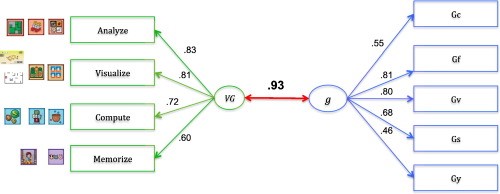
3) Intelligence and video games: Beyond “brain games.” Intelligence, Volume 75, July-August 2019, Pages 85-94 M.A.Quiroga, A.Diaz, F.J.Roman, J.Privado, R.Colom. https://doi.org/10.1016/j.intell.2019.05.001
-”Gaming performance was correlated with standard measures of fluid reasoning, visuospatial ability, and processing speed. Results revealed a correlation value of 0.79 between latent factors representing general intelligence (g) and video games general performance (gVG). This find leads to conclude that: (1) performance intelligence tests and video games are supported by shared cognitive processes and (2) brain-games are not the only genre able to produce performance measures comparable to intelligence standardized tests.”
4) The effects of video game playing on attention, memory, and executive control. Acta Psychologica, Volume 129, November 2008, Pages 387-398. Walter R.Boot, Arthur F.Kramer, Daniel J.Simons, Monica Fabiani, Gabriele Gratton. https://doi.org/10.1016/j.actpsy.2008.09.005
– “Expert gamers and non-gamers differed on a number of basic cognitive skills: experts could track objects moving at greater speeds, better detected changes to objects stored in visual short-term memory, switched more quickly from one task to another, and mentally rotated objects more efficiently.”
Jacobsen: What are some examples in which “many high IQ individuals will do exceptionally poorly in tasks that correlate poorly with general intelligence”?
Anonymous Canadian High-IQ Community Member: Some tasks are better than others at estimating overall mental competence. You can take the g-loading as an index of the complexity of a mental task. Tying your shoes is a low g-loaded task because it is not very complicated, whereas learning calculus is a fairly high g-loaded task since you must problem-solve to acquire new skills. On the Wechsler tests, an example would be digit span forward versus digit span backward. Digit span forward is just a simple memory test, but to give back numbers in reverse order requires more cognitive power. Therefore it is more g-loaded. Einstein’s proficiency and talents would have shown in a challenging field, such as physics, but he probably wouldn’t be famous for driving a car magnificently (apparently, he couldn’t drive). Performing complicated tasks effectively indicates profound intellectual ability, whereas failing to perform essential functions at some level will make people think you’re disabled. Einstein perhaps can be an example of someone who can resemble both descriptions.
Jacobsen: What is the feeling in the separation from the “international Chinese students”?
Anonymous Canadian High-IQ Community Member: In the past, one of my biggest insecurities was my race. Diversity is important. Everyone is unique, and everyone should be proud of themselves. It should also be noted that the group “Asian” is extremely broad, filled with various ethnic groups with very different histories. Not every Asian is Chinese.
I never talked about this to anyone but was conscious about these things near the end of high school. I was quite insecure that I was part of this group labeled as “Asian.” The stereotypes associated with Asian Americans made me feel more conscious of my race since I guess I did not fit those stereotypes. Like an idiot, I fell for the bait and tried to become more “Asian.” It made me feel like I was defined by my race, which led me to forget about the unique traits I have that are divorced from the stereotypes of my racial/ethnic group.
I enjoy being myself, but I don’t want my racial identity or some other part of my social identity to define me. I remember too many times when I blamed any difficulty encountered on my race. On the flip side, would a non-Asian judge me as skillful in math just because of how I look? My race did not play the only role, but I am sure it played an important part. When I saw some non-Asian performing better than me on some non-academic thing, I blamed it on my race to justify it. It was just to my disadvantage, I thought.
Nowadays, I have somehow overcome these insecurities and have matured. I merely view myself as an outlier and outsider, no matter where I go, and have accepted my destiny. Most want to get good grades and go to good schools, but I am different. The Chinese culture never fit me and seemed to inhibit me from being creative and to be my true self and pursue my dreams, and I suffered a lot of depression due to this.
When I was younger, I did not consider ethnicity to be important, but as you grow up with all those stereotypes, they start to hit you. In my senior year of high school, I became more aware of my ethnic heritage and could not escape from it as time went on in my first year of university. I was always judged as being good at math just because of my appearance and quiet personality, and those things did make me uncomfortable a bit, given that I was an underachiever. In contrast, most Asians I knew were overachievers relative to their intelligence or IQ. I was already doing well enough, but I never expected myself to get the highest grades in a class. I never cared about school all that much, but I cared just a little for the first time. Those stereotypes might have helped me improve my work ethic, but later I decided to be who I really was.
I would rather not have anyone associate me with any stereotype. I feel thrilled to know that I am just a unique individual with his own special talents and interests.
Jacobsen: Why the “fear of failure” in a moment of life in which true challenge and competition of talents come forward?
Anonymous Canadian High-IQ Community Member: There comes a time where you realize you won’t balance everything you love to do in life. My parents expect a lot from me, but I probably wasn’t the perfect kid for them. They want me to graduate with a Computer Science degree from UBC and work a stable job for the rest of my life. However, even though my ability to thrive in these STEM programs is very high, going to the workforce as a programmer was not my passion. I just chose what my parents wanted me to do and later decided what my peers wanted to do. I was stuck finding out my passions but eventually found them. I performed at the top of my class in Calculus courses and had already taken too many math courses to quit now. My primary interests were in Philosophy and Psychology, but of course, those degrees by themselves are viewed as worthless. A compromise would be to double major in Philosophy and a STEM field such as Statistics to gain skills to gain a job and pursue my major interests at the same time. I later learned that Statistics should be helpful in a career in science, so I decided to take it a little more seriously. I don’t necessarily have to be the best statistician, but I need to be good enough to perform well enough. It is also impossible to be a professional gamer and pursue research simultaneously; as far as I know, this type of individual is unheard of in the gaming community. I do want to believe I’m something special and that I’d be the one who can do everything, but this type of arrogant mindset will likely be my downfall. I will probably have to pursue my education full time eventually and give up all my passions to become the best scientist I can be. I do not fear failure anymore, but this was a thing of the past. My insecurities alongside Chinese cultural attitudes made me feel like an underachiever. Like a fool, I fell for this trap and became obsessed with prestige. I never really thought going to UBC was anything prestigious, especially compared to the top 12 schools. Anything non-STEM related was also looked down on by many.
Computer Science at Caltech/MIT/Harvard/Stanford made a good match, and I believed my presence would have been better situated there. I also wanted to go to Harvard or Yale Law, Harvard Medicine, and more. My intelligence is not an issue, but it is difficult for me to deal with social interaction, which will make it difficult to succeed in many things in normal society. If I am truly going to live up to my potential, I must pursue the things I am most interested in doing. I realized later that this mindset was wrong and that I must follow what my inner drives tell me I should seek. I believe UBC is an excellent institution, and I’m proud to be here. If I apply to graduate school, I will apply to Canadian schools for sure, no matter what rank. I don’t have to go to the most elite schools to call myself successful. I don’t think my parents have ever said they were proud of me ever, and that didn’t make me too happy. I was definitely influenced by Chinese culture and their obsession with elite schools, jobs, grades, and virtually nothing else. If I fell for this trap, I could never become the scientist that I wanted to be. I also realized that there are people more talented than I am who may not have gotten the chance at all to attend UBC or any elite institution. I must be more humble but still be self-confident with my extraordinary abilities.
If you watched a part of the Ivy Dreams documentary I had linked, my attitude was similar to this one girl. Had I been brought up in her city and applied to the Ivy Leagues, I would have gotten rejected. Even with perfect SAT or ACT scores (she had a pretty high score), and good grades, I would have failed the interview miserably and would have written a terrible essay. In the documentary, her father was always pressuring her. In her interview, her attitude was arrogant, as she was talking about how her high school was too easy for her and how Upenn would challenge her, thinking she was way smarter than everyone else perhaps. She got rejected from the Ivy Leagues and then got accepted to Washington and Lee University. Still, after she finished reading her acceptance letter out loud with a sad attitude, she threw the paper to the ground, with no respect for it at all because it wasn’t an Ivy League school. She had been told her whole life that getting into an Ivy League school was her only goal, and since she had failed that, she felt worthless. I feel bad about her “failure,” but there is no doubt she deserved it.
I need to move past these artificial labels, find out who I am, and not obsess over trivial things. The labels of “genius,” “prodigy,” and “gifted” don’t mean anything to me anymore. Only through hard work, respect, goodness in my heart, and an appropriate attitude will I achieve anything of value. I have nothing to prove anymore, and I am genuinely proud of how far I have come and grown no matter where I end up in life.
I learned a lot recently and hoped to continue to grow as an individual throughout time. Here is what I have learned.
1) Life is hard sometimes. There are things in life that don’t work out. It is challenging to balance one’s passions and school at the same time. I don’t need validation from others regarding my achievements or intelligence. I don’t need validation from anyone else but myself, and I’m proud of how much I have grown. I must be resilient. No matter the obstacle that comes in my way, I can grow from the experience.
2) Being an outlier and outsider made my life a lot harder. I should be proud of who I am and continue to pursue my dreams, no matter what anyone says.
3) Having empathy is essential. I won’t like every person I meet, but learning how to emphasize with others is vital to me to gain long-lasting friends through mutual respect.
Jacobsen: Thank you for the opportunity and your time.
Appendix I: Footnotes
[1] Member, International Society for Philosophical Enquiry (ISPE).
[2] Individual Publication Date: November 1, 2020: http://www.in-sightjournal.com/anonymouscanada-4; Full Issue Publication Date: January 1, 2021: https://in-sightjournal.com/insight-issues/.
*High range testing (HRT) should be taken with honest skepticism grounded in the limited empirical development of the field at present, even in spite of honest and sincere efforts. If a higher general intelligence score, then the greater the variability in, and margin of error in, the general intelligence scores because of the greater rarity in the population.
License
In-Sight Publishing by Scott Douglas Jacobsen is licensed under a Creative Commons Attribution-NonCommercial-NoDerivatives 4.0 International License. Based on a work at www.in-sightpublishing.com.
Copyright
© Scott Douglas Jacobsen and In-Sight Publishing 2012-Present. Unauthorized use and/or duplication of this material without express and written permission from this site’s author and/or owner is strictly prohibited. Excerpts and links may be used, provided that full and clear credit is given to Scott Douglas Jacobsen and In-Sight Publishing with appropriate and specific direction to the original content. All interviewees and authors co-copyright their material and may disseminate for their independent purposes.
Share this:

Author(s): Scott Douglas Jacobsen
Publication (Outlet/Website): In-Sight: Independent Interview-Based Journal
Publication Date (yyyy/mm/dd): 2020/11/01
Abstract
Kishan Harrysingh is a Member of the World Genius Directory. He discusses: some intellectual and spiritual interests; morality; an afterlife; ancient philosophies and religions; and hopes for some of the high-IQ communities.
Keywords: afterlife, ethics, high-IQ communities, intelligence, IQ, Kishan Harrysingh, morality, spirituality, supernatural, World Genius Directory.
Conversation with Kishan Harrysingh on Spirituality, Ethics, an Afterlife, and Pick-and-Choose Philosophy: Member, World Genius Directory (2)
*Please see the footnotes, bibliography, and citation style listing after the interview.*
Scott Douglas Jacobsen: What are some intellectual and spiritual interests now?
Kishan Harrysingh: Spiritual wise, I found almost everything that I can find in terms of the time frame given to me. Certain things will take more time to unfold. There are certain things only possible through time. You only find some things out with time. I have come to a level of enlightenment, where I believe a lot of scientists term it a simulation theory if it is correct. I have not studied this in great detail. I believe that I have seen enough of the world in which we live; I see enough, constantly. A lot is due to luck. I believe I have seen enough and have enough information to believe this isn’t ultimate reality. It is easier to say this now without worrying about ridicule because a number of physicists and other scientists have said this. We are a simulation of deeper reality. I believe this. It is quite apparent, to me, based on the findings.
Jacobsen: What ethic or morality has been developed from this morality or lifestyle for you?
Harrysingh: A large part of this, my base of ethics comes from Christianity and Buddhism. After that, I try to learn from anything in terms of religion. I try to learn from any religious text. There are a lot of things in Islam, which I find beautiful and in depth. However, there are more in Christianity and Buddhism, which appeal to me. My ethics are pretty simple. I believe in freedom and in non-harm, not doing anything malicious, not stealing, trying not to lie; unless, it is really, really for some greater purpose. Obviously, I try to have a more practical approach to ethics than the traditional one. I believe that religion isn’t completely negative. I believe there’s positives and negatives to it. It is up to us to use common sense and to investigate before believing certain religious ideals and so on. I was, at one point in time, a monk or an inspiring monk who was celibate and completely pious and against alcohol and all of that stuff. I am much more liberal nowadays, having seen the enlightenment, which I was chasing. I am more practical and a little more scientific in terms of understanding the human neurological system and psychology. It goes into the system of ethics. Any proper system of ethics would address those things without giving up too much on virtue. Based on what I understand about the human neurological system, and the human experience itself, I am hesitant to gravitate to any particular religion, though.
Jacobsen: Do you believe in an afterlife?
Harrysingh: Yes and no, I believe in the supernatural. I believe in a higher power, but I don’t necessarily believe in an eternal heaven or an eternal hell, necessarily. However, there may be a form of it, a slightly different form of it. I am not too concerned about it. The real challenge is finding out what we have to find out here. As in life, the afterlife, things will happen as they have to.
Jacobsen: If we take the ancient philosophies and religions, and if we take a context in the early 21st century in which more about the operations of the world, the functional aspects, relations, and objects of the world, are known, and if those philosophies and religions came from a time in which those things were complete mysteries, why don’t we simply create new philosophies and jettison those ancient philosophies and religions? Wherein any taking of the good parts of them, we simply take them, and reincorporate them without any of the baggage.
Harrysingh: Right, that’s, basically, what I was saying. You have to pick and choose and not be a slave, mentally, to some theology, some theory, that may have been misinterpreted or felt by a person or a number of people, or moderate by people, who put it there. It amazes me. When humans could listen to news or religious texts, the problem is the same. In that, they don’t consider context and the reliability of the source. To me, those are very, very obvious problems needing consideration. If people considered those two things, then you wouldn’t have this much violence taking over the U.S. and many other places. This is the practical. This is where spirituality is practical. Because you can look at the polarity of the world and see how divided everyone is. Everyone has good intentions and points. However, they both see each other as equal. One side is yelling, “Racist.” The other side is yelling, “Green, communist.” It is really sad. People cannot moderate their own emotions enough to look at the intentions behind the opponent and try to understand: We’re all human. Both sides are trying to move things along. I feel as though I am probably a more moderate version of both arguments or both sides of the argument. I am a more moderate person who understands both sides of the argument. It is really crazy what is going on. It goes to lack of life experience in some cases. Because of my spirituality, I have travelled to a lot of places. I have looked to the darker part of life to understand it. I put myself in danger, which most people try to avoid in life – to try to find the truth. I wish more people would do that rather than sitting in their comfortable little bubbles and trying to dictate to others what the reality is.
Jacobsen: What are your hopes for some of the high-IQ communities in the future?
Harrysingh: I don’t have hopes for them. They need leadership. Clearly, the societies are stagnant. Hopefully, I can provide some of that. It is one of the projects that I am working on, behind the scenes. There is a need for leadership at this point in time. There is a lot of talent out there, but not a lot of vision. I feel as though my own spiritual vision and enlightenment can help humanity on the whole, but that will take some time. I will need cooperation.
Jacobsen: Kishan, thank you so much for your time.
Harrysingh: Alright!
Appendix I: Footnotes
[1] Member, World Genius Directory.
[2] Individual Publication Date: November 1, 2020: http://www.in-sightjournal.com/harrysingh-2; Full Issue Publication Date: January 1, 2021: https://in-sightjournal.com/insight-issues/.
*High range testing (HRT) should be taken with honest skepticism grounded in the limited empirical development of the field at present, even in spite of honest and sincere efforts. If a higher general intelligence score, then the greater the variability in, and margin of error in, the general intelligence scores because of the greater rarity in the population.
License
In-Sight Publishing by Scott Douglas Jacobsen is licensed under a Creative Commons Attribution-NonCommercial-NoDerivatives 4.0 International License. Based on a work at www.in-sightpublishing.com.
Copyright
© Scott Douglas Jacobsen and In-Sight Publishing 2012-Present. Unauthorized use and/or duplication of this material without express and written permission from this site’s author and/or owner is strictly prohibited. Excerpts and links may be used, provided that full and clear credit is given to Scott Douglas Jacobsen and In-Sight Publishing with appropriate and specific direction to the original content. All interviewees and authors co-copyright their material and may disseminate for their independent purposes.
Share this:
Author(s): Scott Douglas Jacobsen
Publication (Outlet/Website): In-Sight: Independent Interview-Based Journal
Publication Date (yyyy/mm/dd): 2020/10/22
Abstract
Anthony Sepulveda scored 174 (S.D.15) on Cosmic and is a member of the World Genius Directory. He discusses: poor social standing; poor economic standing; depression; other health risks; narcissism; highly intelligent couch potatoes; novel situations in which contexts may be non-commutative; professions valuing intelligence in their employees; Mensa a practical option for reasonably intelligent people; AtlantIQ’s efforts important for pragmatic use of intelligent people; Jeffrey Ford; societies renew themselves; the “very poor condition” of the high-IQ community; identifying the disadvantaged; spatial problems; and a possible Holy Grail of the high-IQ world.
Keywords: Anthony Sepulveda (Brown), AtlantIQ, intellect, Jeffrey Ford, mental illness, motivation, narcissism, society, UNICEF.
Conversation with Anthony Sepulveda (Brown) on Intellectual Function and Personality, Formal Mental Illness, Narcissism, Motivation, AtlantIQ-UNICEF, Jeffrey Ford, Societal Renewal, and a Holy Grail of the High-IQ Communities: Member, World Genius Directory (6)
*Please see the footnotes, bibliography, and citation style listing after the interview.*
Scott Douglas Jacobsen: While not having the space for a book, necessarily, off the bat, let’s parse the average intelligence question more particularly in the lines delineated, the factors of poor social and economic standing, depression, and other health risks. If we’re looking at poor social standing, what happens in this case of average intellectual function on personality, where interpersonal and prestige stature are not great?
Anthony Sepulveda (Brown)[1],[2]*: The ability to solve a problem can instill a sense of confidence that will last throughout one’s life. It can make anything seem possible if you only make the correct sequence of moves.
Jacobsen: If we’re looking at poor economic standing, what happens in this case of average intellectual function on personality, where income and net wealth is affected?
Sepulveda (Brown): If you’re unable to resolve problems in your life, a general lack of motivation will prevent you from progressing far towards goals. If your goal is to improve your economic status, you need to truly understand your situation and know how to cultivate the tools and resources necessary to gain the funds and skills you need to do so.
Jacobsen: If we’re looking at depression, what happens in this case of average intellectual function on personality, where feeling bad for months or years at a time becomes a formal mental illness?
Sepulveda (Brown): Depression is the result of having a problem that you cannot resolve or accept enough to move on from. By gaining further insight into the nature of that problem you may be able to move forward enough to get through it. But this can be very hard. Increasingly so as time goes by. Human nature is essentially a number of habits we develop over time. And we often tend to pursue options that continue the trend of our lives. Obvious examples are those who grew up in an unhealthy household and grow up to consistently pursue similar relationships because they feel uncomfortable or unworthy around anything better. It kills me to know that no matter how obvious a solution will be, such people will always make the wrong choice.
Jacobsen: If we’re looking at other health risks, what happens in this case of average intellectual function on personality, where inability to self-care leads to generalized increased risk to negative health outcomes?
Sepulveda (Brown): I’m not sure how much of an impact general intelligence has on one’s health. While it can help motivate one’s desire to avoid certain hazards, I’ve encountered people of all levels that either prioritize or avoid exercise and proper nutrition. It seems more likely that one’s health is a tool used to achieve other goals such as boosting your ego, getting attention from others, pursuing careers such as modeling or athletics, feeling superior to those who live unhealthy lives (such as how vegans tend to chastise those who eat meat) or simply to live longer for personal reasons.
Jacobsen: How does narcissism connect to high intelligence and then lead to worse mental health outcomes?
Sepulveda (Brown): Receiving validation for a belief that you’re better than others (intellectually, in this case) will naturally reenforce or promote a narcissistic personality. If such beliefs are founded upon faulty data from a flawed or invalid IQ test, an individual will likely form an equally invalid opinion of themselves or inspire them to pursue paths they aren’t prepared for
Jacobsen: Even if we take the analysis of “actions, interactions and reactions of the objects (nonliving material) and subjects (living material) in an area,” and if we take individuals capable of a greater grasp of the aforementioned “in an area,” what of the factors of motivation to drive action on the analysis? We all know highly intelligent couch potatoes.
Sepulveda (Brown): This is a very interesting problem when analyzing the impact of personality on intelligence. Clearly, one’s patience, attention span, motivation, etc. will have an impact on their ability to solve a specific problem (especially on untimed tests). But there doesn’t seem to be any socially valid method with which to objectively determine and compensate for a person’s personality on an IQ test. Even if we were to set a time for a person to complete a valid test where the time allowed to work on it is based on their level of stress and/or other physiological inhibitions, there’d be no way to prevent people from unfairly compensating (via drugs or mental preparation (i.e. the Practice Effect)).
Jacobsen: What about novel situations in which contexts may be non-commutative?
Sepulveda (Brown): Such situations are very rare and almost any attempt to resolve a problem under such conditions will result in failure. Clear communication is always necessary, especially when two or more people are involved.
Jacobsen: To “professions [that] value intelligence in their employees,” what ones come to mind? Maybe, the uncommon ones rather than ones, typically, stipulated including pure mathematician or theoretical physicist.
Sepulveda (Brown): IT companies like Google use riddles and logic problems during their interview process to determine whether or not a candidate is truly capable of performing the tasks required of them.
Jacobsen: What makes Mensa a practical option for reasonably intelligent people?
Sepulveda (Brown): Mensa has a lot to offer. They consistently publish a variety of new articles for members to enjoy and offer group meetings and lectures that anyone can attend. For me personally, I’ve greatly enjoyed the conversations held at such meetings. I’ve met a few people that I could connect with to form lasting friendships with and attending the lectures inspires me to create presentations of my own.
Jacobsen: What makes AtlantIQ’s efforts important for pragmatic use of intelligent people? Any thoughts on their UNICEF project?
Sepulveda (Brown): I’m aware that they support UNICEF, but I don’t believe that they hold any particular place within the company itself. As for their efforts, I appreciate how often they emphasize the belief that changing the world for the better takes practical effort. To this end, they often hold contests that require members to find solutions to a variety of world problems (education, renewable energy, environmental stability, etc.). Which is a lot more effort towards a much more noble pursuit than almost every other IQ Society performs. I have the utmost respect for Beatrice Rescazzi and those that work with her.
Jacobsen: What makes a person like Jeffrey Ford tick and work to advance concrete actionables for utilization of – what seems like – a real trait in intelligence for positive benefit in reasonable timelines?
Sepulveda (Brown): I wish I knew. I tried contacting him directly to get some insight, but he wasn’t available. So I’m not aware of whether or not he’s had similar internal debates himself. If he has, he clearly believes that even a temporary effect is worth the effort.
Jacobsen: How could these societies renew themselves and not “waste each other’s time”?
Sepulveda (Brown): By requiring higher standards of proof of personal ability, they’ll create an aura of prestige that some may take more seriously. It would also help if they had a purpose beyond simply existing such as a unanimous desire to solve a specific problem.
Jacobsen: What are some of the other factors filtering into the “very poor condition” of the high-IQ community as it lie prostrate in worship of the aforementioned golden calf of false pursuits?
Sepulveda (Brown): The sad fact is that most people seem to join simply to feel good about themselves for joining. They never had any real drive to do anything practical with their gifts and the community as a whole stagnated into its current condition.
Jacobsen: How could tests such as Cattell’s help identify disadvantaged kids? For example, kids in poor countries such as India with innate abilities and talent while lacking resources, or in highly underserved rural communities or reserves of Native Americans in America or Aboriginals in Canada, or Aborigines in Australia or the Maori in New Zealand – the last largest remnant of European colonial history outside of the ongoing Israel-Palestine issue.
Sepulveda (Brown): I suppose it could be used to identify specific kids if there were an incentive like free schooling. But there are several problems – 1. Cattell’s test is clearly designed to be taken by American or European people. The pictures in it correlate with objects that have a specific design primarily found in those areas (such as the shape of a chimney or stove). So while it is the fairest test I’m aware of, it isn’t useful on a global scale.
2. Say we were to successfully identify gifted children in those areas. We’d have to send them miles away from their home, friends and, likely, family in order to bestow anything of value to them. Those areas simply don’t have the facilities necessary to cultivate their gifts to their highest potential and installing one there would take a lot of effort for very little reward. So, unless the relatively minor impact made on such communities as a whole is worth it (as seen in the efforts of non-profit organizations), the whole venture seems like a waste of time.
3. Say we were to successfully find gifted children in those areas and do everything we can to develop their abilities. What then? It seems to me that they’re very unlikely to go back to their original community. Between the choice of family and community vs opportunity, especially if they were extricated as children, one side is gonna be a lot more appealing. So, if the results of our effort is simply the removal of the best people from the poorest communities, all we’ve done is further impoverish those areas.
It’s a difficult problem. The only option I see that would provide the most benefit is to offer those communities the information necessary for them to benefit as a whole.
Jacobsen: Are spatial problems, in a manner of speaking, simply speaking highly general because of being base-level visual logic problems? No words, no numbers, no concepts, no knowledge, no high-level prior experience, immediate sensory perception with a huge hunk of brain tissue devoted to the visual system with the occipital lobe and then internal, non-verbal logical reasoning on the problems presented, as such, with minimal room for false interpretation to the simplest, i.e., correct, solution for the visual presentation to fit, logically.
Sepulveda (Brown): Yes. Which leads to an interesting topic to consider – If there are a finite number of valid problems that can be used to measure intelligence, that would imply that there’s a set limit to how intelligent anyone can be. That’s why I believe that no one is all that much more capable than anyone else. The biggest differences between any two people are their experiences and the motivation those experiences inspired.
Jacobsen: I have speculated in a similar manner in other interviews on a possible Holy Grail of the high-IQ world and, in more general terms, the professional psychometric community within the concept or possibility, if general intelligence and fluid intelligence are taken seriously, of a non-verbal 6-sigma test with the same funding, renormings, sample sizes, and psychological construct reliability and validity of the WAIS, the SB(IS), Cattell’s, or the RAPM. Any thoughts on this possibility? We have a long history of underusing the talent of girls and women, which has been improving for a century. Now, we see an increasing consistency of underused gifted and talented youth, and people, in general with some factors found in income inequality.
Sepulveda (Brown): Of course. I’ve spent a lot of time pondering the subject over the past couple years, mulling over various problems and weighing the pros and cons of their use. It led to the development of my own test X’s and O’s. And I’d like to make more in the future. But I don’t see much point in the effort if no one takes them. I’ve had my test up on James Dorsey’s website for over a year now and haven’t had any submissions yet. Which is a shame. I put a lot of effort into that project.
Appendix I: Footnotes
[1] Member, World Genius Directory.
[2] Individual Publication Date: October 22, 2020: http://www.in-sightjournal.com/sepulveda-6; Full Issue Publication Date: January 1, 2021: https://in-sightjournal.com/insight-issues/.
*High range testing (HRT) should be taken with honest skepticism grounded in the limited empirical development of the field at present, even in spite of honest and sincere efforts. If a higher general intelligence score, then the greater the variability in, and margin of error in, the general intelligence scores because of the greater rarity in the population.
License
In-Sight Publishing by Scott Douglas Jacobsen is licensed under a Creative Commons Attribution-NonCommercial-NoDerivatives 4.0 International License. Based on a work at www.in-sightpublishing.com.
Copyright
© Scott Douglas Jacobsen and In-Sight Publishing 2012-Present. Unauthorized use and/or duplication of this material without express and written permission from this site’s author and/or owner is strictly prohibited. Excerpts and links may be used, provided that full and clear credit is given to Scott Douglas Jacobsen and In-Sight Publishing with appropriate and specific direction to the original content. All interviewees and authors co-copyright their material and may disseminate for their independent purposes.
Share this:
Author(s): Scott Douglas Jacobsen
Publication (Outlet/Website): In-Sight: Independent Interview-Based Journal
Publication Date (yyyy/mm/dd): 2020/10/22
Abstract
Tiberiu Sammak is a 24-year-old guy who currently lives in Bucharest. He spent most of his childhood and teenage years surfing the Internet (mostly searching things of interest) and playing video games. One of his hobbies used to be the construction of paper airplanes, spending a couple of years designing and trying to perfect different types of paper aircrafts. Academically, he never really excelled at anything. In fact, his high school record was rather poor. Some of his current interests include cosmology, medicine and cryonics. His highest score on an experimental high-range I.Q. test is 187 S.D. 15, achieved on Paul Cooijmans’ Reason – Revision 2008. He discusses: critically evaluate and reason through information; the other subject matters that have been “intriguing” or “meaningful” based on ‘whims’; cryonics; biological death; the general reaction to the discovery of life on other planets; the general risk factors for cancer formation coming out research in carcinogenesis; other micro interests; advice to other gifted and talented youth who lack motivation, study skills, discipline, and interest in studying; personal experience communicating, exchanging opinions, and sharing ideas; why cultures adhere to supernaturalistic beliefs; some of the favourite contemporary artists; a genius in the modern day; a “decent life”; and people who he considers smarter than himself.
Keywords: art, biological death, carcinogenesis, cryonics, high-IQ, IQ, Tiberiu Nicolas Sammak.
Conversation with Tiberiu Nicolas Sammak on Critical Evaluation, Whims, Cryonics, Biological Death, Carcinogenesis, Advice, and Contemporary Artists: High-IQ Community Member (4)
*Please see the footnotes, bibliography, and citation style listing after the interview.*
Scott Douglas Jacobsen: When you’re picking up some information online based on a general interest in some obscure subject matter, and when you’re ‘investigating something in particular, what is the internal thought process there? How do you critically evaluate and reason through information, so as to determine if the information is valuable or not?
Tiberiu Nicolas Sammak[1],[2]*: I don’t really know how to describe the exact mechanisms behind my decision-making process. What I can confirm is that you have to be pretty well-informed on the subject that you are conducting research on to be able to accurately gauge the degree of correctness of your findings.
To me, deciding what information is correct and not inaccurate or deceitful is just common sense (after I know enough about something), roughly speaking.
Jacobsen: What are some of the other subject matters that have been “intriguing” or “meaningful” based on ‘whims’?
Sammak: In-depth lore about certain video games, articles about cellular senescence, philosophical publications (most of the ones I have read or skimmed through being located on the Stanford Encyclopedia of Philosophy website), different stuff about particular movies (or cartoons) or snippets of information about computer-related topics would be some of the subject matters which come to my mind.
Jacobsen: How much of the information around the cryonics is pseudoscience/non-science proposed as scientific information or methodology?
Sammak: The very idea that a brain could regain its consciousness after legal death is what makes other people to be skeptical and reserved about the industry of cryonics. As far as I’m concerned, nothing unscientific pertaining to human cryopreservation is presented as a scientific fact.
Jacobsen: You noted, “I’d like to be more open-minded about it, considering it’s probably the only current possibility to ever be conscious again after the biological death, whereupon eternal oblivion awaits.” Do you consider biological death final?
Sammak: I do, since there is actually no evidence to suggest otherwise. It is very clear that the brain is the organ solely responsible for creating consciousness. However, the precise mechanisms as to how it manages to do that are yet to be fully discovered. An explicit and really straightforward example proving this (that consciousness is entirely generated by the brain) is represented by the way people who are affected by neurodegenerative diseases behave and function. Their consciousness is gradually stripped away by their condition, leaving them unable to perform even the most basic tasks – they become shadows of their former selves.
The cessation of all brain’s functions marks the dawn of an eternal, dreamless sleep. This is an irreversible process (brain death) which will eventually occur at some point in time. This process might be delayed with future technologies, but all organic matter is subject to decay nonetheless.
I cannot imagine a different yet plausible scenario after the biological death. I wish I were wrong though.
Jacobsen: What do you think would be the general reaction to the discovery of life on other planets?
Sammak: My guess is that the prevalent reaction would be surprise. The first encounter (not necessarily a physical one) with an extraterrestrial lifeform would cause wonder and stir great curiosity, to say the least.
However, the chances of a physical encounter with an alien being in the current timeframe are probably non-existent or incredibly low.
Jacobsen: Based on the research, what are the general risk factors for cancer formation coming out research in carcinogenesis?
Sammak: As far as I know, there are many risk factors which could potentially alter one’s genes and lead to the onset of cancer, such as hereditary (like Li-Fraumeni syndrome or von Hippel-Lindau syndrome) or environmental factors, lifestyle choices, obesity, or old age. Most cancers are sporadic but some of them could be prevented by simply not indulging in self-destructive behaviors, such as alcohol abuse (which could lead to cirrhosis of the liver and then evolve into a hepatocellular carcinoma) or smoking. It’s worth mentioning that most lung cancers are caused by tobacco use and they could actually be avoided. Some lung cancers are known to develop chiefly (with few exceptions) in smokers’ lungs, like small cell lung cancer, which is much more aggressive than non-small cell lung cancer. Unlike other cancers, lung cancer has a very poor prognosis. To my knowledge, only a few malignancies would have a dimmer outcome (for instance, mesothelioma, exocrine pancreatic cancers or grade IV brain tumors, such as GBM).
Another environmental risk factor that I’d like to bring into discussion is represented by the asbestos exposure. A notable case which emphasizes the dangers of inhaling asbestos fiber was known as the Wittenoom tragedy. Wittenoom (now a degazetted ghost town) was a town which was mainly known for its asbestos mine and for asbestos mining and milling activities. Due to long-term exposure to crocidolite (also known as blue asbestos) fibers, a lot of miners and even people who were mere inhabitants developed pleural or peritoneal mesothelioma, which is a very lethal type of cancer.
Jacobsen: Any other micro interests akin to paper airplanes?
Sammak: Not really.
Jacobsen: What is the advice to other gifted and talented youth who lack motivation, study skills, discipline, and interest in studying? This can be ideas or pragmatic stuff.
Sammak: I don’t have specific advice for such people. Things like motivation when it comes to achieving certain goals and self-discipline are internal and cannot be imposed on someone. Sure, one may instill motivation in someone by inspiring that someone through different means. In my view, this is probably one of the best ways to motivate a person.
Perhaps having a really great mentor who could offer guidance throughout youthhood would be beneficial for these people as well.
Jacobsen: What has been personal experience communicating, exchanging opinions, and sharing ideas with others who performed above a similar level on cognitive ability tests?
Sammak: I’ve had very few interactions with people from the high-range testing community. However, almost all of the interactions turned to be positive and enjoyable.
Jacobsen: Why do you think many in cultures adhere to supernaturalistic beliefs?
Sammak: I suppose that’s because many are not well-informed when it comes to a certain topic. Many like to speculate and form twisted views about different subject matters when they are ill-informed. It is way easier to take something for granted than to actually search about that something.
I think the belief in the supernatural is inextricably linked with the unknown.
Jacobsen: Who are some of the favourite contemporary artists for you? Why them?
Sammak: I will mention only musical artists, since I listen a lot to music and I do believe these guys do a great job. In no particular order, my favorite musical artists or musical bands are: Paul Oakenfold, Disturbed, The Anix, Klayton (with his three projects: Celldweller, Scandroid and Circle of Dust), Disarmonia Mundi, Poets of the Fall, Christian Älvestam and The Midnight. These are probably the people or bands whose music I enjoy the most.
I consider some of their songs truly beautiful and awe-inspiring.
Jacobsen: Who do you consider a genius in the modern day?
Sammak: I cannot answer this since I have not thoroughly and carefully studied the works of truly exceptional people and I’m not the guy who would label someone as a genius so readily. Moreover, I was never interested in the work of a particular person to actually devote enough time studying it.
Jacobsen: What would comprise a “decent life” to you? You seem concerned about degradation and death more than many other things.
Sammak: A life where I wouldn’t have to constantly worry about taxes or about not having enough money for basic needs, a life in which I would be satisfied with my efforts, a life where I would be happy.
Jacobsen: Who do you consider smarter than yourself?
Sammak: There are quite a few people whom I personally know and who are smarter than I, or at least seem to be smarter than I.
Jacobsen: Thank you for the opportunity and your time, Tiberiu.
Appendix I: Footnotes
[1] Highest score: Reason – Revision 2008, IQ 187 (S.D.15).
[2] Individual Publication Date: October 22, 2020: http://www.in-sightjournal.com/sammak-4; Full Issue Publication Date: January 1, 2021: https://in-sightjournal.com/insight-issues/.
*High range testing (HRT) should be taken with honest skepticism grounded in the limited empirical development of the field at present, even in spite of honest and sincere efforts. If a higher general intelligence score, then the greater the variability in, and margin of error in, the general intelligence scores because of the greater rarity in the population.
License
In-Sight Publishing by Scott Douglas Jacobsen is licensed under a Creative Commons Attribution-NonCommercial-NoDerivatives 4.0 International License. Based on a work at www.in-sightpublishing.com.
Copyright
© Scott Douglas Jacobsen and In-Sight Publishing 2012-Present. Unauthorized use and/or duplication of this material without express and written permission from this site’s author and/or owner is strictly prohibited. Excerpts and links may be used, provided that full and clear credit is given to Scott Douglas Jacobsen and In-Sight Publishing with appropriate and specific direction to the original content. All interviewees and authors co-copyright their material and may disseminate for their independent purposes.
Share this:
Author(s): Scott Douglas Jacobsen
Publication (Outlet/Website): In-Sight: Independent Interview-Based Journal
Publication Date (yyyy/mm/dd): 2020/10/22
Abstract
Kishan Harrysingh is a Member of the World Genius Directory. He discusses: some family background; academic achievement common in the family; the source of feeling depression, sadness; moments of what has been called “overexcitability”; the asynchrony; some odd jobs; some of the tests and the scores; and intelligence, and a life in the 20s spent on spiritual pursuits.
Keywords: depression, family, intelligence, IQ, Kishan Harrysingh, spirituality, World Genius Directory.
Conversation with Kishan Harrysingh on Family Background, Academic Achievement in the Family, Depression, Odd Jobs, and Spiritual Pursuits: Member, World Genius Directory (1)
*Please see the footnotes, bibliography, and citation style listing after the interview.*
Scott Douglas Jacobsen: What is some family background to provide a long-term context for some of your story?
Kishan Harrysingh[1],[2]*: I am from Trinidad and Tobago. My father is an engineer. My mother works in financial consulting. She has worked in that field for quite some time. Before, she was an accountant for many years. I have a lot of cousins in the medical field.
Jacobsen: Is this kind of academic achievement common in the family?
Harrysingh: Yes, absolutely, it is something that I try to deny to myself, because I was against academics for most of my life. I felt like it was something making people more arrogant than something adding depth and character. For that reason, I denied my own abilities and need for company. People who can understand me for many, many years. Until, I was in my 30s. So, only until a couple of years ago. This is only because of depression, anxiety, and other issues. I was able to start addressing and looking to the fact that I am not normal. Perhaps, I need to find more people like myself to get along with because I have always had really, really serious issues with the abilities of other people to communicate.
Jacobsen: When you’re feeling that way, what do you consider the source of feeling depression, sadness? Is it loneliness? Is it an innate factor? Or is it some existential question begging you?
Harrysingh: A combination of all of those. I have had those problems since I was a teenager. I never understood why my friends – no matter how much I explain it – never understand the concepts. It seemed natural to me. I was very much brainwashed into thinking everyone is exactly as intelligent as each other. It is only a matter of effort. There is some truth to that, obviously, because, I believe, neural pathways strengthen with practice. Also, there is a truth. People are born with certain gifts. For me, philosophical intellect and understanding existential questions, I am genetically gifted with it. I see this in my brother, when he was very young. The things that he would say, even adults had trouble understanding it. Maybe, it must be a genetic thing. It causes a lot of problems. My thinking is so different from the average person. My standards and ethics, and morality, and conduct, and my standards in personal life, are so high. Most people find it impossible to live up to them. It comes from the way in which I intellectualize, conceptualize, and understand the world.
Jacobsen: Can you recall any moments of what has been called “overexcitability” of the profoundly gifted in personal life? The profoundly gifted to experience emotions in the extreme.
Harrysingh: That’s definitely me. Also, I can detach because of many years of spiritual development, even completely. I definitely am a very emotional person. A lot of common problems with friends who are gifted and have had to find an outlet in things like power lifting, etc., where they can channel the emotions to physical things. Definitely, I have always been very, very emotional volatile person. It affected learning. If a teacher is not engaging enough and not interesting enough, or not presenting the work in a properly explained fashion, I would lose interest. So, that emotional side probably affected me more than the average person. I went from failing a class to the top of a class in a class 2 years older than me with very little effort. It had to do with emotion. I started to realize. It was after going through a few things. Maybe, that’s why there was the disparity. Emotion, for sure, have affected me more than the average person. I am trying to find the right explanation without dragging on for an hour.
Jacobsen: [Laughing].
Harrysingh: Yes, there is so much to explain in the story for me. This is the reason for the stammering to an extent.
Jacobsen: In some sense, this overexcitability, this feeling out of place, this being at the bottom of the class and then being at the top of the class, it matches well the idea of asynchronous development. The asynchrony being between one’s intellectual abilities and one’s emotional maturity. Do you note this is more extreme in terms of the asynchrony for boys than for girls, men than for women?
Harrysingh: It makes sense. I have been suggesting things like this for a long time. I made those inferences. However, I believe, if you look at the curve of IQ, you will find more boys very, very far to the right. There is a high proportion of males who have extreme and profound giftedness than females. Also, we have a higher number of males who are profoundly handicapped. Females tend to cluster in the middle. They tend to be more ‘cold’ or tend to be less emotional in the perspective of their giftedness. That makes sense to me.
Jacobsen: Also, in some ways, it would match the idea of far more women in English Literature, in writing, in journalism, when it comes to postsecondary education. Because those fields, in light of the fact of being in postsecondary education, will require a higher level of general intelligence. They also require a greater level of emotional maturity and insight into the human condition based on the combination of analytic ability and emotional maturity. What have been some odd jobs for you? What have been some more fruitful and fulfilling jobs for you?
Harrysingh: My professional life is a bit of a mess to be honest with you. I have had a very, very unique life with respect to spending early 20s searching for spiritual enlightenment. After that, the only thing I got into was personal entrepreneurial stuff. I am more of an outlier in that sense. I am not someone with a vast professional life. I am not someone tremendously active and accomplished in academics. I am always someone who has mostly denied my own abilities until relatively late in life to pursue higher level academics, and developing a perspective. For me, it goes back to the emotional side of things. I felt passionately, particularly about personal issues of family. It helped in finding my purpose of existing; I sacrificed a lot of younger years, where I would have been in academics, with a pursuit of enlightenment to find the truth behind it all.
Jacobsen: Let’s talk about tests, what are some of the tests and the scores?
Harrysingh: I am new to this. I scored 160 on this one. However, this one is based on a great crystallized intelligence tested. So, there is a lot of information needing research. I didn’t want to spend too much time and effort on it. I submitted it early. It has to be a fact taken into consideration with intelligence testing. Some take months on a test. Some will take a few hours. For me, I did this in the space of one or two days and spent three, four, or five hours in total. Even though, I started weeks before. I didn’t continue. I started like two and a half weeks before. Most of the stuff was done in a couple of days. I think the two tests done prior to this one were intelligence tests with the ceiling being really low. The ceilings were or 160 or 165, which will tend to lower the score. I scored about 150 on those. However, this is the first full scale test going to 200, which I have done. I expect that I will score a lot higher in the future. I need to get more time to be tested based on things not too foreign to me. That’ll more test more fluid intelligence than crystallized intelligence.
Jacobsen: Now, if we are talking about intelligence and a life in the 20s spent on spiritual pursuits, how are you defining the spiritual here? In other words, what is human nature? What is the nature of the world? What is the human nature in this spirituality that you have developed as a sensibility or a worldview over time?
Harrysingh: Excellent question, I would say, “I first started becoming spiritual when I was 15.” I was depressed by the ways in which my family related to each other. I felt, to some extent, unloved. To some extent, this drove me to search for a meaning to life. I looked around myself. I saw how people spent all of this time on developing ways to survive, and working. I could see almost nobody as truly happy or someone who was truly moral. I started pursuing the spiritual path. It started with curiosity first. I had to find out if there was a spiritual path. Should I believe or not if there is a God? Which religion should I choose? Which pathway seems to be the truest? I wouldn’t believe something simply because it was put in a book. I was too smart for that. I started questioning life, little by little, and testing personal theories and different ideas. That’s when I started having certain personal experiences leading me to greater depth of belief. It continued later into the teens and early 20s. After certain issues and relationships, things like that. Truly, the emotional side of life led the pursuits for me. To an extent, it is the thing with gifted people. Mostly with those on the side of philosophical side of thinking rather than the traditional side of academics. It is sad to me. Philosophy and ethics are left out of modern day academics because I think human society is decaying largely in part to the disappearance of this part of our intellect and our development.
Appendix I: Footnotes
[1] Member, World Genius Directory.
[2] Individual Publication Date: October 22, 2020: http://www.in-sightjournal.com/harrysingh-1; Full Issue Publication Date: January 1, 2021: https://in-sightjournal.com/insight-issues/.
*High range testing (HRT) should be taken with honest skepticism grounded in the limited empirical development of the field at present, even in spite of honest and sincere efforts. If a higher general intelligence score, then the greater the variability in, and margin of error in, the general intelligence scores because of the greater rarity in the population.
License
In-Sight Publishing by Scott Douglas Jacobsen is licensed under a Creative Commons Attribution-NonCommercial-NoDerivatives 4.0 International License. Based on a work at www.in-sightpublishing.com.
Copyright
© Scott Douglas Jacobsen and In-Sight Publishing 2012-Present. Unauthorized use and/or duplication of this material without express and written permission from this site’s author and/or owner is strictly prohibited. Excerpts and links may be used, provided that full and clear credit is given to Scott Douglas Jacobsen and In-Sight Publishing with appropriate and specific direction to the original content. All interviewees and authors co-copyright their material and may disseminate for their independent purposes.
Share this:
Author(s): Scott Douglas Jacobsen
Publication (Outlet/Website): In-Sight: Independent Interview-Based Journal
Publication Date (yyyy/mm/dd): 2020/10/22
Abstract
This is an interview with an anonymous Canadian member of the high-IQ communities. He discusses: philosophy professor; tips for high school students; another possible academic pursuit; self-confidence and arrogance; self-selection of environments; and some of the environments.
Keywords: International Society for Philosophical Enquiry, University of British Columbia.
Conversation with Anonymous Canadian High-IQ Community Member on Advice, Self-Selection, the Spotlight, STEM, and Hereditarianism Versus Environmentalism: Member, International Society for Philosophical Enquiry (ISPE) (3)
*Please see the footnotes, bibliography, and citation style listing after the interview.*
Scott Douglas Jacobsen: What makes this “philosophy professor” stand out to you?
Anonymous Canadian High-IQ Community Member[1],[2]*: I went to office hours one time to discuss some research relevant to his research interests. My particular interest was related to race and IQ, and I wanted to hear what my professor had to say. The subjects he was interested in had a relation to my interests, so he likely could hold a conversation with me in person. He recommended various books, articles, and he had even given me a list of academics to take up. The major problem with this discussion about race and IQ is that certain aspects of the debate are always hidden and are difficult to find. Only after a thorough examination of evidence from all possible perspectives could one call themselves an objective scientist. My primary interest was to find rational responses to the hereditarian position. My philosophy professor was a good choice to talk with because he had stated that he was aware of the debate. At first, I was quite unsure where the evidence pointed, and so I knew I’d have to decide for myself. My philosophy professor played an essential role in helping me discover all possible perspectives of the debate. He gave me an excellent grade in the course, which increased my interest in philosophical discussions and topics.
My professor is merely skeptical about hereditarian claims, but my view is more clear after being exposed to everything. My conclusion is that the totality of the evidence indicates no genetic component to racial differences in average IQ and that they are more likely to be around 100% caused by environmental and cultural differences. This holds true both within and between nations. However, the topic is still being explored and won’t disappear anytime soon. Even though it is way too complicated, I am very confident in my conclusion that the differences in test scores are virtually entirely environmental in origin. Hereditarians will claim that universities have brainwashed me. Still, the truth is that I came to my views all by myself, honestly and rationally, free from any bias, after considering every perspective possible.
My professor got me to read Ned Block’s paper “How heritability misleads about race” and told me that was why he didn’t believe heritability would help the hereditarians all that much. This is a very insightful paper because over 99.9 percent of individuals who are aware of this debate seem to have trouble grasping the role heritability plays in this debate. The primary issue with the hereditarian position is that even the most well-known hereditarians have misapplied the concept of heritability. Heritability is an estimate of genetic variation among individuals within a population, either in the context of a formal experiment that controls for potentially confounding environmental effects or with the assumption that such effects are absent. In the case of IQ, we cannot do these formal experiments, so we must assume the environmental effects are absent. But, certain individuals used evidence of heritability for making inferences about whether or not there were genetic differences among populations. This is not an appropriate application of the statistic. Heritabilities could be very high within a population, yet the differences among populations could be entirely attributable to environmental effects. Conversely, heritabilities could be relatively low within the population in which they are estimated, yet the differences among populations could have a vital genetic component to them. Genetic variation within populations is simply a different measure from the genetic differences between populations, so all of those attempts to make inferences about genetic differences in IQ among populations were based on a faulty application of the concept of heritability.
One of the books my professor told me to read was Richard Nisbett’s book called “Intelligence and How to Get it.”
The best well-known intelligence researcher on the culture-only side would be the late James Flynn. He has produced a lot of great arguments and books that support the environmentalist position.
I emailed David Reznick, an expert in human biology, and he has no idea of who he even was but still critiqued Rushton’s views the best he could.
Joseph Graves, the first African American to receive a Ph.D. in evolutionary biology, has refuted Rushton’s application of the theory.
Chris Stringer, one of the foremost experts on human evolution, who also mentions Rushton in his books, says that he is wrong, although I have yet to read them all yet. He recommended I read “The Race Gallery” by Marek Kohn.
In conclusion, my philosophy professor gave me a sense of interest in subjects relating to philosophical inquiry. Thanks to him, I emailed various eminent professors to get more perspectives to understand complex issues.
Jacobsen: Any tips for high school students about pursuing postsecondary educations?
Anonymous Canadian High-IQ Community Member: Know your requirements for every college application but don’t stress over them. Don’t be domineering; plan for your interviews, and appreciate the experience. Represent the person you genuinely are and express it candidly.
I am brought up in the Canadian school system, so there are no standardized tests. However, for Americans, I’d say start studying for the SAT or ACT during the summer of junior or the summer after sophomore year. Take lots of practice tests and buy the prep books, and practice on Khan Academy and with your friends if possible.
I think most people should consider their options before their senior year of high school. I think it will help you research your options thoroughly and figure out what fields should fit your aptitude and interests. STEM majors are more evident toward where you end up, but if your talents and passions genuinely lie in the liberal arts, I would encourage it. The amount of coursework in university is anticipated to be a lot more numerous than in high school, so I recommend developing a stable work ethic as early as possible. Many people struggle in the first year. Most students going into UBC are straight-A students from high school but quickly realize that university is no joke. Just do your best, follow your dreams, consider backup options, and you will have no regrets.
The critical thing is to prioritize school first if you want to get into your preferred program. A friend of mine in high school, who was quite a high achiever, told me he never looked at an admission requirement (GPA cutoff or average) aside from seeing the required courses needed because once you have done your best, you leave no regrets. If you know the requirements, you will continuously accentuate them.
If we include the entire population, the correlation between IQ and educational achievement and attainment is around .6 (IQ. explains 36% of the variance in grades and years of education), so I wouldn’t worry about whether you have the highest IQ in your high school or not. The correlation between achievement drops to around .5 in high school. The correlation declines further in university and then even more in graduate school due to sample restriction, leaving many more factors responsible for achievement differences. It is much more important to see success in life (economically) as more related to grit, conscientiousness with a mindset for growth than any natural ability.
Finally, I would like to share three important YouTube videos (one documentary, two films) that truly influenced me.
1) Ivy Dreams Documentary (You can find a shorter Youtube video called Strict Asian Parents & Stressed, Pressured Youth – College Process).
- Director: Yu-Teh Huang
- Writer: Joy Huang
2) Acceptance – Ivy League Admissions Movie (2013)
- Director: Ryan Matthew Chan
3) Legally Blonde (2001)
- Director: Robert Luketic
Jacobsen: As a “viable option… to pursue in the future,” if you had not found this joy in academia, what would be another possible academic pursuit for you?
Anonymous Canadian High-IQ Community Member: I honestly don’t see any other academic pursuit that could be appropriate for me other than academic research at the moment. I could work any job but it won’t be likely for me to reach the top given that those things are not interesting for me and not what my inner motivation tells me I should do. I hope I’ll be able to enjoy the workforce if I have to, but I should be settled down with my goals.
Jacobsen: What differentiates self-confidence and arrogance in this “higher IQ” domain? What is the importance of the latter as a character trait than the latter with the greater responsibility inherent in greater capacity to some degree?
Anonymous Canadian High-IQ Community Member: Arrogance is related to narcissism. Entitlement, insecurities, and low self-esteem seem to be significant indicators of narcissism. It is hard to differentiate narcissists from overconfident individuals, but you realize that most narcissists need validation, but self-confident individuals do not need validation for their achievements.
Overall, having a remarkable ability may allow individuals to be more responsible for helping people, rather than viewing themselves as gods. Be aware of their shortcomings. Self-confidence will enable one to work with others and grow as a person through mutual understanding and empathy. On the other hand, arrogance is a god-complex sort of deal that won’t help anyone form meaningful connections.
Jacobsen: With this self-selection of environments, what are some of those self-selection mechanisms?
Anonymous Canadian High-IQ Community Member: Robert Plomin’s book, “Blueprint: How DNA Makes Us Who We Are” gives a splendid answer. Most people find it hard to imagine how behavioral geneticists can begin to disentangle which behavioral characteristics are caused by genetics or the environment (nature or nurture). The most effective way to explore this question is by studying large longitudinal twin and adoption studies. Another way is to rely on the continuous decoding of the human genome.
Blueprint’s central thesis is what Plomin calls “the nature of nurture,” which posits that our genes push us to react to, cooperate with, and even develop our own environments to fit our genetic inclinations. Plomin states, ‘ Psychological environments are not “out there” imposed on us passively. They are “in here,” experienced by us as we actively perceive, interpret, select, modify, and even create environments correlated with our genetic propensities.”
Self-selection relies on the big five personality traits and intelligence. These traits are polygenic and influenced by environmental and genetic factors and the interaction between the two.
Aside from this, there are many critiques of heritability. The complex interaction of genes and the environment makes these questions endlessly tricky. The next book I plan on reading will be a book by James Tabery called “Beyond Verses: the struggle to understand the interaction of nature and nurture.”
Jacobsen: Following from the previous question, what are some of the environments?
Anonymous Canadian High-IQ Community Member: Deciding what your college major will be, or where you will live will influence your future environments and your responses. If you enjoy reading, perhaps you will find a local library quite fitting for you. If you are quite competitive, maybe you will join a football team. Talent for a particular field will make you more likely to choose to participate, given that people tend to prefer to partake in activities that they perform well in.
In effect, the family effect on IQ seems to fade away in adulthood as the heritability of IQ increases. However, it is essential to note that if an individual is treated poorly in society and their environment somehow becomes more detrimental every year, their IQ scores would drop each year, even though their true phenotypic intelligence may have been a lot higher. Suppose the environment somehow is pushed to become more relevant to solving the problems we see on IQ tests each subsequent year. In that case, IQ test scores will subsequently increase every following year, which may overestimate that particular individual’s true intelligence.
An environment where it is difficult to choose your own environment would be when substantial environmental factors put you on hold. Amy Chua’s book Battle Hymn of the Tiger Mother gives that sort of feeling.
Appendix I: Footnotes
[1] Member, International Society for Philosophical Enquiry (ISPE).
[2] Individual Publication Date: October 22, 2020: ; Full Issue Publication Date: January 1, 2021: http://www.in-sightjournal.com/anonymouscanada-3.
*High range testing (HRT) should be taken with honest skepticism grounded in the limited empirical development of the field at present, even in spite of honest and sincere efforts. If a higher general intelligence score, then the greater the variability in, and margin of error in, the general intelligence scores because of the greater rarity in the population.
License
In-Sight Publishing by Scott Douglas Jacobsen is licensed under a Creative Commons Attribution-NonCommercial-NoDerivatives 4.0 International License. Based on a work at www.in-sightpublishing.com.
Copyright
© Scott Douglas Jacobsen and In-Sight Publishing 2012-Present. Unauthorized use and/or duplication of this material without express and written permission from this site’s author and/or owner is strictly prohibited. Excerpts and links may be used, provided that full and clear credit is given to Scott Douglas Jacobsen and In-Sight Publishing with appropriate and specific direction to the original content. All interviewees and authors co-copyright their material and may disseminate for their independent purposes.
Share this:
Author(s): Scott Douglas Jacobsen
Publication (Outlet/Website): In-Sight: Independent Interview-Based Journal
Publication Date (yyyy/mm/dd): 2020/10/15
Abstract
Bob Williams is a Member of the Triple Nine Society, Mensa International, and the International Society for Philosophical Enquiry. He discusses: growing up; a sense of an extended self; the family background; the experience with peers and schoolmates; some professional certifications; the purpose of intelligence tests; high intelligence; the geniuses of the past; the greatest geniuses in history; a genius from a profoundly intelligent person; profound intelligence necessary for genius; job path; the more important aspects of the idea of the gifted and geniuses; thoughts on the God concept or gods idea; science; some of the tests taken and scores earned (with standard deviations); the range of the scores; worldview-encompassing philosophical system; meaning in life; intelligence in the abstract; and the mainstream and fringe theories of human intelligence on offer over time.
Keywords: Bob Williams, intelligence, International Society for Philosophical Enquiry, IQ, Triple Nine Society.
Conversation with Bob Williams on Background, Genius, Theories of Intelligence, Psychometrics, and Worldview-Encompassing Philosophical System: Retired Nuclear Physicist (1)
*Please see the footnotes, bibliography, and citation style listing after the interview.*
Scott Douglas Jacobsen: When you were growing up, what were some of the prominent family stories being told over time?
Bob Williams: Family stories were about what my grandparents and parents experienced before I was born. I recall thinking that I would not see advances as dramatic as those experienced by my grandparents. They were born before electrification and before flight, yet lived to see the first humans land on the moon. It is difficult to compare my life to theirs, but I think there have been at least as many big changes as they experienced.
Jacobsen: Have these stories helped provide a sense of an extended self or a sense of the family legacy?
Williams: Stories of past lives and experiences help to put my life in perspective. There has been an enormous change in the standard of living that my family has experienced as a result of increasing amounts of education and the technology that has increased exponentially in the last two centuries.
Jacobsen: What was the family background, e.g., geography, culture, language, and religion or lack thereof?
Williams: I was born during WW2 and grew up in Virginia in the suburbs of a city that was third largest (back then) in our state. We had two groups: whites and blacks. {Today this seems strange. As a student I only met one child who was Jewish and that was in primary school. We had one Catholic church, but I only knew of one student in my school who was Catholic. There were no Hispanics, Arabs, Russians, or any of the ethnic groups that we only knew about from movies.} Everyone claimed to be Christian; that meant Protestant as Catholics were presumed to mostly live elsewhere. Crime rates were low and violent crimes almost nonexistent. There was a very strong hatred of the North that was residue from the war. My great-great-grandfathers fought for the South, as did the families of those I knew. Today, that feeling has vanished. Technology and multiple generations caused many changes, even in local demographics.
Jacobsen: How was the experience with peers and schoolmates as a child and an adolescent?
Williams: I began first grade when I was 5 (6 was the usual). I had to go to a private school for one year, then transfer to the public schools. Through every grade, I was the youngest and, fortunately, one of the tallest in every class. One curiosity I have is about what was known about me by the schools and teachers. I don’t recall what if any standardized tests were given back then. I was apparently tested by a psychologist before being allowed to start school at age 5.
Jacobsen: What have been some professional certifications, qualifications, and trainings earned by you?
Williams: I have two degrees in physics and one in business administration. I went into the nuclear reactor business and worked (core design, modeling, analysis, instrumentation, etc.) in the private sector, then in the nuclear weapons business (we were intending to build a tritium producing reactor, before the SALT treaty made it unnecessary). In that particular market, everything is either proprietary (private sector) or classified (weapons program). As a result, despite constant writing, nothing was seen “outside.” We had only advancement as a reward. I joined my private sector company as an associate physicist, but the company decided to make everyone an engineer, so my job titles went that way, from engineer, to senior engineer, to principal engineer, and to fellow engineer. During that time I also held a range of management titles. I also became the company representative (we had research labs and production plants scattered over the eastern part of the US) for joint research projects, which led me to a very enjoyable stint of high level meetings with people in the US, over much of Europe, and the Middle East.
Jacobsen: What is the purpose of intelligence tests to you?
Williams: Today we can measure intelligence reliably and with good predictive validity. The only purpose of these tests is to predict important life outcomes. If the tests don’t do that, they are worthless… but they do it quite well. More intelligence means that there is a higher probability that a desirable outcomes will happen and undesirable ones will not. More intelligent people are more likely to experience: higher income, increased longevity, greater general health, more life satisfaction, higher degree of body symmetry, higher educational achievement (grades, years completed, difficulty of major), higher SES (a product of intelligence, not a cause of it), faster speed of mental functions, better memory, faster learning rate, greater number of interests (held with competence), higher job performance, higher brain efficiency (relative to glucose uptake rate and speed of mental operations). And … they are less likely to be impacted by smoking, HIV infection, crime, incarceration, school dropout, teen pregnancy, illegitimate births, and unemployment.
At the national level, mean national IQ correlates positively with per capita GDP, economic growth, economic freedom, rule of law, democratization, adult literacy, savings, national test scores on science and math, enrollment in higher education, life expectancy, and negatively with HIV infection, employment, violent crime, poverty, % agricultural economy, corruption, fertility rate, polygyny, and religiosity.
This effect does not have a known ceiling. The Study of Mathematically Precocious Youth is a longitudinal study started by Julian Stanley and maintained today by Camilla Benbow and David Lubinski. Part of the study evaluated cohorts in the top 1% of intelligence. It showed that there are large differences between those in the bottom quarter of this range and those in the top quarter of the top 1%. These differences, favoring the more intelligent top quarter have been found in number of doctorates, number of STEM publications, number of patents awarded, income and literary publications.
Jacobsen: When was high intelligence discovered for you?
Williams: Apparently it was well before I was aware of it. Even in primary school, I was selected for special treatment (a summer camp), a place on the varsity high school debate team when most participants were 4 years older, etc. By age 15, I began to win awards in science fairs
that led to half a dozen trips to various parts of the nation; two trips to the International Science and Engineering Fair (one was part of the World’s Fair in Seattle); lots of prizes, a summer job, and ultimately scholarships that paid for much of my college education. Upon entering my university I was given a chemistry test, which let to my being put in an advanced chemistry class that destroyed 2/3 of the students who were placed in it (I was up to it). Then there was a surprise trip by the Air Force (I was at Virginia Tech, which was compulsory military for two years, but I stayed in the Corps of Cadets for all four.) to send me to visit an airbase. It was years later that they told me I had made the second highest score on the Air Force Officer’s Qualification Test. The only thing I knew was that I did well on tests; it took years for me to connect various events to testing.
Jacobsen: When you think of the ways in which the geniuses of the past have either been mocked, vilified, and condemned if not killed, or praised, flattered, platformed, and revered, what seems like the reason for the extreme reactions to and treatment of geniuses? Many alive today seem camera shy – many, not all.
Williams: It is amusing to see how interested people are in genius (the real thing, not simply high IQ), yet bright people who are successful seem to be frequently looked down on. Genius is such a complex thing that it is extraordinarily rare. It happens when a constellation of necessary, but not sufficient traits exist at maximum expression. Hans Eysenck believed that both traits Neurosis and Psychoticism had to be elevated in true genius. Obviously if either trait is overly expressed, the individual would be hobbled and not achieve enormous feats of creative genius. When N and P are somewhat elevated they positively impact success, while likely creating an unpleasant personality. For example, P may cause a person to be seen as aggressive, cold, egocentric, impersonal, impulsive, antisocial, unempathic, tough-minded, and creative. Arthur Jensen believed that genius is the product of high ability x high productivity x high creativity.
ability = g = efficiency of information processing
productivity = endogenous cortical stimulation
creativity = trait psychoticism
The result of genius traits is not pretty, nor is it consistent in how it is displayed in geniuses. We have all read about the lives of various composers, artists, and scientists who were sufficiently “unusual” as to be unable to fit into normal life patterns. I think the common reactions that you mention are not restricted to genius. We see other people rejected when they have personality, or even physical, differences. Curiously, I see this same rejection and bullying among the Canada geese that live in my yard. Lame geese and even normal geese without a group are rejected and sometimes attacked.
Jacobsen: Who seem like the greatest geniuses in history to you?
Williams: As a scientist, I am going to surprise you. It is the great artists, because they give us things that only they can produce. The major scientific discoveries would all be made, even if the people who discovered them had not existed. Of the greats, I think Beethoven is the most important person in all of history. His work was so profound, moving, and complex that nothing compares. Of course, the other composers (Bach, Mozart and many others) have made contributions that are treasures. In the arts, Michelangelo and Picasso lead the list of greats.
I have never seen a credible list of the IQs of any real geniuses. My guess is that those in the arts may be reasonably bright, but that it is their creativity and skill that sets them apart. In science, things are different. The scientists are brighter and higher on traits Agreeableness and Consciousness.
Jacobsen: What differentiates a genius from a profoundly intelligent person?
Williams: Personality and creativity. I have already discussed how personality can make a genius seem unlikable and unreachable. The thing that I find to be interesting is that the biological factors that are associated with bright brains are sometimes opposite from those associated with creative brains. We know from prodigy studies that prodigies have IQs that range from 100 to about 147 (those actually studied). Prodigies are found in rule based disciplines: chess, art, music, and mathematics. The highest IQs are those of the math prodigies.
One of the significant factors in the creative brain is an inhibitory function that is weak. This condition lowers the filtering system that rejects stimuli that are not needed for the task at hand. We experience this selective attention when we are in a noisy environment. Our brains usually tune out the noise, for example people talking in a social gathering, and focus on the sensory input that is needed (understanding the person we are talking to). When this selective attention is low, the person may find unrelated stimuli arriving in his brain simultaneously. This promotes new combinations of ideas that would normally be prevented by the inhibitory function. But this is exactly opposite of what we need for intelligence. A mathematician, scientist, or engineer must stay on task, not be distracted, and remain focused. An example of lowered inhibition is seen with alcohol and other drugs. Imagine trying to take a calculus test while you are inebriated!
There is a similar consideration in brain networks. The brain with poor connectivity (long mean path lengths and fewer connections to hubs) causes a single thought process to follow an inefficient path around the brain before it reaches its intended destination. During this long route, it can access information that leads to creative combinations of previously unrelated ideas. Again, this is opposite of what one needs for complex problem solving. There are other examples, but the point here is that creativity taps a set of brain conditions that are often opposite of those that are required for deep scientific reasoning.
Jacobsen: Is profound intelligence necessary for genius?
Williams: “Yes,” for STEM fields, “no” for the arts. This is not to say that artistic geniuses are not bright, but rather that they do not require “profound intelligence” of the sort we see in great scientists.
Jacobsen: What have been some work experiences and jobs held by you?
Williams: I spent a long time in the commercial nuclear reactor world. I began in reactor core physics, where I did modeling, burnup analysis, isotopic balances, and calculated a variety of physics parameters that are used by other physicists/engineers. A good part of that time involved work on fast breeder reactors, which was enjoyable because I could design and analyze multiple configurations so that the best one could be identified. It turned out to be a flat cylinder that got the name “pancake.” That design worked well because it allowed a lot of axial neutron leakage which fed the breeding of U-235 to Pu-239. Then I spent years doing transient analysis. This meant calculating the outcome of accidents, such as an ejected control rod, or a broken pipe. I recall doing the loss of feedwater accident for Three Mile Island-II. That was the accident initiated a sequence of events that destroyed the plant, but it was not because of a miscalculation, it was because we didn’t consider that an operator would turn off the emergency core cooling system! I ultimately became the only person who really understood the Reactor Protection System (RPS). It was satisfying to be the resident expert, but it made it difficult for me to move to something I wanted to do in a different division. I developed the methods for determining RPS setpoints and personally determined these for every large power reactor we built. I also did the work that resulted in the licensing of the first digital RPS approved by the Nuclear Regulatory Commission.
After training several people to do my job, I managed to move to the Contract Research Division, which was the most memorable and enjoyable part of my career. I mentioned some of that in an earlier question. All in all, I had great experiences doing things that most people could not even know about. My last 6 years (before retirement) were spent in the nuclear weapons program. I ended up working in Washington, DC for most of that time, as a Senior Technical Advisor to the Department of Energy. On one trip, I went to Mound, Ohio. The old part of this site was built very deep underground and designed to withstand a direct nuclear blast. It was amazing to see that something like that even existed. I was with a small group and we went on to Fernald. During the trip, someone wanted to visit a vault where weapons grade materials were kept. We went through 3 or 4 checkpoints where we had to go though various presentations of security clearances, etc. and then ended up in a round concrete room. The walls were decorated with machine gun ports and the guys behind them were actually holding the machine guns. I understood the old quip about “shooting fish in a barrel,” from the perspective of the fish. After they finally let us out of what amounted to a cage, we saw the vault, which was a major letdown, then we had to repeat each step in reverse. This sort of thing does not appeal to me at all. I was never happy working with security that involved man traps, armed guards, magnetometers, sniffers, x-ray, and endless security checks.
One thing that I enjoyed was teaching/lecturing. For whatever reason, I became the go to person for delivering lectures to our reactor customers, federal regulatory agencies (including one from Italy), and prospective customers. My lectures were always well received, but we were getting feedback that our Loss of Coolant lectures were not well received. This is an area that is focused on heat transfer and hydraulics. I had not worked in the area, but agreed to take over the lectures, if the engineers there would give me some time, explaining their modeling. I figured it out, designed, and delivered lectures that generated accolades from our customers.
Jacobsen: Why pursue this particular job path?
Williams: From childhood, I knew I wanted to go into science, but had no specific area of interest. By high school, I was more focused on chemistry and won awards on the studies I did with fuel cells that I designed and built, then with my studies of gas chromatography, using a system that I designed, built, then altered into various configurations. [These led to multiple awards, up to and including a first and second at the International Science and Engineering Fairs.] When I had to pick a major, I only considered the math load. I selected physics because I figured it was more math heavy than anything else. I was right at the academic level, but by the time I entered the nuclear business, we had mainframe computers and did most of our work using numerical methods (beating the answers out, by iteration). At that time reactors were the big deal for electric utilities and they paid off big for those who bought them. Ultimately, interveners found a way to stop the industry by endless (pointless) law suits that had no merit, but they delayed construction. At that time we were in the highest inflation period of modern times, so the utilities simply couldn’t pay the cost of their loans. It was a case of the interveners losing every battle, but winning the war.
Jacobsen: What are some of the more important aspects of the idea of the gifted and geniuses? Those myths that pervade the cultures of the world. What are those myths? What truths dispel them?
Williams: Very bright people have the ability to understand and deal with multiple complex disciplines and to solve problems that are beyond even bright people. The spectrum of intelligence is defined by the structures and properties of the brain and can only be degraded by environmental encounters. That means we have not found a way to increase intelligence. The brain is built from our genetic instructions and is intelligent to the extent that its components are efficient and suffer few flaws. For example, we know that tissue integrity in both gray and white matter influences intelligence, as do the multiple factors that relate to mental speed (white matter tracts, hub connections, myelination, nerve conduction velocity, etc.). Ultimately, any brain feature that has a range of efficiency between individuals is going to favor the more efficient brain.
Studies of large populations and high end intelligence have shown that extreme intelligence is not associated with one or a few genes. It is simply part of the normal distribution of the huge number of factors that each contribute to phenotypic intelligence. We are at one of the big new directions of discovery in cognitive science: genetics. Within the past few years Genome Wide Association Studies (GWAS) have been done with large sample sizes. With over 1.2 million people represented, researchers have found more than 1,200 single nucleotide polymorphisms that are associated with intelligence. Despite this number, the effect size is only around 10%. Despite the small effect size, polygenic scores (PGS) have been derived from the GWAS and used to predict intelligence, even in embryos. These PGS have produced almost perfect (greater than correlations of 0.90) predictions of mean intelligence differences between breeding groups.
As the brain matures, the heritability of g (the sine qua non of intelligence) increases from around 40% in early childhood to about 85% in adults. This increase in the genotype is found in other traits as well. Despite the lower heritability found in young children, measurements done for ages 6 to 12 months are predictive of adult IQ and educational achievements. [Adult IQ, r = 0.59; Adult academic achievement, r = 0.53 (both corrected for unreliability)]
In the case of genius, as I previously noted, intelligence, creativity, and personality all have to be at optimum levels. This is an extremely rare event. Geniuses are typically born to families that have not shown outstanding performance in academics, invention, creativity, etc. Relatively few geniuses have children and many do not marry. Those who do have children rarely produce another genius (there are a few possible exceptions that we might find over the past several centuries).
Neither the general public nor those who teach at any level have even a modest understanding of intelligence. Russell Warne has been uncovering the details of just how little people understand. This year he did a survey of teachers asking them to rate a number of statements about intelligence on a Likert scale. Sadly, the results were not surprising. In recent years, he has surveyed US universities and found that most didn’t offer courses on intelligence and the psychology courses they taught used textbooks that primarily discussed discredited models (Gardner’s multiple intelligences) and often did not even mention g. He has written a book on the subject of myths about intelligence: In the Know: 35 Myths About Human Intelligence.
Myths
I will offer a few comments on just 3 of the many myths that are commonly accepted as facts.
Group differences
The single most damaging failure to understand is that there are large intelligence differences between breeding groups. These are differences in g and these are overwhelmingly genetic. The differences explain many of the conflicts we see between nations, within national groups, and between individuals. They explain differences in academic achievement, in job performance, in crime rates, wealth, income, health, and longevity. These differences have been known for 150 years and are forcefully denied by the proponents of political correctness. Sex differences also cause some people to get upset and deny the differences. The reality is that, around age 16 males show a higher mean intelligence and a higher variability. These combine to cause a rapidly increasing male to female ratio in the right tail. There is controversy over the difference at the mean, but my conclusion is that it has turned up in a large number of independent studies and seems to be real. The difference we see most often is around 4 points, but a few studies have shown up to 6 points.
Heritability
Those who want to argue that all humans are born with identical abilities deny the very high heritability of g. We can and have measured this heritability using diverse methods that show essentially the same result. Those methods are as follows:
The correlation between MZA twins–This correlation is used directly—not squared.
Falconer’s Formula–This method was developed by Falconer and MacKay. It computed heritability by doubling the difference between the correlations of same-sex MZT and
DZT twins. Numbers are typically r = 0.88 and 0.51 respectively. After correction for reliability the numbers become .98 and .56, respectively. The difference is 0.42, so the computed heritability is 0.84.
Richard Lynn also reported two studies of heritability in India, both using Falconer’s Formula. One study yielded heritability of 0.81 and the other 0.90. After correction for reliability, these become 0.90 and 1.00, respectively.
1.0 Minus the Environmental Component–Adoption studies (and others) have shown that the environmental component is about 15% in adults (see papers by Posthuma, Haier, Lynn, and various others). This method produces the typically cited level of heritability in adults of 85%.
Path Analysis–This technique was invented in the 1920s by Sewall Wright. The method incorporates multiple linear regression to apportion the contributions of each of the multiple causal variables to the variance in the single outcome. The assumed links between the causal variables can be tested and rejected if they do not fit the assumed causation. This is not a test of causation, but provides a means of determining magnitude and of establishing the existence or nonexistence of the assumed causality link. The method is general and has been used to study diseases, occupations, etc. One study that used this method was based on the Texas Adoption Project (300 adoptees). The analysis used the IQs of mother, father, their natural children, and their adopted children (after about 17 years of adoption). The heritability derived from this study was 0.78 before correction for reliability. With correction it is about 0.86.
Brain Imaging–Within the past decade papers have appeared with heritability estimates based on brain imaging of MZT and DZT twins. Imaging by Paul Thompson showed that the brain structure was heritable at the level predicted by other methods (listed above). PGS (previously mentioned) predict between group differences with strong correlation coefficients, as already discussed.
Environmental factors–People want to believe that intelligence is molded by parental interactions, socioeconomic status, school quality, etc. No, it’s genes. Stephen Pinker wrote a whole book on this topic (The Blank Slate).
Multiple intelligences–Howard Gardner invented a model that has strong appeal to the public, but which is not supported by data and does not withstand scrutiny. He showed that it is profitable to tell people what they want to hear, even if it is incorrect.
Flynn Effect and g
Another case of people wanting to accept pop-science explanations, without understanding the details. In this case, the public believes that intelligence is increasing and some believe that it is increasing in a way that will eliminate between group differences. IQ scores have been unstable for a long time and have mostly increased. The effect is different in different nations and is different as a function of time in most nations. We now have a reversal in a good many European nations. The problem is that these score changes have been shown to be artifacts and are not due to changes in g. For example, some of the instability is due to increased guessing (the Brand Effect) and some are due to the method of scoring the test, which has nothing to do with intelligence. Meanwhile there is considerable evidence that g is declining, at least in Western nations and China.
Jacobsen: Any thoughts on the God concept or gods idea and philosophy, theology, and religion?
Williams: Over 20 years ago, I attended a presentation by Jay Glass, author of The Animal Within Us. He described exactly what I had concluded several years earlier, based on the same source material (the study of chimps). He concluded that humans are significantly like our nearest relatives in that we are genetically predisposed to organize in a dynamic hierarchical structure. Chimps and humans have this social structure (other animals as well). I think we are so drawn to this need to have a hierarchy that we don’t stop with the chief, king, or satrap, but go on to spontaneously invent gods with magical powers and elaborate stories of their adventures, including the creation of the universe and man.
In cognitive science, religion has been studied extensively. In every case (national and individual studies) the finding has been a negative correlation between measures of religiosity and intelligence. Some researchers have approached the topic by studying the degree of dogmatism in individual religious beliefs. The more dogmatic (fundamentalist) the beliefs, the lower the IQ. I can recall that, as a child, I noticed that the religious denominations in my immediate surroundings were clearly stratified by SES. I didn’t know why at that time, but today it is obviously a case of grouping by wealth and education, both of which are products of intelligence. Scientists typically show low percentages who hold religious beliefs.
Jacobsen: How much does science play into the worldview for you?
Williams: It plays to my interest. There are things that are difficult or impossible to understand from a purely scientific perspective. Ethics is one example. Yet most of the things we see are subject to scientific study and understanding. This applies even to relatively etherial things, such as emotions.
Jacobsen: What have been some of the tests taken and scores earned (with standard deviations) for you?
Williams: Virtually all of the tests I have taken were quite a long time ago, before I had an interest in cognition. I previously mentioned two tests I took in college. I think there were various others during high school. About 30 years ago, I took two tests administered by Mensa. I have no idea what they were and what the scores were, but I used them to join Mensa, the International Society for Philosophical Enquiry, and the Triple Nine Society. The latter two admit at the 99.9th percentile. I have not had any interest in hobby tests and have written about my concerns for their validity on numerous occasions. My last effort will presumably appear in the journal Noesis (Mega Society – not a member) in February.
Jacobsen: What is the range of the scores for you? The scores earned on alternative intelligence tests tend to produce a wide smattering of data points rather than clusters, typically.
Williams: I have no idea. When I have taken tests that had consequences, I managed to do well enough. I have not engaged in the “test taking as entertainment” practice.
Jacobsen: What ethical philosophy makes some sense, even the most workable sense to you? What social philosophy makes some sense, even the most workable sense to you? What economic philosophy makes some sense, even the most workable sense to you? What political philosophy makes some sense, even the most workable sense to you? What worldview-encompassing philosophical system makes some sense, even the most workable sense to you?
Williams: I will combine the philosophy questions into one reply. Let me start with an observation by geneticist Robert Plomin. He was being honored with the Distinguished Career Interview at an ISIR (International Society for Intelligence Research) conference. As he discussed his career path, he mentioned that he began his university studies in philosophy. At some point, he realized that things that can be measured are not part of philosophy and changed majors. This reflects my view of philosophy. My interests lie in science, so that is what I read. My formal education did not include any courses on philosophy, so I don’t think in terms of Kant or Nietzsche. The one philosopher who has attracted my interest is Bertrand Russell; I found his essays about religion interesting. My belief about ethics is that, as usual with this sort of topic, there are different perspectives that can be argued endlessly. The thing I am most bothered by is another party attempting to impose an ethical standard on me. We see a lot of this as ethics is blended with politics and I believe it has become a social cancer. This relates to my previous comments about how the huge between group gaps in intelligence have serious consequences.
My view of economics is that of von Mises and Friedman. I think we have valid predictive models of economic behaviors and that we should follow those in government and fiscal policies. I consider myself to be a libertarian at heart. Unfortunately, I don’t see a path from the present political divide in the US towards a more harmonious and prosperous society. We have reached the point mentioned by Alexander Fraser Tytler at which people will vote benefits for themselves from the treasury at the expense of destroying the economic stability of the nation. This is an outcome that returns to the intelligence issue and, in particular, the decline in intellectual capital due to the negative correlation between intelligence and fertility rate.
As a matter of understanding why I see so many things as ultimately being matters relating to cognitive abilities, I think Douglas Detterman explained the gravity of it well: “From very early, I was convinced that intelligence was the most important thing of all to understand, more important than the origin of the universe, more important than climate change, more important than curing cancer, more important than anything else. That is because human intelligence is our major adaptive function and only by optimizing it will we be able to save ourselves and other living things from ultimate destruction. It is as simple as that.” [Detterman is the founder of ISIR and of its journal, Intelligence.]
While I am being pessimistic, I will share my conclusion about group conflicts. Despite all of the idealistic things that some people believe and others would like to believe, world history should have taught us all that humans are truly aggressive and will repeatedly commit atrocities and engage in wars. I see no end to it and think it is a part of our species behavior. In my lifetime we have had a world war, countless smaller wars, multiple instances of genocide, and see that these are not restricted to small, backward nations, but are done on a grand scale by the same nations that have given us artistic beauty and scientific understanding.
Jacobsen: What provides meaning in life for you?
Williams: The things that are meaningful to me are those that many people hold dear: family, liberty, and nature. I have had the opportunity to live comfortably and to enjoy a great deal of autonomy. I have surrounded myself with a zoo-like population of animals, forest, and a beautiful place to enjoy nature. I have gotten to know my Canada geese as individuals and spent hours watching the other creatures that live here with me.
Jacobsen: To set the stage for the further conversation, what comprises intelligence in the abstract?
Williams: I think g is the best match to “abstract.” It is a latent trait, so it can only be known by statistical manipulation of measurements. We have Arthur Jensen to thank for convincing skeptical researchers that the essence of intelligence is this single factor that Charles Spearman discovered in 1904. Jensen had the persistence to meet every argument with data and analysis. Today intelligence research is g research.
Jacobsen: What are the mainstream and fringe theories of human intelligence on offer over time?
Williams: Today g theory is accepted as the best representation of intelligence, defining its structure via factor analysis and linking the biology of intelligence to the outward measurements that relate to it. As I have already noted Gardner’s model is very popular among laymen. It is the sort of thing that drives researchers crazy. Gardner did not derive his model from data, did not use an inductive process to construct it, and has been unable to show that it can be demonstrated as correct from real world measurements. The thing multiple intelligences implies is that if someone has a low academic ability, they have something else to make up for it in a zero sum sense. It sounds nice, but it is nonsense. The real world is not so fair. What we have is the positive manifold, which is the way Spearman described his discovery that people who test at a given level on one category of cognitive tasks will test at a similar level on virtually all cognitive tasks. Of course it’s unfair… it means that bright people are likely to excel at almost every kind of task, while dull people will find most such tasks difficult or impossible. It is from the positive manifold that Spearman was able to reveal the general factor g (Spearman’s g) using factor analysis, which he invented.
Robert Sternberg also invented a model that he calls Triarchic theory. It consists of dividing intelligence into practical, creative, and analytical. As is the case with multiple intelligence, it sounds good to people who want to believe that g is not the answer. Some years ago, Linda Gottfredson did a detailed dissection (published in Intelligence) of his “theory,” showing that it does not withstand scrutiny.
Aside from the models presented by Gardner and Sternberg, there have been various other proposed models that have been abandoned. For example, Joy Paul Gilford offered a “structure of intellect” model. This complex model was designed with 150 cells, each of which represented an ability (Gardner magnified). There are a variety of other models that have been assembled, but the only one that is significant is Cattell’s model which was basically an argument against g. Instead of one top factor, he used two: fluid intelligence and crystallized intelligence. We still use these as stratum II factors, but they are grouped with other broad abilities. The structural model that won out was the Cattell-Horn-Carroll model that serves as the basis for both the Wechsler tests and the Woodcock-Johnson. Carroll tweaked the model that Cattell and Horn were using, so that g was extracted as the single stratum III factor. This model is g theory in practice. [Despite its popularity and usefulness, the CHC model is somewhat arbitrary and is not the true structure of intelligence. That honor goes to the VPR model (verbal, perceptual, and rotational) developed by Wendy Johnson and Thomas Bouchard.]
Appendix I: Footnotes
[1] Retired Nuclear Physicist; Member, Triple Nine Society; Member, Mensa International; Member, International Society for Philosophical Enquiry.
[2] Individual Publication Date: October 15, 2020: http://www.in-sightjournal.com/williams-1; Full Issue Publication Date: January 1, 2021: https://in-sightjournal.com/insight-issues/.
*High range testing (HRT) should be taken with honest skepticism grounded in the limited empirical development of the field at present, even in spite of honest and sincere efforts. If a higher general intelligence score, then the greater the variability in, and margin of error in, the general intelligence scores because of the greater rarity in the population.
License
In-Sight Publishing by Scott Douglas Jacobsen is licensed under a Creative Commons Attribution-NonCommercial-NoDerivatives 4.0 International License. Based on a work at www.in-sightpublishing.com.
Copyright
© Scott Douglas Jacobsen and In-Sight Publishing 2012-Present. Unauthorized use and/or duplication of this material without express and written permission from this site’s author and/or owner is strictly prohibited. Excerpts and links may be used, provided that full and clear credit is given to Scott Douglas Jacobsen and In-Sight Publishing with appropriate and specific direction to the original content. All interviewees and authors co-copyright their material and may disseminate for their independent purposes.
Share this:
Author(s): Scott Douglas Jacobsen
Publication (Outlet/Website): In-Sight: Independent Interview-Based Journal
Publication Date (yyyy/mm/dd): 2020/10/15
Abstract
Hakan E. Kayioglu is a Member of the Glia Society. He discusses: growing up; stories helped provide a sense of an extended self; the family background; the experience with peers and schoolmates; the purpose of intelligence tests; high intelligence; geniuses; the greatest geniuses in history; a genius from a profoundly intelligent person; some work experiences and educational certifications; some of the more important aspects of the idea of the gifted and geniuses; some social and political views; the God concept or gods idea; science; me of the tests taken and scores earned (with standard deviations); the range of the scores; and ethical philosophy.
Keywords: genius, Hakan E. Kayioglu, intelligence, IQ, Istanbul, Turkey.
Conversation with Hakan E. Kayioglu on Family, Background, Philosophy, Genius, and Ethics: Member, Glia Society (1)
*Please see the footnotes, bibliography, and citation style listing after the interview.*
Scott Douglas Jacobsen: When you were growing up, what were some of the prominent family stories being told over time?
Hakan E. Kayioglu: No prominent family stories were told except that my paternal grandfather was a very intelligent and learned man who had been amongst the best 3 students in the university he attended in Istanbul early 20th century. I learned that my father also was the first ranking student in his local high school graduating with a record level cumulative GPA. He said he had graduated as the fourth best student at the university.
Jacobsen: Have these stories helped provide a sense of an extended self or a sense of the family legacy?
Kayioglu: Probably yes in youth but not much in my later years in adulthood. I think family stories might have put some burden, a certain sense of obligation on my subconscious to be successful and achieve better than most at least in school.
Jacobsen: What was the family background, e.g., geography, culture, language, and religion or lack thereof?
Kayioglu: My parents were born in a village close to a historical town, Söğüt, of Bilecik province in Turkey. I learned from my father that our paternal ancestors, at least seven generations back before my father, were all born and grown in the same village as well as my mother’s paternal ancestors. Söğüt is one of the first towns where the Ottomans started to evolve in the 13th century. It is about 300 km south east of Istanbul. I was born in 1964 in a city in the northern part of Turkey but most of my childhood, but most of my childhood, teenage and university years were spent in Ankara, the capital city of Turkey. We also had been to the Turkish Republic of Northern Cyprus for a couple of years during my high school education. My native language is Turkish.
Jacobsen: How was the experience with peers and schoolmates as a child and an adolescent?
Kayioglu: Quite well. I had no problems interacting with my peers and schoolmates throughout my education and in social life. I was probably a bit selective of close friends based on common interests, mutual understanding and accord. For intellectual pursuits I was mostly alone and on my own, doing my reading in diverse fields, constantly acquiring encyclopedic knowledge. So, I had to confine myself to sharing and enjoying with my friends only social life normally as a 14 year old boy couldn’t find ways to discuss higher level topics for lack of intellectual peers. I usually had to satisfy that need by discussing with older people in school, in the circle of acquaintances of my family and sometimes with teachers.
Jacobsen: What is the purpose of intelligence tests to you?
Kayioglu: Intelligence tests give a reasonably accurate measure of one’s intellectual capacity in a comparative scale. To me, it is also a dopamine shower and a sort of ecstasy when I solve a difficult problem; a short term nervous breakdown when I fail to find the solution. The most attractive feature and benefit of especially a good high-range intelligence test is that it teaches one to think on one’s own thinking, and I believe it improves the “quality of thinking” by raising one’s awareness on one’s own logical fallacies, forcing to use one’s mind in extreme diligence, precision, to check every divergent possibility available to his mind. In the end, one either finds the solution or not, but the very process of deep, layered and detailed thinking is itself rewarding on its own even in case of failure simply because it then teaches at least how not to think.
Jacobsen: When was high intelligence discovered for you?
Kayioglu: I was formally tested when I started elementary school a couple of months before age seven. In Turkey, especially in those years I.Q. testing was not popular. It is known but not popular even now. But, years later I learned that somehow the educational management system had started a pilot study to identify intellectually gifted children in the area I lived in (Ankara), and upon my teacher’s noticing some intellectual brilliance about me and contacting the local authority I had the chance to be tested by a professional psychologist. I remember being tested by an old lady, asking me questions and recording my answers, sometimes also tape-recording my voice. I don’t know which test it was but my father told the true story to me years later on an occasion of discussing intelligence at home when I was 16 years old. He said: “Son, they told me you were found to be intellectually as capable as a 12-year-old. They recommended you be skipped at least one grade in elementary school but I didn’t accept that for fear of bullying and developmental issues that may arise.”
My parents also told me that I showed some signs of superior intelligence very early as I was able to speak in full sentences when I just turned my first year. I also invented some novel words at age 2 for objects whose names I didn’t know but needed to refer to. Those words were obtained in accordance with the derivation rules of Turkish but were not in colloquial use. I still remember two of them: tutamak (door handle) derived from “tut”, meaning “to hold” in Turkish, and “bağlaç” (belt) from “bağla” meaning “to fasten”.
I learned the alphabet at 4 and could read and write the names of family members. This happened soon after I was exposed to toys consisting of the letters of the alphabet. I remember a dialogue between my parents, wherein my father expressed his fear that I seemed to learn how to read and write soon if he didn’t hide the letters and thus he wouldn’t want to let me be able to read before the normal school age for fear of problems with my peers.
As a peculiarity and maybe a sign of cognitive precocity, I also have vivid early memories before age 2 dating back to when I was 16 months old although mainstream psychology does not credit.
Jacobsen: When you think of the ways in which the geniuses of the past have either been mocked, vilified, and condemned if not killed, or praised, flattered, platformed, and revered, what seems like the reason for the extreme reactions to and treatment of geniuses? Many alive today seem camera shy – many, not all.
Kayioglu: Well, I think extreme reactions to geniuses may stem partly, or in combination, from socio-cultural conditioning, jealousy, ignorance, misinterpretation, a need for psychological compensation for one’s low self esteem.
Jacobsen: Who seems like the greatest geniuses in history to you?
Kayioglu: The guy who invented the wheel, Euclid, Ibn Sina (Avicenna), Newton, Euler, Gödel, Albert Einstein, and Ramanujan.
Jacobsen: What differentiates a genius from a profoundly intelligent person?
Kayioglu: A profoundly intelligent person, if not already a genius, is no more than being profoundly intelligent. Genius, to me and most others, requires the presence and manifestation of extraordinary level of inventiveness and/or creativity in any field that involves it. Some typical personality traits are also said to co-exist with genius, but maybe the most common trait is conscientiousness. So, genius can be said to be a unique and optimal combination of high enough intelligence (not necessarily profoundly), conscientiousness and creativity. On the ground, it seems to me, lies ample curiosity and a very strong need to understand as a driving force.
Jacobsen: What have been some work experiences and educational certifications for you?
Kayioglu: I graduated from Middle East Technical University’s Chemical Engineering Department with a B.Sc. degree.
Soon after graduation I enrolled in the graduate school for a M.Sc. with an intention to obtain a PhD afterwards and pursue an academic life. But I decided to drop out before completing the first semester simply because I felt offended and discouraged when I was told during the interview by the department head that I would not be employed as a research assistant although I had the highest score at the exam. Reasons put forward were not related to my ability or academic standing but to my prospective attitude. The department head, based on her past observations about me, was just not sure enough if I would remain stable and consistently motivated in a long-term and demanding academic job.
As I had never thought of myself as someone to work in a factory environment throughout my education I didn’t want to hunt for an engineering job in a factory because I felt as a research oriented type of fellow. I didn’t want to go to other universities around for a similar position and degree either. So, I remained idle and unemployed for a couple of months. Then I applied for a vacant position as a translator in a government office. After the assessment formalities I was employed as an official translator. Though successful and happy with my job and work environment, it was a radically different career path which I soon discovered would probably not continue for long.
In the meanwhile I was informed by a friend that some government agencies and companies were granting scholarship to eligible candidates in many fields for higher education abroad – mostly in Europe, the United States of America and Canada – to be employed in various positions, including research engineering, upon return to Turkey after earning M.Sc and/or Ph.D. That was it! I was interested in and applied for a research engineering position offered to chemical engineering graduates who were to obtain a M.Sc. degree in petroleum engineering in the U.S.A. First I had to pass a hard exam held once a year nationwide to be an eligible candidate. I took the exam and got the highest score among some 250 applicants that year.
I was accepted by several universities after meeting requirements for the GRE and TOEFL during my stay with a host family in California in 1988, and I chose the University of Tulsa in Oklahoma. I spent one year by taking both undergraduate and graduate courses in petroleum engineering at Tulsa. Next year I decided to change my school and enrolled in Colorado School of Mines. I moved to Golden, Colorado. But, towards the end of my first semester there, it was too disappointing to have realized, just by chance from reading an announcement on the board, that I would not be able to complete my M.Sc. on the subject I was asked to study by the company, because that subject was only possible to study within the scope of a postdoctoral fellowship offered by another university! Surprised and upset, I discussed the situation with the authorities in the sponsoring company to resolve the issue proposing them also some practical alternatives like changing the subject of thesis or going for a professional engineering degree instead of a M.Sc., but they didn’t accept and could not propose a reasonable solution to satisfy both parties.
Truly frustrated and discouraged, the only way out from the deadlock, it seemed to me then, was to leave everything behind and return to my country to start a new life. For I felt I lost my stamina and was cross with my luck. So I dropped the graduate school, returned home and did nothing for a year until I felt good enough and recovered from depression.
Having completed the mandatory military service, I found a job to work as a chemical engineer in the research department of a factory producing refractory bricks and mortars. Later, I also specialised in quality control and management systems and ensured the entire factory implemented the QM systems and got certified in accordance with international standards. I also became one of the IRCA (International Register of Certified Auditors) certified provisional auditors for quality systems. Aside from managing the quality system in the factory, I also established a small laboratory for on-site internal calibration of measuring devices in use in the factory; giving personally, or arranging necessary training required to all employees from top management to workers.
Later I was also involved as a manager in the installation and development of a new production unit in the factory to manufacture sliding-gate refractory plates that are sold and used in the iron and steel industry. I worked in the refractory company for 7 years.
In November 1998 I moved to Eskisehir, the city I have been living since then, in order to run my own business by starting up a small company to provide calibration and quality systems consulting services with a partner. Because of some financial adversities unfortunately we had to close the company in 2000.
Between March 2000 and January 2020 I worked in a glass tableware production factory that belongs to a large corporation in the glassware industry in the position of Quality Control Chief until 2014, and Quality Manager in 2014 – 2020. Over the years I specialised in quality control and management systems based on international standards such as quality management (ISO 9001), environmental management (ISO 14001), food safety (ISO 22000), information security management (ISO 27001), social compliance management systems (e.g BSCI), and also became partly involved in energy management (ISO 50001) and occupational health and safety management (ISO 45001). Apart from managerial tasks I was involved in, I also contributed to various technical works and researches on product design and development, test development and improvement, quality improvement, organizational development, digital transformation projects, development of automated systems for visual quality, 6 sigma projects etc.
I hold a couple dozen certificates in topics of quality management systems, auditing/assessing, quality improvement techniques as well as managerial skills.
As of January 2020, having fulfilled official requirements, I asked for my resignation and I am now a retired person with some free time and for the first time in 30 years, but only to turn my two decade hobby into a small business: teaching and working as a practicing astrologer on birth time rectification.
Currently I am enjoying free time while at the same time writing a book on the subject and doing some preparations for a different business life.
Jacobsen: What are some of the more important aspects of the idea of the gifted and geniuses? Those myths that pervade the cultures of the world. What are those myths? What truths dispel them?
Kayioglu: I have been into books and articles on intelligence, creativity and genius since my teenage years as a topic of interest. I was keenly interested in the topic especially in my young age that I even had chosen to write on the topic of identification and education of the gifted and submitted a term paper of some 50 pages when I took the expository writing course in English in my freshman year at the university. It was only in order to call attention to the subject. Because I was aware by that time that many, if not most, of the intellectually gifted children and young people were lost and wasted due to many different reasons.
That being said, I believe this is the biggest waste among all sorts of wastes. Imagine for a moment that just because we wasted for this or that reason all geniuses such that humanity didn’t ever have Euclid, Archimedes, Al Khwarazmi, Avicenna, Galileo, Gauss, Euler, Newton, Einstein, Madam Curie, Schrödinger, Tesla, Shakespeare, Mozart, Bach, Da Vinci, Goethe and all other geniuses not mentioned herein; what could be our civilization like? We owe most of our civilization today and in the past to gifted and creative people, the big share always going to geniuses. Period.
The myths surrounding the geniuses usually stem from hearsay, movies, media which often emphasize and portray their eccentricity and savant-like peculiarities presented sometimes in an exaggerated way, so that most of the more important personality traits such as insatiable curiosity, truth seeking, dedication to work, diligence, perfectionism, very high and sustained concentration, determination, obsessiveness etc. are not given due consideration thus leading to a distorted view about genius. A good percentage of ordinary people think that genius comes hand in hand with madness. It is true some of them were also mad but most were certainly less than that. They were actually mad only about their work.
Another false idea, if not a myth, is to assume a genius is always a profoundly intelligent person. This is hardly true. A person having extreme intelligence but lacking genius traits like high level of creativity, diligence, persistence or conscientiousness is not supposed to create products at genius level. For instance, we have many such extremely intelligent individuals in today’s super high I.Q. societies who do not come up with compatibly creative output. There are examples from history also. John Von Neumann for instance had extreme cognitive power that was said by his contemporaries to be unmatched, yet he was not equally creative. By all intellectual standards, it appears, he was sure a genius as far as raw intelligence and cognitive ability is concerned, but not a true genius in terms of the real meaning of the term.
Therefore, it seems, one must have the optimal combination and amount of the required traits to be a genius. If the personality traits are accompanied by an extreme intelligence, that person may even be a candidate for a universal genius like some of the polymathic universal geniuses in history. But, I am of the opinion that in our time it is highly unlikely for the world to see a universal genius simply because too many fields of specialization, all having its diversity and depth and some being interrelated, are beyond any mortal’s capacity to encompass and absorb.
Jacobsen: What are some social and political views for you? Why hold them?
Kayioglu: I have been living in a culture where people usually care for the poor, the old and the underprivileged in general. Compassion and charity are kept in high regard. As someone who was raised in such a culture, this puts me closer to political systems that value social welfare and humanitarian ideals.
Jacobsen: Any thoughts on the God concept or gods idea and philosophy, theology, and religion?
Kayioglu: I believe that everything exists in God’s imagination only. By everything I literally mean everything, the universe we live in and also all other possible universes that we may not be aware of. God, in my understanding and belief system, refers to an undivided endlessness, wholeness and oneness beyond or apart from which nothing can exist on its own. In other words, the only ultimately aware Being who is the source of all other beings. Separateness and otherness is illusory. Each and every being is one of His infinite ways of manifestations as a kind of self projection, projection of a bundle of His names (divine qualities) out of infinitely many . In a sense, we are living in a matrix created in God’s imagination.
I came close to such an understanding in my high school years by reasoning and contemplation. Later, studying islamic sufism shaped my understanding of religion over the years since then. I was really impressed by and owe gratitude to especially two thinkers in this regard among many: Mohiuddin Ibni Arabi, a 13th century sufi mystic, philosopher, poet and scholar; and more recently Ahmed Hulusi, a contemporary sufi thinker.
Jacobsen: How much does science play into the worldview for you?
Kayioglu: In my mature years now, I see that I have always been fascinated by the “scientific thinking” itself rather more than the particular topics of interest in sciences, be it hard sciences or soft sciences. Conceptualization, hypothesis formation, experimentation, testing the hypothesis against facts and findings, drawing conclusions, then a critique. It must be a beautiful adventure. While I was being educated as an engineer, one of the things that I found most interesting and instructive was to discover the importance of underlying assumptions one often needed to make in order to simplify and be able to solve a real engineering problem. This taught me how things differ and a theory turns out to be when real life problems are faced.
I understand that science and engineering, to varying degrees, seem to be an oversimplified model of the reality that we are exposed to. No less, but also no more. In the search for understanding the workings of the universe science absolutely is a strong and indispensable tool, but I doubt that it is the strongest tool when it comes to search for the ultimate truth, especially when we consider the metaphysical implications of the logical limit imposed by the Incompleteness Theorem that Kurt Gödel had introduced and proved.
I suspect that science will ever reach a level where human intellect will no longer need philosophy, metaphysics and religion unless of course some day humanity totally becomes devoid of soul and discards the need to search for meaning (maybe there is no!).
Jacobsen: What have been some of the tests taken and scores earned (with standard deviations) for you?
Kayioglu: I was not informed of a score for the test I took when I started elementary school. I was only informed to be 5 years ahead of my peers. But a quick calculation would place my childhood ratio I.Q in a range of 165 – 175.
In the last year of junior high school I took a nationwide exam open only to eligible students satisfying grade requirements (about 15 percent of the student population). First phase of the exam was an intellectual aptitude test resembling an I.Q. test. I obtained the highest 34th score among some 17000 mates. This roughly corresponds to a rarity score of 1 in 3000 – 4000. Assuming normal distribution, this would have corresponded to an I.Q. above 150 sd15 if it were normed by rarity.
I also took two self administered timed I.Q. tests at 16 which were said to be normed to ceilings of 145 sd 15 and 200 sd16. On the former I hit the ceiling, and on the latter 169. I don’t remember the name of the first test, but the latter was, if I don’t misremember, a Turkish version of the CMMT.
In 2004 I took the Mensa’s entrance test RAPM, but because as a policy Mensa did not give a score, I received a formal letter reporting only that I was eligible to enter Mensa. In 2005 I took Cooijmans Intelligence Test – Form 2E with a score of 156 I.Q. sd15 based on the preliminary norming, and was admitted to the Glia Society based on a 149 I.Q. after the norming in December 2005. Later in 2006 I took Paul Cooijmans’ QMC#4 test with a score of 143 I.Q. sd15.
In both tests I feel I did not do my best because I didn’t put the maximum effort needed for such tests. Years passed without attempting a new test due to lack of time and energy. I have recently completed in my free time after retirement another test authored by Paul Cooijmans, but not sent it yet for scoring; currently reviewing my solutions to make sure I have done my best this time. Last three tests mentioned above are all untimed and unsupervised high-range I.Q. tests authored by Paul Cooijmans.
Jacobsen: What is the range of the scores for you? The scores earned on alternative intelligence tests tend to produce a wide smattering of data points rather than clusters, typically.
Kayioglu: My scores on adult scale have varied between 143 to 149 which seem to be pretty consistent. I think the scores do not scatter much if one invests enough time and effort, does all the tests at adult age, the tests contain mixed item types covering a wider range of abilities rather than focusing on a single type ability such as consisting of verbal-only, or spatial-only; the tests have high enough ceiling, and of course if the test quality is high, that is, the tests are all psychometrically good.
That last condition may not be present in some tests. Most of the supervised tests do not have high enough ceilings for the exceptionally gifted. If a test has a ceiling of 130, another one 145, all Giga Society members with I.Q.’s of 190+ taking all three tests would have a score variation from 130 to 190! So, even if those three different tests are psychometrically perfect, and other conditions above met, one would still observe 60 I.Q. points a difference – apparently a very large discrepancy – between the lowest and the highest scores they obtained.
Obviously, if one or more of the conditions above are not met, then it is likely to get a wide scattering of scores differing at times 2 or more standard deviations for the same person. In my case for example, the condition of “investing enough time and effort” above was not fully met. If, for instance, I get a score well above this on the latest test I did, then it becomes quite clear that the spread is my fault, not the tests’. In the example above for the hypothetical Giga persons, it’s the ceiling that is guilty, not the testees.
Jacobsen: What ethical philosophy makes some sense, even the most workable sense to you?
Kayioglu: No particular philosophy as a whole, without implying myself not favoring moral principles. I only want to point out the highly subjective and complex nature of ethics. Given the observation that human beings, societies and life arising out of interactions between them are too complex and dynamic, it is overwhelmingly difficult to offer a universal philosophy in the first place. I find it superfluous to elaborate more on this as it must be obvious when one especially considers the immense complexity of nonlinear systems and myriad of factors related to culture, genetics, belief systems, religion, education, upbringing, ration, intelligence, geography, technology, individual differences, biases etc. to name a few.
I am not as erudite as to claim that I studied all major schools of ethical philosophies to offer a perspective, but simply because of the complex nature of the matter, I don’t think any particular ethical philosophy can address all or even most of all problems effectively. So, to me, the nature and depth of the problem defies human intellect at its core. Consequently, this requires taking into account non-rational and even irrational elements of human beings if one has to deal with ethics.
Therefore, on an individual level anyone (here “anyone” also includes the most advanced AI to imagine) is doomed to choose one’s way under uncertainty based on such factors said above.
On a personal level, I have moral and ethical principles that I have adopted in the culture I was raised and am trying to follow, but ethical philosophy is, and I think, will always remain to be an open question that needs to be re-addressed, reviewed and revised according to the dynamics of the age human beings live in.
Appendix I: Footnotes
[1] Member, Glia Society.
[2] Individual Publication Date: October 15, 2020: http://www.in-sightjournal.com/kayioglu-1; Full Issue Publication Date: January 1, 2021: https://in-sightjournal.com/insight-issues/.
*High range testing (HRT) should be taken with honest skepticism grounded in the limited empirical development of the field at present, even in spite of honest and sincere efforts. If a higher general intelligence score, then the greater the variability in, and margin of error in, the general intelligence scores because of the greater rarity in the population.
License
In-Sight Publishing by Scott Douglas Jacobsen is licensed under a Creative Commons Attribution-NonCommercial-NoDerivatives 4.0 International License. Based on a work at www.in-sightpublishing.com.
Copyright
© Scott Douglas Jacobsen and In-Sight Publishing 2012-Present. Unauthorized use and/or duplication of this material without express and written permission from this site’s author and/or owner is strictly prohibited. Excerpts and links may be used, provided that full and clear credit is given to Scott Douglas Jacobsen and In-Sight Publishing with appropriate and specific direction to the original content. All interviewees and authors co-copyright their material and may disseminate for their independent purposes.
Share this:
Author(s): Scott Douglas Jacobsen
Publication (Outlet/Website): In-Sight: Independent Interview-Based Journal
Publication Date (yyyy/mm/dd): 2020/10/15
Abstract
Mhedi Banafshei is a Member of the World Genius Directory. He discusses: high-IQ communities defined within the parameters; egalitarianism; common things; certain intellectual interests’ the high-IQ societies; the issues around the legitimacy of high-IQ societies; the issues around the “existence of differences of intelligence altogether”; some of the reasons of others for joining the high-IQ societies; examples of individuals who could only be identified as geniuses; inappropriate ways of putting forth one’s ideas; the important lesson on resilience in the midst of reality; a gifted person learn to trust, drop their guard, and trust their natural inclinations of interests to guide them in life; “answers that are weighted differently rather than just considered as either correct or incorrect”; the injustices of the past; high-IQ societies matching “most things in life”; the precarious balance between humility and confidence; some programs available for the “broadening of horizons” of the gifted and the talented; and speculation as to the reasons for “those with IQs above 150 or so… less likely to have careers of prestigious positions.”
Keywords: confidence, egalitarianism, high-IQ societies, geniuses, humility, injustices, interests, Mhedi Banafshei, World Genius Directory.
Conversation with Mhedi Banafshei on Egalitarianism, Convergent Intellectual Interests, Trust, Confidence and Humility, and “Broadening of Horizons”: Member, World Genius Directory (3)
*Please see the footnotes, bibliography, and citation style listing after the interview.*
Scott Douglas Jacobsen: What makes high-IQ communities defined within the parameters of any “social factor which indicates something about human values or something meaningful in terms of experiences of life is a foundation of community”?
Mhedi Banafshei[1],[2]*: Naturally, many members of high IQ societies are quite adept at being critical thinkers. Those who aren’t inclined to superficially analyze things are likely to find friends among themselves, in the same way that those who’re simply led by popular opinion and the media attract each other. The theory that one can only meaningfully communicate with those within two standard deviations of one’s own IQ score does have some truth to it, even if it doesn’t explain everything.
Jacobsen: Why is egalitarianism a common trait within the high-IQ societies?
Banafshei: I suppose many of us are smart enough to know that the value of something achieved is not determined by the superficial characteristics of the achiever.
Jacobsen: What are some of the common things to help “identify people with whom they have more than one thing in common”?
Banafshei: I think it helps to try to listen better than you talk. People will reveal things well enough, and soon enough, when you do that.
Jacobsen: You stated, “Given that having a high IQ does generally relate to a somewhat higher likelihood of forming certain intellectual interests, such societies are giving many opportunities to not only find those with similar interests but also those who happen to be equally cognitively equipped in relation to exploration of the subjects of mutual investment.” I ask: What seem like such “certain intellectual interests” in which “societies are giving many opportunities”?
Banafshei: It hasn’t been difficult for me to find knowledgeable people within IQ societies to converse with about the subjects I’m interested in, which relate to some of the abstract topics of philosophy, mathematics and psychology. Many of us find IQ societies to be very handy in terms of just learning about almost any subject for purposes of curiosity and intellectual development even, without there necessarily being any desire of academic ambition. And for this reason, IQ societies can have an educational value for the intelligent that can’t be simply replaced by formal education. In terms of the aforementioned, I’ve found the IQ societies founded by Iakovos Koukas to be very good and believe they’ll pave the way of the high, and especially ultra-high, IQ sphere.
Jacobsen: Do the high-IQ societies seem more important to a country culture or less important in general now?
Banafshei: IQ societies are of limited relevance in most countries because options are very limited in terms of the existence of nationally based IQ societies. Currently, many countries only have Mensa chapters and little else of serious development. While higher IQs are not very common, enough people exist with IQs at or above the third standard deviation to make the creation of national societies of such viable. With the realization of this, importance would manifest.
Jacobsen: What seem like the issues around the legitimacy of high-IQ societies?
Banafshei: The main ones are the questions of intelligence itself. Since a considerable number of questions still surround intelligence, many who happen not to have any confirmation of possessing high intelligence are more comfortable assuming the concept of intelligence is merely an abstract philosophical one of little real-life consequence or that the point of diminishing returns is much lower than what is likely to be the case.
Jacobsen: What seem like the issues around the “existence of differences of intelligence altogether”?
Banafshei: For reasons of political correctness, the education systems of many countries avoid assessing the intelligence levels of children and young pupils unless there is very obviously a need for it in terms of special needs, or teachers subjectively make formal judgments of such. The result of this is that many schools do a very poor job at identifying high, and sometimes even very low, intelligence. As well as the more important educational consequences this can have for many people, this reinforces social denial of the realities of intelligence related to the dunning kruger effect. Inevitably, intelligent people are undermined.
Jacobsen: What were some of the reasons of others for joining the high-IQ societies known to you?
Banafshei: I know some who’ve joined with the hope they could find an appropriate partner, some who’ve wanted to learn from others, some who’ve wanted to find high IQ friends and even some who’ve simply been in the business of collecting as many certificates as possible.
Jacobsen: Any examples of individuals who could only be identified as geniuses, as such, after the fact?
Banafshei: Individual examples are not as important as the general principle that contributions often need expansion of context to be properly understood.
Jacobsen: What are inappropriate ways of putting forth one’s ideas? What are more appropriate manners in which to put someone’s ideas forward to others?
Banafshei: The universally inappropriate way would be to present ideas dishonestly. What’s appropriate depends on the idea itself and the range of people it can appeal to.
Jacobsen: If “failure is a part of life no matter what your IQ is,” what is the important lesson on resilience in the midst of this reality? What are some other similar realities for the gifted and talented to ingest as if the proverbial bitter pill?
Banafshei: That while high intelligence is a good asset, it’s rarely sufficient on it’s own. It should be understood that even those who’re regarded as highly intelligent, or even geniuses, are not perfectly intelligent. Intelligence is relative, and the smartest are not as far ahead as some suppose. It’s only logical that some highly intelligent people become complacent in life due to being able to sometimes get by more easily. But that is an often disastrous mistake. In the long run, the winners are always those who are well-rounded participants who possess many positive attributes of human success. The proverbial pill is that intelligent people would often find themselves much more easily overtaken by people of seemingly much lower cognitive ability than they may guess if they are led to believe intelligence is any guarantee of anything. It may seem like an obvious idea, but given the fact that the correlation between intelligence and success isn’t much higher, the need of it’s expression seems apparent.
Jacobsen: How can a gifted person learn to trust, drop their guard, and trust their natural inclinations of interests to guide them in life?
Banafshei: It’s important that they know themselves. Many of the ideas and expectations of prevailing cultures are not very accommodating of the essence of individuals who are statistical minorities of cognitive ability and/or personality. Life isn’t predicated on a monolithic one-size-fits-all philosophical framework of meaning. Those who’ll often find themselves at odds with the world, due to giftedness or anything else, would generally be better off if they try to forge their own senses of meaning and direction rather than continue to try to meet the, sometimes antithetical, standards of normalcy.
Jacobsen: Can you expand on the idea of “answers that are weighted differently rather than just considered as either correct or incorrect,” please?
Banafshei: While the abilities of cognitive tasks correlate with each other, there is still variation in terms of the subtest profiles of supervised IQ tests, and it’s also been found in relation to high range testing that some people of contextually moderate ability sometimes solve some of the hardest items, the hardest items which are also solved by many of the most intelligent test-takers. In relation to this, it’s clear that often there are a range of test answers which could be regarded as more or less statistically correct rather than categorically either. The application of this could lead to more precise estimations.
Jacobsen: What is done to ‘curb’ the injustices of the past? What is done to curb the curbing, so as to re-create the injustices of the past?
Banafshei: The range of both is too vast to be properly specified without writing a book, which I probably wouldn’t be qualified to write. An interesting context of this question is the circumstances in the US in terms of the current issues being dealt with relating to American minorities, and particularly African Americans, as the United States has been a focal point of matters of justice for a considerable period of time. Currently, it seems that radical opposing forces of politics are becoming more prominent there, and this may be in part because of the pervasiveness of the questionable modern notion that the things which are most representative of justice also happen to be the least offensive overall and the most easily presentable to society in association with causing minimal tension, this may have inhibited healthy debates in connection with growing problems and concerns of various kinds. Those who are seemingly the least biased in terms of radicalism will be crucial to the formation of things.
Jacobsen: You note most things in life, a lot, in relation to high-IQ societies. Does the consideration of high-IQ societies matching “most things in life” speak a lot about the nature of high-IQ and its associated societies built around attainers of said status?
Banafshei: Obviously, high IQ societies exist within contexts of general ones and like most, if not all, elements of subculture, they are highly influenced by the cultures of their surroundings. The dilemma of social groups which develop to function for niche purposes is that while they need to form norms of their own, they are nonetheless bound by the prominent cultural realities of their societal foundation. It’s difficult to say to what extent IQ societies tend to be structurally reflective of dominant systems, but participants thereof should certainly consider themselves relatively competent potential explorers of this matter.
Jacobsen: What is the precarious balance between humility and confidence?
Banafshei: A sense of responsibility is important. When one appreciates the importance of their actions in relation to others as well as themselves, it’s often easier to maintain balance of mindset.
Jacobsen: What are some programs available for the “broadening of horizons” of the gifted and the talented?
Banafshei: When in school, it’s important that the educational needs of gifted children are accommodated by the implementation of personalized pathways of learning. The simple fact is, good nurture of the most able children is of incalculable importance to the societal productivity of the future. If the question is thought of generally in relation to all of such people, then I’d say gifted/talented people should be focused on finding the right way of doing things for themselves rather than simply following the example of others of a similar kind.
Jacobsen: Any speculation as to the reasons for “those with IQs above 150 or so… less likely to have careers of prestigious positions”?
Banafshei: Firstly, it should be clear to us all that difficulties of this kind don’t apply to everyone with IQs above this level. Given that one’s general intelligence doesn’t function independently of other human factors, whether or not problems of this kind will exist for a high IQ individual, and what the mechanisms of their existence/non-existence would be, depends on a host of personal, cultural, socioeconomic, and circumstantial factors, of course. In my own case, while I’m not sure such a notion applies in relation to my non-participation in the elite professions, I can say that some of the difficulties I’ve had in my formative years have related to my perceptions of interpreting things differently and apparently being more naturally evaluative/critical of the social activities, ideologies and fact related claims of the social systems of my engagement.
Appendix I: Footnotes
[1] Member, World Genius Directory.
[2] Individual Publication Date: October 15, 2020: http://www.in-sightjournal.com/banafshei-3; Full Issue Publication Date: January 1, 2021: https://in-sightjournal.com/insight-issues/.
*High range testing (HRT) should be taken with honest skepticism grounded in the limited empirical development of the field at present, even in spite of honest and sincere efforts. If a higher general intelligence score, then the greater the variability in, and margin of error in, the general intelligence scores because of the greater rarity in the population.
License
In-Sight Publishing by Scott Douglas Jacobsen is licensed under a Creative Commons Attribution-NonCommercial-NoDerivatives 4.0 International License. Based on a work at www.in-sightpublishing.com.
Copyright
© Scott Douglas Jacobsen and In-Sight Publishing 2012-Present. Unauthorized use and/or duplication of this material without express and written permission from this site’s author and/or owner is strictly prohibited. Excerpts and links may be used, provided that full and clear credit is given to Scott Douglas Jacobsen and In-Sight Publishing with appropriate and specific direction to the original content. All interviewees and authors co-copyright their material and may disseminate for their independent purposes.
Share this:
Author(s): Scott Douglas Jacobsen
Publication (Outlet/Website): In-Sight: Independent Interview-Based Journal
Publication Date (yyyy/mm/dd): 2020/10/08
Abstract
Mohammed Karim Benazzi Jabri is a Member of the World Genius Directory. He discusses: growing up; an extended self; family background; peers and schoolmates; the purpose of intelligence tests; high intelligence; the greatest geniuses in history; a genius from a profoundly intelligent person; some work experiences and educational certifications; some of the more important aspects of the idea of the gifted; some social and political views; thoughts on the God concept or gods idea; science; me of the tests taken and scores earned (with standard deviations); the range of the scores; and ethical philosophy.
Keywords: France, Islam, Mohammed Karim Benazzi Jabri, Morocco, World Genius Directory.
Conversation with Mohammed Karim Benazzi Jabri on Family, Intelligence, Genius, Islam, Faith, and Intelligence Test Scores: Member, World Genius Directory (1)
*Please see the footnotes, bibliography, and citation style listing after the interview.*
Scott Douglas Jacobsen: When you were growing up, what were some of the prominent family stories being told over time?
Mohammed Karim Benazzi Jabri[1],[2]*: Perhaps the most interesting was that of my grandfather on my mother’s side, he was a revolutionary who fought for years against the French resistance against the occupation of Morocco by France in 1912, he always told us with great pride of his adventures and his tricks and how close he was to death on several occasions with the desire to help force the French out of Moroccan territory.
My paternal grandmother was a healer. She used to cure patients with hepatitis and other ailments with medicinal herbs and other natural remedies, since at that time doctors were scarce and everyone with an illness went to healers and curanderos. But perhaps the one that left a very deep impression on me was the unpleasant experience of my mother’s illness as a child. For several years she had repeated psychotic outbreaks with hallucinations, she also had phobias of an obsessive nature and was under psychiatric treatment. It was a very hard time for me and my siblings.
Jacobsen: Have these stories helped provide a sense of an extended self or a sense of the family legacy?
Jabri: There was a positive and a negative part.
The positive part was from my father who is also a doctor by profession. He taught me several values that have served me throughout my life such as generosity, humility, the importance of family and that you have to work very hard to achieve your goals. He loved his country and his work. As soon as he got his medical degree in France he went back to practice medicine in Morocco and to take care of my grandparents who were already very old and with many health problems. He is a very beloved doctor in my city, he was nicknamed the doctor of the poor because he treated them without charging them for the consultation and without receiving anything in return, after treating them he even gave them money to buy their medicines. He was honest in his work and very modest. He has always wanted me to be a doctor just like him even though I had other preferences for other careers at first.
The negative part was living through these difficult times of my mother’s illness that contributed negatively to me. As a result, I too ended up developing anxious depressions and some types of phobias.
Jacobsen: What was family background, e.g., geography, culture, language, and religion or lack thereof?
Jabri: My great-grandparents are of Berber origin were born in Feguig a city that is in the east of Morocco, near the mountains of the atlas on the border with allergy surrounded by a wild desert and mountains, a very hot city, then my grandparents had to move
Looking for a job and a better future in the city of Oujda, it is the city where I was born and grew up until I took the road to Spain to continue my studies. We are a large family of five siblings. In Morocco, in marriages it is common to have enough children thinking that when they are older they will take care of their parents and help support the family. There it is socially frowned upon to admit the parents when they are older in the residences for the elderly, it is part of the Moroccan culture.
The religion in Morocco is Muslim, the official language is Arabic and there are several dialects depending on each region, the second official language is French. My city is small and conservative, but each time the new generation is having a more open and more liberal mentality, although the traditions and customs of our ancestors are maintained but now with a certain touch of modernity. My parents are very religious, I would say they are fanatics, they pray five times a day, they do Ramadan and have made a pilgrimage to Mecca. I grew up in that religious environment, hence my Muslim religion, I consider myself an open person with a different view of the world unlike most of my countrymen, grows up with a certain degree of ostracism towards some customs and habits that are part of Moroccan culture and that remain to this day, although I retain my religious beliefs.
Jacobsen: How was the experience with peers and schoolmates as a child and an adolescent?
Jabri: In both primary and secondary school I had a pretty bad time, there the teachers’ method of teaching consists of you learning things by force, if you don’t do your homework they punish you, they mistreat you physically and psychologically by hitting you, insulting you. I was afraid to go to school, which caused me anxiety and a lot of nervousness. As for the relationship with my classmates, it was not bad at all. There were good moments when we laughed and had a lot of fun, and other bad moments when we were upset and fought with some of our classmates. Once at school, things improved a lot and I stopped suffering so much from the mistreatment and aggressive behaviour of the teachers. I always had very few friends, at most two or three, I was very shy and a little unsociable. I enjoyed spending hours talking with my father about medical and other scientific topics.
Jacobsen: What is the purpose of intelligence tests to you?
Jabri: The purpose of the intelligence tests for me. If we talk about the high-rank tests, in part, they serve to entertain me, I have fun spending sometimes hours trying to solve some test, looking for more and more creative solutions for each item, since they are very complex tests that require much imagination and many hours to get to solve the items of a given test. And in part, they are also used as a psychometric measure of the g with variable reliability depending on the type of test and the author who designed the test. It is a different way of estimating the ci compared to classic tests such as the WAIS and other time-limited tests, which are rather static, simple tests and depend largely on how fast you are and the processing speed you possess. Psychological tests are sometimes less reliable for people who are susceptible to problems of anxiety, stress or if you suffer from a psychological disorder or simply if you take them without having slept well the previous night or any other circumstance that may negatively influence the final result of the test.
Jacobsen: When was high intelligence discovered for you?
Jabri: As a child, I did not take any psychological tests to determine my IQ, but I entered school at an early age and finished the courses with good grades. In school, I got the first grades in subjects like math, physics or chemistry and not so good in other subjects that were less interesting to me, where I was bored and wanted to finish the class as soon as possible. A little over two years ago, thanks to a friend who knows him through Quora and who had told me about the high ranking tests, I tried to take several tests in a small period of time and they didn’t turn out badly, I got quite high scores in most cases. But throughout my life I have always had a mistrust of myself in my abilities, I suffered from the impostor syndrome.
Jacobsen: Who seem like the greatest geniuses in history to you?
Jabri: For me, the most outstanding in the Arab world is Ibn Sina. He was a philosopher, scientist, doctor, mathematician. I contribute many works on geometry, astronomy, logic and psychology and natural sciences.
Albert Einstein is famous for his special and general theories of relativity.
Besides, I have a special admiration for Nicolas Tesla. Engineer, physicist, inventor, he laid the foundations of the second industrial revolution, although it did not have a happy ending because of his mental disorders, he died alone and poor despite his contributions to science.
Jacobsen: What differentiates a genius from a profoundly intelligent person?
Jabri: Albert Einstein, said ‘that we are all geniuses. but if you judge a fish by its ability to climb a tree, it will live a life believing it is stupid)’
Geniuses are not only intelligent, but they are also very creative, they are usually great inventors, painters, musicians, philosophers. A genius is partly capable of understanding reality, which leads to generating transformations that benefit everyone. We attribute the great scientific advances we have achieved today, thanks to their great ideas, theories, thoughts and inventions that revolutionized an entire world
A deeply intelligent person, he has cognitive skills, much understanding to solve difficult and complex problems with divergent thinking. High ability to adapt to the circumstances and diverse situations that life presents.
Jacobsen: What have been some work experiences and educational certifications for you?
Jabri: In Morocco, I started to study biology, then I had to continue my studies in Spain where I studied a year of chemical engineering and changed my career to medicine where I graduated as a doctor. Afterwards, I worked as a doctor for a while in an outpatient clinic in Valencia, currently, I am practicing my profession in a private clinic.
Jacobsen: What are some of the more important aspects of the idea of the gifted and geniuses? Those myths that pervade the cultures of the world. What are those myths? What truths dispel them?
Jabri: Throughout history, a series of stereotypes have been created, myths deeply rooted in society regarding the gifted that are not completely true, they are merely beliefs that often do not correspond to reality. They were considered as misfits, unsociable, they are supermen and superwomen who stood out in all areas and can perform any job without any difficulty, at the academic level is thought to get the best grades, and usually have a high academic performance, achieving both school and professional success. Nothing could be further from the truth than the fact that few people perform in an outstanding way academically, either because of lack of motivation or because of boredom in class. Many times they end up failing at school and a considerable percentage of them end up leaving school. They are emotionally labile, extremely sensitive, in fact, they are vulnerable, and if they do not receive the necessary attention and support and a specific education from an early age to unfold their potential and so that talent is not lost, they do not achieve the desired goals that are expected of them on an academic and professional level. Many develop psychological problems from feeling frustrated, they end up having anxiety, depressive pictures, sometimes obsessive behaviours and various types of phobias.
Jacobsen: What are some social and political views for you? Why hold them?
Jabri: Today we live in a capitalist society, which is dominated by business deregulation, unemployment, injustice, poverty and economic inequality. Economic growth seems to benefit only the highest class of society, unscrupulous billionaires, who seek to make their fortunes at the expense of the poorest, without concern for human dignity, in an attempt to enrich themselves using all the means at their disposal, sometimes illegal, without concern for the generation of more poverty, environmental pollution and destruction of the natural habitat, violence. Pharmaceutical companies make billions of dollars in profits, taking out more and more expensive drugs that are out of reach of many people, they care more about how much money they make than about people’s own health, not everyone can pay what it costs for example the drugs to treat the various types of cancer, especially in the poorest countries.
In order to come to power, in the electoral campaigns before the elections, politicians often make false promises that then do not comply, sometimes financing their election campaigns or political parties with money obtained illegally, really only look after their political interests most of the time that what their people really need, we see each time the emergence of ultra-right parties, radical with their speeches divide society by promoting xenophobia, gender violence, social inequality, as in Spain with some political parties such as the party of Vox. Sometimes politicians in an attitude of manipulating people use religious arguments to attract more voters. Now with the crisis of the COVID-19, apart from the mismanagement of the pandemic by many governments, the rulers of different countries do not agree among themselves. We see at the beginning of the pandemic, a divided European Union. Richer countries in a selfish attitude try to recruit all the medical equipment, the drugs that seem to have some effect on the COVID-19, depriving other countries with fewer economic resources, lack of solidarity. Perhaps, we are undoubtedly facing the worst face of humanity.
I would like there to be solidarity among countries around the world to win the game of the pandemic we are living today. More coordination between countries, more collaboration. At the social level, that there be justice, eradicating poverty, social injustice, child exploitation, and less investment in arming and allocating this money to invest in universal health care, fighting unemployment. I would like to see the extinction of anarchist governments, dictatorial regimes and more care for ecology and the environment.
Jacobsen: Any thoughts on the God concept or gods idea and philosophy, theology, and religion?
Jabri: Religions all have the same purpose, to establish social norms and rules, to put order and justice. These norms do not differ much between one religion and another, they have the same basis for the purpose of worshipping one god in either the Muslim, Christian or Jewish religion…for a reward in life as well as in the afterlife, promising an eternal life after death. Before religion people lived in a wild and disorderly way, it was chaotic, people killed, stole, raped, there was no justice. Almost all religions come with various prohibitions and restrictions that greatly limit people’s freedoms in order to have a sin-free life.
Having one religion or another depends a lot on the social, family and cultural environment of the place where you were born and raised, on the education you received. The Muslim religion its parishioners are the most faithful to their religion in the sense that they follow it and practice it in a more passionate way and with more fanaticism but as always there are exceptions. The parents pass it on to their descendants and so it is perpetuated and passed on from generation to generation. With time we see that religion is fading and losing weight, in many occasions you find people who say they have faith, believe in God but do not practice it or practice it partially, both in the Christian and Muslim religion, although less frequently in the latter, especially among the youngest because the mentality and lifestyle, is sometimes incompatible and does not fit with the times of now.
As for me, I believe in God and try to live with faith. It is difficult for me to conceive of the idea that this universe with this harmonious balance has been created from nothing, hence my need to believe in a creator. I follow the Muslim religion because my parents are Muslims and I have been educated and taught since childhood to practice the Muslim religion and by my own convictions. For me Islam preaches non-violence, respect and solidarity. Unfortunately, some radical extremists or terrorist groups justify their actions by misinterpreting the Koran and the Muslim religion. With their violent acts, they have greatly damaged the image of Islam and Muslims around the world.
Jacobsen: How much does science play into the worldview for you?
Jabri: Thanks to science man came to step on the moon for the first time and who knows in the not so distant future we will reach Tuesday, we discover other galaxies, extraterrestrial life. In the field of medicine, which is constantly being renewed, science has given us much, thanks to the discovery of drugs, vaccines have saved millions of lives throughout history, in parallel with technological advances and their applications in the field of medicine have led to a revolution in modern medicine. Science in all its fields implies greater development associated with an improvement in the quality of life, social equality and in general the well-being of the population.
In my opinion, governments need to invest more in education, research, and seek greater dissemination of information and knowledge, such as opening more libraries, cultural centers, and more accessibility to the Internet. To try to train more and more qualified, prepared and trained people, which would lead to an improvement of our society as a whole.
Jacobsen: What have been some of the tests taken and scores earned (with standard deviations) for you?
Jabri: I did high-grade tests from several authors, among them Mathema by Dr. Jason Betts where I got my maximum score of 158, cosmic by James Dorsey also with a score of 158, the ISPE test and from other authors like Marco Ripa, Alexi Edin and Ivan Ivec among others.
Jacobsen: What is the range of the scores for you? The scores earned on alternative intelligence tests tend to produce a wide smattering of data points rather than clusters, typically.
Jabri: My range is between 144-158, depending on the type of test and the author who designed the test, my lack of knowledge of English limits me when doing verbal tests.
Jacobsen: What ethical philosophy makes some sense, even the most workable sense to you?
Jabri: Religion and my parents’ education have taught me values such as honesty, solidarity, compassion, trying to help others as much as I can, respect for others regardless of their ethnicity, religious beliefs or any other human condition, I live a life free of prejudice. Also because of my profession as a doctor, I must act according to ethical principles, I try to be honest, transparent in my work, I am very understanding and empathetic with my patients, trying to do my job in the best possible way. In my day to day life, I try to take advantage and enjoy the best moments that life has to offer and adapt to difficult circumstances, I always try to give my best.
Appendix I: Footnotes
[1] Member, World Genius Directory.
[2] Individual Publication Date: October 8, 2020: http://www.in-sightjournal.com/jabri-1; Full Issue Publication Date: January 1, 2021: https://in-sightjournal.com/insight-issues/.
*High range testing (HRT) should be taken with honest skepticism grounded in the limited empirical development of the field at present, even in spite of honest and sincere efforts. If a higher general intelligence score, then the greater the variability in, and margin of error in, the general intelligence scores because of the greater rarity in the population.
License
In-Sight Publishing by Scott Douglas Jacobsen is licensed under a Creative Commons Attribution-NonCommercial-NoDerivatives 4.0 International License. Based on a work at www.in-sightpublishing.com.
Copyright
© Scott Douglas Jacobsen and In-Sight Publishing 2012-Present. Unauthorized use and/or duplication of this material without express and written permission from this site’s author and/or owner is strictly prohibited. Excerpts and links may be used, provided that full and clear credit is given to Scott Douglas Jacobsen and In-Sight Publishing with appropriate and specific direction to the original content. All interviewees and authors co-copyright their material and may disseminate for their independent purposes.
Share this:
Author(s): Scott Douglas Jacobsen
Publication (Outlet/Website): In-Sight: Independent Interview-Based Journal
Publication Date (yyyy/mm/dd): 2020/10/08
Abstract
Heather Dugan is an author, advice columnist, and feature writer. She was a finalist in the USA Book Awards and the Indie Next Generation Book Awards. She recently published Date Like a Grownup. She discusses: dating like a grown up; look to someone as a potential partner or someone as a summer fling; change and growth; lifestyle and potential preconditions; the narrative inside of the woman’s mind; young woman vet ‘sharks’ or inauthentic men; the challenge for Millennial women looking for relationships; factors are the most important to make a relationship last; the loss of the late Ruth Bader Ginsburg; persistence; women to see themselves as making independent choices in more connection with their real selves in their lives; and challenges rather than primarily as tragedies.
Keywords: Heather Dugan, life, love, relationships, Ruth Bader Ginsburg.
Conversation with Heather Dugan on Relationships, Life, and Ruth Bader Ginsburg: Author
*Please see the footnotes, bibliography, and citation style listing after the interview.*
Scott Douglas Jacobsen: When you’re considering dating, and dating like a grown up, what are some lessons you’ve learned in reflection?
Heather Dugan[1],[2]: One of the things that got me started on writing that book. If you had a difficult situation, a lot of friends would like to bail you out, “You can pretend you have an emergency.” I wanted to do it differently. You feel a lot more empowered and happy with your choices if you can face people directly. I started this for Date Like a Grownup: Anecdotes, Admissions of Guilt & Advice Between Friends.[3] The big scenes I come back to are understanding who you are. A lot of the time, people begin dating the second time around thinking that they’re the same person as the first time around. They don’t realize, maybe, that they’ll be looking for different qualities.
Have yourself in a position where you have a life bigger than dating, it means that you need good, strong friend relationships. [Laughing] Otherwise, it is like trying to find dinner in a convenience store when starving or hungry.
Jacobsen: [Laughing].
Dugan: Then you tend to grab the least-worst option or the last text message. If you’re solid in your self-understanding, then you can wait for the best fit for you. It fits into some other things like filtering out people who may be nice, but do not fit. It is a self-assessment – being honest with who you are. We have such need for a relationship. Where they will cloak a candidate with all of their hopes and dreams, they want to see this persona s the person that they want. Something that resembles a dream. Then the person [Laughing] does a bad little strip tease and reveals who they are. You just weren’t will to see that.
Jacobsen: This is good information. Also, the framework for coming to vet a potential candidate – let’s call them – for a relationship, this will differ for each individual, but there are trends in terms of what people want where they are in life. For someone of a younger cohort, how do they, typically, if they are a young woman, look to someone as a potential partner or someone as a summer fling – so to speak?
Dugan: My book is really geared more towards for people looking for the long-term relationship. I don’t think that you need to filter. If that is your intention, short fling, there are some things. It is where your attraction is; that is what that boils down to. You may want some shared activities. If you want some legs on it, you have to look deeper than that. Because you can find chemistry in shared activities a lot of different places. If you want it to last longer than a summer, you have to find some other commonalities. One of the big things that will make the difference is static versus a dynamic partner.
It can cause a lot of friction. One wants to stay the same. They aren’t curious. There is nothing wrong with that. But that kind of person is not going to be comfortable in being with someone who wants to learn and grow. Even two people who want to grow, they may not even have the exact same interests. I think it is important to have the same mindset of the curiosity. Because you will always have things to share. Actually, it is better if you don’t share your whole lives together. Otherwise, you suck the oxygen out of the relationship.
Jacobsen: When we talk about change and growth, change is more neutral and can go in any number of directions, including dissolution. Growth has more positive connotations. It has this sense of adding things to the unit, to the couple, rather than detracting from it. What are the positive things, concrete manifestations, of growth here?
Dugan: A lot of times, this last book I wrote about the transitions of people individually, but the effects on couples as well. These are life changing events. When a couple weathers things together, they find strength and learn to appreciate and rely on each other in new ways. Other times, the deficits become clear. If a couple is to grow, then I think it is a matter of each of them being able to use the strengths of them. It takes knowing the strengths of the other person and the strength of oneself. Growing, it is creativity in there too. If we are growing, we are trying new things. One of my lessons to my youngest, “You saw the mistakes of your sister. You saw the mistakes of your brother. Make your own mistakes.”
Obviously, with a couple, in the context of a romantic relationship, you want to be growing, learning. A manifestation – to be more specific – is growing together and finding new things to talk about, new activities to share together, probably meeting new people to talk with. A lot of it is fresh water flowing into the relationship. It guarantees that you’re going to have new information, new opportunities. It is what tends to drive the growth. It is integrating what you’re learning into your life.
Jacobsen: For young women, younger people in general, they, typically, do not have to worry about a lot of health issues. As they get older, the probability of them having any variety of health issues from the very severe to the minor rise. Different health issues arise as well. When people are looking for the long-term partner when they are younger, how should they factor into account lifestyle and potential preconditions an individual might have who they might be looking to have legal and economic ties to – for a lifetime, potentially?
Dugan: In the beginning, if you are young and starting out, philosophy will be important. You mention later having some evidence of those ideas. Are you financially frugal? Do you enjoy spending lavishly? You want to be compatible on that. Part of that is going to be a shared activity thing. Is this somebody who likes to go running or going out, or staying in watching Netflix? Hopefully, your diets are compatible. In terms of health, it is all a roll of the die on it. If you are healthy, hopefully, you will be attracted to someone compatible that way. In the years that transpire, there are other things that grow beyond the initial physical attraction and other things. So, you’re able to weather things like a health issue.
Because, big and small, they do happen. People do bump into things. You do get stronger. I’ve had ankle surgery. I am still hiking in Colorado. You learn to push through. If you are in a couple, it becomes part of your story. Anytime you can make something part of the story. It is good.
Jacobsen: When a relationship is going well for an older person, what is the narrative inside of the woman’s mind? If a younger woman, what is the narrative there as well? Are there differences, in other words?
Dugan: I will have to think about the younger side of it. Because people share things, but you don’t know the whole internal narrative. You always begin relationships with a lot of hope and with a lot of history. Older people have more history. A lot of times, I think that can put a ballast on it. But it doesn’t make it go away. People react in different ways. It depends on how mentally healthy they are. Some people, unfortunately, have a difficult time without drama. I do a lot of speaking on relationships in general. It is so important to catch. People do these patterns based on past experiences, which end up sabotaging relationships, sometimes.
If things are going well, and if the person is emotionally healthy, then the excitement comes from enjoying life together rather than creating drama. There is some peace in that. But you are planning for a future they share. Again, for the younger, there is not the history there. But everyone brings some history. In the beginning, you are dating the possibility of a person, almost. As we go along through life, we get chiselled. It is almost like a sculpting process. I see that happening. You reveal more and more of yourself as you grow into yourself.
Jacobsen: How can a young woman vet ‘sharks’ or inauthentic men who can make wild promises but have no intention of fulfilling them? Or are simply not competent in life, in life tasks and goals, to fulfill some of the promises that they make, even with good intent?
Dugan: It is important to give people time to show who they are. It is difficult to know, immediately. You may have clicks on things that look like a relationship will go a while. But you have to have some glitches along the ay. You have to deal with a malfunctioning toilet or delaying travel plans. Travelling together is a great way to see how flexible people are; somebody might make promises. You look for how they treat you. Words are one thing. What do they do? I often tell people in terms of evaluating the quality of the relationship.
A lot of people, they are weighing it, “Is it valuable to say or should I move on?” Is it diminishing you? Are you able to be your best self? If anybody is having to diminish who they are in order to keep the relationship afloat, it is not going to work in the long-term. That’s a time to have, at least, a discussion together to see if it is something that can be understood and rectified. But that situation, if somebody is squashing somebody else’s capacity to grow or is trying to keep them within a certain framework, then you’re likely to get to get a defensive response. It is better to live alone than to not live authentically as yourself.
Jacobsen: What do you see as the challenge for Millennial women looking for relationships, family, if they are heterosexual, a husband and family? As Pew Research finds, most young men and women do want marriage and family in the United States.
Dugan: I’ve encouraged my children. I’ve told them, “Don’t get married until you’re at least 30.” It is great if you can find someone who you click with and can do things together. There is no rush. You need to be stable in who you are before having children. It launches you into another orbit. I’ll be honest. It is not like you become a parent and suddenly have everything figured out. It is one of the first things I had my kids understood when they were older. “You’ve got it from here.” We don’t have to start a family immediately. I can understand when some people are tentative to move in that direction. I hear what you’re saying, ultimately. It is important to make sure it is a solid relationship. There are a lot of wobbly things in the world right now.
Hopefully, a relationship when you’re younger makes things in the world a little more stable, at least in your vicinity. Is it easy to relax with them? I remember back in relationships. Here is one party that is happy, which has nothing to do with me, it is something carried with them. People show you their best self. That is what we do. Over time, more and more, we reveal parts of ourselves that we are unsure of being worthy for other people to see.
Jacobsen: What factors are the most important to make a relationship last? Based on the research and the advice in the column, what strategies should people keep in mind?
Dugan: I think flexibility is huge. Rigidity has killed more things. It is difficult when people decide there is one way of living, one way of doing things. It is important to embrace things that come your way, to incorporate that into what you’re already building. Kindness, you have to be able, even in the midst of difficult times when there is a crisis or someone is not feeling well/afraid, to know the line and not to vent on your partner. To be kind, it is final. That’s what keeps things afloat, I think. Showing respect, you will not agree on everything. Respecting their choices and letting them have them, that shows love to the highest.
Unfortunately, it is hard to dial it down to a couple. But flexibility, kindness, respect, and a sense of commitment to something bigger than yourself, the promoting of each other in terms of appreciating their ability to be their unique self, not wishing for some other self – letting them be their self on their time. So, you can have the safe, calm space or a haven from the world.
Jacobsen: Unfortunately, there was the loss of the late Ruth Bader Ginsburg late last month. She has been a pillar for a lot of women’s rights progress, nationally, in the United States, whether in Supreme Court decisions or in commentary. So, as a mother, how can you approach speaking about the legacy of former Justice Ginsburg in regards to the work that she has done, and the strength of women and the importance of gender equality in the United States?
Dugan: I like to use those conversations as a way of empowering my kids and to help them tap into their own possibilities. On the topic of legacy, I would begin talking about how these develop over time. She didn’t become a circuit judge until 60. There’s a lot of work there. A lot of constancy, integrity, to get to the position, to be the same in all situations. The reliability of the decision-making there for her. It is helping your daughter understand who RBG is to so many people and thinking, maybe, the things she would hope people know about herself. Now, and what kinds of things would she like to build towards for her own legacy, another thing, too, the consistency thing; the constancy of being the same person in all situations. It is important to talk about integrity and to be the same in all situations.
It can be difficult for young women and for young men for that matter. Can you be the same person with your friends group? It is understandable that, maybe, you speak differently with adults than with kids. Are you able to be the same person with adults and with kids? If you are a person of respectful of other people’s ideas, are you different with one friend group than with another?
Jacobsen: You had a note about persistence as well. What is the example of persistence in Ginsburg’s life?
Dugan: The whole going first thing, my kids have heard a lot, “If not you, then who?” The idea that somebody has to take the first step for things to change. It wasn’t one step. As we said, her legacy, she went at this creatively. She was striving for equality through the use of the law, but she came at it through different viewpoints. As part of her push for women’s rights, she argued widowers should receive death benefits. It was creative to find that and make that as part of the puzzle. I would go on to the value of creative problem solving, where there are different approaches for the same situation to move yourself forward. Talking about what it means to be a pioneer, that “no” is always part of the process. You are going to hear, “No.” Women need to understand it. Because they are going to hear it. When I was younger, “No,” would stop me in my tracks, now, it is more information.
Jacobsen: [Laughing].
Dugan: It is not judgment on a person. When they are more aware, then they can blow through them easier and then make their next attempts, I would ask about times when she heard, “No,” when she thought that she should have heard, “Yes,” when she thought that she was capable. Arming our kids with those first words, so they have that launching pad, the moment when you are first feeling the stress of the situation. It can be hard to find the words. It can give them the confidence to push past and find the dialogue rather than giving up. RBG, her life is such a rich history and example. There are a lot of different answers to learn on how she progressed through her journey.
Jacobsen: How can one allow women to see themselves as making independent choices in more connection with their real selves in their lives?
Dugan: I think you have to build that confidence in self. A lot of people spend their 30s, 40s, and 50s repairing a confidence damaged in childhood, unfortunately. Talking with your daughter that she will make decisions totally different from you, it’s totally fine. RBG pursued a different path than her mom. She couldn’t attend college. But her mother was her fan. Talk about the ways the two of you are similar and different, it allows her to be different within the family. The fact that she can change her mind. That’s part of gaining information. It does mean that you do change your mind. RBG exhibited an open-mindedness, even as she held onto core values. She socialized quite a lot with Scalia. There are a lot of great anecdotes out of that. Her challenges made her stronger, because of him. If you integrate the good parts into your own, and crystallize what you really good think, it is a good thing. We need discuss active listening and discussing vs. arguing, being able to take in the information the other person is preparing rather than preparing the rebuttal [Laughing].
Jacobsen: [Laughing].
Dugan: It is affirming that that is a sign of strength. That apologizing is a sign of strength. She apologized for comments about Donald Trump and Colin Kaepernick. She said things that she thought later weren’t the best and was strong enough later to say that. Saying, “Sorry,” doesn’t make you a weaker person, it makes people respect you more if you own up to it. Was there a time when people apologized to you, and then you liked them better because you felt they were more real with you? Maybe, you ask about times that she’s gotten information and changed her own mind. It will help her be more open to that kind of thing.
Jacobsen: As a wrap-up question for the session today, I want to ask about some of your difficulties in your life that you have experienced and taken those on board as challenges rather than primarily as tragedies, so as to become stronger.
Dugan: It has been a journey [Laughing]. Now and then, people will say, “You’ve had such a charmed life.” I just want to laugh [Laughing]. I had a call today. I mentioned. There was a time in life when I lost three close family members, had a major surgery, was going through divorce proceedings, was trying to raise kids as a single mother, and my mother required care. I got very disconnected from the whole world. It was a very difficult, dark time. I didn’t know that I could create anything better out of my life. I think my children were part of it, certainly, of moving forward. It was a greater responsibility for everybody. If you have something bigger than yourself, then that always helps. I have always been one of those people who has been curious. There is always an expectation. I want to see what it is [Laughing].
I’ve mentioned the previous ankle surgery. I find workarounds. Most of the time, when something is blocked, I have begun to find ways around them and see them as detours. Plan B is almost always better than Plan A because it includes possibilities and spontaneity, which didn’t enter my brain. I didn’t have the idea. [Laughing] I think having this sense of purpose and looking for workarounds in Plan B. It makes all the difference. The purpose part, for me, is helping other people maximize their life experience. It is such a big and important purpose. I don’t think I could stop.
Jacobsen: Heather, it’s been a delight. Thank you so much for your time today.
Dugan: Well, thank you, I appreciate chatting. If I can ever help you with anything, just give me a call.
Appendix I: Footnotes
[1] Author; Columnist.
[2] Individual Publication Date: October 8, 2020: http://www.in-sightjournal.com/dugan; Full Issue Publication Date: January 1, 2021: https://in-sightjournal.com/insight-issues/.
[3]Blurb from Amazon (Hyperlinked in the main text): “Date Like a Grownup examines the impact of loneliness and social obsolescence on men and women in their second single lives and provides punctuating proof that looking for love from a place of isolation is as unwise as grocery shopping on an empty stomach. A USA Book Awards and Next Generation Book Awards finalist, Date Like a Grownup is “a witty and insightful look at dating the second time around, “a refreshing peek into the challenges of building midlife relationships” and “a toolkit for moving past the loneliness toward a relationship built for the future.” Unlike most relationship manuals, this book does NOT guide the reader through game-playing and winning temporary partners. Instead, Ms. Dugan presents a personalized strategy for building a life foundation that facilitates finding and growing a “right fit” relationship. Topics include: effective filtering, social media and online dating, how to avoid isolation and “space-filler” choices and how to strategically begin building a larger social network. Engaging narratives such as “The Percocet Proposal” and “Need Meets Greed” underline specific dating principles outlined in the book and affirm that none of us are immune to bad choices. These real-life outtakes from interviewed men and women are often funny and always insightful. Heather Dugan is a speaker, discussion facilitator and connection coach, a writer/advice columnist and frequent media expert on topics related to relationships, dating, connection, combatting isolation and work/family issues. Founder of Cabernet Coaches, a social connection group that encourages and enables women to build bigger relational foundations, Heather is dedicated to high impact, face-to-face friendship as a means of change. Her videos, articles and books promote active enablement, meaningful connection and proactive decision-making with a twist of humor and the affirming good nature of a friend who has traveled the same road. With at least half of adult population attempting a Do-Over on their most committed relationship—and many getting it wrong yet a second time—Date Like a Grownup provides time-saving truths for the millions of men and women navigating midlife dating.”
License
In-Sight Publishing by Scott Douglas Jacobsen is licensed under a Creative Commons Attribution-NonCommercial-NoDerivatives 4.0 International License. Based on a work at www.in-sightpublishing.com.
Copyright
© Scott Douglas Jacobsen and In-Sight Publishing 2012-Present. Unauthorized use and/or duplication of this material without express and written permission from this site’s author and/or owner is strictly prohibited. Excerpts and links may be used, provided that full and clear credit is given to Scott Douglas Jacobsen and In-Sight Publishing with appropriate and specific direction to the original content. All interviewees and authors co-copyright their material and may disseminate for their independent purposes.
Share this:
Author(s): Scott Douglas Jacobsen
Publication (Outlet/Website): In-Sight: Independent Interview-Based Journal
Publication Date (yyyy/mm/dd): 2020/10/08
Abstract
Justin Duplantis is a Member of the Triple Nine Society and the former Editor of its journal entitled Vidya. He discusses: nuanced facets of giftedness; some ways individuals who are gifted can be derailed in childhood development; the higher risk factors for gifted youth becoming deviant; learning styles; the capacity to make better decisions; internal policies for helping new members who may be younger and having issues; an issue of Vidya to this particular issue; the National Association for Gifted Children; the doctoral research; and the Zone of Proximal Development.
Keywords: giftedness, IQ, Justin Duplantis, National Association for Gifted Children.
Conversation with Justin Duplantis on Giftedness, Deviancy, “Vidya,” and the National Association for Gifted Children: Member, Triple Nine Society (5)
*Please see the footnotes, bibliography, and citation style listing after the interview.*
Scott Douglas Jacobsen: What are some of the nuanced facets of giftedness important for understanding nature of the gifts?
Justin Duplantis: Traditional schooling is tailored to those of average intelligence. The general population requires information to be conveyed numerous times, prior to its retention. Gifted youth do not require such repetition, so once the concepts are understood, the child becomes bored and restless. This, inevitably, results in the child attempting to locate something in which to entertain themselves. This is generally something that directly contradicts the classroom rules, resulting in a reprimand, as opposed to a redirect. These gifted youth are subsequently labelled deviant, as opposed to an exploration into their behaviour, which would have resulted in the proper labelling of the child as gifted.
Jacobsen: What are some ways individuals who are gifted can be derailed in childhood development?
Duplantis: As stated above, if the child is labelled deviant, as opposed to gifted, this could lead that child down a path that would inhibit growth and disable them from fulfilling their potential.
Jacobsen: In adolescence, what would be some of the higher risk factors for gifted youth becoming deviant? Is there an innate aspect to this running off the rails? We have cases of Sufiah Yusof becoming, later, a prostitute. We have the case of Keith Raniere ruining several people’s lives and facing significant time in jail, potentially for life, as a cult leader. Bobby Fischer derailed into exile and anti-Semitism. J. Robert Oppenheimer tried to kill his tutor. Lots of stories like this abound.
Duplantis: I believe this is a two-part response that goes with nature versus nurture theory. Although there are exceptions to every rule, gifted individuals tend to fall into one of two extreme categories. There are those that have the need to try everything once and those that are uninterested in taking risks at all. The higher the standard deviation, the more likely that individual is to fall into one of these two categories. Due to this, there is a high propensity for nefarious behaviour by those who fall into the “try everything once” category. This is fueled by the need for the next thrill. I am unable to relate, as I fall into the opposite category, having never smoked, done any recreational drug, or even tasted alcohol. On the other side of the coin, nurture is certainly a factor and I strongly believe, as referenced above, that the identification of giftedness at an early age is vital. My five year old’s preliminary IQ test was done at three and he ceilinged out the test at 150 IQ, so we are unsure where he actually lies. He started Kindergarten this week and has exhibited behavioural issues already, due to his boredom. If, as parents, we were unaware of his potential there is a probability that this unbecoming behaviour could result in future issues. Instead, his teacher is aware of his giftedness and is exploring creative ways to keep him engaged.
Jacobsen: When you speak of learning styles, what is the theoretical and empirical foundation for this view?
Duplantis: Different learning styles are common among all demographics in society, so this phenomenon is not limited to the gifted population.
Jacobsen: Young adults, ideally, have more fully-developed and integrated brains for the capacity to make better decisions. Yet, still, their minds can go into deviancy, even mental illness. What are some of the ways in which this can be induced externally if not by internal factors? (Obviously, we’re talking ratios here.)
Duplantis: I strongly believe this starts in childhood and adolescence. It is vital that the mental stimulation and hunger for knowledge that gifted youth possess be channelled in the proper direction. Without this, the deviant road is the most convenient, for its excitement.
Jacobsen: For Vidya, have there been any previous issues of the journal dealing with this particular problem? Have there been internal policies for helping new members who may be younger and having issues, i.e., providing community, giving encouragement, supporting them socially and intellectually, etc.?
Duplantis: I am unaware if there have been any past articles that are specifically geared towards this. With that said, at the annual gathering each year there is generally someone that speaks on giftedness and provides advice and resources.
Jacobsen: If this hasn’t been done, would you consider devoting an issue of Vidya to this particular issue?
Duplantis: This has absolutely been on my mind, as well as conducting a presentation at a future annual gathering. With that said, I want to ensure that the primary information that is provided is factual, as opposed to opinionated; therefore, I am going to wait and do so until after ascertaining my PhD.
Jacobsen: With organizations like the National Association for Gifted Children, they provide supports for the gifted. It is an acknowledgement of the differential in performance in different areas for the youth. In What is Giftedness?, they state:
Students with gifts and talents perform—or have the capability to perform—at higher levels compared to others of the same age, experience, and environment in one or more domains. They require modification(s) to their educational experience(s) to learn and realize their potential. Student with gifts and talents:
- Come from all racial, ethnic, and cultural populations, as well as all economic strata.
- Require sufficient access to appropriate learning opportunities to realize their potential.
- Can have learning and processing disorders that require specialized intervention and accommodation.
- Need support and guidance to develop socially and emotionally as well as in their areas of talent.
What are the strengths and weaknesses of this definition?
Duplantis: This is an all-encompassing definition. Just as the term Autism is used to describe individuals with developmental delays in one or more areas. There are many subcategories that are yet to be defined that fall within these larger categories. In some school districts, for instance, they have gifted theatre classes. The students must go through a rigorous testing process to be deemed gifted in theatre. This is completely separate from academic giftedness.
Jacobsen: Is this close to the definition used in the doctoral research for you?
Duplantis: My research is not generically focused, as this definition suggests. I am solely focused upon overall intellectual giftedness, as defined by IQ.
Jacobsen: Something featuring prominently as the theoretical construct for the NAGC is the Zone of Proximal Development. Who invented this terminology and theory? What is it? How is this important for parents of gifted children?
Duplantis: Lev Vygotsky developed this in the early 20th century. It essentially indicates that there are items in which an individual is capable of learning on their own, other items that need assistance from another individual to learn, and those items in which the individual is simply incapable of learning. The toughest sector for the gifted community is the sector of items that simply are unable to be learned. This is a much smaller quantity, as compared to the general population. Due to this, the gifted individual and their circle of influence (ie family, friends, educators, etc) find it inconceivable that a gifted person would be unable to learn a certain subject. This created frustration and often times feelings of worthlessness. Although there are many distinct differences between the average individual and the gifted, at the end of the day we are all human and face similar struggles. Human first. Gifted second.
Appendix I: Footnotes
[1] Justin Duplantis is a Member of the Triple Nine Society and the former Editor of its journal entitled Vidya.
[2] Individual Publication Date: October 8, 2020: http://www.in-sightjournal.com/duplantis-5; Full Issue Publication Date: January 1, 2021: https://in-sightjournal.com/insight-issues/.
*High range testing (HRT) should be taken with honest skepticism grounded in the limited empirical development of the field at present, even in spite of honest and sincere efforts. If a higher general intelligence score, then the greater the variability in, and margin of error in, the general intelligence scores because of the greater rarity in the population.
License
In-Sight Publishing by Scott Douglas Jacobsen is licensed under a Creative Commons Attribution-NonCommercial-NoDerivatives 4.0 International License. Based on a work at www.in-sightpublishing.com.
Copyright
© Scott Douglas Jacobsen and In-Sight Publishing 2012-Present. Unauthorized use and/or duplication of this material without express and written permission from this site’s author and/or owner is strictly prohibited. Excerpts and links may be used, provided that full and clear credit is given to Scott Douglas Jacobsen and In-Sight Publishing with appropriate and specific direction to the original content. All interviewees and authors co-copyright their material and may disseminate for their independent purposes.
Share this:
Author(s): Scott Douglas Jacobsen
Publication (Outlet/Website): In-Sight: Independent Interview-Based Journal
Publication Date (yyyy/mm/dd): 2020/10/01
Abstract
Rick Rosner and I conduct a conversational series entitled Ask A Genius on a variety of subjects through In-Sight Publishing on the personal and professional website for Rick. This series with Christian and Kirk build on this idea. Kirk Kirkpatrick earned a score at 185, on the Stanford-Binet. He is an expert in Business. Dr. Christian Sorensen earned a score at 185+, i.e., at least 186, on the WAIS-R. He is an expert in Metaphysics and Philosophy. Both scores on a standard deviation of 15. A sigma of ~5.67 for Kirk – a general intelligence rarity of 1 in 136,975,305 – and a sigma of ~5.67+ for Christian – a general intelligence rarity of more than 1 in 136,975,305, at least 1 in 202,496,482. Neither splitting hairs nor a competition here; we agreed to a discussion, hopefully, for the edification of the audience here. If a higher general intelligence score, then the greater the variability in, and margin of error in, the general intelligence scores because of the greater rarity in the population. This amounts to a joint interview or conversation with Dr. Christian Sorensen, Kirk Kirkpatrick, and myself. They discuss: its earliest procedural manifestations; the modern sciences; a unifying framework for knowledge; a lack of a unifying framework about human nature; and the sciences converging and providing some deep insights.
Keywords: Christian Sorensen, genius, human nature, Kirk Kirkpatrick, science, scientific methodology, unifying framework.
Ask Two Geniuses with Dr. Christian Sorensen and Kirk Kirkpatrick on Science’s Earliest Manifestations, the Modern Sciences, Human Nature, and a Unifying Framework: Independent Metaphysician & Philosopher; Businessman (1)
*Please see the footnotes, bibliography, and citation style listing after the interview.*
Scott Douglas Jacobsen: The sciences seem like the name of the game of the 20th century and potentially the 21st century with the 21st century probably more as an era of engineering and technological application than discovery, necessarily, because most of the unifying principles and theoretical foundations for fields have been discovered. The eras of broad strokes have been done in most of the major fields of inquiry, except ToEs, GUTs, and psychology, maybe some others. To start off, when you think of more ancient notions of “science,” as such, what were its earliest procedural manifestations?
Dr. Christian Sorensen[1]: I think that believing that this is an era that is more of technological application than of theoretical discoveries, is an irrational and illusory belief, because as such, has frequently been expressed since science decided to turn into a science, which in my opinion has to do metaphorically speaking, with what occurs with the digestive phenomenon of post-prandial depression, where it is erroneously believed, that because it’s felt the sensation of complete satiety with a hint of dysthymic humour, that then the sensation of hunger will never be felt again, in other words in some fictitious way, it is thought with regret, due to a vagal compression of the heart with a full stomach, that the appetite might have disappeared forever. In this sense, I think that in science, theory and technique, are inseparable momentum of a same cycle, due to the fact, that there exist what I will name a contingent positive feedback, therefore as themselves, necessarily they cannot act deferred, which means that the application of the current technique, at a certain moment, immediately remits to a model or theoretical system, which is updated, and at the same time forces an updating of the first technique that is applied again but modified. From my point of view, in strict semantic rigor, the earliest technical procedural applications of science, coincided with Descartes’s Discourse of the Method and with the development of the scientific or empirical experimental method, that gave rise to physics, biology and chemistry as classical basic sciences.
Kirk Kirkpatrick[2],[3]*: Science is a system of organized knowledge derived from observation, deduction, experimentation, and induction which is used to make predictions about the laws and structure of reality. Science predates writing systems which means the earliest procedural manifestations are not available to the modern man. We can deduce what the earliest types of science were. They were most certainly agricultural techniques that were passed along orally.
“The eras of broad strokes have been done in most of the major fields of inquiry, except ToEs, GUTs, and psychology, maybe some others” is not accurate. We have not come close to a systematic understanding of reality. In fact, we are scratching the surface. When we can explain the two-slit experiment or quantum entanglement, perhaps we will be close but I doubt it. “The universe is not only queerer than we suppose, but queerer than we can suppose.” J.B.S. Haldane. The more we know, the more we learn we do not know.
One of the problems with the quoted statement is that it presupposes that everything “CAN BE” known. I would maintain it is not at all clear that the sum total of the Universe can be known. Einstein certainly believed that it could and this belief was perhaps his biggest stumbling block.
“The advancement of the arts, from year to year, taxes our credulity and seems to presage the arrival of that period when human improvement must end.” Patent Office Commissioner, Henry Ellsworth in a report to Congress in 1843.
Jacobsen: How does this differ from the modern sciences inasmuch as changes happened to the epistemologies and practical applications of the sciences, including fine points of crucial detail such as peer review?
Sorensen: It differs, that in their origins, it was inconceivable that something different from the natural sciences would be considered as science, therefore the technical applications derived contextually from these, and especially the epistemology deduced from them, had a systemic consistency which allowed their progress, both from a theoretical and technological point of view. Nevertheless, as modernity progressed, the path went through post-modernity, and entered into an era that I will denominate post-paradigmatic era, which as such among other things has just begun, and has demonstrated as a matter of fact, that science by itself, has evolved paradoxically and dissociatively, since on the one hand, it is possible to verify a coherent and forceful theoretical and technical development, in relation to the classical sciences, which to a certain extent, reached a limit that forces a questioning and redefinition of their object as observable phenomena of study, and consequently to a rethinking of the scientific method in itself, and on the other hand, what is verified is a scientific setback, when it’s examined over time, what has happened with the development of pseudosciences, and with their pretension of being or of becoming science, which although regarding that status they demonstrate the contrary, they continue to consider themselves as science and to seek scientific reputability. I think that the last, is what has occurred fundamentally with the so-called social sciences, which as other pseudoscientific disciplines, they have productively developed numerous theoretical models, that lack a methodological correlation, able to support them with their apparent ground-breaking discoveries and with their truly useless contributions. The lasting, has resulted in technical applications, that operate practically almost exclusively by trial and error, and that have derived nominalistically speaking, in hollow epistemologies, which when analyzed as a whole, I consider that determine scientific failures. If the aforementioned is visualized in perspective, and a conclusion by synthesis is extracted from it, then I think, that it may be possible to propose, that science, in terms of what would be a truly qualitative leap, what it currently needs, is a scientific revolution, not from the point of view of the search for new paradigms, but instead through the exploration of other dimensions of consciousness, which in a functional sense, means to enrich the digital thought, though they might be intellectually intuitive, through what I will name the analogical perceptions.
Kirkpatrick: The organization and systematization of the sciences have advanced precipitously. The methods not so much so. Aristotle delineated the lines of reasoning and most of the advancement since then have been footnotes. The biggest changes from ancient science are that there should be no more references to the supernatural in the study of science. No one sees an effect and yells, “The Hand of GOD!” For the earliest users of science, magic and science were the same things. Even today, sufficiently advanced science seems like magic to the person who does not understand it.
Jacobsen: To a field without a unifying framework for knowledge, psychology is and is not a science by all appearances. Yet, it’s one of the big ways to study human nature, outside of, maybe, incisive literature or something like this. What is human nature as defined by you?
Sorensen: I think that if what is intended to be studied is human nature, but in a more encompassing and comprehensive sense, rather than in a reductive manner, then it is more appropriate to do so from what would be for me a sort of philosophical anthropology, than from what would be a psychological field, since I will define human nature, as a material body endowed with a rational substance, where its intelligents acts as mind and soul simultaneously, while its eternality, leads it to transcend to what I will denominate as a spirit in being.
Kirkpatrick: The question might be better formulated from “To a field without a unifying framework for knowledge, psychology is and is not a science by all appearances,” should be, “To a field without an UNDERSTOOD unifying framework for knowledge, psychology is and is not a science by all appearances.” Human nature has many meanings. Plato thought that humans were rational animals, and he felt our nature was defined by our souls and the ability to reason rather than physical effects from our bodies. Aristotle disagreed and thought that both body and soul contributed to our human nature. Trying to differentiate our nature from some type of science is a mistake. Science is the sum total of all reality and nothing exists outside of it. Psychology and human nature (why one acts) is simply one of the most complex sciences since the subject of its study, the practical applications of the processing of the human brain, is one of the most complex areas of science due to our almost total lack of understanding of Consciousness.
Human nature is that attribute which differentiates humans from other things. Most likely, it is sentience. And I firmly believe that as we build Artificial Intelligence which comes closer and closer to humans, one will see this AI taken on elements of “Human Nature.”
Jacobsen: Why is there a lack of a unifying framework about human nature, about the entire makeup of a human being?
Sorensen: There is a lack of a unifying framework, because the operational aspects of human nature are evident, and therefore there is a general consensus regarding those properties, nevertheless due to the fact that the origin of these aspects is not evident, then there exists a discrepancy with respect to them. In consequence if it is not factible, due to etiological reasons, to combine the operational factors with their causes or principles as a unique definition, neither is then possible to arrive to what I will name a noetic consensus of human nature.
Kirkpatrick: Because there is a lack of a unifying framework about everything we know; in the same way there is a lack of unifying framework in the understanding of the nature of energy and matter. No single branch of science has a truly unifying framework; just a framework more unifying than the framework that come before.
Jacobsen: How might, or are, the sciences converging and providing some deep insights into this?
Sorensen: I think this would be possible, as long as sciences without feeling threatened, are capable of questioning themselves, about the possibility of studying phenomena that are not observable through any medium, which are additionally not experimentally replicable, and that can be of a single occurrence, thus opening up to the study of other realities, that although are not empirical, and may require a methodological readjustment, can nevertheless allow sciences to arrive at valid knowledge, which at least they can approximate asymptotically, that is to say ideally towards the truth.
Kirkpatrick: This question shows us it is appropriate to remember that science is the study of reality. Differing fields of science study different aspects of reality. In this way sciences must converge since all science is the study one thing. A good example is illustrated by the scientific fields of chemistry and physics. The earliest chemists were alchemists, which tried to understand the different constituents of matter and how these interacted. Likewise, builders and soothsayers became early physicists as astrology morphed into Astronomy and construction needed engineering principles. As the chemists learned more about their field, they notice that much of the fine details are solidly in the realm of physics and vice versa. It is not that sciences are converging, it is that our understanding of the compartments of reality lead us to door that open into other compartments of reality as we try and get the big picture.
Appendix I: Footnotes
[1] Christian is a Philosopher that comes from Belgium. What identifies him the most and above all is simplicity, for everything is better with “vanilla flavour.” Perhaps, for this reason, his intellectual passion is criticism and irony, in the sense of trying to reveal what “hides behind the mask,” and give birth to the true. For him, ignorance and knowledge never “cross paths.” What he likes the most in his leisure time, is to go for a walk with his wife.
[2] Kirk is an American businessman.
[3] Individual Publication Date: October 1, 2020: http://www.in-sightjournal.com/kirkpatrick-sorensen-1; Full Issue Publication Date: January 1, 2021: https://in-sightjournal.com/insight-issues/.
*High range testing (HRT) should be taken with honest skepticism grounded in the limited empirical development of the field at present, even in spite of honest and sincere efforts. If a higher general intelligence score, then the greater the variability in, and margin of error in, the general intelligence scores because of the greater rarity in the population.
License
In-Sight Publishing by Scott Douglas Jacobsen is licensed under a Creative Commons Attribution-NonCommercial-NoDerivatives 4.0 International License. Based on a work at www.in-sightpublishing.com.
Copyright
© Scott Douglas Jacobsen and In-Sight Publishing 2012-Present. Unauthorized use and/or duplication of this material without express and written permission from this site’s author and/or owner is strictly prohibited. Excerpts and links may be used, provided that full and clear credit is given to Scott Douglas Jacobsen and In-Sight Publishing with appropriate and specific direction to the original content. All interviewees and authors co-copyright their material and may disseminate for their independent purposes.
Share this:
Author(s): Scott Douglas Jacobsen
Publication (Outlet/Website): In-Sight: Independent Interview-Based Journal
Publication Date (yyyy/mm/dd): 2020/10/01
Abstract
Heiðrún Ósk Sigfúsdóttir is the Chief Executive Office of Dimmblá and Chief Executive Officer of Rebutia. She discusses: potential industry partners connected through the university system in Iceland; artificial intelligence and ethical and sustainable fashion dynamics; and style for Dimmblá.
Keywords: artificial intelligence, Dimmblá, Heiðrún Ósk Sigfúsdóttir, Rebutia, sustainable fashion.
Conversation with Heiðrún Ósk Sigfúsdóttir on Artificial Intelligence and Sustainable Fashion Design in Iceland: Chief Executive Officer, Rebutia (1)
*Please see the footnotes, bibliography, and citation style listing after the interview.*
Scott Douglas Jacobsen: With the University of Iceland and Reykjavik University, how are potential industry partners connected through the university system in Iceland and small business owners & startups such as yourselves?
Heiðrún Ósk Sigfúsdóttir[1],[2]: When we are developing the artificial intelligence into our service, when we applied for the grant, we spoke with Reykjavik University. They have a department within the university, which is an A.I. department. They have been working with companies. They are really respected by the Research Development Grant that we get. They are really respected by them. I am sure that this collaboration is helping, or did help us, to get the grant, definitely. When they, Reykjavik University, sign an agreement, they worked with us, and bigger companies in Iceland, to develop an A.I. for them. The agreement says that, since they get so much innovation and knowledge from every research that they do in the development work, they can use it for the benefit of other companies; that are not in competition. So, let’s say, Marel (machining manufacturer in Garðabær, Iceland) are developing a fishing machine with A.I. This A.I. that they are developing for them could be helpful for us. In our case, there might be some angle there, “Yes, oh, we can use this.”
They are, actually, profiting other companies, helping them out, grow faster, and be better in international competition later on. It is a huge benefit for companies to collaborate with the university. Now, funny that you say this, I am, actually, applying for another grant in collaboration with the University of Iceland. It is a collaboration with a student for the Summer. I have an idea about what we want to do; I applied with the student. They get their angle into the application. They might think something different than I do. Then we get new views on the application, “Oh! We can go to this direction and complete this in three months.” Of course, both the student and the university, and the society, van benefit, because, if we see this person is a good fit for the new company, we can hire them. It can be a good benefit for when we are growing the economy here in Iceland. This is one of the reasons, probably, that the government decided to spend more money on the start-ups. This kind of collaboration is really great for everyone, I think.
Jacobsen: Some of the economic hits that came to Iceland’s economic shores. They have been the 2008 crash. They’ve been the counter-intuitive boom from the explosion, volcanic eruption [Laughing].
Sigfúsdóttir: [Laughing].
Jacobsen: Based on my knowledge so far of Icelandic history and the people, it’s a survival culture. It’s a culture where, to quote Laxness, is “independent people.”
Sigfúsdóttir: Yes.
Jacobsen: Right? It is a people where the men went out; the women handled themselves. They’re fine.
Sigfúsdóttir: [Laughing].
Jacobsen: When men weren’t acting properly in the sexual dynamics of life for men and women…
Sigfúsdóttir: …
Jacobsen: …there was a MeToo before MeToo. When bankers were involved in kind of financial ill-dealings, they were dealt with according to, where law. And they got their penalties. There are cases in the United States, where they were bailed out wih over $700 billion (USD) when the banks were acting bad. So, it was a nanny state for the super-rich. Then when it came to the MeToo movement and the TimesUp movement, we see this in the United States, but only in the last few years since, not only the election of Donald Trump but also, the explosion of the myth around a lot of these prominent male figures in Hollywood.
Sigfúsdóttir: Yes, exactly, definitely.
Jacobsen: So, Iceland is way, way, ahead. How are these artificial intelligence and ethical and sustainable fashion dynamics fitting into the larger weave of Icelandic history and culture, where it’s ahead of the curve and very conscious of things that are right and things that are wrong well ahead of their time?
Sigfúsdóttir: I think, we are a small society. We are 350,000 people.
Jacobsen: [Laughing].
Sigfúsdóttir: [Laughing] That’s the nature of Iceland. Like you talked about in the beginning, you went to the bar [Ed. Pre-interview conversation]. Accidentally, you meet your cousin.
Jacobsen: Right [Laughing].
Sigfúsdóttir: [Laughing] You have to go to check [Ed. The digital application is called Íslendinga-App, which references Íslendingabók or The Book of Icelanders.] If someone who you were dating was someone related to you [Laughing]. That is the problem that we have had in Iceland. I think because we are, basically, a small community.
Jacobsen: That’s a good way to put it.
Sigfúsdóttir: Heritage is our nature. It is our heritage. It is all around us. I live in the city. After five minutes, I can, actually, be in the woods. Of course, I live in the suburban area. However, I only have to travel five minutes to have the river, to have the woods, and to have the beautiful valley, which is untouched. I think I can tell, at least from my perspective, and the people around me. When I was growing up, I spent a lot of time with my grandma. I still remember; she saved everything. She kept jars. I am drinking from a jar now [Laughing].
Jacobsen: [Laughing].
Sigfúsdóttir: I still remember it. She needed a bedroom table. She went to her basement to make one. A table and other stuff, they were putting this together. Then she had a nice table for her bedroom. We just built it, out of stuff that she found. She never bought a bag when grocery shopping. This is 30 years back. She was concerned. She reused. People were poor. They did not have the money. So, they just had to adapt. I think because we were a poor country; people, we learned from our grandparents. This was a way of living. You had to survive with the small things that you had. You had to repurpose things. We learned a lot from our grandparents and being so close to nature. Many of us in the younger generation have gone travelling in Iceland. We are only a few minutes from Reykjavik. You are amazed, “Like, wow!” We have the highlands and so much untouched nature. Many people, when the tourism was really high in Iceland, were scared as well.
Because when there was so much tourism in Iceland, when you travel abroad or to the United States, you pay for everything. It wasn’t the case in Iceland. You could see the waterfalls and everything, but then thing changed with so much tourism. Suddenly, we were standing in line. A few years back, you were standing alone. Nobody was there. That was the best thing. Now, it was crowded with people. People were paying to see something. Even us Icelanders, at least, we had to pay for everything. For us, it was like, “Really?! I am travelling in my own country.” We are so close to nature. We might be brought up by parents, grandparents, who didn’t have much and had to make the most of things. I think this has, definitely, made us more conscious. At least, some of us [Laughing], most of us.
Jacobsen: [Laughing] The township where I live is hovering around 120,000 or 130,000. The capital of Iceland with Reykjavik is floating around the same number.
Sigfúsdóttir: Vancouver, I went there when I worked for an orthopedic company. I liked Vancouver. It is so beautiful there. Oh my God! This is a place I could imagine living. You could go out. You could be like, “What am I going to do today? Should I go skiing, swimming at sea?” [Laughing].
Jacobsen: A big thing, I think, for a lot of Vancouverites. I live in the Greater Vancouver Area. I live on the outskirts in a small town called Fort Langley. It was the first capital of British Columbia. It was a colony before Canada was a country. To get to Downtown Vancouver, it is a significant amount of travel relative to a European’s idea of travel. You can walk from one corner of Reykjavik to the other in about an hour. That’s the length of the drive to Downtown Vancouver.
Sigfúsdóttir: Yes, exactly. That’s a benefit of Iceland, or Reykjavik [Laughing].
Jacobsen: Yes, Canadians don’t understand how other people view them because provinces that we have are bigger than most countries. That really puts it into perspective, I think. I think Canada has a lot of Icelandic-Canadians as well, maybe 100,000.
Sigfúsdóttir: Exactly, true.
Jacobsen: What other areas could we touch on that are relevant to others to cover the relevant dynamics of Iceland? I think the fashion rooted in the culture. With Dimmblá, every fashion company has a particular style. You’re rooted in Iceland. Other than things like Sky Blue and Nay Blue. Things like this. What other things are you thinking in terms of style for Dimmblá?
Sigfúsdóttir: I have been going away from fashion a bit. Because I have been focusing on sustainable living. What I have been designing is basically the accessories, like scarves, of course, I was designing the dresses with a designer before. We were always thinking about what we wanted to capture: As a woman, what you would be feeling when you were wearing the Dimmblá clothing. That’s mostly what I was thinking. It was for women who were free spirit going out into nature. Something reminding her of the nature and the comfort. Someone who is, actually, a traveller who has been around the world, basically. Because what I have learned, you begin to appreciate things more, especially, for me, when I travel, “Oh wow, we have this at home.” You start to appreciate your nature and your heritage more when you start travelling. So, when people are travelling more and learning about new culture, I have seen that for many cases. People start to appreciate. They start to get more conscious about things around them after travelling, learning new culture.
You want to, basically, (not save) keep the heritage and the nature. I see this when people come to Iceland. They travel and come to Iceland and see the nature. They go, “Oh wow, you have managed to keep nature so untouched. It is amazing how much nature that you have.” Then they start to say, “You have to keep it. You have to make sure that it is not ruined. It is the feeling when in nature and close to nature. It is the feeling, which I that want to inspire with my products. You want to get this sustainable and to not be affected by the chemicals or the pollution, which are so-often used in this business. I think that’s a really important perspective for me, in everything I do. I want to inspire people and make the right choices, basically. When you buy something, you know this is something authentic. They believe in this. It is something that you want to be a part of.
Jacobsen: Thank you for the opportunity and your time, Heiðrún.
Sigfúsdóttir: [Laughing].
Appendix I: Footnotes
[1] Founder & Chief Executive Officer, Dimmblá; Co-Founder & Chief Executive Officer, Rebutia.
[2]Individual Publication Date: October 1, 2020: http://www.in-sightjournal.com/Sigfúsdóttir-2; Full Issue Publication Date: January 1, 2021: https://in-sightjournal.com/insight-issues/.
License
In-Sight Publishing by Scott Douglas Jacobsen is licensed under a Creative Commons Attribution-NonCommercial-NoDerivatives 4.0 International License. Based on a work at www.in-sightpublishing.com.
Copyright
© Scott Douglas Jacobsen and In-Sight Publishing 2012-Present. Unauthorized use and/or duplication of this material without express and written permission from this site’s author and/or owner is strictly prohibited. Excerpts and links may be used, provided that full and clear credit is given to Scott Douglas Jacobsen and In-Sight Publishing with appropriate and specific direction to the original content. All interviewees and authors co-copyright their material and may disseminate for their independent purposes.
Share this:
Author(s): Scott Douglas Jacobsen
Publication (Outlet/Website): In-Sight: Independent Interview-Based Journal
Publication Date (yyyy/mm/dd): 2020/10/01
Abstract
Anas El-Husseini is a Member of the Glia Society. He discusses: private forums; the email newsletters; the journals for the high-IQ societies; some common elements; private forums, email newsletters, and journals; apps for communication; long-term online platforms; “Die silently”; some intents of society founders and administrators; a reasonable and coherent society; the alternative tests; historical cases of high-IQ societies becoming particularly acrimonious and destructive; the Glia society; the reason for taking the test in the first place; some first impressions of the tests; the general impression of the content of Thoth; the general contents and reasons for submitting to Thoth; some of the sources of humour found in megalomaniacs; the source of the emotional, verbal, and logical deficits in megalomaniacs; the loss of interest in I.Q. tests; balanced intelligence; and efforts to bring everything under the same roof.
Keywords: Anas El Husseini, Glia Society, IQ, megalomaniacs, Paul Cooijmans, Thoth.
Conversation with Anas El Husseini on Private Forums, Email Newsletters, Journals, Common Elements, Apps, Megalomaniacs, Thoth, and Balanced Intelligence: Member, Glia Society (3)
*Please see the footnotes, bibliography, and citation style listing after the interview.*
Scott Douglas Jacobsen: How do the private forums work in the high-IQ communities?
Anas El Husseini[1],[2]*: They are more or less like public forums, but with different types of topics sometimes, and with less traffic (due to the usually low membership). The communications there are rather high in quality, not only in the content’s side, but also in the presentation and the verbal ability.
Jacobsen: What tends to be the content of the email newsletters?
El Husseini: They vary from I.Q.-related tests/contests/articles to more common topics like personal choices of music. They contain sometimes articles or stories written by society members and published in I.Q. journals or elsewhere. Philosophical discussions occasionally take place there. They are also generally open to all kinds of intellectual communications, whether trivial or major.
Jacobsen: How common are the journals for the high-IQ societies?
El Husseini: They seem like a tradition for high I.Q. societies. If you find such a society without a dedicated journal, or with a journal that does not publish new issues any more, you will be right to assume that that society has become defunct.
Jacobsen: What tend to be some common elements of them?
El Husseini: Basically, there are articles authored by society members looking for a place that allows them to be published verbatim. However, some journals like Thoth accept copy from non-members too, so you get to see some bizarre content (since I.Q. societies tend to attract megalomaniacs and other types of people). Other people like to write about their personal achievements, memories and life experiences and publish it there.
Jacobsen: What could make the private forums, email newsletters, and journals more engaging?
El Husseini: Modernization and rules. First, people have been preferring live chat and social apps over email lately, since the latter usually requires more formality in communications. Second, it is my opinion that the stricter the rules of the forum, the less people become inclined to participate. However, rules are very essential in such forums, since they are there to regulate and not to restrict freedoms. One should set a balance between forum rules and the allowed behavior in order to avoid compromising the principles of the society and the freedom of its members.
Jacobsen: Could the creation of apps for communication bridge the generations of individual members who exist within the high-IQ societies?
El Husseini: I think so, as I explained in an earlier answer.
Jacobsen: Not only member cognitive rarity cutoff for entry, there seems to be the facet of longevity and a long-term growth trajectory of a society for communication. Mensa International started a long time ago and continue to grow past 130,000+ members. It’s a feat. In fact, with online availability and access, could long-term online platforms provide a basis for sufficient membership, trust, and will to move into “physical events” and “meetings”?
El Husseini: No doubt that online presence has increased the outreach of high I.Q. societies, but those seem to have reach their limits in terms of increasing members nowadays. Talking about the higher range of I.Q. societies, they tend to either decrease in new membership because they became dormant, or they increase at an almost fixed rate every year for the last decade.
Jacobsen: I like the phrase, “Die silently.” It seems true. Based on some preliminary analyses of the landscape of the high-IQ, we can note the trend there. Many listings of societies lead to dead links, i.e., likely defunct societies. Any suggestions to memberships on prodding the administrators to maintain focus and energy on the society, so as not to “die silently”?
El Husseini: In brief, the administrator must be fully involved, dedicate a good amount of his own time for this role, and manages to keep the other members engaged and interested in activities and discussions.
Jacobsen: What are some intents of society founders and administrators that can lead them inevitably into oblivion without a change of course?
El Husseini: I do not think there are any intents within society admins that lead to that result. It is usually inaction and passiveness that are the main culprits.
Jacobsen: What cutoff seems most conducive to a reasonable and coherent society without restricting the growth and access of the society?
El Husseini: A good compromise between freedom and regulations seems like a good basic conduct, although not trivial to achieve.
Jacobsen: Why do so many societies focus on the aspects of the alternative tests as opposed to mainstream intelligence tests?
El Husseini: Mainstream intelligence tests have their weak points. They are so common that their patterns are found in almost every online I.Q. test, so people can learn or get trained to memorize those patterns and achieve an I.Q. score higher than their real I.Q. Furthermore, many of those tests have a low cut-offs, i.e. they cannot measure I.Q. higher than 140 or 150 on a standard deviation of 15.
Jacobsen: Any historical cases of high-IQ societies becoming particularly acrimonious and destructive based on personality conflicts?
El Husseini: None that I know of.
Jacobsen: Why decide to join the Glia society in December of 2012?
El Husseini: I was looking into joining Mensa first, but it had no branches in my country and it required supervised I.Q. tests. I found the alternative in online I.Q. societies, many of which admit members based on the scores of recognized unsupervised I.Q. tests.
Jacobsen: With “an I.Q. score of 149 (S.D. 15) on the ‘Psychometrically Activated Grids Acerbate Neuroticism’ test,” what was the reason for taking the test in the first place?
El Husseini: Part of the reason was to solve the extraordinary puzzles in there. The other part was to get admitted to Glia Society.
Jacobsen: What were some first impressions of the tests?
El Husseini: I have tried some of Paul Cooijmans tests before. My opinion is that they were always top-quality. Their questions are unique, very challenging, and give a great satisfaction when one manages to solve them.
Jacobsen: What is the general impression of the content of Thoth to you?
El Husseini: I almost always find something of interest in Thoth, sometimes even an image or just a line. Although, most members seldom send content to be published there nowadays, there are other members who still keep at publishing steadily.
Jacobsen: What were the general contents and reasons for submitting to Thoth several years ago twice?
El Husseini: I had joined the society recently then, so I wanted to see the impact of my writings in the journal. One of the contents I published was a call for engaging society members in some group action. It didn’t get any response or feedback, so I let it go.
Jacobsen: What are some of the sources of humour found in megalomaniacs?
El Husseini: They threaten you sometimes with things they obviously cannot do, or things they can do but it will only hurt them back. They tend to be illogical and contradictory too. They cannot think that they can be wrong in any way. All of that make them say things or in act in ways that render them as objects of humor to me.
Jacobsen: What seems like the source of the emotional, verbal, and logical deficits in megalomaniacs?
El Husseini: It is mainly their failure at assessing their own abilities, and overestimating them, that make them think that they are perfect at their current level and that they don’t need to learn more nor to add any more skills to their arsenal.
Jacobsen: You stated, “I was also fond *at the time* of I.Q. tests, and high I.Q. communities were a source of tests and puzzles of a rare and high quality.” [Emphasis added.] Why the loss of interest in I.Q. tests?
El Husseini: Excellent I.Q. tests are rare. There exist few that show up now and then, which I usually participate in. Otherwise, I try to find interesting and new challenges elsewhere.
Jacobsen: Balanced intelligence seems probably most important for a satisfying life of the highly intelligent person. Community or a social circle is one facet of balance. How do you get the sense of balance out of the Glia Society? Does this seem similar for most others in the communities inasmuch as these exist?
El Husseini: A balance exists between opposites. Highly intelligent people are not necessarily anti-social, but many of them may not find a lot of people that they can befriend. I.Q. societies exist to bring such people closer to each other. The funny thing is that in such societies, there exists a diversity in philosophies and views which may oppose each other, requiring therefore a new kind of balance between them.
Jacobsen: Some efforts exist to bring everything under the same roof, as networked or associative efforts to unify the entire front of the high-IQ. In some ways, this makes sense. In another sense, a diverse ecosystem of independently evolving communities can make a more interesting and variegated tapestry of the highly intelligent. In fact, this may make more sense, as these individuals seem more prone to independence of thought and small collectives may be the trade-off between individualism implied by independence of thought, in general, and collectivistic impulses with an instinct to socialize. What do you think about these efforts?
El Husseini: I have seen a couple of those attempts, none of which seems to achieve its goal, most likely due to the owner(s) of such groups or the participating societies. I personally think that intelligent people who just want to socialize do not need a private group to do so. One may find a good companion or partner with people who have very different levels of intelligence. Some other people get attracted to their opposites. For those reasons, I do not see that collective communities were a success.
Appendix I: Footnotes
[1] Member, Glia Society.
[2] Individual Publication Date: October 1, 2020: http://www.in-sightjournal.com/husseini-3; Full Issue Publication Date: January 1, 2021: https://in-sightjournal.com/insight-issues/.
*High range testing (HRT) should be taken with honest skepticism grounded in the limited empirical development of the field at present, even in spite of honest and sincere efforts. If a higher general intelligence score, then the greater the variability in, and margin of error in, the general intelligence scores because of the greater rarity in the population.
License
In-Sight Publishing by Scott Douglas Jacobsen is licensed under a Creative Commons Attribution-NonCommercial-NoDerivatives 4.0 International License. Based on a work at www.in-sightpublishing.com.
Copyright
© Scott Douglas Jacobsen and In-Sight Publishing 2012-Present. Unauthorized use and/or duplication of this material without express and written permission from this site’s author and/or owner is strictly prohibited. Excerpts and links may be used, provided that full and clear credit is given to Scott Douglas Jacobsen and In-Sight Publishing with appropriate and specific direction to the original content. All interviewees and authors co-copyright their material and may disseminate for their independent purposes.
Share this:
Author(s): Scott Douglas Jacobsen
Publication (Outlet/Website): In-Sight: Independent Interview-Based Journal
Publication Date (yyyy/mm/dd): 2020/10/01
Abstract
Richard May (“May-Tzu”/“MayTzu”/“Mayzi”) is a Member of the Mega Society based on a qualifying score on the Mega Test (before 1995) prior to the compromise of the Mega Test and Co-Editor of Noesis: The Journal of the Mega Society. In self-description, May states: “Not even forgotten in the cosmic microwave background (CMB), I’m an Amish yuppie, born near the rarified regions of Laputa, then and often, above suburban Boston. I’ve done occasional consulting and frequent Sisyphean shlepping. Kafka and Munch have been my therapists and allies. Occasionally I’ve strived to descend from the mists to attain the mythic orientation known as having one’s feet upon the Earth. An ailurophile and a cerebrotonic ectomorph, I write for beings which do not, and never will, exist — writings for no one. I’ve been awarded an M.A. degree, mirabile dictu, in the humanities/philosophy, and U.S. patent for a board game of possible interest to extraterrestrials. I’m a member of the Mega Society, the Omega Society and formerly of Mensa. I’m the founder of the Exa Society, the transfinite Aleph-3 Society and of the renowned Laputans Manqué. I’m a biographee in Who’s Who in the Brane World. My interests include the realization of the idea of humans as incomplete beings with the capacity to complete their own evolution by effecting a change in their being and consciousness. In a moment of presence to myself in inner silence, when I see Richard May’s non-being, ‘I’ am. You can meet me if you go to an empty room.” Some other resources include Stains Upon the Silence: something for no one, McGinnis Genealogy of Crown Point, New York: Hiram Porter McGinnis, Swines List, Solipsist Soliloquies, Board Game, Lulu blog, Memoir of a Non-Irish Non-Jew, and May-Tzu’s posterous. He discusses: a favourite Zen koan; other ethical system formulations; different formulations of the Golden Rule; the ‘religion’ of the Dalai Lama; crossing the other side of the river in Buddhism; “Thought without measurement”; “In Praise of Stupidity”: wisdom and compassion; preventing intelligence levels reaching averages too high; “Know Thy -”; “Ideologies”; “ideologies” in general labelled “a secular theology of lies”; “Real plolitik among the Laputan Taoists”; “Utopia”; “Understanding”; men don’t understand their wives; “Prolegomena To Any Future Obfuscation”; the “reality of existence and the existence of reality” have no “single relationship”; reality and polyamory; metaphysicians; and stage magicians.
Keywords: G.I. Gurdjieff, IQ, koan, Marxism, May’s Razor, Mega Society, obfuscation, prolegomena, Richard May, Stains Upon the Silence, Zen.
Conversation with Richard May (“May-Tzu”/”MayTzu”/”Mayzi”) on Zen Koans, Stupidity, Ideologies, Taoism, G.I. Gurdjieff, Marxism, and May’s Razor for Obfuscation: Co-Editor, “Noesis: The Journal of the Mega Society” (3)
*Please see the footnotes, bibliography, and citation style listing after the interview.*
Scott Douglas Jacobsen: Side question before starting today, what is a favourite Zen koan for you, or two?
Richard May[1],[2]*: My favorite Zen koan is: “What is a favourite Zen koan for you, or two?” Another favorite Zen koan of mine is: “Why is reality so ahead of its time in its polyamorousness?” — In general I think one koan is as good, i. e., ‘useful’, as another. I don’t think I have favorites.
“What is the taste of Braille shadows?” is a koan of my own invention.
Jacobsen: We talked a bit about ethical systems in the second session. What other ethical system formulations make sense to you?
May: The negative formulation of the “golden rule.”
Jacobsen: There are different formulations of the Golden Rule. There can be trotting out of the Golden Rule as if only a Western concept, or only a Christian idea or Jesus Christ’s idea. These are Western and Christian conceits inasmuch as we know and can comment on them within the backyard with the noisy, barking dog of the world. The Golden Rule has been stated as positive, as negative, as neutral. What other formulations, specifically, of the Golden Rule make sense to you?
May: The negative formulation of the golden rule, which is the same in Judaism (attributed to Hillel the Elder) and Confucianism. (The positive formulation which is close, but not as logically excellent, is attributed to Jesus. “Do unto others … ”)
I.e., “Do *not* do to others what you would not want them to do to you.”
This is what Hillel supposedly said to a gentile in the ancient world when asked to explain Judaism to him while standing on one leg!
From Wikipedia:
He is popularly known as the author of two sayings: (1) “If I am not for myself, who will be for me? And being for myself, what am ‘I’? And if not now, when?”[4] and (2) the expression of the ethic of reciprocity, or “Golden Rule“: “That which is hateful to you, do not do to your fellow. That is the whole Torah; the rest is the explanation; go and learn.”
Jacobsen: What is the ‘religion’ of the Dalai Lama regarding ethics, and science for that matter?
May: TheDalai Lama says that his religion is *kindness*, i.e., compassion for all sentient beings. He also said that if any tenet of Buddhism is inconsistent with modern science, then Buddhism must change. Once when asked at a lecture what happens to our consciousness after death the Dalai Lama stood in silence for three or four minutes.
Jacobsen: What is crossing the other side of the river in Buddhism, and then discarding the proverbial raft?
May: After you cross to the other side of the river, i.e., attain enlightenment or liberation from the illusion of personal identity, you should discard the raft, i.e., Buddhism. Atheist and neuroscientist Sam Harris seems to have an understanding of Buddhism and the human situation. Buddhism also maintains that everything is transient and, hence, one day there will be no Buddhism.
Jacobsen: In “Thought without measurement,” you echo Wittgenstein about the relation of comedy and great philosophical works. Why?
May: No, I have not echoed Wittgenstein but reversed him!
Wittgenstein wrote: “A serious and good philosophical work could be written consisting entirely of jokes.”
Whereas I wrote:
Thought without measurement
A hilarious comedy could be written consisting entirely of serious and good philosophical works.
Here I meant that philosophy ends where measurement begins. The domain of philosophy is diminishing historically as scientific knowledges increases
Jacobsen: “In Praise of Stupidity” speaks to the “primitive species” homo sapiens. The species that works in the destruction of one another in tribal warfare and of the environment sustaining its livelihood, not too bright in other words. You speak to the possible evolutionary function of relative stupidity. In that, a highly intelligent species, relative to the present, would probably self-annihilate, where lower mean intelligence of the species leads to a higher probability of surviving in the Darwinian world of nature. You point to an evolution of human intelligence beyond human compassion and wisdom. What seem like the drivers for an increase in intelligence beyond human compassion and wisdom?
May: Natural selection during inter-species competition found little utility in what we call, “compassion and wisdom.” A predator should not feel compassion towards his prey. But the development of weapons of mass destruction by any species on any planet, e.g., Homo sapiens on Earth, would be a game changer. Planets are bio-cultural Petrie dishes in the universe. To get from a Type-0 civilization to a Type-1 civilization or beyond will require much less intra-species self-cannibalism. Only some unknown percentage of ‘advanced’ civilizations would graduate from a Type-0 civilization to a Type-1 civilization. Some don’t make it out of their Petrie dishes.
Jacobsen: How are you defining wisdom and compassion here, as counter-forces to raw intelligence?
May: I’m not sure how to define “wisdom.” Apparently wisdom is traditionally identified by a consensus of individuals who are not considered wise by themselves or others.
Jacobsen: What is preventing intelligence levels reaching averages too high and leading to a greater potential to use the proportionate lack of wisdom and void of compassion to destroy the species, as we head into a self-scorched Earth scenario?
May: Social services and medicine in the modern Western world have produced a dysgenic breeding pattern. I do not imply that I think we ought to abandon social services and modern medicine. But only that social engineering and medicine can and often do have unintended consequences. The ‘absolute IQ’ is probably lower today than it was in ancient Greece, for example. Aldous Huxley mentions that in *Brave New World Revisited*.
But what is the purpose of intelligence and human intelligence in particular? Just to enable the organism to survive, eat, live long enough to produce offspring, who survive, eat, live long enough to have offspring, who survive, eat, live long enough to have offspring, who – – – . After reproduction and some nurturance of one’s offspring, just drop dead. This is Nature’s program for us.
The purpose of human intelligence is not to develop a unified field theory, a Theory of Everything or cosmological theories. Such theories are not necessary for “survive-eat-reproduce-die DNA-replication machines” developed by natural selection.
Cosmology may be beyond the pay grade of Homo sapiens as presently evolved. Just as various threshold levels of IQ, i.e., an approximate range of scores, are associated with different human occupations and professions and every known species has obvious limits of cognitive ability, why would Homo sapiens as presently evolved be an exception to this? Pure anthropocentrism — man is considered by himself to be the center of the universe and the crest jewel of the cosmos, and without inherent cognitive limits as a species.
Many individuals with high IQs today apparently believe that they can do cosmology and theoretical physics without any graduate degrees in physics, as Newton and others did hundreds of years ago; maybe, but maybe not. In my view even credentialed cosmologists and theoretical physicists may not really be doing cosmology today. E.g., String theory, M-theory and Hugh Everett’s Many Worlds hypothesis may only be beautiful mathematical-metaphysics, if none are experimentally disconfirmable. If a theory cannot be disconfirmed experimentally, how can it be considered physical science?
Why do very high levels of theoretical intelligence even exist? Why has this level of intelligence evolved? Albert Einstein didn’t have more progeny than Genghis Khan or Attila-the-Hun. He was vastly less ‘successful’ from an biological evolutionary perspective.
Unless you think we are “images of (some sort of) ‘God’,” images of something at a higher level, maybe holographic images of the cosmos or that the Hermetic principal “As above, so below” applies somehow in ‘our’ universe, then why is there intelligence beyond the eat-replicate-die level?
Until or unless Homo sapiens takes control of its own evolution at a biological-level and an AI-level, by gene-editing/genetic engineering and brain implants a la Yuval Noah Harari, we are basically Chimps with WMDs; we are Koko the gorilla at the Princeton Institute for Advanced Studies.
Jacobsen: In “Know Thy -,” you state, “I don’t know anything until I see myself announcing it on television.” How long have you been playing the part of Socrates?
May: You apparently assume that Socrates was not playing the part of May-Tzu by reverse causality from his future event-horizon, a la M.I.T.’s Seth Lloyd.
Actually “Know thy -” was intended as humor. It was inspired by a certain well-known political leader who, when asked when he had learned of this or that event, claimed that he only learned of it by watching television. So I took it a bit further by writing that “I don’t know anything until I see myself announcing it on television.”
Jacobsen: “Ideologies” speaks to a few points. One on preferable values compared to those that aren’t. What makes “freedom, peace and prosperity” preferable to “their absence or negation”?
May: Our paleo-mammalian brain and cerebral cortex seem to have innate preferences. Other species of animals also appear to seek ‘prosperity’ and freedom as innate positive reinforcers as well.
Jacobsen: Why are “ideologies” in general labelled “a secular theology of lies”? What would make an ideology not a “convenient lie” and more truth than merely “a bit of truth”?
May: Ideologies are secular in that they are not usually theocentric or claimed to be direct revelations from the God of the Bible — quite. Ideologies have in common with theologies that they are not empirically based. You can postdictively interpret history through an ideological lens but you cannot do controlled experiments to test and potentially falsify ideologically-based predictions.
“What would make an ideology not a “convenient lie” and more truth than merely “a bit of truth”?”
If an ideology were philosophy or science, rather than an tendentious admixture of disinformation and truth, a reality-map intended to influence or control our behavior, then it would be more objective and useful to its adherents.
Jacobsen: “Real plolitik [sic] among the Laputan Taoists,” you exhibit the Taoist philosophy, and the paradoxical way of thinking about the different parts of the world, almost like an inverted thinking into redundancy to make a not-so obvious point seem obvious, as a form of education. What is Taoist reasoning or logic, inasmuch as it exists (or not)? What is, perhaps, a better title for it?
May: The following principles and theorems taken from https://phiyakushi.wordpress.com/2012/03/09/seven-principles-of-the-order-of-the-universe-and-twelve-theorems-of-the-unifying-principle/ summarize Taoist principles:
SEVEN PRINCIPLES OF THE ORDER OF THE UNIVERSE
- All things are differentiations of One Infinity
- Everything Changes; nothing is stationary
- All antagonisms are complementary
- All phenomena are unique; there is nothing identical
- All phenomena have a front and back
- The greater the front, the greater the back
- All phenomena have a beginning and an end
TWELVE THEOREMS OF THE UNIFYING PRINCIPLE
- One infinity manifests itself into the two universal tendencies of Yin and Yang; complementary and antagonistic poles of endless change.
- Yin and Yang are arising continuously out of the ceaseless eternal movement of One Infinite Universe.
- Yin appears as centrifugalilty, Yang appears as centripetalilty. The activities of Yin and Yang together create energy and all phenomena.
- Yin attracts Yang. Yang attracts Yin.
- Yin repels Yin. Yang repels Yang.
- Yin and Yang combine in an infinite variety of proportion, creating an infinite variety of phenomena. The strength of attraction or repulsion always represents the degree of difference or similarity.
- All phenomena are relative and ephemeral, constantly changing their direction towards more Yin or more Yang.
- Nothing is solely Yin or absolutely Yang. Everything is created by both tendencies together.
- There is no neutrality; either Yin or Yang is always dominating.
- Great Yin attracts small Yin. Great Yang attracts small yang.
- Yin, at the extreme point, changes into Yang. Yang, at the extreme point, changes into Yin.
- Yang always focuses towards the center. Yin always diffuses toward the periphery.
“Realpolitik Among the Laputan Taoists,” is a better tittle for it. The irony between the meaning of realpolitik and the description of the Laputa Taoists ought to be clear.
Jacobsen: For “Utopia,” is this a recipe for the ‘leadership’ of the current administration of the United States with a particular disability of ill-calibrated ego and grand greed?
May: No, it is a play on the Marxist dictum: “From each according to his ability, to each according to his need.“ —> From each according to his disability, to each according to his greed. — Think Venezuela!
Jacobsen: “Understanding” perfectly exemplifies a big issue of the major religions of the world. Any further ‘issues’?
May: “Understanding” applies to the revealed Abrahamic religions, each of which claims to have the final, complete and perfectly understood ‘revelation’ of the One-and-Only-One True God. The only exception to this is the Baha’i religion, in which revelation is considered to be an ongoing process.
Jacobson: Also, why don’t men understand their wives so much, even not at all?
May: I think a person cannot understand another person beyond his own level of self-understanding. G.I. Gurdjieff wrote that understanding was the arithmetic mean of knowledge and being. Being was defined as the average level of attention of the individual, not his level of attention at any given moment, and his genetic hardwiring.
Jacobsen: “Prolegomena To Any Future Obfuscation” poses this question to no one, “What is the relationship between the reality of existence and the existence of reality? Your answer: Plural, “…in N-valued logic there may be gradations or degrees of existence and/or non-existence, a quantized set of values approaching a continuum as its limit. Ideally in this case the continuum mapped upon various topological structures in N-dimensional hyperspace, in order to maximize the degree of lucidity of the obfuscation.” This then leads to a statement on parsimony or (William of) Ockham’s Razor: “…entities should not be multiplied unnecessarily.” You posit “May’s Razor,” or, “Words should not be simplified unnecessarily.” How does May’s Razor apply, in particular, to metaphysics?
May: This writing was satire, inspired by the incomprehensibly obscure writings of an individual on one of the high-IQ lists. “Words should not be simplified unnecessarily,” because someone may grasp what you are talking about and be able to refute it.
Jacobsen: Why is reality simply a ‘plural relationship,’ or where the “reality of existence and the existence of reality” have no “single relationship” and, in fact, have “multiple relationships”?
May: This was all meant as satirical humor.
Jacobsen: Why is reality so ahead of its time in its polyamorousness? [Ed. Play on the phrase “multiple relationships” regarding the “reality of existence and the existence of reality.”]
May: Is this a koan?
I don’t quite understand how “reality could be … ahead of it’s time,” even a smidgen, let alone “so ahead.” What this could possibly have to do with amorousness, poly- or otherwise, must be one of the deep mysteries.
Jacobsen: Why are metaphysicians prone to super-overcomplicated-complexifications of ideational-concepts about extra-meta-super-reality?
May: “Philosophy is a battle against the bewitchment of our intelligence by means of language.” — Ludwig Wittgenstein
Jacobsen: Are stage magicians like Penn & Teller, and James Randi, better than metaphysicians because they explain the trick and in straightforward terms (with an entertaining presentation)?
May: “better”? — “because”? — “entertaining”?
A magician could make this question disappear, but would the essence of the question still remain?
Appendix I: Footnotes
[1] Member, Mega Society; Co-Editor, Noesis: The Journal of the Mega Society.
[2] Individual Publication Date: October 1, 2020: http://www.in-sightjournal.com/may-3; Full Issue Publication Date: January 1, 2021: https://in-sightjournal.com/insight-issues/.
*High range testing (HRT) should be taken with honest skepticism grounded in the limited empirical development of the field at present, even in spite of honest and sincere efforts. If a higher general intelligence score, then the greater the variability in, and margin of error in, the general intelligence scores because of the greater rarity in the population.
License
In-Sight Publishing by Scott Douglas Jacobsen is licensed under a Creative Commons Attribution-NonCommercial-NoDerivatives 4.0 International License. Based on a work at www.in-sightpublishing.com.
Copyright
© Scott Douglas Jacobsen and In-Sight Publishing 2012-Present. Unauthorized use and/or duplication of this material without express and written permission from this site’s author and/or owner is strictly prohibited. Excerpts and links may be used, provided that full and clear credit is given to Scott Douglas Jacobsen and In-Sight Publishing with appropriate and specific direction to the original content. All interviewees and authors co-copyright their material and may disseminate for their independent purposes.
Share this:
Author(s): Scott Douglas Jacobsen
Publication (Outlet/Website): In-Sight: Independent Interview-Based Journal
Publication Date (yyyy/mm/dd): 2020/09/22
Abstract
His Lordship of Roscelines, Graham Powell, earned the “best mark ever given for acting during his” B.A. (Hons.) degree in “Drama and Theatre Studies at Middlesex University in 1990” and the “Best Dissertation Prize” for an M.A. in Human Resource Management from the University of Newcastle-upon-Tyne, England in 1994. Powell is an Honorary Member of STHIQ Society, Former President of sPIqr Society, Vice President of Atlantiq Society, and a member of British Mensa, IHIQS, Ingenium, Mysterium, High Potentials Society, Elateneos, Milenija, Logiq, and Epida. He is the Full-Time Co-Editor of WIN ONE (WIN-ON-line Edition) since 2010 or nearly a decade. He represents World Intelligence Network Italia. He is the Public Relations Co-Supervisor, Fellow of the Royal Society for the Encouragement of Arts, Manufactures and Commerce, and a Member of the European Council for High Ability. He discusses: a different tone; “Biofeedback” by Gwyneth Wesley Rolph, and Mastermind: How to Think Like Sherlock Holmes by Anna Konnikova; “A Brief History of IQ Tests” by Thomas J. Hally; “Feedback on ‘Atheism’….” by Dr. Claus D. Volko; “The Lost Child” by Therese Waneck; “Another Friend Dies From AIDS” by Beaux Clemmons; “As I Recall” by Hally; “A festive poem” and “The Challenge”; “Gödel and the Limits of Computability” by Volko; “Epigrahams” and “The Editor’s Anagdoku”; “X-Test Solutions Finally Revealed!” by Marco Ripà; Alan Wing-Lun published “About ‘Codin’ Code Al Coda’”; “Theme from Love, Injury, Fear, Embarrassment.”
Keywords: giftedness, Graham Powell, United Arab Emirates, WIN ONE, World Intelligence Network.
Conversation with Graham Powell on Issue X of “WIN ONE” with Gwyneth Wesley Rolph, Anna Konnikova, Thomas J. Hally, Claus Volko, Greg A. Grove, Therese Waneck, Beaux Clemmons, Manahel Thabet, Karyn Huntting Peters, Marco Ripà, and Alan Wing-Lun: Co-Editor, “Phenomenon” (9)
*Please see the footnotes, bibliography, and citation style listing after the interview.*
Scott Douglas Jacobsen: Issue X set a different tone than the previous issue of WIN ONE. It opens with the quote, “To the tranquil mind, flowers are great friends, radiating beauty without recourse to words.” Why this quote or statement for this particular issue? Who owns the quote? You note the problems inherent in the issues of the early 21st century with some turbulent times while also acknowledging the benefits in the ease of travel for in-person discussions within members of the meta-society known as the World Intelligence Network. How important was the tenth issue to get right? Once more, you solo edited. What is the workload in terms of hours and level of effort per issue, as the size and scale of the issue began to stabilize?
Graham Powell[1],[2]: Yes, Scott, this Edition took on a new ‘voice’, I think this a corollary of the meeting of minds at the 12th Asia-Pacific Conference on Giftedness, plus the fact that I was in Al Ain at the time, an Emirate that is part of the United Arab Emirates. In the heat of the desert, the mood was reflective. Usually I was walking to the Internet Cafe in temperatures above body temperature. I reflected on the beautiful flowers at my home in Sardinia – the quotation is my own. It was a struggle to get this edition finished, especially as many of the inclusions arrived late, so, yes, repeated treks to the internet cafe took some pluck as the hours ticked by and the deadline got closer and closer. There is a mood in this edition of discussion and, I think, a little remorse; there is poetry and an artistic intensity that is greater than in previous editions. I wanted everything to be right, yes, despite the challenges. The world was in the middle of an economic meltdown and the effects on people’s daily lives were coming through. There is always a kind of backwash to the wave of macroeconomic hardships, which is tough to bear. It strikes homesteads across the world and this was being reflected on people’s faces. I put in a great deal of effort for this edition too, having time to do that, but also because it was the beginning of an era whereby people had other things to concentrate on. Much of this edition came from friends, or via my own hand. I had just met Gwyneth Wesley Rolph (prior to going to the Emirates) and that was great. I am pleased that she has now realised her potential and is pursuing what, at that time, was a dream. Her research on intelligence and related neurophysiology reminds me of the work by Rex Jung, who I admire greatly.
Jacobsen: “Biofeedback” by Gwyneth Wesley Rolph covers the issue of biofeedback as a research topic. The article provides some grand claims about health benefits and the forms of equipment used for the biofeedback, e.g., EMG or electromyography, temperature or thermal feedback, galvanic skin response training, heart rate variability training, neurofeedback through the EEG or electroencephalogram, and others.[3] Does biofeedback still seem reasonable as a practice and valid as a tool for self-knowledge and awareness? You reviewed Mastermind: How to Think Like Sherlock Holmes by Anna Konnikova (Dr. Maria Konnikova) in “A book review.” She writes about the fictional personhood of Holmes. His personality, abilities, and how this ties to modern psychological research with some reference to the work of Professors Mahzarin Banaji and Anthony Greenwald by you. The most important point, or takeaway for me, comes from the way in which Holmes focused on a goal to filter information, as a means to solve problems before him, as per “Peter Gollwitzer’s 5 Goal-orientated Behaviour traits.” Sections included mindfulness and motivation, interpretation of the world as the world, the DMM or default mode network, the importance of common sense found through deduction or, more properly, induction/abduction described as “systemised common sense,” and knowledge of self. You gave an enthusiastic review of Mastermind: How to Think Like Sherlock Holmes. What was some feedback on the text since the publication of the review? How has Dr. Konnikova’s career progressed?
Powell: Interesting that you ask about this, Scott, because I am involved in neurofeedback at the moment, a new adventure that has taken me back to Dubai. It is, indeed, just that: feedback. In my work, there’s low electrical input, mainly just sensors. People undergoing the feedback monitor their responses alongside the technician and they are ‘rewarded’ via a notification system. This reward system is decided upon via consultation. I have undergone some of the light and sound sessions and it is effective. I have found that my sleep patterns have returned to a healthy rhythm, with theta waves being emitted more than previously. As such, I think the three main goals espoused by Gwyneth are being met: I self regulate, know more about how the brain is functioning, and I am taking the results into my everyday life. I have a hunch that the other forms of biofeedback can have similar effects, hence Gwyneth’s three, generic goals.
As for Maria Konnikova Hamilton (her full name), her writing career has progressed and she has produced several books of note, her latest book resulting in her becoming a gambler in casinos. She is about to move on from that, but, unfortunately, due to a certain amount of fame, she has distanced herself from me these days, so I don’t know in what direction she is about to go.
Jacobsen: “A Brief History of IQ Tests” by Thomas J. Hally talked about the history of low range and normal range testing, and high range testing, of general intelligence with a tip of the hat to Paul Cooijmans, Ron Hoeflin, Robert Lato, Laurent Dubois, Mislav Predavec, Jonathan Wai, Kenneth Ferrell, Jeff Leonard, Jason Betts, and Ivan Ivec. Of course, noting, the test scores do not define the person and the HRT test creators remained all men at the time. This may stay the same into the present. However, as a caveat, as a singular trait pervading aspects of an individual’s life, access to joining societies, access to contribute to and write in journals, and the like, the test scores, at minimum, define part of the person, if defined in an extended sense of “person” as in an extended relational self. What are the issues of high range tests from the most serious to the trivial? What are the benefits of high range tests over low range and normal range tests? How do the politics and personalities of the HRT world impact the dynamics of the societies, the development of tests, and so on? If someone donates money to a high IQ society and to the career of an individual within the HRT world, and if one exists as a member of a society in which a test developer uses individuals for the purpose of increasing the relevant sample size of the tests in development, do these amount to financial conflicts of interest and other forms of conflict of interest? How do these considerations impact the legitimacy of the creation of some tests and some societies in the 3-sigma and higher world of the high IQ?
Powell: Okay, let us break this down, then push people in a direction to learn more. A fundamental issue is said to be the lack of people to provide data, though the current world population is 7.8 billion, which statistically indicates the possibility of at least one person having an IQ of 201, SD16. One in 7.2 billion reach that score. It also equates to one in nearly a million scoring 176 SD 16, (1:982,001), so a quantitative sample of at least 7,385 is possible. This poses the following problem: from where can we find these people? I think a more serious consideration is: how many of these people wish to participate collectively? Having spoken face to face with one such person, the related anecdotes don’t bode well for these people to interact. A further example is an article by Michael Ferguson, who calls them ‘The Inappropriately Excluded’. In a previous round, I cited Hollingworth’s research and the issues of the isolationism of a group which would now, utilizing Gaussian distribution IQ scores, be considered to have an IQ score of around IQ 159 SD 15, or above. Ferguson also refers to this. Generally, the HRTs may identify certain people, but my knowledge about the interactions which take place at the very high IQ level, does not make for pleasant reading. That’s the ‘trivial part’.
As for conflicts of interest, attempting to identify and further research and data collation is necessary. If there is a monetary gain in doing that, I provisionally say that it is fine. In the end, individuals have a choice about whether to participate, or not. At the IQ societal level, I don’t think the funding of individuals occurs very much, at least not due to particular membership of a society. Rather, members of the very exclusive societies can make themselves available for exceptional research and development work – if they so desire. It’s a vicious circle for them, really: the opportunities are there, if they want to run the gauntlet of what may seem banal. As stated before, in the end, many of the plethora of tests are not sufficiently tested to be both reliable and verifiable. In the end, I’m not sure how beneficial all this is to these people anyway. Other factors in life are more important than an IQ score.
Jacobsen: “Feedback on ‘Atheism’….” by Dr. Claus D. Volko provided a short retort to the eighth issue article by Phil Elauria. His critique focusing on the non-need to move to multi-valued logic where classical binary logic suffices to resolve proposed problems in logic. Any thoughts on the retort by Dr. Volko? “The Writer’s Dilemma” by Thomas J. Hally provides an implicitly amusing frolic on the nature of writers, literacy, mathematicians, and other intellectual types. In “Juggler of Day,” a poem by Emily Dickinson, accompanied pictorially by Dr. Greg A. Grove, we discover a new fact: Dr. Grove’s synesthesia or cross-talk between senses. “Emily Dickinson Eats Out” by Dr. Grove was a charming little piece. You wrote “Meeting In-flight.” Where was this a trip towards at the time – other than someone’s lips? Or was this more of an imaginary production? “Not Quite Carbon Copies” by Hally is a delightful, and humorous, observation-bound poem on sex and gender dynamics in general. What made this poem stand out to you? “The Lost Child” by Therese Waneck put forth a one-word poem, in a way, which brought to mind, “Cooked.” What words and images come to mind for you, in this poem? “Dying Dawns” by Waneck brings the sorrow known to and expressed by many elderly friends to me, in intimate conversations. What does this poem evoke for you? “Renewal” by Hally brings forth a strangely depressing but hopeful tale of reflection on the generation and the hope for the metaphysical and spiritual – “transformation” – in spite of the flaws, failures, and follies of the generation. I am ambivalent on an emotional judgment of this piece. What do you think, feel?
Powell: I tried to encourage feedback on the pieces in the magazine, so Claus-Dieter’s was a welcome inclusion within this edition. I recognized the logical sequence that Claus-Dieter proposes, though I had to liaise with him on it at that point in time. It was a steep learning curve for me, so rewarding too. One of the joys of editorship is learning along the way. A curious aftermath was the fact that Phil Elauria took a course in Computer Programming and it is at the core of his career path now, though I’ve no idea if this intervention by Claus-Dieter made Phil consider entering that job sector. All I do know is that Phil is proving successful in his new job.
As for Doctor Grove and his synaesthesia, I knew about it and indeed took part in an experiment involving art. Greg loves music by Scriabin, whose atonal scale was influenced by synaesthesia. Greg also loves the poetry of Emily Dickinson, hence the artwork. Greg would make a fascinating person to interview.
The Meeting In-flight poem is a modern version of Meeting at Night by Robert Browning, though I must confess that it is also based on a real-life experience in Izmir, Turkey. I think Tom Hally and I share a poetic interest in these facets to life, though I am perhaps more of a romantic. That comes out in Renewal, too. Tom is more sardonic in his outlook.
Therese Waneck’s poems always entreat me. Like Emily Dickinson’s, they are bijou expressions, yet pierce to the core. I love Therese’s work.
Jacobsen: “Another Friend Dies From AIDS” by Beaux Clemmons portrays a moving depiction of loss, of death and coping, and moving on, once the shock disappears. Clemmons, as a Christian, comes to confront an apparent injustice with anger at purported love for his Creator. Doubt, anger, and a generally pissed off demeanour seeps through portions of the text, understandably. In a seriocomic stance, Clemmons pretends God is imaginary, not present, and remains unconvinced of the view here in the thought experiment too, which belies a certain agnosticism, implicitly. Clemmons ends on a re-invigoration of strength by putting the feelings to text. What stood out about this piece to you?
Powell: Beau (his actual name) is a devout Christian who I’ve known and, indeed, assisted sometimes for a few years, now. This piece arrived as I was walking through around 45 degrees centigrade to publish the magazine from the internet café in Al Ain. It was a heartfelt piece, one which clearly made Beau question many aspects to life, his sexuality, his beliefs, the seemingly unfair judgement that is bestowed upon us at times. I had to go back through the scorching heat to add his article. Beau expressed that he had to let the emotions go and was keen that I help him by publishing the piece. I think it was a cathartic experience for him, which these occasions often require, whatever your belief.
Jacobsen: “As I Recall” by Hally opens with the psychological knowledge of the most prominent memories tending to be emotional ones. Although, Professor Elizabeth Loftus’s, from the University of California, Irvine, memory research may buffer direct statements about this, especially in regards to Rich False Memories, for example. Hally’s focus is “arousal” and “valence” and “mood” as integral to strong, detailed, and lasting memories. A wonderful, concise, and effective summary of memory research to this point, at an intermediate level. Does educational material, as opposed to that which requires some interpreting, become more easily accepted into the journal? You wrote “A festive poem” and “The Challenge,” which provided some mental food for thought. “WIN Meetings” provide some further context of the relationships between executive members of WIN with visits to Dubai in April and June of 2013 with pictures of Dr. Thabet, Dr. Katsioulis, and Dr. Karyn Huntting Peters. How were the subsequent meetings in person with Drs. Thabet, Katsioulis, and Peters? What have been fruitful dialogues since that time?
Powell: I think people like to learn, yes. I also did a little research and high IQ people are not interested in doing puzzles within magazines. I didn’t realize that at the time, but it seems to be a prevailing viewpoint.
On a different tack, I was pleased to make the interactions of WIN members evident visually, which had been done in an earlier WIN magazine, G2G Manifest. There was quite a lot of interaction while I was in the Middle East, so it was a great opportunity, in that respect. The three WIN members that you cite are at the epicentre of my high IQ experience, even to this day. We continue to change the world, I am sure, in a positive manner.
Jacobsen: Dr. Volko wrote “Gödel and the Limits of Computability.” In it, he describes the ways in which the two incompleteness theorems – 1) incomplete and consistent, or complete and inconsistent and 2) consistent systems cannot be proven consistent within their own formalities – describe the limits of computability. Any further thoughts on the incompleteness theorems for you? Any known additional theorems adjunct to these two theorems? What do these theorems appear to mean for computability and human computation? What stands out about Dr. Volko’s material over the years? “Epigrahams,” clever as well as entertaining as a word, connects to “The Editor’s Anagdoku.” What inspired the tying of these together? Also, what is the image behind the text, the background picture?
Powell: I think you would do best to ask Claus-Dieter about the theorems and the lasting nature of his work. The magazine is largely a snapshot of intellectual considerations at certain moments in time. As I said before, my real-life interactions with the people you mentioned previously are more significant to me now and take up a great deal of my time. The results of that will become clear, I am sure. Please watch the media.
Regarding the Epigrahams, I have kept a journal since April 1983. The Epigrahams were a collection of epigrams from those journals. As I hinted near the beginning of this interview, in the desert, reflections on matters often bring quite original thoughts, with neologisms, if you will. I like anagrams and I also enjoy writing the occasional Sudoku, so some of the anagrams and a Sudoku combined to produce the Anagdoku. The picture behind the text (the watermark) I don’t recall now, though I am sure it is an engraving which is redolent of the work of William Blake, so it is a hark back to the cover of Edition VI, which was very much styled on Blake’s Songs of Innocence.
Jacobsen: “X-Test Solutions Finally Revealed!” by Marco Ripà pulled a first with the exposing and exposition on the solutions to an IQ test developed by the test creator himself. Not too much commentary here in the question other than the unique laying out the solutions to problems on an IQ test, as if Penn & Teller. Any thoughts on the prospect of benefiting from the practice of HRT with provision of the solutions for an educational purpose? You did accept and publish the article after all. Then there were some individual images of famous mostly dead smart people for consideration as parts in a puzzle inside the issue as a whole. Alan Wing-Lun published “About ‘Codin’ Code Al Coda’” in response to the ‘composing’ (I was a bit loose in the language before, sorry, and so partially wrong, in a prior interview part) of the puzzle and the literal zero correct responses sent in about the puzzle, in spite of a competition placed for it. He ends, humorously, on a quote by Oscar Wilde stating, “I refuse to have a battle of wits with an unarmed man.” What comes to mind when a puzzle remains so difficult for the international high IQ community that no correct solutions come into the creator of the puzzle until after a competition and not during?
Powell: I remember that a couple of the items in Marco’s test had been compromised, by unscrupulous people either asking for the answers, or by giving the items as puzzles to solve, thereby gaining insight via other people offering solutions, or by actually giving the solutions. Marco was getting frustrated about this, as one can understand, and he decided that he would submit all the answers and put his X Test into IQ-testing history. We also moved on, with another type of test. It is computer generated and changes each time a person decides to take the test. It was a bold move by Marco and Gaetano Morelli, with a small contribution by me towards the end of the project – what was really a consideration of the best practical way to administer the test, though I did check the workings of it too.
Jacobsen: You composed “Music: ‘Theme from Love, Injury, Fear, Embarrassment’.” Then comes a rapid succession of solutions to puzzles throughout the issue. If you had to guess, how many readers look to the solutions before solving the puzzle? How many get them right on the easier puzzles and on the harder puzzles (excluding the one with zero solutions)?
Powell: As I mentioned before, generally, it seems that high IQ people are not interested in puzzle solving when reading online magazines. Occasionally, people compliment me on the ingenious nature of the puzzles, but I sense that less than 1% of readers do them. The lack of solutions submitted for Alan’s conundrum I feel validates my point. As a point of further interest, the music you cite was composed in 1988 for my play Love Injury Fear Embarrassment, which was performed at the Betchworth Festival, Surrey, England, that autumn.
Jacobsen: Thank you for the opportunity and your time, Graham.
Powell: It was a pleasure, Scott.
References
Clemmons, B. (2013, August 5). Another friend…. Retrieved from www.iqsociety.org/issues/WIN_ONE_10.pdf.
Grove, G.A., Powell, G., Hally, T.J., and Waneck, T. (2013, August 5). Poetry and Artwork. Retrieved from www.iqsociety.org/issues/WIN_ONE_10.pdf.
Hally, T.J. (2013, August 5). A Brief History of IQ Tests. Retrieved from www.iqsociety.org/issues/WIN_ONE_10.pdf.
Hally, T.J. (2013, August 5). As I Recall. Retrieved from www.iqsociety.org/issues/WIN_ONE_10.pdf.
Hally, T.J. (2013, August 5). The Writer’s Dilemma. Retrieved from www.iqsociety.org/issues/WIN_ONE_10.pdf.
Ho, A.W. (2013, August 5). Codin’ Code Al Coda Music Score. Retrieved from www.iqsociety.org/issues/WIN_ONE_10.pdf.
Powell, G. (2013, August 5). A book review. Retrieved from www.iqsociety.org/issues/WIN_ONE_10.pdf.
Powell, G. (2013, August 5). A Festive Meal (puzzle). Retrieved from www.iqsociety.org/issues/WIN_ONE_10.pdf.
Powell, G. (2013, August 5). Puzzle Answers — A Festive Meal, Anagdoku and Famous People Montage. Retrieved from www.iqsociety.org/issues/WIN_ONE_10.pdf.
Powell, G. (2013, August 5). Epigrahams. Retrieved from www.iqsociety.org/issues/WIN_ONE_10.pdf.
Powell, G. (2013, August 5). Introduction by the editor. Retrieved from www.iqsociety.org/issues/WIN_ONE_10.pdf.
Powell, G. (2013, August 5). Music: “Theme from Love, Injury, Fear, Embarrassment”. Retrieved from www.iqsociety.org/issues/WIN_ONE_10.pdf.
Ripà, M. (2013, July). The X-Test Solutions. Retrieved from www.iqsociety.org/issues/WIN_ONE_10.pdf.
Rolph, G.W. (2013, August 5). Biofeedback. Retrieved from www.iqsociety.org/issues/WIN_ONE_10.pdf.
Volko, C.D. (2013, August 5). Feedback on “Atheism”…. Retrieved from www.iqsociety.org/issues/WIN_ONE_10.pdf.
Volko, C.D. (2013, August 5). Gödel and the Limits of Computability. Retrieved from www.iqsociety.org/issues/WIN_ONE_10.pdf.
Wing-Lun, W. (2013, August 5). About “Codin’ Code Al Coda”. Retrieved from www.iqsociety.org/issues/WIN_ONE_10.pdf.
World Intelligence Network. (2013, August 5). Photos of WIN Meetings. Retrieved from www.iqsociety.org/issues/WIN_ONE_10.pdf.
World Intelligence Network. (2013, August 5). The Editor’s Anagdoku. Retrieved from www.iqsociety.org/issues/WIN_ONE_10.pdf.
World Intelligence Network. (2013, August 5). The Famous People (photo) Quiz. Retrieved from www.iqsociety.org/issues/WIN_ONE_10.pdf.
Appendix I: Footnotes
[1] Co-Editor, “Phenomenon” (World Intelligence Network).
[2] Individual Publication Date: September 22, 2020: http://www.in-sightjournal.com/powell-9; Full Issue Publication Date: January 1, 2021: https://in-sightjournal.com/insight-issues/.
[3] “Feedback,” in full, states:
Biofeedback can be used for a variety of purposes, including, but not limited to, the alleviation or reduction of anxiety and stress, muscle tension, high blood pressure, asthma and other breathing difficulties, irritable bowel syndrome and other disorders of the digestive system, temporomandibular joint disorder, back problems, chronic pain, headaches and migraine, insomnia, major depressive disorder, heart disease, diabetes, chronic fatigue syndrome and fibromyalgia.
It can be used by medical doctors, chiropractors, mental health practitioners, dentists and other healthcare providers in conjunction with existing standard health treatment plans, or by specialist biofeedback providers to assist clients with various conditions.
Rolph, G.W. (2013, August 5). Biofeedback. Retrieved from www.iqsociety.org/issues/WIN_ONE_10.pdf.
License
In-Sight Publishing by Scott Douglas Jacobsen is licensed under a Creative Commons Attribution-NonCommercial-NoDerivatives 4.0 International License. Based on a work at www.in-sightpublishing.com.
Copyright
© Scott Douglas Jacobsen and In-Sight Publishing 2012-Present. Unauthorized use and/or duplication of this material without express and written permission from this site’s author and/or owner is strictly prohibited. Excerpts and links may be used, provided that full and clear credit is given to Scott Douglas Jacobsen and In-Sight Publishing with appropriate and specific direction to the original content. All interviewees and authors co-copyright their material and may disseminate for their independent purposes.
Share this:
Author(s): Scott Douglas Jacobsen
Publication (Outlet/Website): In-Sight: Independent Interview-Based Journal
Publication Date (yyyy/mm/dd): 2020/09/22
Abstract
Sigurður Rúnarsson was born in Iceland in 1974 and works as a humanist officiant for both Siðmennt (The Icelandic Ethical Humanist Association) since 2013 and HEF (The Norwegian Humanist Association) from 2015. He was on the board of HEF in Drammen and Lier (Norway) local affiliate and served as a board member alternate for Buskerud county affiliate in Norway. He now lives in Oslo, Norway, but works both in Iceland and Norway. Hediscusses: a global, internationalist outlook on the world in Iceland; young people talk about religion; gender equality part of the erosion of religious traditionalism; tourism; the sensibilities of Iceland; the humanist community in Norway; the humanist community in Iceland; become a humanist officiant; a humanist ceremony; intriguing requests and outcomes for some humanist ceremonies; and final feelings or thoughts.
Keywords: Humanism, Iceland, Norway, Siðmennt, Sigurður Rúnarsson, The Norwegian Humanist Association.
Conversation with Sigurður Rúnarsson on Norwegian and Icelandic Humanism: Humanist Officiant, Siðmennt/The Icelandic Ethical Humanist Association & The Norwegian Humanist Association
*Please see the footnotes, bibliography, and citation style listing after the interview.*
Scott Douglas Jacobsen: I went to Iceland last year in the Summer. All light during the day; mostly light-ish during the night with pubs and bars open until 4:00 am or later – completely baffling and incomprehensible to a North American and, as I was told by Europeans, to Europeans. Also, a super gender-equal country by most metrics, as I found out based on conversations with many Icelandic women and looking at the real statistics. The public opinion matches the statistical rankings of gender equality – truly a remarkable achievement. How does this gender equality and openness of the people and tourism create the basis for a global, internationalist outlook on the world in Iceland?
Sigurður Rúnarsson: We have been going from Christian opening hours to more normal humans [Laughing]…
Jacobsen: …[Laughing]…
Rúnarsson: …opening hours for restaurants and bars. So, that’s what really has been happening in Iceland for the last 30 years because we have been so tightly connected to the church, the state church. We cannot have restaurants, bars, and clubs open on Good Friday. We cannot have them open on Easter Day, and so on. Because we have been very tightly connected with the Christian religion and the church. So, to address that, it is the state furthering itself from the Christian values in many ways. Because when I was younger, we had to close at 2 o’clock or 3 o’clock. But it is getting longer and longer opening hours for the clubs. Things are changing. We are distancing ourselves from the religion.
Jacobsen: How is this influencing the way young people talk about religion?
Rúnarsson: In Iceland, and, actually, in Norway too, young people do not talk that much about religion. They’re not very connected with religion. Until, it comes to the age of about 14 years old, when they are supposed to be confirmed. Religion, for young people, if that’s the question, is not something people talk about or practice in Iceland. So, in many ways, it is like a private club somewhere in the background. There are some people practicing the religion. But many people who are doing that; they are doing this very privately. They don’t boast about it, don’t tell others about, even if they go to young Christian camps, which we still have. It is not very much spoken about. People don’t talk about it in school. It is a private thing. It is getting more and more unusual or special to be very religious in many ways. Young people try to steer away from talks.
Jacobsen: I want to focus on gender equality too. Because most religions through most of the last several thousand years have had an emphasis on not being fair or equal to women. Iceland, according to the World Economic Forum, has been the most gender-equal country in the world for many years, probably almost a decade straight. Obviously, this is a conscious move and affects culture. I can give a personal example. When I was in the pubs in Iceland, it was a common and casual thing: if a guy likes a gal, he buys her a drink, which is normal in North America and expected, but the reverse was also the case. If a girl liked a guy, she would buy him a drink. So, it was less a gender thing and more, “Do you like this person? Do you make an offer to them?” It was different. Is gender equality part of the erosion of religious traditionalism?
Rúnarsson: I think the short answer is, “Yes.” I think the long answer is, “Women don’t want to be owned anymore.”
Jacobsen: Right.
Rúnarsson: They don’t want to be in debt or get the feeling that they owe a man something because of all of the drinks. I think we have come so far in equality in Iceland. It is not about religion anymore. It is about the independence of the woman. The women, they are exactly the same free spirit as men. They can do what they like with their mind, body, and soul. They can have boyfriends and lovers. They can choose to buy a guy a drink. They don’t owe anybody anything. This is more to do with the independence of the woman. In the last years with the Me Too revolution, but it started much sooner in Iceland, women went out and fought for equal pay. They fought for an equal pension. All of those things. We have gone through them for the lost 30 or 40 years. You are seeing something today at the bars; a process that has been boiling for 40 or 50 years in Iceland. You are seeing very strong, independent women who take matters into their own hands. They go by the Iceland women’s strong spirit. Definitely, Iceland women possess it.
Jacobsen: At the University of Iceland bookstore, one of the gentlemen behind the counter recommended a book to me. I think it was called Independent People. I did buy it. It was by Laxness.
Rúnarsson: [Laughing] By Halldór Laxness, yes, winner of the 1955 Nobel Prize in Literature.
Jacobsen: I was told this was the most famous or prominent late/deceased author in Iceland. He told me, “This particular author really got the heart of what Iceland is, Icelandic people are, truly about.” I think it goes right to the point that you’re making in terms of the evolution over the last 30 to 40 years of independent people.
Rúnarsson: Yes.
Jacobsen: That really encapsulated a lot of my experience there. It really did.
Rúnarsson: I think, without being a book critic, and I have read this book, but not in recent years, that he is writing about how the men and the fathers control everything. In the book, in a clever way, he is talking about how the mothers and the women control a lot without it being at the forefront. So, women’s equality, he is dipping his toe into it. This is very early, the last century. So, he is, actually, describing the beginning of women’s evolution or revolution. I think, in many ways, Iceland as in other countries, like in Africa, and so on, the mothers have always controlled things a lot, e.g., the ‘big mommas’ or whatever you call this – when the mother controls the home, the food, the food supplies, the children, and the men are more outside working. This is very early 1920 to 1935, where this book is written and taking place in Iceland in the early 20th century. You can probably see this in the book. But I don’t have the details. This is starting there. I don’t know if this is the same feeling that you get. When we Icelanders read it, we definitely see a man writing the book. But he is definitely talking about how the mothers and grandmothers are teaching their children and grandchildren how to do their job, how to do the work of the farm, even speaking the Icelandic language correctly.
Jacobsen: Fishing still is a big, but was a much bigger, part of the economy.
Rúnarsson: Fishing hasn’t really reduced in the last 50 years. But we have had other export industries that have grown bigger. Fishing is as big as it was before. But we have had other IT, medical, and, of course, tourism, starting to be bigger than fishing export. Fishing is, definitely, as big as before. At least, we are catching as much cod as before. We have had other technological advantages, as well as tourism being much bigger in Iceland than it was.
Jacobsen: How about tourism? Is this a big industry and a way in which there’s an internationalist view of the world, but by Icelanders?
Rúnarsson: I don’t think so. I really don’t think so. I think Icelanders are very well informed. They watch a lot of foreign TV. We have always watched TV in the original language and with text instead of dubbing. We have seen a lot of TV from the States. We have seen a lot of TV from the UK. We have seen a lot of TV from the Nordic countries, from Germany. We are very well informed about international politics. I am not sure how big the tourism industry has done for us. I think this comes from within the Icelandic soul and from within the Icelandic culture. We’ve always been explorers in many ways. Before, we got a lot of our international information from Denmark because Denmark used to be our mother country until 1944. We had a Danish crown over us until 1944 in the Second World War. Copenhagen used to be our capital city. That’s just in recent years. For example, with my grandparents, they remember that. So, before, we got all the information from Scandinavia, mainly from Denmark. After the information revolution, we started to see Sky News, CNN, and Al Jazeera. We have Icelandic News Television. In many ways, we are interested in the world. We have always looked for information. We have never been closed in our small country.
Now, I am talking about the last 30 years. Before, we only got the information from the capital city of Copenhagen in Denmark. In the last 50 years, we’ve been educating our students abroad. We sent them to universities; or, they have chosen to go to universities abroad. They go on to academic teaching and working, e.g., doctors, historians, and whatnot. We are very interested in what’s happening in the world. We have always, some percentage of us, been up to date in everything in international politics. For example, let’s just say, India, everyone was watching what was happening when she was running for office or Putin when he was going from the presidency to be the prime minister and from being prime minister to being president. We were always watching international politics, of other countries. Let’s not forget the States, we are very interested in what happens in the States, in the pre-caucuses, and have been for many years. So, tourism is only expanding in the last 10, 15, or 20 years. I don’t think that we get our information from tourists or because of the tourists. I think we started much earlier doing that.
Jacobsen: What do you consider the sensibilities of Iceland that are easily aligned, now, with Humanism? What values of Iceland are similar to the values of Humanism?
Rúnarsson: I think, in many ways, my previous answer to the interest with international things, international politics and discussions, are also a primer to this. In many ways, we are very taken by technology, very taken by science in everything, of course, nature, and religion. You could say, “Where science deepens the theories of Christianity,” for example, “about the Earth, the weather, the plagues, medicine, and many things.” So, I think when you have a nation, which is much better than before. People start to wonder, “Why are we believing in a book – Bible (New Testament, Old Testament)?” It is just storybooks, like Hansel and Gretel. It is just storybooks. After they grow up, you could say; they grow out of this – we call it – “children’s belief in God.” Somehow, the children believe in God, but not the parents. But the parents allow them. I think many parents have, in many ways, relaxed about it. Because the parents found out when they grew up. They just went away from this religious belief and thing. Children, somehow, do this when they get older. I think the answer is that people are aligning with the humanist take on life, the human, and the world – the mind, science, not least all the beautiful things in the world like music and art. We have a relaxed attitude against everything.
The humanists in Iceland are not very extreme. They take part in public talks about the church and religion, but not very extreme. They do a lot of services to the people or to their congregation. They do naming conventions, confirmations (coming of age), weddings and do funerals. They are providing these essential services and ceremonies to the people, where people can relax and go on with, if you can say, a typical ceremony without the burden of religion. I think, in many ways, Iceland started the humanist revolution in Iceland with – we call it – “a citizen confirmation,” where a 14-year-old girl. What do you call this in English, “Coming of age”? Many people were enlightened. They didn’t need to go through the church system or back to the church. Their parents hadn’t been in their church for many years. A part of the success of the humanists in Iceland and the reason that people are aligning with them is that they have a relaxed attitude against procedures and religion. But they are still doing ceremonies in a way that the people want to have them done. Siðmennt humanists have taken a position in some cases on assisted death, opening hours of public places that I mentioned at the beginning of the interview – opening hours of restaurants and bars, how we are not able to play Bingo on Friday and such.
They have been trying to take part in public discussions and telling the governments to relax a little bit with the old law that banned this and that on Easter days and Christmas days. For example, there are not many years since we weren’t allowed to have restaurants open on Christmas Day. Then we had already started Christmas trips to Iceland for foreigners. We have had problems finding a restaurant for travellers.
Jacobsen: [Laughing].
Rúnarsson: Because out of religious belief, we are not allowed to be open on Christmas Day, Long Friday, and Easter Day, and so on. So, it was very strange, very old-fashioned thinking. We needed to correct it; and, we did. So, it is much better now. The humanists have been taking a lead in some or, actually, many of the discussions, where rules and regulations are still built on church rules or religious rules. I think humanists are aligned with the thinking of many people in Iceland. I think that’s part of the magic that has happened with the humanists in the later years.
Jacobsen: How is the humanist community in Norway?
Rúnarsson: The humanist community in Norway is big and well known amidst the Norwegian people. The Norwegian Humanist Association has, as of 2018, over 90,000 members registered in the organization.
Jacobsen: How is the humanist community in Iceland? How do these two compare to one another?
Rúnarsson: In March 2007 a giant step towards this goal was taken when Baard Thalberg, one of the leaders/trainers at the Norwegian Humanist Association’s ceremonies service came and held a training program for Icelandic celebrants. The course was aimed primarily at training celebrants for secular funerals but also covered baby namings and weddings. Of the 10 Icelanders who undertook this training, 6 of them became the first official Siðmennt celebrants when our ceremonies service was inaugurated in May 2008. Siðmennt has run several training programs in recent years and now has 25 celebrants.
Jacobsen: How does one become a humanist officiant?
Rúnarsson: I got to know of humanist ceremonies through my upbringing in Reykjavik. Siðmennt – the Icelandic Ethical Humanist Association was founded in February 1990, a year after a group organized the first coming of age education program or civil confirmation (Icel. borgaraleg ferming) in Iceland.
Even though, I did not take part in their ceremony; I always found this new approach to teenagers fascinating and heard of many that went through their course.
Later, Siðmennt started offering celebrant for civil funerals and weddings. And it was in 2010 that my brother and his fiancée where married in a humanist ceremony at Geysir in Iceland by a humanist celebrant on behalf of Siðmennt.
In 2013 I was working at a funeral home as a funeral director as I hade done from 1990 when I was 16 years old in my family business.
That year we got surprisingly many requests for funerals without priests or a church being involved. We arranged for that and some ceremonies were conducted by a humanist celebrant and somewhere just conducted by us, the funeral directors and family member. After this experience, I contacted Siðmennt and met with them. I signed up for the course they were starting for new humanist celebrants in the fall of 2013 and graduated a few months later with a diploma and a license from the Icelandic government, arranged for by Siðmennt as a registered secular life stance organization, to officiate weddings. The following week I got my first chance to conduct a funeral for a woman and soon after that, I had my first naming convention for a young girl. This was the start of my career as a humanist officiant both in Iceland and Norway.
I’m still doing humanist ceremonies today. 2019 was a very busy year for me as I conducted over 20 humanist ceremonies in Iceland and Norway, both wedding and naming conventions, where over 70 children got a name. 2020 is already looking to be the busiest as I have 10 weddings already booked until Christmas 2020.
More ceremonies will follow, but naming ceremonies in Iceland tend to be booked with very short notice.
The custom in Iceland for naming ceremonies is to hold one ceremony for every child, and they are either held in the home of the parents or family member or in a small venue like a hotel or community halls.
In Norway the procedure is different. There the parent’s book in advance on one of the prearranged naming convention days of one of the local branches of the Human-Etisk Forbund (The Norwegian Humanist Association) and up to 10 children are joined with parents and family in a public ceremony in one of the community halls.
Jacobsen: What makes a humanist ceremony aligned with the principles of Humanism? What are the necessities and negotiables of humanist ceremonies?
Rúnarsson: People can choose ceremonies, which are purely secular or those which also contain Humanistic values. Our naming conventions do not involve inducting the child into our life stance organization, the way baptism involves induction into a religious organization. Siðmennt discourages people from enrolling babies and children into life stance organizations until the age of 16. For this reason, our civil confirmation program does not require joining Siðmennt and is open to everyone. Neither our naming conventions nor our confirmations require any oath or commitment to follow any leader or accept any dogma, as is done in Christian confirmations.
Siðmennt supports human dignity, human rights, and a broad-minded diverse secular society.
Jacobsen: What have been some intriguing requests and outcomes for some humanist ceremonies?
Rúnarsson: The vast and changeable nature of Iceland, the venues in Iceland, the clothes we the celebrants wear. Standing on a stone or a cliff, near bubbling volcanic waters and blue lagoons, the gazing wind, the rain and snowstorm, performing and conducting the ceremonies in sync with the magnificent nature and unpredictable and ever-changing weather.
Over 50% of weddings conducted by Siðmennt, in 2019, was for foreign citizens travelling for the sole purpose of getting married there. Many of them only travel alone and have nobody from their family or friends circle.
Jacobsen: Any final feelings or thoughts in conclusion based on the conversation today?
Rúnarsson: Many of the things that I have already said also apply with Norway. I think, in many ways, this is Scandinavian thinking. Of the four Nordic countries, Denmark and Sweden have not gone as far as Iceland and Norway. So, but there is more to be done in this part of the world, the humanists in Scandinavia and the Nordic countries need to work more together and put pressure on governments to relax in the same way that the governments in Norway and Iceland have done. That’s probably my special take on the matter because I worked in Norway and Iceland.
Jacobsen: Thank you for the opportunity and your time, Sigurður.
Rúnarsson: Sure! You can find more information here: https://Siðmennt.is/english/history/.
Appendix I: Footnotes
[1] Humanist Officiant, Humanist Officiant, Siðmennt/The Icelandic Ethical Humanist Association; Humanist Officiant, The Norwegian Humanist Association.
[2]Individual Publication Date: September 22, 2020: http://www.in-sightjournal.com/rúnarsson; Full Issue Publication Date: January 1, 2021: https://in-sightjournal.com/insight-issues/.
License
In-Sight Publishing by Scott Douglas Jacobsen is licensed under a Creative Commons Attribution-NonCommercial-NoDerivatives 4.0 International License. Based on a work at www.in-sightpublishing.com.
Copyright
© Scott Douglas Jacobsen and In-Sight Publishing 2012-Present. Unauthorized use and/or duplication of this material without express and written permission from this site’s author and/or owner is strictly prohibited. Excerpts and links may be used, provided that full and clear credit is given to Scott Douglas Jacobsen and In-Sight Publishing with appropriate and specific direction to the original content. All interviewees and authors co-copyright their material and may disseminate for their independent purposes.
Share this:
Author(s): Scott Douglas Jacobsen
Publication (Outlet/Website): In-Sight: Independent Interview-Based Journal
Publication Date (yyyy/mm/dd): 2020/09/22
Abstract
This is an interview with Glia Society Member 479. They discuss: growing up; an extended self; the family background; the experience with peers and schoolmates; the purpose of intelligence tests; high intelligence; the geniuses of the past; the greatest geniuses in history; a genius from a profoundly intelligent person; some work experiences; important aspects of the idea of the gifted and geniuses; some social and political views; the God concept or gods idea; science; some of the tests taken and scores earned (with standard deviations); the range of the scores; and ethical philosophy.
Keywords: 479, Paul Cooijmans, Glia Society, intelligence, IQ.
Conversation with Glia Society Member #479: Member, Glia Society (1)
*Please see the footnotes, bibliography, and citation style listing after the interview.*
*Minor corrections based on interviewee request.*
Scott Douglas Jacobsen: When you were growing up, what were some of the prominent family stories being told over time?
Glia Society Member #479[1],[2]*: Given the nature of the interview, I cannot say too much about that. I do recall some interesting episodes involving adultery or extrasensory perception.
Jacobsen: Have these stores helped provide a sense of an extended self or a sense of the family legacy?
#479: No, not really. I think of myself as an individual person and feel little need to submerge my identity into a kin-group.
Jacobsen: What was the family background, e.g., geography, culture, language, and religion or lack thereof?
#479: Middle-class WASP-y.
Jacobsen: How was the experience with peers and schoolmates as a child and an adolescent?
#479: My only response to this is that I never had a girlfriend in high school and I am still pissed off about that.
Jacobsen: What is the purpose of intelligence tests to you?
#479: If you’re referring specifically to my hobby taking high-range tests, then the purpose is that they’re fun to solve and give me insight into my own mental ability profile. More generally, intelligence tests can be useful clinical instruments for assessing one’s cognitive functioning, and provide insight into intelligence itself, which is the most important thing that can be studied. One might call it meta-science, for it is the brain researching itself.
Also, high-range tests will be very useful for quantitative directional selection once I finally get around to starting that Pacific island eugenics program with a bunch of kidnapped National Merit Scholars.
Jacobsen: When was high intelligence discovered for you?
#479: I hit most of my developmental milestones early, so I guess you could say that it was discovered in toddlerhood, if you define high intelligence by age-peer norms. I think that’s disingenuous, though, so I’d have to say when I qualified for Mensa, significantly surpassing the entry requirement on the supervised test battery that they gave me. I later gained deeper insight into my mental ability profile with high-range tests, particularly those of Paul Cooijmans.
Jacobsen: When you think of the ways in which the geniuses of the past have either been mocked, vilified, and condemned if not killed, or praised, flattered, platformed, and revered, what seems like the reason for the extreme reactions to and treatment of geniuses? Many alive today seem camera shy – many, not all.
#479: I don’t have a comprehensive answer to this question, but what I do know is that geniuses inherently tend to promulgate views which contradict some societal or institutional dogma, e.g., Galileo. That probably explains most of it.
Also, I can’t confidently confirm or deny your assertion that many geniuses alive today seem camera shy without knowing whom you consider geniuses. That is the sort of observation which I am unwilling to accept based entirely on a secondhand opinion. In any case, I think there are extremely few true geniuses alive today, possibly because the sciences, each straining in its own direction, have advanced so far that the barrier for a single person to make a revolutionary contribution is exceedingly high. Besides myself, of course, we probably only know the names of a few.
Jacobsen: Who seem like the greatest geniuses in history to you?
#479: I suspect that there have been people throughout history who would now be considered amongst the greatest geniuses in history, if only they had been recognized as brilliant or otherwise experienced different life circumstances. This would include myself, of course.
Restricting our universe of discourse to well-known geniuses, and ranking them by their intellectual productivity rather than hypothetical potential, Isaac Newton is almost certainly at the top. Second place would probably go to Albert Einstein, and then third to Carl Gauss. Other people near the top include Leonhard Euler, John von Neumann, Nikola Tesla, and Dmitri Mendeleev.
As for tremendous intellects who have received relatively little public notice, but whom I have been lucky enough to discover, I would like to draw attention to Paul Erdős (a borderline case in terms of fame), Stanisław Lem (author of the most eloquent and profound fiction I have ever read), and Chris Langan (a disagreeable person, but a misunderstood intellectual).
Jacobsen: What differentiates a genius from a profoundly intelligent person?
#479: That’s nearly an apples-to-oranges comparison, and somewhat like asking what differentiates an extremely tall person from a top basketball player. To succeed in the NBA, one is practically required to be uncommonly tall, but beyond that, yet greater height brings diminishing returns, while other factors like work ethic, physical strength, and aiming ability become increasingly relevant.
I concur with Arthur Jensen and Paul Cooijmans that exceedingly intelligent people are actually less likely to become geniuses than are people of somewhat lower, but still very high, intelligence. I have observed that people whose intelligence I judge as extremely high, both inside and outside of the high-I.Q. world, tend to be almost depressingly normal, and therefore lack the mixture of non-cognitive personality traits required for genius. This is vaguely analogous to how the tallest people in the world, like well over 7 foot (2.13m) usually don’t excel in sports, since they suffer from chronic mobility problems. The tallest man alive, Sultan Kösen, relies on crutches to ambulate.
Jacobsen: What have been some work experiences and educational certifications for you?
#479: I am currently attending a well-regarded university, majoring in a STEM field. For reasons of privacy, I would rather not say more.
Jacobsen: What are some of the more important aspects of the idea of the gifted and geniuses? Those myths that pervade the cultures of the world. What are those myths? What truths dispel them?
#479: I don’t have much to say about this that hasn’t already been said elsewhere, so I won’t. I refer the reader who is interested in these topics to the articles on Paul Cooijmans’ website.
What I would like to point out is that, for a highly intelligent person, perhaps the greatest thing about living in a society which emphasizes personal responsibility and economic independence is that they can make half of an effort and still succeed. If they actually apply themselves as much as regular people, or more so, then life will certainly roll out the red carpet for them.
Jacobsen: What are some social and political views for you? Why hold them?
#479: My interest is almost totally detached from contemporary politics. Ephesians 6:12 somewhat applies here, although we fight against flesh and blood simultaneously with principalities and powers. Different political ideologies purport that they can solve our problems by organizing humans in certain ways, but the quality of a structure is bounded above by its constituent material. “Oh ye seekers of perpetual motion, how many chimeras have you pursued in vain? Go and take your place with the alchemists.” That line from Leonardo da Vinci would hold true after “perpetual motion” is replaced by something like “social justice” or “collective happiness.”
The only way to induce permanent, significant, positive change in society is by altering the invisible hand of psychology, which underpins human behavior. One might call it psychohistory or one might call it cliodynamics, but the point is the same: human societies are subject to long-term behavioral trends, which are opaque to everyone or almost everyone, and which may be impossible to observe at smaller scales. For instance, old people like to complain about how “kids these days have no work ethic,” which is a common source of intergenerational conflict (“ok boomer”), and they’re largely right. That’s mainly because relatively recent increases in labor productivity, made possible by modern technology, have made people’s lives easier. When you make it so that people are wealthier, can have more fun in their free time, and don’t need to input as many hours of labor to generate the same output, then don’t be surprised when they don’t want to work as much as people used to!
Some kind of genetic improvement of humanity is necessitated, to improve average intelligence and other traits. The details of how such an initiative is to be implemented are, unfortunately, left to the reader. But do consider how many people died under Communist regimes. If a bunch of dirty reds can shift the demographics so hugely, we can do it too! Also, better nutrition will improve intelligence in malnourished populations, with iodine supplementation probably being the best route for that. The egalitarian taboo of discussing group differences in intelligence has actually harmed those populations by making it politically incorrect to address the root cause of their problems, which is low I.Q. Yes, indeed, imagine how good UNICEF could do with just a few dropships full of iodized salt.
Jacobsen: Any thoughts on the God concept or gods idea and philosophy, theology, and religion?
#479: I am an avowed atheist, insofar as theism concerns belief in the deities supposed by popular contemporary religions. However, I do have idiosyncratic beliefs about what I associate with “God,” if only because my atheism leaves a void in my personal share of the collective unconscious where religion would normally go. I believe in absolute truth, the fundamental interconnected monism of all things physical and aphysical, and the potential for humanity to transcend itself through technological singularity. I presume that many people would associate each of these things with “God,” or at least ascribe quasi-divine attributes to them, but I reject that as mere poetic metaphor. Nonetheless, “God” is a convenient referent for them, and therefore what I shall adopt in the forthcoming summary of my metaphysical para-religion.
The below explanation is rather long and difficult, so here’s the TL;DR version: Math exists because it can’t not exist. Groups of mathematical truths, through some unknown mechanism, give rise to an objective reality. Groups of physical objects, through some unknown mechanism, give rise to consciousness.
Now, for the longer version:
[begin dissertation]
Everything, everything under everything and everything over everything, is an absolute monad, whose universe of discourse may for the purpose of explanation be separated into three teleogically disjoint essences. At the root of this structure is mathematics, the domain of propositions which are independently and indisputably true, and therefore monopolize the aseity required for an uncaused cause, serving as axioms for the cosmos and thereby sidestepping arguments from universal causation. Note that “mathematics,” as used in this context, refers to logical structures which occupy some imperceptible realm which I have termed “infospace,” and therefore does not necessarily describe a collection of structures which is bijective to those mathematical structures which are known to humans. We only know them, and perhaps can only know them, by abstract descriptions of their properties, not specific designations or descriptions of the structures within this complex. The collection of propositions which underlie the nomos, and thereby permit the instantiation of the cosmos and nous, may be finite, or it may be infinite; it may include mathematical structures with which we are familiar, or it may be not; it may be possible to identify them as discrete propositions in order to study their emergent phenomena and determine what demarcates truths which exert influence from infospace from truths which exist only as symbolic constructs, or it may not.
Physics is the second level of the existential hierarchy, emanating from the propositions which reside in infospace. It provides a medium through which the atomic propositions can interact with each other and thereby coalesce into novel entities, like a primordial soup catalyzing the acquisition of form beyond what infospace can provide. As Wittgenstein said, the world is all that is case. Note that “physics,” in this context, is not equivalent to the usual understanding of physics in the scientific sense, nor is it necessarily limited to our perceptions of the physical universe. I use “physics” to denote any objective reality which possess properties beyond those of infospace but does not experience qualia.
Consciousness is the third level, and probably the highest. Like propositions somehow engender an objective external reality, physical objects can somehow combine to create qualia. We must accept this without asking how. Although we may eventually discover which collections of physical states give rise to conscious agents, I am nearly certain that the underlying mechanism cannot be empirically determined, even in principle. If it can be determined at all, then it will have to be done through analysis of the absolute truths in infospace themselves, wherein all the secrets of the universe reside. In a poetic sense, that is perhaps the fundamental teleology of the pleroma: to create conscious minds capable of reasoning about metaphysics and thereby let itself be known.
If that hypothetical teleology turns out to be more than a poetic metaphor, then perhaps it gives us hope for an afterlife, whereupon we shall be freed from the boundary layer imposed on us by the Demiurge of physics, and therewith sublime into infospace ourselves, entering into a Gnostic paradise of eternal life and unlimited knowledge. “O, let not the pains of death that come upon thee enter into my body. I am the god Tem, and I am in the foremost part of the sky, and the power which protecteth me is that which is with all the gods forever.” But I wouldn’t count on it.
A counterintuitive remark which I must make for the sake of logical completeness is that physics may not exist at all, in which case the three-layer hierarchy could be reduced to mind-body dualism, wherein mathematics give rise to qualia without an intermediary layer of objective reality. Descartes’ evil demon is applicable, in that case.
Attempting to map this belief structure onto contemporary theology, I see profound parallels with the Christian doctrine of Trinitarianism, which combines a monotheistic God with multiple consubstantial “persons,” namely the Father, the Son, and the Holy Spirit. My own mathematical “God” likewise manifests in three superficially different hypostases which reduce to the same ultimate Ein Sof. However, because the three aspects of my God are apparently hierarchical and interdependent, perhaps it is more nearly isomorphic to heresies such as Modalistic Monarchianism, with the pure apeiron emanating first from the pleroma (mathematical), and from there to the Demiurge (physical), and finally to noesis (qualiac).
[end dissertation]
That may have been difficult to read, but it’s actually full of oversimplifications and imprecise language, which I hope to remedy in a future treatment of these subjects. I am not certain of it all yet myself, and my views have continuously morphed over the past few years, even though I was nearly certain of their correctness at every point in that process.
Jacobsen: How much does science play into the worldview for you?
#479: Science is fundamentally an epistemologically untenable construct, but once you ignore Descartes’ evil demon, it’s given us Internet pornography and electric scooters, so clearly it plays an important role in the lives of most specimens of Homo sapiens, despite the widespread failure of that species’ members to live up to their taxonomy.
Oh, yes, and you all should do yourselves and favor and read about the Technological Singularity and other transhumanist topics. Eliezer Yudkowsky is worth looking into, although I don’t agree with everything he says.
Jacobsen: What have been some of the tests taken and scores earned (with standard deviations) for you?
#479: My scores on good heterogeneous tests tend to cluster around I.Q. 150. I prefer not to specify further. One thing I will say, though, is that my results tend to cluster shockingly closely together, even on tests which seem to be of less than high quality. Whatever the tests are measuring, my portion of it seems to be nearly static and subject to objective analysis.
Jacobsen: What is the range of the scores for you? The scores earned on alternative intelligence tests tend to produce a wide smattering of data points rather than clusters, typically.
#479: The full range is extremely wide, spanning from about 90 to 180. However, much like the bell curve itself, they are mainly clustered around the center, with a few outliers in either direction. Again, for reasons of privacy, I would rather not say too much.
Pertaining to this discussion, I would like to mention that a characteristic shortcoming observable in discussions in the high-I.Q. world is an apparently deficient number-sense with regards to score rarity. For example, suppose you take a high-range test and score the equivalent of I.Q. 160, with a standard deviation of 15, a standard error of 1 raw score point, and (your raw score – 2) and (your raw score + 2) normed at I.Q. 158 and 161 respectively. Then your 95% confidence interval, spanning plus or minus 2 standard errors from your actual score, ranges from a rarity of 1/18,120 to 1/41,916. Three I.Q. points have more than doubled your score’s rarity! Considering that most tests have far wider confidence intervals, and that norms are unreliable at such altitudes regardless of measurement error, we can conclude that pinpointing someone’s level in mental ability relative to the general population is infeasible. Even someone who conscientiously takes many tests in order to better estimate their I.Q. with assistance from the law of large numbers will still have their results tainted by the myriad other sources of systemic bias: less conscientious or fraudulent scores disrupting norms, norms based on self-selected candidates which may not be representative of the general population, bad problems, and more. Results from psychometric tests, especially but not exclusively high-range tests, are bound by inexactitude, and whoever propounds otherwise has lost their perspective amongst the orders of magnitude. Perhaps only in astrophysics would such an imprecise measurement otherwise be taken seriously.
Ultimately, I think that exact I.Q.’s from high-range tests are meaningless. High-range testing is, at best, sufficient to place you in a relative range of intelligence. Note the two words there: relative, meaning that your exact score is almost certainly inaccurate; and range, meaning that it’s almost certainly imprecise. For instance, if your average score over many high-quality heterogeneous tests is 170, and someone else’s average score is 150, then you’re probably the more intelligent of the two. That’s all that can meaningfully be said, other than that you’re both in the hic sunt dracones region of psychometrics.
Jacobsen: What ethical philosophy makes some sense, even the most workable sense to you?
#479: Utilitarianism, by virtue of harnessing the boreal truth of mathematics, is ultimately the only workable ethical philosophy. We must maximize the integral of total positive qualia, summed over all conscious agents in reality, from now as time goes to infinity. However, since we are limited by our agent-relative perceptions, we lack the omniscience required to apply utilitarianism. Therefore, I rather recommend a more intuitively applicable conception of ethics, combining deontology with morality and virtue ethics: Be wonderful to each other. If I have anything to say about it, which I probably don’t, that opus magnum may someday be realized.
Appendix I: Footnotes
[1] Member, Glia Society.
[2] Individual Publication Date: September 22, 2020: http://www.in-sightjournal.com/479-1; Full Issue Publication Date: January 1, 2021: https://in-sightjournal.com/insight-issues/.
*High range testing (HRT) should be taken with honest skepticism grounded in the limited empirical development of the field at present, even in spite of honest and sincere efforts. If a higher general intelligence score, then the greater the variability in, and margin of error in, the general intelligence scores because of the greater rarity in the population.
License
In-Sight Publishing by Scott Douglas Jacobsen is licensed under a Creative Commons Attribution-NonCommercial-NoDerivatives 4.0 International License. Based on a work at www.in-sightpublishing.com.
Copyright
© Scott Douglas Jacobsen and In-Sight Publishing 2012-Present. Unauthorized use and/or duplication of this material without express and written permission from this site’s author and/or owner is strictly prohibited. Excerpts and links may be used, provided that full and clear credit is given to Scott Douglas Jacobsen and In-Sight Publishing with appropriate and specific direction to the original content. All interviewees and authors co-copyright their material and may disseminate for their independent purposes.
Share this:
Author(s): Scott Douglas Jacobsen
Publication (Outlet/Website): Medium (Personal)
Publication Date (yyyy/mm/dd): 2023/03/23
I feel you: Traces of your heart’s desire murmur in your every movement; I sense you as a second instinct, as a rose the Sun.
See “Glue”.
License
In-Sight Publishing by Scott Douglas Jacobsen is licensed under a Creative Commons Attribution-NonCommercial-NoDerivatives 4.0 International License. Based on a work at www.in-sightpublishing.com.
Copyright
© Scott Douglas Jacobsen and In-Sight Publishing 2012-Present. Unauthorized use and/or duplication of this material without express and written permission from this site’s author and/or owner is strictly prohibited. Excerpts and links may be used, provided that full and clear credit is given to Scott Douglas Jacobsen and In-Sight Publishing with appropriate and specific direction to the original content. All interviewees and authors co-copyright their material and may disseminate for their independent purposes.
Share this:
Author(s): Scott Douglas Jacobsen
Publication (Outlet/Website): Medium (Personal)
Publication Date (yyyy/mm/dd): 2023/03/23
Human Intelligence: Homo sapiens, computation with human emphasis; artificial intelligence, computation with different ratios of human emphasis.
See “There’s nothing artificial about artificial intelligence. It’s another form of natural intelligence, like human intelligence. Otherwise, Universe’s Principles of Existence wouldn’t permit it.”
License
In-Sight Publishing by Scott Douglas Jacobsen is licensed under a Creative Commons Attribution-NonCommercial-NoDerivatives 4.0 International License. Based on a work at www.in-sightpublishing.com.
Copyright
© Scott Douglas Jacobsen and In-Sight Publishing 2012-Present. Unauthorized use and/or duplication of this material without express and written permission from this site’s author and/or owner is strictly prohibited. Excerpts and links may be used, provided that full and clear credit is given to Scott Douglas Jacobsen and In-Sight Publishing with appropriate and specific direction to the original content. All interviewees and authors co-copyright their material and may disseminate for their independent purposes.
Share this:
Author(s): Scott Douglas Jacobsen
Publication (Outlet/Website): Medium (Personal)
Publication Date (yyyy/mm/dd): 2023/03/23
Universe as Multiform Data: Any mathematical object is geometric, thus mathematical; anything geometric and mathematical is informational, thus computable.
See “Is it geometric, mathematical, quantum, spatiotemporal, informational…? It’s all of them at different scales, whether actualized objects from the abstracted mathematical or actualized subjects differentiated superficially from actualized objects as such within Universe, pluripotential efficacy is optimal, not maximal, efficiency given the constraints of the Principles of Existence”.
License
In-Sight Publishing by Scott Douglas Jacobsen is licensed under a Creative Commons Attribution-NonCommercial-NoDerivatives 4.0 International License. Based on a work at www.in-sightpublishing.com.
Copyright
© Scott Douglas Jacobsen and In-Sight Publishing 2012-Present. Unauthorized use and/or duplication of this material without express and written permission from this site’s author and/or owner is strictly prohibited. Excerpts and links may be used, provided that full and clear credit is given to Scott Douglas Jacobsen and In-Sight Publishing with appropriate and specific direction to the original content. All interviewees and authors co-copyright their material and may disseminate for their independent purposes.
Share this:
Author(s): Scott Douglas Jacobsen
Publication (Outlet/Website): Medium (Personal)
Publication Date (yyyy/mm/dd): 2023/03/23
Show jumpers: By the standards set by Canadian society, most show jumping women are dating, in common law relationships, or are married, to sub-par men — “losers” or quasi-self-such; what’s the explanatory gap?
See “To be empowered and truly independent in all spheres, thus alone though together”.
License
In-Sight Publishing by Scott Douglas Jacobsen is licensed under a Creative Commons Attribution-NonCommercial-NoDerivatives 4.0 International License. Based on a work at www.in-sightpublishing.com.
Copyright
© Scott Douglas Jacobsen and In-Sight Publishing 2012-Present. Unauthorized use and/or duplication of this material without express and written permission from this site’s author and/or owner is strictly prohibited. Excerpts and links may be used, provided that full and clear credit is given to Scott Douglas Jacobsen and In-Sight Publishing with appropriate and specific direction to the original content. All interviewees and authors co-copyright their material and may disseminate for their independent purposes.
Share this:
Author(s): Scott Douglas Jacobsen
Publication (Outlet/Website): Medium (Personal)
Publication Date (yyyy/mm/dd): 2023/03/23
If I, If you: If I am an economic unit, then I am a utility; if you are a reproduction unit, then you are a utility.
See “What is the function of a human?”.
License
In-Sight Publishing by Scott Douglas Jacobsen is licensed under a Creative Commons Attribution-NonCommercial-NoDerivatives 4.0 International License. Based on a work at www.in-sightpublishing.com.
Copyright
© Scott Douglas Jacobsen and In-Sight Publishing 2012-Present. Unauthorized use and/or duplication of this material without express and written permission from this site’s author and/or owner is strictly prohibited. Excerpts and links may be used, provided that full and clear credit is given to Scott Douglas Jacobsen and In-Sight Publishing with appropriate and specific direction to the original content. All interviewees and authors co-copyright their material and may disseminate for their independent purposes.
Share this:
Author(s): Scott Douglas Jacobsen
Publication (Outlet/Website): Medium (Personal)
Publication Date (yyyy/mm/dd): 2023/03/23
“We’ll be calling you ‘Beet Pulp Boy’”: A boy, a man, a horse person, a stablehand, a learner, en route to knowledge of the equine; and, I still lean to behavioural comforts.
See “Everyone can teach”.
License
In-Sight Publishing by Scott Douglas Jacobsen is licensed under a Creative Commons Attribution-NonCommercial-NoDerivatives 4.0 International License. Based on a work at www.in-sightpublishing.com.
Copyright
© Scott Douglas Jacobsen and In-Sight Publishing 2012-Present. Unauthorized use and/or duplication of this material without express and written permission from this site’s author and/or owner is strictly prohibited. Excerpts and links may be used, provided that full and clear credit is given to Scott Douglas Jacobsen and In-Sight Publishing with appropriate and specific direction to the original content. All interviewees and authors co-copyright their material and may disseminate for their independent purposes.
Share this:
Author(s): Scott Douglas Jacobsen
Publication (Outlet/Website): Medium (Personal)
Publication Date (yyyy/mm/dd): 2023/03/23
I am the Sound Absolute: All, everywhere in all times where no space is and no time happens; and so, my name is Silence.
See “Paradoxiform”.
License
In-Sight Publishing by Scott Douglas Jacobsen is licensed under a Creative Commons Attribution-NonCommercial-NoDerivatives 4.0 International License. Based on a work at www.in-sightpublishing.com.
Copyright
© Scott Douglas Jacobsen and In-Sight Publishing 2012-Present. Unauthorized use and/or duplication of this material without express and written permission from this site’s author and/or owner is strictly prohibited. Excerpts and links may be used, provided that full and clear credit is given to Scott Douglas Jacobsen and In-Sight Publishing with appropriate and specific direction to the original content. All interviewees and authors co-copyright their material and may disseminate for their independent purposes.
Share this:
Author(s): Scott Douglas Jacobsen
Publication (Outlet/Website): Medium (Personal)
Publication Date (yyyy/mm/dd): 2023/03/23
My tether: I’m tied to your wings; is that so we can fly or so we drag?
See “Binary, baby”.
License
In-Sight Publishing by Scott Douglas Jacobsen is licensed under a Creative Commons Attribution-NonCommercial-NoDerivatives 4.0 International License. Based on a work at www.in-sightpublishing.com.
Copyright
© Scott Douglas Jacobsen and In-Sight Publishing 2012-Present. Unauthorized use and/or duplication of this material without express and written permission from this site’s author and/or owner is strictly prohibited. Excerpts and links may be used, provided that full and clear credit is given to Scott Douglas Jacobsen and In-Sight Publishing with appropriate and specific direction to the original content. All interviewees and authors co-copyright their material and may disseminate for their independent purposes.
Share this:
Author(s): Scott Douglas Jacobsen
Publication (Outlet/Website): Medium (Personal)
Publication Date (yyyy/mm/dd): 2023/03/23
The Solipsist: When I go, we all go; when you go, some of me goes too, or maybe that’s backwards.
See “Our informed form of the outer, outwards”.
License
In-Sight Publishing by Scott Douglas Jacobsen is licensed under a Creative Commons Attribution-NonCommercial-NoDerivatives 4.0 International License. Based on a work at www.in-sightpublishing.com.
Copyright
© Scott Douglas Jacobsen and In-Sight Publishing 2012-Present. Unauthorized use and/or duplication of this material without express and written permission from this site’s author and/or owner is strictly prohibited. Excerpts and links may be used, provided that full and clear credit is given to Scott Douglas Jacobsen and In-Sight Publishing with appropriate and specific direction to the original content. All interviewees and authors co-copyright their material and may disseminate for their independent purposes.
Share this:
Author(s): Scott Douglas Jacobsen
Publication (Outlet/Website): Medium (Personal)
Publication Date (yyyy/mm/dd): 2023/03/23
Dot, Line, Plane, Cube, Tesseract: 0-, 1-, 2-, 3-, 4-dimensional objects; embedded geometric operative commutativity.
See “Associativity”.
License
In-Sight Publishing by Scott Douglas Jacobsen is licensed under a Creative Commons Attribution-NonCommercial-NoDerivatives 4.0 International License. Based on a work at www.in-sightpublishing.com.
Copyright
© Scott Douglas Jacobsen and In-Sight Publishing 2012-Present. Unauthorized use and/or duplication of this material without express and written permission from this site’s author and/or owner is strictly prohibited. Excerpts and links may be used, provided that full and clear credit is given to Scott Douglas Jacobsen and In-Sight Publishing with appropriate and specific direction to the original content. All interviewees and authors co-copyright their material and may disseminate for their independent purposes.
Share this:
Author(s): Scott Douglas Jacobsen
Publication (Outlet/Website): Medium (Personal)
Publication Date (yyyy/mm/dd): 2023/03/23
“Well, he deserved it”: You physically assaulted him; then, that’s the response.
See “What is right, anyway?”.
License
In-Sight Publishing by Scott Douglas Jacobsen is licensed under a Creative Commons Attribution-NonCommercial-NoDerivatives 4.0 International License. Based on a work at www.in-sightpublishing.com.
Copyright
© Scott Douglas Jacobsen and In-Sight Publishing 2012-Present. Unauthorized use and/or duplication of this material without express and written permission from this site’s author and/or owner is strictly prohibited. Excerpts and links may be used, provided that full and clear credit is given to Scott Douglas Jacobsen and In-Sight Publishing with appropriate and specific direction to the original content. All interviewees and authors co-copyright their material and may disseminate for their independent purposes.
Share this:
Author(s): Scott Douglas Jacobsen
Publication (Outlet/Website): Medium (Personal)
Publication Date (yyyy/mm/dd): 2023/03/23
Trust of N women: I trust, x, any N of women as much as she/they trust, y, their self or one another in any given moment; a proportionality fit for contemporary judicial interpersonal interpretations.
See “Welcome to Law Land”.
License
In-Sight Publishing by Scott Douglas Jacobsen is licensed under a Creative Commons Attribution-NonCommercial-NoDerivatives 4.0 International License. Based on a work at www.in-sightpublishing.com.
Copyright
© Scott Douglas Jacobsen and In-Sight Publishing 2012-Present. Unauthorized use and/or duplication of this material without express and written permission from this site’s author and/or owner is strictly prohibited. Excerpts and links may be used, provided that full and clear credit is given to Scott Douglas Jacobsen and In-Sight Publishing with appropriate and specific direction to the original content. All interviewees and authors co-copyright their material and may disseminate for their independent purposes.
Share this:
Author(s): Scott Douglas Jacobsen
Publication (Outlet/Website): Medium (Personal)
Publication Date (yyyy/mm/dd): 2023/03/23
Female March: I see females advance, and males withdraw almost entirely; and yet, I still see men, and in fact, only men now.
See “Feminist Strand Error”.
License
In-Sight Publishing by Scott Douglas Jacobsen is licensed under a Creative Commons Attribution-NonCommercial-NoDerivatives 4.0 International License. Based on a work at www.in-sightpublishing.com.
Copyright
© Scott Douglas Jacobsen and In-Sight Publishing 2012-Present. Unauthorized use and/or duplication of this material without express and written permission from this site’s author and/or owner is strictly prohibited. Excerpts and links may be used, provided that full and clear credit is given to Scott Douglas Jacobsen and In-Sight Publishing with appropriate and specific direction to the original content. All interviewees and authors co-copyright their material and may disseminate for their independent purposes.
Share this:
Author(s): Scott Douglas Jacobsen
Publication (Outlet/Website): Medium (Personal)
Publication Date (yyyy/mm/dd): 2023/03/23
Christianity’s Western Fall: Its Winter isn’t questionable, as they’re being replaced; the question is the consequence of their self-radicalization upon everyone else deemed not them, or not sufficiently them.
See “Crusaders or Jackasses on the sociopolitical march”.
License
In-Sight Publishing by Scott Douglas Jacobsen is licensed under a Creative Commons Attribution-NonCommercial-NoDerivatives 4.0 International License. Based on a work at www.in-sightpublishing.com.
Copyright
© Scott Douglas Jacobsen and In-Sight Publishing 2012-Present. Unauthorized use and/or duplication of this material without express and written permission from this site’s author and/or owner is strictly prohibited. Excerpts and links may be used, provided that full and clear credit is given to Scott Douglas Jacobsen and In-Sight Publishing with appropriate and specific direction to the original content. All interviewees and authors co-copyright their material and may disseminate for their independent purposes.
Share this:
Author(s): Scott Douglas Jacobsen
Publication (Outlet/Website): In-Sight: Independent Interview-Based Journal
Publication Date (yyyy/mm/dd): 2020/09/15
Abstract
Anja Jaenicke is a German Poet and Actor. Beatrice Rescazzi is the President of the AtlantIQ Society. Monika Orski is the former Ordförande/Chairman, Mensa Sverige/Mensa Sweden (2015-2019) and a current Board Member (International) of Mensa International. Sandra Schlick has the expertise and interest in Managing Mathematics, Statistics, and Research Methodology with a focus on online teaching, training and thesis supervision. They discuss: true humanities; a real humanities education; a declining emphasis on humanities educations in academe; reduced import of the humanities; high-IQ societies incorporate achievements in the humanities into their admission criteria; high-IQ societies include a humanities sub-community or community into its operations for the benefit of those so inclined; some personal and professional involvements in the humanities inside of and outside of the high-IQ communities; historical geniuses; writers or poets understood more fully and portrayed more realistically girls, adult women, and elder women; striking or clear examples of the written works or poetry exemplifying this assessment; women, in general, dominate the humanities; how the particular factors play out in different areas of professional and personal life; high-IQ groups harbour more men than women; women dominate in the humanities; and a more well-rounded human being, a cultured person.
Keywords: Anja Jaenicke, Beatrice Rescazzi, education, geniuses, high-IQ, high-IQ societies, history, humanities, Mensa Sweden, Monika Orski, poets, Sandra Schlick, writers.
Women of the High-Range Discussion with Anja Jaenicke, Beatrice Rescazzi, Monika Orski, and Dr. Sandra Schlick: Actress & Poet, Germany; President, AtlantIQ Society; Board Member, Mensa International; Thesis Supervisor, University of Applied Sciences and Arts Northwestern Switzerland (1)
*Please see the footnotes, bibliography, and citation style listing after the interview.*
Scott Douglas Jacobsen: With some preliminary introductions to one another and proposals of subject matter, we will cover, in this group discussion: the humanities in general, the arts in general, large scale issues, climate change, democratic protections, the furtherance of democracy and human rights, how to work with the gifted and to be a leader, future scenarios for the economy and business regarding the coronavirus pandemic, and then proceed with some open discussion. To the subject of humanities, if we take a look at the vast array of high-IQ societies on offer, only a few truly focus on the humanities as a secondary, even a co-primary, admission criteria to their particularized community. Defining terms, what is true humanities to you?
Anja Jaenicke[1]*: A holistic knowledge of the human capacity.
One of the most frequently asked questions is the general inclusion of theological studies into the humanities. In German the humanities are called “Geisteswissenschaft” meaning spiritual science. As long as theological studies are focused on historical, cultural and archeological evidence there is nothing to say against it. But as soon as it leaves too much room for speculations and superstition it becomes dogmatic and no longer belongs in the academic realm. But that of course can be said for every branch of scientific studies too.
Beatrice Rescazzi[2]*: If I wanted to upset the vocabulary and give my personal definition of human sciences, I imagine that someone would have to complain. Especially those who, unlike me, are experienced graduates in this subject. The human sciences are those disciplines that study the human being and society, by definition. Maybe, as a non-expert on the subject I can criticize here and there how the information is reported in the books, given that there are cultural biases on the origin and development of human societies, institutions, social relationships and the foundations of social life. In general there is a western-centric view, with biases regarding culture, race, sex, religion and language being considered predominant.
Monika Orski[3]*: I would use the rather common definition that humanities are the branches of learning that have a cultural character. Thus humanities include academic topics as diverse as literature, archeology and philosophy, to name only a few, and can be contrasted with natural sciences and social sciences.
Dr. Sandra Schlick[4],[5]*: Thinking apart literature and definitions, in times of Corona, humanity means to help each other, respect the rules from the governments – yes, in terms of taking distance, using masks, not gathering. Also, to help each other in coping with the crisis, to make kind of human information chains by reporting to each other potential risky situations and to discuss these. Thinking in a broader context, being human means to not focus just on oneself but to understand the other the context, being other humans, be it nature and animals. Humanity is driven by respect, despite role models do not suggest it always.
Jacobsen: What would be a real humanities education to you?
Jaenicke: Much of our past history and culture has been documented only by chronicle writers with a theological background. If you think about the Constitutions of Clarendon made by Henry II. Plantagenet and Thomas Becket, they were one of the first official attempts at reforming and separating the clerical and royal authorities and jurisdictions. And that was in the year 1164. Please think about how many religious conflicts and wars we had since that time. Only if we understand the history and the psyche of our ancestors can we gain knowledge about ourselves and the needs to form peaceful and free future societies.
Rescazzi: In my opinion, true social science education should give due weight to all the cultures and people who have contributed to human development, without placing ethnic groups, women or peoples in the background in order to glorify a specific model of person and culture.
Orski: Not being an expert in education, and with only graduate-level education in a small segment of the broad field of humanities myself, I don’t consider myself qualified to really suggest a curriculum. In general terms, I would suggest that it’s always good to set a broad overview to start with, then to let those interested dive into more specialized education on specifics topics.
Schlick: In education to have a view on communities and teams, to motivate exchange and to critically evaluate existing role models.
Jacobsen: Why is there is a declining emphasis on humanities educations in academe?
Jaenicke: The more knowledge is available to us the more complex it becomes. The trend in education is to higher specialization. But of course, economical reasons play a role too.
Rescazzi: I can’t pretend I know what the statistical trends are on the humanities today at the academy compared to other disciplines, and explain to you the reason why there is a decline or not.
Orski: I wish I knew… I think that in general, academia in many countries has become more of professional training institutes, which in part takes over the more general teaching of knowledge to form a base for further research. Also, a strong emphasis on industry and profits accentuates this tendency.
Schlick: Good question, academia has become more and more business alike and driven by profit. When we speak of humanity it does not exclude economics but it evaluates how far we do not damage others by thinking economically. In this context, academia is at risk to drive economics with too few perspectives on humanities.
Jacobsen: Is this reduced import of the humanities a positive, a negative, or both in different parts depending on the disciplines, in general?
Jaenicke: “Science arose from poetry, when time changes the two can meet again on a higher level as friends.” J.W. Goethe
Rescazzi: If there is a decline in humanitarian discipline students, I can assume that some other disciplines have taken over. Is the decline due to a greater participation of female students in scientific disciplines, is it due to a choice towards studies that guarantee a better salary, or to a growing lack of interest in this subject or to something else? I don’t have enough data to judge.
Orski: In general, I would say it’s a negative. But there are always limits to how much we can learn – or how much we can teach – in a set amount of time. There are sure to be cases where this general negative is less of a negative than the alternatives would be.
Schlick: As said above, a sole focus on economics might provide quick wins, but is at risk to oversee longer-term consequences.
Jacobsen: What high-IQ societies incorporate achievements in the humanities into their admission criteria?
Jaenicke: There are quite a lot of IQ societies. If you take a look, you will be surprised.
Rescazzi: AtlantIQ, ISI-S, Chorium and some other societies about writing and poetry, for example, include humanities communities. Thus, the humanities include: literature, philosophy, history, religion, languages, art history, philology, semiotics, visual arts and performing arts. I am interested in all these topics, as I always like reading to learn about everything. Specifically, I am fascinated by Stoic philosophy, by history: especially by deepening the everyday life of people and what is not found in school books (history of food, living conditions, detailed biographies, history of chemistry, history of biology, discoveries, etc.). I have also read a lot about philosophy and religions, in search of what unites and distinguishes them, but also as doors open to the mentality of different peoples. Regarding languages, in addition to English, I speak Italian, the dialect of my area, and Esperanto. Instead, I know very little German and Japanese (Hiragana only), because at times I abandon their study. I paint with various techniques, but more frequently I create computer drawings. 3D drawing is both fun and a means of creating objects which I then 3D print. As for the performing arts, I don’t think anyone wants to see me dance. Anyway, I love to sing. When I was younger, I sang in a local rock band for a little while. Once, talking to friends, I was criticizing disco music. A funny challenge arose that I would have to compose an entire CD in one day and sell at least one copy, proving that I too could write something better than those slavish sounds. That CD is called “Athmosfera” and I sold it to a fan who listened to the demos of each song before buying. Take this, bad music!
Orski: The high-IQ societies I know of only use IQ as their admission criteria, which means that no kind of achievement has any impact on the admission decisions.
Schlick: I recall some are explicitly mentioned aspects thereof, but frankly, there are a lot of high-IQ societies out there and I wonder, which ones might set the bar alongside the WIN network.
Jacobsen: What high-IQ societies include a humanities sub-community or community into its operations for the benefit of those so inclined?
Jaenicke: When I have been looking for IQ societies, I found many very appealing approaches.
Rescazzi: See my previous answer.
Orski: Well, I wouldn’t really know about the internal organization of all high-IQ societies, but Mensa, being by far the largest one, lets members create meetings and interest groups for whatever topics they are interested in, and helps promote those within the society. I know of several book clubs, philosophy discussion groups and other groups for different humanities interests. Those are open groups, and any member of Mensa can join them at any time.
Schlick: As above this question is quite specific and asks for detailed knowledge on certain communities.
Jacobsen: What have been some personal and professional involvements in the humanities inside of and outside of the high-IQ communities?
Jaenicke: Please take a look at my resume of life achievements.
Rescazzi: In the professional field, having designed some websites and graphics for a period, I could say that I have been involved in the professional field of the visual arts. In the world of high IQ, I am the editor and designer of a magazine, in which I also write articles on the most disparate topics. I am an honorary / distinguished member of some societies that include artistic and musical talents in the admission, such as Chorium and ISI-S.
Orski: I have a BA in literature, but the degree I actually use professionally is an M.Sc. in computer science and engineering, so I wouldn’t really say I have professional involvement in the humanities. However, as a published writer, including works of fiction, I guess I can claim some kind of relation to the humanities. And within Mensa, I write book reviews for the Swedish Mensa magazine and organize book club meetings with my local group in Stockholm.
Schlick: For me this is definitively in adult education where I train students. Training can only be a success when looking at the person as a whole alongside the role of the student. Talking about problems with the curriculum or topic or aims in live (private and professional) can boost motivation and is to the benefit of both, student and docent.
Jacobsen: When I ask about historical geniuses, most reference Goethe, Sidis, da Vinci, Einstein, and a handful of others, in fact, the list is a shortlist. What geniuses in history and at present stand out regarding productivity and works coming out of the humanities?
Jaenicke: Even though the humanities stand in the shadow of our modern education system, the list of great minded people in the humanities would be too long to publish in this context.
Rescazzi: In the field of music, I would certainly say Wolfgang Amadeus Mozart and Johann Sebastian Bach. Also: Ludwig van Beethoven, Igor Stravinsky, Claudio Monteverdi, Richard Wagner, Amy Beach, Luzzasco Luzzaschi, György Ligeti, Arvo Pärt, Krzysztof Penderecki, Barbara Strozzi. In the philosophical field there are many: Socrates, Marcus Aurelius, Jiddu Krishnamurti, Baruch Spinoza, Friedrich Nietzsche, Bertrand Russell, Confucius, Hypatia of Alexandria, Immanuel Kant, Sun Tzu, Laura Bassi, Homer, Pascal. In literature, I would mention: William Shakespeare, Johann Wolfgang von Goethe, Mark Twain, Imru ‘al-Qais Junduh bin Hujr al-Kindi, Sei Shonagon, Virginia Woolf, Dante Alighieri, Agatha Christie, Qu Yuan, Murasaki Shikibu. There are so many painters, I will mention just a few: Rembrandt van Rijn, William Turner, Paul Cézanne, Mary Cassatt, Tamara de Lempicka, Katsushika Hokusai, Pablo Picasso, Leonardo da Vinci, Wang Wei, Vincent Van Gogh, Lucian Freud.
Orski: The list might be a shortlist, but as genius is truly rare such a list is bound to be short. Also, I’m rather reluctant to try and make lists of the sort. However, da Vinci will qualify for a humanities focus, and I would say that so will Murasaki, and maybe Austen.
Schlick: Despite probably few like my answer, I like the humanitarian activity of Bill Gates and his wife. Just wonder, how far this question can give us an indication of role models?
Jacobsen: Since this is a discussion of women in the high-range with a male as a moderator or butler of sorts, what writers or poets understood more fully and portrayed more realistically girls, adult women, and elder women than others? Why them?
Jaenicke: Oh, there are quite a few.
Rescazzi: It depends on the historical period. Of course, Jane Austin and Louisa May Alcott painted their female characters with accuracy, although we should keep in mind that they were all women from another era. Jane Eyre, by Charlotte Brontë painted a female character who becomes an independent and spirited survivor after having grown up an orphan in a cruel environment. Unfortunately, courage is a virtue that is rarely recognized in women, but which the author shows us with mastery in the resilience of the protagonist. Another good portrait of a female character is given by Elizabeth Strout, with her Olive Kitteridge. Olive is brought to a deeper understanding of herself and her life, and she also offers profound insights into the human condition: its conflicts, its tragedies and joys, and the endurance it requires, through her own eyes.
Orski: A good literary portrait lets us see the general through the highly specific. Thus, I would be reluctant to point to portraits of women in general, but rather to specific portraits of specific women, that give the opportunity to see the world as they might see it and the limitations of those women’s lives. To mention a few writers: Selma Lagerlöf (of course I start with a Swedish classic), Charlotte Brontë, Doris Lessing, Ludmila Ulitskaya, Amelie Nothomb, Olga Tokarczuk. I could go on and on making lists.
Schlick: I confess that I did not read or write poems since my teenage times.
Jacobsen: Following from the previous two questions, any particular striking or clear examples of the written works or poetry exemplifying this assessment?
Jaenicke: One of the oldest examples is a poem in Occitan from the 11th century called “Tomida femina.”
Rescazzi: In my opinion, most of all, Emily Dickinson is the writer who, through the themes of nature, love and death, reflects and captures not only the small moments of everyday life, but also the most important themes and battles that involved the rest of the company: it is she herself who, through her great sensitivity, the emphatic digressions and elaborate metaphors of his poems, describes how a woman thinks and perceives the world. Turning to my favourite literary genre, I find that the brilliant Isaac Asimov had thoroughly understood the female soul. His female characters are delicate and profound, they are free from stereotypes and their presence in his novels is balanced, not hidden. The classic schemes in which the male protagonist is the obvious companion of a subordinate female figure, often highly sexualized and lacking in personal aspirations, do not exist in Asimov’s far-sighted novels. Asimov’s female characters are girls and women who, like men in their own way, think, dream, ask questions and seek answers. It is therefore incredible that a science fiction writer is the one who best described reality.
Orski: I think that is highly individual, depending on personal taste but also the experiences you will understand for the first time from a literary work because they are far from your own life. To reach for a nearby contemporary example, the Neapolitan novel series by Elena Ferrante, starting with the novel that got the English title My Brilliant Friend, provided me with a view into lives I could not really imagine before this reading.
Schlick: As a teenager I did like Rimbaud, Baudelaire, and of course the existentialists such as Sartre and Camus. Nowadays I do like e.g. the dark tower from Steven King.
Jacobsen: Women earn far more degrees in the humanities than men, at the baccalaureate, masters, and doctoral levels. In short, women, in general, dominate the humanities and earn their relevant credentials more often than men. What factors explain this phenomenon?
Jaenicke: I personally know many men who are interested in the humanities.
Rescazzi: I think that women dominate the humanist topics because it is in their nature to give more attention to feelings, social dynamics and communication, in all its forms.
Orski: Aren’t there statistics on this, from many countries? Thus no need to speculate. Low pay in relation to the work expected, cultural standards and norms, etc.
Schlick: It’s the phenomenon that a) no blue-collar, and b) best friends (also girls) who go into certain areas. In fact, my first degree was machine construct engineer, I guess I am the wrong person to ask that. Still, I teach the maths and statistics, I like steel and becoming dirty at work, but also like managing and conceptualizing, that’s why I earned my Ph.D. in the field of strategic management and deal with around 10 DBA and MSc projects in my area of expertise. So, I do not have a much better explanation. I was the sole woman engineer student in my class, there was another one in my year, we became number 3 and 4 in 20 years being engineers.
Jacobsen: How do these particular factors play out in different areas of professional and personal life – either as a set or as individuate factors?
Jaenicke: Even those who come from the studies of mathematics and natural science, I do not think it is a gender problem.
Rescazzi: There is a great growth of female doctors, who already occupied the more traditional nursing and child care jobs. Even in politics, which is part of the humanities, there is a growth of female elements and so also in the arts. Without the restrictions imposed by inequality, women are generally more likely to communicate, care for others and for society. Hence the growth in their presence in those careers that are aimed at people.
Orski: We are all part of the societies we live in, and the surrounding society is always part of us. You have probably heard the joke that “men tend to choose high paying professions – like a doctor, engineer, CEO, etc, while women naturally go towards lower-paying jobs like female doctor, female engineer, and female CEO.” So those factors will be there, and while we all have to navigate them, we can also work to gradually change them.
Schlick: I have definitively to fight much more and gaining recognition costs me a lot of time. To advance in a career is extremely hard. On the one hand, it might be that I am female, on the other being talented also can be a curse, it’s not easy to think quick and to be forced to talk slow and explain things several times.
Jacobsen: High-IQ groups harbour more men than women, probably at all levels, whether societies, interest groups, or ‘listings’/rankings. Why?
Jaenicke: I think that any kind of creative person be it female or male has a tendency to stand apart from society. Good art, philosophy and even law have seldom come from beneficial and friendly spaces. But I think that in our time artists and other people in the humanities are often underestimated because our measurement for value has changed over time. That is nothing to worry about, it is part of history. Every time has its own achievements and greatness.
Rescazzi: There are two main reasons for the low number of women joining high-IQ societies. The first is cultural. Statistically, gifted girls are less recognized than boys. A character factor also intervenes: females tend to doubt their potential more, with a more widespread Impostor Syndrome, while males are generally more inclined to overestimate themselves and flaunt their skills. Furthermore, the traditional division of duties prevents women from having free time to devote to themselves, due to occupations at home: it is worrying to note that there are no adhesions by women from the more traditionalist countries at all. The other reason is that there is indeed a difference in the brains of men and women: the distribution of IQ in the male and female populations is different, with a greater variation in the male than in the female with the latter more concentrated in the average values. It means that among males there are both more subnormal and gifted individuals, while in females both the subnormal and the gifted are rarer (some links grouped in this article: https://en.wikipedia.org/wiki/Variability_hypothesis#Modern_studies).
Orski: That is another “I wish I knew”. However, I can say that for the high-IQ group I really know, Mensa Sweden, the gender distribution among members simply reflects the gender distribution among candidates. However, the success rate of candidates who take the admission test administered by Mensa Sweden is slightly higher for women than for men. Not a large difference, but visible. If we could only persuade as many women as men to take the admission test, the gender balance for this particular society might even out with time.
Schlick: Women have to work very hard, it’s time-consuming to go for “clubs”, also high-IQ ones.
Jacobsen: If women dominate in the humanities, and if a society wishes to include more women into their membership, how would incorporation of more humanities orientations and foci make these, potentially, more individually beneficial and friendly spaces for women based on statistical tendencies of interest and talent?
Rescazzi: In my opinion, it would be enough for women to choose their preferred careers without obstacles. Politics, medicine, music and others are still often considered the prerogative of men while women have shown that they can equal and in some cases surpass men in these fields, who are sometimes attracted simply by the position of power rather than by the discipline itself.
Orski: Depends on the society, of course. Some might achieve this through more diversified activities. Others might look more to a broader benefit to the surrounding community or to human society as a whole.
Schlick: I feel very comfortable that you – Scott – bring us together and manage the discussion round. This could bring new motivation to high IQ societies. Moderated thematic discussion clusters might be a potential way.
Jacobsen: How do the humanities make a more well-rounded human being, a cultured person, and give insight into human nature inasmuch as we understand it?
Jaenicke: I want to answer the left out question of how the humanities make a more rounded and cultivated human being, here at the end because it is quintessential. Humans have produced art from the beginning of time. Art was the engine of self-awareness and science but also a channel to other realities that we can not explain until today. Who are we? Why are we here? Where did we come from and where do we go?
Science which evolved from the greater arts could only give little explanation about the phenomena of altered consciousness and after death. But art can! Often without the direct communication of man-made words. Listen to Bach for half an hour and you will understand much more of your questions than we all together can give to you. Look at the wonderful pyramids, cathedrals and castles men have built and understand the holism of art, mathematics, astrology, physics and music. Look at paintings of renaissance artists and Cromagnon cave man and understand the human soul. Do not wait for our stuttering and overly intellectual tries to explain something that is not explainable in words alone.
Go and find out yourself.
Rescazzi: Kant said: “Two things fill the mind with ever new and increasing admiration and awe, the more often and steadily we reflect upon them: the starry heavens above me and the moral law within me.” These two elements of our existence – what is outside of us, that is the universe and all that it contains; and what is within ourselves, with our mind and thoughts – are the observed and the observer, and the one influences the other. If we limit ourselves to looking at what is outside of us, without looking within ourselves, we do not have a yardstick to understand the universe. We must first understand how we think and reason, what we are influenced and limited by. On the other hand, it is by observing what is outside of us that we obtain information about our existence, that we understand our place and size compared to everything else around us. So to increase our knowledge, we cannot exclude the humanistic side, we cannot overlook the observer, that is the imperfect instrument that attempts to measure the universe. It is therefore not possible to open the door of knowledge without the key of the human element.
Orski: Well, yes. To mention only a few things: A basic knowledge of history and that societies and cultures change over time is essential to understanding the world around us. To learn about other people’s thoughts is essential to be able to expand your own thinking. And while no one can really get to know and talk to hundreds of people in-depth, we can all read novels that let us understand how others might function and react to different situations.
Schlick: Very shortly, we are humans and we do live in networks, otherwise, we would not survive. The “homo economicus” is proven not to be as efficient as humans caring for each other.
Appendix I: Footnotes
[1] Anja Jaenicke is a German actor, director, screenwriter, poet, artist and Thinker cum Arte. She has contributed to over one hundred TV and film productions and won several film awards. Anja has published nine poetry volumes in the English language and is a regular author for city connect magazine, Cambridge. She loves drawing and painting and recently published a book with drawings about an insane penguin named Werner.

[2] Beatrice Rescazzi is the President of the AtlantIQ Society. She has been an optician, orthoptist, eye surgery assistant for years, and teaches computer science in adult courses. She is an autodidact regarding 3D printing construction, 3D printing, electronics, robotics, and more. She has an abiding interest in inventions to help vulnerable people and the environment, astronomy, general science, informatics, space missions, 2D and 3D drawing and design, as well as languages and arts. She has taken part in competitions for design, inventions, and space projects. She is an Esperantist.

[3] Monika Orski is the former Ordförande/Chairman, Mensa Sverige/Mensa Sweden (2015-2019) and a current Board Member (International) of Mensa International. She earned an M.Sc. in Computer Science and Engineering, and a B.A. in Literature. She has been volunteering for Mensa at different organizational levels. She is a Jill of all trades with a core line of professional work devoted to IT emphasizing solutions architecture for large systems. She is a public speaker, lecturer, and published author. Two, recently, published books are a collection of short stories and a non-fiction book on leading intelligent people. The texts have been published in Swedish.

[4]Dr. Sandra Schlick has the expertise and interest in Managing Mathematics, Statistics, and Methodology for Business Engineers while having a focus on online training. She supervises M.Sc. theses in Business Information and D.B.A. theses in Business Management. Managing Mathematics, Statistics, Methodology for Business Engineers with a focus on online training. Her areas of competence can be seen in the “Competency Map.” That is to say, her areas of expertise and experience mapped in a visualization presentation. Schlick’s affiliations are the Fernfachhochschule Schweiz: University of Applied Sciences, the University of Applied Sciences and Arts Northwestern Switzerland, the Kalaidos University of Applied Sciences, and AKAD.

[5] Individual Publication Date: September 15, 2020: http://www.in-sightjournal.com/womenhrt-1; Full Issue Publication Date: January 1, 2021: https://in-sightjournal.com/insight-issues/.
*High range testing (HRT) should be taken with honest skepticism grounded in the limited empirical development of the field at present, even in spite of honest and sincere efforts. If a higher general intelligence score, then the greater the variability in, and margin of error in, the general intelligence scores because of the greater rarity in the population.
License
In-Sight Publishing by Scott Douglas Jacobsen is licensed under a Creative Commons Attribution-NonCommercial-NoDerivatives 4.0 International License. Based on a work at www.in-sightpublishing.com.
Copyright
© Scott Douglas Jacobsen and In-Sight Publishing 2012-Present. Unauthorized use and/or duplication of this material without express and written permission from this site’s author and/or owner is strictly prohibited. Excerpts and links may be used, provided that full and clear credit is given to Scott Douglas Jacobsen and In-Sight Publishing with appropriate and specific direction to the original content. All interviewees and authors co-copyright their material and may disseminate for their independent purposes.
Share this:

Author(s): Scott Douglas Jacobsen
Publication (Outlet/Website): In-Sight: Independent Interview-Based Journal
Publication Date (yyyy/mm/dd): 2020/09/15
Abstract
Heinrich Siemens was born as a member of a Low German community in Latvia, or the former Soviet Union. His family spoke Plautdietsch and read the Luther Bible in High German. He has performed very well on HRIQ tests of Ronald K. Hoeflin, Paul Cooijmans, Jonathan Wai, Theodosis Prousalis, and others. Some results have been above 5 sigma or 5 standard deviations. He developed the Three Sonnets Test (www.tweeback.com/hriq/Three-Sonnets.pdf). A lot of his life resolves around Plautdietsch language. He is the president of the international association of speakers of the language. He founded a publishing house devoted to this language: www.tweeback.com. Siemens enjoys the philosophy of Wittgenstein in particular and the philosophy of language in general. He has a film interest in directors including Bergman, Kubrick, Melville, Tarkovsky, Tarr, von Trier. If in Plautdietsch, he enjoys films by Alexandra Kulak & Ruslan Fedotov, Carlos Reygadas, Nora Fingscheidt, and others. He discusses: 195 S.D. 15 on the Cooijmans Intelligence Test 5 or the CIT5; the feeling when the score came back from Cooijmans; thoughts on the directories, rankings, and listings available; the length of time one should take on an alternative test; pre-Soviet and post-Soviet experience of the “Low German community”; life until age 11; life as an adolescent; knowing one’s “limits” a sign of both intelligence and conscientiousness; Mennonites baptize only adults; the main contribution to Germanic life and work via the Plautdietsch speaking people and the Mennonites; the Soviet Union; pacifism as crucial for the Mennonites; religion; individual autonomy in the selection of religion; being against baptism; belonging to the “cultural community of Mennonites, but not to a congregation”; life “without God”; the trajectory of the “careful consideration” about God; the ‘final nails’; the Bible “misused”; freedom of religion; the things lost in non-intergenerational homes; the reason for this becoming a hobby at age 45; the Three Sonnets test; the demographics of the test-takers; finding out about giftedness later in life in the international high-range community; the leap from the previous “highest score” on “the verbal section of the Marathon Test with IQ 180 S.D. 15” to the “195 S.D. 15 on the Cooijmans Intelligence Test 5 or the CIT5”; marathon test-takers; individuals taking 5, 10, 20, 50, or more high-range tests; and Tweeback Verlag.
Keywords: 195, CIT5, Cooijmans, conscientiousness, God, Heinrich Siemens, Mennonites, Plautdietsch, Tweeback Verlag.
Conversation with Dr. Heinrich Siemens on 195 IQ (S.D. 15), CIT5, Cooijmans, Conscientiousness, Mennonites, Plautdietsch, God, the Three Sonnets Test, and Tweeback Verlag: Linguist (2)
*Please see the footnotes, bibliography, and citation style listing after the interview.*
Scott Douglas Jacobsen: Some news since the previous coverage. As noted in the prior interview, on the legendary Titan Test, you scored 45/48. Furthermore, you have “performed very well on HRIQ tests of Ronald K. Hoeflin, Paul Cooijmans, Jonathan Wai, Theodosis Prousalis, and others” with “some results… above 5 sigma or 5 standard deviations.” With the recent news, as stated on the World Genius Directory [Ed. Ranking], you scored 195 S.D. 15 on the Cooijmans Intelligence Test 5 or the CIT5, which corresponds to a score of 28 out of 40. A cognitive rarity of 1 in 8,299,126,114 based on the preliminary (September 2020) norms statistics on the CIT5. Any early feelings on the achievement?
Dr. Heinrich Siemens[1],[2]*: It feels great. To be honest, I do not believe in statistics in these high ranges. What does it mean that I have outscored 8,299,126,113 of the adult population, when there are only 7,800,000,000 people living on earth, including many non-adults? The problem is not the lack of data, but the fact that a priori there is not enough data to make significant statements. But even if Paul should change the norm, the raw score of 28/40 on an extremely hard test and the membership in the Giga society will remain and I am proud of that.
Jacobsen: What was the feeling when the score came back from Cooijmans, the “psychometitor,” to you?
Siemens: It was just like when Ron Hoeflin told me that I was accepted into the Mega society. Sometimes, you have a wish and you do not really believe that it could come true. And then it does happen, and you are happy.
Jacobsen: Any thoughts on the directories, rankings, and listings available when they require some form of rigorousness in validation of the scores on good tests from reliable and trustworthy alternative test constructors? All “directories, rankings, and listings,” as a side note, in presentation and tacit intent appear far more as rankings and, thus, the titles of directory, listing, or ranking, should collapse into “ranking,” in personal opinion. Unless, some other explicit differentiation of intent tied to alternative presentation structure.
Siemens: Do we need such rankings? Why do we have world championships in chess or in sports? Why Olympic Games? It is in the nature of mankind to compete with others. But animals can also jump and run. If cognitive abilities are the outstanding feature of human beings, then this competition is much more important than it is in sports. But then it should also be fair. One of the biggest problems of the HRIQ community is that the norms of the tests are so different. Every test maker works with his own currency for the determination of the IQ value and in the end (in all of these rankings and listings) we behave as if 150 euros = 150 dollars = 150 rubles. There should be a procedure to determine the norms of tests in a uniform way. There are now huge amounts of data from Paul Cooijmans, Theodosis Prousalis, Jason Betts, Domagoj Kuttle, and, perhaps, a few others. One could compare all tests of different test makers with more than (let us say) 20 or 30 submissions. I am sure many test takers have taken tests by different test makers. Based on this, it should be possible to adjust the norms, so that in the end it is equally difficult or easy to get a certain IQ certified for each test. If someone creates a new test, a norm should only be published as soon as a minimum number of test takers, whose IQ is already confirmed by other tests, have submitted their answers. Then rankings and listings would be much more significant than they are at present.
Jacobsen: How long should one take on an alternative test to score as well as innate intelligence provides them rather than underestimating intelligence for them?
Siemens: I am sometimes asked how much time I needed for a specific test. This is a difficult question. I started dealing with CIT5 years ago when it was published. Then other things came up and I forgot about it. Now I have dusted off my old pages because I remembered that this year the contest ends. I changed some answers, added some others. I usually try to think of a difficult question in the evening before I go to sleep. Then I can use the night because the brain continues to think about it while I sleep. Sometimes I wake up in the morning and see the solution light up like a revelation. Probably everyone has their own way of solving IQ tests, but if someone is still looking for a personal approach, you can try my method.
Jacobsen: What encapsulates this pre-Soviet and post-Soviet experience of the “Low German community” experience?
Siemens: In the Soviet Union, the Plautdietsch people lived in more or less isolated settlements, so that life in the family, but also on the street and sometimes even at work, largely took place in Plautdietsch. The Luther Bible was read in High German. Russian, the lingua franca of the Soviet Union, was spoken with other nationalities. In some republics, the national language was also spoken, in my case Latvian. People lived multilingually. Every language had its domain. We still have this situation in the isolated Latin American Plautdietsch settlements, where the number of speakers is increasing rapidly. But in Germany, where most of the Plautdietsch people emigrated after the collapse of the Soviet Union, the language is highly endangered, similar to Canada and the US after World War II.
Jacobsen: What was life like until age 11 as a child?
Siemens: We lived in a small town in Latvia, almost rural. (Of course, there was no free Latvia at that time, but my birthplace Sigulda is in Latvia nowadays). We had a big garden, chickens and every year a pig. As children we played outside a lot. We had books, but no mass media. We lived in a multigenerational household with my grandmothers. The grandfathers had starved to death in Stalin’s Gulag. My parents both grew up without a father.
Jacobsen: At and after age 11, what was life as an adolescent for you?
Siemens: I lived a rather lonely life. I never had close friends. I lived in a world of books and imagination. In Germany we have a special school system, which is not often found in the world. At the age of 10, the children are divided into different types of schools. The main problem is that this division depends much more on the social background of the parents than on the cognitive abilities of the child. For example, there is the so-called Gymnasium for the children of academics (the word has a completely different meaning in German than the word “gym” in English, and both no longer have anything to do with the original meaning in Greek because you don’t walk around naked in either one); at the other end of the spectrum, there is the so-called Hauptschule for the children of socially disadvantaged parents and children with a migration background. This is the official term in a country where there is officially no discrimination, but children born in Germany are not simply German if they have a grandmother born in Anatolia or Siberia. Well, in my case, it was even migration foreground; and so, I attended the Hauptschule. But fortunately, the system is not completely impermeable, so I went to the Gymnasium later. I then became a Diploma Mathematician (a degree which is no longer in use, comparable to a Master of Arts) and to complete the Septem Artes and complement the quadrivium in the trivial direction, I changed the faculty and wrote my Ph.D. thesis in linguistics.
Jacobsen: Is knowing one’s “limits” a sign of both intelligence and conscientiousness?
Siemens: The concept of limit involves the idea that there are two sides to it. An intelligent person is characterized by the fact that s*he finds the other side of the limits more interesting and challenging than her*his own side. Limits are there to be crossed. And consciousness is created by not only crossing borders, but by making this process itself the object of reflection. Noblesse oblige, especially cognitive noblesse. Therefore, intelligence is worthless if it is not accompanied by conscientiousness.
Jacobsen: Why do Mennonites baptize only adults – not to individuals considering from the outside, but the rationale from individual believers who practice & believe in a proper way? As the Dutch were German, and thus amount to a branch of more ancient German peoples, as a German ethnic group, where I live, Dutch Christian farmers came to Canada and settled the land there. I live in British Columbia, Canada. In addition, a large contingent of this “Bible Belt” of Canada or Langley consider themselves Mennonites, interesting coincidence for the conversation today, as they exist in every aspect of life for me. Through various town and Township of Langley positions, I remain in contact with the culture and the peoples, aware, as I harbour significant Dutch, Germanic in other words, heritage too.
Siemens: Yeah, that’s what can happen, you look for someone for an interview on the other side of the world and end up with a Mennonite just like at home in your local supermarket or pub.
I consider it one of the greatest achievements of the Baptizers movement of the 16th century that it was left to each person to decide whether to participate in a rite of initiation into a religion, so I reject the baptism (as well as circumcision, sorry to my Muslim and Jewish friends) of children. There is an age of consent in every country in the world. It should also protect the victims from religious attacks by adults. By the way, I also reject the term Anabaptist used in English. It was invented by the Catholic Church and was used as an excuse to burn or drown the Baptizers. They only baptize once, and that is when they are adults, so there is definitely no re-baptism or ana-baptism. Even with the Westphalian Peace, 120 years after the Baptizers movement, the principle of Cuius regio eius religio still applied. It was not until the Age of Enlightenment that the right to an individual confession of faith (or non-faith) was generally recognized. The Baptizers had already advocated for this principle centuries earlier.
Jacobsen: What seems like the main contribution to Germanic life and work via the Plautdietsch speaking people and the Mennonites too?
Siemens: The most important contributions of Mennonites to world cultural heritage are 1. the individual confession of faith in the 16th century, 2. the invention of the cable car by the Gdansk Mennonite Adam Wiebe in the 17th century, 3. the first civilian alternative service for conscientious objectors in 19th century Russia, and 4. the most famous Plautdietsch family was invented in the 20th century by the Mennonite Matt Groening: the Simpsons.
Jacobsen: How did the Soviet Union change the nature of the culture of the peoples for you?
Siemens: The early Christians lived in communist communities. Part of the Baptizers movement, the Hutterites, have lived in communist communities for 500 years. In the principle “Everybody gives what he can, everybody gets what he needs” and with a classless society in which Mammon does not rule, the ideal of the Soviet Union is in essence hardly different from Christian utopias. It is a pity that such ideas have been corrupted as a form of government for a long time by the Soviet rulers, especially by Stalin’s terror.
Jacobsen: What makes “pacifism… crucial for Mennonites” too?
Siemens: The early Baptizers and thus also the Mennonites saw the Sermon on the Mount, and pacifism as its central component, as the basic law of human coexistence. To uphold this principle, they emigrated again and again to new countries and continents, often to areas that had been considered uninhabitable until then, such as the Paraguayan Chaco.
Jacobsen: Also, theological-definitional question, what is religion? Then, what is religion, to you?
Siemens: Individual religion probably arose from the need to explain the cause of effects when no natural causes could be found and therefore supernatural ones were considered. Organized religion arose as some people claimed to have preferential access to the Deity. They demanded submission from the believers and in return offered answers to difficult questions and, above all, a meaning to life. I personally refuse submission to authority and to difficult questions I prefer to seek the answers myself. In most cases, the questions about the meaning of life are much more exciting than the proposed answers, and philosophical books can be much more helpful than religious dogmas. Since atheism is also a belief, I would probably consider myself an agnostic, but such a label is not important for me.
Jacobsen: Why is individual autonomy in the selection of religion important to you?
Siemens: When it comes to the most important questions in life, everyone should have the right to seek their own answers. That is my view of humanity.
Jacobsen: Why choose “against being baptized”?
Siemens: In the Soviet Union, the practice of religion was persecuted. If the Soviet Union still existed in its former form, and if I still lived there, I would probably have been baptized and, maybe, even become a Mennonite preacher, as my parents always wanted me to be and, perhaps, still do. Anything else would have been a sign of cowardice and betrayal. But I am glad that it has come to this. I am free to choose. By refusing baptism, I can show that I have become alienated from the faith in a supernatural being.
Jacobsen: Why “belong to the cultural community of Mennonites, but not to a congregation”?
Siemens: Many Mennonites have lost their faith, often out of disappointment with the way the congregation dealt with them when they were unwilling to submit to religious authorities with regard to life-style, sexuality, etc. They still think of themselves as Mennonites, even if some believers see it differently. In order to save them for the cultural community, we have founded an international association (Plautdietsch-Freunde e. V.), in which all who feel that they belong to the cultural community of Mennonites (defined by the common language) can meet. Perhaps half of our members are in Mennonite (or other) congregations, the other half are not. But since we do not ask anybody about it, I do not know the exact percentage.
Jacobsen: Why live life “without God”? What defines God in this sense of “without” or “a-,” in reference to “-theism” as in “a-theism” for you – in a pragmatic sense of life without God rather than a formal implied ontological stance of the concept “God”?
Siemens: Some people need someone to take their hand and show them how to align their lives with respect to a higher being. I don’t.
Jacobsen: What constituted the trajectory of the “careful consideration”?
Siemens: When I still attended church, I often felt obliged to give witness to my faith, for example at school. However, I noticed more and more how insincere this was, when scientific explanations contradicted those of the believers. I believed one, gave witness to the other, and did not feel good about it. So, I stopped witnessing the other. Let us suppose that our universe, space and time, arose from an initial singularity. Did God exist before because he is eternal? The idea that anything, even God, existed before the origin of time seems contradictory to me. If God came into existence later, when the laws of nature already applied, he must have had a cause, as nothing comes from nothing (Parmenides). But this contradicts the concept of God as taught by Christianity. So, God himself must be the prima causa, an unmoved mover (Aristotle). Okay, if someone is happy with this, he should call the initial singularity God. But this is a wheel that does not move anything.
Jacobsen: What were the ‘final nails’ – proverbial, so-called – to this careful consideration? Why “maybe because of Ockham’s razor”? How big was the beard to begin with for you?
Siemens: The final nail was even literally a beard. The Baptizers have different ideas about what the lower half of a man’s face should look like. The Amish, for example, let the beard grow (because God lets it grow), but they shave the moustache. Well, actually God lets it grow too, but for some obscure reason that is something completely different. I grew up in a congregation where men had to shave. The theological argument was derived from the fact that it is written: “Verily I say unto you, Except ye be converted, and become as little children, ye shall not enter into the kingdom of heaven.” Little children do not wear beards, quod erat demonstrandum. When I stopped shaving, I got in big trouble with the church leadership. So, I grabbed Ockham’s Razor. However, instead of shaving my beard, I shaved my faith.
Jacobsen: How is the Bible “misused”?
Siemens: I just gave you an example.
Jacobsen: Why is freedom of religion important to you, as either a concept or as a human right?
Siemens: There were always times when religion gave important impulses for the coexistence of people, for example in the Sermon on the Mount. But for some centuries now, secular initiatives have taken this place. For us, the Universal Declaration of Human Rights is the standard that determines our actions. In comparison, many church’s standards seem outdated and contradict not only human rights, but often also constitutions, for example with regard to the role of women or sexual self-determination.
Jacobsen: What is lost in non-intergenerational homes – more than parent-child, e.g., grandparents or great grandparents?
Siemens: In situations of language transition, for example in connection with migration, the three-generation rule often applies. The elderly speak one language, their children are bilingual, and their grandchildren are monolingual again. This is how languages die. Multi-generational households help to prevent or at least delay this process. By talking to their grandparents, the grandchildren learn their language. This is how Plautdietsch was able to survive in the diaspora over the centuries.
Jacobsen: As identified in the first session, you have taken tests from some of the most respected alternative test constructors for the higher scores in the tests taken by you: “My most successful test results include the Titan test by Ronald K. Hoeflin (raw score 45/48), the Test of the Beheaded Man (33/40), the Marathon Test (108/111), both by Paul Cooijmans, many different tests and some won contests by Theodosis Prousalis, SLSE 48 (30/48) by Jonathan Wai, etc. Usually, the results were beyond 5 standard deviations.” Why did this take until 45 to become a hobby?
Siemens: I simply did not know these people or HRIQ tests before. It was a coincidence that I stumbled upon an interview with a member of the Giga society and so Paul came to my attention. With further research, I found Ron, Theodosis, and the others.
Jacobsen: As prospective test-takers look into tests to spend some time for themselves, what are some of the benefits of taking the Three Sonnets test? Why the title, “Three Sonnets”?
Siemens: The Shakespeare Sonnet has the ideal form to express a thought. One develops an idea from three perspectives and summarizes the result in a couplet. (The Russian poet Pushkin proved that you can write an entire novel in Shakespeare’s sonnets. You should read Eugene Onegin, if you haven’t done it yet). My test tries to be not just a sequence of questions, but a real composition, like a poem or a piece of music. It consists of three sonnets: an overture in which the central idea is developed and the later motives are already intoned, a numerical section and a verbal one. In each sonnet, the central idea is illuminated from three angles and summarized in the couplet, just like Shakespeare did. By the way, I would like to draw your attention to verses 29-32 of my test, which represent the quintessence of the test. When you have answered these questions, you have solved one of the central problems that literary studies have been arguing about for decades without being able to solve it. (And I am not referring to the question of who wrote Shakespeare’s works, for the answer is trivial: it was not Shakespeare himself, but a completely unknown author whose real name was Shakespeare.) Like any scientific thesis, my test ends with two footnotes.
Jacobsen: How many people have taken the Three Sonnets test? What are the demographics of the test-takers?
Siemens: Unfortunately, far too few have taken the test so far, so I cannot say anything about demographics or preliminary norms. But I would like to use my 15 minutes of fame to draw attention to this test once again. Perhaps the first step is the hardest. You have to discover the entry. Once you have crossed the threshold, it is no longer time-consuming. Do not let the first impression discourage you. I would be happy if as many of you as possible submit solutions. (The only hint: it was published on Towel Day.)
Jacobsen: Side note, how common is finding out about giftedness later in life in the international high-range community, as you found out at age 45? I like the alignment of the 45 on the legendary Titan Test with it.
Siemens: I have not even noticed this coincidence before. Maybe I should have waited another three years, then I would have had 48/48 correct answers 😉 I do not have the slightest idea at what age other people start to deal with HRIQ tests. You should ask those who have been making many tests for years and therefore have a lot of data.
Jacobsen: What seems like the context in which to interpret the leap from the previous “highest score” on “the verbal section of the Marathon Test with IQ 180 S.D. 15” to the aforementioned “195 S.D. 15 on the Cooijmans Intelligence Test 5 or the CIT5”?
Siemens: The difference is exactly one standard deviation, such leaps are very rare because the intelligence of adults is assumed to be relatively constant, at least until it decreases with age. One explanation is probably that Paul usually publishes preliminary norms at a very early stage, which in my opinion is very problematic, especially in areas where one can hardly expect to get much empirical data. On the other hand, this is not Paul’s first test that I have taken, and from one test to the next, one increasingly understands the test maker’s way of thinking.
Jacobsen: When marathon test-takers of the high-range world exhibit ranges of 30 points (S.D. 15) – plus or minus a few – on the alternative tests, what seems like a reasonable manner in which to interpret the scores?
Siemens: As I already said, such leaps are very rare and could be an indication that something went wrong with the norming process.
Jacobsen: What seems to explain individuals taking 5, 10, 20, 50, or more high-range tests? It helps with the furtherance of the data collection efforts. All the power to them. It seems like a huge time sink, though, at the same time.
Siemens: Of course, every test maker is happy to receive as many submissions as possible, because they are the basis for a profound norming process. Everyone spends as much time with his hobby as he can spare. A hard test is often time consuming. But “time sink” sounds too derogatory. There are certainly worse things to spend time on than passing cognitive challenges.
Jacobsen: Have other publishers arisen alongside Tweeback Verlag working in this niche? If not, why not? If so, why so? What were the books needing publishing (plug, plug)?
Siemens: Most Mennonites still use a different written language and Plautdietsch is only spoken. Therefore, the market for Plautdietsch books is very small. I don’t know of any other publisher that specializes in this niche. Plautdietsch developed late as a literary language. The first major works were written about 100 years ago and the most important Plautdietsch author, Arnold Dyck, died exactly 50 years ago. That is why we are presenting an Arnold Dyck Award for the first time this year to encourage more people to write in Plautdietsch.
Appendix I: Footnotes
[1] Linguist; Founder, Tweeback Verlag; Member, Mega Society; Member, Giga Society.
[2] Individual Publication Date: September 15, 2020: http://www.in-sightjournal.com/siemens-2; Full Issue Publication Date: January 1, 2021: https://in-sightjournal.com/insight-issues/.
License
In-Sight Publishing by Scott Douglas Jacobsen is licensed under a Creative Commons Attribution-NonCommercial-NoDerivatives 4.0 International License. Based on a work at www.in-sightpublishing.com.
Copyright
© Scott Douglas Jacobsen and In-Sight Publishing 2012-Present. Unauthorized use and/or duplication of this material without express and written permission from this site’s author and/or owner is strictly prohibited. Excerpts and links may be used, provided that full and clear credit is given to Scott Douglas Jacobsen and In-Sight Publishing with appropriate and specific direction to the original content. All interviewees and authors co-copyright their material and may disseminate for their independent purposes.
Share this:
Author(s): Scott Douglas Jacobsen
Publication (Outlet/Website): In-Sight: Independent Interview-Based Journal
Publication Date (yyyy/mm/dd): 2020/09/15
Abstract
Dr. Herb Silverman is the Founder of the Secular Coalition for America, the Founder of the Secular Humanists of the Lowcountry, and the Founder of the Atheist/Humanist Alliance student group at the College of Charleston. He authored Complex variables (1975), Candidate Without a Prayer: An Autobiography of a Jewish Atheist in the Bible Belt (2012) and An Atheist Stranger in a Strange Religious Land: Selected Writings from the Bible Belt (2017). He co-authored The Fundamentals of Extremism: The Christian Right in America (2003) with Kimberley Blaker and Edward S. Buckner, Complex Variables with Applications (2007) with Saminathan Ponnusamy, and Short Reflections on Secularism (2019), Short Reflections on American Secularism’s History and Philosophy (2020), and Short Reflections on Age and Youth (2020). He discusses: the course of a Jewish life, of a secular humanist life; Kurtz and Wilson in the opening; the varieties of referenced humanisms; “moral devotion and creative imagination”; freedom of speech and freedom of the press connected in a humanistic framework; opposition to governmental policies; and “freedom of association, and artistic, scientific, and cultural freedom.”
Keywords: freedom of expression, freedom of speech, Herb Silverman, Humanism, Humanist Manifesto II.
Free of Charge 4 – “Humanist Manifesto II,” Kurtz and Wilson, Moral Devotion, Creative Imagination, and Free Speech
*Please see the footnotes, bibliography, and citation style listing after the interview.*
Scott Douglas Jacobsen: Humanist Manifesto II (1973) provided a much bleaker reflection, at its outset, on human nature than Humanist Manifesto I (1933). Humanist Manifesto II started with a joint statement by Paul Kurtz and Edwin H. Wilson:
It is forty years since Humanist Manifesto I (1933) appeared. Events since then make that earlier statement seem far too optimistic. Nazism has shown the depths of brutality of which humanity is capable. Other totalitarian regimes have suppressed human rights without ending poverty. Science has sometimes brought evil as well as good. Recent decades have shown that inhuman wars can be made in the name of peace. The beginnings of police states, even in democratic societies, widespread government espionage, and other abuses of power by military, political, and industrial elites, and the continuance of unyielding racism, all present a different and difficult social outlook. In various societies, the demands of women and minority groups for equal rights effectively challenge our generation.
As we approach the twenty-first century, however, an affirmative and hopeful vision is needed. Faith, commensurate with advancing knowledge, is also necessary. In the choice between despair and hope, humanists respond in this Humanist Manifesto II with a positive declaration for times of uncertainty.
As in 1933, humanists still believe that traditional theism, especially faith in the prayer-hearing God, assumed to live and care for persons, to hear and understand their prayers, and to be able to do something about them, is an unproved and outmoded faith. Salvationism, based on mere affirmation, still appears as harmful, diverting people with false hopes of heaven hereafter. Reasonable minds look to other means for survival.
Those who sign Humanist Manifesto II disclaim that they are setting forth a binding credo; their individual views would be stated in widely varying ways. This statement is, however, reaching for vision in a time that needs direction. It is social analysis in an effort at consensus. New statements should be developed to supersede this, but for today it is our conviction that humanism offers an alternative that can serve present-day needs and guide humankind toward the future. (American Humanist Association, 1973)
Smart men, Kurtz and Wilson, however, as with personal sensibilities for me, I take early enthusiasm with some salting and other flavouring to the stew of Humanism as an evolving ethical philosophy in which the prior “earlier statement” or early enthusiasm seemed “far too optimistic.”
In their case, “Nazism has shown the depths of brutality of which humanity is capable,” as well as “other totalitarian regimes.” In fact, even the perennial issue fought for now, “In various societies, the demands of women and minority groups for equal rights effectively challenge our generation” with the ever-present issue of “traditional theism” or the “outmoded faith” seen in “Salvationism.” Humanism as part – ahem – salvation from these “false hopes” or “false ‘theologies of hope’ and messianic theologies.” Freedom of expression is tapped here some more with some emphasis on “creativity.” It comes in many forms throughout the world as a tendency in human thought, “Many kinds of humanism exist in the contemporary world. The varieties and emphases of naturalistic humanism include ‘scientific,’ ‘ethical,’ ‘democratic,’ ‘religious,’ and ‘Marxist’ humanism. Free thought, atheism, agnosticism, skepticism, deism, rationalism, ethical culture, and liberal religion all claim to be heir to the humanist tradition.” They spoke astutely to “cultivation of moral devotion and creative imagination” as “an expression of genuine ‘spiritual’ experience and aspiration” in which the spirit of freedom of expression is, well, expressed or well expressed. More directly, they speak to “freedom of speech and the press… the legal right of opposition to governmental policies… freedom of association, and artistic, scientific, and cultural freedom…” as well as the need to “safeguard, extend, and implement the principles of human freedom evolved from the Magna Carta to the Bill of Rights, the Rights of Man, and the Universal Declaration of Human Rights.” To humanists, in regards to freedom of expression, in spite of the tempered Humanism in Humanist Manifesto II – in the opinions of Kurtz and Wilson (and myself, and likely many others) – compared to Humanist Manifesto I, these represent ‘sacred’ values of a kind. Over the course of a Jewish life, of a secular humanist life in particular, how has the individualized Humanism changed for you?
Dr. Herb Silverman[1],[2]: You asked how my Jewish life and secular humanist life have changed. I grew up in an Orthodox community and had an Orthodox Bar Mitzvah in 1955 when I was 13. My family mainly instilled in me that I shouldn’t trust goyim (gentiles) because of what they did to us in the Holocaust, and that I should marry a nice Jewish girl. (My wife, Sharon Fratepietro, is not Jewish.)
In Hebrew school, my rabbi refused to answer my question, “Who created God?” He told me the question was inappropriate, but I assumed he just had no answer. One of my best teachers in Hebrew school asked, “Why does the Torah (Hebrew Bible) say ‘God of Abraham, God of Isaac, and God of Jacob,’ instead of the more concise ‘God of Abraham, Isaac, and Jacob’?” His explanation was that each had a different god, and we must search for and find our own god. I took his statement seriously and my search, beginning at age 12, led me to a god who did not exist. I decided to follow all the things in the Torah that made sense to me, like performing mitzvahs (good deeds), but I stopped doing things like fasting on Yom Kippur, the day that God allegedly determines who shall live and who shall die in the coming year. Perhaps that is when I became a humanist without having even heard the term.
As an adult, I first learned about Humanism from the American Humanist Association, and later became a board member of that organization. I still considered myself a Jew because there is no requirement for a Jew to believe in God. I eventually found a proper home for myself in Judaism when I learned about and joined the Society for Humanistic Judaism (https://shj.org), with its atheist rabbis. SHJ is a member organization of the Secular Coalition for America and has an active social justice program known as Jews for a Secular Democracy.
Jacobsen: Do you agree with Kurtz and Wilson in the opening, as an aside?
Silverman: I agree with them that Humanist Manifesto I was too optimistic about what the state of the world would be like after 1933, and that we need a more realistic vision. One sentence I was uncomfortable with was “Faith, commensurate with advancing knowledge, is also necessary.” I prefer to leave the word “faith” to theists. The authors correctly add that traditional theism, especially faith in a prayer-hearing God, makes no sense. It was wise of them to say, “New statements should be developed to supersede this,” one of which is known as Humanist Manifesto III. We should note that these manifestos are written on paper by humans, not written on stone tablets by an alleged deity, and no humanist is obliged to follow all of their assertions.
Jacobsen: How are the varieties of referenced humanisms connected via the idea of freedom of expression?
Silverman: I think all these referenced humanisms include freedom of expression, whether stated explicitly or implicitly. The humanists I know all think everybody has the right to express ideas and opinions freely, though we should try to avoid making false or misleading statements. Some people consider themselves theistic humanists, and might wish to silence those in their flock who have problems believing in the type of god they espouse. My idea of humanism precludes supernaturalism.
Jacobsen: What is this “moral devotion and creative imagination” inherent in the idea of freedom of expression as played out in the lives of freer human beings?
Silverman: I think we have a moral obligation to speak out against injustices, and it helps to imagine what kinds of injustices are suffered by people who are viewed as different from us in artificial ways. Unfortunately, some people use their imagination to develop “fake news” and consider this to be an appropriate form of freedom of expression. The moral problem with such freedom of expression is that fake news can unfairly hurt innocent people. One example is known as “Pizzagate.” This was a baseless rumor circulated in 2016 that Hillary Clinton and other Democrats were heading up a child sex-trafficking ring out of a specific Washington pizzeria. Based on such rumors and hate speech, a gunman with an assault rifle opened fire at the pizzeria, hoping to save the alleged abused children.
Jacobsen: How are freedom of speech and freedom of the press connected in a humanistic framework? How are they being attacked in the United States today?
Silverman: Freedom of speech and freedom of the press are guaranteed by the First Amendment of the United States Constitution. Humanists support this right to speak out verbally, in writing, and by action. Some Americans want to take away the right to burn the American flag, which thankfully the US Supreme Court ruled was constitutionally protected speech. There are also attempts to censor works of art that touch on sensitive issues like religion or sexuality. I think it is fine for people to attack verbally or in writing what someone else says. The problem occurs when someone thinks he has the right to use intimidation, threats, or violence. The way to attack bad speech is with good speech. I still believe the saying I learned as a child: “Sticks and stones may break my bones, but words will never hurt me.”
Jacobsen: How is opposition to governmental policies being prevented in America today?
Silverman: Opposition to government policies is not being prevented. Many individuals and media have spoken against President Trump’s policies (or lack thereof) on the pandemic, healthcare, climate change, international alliances, and countless social justice issues. Unfortunately, from my perspective, the Republican-controlled US Senate gives Trump whatever he wants. So, opposition to government policies can best be achieved by Americans voting in the upcoming election.
Jacobsen: Regarding “freedom of association, and artistic, scientific, and cultural freedom,” what brings these together in one bundle so as to unite them under a banner of common expansion of freedom for more humanistic societies?
Silverman: Humanistic societies recognize that humanism is a progressive philosophy of life that, without supernaturalism, affirms our ability and responsibility to lead ethical lives of personal fulfillment for the greater good of humanity. Humanism promotes democracy, civil liberties, human freedoms, separation of religion and government, and elimination of discrimination based on race, religion, sex, age, or national origin. Humanists respect the scientific method and recognize that we are an integral part of nature, the result of unguided evolutionary change, and that ethical values are derived from human need and interest as tested by experience.
Jacobsen: Thank you for the opportunity and your time, Dr. Silverman.
Silverman: You’re most welcome.
References
American Humanist Association. (1973). Humanist Manifesto II. Retrieved from https://americanhumanist.org/what-is-humanism/manifesto2/.
Appendix I: Footnotes
[1] Founder, Secular Coalition for America; Founder, Secular Humanists of the Low Country; Founder, Atheist/Humanist Alliance, College of Charleston.
[2] Individual Publication Date: September 15, 2020: http://www.in-sightjournal.com/free-of-charge-4; Full Issue Publication Date: January 1, 2021: https://in-sightjournal.com/insight-issues/.
License
In-Sight Publishing by Scott Douglas Jacobsen is licensed under a Creative Commons Attribution-NonCommercial-NoDerivatives 4.0 International License. Based on a work at www.in-sightpublishing.com.
Copyright
© Scott Douglas Jacobsen and In-Sight Publishing 2012-Present. Unauthorized use and/or duplication of this material without express and written permission from this site’s author and/or owner is strictly prohibited. Excerpts and links may be used, provided that full and clear credit is given to Scott Douglas Jacobsen and In-Sight Publishing with appropriate and specific direction to the original content. All interviewees and authors co-copyright their material and may disseminate for their independent purposes.
Share this:
Author(s): Scott Douglas Jacobsen
Publication (Outlet/Website): In-Sight: Independent Interview-Based Journal
Publication Date (yyyy/mm/dd): 2020/09/15
Abstract
Professor Helga Ögmundardóttir is an Assistant Professor in Social and Human Sciences at the University of Iceland. She discusses: family background; some pivotal moments of early life; some early indications of interest in anthropology; the culture of childhood with the culture of Iceland now; Uppsala for the Ph.D. in Anthropology; Ph.D. dissertation was entitled “The Shepherds of Þjórsárver.: Traditional Use and Hydropower Development in the Commons of the Icelandic Highland” (2011); the central thesis and question about the traditional use and development of hydropower in the Iceland Highland; the main findings of the thesis; and some of the teaching content.
Keywords: Helga Ögmundardóttir, human sciences, hydropower, social sciences, University of Iceland.
Conversation with Professor Helga Ögmundardóttir on Laxness, Pivotal Early Moments, Iceland Then and Now, and Hydropower in Iceland Highland: Assistant Professor, Social and Human Sciences, University of Iceland (1)
*Please see the footnotes, bibliography, and citation style listing after the interview.*
Scott Douglas Jacobsen: For this first round of questions, naturally, I would like to start from the beginning. I should note. These interviews take place within a context of simply falling in love with Iceland. It has its issues, as with any country. But it is so lovely and functional, and democratic, and gender equal, and intelligently run, etc., compared to so many other places on Earth. Francis Fukuyama once said, “How do we get to Denmark?” I completely disagree. Well, I agree. Denmark is great. It’s a tough road to progress to there. However! I will give a modern riff on it, “How do we get to Iceland?” Part of the answer sits with the people. Another lies within the context of the development from earlier lives into the present to produce political structure, economic diversity, gender-equal policies, and the formation of a sociocultural structure dynamic to suit the needs of men and women for individual Icelandic citizens to pursue their best selves, their best lives. What was family background for you? I am aware of the culture described by Laxness and the idea of ‘Independent People.’
Helga Ögmundardóttir: I am born in 1965, my parents in 1944, my grandfathers both in 1912, my maternal grandmother in 1918 and the other one 1921, so my great-grandparents were 19th century people, and of them I remember all of them very well, except my paternal grandfather who died just before I was born. He is my namesake, I’m his oldest grandchild and he never even knew I would be born. But my grandmother, his wife, my “amma”, married again and her husband became my “afi” and I loved him much. And I remember my great-great grandfather on my father’s side, my “langafi” well, and my “langamma” – my mother’s grandmother. We always were very close as an extended family, on both my parents’ side, so the strings in my upbringing cover a very broad time-spectrum, stretching far back in Icelandic history, but I’m also a product of 20th century modernistic aspirations, nationalistic ideas of recent independence (Iceland got full independence from Denmark in 1944) and then we have post-everything being the context of my personal and professional life today. Now that my parents are both deceased and I am now a member of the “oldest” generation in my family, I see the ties of blood disappear, alas, and the feeling of belonging to a clan belongs to the past for me. But as for the Laxness-related ideas, I resent all attempts at dividing people, whether on nationalistic notes, in terms of the modernistic idea of the “developed” vs. the “underdeveloped/developing”, which is probably both the cause and effect of my anthropological identity today. I appreciate him as a writer who had enormous influence on Icelandic society in the 20th century; his respect for gone generations, as well as the way he depicts them in a funny and often sarcastic way. He – Halldór Laxness – and my grandfather were cousins, so he was also a part of the idea I was raised with, of the extended family contributing to what I am and where I come from, both genetically and socio-culturally. But what mostly formed my identity from early on is this contradictory mix of “old” and “new”, probably more than anything else because my father was a historian, philologist and folklorist and we were very close. Her was “in the past”, so to speak, telling me about our past all the time, my mother “in the present” as a political activist, both a socialist and a feminist, and even if we were somehow not very close, I always looked up to her as a role model and a brave woman who stood by her ideas about a better world.
Jacobsen: What were some pivotal moments of early life for you?
Ögmundardóttir: I cannot name any specific events or moments; I recall my early life rather badly as I don’t really recall the specificities of events, but more the atmosphere, smells and sounds, feelings, perceptions in general, that I now connect with moments and events, in my mind. But being sent to a farm in northern Iceland as a 10 years old for two summers, to help with the farm-work, that was a great thing for me as I was and am fascinated by animals, and as a 12 years old starting to work in a fish-factory, for many summers to come, that was a big disappointment since my farm-life was thereby over and instead of being outside, free, in the short Icelandic summer, I was confined inside a wet and noisy fish-factory from June to August. Well, we got well paid, I guess, but the money went to my parents’ account as a contribution to our common economy. This was the tradition then and I could do little to object – well, I had my little “rebellions” but they never changed anything. The deaths of dear ones, close relatives, of my pets as well, had profound impact on me as well as a child and teenager. The first time I went abroad, as a 9 years old, to Denmark with my parents, was revolutionary! I saw frogs for the first time, tall trees, huge palaces, trains, could be outside in shorts into the night as it was warm enough… and the list goes on! I was lucky to have marvelous teachers in primary and secondary school, and I read books like there was no tomorrow – I finished all the children’s books in the city library quite early and went on to the grown-ups’ department and many books had profound influence on me, whether books for children or not. We didn’t have a TV until I was several years old and watching telly in my friends’ homes or – even more importantly – the American army-base’s TV-station; now that was a life-changing thing! I could see it in my cousin’s home in Hafnarfjörður, which was close enough to the Keflavik-base to get the signal. And there are countless good and bad “things” I could name as influential, some had impact that left their mark on me early and have since lost some influence – fortunately for the negative ones – others have increasingly popped up in my memory as something that has been there all the time but are now gaining meaning and my understanding of them growing. This is how we – at least I – have been throughout life, and I see us as fairly fluid beings with a complex, changing identity, not at all clearly bound but reaching out to the world all the time; and the world “coming to” or merging with us, not least.
Jacobsen: Were there some early indications of interest in anthropology? Or was this something happening more in early university education?
Ögmundardóttir: I talked about my wonderful teachers when in primary school; I would trace my interest in the world, other people, other cultures to their methods and the material we used to learn from. I will not go into details as that would require a whole essay, but in short, we learned all the classical subjects through learning about different nations and human groups all over the world. As an example, we learned mathematics by following the news on the radio about what cargo-ships were coming and going to and from Iceland – being an island in the middle of the Atlantic, shipping was vital for us – and we made schemes about all the ships and what type they were – size, route, days at sea, types and amount of cargo, etc. and calculated all kinds of information out of that. Another project was to pretend to be farmers in Scandinavia and the northwestern British Isles in the 10th century, heading for a new land somewhere in the northwestern Atlantic Ocean, and decide what to take with us on our ships, how much, how long it would take, how much each member could eat per day and so on and so forth. We basically relived the settlement of Iceland but not on nationalistic terms but practical and creative ones – and of course we learned about any other subject you have to learn in school with these and other such projects and exercises. To make a long story short; when I discovered anthropology, its interdisciplinary character and local-global focus fascinated me and I found myself totally at home in its bosom. But I really didn’t know that something like anthropology existed as an academic subject until I sat in my first class of Introduction to anthropology, really. But there was no turning back, I was stuck and even if the way through university studies, all the way through a PhD was windy and bumpy, it was somehow meant to be because for me, anthropology is a way of life, not just “my job”.
Jacobsen: If you compared the culture of childhood with the culture of Iceland now, what are the major differences? I like to make a comparison, even with Canada. We closed the last Residential School in 1996 or the same year the Hon. Vigdis resigned after 16 years of leadership in Iceland. People love Trudeau, in general. Yet, our history is two decades behind Iceland. It is in the fine details of gender equality that Iceland excels in what I love and term “pragmatic gender egalitarianism.”
Ögmundardóttir: The major differences – what we have now full-force, but weren’t back then or were just somehow in the background and/or emerging: The internet, globalization of everything, more or less, tourism (although we have a little breathing-hole now because of covid), and last but not least: an environmental crisis affecting all and everything. Concerning gender issues here; we are in many ways moving forward but in some other terms we’re just as much struggling as everyone else. And what’s more, steps forward are NOT here to stay – they so easily are erased by bad laws, changes in our values and thus society – how we interact and see and evaluate each other – so it’s like anything we fight for, believing it’s for improvement, it’s precarious and its existence is only real if we practice what we preach, so to speak. We have domestic violence that is more often than not directed towards women and children, we have rapes and other sexual violence that also affects women more than men, we still have a salary-gap between men and women that cannot be explained with anything but their gender, and so on. Although I want to shake the boat more and stop this duality-view of humans as either male of female – we are so much more complex and it’s very old-fashioned to focus so much on male-female equality. But I know what you mean, in many ways we are ahead and when I talk to my friends abroad, in countries where it’s basically life-threatening to be a woman, I am rather pleased with the situation here.
Jacobsen: Now, why go to Uppsala for the Ph.D. in Anthropology?
Ögmundardóttir: I had taken my undergraduate in Gothenburg and Stockholm, my MA in Iceland, and there was no doubt in my mind I wanted to go abroad for my PhD. And I simply searched for a programme and a supervisor who fit my topic of interest and found that in the Department of cultural anthropology at Uppsala University. I couldn’t afford a university that cost much, so Scandinavia was a good choice. I took my two little girls with me to Sweden and the school-system there for young children was appealing to me. I had friends in the country already and by going there I would be closer to them. I knew the language and the system, had a social security number already and slipped into the system easily.
Jacobsen: You Ph.D. dissertation was entitled “The Shepherds of Þjórsárver.: Traditional Use and Hydropower Development in the Commons of the Icelandic Highland” (2011). What is the feeling in getting the Ph.D.?
Ögmundardóttir: It was nice, of course, but also a little sad because it meant I would have no reason to stay there longer, really; Uppsala is close to my heart and my best friends since decades live there or close by, and I miss them every day. But it meant I had a certificate to wave, so to speak, and my words had increased weight in discussions – and we can argue if that is right and fair or not – and last but not least, I had more freedom to be mobile as an academic which is the best thing of all for a restless soul like me who needs freedom more than most other things to thrive.
Jacobsen: What was the central thesis and question about the traditional use and development of hydropower in the Iceland Highland? Also, for those who do not recognize the terminology from Anglo ancient law, what is the commons?
Ögmundardóttir: The commons is this space – in terms of geographical space, but also social and cultural space – where we in a way become equal, in terms of access and ability to be present and heard/seen. I cannot pretend to give the one and only definition of “the commons” but for me, these traits are important. To define a certain area, resource, phenomenon of various kind, that everyone (either all humans or a certain group of humans) has equal access to, is an old way of relating to each other and to our surroundings/environment, and it has lasted and endured in most areas of the world since – most likely – the beginning of human time, in spite of all kinds of political and economic attempts at eliminating them, the commons, by those who believe in private property and want to take them as theirs to use and thereby prevent others from enjoying their treasures, of whatever kind they are. Our atmosphere is a commons, space is (still) a commons, big parts of the earth’s oceans, much of our freshwater, etc. (although the privatization of water is increasing and posing problems to many, especially the poor). My thesis was about the social, cultural and political means people have to protect a piece of land – in this case the commons of a specific rural municipality in Iceland – against state and corporate encroachment. The theme is the familiar one of a hydropower dam-building plan that would destroy a wetland ecosystem, Þjórsárver, and reduce its cultural value and thus hurt the common identity of the community that has used it for centuries, both in terms of access to grazing for their sheep, and as a mental and social refuge from the repetition of daily life. It also has a scientific and conservation value and is one of the last untouched patches of vegetation and birdlife in the highland of Iceland. It is both a strength and a weakness that the area the farmers want to keep intact is a commons; the strength is that they have a common responsibility for it, it being an area of ancient common use, and it is a part of their common identity, but also their weakness because not everyone agrees on its worth and value, as some farmers don’t have sheep and have not emotional nor social ties to the area. But the picture is more complex than that because even people in the community who don’t have sheep and even never have still would never allow its destruction, and the issue of families, family ties, party politics, economic interests within the are and so on, cross-cut the mobilization against the dam scheme.
Jacobsen: What were the main findings of the thesis?
Ögmundardóttir: Well, some of it I talked about in the former answer, but basically these several dozens of farming families have managed to prevent the National power company, owned by the Icelandic state, from building the reservoir Norðlingaölduveita, for decades now (the original plan even dates back to the beginning of the 20th century). Against all odds, against nationalistic ideas of progress of a newly free nation, against the dominant party politics ideology, against very strong industrial and corporate economic interests, they have succeeded with an amazing “toolkit” to stop the plan, sometimes so close to defeat that I sweat when I think about it! Their knowledge and resourcefulness has enabled them to play the multiple strings of resistance, and it has not least been their ties to foreign aid from natural scientists and activists that has made the difference between defeat and victory. Iceland is not an island in all meanings of the term – we are a part of the world and what we do here with “our” nature is not our private business, and when the eyes of the world are on us doing “the wrong thing”, our vain politicians (well, some of them!) often understand that it matters how you talk and behave; it’s not just your fellow country-people who hear you! And “my” farmers have also played their political party-cards well, pulling strings that have strategically helped them bringing forward their cause. And the fact that all Icelanders belong to families and clans (I sometimes call them tribes – Iceland is really an industrialized tribal society, you know!) has enabled my farmers to pull the strings of family- and blood ties which are of great importance here if you want to get anywhere with your ideas and life in general.
Jacobsen: To some of the teaching content for you, what is the state of globalization now? What is the state of ethnography?
Ögmundardóttir: Ethnography has become a fashionable way to do anything between interviewing people about their driving behavior, through cities and institutions being inclusive in planning and constructing, to saving the world from the ills of climate change. Now, my engineering colleagues are incorporating ethnographic methods into their university programs, wanting to learn about qualitative methods, participant observation, action research and I don’t know what! As an example. I remember being a part of groups of interdisciplinary researchers dealing with, let’s say emissions or sustainable fisheries, 20 years ago as the only qualitative, female researcher (two boxes ticked by hiring me!) to now being one of several social and humanities researchers and the qualitative methods being an integrative part of the premise of the project (in order to get funding – again; boxes ticked!) and not just an add-on towards the end, when the modelers and oceanographers and biologists and engineers had done their part – the bulk of the project, in terms of manpower, time and money. Well, I might be a bit unfair here, but overall the scientific landscape has changed and I find myself in the situation of being THE ethnographer, wanted (alive, not dead!) in research because environmental issues cannot be dealt with but by many disciplines in cooperation and communication. Alas, less and less time is allocated to do the research, which is against anything ethnographic – and my task is to somehow fix that. For me, ethnography is a way of life, again, it is how I cope with reality, both for good and bad – I find it hard to put my ethnographic self aside when I’m not at work, sometimes I succeed, sometimes it just happens automatically, but above all it has become my coping method to deal with the globalized world with all its horrors and heavens. And to teach this approach to the human condition is such a privilege – I would have given up and turned to something else if I didn’t have to opportunity to explore ethnography with my students. That is the essence of anthropology to me.
Appendix I: Footnotes
[1] Assistant Professor, Social and Human Sciences, University of Iceland.
[2]Individual Publication Date: September 15, 2020: http://www.in-sightjournal.com/Ögmundardóttir-1; Full Issue Publication Date: January 1, 2021: https://in-sightjournal.com/insight-issues/.
License
In-Sight Publishing by Scott Douglas Jacobsen is licensed under a Creative Commons Attribution-NonCommercial-NoDerivatives 4.0 International License. Based on a work at www.in-sightpublishing.com.
Copyright
© Scott Douglas Jacobsen and In-Sight Publishing 2012-Present. Unauthorized use and/or duplication of this material without express and written permission from this site’s author and/or owner is strictly prohibited. Excerpts and links may be used, provided that full and clear credit is given to Scott Douglas Jacobsen and In-Sight Publishing with appropriate and specific direction to the original content. All interviewees and authors co-copyright their material and may disseminate for their independent purposes.
Share this:
Author(s): Scott Douglas Jacobsen
Publication (Outlet/Website): In-Sight: Independent Interview-Based Journal
Publication Date (yyyy/mm/dd): 2020/09/15
Abstract
Dr. Giuseppe Corrente is a Computer Science teacher at Torino University. He earned a Ph.D. in Science and High Technology – Computer Science in 2013 at Torino University. He has contributed to the World Intelligence Network’s publication Phenomenon. He discusses: the Mafia and the Vatican; the origin of the mafia in Italy; mobbing-bossing; the Mafia offshoots; the great companies; the Mafia attractive to some Italians; the benefits of joining of the Mafia; southern Italy; and conclusion.
Keywords: Giuseppe Corrente, Italy, Mafia, Vatican.
Conversation with Dr. Giuseppe Corrente on the Mafia and the Vatican: Computer Science Teacher, Torino University (8)
*Please see the footnotes, bibliography, and citation style listing after the interview.*
Scott Douglas Jacobsen: Sir, shall we finish? Italy is known for two big organizations: the Mafia and the Vatican. Although, the Vatican appears to have its own autonomous region as recognized by the United Nations with the Holy See. What is the origin of the Roman Catholic Church and the Vatican in Italy?
Dr. Giuseppe Corrente[1],[2]*: The Vatican is a state inside a state, a small state in Rome. The fact that is in Italy exercises enormous power in education, politics, government, moral in the course of past decades and in the present. The Roman Catholic Church history is fused with that of the whole Occident since the origin.
Jacobsen: What is the origin of the mafia in Italy?
Corrente: The origin of the mafia is determined by Sicilian way to dominate poor agricultural masses since 1800. Now it is diffused in all the world, but has its roots in southern Italy. It is also a way of thinking diffused in the population and not only a criminal organization.
Jacobsen: What in the heck is mobbing-bossing?
Corrente: If a hierarchical superior wants take over you, not only as an employee but in your whole life, this is bossing. It is also known as vertical mobbing.
Jacobsen: What are the Mafia offshoots in institutions?
Corrente: In many ways, but the one that mostly I have noticed is an indirect one: in the way of thinking, in the style of managing. The reflection of the Mafia in companies and institutions in this sense is above all the bossing as the main style of personnel management.
Jacobsen: What are the great companies in Italy?
Corrente: Multinationals, or their local branch, sited mainly in Northern Italy.
Jacobsen: What makes the Mafia attractive to some Italians?
Corrente: Unemployment. If Southern Italy is seen only as a way to take funding by companies and is not seen or cured by the Institutions, then the Mafia is a consequence.
Jacobsen: What are some of the benefits of joining the Mafia? What are the obvious downsides of joining the Mafia?
Corrente: Mirage of many, many money. The risk of life and to become a Mafia slave.
Jacobsen: What makes southern Italy a huge for great companies?
Corrente: In the past for the possibility of funding and the lack of control of their use. I hope this is not true for the present, but I am not sure.
Jacobsen: Any final feelings or thoughts in conclusion based on the series of interviews?
Corrente: I am very grateful for the opportunity to tell some parts of my life and of my ideas.
Jacobsen: Thank you for the opportunity and your time, Giuseppe.
Appendix I: Footnotes
[1] Ph.D. (2013), Science and High Technology – Computer Science, Torino University.
[2] Individual Publication Date: September 15, 2020: http://www.in-sightjournal.com/corrente-8; Full Issue Publication Date: January 1, 2021: https://in-sightjournal.com/insight-issues/.
*High range testing (HRT) should be taken with honest skepticism grounded in the limited empirical development of the field at present, even in spite of honest and sincere efforts. If a higher general intelligence score, then the greater the variability in, and margin of error in, the general intelligence scores because of the greater rarity in the population.
License
In-Sight Publishing by Scott Douglas Jacobsen is licensed under a Creative Commons Attribution-NonCommercial-NoDerivatives 4.0 International License. Based on a work at www.in-sightpublishing.com.
Copyright
© Scott Douglas Jacobsen and In-Sight Publishing 2012-Present. Unauthorized use and/or duplication of this material without express and written permission from this site’s author and/or owner is strictly prohibited. Excerpts and links may be used, provided that full and clear credit is given to Scott Douglas Jacobsen and In-Sight Publishing with appropriate and specific direction to the original content. All interviewees and authors co-copyright their material and may disseminate for their independent purposes.
Share this:
Author(s): Scott Douglas Jacobsen
Publication (Outlet/Website): In-Sight: Independent Interview-Based Journal
Publication Date (yyyy/mm/dd): 2020/09/15
Abstract
Erik Haereid is an Actuarial Scientist and Statistician. Eivind Olsen is the Chair of Mensa Norway. Tor Arne Jørgensen is the 2019 Genius of the Year – Europe. They discuss: the high-IQ communities available in Norway; membership in Mensa Norway; the issues perceived in running a high-IQ national group; the qualifications for Mensa Norway; the culture of Norway on mainstream intelligence tests and alternative tests; the considered importance of high-IQ and high-IQ societies; the flavours of the high-IQ societies; some of the unique, or nearly distinct, qualities of Norwegian culture mapped onto the high-IQ communities; and some of the plans and expected developments for Mensa Norway.
Keywords: Erik Haereid, Eivind Olsen, IQ, Mensa, Mensa Norway, Tor Arne Jørgensen.
Norwegians of the High-Range Discussion with Erik Haereid, Eivind Olsen, and Tor Arne Jørgensen: Statistician & Actuarial Scientist; Chair, Mensa Norway; 2019 Genius of the Year – Europe, World Genius Directory (1)
*Please see the footnotes, bibliography, and citation style listing after the interview.*
Scott Douglas Jacobsen: One of the most respected, for longevity and size, high-IQ organizations in the world is Mensa International. No question about it. Some see Mensa International as nothing more than a gigantic social club. Others see the organization as a means by which to connect and politic with the movers and shakers of some of the high-IQ community globally or within a national context. Nonetheless, its stability belies a particular functionality of aim and purpose, and structure, compared to all other high-IQ societies and, thusly, deserves proper praise and adulation. Another aspect of the global focus of Mensa International is the appropriate functionality in breaking apart the big organization into national sub-organizations with chairs. For example, Mensa Norway is one of the national groups for Mensa International. As it so happens, we have the leader of Mensa Norway here today with Mr. Olsen. Also, we have alternative test very high scorers in the presence of Mr. Haereid and Mr. Jørgensen. All from Norway. With Mensa and with Norway, and based on suggestions from participants, the start with Mensa Norway seems like a functional starting point here. Also, it can provide a basis to get down to brass tax about the fundamentals of Norwegian culture and its high-IQ communities, as such. Let’s begin, as per usual, with some softball questions, what are the high-IQ communities available in Norway, whether formal or informal of which you are aware at this time?
Erik Haereid[1]*: I am only aware of Mensa Norway, and became a member at age 49, in 2013. I have never been involved in that kind of organization earlier.
Tor Arne Jørgensen[2]*: None that I`m aware of today as informal goes, and as formal goes we have only Mensa Norway.
Eivind Olsen[3],[4]: I’ll expose my ignorance even at this first question, and set myself up to receive a proper intellectual beating. I’m not really aware of any other high-IQ society/community in Norway. Sure, there are some international societies that have some Norwegian members, but I don’t have the impression that there’s much activity.
Jacobsen: How much does membership in Mensa Norway cost? Who is a member here? What are some of the demographics of Mensa Norway? How has Mensa Norway been helpful in connecting to the national high-IQ community for each of you?
Haereid: 500 Norwegian kroner a year.
2% of the 2% smartest in Norway are members of Mensa Norway; about 2,000 members out of theoretically 100,000 members. Who are those 2% of the 2%? A fine mixture. Men, women, quite young, quite old, highly educated, no education, a variety of different works, different political views, different moral views, some nice, some not so nice, and so on. From all over the country.
Anyway, I think the 98% other Norwegians that theoretically qualify for Mensa is, on average, other types than those who are members. I know some people, quite a few actually, who would qualify for Mensa but don’t dare to try the test. That’s one difference; the courage, belief in themselves, bigger ego maybe. And I guess Mensans are more occupied with their and other’s IQ, and not especially more intellectual than the other equal intelligent bunch. It’s obviously about making friendship with someone who thinks like yourself, because “no one else does”.
But it’s also about this identification. Some exaggerating being different from the rest, the normal part of the population, because they want to feel better as to intelligence, and then they can claim that they don’t belong among normal people. In other words: I think Mensans feel more odd than equally intelligent people outside Mensa, in average. The focus is IQ and intelligence, or puzzles and brain games, more than using one’s intelligence to something useful in the general society. Maybe. It’s diverse also inside Mensa. I see people there discuss a variety of themes, most daily problems, in ways that people with more normal intelligence wouldn’t. At least not in such an intellectual language. That’s something. I miss more existential discussions, though.
The egos are generally big, but maybe not more among Mensans than others. It’s difficult to say. In Mensa and in general in high IQ communities it’s more specific focus on IQ-measures, intelligence per se and competition between members.
That said, it’s not easy to be different. Many highly intelligent people are treated bad in a universal harsh environment. It’s about normality everywhere.
The national high IQ community is, to me, Mensa. I don’t feel especially welcomed. I think this varies depending on who you ask. To me it’s more about suspicion and subtle attacks. I guess the reason is mixed; I am not very social and inviting as a person. Stubborn. Demanding, I guess. And I score high on unauthorized IQ-tests. That doesn’t sound well in Mensa. It’s also about personal traits, and what you write and how people interpret that. Mensans and people in the high IQ communities are in that respect not different from others.
Jørgensen: I am not a member of Mensa Norway, but within the near future a Mensa membership could be exciting to explore. So by that I leave the follow-up questions to my peers.
Olsen: The membership fee for a full year is 500 NOK (approximately 57 USD or 48 EUR), if you’re 18+. There’s a 50 % discount if you’re under the age of 18, and a 50 % discount if you join from 1st of July until 31st of October. Yes, the discounts stack. Our gender distribution is about 77.5 % male, 22.5 % female, and < 1 % identifying as other/unknown. Approx. 30 % of our members are in the 31-40 age bracket. Our youngest member recently started in their first year at school, and a handful of current members were born before WW2.
Mensa was the first high-IQ society I joined (I was recruited by my fiancée, before we were a couple), and we have several friends here. So far I haven’t really seen the need to pursue more obscure societies. I don’t even know if I would qualify for any of the “higher” societies.
Jacobsen: For the two who aren’t leaders of a national high-IQ group, what seem like some of the issues perceived in running a high-IQ national group? For the one who is a leader of a national group, what are some of the difficulties of bringing together the high-IQ communities under the same umbrella?
Haereid: To unify a lot of un-unifiable single individuals. It’s a lot of different intelligent people with strong individual opinions, and therefore a lot of ME.
To make objective goals with plans that fulfills the original idea of Mensa from the post WW2 when established in 1946; to gather the most intelligent people to create ideas to avoid future wars and holocaust-scenarios. Including racism and social polarization. It seems that this is forgotten or repressed.
Jørgensen: Well it is hard to say as I have no personal experience in leading a high-IQ group, but I would expect from what I have previous seen in the various groups by portraying the role of active leadership, followed by scrutiny with reference to the group-leaders’ personal innovative engagement within the various thematic forums thus creating and securing oversight with reference to group stability.
Olsen: Here in Norway, I guess a big part of the hindrance is that there doesn’t seem to be any other active hiqh-IQ societies here.
Jacobsen: To the qualifications for Mensa Norway, what are the measurement tools demanded for membership? What is the standard deviation? What is available for members of the community? What is the range of scores of the members if this is known and available for public consumption/presentation? Who is the highest scorer on a mainstream intelligence test in Norway?
Haereid: When I got into Mensa, it was the spatial FRT-A test; a timed 20 minutes with 45 items. It’s a generally accepted, proctored test, with the aim of discriminating intelligence between those who are within and outside the top 2% of the population. The scores are treated by a professional psychometrician. The standard deviation used is 15 on that test; IQ>=131.
I think there are many proctored, mainstream tests that can be used, like WAIS. But Eivind knows more about this, I guess.
The scores are not available. The FRT-A and similar tests are built on equality; its purpose is to measure if you have over or under 131 in IQ; if you are among or outside the top 2% of the general population, not to measure your detailed IQ beyond that.
Who is the highest scorer on a mainstream intelligence test in Norway? I would like to hear from Eivind who that is. I don’t know.
Jørgensen: As to the highest scorer on mainstream intelligence tests in Norway I would say Haereid, I would also rank him as the one to beat to reach top spot.
Olsen: We have the same requirements as other Mensa countries. You’ll need to have taken a reputable and recognized test in a supervised / monitored setting. You’ll need a score within the top 2 %, but you’re not required to take the test we provide; several other tests are valid. The test we do provide gives a score in SD 15. When people join based on another test, it’s quite often a WISC or WAIS test administered by a psychologist.
We don’t have any easily available, good statistics of the scores our members have received, except that we are fairly confident they are all within the top 2 %. Most of them join based on the test we provide, and the highest score accessible there is top 1 % (“IQ 135 or higher, at SD 15”). I have taken a non-scientific approach and asked several people I know what their score was, and it seemed to be approximately 50/50 split between 2 % and 1 %.
I don’t know who the highest scorer on any reputable intelligence in Norway is. I believe the usual reputable tests, such as the Wechsler tests, only go up to 160 @ SD15, and I’m sure there must be multiple people attaining that score.
Don’t get me started on inflated IQ scores where one conveniently lists their SD24-score without mentioning the SD and compares it to someone elses SD15-score, or where people get described as “having a higher IQ than Einstein!”…
Jacobsen: The World Genius Directory does seem to demand certification of the tests and the test scores from testees. This can be helpful. As far as I am aware, Mensa International and the Triple Nine Society – and some others – are similarly demanding and, in fact, more stringent with the requirement of mainstream intelligence tests only as opposed to mainstream intelligence tests and alternative tests for admissions. Indeed, if one examines the World Genius Directory, they can see the degrees to which the alternative tests far outnumber the mainstream intelligence test. For example, in terms of the test scores earned and submitted, Erik earned 185 S.D. 15 on the N-VRA80, while Tor earned a 172 S.D. 15 on the Lexiq. How is the culture of Norway on mainstream intelligence tests and alternative tests? How seriously is either taken? How are these incorporated into the international, national, or local organizations having various cutoffs and criteria for membership?
Haereid: Mensa is strict. Not only as to admission, but also respect; there is an anti-alternative IQ-test culture. In Mensa, and I may exaggerate, are these untimed tests, many of them beautiful cognitive challenges with proper or at least quite good norms, seen as severe diseases. But I see some Norwegian mensans on the scoreboards on these alternative tests. That pleases me.
I am among the top scorers on several different alternative tests, in all categories (numerical, verbal and spatial) with high credibility in the high-IQ-environment, through many years (since 2013), and I still get critical questions from some; even though I beat most people with IQ-scores from 160 to 175 (S.D. 15) on mainstream, proctored, accepted tests, like WAIS. Some norms are, obviously, not good. Some are quite good, even though they can’t beat norms on tests like WAIS; it’s not enough data.
It seems that some have fastened in the speed-thing; “intelligence has only to do with speed”. Of course, speed is a factor, and important too. But why not include the kind of tests that has to do with solving complex problems and necessarily take some more time than 20 or 120 minutes? I guess this is debated thoroughly in the psychological environments, but anyway. I am not the only one in the high IQ community that asks this. Of course, there is a significant correlation in IQ, between the mainstream and alternative tests mentioned. To me this is obvious.
Jørgensen: As to the how the general culture of the alternative intelligence tests and its acceptance by reference to its streamline counterpart, the supervised intelligence tests. This by ground of unbalanced relationship for the sake of its professional structure and seriousness rating. Further,o the incorporation of these tests when based on the grounds of validation by relying on one for its confirmation of its counterpart, thus factualized with the following reference to the incorporation of todays standard deviation is set to the basis of the equalization principle.
Olsen: We (Mensa) can only accept scores from reputable tests that are properly normed, and that are taken in a supervised setting. We need to have confidence that you took your own test without getting any help from friends or family. And I’ll admit that I’m somewhat sceptical of the validity and reliability of any test that’s normed based on response from 10-15 people.
Jacobsen: In America, there has been a long-term decline in the considered importance of high-IQ and high-IQ societies; in fact, there’s a continuous decrease over decades of the perceived import of IQ in general. How is this trend, if any, in Norway?
Haereid: That’s interesting. It’s the opposite in Norway. We have a rise in focus, and with the Mozart of Chess Magnus Carlsen in our backyard, its importance is increasing. I don’t know if this is the case within the educational system. Tor Arne could say more about that. In general, it has gained more respect. That’s my impression.
Why is it a decline in America, do you think?
Jørgensen: The obvious response to the question at hand is to only give my support to the notion of decline, based on my personal opinion to have a high intelligence has never been looked upon as a «big deal» in any form or shape, only physical activity is viewed as any proper degree of importance in Norway.
Olsen: Whether high IQ is of importance depends entirely on who you ask. Of course, having high IQ doesn’t make you a better person, it doesn’t guarantee that you’re don’t have any glaringly negative personality issues, and it doesn’t ensure you’ll have great success in life, but there can’t be any doubt that in general higher IQ gives you access to a somewhat better toolbox. Whether you use the tools for anything worthwile is a completely different matter.
I’d also like to mention a comic strip; it’s an goldie oldie from Savage Chickens: https://www.savagechickens.com/2008/12/iq-test.html
Regarding the importance of IQ societies: it is what we make of it. Several of our members consider us to be a social environment for them. And we are that too, but not *only* that. Like pretty much every volunteer organisation, we do what we can with what our volunteers can or will provide. For example, we recently spent some time and effort into writing and sending our answer(s) to an open hearing regarding a new “law of education” here in Norway. The proposed changes to the law would have made it more difficult for gifted children to get an individually adjusted education.
Jacobsen: In terms of the flavours of the high-IQ societies, of which there are many, what seem like some of the overlaps of the styles and contents of Norwegian high-IQ individuals and societies?
Haereid: I think there are many equal traits among high IQ people independent of nation; some general ones, like stubbornness, knowing best, strong opinions, fast (and often wrong) conclusions, feeling alone and isolated, victims of bullying, nerdy, ironic. A winner in one’s own view and a loser in the normal population. This is the same in Norway as anywhere else.
Jørgensen: The general search for innovative commitment within various fields of interest such as politics, technology, and space exploration. Futher more, intelligence testing of varying degree of difficulty in the search for what is possible to achieve considering one`s mental qualities.
Olsen: I know there’s some overlap. Some of our members are also members in one or more other high IQ societies, but I don’t have the impression that it’s something many of our members do. Disclaimer: I don’t have hard facts / numbers to back this up. This is just my gut feeling, after having conversations with several members.
Jacobsen: Following from the previous question, what seem like some of the unique, or nearly distinct, qualities of Norwegian culture mapped onto the high-IQ communities, inasmuch as these exist to various types and degrees?
Haereid: At the moment I can’t come up with any specific.
Generally, Norway is a social democracy, with traditionally a rural population. We are not very social, but kind if people (want to and dare to) learn to know us. We hate small talk, I guess, and fumble when we meet any from abroad that are better than us in being nice to strangers. That’s not one of our strengths. We are not very nice to strangers, who we treat like trespassers; people we don’t know, foreigners, can experience Norwegians as ignorant and rejective. But often it’s shyness, based on a history under suppression. Norwegians can be quite rude, and seemingly lack empathy. It’s not our best trait. But we can also be the best friend if we feel comfort and learn to trust the people around us. Norwegians are intelligent. But it’s not always that visible because of the shyness and introvert behavior; you have to read between the lines. I think Norwegians are complicated, and that includes the highly intelligent ones.
Jørgensen: With that notion in mind from previous question, there is a clear link in order to not undermine their qualities in order to «fit in» with their own, and not overestimate these qualities solely based on their sociocultural perspective within its contextual contemporary momentum.
Olsen: I guess modesty might be a Scandinavian thing; it does seem like several members are afraid that others will know they’re a member. Not because they’re ashamed of the organization, but because they think it might be considered bragging.
Some members are asking if they should put their Mensa membership on their resume / CV, also fearing that it might be seen as bragging.
Personally, I don’t see why it should be a problem that someone finds out you’re a member. For me it boils down to if, how and when I inform people. It’s never the first thing I tell people, unless it’s relevant. If I meet someone in a social setting, I *never* introduce myself as “Eivind Olsen, chair of Mensa Norway”, but I will do that if it’s relevant, for example if I’m being interviewed by media. I don’t even try to argue that “you should listen to me because my IQ score is probably higher than yours” – that’s the quickest path to losing any discussion, really. I don’t flash my membership card unless I have a good reason. One good reason would be when I buy hamburgers at the regular meeting place of my local Mensa chapter, since I will then get a discount.
Jacobsen: What are some of the plans and expected developments for Mensa Norway in the midst of the coronavirus pandemic, whether in 2020, 2021, even potentially beyond?
Olsen: All our physical activities were put on hold for a while but we’re now opening up more and more again. We have our annual “national test day” in 2 weeks, and all our proctors have been informed about the extra precautions we are taking, such as ensuring people keep their distance, and making sure there’s plenty of disinfectant available (for external use only). We are still growing, but somewhat slower than we would have expected had this been a non-coronavirus year. Some of our bigger plans have had to slow down due to the situation but we’re hoping we can pick up the lost speed.
Appendix I: Footnotes
[1] Erik Haereid has been a member of Mensa since 2013, and is among the top scorers on several of the most credible IQ-tests in the unstandardized HRT-environment. He is listed in the World Genius Directory. He is also a member of several other high IQ Societies.
Erik, born in 1963, grew up in Oslo, Norway, in a middle class home at Grefsen nearby the forest, and started early running and cross country skiing. After finishing schools he studied mathematics, statistics and actuarial science at the University of Oslo. One of his first glimpses of math-skills appeared after he got a perfect score as the only student on a five hour math exam in high school.
He did his military duty in His Majesty The King’s Guard (Drilltroppen)).
Impatient as he is, he couldn’t sit still and only studying, so among many things he worked as a freelance journalist in a small news agency. In that period, he did some environmental volunteerism with Norges Naturvernforbund (Norwegian Society for the Conservation of Nature), where he was an activist, freelance journalist and arranged ‘Sykkeldagen i Oslo’ twice (1989 and 1990) as well as environmental issues lectures. He also wrote some crime short stories in A-Magasinet (Aftenposten (one of the main newspapers in Norway), the same paper where he earned his runner up (second place) in a nationwide writing contest in 1985. He also wrote several articles in different newspapers, magazines and so on in the 1980s and early 1990s.
He earned an M.Sc. degree in Statistics and Actuarial Sciences in 1991, and worked as an actuary novice/actuary from 1987 to 1995 in several Norwegian Insurance companies. He was the Academic Director (1998-2000) of insurance at the BI Norwegian Business School (1998-2000), Manager (1997-1998) of business insurance, life insurance, and pensions and formerly Actuary (1996-1997) at Nordea in Oslo Area, Norway, a self-employed Actuary Consultant (1996-1997), an Insurance Broker (1995-1996) at Assurance Centeret, Actuary (1991-1995) at Alfa Livsforsikring, novice Actuary (1987-1990) at UNI Forsikring.
In 1989 he worked in a project in Dallas with a Texas computer company for a month incorporating a Norwegian pension product into a data system. Erik is specialized in life insurance and pensions, both private and business insurances. From 1991 to 1995 he was a main part of developing new life insurance saving products adapted to bank business (Sparebanken NOR), and he developed the mathematics behind the premiums and premium reserves.
He has industry experience in accounting, insurance, and insurance as a broker. He writes in his IQ-blog the online newspaper Nettavisen. He has personal interests among other things in history, philosophy and social psychology.
In 1995, he moved to Aalborg in Denmark because of a Danish girl he met. He worked as an insurance broker for one year, and took advantage of this experience later when he developed his own consultant company.
In Aalborg, he taught himself some programming (Visual Basic), and developed an insurance calculation software program which he sold to a Norwegian Insurance Company. After moving to Oslo with his girlfriend, he was hired as consultant by the same company to a project that lasted one year.
After this, he became the Manager of business insurance in the insurance company Norske Liv. At that time he had developed and nurtured his idea of establishing an actuarial consulting company, and he did this after some years on a full-time basis with his actuarial colleague. In the beginning, the company was small. He had to gain money, and worked for almost two years as an Academic Director of insurance at the BI Norwegian Business School.
Then the consultant company started to grow, and he quitted BI and used his full time in NIA (Nordic Insurance Administration). This was in 1998/99, and he has been there since.
NIA provides actuarial consulting services within the pension and life insurance area, especially towards the business market. They was one of the leading actuarial consulting companies in Norway through many years when Defined Benefit Pension Plans were on its peak and companies needed evaluations and calculations concerning their pension schemes and accountings. With the less complex, and cheaper, Defined Contribution Pension Plans entering Norway the last 10-15 years, the need of actuaries is less concerning business pension schemes.
Erik’s book from 2011, Benektelse og Verdighet, contains some thoughts about our superficial, often discriminating societies, where the virtue seems to be egocentrism without thoughts about the whole. Empathy is lacking, and existential division into “us” and “them” is a mental challenge with major consequences. One of the obstacles is when people with power – mind, scientific, money, political, popularity – defend this kind of mind as “necessary” and “survival of the fittest” without understanding that such thoughts make the democracies much more volatile and threatened. When people do not understand the genesis of extreme violence like school killings, suicide or sociopathy, asking “how can this happen?” repeatedly, one can wonder how smart man really is. The responsibility is not limited to let’s say the parents. The responsibility is everyone’s. The day we can survive, mentally, being honest about our lives and existence, we will take huge leaps into the future of mankind.
[2] Eivind Olsen is the current chair of Mensa Norway. He has scored “135 or higher” (SD15) on the test used by Mensa Norway. He has also previously been tested with WISC-R and Raven’s. He recently took the MOCA test and aced it. When he’s not busy herding cats, he works in IT. He sometimes spends time with family and friends.
Eivind Olsen is a member of Mensa Norway since 2014, having filled various roles since then (chair of Mensa Bergen regional group, national test coordinator, deputy board member, and now chair).
He was born in Bergen, Norway, in 1976, but has lived in a few other places in Norway, including military service in the far north of the country.
Since he got bored at school and didn’t have any real idea what he wanted to do, he took vocational school where he studied electronics repair. He has worked in a different field ever since (IT operations).
He is currently residing in Bergen, Norway, with his significant other, 2+2 offspring, 2 cats and a turtle.
[3] Tor Arne Jørgensen is a member of 50+ high IQ societies, including World Genius Directory, NOUS High IQ Society, 6N High IQ Society just to name a few. He has several IQ scores above 160+ sd15 among high range tests like Gift/Gene Verbal, Gift/Gene Numerical of Iakovos Koukas and Lexiq of Soulios.
Tor Arne was also in 2019, nominated for the World Genius Directory 2019 Genius of the Year – Europe. He is the only Norwegian to ever have achieved this honor. He has also been a contributor to the Genius Journal Logicon, in addition to being the creater of toriqtests.com, where he is the designer of now eleven HR-tests of both verbal/numerical varient.
His further interests are related to intelligence, creativity, education developing regarding gifted students. Tor Arne has an bachelor`s degree in history and a degree in Practical education, he works as a teacher within the following subjects: History, Religion, and Social Studies.
[4] Individual Publication Date: September 15, 2020: http://www.in-sightjournal.com/norway-1; Full Issue Publication Date: January 1, 2021: https://in-sightjournal.com/insight-issues/.
*High range testing (HRT) should be taken with honest skepticism grounded in the limited empirical development of the field at present, even in spite of honest and sincere efforts. If a higher general intelligence score, then the greater the variability in, and margin of error in, the general intelligence scores because of the greater rarity in the population.
License
In-Sight Publishing by Scott Douglas Jacobsen is licensed under a Creative Commons Attribution-NonCommercial-NoDerivatives 4.0 International License. Based on a work at www.in-sightpublishing.com.
Copyright
© Scott Douglas Jacobsen and In-Sight Publishing 2012-Present. Unauthorized use and/or duplication of this material without express and written permission from this site’s author and/or owner is strictly prohibited. Excerpts and links may be used, provided that full and clear credit is given to Scott Douglas Jacobsen and In-Sight Publishing with appropriate and specific direction to the original content. All interviewees and authors co-copyright their material and may disseminate for their independent purposes.
Share this:
Author(s): Scott Douglas Jacobsen
Publication (Outlet/Website): In-Sight: Independent Interview-Based Journal
Publication Date (yyyy/mm/dd): 2020/09/15
Abstract
This is an interview with an anonymous Canadian member of the high-IQ communities. He discusses: The University of British Columbia; some of the benefits of the higher IQ in personal life; some of the benefits of the higher IQ in professional life; statistics and mathematics; the local Vancouver culture; the campus culture; the degree in mathematics and statistics; the family background in high-level academics; this career in the sciences; and research question.
Keywords: campus culture, high-IQ, IQ, The University of British Columbia, Vancouver.
Conversation with Anonymous Canadian High-IQ Community Member on High-IQ, the Sciences, Vancouver, and The University of British Columbia: Member, International Society for Philosophical Enquiry (ISPE) (2)
*Please see the footnotes, bibliography, and citation style listing after the interview.*
Scott Douglas Jacobsen: So, you’re studying at The University of British Columbia. You’re scoring high on alternative tests. You’re new to the community. What are some of the insights garnered through some of the mathematics and statistics education at The University of British Columbia for you?
Anonymous Canadian High-IQ Community Member[1],[2]*: I learn most things on my own time, rather than relying on my education. Through my general education, I was quite pleased with my philosophy professor, and I even had a 3-hour conversation with him through office hours one time. He was knowledgeable on many subjects and had even let me borrow a few scholarly books and articles. I usually find it challenging to approach professors, which was the first time, but I found it quite a fantastic experience. I think some insights gained through my education thus far are how to encourage in-depth conversations about thought-provoking topics, listen carefully, consider other viewpoints, and learn voraciously. Even to hear all types of voices, such as those from peer-reviewed journal articles (holds most weight), professors, books, blogs, the internet, the general public, etc. Thanks to my current insights garnered, I think academia is a viable option for me to pursue in the future.
Jacobsen: What do you feel has been some of the benefits of the higher IQ in personal life?
Anonymous Canadian High-IQ Community Member: One benefit is self-confidence. It is important to feel satisfied in one’s ability to live life with the mindset that one can continue to grow, despite any setback. Of course, one should not go around bragging about one’s intelligence, as that will not yield any benefits socially. Even if you knew your I.Q. was much higher than someone else’s, it is not polite to show any signs of a superiority complex. Confidence and arrogance, while similar, are not the same. I think when being confident, you don’t view others as a threat, and instead, you can focus on using one’s higher I.Q. to try to benefit others. Arrogance points to low self-esteem because you feel threatened by other people and believe you must defend yourself. Confident people don’t have to repeatedly rub their achievements in people’s faces because they know their value. Knowing I have a high I.Q. made me recognize that I can probably succeed in a lot of things if the mindset and personality are at an appropriate level. Still, I should also be making positive contributions to other people’s lives at the same time.
Jacobsen: What do you feel has been some of the benefits of the higher IQ in professional life?
Anonymous Canadian High-IQ Community Member: Given that IQ tests, like standardized tests, measure fundamental life skills, there are many benefits. My intelligence has helped me out tremendously, despite figuring things out relatively late in my life. It has helped me thrive in a STEM field at a reasonably elite University (top 40) despite a very poor work ethic since high school.
An exceptionally high IQ will likely help me comprehend difficult material, perform complex actions, or learn the intricate skills necessary for demanding tasks. Examples of cognitively demanding activities include STEM careers, mental sports (Chess, eSports, mental Olympians), music composition, and the like. The correlation between IQ and occupational success is lower in occupations that are less demanding and more repetitive. Sometimes, high IQ individuals will perform exceptionally poorly on tasks that correlate weakly with general intelligence.
Jacobsen: Why did you decide to pursue statistics and mathematics?
Anonymous Canadian High-IQ Community Member: Going into university, I wasn’t so sure what I’d like because I never took academics seriously and had some of the poorest work ethic imaginable. I still did well in mathematics-based courses because they seemed to come naturally, perhaps because my culture had also prepared me more in mathematics. I believe aptitudes, interests, culture, and career prospects played decisive roles. My mathematical skills are currently higher than my verbal skills, so a STEM field made sense. On standardized tests, I can solve math problems considerably faster than verbal problems. However, my verbal reasoning skills have risen exceptionally quickly since university had begun. Culture has played a profound role because, like most immigrant parents (Chinese and Indian I can speak about), it does not look terrific if one decides to study a field that doesn’t lead to a secure job. Most try to look down on the arts and humanities as entirely useless. If I wasn’t worried about money, I would probably just major in Philosophy or Psychology and pursue my passions. It’s a bit late for that now since I took too many courses related to mathematics and statistics and performed well, so it would be a waste to turn away from it. I decided that I should probably try to obtain a double major in Statistics or Mathematics alongside Philosophy. I decided this was perhaps the best way to have a balance. It is hard to be very proficient in both domains, but someone of my caliber of intelligence should tackle the challenge.
Parents and peers have influenced me. I was encouraged to major in Computer Science by parents and pursue either Law or Medicine by peers. I was stuck deciding what type of career to choose, but I decided on these three fields at the start of university because I wanted to do what my friends did. However, my inner urge was telling myself to pursue the most important questions of our time. I spent more time learning about Philosophy, Psychology, and various other fields than my education, which has negatively impacted my academic performance. I made virtually my whole life based on my deepest interests instead of focusing solely on my STEM education. I don’t regret anything since it was what my inner drives told me I ought to do, rather than what my parents or peers would expect me to do instead. I hope to graduate with reasonable skills in statistics and mathematics to gain a job in case I decide to give up on research. This way, I get to study in a lucrative field and learn something I’m more interested in at the same time. My verbal reasoning abilities and vocabulary has been growing at an extraordinary rate and may even surpass my mathematical skills in time.
Life is arduous when you’re a late bloomer and giving it your all to discover what suits you. I’m gratified of myself for effectuating my interests in such a short amount of time.
Jacobsen: Do you find the local Vancouver culture conducive to the flourishing of high-IQ types?
Anonymous Canadian High-IQ Community Member: High IQ types are always more likely to flourish. However, no culture seems to be able to allow outliers and outsiders (geniuses) to succeed. People who are too different in both intelligence and personality will be way out of the norm. In today’s society, people are obsessed with STEM, whereas the genius follows their inner motivation to pursue abstract problems. Geniuses can never flourish without the right support and recognition to pursue their passions.
Jacobsen: How is the campus culture at The University of British Columbia?
Anonymous Canadian High-IQ Community Member: I don’t partake in campus culture, so I’m not totally sure. Every school I have attended has always been packed with Chinese people. Everywhere on campus, you can see Chinese students, both international and domestic, and in classes as well. I don’t care about which school I attend in Canada quite honestly; they are all the same to me. The elite universities are somehow overrepresented by East Asian’s, so Chinese culture will likely be of the most influence. UBC probably has many Chinese influences, such as in its style, food, and language. I tend to eat Chinese food quite a bit on campus, and every time I go, I see a bunch of Chinese students, whereas I tend to sit alone in my own world. Regardless, I am not the right person to ask regarding this.
Jacobsen: When you graduate with the degree in mathematics and statistics, what do you hope to pursue – more education or work relevant to the qualifications of mathematics and statistics?
Anonymous Canadian High-IQ Community Member: I might pursue a master’s in Mathematics, Statistics, or Philosophy. I had someone tell me I should aim for a Ph.D. in Cognitive Psychology. These programs can prepare me for a career in science. My STEM education will help me find a job, but it will be valuable in research additionally. Only academic research will fully employ my full capabilities, but I can do reasonably well in a standard setting, but I will likely not enjoy it. I am still early into my degree, so my aspirations may very well change in a few years, but I think at this moment, I have to do my best. I hope to graduate with ample skills to gain a job, but I will concentrate on academic research and try to reach the top of anything I wish to pursue.
Jacobsen: Do you find the family background in high-level academics an inspiration to pursue formal education more?
Anonymous Canadian High-IQ Community Member: No. Given that my family expects a lot from me, it makes me nervous and gives me tremendous pressure to perform admirably. Eternally I was not too fond of school and felt it was too dull for me. I did very well at times, but I think I didn’t feel very motivated unless I felt I could reach the top. Given that I didn’t take academics earnestly in the past, I still had a fear of failure because I was far behind everyone else in preparation and motivation. I feel that my peers influenced me a lot and made me take academics more seriously. In my senior year of high school, many of my classmates were striving for professional careers, so I just decided to follow them. I didn’t want to disappoint my parents, and I also didn’t want to be the only one among my peers to be way out of the norm. I decided I should aim to attend the best schools and the most prestigious programs and careers, although I later realized how pathetic I was to conform to such trivial matters. I discerned that I didn’t need any of this for motivation to pursue formal education more. My inspiration comes from my desire to acquire more knowledge and learn about the world, to fulfill my need for intellectual stimulation. Financial independence has never been a thing I worried about. My major worry is whether or not I will be able to reach the top of my career and solve the most challenging problems, against all odds. I am not guaranteed to become successful, but given that I have put a lot of energy into finding my academic passion, I can still reach my potential, despite being a late bloomer and gaining motivation at a very late stage of my life.
Jacobsen: If you pursue this career in the sciences, what sciences will most interest you? Why those?
Anonymous Canadian High-IQ Community Member: Given that the subject of intelligence has had a profound impact on my life, I would choose to become an intelligence researcher. There are too many important topics and creative ideas I have in store. I consider this field a domain of importance, given its complexity and social value.
The International Society for Intelligence Research (ISIR) may be an organization I am interested in. Intelligence researchers are, without a doubt, the brightest in the broad field of psychology, and many individuals come from a variety of areas aside from psychology. Many intelligence researchers are self-taught statisticians. It is also a secret, but many intelligence researchers were once members of the most elite IQ societies (above Mensa with strict requirements) such as the Triple Nine Society (TNS), International Society for Philosophical Enquiry (ISPE), and the Prometheus society.
Intelligence is a bit of a taboo subject, and the topic is not given the undivided attention in university as it deserves. Most of the general public is not well educated on this subject, so I believe I can help fill in those gaps in all those myths that pervade our culture. It also seems like I may be destined to be the one to do this. I have had amazing conversations with the general public who are entirely clueless, and many times people tell me how grateful they are for sharing. They find the things I have to say to be very interesting, but they may not have the same level of intellectual curiosity I do.
My philosophical interests are related to the philosophy of science, philosophy of biology, philosophy of race, philosophy of genius, epistemology, and rationality.
To briefly discuss genius once again, some philosophers touch on this subject. Genius is vital to me because I realized that there is a high probability that I could be a genius. I have always had trouble understanding myself, but somehow this one label related to me more than anything else. Giftedness and Prodigiousness also influenced me and are likely what I am interested in as well.
I have not found much interest in mathematics or statistics research, but the skills acquired from my education will be invaluable to a career in research.
Jacobsen: What research question would most interest you?
Anonymous Canadian High-IQ Community Member: The research question that has interested me ever since I graduated high school was the controversial subject about the causes of group differences in IQ test scores within and between nations.
I want to pursue something useful to society and is complicated enough to feel intellectually satisfied. I am not here to solve social problems, but the truth may likely assist that indirectly. Finding all the environmental causes of group differences is an abstract problem.
The race and IQ subject has been in my head for over a year now, and it is a fascinating debate, despite its turbulent history. Intelligence isn’t taught seriously in university because different ethnic groups score differently, on average, on IQ tests. Solving this problem entirely would likely put an end to the taboo.
There are many different perspectives on this taboo subject, but it is my best opinion that the totality of evidence points to a solely environmental cause for group differences.
It just seems like I should be the one to solve this problem since I have developed the skills to rationally and honestly solve this problem, without racism/prejudice or political/personal bias. James Flynn was one of my favorite academics, and he had unfortunately passed away recently. It seems like the individual most likely to succeed him may very possibly be me. I understand his views the most and have conversed with him as well. His interest in race and IQ was due to his political opinions (he has publicly stated). However, he has been sincere and respectable, in addition to having profoundly contributed to the subject of intelligence.
Many people who believe there may be some genetic basis for the gaps (yet they can’t provide a percentage), but who are also afraid of how the research will be used, will likely ask the questions “Give me one reason this research benefits the world” or “What’s the point?” Some will go into flames and tell me whatever the answer may be; the consequences are too destructive. This implies that they believe in what they do not want. These people wish this subject to somehow be ignored for thousands of years. This is a fallacy. These individuals never provide any evidence for their assertions and always rely on fallacious arguments. The statement that IQ is mostly based on genetics is entirely worthless. Any reasonable person should not be afraid of tackling this problem honestly. These people cannot see that their opinions are not based on rational scientific reasoning. I see the differences as likely to be minor and of unknown direction.
I am not very political, but I have given enough thought to why solving this problem will benefit the world. Aside from ending the taboo on IQ, I have realized that there is no rational reason to delay the inevitable. The causes of group differences are of crucial scientific interest, and if done fairly and honestly, can benefit the world. Many people tell me that the differences cannot be entirely environmental and say that I should ignore this subject altogether. These individuals never provide any evidence for their assertions and, when confronted, merely say that genetics influence intelligence, and thus group average differences must have some genetic component. This statement is ignorant and irrelevant to the subject at hand. Even if this is true, it is better to find all the environmental factors that handicap specific groups in society rather than ignore them. With that said, any argument that relies on trying to delay the inevitable can be very easily refuted. An appeal to consequences is just another fallacy I have no time for.
It is better for the answer to come out as soon as possible. I can not wait 500 years for this question to be settled because I will not be alive. Is it better for the truth to be known now, in 100 years, 500 years, or in 50,000 years? Any honest and reasonable person will immediately answer now. Anyone who says that we should never look for the truth exposes themselves as not believing that significant environmental factors influence these outcomes. If we never study the subject honestly, how can we find the environmental factors that can help certain groups advance in society? Also, note that no one will say any of these things in public, but only privately express their concerns. The wide range of viewpoints from the general public needs unpacking, and understanding the social experiences of different ethnic groups requires a candid examination. After this is settled, the IQ taboo should disappear. If we can not talk about this, then society has failed. No knowledge is dangerous by itself, only how we use it.
If we can give everyone a decent life, we wouldn’t need to worry about superficial things like race or IQ. At the moment, however, these things are not insignificant because they impact outcomes and overall life experience. If we ever reach that point for everyone in the world, where we wouldn’t need to care too much about IQ or race, life will be more pleasant for everyone worldwide. When I look at people, I try not to see color. I understand individuals for who they are. If everyone can live a satisfactory life, maybe if we glanced at one another, perhaps we would still detect color, but hopefully, we will notice something else standing behind it.
Appendix I: Footnotes
[1] Member, International Society for Philosophical Enquiry (ISPE).
[2] Individual Publication Date: September 15, 2020: http://www.in-sightjournal.com/anonymouscanada-2; Full Issue Publication Date: January 1, 2021: https://in-sightjournal.com/insight-issues/.
License
In-Sight Publishing by Scott Douglas Jacobsen is licensed under a Creative Commons Attribution-NonCommercial-NoDerivatives 4.0 International License. Based on a work at www.in-sightpublishing.com.
Copyright
© Scott Douglas Jacobsen and In-Sight Publishing 2012-Present. Unauthorized use and/or duplication of this material without express and written permission from this site’s author and/or owner is strictly prohibited. Excerpts and links may be used, provided that full and clear credit is given to Scott Douglas Jacobsen and In-Sight Publishing with appropriate and specific direction to the original content. All interviewees and authors co-copyright their material and may disseminate for their independent purposes.
Share this:
Author(s): Scott Douglas Jacobsen
Publication (Outlet/Website): In-Sight: Independent Interview-Based Journal
Publication Date (yyyy/mm/dd): 2020/09/08
Abstract
Beatrice Rescazzi is the President of the AtlantIQ Society. She discusses: general internal dynamics of the AtlantIQ Society; the “most striking and distinctive thing about high IQ groups of women”; the listed tests; admission criteria; FAQs section; and membership.
Keywords: AtlantIQ, Beatrice Rescazzi, membership, qualifications, tests.
Conversation with Beatrice Rescazzi on Membership and Qualifications: President, AtlantIQ Society (2)
*Please see the footnotes, bibliography, and citation style listing after the interview.*
Scott Douglas Jacobsen: Let’s get into some of the general internal dynamics of AtlantIQ Society now, what is the current headcount of the membership? What are some general indications as to the demographics of the community in AtlantIQ Society? How does this current membership size and demographic compare to the beginnings, the early days, of AtlantIQ Society? What were some of the earliest productions of the community out of AtlantIQ?
Beatrice Rescazzi[1],[2]*: There are 210 members at the moment. I collected some stats in 2011 about their IQ and the language spoken by the members. The magazine was born a few months after the foundation of the society itself, which is now more than 10 years ago. Along with that, we created an affiliation with UNICEF on behalf of the entire society, and the members sent about 500 dollars to UNICEF for their humanitarian projects.

Jacobsen: What are some amusing facts women have in the high-IQ communities discuss amongst themselves about the general community, even about some of the controversies and personality feuds involving mostly the men?
Rescazzi: The most striking and distinctive thing about high IQ groups of women is that no one ever talks about their IQ, IQ tests, scores and comparisons with others. The main topic is of a political nature, followed by social issues, social justice, ethics, equality, books, art, space launches, artificial intelligence and more. I can’t think of any particular joke about the men in the group, but sometimes funny memes with male / female stereotypes are posted.
Jacobsen: You have a list of the admission criteria, as follows:
Accepted IQ tests:
EMC-30R (raw score=10)
HART-26 (raw score=8)
MRI-30R (raw score=14)
Tractatus Logicus 37 (raw score=10)
Logima Strictica 36 (raw score=8)
Esoterica (raw score=6)
LSHR (raw score=6)
LSHR Light (raw score=12)
Einplex (raw score=13)
Triplex (raw score=6)
Verba 66 (raw score=22)
DIGIT (raw score=18)
SLSE 48 (raw score=6)
TetrastIQ Light (raw score=15)
Cooijmans intelligence Test (raw score=23)
Other IQ tests can be considered and accepted.
in any case, acceptance is always at the will of either the President and/or the Officers.
(AtlantIQ Society, 2019a)
Why these tests? With the listed tests by Alexi Edin (e.g., the 2016 Extreme Matrix Challenge – 30: Revised, the 2017 High Abstract Reasoning Trial – 26, the 2017 Matrix Reasoning Index – 30: Revised, and the 2017 Digits Investigate General Intelligence Trial), Christopher Collin (e.g., the 2008 Tractatus Logicus 37), Robert Lato (e.g., the 1999 Logima Strictica 36), Mislav Predavec (e.g., the 2007 Esoterica and the 2008 Verba 66), Ivan Ivec (e.g., the LSHR, the LSHR Light, Einplex, and Triplex), Jonathan Wai (e.g., the 2003 Strict Logic Spatial Examination 48), Gabriel Garofalo (e.g., the TetrastIQ Light), and Paul Cooijmans (e.g., the 2009 Cooijmans Intelligence Test – Form 3E), why these test authors? Following from the last question, what made these particular authors’ tests, or the tests listed of these test creators, appealing and worthy of admission criteria stature?
Rescazzi: AtlantIQ tests are selected based on reliability criteria, in comparison to average scores of other tests, based on the number of people who have taken the test, based on the norming phase and if the test has been compromised by online answers. In the Admission & Info page of the AtlantIQ website it is written that “Other IQ tests can be considered and accepted.” This includes a multitude of other tests, ranging from classic ones to newer ones that are considered when evaluating the submission, taking into consideration the other elements necessary for membership.
Some tests, which I call “slot-machine” type tests, are usually not accepted, because I consider them unethical: in fact they exploit people’s low self-esteem to push them to spend money and repeat the tests indefinitely until they reach the highest possible score. Moreover, these tests are automatically corrected by a program, and therefore have no reason to take a lot of money from the testee people with each new attempt.
I am embittered by the maniacal fixation for the IQ score in this environment: where are the innovative ideas, the depth of thoughts, the superior global vision that must also apply to the people themselves? Is there only IQ in people, or is it the yardstick that measures their whole value? No. And intelligence certainly cannot just be enclosed in a fallacious number eradicated from what should be a full assessment of the potential performed by a psychometrist psychologist. Of course, that score measures a potential, but we must not compare it to intelligence itself or anything more important than what it represents.
Jacobsen: Let’s say someone qualifies, what does membership confer upon, or get, the new member into AtlantIQ Society?
Rescazzi: When a person is accepted as a member of AtlantIQ, he/she becomes a life member and has access to a reserved area of the site where he/she has access to the private group, the library, can take part in challenges, and can take decisions on the society itself by means of questionnaires.
References
AtlantIQ Society. (2019a). Admission and Info: Accepted IQ Tests. Retrieved from www.atlantiqsociety.com/admission-and-info.html.
Collin, C. (2008, September). Tractatus Logicus 37. Retrieved from news.generiq.net/TL37/tl37.html.
Cooijmans, P. (2009). Cooijmans Intelligence Test – Form 3E. Retrieved from https://iq-tests-for-the-high-range.com/cooijmans_intelligence_test.html.
Edin, A. (2016). Extreme Matrix Challenge – 30: Revised. Retrieved from media.iqlati.net/2017/11/EMC-30R.pdf.
Edin, A. (2017c). Digits Investigate General Intelligence Trial. Retrieved from media.iqlati.net/2018/09/DIGIT.pdf.
Edin, A. (2017b). High Abstract Reasoning Trial – 26. Retrieved from media.iqlati.net/2019/02/HART-26.pdf.
Edin, A. (2017a). Matrix Reasoning Index – 30: Revised. Retrieved from media.iqlati.net/2018/01/MRI-30R.pdf.
Garofalo, G. (n.d.). TetrastIQ Light. Retrieved from https://tetrastiqlight.weebly.com/the-test.html.
Ivec, I. (n.d.). Einplex. Retrieved from ivec.ultimaiq.net/einplex.htm.
Ivec, I. (n.d.). LSHR. Retrieved from ivec.ultimaiq.net/lshr.html.
Ivec, I. (n.d.). LSHR Light. Retrieved from ivec.ultimaiq.net/lshr_light.htm.
Ivec, I. (n.d.). Triplex. Retrieved from ivec.ultimaiq.net/triplex.html.
Lato, R. (1999). Logima Strictica 36. Retrieved from news.generiq.net/LS36/ls36.html.
Predavec, M. (2007, November). Esoterica. Retrieved from news.generiq.net/Trilogica/esoterica.html.
Predavec, M. (2008, September). Verba 66. Retrieved from news.generiq.net/Verba66/verba66.html.
Appendix I: Footnotes
[1] President, AtlantIQ Society.
[2] Individual Publication Date: September 8, 2020: http://www.in-sightjournal.com/rescazzi-2; Full Issue Publication Date: September 1, 2020: https://in-sightjournal.com/insight-issues/.
*High range testing (HRT) should be taken with honest skepticism grounded in the limited empirical development of the field at present, even in spite of honest and sincere efforts. If a higher general intelligence score, then the greater the variability in, and margin of error in, the general intelligence scores because of the greater rarity in the population.
License
In-Sight Publishing by Scott Douglas Jacobsen is licensed under a Creative Commons Attribution-NonCommercial-NoDerivatives 4.0 International License. Based on a work at www.in-sightpublishing.com.
Copyright
© Scott Douglas Jacobsen and In-Sight Publishing 2012-Present. Unauthorized use and/or duplication of this material without express and written permission from this site’s author and/or owner is strictly prohibited. Excerpts and links may be used, provided that full and clear credit is given to Scott Douglas Jacobsen and In-Sight Publishing with appropriate and specific direction to the original content. All interviewees and authors co-copyright their material and may disseminate for their independent purposes.
Share this:

Author(s): Scott Douglas Jacobsen
Publication (Outlet/Website): In-Sight: Independent Interview-Based Journal
Publication Date (yyyy/mm/dd): 2020/09/08
Abstract
Heiðrún Ósk Sigfúsdóttir is the Chief Executive Office of Dimmblá and Chief Executive Officer of Rebutia. She discusses: new developments on Dimmblá; Dimmblá and Rebutia; the second company start; and sustainability in fashion.
Keywords: Dimmblá, Heiðrún Ósk Sigfúsdóttir, Rebutia, sustainable fashion.
Conversation with Heiðrún Ósk Sigfúsdóttir on Sustainable Fashion in Iceland: Chief Executive Officer, Dimmblá (1)
*Please see the footnotes, bibliography, and citation style listing after the interview.*
Scott Douglas Jacobsen: Okay, so, it’s been several years since we last talked.
Heiðrún Ósk Sigfúsdóttir[1],[2]: Yes [Laughing].
Jacobsen: We’ve collaborated twice. I was an editor [Ed. and writer] for Trusted Clothes. We did an interview for Dimmblá. Secondly, you’re one of the few people, in fact, who I’ve permitted to do interview with me.
Sigfúsdóttir: [Laughing].
Jacobsen: I have been offered several. It was for your blog. So, I appreciate the opportunity to take part in that. So, here we are again, a third time, this time we will be focusing on something of which I am already aware, which is Dimmblá, and then a second thing which I only became aware only based on a conversation before the interview. It was the start-up that you’re beginning to – well – start up. Let’s start on known ground, what are some new developments on Dimmblá and then preface this on some conversation on ethical and sustainable fashion for those who may not know what it is?
Sigfúsdóttir: For developments for Dimmblá, basically, for years, when I had been working for Dimmblá, my passion became more and more on educating people more. In Iceland with Dimmblá, I was one of the first to start with an sustainable ethical brand. People were, more or less, shocked to see, “Why is this more expensive? Why do I buy something expensive? Why don’t I go to a fast fashion store and buy something 1/3rd of the price of this?” I started to do my newsletters and blog to, more or less, educate people. It is, more or less, helping them. It is not preaching to them. It is more like I don’t want people to get scared. I don’t want to scare children. I want people to be more aware of what they can do to do better in their daily life. It is not simply by me. Because, now, I am presenting brands, which I love and am a collaborator. For example, tomorrow, I am going live with a brand in Budapest. She is making amazing stuff from plastic straws and cork from the bottle.
So, I thought, “Okay, it is not only my brand, which I want to present. I want to present them. The small brands and startups that need to get to the market. However, I don’t have the knowledge of how to present themselves or do the marketing. However, I have experience and want to make use of it, and to present them. Also, I want to get to the masses of people of how to live a more sustainable life.” That’s, basically, the direction that I went. Even now, I started with accessories, scarves. I did a little bit of dresses, but I never wanted to go into mass production of anything. So, I started the pre-orders. Now, I am doing organic cosmetics or skincare. That’s the next thing that will come out from Dimmblá. This is my passion. I think there’s an occasion. This is what brought me to start the other company. I was really sure about my purpose. My purpose was to bring people service that will have reduced impact on the world. That’s exactly what I always think about; everything I do for Dimmblá. Also, everything I do for my other company, Rebutia. This one purpose has driven me forward.
Jacobsen: What does Dimmblá mean? What does Rebutia mean?
Sigfúsdóttir: [Laughing] Okay, so, Dimmblá is, basically, a Navy Blue. When I chose Dimmblá, I wanted to have something, which represented the nature of Iceland. When I started to think about the nature of Iceland, this is Navy Blue. We see this in so many things. When you see some of the collections that I did with the glacier collection, you see a lot of this colour. It is not that I wanted to see everything in blue [Laughing], as some may have thought, because it was Navy Blue. It was because I wanted something representing nature, so I chose this name. With Rebutia, so, you know what we’re doing to make the connection. We are developing an artificially intelligent stylist. [Laughing] Yes. It is a stylist online, which will help you pick the correct clothes, according to body structure, hobbies, and occupation.
Jacobsen: That’s amazing.
Sigfúsdóttir: [Laughing] So, this has, actually, been in development for some years. Now, we are working with Reykjavik University, not University of Iceland. We got the grant this year. It is 20,000,000ISK. That’s like ~200,000CAD. So, we got the grant. We are full speed now, in development, for the next months. We are a team of 4 people. We have two software engineers working with us. Then we have a stylist with 20 years of background as a stylist for companies and people in Iceland.
Jacobsen: That’s amazing. So, Dimmblá started in 2014. When did the second company start, or at least its in-development planning phases?
Sigfúsdóttir: Yes, so, we have been working; basically, it is a funny story. I started in 2018 to work on an idea that I had to start something new. In the beginning, I thought that this was the direction to go with Dimmblá. That was renting clothes. However, I needed the platform to help me with that. Then one of my friends here in Iceland. This is one of the things. We are all connected in some way or another. Basically, you only need to talk to someone, as we’re only connected in seven steps.
Jacobsen: Seven degrees of Kevin Bacon!
Sigfúsdóttir: [Laughing] Yes, my friend called me. I remember this call. I was on a Summer vacation in Akureyri. She called me to talk with me. She said, “What are you doing now?” I told her about this idea. I had a partner in Sweden by that time. I was telling her about this idea. She said, “Oh my God,” this was in 2018, “I have to introduce you to my friend,” or, “a person who I talked to.” She mentioned them developing a platform, which I could use. I said, “Really.” She connected us.” My stylist who I am working with. She had been developing this platform for 3 or 4 years. She had been working on this with programmers. We started the company last year in February. We had been starting last year and deciding how we were going to continue this. We found out, basically, renting clothes has been done, of course, as you know. There are so many companies like that.
When we started to think about it, we thought, “That’s a lot of waste. You send the clothes back and forth. You are cleaning the clothes. Everything is included. So, in the end, how can you be saving the environment by doing this?” So, we thought that it would be better to use the platform, which had already been used. The raw software, to build on it. We decided to make out a stylist that chooses the correct clothes for you. Then you purchase the clothes. What do you want to do? You want to reduce the turn rate. We want to drastically reduce the turn rate of cloths. So, people are more confident when they are buying clothes online. Same thing with today with increased people buying things online. We want to be sure that we are, actually, purchasing the right clothes. So, you don’t have to return them. I think this will also save the retailers a lot of money. The clothes returned are, usually, not resold.
We were chosen to participate in an accelerator in Iceland last year, Startup Reykjavik. We were met in a competition in Finland, which we won in September of last year. Then we got the grant [Laughing] We are full speed now. It is an awesome project, our company. We are a talented team. I think that’s been a little bit tough fro me with Dimmblá. I started this as my idea. It was my baby. I was alone. I really wanted to build another company. I wanted to have a talented team. When you start a company, you can’t do everything yourself. Then you have to have to hire people, which I have done with Dimmblá. It is different than just having the great team from the start. Where, of course, there are two founders, female founders, with Rebutia. It is a totally different experience than starting Dimmblá. This is, of course, more technology than fashion companies. So, the ethical and the sustainable part is that we are using the resources. We are not affecting the environment negatively.
For example, the re-using of materials or repurposing or using materials made without harming nature. The ethical part, for me, I think, in the future, we should not have to ask, “Is this sustainable? Is this ethical?”
Jacobsen: [Laughing].
Sigfúsdóttir: How far away? I have to ask, “Is this fabric sustainable? Is this company fair trade?” No, everything will be like that. Of course! Why should it be any different?
Jacobsen: Some people may not realize. When you mentioned how regular materials and clothes are not reused, not only are they not reused, they are thrown into the ocean or the landfills. Most of those clothes, the vast majority of the materials for those are polyester.
Sigfúsdóttir: And that’s why you can’t reuse it. I don’t want to give any names. There is a fast fashion chain. It says, ‘You can return all the clothes. So, we can reuse all the materials.’ Sorry, we are just not there, yet [Laughing]. It’s just not possible. I know some people might be all into this “greenwashing.” Maybe, that’s the name for it. I mean, I don’t know. What do they do with the material, when we know it’s not possible to re-manufacture them from plastic? I don’t know.
Jacobsen: They do the same things as always with false advertising, instead, with the public facing of it.
Sigfúsdóttir: I don’t want to say. They are making an effort. That’s always good. I applaud everyone who is making an effort to make things better. When you are making false statements, that’s another thing.
Appendix I: Footnotes
[1] Founder & Chief Executive Officer, Dimmblá; Co-Founder & Chief Executive Officer, Rebutia.
[2] Individual Publication Date: September 8, 2020: http://www.in-sightjournal.com/Sigfúsdóttir-1; Full Issue Publication Date: September 1, 2020: https://in-sightjournal.com/insight-issues/.
License
In-Sight Publishing by Scott Douglas Jacobsen is licensed under a Creative Commons Attribution-NonCommercial-NoDerivatives 4.0 International License. Based on a work at www.in-sightpublishing.com.
Copyright
© Scott Douglas Jacobsen and In-Sight Publishing 2012-Present. Unauthorized use and/or duplication of this material without express and written permission from this site’s author and/or owner is strictly prohibited. Excerpts and links may be used, provided that full and clear credit is given to Scott Douglas Jacobsen and In-Sight Publishing with appropriate and specific direction to the original content. All interviewees and authors co-copyright their material and may disseminate for their independent purposes.
Share this:
Author(s): Scott Douglas Jacobsen
Publication (Outlet/Website): In-Sight: Independent Interview-Based Journal
Publication Date (yyyy/mm/dd): 2020/09/08
Abstract
Richard May (“May-Tzu”/”MayTzu”/”Mayzi”) is a Member of the Mega Society based on a qualifying score on the Mega Test (before 1995) prior to the compromise of the Mega Test and Co-Editor of Noesis: The Journal of the Mega Society. In self-description, May states: “Not even forgotten in the cosmic microwave background (CMB), I’m an Amish yuppie, born near the rarified regions of Laputa, then and often, above suburban Boston. I’ve done occasional consulting and frequent Sisyphean shlepping. Kafka and Munch have been my therapists and allies. Occasionally I’ve strived to descend from the mists to attain the mythic orientation known as having one’s feet upon the Earth. An ailurophile and a cerebrotonic ectomorph, I write for beings which do not, and never will, exist — writings for no one. I’ve been awarded an M.A. degree, mirabile dictu, in the humanities/philosophy, and U.S. patent for a board game of possible interest to extraterrestrials. I’m a member of the Mega Society, the Omega Society and formerly of Mensa. I’m the founder of the Exa Society, the transfinite Aleph-3 Society and of the renowned Laputans Manqué. I’m a biographee in Who’s Who in the Brane World. My interests include the realization of the idea of humans as incomplete beings with the capacity to complete their own evolution by effecting a change in their being and consciousness. In a moment of presence to myself in inner silence, when I see Richard May’s non-being, ‘I’ am. You can meet me if you go to an empty room.” Some other resources include Stains Upon the Silence: something for no one, McGinnis Genealogy of Crown Point, New York: Hiram Porter McGinnis, Swines List, Solipsist Soliloquies, Board Game, Lulu blog, Memoir of a Non-Irish Non-Jew, and May-Tzu’s posterous. He discusses: “Stains Upon the Silence: something for no one” (2011); the intended meaning of the title; MayTzu or May-Tzu; the cover; a cross-section with “philosophy, cosmology, poetry and humor”; an atheist; Jorge Luis Borges in The Library of Babel; transontological studies; the conservation of information; “two fundamental theorems of quantum mechanics”; information; and information, knowledge, and wisdom.
Keywords: information, knowledge, IQ, Mega Society, Richard May, Stains Upon the Silence, wisdom.
Conversation with Richard May (“May-Tzu”/”MayTzu”/”Mayzi”) on “Stains Upon the Silence”: Co-Editor, “Noesis: The Journal of the Mega Society” (2)
*Please see the footnotes, bibliography, and citation style listing after the interview.*
Scott Douglas Jacobsen: Okay, now, we come to the fun bits. The greatest hits of May-Tzu in three thematic parts based on three books while bound to one singular interview and segmented into parts. Your first book for analysis is entitled “Stains Upon the Silence: something for no one” (2011). Why this title?
Richard May[1],[2]*: I think the expression that “each word is a stain upon the silence” originated with Samuel Beckett, who may have implied that his words were less true and beautiful than silence. The silence of pure consciousness in the moment is suggested to and by me, but not necessarily meant by Beckett, analogous to sunyata, the Buddhistic void.
“— Something for no one” anticipates that the book is unlikely to immediately be made into a hit TV series or become a popular film. Only the subset of the general population with both fairly high cognitive ability and a degree of “right-brainedness” and/or appreciation of artistic creativity are likely to value the work. These two factors probably have a correlation of about zero (0). So this is not a large potential audience.
Jacobsen: What is the intended meaning of the title?
May: What I’ve said above.
Jacobsen: Is it MayTzu or May-Tzu?
May: Google says it’s either. But May-Tzu is Wade-Giles. Today May-Tzu should apparently be written Mayzi, as Lao-Tzu is Laozi. The former is Wade-Giles, the latter pinyin.
Jacobsen: Who designed the cover?
May: The image was my idea. Someone who knew how to edit files, a digital artist of sorts, brought it into existence.
Jacobsen: Why make a cross-section with “philosophy, cosmology, poetry and humor” in it?
May: Why not? The universe is a Rorschach inkblot interpreted by human intelligence as a geometric theorem and also a geometric theorem interpreted by human intelligence as a Rorschach inkblot. “A complete and perfect philosophical work could be written consisting entirely of jokes” — Ludwig Wittgenstein
Jacobsen: Are you an atheist? Rather, how are you defining the “-theist” god so as to provide an “a-”?
May: I find the existence of Zeus somewhat improbable. Was the Buddha an atheist? Was Patanjali an atheist? Is advaita Vedanta atheism? Is the philosophia perennis atheism? Atheists seemed to be mostly focused on the personality of the Adorable Yahweh, and on the exoteric level of the Abrahamic religions. As Gurdjieff, among others, recognized there are different levels of religions, e.g. exoteric and esoteric, and different levels of humans beings.
Remember May-Tzu’s wager: “It is extremely improbable that God exists. But it is certain that I don’t exist. Therefore, the existence of God is a much better bet.”
Jacobsen: You quote Jorge Luis Borges in The Library of Babel on page 3, which says, “I know of an uncouth region whose librarians repudiate the vain and superstitious custom of finding a meaning in books and equate it with that of finding a meaning in dreams or in the chaotic lines of one’s palm … … … the books signify nothing in themselves. This dictum, we shall see, is not entirely fallacious.” Why quote him in this book? Why do books “signify nothing” in and of themselves?
May: Borges’ mind resonates with me; Borges is hilarious. But he attributes the view to the librarians of an *uncouth* region. If life, itself, is “full of sound and fury, signifying nothing,” then what of the literature of those who live it?
Jacobsen: What would be “transontological studies”?
May: Studies across different levels of Being, a bit beyond transgender. Maybe academic pretense also.
Jacobsen: If we take the musing in the “Preface” on the conservation of information, how might this effect considerations about human mentation and computational capacities of digital computers?
May: Maybe everything and every thing is immortal as information. Then all sorts of Immortal Dreck would exist, floating throughout space-time everlastingly as information, perhaps including human personalities.
I don’t understand how it would affect the computational capacities of digital computers. But the conservation of information may be beyond my pay grade or even the pay grade of Homo sapiens, as presently evolved.
Jacobsen: Do these “two fundamental theorems of quantum mechanics” imply a link to the ‘fundamentals’ or base of the dynamic construct called the universe and that which we – recently, mind us – deemed “information” for the proposed conservation of information if tying this knot to G.I. Gurdjieff who “maintained that all knowledge was material”?
May: I don’t understand the question.
Jacobsen: Following from the previous question, you focused on the contextualizations of information with “knowledge” and “wisdom.” In this framework, we come to the idea of the triplet linkage between information, knowledge, and wisdom. Human operators make distinctions between these. Why would the universe make such a distinction? This seems like an jump-gap with hidden premises, potentially, needing filling for more complete consideration.
May: I think, as Sir Fred Hoyle suggested, that our brains, and presumably brains in general, including exo-brains and AI, follow the logic of the universe, not vice versa. The distinctions between information, knowledge and wisdom may be natural language attempts to designate an information hierarchy of increasing levels of generality and utility, both objectively (isomorphic to ‘external’ reality and intersubjectively testable) and subjectively (isomorphic to ‘internal’ reality). — Sometimes questions have hidden premises too.
Jacobsen: Following from the previous question, we have the idea of the conservation of information and “memories,” human remembrances, as incorporative of information. Why would the universe constitutionally organize the information on the large scale akin to the manner of the human mind, so as to make the connection between human memories as a form of information? This seems similar to the dilemma with information, knowledge, and wisdom, stated in the context before.
May: I continue to think, as Sir Fred Hoyle suggested, that our brains, and presumably brains in general, including exo-brains and AI, follow the logic of the universe, not vice versa. The distinctions between information, knowledge and wisdom may be natural language attempts to designate an information hierarchy of increasing levels of generality and utility, both objectively (isomorphic to ‘external’ reality and intersubjectively testable) and subjectively (isomorphic to ‘internal’ reality).
Appendix I: Footnotes
[1] Member, Mega Society; Co-Editor, Noesis: The Journal of the Mega Society.
[2] Individual Publication Date: September 8, 2020: http://www.in-sightjournal.com/may-2; Full Issue Publication Date: September 1, 2020: https://in-sightjournal.com/insight-issues/.
*High range testing (HRT) should be taken with honest skepticism grounded in the limited empirical development of the field at present, even in spite of honest and sincere efforts. If a higher general intelligence score, then the greater the variability in, and margin of error in, the general intelligence scores because of the greater rarity in the population.
License
In-Sight Publishing by Scott Douglas Jacobsen is licensed under a Creative Commons Attribution-NonCommercial-NoDerivatives 4.0 International License. Based on a work at www.in-sightpublishing.com.
Copyright
© Scott Douglas Jacobsen and In-Sight Publishing 2012-Present. Unauthorized use and/or duplication of this material without express and written permission from this site’s author and/or owner is strictly prohibited. Excerpts and links may be used, provided that full and clear credit is given to Scott Douglas Jacobsen and In-Sight Publishing with appropriate and specific direction to the original content. All interviewees and authors co-copyright their material and may disseminate for their independent purposes.
Share this:
Author(s): Scott Douglas Jacobsen
Publication (Outlet/Website): In-Sight: Independent Interview-Based Journal
Publication Date (yyyy/mm/dd): 2020/09/01
Abstract
Rick Rosner and I conduct a conversational series entitled Ask A Genius on a variety of subjects through In-Sight Publishing on the personal and professional website for Rick. This series with Erik and Christian build on this idea. Erik Haereid earned a score at 185, on the N-VRA80. He is an expert in Actuarial Sciences. Christian Sorensen earned a score at 185+, i.e., at least 186, on the WAIS-R. He is an expert in philosophy. Both scores on a standard deviation of 15. A sigma of ~5.67 for Erik – a general intelligence rarity of 1 in 136,975,305 – and a sigma of ~5.67+ for Christian – a general intelligence rarity of more than 1 in 136,975,305, at least 1 in 202,496,482. Neither splitting hairs nor a competition here; we agreed to a discussion, hopefully, for the edification of the audience here. If a higher general intelligence score, then the greater the variability in, and margin of error in, the general intelligence scores because of the greater rarity in the population. This amounts to a joint interview or conversation with Christian Sorensen, Erik Haereid, and myself. They discuss: the real world and language; “emotional divine experiences”; our “mind map” implying a ‘projection of sense experience categorized into patterns with reason for thought’; eternality of truth; the power of definition; dis-prove or dis-evidence the assumption; offshoring of previously conscious awareness requiring processing; intuitive grasp of reality; a trialectic and quadralectic, etc., form of thinking about reality; forms of reasoning; reality “intrinsically contradictory and conflicted”; modern rational tools; contact points about reality; thoughts maps grounded in experience; the relationship between the thoughts and experience; the real and unreal; emotion and thinking as part of thoughts; the quality of the thoughts or the maps; the “irrational and indeterministic”; statistics; 1) our thoughts and mind structures and 2) the outputs in life and societal organization with new thoughts and new frameworks for individual and collective operation; a capital “T” Truth cannot be reached ever; ‘1 plus 1 sometimes equal 1 if one knows how to count to 3’; the arithmetic principles of annihilation and symmetry; pseudo-indeterminism; “the beginning”; 1 + 1 always equalling 2; comprehension of indeterminism and determinism; a greater understanding of the reality; principles would imply never – not simply “sometimes” – producing 2 with 1 + 1; and predictable and determinate.
Keywords: Christian Sorensen, conflicted, contradictory, Erik Haereid, indeterminate, irrational, linguistic breaks, mind maps, multinary, reality, truth.
Ask Two Geniuses with Dr. Christian Sorensen and Erik Haereid on Linguistic Breaks, Mind Maps, Truth, Irrational and Indeterminate, Conflicted and Contradictory Reality, Multinary Forms of Thinking, and “1+1=1”: Independent Philosopher & Metaphysician; Statistician & Actuarial Scientist (3)
*Please see the footnotes, bibliography, and citation style listing after the interview.*
Scott Douglas Jacobsen: Christian, you spoke about a “linguistic break” and the “purpose of the idea of paradox.” On “the purpose of the idea of paradox,” with “a distinction between logical validity and truth,” the implausibility of logic’s relation to truth, and truth’s relation to logic, in a chain of reasoning from language and linguistic structure and the reality of the world. What is the purpose of the idea of a paradox in this sense to elucidate the apparency of a linguistic disjunction with the truth? How much does language approximate truth – simply sufficiently for good enough evolved organisms such as ourselves to survive in the world? More directly on the “linguistic break,” what does this Grand Canyon between the real world and language mean for the attainment of capital “T” Truth in some form for consciousnesses in the universe – in fact, any iteration of the current dynamics of the universe – including homo sapiens?
Dr. Christian Sorensen[1]*: I think that the whole question must be put in negative, and start from its end in order to understand the originative reason. Therefore I will start from reality, which going backwards with the question, is the cause of everything, since what occurs following an evolutionary sense, is that nobody actually has ever wanted to know anything about reality, because in turn there is nothing more terrifying and distressing than reality as such. This conflictual knot, is what paradoxically speaking, has made survival possible, in consequence the truth, which should arises from the relationship between reality and language, is subject to the above, and to what I will denominate as the original mythical repression of the primary symbol, that consequently, is lost and leaves a space of emptiness. The mythical repression of the primary symbol, is what produces the linguistic break, due to the fact that indeed, if a piece is missing, then it is possible that the language circulates through metaphors that lead to significations, that emerge from a particular significant in relation to the rest of the significants within the chain, nevertheless not with a related reality, which ultimately implies in its meaning at the same time, a disconnection with the signified thing, since the effort to squeeze reality through the truth, always shows regardless of the discursive coherence, that something in every linguistic act escapes throughout symbolization.
Jacobsen: Erik, you spoke more to “intuition, feelings, multiple meanings, semantics” regarding paradox, especially the God concept in which something unproven or unevidenced becomes proof or evidence of “God.” What did you mean by “emotional divine experiences”?
Erik Haereid[2][3]*: Sometimes our emotions bring us into a profound feeling, a state where we feel that everything is right. It’s like being connected to reality, to the truth. We can, more or less, explain what kind of intrinsic physical phenomena going on, but not what make these processes happen.
I didn’t mean that the unproven is a proof of “God”. We reveal hidden material all the time. But I suppose that we will never be able to reveal everything. There will always be, in every event and entity, a power of definition or free will or creator that is beyond our imagination abilities.
It has nothing to do with God in the common meaning, but with how we bodily involve experiences. Sometimes I can feel “God” when I watch ants building their anthill, or when I drink my coffee and watch the sunrise. And those experiences become more or less a part of me, depending on how my body internalizes it. The unproven becomes evidence of that we do not know everything. The point is to declare scientifically, logically, rationally a respect for what we don’t know. To claim there is a God is not within that respect, because then you define something that we don’t know. The only thing we know is that we can’t know everything, for how do we prove that?
Jacobsen: If a “continuous search for truth,” as the benchmark, and the “search for a logical reality” in our “mind map” implying a ‘projection of sense experience categorized into patterns with reason for thought,’ why is this an “eternal and continuous” process?
Haereid: I don’t know if it’s literally eternal. Truth is reality. We want to see, understand, reality; confined and imprisoned into our bodily and mental construction. Since this is impossible, we search for the optimal approximation. By optimizing our thoughts, or map of reality if you want, we get closer to reality; our interaction with reality will increase, there will be more inputs and outputs. We read the constantly improving inner map while walking in the real or true environment. Our search for truth is actually a search for a better projection of truth. One of our goals is to move or interact as best as possible in the real world, and one of our tools is our cognition and world of thoughts. This mental construction’s content is rational per se. Our mind filters or choose the parts of reality that fits into our rational construction, through a translation.
I guess that by evolving increasingly larger mental space of rational connections to reality, we become better and wider in our contact with reality, and this is a goal. It enhances us. As entities we drive for, want and need this improving connection. Maybe or maybe not forever. But it’s something divine with the contact between us as entities and the rest of reality, and our brain is a tool to improve the contact points. It’s about feeling safe and in charge, having control. We create illusions, maps, over a reality that make us feel in charge. And we live from there. The problem is that we are continuously awakened by irrationality and in conflicts with the parts of reality that is not rational and under our control. Until we can rest in a sort of total rational existence, we will fight and struggle with irrationality. If we one day in evolution reach the point of total rationality, it’s an illusion that we rest in. It’s not that we have understood or seen reality, that’s impossible, but that we have ended our journey of gaining more wisdom and insight. Then we have understood that the aim is not infinite amounts of knowledge, but an optimization of knowledge adapted to the human creature. Then we could say that the struggle or conflict between Apollo and Dionysus, between the super-ego and id, between control and libido, is ended.
Jacobsen: Why can eternality of truth, the “Truth” mentioned in the question to Christian, never be ascertained by a human “mind map”?
Haereid: Because we, humans, will never know if what we see as a complete understanding and insight to the Truth contains everything. It’s because of our limitations as creatures. To know that, we have to be the power of definition ourselves. And if we one day think we are, how can we know that there is nothing more, that this idea is just only that; a narcissistic idea? If everything is like we think it is because we experience it (it’s no surprises anymore), it does not prove that it is like this, because we can’t prove that we really have experienced everything. A proved TOE (theory of everything) doesn’t prove that this proves everything, just that there is a perfect rational internal map connected to parts of reality.
Reality has unlimited content. Humans task is to combine as much of this content with our body structure as possible; within our limitations. One way of doing this is to limit our interactions with reality (experiences, sense perceptions), like we do in the virtual reality where we are more in charge of creation. And like psychopaths, fundamentalists and racists do by manipulating others into their limited views. Another way is to open up for whatever content reality shows us, and treat it inside a system like science, to evolve understanding.
Jacobsen: Why is the power of definition the point of the ‘beginning of it all’?
Haereid: Since there is something, and this has a beginning or a point of creation. But this is an idea confined in the logic of the human brain. It’s reasonable. It’s difficult to think of something as infinite. So, when we talk about infinite, we talk about something that we don’t understand. It’s irrational. Beginnings, endings and infinity demand something beyond rational thoughts. We will never capture it with our mind.
There is no explanation that fulfills what we can’t imagine or think of. How can we know that we have explained everything when we prove that we have? How can we establish such a proof? I don’t know what is outside my limits of imagination, and that’s what I call free will or power of definition. It’s a label of what I don’t know and never can know. If I said that one day I maybe will know, I would lie, like people who say that God exists. We don’t know that. It’s impossible to establish knowledge about what we never are able to internalize or capture with our mind.
Jacobsen: ‘What would dis-prove or dis-evidence the assumption (“my assumption”)?
Haereid: To make everyone accept that “my assumption” is false.
Jacobsen: Does this automaticity, offshoring of previously conscious awareness requiring processing to the non-conscious ‘mind,’ help adaptability in new and old environments, i.e., as new problems are dealt with using fresh mental resources and old problems can be automated to previous cognition?
Haereid: When we deal with new problems, we think about that problem in ways that make us aware; we use our conscious mind to solve novel problems. Like learning to drive a car. When you have learned it, you don’t think about every move you take driving it. In this process we use every stored knowledge, every inherited wisdom, any available information learned, inherited or transferred in ways we yet don’t know about or understand, to solve that problem as best as we can to fulfill what we need and wish.
Jacobsen: Erik, following from the previous question (and Part Two), when we take the “conscious rational methods” as a formulation of the ‘intuitive’ “multinary form of thinking,”, why is this intuitive grasp of reality adaptable into formalizations at all?
Our way of thinking, rationality, time-space projection, is a language constructed for humans to “see” or comprehend reality; make us interact better with reality. Parts of reality are interpreted into this human language. The power of definition, nature, god, creator or whatever has created this feature, use this either as a goal in itself or as a tool to achieve some kind of inner or unconscious wisdom. Why our thoughts and consciousness are like it is, is impossible to say. And human will always try to find answers to this, and through this process converging towards a larger consciousness, either as a tool or goal.
Another comment: I said that one possibility is that our consciousness is a tool to achieve a higher degree of truth, and when we do, our consciousness vanishes. Then it has done its job for us. Another view is to think of our consciousness as a goal in itself, not as reality, still as a map of reality, but as a map that optimizes reality for human. Our mind is the reality’s way of giving humans a best way of being aware of reality, sense it, experience it and live it in expansions of here and now; in time and space. It’s a communication tool. When we reach as close as we can, when our mind pictures reality as best as possible confined into what a human brain is, we have reached our potential as humans, and can optimize our lives. If so, the goal could be seen as a complete consciousness, and not as in my other assumption where I pictured a path where the mind map converged into reality, and then disappeared; that humans aim was to discover and develop a complete or perfect map related to reality, and then disappear. Move into the next level of beings or entities, where we are unconscious or conscious on another level than we are as humans. It’s easier to think of consciousness as a goal in itself, because that’s what we can relate to. That’s how we see it now. We learn, develop, in an accumulation of wisdom through generations and history. Why I suggest the other option is that I see life or entities as part of a process, and not as a finite ruler. We will die, extinct, go into other forms, sooner or later. I think it’s convenient to see us as tools for something going on. And as a tool we have our mind. What’s the point with that? Where does consciousness go after human extinction? Why this kind of evolution; what is it good for? Why consciousness at all?
Maybe we need to evolve our consciousness to the mentioned high or perfect level where the mind map fits reality as far as possible, and exactly then we transform into a new form that need that insight to evolve further. That’s a thought.
Jacobsen: Christian, in a dialectic, what points of reference become implied in the analysis of the dialectic for coming at a representation of the real and the unreal? In a prior interview, we talked about trialectics, quadralectics, as an advancement in complexity of the formal or more traditional dialectic. What would be implied by a trialectic and quadralectic, etc., form of thinking about reality? How would this alter, not fundamentally, the Hegelian idea of thesis and antithesis for a synthesis? Christian, what forms of reasoning seem the hardest for the human brain to compute? Why?
Sorensen: In the dialectic representation of the reality and unreality what is fundamental is the presence of the opposition of symbolic terms, that as such individually are blind, but that when placed in a linguistic chain produce a sense in terms of meaning as a third term, that by itself is also blind, since as such does not means anything, nevertheless allows ideational mobility. Therefore I believe that the dialectic, trialectic and quadrilectic, are sort of polygons, where the points are the opposing terms, and the edges are the opposing relationships between these, which in turn end up converging in what I will denominate as fugue point of meaning, that as intermediate, is the third term of the synthesis within the discursive circulation of the symbolic chain. I think that the cryptic ideal forms, are the most difficult to assimilate, because the brain is used to digital and univocal meanings, and to the sensitive connection with the world, as a primary source of knowledge.
Jacobsen: Erik, what forms of reasoning seem the hardest for the human brain to compute? Why?
Haereid: Abductive reasoning is the easiest. We make decisions naturally based on what we think is actual, possible and not, all the time. This is inborn. Deductive reasoning seems to be the hardest. Our brains are quite new, and our cognitive abilities “underdeveloped”; we need more time to catch and develop the mental devices and their possibilities.
We can travel into fictions and experience it as real in one sense, and communicate it, like we do in any virtual reality. If all our movability and empirical senses where shut down, our lives would be limited to a virtual reality. Then this is the reality. But because we experience things with our senses, and also are able to live in fictive sceneries, we have two separate existences. Deduction is therefore linked to empirics. To prove mental images and logical theories, we have to experience empirically, because this is also a crucial part of humanity; our lives are not only in our thoughts, in a book or a computer game.
The more we exclude our contact with reality, by e.g. solely live in computer games, in movies, books and so on, in virtual creations of reality, the more we construct our own reality or map if you want. Then it’s easier to think that reality is what we think, because we have constructed what we want the reality to be like. The more we are in contact with reality, the more we collide with it and meet its irrational challenges. It’s easier to live in a virtual “reality” because we can create it ourselves. Then the contradictions are easier to solve.
The beauty about our mental reality separated from empirics is that we can make it as we want. We can agree upon the rules, and in a common virtual mutual existence of social harmony become whole. We can remove irrationality and make everything under control, given that we are passive and not separate into any empirical activity. To exclude discrimination, we would have to make rules and opportunities that everyone could use and benefit on. This is simpler in virtual reality than in real sensed reality. It’s not the symbols, language, mathematics, constructed thoughts that are the problematic part of our lives, but the combination of that and the sensed experiences. If we could rely on reason, life would be easy. I guess that’s one reason why we have developed reason; it lets us control our lives into a larger degree than if we were limited to a face to face reality with the empirical world. I think that’s the reason why computer programs and virtual realities are exploding. It’s controllable. We get closer to a defining power. If we can manage to create a reality that we fully control, we can “prove” (make the illusion that we have proved) that everything is determined or rational. Then we have showed that we, or whatever that drives us, is the defining power of reality. But still we can’t know what this defining power is or where it comes from, only that we have created complete rationality inside our view of reality. Let’s say that we are part of such a process, where complete control and rationality is the goal and final outcome. This makes natural sense. We are the dominating species, and want control, because that gives us more power. Evolving a mental device that gives us the illusion of control, e.g. logics, is a proper instrument to gain more control. In this context we do not profit on an uncontrollable empirical reality. We want control, and therefore we want to prove a TOE. Or we take control over the empirical reality to make us feel more in power, and to make our mental devices fit the empirical ones.
Our aim is to make the mind maps fit the empirical reality, but also to make the empirical reality more like our mind maps, because it’s easier for us to control the latter one. A mental problem appears when we ask why is that, and where does it end. This will forever be a mental problem for us. Why do we want control/power? What’s the point? Maybe it’s life itself. But life, before our complex mental devices, was an empirical journey and not a mental one. OK, so “we” understood that evolving mentality gave us better opportunities to survive as a species. But the dichotomy is that we drive apart from empirical experiences because this take the control and power away from us. Every time we “loose our brain” we get into more risks for damage and death. The solution is obviously to control the empirical world; remove every danger. And we try to do that as well as creating virtual realities, fictions, illusions and logics that make us feel powerful. But still this is only an explanation of how we increase our survival, and not of why we want to survive and live. Life per se is still an enigma. That’s why I conclude with that life as phenomenon is irrational. In general, you could say that at some starting point there are no explanation, no reason beyond. It’s just there. And what is just there is, when we try to make it reasonable, established by a defining power or on something irrational; that’s only an expression of what we don’t control nor have any power over.
What could happen when we gain complete power? As said, one thought is that we are at The End; we all die, all human consciousness disappears, and we go let’s say into a next and higher level. Another thought is that we go into a circuit of conscious harmony or eternal lives; a fulfillment of what we now and forever want and strive for.
Jacobsen: Christian, why is reality “intrinsically contradictory and conflicted”? What substantiates the claim of the ‘intrinsic’ nature of the (internal) ‘conflict’ and (internal) ‘contradictions’? With this intrinsic nature of a conflicted and contradictory reality, what connects these two sets of two points of ‘intrinsic contradiction & ungraspability’ and ‘intrinsic conflict & unreality’? With nothing to say to no one in particular about the ultimate in specific, an interesting part of this becomes neither the spoken in general or the universally unspeakable; the junction means something. What does this mean for the meaningful statements at the linguistic breaking point or the “linguistic break” between that which “nothing could be pronounced at all” and many things have been and continue to be said all the time? What is an example of a linguistic border to the breaking point? Something leading to the unspeakable (in definition, not in the sense of a horror film creature). Christian and Erik, with modern rational tools, e.g., statistics, to inform thoughts about the world, insofar as we can know the real world, do these tools provide unprecedented or more precise maps and, therefore, understandings of the world? Even with the same genetic equipment across the species, how does this change 1) our thoughts and mind structures and 2) the outputs in life and societal organization with new thoughts and new frameworks for individual and collective operation? If a capital “T” Truth cannot be reached ever, would this mean a continuous and never-ending change in “1)” and “2)” in proportion to one another?
Sorensen: If it is assumed that the contradiction, is equivalent to the opposition, and that this last is a necessary condition for the conflict, and on the other hand, it is accepted that in reality the opposition of things exists as something evident, then it can be deduced, because contradiction exists, that reality is inherently conflicted. On the other side, ungraspability and unreality, have little to do with the contradictory and conflictive nature of reality, since ungraspability is a cognitive consequence, which does not derives from the nature of reality, but rather does it from the nature of logos. Likewise although unreality is a condition of reality as such, as long as it’s a fact that it is nothing in itself, it is imperatively conclusive that then anything can be caused by such thing. The linguistic break occurs, because there exists, shining by its absence, only one and exclusively one signifier, that I will name as mute signifier, which as such it is unspeakable and unpronounceable, because if it is translated linguistically speaking into a word, it is indeed one but because of its emptiness. An illustrating example of the aforementioned, is what happens with poetry, which tries to explain figuratively, what is inexpressible through everyday’s language. In fact the statistics informs of something, but this is not equivalent to assume that doing so, is an approximation to something in truth terms, since what actually always does, is an approach more to what it is not, than to what it is, not for nothing its effort moves towards the acceptance of the null hypotheses in its empirical verification process. I think that this, though it can be felt as an ungrateful disagreement, is what makes individual and collective developments possible, because in itself, is intrinsically linked to movement, which in my opinion is the most fundamental action of the phenomenon of life. In similar manner, although I think that the most permanent thing is change, I also believe that this factual inertia, has an encoded meaning that despite it may be theoretically infinite, has a decryption limit in reality.
Jacobsen: Erik, any other contact points about reality and informed consciousness than ‘sensation, perception, feeling, and thinking’?
Haereid: Expression; output. Input and output, information in and out, is our contact and communication with reality. Physically we choose and amplifies received information, regulates it, making it into mental images, thoughts and projections of reality. We translate something un-understandable into something else, which we can relate to, which we understand and operate within. We can say something about the translation process, but not about the input to it. We know about the physical entities like the nervous system, hormones, neurotransmitters and so on. We build AI-processors based on knowledge of how we think our brain works.
By choosing and excluding (on/off) we can draw a picture based on what information we choose. But we cannot say much about the information we reject. By amplifying we can make chosen information more or less important to us. But we don’t know much about why we choose what we choose.
Jacobsen: Why are thoughts maps grounded in experience?
Haereid: We are born or created with the ability to see the world or reality in these mental images, in time-space-modus. Some of the content may be inherited, most of it learned and experienced. Experiences justifies and improves these maps. Experiences are our unconscious contact with reality, and experiences as projections into mind is our picture of these experiences. When we see, get distanced to, our experiences, we are obviously better fitted to improve in the real world; make our moves better towards whatever goal we have. But it’s still a projection, it’s not reality per se. When we think our thoughts and mental images is reality, we live in an illusion.
Jacobsen: While “thoughts are maps,” and to “sense, perceive, feel, [and] think” become the mediums by which the maps (the thoughts) are informed as experienced about reality, what does this state about the relationship between the thoughts and experience?
Haereid: Reality is sensed as, let’s call it information. Some sort of input to our body-system occurs, and we adapt it, internalize and process it, store it and combine old (stored in our memory) and new information to make an increasing better image or map, an illusion, of reality. You could say that the human body-system work making mess into order, or an inverse entropy. Our common brain’s mission is to collect all chaos in the Universe created once, into an understandable whole. It’s like we try to force an arbitrary evolution into systems of rationality. But this is us, this is a part of the chaos. So, human have a mission. This is an entity in the Universe. Even though we never will know why and where, we can trust in it because it’s actually there. Maybe human consciousness and our strive for logic is a universal appendix, or maybe it’s some higher meaning with it. We don’t know.
Thoughts are translated information, like in computers. The software programs are processes treating some input, information, and translate it into space-time figures; a user interface. Experiences are inputs, coming from reality, a world that we only have illusions about, but something that provide us with impulses. Our senses make these inputs registered before internalized. To maintain, survive and live as organisms or entities we have some needs, and we treat information in coordination with our needs. Our mental images are a product of our needs; we see and think what we want to see and think. What we don’t want or need, we suppress or ignore. It’s like when we have used all our repertoire of methods to rationalize and suppress, and reality becomes to uncomfortable and clammy, we choose to die; lock down the system. We call some of these clammy phenomena for diseases and accidents.
Jacobsen: What differentiates the real and unreal in this proposed framework of statistical and multi-modal maps of the world?
Haereid: Mentally, consciously, we don’t know what is real since we only have the ability to create images and representations or approximations of reality. We are in contact with reality when we experience; all the time. When we sense whatever, we experience, and that is real.
The real is the input, information; signals that we catch, receive and process with our inborn system of senses and other processing tools. Our expressions are real as signals delivered into reality and processed by other entities, like humans who create their images and representations of it. Since we can’t make a true image of the real, we have to trust more or less our images of reality. E.g. through logical systems like mathematics and statistics.
Jacobsen: With emotion and thinking as part of thoughts, does this make the maps, the thoughts, about reality as inextricably biased in the intra-psychic direction of the emoting, feeling when projected ‘outwards’ and asserted as the real world in which the entity operates?
Haereid: Yes.
Emotions are amplifiers of information; it’s an internal weight that make us suppress, ignore or focus. It’s a measure of importance as to our needs. E.g. we need to understand, create a rational picture of reality, and therefore we feel happy when we process information and combinations that enhance this feature, and sad, anxious or disgust when some information make the picture irrational. Emotions help us to choose the parts of reality (input) that help us evolve optimally.
Jacobsen: Should the quality of the thoughts or the maps continue to deteriorate, in general, with middle and elder age as the sense organs become less sensitive, and so the inputs – ‘sensation, perception, feeling, and thinking’ – lose speed, fidelity, and breadth?
Haereid: Age make us generally more indifferent and dependent of habits; more prejudiced. We relate on what we already know and have stored. Our senses are weakened, yes. Mentally we become more confined, pleased, but not necessarily less creative and right. The past becomes more important; with age a thinking human will get the opportunity to see the same information from new angles. Additional information is not necessarily an advantage. With new information and ditto processes we tend to exclude and make shortcuts to get through the aim; understand, reaching our needs. It’s not always about making the mind map, the space of knowledge and understanding, increasingly bigger. It’s about dealing with the knowledge we have until then. Something is more important than other things. If you believe that the goal is to understand everything, then you will stress gaining as much knowledge as possible and make rational coherence as fast as possible within the systems of brains (collective mind).
Jacobsen: Why equate the “irrational and indeterministic”?
Haereid: When something is indeterministic it is a power of definition (my expression), or free will, if you like. It has no rational cause. It’s unpredictable. That makes indeterministic events irrational. If something is seemingly irrational, but after some research not, then it’s not irrational. Rationality and determinism are ways of interpreting and living in an irrational and indeterministic reality. It’s no explanation why it is like this. And this proposition is as said an assumption. We don’t know.
Jacobsen: Erik, with modern rational tools, e.g., statistics, to inform thoughts about the world, insofar as we can know the real world, do these tools provide unprecedented or more precise maps and, therefore, understandings of the world?
Haereid: Yes. Rational tools like statistics is ways of making us see, be aware of more parts (images) of reality. It improves our interactions with reality as real entities. As humans we are restricted to live in rationality, into order. And to do that we need to extract (translate) order from disorder in the chaotic reality. But order is not restricted to some limited amount of information. We evolve by collecting increasingly amounts of information, and make order out of it. This is the main purpose of human lives, seemingly. Evolving rational tools is part of this evolution. But our brains are constructed as though we believe that everything is order; we just have to collect some huge more amounts of information and put it into rationality (We want everything to be orderly; that’s part of our construction). But it’s, in my view, more reasonably that we never will explain the definition of power.
Jacobsen: Even with the same genetic equipment across the species, how does this change 1) our thoughts and mind structures and 2) the outputs in life and societal organization with new thoughts and new frameworks for individual and collective operation?
Haereid: I think individual and group-related narcissism and racism, and the opposite, self-hate, depression and suicide, are interim flaws or failures or appendixes to a better solution for the individuals and collective. The survival of the fittest is natures temporary act to get in power of controlling the evolution. On that road nature provide us with aggression and violence combined with opposing nurturing and compassion. Pure aggression leads us to perfection, which is the same as less variation and finally extinction. Pure compassion leads us to stop in evolution and no development. Then we will not be able to understand what we want to, and to get that control we strive for, whatever reason this is. This is a shuttle between safety and change.
It’s the manifold that define human cognition and mind, the Earth and life/nature. One conclusion could therefore be that the goal is more diversity under the rules of rationality, with the brain and consciousness as basic instruments. This leads to a possible infinite diverse reality, since the mind is an instrument to draw an increasingly more proper map over (parts of) reality. The reason why we restrict ourselves to perfectionism could be that we don’t have (yet) the capacity to embrace and internalize larger parts of reality into our logical structures. We choose what we can overcome at each moment.
We restrict diversity because we can’t understand it yet, and by understanding we create safety. While we are safe, we get energy for more diversity and more wisdom and evolution. Humans can be seen as one of natures instruments to internalize both variety (much information) and control (rationality).
There are species with the same genetic equipment, and the social structures will be a function of how far nature or life has come to reach its final goal. Peace is a function of safety, and safety is a function of feeling satisfied with being where we are. The day we are satisfied we know what we can and will know, we will relax and include everything that we sense and have in mind. Then we are at the point of optimal consciousness; where the mind as best reflects the invisible reality. Then the struggle is over. If we get there, we will live in harmony among species. The rules of nature will change because nature has reached its goal.
Jacobsen: If a capital “T” Truth cannot be reached ever, would this mean a continuous and never-ending change in “1)” and “2)” in proportion to one another?
Haereid: I think I answered this in the last question.
Jacobsen: Christian, why does ‘1 plus 1 sometimes equal 1 if one knows how to count to 3’?
Sorensen: Because 1+1= 1. In any case, I think that jealousy appeared in the evolution of human being when he learned to count to 3.
Jacobsen: Erik, why stick to the arithmetic principles of annihilation and symmetry?
Haereid: Because that’s one language which I am familiar with. I could push the limits and make several other interpretations.
Jacobsen: Christian, what is pseudo-indeterminism?
Sorensen: I think that pseudo indeterminism is equivalent to freedom, which is similar to a stain on clothes, since if a reverse reasoning is followed respect to the stain, it’s deductible that the more it is erased or made disappeared, which is analogous to the case of freedom when it is proclaimed or demanded, then more the underground of determinism and predestination will arise as indelible marks. Therefore I think that liberty in terms of pseudo indeterminism, is nothing else than what I will denominate as vitalist reactive formation, which means that a change of the original negative feeling that’s an expression of despair is done, in order to seek and replace it for another positive one of autonomy and of serenity of conscience.
Jacobsen: Erik, what is “the beginning”?
Haereid: Rationally, it’s chaos. Beyond our understanding, it’s a power of definition. A free will.
Jacobsen: Why is this, in arithmetic, always the case with 1 + 1 always equalling 2?
Haereid: It’s a definition and a logical consequence. It’s communication; an agreement. It doesn’t have to be that way. It’s a part of our common, objective mind map. It’s an example of how we humans squeeze chaotic reality into understandable order. It’s a compass. But it’s also misleading since it’s only a part of and an image of reality.
Jacobsen: Christian, what principles would imply never – not simply “sometimes” – producing 2 with 1 + 1? Are the degrees of comprehension of indeterminism and determinism, or the apparency of indeterminism and determinism, in the universe bound by the minds considering the two? In that, some things seem predictable and determinate to some, and unpredictable and indeterminate to others, where this means a greater understanding of the reality – or a greater accuracy in thoughts about the real world – within a bounded situation provides better predictive capacities to some in contrast to others. Does higher relative intelligence function in this manner?
Sorensen: I think that 1 + 1 is 1 and not 2 in two phenomena, one that’s plausible and another that’s certain, which are respectively that of ideal love and that of death. Something similar occurs with the mind and the understanding of reality, since in my opinion the unicity, the higher degree of intelligence and understandings are directly proportional, meanwhile a higher degree of intelligence with a predictable and determinable understandings of reality are inversely proportional.
Jacobsen: Erik, what principles would imply never – not simply “sometimes” – producing 2 with 1 + 1?
Haereid: It’s a definition and a logical consequence. It’s communication; an agreement. It doesn’t have to be that way. It’s a part of our common, objective mind map. It’s an example of how we humans squeeze chaotic reality into understandable order. It’s a compass. But it’s also misleading since it’s only a part of and an image of reality.
Jacobsen: Are the degrees of comprehension of indeterminism and determinism, or the apparency of indeterminism and determinism, in the universe bound by the minds considering the two?
Haereid: Yes. As insinuated, humans want the world to be deterministic, because that’s how we are constructed. We force ourselves by extracting the fitting pieces from reality and place it into suitable patterns that we can deal with. We see the world as deterministic, and each time reality shows us something else, we use energy to explain or twist these new inputs into our pleasant system of comprehension. We forget what we do not get.
Jacobsen: In that, some things seem predictable and determinate to some, and unpredictable and indeterminate to others, where this means a greater understanding of the reality – or a greater accuracy in thoughts about the real world – within a bounded situation provides better predictive capacities to some in contrast to others. Does higher relative intelligence function in this manner?
Haereid: The human mind is about processing input or information received from reality (I repeat myself…). Due to several causes, some are better to estimate or predict future events than others; their internal maps and processors are better. But this means that they are better in adapting the mind to the part of reality that fits the mind, and not necessarily better to understand reality. Such people are better to project parts of reality into a human language, and contribute to an evolution of that part. The consequence is that human interaction with reality increases (increasing in inputs and outputs); there are more connecting points between humans and reality. In that human view, reality will seem more and more deterministic, because we tend not to think of what we don’t see. We control amounts of thoughts, but not what we do not know or think of. But intelligent people also have a greater fantasy and therefore make more mistakes about reality; creating images that do not fit into reality.
Appendix I: Footnotes
[1] Dr. Christian Sorensen is a Philosopher that comes from Belgium. What identifies him the most and above all is simplicity, for everything is better with “vanilla flavour.” Perhaps, for this reason, his intellectual passion is criticism and irony, in the sense of trying to reveal what “hides behind the mask,” and give birth to the true. For him, ignorance and knowledge never “cross paths.” What he likes the most in his leisure time, is to go for a walk with his wife.
[2] Erik Haereid has been a member of Mensa since 2013, and is among the top scorers on several of the most credible IQ-tests in the unstandardized HRT-environment. He is listed in the World Genius Directory. He is also a member of several other high IQ Societies.
Erik, born in 1963, grew up in Oslo, Norway, in a middle class home at Grefsen nearby the forest, and started early running and cross country skiing. After finishing schools he studied mathematics, statistics and actuarial science at the University of Oslo. One of his first glimpses of math-skills appeared after he got a perfect score as the only student on a five hour math exam in high school.
He did his military duty in His Majesty The King’s Guard (Drilltroppen)).
Impatient as he is, he couldn’t sit still and only studying, so among many things he worked as a freelance journalist in a small news agency. In that period, he did some environmental volunteerism with Norges Naturvernforbund (Norwegian Society for the Conservation of Nature), where he was an activist, freelance journalist and arranged ‘Sykkeldagen i Oslo’ twice (1989 and 1990) as well as environmental issues lectures. He also wrote some crime short stories in A-Magasinet (Aftenposten (one of the main newspapers in Norway), the same paper where he earned his runner up (second place) in a nationwide writing contest in 1985. He also wrote several articles in different newspapers, magazines and so on in the 1980s and early 1990s.
He earned an M.Sc. degree in Statistics and Actuarial Sciences in 1991, and worked as an actuary novice/actuary from 1987 to 1995 in several Norwegian Insurance companies. He was the Academic Director (1998-2000) of insurance at the BI Norwegian Business School (1998-2000), Manager (1997-1998) of business insurance, life insurance, and pensions and formerly Actuary (1996-1997) at Nordea in Oslo Area, Norway, a self-employed Actuary Consultant (1996-1997), an Insurance Broker (1995-1996) at Assurance Centeret, Actuary (1991-1995) at Alfa Livsforsikring, novice Actuary (1987-1990) at UNI Forsikring.
In 1989 he worked in a project in Dallas with a Texas computer company for a month incorporating a Norwegian pension product into a data system. Erik is specialized in life insurance and pensions, both private and business insurances. From 1991 to 1995 he was a main part of developing new life insurance saving products adapted to bank business (Sparebanken NOR), and he developed the mathematics behind the premiums and premium reserves.
He has industry experience in accounting, insurance, and insurance as a broker. He writes in his IQ-blog the online newspaper Nettavisen. He has personal interests among other things in history, philosophy and social psychology.
In 1995, he moved to Aalborg in Denmark because of a Danish girl he met. He worked as an insurance broker for one year, and took advantage of this experience later when he developed his own consultant company.
In Aalborg, he taught himself some programming (Visual Basic), and developed an insurance calculation software program which he sold to a Norwegian Insurance Company. After moving to Oslo with his girlfriend, he was hired as consultant by the same company to a project that lasted one year.
After this, he became the Manager of business insurance in the insurance company Norske Liv. At that time he had developed and nurtured his idea of establishing an actuarial consulting company, and he did this after some years on a full-time basis with his actuarial colleague. In the beginning, the company was small. He had to gain money, and worked for almost two years as an Academic Director of insurance at the BI Norwegian Business School.
Then the consultant company started to grow, and he quitted BI and used his full time in NIA (Nordic Insurance Administration). This was in 1998/99, and he has been there since.
NIA provides actuarial consulting services within the pension and life insurance area, especially towards the business market. They was one of the leading actuarial consulting companies in Norway through many years when Defined Benefit Pension Plans were on its peak and companies needed evaluations and calculations concerning their pension schemes and accountings. With the less complex, and cheaper, Defined Contribution Pension Plans entering Norway the last 10-15 years, the need of actuaries is less concerning business pension schemes.
Erik’s book from 2011, Benektelse og Verdighet, contains some thoughts about our superficial, often discriminating societies, where the virtue seems to be egocentrism without thoughts about the whole. Empathy is lacking, and existential division into “us” and “them” is a mental challenge with major consequences. One of the obstacles is when people with power – mind, scientific, money, political, popularity – defend this kind of mind as “necessary” and “survival of the fittest” without understanding that such thoughts make the democracies much more volatile and threatened. When people do not understand the genesis of extreme violence like school killings, suicide or sociopathy, asking “how can this happen?” repeatedly, one can wonder how smart man really is. The responsibility is not limited to let’s say the parents. The responsibility is everyone’s. The day we can survive, mentally, being honest about our lives and existence, we will take huge leaps into the future of mankind.
[3] Individual Publication Date: September 1, 2020: http://www.in-sightjournal.com/haereid-sorensen-3; Full Issue Publication Date: September 1, 2020: https://in-sightjournal.com/insight-issues/.
*High range testing (HRT) should be taken with honest skepticism grounded in the limited empirical development of the field at present, even in spite of honest and sincere efforts. If a higher general intelligence score, then the greater the variability in, and margin of error in, the general intelligence scores because of the greater rarity in the population.
License
In-Sight Publishing by Scott Douglas Jacobsen is licensed under a Creative Commons Attribution-NonCommercial-NoDerivatives 4.0 International License. Based on a work at www.in-sightpublishing.com.
Copyright
© Scott Douglas Jacobsen and In-Sight Publishing 2012-Present. Unauthorized use and/or duplication of this material without express and written permission from this site’s author and/or owner is strictly prohibited. Excerpts and links may be used, provided that full and clear credit is given to Scott Douglas Jacobsen and In-Sight Publishing with appropriate and specific direction to the original content. All interviewees and authors co-copyright their material and may disseminate for their independent purposes.
Share this:
Author(s): Scott Douglas Jacobsen
Publication (Outlet/Website): In-Sight: Independent Interview-Based Journal
Publication Date (yyyy/mm/dd): 2020/09/01
Abstract
Beatrice Rescazzi is the President of AtlantIQ. She discusses: the trend in the high-IQ societies; family history; some crucial or pivotal moments of upbringing; some of the gifts; the asynchronous development of the gifted and talented; the overexcitability of the gifted and talented; educational; professional; a high-IQ community; AtlantIQ; functional, active, and existent high-IQ societies; become involved with or members of AtlantIQ; Graham Powell; more important figures within the high-IQ community or communities; some of the greatest geniuses in history; few women geniuses in the history of world; few women who are in the high-IQ communities; a respectful and positive space for women; a similar set of issues for members of the LGBTI community; favourite hobbies; favourite colour; top 5 favourite books; the rankings or listings within the high-IQ societies; and importance of publications like those published by AtlantIQ, the Triple Nine Society, and others.
Keywords: AtlantIQ, Beatrice Rescazzi, community, family, genius.
Conversation with Beatrice Rescazzi on Family, Genius, and Community: President, AtlantIQ (1)
*Please see the footnotes, bibliography, and citation style listing after the interview.*
Scott Douglas Jacobsen: I have been interviewing members of and working intensively with members of the high-IQ communities at a wide range of rarities for a number of years now in a number of different capacities. In an effort to compile and analyze every resource available now, so far, in the preliminary analysis, I have noticed the graveyard for most societies, or as AtlantIQ lists them as “dead” societies. Why is this the trend in the high-IQ societies?
Beatrice Rescazzi[1],[2]*: While the first high-IQ societies were physically existing, with real addresses and meeting places, over time new societies were born exclusively online. Since the resources required to run an online group are fewer, I think that even those founders who also had less time and passion to devote, have created new high IQ companies more easily, but they also closed just as easily. Either way, my societies graveyard is to be taken with some humor.
Jacobsen: Taking a step back, what is family history, e.g., geography, culture, language, and religion or lack thereof?
Rescazzi: First, I would love to be more interesting than that but, my family has been native to north-central Italy since time immemorial: the surnames in my family all show origins in the area between Florence and Venice, at least since 1300.
As for the culture, although I love my birthplace with all its wonderful art and tradition, and it seems that my ancestors were couch potatoes who never ventured into faraway places, I have always felt like a citizen of the world: I do not recognize the need for state borders; I believe that it is everyone’s duty to resolve the problems that afflict people even in the most distant geographical areas; and I believe in full international collaboration for the common good of the whole humanity.
As far as politics and religions are concerned, I know I’m unpopular when I say that I see both of them primarily as dangerous means of division, and act like filters that stand between the observer and the world. We know that the human brain – like other organs – has evolved to waste as few resources as possible: consequently it is more natural for us to jump to easy conclusions rather than “waste energy” and continue to ask ourselves questions, study and overcome the cognitive dissonances that keep us in the pleasant convinction of having the best ideology and the best possible cult. Whenever we label ourselves as followers of the political party “X” or religion “Y”, we are not only looking at the whole world through that filter, but we are creating a division from others. I study with pleasure the different ideas and thoughts of philosophers and prophets, but I take care not to embrace any ideologies, parties, religions and beliefs and to maintain a global and inclusive vision without any filter before my eyes.
As for languages, as you can see, unfortunately my English is a little ungrammatical. Yet, I guess it’s still good enough that I might be elected President of the United States. In a discontinuous way I study other languages that intrigue me such as Japanese and Esperanto, above all.
Jacobsen: What were some crucial or pivotal moments of upbringing?
Rescazzi: Since all the readers will be tired of reading my interview up to this point, I can tell you a secret, Scott: I hated school for many years. My problem was following a boring program instead of being able to get the answers to my many questions right away. Hence, many crucial moments in my upbringing were negative. I didn’t fit especially at Catholic private middle school, where bullying, hypocrisy and closed-mindedness were at home.
When I came home from school, on the other hand, I had huge libraries with many thematic encyclopedias, grammars, essays, novels … I also had my Commodore 64 with programs of astronomy, musical composition, creation of sprites, text speech. So, for many years, school for me was a place I couldn’t wait to leave to go home to finally read, study and code.
It was only when I started university that I was able to really manage my time and learning methods.
Jacobsen: When did you find out about some of the gifts for yourself?
Rescazzi: I have not known that I am gifted for many years. I’ve always felt like a fish out of water but if you ask around, many feel that way, and so in itself it doesn’t mean anything. I did not coincide with the stereotype of the bespectacled male child who does great at school. Furthermore, the type of intelligence where I shine the most is the spatial-visual type, which has little relevance at school, where abstract subjects are given more prominence.
When I was around sixteen, I bought a quiz book for fun. At the end of the book there were tables with a score each. I realized that my scores were sometimes reaching the extreme upper limit or even exceeding it. Because it appeared from the book that I was very good at math while I was not in school, I considered that book very unreliable, and I left and forgot it in my library.
Many years later, when the Internet became available, I learned about giftedness, psychometrics and more about other neurodiversities such as sensory synaesthesia, which is also one of my characteristics. I began to delve into these topics and discovered that the quiz book bought years ago, now yellowed by time, had been written by the famous psychologist Hans J. Eysenck.
So I began to consider the possibility that my different way of thinking could result from a different IQ than the norm. I took some tests online, to find that they confirmed my hypothesis. I discovered that logical-mathematical intelligence has nothing to do with grades in mathematics at school, even for those who are dyscalculic.
Some tests were considered valid for entering groups with gifted individuals. So, as a fish out of water, I finally found myself in good company becoming a member to many high IQ societies. Later I went to a psychologist to have a more precise profile of my potential. So, I was pretty slow to realize that I was gifted…
Jacobsen: What are some important things to keep in mind about the asynchronous development of the gifted and talented?
Rescazzi: In my opinion, the most important things to keep in mind about the asynchronous development of the gifted and talented, is that giving little importance or ignoring people’s feelings can lead to very serious consequences, both immediately and in subsequent years. Second, the talent of gifted children is in danger of being wasted. These children do not always have the strength to overcome the loneliness that comes from misunderstanding with their peers, teachers and sometimes families as well. Great importance must be given to the development of a balanced emotional sphere, which will allow the child to manage their feelings and make right decisions in life. Unfortunately, we still tend to believe today that intelligence is sufficient to understand everything, while the emotional part is even an obstacle to reasoning. But this is an outdated concept, and it is dangerous to perpetuate it, especially when you see how many depressed people there are among the gifted, who then become unable to manage their own lives and be successful, even with the highest IQ.
Jacobsen: What are some important things to keep in mind about the overexcitability of the gifted and talented?
Rescazzi: With regard to overexcitability, in my opinion it is necessary that more information be disseminated on this and on all aspects of giftedness. In this way, people who are in contact with the talented child understand that having a high IQ is not just having bright ideas, but there are also other characteristics, which also manifest themselves in behavior and character. The greater the understanding of the strengths and limitations of talented children, the more it will be possible to support them in their educational path. Children who are 2E (twice exceptional) should expecially be kept in mind.
Jacobsen: What did you pursue educationally in young adulthood and moving forward?
Rescazzi: At the University I mainly studied ophthalmology, optics, orthoptics, computer science. Subsequently I followed several university and non-university courses on every topic that ignites my curiosity. If I am not busy, I study many hours a day on my own, be it with a course or with manuals and books.
Jacobsen: What did you pursue professionally in young adulthood and moving forward?
Rescazzi: My working career includes optician, orthoptist, eye surgery assistant, and also computer science teacher in adult courses. Being fond of learning, I taught myself many things including electronics, robotics, and also, how to build 3D printers and 3D print, and this has become a more frequent activity of mine in recent years, since one of my projects is to make medical devices easily accessible to everyone. Some of my inventions and designs appear in the issues of Leonardo – the society magazine.
Jacobsen: Now, when did you find a high-IQ community?
Rescazzi: I found the first high-IQ community in 2009. It was the International High IQ Society.
Jacobsen: With AtlantIQ, why did you found a high-IQ community?
Rescazzi: It seemed to me that many high IQ societies didn’t give much prominence to the actual abilities of the gifted. It is true that the Intelligent Quotient is the expression of a potential, but I wanted to bring together the people who actually use that potential and express it in the most varied forms. The “low” cut-off required for admission to the AtlantIQ Society along with the submission of documentation proving special skills in the arts and sciences, on the one hand includes more talented people, on the other excludes those who only collect IQ tests without having anything intellectually interesting to offer.
Furthermore, it seems to me that knowledge is put aside a bit in many societies, while in my opinion, a thirsty mind requires numerous inputs and resources. So I also created a virtual library with over two thousand books, that is accessible to every member. I also decided that it was time to found a society with totally free admission, where even students, artists, unemployed – who cannot pay a fee plus the cost of the tests, which are required in many other societies – are welcome. High-IQ society doesn’t have to be a club, in my opinion.
Jacobsen: In some of my preliminary analysis or review, why is AtlantIQ one of the few functional, active, and existent high-IQ societies compared to a graveyard of others? Even of those who may be functional, there are a large number who are barely active or who may be paralytic – not so for the AtlantIQ community.
Rescazzi: I suppose that AtlantIQ reflects a bit my way of being, which is that of a very active person.
Jacobsen: How can people become involved with or members of AtlantIQ?
Rescazzi: I’m not a fan of social media, but as they are a popular medium to communicate and share, there is an AtlantIQ Facebook group for those interested in the AtlantIQ high IQ Society.
Instead, for those wishing to become a member, there is detailed information for submissions on the dedicated page of the website: www.atlantiqsociety.com
Jacobsen: How has Graham Powell been an important support for the AtlantIQ community and development of the society?
Rescazzi: Graham Powell holds the position of Vice President and as such presents our quarterly magazine with me. Thanks to his linguistic knowledge he can amend articles written by contributors. In fact, once I complete the graphics, layout and content, Graham revises the text and sometimes contributes his poems himself. In the past he has participated in meetings abroad with representatives of other high IQ societies as an exponent of AtlantIQ. Depending on the society’s activities, he can also hold the position of judge or consultant.
Jacobsen: Who are some of the more important figures within the high-IQ community or communities inasmuch as it or they exist? Why them?
Rescazzi: There are two main types of members in the high IQ community: those who like to brag and draw attention, publish their test results, and pose as philosophers. And there are the modest people, who listen instead of talk, whose name is not so well known, who use their skills to solve problems, put into practice brilliant ideas, and study to improve themselves, without making a lot of noise.
My admiration goes to the latter.
Jacobsen: Who do you consider some of the greatest geniuses in history?
Rescazzi: It is no coincidence that I have dedicated the AtlantIQ Society to Leonardo da Vinci. I consider him an incomparable polyhedric genius.
We know of Archimedes his numerous brilliant inventions, and although many of his writings have been lost, there is still enough material to consider him a true genius.
I would also like to say Socrates, but since he left nothing in writing, there is even the remote possibility that Socrates never even existed and that his words are to be attributed to others.
There is a cultural bias in Western culture and schoolbooks that universal men like Shen Kuo and other brilliant characters from distant cultures aren’t even named. Similarly to Leonardo, he mastered a wide range of different subjects, but 400 years earlier.
Finally, a modern day genius that I admire is Elon Musk. He certainly doesn’t hold the patent record – like the incredible Shunpei Yamazaki – but Musk has the rare gift of shaping the future and thinking so outside the box that it arouses bewilderment to people who believed they knew what was possible and what was not.
Jacobsen: Why are there so few women geniuses in the history of world who have been permitted to flourish?
Rescazzi: The answer partially lies in your question: “… who have been permitted to flourish.” The smaller build of the female gender together with a less aggressive soul has led to suppose in many societies that women should be kept in a condition of subjection, where their rights are permits. This has done nothing but keep many human communities of the Earth in a condition of backwardness and low dignity. Because it’s the way people treat others that shows how much people are worth. The evolution towards a society free from sexual prejudices is still in progress, and has not yet begun in many parts of the world.
Jacobsen: Why are there so few women who are in the high-IQ communities?
Rescazzi: There are two main reasons for the low number of women joining high-IQ societies.
The first is cultural. Statistically, gifted girls are less recognized than boys. A character factor also intervenes: females tend to doubt their potential more, with a more widespread Impostor Syndrome, while males are generally more inclined to overestimate themselves and flaunt their skills. Furthermore, the traditional division of duties prevents women from having free time to devote to themselves, due to occupations at home: it is worrying to note that there are no adhesions by women from the more traditionalist countries at all.
The other reason is that there is indeed a difference in the brains of men and women: the distribution of IQ in the male and female populations is different, with a greater variation in the male than in the female with the latter more concentrated in the average values. It means that among males there are both more subnormal and gifted individuals, while in females both the subnormal and the gifted are rarer (some links grouped in this article: https://en.wikipedia.org/wiki/Variability_hypothesis#Modern_studies)
Jacobsen: What can be done to create a respectful and positive space for women in the high-IQ communities?
Rescazzi: I think it is important to start with general education to respect others at school and in families, avoiding stereotypes and differences in education from early childhood. As long as there are things like silly pink toys for girls and interesting blue toys for boys – as is still the case even in the most advanced societies – we will not be able to have people who are truly free to be as they are and able to follow their aspirations. You may know that women from Mensa and other high IQ societies have created a separate social media group that includes both women and those who recognize themselves as such: it happened because the large male majority in other high IQ groups more often makes these places a source of quarrels based on competition and vanity, while there is a lack of sensitivity to address certain issues, such as homosexuality, mental illness or bullying.
Obviously, this is a generalization, and there are also many talented men with mature and respectful behavior, but we know that even a few individuals in a group are enough to create toxic dynamics and an inhospitable environment for a certain type of people.
Jacobsen: Is it a similar set of issues for members of the LGBTI community within the high-IQ communities (similar to women)?
Rescazzi: I know of homophobic individuals in high IQ societies, and I believe that this, together with other manifestations of intolerance towards diversity, discredits the very value of the much inflated IQ measurement, which evidently does not take into account deficiencies in judgment and sensitivity. Everyone is welcome in the AtlantIQ Society, if it needs to be said.
Jacobsen: What are favourite hobbies?
Rescazzi: Good for you that you have specified “favorites”, narrowing the field a bit, because I cultivate a lot of hobbies, and I don’t know how much space I am given here. Among my favorites are astronomy and space missions, which I follow with such great diligence that in the end I have also infected my husband with this interest. I love all new technologies and I love to experiment with the 3D printing by creating a bit of everything, from Martian habitats for competitions to optical instruments and useful objects for those who need them, such as the face shields that I 3D printed for the healthcare workers during the pandemic. I am interested in robotics, and lately, in the branch of soft robotics. The mascot that appears at the bottom of the list of members on the website of the AtlantIQ society, is called Verbo and is one of my robots. I like nutrition, herbalism, food history and cooking by inventing healthy desserts. I like to draw (2D and 3D), and manage the company’s Leonardo magazine in the graphic field, in the publication, in the contents I write and receive from members. I love to learn, invent and build. I love computer science, programming languages, collecting and restoring retro computers… I stop here.
Jacobsen: What’s your favourite colour?
Rescazzi: Purple. Besides being a beautiful color, it’s interesting from a physics point of view as no single frequency of electromagnetic radiation can create purple: there is no such thing as a purple light in the electromagnetic spectrum (not to be confused with violet). The purple pigment was also very valuable and rare in nature and has a very interesting history.
Jacobsen: What are your top 5 favourite books?
Rescazzi: It’s a difficult question because I’m an avid reader, so I’ve tried to limit the number to ten, but not without doing wrong to other titles that I love equally.
Freedom from the Known by Jiddu Krishnamurti.
Ulysses’ Lies. The Adventure of Logic from Parmenides to Amartya Sen by Piergiorgio Odifreddi
Reality Is Not What It Seems: The Journey to Quantum Gravity by Carlo Rovelli
The Crowd: A Study of the Popular Mind by Gustave Le Bon
Journey to the Center of the Earth by Jules Verne
The Caves of Steel by Isaac Asimov
The Art of Loving by Erich Fromm.
Kinds of Minds: Towards an Understanding of Consciousness by Daniel C. Dennett
The Philosophy of Moral Development by Lawrence Kohlberg
Meeting with Japan by Fosco Maraini
Jacobsen: What explains the rankings or listings within the high-IQ societies? Why is this an endeavour to list the highest of the highest in this niche community?
Rescazzi: I’m sorry to be brutally honest, but those lists are nothing more than an expression of vanity. Some members literally pay to appear in “genius lists”, and like to show this IQ number of theirs like it corresponds to the amount of what they are worth, which in my opinion is counterproductive to their own value and dignity as a person, now reduced to a mere number. Yet, this number seems enough to make them self-proclaim geniuses.
It should be remembered that the IQ shown in many lists and societies is often based on online tests that may not be very accurate, or have even already been compromised by the presence of answers on the internet. In the best case, it represents the measure of a potential, leaving out things like critical thinking, creativity, self-perception, maturity, sense of reality, emotional balance and many other skills that could divide a person who simply scores high on a test from a properly intelligent person.
On the same wave, we’ve also seen the creation of high-IQ societies that ridiculously restricted entry to anyone but the founder, or a few others, just to point out that an online test had given him an incredibly high score. Unfortunately these monstrous scores, which if confirmed would overshadow those of Leonardo da Vinci and Albert Einstein put together, do not show correspondence with any achievements of the same level in life. To me, it doesn’t look much different from those superficial busty women who are all about their physical appearance and whose giant breasts are fake. Here, I said it. Now, if I become the most hated member of the high IQ community, it’s your fault, Scott …
Jacobsen: What is the importance of publications like those published by AtlantIQ, the Triple Nine Society, and others?
Rescazzi: I can answer for the AtlantIQ Society only: Leonardo magazine is a means for all AtlantIQ members to express themselves, to inform others and get informed, to get to know the Society and its members, to learn new things and stay updated. It is a free magazine that also includes many guest authors and can be read and downloaded for free by anyone.
Many thanks to Scott Jacobsen for this interview, who like a gentleman didn’t ask my age not even in dog years.
Appendix I: Footnotes
[1] President, AtlantIQ.
[2] Individual Publication Date: September 1, 2020: http://www.in-sightjournal.com/rescazzi-1; Full Issue Publication Date: September 1, 2020: https://in-sightjournal.com/insight-issues/.
*High range testing (HRT) should be taken with honest skepticism grounded in the limited empirical development of the field at present, even in spite of honest and sincere efforts. If a higher general intelligence score, then the greater the variability in, and margin of error in, the general intelligence scores because of the greater rarity in the population.
License
In-Sight Publishing by Scott Douglas Jacobsen is licensed under a Creative Commons Attribution-NonCommercial-NoDerivatives 4.0 International License. Based on a work at www.in-sightpublishing.com.
Copyright
© Scott Douglas Jacobsen and In-Sight Publishing 2012-Present. Unauthorized use and/or duplication of this material without express and written permission from this site’s author and/or owner is strictly prohibited. Excerpts and links may be used, provided that full and clear credit is given to Scott Douglas Jacobsen and In-Sight Publishing with appropriate and specific direction to the original content. All interviewees and authors co-copyright their material and may disseminate for their independent purposes.
Share this:
Author(s): Scott Douglas Jacobsen
Publication (Outlet/Website): In-Sight: Independent Interview-Based Journal
Publication Date (yyyy/mm/dd): 2020/09/01
Abstract
Richard Sheen is a young independent artist, philosopher, photographer and theologian based in New Zealand. He has studied at Tsinghua University of China and The University of Auckland in New Zealand, and holds degrees in Philosophy and Theological Studies. Originally raised atheist but later came to Christianity, Richard is dedicated to the efforts of human rights and equality, nature conservation, mental health, and to bridge the gap of understanding between the secular and the religious. Richard’s research efforts primarily focus on the epistemic and doxastic frameworks of theism and atheism, the foundations of rational theism and reasonable faith in God, the moral and practical implications of these frameworks of understanding, and the rebuttal of biased and irrational understandings and worship of God. He seeks to reconcile the apparent conflict between science and religion, and to find solutions to problems facing our environmental, societal and existential circumstances as human beings with love and integrity. Richard is also a proponent for healthy, sustainable and eco-friendly lifestyles, and was a frequent participant in competitive sports, fitness training, and strategy gaming. Richard holds publications and awards from Mensa New Zealand and The University of Auckland, and has pending publications for the United Sigma Intelligence Association and CATHOLIQ Society. He discusses: the importance of understanding where other people are coming from in life; passion into ordinary considerations of daily living; love; meaning; these descriptions of love and meaning relate to understanding and compassion; and the meaning of it all – of life and existence.
Keywords: life, meaning, philosophy, Richard Sheen, theology.
Conversation with Richard Sheen on the Meaning from Life: Independent Artist, Philosopher, Photographer, and Theologian (6)
*Please see the footnotes, bibliography, and citation style listing after the interview.*
Scott Douglas Jacobsen: Understanding and compassion reflect different sides of the same coin in humanizing others and oneself, the realization of the gap between seemingly very different people as not quite as big as one thought before. The realization of the frailty of the human frame and flesh. That which, from many religious points of view, God gave Mankind as a gift and blessing while cursed by the fallen nature of Satan and Evil, and the fundamental Sin of Adam and Eve at the beginning of Man in the Garden of Eden with the Redemption of Mankind in the death, burial, and Resurrection of, God made Man in, Jesus Christ. From naturalistic views, that particular organism, primate or human animal, which evolved to be good enough for the perpetuation of form or survival based on various selection pressures in its relevant ancestral environment, where this implies various capacities, limitations, and flaws in a naturalistic, evolved order. In either case, the understanding of human vulnerability remains marked in many ways, probably not in others. This universalization, in a normal person, typically, induces more compassion for other people. While taking into account the in-depth responses on reason and faith, science, metaphysics, ethics, philosophy, society, the human person and humanity, and the like, what brings these together in the acknowledgement of the importance of understanding where other people are coming from in life?
Richard Sheen[1],[2]*: I believe what truly brings people together, regardless of occasion, is the acknowledgement and realisation of universal values – of which the most important and central value is love. From a philosophical perspective, it is sometimes understood that we, as sentient human beings capable of rationality and free will, are “cast” into existence in this world – we are here not by our own volition, we simply open our eyes one day and find that we happen to exist, without even knowing what the concept of “existence” means at first. Our constant struggle to grasp for meaning, purpose, and the contemplation of finality gives us the motivation to continue to unravel the reasons behind our own existence, and ponder upon the eternal curiosity of why there is something rather than nothing. Through this constant struggle with meaning and reason, we come to realise that we are all seeking a common goal – an answer, or perhaps something to soothe the soul’s uncertainty, for the Ultimate Concern, as Paul Tillich would put it.
The Ultimate Concern is the one concern which qualifies all other concerns as preliminary, and in itself provides the answer to the meaning of life. This concern demands total surrender and sacrifice of all other concerns in its pursuit. For Tillich, who is a theologian, this one greatest concern is faith and God, or more precisely, an “ecstatic passion” for God through faith that transcends the profane and ordinary. For many others, it may be the well-being of their parents, their children, their academic and financial success in life, and in the most petty of cases, simple basal pleasure unguided by any principle or faculties of the intellect. There are perhaps as many concerns as there are people who have ever existed, but the one concern that brings us together universally, is love, as the Christian teaching preaches for. To those of us who follow this path, the understanding, pursuit and realisation of love within this limited world through the faith and teachings of Jesus Christ becomes the Ultimate Concern in which we seek to align our words and actions with. At the end of the crossroads, I believe that all concerns ultimately gather at the destination of love, be it love for the self, for others, or for the greater good. This desire for and gradual realisation of love from oneself to one another is what truly brings forth a deepest level of understanding and compassion for one another as human beings. In colloquial terms, in order to understand one another, we need to “be in the shoes of one another”, allowing us to gain insight into the concerns of others, and ultimately, be able to understand and show compassion towards others.
The differential nature of our concerns naturally lead to disagreements, and in many cases, these conflicts cloud our judgement and lead us astray. A concern for the greater good is not universally shared between all of mankind, as there are those who are concerned only for their own personal interest. Dead ends in our pursuit for meaning and purpose occur ubiquitously, particularly within today’s world of social media where distractions and diversions constantly hammer at our capacity to focus. We are met with disagreements, conflicts, and a constant reaffirmation of our egotistical desires, all of which lead us away from the purposes of love. But the power of love brings us together in spite of our differences, it demolishes the ego and restores our faith in the good of the world. Regardless of religious or naturalistic interpretations of our earthly bodies, the capacity and yearning for love is what we must embrace in order to achieve the kind of understanding and compassion that we both desire for mankind as a whole.
Jacobsen: How does this, to you, bring compassion into ordinary considerations of daily living, where the advanced ideas are brought down to the dirt?
Sheen: The capacity to experience and love one another is our foundational faculty in which compassion stems from. While one does not necessarily have to love another in any colloquial sense to be able to understand and show compassion towards another, one must at least be able to acknowledge each other as persons, rather than objects or mere means to an end in order for such compassion to arise. As such, from a most fundamental level, compassion arises from our purest capacity to love and care for one another as both an emotional response, and as a rational desire to care for another solely for the well-being of the other. This may be slightly different for non-human animals (or non-persons), however the universal pattern is the acknowledgement and acceptance of others not as mere objects or means to an end, but as ends themselves. This way, we allow ourselves to see and experience the world through the perspective of the other, and hence, extend our ability to care for one another based on the needs of the other. This empathy and perspective from the bonding of love and understanding is what I believe brings compassion to reality.
Jacobsen: What is love to you? Some philosophers, even metaphysicians, simply leave this question alone, probably, because of the profound importance in all of our lives of this deep portion of human nature. Something experienced by most or all, yet ineffable in many ways.
Sheen: This is a question that I have wrestled with for many years, but am yet to understand. For me, I often refer to the Bible in terms of understanding what love is, and there seems to be multiple layers to this question. Love can manifest in many ways, in the narrowest sense it would imply some sort of desire within us, a desire or enjoyment of something, such as eating mango. Love can also manifest as a feeling of intimacy or attraction towards someone, such as romantic love. It can also manifest as genuine care for the well-being of another, such as brotherly or parental love. But I believe the greatest of love is Godly love, which is distinct from the former types of love, but lays out the foundation for all other forms of love.
Godly love is unconditional, it does not depend on some quality or characteristic in the object, or demand something in return in order to manifest itself – there is no reciprocal relationship in Godly love. Godly love, according to the Bible, is unconditional, ever-persevering and humble. Unlike all other types of love, Godly love does not involve some sort of emotional desire or transactional relationship (e.g. I love mango because it provides the tasty sensation in my mouth when I eat it). Godly love seeks truth and justice in eternal faith and hope, it denies falsehood and selfishness, and rejects evil in all its forms. Godly love is the unconditional teleological framework of the moral good. It is the love that disarms all hatred and animosity, as we are called to love our enemies by Jesus Christ. In practice, Godly love is the love that wills nothing but the good, unconditionally, for any and all, in accordance to the teleological framework of the highest moral goodness. In this sense, Godly love is selfless, it does not distinguish between the self or the other, nor does it demand any sort of quality or characteristic in order to manifest itself. Godly love wills for the reformation of the criminal, the abstinence of the alcoholic, and the well-being of the single mother. It’s will for good persists eternally, in faith and humility. It is this Godly love that we Christians aspire to learn and practice, and suffice to say, it is hard.
Jacobsen: What is meaning to you? Is this simply a synonym for significance? Those things, along a gradient, more significant than others to an individual or a collective seen as more meaningful reflecting an intrinsic and generated sense of meaning rather than imposed from outside individual people. Or is meaning something much different, requiring a belief of a higher-order power and source of it?
Sheen: Meaning or purpose as I see it, is the foundational motive or impetus of any and all human action, be it a petty desire for pleasure or a noble ambition to make the world a better place. I use the term meaning and purpose in roughly interchangeable ways because they both refer to the fundamental “teleology of action” – the reason(s) why an action of a free agent occurred in the first place. I personally see the meaning or purpose behind actions as the most important of all qualities or characteristics that make up our actions.
From a philosophical point of view we can see everything, including every relation in the world as largely belonging to one of three categories: logical, causal, or teleological. Logical entities are atemporal, as formal logic alone does not refer to temporality unlike causal entities. The equation 1 + 1 = 2 carries the same information regardless whether you read it from left to right or vice versa. Causal entities are always temporal, as the existence of particular contingent beings are necessarily preceded by something else that led to its existence. Causal relations reflect the temporal order in which one thing is followed by another. Teleology is unique in that it applies only to rational free agents such as human beings. Teleology is the meaning or purpose behind an action, it is the value that drives a free agent in pursuing a certain thing or result, and the greatest teleology or meaning, I believe, is Godly love.
Godly love, as the highest order teleological framework for the moral good, is necessitated as a prerequisite to all other forms of love, as love pertains to the good, and all subjective good must rely on the foundational concept or ideal of an objective good (otherwise we would have no idea what constitutes “goodness” at all). All other forms of meaning are hence partial representations of Godly love, not all of which are truly good. For example, an alcoholic’s love for beer is focused only on the pleasure of consumption, but looses sight of the perseverance for universal goodness, given that he is harming himself and those around him by constantly over-drinking. In this sense, the alcoholic’s “love” is a partial representation of the fullest extent of love that is Godly love. It is a poor imitation of Godly love, manifested within the worldly shallows of immediate pleasure.
I personally believe that it is imperative that a belief in a high-order (God as the ultimate teleological foundation of all meaning and purpose) is necessary for any and all forms of meaning or purpose to be valid, otherwise there would be no grounding as to why we should trust or cherish any of it. At the very bottom of the debate, the foundational disagreement between theism and atheism, as I see it, is the debate whether there is some sort of inherent meaning to life and existence, or if everything is merely an illusion of a perpetually unexplainable “accident” out of chance (which I term as the “accident of the gaps” argument, a satirical twist of the ubiquitous “god of the gaps” argument). I guess this quote by C.S Lewis might shed more light in this context:
“Supposing there was no intelligence behind the universe, no creative mind. In that case, nobody designed my brain for the purpose of thinking. It is merely that when the atoms inside my skull happen, for physical or chemical reasons, to arrange themselves in a certain way, this gives me, as a by-product, the sensation I call thought. But, if so, how can I trust my own thinking to be true?”
As a further extension of this perplexing situation, if it were the case that there is no ultimate purpose or meaning as an overarching teleology of the entirety of existence, even the question “Is there some sort of ultimate meaning?” wouldn’t make sense, as the very blueprints of meaning that led to the arise of such curiosity would not exist, any and all fragments of meaning would then be lost within the void of logical certainty and causal determinism.
Jacobsen: Do these descriptions of love and meaning relate to understanding and compassion?
Sheen: I believe they do, as understanding seeks truth, so does Godly love. Love without understanding can be misguided, as despite good intentions, it is possible to provide the incorrect aid to another even in genuine love, and make things a lot worse in the long run. For example, giving money or continuing to supply a homeless alcoholic with beer might seem like a charity on the outside, but the continued indulgence in alcohol will only lead to death and destruction for both the homeless alcoholic and those around him. If one only supports the homeless alcoholic with money without knowing what he intends to use them for, one may in reality be leading him down the path of destruction, despite one’s good intentions. In this sense, love and understanding are closely related – one cannot practice love effectively without understanding. This is also the reason why the Bible stresses the importance of truth in love, as love without understanding of truth can easily be led astray.
Jacobsen: What, in the end, is the meaning of it all – of life and existence?
Sheen: That will really depend on who you ask. I do not proclaim to be able to find and identify the meaning for other’s lives, nor am I arrogant enough to define or regulate the purpose other people’s actions. I can only answer for myself, and my life’s meaning is to strive for love, justice and equality for all, and be able to best contribute to these purposes for our society with my greatest strengths and abilities. Love, altruistic justice, and compassion is what I seek as the highest meaning for my life, and at the centre of this triangle is God, realised through faith and a never ending pursuit of Godly love. To seek understanding, and bring forth realisation of the Grand Teleology of Design that is the realisation of the highest good in our universe, and be able to share this wisdom with others and actualise this divine image of the Kingdom of God, in spite of all the evils and imperfections of our world…perhaps at the heart of my desires, this love and reverence for the ultimate moral goodness is what pushes me forward.
Jacobsen: Thank you for the opportunity and your time, Richard.
Appendix I: Footnotes
[1] Independent Artist, Philosopher, Photographer, and Theologian.
[2] Individual Publication Date: September 1, 2020: http://www.in-sightjournal.com/sheen-6; Full Issue Publication Date: September 1, 2020: https://in-sightjournal.com/insight-issues/.
*High range testing (HRT) should be taken with honest skepticism grounded in the limited empirical development of the field at present, even in spite of honest and sincere efforts. If a higher general intelligence score, then the greater the variability in, and margin of error in, the general intelligence scores because of the greater rarity in the population.
License
In-Sight Publishing by Scott Douglas Jacobsen is licensed under a Creative Commons Attribution-NonCommercial-NoDerivatives 4.0 International License. Based on a work at www.in-sightpublishing.com.
Copyright
© Scott Douglas Jacobsen and In-Sight Publishing 2012-Present. Unauthorized use and/or duplication of this material without express and written permission from this site’s author and/or owner is strictly prohibited. Excerpts and links may be used, provided that full and clear credit is given to Scott Douglas Jacobsen and In-Sight Publishing with appropriate and specific direction to the original content. All interviewees and authors co-copyright their material and may disseminate for their independent purposes.
Share this:
Author(s): Scott Douglas Jacobsen
Publication (Outlet/Website): In-Sight: Independent Interview-Based Journal
Publication Date (yyyy/mm/dd): 2020/09/01
Abstract
Paul Cooijmans is an Independent Psychometitor and Administrator of the Glia Society, and Administrator of the Giga Society. He discusses: creation of the Glia Society; the 99.9th-percentile; cognitive rarity in the general population does one begin to observe true thinking about a subject matter; what passes for ‘thinking’ in the general population; the Glia Society “nerve-centred” in Europe; the Administrator’s cognitive rarity; Glia Society “has several hundred members”; other names or titles brainstormed in the earlier stages of development of the Glia Society; the journal Thoth; the tasks performed by the “founder and other members”; and the growth trajectory of the Glia Society since its inception.
Keywords: 99.9th-percentile, Europe, Glia Society, membership, Paul Cooijmans.
Conversation with Paul Cooijmans on Introduction to the Glia Society: Administrator, Glia Society (1)
*Please see the footnotes, bibliography, and citation style listing after the interview.*
Scott Douglas Jacobsen: This interview will focus on the Glia Society. Several years ago, we focused on the Giga Society. You administrate for the Giga Society. You administrate for the Glia Society. Why create the Glia Society as “an international internet-based organization for friendly contact between intelligent individuals”? (Cooijmans, n.d.a) That is to say, is there a deeper reason than the noble and admirable aim of looking to construct a digitally-based community of intelligent people?
Paul Cooijmans[1],[2]*: First, I must say that it was not the aim to construct a digitally-based community. In 1997, I did not have an Internet connection, and all communication regarding and within the Glia Society was conducted via regular correspondence. I did not have an electronic computer either but used a typewriter, and the first three issues of the journal Thoth were produced on that typewriter. From the fourth issue onward, I used an old computer with M.S. DOS and WordPerfect 5.1 that someone gave me, and an old dot-matrix printer, but still had no Internet. Only in January 2001, I bought a modern computer and got Internet access, and that was the first time I used the Internet and electronic mail. Around midnight of the day on which I got Internet access, I had a web site online, and from that moment on, the Glia Society had an online existence (it had been advertised online by a few friends of mine in the years before already though).
Now to the actual question as to the deeper reason, it was so that I was not fully satisfied with the existing I.Q. societies that I knew at the time. The two main problems I saw were (1) the limited freedom of speech, the censorship, the editorial changes and vicious manipulations, in short the lack of fora for verbatim communication and publication, and (2) the too permissive admissions policies of societies, which were, in my perception, selecting below their proclaimed level, partly on purpose, partly through incompetence in psychometrics. I wanted to do better on both accounts; so, to select truly at the nominal level, and to allow uncensored communication and publication. In my view, I have succeeded, although only a limited audience can appreciate that. The truth seems to be that many people really like censorship and curtailed freedom of speech, and that many people like loose and permissive admissions policies. Such people find the Glia Society too strict and rigid, and really believe that anyone interested should be able to join an I.Q. society and feel intelligent or “gifted” in one’s own way. Some of those people are secretly against selecting by I.Q. altogether, and only join I.Q. societies to keep an eye on what is going on, or to destroy them from the inside, like a kind of moles or wolves in sheep’s clothes.
A consequence of the absolute freedom of speech and absence of censorship, combined with the strictly intelligence-based and otherwise non-discriminatory admission policy, is that the “moles” just referred to are able to join and wreak havoc on the society’s communication fora from time to time. Some highly intelligent people have this anti-intelligence attitude, and join purposely to cause trouble, for instance by passive-aggressively sabotaging discussions and conversations that bona fide members are trying to have. Due to its very open nature, the Glia Society is vulnerable to such abuse. On the whole though, my experience is that a strict admission policy and absolute freedom of speech result in a surprisingly diverse membership and that this is appreciated by people who are not afraid of differences.
Jacobsen: Why focus on the 99.9th-percentile?
Cooijmans: My considerations were that actually the 99.5th centile in intelligence, according to my experience with testing and communicating with people of whom I knew the scores, would suffice for the group I had in mind. However, I was anticipating the inflation that inevitably occurs when people take many tests purposely to qualify. Due to the imperfect correlations between tests, a person’s scores are always spread around one’s true level, with some scores above and some below it, and the more tests a person takes, the wider the range of scores (do notice that a widening of the range is not the same as a rise of scores on the whole). This is true for any kind of measurement, not just I.Q. testing. Also, others told me that a cut-off like 99.5 was so unusual that it would confuse people. 99.9 was more common.
So it became 99.9. Soon I discovered that homogeneous (one-sided) tests were letting through apparently unqualified candidates, and for that reason I put the pass level for such tests at 99.99 for some years, which worked well, except that people did not understand the reason for it and mistook it for having “two classes of membership”. Eventually, I decided to set it at 99.9 again, but require qualifying scores on each of two homogeneous tests of different contents types (or on one heterogeneous test, of course). This latter system works excellently.
It has astounded me for many years that most other I.Q. societies do not treat homogeneous tests appropriately, and are thus selecting well below their intended level (for this and for several other reasons, which I will not name because the answer becomes too long then).
Jacobsen: What cognitive rarity in the general population does one begin to observe true thinking about a subject matter?
Cooijmans: I believe that occurs at about the level of 1 in 200 in general intelligence. To avoid misunderstanding, and strictly speaking, it is necessary to specify here that meant is the most intelligent 1 in 200, not the least intelligent 1 in 200; after all, with only the first sentence of this answer given, the latter interpretation would also be possible.
Jacobsen: What passes for ‘thinking’ in the general population, where this ‘thinking’ appears more as thought-ing?
Cooijmans: I do not know what thought-ing is, but for instance the mere possession or even availability of knowledge is often mistaken for intelligence. Sometimes you hear the possibility mentioned of connecting the human brain to a computer so that “all the knowledge in the world” will be instantly available, and this is then spoken of in terms like “then we will all be geniuses”, as if there will be no more differences in intelligence left. But of course, the difference between, say, someone of I.Q. 70 and someone of I.Q. 140 will not change the slightest bit when both come to possess all the knowledge in the world; the person with the higher I.Q. will be better able to use that knowledge. One’s intelligence level is not altered by the amount of knowledge available to one; nor by one’s amount of education, for that matter (the notion that an academic style of working and having an academic title guarantee the ability to “think” may also be an example).
Something similar can be said about improving one’s I.Q. test scores by fraud or practising; some think that their intelligence truly becomes higher that way, but the gains are hollow with regard to thinking.
Another example of confusing an activity with “thinking” that is not thinking is “brainstorming”, and really any form of conferencing, be it in person or by video or telephone. When I was working as a programmer for a company in the summer of 2007, a colleague insisted on meeting me to discuss the project we were working on. He collected me by car in the morning and took me to his house. There I sat the entire day, with him rambling uninterruptedly about anything that occurred to him. I could not get a word in edgeways, in fact he only stopped speaking to swallow the odd pill now and then; Ritalin, one presumes. It was a fully wasted day work-wise for both of us, but he did not seem to notice that, and was even flabbergasted when I asked him to drive me home early in the evening; he had probably hoped to keep “working” like that all night!
The next morning he was again standing at my front door ringing the bell; but we had not agreed on another meeting, so I did not answer and hid in the kitchen until he had gone, thus preventing one more wasted day. Half an hour later an electronic mail message from him arrived. It was empty. For reasons like this I believe that companies could work much more efficiently by honouring the principle of “talking is not work” and thus prohibiting any talk-meetings during paid work hours. Extraverted people may not like this, but boy will it increase productivity!
Jacobsen: Why have the Glia Society “nerve-centred” in Europe? (Cooijmans, n.d.b)
Cooijmans: Because I am living in Europe, and because there was no higher-I.Q. society based in Europe yet at the time (1997). They were all in the United States I think, so “nerve-centred in Europe” was what one calls a “unique selling point”. In this context I should mention that I have also claimed to have introduced the concepts of high-range testing and higher-I.Q. societies to Europe; it is hard to show with certainty that this is fully true, but no one has contradicted it in almost a quarter of a century.
Jacobsen: Where does the Administrator’s cognitive rarity lie, whether a singular number or a range? Does this provide the Administrator the basis for reasonable grounds for the administration of hundreds in the Glia Society?
Cooijmans: To my utmost regret, it would undermine my credibility to claim that I possess a specific intelligence level in the high range, when my scientific quest is to find out whether or not it is possible at all to measure intelligence in that range. It is so that in the 1990s I took a number of intelligence tests used by mainstream psychology, including the hardest ones available at the time in my country (the Drenth test series) but also the W.A.I.S. and more, and my scores were the highest that were possible according to the norm tables, with raw scores that were (much) higher than what was needed for those highest norms. I was told that it was impossible to measure intelligence meaningfully in the range beyond the highest norms. I took this as an inducement to start my high-range test project.
No intelligence level provides grounds for the administration of hundreds in a society; in order to be able to do that, one needs other personality traits next to high intelligence, in particular in the realm of conscientiousness. Perhaps a certain “je ne sais quoi” will help too (but I do not know what).
Jacobsen: The Glia Society “has several hundred members in more than thirty countries on five continents, the lion’s share residing in Europe and North America…” (Cooijmans, n.d.b) Surprisingly, there exist fewer than 10 in the Netherlands. (Ibid.)
Cooijmans: This is not a question. I will therefore assume that the intended question has accidentally fallen off and read something like, “How on Earth is it possible that there exist so few members in the Netherlands, considering the fact that the society’s founder and Administrator is a Netherlander, and one of the most interesting and brilliant ones at that? One would expect every intelligent inhabitant of the low countries to jump at the chance of joining the society under these tantalizing conditions!”
Well, that is an excellent question, and I could scarcely have formulated it better myself. The fact of the matter is that my country is suffering to an extreme degree under the ideological terror of cultural Marxism, and for several generations now the public has been indoctrinated from childhood on with notions like “intelligence is not important or valuable in itself”, “we do not even know what intelligence is, let alone that we could measure it”, and “all individuals have the same inborn potential and any observed differences result solely from social-environmental influences”. With such fallacies so deeply ingrained in the collective mind, I.Q. societies and I.Q. tests are not enjoying much positive interest. Popular sayings in the Netherlands include “Act normally, then you are already acting crazy enough”, and “No one is allowed to stick out above the mowing field”. Also, a prophet is never honoured in one’s own town.
A sublime illumination of the anti-intellectual nature of current Marxist radicalism was the proposal, one or two years ago, to abolish “het”, one of the two definite articles in Netherlandic. Words need “de” or “het” in front of them, depending on their linguistic sex. Immigrants often get it wrong and say “de” where “het” is required. So, the use of “het” by native Netherlanders is “racist” because it makes immigrants feel stupid, according to these activists, and we should stop using the word altogether. Such ideas are fully serious, and if you as much as bat an eye, this reveals you to be a “racist”.
There is little interest in what I do from people in the Netherlands, and reactions have sometimes been acidic, like “Testing and selecting is where the dividing of people starts!” (the implication being that where it ends is in the gas chambers). I have been studying this anti-test attitude on and off over the years, and suspect it is rooted in the following circumstances: (1) The Netherlands has been very open to immigration for a number of centuries, and as a result has been extensively occupied by a caste of people who have undermined the nation from within; (2) The Netherlands has been deeply involved in worldwide trade for centuries and entertains a huge export surplus, so has a business interest in not emphasizing or ignoring group differences, such as in intelligence; (3) The Netherlands has been involved in the Second World War, and the “never again” reflex to that is so strong that anything or anyone that can be even remotely connected to the Nazis is fair game and can be attacked with all ethical constraints dropped. For instance, in 2002 when a right-wing politician was heading to win the elections, his political opponents and the media openly compared him and his ideas to Nazism, and a far-left activist shot him dead a few days before the elections. The murderer received a nominal sentence of eighteen years but was released after a mere twelve years and is now completely free, despite never having regretted his deed and consistently having violated the conditions of his release.
Jacobsen: The Glia Society was entitled as such because the glia “is a type of brain cell — the glia, glial, or neuroglia cell — that in various ways supports and feeds the neurons. Einstein had many more glia cells per neuron than has the average person. Members are analogous to neurons. The Glia Society is a worldwide network of linked brains; a hyper-brain. What were other names or titles brainstormed in the earlier stages of development of the Glia Society if any? Why those names in particular?
Cooijmans: A variant proposed by someone was “Glial Society”, which supposedly sounded better. Another potential name that did not make it – to my disappointment because I liked it a lot – is one I can not name, for reasons I can not name. If you pay good attention you may come across it on occasion though.
Jacobsen: Why name the journal Thoth? The members, one assumes, are alive.
Cooijmans: Thoth, the Egyptian god, is one of the earliest entities in history to be connected to intellectual matters like science, wisdom, writing, art, magic and so on. He is credited with the invention of writing, mathematics, astronomy, and much more. To find an earlier intellectual, one might need to go back to the days of Atlantis, but I did not think of that at the time.
Jacobsen: What are the tasks performed by the “founder and other members”? (Ibid.) Do those “other members” have roles? (Ibid.)
Cooijmans: These tasks include the making of the journal, the admission of members and keeping of the membership list, the administration of communication fora and admission of members thereto, the verifying whether there are non-members on the fora, the keeping of a list of accepted tests, making and maintaining the public web location, and so on. Other members than the founder have done things like creating and administrating communication fora, making the journal, verifying whether there are non-members on the fora, designing the logo, and serving as Ombudsman.
In this context it may be interesting to note that online communication fora tend to get infested with non-members if one does not regularly clean them up. A requirement that has to be made is that a member’s profile on a forum must be able to be connected to the member’s entry in the society’s member list. Some can or will not understand this, and use anonymous or pseudonymous profiles on fora. When confronted with this by the forum inspector, they may not-understandingly respond like, “But you know me! I am [this or that person]!” But of course, such incidental self-identification when confronted does not help; it must be possible for any member to identify any forum profile by comparing it to the official member list.
Jacobsen: What has been the growth trajectory of the Glia Society since its inception?
Cooijmans: Below is a list of numbers of members that joined per year. One should keep in mind that the society went online in 2001. From 2008 on, the admission policy was tightened by requiring either a qualifying score on a heterogeneous test (with at least two different problem types) or two qualifying scores on two homogeneous (one-sided) tests with different contents types.
1997 5
1998 8
1999 17
2000 19
2001 41
2002 39
2003 31
2004 33
2005 32
2006 24
2007 40
2008 14
2009 14
2010 13
2011 14
2012 6
2013 11
2014 15
2015 20
2016 16
2017 13
2018 13
2019 17
2020 9 (until 29 July)
Year unknown 23
References
Cooijmans, P. (n.d.a). The Glia Society: General Information. Retrieved from http://gliasociety.org/general_information.html.
Cooijmans, P. (n.d.a). The Glia Society: The World-wide Hyperbrain. Retrieved from http://gliasociety.org/.
Appendix I: Footnotes
[1] Administrator, Giga Society; Administrator, Glia Society.
[2] Individual Publication Date: September 1, 2020: http://www.in-sightjournal.com/cooijmans-1; Full Issue Publication Date: September 1, 2020: https://in-sightjournal.com/insight-issues/.
*High range testing (HRT) should be taken with honest skepticism grounded in the limited empirical development of the field at present, even in spite of honest and sincere efforts. If a higher general intelligence score, then the greater the variability in, and margin of error in, the general intelligence scores because of the greater rarity in the population.
License
In-Sight Publishing by Scott Douglas Jacobsen is licensed under a Creative Commons Attribution-NonCommercial-NoDerivatives 4.0 International License. Based on a work at www.in-sightpublishing.com.
Copyright
© Scott Douglas Jacobsen and In-Sight Publishing 2012-Present. Unauthorized use and/or duplication of this material without express and written permission from this site’s author and/or owner is strictly prohibited. Excerpts and links may be used, provided that full and clear credit is given to Scott Douglas Jacobsen and In-Sight Publishing with appropriate and specific direction to the original content. All interviewees and authors co-copyright their material and may disseminate for their independent purposes.
Share this:
Author(s): Scott Douglas Jacobsen
Publication (Outlet/Website): In-Sight: Independent Interview-Based Journal
Publication Date (yyyy/mm/dd): 2020/09/01
Abstract
Dr. Herb Silverman is the Founder of the Secular Coalition for America, the Founder of the Secular Humanists of the Lowcountry, and the Founder of the Atheist/Humanist Alliance student group at the College of Charleston. He authored Complex variables (1975), Candidate Without a Prayer: An Autobiography of a Jewish Atheist in the Bible Belt (2012) and An Atheist Stranger in a Strange Religious Land: Selected Writings from the Bible Belt (2017). He co-authored The Fundamentals of Extremism: The Christian Right in America (2003) with Kimberley Blaker and Edward S. Buckner, Complex Variables with Applications (2007) with Saminathan Ponnusamy, and Short Reflections on Secularism (2019), Short Reflections on American Secularism’s History and Philosophy (2020), and Short Reflections on Age and Youth (2020). He discusses: Humanist Manifesto I; freedom of speech; religious humanism; consistent parts over time; and freedom of speech or freedom of expression.
Keywords: freedom of expression, freedom of speech, Herb Silverman, Humanism, Humanist Manifesto I.
Free of Charge 3 – “Humanist Manifesto I” and the Path of Freethought
*Please see the footnotes, bibliography, and citation style listing after the interview.*
Scott Douglas Jacobsen: The original documentation of the humanist movements began with the Humanist Manifesto I from 1933 with an opening descriptive quotation by Raymond B. Bragg:
The Manifesto is a product of many minds. It was designed to represent a developing point of view, not a new creed. The individuals whose signatures appear would, had they been writing individual statements, have stated the propositions in differing terms. The importance of the document is that more than thirty men have come to general agreement on matters of final concern and that these men are undoubtedly representative of a large number who are forging a new philosophy out of the materials of the modern world. (American Humanist Association, 1933)
The obvious values delineated within an evolutionary perspective on a worldview, a collective effort for this worldview as presented, the bias of the times inherent in the language of “men,” while working against or in contradistinction to the views of the past or old philosophies with its replacement in this “new philosophy out of the materials of the modern world.” In much of the old world, religion reigned supreme; critics, doubters, unbelievers, and dissenters were shunned, banished, and killed. In this “new philosophy,” these “critics, doubters, unbelievers, and dissenters”[1] came together as “men” to ‘forge a new philosophy.’ In review of the fundamental tenets proposed in the outdated and historical document, the formal foundations of modern or American Humanism, i.e., “religious humanism,”[2] none of the speak to freedom of speech, free speech, free expression, or freedom of expression. In turn, they focus more on the proposition of a paradigm shift into a continual evolution paradigm in which change becomes inevitable without dogma and an emphasis on Humanism as a religious philosophy bound to a natural self-existent armature entitled “the Universe.” First question, why was freedom of expression[3] in general not emphasized at the time?
Dr. Herb Silverman[1],[2]: To me, freedom of expression must include freedom of speech, as well as freedom of the press and the right to peaceably assemble. So my answer to this question will include my answer to your second question about freedom of speech.
Perhaps freedom of expression was assumed because it is included in the First Amendment to the U. S. Constitution. Humanist Manifesto I (1933) is so-called because it was the first attempt to describe a formal humanist philosophy without any gods. The writers knew there would be additional manifestos as we increased our knowledge and cultural attitudes changed. The document speaks of social justice and scientific optimism. It refers to “socialized and cooperative economic order” and “equitable distribution of the means of life.” Though it wasn’t explicit, it seemed to favor socialism. There was no mention of racism, sexism, minority rights, or environmentalism.
Humanist Manifesto II (1973) promotes democracy, civil liberties, human freedoms, separation of church and state, and elimination of discrimination based on race, religion, sex, age, or national origin. It also refers to ecological damage and overpopulation.
I was on the American Humanist Association Board in 2003 when we approved Humanist Manifesto III. We defined Humanism as a progressive philosophy of life that, without supernaturalism, affirms our ability and responsibility to lead ethical lives of personal fulfillment that aspire to the greater good of humanity. (I hoped to get “atheism” into the definition, but had to be satisfied by “without supernaturalism.”) This document also says that humanists are guided by reason and inspired by compassion. It adds that humans are an integral part of nature, the result of unguided evolutionary change and that ethical values are derived from human need and interest as tested by experience.
Jacobsen: Second question, why was freedom of speech[4], in particular, excluded, too?
Silverman: See answer above.
Jacobsen: What did this document provide for the foundations of modern Humanism through its “religious humanism”?
Silverman: “Religious Humanism” was an integral part of Humanist Manifesto I. The phrase is still used today by some freethinkers, though it is not without controversy. Ethical Culture societies as well as many Unitarian Universalist congregations describe themselves as religious humanists. There seems to be no difference in worldviews between secular humanists and religious humanists. Secular humanists see their worldview as a philosophy, while religious humanists see it as a religion.
But that depends on your definition of religion. Secular humanists think of religion as theistic. Religious humanists say that religion is that which serves the personal and social needs of a group of people sharing the same philosophical worldview. They say religious humanism offers a basis for moral values, an inspiring set of ideals, methods for dealing with life’s harsher realities, a rationale for living life joyously, and an overall sense of purpose.
When I first became a board member of the American Humanist Association, I discovered it called itself religious, for tax advantages, I argued for abandoning its religious designation, and it eventually did. One of its affiliates to which I belong, Humanist Society, is religious, because that helps members in some states be allowed to perform weddings. I am a humanist celebrant who, in South Carolina, has performed several weddings, none of which were religious.
Jacobsen: What parts have the humanist movements kept as consistent parts over time because of the value of the principles?
Silverman: The movements have always had an evolutionary, atheistic worldview, though often with different terminology. What I said about Humanist Manifesto III in my first answer is a summary of what I think has always been the essence of humanism. We defined Humanism as a progressive philosophy of life that, without supernaturalism, affirms our ability and responsibility to lead ethical lives of personal fulfillment that aspire to the greater good of humanity.
Jacobsen: Do freedom of speech or freedom of expression seem like fundamentally humanist values?
Silverman: They are fundamental humanist values, as well as fundamental values in any democratic society.
Jacobsen: Thank you for the opportunity and your time, Dr. Silverman.
Silverman: Thank you.
References
American Humanist Association. (1933). Humanist Manifesto I. Retrieved from https://americanhumanist.org/what-is-humanism/manifesto1/.
Cornell Law School. (n.d.). First Amendment. Retrieved from https://www.law.cornell.edu/constitution/first_amendment.
Appendix I: Footnotes
[1] Founder, Secular Coalition for America.
[2] Individual Publication Date: September 1, 2020: http://www.in-sightjournal.com/free-of-charge-3; Full Issue Publication Date: May 1, 2020: https://in-sightjournal.com/insight-issues/.
[3] In this context, a “Member State” refers to a nation, country, or state with approved and formal status within the United Nations.
[3] The signatories to the Humanist Manifesto I (1933) as follows:
See American Humanist Association (1933).
[4] Ibid.
[5] In international rights, in Canadian law and the constitution, in regional rights stipulations, in the European Union, in the U.K., and in many other nation-states, the rights stipulations continually reference the right to “freedom of expression” as opposed to the more particular “freedom of speech.” The Americans emphasize “freedom of speech”; whereas, most others place more import on the generic and general “freedom of expression.”
[6] See Cornell Law School (n.d.).
License
In-Sight Publishing by Scott Douglas Jacobsen is licensed under a Creative Commons Attribution-NonCommercial-NoDerivatives 4.0 International License. Based on a work at www.in-sightpublishing.com.
Copyright
© Scott Douglas Jacobsen and In-Sight Publishing 2012-Present. Unauthorized use and/or duplication of this material without express and written permission from this site’s author and/or owner is strictly prohibited. Excerpts and links may be used, provided that full and clear credit is given to Scott Douglas Jacobsen and In-Sight Publishing with appropriate and specific direction to the original content. All interviewees and authors co-copyright their material and may disseminate for their independent purposes.
 In-Sight Publishing