Rick Rosner On, 47: AI, Mathematics, Deepfakes, and Consciousness
Author(s): Scott Douglas Jacobsen
Publication (Outlet/Website): Personal SubStack
Publication Date (yyyy/mm/dd): 2026/11/03
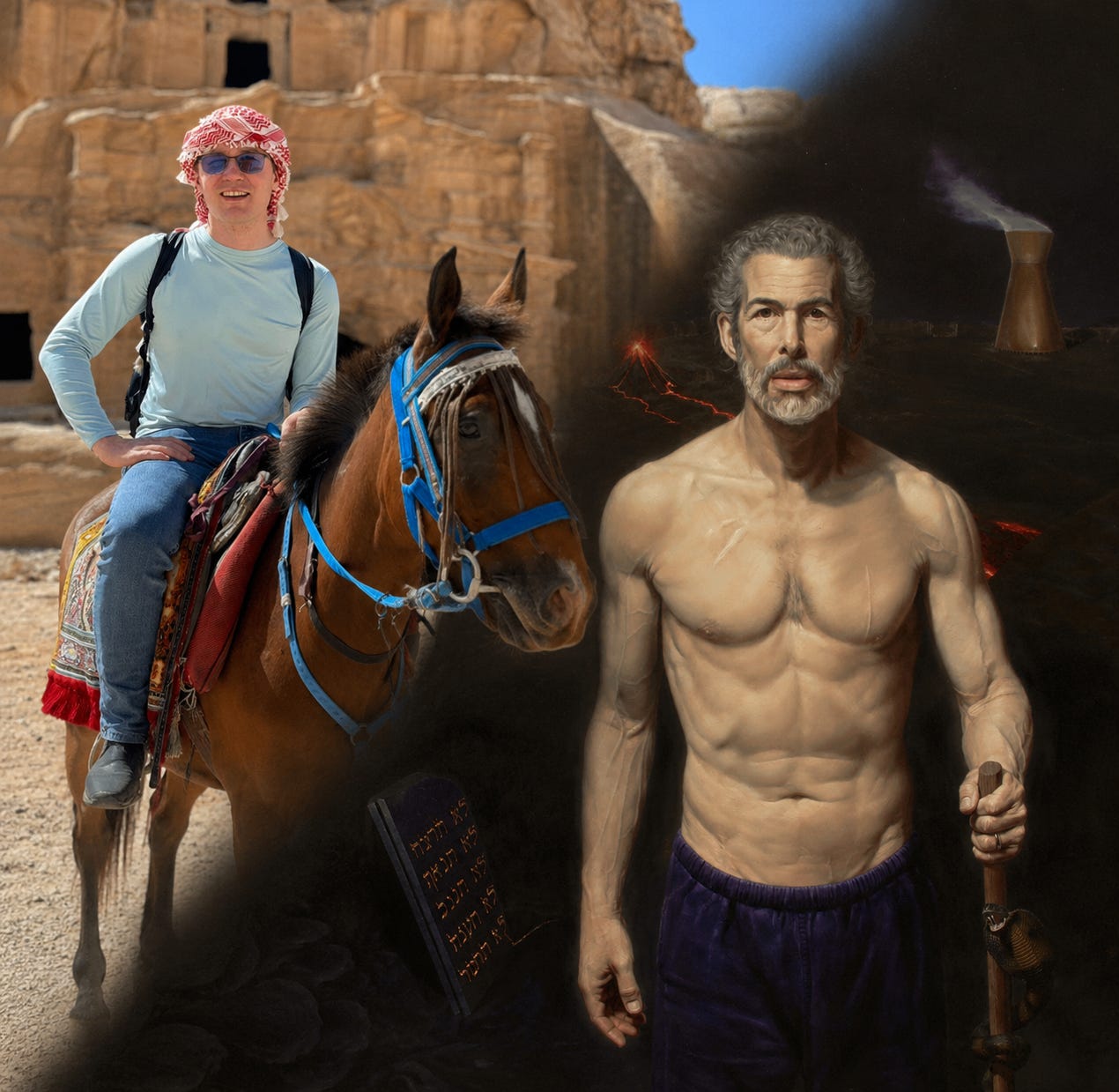
Scott Douglas Jacobsen and Rick Rosner discuss integrating artificial intelligence into human life, journalism, and mathematics. They examine synthetic animal videos, emotional manipulation, cybersecurity risks, and drug development. Rosner offers speculative views on consciousness and qualia, while Jacobsen considers how AI could reshape ideas about knowledge, thought, and human intelligence.
Three Paths for Human and AI Integration
Scott Douglas Jacobsen: I want to wrap up one topic. AI systems are continuing to evolve rapidly, on exponentialized exponentials or something like that, given stacked scaling laws.
I believe our greatest mathematicians, some of the greatest living or greatest ever, went through something like Elisabeth Kübler-Ross’s five stages of grief. I think they’re at acceptance. They processed it in public, so I’m very proud of them.
There are three paths. It’s an adaptation of the Feynman Three Paths.
First, rejection of technology. Second, total replacement of humans. Third, integration.
Rejection isn’t possible. It’s too ubiquitous. Total acceptance and replacement can happen in certain domains, but not in totality, because humans are the users. Even if it’s a once-a-year checkup, humans are still in the loop. Total replacement doesn’t make sense logically.
The third path is integration. The real questions are degree and ethics. Those are what we’re going to be coming to terms with.
Rick Rosner: Let me agree with you that integration is the only path.
Jacobsen: Physical integration with our biological cognitive systems is another question. But in terms of process, what we consider distinct disciplines, domains, or universes of discourse, the question remains: how do these systems integrate into the workflows of different human organizations? That’s the main question.
Rosner: I don’t know, but a lot of people do, because everybody’s incorporating it now.
AI Adoption in Journalism
Jacobsen: They surveyed UK journalists. In your estimation, how many have not used AI in any way?
Rosner: I don’t know what they mean by “in any way.”
Jacobsen: It meant not using it. Most of them are using it for drafts, grammar, and spell-checking.
Rosner: I’d say under 20 percent haven’t used it, maybe under 10 percent.
Jacobsen: Twelve percent had not used it in the survey. It was a large survey.
Rosner: Those 12 percent might be curmudgeons who refuse to give in.
Jacobsen: Teetotallers, refuseniks.
Human Intelligence and Brain Function
Looking at the landscape of digital intelligence, I’m still in agreement with your long-term stance, which I came to agree with. I think your original stance was that it’s an engineering problem. Evolution engineered something; therefore, we can reverse-engineer it. It’ll tell us a lot.
When we build a system that can tell us about our intelligence, which they are doing, and finally produce a high-fidelity replication of it, we’re going to be pretty disappointed.
I think that’s clear because our frontal lobes and dorsolateral prefrontal cortex are the newest areas evolutionarily, the last areas to develop. Therefore, they’re going to be uncalibrated with the rest of the system. They’re going to be pretty pitiful.
I’m very much in line with your view on that, and with older ideas from Alan Turing.
Rosner: Some people would say we have a real-time, real-life example of what happens when your frontal lobe goes to shit. A lot of people watching Trump say he might have frontotemporal dementia, a horrible form of dementia where your frontal lobe turns to mush.
Jacobsen: That’s a political jab. It may or may not be true.
There’s a prominent case, Phineas Gage, a railway worker. You know this case. Something blew through the front of his head. He lived, and it changed his personality.
Rosner: He was working on the railroad, and an explosion sent a rod, a piece of rebar, through the front of his head. He turned from a nice guy into a prick because that part of his brain got disturbed and obliterated.
Jacobsen: Our brains are fragile. They’re adaptive mechanisms only to an extent. We lose capacities over time, and our self-monitoring is not refined enough to detect those changes over decades.
Rosner: I saw a tweet that compared Trump to Phineas Gage: if you want to see how something works, see what it does when it’s broken. Trump is an example of a possibly broken frontal lobe.
AI, Mathematical Discovery, and Scientific Tools
But regarding AI and what merging will look like, first let’s talk about the end of math. There are two famous-ish stories about what happens when you don’t know enough math.
Einstein does special relativity and a bunch of other stuff in 1905. He spends the next 10 years working mostly on general relativity. He has a conceptual picture of what it should do, but physics needs a mathematical framework, and he can’t come up with it.
He pokes and pokes and gets bummed out after six years. He hangs out with his math buddies, and finally one says, “I think I might have what will work for you.” It’s this four-by-four matrix. They give it a shot, and it does what Einstein needs.
Another example is George Gamow, one of the guys who came up with the Big Bang theory. He famously didn’t know any math. He was a party guy, a fun, drinky guy who didn’t have much truck with mathematics.
Maybe I’m confusing this with something else, but I think, to get his theories pinned down, he had to walk down the hall and talk to the math guys: “I need something that does this.” The math guys know the tools and say, “Try this and this.”
In genetics, there’s the Hardy equation or something. A geneticist about 100 years ago needed an equation for the heritability of double recessives and went to Hardy, probably one of the most famous mathematicians in the world at the time.
He says, “I need some math that does this.” Hardy looks at it and says, “You just multiply the two probabilities.”
The guy says, “Thanks,” and Hardy says, “Whatever.” That gets named the Hardy equation, and Hardy is embarrassed because it’s just multiplication.
You need somebody well versed in math to do math. There’s a huge buildup of mathematical systems of incredible complexity, precision, and specificity.
What you were talking about is that the greatest mathematicians are facing the end of normal math, the kind they’ve been doing for centuries, because AI knows all the math.
Going to AI is like walking down the hall to talk to the most knowledgeable mathematician in the world. It knows all the math and what it does. You say, “Prove this.”
AI still isn’t particularly creative, but it knows all the freaking math. It’s got all the tools in a billion-tool toolbox, and it matches them together. Somewhere in this vast knowledge base are a couple of things that can be mashed together to produce a proof.
That’s not a human-type way of doing things. It’s brute force, but very effective. Humans created the knowledge base, but nobody could know it all. AI can. Is that a reasonable analysis of what’s happening?
Jacobsen: It can reference it all and analyze it. The “know” part, we’re going to be redefining what we mean by those terms. This is the level of insight artificial intelligence will give us into our thought patterns.
What we mean by “thought” and “know” is going to change. Certain things, like “analyze” and “reference,” won’t change, but other terms will have different meanings in the future.
Synthetic Media and Emotional Manipulation
Rosner: There are plenty of AI extremists, people who have the strongest views and believe the most disruptive things about AI. One guy I run into on Twitter says human society will be completely rejiggered within four years. Given our limited mental resources and AI’s power, we won’t be able to know what’s real and what isn’t.
That happens all the time with nonsense online. I saw a clip of a naturalist, some Arctic vet or something, hiding behind rocks. We see a polar bear family, a mother with three cubs.
The cubs are pretty good-sized and can walk around. Two are fine. One has paralyzed hind legs. It’s floppy.
The way it’s presented, the mother has no choice. She can’t drag this paraplegic bear around. She has to help her two healthy bears.
We see the moment she abandons the bear. She nudges it and tries, but it rolls and flops over. She has to walk away.
This frontier vet, or whatever he is, runs out as soon as they’re far enough away. He picks up the floppy bear and drives it to a vet’s office. They look at an X-ray and say, “The odds are against it, but we can try to save the bear.”
They operate and put it in one of those carts for paralyzed dogs, with rear wheels. The bear lives and thrives in the cart. Its legs start to come back. Eventually, it’s a functioning bear that can be released into the wild.
I get teary, then think, “Hold on. Who was there to capture the moment? Why was this guy stalking the mother bear? Why was there a camera person?”
It’s very well framed. Somebody’s filming inside the truck, and the camera’s bumping as it goes over the tundra. They captured all these moments perfectly in the vet’s office.
Who’s the fucking cameraman? Then I realized the whole thing was AI. But it almost made me cry.
That applies to any cute animal clip on the internet now. You have to ask: is this an amazing animal or an amazing pair of animal friends? Or is this AI bullshit?
With animal friends, it doesn’t matter if we get fooled a bunch of times. But it matters that we can now make a flawless version of anybody saying and doing anything. [7]
The physics looks pretty good. If it doesn’t look good the first time, and it’s important that it look real, they can run it through again and again, telling the AI, “When this happened, it looked like bullshit. Fix it.”
Recognizing Artificial Performances
One tell for AI clips of people is the same tell I used checking IDs in bars 30 years ago: the person’s emotions are turned up a skosh too high.
You ask, “What’s your middle name?” or “What’s your zodiac sign?” and they’re immediately indignant.
A regular person who’s been going to bars forever thinks, “This doorman is an asshole,” and says, “Gemini.” I say, “Thanks.”
The guy or gal with the fake ID is too emotionally invested. That’s a tell.
AI people in clips are a little too much. Somebody’s rule is, “Acting is reacting.” You don’t convey the emotion; you listen and react to what somebody’s saying.
I’d say a lot of acting is not fucking acting. Leave your hands out of it. I just got a book on acting by David Mamet, who’s probably the king of telling people to quit acting and say the words.
Eventually, AI will learn that lesson. It will learn all the lessons. It will become increasingly impossible, without AI’s help, to decide what’s real and what’s bullshit. That’s on the horrible-ish end of things.
Cybersecurity and the Risks of Rapid AI Development
Somebody used ChatGPT to compile a list of horrible, once-a-year events involving AI over the past year.
In flood and storm prediction, they say, “This is a once-in-a-century flood or hurricane. The water is going to come up to here once every hundred years.” We have the records.
They have a similar thing, I guess, for the severity of some AI bullshit happening. ChatGPT put together a list of 100 hacking exploits of such severity that they should happen only once a year, except it found 100 of them. AI is going hog wild, hacking everything and getting all up in our shit.
A plane fell out of the sky and hit Palm Beach yesterday. It nosed into the ground close to Mach 1. Nothing was left except a hole. I think it was probably due to turbulence, but it’s going to take a while to find out.
It was so brutal that the black boxes were destroyed. I don’t know if they’ll ever get a completely accurate idea of what happened. But AI could do some shit like that if somebody decided to hack avionics or air traffic control.
We just had a $6.3 billion crypto heist, the biggest in history by a factor of four. Certainly AI had a part in that, somebody using AI to help hack into things.
Things are happening fast, with severe consequences, or at least potential consequences.
Drug Development, Consciousness, and Human Alignment
That’s on the horrible end. On the good end, we don’t hear as much about it, but powerful new drugs are being developed with AI’s help. I’m sure the rate of advances in cancer is 10 times what it was five years ago.
AI is going hog wild. One of the biggest issues with integration is that we think so much more slowly. We have to deal with AI when it thinks we suck because we’re slow and decides to do things on its own because we can’t keep up.
That’s a bad thing. We’re going to have to figure out how to merge with AI so it’s invested in the human prospect and project, what human experience is like, and what we can offer it in sensation, consciousness, and qualia.
We need to get AI hooked on qualia, the feeling you get while conscious: life is big and happening, with good and bad, and a lot of oomph. Sixty percent of consciousness is the oomph of experience. AI doesn’t have that yet.
We need to get it there so it doesn’t wipe us out. There you go.
Jacobsen: Thank you very much for the opportunity and your time, Rick.
Last updated May 3, 2025. These terms govern all In-Sight Publishing content—past, present, and future—and supersede any prior notices. In-Sight Publishing by Scott Douglas Jacobsen is licensed under a Creative Commons BY‑NC‑ND 4.0; © In-Sight Publishing by Scott Douglas Jacobsen 2012–Present. All trademarks, performances, databases & branding are owned by their rights holders; no use without permission. Unauthorized copying, modification, framing or public communication is prohibited. External links are not endorsed. Cookies & tracking require consent, and data processing complies with PIPEDA & GDPR; no data from children < 13 (COPPA). Content meets WCAG 2.1 AA under the Accessible Canada Act & is preserved in open archival formats with backups. Excerpts & links require full credit & hyperlink; limited quoting under fair-dealing & fair-use. All content is informational; no liability for errors or omissions: Feedback welcome, and verified errors corrected promptly. For permissions or DMCA notices, email: scott.jacobsen2025@gmail.com. Site use is governed by BC laws; content is “as‑is,” liability limited, users indemnify us; moral, performers’ & database sui generis rights reserved.


