Nataliya Nazarova on Frontline Journalism Support in Dnipro
Author(s): Scott Douglas Jacobsen
Publication (Outlet/Website): Vocal.Media
Publication Date (yyyy/mm/dd): 2026/04
By Scott Douglas Jacobsen and Albina Pryshchep (Translator, Ukrainian-English)
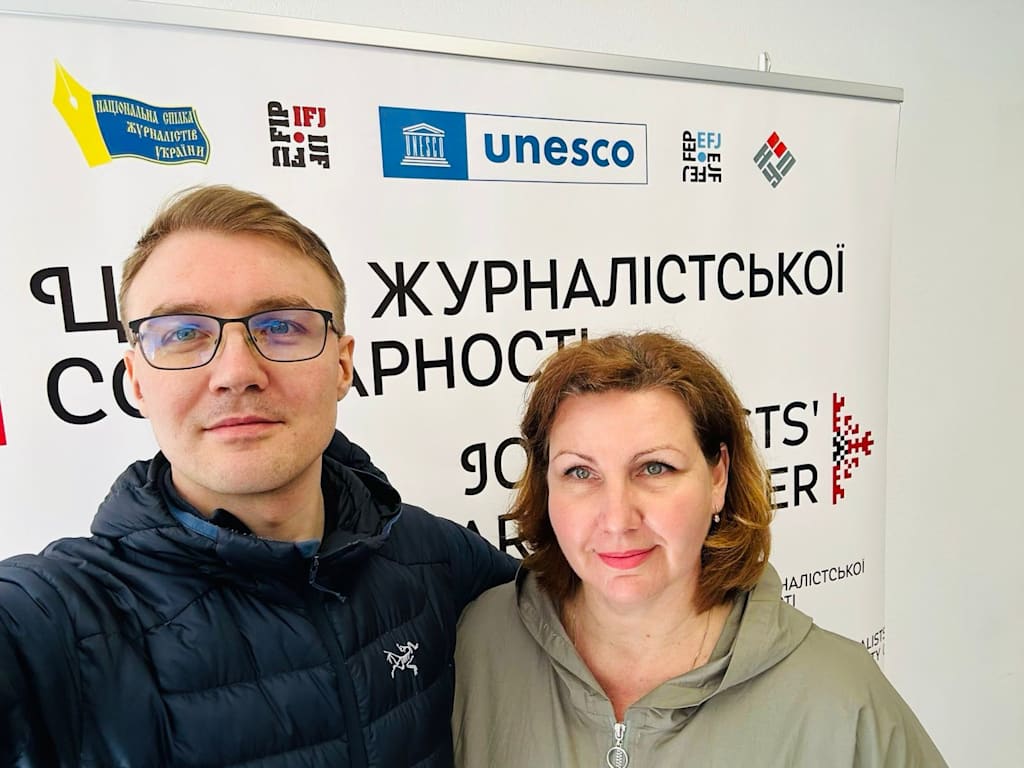
Nataliya Nazarova is a Ukrainian journalist who coordinates the work of the Center for Journalistic Solidarity of the National Union of Journalists of Ukraine in Dnipro.
Since Russia’s full-scale invasion of Ukraine, she has worked with colleagues supporting journalists affected by the war, including those displaced and those whose homes or workplaces were damaged. Her work includes helping organize training, support, and coordination for media workers operating under wartime conditions in and around Dnipro.
In this interview, Scott Douglas Jacobsen speaks with Nataliya Nazarova about the work of the Dnipro Journalists’ Solidarity Center in supporting Ukrainian media during Russia’s full-scale invasion. Nazarova describes emergency aid, newsroom relocations, international assistance, grant training, and mental health support for journalists facing shelling, displacement, and exhaustion. The conversation highlights the resilience of local media, the continuing publication of frontline newspapers, and the psychological toll of sustaining independent reporting under wartime conditions.
Scott Douglas Jacobsen: What are your needs as a solidarity centre in Dnipro? Do those needs differ from those in cities farther from the front line? In the summer of 2022, when some journalists began returning from western Ukraine, what changed?
Nataliya Nazarova: After the beginning of the full-scale war, many journalists from eastern Ukraine passed through Dnipro. We were on the front line. People asked where to stay, where to go next, and where to find support. Some went on to Ivano-Frankivsk or Lviv, and some later returned. We had journalists from Kharkiv who first stopped in Dnipro and then, when the situation stabilized, returned to work in Kharkiv.
One of the first things we did was provide financial and technical support to our colleagues. I know many cases in which journalists suffered greatly and newsrooms were destroyed. There were also cases in which editorial offices were ruined.
Have you heard about Nikopol?
Jacobsen: I received bombing alerts for that area this morning.
Nazarova: Yes. Nikopol, near the Zaporizhzhia Nuclear Power Plant, is under constant shelling. Despite this, a newspaper is still published there, and there is also Nikopol radio.
The windows of the newspaper’s editorial office have been broken more than once because strikes hit nearby. There was also a case at the radio station when a broadcast had to be interrupted because a strike hit the building and part of the roof collapsed. The station was attacked and had to suspend operations for some time.
Unfortunately, this kind of damage to editorial offices and residential areas has become more frequent.
In September of last year, we had to relocate the editorial office of the Mezhivskyi Meridian newspaper. It is based in a settlement in Dnipropetrovsk region near the border with Donetsk region. To this day, that area is under constant attack and is being devastated.
At the same time, the newspaper and its team received support. We involved Reporters Without Borders and Free Press Unlimited. We identified the need, and international partners allocated funds so that all four employees could evacuate, obtain basic equipment, and continue working.
This support, as well as support from other international partners, has allowed the newspaper to continue to be published. The editor still publishes the newspaper. It is published in 12 pages every two weeks.
I do not know how many people remain there now, perhaps only a few hundred. He delivers the newspaper himself. He stays in contact with hubs where local residents and former readers have relocated and ensures they receive it. He also maintains social media and a YouTube channel. There are a lot of views because people want to understand whether their houses have survived, what the situation is in Mezhova.
The situation has become much worse since the beginning of the war. In December, the evacuation of the civilian population was announced in Mezhova.
There is another village – Petropavlivka. The newspaper there also has a 95-year history. About six months ago, its director moved the newspaper’s archive to our Center in Dnipro to preserve the history in case the situation suddenly worsens.
One of the main problems, in my opinion, is the mental health of journalists. Ukrainian journalists work with very complex topics. They themselves need support. That is why we conduct psychological trainings, art therapy meetings. Such events focus on resilience, help counteract emotional burnout.
We have already conducted more than ten trainings on mental health and emotional resilience. Now we have started a series of meetings that will help build effective communication, not succumb to emotional influences, manipulations.
Of course, the economic component of the war has significantly affected the situation of the media. The team of the Network of Journalist Solidarity Centers select grant opportunities and share them with media organizations every week. We conduct webinars to explain how to write successful applications and how to implement projects properly. We help journalists prepare strong applications, provide training, and teach them how to sustain themselves independently.
Jacobsen: Thank you very much for the opportunity and your time, Nataliya.
Last updated May 3, 2025. These terms govern all In Sight Publishing content—past, present, and future—and supersede any prior notices. In Sight Publishing by Scott Douglas Jacobsen is licensed under a Creative Commons BY‑NC‑ND 4.0; © In Sight Publishing by Scott Douglas Jacobsen 2012–Present. All trademarks, performances, databases & branding are owned by their rights holders; no use without permission. Unauthorized copying, modification, framing or public communication is prohibited. External links are not endorsed. Cookies & tracking require consent, and data processing complies with PIPEDA & GDPR; no data from children < 13 (COPPA). Content meets WCAG 2.1 AA under the Accessible Canada Act & is preserved in open archival formats with backups. Excerpts & links require full credit & hyperlink; limited quoting under fair-dealing & fair-use. All content is informational; no liability for errors or omissions: Feedback welcome, and verified errors corrected promptly. For permissions or DMCA notices, email: scott.jacobsen2025@gmail.com. Site use is governed by BC laws; content is “as‑is,” liability limited, users indemnify us; moral, performers’ & database sui generis rights reserved.

 In-Sight Publishing