Dr. Swiatoslaw Podlewski Uniting Ukrainian Art, History, and Theravāda Buddhist Thought
Author(s): Scott Douglas Jacobsen
Publication (Outlet/Website): Vocal.Media
Publication Date (yyyy/mm/dd): 2026/04
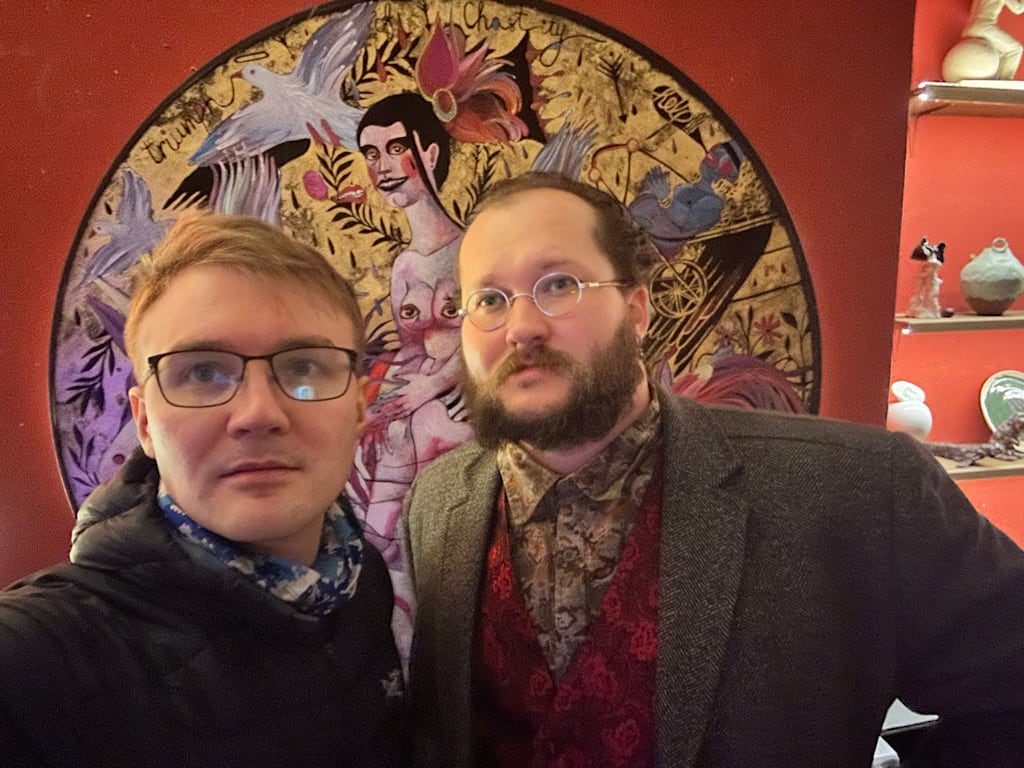
Dr. Swiatoslaw Podlewski is a Ukrainian artist, art critic, and historian born in 1991 in Chernihiv, Ukraine. Based in Kyiv, he studied fine arts from childhood in his father’s studio, Volodymyr Podlewski, before pursuing academic training in history. He holds a Ph.D. in history and has produced research on Ukrainian inscriptions. His visual practice explores abstraction, nature, symbolism, Buddhist thought, and post-Soviet cultural memory through contemporary Ukrainian art.
Scott Douglas Jacobsen interviews Dr. Swiatoslaw Podlewski, a Ukrainian artist, art critic, and historian, on childhood art, academic detours, Theravāda Buddhism, and the return to painting. Podlewski traces his path from early lessons with his father to frustration with academic realism, then toward history, inscriptions, India, and Buddhist thought. He explains how nature, abstraction, dogs, symbolism, and post-Soviet identity shaped his contemporary Ukrainian artistic vision and philosophical practice across modern Ukrainian culture and memory today. Podlewski’s public artist profiles also describe him as a Ukrainian artist born in 1991, based in Kyiv, with a Ph.D. in history. Theravāda is widely associated with the Pali canon and is often presented as tracing its lineage to the Elders, while kōans are recognized in Zen as paradoxical prompts used to disrupt ordinary conceptual thought.
Scott Douglas Jacobsen: What was your earliest piece of art?
Dr. Swiatoslaw Podlewski: My father is an artist, so he first taught me when I was six. I still keep that work. It was a landscape with the sea and a ship, something like that. It is the earliest piece I made: a large wave with a small crest. So, by the age of six, I was already working on art.
Jacobsen: What were some of your early artistic experiments? Did you also try different forms of art, such as audio, rather than only visual art?
Podlewski: Of course. My path was not easy. There were many setbacks. After school, I became disappointed in the classical understanding of art.
Jacobsen: What do you mean by that?
Podlewski: I mean the idea that one must endlessly copy visible reality. I was frustrated. I entered the Lviv National Academy of Arts, but I became frustrated when I understood the program. I realized that I would be spending years drawing still lifes, glasses, and similar objects.
Jacobsen: So you mean realism and still life?
Podlewski: Yes. It was frustrating to think that I would be occupied with that for four or five years. I said to myself, “This is not how I see art.” So I turned to another passion of mine: history and philosophy. I entered university as a historian, with a particular focus on archaeology, history, and cultural studies.
After that, I completed and published my PhD in 2018 on inscriptions found in northern Ukraine, covering material from roughly the 10th to the 18th centuries. I also published a book. While finishing the book, I took a short trip to relax after all the stress. I visited India in 2015, and there I realized that I wanted to return to art.
Jacobsen: What did you find in India?
Podlewski: I turned to Buddhism.
Jacobsen: Which branch of Buddhism?
Podlewski: Theravāda.
Jacobsen: Why Theravāda?
Podlewski: Because, as a historian, I like to look at origins. I want to see the earliest form of an idea. I do not like later accretions, reinterpretations, or misconceptions. I prefer to go to the source, to understand something from the beginning, and only after that to consider later developments. It also resonates with me because Mahāyāna Buddhism seems to incorporate more mysticism, whereas I prefer a simpler philosophy rather than religious dogma. Theravāda traces its lineage to the “Elders” and treats the Pali canon as authoritative, which is part of why many people see it as closer to early Buddhism, though that claim should be stated with some caution.
Jacobsen: Does that mysticism reflect any similarity to the mysticism incorporated into Eastern Christianity, or is it mystical in a completely different way?
Podlewski: It is quite similar in some respects. Eastern Christianity developed strong traditions of venerating saints and relics, including the bodily remains of holy figures. Historically, those practices became an important part of Christian devotion in late antiquity and the medieval period. Whether one interprets that as continuity with pagan practices is a matter of viewpoint, but the traditions of saints and relics are certainly real and well-established.
In Eastern Christianity, especially Orthodox Christianity in Eastern Europe, many saints share roles and attributes with earlier local pagan deities. For example, Saint Blaise (Vlasiy) is sometimes associated in folk tradition with functions similar to those of Volos, an ancient Slavic god connected to cattle and wealth. Many pre-Christian traditions were incorporated into Christian practice over time.
This process is somewhat comparable to how Mahāyāna Buddhism spread across Asia and interacted with local belief systems. For instance, in Japan, Buddhism coexisted with and integrated elements of Shinto belief. However, the processes were historically different. Buddhism generally adapted alongside existing traditions, whereas Christianization in parts of Europe sometimes involved the suppression or replacement of earlier pagan practices.
Jacobsen: How did returning from India as a newly committed Theravāda Buddhist change your artistic expression? Did you use new techniques, or the same techniques in a new way?
Podlewski: It was less about technique and more about subject matter. I shifted from depicting people, cities, and social issues to focusing more on nature and abstract artistic forms. I worked on projects that explored a space between abstraction, landscape, and animal forms, seeking something in between.
There is a saying often associated with Zen (Chan) Buddhism that enlightenment can be approached through paradox. Zen uses methods such as kōans and paradoxical questions or statements to disrupt ordinary patterns of thinking. For example, a famous kōan asks whether a dog has Buddha-nature. A Zen master’s answer may contradict expectations to challenge conceptual thinking. The purpose is to move beyond purely intellectual understanding toward direct insight.
These ideas influenced me, and one of the main subjects in my art became dogs. I use them not simply as familiar figures, but as symbolic elements to express more abstract ideas drawn from Buddhist thought.
In early Buddhism, particularly in its earliest artistic traditions, the Buddha was often not depicted in human form. Instead, symbolic representations were used, such as the Dharma wheel, footprints, or an empty throne.
Jacobsen: What does the wheel represent, in abstract terms?
Podlewski: The wheel represents the Dharma, the teaching of the Buddha, and the cycle of existence, often referred to as saṃsāra. It reflects the ongoing process of life, death, and rebirth shaped by karma.
Jacobsen: Do you still adhere to Theravāda Buddhism?
Podlewski: I try not to approach it dogmatically. The historical Buddha emphasized personal understanding and experience rather than rigid belief. In that sense, I try to understand these ideas through my own experience rather than becoming overly attached to any one doctrine.
There are Buddhist communities in Ukraine, including in Kyiv, where Zen Buddhism is present. I engage with Buddhism in a way that is accessible to me locally, while continuing to explore its ideas through personal practice.
This may be my subjective impression, but many of them felt like cosplayers. After the Zen sessions ended, people would start talking about where to buy clothes, shoes, or belts. It felt less like a spiritual practice and more like a kind of role-playing convention.
Jacobsen: How does Theravāda Buddhism relate to the visual and the linguistic, between noise and silence, blackness and depiction?
Podlewski: That is an interesting way to put it. Buddhism is not as rhetorical as it may seem. It is more about regulating and understanding one’s desires. The Buddha rejected both extreme asceticism and excessive ritualism. Instead, he proposed the “Middle Way,” which avoids both indulgence and self-denial.
It is not that depiction is forbidden. Rather, it is about finding a balance and questioning attachment. For me, this becomes a way to explore how to combine my artistic work with my identity as a citizen of Ukraine, as part of society, and as someone of mixed heritage.
Jacobsen: Which backgrounds?
Podlewski: Polish, Jewish, Roma, Belarusian, and Russian, among others. A very mixed background.
Jacobsen: Do you incorporate those national traditions into your art?
Podlewski: Not directly. I became more aware of these identities later, when I was working as a historian and researching my family background. Growing up, it did not strongly shape my artistic direction. My father’s side was more traditional, but overall, these identities were not a central influence.
The Soviet system largely erased or blended distinct family traditions. It created a more uniform social identity across different people.
Jacobsen: What was early life like in the Soviet Union?
Podlewski: I was born in 1991, so I did not experience it directly.
Jacobsen: How did people talk about the Soviet Union at the time, as Ukraine had just become independent?
Podlewski: It depended on the situation. In reality, not everything changed immediately. When the Soviet Union collapsed, many structures remained in place. The laws and many of the people in positions of power stayed the same, they simply adapted to the new system.
There were attempts to restrict former Soviet officials from holding office, but these rules were often bypassed. If you look at the early Ukrainian parliament in the first years of independence, many officials were former high-ranking members of the Soviet system.
Another issue was that Ukraine’s early legal framework, including parts of its constitution, was heavily based on the previous Soviet system, particularly the constitution of the Ukrainian Soviet Socialist Republic. Much of it was adapted rather than entirely replaced.
From my perspective, many elements of the Soviet structure remained intact for some time. They gradually weakened, but their influence persisted.
Podlewski: This unresolved legacy of the past remains a major source of corruption.
Jacobsen: Were there any positives for artists in the Soviet Union or from its legacy?
Podlewski: Only for those who were conformists. Those who were willing to produce what the state required could benefit from the system. They received support, resources, and institutional recognition. Many of them went on to hold influential positions, and some still do, if they are still alive.
Jacobsen: Thank you very much for the opportunity and your time, Swiatoslaw.
Last updated May 3, 2025. These terms govern all In Sight Publishing content—past, present, and future—and supersede any prior notices. In Sight Publishing by Scott Douglas Jacobsen is licensed under a Creative Commons BY‑NC‑ND 4.0; © In Sight Publishing by Scott Douglas Jacobsen 2012–Present. All trademarks, performances, databases & branding are owned by their rights holders; no use without permission. Unauthorized copying, modification, framing or public communication is prohibited. External links are not endorsed. Cookies & tracking require consent, and data processing complies with PIPEDA & GDPR; no data from children < 13 (COPPA). Content meets WCAG 2.1 AA under the Accessible Canada Act & is preserved in open archival formats with backups. Excerpts & links require full credit & hyperlink; limited quoting under fair-dealing & fair-use. All content is informational; no liability for errors or omissions: Feedback welcome, and verified errors corrected promptly. For permissions or DMCA notices, email: scott.jacobsen2025@gmail.com. Site use is governed by BC laws; content is “as‑is,” liability limited, users indemnify us; moral, performers’ & database sui generis rights reserved.


