Author(s): Scott Douglas Jacobsen
Publication (Outlet/Website): The Good Men Project
Publication Date (yyyy/mm/dd): 2022/11/02
Human trafficking represents one of the gravest global issues in the treatment of human beings by other human beings. What people do, at the end of the day, that’s ethics. According to the United Nations Office on Drugs and Crime, human trafficking can be defined as “the recruitment, transportation, transfer, harbouring or receipt of people through force, fraud or deception, with the aim of exploiting them for profit.” Men, women, and children, regardless of age, are subject to the crime of human trafficking. Commonly, there is the use of violence, fraud, and fake promises of education and work, to coerce and/or trick victims into human trafficking. This representation of human deception and cruelty demarcates one facet of respect for an ethic of human rights versus a violation of human rights.
International documents have been developed and adopted by the United Nations to set a moral direction – compass if you will – for legally binding documents. The first, entitled the UN Protocol to Prevent, Suppress and Punish Trafficking in Persons or The Protocol, was adopted by the United Nations in 2000 as a part of the United Nations Convention against Transnational Organized Crime. 178 Members States (countries/nations) of the United Nations are “party” to The Protocol, whether destination or transit with an emphasis on children and women.
The emphasis on children, particularly girls, and women comes with good reason within the formal language of The Protocol. 71% of victims are women and girls (51% and 20%, respectively), while 21% are men. 8% are boys. This comes from the United Nations in an article entitled “Report: Majority of trafficking victims are women and girls; one-third children”. The article emphasizes individuals fleeing war torn circumstances as particularly vulnerable to human trafficking. Girls and women get forced into marriages and sexual slavery, boys and men into combatant roles and slave labour.
The United Nations Office on Drugs and Crime claims, “Through the services we provide, authorities are better equipped to prevent human trafficking, identify and protect victims, and prosecute the perpetrators. Countries are able to dismantle the criminal networks behind human trafficking and seize the illegal proceeds.”
The United Nations (Organization on Drugs and Crimes) defines three aspects of trafficking as the act, the means, and the purpose. The act is the trafficker recruiting, transporting, transferring, harbouring, and/or receiving. The methods of threat or use of force, coercion, fraud, deception, abuse of position vulnerability, giving payments or benefits, and/or abduction. The sole purpose of exploitation.
Within human trafficking, as already alluded, there exists one particularly tragic avenue of exploitation in the form of sexual trafficking. “UNODC report on human trafficking exposes modern form of slavery” states the majority of sexual trafficking victims are women and girls, globally, based on a report from 155 countries. Secular international human rights come into focus here, as theory in praxis or human rights as moral ideas into realities for women and girls. Are the rights respected or violated?
Antonio Maria Costa, Executive Director of the United Nations Office on Drugs and Crimes, stated, “Many governments are still in denial. There is even neglect when it comes to either reporting on, or prosecuting cases of human trafficking.” Non-governmental organizations, advocacy groups, religious organizations, human right defenders, and so on, have been integral to combatting human trafficking with sexual exploitation as a major component of this human rights violation. Your country doesn’t have to be one of those in denial.
The American Psychological Association describes the consequences for individuals involved in human trafficking (including sexual trafficking), as stated in “Facts About Trafficking of Women and Girls”:
- Trafficked women and girls encounter high rates of physical and sexual violence, including homicide and torture, psychological abuse, horrific work and living conditions, and extreme deprivation while in transit.
- Serious mental health problems result from trafficking, including anxiety, depression, self-injurious behavior, suicidal ideation and suicide, drug and alcohol addiction, post-traumatic stress disorder (PTSD), dissociative disorders and complex PTSD.
- Physical symptoms among trafficking victims include neurological issues, gastrointestinal disturbances, respiratory distress, chronic pain, sexually transmitted diseases (including HIV), uro-genital problems, dental problems, fractures and traumatic brain injuries.
The damages to the girls and women in most cases can be temporary or permanent depending on care, context, and individual factors. Canadian citizens are subject to the same human rights violation in Canada. Between 2010 and 2020, 2,977 individual reports existed of human trafficking. 86% of the incidences happened in census metropolitan areas. 96% of the victims were women and girls. 25% were under age 18. 20% were aged 25 to 34. 81% of those accused were boys and men. 41% of the accused were aged 18 to 24. 36% of the accused were aged 25 to 34. The legal cases take, at least, twice as long as violent adult criminal court cases.
To make this more immediate to a personal locale, the perennial context in Canadian society is the Township of Langley, for me. A socially conservative municipality of the nation and a place upon which religious evangelism, oft Evangelical Christian or Roman Catholic Christian, can be a mainstay. I became aware of some efforts within Christian Life Assembly (Christian Life Assembly Church) lead by Pastor Derrick Hamre through some local contacts working directly on this issue of human trafficking. The presentations to Christian community have been audiovisual in nature, such as “Andrew Hawkes | Break the Cycles | Christian Life Assembly” and “God’s Purpose & Plan for the World | Andrew Hawkes | Christian Life Assembly” – worth a gander.
There are a number of organizations of a secular, religious, or political, nature working towards the same general good goal. The idea is, in fact, a protection of human rights through an implementation of the ideals into practice. Some will speak in working in the name of Christ or another holy figure, the Kingdom of God, and God’s plan, and so on; others within a (secular) international human rights framework will speak to the respect for human rights – rarely both. The important part of the protection from human trafficking in practice, in the end – what people do.
License
In-Sight Publishing by Scott Douglas Jacobsen is licensed under a Creative Commons Attribution-NonCommercial-NoDerivatives 4.0 International License. Based on a work at www.in-sightpublishing.com.
Copyright
© Scott Douglas Jacobsen and In-Sight Publishing 2012-Present. Unauthorized use and/or duplication of this material without express and written permission from this site’s author and/or owner is strictly prohibited. Excerpts and links may be used, provided that full and clear credit is given to Scott Douglas Jacobsen and In-Sight Publishing with appropriate and specific direction to the original content. All interviewees and authors co-copyright their material and may disseminate for their independent purposes.
Share this:

Author(s): Scott Douglas Jacobsen
Publication (Outlet/Website): Medium (Personal)
Publication Date (yyyy/mm/dd): 2023/01/20
Tiltriller Youndgodis: Broseyegross brethersinawe warspitdogphase kneedingcatsnipsdogspis onpreyarefruitlash; brosonbrose.
See “Exitranc”.
License
In-Sight Publishing by Scott Douglas Jacobsen is licensed under a Creative Commons Attribution-NonCommercial-NoDerivatives 4.0 International License. Based on a work at www.in-sightpublishing.com.
Copyright
© Scott Douglas Jacobsen and In-Sight Publishing 2012-Present. Unauthorized use and/or duplication of this material without express and written permission from this site’s author and/or owner is strictly prohibited. Excerpts and links may be used, provided that full and clear credit is given to Scott Douglas Jacobsen and In-Sight Publishing with appropriate and specific direction to the original content. All interviewees and authors co-copyright their material and may disseminate for their independent purposes.
Share this:
Author(s): Scott Douglas Jacobsen
Publication (Outlet/Website): The Good Men Project
Publication Date (yyyy/mm/dd): 2023/01/18
Scott Doulas Jacobsen: Trauma is a terrible consequence of war and conflict zones. As noted by numerous human rights documents, in war and conflict zones, the major non-combatant victims are women and children. Those can come with long-term trauma, PTSD, CPTSD, etc. Your specialty is in child and adolescent psychiatry. What issues arise for children who undergo the trauma of conflict zones and war?
Bishoy Goubran, MD: The brain is born with neural algorithms optimized for learning. However, in a war zone, the child’s brain quickly learns that the world is full of threats. The basic safety needs are not met. Physiological, metabolic, and circadian necessities are disrupted. Under these precarious circumstances, the neural program switches to a survival mode, descending to the lowest tier of Maslow’s hierarchy of needs. This shift in focus negates the children’s innate proclivity towards creativity, collaboration, and self-actualization, and instead, they are left in a state of defense. This can become incapacitating as the child’s cognition becomes hypercautious in an attempt to avoid further trauma, pain, or betrayal.
Trauma directs the child’s ontology moving forwards towards hypervigilance, paranoia, and anxiety. The world is no longer seen as a safe place. In a war zone, children may experience trauma by witnessing the violent death or injury of loved ones, being attacked, or sexually assaulted themselves, or their homes being destroyed. Not to mention that in some conflict areas, children themselves are recruited to fight. All of which creates an increased risk of experiencing traumatic events of different thresholds. Trauma transcends time and space, taking hold over bodily functions for many years and sometimes a lifetime after its inception. It affects the brain, hormones, and has a multisystemic effect on bodily functions. It not only acts on neurological and psychological levels. it also becomes so embedded in the system that it acts epigenetically to shape, unmask, and instigate other Psychosomatic and psychiatric illnesses.
Trauma not only leads to Post Traumatic Stress Disorder (PTSD) but also mood disorders such as depression and bipolar disorder can be instigated by trauma, as can psychotic disorders like schizophrenia. Traumatized children may engage in self-harming behaviors in an attempt to alleviate psychological pain and bring it under their control. When faced with chaos, a phobia of disempowerment and a phobia of unpredictability may become central in their sense-making. Other maladaptive coping mechanisms may include substance abuse and dissociation from reality.
The consequences of trauma on children can be severe and can affect Children’s development, learning, and general functioning in the long term. There is a study published in the Journal of the American Medical Association, that shows that adults who experienced trauma during childhood are more prone to developing chronic conditions such as heart disease, diabetes, and obesity. Also when it comes to academic performance, a study conducted in war-affected regions of Afghanistan elucidated that children who experienced trauma had lower academic achievement and were more likely to repeat grades compared to non-traumatized peers.
Also, direct trauma aside, the sensory experience of war — the loudness of war machinery, sounds of gunshots, explosions, demolitions, bombardment — can be very overwhelming for children and drastically worsen their mental well-being. Especially children with sensory integration and processing difficulties where their senses often exaggerate vibrations and acoustic frequencies. We see that often in patients within the Autism Spectrum and those with Attention Deficit Hyperactivity Disorder.
Jacobsen: Can you tell us more about dissociative experiences?
Goubran: Well, dissociative experiences involve a disconnection between a person’s thoughts, emotions, and sense of self. You can think about it as a defense mechanism, if the brain feels that the pain is too much, and escape is difficult, it “ejects” the sense of self like a pilot ejects themselves from a fighter jet when its destruction seems inevitable. Dissociation can appear as depersonalization, where the child no longer feels they exist within their body. It can also appear as Derealization, where the conscious experience of reality as real diminishes or changes.
Rarely following chronic, early trauma, a complete disruption of the identity can happen. A disorder known as Dissociative Identity Disorder (DID), colloquially known as multiple personalities or split personalities. It is a disorder characterized by the disruption of identity into more than two distinct personality states. Memories of the trauma are compartmentalized and repressed. One of these “alters” or “identities” may be the “trauma holder,” hiding in the recesses of the subconscious, holding the pain of the trauma and emerging only at certain times to deal with perceived threats. The other identities may serve different functions and allow the individual to adapt to life despite the trauma they have experienced. The result is a disruption of a sense of continuity and agency over the self, as each personality state seems to take over the individual.
Jacobsen: How does PTSD appear in children?
Goubran: There is something very somatic and visceral about PTSD and its responses. It affects the limbic system which is the system responsible for emotional processing. It also creates ripples affecting multiple brain networks. We know it alters the hippocampus, amygdala, and fear-processing centers in the brain. Disrupting the emotional and reflex pathways and creating micro behaviors that short-circuit the volitional part of the brain. It also affects the insula, changing the way the body calibrates its responses to the external environment.
PTSD can occur immediately following the trauma or may be delayed. It presents with a constellation of symptoms and a set of criteria. One of the darkest PTSD symptoms in my opinion is avoidance. Victims may avoid talking about or recalling the trauma. As well as avoiding anything that reminds them of the traumatic event, such as a specific location, type of noise, scent, picture, or a visual reminder. This avoidance can become almost addictive, as it provides temporary relief from triggers. The alleviation of tensions by avoiding potential triggers lights up the brain’s reward system. If a brain gets conditioned and addicted to avoidance, imagine the debilitating repercussions this can have on a child. At times, avoidance grows more pathological, and the child’s avoidance list starts to become broader, more symbolic, and encompassing more elements as it becomes more generalized. Triggers expand to include even innocuous stimuli with a very distant association with the actual trauma, almost to the point of avoiding life itself. At best, avoidance drastically hinders the Child’s ability to explore and engage with the world.
PTSD also comes with “intrusion symptoms” such as distressing intrusive memories of the traumatic event. Children often call them “sticky thoughts” because they are difficult to get rid of once they arise. Other symptoms could be recurrent nightmares, which may render going to sleep a dreadful event for some of our patients. Sometimes children experience dissociative flashbacks, where they almost relive the trauma, acting and feeling as if it is actually happening again. We also know that children may sometimes try to re-enact the trauma during play which can give us clues about the nature of the trauma. Sometimes we use that as a tool during play therapy to explore, understand and treat the child’s perspective of the traumatic event. PTSD can be so elusive, and aside from typical symptoms, it can also appear as distractibility, and mood disturbances. It can present with fatigue and low motivation. Children may struggle to go to school, and their brains may grow resistant to the process of learning.
Jacobsen: What are the types of treatments that help with Children suffering PTSD in conflict zones?
Goubran: Systems have been put in place to provide targeted support to children in conflict zones. These programs focus on increasing the resilience and adaptive capabilities of children, as well as providing community and family support. Global health approach to the problem can be preventative and also curative by mitigating the risk factors as well. However, the effectiveness of these programs is contingent on funding, logistics, and accessibility. All of which, can be greatly affected in conflict zones.
When it comes to individual treatment however, the two main pillars are therapy and psychopharmacology. Therapy plays a central role in treating PTSD. Two of the highly effective, evidence-based form of therapy are Cognitive Processing Therapy (CPT) and trauma-focused Cognitive Behavioral Therapy (CBT). These approaches generally aim to help patients understand and process their trauma and to change the way they think about and perceive the event. It also involves cognitive restructuring by guiding the child to re-experience safety and trust in everyday life. Learning how to activate fear extinction and regain control over the memories stored in the body. By doing so, individuals can begin to untangle the effects of trauma and create a new narrative for their lives post-conflict. Other therapeutic tools include prolonged exposure therapy, eye movement desensitization and reprocessing, psychodynamic and psychoanalytic therapy, and biofeedback techniques such as breathing exercises can also be utilized. Also, another therapeutic aspect is that parents can act as an external container to hold, process, and sort of transmute their children’s fears, and instill a sense of safety, structure, and predictability. Therefore, family and parental therapy is an important angle when designing the treatment.
As for medication, there are psychopharmacological tools that target PTSD symptoms depending on the presentation. We often use medications from the antidepressant class as it seems that Serotonin disruption plays a major role in PTSD psychopathology. We can also help mitigate symptoms such as sympathetic hypervigilance by medications that help soothe the autonomic hyperarousal or treat nightmares using psychopharmacological tools that alter the sleep architecture thus interfering with the sleep phases conducive to nightmares. Medications can be utilized to treat the underlying depression or mood disorder. It is definitely very individual presentation based and there is no one size fits all treatment. Depending on the severity of the case, typically, a combined approach comprised of therapy and a tailored medication regimen is effective.
Ultimately It is in the art of psychiatry to really absorb the multifaceted experience of the patient’s reality and craft an approach to treatment based on that very nuanced impression. Hence, it’s personalized medicine, while, of course, adhering to evidence-based guidelines. I also want to end this interview, on a positive note, that with treatment and therapy, there is big hope. Traumatized children can gradually heal, be liberated from the effects of trauma, and lead beautiful, healthy, and fulfilling lives. Finally, if you or anyone you know have been a victim of any type of trauma, I definitely recommend you seek medical attention and connect with a psychiatrist and a therapist so you can accelerate your recovery and healing journey.
Bishoy Goubran, MD, is a board-certified psychiatrist specializing in Child and Adolescent Psychiatry. He received postdoctoral research training in Behavioral and Cardiovascular medicine. Dr. Goubran’s research interest is in psychosomatic medicine.
License
In-Sight Publishing by Scott Douglas Jacobsen is licensed under a Creative Commons Attribution-NonCommercial-NoDerivatives 4.0 International License. Based on a work at www.in-sightpublishing.com.
Copyright
© Scott Douglas Jacobsen and In-Sight Publishing 2012-Present. Unauthorized use and/or duplication of this material without express and written permission from this site’s author and/or owner is strictly prohibited. Excerpts and links may be used, provided that full and clear credit is given to Scott Douglas Jacobsen and In-Sight Publishing with appropriate and specific direction to the original content. All interviewees and authors co-copyright their material and may disseminate for their independent purposes.
Share this:
Author(s): Scott Douglas Jacobsen
Publication (Outlet/Website): Medium (Personal)
Publication Date (yyyy/mm/dd): 2023/01/19
Sillvurn Lilieacs: Trauced lainabcs outvainmen forresq guilden sheerhide runtde burnzeboys; bleghdtrust encircumling flow-era.
See “Rose”.
License
In-Sight Publishing by Scott Douglas Jacobsen is licensed under a Creative Commons Attribution-NonCommercial-NoDerivatives 4.0 International License. Based on a work at www.in-sightpublishing.com.
Copyright
© Scott Douglas Jacobsen and In-Sight Publishing 2012-Present. Unauthorized use and/or duplication of this material without express and written permission from this site’s author and/or owner is strictly prohibited. Excerpts and links may be used, provided that full and clear credit is given to Scott Douglas Jacobsen and In-Sight Publishing with appropriate and specific direction to the original content. All interviewees and authors co-copyright their material and may disseminate for their independent purposes.
Share this:
Author(s): Scott Douglas Jacobsen
Publication (Outlet/Website): Medium (Personal)
Publication Date (yyyy/mm/dd): 2023/01/18
TentsTattherung: Errdinarry cralluppityownme badbunchedappleon Sprungringspringrunginup; Lather-Lay Lusters Spanks.
See “Livloversly”.
License
In-Sight Publishing by Scott Douglas Jacobsen is licensed under a Creative Commons Attribution-NonCommercial-NoDerivatives 4.0 International License. Based on a work at www.in-sightpublishing.com.
Copyright
© Scott Douglas Jacobsen and In-Sight Publishing 2012-Present. Unauthorized use and/or duplication of this material without express and written permission from this site’s author and/or owner is strictly prohibited. Excerpts and links may be used, provided that full and clear credit is given to Scott Douglas Jacobsen and In-Sight Publishing with appropriate and specific direction to the original content. All interviewees and authors co-copyright their material and may disseminate for their independent purposes.
Share this:
Author(s): Scott Douglas Jacobsen
Publication (Outlet/Website): Medium (Personal)
Publication Date (yyyy/mm/dd): 2023/01/17
Quadskreelitterall Byeangel: Deafinitudenough heardwrangeleer addaboytwoduds burntootwinwhether; turn’d assdundeer.
See “Transliberate”.
License
In-Sight Publishing by Scott Douglas Jacobsen is licensed under a Creative Commons Attribution-NonCommercial-NoDerivatives 4.0 International License. Based on a work at www.in-sightpublishing.com.
Copyright
© Scott Douglas Jacobsen and In-Sight Publishing 2012-Present. Unauthorized use and/or duplication of this material without express and written permission from this site’s author and/or owner is strictly prohibited. Excerpts and links may be used, provided that full and clear credit is given to Scott Douglas Jacobsen and In-Sight Publishing with appropriate and specific direction to the original content. All interviewees and authors co-copyright their material and may disseminate for their independent purposes.
Share this:
Publisher: In-Sight Publishing
Publisher Founding: January 1, 2014
Web Domain: http://www.in-sightpublishing.com
Location: Fort Langley, Township of Langley, British Columbia, Canada
Journal: In-Sight: Independent Interview-Based Journal
Journal Founding: August 2, 2012
Frequency: Three (3) Times Per Year
Review Status: Non-Peer-Reviewed
Access: Electronic/Digital & Open Access
Fees: None (Free)
Volume Numbering: 11
Issue Numbering: 2
Section: E
Theme Type: Idea
Theme Premise: “Outliers and Outsiders”
Theme Part: 27
Formal Sub-Theme: “The Greenhorn Chronicles”
Individual Publication Date: January 15, 2023
Issue Publication Date: May 1, 2023
Author(s): Scott Douglas Jacobsen
Interviewer(s): Scott Douglas Jacobsen
Interviewee(s): Cindy Waslewsky and Steve Waslewsky
Word Count: 4,257
Image Credits: None
International Standard Serial Number (ISSN): 2369-6885
*Please see the footnotes, bibliography, and citations, after the interview.*
*Interview conducted January 2, 2022.*
Abstract
Cindy Waslewsky went to Stanford University and competed on the Varsity Gymnastics and Ski Teams. She earned a B.A. in Human Biology in 1982. She earned a Diploma in Christian Studies at Regent College in Vancouver, and a BC teachers’ certification from the University of British Columbia in 1984. She was the President of the Squamish Valley Equestrian Association. She is a certified English and Western coach. Waslewsky is co-owner of Twin Creeks Ranch. Waslewsky discusses: a bigger picture within Twin Creeks Ranch; a standard procedure in the industry within the Lower Mainland; the Council in the Township of Langley; particular bylaws; the industry as a whole in the Lower Mainland; the main providers of feed; and the horse is a part of their own family.
Keywords: agricultural science, ALR, British Columbia, Bylaws, California, Cindy Waslewsky, clients, Equestrian, Federal and Labor Relations Act, horses, Icelandics, Lower Mainland, Mayor Eric Woodward, Mayor Froese, Otter Co-op, ranches, Squamish, Steve Waslewsky, Township of Langley, Twin Creeks Ranch.
The Greenhorn Chronicles 41: Cindy Waslewsky and Steve Waslewsky on Big Picture Operations, the Township of Langley, ALR, and Bylaws (3)
Scott Douglas Jacobsen: Let’s take a bigger picture within Twin Creeks Ranch as a whole, first, as well. With the indoor arena, the training center at the round pen, the racetrack, and the clubhouse trails, all of these combined into a package of 125 acres; how do you build this into an operational business? From what I’m gathering, a mild constricting of the environment for equestrianism, at least, in British Columbia a little bit, particularly in areas like the Township of Langley with rising property prices and, thus, a decrease in the number of people who can afford.
Cindy Waslewsky: No, that’s a really good point. I mean we came in and there’s hyperbole because they say the “horse capital of Canada” [Ed. I even wrote that.] or something ridiculous like that. I’m looking at it like this, “Yes, but it’s shrinking rapidly”, and the people who can tell me that are our feed suppliers. They’re the ones that see it the most because they’re seeing how much feed is being purchased for horses in our area. The land value is high, so I see a lot of boarding places. People come to us over “our boarding place is shutting down”, or “it’s being redeveloped”, or “they’re selling to somebody else’, “it’s difficult to afford lessons and a horse”. It’s fewer and fewer people that can afford that a hobby. I mean people say, “Oh, skiing is expensive.” Well, skiing is cheaper than riding because when you’re not skiing, then you’re parking in your garage. You’re not feeding your skis and shoeing your skis, and your skis don’t go lame on you when you need them and get an abscess, or pull a tendon.
So, there’s a lot of cost to horses to keep them well. You’re shoeing them every six to eight weeks. You’re getting dental work on their teeth once a year. Floating the teeth cost $200 to $400 depending on the horse. It costs about $200 now for hot shoes every six weeks, and then your whole sport is going to start at 700 a month when you start putting up your feed in. Feeding and mucking and a place to ride, you’re in $700 at the bottom end. You’ll see our boarding rates. If you look around, we’re on the low end with two indoor arenas. But we have staff that live on the property. We bring our hay in by the B-train load. We do pelletized bedding for environmental concerns. They used to do straw way back in the day, and then they moved to shavings. Shavings are stored and you try to keep them dry. You put them in, but you still have to pull the shavings out. You almost have to put lime underneath it because of the pee, which is now urea. You don’t want that to build up in the stall.
And so, what has happened, they had to switch to pellets, which we used as soon as we took over the farm. We went to pelletized bedding, which are bags, and it is pellets. You split the bag open. You add hot water, and then pop the pellets back up, and then you spread them out there. they’re made of pine, so you don’t have any allergies in the horses. You clean it like kitty litter. So, you take out all the manure that you get used to doing that with your fork and then where these horses pee; they’re usually peeing in the same corner of their stall. So, our staffs have gotten to know the horses; they pull back the bedding and pull out all the wet stuff and it clumps together like kitty litter. So, all the wet shavings come out in a clump together and then they spread the dry stuff back up to soak up any more pee and pull that out and then cover it up and then they might put one fresh bag on top and we might put a fresh bag on maybe every other day depending on the horse and how messy they are. They shred the manure in their stall in those shredders and then there’s some that poop in one little corner. You go and clean it up. It’s so much easier. You get to love certain horses that are cleaner.
So, we can then spread that. That manure goes in the pile within a year. It is broken down because it’s essentially dust. By the time we’re taking it out of the stall; we’re only taking manure and only the shavings that have pee or urine in it. So, we don’t have big chunks. We have dust that breaks down very quickly. It has mostly manure, a little urine, a little bit of dust, and then we pile it. We manure spread on our property. This disposal of manure. Some places bin their manure and have to have it hauled out. I think there are places making topsoil that buy the stuff or, at least, charge you to take it away for a somewhat more reasonable price, but it is a significant expense for some of the barns: manure disposal. So, the pelletized bedding, our staff go in there with one big wheelbarrow. They can do four stalls. You would fill up one wheelbarrow with the shavings and dump them out there. Now, it’s about a quarter of the waste we have to spread. It’s easy. It breaks down much more quickly. So, environmentally, far better, other than the plastic bags, which they don’t take for recycling. It’s driving us crazy. We want to recycle these plastic bags, but they won’t pick them up at the curb. They won’t take them at the cycling place. We’re like, “These are plastic bags, recycle them, please.” That’s the only downside, so far. That may get worked out. I don’t know how that’s going to work out. However, we’re not political enough and agitating for something there.
Jacobsen: What is a standard procedure in the industry within the Lower Mainland? That is costing a lot of money and causing unnecessary expense to the owners, to the environment, and to the horses that could be changed easily. What is another example of this?
Cindy: What’s something else costing people or the environment?
Jacobsen: People who own ranches or facilities, individuals who are clients, or the horses themselves, or the environment.
Cindy: Some of the mandated manure management programs. My husband did agricultural science. We built a resort in Squamish. He had worms in the soil within a year. Then they’re coming along and saying we need to build this concrete bunker and put all your manure in this concrete bunker that’s covered from the rain and everything else. Then you have to spray it so that it breaks down. We’re like, “We have a system that is working extremely well. You’re wanting us to do it this other way that is very expensive to put in. We question its efficacy.” They don’t want things leaching into creeks. I get that. But if you have a place that’s far enough from the creek, which we truly do, out in by the trails, we don’t understand why we had to go and set up a whole different system. That’s expensive. Also, most horse operations, we’re zoned commercial. So, our hydro rates are double what anyone else is paying. So, hydro rates are higher for any commercial operation as when you compare it to a residential.
You have people giving ‘helpful advice’ about things like manure management and animal care. We had cows in mud. We had someone report us to SPCA because our cows were in the mud. SPCA came out and looked at them and goes, “Well, this is how cows live!” It gets muddy when it rains for a while. Even though, we have pads around all the feed stations. We have cover places for them to have their hay and stuff. So, sometimes, people don’t understand animal care. They’re thinking about, maybe, their pets, what they their pets would need. I know horse boarding doesn’t qualify when you have ALR land as, of course, the land reserves. You want your farm tax status. Horses don’t count and boarding horses does not count as an agricultural operation.
Jacobsen: What could Mayor Froese [Ed. Former mayor, current mayor of the Township of Langley is Mayor Eric Woodward.] in the Council in the Township of Langley or other townships do to better serve the pragmatic needs of the equestrian community at large?
Cindy Waslewsky: Let me hold for a second, because this is something I would definitely like to hear from Steve on. So, Steve, there are two questions. The first question I want to think about it for a minute. What are certain restrictions or things that are creating unnecessary expense for equestrian operations and horse owners in Langley? And the second part of that question would be: Is there anything that mayor Froese or Town Hall could do to improve the viability of horse operations in this area because they are shrinking rapidly? Okay, I’m going to put on the speaker.
Steve Waslewsky: The problem would be the Federal and Labor Relations Act. It’s very inflexible and very expensive. All the payroll deductions and such, a lot of our colleagues are being priced out by labor costs, which the government is creating. As for Langley, nothing really comes to mind. So, yes, because we take care of people’s horses and we’re not breeding, we don’t get farm tax status. We do because we also raise hay and we had cattle until recently. That’s how we got our farm status. Without farm status, we’d be shut down.
Jacobsen: What about particular bylaws that are helpful and in place now, or what could be proposed by the equestrian community to help themselves within their particular townships?
Steve Waslewsky: Well, probably, the number one would be that we ought to be included in it is as a farm status. A lot of places simply can’t afford to be open without farm status. That’s why they’re shutting down. Locally, they’ve become much fussier about enforcing farm status, not with the equestrians, but with everybody else. I know a couple places, where they lost their farm status all to the equestrian operations. Nothing else really comes to mind. I don’t deal with them much because we operate under the table and try not to attract attention. Dealing with government is like being a nail. We’re very quiet about what we do and how we do it. We fall into a little bit of a niche. We exploit that niche maintaining our farm status through actual farming activity. Without that, there’s no question that we would be closed. Equestrian operations take far too much property and resources of an area, where the taxes and bylaws are really set up for more intensive businesses like lumber yards and such. So, that’s where we fall into a little bit of a niche.
Jacobsen: What would that do to the industry as a whole in the Lower Mainland?
Steve Waslewsky: Well, it’s shrinking because the whole lower middle class is shrinking. I’ve been told by people, feed companies and such, that since we took over in 2004, really the entire equestrian industry has been dropped by at least a half. So, we are in a dying industry because of a dying middle class. That’s more of a federal/provincial issue than it is a municipal one.
Jacobsen: Who are the main providers of feed now?
Steve Waslewsky: On a retail basis?
Jacobsen: In terms of producing.
Steve Waslewsky: It all comes from outside the area here. Otter Co-op does produce some. I’m not sure if they actually produce horse feed or not. I think they probably do. I think there’s another one called Ritchie Feeds. I think they do their own stuff too, but all the rest are bringing in from outside the area.
Cindy Waslewsky: We can hot walk a horse in a circle, so that the shed low goes in a circle. So, you can hot walk your horses undercover. That’s great if a horse is colicky or something like that. You need to monitor and walk the horse. You’ve got a space right there outside the stall to do that. So, we have crossties there and huge tack rooms that are insulated. One of our staff members lives in a suite off the same barn. She’s a single girl. She worked at North Shore Equestrian Centre before she came to us, so a good experience that she’s got into the vet tech program starting January 1st. Then across from the barn, we have two suites there, again staff. One’s a single fellow who does basic maintenance. We have lots of equipment. So, he’ll harrow the arena, clear the trails. He’ll check the water lines, of course, with this cold snap; getting frozen lines working again and plowing snow, all that stuff. Then to the left of his suite or to the right of his suite is a young couple, she works in the barn and her partner is an IT guy who works from home. So, when we had this bad weather, he was out helping her in the barn, and then, as I said, one woman who has the four kids. The partner was up helping the barn too, so we had extra help.
So, having everyone live on the property, they’re feeding at 7 in the morning. They’re feeding at noon. They’re feeding at 5. They’re feeding at 9. So, to drive back and forth would not be very efficient, but you can go out there and feed at 7 in the morning, and then go in and warm up or have breakfast, you can come back out and start doing stalls and at 9:30 turn some of the horses out. Some are in what we call “in-and-outs”, where they can walk out.
When people contact us, I would say about almost half our stalls are now in-and-out because what my husband did is he created more in-and-outs off the back of the barn and tried to make as many of them in-and-out stalls. Every other stall is an in-and-out because you don’t want the run, the pen, to be the same width as the stall; that’s too narrow. They can get cast and things like that. So, what you do is if one stall has an in-and-out, the next stall that horse gets led out to a paddock outside the next one’s in-and-out, where they can run in and out at will. The next one we lead them out. So, we have good generous paddocks. Every horse has a paddock. They get turned out no matter what, e.g., pouring rain. They’re out for half the day. When they have this freezing weather, they were out until almost 1 o’clock in the afternoon, and then we brought them in for their lunch because the water was freezing. Even if we gave them a bucket, it was frozen before they needed it when they got fed their lunch. You cannot feed a horse without water available to them. They need water.
So, that was a limiting factor. So, we bring them in at 1 o’clock, and then have the lunch inside. Normally, we’ll keep them out as much as we can keep them out, and in the Spring and the Fall and in the Summer; they could be out 24 hours a day. They have more room in a paddock than they do in a stall. They can see their neighbor, but they each get their own feed in a feeder. That’s on the rubber matting, so it doesn’t fall onto the crusher. The gravel stuff that they’re living on, and they have auto waters as well. We took out all the hog fuel and put in crusher, which is a blend of different kinds of sand and fills. So, it’s firm and doesn’t harbor fungus because we’re living in the Pacific Northwest.
I grew up in California, didn’t have rain, and mud fever and all these other different kinds of fungus on horses up here. But up here, you’ve got to be very careful that they have a blanket on. They’re going to be out in the rain, so that they don’t get damp and get a fungus on their back called ring sore. You can’t even then put a saddle on if they get too sore. You have to stay on top of those things. So, anyway, we have staff living on the property. We have options of in-and-out stalls. Ones that you lead horses out to paddocks and back in again, and then we have a couple of what is called loafing sheds, which means it’s a shelter. We have two Icelandics that love to be outside in the snow, rain; they love to be outside. They have a shelter, where they can get out of the weather, but they’ll be standing outside most of the time. We do have a stall for them if the weather is really bad or the water starts freezing. We can bring them inside if we need to do that. But they love being out, they’re shaggy little guys. They love being outside.
On our property, we have the main indoor arena. We have dressage letters up. We have some jumps. We have show-quality jumps. We don’t set up, often, because they’re heavy to lift in and out. We have other jumps that are easily put in and out for lessons and for people to practice on, but we have a multi-disciplined barn. In other words, we have people who like Western and English. In Western, you might have Reiners. You might have pleasure. You might have trail horses. In English, you might have dressage, hunter, jumper, and simply pleasure trail horses. We tend to have more older riders with a few younger people, who this is the first horse that they’ve brought in here. People, of course, are somewhat price conscious because it’s really expensive owning a horse. It’s getting more expensive because we’ve seen costs skyrocket. We have voluntarily increased the rates and wages for our workers. We do the same thing in a per diem; this is how many horses you have, this is how much you get per horse to clean and feed them for the day.
Now, if you have 31 horses, and that’s too many stalls to do for one person, which it really is, then we say you get a secondary worker and then they get paid for the stalls they do, and you get paid the primary wage. So, it all works out. Our staff have three primary, stock barn staff people. They make up their own schedule. They talk together. They work it out. Some are at school. Some have kids. So, they work together and make up a schedule that works for them. They cover for each other. They make sure everyone’s okay. Then we have another fellow, Hank, who does maintenance and, like you, he can jump into the stalls. He can do stall work. He can do buckets. He can bring the hay down for them. He does maintenance. So, he’s there if anyone’s sick, if anyone needs a hand, and if something happens like a pipe break or anything happens. They call him. So, they have that as well as my husband and I who live on the property as well.
Jacobsen: Is Steve available right now as well by the way?
Cindy Waslewsky: Yes, Steve’s upstairs; he’s not a chatty person. If you had specific questions for him, he’d be happy to answer them. He, like I said, does a lot of the maintenance. Like we mix our own footing for the arena, we mix footing for our paddock. We call it crusher because it’s not that hard. So, we also have three and a half kilometers of trails, which he put in with his own GPS lining up through the woods and clearing out trails and grazing them up, putting culverts in, and then putting landscape cloth and then crusher on top. So, a nice trail that you would see at Alder Grove Park or Camel Valley Park. We have some half kilometers of trails here on the property. So, as you saw on the web page, we have a round pen, a main indoor arena, a second indoor arena, which is like the lunging arena that we have. It’s a 72 x72, so it’s a nice 20-meter circle with a coverall. Then we have three and a half kilometers of all-weather trails, so it’s not muddy. They’re a good footing. Trees fall down, branches fall, things happen with these storms, recently. We go out and clear them off, and then we have a half-mile sand racetrack.
Now, the racetrack is not what you would see for training racehorses. The inside rails are out. So, it’s basically a recreational track. We still harrow it. We keep it maintained. You can go out there. You can walk around the track, trot, or do a little gallop. Sometimes, I’ll take students out. We’ll do a slow canter contest, and then the fastest walk contest. We’re trying to train our horses to have good gaits for us to be out hacking on trails and such, and have them in control. We do our hay storage, like this year there was a real crisis for hay because of the fires, the drought, Covid, and then of course the flooding came along. So, hay is difficult, and so we bought a B-train load, which is a truck and a big trailer that’s following it. A B-train load in the Fall, and then we put a deposit on another B-train load from the same hay supplier up North because it’s good quality professionally grown hay.
Steve with his background in animal physiology and nutrition will be happy to advise boarders on good nutrition for their horse, but, as you probably have found, everybody’s an expert. Quite frankly, it’s interesting. Even when he went to UBC, lots of feed studies on pigs, sheep, goats, chickens, cows, but not many good feed studies on horses. So, you still see a backyard approach, “Oh I’m going to get the beet pulp”, or “they’ll get their weight up”. The beet plants, it’s great for hydrating your horse because you soak this pulp and some people do that to try to put weight on the horse, but I would question their more scientific knowledge of the digestive system of the horse.
We can advise boarder. But if they want this, that, or the other thing, we accommodate them because that’s not livestock to them. That’s not even a pet. That horse is their child. You’ve seen that. Have you not? These women and guys, often, their kids are grown up and gone. These horses are their family. They’re their children, very important to them. So, horse boarding is a very unique business. They really think you’re taking care of people’s horses. We’re taking care of people by taking care of their horses.
Jacobsen: Talking to clientele while working… certainly, individuals who own one or more horses feel as if the horse is a part of their own family. Also, a common sentiment, I find, among those in the equestrian industry with only a few months out of my belt granted, is the sense of a lifestyle. So, you either dive to the deep end first, or it’s a foot in the door phenomenon, where once you start getting into it; more or less, you don’t leave. Unless, you’re forced to leave due to finances or some other catastrophic circumstance. People love it; it is their lifestyle.
Cindy Waslewsky: I have adults coming to me for lessons who have always wanted to ride. Now they’re close to retirement, they now have the time. They have the money. Some of them don’t have the health anymore, so we make sure they’re on a horse that suits their limitations. You’ll see this all the time. People come to me. They might take some lessons. Hopefully, they do take a good number of lessons and really learn horsemanship, ground manners, training techniques, and then get a horse. When they get that horse, the worst thing is to be over the horse; to get a horse that’s a little too much, a little bit too athletic, too high energy, too high maintenance, not as well trained and needs more training. If you don’t get someone with that knowledge, then you get a horse that becomes somewhat dangerous for that rider. Unfortunately, that horse then doesn’t always get a good chance with the next owner either. They get labeled. They’ve developed some bad habits. I always say a horse is like a dog. Get a dog and train that dog, an ill-trained dog, an insecure dog, or an aggressive dog is not a happy dog. Indeed, it could be a danger to a person, and then you might have to put the dog down because an incident happens. I’ve seen that in the horse world as well with horses that are great animals, but have not had the best riding and training at some point in their life. It is human made problems in the horses that the good trainers have to go in and try to fix.
Bibliography
None
Footnotes
None
Citations
American Medical Association (AMA 11th Edition): Jacobsen S. The Greenhorn Chronicles 41: Cindy Waslewsky and Steve Waslewsky on Big Picture Operations, the Township of Langley, ALR, and Bylaws (3). January 2023; 11(2). http://www.in-sightpublishing.com/waslewsky-3
American Psychological Association (APA 7th Edition): Jacobsen, S. (2023, January 15). The Greenhorn Chronicles 41: Cindy Waslewsky and Steve Waslewsky on Big Picture Operations, the Township of Langley, ALR, and Bylaws (3). In-Sight Publishing. 11(2). http://www.in-sightpublishing.com/waslewsky-3.
Brazilian National Standards (ABNT): JACOBSEN, S. D. The Greenhorn Chronicles 41: Cindy Waslewsky and Steve Waslewsky on Big Picture Operations, the Township of Langley, ALR, and Bylaws (3). In-Sight: Independent Interview-Based Journal, Fort Langley, v. 11, n. 2, 2023.
Chicago/Turabian, Author-Date (17th Edition): Jacobsen, Scott. 2023. “The Greenhorn Chronicles 41: Cindy Waslewsky and Steve Waslewsky on Big Picture Operations, the Township of Langley, ALR, and Bylaws (3).” In-Sight: Independent Interview-Based Journal 11, no. 2 (Spring). http://www.in-sightpublishing.com/waslewsky-3.
Chicago/Turabian, Notes & Bibliography (17th Edition): Jacobsen, Scott “The Greenhorn Chronicles 41: Cindy Waslewsky and Steve Waslewsky on Big Picture Operations, the Township of Langley, ALR, and Bylaws (3).” In-Sight: Independent Interview-Based Journal 11, no. 2 (January 2023). http://www.in-sightpublishing.com/waslewsky-3.
Harvard: Jacobsen, S. (2023) ‘The Greenhorn Chronicles 41: Cindy Waslewsky and Steve Waslewsky on Big Picture Operations, the Township of Langley, ALR, and Bylaws (3)’, In-Sight: Independent Interview-Based Journal, 11(2). <http://www.in-sightpublishing.com/waslewsky-3>.
Harvard (Australian): Jacobsen, S 2023, ‘The Greenhorn Chronicles 41: Cindy Waslewsky and Steve Waslewsky on Big Picture Operations, the Township of Langley, ALR, and Bylaws (3)’, In-Sight: Independent Interview-Based Journal, vol. 11, no. 2, <http://www.in-sightpublishing.com/waslewsky-3>.
Modern Language Association (MLA, 9th Edition): Jacobsen, Scott. “The Greenhorn Chronicles 41: Cindy Waslewsky and Steve Waslewsky on Big Picture Operations, the Township of Langley, ALR, and Bylaws (3).” In-Sight: Independent Interview-Based Journal, vo.11, no. 2, 2023, http://www.in-sightpublishing.com/waslewsky-3.
Vancouver/ICMJE: Jacobsen S. The Greenhorn Chronicles 41: Cindy Waslewsky and Steve Waslewsky on Big Picture Operations, the Township of Langley, ALR, and Bylaws (3) [Internet]. 2023 Jan; 11(2). Available from: http://www.in-sightpublishing.com/waslewsky-3
License
In-Sight Publishing by Scott Douglas Jacobsen is licensed under a Creative Commons Attribution-NonCommercial-NoDerivatives 4.0 International License.
Based on work at www.in-sightpublishing.com.
Copyright
© Scott Douglas Jacobsen and In-Sight Publishing 2012-Present. Unauthorized use and/or duplication of this material without express and written permission from this site’s author and/or owner is strictly prohibited. Excerpts and links may be used, provided that full and clear credit is given to Scott Douglas Jacobsen, or the author(s), and In-Sight Publishing with appropriate and specific direction to the original content. All interviewees and authors copyright their material, as well, and may disseminate for their independent purposes.
Share this:
The Greenhorn Chronicles 40: L.J. Tidball on Staffing, Tiffany Foster, Brent Balisky, and Horses (2)

Publisher: In-Sight Publishing
Publisher Founding: January 1, 2014
Web Domain: http://www.in-sightpublishing.com
Location: Fort Langley, Township of Langley, British Columbia, Canada
Journal: In-Sight: Independent Interview-Based Journal
Journal Founding: August 2, 2012
Frequency: Three (3) Times Per Year
Review Status: Non-Peer-Reviewed
Access: Electronic/Digital & Open Access
Fees: None (Free)
Volume Numbering: 11
Issue Numbering: 2
Section: E
Theme Type: Idea
Theme Premise: “Outliers and Outsiders”
Theme Part: 27
Formal Sub-Theme: “The Greenhorn Chronicles”
Individual Publication Date: January 15, 2023
Issue Publication Date: May 1, 2023
Author(s): Scott Douglas Jacobsen
Interviewer(s): Scott Douglas Jacobsen
Interviewee(s): L.J. Tidball
Word Count: 2,568
Image Credits: Quinn Saunders
International Standard Serial Number (ISSN): 2369-6885
*Please see the footnotes, bibliography, and citations, after the interview.*
*Interview conducted December 26, 2022.*
Abstract
Laura Jane “L.J.” Tidball has been the Manager of Thunderbird Show Stables, an elite hunter and jumper facility, for 20 years. She is a shareholder and contributing partner to Thunderbird Show Park, which has been voted in the top 3 equestrian show facilities in North America. For Show Park, she has been important in advising on top level equine footing, site development plans for capital improvement, and competitor scheduling for National and FEI competitions. She has been competing at the Grand Prix level since 16-years-old. Since winning the Equine Canada medal (1994) and competing on the British Columbia Young Riders’ team (1996), L.J. pursued equestrianism as a career with a fervent passion. Tidball shows multiple mounts of Thunderbird Show Stables and its clients in the hunter and the jumper rings. Through work from the pony hunters onwards with the assistance of Olympian Laura Balisky and Laura’s husband, Brent, L.J. has achieved many years of success in equitation, and the hunters and the jumpers. In 2005, she returned from a successful European tour to operate Thunderbird on a professional basis. She has been awarded the 2014 Leading BCHJA 2014 rider in the FEI World Cup West Coast League Rankings and the 2014 BCHJA Leading Trainer of the Year. In her spare time, her hobbies include baking, skiing, and snowboarding. Tidball discusses: a mammal that does not lie; the income generation; staffing an issue across this industry; common factors; horses; dangers of the sport; admire; not a natural talent; decompress; Brent; a second wind; the Longines; and the community feel.
Keywords: Amy Millar, baking, Beth Underhill, breeding, Brent Balisky, California, clientele, Emily Carr, Fédération Equestre Internationale, Ian Millar, L.J. Tidball, Longines, Mario Deslauriers, Spruce Meadows, Tiffany Foster, training, University of San Diego.
The Greenhorn Chronicles 40: L.J. Tidball on Staffing, Tiffany Foster, Brent Balisky, and Horses (2)
Scott Douglas Jacobsen: You were noting in the earlier part of the interview about reading the horses. In the sense that, you can read them. You can feel what they are trying to tell you. Are horses a mammal that does not lie?
L.J. Tidball: I don’t think they lie. I think horses are very truthful. They’re not duplicitous in how they act. They do not ‘tell’ you one thing and mean another. I really believe they are straight shooters. I think as horses come up through the levels. It is very hard to tell when jumping 1.20m or 1.30m if the horse can make it to that top level. I think that’s a special animal. I believe once you jump 1.40m and 1.45m, you see where they will go. You don’t think, “That one can jump 1.60m.” When they are a foal, you can have the right bloodline and training program. However, it still may not do that. So, I would say that is the intriguing part of our sport. To see these young horses come up through the ranks, make these goals for them, and put your heart and soul into what you’re doing, and see where they end up, it is a unique process that we get to do as equestrians and as athletes.
Riding is so unique that way. We don’t age out. There is longevity in it. There is a whole business within it. I make my income from horses. Most people doing sport for a living, are not making their income from it and around it. Riding is not a hugely sponsored sport. We make our income in training and buy-and-selling horses. That is pretty unique.
Jacobsen: Where do you see most of the income generation, from the breeding, training, and sale, of horses, or more from the clinics and the training of clientele?
Tidball: I would say it’s mostly from training clientele, clinics, and buying and selling horses for your clients. I think that’s where most of the income comes from, not when we breed horses. There are horse breeders who make a good living from just that, but it’s much harder. You would think of 100 kids. How many are going to be an Olympic athlete? That’s what you’re looking at with these horses too. Like I said, you can have the right bloodlines, breeding, and training program, you’re not guaranteed the result. To bring the horse along, you can breed it yourself, then you have it for 3 years before sitting on it. Those expenses build up over time. It is more of a passion on the breeding side for us. If something comes to fruition out of it, that’s just a bonus. Obviously, it is always our end goal, but it is very hard to predict. I love to think that each will be a $1,000,000 animal. But that’s pretty far fetched.
Jacobsen: Is staffing an issue across this industry?
Tidball: I think there will always be people who love horses. I think there will always be staff who come into our barns and our lives who want to work with these animals. They are pretty spectacular. We have amazing horses that we get to go on the road with. There will always be a niche of people who want to be a part of that. Yes, day-to-day barn work, as with the restaurant industry in our area, as with retail industry in general, is hard. Yes, there are shortages of staff. But like I said, because it is horses, I think there will always be people who raise their hand and want to be with them.
Jacobsen: I have read some articles of people who do not compete necessarily. However, they will ride and run businesses. Some free-floating cash they have; they devote it to their horse and their horse life. They will define themselves as a “horse crazy girl”.
Tidball: Right.
Jacobsen: What are some factors common that are part of the identity of the people drawn to that culture? I know young girls and young women are, certainly, a larger population for younger riders. Internationally, we tend to see more men at the higher end, European particularly. What are some common factors, other than horses [Laughing]?
Tidball: [Laughing] Yes. I think it is the love of animals. I have to put it down to that. We love animals. Also, you have to have an innate sense of feeling. You have to want to understand the animal. Like you said, to have that conversation, if you walk up to the animal and have no desire to know what the conversation is, probably, you are not meant to be in this industry.
Jacobsen: Right [Laughing].
Tidball: If you walk up and don’t really care… for example, I’m really allergic to cats. When I see a cat, I don’t want to have a conversation at all.
Jacobsen: [Laughing].
Tidball: I’m sure there are people who feel that way about horses. You have to want to be around these animals and have to have a little bit of awe towards them too. A 1,000 lb. animal will listen to you and will jump over obstacles for you, because you asked with your heel. It is pretty intriguing. To me, it always gives the feeling, “Wow. How does that work?” Even to this day, I look at it. I’m like, “If they said, ‘No’, it would be a ‘no’.” The fact that we have this relationship, that hey are willing to cantor into a ring and jump the biggest jumps I’ve ever seen because they want to do it with you. It is pretty awe-inspiring to me.
Jacobsen: What do the horses get out of this?
Tidball: It must be the same level of adrenaline that we feel. When you see a horse come out of a ring, they are hyped. When they jump a big jump, to me, it is the adrenaline that comes out of that; the will to be an athlete. It is easy as people to think that our horses have personalities like they’re human beings. I know that they don’t, but I think horses have an incredibly high sense of feel. When we have anxiety or are putting positive feeling behind it, or putting strength behind it, I think they can sense it and feel it. When we feel the adrenaline and the rush, I think our horse is feeling it. So, I think that creates the reward for them.
Jacobsen: The dangers of the sport. Those are very real. I have noted in conversation with people outside of the industry. They have a mythology around the sport itself. In that, it is a soft sport [Laughing]. It’s very dangerous. The injury rates are very high.
Tidball: Yes.
Jacobsen: It was a struggle to find national data, which was only available, as far as I know, all the way back to 1996 (Government of Canada) for a national injury rate list. So, it’s a very dangerous sport. Some of the best people in the sport have had serious injuries. Do you have any of those fears entering competition grounds?
Tidball: No. However, it is a dangerous sport. Like I said, you are riding a 1,000 lb. animal. If you are plagued by that, you should not ride. If being injured or hurt is all you can focus on, then you shouldn’t be on the back of an animal. Because what we feel goes into the animals, if that is fear, you are going to be transmitting fear to them. When you look at race car driving, skiing, or many other sports, not many do you think, “That’s not dangerous at all.” It is a sport. It is not a hobby. I don’t know many sports in the world where you can say the injury rate is incredibly low in the sport. I don’t think it is part of it. Sport is always related to injury. Of course, we try to mitigate the risk as best we can.
Jacobsen: Who do you admire in this sport?
Tidball: I would say I admire Tiffany (Foster) a lot. She has an incredible drive and an incredible kindness about her. I think it is one of the coolest things if you can get to the top of the sport and can take time to be kind and be true to who you are; it is something that I have always prided myself on. I think she is one of the people who I would look up to the most. She has made it to the highest level and maintained who she is and her sense of who she always was. She always has a smile, always has time, to give to people. It is important as we get higher up we become ambassadors.
Jacobsen: What makes her a great rider?
Tidball: I think all people who are great riders are great because we practice. Like I said to you, when I was in Florida and saw how much faster people were, and immersed myself in it, I think Tiffany is immersed in it and gets the practice. You need some talent and dedication. You can’t go practice and practice and think that will do it. She has talent and dedication and practices a lot.
Jacobsen: She has noted in some interviews prior that she “was not a natural talent” (World of Show Jumping, 2022). The idea of practice, practice, practice is akin to the real estate motto “location, location, location”.
Tidball: Yes, I agree. I think riding is completely a practiced sport. The more time you spend at a high level with multiple horses jumping, the better you become. It is like a skier who spends more time on the hill [Ed. Tidball’s mother, Jane Tidball, was an Olympic skier for the Canadian team]. A black diamond run isn’t so hard for you. If you are a beginner, if we put you at the top of the black diamond run, that is terrifying. The more time we spend at a high level, it becomes part of who you are, and second nature. It doesn’t take all the risk away. It doesn’t take all the danger away. But when you practice consistently at a high level, you become better and better at it.
Jacobsen: How do you decompress? I am aware of baking (Fédération Equestre Internationale, 2023).
Tidball: [Laughing] I find I work hard, honestly, I work long enough every day when we are at a horse show I decompress by simply being exhausted. I mean, baking is a fun thing that I do on the side. It really has nothing to do with relaxing. I would never bake, usually, around a horse show, because I simply never have time. I had a scholarship to Emily Carr, which is an arts school, when I got out of high school. Which I didn’t take, I ended up going to the University of San Diego, instead. I definitely have an artistic background. I find the baking and decorating is letting my artistic side come out. That’s, probably, the biggest draw to it, for me. I allow the creativity to flow.
Jacobsen: We talked about the advice Laura gave, and about George and Dianne. What was the advice Brent (Balisky) gave to you?
Tidball: Brent has been very interesting as a coach in my life. He always makes you feel like “I can do anything”. When you walk up to the ring and he says, “You got this”, it is as if it is ingrained in you, you know you got it. He is incredibly technical. He thinks outside of the box, constantly. As much as I say I am artistic, when it comes to riding, I am the round peg in the round hole and the square peg in th square hole. If it works, I will do the exact same thing that works every day. If I got ready for a class in the morning by flatting my horse, and walking the course twice, and then meditating before I got on, and I got a good result, I guarantee: I will do the exact same thing. I will not change the spurs. I will not change the boots. I do not change things well. If something works, I will keep doing it. What I appreciate about Brent so much, he gets me out of my comfort zone. He challenges me to not be the round peg in the round hole. He challenges me to try something different, to think outside of the box, to make something 5% better when I thought it was good enough. Without him, I think I would keep trudging along on the same path and not see the opportunities coming up beside me.
Jacobsen: There are some cases like Beth Underhill and Mario Deslauriers who had their career and had a second wind. Have there been any cases where it wasn’t a second wind, but it was simply a late start for a show jumper – where they started in their later 20s, 30s, 40s, and so on, and became reasonably accomplished in the sport?
Tidball: You know what. I’m not exactly sure. I don’t know anyone like that, to be honest. Everyone I know has grown up riding. I grew up with a great group of young riders, one of which was Amy Millar. Ian (Millar) took us to bowling nights when we all showed in Arizona. That group of us. We – literally – grew up on horseback. Basically, that entire group of people who I know that got to national team levels rode when they were young. I don’t know the answer to that; I’m sure there is one.
Jacobsen: When I was looking at the individuals on the Longines ranking, there were only 90 Canadians on the listing.
Tidball: [Laughing] Like I said, there are not that many of us.
Jacobsen: So, an indication of the culture, of the sub-culture, that has come up. Everyone knows everyone or everyone knows of everyone, in some sense, with travelling all the time, seeing one another, seeing the names, and seeing the performances. How does that make the community feel, nationally speaking, for you?
Tidball: I think we have a really awesome community. When I go to a horse show, I just came back from California, you see people that you might not have seen for months at a time. It is such a high level of camaraderie. I don’t really know any people that are close to me in the sport who wouldn’t hope for the best for you. There is longevity. It is not like the soccer team where you’re a team one year and then off the next, where as long as you are beating the person next you; you’re fine. Riding is not like that. It is such a long-term activity, we encourage each other. My friends that I ride with, outside my barn, whether Tiffany or Kent Farrington. Whoever it is, they encourage. Kent has walked courses at Spruce Meadows with me, to help me out. You learn to appreciate each other. I think it is something unique in our sport. There aren’t that many of us. I respect that and respect the fact that we spend a lot of time together. Besides, it is more fun if we get along. Isn’t it?
Bibliography
Fédération Equestre Internationale. (2023). Laura Jane Tidball. Fédération Equestre Internationale. https://www.fei.org/athlete/10034933/TIDBALL-Laura-Jane
Government of Canada. (1996, July 10). ARCHIVED – Injuries associated with… EQUESTRIAN ACTIVITIES: CHIRPP database, summary data for 1996, all ages. Public Health Agency of Canada. https://www.canada.ca/en/public-health/services/injury-prevention/canadian-hospitals-injury-reporting-prevention-program/injury-reports/injuries-associated-equestrian-activities.html
World of Showjumping. (2022, September 22). Tiffany Foster: “If you look at my life, I should not be where I am”. World of Showjumping. https://www.worldofshowjumping.com/WoSJ-Exclusive-interviews/Tiffany-Foster-If-you-look-at-my-life-I-should-not-be-where-I-am.html
Footnotes
None
Citations
American Medical Association (AMA 11th Edition): Jacobsen S. The Greenhorn Chronicles 40: L.J. Tidball on Staffing, Tiffany Foster, Brent Balisky, and Horses (2). January 2023; 11(2). http://www.in-sightpublishing.com/tidball-2
American Psychological Association (APA 7th Edition): Jacobsen, S. (2023, January 15). The Greenhorn Chronicles 40: L.J. Tidball on Staffing, Tiffany Foster, Brent Balisky, and Horses (2). In-Sight Publishing. 11(2). http://www.in-sightpublishing.com/tidball-2.
Brazilian National Standards (ABNT): JACOBSEN, S. D. The Greenhorn Chronicles 40: L.J. Tidball on Staffing, Tiffany Foster, Brent Balisky, and Horses (2). In-Sight: Independent Interview-Based Journal, Fort Langley, v. 11, n. 2, 2023.
Chicago/Turabian, Author-Date (17th Edition): Jacobsen, Scott. 2023. “The Greenhorn Chronicles 40: L.J. Tidball on Staffing, Tiffany Foster, Brent Balisky, and Horses (2).” In-Sight: Independent Interview-Based Journal 11, no. 2 (Spring). http://www.in-sightpublishing.com/tidball-2.
Chicago/Turabian, Notes & Bibliography (17th Edition): Jacobsen, Scott “The Greenhorn Chronicles 40: L.J. Tidball on Staffing, Tiffany Foster, Brent Balisky, and Horses (2).” In-Sight: Independent Interview-Based Journal 11, no. 2 (January 2023). http://www.in-sightpublishing.com/tidball-2.
Harvard: Jacobsen, S. (2023) ‘The Greenhorn Chronicles 40: L.J. Tidball on Staffing, Tiffany Foster, Brent Balisky, and Horses (2)’, In-Sight: Independent Interview-Based Journal, 11(2). <http://www.in-sightpublishing.com/tidball-2>.
Harvard (Australian): Jacobsen, S 2023, ‘The Greenhorn Chronicles 40: L.J. Tidball on Staffing, Tiffany Foster, Brent Balisky, and Horses (2)’, In-Sight: Independent Interview-Based Journal, vol. 11, no. 2, <http://www.in-sightpublishing.com/tidball-2>.
Modern Language Association (MLA, 9th Edition): Jacobsen, Scott. “The Greenhorn Chronicles 40: L.J. Tidball on Staffing, Tiffany Foster, Brent Balisky, and Horses (2).” In-Sight: Independent Interview-Based Journal, vo.11, no. 2, 2023, http://www.in-sightpublishing.com/tidball-2.
Vancouver/ICMJE: Jacobsen S. The Greenhorn Chronicles 40: L.J. Tidball on Staffing, Tiffany Foster, Brent Balisky, and Horses (2) [Internet]. 2023 Jan; 11(2). Available from: http://www.in-sightpublishing.com/tidball-2
License
In-Sight Publishing by Scott Douglas Jacobsen is licensed under a Creative Commons Attribution-NonCommercial-NoDerivatives 4.0 International License.
Based on work at www.in-sightpublishing.com.
Copyright
© Scott Douglas Jacobsen and In-Sight Publishing 2012-Present. Unauthorized use and/or duplication of this material without express and written permission from this site’s author and/or owner is strictly prohibited. Excerpts and links may be used, provided that full and clear credit is given to Scott Douglas Jacobsen, or the author(s), and In-Sight Publishing with appropriate and specific direction to the original content. All interviewees and authors copyright their material, as well, and may disseminate for their independent purposes.
Share this:


Publisher: In-Sight Publishing
Publisher Founding: January 1, 2014
Web Domain: http://www.in-sightpublishing.com
Location: Fort Langley, Township of Langley, British Columbia, Canada
Journal: In-Sight: Independent Interview-Based Journal
Journal Founding: August 2, 2012
Frequency: Three (3) Times Per Year
Review Status: Non-Peer-Reviewed
Access: Electronic/Digital & Open Access
Fees: None (Free)
Volume Numbering: 11
Issue Numbering: 2
Section: E
Theme Type: Idea
Theme Premise: “Outliers and Outsiders”
Theme Part: 27
Formal Sub-Theme: “The Greenhorn Chronicles”
Individual Publication Date: January 15, 2023
Issue Publication Date: May 1, 2023
Author(s): Scott Douglas Jacobsen
Interviewer(s): Scott Douglas Jacobsen
Interviewee(s): Alicia Gadban-Lewis
Word Count: 1,473
Image Credits: None.
International Standard Serial Number (ISSN): 2369-6885
*Please see the footnotes, bibliography, and citations, after the interview.*
*Interview conducted December 16, 2022.*
Abstract
Alicia Gadban-Lewis is a Trainer at Imperial Stables Ltd. in Delta, British Columbia, Canada. She was crowned the 2021 Truman Homes Equestrian Canadian Show Jumping Champion. Gadban-Lewis discusses: trainer who really inspires; horse-based sport; and not winning.
Keywords: Alicia Gadban-Lewis, Badge, Barcelona, Beneficial, Beth Underhill, Covid, Delta, Jill Henselwood, Mario Deslauriers, Nations Cup Finals, Olympics, Pony Club, Southlands, Special Ed.
The Greenhorn Chronicles 39: Alicia Gadban-Lewis on Show Jumping Development and Lifestyle (1)
Scott Douglas Jacobsen: So, most of the riders who I have interviewed. They have a very early age of getting into horses. It starts very young. It is a make-or-break period a lot of the time. Sometimes, they will come back after their whole run like Mario Deslauriers. In general, once you’re in it, they do it. It becomes a lifestyle. They continue on with it.
Alicia Gadban-Lewis: Yes, I had a typical start as a kid. I started in Southlands in Vancouver. It started with weekly lessons. It was called “Badge”, which is similar to Pony Club. We did a lot of stable management. Then I joined the Pony Club. Then I had a really naughty pony. She was horrible. I didn’t last long with her in Southlands. I moved out to Delta, which is where our farm is now. It is a bigger training facility. We were out here in a boarding facility until I was 12. Then my family bought the farm across the street from where we were boarding in 2009. That was when it took off for me. It was always a sport that I did full-time. It became our lifestyle. Not only for me, but for my parents as well. All through my junior career, I rode as well.
From the age of 12 when my family bought this facility, I knew this was what I wanted to do. I wanted to be a professional rider and horse trainer. My focus since, probably, the age of 17 has always been learning how to run a training business with clients. That is where I really put most of my attention. I always knew I was a talented rider, so I developed horses on the side. I didn’t really know it was possible for me at the highest level until Covid hit. Tiffany came to Canada. I started to train with her. She exposed me to a different feel and a different level. I have a horse that is good enough for it. I got a taste for the higher level. It re-energized me. Ever since then, I haven’t really looked back [Laughing].
Jacobsen: [Laughing].
Lewis: I am totally invested. I want to go to the Olympics. That is the path I am on, the Olympics.
Jacobsen: There are two parts of the response. The trainer who really inspires you. That is something common among riders. Another thing that I haven’t quite delved into is getting the taste at a more elite level of performing, of riding. So, what is the experience of working with someone who knows what that world is like, how to push you? What is the feeling of performing at that level the first time?
Lewis: Being with someone who has been inside and knows how to push you, I have been really fortunate to have a few really good trainers. It is not just one person for me. It has been several that have brought me along the way. When you have someone behind you, the feeling when they know you can do it is essential as an athlete. I think any sport will tell you the team around you is your glue. You are as good as the team around you. With us and the horses, it is the vet, the farrier, and so on. You can’t out-train or out-ride your team. For example, you have to have your groom; I am fortunate to have an amazing groom. It is open-ended for me. It is a really special thing to feel that support. I have had stronger teams at different points in my career and have had weaker teams. Right now, I feel like I have a really strong team. It’s indescribable when you’re in the ring with someone who believes in you and helped you create a good plan, and is there cheering you on; it gives you a heightened sense of comfort.
To answer the second part of the question [Laughing], it is the best thing ever. The adrenaline, the sense of accomplishment, we work for hours and days to live and breathe it for two minutes in the ring. The connection with the horse, at that level. You’re connected with the horse. You don’t only catch ride. I do catch riding with my training business at home. You get on a horse that is a sales horse. You ride it. You give it back. It’s not the same. Competing at that level, you are, usually, with your partner, like the horse behind me, Beneficial [Ed. Points to photograph on the wall.]. I have had her since she was a baby. So, when I think, she thinks it, too. We have a strong connection. Doing it with her at that level, it is even more special. It is a supreme level of happiness.
Jacobsen: It is one of those sports. Of those sports that I have looked into, show jumping, any horse-based sport is interesting to me. On the one hand, you’re dealing with the rider. Theoretically, men and women can compete equally because it is if you can handle a horse, basically. If the horse is too strong, then get a more manageable horse. However, it is interesting because equestrians talk about two athletes when they’re talking about one person and one horse. They’ll be talking about Jill Henselwood and Special Ed when they’re talking about various performances that are pivotal for their career, make or break. To your point, when you’re riding intensely with a horse for several hours, you seem to get that connection.
Lewis: Exactly, it is what makes our sport so unique. Also, we can have a show schedule and plans for our horse. I have a bit of a plan for the Summer. The horses tell us what our plan is.
Jacobsen: Ha!
Lewis: That is what is most important to me. There are moments that you push them for sure. For me, doing it can’t happen without the horse, I feel, too, being able to work with the horse that works for them, individually, and day-by-day be aware of it, and flexible when it needs to be flexible. It is not just a linear path. We are dealing with an animal. Which is what makes it interesting too, you could be having your best day, but your horse might not be. If you’re matching, you feel unstoppable. It doesn’t happen all the time. It is unique to our sport. Also, it gives us longevity, too, as athletes. There are peaks and valleys in our career. You look at somebody who I am so amazed and totally inspired by: Beth Underhill. She has had an awesome career, including many years ago. We went to Barcelona to the Nations Cup Finals this past September. She said, “The last time I was here was the 1992 (or something) Olympics.” That’s so cool.
Jacobsen: [Laughing].
Lewis: She did that when she was my age now. She is having this second wind in her career. It is because she now has this opportunity with these amazing horses. It is really an interesting thing. It gives our sport so much more longevity. With that comes, as a rider, being ready for the emotions of high times and times of having a training business or a sales business, it is rare to be all out, all the time. I have good horses now. You have to take the opportunity when you find it.
Jacobsen: A lot of the time in the sport, I have heard it said commonly. Actually, I had a conversation with someone here yesterday. They said, “90% of the time or more. You’re not winning.” So, when you get whatever position in the higher end of a class, take it, however, you need the resilience to bounce back because that will be more viable when it comes to those failures.
Lewis: Yes, we jump a lot of rounds. There are going to be mistakes. But also recognizing, you move up to a new level. I jumped my first 1.55m and 1.60m grand prix in Spain in October (2022) with a few mistakes. It wasn’t a negative for me because it is a building block to do it better next time. Both of us needed to get the experience at that level. You have to have a very open mindset. We’re all really competitive at that level as riders and competitors. You have to be careful not to get to obsessed with the end result. You have to love the process. Part of the process is dealing with the trials and tribulations of horses and the sport, and the ups and downs, and training: The whole process. If you are going to have longevity in the sport, falling in love with the process and life of it is important.
Bibliography
None
Footnotes
None
Citations
American Medical Association (AMA 11th Edition): Jacobsen S. The Greenhorn Chronicles 39: Alicia Gadban-Lewis on Show Jumping Development and Lifestyle (1). January 2023; 11(2). http://www.in-sightpublishing.com/gadban-lewis-1
American Psychological Association (APA 7th Edition): Jacobsen, S. (2023, January 15). The Greenhorn Chronicles 39: Alicia Gadban-Lewis on Show Jumping Development and Lifestyle (1). In-Sight Publishing. 11(2). http://www.in-sightpublishing.com/gadban-lewis-1.
Brazilian National Standards (ABNT): JACOBSEN, S. D. The Greenhorn Chronicles 39: Alicia Gadban-Lewis on Show Jumping Development and Lifestyle (1). In-Sight: Independent Interview-Based Journal, Fort Langley, v. 11, n. 2, 2023.
Chicago/Turabian, Author-Date (17th Edition): Jacobsen, Scott. 2023. “The Greenhorn Chronicles 39: Alicia Gadban-Lewis on Show Jumping Development and Lifestyle (1).” In-Sight: Independent Interview-Based Journal 11, no. 2 (Spring). http://www.in-sightpublishing.com/gadban-lewis-1.
Chicago/Turabian, Notes & Bibliography (17th Edition): Jacobsen, Scott “The Greenhorn Chronicles 39: Alicia Gadban-Lewis on Show Jumping Development and Lifestyle (1).” In-Sight: Independent Interview-Based Journal 11, no. 2 (January 2023). http://www.in-sightpublishing.com/gadban-lewis-1.
Harvard: Jacobsen, S. (2023) ‘The Greenhorn Chronicles 39: Alicia Gadban-Lewis on Show Jumping Development and Lifestyle (1)’, In-Sight: Independent Interview-Based Journal, 11(2). <http://www.in-sightpublishing.com/gadban-lewis-1>.
Harvard (Australian): Jacobsen, S 2023, ‘The Greenhorn Chronicles 39: Alicia Gadban-Lewis on Show Jumping Development and Lifestyle (1)’, In-Sight: Independent Interview-Based Journal, vol. 11, no. 2, <http://www.in-sightpublishing.com/gadban-lewis-1>.
Modern Language Association (MLA, 9th Edition): Jacobsen, Scott. “The Greenhorn Chronicles 39: Alicia Gadban-Lewis on Show Jumping Development and Lifestyle (1).” In-Sight: Independent Interview-Based Journal, vo.11, no. 2, 2023, http://www.in-sightpublishing.com/gadban-lewis-1.
Vancouver/ICMJE: Jacobsen S. The Greenhorn Chronicles 39: Alicia Gadban-Lewis on Show Jumping Development and Lifestyle (1) [Internet]. 2023 Jan; 11(2). Available from: http://www.in-sightpublishing.com/gadban-lewis-1
License
In-Sight Publishing by Scott Douglas Jacobsen is licensed under a Creative Commons Attribution-NonCommercial-NoDerivatives 4.0 International License.
Based on work at www.in-sightpublishing.com.
Copyright
© Scott Douglas Jacobsen and In-Sight Publishing 2012-Present. Unauthorized use and/or duplication of this material without express and written permission from this site’s author and/or owner is strictly prohibited. Excerpts and links may be used, provided that full and clear credit is given to Scott Douglas Jacobsen, or the author(s), and In-Sight Publishing with appropriate and specific direction to the original content. All interviewees and authors copyright their material, as well, and may disseminate for their independent purposes.
Share this:


Publisher: In-Sight Publishing
Publisher Founding: January 1, 2014
Web Domain: http://www.in-sightpublishing.com
Location: Fort Langley, Township of Langley, British Columbia, Canada
Journal: In-Sight: Independent Interview-Based Journal
Journal Founding: August 2, 2012
Frequency: Three (3) Times Per Year
Review Status: Non-Peer-Reviewed
Access: Electronic/Digital & Open Access
Fees: None (Free)
Volume Numbering: 11
Issue Numbering: 2
Section: E
Theme Type: Idea
Theme Premise: “Outliers and Outsiders”
Theme Part: 27
Formal Sub-Theme: “The Greenhorn Chronicles”
Individual Publication Date: January 15, 2023
Issue Publication Date: May 1, 2023
Author(s): Scott Douglas Jacobsen
Interviewer(s): Scott Douglas Jacobsen
Interviewee(s): Deborah Clayton
Word Count: 2,250
Image Credits: Deborah Clayton
International Standard Serial Number (ISSN): 2369-6885
*Please see the footnotes, bibliography, and citations, after the interview.*
*Interview conducted January 5, 2023.*
Abstract
Deborah Clayton is the Lead Buyer/Vendor Relations for Thunderbird Show Park (2017-Present). She has been the Retail Store Manager for Tbird Clothing Co., a freelance designer, Sole Proprietor/Head Buyer/Designer/Merchandiser of PuddleJumpers Fine Children’s Clothing, Designer for Cutting Edge Designs, a professional model for BIP Daisho/Excel Models, Senior Customer Service Representative for Alders International Duty Free, a fashion consultant for Cactus. She is a graduate of KPU’s Fashion/Apparel Design program. Clayton discusses:
Keywords: Big Ben, Deborah Clayton, Diane Tidball, equestrianism, equitation, Eric Lamaze, F1, Fort Langley, George Tidball, Grand Prairie, Hickstead, hunters, Ian Millar, Kimberley Martens, Longines Ranking, Montreal, Pine-Sol, racing, Show Park, Stanley Park, Thermal, Thunderbird Show Park, vet, Wellington.
The Greenhorn Chronicles 38: Deborah Clayton on Being a Show Jumping Destination (2)
Scott Douglas Jacobsen: If you know, how does this compare to other domains of equestrianism, equitation, racing, or hunters, there will be subtle differences. There will be obvious differences between trail rides and carriage tours versus show jumping, but there might be subtler ones when you compare some of the other disciplines.
Deborah Clayton: I don’t think it’s that different, Scott. You have to respect the animal. You can’t go on a trail ride and not tack them up properly and be disrespectful. You have to always respect the animal. It is interesting to see the high-level athlete’s love of a good trail ride around Thunderbird. It’s the thrill, or just walking them, reining them around. It is really cool. I think you see that in your work as well.
Jacobsen: I didn’t realize, as a coupled note to what I’m about to say, the amount of work and thought that goes into the stuff around it: The landscaping, the gardening, the maintenance and cleaning work. Then there’s just the groundwork: Keeping the stalls clean, doing waters, doing hay, and then there’s all the riding, which I have no experience in [Ed. One lesson].
Clayton: Then there’re the vet bills.
Jacobsen: [Laughing] Someone showed me the vet bill. That’s a lot of money and a lot of sub-money when you add up the totals.
Clayton: We had a candle line this year. “Candles for Dirty Equestrians”, which was pretty cute. It was made in Montreal. Beautiful candles, what do you think our #1 seller was? It was “Burn your vet bills”.
Jacobsen: I could imagine the second one being “Pine-Sol”.
Clayton: They were like, “Burn your vet bills. We’ll take one.” It is not for the faint of heart, for sure. Do you know what else blows me away? Maybe, because my husband is in logistics, the movement of the horses. I will have someone who drove from Grand Prairie by themselves with their truck and trailer. Like, I’m talking a 30-year-old professional lady. She loaded the horse and drove it from Grand Prairie to Langley by herself, and unloaded it. You’ll see the horse haulers come in. They’re off to the airport to fly the horses to Mexico City or Europe. Logistically, it is incredible. That’s been enlightening. I didn’t know that that transport happened in such a big way. They have to be very careful that they are not injured in transport or get sick. There are so many moving parts at Thunderbird. I like to say, “We’re almost like a 5-star hotel. We want to give the best experience from top to bottom. A high-end hotel that people come to, for two weeks, with their horses.” We’re always trying to make improvements. The food is high quality. The footing for the horses is high quality. The stabling is high quality. The first priority for Thunderbird is always the horses – #1. Then the other stuff is additional to the experience. If people didn’t like it, they wouldn’t be coming back.
Jacobsen: I feel as though the fun that people have at Thunderbird Show Park is in light of the fact that much of the rest of the time off, when they are not competing, is 6 or 7 days a week. Long, hard work, that takes a toll on people. Emotionally, people get tired, get frustrated. It is not necessarily the environment. It is not necessarily the people. It is more-so the amount of work can get to people. So, the chance to get to go to a really nice place to show is a nice treat. There’s a woman named Kimberley Martens on the Longines ranking. She’s in the Netherlands with her husband running a farm. She would love to come to Spruce Meadows because, for her, it was a real treat to show at places like that, but she said it’s 10,000 Euros one way for one horse. It becomes incredibly expensive when you calculate that and all the other expenses. It’s one of those things. When they finally get to do it, which they’ve had a lot of delayed gratification to do it, it is an enormous treat for them because it is what they love to do.
Clayton: I have friends who have gone to Wellington in Florida or Thermal in California. Then they just rented a horse from someone down there. People find a way. There are costs. But, maybe, they are on someone else’s horse. Then they get the experience. That can happen. I think people are really generous with helping each other out. Not a sport for the faint of heart, for sure, it’s tough.
Jacobsen: That’s one of the myths; I’ve found. When I was doing, not interviews but, article writing on some of the sport and looking at different aspects of the sport in Langley, questions would arise. Then I would become a little curious about it. I tend to be a quiet person and intuit things, and try to reflect on it. I thought about it. What about the injury rates? It was hard to find governmental data on it, but very high injury rates. Obviously, you find more girls getting injured. It is just because more girls between 12 to 17 are in it in Canada. Mac Cone puts it down to the focus on equitation and hunters. But it’s hugely injurious because you can fall off, get bucked off, get trampled on. Anything at any point in time.
Clayton: They are making strides. Obviously, everyone is in a helmet. The safety vests that are inflatable that can fit under a blazer. I think they are very well designed and will become common. You don’t even see them on a person under a blazer. They protect your organs and your neck and back if you fall. It is like how in hockey no one wore helmets and now they do.
Jacobsen: Seatbelts in cars!
Clayton: Seatbelts in cars, now, players wear neck guards to protect the throat. I think it is coming, where they are just going to become standard because we saw a grand prix rider. She may have even won the class during the Summer when she had one on. That was not the norm at that level that they would be. That is going to start it, right? That’s a good thing, keep the sport safer. It is a very safety conscious sport. But it is an animal. That’s what I think is so brave. You can be well-trained, can have the right gear. Ultimately, that is an animal. It could be having a bad day. It is in a way that you’ve never seen. I feel it is as dangerous as F1 racing.
Jacobsen: 100%, that’s a common analogy. F1, NASCAR, similarly expensive at a high level, similarly dangerous, you’re right.
Clayton: Transporting the horses, you can lose a lot of money. But it is thrilling. Nothing is more exciting than when someone goes clean and wins the jump-off. It is grand prix Sundays and finals. They are exhilarating. If people haven’t come, they should come and experience it. Then they’re like, “When can I come back?”
Jacobsen: Things that I see. On the international stage, obviously, there are more men on the Longines Ranking. Typically, Western European men, but in Canada, we produce some of the best – in, fact the best consistently – women show jumpers in the world out of the 80+ countries that are part of it. We are doing something unique with regards to training young women riders into adult women riders.
Clayton: Tiff had an incredible year this year.
Jacobsen: Absolutely, so, certainly, this is more of an outsider’s perspective. It would be nice to see more women at the high end, so changing some of the systems in European show jumping culture and also seeing more balance in Canada. Very rarely do I see young boys riding at the 12 to 17 age range, you may have these boys who have an animal sense, a natural talent of horse sense, can ride on feel. The way it is structured, they are more attracted to things like baseball, soccer, or hockey as in your boys’ cases. I have not done a formal analysis. It would require a little more research and conversation. But I think it would be interesting.
Clayton: Our top athletes in the sport were Ian Millar and Eric Lamaze for decades, though. There has been a shift. They ruled Canadian equestrian for so many years. But, maybe, it is in cycles. I love that it is men and women against each other, head-to-head, because it is really about the horse. Whoever is on top of the horse, they seem to think it is insignificant, but it is relationships, ultimately. I like when riders like her have such a special connection with the horse and everything is working for them. It is really beautiful.
Jacobsen: A lot of people will talk about the pleasure of watching someone in their heyday, like Eric Lamaze in late 2000s, early 2010s, riding with Hickstead. It was a very smooth, easy, but fast and accurate ride. It was very clean.
Clayton: Ian Millar and Big Ben, everyone watched it. It was Saturday television in Canada. Everyone would recognize the name. It was special. We’re getting there with maturity. 50 years is a lot. Thunderbird has maturity with the history of the Park. We’ve had some really special moments. I am very excited to be a very small part of it. I am not a big part of it. It is really exciting.
Jacobsen: What do you find people do in the village? Do they walk and gander at things? Are they on their phones, mostly? Are they picking things up for other people? Are they gifting? What are some of the market behaviours?
Clayton: What we cater to in the village is if they have their food and drink experience, they have their technical apparel that they need or their tack; that they are gifting for sure. Sometimes, they are shopping to pass time for pleasure and connections, or social. Post-Covid, it was back to those lovely connections with people on the front rows of the shops reconnecting. Lots of hugs.
Jacobsen: [Laughing].
Clayton: Lots of reunions, it is really lovely, and plans made for later. People really do explore our area. Sometimes, they go to the island and down into Vancouver, up to Whistler. The whole coming to Thunderbird experience is really a West Coast experience. We try and facilitate through customer service. We will say, “Have you seen this? Have you been to Fort Langley? Have you made it to Stanley Park? Do you have time to go to Tofino or Victoria?” So, we have to be ambassadors. That is part of working at Thunderbird. You are helpful and an ambassador for all things. It’s good. We are going to try and add more food trucks and things as well. But that is part of the expansion coming later.
Jacobsen: Do you have any final or feelings based on the conversation today?
Clayton: No, it has been lovely. I appreciate it. I hope we can get, primarily, people excited to come to the Show Park this year. They can come to our website too, tbird.ca. The information is there. They can shop our goods. They are designed to be worn in your life, too. I would say an elevated souvenir, but I don’t like the word “souvenir”.
Jacobsen: A keepsake, a memento.
Clayton: Yes. It is really cool. You will remember it fondly with your experience, so you will have an emotional attachment. We are trying to make something for this year to be something for everyone: men, women, children. Also, something to commemorate for the 50 years, so something you can cherish. Oh! I have the best t-shirt. You need to know this, Scott. It is going to be the best t-shirt because it is going to be a concert t-shirt vibe. The back of it is the year, like you would see concert dates.
Jacobsen: That’s like 1973? That sort of thing.
Clayton: No! I am doing this year. I am calling it the 50th tour.
Jacobsen: Are you going to have all the show names and stuff like that?
Clayton: Sponsors, names, making sure to include the George and Diane Tidball legacy, I thought it was essential, because it was our 50th year. “Tour” came up. So, you are going to want it. It is going to come in 2 colours.
Jacobsen: I will order one in each colour. Can I pre-order?
Clayton: Of course, I’ll hook you up.
Jacobsen: Oh! The hook-up, that’s good, for year 2.
Clayton: I am going to get black-and-white images of things past in the Show, then have them mounted as part of the display of the shop. The shop was due to look different. So, there’s a lot of work ahead of me. But it is all very clear. I am intentional in what I am doing. I have amazing help. We will make it really, really special.
Jacobsen: I would love to see some of the old pictures of the Colossus grounds one.
Clayton: I’ve got family. Laura in her heyday, and Brent. It is really cool. Jane has dipped into the archives for me. And I have them. I am excited to get started. Alright, have an awesome day and stay in touch, bye!
Jacobsen: Bye.
Bibliography
None
Footnotes
None
Citations
American Medical Association (AMA 11th Edition): Jacobsen S. The Greenhorn Chronicles 38: Deborah Clayton on Being a Show Jumping Destination (2). January 2023; 11(2). http://www.in-sightpublishing.com/clayton-2
American Psychological Association (APA 7th Edition): Jacobsen, S. (2023, January 15). The Greenhorn Chronicles 38: Deborah Clayton on Being a Show Jumping Destination (2). In-Sight Publishing. 11(2). http://www.in-sightpublishing.com/clayton-2.
Brazilian National Standards (ABNT): JACOBSEN, S. D. The Greenhorn Chronicles 38: Deborah Clayton on Being a Show Jumping Destination (2). In-Sight: Independent Interview-Based Journal, Fort Langley, v. 11, n. 2, 2023.
Chicago/Turabian, Author-Date (17th Edition): Jacobsen, Scott. 2023. “The Greenhorn Chronicles 38: Deborah Clayton on Being a Show Jumping Destination (2).” In-Sight: Independent Interview-Based Journal 11, no. 2 (Spring). http://www.in-sightpublishing.com/clayton-2.
Chicago/Turabian, Notes & Bibliography (17th Edition): Jacobsen, Scott “The Greenhorn Chronicles 38: Deborah Clayton on Being a Show Jumping Destination (2).” In-Sight: Independent Interview-Based Journal 11, no. 2 (January 2023). http://www.in-sightpublishing.com/clayton-2.
Harvard: Jacobsen, S. (2023) ‘The Greenhorn Chronicles 38: Deborah Clayton on Being a Show Jumping Destination (2)’, In-Sight: Independent Interview-Based Journal, 11(2). <http://www.in-sightpublishing.com/clayton-2>.
Harvard (Australian): Jacobsen, S 2023, ‘The Greenhorn Chronicles 38: Deborah Clayton on Being a Show Jumping Destination (2)’, In-Sight: Independent Interview-Based Journal, vol. 11, no. 2, <http://www.in-sightpublishing.com/clayton-2>.
Modern Language Association (MLA, 9th Edition): Jacobsen, Scott. “The Greenhorn Chronicles 38: Deborah Clayton on Being a Show Jumping Destination (2).” In-Sight: Independent Interview-Based Journal, vo.11, no. 2, 2023, http://www.in-sightpublishing.com/clayton-2.
Vancouver/ICMJE: Jacobsen S. The Greenhorn Chronicles 38: Deborah Clayton on Being a Show Jumping Destination (2) [Internet]. 2023 Jan; 11(2). Available from: http://www.in-sightpublishing.com/clayton-2
License
In-Sight Publishing by Scott Douglas Jacobsen is licensed under a Creative Commons Attribution-NonCommercial-NoDerivatives 4.0 International License.
Based on work at www.in-sightpublishing.com.
Copyright
© Scott Douglas Jacobsen and In-Sight Publishing 2012-Present. Unauthorized use and/or duplication of this material without express and written permission from this site’s author and/or owner is strictly prohibited. Excerpts and links may be used, provided that full and clear credit is given to Scott Douglas Jacobsen, or the author(s), and In-Sight Publishing with appropriate and specific direction to the original content. All interviewees and authors copyright their material, as well, and may disseminate for their independent purposes.
Share this:

Author(s): Scott Douglas Jacobsen
Publication (Outlet/Website): Medium (Personal)
Publication Date (yyyy/mm/dd): 2023/01/14
Equine-inimitable-inimity: Tip-typed-tacked-towed, limits n’ de Deutschess sets, shed-“hi”-hooflow; round hottentot woker-go.
See “Away”.
License
In-Sight Publishing by Scott Douglas Jacobsen is licensed under a Creative Commons Attribution-NonCommercial-NoDerivatives 4.0 International License. Based on a work at www.in-sightpublishing.com.
Copyright
© Scott Douglas Jacobsen and In-Sight Publishing 2012-Present. Unauthorized use and/or duplication of this material without express and written permission from this site’s author and/or owner is strictly prohibited. Excerpts and links may be used, provided that full and clear credit is given to Scott Douglas Jacobsen and In-Sight Publishing with appropriate and specific direction to the original content. All interviewees and authors co-copyright their material and may disseminate for their independent purposes.
Share this:
Author(s): Scott Douglas Jacobsen
Publication (Outlet/Website): Medium (Personal)
Publication Date (yyyy/mm/dd): 2023/01/14
Try-Add: Trin-Itty-Bitey, EV-Angel, struck o’ linen ‘crossed end-angered skiesms; p-lush elec-trick, musky scent-ilated.
See “Pilloughed”.
License
In-Sight Publishing by Scott Douglas Jacobsen is licensed under a Creative Commons Attribution-NonCommercial-NoDerivatives 4.0 International License. Based on a work at www.in-sightpublishing.com.
Copyright
© Scott Douglas Jacobsen and In-Sight Publishing 2012-Present. Unauthorized use and/or duplication of this material without express and written permission from this site’s author and/or owner is strictly prohibited. Excerpts and links may be used, provided that full and clear credit is given to Scott Douglas Jacobsen and In-Sight Publishing with appropriate and specific direction to the original content. All interviewees and authors co-copyright their material and may disseminate for their independent purposes.
Share this:
Author(s): Scott Douglas Jacobsen
Publication (Outlet/Website): Medium (Personal)
Publication Date (yyyy/mm/dd): 2023/01/11
Contras-Distant-Unction: Countrary-Victory, swat’ grillib, thlisy votes inbrag; de Farben werks, natural-sea dis-intact.
See “Inn’dOut”.
License
In-Sight Publishing by Scott Douglas Jacobsen is licensed under a Creative Commons Attribution-NonCommercial-NoDerivatives 4.0 International License. Based on a work at www.in-sightpublishing.com.
Copyright
© Scott Douglas Jacobsen and In-Sight Publishing 2012-Present. Unauthorized use and/or duplication of this material without express and written permission from this site’s author and/or owner is strictly prohibited. Excerpts and links may be used, provided that full and clear credit is given to Scott Douglas Jacobsen and In-Sight Publishing with appropriate and specific direction to the original content. All interviewees and authors co-copyright their material and may disseminate for their independent purposes.
Share this:
Author(s): Scott Douglas Jacobsen
Publication (Outlet/Website): Medium (Personal)
Publication Date (yyyy/mm/dd): 2023/01/13
Gusseting: Come wind, button down, buckle up, settle down, straighten up; bolster, buttress, support, and stand.
See “Truck trailer fix”.
License
In-Sight Publishing by Scott Douglas Jacobsen is licensed under a Creative Commons Attribution-NonCommercial-NoDerivatives 4.0 International License. Based on a work at www.in-sightpublishing.com.
Copyright
© Scott Douglas Jacobsen and In-Sight Publishing 2012-Present. Unauthorized use and/or duplication of this material without express and written permission from this site’s author and/or owner is strictly prohibited. Excerpts and links may be used, provided that full and clear credit is given to Scott Douglas Jacobsen and In-Sight Publishing with appropriate and specific direction to the original content. All interviewees and authors co-copyright their material and may disseminate for their independent purposes.
Share this:
Author(s): Scott Douglas Jacobsen
Publication (Outlet/Website): Medium (Personal)
Publication Date (yyyy/mm/dd): 2023/01/11
Harbinger: West in inverse incline, East in accelerated ascent; more-so: species’ cognitive dominance in relative decline.
See “Augury”.
License
In-Sight Publishing by Scott Douglas Jacobsen is licensed under a Creative Commons Attribution-NonCommercial-NoDerivatives 4.0 International License. Based on a work at www.in-sightpublishing.com.
Copyright
© Scott Douglas Jacobsen and In-Sight Publishing 2012-Present. Unauthorized use and/or duplication of this material without express and written permission from this site’s author and/or owner is strictly prohibited. Excerpts and links may be used, provided that full and clear credit is given to Scott Douglas Jacobsen and In-Sight Publishing with appropriate and specific direction to the original content. All interviewees and authors co-copyright their material and may disseminate for their independent purposes.
Share this:
Author(s): Scott Douglas Jacobsen
Publication (Outlet/Website): Medium (Personal)
Publication Date (yyyy/mm/dd): 2023/01/11
Dove Sta Memoria: Tell me a line, spin me a tale, shiver my spine, show me a grail; plumb my well, where the memory dwells.
See “Echoes”.
License
In-Sight Publishing by Scott Douglas Jacobsen is licensed under a Creative Commons Attribution-NonCommercial-NoDerivatives 4.0 International License. Based on a work at www.in-sightpublishing.com.
Copyright
© Scott Douglas Jacobsen and In-Sight Publishing 2012-Present. Unauthorized use and/or duplication of this material without express and written permission from this site’s author and/or owner is strictly prohibited. Excerpts and links may be used, provided that full and clear credit is given to Scott Douglas Jacobsen and In-Sight Publishing with appropriate and specific direction to the original content. All interviewees and authors co-copyright their material and may disseminate for their independent purposes.
Share this:
Author(s): Scott Douglas Jacobsen
Publication (Outlet/Website): Medium (Personal)
Publication Date (yyyy/mm/dd): 2023/01/11
The Uncle: “Uncle Scott, you are crazy… but I love you”; not neither-nor, or either-or, but a both-and.
See also “Conj-uncle-tion”.
License
In-Sight Publishing by Scott Douglas Jacobsen is licensed under a Creative Commons Attribution-NonCommercial-NoDerivatives 4.0 International License. Based on a work at www.in-sightpublishing.com.
Copyright
© Scott Douglas Jacobsen and In-Sight Publishing 2012-Present. Unauthorized use and/or duplication of this material without express and written permission from this site’s author and/or owner is strictly prohibited. Excerpts and links may be used, provided that full and clear credit is given to Scott Douglas Jacobsen and In-Sight Publishing with appropriate and specific direction to the original content. All interviewees and authors co-copyright their material and may disseminate for their independent purposes.
Share this:
Author(s): Scott Douglas Jacobsen
Publication (Outlet/Website): Medium (Personal)
Publication Date (yyyy/mm/dd): 2023/01/11
Empty: To touch Negation, to imbibe the substantive creative, phenomenological kaleidoscopic ambrosia; mist-if-I.
See also “Voided Void”.
License
In-Sight Publishing by Scott Douglas Jacobsen is licensed under a Creative Commons Attribution-NonCommercial-NoDerivatives 4.0 International License. Based on a work at www.in-sightpublishing.com.
Copyright
© Scott Douglas Jacobsen and In-Sight Publishing 2012-Present. Unauthorized use and/or duplication of this material without express and written permission from this site’s author and/or owner is strictly prohibited. Excerpts and links may be used, provided that full and clear credit is given to Scott Douglas Jacobsen and In-Sight Publishing with appropriate and specific direction to the original content. All interviewees and authors co-copyright their material and may disseminate for their independent purposes.
Share this:
Author(s): Scott Douglas Jacobsen
Publication (Outlet/Website): Medium (Personal)
Publication Date (yyyy/mm/dd): 2023/01/11
Individualism: “All these I will give you, if you will fall down and worship me”; to deviate, undermine a rock of tradition.
See also “I”.
License
In-Sight Publishing by Scott Douglas Jacobsen is licensed under a Creative Commons Attribution-NonCommercial-NoDerivatives 4.0 International License. Based on a work at www.in-sightpublishing.com.
Copyright
© Scott Douglas Jacobsen and In-Sight Publishing 2012-Present. Unauthorized use and/or duplication of this material without express and written permission from this site’s author and/or owner is strictly prohibited. Excerpts and links may be used, provided that full and clear credit is given to Scott Douglas Jacobsen and In-Sight Publishing with appropriate and specific direction to the original content. All interviewees and authors co-copyright their material and may disseminate for their independent purposes.
Share this:
Author(s): Scott Douglas Jacobsen
Publication (Outlet/Website): Medium (Personal)
Publication Date (yyyy/mm/dd): 2023/01/11
Essential: I wish to be the mist, fog, and dew, on your cold Winter morning: Pervasive, sharp, and unavoidable; unheard.
See also “Felt”.
License
In-Sight Publishing by Scott Douglas Jacobsen is licensed under a Creative Commons Attribution-NonCommercial-NoDerivatives 4.0 International License. Based on a work at www.in-sightpublishing.com.
Copyright
© Scott Douglas Jacobsen and In-Sight Publishing 2012-Present. Unauthorized use and/or duplication of this material without express and written permission from this site’s author and/or owner is strictly prohibited. Excerpts and links may be used, provided that full and clear credit is given to Scott Douglas Jacobsen and In-Sight Publishing with appropriate and specific direction to the original content. All interviewees and authors co-copyright their material and may disseminate for their independent purposes.
Share this:
Author(s): Scott Douglas Jacobsen
Publication (Outlet/Website): Medium (Personal)
Publication Date (yyyy/mm/dd): 2023/01/11
Intelligent Individual: That which the stupid see as a challenge rather than a fact and as a lesson giver; misunderstood.
See also “-“.
License
In-Sight Publishing by Scott Douglas Jacobsen is licensed under a Creative Commons Attribution-NonCommercial-NoDerivatives 4.0 International License. Based on a work at www.in-sightpublishing.com.
Copyright
© Scott Douglas Jacobsen and In-Sight Publishing 2012-Present. Unauthorized use and/or duplication of this material without express and written permission from this site’s author and/or owner is strictly prohibited. Excerpts and links may be used, provided that full and clear credit is given to Scott Douglas Jacobsen and In-Sight Publishing with appropriate and specific direction to the original content. All interviewees and authors co-copyright their material and may disseminate for their independent purposes.
Share this:
Author(s): Scott Douglas Jacobsen
Publication (Outlet/Website): Medium (Personal)
Publication Date (yyyy/mm/dd): 2023/01/11
Ekklesiastes: Commune of one in community of many, sinecure for vocal parochialist; God’s people’s self-chosen.
See also “Egotism’s Ego”.
License
In-Sight Publishing by Scott Douglas Jacobsen is licensed under a Creative Commons Attribution-NonCommercial-NoDerivatives 4.0 International License. Based on a work at www.in-sightpublishing.com.
Copyright
© Scott Douglas Jacobsen and In-Sight Publishing 2012-Present. Unauthorized use and/or duplication of this material without express and written permission from this site’s author and/or owner is strictly prohibited. Excerpts and links may be used, provided that full and clear credit is given to Scott Douglas Jacobsen and In-Sight Publishing with appropriate and specific direction to the original content. All interviewees and authors co-copyright their material and may disseminate for their independent purposes.
Share this:
Author(s): Scott Douglas Jacobsen
Publication (Outlet/Website): Medium (Personal)
Publication Date (yyyy/mm/dd): 2023/01/11
Poetry: Tincture, concision, aerial word puffs giving bird’s eye view of a sense, and a sensibility; heart & senses first.
See also “My”.
License
In-Sight Publishing by Scott Douglas Jacobsen is licensed under a Creative Commons Attribution-NonCommercial-NoDerivatives 4.0 International License. Based on a work at www.in-sightpublishing.com.
Copyright
© Scott Douglas Jacobsen and In-Sight Publishing 2012-Present. Unauthorized use and/or duplication of this material without express and written permission from this site’s author and/or owner is strictly prohibited. Excerpts and links may be used, provided that full and clear credit is given to Scott Douglas Jacobsen and In-Sight Publishing with appropriate and specific direction to the original content. All interviewees and authors co-copyright their material and may disseminate for their independent purposes.
Share this:
Author(s): Scott Douglas Jacobsen
Publication (Outlet/Website): Medium (Personal)
Publication Date (yyyy/mm/dd): 2023/01/11
Writing: Sublingual processing and Eros sublimated to visual representation as conceptual code; movement without motion.
See also “Meh”.
License
In-Sight Publishing by Scott Douglas Jacobsen is licensed under a Creative Commons Attribution-NonCommercial-NoDerivatives 4.0 International License. Based on a work at www.in-sightpublishing.com.
Copyright
© Scott Douglas Jacobsen and In-Sight Publishing 2012-Present. Unauthorized use and/or duplication of this material without express and written permission from this site’s author and/or owner is strictly prohibited. Excerpts and links may be used, provided that full and clear credit is given to Scott Douglas Jacobsen and In-Sight Publishing with appropriate and specific direction to the original content. All interviewees and authors co-copyright their material and may disseminate for their independent purposes.
Share this:
Author(s): Scott Douglas Jacobsen
Publication (Outlet/Website): Medium (Personal)
Publication Date (yyyy/mm/dd): 2023/01/11
Winter’s Chill: Time of endings and renewals, partings and passings; to be alone, once more.
See also “Natural Cold Breath in the open”.
License
In-Sight Publishing by Scott Douglas Jacobsen is licensed under a Creative Commons Attribution-NonCommercial-NoDerivatives 4.0 International License. Based on a work at www.in-sightpublishing.com.
Copyright
© Scott Douglas Jacobsen and In-Sight Publishing 2012-Present. Unauthorized use and/or duplication of this material without express and written permission from this site’s author and/or owner is strictly prohibited. Excerpts and links may be used, provided that full and clear credit is given to Scott Douglas Jacobsen and In-Sight Publishing with appropriate and specific direction to the original content. All interviewees and authors co-copyright their material and may disseminate for their independent purposes.
Share this:
Author(s): Scott Douglas Jacobsen
Publication (Outlet/Website): Medium (Personal)
Publication Date (yyyy/mm/dd): 2023/01/11
Eupraxsophy: Empirical morality incorporative of the co-dependent relations of eudaemonia and science; real ethics.
See also “Humanism”.
License
In-Sight Publishing by Scott Douglas Jacobsen is licensed under a Creative Commons Attribution-NonCommercial-NoDerivatives 4.0 International License. Based on a work at www.in-sightpublishing.com.
Copyright
© Scott Douglas Jacobsen and In-Sight Publishing 2012-Present. Unauthorized use and/or duplication of this material without express and written permission from this site’s author and/or owner is strictly prohibited. Excerpts and links may be used, provided that full and clear credit is given to Scott Douglas Jacobsen and In-Sight Publishing with appropriate and specific direction to the original content. All interviewees and authors co-copyright their material and may disseminate for their independent purposes.
Share this:
Author(s): Scott Douglas Jacobsen
Publication (Outlet/Website): Medium (Personal)
Publication Date (yyyy/mm/dd): 2023/01/11
Distance: Where is distance but in minds, when hearts can be drawn together on any map; a rainbow weaved lasts a moment.
See also “Gone”.
License
In-Sight Publishing by Scott Douglas Jacobsen is licensed under a Creative Commons Attribution-NonCommercial-NoDerivatives 4.0 International License. Based on a work at www.in-sightpublishing.com.
Copyright
© Scott Douglas Jacobsen and In-Sight Publishing 2012-Present. Unauthorized use and/or duplication of this material without express and written permission from this site’s author and/or owner is strictly prohibited. Excerpts and links may be used, provided that full and clear credit is given to Scott Douglas Jacobsen and In-Sight Publishing with appropriate and specific direction to the original content. All interviewees and authors co-copyright their material and may disseminate for their independent purposes.
Share this:
Author(s): Scott Douglas Jacobsen
Publication (Outlet/Website): Medium (Personal)
Publication Date (yyyy/mm/dd): 2023/01/11
Cold snap: Dreary, dear-y, keep warm, keep tight, keep back the ice storm & think light; transmogrified mind.
See also “Poetry Induced”.
License
In-Sight Publishing by Scott Douglas Jacobsen is licensed under a Creative Commons Attribution-NonCommercial-NoDerivatives 4.0 International License. Based on a work at www.in-sightpublishing.com.
Copyright
© Scott Douglas Jacobsen and In-Sight Publishing 2012-Present. Unauthorized use and/or duplication of this material without express and written permission from this site’s author and/or owner is strictly prohibited. Excerpts and links may be used, provided that full and clear credit is given to Scott Douglas Jacobsen and In-Sight Publishing with appropriate and specific direction to the original content. All interviewees and authors co-copyright their material and may disseminate for their independent purposes.
Share this:
Author(s): Scott Douglas Jacobsen
Publication (Outlet/Website): Medium (Personal)
Publication Date (yyyy/mm/dd): 2023/01/11
Self: Never found in essence & finitude, only in relations & eternity; I am not who I am, am who I am not.
See also “Presentist Illusion”.
License
In-Sight Publishing by Scott Douglas Jacobsen is licensed under a Creative Commons Attribution-NonCommercial-NoDerivatives 4.0 International License. Based on a work at www.in-sightpublishing.com.
Copyright
© Scott Douglas Jacobsen and In-Sight Publishing 2012-Present. Unauthorized use and/or duplication of this material without express and written permission from this site’s author and/or owner is strictly prohibited. Excerpts and links may be used, provided that full and clear credit is given to Scott Douglas Jacobsen and In-Sight Publishing with appropriate and specific direction to the original content. All interviewees and authors co-copyright their material and may disseminate for their independent purposes.
Share this:
Author(s): Scott Douglas Jacobsen
Publication (Outlet/Website): Medium (Personal)
Publication Date (yyyy/mm/dd): 2023/01/11
The Truth: No should be exists, only that which is; and so comes a terrible truth & a terrible lie.
See also “Existence precedes ethics”.
License
In-Sight Publishing by Scott Douglas Jacobsen is licensed under a Creative Commons Attribution-NonCommercial-NoDerivatives 4.0 International License. Based on a work at www.in-sightpublishing.com.
Copyright
© Scott Douglas Jacobsen and In-Sight Publishing 2012-Present. Unauthorized use and/or duplication of this material without express and written permission from this site’s author and/or owner is strictly prohibited. Excerpts and links may be used, provided that full and clear credit is given to Scott Douglas Jacobsen and In-Sight Publishing with appropriate and specific direction to the original content. All interviewees and authors co-copyright their material and may disseminate for their independent purposes.
Share this:
Author(s): Scott Douglas Jacobsen
Publication (Outlet/Website): Medium (Personal)
Publication Date (yyyy/mm/dd): 2023/01/11
Where: Name me the Nameless, before “vein” & “rain” were, & were still made by flows of blood & water alone; what is, is.
See also “Why”.
License
In-Sight Publishing by Scott Douglas Jacobsen is licensed under a Creative Commons Attribution-NonCommercial-NoDerivatives 4.0 International License. Based on a work at www.in-sightpublishing.com.
Copyright
© Scott Douglas Jacobsen and In-Sight Publishing 2012-Present. Unauthorized use and/or duplication of this material without express and written permission from this site’s author and/or owner is strictly prohibited. Excerpts and links may be used, provided that full and clear credit is given to Scott Douglas Jacobsen and In-Sight Publishing with appropriate and specific direction to the original content. All interviewees and authors co-copyright their material and may disseminate for their independent purposes.
Share this:
Author(s): Scott Douglas Jacobsen
Publication (Outlet/Website): Medium (Personal)
Publication Date (yyyy/mm/dd): 2023/01/11
Discernment: Immediate perception of large swathes of experience’s meanings in a single instance; sense-making.
See also “Self-emptying”.
License
In-Sight Publishing by Scott Douglas Jacobsen is licensed under a Creative Commons Attribution-NonCommercial-NoDerivatives 4.0 International License. Based on a work at www.in-sightpublishing.com.
Copyright
© Scott Douglas Jacobsen and In-Sight Publishing 2012-Present. Unauthorized use and/or duplication of this material without express and written permission from this site’s author and/or owner is strictly prohibited. Excerpts and links may be used, provided that full and clear credit is given to Scott Douglas Jacobsen and In-Sight Publishing with appropriate and specific direction to the original content. All interviewees and authors co-copyright their material and may disseminate for their independent purposes.
Share this:
Author(s): Scott Douglas Jacobsen
Publication (Outlet/Website): Medium (Personal)
Publication Date (yyyy/mm/dd): 2023/01/11
Silence: Imposed, sitting upon reflection, as a boy before the seashore, where troubles wash away; tide out.
See also “Where words lack”.
License
In-Sight Publishing by Scott Douglas Jacobsen is licensed under a Creative Commons Attribution-NonCommercial-NoDerivatives 4.0 International License. Based on a work at www.in-sightpublishing.com.
Copyright
© Scott Douglas Jacobsen and In-Sight Publishing 2012-Present. Unauthorized use and/or duplication of this material without express and written permission from this site’s author and/or owner is strictly prohibited. Excerpts and links may be used, provided that full and clear credit is given to Scott Douglas Jacobsen and In-Sight Publishing with appropriate and specific direction to the original content. All interviewees and authors co-copyright their material and may disseminate for their independent purposes.
Share this:
Author(s): Scott Douglas Jacobsen
Publication (Outlet/Website): Medium (Personal)
Publication Date (yyyy/mm/dd): 2023/01/11
Harmony: The community between conflict, where words fail, and the blind see and the deaf hear; public benevolence.
See also “Synchrony”.
License
In-Sight Publishing by Scott Douglas Jacobsen is licensed under a Creative Commons Attribution-NonCommercial-NoDerivatives 4.0 International License. Based on a work at www.in-sightpublishing.com.
Copyright
© Scott Douglas Jacobsen and In-Sight Publishing 2012-Present. Unauthorized use and/or duplication of this material without express and written permission from this site’s author and/or owner is strictly prohibited. Excerpts and links may be used, provided that full and clear credit is given to Scott Douglas Jacobsen and In-Sight Publishing with appropriate and specific direction to the original content. All interviewees and authors co-copyright their material and may disseminate for their independent purposes.
Share this:
Author(s): Scott Douglas Jacobsen
Publication (Outlet/Website): Medium (Personal)
Publication Date (yyyy/mm/dd): 2023/01/11
Music: Symphonic registers within the depths of cortical processes yielding vulnerability; evolution’s deliverance.
See also “Calm”.
License
In-Sight Publishing by Scott Douglas Jacobsen is licensed under a Creative Commons Attribution-NonCommercial-NoDerivatives 4.0 International License. Based on a work at www.in-sightpublishing.com.
Copyright
© Scott Douglas Jacobsen and In-Sight Publishing 2012-Present. Unauthorized use and/or duplication of this material without express and written permission from this site’s author and/or owner is strictly prohibited. Excerpts and links may be used, provided that full and clear credit is given to Scott Douglas Jacobsen and In-Sight Publishing with appropriate and specific direction to the original content. All interviewees and authors co-copyright their material and may disseminate for their independent purposes.
Share this:
Author(s): Scott Douglas Jacobsen
Publication (Outlet/Website): Medium (Personal)
Publication Date (yyyy/mm/dd): 2023/01/11
Mourning: Do we feel sorrow over that which departs, or for that which never truly was there; Living Death.
See also “Life’s Repetitions”.
License
In-Sight Publishing by Scott Douglas Jacobsen is licensed under a Creative Commons Attribution-NonCommercial-NoDerivatives 4.0 International License. Based on a work at www.in-sightpublishing.com.
Copyright
© Scott Douglas Jacobsen and In-Sight Publishing 2012-Present. Unauthorized use and/or duplication of this material without express and written permission from this site’s author and/or owner is strictly prohibited. Excerpts and links may be used, provided that full and clear credit is given to Scott Douglas Jacobsen and In-Sight Publishing with appropriate and specific direction to the original content. All interviewees and authors co-copyright their material and may disseminate for their independent purposes.
Share this:
Author(s): Scott Douglas Jacobsen
Publication (Outlet/Website): Medium (Personal)
Publication Date (yyyy/mm/dd): 2023/01/11
No-Thing: Formless, before Form, structure before structure, yet formed and structured; empty and so full.
See also “Self without self”.
License
In-Sight Publishing by Scott Douglas Jacobsen is licensed under a Creative Commons Attribution-NonCommercial-NoDerivatives 4.0 International License. Based on a work at www.in-sightpublishing.com.
Copyright
© Scott Douglas Jacobsen and In-Sight Publishing 2012-Present. Unauthorized use and/or duplication of this material without express and written permission from this site’s author and/or owner is strictly prohibited. Excerpts and links may be used, provided that full and clear credit is given to Scott Douglas Jacobsen and In-Sight Publishing with appropriate and specific direction to the original content. All interviewees and authors co-copyright their material and may disseminate for their independent purposes.
Share this:
Author(s): Scott Douglas Jacobsen
Publication (Outlet/Website): Medium (Personal)
Publication Date (yyyy/mm/dd): 2023/01/11
Apeiron: As boundless as the sides of Heaven, its constant siren song recalling interpretive power, negation; infinity.
See also “[]”.
License
In-Sight Publishing by Scott Douglas Jacobsen is licensed under a Creative Commons Attribution-NonCommercial-NoDerivatives 4.0 International License. Based on a work at www.in-sightpublishing.com.
Copyright
© Scott Douglas Jacobsen and In-Sight Publishing 2012-Present. Unauthorized use and/or duplication of this material without express and written permission from this site’s author and/or owner is strictly prohibited. Excerpts and links may be used, provided that full and clear credit is given to Scott Douglas Jacobsen and In-Sight Publishing with appropriate and specific direction to the original content. All interviewees and authors co-copyright their material and may disseminate for their independent purposes.
Share this:
Author(s): Scott Douglas Jacobsen
Publication (Outlet/Website): Medium (Personal)
Publication Date (yyyy/mm/dd): 2023/01/11
Thou: If the sky turned dark, and if you were the only one I could feel in hand and heart, would you still love me; query.
See also “?”.
License
In-Sight Publishing by Scott Douglas Jacobsen is licensed under a Creative Commons Attribution-NonCommercial-NoDerivatives 4.0 International License. Based on a work at www.in-sightpublishing.com.
Copyright
© Scott Douglas Jacobsen and In-Sight Publishing 2012-Present. Unauthorized use and/or duplication of this material without express and written permission from this site’s author and/or owner is strictly prohibited. Excerpts and links may be used, provided that full and clear credit is given to Scott Douglas Jacobsen and In-Sight Publishing with appropriate and specific direction to the original content. All interviewees and authors co-copyright their material and may disseminate for their independent purposes.
Share this:
Author(s): Scott Douglas Jacobsen
Publication (Outlet/Website): Medium (Personal)
Publication Date (yyyy/mm/dd): 2023/01/11
Meaning: Fixed-motion nature, wither-bloomed plants, death-birthed animals; reality’s annihilative creation.
See also “Temporal Disarray”.
License
In-Sight Publishing by Scott Douglas Jacobsen is licensed under a Creative Commons Attribution-NonCommercial-NoDerivatives 4.0 International License. Based on a work at www.in-sightpublishing.com.
Copyright
© Scott Douglas Jacobsen and In-Sight Publishing 2012-Present. Unauthorized use and/or duplication of this material without express and written permission from this site’s author and/or owner is strictly prohibited. Excerpts and links may be used, provided that full and clear credit is given to Scott Douglas Jacobsen and In-Sight Publishing with appropriate and specific direction to the original content. All interviewees and authors co-copyright their material and may disseminate for their independent purposes.
Share this:
Author(s): Scott Douglas Jacobsen
Publication (Outlet/Website): Medium (Personal)
Publication Date (yyyy/mm/dd): 2023/01/11
Religious Prayer: God’s supreme humour in making human beings look like desperate jackasses; Divine Comedy.
See also “Jocular Theity”.
License
In-Sight Publishing by Scott Douglas Jacobsen is licensed under a Creative Commons Attribution-NonCommercial-NoDerivatives 4.0 International License. Based on a work at www.in-sightpublishing.com.
Copyright
© Scott Douglas Jacobsen and In-Sight Publishing 2012-Present. Unauthorized use and/or duplication of this material without express and written permission from this site’s author and/or owner is strictly prohibited. Excerpts and links may be used, provided that full and clear credit is given to Scott Douglas Jacobsen and In-Sight Publishing with appropriate and specific direction to the original content. All interviewees and authors co-copyright their material and may disseminate for their independent purposes.
Share this:
Author(s): Scott Douglas Jacobsen
Publication (Outlet/Website): Medium (Personal)
Publication Date (yyyy/mm/dd): 2023/01/11
Missionaries: Religious dogmatists in search of the vulnerable, desperate, or gullible; conversion attempts only.
See also “Delusional”.
License
In-Sight Publishing by Scott Douglas Jacobsen is licensed under a Creative Commons Attribution-NonCommercial-NoDerivatives 4.0 International License. Based on a work at www.in-sightpublishing.com.
Copyright
© Scott Douglas Jacobsen and In-Sight Publishing 2012-Present. Unauthorized use and/or duplication of this material without express and written permission from this site’s author and/or owner is strictly prohibited. Excerpts and links may be used, provided that full and clear credit is given to Scott Douglas Jacobsen and In-Sight Publishing with appropriate and specific direction to the original content. All interviewees and authors co-copyright their material and may disseminate for their independent purposes.
Share this:
Author(s): Scott Douglas Jacobsen
Publication (Outlet/Website): Medium (Personal)
Publication Date (yyyy/mm/dd): 2023/01/11
Alcoholism: Trapped within Self, bound body, disordered mind, tortured soul, forgiven; Pity and Sympathy incarnate.
See also “Sufferers”.
License
In-Sight Publishing by Scott Douglas Jacobsen is licensed under a Creative Commons Attribution-NonCommercial-NoDerivatives 4.0 International License. Based on a work at www.in-sightpublishing.com.
Copyright
© Scott Douglas Jacobsen and In-Sight Publishing 2012-Present. Unauthorized use and/or duplication of this material without express and written permission from this site’s author and/or owner is strictly prohibited. Excerpts and links may be used, provided that full and clear credit is given to Scott Douglas Jacobsen and In-Sight Publishing with appropriate and specific direction to the original content. All interviewees and authors co-copyright their material and may disseminate for their independent purposes.
Share this:
Author(s): Scott Douglas Jacobsen
Publication (Outlet/Website): Medium (Personal)
Publication Date (yyyy/mm/dd): 2023/01/11
Pain: God’s rock upon which Nature’s necessity forces Truth into the hearts, minds, and souls, of Man; answers revealed.
See also “Known”.
License
In-Sight Publishing by Scott Douglas Jacobsen is licensed under a Creative Commons Attribution-NonCommercial-NoDerivatives 4.0 International License. Based on a work at www.in-sightpublishing.com.
Copyright
© Scott Douglas Jacobsen and In-Sight Publishing 2012-Present. Unauthorized use and/or duplication of this material without express and written permission from this site’s author and/or owner is strictly prohibited. Excerpts and links may be used, provided that full and clear credit is given to Scott Douglas Jacobsen and In-Sight Publishing with appropriate and specific direction to the original content. All interviewees and authors co-copyright their material and may disseminate for their independent purposes.
Share this:
Author(s): Scott Douglas Jacobsen
Publication (Outlet/Website): Medium (Personal)
Publication Date (yyyy/mm/dd): 2023/01/11
Loss: An impetus to proceed forward into the great abyss of thermodynamic rundown known as the future; reflective point.
See also “Gain”.
License
In-Sight Publishing by Scott Douglas Jacobsen is licensed under a Creative Commons Attribution-NonCommercial-NoDerivatives 4.0 International License. Based on a work at www.in-sightpublishing.com.
Copyright
© Scott Douglas Jacobsen and In-Sight Publishing 2012-Present. Unauthorized use and/or duplication of this material without express and written permission from this site’s author and/or owner is strictly prohibited. Excerpts and links may be used, provided that full and clear credit is given to Scott Douglas Jacobsen and In-Sight Publishing with appropriate and specific direction to the original content. All interviewees and authors co-copyright their material and may disseminate for their independent purposes.
Share this:
Publisher: In-Sight Publishing
Publisher Founding: January 1, 2014
Web Domain: http://www.in-sightpublishing.com
Location: Fort Langley, Township of Langley, British Columbia, Canada
Journal: In-Sight: Independent Interview-Based Journal
Journal Founding: August 2, 2012
Frequency: Three (3) Times Per Year
Review Status: Non-Peer-Reviewed
Access: Electronic/Digital & Open Access
Fees: None (Free)
Volume Numbering: 11
Issue Numbering: 2
Section: E
Theme Type: Idea
Theme Premise: “Outliers and Outsiders”
Theme Part: 27
Formal Sub-Theme: “The Greenhorn Chronicles”
Individual Publication Date: January 8, 2023
Issue Publication Date: May 1, 2023
Author(s): Scott Douglas Jacobsen
Interviewer(s): Scott Douglas Jacobsen
Interviewee(s): Deborah Clayton
Word Count: 4,959
Image Credits: Deborah Clayton
International Standard Serial Number (ISSN): 2369-6885
*Please see the footnotes, bibliography, and citations, after the interview.*
*Interview conducted January 5, 2023.*
Abstract
Deborah Clayton is the Lead Buyer/Vendor Relations for Thunderbird Show Park (2017-Present). She has been the Retail Store Manager for Tbird Clothing Co., a freelance designer, Sole Proprietor/Head Buyer/Designer/Merchandiser of PuddleJumpers Fine Children’s Clothing, Designer for Cutting Edge Designs, a professional model for BIP Daisho/Excel Models, Senior Customer Service Representative for Alders International Duty Free, a fashion consultant for Cactus. She is a graduate of KPU’s Fashion/Apparel Design program. Clayton discusses: other options; the expansion; area of specialization within fashion; the key pieces of information or theories of fashion and technology; program in New York; being part of that 35; lesson from that 8-hour period; the background in the field; to a challenging clientele; admixtures; the women clientele and the men clientele; historical trends of equestrianism; fashionable, but boutique; heritage; the business structure for income generation; the retail industry has struggled during Covid; the best sellers; the souvenir items; balance; Canadian culture is accepting and flexible compared to the past for working moms; Iceland; international community; philosophy on customer service; other businesses; a very large ensemble; dedicated village; and show jumpers.
Keywords: Brunette the Label, Chanel, Deborah Clayton, Debra Garside, Desert International Horse Park, Dior, Fashion Design and Clothing Technology, Fashion Institute in New York, Feizal Virani, Iceland, Kwantlen Polytechnic University, Miriam Alden, North America, Salmon Arm, Tbird, Thermal, Thunderbird, Vancouver, Wilson School of Design.
The Greenhorn Chronicles 37: Deborah Clayton on Equestrian Fashion and a Respect for Show Jumping (1)
Scott Douglas Jacobsen: Okay, so, let’s start from the top, what gave you an interest in fashion? What were other options on the table for you – other than fashion? I am aware of some for you, now.
Deborah Clayton: It was a love of law. I was accepted into law school, but I loved fashion. More importantly, a history of fashion, designers like Chanel and Dior (Christian Dior), really an appeal of French designers as well as the Japanese. I chose a creative route. One of the best programs in the West at KPU, Kwantlen Polytechnic University.
Jacobsen: Was this around the time the wealthy couple opened the expansion? I forget the name.
Clayton: They opened the campus in Richmond. Later, they opened the school Chip Wilson sponsored, the Wilson School of Design.
Jacobsen: Was there an area of specialization within fashion, or was it fashion in general that was the interest for you?
Clayton: My degree was called Fashion Design and Clothing Technology. It encompassed everything from concept to design to construction to delivery. Ironically, because of Thunderbird, I am using every single thing I learned back in the 90s, currently. That’s really, really super rewarding.
Jacobsen: How did you develop your educational experience and knowledge base as you went through Kwantlen Polytechnic University? What were some of the key pieces of information or theories of fashion and technology?
Clayton: We were taught everything from the drafting to the pattern making to the factory costing, the design, history, the processes. The program is second to none in Canada. It was hours and hours of doing it, and application, and mentoring. You had mentoring with a designer. I was with Feizal Virani in Vancouver for two months under his tutelage. I had researched the program. It was modelled after FIT in New York.
Jacobsen: What was that program in New York?
Clayton: The Fashion Institute in New York is the best in North America.
Jacobsen: What does it bear as its mark within the fashion industry in North America?
Clayton: With the case of FIT in New York and KPU, you have to apply. There is a lengthy application process. When I was accepted, I had to come down. I lived in Salmon Arm. I came down to Vancouver and did an interview. They made us do a math exam. It is important to know dimensions in drafting. We had to present a portfolio and also a garment we had designed. In the end, there were 35 of us accepted into the program out of what they said was 1,000 applicants.
Jacobsen: Wow. What was it like being part of that 35?
Clayton: It was hilarious. We were a tight group. It was friendly. We were in the old campus. If you have ever watched the show Project Runway, it was, literally, like that at deadline. People think that is dramatic for television. It isn’t.
Jacobsen: [Laughing]
Clayton: We would be kept there until 11 o’clock. It was like a bell would ring. The janitor would say, “You have to go out.” We would be like, “No!” They would say, “Time’s up.” The final exam, they gave us measurements of a fictional person and their occupation. They said, “Here is the fabric, design a dress for them.” It was interesting. Everything came out differently for every student. You were given 8 hours to do it. From the measurements to designing to pattern drafting to sewing to finishing and costing and presenting, after 8 hours, there were people who didn’t finish. The stress levels: It was the most stressful time in my life.
Jacobsen: What was the lesson from that 8-hour period for you?
Clayton: Now, I know. They made it so stressful so life would feel easier. Because, for instance, I am working the factory for Thunderbird’s private line, the private collection. Yes, I designed it. On Monday, I approved dip samples, the colours. I’m not making the dips. I’m not making the clothing. I’m not putting our logo on. Someone else is doing it. I am managing it, but I have my role. Where, in school, you did every role. That wasn’t realistic. When you’re designing, you have a team that supports you.
Jacobsen: One thing I notice with horse people akin to what you’re saying with fashion. It is nice to know some of the theory. However, you need to have the background in the field. You have to be on the ground working to really get a sense of, not only what each role is but also, the practical elements of how the systems relate to one another.
Clayton: I agree. You see that at the Show Park. There are so many people who go into a horse’s success. It is a team. Horse people are very savvy. They are hard working. Sometimes, surprisingly, down to earth, at the same time, they demand quality. So, designing for horse people has been awesome, because, I know, first and foremost, you want things to be chic and inspiring, but we have a level of quality that must be adhered to.
Jacobsen: There are businesses like Miriam Alden’s Brunette the Label in Vancouver. She has described, in a recent article in the Vancouver Sun (Harris, 2022) about her, about being a horse crazy girl or being a woman equestrian, where it is this idea of trying to keep the high fashion with the dirty barn culture that comes with it because you’re constantly cleaning up. How do you orient to a challenging clientele with that sensibility?
Clayton: That comes down to fabrics, to textiles. I could design something and think, “I would love for it to have silk in it.” But realistically, it has to go in the washing machine. It has to be laundered. It has to work in the barn. There is a limit to how chic in can be, because it has to perform. When I’m buying as well as designing for Show Park, I have to look at a performance factor.
Jacobsen: What admixtures work?
Clayton: Instead of 100% cotton, we are doing a 40:60 blend in our textiles, so it can hold up. It can be handled and laundered. Also, the stretch, it has the performance element. Also, sometimes, a waterproofing because, as you know the area, the elements play into it. Funny enough, in California, down at Thermal, they are getting tons of rain right now.
Jacobsen: [Laughing].
Clayton: I am always looking to get things like a chic poncho because they can throw it on and it keeps them dry. Also, with equestrians, we want it to look good on a horse too, because it is a totally different challenge. When I look at a t-shirt, we did 1, one year. Where I did a design down the back, it went the whole length of the back. It looked good on hangers. It looked good in the shop. Right? But when they sat, it looked weird. Because you don’t, normally, worry about how things look sitting down. But I love to see the Tbird clothing on riders on their horse. I think it is fabulous when it still looks good. So, I am very mindful of the length and how it looks as they are warming up on the horse, which is, definitely, unique.
Jacobsen: How do you cater to the women clientele and the men clientele based on differences in the fashion tastes, aesthetic tastes?
Clayton: For the women, it is, definitely, fit. They tend to be a leaner lady. I, generally, design for the fit rider who is a little more petite in stature. For the men, I find they’re all striving to be in good shape too. They want to be comfortable. We are looking at stretch elements. Fabrics that have a nice hand. Performance, for sure. Honestly, they like a lean look. They are not looking for big, oversized, and boxy. It is not our client.
Jacobsen: A lot of the people coming internationally, they ride all the time and riding burns a lot of calories.
Clayton: They are body conscious. I notice that with the clientele. Even if they are thinking something, they want a close-to-body fit, but also flattering. It is a more tailored fit, generally.
Jacobsen: Now, I am aware, vaguely, that the red coats, probably, come from a historical trend of fox hunting with the little trumpets and the English aristocracy. Do historical trends of equestrianism play into how you form the fashion and the colour coding, outside of the Tbird brand?
Clayton: Definitely, there is that nod to the past. I would love to be able to get into that. But we’re very conscious that we are branding ourselves for the masses. Yes, we want the riders to purchase. We want employees. We want fans. Our base is very, very broad. We do ship worldwide. I just shipped to California. Two ordered this week. I ship to New Zealand, England, Australia, Ireland. There is a following for the brand. I will not say it is what I am designing. They want Tbird. It is a nod to 50 years. It is our golden anniversary. 50 years, people crave having Tbird. When you get into the tailored jackets, that is very specific. It has to fit well. A nod to past, as you say, to performance, I think we leave that to the manufacturers who have been doing it so well for so long. We can’t be everything for everyone. My background, my collection, when I graduated, I did a very tailored collection. I really love tailoring. It is, probably, my favourite thing in the world. It would bring the cost up too much, too, Scott. Now, you’re looking at $600/$800 jackets, as a souvenir from Tbird. It is making us too elite, too exclusive. We’re trying to be inclusive.
Jacobsen: Is the attempt to sort of make some of the sport fashionable, but boutique?
Clayton: Yes, we’re told that we’re doing it well, as a brand. The feedback is amazing. I hear from people all over the world. I had a call with someone who was ordering. She said, “I travelled all over the world.” She is an official. So, she is all over with equestrianism. She said, “My favourite things are coming out of Thunderbird.” It is amazing feedback. We are doing something right.
Jacobsen: Tbird does have the international flavour to it. It was part of Major League, recently. It had two 5* events back-to-back in 2022. It is there. It is present on the international stage, certainly, especially in May and August. If this is the 50th year for George and Diane founding Thunderbird, how do you intend, if you do, to give a nod to their heritage with this particular larger business?
Clayton: I don’t want to give too much away. We have a few exciting things. We will be giving a nod to the past in terms of merchandising. The line is under production right now, at the factory. I design the uniforms too, Scott. We’ve added a brand new beautiful logo designed by our team. A nod to 50 years. The only other thing I can say, I’ve got a couple of pieces that were inspired by it being the golden anniversary. 50 being the golden. So, it gives a subtle hint. There might be a touch of gold.
Jacobsen: [Laughing] I could imagine orange turning a bit gold.
Clayton: [Laughing] Yes. Orange is huge to us. That is a thing I should say; that’s a colour. I love orange. Most of us do. Some people, it is not our favourite. What we do, we keep our staff in orange, predominantly. So, when you walk around the Park, you see the orange jacket, the orange sweatshirt, the khaki bottoms. We all wear it, from management down to janitorial. It unifies the team. So, that’s really fun too. So, every employee has that. I try and bring orange tie-ins into the hats or some of the clothing. We’re aware that if we sell an orange jacket and the staff wear orange jackets. It is problematic. People do ask for more orange. But we keep it exclusive to our team. It is our Tbird orange. We’re adding some really great hats this year too. A new hat line, a straw line, from California. It was to have a nod to the 50th anniversary. Our hard goods… it is going to be really, really special.
Jacobsen: Does the business structure for income generation for Tbird clothing differ substantially from other fashion businesses, or is it taking much of a similar line to other fashion businesses? And if it is different, how so?
Clayton: It is the same. You have cost of goods and margins, and sales. So, it is very simple. I have been doing this for 35 years. That is the easy side of it. What is easy and different, how the village erupts during shows that can be thousands of people, they come back 2 or 3 times per day or, at least, every day. That is not a normal situation to even have someone visit your website every day, let alone come into your bricks-and-mortar store. Our sales are accelerated by the sheer volume of people.
Jacobsen: Now, I have heard the retail industry has struggled during Covid, since the beginning of Covid and onward. Does this impact the expected income generation for Tbird clothing, or do you see a compensatory mechanism for more income online, or does having these vendors and this village make this impact null?
Clayton: I know how everyone is doing in vendor row. People want the upscale souvenir. It is not normal. I tell the team, “We have something really special going on.” Because I know what it is like to have a company during recessions and the door not open, but we have people coming and going constantly. We are so grateful. It is so lovely.
Jacobsen: What items tend to be the best sellers?
Clayton: Hats! Hats, hats, hats, and the sweatshirts, pullovers, we sell thousands of hats per year.
Jacobsen: Are those the souvenir items people can take home with them?
Clayton: Yes, it is a price point. You take it home yourself or to your staff back at home, or the barn, whoever looked at your animals while you were away, e.g., dog or cat. We sell thousands of units.
Jacobsen: That’s also true from personal experience. I know a friend who went to Thermal, brought me back a hat from Desert International Horse Park, went back to Montreal, dropped off her cat, got me a Montreal hat. Yes, I mean, it is, definitely, in line with some of the culture; I’ve seen.
Clayton: I can say that about the culture of equestrians. I knew it a little bit. I know it a lot more after 6 years. They are the most generous people I’ve ever met, bar none. I’ve been in sport, in hockey. They come in at the last hour and say, “We’re all loaded up, but we need gifts for this, this, this, and this.” It is phenomenal. We are very conscious of it being a gifting experience too. We want the affordability. I always say, “We are going to be inclusive for everyone.” I want everyone to be able to walk into Tbird clothing and to buy something. So, we need different price levels.
Jacobsen: People have been very hospitable to me, too. It has been the same with the interviews too. They say, “Yes”. Unless, they have too many time conflicts.
Clayton: I think they are generous in every way. I love when the shows are on. I love the family history of the Tidball family. I go back with them. They used to shop at my business for their children.
Jacobsen: That’s so funny.
Clayton: Laura and Brent were customers of mine in the 2000s with their son. It is really neat.
Jacobsen: This is a relevant point too. It is not discussed much in general culture. But I think it is an important point. You have a life outside of your business. You are a mom. You have successful children. They have gone to UBC, and so on. How do you balance making sure your children have standards of excellence for themselves, they achieve, as well as your own business pursuits and ambitions? What is your recipe for balance of those two? What is your recipe for success in both regards?
Clayton: That’s a good question. I know, for sure, I always evaluate a 5-year plan or a set of 5-year plans. After I had my children, as a designer, I was designing bridal gowns. That became complicated when you have three boys who are playful. I said, “This isn’t going to work much longer. I don’t have the time. I am worried where they are stored. I had a studio.” We stopped that. We built a home, a custom home, too. That’s the creative. Then I opened my business, which was open for 13 years. Then there was a break. I think, there are chapters in your life. My priority before coming to Thunderbird was the boys really needing me. They were in critical points of their boarding or education. They needed support and a cheerleader, and my husband as well. I wasn’t bored. I was like, “I need something.” I am thrilled that, in my late 40s, this chapter opened up where I am designing and merchandising, and growing the vendor operations at Thunderbird, working within the team. Also, I am working the factory on production. I am learning new skills, which everyone should want to learn until the day they die. The flexibility, I have flexibility. Family is first. That is universal at Thunderbird. If something comes up with family, that comes first. As much as I love the work, you have to set those priorities.
Jacobsen: Do you find Canadian culture is accepting and flexible compared to the past for working moms?
Clayton: Oh, it’s amazing now. I know lots of people, where having that year off after you have a child and being able to work from home. It’s just phenomenal for moms, and dads. The dads can have parental leave as well. Canada is the envy of the world in that regard.
Jacobsen: When I went to Iceland for an international congress and was running for an international youth organization, I won the election: Hooray. The president of Iceland gave a speech to 30 or 40 of us at the University of Iceland’s lecture hall. He has 5 kids. They have equal maternity and paternity leave. Each time or most of the times, he took that time off to spend with his children. So, I think having that can be helpful to both moms and to dads, and the flexibility can be helpful for couple. I think you’re definitely right about Canada being an envy of the world. Certainly, other countries are on that track or even a little ahead.
Clayton: It is different if you are self-employed. You do not have leave, but you do have flexibility. Creative people, designers, you work really hard. Like right now, I worked hard until Christmas. January is a little lighter. Come March, March to September, it is full throttle. That’s the reality of our business, but that’s okay. I enjoy work. I love what I do. I have been to Iceland too. We stopped there on the way to Germany.
Jacobsen: Oh, nice! How long were you there for?
Clayton: We did the 2-day stop over. We loved the quick flight. The airline was great, Icelandair.
Jacobsen: Yes, Keflavik [Laughing].
Clayton: I loved how efficient it was. They were like, “Sit down, we got your bag, here’s your water.”
Jacobsen: [Laughing].
Clayton: Every time, we left; they were ahead of time. When does that ever happen?
Jacobsen: [Laughing].
Clayton: I love efficiencies too. I should say that. That is my pet peeve, when things aren’t run efficiently. We stayed at the Ion Adventure Hotel, like from a Bond movie. We were out by a geothermal plant, and it was cantilevered. It was so different, right? I like going to different places. That blew our minds. It felt like you were on another plant.
Jacobsen: [Laughing] My European friends are like, “They’re not European. Even though, they are European.”
Clayton: We were very intrigued. We will go back. Even look at the Icelandic horses, where we stayed at the Ion Adventure Hotel, there was this Icelandic horse on the wall. There were all these nods to horses. And I love horses. That’s the best part of Thunderbird. Pinch me, you see the most exquisite horses every day. People don’t appreciate the natural beauty and those animals. I think that’s a huge gift. It makes me very happy. We’ll go back. We’re going to Europe soon. We will do that stopover soon. Very cool, good music too.
Jacobsen: [Laughing] How do you find the 3*, 4*, 5*, events when international community comes to Thunderbird Show Park and makes purchases? How do you find that clientele different from the more local clientele?
Clayton: I don’t want to offend anyone. I don’t know if you can say that. You know. They are millionaires and billionaires. I wouldn’t say that I buy for them. I do go off to market when I do the high-end buying. I am at a point now, Scott, where I can think of specific clients. They phone me, directly. It’s something I pride myself in; I know this specific person would like this, including Jane. I would, probably, have her in mind when I buy the higher-end ladies’ lines, for sure. I think of Christopher Pack (President, formerly COO, of Thunderbird Show Park) when I am buying the men’s. It’s nice when you buy or design to think of specific people and what would please them. Let’s just say, they are very generous people.
Jacobsen: [Laughing] When you get these calls, how do you maintain a long-term rapport, speaking of 6 years at Thunderbird, with these high-end clientele important for the upper echelon of purchases?
Clayton: I don’t discriminate and want to keep them as clientele. The person who bought the $24 hat is just as important to us. The team that works with me. I make sure that we remember something about someone. Be it, ultimately, their name or where they are from, how long they have been here; we have the luxury: They’re with us for 3 weeks, Scott, at least 2 weeks. So, if you don’t start to glean stuff about them and get that rapport, that is so unique. We do remember, but also build the database and get their client information. To be honest, we become friends with them. They invite us down to Desert Horse Park. We get standing invites to join them. It is pretty special. It’s great service too. It will make us memorable to them. It is not just the item. We have to deliver great personal service.
Jacobsen: What is your philosophy on customer service?
Clayton: It is paramount. You know that. I will deliver it.
Jacobsen: [Laughing] That is true!
Clayton: Whatever we can do to go above and beyond, to exceed expectations.
Jacobsen: What would you think of as a next area of expansion or of the clothing line?
Clayton: Rainwear.
Jacobsen: That is such a good idea.
Clayton: It is in the works. I’m looking at textiles right now. We are, probably, a year off.
Jacobsen: Have you teamed with any other businesses in your time there?
Clayton: At Thunderbird?
Jacobsen: Yes, so, working with another distributor to keep the Tbird logo and title while having some other expertise to bring about a new item.
Clayton: No, I must be control freak, hey?
Jacobsen: [Laughing] That’s fine.
Clayton: It happens organically. We have Kingsley Footwear. She’s got beautiful custom footwear. She brings in Canadian logos, Tbird orange colours. We have to be mindful. As vendor relations, I don’t want to step on people’s toes that do blazers really well, footwear really well. We are not going to ever be – and we have had meetings about this – all things to all people. We are going to respect other areas of the park that have their expertise.
Jacobsen: Where do you find the most difficult area of balancing? I do not mean work-life balance mentioned before. I mean balance between other businesses, clientele, keeping the business running. It is a very large ensemble, a very large dance, to keep going.
Clayton: Like I said, I want everyone to be succeeding in our vendor row. It is diverse. So, everyone has their niche. So, we set them up for success and we support each other. We are, definitely, becoming a community there. Where, through our social platforms, we will promote each others’ things. Someone will say, “Do you have a saddle pad?” “No, we don’t, but you can go a few doors down. And they do.” Of course, we are proprietary on branding. It is important. But there is room for everyone, I believe. The other thing is, it is making sure we also manage expectations. I said, “Exceed.” We have people say, “You have saddle pads. You should have tack. You should have this and that.” You listen. Feedback is amazing. We want to make sure that we’re not doing too much. That we do what we do very well. To me, sometimes, businesses grow too quickly. Right now, we are managing growth. I think we have to manage it very closely.
Jacobsen: Do other venues, such as the largest in the country, e.g., Thunderbird is one and Spruce Meadows is another, or large equestrian event centres or show parks, have similar businesses in theirs, or is this more unique to Thunderbird Show Park?
Clayton: It is unique to us. A dedicated village is quite unique. We have beautiful, handcrafted cabins. We are adding two. So, there’ll be two brand new cabins; that we’re taking delivery of and constructing in the next few months. I spearheaded an expansion. We’re going to have a guest cabin experience. I feel like it will cater to artisan vendors who can guest with us for a week. We can ensure a way of having fresh vendors rather than a year-long lease. It is very exciting. That is happening this year as well.
Jacobsen: Do you remember in downtown Reykjavik the stone buildings? Everything, everything, is boutique. It has 120,000 people or more, which isn’t many people for a capital city. Yet, it manages to keep a boutique appeal to it.
Clayton: I love that.
Jacobsen: That’s the sense I get from attending the village and making purchases.
Clayton: That’s awesome. That’s what we’re going for. We don’t want it to feel commercial in any way. We want it to feel exclusive and unique. We are trying to keep a bit of country charm too. We don’t want to be a bit too chic. We are in the country and are a family business. We want to keep the charm. We are very conscious of that.
Jacobsen: What are those two other expansions, by the way?
Clayton: We are having Debra Garside, who is an acclaimed photography artist, amazing. You can look her up. We will have a full gallery, which is just amazing. I love bringing an artistic side. She has popped up with us over the years. Then this guest cabin and a concierge, a dedicated Thunderbird concierge. We will keep the guest of the guest cabin a secret until the debut. We will, probably, have 8 guest vendors.
Jacobsen: I’ve had 15 months in the industry. You’ve had 6 years. How would you describe equestrians, in particular show jumpers?
Clayton: I think they’re focused, dedicated, adventurous.
Jacobsen: At the end of the day, it is all down to the horse for them.
Clayton: Yes, all of them.
Jacobsen: Just based on osmosis, they, constantly, talk about the horse not just as a horse, but as a partner.
Clayton: I’ve made so many friends now. I’ll see them have a great ride. I just saw what they did to get that horse to jump. My friend from Mexico. She is tiny. She is on this massive horse. She is my age. I think she is so delicate with her reining. She is delicate, but she made it go clear. I’ll say, “Wow, that was an amazing ride.” She’s like, “Oh, it was the horse.” Right away, they shut it down. I agree with you. For them, it is all about the horse. They (the rider) are the accessory. They are trained to be humble about it, and the respect for the animal. When you come to Thunderbird Show Park and see the beginner jumpers and see the international pros, the 5*, the Major League, the Grand Prix Longines, you see people fall off horses, get thrown. It is not just easy. They make it look incredibly easy. Some are in their 30s, 40s, 50s. It is time spent and dedication to the sport. But the reason I use “adventurous”, don’t you think jumping over high obstacles is adventurous and brave? We’ll see people hurt and then back there the next day.
Jacobsen: There are tons of stories of people with broken wrists, broken fingers.
Clayton: No big deal.
Jacobsen: Yes [Laughing].
Clayton: Yes, I have such a respect for the horse. It is so incredible and valuable to young people to do a sport that requires you to care for an animal at the same time. It is amazing.
Bibliography
Harris, A. (2022, November 23). Equestrian style: The enduring allure of the ‘horse girl’ esthetic. Vancouver Sun. https://vancouversun.com/life/fashion-beauty/equestrian-style-the-enduring-allure-of-the-horse-girl-esthetic
Footnotes
None
Citations
American Medical Association (AMA 11th Edition): Jacobsen S. The Greenhorn Chronicles 37: Deborah Clayton on Equestrian Fashion and a Respect for Show Jumping (1). January 2023; 11(2). http://www.in-sightpublishing.com/clayton-1
American Psychological Association (APA 7th Edition): Jacobsen, S. (2023, January 8). The Greenhorn Chronicles 37: Deborah Clayton on Equestrian Fashion and a Respect for Show Jumping (1). In-Sight Publishing. 11(2). http://www.in-sightpublishing.com/clayton-1.
Brazilian National Standards (ABNT): JACOBSEN, S. D. The Greenhorn Chronicles 37: Deborah Clayton on Equestrian Fashion and a Respect for Show Jumping (1). In-Sight: Independent Interview-Based Journal, Fort Langley, v. 11, n. 2, 2023.
Chicago/Turabian, Author-Date (17th Edition): Jacobsen, Scott. 2023. “The Greenhorn Chronicles 37: Deborah Clayton on Equestrian Fashion and a Respect for Show Jumping (1).” In-Sight: Independent Interview-Based Journal 11, no. 2 (Spring). http://www.in-sightpublishing.com/clayton-1.
Chicago/Turabian, Notes & Bibliography (17th Edition): Jacobsen, Scott “The Greenhorn Chronicles 37: Deborah Clayton on Equestrian Fashion and a Respect for Show Jumping (1).” In-Sight: Independent Interview-Based Journal 11, no. 2 (January 2023). http://www.in-sightpublishing.com/clayton-1.
Harvard: Jacobsen, S. (2023) ‘The Greenhorn Chronicles 37: Deborah Clayton on Equestrian Fashion and a Respect for Show Jumping (1)’, In-Sight: Independent Interview-Based Journal, 11(2). <http://www.in-sightpublishing.com/clayton-1>.
Harvard (Australian): Jacobsen, S 2023, ‘The Greenhorn Chronicles 37: Deborah Clayton on Equestrian Fashion and a Respect for Show Jumping (1)’, In-Sight: Independent Interview-Based Journal, vol. 11, no. 2, <http://www.in-sightpublishing.com/clayton-1>.
Modern Language Association (MLA, 9th Edition): Jacobsen, Scott. “The Greenhorn Chronicles 37: Deborah Clayton on Equestrian Fashion and a Respect for Show Jumping (1).” In-Sight: Independent Interview-Based Journal, vo.11, no. 2, 2023, http://www.in-sightpublishing.com/clayton-1.
Vancouver/ICMJE: Jacobsen S. The Greenhorn Chronicles 37: Deborah Clayton on Equestrian Fashion and a Respect for Show Jumping (1) [Internet]. 2023 Jan; 11(2). Available from: http://www.in-sightpublishing.com/clayton-1
License
In-Sight Publishing by Scott Douglas Jacobsen is licensed under a Creative Commons Attribution-NonCommercial-NoDerivatives 4.0 International License.
Based on work at www.in-sightpublishing.com.
Copyright
© Scott Douglas Jacobsen and In-Sight Publishing 2012-Present. Unauthorized use and/or duplication of this material without express and written permission from this site’s author and/or owner is strictly prohibited. Excerpts and links may be used, provided that full and clear credit is given to Scott Douglas Jacobsen, or the author(s), and In-Sight Publishing with appropriate and specific direction to the original content. All interviewees and authors copyright their material, as well, and may disseminate for their independent purposes.
Share this:


Publisher: In-Sight Publishing
Publisher Founding: January 1, 2014
Web Domain: http://www.in-sightpublishing.com
Location: Fort Langley, Township of Langley, British Columbia, Canada
Journal: In-Sight: Independent Interview-Based Journal
Journal Founding: August 2, 2012
Frequency: Three (3) Times Per Year
Review Status: Non-Peer-Reviewed
Access: Electronic/Digital & Open Access
Fees: None (Free)
Volume Numbering: 11
Issue Numbering: 2
Section: E
Theme Type: Idea
Theme Premise: “Outliers and Outsiders”
Theme Part: 27
Formal Sub-Theme: “The Greenhorn Chronicles”
Individual Publication Date: January 8, 2023
Issue Publication Date: May 1, 2023
Author(s): Scott Douglas Jacobsen
Interviewer(s): Scott Douglas Jacobsen
Interviewee(s): Hyde Moffatt
Word Count: 1,601
Image Credits: Cealy Tetley
International Standard Serial Number (ISSN): 2369-6885
*Please see the footnotes, bibliography, and citations, after the interview.*
*Interview conducted December 13, 2022.*
Abstract
Hyde Moffatt, according to Starting Gate Communications, can be described as follows: “Andrew Hyde Moffatt had an unusual introduction to horses. When he was five years old, a girl at school brought in her horse for show-and-tell and Hyde was hooked! His top horse is Ting Tin, a son of the well-known sire Chin Chin, purchased in Belgium as a six-year-old. Hyde describes Ting Tin as a brave, intelligent and energetic horse who loves to play with people, but gets bored easily. Starting their Grand Prix career together in 2004, Hyde and Ting Tin have steadily improved with each outing, enjoying top ten finishes at several of the biggest horse shows in Canada including the Capital Classic Show Jumping Tournament, the Collingwood Horse Show, Tournament of Champions, and the Royal Agricultural Winter Fair. When he is not showing in the Grand Prix ring, Hyde competes with several horses in the Young Horse Development Series including Baron, who was crowned the 2006 Ontario Six-Year-Old Champion. In addition to his equestrian pursuits, Hyde also enjoys running. Although he is currently a middle distance runner at 10 to 15 km, he would like to work towards doing his first marathon.” Moffatt discusses: Canada produces some of the best women riders in the world; only 90 riders listed; most significant career win; injuries; a love of horses; and grit.
Keywords: 1.60m, Canada, CSIO, Erynn Ballard, Hyde Moffatt, Longines, Mac Cone, Nations Cup, oxer, rider, show jumping, Wellington.
The Greenhorn Chronicles 36: Hyde Moffatt on the Meaning of Success (2)
Scott Douglas Jacobsen: One thing I noticed that is relatively distinct in Canada. I haven’t done a systematic review of this, yet. Although, preliminarily, Canada produces some of the best women riders in the world.
Hyde Moffatt: Because we’re tough.
Jacobsen: [Laughing].
Moffatt: I, actually, think that is the answer. I think it is because we’re tough. Maybe, that Canadian mentality that we’re always a little bit of an underdog. It is always a little bit harder. I do think it is because we’re tough.
Jacobsen: When I went through the Longines rankings for Canada, there were only 90 riders listed. This has been a very consistent thing in conversing with people. Everyone knows everyone or, at least, knows of everyone, it is a small world. Is it the frequency of the travel, being at the events for several days, seeing the names? Things of this nature.
Moffatt: Yes, there are only so many events in which ranking points are available. Invariably, you end up running into everyone from your country somewhere along the line. Certainly, we do become familiar. Those shows, there are only 50 or 60 riders at some of the bigger shows. You might have 90 riders down in Wellington, but you are not talking about a group that is hard to keep track of. We definitely know each other.
Jacobsen: What would you consider your most significant career win, so far?
Moffatt: Jeez, that’s a good question. Honestly, I try not to quantify things with the wins. A lot of the wins that you end up with, from a non-competitive standpoint, are from learning and discovering on the journey to the wins in the ring; I think that that time that you struggle with teaching a horse something and, suddenly, feel all the parts come together. That is the kind of win that I do this for. I still remember jumping in Wellington. It was the first time I jumped a big CSIO. Nations Cup week down there. I was on a very green horse. They filled this course of jumps, still when Wellington had a grass field. There was a line. You jumped a vertical over the open water. It was unique in and of itself. You don’t see that anymore. You did a number of strides. Then there was a vertical at 1.60m. Then there were 3 and a half strides. I don’t know how else to say it. It was too long for 4 and too short for 3 into a huge oxer. One of the biggest jumps I had ever jumped in the ring in my life at that point.
I know how in theory how I am going to get this done. I am going to need to jump the vertical over the water with some rhythm. I am going to have to balance and curl over the vertical and land and make room in the 4 strides and put my leg up. In my head, I thought, “Is this even possible?” I went so late in the class. I got to sit and watch. This is before we were as limited in the number of courses that you could ride in, or the number of entries in the grand prix. I am watching these horses go. You see them do it. “Well, I know my plan. They seem to have the same plan. I am going to do that.” I did it. When I got it done and put my leg on, and the horse jumped across the oxer, I remember being in the air, to this day, thinking, “I learned something.” Because, theoretically, you knew it was possible, but you never felt it. All of the sudden, you felt it. You’re like, “Man, horses can do things I did not know they can even do.” It is wins like that that stick out rather than the actual win. For me, the win is the reward that comes at the end. But it is the journey that is, maybe, more important.
Jacobsen: As you were noting or alluding to earlier, injuries are a major part of risk in the sport. It is one of the myths, for those looking outside of the industry, which is, probably, similar to cheerleading. Where cheerleading has an extraordinarily high injury rate, same with show jumping. It has this reputation of being a gallivanting, gentle sport. It can be graceful when done at a really high level, as yourself, but it’s extremely dangerous. Have there been deaths on competition grounds before?
Moffatt: Absolutely, by statistics, it is one of the most dangerous sports in the world. Concussion rates as high or higher than the NFL because you are always falling from speed. There is serious risk of spinal cord injuries, paralysis and death from that as well – for the same reasons. Not to mention, you are on something that weighs 1,200 lbs. and can, sometimes, fall down. Sometimes, when it falls down, it can fall on top of you. Yes, there have, definitely, been some terrible accidents and have been some deaths. Personally, I know a number of people who have had that happen to them. Both who have died and who have suffered lifechanging injury. We do not do this without risk. It is best to always remind ourselves of that.
Jacobsen: Back in January (2022), Erynn Ballard cautioned me. She said something to the effect, ‘If you are going to do this series, you have to have a love for horses, or you have to develop that, because, if you don’t, then you won’t understand where these riders and trainers, and so on, are coming from.’ After about 14 months into it now, I completely understand what she is getting at now. The riders are here for the sport, to compete. They have competitive blood. However, at the end of the day, they are here for just a love of horses.
Moffatt: If it was for a love of anything else, it is not worth doing. The number of overtime hours, the amount of work you put into this; you’d be better to work McDonald’s or retail. Because, by the time you average out what we make hourly, it is, probably, not a great decision from a financial point of view.
Jacobsen: [Laughing].
Moffatt: It becomes a lifestyle. It is the way we live. It’s what we do; it’s who we are. All of it is centered around the horses. Certainly, I hope anyone pursuing this as a career is in it because of a love of horses. Because if you love the horses, then you will still like this on a bad day. You will always lose more classes than you win. It doesn’t how good or are or how good you get. If you are only liking it when you’re winning, then it is the wrong sport and the wrong career for you. If you love the horses and like doing things with the horses, then it becomes the right career.
Jacobsen: As things have developed over the last 50 years, individuals in the prior generations had a sport, show jumping, that was not necessarily quite figured out. Mac Cone recalls, basically, in Tennessee building jumps out of random boards and branches in his backyard!
Moffatt: [Laughing].
Jacobsen: The horse was bought for his sister. He ended up seeing her jumping. He said, “I want to jump 4’ with that thing.” So, he set a goal with these home-made jumps to get this thing jumping 4’. He succeeded. But he said, “It was stupid. It was dangerous.” But he didn’t know any better. Those things mark, in my mind, a much more rough-and-tumble, trial-and-error era of show jumping. When I am talking to people in the modern period, more aspects of it are figured out: How to ride properly, how to have proper form, how to develop a horse along, where to get your horses, what kind of horses to have. On the one hand, things are a lot more figured out. So, there is a lot less trial-and-error to do. Yet, there are other things to figure out. However, if you are looking at those trends over time, which again takes many, many decades, do you think that the loss of that trial-and-error can create softening of younger individuals who are coming into the sport to not have the continual battering with reality to really get that grit, so they can become those next great riders?
Moffatt: Absolutely, I think the struggle is necessary. I think that we are a product of our experiences. Those struggles that, sometimes, can be viewed as negative because they are hard, are difficult, are hard work. They hurt. Whatever the case may be, those struggles are what makes people, what makes individuals. I think that some hardship is necessary in order to achieve success. If it all comes for nothing, it comes with no work, no hardship, no discomfort, then did you really, truly get the experience? Did you really win it? I think that those things are what make you appreciate what you do have and do achieve. I, definitely, think that we have to allow people to make mistakes. We have to allow people to think their way through things, sometimes. I think that it is fantastic what previous generations have done in terms of being able to figure these things out. I am not saying necessarily that we have to take steps back. I think people need to not be afraid of failing, making mistakes. It is through failure that we get better.
Bibliography
None
Footnotes
None
Citations
American Medical Association (AMA 11th Edition): Jacobsen S. The Greenhorn Chronicles 36: Hyde Moffatt on the Meaning of Success (2). January 2023; 11(2). http://www.in-sightpublishing.com/moffatt-2
American Psychological Association (APA 7th Edition): Jacobsen, S. (2023, January 8). The Greenhorn Chronicles 36: Hyde Moffatt on the Meaning of Success (2). In-Sight Publishing. 11(2). http://www.in-sightpublishing.com/moffatt-2.
Brazilian National Standards (ABNT): JACOBSEN, S. D. The Greenhorn Chronicles 36: Hyde Moffatt on the Meaning of Success (2). In-Sight: Independent Interview-Based Journal, Fort Langley, v. 11, n. 2, 2023.
Chicago/Turabian, Author-Date (17th Edition): Jacobsen, Scott. 2023. “The Greenhorn Chronicles 36: Hyde Moffatt on the Meaning of Success (2).” In-Sight: Independent Interview-Based Journal 11, no. 2 (Spring). http://www.in-sightpublishing.com/moffatt-2.
Chicago/Turabian, Notes & Bibliography (17th Edition): Jacobsen, Scott “The Greenhorn Chronicles 36: Hyde Moffatt on the Meaning of Success (2).” In-Sight: Independent Interview-Based Journal 11, no. 2 (January 2023). http://www.in-sightpublishing.com/moffatt-2.
Harvard: Jacobsen, S. (2023) ‘The Greenhorn Chronicles 36: Hyde Moffatt on the Meaning of Success (2)’, In-Sight: Independent Interview-Based Journal, 11(2). <http://www.in-sightpublishing.com/moffatt-2>.
Harvard (Australian): Jacobsen, S 2023, ‘The Greenhorn Chronicles 36: Hyde Moffatt on the Meaning of Success (2)’, In-Sight: Independent Interview-Based Journal, vol. 11, no. 2, <http://www.in-sightpublishing.com/moffatt-2>.
Modern Language Association (MLA, 9th Edition): Jacobsen, Scott. “The Greenhorn Chronicles 36: Hyde Moffatt on the Meaning of Success (2).” In-Sight: Independent Interview-Based Journal, vo.11, no. 2, 2023, http://www.in-sightpublishing.com/moffatt-2.
Vancouver/ICMJE: Jacobsen S. The Greenhorn Chronicles 36: Hyde Moffatt on the Meaning of Success (2) [Internet]. 2023 Jan; 11(2). Available from: http://www.in-sightpublishing.com/moffatt-2
License
In-Sight Publishing by Scott Douglas Jacobsen is licensed under a Creative Commons Attribution-NonCommercial-NoDerivatives 4.0 International License.
Based on work at www.in-sightpublishing.com.
Copyright
© Scott Douglas Jacobsen and In-Sight Publishing 2012-Present. Unauthorized use and/or duplication of this material without express and written permission from this site’s author and/or owner is strictly prohibited. Excerpts and links may be used, provided that full and clear credit is given to Scott Douglas Jacobsen, or the author(s), and In-Sight Publishing with appropriate and specific direction to the original content. All interviewees and authors copyright their material, as well, and may disseminate for their independent purposes.
Share this:

Author(s): Benoit Desjardins & Scott Douglas Jacobsen
Publication (Outlet/Website): Noesis: The Journal of the Mega Society
Publication Date (yyyy/mm/dd): 2022/10 (Issue #210)
Professor Benoit Desjardins, MD, PhD, FAHA, FACR, FNASCI is an Ivy League academic physician and scientist at the University of Pennsylvania. He is a member of the Mega Society, the OlympIQ Society and past member of the Prometheus Society. He is the designer of the cryptic Mega Society logo. He is member of several scientific societies and a Fellow of the American College of Radiology and of the American Heart Association. He is the co-Founder of the Arrhythmia Imaging Research (AIR) lab at Penn. His research is funded by the National Institute of Health. He is an international leader in three different fields: cardiovascular imaging, artificial intelligence and cybersecurity. He discusses: science; medicine; limits of science as applied to medicine; science fiction or science fact; human lifespan; the values of the medical field within the United States; venture capital firms decided to make medicine a business; venture capital firms; businesses made to appeal to patients with higher incomes; CEOs; American medicine; ignorance masquerading as knowledge comes to blows with evidence-based expertise; the lower strata of the educational and authority hierarchy in medical facilities; values and preferences of cultures; American patients different than others; American patients similar to others; pressure from administration towards physicians; rudest versions of this hotel mindset of American patients; American virtues; violent hysterics against Dr. Fauci; great examples of American ignorance; and mutually reinforcing trends; the poor working treatment of physicians in the United States; exposing the treatment of physicians; the biggest inroads in sheer viewership or consumption; productions; other proposals at every medical center hypothesized to help with the issue of overwork; the simple and obvious solution; working 36 hours in one period; working 90-100 hours in a week; the social life of the physicians; cruelty; patients kill their physicians; the level of burn out; some of the more egregious examples of (mis-)treatment of physicians; deceased or now-disabled colleagues; human rights violations; International Labour Organization; common statements from physicians; humane working conditions; and the future of the American healthcare system; cruelty; burn out; treatment of physicians; ‘alternative’ medicine; ignorance; masquerading as knowledge; Dr. Oz-ification of culture; scientific illiteracy; deceased or now-disabled colleagues; UDHR; International Labour Organization; Dr. Oz; defense mechanisms or infrastructure to protect themselves from the litigious patients; and those with fewer means and less authority in medical institutions.
Keywords: American, Benoit Desjardins, Dr. Fauci, incomes, Medicine, physicians, science, United States, venture capital firms.
*This interview represents Dr. Desjardins’ opinion, combined to the current content of the published medical literature, and not necessarily the opinion of his employers.*
On science and medicine
Scott Douglas Jacobsen: Let’s start by defining terms, what is science?
Dr. Benoit Desjardins: From Webster, science is the knowledge about general truths or general laws obtained and tested by the scientific method. The scientific method provides a set of principles for the pursuit of knowledge. It involves formulating a problem, collecting data by observation and experimentation, and formulating and testing hypotheses.
Jacobsen: What is medicine?
Desjardins: From Webster, medicine is both a science and an art, dealing with health maintenance and the prevention, alleviation, or cure of disease. It used to be primarily an art, but it has become firmly based on science as science evolved.
Jacobsen: What is a physician? How does a physician differ from other terms of professionals within medicine?
Desjardins: A physician is someone educated, experienced, and licensed to practice the science of medicine. The difference between physicians and other healthcare professionals is becoming less clear with time, as other professionals take on more and more of the responsibilities of physicians.
Jacobsen: What are the ultimate limits of science as applied to medicine?
Desjardins: Nobody knows. Science progresses constantly, and new scientific discoveries that positively impact medicine are produced every year. There are often tradeoffs limiting the applicability of some scientific advances to medicine. Let’s take an example from my field. There have been advances in cross-sectional imaging to image humans at extremely high spatial resolution. Flat-plate CT scanners can do that but require more radiation, which is a limiting factor for human imaging. As a result, they are mainly used to image small animals.
Jacobsen: Some make extravagant, though grounded in the natural rather than the supernatural, claims about longevity post-human or trans-human states of human life, e.g., Ray Kurzweil. Where, indefinite lifespans for humans are realized and ideal health statuses are attained. What’s the current front on this, more science fiction or science fact?
Desjardins: I have no expertise in this area. I see it as science fiction.
Jacobsen: What fields show the greatest promise in helping extend average human lifespan and ‘healthspan’ in real terms?
Desjardins: I have no expertise in this area.
On practicing medicine in the U.S.
Jacobsen: What are the values of the medical field within the United States? How does this differ from other fields?
Desjardins: There are values related to the patient, including compassion, respect, and justice. Other values are related to the physician, including a commitment to excellence, integrity, and ethics. Physicians take a Hippocratic Oath and swear to uphold specific ethical standards. It differs from other fields. Healthcare is, however, a business in the U.S., which creates conflicts with some of its values. For example, many medical practices start with noble goals, trying to help their community with devoted, caring physicians who will do whatever is best to help their patients. These practices sometimes get bought by venture capital firms. After the purchase, physicians become indentured servants, forced to perform massive amounts of work (e.g., seeing one patient every five minutes). They are forced to do whatever is best to maximize shareholders’ and investors’ profits at the expense of quality of care and consequences to physicians’ health.
Jacobsen: At some point, venture capital firms decided to make medicine a business. Is there a documented timeline of this?
Desjardins: Venture capital firms started buying physicians and medical practices in the late 1980s, a growing phenomenon.
Jacobsen: When do venture capital firms decide, in the life cycle of nobly aimed medical facility, to buy them out now? It must be a systematic process now, as it’s been done so much.
Desjardins: I am not familiar with the field of business, but they seem to buy them when they are profitable or have the potential to become profitable from the exploitation of physicians.
Jacobsen: Since medicine became more of a business than less of one, what are some choices the businesses made to appeal to patients with higher incomes, where these have nothing to do with medicine, saving lives, or better health, simply appealing to the culture of the wealthy or, at least, the rich?
Desjardins: Some hospitals offer entire floors reserved for wealthy patients, with hotel-like amenities in their rooms and increased access to services and physicians, a limousine drive from the airport, and lodging for patients’ families.
Jacobsen: How do CEOs and others interact with physicians?
Desjardins: CEOs have minimal direct interactions with physicians. They often provide mass emails to their entire medical center staff updating everyone on current issues, such as the pandemic or new initiatives, the hospital system’s latest national rankings, or financial health.
Jacobsen: Why is American medicine seemingly so terrible at outcomes while, at the same time, so expensive too – including destroying the livelihoods of the individuals giving the care?
Desjardins: American medicine is known as the “great outlier”: it is the worst healthcare system among high-income countries (Commonwealth Funds) but at the same time is the most expensive healthcare system in the world. It has a high infant mortality rate, low life expectancy at age 60, and high preventable mortality. Its infant mortality rate is comparable to some third-world countries, like Sri Lanka (Worldbank). This poor performance at extremely high costs is due to multiple factors. It includes a minimal focus on preventive medicine, emphasis on fixing catastrophic health outcomes after years of neglect, the practice of defensive medicine, and the business approach to healthcare. The traumatic nature of life in America, and the high poverty rate, have significant harmful effects on the population’s health.
Jacobsen: Whether they have terrible health patterns (so their fault), have a bad physician (so not their fault), both (so both their faults), or simply an accident brought about by something unexpected (so neither patient nor physician fault), the reactions from these events can be misinterpretation or malevolence. Each with consequence.
Although, if medicine marks a business, perhaps, we, the non-expert public, can see the issue as a natural derivative of the customer service axiom, “The customer is always right.” How are these issues exacerbating expectations from American patients coming to American physicians with sophisticated ignorance, when ignorance masquerading as knowledge comes to blows with evidence-based expertise?
Desjardins: Physicians are required by their Hippocratic Oath to serve their patients as best as possible. They use an evidence-based approach to healthcare, which is good medicine that can sometimes lead to bad outcomes. The latter often leads to patients physically harming or suing their physician, as patients are too ignorant to realize that good medicine sometimes leads to bad outcomes. Physicians can respond to this situation in two ways. First, they can continue using an evidence-based approach for healthcare until they either get harmed by their patient or more likely lose their practice license due to too many frivolous lawsuits against them. Or they can adapt to an ignorant, scientifically illiterate society by doing “defensive” medicine. The latter leads to overutilization of medical resources, patient harm, and increased U.S. healthcare expenses.
Jacobsen: What about the lower strata of the educational and authority hierarchy in medical facilities? I mean nurses and the like. How is their education? Are they given the same quality of education? How does their education impact the quality of care for patients?
Desjardins: Every member of the healthcare field receives the best possible quality of education addressing the tasks they are expected to perform, ensuring the highest level of quality in healthcare at different levels. Problems arise when healthcare workers lower in the hierarchy are given the authority to perform duties and actions for which they have not been trained to decrease healthcare costs. It has led to patients’ deaths.
On American patients
Jacobsen: I’ve done extensive interviews with Distinguished Professor Gordon Guyatt at McMaster University on Evidence-Based Medicine and other relevant subject matter. He talks about values and preferences. How are these values and preferences of cultures impacting the expectations from physicians by patients in the United States?
Desjardins: I am originally from Canada. Canadians have a more socialist mindset, think about the greater good, and are more reasonable. Americans have a more individualistic mindset. They will not tolerate waiting lists like in Canada. If they cannot see their physicians rapidly or get the device or the operations they want, they get angry and can become litigious. They will expect physicians to spend millions on extending grandma’s life by a few weeks. They have gone to court to prevent unplugging of brain-dead patients (remember Terri Schiavo), with brain dead U.S. lawmakers forcing doctors to keep these patients on life support.
Jacobsen: How are American patients different than others?
Desjardins: They have no personal accountability. They do not take care of themselves. They can chain-smoke for 50 years and then blame their physician if they develop cancer. They expect their physicians to be at their service 24/7/365, an unrealistic expectation, to work all the time without getting tired, and never make a mistake. They fail to realize that physicians are human beings. They still think of physicians as wealthy, privileged people driving expensive cars and living in mansions. U.S. physicians are instead in massive debts from medical schools, massively overworked, cannot take breaks, and are often suicidal from their working conditions.
Jacobsen: How are American patients similar to others?
Desjardins: They get sick.
Jacobsen: You have been in practicing medicine for over 20 years. How do these expectations from patients impact the pressure from administration towards physicians?
Desjardins: There is increasing use of patient satisfaction metrics by the administration to judge physician performance, which I believe is wrong. Most factors affecting patient satisfaction, like waiting time or access to physicians, are entirely beyond the control of physicians. Hospitals in the U.S. are like hotels. U.S. patients have unrealistic expectations because of this hotel mentality.
Jacobsen: What are the rudest versions of this hotel mindset of American patients?
Desjardins: We see more disrespectful behavior from patients and their families against doctors. Some patients will refuse to be examined by a black, Muslim, female, or foreign physician or by a medical trainee, intern, or resident. They will get angry at physicians if they must wait a long time before visits, if the price of their medication is too high, or if busy physicians do not spend enough time with them. And, of course, angry patients often write bad online reviews against competent, dedicated physicians, negatively affecting the physicians’ careers and livelihood.
Jacobsen: Americans are scientifically ignorant, not necessarily individual faults. They are greedy, coming out of a culture based on the superficial things of life, though, at the end of the adult day, is an individual value, so can be considered their fault. Same with cruelty akin to greed. What about American virtues? How are these ameliorating this issue of overwork or poorly cared-for physicians?
Desjardins: Americans can display generosity, compassion, honesty, and solidarity. They often raise thousands of dollars in crowd-funding of patients for an operation, a transplant, or medication. Unfortunately, there is zero empathy in American culture towards physicians. When Americans are told of the poor working conditions of physicians, they simply respond that physicians chose that profession, and they should accept the consequences of working in that profession, even if this leads to physician deaths. When a football player commits suicide, this is extensively covered in the news media, and small local memorials are erected around which people can deposit flowers and pay their respect. When a U.S. physician commits suicide due to poor working conditions, their body gets covered by a tarp, and the death is not reported in the news media. When patients come to their annual physician visit, they are told the physician moved away. After dedicating their lives to taking care of human suffering, their existence is simply eradicated and forgotten. But Americans will remember the football player forever.
Jacobsen: Are violent hysterics against Dr. Fauci ongoing?
Desjardins: I don’t think they will ever stop. In December 2021, Fox News host Jesse Watters urged listeners at a conservative meeting to take a “kill shot” at Dr. Anthony Fauci, the U.S. top government infectious disease physician. Since April 2020, Dr. Fauci and his family have received multiple death threats and have required security and bodyguards. Think about it for a minute. One of the most brilliant infectious disease scientists in the U.S. receives numerous death threats from Americans due to a world pandemic originating in China. What kind of society does that?
Jacobsen: What are two great examples of American ignorance in biology/medicine and basic astronomy?
Desjardins: At my institution, we invite the best scientists in the world to talk about their research. I was privileged to attend lectures by academics who devoted their entire careers to studying American ignorance and scientific illiteracy and trying to find solutions. Here are some examples they provided. Only about 20-30% of Americans believe in the theory of evolution, the core of all biological and medical science. 25% of Americans are unaware that the Earth revolves around the Sun. More recently, when Trump recommended injecting or swallowing Clorox to kill the coronavirus during the pandemic, thousands of Americans poisoned themselves by following his advice.
Jacobsen: All this commentary around scientific illiteracy is the larger discussion around the smaller discourse of medical illiteracy. Basic facts of health and wellness disseminated to the public for public benefit generally, who, by community social police, by malevolent religious leaders, by charlatans, by hubristic greedy ignorance-mongers, and others, are lied to, about it. They’re told the opposite.
They’re told physicians, as with Dr. Fauci, for example, are agents of malevolence, even of Satan, etc. These disconnects from Ground Zero contribute to this culture of ignorance, as many other cultures. However, everything’s on camera in the United States.
Is this a similar trend, as with the increasingly worse treatment of physicians over half of a century, of a collapse of the integrity of the proverbial social fabric and institutional trust in the United States? If so, are these mutually reinforcing trends, where, perhaps, some of the more intelligent physicians among physicians (who are already among the most average intelligent people our societies have) want to pull a House, M.D. on them (the patients)?
Desjardins: The combination of ignorance and hostility in the U.S., each reinforcing the other, leads to the current war against expertise, in which the expertise of physicians, scientists, and scholars is downplayed or wholly dismissed. I am reminded of the famous quote by Isaac Azimov: “There is a cult of ignorance in the United States, and there has always been. The strain of anti-intellectualism has been a constant thread winding its way through our political and cultural life, nurtured by the false notion that democracy means that my ignorance is just as good as your knowledge.” In his 2017 book, “The Death of Expertise: The Campaign Against Established Knowledge and Why It Matters,” Tom Nichols addressed the issue. Nichols notes that “increasing numbers of laypeople lack basic knowledge, they reject fundamental rules of evidence and refuse to learn how to make a logical argument.” He describes instances where scientifically illiterate patients tell their physician why their advice is wrong. He decries Americans’ lack of critical thinking abilities, their positive hostility towards knowledge, their rejection of science, and of dispassionate rationality, which are the foundations of modern civilization.
On the work conditions of U.S. physicians
Jacobsen: What was the earliest known, to you, exposure to the poor working treatment of physicians in the United States?
Desjardins: I realized it as soon as I started my training in the U.S. when I was forced to work 68h without sleep. I had been on call at the hospital two nights in a row, had worked 58 consecutive hours without rest, and was driving back home. As I crashed into my bed, I received a phone call from my chief resident asking me why I was not at the hospital as I was on call again for a third night in a row. I was unaware of it and explained the situation. He ordered me to get back to work. I drove back exhausted to the hospital and could have easily been killed in a car accident. I worked ten additional consecutive hours until I crashed on the call room floor. They found me unconscious later that morning. It was my first exposure to the poor working conditions of U.S. physicians.
Jacobsen: Who have been the most vocal people about exposing the treatment of physicians from 50 years ago to 10 years ago?
Desjardins: In the U.S., it was common for post-MD medical trainees (called “residents”) to work 90-100 hours per week and up to 36 hours without rest. In March 1984, 18-yo Libby Zion died at a New York hospital from a prescription error by a resident doing a 36h shift. It led to an investigation on the effect of resident fatigue on patient safety. New regulations were passed in 1987 limiting residents in New York to work no more than 80h per week and no more than 24 consecutive hours. In 2003, the ACGME (the body regulating medical training in the U.S.) extended the rule to all residents. They also limited resident calls to once every third night and implemented one day off per week. For comparison, in Europe, residents cannot work more than 48h per week. Note that these new rules only apply to residents in training, not to the U.S. practicing physicians who regularly work up to 120h per week and up to 72 consecutive hours without sleep.
Jacobsen: Of various productions about the issue, what ones seem to have made the biggest inroads in sheer viewership or consumption?
Desjardins: Around ten years ago, some physicians started to expose the poor working conditions of U.S. physicians. Dr. Pamela Wible noticed an epidemic of suicide among physicians, and she began accumulating data. So far, she has documented 1620 suicides of physicians caused by their poor working conditions, a clear underestimate of the true incidence of the problem. She publicized her results in a TED talk (“Why doctors kill themselves,” March 23, 2016), maintains a blog, and wrote books on the poor treatment of U.S. physicians. Since then, many articles, blogs, books, medical conferences, and documentary movies have covered the poor treatment of U.S. physicians. As a result of these initiatives, physician wellness is now a topic addressed by every U.S. hospital and medical school.
Jacobsen: There will be variations on a theme with the presentation of the same legitimate complaint of overwork and poor working conditions for U.S. physicians. However, some will ‘get’ it more. In that, they’ll hit the message and the reality, correctly. Which productions have been the most incisive and factually accurate?
Desjardins: On April 8, 2019, the New York Times published the op-ed article “The Business of Health Care Depends on Exploiting Doctors and Nurses” by Dr. Danielle Ofri. The op-ed discussed how the U.S. exploits healthcare workers with poor working conditions that would be unacceptable in other fields and countries. In June 2019, Dr. Pamela Wible wrote a book entitled “Human Rights Violations in Medicine,” tabulating and illustrating with real examples 40 different ways in which the U.S. violates the fundamental human rights of its physicians. It includes sleep deprivation, food deprivation, water deprivation, overwork, exploitation, bullying, punishment when sick, violence, no mental health care, etc. In 2018, Robyn Symon produced a documentary movie on physician suicide and poor working conditions entitled “Do no harm” (donoharmfilm.com). It is available for rent on Amazon and Vimeo. In 2004, Dr. Kevin Pho created a blog (KevinMD.com) on physician issues. Several recent articles and interviews on his blog have focused on the poor working conditions of U.S. physicians.
Jacobsen: What are other proposals at every medical center hypothesized to help with the issue of overwork akin to yoga mats?
Desjardins: The U.S. lacks interest in identifying and solving real problems. It goes well beyond healthcare and applies to poverty, violence, corruption, gun control, climate change, etc. Band-Aid solutions are proposed, and the root causes of problems are rarely addressed. Physician working conditions are treated similarly. Every hospital and medical school is now addressing physician wellness, given the massive levels of physician burnout. They discuss yoga mats, meditation, eating healthy, exercising, and sleeping well. But they don’t address 120h work weeks, 72 consecutive hours call shifts without rest and lack of access to food and water, physicians dying on the job, getting strokes on the job, destroying their health.
Jacobsen: Have any tried the simple and obvious solution by taking issue with the prefix “over-” in “overwork” to deal with overwork of physicians?
Desjardins: No. There is a lack of interest in identifying the real problems and offering needed solutions. There is only one solution to the overwork of U.S. physicians: getting more physicians (or physician equivalent healthcare workers). The U.S. has 2.6 physicians per 1000 people (WorldBank data). The European Union has 4.9, ranging from 3.7 in the Netherlands to 8.0 in Italy, with much healthier populations. Despite the smaller number of physicians in the U.S., the country has the highest healthcare costs globally: $11K per capita in the U.S., compared to $5K per capita in the European Union. If the U.S. increased its population of physicians, the costs would rise since U.S. medicine is a business with unlimited spending. Hospitals have started to explore substituting physicians with less qualified healthcare workers to decrease costs. The frightening consequences of this approach have been well documented in the 2020 book by Dr. Al-Agba and Dr. Bernard, “Patients at Risk: The Rise of the Nurse Practitioner and Physician Assistant in Healthcare.” The book provides examples of poorly trained N.P.s and P.A.s, allowed to perform physician-level decisions and actions, resulting in preventable patient deaths.
Jacobsen: If working 36 hours in one period, what are the impacts, known in medicine and psychology, on the human brain?
Desjardins: Lack of sleep for 24h is, according to the CDC, equivalent to having a blood alcohol content of 0.10, higher than the legal driving limit of 0.08. Among the many side effects, it creates drowsiness, impaired judgment, impaired memory, reduced coordination, increased stress level, and the brain shutting down neurons in some regions. Lack of sleep for 48h affects cognition. The brain enters brief periods of complete unconsciousness known as microsleep, lasting several seconds. Lack of sleep for 72h will have more profound effects on mood and cognition and can lead to paranoia. Chronic sleep deprivation has a lasting impact on general health and creates high blood pressure, obesity, diabetes, heart disease, and depression.
Jacobsen: If working 90-100 hours in one week, what are the impacts, known in medicine and psychology, on the human body?
Desjardins: In a 2021 study by WHO and ILO, long working hours (> 55h/week) led to 398 000 deaths from stroke (35% risk increase) and 347 000 deaths from ischemic heart disease (17% risk increase). Dr. Maria Neira from WHO stated that “Working 55 hours or more per week is a serious health hazard“. Now imagine how much worst of a hazard for physicians forced to work more than 55 consecutive hours without rest. I cannot find any studies specifically looking at the health effects of 90-100 hours workweeks. Japan has the term “karoshi” to describe death by overwork, and employers are held criminally responsible for such deaths. No such laws exist in the U.S.
Jacobsen: Obviously, when everyone is stressed out and overworked in, sometimes, life-and-death circumstances, it is difficult to make an argument for consistent civility and reasonable social engagement. How do these working conditions – and work expectations – impact the social life of the physicians amongst one another, and the physician-to-patient interaction?
Desjardins: Overwork increases the divorce rate in female physicians, not in male physicians. Many physicians do not have much social life since they work constantly. They mainly interact with other physicians at work, not outside work. Sometimes burned-out overworked physicians have been rude to their patients, especially surgeons.
Jacobsen: Something easily wading beneath the surface here: Cruelty. People aren’t going to behave nicely, sometimes, in high-stress environments, where their life and livelihood are under question, including the health care worker. Although, it’s asymmetrical on oath alone.
Physicians take the Hippocratic Oath; the general public’s patients don’t. Also, a larger aspect is institutions. How were physician friends killed in the midst of maltreatment due to working conditions in medical institutions? How have physician friends been permanently disabled due to the work conditions?
Desjardins: Thousands of U.S. physicians have been killed or disabled because of poor working conditions. It has been extensively described in the literature. In my circle of colleagues, which extends beyond my current institution, three of my close radiology colleagues have been killed, all in their 30s, and many have been disabled for life. One was killed at work under circumstances that are still hidden. Two were killed in car accidents after driving back home in the middle of the night after their workday, completely exhausted. A colleague developed a stroke during his workday resulting in a permanent physical handicap. Another colleague was on his 97th hour of work on a week in which he was not allowed to sleep much or eat much. His body failed under these poor working conditions, and he became blind during work. He was rushed to the E.R., where they diagnosed a work-condition induced hypertensive urgency with bilateral optic nerve damage. They pumped him full of medication until part of his vision returned. But he remains physically disabled for life due to the poor working conditions.
Jacobsen: How many patients kill their physicians every year in the United States? How does this compare to other countries with metrics if any?
Desjardins: There are, unfortunately, no statistics on that. In my city, physicians are frequently assaulted by their patients. Some have been stabbed in the face, and some have been killed. The local news media almost always downplay it. Physicians are killed in other countries, too, notably in China. Physician suicides from the poor U.S. working conditions are also downplayed. When a physician jumps from the roof of their hospital, the local authorities simply throw a tarp over the body and don’t report it in the news media. Hospitals simply do not want the bad publicity from having a series of physicians jumping to their death from the roof of their hospital due to poor working conditions, like what recently happened in some N.Y. hospitals.
Jacobsen: What is the level of burn out in your field? What is the formal definition of “burn out” – whatever terms people want to use to describe physicians simply being taxed beyond reasonable limits and – not even requested – demanded to work more, as in your case?
Desjardins: The current level of burnout in my field is up to 70%. There has been a debate on whether physicians experience burnout, moral injury, or basic human rights violations. Burnout means physical and mental collapse from overwork. Moral injury indicates damage to one’s conscience when witnessing horrible conditions violating one’s moral beliefs or code of conduct. In 1948 the U.N. General Assembly adopted a Universal Declaration of Human Rights, a standard for properly treating human beings. Human rights violations are violations of the rules in this declaration. Physicians experience all three categories of injuries: burnout, moral injury, and human rights violations. It is a symptom of a toxic healthcare system, with working conditions massively out of compliance with safe labor laws from all other industries.
Jacobsen: What are some of the more egregious examples of (mis-)treatment of physicians?
Desjardins: There are many examples in the literature. Some U.S. physicians are forced to work up to 72 consecutive hours without rest. In my circle of colleagues, which extends well beyond my current institution, many of my colleagues experienced mistreatment. A physician friend recently started a new job in breast imaging. At the end of her first workday, which included a half-day orientation, they put her on probation for not reading her daily quota of 100 studies. At the end of her second workday, she became more proficient with her new work tools and read 98 studies, two studies short of her daily quota. They fired her immediately. Another physician friend was starting a new radiology job and went to lunch at the hospital cafeteria on her first day. She was forcibly dragged back to her work cubicle before eating a single bite, yelled at by administrators, and told physicians in her practice are not allowed to eat during the workday. Many physicians are required to work non-stop with no breaks for eating and no bathroom breaks and finish their regular workday in the middle of the night. They sometimes must sleep on the floor of their office at the hospital as there is not enough time to return home before their next shift. Dr. Pamela Wible identified several extreme examples of mistreatment: physicians being forced to work during a miscarriage or a seizure, surgeons collapsing on their patients because of dehydration and hypoglycemia because of their lack of access to food and water during work, and physicians falling asleep on their patient during medical rounds due to massive exhaustion.
Jacobsen: When speaking of your deceased or now-disabled colleagues, what happens to a body as parts of it simply shut down, especially in, basically, peak health years, e.g., the 30s?
Desjardins: For deceased colleagues, their body gets cremated or eaten by worms. For disabled colleagues, their health remains affected by the damage to their bodies for the remaining of their lives and deteriorates faster as they get older. They develop chronic diseases, such as high blood pressure, sooner than other workers, making their bodies deteriorate faster and increasing morbidity and mortality.
Jacobsen: For the UDHR, what human rights violations are discussed the most in the literature?
Desjardins: I would say violations of Article 23 (Everyone has the right to work, to free choice of employment, to just and favorable conditions of work), Article 24 (Everyone has the right to rest and leisure, including reasonable limitation of working hours), and Article 25 (Everyone has the right to a standard of living adequate for the health and well-being of himself and of his family, including food).
Jacobsen: Is the International Labour Organization, in any way, involved in rectifying these working conditions? Are there any countries anywhere with comparable working conditions, though, perhaps, lacking the advanced expertise and technological sophistication of the U.S.?
Desjardins: Among the risks for physicians identified by the ILO is “Physical and mental fatigue stemming from the specific conditions of this work” and “Danger of being violently attacked by unsatisfied patients.” So, the ILO has identified some of the risks and has proposed some solutions (Improving employment and working conditions in health services, 2017). In that paper, they discuss the European Union 2003 Working Time Directive, setting work limits to 48h per week, minimum daily rest periods of 11h, weekly rest of 35h, and allowing derogations for some doctors. They do not discuss the working conditions of U.S. physicians. Every country has different working conditions for physicians. India, China, and African Countries have difficult working conditions, given limited access to medical technology and the low physician to population ratios. But among the most industrialized countries (G-20), the U.S. and China have the worst working conditions for physicians.
Jacobsen: What are common statements from physicians about the working conditions? The emotional and psychological states rather than the facts and figures of the situation from colleagues who have survived, and continue survive, the insufferable work environment expectations.
Desjardins: The physician workforce has undergone a progressive zombification as it evolved within the current system. Physicians develop learned powerlessness to affect the system and deference to authority. They understand that working 72 consecutive hours without sleep is illegal and inhumane in every other profession except their own but are forced to do it by their hospital administration. They know that they will continue to become victims of crimes committed by corrupt prosecutors. They understand that the U.S. population is strongly anti-physicians and anti-science and will never be their ally. They know that the U.S. healthcare system is collapsing faster than anyone predicted. So, they bear the insufferable work environment and count the days until they can afford to abandon their medical careers or die on the job.
Jacobsen: Have American physicians simply left states to other states, even to other countries for humane working conditions?
Desjardins: Definitely. Physicians frequently move out of state because of working conditions. In some departments, large portions of several divisions leave en masse to practice elsewhere or abandon their medical career. Most would like to move out of the U.S. into countries with better working conditions for physicians, such as Canada, the U.K., or European Union countries, but immigration and licensure issues prevent them from moving abroad.
Jacobsen: What does this bode for the future of the American healthcare system?
Desjardins: The American healthcare system is collapsing. A massive shortage of healthcare workers is rapidly worsening, made even worse by the treatment of U.S. healthcare workers during the recent pandemic. The three-year probation time recently imposed by a judge on a massively overworked nurse for a fatal mistake will likely have a massive negative impact. These factors decrease the interest of foreign healthcare workers to move to the U.S., reduce the appeal of Americans to enter the medical field and make healthcare workers retire earlier. They have caused the development of healthcare deserts in 80% of the counties in the U.S., which lack access to the medical workforce, hospitals, or pharmacies. The present situation is bleak, but the future will be even more dismal.
On the medical-legal system in the U.S.
Jacobsen: How is the U.S. comparable to the Middle Ages with patients blaming physicians for illness?
Desjardins: It is often taught that the U.S. has been the only country since the Middle Ages in which people blame physicians for their diseases. There is no personal accountability anymore in the U.S. Every problem Americans face is someone else’s fault. They blame most problems on immigrants or rich people, but they blame healthcare problems on physicians. If a woman delivers an imperfect baby, she blames it on the physician and tries to extort money. If a man develops lung cancer after chain-smoking for 50 years, he will often go over his past medical record with lawyers to see if a physician could be blamed for his cancer. Sometimes they discover early imperceptible evidence about cancer and then try to extort money from physicians. Most U.S. courtrooms in medical-legal trials are like the courtroom from the movie “Idiocracy,” where massively ignorant, scientifically illiterate people try to blame top physicians for patients’ diseases. The U.S. medical-legal system has been the laughingstock of the entire planet for more than fifty years.
Jacobsen: Outside of individual violent reprisals by former or current patients, what about the legal repercussions? Where, individual patients may have legitimate claims and may not. However, in a litigious culture, as in the U.S., this can be a major issue. The general litigious culture may become magnified in a context of life-and-death, and general illness, issues. So, what happens?
Desjardins: An entire sector of the U.S. “justice” system has been created to blame physicians for patients’ diseases. There are thousands of primarily frivolous lawsuits filed against physicians in the U.S. every year. Corrupt prosecutors use four well-known techniques of deception to extort money: (1) they suppress published scientific evidence supporting the correct actions by physicians, (2) they commit massive perjury against physicians, (3) they use flawed reasoning techniques from con-artists to fool jurors, and (4) they pay unqualified “experts” to misrepresent the standards of medical practice in court. In addition, U.S. judges threaten physicians with jail time if they try to prove in court that they followed correct science, after corrupt prosecutors suppress published scientific evidence. In other countries, using deception to extort money is a crime. In the U.S., it is the modus operandi of a 55-billion-dollar financial extortion industry against physicians and hospitals, affecting up to 80% of U.S. physicians in some specialties.
Jacobsen: Also, how is the court system in Pennsylvania?
Desjardins: In the past ten years, Philadelphia has been exposed in the medical literature and at medical conferences as having one of the most corrupt, scientifically illiterate medical-legal systems on Earth. The Philadelphia “justice” system frequently commits crimes against innocent physicians.
Jacobsen: What are some fallouts or likely outcomes from this idiocy?
Desjardins: It has led to a severe shortage of physicians in Philadelphia. Physicians have left the city by the boatload, sometimes more than 50% of entire divisions resigning en masse, and we experience significant difficulties recruiting. Several city hospitals have permanently shut down in recent years, and many more are on the verge of shutting down.
Jacobsen: How does this impact the future of the field to recruit sufficiently qualified, even talented, individuals? Where do they go? What about those better physicians in the field who can hack it – the workload and the B.S., but don’t want to deal with the sheer tonnage of nonsense and risks to livelihood?
Desjardins: In the past ten years, my clinical section, which is in desperate need of more radiologists, has not been able to recruit any radiologists. We have even offered some promising recruits the possibility to work remotely. By never setting foot in Philadelphia, this eliminates their chances of getting assaulted or stabbed in the face by patients. Still, they refused as they do not want to be associated with the city of Philadelphia for the reasons described above.
Jacobsen: How do U.S. physicians keep one another in check, too, in case of malpractice – so back to higher levels of healthcare education and authority?
Desjardins: A tiny portion of lawsuits against physicians are genuine cases of malpractice due to poorly trained or incompetent physicians. Checks and balances are in place to either address the educational shortcomings or remove the practice license if necessary. Most lawsuits are crimes committed against excellent physicians by corrupt prosecutors in cases of bad outcomes or complications, which are part of expected outcomes in medicine. There is no lesson for physicians to learn from these cases. They are discussed in the literature and at conferences to educate physicians about the corruption and scientific illiteracy of the U.S. “justice” system and prepare them to become crime victims.
Jacobsen: Have physicians built any defense mechanisms or infrastructure to protect themselves from the litigious patients, when they inevitably arise, or the top-heavy bureaucratic culture?
Desjardins: There is a malpractice insurance system for physicians, a 55-billion-dollar industry. When physicians become victims of too many frivolous lawsuits, the cost of their malpractice insurance rapidly increases until, at some point, they cannot afford to pay the exorbitant fees and are forced to abandon their medical careers. Physicians practicing in cities with the most corrupt medical-legal systems tend to leave their medical profession early, worsening the massive shortage of physicians.
Jacobsen: How does this – the litigious patients out there and the maltreatment of healthcare professionals by institutions – impact those with fewer means and less authority in medical institutions, e.g., nurses, nurse-practitioners, and the like?
Desjardins: Nurses and nurse-practitioners have their own malpractice insurance system, although physicians and hospitals are the main targets of prosecutors. Nurses also have difficult working conditions, including forced overtime. But they cannot be exposed to working conditions as poor as physicians, as nurses have a union. For example, nurses are “officially” not allowed to work more than 12 consecutive hours in most states. It does not include occasional forced overtime. Some physicians are required to work up to 72 straight hours. It would be illegal and inhumane to make nurses work as long as physicians.
On medical quackery in the U.S.
Jacobsen: What are common cases of individuals able to use the term “doctor,” “physician,” etc., by law, or not, when, in fact, no legitimate training or grounds for the claims to the titles exist?
Desjardins: Many professions outside medicine use the term “doctor.” Any Ph.D. in any field has the right to be called a “doctor,” for example, Dr. Jill Biden has a doctorate in educational leadership. Dr. Phil McGraw (Dr. Phil) is not a physician but provides medical advice on T.V. He has a Doctorate in Psychology but is not a licensed psychologist. In the healthcare field, Doctors of Osteopathy (D.O.s) have the right to be called “doctors” and practice medicine in the U.S. but cannot practice medicine in some other countries. Chiropractors and naturopaths are called “doctors” and practice healthcare but are not physicians. They constitute a hazard to healthcare and are not allowed to practice in most countries. There are cases of individuals pretending to be physicians who practice medicine without training until they are exposed.
Jacobsen: There’s plenty of bullshit remedies out there in the public sold by the boatload. What about medical institutions who buy into them and begin to practice them? What are cases of this? Are there any consequences for individuals engaged in giving out known ineffective treatments?
Desjardins: The medical community scientifically assesses remedies to determine their effectiveness. If they are proven ineffective, respectable institutions will not adopt them. Some physicians dispense some ineffective or dangerous therapy and can lose their license. Recently U.S. judges forced physicians to administer ivermectin (horse deworming medicine) to COVID patients, an act of pure idiocy. It reflects the mindboggling scientific illiteracy of the U.S. justice system. Physicians who have administered such medication have been fired for incompetence and stupidity.
Jacobsen: Also, what are the problems with ‘alternative’ medicine, naturopathic medicine, and so on?
Desjardins: They don’t work. Just look at the late Steve Jobs.
Jacobsen: I wrote a short article critical of Naturopathy in British Columbia, Canada, a while ago – a quickie. A while goes, I received a lengthy email or digital letter from the President of the British Columbia Naturopathic Association (B.C.NA.) at the time. Obviously, the person was displeased. I responded with the same so-called baseless critiques towards this individual, once, saying I would only do it a single time, but covered the territory well.
It was enough to deal with the issue. They were orthogonal to the evidence-based claims, so wrong, pointless – by my estimation, and such lightweight critiques, even a young independent journalist could deal with them. Yet, these forms of alternative practice are present, proliferating, and have been with cultures forever, though more complex in the nonsense with technology.
It’s simply less excusable as medicine and meta-analytic studies’ powers give, not deep insight but, a modicum of reasonable thou-shalts and thou-shalt nots of good health guidelines in general, as you stipulated earlier.
People seem entitled. Professionals who spend their time thinking and researching narcissism claim a rise in narcissism over decades. Entitlement is a facet of narcissism. How is the Dr. Oz-ification of culture and medicine halting progress on the front of proper treatment of dis-ease in American society?
Desjardins: Some individuals with top credentials in a specific field sometimes become self-appointed experts in entirely different fields. Dr. Mehmet Oz is one of those. He is a retired Ivy League Professor and cardiothoracic surgeon fro Columbia University. He is a scholar with top credentials in a highly specialized field, who has become a television personality and started providing general health advice. He has promoted pseudoscience, alternative medicine, faith healing, and paranormal beliefs. Dr. Scott Atlas, a prominent neuroradiologist from Stanford, was appointed by Trump as a coronavirus advisor, an area in which he had no expertise. He then spread massive misinformation about COVID and advised against the official policy of the CDC. Pseudo-experts are tools that ignorant, corrupt people use to spread misinformation in the U.S. These pseudo-experts halt progress of good evidence-based medical policy and affect the quality of care.
Jacobsen: Other than Dr. Oz, who are other ignorance-mongers becoming rich off offering fake medicine?
Desjardins: There are several, especially given the rapid growth of social media. But the most prominent media personalities doctors are Dr. Andrew Weil, a physician and expert in integrative medicine, and Dr. Phil McGraw, a T.V. unlicensed psychologist. Weil has a net worth of $100 million (similar to Dr. Oz). McGraw has a net worth of $460 million. They both offer good and bad advice and are both very entertaining.
License
In-Sight Publishing by Scott Douglas Jacobsen is licensed under a Creative Commons Attribution-NonCommercial-NoDerivatives 4.0 International License. Based on a work at www.in-sightpublishing.com.
Copyright
© Scott Douglas Jacobsen and In-Sight Publishing 2012-Present. Unauthorized use and/or duplication of this material without express and written permission from this site’s author and/or owner is strictly prohibited. Excerpts and links may be used, provided that full and clear credit is given to Scott Douglas Jacobsen and In-Sight Publishing with appropriate and specific direction to the original content. All interviewees and authors co-copyright their material and may disseminate for their independent purposes.
Share this:
Author(s): Scott Douglas Jacobsen
Publication (Outlet/Website): Noesis: The Journal of the Mega Society
Publication Date (yyyy/mm/dd): 2022/10 (Issue #210)
Bob Williams is a Member of the Triple Nine Society, Mensa International, and the International Society for Philosophical Enquiry. He discusses: schizotypal traits; schizotypal personality traits and temperament; the prominent tests of creativity; impulsively nonconformist and prone to divergent thought; measuring creativity; creativity over the lifespan; BigC (true genius); Johnson and Bouchard; negative correlation between very high levels of creativity and very high levels of intelligence in brain efficiency; PFIT; Wai, Lubinsky, and Benbow; Rex Jung; Arthur Jensen; original creative insights into a unified work; developmental cascade effects; drugs; true genius tend to isolation; true genius tend towards no progeny; high intelligence or high creativity; cold hard truths; countries leaders.
Keywords: Arthur Jensen, Benbow, Bob Williams, Bouchard, creativity, genius, intelligence, I.Q., Johnson, Lubinski, PFIT, Rex Jung, schizotypy, Wai.
Scott Douglas Jacobsen: With schizotypal traits and temperament as an association with creativity, is it possible to parse schizotypal traits into the individual traits to associate with some common, accepted definitions of creativity?
Bob Williams: Schizotypy is associated with verbal and artistic creativity. There are presumably some who have, nonetheless, shown a more technical form of creativity. John Nash, comes to mind. The form of schizophrenia known as Introvertive Anhedonia is negatively associated with creativity. The commonly found association between schizotypy and creativity is that there is a reduced latent inhibition.
Measuring and predicting outcomes relating to creativity is more difficult than doing those things relative to intelligence, because intelligence is a very general trait that is well understood structurally (as in a hierarchical factor analysis). The thing that schizophrenia and intelligence have in common is that they are both additive polygenic traits and, therefore, can be measured via polygenic scores. The best material I have seen on the genetics of traits is Robert Plomin Blueprint: How DNA Makes Us Who We Are, Penguin Books Ltd., 2018. Plomin mentioned that today schizophrenia, like autism, is treated as a spectrum. In this book, Plomin commented: “In several diverse populations the researchers found that people with high polygenic scores for schizophrenia were more likely to be in creative professions.”
It is my understanding that the ratio of highly creative people with schizophrenia to noncreative people with schizophrenia is small. Even so there is a clear link.
Jacobsen: Following from the previous question, if we do so, what do particular parsed aspects of schizotypal personality traits and temperament tell us about their association or correlation with creativity?
Williams: As I mentioned in the first answer, most important link is a lowered inhibitory function. This particular trait is discussed repeatedly in The Cambridge Handbook of the Neuroscience of Creativity (2018) Rex E. Jung (Editor), Oshin Vartanian (Editor). But, if you ask a psychologist about the traits associated with schizophrenia, he will probably list other behaviors, such as hallucinations, disorganized thinking, extremely disorganized or abnormal motor behavior, thought and movement disorders, etc.
This is a related, side topic: In the book referenced above, Kyaga mentioned that people majoring in technical fields, more often than others, had siblings with autism. This suggests a path from a spectrum behavior that involves shared genes that lead to elevated ability in those who share the genes, but where the spectrum disorder prevents it from showing up in the affected (autistic) person. There may be a similar finding relative to creativity and schizophrenia. In fact there may be good studies of such a relationship, but I have either not seen them or have forgotten the source.
I think the best way to describe the relationships between schizophrenia and creativity is to note that among true geniuses, elevated levels of schizophrenia are helpful or even essential. But if one observes the presence of schizophrenia in an individual, there is not the same high probability (the presence of high creativity). To me, the zones between the elevated levels of psychosis and neurosis (per Hans Eysenck) and elevated standing on the schizophrenia spectrum seem to be either overlapping or identical.
Jacobsen: Do any of the prominent tests of creativity truly measure creativity? Are these reliable and valid, or simply leaving more questions unanswered?
Williams: The answer to that question strikes me as depending on the perspective of the observer. In the most basic sense, the tests of creativity consist of tests of remote association, fluency, divergent thinking, etc., which are not direct measures of creativity. From the perspective of a researcher who wants a wide range of abilities shown (low to high ability), the Torrance Tests of Creative Thinking (and similar tests) produces this kind of measurement. This is where the issue of artistic creativity and scientific creativity can be seen. A test, such as the TTCT will produce similar results for people in science or in arts, so the researcher may be quite happy with the results as measuring “creativity,” even when the kinds of creativity are very different.
Although some researchers argue that intelligence is a factor in creativity, the more important factor is personality, as measured by the Big Five. The most important of these five is Openness to experience and Conscientiousness (a negative indicator).
For the record, a few of the other tests that are used for measuring creativity:
Divergent Thinking (a general category)
Remote Associations Test (a general category)
Creative Personality Scale
Creative Achievement Questionnaire (CAQ; a selfreport)
Jacobsen: If someone is impulsively nonconformist and prone to divergent thought patterns, do these necessarily imply a higher creativity?
Williams: I think the answer is “not.” As with other behavioral relationships, there is a statistically higher probability of the cooccurrence of nonconformity and creativity, but I doubt that this is a necessary pair. Sometimes we see the unusual behavior and tend to generalize it, while we simultaneously ignore normal behavior paired with creativity (or another variable). When ability increases to the point of astonishing achievement (creativity), I expect that the odds of seeing very unusual behaviors increases to the point that there is at least some present. It is difficult to reach a confident conclusion about such trait correlations without proper statistical studies to show how strong an effect is and how it may vary between groups and life conditions. Most educated people are familiar with a lot of the names of artistic and scientific geniuses, but may not know the details of their lives.
Another aspect of behaviors is that, if we look closely at individuals we would consider to be not extreme, everyday folks, we would still find lots of unusual behaviors, including some that might happen more often among highly creative people. My take on Plomin’s comments about spectrums of traits is that these apply to many of the things we observe in both exceptional and “normal” people.
Jacobsen: If experts are measuring creativity or proposing measurements for creativity within the human population, technically, these could be scaled for comparison, not necessarily a Gaussian curve or something like this, but this seems like a natural consequence. Some people score higher on a creativity measurement than others, whether quantitative or qualitative, so would count as more creative. Yet, the question arises about lifespan effects. In that, some aspects of creativity may decline over time, remain stagnant, or may increase over time. In principle, is ranking creativity a prospect before us?
Williams: Any test that has some validity in measuring creativity will produce a distribution. The exact shape of the distribution may vary as a function of how the test is designed and the population to which it is applied. I have never seen a creativity distribution curve, such as the ones that are commonly shown in intelligence literature. If we think about the likely output of a biographical list of honors received for creative work, I would expect that it would show a near zero value for most people and only show positive results for people who are obviously creative. In the sense that we can see creativity, it mirrors intelligence in the sense that it is not hard to identify someone who is shockingly brilliant or who is obviously retarded. Tests are not needed and even middle level effects (above or below average) are obvious enough that our observations are unlikely to vary much from measurements. In the case of creativity, I think someone can easily see brilliant composition and see that most people show much less ability.
Jacobsen: What happens to creativity over the lifespan?
Williams: Age effects presumably show up in various categories of creativity. It certainly happens in scientific creativity. As for artistic creativity, I am less confident that it is a strong effect. It is easy enough to recall conductors who continued to perform with little decline in quality, up to near the end of their lives. I can think of some classical music performers who did much the same. The things that the brain has to do to create art are certainly different than the things it has to do to write and solve equations that describe the physical universe. We see that Nobel Prizes (in science) are overwhelmingly given for work that was done early in life. Einstein’s Miracle Year (1905) included four profound papers that changed physics; he was 26 years old.
Jacobsen: Who does Piffer count as BigC (true genius)? What are his examples of ProC via professions and creative people in them?
Williams: I recall a mention of a few true geniuses in a paper that was probably Piffer, but I don’t know if I still have it or not. The ProC category includes both the arts and the sciences. Most people are more familiar with the true geniuses in the arts and sciences. ProC, as I understand his meaning, is a category that is not about genius, but about people who are able to have successful careers that are based on their high levels of creativity. The names of these people will be known to many of their career peers, but not to the general public. Those who are widely known are usually those who were closely covered by the news media (various reasons, often unrelated to their actual creative output).
Jacobsen: Akin to Johnson and Bouchard’s work showing the top 5 g loadings, does a similar factorization exist for creativity within measurements of creativity? This is a helpful representation of an advancement on the research of g, as 1) a factor in life and 2) a consistently measurable phenomenon in global information processing within the remit of the human nervous system.
Williams: As we discussed in an earlier set, Piffer has argued that a general factor is unlikely. Researchers have done principal components analysis and factor analysis relating to creativity, but I have not seen claims that they have found and shown expert agreement that there is a general factor. These have clusters of related traits that might define a factor that is common to the clustered components. Certainly, there is little mention of a general factor in the creativity literature. There is more support for a general factor of personality (Rushton was writing about this near the end of his life.), but papers on personality are not focused on a general factor of personality in the same way as is common in intelligence research.
Intelligence is powerfully related to quality of life and achievement. At low IQ, life outcomes can be harsh, but this doesn’t happen for low creativity. A person with very little creative ability may still have a happy and productive life, unless that lack of creativity is the direct result of low intelligence. Creativity matters when it is high enough to sustain a livelihood or to produce an eminent artist, engineer, or scientist (as we previously discussed). Below the Pro-C level creativity is much less important at the individual level.
Relating to Johnson and Bouchard’s work, I learned something from Wendy Johnson that I had previously overlooked. The loading of a given factor is dependent on the structure of the test from which it was extracted. For example, if there are more or fewer test items that relate to a given broad ability, that broad ability will show a higher or lower g loading. This explains some of the differences that are reported for the g loadings of various factors. In their work, Johnson and Bouchard used the largest battery of tests that has ever been reported and extracted a structure of intelligence that is probably the most true to nature that exists. The reason I was discussing this with Wendy was that I was curious about the high g loading of the Pedigrees test. Bouchard mentioned the test multiple times as the highest g loading of any test. I later discussed it with him and learned how the test works and that it dates back to the relatively early days of intelligence test development.
Jacobsen: Could there be a negative correlation between very high levels of creativity and very high levels of intelligence in brain efficiency? Where, a highly intelligent brain uses less energy than a less intelligent one to come to a more parsimonious answer to a problem. Whereas, a highly creative person may require more resources burned in their brain to construct more elaborate novel constructs. If so, this would imply a disjunction between high intelligence and high creativity. Unless, a highly intelligent brain with high creativity, somehow, does require less energy than a highly intelligent and less creative person, but still would need less to get a creative result than an unintelligent person with high creativity.
Williams: That’s an interesting thought. I don’t think there are any studies of glucose metabolism as a function of creative output. I think the problem lies in the nature of the end product. In the case of intelligence, Haier’s work shows that more efficient brains are more intelligent. This initial hypothesis has turned out to be a general condition in which various measures of brain efficiency show that high efficiency (in networks, tissue integrity, etc.) is an indication of high intelligence. These observations necessarily apply to narrow tests, such as doing a puzzle, and not to complex end results, such as designing a rocket engine or writing artificial intelligence software. Such tasks happen over long time periods. But we can relate the lab experiment (efficiency measurement) to the very long task because the task is strongly related to a latent trait (g). Without efficiency measurements (they may exist, but I haven’t seen them) for creativity, we have the relationship between established creative ability and multiple end products, but the efficiency part is missing. A number of relatively recent papers have argued that there is a connection between intelligence and creativity, which may provide an indirect link to brain efficiency.
My impression is that some creative people work very fast and some plod along with lots of revisions, but both manage to reach finished works that meet the face value of high level creativity. I once watched a film of Picasso painting and was amazed at the speed with which he created a painting, but he would then overpaint it multiple times (also quickly). We occasionally read about symphonies and novels that were produced over long spans of time and those (Mozart) that were done quickly. It is not obvious that brain efficiency is a factor in these, but it may account for such differences. Curiously, Jensen described how Beethoven started the composition of a symphony from a simple structure, then went over it repeatedly, making changes that increased its complexity and appeal, until the final version was achieved. This is similar to what Picasso was doing, except that Picasso did not add complexity but simply changed the impact of the painting repeatedly, until he had a result that suited his intent.
The efficiency hypothesis may, in fact, be reversed for creative output. It is the inefficient brain that is likely to bring in more remote associations because of low tissue integrity, less efficient networks, and low inhibition. These are probably going to cause increased glucose uptake rates in the brain.
Jacobsen: With the PFIT network as important for intelligence and problem solving, could there be a generic partially diffuse network rather than a singular structure (a lobe, etc.) responsible for much of the conscious problem solving determined as intelligence or I.Q., where much of the rest of the brain is devoted to sensing, motor skills, and feeling? Something like a diffuse network functioning outward from BA10 for conscious discrimination and associational matrix problem solving making sense of the data fed through BA10 through a field of conscious thought.
Williams: Network study is a big thing now that researchers have tools to study white matter tracts (diffusion tensor imaging in particular). The network that I have seen mentioned repeatedly, in connection with creativity, is the default mode network. It clearly plays a role in creativity. Some studies have focused on the interplay between networks, suggesting rapid switching from one network to another, in much the same way as early computers used task switching when they did not have preemptive multitasking. My guess is that, with increasing study and improved imaging tools, there will be models based on networks, switching, and interplay. These presumably will also involve creative task execution. Given the central role of BA10 in intelligence, I would assume that it is also central to creative processing and performs the same integration function.
Jacobsen: How important are Wai, Lubinsky, and Benbow, currently, to the higher study of intelligence?
Williams: They have a near monopoly on the topic. Most intelligence research is focused on the middle of the IQ spectrum. Julian Stanley started the Study of Mathematically Precocious Youth when Camilla Benbow was working with him (probably a student). SMPY became a longitudinal study that had 5 cohort groups. Benbow inherited ownership of the ongoing study from him and it continues today as the most productive study of very bright individuals. It has been ongoing for about 50 years, so there are data for important life outcomes. One of the most significant findings of the study is that there is a large difference within the top 1% of intelligence, favoring increasing intelligence. Among the variables that increase with increasing intelligence are the number of doctorates, peer reviewed publications, STEM publications, STEM doctorates, income, and STEM tenure.
Jacobsen: How does Rex Jung see the different forms of creativity scientific and artistic emergent from a single source in creativity, so fundamentally the same?
Williams: When I asked him if he thought that artistic creativity and scientific creativity are the same, he said “yes.” I think this was based on the two things he used as primary markers: the alternative uses test and the Creative Achievement Questionnaire. With those two items, the difference (scientific/artistic) is presumably not evident.
Jacobsen: How did Arthur Jensen see intelligence as more integral to scientific creativity than artistic creativity, so, in a sense different from Jung, something more fundamental to scientific endeavours than artistic?
Williams: As I recall, Jensen believed that intelligence was not a significant factor in artistic creativity, but was probably a significant factor in scientific creativity. My perspective on this is that the depth of knowledge of a scientific discipline is strongly correlated with intelligence and that knowledge is an essential ingredient in manipulating scientific ideas. Creativity in science is often seen in the formation of an unlikely hypothesis, followed by the task of validating it from experiments and mathematical models. If we compare that to the creativity of an artist, we see that art demands idea generation that makes a subjective impression on the viewer. This is quite different from the scientific product that is supported by testing, replication, modeling, etc. In science, there is nothing subjective about getting something right; there is a subjective zing to seeing the brilliance of new insight.
Jacobsen: Based on your speculation, how would individual flashes of creativity integrated over time with non-creative activity provide a basis for comprehension of creativity regarding output? In this sense, intelligent integrative activity would be necessary, not for creativity but, for unifying the original creative insights into a unified work.
Williams: As a speculation, I would say “yes.” In any case, “intelligent integrative activity” would be necessary for combining the “multiple flashes of creativity.” This idea would be an interesting one for someone to pursue as a study. I doubt that it has been done and imagine that it would at least be possible, using an approach such as interviews, self-reports, etc.
Jacobsen: What about developmental cascade effects? Where, a singular large change in a brain network or structure in early life alters overall brain structure and processing through development into full maturity leading to a much more novel neurology compared to the general population. I would assume this happening in dysfunctional ways more than functional ways as a matter of the law of averages.
Williams: It certainly makes sense that this would turn out badly most of the time. One way that such developmental issues can be observed is via fluctuating anisotropy (FA). This is commonly used in biological sciences as an indicator of developmental instability. It is simply a measure of nonsymmetry, based on bones in the wrists, ankles, etc. The idea is to measure where there is little fat. More FA means lower IQ (and other issues). The correlation with IQ varies widely from about zero to 0.40. One reason for the range of correlations is that head size is a confound. There is a similar relationship between facial symmetry and IQ. Various studies have found that people can guess IQ from photographs of faces. And one study showed that childhood environmental factors are associated with SES. These generally support the notion of early developmental problems having longterm impact on the individual.
Jacobsen: Are there drugs, prescription or not, that, in fact, increase creativity for the duration of efficacy in the body?
Williams: Yes. One of the well known factors is alcohol. I even recall a study of creativity among people who were evaluated when they were drunk. In The Cambridge Handbook of the Neuroscience of Creativity there are discussions of particularly strong drinking problems among writers. This book also discusses clinical drugs that have some impact (positive and negative) on creativity. These generally fall into categories of dopaminergic drugs, sedatives, serotonin reuptake inhibitors, antidepressants, moodstabolizing drugs, and the often mentioned recreational drugs (remember the 60s). This category is an example of an inverted U distribution, where more of the drug is initially beneficial, but a point is reached when the impact of the drug (on creativity) declines because the individual becomes impaired.
Jacobsen: Why does true genius tend to isolation?
Williams: Various researchers have written about the personalities of true genius. These rare creative people typically suffer from nasty dispositions. Jensen: “In many creative geniuses, this potential for actual psychosis is usually buffered and held in check by certain other traits, such as a high degree of ego strength. That psychoticism is a constellation of characteristics that persons may show to varying degrees; such persons may be aggressive, cold, egocentric, impersonal, impulsive, antisocial, unempathic, toughminded, and creative. This is not a charming picture of genius, perhaps, but a reading of the biographies of some of the most famous geniuses attests to its veracity.” [Benbow, C. P., & Lubinski, D. J. (Eds.). (1996). Intellectual talent: Psychometric and social issues. Johns Hopkins University Press.]
Jacobsen: Why does true genius tend towards no progeny?
Williams: The personality traits of true geniuses (discussed above) do not bode well for a social life and may be at least part of the explanation for why they often do not marry. There is a well established negative correlation between IQ and fertility rate (measured relative to women) which has been argued in the literature as the cause of a slow but real decline in mean IQ in developed nations. In the case of geniuses, this is presumably a factor.
Jacobsen: If you could pick only one high intelligence or high creativity, which would you choose?
Williams: For me, the answer is simple: intelligence. The reason is simply that the baggage that accompanies high creativity is not appealing. In general, higher intelligence leads to mostly desirable life outcomes, while high creativity often does not.
Jacobsen: What are the cold hard truths known about intelligence research and about theoretical constructs proposed to explain intelligence now?
Williams: I love this question as it hits directly at the things that are widely not understood, even by bright, educated people.
Mother Nature did not create brains according to a PC project plan. Instead, she opted to make intelligence hugely important and did not compensate people who happen to fall at the low end of the spectrum. I think a good way to view intelligence is by a list of correlates. There is at least one positive correlate that does not imply a desirable outcome: myopia, correlated at about r = 0.20 to 0.25 (given by both Jensen and Storfer). It is not the result of “nearwork.” Jensen: “Children in classes for the intellectually gifted (IQ > 130), for example, show an incidence of myopia three to five times greater than the incidence among pupils in regular classes.” [from The g Factor]
Otherwise, positive correlations are beneficial, while negative correlations are not. The “cold hard truth” of this is that life is increasingly more favorable at higher and higher levels of intelligence and is increasingly more difficult at lower and lower levels. I made the list below a couple of years ago, to illustrate the unfair nature of the IQ spectrum:
positive (+) correlation with intelligence
income
longevity
general health
life satisfaction
body symmetry
vital capacity
grip strength
educational achievement (grades, years completed, difficulty of major)
SES (a product of intelligence, not a cause of it)
speed of mental functions, including response to a stimulus and sensitivity to a short stimulus
memory
learning rate
number of interests (held with competence)
job performance
brain efficiency (relative to glucose uptake rate)
sperm quality
negative (-) correlation with intelligence
smoking
HIV infection
crime
time incarcerated
school dropout
teen pregnancy
fertility rate
illegitimate births
unemployment
At the national level, mean national IQ correlates positively with per capita GDP, economic growth, economic freedom, rule of law, democratization, adult literacy, savings, national test scores on science and math, enrollment in higher education, life expectancy, and negatively with HIV infection, unemployment, violent crime, poverty, % agricultural economy, corruption, fertility rate, polygyny, and religiosity.
The correlates I listed range from moderate to small, but are important because small effects can coexist and are usually small because of the presence of large amounts of noise. When very large groups are considered, noise tends to cancel out, which is why national level comparisons typically have high correlations. An examination of the lists reveals that several factors relate to physical wellbeing. This is frequently discussed in the literature as relating to an overarching fitness factor that encompasses physical health, mental health, intelligence, and physical robustness.
These correlates are all the more cold and hard, when we consider that intelligence is determined at the moment of conception [Using DNA to predict intelligence; Sophie von Stumm, Robert Plomin; Intelligence 86 (2021) 101530.]; the environmental impacts are negative (lower intelligence); and the range of intelligence is huge. Group differences in mean IQ (or g) account for group differences the factors I listed for national outcomes.
Jacobsen: What countries leaders take these seriously without ideological commitments to distort them?
Williams: Some years ago, a friend loaned me a book about Indonesia. There was a fair amount of discussion in it about the highly diverse population and the realistic understanding of how intelligence was a factor that differed between the internal groups. I unfortunately cannot recall the title of the book and am not sure if it was discussing the time Sukarno was president. I think that was the case.
Otherwise China is very much aware of the importance of intelligence and in conducting intelligence research on a large scale. This huge effort is discussed in Haier, R. J. (2017). The Neuroscience of Intelligence, Cambridge University Press. Western nations have gone in the wokePC direction of denial and counter productive policies. I don’t see a path towards rational, factual thinking (about this issue) in the West.
License
In-Sight Publishing by Scott Douglas Jacobsen is licensed under a Creative Commons Attribution-NonCommercial-NoDerivatives 4.0 International License. Based on a work at www.in-sightpublishing.com.
Copyright
© Scott Douglas Jacobsen and In-Sight Publishing 2012-Present. Unauthorized use and/or duplication of this material without express and written permission from this site’s author and/or owner is strictly prohibited. Excerpts and links may be used, provided that full and clear credit is given to Scott Douglas Jacobsen and In-Sight Publishing with appropriate and specific direction to the original content. All interviewees and authors co-copyright their material and may disseminate for their independent purposes.
Share this:
Author(s): Chris Cole, Richard May, Rick Rosner, & Scott Douglas Jacobsen
Publication (Outlet/Website): Noesis: The Journal of the Mega Society
Publication Date (yyyy/mm/dd): 2022/10 (Issue #210)
Chris Cole is a longstanding member of the Mega Society. Richard May is a longstanding member of the Mega Society and Co-Editor of Noesis: The Journal of the Mega Society. Rick Rosner is a longstanding member of the Mega Society and a former editor of Noesis: The Journal of the Mega Society.
They discuss: major warning signs of something awry; the minor, or subtle, warning signs; 4 standard deviations above the norm; the successes and failures of the Mega Test, the Ultra Test, the Power Test, and the Titan Test; 4 and 5 sigma above the norm; the principal design of the Adaptive Test; other extraordinary high-I.Q. societies; associative horizon; the Mega Test; the claims about the Mega Test; legitimate testing; extrapolations well beyond the norms of the mainstream tests; the motivation behind making claims well beyond the norms of the most used mainstream I.Q. tests; the more egregious I.Q. claims in 20th century; and the big lessons in debunking phony I.Q. claims.
Keywords: Adaptive Test, Aleph Society, Chris Cole, debunking, I.Q., intelligence, Keith Raniere, Marilyn vos Savant, Mega Society, Mega Test, Power Test, Richard Feynman, Richard May, Rick Rosner, standard deviation, The Plurality IQ Society, Titan Test, Ultra Test.
Scott Douglas Jacobsen: You have all been around the block. Your membership in the Mega Society has spanned decades. So, you’ve seen controversies, failed high-I.Q. societies, and proclamations to this-or-that I.Q., even individuals who spun off into fraudulent activities, messianic posing, and criminal behaviour. As a note on collectives of high-I.Q. people, when it comes to claimed high-I.Q. societies, what are the major warning signs of something awry, not quite right, with it?
Richard May: The major warning signs of statistical and psychometric incompetence, fraud, or madness are usually quite subtle. Please see below.
Rick Rosner: You got to start with the disclaimer that most people in high-IQ societies are well-behaved relatively normal people who like taking tests and solving puzzles, and there are only a few lunatics. And because the ones I belong to don’t get together very often, you don’t have a chance to see any warning signs developing.
Although, in the case of one guy from many years ago, you could see a guy who was kind of being physically dominant and, I guess, mentally dominant getting increasingly frustrated that people didn’t understand him or believe his theories. So, it was just an increasing belligerence or pre-belligerence.
I guess, a skosh of megalomania.
Chris Cole: The major warning signs are the ones you list: fraudulent activity, messianic posing, and criminal behavior.
Jacobsen: Following from the previous question, what are the minor, or subtle, warning signs?
May: I get slightly suspicious if someone comes up with the most brilliant Theory of Everything ever, explained in a newly invented language of neologisms, which only the inventor of the theory himself can understand, especially if the theory makes no falsifiable predictions and none of those few who claim to understand the theory can explain it in their own words. I’m also slightly suspicious of, e.g., taxi cab drivers or barbers, who have conclusively proved Einstein’s theory of special and general relativity wrong.
If someone claims to be the most intelligent person in the history our solar system or to be the actual God of the Bible, then this level of measured intelligence may be beyond the current development of psychometric science, even with the Flynn effect. I’m probably too skeptical sometimes.
Also, branding of one’s associates by high-IQ types is often unnecessary in my view.
Rosner: Again, I don’t hang. I have no basis or nothing to talk about regarding this. It is not like I was living with a high-IQ person who slowly went crazy, besides myself. Really, in the last few years, I’ve gotten less crazy, more lazy. Lazy has replaced crazy.
Cole: The minor warning signs are incredible IQ claims. As a rule of thumb anything above five sigma is not credible as is anything that has not been normed using regular statistical methods.
Jacobsen: Why is 4 standard deviations above the norm (e.g., mean 100, S.D. 15, I.Q. 160) such a difficult barrier to break in finding highly intelligent individuals?
May: Almost no one in the alleged “real world” is interested in measuring intelligence beyond the 4 sigma level. Where would you find a large sample of individuals beyond the top 1-per-30,000 level of intelligence to study? This level of intelligence is not a target level for standard IQ tests developed by psychologists. Why should it be? Which professions require IQs beyond the 4 sigma level? Even Nobels in physics probably depend more upon a mathematical ability sub-factor of general intelligence than upon super-high IQ per se. Two physics Nobel laureates didn’t qualify for inclusion in Lewis Terman’s study of the intellectually gifted, because their IQs were not sufficiently high! In addition Nature may sometimes not be ‘politically correct’. What if cognitive differences were discovered among various human sub-groups? For example, what if a growing number of trans-species individuals, who identify as advanced AI units, were found to be better at arithmetic addition?
Rosner: Several reasons, one, there aren’t that many people. 4-sigma level is one person in 30,000. Although, in real terms, it’s less rare than that because the average IQ of people on the street is like 105 or 110. The people with IQs of 35 are institutionalized. You don’t see them around. It’s rare. That’s one problem.
Problem two, it is hard to test. All the good high-end tests take dozens of hours to do well on. Thing two-and-a-half, many people who might score well on them might be successful and may not want to waste their time putting in 40 or 50 hours in something that doesn’t compensate them.
They could be trading stocks or coding or doing business deals or getting laid. None of which taking an IQ test helps.
Cole: High range tests require high range questions which are hard to create. Plus there is not much of a market.
Jacobsen: What have been the successes and failures of the Mega Test, the Ultra Test, the Power Test, and the Titan Test in identifying highly intelligent persons – despite being compromised?
May: There is evidence that uncompromised tests work better.
Rosner: Maybe, some smart people still trickle in. The Mega Test has been compromised since, probably, the late ‘90s or the internet made it possible to contaminate the questions by throwing around answers in chat rooms.
The Mega Test was the most successful in finding high-IQ people because the most people took it when it was published in Omni magazine. 4,000 people took it. It’s more than any other test ever.
Which means, though, more people have taken the Hoeflin tests than tests by any other author, though probably a strong second and possibly somebody who has overtaken Hoeflin because he has written dozens of tests is Paul Cooijmans, who has been writing tests for decades and has cranked out quite a few.
Some of his tests have certainly been taken by more than 100 people. In the aggregate, thousands of people must have taken Cooijmans tests. With the success of the Hoeflin tests, they have found, depending on the cutoff, hundreds of high-IQ people.
Some of those people got together and some people were mentored by other high-IQ people, and had their lives improved, including myself. So, the success of the Hoeflin tests is the large numbers of people who have taken them.
For years, I, and sometimes with partners or being asked to consult, pitched TV involving high-IQ-type competitions. The same kind of shit as Project Runway or American Idol. A talent search, but instead of for fashion designing or culinary skill or singing skill, it was for raw intelligence.
This is an idea that comes to people not infrequently, but just has never been turned into a show. But if you had a show that did that, that would be the most successful project ever to find high-IQ people because millions of people would see the show and tens of thousands of people, if there were high-IQ tests associated with the show, would try those tests.
But that project has never happened, which I think is stupid because reality shows are about following assholes around with cameras and there are plenty of high-IQ assholes. Not as a percentage of high-IQ people who are, as I said, mostly decent, normal-ish people.
But if out of 100 people who have managed to score 160 on an IQ test, there are probably a half-dozen who you could productively, entertainingly follow around with cameras.
Cole: First of all Ron Hoeflin is a talented question framer. Next he spent a lot of effort validating his questions. Finally he normed them several different ways.
Jacobsen: In principle, what is realistically needed to test between – let’s say – 4 and 5 sigma above the norm, reliably and validly?
May: Perhaps advanced AI can be used to develop significantly improved high-range intelligence tests. Other neurobiological methods of assessment of the general factor of intelligence, ‘g’, may eventually make IQ tests obsolete. For example, measures of biological traits such as pitch discrimination ability (of sound frequencies), among other such physical measures, have been found to have surprisingly high correlations with general intelligence. This may be the way of cognitive ability assessment in the future.
Rosner: You need experienced test-builders. You need a decent amount of people to norm the problems on, to make sure the problems can actually measure high-IQs. You need their other scores to see what scores getting those problems right correspond to.
As I said, you need some kind of widespread exposure. You have to let hundreds of thousands of people know that the test exists. Ideally, that it’s something fun and/or cool to do.
Another condition is that it would be really, really helpful if the test took less than 20 hours to take. It would be helpful if someonecould spend 20 hours or 10 hours on the test and score near the ceiling, which is not a common thing among these tests.
Cole: To avoid spoilage you need question schemas, not single questions. Then you need a way to automatically collect many samples. Presumably this would be on the Internet. A group of Mega members is working on this. Contact me if you’d like to help [Ed. chris@questrel.com.].
Jacobsen: What is the principal design of the Adaptive Test, inasmuch can be stated at this time? (Is this series the first announcement of the test, by the way?)
Cole: Cf www.mental-testing.com. There are some articles in Noesis. Let me check with the team.
Jacobsen: What other extraordinary high-I.Q. societies have been observed by you – the highest, most inclusive, most exclusive, the most multi-planetary, least reliant on D.N.A. prejudice, most non-carbon-based, und so weiter?
May: The Plurality IQ Society
Top 0.0000000000000000000000000 … % of Multiverse
Previously the highest-IQ group founded was the Aleph Society, which sought to have at most fewer than one member per Multiverse potentially qualifiable. However, the Aleph is found to be insufficiently selective in its admissions criteria for several reasons. First, it only considered 3 dimensions of space and 1 dimension of time per universe. We feel that it is necessary to include all theoretically possible multiple dimensions of spaces and of times per universe of the Multiverse. (For multiple-time dimensions see, e.g.: https://en.wikipedia.org/wiki/Multiple_time_dimensions , https://arxiv.org/abs/0812.389 ,
https://bigthink.com/surprising-science/there-are-in-fact-2-dimensions-of-time-one-theoretical-ph ysicist-states/ )
Secondly, the Aleph only sought the highest IQ ‘individual’, including AIs, in the Multiverse ‘now’, i.e., at only one point in ‘time’ relative to one (1) observer, the Wormhole Officer (formerly called the Membership Officer). To remedy this we ‘now’ recognize that to whatever extent possible technologically, the Wormhole Officer must be a time traveler.
Thirdly, it is not sufficient that our psychometric instruments selecting at the Aleph level be culture free. Our IQ tests must also be genome free, i.e., free of any genetic influences upon performance. Speciesism is even more common than racism and gender-bias. We seek genetic justice in our member selection testing criteria. For example, in the past and even today, species with brains are unfairly advantaged over species without brains, including, of course, AIs. Why should an Isaac Newton have an IQ advantage over a slug, simply because a Newton has a brain? This obvious bias must be eliminated.
NB: All of the non-members of the Plurality IQ Society are Full Non-members and Official Non-members.
Jacobsen: What is the system of thought or the psychometric philosophy behind associative horizon?
Rosner: In my mind, when you get hit with a hard problem, one that might take more than ten hours to figure out. Part of it is how many different angles can you come up with on the problem. How many parts of life can you apply? How many possible analogies can you apply? How many keys are on your key ring to approach the problem?
When he talks about associative horizon, it is how many associations can you possibly come up with, with the symbols or whatever, that constitute the problem. To some extent, taking one of these high-range tests is profiling the author, trying to figure out, maybe, them, Hoeflin problems have a Hoeflin flavour to them, let you know if you are on the right track. Other test makers have flavours similar to them too.
It may be similar to their culture, say. The person building the problem found something in their world and boiled it down to an analogy. There is a popularish puzzle that is 7 d in a w.” You have to figure out what the “d” and the “w” are. It’s ‘days in a week.’ The problems can get tough. Another easy one. “5,280 f in an m,” ‘feet in a mile.’
So, “106 billion p who e l.” The “e” “l” is tough. You have to figure out. It is ‘people who ever lived.’ So, for a lot of IQ problems, they have at least some aspect of that. Decoding, figuring out what the symbols represent. Then it is an exercise in figuring out what could the “p” and the ‘p in e l’ stand for.
“6*10^23 As in an M.” My numbers might not be right. But ‘atoms in a mole,’ it is a test of cultural literacy. Often, there is further manipulation done to the symbols, so you have to work through two or three transformation or link two or three transformations to figure out the problem. It is how much cultural literacy do you have or do you give yourself, and then the flexibility for combining these things.
It is how much different stuff can you bring to bear on a fairly obscure or convoluted problem.
Jacobsen: How did you first come to find the Mega Test?
May: Actually I don’t remember. It was about 40 years ago. I probably met Ron Hoeflin through my membership in the Triple Nine Society. This was probably my initial connection to the Mega Test.
Rosner: Some guys in my dorm told me about the Mega. I must’ve already been IQ braggy. Yuck.
Cole: Saw it in Omni Magazine.
Jacobsen: What were the claims about the Mega Test – and your score(s) in each section on it – by Ronald Hoeflin, the media, and others?
May: Ron Hoeflin told me that I was the 2nd person to obtain a perfect score on the 24 verbal analogies, I believe. I think Marilyn Vos Savant was the first. I certainly didn’t tell many people, beyond my girl friend. I remember showing a copy of the Mega Test to one young woman, thinking she might be interested. She just laughed and laughed. Neil Blincom of Mr. Pecker’s original, illustrious National Enquirer tried to interview me once when I was Membership Officer of the Triple Nine Society. I pondered this offer deeply for a fraction of a second. I remembered Chris. (never forget the decimal point) Harding’s interview, “World’s Highest IQ Genius is an Unemployed Janitor” and decided not to be interviewed. I avoided the media.
Rosner: So, the claims were the Mega was the world’s hardest IQ test. By hardest, having the highest ceiling, the score a perfect score would get you, for instance. I think after the sixth norming, after Ron looked at 4,000 test submissions that came through Omni. I think the ceiling became 190 S.D. 16 or a little over 5.6 sigma. The first time I took it, I got a 44, which was 23 verbal problems right and 1 wrong and 21 math right and 3 wrong. I took it a second time and got a 47, which was 1 math wrong, I think. It doesn’t matter whether math or verbal; I got 1 wrong the second time.
What does that translate into for me, after the fourth or fifth norming, my 44 wasn’t high enough to get me into Mega. Marilyn herself turned me down for admission. My score might have corresponded to 172. Then after the sixth norming, after all these scores came in, I think a 44 got you a 180. I think the Mega cutoff is a 176. There you go. The 1-in-a-million level. Next question.
Cole: Omni called it the “world’s hardest IQ test.” Interpretation of scores can be found in Hoeflin’s normings.
Jacobsen: How does the internet complicate legitimate testing in the high-range?
May: The internet facilitates cheating on tests and meeting other cheaters to work with.
Rosner: The Mega came out in ’85. The Titan, the sequel to the Mega, came out in ’90. Most people got on the internet in the mid-to-late-‘90s. For those tests, it complicated and contaminated them because people went on message boards and threw answers around. Some of which were correct. That was problem one. Problem two was once Google came along; you could put in the words to the analogy and the fourth word would pop up. The analogies were half of the Titan and the Mega.
The 24 verbal problems were all analogies of the type “find the fourth word.” Most of those could be instantly solved using a decent search engine. Tests are different. The Cooijmans tests, which I consider the most challenging of the internet era tests can’t simply be solved by plugging things into a search engine. You still have to figure a lot of shit out. The most general issue with these tests and the internet is just sharing answers. Beyond that, it is a pain in the ass to make sure that the problems on the test can’t be solved through easy searches.
Chris (Cole) and his group of people, who are working on this test that are resistant to having answers shared, are working on tests that give each test-taker the same general problem, but the specifics of the problem are fresh. So, somebody else’s answer on this problem is not going to help you because, even though the problem should score the same – getting it right should reflect the same IQ level, you can’t just post what you got on answer 12. They’ve been working on that for well over a decade.
It’s coming along. Anyway, next question.
Cole: The Mega and Titan tests have been spoiled on the Web. The Power and Ultra tests are at risk.
Jacobsen: Some, in fact more than a few, claim extrapolations well beyond the norms of the mainstream tests, e.g., the WAIS and the SB, which cap out at or around 4-sigma. Assuming legitimacy of the claims, then, the individuals would be highly intelligent, but the claims can range between a little over 4-sigma to 6-sigma. How is this extrapolation generally seen within the high-I.Q. communities at the higher ranges?
May: I don’t know how other others generally perceive unsound or bogus extrapolations of IQ scores.
Rosner: I think the skepticism of super-high scores is generally more for specific claims than for the entire idea of being able to have an IQ that high. I think most people in the high-IQ community believe it is possible to have an IQ close to 200. But I think most people also have a reasonable idea of the rarity of scores like that. Adult IQs, the deviation scores, are based on a bell curve, where between 0 and 1 standard deviation, you have 34% of the population in a bell-shaped distribution for something like height. Between 1 and 2 SDs, you’ve got 14% of the population. Between 2 and 3, you’ve got about 1.5% of the population. Between 3 and 4, you’ve got roughly one-half percent of the population.
Let’s see, about 4 SDs, that’s only one person in 30,000 should score above 4 SDs. One person in 3,000,000 above 5 SDs. What is it? 1 person in 750,000,000 above 6 SD or so; somewhere, I’ve fucked it up, according to the standard bell curve. People also like to say that at the very far ends; there are more outliers than on the normal bell curve. That there are more high-IQs than would be given if it were a perfectly bell-shaped distribution.
But even so, you shouldn’t see more than a half-dozen or ten or twelve or whatever, people, with scores above 6 SDs. So, Paul Cooijmans has the Giga Society, which has 7 or 8 members. It is for people with IQs that are supposed to be one in a billion. So, there are 8 billion people on Earth, 8 members of the Giga Society, so that makes a certain sense, but not really. That’s as if everybody who could score at that level has taken one of his tests. That’s just obviously not true. So, way too many people scoring at the one in a billion level. It’s not like the Giga Society has 300 members.
Cooijmans is pretty rigorous in his norming and testing. So, if you have taken a Cooijmans test and scored at or close to the Giga Society, legitimately, Cooijmans has written in the past about people’s attempts to cheat on his tests, but I don’t think there has been a successful attempt in decades. So, people are pretty accepting that if you get a Giga level score on his tests; that you’re legitimately pretty smart. The claims of super high-IQs, there are legit claims based on performing well on ultra-high IQ tests or kicking ass as a kid on a test like the Stanford-Binet or the Wechsler. Someone can say, “As a kid, I scored a 200,” or something.
That’s another thing I won’t go into. People who claim high-IQ scores and are lying are generally not sophisticatedly lying. They’re saying something that cannot hold up at all. I don’t know if there are many or any sophisticated lies about having a super-high-IQ. So, then there are people outside the high-IQ community who are skeptical about the whole thing, but no one is really worried a lot about it, because: who gives a shit?
Also, if you want to say something, or know something that I’m not aware of, that contradicts what I’m saying, go ahead.
Cole: Hoeflin’s norms all involve some extrapolation. I find it reasonable up to the mega level (about 4.75 standard deviations).
Jacobsen: Following from the previous question, what seems like the motivation behind making claims well beyond the norms of the most used mainstream I.Q. tests?
May: It’s a shame Einstein did physics. He could have been on Facebook (now called Meta, I guess).
Rosner: Going off my own experience, I kind of felt like a loser based on when I was about 20. I’d fucked up a lot of opportunities for myself. Then somebody told me about the previous world’s hardest IQ test, which was a Kevin Langdon test. It ran in Omni or Games Magazine. I took it and scored 170. I went, ‘Wow, that’s a good score.’ When Mega came along, I took that. I liked that validation that it gave me. Even though, it is a ridiculous thing. I kind of feel like it might be analogous to a guy who can bench press 500 lbs.
It’s kind of a goofy thing. You wouldn’t tell that guy it is goofy to his face, but the Sven Magnason. He is 6’4” and weighs 310 lbs. and eats 200 grams of protein a day to get that or support that huge bench press and has hypertension and his joints will be fucked in 10 years. It’s a kind of a goofy thing. It is amazing the guy can bench 500 lbs. It is this ridiculous thing. It is a very obscure sport. Sven Magnason is not playing in the NFL for 1.8 million USD a year. He probably works in a warehouse and does strength training on the side.
It doesn’t translate into the kind of fame or success that you might want. So, it is a niche kind of sport.
Cole: Vanity is one motivation.
Jacobsen: What are some of the more egregious I.Q. claims in 20th century by groups and by individuals? This is a free forum.
May: In the 20th century — maybe being the smartest man in America was a fairly egregious claim. Top 1 per billion high-IQ societies may qualify if such came into existence in the 20th century.
Rosner: I don’t know. Anybody can go on the internet and type whatever they want. One of the craziest claims I saw I mentioned before. Somebody had a site or has a site claiming Jesus had an IQ of 300. The idea that somebody with the deep wisdom of Jesus meant Jesus had a huge IQ. His estimate based on nothing: If smartest people have an IQ of 200, then Jesus must have an IQ of 300. William Sidis, people claim 259 based on extreme achievements as a young person, at least it is based on his history and is a fairly earnest attempt to estimate a very smart young man’s IQ.
It is kind of egregious and not based on him being tested. Oh! Some of the most egregious are in the last 15 years; some insane moms, one mom out of Colorado, maybe 18 years ago, got a hold of the answer key to an earlier edition of the Stanford-Binet. Stanford-Binet gets revised every 15 or 20 years. I don’t know. You can still find psychologists who will give an earlier version. In the stacks of libraries. Probably, the Norlin Library at the University of Colorado, she found an earlier editions, found an answer key. Then taught her kid all the answers, so, that kid scored, at age 3 or 4, like a 10-year-old, which, the way they calculate childhood IQs, gave him an IQ well over 300. She tried to get herself and her kid famous off this.
It, eventually, fell apart because the kid did not have a 300 IQ. So, that is pretty egregious. But! Doable if you’re not an idiot about it, I believe. But anybody who would do it would be a kind of idiot. First of all, I don’t know. How much would a 4-year-old be into it? But if you took a 6-year-old and got a 6-year-old into it, “We’re going to ride this pony into a T.V. show, your acting career.” It has never happened, but it is not impossible. Because Alicia Witt was a child actor, an actor now. Great actor and great kid actor, one of the things that makes for a great kid actor is a 4-year-old who can read.
Because if you can give a 4-year-old – Alicia Witt could read at 3 – a script and the kid can read the script and memorize the script rather than having to be told shit line by line, and if the kid is smart enough to do that, then the kid is smart enough to take direction. Alicia Witt was at least a kid actor because she was super fucking smart. So, I’m thinking if you had a motivated 6-year-old and a creepy parent. I even started working on a screenplay on this or thought about it 30 years ago as a good plot. Like a lot of shit I do, I didn’t do anything with it, except the mom did it and a shitty job in real life.
The right combination of psychopathic parent and bright, motivated kid. That team could believably sustain the bullshit that that kid has an IQ of 300+ for quite a while. Although, nobody has done that. Yes, that would be egregious.
Cole: Before they were banned by Wikipedia, there were many articles by groups making incredible IQ claims.
Jacobsen: What seem like the big lessons in debunking phony I.Q. claims from the 20th century?
May: “The first principle is that you must not fool yourself and you are the easiest person to fool.” — Richard P. Feynman
Rosner: [Laughing] A lot of stuff underlying a lot about high-IQ is “Why?” Why claim to have a high-IQ? Why work your ass off to get a super high score on these tests? Why sweat debunking it? In retrospect, you can see why you might want to hold people who might claim super-high-IQs up to scrutiny, at least given Raniere. The NXVIM sex cult, swindler of the Bronfman’s who is in prison for life now. One of the pillars of his duping people was using a high score on the Mega Test to claim to be one of the smartest people on Earth, though he didn’t really push it.
Because once he gathered enough acolytes, I don’t know enough about him to know how often he dragged out his IQ. But it seems that once he was surrounded by dozens of followers; that he didn’t need to do that. He could rely on his charisma and manipulation skills, and also being at the top of a pyramid of people with good manipulation skills. He was smart enough to recruit charismatic actors, TV stars. A couple actors from Smallville. People with actual show biz careers. One of his selling points and one of the selling points of Scientology can help you succeed professionally in shit where what it takes to succeed, like acting, can seem nebulous.
So, he didn’t need to haul out his IQ a lot because he was surrounded by TV stars who were helping him recruit other people into his cult. He, certainly, deserved a lot of scrutiny, perhaps a lot sooner than he got the scrutiny. There’s another guy who is pretty culty who has a bunch of acolytes who espoused a bunch of scary shit. So, that’s one reason to scrutinize claims of super-high-IQ because people can be up to no good, but those people are fairly rare. Of the 60, 80, 100, people who have qualified for the Mega Society over the past 40 years, 95 or more percent of them are completely normal, undangerous people.
The biggest danger might be that they might be really funny, like Richard May, is a completely decent guy who happens to be extra smart and extra funny. Super-high-IQ people mostly aren’t to be feared. What were we talking about? I always talk myself way away from the question. [Ed. Question repeated.]That, I guess, let the babies have their bottles for the most part, let high-IQ people be high-IQ people, it doesn’t hurt anyone, except for a few cases. Those involved in IQ fraud, the fraud is pretty transparent.
Most of the high-IQ lying is some desperate asshole who is 25 and going to undergraduate parties at his school. That guy finds a freshman girl and says, “Oh, people don’t understand me. I have a 205 IQ. I graduated high school at age 5.” It’s that abject bullshit. There are more sophisticated attempts, but not that much more. Because the payoffs are pretty low. Even lower than getting a hand job from a freshman girl, the end.
Cole: “It’s hard to be right.” — Richard Feynman
Jacobsen: What would you define as fraudulent activity in a high-IQ community or an individual?
Rick Rosner[1]*: Making claims that you know aren’t supported by your performance on tests.
Chris Cole[2]*: Fraud takes many forms just as it does in common law. Because of the Internet, tests with fixed questions are particularly vulnerable to cheating.
Richard May[3],[4]*: I have nothing to add.
Jacobsen: What would you define as messianic posing in a similar regard?
Rosner: If you end up with a cult, that’s messianic posing.
Cole: The common language definition of messianic behavior will serve.
May: I have nothing to add.
Jacobsen: Similarly, what about criminal behaviour?
Rosner: If you end up in jail for the rest of your life, if the FBI has a thick dossier on you because you are considered a potential threat in certain ways, that’s criminal behaviour. The FBI has dossiers on lots of people because, historically, the FBI has done good things and asshole things.
So, if they have a dossier on you, because you’re a legitimate psycho who has the potential to do bodily harm to people for some weird political reason, then there you go.
Cole: Again I have nothing to add here to the common language definition of criminal behavior.
May: I have nothing to add.
Jacobsen: On the Mega Test, why was the three interpenetrating cubes problem seen as the most difficult?
Rosner: It is widely agreed that the three interpenetrating cubes problem was the hardest problem on the test. So, the problem that is agreed upon as likely being the correct answer has not, as far as I know, been proven to be the correct answer.
Interestingly, you can look it up. It depends on what shit is online. But at various times since the ‘90s, it has been agreed upon that the correct answer is floating out there. But you can’t be sure that you’ve found the consensus correct answer.
But the figure, the geometric figure, that corresponds to the consensus correct answer can be found in popular culture, but I won’t tell you where.
Cole: It’s the only problem on the test where the answer that Ron accepts has not been proven. There are a few of these on the Titan.
May: It was the certainly most difficult, but my spatial ability is not sufficiently high to understand why this is so.
Jacobsen: Above 4 standard deviations above the norm, why should there be more scrutiny more than any other cutoff?
Rosner: Isn’t there some claim that “extraordinary claims require extraordinary evidence”? You could argue that because claiming to have one of the world’s highest IQs gets you more than claiming to have a 120 IQ.
In practical terms, not so often, it can get you on a quiz show. It can get you on the cover of Esquire magazine. It can get you interviewed. It can get you on TV. It kind of got me laid once. I was going to get laid anyway. But it was part of that package that got me laid, I guess.
Cole: A credible high range score requires credible high range test questions, which are hard to formulate and norm.
May: I have nothing to add.
Jacobsen: What was the hardest IQ test you’ve ever taken in the high-range? What lesson can be learned for test-makers from this?
Rosner: I say that I’ve had a lot of success, but I’d say that I’ve had the most difficulty with Cooijmans’ tests. Because he brings in stuff from a lot of areas. I don’t want to say too much about his tests because he doesn’t want people talking about his tests and helping other people.
But by the time the Mega Test had been published in Omni, it had been through a number of revisions with hinky problems getting knocked out or revised until they were clear and bullet-proof. The answers were tight. I think Cooijmans talks about the pleasure of when an answer clicks into place. That click of satisfaction of when you know you found the answer.
I would say that on some of Cooijmans’ problems. The click is, maybe, not as loud as on some Hoeflin problems. On Cooijmans’ problems, you can find some really good answers that aren’t as good as the intended answer. That’s, maybe, the mark of one type of really good ultra-high-IQ test.
That there are stopping points. On multiple choice tests, those are called distractors. There are answers among the choices that seem right for various reasons if you’re taking desperate stabs at an answer.
On high-IQ tests, you can come up with answers that make a lot of sense. But do they make as much sense as the intended answer? No. But you’ve fallen for an inferior answer. On tough tests, a lot of problems on hard tests are finding the signal among the noise.
I’m writing a book in which somebody or the recipient of what he thinks is a coded message, thinks that it is a true message because it is based on the first letters of four consecutive sentences. That spell out a word.
The odds that this would happen by chance are 26 to the 6th power, which is 676 squared, which is 400,000 to 1. Then you have to knock that down because there are a zillion four-letter words. So, anyway, the odds are tens of thousands to one that it’s not a coded message, especially since it is specific to the character situation.
So, the character reasons that it is likely a true signal. And on a tough IQ problem, you’d like the numerical coincidences to have an unlikelihood of, at least, 1 in a 1,000. When you look at a number sequence, you see a pattern. Then you say, “What are the odds that this pattern would arise by chance?”
On some super-hard IQ problems, there are more than one pattern to be found. Again, you have to ask yourself, “Was this intentional or accidental?” A tough-ass IQ problem really pushes the limit in finding the signal among the noise.
Cole: The only high range test I took was the Mega.
May: The Mega Test and the L.A.I.T. are the only high range tests I’ve ever taken.
I did not distinguish myself on the latter.
Jacobsen: Is IQ declining in importance now?
Rosner: IQ as IQ is declining in importance because it is a product of the middle of the 20th century when people really believed in it and used it to skip kids a grade, or not, to put them in gifted classes, get admission to magnet schools.
At some point, probably in the ‘50s, you might be able to get laid by your IQ. Since debunked, it has a greasy feeling about it, weirdo, creepazoid. The Cal. State schools, today, decided to get rid of the ACT and SAT altogether and the SAT is an IQ surrogate.
They decided it is not helpful, not worth the shit people go through to prepare for the tests. We can see enough about a student without some IQ surrogate in their admission packet. I’d say intelligence is increasing in importance because we are tiptoeing up to artificial intelligence.
That when we talk about AI – and AI is a misnomer right now; AI means “machine learning.” Eventually, AI will mean “Artificial Intelligence.” We will need ways to mathematicize and to come up with metrics of the power of thought in brains and in other stuff.
So, old school IQ declining; new school AI shit increasing.
Cole: IQ seems to be about as important now as it was when I was young. The SAT has some problems because it has become easy to improve a score via tutoring, but that is being addressed.
May: There is a theoretical possibility that Nature, specifically natural selection might not be entirely “politically correct.” Theoretically there could be differences among human groups that evolved under different conditions. E.g., If only females could bear children, then males would be the expendable ‘gender’. A small number of healthy males could impregnate a large number of females and the group would survive. A large number of males, if males did not bear children, and a small number of females would not allow the group to survive. Hence, there could be more variability among males, including cognitive variability, because males would be more expendable, than among females, i.e., there would be more male ‘geniuses’ and more male idiots.
Fortunately we now realize that there are no biological differences between males and females. Gender is a purely social construct. We now realize that men can menstruate and have babies too, if given a chance. The only important differences are among large numbers of pronouns, all referring to identical nouns.
License
In-Sight Publishing by Scott Douglas Jacobsen is licensed under a Creative Commons Attribution-NonCommercial-NoDerivatives 4.0 International License. Based on a work at www.in-sightpublishing.com.
Copyright
© Scott Douglas Jacobsen and In-Sight Publishing 2012-Present. Unauthorized use and/or duplication of this material without express and written permission from this site’s author and/or owner is strictly prohibited. Excerpts and links may be used, provided that full and clear credit is given to Scott Douglas Jacobsen and In-Sight Publishing with appropriate and specific direction to the original content. All interviewees and authors co-copyright their material and may disseminate for their independent purposes.
Share this:
Author(s): Richard May & Scott Douglas Jacobsen
Publication (Outlet/Website): Noesis: The Journal of the Mega Society
Publication Date (yyyy/mm/dd): 2022/03 (Issue #209)
Abstract
Richard May (“May-Tzu”/“MayTzu”/“Mayzi”) is a Member of the Mega Society based on a qualifying score on the Mega Test (before 1995) prior to the compromise of the Mega Test and Co-Editor of Noesis: The Journal of the Mega Society. In self-description, May states: “Not even forgotten in the cosmic microwave background (CMB), I’m an Amish yuppie, born near the rarified regions of Laputa, then and often, above suburban Boston. I’ve done occasional consulting and frequent Sisyphean shlepping. Kafka and Munch have been my therapists and allies. Occasionally I’ve strived to descend from the mists to attain the mythic orientation known as having one’s feet upon the Earth. An ailurophile and a cerebrotonic ectomorph, I write for beings which do not, and never will, exist — writings for no one. I’ve been awarded an M.A. degree, mirabile dictu, in the humanities/philosophy, and U.S. patent for a board game of possible interest to extraterrestrials. I’m a member of the Mega Society, the Omega Society and formerly of Mensa. I’m the founder of the Exa Society, the transfinite Aleph-3 Society and of the renowned Laputans Manqué. I’m a biographee in Who’s Who in the Brane World. My interests include the realization of the idea of humans as incomplete beings with the capacity to complete their own evolution by effecting a change in their being and consciousness. In a moment of presence to myself in inner silence, when I see Richard May’s non-being, ‘I’ am. You can meet me if you go to an empty room.” Some other resources include Stains Upon the Silence: something for no one, McGinnis Genealogy of Crown Point, New York: Hiram Porter McGinnis, Swines List, Solipsist Soliloquies, Board Game, Lulu blog, Memoir of a Non-Irish Non-Jew, and May-Tzu’s posterous. He discusses: “Picking One’s Own Pocket”; “Did Gurdjieff understand his own teaching?”; “What is the work?”; “Truth”; the meaning of truth in “Truth”; “Good and Evil”; so few being awake; “Is this what the work has become?”; the work, and play; identification with the work; identification with the work considered sleeping rather than waking; and Gurdjieff and Wittgenstein.
Keywords: Blavatsky, Gurdjieff, Ouspenky, Richard May, the work, Wittgenstein.
Scott Douglas Jacobsen: “Picking One’s Own Pocket” describes a context in which the truth, to an individual, gets posed as forever-incomplete, while the truth, itself, can be complete. How is this playing off the poly-agnosticism regarding different levels of knowledge in other braindroppings in Something for No One?
Richard May: To me picking one’s own pocket meant simply that one cannot abrogate one’s own authority in choosing what or whom to believe, if anyone. It’s your judgement.
Jacobsen: “Did Gurdjieff understand his own teaching?” posits, based on Blavatsky’s and Gurdjieff’s overlap in writings, Gurdjieff taking from other sourcing without full knowledge of the implications of the knowledge or parts of the systems lifted from other sources. Who was Gurdjieff? Why was he important? Is he well-regarded in general or more as a fringe loon, or a excommunicated enlightened figure found, more or less, in obscurity? Same questions on Blavatsky, too, please. (These are not Zen koans.)
May: There are hundreds of books on the topic of who Gurdjieff was. No one knows who Gurdjieff was.
Gurdjieff was important only to his pupils.
He is generally regarded as a obscure fringe loon, as you suggest, except by his pupils, and Blavatsky could only aspire to be regarded as a fringe loon.
Jacobsen: “What is the work?” describes a stick with two ends, but inverts North American Judeo-Christian theological foundations. How does the devil lead to paradise and God to hell?
May: The devil may lead to paradise and God lead to hell? I do not know that there is a devil or a God. This is something Gurdjieff seemed to claim. But Gurdjieff said can lead to paradise, not does lead with certainty.
Jacobsen: “Truth” describes the where the lies of truth lie. Side questions, what was the importance of Ouspensky? What is the importance of Blavatsky? What was the importance of Gurdjieff? Because… they seem neither well-known nor well-understood.
May: Ouspensky is generally regarded as Gurdjieff’s most important pupil. Otherwise Ouspensky had no importance. Ouspensky wrote coherent English. Blavatsky and Gurdjieff had no importance except to their pupils. Blavatsky and Gurdjieff were neither well-known nor well-understood.
Jacobsen: What is “truth,” in that sense,” as stated in “Truth”? What is truth and falsehood in that sense? What does this state about human nature with defilement of truth as necessary for truth to come forth and be heard properly?
May: Gurdjieff seemed to be saying that humans as they were could not understand truth. Truth could only be understood by most humans if presented as a lie.
Jacobsen: “Good and Evil” explains the nature of good and evil as first requiring a realization of them. How do good and evil only exist for a few?
May: That good and evil only exist for a few was a claim made by Gurdjieff. I don’t know how this is true, or if the claim even has any meaning.
Jacobsen: Why are so few awake? What is “awake” in this sense? Is it akin to enlightenment in some philosophies of Buddhism?
May: Why are so few awake? What is the biological utility in an evolutionary context of awakening? Maybe awakening has no biological utility. I think awake may be equivalent to enlightenment in some Buddhist philosophical schools. But I may be incorrect.
Jacobsen: “Is this what the work has become?” talks about the work. First, what is the work?
May: The work is Gurdjieff’s system for awakening humans from the condition of being what he called sleeping machines or unconscious automata.
Jacobsen: Second, why does it have to be work? Why not play?
May: Referring to Gurdjieff’s system as work rather than play suggests that it may be difficult to awaken. But I did not choose the terminology of work or play. Supposedly the sheep in the folk tale of the magician illustrate the illusions of hypnotic sleep.
Jacobsen: The magician sounds sadistic and cruel. What is the identification with the work?
May: Supposedly the sheep in the folk tale of the magician illustrate the illusions of hypnotic sleep.
Jacobsen: How is this identification with the work considered sleeping rather than waking?
May: Identification in any form is considered to be sleep.
Jacobsen: Is the act of identifying the work akin to the universe seeing its own back, so as to mess with the still waters of the awakened — so to speak? By act of observation, the work is broken. One is no longer awake but asleep with an even deeper illusion.
May: I don’t understand your question regarding “the universe seeing its own back.”
Gurdjieff may have taught that one could sometimes awaken if only for a moment.
Ludwig Wittgenstein also noted this changing quality of human attention. He wrote that we may occasionally awaken for a moment sufficiently to realize that we have been asleep and dreaming.
Jacobsen: “Identification: to Wake Perchance to Dream” is a woeful story, sort of. What is “satori”?
May: I speak with no official authority about the Gurdjieff work, you should know. None …
I’m not sure that I’ve ever experienced satori. Maybe … But if I have, then I cannot describe it in any case.
But off the top of my head it is an altered state of consciousness (the term satori comes from Zen Buddhism, of course) in which everything is directly seen to be just the way it is in the present moment — When running by the Charles River in Boston once or twice after long 40-minute runs everything looked like it was just the way it should be! The chattering mind had stopped. I just saw … it was somewhat ineffable … “Suchness,” tathata in Sanskrit. The Buddha is called tathagata, “one who has thus gone.”
People in the online chat groups would kvetch endlessly that they were “identified.” In any spiritual practice the goal is the practice, period.
Jacobsen: What exactly is meant by an “attachment” in this non-philosophy philosophy?
May: Oh, I was talking about online chats in the Gurdjieff work. After 10 or 15 years of being in “the work,” intelligent people did not have a clue as to the meaning of “self-remembering,” a very important fundamental concept of G.I. Gurdjieff’s teaching. Gurdjieff had an injunction that recognized that everyone was going to die, so people must be helped along the way, “The Fifth Being Obligation.” But after 10 or 15 years “in the work” intelligent chat participants often did not have a clue what self-remembering meant!
Gurdjieff’s pupil, J.G. Bennet was recognized as brilliant and he knew both Gurdjieff and Ouspensky, his foremost pupil. He travelled to Gurdjieff’s home and even met Gurdjieff’s father. Bennet read All and Everything, Beelzebub’s Tales to his Grandson 11 times and did not understand it! Where does that leave a person lacking Bennett’s advantages?
In addition after many years the pupils in my chat group were told that the teacher’s teacher had said to his pupils “in the work” that we have a “life time of errors in Beelzebub’s Tales to correct.” How could one understand this writing, All and Everything, the Gurdjieffian Bible, without knowing what the innumerable errors are? This tome was translated and written by committee, not by one person, not directly by Gurdjieff, himself. Belatedly you are told that it is riddled with errors. But Gurdjieff himself had what he called the Fifth Being Obligation. Everyone is going to perish and we don’t know when, so there is an obligation to not waste people’s time.
I was satirically contrasting attachments in Buddhism with identification in the Gurdjieff work. There is a saying in Buddhism that “Original realization is marvelous practice.” The meaning is that the practice is the goal. There is no Buddha, no path, no enlightenment. Just meditate. Follow the path.
Jacobsen: The distinction between a small “i” and a big “I” is implicit in the test with the smaller “i” in the identification and identity. Is this distinction purposeful, or am I seeing a ‘there’ that’s not there?
May: Test? Did you mean text?
We are all always seeing ‘a there that’s not there’! Was that a wave or a particle that just walked by? Often small i refers to the individual fictional ego-identity and big I to the ground of being, itself, the individual wave in the ocean and the ocean, itself.
Jacobsen: Why does intellectual analysis interrupt the potential attainment of satori or enlightenment?
May: Intellectual analysis is fine during cognition, but not so much during a meditation practice. (Often people have random thoughts, but do not actually think in any case.) Having thoughts is fine, just let them pass. Patanjali defines Yoga as the “Cessation of the modifications of the mind-stuff.” No or less internal mind-chatter is Yoga.
Jacobsen: What is meant by “But I Hunger and Thirst…for the taste of Vagueness”?
May: Gurdjieff wrote of individuals who “hunger and thirst after truth.” In the Gurdjieff chats there was a plethora of vague talk. Vague talk is not truth. I was mocking what generally occurred in the online chats.
And there seemed to be no evidence-based research on the practices of attempted self-remembering (i.e., being present to oneself in the body, emotions and intellectual mind simultaneously) or on “sitting,” one of the Gurdjieffian meditation practices. But the work was claimed to be scientific.
Jacobsen: There is a circularity, sort of, to the path from analysis to not really analyzing to more analysis. Is this reflective of our constant intellectual meanderings away – and away and away, again – from satori experiences?
May: Yes, more or less. I was satirizing the attempted use of analysis to understand why there was endless analyzing. — Just watch your mindstream of thoughts, your bodily sensations and emotions. The practice is the goal. There is no Buddha, no Dharma (law), no Sangha (community)!
Gautama Buddha was not a Buddhist, Abraham’s mother was not Jewish, hence Abraham wasn’t a born Jew, Jesus wasn’t a Christian and Gurdjieff was not a Gurdjieffian.
Jacobsen: The final quote from “Dogen Practice” states, “Original realization is marvelous practice.” Why is there no definitive distinction between realization of awakening and its cultivation?
May: To have such a distinction would get in the way of realization, create an expectation, make awakening less likely!
Jacobsen: “Roast Pigeon” continues, a bit, with some of the same ideas from “Identification: to Wake Perchance to Dream” “taste” and “vagueness.” What is the association between the vague and the gustatory in these two publications?
May: Gurdjieff said something to the effect that one cannot expect a roast pigeon to fly into one’s mouth in the Gurdjieff work. By this he meant that one must make an effort, constant effort. Work takes effort. It’s not a sinecure.
Jacobsen: Why must the vagueness be stolen?
May: Nothing can be given; Nothing will be given, by the teacher or by Gurdjieff. In Yoga, the Yoga is the effort, not some position. One must steal the truth.
Jacobsen: There’s the circularity in this one, too, with “being in question of being in question” or “pondering pondering.” Are most of our thoughts circuitous-ish?
May: I was again just mocking the endless vague talk in chat groups about “pondering and being in question.” Must we ponder pondering? Can we question being in question? And ponder being in question? … staining the fragments of silence … “You are the space between your thoughts,” Jean Klein.
Jacobsen: At one point, the amorphous is juxtaposed with the precise in the phrase “certain vague talk.” A certainty in the vagueness, this seems paradoxical, so… traditionally May-Tzu – looking at the other side of the partition to apprehend the whole as with the silence between sounds, background & foreground. The fragments of silence are some of the “Stains Upon The Silence.” Glenn Gould talked about the silence between notes or the gaps in notes – and higher harmonics – as rites of passage in a way. He, so it seems with you, see ‘both sides’ if this can be conceptualized, as such. What do you see as “stains” in the silence?
May: By “certain vague talk” I mean a particular, characteristic vague talk in the online chats, not anything to do with probabilistic certainty.
Jacobsen: Also, what is the pigeon, and why roast it?
May: According to a Google search: “Roasted pigeons have been a well-known delicacy in France since the 16th century.” I didn’t know this, but it makes sense as a context for Gurdjieff’s saying. Truth and moksha (liberation) are not going to fly into your mouth effortlessly.
After decades “in the work” there are individuals who cannot cease smoking or lose weight. Yet unification of one’s being is supposed to be a fruit of the Gurdjieff work. Gurdjieff himself was an obese cigarette smoker with chronic bronchitis for thirty years, according to sources.
Gurdjieff’s most excellent pupil, P.D. Ouspensky at the end of his life was an alcoholic, or nearly so, and completely disillusioned with the system of the Gurdjieff work. He said that nothing can be achieved without the “higher emotional center” and we don’t know how to use the higher emotional center. The title of Ouspensky’s book In Search of the Miraculous was originally intended by Ouspensky to be Fragments of an Unknown Teaching. Fragments … Unknown … The publisher, however, chose the former title. Perhaps that tells us something. My teacher didn’t mention the fate of poor Ouspensky, for some peculiar reason.
Now some people remain “in the work” for more than fifty (50) years, which Gurdjieff would never have allowed. Some individuals today make a career out of “being in the work,” exactly as Ouspensky made a career out of the work, finally lecturing in London.
In The Fourth Way Ouspensky states that there are “no institutions associated with the Fourth Way,” Gurdjieff’s path. What then is the Gurdjieff Foundation, if not an institution? Ironically Gurdjieff’s own system predicts that this would happen. In the relative world everything turns into its opposite, a loose paraphrase of the relevant ideas.
By contrast Alfred Richard Orage left Gurdjieff and the work. After Orage died, Gurdjieff called Orage his friend, a epithet he rarely used, and implied that Orage had “created a ‘soul’” by saying that he hoped he went straight to ‘paradise’.
As someone said to me in a chat group, “The work doesn’t work, but I don’t know anything better.” He also said, “Human beings f*ck up everything they do and Gurdjieff did too.” I asked him what he meant by that and he replied, “You’ll have to figure that out yourself.” I already had.
Gurdjieff said “Believe nothing, not even yourself.” — The Harmonious Circle by James Webb is an excellent book on the Gurdjieff work. Webb suicided.
Yet I think that there is much of value to be extracted from the traditional wisdom and psychological teachings of G.I. Gurdjieff, e.g., that humans are unconscious automata most of the time, rather than conscious unified beings with free will. We are incubators or wombs for the creation of a ‘soul’, which can survive bodily death. But the precious diamonds are often found lying deep in dung.
And “Most people can’t hear gray.” — May-Tzu
“To know means to know all. Not to know all means not to know. In order to know all, it is only necessary to know a little. But, in order to know this little, it is first necessary to know pretty much.” — G.I. Gurdjieff
License
In-Sight Publishing by Scott Douglas Jacobsen is licensed under a Creative Commons Attribution-NonCommercial-NoDerivatives 4.0 International License. Based on a work at www.in-sightpublishing.com.
Copyright
© Scott Douglas Jacobsen and In-Sight Publishing 2012-Present. Unauthorized use and/or duplication of this material without express and written permission from this site’s author and/or owner is strictly prohibited. Excerpts and links may be used, provided that full and clear credit is given to Scott Douglas Jacobsen and In-Sight Publishing with appropriate and specific direction to the original content. All interviewees and authors co-copyright their material and may disseminate for their independent purposes.
Share this:
Author(s): Bob Williams & Scott Douglas Jacobsen
Publication (Outlet/Website): Noesis: The Journal of the Mega Society
Publication Date (yyyy/mm/dd): 2022/03 (Issue #209)
Abstract
Bob Williams is a Member of the Triple Nine Society, Mensa International, and the International Society for Philosophical Enquiry. He discusses: the more evidenced theories of creativity similar to g or general intelligence as the majority position of researchers in the field of general intelligence; theories of genius; the main figures in these areas of creativity and genius connected to the research on g; personality differences between scientists and artists; conscientiousness; the ability to think; the expected probability of genius at higher and higher cognitive rarities; Howard Gardner; Robert Sternberg; the works of Arthur Jensen building on Charles Spearman; and the questions remaining about genius.
Keywords: Arthur Jensen, Bob Williams, Charles Spearman, creativity, Davide Piffer, Francis Galton, g, general intelligence, genius, Hans Eysenck, Howard Gardner, Rex Jung, Ricard Haier, Robert Sternberg.
Scott Douglas Jacobsen: Now, I want to touch on another orbiting topic to intelligence research, which comes from this notion of genius. What are some of the more evidenced theories of creativity similar to g or general intelligence as the majority position of researchers in the field of general intelligence?
Bob Williams: The evidence lies primarily in neurology. Creativity measurements are not as informative as intelligence measures. We understand g well and have a massive amount of research to support the structure of intelligence, g, the underlying neurology, and finally the genetics picture is coming together. Even in personality, there is a general factor, but if a general factor has emerged from studies of creativity, I have not seen it. Davide Piffer wrote a paper that specifically addressed the question of a general factor of creativity. He made a convincing argument that aspects of creativity were distinct at the descriptive and neurological levels and would, therefore, be unlikely to yield a general factor. Piffer also presented good criticisms of various past studies, particularly with regard to the construct validity of various creativity tests.
Part of the problem is that much of the literature relating creativity and intelligence preceded latent variable analysis. Another part is that creativity is inherently more difficult to measure than intelligence. In intelligence research, we can easily test for the g loading of a category of test items and see if the loading is high enough to justify its use in a battery of test items, such as an IQ test. In creativity measures, the things being measured are sometimes quite removed from the thing we implicitly understand as creativity.
The other aspect of creativity measures is that people do not have the same degree of agreement as to how a creative response should be graded. For example, one common test of creativity is the alternate uses test, in which a person is asked to list as many alternate uses for a common object (brick, paperclip, etc.) as possible in a short period of time. This is essentially a test of fluency (for example, list words beginning with the letter H). Even when used directly (without grading of individual responses) there is a claimed connection between fluency and creativity. When the responses are graded by judges, according to the level of creativity, the results are claimed to be better. It is obvious that this sort of test is not a close match with the things we expect are happening when a person is exhibiting creative output.
The neurology of creativity is where I see real explanatory results. For example, creative brains should show these:
- The inhibitory function is low or can be made low by the executive function. When the brain has a low inhibitory function, it rejects fewer stimuli, creating opportunities for remote associations. While this is good for creative output, it is opposite of the best function for problem solving.
- Some brains presumably have direct connectivity between parts that are usually combined only by passing through multiple nodes. This also increases the opportunity for unrelated ideas or knowledge to become associated.
- The brain is able to enter the default mode network (DMN) and generate ideas there. This is the network most associated with creativity.
- Leaky attention (the opposite of maintaining focus) relates to the inhibitory function.
- The ability to create remote associations relates to all of the creativity factors.
These brain characteristics tell us that, like intelligence, creativity depends on special properties of the brain. Curiously, these properties seem to sometimes be opposite to those we associate with high intelligence. While we do not have a parallel between intelligence and creativity, in the general factor sense, we do have a set of brain features that have a direct impact on creative output.
Jacobsen: Similarly, creative achievement at the highest levels seems to more often than not earn the title of “genius,” wherein minor creative acts and high intelligence do not. In that, a true act of genius appears to require extremes of creativity and of general intelligence. Both of these rare alone, even rarer together at the same levels. What theories of genius appear the most substantiated now?
Williams: Yes. The enigma is how these traits can sometimes all happen in one brain. The various models of genius that I have seen seem to be relatively unchanged over time, suggesting to me that we have not found measurements that lead us to any one over the others. The various models, however, are not that different and are qualitatively in agreement with the things that are seen in Genius. We have good descriptions of geniuses from the distant past that seem consistent with more recent observations, but we do not have much, if anything, in the way of brain studies because the technology to image brains has only been available for a few decades.
Sir Francis Galton listed intelligence, zeal, and persistence. Another component is probably creativity.
Hans Eysenck believed that both traits Neurosis and Psychoticism had to be elevated in true genius. Obviously if either trait is overly expressed, the individual will be destroyed and not achieve enormous feats of creative genius. When N and P are somewhat elevated they positively impact the individual–at least if he is really a genius. For example, P may cause a person to be seen as aggressive, cold, egocentric, impersonal, impulsive, antisocial, unempathic, tough-minded, and creative… not a pretty picture in terms of attractive personality. This, however, is precisely what we read in the descriptions of the great geniuses of all time.
Arthur Jensen believed that genius is the product of high ability x high productivity x high creativity.
ability = g = efficiency of information processing
productivity = endogenous cortical stimulation
creativity = trait psychoticism
Jacobsen: Who are the main figures in these areas of creativity and genius connected to the research on g?
Williams: The three above (Galton, Eysenck, and Jensen) wrote a good bit about genius and some about creativity. Dean Keith Simonton edited the Handbook of Genius and Scientific genius: A psychology of science. I would classify him as more of an author than researcher.
Much of what we have in the literature on genius is descriptive, due to the scarcity of people to study and their distribution over hundreds of years. In Human Accomplishment: The Pursuit of Excellence in the Arts and Sciences 800 B.C. to 1950, Charles Murray identified 4002 people as having extraordinary eminence. This is a very reasonable list of genius over the long time range
he covered. We are left with a better understanding of what they accomplished than of how they did it. Needless to say, we have no neurological studies of these people.
Today we have researchers who study both intelligence and creativity. The two at the top of my list are neurologists Richard Haier and Rex Jung. Their work resulted in the P-FIT model (described in my second set of questions) and has expanded into a wide range of intelligence and creativity topics. It is my belief that neurological research is most likely to shed additional light on the understanding of what rare conditions produce genius. In the more distant future, geneticists may find ways to understand the underlying genetic traits in true genius.
The neurological characteristics that have been associated with high creativity (see previous answer) include a lowered inhibitory function and long mean path length (networks). Both of these are opposite to the desirable traits for high intelligence. The inhibitory function can be dulled by alcohol or other drugs, precisely not what you want to do before taking a calculus test. Long mean path length is associated with poor network connectivity, possibly related to low tissue integrity (measured by fractional anisotropy) or with lower numbers of connections to hubs. I have not seen anything that attempts to explain how genius incorporates both high intelligence and high creativity. There is, however, the possibility that these rare people have an ability to achieve divergent thinking and remote associations, without the biological factors just mentioned. Piffer has also argued that the focus on divergent thinking may be overemphasized and the association of creativity with intelligence underappreciated.
Jacobsen: What explains some of these personality differences between scientists and artists mentioned in (1)?
Williams: There seems to be numerous domain specific traits, including personality, at work. I doubt that anyone would confuse an artist with an engineer when first meeting them. One personality trait that relates to creativity is Conscientiousness–low for artists and higher for scientists. Trait Openness is the only Big Five trait that relates to intelligence, but this trait also correlates positively with creativity. This suggests that intelligence is not the minor factor claimed by some researchers.
One aspect of creative professions is that they show elevated levels of alcoholism, impacting from 20% to 60% of each. The highest is for actors.
Openness is positively correlated with creative achievement in the arts, but curiously does not predict working memory capacity. Among scientists, intellect is predictive of WMC and achievement (as I would expect). In the long and detailed book The Cambridge Handbook of the Neuroscience of Creativity (2018) Rex E. Jung (Editor), Oshin Vartanian (Editor), there is a discussion of how openness and intellect relate to brain regions. As with the many studies of intelligence factors in the brain structure (and properties), neuroscience has produced similar findings for creativity. There are large numbers of structures and measures to consider, but the thing that is impressive is the frequency with which the results are opposite for creativity and intelligence; tissue integrity is one example (high integrity for intelligence, low integrity for creativity). [Tissue integrity is measured by fractional anisotropy. A high FA indicates less radial diffusivity (loss).]
Jacobsen: Does conscientiousness, whether artists or scientists, remain one of the most important traits for the achievement of a true act of genius – to follow-through despite seemingly impossible odds in the moment?
Williams: There is a big story hidden in follow-through and it seems to me to be a flaw in some of the more traditional discussions about creativity. When researchers administer a test, such as a divergent thinking exercise, they are often measuring fluency and then arguing that fluency is related to creativity. The problem is that this measure is about quantity and is completely disconnected from achievement, production, and end result. We see Michelangelo as a genius, not because he imagined the Sistine Chapel ceiling, but because it imagined AND produced it and not that he imagined the David, but because he sculpted the statue. This illustrates the difficulty of dealing with discussions and measures of creativity… the definitions are messy and can be misleading and the measures are often distant from the construct we want to measure.
Yes, Conscientiousness measured as a trait applies to acts of creativity, but in opposite directions for intelligence and creativity. We can see this without measuring creativity directly by simply measuring personality for artists and scientists. Despite the finding that it is low for artists. [I take the finding to be correct from Jung and Vartanian previously cited.]
Jacobsen: Between Mensa International, Intertel, the Triple Nine Society, the Prometheus Society, and the Mega Society, or between the escalating claimed cognitive rarities, what should one expect in regards to the ability to think of the cognitive floor of the membership?
Williams: Since these groups are self-selected, they tend to be atypical of the entry thresholds they represent. One big difference between membership in these is that people who have not been successful in education, profession, and personal relationships seem to be more attracted to them, possibly as a means of signaling their worth, despite failures. My observation from my in-person participation in the groups is that the majority of members are about what you would expect from a random sampling of people above the admission levels, but there remains a disproportionate
number of people who have not shown life success and developed appropriate interpersonal skills. In Mensa, and only that group, I noticed a significant number of morbidly obese members.
Jensen wrote:
I received a letter from someone I had never met, though I knew he was an eminent professor of biophysics. He had read something I wrote concerning IQ as a predictor of achievement, but he was totally unaware of the present work. The coincidence is that my correspondent posed the very question that is central to my theme. He wrote:
I have felt for a long time that IQ , however defined, is only loosely related to mental achievement. Over the years I have bumped into a fair number of MENSA people. As a group, they seem to be dilettantes seeking titillation but seem unable to think critically or deeply. They have a lot of motivation for intellectual play but little for doing anything worthwhile. One gets the feeling that brains were wasted on them. So, what is it that makes an intelligently productive person?
This is not an uncommon observation, and I have even heard it expressed by members of MENSA. It is one of their self-perceived problems, one for which some have offered theories or rationalizations. The most typical is that they are so gifted that too many subjects attract their intellectual interest and they can never commit themselves to any particular interest. It could also be that individuals drawn toward membership in MENSA are a selective subset of the gifted population, individuals lacking in focus. After all, most highly gifted individuals do not join MENSA. [Intellectual Talent : Psychometric and Social Issues (1997), edited by Camilla Persson Benbow & David Lubinski] {My underline added.}
I only belonged to Intertel for 3-4 years, but I went to their annual gatherings every year until I gave up on them (simply due to inactivity in the journal, which lost contributions of new material). I did notice that when I was with the group, in person, there was a much greater maturity of discussion and sobriety than found in Mensa.
As the entrance requirement increases, I have found that there are more people who are interesting, competent in technical fields, and who have become long term friends.
Unfortunately, that increase is accompanied by the subset of obnoxious members setting new records for repulsiveness. I have not seen this same distribution of personalities in my work. As I explained in my first questions, my career was spent with mostly technical people (physics, engineering, and a few miscellaneous science fields). It may happen that the demands of both education and work in the nuclear reactor business acts as a personality filter, producing a different mix of people from those found in high IQ clubs.
Jensen responded to a few text interviews from high IQ groups. His comments are worth reading, not only because of his prominence, but also for his style-choice of words:
Discussions on Genius and Intelligence Interview with Dr. Arthur Jensen. Mega Press, Eastport, New York
Arthur Jensen: Its hard to imagine how a group of high-IQ people with little else in common besides their IQ and probably differing in many other ways perhaps even more than a random sample of the population can do much to effect social change or carry out and large project with a unified aim.
An interview with Dr. Arthur Jensen by Steve Coy
Dr. Arthur Jensen: The interaction of ability level with interests and lifestyle confounds selection. I daresay you will find few Mensa or Mega members with few or no intellectual interests, for example, although there may be people out there in the population who are very bright but have few such interests. There is also self-selection at the top end. How many Nobel Prize winners, or members of the National Academy of Sciences are in any of the high IQ societies? I was struck by the fact that the Berkeley chapter of Mensa, with its many members, had only one member who was on the faculty of UC Berkeley, although I’m sure some large percentage of them could qualify if they wished to join. And I know a Nobel Prize winner who was invited to join Mensa, but he had no interest in it and declined the invitation. It has been my (untested) impression that if IQ and achievement could be correlated in the whole population, members of HI-IQ societies would be among those who tend to lower the correlation, falling below the regression line (of achievement regressed on IQ). Most conventional IQ tests have a general knowledge-achievement component which makes the test an amalgam of both ability and achievement and particularly skews the high end of the IQ distribution.
Jacobsen: Have there been efforts to calculate the expected probability of genius at higher and higher cognitive rarities?
Williams: In the numerous articles I have read about genius, I have not encountered an estimate of the probability of a person being born with the rare combination of genes that lead to genius. There are some obvious problems. One is defining where to draw the line between genius and not genius. As long as you are dealing with the most distinguished individuals (at the level of Einstein, Bach, and Picasso) there is no problem. But when you want to count, who do you count and who do you skip? Perhaps the 4002 listed in Human Accomplishment is about as good as one can do, largely because they were identified by an objective and quantifiable method. [The worldwide number comes out to fewer than 1.5 per year.] Then things become quite muddy… we might argue that the production of genius has been a variable over time. There is reason to believe that mean intelligence (at least in developed nations) has been a variable. Dutton and Woodley discussed this in At Our Wits’ End: Why We’re Becoming Less Intelligent. They also
speculated that we are producing fewer and fewer geniuses, due mostly to the decline in mean intelligence, and that this will have a profound impact on the progression of mankind as it relates to innovation. My personal feeling is that this analysis may be overstated because we have entered a new paradigm, based on powerful computer resources and artificial intelligence that will undoubtedly change how people innovate and carry out cognitive tasks.
In the distant future, geneticists may be able to calculate the probability of a rare set of genetic variants appearing in a population. As of today, they have finally found 1,200 single nucleotide polymorphisms associated with intelligence, but these account for only about a 10% effect size. It may be even more difficult to find the variants necessary for the other traits, making the problem overwhelming until a powerful new approach becomes available.
Jacobsen: Now, the next triplet tie to ideas proposed about intelligence (covered a bit in the previous two sessions) and genius as laid out above, how do the works of Howard Gardner attempt to address genius? How do these efforts succeed? How do they fail?
Williams: Gardner was interested in creativity and occasionally mentioned creativity in connection with genius. He may have produced significant works relating to genius, but they have not come to my attention. He did discuss the aspects of personality that are often associated with genius and which are well known to relate to the typical non-social and sometimes abrasive behaviors of the people we all know for their monumental works. He also wrote Creating Minds (1993) in which he did a detailed description of seven geniuses, each selected to exemplify one of his multiple intelligences. The irony of this is that his model is based on individual examples of what he claimed were each a different kind of intelligence, but he based his model on people well outside of the range of “normal,” while appealing to those normal people to accept his abnormal model. [The seven people selected: T. S. Eliot, Albert Einstein, Pablo Picasso, Igor Stravinsky, Martha Graham, Mahatma Gandhi, and Sigmund Freud.]
Gardner is in a category that is highly regarded by the general public and not by many serious intelligence researchers. The multiple intelligences model is apparently loved by those who see it as “fair.” Researchers know that there is nothing fair about Mother Nature.
Jacobsen: How do the works of Robert Sternberg attempt to address genius? How do these efforts succeed? How do they fail?
Williams: Unlike Gardner, Sternberg was more involved in matters relating to genius. He was, for example, the editor of the Handbook of Creativity (Cambridge), which included some discussion of genius. The problem is that, like Gardner, Sternberg had a personal invention on the line and was inclined to make that (the Triarchic Theory) the centerpiece of whatever he wrote. The theory was not sound, as demonstrated by Linda Gottfredson, so that carries over to how I see his comments. Per my prior comments, the net observations of genius from all sources remain descriptive and do not tell us much about the underlying genetics and neurology of genius. It’s a case of we know it when we see it, but we can’t explain it from the biological perspective.
Jacobsen: How do the works of Arthur Jensen building on Charles Spearman attempt to address genius? How do these efforts succeed? How do they fail?
Williams: Jensen’s comments on genius strike me as being as good as any that can be found. He believed that the necessary, but not sufficient traits combine in genius at maximum values and that they have a multiplicative effect. I bought the book Intellectual Talent : Psychometric and Social Issues (1997), edited by Camilla Persson Benbow & David Lubinski, just to read the last chapter by Jensen. He described genius as ability at the upper end of a J-curve, which can be thought of as a logarithmic increase. In Human Accomplishment, Murray also addressed the extreme nature of genius but called it the Lotka Curve. Both signify that almost all points relating to high achievement group together, while a few are so far from the rest that they exist in a stratospheric space.
Jacobsen: What are the questions remaining about genius? In particular, what are the unknown, though potentially somewhat known, relations between intelligence, personality, and creativity, and genius?
Williams: We cannot describe or even effectively study the genius brain or genome. There simply are not enough such brains to find and explore. There also seems to be a lack of interest in this among neurologists who have the technology to probe a brain. The only person I know who has imaged various atypical high achievers is Roberto Colom. But the instances I am aware of relate to sports figures and some creative artists. I would most like to see someone do a comprehensive study of David Lynch, as an example of the most creative level of the arts (cinema). There are various Nobel laureates (physics and chemistry) who would seem to me to be examples of the top minds in science, but I don’t think they are being studied. One thing that concerns me about such a project is the age of the person being studied. I would think the best age would be in the 25 to 35 year old range because the brain is typically functioning at its best then. Would Lynch be too old? Most likely the effort that would be required for such a project would be unattractive to many researchers.
The limited information that we have about Einstein’s brain at least tells us that his brain was highly atypical, as compared to the brains that have been studied in modern times. It would be interesting to see if any of his special properties (brain width, elevated glial cell fraction, and a few Brodmann Area size anomalies) can be found in other people and whether they show special cognitive abilities.
The other thing that I consider to be not fully resolved is the relationship between intelligence and creativity. The measurements that produce small correlations were done by correlating such things as the alternate uses test against IQ. Related to the appropriateness of the measures is whether there is a difference between artistic creativity and scientific creativity. Both allow for exploration (try this, then that) but I think that scientific creativity has to be significantly related to knowledge and understanding of the thing being studied.
Jacobsen: After a hiatus, round four, what would make a general test of creativity valid? Has David Piffer proposed anything?
Williams: Piffer has done a good bit of work related to creativity and published several papers on it. To avoid congestion with my answer, I will append references to some of these papers. One of his particularly interesting observations: “There is some evidence that schizotypal triats and temperament are associated with creativity. Schizotypal traits as measured by the O-LIFE questionnaire were related to creative thinking styles and a subscale (but not the other three scales) ImpNon (Impulsive Noncomformity) was positively correlated to Divergent Thinking tasks in a sample of British students.“
Among the things he mentions in his papers are that Openness and low Conscientiousness are predictors of creativity. This has high face value and indirectly links creativity to intelligence (via Openness). He found a correlation of 0.54 between scientific and artistic creativity that was 70% genetic. Piffer suggested that the best measure of creativity is the impact of a work on its creative field. I like that definition more than the usual one of something novel and useful.
From my perspective, measuring creativity is difficult. It is not like intelligence in that we don’t have a positive manifold and we don’t have good ways to check the measurement instruments. One of the problems I see is the lack of importance in creativity below the level that we see in great composers, directors, writers, etc. If a person has a very low level of creativity, or even no realistically detectable level, he will not suffer in the way that the same low standing would cause problems relative to intelligence. Piffer referred to two kinds of creativity: Big-C (as in true genius) and Pro-C (someone at a level where he can work professionally in a creative discipline). If we add one more category, Little C, we have a group where there is a range of creativity, but where it has little impact.
People actually try to measure creativity over a full range. I’m not sure why or whether they have paid much attention to how the Little-C people are affected by their level of creativity.
Tests have a construct validity and an external validity. The construct (internal) validity is simply an indication that the test is measuring the thing it is supposed to measure–in this case, creativity. The treatment of construct validity is less rigorous than a test of external (predictive) validity. One way it
is done is by comparison to tests or other means of making the measurement. If it matches conventional expectations, it is showing internal validity. In the case of intelligence, the usual method is to factor analyze the test and compare the resulting factors to those found in other tests that are believed to show construct validity.
If we consider validity to mean accuracy, the question is one of how well the test predicts creative output. If we have people at two significantly different levels of creativity, can we use their output to validate the measure, as we do in intelligence testing? I don’t know the answer; I see the whole approach to creativity measurement as fuzzy, even when compared to other life sciences.
The more important validity is external or predictive validity, which tells us that the test is measuring things that can be predicted and verified. If the test shows that someone is in the 90th percentile of creativity, we expect that the person will display high levels of creativity in his job and life. For example, he may be a successful screenwriter or composer. Predictive validity is central to the whole
notion of being able to meaningfully test for creativity. If we are measuring things that actually predict real world outcomes, the test is useful. If it fails this, the test is of questionable value.
Jacobsen: Why is the reliance on latent variable analysis important for the study of creativity?
Williams: Latent traits are found in multifaceted constructs, including creativity. The use of latent traits allows the researcher to show how multiple variables interact and form a structure. Remote association tests are used in creativity research with good results. The difficulty level of making specific connections (item level in the test) can be determined using latent trait models. This is similar to Item Response Theory as used in intelligence tests.
Jacobsen: Why is the reliance on latent variable analysis important for the study of intelligence?
Williams: The often displayed hierarchical structure of intelligence is a representation of latent tra its. These identify narrow and broad abilities and g. All of these are latent traits and are essential to the understanding of intelligence. It is difficult to overstate the importance of g in the study of intelligence. It translates directly to the study of the brain, is remarkably stable over lifespan, and explains life outcomes better than any other single parameter.
Jacobsen: What five items or tasks in formal intelligence tests have the highest correlation with the g factor?
Williams: The g loadings of various factors are test dependent. For example, vocabulary is a well known factor that usually shows a very high g loading. But its specific loading depends on the structure of the test and the number of test items that correspond to each factor. If you add more test items, it tends to skew the loadings upwards. Some tests are designed to use only a single category of test items. The best known of these is the Raven’s Progressive Matrices. It can be factor analyzed to show that it has factors other than g, but those factors are usually ignored because they are not the traditional ones seen in comprehensive tests, such as the WAIS.
The WISC-IV has only 5 Stratum II factors. Here are the g loadings for those:
Comprehension-Knowledge (Gc) __ .80
Fluid reasoning (Gf) __________ .95
Short-Term Memory (Gsm) _______ .62
Visual Processing (Gv) ________ .67
Processing Speed (Gs) _________ .27
Timothy Salthouse created a factor structure from 33 of his studies (about 7,000 people, ages 18 through 95) and also found 5 Stratum II factors. The g loadings he found:
Reasoning _____________________ .95
Spatial ability _______________ .91
Memory _______________________ .66
Processing speed ______________ .60
Vocabulary ____________________ .73
Johnson and Bouchard found a natural structure of intelligence by using the 15 test Hawaii Battery, the
Comprehensive Ability Battery, and the The Wechsler Adult Intelligence Scale. They eliminated some subtests to avoid duplication. When they factor analyzed the massive test, a four stratum structure emerged. I consider this to be the best fully analyzed study of the structure of intelligence. The top 5 g loadings:
Verbal ________________________ .96 Stratum III factor Perceptual ____________________ .99 Stratum III factor Image rotation ________________ .97 Stratum III factor Scholastic ____________________ .88 Stratum II factor
Fluency _______________________ .83 Stratum II factor
The point of presenting these different results is to show how different tests cause different factors and different loadings. The very high loadings, in the last set, are the result of the large number of diverse test items used. This causes most non-g factors to cancel out.
Jacobsen: What do these five tasks or sub-tests tell us about the structure of general intelligence and the human brain?
Williams: If you look at the three sets of factors, you see that they are similar. Tests are generally designed to either fit the three stratum Cattell-Horn-Carroll model, or are forced to produce another three stratum structure. All tests show one general factor, that may appear at stratum II, III, or IV. Ergo, we have accepted and repeatedly confirmed Spearman’s early findings. I am always amazed by how much he reported over a century ago and how dead-on accurate his findings were.
Richard Haier formulated the Efficiency Hypothesis based on positron emission tomography studies he did, starting in 1988. These showed high glucose uptake in low IQ cohorts and lower glucose uptake in high IQ testees. It meant that, when trying to resolve the same mental task, the low IQ group required high mental effort, while the bright group required less mental effort. Some MRI work was available with Jensen wrote The g Factor (1998), but it has only been in the 21st century that we have had large MRI based studies. It has only been possible to look for g in the brain by using advanced imaging technologies. Among the most important are structural MRI, functional MRI, and diffusion tensor imaging. The latter two have provided the ability to study white matter and brain networks.
The above comments are a necessary introduction to what has been learned about the general factor within the brain. We already knew that g was unitary at the psychometric level. Now we know that it is not unitary at the neurological level. Richard Haier and Rex Jung found 14 Brodmann Areas that are strongly related to intelligence and problem solving. They created a model known as P-FIT (parieto-frontal integration theory) [described in detail in Haier, R. J. (2017); The Neuroscience of Intelligence, Cambridge University Press]. The model involves a sequential transfer of information between the cognitive centers, ending in the frontal lobes where the integrated information is evaluated.
The distributed nature of g within the brain has been confirmed by various studies, including focal lesion studies (using the Vietnam Head Injury Study). An important finding from this and other studies of networks is that damage to critical white matter areas causes lowered g. These areas are concentrated networks that link the P-FIT regions. Since the important cognitive centers work by information exchange, we have to think of g in the brain as the areas that are being linked as well as the efficiency of the connecting networks.
Most of the P-FIT Brodmann Areas (BA) share their associations with g and other non-g traits. BA-10,
however, is only associated with g. This area appears to function as a control mechanism that is critical to the distributed processing nature of g.
Jacobsen: What do current tests of general intelligence miss?
Williams: As you would expect, different tests miss different things. While researchers today recommend comprehensive tests (WAIS and Woodcock-Johnson, etc.) other tests that are not diverse still work well for most purposes. This is because of Spearman’s indifference of the indicator. We are ultimately trying to measure g and can do that by a variety of seemingly unrelated tests. Each of the different tests (consider vocabulary and block design) is g loaded and is measuring the same g.
But, we know from the structure of intelligence that there are factors, particularly at the broad abilities level (Stratum II) that are particularly important to some tasks. Arguably the most important of these is spatial ability. In this paper: [Spatial Ability for STEM Domains: Aligning Over 50 Years of Cumulative Psychological Knowledge; Jonathan Wai, David Lubinski, and Camilla P. Benbow; 2009, Journal of Educational Psychology Vol. 101, No. 4, 817–835.] the authors show that spatial ability is high in people who pursue engineering and sciences and its magnitude increases as the degrees held go from Bachelors, to Masters, to PhD. These fields are heavily dominated by males. At least part of the reason is that there is a sex difference in spatial ability favoring males. Some tests do not have any spatial ability test items, so they would certainly miss this ability. We know that various test designers try to force their tests to show invariance by sex, which may be why they do not include spatial ability test items.
Jacobsen: How much can an individual train and change the degree of executive function in adult life? Is it a trainable skill or something more innate as with the g factor?
Williams: I haven’t seen any research showing that the executive function can be enhanced by training. It seems, however, that some people can increase things such as Attention and the inhibitory function (both are components of the executive function) when needed and decrease them when that is appropriate. When we see people focused to a degree that blocks out virtually everything around them, they are using the executive function in conjunction with the inhibitory function to stay on task and to block external stimuli. All of this is strongly related to working memory. High WMC enhances the executive function and other factors such as rate of learning, the formation of long term memories, and fluid intelligence.
Jacobsen: With someone like Leonardo Da Vinci, what would the structure of such a creative genius mind look like in real-time at peak performance?
Williams: I don’t think we have any data that relates directly to brain imaging of true genius. If we did have it, I would expect that those in different fields (art versus science) would show behaviors that are similar to their colleagues and quite different from those in other disciplines.
The issue of artistic and scientific creativity is interesting to me; I see it as unresolved. I once asked Rex Jung if the two forms were the same and he said that they were. Jensen, on the other hand, expressed a belief that intelligence was a larger factor in scientific creativity as compared to artistic creativity. To me, this has more face value. I think that Jung was considering how tests of creativity work over a wide range of ability and was not focused on the rare true genius brains.
Neurologists have done measurements of some people while doing a creative task, such as music improvisation. Their findings are certainly related to real-time creativity, but I do not see this as relating to the brains of Leonardo or Beethoven. The task of learning what is going on in their brains is so difficult that I think it will not be resolved for a long time. The starting problem is to find people who are actually at that level of creativity. Then we have to be able to make meaningful measurements at the moment they are inspired to create. I think that director David Lynch is at that level of creative genius, but I doubt that we can monitor him constantly and figure out when and how his brain comes up with the huge number of elements that go into the finished film. My guess is that it is a series of creative flashes, spaced by tasks that require either different kinds of thought or those that do not demand creativity.
I would also expect that if we were lucky enough to be able to examine several creative geniuses, we would find different approaches. Some would probably go into long, deep, creative sessions and some would have multiple sudden insights that they combine to produce their works. And we might find some who do both over the course of a project.
In the specific case of Leonardo we have the most extreme example of a polymath I can imagine. His brain would be a neurological treasure today, now that we finally have the technology to really study it. In such extreme cases of genius it is difficult to imagine what biological factors were combined to
produce the end results that were so profound. One would have to assume that his brain was an extreme case of factors that simply do not exist together in others. From the little we were able to learn about Einstein’s brain, we know that his too was bizarrely different.
Jacobsen: What is the DMN, default mode network?
Williams: The DMN is the network that we use during mind-wandering, spontaneous cognition, imagination and divergent thinking. It is detectable by the presence of increased alpha-power. As is always true, things are messy. While the DMN is clearly linked to these things, the production of novel ideas seems to arise from the interaction of the DMN and various other networks. When the brain stops mind-wandering and focuses on a specific task, the DMN disengages and switches to other networks. We now know that the brain doesn’t lock in on a specific network for a prolonged period; it switches between networks. One of the things that emerged from the focal brain injury studies was the identification of the regulatory role of Brodmann Area 10 as I previously mentioned. I am unsure if this includes network switching, but I think it is likely.
I once asked Richard Haier if it was known whether solutions to problems (the kind that happen after study and then hit us unexpectedly as we are doing something unrelated) are actually made in real-time while we are in the DMN or if the answers were made subconsciously and then revealed using the DMN as a vehicle. He said we don’t know yet.
Jacobsen: Odd question, incoming: How would a universal definition of genius expand into other species? So, we see certain traits consistent across species with some conscious cognitive capacity, so as to consider them – exceptional minds in individual species – geniuses. This would seem an enlarged consideration, biologically, of genius with potential insight into the nature of human genius, so the quality of genius itself.
Williams: The only definitions I believe are appropriate to true human genius are those that relate to a constellation of traits, expressed at a high level. In the case of animal studies, it is difficult to measure as many behavioral traits as we see in humans. For example, researchers have found a general factor of intelligence in some animals, but that factor is based on a rather small group of different categories of problem solving. It may be possible to measure factors such as zeal and persistence in animals, but we have to see that these things are actually productive. For example, I recall a study of wolves and dogs in which there was a barrier between them and food. The wolves continued to repeat the same efforts to go directly to the food. The dogs figured out that they needed help and tried to get it from humans. The point here is that, while persistence tends to be a genius trait, it is so because the genius does not repeat the same failed effort endlessly. We have seen a lot more animal studies in recent years and they are becoming more sophisticated. It is likely that they will eventually have a wider spectrum of tests and measures of animal behavior and that may lead us to identify exceptional individuals. Related to this, much of the animal kingdom is organized around male physical strength and fighting over mates, which creates a situation where the things we see as genius in humans may not show up at all.
Jacobsen: Why do creative people tend to drink so much?
Williams: In the book The Cambridge Handbook of the Neuroscience of Creativity (2018) Rex E. Jung (Editor), Oshin Vartanian (Editor), there is a mention of creative professions showing twice the rate of alcoholism as found in the general population. Some of the people in these professions have creativity expectations associated with the use of alcohol. In general they seem to be right, at least for the insight stage of creativity, but as the amount of alcohol they consume increases, their creative output declines. As we know, at least from modern history, creative people tend to use other drugs as well.
Jacobsen: Why are actors the biggest drinkers?
Williams: The book cited above confirms that actors (60%) use alcohol at a level beyond the norm for the general public. It mentions writers as being particularly likely to have serious problems with booze. This makes sense in that writers have to constantly create new material and their “writers’ block” is often mentioned in various media.
Jacobsen: Could those without high levels of executive function, but latent creativity, help themselves with exogenous agents such as alcohol to perform creative functions? However, this leads to the deleterious lives exhibited in high-performing creatives who have to rely on alcohol and other substances to accomplish incredible creative feats.
Williams: I haven’t seen studies that directly address this situation. It falls into a category of research that is likely to be regarded as too dangerous unless conducted from natural data. I believe that it is a case of “a little helps, but too much hurts.” It follows the distribution that is sometimes called the inverted U curve. We see this in psychosis and neurosis, both contributing positively to genius results, but only when the level is “elevated” and not substantial. Various substances, that are used to enhance creativity, appear to work this way. The problem is that the use of the substances can become a drive and cause the user to not moderate his intake.
Jacobsen: Is there a correlation between sex drive/promiscuity and genius?
Williams: I can only guess, as I haven’t seen a specific study relating to it. What we often see in true genius is isolation and often no children. But I expect we can find rather extreme cases of sexual behavior, depending on the specific personalities and possibly on the category of work they do. One discussion
that relates to this: Who are the “Clever Sillies”? The intelligence, personality, and motives of clever silly originators and those who follow them; Edward Dutton, Dimitri van der Linden; Intelligence 49 (2015) 57–65. The title of the paper is somewhat misleading. From the paper: “… creative, original, uncooperative, and impulsive risk-takers. These kinds of characteristics permit them, like artists, to conceive of an original idea, thus showcasing their intelligence and creativity, and take the risks
necessary – short term ostracism – to achieve their long term goal of high socioeconomic status. The fact that some of those whom we have assessed achieved high social status but not high economic status can thus be seen as the risks only partially paying off. In addition, the lack of sexual success among some of these figures is congruous with many geniuses not having children. But their actions can be interpreted as advantageous at the group level.”
Jacobsen: If taking one moral perspective on it, is there a correlation between perversion or various forms and genius?
Williams: That one falls outside of my knowledge base. I can imagine that there may be various forms of perversion, but I haven’t seen anything that explores the relationship.
Jacobsen: When does conscientiousness become a negative trait? What contexts? I do not mean simply statements on specific professions.
Williams: Low conscientiousness is found in artistic people and high conscientiousness is characteristic of people more likely to be found in STEM. Conscientiousness is less likely among people who use drugs (per our discussion) and who have random life patterns, consisting of no schedule or traditional jobs. The extent of problems relating to low conscientiousness is probably related to specific professions. There are lots of stories of actors who were difficult to work with, inclined to walk out, or get drunk. The most extreme cases of near-zero conscientiousness are those from the world of rock music, where performers have written the book on bad behavior and short lifespans. The “27 Club” was the subject of a documentary [27: Gone Too Soon] of at least 6 high level performers, but the total toll for young deaths is much larger. Low conscientiousness was one of many things that are obvious in the world of idol worshiped musicians.
Jacobsen: Following from the previous question, when does conscientiousness become a positive trait? What contexts?
Williams: In most employment situations, where a person has responsibilities that relate to an entire group, conscientiousness is valuable. You want to have the person who, when given a job, can be counted on to get it done, even if there is a tight deadline. The performers we discussed would not be a good choice for this kind of business.
Jacobsen: How much is productivity a measure of genius?
Williams: The magnitude of output of true geniuses is high. We see massive quantities of output from composers, painters, and writers, even from those who died very young. Part of this may be related to the speed with which some art is created. I once watched a documentary of Picasso, showing him painting. He was fast and changed the painting frequently by painting over parts of the painting repeatedly. I seriously doubt that a sculptor could chisel his way through a piece of marble quickly. The task is at least partly related to productivity, in the sense of output rate.
Jacobsen: Are there any substances that temporarily or artificially increase tissue functionality? Or, more generally, what about substances going in either direction of high FA and low FA temporarily due to their intake? What would be the expected effects and productive outputs from such intake, when heading into artificial high FA and artificial low FA? Perhaps, the wording isn’t sufficiently precise in the questions, but, I think, the curiosity for the idea is there.
Williams: That is a thought provoking question. For the benefit of readers who are not familiar with FA, in this context, it means fractional anisotropy. This is a measure of diffusivity. If FA is zero, the medium is isotropic; if it is at the other extreme, 1, it means that the diffusion is along one axis and there is no loss to radial diffusion. In brain imaging, we see high FA as desirable; this means high tissue integrity.
In the cases I have seen reported, FA is discussed as a tissue property that does not fluctuate. If it goes down, it stays down. But there may be studies showing that there are agents that can reduce FA temporarily and that it would return to normal when the agent is no longer present. Alcohol or drugs associated with hallucination might have some impact on FA (guessing). During the past week, we had the annual conference of the International Society for Intelligence Research. One factor that was discussed during an open session was the impact of anesthesia on the brain. I was unaware that it is believed to be damaging to intelligence. Unfortunately, the discussion was in the context of a one-way trip down.
The reason this could relate to creativity (assuming that it happens) is that low FA can result in the brain following longer paths to join information. This presumably causes brain regions that are not related to the task at hand to be activated and may result in the formation of remote associations of the type associated with creativity. This would happen if a network has broken connections, thereby causing the brain to follow longer paths to complete tasks that recruit information from different parts of the brain.
Jacobsen: For Mensa International, Intertel, the Triple Nine Society, the Prometheus Society, and the Mega Society, you observed a trend or pattern – non-absolute – of individuals who may not succeed in “education, profession, and personal relationships.” They seem more prone to becoming a part of them. Jensen mentioned in the Mega Press interview the dilettantish nature of the interactions and a void in deep, critical evaluation. Yet, the qualifications of the societies ground themselves in higher, sometimes abnormally, higher than normal IQs. Which leads to an associated, but somewhat distant, question, what is IQ missing regarding critical intelligence if that’s the case? The stereotype with some truth to it: A genius level IQ without a sense of the mechanics of the social and professional world, or the right question to probe an intellectual problem appropriately.
Williams: It is certainly true and easily observable that these groups are statistically more attractive to people who have failed to establish meaningful careers, despite having high intelligence. Jensen mentioned that he was personally able to form satisfying relationships with his work colleagues and that, while all were bright, none belonged to Mensa (the only example he mentioned). Part of the answer may lie in the nature of personality. Of the Big Five, only Openness is significantly correlated with intelligence. That leaves a lot of room for other factors, as well as those that only appear in other personality test batteries, to cause problems. In fact, if you look at the four other traits, all of them can be expressed in a direction that could be poisonous to careers. I would expect that two traits would be particularly damaging: low conscientiousness and high neuroticism.
Jacobsen: Does Charles Murray account for global population growth with the 1.5 times per year number in genius emergence? In short, is this number larger in more recent history with vastly more people living at the same time compared to the past, e.g. 0.75 times per year at some point in the past and 3 times per year at a time closer to the present? This is taking into account the speculation of a decline in mean national intelligence.
Williams: No. Murray simply identified 4,002 people of extreme eminence over the period 800 B.C. to 1950 and limited his study to arts and sciences. The problem of computing the rate of genius birth is complicated because of the decline in real intelligence that is largely driven by the negative correlation between intelligence and fertility rate. [See At Our Wits’ End: Why We’re Becoming Less Intelligent and What It Means for the Future, by E. A. Dutton & M. A. Woodley of Menie. Exeter, UK: Imprint Academic.] Dutton and Woodley express concern that the births of geniuses will become increasingly rare, despite many births among low intelligence groups. They fear that this will or already has led to a reduction in innovation and discovery rates.
Jacobsen: What are the difficulties in estimation of mean national intelligence?
Williams: We approach the study of national intelligence (the comparison of mean IQs by nation) by gathering as many datasets as possible for the nation in question, then converting them to a single standard. The conversion is parallel in principle to what we would do in a national economic comparison. In the latter case, we would convert all currencies to a single reference, such as the dollar or Euro. The standard we use for intelligence is white British. This standard is sometimes called the Greenwich IQ Standard. The details of conversion are discussed in Richard Lynn & David Becker (2019). The Intelligence of Nations. Ulster Institute for Social Research, London GB ISBN 9780993000157.
For the most part, the difficulties are simply that it takes a large amount of work to deal with the full set of nations for which we have IQ data. There are lots of studies available for developed nations and most emerging nations, but some poorly developed nations have limited data available. When The Bell Curve was written, there were only a few reports of intelligence for sub-Saharan Africa. But since 1994, we have had data pouring in from around the world. Today we have so much data for many nations that we can map intelligence within the nation by states or provinces. These data have resulted in within-nation studies that have shown patterns that seem to largely reflect migration and economic factors. A rather large number of nations exhibit a higher mean IQ in the northern regions and a decrease at lower latitudes. The opposite is seen in Britain, where the brightest region is in the south and the dullest in the north. Researchers have explained this as the result of the decline in the coal mining industry and its impact on migration. In India, Intelligence is higher in the South and in states with a coastline (indicating economic factors relating to trade). When Richard Lynn first reported the intelligence gradient for Italy (higher in the North) he explained it by noting that mean local intelligence reflects the fraction of the population that immigrated from the Near East and North Africa. In that study regional IQs predict income at r = 0.937. This resulted in papers objecting to his findings and that resulted in an exchange of published papers. It appears that Lynn was (as I would have guessed) right. [The title of the initial paper is a good summary of what was found. In Italy, north–south differences in IQ predict differences in income, education, infant mortality, stature, and literacy; Richard Lynn; Intelligence 38 (2010) 93–100.]
Jacobsen: What is the validity of the measurements done globally now? Some areas must be more reliable than others because of the finances and expertise to do it properly.
Williams: I haven’t seen any reports of reliability for the IQ scores used in the national level studies. When IQ and the Wealth of Nations appeared, two things were triggered. The first was that researchers began to try different curve fits and concluded that a log scale works best and that nations with IQs below 90 were either in poverty or had valuable natural resources (usually oil). Some researchers attacked Lynn as usual. They claimed that his numbers were wrong; that they were based on too few data; that the nations were he used neighboring scores to estimate means could not be true; and that his entire study was politically incorrect and could not be trusted. But, the data, as mentioned above, kept coming in from sources around the world. Now we can say that Lynn was right on every point and that even the estimated mean scores were very close to measured scores that are now available. The validity of this work is shown in the many things that national mean IQ predicts: At the national level, mean national IQ correlates positively with per capita GDP, economic growth, economic freedom, rule of law, democratization, adult literacy, savings, national test scores on science and math, enrollment in higher education, life expectancy, and negatively with HIV infection, employment, violent crime, poverty, % agricultural economy, corruption, fertility rate, polygyny, and religiosity. These are the kinds of things used to establish the predictive validity of IQ tests. Naturally, there are confounds, such as the presence of natural resources in some low IQ nations, but the statistical predictions remain powerful.
Jacobsen: Who else, other than Gardner, are individuals qualifying as individuals who are “in a category that is highly regarded by the general public and not by many serious intelligence researchers”?
Williams: The first who comes to mind is Robert Sternberg. His triarchic theory was shredded by Linda Gottfredson and is not something other researchers have accepted. He has been criticized for grossly over citing his own work. In general, the public has embraced such things as emotional intelligence, grit, mindset, and other tabloid worthy inventions. In his book, In the Know: 35 Myths about Human Intelligence, Russell Warne goes through his list of things that the public loves to love but which are not science. I think the single most disliked person (from the perspective of researchers) is the late Stephen Jay Gould. His book, The Mismeasure of Man was an intentional distortion of facts and is loved by the public because politically left people wanted to hear his false message. He attacked g and other factors, such as brain size, using outrageous comparisons to what researchers were doing in the distant past. It was almost as extreme as claiming that chemistry is worthless because alchemists were unsuccessful.
Jacobsen: Who are the most serious researchers and commentators on genius, on IQ, and on the g factor? I take those as three related, but separate, questions in one.
Williams: Genius – Jensen wrote a good piece on genius in the last chapter of Intellectual Talent: Psychometric and Social Issues by Camilla Persson Benbow & David Lubinski; The Johns Hopkins University Press (January 22, 1997). Dean Keith Simonton has written numerous articles on genius. His work impresses me as biased and inaccurate. Eysenck wrote about genius and the personalities of genius. Some of this can be found in H. Nyborg, Editor, The Scientific Study of Human Nature: a Tribute to Hans J. Eysenck at Eighty, Pergamon, Oxford (1997). Eysenck believed that true genius required elevated neuroticism and psychoticism. Overall, the material we have about genius is based on observations of various eminent historical figures. Statistical studies are not seen because there is no satisfactory way to find and test a statistically meaningful group of such rare people.
IQ – The most prolific and brilliant commentator on intelligence was Arthur Jensen. His lifetime output of 7 books and over 400 papers is huge and remains influential. I think that Richard Haier is probably the most important living commentator. With only 1 book and one DVD lecture set, he is nonetheless a major factor in our understanding of IQ from the neurological perspective. While
Charles Murray is accurately described as an author, he is one of the most knowledgeable intelligence scholars alive. Like Jensen, he has been willing to take the heat from the left and calmly discuss the realities of IQ. Ian Deary has been a high profile researcher and department head. Two young researchers have shown themselves to be bright, competent, and broadly focused. Michael Woodley has authored or co-authored half a dozen books, covering a wide range of topics. His work has been at the forefront of new understandings of such topics as the Flynn Effect and the decline of intelligence. Like Woodley, Stuart Ritchie has rapidly become a serious contributor to the understanding of intelligence. I have read his books and find that his writing style is particularly appealing. His most recent book, Science Fictions, is a detailed account of abuses of the scientific process of doing research and reporting it.
Psychometric g – Jensen almost single-handedly convinced researchers worldwide that intelligence is about g and that their work should be focused on g. His book The g factor: The science of mental ability is the most cited in all of intelligence research. Linda Gottfredson has been a prolific writer of g related papers and articles. She has devoted much of her energy to explaining g and its consequences to non-experts and has made her entire output available to the public on her web site. Today, intelligence research is g research, so it is fair to say that we have lots of people writing about g and studying how it relates to the neurology of the brain.
License
In-Sight Publishing by Scott Douglas Jacobsen is licensed under a Creative Commons Attribution-NonCommercial-NoDerivatives 4.0 International License. Based on a work at www.in-sightpublishing.com.
Copyright
© Scott Douglas Jacobsen and In-Sight Publishing 2012-Present. Unauthorized use and/or duplication of this material without express and written permission from this site’s author and/or owner is strictly prohibited. Excerpts and links may be used, provided that full and clear credit is given to Scott Douglas Jacobsen and In-Sight Publishing with appropriate and specific direction to the original content. All interviewees and authors co-copyright their material and may disseminate for their independent purposes.
Share this:
Author(s): Chris Cole, Richard May, Rick Rosner, & Scott Douglas Jacobsen
Publication (Outlet/Website): Noesis: The Journal of the Mega Society
Publication Date (yyyy/mm/dd): 2022/03 (Issue #209)
Chris Cole is a longstanding member of the Mega Society. Richard May is a longstanding member of the Mega Society and Co-Editor of Noesis: The Journal of the Mega Society. Rick Rosner is a longstanding member of the Mega Society and a former editor of Noesis: The Journal of the Mega Society.
They discuss: I.Q.; fake I.Q. and real I.Q.; more reliable and valid I.Q. ranges; robust, legitimate tests; and the status of measuring I.Q. scores above 4-sigma.
Keywords: Chris Cole, debunking, I.Q., intelligence, Mega Society, Richard May, Rick Rosner.
Scott Douglas Jacobsen: Today, as this is a group discussion with three longstanding members of the Mega Society, the focus is Intelligence Quotient or I.Q., particularly debunking claims. What is I.Q. truly a measure of, at this point?
Chris Cole: I.Q. is an attempt to measure general intelligence, which is analogous to the power of a computer. There is an enormous literature on this subject. I’m going to take it as a given. It will be embarrassing if when we understand more about how the mind works it turns out to be a chimera.
Richard May:‘g’, the general factor of intelligence, i.e., cognitive ability.
Rick Rosner: IQ as measured by a high-end test is somewhat different from IQ as measured by a regular range usually group-administered test. Regular range tests measure intelligence, the ability to focus for 45 minutes, and cultural literacy.
High-end tests can measure obsessiveness and attention to detail, a love of puzzle-solving, and in some cases desperation for validation.
Intelligence has changed over the past 20 years to include skill at using tech to get answers.
Jacobsen: What differentiates a fake I.Q. score claim from a real one, e.g., signals of a fraud or claims far above the norms of a test, etc.?
Cole: Since it is difficult to define, it is difficult to measure. There is a desire to claim intelligence which creates a motivation for “vanity” tests. In science we try to overcome such tendencies using experiments to disprove theories. It is a sign of trouble if a test is not carefully normed.
May: You can perhaps find examples on Facebook and the social media generally.
Rosner: Concerted efforts to lie are fairly rare – claiming a high IQ is not very helpful in life and may even hurt – there’s Stephen Hawking’s quote that “People who brag about their IQ are losers.” There are casual claims – BSers at parties, movie stars trying to seem smart. Geena Davis’s PR team used to mention that she’s Mensa. Sharon Stone is said to have a 150 IQ. James Woods 180. And these might be legit. But that’s to address a specific issue of not being considered a bimbo.
One big tell for IQ fraud is people claiming to have completed and gotten a high score on the Mega or Titan in 10 or 12 hours. Back in 1985, I spent more than 100 hours on the Mega. Now with the internet (and coding skills which I don’t have), I could’ve cut that time by 80%. But the internet has also invalidated the Mega – not only with all of the answers floating around out there but also with instantly solving the verbal analogies just by plugging them into Google.
Jacobsen: What ranges for I.Q. scores have the highest reliability and validity, typically?
Cole: The Langdon and Hoeflin tests are on the cutting edge of reliability and validity. The Mega Test, for example, has been normed several different ways. A group of us are working on a new test that is cheat resistant.
May: Scores with the highest reliability and validity are those closest to the mean on standard IQ tests. Hoeflin and Langdon’s tests are untimed power tests more suitable for measuring above average intelligence.
Jacobsen: What tests are considered the most robust, legitimate?
Cole: We have a problem now that several of the most carefully normed, such as the Langdon Adult Intelligence Test, the Mega Test, the Titan Test, the Ultra Test, and the Power Test have been spoiled.
May: Those of Hoeflin, Langdon and Wechsler.
Rosner: Hoeflin’s tests have been the most thoroughly revised and normed. His Mega Test was normed on more than 4,000 test takers. His test items are excellent. But his tests have been voided by the internet – too many easily found answers. The Mega was published in Omni magazine in 1985, I think, a decade before most people had the internet. You had to use actual physical dictionaries.
Today, I think Paul Cooijmans’ tests are the most legit high-end tests. Paul takes pleasure in bursting the bubbles of people who claim high IQs by offering stringent scoring and norming. Doing well on his tests takes much time and what he calls “associative horizon” – being able to come up with dozens of ideas to crack a tough item.
Jacobsen: What is the status of measuring I.Q. scores above 4-sigma – experimental high-range testing, in other words?
Cole: The Adaptive Test, which is a work in progress, is the cutting edge. Contact me if you want to work on it. [Ed. chris@questrel.com.]
May: Apparently measurement at the far-right tail of intelligence has improved astronomically. I mistakenly thought that determining and measuring IQ was quite difficult even at the 4 sigma level. The Mega Society used to have a statement either at the beginning of Noesis or on our website or both, I think, indicating that we attempted to select members at the 4.75 sigma level, but selecting this rarity was experimental and quite difficult for many reasons. (Not exact wording.)
Today there is an IQ group which has apparently identified the 3 most intelligent individuals on planet Earth! This is quite an achievement in my view.
Since it is well known that the actual distribution of IQ-scores at the far-right tail does not conform to a Gaussian distribution, one has to assume that even if the ceiling of the IQ tests employed was sufficient (not exceeding that intended by the test developers) and the intercorrelation of the various tests at the highest levels was known and that the correct Kuder-Richardson (?) formulas were applied to concatenate the valid IQ scores, that the entire population of planet Earth was actually tested by or on behalf of this group. Since various planetary subgroups of different sizes could have differing means, standard deviations and distribution shapes, a weighted average would need to be taken in order to determine the statistical properties of the global IQ distribution for planet Earth.
This is an unparalleled achievement in psychometric history. I personally don’t know anyone tested for this project in order to determine the actual shape of the global distribution of IQ-scores at the far-right tail, but I assume this is just a minor sampling error. Presumably you and your friends and neighbors have all been tested. Since the three most intelligent individuals on planet Earth have now been identified in fact, the correct protocols were undoubtedly used. If only Lewis Terman were alive now! — LINK here.
License
In-Sight Publishing by Scott Douglas Jacobsen is licensed under a Creative Commons Attribution-NonCommercial-NoDerivatives 4.0 International License. Based on a work at www.in-sightpublishing.com.
Copyright
© Scott Douglas Jacobsen and In-Sight Publishing 2012-Present. Unauthorized use and/or duplication of this material without express and written permission from this site’s author and/or owner is strictly prohibited. Excerpts and links may be used, provided that full and clear credit is given to Scott Douglas Jacobsen and In-Sight Publishing with appropriate and specific direction to the original content. All interviewees and authors co-copyright their material and may disseminate for their independent purposes.
Share this:
Author(s): James Flynn & Scott Douglas Jacobsen
Publication (Outlet/Website): Noesis: The Journal of the Mega Society
Publication Date (yyyy/mm/dd): 2021/09 (Issue #208)
ABSTRACT
Two-part comprehensive interview with Emeritus Professor of Political Studies and Psychology at the University of Otago in Dunedin, New Zealand on the main subjects of his research: intelligence and subsequent controversies; graduate students continuing the debate; Eysenck and Richard Lynn; incoming work for the year; environmental influence on intelligence; considerations on climate change; moral imperatives outsides of survival for solving climate change; family background and influence on development; influence of Catholicism; duties and responsibilities of being Emeritus Professor of Political Studies and Psychology at University of Otago, New Zealand; differences between intelligence and IQ; definitions of intelligence and IQ; the late Dr. Arthur Jensen and the 1969 journal article entitled How Much Can We Boost IQ and Scholastic Achievement?; Dr. Charles Murray and The Bell Curve.
Keywords: Catholicism, climate change, Dr. Arthur Jensen, Dr. Charles Murray, Dr. James Flynn, Emeritus Professor, environmental influence, Eysenck, Intelligence, IQ, moral imperatives, New Zealand, Political Studies, Psychology, Richard Lynn, University of Otago.
Your most famous research area is intelligence. Of those studying intelligence, you are among those on the top of the list. Many researchers worked in this area and caused many, many controversies, but more importantly sparked debate.
Of the old timers, I guess there’s just Richard Lynn and me around. I mean among those people who really duelled over race and IQ.
Jensen died of a very bad case of Parkinson’s or something like that. Very sad really, I wrote an obituary for him that was published in Intelligence. Rushton died of something different, I’m not sure what his complaint was. Eysenck is dead.
You must have some ex-graduate students around that continue the debate.
Yes, there are people who will, though remember, it is a very politically sensitive topic. Jensen’s fingers were burned, though he always showed great courage. Rushton, I think, sort of enjoyed controversy, so I do not know how much his fingers were burned over the outrage his views caused. Eysenck was such a great man and had so many interests, that the race issue was not really too much associated with him. Richard Lynn, though he has made his views on race known, has been more interested in global matters.
Did he not attempt to make intelligence a unifying concept in psychology in a recent book?
He may have. Was this on using the ‘g’ factor? I have a piece on the ‘g’ factor coming out with a Dutch psychologist, who is a whiz at statistics, an article in Intelligence, which may be on the web now, that puts ‘g’ in perspective. It shows that the exaggerated claims made for it have to be trimmed back very radically.
For example, I have been reading the Wechsler manuals, and I have noticed something interesting. The g-men say IQ gains are significant only if they are on the ‘g’ factor because they identify that with general intelligence. I am not saying ‘g’ does not have any significance. I think it has significance in a number of areas, but you cannot really dismiss IQ differences because they are not ‘g’. They take the Wechsler subtests and rank them for the degree of ‘g’ loading, and then they rank them for something else. In this case, IQ gains over time. You find the largest IQ gains do not match the ‘g’ loadings. They say, “You see. IQ gains are not real intelligence gains. They are specific factors that make you good at various subtests.”
But the data show that when you do subtests ranking of normal subjects against people who have had brain trauma, fetal alcohol syndrome, and so on, and when you compare these people with normal subjects, you find that the differences that separate them are not on the ‘g’ factor. You would have to be pretty peculiar to say that a person with brain trauma or fetal alcohol syndrome does not have a lower intelligence from a normal person. As I have said, I have been a sceptic about ‘g’ for years, but only when I came across this data could put an end to all this business. IQ gains are very significant whether they correlate with ‘g’ or not. To say they are not significant, you would have to say, “Well, there is no significant intelligence difference between you and someone who has suffered brain trauma.”
What other work will you bring out in the coming year?
I am doing some work on the effects of family on IQ as people age. The twin studies, of course, show that eventually genes take over. But they do this through elaborate kinship studies. However, I have managed to find printed data in the manuals that allows me to actually chart how much family influences a person for ages going through school until adulthood. I can do this subtest by subtest.
For example, I found that family effects for vocabulary are much more persistent than, for instance, arithmetic. At the beginning, your family almost totally dominates, before you go to school they either teach you to count or they do not. Of course, you are surrounded by their vocabulary. With arithmetic, very quickly, the school swamps family. It matches kids for their genetic promise fairly quickly. Apparently, by being continually exposed to your parent’s vocabulary – after all, chatting with them, listening to them – vocabulary becomes a more persistent influence even up to the college boards at age 17.
This allows me for the first time to say, “Yes, genes do dominate in terms of IQ variance, but there are significant handicaps having to do with certain subtests like vocabulary that effect your ability to do well on the SAT verbal.” I have written this up, preliminary study, not a final study, in a book I published with Elsevier. It is called Intelligence and Human Progress: The Story of What Was Hidden in Our Genes. It really is fundamentally a book on how we have made cognitive progress, stressing the theme that there is a spinoff of this for moral progress. That one of the reasons for us having a more elevated sense of morality is because of our cognitive advance. Moral reasoning has improved.
There is also a chapter, which shows how family affects vocabulary and it points out the way this handicaps young people. The lingering effect of vocabulary at the time they are trying to match themselves for the university. So it is not true that the genetic dominance of IQ variance means that your family background is a null factor. It weakens, but it has sufficient kick that it can give you some disadvantages in later life.
This sets more nuance to the ways family history burdens or benefits you.
Yes, if you come from a family where the vocabulary is less than adequate, your vocabulary will be less than adequate. Now, going to school and encountering the wider world will slowly replace that family effect with your current environment, but the vocabulary handicap can still be quite significant by the age of 17, when you graduate from high school.
I am also doing some other work with climate change.
Why don’t we veer into that a bit?
I have finished a book on climate change, but I have not placed it for publication at this time. I am primarily a moral philosopher. Psychology is a sideline for me. I thought, “My heavens, I might at least confront probably the chief moral issue of our time.” So I have written a little book looking into the science of climate change. Our climate will change. What we are doing is no going to stop it. There was a book called Gaia written by James Lovelock. It describes the Earth being like a total system. He has now become very pessimistic. He figures we are going to go past the point of no return.
I wanted to see if there were alternatives that we could imagine. There is another way. If we were rational enough, we could probably limit climate change over the next generation until alternative, clean sources of energy come online. I wanted to investigate the science and at least propose something a little less gloomy than the climate scientists. They are all about ready to throw in the towel. James Hansen, in Britain, he’s one of the heroes in the environmentalist movement, is pessimistic. Of course, the environmentalists have all turned against him.
That’s what I am doing currently. I am trying to publish my book on climate change, exploring whether you can identify intelligence with ‘g’, looking into the influence of cognitive ability on morality, and I am interested in finding a new way of partitioning IQ variance. Those are the main things. I hope by another month or two to have that cleaned up. After that point, I hope to begin an important book, which is on teaching political philosophy. It would be how to teach it without boring students. As I said, my main work is moral and political philosophy, but morals in particular.
Besides survival, what moral imperative do we have to protect the environment?
I think that comes down to a fundamental question, “Is there any objectivity to our moral ideals?” The answer to that is, “No. Either you empathize with humanity or you do not. If you empathize with humanity, you feel an imperative.” Now, that does not mean you cannot use reason against your opponents. Most of them are, or would at least claim, that they share this bond with humanity and would try and make a case that what we are doing makes no difference.
That leads directly from ethics to science. If what we are doing makes no difference, then there is no moral choice, is there? However, if science shows there are important choices that could be made, then you have to take a stand. Either you possess humane ideals and think all human beings are worthy of moral concern. Or you think this will not happen for 20 years. I am 80 now, so I do not think I will live to see the consequences, and assume I have no grandchildren – so to hell with everyone. Moral imperatives arise out of moral commitments. If you have no commitment that gives you a bond with humanity, I cannot open your mouth and thrust one down your throat.
I wrote about this in a book called Fate and Philosophy that came out about three years ago. It is on three problems: ‘what is good?’, ‘what is possible?’, and ‘what exists?’ To me, that book is the most important book that I have ever written: Fate and Philosophy. It is my stand on fundamental philosophical problems, but it is written for the general public. I published a more specialized book, but more for a philosophical audience. It is entitled How to Defend Humane Ideals. It came out with Nebraska Press. It is a specialized look at this question of objectivity and ethics. However, Fate and Philosophy describes everything in more popular language.
I published a book in 2010 called the Torchlight List, and it is to encourage students to read widely, which most of them do not. Compared to my generation, even our best graduates do not read widely in literature and history. In the first chapter, I give some personal background.
In terms of geography, culture, and language, where does your family background reside? How do you find this influencing your development?
I was raised as an American-Irish Catholic. For my father like so many Irish Catholicism was a badge of patriotism. In terms of his beliefs, he only believed in the fundamentals, which means whatever he found convenient. (Laughs) He was a good man, but he did not care much about the infallibility of the pope. As I studied, I, lost my faith. I began to realize I only believed in God because everyone around me believed in God.
But my background was in Washington, D.C., I was born there. My father settled there as a newspaper man about the time of World War I. My mother came from upstate New York. She had been a school teacher. I was raised there with my brother and first cousins. At that time, the Irish extended family was still important, and my first cousins were really like brothers and sisters.
It influenced me in the sense that having been deeply committed to Catholicism’s version of humane ideals, once I lost my faith, I began to wonder what sort of rational justification I could give for my ideals. That became a large part of my scholarly life. Note my book: How to defend humane ideals: substitutes for objectivity?
As for Psychology, I got onto that through moral philosophy. I was writing what later became How to Defend Humane Ideals. I worked on it for many years. When I was writing a chapter on how to argue with racists, I stumbled on Arthur Jensen – who obviously was not a racist, but thought he had scientific evidence that blacks, on average, were genetically inferior. And then, of course, I thought, “Well, I have certainly got to look into that.” I wrote a book called Race, IQ, and Jensen, which came out in 1980, in which I put the contrary view.
In researching that book, I was looking at publishers’ manuals and stumbled upon IQ gains over time. That, of course, became an avocation for me (laughs), for the next 30 years. You had to do more than acknowledge that the gains were there. You had to alter the theory of intelligence to accommodate them. I did that in my book What is Intelligence?, which came out in 2007 with Cambridge. And I have published other books on this topic. It was all an accident. I had no idea I would be interested in the theory of intelligence. I came to it through moral philosophy.
Even with that background, and the deep influence of Catholicism, what do you consider a pivotal moment?
It was a pivotal moment for me leaving Catholicism. I won an essay contest at the age of 11. As an award, they gave me the World Book Encyclopedia. In reading it, I found there was a more scientific explanation of the world. The other thing was going to the University of Chicago, which gave me the ‘Great Books’ curriculum. It encouraged you to believe that if you are interested in fundamental problems, they were usually cross-disciplinary, and that if you were incisive enough, you could read across disciplines and get a good amateur competence. Of course, I needed that when I went into psychology because I had never taught a psychology course or read a psychology text. However, I was good at math. I saw no reason why I could not chart IQ gains over time, and make the changes in the theory of intelligence that were necessary.
I would say three things: strong moral commitments, the break with Catholicism, and the University of Chicago.
At present, you hold the position of Emeritus Professor at the University of Otago in Dunedin, New Zealand. What responsibilities and duties does this imply to you?
Yes, although I will be 80 in April, I will teach two courses this coming semester. Of course, I will have the rest of the year to do my writing.
Emeritus professor here means that you are still active. So even though I am retired, I am employed by the University of Otago. You can employed at many levels. Two courses is about a 4/5ths load. They like my research. So I am Emeritus Professor jointly with political studies and psychology. I was head of the Political Studies Department for 30 years. We emphasized moral and political philosophy among other things. I teach one course in political studies entitled The Good Society and the Market. I teach another in psychology entitled Justice, Race, and Class.
With regards to your main area of research in psychology, intelligence and IQ mean different things. Intelligence stands for a general attribute. IQ stands for scores given based on tests designed to penetrate this attribute through inference of performance.
Yes, it may be either a better or worse measurement, of course. I mean, there is no measure that cannot be abused, and Arthur Jensen was well aware of that.
With that, how would you define intelligence? How would you differentiate it from IQ?
You have that more formally in my book What is Intelligence? I do not think it needs too careful a definition. It is essentially a matter that one person is more intelligent than another in a certain cultural setting. In the sense that when they confront important problems in that culture, they either learn to solve quicker or better. Arthur Jensen wrote a good article on this using Robinson Crusoe, who was on his island. Unless he had another person, he could not estimate his own intelligence. He could make statements about memory. For example, he either forgot things or he did not; he could learn things like manual dexterity. But only when Friday arrived did he say, “My heavens, Friday is learning everything I learned faster than I did, and he is better at it.” (Laughs) That is a first step to saying who is more intelligent.
When cognitive problems are terribly important, if you can learn what you need to learn to solve those problems quicker, or in the same amount of time you solve them better, that, I think, is a good working definition of intelligence. Now, that still leaves it culturally relative. If you were in the Australian outback, the problem that would interest you is finding water when it is scarce. That would mean, your mapping ability is terribly important. Today, if you are not a London cab driver, you do not much care about mapping ability.
You have mentioned the late Dr. Arthur Jensen a few times. He published a well-cited and famous, or – by many individual’s account – infamous, paper published in 1969 by the late entitled How Much Can We Boost IQ and Scholastic Achievement?, which sparked a controversy around the topic of race and IQ.
It created a storm of controversy. Rather than assembling evidence to attack the position, they attacked the man. That’s why I wrote my book Race, IQ, and Jensen, which you will find saying, “This is ridiculous. There is no reason to think Arthur Jensen is a racist. Let’s look at the evidence. We can either show he is wrong evidentially or he is not.” I feel the evidence shows that it is more probable that blacks have genes roughly equivalent to whites for what we call ‘intelligence’. If you want to see my most recent updating of that thesis, you would want to read, not only the old book Race, IQ, and Jensen, but also Where Have All the Liberals Gone?. It came out with Cambridge in 2008, and it has four chapters on black Americans.
In addition, and following that controversy, those arguing for heredity more than environment provided further momentum for the opposing side with works by Dr. Charles Murray…
Yes, I know Charles Murray. Murray has never stated any definite position on the genetic comparisons of the two racial groups. He has been much more cautious than Jensen. What he wrote, in the minds of many, influenced them to believe that he agreed with Jensen, but he has never stated that. He did bring forward many of Jensen’s arguments saying, “We have to acknowledge there is a powerful case here.”
The Bell Curve was not fundamentally about race, genes, and IQ. It was saying, “Let’s look at the present situation and see how IQ effects your life prospects.” There’s no doubt that even if black and whites have the same genes for IQ, blacks are doing worse academically. And he was exploring the consequences of an IQ test in predicting academic performance.
I had two debates with Murray. You can find them on the internet. One was in New York. Another was in Washington, D.C. Washington, D.C. hosted by the American Enterprise Institute. The one in New York was Cognos I think, but you can find them on the internet – if you type in ‘Flynn, Murray, race, and IQ’. The second debate was better because we had rehearsed our arguments better.
Why are IQ gains not g gains, that is, general intelligence gains?
Simply because IQ gains over time have occurred on all IQ subtests and have not been greater on those subtests that are of the greatest cognitive complexity. However, I do not think that the fact that IQ gains fail to particularly load on g (or cognitive complexity) is a reason to discount their significance. IQ gains on subtests like vocabulary (among adults), matrices, block design, classification, should be very important even if gains are equivalent on other less demanding subtests like digit span, which mainly tests rote memory.
G has an appeal as a concept of intelligence. It shows that individuals who do well on IQ tests beat the average person more and more as problems become more cognitively complex. If you and I were to sit down and say, “What would be one of the characteristics of intelligence?”, we would probably reply, “The person who is intelligent can beat the average person more on complex problems than easy problems,” wouldn’t we?
This mistakenly leads to the conclusion that IQ gains are not really “intelligence” gains and must lack significance. I am not going to get into defining intelligence, but certainly gains on vocabulary are highly socially significant no matter what has happened to other cognitive skills. If you really want to see why IQ gains have not been as significant as they might be, you would do better to focus on the fact that universities are doing such a bad job of educating.
I have a book coming out this year, in September, called In Defence of Free Speech: The University as Censor. At present, universities spend as much time censoring as teaching. Anyone who has unpopular views on race or gender or practically anything is banned: they can’t speak on campus, they are not read, they are derided ignorantly.
In my book, I detail all the things I learned, precisely because I read Jensen, and Murray, and Lynn, and Eysenck. It is wonderful when you encounter a highly intelligent, highly educated opponent, who takes a point of view contrary to your own. You must reassess your arguments. You often find that you have been simplistic, and that arguing with these opponents teaches you ten times as much as you knew when you were naive.
Let us go back to our friend, g. The is overwhelming evidence that cognitive abilities, even when taken individually, are significant. This is true of individual skill in all areas. If we studied drivers in New York, or in Boston, some would be better drivers and some worse drivers. We could rank driving tasks in terms of complexity. We would probably find a “g pattern: that the better drivers bested the average person the more as the complexity of skills rose. I am sure that the better and the worst drivers would not differ much on the simple task of turning on the ignition. But note that the presence or absence of the g pattern would tell us nothing about the causes at work, not even as often thought whether the causes were environmental or genetic
For ordinary city driving, the better drivers would start to forge ahead of the worse ones. This would become more pronounced if you looked at driving around the cities on beltways: that is one of the first things elderly people give up. There are so many cars coming in so many directions and changing lanes. Many elderly people who still drive will not do beltway driving. The better group would be much better at it. Finally, there is the question of parallel parking, which is the part of the driving test most people fear. The better group might better the average person most of all on that.
When we look at these two groups, how useful would it be to derive a g factor? It would be disastrous to assume that since g is influenced by genes the better drivers were somehow a genetic elite. G would tell you nothing about causes. For example, you may discover that the people who are the worst drivers are new arrivals in New York City who have had no experience in beltway driving. You also find that in their town, you just drove into a parking space and didn’t have to know how to come in on a parallel park.
On the other hand, we might find that none of this is true. We might find that they were equally experienced, and then we would say to ourselves, “I bet there is a genetic factor. Perhaps some of these people are better at spatial visualization. Perhaps some of them are better at information processing. Perhaps some of them are better at manual dexterity.” Our minds would go in the direction of skill influence by genes. But it would depend on the case. You must approach each case with fresh eyes, and not be hypnotized by g.
I am quite sure that any two groups can be differentiated by genetic factors, and that this would affect performance. For example, if one group was a lot taller than another, it would affect their basketball performance. But you must take these cases one by one.
I looked at black/white IQ differences in Germany. Blacks in America fall further behind whites the more cognitively complex the task, which leads some to infer that they are lower on g and are genetically inferior. But then you study Eyferth’s children in Germany. These were half-black and all-white children left behind by black and white Ameican servicemen in post-war Germany. The g pattern had disappeared. There was no tendency whatsoever for the half-black kids to fall behind more and more as you go up the complexity ladder.
That seems to imply that this group difference has something to do with culture. The first thing that comes to your mind is that these half-black kids were raised by white German women. There was no real black subculture in Germany after World War II. The black subculture element is totally absent. Then you go to someone like Elsie Moore.
She did a wonderful study in the 1980s. No-one, of course, will repeat it again because of political correctness. She had, as I recall, it was something like 40 kids – or maybe it was 48, that sounds more like it – all of who were black. Half of them were adopted by black parents of high SES and half of whom were adopted by white parents of high SES. At the age of eight and a half, the black kids adopted by white parents of high SES were 13 points ahead of the black kids adopted by black parents.
Elsie Moore called the mothers and kids in. She found that white mothers were universally positive. “That is a good idea. Why don’t we try this?” The black children came in with their black foster mothers. The mother was negative. “You are not that stupid. You know better than that.”
It became quite clear that even though both sets of families had elite SES, there was something in black subculture that found it unwelcome to confront complex cognitive problems. Once again, by the age of eight and a half, the black children adopted by whites of high education and SES were 13 points above the blacks adopted by blacks
You can say, “Is that evidence enough?” It is not enough, of course, but it does tie in with the German data. There, black subculture was absent, and the g effect was absent. In America, black subculture is thriving. Even the black children being raised by white parents, as they grew up, would tend to merge into the black teenage subculture, the “shopping mall” subculture.
My main point is that we must approach all this with an open mind. I am not saying that Jensen’s concept of g does not pose interesting questions. It does, but it cannot be taken as an automatic piece of litmus paper as to when one group is genetically privileged over another. Both options must be open.
I think that a genetically influenced g effect occurs between individuals. I think that when you have sexual reproduction, the higher cognitive abilities are more at risk of “damage” than the lower ones. You can imagine that would be true. You have two siblings. If one had bad luck, he will have more deleterious recessive genes paired. This may damage complex cognitive skills more than less complex ones. The bad luck twin will probably be below his brother more on Raven’s than on rote memory. I published this opinion recently and Woodley took notice of it. Do you know who Woodley is?
I have heard that name before, but that is about all.
Flynn: He’s a very prolific British researcher, very good indeed. I supplemented my remarks by saying that it was interesting that the higher cognitive abilities were the ones that would have come along latest in the human evolutionary history and, therefore, they might be more fragile in the genome. Woodley is now pursuing this possibility
The concept of g shouldn’t be dismissed. Whenever anything describes a phenomenon in intelligence, we must probe for its causes. It is terribly sad that it is gotten side-tracked: into a debate over whether the fact one group falls further behind another as cognitive complexity increases is an indication that they’ve got to be genetically defective.
As you know, I have done research with Bill Dickens that showed that blacks gained on whites about 5 points in the generation between 1972 and 2002. This correlated with evidence from educational tests, as well. What are we going to say if they gain another 5 points? Are we going to conclude that the g pattern is not as pronounced as we once thought it was? That would fly in the face of evidence in its favour. So, g, to me, is an interesting concept for research but it is not the be all and end all of what we do when we do intelligence research.
Racial differences also lead to some questions around definitions. For instance, is it a scientific category, race? In other words, is it proper to even talk, in a modern scientific context, about the category “race” when talking about intelligence?
I do not have much patience with that. I see that as an evasion of real issues. Imagine that a group of Irish came to America in about 1900. Of course, the Irish have not been a pure race through all of history, but they have much more in common in terms of heredity than they do with Slovaks.
These Irishmen in America settle in a community down by the Mississippi. You will find that when the children send them to school, some Irish kids will do better than others; and the ones who do better will, on average, will grow up to buy more affluent homes.
Thus they divide into two groups. Below the railway tracks near the Mississippi, where it is not so nice, you will have what we used to call “shanty Irish”. Above the railway tracks, where things are much nicer, you will have what we used to call “lace curtain Irish”. If you compare these two groups, you will find an IQ gap between them that has a genetic component.
You can try to dismiss this by repeating the mantra “They are not pure races.” Of course, they are not pure races. They are sociological constructs that have a different sociology because of somewhat different histories. But it still makes perfectly good sense to ask whether there would be a genetic difference in IQ between the shanty Irish and the lace curtain Irish.
When individuals within a group compete, genetically influenced cognitive skills are involved. Some people, as I have said, will do better at school and, on average, they will have a better genetic endowment. It will not be a huge gulf. American children from parents in the top and bottom third of SES tend to have an IQ gap of 10 points; and perhaps 5 of these may be genetic rather than environmental.
I hope this cuts through all of this nonsense. Also, the “irrelevance” of race seems to be special pleading. If we cannot talk about blacks as a “pure race”, and that disqualifies grouping them together, how can we have anything like affirmative action? The answer will be, “Well of course they are not a pure race. But they identify themselves as black, and whites identify them as black, and despite the fact that they are a social construct, they get the short end of the stick.”
If you can compare blacks and whites as to who gets the short end of the stick, you can also give them IQ tests, and you can also ask yourself as to whether in the histories of these two peoples, there has not been sufficient genetic diversity that one has built up an advantage over the other.
The causes of the black-white IQ gap are an empirical question. It has nothing to do with the stuff about pure races. There are groups that are socially identified as different, groups that identify themselves as socially different, groups that have histories that could conceivably lead to a genetic gap between them. You have got to look at the evidence.
It is an evasion. You ignore the fact that there are no pure races when you say, “more blacks live in poverty.” Why drag it in when you compare races for genetic differences?
What about the shift in the conversation in terms of talking more about species rather than races, and then looking at different ethnic groupings? So, it is doing it within what probably are more accurate depictions than terminology such as “race”.
In terms of reframing it within a more modern scientific context, in terms of having species, and then having different groupings, as you noted, it is with ethnic groupings with different histories, rather than talking about races.
That is fine. I have no objection to that, but it is not going to make anything go away, is it?
No.
There are still going to be 10% of Americans who self-identify as “black” and virtually all whites will identify blacks as “black”, and then we will still have to ask the question, “Do black and white at this point in time differ for cognitive abilities entirely environmentally?” I do not see how any verbal device will change this
There used to be academics who said that since humans share 99% of their genes with bonobos, you could dismiss the notion that genes have something to do with intelligence. The significance of this was exactly the opposite. If one percent difference made a huge difference in intelligence, then if racial groups differed by 1/100 of a percent, it might create the IQ gap difference that we see today.
I haven’t found any argument yet for sweeping the race and IQ debate under the carpet which is anything but special pleading. I do not think these arguments would be used in any other context whatsoever. They are used in this context so that we can all say, “We do not have to investigate these matters. We can pat ourselves on the back.” When actually, we should feel scholarly remiss.
License
In-Sight Publishing by Scott Douglas Jacobsen is licensed under a Creative Commons Attribution-NonCommercial-NoDerivatives 4.0 International License. Based on a work at www.in-sightpublishing.com.
Copyright
© Scott Douglas Jacobsen and In-Sight Publishing 2012-Present. Unauthorized use and/or duplication of this material without express and written permission from this site’s author and/or owner is strictly prohibited. Excerpts and links may be used, provided that full and clear credit is given to Scott Douglas Jacobsen and In-Sight Publishing with appropriate and specific direction to the original content. All interviewees and authors co-copyright their material and may disseminate for their independent purposes.
Share this:
Author(s): Benoit Desjardins & Scott Douglas Jacobsen
Publication (Outlet/Website): Noesis: The Journal of the Mega Society
Publication Date (yyyy/mm/dd): 2021/09 (Issue #208)
Abstract
Professor Benoit Desjardins, MD, PhD, FAHA, FACR is an Ivy League academic physician and scientist at the University of Pennsylvania. He is a member of the Mega Society, the OlympIQ Society and past member of the Prometheus Society. He is the designer of the cryptic Mega Society logo. He is member of several scientific societies and a Fellow of the American College of Radiology and of the American Heart Association. He is the co-Founder of the Arrhythmia Imaging Research (AIR) lab at Penn. His research is funded by the National Institute of Health. He is an international leader in three different fields: cardiovascular imaging, artificial intelligence and cybersecurity. He discusses: growing up; extended self; family background; youth with friends; education; purpose of intelligence tests; high intelligence; extreme reactions to geniuses; greatest geniuses; genius and a profoundly gifted person; necessities for genius or the definition of genius; work experiences and jobs held; job path; myths of the gifted; God; science; tests taken and scores earned; range of the scores; ethical philosophy; political philosophy; metaphysics; worldview; meaning in life; source of meaning; afterlife; life; and love; father; financial stability over artistic fulfillment; French-Canadian Catholic culture; not a very religious family; the priest who cursed the family; the wife, kids, and happy marriage of 34 years; “Pure Mathematics, Artificial Intelligence, Formal Philosophy (Logic), and Theoretical Physics”; a big Fellowship from the Canadian Medical Research Council; an M.D. degree, a PhD degree, half a dozen Masters; the scores on the Mega Test and the Titan Test; the pluses and minuses of the Mega Society; the feud between ‘Mega Society East’/ Mega Foundation of Christopher Langan and Dr. Gina Langan and the Mega Society decades ago; the most entertaining test; a recluse prior to and in some of high school; the smartest person; the most creative person; a hacker and cybersecurity specialist; VPNs and encrypted email systems; the highest paid position or specialization in medicine; God as an invention; a social democracy like Canada; Tim Roberts stuff; 5-sigma intelligence; more forceful with the recommendations to patients; advancements in medicine; greater value of the state; metaphysics; post-positivism; scientific theories; “Grand Challenges”; funeral; remembered; hopes for your children; and the community of the high-I.Q.; fonder memories; areas of specialization; pure mathematics; Atheism; some of the influences on this atheism; the Catholic high school education; children’s and your wife’s association with spirituality and religion; each of the degrees’ subject matter; the OSCP test; Prof. Tao; da Vinci; physicians; Canadian society; hacked; religion; education in critical thinking; and American scientific illiteracy.
Keywords: academic physician, Benoit Desjardins, intelligence, Mega Society, science, University of Pennsylvania.
Scott Douglas Jacobsen: When you were growing up, what were some of the prominent family stories being told over time?
Dr. Benoit Desjardins: Nothing interesting. A very ordinary family, trying to stay afloat financially. I found out on my wedding day that my father was adopted, which added mystery to the family for the first time in my life. But I chose not to investigate further out of respect for his wishes.
Jacobsen: Have these stories helped provide a sense of an extended self or a sense of the family legacy?
Desjardins: No, not much of a legacy. My family history did, however, make me prioritize financial stability as one of my main goals in life.
Jacobsen: What was the family background, e.g., geography, culture, language, and religion or lack thereof?
Desjardins: French Canadian, catholic, I grew up in Montreal. I was a first-generation college student, although I never really attended college and was fast-tracked directly to medical school and graduate school. We were not a very religious family. A priest had cursed my mother to get a physically disabled child when she was pregnant with me because she missed mass, and my parents then dissociated from the church. I was fortunately not born with any handicaps.
Jacobsen: How was the experience with peers and schoolmates as a child and an adolescent?
Desjardins: Not great. I was not good with human interaction. I was a bit of a recluse, although I did attend school but did not have many friends. I went to an all-boys high school. I only became comfortable interacting with girls a few years after high school. Now I have a wife and kids. Happily married for 34 years.
Jacobsen: What have been some professional certifications, qualifications, and trainings earned by you?
Desjardins: My path was unusual. I was fast-tracked to medical school in Canada because of my exceptional intellectual abilities, skipping college. But medical school did not satisfy me intellectually. So, after medical school, I received a very prestigious Award to pursue four simultaneous graduate degrees in the US, combining Pure Mathematics, Artificial Intelligence, Formal Philosophy (Logic), and Theoretical Physics. I called this my “intellectual interlude”. I then completed the medical curriculum (internship, residency, fellowship) to earn a living as an academic physician. So, I have an MD degree, a PhD degree, half a dozen Masters, and medical post-graduate training certificates. I also completed several additional certifications on the side, like recent certifications in hacking and cybersecurity. I love to learn new things, and these certifications force me to learn new fields very thoroughly.
Jacobsen: What is the purpose of intelligence tests to you?
Desjardins: Their purpose is to attempt to evaluate intelligence. I just take those tests for fun as I love to solve complicated problems.
Jacobsen: When was high intelligence discovered for you?
Desjardins: It was in high school since I was pretty much a recluse before that.
Jacobsen: When you think of the ways in which the geniuses of the past have either been mocked, vilified, and condemned if not killed, or praised, flattered, platformed, and revered, what seems like the reason for the extreme reactions to and treatment of geniuses? Many alive today seem camera shy – many, not all.
Desjardins: It usually depends on the mindset of the society in which they live. If it is not open to new ideas or non-traditional ideas, geniuses get vilified, sometimes imprisoned (e.g., Galileo), or killed (e.g., Socrates). On the other hand, if it values new ideas and risk-takers, geniuses get praised or platformed (e.g., Gates, Jobs, Musk).
Jacobsen: Who seem like the greatest geniuses in history to you?
Desjardins: One hundred billion humans ever lived on Earth, so out of those, there were quite a few geniuses throughout history. Here are a few: Socrates, Galileo, da Vinci, Einstein, Darwin, Newton, Aristotle, Turing.
Jacobsen: What differentiates a genius from a profoundly intelligent person?
Desjardins: Extreme creativity and long-term focused effort characterize genius. Profoundly intelligent people are much more common, and most don’t amount to much in life.
Jacobsen: Is profound intelligence necessary for genius?
Desjardins: Profound intelligence is usually a left-brain process. Extreme creativity is usually a right-brain process. So no, it’s not necessary.
Jacobsen: What have been some work experiences and jobs held by you?
Desjardins: The main path I followed is that of an Ivy League academic physician and scientist. But I have always pursued multiple sidelines in parallel. For example, one of my current sidelines is being a hacker and a cybersecurity specialist.
Jacobsen: Why pursue this particular job path?
Desjardins: Early in my life, I sought an intellectually challenging career, which generated good financial security income. However, I quickly realized that such a career did not exist or was very difficult to find. So, I decided to pursue two careers in parallel. I picked academic medicine to generate income and pursued many other activities in parallel to provide an intellectual challenge.
Jacobsen: What are some of the more important aspects of the idea of the gifted and geniuses? Those myths that pervade the cultures of the world. What are those myths? What truths dispel them?
Desjardins: There are many myths. For example, the myth that gifted people always do well in school. But, unfortunately, the structure of the education system is not always appropriate for many geniuses, who either do poorly in school or drop out (e.g., Einstein).
Jacobsen: Any thoughts on the God concept or gods idea and philosophy, theology, and religion?
Desjardins: God was an invention of prehistoric man to explain what he could not understand. Eventually, science explained more and more and made God and religion irrelevant. As for philosophy, it is a field that helps sharpen critical thinking, analysis, and writing. Therefore, everyone should take courses in philosophy, unless one aims for a job not requiring much thinking, like a farmer or a US congressman.
Jacobsen: How much does science play into the worldview for you?
Desjardins: I earn a living as a physician and scientist, so much of my worldview is based on science.
Jacobsen: What have been some of the tests taken and scores earned (with standard deviations) for you?
Desjardins: I took the Mega test and Titan test in the mid-1990s for fun. My scores on those were good enough to qualify for membership to the Mega Society. Whether they are appropriate tests to measure very high IQs is still an open question, but all similar tests face the same problems. I probably have taken other tests as a kid, but I don’t remember much. I also do puzzles and quizzes whenever they come up, such as Tim Roberts quizzes, and I usually finish first at most of them.
Jacobsen: What is the range of the scores for you? The scores earned on alternative intelligence tests tend to produce a wide smattering of data points rather than clusters, typically.
Desjardins: High enough to qualify for membership in the Mega Society. Narrow range, around five-sigma.
Jacobsen: What ethical philosophy makes some sense, even the most workable sense to you?
Desjardins: I take a little bit from each of the main ethical philosophies, depending on the context. Deontological ethics mainly guides physicians, but a utilitarian approach often makes more sense to me.
Jacobsen: What social philosophy makes some sense, even the most workable sense to you?
Desjardins: I value the “Live and let live” social philosophy with a set of practical constraints. As long as people’s behavior does not harm others, does not harm the environment, and does not harm the social fabric, let people do what they want to do. If they’re going to hurt themselves, it’s their choice. You can always provide them with the best possible advice to help them realize the consequences of their actions, but in the end, it’s their choice. Physicians use that approach a lot. For example, we inform patients who drink too much or do drugs about the consequences of their actions, and if they chose to continue, it’s not our role to forcibly stop them from harming themselves.
Jacobsen: What economic philosophy makes some sense, even the most workable sense to you?
Desjardins: Well, I cannot tolerate the cruelty and exploitative nature of predatory capitalism in the US. I instead value any economic system that provides people with the means to achieve their goals in life and reap the benefits of their hard work while at the same time providing a robust social net to prevent people from falling through the cracks. Canada, where I grew up, is a social democracy that provides all these features and makes sense to me from an economic perspective.
Jacobsen: What political philosophy makes some sense, even the most workable sense to you?
Desjardins: I oscillate between social liberalism and social democracy, depending on the context. Their basic policies are often the same. I value the power of the state but do not value as much the power of unions.
Jacobsen: What metaphysics makes some sense to you, even the most workable sense to you?
Desjardins: I have a purely atheistic scientific view of the world, and I do not need metaphysics.
Jacobsen: What worldview-encompassing philosophical system makes some sense, even the most workable sense to you?
Desjardins: As a scientist, post-positivism is the worldview philosophical system that makes the most sense to me. Reality is accessible through careful observation and scientific reasoning. Scientists make theories that can evolve, and they use observation to support or disprove a theory, knowing that all observations have a certain amount of error in them. Thus, science makes steady progress towards understanding reality.
Jacobsen: What provides meaning in life for you?
Desjardins: Three elements provide meaning to my life: my wife and kids, job and research work, and achievements. For the past few decades, I undertook a series of Grand Challenges outside work for personal growth and achievement. Each new Grand Challenge had to meet three conditions: (1) be something I had never done in my life, (2) enable me to grow as a person, and (3) have a well-defined end goal. I have pursued many such grand challenges, such as getting a Black Belt at Tae Kwon Do, earning a Wood Badge with Boy Scouts of America, becoming a pilot, becoming a competitive master marksman, etc.
Jacobsen: Is meaning externally derived, internally generated, both, or something else?
Desjardins: It’s both. In my case, my grand challenges are purely internally generated. However, other aspects such as wife and kids are externally generated.
Jacobsen: Do you believe in an afterlife? If so, why, and what form? If not, why not?
Desjardins: We either get cremated or eaten by worms and get recycled, currently into dirt, but eventually possibly into Soylent Green.
Jacobsen: What do you make of the mystery and transience of life?
Desjardins: Life is a beautiful thing. It appeared by itself out of nothing billions of years ago. It kept evolving until it produced Homo Sapiens, which could colonize and change the planet, and might eventually become interstellar. Science has taught us more and more about the mechanisms of life, so it’s becoming less mysterious with time. The transience of life is a good thing, as otherwise there would be 100 billion people living on Earth, 94 billion of them living in old people’s homes.
Jacobsen: What is love to you?
Desjardins: Love is an emotion that binds people to each other. I never thought of it more deeply or philosophically. But I express it regularly. For example, I’ve bought roses for my wife every month since we started dating, and I have not forgotten any monthly roses in the 37 years we have been together.
Jacobsen: Was there any lead-up to finding out about the adoption of your father? Or was it mentioned nonchalantly, almost casually, at the wedding?
Desjardins: My father’s sister was a troublemaker, so I did not invite her to the wedding. My father’s mother was angry about it and did not come to the wedding. My father was furious about these two absences, got drunk, and made the big reveal at the wedding.
Jacobsen: What career paths were considered for you, as you selected for financial stability over artistic fulfillment (or something else like this)?
Desjardins: I initially had planned a double career: one to generate income and one to provide intellectual fulfillment. I studied many combinations and assessed which were realistic. I was a hacker, so I strongly considered math & computer science for intellectual satisfaction and medicine to generate income. I was fast-tracked to medicine in Canada. Then I completed four simultaneous graduate degrees in the U.S. after I was awarded one of Canada’s most prestigious fellowships. It was challenging to do graduate-level training (especially in pure mathematics) without ever having done undergraduate training.
Jacobsen: How was French-Canadian Catholic culture in Montreal at the time – for family background?
Desjardins: It was fine when I grew up. Not a very big part of our lives. I already knew that I was an atheist at a very young age. The Quebec religious and cultural revolution had already happened, and religion was fading away in the province. I did attend a catholic high school but was never abused by any priest or teacher, probably because of my lack of sex appeal.
Jacobsen: When you say, “Not a very religious family,” what is “religious” in this sense?
Desjardins: We attended church at Christmas. I was baptized and did first communion and confirmation. I got married in a church. That was the limit of my family’s involvement with religion.
Jacobsen: For the priest who cursed the family to have a physically disabled child for missing Mass, this tells a bit about some of the church culture of the time. I will ad. In fact, you were born with prodigious intellectual capacities. The priest was very wrong. The Catholic God may vetoed or inverted the priest’s curse – so to speak. Any other stories, good or bad, with the church before leaving?
Desjardins: This happened before I was born. I have not heard of any other stories from my family.
Jacobsen: Congratulations on the wife, kids, and happy marriage of 34 years, what helps make for longevity in a marriage?
Desjardins: Always treat your wife like a queen, with unconditional love, and understand that nobody is perfect.
Jacobsen: Why select “Pure Mathematics, Artificial Intelligence, Formal Philosophy (Logic), and Theoretical Physics” as the simultaneous graduate degree path? Certainly, other disciplines may have been on the table for offer within the four-fold path. Just curious, you had financial stability, probably, by that time, so intellectual fulfillment seems like part of the purpose there.
Desjardins: I was poor during my graduate training. I lived off my Canadian Fellowship money. The tricky part was finding a clever way to not pay for any of the graduate degrees using my Fellowship money: this involved research assistantships and other duties. I only paid half the tuition for one term for my Pure Mathematics degree at CMU. For everything else, I found ways not to have to pay. These four fields had always interested me intellectually, and they meshed very well together.
Jacobsen: What was the title of the “very prestigious Award”?
Desjardins: It was a big Fellowship from the Canadian Medical Research Council. I forgot its exact name. It was about 40K per year, which was good money if I remember well.
Jacobsen: With “an M.D. degree, a PhD degree, half a dozen Masters, and medical post-graduate training certificates. I also completed several additional certifications on the side, like recent certifications in hacking and cybersecurity,” what are some synoptic statements to be made about each expertise or the inter-relatedness of the disciplines too?
Desjardins: Some people collect stamps. I collect degrees. The MD degree was for financial stability. The simultaneous graduate degrees were part of an “intellectual interlude,” where I did everything I wanted to do that medical school did not cover. The additional degrees and certificates were just extensions into areas in which I developed an interest later in life.
Jacobsen: What were the scores on the Mega Test and the Titan Test to enter the Mega Society?
Desjardins: 45, enough to get in.
Jacobsen: What are the pluses and minuses of the Mega Society?
Desjardins: All high I.Q. societies are controversial societies with controversial entry requirements. But it’s the best available requirements, with no suitable alternatives. I enjoy getting regular updates via their mailing list about significant developments in areas of interest, like when someone proves a critical theorem or obtains a huge scientific result. I don’t have time to keep track of all the fields. I also enjoy the quizzes/competitions for high I.Q. people. I usually finish first and get some prize money. It keeps my neurons active as I get older.
Jacobsen: What seemed to have happened with the feud between ‘Mega Society East’/ Mega Foundation of Christopher Langan and Dr. Gina Langan and the Mega Society decades ago? Duly noting, the Langans lost the legal battle over the name, as stipulated on the Mega Society website. One of several in a career of losses, in fact.
Langan’s current research program comprises hypothesizing about logic, the Coudenhove-Kalergi white genocide plan, theology, the I.Q. of Koko the gorilla and Somalians, metaphysics, 9/11 as a cover to prevent the world finding out about his Theory of Everything (ToE), Intelligent Design and evolution combined, the role of Jews and bankers and multibillionaire technologists in global affairs, philosophy, the reality of Jesus & Satan, math, Demonology, world religions, the role of literal magic in the operations of the CIA, set theory, more about some Jews, linguistics, issues with inter-ethnic couplings, ontology, the harms of vaccines and the sociopolitical conspiracies around getting a vaccine, epistemology, how spelling his name wrong “can be interpreted as a passive-aggressive form of sacrilege,” and more.
Desjardins: I briefly interacted with Mr. Langan and decided to stay as far away from him as possible.
Jacobsen: What has been the most entertaining test taken by you? What has been the most difficult test taken by you, and why that test?
Desjardins: Titan and Mega were by far the most entertaining tests. The most challenging test was the OSCP test in hacking. It’s a 24h test, and it’s challenging to stay awake for 24h doing intense hacking.
Jacobsen: What did you do as a recluse prior to and in some of high school?
Desjardins: I read a lot about everything at the library.
Jacobsen: Who is the smartest person known to you?
Desjardins: Probably Prof Terence Tao from UCLA.
Jacobsen: Who is the most creative person known to you?
Desjardins: If we consider everyone in history, then Leonardo Da Vinci.
Jacobsen: As a hacker and cybersecurity specialist, what are the things people should keep in mind to keep privacy and personal information safe?
Desjardins: Keep in mind that anybody can get hacked. Use a layered approach to privacy. You should encrypt your most private digital information with military-grade symmetric encryption and a complex password that you cannot remember but that you can reconstruct. Be very wary of phishing emails. You must keep many backups of your data stored in different media and air-gapped from the internet. Use a VPN whenever you connect to public WIFI. I have two VPN software on my laptop, as some do not work with some networks.
Jacobsen: Are VPNs and encrypted email systems useful in the last questions regard, too?
Desjardins: Definitely. For business-related confidential emails, use the secure communication tools your company provides.
Jacobsen: What is the highest paid position or specialization in medicine now? Because I have no idea at this point.
Desjardins: Hospital CEOs and Health Insurance CEOs are the highest-paid people in medicine and earn millions. Physicians make orders of magnitude less money. The American society exploits physicians and treats them like slaves.
Jacobsen: If “God was an invention of prehistoric man to explain what he could not understand,” what does this state about the significant majority of the world’s population adhering to this “invention”?
Desjardins: 50% of the world population is on the left side of the Bell curve, and most of them are religious. There is also a strong cultural aspect to religion.
Jacobsen: Where could a social democracy like Canada improve itself?
Desjardins: There is always room for improvement in every system. Some of the rules in Canada should be less rigid. I was a victim of this rigidity on several occasions. For example, after my intellectual interlude in the U.S., I was not allowed back to Canada to complete my post-graduate medical training. They had changed the Canadian training access rules during my stay in the U.S. I had to emigrate to the U.S. to complete my medical training. In 1987, they hired me to be chief of radiology at the Montreal Heart Institute, which I accepted. I decided to un-accept the position when the Quebec government did not allow my kids to continue their education in English after two failed appeals against their decision.
Jacobsen: What makes Tim Roberts stuff challenging, intellectually fun?
Desjardins: They are well-designed fun problems. I usually solve almost all of them. I then show them to my physician friends, who usually cannot solve any.
Jacobsen: What do you think would really need to be done to measure 5-sigma intelligence with a much, much smaller margin of error in the final assessment – speaking less in terms of obvious things like larger sample size, more in terms of the character of the problems proposed?
Desjardins: I think this is a complicated problem that we will likely never solve. All the tools we have are imperfect.
Jacobsen: When is it appropriate to be more forceful with the recommendations to patients in medicine?
Desjardins: For example, when thousands of Americans poisoned themselves by ingesting disinfectants to kill the coronavirus after Trump suggested it, it would have been a good idea for physicians to tell their patients not to swallow disinfectants. But very few physicians realized that Americans were so scientifically illiterate.
Jacobsen: With advancements in medicine, what are the top 5 things everyone can practice for a higher probability of a longer healthspan and lifespan?
Desjardins: Don’t smoke, maintain your weight to avoid type II diabetes, keep your blood pressure within the normal range, eat healthily and exercise. It is not rocket science. I follow only two of those, sadly.
Jacobsen: What is the greater value of the state? What is the lesser value, though still value, of unions?
Desjardins: The greater value of the state is to ensure a decent quality of life for everybody and not let people fall through the cracks. The U.S. does a miserable job at this. The value of unions is not to let big companies exploit workers. Full-time workers should not need food stamps in addition to their pay, as some poorly paid exploited U.S. workers require to stay afloat.
Jacobsen: Without a need for metaphysics, what, if it arises in any conversation, has been a response to you, where you “have a purely atheistic scientific view of the world”?
Desjardins: I live in an Ivy League environment surrounded by people who share the same worldview, so they simply agree.
Jacobsen: How do you define post-positivism?
Desjardins: It’s like Natural Selection for knowledge. All researchers are biased, which affects their observations, and therefore cannot see the world objectively. But researchers are part of a research community that criticizes each other’s ideas, and the ideas that survive intense scrutiny remain and get progressively closer to objective truth and reality. It is how science makes progress these days.
Jacobsen: Do scientific theories progress slowly or in stages, more often, in the modern period, e.g., late 20th century to early 21st century? Although, you mentioned “steady progress.” I want to delve a bit more into this, as you’re a properly trained practitioner and an intelligent person.
Desjardins: Steady progress with an occasional breakthrough. Most scientific contributions are incremental these days. But there is such a massive number of scientists and money for science that science evolves quite rapidly in several areas. Just take, for example, the rapid development of RNA vaccines (at my institution) to address the COVID pandemic.
Jacobsen: With these “Grand Challenges,” what one feels the most fulfilling?
Desjardins: Probably my Black Belt at Tae Kwon Do. I pursued it with my twins, and it was a wonderful, shared family experience. We all earned our Black Belts at the same time.
Jacobsen: Have you planned your funeral?
Desjardins: I’m working as a physician in the U.S., which is well known as the country with the most inhuman treatment of its physicians. We all saw this during the pandemic. I suspect I will die on the job, given that many of my close U.S. physician colleagues have been killed or become physically disabled due to their work conditions. Once I die on the job, I wish to be cremated.
Jacobsen: How would you like to be remembered?
Desjardins: He was a great husband and a great father.
Jacobsen: What are your hopes for your children?
Desjardins: I want them to leave the U.S. and return to Canada before the U.S. collapses. They will have a great life in Canada.
Jacobsen: What has the community of the high-I.Q. given you?
Desjardins: It keeps my neurons active.
Jacobsen: That’s a very dramatic reveal at the wedding. At least, it spices life up a bit, I suppose. Any fonder memories come to mind rather than those featuring the dramatis personae? Something unmentioned.
Desjardins: There were plenty of fonder memories in my early life, but nothing interesting to the readers. You know, getting puppies and stuff like that.
Jacobsen: What were the areas of specialization when doing graduate school? I do not mean the disciplines themselves, e.g., “Pure Mathematics, Artificial Intelligence, Formal Philosophy (Logic), and Theoretical Physics.” I mean the topics within the disciplines studied, e.g., the area of logic, the area of medicine. Also, why not pursue a CEO position within medicine to make even more money rather than make a lot of money, though less than a CEO, and in slave-like conditions?
Desjardins: Well, for Pure Mathematics, it’s your general graduate degree covering all basic areas. For Artificial Intelligence, I focused on the applications to healthcare and basic A.I. theory. For Theoretical Physics, I enjoyed quantum physics and mathematical methods. For Formal Philosophy, I focused on standard and non-standard logic, formal learning theory, formal discovery theory (my dissertation), and philosophy of science. I studied everything in those four fields relevant to theoretical artificial intelligence.
I was not born with the business gene. I developed a few computational tools over the years, and I was strongly encouraged to start a company to make money out of those tools. I had no interest in starting a company and decided to make the tools available for free to the medical community. Doing an MBA (a degree in greed) is undoubtedly an option for someone who collects degrees, but I have no interest in business.
Jacobsen: Why was pure mathematics the hardest? Why does pure mathematics seem to require such high levels of g?
Desjardins: Graduate-level pure mathematics builds on a full undergraduate-level mathematics curriculum that I never pursued. They did not allow me to register for that graduate program initially. They felt it was impossible for someone without an undergraduate degree in mathematics to complete a level 1 (top institution) graduate-level pure mathematics program. So, I made a deal with them. I asked which first-term pure mathematics graduate course was the hardest. They told me it was Advanced Abstract Algebra. I asked the program director, “if I take that course and do well in it, could I get into the program?” He said yes. It was challenging without an undergraduate background, but I got used to it and did well enough. So, they allowed me to enroll. None of those pure mathematics courses were easy, and many were an exercise in frustration. But I pulled through, somehow.
Jacobsen: What age was Atheism ‘it’ for you?
Desjardins: In early elementary school, when I first learned about religion. The concept of an invisible entity controlling our lives seemed ridiculous to me, and worshipping it sounded even more ridiculous.
Jacobsen: What were some of the influences on this atheism, or lines of thought within the mind of a profoundly gifted young Canadian?
Desjardins: None. I concluded by myself from the very start that religion made no sense. I was not exposed to any atheist group, and the public internet as we know it today did not exist at the time. Religion was starting to fade away in Quebec, which helped a bit.
Jacobsen: What were the benefits, and not, of the Catholic high school education?
Desjardins: It was better than public school. This specific high school also included a strong sports component, and my parents wanted me to become more active, besides reading and playing chess.
Jacobsen: What are your children’s and your wife’s association with spirituality and religion if I may ask?
Desjardins: They vary from strong atheism to mild religiosity.
Jacobsen: Are there fundamental interrelationships between each of the degree’s subject matter? In that, there is a theoretical and empirical foundation unifying the study of each, or these were, just that, a collection of stamps as degrees.
Desjardins: I did not start graduate school by doing four simultaneous degrees. For the first term, I just did artificial intelligence related to medicine. But during that term, I was exposed to formal philosophers with a solid logic and theoretical background. They had an incredibly deeper understanding of everything in the field. They operated at an intellectual level to which I had never been exposed. I was genuinely impressed by them, and I wanted to acquire the same skills, so I got into logic and then pure mathematics. Theoretical physics was just for fun. But all the degrees involved skills relevant to theoretical artificial intelligence, so they were not a collection of random degrees. They also involved topics in which I had a long-time interest.
Jacobsen: What is the OSCP test in hacking?
Desjardins: OSCP is a hands-on hacking course where you initially get exposed to a minimal set of hacking techniques. You then self-learn practical hacking skills by hacking into 50 machines on a virtual network by trial and error, each requiring a different hacking approach. It requires penetration followed by privileges escalation to the root level for each machine. In the final exam, you have 24h to hack into five machines on a virtual network. You must try every hacking technique you know and hope some of them work in the limited 24h of the test while staying awake. Although I have been forced to stay awake for up to 68h in medicine, hacking non-stop for 24h is extremely difficult because of the constant intense intellectual effort. It just burns you out.
Jacobsen: What makes Prof. Tao so smart, or impressively astute with mathematics?
Desjardins: Probably a combination of good genes and training and a well-connected set of neurons. He is the academic that other brilliant mathematicians consult when they get stuck on a problem.
Jacobsen: What aspect of da Vinci seems the most contributive to his creativity?
Desjardins: He was born at the right time in history and with the right set of creative skills for that specific time. I don’t know enough about his life to provide an intelligent answer to that.
Jacobsen: How does American society treat physicians like slaves? We can, as discussed, cover this in-depth a separate educational series here.
Desjardins: I will elaborate in the separate educational series.
Jacobsen: How does Canadian society treat them?
Desjardins: Much better. Canadian society is better educated and has more respect for physicians and scientists. Canadians are not at war with science like in the U.S. Canada is more like Europe. They do not have Fox News in Canada.
Jacobsen: Who are most likely to get hacked, or have attempts at hacking them?
Desjardins: If you think of individual people (as opposed to military installations or government institutions), then political leaders or famous people are more likely to get hacked. Trump got his Twitter account hacked a few times because he used trivial passwords. The actress Jennifer Lawrence got hacked so that they could get naked pictures of her from her cloud account.
Jacobsen: Why does religion, as a statistical tendency and a finding mutually known in psychology based on meta-analyses of I.Q. and religiosity and conservatism, attract more of the left side of the bell curve rather than less of the left side of the bell curve?
Desjardins: I am not an expert on that topic. I might be completely wrong, but this seems to make some sense. People on the left side of the Bell curve accept what they learn in school without much questioning. People on the right side of the Bell curve tend to question more what they learn and can more easily form opinions that are independent and different from that of their teachers. It includes views about religion.
Jacobsen: How much could education in critical thinking help with this problem of negative religiosity infecting public discourse, even politics, and public policy?
Desjardins: It would help a lot, and there is a lot of effort to implement critical thinking as part of the U.S. educational curriculum (e.g., gen-ed courses in U.S. colleges). But this is not easy, and there is surprisingly a solid reluctance to this initiative amongst U.S. students. An anecdote opened my mind to this problem. A physician colleague did part of his training at Harvard and was a mentor in an undergraduate course on critical thinking required for Harvard students. There were many complaints from the students in the class as they could not understand why a course in critical thinking was helpful for their major. If Harvard students don’t get it, how could students in less competitive institutions get it? How could people not attending college get it?
Jacobsen: How does this American scientific illiteracy show itself? In Canada, we have the same with Trinity Western University. The largest Evangelical Christian university in the country, largest private university in the country, is 5 minutes down the road from me, and creates a culture of Evangelical fundamentalism and resultant scientific illiteracy and monocultural prejudice in general, so most cases. 1/4 to 1/5 Canadians are young Earth creationists by title or by stipulated belief systems based on surveys.
Desjardins: You don’t have to look very far to find recent examples. Just look at the U.S. response to the current pandemic. A large portion of Americans refused to get vaccinated and wear masks. Ignorant and scientifically illiterate governors implemented horrible state policies, leading to COVID cases skyrocketing in red states. It led to over one million U.S. deaths from COVID, more than any other nation on Earth. After Trump suggested it, thousands of Americans poisoned themselves by swallowing disinfectants to try to cure COVID. U.S. judges, who are supposed to be educated and intelligent, forced physicians to administer horse deworming medicine to COVID patients, an act of pure idiocy. Physicians who prescribed this drug for COVID patients were fired for gross incompetence and stupidity.
License
In-Sight Publishing by Scott Douglas Jacobsen is licensed under a Creative Commons Attribution-NonCommercial-NoDerivatives 4.0 International License. Based on a work at www.in-sightpublishing.com.
Copyright
© Scott Douglas Jacobsen and In-Sight Publishing 2012-Present. Unauthorized use and/or duplication of this material without express and written permission from this site’s author and/or owner is strictly prohibited. Excerpts and links may be used, provided that full and clear credit is given to Scott Douglas Jacobsen and In-Sight Publishing with appropriate and specific direction to the original content. All interviewees and authors co-copyright their material and may disseminate for their independent purposes.
Share this:
Author(s): Heinrich Siemens & Scott Douglas Jacobsen
Publication (Outlet/Website): Noesis: The Journal of the Mega Society
Publication Date (yyyy/mm/dd): 2021/02 (Issue #207)
Abstract
Heinrich Siemens was born as a member of a Low German community in Latvia, or the former Soviet Union. His family spoke Plautdietsch and read the Luther Bible in High German. He has performed very well on HRIQ tests of Ronald K. Hoeflin, Paul Cooijmans, Jonathan Wai, Theodosis Prousalis, and others. Some results have been above 5 sigma or 5 standard deviations. He developed the Three Sonnets Test (www.tweeback.com/hriq/Three-Sonnets.pdf). A lot of his life resolves around Plautdietsch language. He is the president of the international association of speakers of the language. He founded a publishing house devoted to this language:www.tweeback.com. Siemens enjoys the philosophy of Wittgenstein in particular and the philosophy of language in general. He has a film interest directors including Bergman, Kubrick, Melville, Tarr, Tarkovsky, Tarr, von Trier. If in Plautdietsch, he enjoys films by Alexandra Kulak & Ruslan Fedotov, Carlos Reygadas, Nora Fingscheidt, and others. He discusses: Germany; Plautdietsch, German, and Russian; the origin of Plautdietsch; the Mennonite religion; family life; giftedness; Ronald K. Hoeflin, Paul Cooijmans, Jonathan Wai, Theodosis Prousalis, and some others; and Tweeback Verlag. 195 S.D. 15 on the Cooijmans Intelligence Test 5 or the CIT5; the feeling when the score came back from Cooijmans; thoughts on the directories, rankings, and listings available; the length of time one should take on an alternative test; pre-Soviet and post-Soviet experience of the “Low German community”; life until age 11; life as an adolescent; knowing one’s “limits” a sign of both intelligence and conscientiousness; Mennonites baptize only adults; the main contribution to Germanic life and work via the Plautdietsch speaking people and the Mennonites; the Soviet Union; pacifism as crucial for the Mennonites; religion; individual autonomy in the selection of religion; being against baptism; belonging to the “cultural community of Mennonites, but not to a congregation”; life “without God”; the trajectory of the “careful consideration” about God; the ‘final nails’; the Bible “misused”; freedom of religion; the things lost in non-intergenerational homes; the reason for this becoming a hobby at age 45; the Three Sonnets test; the demographics of the test-takers; finding out about giftedness later in life in the international high-range community; the leap from the previous “highest score” on “the verbal section of the Marathon Test with IQ 180 S.D. 15” to the “195 S.D. 15 on the Cooijmans Intelligence Test 5 or the CIT5”; marathon test-takers; individuals taking 5, 10, 20, 50, or more high-range tests; and Tweeback Verlag.
Keywords: Heinrich Siemens, Jonathan Wai, Luther Bible, Paul Cooijmans, Plautdietsch, Ronald K. Hoeflin, Theodosis Prousalis, Tweeback Verlag.
An Interview with Heinrich Siemens on Background and Scores (Part One)[1],[2]*
*Please see the footnotes, bibliography, and citation style listing after the interview.*
Scott Douglas Jacobsen: In Latvia, what is the cultural and socioeconomic meaning of the “Low German community”?
Heinrich Siemens: In the second half of the 18th century, when the German-born Catherine II. was Tsarina, many people from (High and Low) German-speaking countries (Germany did not yet exist) emigrated to the Russian Empire. My parents grew up in Siberia, but in the 1960s when the opportunity arose, they moved to Latvia, now part of the EU, but then part of the Soviet Union.
In our community we spoke Plautdietsch, the variety of Low German that was common in the former Soviet Union. But the Luther Bible was read in High German, the school was in Latvian and the lingua franca of the Soviet Union was Russian. I grew up with these languages. When I was 11, we emigrated to Germany.
Jacobsen: Why did you emigrate to Germany?
Siemens: As a German minority and as part of a religious community, we suffered great restrictions in the Soviet Union. I could not have become an academic, for example, and there was even the danger of being locked up in prison.
In the 1970s the cold war thawed a little and the possibility of emigration arose in the context of the Helsinki Accords. Many families could be reunited who had been separated for decades by the iron curtain.
Jacobsen: Are you trilingual now with Plautdietsch, German, and Russian?
Siemens: Yes, I feel most comfortable in these languages. There are a few more languages (including English) in which I read books or have simple conversations, but when it comes to in-depth conversations I quickly reach my limits.
Jacobsen: What is the origin of Plautdietsch?
Siemens: In contrast to High German, Low German has preserved the old consonants /p, t, k/ and the old monophthongs /i:, u:/, so it has not gone through the High German consonant shift and diphthongization (Pepa, Tiet, Wota, koake, Hus vs. Pfeffer, Zeit, Wasser, kochen, Haus). Consonantism is thus similar in Low German, Dutch, and English, while the long vowels /i:, u:/ are preserved only in Low German, while English, High German, and Dutch have diphthongs.
Plautdietsch is the Low German variety that was spoken between the Vistula and Nogat rivers in Poland. At that time, the Baltic Prussians (now extinct), the Slavic Kashubs and German settlers lived in this area, they all formed a Sprachbund and thus Plautdietsch was also influenced by Baltic and Slavic.
Now there are only a few Plautdietsch speakers left in Siberia, most of them have emigrated to Germany (about 200,000). There have been overseas emigrations since the 19th century, so that now there are about 100,000 speakers in North America and about 250,000 speakers in Latin America. In Europe the number of speakers is decreasing, in Latin America it is growing thanks to large families.
For about 100 years there has been a Plautdietsch literature, there are grammars and dictionaries, so that today it is a fully developed written language.
Jacobsen: Does the Mennonite religion still influence you? If not, why not? If so, how?
Siemens: Because my name is Heinrich, I naturally expected this Gretchenfrage 😉 (cf. Faust I by Goethe).
Mennonites differ from the other Christian religions in that they only baptize adults. I consider this principle to be very important, because everyone should decide for himself whether he wants to belong and to which religion he wants to belong. Theologically, pacifism is crucial for Mennonites, and this was also the reason for the many migrations of Mennonites: Whenever the young men were to become soldiers, the Mennonites emigrated to another country where they didn’t have to do army service.
I still share these religious principles, but I personally decided against being baptized. I belong to the cultural community of Mennonites, but not to a congregation. After careful consideration I have come to the conclusion that I want to live my life without God, maybe because of Ockham’s razor. When I see what the Bible (or other holy scriptures) and faith are misused for, I don’t want to be a part of it.
Jacobsen: How was family life for you? Was this reflective of many families of the time in Latvia?
Siemens: A childhood in the late 1960s and 1970s was very different from now. We played outside a lot, had no electronic gadgets yet, we lived in a three-generation household. My parents worked, we children were with the grandmother. The other families lived similarly, not only in our Low German community, but also the Latvians in our small town.
Jacobsen: Was giftedness noticed early for you?
Siemens: Giftedness was never an issue. Although I have always found cognitive challenges easier than many of my fellow human beings, I did not take my first test until I was 45. Today I know the international high range IQ community, but I didn’t know about it before.
Jacobsen: What were some of the tests by Ronald K. Hoeflin, Paul Cooijmans, Jonathan Wai, Theodosis Prousalis, and some others taken by you? What has been the full range of scores on S.D. 15? What test was the highest score for you?
Siemens: My most successful test results include the Titan test by Ronald K. Hoeflin (raw score 45/48), the Test of the Beheaded Man (33/40), the Marathon Test (108/111), both by Paul Cooijmans, many different tests and some won contests by Theodosis Prousalis, SLSE 48 (30/48) by Jonathan Wai, etc. Usually the results were beyond 5 standard deviations. The highest score was the verbal section of the Marathon Test with IQ 180 S.D. 15.
In this context, let me draw your attention to the only test I have designed: Three Sonnets (tweeback.com/hriq/Three-Sonnets.pdf). It takes some time to get into it, but if you consider that the test was published on Towel day, you have a clue. I am waiting for your submission. Have fun and dopamine release.
Jacobsen: Why found the publishing house Tweeback Verlag?
Siemens: The Tweeback Verlag has literature on and about Plautdietsch as its main focus. I founded it because there was no publisher in this niche yet and there were some books that needed to be published.
Jacobsen: Some news since the previous coverage. As noted in the prior interview, on the legendary Titan Test, you scored 45/48. Furthermore, you have “performed very well on HRIQ tests of Ronald K. Hoeflin, Paul Cooijmans, Jonathan Wai, Theodosis Prousalis, and others” with “some results… above 5 sigma or 5 standard deviations.” With the recent news, as stated on the World Genius Directory [Ed. Ranking], you scored 195 S.D. 15 on the Cooijmans Intelligence Test 5 or the CIT5, which corresponds to a score of 28 out of 40. A cognitive rarity of 1 in 8,299,126,114 based on the preliminary (September 2020) norms statistics on the CIT5. Any early feelings on the achievement?
Dr. Heinrich Siemens: It feels great. To be honest, I do not believe in statistics in these high ranges. What does it mean that I have outscored 8,299,126,113 of the adult population, when there are only 7,800,000,000 people living on earth, including many non-adults? The problem is not the lack of data, but the fact that a priori there is not enough data to make significant statements. But even if Paul should change the norm, the raw score of 28/40 on an extremely hard test and the membership in the Giga society will remain and I am proud of that.
Jacobsen: What was the feeling when the score came back from Cooijmans, the “psychometitor,” to you?
Siemens: It was just like when Ron Hoeflin told me that I was accepted into the Mega society. Sometimes, you have a wish and you do not really believe that it could come true. And then it does happen, and you are happy.
Jacobsen: Any thoughts on the directories, rankings, and listings available when they require some form of rigorousness in validation of the scores on good tests from reliable and trustworthy alternative test constructors? All “directories, rankings, and listings,” as a side note, in presentation and tacit intent appear far more as rankings and, thus, the titles of directory, listing, or ranking, should collapse into “ranking,” in personal opinion. Unless, some other explicit differentiation of intent tied to alternative presentation structure.
Siemens: Do we need such rankings? Why do we have world championships in chess or in sports? Why Olympic Games? It is in the nature of mankind to compete with others. But animals can also jump and run. If cognitive abilities are the outstanding feature of human beings, then this competition is much more important than it is in sports. But then it should also be fair. One of the biggest problems of the HRIQ community is that the norms of the tests are so different. Every test maker works with his own currency for the determination of the IQ value and in the end (in all of these rankings and listings) we behave as if 150 euros = 150 dollars = 150 rubles. There should be a procedure to determine the norms of tests in a uniform way. There are now huge amounts of data from Paul Cooijmans, Theodosis Prousalis, Jason Betts, Domagoj Kuttle, and, perhaps, a few others. One could compare all tests of different test makers with more than (let us say) 20 or 30 submissions. I am sure many test takers have taken tests by different test makers. Based on this, it should be possible to adjust the norms, so that in the end it is equally difficult or easy to get a certain IQ certified for each test. If someone creates a new test, a norm should only be published as soon as a minimum number of test takers, whose IQ is already confirmed by other tests, have submitted their answers. Then rankings and listings would be much more significant than they are at present.
Jacobsen: How long should one take on an alternative test to score as well as innate intelligence provides them rather than underestimating intelligence for them?
Siemens: I am sometimes asked how much time I needed for a specific test. This is a difficult question. I started dealing with CIT5 years ago when it was published. Then other things came up and I forgot about it. Now I have dusted off my old pages because I remembered that this year the contest ends. I changed some answers, added some others. I usually try to think of a difficult question in the evening before I go to sleep. Then I can use the night because the brain continues to think about it while I sleep. Sometimes I wake up in the morning and see the solution light up like a revelation. Probably everyone has their own way of solving IQ tests, but if someone is still looking for a personal approach, you can try my method.
Jacobsen: What encapsulates this pre-Soviet and post-Soviet experience of the “Low German community” experience?
Siemens: In the Soviet Union, the Plautdietsch people lived in more or less isolated settlements, so that life in the family, but also on the street and sometimes even at work, largely took place in Plautdietsch. The Luther Bible was read in High German. Russian, the lingua franca of the Soviet Union, was spoken with other nationalities. In some republics, the national language was also spoken, in my case Latvian. People lived multilingually. Every language had its domain. We still have this situation in the isolated Latin American Plautdietsch settlements, where the number of speakers is increasing rapidly. But in Germany, where most of the Plautdietsch people emigrated after the collapse of the Soviet Union, the language is highly endangered, similar to Canada and the US after World War II.
Jacobsen: What was life like until age 11 as a child?
Siemens: We lived in a small town in Latvia, almost rural. (Of course, there was no free Latvia at that time, but my birthplace Sigulda is in Latvia nowadays). We had a big garden, chickens and every year a pig. As children we played outside a lot. We had books, but no mass media. We lived in a multigenerational household with my grandmothers. The grandfathers had starved to death in Stalin’s Gulag. My parents both grew up without a father.
Jacobsen: At and after age 11, what was life as an adolescent for you?
Siemens: I lived a rather lonely life. I never had close friends. I lived in a world of books and imagination. In Germany we have a special school system, which is not often found in the world. At the age of 10, the children are divided into different types of schools. The main problem is that this division depends much more on the social background of the parents than on the cognitive abilities of the child. For example, there is the so-called Gymnasium for the children of academics (the word has a completely different meaning in German than the word “gym” in English, and both no longer have anything to do with the original meaning in Greek because you don’t walk around naked in either one); at the other end of the spectrum, there is the so-called Hauptschule for the children of socially disadvantaged parents and children with a migration background. This is the official term in a country where there is officially no discrimination, but children born in Germany are not simply German if they have a grandmother born in Anatolia or Siberia. Well, in my case, it was even migration foreground; and so, I attended the Hauptschule. But fortunately, the system is not completely impermeable, so I went to the Gymnasium later. I then became a Diploma Mathematician (a degree which is no longer in use, comparable to a Master of Arts) and to complete the Septem Artes and complement the quadrivium in the trivial direction, I changed the faculty and wrote my Ph.D. thesis in linguistics.
Jacobsen: Is knowing one’s “limits” a sign of both intelligence and conscientiousness?
Siemens: The concept of limit involves the idea that there are two sides to it. An intelligent person is characterized by the fact that s*he finds the other side of the limits more interesting and challenging than her*his own side. Limits are there to be crossed. And consciousness is created by not only crossing borders, but by making this process itself the object of reflection. Noblesse oblige, especially cognitive noblesse. Therefore, intelligence is worthless if it is not accompanied by conscientiousness.
Jacobsen: Why do Mennonites baptize only adults – not to individuals considering from the outside, but the rationale from individual believers who practice & believe in a proper way? As the Dutch were German, and thus amount to a branch of more ancient German peoples, as a German ethnic group, where I live, Dutch Christian farmers came to Canada and settled the land there. I live in British Columbia, Canada. In addition, a large contingent of this “Bible Belt” of Canada or Langley consider themselves Mennonites, interesting coincidence for the conversation today, as they exist in every aspect of life for me. Through various town and Township of Langley positions, I remain in contact with the culture and the peoples, aware, as I harbour significant Dutch, Germanic in other words, heritage too.
Siemens: Yeah, that’s what can happen, you look for someone for an interview on the other side of the world and end up with a Mennonite just like at home in your local supermarket or pub.
I consider it one of the greatest achievements of the Baptizers movement of the 16th century that it was left to each person to decide whether to participate in a rite of initiation into a religion, so I reject the baptism (as well as circumcision, sorry to my Muslim and Jewish friends) of children. There is an age of consent in every country in the world. It should also protect the victims from religious attacks by adults. By the way, I also reject the term Anabaptist used in English. It was invented by the Catholic Church and was used as an excuse to burn or drown the Baptizers. They only baptize once, and that is when they are adults, so there is definitely no re-baptism or ana-baptism. Even with the Westphalian Peace, 120 years after the Baptizers movement, the principle of Cuius regio eius religio still applied. It was not until the Age of Enlightenment that the right to an individual confession of faith (or non-faith) was generally recognized. The Baptizers had already advocated for this principle centuries earlier.
Jacobsen: What seems like the main contribution to Germanic life and work via the Plautdietsch speaking people and the Mennonites too?
Siemens: The most important contributions of Mennonites to world cultural heritage are 1. the individual confession of faith in the 16th century, 2. the invention of the cable car by the Gdansk Mennonite Adam Wiebe in the 17th century, 3. the first civilian alternative service for conscientious objectors in 19th century Russia, and 4. the most famous Plautdietsch family was invented in the 20th century by the Mennonite Matt Groening: the Simpsons.
Jacobsen: How did the Soviet Union change the nature of the culture of the peoples for you?
Siemens: The early Christians lived in communist communities. Part of the Baptizers movement, the Hutterites, have lived in communist communities for 500 years. In the principle “Everybody gives what he can, everybody gets what he needs” and with a classless society in which Mammon does not rule, the ideal of the Soviet Union is in essence hardly different from Christian utopias. It is a pity that such ideas have been corrupted as a form of government for a long time by the Soviet rulers, especially by Stalin’s terror.
Jacobsen: What makes “pacifism… crucial for Mennonites” too?
Siemens: The early Baptizers and thus also the Mennonites saw the Sermon on the Mount, and pacifism as its central component, as the basic law of human coexistence. To uphold this principle, they emigrated again and again to new countries and continents, often to areas that had been considered uninhabitable until then, such as the Paraguayan Chaco.
Jacobsen: Also, theological-definitional question, what is religion? Then, what is religion, to you?
Siemens: Individual religion probably arose from the need to explain the cause of effects when no natural causes could be found and therefore supernatural ones were considered. Organized religion arose as some people claimed to have preferential access to the Deity. They demanded submission from the believers and in return offered answers to difficult questions and, above all, a meaning to life. I personally refuse submission to authority and to difficult questions I prefer to seek the answers myself. In most cases, the questions about the meaning of life are much more exciting than the proposed answers, and philosophical books can be much more helpful than religious dogmas. Since atheism is also a belief, I would probably consider myself an agnostic, but such a label is not important for me.
Jacobsen: Why is individual autonomy in the selection of religion important to you?
Siemens: When it comes to the most important questions in life, everyone should have the right to seek their own answers. That is my view of humanity.
Jacobsen: Why choose “against being baptized”?
Siemens: In the Soviet Union, the practice of religion was persecuted. If the Soviet Union still existed in its former form, and if I still lived there, I would probably have been baptized and, maybe, even become a Mennonite preacher, as my parents always wanted me to be and, perhaps, still do. Anything else would have been a sign of cowardice and betrayal. But I am glad that it has come to this. I am free to choose. By refusing baptism, I can show that I have become alienated from the faith in a supernatural being.
Jacobsen: Why “belong to the cultural community of Mennonites, but not to a congregation”?
Siemens: Many Mennonites have lost their faith, often out of disappointment with the way the congregation dealt with them when they were unwilling to submit to religious authorities with regard to life-style, sexuality, etc. They still think of themselves as Mennonites, even if some believers see it differently. In order to save them for the cultural community, we have founded an international association (Plautdietsch-Freunde e. V.), in which all who feel that they belong to the cultural community of Mennonites (defined by the common language) can meet. Perhaps half of our members are in Mennonite (or other) congregations, the other half are not. But since we do not ask anybody about it, I do not know the exact percentage.
Jacobsen: Why live life “without God”? What defines God in this sense of “without” or “a-,” in reference to “-theism” as in “a-theism” for you – in a pragmatic sense of life without God rather than a formal implied ontological stance of the concept “God”?
Siemens: Some people need someone to take their hand and show them how to align their lives with respect to a higher being. I don’t.
Jacobsen: What constituted the trajectory of the “careful consideration”?
Siemens: When I still attended church, I often felt obliged to give witness to my faith, for example at school. However, I noticed more and more how insincere this was, when scientific explanations contradicted those of the believers. I believed one, gave witness to the other, and did not feel good about it. So, I stopped witnessing the other. Let us suppose that our universe, space and time, arose from an initial singularity. Did God exist before because he is eternal? The idea that anything, even God, existed before the origin of time seems contradictory to me. If God came into existence later, when the laws of nature already applied, he must have had a cause, as nothing comes from nothing (Parmenides). But this contradicts the concept of God as taught by Christianity. So, God himself must be the prima causa, an unmoved mover (Aristotle). Okay, if someone is happy with this, he should call the initial singularity God. But this is a wheel that does not move anything.
Jacobsen: What were the ‘final nails’ – proverbial, so-called – to this careful consideration? Why “maybe because of Ockham’s razor”? How big was the beard to begin with for you?
Siemens: The final nail was even literally a beard. The Baptizers have different ideas about what the lower half of a man’s face should look like. The Amish, for example, let the beard grow (because God lets it grow), but they shave the moustache. Well, actually God lets it grow too, but for some obscure reason that is something completely different. I grew up in a congregation where men had to shave. The theological argument was derived from the fact that it is written: “Verily I say unto you, Except ye be converted, and become as little children, ye shall not enter into the kingdom of heaven.” Little children do not wear beards, quod erat demonstrandum. When I stopped shaving, I got in big trouble with the church leadership. So, I grabbed Ockham’s Razor. However, instead of shaving my beard, I shaved my faith.
Jacobsen: How is the Bible “misused”?
Siemens: I just gave you an example.
Jacobsen: Why is freedom of religion important to you, as either a concept or as a human right?
Siemens: There were always times when religion gave important impulses for the coexistence of people, for example in the Sermon on the Mount. But for some centuries now, secular initiatives have taken this place. For us, the Universal Declaration of Human Rights is the standard that determines our actions. In comparison, many church’s standards seem outdated and contradict not only human rights, but often also constitutions, for example with regard to the role of women or sexual self-determination.
Jacobsen: What is lost in non-intergenerational homes – more than parent-child, e.g., grandparents or great grandparents?
Siemens: In situations of language transition, for example in connection with migration, the three-generation rule often applies. The elderly speak one language, their children are bilingual, and their grandchildren are monolingual again. This is how languages die. Multi-generational households help to prevent or at least delay this process. By talking to their grandparents, the grandchildren learn their language. This is how Plautdietsch was able to survive in the diaspora over the centuries.
Jacobsen: As identified in the first session, you have taken tests from some of the most respected alternative test constructors for the higher scores in the tests taken by you: “My most successful test results include the Titan test by Ronald K. Hoeflin (raw score 45/48), the Test of the Beheaded Man (33/40), the Marathon Test (108/111), both by Paul Cooijmans, many different tests and some won contests by Theodosis Prousalis, SLSE 48 (30/48) by Jonathan Wai, etc. Usually, the results were beyond 5 standard deviations.” Why did this take until 45 to become a hobby?
Siemens: I simply did not know these people or HRIQ tests before. It was a coincidence that I stumbled upon an interview with a member of the Giga society and so Paul came to my attention. With further research, I found Ron, Theodosis, and the others.
Jacobsen: As prospective test-takers look into tests to spend some time for themselves, what are some of the benefits of taking the Three Sonnets test? Why the title, “Three Sonnets”?
Siemens: The Shakespeare Sonnet has the ideal form to express a thought. One develops an idea from three perspectives and summarizes the result in a couplet. (The Russian poet Pushkin proved that you can write an entire novel in Shakespeare’s sonnets. You should read Eugene Onegin, if you haven’t done it yet). My test tries to be not just a sequence of questions, but a real composition, like a poem or a piece of music. It consists of three sonnets: an overture in which the central idea is developed and the later motives are already intoned, a numerical section and a verbal one. In each sonnet, the central idea is illuminated from three angles and summarized in the couplet, just like Shakespeare did. By the way, I would like to draw your attention to verses 29-32 of my test, which represent the quintessence of the test. When you have answered these questions, you have solved one of the central problems that literary studies have been arguing about for decades without being able to solve it. (And I am not referring to the question of who wrote Shakespeare’s works, for the answer is trivial: it was not Shakespeare himself, but a completely unknown author whose real name was Shakespeare.) Like any scientific thesis, my test ends with two footnotes.
Jacobsen: How many people have taken the Three Sonnets test? What are the demographics of the test-takers?
Siemens: Unfortunately, far too few have taken the test so far, so I cannot say anything about demographics or preliminary norms. But I would like to use my 15 minutes of fame to draw attention to this test once again. Perhaps the first step is the hardest. You have to discover the entry. Once you have crossed the threshold, it is no longer time-consuming. Do not let the first impression discourage you. I would be happy if as many of you as possible submit solutions. (The only hint: it was published on Towel Day.)
Jacobsen: Side note, how common is finding out about giftedness later in life in the international high-range community, as you found out at age 45? I like the alignment of the 45 on the legendary Titan Test with it.
Siemens: I have not even noticed this coincidence before. Maybe I should have waited another three years, then I would have had 48/48 correct answers 😉 I do not have the slightest idea at what age other people start to deal with HRIQ tests. You should ask those who have been making many tests for years and therefore have a lot of data.
Jacobsen: What seems like the context in which to interpret the leap from the previous “highest score” on “the verbal section of the Marathon Test with IQ 180 S.D. 15” to the aforementioned “195 S.D. 15 on the Cooijmans Intelligence Test 5 or the CIT5”?
Siemens: The difference is exactly one standard deviation, such leaps are very rare because the intelligence of adults is assumed to be relatively constant, at least until it decreases with age. One explanation is probably that Paul usually publishes preliminary norms at a very early stage, which in my opinion is very problematic, especially in areas where one can hardly expect to get much empirical data. On the other hand, this is not Paul’s first test that I have taken, and from one test to the next, one increasingly understands the test maker’s way of thinking.
Jacobsen: When marathon test-takers of the high-range world exhibit ranges of 30 points (S.D. 15) – plus or minus a few – on the alternative tests, what seems like a reasonable manner in which to interpret the scores?
Siemens: As I already said, such leaps are very rare and could be an indication that something went wrong with the norming process.
Jacobsen: What seems to explain individuals taking 5, 10, 20, 50, or more high-range tests? It helps with the furtherance of the data collection efforts. All the power to them. It seems like a huge time sink, though, at the same time.
Siemens: Of course, every test maker is happy to receive as many submissions as possible, because they are the basis for a profound norming process. Everyone spends as much time with his hobby as he can spare. A hard test is often time consuming. But “time sink” sounds too derogatory. There are certainly worse things to spend time on than passing cognitive challenges.
Jacobsen: Have other publishers arisen alongside Tweeback Verlag working in this niche? If not, why not? If so, why so? What were the books needing publishing (plug, plug)?
Siemens: Most Mennonites still use a different written language and Plautdietsch is only spoken. Therefore, the market for Plautdietsch books is very small. I don’t know of any other publisher that specializes in this niche. Plautdietsch developed late as a literary language. The first major works were written about 100 years ago and the most important Plautdietsch author, Arnold Dyck, died exactly 50 years ago. That is why we are presenting an Arnold Dyck Award for the first time this year to encourage more people to write in Plautdietsch.
License
In-Sight Publishing by Scott Douglas Jacobsen is licensed under a Creative Commons Attribution-NonCommercial-NoDerivatives 4.0 International License. Based on a work at www.in-sightpublishing.com.
Copyright
© Scott Douglas Jacobsen and In-Sight Publishing 2012-Present. Unauthorized use and/or duplication of this material without express and written permission from this site’s author and/or owner is strictly prohibited. Excerpts and links may be used, provided that full and clear credit is given to Scott Douglas Jacobsen and In-Sight Publishing with appropriate and specific direction to the original content. All interviewees and authors co-copyright their material and may disseminate for their independent purposes.
Share this:
Author(s): Richard May & Scott Douglas Jacobsen
Publication (Outlet/Website): Noesis: The Journal of the Mega Society
Publication Date (yyyy/mm/dd): 2021/02 (Issue #207)
Abstract
Richard May (“May-Tzu”/”MayTzu”/”Mayzi”) is a Member of the Mega Society based on a qualifying score on the Mega Test (before 1995) prior to the compromise of the Mega Test and Co-Editor of Noesis: The Journal of the Mega Society. In self-description, May states: “Not even forgotten in the cosmic microwave background (CMB), I’m an Amish yuppie, born near the rarified regions of Laputa, then and often, above suburban Boston. I’ve done occasional consulting and frequent Sisyphean shlepping. Kafka and Munch have been my therapists and allies. Occasionally I’ve strived to descend from the mists to attain the mythic orientation known as having one’s feet upon the Earth. An ailurophile and a cerebrotonic ectomorph, I write for beings which do not, and never will, exist — writings for no one. I’ve been awarded an M.A. degree, mirabile dictu, in the humanities/philosophy, and U.S. patent for a board game of possible interest to extraterrestrials. I’m a member of the Mega Society, the Omega Society and formerly of Mensa. I’m the founder of the Exa Society, the transfinite Aleph-3 Society and of the renowned Laputans Manqué. I’m a biographee in Who’s Who in the Brane World. My interests include the realization of the idea of humans as incomplete beings with the capacity to complete their own evolution by effecting a change in their being and consciousness. In a moment of presence to myself in inner silence, when I see Richard May’s non-being, ‘I’ am. You can meet me if you go to an empty room.” Some other resources include Stains Upon the Silence: something for no one, McGinnis Genealogy of Crown Point, New York: Hiram Porter McGinnis, Swines List, Solipsist Soliloquies, Board Game, Lulu blog, Memoir of a Non-Irish Non-Jew, and May-Tzu’s posterous. He discusses: growing up; a sense of an extended self; family background; the experience with peers and schoolmates as a child and an adolescent; the purpose of intelligence tests; high intelligence; geniuses of the past; the greatest geniuses in history; a genius from a profoundly intelligent person; some work experiences and educational certifications; the more important aspects of the idea of the gifted and geniuses; some social and political views; the God concept; science; some of the tests taken and scores earned (with standard deviations); the range of the scores; and ethical philosophy; “Stains Upon the Silence: something for no one” (2011); the intended meaning of the title; MayTzu or May-Tzu; the cover; a cross-section with “philosophy, cosmology, poetry and humor”; an atheist; Jorge Luis Borges in The Library of Babel; transontological studies; the conservation of information; “two fundamental theorems of quantum mechanics”; information; and information, knowledge, and wisdom; a favourite Zen koan; other ethical system formulations; different formulations of the Golden Rule; the ‘religion’ of the Dalai Lama; crossing the other side of the river in Buddhism; “Thought without measurement”; “In Praise of Stupidity”: wisdom and compassion; preventing intelligence levels reaching averages too high; “Know Thy -”; “Ideologies”; “ideologies” in general labelled “a secular theology of lies”; “Real plolitik among the Laputan Taoists”; “Utopia”; “Understanding”; men don’t understand their wives; “Prolegomena To Any Future Obfuscation”; the “reality of existence and the existence of reality” have no “single relationship”; reality and polyamory; metaphysicians; and stage magicians; “Vista”; the resentment of the gnawing of fellows nearby in mutual, individuated contemplation of their “own sublimity”; “A Belated Discovery,”; death; “Valentines Moment”; a sort of drama play by photons; “Dr. Capgras Before Mirrors’; emulation; physics and metaphysics; “Wedding Solstice”; any biological children or adoptive children; “Taoless Tao”; synesthesia; “The Holy Land”; “The Near Shall Be Far and the Far Near”; “Seeing dead people”; the loss of loved ones and coming to terms with mortality; “On Our Increased Longevity”; “The Offensiveness of the Universe”; “Going to Temple”; Mrs. Non; “nirguna brahman,” “the alayavijnana,” or “Neti neti! (neither this nor that”) and Tat tvam asi (“That art thou”) of the Chandogya Upanishad”; Ramachandran on split-brain patients; Mrs. Non’s right brain; “Endless Error”; “Will man create God?”; “Is Physics Becoming Art at the Limits of Scale?”; “Physical Laws as Sampling Error”; Where will the universe be when the paradigm shifts?”; our “little truths” a “receding horizon”; an imaginably godlike entity; “Multiverse Is That It Is”; “spirit or spiritual,” non-physical, realities come from “the world of phenomena” or physical realities; these being united; apparent unicity; a-temporal multiversal God neither “infinitely old” nor “beyond or outside space-time”; “panpsychism”; and “everyone develop his own intuition regarding the nature of reality”; Physics as Erotica: Objective Lust”; “The Laputans”; the space program of the Laputans; a reasonable place for the Laputans to have gathered, after the exploratory missions, the “somewhere”; ‘What is satire? What is not?’; the Laputan Olympics; other oddities of Laputan memory; “Security Check”; ontological password; “The Colonies”; “Delay in publication of Journal of Uncompleted Projects”; OCPD; “May’s Paradox”; “May’s Wager”; and “The Silicon Scream.”
Keywords: digital computers, erotica, May’s Paradox, May’s Wager, OCPD, Physics,
Scott Douglas Jacobsen: When you were growing up, what were some of the prominent family stories being told over time?
Richard May: Mother said that she was an orphan and “didn’t know who her parents were.” But she knew her mother’s sister. It was all very coherent and logical. Once she said her father was a minister. I listened in silence. Once she said we were Danish, after talking to her brother on the phone. Danish had been substituted for Irish, I’m sure. I never interrogated Mother, naively preferring a passive psychoanalytic or Rogerian approach.
Father said his grandfather, who “looked very Jewish and wore a yarmulke in his jewelry business, fooled the Jews, by pretending to be a Jew.” However, we were the Jews we ‘fooled’ on father’s side of the family. “Truth is the safest lie,” is a Yiddish proverb. There were no true family stories of interest. The lies of otherwise honest parents inspired me to research my background.
Jacobsen: Have these stories helped provide a sense of an extended self or a sense of the family legacy?
May: No, belatedly at age 53 finding the hidden truth provided a sense of family legacy.
Jacobsen: What was family background, e.g., geography, culture, language, and religion or lack thereof?
May: Mother was from Northern New York. Father was from Boston, Mass. We spoke English, which was not unusual in those areas at the time. There was not much religion at home. Nothing to rebel against. A children’s book on “Jesus,” when I was very young. An angel candle to protect me from goblins coming down the chimney at night. There was a little lip service to God now and then. We usually said grace before Sunday dinner.
I’ve only gone to church about five times in my life, all during childhood only. Father’s originally Jewish side had become Unitarian, I guess. Mother seemed to think she was some sort of Protestant, alternating in a quantum fashion between Episcopal and Baptist. I correctly perceived this as not even farcical. At one point as a young child I told Mother that I did not believe in church. She cried.
Jacobsen: How was the experience with peers and schoolmates as a child and an adolescent?
May: I had a crush on a girl in the first grade. She liked my art work. It may have been o.k. till puberty. I was always chosen last along with a slightly retarded epileptic for sports teams in high school gym class. I was somewhat proud of this distinction. Guess I didn’t fit in. Almost didn’t graduate from high school and then university because of gym requirements.
Jacobsen: What is the purpose of intelligence tests to you?
May: Maybe the purpose of intelligence tests is to attempt to measure intelligence.
Jacobsen: When was high intelligence discovered for you?
May: Did SETI finally announce that they made a breakthrough? But SETI has never discovered me, as far as I’m aware.
Jacobsen: When you think of the ways in which the geniuses of have either been mocked, vilified, and condemned if not killed, or praised, flattered, platformed, and revered, what seems like the reason for the extreme reactions to and treatment of geniuses? Many alive today seem camera shy – many, not all.
May: Humans are tribal and primitive even today, to varying degrees. Differences of any kind among us are often not well tolerated.
Jacobsen: Who seem like the greatest geniuses in history to you?
May: Oh, you mean Mensa!
No?
— Archimedes, Euclid, Newton, Gauss, Einstein, and von Neumann come to mind.
Jacobsen: What differentiates a genius from a profoundly intelligent person?
May: Focused hard work in an intellectual discipline(s) over many years, original insights and thinking out of the box. Also the conventions historians used in identifying geniuses in various time periods. Herman Hesse wrote that in his view many geniuses were never noticed or recognized by their contemporaries or even later.
Jacobsen: What have been some work experiences and educational certifications for you?
May: Sisyphean shlepping, including ID checking in a bar, with a B.S. in psychology and a M.A. in Humanities/Philosophy.
Jacobsen: What are some of the more important aspects of the idea of the gifted and geniuses? Those myths that pervade the cultures of the world. What are those myths? What truths dispel them?
May: Myths may not necessarily be false propositions to be dispelled by truths, I think. Otherwise I have no thoughts on this.
Jacobsen: What are some social and political views for you? Why hold them?
I’m a political atheist with regard to ideologies and political process:
“Ideologies
Freedom, peace and prosperity are preferable to their absence or negation. Marxists say that property is theft; Libertarians say that taxation is theft. But ideologies, themselves, are theft: theft of reason; theft of truth; a secular theology of lies; paleomammalian delusions shared by the herd; 1 dimensional maps of hyperdimensional territories of phenomenal processes and individual values; attempts to depict a higher-dimensional polytope on a 1-dimensional line segment; maps far more useful to the mapmaker than the individual trying to find his way. There are no up-wingers or down-wingers; no front-wingers or back-wingers. Ideology is a bit of truth simplified to a convenient lie. — May–Tzu”
Humans are unconscious automata, as G. I. Gurdjieff stressed. In Christian language we are not redeemed, i.e., we are just too f*cked up as a species and we have a Type-O civilization. (We are probably actually less intelligent today than were the ancient Greeks.) It may be worth noting, however, that everything turns into its opposite in the relative world, including in the political arena.
“In Praise Of Stupidity
Homo sapiens is a primitive species whose primary activity is internecine tribal warfare and whose secondary activity is destruction of the ecosystem. Obviously human wisdom and compassion have not evolved as rapidly as the intelligence associated with technology and weaponry. Maybe for this reason “human stupidity” actually has survival value for our species. If the mean absolute I.Q. were 150 rather than 100, and if there were no correspondingly increased levels of wisdom and compassion, then perhaps we would have eradicated our species from the planet. Is stupidity, itself, the long awaited but unrecognized Messiah? — May-Tzu”
“There is infinite hope, but not for us.” — Franz Kafka
Jacobsen: Any thoughts on the God concept or gods idea and philosophy, theology, and religion?
May: There are a quite a few thoughts on the above topics are in my “Stains Upon the Silence — something for no one.” — But having thoughts is not thinking.
Jacobsen: How much does science play into the worldview for you?
May: To the extent that science is an apolitical approximation of truth, science is my ‘religion’ or worldview; Science not scientism. But remember the disinvitation of physics Nobel laureate Brian Josephson from a Cambridge University physics conference and the banning of Rupert Sheldrake and laser physicist Russell Targ, who did research for the C.I.A. for years, from TED Talks.
Jacobsen: What have been some of the tests taken and scores earned (with standard deviations) for you?
May: I stopped taking IQ tests after the Mega Test on which I scored about 4.7+ sigma, qualifying me for the Mega Society. I took no later-developed tests after that. My score range is between mostly between 3 and 4.7 sigma.
Incidentally I make no claims about my alleged ‘high intelligence’. This is neither humility nor false humility. I was raised to be stupid.
My mother repeatedly said that I was “just like her,”odd given that she appeared to be a female. She would refer to herself as “my stupid mother” and shortly after say, “You’re just like me.” She was orphaned in a rural area and had a 10th. grade formal educational level, although she usually didn’t sound like it.
An uncle on my father’s side, who boasted of having a very high IQ score, gave me a vast dictionary- encyclopedia in my early teens. I remember avidly looking up and studying various topics for hours. Mother told me that my thirst for knowledge “was just because my brain was developing” and reassured me that I would “get over it.”
My father’s father was said to have been a professorial-sounding brilliant autodidact who had dropped out of elementary school. He was said to have read a book a day, had a extensive vocabulary and corrected people’s grammar. But Grandfather had bipolar disorder. Therefore, my father apparently associated high intelligence and erudition with ‘madness’ and disapproved of my attraction to books, where they could be found.
In short I took these tests to attempt to demonstrate something to myself, not to impress others. I don’t generally feel highly intelligent and usually assume that others are more intelligent than I am, at least until I’ve observed them.
But — in an absolute sense — how brilliant are actual human geniuses standing before the cosmos?
Jacobsen: What is the range of the scores for you? The scores earned on alternative intelligence tests tend to produce a wide smattering of data points rather than clusters, typically.
May: My score range is mostly between about 3 and 4.7+ sigmas. My lowest score was about 2 sigmas. My friend Grady M Towers claimed that everyone has as many IQs as they have taken IQ tests. Anne Anastasi wrote that IQ is not a property of an organism, but an index of a sample of behavior.
Jacobsen: What ethical philosophy makes some sense, even the most workable sense to you?
May: Buddhist ethics.
Jacobsen: Okay, now, we come to the fun bits. The greatest hits of May-Tzu in three thematic parts based on three books while bound to one singular interview and segmented into parts. Your first book for analysis is entitled “Stains Upon the Silence: something for no one” (2011). Why this title?
May: I think the expression that “each word is a stain upon the silence” originated with Samuel Beckett, who may have implied that his words were less true and beautiful than silence. The silence of pure consciousness in the moment is suggested to and by me, but not necessarily meant by Beckett, analogous to sunyata, the Buddhistic void.
“— Something for no one” anticipates that the book is unlikely to immediately be made into a hit TV series or become a popular film. Only the subset of the general population with both fairly high cognitive ability and a degree of “right-brainedness” and/or appreciation of artistic creativity are likely to value the work. These two factors probably have a correlation of about zero (0). So this is not a large potential audience.
Jacobsen: What is the intended meaning of the title?
May: What I’ve said above.
Jacobsen: Is it MayTzu or May-Tzu?
May: Google says it’s either. But May-Tzu is Wade-Giles. Today May-Tzu should apparently be written Mayzi, as Lao-Tzu is Laozi. The former is Wade-Giles, the latter pinyin.
Jacobsen: Who designed the cover?
May:The image was my idea. Someone who knew how to edit files, a digital artist of sorts, brought it into existence.
Jacobsen: Why make a cross-section with “philosophy, cosmology, poetry and humor” in it?
May: Why not? The universe is a Rorschach inkblot interpreted by human intelligence as a geometric theorem and also a geometric theorem interpreted by human intelligence as a Rorschach inkblot. “A complete and perfect philosophical work could be written consisting entirely of jokes” — Ludwig Wittgenstein
Jacobsen: Are you an atheist? Rather, how are you defining the “-theist” god so as to provide an “a-”?
May: I find the existence of Zeus somewhat improbable. Was the Buddha an atheist? Was Patanjali an atheist? Is advaita Vedanta atheism? Is the philosophia perennis atheism? Atheists seemed to be mostly focused on the personality of the Adorable Yahweh, and on the exoteric level of the Abrahamic religions. As Gurdjieff, among others, recognized there are different levels of religions, e.g. exoteric and esoteric, and different levels of humans beings.
Remember May-Tzu’s wager: “It is extremely improbable that God exists. But it is certain that I don’t exist. Therefore, the existence of God is a much better bet.”
Jacobsen: You quote Jorge Luis Borges in The Library of Babel on page 3, which says, “I know of an uncouth region whose librarians repudiate the vain and superstitious custom of finding a meaning in books and equate it with that of finding a meaning in dreams or in the chaotic lines of one’s palm … … … the books signify nothing in themselves. This dictum, we shall see, is not entirely fallacious.” Why quote him in this book? Why do books “signify nothing” in and of themselves?
May: Borges’ mind resonates with me; Borges is hilarious. But he attributes the view to the librarians of an *uncouth* region. If life, itself, is “full of sound and fury, signifying nothing,” then what of the literature of those who live it?
Jacobsen: What would be “transontological studies”?
May: Studies across different levels of Being, a bit beyond transgender. Maybe academic pretense also.
Jacobsen: If we take the musing in the “Preface” on the conservation of information, how might this effect considerations about human mentation and computational capacities of digital computers?
May: Maybe everything and every thing is immortal as information. Then all sorts of Immortal Dreck would exist, floating throughout space-time everlastingly as information, perhaps including human personalities.
I don’t understand how it would affect the computational capacities of digital computers. But the conservation of information may be beyond my pay grade or even the pay grade of Homo sapiens, as presently evolved.
Jacobsen: Do these “two fundamental theorems of quantum mechanics” imply a link to the ‘fundamentals’ or base of the dynamic construct called the universe and that which we – recently, mind us – deemed “information” for the proposed conservation of information if tying this knot to G.I. Gurdjieff who “maintained that all knowledge was material”?
May: I don’t understand the question.
Jacobsen: Following from the previous question, you focused on the contextualizations of information with “knowledge” and “wisdom.” In this framework, we come to the idea of the triplet linkage between information, knowledge, and wisdom. Human operators make distinctions between these. Why would the universe make such a distinction? This seems like an jump-gap with hidden premises, potentially, needing filling for more complete consideration.
May: I think, as Sir Fred Hoyle suggested, that our brains, and presumably brains in general, including exo-brains and AI, follow the logic of the universe, not vice versa. The distinctions between information, knowledge and wisdom may be natural language attempts to designate an information hierarchy of increasing levels of generality and utility, both objectively (isomorphic to ‘external’ reality and intersubjectively testable) and subjectively (isomorphic to ‘internal’ reality). — Sometimes questions have hidden premises too.
Jacobsen: Following from the previous question, we have the idea of the conservation of information and “memories,” human remembrances, as incorporative of information. Why would the universe constitutionally organize the information on the large scale akin to the manner of the human mind, so as to make the connection between human memories as a form of information? This seems similar to the dilemma with information, knowledge, and wisdom, stated in the context before.
May: I continue to think, as Sir Fred Hoyle suggested, that our brains, and presumably brains in general, including exo-brains and AI, follow the logic of the universe, not vice versa. The distinctions between information, knowledge and wisdom may be natural language attempts to designate an information hierarchy of increasing levels of generality and utility, both objectively (isomorphic to ‘external’ reality and intersubjectively testable) and subjectively (isomorphic to ‘internal’ reality).
Jacobsen: Side question before starting today, what is a favourite Zen koan for you, or two?
May: My favorite Zen koan is: “What is a favourite Zen koan for you, or two?” Another favorite Zen koan of mine is: “Why is reality so ahead of its time in its polyamorousness?” — In general I think one koan is as good, i. e., ‘useful’, as another. I don’t think I have favorites.
“What is the taste of Braille shadows?” is a koan of my own invention.
Jacobsen: We talked a bit about ethical systems in the second session. What other ethical system formulations make sense to you?
May: The negative formulation of the “golden rule.”
Jacobsen: There are different formulations of the Golden Rule. There can be trotting out of the Golden Rule as if only a Western concept, or only a Christian idea or Jesus Christ’s idea. These are Western and Christian conceits inasmuch as we know and can comment on them within the backyard with the noisy, barking dog of the world. The Golden Rule has been stated as positive, as negative, as neutral. What other formulations, specifically, of the Golden Rule make sense to you?
May: The negative formulation of the golden rule, which is the same in Judaism (attributed to Hillel the Elder) and Confucianism. (The positive formulation which is close, but not as logically excellent, is attributed to Jesus. “Do unto others … ”)
I.e., “Do *not* do to others what you would not want them to do to you.”
This is what Hillel supposedly said to a gentile in the ancient world when asked to explain Judaism to him while standing on one leg!
From Wikipedia:
He is popularly known as the author of two sayings: (1) “If I am not for myself, who will be for me? And being for myself, what am ‘I’? And if not now, when?”[4] and (2) the expression of the ethic of reciprocity, or “Golden Rule“: “That which is hateful to you, do not do to your fellow. That is the whole Torah; the rest is the explanation; go and learn.”
Jacobsen: What is the ‘religion’ of the Dalai Lama regarding ethics, and science for that matter?
May: TheDalai Lama says that his religion is *kindness*, i.e., compassion for all sentient beings. He also said that if any tenet of Buddhism is inconsistent with modern science, then Buddhism must change. Once when asked at a lecture what happens to our consciousness after death the Dalai Lama stood in silence for three or four minutes.
Jacobsen: What is crossing the other side of the river in Buddhism, and then discarding the proverbial raft?
May: After you cross to the other side of the river, i.e., attain enlightenment or liberation from the illusion of personal identity, you should discard the raft, i.e., Buddhism. Atheist and neuroscientist Sam Harris seems to have an understanding of Buddhism and the human situation. Buddhism also maintains that everything is transient and, hence, one day there will be no Buddhism.
Jacobsen: In “Thought without measurement,” you echo Wittgenstein about the relation of comedy and great philosophical works. Why?
May: No, I have not echoed Wittgenstein but reversed him!
Wittgenstein wrote: “A serious and good philosophical work could be written consisting entirely of jokes.”
Whereas I wrote:
Thought without measurement
A hilarious comedy could be written consisting entirely of serious and good philosophical works.
Here I meant that philosophy ends where measurement begins. The domain of philosophy is diminishing historically as scientific knowledges increases
Jacobsen: “In Praise of Stupidity” speaks to the “primitive species” homo sapiens. The species that works in the destruction of one another in tribal warfare and of the environment sustaining its livelihood, not too bright in other words. You speak to the possible evolutionary function of relative stupidity. In that, a highly intelligent species, relative to the present, would probably self-annihilate, where lower mean intelligence of the species leads to a higher probability of surviving in the Darwinian world of nature. You point to an evolution of human intelligence beyond human compassion and wisdom. What seem like the drivers for an increase in intelligence beyond human compassion and wisdom?
May: Natural selection during inter-species competition found little utility in what we call, “compassion and wisdom.” A predator should not feel compassion towards his prey. But the development of weapons of mass destruction by any species on any planet, e.g., Homo sapiens on Earth, would be a game changer. Planets are bio-cultural Petrie dishes in the universe. To get from a Type-0 civilization to a Type-1 civilization or beyond will require much less intra-species self-cannibalism. Only some unknown percentage of ‘advanced’ civilizations would graduate from a Type-0 civilization to a Type-1 civilization. Some don’t make it out of their Petrie dishes.
Jacobsen: How are you defining wisdom and compassion here, as counter-forces to raw intelligence?
May: I’m not sure how to define “wisdom.” Apparently wisdom is traditionally identified by a consensus of individuals who are not considered wise by themselves or others.
Jacobsen: What is preventing intelligence levels reaching averages too high and leading to a greater potential to use the proportionate lack of wisdom and void of compassion to destroy the species, as we head into a self-scorched Earth scenario?
May: Social services and medicine in the modern Western world have produced a dysgenic breeding pattern. I do not imply that I think we ought to abandon social services and modern medicine. But only that social engineering and medicine can and often do have unintended consequences. The ‘absolute IQ’ is probably lower today than it was in ancient Greece, for example. Aldous Huxley mentions that in *Brave New World Revisited*.
But what is the purpose of intelligence and human intelligence in particular? Just to enable the organism to survive, eat, live long enough to produce offspring, who survive, eat, live long enough to have offspring, who survive, eat, live long enough to have offspring, who – – – . After reproduction and some nurturance of one’s offspring, just drop dead. This is Nature’s program for us.
The purpose of human intelligence is not to develop a unified field theory, a Theory of Everything or cosmological theories. Such theories are not necessary for “survive-eat-reproduce-die DNA-replication machines” developed by natural selection.
Cosmology may be beyond the pay grade of Homo sapiens as presently evolved. Just as various threshold levels of IQ, i.e., an approximate range of scores, are associated with different human occupations and professions and every known species has obvious limits of cognitive ability, why would Homo sapiens as presently evolved be an exception to this? Pure anthropocentrism — man is considered by himself to be the center of the universe and the crest jewel of the cosmos, and without inherent cognitive limits as a species.
Many individuals with high IQs today apparently believe that they can do cosmology and theoretical physics without any graduate degrees in physics, as Newton and others did hundreds of years ago; maybe, but maybe not. In my view even credentialed cosmologists and theoretical physicists may not really be doing cosmology today. E.g., String theory, M-theory and Hugh Everett’s Many Worlds hypothesis may only be beautiful mathematical-metaphysics, if none are experimentally disconfirmable. If a theory cannot be disconfirmed experimentally, how can it be considered physical science?
Why do very high levels of theoretical intelligence even exist? Why has this level of intelligence evolved? Albert Einstein didn’t have more progeny than Genghis Khan or Attila-the-Hun. He was vastly less ‘successful’ from an biological evolutionary perspective.
Unless you think we are “images of (some sort of) ‘God’,” images of something at a higher level, maybe holographic images of the cosmos or that the Hermetic principal “As above, so below” applies somehow in ‘our’ universe, then why is there intelligence beyond the eat-replicate-die level?
Until or unless Homo sapiens takes control of its own evolution at a biological-level and an AI-level, by gene-editing/genetic engineering and brain implants a la Yuval Noah Harari, we are basically Chimps with WMDs; we are Koko the gorilla at the Princeton Institute for Advanced Studies.
Jacobsen: In “Know Thy -,” you state, “I don’t know anything until I see myself announcing it on television.” How long have you been playing the part of Socrates?
May: You apparently assume that Socrates was not playing the part of May-Tzu by reverse causality from his future event-horizon, a la M.I.T.’s Seth Lloyd.
Actually “Know thy -” was intended as humor. It was inspired by a certain well-known political leader who, when asked when he had learned of this or that event, claimed that he only learned of it by watching television. So I took it a bit further by writing that “I don’t know anything until I see myself announcing it on television.”
Jacobsen: “Ideologies” speaks to a few points. One on preferable values compared to those that aren’t. What makes “freedom, peace and prosperity” preferable to “their absence or negation”?
May: Our paleo-mammalian brain and cerebral cortex seem to have innate preferences. Other species of animals also appear to seek ‘prosperity’ and freedom as innate positive reinforcers as well.
Jacobsen: Why are “ideologies” in general labelled “a secular theology of lies”? What would make an ideology not a “convenient lie” and more truth than merely “a bit of truth”?
May: Ideologies are secular in that they are not usually theocentric or claimed to be direct revelations from the God of the Bible — quite. Ideologies have in common with theologies that they are not empirically based. You can postdictively interpret history through an ideological lens but you cannot do controlled experiments to test and potentially falsify ideologically-based predictions.
“What would make an ideology not a “convenient lie” and more truth than merely “a bit of truth”?”
If an ideology were philosophy or science, rather than an tendentious admixture of disinformation and truth, a reality-map intended to influence or control our behavior, then it would be more objective and useful to its adherents.
Jacobsen: “Real plolitik [sic] among the Laputan Taoists,” you exhibit the Taoist philosophy, and the paradoxical way of thinking about the different parts of the world, almost like an inverted thinking into redundancy to make a not-so obvious point seem obvious, as a form of education. What is Taoist reasoning or logic, inasmuch as it exists (or not)? What is, perhaps, a better title for it?
May: The following principles and theorems taken from https://phiyakushi.wordpress.com/2012/03/09/seven-principles-of-the-order-of-the-universe-and-twelve-theorems-of-the-unifying-principle/ summarize Taoist principles:
SEVEN PRINCIPLES OF THE ORDER OF THE UNIVERSE
- All things are differentiations of One Infinity
- Everything Changes; nothing is stationary
- All antagonisms are complementary
- All phenomena are unique; there is nothing identical
- All phenomena have a front and back
- The greater the front, the greater the back
- All phenomena have a beginning and an end
TWELVE THEOREMS OF THE UNIFYING PRINCIPLE
- One infinity manifests itself into the two universal tendencies of Yin and Yang; complementary and antagonistic poles of endless change.
- Yin and Yang are arising continuously out of the ceaseless eternal movement of One Infinite Universe.
- Yin appears as centrifugalilty, Yang appears as centripetalilty. The activities of Yin and Yang together create energy and all phenomena.
- Yin attracts Yang. Yang attracts Yin.
- Yin repels Yin. Yang repels Yang.
- Yin and Yang combine in an infinite variety of proportion, creating an infinite variety of phenomena. The strength of attraction or repulsion always represents the degree of difference or similarity.
- All phenomena are relative and ephemeral, constantly changing their direction towards more Yin or more Yang.
- Nothing is solely Yin or absolutely Yang. Everything is created by both tendencies together.
- There is no neutrality; either Yin or Yang is always dominating.
- Great Yin attracts small Yin. Great Yang attracts small yang.
- Yin, at the extreme point, changes into Yang. Yang, at the extreme point, changes into Yin.
- Yang always focuses towards the center. Yin always diffuses toward the periphery.
“Realpolitik Among the Laputan Taoists,” is a better tittle for it. The irony between the meaning of realpolitik and the description of the Laputa Taoists ought to be clear.
Jacobsen: For “Utopia,” is this a recipe for the ‘leadership’ of the current administration of the United States with a particular disability of ill-calibrated ego and grand greed?
May: No, it is a play on the Marxist dictum: “From each according to his ability, to each according to his need.“ —> From each according to his disability, to each according to his greed. — Think Venezuela!
Jacobsen: “Understanding” perfectly exemplifies a big issue of the major religions of the world. Any further ‘issues’?
May: “Understanding” applies to the revealed Abrahamic religions, each of which claims to have the final, complete and perfectly understood ‘revelation’ of the One-and-Only-One True God. The only exception to this is the Baha’i religion, in which revelation is considered to be an ongoing process.
Jacobson: Also, why don’t men understand their wives so much, even not at all?
May: I think a person cannot understand another person beyond his own level of self-understanding. G.I. Gurdjieff wrote that understanding was the arithmetic mean of knowledge and being. Being was defined as the average level of attention of the individual, not his level of attention at any given moment, and his genetic hardwiring.
Jacobsen: “Prolegomena To Any Future Obfuscation” poses this question to no one, “What is the relationship between the reality of existence and the existence of reality? Your answer: Plural, “…in N-valued logic there may be gradations or degrees of existence and/or non-existence, a quantized set of values approaching a continuum as its limit. Ideally in this case the continuum mapped upon various topological structures in N-dimensional hyperspace, in order to maximize the degree of lucidity of the obfuscation.” This then leads to a statement on parsimony or (William of) Ockham’s Razor: “…entities should not be multiplied unnecessarily.” You posit “May’s Razor,” or, “Words should not be simplified unnecessarily.” How does May’s Razor apply, in particular, to metaphysics?
May: This writing was satire, inspired by the incomprehensibly obscure writings of an individual on one of the high-IQ lists. “Words should not be simplified unnecessarily,” because someone may grasp what you are talking about and be able to refute it.
Jacobsen: Why is reality simply a ‘plural relationship,’ or where the “reality of existence and the existence of reality” have no “single relationship” and, in fact, have “multiple relationships”?
May: This was all meant as satirical humor.
Jacobsen: Why is reality so ahead of its time in its polyamorousness? [Ed. Play on the phrase “multiple relationships” regarding the “reality of existence and the existence of reality.”]
May: Is this a koan?
I don’t quite understand how “reality could be … ahead of it’s time,” even a smidgen, let alone “so ahead.” What this could possibly have to do with amorousness, poly- or otherwise, must be one of the deep mysteries.
Jacobsen: Why are metaphysicians prone to super-overcomplicated-complexifications of ideational-concepts about extra-meta-super-reality?
May: “Philosophy is a battle against the bewitchment of our intelligence by means of language.” — Ludwig Wittgenstein
Jacobsen: Are stage magicians like Penn & Teller, and James Randi, better than metaphysicians because they explain the trick and in straightforward terms (with an entertaining presentation)?
May: “better”? — “because”? — “entertaining”?
A magician could make this question disappear, but would the essence of the question still remain?
Jacobsen: In “Vista,” you mention becoming a “blind rodent.” I am reminded of a certain author of yore awakening as a cockroach one day. Is this a similar happening?
May: No.
Jacobsen: Also, why the resentment of the gnawing of fellows nearby in mutual, individuated contemplation of their “own sublimity”?
May: This is a slightly sarcastic summary of life in the ordinary human existential situation at its best. Resentment or ressentiment permeates human ‘consciousness’, as noticed by various 19th century thinkers. Gurdjieff’s psychology called resentment “internal considering.” Few resent their resentment.
Jacobsen: As is obvious, and as admitted in “A Belated Discovery,” you’re a “highly perceptive person.”
May: I meant that ironically. I am so highly perceptive that I didn’t even notice that I’d died. Incidentally there’s an App now for Smartphone Zombies to tell them if they’re making love at the present moment or if they’ve died yet. Clearly we’re getting much more intelligent today, because of the advances of technology and our attentions spans are far longer than in the past.
Jacobsen: You mentioned death, not noticing dying, having friends, and yourself, none the wiser. To quote people mimicking Seinfeld, “What the deal with your death?” Was it safe, painless, and dignified?
May: I’ve never seen a single episode of Seinfeld. I mostly listen to strawberry ice cream and eat Tibetan music. Remember, Bodhidharma didn’t have cable or only had one channel. Safe, painless, and dignified? Is life safe, painless and dignified? Who would know? “Death is not an event in life.” — Ludwig Wittgenstein
Jacobsen: “Valentines Moment” speaks of a Prince and Princess in awe of one another’s presence, existence, coming to know one another. They stopped the consumption of “recreational and psychotropic drugs” and “endless amounts of sucrose.” Consequently, they became less in awe as they began to have a “reduction in their reality deficit disorders,” including the “delusional dreams of Western culture.” Each coming to become neither prince nor princess. The princess as a mirror, and the prince as another mirror that “dreamed” of its princehood. When people passed by them, they were reflected. The mirrors identified with the personalities crossing their reflective paths. Ending, “But when the room was empty, the two opposing mirrors each reflected and even mirrored each other with perfect, but depthless, fidelity; Empty mirrors looking into each other eternally or at least until someone turned off the lights.”
Who could be considered the prince and princess reflected in the mirrors and conveyed through the personas of the mirrors?
May: The Prince and the Princess are legion, both within and without. This piece is called Valentines Moment, substituted for Valentines Day; depicting the self-absorption of the Prince and the Princess. “I never met anyone like you before,” each says to the other mirror; and the ‘depths’ of the usually short-lived psychosis called Romantic love in Western culture, enhanced by inherent and chemically induced Reality Deficit Disorder; Not even objective lust. Most of us are or have been at one time the Prince or Princess of the Mirrors.
Jacobsen: Could this be considered a sort of drama play by photons? (Could all of them, as in a hall of hanging mirrors and reflections? Could everything?)
May: Maybe, I suppose. Is there a Surreality Deficit Disorder?
Jacobsen: In “Dr. Capgras Before Mirrors,” for those who may not know, who is the real Capgras?
May: Joseph Capgras, full name: Jean Marie Joseph Capgras (23 August 1873 – 27 January 1950, the French psychiatrist who discovered Capgras syndrome, according to Wikipedia.
I was surprised to learn that there is, in fact, a rare form of Capgras syndrome in which a person believes that they themself are the imposter! I nailed it. Previously I had also written of the possibility of my being an imposter, impersonating an imposter:
Security Check
From now on I’m going to do a Security Check between each of my so-called thoughts, to verify that they’re really mine. But can I trust myself to do the Security Check? There are so many levels of encryption and security that I’m no longer sure that I’m not an impostor, impersonating an impostor – – Maybe if I were capable of becoming a hacker, I could hack my own brain, actually just a rental unit, and steal my ontological password.
May-Tzu
I‘m pleased to mention that I have not been a recipient of the “Genius of the a Year” award for eight (8) consecutive years, certainly an important distinction! I attribute this honor in part to my discovery of Cotard’s syndrome as a cure for self-referential Capgras syndrome.
Jacobsen: If you were replaced by emulation down to the sub-atomic level, would this ‘you,’ in fact, be you?
May: Yes, of course, at least to the extent that ‘I’ am the real ‘me’.
Jacobson: A sort of emulation being the real deal and the real deal being an imitation without being a copy of the “emulation.”
May: The only difference between the original and the emulation(s) could be in the time of their origins and their location in space (space-time). If Hugh Everett’s Many-World’s hypothesis is correct, there are some infinite number of emulations of everyone throughout the Multiverse. Maybe some subset of the infinite number of our emulations will necessarily become amortal, awakened Buddhas or at least occasionally have a good space-time.
Jacobsen: Why does physics, and metaphysics, infuse much of the muse musing by you?
May: It gives me the impression that I exist. I’m just playing my favorite character in fiction, to use Aldous Huxley’s phrase from *The Doors of Perception*.
Jacobsen: “Wedding Solstice” is more ‘earthy’ with references to “blood and shit.” Why? By the way, are you, or have you ever been, married? Do you have any children in a biological sense or in an adoptive sense?
May: “Sacks of blood and shit” is Buddhist iconography, our bodies from a certain perspective.
I think that the state vector of marriage depends upon observation by the observers. I asked my wife and she (by the no-Y-chromosome criterion) says that we are married. So there is some empirical evidence for my being married, even if only anecdotal.
We were married by a Buddhist woman of Thich Nhat Hanh’s tradition. We were married to *each other* in the interest of combinatoric simplicity. I guess marriage is still legal, even for trans-ontologicals. — ‘I’ identify as an anthropologist from another dimension of space-time, who makes an effort to practice non-identification. I suspect that she may have some Earth ancestry. — She claims to be a board-certified Physician of the Soul. I suppose it could be a shared delusion, a fo·lie à deux.
We met on the internet and levitated in love, too old to fall or only fall, even before we met in meat-space. I was married once before also, I think, a long time ago — in a timeless time. She was married too, I recall. In fact we were married to each other, again Ockham’s razor applied to marriage (Cf: “entities should not be multiplied unnecessarily,” not to be confused with “Mirrors and copulation are abominable, since they both multiply the numbers of men…” ― Jorge Luis Borges, Tlön, Uqbar, Orbis Tertius)
She was also a woman by the no-Y-chromosome criterion. (She identified sometimes as a duck, if that is important.) And I was allegedly a man (at least by the Y-chromosome criterion) “a man with quotation marks,” as G.I. Gurdjieff would have said.
We met one summer’s day down by the Charles River in Boston. Two shy introverts, we approached each other, each thinking the other was someone else, met before. (Then I was also someone else, whom I had not met.) We immediately married, after twenty-five years. No need to hurry. Three years later, one of us died. I was told it wasn’t me.
Jacobsen: Do I have any biological children or adoptive children?
May: Cats Galore. I don’t *think* I have any other children in a biological or in an adoptive sense.
Jacobsen: “Taoless Tao” touches on a common philosophical perspective from you, Taoism. What is the embedded, repeating structure, imagery imagined here?
May: The first sentence refers to doing Tai Chi with my wife; The second to the Tai Chi dance as a re-enactment of our marriage ritual — for the first time — again — in the eternity of the present moment.
Jacobsen: It ends in an almost synesthete note: “…the taste of silence.” Do you have synesthesia?
May: I have just a little synesthesia, not to a significant degree. I associate colors with letters of the alphabet. I don’t know why. Maybe this is a remnant of something from my childhood. My visual eidetic imagery is rather weak.
Jacobsen: “The Holy Land” spoke to the comical notion, commonly believed, of “the One-and-Only-One True Revelation Revelation,” the only true true divine revelation. How important is humour in coming to terms with the current state of religious ideologies and international geopolitics guiding human affairs for you?
May: How important is humour … ? Some of us may die some day. Comedians are more serious than philosophers
Jacobsen: “The Near Shall Be Far and the Far Near,” I love the opening with the apparency of multi-worlds considered, as in the potential worlds with other possible futures unrealized, where everyone, at least once, becomes famous. What did you mean by this line, “However, the closer one approaches to anyone proximate, the more darkly obscure she will become, and then increasingly unfamiliar with the passage of time…”?
May: This is meant to convey that as the “Far Shall be Near,” The Near Shall be Far also in both space and time. While one will be famous on distant and unimaginable, unknown worlds, one’s neighbor will be an utter stranger, there won’t even be a word for “mother,” in the language of the day, and if one looks in the mirror one will not see one’s image. Proximity in space and time, which ordinarily lead to familiarity, increase unfamiliarity. – – – Imagine a “remote viewer,” if there are such persons, who lived in a dark abode, either his parents basement or maybe Plato’s allegorical cave, and rarely went outside, spending all his time on the internet.
Jacobsen: “Seeing dead people,” I am reminded of personal life. I was raised by the old, retired or near-retired, particularly women in a small Canadian community village. No doubt, this impacted me. Duly, it provides a sense of time, a sense of what matters, and a sensibility about the things to hold fast and firm, and others to permit to drift as water in a summer forest stream. How do you cope with the passage of time?
May: This assumes that the passage of time is a problem for me that I must cope with this problem, and that I do in fact cope with the passage of time, rather than decompensate or freak out. — I think that Albert Einstein said that time was an illusion, but a very real illusion. — Well, I suppose one could drink a bit of alcohol, or consume another drug, depending upon one’s preference, go for a long run or vigorous walk, practice a meditation technique, just ruminate (endogenous cortical stimulation) or distract oneself with the esthetic/intellectual/spiritual vomit of popular culture, while eating “comfort food,” whatever that is.
Jacobsen: Following from the previous question, and outside of the query with one foot, how do you cope with the loss of loved ones and coming to terms with mortality, as commonly held, physiological cessation?
May: For the loss of a loved one I ran/jogged in the high temperature heat and humidity of summer. There may be no way to completely come to terms with one’s mortality. The fear of death is hardwired into our brains by natural selection/evolution.
It may help somewhat if one realizes that one’s personal identity is an illusion a la the Buddha, Patanjali, Jiddhu Krishnamurti and G.I. Gurdjieff, among others.
Jacobsen: In “On Our Increased Longevity,” you posit depressed individuals as not capable of suicide. In fact, you invert much of the sentiment of modern society. In this sense, a reduction in negative affect leads to fewer homicides and suicides. While, you claim, not necessarily a cessation but, an improvement in the psychological status of human beings leads to en masse homicide-suicide. Can you expand on some of this idea, please? It’s intriguing.
May: I don’t merely posit depressed individuals are less capable of suicide. There are actual clinical studies which indicate this. Psychotherapists must beware this unfortunate psychological phenomenon. I take this apparent fact and “run with it,” as normal members of our sports-centric culture put it.
This irony would be hilarious if it were not so tragic. So I just take it to the next level, positing that humans live longer today because they are depressed en mass (too depressed to suicide) by being immersed in a culture of materialism and competition for social status in various forms. When conditions improve, what would have been inner directed aggression (suicide) becomes an external war or terroristic destruction. This is intended as a humorous reflection on modern society.
Jacobsen: “The Offensiveness of the Universe” is a short, comical note on the size of a child’s ego in proportion to the universe, if only there was enough space. Have you come to terms with growth limits and spatial limitations of the universe, relative as they are?
May: This was inspired by a member of the higher-IQ community, who actually wrote that as a child he resented the fact that God was allegedly more intelligent than he was or he thought he was. I thought that this young fellow demonstrated a remarkable level of egotism and arrogance.
But I was also struck with how it contrasted with my own thoughts about God as a child. I was disconcerted to think that God might *not* have been more intelligent than I was, not because I considered myself to be extremely intelligent, but because the God of the Old Testament often seemed barbaric, tribal and genocidal. I thought at an early age, if there is a God, God cannot be worse than men.
Jacobsen: “Going to Temple,” the character Non seemed much like the sentiment of an Omni-Weave concept rejection of a god for me. An “atheist-agnostic continuum” upon which to sit depending on the definition of a god: “…the personality of the anthropomorphic tribal Yahweh/Allah downloaded by the ancient desert nomads of her ancestral 3rd planet versus a quantum-wave function reinterpretation of less philosophically primitive concepts, such as nirguna brahman, the alayavijnana, Neti neti! (neither this nor that”) and Tat tvam asi (“That art thou”) of the Chandogya Upanishad.” Let’s jump on the spectrum, if Mrs. Non, where would she land for “the personality of the anthropomorphic tribal Yahweh/Allah downloaded by the ancient desert nomads of her ancestral 3rd planet”?
May: A rough landing at Heathrow Airport might do it. — I’m not exactly sure what you mean. — Nirguna brahman, the alayavijnana, neti neti!, and tat tvam asi are or point to abstract concepts associated with Eastern philosophies, not subjective experiences potentially induced by transcranial brain stimulation.
Jacobsen: If Mrs. Non, where would she land for “a quantum-wave function reinterpretation of less philosophically primitive concepts,” “nirguna brahman,” “the alayavijnana,” or “Neti neti! (neither this nor that”) and Tat tvam asi (“That art thou”) of the Chandogya Upanishad”?
May: Ms. Non may exist in a future in which very ancient religious doctrines and dogmas for which there is little or no objective evidence have evolved, as all other human knowledge continually does, to become less incompatible with science. Even today the Dalai Lama has said if Buddhism is incompatible with modern science, then Buddhism must change.
Jacobsen: If Mrs. Non, where would she land for “nirguna brahman,” “the alayavijnana,” or “Neti neti! (neither this nor that”) and Tat tvam asi (“That art thou”) of the Chandogya Upanishad”?
May: This was answered in the first two replies.
Jacobsen: Have you seen some of the work of Ramachandran on split-brain patients? If so, I would recommend it, highly informative.
May: Yes and yes.
For Mrs. Non’s right brain, what were some of the experiences of her “Temple of the Corpus Callosum,” as in the yogic meaning of union or the “direct perception of reality”?
May: I’ve never experienced transcranial brain stimulation and I have no way of knowing what Ms. Non would experience. My point is that everything we experience is obviously mediated by and filtered through our brains and senses. Aldous Huxley thought that the brain may function as a reducing-valve for consciousness-at-large.
Brain scientist Dr. Jill Bolte Taylor’s experience of a stroke may be of interest:
Jacobsen: In “Endless Error,” why is the mind of god an endless series of error messages?
May: The gnostic idea of the Old Testament God has always resonated with me, i.e., the God of the Bible is the Demiurge or Yaldabaoth, not actually the God of the universe, but only a subordinate blundering craftsman or builder, hence ‘His’ mind could be just an endless series of error messages.
I once wrote that God was just a kid playing, when he created the world. He messed it up and threw it away, because He was in a hurry to get to a football game (a new theodicy). If we are going to anthropomorphize the Absolute, why not go all the way?
Jacobsen: “Will man create God?” ponders technology and God, as in the construction of “Theo computatis” by homo sapiens. So, do we seem like the “soon-to-be missing links in the evolution of an artificial-intelligence-based God?”, or not?
May: Homo sapiens may be the pre cyborg-implant soon-to-be missing-links in the evolution of an genetically-engineered and artificial-intelligence-based species, as written about by Yuval Noah Harari in “Sapiens.” I suppose if we are “holographic images of ‘God’,” then there could be a “mutual arising,” to invoke the Taoist a- causal connecting principle or even reverse causation from the future event-horizon, a la MIT’s Seth Loyd. “The greatest untold story is the evolution of God.” — G.I. Gurdjieff
Jacobsen: “Is Physics Becoming Art at the Limits of Scale?” posits – well – a lot. So, given some of the previous responses to the questions, as in the statements or the entire pieces were satire, is this satire or a real proposal?
May: You expect *me* to know? Maybe it’s both a real proposal and a satire of contemporary cosmology.
Jacobsen: “Physical Laws as Sampling Error” seems to propose a more accurate conception of reality. In that, reality consists of principles, not laws, as in “no fundamental ordered physical reality.” Reality as a tendency of state and process rather than fixed decrees governing its operation. Is this reflective out of selective order out of plenty of chaos, or an apparent order out of chaos, not vice versa? Also, noting “Dark energy,” as a one-sentence piece, are these two – “Physical Laws as Sampling Error” and “Dark energy” – satire to some extent too?
May: Maybe the observable universe is a parody of something else. — “Dark energy” was inspired by an physics article which suggested that dark energy may only be a rounding error. Since dark energy and dark matter (if they exist) supposedly make up about 95% of the mass of the universe, I generalized a bit and concluded that the universe itself may be a rounding error.
In “Physical Laws as Sampling Error” I meant that there could theoretically be only random chaos with no lawful patterns in the universe. The perceived patterns (“interpreting a Rorschach ink blot as a geometric theorem”) could just be caused by finite (in space and time, if you posit time as real) sampling of an infinite set of randomness. In an infinite set of random numbers, every possible pattern will occur somewhere by chance alone, as a subset of the infinite set or “eventually,” if you posit time as real.
Jacobsen: “Where will the universe be when the paradigm shifts?”, I love the phrasing of “humongous quantum-foam Wiki,” please more. If you will indulge, what are some other descriptors of the universe – neologisms permissible?
May: Am I a dancing bear (in the traditional sense of the term, not … )? Hmmm – – – How about the universe is a “cosmic food chain, from bottom to top.” Cf: “God is a man eater.” — The Gospel of Philip.
Jacobsen: How are our “little truths” a “receding horizon”?
May: I was suggesting that our discovering an aspect of the nature of reality could actually change that aspect of the nature of reality. The truth would recede from us.
Jacobsen: What would comprise an imaginably godlike entity?
May: An imaginably godlike entity as contrasted to an unimaginably godlike entity? Anthropomorphic, genocidal Yahveh versus Nirguna Brahman, without any qualities whatsoever?
Jacobsen: “Multiverse Is That It Is”, being as it is, how is this definition as a “personal intuition or wild guess regarding the nature of reality” ‘probably offensive to theists and atheists’?
May: Theists of the Abrahamic traditions are only happy if their particular One-and-Only-One-True Sky-God is argued for or supported. Atheists who deny these traditions generally seem terrified that there might be a “ghost in the machine,” somewhere, such as psi phenomena, remote viewing, psychokinesis, or any alleged phenomenon that doesn’t appear to be explained by current scientific paradigms.
Jacobsen: Same line of questioning, how might “spirit or spiritual,” non-physical, realities come from “the world of phenomena” or physical realities?
May: If there is a non-physical component of reality, e.g., mathematics, I don’t think it can be derived from physical reality. I don’t think that qualia can be reduced to computations. The subjective experience of seeing the color red (qualia) cannot be reduced to objective biochemistry and neurophysiology, even if biochemistry and neurophysiology can fully explain seeing the electromagnetic frequency that we label “red.” — But most of what I know may not even be wrong.
Jacobsen: How might these be united?
May: I don’t think they can be united. If both the spiritual exists and the physical exists, they are either united or in some sort of relationship, or not.
Jacobsen: How might this inhering as a “fundamental substrate of reality” explain this apparent unicity?
May: Space, time and mass-energy may be or have been regarded as irreducible fundamentals of Nature. The question is: Is consciousness an epiphenomenon of matter, e.g., of brains or not? Maybe consciousness is also such a fundamental, as in Eastern philosophies. But maybe not.
Jacobsen: What might be a good term for this a-temporal multiversal God neither “infinitely old” nor “beyond or outside space-time”?
May: The second quoted clause is a misquote of what I wrote. A good term for this God? — The God-of-human-cortical-limitations?“Beyond or outside of space time,” is a misquote of what I wrote.
Jacobsen: Any thoughts on “panpsychism” as referenced within the context of the piece?
May: Only that we don’t know if panpsychism is the case or even if we *can* know if panpsychism is the case or not. “The universe is not only stranger than we think, it is stranger than we can think.” — J. B. S. Haldane
Jacobsen: Why should “everyone develop his own intuition regarding the nature of reality”?
May: I meant that I was not trying to convert anyone to my (tentative) view of the nature of reality. We shouldn’t believe our own thoughts, just because we have them. “The first principle is that you must not fool yourself — and you are the easiest person to fool.” — Richard Feynman. Buddha’s dying words are alleged to have been, “Everyone should workout their own salvation with diligence.”
Jacobsen: “Physics as Erotica: Objective Lust,” one can find a number of great plays on terms with “Omni Amorist,” “Poly Amory,” “orthodox Bi Poly Amorists,” “Multi Omni,” “Bi Poly Amorists,” and, simply, “Poly.” It’s a delightful play on sexual orientation, sexuality, physics, and cosmology. It’s not merely a rhyming scheme, as in some formal poetry, or straightforward writing. It feels as if more developing a sensibility of conceptual rhythm to read it. Something like this. How do you take disparate ideas, including the sexual and physics, and unite them in a common weave, as in this piece?
May: This was inspired by a woman, or at least “she” seemed to identify as a woman, back in the ancient world, before the time when the only important thing is how a person identifies, who was an advocate of bipolyamory. But maybe ‘she’ was cat-fishing the cosmos. I thought that this was quite quaint, because she also claimed to be an Orthodox member of one of the world’s great religions. This is how bipolyamory came to my attention. I wanted to outdo her through satire.
As to how I take disparate ideas, including the sexual and physics, and unite them in a common weave, as in this piece, I suppose most of my pieces come from my subconsciousness, not thinking. — Gurdjieff said that “Subconsciousness is the real consciousness of man.” — Sexuality and physics are held to be in an analogical relationship.
I once read that William James wrote that the ability to see analogies is the surest indication of genius. I particularly liked this quote because I was the 2nd person to get a perfect score on the verbal half of the Mega Test, eons ago when there was no internet to allow cheating. But now the only relevant quote I can find by Googling is Emerson’s that science was ‘nothing but the finding of an analogy’.
Sexuality and physics can also be unified by May-Tzu’s Theory of Nothing (TON). Most Theories of Everything (TOEs) predict nothing and explain nothing. May-Tzu’s Theory of Nothing also predicts nothing and explains nothing, but does so with far more parsimony and hence is to be preferred by Ockham’s razor.
Jacobsen: We’re back to the Laputans, in “The Laputans.” I love this paragraph:
Among the Laputans it was not considered true that a house built of metaphors was not as strong as a house built of straw. It had been said since time immemorial that a house built of metaphors was stronger than a house built of bricks and mortar. It’s not known if they meant this metaphorically or literally.
It’s clever, witty, and entertaining. Also, why would the lack of the existence of the monuments of the Laputans speak to the enduring legacy of the Laputans?
May: The Laputans may represent the more practical side of my nature. — The Laputans have no legacy whatsoever, as they have no monuments.
I’m not even forgotten in the cosmic microwave background (CMB).
Jacobsen: What comprised the space program of the Laputans?
May: The Laputans are Luftmenschen or air people from German/Yiddish, so they don’t have quite as far to travel to find non-terrestrial space. The most practical and grounded Laputans would probably attempt to launch into interstellar space on a flight of ideas or abstract free associations.
Jacobsen: What might be a reasonable place for the Laputans to have gathered, after the exploratory missions, the “somewhere”?
May: Since the Laputan spacecraft were mutually incommunicado and did not agree prior to their dispersal to a specific meeting place, it is not inconceivable that they could encounter problems attempting to reunite. Perhaps they could attempt to land at a high-IQ society gathering, e.g., a ggg999 gathering *somewhere* in the cosmos.
Jacobsen: I like how you take the ordinary and make them seem like the exceptional in some of the writing. In fact, in some manner, you show the reverse is the case, as in the satire. It raises fresh questions, ‘What is satire? What is not?’
So, as a reader, you’re left with more question marks leaving than coming in – and more exclamation marks. Are you, more or less, playing around with ideas, putting them into text, and basing them off observations to both make satire and make a point, sometimes no point whatsoever?
May: On the Myers-Briggs Type Index I’m an INTP, described as an “architect of ideas.” So, yes, I’m more or less, playing around with ideas. As to what is satire and what is not, I’ve thought that maybe the laws of physics of our universe represent a mathematical satire at some higher level of dimensions/being/intelligence.
Jacobsen: “Among the Laputans endurance breathing was considered a lifetime sport and one that they were truly motivated to play, usually on highly competitive endurance breathing teams, but sometimes in solitude among the clouds. The games were, of course, televised 24 -7. But often the uninitiated had difficulty differentiating sportsmen from spectators,” as some version of you wrote. This seems a case in point of making the ordinary, breathing, extraordinary, something other. Any updates on the Laputan Olympics? Any other sports as part of the Laputan Olympics?
May: Yes, as you know the Laputans are quite libertarian, they oppose the use of force of any kind, and have for centuries attempted to repeal the laws of gravitation and of electromagnetism, seeking to replace them with a susurration of tautologies. The Laputan Olympics have now instituted direct competitions between Olympic Doping Teams, rather than attempting to enforce the prohibition of certain performance enhancing drugs among the athletes.
Jacobsen: Any other oddities of Laputan memory needing mentioning here?
May: It is suspected by some that certain notable individuals in the higher-IQ community may be Laputans. Because even the most substantial Laputans are said to have no shadows, these individuals may only appear in public undetected at noon or on sunless days. But this has never been proven beyond the shadow of a doubt.
Jacobsen: As noted elsewhere, and as mentioned in “Security Check,” obviously, this is a satire on the ways in which modern technology requires a constant certification of a human operator rather than a computer. Are our thoughts our own in any manner, sensei?
May: Ludwig Wittgenstein wrote that we are asleep and sometimes we awaken just enough to realize that we are dreaming. Maybe “our” ’thoughts’ are just echos of echos reverberating in the Buddhistic void, Shunyata. “We are the space between our thoughts.” — Jean Klein. But in the near future after brain implants, our brains and thoughts will be hackable.
Jacobsen: What’s your ontological password?
May: Oy vey! You expect me to know what I’m talking about? Me of all people?
Maybe my “ontological password” is actually my attention and the sensation/feeling of “I am.”
Jacobsen: “The Colonies” existing as a colony of moles of sorts. The recording of yourself spying on your self, a hall of mirrors. Did you manage to escape complete ontological detection?
May: I’m not a conscious unified being most of the time. So the question is who is spying on whom?
“The possibility of my existence is too private for me to share with myself
— May-Tzu”
Jacobsen: “Delay in publication of Journal of Uncompleted Projects,” sadly, doesn’t seem so much as satire as a reality of most projects for most people, incomplete or partially done, so not done. Who were some of the hoped-for contributors to the journal?
May: This piece was inspired by certain prominent members of the higher-IQ community, who must, of course, remain nameless.
Jacobsen: What were some of the too-many-interests interests of those with OCPD?
May: The too-many-‘interests’ could be anything, not just objects of intellectual curiosity, but any object that attracts or distracts one’s attention, either internally or externally.
If a person has OCPD (obsessive-compulsive personality disorder) everything under the control of the person has to be absolutely ‘perfect’, e.g., if one is proofreading, the clerical minutia and visual-spatial formatting. Individuals with obsessive-compulsive personality disorder were highly sought after as employees at Zeno Publications.
Jacobsen: “May’s Paradox” asks, “Why, if a multitude of New Yorkers exist in Manhattan, evidence of New Yorkers, such as automobiles or subways, is not seen?” Why?
May: Obviously there is no evidence of New Yorkers existing, such as automobiles or subways, in New York City. That would be a Conspiracy Theory. May’s paradox should have been called the May paradox. The clear absence of evidence for the existence of New Yorkers makes May’s paradox analogous to the Fermi paradox.
In the SETI program we have searched for years for signals in the hydrogen frequency. As was pointed out in a YouTube video by Dr. Michio Kaku, there is no particular reason to assume that advance alien life would use the hydrogen frequency to send signals, even if one assumes that such beings would use radio signals at all. Dr. Kaku also points out that if the extraterrestrial communications used spread-spectrum signals, such as we humans use even now in our cellphone signals, then we would not even recognize the alien spread-spectrum signals as signals.
Given the exponential and unpredictable course of the growth of human technology, it seems entirely possible that a civilization even a few hundred years more advanced scientifically and technologically than our own might accomplish things that in ways that we could not understand at our present level of scientific-technological development.
Do you suppose we would comprehend the technology of a civilization a thousand or more years older than our own? “Any sufficiently advanced technology is indistinguishable from magic” — Arthur C Clarke. So where are the smoke signals?
Just for fun let’s take the Roswell, New Mexico UFO crash myth. Of course, it’s just a Conspiracy Theory. The so-called Roswell incident been explained – – at least twice. Last time it was sad to be a weather balloon. It might just as well have been a flock of geese or the planet Venus, I suppose.
But let’s be silly and play devil’s advocate. Suppose an unexplained extraterrestrial craft or vehicle had crashed there in 1947 after WWII. Presumably the US. military would have little or no interest in such an event. There would have been no suspicion that it might have been a Russian or German device after World War II. There would have been no military interest; There would have been no interest if not duty of the U.S. military to study and reverse engineer the advanced off-world technology for American national security. So a possible crash of some sort would not have been investigated.
But if what was discovered was thought to be an unexplained craft or an “off-world device,” as they are apparently called today, of some sort, then a high-ranking military officer or perhaps the chairman of the Joint Chiefs of Staff or our President would certainly have gone on the radio and told the U.S. public. “Fellow Americans, an unknown craft appearing to be extraterrestrial in origin has crashed in Roswell, New Mexico. We do not know its origin or understand its method of propulsion. The technology is far superior to American technology or that of any other nation on Earth.
A few small gray(?) humanoid bodies have been retrieved from the crash site. They’re not thought to be Americans. We don’t know yet with certainty if these beings are Christian or Jewish. But we can be sure they are Baptists. At this point in time it is apparent that the U.S. military cannot control its own airspace. — But, hey, don’t worry about it! — America is number one, the greatest power! — Have a nice day.”
The Brookings Institution report on the possible consequences of advanced extraterrestrial contact that concluded that when a more primitive civilization encounters an advanced civilization, the more primitive civilization is damaged by the contact would certainly not be considered relevant by those in authority. The conclusion that religious fundamentalists would be highly unreceptive to contact with an advanced extraterrestrial civilization would also certainly be ignored as irrelevant.
Below are a few crackpot books of Conspiracy Theories, perhaps good for a few laughs:
*Wonders in the Sky: Unexplained Aerial Objects from Antiquity to Modern Times* by Jacques Vallee (Author), Chris Aubeck (Author)
*UFOs: Generals, Pilots, and Government Officials Go on the Record* Paperback – August 2, 2011 by Leslie Kean (Author), John Podesta (Foreword)
*UFOs and the National Security State: Chronology of a Coverup, 1941-1973* Paperback – June 1, 2002 by Richard M. Dolan (Author), Jacques F. Vallee (Foreword).
A cottage industry of woo woo, no doubt. Everyone with a high IQ knew about the Manhattan Project. You couldn’t keep something like that secret.
And in any case there are no conspiracies, ever. The Watergate break-in and subsequent Watergate cover-up were certainly not conspiracies. Project MK-Ultra was certainly not a conspiracy. Industrial espionage certainly does not involve conspiracy. — The belief that there are ever conspiracies is no more than a meta-conspiracy theory.
Jacobsen: “May’s Wager,” noted elsewhere, states:
It is extremely improbable that God exists.
But it is certain that I do not exist.
Therefore, the existence of God is a much better bet.
What are some potential hidden premises here?
May: That either we or God or both exist. Western philosophy and neuroscience are beginning to catch up with Eastern philosophies such as Buddhism, the Abiddama in particular, Vedanta, the Yoga Sutras of Patanjali and the psychological theories and phenomenological observations of G.I. Gurdjieff. In particular neuroscientist Sam Harris is insightful and Thomas Metzinger, author of *Being No One — The Self-Model Theory of Subjectivity* is noteworthy.
https://mitpress.mit.edu/books/being-no-one
If there is no being resembling the human conceptions of a ‘God’,
then perhaps we will at least have “being no one” in common with He/She/It.
(As you know, *Stains Upon the Silence* is “something for no one.”)
Here is one possible relationship among ourselves and the other:
“More and less than stardust
The perceiving subject and the object perceived,
‘internally’ and ‘externally’, are usually separate in our ordinary, biologically useful state of ‘consciousness’. Duality, the subject-object dichotomy, can be abolished, as in cosmic consciousness or ‘objective consciousness’. We are the universe observing itself. But as skin-encapsulated egos, we live the delusion of ‘our’ separateness. There is only the One, the Cosmos, at various levels of scale ‘within’ and ‘without’. But there are an infinite number of points within the hologram, Indra’s net of gems, from which to see and be the totality, depending upon state and station, knowledge and being, “hal” and “makam.”
“The observer is the observed.” — J. Krishnamurti
May-Tzu”
Jacobsen: “The Silicon Scream” seems to echo the infinite incompleteness of the digital computers’ minds. Are some of these May-sian paradoxes?
May: “The Silicon Scream
Behold —
Infinite recursive paradoxes
in a cognitive hall of mirrors.”
I imagine that a “silicon scream,” a scream coming from or experienced by the ‘mind’of an advanced AI-unit would not refer to sensations or emotions as we feel them, not the despair, pain and love we wetware units know, but would be of a purely intellectual-cognitive sort; perhaps occasioned by encountering an infinite series of unresolvable logical paradoxes or by cognizing Godel’s incompleteness theorems; The absolute terror of seeing an inherent limitation within a logical or a mathematical system.
Wikipedia: “Gödel’s incompleteness theorems are two theorems of mathematical logic that demonstrate the inherent limitations of every formal axiomatic system capable of modelling basic arithmetic. These results, published by Kurt Gödel in 1931, are important both in mathematical logic and in the philosophy of mathematics.”
https://en.wikipedia.org/wiki/Gödel%27s_incompleteness_theorems
License
In-Sight Publishing by Scott Douglas Jacobsen is licensed under a Creative Commons Attribution-NonCommercial-NoDerivatives 4.0 International License. Based on a work at www.in-sightpublishing.com.
Copyright
© Scott Douglas Jacobsen and In-Sight Publishing 2012-Present. Unauthorized use and/or duplication of this material without express and written permission from this site’s author and/or owner is strictly prohibited. Excerpts and links may be used, provided that full and clear credit is given to Scott Douglas Jacobsen and In-Sight Publishing with appropriate and specific direction to the original content. All interviewees and authors co-copyright their material and may disseminate for their independent purposes.
Share this:
Author(s): James Flynn & Scott Douglas Jacobsen
Publication (Outlet/Website): Noesis: The Journal of the Mega Society
Publication Date (yyyy/mm/dd): 2021/02 (Issue #207)
Abstract
Dr. James Robert Flynn, FRSNZ is an Emeritus Professor of Political Studies at the University of Otago in Dunedin, New Zealand. He discusses: current intelligence research; evolutionary biology; and the correlation between IQ gains and the advanced moral views.
Keywords: evolutionary biology, intelligence, IQ, James Flynn, morals, political studies.
An Interview with Emeritus Professor James Robert Flynn, FRSNZ on Intelligence Research, Evolutionary Biology, and IQ Gains and Advanced Moral Views: Emeritus Professor, Political Studies, University of Otago in Dunedin, New Zealand (Part One)
Scott Douglas Jacobsen: Let us start from the current empirics of intelligence research. What are the overall findings now? What is the consensus of the field, if there is one?
Professor James Flynn: One of the consensuses of the field is one that I will not explore, that is, the relationship of intelligence to brain physiology. People seem to be inventing all sorts of wonderful new tools to investigate the brain beyond magnetic resonance imaging and see what type of thought processes are going on, and that should be extremely illuminating.
Obviously, cognition has a physiological basis. If we have illusions as to just what the physiological basis of certain cognitive abilities are, they certainly need correcting.
As to other areas of research, many people are not sufficiently sophisticated about the phenomenon of IQ gains over time. They do not seem to entirely grasp its significance and its limitations.
For example, the fact that people are better at generalization often produces a rise in moral reasoning. If you talked to my grandfather about race, he had certain fixed racial mores. But if you take a young person today, they are more flexible. If you ask, “Should you be underprivileged because your skin is black?”, and then ask, “What if your skin turned black?”, they would see the point. You must render your moral principles logically consistent.
They would not do what my father would do. He would say, “That is the stupidest thing I have ever heard of. Who do you know whose skin turned black?” He would not take a hypothetical seriously, or the demands it entails for logical consistency. And once you concede that sheer “blackness” does not count, you would have to list personal traits that made someone worthy of persecution. That immediately gets you down to individuals as individuals, not individuals as a member of a particular race.
In my lifetime; students are less subject to racist and sexist stereotypes. That has had a good deal to do with the nature of the IQ gains over time, our ability to take hypothetical situations seriously, our ability to generalize and to see moral maxims as things that ought to have some type of universal applicability, rather than be just a tribal inheritance.
Jacobsen: Does a modern understanding of evolutionary biology help with this?
Flynn: They do not need anything as sophisticated as that. However, in saying that people today are better at moral assessments, I may give a false impression. Because they do need basic knowledge about the world and its history. You can have a very enlightened point of view towards social justice, and you can be free of racial stereotypes and yet, you can be colossally ignorant. All recent studies show that Americans are reading less and are less aware of how nations and their histories differ.
I emphasize this point in several of my books such as The Torchlight List and More Torchlight Books. People are surrounded by the babble of the media, Fox News and even CBS News. They are surrounded by the rhetoric of politicians. When people reach false conclusions about what ought to be done, it is often just sheer lack of the background knowledge that will allow them to put their egalitarian ideals to work.
Remember how America was talked into going into Iraq. This was not to wreak devastation on Iraqis, it was going to help Iraqis. This was going to give them a modern, stable society. Put that way, it sounds very good, does it not?
All people would have had to do would have been to have read one book on the Middle East, like Robert Fisk’s The Great War for Western Civilisation. They would have found that no Western power that sent troops into the Middle East has had a credit balance. They have always managed to get more people killed than would have been killed otherwise, and when they left, they left behind nations that had to “nation build” themselves, like every other nation in history.
I have often used an example that any properly educated person would think of immediately. That is The Thirty Years’ War in Germany (1618-1648), between Catholic and Protestant. It killed off half of the population. Let us imagine that a Turkish sultan, who in 1618, looked at Germany and said, “Look at how these Catholics and Protestants are torturing each other. Surely if I go in with a Turkish army, I can punish the wicked ones who do the most drawing and quartering, and I can reward the people who are more tolerant, and I will teach Catholic and Protestant to live to together in a nation-built Germany.”
We can all see the absurdity of this. But we can’t see the absurdity of a “benevolent” America sending an army into the Middle East to punish the bad guys and help the good guys, and make Sunnis and Shias love one another and nation build together.
The Thirty Years’ war also teaches us a lesson about Israel’s policy in the Middle East. What was Cardinal Richelieu’s policy from1618 to 1648? He said, “I am a Frenchman first, and a Catholic second. What I am going to do is meddle in this war and whoever is losing, I will back. I want these wars to go on forever. The more dead Germans, Catholic or Protestant, the better for France.”
This foreshadows Israel’s stand about the wars that rage in the Middle East. Israel believes that the Arabs will never accept them. It will always have to be stronger than the Arab nations to defend itself, and the weaker and the more divided the Arabs the better. This, of course, has nothing to do with the interests of American foreign policy. America must be talked into creating chaos in the Middle East so as “to do good”.
America is going through a trauma now. We backed Saudi Arabia against Iran, and now it turns out that Saudi Arabia is at least as wicked as Iran, killing people by the millions in Yemen. It still lops people’s hands off for theft. The women who pioneered against the restrictions on driving are all in jail. Until recently the Shiite population could not have cellars because they were suspected of conducting filthy rites down there.
Americans do not know enough to assess either US or Israeli policy. The average person’s “knowledge” is limited to what they are told. They may be well-meaning. But they are told that Saddam Hussein is a tyrant. They meet exiles who dress like Westerners and look like themselves. These exiles use the language of democracy and free speech. However, their real goal is to get back into power in Iraq and their only hope of that is American intervention.
Academics are fixated on whether the 21st Century will see IQ gains or IQ losses. The real question for the 21st century is whether we can produce a better-educated population. The odds seem to be all against it.
I have a book coming out this year called In Defense of Free Speech: The University as Censor. More and more of America’s students lack either the knowledge or the critical intelligence to come to terms with the modern world. There is nothing the matter with our hearts but the problem is our heads.
If anyone had told me, 50, 60 years ago, when I began lecturing, that we would double the number of university graduates, and have a smaller elite of well-educated critics of our time, I would say that was insane. But all the studies show that adults today read less serious literature, less history than they did 30 or 40 years ago, that they are at least as ignorant of the same basic facts as they were 30 or 40 years ago.
To some degree, America is a special case – it is strange beyond belief. In other countries, people may not be well-educated. But few of them have an alternative view of the world that challenges science and makes education almost impossible. About 35 percent of Americans are raised in a way that provides them with a kind of world view that makes them suspicious of science.
At least in France, over one-third of people do not believe that the solar system began ten thousand years ago, that dinosaurs and human beings existed at the same time, and that if one species differs from another it was because God designed them that way.
This world-view was typical in many nations in the late 19th century. Take Britain: people were enraged by Darwin and thought their next-door neighbour was going to hell because they didn’t baptize their kids correctly. But slowly this world view faded in Britain, and Canada, and Australia, and England, and Spain, and Portugal. People who thought of modern science as an enemy, and had this 19th-century perspective, began to disappear.
What the hell happened to America? It is as if a third of the population was taken to Mars, and then came back a hundred years later, and their minds had been in a refrigerator. That is a terrible burden America must carry: about a third of its population has a world view that makes them systematically opposed to learning and critical intelligence.
Jacobsen: How much is there a correlation between IQ gains and the advanced moral views that you mentioned before?
Flynn: That is hard to tell. I am only familiar with data within the US. The mean IQ is lower in the South than in states like Minnesota, or like Massachusetts. Despite the preaching of the Southern Baptists and Southern Methodists about the value of fundamentalist Christianity, you have more murder, rape, and early pregnancies than you have up north.
You find a correlation that as IQ rises, people have what I would call more enlightened moral judgment. But you must look at all the confounding variables. Ever since the Civil War, the South has been in a state of schizophrenia. Of course, it is a less prosperous part of the nation. It is a more rural part of the nation. It is a more religious part of the nation. How is one to pick out the causes here? I suspect that thanks to IQ gains over time, some kids raised as Southern Baptists, have learned to be skeptical and to think for themselves. But why has the number been so small?
Jacobsen: Why are IQ gains not g gains, that is, general intelligence gains?
Flynn: Simply because IQ gains over time have occurred on all IQ subtests and have not been greater on those subtests that are of the greatest cognitive complexity. However, I do not think that the fact that IQ gains fail to particularly load on g (or cognitive complexity) is a reason to discount their significance. IQ gains on subtests like vocabulary (among adults), matrices, block design, classification, should be very important even if gains are equivalent on other less demanding subtests like digit span, which mainly tests rote memory.
G has an appeal as a concept of intelligence. It shows that individuals who do well on IQ tests beat the average person more and more as problems become more cognitively complex. If you and I were to sit down and say, “What would be one of the characteristics of intelligence?”, we would probably reply, “The person who is intelligent can beat the average person more on complex problems than easy problems,” wouldn’t we?
This mistakenly leads to the conclusion that IQ gains are not really “intelligence” gains and must lack significance. I am not going to get into defining intelligence, but certainly gains on vocabulary are highly socially significant no matter what has happened to other cognitive skills. If you really want to see why IQ gains have not been as significant as they might be, you would do better to focus on the fact that universities are doing such a bad job of educating.
I have a book coming out this year, in September, called In Defence of Free Speech: The University as Censor. At present, universities spend as much time censoring as teaching. Anyone who has unpopular views on race or gender or practically anything is banned: they can’t speak on campus, they are not read, they are derided ignorantly.
In my book, I detail all the things I learned, precisely because I read Jensen, and Murray, and Lynn, and Eysenck. It is wonderful when you encounter a highly intelligent, highly educated opponent, who takes a point of view contrary to your own. You must reassess your arguments. You often find that you have been simplistic, and that arguing with these opponents teaches you ten times as much as you knew when you were naive.
Let us go back to our friend, g. The is overwhelming evidence that cognitive abilities, even when taken individually, are significant. This is true of individual skill in all areas. If we studied drivers in New York, or in Boston, some would be better drivers and some worse drivers. We could rank driving tasks in terms of complexity. We would probably find a “g pattern: that the better drivers bested the average person the more as the complexity of skills rose. I am sure that the better and the worst drivers would not differ much on the simple task of turning on the ignition. But note that the presence or absence of the g pattern would tell us nothing about the causes at work, not even as often thought whether the causes were environmental or genetic
For ordinary city driving, the better drivers would start to forge ahead of the worse ones. This would become more pronounced if you looked at driving around the cities on beltways: that is one of the first things elderly people give up. There are so many cars coming in so many directions and changing lanes. Many elderly people who still drive will not do beltway driving. The better group would be much better at it. Finally, there is the question of parallel parking, which is the part of the driving test most people fear. The better group might better the average person most of all on that.
When we look at these two groups, how useful would it be to derive a g factor? It would be disastrous to assume that since g is influenced by genes the better drivers were somehow a genetic elite. G would tell you nothing about causes. For example, you may discover that the people who are the worst drivers are new arrivals in New York City who have had no experience in beltway driving. You also find that in their town, you just drove into a parking space and didn’t have to know how to come in on a parallel park.
On the other hand, we might find that none of this is true. We might find that they were equally experienced, and then we would say to ourselves, “I bet there is a genetic factor. Perhaps some of these people are better at spatial visualization. Perhaps some of them are better at information processing. Perhaps some of them are better at manual dexterity.” Our minds would go in the direction of skill influence by genes. But it would depend on the case. You must approach each case with fresh eyes, and not be hypnotized by g.
I am quite sure that any two groups can be differentiated by genetic factors, and that this would affect performance. For example, if one group was a lot taller than another, it would affect their basketball performance. But you must take these cases one by one.
I looked at black/white IQ differences in Germany. Blacks in America fall further behind whites the more cognitively complex the task, which leads some to infer that they are lower on g and are genetically inferior. But then you study Eyferth’s children in Germany. These were half-black and all-white children left behind by black and white Ameican servicemen in post-war Germany. The g pattern had disappeared. There was no tendency whatsoever for the half-black kids to fall behind more and more as you go up the complexity ladder.
That seems to imply that this group difference has something to do with culture. The first thing that comes to your mind is that these half-black kids were raised by white German women. There was no real black subculture in Germany after World War II. The black subculture element is totally absent. Then you go to someone like Elsie Moore.
She did a wonderful study in the 1980s. No-one, of course, will repeat it again because of political correctness. She had, as I recall, it was something like 40 kids – or maybe it was 48, that sounds more like it – all of who were black. Half of them were adopted by black parents of high SES and half of whom were adopted by white parents of high SES. At the age of eight and a half, the black kids adopted by white parents of high SES were 13 points ahead of the black kids adopted by black parents.
Elsie Moore called the mothers and kids in. She found that white mothers were universally positive. “That is a good idea. Why don’t we try this?” The black children came in with their black foster mothers. The mother was negative. “You are not that stupid. You know better than that.”
It became quite clear that even though both sets of families had elite SES, there was something in black subculture that found it unwelcome to confront complex cognitive problems. Once again, by the age of eight and a half, the black children adopted by whites of high education and SES were 13 points above the blacks adopted by blacks
You can say, “Is that evidence enough?” It is not enough, of course, but it does tie in with the German data. There, black subculture was absent, and the g effect was absent. In America, black subculture is thriving. Even the black children being raised by white parents, as they grew up, would tend to merge into the black teenage subculture, the “shopping mall” subculture.
My main point is that we must approach all this with an open mind. I am not saying that Jensen’s concept of g does not pose interesting questions. It does, but it cannot be taken as an automatic piece of litmus paper as to when one group is genetically privileged over another. Both options must be open.
I think that a genetically influenced g effect occurs between individuals. I think that when you have sexual reproduction, the higher cognitive abilities are more at risk of “damage” than the lower ones. You can imagine that would be true. You have two siblings. If one had bad luck, he will have more deleterious recessive genes paired. This may damage complex cognitive skills more than less complex ones. The bad luck twin will probably be below his brother more on Raven’s than on rote memory. I published this opinion recently and Woodley took notice of it. Do you know who Woodley is?
Jacobsen: I have heard that name before, but that is about all.
Flynn: He’s a very prolific British researcher, very good indeed. I supplemented my remarks by saying that it was interesting that the higher cognitive abilities were the ones that would have come along latest in the human evolutionary history and, therefore, they might be more fragile in the genome. Woodley is now pursuing this possibility
The concept of g shouldn’t be dismissed. Whenever anything describes a phenomenon in intelligence, we must probe for its causes. It is terribly sad that it is gotten side-tracked: into a debate over whether the fact one group falls further behind another as cognitive complexity increases is an indication that they’ve got to be genetically defective.
As you know, I have done research with Bill Dickens that showed that blacks gained on whites about 5 points in the generation between 1972 and 2002. This correlated with evidence from educational tests, as well. What are we going to say if they gain another 5 points? Are we going to conclude that the g pattern is not as pronounced as we once thought it was? That would fly in the face of evidence in its favour. So, g, to me, is an interesting concept for research but it is not the be all and end all of what we do when we do intelligence research.
Jacobsen: Racial differences also lead to some questions around definitions. For instance, is it a scientific category, race? In other words, is it proper to even talk, in a modern scientific context, about the category “race” when talking about intelligence?
Flynn: I do not have much patience with that. I see that as an evasion of real issues. Imagine that a group of Irish came to America in about 1900. Of course, the Irish have not been a pure race through all of history, but they have much more in common in terms of heredity than they do with Slovaks.
These Irishmen in America settle in a community down by the Mississippi. You will find that when the children send them to school, some Irish kids will do better than others; and the ones who do better will, on average, will grow up to buy more affluent homes.
Thus they divide into two groups. Below the railway tracks near the Mississippi, where it is not so nice, you will have what we used to call “shanty Irish”. Above the railway tracks, where things are much nicer, you will have what we used to call “lace curtain Irish”. If you compare these two groups, you will find an IQ gap between them that has a genetic component.
You can try to dismiss this by repeating the mantra “They are not pure races.” Of course, they are not pure races. They are sociological constructs that have a different sociology because of somewhat different histories. But it still makes perfectly good sense to ask whether there would be a genetic difference in IQ between the shanty Irish and the lace curtain Irish.
When individuals within a group compete, genetically influenced cognitive skills are involved. Some people, as I have said, will do better at school and, on average, they will have a better genetic endowment. It will not be a huge gulf. American children from parents in the top and bottom third of SES tend to have an IQ gap of 10 points; and perhaps 5 of these may be genetic rather than environmental.
I hope this cuts through all of this nonsense. Also, the “irrelevance” of race seems to be special pleading. If we cannot talk about blacks as a “pure race”, and that disqualifies grouping them together, how can we have anything like affirmative action? The answer will be, “Well of course they are not a pure race. But they identify themselves as black, and whites identify them as black, and despite the fact that they are a social construct, they get the short end of the stick.”
If you can compare blacks and whites as to who gets the short end of the stick, you can also give them IQ tests, and you can also ask yourself as to whether in the histories of these two peoples, there has not been sufficient genetic diversity that one has built up an advantage over the other.
The causes of the black-white IQ gap are an empirical question. It has nothing to do with the stuff about pure races. There are groups that are socially identified as different, groups that identify themselves as socially different, groups that have histories that could conceivably lead to a genetic gap between them. You have got to look at the evidence.
It is an evasion. You ignore the fact that there are no pure races when you say, “more blacks live in poverty.” Why drag it in when you compare races for genetic differences?
Jacobsen: What about the shift in the conversation in terms of talking more about species rather than races, and then looking at different ethnic groupings? So, it is doing it within what probably are more accurate depictions than terminology such as “race”.
In terms of reframing it within a more modern scientific context, in terms of having species, and then having different groupings, as you noted, it is with ethnic groupings with different histories, rather than talking about races.
Flynn: That is fine. I have no objection to that, but it is not going to make anything go away, is it?
Jacobsen: No.
Flynn: There are still going to be 10% of Americans who self-identify as “black” and virtually all whites will identify blacks as “black”, and then we will still have to ask the question, “Do black and white at this point in time differ for cognitive abilities entirely environmentally?” I do not see how any verbal device will change this
There used to be academics who said that since humans share 99% of their genes with bonobos, you could dismiss the notion that genes have something to do with intelligence. The significance of this was exactly the opposite. If one percent difference made a huge difference in intelligence, then if racial groups differed by 1/100 of a percent, it might create the IQ gap difference that we see today.
I haven’t found any argument yet for sweeping the race and IQ debate under the carpet which is anything but special pleading. I do not think these arguments would be used in any other context whatsoever. They are used in this context so that we can all say, “We do not have to investigate these matters. We can pat ourselves on the back.” When actually, we should feel scholarly remiss.
Jacobsen: What about the declines, or apparent declines, in IQ over the last decade or so?
Professor James Flynn: People have never understood that the factors that feed into IQ gains are quite complex and interlinked. I do not know if you have seen the article with the very distinguished British psychologist, Michael Shayer, that we published in Intelligence.
People focus on Scandinavia but most of the Scandinavian data are young adults taking military tests, and it could well be that the environmental triggers for IQ gains have declined for that age-group while they have not declined for other age-groups. For example, in all cultures today, including Scandinavia, there is much more emphasis on cognitive exercise in old age. This may still be progressing today and if you looked at the aged in Scandinavia, you would find gains.
I have studied the Dutch. I suspect that the Dutch are still treating their aged better, making them healthier, and giving them more food, and more cognitive stimulation. Then we go down to mature adults who are in the world of work. There is some Wechsler data showing that in that age group, IQ gains are still proceeding, meaning the world of work in Holland is still more cognitively challenging than it was 30 years ago.
Then you come down to the kids just out of school who aren’t in the world of work. There is overwhelming data that in most Western societies, males are interfacing with formal education worse than they did in the past: more expulsions, less homework, more rebellion. At that age, Dutch IQ may be slightly lower than in the previous generation.
Then you look at the Dutch down at preschool and you find, essentially, stasis. This is before kids go to school. It appears that their environment is neither better nor worse. Perhaps parents have exhausted their bag of tricks for making the childhood environment cognitively demanding, but they haven’t lost any ground either.
The question of IQ gains over time must be looked at in the light of full data that involves all age groups. Remember, again, my point, that whether we have slight increases in IQ during the 21st century, is far less important than the level of ignorance during the 21st century.
Jacobsen: [Laughing] Looking at the research since 2000, how have the notions, or the formal definitions, and research, and trends into race, class, and IQ changed over time as further research has been done?
Flynn: As for race, those who want to evade the issue still say, “Oh, the races just differ in term of class.” This is ludicrous because as you know, if you match black and whites for socioeconomic status, it does almost nothing to eliminate the IQ gap.
Then you say: “But the black class is more insecure, they are more recently arrived at middle-class status, and thus class does not mean the same thing for black and white.” Note those words. Although it is never admitted, you have slipped from a class analysis into a black subculture analysis. You are saying that you can no longer look at this issue purely in terms of socioeconomic status. You must look behind matching for SES and see what is going on in the minds and hearts of people. Despite this, there is an enormous inhibition against using the notion of subculture. This has to do with weird notions about praise and blame.
If you look at Elsie Moore, you think, “Isn’t she saying that black mothers are less efficient mothers than white mothers? Isn’t she saying that they are more negative? Isn’t more corporal punishment waiting in the wings?” Maybe there is. If so, these things must be isolated and altered. But they make white scholars shudder. If they talk about black subculture, they will be accused of “blaming the victim”.
The cover is to talk vaguely about the fact that blacks have a history of slavery for which they are not to blame. And that they are poor for which they are not to blame. This is a sad evasion. Unless the history of blacks has current effects on their subculture, it would be irrelevant. Once again, you must come back to subculture. Note that the Chinese have a history of persecution but that is irrelevant because their subculture today is not affected in a way that lowers their mean IQ.
I do think that there has been a rise in the number of people who take Jensen’s hypotheses seriously. I have. Dick Nisbett has. Steve Cici has. Bill Dickens has. How do you balance that against this deeply rooted feeling that any investigation in this area has to be subject to a moral censor?
Jacobsen: This leads into the book you are going to be publishing later.
Flynn: The one on the universities?
Jacobsen: Yes. It has to do with academic freedom and the prevention of certain research. Also, in terms of what is coming out of the universities in terms of the graduates, what are your first general thoughts about the state of academic freedom and the state of graduates?
Flynn: There is a sad intolerance on the parts of students when they encounter people who hold ideals or ideas that they find repugnant. Look at the persecution of Charles Murray. I do not, by the way, deny that this sort of thing happened in the past. When I was a young academic, I was persecuted for being a social democrat and driven out of US academia, so I am not one of these elderly people who say, “It was nice in my day.”
It is ironic that the left today seem as intolerant as the right were in my day. When students banished Charles Murray at Middlebury University, they merely proved they were more powerful than he was and could threaten him with violence. There was not one person in that mob educated enough to argue effectively against his views. They did not know what he had to say and never having heard him, they will never know. They mimicked lecturers who said, “This man is a racist. Let us keep him off campus.” That is one force against academic freedom.
The is also the fact that no young academic has security. Over half of the courses in America today are taught by adjunct professors.
They have no tenure and can be fired at the drop of the hat. They know where their careers lie. Imagine giving a vita to a university and saying on it, “One of my chief interests is research into racial differences and intelligence and the necessity of an evidential approach to the work of Arthur Jensen.” What chance do you think you would have? You wouldn’t get hired. You wouldn’t get given tenure. You might as well jump off a bridge.
People are being fired in American universities today, merely because they use the term “wetback” in a lecture, which is considered so offensive that they could not possibly apologize for it.
The administrators, of course, are supine. They just want as little trouble as possible, and the least trouble possible is to have a speech code. When a student is upset, you get the lecturer fired. If the lecturer remains, there is trouble and controversy. What other people do to academics is one source.
The second source is what academics do to themselves. There are certain departments where there is what I call “a Walden Code”. The phrase is taken from Skinner’s book Walden Two, which has a code that describes what is permissable. Various academic departments tend to enforce such a code.
In anthropology, if you are a Piagetian, and you think that societies could be ranked in terms of mental maturity, you are considered unholy. If you are in education and you think that IQ tests have a role to play, people recoil in horror. IQ tests rank people, and what education is all about is producing a society in which no-one ranks anyone else.
Then there are the new groups like black studies where there is often a fierce fight between ideologies as to who gets control. Who gets control is very likely to banish the others. Whether you are a revolutionary black Marxist, or whether you are this or that. There is a great deal of intolerance.
The same is true of women’s studies, though by no means in all departments. My department here at Otago is good. But in many of them, you cannot seriously investigate the reasons why women have less pay than men. It is automatically attributed to male malice without looking at all the sociological variables.
There is also the larger issue of what universities are doing to their students in general. They do not educate them for critical intelligence but to just get a certificate for a job. And some departments see themselves as sending out missionaries, for example, Schools of Education send students out to turn the schools into an imitation of a “liberated” society.
The teachers and students bat ideas around, but the teacher steers the conversation toward America’s ills points out that there are poor people in America, and that rich people profit from the poor, and that blacks and gays suffer. All very true. But the students arrive at university without learning what they need to cope.
My book gives a classical defence of free speech. It details the knowledge I would have been cheated out of had I not benefited from arguing against Jensen, and Murray, and Lynn, and Eysenck. It details all the threats to free speech posed by the university environment.
Jacobsen: How important are modern developments of things like research ethics boards, REB and IRB?
Flynn: Some of these, of course, are appropriate. You do not want psychologists experimenting with how students perform at various levels of inebriation, and then let them drive home and kill each other in traffic accidents. Certain ethical codes are important. The abuse is when they are used to ban research that the university knows is unpopular.
A point that I haven’t touched on. The natural sciences, the mathematical sciences, and professions like law and medicine are not exempt from pressures toward conformity, but they do have to educate for the relevant knowledge, and they are less subject to corruption. I guess you could take an ideological line in favour of Newton, an Englishman, and against Leibniz, a Frenchman. I once knew a lecturer who turned his Accounting classes into a plea for Social Darwinism. But still, students have got to learn to do the math.
In physics, it is hard to take an ideological line when you teach the oxygen theory of combustion against the phlogiston theory. The same is true of chemistry. After all, your graduates go on to graduate schools and you don’t want them to embarrass you by seeming woefully inept. Someone must be able to do surgery without always nicking the tonsils in the process.
The hard sciences have an incentive to maintain a higher standard of intellectual training than the humanities and social sciences. Yet they can easily be corrupted by the fact that they usually require lots of money. The government put strings on what money it is willing to give, and corporations put strings on what money they are willing to give. They can effectively forbid research that they dislike.
My book does not go into that. It is mainly about the humanities and the social sciences. I am told that the Trump administration is trying to do awful things to the biological sciences when funding the National Health Foundation. He is certainly discouraging research into climate change.
Jacobsen: If you were to take what would be termed the socio-political left and the socio-political right in the academic system, in the humanities, what are they doing right and what are they doing wrong regarding academic freedom?
Flynn: They are doing something right insofar as they are scientific realists, and they are doing something wrong insofar as they are not. [Laughing] Of course, that is not purely a political divide. There are plenty of people both on the so-called left and on the right who live in an ideological dream world, an image of man and society which they try to “protect” by getting people fired they disagree with.
But fortunately, on both right and left, there are people who say, “We have got the scientific method. It is the only method that actually teaches us what the real world is like, and we’re going to fight like crazy to apply it despite all of the forces against us.
Jacobsen: If an academic on either side of the aisle want to make a point as in the ends justify the means, is it justified for them to simply ignore or skip an ethics review and potential need for ethics approval in a university when they are doing research?
Flynn: The notion that the end justifies the means, if stretched far enough, will open the door to censorship. There are limits, of course. I wouldn’t be in favour of a physics department that spent all of its time trying to develop a doomsday machine: how to dig a hole, and put enough nuclear weapons in there, so that any nuclear attack on your soil would trigger a nuclear explosion that would tilt the earth on its axis. [Laughing]
There are also limits in the humanities. To have a whole department of geology dominated by people who believe in crop circles, would also be bizarre. What you have got to do is say, “The scientific community recognizes that there are screwballs out there. We have got to take efforts to try to limit their presence in the classroom. But we must always, always be alert to the difference between necessary guidelines and censorship guidelines that allow us to shut up people we disagree with.”
Aristotle called finding this balance “practical wisdom”. I do not know how to give say 90% of academics practical wisdom so they can tell the difference between the two, but it is what academics have got to strive for whether they are right or left.
Jacobsen: In what contexts in history have there been academics as a majority who have adhered to those freedom of academic inquiry principles?
Flynn: I am not sure that they have ever been a majority. It is better to ask, “Are there universities today that sin less than others?” I would say that the University of Chicago sins much less than Harvard or Yale. In my book, I detail the extent to which the University of Chicago tries to deal with the forces against free speech on campus, and the extent to which Yale and Harvard have succumbed to these.
When you look at the history of universities, there sure as hell was not much tolerance before let us say about 1920, if only because of the influence the churches and their respectable members. In the 1920s, the Red Scare intimidated thousands of academics. Later, there was the McCarthy period. But in all those periods, there were academics who fought for free speech come hell or high water.
It is hard for me to say what the ebb and flow has been over history. It is much better to look at universities today and see who the worst sinners are.
Jacobsen: If you were to take a period-based qualitative analysis, is the persecution now from the so-called left, as you labelled them, worse than those from the so-called right towards the left during, for instance, The Red Scare, or the McCarthy era?
Flynn: I am trying to say that it is too hard to tell. I lived through the McCarthy period. I was damaged by it. My wife was damaged by it. My friends were damaged by it. Obviously, it has an immediacy for me. But at that time, even then, I felt I could probably find somewhere in the academic world where I might find a home.
Today, I look at the young adjunct professor in Virginia frantically trying, despite being an outstanding researcher, to find a berth somewhere, and being terrified of being thought unorthodox. I think today is at least comparable to what went on in the McCarthy period. It shouldn’t be thought of as somehow a lesser influence against freedom of inquiry than what went on then.
Jacobsen: What are the more egregious cases in the modern period that come to mind regarding this?
Flynn: The continual firing of adjunct professors because of a slip of the tongue. In my book, I also examine cases in which tenured professors have either been fired or have had their research curtailed. All sorts of things are done to them because they were investigating the wrong issue at the wrong time. Hiring policies. The banning of speakers on campus. All these things are at present in full swing.
Jacobsen: What do you see as the trajectory of research into the 2020s on IQ and on intelligence?
Flynn: If you look at problems that do not raise the spectre of race, there’ll be very considerable progress, particularly from the brain physiologists. Also people are becoming more sophisticated in understanding that you must deal with g and not be hypnotized by it.
Jacobsen: What about the future of the academic system regarding freedom of expression, not just freedom of speech?
Flynn: There is a real reaction against what is going on. The interesting thing will be to see how far it will go. It will go far only if principled university lecturers get behind the various groups that are fighting like crazy to have a more open university. Heterodox Academy is one such.
I do not know how many university staff still retain academic integrity. I do not know how many of them, integrity aside, can no longer think clearly about issues. I do not know how many of them have sold out to careerist interests, but there do seem to be encouraging signs. A lot of academics are saying, “We’d rather teach in a place like Chicago, and not a place like Yale.” Let us just hope we can turn the tide.
A lot of it will have to do with exterior events. If you get a wartime climate, all reason goes out of the window. What the effects will be of global warming, I would hate to guess. I have no crystal ball, but the universities are in the balance. There are significant pressures against the forces of reaction.
Jacobsen: Do you have any further thoughts, overall, just on your life’s work?
Flynn: I do not want to comment on my life’s work. Either it has had an influence, or it hasn’t. [Laughing]
Jacobsen: I think it has. It was nice to talk to you again. Take care. I hope you have a wonderful evening.
Flynn: We will be in touch.
Jacobsen: Excellent. Thank you very much.
Flynn: Good-bye.
License
In-Sight Publishing by Scott Douglas Jacobsen is licensed under a Creative Commons Attribution-NonCommercial-NoDerivatives 4.0 International License. Based on a work at www.in-sightpublishing.com.
Copyright
© Scott Douglas Jacobsen and In-Sight Publishing 2012-Present. Unauthorized use and/or duplication of this material without express and written permission from this site’s author and/or owner is strictly prohibited. Excerpts and links may be used, provided that full and clear credit is given to Scott Douglas Jacobsen and In-Sight Publishing with appropriate and specific direction to the original content. All interviewees and authors co-copyright their material and may disseminate for their independent purposes.
Share this:
Author(s): Bob Williams & Scott Douglas Jacobsen
Publication (Outlet/Website): Noesis: The Journal of the Mega Society
Publication Date (yyyy/mm/dd): 2021/02 (Issue #207)
Abstract
Bob Williams is a Member of the Triple Nine Society, Mensa International, and the International Society for Philosophical Enquiry. He discusses: growing up; a sense of an extended self; the family background; the experience with peers and schoolmates; some professional certifications; the purpose of intelligence tests; high intelligence; the geniuses of the past; the greatest geniuses in history; a genius from a profoundly intelligent person; profound intelligence necessary for genius; job path; the more important aspects of the idea of the gifted and geniuses; thoughts on the God concept or gods idea; science; some of the tests taken and scores earned (with standard deviations); the range of the scores; worldview-encompassing philosophical system; meaning in life; intelligence in the abstract; and the mainstream and fringe theories of human intelligence on offer over time; intelligence in the public consciousness; consciousness within those who spend more time thinking about it, in professional circles; the scientific constructs; the majority opinion definition of general intelligence; other peripheral, though respected, definitions of general intelligence; most noteworthy and prominent names in psychometrics history; arguments for national intelligences; the form of data gathering on the national intelligences; age 16 as a capstone; tests measure g; scores extrapolated beyond their highest range; and the range of validity and reliability of these alternative tests.
Keywords: Bob Williams, intelligence, International Society for Philosophical Enquiry, IQ, Triple Nine Society.
Conversation with Bob Williams on Background, Genius, Theories of Intelligence, Psychometrics, and Worldview-Encompassing Philosophical System: Retired Nuclear Physicist (1)
*Please see the footnotes, bibliography, and citation style listing after the interview.*
Scott Douglas Jacobsen: When you were growing up, what were some of the prominent family stories being told over time?
Bob Williams: Family stories were about what my grandparents and parents experienced before I was born. I recall thinking that I would not see advances as dramatic as those experienced by my grandparents. They were born before electrification and before flight, yet lived to see the first humans land on the moon. It is difficult to compare my life to theirs, but I think there have been at least as many big changes as they experienced.
Jacobsen: Have these stories helped provide a sense of an extended self or a sense of the family legacy?
Williams: Stories of past lives and experiences help to put my life in perspective. There has been an enormous change in the standard of living that my family has experienced as a result of increasing amounts of education and the technology that has increased exponentially in the last two centuries.
Jacobsen: What was the family background, e.g., geography, culture, language, and religion or lack thereof?
Williams: I was born during WW2 and grew up in Virginia in the suburbs of a city that was third largest (back then) in our state. We had two groups: whites and blacks. {Today this seems strange. As a student I only met one child who was Jewish and that was in primary school. We had one Catholic church, but I only knew of one student in my school who was Catholic. There were no Hispanics, Arabs, Russians, or any of the ethnic groups that we only knew about from movies.} Everyone claimed to be Christian; that meant Protestant as Catholics were presumed to mostly live elsewhere. Crime rates were low and violent crimes almost nonexistent. There was a very strong hatred of the North that was residue from the war. My great-great-grandfathers fought for the South, as did the families of those I knew. Today, that feeling has vanished. Technology and multiple generations caused many changes, even in local demographics.
Jacobsen: How was the experience with peers and schoolmates as a child and an adolescent?
Williams: I began first grade when I was 5 (6 was the usual). I had to go to a private school for one year, then transfer to the public schools. Through every grade, I was the youngest and, fortunately, one of the tallest in every class. One curiosity I have is about what was known about me by the schools and teachers. I don’t recall what if any standardized tests were given back then. I was apparently tested by a psychologist before being allowed to start school at age 5.
Jacobsen: What have been some professional certifications, qualifications, and trainings earned by you?
Williams: I have two degrees in physics and one in business administration. I went into the nuclear reactor business and worked (core design, modeling, analysis, instrumentation, etc.) in the private sector, then in the nuclear weapons business (we were intending to build a tritium producing reactor, before the SALT treaty made it unnecessary). In that particular market, everything is either proprietary (private sector) or classified (weapons program). As a result, despite constant writing, nothing was seen “outside.” We had only advancement as a reward. I joined my private sector company as an associate physicist, but the company decided to make everyone an engineer, so my job titles went that way, from engineer, to senior engineer, to principal engineer, and to fellow engineer. During that time I also held a range of management titles. I also became the company representative (we had research labs and production plants scattered over the eastern part of the US) for joint research projects, which led me to a very enjoyable stint of high level meetings with people in the US, over much of Europe, and the Middle East.
Jacobsen: What is the purpose of intelligence tests to you?
Williams: Today we can measure intelligence reliably and with good predictive validity. The only purpose of these tests is to predict important life outcomes. If the tests don’t do that, they are worthless… but they do it quite well. More intelligence means that there is a higher probability that a desirable outcomes will happen and undesirable ones will not. More intelligent people are more likely to experience: higher income, increased longevity, greater general health, more life satisfaction, higher degree of body symmetry, higher educational achievement (grades, years completed, difficulty of major), higher SES (a product of intelligence, not a cause of it), faster speed of mental functions, better memory, faster learning rate, greater number of interests (held with competence), higher job performance, higher brain efficiency (relative to glucose uptake rate and speed of mental operations). And … they are less likely to be impacted by smoking, HIV infection, crime, incarceration, school dropout, teen pregnancy, illegitimate births, and unemployment.
At the national level, mean national IQ correlates positively with per capita GDP, economic growth, economic freedom, rule of law, democratization, adult literacy, savings, national test scores on science and math, enrollment in higher education, life expectancy, and negatively with HIV infection, employment, violent crime, poverty, % agricultural economy, corruption, fertility rate, polygyny, and religiosity.
This effect does not have a known ceiling. The Study of Mathematically Precocious Youth is a longitudinal study started by Julian Stanley and maintained today by Camilla Benbow and David Lubinski. Part of the study evaluated cohorts in the top 1% of intelligence. It showed that there are large differences between those in the bottom quarter of this range and those in the top quarter of the top 1%. These differences, favoring the more intelligent top quarter have been found in number of doctorates, number of STEM publications, number of patents awarded, income and literary publications.
Jacobsen: When was high intelligence discovered for you?
Williams: Apparently it was well before I was aware of it. Even in primary school, I was selected for special treatment (a summer camp), a place on the varsity high school debate team when most participants were 4 years older, etc. By age 15, I began to win awards in science fairs
that led to half a dozen trips to various parts of the nation; two trips to the International Science and Engineering Fair (one was part of the World’s Fair in Seattle); lots of prizes, a summer job, and ultimately scholarships that paid for much of my college education. Upon entering my university I was given a chemistry test, which let to my being put in an advanced chemistry class that destroyed 2/3 of the students who were placed in it (I was up to it). Then there was a surprise trip by the Air Force (I was at Virginia Tech, which was compulsory military for two years, but I stayed in the Corps of Cadets for all four.) to send me to visit an airbase. It was years later that they told me I had made the second highest score on the Air Force Officer’s Qualification Test. The only thing I knew was that I did well on tests; it took years for me to connect various events to testing.
Jacobsen: When you think of the ways in which the geniuses of the past have either been mocked, vilified, and condemned if not killed, or praised, flattered, platformed, and revered, what seems like the reason for the extreme reactions to and treatment of geniuses? Many alive today seem camera shy – many, not all.
Williams: It is amusing to see how interested people are in genius (the real thing, not simply high IQ), yet bright people who are successful seem to be frequently looked down on. Genius is such a complex thing that it is extraordinarily rare. It happens when a constellation of necessary, but not sufficient traits exist at maximum expression. Hans Eysenck believed that both traits Neurosis and Psychoticism had to be elevated in true genius. Obviously if either trait is overly expressed, the individual would be hobbled and not achieve enormous feats of creative genius. When N and P are somewhat elevated they positively impact success, while likely creating an unpleasant personality. For example, P may cause a person to be seen as aggressive, cold, egocentric, impersonal, impulsive, antisocial, unempathic, tough-minded, and creative. Arthur Jensen believed that genius is the product of high ability x high productivity x high creativity.
ability = g = efficiency of information processing
productivity = endogenous cortical stimulation
creativity = trait psychoticism
The result of genius traits is not pretty, nor is it consistent in how it is displayed in geniuses. We have all read about the lives of various composers, artists, and scientists who were sufficiently “unusual” as to be unable to fit into normal life patterns. I think the common reactions that you mention are not restricted to genius. We see other people rejected when they have personality, or even physical, differences. Curiously, I see this same rejection and bullying among the Canada geese that live in my yard. Lame geese and even normal geese without a group are rejected and sometimes attacked.
Jacobsen: Who seem like the greatest geniuses in history to you?
Williams: As a scientist, I am going to surprise you. It is the great artists, because they give us things that only they can produce. The major scientific discoveries would all be made, even if the people who discovered them had not existed. Of the greats, I think Beethoven is the most important person in all of history. His work was so profound, moving, and complex that nothing compares. Of course, the other composers (Bach, Mozart and many others) have made contributions that are treasures. In the arts, Michelangelo and Picasso lead the list of greats.
I have never seen a credible list of the IQs of any real geniuses. My guess is that those in the arts may be reasonably bright, but that it is their creativity and skill that sets them apart. In science, things are different. The scientists are brighter and higher on traits Agreeableness and Consciousness.
Jacobsen: What differentiates a genius from a profoundly intelligent person?
Williams: Personality and creativity. I have already discussed how personality can make a genius seem unlikable and unreachable. The thing that I find to be interesting is that the biological factors that are associated with bright brains are sometimes opposite from those associated with creative brains. We know from prodigy studies that prodigies have IQs that range from 100 to about 147 (those actually studied). Prodigies are found in rule based disciplines: chess, art, music, and mathematics. The highest IQs are those of the math prodigies.
One of the significant factors in the creative brain is an inhibitory function that is weak. This condition lowers the filtering system that rejects stimuli that are not needed for the task at hand. We experience this selective attention when we are in a noisy environment. Our brains usually tune out the noise, for example people talking in a social gathering, and focus on the sensory input that is needed (understanding the person we are talking to). When this selective attention is low, the person may find unrelated stimuli arriving in his brain simultaneously. This promotes new combinations of ideas that would normally be prevented by the inhibitory function. But this is exactly opposite of what we need for intelligence. A mathematician, scientist, or engineer must stay on task, not be distracted, and remain focused. An example of lowered inhibition is seen with alcohol and other drugs. Imagine trying to take a calculus test while you are inebriated!
There is a similar consideration in brain networks. The brain with poor connectivity (long mean path lengths and fewer connections to hubs) causes a single thought process to follow an inefficient path around the brain before it reaches its intended destination. During this long route, it can access information that leads to creative combinations of previously unrelated ideas. Again, this is opposite of what one needs for complex problem solving. There are other examples, but the point here is that creativity taps a set of brain conditions that are often opposite of those that are required for deep scientific reasoning.
Jacobsen: Is profound intelligence necessary for genius?
Williams: “Yes,” for STEM fields, “no” for the arts. This is not to say that artistic geniuses are not bright, but rather that they do not require “profound intelligence” of the sort we see in great scientists.
Jacobsen: What have been some work experiences and jobs held by you?
Williams: I spent a long time in the commercial nuclear reactor world. I began in reactor core physics, where I did modeling, burnup analysis, isotopic balances, and calculated a variety of physics parameters that are used by other physicists/engineers. A good part of that time involved work on fast breeder reactors, which was enjoyable because I could design and analyze multiple configurations so that the best one could be identified. It turned out to be a flat cylinder that got the name “pancake.” That design worked well because it allowed a lot of axial neutron leakage which fed the breeding of U-235 to Pu-239. Then I spent years doing transient analysis. This meant calculating the outcome of accidents, such as an ejected control rod, or a broken pipe. I recall doing the loss of feedwater accident for Three Mile Island-II. That was the accident initiated a sequence of events that destroyed the plant, but it was not because of a miscalculation, it was because we didn’t consider that an operator would turn off the emergency core cooling system! I ultimately became the only person who really understood the Reactor Protection System (RPS). It was satisfying to be the resident expert, but it made it difficult for me to move to something I wanted to do in a different division. I developed the methods for determining RPS setpoints and personally determined these for every large power reactor we built. I also did the work that resulted in the licensing of the first digital RPS approved by the Nuclear Regulatory Commission.
After training several people to do my job, I managed to move to the Contract Research Division, which was the most memorable and enjoyable part of my career. I mentioned some of that in an earlier question. All in all, I had great experiences doing things that most people could not even know about. My last 6 years (before retirement) were spent in the nuclear weapons program. I ended up working in Washington, DC for most of that time, as a Senior Technical Advisor to the Department of Energy. On one trip, I went to Mound, Ohio. The old part of this site was built very deep underground and designed to withstand a direct nuclear blast. It was amazing to see that something like that even existed. I was with a small group and we went on to Fernald. During the trip, someone wanted to visit a vault where weapons grade materials were kept. We went through 3 or 4 checkpoints where we had to go though various presentations of security clearances, etc. and then ended up in a round concrete room. The walls were decorated with machine gun ports and the guys behind them were actually holding the machine guns. I understood the old quip about “shooting fish in a barrel,” from the perspective of the fish. After they finally let us out of what amounted to a cage, we saw the vault, which was a major letdown, then we had to repeat each step in reverse. This sort of thing does not appeal to me at all. I was never happy working with security that involved man traps, armed guards, magnetometers, sniffers, x-ray, and endless security checks.
One thing that I enjoyed was teaching/lecturing. For whatever reason, I became the go to person for delivering lectures to our reactor customers, federal regulatory agencies (including one from Italy), and prospective customers. My lectures were always well received, but we were getting feedback that our Loss of Coolant lectures were not well received. This is an area that is focused on heat transfer and hydraulics. I had not worked in the area, but agreed to take over the lectures, if the engineers there would give me some time, explaining their modeling. I figured it out, designed, and delivered lectures that generated accolades from our customers.
Jacobsen: Why pursue this particular job path?
Williams: From childhood, I knew I wanted to go into science, but had no specific area of interest. By high school, I was more focused on chemistry and won awards on the studies I did with fuel cells that I designed and built, then with my studies of gas chromatography, using a system that I designed, built, then altered into various configurations. [These led to multiple awards, up to and including a first and second at the International Science and Engineering Fairs.] When I had to pick a major, I only considered the math load. I selected physics because I figured it was more math heavy than anything else. I was right at the academic level, but by the time I entered the nuclear business, we had mainframe computers and did most of our work using numerical methods (beating the answers out, by iteration). At that time reactors were the big deal for electric utilities and they paid off big for those who bought them. Ultimately, interveners found a way to stop the industry by endless (pointless) law suits that had no merit, but they delayed construction. At that time we were in the highest inflation period of modern times, so the utilities simply couldn’t pay the cost of their loans. It was a case of the interveners losing every battle, but winning the war.
Jacobsen: What are some of the more important aspects of the idea of the gifted and geniuses? Those myths that pervade the cultures of the world. What are those myths? What truths dispel them?
Williams: Very bright people have the ability to understand and deal with multiple complex disciplines and to solve problems that are beyond even bright people. The spectrum of intelligence is defined by the structures and properties of the brain and can only be degraded by environmental encounters. That means we have not found a way to increase intelligence. The brain is built from our genetic instructions and is intelligent to the extent that its components are efficient and suffer few flaws. For example, we know that tissue integrity in both gray and white matter influences intelligence, as do the multiple factors that relate to mental speed (white matter tracts, hub connections, myelination, nerve conduction velocity, etc.). Ultimately, any brain feature that has a range of efficiency between individuals is going to favor the more efficient brain.
Studies of large populations and high end intelligence have shown that extreme intelligence is not associated with one or a few genes. It is simply part of the normal distribution of the huge number of factors that each contribute to phenotypic intelligence. We are at one of the big new directions of discovery in cognitive science: genetics. Within the past few years Genome Wide Association Studies (GWAS) have been done with large sample sizes. With over 1.2 million people represented, researchers have found more than 1,200 single nucleotide polymorphisms that are associated with intelligence. Despite this number, the effect size is only around 10%. Despite the small effect size, polygenic scores (PGS) have been derived from the GWAS and used to predict intelligence, even in embryos. These PGS have produced almost perfect (greater than correlations of 0.90) predictions of mean intelligence differences between breeding groups.
As the brain matures, the heritability of g (the sine qua non of intelligence) increases from around 40% in early childhood to about 85% in adults. This increase in the genotype is found in other traits as well. Despite the lower heritability found in young children, measurements done for ages 6 to 12 months are predictive of adult IQ and educational achievements. [Adult IQ, r = 0.59; Adult academic achievement, r = 0.53 (both corrected for unreliability)]
In the case of genius, as I previously noted, intelligence, creativity, and personality all have to be at optimum levels. This is an extremely rare event. Geniuses are typically born to families that have not shown outstanding performance in academics, invention, creativity, etc. Relatively few geniuses have children and many do not marry. Those who do have children rarely produce another genius (there are a few possible exceptions that we might find over the past several centuries).
Neither the general public nor those who teach at any level have even a modest understanding of intelligence. Russell Warne has been uncovering the details of just how little people understand. This year he did a survey of teachers asking them to rate a number of statements about intelligence on a Likert scale. Sadly, the results were not surprising. In recent years, he has surveyed US universities and found that most didn’t offer courses on intelligence and the psychology courses they taught used textbooks that primarily discussed discredited models (Gardner’s multiple intelligences) and often did not even mention g. He has written a book on the subject of myths about intelligence: In the Know: 35 Myths About Human Intelligence.
Myths
I will offer a few comments on just 3 of the many myths that are commonly accepted as facts.
Group differences
The single most damaging failure to understand is that there are large intelligence differences between breeding groups. These are differences in g and these are overwhelmingly genetic. The differences explain many of the conflicts we see between nations, within national groups, and between individuals. They explain differences in academic achievement, in job performance, in crime rates, wealth, income, health, and longevity. These differences have been known for 150 years and are forcefully denied by the proponents of political correctness. Sex differences also cause some people to get upset and deny the differences. The reality is that, around age 16 males show a higher mean intelligence and a higher variability. These combine to cause a rapidly increasing male to female ratio in the right tail. There is controversy over the difference at the mean, but my conclusion is that it has turned up in a large number of independent studies and seems to be real. The difference we see most often is around 4 points, but a few studies have shown up to 6 points.
Heritability
Those who want to argue that all humans are born with identical abilities deny the very high heritability of g. We can and have measured this heritability using diverse methods that show essentially the same result. Those methods are as follows:
The correlation between MZA twins–This correlation is used directly—not squared.
Falconer’s Formula–This method was developed by Falconer and MacKay. It computed heritability by doubling the difference between the correlations of same-sex MZT and
DZT twins. Numbers are typically r = 0.88 and 0.51 respectively. After correction for reliability the numbers become .98 and .56, respectively. The difference is 0.42, so the computed heritability is 0.84.
Richard Lynn also reported two studies of heritability in India, both using Falconer’s Formula. One study yielded heritability of 0.81 and the other 0.90. After correction for reliability, these become 0.90 and 1.00, respectively.
1.0 Minus the Environmental Component–Adoption studies (and others) have shown that the environmental component is about 15% in adults (see papers by Posthuma, Haier, Lynn, and various others). This method produces the typically cited level of heritability in adults of 85%.
Path Analysis–This technique was invented in the 1920s by Sewall Wright. The method incorporates multiple linear regression to apportion the contributions of each of the multiple causal variables to the variance in the single outcome. The assumed links between the causal variables can be tested and rejected if they do not fit the assumed causation. This is not a test of causation, but provides a means of determining magnitude and of establishing the existence or nonexistence of the assumed causality link. The method is general and has been used to study diseases, occupations, etc. One study that used this method was based on the Texas Adoption Project (300 adoptees). The analysis used the IQs of mother, father, their natural children, and their adopted children (after about 17 years of adoption). The heritability derived from this study was 0.78 before correction for reliability. With correction it is about 0.86.
Brain Imaging–Within the past decade papers have appeared with heritability estimates based on brain imaging of MZT and DZT twins. Imaging by Paul Thompson showed that the brain structure was heritable at the level predicted by other methods (listed above). PGS (previously mentioned) predict between group differences with strong correlation coefficients, as already discussed.
Environmental factors–People want to believe that intelligence is molded by parental interactions, socioeconomic status, school quality, etc. No, it’s genes. Stephen Pinker wrote a whole book on this topic (The Blank Slate).
Multiple intelligences–Howard Gardner invented a model that has strong appeal to the public, but which is not supported by data and does not withstand scrutiny. He showed that it is profitable to tell people what they want to hear, even if it is incorrect.
Flynn Effect and g
Another case of people wanting to accept pop-science explanations, without understanding the details. In this case, the public believes that intelligence is increasing and some believe that it is increasing in a way that will eliminate between group differences. IQ scores have been unstable for a long time and have mostly increased. The effect is different in different nations and is different as a function of time in most nations. We now have a reversal in a good many European nations. The problem is that these score changes have been shown to be artifacts and are not due to changes in g. For example, some of the instability is due to increased guessing (the Brand Effect) and some are due to the method of scoring the test, which has nothing to do with intelligence. Meanwhile there is considerable evidence that g is declining, at least in Western nations and China.
Jacobsen: Any thoughts on the God concept or gods idea and philosophy, theology, and religion?
Williams: Over 20 years ago, I attended a presentation by Jay Glass, author of The Animal Within Us. He described exactly what I had concluded several years earlier, based on the same source material (the study of chimps). He concluded that humans are significantly like our nearest relatives in that we are genetically predisposed to organize in a dynamic hierarchical structure. Chimps and humans have this social structure (other animals as well). I think we are so drawn to this need to have a hierarchy that we don’t stop with the chief, king, or satrap, but go on to spontaneously invent gods with magical powers and elaborate stories of their adventures, including the creation of the universe and man.
In cognitive science, religion has been studied extensively. In every case (national and individual studies) the finding has been a negative correlation between measures of religiosity and intelligence. Some researchers have approached the topic by studying the degree of dogmatism in individual religious beliefs. The more dogmatic (fundamentalist) the beliefs, the lower the IQ. I can recall that, as a child, I noticed that the religious denominations in my immediate surroundings were clearly stratified by SES. I didn’t know why at that time, but today it is obviously a case of grouping by wealth and education, both of which are products of intelligence. Scientists typically show low percentages who hold religious beliefs.
Jacobsen: How much does science play into the worldview for you?
Williams: It plays to my interest. There are things that are difficult or impossible to understand from a purely scientific perspective. Ethics is one example. Yet most of the things we see are subject to scientific study and understanding. This applies even to relatively etherial things, such as emotions.
Jacobsen: What have been some of the tests taken and scores earned (with standard deviations) for you?
Williams: Virtually all of the tests I have taken were quite a long time ago, before I had an interest in cognition. I previously mentioned two tests I took in college. I think there were various others during high school. About 30 years ago, I took two tests administered by Mensa. I have no idea what they were and what the scores were, but I used them to join Mensa, the International Society for Philosophical Enquiry, and the Triple Nine Society. The latter two admit at the 99.9th percentile. I have not had any interest in hobby tests and have written about my concerns for their validity on numerous occasions. My last effort will presumably appear in the journal Noesis (Mega Society – not a member) in February.
Jacobsen: What is the range of the scores for you? The scores earned on alternative intelligence tests tend to produce a wide smattering of data points rather than clusters, typically.
Williams: I have no idea. When I have taken tests that had consequences, I managed to do well enough. I have not engaged in the “test taking as entertainment” practice.
Jacobsen: What ethical philosophy makes some sense, even the most workable sense to you? What social philosophy makes some sense, even the most workable sense to you? What economic philosophy makes some sense, even the most workable sense to you? What political philosophy makes some sense, even the most workable sense to you? What worldview-encompassing philosophical system makes some sense, even the most workable sense to you?
Williams: I will combine the philosophy questions into one reply. Let me start with an observation by geneticist Robert Plomin. He was being honored with the Distinguished Career Interview at an ISIR (International Society for Intelligence Research) conference. As he discussed his career path, he mentioned that he began his university studies in philosophy. At some point, he realized that things that can be measured are not part of philosophy and changed majors. This reflects my view of philosophy. My interests lie in science, so that is what I read. My formal education did not include any courses on philosophy, so I don’t think in terms of Kant or Nietzsche. The one philosopher who has attracted my interest is Bertrand Russell; I found his essays about religion interesting. My belief about ethics is that, as usual with this sort of topic, there are different perspectives that can be argued endlessly. The thing I am most bothered by is another party attempting to impose an ethical standard on me. We see a lot of this as ethics is blended with politics and I believe it has become a social cancer. This relates to my previous comments about how the huge between group gaps in intelligence have serious consequences.
My view of economics is that of von Mises and Friedman. I think we have valid predictive models of economic behaviors and that we should follow those in government and fiscal policies. I consider myself to be a libertarian at heart. Unfortunately, I don’t see a path from the present political divide in the US towards a more harmonious and prosperous society. We have reached the point mentioned by Alexander Fraser Tytler at which people will vote benefits for themselves from the treasury at the expense of destroying the economic stability of the nation. This is an outcome that returns to the intelligence issue and, in particular, the decline in intellectual capital due to the negative correlation between intelligence and fertility rate.
As a matter of understanding why I see so many things as ultimately being matters relating to cognitive abilities, I think Douglas Detterman explained the gravity of it well: “From very early, I was convinced that intelligence was the most important thing of all to understand, more important than the origin of the universe, more important than climate change, more important than curing cancer, more important than anything else. That is because human intelligence is our major adaptive function and only by optimizing it will we be able to save ourselves and other living things from ultimate destruction. It is as simple as that.” [Detterman is the founder of ISIR and of its journal, Intelligence.]
While I am being pessimistic, I will share my conclusion about group conflicts. Despite all of the idealistic things that some people believe and others would like to believe, world history should have taught us all that humans are truly aggressive and will repeatedly commit atrocities and engage in wars. I see no end to it and think it is a part of our species behavior. In my lifetime we have had a world war, countless smaller wars, multiple instances of genocide, and see that these are not restricted to small, backward nations, but are done on a grand scale by the same nations that have given us artistic beauty and scientific understanding.
Jacobsen: What provides meaning in life for you?
Williams: The things that are meaningful to me are those that many people hold dear: family, liberty, and nature. I have had the opportunity to live comfortably and to enjoy a great deal of autonomy. I have surrounded myself with a zoo-like population of animals, forest, and a beautiful place to enjoy nature. I have gotten to know my Canada geese as individuals and spent hours watching the other creatures that live here with me.
Jacobsen: To set the stage for the further conversation, what comprises intelligence in the abstract?
Williams: I think g is the best match to “abstract.” It is a latent trait, so it can only be known by statistical manipulation of measurements. We have Arthur Jensen to thank for convincing skeptical researchers that the essence of intelligence is this single factor that Charles Spearman discovered in 1904. Jensen had the persistence to meet every argument with data and analysis. Today intelligence research is g research.
Jacobsen: What are the mainstream and fringe theories of human intelligence on offer over time?
Williams: Today g theory is accepted as the best representation of intelligence, defining its structure via factor analysis and linking the biology of intelligence to the outward measurements that relate to it. As I have already noted Gardner’s model is very popular among laymen. It is the sort of thing that drives researchers crazy. Gardner did not derive his model from data, did not use an inductive process to construct it, and has been unable to show that it can be demonstrated as correct from real world measurements. The thing multiple intelligences implies is that if someone has a low academic ability, they have something else to make up for it in a zero sum sense. It sounds nice, but it is nonsense. The real world is not so fair. What we have is the positive manifold, which is the way Spearman described his discovery that people who test at a given level on one category of cognitive tasks will test at a similar level on virtually all cognitive tasks. Of course it’s unfair… it means that bright people are likely to excel at almost every kind of task, while dull people will find most such tasks difficult or impossible. It is from the positive manifold that Spearman was able to reveal the general factor g (Spearman’s g) using factor analysis, which he invented.
Robert Sternberg also invented a model that he calls Triarchic theory. It consists of dividing intelligence into practical, creative, and analytical. As is the case with multiple intelligence, it sounds good to people who want to believe that g is not the answer. Some years ago, Linda Gottfredson did a detailed dissection (published in Intelligence) of his “theory,” showing that it does not withstand scrutiny.
Aside from the models presented by Gardner and Sternberg, there have been various other proposed models that have been abandoned. For example, Joy Paul Gilford offered a “structure of intellect” model. This complex model was designed with 150 cells, each of which represented an ability (Gardner magnified). There are a variety of other models that have been assembled, but the only one that is significant is Cattell’s model which was basically an argument against g. Instead of one top factor, he used two: fluid intelligence and crystallized intelligence. We still use these as stratum II factors, but they are grouped with other broad abilities. The structural model that won out was the Cattell-Horn-Carroll model that serves as the basis for both the Wechsler tests and the Woodcock-Johnson. Carroll tweaked the model that Cattell and Horn were using, so that g was extracted as the single stratum III factor. This model is g theory in practice. [Despite its popularity and usefulness, the CHC model is somewhat arbitrary and is not the true structure of intelligence. That honor goes to the VPR model (verbal, perceptual, and rotational) developed by Wendy Johnson and Thomas Bouchard.]
Jacobsen: Let’s talk about the abstraction of concept “Intelligence” first, what, fundamentally, is meant by intelligence in the public consciousness?
Williams: People inherently understand that some people who are able to do complicated tasks that are beyond the abilities of average people and they are certainly aware of dullness. While the benefits of intelligence are strong as it increases, the consequences of low intelligence are much more serious. Most states have legal definitions of the threshold of retardation–usually IQ 70. Each 5 points or so in the down direction adds limitations to learning ability, learning speed, and the ability to manage personal affairs. One of the most convincing sources of information about what can and cannot be done by the population as a whole, is the National Adult Literacy Survey (NALS). The test is done for the federal government by Educational Testing Service. About 92 million adults (out of 191 million) were functioning in levels 1 or 2, meaning that they could perform only basic and elementary tasks. Most of this reflects low intellectual ability or age related decline.
I think the public understands that bright people do better in school and that they are needed in cognitively demanding careers. The thing they don’t seem to get is that intelligence is not evenly distributed between groups nor within groups. They also grossly overestimate the role of the environment in determining intelligence.
Jacobsen: What is meant by consciousness within those who spend more time thinking about it, in professional circles?
Williams: Intelligence researchers do not study consciousness. I have not encountered any casual discussions of it. Scientists (including social sciences) like to measure things, analyze measurements, and construct models that are able to predict other things. Consciousness doesn’t lend itself to such treatment, so it falls into the abstract world of philosophy. Most people seem to regard consciousness as sentience or as self-awareness. A few animal studies have reported various experiments that may test some aspects of self-awareness, such as the mirror test. So far, such tests are yes/no outcomes with little that can be modeled or analyzed.
Jacobsen: Now, to the scientific constructs, e.g., general intelligence, what is meant by general intelligence?
Williams: General intelligence, g, is the common resource that is involved in all cognitive tasks. Jensen described g as a distillate, in the sense that it is the thing that remains when the less essential factors are eliminated. At the psychometric level, g is unitary; at the neurological level, it is not. Charles Spearman found that when he tested people on unrelated tasks, the people who did well on one task were likely to do well on all tasks and vice versa. He called this finding the positive manifold. In the process of devising ways to analyze data, he invented factor analysis and from that, he was able to discover g in 1904.
The public is generally unaware of g and its central importance to the understanding of intelligence. Unfortunately, g is not the kind of thing that people study. It, as with everything we know about intelligence, is a statistical parameter and is a latent trait. We can determine g for a group of people by using a hierarchical factor analysis or other methods (bifactor analysis or principal components analysis). Each method has its advantages in certain applications, but the differences in results are insignificant.
Jacobsen: What is the majority opinion definition of general intelligence?
Williams: Within cognitive science, I think virtually everyone has accepted that intelligence is well represented by g. Today essentially all intelligence research is related to g. The easy way out of definitions is to skip “intelligence” entirely and simply discuss g. If we get into the definition of intelligence, we have many definitions from psychologists over the past century. I will give you two of them. My favorite is from Carl Bereiter: “Intelligence is what you use when you don’t know what to do.” This is a surprisingly accurate, concise, and elegant definition. The second definition is the one used by Linda Gottfredson: “Intelligence is a very general mental capability that, among other things, involves the ability to reason, plan, solve problems, think abstractly, comprehend complex ideas, learn quickly and learn from experience. It is not merely book learning, a narrow academic skill, or test-taking smarts. Rather, it reflects a broader and deeper capability for comprehending our surroundings–‘catching on,’ ‘making sense’ of things, or ‘figuring out’ what to do.” [Linda Gottfredson – Mainstream Science on Intelligence; The Wall Street Journal; December 13, 1994] This definition is the one most often cited since 1994.
{My answer (above) is based on what I think you were asking. It turns out that “general intelligence” is commonly used in reference to g, which we have discussed in various ways.}
Jacobsen: What are some other peripheral, though respected, definitions of general intelligence?
Williams: Most of the definitions that are credible are similar, as one would expect. If they are respected by cognitive scientists, they must address the things we all see and understand in connection with the word. Here are a few, that are worthwhile:
“Individuals differ from one another in their ability to understand complex ideas, to adapt effectively to the environment, to learn from experience, to engage in various forms of reasoning, to overcome obstacles by taking thought.” American Psychological Association
“. . . that facet of mind underlying our capacity to think, to solve novel problems, to reason and to have knowledge of the world.” M. Anderson
“. . . the resultant of the process of acquiring, storing in memory, retrieving, combining, comparing, and using in new contexts information and conceptual skills.” Humphreys
“The ability to carry on abstract thinking.” L. M. Terman
Jacobsen: Who are the most noteworthy and prominent names in psychometrics history who
studied general intelligence as a career?
Williams: Given the long history of the study of intelligence, we could name many people who have contributed to our present day understanding. Progress and activity level in cognitive science has followed a curve that increased slowly at first, then turned upward as rapid advances came from brain imaging and genetics (all made possible by advanced computer technology). I will list a few of the early names, then those whom I know personally who have made major contributions.
The first person who studied intelligence, made measurements, and wrote about his findings was Sir Francis Galton. He is clearly the father of cognitive science. People naturally think of Alfred Binet and Lewis Terman as important figures because of their contributions to the development of testing. Terman also famously conducted a longitudinal study of high IQ cohorts (called Termites).
Charles Spearman was one of the most important and possibly THE most important of all intelligence researchers. He invented statistical methods that were needed to study intelligence (now used widely in other fields), discovered g, invented the first matrix test (developed and carried to the market by his student John C. Raven), and produced a range of insightful observations which remain accurate today.
William Stern deserves mention because he was the originator of the ratio method of determining IQ. The method left us with a test name (IQ) and showed that intelligence could be graded as a function of age and performance.
David Wechsler rescued us from the limited usefulness of the ratio method by introducing the deviation quotient that is now the standard for IQ measurement. He is also known for the Wechsler set of IQ tests, which remain as the most important of all cognitive tests.
Arthur Jensen was clearly the most important researcher in the second half of the 20th century. He convinced his peers that g theory was the only correct basis for understanding intelligence; today that reality permeates intelligence research. Jensen was centrally involved in the study of chronometrics for measuring and studying intelligence. He was a prolific writer of books and papers (totaling approximately 400), many of them remaining as the standards of understanding specific topics today. Two were of particular importance: Bias in mental testing (1980) and The g Factor (1998). I am grateful that I had the opportunity to meet him and have numerous conversations with him at ISIR conferences. The first time I met him was in 2004. He asked me about my interests and I told him that I was particularly interested in the biological foundations of intelligence. He said he had some papers that would interest me and asked that I write my address. Within a week, I received a large envelope stuffed with these papers.
Thomas Bouchard was the founder of the Minnesota Twins Study, which was a huge breakthrough in the understanding of the high heritability of intelligence. He was particularly patient with me when I asked endless questions at the conferences. His graduate students are central figures in cognitive science today.
Richard Lynn led the way in understanding the evolution of intelligence and (later) its slow decline. He displayed the strength of Jensen and a handful of others who dared to study race differences and sex differences. He was the first to study national level intelligence and demonstrated that it was responsible for the wealth of nations (except where there is natural resource wealth, such as oil). This work led to many researchers vastly expanding the amount of national level data collected and who showed the extensive number of parameters that are influenced by it.
Brain imaging was started by Richard Haier, when he first applied positron emission tomography to study glucose uptake rates as a function of intelligence. This led to the brain efficiency hypothesis which has been repeatedly confirmed by various other forms of measurement. Haier and Rex Jung simultaneously discovered the intelligence centers of the brain, then joined forces to produce the P-FIT model that is the standard (so far) neurological model. Jung also investigated creativity with brain imaging and revealed important brain characteristics that relate to it.
Jacobsen: How does this construct g, more precisely, map onto arguments for national intelligences?
Williams: As mentioned above, Richard Lynn opened the door to national intelligence studies. His book IQ and the Wealth of Nations showed a strong correlation between mean national IQ and national wealth and productivity. In this case, the difference between IQ and g doesn’t really matter because only the most powerful predictor (g) is active, even when the discussions use IQ, because the non-g factors are lost via cancellation when very large populations are studied. Now that we have national and regional level data pouring in in from all over the world, we can see that the geographic effects exist within nations. McDaniel an others have shown that US states show the same relationships between IQ and wealth as do nations. Today we have detailed IQ data on a regional basis for many nations, including the US, China, Japan, Italy, India, Vietnam, etc. With the exception of India, IQ generally increases from south to north within nations in the northern hemisphere. These nations also show the regional relation to IQ and per capita income.
The g construct is usually thought of as the three stratum model with g at stratum III, broad abilities at stratum II, and narrow abilities at stratum I. If you look at stratum II, you can divide the broad abilities into g and non-g parts. The g parts define stratum I and the non-g parts are residuals that have little predictive validity (except possibly in the right tail). In national level studies the residuals are lost or minimized due to their randomness. We can, however, see high spatial abilities in East Asians, accompanied by low verbal abilities. These differences are large enough to have consequences.
Jacobsen: What is the form of data gathering on the national intelligences to make them more legitimate or less legitimate depending on the form of interpretation of the analysis?
Williams: It is important to convert all test data to a single standard before attempting to compare them. Richard Lynn developed the means to do this with the Greenwich IQ Standard. It basically uses white British as the standard, so all tests scores are compared as if they were normed against the same group.
One of the early criticisms of Lynn’s work was that (at that time) there were relatively few studies and many of them were convenience studies that were random and were reported by many researchers. The criticisms may have seemed sound to those making them, but now that we have a large amount of data, the results have not changed much, other than to show strong consistency. Another criticism was that Lynn estimated the IQs of some nations by using measured IQs of neighboring nations. Some critics were very critical of this estimation. After data was collected, the estimates turned out to be surprisingly accurate.
Jacobsen: With age 16 as a capstone, what is the degree of difference in the variability between males and females at that age? Is this played out differentially in terms of self-identification in sociocultural constructs of the self seen in gender, often confused with biological and genetic sex differentiation?
Williams: I haven’t seen data showing differences in variability as a function of age, but with respect to intelligence, males appear to reach their advantage at the mean (4-6 points) around age 16. The difference in standard deviation between the sexes is 5 to 15% (males higher). In real world outcomes (the things we use as measures of external validity) males dominate a grossly disproportionate number of cognitive arenas. In Charles Murray’s book Human Accomplishment: The Pursuit of Excellence in the Arts and Sciences 800 B.C. to 1950, he was largely measuring eminence. Of the 4,002 people he reported over that time frame, only 2% were women. Of course, much of that can be attributed to limited opportunity for women, so resolution of the cause is difficult. Side story… At the ISIR conference in 2006, we discussed sex differences in intelligence in an open session. Jensen believed that there was no difference, but his friend Helmuth Nyborg had been trying to show him the reality of it for some time. Anyway, Jensen made the observation that on any credible list of the top 100 composers, there would not be a single woman listed. He often commented on music in relation to various topics, as he considered becoming a professional musician (clarinet).
Unfortunately, I cannot comment on self-identification, as it is something that is studied and debated in different circles. There has, however, been excellent work on outlooks and preferences as a function of sex. The best of this is from the Longitudinal Study of Mathematically Precocious Youth. The limitation of this study is that it applies to very bright cohorts in the 99th percentile, although some of the findings have been reported for less restricted range data sets. Among the things they found were that women showed a marked preference for jobs involving fewer hours of work per week; and they placed a significantly higher value on family, social involvement, community service, friendships, and giving back to the community.
Besides life preferences, there are differences in brain structures, brain activity, and connectivity that differ by sex to such an extent that when correlations are computed for activity involving specific volumes of the brain, the correlation coefficients sometimes have opposite signs for male and female. One interesting comparison that was made involved male and female subjects solving the same math problem. The male and female participants were matched for IQ. Males used the frontal and parietal lobes for solving the problem and females used only the frontal lobe.
These are just examples of the rather large number of sex differences that brain imaging has shown.
Jacobsen: What tests measure g the best? What are the ranges of those tests with standard deviations?
Williams: The most heavily g loaded tests are clearly the best, since the whole reason we can use IQ tests is that they are sufficiently g saturated that they can be used as proxies for g. In recent years, researchers have been urging the use of comprehensive tests, such as the WAIS or Woodcock-Johnson, because they do a better job. It also happens that these two tests can report g at the individual level.
Gilles Gignac and Timothy Bates did a study on the correlation between brain volume and test quality. They showed that the correlation increases as test quality increases. [see Intelligence 64 (2017) 18–29] This is expected because g reflects the biology (structure and global properties) of the brain. From their paper, here are the things they identified as determining test quality (examples of “excellent” given on the right):
number of subtests 9+
dimensions 3+ (e.g., fluid intelligence, crystallised intelligence, processing speed)
testing time 40+ minutes
correlation with g $ 0.95
In the past, researchers were often inclined to accept Spearman’s indifference of the indicator in situations that would draw criticism today. Spearman was (as usual) right, but only in a general sense. It is certainly true that a single dimension test, such as the Raven’s Progressive Matrices can give a good measure of intelligence, but even that popular test has received some criticism for having a lower g loading than the comprehensive tests (and lower than some prior claims) and for the presence of factors (as can be found in a factor analysis) that are not reported. At one time, researchers sometimes took the RPM score as a g score.
[The indifference of the indicator is based on the fact that every correlation with g is with the same g. So a vocabulary test can be used to estimate (quite well) g as can a test of analogies. Both of these give us a good estimate of the same g. There is, however, a greater fidelity when multiple measures are used, particularly in an omnibus test.]
The reason for emphasis on comprehensive tests is that they examine more of the relatively few stratum II factors. Examining more broad abilities gives a more complete picture. You can imagine trying to make out the image in a puzzle; it is better defined when more pieces are in place than with fewer.
Jacobsen: How are these scores extrapolated beyond their highest range for some individuals who claim more than 4-sigma scores on these mainstream intelligence tests?
Williams: Of professional IQ tests, I don’t know the procedures used, but I can tell you the claimed ceilings of a few. The WISC-V added extended range in 2019 and claims a ceiling of 210. The DAS claims 175. I assume that the extrapolations are simply extensions of the norming data above the range where there are no data points. Naturally, this means an increased measurement error and requires an assumption that the distribution remains Gaussian in that range (I think that an argument can be made that this is has not been demonstrated).
Hobby tests have claimed very high ceilings, but they have not established a valid support for the claimed ranges. I have read a few of the arguments used to explain their norming and have not seen anything I believe would withstand close scrutiny. There are so many deficiencies associated with hobby test designs, in addition to norming, that I think they should be considered as for entertainment only. I know there are some people who will disagree, but they have not come forth with sound support for the tests. If the tests are not used by clinical psychologists or intelligence researchers (as shown by their use in scholarly journal papers) I fail to see how they can be considered as meaningful measurement instruments.
Jacobsen: What is the range of validity and reliability of these alternative tests compared to the aforementioned mainstream intelligence tests?
Williams: For alternate tests, the disclosures vary from no mention to numbers that reflect an attempt to make some measurements, but which do not result in a full presentation of the things a real test must demonstrate: a high reliability coefficient; norming data (including group size and selection criteria) and method that is appropriate to the claimed ceiling; a predictive validity that is supported by meaningful external measurements; a demonstration of construct validity; a clear standard deviation of 15, or a proper conversion to 15 in the reporting of the score; measurement of at least three broad abilities; identification of a properly determined g loading for the test, where that loading is near or above 0.80; demonstrated invariance by population group, age, and sex (or exclusion of groups where invariance has not been shown); age corrected scoring; citations in the peer reviewed scholarly literature; and demonstrated use by professionals.
Of these, the demonstration of external (predictive) validity is the most important. If the scores do not predict differences in real life outcomes, they are meaningless. Take a hypothetical score of 160 and one of 190 by the same test. This huge, 2 standard deviation difference should produce large differences in external measures, such as the probability of earning a PhD, income, wealth, number of scholarly papers published, number of books published, probabilities of receiving world class honors (for example, those received by Richard Feynman: Putnam Fellow · Nobel Prize in a science · Albert Einstein Award · Oersted Medal · National Medal of Science for Physical Science · Foreign Member of the Royal Society), patents awarded, corporations founded, major accomplishments (think of Musk, Gates, and Zuckerberg), etc. If there is not a difference in such external measures, there is no reason to believe that the test scores have meaning.
License
In-Sight Publishing by Scott Douglas Jacobsen is licensed under a Creative Commons Attribution-NonCommercial-NoDerivatives 4.0 International License. Based on a work at www.in-sightpublishing.com.
Copyright
© Scott Douglas Jacobsen and In-Sight Publishing 2012-Present. Unauthorized use and/or duplication of this material without express and written permission from this site’s author and/or owner is strictly prohibited. Excerpts and links may be used, provided that full and clear credit is given to Scott Douglas Jacobsen and In-Sight Publishing with appropriate and specific direction to the original content. All interviewees and authors co-copyright their material and may disseminate for their independent purposes.
Share this:
Author(s): Rick Rosner & Scott Douglas Jacobsen
Publication (Outlet/Website): Noesis: The Journal of the Mega Society
Publication Date (yyyy/mm/dd): 2020/09 (Issue #206)
ABSTRACT
Part eleven of eleven comprehensive interview with Rick G. Rosner. Giga Society member, ex-editor for Mega Society (1991-97), and writer. He discusses the following subject-matter: Genius of the Year Award – North America in 2013 from PSIQ and clarification of statements; definition of the term “gods” in operational terms from the award statement; discussion on our future rather than gods; thoughts on aesthetics within an informational cosmology lens; some brief discussion on informational eschatology; human history’s numerous examples of individuals and schools of thought aimed at absolute definitions of consciousness, universe, and their mutual union; thoughts on Big Bang Cosmology and the possibility of its replacement; three greatest mathematicians/physicists/cosmologists; three greatest mathematics/physics/cosmology concepts; The Heisenberg Uncertainty Principle and Wave-Particle Duality; Einstein-Podolsky-Rosen(EPR) Nonlocality; possibility of universe operating in something more essential than information; everything in essence equate to a Turing Machine in informational cosmology; operation of different time depending on armature/universe in reference; mysteries; ex nihilo cosmogony; theology becoming informational cosmology and vice versa; informational ethics in relation to numerous ethics; The Problem of Evil; souls; Fr. Teilhard de Chardin, The Phenomenon of Man (1955), Omega Point, and The Future of Man(1964); work needing doing for Informational Cosmology; reflection on theorizing and outlier background; common sense and intelligence; regrets; ethics of forming, joining, and sustaining elite groups based on high and ultra-high IQs; harsh internet crowd, frequent comments, and responses; principles of existence as the language of existence with explicit listing of some of them; and thoughts on prevention of intellectual theft.
Keywords: aesthetics, armature, armature/universe, Big Bang Cosmology, common sense, consciousness, Einstein-Podolsky-Rosen (EPR) Nonlocality, ex nihilo cosmogony, Fr. Teilhard de Chardin, Giga Society, gods, history, informational cosmogony, informational cosmology, informational eschatology, IQ, isomorphism, Mega Society, Omega Point, principles of existence, Rick G. Rosner, The Heisenberg Uncertainty Principle, The Problem of Evil, theology, Turing Machine, universe, Wave-Particle Duality, writer.
99. You earned the Genius of the Year Award – North America in 2013 from PSIQ. In your one-page statement on winning the award, you say, “My one wish is that trying to extend human understanding is doing God’s work.” In some sense, there seems no higher calling than something akin to an internal – to the cosmos – teleological duty to assist the self-actualization of the universe as sub-systems, various individual POVs, within the universe in service of God. Does this fairly characterize the statement? If not, what did you attempt to address with such a statement?
I was addressing a strain of religiosity which is hostile to science (or which misrepresents science to advance an agenda). I would like fewer people to be anti-science and would like people to be less subject to anti-scientific manipulation on religious grounds.
Isaac Newton thought that by making mathematical and scientific discoveries, he was doing God’s work. I like the idea that figuring out how the world works and how to make it better is helping God, not defying God.
Humans are part of a world we can choose to believe was created by God. Doing science isn’t alien to the world or opposed to God.
Teleology isn’t a word that I embrace, because it can be used to sneak creationism into evolution. Evolution, of course, isn’t a purposeful progression towards complexity. Rather, it’s the proliferation of varied organisms via the occupation of exploitable niches, some of which are occupied by organisms having complex abilities. (But simple organisms continue to occupy their niches. And new, simple organisms continue to arise.)
The universe is a very complicated entity, and as such, demonstrates that highly complex entities are permitted by the principles of existence (whatever those turn out to be). Can we help our species, our planet, or even the universe itself self-actualize, and if so, is this some kind of built-in bias towards complexity? Maybe, but I don’t see it as the hand of the Creator nudging us towards glory. Rather, I see it as the possibility of mathematical teleology, with complex entities perhaps statistically tending to have histories of increasing complexity. There is room for God or gods in this, but gods who are subject to the same principles of existence that we are. Which isn’t the worst thing – we are all striving, humans and gods alike.
100. You stated “gods.” How do you operationally define the attributes, in concrete terms, of these proposed gods? Moreover, how might we rank these civilizations in terms of advancement some relative scale of civilization development?
Start with the Arthur C. Clarke quote that’s now so overused it’s a cliché – “Any sufficiently advanced technology is indistinguishable from magic.” There are around a quarter or a third of a trillion stars in the galaxy. A bunch of them have planets – there are tens of billions of planets in the Milky Way – maybe 100 billion, maybe 200 billion or more. Even if only one in 10,000 contains life, that’s still 10 million planets with life. (And there are a hundred billion galaxies in the universe.) Some must have intelligent life, and on some of these planets, tech-wielding life most likely has a huge head start on us (because the odds of us being the first to tech in the galaxy are one in however many tech civilizations there will eventually be). Even if it’s only a thousand-year head start, that’s huge with regard to tech. And it’s possible that tech-wielding life on some planets might have a billion-year head start. So it’s reasonable to assume that there are some civilizations which are so advanced, their powers are almost magical in comparison to ours. But to call them gods is something of a cheat – super-advanced civilizations that have arisen in the past 14 billion years might best be called godlike.
Super-advanced civilizations would be able to do awesome stuff – for instance, possibly defy time to some extent by simulating a plethora of possible futures (on a rolling basis) and choosing the best future from among them. At the very least, advanced civilizations will have vast computational capacities. And the business of the universe is computation.
Next step in the hierarchy of godlike beings – let’s say I’m correct that the universe is vastly older than 14 billion years. It’s not unreasonable to think that some civilizations have learned how to survive galactic cycles, perhaps by hiding out in the enormous black hole-like objects at the centers of galaxies or by hopping from exhausted galaxies to newer galaxies (if it’s even possible to travel fast enough to escape a collapsing, exhausted region of the universe – hey, maybe they could beam themselves via neutrinos). Civilizations (or entities) which can survive for many multiples of 14 billion years would have fantastic capabilities – they might actively participate in the running of the universe – beaming neutrinos at the burned-out galaxies they want to reactivate, for example. Is it so unreasonable to think that something as large and old and intricate as the universe might have intelligent entities helping to manage it? Such entities might almost deserve the title of gods.
And the next step in the hierarchy – what if the universe itself is an entity, with perceptions, thoughts, and objectives, playing out across octillions or decillions of years? That is –
What if a sufficiently complicated self-contained and self-consistent system of information such as the universe itself can’t not be conscious?
That entity deserves to be called a god, but a god that did not make us, that may not know we exist, and that doesn’t intercede in our affairs. We are made of its information – its thought-stuff – but it didn’t intentionally create us. Its information space provides the arena in which we came into existence through natural processes.
And beyond the universe we live in is the universe in which the entity whose information space we live in itself lives. Maybe it’s not turtles all the way down; maybe it is information spaces all the way up.
These different levels of goddish beings share with us the basic constraints of existence. They’ve almost certainly developed work-arounds for many of these limitations, but they share the same general characteristics, even if such characteristics have been obscured and weirdified by their godlike mastery of physical processes. It’s kind of nice that in wrestling with existence, we and these gods are all in it together.
The various gods certainly have consciousnesses which are more powerful, more detailed, and encompassing more senses and types of analysis than ours. But who knows if the differences in consciousness are more than differences in magnitude, perceiving space and time in ways that are fundamentally different?
101. What about our future rather than these “gods”?
People aren’t freaked out enough about the future. Have I already said that? Humanity will be forced to change – to embrace new, weird forms of thought. Here’s why – advanced artificial intelligence is coming. It will be hard and perhaps impossible to design AI so that it doesn’t want stuff for itself. It won’t just be our faithful servant. So we’re gonna have to keep up with it – we’ll need to be joined to AI, so that we remain, for as long as possible, among the smartest beings on the planet. When occupying niches, species tend not to limit themselves. External factors limit how far species expand. Similarly, if it’s us versus AI in a struggle to occupy the same niches, the smarter entities will overpower the weaker ones. We can’t program AI to limit itself – it’s too likely that any barriers will spring leaks.
We’ll need to develop and evolve a worldwide (and eventually a solar system-wide) ecosystem which incorporates AI. That is, we’ll need to develop durable forms of advanced intelligence which don’t just ravage all available matter for computing purposes. It doesn’t seem unreasonable that AI and humans-plus-AI will eventually find niches that don’t threaten the existence of all other life on earth. But that probably won’t happen unless we keep up with AI by augmenting ourselves with it.
The world will be flooded with AI cops – software, hardware, etc. that will spy on everything to make sure that hyper-destructive AI and nanotech don’t get loose and destroy everything. There will have to be cyber cops on top of cyber cops – like an immune system – trying to keep outbreaks of bad AI local. Privacy will be left in tatters. (This could be an unrealistic science fiction TV show set 20 years in the future. A squad of sexy cops fight bad AI and nanotech. Perhaps make it a comedy, so the glaring errors can be seen as funny instead of stupid.)
AI will get smarter and smarter, faster and faster. Won’t it smart itself right out of the universe and into some other plane of existence? Nah. I think it runs into some hard limits – the speed of light, the computational limits of matter, the decreasing marginal utility of additional knowledge. There might be work-arounds for some hard limits – cramming enough matter into a small enough space should create more space, for instance – but such limits should put a damper on the double-exponential growth predicted by some Singularitarians.
We’ve been talking about ethics. Throughout history, humanity has had generally agreed-upon ethics for the protection of life and property and sometimes freedom, based on what humans want – comfort and safety. Such protections don’t extend far beyond humans, and we’ve found little evidence of the world itself having any ethical expectations. Our ethical framework is about to be completely revamped. Consciousness will be quantified. Consciousness will be created in non-living beings. Unaugmented human intelligence will no longer dominate the planet. Ethical arguments will have to be more powerful, to persuade our far brighter descendants.
Ethical protections have extended from the self-appointed most special beings on earth, humans, to, often grudgingly, other humans and sometimes to animals, the environment, and objects of historic value. Within 40 years and probably much sooner than that, unaugmented humans won’t be the smartest, most talented known beings. Unaugmented consciousness will be shown to be unimpressive in many ways. Winds of change will buffet the ethical umbrella, and we don’t know who or what will be under it in 2060.
Narrative is important. We like stories. And stories are an essential part of the structure of history. Just about every development in evolution and history involves someone or something embracing change – often being the first to make a change. We offer people, animals, and things ethical protection when we recognize and understand their stories. We have to sell the future on the importance of unaugmented humans’ stories, even when the augmented are in charge.
102. What would a timeline of the future look like?
There are already some good timelines of the future. Ray Kurzweil’s timelines might be the most well-known. He’s been making them since 1990, so you can judge how he’s done in his first 25 years of predicting. And this is a through, non-lunatic timeline –
http://www.futuretimeline.net/index.htm. (You have to watch out for timelines with crazy agendas.)
Let me try to do one –
2070: World’s annual birthrate drops under 1%.
Don’t know if I can do this. What I know is a bunch of stuff is gonna get weird and perhaps go away. Pro and Olympic sports will get weird in the next century as human bodies become increasingly augmented. There might be augmented and unaugmented leagues. Current pro sports may come to seem too arbitrary or antiquated for popular attention.
2080: People commonly have relationships with artificial people, who by the early 22nd century, have acquired limited rights.
Money is gonna get weird. Some human necessities will continue to get cheaper. Employment will decrease. The life cycle of commercial enterprises will accelerate, making investment weird.
By the mid-22nd century, everything associated with human life as we’ve known it for thousands of years gets weird as we have increasing choice of what should contain our minds and of the form of consciousness itself. You could call the 2100s the Century of Choice. Dibs on that.
It’s also the century of fragmentation, as new choices of how to live lead to different societies and sects and enclaves. After this, it’s hard to say what happens, because you can’t predict what the prevalent forms of consciousness will be.
The mental isolation that humans have always felt – that we are separate, autonomous individuals – will be eroded. We already have close working relationships with our devices, and we’ll increasingly be nodes in a network of streaming information as everything in our world gets packed with computing (and eventually thinking) circuitry.
Just remembered – made this list in 2013 as part of a pitch to Grantland – it’s everything I thought would be going away.
Children (Currently, about 85% of humans have children. By 2090, less than 30% of humans will have reproduced traditionally by the age of 60.)
Risk and wrecks (People who might live for many centuries won’t tolerate current levels of risk.)
Meat from animals with brains
Humans’ exalted view of ourselves (We’re gonna learn exactly how we work, and we’ll find it not so awesome.)
The soul (We’ll have a mathematical model of how we feel that we have feelings. This will be a good thing, but it won’t feel so good. Understanding consciousness could add an underlying sadness to the world until people get used to it.)
Basic human concerns and drives (We’re gonna be able to rejigger the agenda that evolution has wired into our heads.)
TV and movie storylines as we know them (All our entertainment is built around basic human drives. Once we start messing with these drives, we have to mess w/ our stories. Romance, action, comedy, drama, etc. all get reworked.)
Natural-born bodies
Sex as the greatest thing
Not knowing how our brains work
Not knowing why the universe is
Thinking we know what’s going on a moment-to-moment basis (Our awareness is really patchy and cobbled together, but evolution doesn’t give a crap. Evolution wants us to have enough awareness to survive and reproduce. Anything beyond that is a bonus.)
Thinking our brains are perfect and fantastic
Privacy
Marriage ’til death do us part
Disease
Island consciousness (that is, not being able to link your brain to someone else’s)
Abject poverty and ignorance (except among angry, fucked-up, repressed populations)
Unhealthy food (Food that tastes great won’t actually be bad for you.)
And a few things that won’t happen:
No time travel, except through simulation (which will grow more and more powerful, but still won’t let you change the past).
Probably no warp drive.
Probably no war between galactic empires. Empires don’t get you much – there’s no rare stuff that can only be had on a certain planet. I guess civilizations might fight for control of large bodies such as a neutron star that has neutrino jets or a black hole at a galactic center (which might be good for vast amounts of computing). They won’t be fighting over worm poop that helps you steer spaceships. According to many futurists, advanced civilizations just want to stay home and compute – kinda like us with our smart phones.
We’ll eventually encounter other civilizations. I’m guessing finding alien life will be like dating and marriage – initial excitement followed by vaguely interested familiarity.
And finally, a rule of thumb. In the 21st century, the percent weirdness of daily life roughly equals the last two digits of the year. The year 2015 is 15% weird. (We spend all day staring at screens. We have access to all information, and we constantly share information via social media. We can watch anything we want at any time. We’re in a constant state of war against nebulous enemies. Cameras and surveillance are everywhere. All this adds up to at least 15% weirdness.) The year 2030 will be roughly 30% weird. 2050, 50% weird. (The rule, following a straight line instead of an exponential curve, probably underestimates weirdness for the last part of the century.) Dibs on the rule – call it the Rosner Rule.
103. Any thoughts on aesthetics within your framework for understanding the world?
Conscious beings are driven by pleasure (and pain). Pleasure is associated with things that are important to survival and reproduction. Perhaps more than any other species, humans get pleasure from learning, because our niche is discovering exploitable regularities in the world. We get aesthetic pleasure from representations of things associated with pleasure, especially when those representations offer a satisfying hint of discovery or problem-solving.
Kitsch and porn pander to pure pleasure without the learning, while art offers at least the suggestion of learning how to decode the world. At its best, the beautiful also offers insight.
Endorphins shape learning. Jokes are funny because they simulate an abridged learning process. We enjoy music because it sets up expectations of patterns and then fulfills those patterns. (And the rhythm sets up a framework that can keep us in the moment.) Familiarity in our surroundings and predictability in our sensory input helps structure our awareness – we’re all a little like the guy in Memento.
104. Any comments on informational eschatology?
The universe will likely largely stay the way it is for trillions upon quadrillions upon quintillions of years. However, our galaxy will burn out and fall away from the active center after I dunno, another ten billion years or so. (Astronomers say the Milky Way and the Andromeda galaxy will collide and merge in another five or so billion years, but that’s not the issue. It’s when the merged galaxy’s stars burn out that it falls out of the active center.) Perhaps advanced civilizations have ways of surviving the burning-out of a galaxy to persist for more than just tens of billions of years. For us, with our puny conception of things, tens or hundreds of billions of years might as well be forever. When and if the universe does end, probably does so through heat. Heat is noise and loss of information. The temperature of the cosmic background radiation increases and sizzles everything away. The currently active center runs out of juice and falls back into the hot background like Schwarzenegger being lowered into the molten steel in Terminator 2.
Of course, for us, the idea of a civilization or entity lasting for billions of years is inconceivable. How could an entity develop and accumulate knowledge for the equivalent of a million lifespans of our current civilization? Well, maybe it doesn’t. Maybe it hits a ceiling of knowledge. Maybe it’s like a security cam setup that keeps only a rolling record of the past 24 hours. At this point, with knowledge of only one civilization that’s only 10,000 years old, we have no way of knowing.
105. Deep and shallow recorded human history present numerous examples of prior attempts at absolute definitions of consciousness, universe, and their mutual union. Of course, dust needed brushing along with spooling of the cobwebs, and at least one coat of varnish, of ideas, evidence, and argument to a sufficient level for clarity on these issues.
Rather than pontificate on broad historical patterns, for brief and mundane historical examples, earliest known individuals with works focused on the gods such as Hesiod with Theogony, which went through the traditional Greek mythological timeline including the triumphs of Cronos over Ouranos and Zeus over Cronos.
Other sets of individuals comprising schools focused on the schools of philosophy with less focus on gods and more focus on forces of nature. The Milesians took different fundamental compositions of the world while removing the place of the gods with Thales (Water), Anaximander (Apeiron or the indefinite, infinite, unlimited), and Anaximenes (Mist, air, or vapour). Each with views different from before, but monistic (non-plural) and material as opposed to plurality of gods and their caprices. In particular, the worldview of Thales because of the transition between the world of the mythological, allegorical, and metaphorical of Hesiod into the world of reason.
Some of these cosmological speculative philosophies gave rise to political and moral philosophy. These speculations continued to lack comprehensive integration, even with the question-based philosophies of Socrates and the Sophists. Plato and Aristotle provided the most thorough accounts of a comprehensive philosophy covering numerous subjects over many, many writings. This continued onward to the present day with individuals attempting unification such as David Deutsch, David Chalmers, Edward Witten, Stephen Hawking, and so on. Many bright lights in history. How do you assess or grade the attempts at absolute definitions of phenomena such as consciousness?
For most of human history, people made all sorts of wrong guesses about the nature of consciousness. It feels so ineffable and deeply, transcendently real – it has to be a bridge to some kind of ethereal beyondness, right? After millennia of this, consciousness has a bad reputation for being associated with la-de-dah mysticism. Mention consciousness, and people get nervous that you’re gonna argue that rocks and trees and entire planetary surfaces are conscious.
But, as I’ve said, consciousness is a technical, not a mystical phenomenon. Human consciousness is all jazzed up – made super-exciting to keep us interested in ourselves – but at base, it’s about shared information forming a mind – a mental arena – because we have a better chance of accurately modeling reality when all our specialized subsystems have a global understanding.
Today, people have a better intuitive understanding of consciousness than ever before. We’re used to working with our devices, which are near-extensions of consciousness – feeding us information at our bidding. We’re fluid in juggling apps – right now, I have 25 windows open on my computer – and can see not a stream of consciousness, but pop-up consciousness – information and specialist systems popping into awareness as needed. We can see that our devices, while not conscious, could become more integrated into our consciousness – heads-up displays as in Terminator or fighter jets, for instance – and that smart devices will become increasingly emulative of our thinking. Regardless of whether our devices will eventually become conscious in the manner of hundreds of mostly bad science fiction movies, we see that our devices are capable of complex information processing, which takes away some of the exaltedness of the information processing going on in our heads.
106. What makes the Big Bang so convincing? Is it at risk of being replaced?
The Big Bang is convincing for lots of reasons. It’s by far the most widely accepted theory of cosmogony among scientists. However, it’s only held this position for the past 50 years. Before the discovery of the Cosmic Microwave Background radiation in 1964-65, it was neck-and-neck between Big Bang and Steady State Theory, which postulated that matter popped into existence in empty space. And before Big Bang and Steady State Theory originated as a consequence of general relativity and Hubble’s Law in the 1920s, we didn’t know enough about the large-scale dynamics of the universe for any effective theorizing that I’m aware of.
The discovery of Cosmic Microwave Background radiation was dramatically convincing. In 1964, some guys at Bell Labs built a radio telescope which picked up low-temperature noise they couldn’t explain. They thought it might be bird poop on the antenna. Turned out to be light from the early universe as predicted by the Big Bang. Game, set, match for Big Bang Theory.
The Big Bang explains a lot – the apparent velocities of billions of galaxies, the formation of heavy elements, the size and apparent age of the universe, the proportions of elements found in the universe, the relative youthfulness of more distant galaxies.
It’s conceptually easy – one big explosion, everything flies apart. Has a catchy name. Is the title of the biggest sitcom on TV.
But it doesn’t explain enough. It minimizes cosmic questions, with the main question being, why is nothingness so volatile that it explodes into an entire enormous universe? With enough tweaks, Big Bang theory can explain the mechanics of how the universe exploded out of nothingness, which is kind of satisfying from the point of view of physics, but not of philosophy.
Some problems of Big Bang theory include:
It leaves too many physical constants unexplained – the proton-electron mass ratio and dozens more. The Big Bang in general is not overly explanatory – it only tells you why some stuff is the way it is – how elements form in stars, for instance. (But you can have element formation in stars without the Big Bang.)
Big Bang Theory incorporates assumptions of uniform conditions and constants across the entire universe. This is usually seen as a theoretical strength, but, like the unexplained physical constants, Big Bang theory doesn’t completely justify why the universe should be uniform. The philosophical reason, called the cosmological principle, is that we on earth are located nowhere special in the universe, and furthermore, the entire universe is nowhere special. This is a dangerous assumption. You can’t just demand that the universe be roughly the same everywhere. What if that’s not how the universe works? The Big Bang has that assumption built in. And while the Big Bang assumes uniformity in space, it does no such thing in time. There is no uniformity across time in Big Bang theory – every observer is located at a unique moment in the universe’s unfolding.
Some of universe’s spatial uniformity is explained by cosmic inflation in the very early universe. According to cosmic inflation, the universe expanded so fast (blowing up by a factor of at least 10^26 in less than 1/10^32nd of a second – that is, doubling in size every 1/10,000,000,000,000,000,000,000,000,000,000,000th of a second or so) that a tiny volume without much room for variation became the entire visible universe, and the rapid expansion also spread out any irregularities. The reason for such rapid inflation isn’t known, so cosmic inflation is a little ad hoc.
Beyond cosmic inflation, the Big Bang requires more and more precise, fussy tweaks to agree with increasing amounts of observational data. One would hope that there would be a theory, either an add-on to Big Bang theory or an alternative, which would explain more of the conditions of the universe without having to be tweaked to fit the conditions of the universe.
Our galaxy contains globular clusters – tight groups of a million or so stars – which may be older than the Big Bang. Calculations are pretty equivocal on this – the clusters might not be that old. Meh to the clusters.
Yeah, the Big Bang is in danger of being supplanted. It’s pretty much our first try at a theory of the universe based on not hopelessly incomplete observational evidence. Even though the Big Bang is young, it’s already accumulated a bunch of patches.
A digression –
Was up late last night, thinking about how active galaxies get to the active center. They can’t just light up and slide into the center – what would cause the slide? And they can’t just slide out of the center when burned out. I’m thinking maybe it looks like soap bubbles – lit-up galaxies expand enough of the surrounding space that bubbles would be too big not to merge. There wouldn’t be walls between bubbles – that’s incorrectly extending the analogy – but there would be dark galaxies along the saddles between bubbles. Without being able to contribute to the photon flux that keeps the active center inflated, maybe dark galaxies would slide along the saddle between lit-up regions, back down to the dark outskirts. Could be messy enough to work. Over billions of years, there would be an ordering of regions by brightness – the greatest producers of photon flux would float to the top of the lumpy bubble, and less-bright regions would be pulled down to the outskirts by gravity.
I suppose this would mean you could temporarily be of two minds – thinking of two things somewhat independently – having a pair of incompletely merged active centers in your mind-space – until your thoughts merge. While driving, you’re trying to remember your second-grade teacher when another driver forces you slightly out of your lane. Your thoughts about your split-second evasive driving maneuver don’t necessarily disrupt your thoughts about second grade. Each pattern of thought informs itself more than it informs the other, unless you then ponder your bifurcated thinking during the incident.
107. Who do you consider the three greatest mathematicians/physicists/cosmologists?
Darwin is one of my favorite cosmologists, even though he’s not a cosmologist. He took the idea of deep time, which was being debated by geologists of his era, and applied it to biology, which indirectly set the stage for the discovery, 60 years later, that we live in a universe that’s many billions of years old. Some physicists of Darwin’s time argued against deep time, saying stars couldn’t last that long. The longevity of stars wasn’t explained until the discovery of nuclear fusion.
Newton was the first to describe gravity as the force holding all large objects together, which is a necessary first step in a conceptual framework that encompasses the entire universe. And Einstein made that framework much more explicit.
Also important are the developers of theories of information, including Alan Turning and Claude Shannon.
108. What do you consider the three greatest mathematics/physics/cosmology concepts?
I like Mach’s Principle, which states that inertia arises from an object’s interaction with the stellar I like Mach’s Principle, which states that inertia arises from an object’s interaction with the stellar background (all the matter in the universe). Mach’s Principle has never been turned into a precise mathematical theory, but it’s still compelling. If true, Mach’s Principle can’t mean that an object is directly interacting with all matter as that matter is now, because of the speed of light. The object has to be interacting with its local inertial field which is created by all matter, but with matter’s contribution to the field delayed by distance, the same way we can see all the visible stars in the universe but only as they were in the past.
Quantum mechanics is powerful, especially when viewed as the universe observing and defining itself.
And relativity, both special and general and including Big Bang cosmology, is essential, particularly when considered as aspects of how information is structured and how it behaves.
109. How does informational cosmology incorporate high level concepts like The Heisenberg Uncertainty Principle? How about Wave-Particle Duality?
Uncertainty and wave-particle duality are aspects of a finite universe having a finite capacity to define itself. Particles will be fuzzy. Say you’re playing roulette, one chip at a time. The best you can do, on average, based on whether your chip pays off (and nothing else), is pin down the number that came up to somewhere among half the numbers on the wheel. The universe is like that – it doesn’t have an infinite number of chips to lay down to see exactly what comes up. Or have an infinity of photons for particles to exchange with each other. (Though one difference between the universe and blind betting and roulette is that an incompletely observed quantum roulette ball lands in all possible slots. The information isn’t there-but-hidden – it’s just not there. Black pays off – well, the ball’s probability wave occupies all the black slots (unless observed to occupy a specific slot). The universe moves on.)
The universe writes its own history moment by moment. But history is always incomplete. Under the uncertainty principle, you can pin down some aspects of things with as much precision as you want, but this will always be at the expense of other aspects. We’re used to feeling that the universe has great solidity and precision because at our macroscopic scales, it does. Our bodies contain nearly 10^28 atoms. We’re big, compared to atoms. We don’t generally perceive atomic-scale lack of precision. We’re the beneficiaries of living in a universe with something like 10^80 particles, which define each other pretty precisely but not infinitely so through their interactions.
Inexactly defined particles behave with a certain degree of mystery – of unknown information. This unknownness takes definite forms – probability waves, etc. Defining how unknownness and imprecision manifest themselves is the job of quantum mechanics. Patrick Coles, Jedrzej Kaniewski, and Stephanie Wehner at the National University of Singapore just proved that wave-particle duality is a manifestation of the uncertainty principle. Dr. Wehner said, “The connection between uncertainty and wave-particle duality comes out very naturally when you consider them as questions about what information you can gain about a system. Our result highlights the power of thinking about physics from the perspective of information.” (Once co-wrote an adult movie about time travel which included a scientist named Dr. Wiener. This is not the same Dr. Wiener.)
110. How about Einstein-Podolsky-Rosen (EPR) Nonlocality?
Existence depends on self-consistency. You can set up situations in the universe in which the discovery of the value of a variable at Point A implies the value of a linked variable at an arbitrarily distant Point B. Every particle interaction is a handshake between two points in time (as seen from points of view that aren’t moving at the speed of light – from the photon’s POV, no time passes). These handshakes are part of how the universe defines itself and maintains its self-consistency. The EPR setup links two such handshakes. The unfolding of time is the setting up and completing of vast numbers of these handshakes.
111. How about the possibility of universe operating in something more essential than information?
I don’t know what would be more essential (in a practical sense) than information. Information is the pure essence of choice with everything extraneous stripped away. In a binary system of information, it’s just 0s and 1s or whatever you want to call it – apples and oranges, Bens and Jerrys – but it’s all just the choice between two values – what you call these two values isn’t included. It’s no-frills.
However, this doesn’t get at the essence of distinct choices, why something can only be true or not true (Gödel aside), how non-contradiction arises and why it’s the key to existence. We have to work on the logical foundation of existence, including the existence of information, but in terms of how the universe does moment-to-moment business, information is a highly efficient framing device.
While we’re at it, we have to get at the foundation of numbers – how they exist (in an abstract sense that’s reflected by numbers in the material world) without contradiction and with infinite precision. The same logical structures of non-contradiction – the infinite choices of and handshakes between values that allow numbers to work – also allow material existence. (My article about meta-primes in Noesis begins to discuss the infinite series of choices among numerical values that make numbers work.
112. How does everything in essence equate to aTuring Machinein informational cosmology?
A Turing machine constructs a picture of reality one finite step at a time. Any finite process or system can be mathematically translated into a series of bit-wise steps – a series of 0s and 1s. Multiple Turing machines can be married into a single machine – the Church-Turing thesis states that any computable function on the natural numbers is computable on a Turing machine. I’m assuming that the universe (or any information-space) is finite and that possible transitions between states of the universe are computable (given the input of new information to reflect the outcome of events that had yet to be resolved). With these assumptions, subsequent events can be computed by a Turing machine.
113. Where one contained armature/universe equals A2 and another container armature/universe equals A3, does A2 operate on a different kind of time than A3?
The armature world and the mind-space world are temporally linked – the mind-space is reacting in real time, but there’s no coordination of physical processes – between the speed of light in the armature world and in the mind-space, for instance.
114. What can we never know? In other words, what count as, by their nature, mysteries?
The universe observes and defines itself. It takes information to get information. There’s not an infinite amount of specification to be spread around. There will always be gaps in knowing. Even in a deterministic universe, which ours isn’t, you’d need something vastly hugely huge to model the universe.
So our knowledge of specifics will always be at risk of being threadbare. But we can hope to learn more about the general principles of existence. Richard Feynman laid out the possible paths of future scientific knowledge, something like – we figure out the universe, learning just about everything there is to know. Or we fail to figure out the universe – it’s just too tough. Or we keep learning more and more but never learn just about everything because what there is to know just keeps going and going.
I think we’ll mostly figure out the universe – we’ll develop a pretty good picture of the Whys. Our knowledge, however, will always be surrounded by a deep metaphysical chasm of not yet understanding the Whys behind the Whys. There’s no absolute knowledge – there’s just hope.
It’s not an unreasonable assumption that there’s an unlimited amount of stuff to know. There are reasons behind reasons behind reasons, and we may never get to the rock-bottom essential nature of things, because there may not be a rock-bottom essential nature. Everything might be bootstrapped and self-referential and the way it is because it can’t not be the way it is without being contradictory. You can never precisely draw a fractal or a Mandelbrot set – there’s always an infinity of little curlicues you’re leaving out. And as you go bigger and bigger and more complex, there are emergent properties and essential stories too big to be contained in smaller information sets.
Having a beginner’s understanding of the Whys of the universe is just a first step to learning how to operate within the universe. There will always be infinitely far to go to figuring everything out.
115. How does informational cosmology explain ex nihilo cosmogony for the modern form of nothing defined by science and the modern philosophical/theological kind of “nonbeing” nothing?
In informational cosmology, there’s a reason in the armature world for a mind-space to come into existence. Reasons can be anything that creates a wide-angle information processing system – can be natural, as when our brains form as a fetus grows, could be semi-mechanical, as with us building future sophisticated robots, could be a spontaneous negentropic process (which the billion-year evolution of life on earth can be seen as).
Also, the principles of self-defined information-spaces should generate a roughly defined set of all possible such spaces. If these principles more-or-less completely specify what can exist, consistent with non-contradiction, then anything that can exist, can’t not exist – that is, must exist (though we can only experience one moment at a time, and each moment has to be consistent with its history – we can’t jump world-lines).
So, between every information-space having a reason to exist in an armature world that’s created it and the principles of existence pretty much mandating that information-spaces exist, you have pretty solid justifications for there not being just nothingness.
116. With universe as mind and theology as study of the nature of God – in large part, theology becomes informational cosmology, and vice versa. How does this reframe the enormous discipline of theology?
If widely embraced, informational cosmology would eventually prompt a whole new mess of unfounded and semi-unfounded belief and misunderstanding. It has a whole set of new and semi-new hooks on which to hang irrational beliefs.
Even if it becomes an accepted theory, not everyone’s going to believe it. I assume our semi-artificial selves of a century hence will be pretty scientific in their beliefs, but there will be many groups that continue to hold traditional beliefs. Figure 14 to 25 billion entities with at least human-level cognition 100 years from now (could be many, many more if independent, individual AIs are all over the place). The majority will hold scientific worldviews, but billions of others will be various degrees of Christian or Muslim or Buddhist.
Informational cosmology contains more Whys than Big Bang theory. Big Bang theory asks you to believe that nothingness is unstable and wants to explode without much philosophical justification. I’d think that people would embrace a theory that, if largely verified, offers more Whys within a scientific framework.
Informational cosmology also offers huge questions to try to answer – is the universe truly conscious? If so, what’s it up to, and what world contains it? How old is the universe? Can civilizations survive the recycling of galaxies? Is there a ladder of worlds? What are some of the other conscious beings scattered throughout the universe up to? Do they participate in the mechanics of the universe? Are three-dimensional space and one-dimensional time structures that all civilizations are stuck with? And a zillion more questions. Some people will try to answer them theologically.
117. If you had the opportunity to look at deep human time in an instant, you would see antiquity’s graveyard with a small section, where we can find remnants of the great theologians, and these grand figures of theology lie in the grave with some onlookers – no doubt to join – around the graveyard; look close, some found in this grave, some at the eulogies, and others to partake of this cemetery: Abraham Joshua Heschel, Albert Schweizer, Baháu’lláh, Charles Wesley, Clement of Alexandria, Clive Staples Lewis, Eliabeth Stuart, Gordon Clark, John Calvin, John Ronald Reuel Tolkien, John Wesley, Jonathan Edwards, Joseph Smith, Jr., Karl Barth, Ketut Wiana, Leila Ahmed, Marilyn McCord Adams, Martin Luther, Pelagius, Polycarp, Prophet Muhammad, Saint Anselm, Saint Augustine of Hippo, Saint Francis of Assisi, Saint Ignatius of Antioch, Saint Irenaeus, Saint Jerome, Saint Thomas Aquinas, Soren Kirkegaard, Teilhard de Chardin, and so on.
With such a deep background into the realm of ethics in the world of theology, informational ethics provides the basis for theoretical analysis of issues in ethics such as asserted proclamations on ethics in prior times. Application of CE to each set or subset of proposed ethics; CE provides the basis for logical analysis of ethics.
How might other pervasive ethics have rational calculation in such a moral calculus from informational cosmology? How might the longstanding tradition of theology work in such a framework? How do some vogue – within the timeline of recorded human civilization’s history – assertions of ethics operate in informational ethics such as Christianity, Confucianism, humanism, Islam, Judaism, secularism, and so on?
Most ethical implications of informational cosmology probably come from the idea that everything exists within a framework of (technical-not-mystical) consciousness. Consciousness is a big deal – it’s the context for everything. At the same time, it is weak – it’s technical, not transcendent, and it doesn’t transcend death unless abetted by technology. Consciousness is threadbare, it lies to us, and it’s not everlasting. At the same time, it’s all we have.
We have to assume that respect for conscious beings is important. At the same time, we have evidence that it’s not. We know pigs are fairly intelligent and have feelings. At this point, only schmucks would argue that pigs aren’t conscious. (Unless they’re arguing that no living beings are truly conscious, in which case they’re using a completely different (and schmucky) definition of consciousness.) We slaughter pigs by the billions, but there’s no proof that this mass killing of conscious beings leaves a metaphysical stain on the universe.
We can go back to existentialism, that the world is meaningless, so we have to build our own moral systems. But we’re potentially in a better position than the existentialists confronting a random, spontaneously arising Creator-less universe that contains no inherent moral values. If informational cosmology is correct about conscious information-spaces being the framework for existence that, at least, is a unifying theme for existence. We still have to build our own moral systems, but there’s a little more to grab onto than the completely random, coldly purposeless, Big Bang universe.
Consciousness is a mathematically describable, verifiable thing, not just a suspicion of or an ineffable feeling that there might be a thing. And consciousness might be a thing on all scales, up to the most humongous. We don’t know much yet, but there’s a chance that our self-built moral systems might eventually get some support, not from some Creator handing down pronouncements, but from the structure of things. If consciousness is embedded in existence, and existence is the default state of things, then there might be reasonable ways to philosophize the problem of how to exist, without just blindly, bravely doing it for the sake of keeping on.
We still have to face that existence is governed by the math-like principles of non-contradiction, rather than being granted by a deity. We may always face the problem that there’s not some Ultimate Mover who wants us to exist, but rather that it’s up to us to design ourselves to want to exist (after having inherited the drive to exist from purposeless evolutionary processes). But we can be hopeful about consciousness being inherent to existence. The principles of existence won’t be able to squeeze the ghosts out of the machine.
118. How might this calculate the most difficult issue in the history of theology,The Problem of Evil?
The deal is, the processes that created us don’t have purpose, and they don’t judge. We’ve been created by a history of things happening via natural processes. I think we arose instead of being created by a purposeful being with plans for us. And since there’s no planner to keep things in line, to make things nice, lots of things can happen, and some of the things that can happen are horrible. It’s up to us to create moral systems which help us decide good and bad and up to us to do what we can to minimize the bad. There’s no One in charge; we have to be in charge of ourselves. But we get some help, in that existence seems to be unpreventable. We’re in a fight against personal and civilizational and even universal oblivion (our universe, not all possible universes), but existence itself is undodgeable. Existence isn’t a fluke, and nothingness is not the default state. There is a fabric of existence (well, not exactly, because where would it exist? It exists the way numbers exist.), a set (a quite likely messy, not-well-defined set) of possible moments of existence, because there can’t not be.
Evil, as opposed to bad things happening by accident, involves choice. Something capable of choice chooses to do something bad or to allow something bad to happen. There’s no deity in charge who’s allowing bad things to happen. But what about the conscious entities who are so much bigger than us that they might as well be gods? In the case of the universe itself, it probably has an idea that the information which comprises its information-space can take forms which are so complicated that they can include worlds with conscious beings and civilizations. However, it’s unlikely that the universe would care about beings which are low-level relative to itself and which do not exist in a form of which it is explicitly conscious, unless such forms threaten to impede the universe’s information-processing. As for advanced civilizations within the universe, they seem unlikely to go out of their way to prevent bad things from happening on our planet.
So, to boil everything down –
No one is in charge, neither a Creator nor an agent or ethical system put in place by a Creator.
The universe isn’t concerned about relatively low-level worlds which form in its information-space. The universe wants its information-space to process information. It’s okay with, and is largely unaware of, whatever happens to specific negentropic forms taken by the information in its information-space – that is, us.
Other civilizations in the universe haven’t invited us to join some galactic empire of goodness in which we get help in not having bad things happen.
For the time being, we’re on our own in building ethical systems and in trying to minimize evil.
119. Do souls exists? How do you define them?
Souls exist if you call our conscious selves our souls. If by “soul” you mean a magic ingredient, not information-based, that transforms an unconscious automaton into a feeling, experiencing being, then no, I don’t think souls exist. Our consciousness, our feeling that we exist in the world, is a property of how we process information. It’s not the result of a transcendent soul that rides unfeeling matter like a little sparkly cowboy or a golden thinking cap on a flesh-and-bone Roomba.
Our soul is what we’re feeling and experiencing and the incompletely expressed background to what we’re thinking at any given moment. At any given moment, there’s a lot we don’t consciously know but are comfortable that we could know if we needed to. Our moment-to-moment awareness is somewhat rooted in all our stored knowledge (including feelings associated with that knowledge) that’s only unpacked a little at a time. Our being accustomed to knowledge-in-waiting, our at-homeness in the world, our not freaking out that we don’t know everything at every moment, is part of what feels like a soul – a generalized feeling of self.
We don’t see a painting all at once – we fill it in mentally as our eyes wander over the painting. Similarly, we don’t know ourselves all at once. We constantly fill in ourselves about ourselves as our awareness wanders through our stored knowledge. Being comfortable with our normal brain function is part of feeling we have a soul.
We could even speculate that a feeling of comfort with and complacency about our brain function – this feeling of self and soul – might be encouraged by evolution, because it wouldn’t do for every organism to be freaking out over every mental glitch. Consciousness is glitchy, and we might have a certain optimum level of glitch-blindness that’s consistent with calm, normal functioning. In people suffering from Alzheimer’s, failure to recognize mental deficits seems to be fairly common. This could be a manifestation of a normally helpful defense mechanism (or it could be another symptom – a failure in self-perception caused by the Alzheimer’s itself).
The speed and precision of perception and thought are also a big part of feeling as if we have a soul. There’s a not-uncommon feeling among people who’ve been on heart-lung machines for many hours during an operation, called “pumphead” or post-perfusion syndrome. Apparently, while you’re on the machine, your circulatory system can get gunked-up, and during the month or so after the operation, your brain becomes clogged and strokey. It becomes harder to think and concentrate and control your mood. Some people with pumphead describe it as losing their soul.
And most of us have had the “wrapped in cotton” feeling of reduced reality when exhausted or a little bit buzzed. It’s apparent that degrading brain function reduces the feeling of the authenticity of reality and of self.
120. Father Teilhard de Chardin remains a controversial figure to some. In particular, his ideas in The Phenomenon of Man(1955) evoked praise, infamy, and even calumny. He had some ideas of note. Ideas in relation to theology and the world. With rich theological undertones, he spoke of an Omega Point in the book The Future of Man(1964). Does this idea hold merit in informational cosmology?
I believe that, as in Omega Point theory, the universe evolves more complicated and effective ways to process and store information, which can include biological and technical evolution. However, I don’t believe in the Omega Point’s teleology, that some god-like entity is the engine of progress, drawing us towards its enlightenment. And evolution doesn’t just progress towards increased complexity; evolution spreads out across all levels of complexity. Bacteria didn’t disappear when humans emerged.
Also, if the universe recycles itself across octillions of years, then life within it emerges zillions of times as a natural consequence of negentropy. (Every solar system is an open, negentropic system, though life won’t evolve in every such system.) So you don’t have a universe relentlessly climbing towards higher levels of complexity; you have a universe in which complexity arises over and over, trillions and quintillions of times. Even if intelligent life arises only once per galaxy, that’s still 10^11 instances of intelligent life, not even considering the recycling of galaxies. The universe should gradually grow more complex as it accumulates more information, but it could operate just fine with an unchanging amount of information, just as we could.
121. What do you see as still needing to be done with Informational Cosmology?
Informational Cosmology:
Needs mathematical structure – words translated into equations.
Needs testable aspects and testing – it’s not a theory unless it can be tested. Many of its elements are hard to test observationally – dark matter being collapsed normal matter, there being a bunch of burned-out galaxies in the neighborhood of T = 0, the universe being many, many times older than 14 billion years. But these same difficulties pertain to other theories of dark matter and the large-scale structure of the universe. These theories are often tested via mathematical modeling, which could be applied to Informational Cosmology. Fortunately (perhaps), Informational Cosmology is also a model of our minds, which, while not sharing our physical space, aren’t 14 billion light years away and are amenable to observation.
Needs attention. I’m trying to sell a memoir, Dumbass Genius, about the dumb things I’ve done, with some of the dumb things being done in pursuit of a theory of the universe. The proposal for Dumbass Genius is currently being looked at by publishers. The memoir will be 95% narrative and 5% physics. The narrative is a Trojan horse to get the physics in front of people. I’ve hired some PR people, and I’m trying to expand my social media presence, and I will continue to do and say semi-stupid stuff with the hope that this might cause people to accidentally pay attention to my non-stupid stuff.
Needs professionals to look at it. Professional scientists hate this kind of stuff. I’m working on an article titled “On Being a Crackpot.” I can tell you that professors don’t greet wild, all-encompassing amateur theories with unbridled joy. The standard reaction is, “I’m not even gonna look at your theory. I’ve dealt with lunatics like you before. Your theory is almost certainly crap, and reading the theory and explaining why it’s wrong would be a waste of time because nothing I could say would change your crazed mind. Why did the receptionist even let you into my office?” My best bet is to have my brain transplanted into the body of an attractive young woman and marry Brian Green or Neil deGrasse Tyson or Michio Kaku. We’ll get married and have lots of sex and then he’ll have to at least pretend to pay attention to my theory. Anyone know an attractive young woman who wants to swap bodies with a 54-year-old man with hair plugs?
Needs further integration – to have its elements combined into a smoothly functioning model of the life cycles of thoughts, galaxies, and the entire mind and universe (preferably with cool diagrams).
Needs to be shown to address shortcomings of currently accepted theories and explain things currently accepted theories don’t. A theory which explains why the universe does what it does is preferable to a theory which says, “There was a big explosion, then some cosmic inflation, and now there’s some accelerated expansion.” Current thinking tends in the direction of, “Asking ‘Why?’ is naïve – a pinpoint that explodes with vast broken-symmetry energy just is,” but a nice metaphysical/mathematical explanation that might also explain why some physical constants are what they are could eventually be well-received.
Needs time and for Big Bang theory to continue to accumulate contravening evidence. Thomas Kuhn, in his classic book about how science works, The Structure of Scientific Revolutions, explains that science progresses through a kind of punctuated equilibrium – theories prevail until they accumulate a bunch of anomalies, and then there’s a scientific revolution. Big Bang theory has been the boss-man theory of the universe for only 50 years. And before that, we didn’t really have a widely accepted theory of universal structure, because all the pieces weren’t in place. The Hubble redshift and expanding universe equations of general relativity weren’t discovered until the 1920s. We didn’t even know that the universe extended beyond the Milky Way until Hubble provided incontrovertible evidence in the 20s. So we’ve had this one theory for not too long – basically our first and only theory based on decent information about the universe. (There was Steady State theory, but it was never boss before getting swatted down by observational evidence.) Big Bang’s getting a little creaky – needs a lot of add-ons and geegaws to account for the results of observation.
The Big Bang will eventually be replaced, but it won’t go away, the same way Newton’s gravitation didn’t go away – it became part of the larger conceptual framework of general relativity. The universe will always appear to be Big Bangy due to the nature of information. Informational cosmology still has the universe blowing up, but just a little at a time. (And by little, I mean maybe at an average rate of around ten galaxies a year.)
122. Would you ever have theorized without your outlier background?
The background definitely helps. Can imagine many different destinies – resentful math teacher, divorced unsuccessful novelist…. But think those versions would do some theorizing, too. Maybe not as much as this version. And they certainly wouldn’t have had this forum.
123. Do you see a difference between common sense and intelligence?
It’s an old question which has an element of what might now be called nerd-shaming. It implies that regular people with common sense can get along in the world, while you, Nerd, with your so-called intelligence, have a hard time with things such as sports or getting a girlfriend or not dressing weird.
As a nerdy kid, I ran into this attitude fairly often, with people saying, “Well, you may be a brainiac, but I’ve got common sense.” This reflects a lost world of nerds being somewhat isolated from regular people. Today, tech forces us all to be nerds to some extent, all searching for the new best practices for living.
124. What do you most regret?
I regret squandering time on some stupid stuff – all the Gilligan’s Island and I Love Lucy reruns I watched as a kid, the crazy amount of time spent suing a quiz show. (My lawsuit was justified, but it ate up a lot of time.) I regret not being more skeptical of medical procedures which turned out to be unhelpful at best – varicose vein stripping, CT scan…. I regret not being born a couple decades further into the future. I regret not becoming wildly handsome in my 20s.
125. You live among an interesting cohort, no doubt. A group of individuals among the elite of intellectual abilities. What of the ethics of forming elite organizations – “elite” by admission standards? What about joining them? What about the possibility of some exploiting concomitant assumed authority of an individual or group? Perhaps some of those in the ultra-high IQ community make a conscientious choice – moral choice even – to not join such societies. Insofar as the ethics of forming, joining, and sustaining elite groups, what of the possibility of ultra-high general ability individuals choosing to not enter?
There are probably more hyper-intelligent people not in high-IQ societies than in them. Smart, highly successful people tend to be more involved with the things that made them successful than in exploring their mental skills.
But there’s not a super-high correlation between intelligence and success, especially at the highest levels. Many high-IQ people have pretty normal lives and jobs. Some of them find high-IQ societies, where they can get a little recognition and interact with people who have meshing interests. People turn to high-IQ societies on social media for the same reasons people do anything on social media – recognition and sharing. Social media makes it easier to join high-IQ societies – every two or three months, I’ll be emailed that I’ve been added to some high-IQ group. Because they’re easy to join, quite a few people belong to high-IQ groups on social media, which means that such groups consist largely of nice people who are delighted to have online friends.
126. You suffer from the attention and invective of internet trolls. Trolls come in many variety within the flora and fauna of internet life. I hear they feed on a combination of foaming at the mouth and others’ time – at least in their natural habitat. Unfortunately, they’re like starfish. If one chops the poor little echinoderm to pieces – or like the story of the wizard from Fantasia with the shredded broom, they have a “population explosion” and emerge with greater force and invective than ever before. Do you have any responses for the harsh internet crowd? In other words, what comes across with the highest frequency? How do you respond to them?
Arrogant – Well, I’m really good at IQ tests. Does that make me a snotty jerk? I hope not. Do I know what’s best for people or have a plan for remaking society? No. Do I want to be the boss of everybody? No. Do I think I’m really smart? Kinda, but my Twitter handle is @DumbassGenius, not @geniusgenius, which shows at least a little modesty.
Weirdo – Yes, I’m kind of weird – not weird just to be weird, but weird because I’m used to figuring out on my own how to do stuff, and often this figuring works out oddly. And even though I do weird things like go to the gym five times a day, I also do normal, responsible things like stay married for 23 years and be a dad and hold down jobs more successfully than most people in my profession.
Loser – If you’ve read that I’m a high-IQ bouncer and stripper and nude model, that’s kind of loserish. Very loserish. But I’ve also been a TV writer and sometimes-producer since the late 80s. I’ve written for more than 2,500 hours of broadcast television, including the Emmys, ESPYs, American Music Awards, Grammys, and Jimmy Kimmel Live!, earning seven Writers Guild Award nominations (one win) and an Emmy nomination. I’ve gotten a lot of material on TV. As I’ve said before, I’m married and a dad, which is important. I’ve got a memoir that’s being shopped around, and I have a theory of the universe. So, not entirely a loser.
Obvious hair plugs – Yes, you can tell that I have hair plugs. They’re not the worst plugs in the world, but they could be better. I started getting them in 1989, before the technique had been refined, so they’re a little clumpy. But they’re better than no hair, and if you didn’t know what you were looking for, you might not notice them.
Why should you listen to me? – I’ve been trying to figure out how the universe works since I was ten, and I’ve had a decent foundation for a theory for more than 30 years. I might be onto something. Current big bang cosmology is getting a little threadbare. A very, very, very old universe explains a lot of stuff.
You were very concerned about losing your virginity –Sex is kind of a given. Unmarried couples live together without social censure, everyone’s saturated in porn and sexualized images, everyone suspects the worst about everyone else in terms of sexual behavior. But as a population, we’re just about fatter than ever, there are a zillion other things to besides sex, and people in general don’t seem overly concerned with having sex, at least not as much as in the 70s.
127. Provisions for principles of existence would equate to the language of existence, and therefore one can derive the more appropriate, direct, and proper phrase “principles of existence” rather than “laws.” We have more derivations from defined principles of existence:
Principle One: universe operates within limits of complexity. Any further complexity will likely deteriorate into optimal simplicity. Universe among logical possibilities of the set of universes bound by optimal simplicity.
Principle Two: relevance/irrelevance, information of relevance will occupy or begin to occupy the active center; conversely, information of irrelevance will not occupy or begin to not occupy the active center.
Principle Three: The Persistence Project divides into The Statistical Argument for Universe and The Statistical Argument for Consciousness. Universe cannot not exist; consciousness cannot not exist. Therefore, the non-absolute high probability for existence, and persistence, of universe and consciousness.
Principle Four: informational cosmology implies informational ethics in a progressive argument. Where Ic equals informational cosmology, Su equals Statistical Argument for Universe, Sc equals Statistical Argument for Consciousness, P equals The Persistence Project, CE equals “existence-valuing principles,” and Ie equals informational ethics, we can construct one conditional argument to derive informational ethics from informational cosmology: 1) Ic ⇒ (Su ∧Sc), 2) (Su ∧Sc) ⇒P, 3) P ⇒CE, 4) CE ⇒ Ie, 5) Ic, 6) ∴, Ie. Therefore, one acquires values consistent with the facts of existence: “existence-valuing principles” or CE. David Hume’s is/oughtfails. A distinction exists between them, but facts imply values.
Principle Five: universe/mind symmetry, universe as mind based on net self-consistency and information processing. Units of sufficient individuation in universe with self-consistency and information processing as minds too.
Principle Six: universe (Mn) implies armature (An); if armature, universe. Universe equates to information processing; armature equates to material framework/processor: (An ⇒ Mn).
Principle Seven: armature and universe construct mind-space: (An + Mn = Sn).
Principle Eight: net self-consistency and information processing equates to consciousness. This reflects Principle Five. Sigma, ∑, self-consistency, S, times, *, sigma information processing, ∑Ip, would equal mind-space, Sn, where mind-space equals information-space, Is: (∑S * ∑Ip = Sn = Is).
Principle Nine: universe as conscious: (An ⇒ Mn); ∴, (An + Mn); (An + Mn) ⇒ Sn; ∴, (An + Mn = Sn). In addition to this, we have the inclusion ofPrinciple Eightto derive the same conclusion about mind-spaces, Sn: (∑S * ∑Ip = Sn). Armature implies universe; therefore, armature and universe; armature and universe imply mind-space; therefore, mind-space; armature and universe construct mind-space, and net self-consistency and information processing equate to mind-space. Consciousness equates to net self-consistency and information processing; universe equates to these too. Therefore, universe equates to consciousness endowed system.
Principle Ten: consciousness at every magnitude exists in finitude and with non-mystical/technical construction. Informational cosmology lacks infinities and describes finites. Information constructs consciousness based on information processor and net self-consistency with finite capabilities. Subsystems internal to universe partake of this consciousness too, but not to the same degree. Units of sufficient individuation in universe with net self-consistency and information processing have consciousness proportional to sum of self-consistency times sum of information processing. Therefore, universe and multiple subsystems in universe have consciousness or equate to minds.
Beyond the foundational elements of informational cosmology laid out in this interview, and the first- and second-order derivations with informational ethics and other areas of discourse, what further realms of investigation have a possible future of analysis within an informational cosmological and informational ethical perspective?
One big field that will open up in during the rest of the century is what our drives should be, as we develop the ability to modify our drives and desires.
By the end of the century, there will be much inquiry about how to merge minds and how connected minds should be. There will be a whole new field addressing issues of mental connectivity. In some communities, people will want to stay completely unmerged. In others, people will try to achieve complete merging.
A critical field will be modeling AI and predicting its behavior. You need a mathematics of consciousness to understand AI. Out-of-control AI could be the greatest threat in history. A related field will be the design of artificial awareness.
There will be the field of informational structure – trying to figure out what the universe and other such systems are doing with information by looking at the distribution and behavior of matter. Can we get any idea of what’s in the mind of the universe?
Technical resurrection will be an area of inquiry and development – preserving consciousness after the body is gone, attempting to reconstruct and simulate the minds of people from history. We’ll have better and better iterations of Austen, Lincoln, and Shakespeare – all the usual holodeck suspects.
Beyond the physics of information-spaces, there will be the mathematics of information-spaces, which will go farther into the abstract and general properties of self-defined spaces, along with set theory as it applies to the set of all such possible spaces, the connections and transformations among members of the set, the level of infinity that describes the set, whether it’s a well-defined set, and so on.
Then there’s the cultural analysis of how we’ll be affected by thoroughly understanding consciousness. Most people probably believe that consciousness is produced by the brain, but the culture shock may not fully set in until consciousness is fully dismantled and replicated. How people feel and behave when they’re no longer more divine than their devices will have to be studied.
128. In the current climate of excess sensitivity tied to a reactionary institutional culture and subsequent radical conformity – in irony, I do not wish to offend anyone; however, institutional analysis does have value for us: internally, to Academia, various filters through achievement measurements (BA/BAA/BBA/BSc, MA/MBA/MPA/MSc, JD, MD, PhD, Post-Doctorate, and so on) and organizational-structural apparatuses operate for academic peers to consider standards high and one another proficient in relevant material under research; externally, to independent researchers and scholars, these can prevent innovation, hinder creativity, foster intellectual docility and acquiescence, and exclude bright and qualified outsiders (even geniuses) – to claim otherwise would consider academics of an angelic form. Both perspectives valid and compatible. It sounds good in an introductory course for particular ideals to have statement; however, we must face facts in the following reflection. We must speak without prevarication. You do not have academic awards, grants, honors, titles, or persuasive associations such as authoritative academics/institutional connections. If correct, and if someone in mainstream Academia stole these ideas, arguments, calculations, and original conceptualizations, you have little recourse for intellectual copyright and plagiarism.
Your defence would hold little weight, especially with the possibility of defamation, character assassination, and other tenth-rate tricks to discredit an individual rather than consider the claim of plagiarism on truth or falsity of the claim. No internal colleague, principal investigator status (or laboratory), faculty, external department, research institute, ethics board, administrative authority, or university at large to likely remedy such a possibility. The Academy tends to work in a closed way for accreditation and peer recommendations. You live and work outside the university system. Any thoughts on such an outcome? You developed this theory for over three decades. Any words for someone with intention of surreptitious pilfering of even your crumbs? Those with a wolf heart, modicum of talent, but starved for anything with a resemblance to this conceptual bread of life based on avarice and a gnawing hunger for academic, and eventual popular, glory.
I have one good defence – some of this stuff turning out to be true. If it’s true in a big way – if it’s picked up and verified by the world, someone will put me in the story.
My wife and I go to couples counselling every three or four weeks, and we discussed this in our last session – what happens if my book doesn’t get published, if I don’t get recognition, if 30 years from now I’m a frustrated old man whose ideas have become accepted but whose authorship isn’t generally recognized. My wife and our therapist and I agreed that would suck.
And yeah, my credentials are: not-great stripper, epic catcher of fake IDs, legendary goer-back to high school, nude art model, compulsive overachiever on IQ tests, and writer of jokes for late-night TV. But there’s a story there. William Blake said, “The road of excess leads to the palace of wisdom.” My excess hasn’t been that excessive, but it hasn’t been what everyone else has done. Charles Darwin took a five-year trip on the Beagle. He saw eroded landscapes and thousands of species. He thought about it for 20, 30 years. His exceptional life experience plus extended thought lead to the greatest unifying theory in history – the earth’s geology plus the vastness of organic variety equals deep time. I like to think that exceptional personal experience plus extended thought can, even in the era of Big Science, lead to a great unifying theory.
I currently have sort of a PR person and next month will hire another PR person. My story will get out there. Eventually, established scientists will consider it. Will someone be able to steal it? At this point, my best chance for this not to happen if for me to keep talking and writing about it in my goofy way.
License
In-Sight Publishing by Scott Douglas Jacobsen is licensed under a Creative Commons Attribution-NonCommercial-NoDerivatives 4.0 International License. Based on a work at www.in-sightpublishing.com.
Copyright
© Scott Douglas Jacobsen and In-Sight Publishing 2012-Present. Unauthorized use and/or duplication of this material without express and written permission from this site’s author and/or owner is strictly prohibited. Excerpts and links may be used, provided that full and clear credit is given to Scott Douglas Jacobsen and In-Sight Publishing with appropriate and specific direction to the original content. All interviewees and authors co-copyright their material and may disseminate for their independent purposes.
Share this:
Author(s): Scott Douglas Jacobsen
Publication (Outlet/Website): Noesis: The Journal of the Mega Society
Publication Date (yyyy/mm/dd): 2019/08 (Issue #205)
ABSTRACT
Part ten of eleven, comprehensive interview with Rick G. Rosner. Giga Society member, ex-editor for Mega Society (1990-96), and writer. He discusses the following subject-matter: difficult circumstances for women, international obligations to women based on Millennium Development Goals (MDG) with a focus on MDG 3, 4, and 5, thoughts of focus on the transhumanist future, recommended reading of Charles Stross, Cory Doctorow, David Marusek, or Neal Stephenson; Dr. Rosalyn Yow quote, some observations about conditions for women; the history of men with two examples of Plato and John Stuart Mill, and reflection on history not treating most people well; female exemplars in history with multiple examples, daughter’s study of history, and personal Women’s Studies history; ethics in the global scale with multiple UN examples, collating them into a single question of “How best to solve problems in civil society?”, and thinking about the future with becoming more informed as the remedy.
Keywords: Charles Stross, Cory Doctorow, David Marusek, Dr. Rosalyn Yow, ethics, Giga Society, informational ethics, John Stuart Mill, Mega Society, Millennium Development Goals, Neal Stephenson, Plato, Rick G. Rosner, UN, writer.
94. Many, arguably most, women have greater difficulties than their male counterparts in equivalent circumstances. Their welfare means our welfare – men and women (no need to enter the thorny, confused wasteland of arguments for social construction of gender rather than sex; one need not make a discipline out of truisms.).
Net global wellbeing for women improves slowly, but appears to increase in pace over the years – millennia, centuries, and decades. Far better in some countries; decent in some countries; and far worse, even regressing, in others. Subjugation with denial of voting, driving, choice in marriage, choice in children, honour killings, and severe practices of infibulation, clitoridectomy, or excision among the varied, creative means of female genital mutilation based in socio-cultural or religious practices; objectification with popular media violence and sexuality, internet memes and content, fashion culture to some extent, even matters of personal preference such as forced dress or coerced attire, or stereotyping of attitudinal and behavioral stances. “All I ask of our brethren is that they will take their feet from off our necks and permit us to stand upright on the ground which God intended us to occupy.” Sarah Moore Grimke said.
Everyone owes women. International obligations and goals dictate straightforward statements such as the Millennium Development Goals (MDGs) of the United Nations (UN) in addition to simple provision of first life. MDG 3, 4, and 5 relate in direct accordance with this proclamation – in an international context mind you. MDG 3 states everyone’s obligations, based on agreed upon goals, for promotion of gender equality and the empowerment of women. MDG 4 states everyone’s obligations for reduction of infant mortality rate. MDG 5 states everyone’s obligations towards improvement of maternal health. All MDGs proclaim completion by 2015. We do not appear to have sufficed in obligations up to the projected deadline of 2015 with respect to all of the MDGs in sum.
In addition to these provisions, we have the conditions set forth in the The International Bill of Rights for Women by The Convention on the Elimination of All Forms of Discrimination Against Women (CEDAW) of the United Nations Development Fund’s (UNDF) consideration and mandate of the “right of women to be free from discrimination and sets the core principles to protect this right.” Where do you project the future of women in the next 5, 10, 25, 100 years, and further? In general and particular terms such as the trends and the concomitant subtrends, what about the MDGs and numerous other proclaimed goals to assist women – especially in developing areas of the world?
Predicting gender relations beyond a century from now is somewhat easier than predicting the short-term. In the transhuman future, bodily form, including sex, will be changeable. People will take different forms. And when anyone can change sexes with relative ease, there will be less gender bias.
Let’s talk about the transhuman future (100 to 300 years from now) in general, at least as it’s presented in science fiction that doesn’t suck. Three main things are going on:
There’s pervasive networked computing. Everything has a computer in it, the computers all talk to each other, computing costs nothing, data flying everywhere. Structures are constantly being modified by swarms of AI builders. A lot of stuff happens very fast.
Your mind-space isn’t permanently anchored to your body. Consciousness will be mathematically characterized, so it’ll be transferrable, mergeable, generally mess-withable.
People choose their level of involvement in this swirling AI chaos. Most people won’t live at the frenzied pinnacle of tech – it’s too much. There are communities at all different levels of tech.
Also, horrible stuff old and new happens from time to time – bio-terror, nanotech trouble, economic imperialism, religious strife, etc.
For more about this kind of thing, read Charles Stross, Cory Doctorow, David Marusek, or Neal Stephenson.
So, two hundred years from now, gender won’t be much of a limiting factor, except in weird throwback communities. In the meantime, idiots will continue to be idiots, but to a lesser extent the further we go into the future. No one who’s not a retard is standing up for the idea of men being the natural dominators of everything. If it seems like we’re not making progress towards gender equality, it may be because there’s a huge political/economic/media faction that draws money and power from the more unsavoury old-fashioned values, with its stance that anyone who’s concerned about racism or sexism is naïve and pursuing a hidden agenda to undermine American greatness.
Dumb beliefs that aren’t propped up by doctrine eventually fade away, and believing that men or any elite group is inherently superior is dumb, particularly now and into the future as any purportedly superior inherent abilities become less significant in relation to our augmented selves. Across the world, the best lazy, non-specifically targeted way to reduce gender bias is to open up the flow of information, serious and trivial (however you do that).
In the very short run, maybe the U.S. elects a female President. Doubt this will do that much to advance the cause of women, because Hillary Clinton has already been in the public eye for so long – she’s more a specific person than a representative of an entire gender. Is thinking that dumb? I dunno. I do know that her gender and who she is specifically will be cynically used against her. I hope that if elected, she’s less conciliatory and more willing to call out BS than our current President.
In the U.S., there’s currently some attention being paid to rape. Will the media attention to rape make rapey guys less rapey? I dunno. Will increased attention to rape in India reduce instances there? I dunno. A couple general trends may slowly reduce the overall occurrence of sexual coercion and violence. One trend is the increased flow of information and the reduction of privacy – cameras everywhere, everybody willing to talk about everything on social media, victims being more willing to report incidents, better understanding of what does and does not constitute consent. The other trend is the decreasing importance of sex. My baseline is the 70s, when I was hoping to lose my virginity. Sex was a huge deal because everything else sucked – food, TV, no video games, no internet – and people looked good – skinny from jogging and cocaine and food not yet being engineered to be super-irresistible. Today, everybody’s fat, and there’s a lot of other fun stuff to do besides sex.
I think that some forms of sexual misbehaviour – serial adultery, some workplace harassment – will be seen as increasingly old-school as more and more people will take care of their desire for sexual variety via the vast ocean of internet porn. Of course, sexual misbehaviour isn’t only about sex – it’s also about exercising creepy power or a perverse need to be caught and punished – so, unfortunately, that won’t entirely go away. During the past century, sexual behaviour has changed drastically – the types of sex that people regularly engage in, sex outside of marriage, tolerance for different sexual orientations, freely available pornography and sexual information, the decline in prostitution – you could say, cheesily, that sex is out of the closet. And sex that’s not secretive or taboo loses some of its power.
But I could be wrong. According to a 2007 study conducted at two U.S. public universities, one fifth of female college students studied suffered some degree of sexual assault.
95. Many, not all, women tend to have a hard time in science too. Improvements in welfare, access, and attainment continue. Rosalyn Yalow, Nobel Prize in Medicine for 1977, stated:
“We bequeath to you, the next generation, our knowledge but also our problems. While we still live, let us join hands, hearts and minds to work together for their solution so that your world will be better than ours and the world of your children even better.
We cannot expect in the immediate future that all women who seek it will achieve full equality of opportunity. But if women are to start moving towards that goal, we must believe in ourselves or no one else will believe in us; we must match our aspirations with the competence, courage and determination to succeed; and we must feel a personal responsibility to ease the path for those who come afterwards. The world cannot afford the loss of the talents of half its people if we are to solve the many problems which beset us.
If we are to have faith that mankind will survive and thrive on the face of the earth, we must believe that each succeeding generation will be wiser than its progenitors. We transmit to you, the next generation, the total sum of our knowledge. Yours is the responsibility to use it, add to it, and transmit it to your children.
The failure of women to have reached positions of leadership has been due in large part to social and professional discrimination.
The excitement of learning separates youth from old age. As long as you’re learning you’re not old.”
Yalow’s “immediate future” exists here and now.
I observe some tendencies of form: some truth in women choosing non-STEM fields often to explain some of the number differential; decent truth in institutional barriers; a good deal to do with ineffectual programs of action; a great deal to do with lack of female mentors – male mentors appear less effective than women; a catch-22 of desire for more women at the top, need of more female mentors from the top for women at the bottom, but lack of female mentors at the top in proportion to the women at the bottom; some more to do with inflexible tenure-track, differential pay, no childcare on-site, tacit bias for men; and, something never said – too taboo, some small minority of men not liking women; or a variable by implication of the former or on its own, working with them.
Narrowed from the prior question about the situation for women, with some of this in mind, what about the need for opening the arena for women in science more with continued technological and scientific comprehension in the 21st century to succeed in keeping apace with the rapidity of technological change, and scientific discovery and innovation?
I don’t know what will draw more women into STEM fields. However, I think that more needs to be done to draw people of both genders into STEM. (A good step might be calling it “math-science” instead of STEM.) I grew up during the post-Sputnik push to educate Americans in science, followed by the laissez-faire 70s. Now we’re in the era of dumb politics, with large factions backing away from and urging skepticism about science. It shouldn’t take a cold war or a big regular war for the U.S. to be pro-science. If current trends persist, the US will be overtaken by China in terms of percentage of GDP spent on R&D within a decade. Does it matter to the future whether the United States becomes a backwater country? I think so. American politics is having a bad 21st century so far, but the best values America stands for will be important in tempering the more ominous aspects of the tech wave.
96. In the history of men, we have some exemplars, Plato’s philosophy culminated in the considerations of an ideal society appropriately given the appellation “Kallipolis,” or “Beautiful City.” Few did as much theorization for female opportunity and equality, likely hypothesizing only in light of limitations of power and influence, in the ancient world apart from Plato including the incorporation of equality for women in the philosophical foundations, theoretical institutional operations, and consideration of aptitude and character found in The Republic, there likely exists few, or none, other in ancient times paralleling such depth of female inclusion in society and procurement of education. Bear in mind, he did not intend the discourse of work related to Kallipolis for the purpose of equality for women, but for creation of an ideal society and people with spores devoted to women in the society. Just society equated to just individual; ideal society equated to ideal individual; society – in conceptual equivalence to Platonic Form or Idea of “ideal society” – paralleled the individual. Well-ordered society reflected well-ordered individual – man or woman. Germinations from the dialogue on an ideal society in the seminal work The Republic became the seeds for partial, by the accepted canon of ethics today, female equality, most saliently found in the work The Republic.
We find little in the totality of literature contained within the canon of Western, and Eastern, traditions beyond Plato and the ancient Greeks until the explicit work by the bright light John Stuart Mill (1806-1873) – a utilitarian philosopher rooted in the ideas and work of Berkeley, Hume, and Locke – in the hefty essay On The Subjection of Women (1869) – a probable fresh stirp outcropping from the writing of his wife Harriet Taylor Mill’s essay, The Enfranchisement of Women (1851), because the Mills – including some by their daughter Helen – co-authored On the Subjection of Women, where the opening paragraph considers the issue of male & female relations and social institutions from the discerning, acute, and perceptive gaze of the Mills in preparation of probably one of the most complete disquisitions on women and their status in society in their day – one can find these throughout the prolonged essay:
“The object of this Essay is to explain as clearly as I am able, the grounds of an opinion which I have held from the very earliest period when I had formed any opinions at all on social or political matters, and which, instead of being weakened or modified, has been constantly growing stronger by the progress of reflection and the experience of life: That the principle which regulates the existing social relations between the two sexes—the legal subordination of one sex to the other—is wrong in itself, and now one of the chief hindrances to human improvement; and that it ought to be replaced by a principle of perfect equality, admitting no power or privilege on the one side, nor disability on the other.” [Mill, J.M. 1869]
Why little in the way of acknowledgement in history for women other than in some great few jewels? How can men best assist women – and by implication everyone in sum – flourish?
History hasn’t been very nice to anybody. About 107 billion humans have ever lived, and the vast majority of these had miserable lives, regardless of sex. Global life expectancy didn’t reach 50 until the 1960s and didn’t reach 60 until about 1980. We live like kings and queens compared to people of a century ago, and we live wretched lives compared to people a century from now. Standards of liberty go roughly hand-in-hand with standards of living. As humanity has gained control over the world, larger segments of the population have gained some relief from misery. I expect the future to be richer, to have more life-improving tech, and to be more inclusive.
Regressive forces in politics want to maintain gender and racial hierarchies to some extent. These efforts often masquerade as equal treatment for all, when in fact, treatment isn’t equal. So people get pissed, and they protest, and they point out inequalities and hypocrisy. Bringing unfairness to the public’s attention seems to be the way to get things done. One sign of progress is that arguments for inherent inequality between genders or among races are increasingly unacceptable. And such arguments should be. I have a saying (which has failed to impress anyone) that the world’s smartest rabbit is still a rabbit. By figuring out how to overcome human limitations, we can figure out how to overcome individual limitations.
97. In the timeline of women, on setting examples, instances arise of historical female virtuosity in spite of different circumstances for women en masse, in the commemorated annals of geniuses such as Hypatia of Alexandria, Elizabeth Anscombe, Hannah Arendt, Margaret Atwood, Simone de Beauvoir, Hildegard von Bingen, Marie Curie, Lady Anne Conway, Sarah Margaret Fuller, Susan Haack, Ayn Rand, Dame Mary Warnock, Mary Wollstonecraft, Betty Friedan, Marilyn vos Savant (greatest living philosopher of the everyday – opining), Joanne Rowling (“J.K. Rowling”/”Robert Galbraith”), and innumerable others, one need not agree with their multitudinous productions, but ought to welcome the attainments as genuine supplements to the cerebral arsenal of the erudite world.
Most of these relate in the academic, philosophical, intellectual partition of discourse on the sexes, more exist in relation to the many types of sheer brave accomplishments and firsts for women: Élisabeth Thible (First woman to ride in hot air balloon), Sophie Blanchard (First woman to pilot hot air balloon), Raymonde de Laroche (First woman to receive pilot’s license), Lilian Bland (First woman to design, build, and fly an aircraft), Amelia Earhart (Not long after Charles Lindbergh – one could state Albert Read before either Lindbergh or Earhart, first woman to fly solo across the Atlantic Ocean), Sabiha Gökçen (First woman to fly fighter plane into combat), Jacqueline Cochran (First woman to break sound barrier), Jerrie Mock (First woman to fly solo around the world), Svetlana Savitskaya (First woman to walk in space), Eileen Collins (First female space shuttle pilot), and so on. Not enough time to enter into full listing and description – a compendium must suffice for now.
Even a single example, in depth, from this list of female bright lights in the human narrative, Marie Curie discoverer of the 88th element known as Radium, winner of the Nobel Prize in Physics (1903) and Chemistry (1911), having an element named after her: curium, and someone of potential for higher emotional impact based on the recent nature – relative to the timeline from Hypatia to the present – of the achievements by Curie. Indeed, she lived concurrent with the most often quoted, and misquoted, of geniuses, Albert Einstein. No introduction or explanation needed for his accomplishments of unification and foundational contributions to physics, cosmology, and insights into reality in general. However, we do not hear much of Marie Curie off the top of our minds; even so, she may arise after some time to wonder and ponder on the cases of female genius.
When examining with thorough care the deep historical roots of the situation for women up to the modern era in the world of pedagogy, or even with a mild skim through a history text, within arguably the most important societal and cultural institution, outside of raw technological change, for the influence of individuals and collectives in society, Academia holds the most sway in refurbishing the old housing of society with new frameworks for understanding the world and the relation of human beings within, and to, that new apprehension of the world.
Some modern days of recognition such as International Women’s Day, Women’s Equality Day, and Women’s History Month do some good in continual recognition from positive reflection on them. As per the previous question, most history education tends to teach male exemplars in each field while lacking the representation of women in such fields of endeavour. History would appear to work on the shoulders of men, European men. No exemplars in proportion to men can set tacit tones through education for the youth and in turn the upcoming generation. What could shift the focus, perspective, and conversation related to female exemplars in history?
Compared to men, a much smaller fraction of women have been highly visible to history. Of course, the fraction of men who are visible to history is already tiny. The vast majority of the more than 100 billion humans who have ever lived have disappeared without a trace of individual presence and are remembered only as tiny constituents of plagues or wars or statistical trends. Now, of course, everyone produces an extensive individual digital record, and the recording of our lives will only grow more thorough. (But individuals may become invisible within a deluge of information rather than a trickle.)
History is usually learned from an event- and trend-based perspective – battles, leaders, dates, economic and demographic forces. But there’s another way – the slice-of-life approach – trying to reconstruct how people lived their daily lives and thought their daily thoughts. This puts the women back into history and provides a counter-narrative to the big events POV. Most of our lives are conducted around daily tasks, not historic events. When we see history on TV or in a movie, it’s usually people’s stories, not dry recitations of facts.
In Women’s Studies classes and by watching my daughter study history, I’ve learned that traditionally womanly arts are often assumed to be second-tier – mundane, decorative, part of the background – what Betty Draper does, to her frustration, as compared to what Don Draper does. And even as Mad Men points out this dynamic, it still screws over Betty, making her seem unpleasant compared to Don, whom we root for even as he wrecks his life.
We’re lucky to live in an era of increasingly immersive media that offers more opportunity to build complete worlds, including the worlds of the past. But even with this ability, virtual worlds can be shitty for women – for example, the Grand Theft Auto series is brutal to women. The video game industry remains biased towards traditionally male action stories because they’re fun, they sell, and they’re easier to make compelling. Eventually, video games and immersive entertainment will learn how to embrace more of human experience. The subtlety’s not there yet.
(My thinking about women’s issues isn’t ultra-sophisticated. But I took women’s studies in college and belonged to a pro-feminist group called 100 Men Against Violence Against Women. On the other hand, I wrote for The Man Show. (It wasn’t anti-women – it made fun of men’s attitudes about women – but was widely misunderstood because it tried to have it both ways – making fun of men and celebrating what men like. And the fifth season, after Adam and Jimmy and the other writers and I left, was pretty mean and misogynist.))
98. Ethics exists beyond issues of the sexes. Issues of global concern. Ongoing problems needing comprehensive solutions such as differing ethnic, ideological, linguistic, national, and religious groups converging on common goals for viable and long-term human relations in a globalized world scarce in resources without any land-based frontiers for further expansion and exploitation, UN international diplomatic resolutions for common initiatives such as humanitarian initiatives through General Assembly Third Committee (Social, Humanitarian and Cultural), Economic and Social Council (ECOSOC), United Children’s Fund (UNICEF), United Nations Develop Programme (UNDP), World Food Programme (WFP), Food And Agricultural Organization of the United Nations (FAO), United Nations Population Fund (UNFPA), United Nations Human Populations Settlement Programme (UN-HABITAT), Interagency Standing Committee (IASC), and issues of UN humanitarian thematic import such as demining, early warning and disaster detection, the merger of theories of the grandest magnitude (e.g., general and special relativity) and the most minute (e.g., quantum mechanics), medical issues such as Malaria, Cancer, and new outbreaks of Ebola, nuclear waste and fossil fuel emissions, severe practices of infibulation, clitoridectomy, or excision among the varied, creative means of female – and male – genital mutilation based in socio-cultural and religious practices, stabilization of human population growth prior to exceeding the planet’s present and future supportive capacity for humans, reduction of religious and national extremism, continuous efforts of conservation of cultural and biological diversity, energy production, distribution, and sustainability, economic sustainability, provision of basic necessities of clean water, food, and shelter, IAEA and other organizations’ work for reduction and eventual elimination of nuclear armaments, culture wars over certainty in ethics on no evidence (faith-based ethics) and lack of certainty in morality because of too much data while lacking a coherent framework for action (aforementioned bland multiculturalism transformed into prescription of cultural/ethical relativism), acidification of the oceans, problems of corruption, continued annexation of land, issues of international justice handled by such organs as the International Court of Justice, introduction of rapid acceleration of technological capabilities while adapting to the upheavals following in its wake, issues of drug and human trafficking, other serious problems of children and armed conflict including child soldiers, terrorist activity, education of new generations linked to new technological and informational access, smooth integration of national economies into a global economy for increased trade and prosperity, and the list appears endless – and growing.
If collated, they form one question: “How best to solve problems in civil society?”
Main issue, all subordinate queries and comprehensive, coherent solutions require sacrifice. You might ask, “Cui bono?” (“Who benefits?”) Answer: all in sum. Problem: few feel the need to sacrifice past the superficial. Some Facebook, Twitter, or Instagram protestations to represent themselves as just people while not behaving in the real world as just people. Hashtags and celebrity speeches help in outreach and advertisement, but we need long-term, pragmatic solutions to coincide with them more. Nothing hyperbolic to disturb healthy human societies, but reasonable and relatively rapid transitions into sustainable solutions. You have stated positive trajectories by thinking about the future. You talked of some, but not all. What about these collection of problems and the growing list?
I believe the best instrument of change is information. Informed people more readily disbelieve stupid shit. Widespread ignorance and distrust of well-substantiated facts are usually signs of somebody getting away with something.
We know society is trending in an egalitarian direction. Trends towards equality are in a race with technology remaking society. For me, the question becomes, “How many lives and generations will be spent in misery before social and tech trends make things better and/or weird?”
The happy possible eventual situation is that tech creates a utopia in which all people get what they want. The unhappy possible eventuality is that tech debunks the importance or centrality of humanity, and humans are afterthoughts – the stepchildren of the future – being taken care of but not really having their concerns addressed because their level of existence isn’t taken seriously by posthumans. (And of course there’s the possibility that AI gets out of hand, eats everything and craps out robots. Let’s try to avoid that.)
Tech will solve some huge problems. One of the biggest is the steadily growing population. People who have a shot at technical, earthly immortality (50 to 80 years from now) will reproduce less. When transferrable consciousness becomes commonplace (120 to 150 years from now), posthuman people may not reproduce at all (though traditional human enclaves will still spit out a steady stream of kids). The uncoupling of individual consciousness from the body it was born into solves a bunch of, perhaps most, current problems and anticipated problems – crowding, food, pollution, global warming – by allowing people to live in ways that leave less of a footprint. (Not that their choices will be made for purely ecological concerns. People will always follow their own interests, and posthuman people will choose a variety of non-fleshy containers (200 years from now) because virtual or semi-robotic containers will be cheaper, more convenient, more versatile and exciting.)
But our current problems will be largely replaced by fantastically weird problems. Virtual people will be subject to virtual attacks and virtual disease. Agglomerations of consciousness may become bad actors. People may sic nanotech swarms on each other. You can find all this stuff in good near-future science fiction. William Gibson’s new novel, The Peripheral, which takes place about 20 years and 90 years from now, can serve as a good, fun intro to the future. In it, some impossible stuff happens, but it’s the possible stuff that’s interesting and scary. There are websites devoted to the future in a very non-la-de-dah way. Look at http://io9.com/ and http://boingboing.net/ – they’re entertaining and informative.
License
In-Sight Publishing by Scott Douglas Jacobsen is licensed under a Creative Commons Attribution-NonCommercial-NoDerivatives 4.0 International License. Based on a work at www.in-sightpublishing.com.
Copyright
© Scott Douglas Jacobsen and In-Sight Publishing 2012-Present. Unauthorized use and/or duplication of this material without express and written permission from this site’s author and/or owner is strictly prohibited. Excerpts and links may be used, provided that full and clear credit is given to Scott Douglas Jacobsen and In-Sight Publishing with appropriate and specific direction to the original content. All interviewees and authors co-copyright their material and may disseminate for their independent purposes.
Share this:
Author(s): Scott Douglas Jacobsen
Publication (Outlet/Website): Noesis: The Journal of the Mega Society
Publication Date (yyyy/mm/dd): 2018/12 (Issue #204)
ABSTRACT
Part nine of eleven, comprehensive interview with Rick G. Rosner. Giga Society member, ex-editor for Mega Society (1991-97), and writer. He discusses the following subject-matter: individual-based/subjective, universe-based/objective, and collective-based ethics, Social Contract Theory of Thomas Hobbes (Leviathan, 1651), John Locke (Second Treatise of Government, 1689), Jean Jacques-Rousseau, (The Social Contract, 1762), Pierre-Joseph Proudhon (General Idea of the Revolution in the Nineteenth Century, 1851), John Rawls (Theory of Justice, 1971), David Gauthiers (Morals By Agreement, 1986), and Philip Pettit (Republicanism, 1997), with discussion on social ethics in essence “boiling down” to the Golden Rule; ethics in journalism with respect to acquisition, collation, and reportage, definition of a “real” journalist, Dr. Steven J. Pinker on the improved conditions for humans, and informational ethics in relation to sociocultural trends; motivation of intellectuals for the good, troubles in academia with description of differing cultural/ethical systems transformed into prescription of cultural/ethical relativism – no scale to ethics or cultures, and things for intellectuals to do in the immediate for the good; Academia’s two dominant ideological strains of “bland multiculturalism” and “ethical relativism,” and reference back to thinking about the future; mobilization of intellectuals for the good in the long-term; possible prevention of this good; and thoughts on ethics of focus on one person with reflection on the personal desire for fame.
Keywords: collective, ethics, fame, Giga Society, good, informational cosmology, informational ethics, intellectuals, journalism, Mega Society, mind-space, objective, Rick G. Rosner, subjective, writer.
89. Ethics at the individual-based/subjective (CnE) scale relates to the universe-based/objective scale (CE). Everything might appear abstract. Not so, informational ethics would clarify social ethics too.
Social ethics equates to collective-based ethics. A superset of CnE. A group of individuals with different, similar, or the same ethics within each possible superset. All of this would provide new clarification of the terminology in ethics.
Universe-based ethics means objective; collective-based ethics means universal; individual-based means subjective. More vogue ethics relate to social context and universal ethics such as Social Contract Theory of Thomas Hobbes (Leviathan, 1651), John Locke (Second Treatise of Government, 1689), Jean Jacques-Rousseau, (The Social Contract, 1762), Pierre-Joseph Proudhon (General Idea of the Revolution in the Nineteenth Century, 1851), John Rawls (Theory of Justice, 1971), David Gauthiers (Morals By Agreement, 1986), and Philip Pettit (Republicanism, 1997).
Collectives and individuals can exist out of sync with the greatest possible criterion for ethics (CE) in informational ethics. They might have greater or lesser correspondence in actions and choices with CE, and, therefore, more moral or immoral behavior. Degree of moral and immoral dependent upon correspondence with CE.
Informational ethics clarifies the variant and invariant aspects of ethics. A comprehensive and coherent consideration of ethics. Social ethics pertains to the many-valued middle between individual-based/subjective and universe-based/objective ethics.
A more prosaic consideration of this issue with one question: what equates to the right action in the immediate social context?
I suppose that informational ethics in a social context boils down to something like the golden rule – treat others how you’d want to be treated. Often, a tacit or explicitly stated argument for the inconsiderate treatment of others is that the others don’t have fully developed consciousness – they’re dumb or animal-like. However, if consciousness is a technical-not-mystical thing that’s commonly found in systems with wide-angle information-sharing, then you can assume that you can find consciousness in many of the places you’d suspect you could find it – in other people, for instance, and in animals with decent-sized brains.
In an even smaller nutshell – don’t break stuff. That is, don’t unnecessarily destroy things that may be valued by other conscious beings.
But there’s a huge caveat to all of this. Under informational cosmology, consciousness is a not-too-hard-to-achieve technical phenomenon which arises frequently in the universe. In terms of time and space as we experience it, it’s a rare thing – it shows up on this planet, and say, in the closest other instance, it emerged 32 light years (and 700 million years ago) on some other planet – but in terms of sheer numbers, it probably shows up a bunch. Figure our universe creates 10^20 habitable planets per every 20 billion years, and conscious life arises on one half of one percent of such planets. This would mean that conscious life arises somewhere in the universe an average of nearly once a second.
Conscious life could be, in terms of the sheer number of times it arises, fantastically common. Does that make it less magical? Not necessarily, in that consciousness may be linked to the existence of everything. Not that rocks and trees and Gaia are individually conscious, but that matter is information that’s part of the mind/information-space of the (conscious) universe itself. At the same time, our individual consciousnesses are rough-grained and piddly compared to a universe-sized consciousness. And when an individual consciousness ends, the good and bad things experienced within that consciousness may be completely erased. When a factory-farmed pig leads a thoroughly miserable life and then is killed, there’s no vessel in which the pig’s misery lives on. So does the pig’s misery ultimately matter? Do the good and bad we experience ultimately matter? We just don’t know yet.
We can imagine a set of all possible moments in a mind/information space (with informational cosmology suggesting that such moments are the only context in which things can exist). There are strong probabilistic linkages among such moments, experienced as individual consciousnesses’ world-lines. Among animals and primitive naturally arising civilizations, death means the end of a world-line. But in more advanced civilizations, there can be technical resurrection and virtual creation – moments of consciousness and world-lines can be artificially created. So death may not exactly be Game Over. (Though it still may be Game Over. What are the odds that some civilization will resurrect virtual pigs in cyberspace?) Given the possibility of artificial resurrection, we can’t rule out the possibility that what’s experienced in a world-line has some significance beyond that world-line. There’s the obvious significance of the good you do in the world lasting beyond your death. And there’s the yet-to-be-explored probabilistic math of how mind-space moments relate to each other beyond the natural moment-to-moment linking along world-lines. Looking into this will be complicated and never-ending. In the meantime, try not to be a dick.
90. Ethics appears more in the fore of the public conversation – for the better. I do not know the precise state of journalism, but I do have many suspicions. Suspicions with respect to acquisition, collation, and reportage from popular news venues. Most venues seem trivial, content with shameless hyperbole and political bias, celebrity gossip, inaccuracies or, worse yet, ignorant and callous; ignorance and a hard edge become the harvesting ground for cynical charlatans, liars, mountebanks, swindlers, and sophists. A phenomena hastened by continuous motion into a service economy. How else for their jobs to persist? They malignantly grow on ignorance, unconcern for others, and non-production – a modicum of wellbeing from solace at times, but not much else.
Possible amusement in consideration of the reality, but more distress because of the deleterious effect on popular discourse. I quote Malcolm X, “The media is the most powerful entity on earth… they control the minds of the masses.” We should respect media more. Media should conduct themselves with more wisdom. Not an easy task. It becomes a ubiquitous pattern of inaccurate representation. Not aimed at reportage with high correspondence to objective truth (which exists – sorry to burst bubbles), but in apparent intent to create an image of how things can seem true.
A real journalist seems demonized, wrongly – but expectedly, into obscurity. What do I mean by “real”? “Real” lives next door to “true.” A journalist collects, collates, and summarily reports. Within this framework, a “real journalist” collects, collates, and summarily reports the truth. One might add – for explicit clarity, “…without obfuscation, lies, leniencies, allegiances, and onward in the list of foul behaviour in the name of public (or more appropriately self-) service.” I write in such frank tones because of the immense responsibilities and duties concomitant with roles in the media – at all levels, especially for journalists.
According to Johnstone Family Professor of Psychology at Harvard University, Dr. Steven J. Pinker, we live in the most peaceful times of humankind, which he described at length in The Better Angels of Our Nature: Why Violence has Declined (2011). Other troubles exist and persist (more later).
Without common diversionary tactics or redirecting attention from particular groups, even excuses for infliction of suffering upon other human beings, terrorist activity from fundamentalist national and religious groups, killing without trial in violation of international human rights, and law, by some countries, organizations, and individuals, and variegated forms of subjection, general thralldom, or objectification of women depending on the history, nation, culture, context, people, and motivations, ethics emerges in each of these particulars and their innumerable interactions – acknowledging far more numerous other instances without explicit statement, how does an information-based perspective in ethics relate to sociocultural trends?
In addition to the long-term trend of science moving humanity away from the center of the universe, there’s a long-term social trend of admitting that an increasingly large sphere of people deserve civil rights, with an implied acknowledgment that different groups – women, minorities, LGBT people – think and feel on a par with members of the most empowered class. Informational cosmology will reinforce that process. It will lead to the mathematization of consciousness, and by 2050 or so, we’ll be able to estimate the size of thinking systems. (We’ll have a number or pair of numbers which will reflect the size of an information-space.)
Having a numerical idea of the size of thinking systems and mathematical models of such systems will inform ethical questions. Is it wrong to make a chicken, with its mind-space of size X, suffer? What about a cow? A whale? A robot companion? Is it cruel to deprive someone of his AI brain booster, reducing the size of his mind-space by two-thirds? Should a copy of a deceased person’s mind-space, downloaded with 92% accuracy while he was still alive, have legal rights? Should it continue to receive a pension? Should it be able to vote? Should it be able to own things? Should video games be allowed to incorporate AIs which think and feel? How much privacy should be given to individuals’ mind-spaces? Who should be allowed to have cyber-immortality? Should reengineering of criminals’ mental landscapes to remove criminal tendencies replace punishment?
All these and many more questions about AIs and boosted brains are familiar to anyone who’s interested in science fiction. Informational cosmology will help clarify what thinking and consciousness are and will encourage and facilitate the creation of artificial and add-on thinking systems.
Our world will have more and more embedded computing devices – people (who watch TED talks) are calling it “the internet of things,” “ubiquitous computing,” “the world waking up.” Many of these devices will be of sufficient complexity that they can be said to think, which will raise a zillion new questions of ethics and etiquette. And we won’t have time to adequately answer these questions before new stuff comes along. We’ll be playing catch-up, at least until someone develops MannersMaster, an AI specialist system brain add-on. “MannersMaster has manners, so you don’t have to! Order now, and we’ll include MannersMaster Junior, absolutely free!”
I imagine a science-fiction story in which every animal above a certain level of complexity has had its intelligence boosted. Their lives become a mix of their old ways of being and new behaviors prompted by their expanded cognition. When one animal kills another, the killer is obligated to absorb and incorporate the life experience – the mental record – of the animal it’s killing. (This is also how vampires should work. Nanobots, injected via the vampire’s bite, map the victim’s brain. The victim lives on, along with a chorus of other victims, in the vampire’s brain.) I don’t imagine this will really happen – it’s just fun to think about. However, eventually we’ll have dogs and cats that live for 40 years and have the intelligence of kindergarteners (and little articulated paws for posting their selfies on Instagram for Pets).
91. You spoke in another venue for motivating intellectuals into a force for good. Difficulties exist in mobilization of intellectuals for the good. Formal, mainstream intellectuals, i.e. majority of Academia, seem to have two dominant ideological strains: bland multiculturalism and moral relativism. A broad conceptualization would depict these two in generalized, merged terms: difference in cultural/ethical systems transformed into prescription of cultural/ethical relativism – no scale to ethics or cultures. Ethics becomes a human construction; in contradistinction to this ubiquitous academic position, informational ethics necessitates otherwise – described earlier.
Together, these have crippled effective ethical calculations and implementations in and from the Academy in many instances. Organizations external to Academia could form, organize, strategize, and implement various plans of action to counteract these rather negative developments. Trouble with this, the majority of funding, support, and advertisement goes towards mainstream academics.
If we wish to create a force of good from intellectuals, in and out of the ivory tower, we might need to erase or modify these ideological programs based on their failure to intake large quantities of ethically relevant information and compute this into effective action to solve problems inside and outside the university system. I do not state this with demeaning any particular person or group.
Either through tacit approval or passive negligence, all – interviewer included – have failed to combat the morally crippling effects of these two ideological strains in conjunction. Intellectuals have more foundational work to complete in this light. What can intellectuals begin to do in the immediate as a force for good?
I’ll say again that people need to think about the changes the future will bring. The future will be increasingly focused on thinking, computing, and sharing information. It could be helpful to start thinking about the risks and benefits of this kind of future before it arrives.
Here’s how we might think about and prepare for the future:
If you’re in the arts, make stories set in the near-future. Picturing the near-future is hard, because it doesn’t exist yet, and it has a lot of moving parts. But people will love you for taking on the future. Look at Star Trek – it’s been around for 48 years, has spawned a bunch of series and movies, and is universally known and widely beloved, and it does a half-assed job at best of presenting the future.
Acquire scientific and technical literacy. The future’s not gonna get less filled with high-tech geegaws. Everybody should understand this stuff, so we can distinguish reasonable approximations of the truth from nonsense and don’t get fooled by bad actors – sleazy corporations, sneaky government programs – hiding behind lies. C’mon – if you can understand the math of fantasy football, you can track trends in tech.
Sharpen and systematize our predictions of the future. We do a lot of predicting of election and sports results. We don’t do much predicting of the future in general. We use Moore’s Laws to determine how small and cheap and powerful our devices will become. Futurists like Ray Kurzweil have their timelines full of predictions. But we don’t have a good overall consensus landscape of how the future might unfold. A consensus landscape would of course be wrong about a bunch of things, maybe most things, but at least it would give us practice at thinking about and getting ahead of possible issues. We’re doing a crap job of addressing global warming. Idiots and shysters are still arguing that doing anything about it is playing into some liberal, big-government scam, and those arguments seem as if they’ll continue for years to come, even as increasingly obvious effects become apparent. What will happen if that kind of paralysis-by-bullshit is allowed to play out with a faster-moving problem?
Call out cynical stupidity and anti-scientific bias in the media. News channels are full of false balance or false equivalence, with a sensible argument on one side and idiots spouting bullshit on the other, presented as equal in merit. We should be less afraid to call stupidity stupid.
If we don’t do the work of visualizing the future, it will be built for us in ways that will be less to our liking.
92. What about the long-term? How can those with particular gifts and talents contribute to society?
John Maynard Keynes said, “In the long run we are all dead.” The era of people with exceptional natural talents may be, in the not so long run, over. In some important ways, we’re living at the beginning of the end of the world. It’s premature to call this the end of human civilization and the beginning of post-human civilization, but it’s not that premature. The science fiction future is coming. It won’t be much about Mars colonies and gyrocopters. The future will be the rise of computation, with everyone being nodes in a network of stuff that thinks.
Natural talents won’t translate directly into the world of pervasive computing. The new talented might be people who figure out the most effective ways to team up or merge with technology. The most effective talents change from era to era. My friend Lance Richlin, who’s skilled in Old Masters-style painting and who painted the portrait of me which begins each part of this interview, scrambles to make a living. Four hundred years ago, his painting skill would have made him wildly successful and highly renowned. Andy Warhol was a talented illustrator, but he found great success in putting aside illustration to concentrate on the role of celebrity in pop culture. Jeff Koons is an artist-technologist, developing novel high-tech methods to create works of kitsch which acquire grace and grandeur through their sheer size and precision.
In the long run, contributions to society will come from people who find and create creative niches in the computational world. Old niches will remain for traditional artists, writers, performers, but many more new niches will open up as the world becomes more saturated with cheap computing. There will be room and need for both creators and artistic interpreters of computation-intensive technology. So, once again, my advice is to stay current on technology. And don’t be afraid to do stupid stuff. – powerful technology brings with it powerful frivolity, which often turns out to have seriously transformative effects – Twitter and other social media as tools against political repression, for instance.
93. Insofar as ethics concerns individuals’ focus on one person, this collective drain of attentional, emotional, and sometimes intellectual resources might work for good or bad, which relates to an astonishing and relatively pervasive celebrity culture devoid of a single scintilla of responsibility – even with a lack of basic knowledge about risks associated with the potential for creation of an idol without grounds. You comment on this celebrity culture within some of the discussion for prior parts of the interview.
Most people do not deserve such status because most do not earn it. Further, most fail to heed risks and steward responsibilities implicated within increased attention, admiration, and general expenditure of collective time and resources on them. Entrusted power means privilege; privilege implies responsibility; responsibility proportional to privilege, and therefore responsibility proportional to entrusted power.
In point of fact, you desire fame – have for decades. You spend lots of time in this pursuit. As noted, responsibilities and risks come with it. Based on the served quotation of Eugene Wigner from me and your return with the quote of Albert Einstein, I return the ball to you with a minor note from Ideas and Opinions (1954) by Einstein in print:
“The cult of individuals is always, in my view, unjustified. To be sure, nature distributes her gifts unevenly among her children. But there are plenty of well-endowed, thank God, and I am firmly convinced that most of them live quiet, unobstrusive lives. It strikes me as unfair, and even in bad taste, to select a few of them for boundless admiration, attributing superhuman powers of mind and character to them. This has been my fate, and the contrast between the popular estimate of my powers and achievements and the reality is simply grotesque.” (Einstein, 1954)
I observe near-universal tendencies in others and yourself. What do people want in life? Lots of things. You want to be understood, liked, and respected – in no particular order. Why the desire for fame – even glory? Does this not appear proud or hubristic?
I agree with Einstein that the structure of fame rests on a rotten foundation, since every characteristic on which fame can be based is the result of luck, even traits that don’t seem like special gifts, such as persistence or conscientiousness. But fame being based on luck doesn’t imply a moral prohibition against trying to become famous. Many famous people who complain about fame probably secretly or not-so-secretly enjoy its benefits.
Starting when I was young, I wanted fame for at least three reasons – respect, understanding, and a girlfriend. I was nerdy at a time when nerdy wasn’t at all cute. I sometimes felt picked-on. Whenever allowed, I stayed inside at recess and read. From constant reading and looking at Mad magazine and National Lampoon and accidentally being exposed to a book of Victorian pornographic writing(and having cute third- and fourth-grade teachers), I became aware of women’s sexual desirability by age nine, which is way too young to do anything about it, especially when you’re a geek.
So I wanted to be famous. I didn’t want to be picked-on, and I wanted a girlfriend. I figured that my shot at recognition would be through figuring out the universe.
I’ve always been a little weird. Not so much eccentric-for-attention (though I do like attention) but rather, having my own ways of doing things which make sense to me but seem nuts to everyone else – taking 70 pills a day, going to the gym 5 times a day, having a OCDish preference for turning clockwise. Always figured if I were famous my quirks would be understood and perhaps accepted. Instead of “What’s up with that weirdo?” it’d be “Hey, there’s that guy who does that stuff.”
I’ve been pretty successful without being famous. Been married for nearly 24 years. Am a parent of a lovely daughter. Have been a TV writer for more than 25 years, contributing to 2,500 hours of network television and being nominated for six Writers Guild Awards and an Emmy. Am generally thought of by people who know me as not especially a prick or a douche.
I’m past the point of wanting celebrity in order to get a girlfriend. But I still want to be famous. Have had brushes with fame – was in an Errol Morris documentary, have been in three TV pilots which, like most pilots, didn’t go anywhere, occasionally get to be in a news article. None of these has caused me to reach a self-sustaining level of fame, where you get to stay famous by virtue of being famous.
But now, I kind of really want/need to be famous. I lost my longest-lasting, best TV-writing job a few months ago and am screwed when it comes to (easily) getting more TV work (even though I’m a proven writer). Met with an agent at a big agency. He said that he can’t represent me unless I have a spec sitcom pilot. But if I take a couple months and write a spec pilot, all that would do, if the agent indeed would rep me, would be to get my stuff into a stack of 200 or so submissions, out of which 1 or 2 percent of the submitters might be hired. I want to stand out from the hundreds of other submitters, and to do that, it would be helpful to have fame. (If I did write a spec pilot, it’d be about a weird genius dad with a normal family who thinks he’s half-an-idiot. Write what you know.)
Genius is very popular on TV right now – two flavors of Sherlock Holmes, The Big Bang Theory, the team of super-geniuses on Scorpion, the genius forensic techs and profilers on every murder show. CBS alone must have more than a dozen actors playing geniuses. So I want to yell, “Yo! Over here, CBS – a real person who’s gotten dozens of highest-ever scores on IQ tests, who has a theory of the universe that might not suck, who knows all the issues and behaviors associated with being a weird-ass brainiac, and who’s written more TV than all but 60 or 80 people in the city of Los Angeles.”
It’s not unreasonable for me to want recognition. You may have noticed that reality TV has made dozens and dozens and dozens of horrible people famous. At least my story is interesting. I’m not some Botox addict getting in a slap-fight at a wine-tasting. (But give me a chance – I’ll do that.) Marilyn Savant has had a nice 30-year career based on having the world’s highest IQ. My scores are higher than hers.
And let’s say my theory of the universe is at least partially correct. It could lead to big steps forward in our understanding of the world and our place in it. It could help us figure out how to make our brains work better. If some fame draws some attention to the theory, then good.
If you’ve slogged through all of the interview up to this point, you should be able to tell I’m not a BSer. I’ve spent decades trying to figure out how the universe works (when I haven’t been writing Kardashian jokes), and I’ve come up with some stuff that I think merits some attention. Yeah, there’s some “Hey – looka me!” in my fame-seeking. But, after working on a theory for 33 ½ years and having had a bunch of ridiculous misadventures, it doesn’t make me a douche to want people to check out my stuff.
License
In-Sight Publishing by Scott Douglas Jacobsen is licensed under a Creative Commons Attribution-NonCommercial-NoDerivatives 4.0 International License. Based on a work at www.in-sightpublishing.com.
Copyright
© Scott Douglas Jacobsen and In-Sight Publishing 2012-Present. Unauthorized use and/or duplication of this material without express and written permission from this site’s author and/or owner is strictly prohibited. Excerpts and links may be used, provided that full and clear credit is given to Scott Douglas Jacobsen and In-Sight Publishing with appropriate and specific direction to the original content. All interviewees and authors co-copyright their material and may disseminate for their independent purposes.
Share this:
Author(s): Rick Rosner & Scott Douglas Jacobsen
Publication (Outlet/Website): Noesis: The Journal of the Mega Society
Publication Date (yyyy/mm/dd): 2018/07 (Issue #203)
ABSTRACT
Part eight of eleven, comprehensive interview with Rick G. Rosner. Giga Society member, ex-editor for Mega Society (1991-97), and writer. He discusses the following subject-matter: fundaments of universe in bits or links, Pierre-Simon Marquis de Laplace and Napoleon Bonaparte’s famous conversation, axiology, aesthetics, ethics, metaethics, comparative/descriptive ethics, applied ethics, normative ethics, moral psychology, moral truth, moral antirealism with Gorgias, Søren Kierkegaard, Friedrich Nietszche, and The Will to Power, moral realism, and their concomitant sets and subsets, ethic’s cataloguing with “Deontological,” “Teleological,” and “Virtue,” and an information-based perspective of these; a framework with concepts for theoretical considerations about the existence of free will at the global and local scales in addition to the reflection in informational cosmology; revision of the prior formalisms to discuss informational cosmology and informational ethics; definition of the key terms “informed will” and “targeted thinking” with Canadian Oxford Dictionary (2nd Edition) descriptions of “informed,” “will,” “targeted,” and “thinking”; and informed will and targeted thinking in relation to everyday and outlier morality with examples from recent reading.
Keywords: axiology, aesthetics, Deontological, ethics, comparative/descriptive ethics, applied ethics, Friedrich Nietszche, Giga Society, Gorgias, informational cosmology, informed will, Mega Society, metaethics, moral antirealism, moral realism, moral psychology, moral truth, Napoleon Bonaparte, normative ethics, Pierre-Simon Marquis de Laplace, Rick G. Rosner, Søren Kierkegaard, targeted thinking, Teleological, universe, Virtue, writer.
84. Fundaments of universe deals with bits or links – information. Units of sufficient individuation of universe with self-consistency and information processing – and by implication complexity – might not implicate ethics. No explicit connection there; a possible tacit linkage.
Akin to Pierre-Simon Marquis de Laplace’s – likely apocryphal – determinist universe statement to Napoleon Bonaparte, in Bonaparte’s question about God in the equations of LaPlace, LaPlace said, “Je n’avais pas besoin de cette hypothèse-là,” or in the English translation of the statement, he said, “I had no need for that hypothesis.”
An information-based view of processing reflects a meaningless, clockwork mechanism conceptually synonymous with the Laplacian determinate – or even indeterminate, meaningless quantum – world with everything lacking inherent, even derived, moral truths.
Axiologists might enlighten the shroud of these problems. Indeed, information-based ethics might implicate ethics with some background and thought.
Axiologists study value. Value divided into aesthetics and ethics. Aesthetics studies beauty. Ethics studies moral conduct. In general agreement among ethical axiologists, ethics splits five ways: metaethics, comparative/descriptive ethics, applied ethics, normative ethics, and moral psychology.
Metaethics studies nature of moral theories and judgments. Descriptive ethics studies beliefs about morality. Applied ethics studies professional and public affairs related to morality. Normative ethics studies ethics in practice. Moral psychology studies the nature and development of moral agency.
Ethics begins with one basic metaethical query, “Do moral truths exist?” Without such a question and answer, why bother arguing for moral truths and, therefore, ethics? A field needs content; that question with an answer gives it.
Ethics derives further from answers to the fundamental metaethical question. One answer negates moral truths; another affirms them. If one answers, “No,” moral truths do not exist; if one answers, “Yes,” moral truths exist. Former called antirealist (“No”); latter called realist (“Yes”). Each provides complete conceptual and functional negation or affirmation – “No” and “Yes,” respectively. “Conceptual” means “in theory.” “Functional” means “in practice.”
One could answer with “probability,” “undecidability,” or “meaningless.” If “probability,” this implies conceptual and functional affirmative, but not to the degree of “Yes”; if “undecidable,” this implies functional negation; if “meaningless,” this implies conceptual and functional negation, but not to the explicit degree of “No.”
Of course, a thought, behavior, and consequences of thoughts and behavior might have objective moral content in spite of an individual respondent’s answer.
“Probability” argues for moral truths in thoughts about and behavior with respect to them. “Undecidability” answer argues for present unknowability of moral truths in thought and, therefore, lack of explicit ethical dimension to behavior. “Meaningless” answer argues unknown moral truths with permanent conceptual unknown and functional negation status. This leaves definite negation and definite affirmation.
Definite negation of moral truth includes one ethics set: nihilism. Greek sophist Gorgias (485 BCE-380 BCE) equates to the most stated ancient exemplar of moral antirealism. Some argue for Socrates (469 BCE-399 BCE) as a nihilist based on the Method of Elenchus or the method of questioning. A modern instance in the person of Søren Kierkegaard (1813-1855).
With another common instance adumbrated in the writing of Friedrich Nietszche (1844-1900), he writes in The Will to Power (1901), “I describe what is coming, what can no longer come differently: the advent of nihilism.” In short, exemplars (Gorgias and Kirkegaard) and ideological forecasters (Nietzsche) lived in history. Not something of easy dismissal.
Nihilism argues nothing contains intrinsic moral value. Troubles relate to antirealism. It denies truth. Truth intersects with logic. Logic cannot apply here. No truth to prove or disprove with respect to internal validity of arguments. No objective or subjective truth. Same for ethics. Moral antirealists have the same problem. No objective or subjective moral truth.
If universe lacks truth – and by implication moral truth, then thoughts, behaviors, and their consequences lack inherent immoral status. If logic implies truth, and if moral realism implies moral truths, then logic applies to moral truths, and therefore logic can examine truth or falsity of moral arguments.
Let’s work through the difficult circumstance in pragmatic terms: if one 1) kidnaps and tortures a young girl/boy, 2) steals a cookie, or 3) saves a life from collision with a New York taxi driver, the moral antirealist would consider these equivalent in their empty state with respect to moral content.
They have distinguishing factual content, but equivalent moral content. Different variables, associations, and likely outcomes. Even so, no distinction among them in the calculation because no distinguishing moral value among “1),” “2),” or “3.” Therefore, one cannot calculate among these except to equate them in null moral terms and calculate their null value.
No need for ethics in the first place with such a position. Why bother arguing over ethics? Moral antirealism provides zero content for the discipline. In a way, the empty set of ethics. A near-complete analogue.
A definite affirmation of moral truth includes many ethics supersets: Act Utilitarian, African, Anarchist, Aristotelian, Atheist, Biological, Buddhist, Business, Casuist, Christian, Communication, Confucian, Consequentialist, Daoist, Deontological, Environmental, Epicurean, Evolutionary, Feminist, Gender, Global, Hedonist, Hindu, Humanist, Islamic, Jewish, Machine, Military, Objectivist, Personal, Political, Postmodern, Professional, Publication, Relational, Research, Role, Role Utilitarian, Sexual, Shinto, Social, Stoic, Teleological, and Virtue. (Insert the term “ethics” at the end of each: “Act Utilitarian Ethics,” “African Ethics,” and so on.) Each affirms some model of moral realism. Limits in depth, scope, and duration of use, but gives specifications of moral domains and, thus, an ethics position – a moral realist stance.
In and out these ethics supersets, we find sets of and subsets of ethics in principles, codes, and laws: American Constitution, animal care, autonomy, beneficence, carefulness, Charter of Medina (Constitution of Medina), Code of Hammurabi, Code of Li k’vei, competence, Computer and Information, confidentiality, Declaration of Helsinki (1964), Declaration Toward Global Ethic, discipline-based conduct, English Bill of Rights, Exodus’ Ten Commandments, Great Laws of Manu, Hippocratic Oath, honesty, human rights protection, International Charter on Medical Professionalism (First published in 2002), justice, Justinian Code, least harm, legality, Magna Carta, Mosaic Law, Napoleonic Code, non-discrimination, Nuremberg Code (1947), objectivity, openness, respect for colleagues, respect for integrity, respect for intellectual property, responsible mentoring, responsible publication, Ṣahīh al-Bukhārī (Sunni Islam), Sharia and Fiqh, social responsibility, T’ang Code (including Tánglǜ shūyì – commentary for it), The Golden Rule, and so on, in an enormous array spanning millennia of creation, dissolution, modification, and general development.
The moral realist set argues thoughts and behaviors contain intrinsic or extrinsic moral value. These sets relate to positive considerations of ethical ontology, i.e. ethics talks about reality or moral reality – moral truths exist. Correct/right/moral statements correspond to moral reality; incorrect/wrong/immoral statements do not correspond to moral reality.
Convenient for logicians and ethicists. Logic’s intersection with truth permits logical analysis of moral statements, premises, conclusions, arguments, or sets thereof.
Moral realist systems operate in three traditional terms: “Deontological,” “Teleological,” and “Virtue.” “Deontological” or duty-based aims for rights and duties of agents. “Teleological” or goods-based aims for the good life. “Virtue” or civic-based aims for development of virtuous people.
How does an informational vantage invite new interpretations of classical, and modern consensus, perspectives on metaethics, descriptive ethics, applied ethics, normative ethics, and moral psychology? What new emergent properties, fields, or arguments organize themselves from this information-based view?
Many philosophical or cosmological systems imply a set of worlds which can exist (or do exist, in some elsewhere). Many-worlds theory, at least as popularly understood, says that every possible world exists. This could be seen as an argument against ethics, since, if every possible thing happens, if every possible choice, good or bad, is made, what’s the difference?
So, I would first stipulate that our world – the series of moments we exist in – is more real than other possible worlds. I don’t know whether other possible worlds necessarily exist somewhere, but our world is the one we experience directly – the world in which our choices have consequences.
Now for some semi-informed assumptions.
There could be a ladder of armature-spaces containing mind-spaces extending towards infinity. (“Towards infinity” requires several assumptions – that armature-spaces tend to be bigger than the mind-spaces they contain, that every mind-space necessitates an armature-space, and that there’s no limit to the size of armature- and mind-spaces.)
There’s no Prime Mover who’s biased towards existence. Existence conforms to principles of consistency. Existence is permitted and compelled by a kind of bootstrapped math. There’s not some omnipotent entity who wants things to exist. (But good luck eliminating this possibility, as every level of metaphysical explanation requires another, deeper level to explain why the explanation is justified.) Not being part of any conscious entity that can want, the principles of existence are neutral. But the principles are highly permissive of existence (again, without intent).
Entities that exist can be biased towards wanting to continue to exist. Evolved entities are often driven to continue to exist, and values associated with continuing existence are built into their civilizations. Advanced entities may design sophisticated, special-purpose entities which do not include a drive for indefinite existence, but such entities would likely be part of larger social/technological structures which have at some level a drive for continued existence.
Some entities which have developed the understanding and technology to take control of their own drives may choose not to include the desire for indefinite existence. But the (presumed) existence of entities at all levels of complexity approaching infinity should indicate that a desire for continued existence isn’t inconsistent with arbitrarily large entities.
Every entity has a history which includes reasons why it was brought into existence. Such reasons can range from what we would consider natural, initially random action which has brought about persistent processes and entities – evolution, for instance – to intentional creation of entities by civilizations with high technology. Whether natural or technological or somewhere in between, the creation of entities should have a reasonable probability of being associated with a drive for the continued existence of something – individuals, a species, a civilization, or the universe itself. We can imagine nihilist civilizations dedicated to promoting chaos and non-existence (and science fiction has), but such civilizations seem likely to be much less prevalent than existence-favoring civilizations.
For more than half a century, people have been growing increasingly uneasy about the potential for artificial intelligence to enslave or wipe out humanity. The mathematization of consciousness (as part of informational cosmology) – the procedure for mathematically modeling mind-spaces – is an essential part of developing advanced AI. We have to know that the motivations we design and those which may arise spontaneously are consistent with benevolent AI behavior which preserves our world and allows humans at all levels of development to choose their destinies. We can’t be sure what AIs are thinking unless we can model it.
While the principles of existence, lacking consciousness and will, don’t have an agenda, existence in general is biased towards continued existence, and the ethics of existence should be preservational. Let entities which want to continue to exist, continue to exist, unless there is a compelling reason otherwise.
Of course, we have barely an inkling of the nature of existence, and all of this is subject to complete revision as we learn more. For the past couple hundred years, science has increasingly implied that existence is meaningless, that the universe just is. This may not always be the case. Existence may provide its own durable justifications.
85. If free will exists, its options exist as a total set or space of logical possibilities of choices, C. Free will means any selection in the total set or space of logical possibilities of choices (C). Why “logical possibilities”? Informational cosmology operates on self-consistency; “logical possibility” means maximal possible definition of “self-consistency.”
If universe operates in self-consistency or logical possibility, choices of universe operate within logical possibilities; universe operates in self-consistency or logical possibility; therefore, choices of universe operate within logical possibilities. In short, universe exists within constraints, and, by implication, constrains internal choices of net system and subsystems.
C exists in the space provided by universe from the start, T = 0, through every positive addition in time. Each whole cross-section of universe in time would have a unique configuration of C. In short, informational cosmology’s “final answer” amounts to choice from the time universe says, “Go.” No way out of choice with the “blue touch paper” lit and kept alight through the arrow of time.
Consciousness endowed subsystems of universe would partake of this space, C, with a subset or subspace of logical possibilities of choice, Cn. Each unit of sufficient individuation in universe with self-consistency and information processing would have a set or space of logical possibilities of choices (Cn). Each whole cross-section of a single unit of sufficient individuation in time would have a unique configuration of Cn.
Undoubtedly, we take into account finite self-consistency and information processing of each unit of sufficient individuation, i.e. mental and physical limitations of each consciousness endowed subsystem in universe. Less physical and mental possibilities reduces the magnitude of Cn out of C; more physical or mental possibilities increases the magnitude of Cn out of C.
Ethics dictates correct choices through affirmation of optimal choices and negation of suboptimal choices in C and Cn. Demarcation between optimal and suboptimal based on ethical code or algorithm, E, inserted into C and Cn. Interpolation of E transforms C and Cn into a moral set or space. C becomes CE; Cn becomes CnE. Thus unifying universe-based/objective and individual-based/subjective general ethics. “Generals ethics” without specification of particular ethics (more later).
If informational cosmology lacks infinities, it describes finites; informational cosmology lacks infinities and, hence, describes finites; if informational cosmology describes universe and finites, universe lacks infinities and operates in finites; informational cosmology describes universe and finites; therefore, universe lacks infinities and operates in finites.
Furthermore, if universe operates in finites, C contains finite elements; if C contains finite elements, CE contains finite elements. Universe operates in finites. Hence, C and CE contain finite elements.
Even further, if C contains finite elements, Cn contains finite elements; if Cn contains finite elements, CnE contains finite elements. C contains finite elements. Thus, Cn and CnE contain finite elements.
Free will and ethics implies moral choice. Together – free will and ethics – imply correct/right/moral and incorrect/wrong/immoral choices in CE, at the global scale, and in CnE, at the local scale. Therefore, this means individual free will and ethics over time (over one or more selections) creates moral accountability.
What kinds of free will might exist in universe – at global and local scales? How do you define them? How do they relate to the C? How about CE and CnE? In short, how do you pin the start of informational ethics?
Protagoras said, “Man is the measure of all things,” meaning that there is no absolute truth. When it comes to existence, I disagree with this. I believe that we have an infinitesimal probability of not existing in the forms in which we seem to exist. More simply, the odds that this is the Matrix are just about zero, and even if this were the Matrix, its existence would imply the existence of a substantial material world (that contains the Matrix, or contains the fake world that contains the fake Matrix – at some point, you run into the Real).
But it’s harder to disregard a suspicion that ethics is a human construct with human-created rules and values. So let’s pin down ethics. We evolved as persistent organisms – organisms which want to continue to exist and which serve the continuing existence of life by surviving and reproducing. If we’re playing the game of persistence – and we’ve been built to (not on purpose by a goal-oriented entity, but as a consequence of purposeless-but-persistent processes) – an entire moral/ethical structure can be built from the game. To win the game is to maximize existence according to a set of existence-valuing principles. People can argue about the specific principles, but the general idea is not to wreck the world and not to wreck people and perhaps to make progress. It’s the opposite of nihilism.
Since we humans are discussing and determining what the existence-valuing principles should be, you could argue that morals and ethics are a human-built system which doesn’t reflect absolute truth. However, life that arises anywhere within the universe faces the same game, the same issues of how to protect life and civilization and its world. The universe itself is likely part of some system which has rules to preserve existence.
Given the one principle that persistent beings want themselves and/or the world in which they exist to continue to exist, moral and ethical systems will have great general similarities (involving safeguarding existence). So what we’re left with of Protagoras is specific precepts of morals and ethics being specific to humans. General ethical and moral principles and existence itself aren’t just human constructs.
86. You mean objective and universal ethics derived from informational cosmology: informational ethics. Prior considerations remain valid: C means the same; CE means “existence-valuing principles”; Cn means “informed will”; and CnE means “targeted thinking.”
New CE provides absolute referent of correct or incorrect ethics. An absolute referent for morality. Or the greatest possible criterion for all logical possibilities of ethics. Logic implies truth, truth implies logical possibilities, logical possibilities operates in both informational cosmology and informational ethics, and therefore ethics examinable by logic for truth or falsity, or degree thereof.
Where “good” means “maximizes persistent existence” and “evil” means “does not maximize persistent existence,” one can scale ethics. CE bestows referent and grounds for logical analysis of every ethical system, code, creed, law, and principle in proportion to their respective correspondence with CE. More Cn allows greater CnE. More Cn and CnE provide possibility for more accurate correspondence with CE, and therefore, by implication, greater responsibility due to greater moral accountability. A Moral Hierarchy implied with CE at the top.
Does this hold merit to you? How might we refine or extend this argument? If you do consider a general moral, intellectual, spiritual, or emotional progression or development, how do you view development from the basic to most advanced at the individual and collective levels?
Should note that I live in LA, where we’re more concerned about spotting celebrities at Rite-Aid than personal growth. On a daily basis, most of my efforts to be a better person occur behind the wheel. (In LA, your morality is revealed by your driving. Many Audi drivers will have to do a lot of explaining to St. Peter.) And I often judge other people’s moral development by their posted comments on internet stories.
I like to imagine that our increasing interconnectedness leads to increasing moral development – an ethical Flynn Effect – though internet trolling indicates otherwise.
I picture people in general as having moral characteristics – levels of niceness, truthfulness, reliability, etc. – distributed in a bell curve, with most people being close to average and some outliers in positive and negative directions. When I was checking IDs in bars, I estimated that about one person in 90 would lie to me. This seemed indicative of most human behavior – generally good, with opportunistic failures (which you shouldn’t consistently expect but should be prepared to protect yourself against – it’s like defensive driving – always be alert for terrible behavior without expecting it in every instance). When dealing with jerks in bars, the bell curve model helped me keep my temper. I’d think, “Here’s somebody who’s way beyond the mean for jerkiness. Statistically, that’s what you’d expect occasionally. Should I fly off the handle at him, or wait for someone who’s even more of an outlier?” (I’d usually keep my temper.)
Having a bell curve model of behavior means that I don’t spend much time thinking about hierarchies of individual goodness. People will be people – I just try to steer clear of the horrible ones. I spend more time thinking about societal goodness because, writing for a late-night show, I got in the habit of paying attention to politics, and America currently has a bunch of terrible people in and around politics. You have a bunch of people upset about tyranny and the end of America, and these people, when they willfully and very effectively bend the truth, seem like the biggest threat to America.
But crappy politicians probably aren’t the biggest threat to America as it is. The biggest threat and biggest opportunity is change. In 10 years, America will change as much as it did in the previous 20; in 20 years, America will change as much as it did in the previous 60; in 30 years, America (and the world) will change more than it did in the previous century. Near-future science fiction presents a range of possibilities for America. The laziest SF presents stories of apocalyptic strife, some with America split into several nations. More well-thought-out work presents a daunting assortment of negative and positive changes. But no near-future fiction presents an America that’s unchanged.
Which leads to what I think is the most pressing ethical concern of our time – managing change. The wages of ignorance have always been death, but even more so now and into the future. Politicians often talk about the world we’re leaving for our grandchildren. But they never mention that our grandchildren will be very different from us, and if we want to build a bridge to them, we can’t be dipshits about technology. More technically-educated people and nations will be in the driver’s seat. (Actually, no one will be in the driver’s seat, since cars will be driving themselves.)
Technical literacy should be viewed as an ethical responsibility. Ignorance about science and technology screws you, your family, and your friends. In America, there’s a strong correlation between states where people are more likely to have anti-scientific views and states with higher mortality rates.
87. You leave some definitions loose: “informed will” and “targeted thinking.” Canadian Oxford Dictionary (2nd Edition) defines the terms in a reliable fashion. “Informed” means “give or supply information or knowledge”; “will” means “the faculty by which a person decides or is regarded as deciding on and initiating action”; “targeted” means “identify or single out (a person or thing) as an object of attention or attack”; and “thinking” means “using thought or rational judgment; cogitation.” What does “will” mean in an information-based ethics? How might this relate to personal valence (“emotional value”) of an individual consciousness?
Everything a decision-making entity does is based on information – the information which informs its decision (the data) in combination with the information which describes its decision-making apparatus (the hardware, software, and settings). You can’t defy the informational basis of decisions – you can only strive to understand the basis (though your decision to strive is itself based on information). Will can be understood as a decision (I will work on this paper until I pass out) or as a tendency in decisions (I will always go to the utmost extreme when working on something I deem to be of value). As such, will comes from a combination of hardware, settings, and data. A thinking entity can know itself but cannot escape that its decisions are rooted in information which is encoded in the material from which it is made.
88. How do informed will and targeted thinking influence every day and outlier morality?
I expect informed will to generally be more good and ethical than reflexive responses. Informed will is decision-making based on thorough thinking. Often my immediate decision isn’t as brave or kind as a reconsidered decision. I’ll walk right past asking for money then be forced by my conscience to double back. Of course, doing bad can also be the result of thorough thinking. But if you consider most people, I’d guess that the average move between knee-jerk reaction and thorough thinking is towards the positive. It helps if there are societal, peer and family structures in place which support positive values. Just finished Zone of Interest, by Martin Amis, which tells about the daily lives of the people who ran Auschwitz. Everyone was highly invested in the evil they were doing and could find unlimited support for their evil from their government.
License
In-Sight Publishing by Scott Douglas Jacobsen is licensed under a Creative Commons Attribution-NonCommercial-NoDerivatives 4.0 International License. Based on a work at www.in-sightpublishing.com.
Copyright
© Scott Douglas Jacobsen and In-Sight Publishing 2012-Present. Unauthorized use and/or duplication of this material without express and written permission from this site’s author and/or owner is strictly prohibited. Excerpts and links may be used, provided that full and clear credit is given to Scott Douglas Jacobsen and In-Sight Publishing with appropriate and specific direction to the original content. All interviewees and authors co-copyright their material and may disseminate for their independent purposes.
Share this:
Author(s): Rick Rosner & Scott Douglas Jacobsen
Publication (Outlet/Website): Noesis: The Journal of the Mega Society
Publication Date (yyyy/mm/dd): 2016/12 (Issue #202)
ABSTRACT
Part seven of eleven, comprehensive interview with Rick G. Rosner. Giga Society member, ex-editor for Mega Society (1990-96), and writer. He discusses the following subject-matter: The United States of America leading the world in science, technology, and innovation, strange situation for the 21st century, possible continued decline of America, example from Britain in the 1930s, news sources and liberal leaning, and possible contexts for the continued flourishing of the United States; descriptive capacity of the principles of existence, functional truth of principles of existence, and speculation on their inhering in reality; philosophers’ idea of logical possibility mirroring self-consistency, extrapolations of nested universes, the possible limit to minds/mind-spaces and their respective armatures, universe’s ability to handle contradiction, correlation establishment between two particles through close proximity and emission of energy, widespread contradiction would appear as loss of information, “spooky action at a distance” of Einstein, consideration of an infinity of mind-spaces, assumption of no maximum-possible size for an information space, constrained perspective akin to Plato’s Cave, possibility of universe finding way to communicate with “its minions,” thoughts on writing a “big ol’ space opera-ish SF novel,” 10^80 particles in active center of universe (with possible multiplication by 10^3 for all collapsed matter at T = 0), a hypothetical 10^10 step down each rung of the mind-space ladder making our universe 8 rungs from the bottom of an infinite ladder, possibility of blackish holes being the visible outputs of larger processors, and considerations of the universe containing itself acting as its own armature; Frank Drake, Drake Equation, extensions of the Drake Equation, contents of The Milky Way galaxy, Matrioshka brain out of a Dyson Sphere thought, Fermi Paradox; thoughts on Goldilocks Zone for universes existing with caveat of Occam’s Razor; infinities in informational cosmology, metric of minds, and metric of universe, lack of infinities in information cosmology, and list of possible metrics; modern cosmology, common sense, and informational cosmology on ‘empty space’; formulations of modern cosmology and informational cosmology in relation to bidirectional time and the arrow of time, and a scenario for a time-asymmetric process; other scenarios of a time-asymmetric process; summarization of discussion on informational cosmology with respect to equivalence of minds and universe, and complementary fields of informational cosmogony and eschatology; informational cosmology in relation to particles, dark matter and dark energy, gravitation and collapsed matter, and additional elements; blackish holes equal universe’s memory with thoughts on possible functions of other astronomical objects such as solar systems, gas giants, galaxies (e.g., Barred spiral galaxies, Elliptical galaxies, Irregular galaxies, Lenticular galaxies, Ring galaxies, Spiral galaxies, and so on), galaxy filiments, galaxy clusters, galaxy groups, galactic superclusters, quasars, blazars, seyfert galaxies, stars (e.g., A-type, B-types, F-type, G-type, K-type, L-type, M-type, O-type, T-type, peculiar, barium, neutron, hypergiants, and so on), stellar groupings, variable stars (e.g., cataclysmic, eclipsing binaries, eruptive, pulsating, rotating, and so on), circumstellar matter, accretion discs, star systems, meteoroids, interstellar medium, comets, satellites, stellar streams, asteroids, planets, intergalactic space, dwarf planets, cosmic microwave background radiation, proplyds, open/globular clusters, nebulae, and voids; discussion on derivative fields of information-based cosmology including chemistry, biology, psychology, economics, and other fields amenable to the information-based program of research, and influence on education and entertainment; and everything related to informational cosmology in context.
Keywords: arrow of time, bidirectional time, blackish hole, dark energy, dark matter, Einstein, empty space, Giga Society, gravitation, infinity, informational cosmogony, informational cosmology, informational eschatology, innovation, isomorphism, logical possibility, Mega Society, mind-space, Occam’s Razor, Plato’s Cave, Rick G. Rosner, science, technology, The United States of America, universe, writer.
70. The United States of America continues to lead the world in technology, science, and innovation. America persists in its descent relative to other nations on the world stage with respect to these three domains too. In part due to the disjunction between the level of scientific literacy of the general populace and scientists, not limited to any particular area, this trend persists across scientific disciplines with representative statistics and data collected, collated, and presented by organizations such as the Pew Research Center and Smithsonian magazine. Moreover, this pattern appears to have continued at about the same rate for many, many years.
We have a strange situation. In the 21st century, nations with the desire to thrive need their populace capable of critical thought without restriction to particular domains. Some countries will not warm to this prospect. Information does have easy access. Some countries’ leaders work towards active suppression of this activity – to deprive the populace of basic information. Others will have increased probability of flourishing with allowance of free-flow of information and education. No doubt expedited by internet and computers.
Some interesting emergent ideals in society with increased information. Information for self-education turned into superficial knowledge – not by necessity deep knowledge-based networks of comprehension. Although, the possibility for such self-education might develop more general algorithms for critical thought – more important than base knowledge. With many countries inundated with information such as the United States, I suspect some resentment from the scientific community on this matter of the general populations’ scientific ignorance with public outreach partaking of the more positive side of concern in this statistical phenomena.
Not an easy task for a whole populace to develop sufficient skills, faculties, and knowledge, it might lead to a modified form of anarchy with implied continuous dismantling of unjustified authority. Some might welcome the prospect; some others might not welcome it. Insofar as the trajectories of collected information might predict the future with increasing accuracy based on the nearness to the present, these do not, and especially in further, and further, extrapolations, mean fate or destiny of a nation. If aware and proactive, positive itineraries for society can continue with many negatives avoided or circumnavigated.
Flash back to the 1930s, one could argue for Britain’s decline due to the great minds entering into disciplines of finance rather than sciences. Rather than generating new wealth through innovations in technology and science, smart people funneled into finance. They dealt with existing money rather than generating wealth through innovations in technology and science. America’s decline appears to reflect this in some ways.
If innovation grinds to a sufficiently slow pace, America seems geared to become a technical nation with technology – plenty of technical support work – while lacking innovation into new frontiers through scientific machinery, methodology, discovery, and subsequent application for new machinery and methodological refinement – at least in prime leadership status with regards to these aspects of nation building and wellbeing. How best to stop this possible historical pattern of societal innovatory decay connected to dissolution of the US?
Fixing society isn’t really my field. Plus, you should know I watch a lot of MSNBC (balanced a little by CNBC) and read HuffPo, Salon, and Slate and only occasionally Drudge. I lean liberal. At the same time, I’m not stupid. (Though maybe not as smart as I’d like to think.)
A great strength and a great vulnerability of the United States is our population of nearly a third of a billion. Only China and India have larger populations (much larger). Our population, our standard of living and our level of education give us the resources to innovate. But on the other hand, a large population means we have tens of millions of yahoos. And for the past 30 or 40 years, cynical conservative think tanks have studied and learned how to mobilize low-information voters. There’s always been a strain of angry dumbness in American politics, but the size of our population, the persuasive power of the internet and TV, and the amount of money devoted to persuasion have made dumbness in politics a more potent force than ever before.
Plus, the pace of change is genuinely weird and scary. If you’re conservative or if you’re old or even if you’re not, you find the world an increasingly strange place. The world hasn’t gotten so crazy so fast since the run-up to World War II. But WWII ended – the current acceleration of change won’t.
Here are some things that could happen which would help the US continue to lead in innovation:
Science-denying conservatives lose political power. This could happen as a result of demographics and/or growing disgust. Roger Ailes, who runs Fox News, is 74 and fat. What, if anything, happens when he’s no longer able to run it?
Competition with China and India heats up. During the Cold War, competition with Russia drove science education and quite a bit of publicly funded scientific innovation. Or we could productively partner with China or India.
The means of innovation continues to decouple from governmental support. The more people can innovate on their own, the more it doesn’t matter if government continues to suck.
There’s a biotech revolution. As biotech becomes more effective, providing people with extra decades of (healthy) life will become the biggest industry on earth. And the US has the largest group of consumers able to afford it.
Damage to the planet becomes an urgent concern.
So what can people do to help the US remain competitive?
Stay current – understand and embrace technology and change. The world’s gonna change with or without you. Be part of it, even if it’s scary. Because even scarier is living in some change-denying backwater and dragging down the rest of the country with you. Make reading about new technology part of your daily routine.
Sell the positive. Conservatives sell fear to people who are intimidated by change. Win people’s hearts and minds with cool, fun tech.
Be healthy and don’t die. Change-avoiders and the ignorant have unhealthy lifestyles, don’t educate themselves about healthy change, and die off sooner. Don’t be them.
71. We discussed the descriptive capacity of the principles of existence (“laws”). All describe an aspect or function of universe. Functional truth provides confidence for operational utility. What about deeper? Principles of existence describe universe. They must inhere in it too. Why “must” they inhere in universe? Plain and simple: principles of existence describe universe’s operation. They map reality. They must map onto it because of operating in it. Correspondence warrants containment. Otherwise, an inaccurate map. How do principles of existence inhere in reality?
I suppose, without knowing the math of the quantum mechanics behind it, worlds that can’t exist – that are self-contradictory – decohere – expand into nothing. I’m guessing that in a quantum computer, only the consistent solutions are coherent – they exist. Universe probably works the same way. Things that can exist, do, thorough consistency (and only get blurry to the point of non-existence at the edges). Which I guess is the same way of saying that universes are pockets of deep consistency.
But it’s not as if rules were set up at the beginning and the universe was built like a Lego set. It’s more like what turns out to be consistent gets to exist and enjoy an increased likelihood of continued existence. And it turns out these consistent worlds embody consistent systems, which don’t exactly pre-exist the universe but which are highly consistent across universes. The universe defines, reveals and refines the principles of existence as it goes along. These principles are mostly the same across universes. But they’re not used to build universes. It’s just that universes that don’t have them can’t exist. It’s bootstrappy and at the same time reflective of some unavoidable principles.
72. Philosophers have an idea of utility here: logical possibility. “Logical possibility” parallels “self-consistency.” Logical possibility comes from philosophy; self-consistency from pure mathematics and derivative fields – as preliminarily discussed in Part Three and Part Five.
Conceptual or generalized self-consistency entitled logical possibility. Opposed by self-inconsistency and logical impossibility. Banal examples of logical impossibility include a “married bachelor” or “square circle.” Either a bachelor or married, but not both; either a square or a circle, but not both. You see the point – generalized consistency.
Universe contains self-consistency, and therefore pertains to logical possibilities. It exists. Translation: universe does not net self-contradict. Net self-consistency equates to logical possibility meaning allowance for universe to exist. A circuitous path to hyphenated terms “self-consistent” or “self-consistency” once more.
It sharpens the construct of “universe’s armature.” Universe’s framework must have logical possibility. Same for universe, minds’ material frameworks (brains), and minds in universe. All require self-consistency in an information-based perspective.
Self-consistent structures derive from logical possibility because of logical possibility applied internal to them. “Logical possibility applied internal to them” means “intrinsic components and interrelationships remain logical.” Part Five’s definition of “system without self-contradiction” – broadened in Part Seven to “system without net self-contradiction” – harnessed technical and concrete definitions.
Far from blunting the definitional lapidary tools of this gem. We further refined as proper artisans. “Logical possibility” equates to maximal generalized definition of “self-consistency.” It applies the most general system of reason: logic. Logic consolidates dominance of one discipline: philosophy. To the consternation of some, it reigns here. All else derives from it.
Additional issues pertain to brains and minds with self-consistency and self-consistent relationships – likewise for armature and its universe. Furthermore, the self-consistent nature of the four major conceptualizations in informational cosmology at present – armature, universe, minds, and brains – converge to less and imply more.
Convergence of four major conceptualizations. Brains necessitate minds; armature necessitates universe. No brain, no mind; no armature, no universe, minds emerge from brains and universe emerges from armature. Each reflects the other. Brain means armature; mind means universe.
Insofar as definitions and isomorphism permit, the four primary objects of informational cosmology converge brain into armature and mind into universe with differences in capacity. Four objects reduced to two. Correspondence to such an extent to permit the convergence of two pairs of ideas with implication of an emergent or necessary construct. One structure-pair, brain and armature into armature alone; another function-pair, mind and universe into universe alone; necessary construct of mind-space from armature/universe.
Ergo, informational cosmology contains two major conceptualizations: armatures and universes. Four reduced to two major conceptualizations with emergent respective mind-spaces from armatures and universes. All net self-consistent – without net self-contradiction – and information processing.
Implication of nested relationships with the possibility of an infinite vertical regress of mind-spaces. A simple nested system of self-consistency with armature and universe connected by information processing. An informational cosmological nested system with primacy of structure from armature, primacy of function from universe, and primacy of construction from mind-space. Armature produces universe; universe derives from armature; and mind-space constructed from respective armature and universe. All connects to argument for universe as consciousness endowed system or mind because of net self-consistency and information processing.
In conditionals: if isomorphic geometry between brains/minds and armature/universe, and if brains imply minds, and if armature implies universe, then these equate in definition and differ in magnitude. Implication of universe as mind bound by armature further extrapolating into another armature and universe, or brain and mind. These mean nested systems and interrelationships among these systems.
Insofar as our universe operates (and other universes of logical possibility operate) within principles of existence equating to mathematical descriptors (symbol systems) and respective evidential bulwarks (symbol systems mapped to scientific evidence), armature for universe external to universe equates to nested universes within respective armatures, within further universes within respective armatures und so weiter. Armature and universe contain self-consistency and information processing.
If I may, this recapitulates earlier arguments with important extrapolations and subsequent adjunctions. Minds within universe and universe have identities with one another based on isomorphic geometry. By implication, universe contains operation and traits analogous to individual localized minds within itself, and therefore – and further – universe equates to a mind in philosophic and scientific terms (as an aside).
Evidence from cognitive neuroscience would bequeath reasonable grounds for extrapolation about universe. This defines the new disciplines. Informational cosmogony, informational cosmology, and informational eschatology describe the beginning, development, and conclusion of universe and other universes of logical possibility. Study of every logically possible armature/universe relationship, interrelationship of all armatures/universes, and their respective mind-spaces for each.
Furthermore, universe represents operation of an armature; all minds (consciousness endowed subsystems within universe) have containment within universe. If localized minds and universe have isomorphic operations (through time) and traits (self-consistency and information processing), and if localized minds (consciousness endowed subsystems within universe) have armatures (brains), then universe must have an armature (unknown equivalent of “brain”).
Moreover, this validates contemplation on armature for universe too. You know the likely apocryphal yarn of the woman stating, “Turtles all the way down.” Nested universes and respective armatures mean the prior argument extended into an indefinite number of iterations without grounds for reasonable cessation.
In more formal terms, if brain/derivative armature equals A1, its mind equals M1, armature for universe equals A2, universe equals M2, and if these have isomorphic operation – through time – and traits – self-consistency and information processing, and if A1 and M1 have containment in A2 and M2, then A2 and M2 should have containment in an unknown A3 and M3, and these in A4 and M4, and so on. Each An and Mn constructing their respective mind spaces, Sn. Charles Lutwidge Dodgson (Lewis Carroll, Alice’s Adventures in Wonderland) would smile.
What does this mean for an indefinite iteration of minds/mind-spaces? What else do you argue for informational cosmogony, cosmology, and eschatology? How far does the regress of minds continue? In other words, how far does the proverbial ‘rabbit hole’ persist with respect to minds/mind-spaces and their armatures?
First, about contradiction – the universe can handle quite a bit of it. Processes in the active center – fusion, the creation of life – involve the creation of information and order, the emission of energy and the settling down of protons, neutrons and electrons into lower-energy states. The active center is reshuffling and compactifying itself by finding relationships among particles.
When two particles establish a relationship/correlation by coming into proximity and emitting energy, the emitted energy serves as a contradiction check with the rest of the universe. Say an electron is captured by a proton, or an electron already in orbit around a proton falls to a lower orbit. A photon is emitted. As the photon traverses space, it’s announcing, “There’s been a status change,” and asking, “Does this necessitate a change in the status of other particles?” If the photon is absorbed by another particle, that says the initial change in status required a change elsewhere. If the photon isn’t absorbed locally, it travels farther and farther, losing energy to the curvature of space, which means it’s losing the ability to create change elsewhere. As it travels across billions of light years to the edge of the active center, it’s lost almost all ability to cause a status change in another particle or set of particles. It’s as if it’s performed a universe-wide contradiction check. Its energy has been lost to space, slightly increasing the precision with which space is defined. 1. Status change between particles with the emission of a photon, asking, “Everybody cool with this, or is it gonna cause a blip?” 2. Photon crosses space – blip of absorption if this necessitates a status change elsewhere – a mini-contradiction – no absorption if no problem. 3. After traveling for billions of years, photon has lost almost all energy to space, and a little bit of additional order has been created.
Widespread contradiction would look like the loss of information. Blasting a part of the universe with a bunch of energy would destroy its order and information. Information lost in a leaky blackish hole would be lost to heat energy – matter would collapse, heat up as in a Big Bang run backwards, and relationships among particles would be cooked away. An entire universe that’s losing information is doing so by heating up. It shrinks, the Cosmic Background Radiation increases in temperature, making it more disruptive. Information and order are lost.
We could also look at “spooky action at a distance,” as Einstein called quantum correlations which apparently travel faster than light. A photon emission and capture is a handshake between the present and the future, (Except for the photon itself – photons, traveling at the speed of light, never see any time pass. They exist in an eternal present of zero duration.) (The Einstein-Podolsky-Rosen experiment – a thought experiment prompted by Einstein’s loathing of “spooky action” is a linked pair of handshakes between present and future.) The history of the active center of the universe is, in part, the systematic arrangement of these handshakes to minimize their duration (a minimization in time and space). Cause-and-effect, non-contradiction, space itself and time itself might be consequences of or at least accompaniments to this systematic arrangement. Every handshake is a contradiction and a link in a mesh of cause-and-effect, a mesh that tries to maximize the handshakes’ localization and predictability.
Now for the infinite stack of mind-spaces. If every mind-space requires an outside armature that is itself located in another mind-space, then this implies an infinite chain of mind-spaces and armatures. (The chain can terminate at the small end – you can have a mind-space that’s so small that it doesn’t include the armatures for any smaller mind-spaces.) Infinities are troubling, but at least the infinities associated with mind-spaces are aleph-null, the lowest degree of infinity – the infinity of the counting numbers. This assumes that each mind-space can be described finitely – that it doesn’t have unavoidably infinite gradations of anything.
I’m assuming that there’s no maximum-possible size for an information space and that everything that exists does so as part of (or all of) an information space. These are big assumptions, but fine for a short discussion. If there’s no limit on size, then there’s no immediately apparent insurmountable problem with an infinite chain of mind-spaces within mind-spaces.
It’s not like we’ll ever see all the way up the stack of mind-spaces. (Our constrained perspective make’s Plato’s Cave look like a view of a 100-inch high-def flat-screen slice of raw, unmediated reality itself.) But it’s not unreasonable to imagine that the universe might figure out a way to communicate with its minions in its mind-space and tell them what’s what. It’d be nice to know what the universe is the mind of, and it might be helpful for the universe. Most likely to know are the ancient civs possibly hanging out at the centers of galaxies. They might officially be working for the universe, helping it do its mental business (with greater precision).
If I were going to write a big ol’ space opera-ish SF novel, it would concern humanity’s attempt to travel to the center of the Milky Way, to find out what’s going on, but stealthily, so we don’t get swatted down by the big, old civs.
The universe has about 10^80 particles (in the active center – maybe multiply that by 10^3 to include all the collapsed matter around T = 0). The million-stellar-mass black(ish) hole at the center of the Milky Way might have about 10^64 particles, which might be the armature for a mind-space of 10^60 particles, a step-down by a factor of 10^20 between the mind-space of the universe and the biggest mind-space in the universe, unless the central black hole has more information on the inside than is apparent from the outside. So just for fun, figure there’s an average step-down of only 10^10. Even with that fairly small step-down, our universe is only about eight rungs from the bottom of an infinite ladder. Unless…
…blackish holes could be just the visible outputs of possibly much bigger processors. Could be – quite likely is – that information-spaces can contain information outputs from information-spaces much bigger than themselves. I guess that doesn’t really affect the laddered hierarchy – the armature of the complicated processor is probably part of the same external universe as the armature of the mind-space it’s feeding information into. Anyhow, our universe, big as it is, is very close to the bottom of the ladder of universes within universes. Things get really big if there’s no governor on the size of things that can exist.
Not that such hugeness is visible to us – we’re thoroughly a part of our fairly small universe, and furthermore, we’re a product of a single long moment of the universe. We’ll need luck and great leaps forward in complexity and understanding to survive as a civilization beyond this moment.
Can a universe contain itself – be its own armature and thus avoid the infinite ladder of universes? I don’t see how. (But of course I know almost nothing.) The mind-space would be minding just itself, self-referentially shielded from any reason for existence. Even if you could have an information-space that’s equivalent to its armature, wouldn’t that armature need to be a material presence in an external space?
73. Frank Drake proposed an equation mapping onto the probability of extraterrestrial/alien life with active radio communication technology. A widely-accepted probabilistic metric of advanced civilizations. Moreover, one can remove the additional specifications of the theory for estimations of lesser, and lesser, degrees of advanced life. He proposed a single equation to distill the probabilities:
(N=R*⋅fp⋅ne⋅fl⋅fi ⋅fc⋅L)
Each in brief:
- “N” means “The Milky Way galaxy civilizations with detectable electromagnetic emissions.”
- “R*” means “rate of star formation acceptable for intelligent life’s development.”
- “fp” means “fraction of stars with planetary systems.”
- “ne” means “planets per solar system with acceptable habitat for life.”
- “fl” means “fraction of acceptable planets with certain emergence of life.”
- “fi” means “fraction of acceptable planets with certain emergence of intelligent life.”
- “fc” means “fraction of civilizations with technology capable producing detectable signs in space.”
- “L” means “span of fc in intelligent life and their civilizations.”
Most expert critiques consider the last four variables hard to measure. It may seem complicated, but each new variable builds, i.e. specifies, on prior variables. You simply follow the steps. If one removes “fi“, the equation produces probabilities for emergence of life rather than intelligent life. Duly note, if you remove one variable, you effectively remove subsequent numbers of higher specification. Latter variables build on former variables in specification.
In universe with ultra-deep cosmic time and multiple unfoldings through tremendous numbers of “little bangs” rather than one “big bang” based in neutron cycling, how does the Drake Equation operate?
In my humble consideration of Drake’s venerable work, not an expert, but he did not seem to extrapolate far enough – do not know of others. I consider two additional variables of substance. He limited “N” to The Milky Way galaxy. Another variable needs inclusion based on best estimates of galaxies with habitable life. Galaxies might have a “Goldilocks Zone” akin to range of planetary orbits suitable for the development of known kinds of life. Rate of life-permitting galaxies labelled “G*” in a Drake-Jacobsen Equation for our universe. New formulation becomes the following:
(N=G*⋅R*⋅fp⋅ne⋅fl⋅fi ⋅fc⋅L)
One might include an additional variable on life-permitting universes too. “U*” for the rate of life-permitting universes in the total set of logical possibilities of universes. With the first addition of “G*” in the modified equation, we produce a modified “N” meaning “galaxies containing civilizations with detectable electromagnetic emissions.” In the second addition, we produce a further modified “N” meaning “set of logically possible universes containing civilizations with detectable electromagnetic emissions.” The second extrapolation of the formulation becomes:
(N=U*⋅G*⋅R*⋅fp⋅ne⋅fl⋅fi ⋅fc⋅L)
Moreover, the non-arbitrary definition of “detectable electromagnetic emissions” – as an adaptation of Drake’s definitions – does narrow the range; however, we do not know the precise forms of life, if indeed beyond the DNA-based, and the expression of intelligibility including those outside of the use of technologies with detectable electromagnetic emissions. One need merely redefine the former variables appropriately – in a self-consistent way – to extrapolate on a more specified or less specified definition of extraterrestrial intelligent life with detectable activity. If Drake can string assumptions together and name a formula after himself, then I can string assumptions together off Drake’s and adapt various forms of a Drake-Jacobsen Equation.
How might the Drake Equation work in an informational cosmology view?
The Milky Way contains at least 100 billion planets. There’s nothing so untypical about our solar system that we can’t imagine similar conditions existing on many millions of other planets in our galaxy, not to mention the more than 100 billion other galaxies in the universe. Informational cosmology suggests that it’s pretty hard to avoid the creation of life and, eventually, thinking organisms.
Thought isn’t this magical thing the creation of which requires the touch of a wand from on-high. Thought is flexible information processing which can bestow evolutionary advantages. In the random spread of organisms to occupy evolutionary niches, the niche of thought has likely been occupied on a multitude of different planets.
And once occupied, the niche probably doesn’t get unoccupied. Yes, we’re fucking up our planet. But we’re not fucking it up so terribly that we won’t be able to fix it. We’re about to enter the era of smart everything. I remember when, in 1974, my family’s first computer chip entered our house in a primitive four-function calculator. Now, our home contains at least a dozen computers or computer-like devices with trillions of times the computing power of that first chip. And that’s nothing – we’re far from the limit of Moore’s law. In the past 50 years, the cost-per-calculation has dropped by something like a billion-fold, and it will keep dropping. We’re about to be surrounded by computation, and we’ll increasingly merge with our computing devices.
This has probably happened on some crazy number of planets. Recent science fiction has it playing out like this – an advanced civilization devotes increasing amounts of resources to computing, eventually dismantling entire planets to build a shell around its sun – a Dyson sphere – or multiple shells – a Matrioshka brain – to capture more energy for computing.
Computing might be the answer to the Fermi Paradox. (With regard to space aliens, Fermi asked, “Where is everybody?”) If it’s more profitable in terms of knowledge to stay home for the most part and devote resources to computation and simulation, civilizations will stay home. It’s not computationally efficient to have a far-flung galactic empire because the speed of light puts a speed limit on communication. Better to build your empire around a single star, where the exchange of messages will take hours at most rather than years. And once you outgrow your Matrioshka brain, maybe you set up shop around or in a blackish hole, which gives you a bunch of matter in a much smaller space for faster communication and computation.
There’s no non-weird answer to the question of aliens. No aliens anywhere? Weird. Aliens? Weird! Aliens colonizing space? Weird. Aliens not colonizing space? Weird. But everything is weird. We’re on a ball of rock orbited by a smaller ball of rock which both orbit a huge ball of hydrogen atoms undergoing fusion? Weird. Weirdness is a less-than-reliable guide to the validity of a theory.
In a Big Bang universe, it’s unlikely that there aren’t a bunch of civilizations a million years old and more. Unless something consistently wipes out civilizations, which would be weird. Or civilizations link up or are colonized into super-civilizations extending across swaths of the galaxy. So the question becomes, what does a civilization do for a million years or ten million or a billion? I’d guess that there’s some principle that the number of interesting things to do increases along with the computational power of your brain (or your brain plus your super-computing add-ons). Otherwise, you and your civilization would go nuts from boredom.
In an informational cosmology universe, civilizations could survive for longer than the apparent age of the universe. You could have civilizations tens or hundreds of billions of years old or more. I’m guessing that if this is the case, then such civilizations are very involved in the business of the universe. They have a good idea of the universe’s objectives, and they help with its operations. A big, old, highly organized universe might include highly developed technicians. Kinda doesn’t make sense that it wouldn’t.
I imagine that, among other things, long-lasting civilizations might be able to manipulate quasars to hose down dormant galaxies with neutrinos, awakening those galaxies. (Can also imagine this might be wrong and dumb.) Can’t imagine how a civilization or entity could persist for 100 billion years without going stir-crazy, but it has 100 billion years to figure out fun things to do. (A hundred billion years is the ultimate endless Sunday afternoon.)
74. What about the Goldilocks Zone for universes existing?
I don’t think there’s any optimum size for a universe, except that really tiny, fuzzy ones are on the borderline of existence. And to have creatures inside it that can speculate about the universe, you need a universe of a certain hugeness, though such creatures aren’t essential – they don’t grant the universe existence by observing it. The universe observes itself. (That is, the matter in the universe defines itself through its interactions.)
If every universe is an information-space supported by an armature in a universe external to that information-space, that implies an endless chain of universes, each with an external armature supporting it. This is disquieting – we live in a huge universe, which is supported by an even larger external universe, etc. Seems like Occam’s Razor might scoff – “Your concept implies an infinity of universes, each one more gigantic than the one before? That’s simple – not.”
75. What role do infinities play in informational cosmology? How about metric of minds? How about metric of universe?
I don’t think there are infinities in informational cosmology. I think everything’s the result of a finite number (though often fantastically huge) of interactions in finite though tremendous time and space. Fuzziness and the finite nature of information save us from infinities. For instance, you can’t get two particles close enough together to have infinite gravitational force between them – their fuzziness means they can never have zero distance between them – it’s impossible to specify distance with infinite precision.
To indicate the size of an information-space, there could be various metrics – total number of particles, apparent age, apparent size, scale – the DeBroglie wavelength of a proton compared to the average distance between protons, maybe even the proton-electron mass ratio or the number of levels in the hierarchy of clustering (solar system, galaxy, galactic cluster, supercluster).
76. Modern cosmology found ‘empty space’ weighs something. Common sense might think empty space weighs nothing. In informational cosmology, does apparent empty space weigh something or nothing? Does empty space contain something or nothing in informational cosmology? Does ‘empty space’ suffice for a proper title?
Common sense believes that nothingness is the natural, default state, and that anything else requires an explanation. In actuality, everything including nothingness requires an explanation, and nothingness is a very unlikely state.
I don’t know if space weighs anything. In informational cosmology, space has to be specified – given shape and scale and size by the relationships among the matter it contains. Don’t know if this implies that it has weight. Apparently empty space does have a lot of stuff in it – zillions of photons and neutrinos crossing every cubic centimeter of space all the time. And space is bubbling with virtual particles which are probably part of the universe’s bookkeeping, in that virtual particles reflect relationships among actual particles. So empty space isn’t empty.
Two of my ideas in particular need to be mathematicized and put into an overall system of how the universe defines itself – that protons’ and neutrons’ relatively heavy masses have to do with the amount of collapsed matter in the universe, and that space in the active center is further defined by interactions among charged particles.
The exchange of distance-traversing particles – photons and neutrinos – defines and organizes space via Hubble sorting – giving clusters of matter their own unique apparent velocity vectors.
When I was working at Anthony’s Gardens, at the time America’s biggest outdoor bar, in the 80s, one of the other bouncers, Larry Reimers, a tough, competent Vietnam vet, would break up fights using spatial sorting. Instead of grabbing people who were brawling, he’d walk into the middle of the tussle and shove everyone in different directions. The brawlers would stumble several steps backwards. Continuing to shove drunk idiots as they tried to get at each other allowed Larry to handle fights that otherwise would’ve required more bouncers. (Not being as competent or as brave as Larry, I’d come up behind a single brawler and try to put him in a sleeper hold, which I didn’t know how to administer – nobody ever went to sleep. I’d grab the guy around the neck. Customers would scream that I was choking him, so I’d let go, and then he’d turn around and hit me, so I’d put him in an incorrect sleeper hold again.)
The universe sorts itself out by exchanging particles. Over billions of years, particles’ kinetic energy is translated into Hubble sorting – large-scale structuring (and, I suppose, indexing – with the structure allowing for retrieval of information when needed). A photon traversing the universe loses its energy to the curvature of space (the universe being one huge gravitational well). But the loss of this energy helps define space, so the lost energy is turned into order. (Hence, no entropy on a universe-wide scale.)
The collapsed matter hanging out in collapsed space close to T = 0 is Hubble sorted – relativistically segregated. It doesn’t all coalesce into one big blob. Every collapsed galaxy or cluster has its own unique Hubble vector, with all the vectors separated by what must be, in that neighborhood, a pretty severe (equivalent of a) cosmological constant.
77. You provided extensive discussion of informational cosmology. I formulated modern cosmological and informational cosmological conceptualizations rooted in information theory from Shannon and Weaver (1949) in one question for each:
- In modern cosmology, we ask, “What if the contents of the universe equals input, process equals laws plus time, and output equals transformations of the contents (e.g., particles, fields, forces, and so on) of the universe?”
- In informational cosmology, we ask, “What if bit units of universe equal input, process equals principles of existence plus time, and output equals transformations of bit units of universe?”
How does the former relate to bidirectional time? How about the latter?
The arrow of time should point into the future whether we picture the universe as a thinking entity or only as a set of physical processes. The arrow of time should make sense when thought of from both points of view. For the physics to have a time arrow, you might need to have time-asymmetric processes. On a large scale, we have these. Physical processes are only reversible across small distances. Traversing millions of light years, neutrinos and photons lose energy to the curvature of space, energy they wouldn’t get back if you bounced them off of a mirror and sent them back to where they came.
This is true for a uniform Big Bang universe (everything’s the same everywhere) and even more so for an information-based universe, which isn’t spatially uniform, with most of its collapsed matter hanging out in its smallish outskirts, making the collapsed outskirts much less transparent to neutrinos than the active center. Neutrinos are created through fusion in the active center and travel largely unimpeded to the outskirts. It’s a large-scale, one-way process. It doesn’t work in reverse.
Are large-scale one-way processes sufficient to propel the arrow of time? Does the arrow of time need to be propelled, or is the entire idea of the potential reversibility of time a misconception based on thinking of physics as a set of small-scale reversible processes? I don’t know.
Though small-scale individual physical events can be run in reverse without violating the rules of physics, events don’t happen in isolation. Events are part of moments. In our minds, moments are what we’re currently aware of. This might also apply to the universe itself, but even if not, a moment can be seen as what’s currently happening in the universe (from a particular vantage point or in the universe as a whole). Each moment contains information about the present, which includes information about the past (which contextualizes the present) and predictive constraints on the future. Each moment predicts its immediate future. An arrow is built in.
78. What about other scenarios with the possibility of a time-asymmetric process?
With regard to time, I think the biggest question is, if the universe is vastly, wildly ancient, with its Big Bang age only an apparent age, why does the universe look so precisely as if it had a Big Bang? The answer must have to do with the nature of information. (Or with me being wrong. But I’m not.) The active center of the universe is where new information is being formed. Protons entering the active center are new – either they’ve been created from neutrons in collapsed matter, or they’ve come from a soup of unstructured primordial matter around T = 0. (I picture space around T = 0 consisting of collapsed galaxies, separated by their Hubble/general relativistic vectors along with a large local gravitational constant, all suspended in a dense primordial soup.)
All the protons are new, though most of them are contextualized by the once-collapsed and now uncollapsing galaxies they’re part of. They all enter the active center from close to T = 0. The protons’ (and electrons’) interactions with each other puff up the space they share in what looks like a Big Bang. Galaxies don’t have to all enter the active center at the same time. Since all galaxies enter from close to T = 0, more recently lit-up galaxies look like they’re located in part of the universe that’s distant from us, so we’re seeing them earlier in their existence.
The proton interactions have to start from around T = 0. They have to create the space they’re in – the active center, which, as galaxies light up, expands like a Big Bang universe. The protons and their galaxies create information through a shared history that plays out in what looks like a Big Bang – they enter at the beginning of apparent time, and space expands around them.
Some conceptual trouble comes when galaxies burn out. They recede from the active center, which means they’re moving backwards in apparent time. I guess this is okay. Observers within a burned-out galaxy would see something like a Big Crunch, I suppose.
The apparent age of the universe could stay roughly the same for a very long time, as newly lit-up galaxies enter from near T = 0 and burned-out galaxies recede back towards T = 0. Or the apparent age can change as more or less business is done in the active center. You could have relatively few galaxies in the active center, with the universe kind of being asleep, or you could have a relative multitude.
79. Let’s summarize some of the back-and-forth from our discussion of informational cosmology. We’ve covered the equivalence of minds and universe; isomorphic operation and traits of minds and universe. Informational cosmology implies informational cosmogony and informational eschatology too. Brain/mind converging into armature/universe. Armature/universe constructing mind-spaces. Possibility of armatures/universes and respective mind-spaces extrapolated in positive magnitude without reasonable grounds for cessation.
You have some primary derivative constructs such as a series of little bangs in a neutron cycle rather than a single big bang for the universe, ultra-deep cosmic time, Hubble Redshift based on information, a flat universe (compared to open or closed). What are the primary elements of the physics you’ve presented here?
Information in the mind and information in the universe have strong structural and dynamic equivalences. The physics of the universe is analogous to information-processing in thought.
The optimal map of information within a mind-space or information-space has the same properties of the universe – same 4D space-time and same physics.
Consciousness is a technical property of wide-angle information-sharing.
The universe is probably conscious.
The universe extends across ultra-deep time, with the current 14-billion-year or so current unfolding of the universe being a single (computational) moment in a long series of such moments. (The universe can think about more than one thing at a time, and series of thoughts can continuously fade into each other, but shifts in what the universe has under consideration generally take billions of years.) The unfolding of the universe for what appears to be its apparent age is more or less the equivalent of a single thought. The universe thinks many, many thoughts across an ultra-deep span of time.
There’s an ongoing series of Little Bangs. The universe didn’t explode once, 14 billion years ago. It’s been on a rolling boil for a fantastic span of time.
Galaxies recycle, lighting up and helping for the universe’s active center, burning out and being pushed to the outskirts (around T = 0), and lighting up again when needed.
The apparent age of the universe is an indicator of the amount of information in the (active center of) the universe.
An information-based universe is essentially flat – it won’t expand to infinity or collapse to nothing. The size of the universe is proportional to the amount of information it contains.
An information-based universe appears to have Big Bang mechanics, with all galaxies’ (Hubble) expansion vectors apparently originating from a single point, and with a history of proton-mediated interactions stretching back to what is apparently the early universe. There was no Big Bang.
The Hubble redshift is due to the nature of information. Parts of the active center of the universe which have less to do with each other (less information in common) are more redshifted relative to each other.
80. In relation to particles, modern ideas such as dark matter and dark energy, gravitation and collapsed matter, Cosmic Background Radiation, and proton-electron mass ratio, what other elements come from informational cosmology?
The five persistent particles do most of the universe’s information-processing and memory-keeping. Other particles are largely helpers and bookkeepers.
Dark matter responsible for the flat galactic rotation curve isn’t exotic matter – it’s regular collapsed matter – neutron stars, blackish holes – which has survived previous galactic cycles. (There might be issues here with metallicity – heavy elements contained in stars – and absence of microlensing.)
Gravitation is most commonly seen as following the inverse-square law, but gravitation is informational, with the shape and scale of space determined by the distribution of and relationships among particles, which means that on the very largest scales, gravitation probably isn’t inverse-square. (It behaves as if there’s a cosmological constant.) This may also account for what looks like dark energy. (General relativity addresses the shape of space. It doesn’t have as much to say about the scale of space. (I think.))
Probably don’t need gravitons. The net result of other types of interactions (electrogmagnetic, the weak nuclear force – neutrino stuff) probably accounts for gravity without requiring special particles.
The Cosmic Background Radiation is noise/uncertainty. The more organized the active center is, the more CBR is attenuated.
The proton-electron mass ratio is proportional to the ratio of collapsed matter to non-collapsed matter. (Which means it might be proportional to the ratio of neutrons to protons (or, in the case of blackish holes, at least what look like neutrons when observed from outside the blackish holes).) Collapsed matter helps specify matter.
Collapsed matter contains memory of past interactions or other specification mechanisms such as processing of external information (within the collapsed matter).
81. Blackish holes equal universe’s memory. What about other astronomical objects? For instances, solar systems, gas giants, galaxies (e.g., barred spiral galaxies, elliptical galaxies, irregular galaxies, lenticular galaxies, ring galaxies, spiral galaxies, and so on), galaxy filiments, galaxy clusters, galaxy groups, galactic superclusters, quasars, blazars, seyfert galaxies, stars (e.g., A-type, B-types, F-type, G-type, K-type, L-type, M-type, O-type, T-type, peculiar stars, barium, neutron, hypergiants, and so on), stellar groupings, variable stars (e.g., pulsating variable, eruptive variables, cataclysmic variables, rotating variables, eclipsing binaries, and so on), circumstellar matter, accretion discs, star systems, meteoroids, interstellar medium, comets, satellites, stellar streams, asteroids, planets, intergalactic space, dwarf planets, cosmic microwave background radiation, proplyds, open/globular clusters, nebulae, and voids, what about possible novel astronomical objects?
Don’t think you get quasars without collapsed matter at the center.
Think there are a variety of collapsed matter structures – memory (mostly sits there), sensory information feeds (comes in semi-processed, is a spraying hose of information), reduced information feeds from semi-conscious to unconscious processors (in ourselves, walking, breathing). Also have leaky blackish holes – information goes in, gets lost forever – universe’s armature doen’t hold onto it. Would guess that any celestial objects behaving spectacularly are doing something interesting with information.
Also have to talk about the Cosmic Microwave Background, which is basically noise. By organizing itself, universe has managed to reduce its impact. It’s like three degrees? So it doesn’t have much power to cause heat-based disorder. If it were 100 degrees, it would make it harder for the universe to order itself – stuff would be getting randomly knocked around by stray photons.
Think that any aggregating celestial body is an incipient idea. Bodies coalesce, and as they boil down over billions of years, they become more sharply defined mental objects – representations of fork, cube, tire, movie cliche, messy 2010s hair, shininess, the letter B – lots of fairly specific mini-umbrella concepts. The concepts can feel kind of arbitrary – clustering is choosing. To form one classificatory concept is to preclude others (which doesn’t drive them out of existence, but which makes them less handily referenced, I suppose).
Black holes aren’t black – they’re blackish. Their crushing gravitational force isn’t as crushing as traditionally thought, because interactions among particles within the blackish hole reduce the scale of space.
Blackish holes store and process information. Most of this information is retrievable
The universe has three spatial dimensions because information is generally limited to holding open – specifying – three dimensions. (Specifying dimensions takes information. Information-in-common/not-in-common with the point of observation specifies the polar axis. Points with the same amount of information-in-common with the point of observation form a sphere (centered on the point of observation).)
The general mechanism for specifying matter and space is Hubble sorting of matter. That is, the more matter that has its own unique apparent velocity or acceleration vector away from other matter (and the greater the vector’s magnitude), the more precisely matter is located within space.
Photon flux keeps space open in the active center of the universe. (Alternately, virtual photons keep space open.) In essence, an array of Hubble-shifted protons keeps space in the active center open, making space extra voluminous via the specifying activity of interactions among charged particles. As protons and electrons cook down into neutrons, space starts to close up.
Neutrino interactions are time-asymmetric. (This is within the large-scale arena of the universe, but where else are they gonna interact?) Neutrinos are emitted in the active center through fusion, pass through the active center which is largely transparent to neutrinos, and are absorbed by the collapsed matter at the outskirts (where the neutrinos have been slowed down, increasing their capture cross-section, and where there’s a bunch of neutrons close together). Photon interactions are also large-scale time-asymmetric – they lose energy traversing great distances. You can’t run that in reverse and have photons pick up energy. Is this enough to specify the arrow of time? Seems like it. Does the arrow of time need to be specified? Probably – some large-scale framework needs to keep all the essentially reversible small-scale interactions in line.
Space seems organized to minimize the total distance traversed by particle interactions. And time seems organized to maximize the number of interactions per unit of time. (This is tricky, because the scales of space and time are self-determined, but still doable. In temporal terms, this means a distribution of events that’s as evenly spaced as possible. In spatial terms, it means efficient clustering.) The universe might also be arranged to maximally specify (predict, determine) the immediate future and/or to maximize the information obtained from the immediate future.
Universe as a whole doesn’t have to increase in entropy. Energy lost to the curvature of space is translated into increased order (via Hubble sorting).
Protons are units of potential correlation. They act as variables or dimensions, correlating via proximity. When two protons are so near to each other that they’re essentially perfectly correlated as a single variable, they fuse, locking down one of the protons as a neutron, with a single proton interacting via charge.
82. What about derivative fields in an information-based cosmology? How do they change? How does this effect fields such as formal sciences (logic, statistics, computer science, systems science, and mathematics), social sciences (anthropology, archaeology, criminology, sociology, psychology, and so on), natural sciences (biology, chemistry, earth sciences, and so on), humanities (linguistics, literature, arts, philosophy, religion, and so on), professions (law, education, divinity, and so on), and others amenable to the information-based program of research?
We can hope this fits into the tech boom which will empower people, make them less stupid, leave politicians in the dust. Of course that’s optimistic. But we’re at a 100-year low point in American politics. It has to get better, especially as people get less dumb. If it doesn’t get better, then America eventually ceases to be a first-world country and turns into a cowboy theocracy. Dozens of SF books present different versions of this, including Margaret Atwood’s A Handmaid’s Tale, Cory Doctorow’s and Charles Stross’s The Rapture of the Nerds.
Understanding that consciousness can be mathematicized is the last major conceptual hurdle to having programs that research all aspects of human physiology. Consciousness has been ignored for being too nebulous, too disconnected from the body. But to truly pursue immortality or even healthy extended living, we have to understand consciousness. Once we understand that consciousness is something we can aspire to work with, that opens up new research angles in what, up to now, has been brain research. Doing brain research without a mathematical model of consciousness is like trying to build computers and software without the benefit of display screens.
Impact on psychology: If you read a lot of brain research, you can get a pretty good idea of how thoughts are assembled. But a model of consciousness that specifically addresses how thoughts might play out in a mind-space gives you a bigger set of tools for observing thought. Minsky’s society of mind, built up from simple, mindless mental agents, is a good place to start. But you generally can’t observe your mind working at the agent level – they’re too small. You can, however, observe different perceptions and half-formed thoughts competing in your mental arena. I can observing my mind battling about whether I should get out of bed or get out of the tub. (Often, it takes me observing, “This lazy battle has been going on too long – I’m just gonna get out of the tub now” to get me out of the tub.) You can watch yourself telling yourself, “I knew that chair was there – why did I walk into it?” Truth is, part of your brain sensed the chair was there immediately before or just as you walked into it, but not soon enough to avoid the chair. You got your chair warning too late, but part of your brain misunderstands it as a timely warning and says, “I knew that was gonna happen.” Yeah, you knew it was gonna happen because it did happen, and chatter among parts of your awareness doesn’t come time-stamped. Anyhow, having a physics-based model of mind-space is very handy for understanding the mechanics of thought and memory and subconscious processing.
Impact on economics: In the next century, the world economy will get kicked in eight different directions. Among the things weirding-out the economy will be – accelerating pace of technological change, reduced cost of essential goods, in-home manufacturing, increasing population, destruction of the environment and massive clean-up and preservation projects, changing sources of energy, a biotech revolution, possible epidemics abetted by failure of antibiotics. The longevity business – selling extra years of healthy, somewhat youthful life – will become the biggest industry on earth. But uncoupling consciousness from the human body (beginning 40 to 60 years from now and becoming commonplace by the middle of the 22nd century) will be more economically disruptive than all these other things. Almost all of our economy is involved with the physical needs of the body. Increasing numbers of people will choose to make some of these needs go away. We’ll have the human economy fading into the transhuman economy.
Impact on education and entertainment: Eventually we’ll have knowledge and expertise on-demand. To the extent that classroom learning continues to exist, it will be for socialization more than for academics. Information and entertainment will be piped into our heads with increasing directness.
You can read about this stuff in good near-future SF novels. Informational cosmology provides a mathematical framework which facilitates making consciousness transferrable, augmentable, fabricatable. It’s part of the science fiction world we pretty much know is coming, with a few unexpected technical/spiritual overtones.
83. What does it all mean?
We’re out of the habit of pondering metaphysical questions. The universe that science shows us seems to run without purpose. But…
The principles of existence allow for large structures – the size of our universe, at least – to exist. It’s not necessarily a deep, permanent existence – probably has a finite-though-enormous lifespan and can disappear without a trace. But…
Worlds that can exist, do exist, belonging to the set of allowed-to-exist worlds – a bunch of present moments. (We only know our present moment, and we don’t even know it in some super-deep sense. We only know things in a virtual, “as if we actually know it but we don’t, really” knowingness. However, each present moment contains statistically indisputable evidence of the past.) Nothing that we know of exists except in the form of a present moment. These moments can be seen to form chains in that each present moment contains information about past present moments and information that predicts future present moments. Does being part of these allowed worlds – belonging to this set of all that is – give us any sort of satisfying permanence? (I mean, we’re woven right into some immutable fabric of what is or can be.) Seems unlikely. This abstract permanence doesn’t satisfy any of our real needs – it’s just tokens in an abstract set. It doesn’t extend our existence beyond its natural, situational limits. But…
Persistent structures tend to persist. They may not last forever, but they might be able to last for any length of time short of infinity. Structures might be able to grow to any finite size. We’ve evolved to want to continue to exist. (Beings that don’t want to exist probably don’t persist so well.) Call that desire to exist the Persistence Project. Belonging to the Persistence Project means adhering to a set of non-nihilistic morals (which function to make continued existence more likely by avoiding destruction and chaos). We have evidence that the Persistence Project works – the universe itself is huge and old and likely to continue for a long time.
It’s almost a cliché that each scientific revolution takes humans farther away from the center of creation. Copernicus moves the sun to the center and kicks us to the side. Darwin descends us from fish and dwarfs human history with hundreds of millions of years of deep time. Hubble and Einstein locate us in Nowheresville in a vast universe. And if the universe is some fantastic multiple of tens of billions of years old on a rolling boil, then we’ve lost even the story of being witnesses to the grand unfolding of the big bang universe. There were a zillion unfoldings before us, and a zillion after. We’re a sub-blip in ultra-deep time. But…
If consciousness is a technical, not a mystical thing, if it’s associated with thorough sharing of information among specialized subsystems – modules – within a self-contained system of information, then it may be found in many places in the universe and may be an attribute of the universe itself. To me, this feels like a small victory versus the vastness of the universe (which keeps getting bumped up in size and duration). Consciousness may be the framework through which the universe perceives itself and exists is an information space.
(Humans have very jazzy, souped-up consciousness – emotionally charged, rich in special effects and value judgments and motivation to take action. Is a quieter consciousness, more of an observer than an actor, not wired for strong emotion, still conscious? That is, is the drama of amped-up consciousness responsible for the awesome, profound, feeling of undeniable existence and solidity of reality that we experience as consciousness? Is consciousness without emotion still consciousness? I think it is (though without oomph) and also think it’s hard to drain all emotion and value judgment from consciousness. A pure observer with no preferences is unlikely, and such an observer would still be conscious of what it’s perceiving.)
That we can reasonably assume that we share the property of consciousness with many entities throughout the universe can be seen as heartening. It’s the way entities do mental business. We each have our story of contending with the principles of existence. And, because persistent systems can be huge and old, we can assume that huge, old persistent systems have found adequate reasons to continue to exist. So, everything considered (including that we currently know approximately zero percent of what we will know), I have guarded optimism about the nature of existence.
License
In-Sight Publishing by Scott Douglas Jacobsen is licensed under a Creative Commons Attribution-NonCommercial-NoDerivatives 4.0 International License. Based on a work at www.in-sightpublishing.com.
Copyright
© Scott Douglas Jacobsen and In-Sight Publishing 2012-Present. Unauthorized use and/or duplication of this material without express and written permission from this site’s author and/or owner is strictly prohibited. Excerpts and links may be used, provided that full and clear credit is given to Scott Douglas Jacobsen and In-Sight Publishing with appropriate and specific direction to the original content. All interviewees and authors co-copyright their material and may disseminate for their independent purposes.
Share this:
Author(s): Rick Rosner & Scott Douglas Jacobsen
Publication (Outlet/Website): Noesis: The Journal of the Mega Society
Publication Date (yyyy/mm/dd): 2016/07 (Issue #201)
ABSTRACT
Part six of eleven, comprehensive interview with Rick G. Rosner. Giga Society member, ex-editor for Mega Society (1990-96), and writer. He discusses the following subject-matter: organizations devoted to the moderately gifted ability sectors of the general population, few with provisions for the high, profound, exceptional, or ‘unmeasurable ability’ sectors, the possibility of proactive work by individuals and organizations, comparison with his own childhood to his daughter’s childhood, and extensive discussion on giftedness, giftedness in Los Angeles, and social guidance for the highly gifted; methods for the adult and senior gifted set to inculcate prosocial values in the young, commentary of Capitalism and failure of communism, and technological booms on the horizon with examples of 3D printing and biotechnology; increased awareness and commentary on bullying; message for kids undergoing bullying and general reflections on personal experiences and considerations of adaptive active approaches to the problem of bullying; active approaches with respect to parents, teachers, administrators, authority figures, and the wider community for support and encouragement; possible passive approaches and consolation; assisting others in their struggle with bullying; extreme cases of abuse for girls and boys, young men and women, and words for those feeling driven to extremes; commentary on the possibility of mean people becoming kind people, First Amendment, and Foundation for Individual Rights in Education (FIRE); possibilities of remaking the educational systems of the world; thoughts on global problems in the United States of America and some possible ways to solve them; interacting political, economic, religious, corporate, educational, and other systems in societies with reflections on the future; associations of the highest levels of ability with world-changing things; and responsibilities of the gifted population towards society and culture.
Keywords: administrators, bullies, bullying, corporate, economic, educational, First Amendment, Foundation for Individual Rights in Education, gifted, Giga Society, Los Angeles, Mega Society, parents, political, religious, Rick G. Rosner, teachers, unfolding, United States of America, universe, writer.
56. Many organizations provide for the needs of the moderately gifted ability sectors of the general population, most often adults and sometimes children. However, few provide for the needs of children (and adults) in the high, profound, exceptional, or ‘unmeasurable ability’ sectors of the general population. Not to argue for the necessary disadvantage of the gifted population based on abilities and talents. A definite benefit over others in life. Even so, some organizations and societies provide forums, retreats, journals, intelligence tests, literature, or outlets for the highest ability sub-populations. No need to bore with a list best left to an internet search engine query. What can individuals, organizations, and societies do to provide for the gifted population? What argument most convinces you of the need to provide for this sector of society? In short, how can parents, mentors, educators, and policymakers assist the gifted population towards the appropriate resources?
Based on my childhood compared to my daughter’s childhood, I think that things are much better for the highly gifted than when I was a kid. Plenty of parents are on the lookout for giftedness in their children, and organizations will help them nurture it. This doesn’t mean that every super-high-IQ kid will be found or well-served. Affluent, well-informed, non-chaotic parents are more likely to notice and encourage giftedness, which still leaves a lot of smart kids who may need to be spotted by other people in their lives.
A nice thing about our current internet-centric culture is that a smart kid can find smart, entertaining things to do without too much effort. All of human knowledge is available via any keyboard (though so is all of human foolishness – the smarter we get, the more sophisticated our time-wasting diversions become).
In the 60s and 70s, it felt like there was frickin’ nothing. I should’ve taken more of the initiative in finding learning opportunities instead of watching endless crappy sitcom reruns, but I shared a certain laziness and complacency with the era. At the time, most people assumed just about everyone would turn out okay, educationally, with regular schooling. Back then, everyone I knew went to public school, and there didn’t seem to be pervasive concern over public education. Could be America, exhausted by Vietnam and Watergate and crappy cars and ugly color schemes (orange, brown and turquoise) and the first OPEC crisis, didn’t want to look for trouble where there didn’t seem to be any.
Today, with schools seeming much more broke and broken, skepticism about whether a kid is being adequately served comes more easily. It helps any kid to have an involved parent. On behalf of my daughter, my wife spent hundreds of hours researching and pursuing the enriched educational opportunities available through the Los Angeles public schools. LA public schools have great gifted programs, but because the school system is financially strapped, they can serve only a very limited number of students. Basically, you accumulate gifted program lottery tickets and hope your name is drawn for a program. We were lucky. Or your kid can get in by scoring 145 or higher on a group-administered IQ test, which is an iffy proposition for a first- or second-grader, no matter how gifted.
To serve very-high-IQ kids, first someone has to notice that a kid is smart. This generally happens when a kid shows extreme precocity or is disruptive in the classroom out of boredom, which makes me wonder if quiet, well-behaved prodigies are sometimes overlooked. (Luckily for me, I was a bored and obnoxious kid. If there had been specialized educational resources to give me, I would’ve gotten them.) At the very least, teachers and administrators should get a heads-up at some point in their training to be on the lookout for a once-in-a-decade kid. For parents who are wondering if their kid is super-smart, Googling “Is my child gifted?” returns a blizzard of information. A good book for figuring out what’s up with your possibly gifted kid is 5 Levels of Gifted, by Deborah Ruf. But ideally, every kid should be noticed, should have people and systems that understand his or her abilities and interests. Via digital devices, kids do more of their own educating than ever before. An up-to-date educational system, which should include lots of tech-heavy teaching resources, would build upon kids’ digital lives and individualize instruction. It’s counterproductive that the hours spent in school are the least tech-rich part of students’ day.
I know of a couple organizations which provide considerable support for gifted kids. The Institute for Educational Advancement has a variety of programs, including the Caroline D. Bradley Scholarship, which covers the costs of four years of school at any high school in the nation. They’ve just doubled the number of scholarships available, to 30 new recipients each year. You take the SAT and apply during middle school, so it takes some foresight, but it’s well worth it. The Davidson Institute for Talent Development has a bunch of programs and a directory of gifted resources throughout the country. Parents who think their kid is gifted should network online like crazy. So should teachers who suspect they have a gifted student who’s being overlooked.
In a way, we’re all highly gifted children who need guidance. Tech is giving us capabilities unheard of up to now – the instantaneous retrieval of detailed though not necessarily accurate information on any subject, constant communication with a wide circle of family, friends, and acquaintances, access to vast selections of entertainment. I mentioned the Flynn effect, but there’s also what could be called the Watson effect. Like Watson the Jeopardy! computer, we have access to all the knowledge in the world but need to develop the research skills and discernment to use it well. Compared to a smart person without access to the internet, a person with a smart phone could potentially have an effective IQ of 400. (Imagine Lewis Terman in 1921, testing the IQ of a time-traveling kid from 2032 who has a smart phone built into his head (with an internet connection that works across time). That kid would crush the test.) Of course, people with smart phones don’t have effective IQs of 400, because they’re tweeting clapping-hands emojis while almost getting clipped by an Audi in a crosswalk. Our entire civilization needs to adjust and embrace its genius, which we will, frustratingly slowly (along with a flood of high-tech foolishness – the greater the tech, the greater the sophisticated, time-wasting frivolity).
Besides intellectual and educational guidance, an ultra-smart kid might need social guidance. Growing up, I desperately could’ve used an older sibling to clue me in, socially. This is another thing the internet has made better, but there’s still no substitute for an older sister saying, “You’re wearing that? Ewww.” (Until high school, my mom helped me shop for clothes. In the Brady Bunch polyester 70s, this delivered mixed results. I eventually learned to avoid the wrong pants, at least, by wearing Levi’s to school every day, though I did commit a terrible mistake by making my jean cutoffs too long. Back then, they were supposed to cut off within about an inch and a half of your balls. Even the gym teacher made fun of me.)
57. From the vantage of the adult and senior gifted set, how might we inculcate prosocial values most net beneficial to both the gifted individual and society?
I believe that advantaged people should look for ways to increase equality of opportunity for everyone. We would never strive to completely flatten the playing field at the expense of every other cultural and economic consideration, but there’s a level of opportunity that helps entire nations flourish. Many economists say the current level of economic inequality in America is bad for the country, but we seem years away from any effective remedies. Our infrastructure and schools are dilapidated, and anti-science yahoos – social Darwinists who don’t believe in evolution – hold many of the reins of power.
We’re all a little (or a lot) boggled by tech, and this is only going to increase. We can hope that smart people will come up with smart ways to use tech or at least figure out ways to reduce stupid and dangerous uses.
Capitalism is a pretty good framework for maximizing the benefit of smart people to society. When smart people invent good things, they’re more often thinking, “Will people want this?” than “Will this help society?” The near future will be shaped by capitalism. Science fiction of the 1950s and 60s didn’t include much economics. Enormous spacecraft traveled the galaxy without discussion of who was financing the spacecraft. In modern SF, market forces pop up frequently. (Of course, right now in this country, a lot of powerful douchebags are putting a terrible face on capitalism – dicks who argue that taxes and regulations amount to tyranny and who often espouse anti-scientific views which can reduce the U.S.’s chances to continue to be a tech leader. I hope that a wave of tech growth sweeps away much of the current political stupidity. Politics that’s specifically designed for and targeted at dumb people is creepy and cynical.)
Regardless of politics, capitalism and investing will have increasing difficulty keeping up with the accelerating pace of change. It’ll be tough to invest in market sectors in which companies have life cycles of less than a year. Tech might eventually make some types of consumer goods so inexpensive, they’re virtually free. Tech will also reduce the amount of work available for people to do. So the consumer economy will get weird, and money may not have the same motivating force it does today. We won’t be living in Idiocracy, but neither will we be ruled by the Gordon Gekkos and Donald Trumps of the world.
Right now, Americans are in no mood to share. For 30 or 40 years, conservative think tanks have been studying how to hammer home the message of rugged individualism and entrepreneurial spirit. Some politicians have been successfully following the strategy of making people think that government doesn’t work by making sure that government doesn’t work.
The 20th century demonstrated the failure of communism. (Might it work if it weren’t in the hands of murderous dictators? Who cares – we’re not gonna do it.) So far, this century in America has demonstrated the danger of capitalism when moneyed interests get too much leverage over democracy. (Used to wonder if people voted against their own interests because they thought they were just a reality show away from being millionaires.) But democracy is resilient – we made it through other periods of political rancour and should make it through the current dysfunction, perhaps with the help of a rising tech economy. (Don’t even know why I’m going on about this; I have no particular political insight.)
I hope prosperity from tech makes people richer, smarter, more generous in spirit, and less able to be manipulated by the politics of dumbness. Under Clinton, we had a tech boom – we all thought we’d become millionaires via a website or an IPO – and things were good, but not because of politicians. Then the boom turned out to be a bubble. But we have tech booms on the near horizon – more digital stuff, biotech, 3D printing – and we can hope that the vitality they’ll pump into our economy will overwhelm stupid politics. Tech will give Americans increased wealth and autonomy if we can keep America educated and prosperous long enough for that to happen.
58. Most children have negative experiences. Not to argue for life in shelter from the world – grit counts. Even taking this into account, some experiences should seem across the board uncivil and fought against according to the context. Indeed, some experiences might devastate a child, even though some become more resilient. Bullying does have increased awareness. Individuals, families, authority figures, communities, and organizations work to solve the social issue more than earlier times. Do you have any general reflections on personal experiences with bullies?
Looking back on the bullying I received, I have two thoughts. One, it wasn’t that bad. I wasn’t that much of a wuss, my school wasn’t that bad, and I used my smartness to avoid some potential teasing and bullying by letting cool kids copy off of me. And two, I should’ve punched more people. The summer before ninth grade, I suffered some bullying at Jewish summer camp. Eventually, I realized that these bullies weren’t the cool kids at their school – they were just anonymous assholes. I was really offended – I wanted to be bullied by the best bullies, not a bunch of losers. So I decided to start punching anyone who dissed me – crunch! right in the cheek. I punched about half a dozen jerkwad kids. It was very satisfying.
59. What message do you have for kids suffering from bullying? What would you recommend for them on an interpersonal level to do for themselves? In short, what count among adaptive active approaches to the problem?
My advice to kids who are being bullied is several-fold.
Punch bullies, especially if you’re young enough – say, under 14 – to not suffer serious consequences for assault. Practice some punching at home, learn the most painful places to hit people, and then fly at ‘em. Go crazy – make them fear you. And don’t fear their punches unless they’re full-grown thugs. Kids who are afraid of fighting don’t realize that it doesn’t hurt that much to get punched by a 12-year-old. And even if it hurts, don’t stop to consider the pain – just keep punching and kicking. And fight dirty – bend a kid’s pinky back until it almost breaks. But only for the kids who really deserve it – the ones who shove your hard in the back or elbow you in the face – not the cute girl who gives you an “Ewww” look or the boy who calls you a spaz.
Look for books, movies and TV shows about abuse and bullying (not necessarily books that are complete downers, like Lord of the Flies). (Googling “bullying movies” returns a bunch of lists. A quick look at the movies on these lists reveals that most of them suck. The documentary Bully is supposed to be pretty good – haven’t seen it.) In many of these, the abuser continues to get away with it as long as the victim is completely intimidated. You can read and watch these things to see how the victim eventually quits being a victim or you can figure out what you’d do if you were in the victim’s place. Movies won’t offer a quick fix – they just get you thinking. The kid in Let the Right One In is bullied, and he makes friends with a vampire. That’s not really gonna work for you. (Great movie, though.)
Acquire some social skills – learn to co-exist with stupid dickheads. I had to learn social skills, Temple Grandin had to learn social skills, even people who aren’t bullied have to learn how to interact with other people. Depending on your situation, you can try some stuff such as not flinching, staring the bully down, taunting the bully – “Hey, Snagglepuss – still wetting the bed?” (Careful with this – you’re gonna get punched. But if you’re gonna get punched anyway, might be worth a shot – but only in front of an audience – you want people talking about how you made the bully look bad.) At the very least, make the small, easy moves to reduce your chances of being the target of bullies. Are you the only one walking around your middle school with a 50-pound book-stuffed backpack? Are you still wearing your glasses from second grade that are now too small for your face? Take a look at yourself and fix the easy stuff. I wish I’d had an older sibling to tell me how to be less of a geek. (I had some horribly geeky years in junior high – didn’t call it middle school back then – and this was before being geeky was somewhat accepted.)
Become badass. If you’re recalibrating yourself to make your social interactions less painful, there’s no reason you have to stop at just fading into the background. You can eventually become someone who’s intimidating and/or respected. Again, use your smarts and research skills to figure out the angles. As a smart kid, I tended to turn things into big projects. If that’s your proclivity, consider making a project out of turning yourself into a non-bullied person with some possible swagger.
Be aware of your surroundings and situations. Lots of bullying and rape involve hooking up and/or alcohol. Be prudent – be familiar with your hookups. Is he a rapey douche? Does he have a terrible girlfriend or ex-girlfriend who, along with her scummy friends, will go after you? Watch out for the kings and queens of the school – kids who, because of being rich or star athletes or super-popular, get a free pass to screw over other people. This kind of thinking is currently controversial, with people saying, “We shouldn’t be teaching people how not to be bullied or raped – we should be teaching people to not be bullies or rapists.” This is valid. At the same time, it’s dumb to put yourself at risk to make the point that in a perfect world, you should be free to casually do whatever you want. It’s not a perfect world.
Own yourself. Figure out what you like about yourself and embrace it. Doesn’t have to be much – could be that someday you’ll grow up and will be able to escape all the dickheads in your life. (There may always be dickheads, but at least you’ll be able to ditch these dickheads. Maybe what you like about yourself is also getting you bullied. You don’t have to change this stuff. You can decide how in-your-face you want to be, or you don’t even have to do that. You can simply be aware that you’re gonna be who you’re gonna be, and the bullies are headed for SadLifesville. You might be aware of It Gets Better, which tells LGBT teens that their lives won’t always suck because of the jerkfaces around them. This is true for LGBT people, but it’s also true for lots of other people. There are entire industries where the majority of people in these industries got a bunch of shit when they were kids – TV, movies, Broadway, fashion, design, video games. These are also industries where people get to have really cool lives.
Call bullies out. Don’t keep bullying secret. You shouldn’t be embarrassed – the bullies should. Some ongoing abuse depends on the victim keeping his or her mouth shut. Announce to your class what the bully did to you or sent to you. In front of other people, ask the bully why. “Is it because I’m effeminate / nerdy / fat / skinny?” (This is a tricky move. It can backfire.)
60. What about active approaches with respect to parents, teachers, administrators, authority figures, and the wider community for support and encouragement?
Document the abuse and what was done about it. If you get bruised or bloodied, take pictures. Keep a journal of what’s happened to you, along with a record of adults you talked to and what they did about it. If this becomes a “them versus you” thing, you want to be able to prove your case that they’re the abusers. Keep a record of online bullying – make a doc with all the terrible stuff in it, take screenshots. If other people, especially teachers or administrators, see you getting messed with, discreetly ask, “You saw that, right?” Clearly tell them what happened and keep a record.
Tattle, if it will get the bullies in trouble and not increase the bullying. If you’re in a position to screw over bullies by telling on them, do it! They probably won’t learn a lesson, but any punishment they get may make them feel bad for awhile.
Contact local news media. They love a good bullying story.
Sue people. Asshole kids often have asshole parents – make them feel some consequences. And go after lazy, incompetent, know-nothing administrators. There are great teachers and administrators, and there are lazy dumbshits. (One reason is, teaching doesn’t pay very well, so some teachers are very skilled and dedicated, with their love of helping kids overcoming the crap pay, while others are too incompetent and sluggardly to do anything else.) Also, this whole bullying thing is new territory for administrators who haven’t been paying attention. Often their natural reaction to a problem is to downplay or ignore it. As a group, teachers have about the lowest standardized test scores among all the professions. If you reach out to school administrators about bullying, odds are good that you’ll be dealing with at least one idiot. This shouldn’t stop you. Idiots can be brought around, and you’re helping the idiot do a better job on behalf of the next bullied kid.
Do research. With the internet, bullying is different now – some of the worst bullying is online. I want to tell you to use your smarts to destroy people online – to tell mean girls their futures with horrific specificity, the way the Albert Brooks character cursed bullies with a prediction of their futures in Broadcast News. But that’s probably not a good move. It leaves a record, and you could be outmaneuvered and made to look like you’re the bully or at least an evenly matched opponent. Instead, use the internet to research what other people have found to be effective against bullies. And go online to reach out to other bullying victims and anti-bullying organizations.
Play the victim. Can you make a reasonable case that what’s been happening to you has affected you emotionally? Play that card if you think it’ll help – people are ready to listen. Visit your school counselor. Ask to see a therapist. Maybe get a diagnosis – PTSD, being on the autism spectrum. (I don’t know the politics of this. Seems like a diagnosis of mild autism might help make the bullies look extra bad for picking on someone who’s officially handicapped, but I don’t know.
Team up. If you’re not the only one who’s getting messed with, get the testimony of other victims. You might have to build a case to present to ass-covering, confused, overworked, often not-smart administrators. Officials have an amazing ability to not see what’s right in their face if it’s inconvenient. The more people you can put in their face, the more likely they are to take you seriously. Other people may be reluctant to come forward. Doesn’t mean you can’t mention them to the administrator, along with the phrase, “class-action lawsuit.”
With bullying, there’s a lot of stuff you can try, but most of it isn’t easy. There are conditions in place which help bullies get away with it. But you’re smart – you can examine the situation to see what can be changed and what resources can be applied to make it less easy for the bully.
61. What about adaptive passive approaches and consolation over time?
Be happy that you’re not the bullies. They’re probably going to be miserable, dickish people for the rest of their lives. Sometimes the best revenge is not being the people you hate.
Sometimes little dipshits grow up to be fine people. Trying to figure out who truly sucks and will suck forever is tricky, but that’s part of what school is for. American schools were designed to be abridged versions of adult life. You don’t go to school just to learn academic subjects – you go to learn how to deal with people.
Give it time and put it in perspective. Sometimes what nerds perceive as bullying is perceived by bullies as harmless goofing around, and sometimes the truth is somewhere in the middle. Analyze your bullies – are they truly malevolent, or do they just have a stupid idea of fun? Are they focusing on you in an evil way, or are they just generally causing trouble? Is there a way for you to join in the stupidity instead of making enemies out of them? I’m not saying to go along with evil, but if it’s just messing around, you might be able to work with it. On the other hand, truly evil little assholes are good at disguising their evil as harmless fooling around.
62. How about helping others undergoing it?
Stand up for other people. Bullies know that giving people shit is fun. If you see someone being a bully, you can give them shit – it’s like a free pass to mess with someone. (This is an advanced move. There could be some unpleasant consequences.)
63. What about the extreme cases of abuse for girls and boys, young men and women, what do you recommend for them? Any words for people who feel driven to extremes?
Don’t go overboard (and don’t decide to hate everyone). No one ever thinks a kid who strikes back with extreme violence is a hero. They’re always thought of as psycho losers, probably even to themselves. People who go on a spree of destruction find no good fame – they’re monsters and creeps for as long as they’re remembered (which isn’t that long, because yuck). There’s no joy in over-the-top vengeance – you’ve let the bullies win by driving you to brutality. You can play the game better than that.
Start over somewhere else, if that’s an option. Are you completely screwed in your current situation? Will you never be able to overcome a loser-ish reputation or the enmity of jerks at your current school? Then switch schools before it’s too late. (Or you can do home schooling for awhile. It may not stop all bullying, but it’ll at least reduce the face-to-face bullying, unless the bullying is happening at home.) I was too chicken to move when I should’ve, right at the beginning of high school. (Because of my parents’ divorce, I had families in two different towns – it wouldn’t have been that tough for me to relocate.) Kept thinking I could improve my standing among the kids I’d grown up with. It wasn’t horrible for me, but I wanted a girlfriend, and there was little chance, given how nerdy I’d been and how Ryan Gosling I still wasn’t. It gets better, but it sucks wasting years in a situation that’s not gonna get much better.
64. What about in defense of, and reflections on, those capable of changing their socially maladaptive, and abusive, behaviors? In other words, your thoughts on the chances for change. The opportunity in life of the mean becoming kind people. Sometimes definitions of ‘bully’ and ‘bullying’ can seem too elastic in which any behavior of dislike by a purported recipient becomes grounds for claims of bullying.
In particular, many university environments stating the first amendment within your own country seem to fail to live to some of these standards. The First Amendment to the American Constitution seems most relevant, which states, “Congress shall make no law respecting an establishment of religion, or prohibiting the free exercise thereof; or abridging the freedom of speech, or of the press; or the right of the people peaceably to assemble, and to petition the Government for a redress of grievances.” [Emphasis added] Some organizations, e.g. Foundation for Individual Rights in Education (FIRE) under the Presidency of Greg Lukianoff, assist those in need of advisement. This assists prosecutors and defendants, i.e. those without experience in the litigation process of arraignments, trial proceedings, and verdicts.
An issue clichéd into the initialism ‘PC’ (Politically Correct) becomes the basis for some of these organizations and universities in coarse analysis. Even extreme restrictions, increasingly common, the creation of ‘free speech zones’ on campus for students to speak without restraint or the phenomenon of ‘speech codes’ – sometimes limits in zone area and stipulations on speech to such an extent as to merit laughter, let alone the sheer existence of them.
Forms of ‘benign bullying’ – for want of a better phrase – or norm-keeping can work to build community, sustain professional standards, prevent unwanted advances of sexual harassers and aggressors (men and women), and provide consistent norms along the spectrum of appropriate-inappropriate social behavior. In short, assertive standard setting based on context without violating US citizens’ privileges. Of course, in an academic environment, ideological and intellectual norms need questioning for a vibrant, i.e. meaningful, university education. Likewise and further, this moves into the broader societal milieu.
I was bullied sometimes as a kid. In college, an aggressive girlfriend came close to being a bully, and for years, I was the adult recipient from a bully of abuse in the workplace. (It was disheartening to be bullied even though I used to be able to (sloppily) bench press 300 pounds, but of course bullying doesn’t have to be based on physical dominance. Sometimes it comes from a simple willingness to be a dick, especially if dickish behaviour gets you what you want.)
Some bullying I was able to stop, and some I had to live with (at least that’s what I told myself). No matter how long ago the bullying happened, it still makes me mad. (I want to time-travel back to 1973 and body-slam the gym teacher who lined up everybody in class and went down the line slapping us, just for fun. But anger can be positively motivating – I’ve been lifting weights for nearly 40 years.) On the other hand, I’ve been in situations in which everyone gave everyone else (well-intentioned) shit, and it was great – fun and actually helpful, spotlighting areas in which I could do better.
As with a lot of characteristics, people come in a range of niceness, with most people being averagely nice, and a few people being saints or complete monsters. Similarly, the amount of change people can undergo covers a range from no change to radical change. Part of growing up is realizing there’s a chance that any given person could be (or could turn into) a despicable shit or worse, and defending against that possibility.
After high school, most people eventually put themselves in situations that confirm their worldviews and that don’t often challenge them. This lets people think of themselves in positive terms – as smart and good and competent, even brave. People who are in favour of pretty rotten things like tearing down the social safety net in support of Ayn Randian social Darwinism build information bubbles which allow them to think of themselves as rugged iconoclasts making hard but necessary choices. (BTW – don’t confuse social Darwinism – every man for himself, devil take the hindmost – with Charles Darwin. Social Darwinism is a facile and self-serving bastardization of his thinking.)
I returned to high school as a student a few times after graduation, and among the reasons were that I think people in high school are generally nice. Yeah, we think of high school as a place of vicious social struggle, but that’s more often middle school. In high school, students mostly don’t have to support themselves, so there’s often less economic desperation than in adult life. (Don’t get me wrong – there are plenty of students who are fully aware of their family’s desperate circumstances.) And students haven’t yet settled into their adult lives and personas and like to think of themselves as good people. Later, adulthood starts kicking their asses. Is it possible for people to become nicer as adults? Sure. But the general trend is to become more politically conservative with age. (When you’re young, it’s not your money, so yeah – spread it around. When you’re older, you turn to Fox News.)
You can look for positive change among people who were part of an aggressive pack – mean girls, jocks – but are now free of the pack. Sometimes the pack contains members who aren’t naturally vicious but are just going along. Of course, this doesn’t apply to every single pack member – some might be dicks for life.
65. If you could, how would you change the educational systems of the world? In particular, how would you change the educational system to provide for the needs of the gifted population?
Education needs to become more individualized by using more tech. Hours spent in school shouldn’t be the least information-rich hours of the day. Great teachers are still needed, but not all teachers are great, and a lot of school systems are underfunded. (In California, where I live, Proposition 13 limiting property taxes has left public schools strapped for money since 1978. Affluent parents send their kids to private schools or use elaborate strategies to get their kids into limited spots in good public school programs.) Internet-based aids to instruction could be an inexpensive way to help make up for less-than-great teaching.
In middle school, my daughter took an online math course, which kind of sucked. But online courses don’t have to suck. Online courses need to look more like what people do online for entertainment. That doesn’t mean adding some half-assed animated, talking algebra symbols. I hope that market forces eventually bring good people and good tech to education.
To help gifted kids, we need educational tools that help everyone. Now more than ever, a wide range of people have the potential to be gifted. A kid doesn’t need a 160 IQ. She needs some combination of curiosity, motivation, and ability to find information and other resources. Among the next generations of gifted, successful people will be those who are able to amplify their natural abilities with smart use of tech. Our brains and bodies will become more intimately linked with more and more powerful technology. (People wear fitness bracelets now. In the future, people will wear bracelets which tell them what nutrients to ingest and which will eventually administer drugs as needed. I imagine that a wearable drug-administration system which strictly regulates blood sugar and other factors might slow aging by 30 percent. Google Glass may never take off, but people will eventually have some form of wearable brain butlers to constantly augment their reality with helpful information (and distracting fun stuff).)
Perhaps schools will eventually have navigators who would be like a combination of counselor and teacher, to help guide students through our new world of tech and information. Students are already skilled at social media, typically better than adults. (My wife tells me it doesn’t go by “social media” anymore – now it’s just “social.”) Among other things, navigators could help students adapt their social media skills for learning, researching, and professional networking. (I can see the school navigator being hopelessly behind the times – a walking dial-up modem. But it wouldn’t have to be that way.)
How about this? – a tax deduction for online mentoring. Experts in all fields (and some non-fields) make themselves available for online consultation with qualified students and get to deduct $25 an hour from their tax bill for each hour of mentoring up to a total of 8 or 10 hours a year.
One way to help millions of talented kids would be to build an online college admissions concierge. So many things go into college admissions – grades, test scores and test prep, high school course selection, activities, essays, selecting colleges to apply to, financial aid and scholarships, college tours…. Information about all this stuff often has to be gathered from a bunch of different sources, and often this information is incomplete or comes too late. It helps to have involved, knowledgeable parents and attend a private school with a quality college admissions department. Most kids don’t have this.
It wouldn’t be fantastically tough to build an online portal (obsolete term) to everything about prepping for college. Kids set up an account towards the end of middle school, entering grades and interests and test scores, and get personalized advice that carries them through high school. Every kid would get basic automated services. More deluxe services could be provided for a fee. Right now, kids obsessed with getting into college (and their parents) share information on CollegeConfidential.com, but it’s hit-and-miss and not easy to navigate. There should be something more organized. Rich families often pay an admissions specialist the equivalent of a year or more of college tuition to help their kid through the process. (There’s a guy who charges $600,000 and more to get your kid into a top Ivy League school. If your kid doesn’t get in, you get $200,000 back.)
All talented kids, not just rich ones, deserve some guidance towards college – it’s consistent with the idea of America being a meritocracy.
66. What global problems do you consider most important at the moment? What about problems in the United States of America? How would you solve them?
A major problem will be how well we can build a workable society around the huge and accelerating changes in tech. There are some signs we haven’t been doing so well – our use of devices in dangerous and inappropriate places makes us look like idiots. Via the internet, millions of willfully ignorant people reinforce each other’s stupid beliefs and are manipulated by clever, horrible people. But there are other signs that we’re adapting to tech and living more intelligently in a smarter, better-informed world. (Just guessing – not sure I see those signs.)
Politically, the U.S. is in bad shape. But our system of government is resilient. A period of tech-driven growth would go a long way towards showing Americans that things don’t have to suck and that you don’t have to base your politics on accusing the other side of making things suck. It would help if the government would support research and innovation instead of denying evolution and global warming.
At the University of Colorado, I heard Professor Al Bartlett’s lecture on the danger of exponential population growth more than once. I agree that many of the world’s problems are associated with or made worse by our increasing population. But I don’t think this will crash civilization.
It’s easy to imagine an impending apocalypse, in part because they’re easy to imagine. So many lazy TV shows and movies are set in a future post-apocalyptic world. Post-apocalyptic landscapes are cheap and don’t require much imagination. It’s much harder to try to picture a non-apocalyptic future in all its aspects. Only a few authors are any good at it – Neal Stephenson, Charles Stross, Cory Doctorow.
The world isn’t getting worse. It’s easy to imagine current problems exploding into disaster, and there will be localized disasters and worldwide challenges that verge on catastrophe. But standards of living are rising, and our understanding of the world and our tools for dealing with it are getting better. Social media makes it harder for criminal regimes to hide their crimes and easier to organize in opposition. Wider access to information and communication is a powerful force against ignorance and for helping people decide that they have a stake in the modern world.
The rate of population growth needs to decrease, which it’s been doing, going from more than two percent per year in the 1960s to just over one percent today to a projected half-percent a year by 2050.
I’m hopeful that, by the end of the century, the world will transform into if not a technological wonderland, then at least a more livable place for most people, rather than the squalid dystopias of Blade Runner also hopeful that economics and tech will be the agents of positive change, rather than having to rely on people not to behave selfishly and stupidly.
With that in mind, it would be great for the U.S. to be a more tech-friendly place. I’m hopeful that Americans are largely tech-friendly, and anti-science dolts are getting disproportionate media coverage.
Over the next century, I suppose our most urgent task is not to let people stay stupid. (This includes learning to manage the rising flood of information and nonsense bombarding us.) There are more than 40 million adult Americans who are in the bottom 20% in intelligence, and some very creepy people have spent a lot of time and money learning how to manipulate them.
Right now in America, gerrymandering is a huge problem, making for some of the worst politics and politicians since the Civil War. (And it doesn’t help that two Supreme Court justices are crazy dickheads with an apparent vendetta against regular Americans.) We can hope that demographics and sheer revulsion at the current political situation will gradually fix this. And government will gradually become less important as tech increases individual autonomy. But we have 320 million people in this country, and we need some government. We deserve roads that don’t destroy our cars and schools to which we’re willing to send our kids. Not suggesting any radical new form of government – just saying it would be nice to have the government work the way it did before it was broken.
67. Generally, many interacting systems operate in societies: political, economic, religious, corporate, educational, and so on. If you could build and run a society, how would you do it?
I’m not cut out to tell people how to run the world. (About 2,500,000 internet trolls are eager to provide advice.) But I will suggest that we look for ways to minimize the turmoil of rapid technological change. That includes making it unattractive to join tech-phobic reactionary forces that would rather tear down the world than embrace change. The benefits of technology need to be convincingly presented to people in all societies, along with the message that they can share in its benefits rather than be screwed over and exploited by it.
My general, not-well-thought-out feeling is that if we can keep the world from getting too pissed-off, economically and politically, for the next 50 to 80 years, advancing technology and increasing standards of living will make life better for just about everyone. (Food, clothing and other necessities and non-necessities should continue to get cheaper – 1901: food and clothing use up 60% of US consumers’ income; 2002: 17%.) Poor countries have to feel they’re participating in tech-driven economic boom. Which means, among other things, we have to avoid undue influence by short-sighted, psychopathic pricks who think that any money not going to them is theft from them – the everyone for himself, except for tax breaks and subsidies for me, Ayn Randians.
People aren’t good at thinking about the future, which made sense back when the world didn’t change very much. Your parents were farmers, you’re a farmer, your kids and their kids will be farmers. Not anymore. (1790: farmers are 90% of US labor force, 1860: 58%, 1900: 38%, 1940: 18%, 2000: 1.9%) Now vast changes take place within single lifetimes and even within half-decades; in 2009, only teen girls were texting obsessively. Movies and TV shows consistently get the future wrong. The movie Her (the one where Joaquin Phoenix falls in love with Scarlett Johansson the cell phone) seems to present a pretty reasonable future, mostly because it kept its scale and the time-jump small.
We should be doing a lot more thinking about the next 50 to 100 years. Many of us will still be alive a century from now, due to new tech (and if we’re not, it might also be due to new tech). Our entertainment should strive to present less lazy, more thought-out versions of the near future, not just robot cops.
68. Individuals might associate the highest levels of ability with certain specialized activities. For examples, construction of a grand theory of everything (e.g., Albert Einstein, General & Special Relativity, Sir Isaac Newton, The Universal Law of Gravitation), a great discovery in genetic science (e.g., Francis Crick and James Watson, Double-Helix Structure of DNA), the solution of a major mathematical problem (e.g., Andrew Wiles, Fermat’s Last Theorem Solution, or Grigori Perelman, Poincaré Conjecture), musical compositions (Johann Sebastian Bach, Goldberg Variations, Ludwig van Beethoven, Symphony 6, 7, and 9, Hammerklavier Sonata, Missa Solemnis, Richard Strauss, Till Eulenspiegel’s Merry Pranks and Burleske), creation of a new field of research (John Von Neumann & Oskar Morgenstern, Game Theory), a revolution in medical science (Edward Jenner, Vaccinations), foundational scientific theories in biology (Charles Darwin, Origin of Species), comprehensive works of philosophy (Bertrand Russell, History of Western Philosophy, and coauthored with Alfred North Whitehead, Principia Mathematica), foundational research in linguistics (Noam Chomsky, Syntactic-Structures), revolutionary production on philosophy of language (Ludwig Wittgenstein, Tractatus Logico-Philosophicus), mastery of performance arts (Richard Pryor, Richard Pryor: Live in Concert (1979), Richard Pryor: Live on the Sunset Strip, and Richard Pryor: Here and Now, Leonard Alfred Schneider AKA Lenny Bruce, George Carlin, FM & AM, Jammin’ in New York, and Life is Worth Losing), work in cryptography and computer science (Alan Turing), work in espionage (Mata Hari AKA Eye of the Day), virtuosity with classical European musical instruments (e.g., Yehudin Menuhi with Violin, Glenn Gould, Martha Argerich, and Evgeny Kissin with Piano, Russell Oberlin with voice, Mstlislav Rostropovich with Cello), great lyrical productions (Lauryn Hill, The Miseducation of Lauryn Hill, Shawn Corey Carter AKA Jay-Z, Reasonable Doubt, The Blueprint, or The Black Album, Nasir bin Olu Dara Jones AKA Nas, Illmatic, and Eric Barrier & William Michael Griffith Jr. AKA Eric B. & Rakim Allah, Paid in Full), theological productions (Saint Thomas Aquinas, Summa Theologica, and Saint Augustine of Hippo,The City of God), or foundational theological arguments (Saint Anselm of Canterbury/Aosta, Ontological Argument), the creation of a massive social movement (Mahatma Ghandi, Revolution Devoted to Non-Violence), an obsession in a single intellectual sport (Bobby Fischer, Chess), a major work of literature (Johann Wolfgang von Goethe, Faust), major works in ethical, political and social philosophy (Plato, The Republic, and John Stuart Mill, On the Subjection of Women and Utilitarianism), a great work of art (Leonardo da Vinci, Mona Lisa, Pablo Picasso, Guernica, Michelangelo, Pieta and Sistine Chapel, Vincent Van Gogh, Cafe Terrace at Night, Jan Vermeer, The Girl with a Pearl Earring, Caravaggio, Inspiration of St Matthew, and Claude Monet, Water Lilies), earning tremendous amounts of wealth (Bill Gates, Microsoft, or Warren Buffet), adumbrated work in media theory (Herbert Marshall McLuhan, Understanding Media: The Extensions of Man, The Medium is the Message: An Inventory of Effects, and The Global Village: Transformations in World Life and Media in the 21st Century),revolutionary psychiatric work (Timothy Leary, LSD in Psychiatry experiments and Concord Prison Experiment), engineered inventions (Bucky Fuller, Geodesic Dome, Dymaxion Map and Car, and Synergetics), calculation and extrapolation of technological trends (Raymond Kurzweil, The Law of Accelerating Returns), dual Nobel Prizes (Marie Skłodowska-Curie, John Bardeen, Linus Pauling, or Frederick Sanger), or some other revolutionizing idea/production/practice. Provided these and many other unstated examples, do you consider the association accurate? What about the tendency of underachievement or underutilization of abilities in the gifted community? What can people do to alleviate this?
Smart people want to do world-changing things. Many get side-tracked. It’s like sports – not everyone who wants to play in the NBA gets to.
Starting early in life, people do a lot of self-selection based on perceived skills. With nerdy people, sometimes there’s a nice agreement between geniusy interests and skills, almost as if in compensation for social awkwardness. (Not telling you anything new; everybody’s familiar with the awkward, brainy nerd type.)
The sidetracking of smart people into intellectual enclaves might serve to make society more stable. What if every supergenius suddenly decided to go into real estate? It’s likely normal real estate practices would be highly disrupted, and non-supergenius Realtors might have a hard time keeping up.
A combination of factors nudges nerdy people towards mentally demanding activities – having appropriate the skill set, the pleasure of being good at something, other people’s expectations (“You’re so tall – do you play basketball?), the desire for recognition, curiosity, a tendency towards mental flexibility and introspection prompted by not being perfectly at home in the world. Who’s gonna be more creative – the perfectly adjusted straight jock, or the gay guy who had to strategically think his way through every day of the mine field of middle school? (This isn’t entirely fair – there are plenty of wildly creative straight jocks – Matthew Barney and Jeff Koons come to mind – but still….)
Social skills are kind of the icing on the cake of mental development. If everything goes well, you end up with a kid who can fairly easily learn the demanding task of social interaction. But if any of a hundred things goes wrong with brain development, various mental subsystems aren’t adequately integrated, and you don’t get easy social understanding. Come to think of it, this suggests that consciousness – thorough mental integration – is especially important in interpersonal interaction. This doesn’t mean that people on the autism spectrum aren’t conscious. But it may suggest that the components of their consciousness are weighted differently from Frat Boy Joe’s.
Having smooth social skills might be at the expense of profound gifts. There are many well-known examples of people with social challenges who have astonishing eidetic memories or math skills or sculptural ability.
Everyone’s familiar with stereotypical Asperger’s behavior. I think the entertainment industry in which I work is packed with people who have reverse Asperger’s. They have highly developed social skills, which can exact a price. When you can always make friends or hook up or get what you want with charisma, you might not value relationships and may leave a trail of burned bridges. Because social success comes so easily to people with reverse Asperger’s, they may have never learned to do hard things – telling people “No,” for instance. (People in entertainment are notorious for not saying no straight out – it’s painful to disappoint someone. Instead, it’s a “Yes, maybe,” followed by a declining rate of returned phone calls.)
Now, about underachievement or under-utilization of abilities in the gifted community – humans’ evolutionary niche is to spot exploitable regularities in the world. (It’s every animal’s niche, but we really specialize in it.) Some humans are better at spotting patterns than others. Some are more obsessed with and sidetracked by pattern-spotting, sometimes at the expense of real-world skills such as career and relationship success.
Plus, the unsuccessful smart person is a media trope. “Hey – look at the genius who lives in weird squalor.” Schadenfreude. Success isn’t perfectly correlated with intelligence. There are plenty of not-traditionally-successful people at all levels of intelligence. It’s just more exciting to see the smart ones.
What can we do to help make gifted people more successful? Show them the landscape, and let them make informed choices about whom they might like to try to be. We’ve talked about informed will being more important than free will – gifted people should know their options. Growing up, I desperately needed an older sibling (which I didn’t have) to tell me what’s what in junior high and high school. My stepdad tried, but I didn’t respect him until much later, and he didn’t help me understand the social benefits of doing normal guy things.
Back when I was pitching TV shows in the 90s, one of my ideas was a makeover show for nerds. In each episode, an expert panel would help a nerd to examine his life and decide what he wants to keep and what he wants to get rid of in the interest of social success. Keep the room full of pristine Star Wars action figures, but maybe drop 50 pounds and get some new clothes. But it’s not 1998 anymore, and it’s much more acceptable to be a nerd. Nerds and nerdettes are hooking up all over the place without being made over. It’s a little frustrating – I could’ve used some nerd acceptance back in 1974.
69. In turn, what responsibilities do the gifted population have towards society and culture? Why do you think this?
I don’t think gifted people spend much time thinking about what they can give to society (and may not even think of themselves as gifted or at least pretend they don’t). Many highly gifted people are compelled to single-mindedly pursue their visions and objectives at the expense of almost everything else. I don’t know about telling art to behave for society’s sake – don’t think it works like that.
However, I do think that gifted people don’t get a pass to act like dicks just because of their giftedness. Many gifted people have terrible behavior, but so do many non-gifted people. Often, the fame associated with their gifts gives them increased opportunity to engage in bad behavior. And sometimes their gifts have made them a little nuts.
But it’s really stupid to act out sexually in an era with virtually unlimited internet pornography. Having affairs, especially with terrible people – and affair-having is correlated with being terrible – generally doesn’t turn out well. Sending pictures of your penis to women never works out, unless your objective is to be ridiculed and punished and have your life reduced to a shambles. Messing around extracurricularly with people in the flesh just seems so old-school, so 68-year-old Senator dumping his second wife.
What I’m saying is, if you’re in a marriage or long-term relationship that doesn’t have major problems, make do with the images you can find online. Don’t scuttle everything for a half-dozen intimate encounters with some asshole. And don’t tell yourself that being true to your gift doesn’t leave you with sufficient control over the rest of your behavior to avoid trouble. But this is coming from a guy who’s always had such lousy game with women that such opportunities never come up.
License
In-Sight Publishing by Scott Douglas Jacobsen is licensed under a Creative Commons Attribution-NonCommercial-NoDerivatives 4.0 International License. Based on a work at www.in-sightpublishing.com.
Copyright
© Scott Douglas Jacobsen and In-Sight Publishing 2012-Present. Unauthorized use and/or duplication of this material without express and written permission from this site’s author and/or owner is strictly prohibited. Excerpts and links may be used, provided that full and clear credit is given to Scott Douglas Jacobsen and In-Sight Publishing with appropriate and specific direction to the original content. All interviewees and authors co-copyright their material and may disseminate for their independent purposes.
Share this:
Author(s): Rick Rosner & Scott Douglas Jacobsen
Publication (Outlet/Website): Noesis: The Journal of the Mega Society
Publication Date (yyyy/mm/dd): 2016/01 (Issue #200)
ABSTRACT
Part five of eleven, comprehensive interview with Rick G. Rosner. Giga Society member, ex-editor for Mega Society (1990-96), and writer. He discusses the following subject-matter: mathematics and physics, logic and metaphysics, mutual interrelationships, digital physics and “informational cosmology,” consciousness grounded in informational cosmological definitions of “self-consistency” and “information processing,” identification of minds within universe with consciousness, interrelation between minds and universe, subcategorizations of self-consistency and information processing based on interpretations and definitions, Georg Ferdinand Ludwig Philipp Cantor, logic,Law ofIdentity, Lawof Non-Contradiction,Law of the Excluded Middle, Plato,Theaetetus,The Republic, Aristotle,Metaphysics, “laws of thought,” Wilhelm Gottfried von Leibniz,Leibniz’ Law,Law of Reflexivity, Law of Symmetry, Law of Transitivity, set theory, Kurt FriedrichGödel, Saint Anselm of Canterbury, On Formally Undecidable Propositions of Principia Mathematica and Related Systems (1931),incompleteness theorems, Boolean Algebra (foundational for digital electronics), George Boole, “Boolean Heresies,” An Investigation of the Laws of Thought (1854), physics, Novikov Self-Consistency Principle, time-travel, computer science, database management systems, Jim Gray (1981), ACID or ‘Atomicity, Consistency, Isolation, and Durability’, “self-consistent” or “self-consistency” as “system without self-contradiction,” information theory, Claude Elwood Shannon, A Mathematical Theory of Communication (1948), Warren Weaver, The Mathematical Theory of Communication, examples of information processing, application of information theory to information cosmology, reflection of the deep equivalences, clarification of armature of universe and universe, and the rich refinement of digital physics into informational cosmology; definition of universe as the entirety of matter and space; definition of the interrelation of mind and universe based on a personal query from 1981, each mind having structure and rules akin to universe, different manifestations of the same structure at vastly different scales for universe, and the non-mystical/technical nature of the definition; informational cosmogony, cosmology, and eschatology apply to origins up to the present until the resolution of universe, construction of a metric for individual local and global consciousness, mathematical operation of universe with a quote from Eugene Wigner, armature of universe, speculation on descriptors of armature for universe, a response to Wigner quote with Einstein, and speculation on external universes and respective armatures from our universe; thoughts on the disparaging nature of the commentary on consciousness; survival advantages of consciousness, commentary on evolution and consciousness, and the possible role for consciousness in evolution; statistical likelihood of localized consciousness within universe and globalized consciousness of universe, and the ‘Statistical Argument for Existence’, and further commentary on it; thoughts on reactions to grand claims made about the structure of thought and universe, and brief comments; Aristotelian foundational empiricism, natural philosophy, methodological naturalism, rationalism, empiricism, inductivism, Ockham’s Razor, consilience, falsificationism, verificationism, hypothetico-deductivism, Bayesianism, and epistemological anarchism; reflections on religious/irreligious conceptions of an afterlife such as reincarnation (with/without karma), heaven and hell, oblivion, nirvana, union with the divine, and the whole suite of possibilities for an afterlife, and in particular their truth value; and general thoughts on religion.
Keywords: armature, computer science, consciousness, evolution, faith, falsificationism, Giga Society, heaven, hell, information processing, informational cosmogony, informational cosmology, informational eschatology, irreligious, karma, law of non-contradiction, logic, mathematical, Mega Society, metaphysics, nirvana, Novikov Self-Consistency Principle, physics, predictions, probabilities, religion, Rick G. Rosner, science, self-consistency, universe.
45. We discussed mathematics and physics, logic and metaphysics, consciousness and its subcategories, and these conceptualizations’ mutual interrelationships. In particular, refinement of digital physics into “informational cosmology.”
Furthermore, in informational cosmological nomenclature, your definition of consciousness divides into and emerges from two broad ideas: self-consistency and information processing. In brief review, we have identification of minds within universe with consciousness, universe with consciousness, and the interrelation of mind and universe based on isomorphic function and characteristics. What beyond this introductory realization of the equivalence? I observe multiple arenas of common discourse – let me explain.
From an informational cosmological foundation, the hyphenated term “self-consistency” and phrase “information processing” divide into further subcategorizations. These subcategories have constraints from definitions. “Self-consistency” and “information processing” contain various definitions because of differing interpretations, but technical and concrete definitions hold most import here.
As a general primer to “self-consistency” – which might have less decipherability than “information processing,” we can begin with this informational cosmology expression “self-consistency.” German mathematician and founder of set theory (fundamental theory for mathematics),Georg Ferdinand Ludwig Philipp Cantor, defined self-consistency as the inability to derive both the statement and negation of the statement at the same time. Cantor argued, if deriving the statement and its negation, the derivation would self-contradict. (One can transform this into more formal set theoretic language about elements contained in sets – or the language of mathematics, self-consistency holds great weight for mathematicians, and logic, see Law of Non-Contradiction below.)
Self-consistency does have other theoretical universes of discourse in addition to multiple practical and applied venues of human venture: logic, set theory, mathematics, physics, computer science, and many others.
In logic, the Law of Identity (A equals A), Law of Non-Contradiction (A cannot equal not-A), and Law of the Excluded Middle (For all A: either A or not-A)all introduced – informally & implicitly by Plato inTheaetetus &The Republicand formally & explicitly by Aristotle inMetaphysics– in ancient Greece. Sometimes called “laws of thought.” These delineate facets of self-consistency expressed in the formalisms and vernacular of logic. For one similar vein, Gottfried Wilhelm von Leibniz derived Leibniz’ Law,‘x = y’:if, and only if, x contains every property of y, and vice versa. Moreover, he derived sublaws from Leibniz’ Lawsuch as the Law of Reflexivity, Law of Symmetry, and Law of Transitivity.For one example,Law of Reflexivity,‘x = x’:everything is equal to itself. This mirrors the Law of Identity of Athenian philosophers – Plato and Aristotle. Patterns – Platonic Forms and Ideas even – of concepts arise in repeated episodes of the historical timeline – groping towards some unitary definition.
In set theory, Austrian-born American logician, mathematician, and philosopher, Kurt Friedrich Gödel, had additional fame for formalization of St. Anselm’s Ontological Proof for the existence of God. In addition to this, Gödel publishedÜber formal unentscheidbare Sätze der Principia Mathematica und verwandter Systeme or On Formally Undecidable Propositions of Principia Mathematica and Related Systems (1931). Tersely, an axiomatic system capable of describing natural numbers (e.g., 1, 2, 3…) held within it: 1) cannot be both consistent and complete, and 2) if consistent, the consistency of the axioms cannot be proven within the system. He, and modern specialists, call these two incompleteness theorems.
In mathematics, English logician, mathematician, philosopher, and founder ofBoolean Algebra(foundational for digital electronics), George Boole, continued the ancient Grecians work in a facsimile of the earlier laws of thought with some extensions in mathematical language. I call them “Boolean Heresies” for fun. Boole laid these out inAn Investigation of the Laws of Thought(1854). The primary extension from Aristotle became the extension of the three classical laws of thought into mathematical symbolisms, formalisms, and terminology. For one example, the ‘=’ or ‘equals sign’ signals synonymous meaning with theLaw of Identityor theLaw of Reflexivitybetween things. Things labelled ‘A’ in theLaw of Identityand ‘x’ in theLaw of Reflexivitydiscussed earlier.
In physics, applied to time travel – the Novikov Self-Consistency Principle, ‘laws’ of physics must remain self-consistent at a global level in the real universe to prohibit any paradoxes with respect to time travel. In this application, time-travel scenarios must disallow violation of universe’s global laws.
In computer science, at least in database management systems, the acronym ACID equates to principles for operation of database transactions. “ACID,” from Jim Gray (1981), means ‘Atomicity, Consistency, Isolation, and Durability’ with the importance of ‘consistency’ meaning “the transaction must obey legal laws.”
In broad definitions provided by Gray (1981) about the “general model of transactions,” he states, “Transactions preserve the system consistency constraints — they obey the laws by transforming consistent states into new consistent states.” As noted, Boolean Algebraic (Boole) systems operable in computer science too.
One can see the pattern in numerous fields. Therefore, “self-consistent” or “self-consistency” within informational cosmology means “system without self-contradiction.”
“Information processing” will have an easier time of comprehension because of living in the computer age, digital age, or information age. American mathematician and cryptographer Claude Elwood Shannon’s article,A Mathematical Theory of Communication (1948), represented information theory connected to communication. A short paper, experts consider this article foundational to the field of information theory, which allowed many of them to decree Shannon the father of the information age.
American scientist and mathematician, Warren Weaver, republishedA Mathematical Theory of Communication (1948) and expanded on Shannon’s work in a coauthored – with Weaver – book entitled The Mathematical Theory of Communication (1949). Specialists remember Weaver for pioneering work in machine translation. Shannon and Weaver laid the framework for information and communication theory up to the present day.
In it, if we take a human interpretive view of the work, he showed the degree of “noise” – entropy/disorder introduced into the message – entering between the “information source” (brain1/mind1) & “transmitter” (voice/speech) and the “receiver” (ears) & “destination” (brain2/mind2). Noise enters between the transmitter and receiver to decrease the quality of the message from the information source to the destination.
For an everyday example, if you whisper from a mile away, your friend will have trouble understanding you – too much “noise” preventing clear receiving and interpretation of the message; if you whisper next to your friend’s ear, the message will more likely have appropriate receiving, decoding, and arrival at the destination for your friend’s comprehension.
Not clear enough – think of a computer, how does it process information? It processes information according to input, process, and output. You type a symbol on the keyboard – input, the machine runs internal mechanics – process, and produces the appropriate (if functional) symbol on the monitor – output. Hence, the foundation of information theory in informational cosmology.
Input becomes any decipherable piece of data to the system. Process becomes the algorithm for managing the information. Output becomes the final product of input and process. Likewise, this applies to everything in informational cosmology at local and global scales.
In current vernacular, we ask, “What if the contents of the universe equals input, process equals laws plus time, and output equals transformations of the contents (e.g., particles, fields, forces, and so on) of the universe?”
In informational cosmological parlance, we ask, “What if bit units of universe equal input, process equals principles of existence plus time, and output equals transformations of bit units of universe?”
These reflect deep equivalences. As noted by 21 year old Rick, all theories of grandeur and great import start with big equivalences. You shifted the perspective. Subsequent information processing equates to observed universe. Simply put, we need an armature by necessity, but do not observe the armature based on externality to universe.
Armature of universe equates to material framework or processor; universe equates to information processing or processing. We observe the information processing. We call this universe. We do not observe the material framework, but by necessity require processor based on isomorphic geometry between universe and individual localized minds.
Individual localized minds operate from brains, and therefore universe must have an equivalent of a “brain” – aforementioned armature. This deals with information and universe at the largest scales. In this, we have the rich derivation, i.e. refinement, of digital physics into informational cosmology.
Since universe does have some characterization in relation to subsystems within itself based on isomorphic properties, what would count among other subcategorizations? In other words, what other manifestations exemplify the definition of self-consistency or information processing? How do you define these ideas in more colloquial terms?
Consciousness is the vivid, emotionally charged, moment-to-moment sharing of processed sensory input, memories, and simulated/imagined self-generated content among brain systems which receive a wide-angle flow of information. By wide-angle, I mean not a linear relaying of signals from A to B to C but instead, sharing of information with many other brain systems, so that each system knows what’s going on in the rest of the brain (within the limitations of its specialty). Systems can pop into and drop out of consciousness, depending on the brain’s moment-to-moment processing needs.
Each pertinent subsystem adds its angle on what’s currently under consideration in the mind, possibly triggering further associations. Memories are pretty much locked until they’re unlocked by being pulled into the conscious arena. Most people have memories which they’ve remembered so many times that the original memory has been all messed around by being rewritten over and over in the conscious arena. (Do we need to fully light up a memory to remember/mess with it?)
The entire mind needs to speak the same language of representation, so there’s probably a lot of recursion, where subsystems of the brain have to be able to identify stuff that’s not their specialties. Some systems can be less clued-in than others. Our sense of smell seems to be kind of distant from other systems. You smell something, it’s familiar, it’s on the tip of your brain, but you can’t quite pull up the specifics of when you’ve smelled that smell before. (If you were a dog, you could pull up everything about that smell. When humans and dogs teamed up, humans took over strategic thinking, and dogs took charge of smelling.) Language probably makes pulling up associations easier and more efficient. Hanging a word on something is a kind of shorthand (that maybe takes up less space than a full description and makes it more retrievable).
Anyhow, the same way every part of your brain knows what’s going on in every other part via the conscious mind, every part of the universe is clued in to every other part (via long-distance particles – mainly photons in the active center and neutrinos traveling to the deeper structure on the outskirts). The conservation laws – momentum, energy – and the relative constancy across space and time of physical constants help the universe maintain informational consistency.
I also think that much of our understanding is virtual, where, in any given moment, our awareness doesn’t contain much, but by shifting attention around, we build a virtually complete picture of the world. It’s similar to how our eyesight functions – we have precise vision for only about 15 degrees out of a total visual field of 200 degrees. We can’t precisely see an entire painting or TV image all at once. Our eyes wander around the image, and we build a more-or-less complete picture in our mind. Our awareness probably works the same way. Our brains can only process so much in any given moment. Whatever’s under consideration gets analyzed in some ways and then in others, but not in all possible ways at once. We never see or comprehend anything completely in an instant but through sequential processing build up (over a short period of time) what acts like fairly complete understanding.
It’s like trying to look at Macy’s 50-by-100-foot American flag in a storage closet. You can only spread out 20 square feet of it at a time, but eventually, by looking at different parts of it, you can develop a picture of the whole flag.
So a thought isn’t just some parts of the brain lighting up all at once – it’s a whole chain of parts of the brain lighting up until you eventually (but in a short period of time – fractions of a second) have the semblance of a complete thought. The universe probably works the same way – galaxies keep lighting up while other galaxies are fading away. A thought isn’t just the 10^11 galaxies lit at any one time – it’s a whole chain of lit galaxies, like an animated, moving display of Christmas lights. Thoughts – things under consideration – fade into each other. We have a more thorough understanding of things than what we understand at any instant. And the universe is more precisely defined than just by the relationships among matter in the active center.
In both the mind and the universe, you need consistency. Galaxies don’t wink in and out of existence just because you’ve shifted your point of view. A galaxy exists no matter where it’s viewed from (though if you go far enough away from it, it’ll look Hubble/relativistically/informationally redshifted). Same thing in your mind. If an event definitely made itself known to some part of your conscious mind – red traffic light – that light isn’t red according to some parts of your mind and green according to others. You can have ambiguous events where you’re not sure what happened, but if you have deep disagreements about established facts between different parts of the brain, that’s trouble.
46. All representation of the information sharing of the material framework of universe equates to universe in informational cosmogony, cosmology, and eschatology. More elements have inclusion here. How do you define universe?
The universe is the entirety of matter and space – everything that has interacted with or could interact with us. It’s an information space – an arena for the sharing, processing and storing of information (for the universe, not directly for us), with the scale and curvature of space determined by the rules of information and its distribution and correlations. (That is, the distribution of matter.) The location (and velocity) of matter has almost everything to say about its correlations as information.
47. Insofar as mind and universe have propinquity – kinship in nature; a structural relation between individual localized consciousness within universe and globalized consciousness of universe. How do you define their interrelation?
Back in 1981, I asked myself, “What if the geometry of information within consciousness is the same as the geometry of the universe? (And how can it not be?)” The optimal structure/map of the information within each individual mind has the same general structure and rules as the universe and its physics. It has 4D space-time, atoms, the whole deal (with allowances for the universe having about 10^80 particles and our brains having 10^11 neurons, which, though I don’t know how many particles in a mind-space this might translate into, can’t be many more than 10^16). The mind and the universe are different manifestations (at vastly different scales) of the same information structure. We see the universe from the inside – as part of it – so we don’t see it as information (except that quantum mechanics is the rules of behavior for matter about which there is incomplete information – we can see that matter is information by catching it behaving as incomplete information, as in the double-slit experiment). And we each embody our own mind, so we see only its information and not the mechanics of it.
People suspect that you might be a wacko when you try to assign consciousness to anything but people and higher animals, as if you’re talking about a fancy, mysterious transcendent realm of rocks and trees and butterflies sending thinky vibes to each other. But no – consciousness is a technical thing, not a mystical thing, associated with broadband sharing of real-time information among brain subsystems plus emotionally linked value determinations. (Emotions and values amplify the personal importance of what’s happening in your life. We have evolved to care about our lives. Apathy and absence of judgment aren’t the best survival characteristics – if you can’t be compelled to care about yourself and choose favourable courses of action, you’re in trouble.) When a bunch of specialized systems in your brain are exchanging information including emotions in real time – when every part of your brain knows what’s going on, more or less, in every other part of your brain, and you have feelings about it, that’s consciousness – a technical property associated with global, pervasive information-sharing. (The subsystems need to understand the information they’re getting hit with. Most parts of your brain understand fire or the color fuchsia or birds (in ways pertinent to each brain system’s function, with some parts understanding some things better than others, consistent with their specialties).) It’s not mystical – not connected to some divine or exalted domain.
48. Informational cosmology describes the self-consistency and information processing of universe. We might construct a metric for individual local and global consciousness. Universe operates under mathematical principles of existence (laws). Eugene Wigner’s stock quote about the “unreasonable effectiveness of mathematics” seems apropos to me – not in presumption about either side of the ledger. Universe’s armature might operate within other principles of existence.
By an informational cosmological definition, anything internal to universe operates according to mathematical principles of existence (mathematical laws). Anything external to universe operates in mathematics containing universe’s mathematics, or in some novel considerations about the nature of mathematics. Universe’s armature exists external to universe. Therefore, universe’s armature must operate in mathematics containing universe’s mathematics, or in some novel considerations about the nature of mathematics. Any speculation about this? What does this imply?
You talk about constructing “a metric for individual local and global consciousness.” I think that, in terms of increasing brain complexity, consciousness becomes well-rounded – feeling like a fully-rendered experience of the world – pretty fast. It’s not clear how deeply insects feel, but fish and reptiles feel and think, though they can be pretty boring as companions. I had a genius goldfish that figured out how to call me to feed it by noisily blowing bubbles at the top of the tank. Even with their tiny little heads, birds feel and think (and can be kind of dickish – read about Alex the parrot). And of course mammals think and feel. Darwin, who was above all an excellent observer, knew that animals feel, writing the book The Expression of the Emotions in Man and Animals.
I think of subjective degrees of consciousness like the number of sides in a polygon. With increasing numbers, they become close to perfectly round pretty fast. A tire shaped like a regular triangle or square would give you a very bumpy ride, but this quickly gives way to the near-circles of 12-, 15- and 24-sided regular polygons. Tires in the shape of 24-sided polygons would give you a pretty smooth ride. Fifty- or 100-sided polygons are barely distinguishable from circles.
Consider a dog’s consciousness as a 15-sided polygon – reasonably close to circular. Doesn’t have all our bells & whistles – language, ability to rotate objects in our mind. (On the other hand, we don’t have the world of smells dogs have.) And consider our consciousness as a 100-sided polygon. Lots of ways to analyze and mentally manipulate things – when we look at something, we feel as if we’re really seeing it. Our lives feel deeply substantial and authentic to us, but they probably don’t feel a whole lot less real and immediate to dogs. If we suddenly had the awareness of a frog or alligator or lizard, we might think, “Wow – this is kind of a half-assed representation of the world.” (Or maybe not – alligators must have some precise sensory systems.) Seeing the world with a bug’s awareness might be like being in a 1980s video game – rough, not detailed, not very fleshed-out, not a lot of analytic tools.
As long as we’re messing around in this direction, let’s guess at the size of a thought, in terms of the total number of events in mind-space that might make up that thought. (A mind-space event might be the equivalent of the exchange of a photon or the fusion of a pair of protons with the emission of a neutrino plus a photon.) We have about 86 billion neurons and up to a quadrillion synapses. Assume, just to make sure we’re not underestimating, that 10,000 mind-space events contribute to the firing of a neuron. Figure a neuron might fire up to eight times during a thought. So a thought might consist of nearly 10^16 mind-space events, but it’s probably a lot less, because not every neuron’s firing like crazy, and there probably aren’t 10,000 discernable mind-space events that led up to a neuron firing. (But a neuron firing may not be a single event – it may light up a lot of stuff. Or it may not be an event at all. The formation and breaking of dendritic connections might be events. The network of connections – the associative landscape – might be a framework that tacitly informs the processing of information. The layout of the landscape might provide a virtual context for the information being actively processed, the way collapsed matter might provide context for active matter. Could be like compressed digital information – to send a compressed video, you only specify the pixels that change – you get a series of complete pictures without sending complete pictures. Similarly, the active center of the universe may be only part of the picture the universe is painting for itself. For the (long) moment, it’s the only part that’s in play, but it’s not the whole picture.)
So let’s take a look at the universe, which I theorize is a mind-space thinking a 20- or 30-billion-year thought or part of a thought (in a long-ass string of thoughts). The active center has about 10^80 particles, mostly in stars. Each particle has maybe 10^11 interactions a second times about 3 x 10^7 seconds a year for maybe 3 x 10^10 years. So a thought by the universe might consist of around 10^109 events. That is, of course, enormous – you couldn’t count that high in a year. Or in the apparent lifetime of the universe. Or in a billion apparent lifetimes of the universe for each particle in the universe. So don’t even try.
Why such a big number? Well, if every size of universe less than infinity is allowed, then there’s no limit on size – bigness comes cheap. Normally, I don’t like the anthropic principle, which says the universe is the way it is because we’re in it, but we do need a universe that’s big enough, detailed enough, old enough for us to come to exist in it.
And you asked about Wigner’s “unreasonable effectiveness of mathematics” quote, which asks why math is so good at describing the universe. I’d counter that with the well-known Einstein quote, “God is subtle, but he’s not malicious.” I think another way of saying that is “The universe is only as complicated as it needs to be.” I’d argue that numbers are about the simplest non-contradictory system (that’s unlimited in size). (Godel proved that numbers might contain hidden contradictions, but we haven’t found any yet, and even if we did, they wouldn’t be serious enough to stop us from using numbers.)
The universe is only as complicated as it needs to be to exist. (There’s probably an argument to be made that more-complicated-than-necessary forms of existence, unless artificially supported, are unstable (or improbable) and break down into simplest-possible forms.) A simplest-possible universe will include simplest-possible components and structures, which can be characterized by numbers, which are themselves part of a simplest-possible system.
You asked about a universe external to ours that contains the universe’s armature. I think that universe can be characterized by the same mathematics that characterizes our universe. The principles of existence keep a fairly tight leash on the forms that universes can take, which includes number of dimensions, types of physical forces, and being characterizable by math. Of course we have no evidence of a universe external to ours.
49. You made disparaging and denigrating statements about consciousness. Your thumbnail sketch and corporeal definition of self-consistency and information processing does not by necessity implicate such negative commentary. Why the occasional harsh tone on consciousness? Any positive statement about consciousness while on the topic?
Consciousness is more helpful when you have time to think. Obviously, you come closer to having free will when you have time to consider a situation and can weigh everything you know, including, perhaps, knowledge of your own biases. You can run a thought a few times and see what associations your brain pulls up. Consciousness is helpful in new or complicated situations – it can help recognize patterns and put together essential details, finding exploitable regularities in your environment.
Consciousness lets you talk to yourself. Assigning words to things is powerful when trying to retrieve information from your own memory or from outside sources. (Key words are useful even in your head.) Consciousness lets you run simulations – what would happen if I did this? In the future, advanced versions of us might constantly be running very detailed projections of a range of near-futures – what might happen in the next few seconds or minutes – so we can choose the best course of action. We’d be living in our own near-futures and choosing among them. This might be the closest we come to side-stepping the one-dimensional flow of time.
Consciousness is necessary for interacting with other people. It takes many integrated brain systems to engage in effective human interaction. When the requisite systems don’t function together smoothly, you can end up with autism spectrum challenges.
Sometimes, consciousness seems like more trouble than it’s worth – as when you’re aware of how miserable you are. (Of course evolution only cares about our happiness to the extent that it helps us produce and raise offspring that are themselves good at reproducing. Too much misery would make us ineffective, but so would being happy all the time.) But it’s like me nagging my wife to always keep two hands on the steering wheel in case of sudden and unpredictable danger. Maybe we don’t need consciousness during every waking moment, but it needs to be running for those unpredictable moments when we really need it – when it’s better that we’re not just a bunch of reflexes.
One more thing – say your life really does pass in front of your eyes during moments of extreme danger. Maybe this is a survival mechanism, or is at least an indicator of a survival mechanism. Maybe stress triggers thinking, so stressed organisms think more, and think more fluidly, than non-stressed organisms. We seem to know that extreme stress – danger – triggers a temporary increase in the brain’s ability to take in sensory information – time slows down, and we’re hyperaware of our surroundings. Perhaps really big danger triggers a really big thought reaction – your brain tries to make you think everything all at once.
50. Consciousness can offer survival advantages. Can it play a role in evolution? How might this play out?
This is a recent excerpt from a book by evolutionary biologist Professor Andreas Wagner on Salon.com:
“Selection did not—cannot—create all this variation. A few decades after Darwin, Hugo de Vries expressed it best when he said that “natural selection may explain the survival of the fittest, but it cannot explain the arrival of the fittest.” And if we do not know what explains its arrival, then we do not understand the very origins of life’s diversity.”
That is, we know how changes in and variations among animals may allow some animals to produce more descendants, but we don’t know enough about how such changes originate and become enduring details in evolutionary history. Not enough consideration has been given to consciousness as an evolution booster. (Obviously, at some point in the development of a civilized species, random evolution is mostly replaced by intentional change. Humans are at this point.) I think that consciousness facilitates evolution in a variety of ways. One possible way – the stress of being ill-adapted triggers increased mental flexibility. Say a nerdy organism has a gimpy leg or something. Maybe there’s a mechanism where that organism has a little meltdown, with normally crystallized patterns of behavior becoming subject to conscious consideration, possibly resulting in innovation. (Hey, it happened to me, maybe it can happen to an iguana.) Only to the extent, of course, that the organism has a mental arena – gimpy amoebas won’t be doing any thinking. (Though similar-to-conscious mechanisms might still occur in non-conscious beings. A changing environment may prompt inadvertent innovation among amoebas, even though it’s happening through chemistry, not consciousness.) Once a successful innovation arises, there’s a new niche offering an advantage to organisms that are relatively better at the innovation (assuming that the innovation can be disseminated and perpetuated).
Another way consciousness can increase the likelihood or frequency of evolutionary change might be through a generalization of the “Nerds are compelled to think” principle discussed above. What if every member of a species has some conscious awareness? Every behavior or combination of behaviors in an organism’s conscious arena (entirely or in part), is subject to conscious variation. That is, the organism understands the behavior to some little extent and can put its spin on it. The behavior isn’t entirely unconscious and hard-wired. Conscious variation makes possible a bunch of small potential advantages – on a short-term basis for individual animals, on a medium-term basis from physiological variation that already exists within a species, and on a long-term basis from mutation. Behavioral change can lead to genetic change, not in a Lamarckian sense, but by giving an advantage to those organisms which can best perform the changed behavior. Animals can’t choose their mutations and variations, but, if capable of any thought, are better able to take advantage of them.
Animal thought can make evolutionary transitions more likely and mutations more likely to be exploited (among both thinking animals and the organisms they interact with – cows and corn aren’t great thinkers, but they’ve gained a reproductive advantage via human thought). Genetic changes can be abrupt – there’s punctuated equilibrium, where the fossil record shows relatively fast transitions between long periods of unchanging form; thought can ease such transitions. I dunno – maybe biologists adequately factor animals’ ability to think into evolution, but I kind of doubt it. I guess a test of this would to see if the pace of evolution has accelerated along with complexity of thought (other things being equal). We had 2.5 billion years of bacteria, a few hundred million years of cell colonies, then – boom – a panoply of life in relatively quick succession – worms, fish, amphibians, bugs, reptiles, birds, lemurs. Flexible behavior facilitates evolution.
The stories of individual organisms must sometimes be crucial to evolutionary history. Gimpy Carla the Crustacean has a weird claw; she figures out she can use it to really get at snails – good eatin’! Her friends learn the same trick – maybe not as expertly as Carla, but enough for snail scooping to become part of Carla’s species’ behavioural repertoire. Skilled snail-scooping turns into an evolutionary advantage, with members of the species that have genes which help make them better scoopers having more reproductive success. Or maybe Gimpy Carla doesn’t find a use for her weird claw; maybe she figures out something else altogether. Or perhaps there’s nothing particularly wrong with Carla’s claws, and she figures out a new behaviour anyway. Maybe she sees an octopus flipping over rocks to get what’s underneath, and Carla’s like, “Hey – I can flip rocks, too.”
51. Furthermore, you have spoken on the probability for the existence of both globalized consciousness of universe and individual localized consciousness within universe. We can name these ‘Statistical Arguments for Consciousness’: consciousness of universe (and consciousness of minds within it) cannot not exist.
Indeed, the simple existence of universe could be called ‘Statistical Argument for Universe’: universe cannot not exist. Some state this as a blunt, dull, and passive query, “Why is there something rather than nothing?” What best represents these idea? How can you state this in formal terms?
You can view Descartes’ “I think, therefore I am” as a statistical argument. Given the apparently highly organized and consistent information within a human’s consciousness, the odds that the existence it reflects isn’t real and is instead caused by happenstance is nearly zero.
To put it in a mathematical framework, there must be some measure of the complexity/amount of information within an individual awareness and within the universe. And there’s some calculation you could do which represents the odds that such complexity could arise as a momentary random blip that doesn’t reflect actual existence. The odds are infinitesimal.
(When saying that the universe “can’t not exist,” I mean something else – that there’s a statistical bias towards existence. Non-existence entails as special a set of circumstances as existence – it’s not the default state of things. And given that there’s a very small set of non-existent states and a very large set of possible states of existence, there’s a probabilistic argument to be made in favor of existence. There might be only one state of perfect non-existence. If there were different null states, then there’d be something to differentiate them. And that something is something that exists, so at least one of those things isn’t the null state. (Can’t imagine nullity coming in a bunch of flavors.) The more particles you have, the greater the number of possible interrelationships they can have, with that number growing at least exponentially. (Look at video games now compared to video games in the 80s. Complexity allows variety.) Also, if the principles of existence permit existence, there has to be existence – not all possible states all the time, but permitted states (one at a time) operating under (possibly self-arising) rules.
52. You’re making enormous claims about the structure and function of both mind and universe. Even in general terms connected to their relationship, these arguments might create grounds for individual or collective bafflement, confusion, glazed reading, instinctive ire, reactive dismissal, mockery, scolding, scoffing, offense, prods and epithets about intelligence, furrowed brows, pleas for clarification, misunderstandings tied to wrongful extensions and conclusions of the theory, straw-manned misinterpretations, questioning of sanity, non-sequitur statements, appeals to emotion or authority for disproof, personal attacks at various facets of your personal life – including shallow attacks at family, and awe at ground breaking ideas – let alone thoughts about the interviewer.
Most reactions and feedback welcome. Preference for constructive feedback. However, these have zero connection to the truth or falsity of the theory. We need rigorous scientific methodological constraints. Obviously, and an extraordinarily important note, this journal is not peer-reviewed. Any reflections?
I’ve been interviewed before, though never at this length, and am familiar with the kind of comments this could generate. Pretty comfortable being an eccentric clown – it’s often helped me avoid being fired. “He’s crazy, but he’s harmless – just leave him be.” Have done a lot of ridiculous stuff, in part because I’ve thought as long as I’m doing physics in my head, whatever else I do doesn’t matter so much. By talking about this theory in depth, I’m hoping for pretty much the first time to eventually be taken seriously.
Even if I didn’t have a history of being a goofball, this would be tough. A bunch of people have radical theories of the universe. Many are at least a little crazy; most are wrong. There’s a fun test by John Baez called “The Crackpot Index,” which gives a craziness score for your theory and yourself. I score about 20 out of a possible 641, putting me on the low end of crazy. But I write jokes for TV, have been a stripper, don’t have a PhD or have ever worked in academia, my theory isn’t peer-reviewed, it has very few equations. Making it legit will be a long haul.
I’ve postulated a lot of stuff here; some of it will turn out to be true or closer to true than currently accepted theories. It feels consistent with what we know and has a kind of poetic rightness. But that’s just how I feel. Could get some credit, or could be like Fritz Hasenohrl, who, a year before Einstein, came up w/ E = 3/4 MC^2. So close.
Gonna use social and other media to try to get my stuff out there, hoping that the current culture of foolishness finds me foolish enough to embrace and that the attention prompts legit people to ponder my BS.
53. Modern science developed many explicit and tacit boundaries along the trajectory of development. From an ahistorical and more conceptual consideration while acknowledging the rough-and-tumble development of modern science, some bounds include Aristotelian foundational empiricism, natural philosophy, methodological naturalism, rationalism, empiricism, inductivism, Ockham’s Razor, consilience, falsificationism, verificationism, hypothetico-deductivism, Bayesianism, and epistemological anarchism.
Undoubtedly, quarrels exist around the appropriate weight and inclusion of these – and unstated others. I state the description of them in the upcoming format for sake of concision. Far too much to cover here. Many, many books written at length on the subjects alone and together. I will cover each in their presented order.
Originating from a single mine of human endeavour, science forged from the base metals of Aristotelian thought. Aristotle, the smithy, even invented the – still used – biological taxonomical distinctions ofanimaliaandplantaein the 4thcentury BCE. Aristotle shifted the dominant philosophy from the Platonic to the empirical – suiting for a strong student of Plato inThe Academy.
English alchemist, biblical scholar,mathematician, occultist, and philosopher, Sir Isaac Newton, from The Mathematical Principles of Natural Philosophy (1687) becomes the transition between the era of natural philosophy and natural science. In fact, some would consider the simple definition of studying natural causes by natural means sufficient to explain a foundational principle of science: methodological naturalism.
Rationalism and empiricism tend to oppose one another. Pure rationalism defines knowledge from the human mind alone (a priori); pure empiricism defines knowledge from experience alone (a posteriori). Pythagoras, Parmenides, and Zeno of Elea represent early rationalism culminating in Plato with the candle kept alight byRené Descartes, Benedict (Baruch in Hebrew) de Spinoza, Gottfried Wilhelm von Leibniz, Francis Herbert Bradley, Bernard Bosanquet,Josiah Royce, Noam Chomsky, and other ancient and modern exemplars.
Sophists represent early empiricism coming afire with Aristotle with the torch taken by the Stoics and Epicureans, followed by Saint Augustine of Hippo, Saint Thomas Aquinas, Roger Bacon, William of Ockham, Francis Bacon, Thomas Hobbes, John Locke, David Hume, Voltaire, John Stuart Mill, William Kingdon Clifford, Karl Pearson, Bertrand Russell, Sir Alfred Jules Ayer, and other ancient and modern exemplars. For some preliminary reading,René Descartes defends rationalism in Discourse on the Method (1637); John Locke defends empiricism in An Essay Concerning Human Understanding (1689).
1stViscount St. Alban, English jurist, philosopher, and statesmen, Francis Bacon, founded the Baconian Method inNovum Organum Scientiarum or New Instrument of Science (1620), synonymous with inductivism. Where Aristotle represents the major transition from dominant rationalism to some form of empiricism, Bacon represents the metamorphosing of empiricism into more modern empiricism.
Science does not give proofs. Mathematics produces proofs. As founded by Francis Bacon under the appellation empiricism and enunciated by Scottish economist, empiricist, historian, and philosopher, David Hume, science amasses evidence for probabilities of theories. Weight towards theories and arguments based on quantity and quality of evidence. Sometimes echoed in the oft-said – to the point of boredom – phrase of Carl Sagan, adapted from Marcello Truzzi, for extreme cases, “Extraordinary claims require extraordinary evidence.”
English Franciscan friar, and scholastic philosopher and theologian, William of Ockham, proposedOckham’s Razor, or the principle of parsimony, meaning do not multiply assumptions/premises (“entities”) past the point of necessity. In other words, among competing hypotheses choose the one with the least assumptions.
English polymath, historian of science, Anglican priest, and theologian, William Whewell, brought “consilience” into consideration with The Philosophy of the Inductive Sciences, Founded Upon Their History(1840). Of great importance, Whewell – in addition to other work by John Herschel – formalized the modern methodology of science with History of the Inductive Sciences (1837) and The Philosophy of the Inductive Sciences, Founded Upon Their History (1840). Whewell’s efforts with the term consilience faded in philosophy of science until revival in the late 1990s. His lasting mark continues with the modern methodology and refinement of the title “natural philosophy” to “science” and “natural philosopher” to “scientist.”
With great acumen for synthesis (and conceptual resurrection), American biologist, naturalist, and sociobiologist, Edward Osborne Wilson reawakened the philosophy of science term “consilience” withConsilience: The Unity of Knowledge(1998). However, Wilson attempted to bridge the division between the humanities and sciences adumbrated by Barron Charles Percy Snow fromThe Two Cultures and the Scientific Revolution(1959). We can leave considerations of humanist convictions possibly driving the thrust of Wilson’s efforts while sustaining the content of the text, argument, and term from philosophy of science. “Consilience” means convergence of evidence from multiple disciplines; a confluence of evidence from multiple fields, subfields, researchers, and laboratories.
Insofar as methodological science concerns itself with absolutes, Austrian-born British Philosopher, Sir Karl Raimund Popper thought science falsifies. Some call this criterion falsificationism. Popper meant this to solve problems of induction and demarcation. Of course, this proposed solution/answer to two problems/questions (induction and demarcation) non-arbitrarily excludes certain disciplines from scientific analysis.
Problem of Inductionasks, “Does inductive reasoning lead to knowledge?” “Inductive reasoning” means evidence for support of premises without aim of absolute proof (particular to general); as opposed to deductive reasoning meaning premises logically imply conclusion of the argument (general to particular).
Problem of Demarcationasks, “What distinguishes science from non-science?” According to Popper, with respect to one instance with theProblem of Demarcation, non-science fails at adherence tofalsificationism. For example, astrology, Freudian psychoanalysis, and metaphysics seen through the lens of falsificationism – and skepticism – become non-science, and therefore equate to pseudoscience within this single constraint.
Although, not set firm, Popperian discussions continue, e.g. some might argue for verifiability over falsifiability. “Verifiability over falsifiability” meaning the theory must have verification rather than the possibility of falsification.
Dutch physicist, mathematician, and astronomer, Christiaan Huygens, built the original scaffolding for the hypothetico-deductive methodology. A procedure for building a scientific theory accounting for results of observation, experimentation, and inference with the possibility of further effects being verified/not verified. For a concrete example, hypothetico-deductivism might use Bayesian analysis based onBayes’ Theorem/Bayes’ Law/Bayes’ Rule.
Reverend Thomas Bayes died and one friend, Richard Price, edited and publishedAn Essay towards solving a Problem in the Doctrine of Chances (1763), which contained the theorem. In brief, Bayes’ Theoremdeals with the mathematics of conditional probabilities. Some applications and utility in calculations for real-world scenarios in drug testing. Bayesianism took the throne of inductivism (which Popper rejected) or became the adapted equivalent of inductivism in the modern day, especially with the utility in the ascendance of modern medical testing.
Austrian philosopher of science, Paul Feyerabend, proposed epistemological anarchism. Epistemology means the study of the nature and scope of knowledge. In this sense, within the confines of scientific discourse, epistemological anarchism means science’s attempts for fixed boundaries appears too optimistic and eventually detrimental to science itself, and therefore the search for universal boundaries of operation becomes an impossible ideal.
History presents one tangled, messy narrative filled with disagreement, dialogue, and debate, even petty feuds. At bottom, we need predictions and tests. What does your theory predict? How could we test the predictions of informational cosmogony, informational cosmology, and informational eschatology?
Some possibly testable questions:
Can my theorizing reasonably be made to agree with well-established observational evidence? For instance, I say there’s a bunch of blackish collapsed (but non-exotic) matter, located mostly in what appears to be the early universe and probably around the outskirts of galaxies (as well as at the center of galaxies, but that’s been established). Can this work in terms of galactic dynamics? The greatest observed Hubble galactic redshift is about 12; I say there’s a bunch of blackish stuff with redshifts of 1,000 or more. Very convenient – all the stuff that makes the universe work is nearly invisible.
For my theory to work, black holes have to be more accessible and reversible than they’re currently thought of as being. This can work if the matter in collapsing bodies creates additional space for itself by shrinking. (A house or a collapsing star is a lot more spacious if you’re only two feet tall.) This makes sense informationally. Not only is the matter in a collapsing body defined by its interaction (gun-fighting) with the rest of the universe, it’s additionally defined by all the additional gun-fighting going on within the body. With so much matter clustered so close together, the particles can zip bullets back and forth among themselves at a much faster rate than in non-collapsed matter, defining themselves in space much more precisely. You still have tremendous forces, but they’re not enough to inexorably crush matter beyond the resistance of any other force. (You can still lose information in a blackish hole to noise/heat, if the ability of the universe to store information isn’t perfect.)
Blackish holes which have less crushing power than they’re traditionally understood to have should be able to coexist with non-collapsed matter without relentlessly consuming it. If galaxies cycle over and over, there’s gonna be some collapsed matter left around. Maybe new stars sometimes coalesce around collapsed bodies. Maybe some collapsed bodies can open back up from the heat generated near the center of new stars. In general, gentler new-school blackish holes create less havoc than unstoppable old-school black holes. We should be able to mathematically model galaxies that contain a bunch of collapsed non-exotic matter (including modeling various ways old galaxies get lit back up). There’s a study released just a few hours ago which suggests that up to half the stars in the universe might be found outside of galaxies. This seems possibly consistent with a very old universe with parts of space that repeatedly puff up and shrink down, do-si-doing into and back out of the active center. Stuff’s gonna get tossed around.
Can information-based cosmology fit in with well-established laws of physics? When I edited Noesis, I received articles from people claiming to have disproved Einstein. Disproving Einstein is a major indication your thinking is likely flawed. Einstein’s theories show that space and time and matter are up for grabs, lacking Newtonian solidity, which brings out the theorizing in some people. Einstein didn’t disprove Newton. He put Newton in a larger context. I don’t want to disprove well-established physics – I want to put some of it in a new information-based context.
Can this be mathematicized? Seems like it – it has some math in it already. It sounds a little like what legit guys like John Wheeler and Ed Fredkin sound like when they talk about a universe that’s built from first principles. Scientists who come up with biggish theories often talk about looking for elegance or simplicity or divine symmetry – indications that the deep rules governing the universe are particularly nice – non-arbitrary, explaining a lot with a little, having a pleasant orderliness without being a complete buzzkill. Do my principles and the big equivalence between mind-space and physical space have the right poetry, the right irony, the right we-should’ve-known? Do they give us and the universe a destiny that makes sense?
Is what I’m claiming consistent with what we know of the mind and brain, of the phenomenology of thought?
Do the general principles mesh with the specifics – have I come to the right conclusions in going from an information-based universe to the five persistent particles being the major players in it?
Do the two structures – mind and universe – inform each other in what seems like a reasonable way? Do memories in our heads really pop into our awareness like galaxies lighting up? Can blackish holes be seen as storing information for later retrieval? Can efficient, three-dimensional information spaces be constructed? Does it make sense that a nexus of information would coalesce like a galaxy? Are words and concepts and people and things represented in our mental maps by things that look like stars and galaxies? (Hey, how else would they look? – not like frickin’ file cabinets.) Can we eventually find connections between brain activity and structure and mind-space activity and structure? Are stars and galaxies the best way to cluster related information? How does gravitation decide what information clusters into stars and galaxies, forming concepts and representations? Why does a concept end up in one galaxy rather than another? (Though everything’s related to everything else, choices still have to be made about which things are clustered with each other – you can’t have just one big cluster.) What do orbits and angular momentum mean in terms of information?
By the way – I love Bayesian analysis. When working as an ID-checker in bars, I created a Bayesian system which assigned points for everything not quite right about a potential customer’s ID and presentation. At its most refined, the system and I could catch 99% of fake IDs with only one or two false catches a year. (This was back when going to bars, not going online, was probably the number-one way to try to hook up. Having a fake ID was a big deal back then.)
54. With regards to traditional religious/irreligious conceptions of an afterlife such as reincarnation (with/without karma), heaven and hell, oblivion, nirvana, union with the divine, and the whole suite of possibilities, do you consider any of them to have any truth value? If so, which one(s)?
I think in the not-too-distant future, we’ll have technical resurrection – technologically created conscious entities which can be seen as approximating the continuation of specific humans’ awarenesses. Eventually, we’ll understand and synthesize consciousness. (Some disappointment may accompany the understanding of consciousness – once dissected, it may not hold all the wonder it currently does.)
As to whether the universe has non-human means for continuing or resuming human consciousness – could be. If there are high degrees of infinity of worlds that can and do exist at some point, then finite beings such as ourselves (or close approximations of ourselves) could pop up. But this pop-up existence seems unlikely out-of-context.
By out-of-context, I mean that we are born into a world which seems to operate via natural processes. For us to pop up, out-of-context, in a constructed world, there would need to be a constructor. I don’t see a lot of evidence for some outside constructor preparing a world for us beyond our natural existence. I think we humans will have to help ourselves (and any possible Creator) by building our own afterlives.
55. Based on the last response, any thoughts on religion?
Religion remains a matter of faith. Science continues to turn up more evidence for scientific explanations of the world. There’s room for God in this, but a God who’s deeply in the background, intertwined with the beautiful symmetries of the universe, not an actively intervening God. The world’s religions have a pretty consistent view of what they’d like God to do – provide fairness, abundance, an afterlife. In the absence of definitive evidence that God provides these things, it’s not unreasonable, nor should it be against God’s wishes, to help Him out. Isaac Newton and many other scientists have thought and continue to think that figuring out the universe is doing God’s work.
License
In-Sight Publishing by Scott Douglas Jacobsen is licensed under a Creative Commons Attribution-NonCommercial-NoDerivatives 4.0 International License. Based on a work at www.in-sightpublishing.com.
Copyright
© Scott Douglas Jacobsen and In-Sight Publishing 2012-Present. Unauthorized use and/or duplication of this material without express and written permission from this site’s author and/or owner is strictly prohibited. Excerpts and links may be used, provided that full and clear credit is given to Scott Douglas Jacobsen and In-Sight Publishing with appropriate and specific direction to the original content. All interviewees and authors co-copyright their material and may disseminate for their independent purposes.
Share this:
Author(s): Rick Rosner & Scott Douglas Jacobsen
Publication (Outlet/Website): Noesis: The Journal of the Mega Society
Publication Date (yyyy/mm/dd): 2015/09 (Issue #199)
ABSTRACT
Part four of eleven, comprehensive interview with Rick G. Rosner. Giga Society member, ex-editor for Mega Society (1990-96), and writer. He discusses the following subject-matter: information processing as the basic operation of universe, ‘transactional information processing’, isomorphic operation and traits of humans and universe, operation through time, self-consistency and information processing as the traits, creation of a new field of endeavor called ‘informational cosmology’, and implications of informational cosmology; scientific study of the linkage with established scientific techniques, applying physics to thought and understanding of the mind to universe, mathematicising consciousness as a step to digitizing consciousness, implications of storable and transferable consciousness, the destiny of civilizations to make this linkage, and human civilization being one of them; calculated information-in-common/information-not-in-common based on various velocities (.15v and .3v), gravitational lensing across ultra-deep cosmic time, self-consistent and information processing areas of universe equating to subsystems and therefore consciousness, black holes not existing, “blackish holes” existing, considerations on consciousness of largely independently processing blackish holes, and complexity of the universe possibly taking the form of advanced civilizations; current theory of universe composed of ~4.6% baryonic matter, ~24% non-baryonic/exotic ‘dark’ matter, and ~71.4% non-baryonic/exotic ‘dark’ energy, argumentum ad verucundiam, theories with correct or incorrect nature based on the reasoning and agreement with the evidence; allowance for recycling of galaxies, young galaxies populating the expansive center of the universe (older galaxies on the outskirts), old galaxies as neutron heavy (“cooked”), and recalling of old galaxies to the center of the universe; élan vital, possible analogous ideas such as dark matter and dark energy, dark energy as a tweak on the inverse-square law of gravitation, steady scale of universe over billions and billions of years, “self-observing, self-defining universe” having flatness and in-built constant size, self-definition of universe maintaining a constancy of size, one cross-section of time or one moment and associated probabilities of history and possible futures; considerations on gravity; thoughts on the necessity or non-necessity for gravitons to have gravity; preliminary review of informational cosmology and interrelated concepts, commentary, calculations, and arguments for the field; discussion on informational cosmology and entropy; discussion on informational cosmology and subatomic particles; further extrapolations about black holes; linking the variegated concepts and arguments of the theory; the essential meaning of these linkages; discussion on informational cosmology and space & time; discussion on informational cosmology and the principles of existence (‘laws’); concrete calculation about the age of the universe relative to the accepted canon age of the universe at ~13.77 billion years old, calculations based on estimations of human thought, unfolding of galaxies, structure for the universe, multibillion-year unfoldings of universe, and the derivations up to concluding of the universe not being only ~14 billion years old; and the extension of informational cosmology to two new complementary fields called ‘informational cosmogony’ and ‘informational ‘eschatology’, information internal to universe arising external to it, and thoughts on such an armature external to universe.
Keywords: billion, consciousness, correlation, cosmic time, cosmogony, cosmology, dark energy, dark matter, élan vital, electrons, eschatology, galaxy, Giga Society, gravitational lensing, information, information processing, informational cosmogony, informational cosmology, informational eschatology, isomorphism, isomorphic, Liebnizian monads, Mega Society, protons, Rick G. Rosner, self-consistency, self-self-observing, tautological, transactional information processing, unfolding, universe, writer.
28. You describe information processing for universe’s substrate of operation. This implies transactions. For precision, this means ‘transactional information processing’. I would like to plumb the well of reasoning. For example, ubiquitous information processing within and by universe. Consciousness emerges from self-consistency and information processing. Humans have self-consistency and information processing, and thus have consciousness. Therefore, we can extrapolate to universe based on isomorphism in operation and traits. Operation through time. Traits of self-consistency and information processing. An isomorphic geometry of universe and minds in universe. By extension, universe possesses localized and globalized consciousness. In addition to this, if we could provide an absolute measure of the degree of 1) self-consistency and 2) information processing capabilities of individual localized consciousness, then we could provide an absolute measure of global 1) self-consistency and 2) information processing capabilities of universe. Precision of this metric limited by information quality, computational capacity, and efficacy of calculation methodology. Therefore, we might both 1) consider universe reposed with consciousness at the fundaments and 2) provide a metric of universe’s degree of consciousness. You call this “informational cosmology.” In a way, mind/brain sciences become physics/cosmology, and vice versa. A metric for the mind/brain could extrapolate – within reasonable consideration – into a metric of universe. Only differences in magnitude. Where else does “informational cosmology” lead us?
Informational cosmology smashes together two big areas of study – the mind/brain and the universe – in a way they’ve never productively been smashed together before – they’re the chocolate & peanut butter, the Han Solo & Chewbacca, the mac & cheese, the Lennon & McCartney, the Key & Peele, the Beavis & Butt-head, the Spock & Kirk, the Mulder & Scully, the Felix & Oscar, the Holmes & Watson, the Thelma & Louise, the Jonah Hill & Channing Tatum of tough things to think about. Three hundred years ago, Bishop George Berkeley said something like, “The universe is an idea in the mind of God,” but this didn’t lead to anything. There wasn’t yet enough scientific knowledge to work from.
But that was then. Now, linking information maps and thinking and the universe allows you to apply established scientific techniques across the linkage. We can apply physics to thought and information in the mind. We can apply understanding about the purpose and mechanisms of thought to the universe. We will soon be able to give mushy, loosely defined terms such as consciousness a solid mathematical basis.
And mathematicizing consciousness (developing a mathematical model of information processed in awareness) is the first step to digitizing consciousness (translating moments of consciousness into numbers) – to making it recordable, preservable, and transferable. That is a huge step – maybe the hugest step – towards saving our species and the planet. Storable, transferable consciousness eventually – within 100 or 150 years – frees us from the confines of our biological form. This is a big deal, if earth isn’t going to become a giant dump suffering from the effects of a 23-billion-person population. Science fiction writer Charles Stross imagines a future where, among many other things, most people/semi-people/robots are only three feet tall. Half-height people use less than half the resources – maybe less than a quarter of the resources – of full-size people. You can cram a lot more of them on the planet, if that’s what you want to do.
But that won’t be all that we might want to do. Like-minded people might meld or marry minds and literally live as one. Many people will want to live almost exclusively in cyberspace, renting bodies when they need to go out into the real world. Population growth will slow. Maybe your rich grandma in a failing body offers you $50 million to let her consciousness ride piggyback on yours. (Steve Martin made a movie about something like this 30 years ago – All of Me.) These are pretty unsurprising ideas in science fiction – people who think about this kind of stuff are expecting things to get weird. Even if my attempt to join thought and the universe doesn’t gain traction – even if it takes someone else theorizing similarly, years from now, it’s still coming – it’s pretty much our destiny. It’s the destiny of civilizations to make this connection and figure out the universe. (Just about every civilization figures out that its planet orbits its sun, that it’s part of a galaxy, that there are other galaxies, that life evolved, etc. Figuring out that massively shared information-processing is essentially thought is another one of those things.)
There will still be plenty of normal human life. We’ll still have the same drives (for sex, food, status, slightly taboo information), until we start messing with them. And then we’ll have slightly more efficient and exalted drives, but nothing too terrible – ethical values will survive. People who want to live old-school will still be able to do it. But the drift will be towards control of our destinies via understanding ourselves and the universe – we’ll improve consciousness, making it (and us) more informed and more complete, with fewer hidden biases. It’ll be weird but also mostly great, and it’s where we’ve been heading without knowing it since apes started using twigs to fish ants out of anthills.
29. You calculated the information-in-common/information-not-in-common based on various velocities (.15v and .3v). We can symbolize them: Ic/I~c. Gravitational lensing across ultra-deep cosmic time could form pockets beyond expected, i.e. calculated, arithmetic mean of derived spheres from Ic/I~c at .15v, .3v, .45v, and so on. Insofar as calculated Ic/I~c spheres with extensive radii in excess of .3v, multiple dispersions of information might converge on pockets of uneven areas of universe (and sufficiently large to make the empirical point) for statistically significant outliers of calculated information with expansive distances from one another. In an information theoretic framework, areas of self-consistency in an information processing universe might count among other subsystems. Units of sufficient individuation with self-consistency and information processing. Indeed, you have mentioned black holes, but “blackish holes.” You have said this for over 30 years. Moreover, you consider blackish holes universe’s memory. If we fuse these arguments, we have outlier subsystems with capabilities for self-consistency and information processing called ‘black holes’ at present. Self-consistent and information processing subsystem equates to consciousness. Therefore, we have the possibility for sound consideration of consciousness emergent from blackish holes in universe.
If blackish holes are (largely) independently processing information, then there’s the strong possibility that conscious entities are doing at least some of the processing. Perhaps a place for civilizations or advanced beings to survive galactic cycling would be in the massive million-solar-mass blackish holes at the centers of galaxies. The universe is huge, ancient, and unavoidably complex (in part because every star with orbiting planets is an open system that can shed excess energy, which works against entropy and disorder). Some of that complexity probably takes the form of long-lived structures and entities and civilizations (or whatever civilizations tend to turn into).
30. In the current theory of universe composed of ~4.6% baryonic matter, ~24% non-baryonic/exotic ‘dark’ matter, and ~71.4% non-baryonic/exotic ‘dark’ energy, your theory would shirk the current weight of astrophysical consensus. Although, we cannot disprove or by necessity deny the validity of the theory based on argumentum ad verucundiam, even authoritative authority. In addition to this, we cannot agree or disagree with the theory based on various high intelligence test scores, or credentials or lack thereof. Either correct or incorrect based on the reasoning and agreement with evidence. With these in mind, what do you make of dark matter and dark energy? Do they exist? How would your theory supersede present explanations?
I think the universe isn’t inherently unstable in size, with overall stability being a characteristic of an information-based universe. That is, though parts of it can expand and contract, the universe isn’t going to keep flying apart to some cold, thin oblivion or collapse into an infernal dot. (At least without some outside agency acting upon it. The loss or degradation of the physical structure which supports the universe would result in the loss of the information within the universe. As the universe loses information, it would become less well-defined, which might look like a collapse and heating up of the universe – a big bang in reverse.) The scale and size of the universe should be roughly proportional to the amount of information it contains (with local scale and size depending on the information/matter distribution as viewed from each particular neighborhood).
Are dark matter and dark energy needed to help with the gravitational bookkeeping of an inherently flat universe? I don’t know. I’m more inclined to believe in dark matter than dark energy, with the dark matter made of non-exotic stuff – mostly old, burned-out, collapsed stars, many of which, I guess, would be orbiting on the fringes of galaxies, largely invisible except for their effect on the galactic rotation curve.
(Burned-out stars closer to the centers of galaxies could orbit the galactic center, largely undetected, or might collide with other stars (possible falling towards the massive black hole-like object at the galactic center), or during early-galaxy star formation might accrete enough hydrogen to light up again for awhile. I don’t know how old stars mixed into a young galaxy would mess with the dynamics of galactic formation. Wikipedia says there might be 10^8 neutron stars in the Milky Way, compared to 10^11 regular stars. Red dwarfs, which have extremely long lifespans and are hard to detect, might make up three quarters of the stars in the Milky Way.)
What I’m saying is, if you allow for galaxies to recycle – to go through star formation, light up and burn out, over and over again – there’s room and reason for there to be lots of non-exotic, hard-to-see dark and dark-ish matter in and around galaxies.
31. How would a burned-out galaxy be recycled?
Young, active galaxies occupy the expansive center of the universe. Old, burned-out galaxies find themselves in more collapsed neighborhoods on the outskirts of the universe, due to subsequent expansions (in which they don’t participate). Old galaxies are neutron-heavy – they’re cooked – they’re done.
But conditions on the outskirts cause some old galaxies to become proton-rich again. Maybe an old galaxy gets flooded with neutrinos, which will be found in more profusion on the collapsed outskirts of the universe and which convert neutrons into protons. Maybe the hotter, denser outskirts have more free-floating hydrogen to accrete. Maybe the increased curvature of space in the collapsed outskirts reduces the depth of the gravitational wells which keep neutron stars under pressure, allowing the surface layers of these stars to decay back into protons. Maybe collapsed structures can reignite themselves, based on their own information and processes or when detecting information that they specialize in (that may not be visible to the rest of the universe – collapsed galaxy as smoke detector).
The outskirts of the universe are hotter, denser, more spatially curved, more bombarded with neutrinos streaming from the active center. Here, it’s harder for neutrons to remain neutrons. Here, I’m guessing that the crusty, neutron-heavy surfaces of the stars in an old galaxy can be eroded into protons, like a Lifesaver in your mouth. A galaxy that gets hit with enough proton-producing forces is rejuvenated and can become part of an active, expansive galactic center. Perhaps most of the collapsed matter on the outskirts exists in a hair-trigger state, ready to light up again on a moment’s notice (with that moment being billions of years long).
An information-processing universe can reactivate old, settled galaxies, recalling them to the center, where they participate in new processing. The processing in the center helps but doesn’t exclusively determine which galaxies will be next to be recalled. (The galaxies in the active center co-evolve over a rolling cycle. They form a bubble that might merge with other bubbles. The active center is probably more balloon than neck. That is, most galaxies would experience themselves to be roughly at the center of the universe, the way every galaxy is central in a Big Bang universe.)
32. Science history presents examples of widely accepted substances. For a trite example, élan vital to explain the knotty operations of life. Time proved their possible veracity more or less false. Do you think dark matter and dark energy have analogous existence to older ideas like élan vital?
Some of the finer points of dark energy will go away – for instance, I doubt the universe is undergoing accelerating expansion.
Dark energy can be seen as a tweak to the inverse-square law of gravitation (or at least there are theories which account for large-scale phenomena by tweaking the inverse-square law). I believe that over a sufficiently long time scale, the universe as a whole experiences very little net expansion – that the size of the universe is proportional to the amount of information it contains, and on the timescale of a few 14-billion-year cosmic blinks, the universe doesn’t gain or lose that much information. I suppose the active center of the universe can vary in size quite a bit, but I doubt this is accomplished via dark energy.
Given that the overall scale of the universe should remain steady, the inverse-square law has to be violated – there’s no stable solution to general relativity without throwing in a cosmological constant. According to GR, the universe can’t just hang in mid-air (or mid-space-time continuum).
But in a self-observing, self-defining universe, flatness and constancy of size are built in. I believe that the universe observes and defines itself quantum mechanically. It’s as if the universe is an enormous gunfight – every particle in the universe helps figure out where every other particle is by all the particles shooting particles at each other.
Imagine a uniform universe consisting of regularly spaced particles (all shooting at each other). Over time, the wave functions of the particles spread out, as the universe itself spreads out (because the specifications of space itself are uncertain). There’s not enough information from the gunfighting particles to keep them absolutely pinned down in space – they’re fuzzy, and they get fuzzier. BUT the rate at which the particles get fuzzier is proportional to the rate at which the universe spreads out, so the scale of the universe – the ratio of the particles’ fuzziness to the size of the universe stays constant. There’s your stable universe, hanging in mid-air.
The universe defines itself, and, by defining itself with a constant amount of information (proportional to the number of particles in the shoot-out and the complexity of their relationships), the size of the universe remains constant (or grows or shrinks gradually as it gains or loses information).
(What collapses the wave function (if that’s the way you want to talk about it)? Probability. Wave functions are either collapsed by observation or not. (I guess – it’d be nice if I’d studied advanced QM, but oh well.) Observation is done by the matter within the universe. (Sometimes people make the observations, but we’re not particularly special in that capacity – we’re part of the universe.) At each moment (as experienced locally, so you don’t have simultaneity problems) particles are all in their various states, with their probabilities of interacting with each other or decaying or whatever else particles do. Subsequent moments reflect the playing out of these probabilities.
To be clear-ish: you have a moment, with its probabilities. This moment implies a set of possible subsequent moments, consistent with the information contained in the moment. Each subsequent moment (that is, an actual moment, not just a possible many-worlds moment) reflects the probabilities in the history that led up to it. But each moment is random and arbitrary to the extent that the universe has finite determinative information – a limited capacity to define the future. Every moment predicts the future, but not all the way. Each new moment has information that is filled in, not from out of nowhere, but from outside of the universe’s determinative information. Like this – an hour before the end of a football game, your personal information space determines that the game will almost certainly have a final score. But your information space – your mind – can’t determine that score. It can assign probabilities, but the moment that contains the final score includes information that was previously unavailable to your information space and had to be filled in from outside.)
33. What about gravity?
In our evenly spaced universe, there’s no experience of gravity – everything’s hanging in mid-air. But move a couple of objects closer together. You’ve raised the mass density in their region above the universal average. (Been thinking about gravity a lot and have managed to confuse myself a little bit, but…) By being closer together, they’re not seeing as much of the energy flux that holds space open (or something). The space between them will expand considerably less than between the evenly spaced objects, and hey! – you’ve got gravity (when the overall expansion due to uncertainty (and photon flux?) is cancelled out). (Given that the average mass density of the universe is about one proton per cubic meter, two protons separated by a meter (in our hanging-in-mid-air universe) should experience no net gravitational attraction. Good luck testing that – the force or lack of force is more than 10^40 times smaller than the smallest force ever measured.)
34. Do we need gravitons to have gravity?
There are arguments from quantum field theory in favor of gravitons, but if gravitation is an effect of the scale of the universe being information-based, gravitation might be entirely mediated by other forces and particles. Gravitation might be bookkeeping – other forces conduct their business, with the scale and shape of space (which includes gravitation) being a collective net result of this business. What I’m asking is – does the shaping of space require special space-shaping particles, or does the shape of space result from all other physics business? I guess this is the same thing as asking, “Does all the other business transmit all the information without the help of gravitation?”
This leads back to your question about dark energy. Dark energy seems like a spring-loading of empty space to make the universe conform to observation. I doubt that dark energy is a thing beyond that everything comes from the scaling of space based on information. In most of our observations, we see this as an inverse-square effect of gravity. But this doesn’t make inverse-square the law – it’s just the most observable effect. Overall, the universe probably stays roughly the same size over shortish periods of time (billions of years), which it couldn’t under universal inverse-square gravity. Effectively, there’s a cosmological constant. And there are probably a bunch of other tweaks to inverse-square gravity. But inverse-square and its tweaks all come from the same thing – the shape and scale of space being defined by the information it embodies. So, instead of a computationally very simple inverse-square law as a foundation, you have this principle that information shapes space which is probably computationally a pain in some of its aspects. In everyday situations, you can simplify it to inverse-square. In other situations, maybe it’s helpful to do the math as if there is dark energy or a cosmological constant. Does that mean that dark energy actually exists? Could be that it doesn’t – could be just a mathematical convenience.
35. Let’s go through a few questions that have been prompted by your answers to previous questions. What would you call a field which links the structure of thought with the structure of the universe?
The idea that the universe is describable by information (is a humongous information processor) is called digital physics. I like “informational cosmology” better. (But suggesting a discipline be renamed is kind of a douche move.)
36. What about entropy?
In the words of a tweet from Christopher D. Long, “People shouldn’t expect phenomena at scales and energies far outside normal experiences to be analogous to those experiences.” We don’t have an understanding of how entropy might work for the universe as a whole. I think that the universe has ways to dump or hide or attenuate energy-depleted, high-entropy volumes. As a formerly active part of the universe burns out, it collapses and gets pushed to the side as other parts of the universe light up and expand. The effect is no overall increase in entropy. (The pushing to the side is a relativistic rotation out of the active center. I like thinking of relativistic shifts as rotational. Objects with a high velocity relative to you aren’t fully participating in your space-time frame, according to the equations of special relativity, which are trigonometric.)
Relativity, both special and general, has to do with information. Matter that (as information) has reduced relevance (that is, I guess, reduced information in common) with the matter observing it is relativistically rotated – shortened, time-dilated, red-shifted. The Hubble redshift acts like a correlation quilt across the universe. Neighborhoods that are highly correlated with each other are close to each other, with low relative redshifts.
Which kind of leads to inertia. Mach’s Principle says that inertia is due to the stellar background. (That is, movement relative to all the galaxies in the universe – at the time Mach was writing, the existence of galaxies beyond ours wasn’t well-established. And way before Mach, someone else who kind of thought this was Bishop Berkeley, the “Universe is an idea in the mind of God” fella. That guy was good.) What if inertia is due to gravitational attraction being relativistically attenuated, so that an object in motion is less attracted to the matter in its immediate neighborhood and more attracted to the neighborhood whose apparent velocity matches its own? (A friend of mine asked Feynman about something like this, and Feynman said it didn’t work – the calculation ended up with a sign-reversal – a plus where a minus should be, or something.)
37. What about subatomic particles?
Of the dozens of subatomic particles, only five – the electron, proton, neutron, neutrino, and photon – can last for a long time and travel across large distances. I consider these the workhorses of the universe and all the other particles their helpers. Protons and neutrons encode information and shape space, with protons opening up space and neutrons collapsing it.
Not all information in the universe can be in play at the same time. The universe doesn’t have enough processing capacity, and most parts of the universe are highly uncorrelated with each other – they’re in neighborhoods that are vastly separated (in distance and Hubble redshift). But even when not in play, information in collapsed neighborhoods may help define the universe, perhaps with their gravitational vectors acting as 4D tent pegs, helping hold the whole universe open.
If you examine the contents of your awareness from moment to moment, you don’t know that much stuff at any given instant (the moment you wake up, for instance), but you don’t panic, because you feel that you can recall just about anything you need to know almost immediately (and because it wouldn’t make sense to be in a constant panic – you’re used to always almost knowing things). There’s all this knowledge on the tip of your brain – it’s imminent – ready to go and perhaps providing structure without being fully in your awareness.
The universe could be set up the same way, with shadow information – collapsed neighborhoods on the outskirts – providing structural support and helping define space and the matter it contains. Maybe in a very low-information universe – young, hot, fuzzy – the ratio of the proton mass to the electron mass is closer to one-to-one rather than our 1,836-to-one.
Could be that neutrons, acting as closed-off variables, serve to increase the precision with which matter is defined. Protons are free to act on other matter via electric charge – they’re active. Neutrons are decided – they’re locked into fixed correlations in a nucleus or in gravitationally collapsed matter. They can’t interact with the universe via charge. But by being fixed (generally for the many-billion-year time being) they can provide a stable background – a framework of frozen, decided (for the long now) issues – against which the active center of the universe can work out the issues in play. The frozen background is the framework of assumptions that more precisely define the terms in play. The terms in play are the protons in the active center, made heavy, small and precise (because the heavier the particle, the smaller the DeBroglie wavelength) by all the collapsed matter in the background. The proton-electron mass ratio is proportional to the amount of collapsed, neutron-rich matter on the outskirts of the universe compared to the amount of proton-rich matter in the active center. It’s an old universe, with a lot of collapsed matter.
The frozen framework can be brought back into play, but only a small fraction of it can be in play at any one time. It sits, waiting, an array of imminent knowledge – things resolved and removed from active consideration until needed. (Your mind pings against its frozen background, warming it up just enough to give you the feeling of being at home in yourself.)
38. What about black holes?
Black holes. I don’t believe in black holes as objects that must necessarily crush themselves into singularities. Instead, matter moving towards black hole status is a ball of information/matter which, as the matter collapses, increasingly correlating with the matter within its own sphere, shares less and less information with the outside universe. But the information it contains doesn’t have to be crushed out of existence. Circumstances can vary, and a blackish hole’s information should usually be retrievable.
The information within collapsed matter has to generally be repeatedly retrievable as parts of the universe cycle from active to burned-out/collapsed and back to active. The crushing forces of gravitational collapse might be countered by a shrinkage of the scale of space within a sphere of collapsing matter, with the matter growing heavier and smaller until stasis is achieved, with shrinkage of space equaling energy gravitational gained, so that matter and the scale of space largely define themselves through interactions among the collapsed matter. The interior of blackish holes could be organized, which we couldn’t see much of from the outside, or information could be lost, as the matter falls back into primordial chaos. (Wouldn’t want too much of that. The universe would be losing its memory/framework.)
39. How does this come together?
Non-velocital redshift is an indicator of information not-in-common (I~c) with the observer.
(On my birthday in May, 1981, when I first got the idea of mental information maps (in the Libby Hall dorm cafeteria at the University of Colorado (may have been eating cubes of red Jell-O – I liked my Jell-O), I imagined that the ease with which something can be recalled depended on the geometry of the information to be remembered. Are there a bunch of angles from which it can be accessed, or is there just one angle – only one set of associations which can be combined to get to it (which means you can’t get to it at all if you can’t come up with those associations)? Then I realized that an optimal mental information map might look like the universe itself.
And then I imagined a mental map of what you know about how you and other beings go to the bathroom. (It’s just where my brain takes me – sorry!) You know a lot about how you go to the bathroom – that’s at the center of your map. Close to the center, you may know (too much, even) about how family and friends go to the bathroom. Further out, you have generalized knowledge and assumptions about how Americans and Canadians go to the bathroom. Way further out (and redshifted), is how they go to the bathroom on other continents, such as China and Japan. You’ve heard about holes and places to put your feet – you don’t really want to know any more than that. And then way, way out in zero-knowledge land is how they go to the bathroom on other planets. I suppose a more mature person would’ve simply pictured the classic March 29, 1976 New Yorker cover, which is kind of a Manhattanite’s mental map of the world.)
Go ahead and figure information in-common (Ic) equals the square root of (1 – v^2), where v is the apparent recessional velocity over the speed of light. (It’s a term from special relativity.) Everything in the universe is a mixture of information Ic and I~c with us. The farther a galaxy is from us, the greater its apparent recession, the less information it has Ic and more I~c with us. I think the proton-electron mass ratio is proportional to the I~c-Ic mass ratio. In a young, small, nearly information-less universe, the proton-electron would be a lot smaller – possibly not one-to-one – a proton is much more complicated than an electron – it’s a knot in space, while an electron is a twist in space. But the ratio would be much closer to one-to-one.
Information I~c is stored information – it’s memory, not retrieved in the present moment. The universe has limited information-processing capacity – it can’t know everything it knows all at once. (You don’t know everything you know all at once.) Every galaxy, active or collapsed, in the universe has a combination of information Ic and I~c with us.
The cosmic microwave background radiation – the oldest, farthest-traveling radiation in the universe – has a z, a redshift, of nearly 1,100. A galaxy’s redshift z is proportional to its I~c-Ic ratio. This is ballpark for a I~c-Ic-dependent proton-electron mass ratio of about 1,836. The picture is like this: near T = 0, you have a bunch of collapsed galaxies that aren’t sharing much information with the active center of the universe. These blackish galaxies have I~c-Ic ratios of 1,000 and higher, and there are enough of them to raise the I~c-Ic ratio for the entire universe, as seen by us in the active center, to 1,000 or more, bumping up the proton-electron mass ratio.
To go into a little more detail – imagine a grid of galaxies with an apparent velocity of half the speed of light between adjacent galaxies.
(I first imagined this while posing for an art class in 1988 – gave me something to do while sitting naked, trying not to move. Instead of galaxies, I imagined spaceships piloted by the Brady Bunch. Greg pilots a ship going .5C away from earth. Marsha’s ship goes away from Greg at .5C. Bobby’s ship travels away from Marsha at .5C, and so on. I told my boss, Mike Armstrong, at Remote Control, the quiz show I wrote for, about it (because I’m weird). He said, “That’s a whole new type of question!” and Brady Physics was born. We asked contestants to tell us the result of dangerous hypothetical experiments performed on the Bradys.)
When you add the velocities of a series of objects moving at half the speed of light relative to each other, you never reach the speed of light relative to the stationary observer (to any observer). The observer on earth sees ships moving at higher and higher fractions of the speed of light – ½, 4/5, 13/14, 40/41, 121/122, 364/365, 1093/1094…. To get a I~c-Ic ratio of more than 1,000, you need an apparent velocity within one two-millionth of the speed of light, which takes a string of 14 spaceships. (You run through all the Brady kids and parents, Alice, Tiger, Sam the Butcher….)
So you have a grid of galaxies, with the most distant nearly redshifted into invisibility, but still providing scale and structure, in part by making protons fairly massive. Remember how the universe is in a big gunfight with itself? Well, all the particles accumulated mass from all the bullets shot at each other over an incredible amount of time.
Now, all those collapsed galaxies with the huge redshifts should be black holes, according to current understanding. But I don’t think so. I think they’re blackish, not black, in that they still exchange some information with the rest of the universe. They also have inner structure, hidden from us. A blackish galaxy has cooked down, blasting away extraneous matter/information, until it’s a largely self-informing, nearly closed-off system. If it’s on the outskirts, it’s not currently relevant and is nearly frozen in time – it’s memory or an app that’s not currently needed. If it’s closer to the center, it might be a specialized system that’s currently relevant but can largely do business independently – behind a blackish curtain. Seems as if most galaxies have million-star-sized black(ish) holes at their center. These might be specialized systems or recalled memories, with galaxies’ 10^22 shining stars being the visible broadcasters – the active center’s universe-spanning mega-processor.
But there’s another step. In the active center, space is expanded – particles are very small in relation to the scale of space. Something must be precisely defining matter within space, and that something is photons. As long as protons are cooking down into neutrons and releasing fusion energy, space is expanded. When protons run out, the flux of photons that fills space peters out (over billions of years – it takes photons awhile to cross the universe), and space deflates gravitationally (up to a point – objects might still have some leftover orbital energy, there’s still redshift segregation, and scale invariance kicks in before particles can crush themselves out of existence).
Photons are fighting gravity – they specify space, making it fluffy. Without this specification, space contracts. Fluffy, expanded space facilitates large-scale information-sharing among active galaxies. Collapsed space tends to be opaque, making it tough to share information. (It’s not like the universe was intentionally designed to have a transparent active center. Lucky accident? Seems doubtful.)
What would happen if all the galaxies burned out, and there were no active center? You’d have no widespread information-sharing/processing – no large-scale cogitating – and the universe would effectively be asleep. (Or at least something like this happens during certain stages of our sleep. And to a lesser extent when certain drugs are taken. LSD, for instance, seems to interfere with the normal functioning of systems that help interpret the world. For example, our software that processes faces is hampered, and you see half-processed lizard faces or semi-wire-frame polygon faces. Very annoying, not fun.
(Kids, don’t do drugs, particularly LSD. It lasts for like 15 hours, and only the first hour or two is at all fun or interesting. You’ve broken your brain for an entire day, and you can’t even sleep it off, especially if the LSD has been cut with something. If you absolutely want to slightly break your brain to see how it works, a light dose of shrooms is much better. Lasts like a third as long, isn’t as debilitating, doesn’t make you worry as much that your brain is gonna stay like this. Make sure you have babysitters to keep you calm and to make sure you don’t do anything stupid. But just don’t do drugs in the first place. Better to observe your thoughts using your intact, non-broken brain.)
Anyhow, the universe is asleep (that is, it could be at some point). Little or no active center, not overly conscious. So what happens? It can wake up, just like we do. Something wakes it – could be external, could be internal – the effect is the same – galaxies are turned on, space expands around them, they form an active center.
Which brings up another thing – it takes hundreds of millions of years for clouds of hydrogen to coalesce into stars and light up. With not necessarily any stars lighting up the just turned-on galaxies, where’s the energy flux that expands space? The thing is, you can get energy from both neutrons decaying into protons and protons fusing into neutrons. Hose down some burned-out galaxies with neutrinos, turning neutrons into protons, you’re gonna release a bunch of energy. Half a billion years later, when some of those protons, now in stars, start fusing back into neutrons, they’re gonna spit out more energy. Shweet!
40. What does this mean in a nutshell?
Collapsed galaxies on the outskirts of the universe (and, to a smaller extent, collapsed matter in the centers and on the outskirts of active galaxies) give scale and structure to the universe by adding mass to protons and neutrons.
Collapsed galaxies are the universe’s memory and currently unneeded apps, able to recalled when relevant.
Energy from protons fusing into neutrons expands space in the universe’s active center (making space transparent and widespread information-sharing possible).
41. What about space and time?
Space and time are self-assembling according to some minimizing and maximizing principles. Space seems to be arranged to minimize the aggregate distance traveled by photons. Things that are going to interact a lot should be close to each other – space shouldn’t be any bigger than it has to be. Minimizing distance maximizes the rate of interactions; time is as full of events as it can be. (Of course, events don’t happen in time, as if time is this independently existing thing to be filled – the sequence of events is time. But still…) this probably means that information is maximized over time and that information is the engine of time.
(Here’s where I further confuse myself.) The present moment is when information is gained through events which resolve probabilistic situations. (Time is a news-gatherer.) Time maximizes causality and the predictive power of correlations among matter.
42. Why these principles of existence (‘laws’)?
There’s a tautological aspect to the principles of existence. (Why principles and not laws? Because laws seem like rules delivered from on-high, while principles can be emergent – nebulous until made tight and precise by the statistical behaviour of large amounts of organized matter.) Things that exist have to exist – they can’t both exist and not exist (except when their existence or not is incompletely specified quantum mechanically). Right there, you have a principle, but not a very useful one until you draw some conclusions from it. A conclusion might be that existence includes duration – that for every existent moment, there’s at least one related existent moment which can be seen as a subsequent moment.
Somehow out of this, you get the fairly tautological principle that persistent structures or processes are persistent – that they create a bias towards their own continued existence.
You get things which work like Liebnizian monads – little correlation engines whose main job is to be correlated with other engines at various times. These correlations pull the universe tight, giving it structure in space and time. I believe that protons (and the electrons which go with them) are the correlation engines. They’re each like a little spatial axis – a dimension – and the variable that lies somewhere along that dimension, all in one. But the dimension doesn’t extend to infinity – it fades – it only extends as far as it needs to for the correlations it’s involved with, like a street. Streets only exist for their own limited length.
Protons are knots in our locally three-dimensional space. The knot in space is rectified by the point-wise inversion in space (kind of a cross-cap) which is the electron. Without an electron for every proton (but without electrons being assigned to specific protons), space doesn’t work topologically.
Neutrons are locked-down dimensions. Proximity is like correlation – two protons coming close enough that they turn into a proton-neutron pair means that they’re so correlated that two dimensions (or variables) can function as a single dimension (or variable). The universe prioritizes compactness – it stores dimensions/variables it doesn’t need within neutrons.
Over billions of years, a star boils down a big ball of hydrogen – a stew of protons and electrons – into a bunch of neutron-heavy elements. It’s a correlation machine – it links protons together, locking them down into closed-off neutrons. And the fusion energy it emits helps define and expand space in the active center as light streams across the universe.
43. Let’s make a concrete calculation along the dimension of time, your novel framework for the structure of universe may gain clarity from such calculations. Using the accepted canon age of cosmos at ~13.77 billion years old as the referent, by your own theorizing and within your framework, how might we calculate universe’s age? What age would the calculation produce?
If you didn’t know how brains worked, and you saw a half-second PET scan of a thought unfolding across a brain, how would you estimate the age of the brain? It would be really tough. You might be able to assume that this processing of a thought isn’t a one-time thing – assume that this is a function of the brain and, as such, happens again and again. But it would take a lot more knowledge to have any idea how many times it happens. (How many times does it happen? Estimate three thoughts a second. (How long does it take for your attention to shift and a thought to form? At least a tenth of a second and not more than two-thirds of a second. Observe your thoughts – see what you think.) Three thoughts a second is about 10,000 thoughts an hour times 16 waking hours a day times 80 years comes out to a human brain having about 5 billion thoughts in a lifetime.)
What if the universe is an apparatus that does what it does again and again – unfolding over and over, sending stars and galaxies through their life cycles, with those galaxies burning out and being squeezed to the outskirts by new unfoldings, where they wait to be part of a subsequent expansion?
If the universe is an information-processing entity (It is!), from within the universe, we’re seeing only the information, we’re not seeing the structure that supports the information-processing. Analogously, the mind is the moment-to-moment unfolding of information within consciousness, while the brain is the physical structure which supports this interplay of information. When we look at the universe, we see the interplay of information; we don’t see the physical structure which supports it. This makes it even harder to guess the age or lifespan of the universe.
We don’t know the purpose of the universe. (We’re so far from knowing that even asking seems a little preposterous.) We can’t decode the information in the universe. (We’re made out of it, but we can’t read it. As we make our way onward, maybe we’ll pick up some clues, perhaps from civilizations that have been around longer.) As we learn more, perhaps we get to participate in the business of the universe. The universe processes and stores information at all levels of complexity. Civilizations would be part of this). We don’t know anything about the physical structure that might support it. So it’s hard to guess how old it is.
(Imagine that in the future, we find out with reasonable certainty that the universe has a purpose – to process information to help the universe’s supporting structure or entity achieve its objectives in its external world (the world perceived and modeled by the universe). One way of dealing with this discovery would be to get with the project – to figure that we’re all in this together – that if the universe prospers, we prosper. I’d guess that many entities within the universe are part of the program. Maybe the really advanced ones run galaxy-sized neutrino hoses that can reactivate dormant parts of the universe. (I know that seems goofy, but we don’t know anything yet.) Maybe there are nihilistic or hedonistic civilizations that figure, “Everything’s so big and old and, in a way, virtual, it doesn’t really matter what we do.”)
There might be some clues to the universe being older than its apparent age. If the universe undergoes repeated multi-billion-year unfoldings, there should be lots of stuff that’s older than the apparent 14-billion-year age of the universe. That stuff won’t necessarily be in our immediate neighborhood – we’re new – we came into being as part of the current unfolding.
Via repeated cycles (not cycles of the entire universe expanding and contracting – not an oscillating universe – more like a rolling boil) of galaxies lighting up and burning out, the dark matter we’re looking for (to explain gravitational anomalies such as the outer rims of galaxies rotating faster than accounted for by the distribution of visible stars) might be a bunch of neutron stars and near-black holes. If anything could survive repeated cycles without being completely ablated away, it would be near-black holes. (Don’t really believe in fully black holes.) A universe which has gone through a zillion cycles might have generated a bunch of burned-out junk (or, in an informational sense, massive settled or solved (for the moment) equations or clumps of correlations or memories or independent processors whose operations the wider universe doesn’t much participate in/isn’t very conscious of) hanging around on the outskirts of galaxies.
A brand-new universe – one that’s unfolded after a single big bang – doesn’t have much opportunity to form a bunch of collapsed matter. But a universe at a rolling boil – that is, a “continuing series of little bangs” universe – would generate lots of junk. It’s that house with all the trashed cars and plumbing fixtures scattered across the front yard.
Just for fun, we could multiply the 14-billion-year apparent age of the universe by the 5 billion lifetime cycles of the human brain. There’s no reason to assume that the universe goes through 500,000 or 5 googol rolling cycles. But anyhow, 5 billion times the apparent age of the universe gives you 70,000,000,000,000,000,000 years. That’s based on not much. What if the expected duration of a self-contained system of information (in terms of rolling cycles) is proportional to the complexity of the system? What if the complexity, like the average distance from the origin of a random walk, is proportional to duration squared? The universe could be really old.
No way the universe unfolds just once. No way it’s only 14 billion years old.
44. If I may extend the implications of informational cosmology, the discipline implies two complementary fields: informational cosmogony and informational eschatology. In your worldview of the universe’s life cycle, how would the universe – if indeed the world corresponds to such a model – begin (Cosmogony), develop (Cosmology), and end (Eschatology)?
In my view, the information space that is the universe arose through processes external to the universe. There’s a material framework – an armature – which provides the structure that allows the information-processing to take place. If the universe is the mind, then this armature is the brain. Our brains/minds exist within the context of the outside world. We can speculate or even assume that the universe similarly exists because of and within an outside context. Of course, we know nothing about any armature for the universe, but if it exists, its fate determines the fate of the universe.
We’re used to our brains being able to store a steady stream of information over many years. An information-space model of this would look like a universe becoming more complicated, perhaps expanding like a Big Bang universe (but over a long series of rolling cycles, not just a single original push plus various inflational add-ons) with more and more matter gradually falling into visibility from the farthest reaches – the outskirts close to T = 0, the apparent beginning of time. But as we age, we can lose information. Instead of our information space becoming bigger and more complex, with the primordial background radiation spreading out and getting cooler and cooler, the information space would heat up, becoming smaller, hotter, and less complex. Information melts away, lost in background noise. As information drops to zero, we have an information space that’s hot and fuzzy, with a short horizon.
An information space is dependent on the integrity of its armature. There are statistical arguments to be made on the future size of the information space, based on its current size, but that math doesn’t exist yet. And that math is just a statistical bet about conditions in a world external to the universe that we, as yet, know nothing about. (How might we learn about this external world? Perhaps by making contact with older civilizations which have had more time to suss out what the universe is up to. Scary. I suspect that old entities who know what’s up might be found at the galactic center. Eventually, our strategy might be to tiptoe towards the galactic center to take a look, but very stealthily, so as not to get our asses kicked. But really – how would we outsmart entities that might be billions of years old? Will Smith and Jeff Goldblum with a computer virus won’t do it.)
License
In-Sight Publishing by Scott Douglas Jacobsen is licensed under a Creative Commons Attribution-NonCommercial-NoDerivatives 4.0 International License. Based on a work at www.in-sightpublishing.com.
Copyright
© Scott Douglas Jacobsen and In-Sight Publishing 2012-Present. Unauthorized use and/or duplication of this material without express and written permission from this site’s author and/or owner is strictly prohibited. Excerpts and links may be used, provided that full and clear credit is given to Scott Douglas Jacobsen and In-Sight Publishing with appropriate and specific direction to the original content. All interviewees and authors co-copyright their material and may disseminate for their independent purposes.
Share this:
Author(s): Rick Rosner & Scott Douglas Jacobsen
Publication (Outlet/Website): Noesis: The Journal of the Mega Society
Publication Date (yyyy/mm/dd): 2015/05 (Issue #198)
ABSTRACT
Part three of eleven, comprehensive interview with Rick G. Rosner. Giga Society member, ex-editor for Mega Society (1990-96), and writer. He discusses the following subject-matter: arguing for reinstatement of metaphysics into physics, their present estranged relationship, necessary relationship between logic and metaphysics, formal argument for the derivations from logic to physics and connection to metaphysics, unsuccessful attempts at metaphysical thinking, ancient Greece’s lack of experimental science, the opposite trend today with much experimental science, the depth of understanding the business transactions of the universe on a macro scale, possible purposes for these transactions for the universe, brief overview of the universe’s development, related objectives of organisms, purpose of laughter illuminated by George Saunders, and effective economy of thought for a possible grounding for the universe; methodology of science, derived facts from the methodology, and constructed systems of knowledge, a determined universe, free will as an internal sense of willing something, compatibilist and non-compatibilist free will, quantum mechanics, moral axiologists, free will and ethics implying moral accountability, considerations of this with an increased understanding of the world through science, framing the appropriate question for an accurate answer to the free will question, some peoples’ arguments for the ability of free will based on quantum indeterminacy, impetus behind free will appearing to be not wanting restrictions “by genes, by creeds or institutions, by mental limitations,” a better question for understanding the free will issue, evolved creatures not necessarily constructing the most accurate views of reality, evolutionary examples of hijacked thought, Plato’s Cave, the ‘freakout’ over determinism based on Newtonian mechanics, technical rather than transcendent aspect of thinking, and lack of determinacy of the universe based on quantum mechanics; free will intrinsic to an individual consciousness, free will for the penultimate armature of the universe, derived-from-armature free will for an individual consciousness (or set of them), the more important angle of informed will, and targeted thinking; and set of mainstream physicists considering the universe to exist in 11-dimensional hyperspace in string theory, constraints of the universe’s structure based on the specification of dimensions, implied limitations of a three dimensional universe, analogy of Donald Rumsfeld and Errol Morris’ The Unknown Known, origin of the phrase with John Wesley Powell, John Keats and Robert Browning mentioning the phrase too, the universe as an optimized information map, commonalities of the universe exist close to one another while those far apart have less in common, 30% of the speed of light (.3c) of objects moving away from us equating to ~4 billion light years away, forming a sphere of that radius about twice the radius of everything moving away at 15% the speed of light (.15c) away from us with four times the area, further considerations and calculations with the reciprocal Lorentz factor from special relativity, redshift and information in common, Big Bang universe, size proportional to age of universe (look farther away, the universe appears smaller because younger, or larger because older), Hubble redshift, a non-Big Bang universe having lack of uniformity with an active and burned-out center with collapsed outskirts clustered to T = 0 (Time equates to zero or absolute beginning of the cosmos), inverse-square law, and an economy of dimensions likely defeating an 11-dimensional universe posited out of string theoretic constructions.
Keywords: Apple, armature, Big Bang universe, Dave Damashek, determinism, Donald Rumsfeld, Donald Trump, Dyson spheres, Errol Morris, economy of dimensions, ethics, evolution, experimental science, fields, fixed orbits, free will, galaxies, George Saunders, Giga Society, gravitational wells, Greece, Hubble redshift, hypersphere, indeterminate, infinity, informed will, inverse-square law, John Keats, John Wesley Powell, laughter, life, logic, long-distance particles, Lorentz factor, mathematics, Mega Society, metaphysics, Michael Scott, Microwave background radiation, moral axiologists, morality, neutrinos, particle physics, photons, physics, Plato’s Cave, principles of existence, quantum mechanics, Rick G. Rosner, Robert Browning, science, ‘The Unknown Known’, thought, toxoplasmosis, unconscious biases, universe, unpredictable, writer.
24. You think metaphysics needs to be reinstated into physics. Yet, they have an estrangement. You mean physics and metaphysics together. Indeed, I would reason much further than this. Metaphysics needs logic; logic needs metaphysics. Furthermore, mathematics derives from logic, physics derives from mathematics, and hence – for a more comprehensive framework – physics needs metaphysics and vice versa. At root, we have a deep relation between physics and metaphysics. This estrangement seemed temporary before someone directed appropriate attention to the need for conscious reunification of the two.
Compared to science, metaphysics has been very unsuccessful, to the extent that few people, scientists included, do much metaphysical thinking. Science has helped us build the modern world. Metaphysics can’t even definitively answer its own questions. Pondering “What is being?” doesn’t bring us Apple products. Our era is kind of the reverse of ancient Greece, which was all “Why is everything the way it is?” and not much for doing experimental science. The Greeks should’ve performed some experiments. It’s hard to do effective metaphysics if you don’t have sufficient information about how the universe works. It’s like solving a crime without evidence.
But perhaps by now, we have almost enough information, via physics, to come up with a system which has some “whys” as well as “hows.” We’ve learned a lot of “hows” about the universe: how it transacts much of its business – on a macro scale, via fields and long-distance particles such as photons and neutrinos. We should be able to use our knowledge of these transactions to propose theories of how the universe might benefit from these transactions, asking “Why? – What does the universe gain?”
Via these processes, the universe becomes simpler in some ways – over billions of years, stars boil down – and more complex in others – across billions of years, life arises. The universe becomes more stable in some ways – matter accretes into galaxies and stars which are cradled in fixed orbits and gravitational wells and the universe clusters on a range of scales, adding to stability and informational compactness. As my friend Dave Dameshek likes to ask, “To what end? To what end?!”
Take a look at a business model for a system with “whys” – with goals we kind of understand – thought.
Thought has several related objectives – manage an organism’s normal activities, look for exploitable regularities, and avoid error, all within the context of constructing a model of reality. The brain has a finite capacity, so it wants to compress information to reduce the chance for error and make room for more information. The brain likes finding analogies and shortcuts – they help compactify information.
Thought involves risk. If the brain can figure out how to make knowing fewer things as helpful as knowing more things, it can know those few things with greater certainty and less distraction and chance of confusion. Think of it in terms of sending a message – if you have a 15-word message but can compress it to 5 words, better to send the shorter message 3 times to increase the likelihood the message gets through.
I view laughter as delight at finding a shortcut and as a signal to other people that a shortcut has been found. George Saunders has the same theory. “Humor is what happens when we’re told the truth quicker and more directly than we’re used to.” ― George Saunders, The Braindead Megaphone
So we have a rough idea of the brain’s informational priorities and procedures. Similarly, we can speculate about what the universe is up to with regard to information.
The universe does what it does, which I believe is information processing – thinking, even – within some context. It’s grappling with – thinking about – some world beyond itself – a world that includes the physical structure that makes the universe’s information-processing possible. We can assume that the universe has objectives in that world. We can assume that the universe has an economy of thought – that its thinking is effective because some rules of information are in place. We can try to figure out those rules, dagnabbit.
25. You think that people may be better able to answer philosophical questions today than in the past because of more accurate depictions of reality through the methodology of science, derived facts from the methodology, and constructed systems of knowledge: quantum mechanics, particle physics, chemical sciences, biological sciences, psychological sciences, and economic sciences onward with inclusion of every relevant discipline and subdiscipline. Of note, traditional ‘great’ questions can have placement in complementary scientific frameworks. For instance, in a determined universe, freedom of the will, ‘free will’, does not exist because determinacy reigns supreme. Either branch of determinism, compatibilist or non-compatibilist, bears little or no proper fruits. Why? Quantum mechanics shows either deterministic branch of the tree to be barren. Therefore, zero factual streams to hydrate and nourish the roots. Unless individuals defy the larger systemic laws (they would not) behind the hypothetical determinate universe. Furthermore, in an indeterminate universe, free will does not exist due to 1) no genuine point of contact for free will and 2) any utility of free will dissipates into meaningless randomness and noise. Peoples’ ability to freely will represents the fulcrum for each stream of reasoning, which makes intuitive and immediate experiential sense. Our universal, internal sense of willing something, of choosing one thought or act over another. Moreover, free will implicates ethics, morals, and legal systems, which binds upon bearers with the ability to freely choose right over wrong. Moral axiologists connect “right over wrong” to value systems. Value systems found in theological and non-theological contexts. Therefore, an important question for most people to consider with due ratiocination. In short, free will and ethics implies moral accountability. With increased understanding of the world through science, what do you think of this issue? What evidence and argument most convinces you of this answer/these answers?
We can use physics to start to address whether we’ve even been asking the right metaphysical questions, such as, “Is there free will?” Free from what, exactly? From being trapped in determinism? Thanks to quantum mechanics, we know that the world isn’t pre-determined. (However, it’s easy to imagine that, even with quantum indeterminacy, our thoughts in any given situation could pretty much be pre-determined (unless we explicitly build in randomness just to be contrary). I don’t think that quantum indeterminacy has much to do with whether we think one thought or another. Other people disagree.)
“Free will” can mean “thought that is independent from material constraints.” Under this definition, if thought takes place in the material world, then it’s materially constrained. Material constraint doesn’t bother me. I believe a more important question is, “Can we make decisions free of unconscious biases?” Are our conscious minds running the show, or are we puppets of our selfish genes? And can we overcome this puppetry?
In the past, some people thought there was ordinary matter, the tangible stuff that comprises the world and there was mind-stuff – special, as-yet-undetected twinkly stuff that does your thinking. (But even with two forms of stuff, there’s still the question, is this mind-stuff free of material constraints? Are we free to think what we want to think without the material world constraining our mind-stuff?)
I think today, the situation is clearer. Our thinking consists of the information in our awareness and how we manipulate it with our hardware – our brains. We are our information. There’s no mind-stuff that freely thinks independent of information.
When you ask the question, “Why am I me?” the answer turns out to be, “Because all of your information pertains to you.” All your information came into your head, was processed by you, and pertains to you (if only because you perceived and processed it.) You can imagine jumping into someone else’s head, Quantum Leap style, but in that case, you’re taking your information and your mental history and the ways you process information into somebody else’s situation. You’re not taking some abstract mind-stuff that’s free from information with you – you are your information and your mental tendencies.
So there’s not free will (as I understand the question – there are other interpretations of free will) because there’s no mind-stuff judging from afar, independent of information. To be clear, information is not matter, but neither is it independent, free-floating, twinkly mind-stuff. Information in this context is representations of things presented in such a way that we can think about them – they’re part of thought – they’re mentally manipulable in our mind-space. This space isn’t made of or facilitated by a special form of matter. Information is tightly coupled to and facilitated by our brains, which are concrete and material.
I’m vastly oversimplifying, but the impetus behind the interest throughout history in free will seems to be concern about whether thought is to some extent a sham – whether we have exalted powers to stand apart and above from the grubby, clockwork stuff of the world, and beyond that, whether can we avoid having our thoughts controlled – by genes, by creeds or institutions, by mental limitations.
We would want free will because that would mean we’re not the beyotches of the pedestrian, earth-bound material world.
But the better question is, “Can we be in charge of our thinking?” That is, can we think without bias? Consciousness is always playing tricks on us, because consciousness is a product of evolution, not a pure product of a desire to give us the most complete and accurate view of the world. (But we don’t need to be products of evolution for our brains and biology and consciousness to have hidden agendas. The biases are there, regardless of what put them there. Just ask any grad student in psychology about what must be thousands of experiments which show that consciousness gives us a highly filtered and biased and monkeyed-with view of the world. Each of us is our own Fox News.)
There are a bunch of parasites that transact business by messing with the brains of their victims – parasites that make mice attracted to cats (toxoplasmosis) or bugs attracted to light – so they get eaten and pass on the parasite to the next host in their life cycle. The hosts’ brains have been hijacked. To some extent, everyone’s brain is hijacked by what our genes want us to do. Reproducing often runs counter to the well-being and continued existence of individual organisms, but the process that made us is based on reproduction, and it tends not to be denied. We are greatly manipulated by our sexual thoughts and drives. It’s so crazy how fascinated we are with boobs and butts and symmetrical, easy-to-read faces, but all those things carry information about reproductive fitness that we’re hardwired to scrutinize.
We can make and are making progress in understanding our thought processes. Figuring out the limitations and biases of our thoughts and perceptions and how to overcome them are how we slowly extricate ourselves from Plato’s Cave. We can never get all the way out of the cave – never see and understand existence exactly as it is – but we can make unlimited progress, stacking up level upon level of scientific, philosophical, aesthetic and moral understanding. (If thinking entities are common throughout the universe, then not only scientific understanding is necessary. Thinking entities have narratives and morality.)
People freaked out over the idea of determinism which got a big push from Newtonian mechanics. They didn’t like the idea of being locked into a perfectly predictable machine universe which seems to make consciousness unnecessary. How can we really be thinking and why do we need to think if our brains are just molecules bouncing off of each other in a completely predictable way? But thinking shouldn’t have to be and isn’t transcendent – it’s a technical process involving considerable amounts of information simultaneously shared among a bunch of specialized subsystems. Doesn’t matter if it’s just electricity and bouncing molecules – the mental chatter is an unavoidable aspect of the processing. While not transcending mechanics, thinking, as an inescapable aspect of high-level information processing, may be the frame for all of physics (since the universe engages in high-level information processing), which makes thinking kind of transcendent, after all.
The universe turns out not to be deterministic – quantum events are, within their probability functions, perfectly unpredictable. (Future quantum events (which includes everything, really) precisely follow probability functions. We don’t know the outcome of a quantum event. But we do know the probability curve that decides the outcome. That is, once we’ve narrowed down the possible outcomes as much as possible, what’s left – the unpredictable, indeterminate part – is completely, inherently unpredictable except in terms of precisely defined probabilities.)
But this isn’t good news for free will, because quantum unpredictability doesn’t liberate thought from being a mechanistic process.
Consciousness is a technical thing, not a mystical in the realm of angels thing – it’s a property of high-level information-sharing via bouncing molecules, etc. – not necessarily in a completely predictable way, but also not in a way that thought can bend or defy physics through thought itself.
Consciousness creates an information space (or mind-space) that owes itself to the physics of the brain but isn’t comprised of the atoms of the brain. (It’s as if your brain is running a video game environment which contains representations that come from (processed) sensory information and from imagination (generally not the Willy Wonka kind). It hasn’t built a physical world – a scale model of the outside world like a model train set – but rather a system that allows the mind to envision and manipulate mental representations. As we think, we don’t see neurons firing – we see what is represented by patterns of neurons firing.)
But hey – if you have your mind-space – an abstract arena for the information in your awareness – why so serious about the physical foundation of the space? Your brain is made of stuff – get over it. Legitimate concerns related to free will include not being in charge of what gets to enter your mind-space, how information has been sharpened, simplified, amplified or otherwise tweaked on the way in, and unconscious glitches in your information-processing.
There’s the ass-covering, bogus storytelling nature of consciousness. Your unconscious or some specialized subsystem pulls the trigger on a decision, followed by your consciousness telling itself a story after the fact about why it made the decision. Happens all the time. Your consciousness is always telling you, “It’s cool – got it – I’m the boss.” Sure you are, consciousness – you’re the boss like Donald Trump or Michael Scott is the boss – you can be a blowhard with an exaggerated sense of your own skills.
If you observe carefully, you can spot some of the mechanics of consciousness and watch your thoughts being assembled. One small example – when there’s a name on the tip of your brain, sometimes you get clues – it’s five letters, it starts with a B or an M. You can glimpse some of the mental landscape where the little ball of inquiry is rolling around, trying to drop into the pit that’s the answer. But now you’ve thought about it too much – you’ve scrambled the landscape – you have to forget your inquiry and let it settle. Come back to it a little later, and often, the answer is right there for you.
In addition to constraints on thought, there are constraints on existence itself. Our thoughts are fairly tightly bound to reality, and reality seems bound to some pretty inflexible principles of existence. Creatures that are the result of evolution in a natural (un-engineered) cosmos probably all live in three spatial dimensions with linear time and rules of physics which are fairly consistent among all the different possible universes. (I don’t believe that the universe can take on any crazy dang form, with physical constants and number of dimensions at the mercy of 12-sided dice, and not just because the special effects department only has the budget to cover a couple of extras in blue body paint. There are reasons for gravity and 4D space-time, etc.) Whether advanced civilizations can circumvent these somewhat uniform conditions and construct truly weird universes remains to be seen.
Evolved creatures are persistent creatures – they’ve evolved to persist by propagating offspring across time. If the general scheme of the universe is decipherable – if we can decode its physics and metaphysics – then advanced civilizations (at least those which retain the will to persist that they evolved with) will figure out the universe and be forced to address it on its terms (which we have to anyway, even without understanding it). Every civilization cooks from the same Mystery Basket – the universe.
So civilizations are locked into a template – they react to the conditions of existence, constrained by their persistent characteristics and by physics, resulting in a limited range of possible paths for civilizations. You hear people say, “There are only seven basic plots for movies.” Well maybe there are a limited number of basic plots for civilizations. Some might be empire-builders. Though maybe not – in the words of Enrico Fermi, “Where are they?” It might be more efficient to stay close to home and exploit local resources for computing power – turning nearby planets into Dyson spheres and the like. Some might fall into decadence. Some might devote themselves to figuring out what the universe means and wants. Some might become artists, engaging in grand feats of beautiful, frivolous engineering. Maybe your standard advanced civilization is a mix of all the major reactions to existence, kind of like a TV lineup – comedy, drama, glitzy excess, hedonism….
The rules of existence will turn out to be fairly mathematical – not ordained from above, with God saying, “This is the precise and perfect Number One. It’s the basis of counting,” but hemmed in by slippery, iron-clad but fuzzy and evanescent tautological necessities such as non-contradiction – something can’t both exist and not exist (except when it can because of quantum uncertainty) – with existence entailing space and time and matter and their delineation via interactions – a big, messy ball of bootstrapped logic. (Numbers seem inherently exact, but that’s how we define and use them. We’re really borrowing an infinity of information (about the relationships among numbers) to do so. Numbers are as bootstrapped as everything else, but they’re amenable to procedures which hide that.)
Given that we’re constrained by math-like rules, it’s not unreasonable to think that we’re math-like entities, with our existences boxed and bound and constrained by having to belong to the set of all possible things.
Imagine, for example, the mind-space of a sponge, which has no neurons but which can respond to stimuli. (A sponge can sneeze when it gets filled up with schmutz.) It has a tiny-to-the-point-of-nonexistent, fuzzy mind-space – a pretty close to minimum-possible mind-space – which could probably be replicated with a simple mathematical model. Then there are roundworms with 302 neurons. It would take a much more complicated model, but you could still build one, once the math of mental spaces is understood, which would encompass all possible roundworm mental states. Which means that the mind of a roundworm is a mathematical entity.
Now imagine the brain of a chicken. The (always reliable) internet suggests it might have 100 million neurons. Hard to imagine precisely and accurately modeling a chicken’s mental space. But on the other hand, it’s a chicken. We’ll eventually be able to do this. We could build Chicken (and Pig and Cow) Heaven. Sorry we keep killing and eating you, chickens, but we’ve replicated all possible chicken mind-spaces in this computer. You’re in there somewhere, having what passes for a great time for a chicken.
There’s no way we won’t, in the next 50 years, try to build the mind-spaces of Abe Lincoln and Jane Austen and Shakespeare. “Have you read Joy and Jealousy by Jane Austen 3.3? Way too much sex.” Yes, Star Trek Holodeck, I can see you. You can put your hand down. Characters in video games will have their own mind-spaces. People who freeze their heads might find themselves brought back to fight World War Two over and over in Shell Shock 4 for the Goopple PlayVerse.
But we’re saved from our constraints by infinity. Assuming (which we may never be able to prove) that possible universes can be of any finite size, and that the number of universes of any given size is proportional to the size raised to some exponential power, there’s an infinity of possible worlds and destinies.
26. Free will might operate beyond present explanatory powers. It may exist intrinsic to an individual consciousness, or set of POVs, in the universe overriding/incorporating quantum indeterminacy or exist based on an intrinsic characteristic in a larger system. For instance, an armature of the cosmos beyond present explanatory powers. What of this armature for the universe? What if free will for the universe inheres in this armature? Intrinsic freedom of the cosmos. In other words, what if conscious creatures relate to such an armature and have derived (intrinsic to them or derived from armature) freedom of the will?
[Asked in a Seinfeld voice] What’s the big deal about free will? I’m not overly concerned about free will; I care about informed will. Consciousness can function to somewhat optimize mental resources, with the objective being, the better the model you have of the world, the better your understanding of that model and the more angles and tactics you can deploy based on that understanding, the better your chances are of achieving your goals.
This is not free thinking. This is targeted thinking, based on where and what we are in the world. We’re not free – we’re part of the world, and we have to think about it. We can think freely about philosophical issues – about whatever we have the mental chops to think about – but even this kind of thinking is some kind of strategic reaction to the world. I would rather think well than think free. Freedom comes from knowing what’s up and being able to react effectively to it. But you’re still anchored to what’s up.
And about the universe’s armature – I think the universe is thinking about the world that the armature is part of – the outside world that contains the mind or mind-like thing that is our universe. The universe’s information processing or thoughts pertain to – are anchored to – its outside world. Everything that thinks is thinking about a world – it’s thinking in an anchored context.
27. Out of another set of mainstream physicists, even while some claim lacking direct observational evidence, arises the possibility of additional dimensions as postulated in, for example, string theory with everything in existence operating inside of 11 dimensional hyperspace. How do these conceptual and mathematical frameworks hold in your view?
It takes information to build and specify dimensions. Where does the information contained in 11-dimensional hyperspace come from? Does the universe contain enough information to have all these extra dimensions? Maybe so, if the dimensions are small enough to not contain much information at all. But on a macro scale, the universe barely has enough information (from observing itself) to hold open three spatial dimensions.
I don’t love string theory. Maybe if I knew enough math and physics to work with it, I’d like it better. But in my current ignorant state, it seems unnecessarily complicated. I hope there’s a simpler explanation for the way the universe works, with string theory being one of a variety of helpful ways to conceptualize physics. I’m hoping we develop a toolkit consisting of a number of different but consistent angles on physics and the universe, each being handy for certain operations, and acting as cross-checks and sources of insight for each other. It would kind of suck for string theory to turn out to be the simplest way to understand the world.
Why does the universe have three dimensions? I think we live in a Rumsfeld universe. Donald Rumsfeld famously said, “…there are known knowns; there are things we know we know. We also know there are known unknowns; that is to say we know there are some things we do not know. But there are also unknown unknowns — the ones we don’t know we don’t know.” (Errol Morris, who made a great-as-usual documentary interview with Rumsfeld called The Unknown Known, traced the idea of unknown knowns and known unknowns back to the explorer John Wesley Powell. He also notes that John Keats and Robert Browning also mention the “known unknown.”)
Suppose that the universe is an optimized information map (of itself, the same way we could imagine an information map of the mind, which when optimized would be a map of itself), with the distance between objects roughly based on how much information they have in common. Parts of the universe with almost everything in common will be very close to each other. (By “in common,” I mean shared information – they’ve been exposed to largely the same history – belonging to the same group of active galaxies – as the universe unfolds.) Parts of the universe with very little in common will be distant from each other (and red-shifted and time-dilated). (Dormant galaxies which are distant from and mostly uncorrelated with each other can be hauled into stronger correlation with each other by bringing them into the active center (kind of like popping open windows on a giant glass touch-screen on a cheesy CSI-type show).)
In an information-map universe, it takes information to hold space open. The number of dimensions depends on the amount of information available to specify the relationships among objects in these dimensions.
Every part of the universe at the same distance from us has about the same amount of information in common with our neighborhood. Say, for example, that we’re looking at parts of the universe that appear to be moving away from us at 30% the speed of light; they’re about 4 billion light years away. Everything that’s four billion light years away from us forms a sphere of that radius, about twice the radius of everything that appears to be moving away at 15% the speed of light, with four times the area.
Just for fun, say that the amount of information in common with us is approximately (at low v) the reciprocal Lorentz factor from special relativity: the square root of (1 – v^2), where v is the redshift velocity (how fast that part of the universe seems to be moving away from us). For v = .15, information would be about 98.9% in common, or 1.1% not in common. For v = .3, information would be about 95.6% in common, or 4.4% not in common. For low redshift velocities, information not in common is proportional to the ratio of velocities squared.
This sets up a locally three-dimensional universe. At each redshift radius v, information not in common with our neighborhood takes up a region proportional to v squared, or the surface of a sphere of radius v. (Each redshift velocity corresponds to a (Hubble relation) distance from our galaxy.)
I’ve left out multiplying the information not in common by the information in common. The less information in common, the less you can distinguish the spatial relationships among distant objects, and space at that distance as we see it shrinks proportionately.
So here’s a Rumsfeld way of thinking about the dimensionality of space. Distances from us are the known known – we know how much information we have in common with other neighborhoods and objects in space. Spatial relationships among other objects shade from the known unknown to, at higher redshifts, the unknown unknown. We know a lot about neighborhoods with almost all information in common with us, but, having almost all information in common, they don’t spread out across a lot of space. The less information neighborhoods have in common with us, the more information space they could occupy, but the less we know about them, the less we know about their spatial interrelationships and the less we can see those relationships, and space at large cosmological distances is effectively shrunken (and smeared out as we look at it).
In a Big Bang universe, we can see across nearly 14 billion light years. (Microwave background radiation has spent nearly the apparent lifetime of the universe reaching us.) But we’re not looking at a sphere 14 billion light years in radius, because the background radiation comes from a very small, young, recently exploded universe. (There’s a maximum radius we can see as we look across greater distances and farther into the past. Beyond that radius, we’re seeing increasingly smeared-out images of our universe when it was younger and smaller. Of course, every image we see is of a younger universe, but it’s usually only younger by a few billionths of a second – the time light takes to cross a room.)
If we could see to infinity, we wouldn’t see Big Bang space as completely filling three-dimensional space. Looking farther and farther, we’d see the universe getting smaller and smaller (because younger and younger), until it’s a point at T = 0. But that’s just because we’re looking back in time. Though we can’t see it because of the finite speed of light, a Big Bang universe can be a fully three-dimensional surface of a hypersphere.
But I don’t think we live in a Big Bang universe. Due to the nature of an information-space universe, it looks quite a bit like a Big Bang universe, and that it started with a Big Bang is a natural first conclusion to reach, based on general relativity and the Hubble redshift. Note that the idea of the Big Bang – space exploding from an initial point – while seeming indisputably established, is less than 100 years old, and has been the predominant theory of universal structure for less than 50 years.
A Big Bang universe is nearly the same everywhere – the result of a uniform outward expansion. But a universe that doesn’t blow up all at once isn’t the same everywhere. It has an active center and burned-out and collapsed outskirts clustered close to what looks like T = 0. This universe may not be perfectly three-dimensional – space is highly curved and riddled with collapsed stuff near the apparent origin, which may mean that space is effectively less than three-dimensional at great distances.
If space doesn’t extend outward from any given point – if, on the outskirts, it tucks into itself – maybe it’s lacking dimensionality. (Or maybe the scale of space is (relativistically) collapsed, allowing for space to be squeezed into less space. On the outskirts, you might be able to have an unlimited number of neighborhoods separated by high apparent relative velocities, because you can add relativistic velocities forever without reaching the speed of light – stuff just gets more contracted.) If the outskirts are less than three-dimensional, this might explain large-scale gravity not falling off according to the inverse-square law.
(If there’s an actual collapsed outskirts not just a visual ghost of the early universe, can you build a rocket and travel close to T = 0? Probably not. For one thing, it’s a many-billion-year trip, even at the speed of light. For another thing, space filled with collapsed stuff may have a smaller scale and contain even more distance than we can see from here. And there would be heavy radiation including lots of neutrinos.)
To get back to your original question about string theory and 11 dimensions – I think there’s an economy of dimensions. Self-defining systems of information don’t have enough information to hold open a space greater than three dimensions (not counting gravitational wells) (and maybe not even three dimensions over great distances).
License
In-Sight Publishing by Scott Douglas Jacobsen is licensed under a Creative Commons Attribution-NonCommercial-NoDerivatives 4.0 International License. Based on a work at www.in-sightpublishing.com.
Copyright
© Scott Douglas Jacobsen and In-Sight Publishing 2012-Present. Unauthorized use and/or duplication of this material without express and written permission from this site’s author and/or owner is strictly prohibited. Excerpts and links may be used, provided that full and clear credit is given to Scott Douglas Jacobsen and In-Sight Publishing with appropriate and specific direction to the original content. All interviewees and authors co-copyright their material and may disseminate for their independent purposes.
Share this:
Author(s): Rick Rosner & Scott Douglas Jacobsen
Publication (Outlet/Website): Noesis: The Journal of the Mega Society
Publication Date (yyyy/mm/dd): 2014/11 (Issue #197)
ABSTRACT
Part two of eleven, comprehensive interview with Rick G. Rosner. Giga Society member, ex-editor for Mega Society (1990-96), and writer. He discusses the following subject-matter: health advice, longevity, mortality, Pythagoreans, Transhumanists, future scenarios of downloadable consciousness, aims for immortality, rewriting genetic code, partial/full mergers with biology, technological and medical futurists, United Nations on lifespans, Dr. Aubrey de Grey divided subproblems for solving aging, figuring out the mind as the ultimate longevity solution, consciousness and evolution, discounting of some animal consciousness by people, and the possibility of the same consideration for human consciousness; personal vitamin and nutraceutical consumption, considerations of efforts for longevity, aspirin and statins, and Life Extension magazine; possible negative interactions of nutritional supplements, circumin, vitamin d, Metformin, Type 2 Diabetes, resveratrol, methylene blue, Fen-Phen, and flossing and inflammation; possible negative interactions with ingested nutritional supplements taken alone or together with another nutritional supplement, and the reasons for considering his current set of nutritional supplements safe; obscure and mainstream thinkers on the progression of technology, some thoughts to do with the Law of Accelerating Returns, Dr. Ray Kurzweil, extrapolations of current technological trends from the past and the trends’ influence on us in the future, and relevant extrapolations beyond this century; entrance into the world of trivia, ‘Who Wants to be a Millionaire?, first and second times on the show, and Noesis issue 150’s articlesThree Letters of Protest Regarding “Who Wants to Be a Millionaire?” and Request for Assistance from Mega Society Members; rectifying the situation; mastering multiple intellectual fields, 12 years of university credit in one year at Excelsior College, and reason for pursuing this method of education accreditation; moving beyond academics into acting and physique building (bodybuilding), films with J.D. Mata, and reason for entering into this kind of work; and nude modeling, Obsessive Compulsive Disorder, and time spent at the gym.
Keywords: animal, aspirin, consciousness, curcumin, consciousness, Dr. Aubrey de Grey, Dr. Peter Diamandis, Dr. Ray Kurzweil, Dr. Terry Grossman, Excelsior College, evolution, Fen-Phen, future, Giga Society, God, gods, immortality, inflammation, J.D. Mata, Law of Acclerating Returns, Life Extension Foundation, longevity, Mega Society, Metformin, methylene blue, Michael Bay, mind, mortality, nutraceutical, Obsessive Compulsive Disorder, Pythagoreans, Resveratrol, Rick G. Rosner, Saul Kent, statins, supplements, Transhumanists, Type 2 Diabetes, United Nations, vitamin d.
15. Furthermore, many people in history followed health advice. Some provided it. Today this persists. Primarily for well-being with a secondary benefit of longevity. Although, most people in recorded history accepted mortality of the body as fact, but in most cases attended to ritual, scripture, incantation, sacrifice, prayer, meditative practices, and propitiation to a god, the gods, or God to attain immortality as a spirit, a disembodied awareness, an existence in another realm, or through continuous re-incarnation as a mortal creature in this world. These tendencies of thought wax and wane. For instance, Pythagoreans searched for immortality. Even today, an emergent sub-group of a modern school of thought, Transhumanism, aims for immortality through hypothetical future scenarios of downloading their minds onto computers, re-writing of genetic code for extended life, and partial/full mergers of biology with machines for bodies and minds immune to the present higher levels of degradation based on the degrading effects of time on our bodies. Some people come to mind such as Dr. Ray Kurzweil, Dr. Terry Grossman, M.D, Dr. Aubrey de Grey, Dr. Peter Diamandis, M.D., Saul Kent of the Life Extension Foundation, and others. What do you think of the many ideas and arguments behind these various groups for longevity – even outright ‘immortality’? What makes their arguments and our situation different, and better, enough to have such possibilities arise in practicality?
It sucks to be among the last generations of humans who don’t have a choice about dying. Medicine will advance tremendously in the next century, and so will life spans. Even the U.N., which isn’t a hotbed of science fiction-ish speculation, says that living to 100 will become common.
Transhumanists like to argue that to be effectively immortal, you don’t have to live until immortality is possible. You only have to live until medical science can extend your life at a rate of one year per year.
Researchers such as Dr. Aubrey de Grey say that aging will be conquered by breaking it down into a set of sub-problems and solving each of them. While not part of de Grey’s sub-problems, figuring out the mind and consciousness can be seen as the ultimate longevity solution. If you can make the contents and actions of the brain transferable, then keeping your body going may become just one of a variety of longevity strategies.
But figuring out consciousness may be a good news-bad news thing. Consciousness constantly acts as an advertisement for itself, telling you that your life and thoughts and experiences are interesting. Evolutionarily, it has to do that. If you quit paying attention to your life, you make more errors, which might kill you. We come from millions of generations of ancestors who paid attention.
For instance, deciding when to cross at a traffic light. (Traffic lights seem to pop up in discussions of consciousness.) For you not to be killed crossing at a light, your lifetime error rate of observing and stopping for red lights has to be reasonably close to zero. If you weren’t sufficiently interested in not being killed, your error rate would rise dangerously. Of course we see this with digital devices being so interesting that people become insufficiently interested in clear, real-life risks (texting while walking or driving a car or even a train being the sadly typical example).
Once we figure out consciousness, it may turn out to not be so awesome. Consciousness may be seen to incorporate a bunch of sensationalistic tricks to keep your attention, like a Michael Bay movie, and there may be a letdown – we’re the saps who bought tickets to the movie.
We have little problem discounting consciousness in other creatures – the billions of chickens Americans eat each year, for instance, cows, pigs, octopi. The chickens live their short lives, they’re killed, no big deal. A minority of people say it’s the ultimate deal – that every creature’s experience is important. But what happens if our understanding of consciousness leads us to believe that human consciousness just isn’t that big a deal – not much more important than other animals’? That could be a bummer. (But this bummer might partially be addressed via biotech brain helper add-ons that make our moment-to-moment awareness more super-duper.)
We’re gonna live longer, we’re gonna get weirder, gradually turning into the augmented but still very human beings that will come after humans.
16. Granted, death stands atop the mount of costly adventures. You take high-level double digit numbers of vitamins and nutraceuticals every day. Even so, these measures for slowing, potentially halting or reversing, aging seem excessive and even dangerous. For instance, do they all have FDA approval? Where do you base your efforts for longevity? What research and evidence?
Mostly, I take vitamins and nutraceuticals, which may not do much – one way or the other. And most of the other stuff is apparently very safe and widely tested – aspirin and a half-dose of statins, for instance.
I research supplements and nutritional strategies on the internet, trying to separate the BS from the crumbs of actual information. Life Extensionmagazine is pretty good, even though it’s trying to sell fancy vitamins. At least the claims in the magazine are backed up by some studies.
The purpose of the pills, of course, is to put off dying as long as possible. Will exercise, a semi-careful diet and mostly mainstream supplements increase my mortality? I hope not, and most statistics are on my side.
17. For instance, which ones of these nutritional supplements have sufficient clinical testing in favour of their individual use? What about potential negative interactions of an individual supplement or drug? What of negative interactions between two or more of them?
I mostly take nutritional supplements. Their effects are probably not as helpful or as potentially harmful as pharmaceuticals, though they haven’t usually been through the same clinical trials as prescription drugs. (Some vitamins, however, have had more than a century of testing, and clinical testing is not a 100% guarantee.)
I take a big but not crazy dose of vitamin D and a lot of curcumin, both of which are currently very well-regarded. They’re being studied extensively, and the studies are returning encouraging results. As with anything, future research may debunk them, but I don’t think they’re hurting me. People in India have been using curcumin for centuries, and this seems to be correlated with lower rates for some inflammation-based disease.
Some of what I take may be considered a little wacky. For instance, I take Metformin, a drug for Type 2 diabetes, even though I don’t have diabetes. Among other effects, Metformin helps your body use insulin more efficiently. Along with resveratrol, it’s one of only two drugs I know of which trigger some of the positive effects of calorie restriction (without the misery of calorie restriction). And Metformin is a more effective calorie restriction mimetic than resveratrol, because orally administered resveratrol gets knocked out by your liver.
Metformin is the most widely prescribed anti-diabetes drug in the world, with 48 million annual prescriptions in the U.S. alone. It’s been used in the UK since 1958 and the U.S. since 1995. Negative side effects are rare. There is some evidence that Metformin may reduce the incidence of cancer. I like the stuff.
I sometimes take methylene blue, which may act as a detergent to loosen amyloid plaque in the brain. (Amyloid is sticky gunk thrown up by damaged brain cells.) MB is currently in Phase III trial for Alzheimer’s and Parkinson’s. (It turns urine a bright emerald green!) If I were in the NFL and taking a bunch of shots to the head, I’d use methylene blue like Splenda.
Most of what I take doesn’t negatively interact. A couple of minor vitamin depletions are covered by a good multi-vitamin. (For instance, Metformin may reduce absorption of B12.)
You don’t often hear about people dying early from vitamins. Occasionally, there’s a study which might say something like, “People who take vitamin E might have slightly elevated mortality.” Then you look at the study, and it’s hard to apply to your specific situation, but you cut back on vitamin E. In the 70s, people went on the liquid protein diet. But it depleted potassium and caused heart attacks. A couple of people died – it was big news. In the 90s, Fen-Phen, a combination of diet drugs, killed people. Again, big news. If vitamins were knocking people off like crazy, we’d hear about it. So I take my chances.
Hey – here are two very safe things you should do to add years to your life – take half an aspirin or a baby aspirin each day, and floss your teeth. Unflossed teeth spread inflammation throughout your body.
18. In some sectors of the population, some obscure, and other more – as of recent – mainstream thinkers have extrapolations based on many highly complex technological innovations in society regarding the progression of technology. Some will use general hunches, e.g. things seem more complicated and, therefore, will become more complex. Others will use mathematical modelling through extensions of such things as Moore’s Law, e.g. the Law of Accelerating Returns a la Ray Kurzweil. How do you see these technological trends and changes influencing us in the far and recent past? What extrapolations do you consider most likely for this century and past it?
Many of the developments predicted by science fiction eventually happen, though often not as soon as science fiction predicts (the iPad, the atomic bomb, the internet and computer viruses, to name a few).
I think that will be the case with many aspects of the Singularity. (The Singularity is when, according to believers in the Singularity, artificial intelligence will be able to answer any question and solve any problem, and all our wishes will come true, sometime around the year 2040.) Humanity or some version of humans plus technology will get smarter and smarter, but it won’t all happen at once or as soon as 2040.
But things will get weird. Good manners and considerate behavior will have an increasingly difficult time keeping up with changes in tech. It would be nice if people would stop being annoying or dangerous with their devices, but I can’t see how manners will ever catch up with the accelerating development of technology. Tech will keep making people smarter but appearing to be stupider.
I don’t think the future will be humans fighting robots. I think we’ll become our own half-robots. We’ll keep augmenting ourselves, adding devices around and to ourselves until our artificial systems do more information-processing than our natural systems. (We’ll build expert devices of increasing sophistication, but for the near future, the most expert systems will be human brains plus tech. We already are expert systems – right now it’s most effective to add onto us.)
Some people argue that the brain has hidden, possibly quantum, information-processing capacity and that we won’t be able to emulate the brain. Obviously, the more complicated our brains turn out to be, the harder it will be to emulate them and interface with them. But we’ll still keep going in that direction. We’re already pretty good at piping information into our heads nonstop via our current devices.
One big though gradual change is we’ll be able to change our drives, motivations, judgments and values. Much of what drives us is pretty thoroughly wired into our brains via evolution – sexual attraction, tastes in food, aesthetic preferences, to name some big ones.
Sex makes just about everyone crazy at one time or another, demonstrating that, to some extent, we’re pawns of the need to reproduce. It’s just weird that one of the primary engines of human progress is a compulsion for males to insert fleshy tubes into females’ fleshy pockets. The entire history of the 21st century hinges on a few instances of oral sex, like this – Al Gore gets mad at Clinton for sullying the Presidency with Oval Office BJs. Gore underutilizes the still very popular Clinton in his Presidential campaign and narrowly loses some important states. And there you have it – President George W. Bush and the 21st century.
The fascination with and rituals around eating get pretty weird, too. And look at magazine covers – all the time faces – just pretty faces.
As we better understand our brains, we’ll be able to change our drives and desires. Suppose your spouse has put on 160 pounds. Is it better to be resentful of your spouse or to rejigger your sexual tastes to fit your super-sized spouse?
I think by the end of the century, consciousness will begin to be transferable and average life spans will increase by at least 40 years. We can hope this will lead to a reduction in the rate of population growth. People who can look forward to very long lives should on average have fewer kids and have them later, if at all.
There will be glitches, of course. Nanotech will have to be watched. The benefits of increasing technology will have to be made available worldwide in such a way that it’s more attractive to join the modern world than to try to take down the modern world.
I doubt that we can count on non-selfish behaviour to turn around the degradation of our planet. A conscientious Prius-driving, recycling American still generates a lot of waste. (On a related note, smug Prius drivers are almost as bad as Audi drivers. “Ooh, I’m making less pollution, so I can drive however I want.”) And the world population will keep growing until living indefinitely (and, later, consciousness becoming digitizable and transferable) reduces the production of offspring.
Eventually, high-tech measures will have to be deployed to fix the worst messes we’ve made – wide-spread extinction, global warming and the acidification of the oceans, and the like. (This will be followed by more tech to correct the negative effects of previous high-tech fixes). Large swaths of the globe will be Disneyfied – artificially restored and made pretty and sweet – like what New York did with Times Square, but on a global scale.
19. At some point, you entered the world of trivia. In particular, professional competition of trivia via the game show ‘Who Wants to be a Millionaire?’. You did not have a good experience with them on your first, or second, time qualifying to compete on the show, which you recount, somewhat, in Noesis issue 150’s articles Three Letters of Protest Regarding “Who Wants to Be a Millionaire?” and Request for Assistance from Mega Society Members. What happened, Rick?
Every quiz show has occasional glitches in which factual errors survive the fact-checking process. (It should work like this: a writer writes a question and cites a source. The question goes to a fact-checker who finds additional legit sources to confirm what should be the facts behind the question Fact-checkers, writers, and producers eliminate ambiguity and make sure the answer is “pinned.” I did an interview about the process.
On most quiz shows, most glitches don’t affect the outcome of the game. On Jeopardy! for instance, a glitchy question might come up, and no one answers it. The game goes on. Or someone gives an unexpected acceptable response. Judges check the answer during a commercial and perhaps award more points.
On Millionaire, however, since a player had to answer every question (at the time I was on the show) or withdraw from the game, a factually flawed question often knocked the player who received it out of the Hot Seat. It was Millionaire’s policy to rectify factually flawed questions, but they were getting sick of it – they’d had to do it many times. During our briefing, a contestant asked the executive producer what to do if we thought we got a bad question. A contestant had, very shortly before, gotten a bad question. The EP said, “Don’t worry about bad questions. Just play the game. If a question is wrong, we’ll look into it and make it right.”
In my case, they thought they could weasel out of it by claiming a non-straightforward and non-traditional interpretation of the question. The flawed multiple-choice question was:
“What capital city is located at the highest altitude above sea level?”
with the possible answer choices of Mexico City, Quito, Bogota, and Kathmandu. Because of faulty writing and fact-checking, Millionaire failed to include the actual correct answer of La Paz, Bolivia. (For people who’d like to quibble, Bolivia has two national capitals, and La Paz is one of them. It’s about four kilometers – two-and-a-half miles – above sea level.)
Millionaire tried to avoid responsibility for their error by arguing that they meant “Which of these four cities we gave you is the highest?” This interpretation goes against common sense and standard practice. I looked at 110,000 questions from productions of Millionaire in the U.S. and throughout the world, and their standard practice, as well as any other reasonable quiz show’s standard practice, is, if you mean “Which of these?” you write “Which of these?”
Since 1987, I’ve worked on a bunch of quiz shows, writing more than 10,000 questions. I co-created a quiz show which ran for a season on VH1, was co-head writer of the show, edited all its questions, and acted as a judge. Quiz show questions are my business. (Additionally, I’ve tutored the SAT and related multiple-choice tests since I was a teenager and have looked at more than 40,000 SAT-type questions. Multiple-choice questions are also my business.) I’m probably the person most likely and qualified to take a dim view of Millionaire’s ad hoc, disingenuous, self-serving, lazy and dishonest interpretation.
I concur with standard practice and common sense. No writer or producer would reasonably expect a contestant to know the relative altitudes of four arbitrarily chosen capital cities. It would be more reasonable to imagine that a contestant might have heard of the world’s highest capital city, but that city was absent from the answer choices.
The writer of the question (who’d never before written for a quiz show and who didn’t last very long) built the question from a list of altitudes of 30 random world cities in the World Almanac, apparently failing to realize that the omission of 96% of the world’s cities from the list might be a problem.
During legal proceedings, I saw Millionaire’s fact-checking notes on the question, which indicate that they wanted the highest capital, didn’t realize they didn’t have it, and fact-checked only the altitudes of the cities they did have. Someone noted that he or she thought that Ecuador might have two capitals (that would be Bolivia), but this wasn’t further pursued. Not knowing about La Paz, they had no knowledge of any quibbles about La Paz being a de facto capital – their research wasn’t anywhere near that thorough. (Currently, a Google search for the phrase “La Paz is the world’s “highest capital city” returns 97,800 results, while “Quito is the world’s highest capital city” returns just 7 results, a ratio of 13,970 to one. Of course, back in 2000 when Millionaire was fact-checking the question, Google wasn’t the go-to research tool.)
(And another thing – world cities have no official point from which altitude is measured. Quito’s city limits extend down into river gorges and up the side of a volcano. Altitudes found within its city limits vary by a couple miles. Miles! From Today in Ecuador: “The Metropolitan District of Quito (DMQ) covers an area of 422,802 hectares (almost 1,050,000 acres), with altitudinal ranges from 500 to 4.800 meters above sea level.”
Quito has a single altitude like Olympic athletes have a single height. The facts behind the altitude question are messy and ambiguous at best. Had Millionaire done a better job researching the question, they would’ve been forced to throw it out before it ever got to a contestant.)
If Millionaire’s writers and researchers, with all their resources and unlimited time to check their work, can’t come up with the correct answer, then they shouldn’t expect some schmuck alone in the Hot Seat to be able to come up with the answer. That schmuck should be invited back (and many contestants were invited back, until I came along).
Eventually, I sued them, but no one has ever won a lawsuit against a quiz show. After I sued, Millionaire changed the official rules so that they’re no longer obligated to come up with the correct answer. Contestants must choose the best answer from those offered, even if the correct answer isn’t among them. Nice!
Discussing soccer, the executive producer of Millionaire said that people need to accept bad calls from judges and referees, in soccer and on game shows. This is a lousy parallel to draw. A call in a World Cup match would need to be reviewed immediately (with just a few angles captured on video). Changing a call after a game could affect the rest of the tournament, not just the teams but also billions of fans, so it’s impossible to undo a call hours or days later. But a bad call on Millionaire affects just one person in the Hot Seat and his family. And researching a faulty question isn’t like reviewing a soccer call – you’re not looking at video in the middle of a soccer game – you can take time to do adequate research. It doesn’t change anything for anyone else to rectify a bad quiz show call for one person. You don’t even have to televise it.
20. What would rectify the situation to you?
This happened more than 14 years ago. The past 14 years haven’t been the greatest for the world. Next to it all, the Millionaire thing is nothing. I can continue to be annoyed by it, but I would be a big baby to still be crusading for rectification.
21. You have mastered multiple intellectual fields, especially with respect to having earned 12 years of university credit in one year at Excelsior College. In fact, you did this through a little-known system of taking tests, which continues your long-experience with the obsession of IQ tests into the domain of tests of general and specific knowledge. How did you discover this method of earning credit? Why did you pursue this means of earning tertiary educational credit rather than traditional classroom-based forms of education?
In high school, I wanted to go to Harvard. (I almost certainly would’ve gotten in. My SATs were in the top 1% of Harvard applicants, grades were excellent (until my senior year meltdown), was student body co-president, came from a geographically underrepresented part of the country, and back then, Harvard admitted about 18% of applicants, compared to about 6% today.) Then I freaked out, scuttled my application, and ended up attending my hometown school, the University of Colorado, which I didn’t take very seriously. Did well in classes I liked, blew off classes I didn’t, so lots of As and Fs. Didn’t graduate.
Years later, I’m underemployed in LA. My wife is working at a fancy company in Santa Monica. She comes home and talks about the flashy clothes and jewelry worn by the other women who work there. Can’t afford to buy her jewelry from a store but I do some research and find out that jewelry is marked-up like crazy – sometimes 500 or 1,000 percent. Start making jewelry for my wife – the individual components are affordable. But I need access to equipment. Turns out CSUN, a local university, offers a jewelry-making class. I go back to college to make jewelry.
At CSUN, I think, “I’m in my 30s and more mature and would probably be a better student this time around.” So I decide to sign up for real classes – astronomy, advanced stats, econ, group theory – and get my degree. Turns out I still hate sitting in a classroom, plus CSUN has a bunch of general education requirements I don’t want to deal with.
About this time, someone in the Mega Society tells me about schools that let you test out of subjects, which leads me to Regents College of the University of the State of New York (now called Excelsior University), an accredited school that awards credit in a subject if you get a high enough score on the GRE test for that subject. (The GRE is the SAT for grad school.) The GRE comes from ETS, the same company that does the SAT, and I’ve always done well on their tests.
So I go on a rampage. There’s an ETS testing center in Pasadena that offers GRE subject tests once a month. For a year, I take a test a month, studying for each test while working as a doorman at a bar called Mom’s Saloon in Brentwood. (The loud music doesn’t bother me – I used to study for Jeopardy! while bouncing.) I get good scores, earning a year’s worth of college credit in each of 12 subjects and fulfilling the requirements to graduate with eight majors.
22. Not limited to the academic domain, you have entered, somewhat haphazardly, into other domains of inquiry and human endeavor such as acting and physique building. In particular, you have some short films featuring you, directed by J.D. Mata. What compelled entering into yet another domain of work?
I’ve always been a pretty decent actor but just didn’t have the fortitude to go through all the rejection that usually accompanies trying to be a professional actor. (One key to acting is not going overboard with emotional intensity. Most moments aren’t moments of extreme emotion.) Plus, I’m not overly photogenic. I act on the infrequent occasions when someone offers me the chance. (I’ve always hoped to sneak into acting by becoming famous enough to be cast in cameos as a curiosity or inside joke.)
23. Furthermore, based on your work in nude modeling, and so on, you have years of experience with bodybuilding and sculpting. However, this seems to have come attached to a downside of Obsessive Compulsive Disorder (OCD). How many times do you go to the gym every week and month? How much circa 10 years ago?
Currently go to five gyms a day. They’re in a circuit, with a mile or two between each gym. Luckily for me, L.A. has a lot of gyms, and I have cheap membership deals. Takes about two hours to do the circuit, which includes 80 to 100 sets. At my most OCDish, I was averaging nearly eight workouts a day, with a long streak of working out at least 50 times a week. At earlier, less-obsessed times, I averaged about ten workouts a week.
License
In-Sight Publishing by Scott Douglas Jacobsen is licensed under a Creative Commons Attribution-NonCommercial-NoDerivatives 4.0 International License. Based on a work at www.in-sightpublishing.com.
Copyright
© Scott Douglas Jacobsen and In-Sight Publishing 2012-Present. Unauthorized use and/or duplication of this material without express and written permission from this site’s author and/or owner is strictly prohibited. Excerpts and links may be used, provided that full and clear credit is given to Scott Douglas Jacobsen and In-Sight Publishing with appropriate and specific direction to the original content. All interviewees and authors co-copyright their material and may disseminate for their independent purposes.
Share this:
Author(s): Rick Rosner & Scott Douglas Jacobsen
Publication (Outlet/Website): Noesis: The Journal of the Mega Society
Publication Date (yyyy/mm/dd): 2014/11 (Issue #197)
ABSTRACT
Part one of eleven, comprehensive interview with Rick G. Rosner. Giga Society member, ex-editor for Mega Society (1990-96), and writer. He discusses the following subject-matter: geography, culture, and linguistic background, and attenuated Jewish cultural influence during upbringing; Noesis issue 57 article entitled When Good IQs Happen to Bad People, and early signs of being a child prodigy; experiences in grade school, junior high, high school, and college; long history of forging identities beginning in entering high school another time, and many more, motivations for the behavior, outcomes for him, and tease for upcoming book entitled Dumbass Genius; ideas on cosmology and physics beginning at age 10, coming to a realization at age 21, Noesis 58 comments on the equivalence, and subsequent development of the equivalence to the present day; discussion on a mathematical model to represent the equivalence and a layman analogy for this equivalence; coined phrase of “lazy voodoo physics,” definition of it, and relation of this to considerations about 20th and 21st century cosmology and physics; entrance into the ultra-high IQ community, the Mega Society, forging another identity, pseudonym of Richard Sterman, Noesis, and eventual amends for forgery; three trends in Noesis of high-level material across arts and sciences, mix of scatological material (circa 1990-96), and his time as an editor from 1990-1996, earning position of editor, and thoughts on fulfilling the purpose of the journal’s constitution; My Problem With Black People (1992), argument at the time for equivalent intelligence of the races, differing views of other Mega Society members, and current stance on the issue; current membership in societies and personal use through membership; Intelligence Quotient (IQ) pervading American culture, Raven’s Progressive Matrices (RPM) and the Wechsler Adult Intelligence Scale (WAIS), some independent researchers’ work and test constructors’ productions for those achieving maximum or near-maximum scores on mainstream tests, and this setting the groundwork for his obsession of IQ tests; Titan Test perfect score, and range, mean, and median for best high-range IQ test scores; criticism of some intelligence tests and solution through non-verbal/‘culture-fair’ tests, and recommendations for identifying giftedness; and interest in health from a young age and the reason for it.
Keywords: arts, child prodigy, college, cosmology, equivalence, Genius, giftedness, Giga Society, Intelligence, IQ, Jewish, mathematical, Mega Society, Mega Test, Noesis, physics, Rick G. Rosner, Richard Sterman, Raven’s Progressive Matrices, sciences, Titan Test, Wechsler Adult Intelligence Scale.
1. In terms of geography, culture, and language, where does your family background reside? How do you find this influencing your development?
I grew up in Boulder, Colorado, with my mom, stepdad and brother, and spent a month each summer with my dad and stepmom and their kids in Albuquerque, New Mexico. My ancestors came from Eastern Europe and the Baltics by way of Cincinnati and Shreveport. I’m Jewish, but out west, Jewish cultural influence is somewhat attenuated.
2. In Noesis issue 57’s article When Good IQs Happen to Bad People, you describe some of your experience as a kid. Could you elaborate on some of the history before entering grade school?
I showed some signs of being a child prodigy – by the age of about 18 months, I’d learned the alphabet, and by age 3 ¾, I’d taught myself to read at a near-adult level, which was unusual for the era. I was good with puzzles and math – but this wasn’t encouraged. My parents thought I’d do better growing up as a normal kid, which did not go smoothly.
Some non-prodigy stuff – the theme music to Perry Mason scared me – I’d have to go hide behind the couch. My first crush was on Patty Duke on The Patty Duke Show, who I somehow conflated with my dad’s sister, Aunt Janice, whom I saw during summer visitation with my dad in Los Angeles. My first memory is of the Raggedy Ann & Andy curtains and bedspread in my room. We had a very nice cocker spaniel named Tinkerbell, who died when I was four. (This is before cockers became overbred and high-strung.)
I was terrified of swimming, which was part of my generally being a wuss – had to be peeled off the side of the pool by the swim teacher.
3. What about your time in grade school, junior high, high school, and college? In particular, what do you consider pivotal moments in each of these cross-sections of latter portions of your early life?
I grew up nerdy and interested in science, deciding at a young age to make it my job to figure out the universe. At age six, I was left with a scary babysitter, which led me to start spinning clockwise, chanting to God, and to be sent to my first shrink.
I was uncoordinated. Each year, I’d enter the 50-yard-dash on track & field day, and each year, would come in last. (Maybe the other not-so-fast kids knew not to enter the race and avoid the embarrassment.) Even as a kid, I had gross caveman feet with weirdly long second toes. I used to take off my shoe to make girls scream and run away – I liked the attention.
In the 1970s, there was no such thing as nerd chic. If you were nerdy, you were probably lonely. But, like many misguided nerds, I thought my intelligence and niceness would inspire a girl to look past my nerdiness. I spent the second semester of ninth grade building a Three-Dimensional Gaussian Distribution Generator to demonstrate to my honors math class. The machine dropped a thousand BBs through a pyramidal tower of overlapping half-inch grids into a 24-by-12 array of columns. It was a supercharged Plinko machine with an added spatial dimension, forming a half-bell of BBs, thanks to the laws of probability. During its construction, I thought, “A girl will see this elegant experimental apparatus, think I’m brilliant, and become my girlfriend.” I completed the BB Machine in time to demonstrate it to the class on the last day of school. No one cared. Of course they didn’t – it was the last day of junior high, and a dweeb was pouring BBs into a plastic pyramid.
Realizing that my nerdiness was standing in the way of ever having a girlfriend, I began changing myself – lifting weights and wearing contact lenses.
Towards the end of high school, I saw my IQ test scores, which maxed out at about 150. I decided that a 150 IQ wasn’t high enough for me to become the world-changing physicist I wanted to be, so I decided to become kind of a meathead – a stripper and a bar bouncer. At about the same time I was beginning my meathead career, I started to take high-end IQ tests, scoring in the 170s, 180s, and eventually 190s. I also found out that among the reasons I’d never scored much above 150 on school-administered IQ tests is that the tests themselves don’t go much above 150. (This makes sense – if you’re a teacher or administrator trying to figure out whether a kid needs educational enrichment, it doesn’t matter much whether a kid’s IQ is 150 or 165. With either IQ, that kid will go stir-crazy in a regular classroom.)
I’d never quit thinking about physics, but my new, high scores gave me more confidence that I might eventually be able to theorize productively. Of course, a few points should probably be subtracted from my IQ for basing my life on IQ scores.
4. You have a long history with forging identities beginning with entering high school another time, and many more. What motivated this behavior? How long did you pursue this ‘calling’ of entering high school? In particular, how did each experience turn out? How many times did you do this?
Though I had started trying to de-nerdify myself as early as ninth grade, it wasn’t effective. In my small town, my classmates were well aware of my nerdiness – there was no erasing that. After years of trying to be cool and failing, I was very frustrated and had something like a freak-out. I decided that I would not leave high school a virgin. So after graduating high school with the class of 1978, using forged transcripts, I went back to high school for a second senior year (class of ’79) with my other family in Albuquerque. I only lasted ten weeks and didn’t come close to even making out with a girl.
A note on inappropriateness: I think standards have changed since I did this. The creepiness factor has increased. But since I was just 18 – still roughly high school age – and barely talked to any girls much less date them when I returned to high school, it was pretty harmless.
1980: Went on a double-date to a high school prom because my girlfriend (who, like me, was in college) had a best friend who was still in high school and thought we should all go to her prom.
Also 1980: I went to L.A. to try to sell my back-to-high-school story to a Hollywood producer. Thought it would help sell the story if I were back in high school at the time. Tried to talk my way into a couple of L.A. schools without any transcripts, just a class of ’81 letterman’s jacket.
I eventually spent several more semesters in high school, but rather than tell about them here, I’ll just tease my forthcoming book, Dumbass Genius, which will detail my more than ten years as a sometime high school student.
5. In terms of your ideas related to cosmology and physics, at 10, you began thinking about the universe. The reason for existence. At 21, you came to a realization. You note, “All the big theories are built around big equivalences.” Namely, your realization of an equivalence between the operation of information in an individual consciousness and the operation of space & matter in the universe. Both have self-consistency. In addition to this, and later in response to a similar topic in Noesis 58, you state, “I believe in matter and space as information held in some vast awareness…” What do you mean by these? In particular, the idea of a great equivalence. How have you developed the idea from the original equivalence to the present day?
I’ve continued to think about this stuff and think I have a pretty good theoretical framework, though it needs more math.
I believe that it’s almost impossible to have a large, self-consistent system of information without that system having some degree of consciousness – probably a high degree. Consciousness can be characterized as every part of a system knowing what’s going on, more or less, with every other part of the system, within a framework that assigns (emotional) values to events perceived by the system. (Of course there are processes which are peripheral to consciousness – most of the time, we’re not aware of the finer points of breathing or walking or why we like looking at cat videos and butts.)
Plenty of people think that the universe is a massive processor of information. Quantum mechanics mathematicizes the limitations of the universe’s information-processing ability. Being finite, the universe cannot observe itself with infinite precision.
6. Provided the nature of these particular equivalences, especially related to the universe, do you have a mathematical model to represent this equivalence? Furthermore, do you have a layman analogy for this equivalence?
I think the most efficient model of the information contained in a complex, self-contained and self-consistent system of information looks like the universe – locally three-dimensional (spatially) with linear time and particles and forces that transact business more or less the way they do in the universe itself.
I don’t believe in the big bang – instead, I believe that what looks like a big bang is kind of a trick of perspective, based on the universe being made of information. Parts of the universe which have less information in common with us are more distant and red-shifted. The apparent age of the universe is a measure of the amount of information it contains (or has in play). Somewhat similarly, train tracks don’t really touch at the horizon.
Kind of picture the universe as being at a slow boil. Some parts are energy-rich and expanding, while other parts are burned out and pushed to the outskirts by the expanding regions, waiting for their chance to expand again.
7. You have coined the phrase “lazy voodoo physics”. How do you define “lazy voodoo physics”? Why resort to this form of considering major interests such as the structure and fate our universe, or existence of other universes, and other concepts arising from 20th and 21st century cosmology and physics?
Lazy voodoo physics is my term for crappy metaphysical theorizing (which I’ve done some of, particularly as a little kid). I prefer to think that my current metaphysical theorizing is less crappy.
It is possible to think about the universe without a full mathematical arsenal. George Gamow, who came up with the big bang, was notoriously unschooled in math. Immanuel Kant was among the first people to endorse the idea of galaxies, and Edgar Allen Poe offered a reasonable solution to Olbers’ Paradox. Einstein himself had to be pointed towards the mathematical framework for general relativity by his friends. Trying to imagine the processes of the universe with the math to come later is not voodoo physics. Metaphysics doesn’t have to be voodoo physics, either.
8. When did you enter into the world of the ultra-high IQ community? In particular, the Mega Society. In it, once more, you forged an identity. What motivated this resurgence of forging an identity? For instance, the use of the pseudonym Richard Sterman within the publications of the Mega Society journal, Noesis. To make amends, and needing stating, you did apologize to members and readers of the journal for the false identity portrayal.
When I first qualified for the Mega Society in late 1985, I was depressed from a bad breakup and would try to make myself less depressed by doing stupid stuff. After receiving a score on the Mega Test that qualified me for the Mega Society, I wrote to Marilyn Savant (who must’ve been in charge of membership at the time) and asked, “Hey, can I join your club…and want to go on a date? I’m a stripper.” Marilyn wrote back and said my score didn’t qualify me for Mega. She had no response to the personal invitation. (Later, my score did turn out qualify me for Mega. My score’s IQ equivalent jumped around as more scores came in and the test was repeatedly recalibrated.)
On the Mega Test, I had tied for the second-highest score in the country. The CBS Morning News called to invite me to be on the show. I asked the producer if I should wear my tux or my loincloth. She immediately cancelled me for being a crazy person. In my defense, I worked in bars until two in the morning and didn’t wake up in time to see what morning news shows were like. I thought, stupidly, that the CBS Morning News would want somebody really fun. (Fun = loincloth.)
The other people with high scores were two Los Angeles math professors, Solomon Golomb and Herbert Taylor, and the Governor of New Hampshire. People seemed really annoyed that I, a roller skating waiter, stripper, bar bouncer, and amateur undercover high school student, was in their company.
In 1990, when the Titan Test came out, I remembered how appalled at me people were after the Mega. So I decided to take the test using my girlfriend’s last name instead of my own, figuring that if I did well on the Titan, I could get a fresh start at talking to reporters without being tainted by being the person who shocked people the first time around. If this sounds dumb, it’s because it was. My Twitter handle is @dumbassgenius because I tend to do a mix of smart and dumb stuff (not usually on purpose). I wasn’t trying to fool anyone for test purposes, I was just trying to sidestep my stupid past.
I did really well on the Titan, finally joining the Mega Society and becoming editor of the Mega Society journal. After a few months, I told everyone, “Hey, I’m the same guy who did well on the Mega Test.” I don’t think anyone was outraged. (I also took the Mega Test for a second time as Richard Sterman. But I soon came clean.)
9. In reading through the available literature of Noesis, i.e. available online, three trends persist to me. One, the range of high-level and engaging material across the arts and science, e.g. the lucid description of relativity by Chris Cole at the end of issue 69 entitled Relativity – A Primer. Two, the mix of the occasional scatological material in the writing, mostly c. 1990-1996. Three, the length of your time as the main editor from 1990-1996. How did you come into the world of the Mega Society? How did you earn the position of editor for six years? Do you think the journal fulfilled part of the purpose stated in the constitution to “facilitate interaction among its members and to assist them in gaining access to resources to accomplish their individual purposes”?
When the editorship was offered to me, I was underemployed. I’d written for some TV quiz shows and thought that work would continue but didn’t know how to get that work. The publisher of Noesis said I could have the subscription money if I’d edit it. It wasn’t much, but everything helps when you’re a bouncer and nude model who’s trying to cover a mortgage and pay for hair transplants. I edited Noesis for six years because no one else was clamoring to do it. Towards the end, I started getting TV work again, and became even less reliable about getting issues out on time. Other members volunteered to take over.
As editor, I didn’t do too much editing. Most material submitted to me went straight into Noesis. I may have left out some crackpot submissions claiming to have disproved Einstein and perhaps some angry letters from people who thought they deserved to be admitted to Mega though they didn’t meet the entrance requirements.
Some of the writing you term scatological may have been my writing about myself. While most of the material submitted to Noesis is at a high intellectual level or at least reflects striving in that direction, I was trying to be entertaining and tell the embarrassing and I hope funny truth about myself. I eventually became a professional comedy writer, and, without looking back on my writing for Noesis, I’m sure much of it was goofier and more obnoxious (and perhaps more entertaining) than the average article.
I’m fairly pessimistic about the effectiveness of most high-IQ journals, though I’ve seen some good ones. My editorship was at the very beginning of the internet era, so most communication was by snail mail. Now, of course, high-IQ organizations are online, which speeds up discourse. The Mega Society online journal has some good material and discussions.
10. Amidst the busywork of editorials and organization of the material, upon reading Noesis, one article struck me regarding the title and content entitled My Problem With Black People. At the time, August 1992, other members of the Mega Society argued for the possibility of intellectual inferiority of blacks. You argued otherwise. In that, by your estimate, all races have about equal intelligence. Although in defense of all parties involved in the discussion of issue 72, the articles were written in 1992. Much work written in public discourse has progressed on the issue of intelligence and race: ‘does race count as an appropriate scientific category?’, ‘do IQ tests measure intelligence?’ and so forth. Where do you stand on this issue now?
I don’t have a problem with black people – in my juvenile manner, just wanted an attention-grabbing title. I believe that most work which tries to or claims to establish a relationship between intelligence and race has elements of creepy bullshit. Little good and lots and lots of bad has been done by people who claim that certain races or nationalities are mentally inferior to others.
Intelligence has a fluid relationship with environment, and all sorts of things can happen during an individual’s lifetime which may or may not bring his or her intelligence to fruition. Sometimes, being imperfectly adapted to an environment may elicit the expression of intelligence – think of perfectly adapted jocks who never had to learn to think versus awkward nerds who, because of physical imperfection, have to follow the riskier strategy of original thought. So, people who want to eliminate or reduce the reproductive opportunities of groups that may be considered inferior (according to crappy, wobbly, arbitrary, prejudiced and culturally loaded standards) may actually be trying to eliminate one of the triggers for intelligence – being at odds with one’s circumstances. More great art has been made by people who are ill-at-ease with their world than by people who are perfectly at home in it.
Furthermore, this is a particularly dumb time for arguments about racial differences in intelligence, as more and more of our effective intelligence comes from our interaction with technology. Tech is turning us all into geniuses, though it doesn’t seem like it when you see so many people behaving stupidly with their devices. Since World War Two, the average IQ of all of humanity has gone up by 15 points – the Flynn Effect. One of the main suspects in this upslope is the pervasiveness of complicated modern culture. Culture and tech will keep getting more complicated, and humans in conjunction with our devices will keep getting smarter. Tech that’s built into our bodies isn’t too far in the future. More than one percent of the population already has built-in computers – pacemakers, cochlear implants, etc. So who cares about some hard-to-measure few-IQ-point alleged difference among groups when we’re all going to end up being increasingly augmented geniuses?
People who insist on racial inferiority are creeps. We can discuss cultural differences – for instance, there seem to be cultural differences in causes of passenger jet pilot error – but the idea that some races need to be babysat by other races is gross. We’re all going to need to figure out how to work with each (augmented) other as tech reshapes the world.
11. How many societies do you have membership inside of now? What use do you get from these societies?
Don’t know how many societies I belong to. People ask me to click on things on Facebook, and sometimes clicking means that I’ve joined something. Could be 8 societies, could be 15. I’m not very good at Facebook and don’t live on it, as does your Aunt Angie, with her constant posting of cat and casserole pictures. Currently living on Twitter.
12. Intelligence Quotient (IQ) pervades American culture more than most, based on my reading of the culture, with a litany of reactions ranging from reverence to laughter to skepticism – and serious scholarship. Many neuropsychological tests developed by those with appropriate qualifications have developed some of the most well-used and researched tests such as the Raven’s Progressive Matrices (RPM) and the Wechsler Adult Intelligence Scale (WAIS). However, mainstream standardized intelligence tests tend to have maximum scores at 4-sigma above the norm (160/164/196; SD-15/16/24, respectively). In the development of this work, some independent researchers and test constructors began to make tests for those earning maximum, or near-maximum, scores on mainstream tests. In the process, tests and societies developed for the high-ability population. This environment set the stage for the flourishing of your obsession: IQ tests. For example, on a high-ability test called the Titan Test – one of the most difficult, you set a record score. In fact, you earned a perfect score. You have taken many more. What are some of the other tests? In particular, where does your range, mean, and median lie for the set of high-range IQ tests taken?
It’s hard to pin down what my actual score might be. It’s silly to even think that people have one set IQ and that it’s precisely measurable. My lowest scores probably reflect less than my maximum effort, and my highest scores probably grant me some extra points due to crazily high levels of diligence plus vast experience with these tests. It doesn’t really matter unless we want to turn IQ testing into a reality show sport. And we should – why do we have a bunch of competition shows about people cooking from Mystery Baskets and none with IQ showdowns?
13. In the testing of intelligence, much criticism exists towards the potential for bias inherent in the tests themselves. For example, the use of an examinee’s non-native language in intelligence tests. If an individual speaks a different native language than the test provides, they may score low in the verbal section, which may decrease the composite score. To solve this problem, non-verbal/’culture fair’ tests exist. However, many of these culture fair tests have lower ceilings. What do you see in the future for high-range non-verbal tests? How will this change general intelligence testing and the identification of gifted individuals?
Intelligence testing has always been kind of a mess, often arbitrary and unfair. I think the best, easiest thing to do is test kids repeatedly, using a variety of tests. There are plenty of good, long-established tests. Trouble is, school districts are broke and don’t have the resources for repeated testing.
We can hope that tech will make schools more responsive to individual needs. Schools can be a little behind the curve. A century ago, school was the most interesting part of a kid’s day – it’s where the information was. Now, with the rest of our lives being so information- and entertainment-rich, school can be relatively uninteresting, which isn’t helped by politicians and people who don’t like paying property tax starving schools of resources.
School needs somewhat of a makeover – increasing automation and personalization, which the ongoing tech wave should help make possible. Don’t know if a push for better giftedness-finder diagnostics needs a special push. Would guess that this won’t be overlooked as part of high-tech changes to education.
Currently a crazy thing is the pressure on a few tens of thousands of high-end students, with endless AP courses and brutal study loads, for a seven percent chance of getting into an Ivy. When I was in school, the average AP kid took 1.3 AP courses; now it’s more than 7. I assume our weird college admissions system will get somewhat straightened out by technological advances in education, or will become weird in exciting new ways.
14. You have great interest in health. In fact, you had interest in health since a young age. Why the deep interest in the health from a young age?
At first, I wanted to build muscles to impress girls. (This sort of worked, but it took many years of de-nerdification.) People were fit in the 70s – clothes were tight and high-waisted. The Arnold Schwarzenegger documentary, Pumping Iron, which came out in 1976, introduced many people to serious muscle-building. Weight training incidentally introduced me to some healthy eating habits, plus I’ve always been a little fat-phobic and perhaps over-disciplined.
Only much later did I read Kurzweil’s book, Fantastic Voyage: Live Long Enough to Live Forever, and go from a few vitamins a day to a zillion. I don’t buy Kurzweil’s entire argument – that the Singularity will happen around 2040, and anyone who can live until then can live forever – but I do think there will be many biotech breakthroughs in the coming decades which may offer extra years of life. I want to stick around – the future is where you can find a lot of cool stuff.
License
In-Sight Publishing by Scott Douglas Jacobsen is licensed under a Creative Commons Attribution-NonCommercial-NoDerivatives 4.0 International License. Based on a work at www.in-sightpublishing.com.
Copyright
© Scott Douglas Jacobsen and In-Sight Publishing 2012-Present. Unauthorized use and/or duplication of this material without express and written permission from this site’s author and/or owner is strictly prohibited. Excerpts and links may be used, provided that full and clear credit is given to Scott Douglas Jacobsen and In-Sight Publishing with appropriate and specific direction to the original content. All interviewees and authors co-copyright their material and may disseminate for their independent purposes.
Share this:
Author(s): Scott Douglas Jacobsen
Publication (Outlet/Website): Medium (Humanist Voices)
Publication Date (yyyy/mm/dd): 2021/01/23
Dr. Maria Brigida Brunetti is the former person responsible for the youth section of UAAR (Italian Union of Rationalist Atheists and Agnostics). Here we talk about science as a recent post-doc for Dr. Brunetti.
Scott Douglas Jacobsen: Maria, was a deep interest and fascination with science a part of family history?
Dr. Maria Brigida Brunetti: There has always been a fascination with it. I do remember summer stargazing sessions, wondering about the distance of stars and the limits of space, or speculation on other stimulating topics, despite none of my relatives holding a scientific degree. I think some influences may have come from literature and cinema, especially science-fiction.
Advanced physics has properly entered the conversation in my family only recently, with my main topics of interest providing occasions for discussion.
Telling the general public about the boundaries of our knowledge is challenging, as it forces you to take a step back from the specialized language of your field and the frame of thought it spans, as this is often hard to reconcile with everyday intuitive and sensorial experience.
To complicate things, particle physicists have their own practical but deceitful language; as an example, we speak of flavour and colour to indicate properties of particles, but those words of course don’t hold here their literal meaning.
The goal is to communicate the nature of reality itself, relating it as much as possible to our common human thought and experience — which is the way in which we started doing science in the first place!
Jacobsen: Following from the previous question, how was science a part of early life and education for you? When was physics discovered as a talent and an intrigue for you?
Brunetti: Science was not a main focus of my early education, but neither was it belittled, despite the fact that I attended a catholic primary school. I recall being taught there that faith and science answer different questions — the authority of science on evidence-based matters was not questioned. This argument didn’t suffice to sell religion to me, as I started to develop my skepticism in those years, but I still appreciated that boundary being drawn back then.
Until I was a young adult I used to prefer humanistic subjects, for example I was an avid reader and enjoyed creative writing, especially fiction. However, I was a curious and imaginative child, who enjoyed deep or unusual questions and the reflections they stimulated. I chose to attend a scientific high school in my home town, which provided me with solid grounds in maths, and helped me broaden my scientific interests.
The die was cast when I stumbled into astronomy, which seemed to mix well rigorous thinking and a yearning for exploration and discovery. It was reason wrapped up in an envelope of romanticism, two features I resonated well with.
I was hyped about it: I bought books, binoculars and telescopes, I used to attend the astronomical observatory in my city, joining the activities of astro-amateur groups, and went on international astronomy summer camps for young people — check out the IAYC if you’re into that sort of thing.
Once I had to pick a degree physics was the obvious choice, and I had in mind to focus on astrophysics — only later on, my preferences shifted from the very large to the very small.
Jacobsen: Gifted and talented students, often, benefit from enrichment, formally or informally, in education. Was this nurtured in any way for you?
Brunetti: Thank you for the esteem, but I never regarded myself as being gifted or talented, even though I am proud of where I am today!
Let me stress that scientific careers are not only for extremely brilliant individuals. Once upon a time, perhaps, science was a prerogative of a handful of Newtons and Maxwells, extremely brilliant minds capable of causing, alone, whole paradigm shifts in their fields.
Although we still need such minds, we now live in an era where advancements in our knowledge are only possible thanks to the joint efforts of extremely large, international communities — with experimental collaborations ranging anywhere in size from a few members to several thousands, as it is the case, for example, at the CERN’s Large Hadron Collider (LHC).
The ability to contribute a tassel to the big puzzle has a lot to do with dedication, curiosity, rigour and perseverance. Being good team players is a bonus!
Now, to go back to your question — my education followed a pretty standard path. I was lucky enough to have some excellent teachers, but only a limited programme of enrichment was on offer throughout my studies. I think more could be done, especially in Italy, to stimulate receptive young minds and give them a glimpse of cutting edge research. However, I believe the most compelling question is how to make quality basic education accessible to everyone, before focusing on additional opportunities for the particularly curious.
Jacobsen: Why pursue particle physics, in particular, in graduate school?
Brunetti: Because that’s the field that studies the world at the most fundamental level. Particle physicists have been breaking matter for decades, trying to find the smallest pieces that everything is made of, and studying their behaviour. We keep on asking new questions about the foundations of reality and sometimes the answers are mind-blowing — nature can be quite strange!
Ultimately, we want to put together a theory that predicts all phenomena to high precision, a theory of everything.
This sounded to me like a very exciting endeavour, something worth the challenge, and something I could have lost my chance of exploring and being part of, had I not made this choice. The beauty of physics is that it ties in with all other technical fields: you can always move away from physics onto a different career, but the converse is not as easy.
License
In-Sight Publishing by Scott Douglas Jacobsen is licensed under a Creative Commons Attribution-NonCommercial-NoDerivatives 4.0 International License. Based on a work at www.in-sightpublishing.com.
Copyright
© Scott Douglas Jacobsen and In-Sight Publishing 2012-Present. Unauthorized use and/or duplication of this material without express and written permission from this site’s author and/or owner is strictly prohibited. Excerpts and links may be used, provided that full and clear credit is given to Scott Douglas Jacobsen and In-Sight Publishing with appropriate and specific direction to the original content. All interviewees and authors co-copyright their material and may disseminate for their independent purposes.
Share this:
Author(s): Scott Douglas Jacobsen
Publication (Outlet/Website): Medium (Humanist Voices)
Publication Date (yyyy/mm/dd): 2020/11/01
Scott Douglas Jacobsen: Human nature, at least, provides some sense of an ability to make a choice, whether illusory, delusory, or reality. The feeling and sense of making a free choice constrained by one’s fleshy robot container capacities. Then over some unmarked period of time, individual human beings can construct worldlines of time in their lives comprised of multiplicities of bifurcated choices. Each of which collapses into that which they have decided and, thusly, enacted in their lives. We’re each of us stuck with our worldlines, our individual histories, ‘decided,’ in part, by our individual choices in reaction and proaction to the situations in each moment. Our identities, as such, may be considered, in some sense a free creation if this feeling and sense if real rather than illusory or delusory. In spite of the ontological status of ourselves as beings in the world knowing about our existences and our knowingness, is this act of free creation incorporated into this development of this “I” walking about in these fleshy robot containers, vessels?
Dr. Christian Sorensen: I think that freedom, as such, needs of consciousness for existing, at the same time that both are identical under one main aspect, since respectively, it is the fact according to which the individual can flex on himself, that is to say, that’s able to reflectively look into its inside as a subject, that manages to take knowledge of its internal states, and therefore, by realizing what’s going on inside, triggers an emotional and cognitive response, which is the instance where freedom arises, as a capacity for choosing in between options, and consequently deciding towards an action. Nevertheless in my opinion, simultaneously, consciousness and freedom, structurally speaking, have the same identity, since both, are based in what I will name as the parallelism of the darkness of worlds, in other words, they would be held by the unconscious and ruled with the predestination, which as such, besides been inaccessible for discursive knowledge, due to their principles of functioning, they will always be deterministic, and in consequence existentially constricting and limiting of the individual in its subjectivity.
Jacobsen: Is this act of free creation delusory, illusory, or real? In short, do we have freedom of the will?
Sorensen: In my opinion the act of freedom, is at the same time illusory, delusory and realistic, since on the one hand, the individual actually depends to some degree on its cognitive abilities and will, and on the other side, it’s affected by means of the pressure exerted through the surrounding circumstances. In fact, although the individual is capable of deciding between options, its decisions are not made autonomously, since from my point of view, there is a sub-world, governed by irrational forces, which besides not respecting not even formal logical principles of identity and non contradiction, are not knowable, and therefore they’re unmodifiable and not controllable. Concerning the above, at the same time, there is what I am going to denominate as pre-existential history, that like the unconscious, is full of obscure motifs, which in themselves, constitute what for me is a phylogenetic predestination, due to the reason that although the individual is able to decide, and in consequence, in some manner build its personal destiny, simultaneously, there is another sort of path, which is previous to existence and somehow is strange to anyone, because even if there are no personal decisions on the horizon, they bury the ghostly teeth of their gears in those of individuality, just as the key does with the lock, in order to make them turn in the direction of their will. The aforementioned, leads individual destiny, unless by chance both coincide, to stumble upon itself time after time. In this sense, it is possible that freedom of will exists, as long as in place of being understood, as something equivalent to the absence of ties, with which the inescapably of determination is always present in one way or another, it is conceived instead, through what I will name as the bonds of quality, which should be intrinsically linked, with the immanence of the unconscious phylogenetic predestination. What I mean with the last, is that if the self makes peace with the infra world of shadows, and therefore comes to have a feeling of ego in sintony with them, then it would be factible to open a space between destiny and predestination, in order that the aforementioned enables first of all, individual correction, and secondarily induce afterwards, the crystallization of a transpersonal evolution heritable in time.
Jacobsen: Insofar as we have the imaginary, as delineated before, in regards to freedom of the will, what is the state of gender in this act of free creation? What are not just the categories of limitation, but the constrained bounds for the free play, the area of feeling as if and sensing like freedom of the will is at play in the construction of personal identity?
Sorensen: I think that in the context of identity development, and particularly of gender identity, there are three sequential instances that I will denominate, as the antecedent of the real, the current of imaginary, and the consequent of the real. The last would mean, that between the two instances of the real, respectively, the phylogenetic unconscious predestination, and the individual act of freedom, represented by the choice of options, there is an imaginary space, which within itself, is where the development of gender identity takes place. In this manner, from a self-centered experiential descriptive perspective, regarding subjectivity, it would be possible to conclude, that individuals assume with property and with the feeling of belonging, the identity of gender, while at the same time, believe in the autonomy of will, nevertheless don’t realise from my point of view, the presence of the obvious, which is nothing less than the futurity of an illusion. Therefore, on the one hand, psychologically speaking, gender identity, is always constructed speculatively, which in practical words would mean, that when the world of others tells him that he is, and he responds that I am, along the virtuality of life, is when it is easily allowed to fall into the mirage of delirium of freedom, especially if the world of realness and even of spirituality, facilitates the deduction according to which, it confirms the freedom of will as an absolute of something. Nevertheless gets out of sight, the fact that predestination, in terms of pre-existence, is imperceptible for the senses, and because it has a ring of obscurity, it is believed, therefore, like something mysterious, though as a counterpart, is as objective as a reality in itself, since precedes a sort of collective, after which the individual gender identity is placed on, in terms of an intermediate space, respect to which, and due to the fact that there are two opposite realities converging, conscience is submerged in conflict and induced into confusion, because structurally speaking, is not capable, at least enough, to discern in relation to freedom, if what is believed to be real actually is, or if instead it should be treated as if, since ultimately it is not.
Jacobsen: Is this implying some form of a metaphysical act of free creation?
Sorensen: In my opinion if this, it’s understood as freedom of will, then regarding the physical and metaphysical aspects of entities, it could be seen as an act of free creation, since it would be capable to modify these properties, as consequents of the real, at the same time that makes them inheritable. Therefore, if the aforementioned is factible, then the next temporal sequences, would be followed with the current of imaginary, and the consequent of the real, which are going to take place as a whole and introduce levels of change, into the antecedents of the real, regarding the phylogenetic unconscious predestination, and in consequence from there on, by maintaining the limits within the space of imaginary, determine the identity of gender development.
Jacobsen: Thanks so much, Dr. Christian.
Sorensen: My pleasure, Mr. Jacobsen.
Christian is a Philosopher that comes from Belgium. What identifies him the most and above all is simplicity, for everything is better with “vanilla flavour.” Perhaps, for this reason, his intellectual passion is criticism and irony, in the sense of trying to reveal what “hides behind the mask,” and give birth to the true. For him, ignorance and knowledge never “cross paths.” What he likes the most in his leisure time, is to go for a walk with his wife.
License
In-Sight Publishing by Scott Douglas Jacobsen is licensed under a Creative Commons Attribution-NonCommercial-NoDerivatives 4.0 International License. Based on a work at www.in-sightpublishing.com.
Copyright
© Scott Douglas Jacobsen and In-Sight Publishing 2012-Present. Unauthorized use and/or duplication of this material without express and written permission from this site’s author and/or owner is strictly prohibited. Excerpts and links may be used, provided that full and clear credit is given to Scott Douglas Jacobsen and In-Sight Publishing with appropriate and specific direction to the original content. All interviewees and authors co-copyright their material and may disseminate for their independent purposes.
Share this:
A Humanly Center, Humanely Reasoned, for Operators in the Universe to Beam the Good and Avoid the Evil
Author(s): Scott Douglas Jacobsen
Publication (Outlet/Website): Medium (Humanist Voices)
Publication Date (yyyy/mm/dd): 2020/09/23
Christian is a Philosopher that comes from Belgium. What identifies him the most and above all is simplicity, for everything is better with “vanilla flavour.” Perhaps, for this reason, his intellectual passion is criticism and irony, in the sense of trying to reveal what “hides behind the mask,” and give birth to the true. For him, ignorance and knowledge never “cross paths.” What he likes the most in his leisure time, is to go for a walk with his wife.
Scott Douglas Jacobsen: What would be a good motto or catchphrase for Critical Humanism?
Dr. Christian Sorensen: Man is the center and reason is its limit.
Jacobsen: What would be a good motto or catchphrase for Phenomenological-Existentialist Humanism?
Sorensen: The human experience and the power of now.
Jacobsen: As regards the “positum,” things are taken for granted: assumptions, assertions, working hidden premises, in the ethical view, in the “positivist ethics.” What makes this ethics a functional, workable solution to many problems in a scientific-technological era?
Sorensen: Its objectivity, since according to this ethics, the action would be morally valuable, only if it’s done what I will denominate of putting the fact in between parentheses, that is to say, everything that does not belongs to the fact as such, and therefore anything that cannot be empirically verified is left aside, in consequence, its underlying intentionality, becomes in itself something ethically indifferent, because for being not directly accessible, and being interpretive, this approaching would relativize and subjectivize the ethical behavior, which ultimately regarding this perspective, is equivalent to emptying it of all morality.
Jacobsen: More particularly, why is a positivist ethics more workable within a techno-empiricist society, i.e., advanced industrial societies?
Sorensen: Because I think, that it is properly speaking, a scientific ethics that reaches results, since although constitutes value judgments, these can nevertheless be objectively verified, which would in turn allow, in a techno-empiricist society, to define deontological behaviors, and establish control mechanisms, by means of experimental evaluations regarding them.
Jacobsen: What makes the “assumptions, assertions, working hidden premises, in the ethical view,” troublesome on a deeper analysis, an examination of the positum?
Sorensen: Since everything that underlies subjectively an ethically valuable behavior, to the extent that renders it inaccessible to critical intellectual analysis, and therefore converts it a mystery, gives an obscurantist character to the positum. In consequence the last, feeds the speculation that would ultimately neutralize the empirically objectifiable of conduct as a moral fact.
Jacobsen: What is a proper name for an ethic ignoring the black box?
Sorensen: The positive ethics.
Jacobsen: Why were the concepts of “sin” and “punishment,” in the skeletal-work of theological normativism, invented in the first place?
Sorensen: Because the Roman Catholic Church, knew that it was impossible not to sin, since they’re aware that the fact of escaping from temptation, is not a possibility, due to the reason that if pleasure wasn’t sought as a principle, then the existence of life as such would not be possible either. Therefore, theology, needed to create punishing monstrosities, fueled by the unknown and the fear of them, which are the most powerful sources of fear imaginable, since by doing so, they kept control of their coffers, guaranteeing through the sale of plenary indulgences, salvation to souls tormented and repressed by their worldly sins.
Jacobsen: Thusly, why were 20th-century humanist and secular advancements, when possible, important as moderators and alternatives?
Sorensen: Since by opening up a path of freedom and choice options, they have allowed, to get out of a suffocating system of repression and punishment, where power and destiny were no longer in the hands of oppressive institutions, such as occurs with the Roman Catholic Church, that through fear and the threat of eternal spiritual punishment, believes that will surely found the city of god, by exercising the manipulation of consciousness, and promoting the abuse of power. Instead, power and destiny, would be from now on, properly speaking in the hands of man, who will recognize in itself, and from the subjective relativity of individual existence, the talent of a being that’s capable to discern and manage responsibly, its own ethical good.
Jacobsen: If ‘empirical verification’ is the root of ‘ethical value’ in positivist ethics, and if this, inherently, and rather glaringly, brushes aside the lock, the black box, what is the key point here? What is the point of Alice falling, finding the “key”?
Sorensen: What is the key in this type of ethics, is that only what I will denominate as conducts of the public sphere, that is to say, those ones which are expressible and empirically verifiable, are going to be ethically assessable or judgeable, as individually manifest attitudes or behaviors. Meanwhile those, that are not directly observable, and therefore not empirically verifiable, will form part of what I am going to name as private or intimate sphere, and in consequence, within the context of a positivist ethics, it will not be possible in relation to the last, to pronounce absolutely anything regarding their moral value.
Jacobsen: Does A-nominalism relate to idealism? How does “anominalist ethics” rejection nominalist ethics via absence?
Sorensen: It is rather the opposite, since it is nominalism that is related to idealism. I think that nominalism, is a formalistic ethic, in the sense that represents ideal moral forms, which after merging with a concrete behavior, and depending on the comparison between each other, would allow to formulate a value judgement, while in anominalism, there would not exist any ideal moral forms, because the ethical value regarding behavior, will be subject to the interrelation maintained between the last and the common good, which is contextually defined within a given society. Therefore morality, according to an anominalistic ethics, would be circumscribed to a deontological question, which in turn, is determined by a functional and utilitarian order.
Jacobsen: This non-nameability, lack of significability, and inability to define, the existentialist-phenomenological critical humanist ethics of the future, outside of the three axioms, where can one plant some flags on the periphery for definition of the boundaries and borders of the “black box” mentation-nation?
Sorensen: It is an ethic made up of forms of reason, that in themselves are empty, as if they were molds that act as moral models, and that because they are innate, are then universal and intersubjectively identical. For this reason, these must be filled in, by merging with the individual perceptual experience, that’s captured through the senses, and which subsequently in a second moment, based on a comparative relationship between the form as a moral model, and the experience, should be evaluated by reason, as a matter that completes them, in order to make regarding this union between the two, a value or ethical judgment.
Jacobsen: Axiom one, why is ‘man exclusively an end and never a means’?
Sorensen: Because I think that man, due to its rational and spiritual eternal nature, has a dignity superior to that of all the rest of the existing things, which consequently leads these, in the sense of contributing to the destiny that he has drawn for himself, and not the other way around, to be at its service.
Jacobsen: What circumstances would permit the consideration and acting upon another human being as a means rather than an end?
Sorensen: Those circumstances, where the dignity of man is damaged, which basically refers to when their fundamental rights, that should be universal, that is to say that must be the same for everyone, are not respected.
Jacobsen: Axiom two, if a assessment of the “good” sits in the “ethically good,” what justifies the belief in this “good” for action so as to fulfill the “ethically good” in the world? When is the “ethically good” doing nothing?
Sorensen: Since the consciousness of the ethically good, is fundamentally not given by any process derived from the learning of experience, but is instead innately given to everyone, because they all share the same nature as a species. Therefore it is possible to affirm, that all have been born knowing or being aware of what is good and what is bad, which is not equivalent to know how to base that fact of conscience, because for doing so, it’s needed unlike the ability to discern between good and evil, of a social learning process. For this reason, it is possible to conclude besides, that the ethically good does nothing, not when something it’s not known, since actually is not true that does not knows, but when it’s not wanted to be able of, which is something paradoxical and analogous, to when power is not wanted.
Jacobsen: When does the practice of the good become unsustainable “universally”?
Sorensen: When something with pretensions of good, is perversely presented and imposed as a good.
Jacobsen: Axiom three, the idea of “always treating others with equal proportionality and in the same manner.” Why?
Sorensen: Because I think that the treatment of others, should be proportionally equal and in the same way, to the treatment received from them. In other words I consider that doing good to others, does not mean necessarily with literally doing good, that is to say, turning the other cheek and responding by doing good to the enemies, as the Roman Catholic Church says, for example. I think that this kind of preach, more than an ethic of good, is the inconsistent and deceitful ethic of the masochism. Therefore, the maximum that could translate this ethical proportionality and identity of forms, could be expressed in the following, always treat the others, as the others treat you.
Jacobsen: What about exclusive/unique or extreme situations in which individuals require special consideration, treatment, whether for positive or negative, good or evil reasons?
Sorensen: In those special cases, I think it is necessary to attend to the circumstances, that although I think they should not change the sense of the ethical valence of behavior, they can though, modify the negative or positive charge of it, in this manner it could be affirmed, that the ethical value of behavior, is the ethical value of behavior plus its circumstances.
Jacobsen: With secundum quid et simpliciter, or the failure to distinguish between the rules of thumb, principles, or soft generalizations requiring caveats with the laws or hard generalizations, this leads ethical outcomes astray via the “consequences” as the evidence. What that which comes before the consequence, pre-consequence reasoning or ad hoc justifications for the outcomes after they have occurred in part or in full? What fallacies, formal or informal, connect to those?
Sorensen: I think that neither of the two, is prior to the other, since basically ad-hoc justifications, are nothing more than an explanation of the previous reasoning, that instead of having been done before the results, is done après quo, that is to say, after they begin to appear as such. In this sense, what is meant by reasonings or justifications, is actually the intentionality in terms of explanatory reason, which leads by answering the question of for what, or that justifies certain results, through answering the question of why, to certain consequences. The space between what I will name the external stimulus, as a motive, and the results or consequences, will arise a confrontation between the stimulus as a motive, and the individual interpretation of this, that is going to give rise, to what I will call motivation, which represents the explanatory intention, and globally is what I also going to denominate as contingential space. Due to the fact, that the last depends on the subjective interpretation of the individual, is that the intention to relativize the meanings of the motive and the results or consequences, is going to debut and enter as a premise, since by doing so, besides conditionating also the latter, it will make plausible the formulation of formal explanatory fallacies or not of them.
Jacobsen: While, at the same time, what makes the ‘right to the good’ inalienable and unconditional?
Sorensen: The fact that I think that the most important thing in life for man, is to achieve happiness, and the only way to reaached it, is by accessing good.
Jacobsen: What is this alienable-inalienable and conditional-unconditional two-dimensional representation of the ‘right to the good’ in this view?
Sorensen: It is a form of dualism, classic of Christian thought, in which everything ends up being reduced and polarized into good and bad. Beyond this reductionism and polarization, the difficulty that can be found in this type of dichotomous thinking, is that it loses sight of the fact, that reality is constituted rather on a continuity degradation, than on the basis of absolutes, which within this ethical context, leads to correlate in a necessary nexus, the good with the truth, and the evil with the false, when from the practical and deontological point of view, this does not occurs as something immobile, since what may happens, is that the terms alternate between each other and invert their meanings.
Jacobsen: Is existentialist-phenomenological critical humanist ethics unassailable “forever and always into eternity”? If not, why not? If so, why so?
Sorensen: I think it depends on whether or not, it’s possible to reach other dimensions of consciousness in the future. At this current level of consciousness, I think that it would not be factible, because it is not achievable to define the content of what I name as forms of morality, since they seem to act as only empty molds, nevertheless if they have an ideal content as such, which due to the limitations of consciousness, are not intellectually accessible, then I would presume, that they could only be thought through an intellectual vision. Therefore, if these are not achievable, it should be conscience that would impose limitations on what I will denominate as moral intuition.
Jacobsen: How would existentialist-phenomenological critical humanist ethics be applicable to other operators in the universe, entities who know that they know and know that they exist?
Sorensen: I think that regardless of the use of artificial intelligence, it would only be possible, if these other beings shared with man, in addition to consciousness, the same natural moral law, which concretely would mean to share similar characteristics regarding innate forms of morality, that besides, should be compatible with an ethical imperative that could be expressed as beam good and avoid evil.
Jacobsen: As rooted essential beings who know that they know and know that they exist, while evolving in the middle of the world, of sense, and experience, and life, you count us as ‘God in a certain way.’ Although, in fact, gods who make mistakes and perish, thusly persisting for a finite eternity, because of ‘instantaneously ceasing to be that which they are.’ God, in transcendentalist religious ethics of the past, makes the divine law, inheres in goodness and righteous, is the Good. Existentialist-phenomenological critical humanist ethics of the future would flip the script and place the generation of ethics in each and every individual human being. No governor everywhere. Only a generator in every moment and place there is a person present, so a presence of morality whose source is nowhere ubiquitous and everywhere there is a conscious worldline. “Something immanently unspecific to behavior” emanating from immediate points in a conscious worldline on “command” as a “categorical imperative.” What immediate secondaries or first-derivatives follow from these three aforementioned axioms in reflection on the immanence of ethics? An inevitability of morality in which one cannot ignore it, but, rather, must face the day, even in leaving it to beaver, must make a choice.
Sorensen: According to this ethics, each human being is in fact its own moral model as if it was a law, since this last as such would be indefinable, therefore it is each individual that in practice completes it, although it has a mold, which despite it is subjectively open, because demands an individual interpretation, on the other hand is limited by a symbolic border, that always determines its orientation towards a categorical imperative that I will define as beam good and avoid evil. Therefore I am going to sustain that at the same time man would be the measure of all things, ethically speaking, and would be slave of a structural formalism, which does not allow to think regardless of ethics, since morality is an internal part of its being. Regarding the last, does not even permit to escape from determinism, because if he moves away from the good, the feeling of guilt in this case not as something of religious order, since it does not have an offensive connotation, will remind its conscience as an accusing finger, that something is not working properly in the way of appropriating reality and acting over it.
Jacobsen: Yo, dude, thanks! That was coolio.
Sorensen: You are welcome, it was fun.
License
In-Sight Publishing by Scott Douglas Jacobsen is licensed under a Creative Commons Attribution-NonCommercial-NoDerivatives 4.0 International License. Based on a work at www.in-sightpublishing.com.
Copyright
© Scott Douglas Jacobsen and In-Sight Publishing 2012-Present. Unauthorized use and/or duplication of this material without express and written permission from this site’s author and/or owner is strictly prohibited. Excerpts and links may be used, provided that full and clear credit is given to Scott Douglas Jacobsen and In-Sight Publishing with appropriate and specific direction to the original content. All interviewees and authors co-copyright their material and may disseminate for their independent purposes.
Share this:
Author(s): Scott Douglas Jacobsen
Publication (Outlet/Website): Medium (Humanist Voices)
Publication Date (yyyy/mm/dd): 2020/08/10
Christian is a Philosopher that comes from Belgium. What identifies him the most and above all is simplicity, for everything is better with “vanilla flavour.” Perhaps, for this reason, his intellectual passion is criticism and irony, in the sense of trying to reveal what “hides behind the mask,” and give birth to the true. For him, ignorance and knowledge never “cross paths.” What he likes the most in his leisure time, is to go for a walk with his wife.
Scott Douglas Jacobsen: So, we have introduced some new concepts with Critical Humanism and Phenomenological-Existentialist Humanism. As you have noted, Humanism in some form will be necessary moving into the future for some of the world in regards to establishing some moral and ethical minimal standards. Most humanists highly respect human rights. Although, they may differentially apply the ethical standards. If a generous interpretation, then it may become an interpretation of the rights grounded in the misconception of some human rights trumping others. Not true, in theory, they balance one with the other rather than one taking over and nullifying another. Here’s the theme for this session, the secular human rights ethics of the present, the transcendentalist religious ethics of the past, and the existentialist-phenomenological critical humanist ethics of the future. Imagine oneself listening to “Der Ring des Nibelungen.” What defines secular human rights ethics of the present?
Christian Sorensen: It is a positivist ethics, since it focuses on the positum and therefore in behavior as a fact in itself, but not on what may subjectively underlie it, because is the former what’s ultimately empirically verifiable when it’s ethically evaluable.
Jacobsen: What defines transcendentalist religious ethics of the past?
Sorensen: It is defined by a theological normativism, in which it is intended, that the conduct that is ethically prosecutable, by basing on the notions of sin and punishment, conforms to a moral law of divine nature that orders it, therefore as such, has a relative moral value, since it is circumscribed to a particular religious context, and in consequence it is limited and not universally extensible.
Jacobsen: As a proposition or a proposal here today, what would be the existentialist-phenomenological critical humanist ethics of the future?
Sorensen: It would be an anominalist ethics, that since as such would not be nameable, neither could it be significable or definable, and therefore it cannot become norm or law of any moral conduct. The axioms that sustain this future ethics are three respectively, the fact of considering man exclusively as an end and never as a means, in consequence ethically speaking, the end could justify the means depending on the circumstances, to assess behavior as ethically good, if its praxis as a condition provided is universally sustainable, and the moral duty of always treating others with equal proportionality and in the same manner as they do.
Jacobsen: What would be the primary and secondary distinctions between the transcendentalist religious ethics of the past, secular human rights ethics of the present, and the existentialist-phenomenological critical humanist ethics of the future?
Sorensen: Its indefinable unspecificity, and the fact that the claim of the good towards others, it’s always secundum quid regarding the consequences, and therefore even though the right to good is inalienable, this is never an unconditional right.
Jacobsen: Even with the consideration of the transcendentalist religious ethics of the past, these were asserted as complete ethics forever and always into eternity. They were wrong. Secular human rights ethics of the present are asserted as partial, incomplete, though universal. Probably right in the partiality while wrong in the universality of the stipulations, the existentialist-phenomenological critical humanist ethics of the future seems more working to round out and complete some of the human rights ethics at present, while better approximating the totality aims of the transcendentalist religious ethics of the past. How would the existentialist-phenomenological critical humanist ethics of the future better approximate truly universal ethics grounded in the most accurate image of human nature?
Sorensen: For the same reason why the transcendentalist religious ethics, was asserted as complete ethics forever and always into eternity, since if its origin would have to have been divine, and this is so, it could not have been otherwise, because God cannot make mistakes or do something perishable, due to the fact that if it were so, then that would not be God. Likewise, the human being is also as God in a certain way, because its essence although evolves, it could be affirmed logically that human nature is completed and made for eternity, due to the fact that if any of their defining qualities are no longer existing, then as such would instantly cease to be what it is. Therefore it could be said, that future ethics unlike the previous two, is existentially speaking, an essentialist ethics, since due to the fact that it is born from the heart of each man, it is in consequence arises from the heart of man as such. At the same time, does so in its most pure state, because there’s no mediator, and for that reason it could be thought additionally as legitimately true. In other words, it is not a question of adequacy between being and the duty to be, as it has been so far, because the norm would not be subjectively external to man, neither in a human nor divine sense, but as something immanently unspecific to behavior, since would be the action itself the one that emanates the ethical value as such and as a categorical imperative that commands.
Jacobsen: Mr. S, thanks!
Sorensen: With my duty I fulfilled.
License
In-Sight Publishing by Scott Douglas Jacobsen is licensed under a Creative Commons Attribution-NonCommercial-NoDerivatives 4.0 International License. Based on a work at www.in-sightpublishing.com.
Copyright
© Scott Douglas Jacobsen and In-Sight Publishing 2012-Present. Unauthorized use and/or duplication of this material without express and written permission from this site’s author and/or owner is strictly prohibited. Excerpts and links may be used, provided that full and clear credit is given to Scott Douglas Jacobsen and In-Sight Publishing with appropriate and specific direction to the original content. All interviewees and authors co-copyright their material and may disseminate for their independent purposes.
Share this:
Author(s): Scott Douglas Jacobsen
Publication (Outlet/Website): Medium (Humanist Voices)
Publication Date (yyyy/mm/dd): 2020/07/25
I was asked, sincerely, by a reasonably intelligent younger man. He asked, “Do you think Jesus existed?” He noted some of the mixed opinion “folks” have on the issue of the extant nature of the god-man, God made flesh. I thought about it. With the sincerity behind the request, I provided an answer to him.
I responded more less with the following about religious ideologies in general. I take it as timelines. Some have worldviews from the 1st century, most Christians. Some have philosophies from the 7th century, most Muslims. Some have philosophies from the middle 20th century, many Rationalists and Humanists. I take them as frozen ways of looking at the world plus some modern updates.
Then I moved to the meat of the discussion.
Most historians — secular and religious — agree Jesus Christ existed with the real, proper, name as “Yeshua ben Josef.” Taking a modern scientific skeptic view on the Gospels, it becomes a charismatic figure among many in the Middle East who was Jewish, formulated a religion of the poor, argued for a revolutionary religion in a way, and was persecuted by state authorities for it, eventually killed for this including the rest of the Apostles. Why would the powerful tolerate violation or challenges of their own power? Emperor Constantine turned the Roman Empire on the Christian religion to make this, the religion of the poor, become the religion of the rich, the powerful, and the persecutors — the sword and the shield.
As a pre-scientific era, the main philosophical leaning for explaining the world was metaphysics, not physics, which means people took intuition, immediate experience, and failures of intuition and failures of the ability of immediate experience, to give accurate images of reality, i.e., a world in which assertions of burning bushes that don’t burn down and can talk, virgin births, walking on water, multiplication of loaves and fishes, healing of lepers via miraculous touch, of immediate creation of living things rather than slow and deep time evolution of organisms, of spirits, of demons and demonic possession, of the divine inspiration of holy texts, of resurrection of the dead including Jesus and Lazarus and others, become real propositions for consideration as what are called justified true beliefs. They seemed real, at the time, but shouldn’t now. In empirical terms, these wouldn’t stand scrutiny to modern scientifically minded people. However, even the most advanced societies have large numbers of people who believe in magical thinking and miracles, many people pray for miraculous cures and the like. So, Jesus existed, though the claims about this man as a wise and charismatic, and moral, figure rather than the God of the Bible made flesh or the Son of God who performed miraculous things, cast out evil spirits, died for our ‘sins,’ and rose on the third day in triumph of death.
Here’s a quote from the “Sermon on the Mount” of Jesus:
“Blessed are the poor in spirit: for theirs is the kingdom of heaven.
Blessed are they that mourn: for they shall be comforted.
Blessed are the meek: for they shall inherit the earth.
Blessed are they which do hunger and thirst after righteousness: for they shall be filled.
Blessed are the merciful: for they shall obtain mercy.
Blessed are the pure in heart: for they shall see God.
Blessed are the peacemakers: for they shall be called the children of God.
Blessed are they which are persecuted for righteousness’ sake: for theirs is the kingdom of heaven.
Blessed are ye, when men shall revile you, and persecute you, and shall say all manner of evil against you falsely, for my sake.
Rejoice, and be exceeding glad: for great is your reward in heaven: for so persecuted they the prophets which were before you.”
It’s beautiful and mostly wise.
License
In-Sight Publishing by Scott Douglas Jacobsen is licensed under a Creative Commons Attribution-NonCommercial-NoDerivatives 4.0 International License. Based on a work at www.in-sightpublishing.com.
Copyright
© Scott Douglas Jacobsen and In-Sight Publishing 2012-Present. Unauthorized use and/or duplication of this material without express and written permission from this site’s author and/or owner is strictly prohibited. Excerpts and links may be used, provided that full and clear credit is given to Scott Douglas Jacobsen and In-Sight Publishing with appropriate and specific direction to the original content. All interviewees and authors co-copyright their material and may disseminate for their independent purposes.
Share this:
Author(s): Scott Douglas Jacobsen
Publication (Outlet/Website): Medium (Humanist Voices)
Publication Date (yyyy/mm/dd): 2020/07/21
Scott Douglas Jacobsen: Was there any family background in secularism and humanism?
Patricia Pereira: Not really. My family is mostly Catholic, albeit not exactly super Catholic. But, as far as I know, I am the only atheist and humanist.
Jacobsen: Brazil is a hugely religious country. One in which the general culture is filled with faith-based thinking and proclamations, and representation, from the bottom, the normal believer, to the top of authority, Jair Bolsonaro, in the country. How did Brazil become so religious?
Pereira: Brazil was discovered, so to speak, by the Portuguese. There were Indigenous people already living here, but, unfortunately, those communities were mostly killed off. We had a lot of immigrants from Africa come in to be enslaved. The result was a big melting pot of different religions, with influence from Africa and Europe. Lately, there has been a big evangelical movement, and it has increased.
Jacobsen: Why is Roman Catholicism the main faith of the nation now?
Pereira: It is mostly because we were deeply colonized and influenced by the Portuguese, so they brought their customs and religion along. It is worth noting, however, that Catholicism is decreasing in recent years, in terms of overall numbers. It is still the main religion, but I would say the evangelical movement has been increasing dramatically.
Jacobsen: How does this religious language, iconography, and social attitudinal set influence political life in Brazil?
Pereira: Religion has a big part in our political life. Our constitution guarantees separation from church and state, but, in practical terms, this hasn’t been the case. We see crosses and religious ornaments in public spaces, references to god and religion in political speeches, and prayer present in the public arena. An openly atheist political candidate is something that is unheard of, for example. Religiosity is still intrinsically linked to morality and ethics, in the public’s eye.
Jacobsen: As a humanist, what are some of the issues faced in the light of the aforementioned representation and domination of Christian religion in Brazil?
Pereira: There are numerous challenges: atheists and humanists still suffer significant prejudice, since anyone who will openly divulge they are non-religious are often seen as immoral and unethical. We are also currently facing numerous setbacks in the public arena: religion and religious interests have a strong voice in politics, which means they often shape our public policies. Ideas such as banning abortion in all forms, teaching “intelligent design” alongside evolution in schools, losing minorities’ rights, and promoting antiscientific ideas.
Jacobsen: What are some of the positives of the Christian religion in Brazil?
Pereira: There is a very strong sense of community and belonging in Christianity, which means people form deep and significant bonds with each other. It is also a great source of optimism and hope, particularly in difficult times and situations. Because of that, Brazilians turn to religion for comfort and hope, and this usually translates into happier people. Other than that, a lot of religious organizations are responsible for charitable and altruistic actions, helping those in need.
Jacobsen: Why is religion repressive and bad for women in Brazil? What forms does this take?
Pereira: This is a tricky one. Brazil has some conflicting ideas: Brazilians are very sexually driven and open, with parties like Carnival portraying women in very revealing clothes and confidently displaying their sexuality. Despite that, there is a lot of judgment when it comes to a woman’s sexuality: women are taught to “say no even if you mean yes” and are often judged by the way they dress and portray themselves. The religious idea that the “man is the head of the house” can parlay into larger and smaller salaries for women and high levels of domestic violence. Sexual assault is also rampant and often seen as acceptable behaviour for women that “do not respect themselves”.
Jacobsen: Why is religion repressive and bad for men in Brazil? What forms does this take?
Pereira: The same idea that represses women can repress men. The idea that there are strict gender roles that cannot be bendable or changed tends to put a lot of pressure on people to stick by these rules, even if they themselves are different. This means, in the case of many men, that they cannot show emotion, be caretakers or even engage in careers or behaviours that are considered “unmanly”, like earning less money than your spouse or even taking part in a different sport or activity.
Jacobsen: How would a liberalization of religion and an increase in critical thinking, scientific literacy, and gender egalitarianism improve the lives of ordinary and well-to-do Brazilians?
Pereira: An increase in critical thinking, in my view, would free people from these preconceived ideas of determined roles and expectations. It would allow people to live freely in a way that better suits them, and not an idea of what they should be. Religion sets up a series of rules that limits our choices and ways of living. We can leave that box and live in other ways that suit us better, not having to follow a set of predetermined rules, that can often imprison us in lives we would otherwise not choose to live.
Jacobsen: What makes freethinking, humanism, and secularism appeal to you? How does this compare with the Catholic religion?
Pereira: Humanism is based on reason and is rooted in reality. Ideas can be debated and argued, and people can change their minds. We are always in constant evolution, researching and looking for ways to improve our lives. Humanism always appealed to me because it made, finally, feel free, releasing me of the guilt I usually felt when I followed a religion and behaved differently from what was expected of me. The idea that I give meaning to my life the way I want to, without having to adhere to arbitrary rules in order to guarantee a good spot in the afterlife, was extremely freeing and satisfying.
Jacobsen: Now, Humanism and non-religious worldviews have had a tough run, in terms of penetrating Central America and South America. One, why?
Pereira: I think it is rooted in the idea that it is considered immoral and unethical. This, of course, is largely linked to a lack of quality education in the region.
Jacobsen: Two, what are the ways out of the quagmire of stagnation or slow growth of Humanism and non-religious worldviews in Central America and South America?
Pereira: I think the first step is to “come out of the closet”. Let people know we are as humanists and tell them what we believe in. The next logical step to me to organize ourselves. Freethinkers tend to be opposed to structured organizations, as we don’t want to be seen as just a “different kind of religion”. But I think we need to start seeing ourselves as a movement, as we have certain beliefs and interests. In order to defend our interests — and ourselves- we work better as a united front. If we want to promote change and alter the way things have been done, we need to stick together. Much like ants, we can be little and weak when scattered apart, but together we can form a strong force.
Jacobsen: Any recommended authors, books, or speakers?
Pereira: I am a big fan of all of our basic humanist writers: Richard Dawkins, Sam Harris. In terms of Brazil, there are speakers that have been very active in terms of promoting critical thinking: Pirula and Atila Lamarino have YouTube channels with a large following. If you speak Portuguese, I would urge you to check them out.
Jacobsen: Any final feelings or thoughts based on the interview today?
Pereira: I’d just like to thank you for the opportunity and for working towards promoting Humanism and secularism. We need more active people in our community, so I immensely appreciate the work you do.
Jacobsen: Patricia, thanks so much for the opportunity.
Pereira: Thank you!!
License
In-Sight Publishing by Scott Douglas Jacobsen is licensed under a Creative Commons Attribution-NonCommercial-NoDerivatives 4.0 International License. Based on a work at www.in-sightpublishing.com.
Copyright
© Scott Douglas Jacobsen and In-Sight Publishing 2012-Present. Unauthorized use and/or duplication of this material without express and written permission from this site’s author and/or owner is strictly prohibited. Excerpts and links may be used, provided that full and clear credit is given to Scott Douglas Jacobsen and In-Sight Publishing with appropriate and specific direction to the original content. All interviewees and authors co-copyright their material and may disseminate for their independent purposes.
Share this:
Author(s): Scott Douglas Jacobsen
Publication (Outlet/Website): Medium (Humanist Voices)
Publication Date (yyyy/mm/dd): 2020/07/20
Christian is a Philosopher that comes from Belgium. What identifies him the most and above all is simplicity, for everything is better with “vanilla flavour.” Perhaps, for this reason, his intellectual passion is criticism and irony, in the sense of trying to reveal what “hides behind the mask,” and give birth to the true. For him, ignorance and knowledge never “cross paths.” What he likes the most in his leisure time, is to go for a walk with his wife.
Scott Douglas Jacobsen: Some might be thinking, “Okay, smarty pants, you’ve got this incredibly high intelligence score. But what’s in a score? It’s just a stupid number after all, right?” So, psychometrics has been around for more than a century. What is the history of the concept of intelligence before psychometrics?
Christian Sorensen: The intelligence score in itself, does not mean anything, since intelligence as such, is not observable and therefore is not directly measurable. In this sense, it could be said, that what is named as intelligence, actually is a model that supposedly represents something, and which in turn would be equivalent and indirectly measured through an arbitrary unit in terms of a certain numerical value. I consider that the concept of intelligence, before psychometrists, was more valid, since it was strictly related to what an individual was capable to demonstrate or not by means of its intellectual productivity, which is something evidently observable, and besides by contrast, directly measurable. An illustrative and paradoxical example of the aforementioned, is what occurs, when psychometrists have assigned intelligence scores to geniuses of history before the past century. In these cases, because psychometrists couldn’t apply any psychometric instruments to quantify intelligence, due to the reason that the latest did not exist at the time, they were forced as a consequence of it, to inferred scores from their own works, which despite being fictitious numbers, actually what they did without realizing what they were doing, was to emphasize the fundamental facts regarding intelligence, that is to say, that these were more tangibly related to what was done, than to what was measured from them.
Jacobsen: How does this history differ from the last century or so of research into human cognitive capacities?
Sorensen: The difference, would be equivalent to relate intelligence with scores, and compared them with intelligence linked to intellectual productivity respectively. Regarding the first case, it could be affirmed, that these are directly proportional, since these necessarily would be correlates, and tending positively to an ideal in terms of infinity. While in the second situation, it is plausible to not deduce any necessity, and therefore to predict the outcome of nothing at all, due to the fact that neither the score nor the instrument, from which the former is derived, are able to establish a direct relationship with something different than themselves as such.
Jacobsen: Why is general intelligence and its measurements so utilized in academic and professional, and cognitive high general ability and particularized disability identification, settings while denied in much of the common international cultural settings now?
Sorensen: Because culturally speaking, the intelligence and cognitives abilities are associated with the left hemisphere, which in turn are usually linked to hard and digital competences, that as such and by contrast, have been losing ground in comparison to the analogic skills, known as emotional abilities, which at the same time are grouped under what is recognized as the emotional coefficient and emotional intelligence. Perhaps in the cultural context, this supremacy given to the emotional sphere, it may be attributable to an change of Age, since not long ago we entered to Aquarium, that aims to achieve a paradigmatic shift, that goes from rationalism towards the dimensions of emotionality and feelings.
Jacobsen: Is the honest conversation still at an impasse?
Sorensen: I think that more than a conversation, it is a two-band monologue, since on the one hand psychometrists remain attached with a sort of glue to the concept of scoring and intelligence measurements, while on the other side, the cultural settings are fixed to a forced idea, according to which, in my opinion what they intend to signify and use as a means of persuasion, is the belief that there would be reasons, which the heart is not capable to understands. Therefore what really exists is not an impasse of conversation… Rather what there is, is an infeasibility of possible encounters that they wouldn’t even make a conversation thinkable.
Jacobsen: Do certain philosophical worldviews reflect certain sigmas? If so, why is the case? If not, why not? Do particular trends exist here?
Sorensen: I think some do and some do not. Concretely, there have been outstanding philosophical developments with German rationalism and idealism, and with existentialism as well. Nevertheless as a counterpart, in my opinion there have been other philosophical approaches, such as the medieval worldview, that despite it should be rather remarked with a sigma towards the left side, has been able to overshadowed, perhaps due to circumstances related to some kind of temporal or divine power, the philosophical developments aforementioned. The last is something notable, although many of its premises are anachronistic and evolutionarily primitives, since regardless of the prism with which it is analyzed, represents the ideal state of an absolute intolerance and the demonization of reason. In this manner, not only encompasses a dark period of thought, but also a sad and unfortunate transition for humanity, that pitifully even in our days continues to cause a considerable damage, regarding not only to philosophical inquiries, but also in relation to the core of culture, and society, that ultimately touches the house in which we live.
Jacobsen: How can an honest conversation here (the above) and a reflection on who individuals are start there (rather than the current focus on the image of the individual)?
Sorensen: I think that this will be feasible, to the extent that the image of the individual as such, which seems to be understood as mere individualism, is replaced by that of the subject, in which the mind, soul and spirit could symbolically converge, in order that it is appreciated the transversal piercing that comes from the intelligence towards them.
Jacobsen: Thanks, Mr. S!
Sorensen: My pleasure, Mr. S!
License
In-Sight Publishing by Scott Douglas Jacobsen is licensed under a Creative Commons Attribution-NonCommercial-NoDerivatives 4.0 International License. Based on a work at www.in-sightpublishing.com.
Copyright
© Scott Douglas Jacobsen and In-Sight Publishing 2012-Present. Unauthorized use and/or duplication of this material without express and written permission from this site’s author and/or owner is strictly prohibited. Excerpts and links may be used, provided that full and clear credit is given to Scott Douglas Jacobsen and In-Sight Publishing with appropriate and specific direction to the original content. All interviewees and authors co-copyright their material and may disseminate for their independent purposes.
Share this:
Author(s): Scott Douglas Jacobsen
Publication (Outlet/Website): Medium (Humanist Voices)
Publication Date (yyyy/mm/dd): 2020/07/15
Rebekah Woods is a Canadian writer, settled on the coast with her spouse and beautiful toddler who fills the hours with challenges unequaled by the healing his life brings. Originally from Ontario, her father moved his family near a large Message Believer’s church when she was ten months old. Her siblings include five brothers and one sister. The struggle to sort memories on paper began in early 2012, but addiction held her back. Clean living away from illicit drugs started November 16, 2016, and continues this present day. She completed a memoir in February 2020. Now her goals are to publish her work, uplift others, publicly speak and build the role of Human Rights Activist. You can follow her blog www.rebekahcwoods.ca. She is spiritual/agnostic. Here we talk about Humanism and The Message of William Marrion Branham, and gender role expectations in The Message.
Scott Douglas Jacobsen: Young nonbelievers come in a variety of types. One of those is Humanism. Humanism, itself, has a mixed history and content. It has positives and negatives, as an incomplete philosophy. Some famous historical intellectual founders of modern humanist thought were grounded in eugenics. Julian Sorrell Huxley (1887–1975) used terms like “evolutionary” and “scientific” to justify eugenic thought advancement and social planning, as laid out in “Julian Huxley and the Continuity of Eugenics in Twentieth-century Britain.” With a break from religious terminology, even Humanist Manifesto I (1933) spoke about “Religious humanists,” “religious humanism,” the Amsterdam Declaration 1952 spoke about “ethical humanism” even, “Ethical humanism is thus a faith…” So, Humanism became a singular term for a unifying sentiment, while growing out of religious sensibilities and terminology and proposition as a new ethical philosophy. Around the same period, one speaks of ethical and another talks about religious, while leading thinkers wrote about eugenics as a good and provided ideas about social planning around eugenics. This is the history of Humanism. I know some work to ignore this history. Fair enough, it’s uncomfortable. One grounded in ethics linked deeply to “faith” and ‘religion’ in arrogation of the goods of traditional religions, while adhering to eugenic thought, eugenic social planning, and eugenic ideational promotion. Other humanists who showed interest in eugenics were George Bernard Shaw, Marie Stopes, Herbert Spencer, H.G. Wells, Bertrand Russell, Francis Crick, J.B.S. Haldane, and probably others. All ideological commitments come with histories. With Humanism, though idolized by some, it comes with its own blemishes and avoided, undiscussed unsavoury histories. Some evolve while others remain, become stagnant. The Message of William Marrion Branham, as an aberrant branch of the religion of the poor of Jesus Christ, Christianity, is one such decades-long abusive supernatural philosophy or theology. Young humanists may not know about it. What is this theology, The Message?
Rebekah Woods: Branham’s teachings emphasized the Bride of Christ as noted in the Bible. She was a whole body of people and he was their messenger: Elijah, the prophet, predicted in Malachi, the 4th chapter. They were persecuted, but superior and divinely protected, as they would not endure the bombs falling, the devastating earthquakes soon to happen, etc. His theology was very much Christian-based. However, since he was now elevated to the level of modern-day prophet, he was vindicated by God and could interpret secrets of the Bible not yet revealed. All of his theologies were founded on that. They appealed to power-hungry men, Caucasians, and women looking for a false sense of security. I’m shocked that people of color choose him. That just shows the extent of his brainwashing and eerily reminds me of Jim Jones.
Jacobsen: How were you impacted by this theology as a younger person in the teens and twenties?
Woods: I transitioned into society a total disaster. I had no education, no proper etiquette, no social skills, no knowledge of slang, celebrities, or world events. Jobs were part-time, minimum wage and hard to keep. I eventually found a dangerous way of living that put food on the table.
Jacobsen: How were others, boys and girls, impacted in adolescence with these theological commitments?
Woods: The boys suffered harsh beatings and ridicule from outsiders. The girls suffered, too, but I feel that standards were higher and their mistakes (especially around makeup or dress code) were not easily forgiven.
Jacobsen: What are the rules for girls and women in The Message?
Woods: Skirt length was crucial. No make-up, no pants, no earrings, no hair cuts, shoulders covered, no voting, no jobs in authority positions. The man, always above them, and making the final decision. I’m sure that’s just a fraction of the rules.
Jacobsen: What are the rules for boys and men in The Message?
Woods: No shorts, no outside music, no dancing, no alcohol.
Jacobsen: Why is there such a disparity between the rules for men and the rules for women?
Woods: Some rules are shared, such as with music and drinking. I still believe the women are more restricted in their appearance and lifestyle than the men.
Jacobsen: What is the Serpent Seed Doctrine? Why is this important to The Message theology?
Woods: The Serpent Seed doctrine promotes sexism. It is the belief that Eve, the first female, seduced a Serpent instead of eating fruit. Through the Serpent, she gives birth to an inferior bloodline. This, as you can predict, is where the racial divide sets in. I can say with certainty that the doctrine is both sexist and racist. Instead of accepting all bloodlines and celebrating a woman’s strength and courage during childbirth, we see discrimination.
Jacobsen: How are women viewed as products of the devil and the source of most evil in The Message theology? How is this played out in the community?
Woods: The woman is evil and perverted by design, therefore she must prove herself with humility and obedience.
Jacobsen: John Collins is a great resource on this topic. Jennifer Hamilton from the Casting Pearls Project is a great resource for women who have been abused while in The Message theology. Any other important resources for people?
Woods: I can recommend the immediate resource I used which is Battered Women’s. Right now there isn’t many. I have reached out into my local community and was granted free counselling through Victim’s Services. There are government safe homes if she’s in danger. I hope one day to create various exits for these women and give back when I am able. This is the start. John Collins and Jennifer Hamilton are people I respect greatly, and we’ll do this together.
Jacobsen: Thank you for the opportunity and your time, Rebekah.
Woods: Thank you for yours, Scott.
License
In-Sight Publishing by Scott Douglas Jacobsen is licensed under a Creative Commons Attribution-NonCommercial-NoDerivatives 4.0 International License. Based on a work at www.in-sightpublishing.com.
Copyright
© Scott Douglas Jacobsen and In-Sight Publishing 2012-Present. Unauthorized use and/or duplication of this material without express and written permission from this site’s author and/or owner is strictly prohibited. Excerpts and links may be used, provided that full and clear credit is given to Scott Douglas Jacobsen and In-Sight Publishing with appropriate and specific direction to the original content. All interviewees and authors co-copyright their material and may disseminate for their independent purposes.
Share this:
Author(s): Scott Douglas Jacobsen
Publication (Outlet/Website): Medium (Humanist Voices)
Publication Date (yyyy/mm/dd): 2020/07/12
Scott Douglas Jacobsen: Was there any family background in secularism and humanism?
Jonas Sousa: No. Most parts of my family are Presbyterian and some are neo-Pentecostal.
Jacobsen: Brazil is a hugely religious country. One in which the general culture is filled with faith-based thinking and proclamations, and representation, from the bottom, the normal believer, to the top of authority, Jair Bolsonaro, in the country. How did Brazil become so religious?
Sousa: Although our Constitution is a secular one; I think Brazil never was a non-religious country. Since the Portuguese Jesuits came in the colonial era, till the modern age when neo-Pentecostal church’s rise to power in the ’90s, religion always had been a part of our daily lives. So, I would say Brazil has always been religious.
Aside from his ministries that are religious leaders, I don’t believe our president himself is religious. Most of his so-called faith display acts, such as his baptism at Jordan river, are just misleading just to gain more popularity among his Christian voters — the major chunk of Bolsonaro’s voters.
Jacobsen: Why is Roman Catholicism the main faith of the nation now?
Sousa: I think our colonization by Portugal can explain that, but I don’t think Catholicism is the main Brazilian faith anymore. There had been a huge shift towards neo-Pentecostalism since the ’80s.
Jacobsen: How do this religious language, iconography, and social attitudinal set influence political life in Brazil?
Sousa: From my point of view, as a humanist, I can say that there is a huge influence. As we have no secular tradition, in the mind of an ordinary Brazilian citizen, it is said that a religious person is a person with honour and moral values, someone you can trust. On the other hand, an atheist is said to be immoral and prone to doing bad things.
Some malicious politicians take advantage of this to win more voters.
So, what we see during election campaigns are politicians who visit churches, use the pulpit as a political platform, great religious leaders trying to convert to a political career, because they know that their followers will trust them. It can be said that the Brazilian wants a moral leader more than a statesman.
Jacobsen: As a humanist, what are some of the issues faced in the light of the aforementioned representation and domination of the Christian religion in Brazil?
Sousa: I feel we’ve been facing daily threats to freedom, democracy and a constant menace of rights withdrawing, mainly the rights of minorities had struggled to acquire. On an interpersonal level, I can say we humanists and atheists are seemed by religious people as people without morals. Since Bolsonaro’s election, my humanist fellows and I feel like every day we’re on the brink of a fundamentalist coup.
In 2018, Debora Diniz, an anthropologist researcher working with gender issues was exiled after receiving death threats by Christian fundamentalist groups. One question that worries me the most is: We regularly see some religious leaders and institutions having political privileges increased in ways that affect minorities.
Jacobsen: What are some of the positives of the Christian religion in Brazil?
Sousa: In the past, cities used to develop around Catholic churches. Some cities have universities now because there were catholic universities first.
Jacobsen: Why is religion repressive and bad for women in Brazil? What forms does this take?
Sousa: Since religion is still relevant to the morals of our people, we are far behind some countries on women right’s matters. For example, abortion is still a crime in most of the cases and because of that, economically vulnerable women turn to dangerous abortion methods and sometimes dies in clandestine abortion clinics.
Jacobsen: Why is religion repressive and bad for men in Brazil? What forms does this take?
Sousa: I never thought about this question. I think religion’s repression is heavier on women. But I can say men from African root religions, such as Candomblé, have been a long time persecuted. In the past by police, nowadays by neo-Pentecostal people. Gay men like myself, I have many gay friends who struggle to come out to their families because of the religious morals of their family. Once they are independent financially, things seem to get a little better.
Jacobsen: How would a liberalization of religion and an increase in critical thinking, scientific literacy, and gender egalitarianism improve the lives of ordinary and well-to-do Brazilians?
Sousa: I think we’re able to make better choices in our lives and politically wise. We improve our lives’ quality. We will be able to find science-based solutions to our daily problems. With women’s freedom, we can grow in wealth and artistically as a society.
Jacobsen: What makes freethinking, humanism, and secularism appeal to you? How does this compare with the Catholic religion?
Sousa: Well, I can’t compare to the Catholic religion, since I was born in a Presbyterian family. Humanism to me means freedom and the future. I was a gay kid born into a Protestant family. Just being me was a sin. Every day I was taken by this fear of going to hell. I was only 10 years old and thought about suicide every single day to end this torture. There was no one I can talk to. Then after some History classes on how religion was created and after reading Catherine Clément’s La Voyage de Théo, I started to question what was god, sin and hell.
Then I become an atheist at 16 years old. I’ve never heard about humanism till I was 24 years old, marching against a fundamentalist and obscurantist congressman. Humanism appeals to me as atheism with a plus. Since is it’s a movement based on reason, it not only antagonizes religion as some atheists do, humanism proposes political guidelines for a fair and egalitarian society. Humanism does not give ready-made answers, it compels you to search it for yourself. That’s why humanism appeals to me the most.
Jacobsen: Now, Humanism and non-religious worldviews have had a tough run, in terms of penetrating Central America and South America. One, why?
Sousa: I can’t say anything about Central America, so I will skip that. But I don’t know how to answer about Brazil either. I think authoritarian ideas have more appeal to Brazilian masses. I guess difficult access to education may be the answer. In the past, only the upper class and the whites of urbanized centres had access to education. Besides that, the influence of the Catholic church in politics never opened the country to the development of a secular tradition. That’s a subject I would like to study more.
Jacobsen: Two, what are the ways out of the quagmire of stagnation or slow growth of Humanism and non-religious worldviews in Central America and South America?
Sousa: That’s the question I wish I could know the answer. There are many obstacles, since our education doesn’t value autonomous and critical thinking, and lacks humanist books. As I volunteer as the main editor on “Humanistas Brasil” Facebook page we’re asked a lot about books and reading suggestions on the subject, but there is no book about humanism in Portuguese to suggest. Most of the Brazilian people don’t read in English. So I think what lacks the most is good books on humanism. I hope someday we can translate books such as Robert Norman’s On Humanism to everyone.
Jacobsen: Any recommended authors, books, or speakers?
Sousa: You guys have plenty of humanist authors out in Europe. Robert Norman’s book helps me to understand what humanism is. I like to watch videos from Stephen Fry, Andrew Copson and Alice Roberts. They speak eloquently about humanism. But I would like to suggest writers as José Saramago and Machado De Assis, a fiction writer of the XIX century who used some anticlerical passages on his books. Also, I’m soon to publish my first short story where I try to input my humanist values so please keep an eye on.
Jacobsen: Any final feelings or thoughts based on the interview today?
Sousa: I would like to thank you for this opportunity and to let you guys know that there are humanists in this part of the globe too. We are working hard to be stronger. If you want to help in order to the globalization of humanist I would like to ask all European humanists associations to invest in more humanist books and other materials translations such as online courses, in languages such as Portuguese and Spanish. Please, take this in consideration.
Jacobsen: Thank you for your time, Jonas.
Sousa: Thank you. Please follow our page on Facebook: fb.com/HumanistasBr and follow me on twitter: @travessia87. See you next time.
License
In-Sight Publishing by Scott Douglas Jacobsen is licensed under a Creative Commons Attribution-NonCommercial-NoDerivatives 4.0 International License. Based on a work at www.in-sightpublishing.com.
Copyright
© Scott Douglas Jacobsen and In-Sight Publishing 2012-Present. Unauthorized use and/or duplication of this material without express and written permission from this site’s author and/or owner is strictly prohibited. Excerpts and links may be used, provided that full and clear credit is given to Scott Douglas Jacobsen and In-Sight Publishing with appropriate and specific direction to the original content. All interviewees and authors co-copyright their material and may disseminate for their independent purposes.
Share this:
Author(s): Scott Douglas Jacobsen
Publication (Outlet/Website): Medium (Humanist Voices)
Publication Date (yyyy/mm/dd): 2020/06/29
Christian is a Philosopher that comes from Belgium. What identifies him the most and above all is simplicity, for everything is better with “vanilla flavour.” Perhaps, for this reason, his intellectual passion is criticism and irony, in the sense of trying to reveal what “hides behind the mask,” and give birth to the true. For him, ignorance and knowledge never “cross paths.” What he likes the most in his leisure time, is to go for a walk with his wife.
Scott Douglas Jacobsen: What is a phenomenological-existentialist philosophy in more common terms?
Christian Sorensen: The “phenomenological-existentialist” philosophy, is one that pretends to integrate “three elements,” respectively the being, existence and behaviour, where the purpose is “to objectify” the “consciousness act,” through a “descriptive observation” of the “being’s existential behaviour.”
Jacobsen: How is no one indispensable?
Sorensen: Since there will always “be another” who can take “someone’s place,” and if is not someone who does it, then it will “be oblivion” who will take that place, when that one “will never” be there again.
Jacobsen: With everyone, even the old, as potentially dispensable at any given time, what does this mean for the ways in which the societies existing now value the young and the old?
Sorensen: In my opinion generally within existing societies a “consumerist” and “light” culture prevails, where “the image is everything,” and people are usually valued for “what they have,” and not for “what they are,” therefore from this premise, it is deductible to suppose that “age and value,” are two “inversely proportional terms.” Since if the “image deteriorates,” and “people have less and less” of everything as they get older, then what is expected, is that a greater “social dilemma and problematic” are going to be caused by these, and then a major “disposability” of the older will be triggered, due to the fact that societies feel that they are called “to resolve” their “cognitive dissonances” and “psychic conflicts,” by efficiently fulfilling the “deontological social mission,” of developing a “garbage collector profession.”
Jacobsen: What does this mean for the continuance of thrift, gratitude, humility, hard work, and proper application of meritocratic principles as in not the smartest or the strongest but the correct person for the suitable position in the society across the board?
Sorensen: It means that “the opposite” of this, is what should be expected in order to achieve the continuity of all that. In this sense, I think that to the extent that “common benefit,” is put before and understood as the “supreme benefit,” what in turn and in “pragmatic” terms, means to generously subordinate “individual interests,” placing them at the disposal of a “group synergy,” the humility, gratitude and the principle of meritocracy “will prevail” above all and along the time.
Jacobsen: What do you make of most of the leaders of the world today from the genuinely altruistic to the outright psychopathic insatiably power-hungry?
Sorensen: I feel they have “a speech” about “what should be,” and about “the ideal good,” which “is sticky” like “chewing gum,” and “it’s worn” as the “bones of a menopausal woman,” so it should be advisable that once and for all, they modify “the lyrics,” and the “musical composition” of it.
Jacobsen: How are humanistic forces shaping the modern global culture and the various sub-sets, parts, of the global culture found within the multipolar world with various spheres of geopolitical-economic influence?
Sorensen: Through a “propositional criticism,” and by “re-signifying” the “development space” that occurs between a “current and a proximal” end, they have been able “to integrate,” the various multipolarities of global culture, in order to form what I will denominate as a “superior synthesis” and a “new gestalt” of “the worldview.”
Jacobsen: How should the young humanists keep in mind the limitations of the philosophy and the ways in which the world is changing so as to optimize their talents and temperaments for betterment of the situation for themselves and their expanded selves in the world?
Sorensen: In order “never to be confused,” or “get lost on the road,” they should always keep in mind the “ concept of change,” and “the sense” of it, which from my point of view are the most fundamental of all. In this regard, and according to what I think, this has a “double form” and a “double bottom,” therefore in one case, it represents “a simple adaptation” in order to guarantee “the viability” of something, so it is “a change,” but the structure actually “continue to be” the same, while in the other it is “a change in itself,” since there literally “is a twist” in the “rule set” of something, and therefore a “profound modification” within a sort of its essence.
Jacobsen: How can a Critical Humanism and a phenomenological existentialist philosophy provide a framework for this comprehension of trajectory?
Sorensen: Through a “renewable marriage” contract, with “separation of assets.”
Jacobsen: Thank you, Christian, pleasure!
Sorensen: You are welcome Scott, cheers!
License
In-Sight Publishing by Scott Douglas Jacobsen is licensed under a Creative Commons Attribution-NonCommercial-NoDerivatives 4.0 International License. Based on a work at www.in-sightpublishing.com.
Copyright
© Scott Douglas Jacobsen and In-Sight Publishing 2012-Present. Unauthorized use and/or duplication of this material without express and written permission from this site’s author and/or owner is strictly prohibited. Excerpts and links may be used, provided that full and clear credit is given to Scott Douglas Jacobsen and In-Sight Publishing with appropriate and specific direction to the original content. All interviewees and authors co-copyright their material and may disseminate for their independent purposes.
Share this:
Author(s): Scott Douglas Jacobsen
Publication (Outlet/Website): Medium (Humanist Voices)
Publication Date (yyyy/mm/dd): 2020/06/24
Christian is a Philosopher that comes from Belgium. What identifies him the most and above all is simplicity, for everything is better with “vanilla flavour.” Perhaps, for this reason, his intellectual passion is criticism and irony, in the sense of trying to reveal what “hides behind the mask,” and give birth to the true. For him, ignorance and knowledge never “cross paths.” What he likes the most in his leisure time, is to go for a walk with his wife.
Scott Douglas Jacobsen: With a Critical Humanism, is this building off any prior philosophical leanings?
Christian Sorensen: Along with “Critical Humanism,” I would develop a “phenomenological existentialist philosophy,” which in synthesis will pretend to “overcome existentialism,” by “integrating” in its way of approaching to men, criteria regarding “empiricism and objectivity” as such.
Jacobsen: In practical, or more concrete terms, i.e., useable by ordinary citizens, what would Critical Humanism look like? As we both know, philosophy can get stuck in the philosophy classroom at times.
Sorensen: The “core” of “Critical Humanism,” has to do with the fact that “human nature” is conceived as “essentially neutral,” which means in itself that is “neither good nor bad,” nevertheless it’s always naturally “inclined” towards “goodness.” In practical terms, this implies that it is “not enough” for human beings to make an “excursion within themselves” in order to find “truth” and in consequence to “answer” at everything, as well as if he had an “internal and innate wisdom” source brought since birth. Quite the contrary, the former constitutes its “life mission,” and therefore for reaching there, not only has “to search” something, but besides needs “to strive” with “resistances,” although at the same time it can be affirmed, that “freely and spontaneously” will “always tend” to follow “truth and goodness,” because its soul carries a “small inextinguishable flame,” which despite it doesn’t represent as such “no inspirational source” for neither of them, they are however “drives” that pushes tirelessly in their direction, and “illuminate” in turn the path “of search,” as “the lamp” does with “the hermit.”
Jacobsen: Most of the big activisms’ voices are older, but most of the activists for human rights and various forms of justice, whether right or wrong, are young people. In short, the engines of societal change are younger people (outside of the voting booth, if the country has a voting booth). What should older voices keep in mind when giving advice to the younger generations?
Sorensen: That nobody is “indispensable.”
Jacobsen: What should the younger generations keep in mind while listening to this advice?
Sorensen: The fact that when they “blend idealism with saving feelings,” they must not forget that sometimes “memory is fragile,” and that many times the “world works backwards.”
Jacobsen: All societies that last bring young and old together. Societies that do not bring together the bonds between the generations, naturally, will shrivel and wither because of the lack of transmission of values, of knowledge, of sentiments, of discipline, of skills, and a sense of a common purpose and identity through time. How can older and younger generations build closer ties in what seems like a fraying of social and familial bonds around the world?
Sorensen: Through a sort of “commercial transactional agreement,” where both at the same time recognize through “this pact,” their own “needs and differences,” they exercise an “active listening” by which each “renounces its symbolic benefits” in favour of the other, basing in turn that motion on what the other party actually considers “to be objectively good for itself,” and finally reaching in that way an “agreement” on what “separates them” but from which they “are aware,” since if not, “inter-generational continuity” won’t succeed nor “societies” as such will last.
Jacobsen: Who do you consider the wisest man or woman in history?
Sorensen: My wife.
Jacobsen: What are the most important things for young people to develop earlier in life while they are young?
Sorensen: The development of “tolerance to frustration,” in order to postpone “need’s immediacy,” being able to relate with the world “dispensing” of an “image mediation,” and learning “to discriminate,” since not everything is disposable in life.
Jacobsen: What if a youth is like most young people, ordinary? What should they work towards in life to maximize potential while being realistic in a number of ways?
Sorensen: In my opinion “young people” should develop a “critical capacity,” since through this link, “realism sense” and “originality fact” remain connected to each other, in order to don’t let themselves to “be dragged” by “the system.” Therefore somehow, they must have their “heads in the sky,” with their feet firmly “on the ground,” and with the accusing index finger “pointing out” in direction “towards something,” but at the same time, without forgetting that besides there are “three fingers pointing” to them.
Jacobsen: Thanks, Christian!
Sorensen: You are welcome!
License
In-Sight Publishing by Scott Douglas Jacobsen is licensed under a Creative Commons Attribution-NonCommercial-NoDerivatives 4.0 International License. Based on a work at www.in-sightpublishing.com.
Copyright
© Scott Douglas Jacobsen and In-Sight Publishing 2012-Present. Unauthorized use and/or duplication of this material without express and written permission from this site’s author and/or owner is strictly prohibited. Excerpts and links may be used, provided that full and clear credit is given to Scott Douglas Jacobsen and In-Sight Publishing with appropriate and specific direction to the original content. All interviewees and authors co-copyright their material and may disseminate for their independent purposes.
Share this:
Author(s): Scott Douglas Jacobsen
Publication (Outlet/Website): Medium (Humanist Voices)
Publication Date (yyyy/mm/dd): 2020/06/19
Christian is a Philosopher that comes from Belgium. What identifies him the most and above all is simplicity, for everything is better with “vanilla flavour.” Perhaps, for this reason, his intellectual passion is criticism and irony, in the sense of trying to reveal what “hides behind the mask,” and give birth to the true. For him, ignorance and knowledge never “cross paths.” What he likes the most in his leisure time, is to go for a walk with his wife.
Scott Douglas Jacobsen: As this is Humanist Voices, it is a Humanism-facing youth publication. What is the first-pass evaluation of Humanism as a philosophy to you?
Christian Sorenson: In my opinion, “humanism” is not a philosophy, but rather a “theoretical approach” or “intellectual current” that influences different areas, or disciplines related to “human sciences”. Its orbit revolves around a “particular anthropological” vision of man, that aims to influence “psychological” and “social” behaviours in order to achieve “profound changes” in those spheres, and therefore in this sense, I consider that its contributions are “fundamentally necessary” in the actual world.
Jacobsen: What are the strengths of Humanism?
Sorenson: “Humanism” has “a positive” vision of human being, since considers that “its nature is in itself good”, and therefore, “tends intrinsically” towards “goodness”. In consequence sustains an “absolute confidence” and “complete credibility” in relation to its “innate potentialities”.
Jacobsen: What are the weaknesses of Humanism?
Sorenson: “Humanism” tends to “blind itself” in its “optimistic vision” regarding human being, and therefore leans “to idealize” it with “certain naivete”. Likewise, I consider that “its postulates” in occasions lack fundamental “logical basis”. In simple words, from my point of view, “humanistic proposals” sometimes “seem too good to be good”.
Jacobsen: Humanism stresses autonomy of the individual, social responsibility, empiricism. You and I have talked about a delimit critique of empiricism, as in the ideal or ontological reality as supreme with probabilistic manifestations in the ontological uncertainty of the world, the epistemological uncertainty of the tools of science, the sensory limitations in receiving and sending information, and the other certainty sitting with knowing that one knows and being a consciousness here-and-now. What would create a newer strain of Humanism incorporative of this realization?
Sorenson: I would designate this novel strain of “humanism” as “critical humanism”, which would be capable to elaborate “its own discourse on the method”, since in my opinion “methodology” is its main weakness, but in turn it may be the foundation for building an “humanism” that “incorporates and integrates” ontological, epistemological and existential dimensions with a greater “certainty degree”.
Jacobsen: How would this change ethics?
Sorenson: If “ethics” is based on “morality principles”, and “humanistic ethics” is based on a “unique and absolute goodness principle”, then probably with “critical humanism”, although it could continue to be founded on the “same unique principle”, perhaps this one would “relativize it”, and therefore even if “the trend” continues “being identical”, maybe the “novel ethic” will “not be absolutist”, and consequently it could “judge morally” according to a “secundum quid”.
Jacobsen: What about the sense of social responsibility and sense of personal responsibility?
Sorenson: Both “responsibilities” would “get rid” of their dependency regarding “the act of a man”, and they will rather become dependent at last on “the human act”.
Jacobsen: Thank you for the opportunity and your time, Christian.
Sorenson: You are welcome.
License
In-Sight Publishing by Scott Douglas Jacobsen is licensed under a Creative Commons Attribution-NonCommercial-NoDerivatives 4.0 International License. Based on a work at www.in-sightpublishing.com.
Copyright
© Scott Douglas Jacobsen and In-Sight Publishing 2012-Present. Unauthorized use and/or duplication of this material without express and written permission from this site’s author and/or owner is strictly prohibited. Excerpts and links may be used, provided that full and clear credit is given to Scott Douglas Jacobsen and In-Sight Publishing with appropriate and specific direction to the original content. All interviewees and authors co-copyright their material and may disseminate for their independent purposes.
Share this:
Author(s): Scott Douglas Jacobsen
Publication (Outlet/Website): Medium (Humanist Voices)
Publication Date (yyyy/mm/dd): 2020/05/18
Scott Douglas Jacobsen: Mubarak was apprehended and placed into jail in Kaduna on April 28. What was the justification?
Irfan Bayei: Because he blasphemed on his Facebook page.
Jacobsen: What rights were violated for him?
Bayei: His right to freedom of speech.
Jacobsen: What has been the Nigerian news reportage of the case?
Bayei: He could be sentenced to a maximum of seven years in prison.
Jacobsen: Has the international pressure been helpful?
Bayei: No, the security agencies do not follow international calls in my country.
Jacobsen: Is he in Kano? Or is he in Kaduna? Or is his location unknown?
Bayei: He is in hiding in a secret place in Kano city.
Jacobsen: What makes Kano dangerous for public, outspoken atheists?
Bayei: Kano is a city of religious people in Nigeria.
Jacobsen: How serious is the claim?
Bayei: Blasphemy is a serious offence under the Kano law.
Jacobsen: How does religion worsen Kano life?
Bayei: They believed in God so much that their book told them that anyone who left a religion should be killed.
Jacobsen: How do Muslims in Kano react to blasphemers?
Bayei: Those who have left Islam are only making a fresh appearance.
Jacobsen: Are police and judges biased in favour of religion in Kano?
Bayei: Kano, they use Islamic law to decide.
Jacobsen: Why is northern Nigeria mainly Muslims rather than not?
Bayei: Extremist Muslims are Sunni followers. Because they are more religious people; in the South, people are less concerned about religion.
Jacobsen: How does the public view atheists, humanists, and ex-Muslims?
Bayei: They view them as devils or children of the devil.
Jacobsen: How can people keep informed on the case?
Bayei: Members of our community can also be notified via social media.
Jacobsen: How can people around the world help?
Bayei: They can provide financial assistance to lawyers and security agencies to help them.
Jacobsen: Thank you for the opportunity and your time, Irfan.
License
In-Sight Publishing by Scott Douglas Jacobsen is licensed under a Creative Commons Attribution-NonCommercial-NoDerivatives 4.0 International License. Based on a work at www.in-sightpublishing.com.
Copyright
© Scott Douglas Jacobsen and In-Sight Publishing 2012-Present. Unauthorized use and/or duplication of this material without express and written permission from this site’s author and/or owner is strictly prohibited. Excerpts and links may be used, provided that full and clear credit is given to Scott Douglas Jacobsen and In-Sight Publishing with appropriate and specific direction to the original content. All interviewees and authors co-copyright their material and may disseminate for their independent purposes.
Share this:
Author(s): Scott Douglas Jacobsen
Publication (Outlet/Website): Medium (Humanist Voices)
Publication Date (yyyy/mm/dd): 2020/05/05
VANCOUVER, British Columbia — May 5, 2020 — PRLog — Canadian Humanists are supporting calls from Humanists International to have Mubarak Bala released from a Nigerian jail. Bala, who is president of the Humanist Association of Nigeria, was arrested by Nigerian police April 28 following a complaint the had insulted the prophet Mohammed in a social media post. Bala, who is a former Muslim, has been arrested without formal charges. Bala’s lawyer has not been allowed access to his client.
“The right to be charged within 24 hours of arrest and the right to legal counsel are enshrined in Nigerian law. In addition, we would request: if Mr. Bala is charged with a crime, then the charge is, or those charges are, heard in a secular as opposed to a Islamic court, as he is a humanist, atheist, and former Muslim,” said Scott Jacobsen, international rights spokesman for Humanist Canada. Humanist Canada Vice-President, Lloyd Robertson, said Canadians can support Mr Bala’s defence campaign organized by Humanists International by visiting:
https://www.gofundme.com/f/free-mubarak-bala
He added that international support is important for the protection of minorities.
License
In-Sight Publishing by Scott Douglas Jacobsen is licensed under a Creative Commons Attribution-NonCommercial-NoDerivatives 4.0 International License. Based on a work at www.in-sightpublishing.com.
Copyright
© Scott Douglas Jacobsen and In-Sight Publishing 2012-Present. Unauthorized use and/or duplication of this material without express and written permission from this site’s author and/or owner is strictly prohibited. Excerpts and links may be used, provided that full and clear credit is given to Scott Douglas Jacobsen and In-Sight Publishing with appropriate and specific direction to the original content. All interviewees and authors co-copyright their material and may disseminate for their independent purposes.
Share this:
Author(s): Scott Douglas Jacobsen
Publication (Outlet/Website): Medium (Humanist Voices)
Publication Date (yyyy/mm/dd): 2020/05/01
*Originally published in the morning (Pacific Time) of April 28, 2020.*
By Scott Douglas Jacobsen
Some of the most brutal, insane, and unjust systems of ethics and jurisprudence can be found in the fundamentalist or selective literalist interpretations of the religious, often as commanded and perceived by men, if you haven’t noticed, or in the pseudoscientific justifications for supernaturalistic perspectives on the world deemed holy and grounded in purported transcendent texts and a supposedly Divine Holy Father in the Highest. A conceived Heavenly Father with a thin skin who hates while desiring retribution on Earth, including capital punishment for insults to the transcendent(ly fragile) ego. Freud, Hume, Hobbes, and Durkheim seem substantially correct over and over again in the historical record right into the present on the religious conceptualizations of a divine figure projected outward, abstracted as a précis of the worst facets of manly identity, as when men held/hold the majority power in societies and the God becomes a Father, a Lord, or a King, or even Lord of Lords, King of Kings, or Heavenly Father — in short, a man, and a rather ordinary one in spite of the grandiose titles — with the typical foibles and follies of men including pride, anger, vanity, and a desire for physical violence as a form of purification through retribution for the perceived insult. Thus, one can extrapolate the humourless, thin-skinned, and vengeful hypothetical Theity as one reflecting the individual and collective psychologies of some groups of men who deem themselves the bearers of the truth of some religions. A recent case arose once more in the modern record, as happened with a small group of self-identified Muslims who, presumably, claim to stand representative of all Muslims for all time, all interpretations, everywhere and always. Muslim friends and colleagues, and former Muslim friends and colleagues, would, probably, disown said individuals as non-representative of ordinary believers, in general, with only some exceptions, but the trend would probably be clear. So, why stand so tall on a charge so big with consequences so infinitely great to an individual humanist with evidence so small?
Mubarak Bala is the President of the Humanist Association of Nigeria who uses the freedom of expression to its full provided constitutionally within Nigeria and internationally within the global system of rights and law via the United Nations. Individuals who utilize these rights deserve to express themselves without fear or terror of reprisal because of the impacts on individual readers or listeners. Recently, he was charged and hauled off to jail by two Kaduna police officers. He was arrested on the afternoon of 28 April 2020 in Kaduna, Northern Nigeria, by two police officers who did not wear uniforms at the time while engaging in the arrest at the residence of Bala. All of this reeks of unethical and unprofessional law enforcement conduct, as a start to this absurdist comedy of errors against Bala. Currently, he is detained at Gbabasawa police station in Kaduna. Some local sources speculate the police detainment comes from a charge of blasphemy against him. The main claim stated “provocative and annoying” statements publicly on social media by Bala towards Muslims, specifically. If this is the case, and if some Islamic ethics incorporates the Golden Rule, then the Golden Rule can be applied here. Muhammad Sani Tahir on Facebook stated, “People like Mubarak Bala aren’t supposed to be on Social media, he has no regard for any Religion and the exalted beings we hold so dear in our minds.” This sounds provocative and annoying to some non-religious people, potentially. Shall we lay a criminal complaint? Halima Sa’adiya Umar started a Change.Org campaign stating:
Mubarak is blaspheming against the religion of Islam. He should practice his atheism and let Muslims be! “For you is your religion and for me is my religion”
His utterances are capable of causing unrest which could cause religious and social upheaval in the country.
Facebook is meant to promote & encourage relationships, allowing his kind to be on the platform is catastrophic. Freedom of expression is not synonymous to hate speech that can cause mayhem in Nigeria. [Ed. The campaign, due to pressure from the host web service and humanists, has been removed.]
A petition with a goal of 25,000 online people and, at the time of publication of this article almost 17,000 signatures in its first 12 hours. This seems provocative and annoying. Once more, shall we make a charge? Unrest and upheaval based on words denigrates one’s own sect of one community, so as to reduce their humanity; in that, Umar asserts this claim with the implicatory obligation to point out the obvious and embarrassing logical consequence of the statements about “utterances” ‘causing’ irrational actions by her particular Muslim community (not all Nigerian Muslims, which one would gather from reading this blanket statement). The implied statement is followers of Islam within the circle for Umar cannot handle themselves; with some opinions or expressed ideas counter to the assertions of the faith, they can’t help themselves in enacting “unrest” and “religious and social upheaval in the country.” How offensive to the dignity and humanity of some followers of Islam, individual Muslims, my personal belief is individual Nigerian Muslims are every bit as capable of critical inquiry and have the capacity for rational thought and reaction to freely expressed opinions and ideas as much as anyone else of any other ethnicity, nationality, or religion. I find the implication of the statements by Umar about followers of Islam beyond provocative and annoying: dehumanizing. Shall we make a criminal complaint here too?
“Provocative and annoying” as the main statements here because several lawyers petitioned the Kano state with the explicit charge for the prosecution of Bala for the perceived insult of the Prophet of Islam, Muhammad. One should note, Muhammad is dead; thus, why not have Prophet Muhammad make his own case and attend a day in court for himself rather than purported representatives on Earth now — only some of whom making the claim at the moment? Duly noting, of course, only the living can feel the insult, which means a small grouping of self-identified Muslims in Nigeria under the auspices of the likes of the lawyers from S.S. Umar & Co. (Barristers, Solicitors and Property Consultants at №328, Opp. Alhamsad Towers, Zoo Road, Kano), Halima Sa’adiya Umar (uncertain as to any relation to the former), and Muhammad Sani Tahir, who make far more provocative and annoying utterances; all the while ignoring the real social “unrest” and “religious and social upheaval” seen in those making a mockery of well-meaning Muslims throughout Nigeria in the cases of Boko Haram with thousands killed and hundreds of thousands displaced. The charge of insulting a dead man is spurious, inasmuch as one can claim to represent the knowledge of the insult of Nelson Mandela, Jesus Christ, Edward Teller, Kwame Nkrumah, Joseph Stalin, or Albert Einstein. As Dr. Leo Igwe reported in Humanist Voices, Canadian Atheist, and NewsGhana as, more or less, facsimiles:
S. S. Umar signed the petition. And this is how one Yusuf Jnr (@MrZage) commented on the petition on his tweeter account: “Some group of lawyers finally write a petition against that animal Mubarak Bala”. He described Mubarak as ‘an animal’…
… All of us at the Humanist Association of Nigeria are deeply worried by the arrest and detention of our president, Mubarak Bala. Mubarak Bala will likely be handed over to the Kano state police command, that will prosecute him for blasphemy, a crime that caries a death sentence under sharia law. We urge the Inspector General of Police, the governor of Kaduna, Mallam Elrufai to ensure his immediate release.
Once more, “Animal,” does this seem “provocative and annoying” to anyone else? Similar reportage came from — so far — Barry Duke of The Freethinker, Hemant Mehta of Friendly Atheist, The Will Nigeria, Sahara Reporters, Center for Inquiry (issued a statement), the International Association of Atheists, West Africa Reporters, Politics Nigeria, Roasted Amala, and InfoDigest. S.S. Umar & Co. charged Bala with “publically insulting Prophet Muhammad (PBUH) on his Facebook page contrary to Section 210 of the Penal Code of Kano State ad Section 26(1)© of the Cybercrimes (Prohibitions, Prevention, Etc.) Act of 2015.”
Cybercrimes (Prohibitions, Prevention, Etc.) Act of 2015 Section 26(1)© states:
26. (1) Any person who with intent –
(c) insults publicly through a computer system or network–
(i) persons for the reason that they belong to a group distinguished by race, colour, descent or national or ethnic origin, as well as religion, if used as a pretext for any of these factors; or
(ii) a group of persons which is distinguished by any of these characteristics;
Section 210 of the (Shari’a) Penal Code of Kano State states:
Whoever by any means publicly insults or seeks to incite contempt of any religion in such a manner as to be likely to lead to a breach of the peace, shall be punished with imprisonment for a term which may extend to two years or with fine or with both.
They invoked Section 4 of the Police Act 1967, which states:
4. General duties of the police The police shall be employed for the prevention and detection of crime, the apprehension of offenders, the preservation of law and order, the protection of life and property and the due enforcement of all laws and regulations with which they are directly charged, and shall perform such military duties within or outside Nigeria as may be required of them by, or under the authority of this or any other Act. [1979 №23.]
With the charge on April 27 2020 by Umar S.S. & Co., they proclaim to know this individual, Bala, committed crimes and made a charge of the public complaining of possible state complicity in the ‘crime’ by Bala based on the Facebook posts; while, at the same time, the public claimed, based on the filed complaint of S.S. Umar & Co., if the insults were directed at a politician rather then Islamic Prophet Muhammad, then the state and the police would act differently. Couple things, Muhammad is dead; politicians are alive. Also, the state did act and within 24 hours with the finding of Bala, unprofessionally (out of uniform) gathering Bala, and then jailing him. Thus, it’s precisely the opposite; it would appear the state acted in complicity with the demands of the religious. In a time when blasphemy laws continue to disappear around the world, for the largest and most populated African state, it is a singular crime to single out the non-religious with a law premised on the existence of a Theity capable of insult, especially when many members of Nigerian society do not believe in it. Section 210 of the Penal Code on secular consistency grounds should not exist at all. It should not exist in a pluralistic, secular, and democratic state. Even more so, a representative of the God who is dead and cannot speak for their self requiring flawed human beings to represent someone who the believers in the faith consider a highly morally advanced if not perfect former member of the human species. Who says they’ve got the picture right? Who says that they can speak for all Muslims and for the correct reading of Islam — let alone the final Prophet, the inerrant holy text called the Quran, or Allah Himself? Is this not, in and of itself, a blasphemous act — to put oneself in a place so as to claim to speak for Allah and all of his people?
Nonetheless, Bala has the right to express himself. S.S. Umar & Co., even admit to this right for Bala. Readers and listeners — who choose and chose to read and listen to him – do not have the right to be non-offended by him (and appear to know the track record of Bala and should expect to be offended based on the differences of opinion, which makes the whole situation all the more confusing and idiotic), or to threaten jail-time based on hurt sentiments, or, even further, demand the death penalty for said offenses deemed by the holy men who claim to know the emotions, heart, and mind of the God offended by such existences and statements of ex-Muslims and humanists as Mubarak Bala. When one claims the offense of a God, or Allah, or a purported messenger, one does not acquire the legal right to proclaim to speak on behalf of this Theity or behalf of all of the religious people and communities, and leaders, who identify under the same title because they were probably not as offended as you, even not offended at all.
If someone does not want to hear or read something, then you do not have to see or hear it. In fact, in an era of autonomy and free delivery of information via the Internet, the choice before every individual human being becomes to engage in something or not, barring cases of coercion or force. In these instances, given the fact of the freedom to choose not to listen to the freedom of expression used by Bala, it’s less as to what Bala stated and more, obviously, to the ‘crime’ of existing, on the first count as an ex-Muslim and a public humanist and non-believer, and for speaking openly about it, on the second count. That’s the real ‘crime’; that’s the real reason for continuing to read and listen to him because it’s a public monitoring of him to find points to score for the purposes of silencing or ending his actual existence, as one can gleam from the public threat of violence, reprisal, and numerous death threats over a significant period of time right into the present. That’s xenophobia. Taken together, it’s the fact of existing and articulating opinions at odds with some of the religious orthodoxy in the nation. Indeed, not the entire nation, as many Muslims do not care a smidgen for these things, Muslims aren’t a bloc and small collections of individuals making criminal charges cannot claim to represent all of Islam, all Muslims, or the sentiments of individuals who do not believe in Islam, or have left Islam, while understanding the prejudice and bigotry faced by many Muslims in the modern world; in fact, the last point makes the charge with the potential for the death penalty application more tragic, as it becomes one group feeling prejudice from others to some degree with issuance from some in its communities demanding the harshest form of punishment known: death. Who chose to make some followers of some bits of Islam the arbiters of life or death of someone? Of course, a self-selected group of the easily offended.
As someone without a formal religion, I worked for an Ismaili Muslim who ran the Almas Jiwani Foundation, formerly UN Women Canada, on the Board for three years, my stances were known and almost never an issue for Ms. Jiwani during most of the three years working for the organization, as we worked on a unified interest in women’s rights as part and parcel of human rights (not separate or distinct from one another, as the separation would imply something of a classification of the rights for women as not human rights and, thus, not incorporate women as human beings, as Margaret Atwood, importantly, reminds us). We’re talking extensive research, work with her, even writing draft speeches, including for one Miss Universe Canada before. Muslims and Islam cannot be perceived or conceived as a bloc akin to the numerous sects, sometimes warring, of Christianity cannot be perceived or conceived as a bloc in any reasonable manner, except on fundamentals. One cannot deny the Resurrection in Christianity, as there would be no redeeming of the sins of Mankind in their theologies; one cannot rewrite the Quran in Islam, as this is the literal language and Word of Allah. Other than those, we can have some wiggle room within Christianity with rewrites and with Islam in reinterpretations of the wording that cannot be changed, as in a poetic reorientation of the textual analysis, as has been and continues to be done throughout the world.
On the issue of rights and back to the libretto, Bala maintains the full right of state and international community to speak openly with personal views on a fundamental level. When we examine the Constitution of the Federal Republic of Nigeria (1999), the stipulations become explicit, clear, and articulated in line with the use of the freedom to expression by Bala with Chapter IV Fundamental Rights 39. (1) Right to freedom of expression and the press stating, “Every person shall be entitled to freedom of expression, including freedom to hold opinions and to receive and impart ideas and information without interference.” One can see the echoes in the United Nations Universal Declaration of Human Rights Article 19 stating, “Everyone has the right to freedom of opinion and expression; this right includes freedom to hold opinions without interference and to seek, receive and impart information and ideas through any media and regardless of frontiers.” Individuals in the international community retain the right to “freedom of opinion and expression… without interference to seek, receive and impart information and ideas through any media and regardless of frontiers,” where Bala utilized blog posts and Facebook posts to engage in freely expressing personal ideas and opinions. The Constitution of the Federal Republic of Nigeria continued in the same articulation of the right to impart opinions and ideas “without interference.” Hence, Bala utilized posts in online media for freely expressing personal opinions and ideas.
A basis for civil discourse and the foundation for civil society grounds itself in this fundamental agreement of a civil discourse barring open threats to violence or livelihood, as has happened to Mubarak Bala with clear examples in the historical record in 2014 on the part of some of the fundamentalist religious community in Nigeria. Furthermore, other rights stand on the side of Bala in the international rights and national law stipulations of Nigeria society. The Constitution of the Federal Republic of Nigeria Chapter IV Fundamental Rights 38. (1) Right to freedom of thought, conscience and religion states, “Every person shall be entitled to freedom of thought, conscience and religion, including freedom to change his religion or belief, and freedom (either alone or in community with others, and in public or in private) to manifest and propagate his religion or belief in worship, teaching, practice and observance.” The Universal Declaration of Human Rights in Article 18 states, “Everyone has the right to freedom of thought, conscience and religion; this right includes freedom to change his religion or belief, and freedom, either alone or in community with others and in public or private, to manifest his religion or belief in teaching, practice, worship and observance.” In short, there’s no question on the freedom of belief and conscience, and religion and expression.
Article 45 of the Constitution, where S.S. Umar & Co. only make vague statements as to the invalidation of the right to freedoms of Bala because Article 45 is a huge statement and, states:
45. (1) Nothing in sections 37, 38, 39, 40 and 41 of this Constitution shall invalidate any law that is reasonably justifiable in a democratic society
(a) in the interest of defence, public safety, public order, public morality or public health; or
(b) for the purpose of protecting the rights and freedom or other persons
(2) An act of the National Assembly shall not be invalidated by reason only that it provides for the taking, during periods of emergency, of measures that derogate from the provisions of section 33 or 35 of this Constitution; but no such measures shall be taken in pursuance of any such act during any period of emergency save to the extent that those measures are reasonably justifiable for the purpose of dealing with the situation that exists during that period of emergency:
Provided that nothing in this section shall authorise any derogation from the provisions of section 33 of this Constitution, except in respect of death resulting from acts of war or authorise any derogation from the provisions of section 36(8) of this Constitution.
(3) In this section, a ” period of emergency” means any period during which there is in force a Proclamation of a state of emergency declared by the President in exercise of the powers conferred on him under section 305 of this Constitution.
If you want to place a charge, especially when said charge may lead to the risk of someone’s life or make their life forfeit to the glee of enemies and onlookers, then, at least, make a careful analysis of the last straw in the charge. One may point to the S.S. Umar & Co. charge about xenophobia and racism. However, if one is a white Muslim rather than a black Muslim, or a European-Caucasian Muslim compared to an African Muslim, is the religion or the ethnicity the race here? It’s a confused argument and, therefore, illegitimate. Islam as a race is as much a legitimate idea as atheism is a race. On xenophobia, as charged, can one point to the numerous death threats, hurled insults, hatred, claims of violence, etc., at Bala as individuated xenophobia en masse? If one can claim it, then the charges should be placed in the exact opposite direction towards, in fact, a stronger case with a collective of the living rather than a single claim of one religious hierarch as a terrorist who is deceased.
So, what do we have here? Bala made a conscience and belief choice to become free from Islam and other religious indoctrination/impositions based on the freedom to have no belief and no religion and, thus, make a conscientious objection to partaking in the belief structure and practices of one religion and, in turn, all religions. Bala, in the world based on the United Nations, and in Nigeria based on its Constitution, maintains the right to freedom of belief away from religion, freedom from religion as one of non-religion, freedom of conscience so as to make a moral choice regarding the two aforementioned matters, and the freedom to expression of the opinions and ideas against the religions and beliefs without interference. The statement merely amalgamates and unites the rights into a singular statement in support of Bala rather than not. Bear in mind, the entirety of the presentation here amounts to standard rights and law stipulations for the individuals who happen to disagree with the wider strand of human societies while having the desire to live in democratic and free societies. With the individuals who speak out and express themselves openly and articulately, as Bala, the claim for the ability to jail without just warrant and have them, potentially, killed based on a purported blasphemy charge brings other factors of a society into question.
Note, Bala is the President of the Humanist Association of Nigeria with the power of words alone. In more clear-cut cases of doing bad public relations to the image of Islam, we can see Abu Mohammed Abubakar bin Mohammad al-Sheikawi, who is the leader of the Nigerian militant group proclaiming itself Islamic, Boko Haram, under al-Sheikawi’s leadership. Who is doing worse damage to the image of Islam and to the lives of non-Muslims and Muslims alike? Does the focus on Bala make for a perverse form of extreme hypocrisy? Of course, the fundamental basis of words as the problem rather than acts of murder, rape, and enslavement becomes the ethical difference making the moral actual. Boko Haram has killed tens of thousands and displaced more than 2,000,000 people; whereas, Bala made ironic or flat, frank statements of personal opinion about the religious ‘Prophet’ and the supposed holy origin of the text. All claims by individuals on social media have been dealt with in the above arguments, as simply inadequate, illogical, public incitement and declarations of violence, and open xenophobia against the non-religious, and spurious claims to religious legitimacy as if speaking for all Muslims or Islam as if a bloc interpretation or reading for all time, all places, and all peoples, including all Nigerian Muslims. Non-religious and religious alike should stand behind the legitimate claim to freedom of belief, freedom of religion, freedom of conscience, and freedom of expression of Bala because, as the violation of the right of one person in one place is a violation of all peoples rights everywhere as, we do not know when one our other communities’ leaders or group of peoples may fall under similar undue pressure and illegitimate punishment and charges. Either we stand together; or, we abandon the principles upon which free, democratic, pluralistic, and prosperous societies are constructed, and, thus, collapse together. There’s a lot of talk about saving the world qua the world and for human beings as of late for good scientific and survival reasons; however, I argue the future remains built on principles and values, which express themselves in the societies constructed now and into the future, where the maintenance and survival of the natural world and humanity qua the natural world and humanity becomes of utmost importance, but only alongside principles and values expressed in the actualized lives of global citizenry and the international society that make a humanity worth surviving and an Earth worth saving.
License
In-Sight Publishing by Scott Douglas Jacobsen is licensed under a Creative Commons Attribution-NonCommercial-NoDerivatives 4.0 International License. Based on a work at www.in-sightpublishing.com.
Copyright
© Scott Douglas Jacobsen and In-Sight Publishing 2012-Present. Unauthorized use and/or duplication of this material without express and written permission from this site’s author and/or owner is strictly prohibited. Excerpts and links may be used, provided that full and clear credit is given to Scott Douglas Jacobsen and In-Sight Publishing with appropriate and specific direction to the original content. All interviewees and authors co-copyright their material and may disseminate for their independent purposes.
Share this:
Author(s): Scott Douglas Jacobsen
Publication (Outlet/Website): Medium (Humanist Voices)
Publication Date (yyyy/mm/dd): 2020/04/01
Dr. Herb Silverman is the Founder of the Secular Coalition for America, the Founder of the Secular Humanists of the Lowcountry, and the Founder of the Atheist/Humanist Alliance student group at the College of Charleston. He authored Complex variables (1975), Candidate Without a Prayer: An Autobiography of a Jewish Atheist in the Bible Belt (2012) and An Atheist Stranger in a Strange Religious Land: Selected Writings from the Bible Belt (2017). He co-authored The Fundamentals of Extremism: The Christian Right in America (2003) with Kimberley Blaker and Edward S. Buckner, Complex Variables with Applications (2007) with Saminathan Ponnusamy, and Short Reflections on Secularism (2019), and Short Reflections on American Secularism’s History and Philosophy (2020).
Here we talk about legacy and doing the good.
Scott Douglas Jacobsen: Legacies don’t come from one person, usually. They come from a collective mass of unknowns and the forgotten, where one person or representation gets the collective credit.
But the vast majority of our benefit comes from the dead even before them. I can understand the ancestor worship, the praying for the dead, and the making divine of ordinary human beings who persisted and had some talents.
I can see this as a source of reverence. Those we never knew gave us a bit of a better shot, bit by bit, then died. What do you owe to freethought pioneers?
Dr. Herb Silverman: Isaac Newton in 1675 said, “If I have seen further it is by standing on the shoulders of giants.” Newton produced a mathematical understanding of motion, making the workings of the cosmos intelligible without any reference to supernatural belief. Yet he misguidedly said, “This most elegant system of the sun, planets, and comets could not have arisen without the design and dominion of an intelligent and powerful being.”
Religious or not, scientists like Newton and Galileo contributed an enormous amount to the freethought movement before the Enlightenment. As Galileo learned, scientists often diverge from scripture at their peril. Scientific contributions have spread disbelief throughout the world because scientific arguments are settled through experimentation and evidence, not through authority or unproved claims of miracles found in so-called holy books. Scientists may not directly attack religious creeds, but they have undermined religious foundations. Nobody anymore believes that the earth is the center of the universe or that a deity made stars as an afterthought after creating the sun and the moon.
I’ll even give a freethought shout-out to the anonymous biblical writer of Ecclesiastes who said that we all die, humans and animals alike, and that is it. From dust we came, and to dust we shall return. Pete Seeger included words from Ecclesiastes in his song, “Turn! Turn! Turn!”
Another shout-out goes to Socrates, who posed the Euthyphro Dilemma in 399 BCE, “Is something good because the gods command it, or do the gods command it because it is good?” This question still puzzles many theists today. Socrates was sentenced to death and forced to drink poison hemlock for corrupting the minds of the youth of Athens and for not believing in the gods of the state. Socrates’s willingness to stand up against religious tradition turned him into an early freethought martyr.
Hypatia became a freethought martyr in the fifth century, one of the first women to study and teach mathematics, astronomy, and philosophy. Hypatia said, “All formal dogmatic religions are fallacious and must never be accepted by self-respecting persons as final,” and “To teach superstitions as truth is a most terrible thing.” A mob of Christian zealots in Alexandria, Egypt dragged Hypatia into a church where they stripped her and beat her to death. They then tore her body apart and burned it. There wasn’t much religious tolerance shown to Hypatia.
Moving to more modern times, who can omit Charles Darwin as a freethought pioneer? When he began his scientific research, he was a church member. Shortly before he died, Darwin acknowledged having become an atheist. He was not inclined to engage in controversy. He wrote down what he had learned, and left it to others to accept or reject. Darwin’s theory of Evolution was shown by others that it was not “just” a theory, but an established fact, which led thinking people to understand that the whole biblical story of creation is a myth.
Robert Ingersoll was a great orator who advocated for freethought and humanism. He was active in politics and served as Illinois Attorney General in 1867. Illinois Republicans tried to persuade him to become a candidate for governor on the condition that he conceal his agnosticism during the campaign. Ingersoll refused, saying he would not let anyone limit his freedom of speech. He was also considered a radical for supporting woman’s suffrage.
Freethinker Thomas Paine is my favourite American founder. In his pamphlet, Common Sense, Paine provided convincing moral and political arguments for independence from Great Britain. Nonetheless, Paine hasn’t received the credit he deserves, primarily because of his irreverent book The Age of Reason. In it, he says, “I do not believe in the creed professed by the Jewish church, by the Roman church, by the Greek church, by the Protestant church, nor by any church that I know of. My own mind is my church.” And furthermore, “Of all the systems of religion that ever were invented, there is no more derogatory, more repugnant to reason, and more contradictory to itself than this thing called Christianity.” Many contemporary politicians sympathized with the views of Paine, but didn’t openly support him for fear of the Religious Right of their day.
Finally, I’ll bring in a pioneer freethinker who was alive in my lifetime — Bertrand Russell. When I was 16, I found at my local library his book, Why I am Not a Christian, the first book I ever saw about being an atheist. Russell transformed the lives of many in my generation. It was gratifying to see articulate arguments that confirmed and gave voice to our doubts about the existence of any deities. I think Bertrand Russell also influenced me to become a mathematician.
Jacobsen: What newer generations owe to more recent freethought pioneers?
Silverman: There are lots of recent freethought role models, many with outstanding books. They include Richard Dawkins, Sam Harris, Christopher Hitchens, Daniel Dennett, Susan Jacoby, Annie Laurie Gaynor, Dan Barker, Steven Pinker, Rebecca Goldstein, Rob Boston, Andrew Seidel, Ayaan Hirsi Ali, Greta Christina, A. C. Grayling, Wendy Kaminer, Greg Epstein, Salman Rushdie, Julia Sweeney, George Carlin, Bill Maher, and many more. And I’m sure that you, the reader, can come up with additional freethought pioneers. There was a time when it wasn’t safe or comfortable to reveal that you are a freethinker. Our pioneers have made it easier to do so today.
Jacobsen: Is this effort at immortalization in memories of the living all that important at the end of the day? Or is simply doing good and maintaining what good has been built more important at the end of the day?
Silverman: It’s worth knowing about freethought pioneers, who can serve as role models, but I don’t think it is necessary to immortalize them. After all, they are not immortal. We should learn from them and try to make their good works remain influential in our lives.
Jacobsen: Thank you for the opportunity and your time, Dr. Silverman.
—
Previous sessions:
If Youth Knew, If Age Could 1 — Freethought for the 21st Century
If Youth Knew, If Age Could 2 — Freethought for a Multipolar World
If Youth Knew, If Age Could 3 — Coming of Age in an Ever, Ever-Irrational World
If Youth Knew, If Age Could 4 — Bridges are the Rainbows
If Youth Knew, If Age Could 6 — Age is Numbers, Youth is Attitude
If Youth Knew, If Age Could 7 — The Nature of Nature in the Nature of Time
If Youth Knew, If Age Could 8 — Serendipity, Luck, and Love
If Youth Knew, If Age Could 9 — Guidance Without Expectation of Reward: or, Thus Saith the Landlord
If Youth Knew, If Age Could 11 — Morrow’s Fantasia: My Tomorrow’s ‘Tomorrow’
If Youth Knew, If Age Could 12 — By ‘Soul,’ We Mean Psyche: The Complete Human Being
If Youth Knew, If Age Could 14 — A Rational Life Includes Non-Rational Parts
If Youth Knew, If Age Could 16 — Take Some Time: Virtues and Virtuous Habits
If Youth Knew, If Age Could 17 — Family: The United Nations and Conservatism
If Youth Knew, If Age Could 19 — Archimedean Pivot: To Take a Stand and to Move the Earth
License
In-Sight Publishing by Scott Douglas Jacobsen is licensed under a Creative Commons Attribution-NonCommercial-NoDerivatives 4.0 International License. Based on a work at www.in-sightpublishing.com.
Copyright
© Scott Douglas Jacobsen and In-Sight Publishing 2012-Present. Unauthorized use and/or duplication of this material without express and written permission from this site’s author and/or owner is strictly prohibited. Excerpts and links may be used, provided that full and clear credit is given to Scott Douglas Jacobsen and In-Sight Publishing with appropriate and specific direction to the original content. All interviewees and authors co-copyright their material and may disseminate for their independent purposes.
Share this:
Author(s): Scott Douglas Jacobsen
Publication (Outlet/Website): Medium (Humanist Voices)
Publication Date (yyyy/mm/dd): 2020/04/01
Rob Boston is the Senior Advisor and Editor for Church and State of Americans United for Separation of Church and State, which is the monthly membership magazine. He began work at Americans United in 1987 and authored four books entitled Close Encounters with the Religious Right: Journeys into the Twilight Zone of Religion and Politics (Prometheus Books, 2000), The Most Dangerous Man in America? Pat Robertson and the Rise of the Christian Coalition (Prometheus Books, 1996), Why the Religious Right Is Wrong About Separation of Church and State (Prometheus Books, 1993; second edition, 2003), and Taking Liberties: Why Religious Freedom Doesn’t Give You The Right To Tell Other People What To Do (Prometheus Books, 2014). Mr. Boston can be contacted here: boston@au.org.
This series covers secularism strictly within the American context for the consumption of 18-to-35-year-olds. In this interview session, we cover nationalism, religion, regressions, and a “damage report.”
Scott Douglas Jacobsen: White Nationalism is one form of ethnic nationalism in the United States. Black Nationalism exists while without the passing of segregationist laws in its favour in the history of the country, which makes the historical negative perspective of White Nationalism worse than Black Nationalism in America. How much of the Religious Right in the United States is, and is not, infected with White Nationalist rhetoric, attitudes, and implied policies?
Rob Boston: I think overt white nationalism in the major Religious Right groups in the United States is not very common. What is more common is for Christian nationalist groups to be tone-deaf to the concerns of others. They pursue an agenda that elevates the concerns of the majority — usually white, conservative Christian men — above everyone else. They pretend that American society is colour blind when it clearly is not. If you read Religious Right materials, you quickly reach the conclusion that they idealize the 1950s, which was a time when white Christians (mostly Protestants) men held sway over American culture, law and politics. They overlook the fact that African Americans were still living under oppressive Jim Crow laws in much of the nation and that women had very few rights.
Jacobsen: The United States had great founding principles, ideas, and then counter behaviours, laws, and actions of citizens to the stipulated ideals. More of the ideals appear to have been incorporated into the American cultural environs. What has been the reaction of the major secular organizations to these recent regressions in some of the stipulated ideals of America?
Boston: We are alarmed, especially at the ongoing erosion of the church-state wall and the attempts to redefine religious freedom as an instrument of discrimination. Our evolution from a majority Protestant nation to one of true religious diversity has at times been painful and difficult. But it was a necessary journey, and I think most Americans have little interest in going backwards.
Jacobsen: How have secular organizations in the United States been succeeding and failing in their efforts? As several have noted, the “damage report,” to use a Star Trek phrase, will cost several years in reparative work, probably.
Boston: Yes, there’s no doubt that we have a lot of work ahead of us. However, I do think that demographic trends in America are moving in the right direction, and the idea of our country lapsing into some sort of quasi-official “Christian nation” is probably a non-starter. Having said that, we are seeing laws and court rulings that preference the Christian faith. The federal courts under Donald Trump have become much more conservative, and that will take a long time to repair. I tell people to be in this fight for the long haul. The defence of church-state separation is a long-term project. Some people who are working on this issue now might not live long enough to see us entirely correct the course. But the next generation will — and that’s why we keep art it.
Jacobsen: Thank you for the opportunity and your time, Mr. Boston.
Boston: Thank you.
License
In-Sight Publishing by Scott Douglas Jacobsen is licensed under a Creative Commons Attribution-NonCommercial-NoDerivatives 4.0 International License. Based on a work at www.in-sightpublishing.com.
Copyright
© Scott Douglas Jacobsen and In-Sight Publishing 2012-Present. Unauthorized use and/or duplication of this material without express and written permission from this site’s author and/or owner is strictly prohibited. Excerpts and links may be used, provided that full and clear credit is given to Scott Douglas Jacobsen and In-Sight Publishing with appropriate and specific direction to the original content. All interviewees and authors co-copyright their material and may disseminate for their independent purposes.
Share this:
Author(s): Scott Douglas Jacobsen
Publication (Outlet/Website): Medium (Humanist Voices)
Publication Date (yyyy/mm/dd): 2020/03/30
Dr. Herb Silverman is the Founder of the Secular Coalition for America, the Founder of the Secular Humanists of the Lowcountry, and the Founder of the Atheist/Humanist Alliance student group at the College of Charleston. He authored Complex variables (1975), Candidate Without a Prayer: An Autobiography of a Jewish Atheist in the Bible Belt (2012) and An Atheist Stranger in a Strange Religious Land: Selected Writings from the Bible Belt (2017). He co-authored The Fundamentals of Extremism: The Christian Right in America (2003) with Kimberley Blaker and Edward S. Buckner, Complex Variables with Applications (2007) with Saminathan Ponnusamy, and Short Reflections on Secularism (2019), and Short Reflections on American Secularism’s History and Philosophy (2020).
Here we talk about taking a stand.
Scott Douglas Jacobsen: In life, our wills, characters, and true stances will be tested. This seems like an inevitability. I’ve had several myself. Many cost me, dearly. Some, I’m still paying the costs in different ways.
Nonetheless, I don’t regret them, taking the stands. I doubt I ever will. You need to take a stand. It may cost you. No one does anything alone, though. However, you can make a change and an influence as an example for others.
So, instead of avoidance of the issue, we best deal with them headfirst. What are the meanings of trials and tests in life, in hindsight?
Dr. Herb Silverman: Regarding trials and tests in life, here’s a paragraph from the preface of my book, Candidate Without A Prayer: An Autobiography of a Jewish Atheist in the Bible Belt: “When I was a graduate student in the 1960s, I occasionally took breaks from mathematics to writing what I thought were clever stories. Then my roommate showed me a quote from Henry David Thoreau, ‘How vain it is to sit down to write when you have not stood up to live.’ So, prodded by Thoreau, I stopped my creative writing and focused on completing my Ph.D. in mathematics. Now more than forty years later, I’ve written about a few of the times I stood up to live, about the times I couldn’t or wouldn’t, and about the times I stood up and should have remained seated.”
Life consists of trials and tests, and we need to learn from them. Before committing to an action, we should think about whether it will make a difference and to whom. For most of my life, I was a mathematics professor. I think I made a positive difference with some students, and though my research was respectable, it was not significant enough to make much difference to the mathematical community, nor did it have an impact on people outside the world of mathematics.
Circumstances of my adult life in the Bible Belt turned me from apathetic atheist (as most atheists are) to passionate atheist. It became my “calling,” because I saw how I might make a significant difference in our culture. I became an accidental atheist activist when I discovered in 1990 that our South Carolina state constitution prohibited atheists from holding public office, and I challenged that provision by running for governor as “the candidate without a prayer.” In 1997 I won a unanimous decision in the South Carolina Supreme Court, striking down the unconstitutional provision and giving atheists the right to hold public office in South Carolina.
This victory established me as an atheist activist, and I worked to increase the visibility and respectability of atheist viewpoints and to separate religion from government. I’m more interested in “converting” people from apathy to activism than from theism to atheism. I never regretted taking such unpopular stands in a state with so many religious people. As a tenured math professor, my job was secure. I also made many new friends, and I enjoy controversy if it comes from adopting positions on important causes.
I don’t think that gaining respectability for atheists is the world’s most important issue. It’s not even the most noteworthy civil rights struggle. If I had a magic wand, and believed in its efficacy, probably I’d first wave it to end world hunger. But there’s not much I can do about that, so my activity in this area doesn’t go much beyond working on small community projects and contributing to worthwhile organizations.
Jacobsen: What were examples from life for you?
Silverman: I became chair of the College of Charleston Faculty Research Committee in 1978. After spending many hours deciding how best to award funds set aside for summer research grants, I received a call from the president of the college. He told me he was cutting our research budget in half and wanted me not to tell grant applicants. As chair of the committee, I felt it my duty to be honest with the applicants and faculty, and I explained to them why some deserving recipients would not be receiving grants.
The faculty appreciated what I said, but President Stern definitely did not. I didn’t have to wait long to find out the extent of his displeasure. When a committee recommended me for the Distinguished Research Award, President Stern reluctantly presented me with the award at the spring graduation ceremony, along with the $500 that went with it (meaningful in 1978, when my annual salary was under $20,000).
As it turned out, I was fortunate that the amount in 1978 was only $500, instead of the $1,000 it became a couple of years later. President Stern also cut my recommended salary raise that year by $500 because of my research award, something he had never done with past recipients. My $500 research award was a one-time occurrence, but I lost that additional $500 per year for the next 30 years, along with percentage raises based on it. So, my award cost me over $25,000.
Was it worth taking such a stand? My conscience says, absolutely! Fortunately for me, President Stern retired the year before I came up for tenure, which I received through the new president.
Another example of my activism at the College of Charleston, a public institution, occurred at its Counseling Center, where one counsellor’s “specialty” was Christian counselling. When a non-Christian student informed me that the counsellor advised him to overcome his difficulties by giving his life to Jesus, I spoke to the counsellor. She did not deny the accusation. In fact, she named two students and asked if it was one of them who lodged the complaint. It wasn’t! Her response was so inappropriate at so many levels that I went directly to her boss and told him about our exchange. The counsellor was quietly let go and the Counseling Center never again hired someone with that specialty
Jacobsen: If a youth ‘fails’ a test, inasmuch as one can fail at trials and tribulations of life testing endurance, what should be the main points of reflection for them?
Silverman: I would say that failure is not the opposite of success; it’s part of success. We can expect many failures along the path to finally succeeding. When attempting something new, don’t be afraid of appearing to be different from others if you think you are doing the right thing. If unable to accomplish a task, instead of saying “I can’t do it,” think about adding “yet.” And slow progress is better than no progress. Finally, remember the words of American president Theodore Roosevelt, “Knowing what’s right doesn’t mean much unless you do what’s right.”
Jacobsen: Thank you for the opportunity and your time, Dr. Silverman.
—
Previous sessions:
If Youth Knew, If Age Could 1 — Freethought for the 21st Century
If Youth Knew, If Age Could 2 — Freethought for a Multipolar World
If Youth Knew, If Age Could 3 — Coming of Age in an Ever, Ever-Irrational World
If Youth Knew, If Age Could 4 — Bridges are the Rainbows
If Youth Knew, If Age Could 6 — Age is Numbers, Youth is Attitude
If Youth Knew, If Age Could 7 — The Nature of Nature in the Nature of Time
If Youth Knew, If Age Could 8 — Serendipity, Luck, and Love
If Youth Knew, If Age Could 9 — Guidance Without Expectation of Reward: or, Thus Saith the Landlord
If Youth Knew, If Age Could 11 — Morrow’s Fantasia: My Tomorrow’s ‘Tomorrow’
If Youth Knew, If Age Could 12 — By ‘Soul,’ We Mean Psyche: The Complete Human Being
If Youth Knew, If Age Could 14 — A Rational Life Includes Non-Rational Parts
If Youth Knew, If Age Could 16 — Take Some Time: Virtues and Virtuous Habits
If Youth Knew, If Age Could 17 — Family: The United Nations and Conservatism
License
In-Sight Publishing by Scott Douglas Jacobsen is licensed under a Creative Commons Attribution-NonCommercial-NoDerivatives 4.0 International License. Based on a work at www.in-sightpublishing.com.
Copyright
© Scott Douglas Jacobsen and In-Sight Publishing 2012-Present. Unauthorized use and/or duplication of this material without express and written permission from this site’s author and/or owner is strictly prohibited. Excerpts and links may be used, provided that full and clear credit is given to Scott Douglas Jacobsen and In-Sight Publishing with appropriate and specific direction to the original content. All interviewees and authors co-copyright their material and may disseminate for their independent purposes.
Share this:
Author(s): Scott Douglas Jacobsen
Publication (Outlet/Website): Medium (Humanist Voices)
Publication Date (yyyy/mm/dd): 2020/03/05
Dr. Herb Silverman is the Founder of the Secular Coalition for America, the Founder of the Secular Humanists of the Lowcountry, and the Founder of the Atheist/Humanist Alliance student group at the College of Charleston. He authored Complex variables (1975), Candidate Without a Prayer: An Autobiography of a Jewish Atheist in the Bible Belt (2012) and An Atheist Stranger in a Strange Religious Land: Selected Writings from the Bible Belt (2017). He co-authored The Fundamentals of Extremism: The Christian Right in America (2003) with Kimberley Blaker and Edward S. Buckner, Complex Variables with Applications (2007) with Saminathan Ponnusamy, and Short Reflections on Secularism (2019), and Short Reflections on American Secularism’s History and Philosophy (2020).
Here we talk about friendship.
Scott Douglas Jacobsen: We talked some sessions ago about the death of Paul Krassner. A cultural elephant in the countercultural room, or, more properly, the plural alternative cultures room. Friends come from many different areas. What makes a friendship?
Dr. Herb Silverman: There are all kinds of friends. I recently met someone I had never seen before, and she informed me that she was a friend of mine — a Facebook friend. When I first got on Facebook I agreed to be friends with anyone who requested it, and now I think I have too many such “friends.” I’m also friends with some charities I support, as in “Friends of the Library.”
I am not a Quaker (the Society of Friends), though among religions I think it is one of the best because of its emphasis on peace, social justice, and finding the light within. Surprisingly, there is also a group called Nontheistic Quakers (nontheistic Friends).
A more traditional notion of friends would be people not related to you whom you know well, and whose company you enjoy. This might include professional colleagues, fellow supporters in a cause, or someone you are intimate with. Friends are the family you choose.
No matter how down you are, good friends should be able to make you laugh. I think the best kind of friend is someone you love and who loves you, someone you respect and who respects you, someone you trust and who trusts you, someone with whom you can be honest and who is honest with you, and someone you are loyal to and who is loyal to you. (We are fortunate in life if we have two such friends.) My wife, Sharon, is my best friend.
Jacobsen: What makes a friendship last?
Silverman: A friendship lasts as long as you continue to enjoy one another’s company. You should be able to be yourself, give support when needed, empathize, express your feelings, forgive, and make mistakes without fear of judgment.
Sometimes friends drift apart (becoming former friends) because their interests change. Last year I attended my 55th high school reunion. Some of my former friends might become friends again if we stayed in touch, but our lives and interests have moved on, so there are no such plans. On the other hand, I continue to communicate with a former colleague who left the College of Charleston 40 years ago and moved to another state. We remain good friends with many similar interests and activities, and go out of our way occasionally to get together. To make a friendship endure often requires hard work. If you value the friendship, you should learn about your friend’s new interests and see if you can turn them into interests of yours as well. It likely will include your friend’s spouse and children.
Jacobsen: Why are long-term friends important to maintain for emotional health and a sense of connection with other human beings, and to think about others besides oneself, i.e., to have social responsibility and consideration?
Silverman: Life is a continuous journey. It helps to have long-term friends who know a lot about your past, so you don’t have to explain it to them. As we age, family responsibilities and occupational pressures lessen, and so friendships become more important. Friendship in adulthood provides companionship and affection, as well as emotional support, and contributes positively to mental well-being and improved physical health.
Among the elderly, friendships are especially important. Should close relatives die, friends can provide links to the larger community, mitigate depression and loneliness, and compensate for potential losses in social support previously given by family members. Older people also feel more useful when they can do something for the community. Research has shown that older adults report the highest level of happiness and general well-being when they have close ties to friends. This satisfaction is associated with an increased ability to accomplish activities of daily living.
The number of friends in old age usually declines, often because of their death. I’ve gotten used to checking the daily obituary section in my local paper. Sometimes I learn that friends younger than I am (77), have died. This makes me more appreciative of my friends who remain.
Friends are important at any age, but especially for the elderly who might not be able to get out as often. Interaction with friends provides a continued social life. So, if you are young, think about staying in touch with elderly people you know. They will appreciate your attention more than you might have realized.
Jacobsen: Thank you for the opportunity and your time, Dr. Silverman.
—
Previous sessions:
If Youth Knew, If Age Could 1 — Freethought for the 21st Century
If Youth Knew, If Age Could 2 — Freethought for a Multipolar World
If Youth Knew, If Age Could 3 — Coming of Age in an Ever, Ever-Irrational World
If Youth Knew, If Age Could 4 — Bridges are the Rainbows
If Youth Knew, If Age Could 6 — Age is Numbers, Youth is Attitude
If Youth Knew, If Age Could 7 — The Nature of Nature in the Nature of Time
If Youth Knew, If Age Could 8 — Serendipity, Luck, and Love
If Youth Knew, If Age Could 9 — Guidance Without Expectation of Reward: or, Thus Saith the Landlord
If Youth Knew, If Age Could 11 — Morrow’s Fantasia: My Tomorrow’s ‘Tomorrow’
If Youth Knew, If Age Could 12 — By ‘Soul,’ We Mean Psyche: The Complete Human Being
If Youth Knew, If Age Could 14 — A Rational Life Includes Non-Rational Parts
If Youth Knew, If Age Could 16 — Take Some Time: Virtues and Virtuous Habits
If Youth Knew, If Age Could 17 — Family: The United Nations and Conservatism
License
In-Sight Publishing by Scott Douglas Jacobsen is licensed under a Creative Commons Attribution-NonCommercial-NoDerivatives 4.0 International License. Based on a work at www.in-sightpublishing.com.
Copyright
© Scott Douglas Jacobsen and In-Sight Publishing 2012-Present. Unauthorized use and/or duplication of this material without express and written permission from this site’s author and/or owner is strictly prohibited. Excerpts and links may be used, provided that full and clear credit is given to Scott Douglas Jacobsen and In-Sight Publishing with appropriate and specific direction to the original content. All interviewees and authors co-copyright their material and may disseminate for their independent purposes.
Share this:
Author(s): Scott Douglas Jacobsen
Publication (Outlet/Website): Medium (Humanist Voices)
Publication Date (yyyy/mm/dd): 2020/03/22
Dr. Herb Silverman is the Founder of the Secular Coalition for America, the Founder of the Secular Humanists of the Lowcountry, and the Founder of the Atheist/Humanist Alliance student group at the College of Charleston. He authored Complex variables (1975), Candidate Without a Prayer: An Autobiography of a Jewish Atheist in the Bible Belt (2012) and An Atheist Stranger in a Strange Religious Land: Selected Writings from the Bible Belt (2017). He co-authored The Fundamentals of Extremism: The Christian Right in America (2003) with Kimberley Blaker and Edward S. Buckner, Complex Variables with Applications (2007) with Saminathan Ponnusamy, and Short Reflections on Secularism (2019), and Short Reflections on American Secularism’s History and Philosophy (2020).
Here we talk about family.
Scott Douglas Jacobsen: Conservatives take the family as the fundamental unit of societies, the building block. It becomes a divine mandate in many theologies and religious social commentaries.
The United Nations is fundamentally allied with this vision in its foundational and associated documents with the description of the family as the fundamental group unit in the society.
An almost unacknowledged unifying vision between a nationalist and a globalist vision of the world. So, why is family fundamental? They both seem right from different views of the world.
Dr. Herb Silverman: A family is usually viewed as people connected by blood, adoption, or marriage. The question then becomes how we should treat family members. Surprisingly, I like what Jesus said about blood relatives, though with some objections and a different perspective.
This is from Mark 3:32–35: A crowd was sitting around Jesus and said to him, “Your mother and your brothers and sisters are outside, asking for you.” And Jesus replied, “Who are my mother and brothers?” And looking at those who sat around him, he said, “Here are my mother and my brothers! Whoever does the will of God is my brother and sister and my mother.”
Of course, I disagree with defining family in terms of faith. On the other hand, there is something to be said about counting friends we choose after we are born as more important than people we are related to through no personal decisions. I would say that family is fundamental if we include those we are close to, whether or not we are related to them.
Nevertheless, even if we are not close to blood relatives, I think we owe them respect and help when they are in need. I have no siblings and wasn’t particularly close to my parents, but I know they made many sacrifices for me and I appreciate that they tried to raise me as best they could. I also tried to make things comfortable for them when they became too old and sick to care for themselves.
Jesus challenges our notions of family loyalty when he says, according to Luke 14:26, “Whoever does not hate his own father and mother and wife and children and brothers and sisters, yes, and even his own life, he cannot be my disciple.” Perhaps this is why when Jesus’ family heard what he was doing, they said, “He is out of his mind.” (Mark 3:21). In John 7:5, we learn that even Jesus’ brothers didn’t believe him.
Christians continually bemoan the breakdown of “family values” in our culture. Do they only count as family members those who worship Jesus the same way that they do?
I don’t think Christians can take much solace in the Hebrew Bible, where many men had more than one wife. In fact, according to 1 Kings 11:3, Solomon had 700 wives and 300 concubines. Perhaps Solomon’s brain was not his most noteworthy organ.
When it comes to nationalist and globalist views of family, I include extended families, who go beyond the nuclear family of father, mother, and their children. It can include aunts, uncles, grandparents, and cousins, all living in the same household. In a lot of cultures, the extended family is the basic family unit.
Many families move in with one another for financial and emotional support, especially when children are involved. Demographic and cultural shifts, such as the increasing number of immigrants and the rising average age of young-adult marriages, along with difficulties in finding jobs paying a living wage, have also created a need for extended families. Approximately 49 million Americans live in homes containing three or more generations.
Jacobsen: Most people want a family. Most will create one. What are some good principles for getting from point A to point Z?
Silverman: You can create family by first establishing close and fulfilling relationships. Sometimes these relationships are formed when you get involved with activities you enjoy. This is a good way to meet people with whom you have things in common. When it comes to coupling (as in dating), it’s important to make sure the other half of your couple is a friend (and contraceptives have been considered). You should be honest, not just about your feelings for the person, but also about your perceived weaknesses and fears.
When the relationship grows closer, you might consider living together. By now you should have discussed boundaries, what you feel is permitted and what is not. Is it an exclusive sexual relationship? If it appears that this loving relationship might become permanent, you may want to consider marriage. But first discuss what you both want out of marriage. Financial arrangements? Kids? If so, how many and how should they be raised? Such plans might change, but it’s still a good idea to discuss such things in advance.
Though couples usually marry with the best of intentions, about half of marriages end in divorce. I recommend couples-counselling before considering divorce, especially if kids are involved. I definitely don’t recommend following Mark 10:9, “What God has joined together, let no man put asunder.” This means, according to the Catholic Church, that a woman should stay in her marriage even if her husband abuses her. There is a Catholic out, known as annulment, in which the Church can declare that the marriage was never really valid. It can be expensive to get such an annulment.
My wife is an adulterer in the eyes of the Catholic Church. She is married to a second man (me), even though she received a civil divorce from the first many years ago. The Catholic Church does not recognize or permit a second marriage like hers when the first took place in a Catholic Church. I enthusiastically endorse my wife’s two divorces: one legally from her first husband, and one metaphorically from the Catholic Church.
Jacobsen: How do you keep a family life, or simply a family without children, fresh, vibrant, and stimulating rather than dull, a deteriorator, and stultifying?
Silverman: You sometimes hear that in a marriage, two become one. I disagree. I think it’s important for two to remain two. While each has his or her interests, it’s good for couples to also have lots in common, things that they enjoy doing together. Often one of the partners develops an interest that the other partner has. It’s also nice to share new adventures.
If you don’t get along with a family member, perhaps a relative, that’s fine as long as you don’t resent it and hold a grudge. Such feelings not only make the relationship worse, but they can also hurt your body and your mind.
To keep a marriage from stultifying, it helps to have a sense of humor. Most mornings my wife says to me, “It’s so nice to wake up next to you.” She laughs when I respond, “I’m sorry I can’t experience that pleasure.” Despite the cliché, I don’t know what it means to be “beside myself.”
Jacobsen: Thank you for the opportunity and your time, Dr. Silverman.
—
Previous sessions:
If Youth Knew, If Age Could 1 — Freethought for the 21st Century
If Youth Knew, If Age Could 2 — Freethought for a Multipolar World
If Youth Knew, If Age Could 3 — Coming of Age in an Ever, Ever-Irrational World
If Youth Knew, If Age Could 4 — Bridges are the Rainbows
If Youth Knew, If Age Could 6 — Age is Numbers, Youth is Attitude
If Youth Knew, If Age Could 7 — The Nature of Nature in the Nature of Time
If Youth Knew, If Age Could 8 — Serendipity, Luck, and Love
If Youth Knew, If Age Could 9 — Guidance Without Expectation of Reward: or, Thus Saith the Landlord
If Youth Knew, If Age Could 11 — Morrow’s Fantasia: My Tomorrow’s ‘Tomorrow’
If Youth Knew, If Age Could 12 — By ‘Soul,’ We Mean Psyche: The Complete Human Being
If Youth Knew, If Age Could 14 — A Rational Life Includes Non-Rational Parts
If Youth Knew, If Age Could 16 — Take Some Time: Virtues and Virtuous Habits
License
In-Sight Publishing by Scott Douglas Jacobsen is licensed under a Creative Commons Attribution-NonCommercial-NoDerivatives 4.0 International License. Based on a work at www.in-sightpublishing.com.
Copyright
© Scott Douglas Jacobsen and In-Sight Publishing 2012-Present. Unauthorized use and/or duplication of this material without express and written permission from this site’s author and/or owner is strictly prohibited. Excerpts and links may be used, provided that full and clear credit is given to Scott Douglas Jacobsen and In-Sight Publishing with appropriate and specific direction to the original content. All interviewees and authors co-copyright their material and may disseminate for their independent purposes.
Share this:
Author(s): Scott Douglas Jacobsen
Publication (Outlet/Website): Medium (Humanist Voices)
Publication Date (yyyy/mm/dd): 2020/03/18
Dr. Herb Silverman is the Founder of the Secular Coalition for America, the Founder of the Secular Humanists of the Lowcountry, and the Founder of the Atheist/Humanist Alliance student group at the College of Charleston. He authored Complex variables (1975), Candidate Without a Prayer: An Autobiography of a Jewish Atheist in the Bible Belt (2012) and An Atheist Stranger in a Strange Religious Land: Selected Writings from the Bible Belt (2017). He co-authored The Fundamentals of Extremism: The Christian Right in America (2003) with Kimberley Blaker and Edward S. Buckner, Complex Variables with Applications (2007) with Saminathan Ponnusamy, and Short Reflections on Secularism (2019), and Short Reflections on American Secularism’s History and Philosophy (2020).
Here we talk about habits, virtue, and happiness.
Scott Douglas Jacobsen: Virtue seems mostly like a habit. Then we call long trends in behaviour in someone a character trait. It seems like this to me. So, virtue starts with the habituation of ethical conduct.
There are consequences to a certain behaviour. Good results become consequentially good, tautologically. Bad results become consequentially bad, but come from antecedent behaviour, inescapably.
The possible good and bad have a range of known and unknown consequences. So, I am noting some virtue ethics and consequentialism mixed together here, where limits get placed on personal responsibility based on cognitive-predictive limits. What virtues should be encouraged/vices should be discouraged every day?
Dr. Herb Silverman: Let’s first describe what we mean by “virtue.” To me, virtue is behavior that shows high moral standards, which means good behavior. Humans have evolved to be social animals with patterns of behavior to live harmoniously and productively together. Without cooperative behavior, humans would not have survived. Ideas of right and wrong that we call morality arise from human nature. We all have the ability to think in moral terms, except perhaps for psychopaths.
Of course, being moral or good means different thing to different folks. Some religious people would say that to act morally is to act in obedience to God’s commandments. Many Christians view virtue as having faith, hope, and charity, described in 1 Corinthians 13:13. Islamic virtue requires submission to Allah. Muhammad said, “Virtue is good manner, and sin is that which creates doubt.”
As a secular humanist, I certainly don’t tie any virtues to god beliefs. I think that ethical values are derived from human needs and interests, tested and refined by experience. Morality should be based on how our actions affect others. Our deeds are more important than our creeds, and dogmas should never override compassion for others.
So how do we make moral decisions? One criterion is to look at what works well and has withstood the test of time. Just about all religions and philosophies have grounded morality in some version of the Golden Rule. But that’s a guideline open to interpretation, not an absolute. Even if we believe in absolutes, we’re forced to make human judgments on how to interpret them. For instance, we agree that murder is wrong. But what do we do about euthanasia, suicide, abortion, war, capital punishment, stem-cell research? Different religions, and even people within the same religion, often disagree.
So how do we decide? In tough decisions, I believe we should be guided by the consequences of our actions to individuals, our families, our community, and our world. Morality may arise from human nature, but it is shaped by our experiences and culture. Morality helps humans construct a livable society with human rights for all. It requires flexibility because the circumstances under which we live continue to change and we discover what works better.
I would say virtue includes searching for truth and obtaining knowledge through rational thought. Belief should be proportional to the evidence. As William Clifford, a nineteenth century mathematician and philosopher said, “It is wrong, always, everywhere, and for anyone, to believe anything upon insufficient evidence.”
Morality should also include creating happiness and fulfillment. As Robert Ingersoll, the Great Agnostic, said, “Reason, Observation and Experience, the Holy Trinity of Science, have taught us that happiness is the only good; that the time to be happy is now, and the way to be happy is to make others so.” And Bertrand Russell said, “A good life is one inspired by love and guided by knowledge.”
Jacobsen: Why is youth important for the inculcation of virtue?
Silverman: To quote Aristotle, “Give me a child until he is 7 and I will show you the man.” The Jesuits have slightly modified Aristotle’s statement, “Give us a child till he’s seven and we’ll have him for life.” Unfortunately, this is often true. Fortunately, many people (myself included) cast away their childhood (and childish) religious beliefs. Nevertheless, people are influenced a lot by their upbringing, so it’s important to instill, teach, and inspire virtue in youth.
Jacobsen: Is it just easier to get virtue inculcated earlier than not? Or is it never too late?
Silverman: Virtue and vice are not an either/or for humans. Throughout our lives, we sometimes act with virtue and sometimes we fall short. We should always learn from our mistakes and observations, and try to improve. For instance, in these uncertain times of the coronavirus pandemic, we all need to step up to the challenge. Are we thinking only about our own families, or are we also concerned about others? Some people look for ways to profit in the crisis. Others are stocking up on enough toilet paper and other household goods to last until Christmas. The virtuous thing for us to do, at any age, is to reach out to others and see how we can help them.
Jacobsen: Thank you for the opportunity and your time, Dr. Silverman.
—
Previous sessions:
If Youth Knew, If Age Could 1 — Freethought for the 21st Century
If Youth Knew, If Age Could 2 — Freethought for a Multipolar World
If Youth Knew, If Age Could 3 — Coming of Age in an Ever, Ever-Irrational World
If Youth Knew, If Age Could 4 — Bridges are the Rainbows
If Youth Knew, If Age Could 6 — Age is Numbers, Youth is Attitude
If Youth Knew, If Age Could 7 — The Nature of Nature in the Nature of Time
If Youth Knew, If Age Could 8 — Serendipity, Luck, and Love
If Youth Knew, If Age Could 9 — Guidance Without Expectation of Reward: or, Thus Saith the Landlord
If Youth Knew, If Age Could 11 — Morrow’s Fantasia: My Tomorrow’s ‘Tomorrow’
If Youth Knew, If Age Could 12 — By ‘Soul,’ We Mean Psyche: The Complete Human Being
If Youth Knew, If Age Could 14 — A Rational Life Includes Non-Rational Parts
License
In-Sight Publishing by Scott Douglas Jacobsen is licensed under a Creative Commons Attribution-NonCommercial-NoDerivatives 4.0 International License. Based on a work at www.in-sightpublishing.com.
Copyright
© Scott Douglas Jacobsen and In-Sight Publishing 2012-Present. Unauthorized use and/or duplication of this material without express and written permission from this site’s author and/or owner is strictly prohibited. Excerpts and links may be used, provided that full and clear credit is given to Scott Douglas Jacobsen and In-Sight Publishing with appropriate and specific direction to the original content. All interviewees and authors co-copyright their material and may disseminate for their independent purposes.
Share this:
Author(s): Scott Douglas Jacobsen
Publication (Outlet/Website): Medium (Humanist Voices)
Publication Date (yyyy/mm/dd): 2020/03/15
Dr. Herb Silverman is the Founder of the Secular Coalition for America, the Founder of the Secular Humanists of the Lowcountry, and the Founder of the Atheist/Humanist Alliance student group at the College of Charleston. He authored Complex variables (1975), Candidate Without a Prayer: An Autobiography of a Jewish Atheist in the Bible Belt (2012) and An Atheist Stranger in a Strange Religious Land: Selected Writings from the Bible Belt (2017). He co-authored The Fundamentals of Extremism: The Christian Right in America (2003) with Kimberley Blaker and Edward S. Buckner, Complex Variables with Applications (2007) with Saminathan Ponnusamy, and Short Reflections on Secularism (2019), and Short Reflections on American Secularism’s History and Philosophy (2020).
Here we talk about what you know, what you can’t know, and what you can’t ever know.
Scott Douglas Jacobsen: Of all possible mathematical knowledge, what do we really know? You were a distinguished professor in the past. We have written a text on this.
Herb Silverman: Here is what we know about mathematics. Mathematicians start with axioms (assumptions) and see what conclusion may logically be deduced (proved) from these axioms. The nineteenth-century mathematician Leopold Kronecker once said, “God created the integers, all else is the work of man.” I interpret this statement to be more about the axiomatic approach than about theology. Mathematicians often begin with axioms that seem “self-evident,” because they are more likely to lead to real-world truths, including scientific discoveries and accurate predictions of physical phenomena. But if at least one axiom is false, then the conclusion may not be scientifically applicable.
Unlike in applied mathematicians, theoretical mathematicians are not so concerned with whether their axioms are true. Axioms in some branches are contradictory to axioms in others. In non-Euclidean geometry, we replace Euclid’s parallel axiom with a different axiom. The axioms in Euclidean geometry have led to discoveries on planet Earth; results from the axioms in non-Euclidean geometry were applied many years later by Einstein for his general theory of relativity, when he showed we live in a non-Euclidean four-dimensional universe, consisting of three-dimensional space and one-dimensional time.
There is a lot we don’t know, and never will know. Just about any problem solved in mathematics seems to raise additional questions that we would like to solve. So I expect there are infinitely many questions that we would like answers to, which won’t be found in a finite amount of time. There might even be infinitely many possible theories, not all of which humans can ponder. With or without machines, even now the majority of scientific discoveries are barely comprehensible (or incomprehensible) to most human beings.
Speaking of infinity, which is a theoretical construct created by humans, the number “infinity” does not exist in reality (as a real number). My math students sometimes falsely treated infinity as a real number, and such misuse often got them into trouble.
The concept of infinity is useful to help solve many math problems involving limits in calculus. For instance, we know there are infinitely many positive integers because the integer n+1 is larger than n for any integer n. What happens to the sequence {1/n}, n = 1, 2, 3, …? The sequence gets arbitrarily close to 0, and we say that the limit of the sequence is 0.
Here’s a limit example for an infinite series: 1/2 + 1/4 + 1/8 + 1/16 + … = 1.
Also, we can’t draw a “perfect” circle, we can just imagine one. Imagine a polygon with an ever-increasing number of equal sides. As the number of sides approaches infinity, the polygon will become a circle as the limit of an infinite number of infinitesimally small sides. No matter how accurate a computer’s rendering of a circle might be, it will only be an imperfect approximation.
Mathematics has played a major role in bringing about innovations. Many mathematical theories and models of real-world problems have helped scientists and engineers grapple with seemingly impossible tasks. The eighteenth-century mathematician Gauss said, “Mathematics is the queen of sciences.” He said this because mathematics is essential in the study of all scientific fields. Galileo referred to mathematics as the language in which the natural physical world is written. When scientific statements are translated into mathematical statements, including about the structure of the universe, we apply mathematics to solve scientific problems.
Jacobsen: How much do we not know? Even with this, what can we say for certain about particular categories of things, as simply falsehoods?
Silverman: We often get into trouble when we apply mathematical concepts to God. Most religious people believe in an infinite God with infinite power who has lived for an infinite time. Just as finite humans created infinity, so finite humans created God and gave him infinite attributes. God had to be presumed infinite, because a finite god would be limited. However, we can show mathematically that there can’t be a largest infinity. The German mathematician Georg Cantor showed that every subset of an infinite set has a higher cardinality (more elements). In other words, there are infinitely many infinities. So, any infinite god could theoretically be replaced by a more powerful infinite god.
Infinity, like gods, is not sensible (known through the senses). Just as infinity does not exist in reality, it does help solve some math problems. Lots of humans believe in a (nonexistent) god who helps them solve human problems.
Mathematicians, unlike most theologians, recognize that their axioms are just made up. So, a perfectly valid and logical proof may have nothing to do with reality if the axioms are not true. Most ancient religions are also loosely based on axioms. Their most common axiom is “God exists,” which is not as self-evident as it appeared to be in a pre-scientific world. A “God axiom” might give comfort to some, but it lacks predictive value.
Besides their practical uses, numbers have cultural significance throughout the world. For example, in Western society, the number 13 is regarded as unlucky. Some people also believe in numerology, which attributes a divine or mystical significance to numbers. One such example, espoused by many Christian fundamentalists, is fear of the number 666, which they refer to as the Mark of the Beast. Numerology is also associated with the paranormal and astrology. Of course, numerology is a pseudoscience, a superstition that uses numbers to give their subject a veneer of scientific authority
Jacobsen: Where does this bring humility into the equation?
Silverman: Kurt Gödel, a mathematician/logician, made a rather disturbing groundbreaking discovery in mathematics. Gödel showed that with just about any set of axioms there must be at least one true but unprovable statement. In other words, not all true statements in mathematics have formal proofs. Furthermore, we have no way of knowing in advance whether a statement is really hard to prove (or disprove), or whether it is impossible. For instance, mathematician Andrew Wiles proved Fermat’s Last Theorem 358 years after Fermat proposed it in 1637. The proof was difficult but provable. We don’t know if questions about the beginning of our universe and multiverses are really hard to answer completely or are logically unanswerable. Or maybe the human mind is not bright enough to figure it out.
Gödel’s incompleteness theorem suggests to many that a Theory of Everything (an all-encompassing, coherent, theoretical framework of physics that fully explains and links together all physical aspects of the universe) is unattainable. In fact, Gödel’s theorem seems to imply that theoretical mathematics is inexhaustible. No matter how many problems we solve, there will always be other problems that can’t be solved within the existing rules.
Jacobsen: Thank you for the opportunity and your time, Dr. Silverman.
—
Previous sessions:
If Youth Knew, If Age Could 1 — Freethought for the 21st Century
If Youth Knew, If Age Could 2 — Freethought for a Multipolar World
If Youth Knew, If Age Could 3 — Coming of Age in an Ever, Ever-Irrational World
If Youth Knew, If Age Could 4 — Bridges are the Rainbows
If Youth Knew, If Age Could 6 — Age is Numbers, Youth is Attitude
If Youth Knew, If Age Could 7 — The Nature of Nature in the Nature of Time
If Youth Knew, If Age Could 8 — Serendipity, Luck, and Love
If Youth Knew, If Age Could 9 — Guidance Without Expectation of Reward: or, Thus Saith the Landlord
If Youth Knew, If Age Could 11 — Morrow’s Fantasia: My Tomorrow’s ‘Tomorrow’
If Youth Knew, If Age Could 12 — By ‘Soul,’ We Mean Psyche: The Complete Human Being
If Youth Knew, If Age Could 14 — A Rational Life Includes Non-Rational Parts
License
In-Sight Publishing by Scott Douglas Jacobsen is licensed under a Creative Commons Attribution-NonCommercial-NoDerivatives 4.0 International License. Based on a work at www.in-sightpublishing.com.
Copyright
© Scott Douglas Jacobsen and In-Sight Publishing 2012-Present. Unauthorized use and/or duplication of this material without express and written permission from this site’s author and/or owner is strictly prohibited. Excerpts and links may be used, provided that full and clear credit is given to Scott Douglas Jacobsen and In-Sight Publishing with appropriate and specific direction to the original content. All interviewees and authors co-copyright their material and may disseminate for their independent purposes.
Share this:
Author(s): Scott Douglas Jacobsen
Publication (Outlet/Website): Medium (Humanist Voices)
Publication Date (yyyy/mm/dd): 2020/03/12
Dr. Herb Silverman is the Founder of the Secular Coalition for America, the Founder of the Secular Humanists of the Lowcountry, and the Founder of the Atheist/Humanist Alliance student group at the College of Charleston. He authored Complex variables (1975), Candidate Without a Prayer: An Autobiography of a Jewish Atheist in the Bible Belt (2012) and An Atheist Stranger in a Strange Religious Land: Selected Writings from the Bible Belt (2017). He co-authored The Fundamentals of Extremism: The Christian Right in America (2003) with Kimberley Blaker and Edward S. Buckner, Complex Variables with Applications (2007) with Saminathan Ponnusamy, and Short Reflections on Secularism (2019), and Short Reflections on American Secularism’s History and Philosophy (2020).
Here we talk about the rationality of a life lived with the non-rational.
Scott Douglas Jacobsen: We’ve talked about rationality and such. You’ve commented on personal experience with love, and more. Love is a non-rational part of life, but love happens, nonetheless. A profound, significant, and, sometimes, incomprehensible and inexplicable component of human life. What do you make of making room, in life, for the non-rational? As Chris Hedges clarifies, he does not mean the irrational, but the non-rational forces of life.
Herb Silverman: For most of my professional life as a mathematician I made good use of the irrational. I speak, of course, about irrational numbers (not expressible as the quotient of two integers) like the square root of 2 and pi. Irrational numbers were discovered in Greece in the 5th century BCE, and challenged the Greek belief in a rational universe controlled by mathematical harmonies. Such numbers seemed to these Greeks so illogical and unreasonable that they called them irrational. So, sometimes things may seem irrational because we don’t understand them.
Outside the world of mathematics, the main difference between rational thinking and non-rational or irrational thinking is that rational thinking is based on logic and reason, while non-rational and irrational thinking are usually based on neither. In rational decision making, choices are made through reason and facts.
The way I distinguish between non-rational and irrational thinking is that non-rational thinking relies more on intuitive judgments, and can sometimes be thought to make common sense, while irrational thinking goes counter to logic, and relies more on emotions without considering the consequences of decisions. In rational thinking we use our brain, and in irrational thinking we listen to our heart or gut. I prefer to think with my brain, not my gut.
That doesn’t necessarily mean that irrational thinking is always wrong. People have won lotteries by choosing numbers based on a dream, or a birthday. A person who thinks rationally tries to use all the information available to make an informed decision, putting aside emotions. But often there are unknown factors or features that the rational person didn’t account for.
It can be argued that humans did not evolve to become rational creatures. We make good use of the non-rational, like love, beauty, art, poetry, music, and grief. I can give good reasons for why I love my wife, though I can’t show that these reasons are rational. As far as we know, these non-rational decisions have nothing to do with science, and are not empirically measurable. However, it’s possible that brain research might someday show there is no such thing as free will, and that I didn’t really choose to marry Sharon.
Jacobsen: Are there any borderline issues between the non-rational and the irrational?
Silverman: When it comes to religion, atheists usually object to irrational beliefs, not necessarily to non-rational beliefs. But how do we decide which is which?
For instance, there is no empirical evidence for the existence or nonexistence of God, so can we say that that both beliefs are non-rational (as opposed to irrational)? People will answer differently, which shows that non-rational and irrational are not well-defined terms. Depending on the definition of “God,” I might be willing to call the belief non-rational (for instance, a creator of the universe who set natural laws in motion, and then retired, died, or moved on to bigger or better things). I don’t believe this, but I’m willing to consider such a deistic belief non-rational. The same with people who define God as love, or who take statements in so-called holy books metaphorically. On the other hand, I would call irrational any belief in the literal God of the Bible or the Quran, because we can find so much scientific evidence that falsifies claims in these “holy” books. (Young earth creationists would criticize me for having “faith” in science.)
I also consider all claims to miracles, including resurrections, as irrational beliefs, though I can’t disprove them. Then again, I also can’t disprove the existence of a Flying Spaghetti Monster, though everyone would consider such a belief irrational.
Is it fair to call irrational what Christians, Muslims, and UFO abductees believe, because such beliefs are devoid of the kind of evidence we would expect to find for those beliefs? I would say yes, but the majority of the world would disagree with me.
Jacobsen: What can we do to ensure others, who did not have the sanction of the general public, have the same rights and privileges afforded to love and join with whomever they see fit for their lives, especially as societies become freer, opener, and more prosperous?
Silverman: I hope that societies continue to become freer and more open. There was a time in my country and elsewhere when I might not have been allowed to marry because I insisted on a non-religious (humanist) ceremony. Unfortunately, even today, such a marriage is not permissible in some countries. There was also a time that it would have been illegal for Sharon and me to live in sin. I’m pleased to see in my lifetime that gays and lesbians are finally allowed to marry in many countries, and that homosexuality is rarely against the law, except in Muslim countries.
Such restrictions have usually been religion-based. The less religious societies become, the more freedom, privileges, and prosperity individuals will have.
Jacobsen: Thank you for the opportunity and your time, Dr. Silverman.
—
Previous sessions:
If Youth Knew, If Age Could 1 — Freethought for the 21st Century
If Youth Knew, If Age Could 2 — Freethought for a Multipolar World
If Youth Knew, If Age Could 3 — Coming of Age in an Ever, Ever-Irrational World
If Youth Knew, If Age Could 4 — Bridges are the Rainbows
If Youth Knew, If Age Could 6 — Age is Numbers, Youth is Attitude
If Youth Knew, If Age Could 7 — The Nature of Nature in the Nature of Time
If Youth Knew, If Age Could 8 — Serendipity, Luck, and Love
If Youth Knew, If Age Could 9 — Guidance Without Expectation of Reward: or, Thus Saith the Landlord
If Youth Knew, If Age Could 11 — Morrow’s Fantasia: My Tomorrow’s ‘Tomorrow’
If Youth Knew, If Age Could 12 — By ‘Soul,’ We Mean Psyche: The Complete Human Being
License
In-Sight Publishing by Scott Douglas Jacobsen is licensed under a Creative Commons Attribution-NonCommercial-NoDerivatives 4.0 International License. Based on a work at www.in-sightpublishing.com.
Copyright
© Scott Douglas Jacobsen and In-Sight Publishing 2012-Present. Unauthorized use and/or duplication of this material without express and written permission from this site’s author and/or owner is strictly prohibited. Excerpts and links may be used, provided that full and clear credit is given to Scott Douglas Jacobsen and In-Sight Publishing with appropriate and specific direction to the original content. All interviewees and authors co-copyright their material and may disseminate for their independent purposes.
Share this:
Author(s): Scott Douglas Jacobsen
Publication (Outlet/Website): Medium (Humanist Voices)
Publication Date (yyyy/mm/dd): 2020/03/06
Dr. Herb Silverman is the Founder of the Secular Coalition for America, the Founder of the Secular Humanists of the Lowcountry, and the Founder of the Atheist/Humanist Alliance student group at the College of Charleston. He authored Complex variables (1975), Candidate Without a Prayer: An Autobiography of a Jewish Atheist in the Bible Belt (2012) and An Atheist Stranger in a Strange Religious Land: Selected Writings from the Bible Belt (2017). He co-authored The Fundamentals of Extremism: The Christian Right in America (2003) with Kimberley Blaker and Edward S. Buckner, Complex Variables with Applications (2007) with Saminathan Ponnusamy, and Short Reflections on Secularism (2019), and Short Reflections on American Secularism’s History and Philosophy (2020).
Here we talk about critical thinking.
Scott Douglas Jacobsen: People lie. That’s obvious. The interesting thing is what they lie about in life. Big lies can persist and overtake large hunks of a population. Carl Sagan and others developed something of a B.S. kit or some mental tools, considerations, for detecting nonsense posed as sense. What are some basic tools of critical thinking? Some first pass filters.
Herb Silverman: When making decisions, we should be careful about putting too much trust in our feelings or our observations. A recent study looked at judges who decided which criminals to let out on parole and which to imprison, and then fed relevant information about the criminals into a computer. The computer could not see whether the criminal showed remorse, acted reformed, whether the family showed up for support, or countless other observations the judge made. Based on the paroled subjects’ subsequent recidivism rates, it turned out that the computer did a better job than the judges.
We tend to think people are being honest if they give a firm handshake, look us in the eye, and sound authoritative. But con men and con women know this, and have perfected such skills. There are also shy people who look down when they talk, have a limp handshake, and seem nervous. They are probably honest, despite how we might read or misread their visual cues.
When trying to decide whether someone is lying or giving us fake news, keep in mind the phrase made popular by Carl Sagan, “Extraordinary claims require extraordinary evidence.” Before that, the 18th century mathematician Laplace said, “The weight of evidence for an extraordinary claim must be proportional to its strangeness.” Also, David Hume in 1748 wrote, “A wise man proportions his belief to the evidence,” and “No testimony is sufficient to establish a miracle, unless the testimony be of such a kind that its falsehood would be more miraculous than the fact which it endeavors to establish.”
These phrases are central to the scientific method, and a key to critical thinking, rational thought, and skepticism. If someone told me he had a letter from George Washington that said, “Send more troops,” that might sound plausible, but if he told me the letter from George Washington said, “Buy Amazon stock in 1995,” I would ignore him unless he had extraordinary evidence.
Many people believe or pretend to believe ideas for which there is no evidence, and repeat details beyond the possibilities of knowledge. This happens almost all the time in religion.
Some basic tools in critical thinking include constructing and understanding a reasoned argument, and recognizing a fallacious or fraudulent argument. The question is not whether we like the conclusion, but whether the conclusion follows from the premise or starting point and whether the premise is true. Don’t get too attached to a conclusion you like, where you may only look at evidence that supports your conclusion and reject or ignore contrary evidence. This is known as confirmation bias.
If possible, see if you can find independent confirmation of “facts.” Don’t rely exclusively on what so-called “authorities” say. See if you can find good reasons to reject an idea. If you can’t, it is more likely to be true. Don’t assume, without evidence, that if one event followed another, the first event must have caused the second. Remember Occam’s Razor: When faced with two hypotheses that explain the data equally well, choose the simpler hypothesis, and you’re more likely to choose right.
Jacobsen: James Randi compared charlatans to whack-a-mole. Of those who get exposed, they just pop up again, and again, and again and again and again, in other circumstances and similar guises with the same ‘powers,’ i.e., Uri Geller. Is this going to be a perpetual project of critical thinking and exposure of bad actors?
Silverman: Yes, we can’t prevent bad actors from continuing to be bad actors. We must continually try to expose them, but people will continue to believe charlatans. As P. T. Barnum said, “There’s a sucker born every minute.”
Jacobsen: Finally, have you ever seen any charlatans or frauds ever learn from their bad ways and correct course?
Silverman: What I’ve learned is that some followers of charlatans get upset when the charlatan is exposed because they want to continue to believe the charlatan. I’ll give some personal examples.
I do yoga for flexibility, and once went to a yoga retreat where some of the leaders also performed activities far beyond what I had expected. One leader claimed to regress several participants to their past lives. Most had impressive backgrounds as former kings, queens, and warriors. When the professional regressor told us we all had many past lives, I asked him how that could be when more people are born each year than die. He was unfazed, saying matter-of-factly, “You didn’t take into account life on other planets.” He was right, I hadn’t. I think a better explanation (though still imaginary) would have been, “You didn’t consider other species. Some of you were once mosquitoes or cockroaches.” At least we know there are other life forms on this planet, but those at the retreat likely preferred thinking of themselves as former royalty than as former garden pests.
After the session, I talked to a couple of the regressed, trying to discover if they had been plants (in the ringer sense, not in the past-life sense). They all said they believed their past life experiences were real.
Another leader was an aura specialist, a clairvoyant who drew inferences about a person’s emotional state based on his or her supposed aura color. She would put a person on stage and say something like, “He has a blue aura. Can you see it?” After several such demonstrations, many at the retreat became confident about their aura-reading abilities. Then I said to the clairvoyant, “To test how good we’ve become, why don’t we write down the aura color we see before you tell us what you see?” The clairvoyant must not have been psychic, because she didn’t see my question coming and felt insulted by it. Some of the others were also upset with my proposed “test” for the professional clairvoyant, in which she refused to participate.
Years later, I had a similar experience in South Carolina at a group reading organized by “internationally-renowned channeler” Darlen-De, who claimed to be an intermediary for a dead guy who would answer questions about the future. The deceased was like your typical fortune teller, only dead. Darlen-De went around the room soliciting questions. She would repeat each question, be silent for a minute, and then answer in a funny voice attributed to the dead guy. People seemed happy with the answers.
When my turn came, I said, “I’ve been worried about Calvin. He doesn’t apply himself. Will he go to college?” The dead guy answered, “Don’t worry. He’ll go to college, but perhaps not the school you like.” I then asked, “Do you know which college my cat Calvin will attend?” This time Darlen-De didn’t ask the dead guy, though I expect “obedience school” would have been an appropriate answer. Again, the wrath of the participants was directed toward the exposer rather than the exposed. Apparently, people enjoy being gullible as long as their gullibility isn’t pointed out to them so blatantly.
Jacobsen: Thank you for the opportunity and your time, Dr. Silverman.
—
Previous sessions:
If Youth Knew, If Age Could 1 — Freethought for the 21st Century
If Youth Knew, If Age Could 2 — Freethought for a Multipolar World
If Youth Knew, If Age Could 3 — Coming of Age in an Ever, Ever-Irrational World
If Youth Knew, If Age Could 4 — Bridges are the Rainbows
If Youth Knew, If Age Could 6 — Age is Numbers, Youth is Attitude
If Youth Knew, If Age Could 7 — The Nature of Nature in the Nature of Time
If Youth Knew, If Age Could 8 — Serendipity, Luck, and Love
If Youth Knew, If Age Could 9 — Guidance Without Expectation of Reward: or, Thus Saith the Landlord
If Youth Knew, If Age Could 11 — Morrow’s Fantasia: My Tomorrow’s ‘Tomorrow’
If Youth Knew, If Age Could 12 — By ‘Soul,’ We Mean Psyche: The Complete Human Being
License
In-Sight Publishing by Scott Douglas Jacobsen is licensed under a Creative Commons Attribution-NonCommercial-NoDerivatives 4.0 International License. Based on a work at www.in-sightpublishing.com.
Copyright
© Scott Douglas Jacobsen and In-Sight Publishing 2012-Present. Unauthorized use and/or duplication of this material without express and written permission from this site’s author and/or owner is strictly prohibited. Excerpts and links may be used, provided that full and clear credit is given to Scott Douglas Jacobsen and In-Sight Publishing with appropriate and specific direction to the original content. All interviewees and authors co-copyright their material and may disseminate for their independent purposes.
Share this:
Author(s): Scott Douglas Jacobsen
Publication (Outlet/Website): Medium (Humanist Voices)
Publication Date (yyyy/mm/dd): 2020/03/03
Rob Boston is the Senior Advisor and Editor for Church and State of Americans United for Separation of Church and State, which is the monthly membership magazine. He began work at Americans United in 1987 and authored four books entitled Close Encounters with the Religious Right: Journeys into the Twilight Zone of Religion and Politics (Prometheus Books, 2000), The Most Dangerous Man in America? Pat Robertson and the Rise of the Christian Coalition (Prometheus Books, 1996), Why the Religious Right Is Wrong About Separation of Church and State (Prometheus Books, 1993; second edition, 2003), and Taking Liberties: Why Religious Freedom Doesn’t Give You The Right To Tell Other People What To Do (Prometheus Books, 2014). Mr. Boston can be contacted here: boston@au.org.
This series covers secularism strictly within the American context for the consumption of 18-to-35-year-olds. In this interview session, we cover national decay in the United States (only in some ways, don’t want to overstate it).
Scott Douglas Jacobsen: With the decay of the American political culture, fraying of social ties, and battering ram hits to its legal infrastructure, we have a lot of work ahead of us. This will reverberate to nations around the world and impact the internal society for some time now. What individuals around President Trump have been the most egregious in their anti-secularist rhetoric and proclamations, e.g., various Dominionist Christian personalities?
Rob Boston: Trump has an evangelical advisory board stacked with Christian nationalists. They are essentially his toadies, and they have replaced Jesus with Trump. Trump is their new idol. Among the worst offenders are Pastor Robert Jeffress, a Southern Baptist minister in Texas; Franklin Graham, son of the late evangelist Billy Graham; Jerry Falwell Jr, chancellor of Liberty University; Ralph Reed, a longtime Religious Right hack and Paula White, a “prosperity gospel” TV evangelist. They are sycophants who will sign off on anything Trump does. As far as I’m concerned, they’re a collective embarrassment to American evangelicalism. For more on this, see this article I wrote: https://www.au.org/church-state/june-2019-church-state-magazine/cover-story/the-not-so-magnificent-seven-whenever
Jacobsen: Does age play a role in the form of political attitudinal differences in American society? What are we seeing play out before our eyes in terms of the theocratically minded who would want this state of mind implemented formally in the government of the United States?
Boston: I am not a sociologist or a political scientist, but it does seem to me that the Christian nationalist base in this country consists of older white people. I’ve attended gatherings of Religious Right groups over the years, and you don’t see a lot of young people or non-whites at these meetings. In America, old people tend to vote at higher rates than young people, which makes them a disciplined voting bloc. We do know that when young people vote, we get more progressive results. The challenge is getting them to vote.
Jacobsen: The problem seems underdiagnosed and further along than realized, and more insidious, than many in the secular communities may realize at this time, especially as these movements link to explicitly racist movements in some parts. A situation where lies become truths can devolve rather rapidly. What channels of secular activism need more boost in the current moment?
Boston: That is a challenging question. We seem to have entered a period where the truth really does not matter. Trump has been caught in so many lies that they’re hard to even count, yet his supporters do not care or argue that there is some sort of conspiracy to make him look bad (as if he needed help!) All we can do is keeping plugging away and standing up for what is good, right and true. I really do believe that the truth wins out in the end, but that process can take some time. In my speeches to allied organizations, I’ve been telling people that the work they do now to defend the secular government might not bear fruit until some years in the future. In some cases, activists who are alive now will not live to see the payoff. Do it anyway. We owe that to future generations.
Jacobsen: Thank you for the opportunity and your time, Mr. Boston.
Boston: Thank you.
License
In-Sight Publishing by Scott Douglas Jacobsen is licensed under a Creative Commons Attribution-NonCommercial-NoDerivatives 4.0 International License. Based on a work at www.in-sightpublishing.com.
Copyright
© Scott Douglas Jacobsen and In-Sight Publishing 2012-Present. Unauthorized use and/or duplication of this material without express and written permission from this site’s author and/or owner is strictly prohibited. Excerpts and links may be used, provided that full and clear credit is given to Scott Douglas Jacobsen and In-Sight Publishing with appropriate and specific direction to the original content. All interviewees and authors co-copyright their material and may disseminate for their independent purposes.
Share this:
Author(s): Scott Douglas Jacobsen
Publication (Outlet/Website): Medium (Humanist Voices)
Publication Date (yyyy/mm/dd): 2020/02/29
Bwambale Musubaho Robert is the School Director of the Kasese Humanist School (Rukoki/Muhokya/Kahendero). Here we talk about updates on Humanism in Uganda and the schools.
Scott Douglas Jacobsen: Humanism is a young movement, compared to other movements, comprised of more old people than young people. Is the case in Uganda as well?
Robert Bwambale: No, it’s a different case for Uganda, Humanism movement in Uganda is being steered by young, vibrant, courageous, determined and visionary young people instead especially those in the age bracket of 15–50 years.
Jacobsen: How does the founding of educational institutions for the young provide a solid foundation for the development of the next generations with the values of Humanism?
Bwambale: Educational institutions give chance to young people to question everything and this opens their level of thinking.
Critical thinking skills are much promoted in our institutions and this empowers young people with the potential to analyze, experiment, deduce, or research on some of the things people face or go through.
Educational institutions allow people to be informed about anything that happens, they help in fighting against ignorance.
Jacobsen: How has Kasese Humanist School shown positive effects over time in its locale?
Bwambale: Has boosted learning in areas of Rukoki, Muhokya and Kahendero where the schools are located.
Locals have managed to acquire meaningful employment as teachers and non-teachers at the schools.
There has been a shoot up in school enrollment which is a good step in our efforts of trying to combat ignorance.
Our clinics at the schools have benefitted both our parents, non-parents, staffs and children
Bringing more services to the community like extending electricity poles and water pipes to our schools of Rukoki, Muhokya and Kahendero brought those services near the people and some have added these utilities at their own homesteads.
Our students who attend our schools have attained knowledge that is mixed up with enlightenment ideas, skills empowerment, and a chance to know more about the different beliefs around the world.
Jacobsen: What have been some of the developments in the curricula since we last talked?
Bwambale: We introduced critical thinking lessons at the schools to benefit the children with resources being gathered from educational websites online.
We continue to strengthen internal workshops and drills about humanism, secularism to our staff both old and new.
Jacobsen: Who have been integral donors and supporters of Kasese Humanist School?
Bwambale: Atheist Alliance International, The Brighter Brains Institute now renamed Humanist Global charity, Humanist Canada, Swinburne University, HAAM, Victoria Humanists Australia, Kalmar Humanists Sweden, UHST — UK and several generous individuals from secular communities worldwide.
Jacobsen: What have those funds gone towards?
Bwambale: Staff salaries, purchase of computers, musical instruments, school furniture, scholastic supplies, buying more toolboxes for our vocational skills departments, House constructions at the schools, building septic tanks, water tanks, planting and care for trees and Bizoha tractor repairs.
Jacobsen: What has been seen with the educational outcomes of the pupils?
Bwambale: Our pupils are all round, they are trained to learn very many things, are knowledgeable, skilled and with a great sense of humour.
Jacobsen: How integrated are the Humanist schools with the ministry devoted to education?
Bwambale: The ministry has gone a long way accepting Humanist Schools alongside other schools in our journey of supplementing government efforts to availing education to Ugandans. We are on equal footing since we teach the national curriculum even though we spice it with vocational and humanist studies.
Jacobsen: Looking at the surrounding schools, is it, basically, a truism to assume discrimination against Humanist school students from the surrounding religious school culture and environment?
Bwambale: The discrimination of our students from the surrounding religious school culture is fading away year by year. This is attributed to the awareness and sensitization campaigns we hold to parents and other locals of the school about who we are, what we do and what we stand and advocate for.
Only a section of religious leaders and fanatics still smear our initiatives but the truth is, they are fighting a losing battle since we are innocent, clean and free of any dirt intention to derail humanity to the dark side but instead we are about enlightening the people about the goodness of appreciating humanity and what it can do to improve the world.
Jacobsen: What is the big target for 2020?
Bwambale: Improving on teachers welfare and way of living
Ensuring there is an improvement in enrollment at all our campuses
Creating more income-generating projects for schools for better sustainability.
Ensuring my schools get registration numbers with the Ministry of Education & Sports, currently, we are only a licensed entity.
Jacobsen: Thank you for the opportunity and your time, Robert.
Bwambale: It’s my pleasure and you are welcome. Thanks for this brief interview. Many thanks.
License
In-Sight Publishing by Scott Douglas Jacobsen is licensed under a Creative Commons Attribution-NonCommercial-NoDerivatives 4.0 International License. Based on a work at www.in-sightpublishing.com.
Copyright
© Scott Douglas Jacobsen and In-Sight Publishing 2012-Present. Unauthorized use and/or duplication of this material without express and written permission from this site’s author and/or owner is strictly prohibited. Excerpts and links may be used, provided that full and clear credit is given to Scott Douglas Jacobsen and In-Sight Publishing with appropriate and specific direction to the original content. All interviewees and authors co-copyright their material and may disseminate for their independent purposes.
Share this:
Author(s): Scott Douglas Jacobsen
Publication (Outlet/Website): Medium (Humanist Voices)
Publication Date (yyyy/mm/dd): 2020/02/26
Dr. Herb Silverman is the Founder of the Secular Coalition for America, the Founder of the Secular Humanists of the Lowcountry, and the Founder of the Atheist/Humanist Alliance student group at the College of Charleston. He authored Complex variables (1975), Candidate Without a Prayer: An Autobiography of a Jewish Atheist in the Bible Belt (2012) and An Atheist Stranger in a Strange Religious Land: Selected Writings from the Bible Belt (2017). He co-authored The Fundamentals of Extremism: The Christian Right in America (2003) with Kimberley Blaker and Edward S. Buckner, Complex Variables with Applications (2007) with Saminathan Ponnusamy, and Short Reflections on Secularism (2019), and Short Reflections on American Secularism’s History and Philosophy (2020).
Here we talk about Lenny Bruce and Paul Krassner.
Scott Douglas Jacobsen: My friend and colleague, Paul Krassner, died last year. He published The Realist with luminaries including George Carlin and Lenny Bruce in it. In honour of his life and work, I will comment on Bruce and then Krassner for individuals who may not know them, as I believe in the renewal of their core legacies for the current crop of the young:
Getting caught in what should be, as Lenny Bruce articulated, is a terrible, terrible lie given to the people long ago, there only is what is, and the rest is a fantasy. This seems true to me. How can the false selves and idealized selves of youth lead a young person astray, by their own inability or outright dismissal to take heed of the real and act on it?
Dr. Herb Silverman: I have fond memories of Lenny Bruce, whom I worked with on February 11, 1961, at Town Hall in Philadelphia. I never actually met Lenny, but I sold soft drinks before his performance and during intermissions. I made about six dollars that night, and Lenny made considerably more.
I started my selling career in 1958, when I was 16, and continued until I graduated from Temple University in 1963. I mostly worked my way through college by selling refreshments at sporting events, and occasionally at Town Hall. Other performers I “worked” with at Town Hall include Pete Seeger, Ray Charles, Joan Baez, and Peter, Paul & Mary.
Lenny Bruce’s performance was special for me. I didn’t even know who he was at the time, but I was pleasantly shocked to hear an adult, let alone a performer, use the word “fuck.” Youth today certainly aren’t surprised to hear the F-word in ordinary conversation, but the 1950s and early 1960s were a different world. Lenny Bruce’s battles against censorship, including jail time, are now mostly won, but he was a pioneer whom I am proud to have “worked” with.
In his performance, Lenny said, “There are no dirty words, only dirty minds.” He also criticized religion, the first time I heard such criticism from a performer. He said, “If Jesus had been killed twenty years ago, Catholic school children would be wearing little electric chairs around their necks instead of crosses.”
As you indicate, Lenny Bruce said this about lying, “ Let me tell you the truth: The truth is what is. And what should be is a fantasy, a terrible, terrible lie that someone gave the people long ago.” Along those same lines, Lenny also said, “If you believe there is a God, a God that made your body, and yet you think that you can do anything with that body that’s dirty, then the fault lies with the manufacturer.”
In particular, young people can be led astray by believing lies they are told about God and religion. (Here I use the word “lie” loosely, meaning “untruth,” because people might not actually be lying if they accept as true their fantasies about God.) Of course, there are many ways to be led astray by lies, not just through religion. It’s important to be skeptical of claims, and you should look for evidence to back up those claims. This is especially true of claims made by politicians. It’s essential to learn how to think critically, which should be taught in school starting with kindergarten.
Jacobsen: When I asked Krassner in an interview with him, “What advice do you have for youth?” He replied, “Try not to take yourself as seriously as your causes.” I still miss him. When a young person isn’t tuned into themselves, able to feel, able to label the feelings, able to assert themselves and deal with the real world in a proactive, friendly, and realistic fashion, they’re significantly handicapping their fulfillment in life and trajectory. The getting to where they want to go and the feeling of how they want to feel getting missed. When connected with oneself, you can connect to others fully and authentically — organically. Why is non-seriousness about oneself and seriousness about one’s causes important as a life principle?
Silverman: Scott, you are very fortunate to have been a friend and colleague of Paul Krassner. I never met Krassner, but I have admired him since I was a child and read his pieces in Mad magazine. In Mad, and later in The Realist, I learned to appreciate political (and religious) satire.
When Paul Krassner advised youth, “Try not to take yourself as seriously as your causes,” I think he was speaking not just about youth, but about everybody — including himself. Krassner coined the term “Yippies,” a politically-active countercultural youth group of hippies. It was an offshoot of the free speech and anti-war movements in the late 1960s. The Yippies were known for street theater and politically-themed pranks, and had been called “Groucho Marxists.”
After Larry Flint announced in 1978 that he was resigning as publisher of Hustler, the porn magazine, because he had become a born-again Christian, Flint said that Paul Krassner should replace him. Krassner told People Magazine, “I know it’s bizarre, but if God told him to hire me, I ain’t going to argue about it, even if I’m a born-again agnostic.” Krassner became publisher of Hustler for six months, until Larry Flint came back to his senses as an atheist.
I think Paul Krassner summed up his philosophy nicely when he said, “We know we are all sentenced to death. People cannot become prisoners of guilts and fears. They should cling to each moment and take what enjoyment they can.” For Krassner, joy was not merely hedonistic pleasures, but remaining active in causes dear to him while keeping a sense of humor.
Jacobsen: What advice do you have for youth?
Silverman: It is difficult to come up with advice that doesn’t incorporate the advice above from Lenny Bruce and Paul Krassner. But one way the three of us are different is that I don’t do drugs as they did, though I certainly favor legalizing marijuana and other drugs. Using drugs may be imprudent, but it makes no sense to arrest people for being imprudent, incarcerating them, and then giving us taxpayers the bill to keep them locked up. Unfortunately, Lenny Bruce died from a morphine overdose. One thing that Lenny, Paul, and I do have in common is that we are all Jews who don’t believe in any gods. Perhaps that ties in with the importance of having a sense of humor.
So, my advice for youth is to keep a sense of humor while remaining active in causes you care about. Unless you can have fun when working on a cause, you may quickly tire of it. Yes, you need to work hard. But you need to find ways to enjoy your work, and your life.
Jacobsen: Thank you for the opportunity and your time, Dr. Silverman.
Silverman: Thank you.
—
Previous sessions:
If Youth Knew, If Age Could 1 — Freethought for the 21st Century
If Youth Knew, If Age Could 2 — Freethought for a Multipolar World
If Youth Knew, If Age Could 3 — Coming of Age in an Ever, Ever-Irrational World
If Youth Knew, If Age Could 4 — Bridges are the Rainbows
If Youth Knew, If Age Could 6 — Age is Numbers, Youth is Attitude
If Youth Knew, If Age Could 7 — The Nature of Nature in the Nature of Time
If Youth Knew, If Age Could 8 — Serendipity, Luck, and Love
If Youth Knew, If Age Could 9 — Guidance Without Expectation of Reward: or, Thus Saith the Landlord
License
In-Sight Publishing by Scott Douglas Jacobsen is licensed under a Creative Commons Attribution-NonCommercial-NoDerivatives 4.0 International License. Based on a work at www.in-sightpublishing.com.
Copyright
© Scott Douglas Jacobsen and In-Sight Publishing 2012-Present. Unauthorized use and/or duplication of this material without express and written permission from this site’s author and/or owner is strictly prohibited. Excerpts and links may be used, provided that full and clear credit is given to Scott Douglas Jacobsen and In-Sight Publishing with appropriate and specific direction to the original content. All interviewees and authors co-copyright their material and may disseminate for their independent purposes.
Share this:
Author(s): Scott Douglas Jacobsen
Publication (Outlet/Website): Medium (Humanist Voices)
Publication Date (yyyy/mm/dd): 2020/02/21
Payira Bonnie is the President of the Humanists of Northern Uganda (Humanists NUg). Here we talk about updates on Humanists NUg.
Scott Douglas Jacobsen: We’ve been working together for some time now. I consider this one of the long-term projects or initiatives, and, therefore, partnerships. How are things with the children? This is one of our main areas of emphasis in our collaboration.
Payira Bonnie: Well, thank you Scott, it has been a year and some good months of rides and I must say the progress because of this partnership is keeping the school moving forward.
Kids are doing well, we closed last year with about 61 Learners in all classes (K1, K2, K3 and P1). First-term started on 3rd February 2020 and we have so far registered 72 learners. There is high hope that more will come in by end of the third week of February.
During holidays with the help of our longtime friend, Gunnar Olafsen, we painted the classrooms, and built energy-saving stoves. Parents and well-wishers joined in the painting. We got some new good teachers too.
83 kids in total at this time.

Jacobsen: What has been the situation for some of the funding?
Bonnie: Humanists in Northern Uganda has been operating without funding for some time and this affected the running of the school project greatly. A big thank you to Humanists International for their Development grants we are able to promote Humanism in Northern Uganda: open Skeptic Clubs at Universities in Northern Uganda, organize workshops, have radio talk shows to promote Humanism.
Jacobsen: How can others provide some needed resources to the schools for the children?
Bonnie: As you know Scott, most of our children come from families that leave on half a dollar for 2 days. They practice subsistence family which is seasonal. Most of these kids come to school barefoot: no shoes, not sandals. This puts a big danger to the kids’ lives with tetanus and other diseases.
If Humanists all of the world could come in support by sponsoring the purchase of shoes of about 14 US Dollars each for all the children.
If also we could have the play swings fixed, this would be a good thing for the kids and the school. This will not only improve their brain developments but also many parents would want to bring their kids to us because of facilities.
We haven’t sorted out our washroom problems. As the school grows, the washrooms become smaller for the population. We need to construct more washrooms and ‘atrines.
As the saying goes, “Water is life,” water scarcity in the area where our schools are located is heartbreaking. Our staff walk 2 km to the well. That is 4 km to just curry 20 litres of water and the school uses 300 litres of water on a daily. Everything gets worse in dry seasons where the well dries up. We have to move to a much further place in search for water. We dearly need water in the compound of the school.
Last year, Primary One was introduced. This year, we introduced Primary Two. Next year, we intend to introduce Primary Three. We, therefore, need more classrooms built to house them.
The Uganda national power grid hasn’t been supplied in Ongako Sub-County, the Village where the schools are located. We are, therefore, safe with Solar Panels and Batteries. This will help for security, run computers, and printers that will help for setting and printing exams for the Primary section.
I can only mention a few, but we need financial support to improve the school and activities at the school which I think will help improve the performance of the learners.

Jacobsen: How are the different schools being run at this time?
Bonnie: Most schools worked with the Uganda Ministry of Education and Sports Education Calendar. Most of these schools charge higher in school fees than what our school does. Ours being a Humanists school and the community being religious; we have challenges of trust. The surrounding schools are trusted more than we are trusted.
Jacobsen: How many pupils are in each school at this time?
Bonnie: The Preschool (K1, K2, K3), 67, and Primary 1 and 2, 16.
Jacobsen: What have been the growth trajectories of the schools? I mean in terms of internal capacity and in terms of teachers and students.
Bonnie: A child with a free mind has no limitation to what they can achieve in life. They will work towards reaching their potentials. Being kind to fellow humans and above all knowing they are the sole responsibility for their mistakes and good deeds.
Jacobsen: How is this related to the overall organization? The work of Humanists NUg.
Bonnie: Looking at how we started, the school is moving in the right direction. More learners in the school. More teachers. More classroom and our hope is that we build a modern classroom for the school accommodate over 900 Learners in both Preschool and Primary school. With the Boarding section for Upper Primary (P5 to P7).

Jacobsen: Finally, what is the importance of education in an independent-minded manner and a humanistic way for the next generations in northern Uganda?
Bonnie: Promoting humanism in the Organisation’s core reason for existence. We believe that with these kids, Northern Uganda, Uganda and East Africa as a whole will have a generation of young people who think rationally with scientific evidence to find solutions to Africa’s problems and not prayers.
Jacobsen: Thank you for the opportunity and your time, Payira.
License
In-Sight Publishing by Scott Douglas Jacobsen is licensed under a Creative Commons Attribution-NonCommercial-NoDerivatives 4.0 International License. Based on a work at www.in-sightpublishing.com.
Copyright
© Scott Douglas Jacobsen and In-Sight Publishing 2012-Present. Unauthorized use and/or duplication of this material without express and written permission from this site’s author and/or owner is strictly prohibited. Excerpts and links may be used, provided that full and clear credit is given to Scott Douglas Jacobsen and In-Sight Publishing with appropriate and specific direction to the original content. All interviewees and authors co-copyright their material and may disseminate for their independent purposes.
Share this:

Author(s): Scott Douglas Jacobsen
Publication (Outlet/Website): Medium (Humanist Voices)
Publication Date (yyyy/mm/dd): 2020/02/21
James A. Haught was born on Feb. 20, 1932, in a small West Virginia farm town that had no electricity or paved streets. During his six decades in newspaper life, he has been police reporter, religion columnist, feature writer and night city editor; then he was investigative reporter for 13 years, and his work led to several corruption convictions. He writes nearly 400 Gazette editorials a year, plus personal columns and news articles. Haught has won two dozen national newswriting awards, and is author of 11 books and 120 magazine essays. About 50 of his columns have been distributed by national syndicates. He also is a senior editor of Free Inquiry magazine. He is listed in Who’s Who in America, Who’s Who in the World, Contemporary Authors and 2000 Outstanding Intellectuals of the 21st Century. He has four children, 12 grandchildren and nine great-grandchildren. He is a longtime member of Charleston’s Unitarian Universalist Congregation. Haught continues working full-time in his 80s.
Here we talk about another facet of the otherwise laudable American freedoms.
Scott Douglas Jacobsen: Americans earned a laudable moniker of the free. In many ways, it is true. In other ways, the degrees of freedom determined by the bank account. Another facet of this comes in behavioural and mental freedom in non-constructive ways. Religious fervour produces some of this. What have been cases of massive institutional religious financial fraud in the United States?
Jim Haught: To me, all religion is a financial fraud: It promises supernatural rewards after death, while taking billions in donations. In truth, there are no invisible gods, devils, heavens, hells, saviors, etc. As George Carlin said, it’s biggest “bullshit story” ever told. Ministers are the most dishonest people, because they endlessly spiel lies.
Jacobsen: What have been some of the larger exposures of abuse within religious institutions in the United States, where unquestioning faith of, more often, women followers and boy believers is — well — abused?
Haught: I just wrote a blog post about scandals in megachurches, where millionaire preachers wear huge diamonds and fly in private jets — but often wind up in prison.
Jacobsen: How does the otherwise admirable room for mental freedom for Americans create mental illness or provide an environment for the flourishing of mental illness to come forth in religious practices seen with glossolalia, being a reincarnation of Jesus, hearing the voice of God, believing in the power of intercessory prayer, and so on? Basically, the training wheels are off prematurely, or the guard rails aren’t up at the bowling ally.
Haught: Part of me agrees that anyone who believes supernatural dogmas must be mentally ill. But half of humanity swallows religious claims — and I’m not qualified to pronounce them all nuts.
Jacobsen: Thank you for the opportunity and your time, Jim.
Haught: Keep the faith, baby.
License
In-Sight Publishing by Scott Douglas Jacobsen is licensed under a Creative Commons Attribution-NonCommercial-NoDerivatives 4.0 International License. Based on a work at www.in-sightpublishing.com.
Copyright
© Scott Douglas Jacobsen and In-Sight Publishing 2012-Present. Unauthorized use and/or duplication of this material without express and written permission from this site’s author and/or owner is strictly prohibited. Excerpts and links may be used, provided that full and clear credit is given to Scott Douglas Jacobsen and In-Sight Publishing with appropriate and specific direction to the original content. All interviewees and authors co-copyright their material and may disseminate for their independent purposes.
Share this:
Author(s): Scott Douglas Jacobsen
Publication (Outlet/Website): Medium (Humanist Voices)
Publication Date (yyyy/mm/dd): 2020/02/17
Okoye Francis Chukwuebuka is an indigene of Imo State, Nigeria. He is Igbo by tribe and Humanist by worldview, and a skeptic by orientation, and a former Roman Catholic priest-in-training. He is a Member of the Humanists Association of Nigeria and belongs to the African Regional Committee of Young Humanists International as the West African Delegate for Humanist Affairs. Here we talk about Imo State indigenous culture as Igbo, the Great God, cultural traditions, religion as a tool for power and oppression, and more.
Scott Douglas Jacobsen: What are some of the ways in which Imo State indigenous culture inculcates beliefs in the supernatural backed by practices particular to the indigenous culture?
Okoye Francis Chukwuebuka: An exceptional approach to gain insight into the ways in which Imo State indigenous culture inculcates belief in the supernatural is to make a clear-cut clarification of concepts so as to avoid some unguided misinterpretations. It should be noted that prior to the advent of Western education; the indigenous people of Nigeria had certain ideas, which formed the basis of their system of values which includes the various customs, traditions, and practices of the people like marriage, birth and death rituals, music, language, as well as food. And when we speak of Imo state indigenous culture, we are actually referring to the Igbo culture in particular.
Interestingly, one of the many ways in which the Igbo culture inculcates belief in the supernatural lies in the recourse to the Supreme Being called CHUKWU (The Great God). The Igbos are very religious and the idea of the Supreme Being is featured prominently in the consciousness of their daily existential engagements. The Igbo culture obviously gives a premier status to talks relating to the Supreme Being and it is only an aberration to talk of an Igbo culture that is devoid of the Supreme Being because the Supreme Being is always at the peak of human thought, expressions, actions, and activities of these people.
It is against this backdrop that a major social practice amongst the Igbo people emanates from which is the ritual naming of the newborn. For an Igbo child, the ceremony of being named is the beginning point of being socialized into the membership of the community and also being identified as one of the creatures of the Supreme Being. Nonetheless, some of the names given to the newborn during such rituals include CHUKWUEBUKA, CHINONSO, and CHIDUBEM, which bear testimony to the whole idea of the supernatural.
Moreso, beliefs in faith healers also extends its arms across to the things of the supernatural. Faith healing as a belief system is very crucial for an Igbo for it is believed that whatever happens to any member of the community in terms of sickness has a spiritual meaning attached to it and must be handled spiritually through the medium of faith healers. These various cultural practices explain the fact that the Igbos are not so intellectually impecunious as to be lacking in the belief in the Supernatural.
Jacobsen: Was religion something helpful or a hindrance in growing up in the tough life of Imo State on the streets?
Chukwuebuka: I grew up in a harsh environment where religion was a tool used by the church to oppress, confine, deprive and limit people. An anomaly that played out in various ways — injustices, sexual abuses, and social ills and mostly carried out by the church’s clergymen. Growing up, I was privileged to listen to stories from my peer group; you know, as children, we opened up only to ourselves and we were made to remain silent on matters like this, as voicing out these social concerns would only bring shame and condemnation from the society upon one’s family.
You see the hypocrisy everywhere; people try to hide it, but it is as conspicuous as anything. Religion played on the emotions of people and religious clergymen most especially took advantage of this. The sexual abuses were everywhere; children were mostly the victims of these abuses. Once, I could remember having an indirect encounter at age seven where I did see a clergyman abusing a girl of my age in the parish house. These experiences are gory I must say and not so pleasing for me.
Jacobsen: How many indigenes who grow up in those conditions simply do not make it — either life or a decent livelihood?
Chukwuebuka: Like I rightly mentioned, religion was just a hindrance for me, I could feel it. There was this moral compulsion upon me to act in a certain way which I consider to be servile. And this anomaly undeniably plays in the lives of so many children out there in Nigeria. Parents take their children to religious schools and seminaries where religious beliefs are taught thereby forcing its way into the stream of consciousness of these children. What this means is that when I violate a rule, I feel guilty, and when I adhere to the rules, I am being praised for doing so.
On one hand, we see children who do not make it in life at a later stage because there is this psychological trauma. If you have grown up being told that there is a God who watches over you, it is hard to part with it later in life. On the other hand, some make it in life through the various addictive parameters of power and control. You see people who have once been controlled in life trying to also control others forcefully. This is not healthy at all.
Jacobsen: Dr. Leo Igwe came out of the seminary experience, as he left early into a humanist frame of mind. Something similar to your story. Is this a theme in some of the Nigerian, even general African, stories of coming to humanism?
Obviously, this would probably be more applicable to men than to women, as seminaries and the churches tend to have a sex and gender partition upon which one only finds women on one side and men on another — for the elite education and training of the seminarians.
Chukwuebuka: I must say that ever since I embraced humanism, I have been at peace with myself. It has given me a sense of compassion and affection to care for others. It has also helped me see the importance of humanist values as they could help end the persisting scale of violence, religious extremism fundamentalism in Nigeria and this is where people like Leo, Mubarak, and the like stand out.
I have been privileged to have a solid conversation with Dr. Leo Igwe via Facebook messenger. It was a nice encounter with such a promising man who took the bull by the horn to leave the seminary amidst the ostracization that usually comes with such a decision in the society. Occasionally, I also get inspiration from many humanists particularly former Catholic seminarians who left the church. They are all amazing I must say.
Humanism is creating social change and becoming an agent of transformation in the Nigerian space. We are gradually standing out. But we see more of the men standing out than women because the church and tradition have successfully created a gender-based partition backed with toxic masculinity that only sees reason without doubt whenever a man leaves the church than a woman. It is unbearable and an unthinkable thing for a woman to embrace humanism in Nigeria. This is one concern the international community should look into more.
Jacobsen: What are the struggles for women in Nigeria as humanists? How are these similar and different for men?
Chukwuebuka: Every society has its own expectations concerning women and men and the concept of ‘gender’ continues to change over time — how men and women are made today especially in the Western world has changed drastically and yielded much progress. Women now have more freedom, opportunities, and autonomy.
However, there is a sharp contrast as to what we see in Nigeria. A huge gap exists among humanists that are male and those that are female. The men are feared and respected because it is believed that they have the power and authority to decide for themselves. This mindset continues to bring about the subjugation of the rights of women, which makes it difficult for some of them to willfully opt out of religion.
We can begin now to re-educate people and make them know that discrimination is very bad and it impedes progress. We can also begin to look into the concerns of gender constructs. When we begin to put some certain people in a box and judge them by the label of the box, then it becomes an issue for everyone. Patriarchal viewpoints should be abolished most especially and women should be allowed to do whatever they want to do.
Jacobsen: Thank you for the opportunity and your time, Francis.

License
In-Sight Publishing by Scott Douglas Jacobsen is licensed under a Creative Commons Attribution-NonCommercial-NoDerivatives 4.0 International License. Based on a work at www.in-sightpublishing.com.
Copyright
© Scott Douglas Jacobsen and In-Sight Publishing 2012-Present. Unauthorized use and/or duplication of this material without express and written permission from this site’s author and/or owner is strictly prohibited. Excerpts and links may be used, provided that full and clear credit is given to Scott Douglas Jacobsen and In-Sight Publishing with appropriate and specific direction to the original content. All interviewees and authors co-copyright their material and may disseminate for their independent purposes.
Share this:

Author(s): Scott Douglas Jacobsen
Publication (Outlet/Website): Medium (Humanist Voices)
Publication Date (yyyy/mm/dd): 2020/02/19
Dr. Herb Silverman is the Founder of the Secular Coalition for America, the Founder of the Secular Humanists of the Lowcountry, and the Founder of the Atheist/Humanist Alliance student group at the College of Charleston. He authored Complex variables (1975), Candidate Without a Prayer: An Autobiography of a Jewish Atheist in the Bible Belt (2012) and An Atheist Stranger in a Strange Religious Land: Selected Writings from the Bible Belt (2017). He co-authored The Fundamentals of Extremism: The Christian Right in America (2003) with Kimberley Blaker and Edward S. Buckner, Complex Variables with Applications (2007) with Saminathan Ponnusamy, and Short Reflections on Secularism (2019), and Short Reflections on American Secularism’s History and Philosophy (2020).
Here we talk about nature and humans as part of nature, and the relation to life.
Scott Douglas Jacobsen: Nature appears to have a minimum effort to come to certain paths for life. A lot of compromises come with this. Illness, ‘early’ death, malformations, natural abortions by the female body, cognitive ticks, physical and mental limitations, etc., that’s evolution’s compromise with the world. Coming to terms with the world, the real and natural world, will happen sooner or later, on the promenade of life, people have to step out and dance, eventually. What else is life for, exactly, but to dance — so to speak? Do you see the coming to terms with the world and make compromises with one’s surrounding important for living a fulfilling life?
Dr. Herb Silverman: You certainly express well why it makes no sense to believe in an all-powerful, omnibenevolent god who created a world with the kind of malformations you describe. We are the products of evolution. We were born of risen apes, not fallen angels. Apes had to kill to survive, and human apes have done a lot of killing and committed many atrocities. Yet the issue for me is not how low humans have sunk, but how high humans have risen. Steven Pinker provides evidence for our rise in his book, The Better Angels of Our Nature: Why Violence Has Declined. Lately we have seen advances in human rights, in part because many people have rejected or re-interpreted some features of biblically-based morality.
Life itself is a once-in-eternity chance to experience the universe like no other living creature can. We accept that animals do not think they have a reason to exist and yet, just because we have a more advanced brain, we seek purposes or reasons to exist. We are the fortunate result of billions of years of evolution that happened to form what we call life.
But I wouldn’t refer to “evolution’s compromise with the world.” Despite the limitations that are placed on us by evolution (we can’t fly or live forever), we can, as you say, “step out and dance.” So better to enjoy life, no matter what, because life can always get worse for you. Each of us will dance differently as we strive to lead fulfilling lives. I think compromises with our surroundings consist of what we can do to improve our environment. We need to find ways to stop or reverse the damage from climate change if we care about what will happen to future generations long after we are dead. It is said that we should think globally and act locally. At the moment, thinking globally about the environment overwhelms me, so I concentrate on acting locally.
Jacobsen: Following from the previous question, nature seems like a plural process. Everything going on at once. Same with our lives, hence the random events running around the house and then pooping on our carpets. Some stains never leave, entirely. How can you take on the blips in life in stride rather than saying, “I tried”?
Silverman: You mention random events, but we are here right now by some stroke of evolutionary luck. We’ve evolved to be able to think critically and dismiss Bronze Age ideas from tribesmen who attributed floods, eclipses, and plagues to punishments from a magical higher power. Rather than focusing on the “poop” in our lives, we should focus on what we’ve accomplished so far, and come up with a plan for what we can accomplish in the future. We all need to be lifelong learners.
I saw a disheartening statistic that 42 percent of college graduates never read another book after they graduate. That reminded me of a clever sign in front of a local library in my hometown of Charleston, South Carolina: “Dinosaurs didn’t read books, and now they are extinct.” If you finish your formal education without understanding your deepest strengths and interests, you have some work to do. Become the author of your life before you go extinct.
Jacobsen: In the midst of life, we can see most of us as good enough. We get along with one another and in our daily lives. Others come as dynamic dynamos, truly incredible souls. The rest — the big mass — of us as rather ordinary, stingy and crummy offshoots. The dynamos get, generally speaking, the best of what life offers due to fortune of Mother Nature’s blessings and the rewards of culture in response to the demands of said talents and special abilities. Even though, the rest of us are the good enough, the trend line of evolution. How can we get the most out of the little we’re given? Even if the time is a brief flicker, we get a life. For those dealing much with the end of life, the good stuff of life seems to come up more, ironically.
Silverman: The conditions into which people are born are due to simple dumb luck. I’m fortunate to have started life without any “blueprint errors,” so I wasn’t encumbered with any special physical or mental limitations. I know that life can be terrible for lots of people with major disabilities. Some families learn how to deal with it well, and others not so well. Attitude is almost everything along with good medical help, and a strong support system is often essential. Though I didn’t have a “silver spoon” growing up, I had a comfortable upbringing. I was also privileged to have been born in a country where I can live safely and prosperously, unlike many people in other countries who risk their lives to escape because of extreme poverty or grave danger to their lives.
In my retirement years, I’m beginning to reflect on how unnatural an act retirement is. It doesn’t exist anywhere else in nature. Have you ever heard of a retired coyote or a retired lion? A hundred years ago, humans didn’t even have a concept of retirement. Some of us are fortunate enough to be able to enjoy retirement, while continuing to try to make a positive difference in our community and on causes we care deeply about.
Jacobsen: Thank you for the opportunity and your time, Dr. Silverman.
Silverman: Thank you for the opportunity to spout off.
—
Previous sessions:
If Youth Knew, If Age Could 1 — Freethought for the 21st Century
If Youth Knew, If Age Could 2 — Freethought for a Multipolar World
If Youth Knew, If Age Could 3 — Coming of Age in an Ever, Ever-Irrational World
If Youth Knew, If Age Could 4 — Bridges are the Rainbows
If Youth Knew, If Age Could 6 — Age is Numbers, Youth is Attitude
If Youth Knew, If Age Could 7 — The Nature of Nature in the Nature of Time
If Youth Knew, If Age Could 8 — Serendipity, Luck, and Love
If Youth Knew, If Age Could 9 — Guidance Without Expectation of Reward: or, Thus Saith the Landlord
License
In-Sight Publishing by Scott Douglas Jacobsen is licensed under a Creative Commons Attribution-NonCommercial-NoDerivatives 4.0 International License. Based on a work at www.in-sightpublishing.com.
Copyright
© Scott Douglas Jacobsen and In-Sight Publishing 2012-Present. Unauthorized use and/or duplication of this material without express and written permission from this site’s author and/or owner is strictly prohibited. Excerpts and links may be used, provided that full and clear credit is given to Scott Douglas Jacobsen and In-Sight Publishing with appropriate and specific direction to the original content. All interviewees and authors co-copyright their material and may disseminate for their independent purposes.
Share this:
Author(s): Scott Douglas Jacobsen
Publication (Outlet/Website): Medium (Humanist Voices)
Publication Date (yyyy/mm/dd): 2020/02/14
Viola Namyalo is the Regional Committee Chair, formerly Working Group Chair, of the African Regional Committee, formerly, African Working Group, ofYoung Humanists International (formerly International Youth Ethical and Humanist Organisation). She has been working with the Uganda Humanist Association and the Humanist Association for Leadership Equity and Accountability (HALEA) for more than five years to empower youth and young mothers.
Here we talk about some updates, from her Chairship, in Uganda and Africa for humanists.
Scott Douglas Jacobsen: We have been working together, happily, through Young Humanists International for a long time now. Let’s do a quick recap of your time in leadership in the African Working Group and then the recent transition into the African Regional Committee, as the Chair in both regards. Looking back, what do you consider some of the more significant developments in the African region for Humanism and young people (18-to-35-year-olds)?
Viola Namyalo: We have seen youth get involved in Humanist activities more than before. We have got active young people from all regions of Africa including North Africa; a region that has been inactive for some time. In Uganda, young people have started groups in areas where humanist organization were not existing, they are still growing and with time, they will be official members of HI.
Jacobsen: Now, as we transitioned from the International Humanist and Ethical and Youth Organisation (IHEYO) into Young Humanists International (YHI), from an Executive Committee (President, Vice-President, Secretary-General, Working Group chairs, and Communications Officer) to an Executive Board (President, Vice-President, Secretary-General, Regional Committee chairs, and Communications Officer), and from the Working Groups to the Regional Committees, we have seen some institutional changes. What do these institutional and title changes mean for the African region’s humanist youth?
Namyalo: The institutional changes (especially the change of the name, from IHEYO to YHI) made the youth wing sound more youth-friendly. As young Humanists from Africa, we are happy to be part of this and we promise to keep the light burning.
Jacobsen: What have been some of the more exciting developments more recently, late 2019 or early 2020 for Ugandan humanists?
Namyalo: The introduction of Humanist ceremonies in Uganda.
Towards the end of 2019, HALEA started a project whose aim was to introduce Humanist ceremonies in Uganda and also have Humanist marriages legalized in Uganda. Currently, there has been publicity about the project both on social media platforms and radio. Of recent, HALEA, Humanists and all well-wishers just signed a petition to legalize Humanist marriages in Uganda. We want the people ns authority to legalize Humanist marriages in Uganda. The going is not bad so far, there is hope for something good.
Jacobsen: How have these exciting developments reflected many positive changes in the African region?
Namyalo: Through the Humanist Ceremonies Project, more than 10 Humanists from different African countries have been trained as celebrants. In 2019, we saw the first Humanist wedding in Kenya Celebrated by one of the celebrants that was trained through this project.
Since we have more than 10 qualified Humanist celebrants in different African countries who will also want to legalize marriages in their countries, Uganda is setting a live example for all of them. If things go as planned, other African countries can adopt the same strategy to legalize marriages in their marriages.
Jacobsen: For the Humanist marriages and Humanist celebrants in Uganda, as you brought this to more fruition and to the public through the media, what have been some of the early reactions within the Humanist community? What have been some of the reactions of the general public in Uganda?
Namyalo: Humanists in Uganda and Africa at Large are very happy about this project. This is a great step ahead. The most beautiful thing about this project is that, it will give Humanists a chance to celebrate life in a way that Carries meaning and also generate some income for the organization.
The general public seems unbothered at the moment; I have had a few people write to me explaining how they are praying so hard for our plan to be unsuccessful because they think it’s unholy.
Jacobsen: Do these reactions reflect some of the reactions other national publics to Humanist groups in other countries working on similar projects?
Namyalo: I think so. However, it might differ a little depending on the country. A country like Kenya which is more secular than Uganda, it’s reactions might be more positive than in a Muslim country like Algeria. I think it mainly depends on the country.
Jacobsen: Uganda has an impressive number of secular and freethought groups. Why is Uganda an area with more groups than other African states?
Namyalo: I think we have an impressive number of groups because the existing groups have done a good job that inspires more groups to come up especially in places where there are no groups.
Jacobsen: How is the situation for African women in the Humanist movement? In short, how are things good and bad?
Namyalo: It’s not easy for someone to come out as a non-believer in Africa. It becomes much harder for women because in most cases women are either under the guidance of their parents or their husbands, some are afraid of getting a bad image, losing their jobs while others are afraid to lose a chance to marry arguing that men will walk away from them once they learn that these women are Humanists
For this reason, I have so much love and respect for women that stand out and be open about their state of being non-believers, Roslyn Mould, Gaylene Cornelius, Khatondi Phiona and others. You are great examples; the African Humanist community is so grateful to have you.
I think empowering women to stand tall and be themselves should be done.
(I wrote an article about opening up, I recommend it to everyone that has challenges with this issue.)
Jacobsen: How can things be improved for more inclusion and for a wider range of voices in Humanism for the youth, and bolder and more visionary projects in Uganda and beyond in Africa?
Namyalo: More visibility of the articles and activities done by young people is needed, organizing more youth conferences or perhaps camps more often can make a difference as well. These events give a chance to young people to meet and brainstorm on what should be done for the betterment of the community.
Jacobsen: Thank you for the opportunity and your time, Viola.
License
In-Sight Publishing by Scott Douglas Jacobsen is licensed under a Creative Commons Attribution-NonCommercial-NoDerivatives 4.0 International License. Based on a work at www.in-sightpublishing.com.
Copyright
© Scott Douglas Jacobsen and In-Sight Publishing 2012-Present. Unauthorized use and/or duplication of this material without express and written permission from this site’s author and/or owner is strictly prohibited. Excerpts and links may be used, provided that full and clear credit is given to Scott Douglas Jacobsen and In-Sight Publishing with appropriate and specific direction to the original content. All interviewees and authors co-copyright their material and may disseminate for their independent purposes.
Share this:
Author(s): Scott Douglas Jacobsen
Publication (Outlet/Website): Medium (Humanist Voices)
Publication Date (yyyy/mm/dd): 2020/02/13
Dr. Herb Silverman is the Founder of the Secular Coalition for America, the Founder of the Secular Humanists of the Lowcountry, and the Founder of the Atheist/Humanist Alliance student group at the College of Charleston. He authored Complex variables (1975), Candidate Without a Prayer: An Autobiography of a Jewish Atheist in the Bible Belt (2012) and An Atheist Stranger in a Strange Religious Land: Selected Writings from the Bible Belt (2017). He co-authored The Fundamentals of Extremism: The Christian Right in America (2003) with Kimberley Blaker and Edward S. Buckner, Complex Variables with Applications (2007) with Saminathan Ponnusamy, and Short Reflections on Secularism (2019), and Short Reflections on American Secularism’s History and Philosophy (2020).
Here we talk about the transience of things, and ‘having been there and done it.’
Scott Douglas Jacobsen: “Nothing lasts forever,” so said a landlord to me, at an important juncture in life, without a word mouthed by me. He watched, observed, and knew the right thing, compassionate words, to say to me. Pain, loss, despair, kings, queens, a new pair of shoes and underwear, the puppy or kitten, all of our highs and lows are temporary. Those moments of insight provided by someone transient in life, brief, can make all the difference in the world, and lift that same world from your chest. Why is an openness to feedback, input, and guidance from elders important in maintaining a more well-rounded worldview and character?
Dr. Herb Silverman: Young people won’t always agree with what elders have to say, but I’ve learned it is important for young people to listen to elders. Why? Because sometimes they’re right.
When I was young, I more-often-than-not ignored parental advice, feeling I knew better what was good for me than my parents knew. But I did listen like a dutiful son should, and I would explain why I disagreed.
I didn’t always make the right choice, but I think I did on many important decisions. Had I followed parental advice, I would have stayed in my hometown of Philadelphia, settled down and married some nice Jewish girl there, as did most of my relatives. Instead, I preferred following the advice of an elder who was not my relative, Henry David Thoreau: “If a man does not keep pace with his companions, perhaps it is because he hears a different drummer. Let him step to the music he hears, however measured or far away.”
The music I heard took me away from Philadelphia, Pennsylvania to Syracuse, New York for graduate school, then to Massachusetts, and finally to Charleston, South Carolina where I became Professor of Mathematics at the College of Charleston and married a nice gentile girl. By that time, my mother was relieved that I found someone willing to marry me, even if the bride wasn’t Jewish.
Along my path, there were many elders in my life who were able to offer good advice, and there’s a reason why: Elders can often say “been there, done that” and recall the consequences, while younger people have to imagine the outcome as they make decisions. Given the advantage of time lived, an elder usually learns to put past progress and failures in perspective, leading to greater peace of mind. This applies to both personal situations and the political world. The truism by George Santayana, “Those who forget history are condemned to repeat it,” is applicable to both the personal and the political. Speaking of political, many of you (including me) are disgusted by the behavior and the lies of Donald Trump and can’t imagine a worse American president. Nevertheless, I can remember a worse time in America.
The Vietnam War, which for the United States lasted from 1964 to 1975, tore America apart and led to the deaths of over 58,000 American troops, 1.3 million Vietnamese troops, and approximately 2 million Vietnamese civilians. In a way, I was party to the beginning. I heard President Lyndon Johnson speak at Syracuse University on August 5, 1964 when he cited an incident on the previous day in a place I had never heard of, the Gulf of Tonkin. I had no idea I was watching history being made, and a very bad history. Two days later Congress approved the Gulf of Tonkin Resolution, authorizing force against Communists in Southeast Asia. Not only was the Vietnam War to become a disaster, but also the Tonkin incident had been manufactured. I now think President Johnson, despite his gains on civil rights, should have been impeached for lying us into a disastrous war.
So keep in mind that as bad as something may seem today, there were probably worse times. Something I didn’t do when I was young, but do now, is read the obituaries in the newspaper. Too often I see that a friend or acquaintance has died, usually someone who was younger than I am. While I’m sad when I read of those deaths, I appreciate being alive and able to contribute in a positive way. Staying alive is certainly better than the alternative, and both young and old should take the time to appreciate being alive.
Jacobsen: Thank you for the opportunity and your time, Dr. Silverman.
—
Previous sessions:
If Youth Knew, If Age Could 1 — Freethought for the 21st Century
If Youth Knew, If Age Could 2 — Freethought for a Multipolar World
If Youth Knew, If Age Could 3 — Coming of Age in an Ever, Ever-Irrational World
If Youth Knew, If Age Could 4 — Bridges are the Rainbows
If Youth Knew, If Age Could 6 — Age is Numbers, Youth is Attitude
If Youth Knew, If Age Could 7 — The Nature of Nature in the Nature of Time
If Youth Knew, If Age Could 8 — Serendipity, Luck, and Love
License
In-Sight Publishing by Scott Douglas Jacobsen is licensed under a Creative Commons Attribution-NonCommercial-NoDerivatives 4.0 International License. Based on a work at www.in-sightpublishing.com.
Copyright
© Scott Douglas Jacobsen and In-Sight Publishing 2012-Present. Unauthorized use and/or duplication of this material without express and written permission from this site’s author and/or owner is strictly prohibited. Excerpts and links may be used, provided that full and clear credit is given to Scott Douglas Jacobsen and In-Sight Publishing with appropriate and specific direction to the original content. All interviewees and authors co-copyright their material and may disseminate for their independent purposes.
Share this:
Author(s): Scott Douglas Jacobsen
Publication (Outlet/Website): Medium (Humanist Voices)
Publication Date (yyyy/mm/dd): 2020/02/09
Dr. Herb Silverman is the Founder of the Secular Coalition for America, the Founder of the Secular Humanists of the Lowcountry, and the Founder of the Atheist/Humanist Alliance student group at the College of Charleston. He authored Complex variables (1975), Candidate Without a Prayer: An Autobiography of a Jewish Atheist in the Bible Belt (2012) and An Atheist Stranger in a Strange Religious Land: Selected Writings from the Bible Belt (2017). He co-authored The Fundamentals of Extremism: The Christian Right in America (2003) with Kimberley Blaker and Edward S. Buckner, Complex Variables with Applications (2007) with Saminathan Ponnusamy, and Short Reflections on Secularism (2019), and Short Reflections on American Secularism’s History and Philosophy (2020).
Here we talk about the love of our lives in life.
Scott Douglas Jacobsen: Serendipity can make a pit stop. Luck may drop by you. Love can fall into your arms. All three at once, count your blessings — thank heaven! What is the importance of mindfulness and conscientiousness for long-term life satisfaction? What is the importance of the same stuff of character, virtues, for utilizing serendipities, luck, and love in life?
Dr. Herb Silverman: It’s never too late to fall in love. For me love came late in life, started with serendipity, and flourished beyond my wildest expectations. You can find Mr. or Ms. Right in the most unexpected places at the most unexpected times. I even have a friend who, at 90, fell in love in an assisted living home.
If you haven’t yet found a life partner, and may never, you can still have a happy life. There are many couples who are miserable together, but stay in unhappy marriages. If you find that special someone, I suggest you live together for a while until you feel certain about the relationship. Only then, consider marriage. Better to eventually split than to go through a messy divorce.
I can certainly count my blessings, though no deity is involved. Love came to me in an unusual way, by running for governor of South Carolina in 1990. I ran to challenge the provision in the state constitution that prohibited atheists from holding public office. During my campaign, I received my one and only invitation to speak at a church — the Unitarian Church in Charleston. After my talk, Sharon Fratepietro came up to me and offered to help in my campaign.
At first, we spoke only about the campaign, but gradually conversations became personal. Our relationship quickly grew beyond friendship. Sharon became my one and only groupie during my campaign. In an irrational moment, she said, “I hope you won’t be too disappointed if you lose the election.” I laughed, and said, “I’ll only be disappointed if our relationship doesn’t last a lot longer than my candidacy.” We were having a great time campaigning, and beginning to think of staying together forever. I had never thought about anyone that way before. When I lost the election, I told Sharon that I blamed her because she had become my campaign manager (this sounds like something Donald Trump would say, except he would expect people to believe him).
It took eight years for me to overturn the unconstitutional provision in the South Carolina Constitution, climaxed by a state Supreme Court victory. By far the best outcome of my eight-year political saga was finding Sharon. My cultural and social life had previously been wrapped up around the insulated world of academe. My meeting Sharon was serendipity. I met her at just the right time with just the right cause. I had been looking for something else to do with my life and Sharon became the catalyst.
After living together for ten years, Sharon felt we were getting too old to be boyfriend (58) and girlfriend (62), and suggested that we get married. I gave her my best arguments against marriage: If it ain’t broke, don’t fix it; marriage is a religious tradition, and I enjoy telling people that we’re living in sin; we should boycott heterosexual marriage until gays can marry.
Since Sharon wanted us to get married more than I didn’t, I agreed to go ahead and do it. While I never expected to get married, I wouldn’t have thought it possible that I would meet my future bride in church. We got married in our home, with a friend (a notary public) presiding, at one minute after midnight on January 1, 2000. Sharon wanted me to dress more formally for the occasion, so she got me a tuxedo T-shirt. Each of us spoke unrehearsed words at the ceremony. I thanked God for his nonexistence, without which I never would have met Sharon.
My first-year anniversary present to Sharon was to tell her, “You know, being married isn’t as bad as I thought it would be.” She laughed and said, “That’s the most romantic thing you ever said to me.” And it probably was. I also enjoy referring to Sharon as my starter wife.
Before I met Sharon, I could have made the same claim as Woody Allen’s character in the movie Manhattan, that I hadn’t had a relationship with a woman that lasted longer than the one between Adolph Hitler and Eva Broun. Though I don’t believe in souls, I’m comfortable saying Sharon has been my soul mate (and my first love) for the past thirty years.
Jacobsen: Thank you for the opportunity and your time, Dr. Silverman.
—
Previous sessions:
If Youth Knew, If Age Could 1 — Freethought for the 21st Century
If Youth Knew, If Age Could 2 — Freethought for a Multipolar World
If Youth Knew, If Age Could 3 — Coming of Age in an Ever, Ever-Irrational World
If Youth Knew, If Age Could 4 — Bridges are the Rainbows
If Youth Knew, If Age Could 6 — Age is Numbers, Youth is Attitude
If Youth Knew, If Age Could 7 — The Nature of Nature in the Nature of Time
License
In-Sight Publishing by Scott Douglas Jacobsen is licensed under a Creative Commons Attribution-NonCommercial-NoDerivatives 4.0 International License. Based on a work at www.in-sightpublishing.com.
Copyright
© Scott Douglas Jacobsen and In-Sight Publishing 2012-Present. Unauthorized use and/or duplication of this material without express and written permission from this site’s author and/or owner is strictly prohibited. Excerpts and links may be used, provided that full and clear credit is given to Scott Douglas Jacobsen and In-Sight Publishing with appropriate and specific direction to the original content. All interviewees and authors co-copyright their material and may disseminate for their independent purposes.
Share this:
Author(s): Scott Douglas Jacobsen
Publication (Outlet/Website): Medium (Humanist Voices)
Publication Date (yyyy/mm/dd): 2020/02/06
Rob Boston is the Senior Advisor and Editor for Church and State of Americans United for Separation of Church and State, which is the monthly membership magazine. He began work at Americans United in 1987 and authored four books entitled Close Encounters with the Religious Right: Journeys into the Twilight Zone of Religion and Politics (Prometheus Books, 2000), The Most Dangerous Man in America? Pat Robertson and the Rise of the Christian Coalition (Prometheus Books, 1996), Why the Religious Right Is Wrong About Separation of Church and State (Prometheus Books, 1993; second edition, 2003), and Taking Liberties: Why Religious Freedom Doesn’t Give You The Right To Tell Other People What To Do (Prometheus Books, 2014). Mr. Boston can be contacted here: boston@au.org.
This series covers secularism strictly within the American context for the consumption of 18-to-35-year-olds. In this interview session, we cover national secular culture as an imperative for equality for all.
Scott Douglas Jacobsen: Our previous future came to pass. It’s currentist rather than futurist in some ways. How do we maintain the wins for the secular principles seen so greatly enhancing human life in the United States?
Rob Boston: I will be honest: In the United States, that is going to be a challenge in the years to come. President Trump is stacking our courts with judges who are hostile to church-state separation. Even if he is not re-elected in November, it’s going to take a long time to fix that. I’m advising our activists to remember the importance of having a long game. Keep working. Keep laying the groundwork for victories yet to come. In the case of some older activists, they must realize that they may not live to see the victories that will come eventually. It is still important to do the work so that the next generation can live in freedom. Our country is changing. It is becoming more secular and more diverse. That tide simply can’t be held back so things will change for the better in the long run. But in the short run, we will face some rocky times.
Jacobsen: Institutionally, what are the strong points for the secular-freethought community and the secular-religious communities? Those who share common core values on this subject matter of the instantiation of laws and institutions permitting true live-and-let-live philosophy as national culture.
Boston: As I said above, America is changing. For example, more and more people are turning away from organized religion. This does not necessarily mean they are abandoning religion, but clearly, growing numbers of people are laying claim to a spiritual life outside of the walls of houses of worship. Sometimes the law leads the culture, and sometimes the culture leads the law. I think this is one of those cases where the culture is leading.
Jacobsen: Legally, what are the strong points along the lines of the previous question? How is the ease of spreading information in the Computer Age helping share knowledge about secular activism efforts?
Boston: The changes we’ve seen in the past 20 years or so have been nothing short of remarkable. I remember the days when, from a political angle, there really was no secular activism. Now we have a national organization, the Secular Coalition for America (a group I’m proud to work with), representing the interests of secular Americans in Congress. Secular Americans are also getting more active at the state and local levels. The rise of the internet and social media has made it possible for people to share information and strategy a lightning speed. Another positive trend is that more and more political leaders are declaring themselves secular. It’s a small cohort, but it’s growing. Declaring yourself secular or non-religious is no longer a death sentence for a politician, and a small majority of Americans now tell pollsters they’d be willing to vote for an atheist for high office. I think a lot of this is due to the increasing visibility of secular Americans, which has been greatly enhanced by modern methods of communication.
Jacobsen: Thank you for the opportunity and your time, Mr. Boston.
Boston: Thank you.
License
In-Sight Publishing by Scott Douglas Jacobsen is licensed under a Creative Commons Attribution-NonCommercial-NoDerivatives 4.0 International License. Based on a work at www.in-sightpublishing.com.
Copyright
© Scott Douglas Jacobsen and In-Sight Publishing 2012-Present. Unauthorized use and/or duplication of this material without express and written permission from this site’s author and/or owner is strictly prohibited. Excerpts and links may be used, provided that full and clear credit is given to Scott Douglas Jacobsen and In-Sight Publishing with appropriate and specific direction to the original content. All interviewees and authors co-copyright their material and may disseminate for their independent purposes.
Share this:
Author(s): Scott Douglas Jacobsen
Publication (Outlet/Website): Medium (Humanist Voices)
Publication Date (yyyy/mm/dd): 2020/02/05
Dr. Herb Silverman is the Founder of the Secular Coalition for America, the Founder of the Secular Humanists of the Lowcountry, and the Founder of the Atheist/Humanist Alliance student group at the College of Charleston. He authored Complex variables (1975), Candidate Without a Prayer: An Autobiography of a Jewish Atheist in the Bible Belt (2012) and An Atheist Stranger in a Strange Religious Land: Selected Writings from the Bible Belt (2017). He co-authored The Fundamentals of Extremism: The Christian Right in America (2003) with Kimberley Blaker and Edward S. Buckner, Complex Variables with Applications (2007) with Saminathan Ponnusamy, and Short Reflections on Secularism (2019), and Short Reflections on American Secularism’s History and Philosophy (2020).
Here we talk about the time of our lives and in life.
Scott Douglas Jacobsen: How does the perception of time change — ahem — over time? When it comes to this particular realization, how does this change the subjective perception of others of a younger cohort in terms of their experience of the passing of time? What seems like the nature of nature in the nature of changing perceptions of time? Why is a life plan important — at some point, eventually — for the integration of one’s youthful past with their middle and later years of — in normal circumstances — expected lifespan?
Dr. Herb Silverman: Your questions make me think of “September Song,” which begins, “Oh, it’s a long, long while from May to December, but the days grow short when you reach September.” The song is a metaphor for one year serving as a person’s life span from birth to death. (If you want to hear the song on YouTube, I recommend the Willie Nelson version.)
Our perceptions of time do change as we age. When I was young a day seemed quite long, but now, at 77, when night comes I wonder why the day has seemed so short. I’m happy to still be here and I plan to make each of my remaining days meaningful. I feel that I have so much to do and so little time. I’m fortunate to have a life partner like Sharon, which brings me to more lyrics from the September Song, “Oh, the days dwindle down to a precious few. September, November. And these few precious days, I’ll spend with you. These precious days, I’ll spend with you.”
You mention expected lifespan, but that only represents a statistical average. We assume younger people will live many more years than older people, and they should plan accordingly, but one never knows. Some good strategies likely to increase lifespan, whether young or old, include eating healthy, exercising regularly, having close friends, avoiding tobacco, not drinking in excess, reducing stress, regular check-ups, and getting enough sleep. Young people can often get away with ignoring some of these strategies, but it will likely catch up with you later in life and you may regret some of your youthful bad habits.
A life plan is certainly more important for younger people than for older people because it’s a good idea to plan for what is expected to be a long future. Think about what you want to achieve in life and then how to go about accomplishing it. You need to be flexible, because your goals might change. Regardless, getting a good education is important because it will probably provide skills for whatever career path you choose. Education is also helpful when looking for the kind of work you really enjoy, rather than just taking a job to make money.
Engaging politically when you are young can be more beneficial than when you are old, because many of the issues currently being discussed are more likely to affect the young. Presently, the primary issue is climate change, which is affecting people now and will become more problematic in the future. Sixteen-year-old Greta Thunberg from Sweden is a good role model. Other issues in which young people should become active include healthcare, education, religious freedom, immigration, racism, sexism, terrorism, gun safety, and free speech. Oh, and make sure you vote.
If you are young, you should assume you will live for many more years, and plan accordingly. This means doing what you can to prepare for a comfortable retirement. You can think about what hobbies you might want to pursue when you have more leisure time. You also want to have enough money to enjoy a comfortable retirement, which could last a long time if you are healthy and lucky. When I was young, I didn’t really think much about saving for retirement. Fortunately, my academic institutions required that some of my salary be set aside to invest in my retirement. That, along with a pension and social security when I retired, helped to eliminate financial worries for me.
Here’s something we all need to realize: Life is a sexually transmitted disease with a 100% mortality rate. Yes, we are all going to die someday. We are fragile creatures who have been dying from the moment we were born into a universe that has no purpose. There is no purpose of life, so we all need to find purposes in life. There’s no need to delude ourselves into thinking that we will have an afterlife, so we ought to decide what we want to accomplish in this, our one and only, life. Sometimes those choices and their repercussions live longer than we do. We hope to impact future generations in a positive way.
Finally, planning a life is a weighty subject, one worth considering and reconsidering as long as our limited life allows. Also, remember that you need to have fun and enjoy life, and laugh as often as possible.
Jacobsen: Thank you for the opportunity and your time, Dr. Silverman.
—
Previous sessions:
If Youth Knew, If Age Could 1 — Freethought for the 21st Century
If Youth Knew, If Age Could 2 — Freethought for a Multipolar World
If Youth Knew, If Age Could 3 — Coming of Age in an Ever, Ever-Irrational World
If Youth Knew, If Age Could 4 — Bridges are the Rainbows
If Youth Knew, If Age Could 6 — Age is Numbers, Youth is Attitude
License
In-Sight Publishing by Scott Douglas Jacobsen is licensed under a Creative Commons Attribution-NonCommercial-NoDerivatives 4.0 International License. Based on a work at www.in-sightpublishing.com.
Copyright
© Scott Douglas Jacobsen and In-Sight Publishing 2012-Present. Unauthorized use and/or duplication of this material without express and written permission from this site’s author and/or owner is strictly prohibited. Excerpts and links may be used, provided that full and clear credit is given to Scott Douglas Jacobsen and In-Sight Publishing with appropriate and specific direction to the original content. All interviewees and authors co-copyright their material and may disseminate for their independent purposes.
Share this:
Author(s): Scott Douglas Jacobsen
Publication (Outlet/Website): Medium (Humanist Voices)
Publication Date (yyyy/mm/dd): 2020/01/30
Dr. Herb Silverman is the Founder of the Secular Coalition for America, the Founder of the Secular Humanists of the Lowcountry, and the Founder of the Atheist/Humanist Alliance student group at the College of Charleston. He authored Complex variables (1975), Candidate Without a Prayer: An Autobiography of a Jewish Atheist in the Bible Belt (2012) and An Atheist Stranger in a Strange Religious Land: Selected Writings from the Bible Belt (2017). He co-authored The Fundamentals of Extremism: The Christian Right in America (2003) with Kimberley Blaker and Edward S. Buckner, Complex Variables with Applications (2007) with Saminathan Ponnusamy, and Short Reflections on Secularism (2019), and Short Reflections on American Secularism’s History and Philosophy (2020).
Here we talk about aging well.
Scott Douglas Jacobsen: You continue activity in the freethought communities. Not only as a presence to give a reminder of history and to honour successes, but as an active participant in community, someone who others admire.
Age slows us down. It just ticks up, and up, and up, in the numbers. A scythe hovering ever-present with each passing year. But we can maintain a youthful attitude. One of curiosity, discovery, sociability, and affability.
Even as we’re bound to get old, what are some tips to keeping a positive disposition while not denying some of the uglier realities of life, of time, of age?
Dr. Herb Silverman: I’m 77 years old, and I retired in 2009 as Distinguished Professor Emeritus of Mathematics at the College of Charleston. I dislike the word “retired,” which sounds like I used to be tired and now I’m tired again. I’m not really tired. What retired actually means is that I’m no longer making money for the work I do. Fortunately, I have enough money to satisfy all my needs through a reasonable pension, an investment retirement account (IRA), and Social Security, so I am able to sleep at night without worrying about paying bills. I’ve never been invested in consumerism or accumulating possessions.
One of the best things about retirement for me is that I can stay busy doing things I love to do. It was easy for me to retire because my passion had turned from mathematics to secular causes. Even before retiring, it’s a good idea to volunteer your services to groups or organizations you feel are worth your time. Volunteerism is not just about helping others. It helps the volunteer, too. People are much happier in later life if they have given to others and not thought only about themselves.
Another way to keep a positive disposition is to have a wonderful life partner. For me it is my wife, Sharon. Behind the scenes, Sharon has usually been involved in any successes I have had. She edits just about whatever I write, except for my mathematics papers. It also helps to have a sense of humor and to laugh a lot, which Sharon always does at my jokes.
The “Golden Years” of your life are called Golden because this is the time when you can finally do all the things you wanted to without having to worry about getting time off. You can go out and enjoy yourself. Lifetime learning is also important for everyone. There are often opportunities for retirees to take courses at a nearby university at a very low cost. If you are retired, staying engaged with young people is especially worthwhile. For some retirees, there is a tendency just to hang out with other old farts. It’s possible to grow old without feeling old.
Most of us realize as we get older that we can’t or shouldn’t try to do everything we used to do. Some time ago, I decided to step back from leadership positions I held, partly because I have less energy, but mostly because I knew it was time to make room for younger people with fresh ideas. Before it became time to kick me out, I chose to no longer be president of the Secular Coalition for America, president of our local secular humanist group, board member of the Atheist Alliance, board member of the American Humanist Association, faculty advisor to the College of Charleston Atheist/Humanist Alliance, etc. However, I still fully support all of these organizations as well as other groups.
Old age can also bring unpleasant surprises. Last year at age 76, I suffered a stroke. This was quite a shock to my doctors and me because I had no risk factors (other than a mother who died of a stroke) and I was doing all the right things, eating healthy foods and exercising for about an hour each morning. After my stroke, I received physical therapy for several weeks. I’m pretty much fully recovered (thank no god), except for a slight weakness on my right side and occasional slurring of speech. I felt the best thing for me to do after my stroke was to pick myself up and go on with life as if nothing had happened. In happy aging, there is no room to focus on regrets.
There is no sense worrying about what might happen in the future. I deal with things when they happen, appreciate what I have, and approach each day with a sense of purpose. It certainly helps to have family, friends, and a caring community. When I was young, I wanted to be noticed. As I got older, I wanted to make a difference. I must admit that I am now also interested in establishing a legacy. It’s nice to know that when I die I will be able to leave money to secular organizations and secular causes.
End of life choices should be made explicit, and not just for the elderly because we don’t know when time might be up for us. If I ever reach the point when my mind is gone, I want someone to pull the plug. I told Sharon specifically to pull the plug if I start saying that I believe in God.
Something else I recommend for everyone, which I already did, is to write your autobiography. One of the best ways to learn about yourself is to write about yourself. Also, people should write about things they know, and who is more of an expert about you than you?
Finally, I’ll close with this Mark Twain quote, “ Do not complain about growing old. It is a privilege denied to many.”
Jacobsen: Thank you for the opportunity and your time, Dr. Silverman.
—
Previous sessions:
If Youth Knew, If Age Could 1 — Freethought for the 21st Century
If Youth Knew, If Age Could 2 — Freethought for a Multipolar World
If Youth Knew, If Age Could 3 — Coming of Age in an Ever, Ever-Irrational World
If Youth Knew, If Age Could 4 — Bridges are the Rainbows
License
In-Sight Publishing by Scott Douglas Jacobsen is licensed under a Creative Commons Attribution-NonCommercial-NoDerivatives 4.0 International License. Based on a work at www.in-sightpublishing.com.
Copyright
© Scott Douglas Jacobsen and In-Sight Publishing 2012-Present. Unauthorized use and/or duplication of this material without express and written permission from this site’s author and/or owner is strictly prohibited. Excerpts and links may be used, provided that full and clear credit is given to Scott Douglas Jacobsen and In-Sight Publishing with appropriate and specific direction to the original content. All interviewees and authors co-copyright their material and may disseminate for their independent purposes.
Share this:
Author(s): Scott Douglas Jacobsen
Publication (Outlet/Website): Medium (Humanist Voices)
Publication Date (yyyy/mm/dd): 2020/01/26
Dr. Leo Igwe is the Founder of the Nigerian Humanist Movement/Humanist Association of Nigeria and former Western and Southern African Representative of the International Humanist and Ethical Union, now Humanists International, and the Founder & CEO of Advocacy for Alleged Witches. He is among the most prominent African non-religious people from the African continent. When he speaks, many people listen in a serious way. He holds a Ph.D. from the Bayreuth International School of African Studies at the University of Bayreuth in Germany, having earned a graduate degree in Philosophy from the University of Calabar in Nigeria.
Here we talk about Islamic and Christian ironic reinforcement of charges or and teachings of witchcraft in Africa, and the effects of the lives of real human beings throughout Africa.
Scott Douglas Jacobsen: How are Nigerian flavours of Islam and Christianity poisoning the cultural well of the lives of individuals who may or may not practice witchcraft through demonization, e.g., shunning, ostracization, and the like, and abuse, e.g., burnings and beatings, and so on, as a set of ideas influencing the thinking of Nigerians about alleged witches?
Dr. Leo Igwe: With or without Nigerian adaptations, Christianity and Islam have a place for witchcraft in their teachings and therefore have served the purpose of reinforcing witchcraft beliefs and practices. Western missionaries and their Middle-eastern counterparts introduced these faiths, presenting them as ‘better religions’ that should replace and substitute traditional religious beliefs.
These religious imperialists introduced Christian and Muslim faiths with so much force and violence. They invested these religions with social, political, economic capital that have eventually transformed them into dominant faiths in the region. Thus Africans predominantly practice Christianity and Islam, at least on paper but never abandoned the traditional religious beliefs. A critical look at the manifestations of witchcraft beliefs in contemporary Africa reveals a holy alliance- these religions have intersected and interrelated in stoking occult fears and anxieties. Expediency has compelled Africans to mix and marry various religions- Christianity and traditional religion, Islam and traditional religion, Christianity, Islam and traditional religion as the case may be in making sense of everyday life especially their treatment of alleged witches. Christianity and Islam have been deployed against the practice of witchcraft and yes against witches. Christian pastors, Muslim imams and mallam have become ‘modern day’ witch finders, witch identifiers, witch hunters, witchcraft neutralizers and witchcraft exorcizers.
Even though Christianity in the West distances itself from witch hunting, designating it as a thing of the past, as a dark phenomenon that ended centuries ago, the church in Nigeria has remained a witch-demon-hunting institution. Nigerian Christians based their beliefs and practices (or least claim to do so) on the Bible. And the Christian holy book is replete with provisions that demonize alleged witches, and incite violence against those allegedly possessed by evil spirits. Various scriptural verses endorse and sanctify witch identification and killing. In the case of Islam, while many Muslims may claim not to subscribe to witchcraft beliefs, witchcraft allegation is pervasive in Muslim dominated communities. Mallams have Quran, Islam based remedies to identify witches and neutralize witchcraft. These Christian and Islamic layers have not been helpful in dispelling witchcraft fears and anxieties.
Jacobsen: What is Advocacy for Alleged Witches?
Igwe: Advocacy for Alleged Witches (AfAW) is an initiative to build a critical mass of support for those who are accused of witchcraft and forge an effective alliance against abuses that are linked to witchcraft accusation and witch persecution. For far too long, those who are accused of witchcraft are treated in most horrific ways. Alleged witches are attacked, killed, and brutalized with impunity.
Recently in Nigeria, a parent set his two children ablaze after accusing them of witchcraft. And in Malawi, a mob stoned a 40-year-old woman to death for perpetrating magical harm. These abuses have taken place due to lack of effective mechanisms to support persons who are suspected of witchcraft. These atrocities happen due to a deficit in advocacy for alleged witches in the region. AfAW has been established to fulfill this need, and change this sad and unfortunate situation. The main objective is of AfAW is to realize a critical mass of advocates in every village, community, county and country in Africa. If a significant number of advocates exist across the region, witchcraft allegations will be nipped in the bud. Suspicions of occult harm will not turn into campaign of violence and abuse. AfAW plans to intervene to support and defend accused persons. The support for accused persons is predicated on the notion that alleged witches are innocent and that witchcraft is a form of superstition. Support for the accused is a reactive approach to ensure that survivors restart their lives. Support is deployed following allegations of witchcraft and includes rehabilitation, relocation and reintegration. Incidentally empowering alleged witches is not enough to realize a witch-hunting free Africa because alleged witches are victims, not victimizers. Witchcraft accusers and witch hunters are the victimizers.
In addition, AfAW will work to educate and enlighten witchcraft accusers and believers. This is because people indulge in witchcraft accusations due to fears, ignorance and misunderstanding of nature and how nature works. Witchcraft accusers need support to free themselves from those misconceptions of the causes of misfortune that lead to witch persecution and killing. AfAW is here to champion this program of cultural awakening, renewal and rebirth.
Jacobsen: Thank you for the opportunity and your time, Dr. Igwe.
License
In-Sight Publishing by Scott Douglas Jacobsen is licensed under a Creative Commons Attribution-NonCommercial-NoDerivatives 4.0 International License. Based on a work at www.in-sightpublishing.com.
Copyright
© Scott Douglas Jacobsen and In-Sight Publishing 2012-Present. Unauthorized use and/or duplication of this material without express and written permission from this site’s author and/or owner is strictly prohibited. Excerpts and links may be used, provided that full and clear credit is given to Scott Douglas Jacobsen and In-Sight Publishing with appropriate and specific direction to the original content. All interviewees and authors co-copyright their material and may disseminate for their independent purposes.
Share this:
Author(s): Scott Douglas Jacobsen
Publication (Outlet/Website): Medium (Humanist Voices)
Publication Date (yyyy/mm/dd): 2022/01/25
Dr. Herb Silverman is the Founder of the Secular Coalition for America, the Founder of the Secular Humanists of the Lowcountry, and the Founder of the Atheist/Humanist Alliance student group at the College of Charleston. He authored Complex variables (1975), Candidate Without a Prayer: An Autobiography of a Jewish Atheist in the Bible Belt (2012) and An Atheist Stranger in a Strange Religious Land: Selected Writings from the Bible Belt (2017). He co-authored The Fundamentals of Extremism: The Christian Right in America (2003) with Kimberley Blaker and Edward S. Buckner, Complex Variables with Applications (2007) with Saminathan Ponnusamy, and Short Reflections on Secularism (2019), and Short Reflections on American Secularism’s History and Philosophy (2020).
Here we talk about community formation in the future, similarities and differences.
Scott Douglas Jacobsen: Two trends seem apparent. One, as societies develop, they become more oriented to the technical, even mechanical and certainly digital. This affects the analog acceptance of the mystery orientation of traditional — most — religion. In that, as you note, traditional religion declines. Religions that change survive with a small number thriving.
Two, something follows from one. Although, as most of the world continues to develop, most of the young continue on rapid rejections of traditional religion. Another contingent appeared in the 20th century, even earlier, looking for similar patterns of life as traditional religion without some of the now-seen-as-baggage.
For those young humanists, who want some of the patterns of life of traditional religion without the excess cargo, how can they formulate some communities for themselves? Not merely joining those which take on the appearances of traditional religious communities with secular philosophy. What pathways exist for them? What roads have simply been grown over with scientific roots and overgrown with technological trees?
Dr. Herb Silverman: You ask how young humanists can formulate their own communities. Some might want patterns of life of traditional religion without the excess cargo (theism), some are more interested in a community with a secular philosophy that has nothing to do with religion, and some might want a community that actively opposes the excesses of religion. I’ll try to address all these concerns, and begin by describing the two communities I was involved in starting.
When I ran for Governor of South Carolina in 1990 to challenge the unconstitutional provision in our state constitution that prohibited atheists from holding public office, I got unsigned hate mail and anonymous phone calls. But I also received letters and calls of support and appreciation. Many had thought they were the only atheists in South Carolina, and most were closeted for fear of social and family disapproval. These isolated atheists needed a supportive community, so with my list of names I suggested meeting at the local library to see if there was interest in organizing a group. So in 1994 we formed a secular humanist group in Charleston, with a dozen founding members. Because a secular humanist group in the Bible Belt was so unusual at that time, we received considerable media attention. We would hear from people who disliked us and from people who wanted to join us. It was easily worth the trade-off.
In 1998, a student came to my office and asked about starting a group at the College of Charleston, where I was teaching. I was thrilled and agreed to be its faculty advisor. Despite attempts by a few Christian students in the Student Council to oppose giving official club status to the Atheist/Humanist Alliance student group, the group prevailed. When they first met, several students talked about friends or roommates who now shunned them because of their nonbelief. These atheist students came to meetings because they needed a supportive community. Gradually attitudes at the College of Charleston changed and students worried far less about becoming unpopular because of openly being atheists. I’ve heard students say they joined the club because atheist students are pretty cool. They are, but they were also cool in 1998. I’m encouraged by the younger generation’s wider acceptance of diversity in our society.
As far as those who like some religious ceremony without the baggage, I was raised as an Orthodox Jew and stopped believing in God shortly after my bar mitzvah at age 13. I still like some of the Hebrew songs I sang as a child, but a line in the Peter, Paul, and Mary song “I Dig Rock and Roll Music” explains why I don’t sing them today. The line is “They got a good thing going when the words don’t get in the way.” The words of my Hebrew songs when translated into English were prayers to God, which definitely got in the way.
My wife Sharon was raised Catholic, went to Catholic schools, and as an adult became an atheist like me. She now wants nothing to do with Catholicism, but around Christmas time she enjoys going to performances of Handel’s “Messiah.” I kid her by saying, “Tonight you are going to see your Lord and Savior.”
Two good sources for starting a freethought organization might be the Secular Student Alliance with its membership of young people, and the British Humanist Association, located in a country where religious belief has been in disfavor for quite a while. I especially like some of the quotes on the British Humanist website, including:
George Orwell: “Freedom is the right to tell people what they do not want to hear.”
Thomas Paine: “My country is the world. My religion is to do good.”
Stephen Hawking: “Remember to look up at the stars and not down at your feet.”
Voltaire: “Think for yourself and let others enjoy the privilege of doing so too.”
Bertrand Russell: If we are to live together and not die together, we must learn a kind of charity and a kind of tolerance that is absolutely vital to the continuation of human life on this planet.”
Mary Shelley: “Live and be happy, and make others so.”
Marie Curie: “Now is the time to understand more, so that we may fear less.”
Shappi Kohrsandi: “Doing a good thing is its own reward. It feels good in and of itself, and that’s enough.”
Rosalind Franklin: “Faith in this world is entirely possible without faith in another world.”
Benjamin Franklin: “There never was a good war or a bad peace.”
Terry Pratchett: “In ancient times, cats were worshipped as gods. They have not forgotten this.”
If you are interested in forming your own freethought community, there are many options. The simplest is probably to affiliate with one of the national organizations, which would help you get started locally. There are even atheist churches that you might want to join, or start one locally. There are also nontheistic religions that I’ve joined: Humanist Unitarians, American Ethical Union, and the Society for Humanistic Judaism.
Presumably you are interested in starting a group because there is none in your area, you want to make a difference in your community, you advocate for reason and science, and would like to end discrimination against secular people. You will need a core of committed volunteers interested in joining you to form an organization. One way to find such people is by attending meetings of organizations whose participants are likely to hold similar beliefs. Depending on your interests it might include science meetings, Unitarian churches, Ethical Culture societies, LBGTQ groups, the American Civil Liberties Union, Planned Parenthood, etc. Find out how these organizations are run and talk to people who might be interested in affiliating with your organization. For those interested, find out if they have friends who might also be interested. You can also post fliers in bookstores, community centers, libraries, and nearby universities.
You should also have an “elevator speech” explaining why you want to start a group and what you hope to accomplish. This could include the importance of interacting with like-minded people because there are so few in the community or learning how to respond individually and as a group to political threats from the religious right who would like to impose their beliefs on all of society.
Once you have an interested community of volunteers, discuss details of the group. This could include how activist the group might be, what kind of social and charitable events you might have, whether you will have outside talks and educational opportunities, and what type of leadership structure you might have. Keep in mind that some of these things will change when you add new members with fresh ideas. Of course, you will eventually want a website, a Facebook presence, Meetup, Twitter, and other forms of technology.
Sometimes religious people claim to speak for the entire community, which marginalizes secular folks. Point out that this is discrimination. It helps to find common ground with religious people in your community, working together to perform good works. The individuals you work with and help are likely to become friends. These religious people will understand that we don’t think there is a purpose OF life, but that we find purposes IN life. They will see that we are not striving for brownie points in an afterlife, but looking to do good in this life.
Jacobsen: Thank you for the opportunity and your time, Dr. Silverman.
—
Previous sessions:
If Youth Knew, If Age Could 1 — Freethought for the 21st Century
If Youth Knew, If Age Could 2 — Freethought for a Multipolar World
If Youth Knew, If Age Could 3 — Coming of Age in an Ever, Ever-Irrational World
If Youth Knew, If Age Could 4 — Bridges are the Rainbows
License
In-Sight Publishing by Scott Douglas Jacobsen is licensed under a Creative Commons Attribution-NonCommercial-NoDerivatives 4.0 International License. Based on a work at www.in-sightpublishing.com.
Copyright
© Scott Douglas Jacobsen and In-Sight Publishing 2012-Present. Unauthorized use and/or duplication of this material without express and written permission from this site’s author and/or owner is strictly prohibited. Excerpts and links may be used, provided that full and clear credit is given to Scott Douglas Jacobsen and In-Sight Publishing with appropriate and specific direction to the original content. All interviewees and authors co-copyright their material and may disseminate for their independent purposes.
Share this:
Author(s): Scott Douglas Jacobsen
Publication (Outlet/Website): Medium (Humanist Voices)
Publication Date (yyyy/mm/dd): 2020/01/22
Dr. Leo Igwe is the Founder of the Nigerian Humanist Movement/Humanist Association of Nigeria and former Western and Southern African Representative of the International Humanist and Ethical Union, now Humanists International, and the Founder & CEO of Advocacy for Alleged Witches. He is among the most prominent African non-religious people from the African continent. When he speaks, many people listen in a serious way. He holds a Ph.D. from the Bayreuth International School of African Studies at the University of Bayreuth in Germany, having earned a graduate degree in Philosophy from the University of Calabar in Nigeria.
Here we talk about witchcraft in Nigeria and Ghana, and the misrepresentations and inaccuracies, and falsehoods, provided to the Western world through Western anthropologists with negative impacts on the image of Africa and Africans.
Scott Jacobsen: You have been doing some research into the dynamics of witchcraft in Nigeria and Ghana. This includes fieldwork in these places. Could you share some of your experiences?
Igwe: I worked for local and international NGOs, intervening in cases of witchcraft accusations in Nigeria, Malawi and Gambia, before undertaking my doctoral studies on the same topic. However, I did my doctoral fieldwork in Ghana and I am still trying to document some of my experiences as a researcher on witchcraft because it is still ongoing. Apart from this, I monitor cases of witchcraft allegations in other African countries and regions including South Asia and Oceania. In the course of my intervention work, I had the chance to raise the issues of witch persecution before the African Commission as well as the UN Human Rights Council in Geneva, Switzerland. I am keen to understand why witch persecution persists in some parts of the world, and what can be done to eradicate this dark and destructive phenomenon.
It was during my doctoral programme that I learnt about the extensive research and study that had been conducted on African witchcraft. As most of the study was done by western anthropologists, there was a lot of misrepresentation of Africa and Africans in these studies. Texts on witchcraft in Africa mainly portrayed Africans as people with a child-like mentality. Having lived in Africa and being an African I was compelled to challenge these thoughts and texts through relatable research on issues of witchcraft in Africa. There was an underlying prejudice in these studies. A constant comparison of ‘us’ and ‘them’ which created an impression of two worlds: one with witchcraft belief and the other without. The ‘us’ referred to the rational, scientific and ‘civilized’ westerners, and the ‘them’ to magical, occult, native, witchcraft-minded Africans. These ‘scientific’ texts on African witchcraft sounded like stories about the behaviours of children meant to entertain adults. The accounts were biased, mainly narrations of gossips and hearsay, superficial fairy tales, permeated with prejudices and misconceptions. These accounts were based on one incident or one encounter on the streets or village squares in Sudan, Tanzania, Soweto, Nigeria or Cameroon.
Most Western anthropologists have used particular incidents to explain a whole ethnic group, a country, a continent making generalizations with far reaching racial implications other than providing solid arguments based on intensive research. These generalizations have ended up misinforming the readers about these peoples and their cultures.
Some years ago, a German colleague who visited Ghana for his fieldwork told me that based on what he read about witchcraft in Ghana he had expected to see witchcraft everywhere on arrival. He didn’t. This was a clear case of misinformation through the texts that he had hoped would guide him on what to expect of African people and their cultures. The misrepresentation of African cultures by Western anthropologists has shaped the way that westerners perceive Africans and their cultures. A trend that has continued by subsequent scholars due to lack of academic will on the part of African scholars to engage ‘established western scholarship’.
Meanwhile, western anthropologists have further represented the west as a bastion of science, civilization, and enlightenment even at a time that western missionaries were busy propagating Christian myths and superstitions across the region. They have otherized Africa to the point that strains comprehension especially for one who comes from the culture being explained.
Unfortunately, these are the studies that have been used to introduce generations of European and other westerners to African cultures. These are studies that many claim or acclaim as embodying contemporary knowledge. It is absurd that African researchers are expected to engage these texts as documented evidence of the African culture from which they can learn and understand their own culture. What western anthropologists and their African counterparts have done over the years is to expand and perpetuate a debate that thrives on exoticizing Africans, a research trend that presents Africans as the prototype of primitive savage humans. This narrative only serves the interests of racists, colonizers and exploiters.
As a doctoral research fellow, I found it difficult to engage and make sense of this corpus of literature. The studies lacked the rigors and depth that I had expected at that level. The witchcraft debate is inclined to inform the west, not necessarily the world, about ‘me’, about Africa. I kept wondering how I could get into this debate. I wondered how I could meaningfully engage in this ethnography of the self. For instance, going through the literature on African witchcraft, I noticed a predominantly pattern of writing by western scholars. They usually say: “As a westerner I have never seen such thing (referring to a manifestation of witch belief) like this before blah blah blah….”. Then they go on to explain this strange African phenomenon. Having grown and lived within this African culture it was obvious that I would take a different dimension in explaining the same phenomenon. Due to the choice of words and angle of research done by the western anthropologists, it was clear who the audience was. Anthropologists write for the west. They tell the west about Africa. In my own case, it was difficult to position and participate in this ‘writing culture’. Who would be my audience? Africans? So mine would be a story of Africa to Africans?
May be this predominant culture of anthropological writing made sense centuries ago when western humans had to travel thousands of miles on boats or ships to remote African villages and forests and send back stories of their experiences with these ‘strange’ humans. Does such as a discipline have any academic value today that we have the internet and more especially we have Africans traveling to the west and telling their own stories? Probably as a form of archival studies.
Jacobsen: Thank you for the opportunity and your time, Dr. Igwe.
License
In-Sight Publishing by Scott Douglas Jacobsen is licensed under a Creative Commons Attribution-NonCommercial-NoDerivatives 4.0 International License. Based on a work at www.in-sightpublishing.com.
Copyright
© Scott Douglas Jacobsen and In-Sight Publishing 2012-Present. Unauthorized use and/or duplication of this material without express and written permission from this site’s author and/or owner is strictly prohibited. Excerpts and links may be used, provided that full and clear credit is given to Scott Douglas Jacobsen and In-Sight Publishing with appropriate and specific direction to the original content. All interviewees and authors co-copyright their material and may disseminate for their independent purposes.
Share this:
Author(s): Scott Douglas Jacobsen
Publication (Outlet/Website): Medium (Humanist Voices)
Publication Date (yyyy/mm/dd): 2020/01/22
Rob Boston is the Senior Advisor and Editor for Church and State of Americans United for Separation of Church and State, which is the monthly membership magazine. He began work at Americans United in 1987 and authored four books entitled Close Encounters with the Religious Right: Journeys into the Twilight Zone of Religion and Politics (Prometheus Books, 2000), The Most Dangerous Man in America? Pat Robertson and the Rise of the Christian Coalition (Prometheus Books, 1996), Why the Religious Right Is Wrong About Separation of Church and State (Prometheus Books, 1993; second edition, 2003), and Taking Liberties: Why Religious Freedom Doesn’t Give You The Right To Tell Other People What To Do (Prometheus Books, 2014). Mr. Boston can be contacted here: boston@au.org.
This series covers secularism strictly within the American context for the consumption of 18-to-35-year-olds. In this interview session, we cover recent, modern history of Americans United.
Scott Douglas Jacobsen: Following the 1950s through 1990s, and the support structure of religious individuals and religious institutions, when did the work transition more into secular American citizens taking the charge in maintaining the ever-important separation of church and state?
Rob Boston: It’s hard to say exactly when this happened, but there were some significant events along the way that provide some evidence. For example, after the U.S. Supreme Court struck down state-sponsored prayer in public schools in landmark rulings from 1962 and 1963, some religious groups endorsed that decision and others opposed it. Some of the groups that were in opposition went so far as to call a constitutional amendment to “restore” prayer to public schools. This created a rift in the religious community that exists until this day.
Another factor was the takeover of the Southern Baptist Convention by fundamentalists in the late 1970s. As they consolidated power, the fundamentalists shifted the SBC away from its traditional positions in favor of church-state separation. This loss of a key religious ally created a vacuum that some secularists began to fill.
A final development was the rise of organized secularism in the 1980s. Support for church-state separation was always a part of the agenda of humanist/atheist/freethought groups. As they became more visible, more active and better funded, they naturally gravitated toward the cause.
Having said that, I think it is important to note that religious voices are still very much a key part of our movement. We couldn’t do this work without support from faith communities. They have been amazing allies. In my view, one of the best things about Americans United is the way we bring religious and secular people together to work on this common issue of protecting freedom of conscience. It’s a phenomenal partnership — and a necessary one.
Jacobsen: Based on the last question, what were some recent markers in the 2000s and 2010s representing this transition and the activism for separation of church and state in different domains by those without religion, and in leadership positions?
Boston: One thing I noticed in the 2000s was the rise of alliances in secular communities that had not existed before. Herb Silverman formed the Secular Coalition for America, which brings together several secularist bodies to work together on shared interests, including church-state separation. Basically, organizations ceased looking at one another as rivals and started to be allies. That alliance undoubtedly amplified secularist voices.
Jacobsen: Thank you for the opportunity and your time, Mr. Boston.
Boston: Thank you.
License
In-Sight Publishing by Scott Douglas Jacobsen is licensed under a Creative Commons Attribution-NonCommercial-NoDerivatives 4.0 International License. Based on a work at www.in-sightpublishing.com.
Copyright
© Scott Douglas Jacobsen and In-Sight Publishing 2012-Present. Unauthorized use and/or duplication of this material without express and written permission from this site’s author and/or owner is strictly prohibited. Excerpts and links may be used, provided that full and clear credit is given to Scott Douglas Jacobsen and In-Sight Publishing with appropriate and specific direction to the original content. All interviewees and authors co-copyright their material and may disseminate for their independent purposes.
Share this:
Author(s): Scott Douglas Jacobsen
Publication (Outlet/Website): Medium (Humanist Voices)
Publication Date (yyyy/mm/dd): 2020/01/21
Dr. Herb Silverman is the Founder of the Secular Coalition for America, the Founder of the Secular Humanists of the Lowcountry, and the Founder of the Atheist/Humanist Alliance student group at the College of Charleston. He authored Complex variables (1975), Candidate Without a Prayer: An Autobiography of a Jewish Atheist in the Bible Belt (2012) and An Atheist Stranger in a Strange Religious Land: Selected Writings from the Bible Belt (2017). He co-authored The Fundamentals of Extremism: The Christian Right in America (2003) with Kimberley Blaker and Edward S. Buckner, Complex Variables with Applications (2007) with Saminathan Ponnusamy, and Short Reflections on Secularism (2019), and Short Reflections on American Secularism’s History and Philosophy (2020).
Here we talk about technology, religion, natural philosophy, and the future.
Scott Douglas Jacobsen: The foundation of the Secular Coalition for America remains a landmark apart from the smaller organizations, including the student groups, in the freethought organizational landscape. The Freedom From Religion Foundation, Humanists International, and a few others maintain a large coalition. They have members. They have the followings. Member organizations pay membership fees. These fees get funnelled back into staff and campaigns for further work to improve the situation on the front of secular equality, freedom of thought, and freedom from religion. These are the bridges, the rainbows, to the lucky gold. The untrained enthusiasm of youth can be good in its vigour. It can be bad in its poor directionality towards a singular target for efficacy. Any lessons on channelling the energy of youth? Any notes on the importance of developing the discipline to become effective? Any commentary on going out and doing something — something concrete, specific, and reasonable — rather than wishing-it-were-so, e.g., not praying, not meditating on a wanted targeted objective, not daydreaming (as much), or passing the buck?
Dr. Herb Silverman: All 20 national member organizations of the Secular Coalition for America try to attract young people to join their organizations. Two organizations in particular focus on this: The Secular Student Alliance (SSA) and Camp Quest. SSA is dedicated to atheist, humanist, and other nontheistic students. Its goal is to empower secular students to proudly express their identity, build welcoming communities, promote secular values, and set a course for lifelong activism. Over 300 student organizations belong to the SSA, with more than 1,600 programs in schools that impact over 28,000 students. Camp Quest provides an educational summer adventure that features science, natural wonders, and humanist values. A network of Camp Quest summer camps for children and teens encourages critical thinking, skepticism and fun. Aimed at campers from the atheist, agnostic, and other secular families, Camp Quest is open to campers from all worldview backgrounds.
The Secular Coalition for America advocates for religious freedom as guaranteed by the First Amendment of the U.S. Constitution, and works to bring visibility and respect for people without religious beliefs. The Secular Coalition represents its national member organizations and their hundreds of local secular groups. It joins with allies in faith communities, combining the power of grassroots activism with professional lobbying to make an impact on the laws and policies that govern the separation of religion and government. Please consider signing up with the Secular Coalition for action alerts on pending legislation. You can find all the national nontheistic member organizations of the Secular Coalition for America at https://secular.org/about/members/
Young people are encouraged to become active within the Secular Coalition for America, as well as in local, national, and international freethought organizations. Some organizations with paid staff bring in young people as unpaid interns, giving them an opportunity to learn from the inside how an organization works. Such valuable experience can help young people become more active in their local community, and sometimes leads to future paid employment in the secular movement.
I am optimistic about the future because national surveys show that there are more young people without religion than ever before. The secular movement is growing, both formally through secular organizations and informally through “nones,” those who don’t subscribe to any faith. The “nones” are the fastest-growing demographic related to “religion,” especially among young people. According to a recent American Family survey, 35 percent of Americans said they are atheist, agnostic, or “nothing in particular.” That number grows to 44 percent for people age 18–29. I hope that those of us who identify as atheists or humanists will not only join secular organizations, but also try to give “nones” who we know a reason to join. A lot of them favour separation of religion and government and would like to help counter the influence of religion in government.
While respecting the work and value of membership organizations and coalitions, many young people are interested in making a difference by doing something good, and not just joining a non-religious group. I’ve seen this at my own own local secular humanist organization, where some younger members are not interested in our monthly lectures or book club. They show up only for charitable projects. Recent events have included picking up trash for an “Adopt a Highway” program, contributing food for a community lunch to help homeless people, volunteering at a local food bank, and assisting at a Youth Development Center. Helping others is the very essence of being a humanist. This also includes atheists and humanists who give time and money for charitable work. I hope to see all secular organizations have a charitable component.
One member organization of the Secular Coalition for America devotes itself exclusively to charitable work. The Foundation Beyond Belief is a humanist charity that promotes secular volunteering and responsible financial donations. Guided by the principles of secular humanism, the mission of Foundation Beyond Belief is to unite the humanist community in charitable efforts and advocate for compassionate action throughout the world. It is currently supporting humanist disaster recovery by raising funds for the victims of the Puerto Rico earthquakes. People of all ages may wish to contribute time or money to this worthwhile organization.
Jacobsen: Thank you for the opportunity and your time, Dr. Silverman.
—
Previous sessions:
If Youth Knew, If Age Could 1 — Freethought for the 21st Century
If Youth Knew, If Age Could 2 — Freethought for a Multipolar World
If Youth Knew, If Age Could 3 — Coming of Age in an Ever, Ever-Irrational World
License
In-Sight Publishing by Scott Douglas Jacobsen is licensed under a Creative Commons Attribution-NonCommercial-NoDerivatives 4.0 International License. Based on a work at www.in-sightpublishing.com.
Copyright
© Scott Douglas Jacobsen and In-Sight Publishing 2012-Present. Unauthorized use and/or duplication of this material without express and written permission from this site’s author and/or owner is strictly prohibited. Excerpts and links may be used, provided that full and clear credit is given to Scott Douglas Jacobsen and In-Sight Publishing with appropriate and specific direction to the original content. All interviewees and authors co-copyright their material and may disseminate for their independent purposes.
Share this:
Author(s): Scott Douglas Jacobsen
Publication (Outlet/Website): Medium (Humanist Voices)
Publication Date (yyyy/mm/dd): 2020/01/13
Dr. Herb Silverman is the Founder of the Secular Coalition for America, the Founder of the Secular Humanists of the Lowcountry, and the Founder of the Atheist/Humanist Alliance student group at the College of Charleston. He authored Complex variables (1975), Candidate Without a Prayer: An Autobiography of a Jewish Atheist in the Bible Belt (2012) and An Atheist Stranger in a Strange Religious Land: Selected Writings from the Bible Belt (2017). He co-authored The Fundamentals of Extremism: The Christian Right in America (2003) with Kimberley Blaker and Edward S. Buckner, Complex Variables with Applications (2007) with Saminathan Ponnusamy, and Short Reflections on Secularism (2019), and Short Reflections on American Secularism’s History and Philosophy (2020).
Here we talk about science and technology and new generations.
Scott Douglas Jacobsen: New generations, if we’re thinking in terms of decades into the 2000s — and beyond my own lifetime too, living in current level industrial societies and industrializing societies (even towards more sustainability) will witness declines in religion. This comes with a rise in science, as we see now.
Religion declines in the more advanced economies, the more scientific societies. Technological societies without a scientific backdrop may not see this in the future, as one does not need to question the fundamentals of nature (of the basic claims of the religious or general culture). One can simply acquire technological know-how without questioning supernaturalistic dogma.
These new, fortunate, and tech-savvy generations harbour far more power, far more access to data (and mis-data). Even so, irrationalities abound, will continue, and new ones will pop up. What is the first lesson in coming of age here? What is the modern lesson for a wondrous technological world full of silicon-made wonders?
What is a caveat to this with most of the users of technology disconnected from the linkage between scientific progress and technological progress, and the naturalistic philosophy behind both? Most, the vast majority, of the world believe this world links up with a whole other one, the unseen. Perhaps, also, a listing of ways to detect bunkum are in order, too.
Dr. Herb Silverman: Technology is our present and future, and young people need to embrace it. Being tech-savvy in the workplace is becoming a necessity for job seekers. Schools need to educate students for this reality so they will be able to transition into the work world. Workers presently employed need to be able to master new technology, expect frequent updates and changes to software, and learn how to stay on top of those advances.
For most of human history, technological improvements were achieved by chance, trial and error, or inspiration. The modern scientific enterprise matured in the Enlightenment and concerned itself primarily with fundamental questions of nature. Research and development directed toward immediate technical application arose with the Industrial Revolution and became commonplace in the twentieth century. Science deals with theories, principals, and laws, while technology deals with products, processes, and designs. Science has helped us gain some knowledge of the universe and make accurate predictions on future outcomes. Technology, on the other hand, has helped to simplify our work by providing us with products that help get better results in less time.
A downside to technology is that digital media can pervade the lives of people, many of whom can’t imagine a social life without it. A study at the University of Maryland asked students to give up digital media for 24 hours and then write about their experience. The study concluded that “most college students are not just unwilling, but functionally unable to be without media links to the world.” Without digital ties, students felt unconnected even to those who were close by. This sounds to me a lot like addiction. Another problem with social media is that people often filter out opposing points of view, leading to confirmation bias.
Most tech-savvy folks understand that their technology was created through science, but may not be interested in learning the underlying science. That’s fine with me. Similarly, people feel safe flying on planes without knowing the science behind air flights. On the other hand, I think every educated person should know the rudiments of science even if they don’t directly use science in their field of work. When I was younger, people used to be embarrassed that they didn’t know science. These days I sometimes hear intellectuals, even within academe, matter-of-factly say, “I know nothing about science.” To me, this is comparable to saying, “I can’t read or write.”
Even worse than people who are comfortable being ignorant of science are those who say they don’t “believe” in science, as if science were merely a belief. Religious fundamentalists don’t accept the parts of science that conflict with their holy books, sometimes referring to science as anti-religion. But in searching for truths, science does not try to debunk religious myths, though that may be a consequence of some scientific findings. Much of what we know about the age of the Earth, cosmology, archaeology, biology, and history conflicts with a literal interpretation of the Bible. For too many people, it’s much easier to ignore science and prepare for an afterlife, while being comfortably clueless about the workings in this life.
Evolution is one of the most interesting and important basic facts of science. Just about all evolution deniers are religious. Even religious people who accept evolution almost always try to stick their god somewhere into the process, though biologists would never do that. This makes religious people creationists because they believe their god created the Universe and life on Earth. Evolution is a completely natural process with no supernatural inventor needed.
Religious people do accept some science that improves their quality of life, like penicillin, television, microwaves, and so forth. Often they don’t know there is basic science behind these conveniences. This includes antibiotics, which is based on evolution. If humanity had continued to apply religious belief without solid physical knowledge, how far would we have gotten? Modern history books describe such a period as the Dark Ages.
The term “elites” arouses a negative feeling in many people, however elite is defined. The United States has a billionaire president who attacks the elites. Scientists are part of that elite in his mind. Their superiority based on education and experience gives them knowledge and expertise that most people, even a president, don’t have. Mention of climate change, vaccines, evolution, or the Big Bang, inclines some people to disbelieve these things and hold scientists suspect. Science deniers don’t want to hear long explanations about greenhouse gases, germ theory, the fossil record, or an expanding universe. They prefer to believe it’s all a gigantic hoax.
But I am hopeful for the future. I think we need to train more people as science popularizers, and that scientists should become more adept at written and verbal communication. Some of the best science popularizers have been Isaac Asimov, Stephen J. Gould, Carl Sagan, Bill Nye, and Neil deGrasse Tyson. Through their appealing personalities and convincing evidence, they have shown that it’s possible to excite and educate the public about scientific concepts.
I’m a leftist, but I’ll close with a few comments I sometimes hear from leftists with whom I disagree.
“The truth is unique to each of us since we decide individually what we consider to be truth. Every human being is unique and will see the world differently. We construct our own realities.” No, deciding something is true doesn’t make it so. People can say the Earth is flat, but I accept the scientific evidence that it’s not.
“To be intellectually honest one cannot prove the non-existence of God any more than the existence. Therefore, there is a certain amount of ‘faith’ taken in both positions.” I don’t understand how someone can profess “faith” (belief without evidence) in many things that are shown by science to be demonstrably false. We can’t prove or disprove the existence of the Flying Spaghetti Monster, but I would not say there is a certain amount of “faith” taken in both positions. Under certain circumstances, I’m comfortable concluding that an absence of evidence is evidence of absence.
Some on the left with whom I disagree also favor homeopathy, are anti-vaxxers or anti-GMO. Some consider that science and mathematics are anti-feminist and represent patriarchal oppression because they are not subjective or open to interpretation and different ways of thinking. I’ve also heard complaints that science is not democratic.
Call me undemocratic, too, but I think this is the bottom line: Opinions of the uninformed shouldn’t count. Feel free to disagree, but be prepared to show me the evidence.
Jacobsen: Thank you for the opportunity and your time, Dr. Silverman.
—
Previous sessions:
If Youth Knew, If Age Could 1 — Freethought for the 21st Century
If Youth Knew, If Age Could 2 — Freethought for a Multipolar World
License
In-Sight Publishing by Scott Douglas Jacobsen is licensed under a Creative Commons Attribution-NonCommercial-NoDerivatives 4.0 International License. Based on a work at www.in-sightpublishing.com.
Copyright
© Scott Douglas Jacobsen and In-Sight Publishing 2012-Present. Unauthorized use and/or duplication of this material without express and written permission from this site’s author and/or owner is strictly prohibited. Excerpts and links may be used, provided that full and clear credit is given to Scott Douglas Jacobsen and In-Sight Publishing with appropriate and specific direction to the original content. All interviewees and authors co-copyright their material and may disseminate for their independent purposes.
Share this:
Author(s): Scott Douglas Jacobsen
Publication (Outlet/Website): Medium (Humanist Voices)
Publication Date (yyyy/mm/dd): 2020/01/13
Rob Boston is the Senior Advisor and Editor for Church and State of Americans United for Separation of Church and State, which is the monthly membership magazine. He began work at Americans United in 1987 and authored four books entitled Close Encounters with the Religious Right: Journeys into the Twilight Zone of Religion and Politics (Prometheus Books, 2000), The Most Dangerous Man in America? Pat Robertson and the Rise of the Christian Coalition (Prometheus Books, 1996), Why the Religious Right Is Wrong About Separation of Church and State (Prometheus Books, 1993; second edition, 2003), and Taking Liberties: Why Religious Freedom Doesn’t Give You The Right To Tell Other People What To Do (Prometheus Books, 2014). Mr. Boston can be contacted here: boston@au.org.
This series covers secularism strictly within the American context for the consumption of 18-to-35-year-olds. In this interview session, we cover the earlier decades of development for Americans United.
Scott Douglas Jacobsen: Following the founding in 1947 and by mostly religious individuals, what were those major developments?
Rob Boston: When I dig into AU’s archival material, I’m always surprised at what a big issue access to birth control was in the 1950s. There weren’t many options back then because this was prior to the invention of the pill, but in many states, doctors were gagged from discussing the options that did exist — even with married couples. Just to be clear, some of these laws were so strict that they not only banned contraceptives devices, they also banned the discussion of such devices. These laws came about due to pressure from religious groups, and this didn’t change until the Supreme Court’s decision in Griswold v. Connecticut in 1965.
Another issue that started to pick up steam in the late 1940s and into the ’50s was the role of religion in public education. In 1948, the U.S. Supreme Court ruled in McCollum v. Board of Education that public schools could not partner with church groups to sponsor religion classes on-site at the schools. That ruling laid important groundwork for the school prayer and Bible reading decisions of 1962 and ’63.
Jacobsen: What were those major early partners as this middle period of the organization developed from the 1950s to the 1990s?
Rob Boston: In the early days of Americans United, our primary allies were Protestant groups, chiefly Baptist. Methodist, Lutheran, Presbyterian, Christian Science and Seventh Day Adventist bodies. I know this may seem strange today because some of these groups no longer support church-state separation, but the times were different then. For example, the Southern Baptist Convention was a strong supporter of church-state separation during this period. That didn’t change until fundamentalists took over the denomination in the late 1970s. And it’s important to remember that we still have support from many traditional Baptists who believe that backing separation of church and state and freedom of conscience is a vital and necessary part of their faith.
Jewish groups were very active in the early days of Americans United and still are, Likewise for education groups like the National Education Association.
One group that came along a little later was organized secularists and freethinkers. In the late 1940s, we just did not have prominent, powerful national organizations for non-believers. The culture at that time — especially during the 1950s — was pretty hostile to skeptics of religion. When freethought/atheist/humanist movements took off in the 1970s and into the ’80s, they adopted defense of church-state separation as part of their program. They became an important part of AU’s coalition and remain so today.
Jacobsen: Thank you for the opportunity and your time, Mr. Boston.
Boston: Thank you.
License
In-Sight Publishing by Scott Douglas Jacobsen is licensed under a Creative Commons Attribution-NonCommercial-NoDerivatives 4.0 International License. Based on a work at www.in-sightpublishing.com.
Copyright
© Scott Douglas Jacobsen and In-Sight Publishing 2012-Present. Unauthorized use and/or duplication of this material without express and written permission from this site’s author and/or owner is strictly prohibited. Excerpts and links may be used, provided that full and clear credit is given to Scott Douglas Jacobsen and In-Sight Publishing with appropriate and specific direction to the original content. All interviewees and authors co-copyright their material and may disseminate for their independent purposes.
Share this:
Author(s): Scott Douglas Jacobsen
Publication (Outlet/Website): Medium (Humanist Voices)
Publication Date (yyyy/mm/dd): 2020/01/06
Dr. Leo Igwe is the founder of the Nigerian Humanist Movement and former Western and Southern African representative of the International Humanist and Ethical Union, now Humanists International. He is among the most prominent African non-religious people from the African continent. When he speaks, many people listen in a serious way. He holds a Ph.D. from the Bayreuth International School of African Studies at the University of Bayreuth in Germany, having earned a graduate degree in Philosophy from the University of Calabar in Nigeria.
Here we talk about Western anthropological, NGO, and journalistic misrepresentation of albinism.
Scott Douglas Jacobsen: Skin colour is a spectrum. A spectrum determined by the range of melanin content in the skin or not. Albinism represents total lack. How have Western anthropologists misrepresented albinism to the international audiences, African and non-African alike?
Dr. Leo Igwe: What western anthropologists and their NGO/journalist counterparts have misrepresented is the attack on people living with albinism. They have designated such attacks as ‘witchcraft’ murders. They have conflated two cultural epistemologies, the epistemology of money/wealth ritual (Ogwuego) and the epistemology of witchcraft (Amusu). One epistemology is predicated on what people know about the body parts of persons with albinism and the other is factored on what people know about alleged witches’ ability to harm others through occult means. In explaining African socio-cultural phenomena, western anthropologists have merged the naturalist and the supernaturalist epistemologies. In fact, there is seldom any allusion to any form of naturalism in the explanation of Africa, or any thing African. Going through many anthropological texts, it is as if the naturalistic is unAfrican, while the supernaturalistic, the magical and the occult are essentially African.
The classical tragedy is that western anthropologists take witchcraft as a gate keeping concept, that is, the frame to study, understand and explain Africa, and everything African. And this constitutes the mother of all misrepresentations in the anthropological discourse. In fact the misrepresentation of the killings of persons with albinism as witchcraft killings or the designation of traditional African medicine as an exercise in witch doctoring draws from this fundamental misrepresentation by western anthropologists. The time has come for a paradigm shift away from witchcraft as a gate keeping concept to a new paradigm where witchcraft is a concept, not the concept for the study of Africa and any thing African.
Jacobsen: What has been the impact of the acceptance of the misrepresentation by the African public and the African intellectuals, and political and theological personalities?
Igwe: The major impact is massive loss of local knowledge and concepts and the tendency to paint everything African with the brush of witchcraft. Many have embraced the facile explanation of any phenomenon as a manifestation of witchcraft. African medicine is taken to be a form of witchcraft. African religion is witchcraft. Even ‘African science’ is witchcraft. This misrepresentation has not been useful and resourceful in highlighting changes and transformations in African societies. It has continued to perpetuate an imbalanced explanation of Africa. The misrepresentation has negatively impacted the ability of the African public and intellectuals to be very nuanced in explaining Africa, and in situating African social or cultural phenomena. It has implicitly invested more power and authority in studying and interpreting anything African on western anthropologies and anthropologists than their African counterparts.
Jacobsen: Thank you for the opportunity and your time, Dr. Igwe.
Igwe: You are welcome.
License
In-Sight Publishing by Scott Douglas Jacobsen is licensed under a Creative Commons Attribution-NonCommercial-NoDerivatives 4.0 International License. Based on a work at www.in-sightpublishing.com.
Copyright
© Scott Douglas Jacobsen and In-Sight Publishing 2012-Present. Unauthorized use and/or duplication of this material without express and written permission from this site’s author and/or owner is strictly prohibited. Excerpts and links may be used, provided that full and clear credit is given to Scott Douglas Jacobsen and In-Sight Publishing with appropriate and specific direction to the original content. All interviewees and authors co-copyright their material and may disseminate for their independent purposes.
Share this:
Author(s): Scott Douglas Jacobsen
Publication (Outlet/Website): Medium (Humanist Voices)
Publication Date (yyyy/mm/dd): 2020/01/04
Dr. Leo Igwe is the founder of the Nigerian Humanist Movement and former Western and Southern African representative of the International Humanist and Ethical Union, now Humanists International. He is among the most prominent African non-religious people from the African continent. When he speaks, many people listen in a serious way. He holds a Ph.D. from the Bayreuth International School of African Studies at the University of Bayreuth in Germany, having earned a graduate degree in Philosophy from the University of Calabar in Nigeria.
Here we talk about albinism and witchcraft in Africa.
Scott Douglas Jacobsen: Once again, my friend, we cross paths in word. Let’s touch on a sensitive subject matter in Nigeria, but Africa as a whole. That is to say, the notions of albinism and witchcraft in the African region.
Let’s define terms, first: What is albinism? What is witchcraft? Both defined in an African context with a range to provide an idea of the possible spectrum depending on the African nation-state in question.
Dr. Leo Igwe: Albinism and witchcraft belong to two conceptual categories that western anthropologists and their NGO counterparts often conflate, and yes misrepresent. The misrepresentation has led to confusion and inadequate situation of the two issues. Albinism is a skin disorder due to the absence of melanin. People with albinism have white skin. Their skin is seen as a deviation from the ‘normal’ black skin. While witchcraft stands for the belief that some persons (alleged witches) can harm others through spiritual or occult means. In some parts of Africa, people with albinism, like alleged witches, are often victims of murder and attack. Unlike imputed witches, people with albinism are hunted down, and killed because their body parts are believed to have a magical potency. Ritualists target people with albinism to harvest their body parts not to neutralize their supposed harmful magic. While in both cases, superstition motivates the attackers and killers, strictly speaking, albinism is not witchcraft and people with albinism are not witches. Killings of people with albinism are ritual killings, or muti-related killings, not witchcraft murders.
Jacobsen: What is the foundational epistemological (supernatural) claim about ‘witches’ and albinos in Africa?
Igwe: The foundational epistemology is that ‘witches’ have magical powers and use these powers to cause misfortune while the body of persons with albinism is believed to have magical potency that people could harness to enhance their fortune and luck. ‘Witches’ evoke fear and individuals who identify them try to eliminate them or neutralize their powers. Whilst people with albinism fear for their lives because people could attack, kill and harvest their body parts for ritual sacrifice.
For a better understanding of the epistemological distinction, I would like to draw from my Nigerian background. Locally, people with albinism are linked to what is known as Ogwu-ego (Igbo) or Ogun owo (yoruba) which literally translates as medicine money or ritual money. But this is not the case with ‘witches’, they are designated as ‘amusu’ (Igbo) or aje (yoruba), as destroyers and as enemies within the family. Both ‘witches’ and albinos rest on different epistemological foundations.
Jacobsen: Thank you for the opportunity and your time, Dr. Igwe.
Igwe: It’s always my pleasure!
License
In-Sight Publishing by Scott Douglas Jacobsen is licensed under a Creative Commons Attribution-NonCommercial-NoDerivatives 4.0 International License. Based on a work at www.in-sightpublishing.com.
Copyright
© Scott Douglas Jacobsen and In-Sight Publishing 2012-Present. Unauthorized use and/or duplication of this material without express and written permission from this site’s author and/or owner is strictly prohibited. Excerpts and links may be used, provided that full and clear credit is given to Scott Douglas Jacobsen and In-Sight Publishing with appropriate and specific direction to the original content. All interviewees and authors co-copyright their material and may disseminate for their independent purposes.
Share this:
Author(s): Scott Douglas Jacobsen
Publication (Outlet/Website): Medium (Humanist Voices)
Publication Date (yyyy/mm/dd): 2020/01/03
Rob Boston is the Senior Advisor and Editor for Church and State of Americans United for Separation of Church and State, which is the monthly membership magazine. He began work at Americans United in 1987 and authored four books entitled Close Encounters with the Religious Right: Journeys into the Twilight Zone of Religion and Politics (Prometheus Books, 2000), The Most Dangerous Man in America? Pat Robertson and the Rise of the Christian Coalition (Prometheus Books, 1996), Why the Religious Right Is Wrong About Separation of Church and State (Prometheus Books, 1993; second edition, 2003), and Taking Liberties: Why Religious Freedom Doesn’t Give You The Right To Tell Other People What To Do (Prometheus Books, 2014). Mr. Boston can be contacted here: boston@au.org.
This series covers secularism strictly within the American context for the consumption of 18-to-35-year-olds. In this interview session, we cover the founding year of Americans United for Separation of Church and State.
Scott Douglas Jacobsen: What were the sociopolitical contexts of the 1940s, and 1947 in particular, necessitating the development of Americans United for Separation of Church and State, in more detail?
Rob Boston: In 1947, the U.S. Supreme Court handed down an important church-state ruling in a case called Everson v. Board of Education. It was a curious decision. The Supreme Court unanimously endorsed the concept of separation of church and state but also ruled that it was permissible to use public funds to pay for transporting students to private religious schools. Many people were alarmed at this decision, believing it had opened the door to government support for religion. Indeed, after the decision came down, the leaders of some religious groups, primarily the Catholic Church, began lobbying for more access to public money for their private school system. The decision was made to form a national organization to advocate for church-state separation to prevent further encroachments.
There were other issues gaining attention during that period. Religiously based censorship of films, books, magazines and stage plays was still common in some parts of the country, and people were chaffing against it. Also, while there were not many artificial birth control options at the time (the pill had not yet been invented), the few that did exist were banned in some regions, and doctors were gagged from discussing them, again due to religious pressure. People were increasingly speaking out against that.
In short, I think a number of social and legal issues came to a head in the late 1940s that made the time right for a group like Americans United.
Jacobsen: Why were the religious leaders the central players here? This may seem unusual at first glance.
Rob Boston: There are a couple of reasons for that. First, American society was much more religious in the late 1940s and 1950s than it is now. I’m sure atheists existed then, but they tended to keep a low profile. It could be dangerous to be too public about non-belief, especially in the 1950s when atheism was linked to communism in the public mind. Given the cultural ethos of the times, it just made sense for religious leaders to take the lead on church-state separation.
Secondly, the religious community felt that it had a lot to lose if church and state got too close. The idea that an alliance of church and state will corrupt and harm the church more than the state is an old one. Some of the framers talked about it, as did religious leaders during the founding period. It was natural for religious leaders to play a key role in defending church-state separation.
Finally, religious leaders during this period enjoyed a lot of goodwill. People generally thought well of members of the clergy, and they carried a lot of social capital. It made sense for them to lead the fight for church-state separation.
Jacobsen: Thank you for the opportunity and your time, Mr. Boston.
Boston: Thank you.
License
In-Sight Publishing by Scott Douglas Jacobsen is licensed under a Creative Commons Attribution-NonCommercial-NoDerivatives 4.0 International License. Based on a work at www.in-sightpublishing.com.
Copyright
© Scott Douglas Jacobsen and In-Sight Publishing 2012-Present. Unauthorized use and/or duplication of this material without express and written permission from this site’s author and/or owner is strictly prohibited. Excerpts and links may be used, provided that full and clear credit is given to Scott Douglas Jacobsen and In-Sight Publishing with appropriate and specific direction to the original content. All interviewees and authors co-copyright their material and may disseminate for their independent purposes.
Share this:
Author(s): Scott Douglas Jacobsen
Publication (Outlet/Website): Medium (Humanist Voices)
Publication Date (yyyy/mm/dd): 2020/01/02
Rob Boston is the Senior Advisor and Editor for Church and State of Americans United for Separation of Church and State, which is the monthly membership magazine. He began work at Americans United in 1987 and authored four books entitled Close Encounters with the Religious Right: Journeys into the Twilight Zone of Religion and Politics (Prometheus Books, 2000), The Most Dangerous Man in America? Pat Robertson and the Rise of the Christian Coalition (Prometheus Books, 1996), Why the Religious Right Is Wrong About Separation of Church and State (Prometheus Books, 1993; second edition, 2003), and Taking Liberties: Why Religious Freedom Doesn’t Give You The Right To Tell Other People What To Do (Prometheus Books, 2014). Mr. Boston can be contacted here: boston@au.org.
This series covers secularism strictly within the American context for the consumption of 18-to-35-year-olds. In this interview session, we cover the general history of Americans United for Separation of Church and State and its relationship with the secular battles over the course of American history.
Scott Douglas Jacobsen: You’ve been involved in some of the important issues and an important organization for the fundamental issue, a defining one, of American history. That is, the idea of Secularism in history and communities of seculars around it. What is the story of Americans United for Separation of Church and State?
Rob Boston: Americans United was founded in 1947 largely by a group of religious leaders who were concerned that support for the principle of separation of church and state was eroding. At the time, there were several proposals in Congress and in state legislatures that would have diverted taxpayer funds to private religious schools. The founders of Americans United believed strongly that religion must always be supported with voluntary funds so they formed a national group to advocate for that point of view.
Over time, other issues were added to AU’s plate — for example, questions concerning the proper role of religion in public education, the display of religious symbols by government, the interaction of houses of worship in politics, censorship based on religious views, access to birth control, LGBTQ rights and so on. The organization’s formal ties to religious bodies also faded, and by the early 1970s AU was a non-sectarian group consisting of religious and non-religious members.
Jacobsen: How does this, only in general terms, match and build on the work of dead America secular exemplars? Those who fought for the rights to equality with the dominant religions of the time, and today.
Rob Boston: I believe we are continuing the great work started during the colonial and founding periods by some bold thinkers. For example, Roger Williams was a Puritan minister in Boston but also a powerful advocate for religious freedom. His stand on these issues made him unpopular and he had to flee. He founded the city of Providence, where all were free to worship, or not, as guided by conscience. Years later, clerics like John Leland joined forces with Enlightenment thinkers like Thomas Jefferson and James Madison to insist that only separation of church and state would truly protect freedom of conscience. We tend to take religious freedom for granted today, but we have it only because these leaders demanded it and fought for it. Americans United works to preserve their legacy by ensuring that every American — be they Christian, Jewish, Muslim, Buddhist, Hindu, Wiccan, Pagan, Atheist, Humanist and so on — be treated equally by the government and that the state refrains from basing the laws that we all must follow on the theology of some.
Jacobsen: Thank you for the opportunity and your time, Mr. Boston.
Boston: Thank you!
License
In-Sight Publishing by Scott Douglas Jacobsen is licensed under a Creative Commons Attribution-NonCommercial-NoDerivatives 4.0 International License. Based on a work at www.in-sightpublishing.com.
Copyright
© Scott Douglas Jacobsen and In-Sight Publishing 2012-Present. Unauthorized use and/or duplication of this material without express and written permission from this site’s author and/or owner is strictly prohibited. Excerpts and links may be used, provided that full and clear credit is given to Scott Douglas Jacobsen and In-Sight Publishing with appropriate and specific direction to the original content. All interviewees and authors co-copyright their material and may disseminate for their independent purposes.
Share this:
Author(s): Scott Douglas Jacobsen
Publication (Outlet/Website): Medium (Humanist Voices)
Publication Date (yyyy/mm/dd): 2020/01/01
Dr. Herb Silverman is the Founder of the Secular Coalition for America, the Founder of the Secular Humanists of the Lowcountry, and the Founder of the Atheist/Humanist Alliance student group at the College of Charleston. He authored Complex variables (1975), Candidate Without a Prayer: An Autobiography of a Jewish Atheist in the Bible Belt (2012) and An Atheist Stranger in a Strange Religious Land: Selected Writings from the Bible Belt (2017). He co-authored The Fundamentals of Extremism: The Christian Right in America (2003) with Kimberley Blaker and Edward S. Buckner, Complex Variables with Applications (2007) with Saminathan Ponnusamy, and Short Reflections on Secularism (2019).
Here we talk about youth freethought issues with an American lens.
Scott Douglas Jacobsen: You have published several books, on mathematics, on personal history, and on secularism. We published two. One last year. One this year. We agreed on a series devoted to younger generations of freethinkers. Let’s begin: Who is the prime example of international vision and human values known in history to you? Also, what is the first principle of freethought for the 21st century?
Dr. Herb Silverman. It’s not easy to choose just one person to feature as a prime example of international vision and human values, when so many come to mind.
I thought about choosing Abraham Lincoln, who was responsible for ending slavery in the United States. However, he did not always have humanistic views of black people. During the famous Lincoln-Douglas debates in 1858, Lincoln said, “I am not nor ever have been in favor of making voters of the negroes, or jurors, or qualifying them to hold office, nor to intermarry with white people.” He added that he viewed the white race as superior to the black race. Lincoln did not differ from most white males in the North and South at the time. Even though he was an abolitionist, and despite his many other good qualities, Abraham Lincoln was a white supremacist.
Another I thought about choosing was Mahatma Gandhi, who employed nonviolent resistance to lead a successful campaign for India’s independence from British rule. Gandhi’s campaign inspired movements for civil rights and freedom across the world. He supported religious pluralism and, though Hindu, himself, was sympathetic to Muslims when part of India was sectioned off in 1947 into Pakistan, a Muslim country. Gandhi, however, was not without faults. He opposed calling a caste of Hindus “Untouchables,” which he referred to as Harijans, or “Children of God,” but he still supported the caste system.
While Gandhi supported many rights for women, he did not support their economic independence or equal rights in all areas. At the age of 38, in 1906, Gandhi took a vow of chastity (without first discussing this with his wife). When Gandhi’s wife died in 1944, Gandhi decided to test himself by sleeping in the same room with other women (first in separate beds, then in the same bed with clothes on, and finally naked). Not a good example of human values.
My choice for a universal role model is Nelson Mandela, who was a South African anti-apartheid revolutionary, political leader, and philanthropist. He became involved in anti-colonial and African nationalist politics in 1943, joining the African National Congress (ANC). Its primary mission was to bring all Africans together as one people and to defend their rights and freedoms, including full voting rights for black and mixed-race South Africans. At the time, South Africa’s white-only government promoted apartheid, a form of racial segregation that privileged whites. Mandela and the ANC committed themselves to overthrowing apartheid.
Mandela was repeatedly arrested for seditious activities and was unsuccessfully prosecuted for treason in 1956. He was sentenced to life imprisonment in 1962 as a terrorist and for leading the then-outlawed ANC. With growing domestic and international pressure, and fears of a racial civil war, President de Klerk released him in 1990. Mandela and de Klerk then led efforts to negotiate an end to apartheid, which resulted in the 1994 multiracial general election in which Mandela led the ANC to victory and became president. Mandela’s 1994 book Long Walk to Freedom, describes his 27 years in prison, and rejection of bitterness after his release.
Mandela served as president of South Africa from 1994 to 1999, the country’s first black head of state and the first elected in a fully representative democratic election. Presiding over the transition from apartheid minority rule to a multicultural democracy, Mandela saw national reconciliation as the primary task of his presidency. He emphasized reconciliation between the country’s racial groups and created the Truth and Reconciliation Commission to investigate past human rights abuses. Having seen other post-colonial African economies damaged by the departure of white elites, Mandela worked to reassure South Africa’s white population that they were protected and represented in the “rainbow nation,” a term coined by Archbishop Desmond Tutu.
As president, Mandela said, “South Africa’s future foreign relations should be based on our belief that human rights should be the core of international relations.” Following the South African example, he encouraged other nations to resolve conflicts through diplomacy and reconciliation. Mandela declined a second presidential term, and in 1999 was succeeded by his deputy. Mandela became an elder statesman and founded the charitable Nelson Mandela Foundation to promote freedom and equality for all. It focuses on rural development, school construction, and combating HIV/AIDS. He also founded the Nelson Mandela Children’s Fund.
Mandela was raised Methodist, and theologian Dion Foster described him as a Christian humanist. Mandela never had a strong religious faith. He was influenced by Marxism, and he advocated scientific socialism, a society ruled by a scientific government whose sovereignty rests on reason.
I’ll close this portion with some quotes from Nelson Mandela:
“No one is born hating another person because of the color of his skin, or his background, or his religion.”
“We must strive to be moved by a generosity of spirit that will enable us to outgrow the hatred and conflicts of the past.”
“You will achieve more in this world through acts of mercy than you will through acts of retribution.”
“As I am former prisoner number 46664, there is a special place in my heart for all those that are denied access to their basic human rights.”
“There can be no greater gift than that of giving one’s time and energy to help others without expecting anything in return.”
You also ask about the first principle of freethought for the 21st century. I don’t see why there should be anything special about the 21st century, other than that I’m pleased more people (especially younger people) are identifying as freethinkers. I like to see more people so identify, which is easier to do than when I was young and most people incorrectly equated religious belief with morality.
I like to put a positive face on freethought. We want to maximize happiness, which often involves making others happy, too. We have one life to live, and one chance to do something meaningful with it. The mathematician/philosopher Bertrand Russell summed it up nicely: “The good life is one inspired by love and guided by knowledge.” But if I had to choose a first principle of freethought for any century, it would simply be the slogan on my wife’s T-shirt: “Be good, do good.” We really don’t need anything more complicated than that.
Jacobsen: Thank you for the opportunity and your time, Dr. Silverman.
License
In-Sight Publishing by Scott Douglas Jacobsen is licensed under a Creative Commons Attribution-NonCommercial-NoDerivatives 4.0 International License. Based on a work at www.in-sightpublishing.com.
Copyright
© Scott Douglas Jacobsen and In-Sight Publishing 2012-Present. Unauthorized use and/or duplication of this material without express and written permission from this site’s author and/or owner is strictly prohibited. Excerpts and links may be used, provided that full and clear credit is given to Scott Douglas Jacobsen and In-Sight Publishing with appropriate and specific direction to the original content. All interviewees and authors co-copyright their material and may disseminate for their independent purposes.
Share this:
Author(s): Scott Douglas Jacobsen
Publication (Outlet/Website): Medium (Humanist Voices)
Publication Date (yyyy/mm/dd): 2019/12/31
James A. Haught was born on Feb. 20, 1932, in a small West Virginia farm town that had no electricity or paved streets. During his six decades in newspaper life, he has been police reporter, religion columnist, feature writer and night city editor; then he was investigative reporter for 13 years, and his work led to several corruption convictions. He writes nearly 400 Gazette editorials a year, plus personal columns and news articles. Haught has won two dozen national newswriting awards, and is author of 11 books and 120 magazine essays. About 50 of his columns have been distributed by national syndicates. He also is a senior editor of Free Inquiry magazine. He is listed in Who’s Who in America, Who’s Who in the World, Contemporary Authors and 2000 Outstanding Intellectuals of the 21st Century. He has four children, 12 grandchildren and nine great-grandchildren. He is a longtime member of Charleston’s Unitarian Universalist Congregation. Haught continues working full-time in his 80s.
Here we talk about working for a secular democratic state.
Scott Douglas Jacobsen: How does secularism make backslides in its development?
Jim Haught: After Darwin’s great evolution breakthrough and other science advances, freethought blossomed in the late 1800s in western nations. Robert Ingersoll held skeptic lecture tours. Atheist publications arose. It was called a Golden Age of Freethought. But it subsided in the 1900s.
Jacobsen: Following from the previous question, naturally, what have been instances of this in the United States’s narrative?
Haught: After World War II, a wave of social conformity swept America and church membership soared to record highs. The 1950s were hidebound with taboos. It was a crime for stores to open on the Sabbath — or for anyone to buy a cocktail or lottery ticket — or to look at nudity in a movie or magazine — or to terminate a pregnancy. Even reading about sex was illegal. Our mayor sent police to raid stores selling “Peyton Place.” It was a felony to be gay. Blacks were confined to segregated ghettos. Jews were ostracized. Today, many fundamentalists sing praises for the “good old days” of the “moral” 1950s — a time when secularism was suppressed.
Jacobsen: Secularism is one view. Humanism is another. Secular humanism, yet another, same for skepticism, science, and Scientific Skepticism. how do Secular Humanism and Scientific Skepticism provide a view of the world as non-teleological? What does this mean for the evitability of secularism, i.e., not a necessary or guaranteed trend?
Haught: As a general rule, the more intelligent and educated people are, the less they believe supernatural things. America’s I.Q. average rises three points per decade, according to the Flynn Effect. Western people are growing smarter and more knowledgeable about science — so religion’s miracle tales are losing their power.
Jacobsen: Thank you for the opportunity and your time, Jim.
Haught: Keep the faith, baby.
License
In-Sight Publishing by Scott Douglas Jacobsen is licensed under a Creative Commons Attribution-NonCommercial-NoDerivatives 4.0 International License. Based on a work at www.in-sightpublishing.com.
Copyright
© Scott Douglas Jacobsen and In-Sight Publishing 2012-Present. Unauthorized use and/or duplication of this material without express and written permission from this site’s author and/or owner is strictly prohibited. Excerpts and links may be used, provided that full and clear credit is given to Scott Douglas Jacobsen and In-Sight Publishing with appropriate and specific direction to the original content. All interviewees and authors co-copyright their material and may disseminate for their independent purposes.
Share this:
Author(s): Scott Douglas Jacobsen
Publication (Outlet/Website): Medium (Humanist Voices)
Publication Date (yyyy/mm/dd): 2019/12/27
James A. Haught was born on Feb. 20, 1932, in a small West Virginia farm town that had no electricity or paved streets. He graduated from a rural high school with 13 students in the senior class. He came to Charleston, worked as a delivery boy, then became a teen-age apprentice printer at the Charleston Daily Mail in 1951. Developing a yen to be a reporter, he volunteered to work without pay in the Daily Mail newsroom on his days off to learn the trade. This arrangement continued several months, until The Charleston Gazette offered a full-time news job in 1953. He has been at the Gazette ever since — except for a few months in 1959 when he was press aide to Sen. Robert Byrd.
During his six decades in newspaper life, he has been police reporter, religion columnist, feature writer and night city editor; then he was investigative reporter for 13 years, and his work led to several corruption convictions. In 1983 he was named associate editor, and in 1992 he became editor. In 2015, as The Gazette combined with the Daily Mail, he assumed the title of editor emeritus, but still works full-time. He writes nearly 400 Gazette editorials a year, plus personal columns and news articles. Haught has won two dozen national newswriting awards, and is author of 11 books and 120 magazine essays. About 50 of his columns have been distributed by national syndicates. He also is a senior editor of Free Inquiry magazine. He is listed in Who’s Who in America, Who’s Who in the World, Contemporary Authors and 2000 Outstanding Intellectuals of the 21st Century. He has four children, 12 grandchildren and nine great-grandchildren. For years, Jim has enjoyed hiking with Kanawha Trail Club, participating in a philosophy group, and taking grandchildren swimming off his old sailboat. He is a longtime member of Charleston’s Unitarian Universalist Congregation. Haught continues working full-time in his 80s.
Here we talk about the nature of Scientific Skepticism as a capitalized abstraction, in definition more precisely, and in concrete terms.
Scott Douglas Jacobsen: Scientific Skepticism, as an epistemology deriving certain facts of reality, a particular ontology, rejects — not at the outset of the practice of the empirical disciplines, but as time progressed into the present with further repeated experimentation on predictions — the supernatural.
To some, a firm, definitive conclusion, and to others, a soft, mostly determinate conclusion on the state of the world, reality exists as natural. Nonetheless, a conclusion, magic holds no place except in lore or individuals ignorant of the technical operations of the world.
Many believers, in the adherence to a supernaturalistic lifestance and philosophy (theology), assert purpose and meaning from outside of themselves, not self-generated inasmuch as downloaded from on High through the Cosmic Architect Bill Gates, Divine Constructor Steve Jobs, or Transcendental Artificer Steve Wozniak.
An informed and discerning scientific skeptic, almost always, discovers a natural, regular world filled with crooks and crazies asserting a supermaterial realm rather than a real superphysical dimension permitting magic.
A true believer would, often, consider this asserted other-world as one in which an omnipotent or plural-potent object acts through and into the ordinary life of the believer, i.e., to answer prayers, to deliver cures, to provide consolation and comfort, to help cure their syphilis caught from cheating on their spouse with a male/female hooker, to get a good deal on the house’s mortgage, or to give their child a tad extra vocabulary talent to come in first place in the local Spelling Bee, and so on.
This, to me, seems like wishful thinking, confirmation bias, and simply wishing-it-were-so. These answers or the assertions, as we both know, cannot be maintained by an intelligent, informed, and integrated personality and intellect in the early 21st century.
Science advanced, the scientific skeptic’s process of investigation into the world comes to reject the claims with evidence, not before the evidence. This appears the same with a teleological perspective on the nature of reality.
All supernatural claims at the outset, to the scientific skeptic, acquire more appropriate strong doubt with the continual pounding of the mathematical, physical, chemical, biological, and social sciences on their now-obviously-incoherent and wrong assumptions of reality because of the further wealth of worldly knowledge. The strong doubt, therefore, about teleology or magic, or supernaturalism, is not a priori, but based on the empirical findings in the past, richly repeatedly discovered.
So, this leads to teleology and science, skepticism, and secular humanism. How does one operate in a community in which science is scorned by the nature of the ideological fundamentalism in the community?
Jim Haught: In her wonderful book, Sleeping with Extraterrestrials, Wendy Kaminer outlined many goofy, irrational beliefs held by fantasy-prone people. I’m baffled by belief in nutty things — including virgin births, resurrections, heavens, hells, purgatories and virgins in paradise. We scientific-minded skeptics simply cannot swallow such absurdities.
Jacobsen: How does the teleology provide purpose and meaning to the lives of individual believers in America? What is a scientific skeptic answer to the idea of a “world not for you”?
Haught: I know the top psychiatrist at West Virginia University’s medical school (who’s an atheist like me), but I doubt if he can explain what satisfaction believers get from such fantasies.
Jacobsen: Following from the previous question, if the “world [is] not for you,” how does this tend to feel threatening to some within the religious community in the United States through the removal of the sense of externally (imposed) meaning and purpose?
Haught: For many years, I wrote news about Appalachian serpent-handlers — and actually became friends with a few of them. They felt isolated from mainstream society (and probably considered themselves superior, because they were God’s chosen). Because of my writing, a sociology professor visited the snake-handler repeatedly and gave them a mental stability exam (Minnesota Multiphasic Personality Inventory). For a control group, he also gave the MMPI to a nearby Methodist congregation. The serpent-handlers came out mentally healthier.
Jacobsen: Thank you for the opportunity and your time, Jim.
Haught: Keep the faith, baby.
License
In-Sight Publishing by Scott Douglas Jacobsen is licensed under a Creative Commons Attribution-NonCommercial-NoDerivatives 4.0 International License. Based on a work at www.in-sightpublishing.com.
Copyright
© Scott Douglas Jacobsen and In-Sight Publishing 2012-Present. Unauthorized use and/or duplication of this material without express and written permission from this site’s author and/or owner is strictly prohibited. Excerpts and links may be used, provided that full and clear credit is given to Scott Douglas Jacobsen and In-Sight Publishing with appropriate and specific direction to the original content. All interviewees and authors co-copyright their material and may disseminate for their independent purposes.
Share this:
Author(s): Scott Douglas Jacobsen
Publication (Outlet/Website): Medium (Humanist Voices)
Publication Date (yyyy/mm/dd): 2019/12/24
James A. Haught was born on Feb. 20, 1932, in a small West Virginia farm town that had no electricity or paved streets. He graduated from a rural high school with 13 students in the senior class. He came to Charleston, worked as a delivery boy, then became a teen-age apprentice printer at the Charleston Daily Mail in 1951. Developing a yen to be a reporter, he volunteered to work without pay in the Daily Mail newsroom on his days off to learn the trade. This arrangement continued several months, until The Charleston Gazette offered a full-time news job in 1953. He has been at the Gazette ever since — except for a few months in 1959 when he was press aide to Sen. Robert Byrd.
During his six decades in newspaper life, he has been police reporter, religion columnist, feature writer and night city editor; then he was investigative reporter for 13 years, and his work led to several corruption convictions. In 1983 he was named associate editor, and in 1992 he became editor. In 2015, as The Gazette combined with the Daily Mail, he assumed the title of editor emeritus, but still works full-time. He writes nearly 400 Gazette editorials a year, plus personal columns and news articles. Haught has won two dozen national newswriting awards, and is author of 11 books and 120 magazine essays. About 50 of his columns have been distributed by national syndicates. He also is a senior editor of Free Inquiry magazine. He is listed in Who’s Who in America, Who’s Who in the World, Contemporary Authors and 2000 Outstanding Intellectuals of the 21st Century. He has four children, 12 grandchildren and nine great-grandchildren. For years, Jim has enjoyed hiking with Kanawha Trail Club, participating in a philosophy group, and taking grandchildren swimming off his old sailboat. He is a longtime member of Charleston’s Unitarian Universalist Congregation. Haught continues working full-time in his 80s.
Here we talk about tact.
Scott Douglas Jacobsen: Scientific skeptics tend to raise questions rather than impose an ideology. Religious zealots, at times, aim for conversion through proselytization to the One True Faith.
By the nature of some of the beliefs, believers must reach the unconverted or previously converted (the de-converted) to bring them back to the light, the truth, of the One True God.
How can a secularist and scientific skeptic maneuver politely in the common cultural waters of those feel the need to proselytize in American society?
Jim Haught: Religion is such a touchy topic that anger can explode during any confrontation. (Bertrand Russell said it’s because believers subconsciously realize their beliefs are irrational, so they can’t bear to have them challenged.)
To avoid ugly clashes, I urge skeptics to stay calm, avoid belligerence, and mostly ask questions: Ask a believer: “The Bible says anyone who works on the Sabbath must be put to death. Should we obey the Bible?” Or this one: “The Bible says brides who aren’t virgins shall be stoned to death on their fathers’ doorsteps. Should this command from God be obeyed?” And the clincher: “Why did an all-loving, all-merciful God create breast cancer and cerebral palsy — and mass-killing twisters, earthquakes, hurricanes, tsunamis, etc. — and why did He make foxes to rip rabbits apart?”
Jacobsen: One, with enough time and experience, gets the sense of the true believer who proselytizes as an individual who does not take religion as a personal and private matter alone.
The trying for conversion to the Good News becomes something the true believer won’t not do and, furthermore, simply can’t not do because of the nature of the belief’s imperatives. God commands thusly. What is undergirding this form of thought and behaviour in American life and history?
Haught: Believers need to convert others as a way affirm that their supernatural dogmas are true. But it’s a losing struggle. Increasingly, intelligent young people cannot be converted to swallow magic tales. Religion is dying rapidly in educated western democracies. Hurrah.
Jacobsen: How does Secular Humanism provide a healthy alternative approach to thinking in private and behaving in public?
Haught: Humanism means helping people — and secular humanism means doing it without supernatural faith. It’s actually the foundation of democracy and human rights. Ever since The Enlightenment, secular humanism has been growing relentlessly until it’s now the bedrock of modern life and society (in the West, but not in Muslim cultures). I hope this tide keeps growing forever.
Jacobsen: Thank you for the opportunity and your time, Jim.
Haught: Keep the faith, baby.
License
In-Sight Publishing by Scott Douglas Jacobsen is licensed under a Creative Commons Attribution-NonCommercial-NoDerivatives 4.0 International License. Based on a work at www.in-sightpublishing.com.
Copyright
© Scott Douglas Jacobsen and In-Sight Publishing 2012-Present. Unauthorized use and/or duplication of this material without express and written permission from this site’s author and/or owner is strictly prohibited. Excerpts and links may be used, provided that full and clear credit is given to Scott Douglas Jacobsen and In-Sight Publishing with appropriate and specific direction to the original content. All interviewees and authors co-copyright their material and may disseminate for their independent purposes.
Share this:
Author(s): Scott Douglas Jacobsen
Publication (Outlet/Website): Medium (Humanist Voices)
Publication Date (yyyy/mm/dd): 2019/12/20
James A. Haught was born on Feb. 20, 1932, in a small West Virginia farm town that had no electricity or paved streets. He graduated from a rural high school with 13 students in the senior class. He came to Charleston, worked as a delivery boy, then became a teen-age apprentice printer at the Charleston Daily Mail in 1951. Developing a yen to be a reporter, he volunteered to work without pay in the Daily Mail newsroom on his days off to learn the trade. This arrangement continued several months, until The Charleston Gazette offered a full-time news job in 1953. He has been at the Gazette ever since — except for a few months in 1959 when he was press aide to Sen. Robert Byrd.
During his six decades in newspaper life, he has been police reporter, religion columnist, feature writer and night city editor; then he was investigative reporter for 13 years, and his work led to several corruption convictions. In 1983 he was named associate editor, and in 1992 he became editor. In 2015, as The Gazette combined with the Daily Mail, he assumed the title of editor emeritus, but still works full-time. He writes nearly 400 Gazette editorials a year, plus personal columns and news articles. Haught has won two dozen national newswriting awards, and is author of 11 books and 120 magazine essays. About 50 of his columns have been distributed by national syndicates. He also is a senior editor of Free Inquiry magazine. He is listed in Who’s Who in America, Who’s Who in the World, Contemporary Authors and 2000 Outstanding Intellectuals of the 21st Century. He has four children, 12 grandchildren and nine great-grandchildren. For years, Jim has enjoyed hiking with Kanawha Trail Club, participating in a philosophy group, and taking grandchildren swimming off his old sailboat. He is a longtime member of Charleston’s Unitarian Universalist Congregation. Haught continues working full-time in his 80s.
Here we talk about the pillars of scientific skepticism in the United States.
Scott Douglas Jacobsen: Pillars of the freethought community with not necessarily a large prominence but a pervasive influence on the main influencers have been the Committee for Skeptical Inquiry and Skeptical Inquirer, who, often, will, probably, receive Scientific American in the mail too.
The speakers, the organizations, and the campaigns exist, but the ideas matter most of all. How has the CSI been important for the advancement of science, skepticism, and secular humanism?
Jim Haught: Several studies have found that skeptics have higher intelligence than religious believers. Top scientists — perhaps most intelligent of all — overwhelmingly reject supernatural religion. A famed 1998 survey found that 93 percent of members of America’s National Academy of Sciences doubt the personal God alleged by churches. CSI is vital in applying the rational approach of such scientists to supernatural claims.
Jacobsen: Also, following from the previous question, what is scientific skepticism compared to science alone to skepticism only?
Haught: America has multitudes of skeptics who aren’t scientists — yet both groups are kindred spirits, trying to understand reality through rational logic.
Jacobsen: Bright individuals like James Alcock, Isaac Aasimov, Martin Gardner, Ray Hyman, Philip Klass, Paul Kurtz, Elizabeth Loftus, Bill Nye, James Randi, Carl Sagan, B.F. Skinner, Tyson, Marilyn (Mach) Vos Savant, and a host of others have been a part of the Committee for Skeptical Inquiry (CSI), previously the Committee for the Scientific Investigation of Claims of the Paranormal (CSICOP).
The current ‘incarnation’ of the Committee functions in more general terms if I interpret the simplification of the title correctly. Why does scientific skepticism seem to tend to disproportionately attract some extremely smart people into its cohort and leadership? Not a verified statistical claim inasmuch as an observational one. All have made an enormous impact in different areas of increasing America’s rational quotient.
Haught: The ancient Arabic poet Abd Allah al-Ma’arri said: “The world holds two classes of men — intelligent men without religion, and religious men without intelligence.” That’s simplistic, but it illuminates the disbelief among scientists.
Jacobsen: Thank you for the opportunity and your time, Jim.
Haught: Keep the faith, baby.
License
In-Sight Publishing by Scott Douglas Jacobsen is licensed under a Creative Commons Attribution-NonCommercial-NoDerivatives 4.0 International License. Based on a work at www.in-sightpublishing.com.
Copyright
© Scott Douglas Jacobsen and In-Sight Publishing 2012-Present. Unauthorized use and/or duplication of this material without express and written permission from this site’s author and/or owner is strictly prohibited. Excerpts and links may be used, provided that full and clear credit is given to Scott Douglas Jacobsen and In-Sight Publishing with appropriate and specific direction to the original content. All interviewees and authors co-copyright their material and may disseminate for their independent purposes.
Share this:
Author(s): Scott Douglas Jacobsen
Publication (Outlet/Website): Medium (Humanist Voices)
Publication Date (yyyy/mm/dd): 2019/12/19
James A. Haught was born on Feb. 20, 1932, in a small West Virginia farm town that had no electricity or paved streets. He graduated from a rural high school with 13 students in the senior class. He came to Charleston, worked as a delivery boy, then became a teen-age apprentice printer at the Charleston Daily Mail in 1951. Developing a yen to be a reporter, he volunteered to work without pay in the Daily Mail newsroom on his days off to learn the trade. This arrangement continued several months, until The Charleston Gazette offered a full-time news job in 1953. He has been at the Gazette ever since — except for a few months in 1959 when he was press aide to Sen. Robert Byrd.
During his six decades in newspaper life, he has been police reporter, religion columnist, feature writer and night city editor; then he was investigative reporter for 13 years, and his work led to several corruption convictions. In 1983 he was named associate editor, and in 1992 he became editor. In 2015, as The Gazette combined with the Daily Mail, he assumed the title of editor emeritus, but still works full-time.
He writes nearly 400 Gazette editorials a year, plus personal columns and news articles. Haught has won two dozen national newswriting awards, and is author of 11 books and 120 magazine essays. About 50 of his columns have been distributed by national syndicates. He also is a senior editor of Free Inquiry magazine. He is listed in Who’s Who in America, Who’s Who in the World, Contemporary Authors and 2000 Outstanding Intellectuals of the 21st Century. He has four children, 12 grandchildren and nine great-grandchildren. For years, Jim has enjoyed hiking with Kanawha Trail Club, participating in a philosophy group, and taking grandchildren swimming off his old sailboat. He is a longtime member of Charleston’s Unitarian Universalist Congregation. Haught continues working full-time in his 80s.
Here we talk about the proportioning of claims to the evidence.
Scott Douglas Jacobsen: As these portions of the blog, not the news or the political commentary, of the News Intervention publication devote themselves, mostly, to educational projects, and as the editorial responsibility, for me, exists in North America and in science issues, this educational series will cover a historical and current perspective on the convergence of three areas: science, skepticism, and secular humanism, as you have a long history in these traditions.
Traditions better equipped collectively to provide more accurate images or pictures of the world than many other ones on offer in the current paradigms frozen in forgone centuries. Antiquated epistemologies and false ontologies forced ignorantly from one generation to the next as The True Way and The Truth (epistemology and ontology) rather than something within a sea of competing ways of knowing and things known of lesser and greater quality relative to one another, in the goal of ascertainment of the truths of reality.
Let’s start with some of the basic Humean notions taken by the late astrophysicist Dr. Carl Sagan and others — including members of the Committee for Skeptical Inquiry or Skeptical Inquirer — in the form of evaluation of the most extreme claims about the nature of the world — mystical-magical claims about the world as opposed to technical-natural ones. Where did the phrase “extraordinary claims require extraordinary evidence” originate in content and in phraseology?
Jim Haught: Back in the 1700s, Scottish skeptic David Hume wrote that miracle claims cannot be believed, because they lack enough trustworthy evidence. In 1808, Thomas Jefferson wrote in a letter: “A thousand phenomena present themselves daily which we cannot explain, but where facts are suggested, bearing no analogy to the laws of nature as yet known to us, their verity needs proofs proportioned to their difficulty.” In 1814, Laplace reportedly said that “we ought to examine [inexplicable claims] with an attention all the more scrupulous as it appears more difficult to admit them.” In 1899, Theodore Flournoy contended that “the weight of evidence for an extraordinary claim must be proportioned to its strangeness.” In the 1970s, Science magazine editor Philip Abelson reportedly was first to use the phrase: “extraordinary claims require extraordinary evidence.” Science hero Carl Sagan gave it wide popularity in his Cosmos television series, and it became known as “the Sagan Standard.”
Jacobsen: How does this best reflect a scientific, skeptical, and secular humanistic perspective about the world?
Haught: It simply means: Don’t swallow bizarre stories — supernatural stories — without solid proof to support them.
Jacobsen: How does that view differ markedly from the religious and supernaturalist perspective on the nature of reality writ big?
Haught: Religion depends upon blind acceptance of magic tales supposed revealed by some prophet or ancient scripture — without any evidence whatsoever. This approach is unacceptable to intelligent, modern, scientific-minded people.
Jacobsen: Thank you for the opportunity and your time, Jim.
Haught: Keep the faith, baby.
License
In-Sight Publishing by Scott Douglas Jacobsen is licensed under a Creative Commons Attribution-NonCommercial-NoDerivatives 4.0 International License. Based on a work at www.in-sightpublishing.com.
Copyright
© Scott Douglas Jacobsen and In-Sight Publishing 2012-Present. Unauthorized use and/or duplication of this material without express and written permission from this site’s author and/or owner is strictly prohibited. Excerpts and links may be used, provided that full and clear credit is given to Scott Douglas Jacobsen and In-Sight Publishing with appropriate and specific direction to the original content. All interviewees and authors co-copyright their material and may disseminate for their independent purposes.
Share this:
Author(s): Danielle Erika Hill (Asian Working Group Chair, Young Humanists International) and Scott Douglas Jacobsen (Secretary-General, Young Humanists International)
Publication (Outlet/Website): Medium (Humanist Voices)
Publication Date (yyyy/mm/dd): 2019/12/04
Overview
The Spanish conquest and imposition of Christianity continues to mark the conscience and culture of the Philippines.Modern feminist thought in the Philippines developed in this environment, alongside the revolutions and regimes that shaped the nation. Today, it operates within the context of an environment of religious thought and macho society, often as a reaction to it. Philippine feminism, in a nutshell, can be understood as “a bifurcation of Western liberal feminist thought and the Philippine colonial experience (Arnado, 2011).” Knowledge of the history of Philippine Feminism is crucial to any reading of Filipino history and culture, not least because because feminist values and struggles existed in the archipelago long before feminism became an internet-age buzzword in the modern Filipino woman’s fight for full reproductive rights and against the misogynistic Duterte regime.
To understand the unique flavor of feminism in the Philippines, we need to consider the long history of the country, and place where its women are found in its national struggles and its colonial, political and economic history. This series is an attempt to trace that history.
Filipino Feminism: A Genesis
In her 2011 paper “Theorizing Filipina Feminism: A survey of the theoretical and political streams of feminism in the Philippines”, MJ Arnado says that “feminists’ vision of society and their perceived sources of women’s oppression vary depending on how they have experienced differentiation, oppression, or exploitation.” Feminism is not monolithic; it is a movement with various “strains”, pushing and pulling against each other throughout history, all based on the personal struggles of their demographics. See how 19th-century liberal feminism focused on representation on the public sphere and claimed that suffrage would be enough to birth equality, and how Marxist feminism was born as a critique of this view, arguing that a purely liberal reading of feminism left out the lived experiences of working-class women, and pinpointing capitalism and wage labor as the source of women’s oppression. Years later, radical feminism (which coined the term “patriarchy”) was born out of the realization that even class analysis wasn’t enough and that women of all classes were being oppressed both in the public and private spheres by virtue of their being women, and socialist feminism was invented shortly thereafter as a comprehensive amalgamation of these three strains.
These “Big Four” feminist theories are the foundations of the modern women’s movement. However, consider how all of these schools of thought were born in the West, born of the experiences of white middle-class and working women. Obviously, then, their feminism would focus on the liberation of American women, unknowingly excluding the experiences of women of color. If humans create cultural reality through symbols and stories, then entire identity groups are erased from the narrative when the only stories being told about them are alien to their lived experiences.
It wasn’t until the 1980s, when Third World/Postcolonial Feminism became a field of study, that women of the global South finally saw themselves represented in the narrative of the women’s movement. The creation of Filipino feminism was part of this narrative shift, combining what was learned from Western feminism thus far with its own colonial experience, and ending up with a bespoke women’s movement that fit its own context.
What differentiates the Filipino women’s movement from its Western counterparts is that the Filipina’s struggle is not about having to carve out spaces for women to occupy, but about taking back a space that they were forcibly removed from, which will be discussed in the next section. Postcolonial feminism notwithstanding, though, the Filipino women’s movement still has to deal with the effects that “white feminism,” having been the dominant narrative for so long, have brought about. Even today, it is challenging to explain the nuances of feminism to people outside the movement, and even within the movement feminists find themselves disagreeing with each other on many issues, depending on what strain they ascribe to. To top it off, “traditionalists” in Filipino society insist that feminism is a Western invention (patently false, and can be rebutted by the argument that it was patriarchy, in fact, that was brought to the Islands by the White Man.)
Mujer indijena and “traditional” Filipino culture
Many Filipinos imagine Hispanic colonial tropes when they think of “traditional” values. However, going back in time further reveals that women in the precolonial period enjoyed a much more liberated existence compared to their colonized descendants.
Historians and anthropologists writing about pre-colonial Philippines all note that before the Spanish invasion, male and female offspring enjoyed relatively equal status, with both men and women having equal access to societal resources and inheritance rights (or the equivalents thereof). Children bore the mother’s name. Lineage was traced both from the maternal and paternal lines (a practice that still manifests in the Filipino naming system: a child’s “middle name” is their mother’s maiden surname). Women could move as freely as the men, could acquire education, retained equal rights in marriage and divorce, were eligible to be leaders in both political and religious domains, and while there was a bias towards males in terms of inheritance and martial leadership, it was by no means a systematic bias against women. Society was not, in the words of anthropologist Robert Fox, “patricentric”. Part of this was due to the lack of a strong capitalist engine and no clearly-defined division of labor, which a traditional patriarchal family institution sacralizes in a number of ways, and which we will discuss later on.
The notion of women as property — prominent in Western feminist critiques of history — only took root with the Spanish conquest. The islands, having no centralized means of production and no conceptualization of women as lesser than men in a fundamental sense, ensured that women remained human beings with full and equal rights. The conquistadores, witnessing this and realizing that the power wielded by women in native society was a threat to their subjugation of the islands, imposed Roman Catholicism, a sexual division of labor, and a concept of “womanhood” very different from that which had prevailed in native society.
300 years of Spanish mercantilist trade shaped Philippine agriculture industry, the development of social classes, and shifts in social relations. Whereas men developed higher labor value because the Spanish hired them, and only them, as farmhands, soldiers, etc., women were systematically removed from the labor force through aggressive Catholic indoctrination. The goal was to neutralize the problem of independent women within the society, and thus make conquest and colony management easier. And so the babaylans — female spiritual leaders of the barangays working hand-in-hand with the datus — were demonized and hunted down. The women of the barangay lost their prestige as indigenous rites and rituals were outlawed, ancient symbols of worship burned down, and even the practice of their medicinal knowledge led them to be tagged as mangkukulam — witches. Monogamy and chastity culture further solidified the view of woman as a display item, as fragile, delicate, and in need of utmost care. Beaterio education, which taught Spanish ideals of womanhood (a Mary-like figure, docile and obedient) was offered to women of the upper class, and became aspirational for the lower classes. From being cultural and spiritual pillars of the community, women were forced to take on a strictly domestic role as unpaid caregivers, answering to their husbands, the governor, the Spanish king, and the Abrahamic god. And with the imposition of a breadwinner/caregiver dichotomy, women became tied to the household, made dependent on husbands and relatives, and unable or unwilling to enter the workforce because their “rightful place” was the home and church.
From here on out, “women’s position became one of subservience. Any status a woman enjoyed derived from her role as mother and wife, or from her relationship to men. In both roles, her body was subject to male domination, either as vehicle of progeneration or as chattel acquired through marriage.” (Illo, 1999)
The transition from pre-feudal to feudal solidified the further subjection of women. In Anglo law, there is the idea of communal ownership or the commons. Similarly, among indigenous Filipino societies, there is a notion of communal ownership of land. With the calcification of the process of colonization by the Spanish of the pre-feudal territories and cultures, these communal lands became part and parcel of private reserves. Debt peonage and sharecropping became more common, and with this, women were further entrenched in their oppression in a systematic way. Census and taxation reflected only single men and families headed by males (as the padre de familia). The new status of women left land to be owned solely by men, and both land and women became private property — of men, of families, of Hispanic colonial Roman Catholic society.
To this day in the Philippines, men are seen as primary income earners, as well as holding household power. Meanwhile, women are seen as secondary income earners, whose primary role is to “take care of the kids”. This is not “traditional culture” at all, but a result of a long-term, colonizer-imposed ideology which relegated women to the household and severely limited their social and economic roles. To be a Filipina is to be unfree in these conditions, the shackles unseen but in place, and affecting the lives and livelihoods of Filipinas since the Spanish invasion all the way into the present.
License
In-Sight Publishing by Scott Douglas Jacobsen is licensed under a Creative Commons Attribution-NonCommercial-NoDerivatives 4.0 International License. Based on a work at www.in-sightpublishing.com.
Copyright
© Scott Douglas Jacobsen and In-Sight Publishing 2012-Present. Unauthorized use and/or duplication of this material without express and written permission from this site’s author and/or owner is strictly prohibited. Excerpts and links may be used, provided that full and clear credit is given to Scott Douglas Jacobsen and In-Sight Publishing with appropriate and specific direction to the original content. All interviewees and authors co-copyright their material and may disseminate for their independent purposes.
Share this:
Author(s): Annica Källebo and Scott Douglas Jacobsen (Secretary-General, Young Humanists International)
Publication (Outlet/Website): Medium (Humanist Voices)
Publication Date (yyyy/mm/dd): 2019/12/02
These are the things expected with human rights for the young.
Early Childhood Education
175 million children lack access to early childhood education (ECE). This is a period of life in which brain development is the most rapid. This requires international efforts on mainstreaming ECE. From previous efforts on education for all, to the focus on transitions between educational levels to reduce drop-out rates amongst students, the time has come for efforts on mainstreaming ECE for the youngest children.
As a vital notion within the Sustainable Development Goals, ECE bridges current societal challenges such as the right to education, gender equality, and reduced inequalities. Although, the current efforts mainly provide tools on how to establish ECE as a sub-sector in educational planning for governments and NGOs, little is mentioned about the actual content, as in pedagogical aims and goals for children enrolled in them.
Despite unique national challenges, what should or ought to be considered as universal in terms of what education for our youngest children can be? At this stage, the intersection of physical and educational development presents an opening for discussions on how the mainstreaming of ECE can include humanist approaches.
Physical Development
Physical development of the body continues for nearly two decades in human beings with significant time required for the full development of the brain. Any physical-structural development of the brain brings about new functions and dynamic changes to other functions of the mind.
Early childhood is defined as birth to eight years old. The physical development, in this sense, includes the body and the brain from birth to eight years old. According to the National Scientific Council on the Develop Child through the Center on the Developing Child at Harvard University in “The Science of Early Childhood Development: Closing the Gap Between What We Know and What We Do,” the health and wellness of society depends on the quality of the life provided for the next generations.
The ability to become tomorrow’s responsible citizens, workers, and parents, requires appropriate nutrition for proper physical development. In this publication from a highly reputable source, the developments in the field of neurobiology provide an insight into the mechanics of early childhood development.
As an aside, the second note is the requirement of a highly skilled workforce of tomorrow. The requisite skill-sets for this workforce tomorrow rests of the implicit foundation of the first premise. They note the developments in the brain happen from the bottom up rather than top down. Any positive mental attributes will require earlier positive developments, in other words.
There is a “serve and return” relationship between the mind of the developing child, and the parents and the surrounding community. Simple skill circuits in the brain are necessary for the more desired advanced neural circuits seen in later life, in later childhood and, certainly, in adulthood. However, this requires long-term developments for the mind.
There can be impediments to the stable development of these base circuits in order to create the more advanced neurological architecture. As the authors note, “Toxic stress in early childhood is associated with persistent effects on the nervous system and stress hormone systems that can damage developing brain architecture and lead to lifelong problems in learning, behavior, and both physical and mental health.” Consistent, or long-term, stress impairs development.
The brain has sensitive periods of development crucial for lifelong impacts in development. The forms of cognitive skills, emotional well-being, and social competence for a healthy child and adult come from an integrated mind. This mind as a product of the brain comes into effect through the stable environment in periods of early childhood development between ages 0 to 8, especially through crucial periods when brain architecture gets layered on top of prior contents. All this comes from an interaction between genes and environment, as humanists incorporate the (correct) idea of human beings as, in fact, evolved natural beings existing in a natural world.
Educational Outcomes
The development of cognitive skills, emotional well-being, and social competence of the child should lead the way on how to think about educational outcomes within ECE on a global level. How can we shift from regarding the preparation for primary school as the main educational outcome for pre-primary education, into consideration of the earlier stages of a child’s development as a time to develop humanistic traits such as critical thinking, reasoning, empathy and responsibility.
From this position, national reconstruction of globally set educational aims for ECE, interpreted into local realities, could enhance the creation of curriculums that values equivalent implementation and focuses on the development of humanistic traits. This could imply framing ECE as a universal framework to enhance the strive of shaping tomorrow’s citizens.
This stance also implies the surpassing of interests of separate nations, as those more often found in primary and secondary education curriculum, into a global common ground without values favoring one thing over the other. This position of framing ECE universally, to ensure human rights for the youngest children, also means another take on pedagogy.
It suggests a child-centered and holistic approach of where the child gets the opportunity to be challenged and encouraged, not only in regards to educational achievement but moreover on the socio-emotional development during ECE enrolment. If this notion could be perceived as further valuable, educational outcomes of ECE implies that children gain the ability to learn and live together with others. This is a highly valuable outcome for the future, whatever that might entail. Additionally, to achieve this further effort on ECE has to be made to ensure an environment that creates the conditions for children to develop intellectual and social skills. This includes mainstreaming ECE into educational planning, recruiting teachers and, especially, create a common ground for what ECE is and should be for children globally.
Humanism’s Place
Humanism posits a naturalistic world devoid of the supernatural — naturally. UNESCO emphasized human rights in ECE. Not coincidentally, if we look at the foundation of the American Humanist Association in 1941 with Curtis W. Reese, the European Humanist Federation in 1991, or the currently Humanists International and formerly International Humanist and Ethical Union in 1952, the Universal Declaration of Human Rights on December 10, 1945, and so on, the notion of human rights from the 1940s onwards seemed in the air. This comes into the educational arena as newer generations grow up. With a natural, or empirical and scientific, comprehension of the world, we can note the other principles too. An idea of human autonomy and freedom of inquiry.
If applied to ECE, we can see a naturalistic understanding of development leaving children to freely develop critical faculties in an educational setting. Taking some of the former parts of the commentary, this form of human rights and humanism in education requires a stable, low-stress environment for healthy development of the earliest layers of the circuitry of the brain. Children’s brains constructed over time with increasing levels of competency for the adult competency in social and emotional life, and in intellectual capacities. ECE may be where the rubber hits the road in terms of the future of humanism, especially as societies become more secular and the international systems more humanistic in orientation. When one is a carpenter, every solution may look like a nail; however, even in spite of one of us being an educator, in this instance, it is universally true for a 21st century global community: education is the solution to the problems of the world, taught and understood in a humanist way.
License
In-Sight Publishing by Scott Douglas Jacobsen is licensed under a Creative Commons Attribution-NonCommercial-NoDerivatives 4.0 International License. Based on a work at www.in-sightpublishing.com.
Copyright
© Scott Douglas Jacobsen and In-Sight Publishing 2012-Present. Unauthorized use and/or duplication of this material without express and written permission from this site’s author and/or owner is strictly prohibited. Excerpts and links may be used, provided that full and clear credit is given to Scott Douglas Jacobsen and In-Sight Publishing with appropriate and specific direction to the original content. All interviewees and authors co-copyright their material and may disseminate for their independent purposes.
Share this:
Author(s): Scott Douglas Jacobsen
Publication (Outlet/Website): Medium (Humanist Voices)
Publication Date (yyyy/mm/dd): 2019/11/14
The Father of Gulalai Ismail, famed Co-Founder of Aware Girls and International Human Rights Activist, who is a human rights advocate for decades in Pakistan, himself, has been met with imprisonment.
Gulalai Ismail escaped to New York in the United States of America. Where Gulalai brought attention to the human rights violations of women and girls, this became too much pressure, in some ways, for the police.
After an escape, a successful fleeing, to the United States, Gulalai and other siblings feared for the parents staying in Pakistan, as to what the police and military might do to the family’s parents.
In late October/early November, a problem emerged with the charge of “hate speech” and “cyber terrorism” against Prof. Muhammad Ismail — the father of the family with a robust human rights record in Pakistan.
On November 4, 10 days ago, Prof. Ismail was denied bail and will be facing upward of seven years in prison based on the scale of the charges. He has been an outspoken critic of the armed forces of Pakistan and the treatment of his daughter.
Some see these charges as likely trumped-up charges based on the anti-terror laws of Pakistan. Now, the Ismail family has faced intimidation, surveillance, and threats since, at least, May 2019.
Their home has been raised several times and the right to freedom of expression, as used, led to the detainment. The immediate demand is for the unconditional release of Prof. Ismail.
Please find the link to Amnesty International here, where there are some of the relevant documents and further information:
Feel free to email Scott.D.Jacobsen@Gmail.Com for guidance on assistance.
License
In-Sight Publishing by Scott Douglas Jacobsen is licensed under a Creative Commons Attribution-NonCommercial-NoDerivatives 4.0 International License. Based on a work at www.in-sightpublishing.com.
Copyright
© Scott Douglas Jacobsen and In-Sight Publishing 2012-Present. Unauthorized use and/or duplication of this material without express and written permission from this site’s author and/or owner is strictly prohibited. Excerpts and links may be used, provided that full and clear credit is given to Scott Douglas Jacobsen and In-Sight Publishing with appropriate and specific direction to the original content. All interviewees and authors co-copyright their material and may disseminate for their independent purposes.
Share this:
Author(s): Scott Douglas Jacobsen
Publication (Outlet/Website): Medium (Humanist Voices)
Publication Date (yyyy/mm/dd): 2019/11/13
Alex Kofi Donkor is the Director of LGBT+ Rights Ghana & Programs Manager of Priorities on Rights and Sexual Health. Here we talk about his life, work, and views.
Scott Douglas Jacobsen: How did you grow up?
Alex Kofi Donkor: I grew up in a church background. I grew up from a family that was into the church, as in my mom, my grandma, my siblings, almost all of them go to church. Growing up, I had to go to the Church of course.
I happened to be the last born. I had no other excuse than to go to church. Going to church, it was such that I began to have battles between how I feel and then what the Bible says. On the one hand, the Bible is condemning homosexuality, as in a man having sex with a man.
On the other hand, I am also experiencing sexual attraction towards guys. This is me, at a younger age. I was very much confused. I had a bit of effeminate behaviour as a younger person. And some people used to call me names. They would use a word like “Kojo besia” in the local language meaning “guy who behaves like a girl.”
Being called that, to me, I found it a bit upsetting. It was sad and worrying for me. Because I feel if you are being associated with the word for being a guy who behaves like a girl, It automatically implies that you are gay.
Because I am also coming from a church background and did not want to accept the fact that I am gay, I also did not want to be associated with the word “Kojo besia”. Yes, so, I was being called the name, not every day, but occasionally.
Sometimes I will hear somebody tell me, “Why do you talk like a girl? Why do you twirl your hands like a girl? Why are you rolling your eyes like a girl? Why are you doing things like a girl?” All this while, I never really explored or understood my feelings and my mannerisms.
In a battle with prays and from a church background, I am told, ‘Whatever you do, just pray, God will help you.’ I kept praying, praying, praying, and praying. All the way through secondary school yet I was still being referred to as a guy who behaves like a girl.
It was a bit hurtful. This was me, I have not had sex. At some point in secondary school, I was asked, “Why do you behave like a girl? Are you gay?” I was worried still as a church boy. By calling me gay, it was like saying that I would be going to hell or something [Laughing].
Jacobsen: [Laughing].
Donkor: I was still battling it. I was trying my best to not roll my hands, or roll my eyes, or give some gesture that would reveal me as effeminate. Even in my voice, I do not know [Laughing]. There were some things I would not do again. At home, I love to cook, I love to sing, But because I also felt like those kinds of experiences will lead people up to calling me this word or saying, “You’re gay,” or something, I tried to give up on all those exposures to cooking and singing. I am like, “No, I am not going to do this anymore. I am not going to cook anymore.”
Through to the university, in my first year was when one of my lectures on the research said if you do not understand something, then you go and search about it.
There are people who have done research on topics, all you need to do is look for the problem or identify the problem, then look for work that others have done on it; and then you can build on the research.
So he asked us this question, “What is the problem that we’re going through or facing, or have identified?” How do we want to go about it? If you identify the problem, then go and find out about it on the internet.
Look at what others have done on those topics; you can also build on it. When he said that, one of the first things that came to mind was sexuality. The word “gay,” I have not come face to face with the word, I have not used the word on any level, I have not written this anywhere. I have not searched for this anywhere. Although, I have no idea what being gay is about; I have an idea as a guy having sex with another guy. Apart from that, everything else was a no-no.
Also, because I was coming from a church background, I didn’t want to know anything about it. But this is me, I have access to the internet and the first thing I hit: “gay” on google and hit search. Now, I read the literature, the books, the documentaries, the movies that were suggested.
One of the first suggested movies was Brokeback Mountain. There were documentaries and literature. I began to go through one-by-one. I began to read the literature that I had access to through the Google search. I went no YouTube. I began to go through some of the recommended videos too.
This was in 2011. I was 21 by then. I liked one particular video where the guy was talking about his journey as a gay person. Almost everything that he said or was saying was something that I could relate to.
I felt I could relate to the story. He was from a church background. He talked about how he tried to suppress it, and to let it go, how it did not work, and how he came to the point of accepting who he is now.
One of the key things from the videos and the documentaries was that homosexuality is another sexual orientation. It is not going to go away. It is a sexual feeling, which will stay. If you are gay, be yourself and live your life, or deny yourself and go the way of society and try to appeal the way of society for the rest of your life, it is always an individual decision but the tendencies will never go away.
This is me. From then on, I began to read more about it. Now, there are more videos, more movies suggested. I was downloading all these movies and videos. I downloaded lots of movies. I was reading. I was watching movies.
I thought, “This is amazing.” At that time, I began to face reality. I began to work gradually towards accepting myself. But, I was still holding church positions. And gradually I began to move away from church because I felt like I do not want to contradict my sexuality and religion.
Religion is saying this. I am also standing here. I also do not want to be between someone and their god. I was in a leadership position. I did not want my sexuality to cause someone to not worship God, which was my thinking at that time.
When someone finds out about my sexuality, it is going to be so much of a shock to the person, who will think, “Wow — this is a man doing all this cool stuff in church. He is gay. The man is gay.”
Jacobsen: [Laughing].
Donkor: It is going to be so much of a shock to the person. I felt like there would be rejection and judgment, and ill-treatment coming from the church. I also felt scared about it. Gradually, I began to let go of certain positions. Sometimes, I wouldn’t even go to church [Laughing].
Jacobsen: [Laughing].
Donkor: I would just shut off my phone and go somewhere.
“Now, I know what ‘gay’ is about. It is a sexual orientation. I know some people are born gay and nothing can be done about it.”
I thought, “How am I going to help others who fall within my space? The challenges, I am going through with my sexuality growing up, I needed to help others who fall within this experience. To know who they are and how they feel, and how they are not alone; other people are going through the same challenges, especially here in Ghana. I feel there is a need.
On the internet, I tried to search for organizations or institutions but could not find any organization that was really looking at providing support for people who identify as LGBT. I felt that if there is not anything like that, as I was interested in development and education.
I felt, “The course I am studying has to do with human development and societal development in the community. If there is not anything like this there, then there is a need to create an avenue or a platform for people who identify as gay, bisexual, transgender, and lesbian.
A way for them to gain access to knowledge of themselves, a basic understanding of who they are. I felt like, maybe, others would not have the privilege of researching and finding out about their orientation and finding out how they feel.
If others would not get that opportunity, if somebody can have the advantage, then we can get the information to them. I begin to think about ways to help. I learnt about my sexuality on my own but I felt that there is no need for others without going through the struggles that I have gone through.
In 2011, coming down, I began to explore my sexual life. In 2011, I was 21. It was the first time that I had sex with someone. After having done all my research, I found out this is what it is [Laughing].
Jacobsen: [Laughing].
Donkor: I met people through social media and Facebook at the time. There were suggestions from other Facebook friends about other gays parties and anytime I came back from school I will go to this fest with a whole bunch of guys and a bunch behaving very friendly.
Like, oh my god, this is the first time I can see people who I can identify with and who I can understand in such numbers. They are just being themselves. Around the same time, even though, I knew my sexuality. I did not want to expose myself that much. I was so much still into the church stuff. I just looked at them doing their own thing. I was very fascinated by the whole thing.
To me, it was around the same time. I met someone there. We became friends. He was an extrovert type. He liked to party, go here and there. I would be at home. He would text me, “Hey! What are you doing today? Let us go here, let us go there.”
I would follow him to wherever we were going. That is how I began to understand how big the community was. I felt a part of the community. That is how I began to know the community, gradually, and how it is like, especially here in Accra.
There were a lot of people, like me. So, gradually, I begin to pull out of the church. In 2017, I finally decided, “I am not going to suffer this church again,” especially so much toxic rhetoric that is discriminatory and subjects others to disrepute, violence, and abuse.
I was like, “I want to understand who I am and the course that I want to take in life.” There are so many injustices going on. There is a need to talk about such issues, and let people know about such injustices and abuses that others are going through.
Around the same time, I identified as a humanist and then as an activist (LGBT activist), and a human rights advocate. So, I then began to work towards this identification and how best I can help through those identities created by me.
Then again, one of the reasons for pulling out of the church. I went through some of the conversations and teachings, and preachings, in the church. It was lacking in terms of basic logic and basic critical thinking. It did not make much sense.
Something that does not make much sense to me. Why should I still involve myself in it? [Laughing] I pulled out, finally, from a church in 2017. That has been me, i.e., my gay life to me being here.
Jacobsen: How were friends and family reacting to coming out?
Donkor: When I identified as a gay person, or I knew I was a gay person. I was also thinking about how my family was going to react if they should find out about me being gay or even how someone outside will react if they find out if I am gay.
Just when I was doing all the research about gay, LGBT, all of that, I wanted to know what my defence mechanism was. How will I react? If I am having sex, and then someone sees me. How will I react? If I am walking in town and someone calls me gay, how will I react?
I am thinking about how people will react and how I will approach when I am being called gay in public. I am thinking through all of that. In 2016, I had a friend come over to my house. I was staying with my family at the time.
We do all the fun stuff. The talking, the screaming, we were being ourselves with all of that. It has been all guys, guys, guys coming to the house. I thought, “One day, I am going to be questioned, ‘Hey! Where are the girls?’” [Laughing]
In 2016, a friend of mine came over. He slept over. He is usually someone who comes and sleeps over. It has not usually been an issue, except in 2016. At the time, I went jogging. My friend told me. My brother came into the room (I have 5 siblings, 5 brothers, as I am the last one.).
He said, “Oh! That’s abominable stuff that you guys have been doing in this room” (in the local dialect). Then he left the room. I was like, “Were you watching porn or something?” He was like, “No! I was watching this movie.”
I thought, “Why would you come into this room and say that stuff?” I was in the house when he came back from work. When he came back from work, I approached him. I was like, “What do you mean by ‘that abominable stuff that you have been doing in this room’?”
My friend is a platonic friend. We do chit-chatting. We do not do anything sexual. It does not mean anything to say such stuff. I was wondering. I asked my brother. He got angry, “That gay stuff that you guys have been doing in this house.”
It dawned on me. Within a split second, “This boy is coming forward. It is either I deny or say it is not true or simply accept this and move on.” This gay stuff, “You didn’t know all this time. Yes, I am gay. What’s your fucking problem?” was my response to him.
“You are going to go to hell and all of that.” I said, “Look, I am gay. What is your problem now?” He did not seem to have any explanation as to why he was coming for me. I said, “If you think calling me gay is an insult, or that I am supposed to run and hide, then you are the most stupid person who I have ever seen because I have been gay since the day that I was born. I am still going to remain gay. That is my life. It is not yours. I am not asking you to be gay.”
Jacobsen: [Laughing].
Donkor: Yes! “You live your life. Let me live mine.” I called my other brothers on the phone and told them what their brother has done. I began to scream, “Yes, I am gay!” Even people from outside the house had to come that day, they called me, “Kofi? What is going on?” I said, “I am gay. Haven’t you heard?”
I called my other brothers who were not at home and told them all of that. I am gay. It is not his problem. “This is the last time he will talk about me, or my issues, or my gayness.” He told me about this some time ago. “I wanted to come and approach you. I let it go.” One brother said.
Another brother of mine, ‘If you are gay, what is his problem?” I said, “You should call him. I don’t want the nonsense.” Especially if I am gay, live your life, let me live mine, my mom and dad died at the time.
So, just let it go, my mom brought me into this world. Since then, we have been talking. I think several family members know that I am gay. Those who do not know. I am sure; it is on social media.
On social media, I am quite loud on it. Many of my pictures are rainbow. I am very active on social media. I am active on LGBT issues on social media. At the time, I was active on Facebook. I added all the church people and the school people on Facebook too.
They are still friends on Facebook. When I talked about LGBT issues, they asked, “Are you gay?” Others came into the inbox and asked questions. I began to take others through the process. Others were not ready to take part in the process.
I said, “Okay, I am not going to force you.” I am unapologetic about my sexuality. In terms of acceptance and how people react, I love myself. I love my life.
That is what matters. It is yours, deal with yours. It is mine; I will deal with mine. It is as simple that. If you love me, I will love you. If you hate me, what can I do? [Laughing]
Jacobsen: What about in the public and the law? How is the treatment there?
Donkor: In Ghana, there is no explicit gay law, LGBT law. No law that criminalizes being gay. The law that is usually used as a gay club or one that is used to subject gay people to abuse. Section 104 of the Criminal Code talks about the “unnatural carnal knowledge” and “having any other sex” or “having penetrating sex aiming at anything other than a vagina.”
So, if you have non-penetrative sex — oral sex or anal sex, it is deemed as a criminal offence. This is explicitly applied to every person as far as you have sex, not inside a single vagina; it is a criminal offence in the law.
You would say this is discriminatory towards gay men. Because when it comes to lesbians, it does not apply to them. They do not have penetrative stuff applied to them. Also, in a country where a lot more people know a lot about religion and less about the law, when people are dealing with you and talking to you, they are talking to or dealing with, or relating to you based on what the Bible said.
It is what a pastor or an Imam, or a religious text, has said. If we go based on what the Constitution says, no one should be beaten for being homosexual. Clearly, the Constitution does not say anything about being gay or being a lesbian.
It says that everyone, whatever colour, creed, or religion, has the right to life, dignity, and respect and expression; all of that. Why the mistreatment of people because they are gay or identify as a bisexual and a lesbian?
The religious mind of the population that is really causing much harm to the LGBT community.
Jacobsen: What are practical examples of harm?
Donkor: For instance, when a gay issue comes out in public, I think one of the first things that you will see is the condemnation from the Christian side. Everyone is looking at this from the negative examples or the negative stuff.
There have been examples of people being beaten for being gay. I have had to deal with some of the issues myself. Sometimes, I must go to the hospital with some of the victims of the beatings.
I have had to go to the police station to report some of the cases because some of the gay people, from my community, do not know what the law says. They feel the police will discriminate against them.
So even when they get beaten, they are unable to report the issue to the police. You have other community members who can report cases to the police because the victims may feel the police will blame them. The victims are reluctant to report the abuse to the police.
I have had to report some of the cases to the police for others. You can experience the discrimination firsthand. The police person thinks, “Oh, you’re just gay people.” These are the same Ghanaians (the police) who are church people.
They are looking at the issue as an emotionally charged issue. They become very reactive. You, sometimes, go to the police station with a victim and report an abuse issue. Because it is a gay issue. The whole issue turns around. The police blame the victim (the gay person) for whatever crime that they report.
Sometimes, it is mind-boggling. Someone is beaten. Someone’s stuff has been stolen. Because they are a victim, but gay, the gay person is the one being punished now. This is some of the stuff that discourages the community from reporting or seeking justice for the abuses.
There are quite a number of cases. Mostly, it has to do with black males, social media, and so on. Most of the reportage has been real, as reported to me. Some of the most homophobic guys find themselves lured into homes or the ghettoes.
They are robbed. Sometimes, they are stripped naked. They ask them to confess that they are gays. All of that. Sometimes, now, they demand money from them when they go home. If they do not give the money, they send all the naked videos to the contacts on social media and on WhatsApp. They post the videos.
Jacobsen: What is the motivation for homophobic bigots to do this?
Donkor: I think one of them comes from the idea that being gay is a sin or being gay is an abomination. Another has to do with the fact that Section 104 of the Criminal Code talks about the “unnatural carnal knowledge” and the public has no idea.
All they know is gays are an abomination. It is a sin. They must do something to eradicate them or do something to them, to kill them. It feels as if it is coming from a place of ignorance or hate.
Jacobsen: Who are wonderful human rights campaigners fighting for equality on the other side of the aisle?
Donkor: We have LGBT persons who are fighting for the LGBT cause here. You have individual LGBT persons who are helping. There are also some organizations that are helping in championing the LGBT cause here in Ghana.
So, Priorities on Rights and Sexual Health, CPEHRG, Hope Alliance Foundation, Solace Initiative, One Heart Foundation, and so on, these are all organizations helping in their own small way towards getting some help to the LGBT community and championing the LGBT fight.
Of course, we also have the movement here, which is the LGBT+ Rights Ghana. I am currently the Director of LGBT Rights Ghana. We are fighting for LGBT freedom here in Ghana. I should mention that we have amazing allies like the Humanist Association of Ghana. I know you know Roslyn.
They are doing amazing work here. At some point, where even LGBT persons were not even speaking to the issues in the media, when there is so much bashing on the TV, you have the humanist members going to the media and speaking for the LGBT community.
It is amazing. These are going through the suffering and able to stand the pressure from the community and homophobia from the community. You have the Humanist Association of Ghana doing amazing work.
There is Drama Queens. They are a drama-based organization who are highlighting LGBT issues. There is a Commission on Human Rights and Administrative Justice (CHRAJ). It is also doing an amazing job.
There are individuals, police personnel; they are amazing. They are fighting and helping us fight the abuses, and some of the violence that goes on. These are the groups here that are fighting and championing the cause here in Ghana.
Jacobsen: Any books?
Donkor: Yes! There is this book called No Choice But to Deny Who I Am. It is HRW or Human Rights Watch. It is the report that they did on Ghana. It highlights some of the issue’s LGBT folks face in Ghana.
Then there is also the Ghana Country Club text on the health and rights of LGBT persons. It is another report that highlights LGBT issues in Ghana. There is also this policy briefing from the Solace Initiative. They are an NGO helping to fight the LGBT cause.
I do not know how to get these books to you. I will see if I can find copies and then forward them via email to you.
Jacobsen: Thank you. Who has been an important humanist or secularist LGBT activist who is no longer with us? Someone from Ghana.
Donkor: I got to know a humanist from 2018. Those who I know are working and championing the LGBT cause are live ones, not the dead ones [Laughing]!
Jacobsen: [Laughing] that is encouraging!
Donkor: I do know some who have been fighting the fight, but who have died and gone. One person was named Sadiq. He was the Executive Director of Solace Initiative.
Jacobsen: When it comes to religion, it can be a force for good. It can be a force for bad. I say this within the context of the LBGTI community. In Ghana, when is this a force for good? When is it a force for bad? I speak of religion.
Donkor: In our 2010 census, for instance, it estimated that 95% of Ghanaians are religious. 72% are Christians. The rest are the other religions. Clearly, religion has much control over decisions here in Ghana. Religion oversees a lot of decisions here in Ghana.
Let me add, most LGBT persons are religious in Ghana. We are here with most people as religious [Laughing]. So, most LGBT are religious. You must work until you find your way out. Many times, you do not find your way out.
When issues of the LGBT community and religion come out, it is very heated. Sometimes, you have so many opinions, very strong opinions, coming here and then. All of that. Religion can be a force for good.
That is, if we begin to focus or highlight the very essence of religion, what it seeks to promote, most of the conversations that you do have: Christianity, Islam, and Judaism are about peace and love.
If it is about peace and love, why do we experience all the negatives? The opposites of peace and love. We are in a country of religion. Now, personally, I do not think, when it comes to LGBT issues, that they are more hostile to LGBT persons than to non-LGBT persons.
Most of the comments and most of the stigmas that they bring out are in the negative. I think it is more to the negative than to the positive. If it is influencing homophobia and abuse, then it is bringing us down.
Jacobsen: Has there been a particularly salty reaction or controversial reaction online in Ghana with regards to a religious leader and an activist for the LGBTI+ community?
Donkor: There have been some. Roslyn, for instance, last year, she was at one of the stations. On the same day, there were also the religious guys around. I think some pastors. They had this interaction.
They seek to condemn homosexuality and gays and all LGBT. Then they associate so many negative stuff to being LGBT. At some point, you have this religious person associating to the LGBT community trying to emphasize that the LGBT persons are suffering from this disease and that disease.
When it comes to social media, most of the religious guys are there. Most of the time the LGBT people are there. When you side with the LGBT community, they attack the person. I, for one, have experienced all this stuff. You must go through such an approach on social media.
Jacobsen: How does a humanistic framework of ethics provide a more reasonable and evidence-based place for the LGBT community in Ghana?
Donkor: Humanism is, basically, looking at the very basis of humans with rights, dignity, respect, and wellbeing, as well as critical thinking and analysis of everything that one is exposed to.
The idea of them looking at issues from the other side of religion is amazing because most of the time; we do not get the opportunity of having to analyze things from a unique perspective. A perspective of non-religion.
If a person is coming to ask you to look at issues critically and to look at things from the human rights perspective, it is an amazing way to get people to debunk some of the notions from religions and its sentiments.
I think the Humanist Association of Ghana is doing some amazing work. If you have religious ideas on rights, can you look at things from this angle? It is having the two and then comparing the two.
It is something that allows people to critically think through issues, the idea of thinking is an amazing thing. It is causing minds to change for the better.
Jacobsen: How are the politicians’ images on the LGBTI+ issue?
Donkor: Yes, the politicians, we have had the presidents. During John Atta Mills’s time, on LGBT issues, he said, ‘We are not going to accept any LGBT life in Ghana and no gay marriage.’ All of that. You find such comments sad and unfortunate because nobody is talking about marriage.
When we are talking the human rights that are being denied LGBT persons, the abuses LGBT persons are going through. If a country like the UK tells you to talk about and do something about the LGBT issues, it does not cause people to come out and say, “Our culture does not accept gay people.”
African culture has never subjected gay people to abuse or stigma. In the past, it has been very accepting and very diverse. What is causing divide, is religion. Religion is saying, “This is not good. This is an abomination.”
When we hear some of the politicians talking about all this rhetoric, you know that it is clearly influenced by religion or religious background. All of that. Then coming down, you have John Mahama, who became president from 2012 to 2016. During his time, you hardly heard about LGBT issues.
He did not say anything about LGBT issues. He never said anything. In fact, at some point, in this country, people were associating him with an LGBT person who helped him launch his book. They were associating him to that person. They said, “That is his gay person.”
He did not care. Then in 2017 When you talk Akufo Addo, about his early times when he became president, he was asked in this interview with Al Jazeera with the LGBT issues in Ghana. He said, “Acceptance of LGBT is bound to happen. Now, it is not a conversation that is on the table in Ghana. We are not having the conversation at all, but the conversation will come when the community is strong enough to cause or demand the change. When the community is strong enough to cause or demand the change, then the change will come.”
Once he made those comments, it was a huge conversation in Ghana!
Jacobsen: [Laughing].
Donkor: People keep asking about marriage and gay marriage and looking at this from the marriage perspective. Who is talking about marriage? Even if it is gay marriage, it is two consenting adults. Think about it. How does it even affect you?
The current Speaker of Parliament, Mike Oquaye, appointed by President Nana Akufo-Addo. He is homophobic. You can clearly say it. You can see so many of the homophobic comments made as a Speaker of Parliament. He has made so many and gotten away with it.
Any opportunity he gets; he is always going to talk about LGBT stuff. His obsession with gay life is overwhelming. What is his problem? The Speaker of Parliament is a homophobic person. Apart from him, there is also the coalition for proper human sexual rights and family values organization.
They are also an anti-LGBT organization; they are always fighting the LGBT community. Moses Foh Amoanen, He is the leader of the organization. He is the first person to fight LGBT issues. He is the first person called on radio and TV for anti-gay issues. Roslyn (Mould) and he had an interaction on radio one time.
He is among the homophobic persons. He is a lawyer. He is also an albino. Of course, someone who is a minority as an albino. It is like confusing for an equal minority person to come for other minority people. If anything at all, you should understand how it is or how it feels to be in a minority.
Unfortunately, it is a minority person who comes after the LGBT community. It is sad. Because he is in Ghana. He always gets the radio and the TV chances to talk about anti-gay issues. There are times when he has called for fasting and prayers against gay people.
Jacobsen: [Laughing].
Donkor: An all-night service for gay people. He even said he has created a conversion therapy for gay people.
Jacobsen: That is a motivated person.
Donkor: Yes, he said about 400 gay persons signed up to the conversion [Laughing]. I was like, “Dude, come on, that’s a lie.” Even as organizations for the LGBT community, to get LGBT people to get out to events, it is difficult.
400 people for conversion. If there are 400 people coming to you for conversion, it should tell you about the community and the repression. I am skeptical. However, if it is true, I do not know people who have dared for that conversion.
So, in terms of politicians, it has been the situation. Speaking of Parliament, at some point, one said that if any gay stuff comes to the Parliament; the Speaker of the Parliament said he would resign. I was like, “Oh my god, just resign already.” Just go!
Jacobsen: [Laughing].
Donkor: Someone should bring this to the Parliament and let this man get out of there [Laughing].
Jacobsen: [Laughing].
Donkor: You were not even voted for. If you come and stand for a presidential race or something, no one will vote for you. You are there because the president appointed you. You were not voted in there.
If you make it seem like you are the only person, it is simply ridiculous, just leave. You are just there. You are promoting discrimination against other citizens in the country who happen to be gays, bisexuals, lesbians, and transgenders. You do not need to use your influence as a public person to harm average citizens.
It is what he is doing. Someone should bring the issue there and then just get this guy out of there. Of course, he is still there as the Speaker of Parliament.
Jacobsen: Any final feelings or thoughts in conclusion based on the conversation today?
Donkor: It is the thing that keeps me pushing to do the work as an activist. There is a time when LGBT issues come up. We have no one to speak up about the issues. I think it is time that we talk about the issues and begin to highlight the issues on all platforms.
One thing that really scares me is silence. Silence scares me a lot, especially on issues where everyone is quiet about it. We all speak from our common places. The simple places where we highlight human rights and LGBT issues.
I think, in a way, it helps to demystify the ideas and notions that people have about LGBT persons. So, the conversation needs to go on. I am happy that the conversation is going on, gradually. I am hoping that in the very near future that the view will be out there in the public.
Such that, we get to talk about the issue devoid of sentiments and emotions and gradually will get there. There are other countries repealing discriminatory laws and beginning to work towards repealing those laws and making the place a safer country for the Ghanaians however you identify, living free and equal as every other person. That’s my mission.
Jacobsen: Thank you for the opportunity and your time, Alex.
Donkor: Sure, you’re welcome.
License
In-Sight Publishing by Scott Douglas Jacobsen is licensed under a Creative Commons Attribution-NonCommercial-NoDerivatives 4.0 International License. Based on a work at www.in-sightpublishing.com.
Copyright
© Scott Douglas Jacobsen and In-Sight Publishing 2012-Present. Unauthorized use and/or duplication of this material without express and written permission from this site’s author and/or owner is strictly prohibited. Excerpts and links may be used, provided that full and clear credit is given to Scott Douglas Jacobsen and In-Sight Publishing with appropriate and specific direction to the original content. All interviewees and authors co-copyright their material and may disseminate for their independent purposes.
Share this:
Author(s): Pamela Machado (Freelance Journalist, Brazil) and Scott Douglas Jacobsen (Secretary-General, Young Humanists International)
Publication (Outlet/Website): Medium (Humanist Voices)
Publication Date (yyyy/mm/dd): 2019/10/09
The global call for stronger environmental protection, sustainability and climate change mitigation has shown that there is much wisdom in indigenous communities that can be learned in order to build a society that respects the limits of the planet. For centuries, indigenous people have lived their lives in accordance with natural and ecological forces, and as resources become scarce in the world nowadays, indigenous communities play an increasingly important role in shaping the new global order.
The Indigenous movement has long been overshadowed amongst other more influential social movements and due to lack of resources and more powerful voices, indigenous groups gained little recognition in the global media scenario. Despite years of resistance, the UN Declaration on the Rights of Indigenous Peoples, the most comprehensive framework in this realm, was only adopted by the UN General Assembly (UNGA) in September, 2007, leaving evidence of the long-standing struggle of indigenous groups to have their rights assured in an international organization.
This plea for the respect for the rights of the indigenous around the world continues to provide a context for countermovements to the negative populism emergent in addition to the development of international grassroots coalitions who develop from and work in solidarity with the indigenous subpopulations of the world.
As per some of our previous coverage on the indigenous of Brazilian Amazon forests or the tribes found in the Amazon forests, we continue to find the development of a strongman politics with an arising merger between religion and politics grounded in male authority with derivative impacts on the indigenous populations of the region or the country. The rise of far-right politics in the global political landscape urges social movements to keep fighting, and in South America, the government of Brazil’s Jair Bolsonaro represents a risk for the survival of the communities in the Amazon and their legacy. As the main rainforest and home to numerous communities, the indigenous groups are campaigning for stronger policies to protect their lands in the Amazon, but those movements clash directly with political interests and corporatism.
The state of the indigenous peoples in the Amazon is clearly under threat, as has been found by relevant experts and made public with a letter to Bolsonaro. The letter called for the non-interference and neutrality of ideological values professed by the current government towards the matters of indigenous rights and land protections in Brazil. “Brazil has one of the most ethnic diversity in the world, and the highest number of isolated and uncontacted peoples, giving the country great cultural wealth.” Indigenous people acre actively protesting against Brazil’s vile policies under Bolsonaro. In August, we witnessed the first march of indigenous women against the government, organised by Abip, Brazil’s Indigenous People Articulation. The march counted with the participation of 120 different peoples from different states across Brazil and South America. “This government is denying our right to exist,” said Sonia Guajajara, leading figure in the indigenous movement and one of the organisers of the march.
The struggles outlined by the indigenous movements are further recognised by international actors, like the Advocacy Director for Survival International, Fiona Watson, as she calls out not only Bolsonaro’s administration for disregard of indigenous rights, a long standing modern history of exploitation of indigenous lands for corporate purposes: “For decades, Brazil has led the way in the protection of uncontacted tribes’ lands, recognizing that they’re the most vulnerable peoples on the planet… But President Bolsonaro is clearly intent on completely dismantling this work, and wants to open up indigenous territories across Brazil to loggers, miners, and ranchers… He doesn’t care how many Indigenous people die in the process, and has openly expressed his racist contempt for them on many occasions.” Some see this as a pivotal moment in human history apart from others in the contacting, if choosing to do it, of uncontacted human subpopulations, e.g., the Amazonian tribespeople.
This seems like a different time in the living historical record because of the quiet continuation, but noticeable attenuation, of the legacy and impact colonization. Contact, if done, or study with contact, also if done, can be done with honour and respect.
Brazil as the largest state in South America; and, Brazil’s live case of the Amazonian forest not simply burning but being actively burned and then attempts to stop or halt the burning being prevented by the governmental representatives or forces. Bolsonaro’s history shows statements unfavourable — to euphemize — to indigenous peoples living in the Amazon. His statements on record:
“There is no indigenous land where there are no minerals. Gold, tin and magnesium are in these lands, especially in the Amazon, the richest area in the world. I do not enter this bullshit to defend land for Indian”
“There is no indigenous territory where there are no minerals. Gold, tin and magnesium are in these lands, especially in the Amazon, the richest area in the world. I’m not getting into this nonsense of defending land for Indians”
Campo Grande News, April 22, 2015
“Not a centimeter will be demarcated either the an indigenous reserve or as a quilombo [territory for descendents of African slave communities].”
In short, Bolsonaro in these and other quotations represents a common racist with a supremacist attitude who stated precisely the intent as leader if in power and, once being elected into power, began to enact racist policies and the continuation of a 500-year history of colonization of the Amazon with no regard or care given to the health and wellbeing, and land claims and rights, of the original inhabitants of the land who live there now.
The threats to indigenous communities are not confined to Brazil, extending to other territories in South America where their rights have been neglected throughout history, as seen in Brazil, we can see an echo of an emergence of indigenous peoples’ movements from taking to the streets and using one’s body to requests or formal complaints on specific issues to the founding of united indigenous movements in Ecuador, Argentina, Colombia, Venezuela, Bolivia, and others.
In Ecuador, “Thousands of indigenous people, some carrying long sticks, converged on Ecuador’s capital as anti-government protests and clashes led the president to move his besieged administration out of Quito,” Associated Press stated, “The South American country of 17 million people appeared to be at a dangerous impasse, paralysed by a lack of public transport and blockaded roads that were taking a toll on an already vulnerable economy.” The sharp increases in the fuel prices created the basis for the protests led by the indigenous activists. President Lenin Moreno ended the subsidies creating the basis for the rapid rise in the fuel prices. Protestors were reported to break through the police barricades and then enter into the congress building. Rioters clashed with police and video footage, as per the AP reportage, sowed police beating some protestors and activists.
In Argentina, efforts to revive lost indigenous languages are taking shape as the country was once home to 38 different groups, but for many reasons, those cultures were silenced. Cristina Messineo, a language specialist says: “Argentina is a country that historically has negated and hidden its multi-linguistic matrix, especially relating to native peoples. The myth that we are all white and European and that the Indians belong to the past falls apart when you consider the latest polls, where the number of those recognizing their indigenous roots (nearly 1 million), exceeds the number who see this as a homogeneous nation speaking a single language.” This year, researchers have engaged in creating Argentina’s first comprehensive language map. Pope Francis has made some noises as to the rights of the indigenous, where, as a matter of fact, is Argentinian.
In Colombia, the indigenous Jiw have lost self-sufficiency since, at least, the 70s and, recently, lodged a formal complaint to the Land Restitution Unit in Colombia. The Jiw and 33 other ethnic groups have been stated as at-risk of extinction. Other movements have taken place in Venezuela where the Founding Congress of the United Indigenous Movement of Venezuela hosted 800 delegates took part from all over Venezuela, as well as in Bolivia, sometimes, their gods come to their aid, so it seems — as the rains snuffed out the fires there. A country with indigenous peoples continuing to march over the troubles from them.
The development history of South America is filled with the combat between the native communities, on one side, and colonial actors, on the other. It is important to note that the regional context for the rights of the indigenous in Brazil and its neighbours reflects the same struggles internationally for the rights stipulated in some human rights documents including the aforementioned UNDRIP. Numerous communities in the Global South have faced ongoing struggles to keep their culture, language and lifestyle alive.
The 500-year history is really the centuries-ongoing story of the indigenous in relation to the colonial cultures.
License
In-Sight Publishing by Scott Douglas Jacobsen is licensed under a Creative Commons Attribution-NonCommercial-NoDerivatives 4.0 International License. Based on a work at www.in-sightpublishing.com.
Copyright
© Scott Douglas Jacobsen and In-Sight Publishing 2012-Present. Unauthorized use and/or duplication of this material without express and written permission from this site’s author and/or owner is strictly prohibited. Excerpts and links may be used, provided that full and clear credit is given to Scott Douglas Jacobsen and In-Sight Publishing with appropriate and specific direction to the original content. All interviewees and authors co-copyright their material and may disseminate for their independent purposes.
Share this:
Author(s): Scott Douglas Jacobsen
Publication (Outlet/Website): Medium (Humanist Voices)
Publication Date (yyyy/mm/dd): 2019/10/07
I
Values enacted construct societies.
Lenny Bruce once said, “Let me tell you the truth. The truth is what is, and what should be is a fantasy. A terrible, terrible lie that someone gave to the people long ago.”
Before the death of Albert Einstein on April 18, 1955 in Princeton, New Jersey (“New Joi-Zee”), United States of America, he continued to work on the prevention or attenuation of the negative derivative effects of the theories starting 50 years earlier in 1905 with Special Relativity and, in particular, 40 years earlier with General Relativity in 1915 (Nature, 2019). In the former, in Special Relativity, a uniform motion of objects or observers, or non-accelerating objects or observers, means identical referential laws of physics, or “the laws of physics are the same… in all inertial frames of reference” and the speed of light remains the same for all observers or objects in the universe(Tate, 2009; The Editors of Encyclopaedia Britannica, 2018a).[1] “Observers,” in this context, does not limit to critters like us or even the category of living things. In this sense of observation, the universe “interacts” with itself or observes itself, or objects within the cosmos function as observers, whether subatomic particles, organic creatures, planets and planetary satellites, or galactic filaments. Stuff interacts. It’s the nature of nature. In the latter, in General Relativity, space and time unify as space-time and matter in the universe warps the curvature of space-time while space-time affects matter in a mutual dance with gravity included in the relativistic due to General Relativity’s advancements of Special Relativity (Kaku, 2019; The Editors of Encyclopaedia Britannica, 2018a; Perkowitz, 2019; Physics of the Universe, 2019).[2] Einstein may not have seen the engineering applications in totality of the twin theories with both positive derivatives, e.g., GPS technologies, and negative derivatives, e.g. nuclear weapons in massive stockpiles and the long run of the Cold War — though he lived to see some of the latter. One of the negative derivative effects found in thermonuclear weapons, i.e., the splitting of the Uranium atom in 1938 changed everything (Encyclopaedia Britannica, 2010; American Museum of Natural History, n.d.).[3] Knowledge of these weapons will haunt the species into the indefinite future as the theoretical foundations for the weapons exist, the engineering knowhow for the weapons exist, the materials for the creation of the weapons exist, and, indeed, the weapons in the current moment exist, and the social and political tensions exist in sufficient spurts, too.
II
Einstein wrote a letter to President Franklin D. Roosevelt (National Geographic, 2017).[4] Grossman (2019) stated, “That letter from Einstein triggered the Manhattan Project, an emergency program by the United States to build atomic weaponry — to construct atom bombs before Nazi Germany. And it led to a widening of nuclear technology and ushered in what has been called the ‘Atomic Age.’” Words hold power. Einstein’s letters become multi-million-dollar objects (Jacobsen, 2018b). Einstein’s August 2nd letter to Roosevelt alongside U.S. intelligence operatives’ reports about Adolf Hitler’s scientists working on atomic weapons set forth the nationalist security imperative to construct a massive initiative to race into first place to build a workable thermonuclear weapon called the Manhattan Project (History.Com, 2019). To Einstein’s credit, the Manhattan Project began in late 1941, where Einstein “was not involved in it” based on the denial of a security clearance in July of 1940 because of “pacifist tendencies” (Green, 2015; Atomic Heritage Foundation, 2019a). Prior generations made mistakes; we live with them. Mistakes do not mean evil, necessarily, but show the limits in human beings with restraints in context. Although, Margaret Atwood said, “Stupidity is the same as evil if you judge by the results.” This seems correct. As in the other cases, there is simple intent to murder. Grossman (2019) explains Einstein provided robust qualification about the entrance into war effort involvement with the Americans against the Germans regarding the atom bomb.
Even though, anthropogenic climate change remains an enormous problem, looming, as the Intergovernmental Panel on Climate Change continues onward with its Sixth Assessment Cycle — in progress (IPCC, 2019).[5] In addition, global population continues well beyond reasonable numbers with current technologies and the birthrates needing lowering, on average, with an increasing required in some areas, e.g., some of East Asia, Western Europe, Oceania, and North America, and decreasing in other areas, the Middle East and Africa, for stability of the global population to maintenance levels at 2.1 children for an average woman (World Population Review, 2019; The World Bank, 2017; Searchinger, T., et al, 2013).[6] Even with these other associated and large problems, nuclear proliferation continues to threaten several nations and, in turn, the world, including potential lethality internal to the state, e.g., the recent explosion, killing several, in Russia, or internationally, e.g., claims of a Russian “Intercontinental Nuclear-Powered Nuclear-Armed Autonomous Torpedo by the U.S. government” in development in 2014 with projected deployment (not launching, readiness capacity) by 2020, or simply the 6,490 nuclear warheads of Russia, 6,185 of the United States of America, 300 of France, 290 of China, 200 of the United Kingdom, 160 of Pakistan, 140 of India, 90 of Israel, and 30 of North Korea as of June, 2019 (Reuters, 2019; Sutton, 2019; Davenport, 2019).[7] Nearly 14,000 nuclear warheads, in other words, with 90% in either Russia or the United States, who remain the worst offenders in the over-stocking of nuclear weapons (Davenport, 2019). The Ministry of Defence of the Russian Federation confirmed the recent explosion and deaths (Roth, 2019a; Roth, 2019b). Iran, correctly, notes the United States as the first and only nation to use nuclear weapons (O’Connor, 2019) while India remains committed to not using them based on some reportage (Miglani, 2019). The Russian Tupolev Tu-154M spotted over the American Midwest, recently, poses no threat as this functioned and functions as part of the Treaty on Open Skies (Law, 2019). This and other documents represent national efforts decrease fear and increase trust; these remain only some of the news notes, too.
III
The Treaty on Open Skies, according to the Organization for Security and Co-operation in Europe, “established a regime of unarmed observation flights over the territories of State Parties. It specifies, inter alia, quotas for observation flights, the notification of points of entry, the technical details and inspection for sensors” (1992).[8] “States Parties” applies to the states of the United States and Russia here. However, the U.S. President Donald Trump and Russian Federation President Vladimir Putin pulling out of the Intermediate-Range Nuclear Forces Treaty (INF) signed by then-President Ronald Reagan and Soviet leader Mikhail Gorbachev in 1987 remains an enormous concern in the escalation of the possibilities of nuclear war and, thus, nuclear catastrophe. Where climate change is alarming and “looming” and overpopulation is concerning, nuclear catastrophe is regularly and increasingly hair-raising in the reinvigorated Strongmen Era.[9]
Many around the world see a strongman in Prime Minister of India Narendra Modi (Siddiqui et al, 2019; Chaudhary & Dilawar, 2019; Mukherjee, 2019; Asghar, 2019; Crabtree, 2019; Marlow & Chaudhary, 2019). Others see President of the People’s Republic of China Xi Jinping as another one (Branigan, 2017; Tisdall, 2019; Roxburgh, 2019; Hemmings, 2019; Hartcher, 2019; Seidel, 2019). President of Russia, Vladimir Putin, gets the same wrap (Carroll, 2019; Roxburgh, 2019; The Editorial Board, 2019). President Trump of the United States garners the same reputation (Kroll, 2019; Walter, 2019; Walker, 2018). The Supreme Leader of North Korea, Kim Jong-Un, earned the same status (Watson, 2019; Nueman, 2019; Saunders, 2019). President of Egypt Abdel-Fattah el-Sissi got the same moniker (DW, 2019; CNN, 2019). President of Turkey Recep Tayyip Erdoğan lives in this coterie of titles as well (Ahval, 2019; Sonmez, 2019; Washington Examiner, 2019). President of Hungary Viktor Mihály Orbán operates within the same name (Whitman, 2019; Than & Szakacs, 2018; Hirsch, 2019; Liptak, 2019). Those who influenced Orban functioned on a platform of myths, of long-time tales, rather trivial and shallow (Robinson, 2018a; Robinson, 2018b). Stories matter; but why not make new ones? President of Brazil, Jair Bolsonaro, got himself the same old title (Rachman, 2018; van Wagtendonk, 2019; Trinkunas; Royden, 2018). Philippines Rodrigo Duterte earned the label to some (Roughneen, 2019a; Todd, 2019; Roughneen, 2019b). Imran Khan, Prime Minister of Pakistan, did too (Waraich, 2018; Bukhari, 2018). Same with the Prime Minister of Israel Benjamin Netanyahu (Judah, 2018; Zeveloff, 2019). Identical for British Prime Minister Boris Johnson (Plummer, 2019; Plummer, 2019). These strongmen associate with one another too (Montanaro, 2017). Taking the populations of these countries, more than half of the world’s populations remain under the thumb of strongman politics. Not original now, not original in history, even with the United States, not unique in the 21st or in the 20th century.
At the outset of this current crisis, the United States wanted to retain its absolute control of nuclear armaments at the beginning of the nuclear era. Despite this nationalist imperative, the science and technology of massively destructive weapons took a turn in July, 1945 with the first nuclear test explosion and then the dropping of two atomic bombs on Nagasaki and Hiroshima in August, 1945 (Davenport, 2019). The Soviet Union conducted its first nuclear test in 1949; the United Kingdom conducted its first in 1952; France conducted its first in 1960; and China conducted its first in 1964 (Ibid.). The threat levels of possible nuclear war increasing and, possibly, with the continued problem of rising competition in the nuclear domain set the United States and “other like-minded states” to negotiate for the creation of the nuclear Nonproliferation Treaty (NPT) and the Comprehensive Nuclear Test Ban Treaty (CTBT) (Ibid.).
The NPT went into force in March, 1970 with the classification of the world’s states-parties, 191 countries, to the NPT placed into one of two categories: nuclear weapon states (NWS) or non-nuclear-weapon states (NNWS), where North Korea announced withdrawal from the NPT on January 10, 2003 with the reneging effective January 11, 2003 (Kimball, 2012). Of those NWS labelled within the NPT, i.e., China, France, Russia, the United States, and the United Kingdom, they agreed to “commit to pursue general and complete disarmament, while the NNWS agree to forgo developing or acquiring nuclear weapons” (Ibid.). The NPT maintains a near universal membership and, thus, one of the broadest adherences of any arms control treaties (Ibid.).[10] The NPT developed an interesting history too (Kimball, 2018).
The Comprehensive Test Ban Treaty (CTBT) was the other treaty founded as a complement to the NPT signed on September 10, 1996 with China, Democratic People’s Republic of Korea, Egypt, India, Iran (Islamic Republic of), Israel, Pakistan, and United States of America having failed to ratify the CTBT to this date — noting France, the Russian Federation, and the United Kingdom of Great Britain and Northern Ireland ratified it (Kimball, 2019a; Collina & Kimball, 2010).[11] Besides the NPT and the CTBT, there have been several concerns over the years (Davenport, 2019).[12] The successes outweigh the failures in spite of the difficulties, according to Davenport (2019). The United Nations with several conferences continues to work to expedite the facilitation of bringing into force the CTBT (United Nations Office for Disarmament Affairs, 2019).
The NPT worked. When it concluded, the nuclear stockpiles of the United States and the Soviet Union/Russia were counted in the tens of thousands compared to the only, relatively speaking, about 14,000 present in all nuclear states mentioned earlier (Ibid.). The United States and Russia, rather than the world multilateral treaties, worked on several bilateral arms control agreements and initiatives with limitations on and reduction of the scale of their mutual nuclear arsenals, including SALT I, SALT II, START I, START II, START III Framework, SORT (Moscow Treaty), New START, and Intermediate-Range Nuclear Forces (INF) Treaty (Kimball, 2019b).[13] As Davenport (2019) states, “Today, the United States and Russia each deploy roughly 1,400 strategic warheads on several hundred bombers and missiles, and are modernizing their nuclear delivery systems… Scholars globally are feeling the heat from politicians. They should take inspiration from scientists in the 1950s who raised the alarm over nuclear weapons.” Scientists and public citizenry can, and should, raise alarms in all known nuclear states at this time. These following from nuclear proliferation and the threat, ongoing, of nuclear war and, thus, nuclear catastrophe, the Manhattan Project, the letter to Roosevelt with additional warnings of U.S. army personnel, and the original discovery-invention of Special Relativity and General Relativity making this a possibility as a concern in the first place.
IV
Also prior to Einstein’s death, and closer to it, he co-authored a report on avoiding nuclear war (Nature, 2019). Einstein wrote an article in November of 1947 emphasizing several important points in the avoidance of nuclear war as well. He opened, “Since the completion of the first atomic bomb nothing has been accomplished to make the world more safe from war, while much has been done to increase the destructiveness of war. I am not able to speak from any firsthand knowledge about the development of the atomic bomb, since I do not work in this field” (Einstein, 1947). He goes on to note the ways in which the nuclear bombs could become larger, more destructive with the resultant catastrophic effect of radioactive gases, even with a note, to a more modern issue, of the possibility of bacteriological warfare with bacteriological warfare taking the same position as digital warfare as a fifth dimension in war in the present moment as bacteriological warfare took in Einstein’s moment (CIA, 2007; Lockheed Martin, 2019; Ratheon, 2019; The Editors of Encyclopaedia Britannica, 2017b). Einstein spoke to the concerns of bombs of a larger size, of the importance of a supranational governing body for control of atomic weaponry or for the mediation of said nuclear armaments, of the lack of initiative of the United States and of the Soviet Union in working towards these aims of mutual benefit, and more.
He affirmed the moral position, “In refusing to outlaw the bomb while having the monopoly of it, this country suffers in another respect, in that it fails to return publicly to the ethical standards of warfare formally accepted previous to the last war. It should not be forgotten that the atomic bomb was made in this country as a preventive measure; it was to head off its use by the Germans, if they discovered it. The bombing of civilian centers was initiated by the Germans and adopted by the Japanese. To it the Allies responded in kind — as it turned out, with greater effectiveness — and they were morally justified in doing so. But now, without any provocation, and without the justification of reprisal or retaliation, a refusal to outlaw the use of the bomb save in reprisal is making a political purpose of its possession; this is hardly pardonable” (Ibid.).
Einstein believed the Americas should “manufacture and stockpile the bomb” in order to deter other nation-states from making an offensive maneuver, an attack, with an atomic weapon. The nuclear armaments, suggested at the time, for development in the United States for this to comprise a deterrence capacity. He affirmed deterrence and diplomatically working on a multilateral level to create a supranational entity for the coaxing of the Soviet Union into working within the international community instead of utilizing fear and war rhetoric because this “only heightens antagonism and increases the danger of war” (Ibid.). He described the emergence from war as an, in a manner of speaking, acceptance of degrading low moral bars with “starting toward another war degraded by our own choice” (Ibid.).
The improved capacity and know-how in the construction of the weapons of mass destruction formed a basis for strategic concern or worry for Einstein as these mean cheap nuclear weapons and widely available, and thus more easily accessible, nuclear weapons. Democracy lies in the hands of the governed. Citizens can demand higher ethical standards of behaviour of the government’s representatives of them as far as the state retains some semblance of representativeness. Einstein stated, “Unless there is a determination not to use them that is stronger than can be noted today among American political and military leaders, and on the part the public itself, atomic warfare will be hard to avoid. Unless Americans come to recognize that they are not stronger in the world because they have the bomb, but weaker because of their vulnerability to atomic attack, they are not likely to conduct their policy at Lake Success or in their relations with Russia in a spirit that furthers the arrival at an understanding” (Ibid.).
American reluctance to outlaw the atomic bomb, in his view, was the reason for a lack of Soviet agreement on nuclear arms control. As one may tell from the CTBT, in the current era, the United States did not ratify the treaty while the Russian Federation has ratified it (Kimball, 2019a; Collina & Kimball, 2010). This reasoning may echo here and remain valid. Einstein (1947) continued, “That the Russians are striving to prevent the formation of a supranational security system is no reason why the rest of the world should not work to create one. It has been pointed out that the Russians have a way of resisting with all their arts what they do not wish to have happen; but once it happens, they can be flexible and accommodate themselves to it.” This becomes the basis for diplomacy at the time. Einstein felt comfortable with the creation of a supranational authority with or without the Russians in 1947.
Although, he noted, “These are abstractions, and it is not easy to outline the specific lines a partial world government must follow to induce the Russians to join. But two conditions are clear to me: the new organization must have no military secrets; and the Russians must be free to have observers at every session of the organization, where its new laws are drafted, discussed, and adopted, and where its policies are decided. That would destroy the great factory of secrecy where so many of the world’s suspicions are manufactured” (Einstein, 1947).
He believed in a requirement of the supranational security system involving the assembly and council including election by the people rather than the government to “enhance the pacific nature of the organization” (Ibid.). He believed democratic institutions are not appreciated by the lands in which they have taken root and harboured the collective will of the people (more or less). Einstein, in admission of the practical limit of the ideals stipulated in the statements, said, “I do not hide from myself the great difficulties of establishing a world government, either a beginning without Russia or one with Russia. I am aware of the risks. Since I should not wish it to be permissible for any country that has joined the supranational organization to secede, one of these risks is possible civil war. But I also believe that world government is certain to come in time, and that the question is how much it is to be permitted to cost. It will come, I believe, even if there is another world war, though after such a war, if it is won, it would be world government established by the victor, resting on the victor’s military power, and thus to be maintained permanently only through the permanent militarization of the human race” (Ibid.).[14]
The catastrophe of the result of nuclear arms stockpiling can come from accidents with apparent miraculous saving of the human species from rapid extinction due to said nuclear obliteration of, likely, all mammalian life of the planet. Einstein did not believe in the power of prayer, rejected a personal God, and, in essence, agreed with the God of Spinoza with a belief in human affairs left to human beings to solve or not; hence, the proposal of a “supranational” entity, not a corporation, rather than the transcendent (Jacobsen, 2018c; Letters of Note, 2009).[15] The word God becomes a product of human weakness rather than a stipulation of faith about the penultimate source of being. Something akin to an ill-defined concept and ill-conceived word where human frailties leave one to mutter, not incoherently but, in one’s inability to coherently explain, “God did it. It was God.” Failures, directly or indirectly, committed by human oversight, ignorance, or general stupidity.
V
These exist in the record of the Nuclear Era too. One came from the NORAD computer chip malfunction(s) between November 1979 and June 1980 (Wright, 2015; Wright, 2016). Here, during the 1945 to 1990 Cold War, and in this malfunction, period mentioned, there were several false alarms of Soviet Union nuclear attacks on the United States (Wright, 2016). June 3, 1980 some consider “by far” the worst of the false flags when the “main US warning centers” were notified of a “large incoming nuclear strike” in which the National Security Advisor, Zbigniew Brezezinski, to the American President awoke at 3 am with a phone call stating the urgent need to deal with a large nuclear attack on the United States and the, apparent, urgent need to prepare a call to the President of the United States (Ibid.). Brezezinski did not awaken his wife because he assumed everyone would be dead within 30 minutes (Ibid.). Failure in automated and human-designed equipment with the possibility for the annihilation of humanity if not for human intervention.[16],[17]
The SAC-NORAD communications error was another big issue (Floss Books, n.d.).[18] One means by which to determine if a missile attack will head towards one’s own countries comes from the advanced warning systems built to show this or not. Other ways include proxies of this. The probability of a complete warning systems and communications system shutdown seems low. In this latter case, one may assume aggressive intent from an enemy state. On November 24, 1961, this happened with the U.S. Strategic Air Command (SAC) and NORAD systems (Ibid.). The systems went silent, dead (Ibid.). This cut the SAC system off from the Alaska, England, and Greenland early warning systems with a widespread communications breakdown considered impossible at the time (Ibid.). There were several fail-safes in place and, therefore, the conclusion: Soviet nuclear strike immanent (Ibid.). Subsequently, all SAC bases were placed on alert with B-52 bombers ordered into readiness with planes warmed and on the runways with a final order required for a nuclear strike on the Soviet Union (Ibid.).
Another instance came with a face (Aksenov, 2013). A single individual, Stanislav Petrov, saved the world from nuclear annihilation after midnight on September 26, 1983 with sole control left to Petrov in Moscow, at a command center, in which systems warned of five intercontinental ballistic missiles incoming from the United States, and fast, which implied a standard protocol (Ibid.). The standard protocol stated Petrov should inform higher authorities of an incoming attack from the United States against the USSR with such an action leading to a possible nuclear confrontation and war (Ibid.). Petrov decided to disobey; the original virtue of the species, to disobey (Ibid). As we remain alive here, obviously, we can appreciate the decision of Petrov to disobey because the system malfunction resulted from a solar alignment, which scrambled some of the Soviet radar satellite systems creating a false alarm (Ibid.).
The Cuban Missile Crisis represented another stark moment in the history of the Cold War and of the Nuclear Age in which the world could abruptly come to a halt for the human species (Office of the Historian, n.d.). Many commentators consider this the single most important 13 days of the Cold War because of the possibility for nuclear obliteration, mutually assured destruction, with a single misstep (Ibid.). The Cuban Missile Crisis followed the Bay of Pigs failed invasion with the discovery of Soviet-sanctioned missiles in Cuba 90 miles from the state of Florida (Ibid.; The Editors of Encyclopaedia Britannica, 2019c).[19] This violated a nuclear superpower bilateral agreement with a rapid escalation over the next couple of days in which the United States deliberated on whether or not to send an air raid or an invasion to Cuba in order to wipe out the missiles (Office of the Historian, n.d.). This may have resulted in war (Ibid.). With the tense negotiations ongoing at the time, several dangerous moments almost led to an all-out conflict with the implication of death for both superpowers, but President John Kennedy and Soviet leader Nikita Khrushchev agreed on a deal, last minute, for removal of WMDs by the Soviet Union and for the United States to halt possible invasion of Cuba (Ibid.).
Another potential global catastrophe was averted with the training tape accident on November 9, 1979 (Wright, 2016). The U.S. Missile Warning Command Center received warning of an incoming attack from the USSR with an immediate high alert warning placed for the entire country (Ibid.). NORAD, the Strategic Air Command, and other organizations went into ready-mode for this incoming nuclear attack from the USSR, and 10 fighter-interceptor planes were launched (Ibid.). President Carter’s plane left the ground as well, and, humorously enough — probably in a panic, without Carter (Ibid.). All this instigated from a training tape placed into the NORAD mainframe, which then broadcast to the command center in North America — distinct error (Ibid.).
Amongst the closest, according to Boris Yeltsin, times the Russians came to a full attack on the United States came from the Norwegian rocket accident where an accident with a missile detected by the Russians along their northern border (Atomic Heritage Foundation, 2018; History.Com, 2009). In 1995, the Russians prepared for high alert, and a nuclear world war, presumably (Ibid.). The missile plunged harmlessly into the Arctic Ocean with the stray missile as part of a Norwegian and American experiment involving the Northern Lights (Ibid.).
Noting the remarkable fact, this began with the theorizing of a young patent clerk who created the theoretical foundations for the weaponry and, in a fit of pressure and a modicum of coercion, fell into writing a letter to Roosevelt to set forth the Manhattan Project and the events such as these. Einstein does not seem responsible here. He invented the theory or discovered the descriptive principles of existence of the universe — some of them, but he did not push for the aggressive use of the atom bomb or its creation except as a deterrent in order for the creation of a “supranational” entity to regulate the production of thermonuclear weapons and control its use if constructed and stored in weapons stockpiles once more as a deterrence strategy in a supranational monopoly or collective nuclear polyopoly as deterrent.
Einstein did not foresee, or more properly expect, the development of the bomb in his lifetime and considered the bombing of Nagasaki and Hiroshima the result of U.S.-Soviet politicking (Green, 2015). He considered the militarism and nationalism as the main issues superseding nuclear weaponry, or superordinate to nuclear weapons (Ibid.). As Green stated, “Einstein hoped that the added threat of atomic weapons might facilitate his broader objective of establishing a supranational authority, and he wanted the ‘secret’ of the atomic bomb to be monopolised by such an authority. He wanted the US to renounce the use of atomic weapons pending the creation of a supranational authority or if supranational control was not achieved” (Ibid.).[20]
Einstein appeared on the NBC News program and spoke of the “mechanistic, technical-military psychological attitude” producing inevitable and, thus, predictable consequences within societies and between them (A. & N., 1950). Einstein cautioned, explained, and judged, “The idea of achieving security through national armament is, at the present state of military technique, a disastrous illusion. On the part of the U.S.A. this illusion has been particularly fostered by the fact that this country succeeded first in producing an atomic bomb. The belief seemed to prevail that in the end it would be possible to achieve decisive military superiority. In this way, any potential opponent would be intimidated, and security, so ardently desired by all of us, brought to us and all of humanity. The maxim which we have been following during these last five years has been, in short: security through superior military power, whatever the cost” (Ibid.). In many ways, this attitude continues into the present. The illusion amongst major nuclear players needs disabusing in order to realize this critique aimed solely at the United States in 1950–5 years before the death of Einstein — and more applicable to the whole set of the nuclear armed Member States of the United Nations.
On the internal dynamics of a nation, Einstein commented, “Within the country: concentration of tremendous financial power in the hands of the military; militarization of the youth; close supervision of the loyalty of the citizens, in particular, of the civil servants, by a police force growing more conspicuous every day. Intimidation of people of independent political thinking. Subtle indoctrination of the public by radio, press, and schools. Growing restriction of the range of public information under the pressure of military secrecy.” He saw the tit-for-tat between the “U.S.A. and the U.S.S.R.” as assuming a “hysterical character” (Ibid.). “Every step appears as the unavoidable consequence of the preceding one. In the end, there beckons more and more clearly general annihilation,” Einstein said, “…All of us, and particularly those who are responsible for the attitude of the U.S.A. and the U.S.S.R., should realize that we may have vanquished an external enemy, but have been incapable of getting rid of the mentality created by the war” (Ibid.).
He strongly emphasized the need for ridding ourselves of the problems of mutual distrust and fear — there referencing the United States and the then-Soviet Union — connected to a “solemn renunciation of violence,” where this should be applied to the global nuclear players now — more than ever (Ibid.). The risks and threats to human life seem too great, especially with the concomitant problem of anthropogenic climate change exacerbated by excessive human population size and human population growth on the Earth.[21],[22]
Green (2015) concluded on some words in print by Einstein from 1945, 5 years earlier, in which he states, “To give any estimate when atomic energy can be applied to constructive purposes is impossible. … Since I do not foresee that atomic energy is to be a great boon for a long time, I have to say that for the present it is a menace.” Einstein, a devout pacifist forced by international prominence and bi-national circumstance (“U.S.A. and the U.S.S.R”) into writing a letter to the most powerful man in the world at the time, Roosevelt, leading to the development of a program, the Manhattan Project, and nuclear weaponry and arsenal proliferation, and stockpiling, with severely negative possible implications with the consistent attitude of distrust, fear, and commitment to violence as a universal value and salve. He was a dismayed pacifist (Ito, 2005; American Museum of Natural History, 2019).
VI
Einstein did not live an entire life fighting against the possibility of nuclear catastrophe befalling the human race or species alone, but, rather, worked with some of the most distinguished minds in history and of the time where this included names beyond the bounded geography of the United States with another widely respected, deceased person, a philosopher, Bertrand Russell (Monk, 2019; The Nobel Prize, 2019; Irvine, 2019). An immensely prominent and respected figure in 20th-century history, Bertrand Russell, joined with Einstein in order to produce the Russell-Einstein Manifesto with other prominent signatories including Max Born, Percy W. Bridgman, Leopold Infeld, Frederic Joliot-Curie, Herman J. Muller, Linus Pauling, Cecil F. Powell, Joseph Rotblat, and Hideki Yukawa (Atomic Heritage Foundation, 2019b). The manifesto issued on July 5, 1955 was released months after Einstein’s death (Ibid.).
Einstein thought highly of Russell’s A History of Western Philosophy (1945) saying, “Bertrand Russell’s History of Philosophy [sic] is a precious book. I don’t know whether one should more admire the delightful freshness and originality or the sensitivity of the sympathy with distant times and remote mentalities on the part of this great thinker. I regard it as fortunate that our so dry and also brutal generation can point to such a wise, honourable, bold and at the same time humorous man. It is a work that is in the highest degree pedagogical which stands above the conflicts of parties and opinions” — love at first book, how fitting, or love at Bert sight (Wikiquote, 2019).
An amicable mutual perception of one another with the possibility for cooperation on this basis, where a coordinated effort worked between the two of them to create The Russell-Einstein Manifesto leading to the Pugwash Conferences (Nature, 2019; Pugwash Conferences on Science and World Affairs, 2019). Einstein died before the release of the manifesto and, by implication, the founding of the Pugwash Conferences. The Pugwash Conferences on Science and World Affairs began with Bertrand Russell, Einstein, Frédéric Joliot-Curie, and others of similar stature making urgent appeals for a meeting of scientists to “discuss problems” of “nuclear weapons and world security” in the midst of the “arms race” and the “Cold War” (The Editors of Encyclopaedia Britannica, 2019b; Pugwash Conferences on Science and World Affairs, 2019).[23] These Pugwash Conferences “helped create non-proliferation agreements” (Nature, 2019).[24] Einstein and Russell set forth the Pugwash movement, in other words (Ibid.).
VII
Societies construct values worth enactment.
“I am not a propagandist, but a prophet. I do not say that what I say should come to pass, but what I think is likely to come to pass, and what is inevitable. While I would not be understood as advocating the desirability of such a result, I would not be understood as deprecating it,” Frederick Douglass said.[25]
The values held by and, therefore, practiced through individual citizens with society form the basis for improvements in quality of life, or not, and guide the trajectory of the society in coordination with international discourse for a mutual feedback between international laws & international human rights, and national values, for different overall outcomes and improved net global results (New World Encyclopedia, 2016; Schroeder, 2016; The Editors of Encyclopaedia Britannica, 2015; United Nations, 2019a; United Nations, 2019b; United Nations, 2019c; OECD, 2017; Social Progress Initiative, 2019; WHO, 2019; Jenkinson, 2019; Smith, 2016; OHCHR, 2019a; OHCHR, 2019b; The Editors of Encyclopaedia Britannica, 2018b).[26],[27].[28],[29],[30],[31],[32]Nature and others reported on the continual invisible to the wider public international issue impacting the scientific communities through the imposition of governmental systems to dampen institutions of science or control them in part or whole, which continues to garner expert attention and comprises the fuel of the anger sufficient for popular marches (Tollefson, 2019a; Tollefson, 2019b; Tollefson, 2018; Angelo, 2019; Levin, 2017; Schwagerl, 2016; Andrade, 2019; Mega, 2019). The institutions harbouring the practitioners of the most powerful process, especially if applied with modern tools, in the literal hands of and minds of human beings to the present day, as the late Dr. Carl Sagan, largely and substantially but not entirely[33], correctly observed and commented in his last interview before death on December 20, 1996, due to bone-marrow disease myelodysplasia (Kragh, 2019):
…science is more than a body of knowledge. It’s a way of thinking. A way of skeptically interrogating the universe with a keen understanding of human fallibility. If we are not able to ask skeptical questions, to interrogate those who tell us that something is true, to be skeptical of those in authority, then we’re up for grabs for the next charlatan political or religious who comes ambling along. (Speakola, 1996)
Science as technical, organized processes mediated by human beings — even amplified by computational engines — and subsequent accumulations of probabilistic points of information about the natural world, including a fundamental attitude of skepticism about human authority or rich and robust acknowledgement of the fallibility of human beings (The Editors of Encyclopaedia Britannica, 2019a; Jacobsen, 2019b).[34] The developments of technology come from the successful application of the discoveries of science. Both exist as human endeavours. The former as means of application and the latter as more means of discovery.[35]
VIII
The social and political focus on terms, e.g., “fake news” and “post-truth,” remain rather humorless distractions — not unimportant, but mere symptoms of larger problems in critical thought levels in the general population due to institutional failures over years (Grammarist, 2019; The Learning Portal: College Libraries Ontario, 2019).[36],[37] At the same time, trust in scientists, in the United States, sits at the level of trust in the military while concerns about misconduct and conflicts of interest remain steadfast (Ledford, 2019). The humorless distractions from the real consequences of budget cuts to science around the world, hostile takeover of science by governments, and distrust in science leading to pseudo-religious and dogmatic movements who fill the void of positive popular movements and communicative feedback between the community of the general lay public and the community of expert scientists.
A communicative feedback foundational to an informed populace to decide on important scientific and technological aspects of society in advanced industrial economies and, in many ways, digital pluralistic democracies with some more polyarchies & plutocratic in orientation. As we see in ongoing social and political unrest, governments want to use force, military and police force, to crush autonomy and natural democratic tendencies and thrusts of populations (Post Editorial Board, 2019; Withnall, 2019; Applebaum, 2019).[38] Similarly, governments who observe inconvenient scientific evidences emergent from institutions or whole disciplines work to cut funds or defund them entirely, or, as with Hungary, take them over. As Abbott (2019) notes about the Hungarian government of Prime Minister Viktor Mihály Orbán, international outcries continue in the midst of the (hostile) takeover of the research institutions of the nation by the government with a direct impact on academic freedom and independent intellectual enquiry within Academia and the negative consequences for science and, therefore, for society including its citizens.
In other cases, as in autocratic Russia, new laws impose fines and jail time for acts considered disrespectful, not of individual politicians or public figures but, the state, the government (Van Sant, 2019). In Saudi Arabia, journalist Jamal Khashoggi was murdered (BBC News, 2019b). UNESCO condemned the killing of journalist in large numbers, in the hundreds since the 1990s and into the 2010s (UNESCO, 2019). The Committee to Protect Journalists tracks individuals murdered or killed as journalists (Committee to Protect Journalists, 2019). Even benign reportage on the environment, journalists get killed with “impunity” and leaders of the world continue to ignore, justify, or command the murders of journalists themselves, as stark attacks on freedom of the press and freedom of expression (or speech if American) through the ending of human life (Garside & Watts, 2019; Mohdin & van der Zee, 2018; Robertson, 2019; The Globe and Mail, 2018; Longman, 2019; Tangen, 2019a).
Journalists expose governmental lies. Government leaders do not like it. Thus, there exists an interest in silencing the journalists, at times in extreme ways. The message: Do not explore this, write about it, or report on it, or else. One could cite hundreds of articles with the headlines and contents covering the murder of journalists. UNESCO (n.d.) views press freedom as a foundation of peace, which seems right. Amnesty International (2019) sees the violent crackdown on mostly peaceful protests as a violation of this principle for citizens’ freedom to express themselves. Article 19 of The Universal Declaration of Human Rights, in theory or as a principle, should protect the freedom of expression of journalists (United Nations, 2019c; Article 19, 2019; ).[39],[40] One global phenomenon, as noted by Adele M. Stan, editor of Right Wing Watch, comes in the form of the far right (Internationale Politik und Gesellschaft, 2019), and the rise of the strongman (Mayhew, 2018).
In some of North America, to some home turf, human rights experts consider American President Donald Trump’s attacks on the press a significant problem (OHCHR, 2018). Free expression groups in Canada opposed the province of Ontario move by the provincial government planned for universities and colleges (Canadian Journalists for Free Expression, 2018a), as they opposed the conviction and sentencing of Pelin Unker (Canadian Journalists for Free Expression, 2019). Canadians agree with the protections of journalists’ source material from authorities, from police (Canadian Journalists for Free Expression, 2018b). Apparently, Canadians agree with NWA in “Straight Outta Compton” on this issue. Tanzania approved the “Electronic and Postal Communications (Online Content) Regulations 2018” to restrict online freedom of expression (Canadian Journalists for Freedom of Expression, 2018c). Thankfully, online resources for protection of journalists by others or themselves exist (Canadian Journalists for Free Expression, n.d.).[41]
South Sudan sees restriction on the freedom of expression (UN News, 2018). Indonesia’s Papua region experiences restrictions on freedom of expression (Westerman, 2019). Campus journalists in Indonesia are pushing back (Llewellyn, 2019). Vietnam is experiencing freedom of expression problems (HRW, 2019a). Ukraine experiences some of the same problems (HRW, 2019b). Lebanon has issues around freedom of expression but restrictions found in co-existent laws (Majzoub, 2019). Singapore has free expression issues (HRW, 2019c). Russia sees the same crackdown on freedom of speech (Vladimirov, 2018). Nepal sees the same problem (HRW, 2019d). Same with India, Nigeria, Mauritania, Crimea, Thailand, Cambodia, Kuwait, Malaysia, and elsewhere (HRW, 2019e; HRW, 2019f; HRW, 2019g; HRW, 2019h; HRW, 2019i; HRW, 2019j; HRW, 2019k; HRW, 2019l). We can see this same problem in Iraq (Osman, 2019). One could list many, many other countries or the same countries with multiple, ongoing cases of the violation to freedom of expression. Not only in freedom of expression, we can see in the study of the natural world from the strongmen with weakman politics innervation of and restriction of scientific investigation and the dissemination of the findings to the public.
In 2018, Malaysian forces arrested a Danish man, critical of the police, through anti-fake-news laws (Domonoske, 2018). Predatory journals on the periphery of the academic system peddle false science or faux credibility with India working to fight against the “determined and adaptable” foe (Patwardhan, 2019). Other cases come with gender equality initiatives abused to the point of appearance or surface improvements, even intentions, only, as Tzanakou (2019) states, “A department looks at gender-equality data not as an opportunity to gain insight and improve the working environment for all, but to present itself in a certain light in order to secure the award; it must assert that inequality is not really that bad within their unit, but that it can make clear improvements. There is a temptation to think more about what can be demonstrated than about what needs to be done.”
The Union of Concerned Scientists reports (2019a) on “disappearing data, silenced scientists, and other assaults on scientific integrity and science-based policy… many other moves by the president and Congress degrade the environment for science and scientists in this country. For example, the president’s Muslim ban hurts science and scientists, including those working for the federal government and the president’s rescinding transgender protections is damaging to the ability of all young budding scientists to reach their full potential” (Halpern, 2017a; Halpern, 2017b). Brazil’s space director was sacked and spoke out (Daley, 2019). Americans are horrified at the denial of science (Gustafson & Goldberg, 2018). All this in the midst of genetic engineering as a science moving forward (Saey, 2019). Important scientific and borderline previous science fiction questions stand before us in a long queue.
Quality production of data impacts sustainable development, as noted by Espey (2019). Loring (2019) describes the ways in which promising medicines, e.g., stem cell therapies, become occluded to the public in efficacy and obscured in reality via fakes with important work done by Elena Cattaneo and Gilberto Corbellini (2014), as noted by others too (Bianco & Sipp, 2014), especially with the selling of products prior to full efficacy shown as sufficiently evidentiarily backed (Bianco, 2013). Piantadosi (2019) notes universities fail in their institutional upholding of values purported in public if comprised, or axed on the altar, of legal liabilities.
According to Goldman (2019), the curse of budget cuts to advisory panels will outlast the first/last term of the American president, as she emphasizes “scientists must sound the alarm.” Gunsalus states, correctly, the need to make research misconduct public, which should extend to public servants, politicians, and policymakers making ethics breaches public (2019). Brazilian military invaded 20 universities in Brazil to confiscate materials on ideological grounds (The Guardian, 2018). As stated by Freedom House in Attacks on the Record: The State of Global Press Freedom, 2017–2018 (2018), “Today, populist leaders constitute a major threat to free expression in these open societies. Ambitious politicians around the world are increasingly willing to dispense with the norms of behavior that held their predecessors in check, in some cases blatantly undermining press freedom.”
Take, again, the singular issues of nuclear proliferation, and associated risks & anthropogenic climate change/human-induced global warming and excessive levels of the human species on the planet with current technologies, several collectives continue to note the importance of literal survival of the species within the necessary immediate, deep, and comprehensive work on a colossal scale. There are several contraints, including limited time, collective will, general scientific ignorance, financial conflicts of interest, and some who hope for the cleansing of this world for the actualization of a new (hypothetical and highly unlikely) wondrous one — for them and a few co-selected.
Human-induced rapid climate warming or heating becomes a political issue as politics halts, silences, and defunds scientific investigation, findings, and practitioners and academic disciplines posited as epistemologically sound or on a firmer footing than empiricism pervade academic and, eventually, public discourse to attack scientists and scientific validity (Dillen, 2018; Kreighbaum, 2018; One Faculty One Resistannce, 2019; Polansky, 2019; Sabine Center for Climate Change Law, 2019; Showstack, 2019; Stenger, n.d.; Union of Concerned Scientists, 2019b; Webb & Kurts, 2018). Some amusing salvage of the catastrophes in the increase in bird attacks on people (Weston, 2019).
Cultures require a literate public and a press corps open to making the directing attention to governmental failures. Populism and populist leadership can create problems because of the continual charges on the part of the populist of the problem with the media, especially as the media makes factual claims of the failures of the leadership. The people can begin to doubt the media and then resent it, placing full embrace in the statements, lies, exaggerations, and outright buffoonery of the charismatic populist leaders. This becomes an attack on a pillar of democracy in real journalism and, in turn, decreases the possibility of evidence-based and factual decision-making by the public for a real democratic society. A society begins to resemble a polyarchy more and more over time. Targets become the journalists as a first salvo — and their productions found in the news — in the main war against democratic institutions with the second salvo towards the judiciary and other places (Freedom House, 2018).
Sarah Repucci, in 2019, provided a wonderful reportage on freedom of the press/media. Entitled Freedom and the Media: A Downward Spiral (Repucci, 2019) in which the key findings comprise the deterioration of the media around the world, the populist leaders arising in some of the most influential democracies the world has ever seen, the dangerous restriction and retraction of the right to freedom of expression and freedom of the press throughout the world in spite of the “basic desire for democratic liberties (Ibid.). More fully, Repucci (Ibid.) stated, “Experience has shown, however, that press freedom can rebound from even lengthy stints of repression when given the opportunity. The basic desire for democratic liberties, including access to honest and fact-based journalism, can never be extinguished.”
IX
Positive notes exist with some of the international secular and freethought communities providing some basis for working together as unified social and economic, and technological, oriented community to reduce the problems of anthropogenic climate change. One initiative comes from Humanists International, the European Humanist Federation, and Young Humanists International in the Reykjavik Declaration on the Climate Change Crisis (2019) proposed by the Board of the three aforementioned organizations (Humanists International, 2019; European Humanist Federation, 2019; Young Humanists International, 2019).[42] Humanists International dealt with ecological and environmental issues in other documents in its history, too: in 2015, in 2000, in 1974, and in 1971 (Humanists International, 2015; Humanists International, 2000; Humanists International, 1974; Humanists International, 1971).[43] Important to note, the title of Humanists International (HI) changed from the former title of the International Humanist and Ethical Union (IHEU) with an associated change in the youth organization.[44] Humanists seem prone to or to have a penchant for declarations and manifestos: “Humanist Manifesto I (1933), Amsterdam Declaration (1952), Humanist Manifesto II (1973), A Secular Humanist Declaration (1980), A Declaration of Interdependence (1988), Humanism: Why, What, and What For, In 882 Words (1996), IHEU Minimum Statement on Humanism (1996), Humanist Manifesto 2000: A Call For A New Planetary Humanism, The Promise of Manifesto 2000, Amsterdam Declaration (2002), Humanist Manifesto III/Humanism and Its Aspirations (2003), Manifeste pour un humanisme contemporain/Manifesto for a contemporary humanism (2012),” as noted in What is Canadian Humanism? (Jacobsen, 2019g).
In addition, in On Climate Change (Jacobsen, 2018a), NASA including 18 listed major scientific societies (2016), the Intergovernmental Panel on Climate Change (2015), The Royal Society (2016), and innumerable others, whether directly or indirectly, agree on anthropogenic climate change, if not simply global warming without human inducement, for the importance of dealing with the issue together (NASA, 2019).[45] Skeptical Science provided a concise and thorough rundown of the idea and facts about anthropogenic climate change and scientific consensus (2017). Also, Watts (2019) provided a nice statement, “Previous studies have shown near unanimity among climate scientists that human factors — car exhausts, factory chimneys, forest clearance, and other sources of greenhouse gases — are responsible for the exceptional level of global warming… The pushback has been political rather than scientific.”
This seems to reflect socio-political, not empirical, controversies between Young Earth Creationism and Evolution Via Natural Selection, as Professor Kenneth Miller notes (Jacobsen, 2019a; Jacobsen, 2014).[46],[47] The controversies do not come from the consensus of the debating experts and practitioners, but, rather, from the socio-political context of the nation. Of course, these issues overlap with one another, e.g., larger populations contribute more, on average, to the net carbon output than smaller ones (Scientific American, 2009). The COP21 and associated conferences become important in collective action against the impacts of human industrial activity on the planet with European, North American, and Asian Member States as more culpable because of the higher per capita contributions to global warming (European Commission, n.d.; The World Bank, n.d.). Important to note, continual reports, even local ones, state the ominous situation, we may live at the end of the human species because of a lack preparedness (The Canadian Press, 2015; Timperley, 2019; Uptime Institute, n.d.; Roston, 2019; Science News, 2019; Parry, 2011; Pyper, 2011; Parry, n.d.; Wherry, 2017; Environmental Defense Fund, n.d.; C40, n.d.). We may not have a frown ever with “Golden Brown,” but we may when the skies turn as such.
X
All this history and political context can neglect to discuss the effects of nuclear war. As with anthropogenic climate change or human-induced global warming, the problem of nuclear war run amok — basically, any amount — comes from the literal cooking of the environment. The environmental interconnected systems necessary for the maintenance of, at a minimum of individual self-interest, personal survival. If more inclined in a larger perspective, national and species survival even, if more broad minded, much of the biosphere poorly adapted to the rapidity of the warming of the Earth seen in the current moment due, in large part, to human contributions beginning with the first Industrial Revolution (The Editors of Encyclopaedia Britannica, 2019b; EPA, 2017; Government of Canada, 2019; American Chemical Society, 2019; Committee on Climate Change, n.d.).[48],[49],[50],[51],[52] One of the strong negative effects of the possibility of nuclear war comes from the infusion of radioactivity into the immediate vicinity and then the general “light, heat, blast, and radiation,” which have been known to scientists since the 70s with further predictions of millions of tonnes of dust launched into the stratosphere with the return of dust within 24 hours to the Earth — dust, stones, and pebbles returned as radioactive material (The Editors of Encyclopaedia Britannica, 2017a; Martin, 1982).[53] One outcome of widespread nuclear war comes in the form of a “nuclear winter” (The Editors of Encyclopaedia Britannica, 2017a). Nuclear winter results from several nuclear warhead explosions resulting in numerous nuclear fireballs leading to uncontrolled fires or “firestorms” gusted over “any and all cities and forests within the range of them” leading to massive smoke plumes in which soot and dust would launch with their own heating, lifting the irradiated materials into high altitudes drifting for weeks on average before “being washed out of the atmosphere onto the ground” (Ibid.). Nuclear attacks, regardless of the size, come with short-term and long-term impacts (Department of Homeland Security, 2005).[54] According to the Campaign for Nuclear Disarmament (2018), these come alongside instantaneous and near-immediate effects to the local populations and the local environment.[55] Rather bluntly, the Campaign for Nuclear Disarmament stated, “There is currently no international plan in place to deliver humanitarian assistance to survivors in the case of a nuclear attack. Most casualties would receive at best minimal, palliative treatment. The best they could hope for would be to die in as little pain as possible” (2019). This reflects similar sentiment with the lack of preparedness of major nuclear states in the world (Jacobsen, 2019c). Fates, before death, exist worse than death.
Nuclear winter, for the human species, would create one such nightmare as daymare. “The extreme cold, high radiation levels, and the widespread destruction of industrial, medical, and transportation infrastructures along with food supplies and crops would trigger a massive death toll from starvation, exposure, and disease,” The Editors of Encyclopaedia Britannica stated, “A nuclear war could thus reduce the Earth’s human population to a fraction of its previous numbers” (2017). Of course, we have other urgent issues. Our society values these as important endeavours alongside of the international community. One in the form of gender equality, in particular in the labour force of Canada.
According to the Government of Canada (2018), Canadian society’s labour market experienced a rapid surgence of globalization, automation, the gig economy, and economic emergence of trading partners, since the 1950s with massive players in the global market garnering more ground, i.e., India and China.[56] As Url (2018) argued, one should not deploy politics on science, but, rather, inform politics with science and then formulate differences in policy and socioeconomic solutions through the politics informed by science.[57] An international issue given the power, ubiquity, and assumed-credibility given to communications technologies and information received from them (Starbird, 2019).
As globalization, automation, the gig economy, and other trends continue to become entrenched in the international systems, there will be other associated effects of scientific discovery implemented as technology erodes old industries and creates new ones, not all nation-states will make it.
The Canadian environment for the labour force participation rate of women appears better at the lower levels and worse at the higher levels, where “lower” and “higher” represent the relative status of the positions for the jobs in terms of income and prestige.[58] The Canadian Women’s Foundation reported on the low levels of women in the executive positions through the country (Canadian Women’s Foundation, 2019). 27% of the seats of the House of Commons are held by women (House of Commons, 2019). Approximately 20% of the board members of Canada’s top 500 companies are held by women (CBC News, 2013). Also, “8.5% of the highest-paid positions in Canada’s top 100 listed companies are held by women” (CBC News, 2015). According to the Government of Canada (2018), the labour market for Canadian society has seen a surge since the 1950s with automation, globalization, the gig economy, and economic emergence of trading partners, including India and China — holding over 1 billion citizens per country in the present period.[59] Globalization increases cultural diversity, the levels of earnings for different types of workers, increases the need for diversity training, increases the standards of the workforce while on site or on the job, and influences particular types of job losses (Mcfarlin, 2019; Hoffman, 2017).[60] Automation will increase GDP of nation-states open to the market of computers and artificial intelligence connected to robotics in industries linked to Moore’s Law and the decreasing cost with an associated power in complexity and computing power for the industries succumbing, almost inevitably, to the pull of workers who do not unionize or complain, or sleep (McKinsey Global Institute, 2018). The gig economy refers to the temporary and flexible jobs as a commonplace, increasingly common phenomenon throughout the economies of the world including Canadian (Chappelow, 2019; Istrate, 2017).[61] With 2–3 billion global citizens housed in India and China alone, the impacts of the rising economic partners of Canadian businesspeople will impact the future of the economy, the trading relationships, and the workers, including the women at all levels.
These reshape the global economy, the nature of international trade, and the state of life in Canadian society, even amongst the other OECD or the Organisation for Economic Co-operation and Development countries. Although, the numbers of workers who have unionized jobs, jobs covered by sponsored pension plans, or manufacturing jobs has fallen while the number of Canadian workers with a formal education has increased since the 1950s. As this continued from the 1950s into the present period, the current era exists with a massive spike in the numbers of educated women compared to the current generation of educated men in entrance into postsecondary institutions, performance in the postsecondary environment with lower GPAs for the men, more extracurriculars for the women, and even with the lower entrance into the university arenas the lower rates of graduation for men. An unprecedented era in formal education and in the women’s movement; as Canadian society — and global civilization — moves into new territory in formal education, this will, undoubtedly, change the nature of the world in which men and women study, work, and partner and mate (if they so choose). A valid problem with a concerted effort is the labour force participation of women.
Simultaneously, if we neglect the fact of three gargantuan issues hovering over this and far above this, we may regret this at the peril of the species. The issues of anthropogenic climate change and overpopulation are two of them. With recent escalations, the immediate concern seems the possible threat of nuclear war or a second cold war, which few want now or ever. Our values in practice will determine the course or directions in which we want to take global society, destruction or survival. Everything else is secondary, even noble initiatives.
We best pick values worthy of our global civilization.
References
[Encyclopaedia Britannica]. (2010, September 24). SPOTLIGHT: “Mike” — The World’s First Thermonuclear Weapon | Encyclopaedia Britannica. Retrieved from https://www.youtube.com/watch?v=1LkgAnnHtio.
[Internationale Politik und Gesellschaft]. (2019, May 24). ‘The far right is a global movement’. Retrieved from https://www.youtube.com/watch?v=rz6zsuwG_dE.
[MrBrittish]. (2011, September 13). Neil deGrasse Tyson: The Perimeter of Ignorance. Retrieved from https://www.youtube.com/watch?v=1te01rfEF0g.
[National Geographic]. (2017, June 18). The Letter That Led to the Atomic Bomb | Genius. Retrieved from https://www.youtube.com/watch?v=sQGjiieee-A.
A., A. (Reporter), & N., N. (Anchor). (1950, February 12). Albert Einstein Warns of Dangers in Nuclear Arms Race. [Television series episode]. NBC News. Retrieved from https://archives.nbclearn.com/portal/site/k-12/browse/?cuecard=39895.
Abbott, A. (2019, July 8). Hungarian government takes control of research institutes despite outcry. Retrieved from https://www.nature.com/articles/d41586-019-02107-4.
Ahval. (2019, August 26). Israel calls for measures to end Turkey’s ‘subversion’ in east Jerusalem. Retrieved from https://ahvalnews.com/turkey-israel/israel-calls-measures-end-turkeys-subversion-east-jerusalem.
Aksenov, P. (2013, September 26). Stanislav Petrov: The man who may have saved the world. Retrieved from https://www.bbc.com/news/world-europe-24280831.
American Chemical Society. (2019). What are the greenhouse gas changes since the Industrial Revolution?. Retrieved from https://www.acs.org/content/acs/en/climatescience/greenhousegases/industrialrevolution.html.
American Museum of Natural History. (2019). Nuclear Arms Race. Retrieved from https://www.amnh.org/exhibitions/einstein/peace-and-war/nuclear-arms-race.
American Museum of Natural History. (n.d.). The Manhattan Project. Retrieved from https://www.amnh.org/exhibitions/einstein/peace-and-war/the-manhattan-project.
Amnesty International. (2019, June 12). Hong Kong: Police must end excessive force against largely peaceful protest. Retrieved from https://www.amnesty.ca/category/issue/freedom-of-expression.
Andrade, R.O. (2019, May 23). Brazilian scientists strive to turn politicians into allies. Retrieved from https://www.nature.com/articles/d41586-019-01648-y.
Angelo, C. (2019, April 8). Brazil’s government freezes nearly half of its science spending. Retrieved from https://www.nature.com/articles/d41586-019-01079-9.
Applebaum, A. (2019, August 16). Hong Kong and Russia protesters fight for democracy. The West should listen and learn.. Retrieved from https://www.washingtonpost.com/opinions/global-opinions/hong-kong-and-russia-protesters-fight-for-democracy-the-west-should-listen-and-learn/2019/08/16/f7a935d8-c03b-11e9-b873-63ace636af08_story.html.
Arms Control Association. (2012, October). The Open Skies Treaty at a Glance. Retrieved from https://www.armscontrol.org/factsheets/openskies.
Article 19. (2019). Safety of journalists and human rights defenders. Retrieved from https://www.article19.org/issue/safety-of-journalists-and-human-rights-defenders/.
Asghar, V. (2019, August 16). ‘Rogue’ Modi in media spotlight. Retrieved from https://tribune.com.pk/story/2034652/1-kashmir-turned-giant-prison-camp-arundhati-roy/.
Atomic Heritage Foundation. (2019a). Albert Einstein. Retrieved from https://www.atomicheritage.org/profile/albert-einstein.
Atomic Heritage Foundation. (2018, June 15). Nuclear Close Calls: The Norwegian Rocket Incident. Retrieved from https://www.atomicheritage.org/history/nuclear-close-calls-norwegian-rocket-incident.
Atomic Heritage Foundation. (2019b). Russell-Einstein Manifesto. Retrieved from https://www.atomicheritage.org/key-documents/russell-einstein-manifesto.
BBC News. (2019, August 13). Brazil’s indigenous women protest against Bolsonaro policies. Retrieved from https://www.bbc.com/news/world-latin-america-49329680?fbclid=IwAR3UQz2KcWlvOU2vNOILMgKcH-bjxe7CmyK1YOEGuexf8JsmYq0jj1KbV5o.
BBC News. (2019, June 19). Jamal Khashoggi: All you need to know about Saudi journalist’s death. Retrieved from https://www.bbc.com/news/world-europe-45812399.
Bianco, P. (2013, July 17). Don’t market stem-cell products ahead of proof. Retrieved from https://www.nature.com/news/don-t-market-stem-cell-products-ahead-of-proof-1.13389.
Bianco, P. & Sipp, D. (2014, June 16). Regulation: Sell help not hope. Retrieved from https://www.nature.com/news/regulation-sell-help-not-hope-1.15409.
Branigan, T. (2017, October 24). Xi Jinping: has China’s strongman forgotten the perils of power?. Retrieved from https://www.theguardian.com/world/2017/oct/25/xi-jinping-has-china-strongman-forgotten-the-perils-of-power.
Bukhari, G. (2018, August 8). Imran Khan and the military: Allies today, foes tomorrow?. Retrieved from https://www.aljazeera.com/indepth/opinion/imran-khan-military-allies-today-foes-tomorrow-180807142326489.html.
C40. (2019). Staying Afloat: The Urban Response to Sea Level Rise. Retrieved from https://www.c40.org/other/the-future-we-don-t-want-staying-afloat-the-urban-response-to-sea-level-rise.
Campaign for Nuclear Disarmament. (2018, April 3). The Effects of Nuclear Weapons. Retrieved from https://cnduk.org/the-effects-of-nuclear-weapons/.
Canadian Journalists for Free Expression. (2019, January 10). CJFE Condemns the Conviction and Sentencing of Turkish Journalist Pelin Unker. Retrieved from https://www.cjfe.org/pelin_unker.
Canadian Journalists for Freedom of Expression. (2018c, April 19). CJFE Deeply Concerned By Tanzania Law Restricting Online Expression. Retrieved from https://www.cjfe.org/cjfe_deeply_concerned_by_tanzania_law_restricting_online_expression.
Canadian Journalists for Free Expression. (2018a, September 4). Free Expression Groups Oppose Ontario Government Plan for Universities and Colleges. Retrieved from https://www.cjfe.org/free_expression_groups_oppose_ontario_government_plan_for_universities_and_colleges.
Canadian Journalists for Free Expression. (n.d.). Journalists in Distress: Securing Your Digital Life. Retrieved from https://www.cjfe.org/journalists_in_distress_securing_your_digital_life.
Canadian Journalists for Free Expression. (2018b, May 22). Two-Thirds of Canadians Say Journalistic Source Material Should be Shielded from police. Retrieved from https://www.cjfe.org/two_thirds_of_canadians_say_journalistic_source_material_should_be_shielded_from_police.
Canadian Women’s Foundation. (2019). The Facts about Women and Leadership in Canada. Retrieved from https://www.canadianwomen.org/the-facts/women-and-leadership-in-canada/.
Carroll, O. (2019, August 15). Vladimir the Great: How 20 years of Putin has shaped Russia and the world. Retrieved from https://www.independent.co.uk/news/world/europe/vladimir-putin-20-year-anniversary-russia-kgb-ukraine-media-democracy-a9060191.html.
Cattaneo, E. & Corbellini, G. (2014, June 6). Stem cells: Taking a stand against pseudoscience. Retrieved from https://www.nature.com/news/stem-cells-taking-a-stand-against-pseudoscience-1.15408.
CBC News. (2013, March 8). Canada falling behind on women on corporate boards. Retrieved from https://www.cbc.ca/news/business/canada-falling-behind-on-women-on-corporate-boards-1.1313277.
CBC News. (2015, March 19). Women now hold 8.5% of Canada’s top jobs. Retrieved from https://www.cbc.ca/news/business/women-now-hold-8-5-of-canada-s-top-jobs-1.3001744.
Chappelow, J. (2019, June 25). Gig Economy. Retrieved from https://www.investopedia.com/terms/g/gig-economy.asp.
Chappelow, J. (2019, May 15). Gross National Income (GNI). Retrieved from https://www.investopedia.com/terms/g/gross-national-income-gni.asp.
Chaudhary, A. & Dilawar, I. (2019, August 6). Modi’s provocative move on Kashmir raises risk of violence. Retrieved from https://www.businesslive.co.za/bd/world/asia/2019-08-06-modis-provocative-move-on-kashmir-raises-risk-of-violence/.
CIA. (2007, April 22). Biological Warfare. Retrieved from https://www.cia.gov/library/reports/general-reports-1/iraq_wmd_2004/chap6.html.
CNN. (2019). Egypt’s era of hope has ended. Retrieved from https://www.cnn.com/2019/04/25/africa/egypt-sisi-referendum-analysis-intl/index.html.
Collina, T.Z. & Kimball, D.G. (2010, February). Now More Than Ever: The Case for the Comprehensive Nuclear Test Ban Treaty. Retrieved from https://www.armscontrol.org/system/files/ACA_CTB_Briefing_Book.pdf.
Committee on Climate Change. (n.d.). What is causing climate change?. Retrieved from https://www.theccc.org.uk/tackling-climate-change/the-science-of-climate-change/climate-variations-natural-and-human-factors/.
Committee to Protect Journalists. (2019). 15 Jounralists Killed. Retrieved from https://cpj.org/data/killed/2019/?status=Killed&motiveConfirmed%5B%5D=Confirmed&type%5B%5D=Journalist&start_year=2019&end_year=2019&group_by=location.
Crabtree, J. (2019, January 22). Modi: the strongman losing his grip. Retrieved from https://asia.nikkei.com/Opinion/Modi-the-strongman-losing-his-grip.
Daley, J. (2019, August 7). Brazil’s Sacked Space Director Speaks Out on Attacks on Science. Retrieved from https://www.scientificamerican.com/article/brazils-sacked-space-director-speaks-out-on-attacks-on-science/.
Davenport, K. (2019, July). Nuclear Weapon: Who Has What at a Glance. Retrieved from https://www.armscontrol.org/factsheets/Nuclearweaponswhohaswhat.
Department of Homeland Security. (2005). Nuclear Attack. Retrieved from https://www.dhs.gov/xlibrary/assets/prep_nuclear_fact_sheet.pdf.
Dillen, A. (2018, December 13). Tired of Losing in Court, Trump Administration Amplifies Attack on Science. Retrieved from https://earthjustice.org/blog/2018-december/tired-of-losing-in-court-trump-administration-amplifies-attack-on-science.
Domonoske, C. (2018, April 30). Danish Man Is First Person Sentenced Under Malaysia’s Anti-Fake-News Law. Retrieved from https://www.npr.org/sections/thetwo-way/2018/04/30/607068241/danish-man-is-first-person-convicted-under-malaysias-anti-fake-news-law.
DW. (2019, April, 16). Egypt’s parliament clears the way for President Abdel-Fattah el-Sissi to stay in power until 2030. Retrieved from https://www.dw.com/en/egypts-parliament-clears-the-way-for-president-abdel-fattah-el-sissi-to-stay-in-power-until-2030/a-48360835.
Einstein, A. (1947, November). Atomic War or Peace. Retrieved from https://www.theatlantic.com/magazine/archive/1947/11/atomic-war-or-peace/305443/.
Einstein, A. (1939, August 2). Einstein’s Letter to President Roosevelt — 1939. Retrieved from www.atomicarchive.com/Docs/Begin/Einstein.shtml.
Environmental Defense Fund. (n.d.). How climate change plunders the planet. Retrieved from https://www.edf.org/climate/how-climate-change-plunders-planet.
EPA. (2017, January 19). Causes of Climate Change. Retrieved from https://19january2017snapshot.epa.gov/climate-change-science/causes-climate-change_.html.
Espey, J. (2019, July 17). Sustainable development will falter without data. Retrieved from https://www.nature.com/articles/d41586-019-02139-w.
European Commission. (n.d.). Paris Agreement. Retrieved from https://ec.europa.eu/clima/policies/international/negotiations/paris_en.
European Humanist Federation. (2019). European Humanist Federation. Retrieved from https://humanistfederation.eu.
Ewang, A. (2019f, June 28). Nigeria’s Wavering Commitment to Freedom of Expression. Retrieved from https://www.hrw.org/news/2019/06/28/nigerias-wavering-commitment-freedom-expression.
Floss Books. (n.d.). 7 close calls in the nuclear age. Retrieved from https://theweek.com/articles/443900/7-close-calls-nuclear-age.
Freedom House. (2018). Attacks on the Record: The State of Global Press Freedom, 2017–2018. Retrieved from https://freedomhouse.org/report/special-reports/attacks-record-state-global-press-freedom-2017-2018.
Garside, J. & Watts, J. (2019, June 17). Environment reporters facing harassment and murder, study finds. Retrieved from https://www.theguardian.com/environment/2019/jun/17/environment-reporters-facing-harassment-murder-study.
Goldman, G.T. (2019, June 20). Trump’s plan would make government stupid. Retrieved from https://www.nature.com/articles/d41586-019-01961-6.
Goodman, A. & Shaikh, N. (2019, July 25). Protests Erupt in London as Boris Johnson Is Sworn In as New Prime Minister. Retrieved from https://truthout.org/video/protests-erupt-in-london-as-boris-johnson-is-sworn-in-as-new-prime-minister/.
Gosling, T. (2019, July 29). HUNGARY AND POLAND TIGHTEN GRIP ON ‘NATIONAL NARRATIVES’. Retrieved from https://balkaninsight.com/2019/07/29/hungary-and-poland-tighten-grip-on-national-narratives/.
Government of Canada. (2019, March 28). Causes of climate change: What is the most important cause of climate change?. Retrieved from https://www.canada.ca/en/environment-climate-change/services/climate-change/causes.html.
Government of Canada. (2018, May 17). The surge of women in the workforce. Retrieved from https://www150.statcan.gc.ca/n1/pub/11-630-x/11-630-x2015009-eng.htm.
Grammarist. (2019). Post-truth. Retrieved from https://grammarist.com/new-words/post-truth/.
Green, J. (2015, April). Albert Einstein on nuclear weapons. Retrieved from https://www.wiseinternational.org/nuclear-monitor/802/albert-einstein-nuclear-weapons.
Grossman, K. (2019 August 18). Suffolk close Up: The Einstein letter. Retrieved from https://shelterislandreporter.timesreview.com/2019/08/18/suffolk-close-einstein-letter/.
Gunsalus, C.K. (2019, June 3). Make reports of research misconduct public. Retrieved from https://www.nature.com/articles/d41586-019-01728-z.
Gustafson, A. & Goldberg, M. (2018, October 18). Even Americans highly concerned about climate change dramatically underestimate the scientific consensus. Retrieved from https://climatecommunication.yale.edu/publications/even-americans-highly-concerned-about-climate-change-dramatically-underestimate-the-scientific-consensus/.
Halpern, M. (2017b). Marginalizing Transgender Students Weakens Science and Diminishes America. Retrieved from https://blog.ucsusa.org/michael-halpern/marginalizing-transgender-students-weakens-science-and-diminishes-america.
Halpern, M. (2017a, January 25). President Trump’s Attacks on Immigrants Impoverish Science and Weaken America. Retrieved from https://blog.ucsusa.org/michael-halpern/president-trumps-attacks-on-immigrants-impoverish-science-and-weaken-america.
Harkov, L. (2019, Janauary 29). Choosing the Right Strongmen Allies. Retrieved from https://www.tabletmag.com/jewish-news-and-politics/279548/choosing-strongmen-allies.
Hartcher, P. (2019, July 23). China’s Xi Jinping is not a god and the backlash against him is building. Retrieved from https://www.smh.com.au/world/asia/china-s-xi-jinping-is-not-a-god-and-the-backlash-against-him-is-building-20190722-p529h3.html.
Hemmings, J. (2019, June 12). President Xi’s strongman tactics have severely backfired in Hong Kong. Retrieved from https://www.telegraph.co.uk/politics/2019/06/12/president-xis-strongman-tactics-have-severely-backfired-hong/.
Hirsch, A. (2019, February 13). Nationalist strongmen are bent on controlling women’s bodies. Retrieved from https://www.theguardian.com/commentisfree/2019/feb/13/women-bodies-brazil-jair-bolsonaro-hungary-victor-orban.
History.Com Editors. (2009, November 9). Boris Yeltsin. Retrieved from https://www.history.com/topics/russia/boris-yeltsin.
History.Com. (2017, July 26). Manhattan Project. Retrieved from https://www.history.com/topics/world-war-ii/the-manhattan-project.
Hoffman, N. (2017, July 11). How Globalization Affects the Workplace. Retrieved from https://global-lt.com/globalization-workplace/.
House of Commons. (2019). Current Members of Parliament. Retrieved from https://www.ourcommons.ca/Parliamentarians/en/members.
HRW. (2019a, August 27). Australia: Press Vietnam to Respect Rights. Retrieved from https://www.hrw.org/news/2019/08/27/australia-press-vietnam-respect-rights.
HRW. (2019j, July 24). Cambodia: Drop Case Against Journalists. Retrieved from https://www.hrw.org/news/2019/07/24/cambodia-drop-case-against-journalists.
HRW. (2019b, January 21). Human Rights Watch notices curbing of freedom of speech in Ukraine. Retrieved from https://112.international/politics/human-rights-watch-notices-curbing-of-freedom-of-speech-in-ukraine-36180.html.
HRW. (2019e, August 28). India: Restore Kashmir’s Internet, Phones. Retrieved from https://www.hrw.org/news/2019/08/28/india-restore-kashmirs-internet-phones.
HRW. (2019k, July 19). Kuwait: Activists Arrested for Peaceful Sit-In. Retrieved from https://www.hrw.org/news/2019/07/19/kuwait-activists-arrested-peaceful-sit.
HRW. (2019l, July 17). Malaysia: End Use of Sedition Act. Retrieved from https://www.hrw.org/news/2019/07/17/malaysia-end-use-sedition-act.
HRW. (2019g, July 30). Mauritania: Blogger in ‘Blasphemy’ Case Freed After 5 Years. Retrieved from https://www.hrw.org/news/2019/07/30/mauritania-blogger-blasphemy-case-freed-after-5-years.
HRW. (2019d, April 18). Nepal: End Attacks on Free Expression. Retrieved from https://www.hrw.org/news/2019/04/18/nepal-end-attacks-free-expression.
HRW. (2019c, January 17). Singapore: Free Expression Targeted. Retrieved from https://www.hrw.org/news/2019/01/17/singapore-free-expression-targeted.
HRW. (2019h, July 24). Thailand: New Government Disregards Rights. Retrieved from https://www.hrw.org/news/2019/07/24/thailand-new-government-disregards-rights.
HRW. (2019i, July 12). Video: Crimean Tatars Face Unfounded Terrorism Charges. Retrieved from https://www.hrw.org/video-photos/video/2019/07/12/video-crimean-tatars-face-unfounded-terrorism-charges.
Humanists International. (2000). Ecology. Retrieved from https://humanists.international/policy/ecology/.
Humanists International. (2015, May). General Statement of Policy: 4. Human development and the environment. Retrieved from https://humanists.international/policy/general-statement-of-policy/.
Humanists International. (1974). The extermination of birds of passage. Retrieved from https://humanists.international/policy/the-extermination-of-birds-of-passage/.
Humanists International. (2019). Reykjavik Declaration on the Climate Change Crisis. Retrieved from https://humanists.international/policy/reykjavik-declaration-on-the-climate-change-crisis/.
Intergovernmental Panel on Climate Change. (June, 2019). AR6 Synthesis Report: Climate Change 2022. Retrieved from https://www.ipcc.ch/report/sixth-assessment-report-cycle/.
Intergovernmental Panel on Climate Change. (2015). Climate Change 2014 Synthesis Report. Retrieved from https://www.ipcc.ch/site/assets/uploads/2018/05/SYR_AR5_FINAL_full_wcover.pdf.
Irvine, A.D. (2019, Summer). Bertrand Russell. Retrieved from https://plato.stanford.edu/entries/russell/.
Istrate, E. (2017, November). The Future of Work: The Rise of the Gig Economy. Retrieved from https://www.naco.org/featured-resources/future-work-rise-gig-economy.
Ito, S. (2005, July 5). Einstein’s pacifist dilemma revealed. Retrieved from https://www.theguardian.com/science/2005/jul/05/japan.internationaleducationnews.
Jacobsen, S.D. (2019b, June 16). Ask Dr. Silverman 5 — Limits of Mind: Possible Human Science. Retrieved from https://medium.com/question-time/ask-dr-silverman-5-limits-of-mind-possible-human-science-a9fc20cbe27e.
Jacobsen, S.D. (2018d, October 30). Ask Dr. Weld 1 — Demography 101. Retrieved from https://medium.com/question-time/ask-dr-weld-1-demography-101-d2f42eada524.
Jacobsen, S.D. (2018e, November 7). Ask Dr. Weld 2 — These Are That Which Malthusian Dreams, Or Nightmares, Are Made. Retrieved from https://medium.com/question-time/ask-dr-weld-2-these-are-that-which-malthusian-dreams-or-nightmares-are-made-c5f1f6631667.
Jacobsen, S.D. (2019d, January 14). Ask Dr. Weld 3 — The Demographic Rap: Terms and Definitions. Retrieved from https://medium.com/question-time/ask-dr-weld-3-the-demographic-rap-terms-and-definitions-2636582cb106.
Jacobsen, S.D. (2019e, June 6). Ask Dr. Weld 4 — Malthus King’s Demographic Men (and Some Women). Retrieved from https://medium.com/question-time/ask-dr-weld-4-malthus-kings-demographic-men-and-some-women-621a9bdfb738
Jacobsen, S.D. (2019f, June 6). Ask Dr. Weld 5 — Complete Suite: Patois for the Demographic Categois. Retrieved from https://medium.com/question-time/ask-dr-weld-5-complete-suite-patois-for-the-demographic-categois-cfa51aad98ad.
Jacobsen, S.D. (2019a, March 25). Interview with Professor Kenneth Miller — Professor, Brown University. Retrieved from https://www.canadianatheist.com/2019/03/miller-jacobsen/.
Jacobsen, S.D. (2018b, December 25). Einstein’s Pantheity: The Mind of God in Structure, Form, and Mathematics, Not in Superstition, Revelation, and Narrative. Retrieved from https://www.newsintervention.com/einsteins-pantheity-the-mind-of-god-in-structure-form-and-mathematics-not-in-superstition-revelation-and-narrative/.
Jacobsen, S.D. (2018a, June 3). On Climate Change. Retrieved from https://www.canadianatheist.com/2018/06/climate/.
Jacobsen, S.D. (2018c, December 22). Pass the Brilliant Person: The Einstein Traditional God Rejection Letter. Retrieved from https://www.canadianatheist.com/2018/12/einstein-jacobsen/.
Jacobsen, S.D. (2019c, March 31). The Fallout of an Unprepared Mind, and Nation. Retrieved from https://www.newsintervention.com/fallout-jacobsen/.
Jacobsen, S.D. (2019g). What is Canadian Humanism?. Retrieved from https://in-sightpublishing.com/wp-content/uploads/2022/04/7cc21-jj-jan2019-canadianhumanism.pdf.
Jenkinson, C. (2019, July 15). Quality of life. Retrieved from https://www.britannica.com/topic/quality-of-life.
Judah, B. (2018, December 18). Bibi Was Right. Retrieved from https://www.theatlantic.com/ideas/archive/2018/12/benjamin-netanyahu-predicted-rise-authoritarianism/578374/.
Kaku, M. (2019, July 19). Albert Einstein: German-American Physicist. Retrieved from https://www.britannica.com/biography/Albert-Einstein.
Kimball, D. (2019a, February). Comprehensive Test Ban Treaty at a Glance. Retrieved from https://www.armscontrol.org/factsheets/test-ban-treaty-at-a-glance.
Kimball, D. (2012, August). The Nuclear Nonproliferation Treaty (NPT) at a Glance. Retrieved from https://www.armscontrol.org/factsheets/nptfact.
Kimball, D. (2018, February). Timeline of the Nuclear Nonproliferation Treaty (NPT). Retrieved from https://www.armscontrol.org/factsheets/Timeline-of-the-Treaty-on-the-Non-Proliferation-of-Nuclear-Weapons-NPT.
Kragh, H. (2019, April 22). Carl Sagan. Retrieved from https://www.britannica.com/biography/Carl-Sagan.
Kreighbaum, A. (2018, April 25). Scientists Call on Trump to Stop Attacks on Science. Retrieved from https://www.insidehighered.com/quicktakes/2018/04/25/scientists-call-trump-stop-attacks-science.
Kroll, A. (2019, March 26), Trump’s Latest Attacks Place Him in the Company of Authoritarian Strongmen. Retrieved from https://www.rollingstone.com/politics/politics-news/trump-authoritarian-mueller-813585/.
Law, T. (2019, August 16). A Russian ‘Spy Plane’ Was Spotted Over the Midwest. But It’s Totally Normal (Yes, Really). Retrieved from https://time.com/5654461/russian-spy-plane-midwest/.
Ledford, H. (2019, August 6). US trust in scientists is now on par with the military. Retrieved from https://www.nature.com/articles/d41586-019-02389-8.
Letters of Note. (2009, September). The word God is a product of human weakness. Retrieved from http://www.lettersofnote.com/2009/10/word-god-is-product-of-human-weakness.html.
Levin, K. (2017, April 20). Attacks on Science Threaten All of Us. Retrieved from https://www.wri.org/blog/2017/04/attacks-science-threaten-all-us.
Liptak, K. (2019, May 13). Trump welcomes Hungary’s far-right nationalist prime minister after past presidents shunned him. Retrieved from https://www.cnn.com/2019/05/13/politics/trump-hungary-viktor-orban/index.html.
Llewellyn, A. (2019, August 15). Campus journalists challenge Indonesia’s limits on free press. Retrieved from https://www.aljazeera.com/news/2019/08/campus-journalists-challenge-indonesia-limits-free-press-190815050034464.html.
Lockheed Martin. (2019). Electronic Warfare. Retrieved from https://www.lockheedmartin.com/en-us/capabilities/electronic-warfare.html.
Longman, M. (2019, June 28). At G20, Trump Continues to Excuse and Justify the Murder of Journalists. Retrieved from https://washingtonmonthly.com/2019/06/28/at-g20-trump-continues-to-excuse-and-justify-the-murder-of-journalists/.
Loring, J.F. (2019, August 7). Wind-down of stem-cell institute leaves a void. Retrieved from https://www.nature.com/articles/d41586-019-02346-5.
Marlow, I. & Chaudhary, A. (2019, May 23). Modi Strengthens Grip on Power, Pulling India Further to Right. Retrieved from https://www.bloomberg.com/news/articles/2019-05-23/modi-strengthens-grip-on-power-pulling-india-further-to-right.
Majzoub, A. (2019, February 20). Misplaced Trust. Retrieved from https://www.hrw.org/news/2019/02/20/misplaced-trust.
Mayhew, F. (2018, December 5). Report showing ‘significant decline’ in global freedom of expression amid ‘strongman’ rise is ‘wake-up call’ to ‘corrosive trend’. Retrieved from https://www.pressgazette.co.uk/report-showing-significant-decline-in-global-freedom-of-expression-amid-strongman-rise-is-wake-up-call-to-corrosive-trend/.
Majzoub, A. (2019, February 20). Misplaced Trust. Retrieved from https://www.hrw.org/news/2019/02/20/misplaced-trust.
McFarlin, K. (2019, March 12). The Effects of Globalization in the Workplace. Retrieved from https://smallbusiness.chron.com/effects-globalization-workplace-10738.html.
McKinsey Global Institute. (2018, May). Skill shift: Automation and the future of the workforce. Retrieved from https://www.mckinsey.com/featured-insights/future-of-work/skill-shift-automation-and-the-future-of-the-workforce.
Mega, E.R. (2019, July 16). The battle to rebuild centuries of science after an epic inferno. Retrieved from https://www.nature.com/articles/d41586-019-02141-2.
Miglani, S. (2019, August 16). India says committed to ‘no first use’ of nuclear weapons for now. Retrieved from https://www.reuters.com/article/us-india-nuclear/india-says-committed-to-no-first-use-of-nuclear-weapons-for-now-idUSKCN1V613F.
Mohdin, A. & van der Zee, B. (2018, December 5). ‘Killed for speaking the truth’: tributes to nine journalists murdered in 2018. Retrieved from https://www.theguardian.com/media/2018/dec/05/journalists-murdered-khashoggi-kuciak-panama-papers.
Monk, R. (2019, June 13). Bertrand Russell. Retrieved from https://www.britannica.com/biography/Bertrand-Russell.
Montanaro, D. (2017, May 2). 6 Strongmen Trump Has Praised — And The Conflicts It Presents. Retrieved from https://www.npr.org/2017/05/02/526520042/6-strongmen-trumps-praised-and-the-conflicts-it-presents.
Mukherjee, A. (2019, June 1). Nirmala Sitharaman needs skills to handle her strongman boss Modi. Retrieved from https://theprint.in/opinion/nirmala-sitharaman-needs-skills-to-handle-her-strongman-boss-modi/244251/.
NASA. (2019). Do scientists agree on climate change?. Retrieved from https://climate.nasa.gov/faq/17/do-scientists-agree-on-climate-change/.
NASA. (2016). Scientific Consensus: Earth’s Climate is Warming. Retrieved from https://climate.nasa.gov/scientific-consensus/.
NASA Jet Propulsion Laboratory. (2019). The Causes of Climate Change. Retrieved from https://climate.nasa.gov/causes/.
Nature. (2019, August 7). Scientists must rise above politics — and restate their value to society. Retrieved from https://www.nature.com/articles/d41586-019-02379-w.
Neuman, S. (2019, August 16). North Korea Calls Off Further Talks With South, Launches More Projectiles. Retrieved from https://www.npr.org/2019/08/16/751659703/north-korea-calls-off-further-talks-with-south-launches-more-projectiles.
New World Encyclopedia. (2016, May 4). Axiology. Retrieved from https://www.newworldencyclopedia.org/entry/Axiology.
O’Connor, T. (2019, August 6). IRAN SAYS U.S. ‘FIRST AND ONLY REGIME TO DEPLOY A NUCLEAR WEAPON’ AND ‘IS STILL TARGETING CIVILIANS’ TODAY. Retrieved from https://www.newsweek.com/iran-us-only-regime-nuclear-weapon-1452850.
OECD. (2017). How’s life?. Retrieved from www.oecdbetterlifeindex.org/#/11111111111.
OECD. (2019). Labour force participation rate. Retrieved from https://data.oecd.org/emp/labour-force-participation-rate.htm.
Office of the Historian. (n.d.). The Cuban Missile Crisis, October 1962. Retrieved from https://history.state.gov/milestones/1961-1968/cuban-missile-crisis.
OHCHR. (2019b). Human Rights Indicators. Retrieved from https://www.ohchr.org/EN/Issues/Indicators/Pages/HRIndicatorsIndex.aspx.
OHCHR. (2018, August 2). Trump attacks on media violate basic norms of press freedom, human rights experts say. Retrieved from https://www.ohchr.org/EN/NewsEvents/Pages/DisplayNews.aspx?NewsID=23425&LangID=E.
OHCHR. (2019a). Welcome to UHRI. Retrieved from https://uhri.ohchr.org/en/.
One Faculty One Resistance. (2019). Unacceptable Attacks on Science. Retrieved from https://onefacultyoneresistance.org/featured-campaigns/unacceptable-attacks-on-science/
Organization for Security and Co-operation in Europe. (1992, March 24). Treaty on Open Skies. Retrieved from https://www.osce.org/library/14127.
Ortiz-Ospina, E. & Tzvetkova, S. (2017, October 16). Working women: Key facts and trends in female labor force participation. Retrieved from https://ourworldindata.org/female-labor-force-participation-key-facts.
Osman, I. (2019, March 6). Freedom of expression is under threat in Iraq, again. Retrieved from https://www.aljazeera.com/indepth/opinion/freedom-expression-threat-iraq-190305160511222.html.
Oxford Reference. (2019). occupational prestige. Retrieved from Fhttps://www.oxfordreference.com/view/10.1093/oi/authority.20110803100244553.
Parry, J. & Terton, A. (n.d.). How Are Vulnerable Countries Adapting to Climate Change?. Retrieved from https://www.iisd.org/faq/adapting-to-climate-change/.
Parry, W. (2011, April 7). World’s Cities Unprepared for Climate Change. Retrieved from https://www.livescience.com/13618-cities-climate-change-global-warming-disaster.html.
Patwardhan, B. (2019, July 2). Why India is striking back against predatory journals. Retrieved from https://www.nature.com/articles/d41586-019-02023-7.
Perkowitz, S. (2019, April 10). Relativity. Retrieved from https://www.britannica.com/science/relativity.
Physics of the Universe. (2019). General Theory of Relativity. Retrieved from https://www.physicsoftheuniverse.com/topics_relativity_general.html.
Piantadosi, S. (2019, July 1). Universities show their true colours in court. Retrieved from https://www.nature.com/articles/d41586-019-02065-x.
Plummer, K. (2019, August 28). Brits call for general strike after Boris Johnson moves to suspend Parliament before Brexit. Retrieved from https://scramnews.com/brits-call-for-general-strike-boris-johnson-moves-suspend-parliament-before-brexit/.
Polansky, A. (2019, June 28). As Climate Change Creates a True Public Health Emergency, Trump Administration Quashes Federal Climate Program and Exiles its Director. Retrieved from www.climatesciencewatch.org.
Post Editorial Board. (2019, August 3). Beijing is prepping for a massacre in Hong Kong: time for the West to put human rights ahead of free trade. Retrieved from https://nypost.com/2019/08/03/beijing-is-prepping-for-a-massacre-in-hong-kong-time-for-the-west-to-put-human-rights-ahead-of-free-trade.
Pugwash Conferences on Science and World Affairs. (2019). Pugwash Conferences on Science and World Affairs. Retrieved from https://pugwash.org.
Pyper, J. (2011, September 16). World’s Dams Unprepared for Climate Change Conditions. Retrieved from https://www.scientificamerican.com/article/worlds-dams-unprepared-for-climate-change/.
Rachman, G. (2018, October 8). Jair Bolsonaro and the return of strongman rule. Retrieved from https://www.ft.com/content/86a29826-cad1-11e8-9fe5-24ad351828ab.
Raytheon. (2019). Electronic Warfare: Strength Across the Spectrum. Retrieved from https://www.raytheon.com/capabilities/ew.
Repucci, S. (2019). Freedom and the Media: A Downward Spiral. Retrieved from https://freedomhouse.org/report/freedom-media/freedom-media-2019.
Reuters. (2019, August 16). Ecologist Says Russian Nuclear Agency Committed Crime by Conducting Test Near City. Retrieved from https://www.themoscowtimes.com/2019/08/16/ecologist-says-russian-nuclear-agency-committed-crime-by-conducting-test-near-city-a66893.
Robertson, N. (2019, April 20). Two teenagers arrested in the killing of journalist Lyra McKee. Retrieved from https://www.cnn.com/2019/04/20/uk/lyra-mckee-two-men-arrested-gbr-intl/index.html.
Robinson, N.J. (2018b, December 30). Dear Lobsters: There is a Better Way. Retrieved from https://www.currentaffairs.org/2018/12/dear-lobsters-there-is-a-better-way.
Robinson, N.J. (2018a, March 14). The Intellectual We Deserve. Retrieved from https://www.currentaffairs.org/2018/03/the-intellectual-we-deserve.
Roston, E. (2019, June 13). Major Military Bases Unprepared for Climate Change, U.S. Watchdog Finds. Retrieved from https://www.bloomberg.com/news/articles/2019-06-13/major-military-bases-unprepared-for-climate-change-u-s-watchdog-finds.
Roughneen, S. (2019b, July 18). Strongman Duterte can do no wrong. Retrieved from https://www.ucanews.com/news/strongman-duterte-can-do-no-wrong/85638.
Roughneen, S. (2019a, July 16). Strongman Duterte remains as popular as ever. Retrieved from https://international.la-croix.com/news/strongman-duterte-remains-as-popular-as-ever/10541.
Roxburgh, A. (2019, August 12). Putin began by embracing the west. Now, he wants revenge. Retrieved from https://www.theguardian.com/commentisfree/2019/aug/12/vladimir-putin-west-russian-president-20-years.
Roxburgh, H. (2019, August 17). A bad year for Xi clouds Communist China’s 70th birthday celebrations. Retrieved from https://news.yahoo.com/bad-xi-clouds-communist-chinas-70th-birthday-celebrations-030436986.html.
Royden, D. (2018, October 12). Strongman: Jair Bolsonaro and the unexpected rise of the far right in Brazil. Retrieved from https://www.nationofchange.org/2018/10/12/strongman-jair-bolsonaro-and-the-unexpected-rise-of-the-far-right-in-brazil/.
Roth, A. (2019b, August 8). Two dead and radiation spike reported after Russia rocket test blast. Retrieved from https://www.theguardian.com/world/2019/aug/08/explosion-military-base-russia-arkhangelsk.
Roth, A. (2019a, August 10). Russian nuclear agency confirms role in rocket test explosion. Retrieved from https://www.theguardian.com/world/2019/aug/10/russian-nuclear-agency-confirms-role-in-rocket-test-explosion.
Sabine Center for Climate Change Law. (2019). Silencing Science Tracker. Retrieved from columbiaclimatelaw.com/resources/silencing-science-tracker/.
Saey, T.H. (2019, August 14). CRISPR enters its first human clinical trials. Retrieved from https://www.sciencenews.org/article/crispr-gene-editor-first-human-clinical-trials.
Saunders, D. (2019, August 6). Saunders: Trump’s actions on Rocky ground. Retrieved from https://www.columbian.com/news/2019/aug/06/saunders-trumps-actions-on-rocky-ground/.
Schroeder, M. (2016, Fall). Value Theory. Retrieved from https://plato.stanford.edu/archives/fall2016/entries/value-theory/.
Schwagerl, C. (2016, October 3). How the Attack on Science Is Becoming a Global Contagion. Retrieved from https://e360.yale.edu/features/how_the_attack_on_science_is_becoming_global_contagion.
Science News. (2019, August 22). Health care workers unprepared for magnitude of climate change. Retrieved from https://www.sciencedaily.com/releases/2019/08/190822094008.htm.
Scientific American. (2009, July 29). Does Population Growth Impact Climate Change?. Retrieved from https://www.scientificamerican.com/article/population-growth-climate-change/.
Scribbler, R. (2016, July 8). Coastal Cities, Critical Infrastructure Unprepared to Face the Rising Tides of Climate Change. Retrieved from https://robertscribbler.com/2016/07/08/coastal-cities-critical-infrastructure-unprepared-to-face-the-rising-tides-of-climate-change/.
Searchinger, T., et al. (2013, August). Achieving Replacement Level Fertility. Retrieved from https://www.wri.org/publication/achieving-replacement-level-fertility.
Seidel, J. (2019, August 21). ‘A nation at risk’: Has Chinese leader Xi Jinping bitten off more than he can chew?. Retrieved from https://www.news.com.au/world/asia/a-nation-at-risk-has-chinese-leader-xi-jinping-bitten-off-more-than-he-can-chew/news-story/0b03183c96e4321eba6ef761ff6bfd4b.
Shambaugh, J., Nunn, R, & Portman, B. (2017, November 2). Removing barriers to women’s labor force participation. Retrieved from https://www.brookings.edu/opinions/removing-barriers-to-womens-labor-force-participation/.
Showstack, R. (2019, August 20). Ousted Head of Science Agency Criticizes Brazil’s Denial of Deforestation Data. Retrieved from https://eos.org/articles/ousted-head-of-science-agency-criticizes-brazils-denial-of-deforestation-data
Siddiqui, Z., Jadhaz, R., & Bhardwaj, M. (2019, May 24). Many Indian farmers voted for Modi the strongman, but now hope he tackles their woes. Retrieved from https://www.reuters.com/article/us-india-election-farmers/many-indian-farmers-voted-for-modi-the-strongman-but-now-hope-he-tackles-their-woes-idUSKCN1SU1EM.
Skeptical Science. (2017, January 28). The 97% consensus on global warming. Retrieved from https://skepticalscience.com/global-warming-scientific-consensus-intermediate.htm.
Smith, M.N. (2016, July 1). These countries have the highest quality of life. Retrieved from https://www.weforum.org/agenda/2016/07/these-countries-have-the-highest-quality-of-life.
Social Progress Initiative. (2019). Global | View the Index. Retrieved from https://www.socialprogress.org/index/global.
Sonmez, M. (2019, August 8). Expect Turkish business world to embrace former economy czar’s new party Read more: https://www.al-monitor.com/pulse/originals/2019/08/turkey-business-community-awaits-babacan.html#ixzz5xmaPRFn3. Retrieved from https://www.al-monitor.com/pulse/originals/2019/08/turkey-business-community-awaits-babacan.html.
Speakola. (1996, May 27). Carl Sagan: ‘Science is more than a body of knowledge. It’s a way of thinking’, Carl Sagan’s last interview — 1996. Retrieved from https://speakola.com/ideas/carl-sagan-science-last-interview-1996.
Starbird, K. (2019, July 24). Disinformation’s spread: bots, trolls and all of us. Retrieved from https://www.nature.com/articles/d41586-019-02235-x.
Stenger, V.J. (n.d.). “Postmodern” Attacks on Science and Reality. Retrieved from https://www.quackwatch.org/01QuackeryRelatedTopics/reality.html.
Sutton, H.I. (2019, August 17). Russia Testing Nuclear-Powered Mega-Torpedo Near Where Deadly Explosion Occurred. Retrieved from https://www.forbes.com/sites/hisutton/2019/08/17/russia-testing-nuclear-powered-mega-torpedo-near-where-deadly-explosion-occurred/#660938592d7f.
Tangen, O. (2019a, April 7). 2 journalists were murdered — but their investigations live on. Retrieved from https://www.dw.com/en/2-journalists-were-murdered-but-their-investigations-live-on/a-48241808.
Tate, J. (2009, November 18). What is Einstein’s Theory of Relativity?. Retrieved from https://www.universetoday.com/45484/einsteins-theory-of-relativity/.
Than, K. & Szakacs, G. (2018, April 7). Hungary’s strongman Viktor Orban wins third term in power. Retrieved from https://www.reuters.com/article/us-hungary-election/hungarys-strongman-viktor-orban-wins-third-term-in-power-idUSKBN1HE0UC.
The Canadian Press. (2015, August 22). Climate change: Municipalities unprepared for ‘weather whiplash,’ warns meteorologist. Retrieved from https://www.cbc.ca/news/canada/climate-change-municipalities-unprepared-for-weather-whiplash-warns-meteorologist-1.3200332.
The Editorial Board. (2019, August 26). Is China ready to negotiate? Donald Trump has no clue on how to deliver a trade deal.. Retrieved from https://www.usatoday.com/story/opinion/2019/08/26/china-trade-deal-donald-trump-clueless-2020-election-editorials-debates/2123272001/.
The Editors of Encyclopaedia Britannica. (2015, June 10). Axiology. Retrieved from https://www.britannica.com/topic/axiology.
The Editors of Encyclopaedia Britannica. (2019c, April 10). Bay of Pigs Invasion. Retrieved from https://www.britannica.com/event/Bay-of-Pigs-invasion.
The Editors of Encyclopaedia Britannica. (2017b, March 28). Electronic Warfare. Retrieved from https://www.britannica.com/topic/electronic-warfare.
The Editors of Encyclopaedia Britannica. (2019b, June 21). Industrial Revolution. Retrieved from https://www.britannica.com/event/Industrial-Revolution.
The Editors of Encyclopaedia Britannica. (2017a, April 21). Nuclear winter. Retrieved from https://www.britannica.com/science/nuclear-winter.
The Editors of Encyclopaedia Britannica. (2019a, August 9). Science. Retrieved from https://www.britannica.com/science/science.
The Editors of Encyclopaedia Britannica. (2018a, February 7). Special relativity. Retrieved from https://www.britannica.com/science/special-relativity.
The Editors of Encyclopaedia Britannica. (2018b, October 4). Standard of living. Retrieved from https://www.britannica.com/topic/standard-of-living.
The Globe and Mail. (2018, November 1). Journalists are being killed with impunity around the world. Remember their stories. Retrieved from https://www.theglobeandmail.com/world/article-journalists-are-being-killed-with-impunity-around-the-world-remember/.
The Guardian. (2018, November 1). We deplore this attack on freedom of expression in Brazil’s universities. Retrieved from https://www.theguardian.com/world/2018/nov/01/we-deplore-this-attack-on-freedom-of-expression-in-brazils-universities.
The Nobel Prize. (2019). Bertrand Russell. Retrieved from https://www.nobelprize.org/prizes/literature/1950/russell/biographical/.
The Learning Portal: College Libraries Ontario. (2019). Fake News?: What is Fake News?. Retrieved from https://tlp-lpa.ca/digital-citizenship/fake-news.
The Royal Society. (2014, February). 2. How do scientists know that recent climate change is largely caused by human activities?. Retrieved from https://royalsociety.org/topics-policy/projects/climate-change-evidence-causes/question-2/.
The World Bank. (n.d.). CO2 emissions (metric tons per capita). Retrieved from https://data.worldbank.org/indicator/en.atm.co2e.pc.
The World Bank. (2017). Fertility rate, total (births per woman). Retrieved from https://data.worldbank.org/indicator/sp.dyn.tfrt.in.
The World Bank. (2019, April). Labor force participation rate, female (% of female population ages 15+) (modeled ILO estimate). Retrieved from https://data.worldbank.org/indicator/SL.TLF.CACT.FE.ZS.
Timperley, J. (2019, February 21). UK homes ‘shockingly unprepared’ for climate change, says CCC. Retrieved from https://www.carbonbrief.org/uk-homes-shockingly-unprepared-for-climate-change-says-ccc.
Tisdall, S. (2019, July 1). Hong Kong’s protests are a personal challenge to strongman Xi Jinping. Retrieved from https://www.theguardian.com/world/2019/jul/01/hong-kong-protests-personal-challenge-strongman-xi-jinping.
Todd, D. (2019, April 20). Douglas Todd: The shadow of Philippines’ strongman hovers over Canadian Catholics. Retrieved from https://vancouversun.com/opinion/columnists/douglas-todd-the-shadow-of-philippines-strongman-hovers-over-canadian-catholics.
Tollefson, J. (2018). Science under siege: behind the scenes at Trump’s troubled environment agency. Retrieved from https://www.nature.com/articles/d41586-018-05706-9.
Tollefson, J. (2019a, March 28). Air pollution science under siege at US environment agency. Retrieved from https://www.nature.com/articles/d41586-019-00937-w.
Tollefson, J. (2019b, August 1). ‘Tropical Trump’ sparks unprecedented crisis for Brazilian science. Retrieved from https://www.nature.com/articles/d41586-019-02353-6.
Trading Economics. (2019). India Population. Retrieved from https://tradingeconomics.com/india/population.
Trinkunas, H. (2018, October 31). Brazil’s new president: strongman at home, weak man abroad?. Retrieved from https://www.brookings.edu/blog/order-from-chaos/2018/10/31/brazils-new-president-strongman-at-home-weak-man-abroad/.
Tzanakou, C. (2019, June 18). Unintended consequences of gender-equality plans. Retrieved from https://www.nature.com/articles/d41586-019-01904-1.
UN News. (2018, February 22). New UN report cites violations of rights to freedom of opinion and expression in South Sudan. Retrieved from https://news.un.org/en/story/2018/02/1003301.
UNDP. (2019). Human Development Reports: Labour force participation rate (female-male ratio). Retrieved from hdr.undp.org/en/content/labour-force-participation-rate-female-male-ratio.
UNESCO. (2019). UNESCO Condemns Killing of Journalists. Retrieved from https://en.unesco.org/unesco-condemns-killing-of-journalists.
UNESCO. (n.d.). World Press Freedom Day. Retrieved from https://en.unesco.org/commemorations/worldpressfreedomday.
Union of Concerned Scientists. (2019a). Attacks on Science. Retrieved from https://www.ucsusa.org/center-science-and-democracy/attacks-on-science.
Union of Concerned Scientists (2019b). The State of Science in the Trump Era (2019). Retrieved from https://www.ucsusa.org/center-science-and-democracy/state-of-science-trump-era.
United Nations. (2019a). Human Rights. Retrieved from https://www.un.org/en/sections/issues-depth/human-rights/.
United Nations (2019b). The Foundation of International Human Rights Law. Retrieved from https://www.un.org/en/sections/universal-declaration/foundation-international-human-rights-law/index.html.
United Nations. (2019c). Universal Declaration of Human Rights. Retrieved from https://www.un.org/en/universal-declaration-human-rights/index.html.
United Nations Office for Disarmament Affairs. (2019). Comprehensive Nuclear-Test-Ban Treaty (CTBT). Retrieved from https://www.un.org/disarmament/wmd/nuclear/ctbt/.
Uptime Institute. (n.d.). A Mission-Critical Industry Unprepared for Climate Change. Retrieved from https://uptimeinstitute.com/a-mission-critical-industry-unprepared-for-climate-change.
Url, B. (2018, January 24). Don’t attack science agencies for political gain. Retrieved from https://www.nature.com/articles/d41586-018-01071-9.
Van Sant, S. (2019, March 18). Russia Criminalizes The Spread Of Online News Which ‘Disrespects’ The Government. Retrieved from https://www.npr.org/2019/03/18/704600310/russia-criminalizes-the-spread-of-online-news-which-disrespects-the-government.
van Wagtendonk, A. (2019, August 24). After international criticism, Bolsonaro deploys military to fight Amazon fires. Retrieved from https://www.vox.com/world/2019/8/24/20831282/amazon-fires-brazil-jair-bolsonaro-military-flames-macron-trump-g7-rondonia-amazonias.
Verick, S. (2018). Female labor force participation and development. Retrieved from https://wol.iza.org/articles/female-labor-force-participation-and-development/long.
Vladimirov, V. (2018, October 11). Report: Russian Free-Speech Crackdown Intensified Since 2012. Retrieved from https://www.voanews.com/europe/report-russian-free-speech-crackdown-intensified-2012.
Walker, T. (2018, July 23). Why the world should be worried about the rise of strongman politics. Retrieved from https://theconversation.com/why-the-world-should-be-worried-about-the-rise-of-strongman-politics-100165.
Walters, G. (2019, May 13). Trump’s Love Affair with Strongman Leaders Continues with Hungary’s Viktor Orban. Retrieved from https://www.vice.com/en_us/article/vb97g8/trumps-love-affair-with-strongman-leaders-continues-with-hungarys-viktor-orban.
Waraich, O. (2018, July 27). Pakistan’s Populist Triumph. Retrieved from https://www.theatlantic.com/international/archive/2018/07/imran-khan-pakistan-election/566198/.
Washington Examiner. (2019, August 12). The leader of the free world should not praise dictators like Kim. Retrieved from https://www.washingtonexaminer.com/opinion/editorials/the-leader-of-the-free-world-should-not-praise-dictators-like-kim.
Watson, K. (2019, August 23). Trump heading to G-7 summit after insulting allied world leaders. Retrieved from https://www.cbsnews.com/news/trump-g7-summit-in-france-departure-after-insulting-allied-world-leaders-live-updates-2019-08-23/.
Watts, J. (2019, July 27). ‘There’s no doubt left’ about scientific consensus on global warming anymore. Retrieved from https://grist.org/article/theres-no-doubt-left-about-scientific-consensus-on-global-warming-anymore/.
Webb, R. & Kurtz, L. (2018, August 15). The Trump Administration’s Continued Attack on Science. Retrieved from https://blogs.ei.columbia.edu/2018/08/15/trump-administrations-continued-attack-science/.
Westerman, A. (2019, August 28). Violence Follows Pro-Independence Protests In Indonesia’s Papua Region. Retrieved from https://news.wjct.org/post/violence-follows-pro-independence-protests-indonesias-papua-region.
Weston, P. (2019, July 18). Bird attacks on humans becoming more common, experts warn. Retrieved from https://www.independent.co.uk/news/science/bird-attacks-humans-seagulls-arctic-terns-a9011066.html.
Wherry, A. (2017, September 3). ‘We are not well prepared’: An expert’s view of climate change and the next big storm. Retrieved from https://www.cbc.ca/news/politics/climate-change-adaptation-expert-panel-analysis-wherry-1.4271699.
White House: Council of Economic Advisers. (2019, February 7). Relationship Between Female Labor Force Participation Rates and GDP. Retrieved from https://www.whitehouse.gov/articles/relationship-female-labor-force-participation-rates-gdp/.
Whitman, E. (2019, August 23). Arizona Congressman Paul Gosar Defends Far-Right Hungarian Leader Viktor Orbán. Retrieved from https://www.phoenixnewtimes.com/news/paul-gosar-drafts-resolution-backing-hungarian-strongman-orban-11347895.
WHO. (2019). WHOQOL: Measuring Quality of Life, Introducing the WHOQOL instruments. Retrieved from https://www.who.int/healthinfo/survey/whoqol-qualityoflife/en/.
Wikiquote. (2019, June 19). A History of Western Philosophy. Retrieved from https://en.wikiquote.org/wiki/A_History_of_Western_Philosophy.
Withnall, A. (2019, August 13). ‘Something extraordinarily bad is about to happen’: Huge Chinese military build-up filmed on Hong Kong border amid airport clashes. Retrieved from https://www.independent.co.uk/news/world/asia/hong-kong-protests-latest-airport-china-military-response-a9055591.html.
World Bank. (2019). Population, total; China. Retrieved from https://data.worldbank.org/indicator/SP.POP.TOTL?locations=CN.
World Population Review. (2019). Fertility Rate By Country 2019. Retrieved from worldpopulationreview.com/countries/total-fertility-rate/.
Wright, D. (2015, November 9). A Nuclear False Alarm that Looked Exactly Like the Real Thing. Retrieved from https://blog.ucsusa.org/david-wright/nuclear-false-alarm-950.
Wright, D. (2016, June 6). How Could a Failed Computer Chip Lead to Nuclear War?. Retrieved from https://blog.ucsusa.org/david-wright/how-could-a-failed-computer-chip-lead-to-nuclear-war
Young Humanists International. (2019). Young Humanists International. Retrieved from https://humanists.international/about/young-humanists-international/.
Zeveloff, N. (2019, March 12). Is this the end for strongman Netanyahu?. Retrieved from https://unherd.com/2019/03/is-this-the-end-for-strongman-netanyahu/.
Footnotes
[1] What is Einstein’s Theory of Relativity? (2009) states:
The special theory of relativity was published in 1905, in Annalen der Physik (“Zur Elektrodynamik bewegter Körper“, in the original German; “On the Electrodynamics of Moving Bodies” is its English translation), and the general theory of relativity published in 1915, in the Minutes of the Meetings of the Prussian Academy of Sciences (Berlin) (“Die Feldgleichungen der Gravitation” in the original German; “The Field Equations of Gravitation” is its English translation).
In its original form, special relativity is based on just two postulates (or assumptions); namely, that the speed of light (in a vacuum) is constant — no matter who measures it, or when, or where — and that the laws of physics are the same for in all inertial frames of reference (basically, for all observers who are not accelerating) … there are other, logically consistent, ways to construct SR, from different postulates, but they are equivalent to Einstein’s original.
See Tate, J. (2009, November 18). What is Einstein’s Theory of Relativity?. Retrieved from https://www.universetoday.com/45484/einsteins-theory-of-relativity/.
[2] General Theory of Relativity (2019) states:
As we have seen, matter does not simply pull on other matter across empty space, as Newton had imagined. Rather matter distorts space-time and it is this distorted space-time that in turn affects other matter. Objects (including planets, like the Earth, for instance) fly freely under their own inertia through warped space-time, following curved paths because this is the shortest possible path (or geodesic) in warped space-time.
This, in a nutshell, then, is the General Theory of Relativity, and its central premise is that the curvature of space-time is directly determined by the distribution of matter and energy contained within it. What complicates things, however, is that the distribution of matter and energy is in turn governed by the curvature of space, leading to a feedback loop and a lot of very complex mathematics. Thus, the presence of mass/energy determines the geometry of space, and the geometry of space determines the motion of mass/energy.
See Physics of the Universe. (2019). General Theory of Relativity. Retrieved from https://www.physicsoftheuniverse.com/topics_relativity_general.html.
[3] The Manhattan Project (2019) states:
In December 1941, the government launched the Manhattan Project, the scientific and military undertaking to develop the bomb.
A Letter to the President
In August 1939, Einstein wrote to U.S. President Franklin Roosevelt to warn him that the Nazis were working on a new and powerful weapon: an atomic bomb. Fellow physicist Leo Szilard urged Einstein to send the letter and helped him draft it.
Einstein: A Security Risk
In July 1940, the U.S. Army Intelligence office denied Einstein the security clearance needed to work on the Manhattan Project. The hundreds of scientists on the project were forbidden from consulting with Einstein, because the left-leaning political activist was deemed a potential security risk…
… In an interview with Newsweek magazine, he [Einstein] said that “had I known that the Germans would not succeed in developing an atomic bomb, I would have done nothing.”
See American Museum of Natural History. (n.d.). The Manhattan Project. Retrieved from https://www.amnh.org/exhibitions/einstein/peace-and-war/the-manhattan-project.
[4] Einstein’s Letter to President Roosevelt — 1939, in full, states:
Albert Einstein
Old Grove Road
Peconic, Long Island
August 2nd, 1939
F.D. Roosevelt
President of the United States
White House
Washington, D.C.
Sir:
Some recent work by E. Fermi and L. Szilard, which has been communicated to me in manuscript, leads me to expect that the element uranium may be turned into a new and important source of energy in the immediate future. Certain aspects of the situation which has arisen seem to call for watchfulness and if necessary, quick action on the part of the Administration. I believe therefore that it is my duty to bring to your attention the following facts and recommendations.
In the course of the last four months it has been made probable through the work of Joliot in France as well as Fermi and Szilard in America–that it may be possible to set up a nuclear chain reaction in a large mass of uranium, by which vast amounts of power and large quantities of new radium-like elements would be generated. Now it appears almost certain that this could be achieved in the immediate future.
This new phenomenon would also lead to the construction of bombs, and it is conceivable–though much less certain–that extremely powerful bombs of this type may thus be constructed. A single bomb of this type, carried by boat and exploded in a port, might very well destroy the whole port together with some of the surrounding territory. However, such bombs might very well prove too heavy for transportation by air.
The United States has only very poor ores of uranium in moderate quantities. There is some good ore in Canada and former Czechoslovakia, while the most important source of uranium is in the Belgian Congo.
In view of this situation you may think it desirable to have some permanent contact maintained between the Administration and the group of physicists working on chain reactions in America. One possible way of achieving this might be for you to entrust the task with a person who has your confidence and who could perhaps serve in an unofficial capacity. His task might comprise the following:
a) to approach Government Departments, keep them informed of the further development, and put forward recommendations for Government action, giving particular attention to the problem of securing a supply of uranium ore for the United States.
b) to speed up the experimental work, which is at present being carried on within the limits of the budgets of University laboratories, by providing funds, if such funds be required, through his contacts with private persons who are willing to make contributions for this cause, and perhaps also by obtaining co-operation of industrial laboratories which have necessary equipment.
I understand that Germany has actually stopped the sale of uranium from the Czechoslovakian mines which she has taken over. That she should have taken such early action might perhaps be understood on the ground that the son of the German Under-Secretary of State, von Weizsacker, is attached to the Kaiser-Wilhelm Institute in Berlin, where some of the American work on uranium is now being repeated.
See Einstein, A. (1939, August 2). Einstein’s Letter to President Roosevelt — 1939. Retrieved from www.atomicarchive.com/Docs/Begin/Einstein.shtml.
[5] If you put the heater on in the room, and if you go to bed without turning the heater off, then you will likely awaken in a sweat. This amounts to the situation with continual efforts to ignore serious work needing doing on human-induced global warming.
[6] For an introduction to some of the basics of the study of populations or demography, please see some of the currently published “Ask Dr. Weld…” series.
See Jacobsen, S.D. (2018d, October 30). Ask Dr. Weld 1 — Demography 101. Retrieved from https://medium.com/question-time/ask-dr-weld-1-demography-101-d2f42eada524.
See Jacobsen, S.D. (2018e, November 7). Ask Dr. Weld 2 — These Are That Which Malthusian Dreams, Or Nightmares, Are Made. Retrieved from https://medium.com/question-time/ask-dr-weld-2-these-are-that-which-malthusian-dreams-or-nightmares-are-made-c5f1f6631667.
See Jacobsen, S.D. (2019d, January 14). Ask Dr. Weld 3 — The Demographic Rap: Terms and Definitions. Retrieved from https://medium.com/question-time/ask-dr-weld-3-the-demographic-rap-terms-and-definitions-2636582cb106.
See Jacobsen, S.D. (2019e, June 6). Ask Dr. Weld 4 — Malthus King’s Demographic Men (and Some Women). Retrieved from https://medium.com/question-time/ask-dr-weld-4-malthus-kings-demographic-men-and-some-women-621a9bdfb738
See Jacobsen, S.D. (2019f, June 6). Ask Dr. Weld 5 — Complete Suite: Patois for the Demographic Categois. Retrieved from https://medium.com/question-time/ask-dr-weld-5-complete-suite-patois-for-the-demographic-categois-cfa51aad98ad.
[7] Threats of nuclear war continue in the modern period, cannot stay ignored, and need diplomatic measures for a continual international reduction in their number for the safety of nation-states’ civilian populations and the stability of the international community. Nuclear Weapon: Who Has What at a Glance (2019) states the desired aims of several countries, of their mutually consistent and independent nuclear targeted objectives:
China, India, and Pakistan are all pursuing new ballistic missile, cruise missile, and sea-based nuclear delivery systems. In addition, Pakistan has lowered the threshold for nuclear weapons use by developing tactical nuclear weapons capabilities to counter perceived Indian conventional military threats. North Korea continues its nuclear pursuits in violation of its earlier denuclearization pledges.
See Davenport, K. (2019, July). Nuclear Weapon: Who Has What at a Glance. Retrieved from https://www.armscontrol.org/factsheets/Nuclearweaponswhohaswhat.
[8] The Open Skies Treaty at a Glance (1992) states:
Signed March 24, 1992, the Open Skies Treaty permits each state-party to conduct short-notice, unarmed, reconnaissance flights over the others’ entire territories to collect data on military forces and activities. Observation aircraft used to fly the missions must be equipped with sensors that enable the observing party to identify significant military equipment, such as artillery, fighter aircraft, and armored combat vehicles. Though satellites can provide the same, and even more detailed, information, not all of the 34 treaty states-parties1 have such capabilities. The treaty is also aimed at building confidence and familiarity among states-parties through their participation in the overflights.
President Dwight Eisenhower first proposed that the United States and the Soviet Union allow aerial reconnaissance flights over each other’s territory in July 1955. Claiming the initiative would be used for extensive spying, Moscow rejected Eisenhower’s proposal. President George H.W. Bush revived the idea in May 1989 and negotiations between NATO and the Warsaw Pact started in February 1990…
…Territory: All of a state-party’s territory can be overflown. No territory can be declared off-limits by the host nation.
See Arms Control Association. (2012, October). The Open Skies Treaty at a Glance. Retrieved from https://www.armscontrol.org/factsheets/openskies.
[9] If we look into the definitions of the strongmen provided in ssome standard political orientations, we can see. If we look at the individuals who represent this well, we see . By calculation of the populations of the countries in which these men lead, the total provides some idea of the claim the majority of the world exists under a dangerous and technologically powerful form of strongman and associated politics.
[10] India, Israel, Pakistan, and South Sudan are the only states parties who function outside of the Treaty on Open Skies. Articles I and II of the NPT state NWS will not help NNWS develop or acquire nuclear weapons with the NNWS never, as a national promise or oath based on the NPT, to pursue the acquisition of nuclear armaments or thermonuclear capacity grade weapons technologies. Article III set the International Atomic Energy Agency the task of inspecting the nuclear facilities of the NNWS while providing safeguards for the “transfer of fissionable materials between NWS and NNWS. Article IV “acknowledges the ‘inalienable right’ of states-parties to research, develop, and use nuclear energy for non-weapons purposes. It also supports the ‘fullest possible exchange’ of such nuclear-related information and technology between NWS and NNWS.” Article V is listed as “effectively obsolete.” Article VI states states parties should “pursue negotiations in good faith on effective measures relating to cessation of the nuclear arms race at an early date and to nuclear disarmament, and on a treaty on general and complete disarmament under strict and effective international control.” Article VII permits for the establishment of nuclear weapons free zones in regions, which remains an important and intriguing, and extremely useful, article as a tool for peace. Article VIII sets a “complex and legnthy process to amend the treaty, effectively blocking any changes absent clear consensus.” Article X gives the grounds upon which states parties to the NPT may withdraw from the NPT.
[11] Comprehensive Test Ban Treaty at a Glance (2019) states:
The Comprehensive Test Ban Treaty (CTBT) prohibits “any nuclear weapon test explosion or any other nuclear explosion” anywhere in the world. The treaty was opened for signature in September 1996, and has been signed by 184 nations and ratified by 168. The treaty cannot enter into force until it is ratified by 44 specific nations, eight of which have yet to do so: China, India, Pakistan, North Korea, Israel, Iran, Egypt, and the United States. The U.S. Senate voted against CTBT ratification in 1999, and though in 2009 President Barack Obama announced his intention to seek Senate reconsideration of the treaty, he did not pursue the initative, though the United States did see through UN Security Council Resolution 2310, which was the first UN Security Council resolution to support the CTBT.
The 2018 Trump administration Nuclear Posture Reviews notes, “Although the United States will not seek ratification of the Comprehensive Nuclear Test Ban Treaty, it will continue to support the Comprehensive Nuclear Test Ban Treaty Organization Preparatory Committee as well as the International Monitoring System [IMS] and the International Data Center [IDC]. The United States will not resume nuclear explosive testing unless necessary to ensure the safety and effectiveness of the U.S. nuclear arsenal, and calls on all states possessing nuclear weapons to declare or maintain a moratorium on nuclear testing.”
In order to verify compliance with its provisions, the treaty establishes a global network of monitoring facilities and allows for on-site inspections of suspicious events. The overall accord contains a preamble, 17 treaty articles, two treaty annexes, and a protocol with two annexes detailing verification procedures.
See Kimball, D. (2019, February). Comprehensive Test Ban Treaty at a Glance. Retrieved from https://www.armscontrol.org/factsheets/test-ban-treaty-at-a-glance.
[12] Nuclear Weapon: Who Has What at a Glance (2019) states:
India, Israel, and Pakistan never signed the NPT and possess nuclear arsenals. Iraq initiated a secret nuclear program under Saddam Hussein before the 1991 Persian Gulf War. North Korea announced its withdrawal from the NPT in January 2003 and has tested nuclear devices since that time. Iran and Libya have pursued secret nuclear activities in violation of the treaty’s terms, and Syria is suspected of having done the same.
See Davenport, K. (2019, July). Nuclear Weapon: Who Has What at a Glance. Retrieved from https://www.armscontrol.org/factsheets/Nuclearweaponswhohaswhat.
[13] The INF treaty represents the one in the news with Russia and the United States, recently.
[14] Atomic War or Peace (1947) concluded:
But I also believe it can come through agreement and through the force of persuasion alone, hence, low cost. But if it is to come in this way it will not be enough to appeal to reason. One strength of the communist system of the East is that it has some of the character of a religion and inspires the emotions of a religion. Unless the cause of peace based on law gathers behind it the force and zeal of a religion, it hardly can hope to succeed. Those to whom the moral teaching of the human race is entrusted surely have a great duty and a great opportunity. The atomic scientists, I think, have become convinced that they cannot arouse the American people to the truths of the atomic era by logic alone. There must be added that deep power of emotion which is a basic ingredient of religion. It is to be hoped that not only the churches but the schools, the colleges, and the leading organs of opinion will acquit themselves well of their unique responsibility in this regard.
See Einstein, A. (1947, November). Atomic War or Peace. Retrieved from https://www.theatlantic.com/magazine/archive/1947/11/atomic-war-or-peace/305443/.
[15] The famous Einstein letter sold for several million dollars in 2018. It represents the historical significance of the man and the mind within the context of the modern period, in the cascade of events based on the world made by him. The letter amounts to some short correspondence between one man, Mr. Gutkind, and himself, in which Einstein remained rather gentle with Mr. Gutkind while holding to his own comprehension of the physics of the universe and some speculative metaphysical considerations about the universe as well.
[16] How Could a Failed Computer Chip Lead to Nuclear War? (2016) states:
By far the most serious of the computer chip problems occurred on early June 3, when the main US warning centers all received notification of a large incoming nuclear strike. The president’s National Security Advisor Zbigniew Brezezinski woke at 3 am to a phone call telling him a large nuclear attack on the United States was underway and he should prepare to call the president. He later said he had not woken up his wife, assuming they would all be dead in 30 minutes.
Like the November 1979 glitch, this one led NORAD to convene a high-level “Threat Assessment Conference,” which includes the Chair of the Joint Chiefs of Staff and is just below the level that involves the president. Taking this step sets lots of things in motion to increase survivability of U.S. strategic forces and command and control systems. Air Force bomber crews at bases around the US got in their planes and started the engines, ready for take-off. Missile launch offices were notified to standby for launch orders. The Pacific Command’s Airborne Command Post took off from Hawaii. The National Emergency Airborne Command Post at Andrews Air Force Base taxied into position for a rapid takeoff.
The warning centers, by comparing warning signals they were getting from several different sources, were able to determine within a few minutes they were seeing a false alarm — likely due to a computer glitch. The specific cause wasn’t identified until much later. At that point, a Pentagon document matter-of-factly stated that a 46-cent computer chip “simply wore out.”
See Wright, D. (2016, June 6). How Could a Failed Computer Chip Lead to Nuclear War?. Retrieved from https://blog.ucsusa.org/david-wright/how-could-a-failed-computer-chip-lead-to-nuclear-war.
[17] The word God is a product of human weakness (2009), in full, states:
Dear Mr Gutkind,
Inspired by Brouwer’s repeated suggestion, I read a great deal in your book, and thank you very much for lending it to me. What struck me was this: with regard to the factual attitude to life and to the human community we have a great deal in common. Your personal ideal with its striving for freedom from ego-oriented desires, for making life beautiful and noble, with an emphasis on the purely human element. This unites us as having an “unAmerican attitude.”
Still, without Brouwer’s suggestion I would never have gotten myself to engage intensively with your book because it is written in a language inaccessible to me. The word God is for me nothing more than the expression and product of human weakness, the Bible a collection of honorable, but still purely primitive, legends which are nevertheless pretty childish. No interpretation, no matter how subtle, can change this for me. For me the Jewish religion like all other religions is an incarnation of the most childish superstition. And the Jewish people to whom I gladly belong, and whose thinking I have a deep affinity for, have no different quality for me than all other people. As far as my experience goes, they are also no better than other human groups, although they are protected from the worst cancers by a lack of power. Otherwise I cannot see anything “chosen” about them.
In general I find it painful that you claim a privileged position and try to defend it by two walls of pride, an external one as a man and an internal one as a Jew. As a man you claim, so to speak, a dispensation from causality otherwise accepted, as a Jew the privilege of monotheism. But a limited causality is no longer a causality at all, as our wonderful Spinoza recognized with all incision, probably as the first one. And the animistic interpretations of the religions of nature are in principle not annulled by monopolization. With such walls we can only attain a certain self-deception, but our moral efforts are not furthered by them. On the contrary.
Now that I have quite openly stated our differences in intellectual convictions it is still clear to me that we are quite close to each other in essential things, i.e; in our evaluations of human behavior. What separates us are only intellectual “props” and “rationalization” in Freud’s language. Therefore I think that we would understand each other quite well if we talked about concrete things.
With friendly thanks and best wishes,
Yours,
A. Einstein
See Letters of Note. (2009, September). The word God is a product of human weakness. Retrieved from http://www.lettersofnote.com/2009/10/word-god-is-product-of-human-weakness.html.
[18] 7 close calls in the nuclear age (n.d.) states:
On Nov. 24, 1961, all communication links between the U.S. Strategic Air Command (SAC) and NORAD suddenly went dead, cutting off the SAC from three early warning radar stations in England, Greenland, and Alaska. The communication breakdown made no sense, though. After all, a widespread, total failure of all communication circuits was considered impossible, because the network included so many redundant systems that it should have been failsafe. The only alternative explanation was that a full-scale Soviet nuclear first strike had occurred. As a result, all SAC bases were put on alert, and B-52 bomber crews warmed up their engines and moved their planes onto runways, awaiting orders to counterattack the Soviet Union with nuclear weapons. Luckily, those orders were never given. It was discovered that the circuits were not in fact redundant because they all ran through one relay station in Colorado, where a single motor had overheated and caused the entire system to fail.
See Floss Books. (n.d.). 7 close calls in the nuclear age. Retrieved from https://theweek.com/articles/443900/7-close-calls-nuclear-age.
[19] Bay of Pigs Invasion (2019c) states:
Bay of Pigs invasion, (April 17, 1961), abortive invasion of Cuba at the Bahía de Cochinos (Bay of Pigs), or Playa Girón (Girón Beach) to Cubans, on the southwestern coast by some 1,500 Cuban exiles opposed to Fidel Castro. The invasion was financed and directed by the U.S. government…
… An invasion of Cuba had been planned by the U.S. Central Intelligence Agency (CIA) since May 1960. The wisdom of proceeding with the invasion had been debated within the newly inaugurated administration of President John F. Kennedy before it was finally approved and carried out…
…The captured members of the invasion force were imprisoned. From May 1961 the Kennedy administration unofficially backed attempts to ransom the prisoners, but the efforts of the Tractors for Freedom Committee, headed by Eleanor Roosevelt, failed to raise the $28,000,000 needed for heavy-construction equipment demanded by Castro as reparations. The conditions for the ransom changed several times during the next several months; after painstaking negotiations by James B. Donovan, Castro finally agreed to release the prisoners in exchange for $53,000,000 worth of food and medicine. Between December 1962 and July 1965 the survivors were returned to the United States.
Some critics thought that the United States had not been aggressive enough in its support of the Bay of Pigs invasion and had left an impression of irresolution, while others later questioned U.S. misjudgment of the Cubans’ fighting prowess. The incident was crucial to the development of the Cuban missile crisis of October 1962.
See The Editors of Encyclopaedia Britannica. (2019c, April 10). Bay of Pigs Invasion. Retrieved from https://www.britannica.com/event/Bay-of-Pigs-invasion.
[20] This may be a more relevant in the current period with some of the recent developments covered in the next portions of this production
See Green, J. (2015, April 23). Albert Einstein on nuclear weapons. Retrieved from https://www.wiseinternational.org/nuclear-monitor/802/albert-einstein-nuclear-weapons.
[21] Often, the media representation comes from climate change or global warming. However, these phrases or stipulations, or framings, of the problem grossly leave out the main actors or species responsible for this problem, the human race. Either should reference anthropogenic or human-induced at some point.
[22] Einstein concluded in Albert Einstein Warns of Dangers in Nuclear Arms Race (1950), “In the last analysis, every kind of peaceful cooperation among men is primarily based on mutual trust and only secondly on institutions such as courts of justice and police. This holds for nations as well as for individuals. And the basis of trust is loyal give and take”
See A., A. (Reporter), & N., N. (Anchor). (1950, February 12). Albert Einstein Warns of Dangers in Nuclear Arms Race. [Television series episode]. NBC News. Retrieved from https://archives.nbclearn.com/portal/site/k-12/browse/?cuecard=39895.
[23] Pugwash Conferences: International Meeting of Science (2019b) states:
Pugwash Conferences, in full Pugwash Conferences on Science and World Affairs, series of international meetings of scientists to discuss problems of nuclear weapons and world security. The first of the conferences met in July 1957 at the estate of the American philanthropist Cyrus Eaton in the village of Pugwash, Nova Scotia, in response to an appeal by Bertrand Russell, Albert Einstein, Frédéric Joliot-Curie, and other prominent scientific figures. Subsequent conferences were held in many countries, including the Soviet Union, Great Britain, Yugoslavia, India, Czechoslovakia, Romania, Sweden, and the United States.
The chief concern of Pugwash was to bring together leading scholars from many countries to discuss ways of reducing armaments and tempering the arms race. During the Cold War it was one of the few lines of open communication between the United States and the Soviet Union. Another purpose was to examine the social responsibility of scientists toward such world problems as economic development, population growth, and environmental damage.
See The Editors of Encyclopaedia Britannica. (2019b, March 14). Pugwash Conferences: International Meeting of Science. Retrieved from https://www.britannica.com/event/Pugwash-Conferences.
[24] Scientists must rise above politics — and restate their value to society (2019), in full, states:
Albert Einstein and the philosopher Bertrand Russell created a manifesto warning of the dangers of weapons of mass destruction. This led to the first Pugwash Conference on Science and World Affairs, a meeting of researchers from many countries and political ideologies to discuss the hazards of nuclear weapons.
More meetings — formal and informal — followed. What became known as the Pugwash movement gave a global voice to researchers working in, or supporting, non-proliferation, and served as a channel of communication between the superpowers. Pugwash eventually contributed to international nuclear non-proliferation agreements, culminating, in 1995, in a Nobel Peace Prize.
The researchers feeling the heat today face different and more varied challenges. That means that any attempt to use a Pugwash-style approach to address today’s pressures should be strengthened by recent understanding of the importance of inclusivity — with a meaningful role for public engagement — and a place at the table for researchers from diverse backgrounds and from across disciplines, not only science and engineering.
But there are key similarities to Pugwash, too, including the need to re-emphasize the value of scholarship in solving society’s problems and for a channel of communication between governments and their research communities.
As with Pugwash, crucial to any effort to give scientists a bigger voice will be the ability of international researchers to stand apart from political arguments, and to assert that support for scholarship is not an issue of left versus right, but of the very survival and prosperity of humanity itself.
See Nature. (2019, August 7). Scientists must rise above politics — and restate their value to society. Retrieved from https://www.nature.com/articles/d41586-019-02379-w.
[25] Noam Chomsky said, “Prophet just means intellectual. They were people giving geopolitical analysis, moral lessons, that sort of thing. We call them intellectuals today. There were the people we honor as prophets, there were the people we condemn as false prophets. But if you look at the biblical record, at the time, it was the other way around. The flatterers of the Court of King Ahab were the ones who were honored. The ones we call prophets were driven into the desert and imprisoned.”
This applies to the Douglass quote as a prophet, an intellectual. Douglass spoke on race issues, but the principle behind the statement applies here, too.
[26] A field does exist within philosophy — comprised of aesthetics, epistemology, ethics, law, metaphysics, political philosophy, and social philosophy — for the consideration and determination of values called axiology, where axiology exists within aesthetics and ethics as a two-form branch of philosophy by implication with content and style of study dependent on the branch in question. Axiology (2016) states, “Axiology (from Greek ἀξίᾱ (axiā) translated as “value, worth”; and λόγος (logos) translated as “science”) is the philosophical study of value. The term was first used in the early twentieth century by Paul Lapie, in 1902, and E. von Hartmann, in 1908. Axiology is the philosophical study of goodness, or value, in the widest sense of these terms.” In the sense of the possibility of a value set in a society derived from the universal set of societal-cultural values possible, so the overarching ethic of a culture, in theory in other words, of human society, in societies only constructable by human beings, axiological studies becomes a wide-ranging philosophical conceptualization of value with applicability in the sense of the study of the values of a society, of an analysis of a culture’s values. Those values seen as the Good and the Bad in a society or a culture. This applies to individual values too. In this way, Plato’s notion of the society reflective of the individual and the individual reflective of the society as trivially true at the level of values, of an axiological ethical evaluation. When we come to the considerations of societies without values or value, or individuals without values or value, these become nihilistic in some fundamental sense, where the study of values applied to non-value — or the aforementioned nihilism — becomes near-illogical/futile and a one-step domain of study for the budding axiologist as to study the value of that without value becomes near pointless as an endeavour, as if a research project into the Empty Set from this Universal Set with the simple acknowledgement of the Empty Set as the intersect of all subsets, sets, and power sets of the Universal Set. On the other hand, an axiological analysis of societies and then the outcomes of those societies may provide some insight into the values to wellbeing outcome measurements of society. This becomes technical and concrete, empiric in other words, rather than some mystical and emotional examination of values and life outcomes of societies, even civilizations. The commentary in the footnote on standard of living and quality of life provides some more insight into the aspects of outcomes of societies.
See New World Encyclopedia. (2016, May 4). Axiology. Retrieved from https://www.newworldencyclopedia.org/entry/Axiology.
[27] The United Nations in Human Rights (2019a) states:
Human rights are rights inherent to all human beings, regardless of race, sex, nationality, ethnicity, language, religion, or any other status…
… International human rights law lays down the obligations of Governments to act in certain ways or to refrain from certain acts, in order to promote and protect human rights and fundamental freedoms of individuals or groups…
… The foundations of this body of law are the Charter of the United Nations and the Universal Declaration of Human Rights, adopted by the General Assembly in 1945 and 1948, respectively…
… The Universal Declaration of Human Rights (UDHR)is a milestone document in the history of human rights. Drafted by representatives with different legal and cultural backgrounds from all regions of the world, the Declaration was proclaimed by the United Nations General Assembly in Paris on 10 December 1948 by General Assembly resolution 217 A (III) as a common standard of achievements for all peoples and all nations. It sets out, for the first time, fundamental human rights to be universally protected…
… Human rights is a cross-cutting theme in all UN policies and programmes in the key areas of peace and security, development, humanitarian assistance, and economic and social affairs. As a result, virtually every UN body and specialized agency is involved to some degree in the protection of human rights.
As one may surmise from these straightforward and firm statements as to the nature of human rights and international human rights law, all institutions within the global body known as the United Nations functions within a framework of human rights protection “to some degree.” Any enquiry into human rights begins with the United Nations and then moves into the institutional framework in which the United Nations functions alongside the Charter and the The Universal Declaration of Human Rights for universal human rights and international law, in which consensus orientations and processes within a global context provide a non-absolute and universal outcome of ethics for the naturalized inclusion of multiple valid and non-contradictory frames within a larger edifice made by human beings for human beings. On occasions of contradiction or disagreement, the discourse begins in a collecitve way, ideally; of course, the international scene does not play out this way in every single instance, especially in long-standing human rights violations involved in the Israel-Palestinian issue beginning at the literal foundations of the United Nations in 1948. I suspect, as more of the global population comes online and become empowered to speak their voices into the collective chorus of humanity, the nature of the definition of “rights” to change to some degree to better approximate “universal” in a human sense, in which human nature becomes better approximated and instantiated in international documents and institutions. National power plays will continue to enforce narrow versions of ‘universal’ against the internationally democratic ideal of universal. I see no inevitable trajectory in one direction or the other here as these rely in a fndamental manner on human decisions — to invoke such an explanatory framework, even in a secular context, implies a teleological view of that which must be or inevitably come to be, at some amorphous, unstipulated time in the future. This form of secular teleology exists as a dogma in some secular circles, not necessarily the same as those assumed in the death, burial, and resurrection of and eventual return of Christ for redemption of Mankind in the Rapture or the overthrow of the Bourgeosie by the Proletariat for the creation of a workers’ paradise seen in some interpretations of Marx but similar in a brand of teleology.
See United Nations. (2019a). Human Rights. Retrieved from https://www.un.org/en/sections/issues-depth/human-rights/.
[28] Several metrics exist for the measurement of the quality of life and the standard of living of a nation-state. Quality of life and standard of living differ in some fundamental aspects in terms of scope and depth with quality of life as more meaningful in a humanistic sense and standard of living in terms of an economic one. For standard of living, this can mean the goods and services aspirations of an individual or group within a society or the level of consumption of an individual or group within a society. What can an individual or a group purchase, this becomes the basis for the level of living with the desired level of living as the standard of living with an interplay between actuality and aspirations, respectively, for the two and the individuals and groups within a society. One metric for standard of living is the GNI or the Gross National Income, as defined by Chappelow (2019) as the alternative means by which to calculate GNP or the Gross National Product through GDP and net income from overseas. However, either GNI, measuring foreign and domestic incomes, or GNP, measuring domestic income sources, limit to the frame of income, this excludes non-tangible aspects of life, including life expectancy and happiness for a better metric of wellbeing. Standard of living makes sense in a narrow way; quality of life makes sense in a broader manner. Quality of life, according to the World Health Organization (2019), is defined as something “affected in a complex way by the person’s physical health, psychological state, personal beliefs, social relationships and their relationship to salient features of their environment” with the implied “environment” as one’s nation, culture, and local community, even, in an extended sense, one’s internal mental and psychological fitness. This means income as part of it, but not all of it or even most of it. Smith (2016) from the World Economic Forum defines quality of life as akin to this in some ways, but posits a Social Progress Index comprised of three separate parts and measured on a scale of 0 to 100. Jenkinson (2019) noted, “Examples of quality-of-life measures include the Beck Depression Inventory (BDI), the Sickness Impact Profile (SIP), and the 36-item Short Form Health Survey (SF-36)…Disease-specific measures, such as the Arthritis Impact Measurement Scales (AIMS), the 39-item Parkinson’s Disease Questionnaire (PDQ-39), the Endometriosis Health Profile (EHP), and the 40-item Amyotrophic Lateral Sclerosis Assessment Questionnaire (ALSAQ-40), are designed for use with specific patient groups.” Quality of life is subjective and objective, but wide in applicability. In other words, the forms of quality of life metrics focus more on the dimensions relevant to direct human wellbeing rather than economic indicators, e.g., income, for the measurement of the health and wellness of a society, though income matters to some of the human wellbeing outcomes important for measurement of quality of life as opposed to standard of living alone.
See Jenkinson, C. (2019, July 15). Quality of life. Retrieved from https://www.britannica.com/topic/quality-of-life.
[29] Metrics for measuring human rights came in the form of the UHRI or the Universal Human Rights Index. In other words, the universal human rights of The Universal Declaration of Human Rights do not exist as some abstract notion alone, but come with concrete measurements and outcomes in the real world if applied in a responsible and correct way. Welcome to UHRI (2019a) states:
The Universal Human Rights Index (UHRI) is designed to facilitate access to human rights recommendations issued by three key pillars of the United Nations human rights protection system: the Treaty Bodies established under the international human rights treaties as well as the Special Procedures and the Universal Periodic Review (UPR) of the Human Rights Council.
The UHRI aims at assisting States in the implementation of these recommendations and at facilitating the work of national stakeholders such as National Human Rights Institutions (NHRIs), non-governmental organisations, civil society and academics as well as the United Nations.
See OHCHR. (2019a). Welcome to UHRI. Retrieved from https://uhri.ohchr.org/en/.
[30] Human Rights Indicators (2019b) states:
Human rights indicators are essential in the implementation of human rights standards and commitments, to support policy formulation, impact assessment and transparency.
OHCHR has developed a framework of indicators to respond to a longstanding demand to develop and deploy appropriate statistical indicators in furthering the cause of human rights.
One of the recommendations of the World Conference on Human Rights in Vienna was the use and analysis of indicators to help measure progress in human rights.
Several years of research and consultation went into the development of this tool. It was guided by the principles of universality, impartiality, objectivity and cooperation to strengthen the capacity of Member States in meeting their human rights obligations.
See OHCHR. (2019b). Human Rights Indicators. Retrieved from https://www.ohchr.org/EN/Issues/Indicators/Pages/HRIndicatorsIndex.aspx.
[31] The World Health Organization (2019) states in full:
The Constitution of the World Health Organization (WHO) defines health as “A state of complete physical, mental, and social well-being not merely the absence of disease . . .”. It follows that the measurement of health and the effects of health care must include not only an indication of changes in the frequency and severity of diseases but also an estimation of well being and this can be assessed by measuring the improvement in the quality of life related to health care. Although there are generally satisfactory ways of measuring the frequency and severity of diseases this is not the case in so far as the measurement of well being and quality of life are concerned. WHO, with the aid of 15 collaborating centres around the world, has therefore developed two instruments for measuring quality of life (the WHOQOL-100 and the WHOQOL-BREF), that can be used in a variety of cultural settings whilst allowing the results from different populations and countries to be compared. These instruments have many uses, including use in medical practice, research, audit, and in policy making.
WHO defines Quality of Life as an individual’s perception of their position in life in the context of the culture and value systems in which they live and in relation to their goals, expectations, standards and concerns. It is a broad ranging concept affected in a complex way by the person’s physical health, psychological state, personal beliefs, social relationships and their relationship to salient features of their environment.
See WHO. (2019). WHOQOL: Measuring Quality of Life, Introducing the WHOQOL instruments. Retrieved from https://www.who.int/healthinfo/survey/whoqol-qualityoflife/en/.
[32] Smith in These countries have the highest quality of life (2016), in full, states:
Scandinavian nations scored highly in the “Social Progress Index,” but more surprising are the very large countries which came lower down the list — suggesting that a strong GDP per capita is not the only gauge for a high standard of living.
Despite this, all of the top 10 countries are developed nations — so having a strong economy clear has an impact.
The “Social Progress Index” collates the scores of three main indexes:
- Basic Human Needs, which includes medical care, sanitation, and shelter.
- Foundations of Wellbeing, which covers education, access to technology, and life expectancy.
- Opportunity, which looks at personal rights, freedom of choice, and general tolerance.
The index then adds the three different factors together, before giving each nation a score out of 100.
See Smith, M.N. (2016, July 1). These countries have the highest quality of life. Retrieved from https://www.weforum.org/agenda/2016/07/these-countries-have-the-highest-quality-of-life.
[33] A live interview format creates problems for the comprehensive statement about most things, not a critique on this level given the nature of a live interview format for Dr. Sagan at the time. At the same time, one distinction may be between general authority and authoritative authority in which questioning authoritative authority, e.g., evolutionary biologists speaking on evolutionary theory, becomes less reasonable most of the time compared to questioning general authority, e.g., a politician known to not listen to science or scientific bodies’ leaders on relevant, appropriate, and important scientific questions impacting the lives of citizens with import to public policy, political platforms, and the engineering of society based on the common interest of the pubic as decided, hopefully, democratically by the general polis. Other breakdowns can ensue here, which will not be the focus of the article and, therefore, I will stop here.
[34] Ask Dr. Silverman 5 — Limits of Mind: Possible Human Science (2019b) in full states:
Scott Douglas Jacobsen: In one view, the limitations of the human mind set boundaries on possible human science. Human empirical methods with the inclusion of artificially constructed structures can extend the reach of the human mind, whether computational constructs, e.g., algorithms or data collection systems, or tools to manifest the world with greater precision to the senses, e.g., telescopes and microscopes. However, these translate the information back into the range of experience and processing of human beings.
In another perspective, the discoveries about the world reflect the tendencies in thought, and so the limitations, of the human mind, whether individuals or groups. What we know to various degrees, seem to know, and think we know, these reflect the form of information processing of human beings at large. Hills and valleys of fidelity and complexity reflecting the internal mechanics of the mind.
Pure mathematics seems to reflect this the most exquisitely. Some discoveries would, probably, remain impossible without the aid of technology. In particular, the world of large data sets, powerful computational systems, and to-the-task algorithms to help teams of professional mathematicians.
As technology advances, and as a practical philosophical inquiry, how will science advance? Where will possible human science hit a wall? Will machines launch independent scientific enquiries in the future to make discoveries barely comprehensible to most human beings?
Professor Herb Silverman: Aristotle pioneered the scientific method in ancient Greece alongside his empirical biology and work on logic, rejecting a purely deductive framework in favor of generalizations made from observations of nature. Modern science began to develop in the scientific revolution of 16th- and 17th-century Europe when the scientific method was formalized.
At this point in 2019, I’m not too worried about the possibility of human scientific discoveries hitting a wall. Based on the progress of the history of science and technology, it is not unreasonable to expect that means will be found to circumvent what appear to us now to be absolute limitations.
Look at all the scientific progress we’ve made in just the last century. People once said that we would never fly, before the Wright brothers did. People said we would never make it into space, until we did. And then that we would never make it to the moon, but we did.
Interstellar travel is one of those future innovations that many people believe will never happen. It won’t happen tomorrow or in the next year, but eventually, if we last long enough, I think we will get to Alpha Centauri, the closest star and closest planetary system to our solar system. It is 4.37 light-years from the sun. Using current spacecraft technologies, crossing the distance between our Sun and Alpha Centauri would take several millennia, which would require generations of people in spaceships. But scientists are now investigating nuclear pulse propulsion and laser light sail technology, which might reduce the journey time between our sun and Alpha Centauri to decades.
Some scientists think there will be an end to physics if a “Theory of Everything” (TOE) is discovered. This would entail an all-encompassing, coherent theoretical framework that fully explains and links all physical aspects of the universe. In particular, such a theory would reconcile general relativity and quantum field theory. General relativity only focuses on gravity for understanding the universe in regions of both large scale and high mass: stars, galaxies, clusters of galaxies, etc. Quantum field theory only focuses on three non-gravitational forces, (strong, weak, and electromagnetic force) for understanding the universe in regions of both small scale and low mass: sub-atomic particles, atoms, molecules, etc. At present, there is no candidate for a TOE that includes the standard model of particle physics and general relativity.
A number of scholars claim that Gödel’s incompleteness theorem suggests that any attempt to construct a TOE is bound to fail. Gödel’s theorem, informally stated, asserts that any formal theory sufficient to express elementary arithmetical facts and strong enough for them to be proved is either inconsistent or incomplete. Stephen Hawking, originally a believer in a TOE, after investigating Gödel’s theorem, concluded that a TOE was not attainable.
In fact, Gödel’s theorem seems to imply that pure mathematics is inexhaustible. No matter how many problems we solve, there will always be other problems that cannot be solved within the existing rules. So, because of Gödel’s theorem, physics is inexhaustible too. The laws of physics are a finite set of rules, and include the rules for doing mathematics, so that Gödel’s theorem applies to them.
Also, just about any problem solved in mathematics or science seems to raise additional questions that we would like to solve. So I expect there are infinitely many questions that we would like answers to, which won’t be found in a finite amount of time. There might even be infinitely many possible theories, not all of which humans can ponder. With or without machines, even now the majority of scientific discoveries are barely comprehensible (or incomprehensible) to most human beings.
The limitations on human scientific and mathematical discoveries, I expect, will be based on the limits to human life — which might end from climate change, an asteroid, nuclear war, or for some reason we don’t yet know about. Now that’s what should probably be a priority for us to address.
See Jacobsen, S.D. (2019b, June 16). Ask Dr. Silverman 5 — Limits of Mind: Possible Human Science. Retrieved from https://medium.com/question-time/ask-dr-silverman-5-limits-of-mind-possible-human-science-a9fc20cbe27e.
[35] Dr. Neil deGrasse Tyson reflects an amusing point of view. In an old lecture, he spoke about the philosophy of discovery and the philosophy of ignorance with science as reflective of the philosophy of discovery and religion as the philosophy of ignorance. With some further thought, this seems wrong. Some, including the Sufis and meditative branches of, religions orient with something akin to systematic introspection.
See [MrBrittish]. (2011, September 13). Neil deGrasse Tyson: The Perimeter of Ignorance. Retrieved from https://www.youtube.com/watch?v=1te01rfEF0g.
[36] Fake News?: What is Fake News? (2019) states:
Fake news is made-up, false information packaged and shared as real news. Fake news:
- Presents ‘facts’ that can not be verified, and may be hard to find anywhere else
- Is usually created to advance a political agenda, for profit, mischief, or attention-seeking
- Appeals to emotions, hoping you’ll be scared or angry enough to share without checking
- Is usually created by people who are not experts on the topic or even journalists
See The Learning Portal: College Libraries Ontario. (2019). Fake News?: What is Fake News?. Retrieved from https://tlp-lpa.ca/digital-citizenship/fake-news.
[37] Post-truth (2019) states:
Post-truth describes a situation in which the importance of actual facts is supplanted by appeals to emotion and personal prejudices in influencing public opinion.
See Grammarist. (2019). Post-truth. Retrieved from https://grammarist.com/new-words/post-truth/.
[38] Beijing is prepping for a massacre in Hong Kong: time for the West to put human rights ahead of free trade (2019), in full, states:
A quarter-century ago, the West wagered that welcoming China into the world economy would seduce the Communist Party into allowing ever-more freedom. That bet’s been lost.
There’s precious little ideology to China’s “communism” anymore and no hint of seeking economic justice. But the party will allow no challenge to its rule. Since Xi Jinping took over as president in 2013, he’s rolled back freedom after freedom.
Christian churches are smashed and worshippers jailed; Xi has even bullied Rome into letting him choose Catholic bishops in China. Re-education camps house 1 million Uighers in a province teeming with hi-tech surveillance. Twelve million other Muslims suffer stepped-up repression and systematic abuses, notes Human Rights Watch. Buddhists deemed members of the Falun Gong movement pack prisons that provide involuntary “organ donors.”
And Hong Kong’s promised “high degree of autonomy” has become a joke. The mainland has even begun to databank its residents’ biometrics (DNA, fingerprints, voice samples, etc.), the obvious basis for eventual Big Brother surveillance.
See Post Editorial Board. (2019, August 3). Beijing is prepping for a massacre in Hong Kong: time for the West to put human rights ahead of free trade. Retrieved from https://nypost.com/2019/08/03/beijing-is-prepping-for-a-massacre-in-hong-kong-time-for-the-west-to-put-human-rights-ahead-of-free-trade.
[39] The Universal Declaration of Human Rights (2019c) states:
Article 19.
Everyone has the right to freedom of opinion and expression; this right includes freedom to hold opinions without interference and to seek, receive and impart information and ideas through any media and regardless of frontiers.
See United Nations. (2019c). The Universal Declaration of Human Rights. Retrieved from https://www.un.org/en/universal-declaration-human-rights/.
[40] Safety of journalists and human rights defenders (2019) states:
Journalists and human rights defenders around the world face major risks as a result of their work. Governments and other powerful actors, seeking to escape scrutiny and stifle dissent, often respond to critical reporting or activism with attempts to silence them.
Threats, surveillance, attacks, arbitrary arrest and detention, and, in the most grave cases, enforced disappearance or killings, are too often the cost of reporting the truth. The protection of journalists and human rights defenders, and ending impunity for attacks against them, is a global priority for safeguarding freedom of expression.
States are under an obligation to prevent, protect against, and prosecute attacks against journalists and human rights defenders. Creating a safe and enabling environment for their work necessitates legal reform, the creation of special protection mechanisms, and protocols to guide effective investigations and prosecutions where attacks occur. A free press and active civil society are essential to ensure the public’s right to know, so that governments and institutions can be held accountable.
See Article 19. (2019). Safety of journalists and human rights defenders. Retrieved from https://www.article19.org/issue/safety-of-journalists-and-human-rights-defenders/.
[41] Journalists in Distress: Securing Your Digital Life (n.d.) states:
Digital technologies have become extremely important to journalism work, but this also means there is a growing number of tools and platforms that can be used against journalists as means of surveillance, identification and harassment by States and non-State actors alike. Protecting yourself can no longer mean just securing your physical safety; it must also include securing your digital safety. Any breaches to your online life also put your physical life at risk.
When journalists are persecuted for their work, they often seek help from organizations around the world that operate emergency assistance programs specifically for them. If you find yourself in this precarious situation, it is important to be aware of the digital security risks that you face even when contacting these programs. Taking steps to eliminate or mitigate these risks will not only protect yourself during your search for help; it will also improve your digital security overall.
See Canadian Journalists for Free Expression. (n.d.). Journalists in Distress: Securing Your Digital Life. Retrieved from https://www.cjfe.org/journalists_in_distress_securing_your_digital_life.
[42] Humanists International (2019) in the Reykjavik Declaration on the Climate Change Crisis, in full, states:
Proposed by the Boards of the European Humanist Federation, Humanists International, and Young Humanists International
Human beings are part of the natural world, but have a disproportionate effect on the global environment and biodiversity. Throughout history, our species has used the natural world to increase individual and collective wellbeing, and the impact we have is no longer sustainable. Policies adopted by governments should be informed by scientific findings. Governments need to respect the overwhelming conclusions reached by the international scientific community, including that the overuse of natural resources and the increase in greenhouse gas emissions is driving catastrophic climate change, threatening the diversity of life on Earth and the sustainability of human societies. Indeed, extreme scenarios pose an existential risk to humanity. The world must act with urgency and in a globally coordinated way to reduce and prevent human contributions to climate change, to mitigate climate impacts and adapt to them.
We recognise:
- The overwhelming scientific consensus that human beings are contributing to the climate change trend of global warming;
- That climate change will adversely affect human communities, non-human animals and natural ecosystems;
- The threat to ecosystems caused by land-use and resource extraction, including commercial deforestation and unsustainable farming;
- That investment in new renewable energy technology must happen alongside a massive reduction in the use of carbon-intensive fuels, such as coal, oil and gas;
- That all countries need to work to reduce greenhouse gas emissions and to preserve habitats and species.
- That economic development resulting from industrialisation has historically advantaged countries as they develop, and that wealthier countries should assist developing countries in meeting environmental obligations.
We support:
- The United Nations Framework Convention on Climate Change, and the resulting work of the 2017 Paris Agreement, and the 2017 United Nations Climate Change Conference (COP23);
- The urgent work of the scientific, engineering and activist communities to research and deploy new technologies and strategies to mitigate the risks to civilisation and biodiversity;
- The need for a global transition to new ways of using resources and new means of generating energy that will be socially and environmentally sustainable.
We call upon all humanist organizations, civil society in general, and all individuals around the world to:
- Highlight to their governments and regional bodies the need for urgent action to reduce greenhouse gas emissions and make land-use and resource extraction sustainable, and to protect and conserve wild habitats;
- Foster a social and political commitment to urgent action and long-term policymaking to mitigate and prevent climate change.
This policy supersedes the following Humanists International policy statements, and they will therefore be archived:
- ‘Ecology’, Humanists International, Regional Congress, Australia, 2000
- ‘The extermination of birds of passage’, Humanists International, World Humanist Congress, Amsterdam, Netherlands, 1974
- ‘Ecology’, Humanists International, Executive Committee, 1971
See Humanists International. (2019). Reykjavik Declaration on the Climate Change Crisis. Retrieved from https://humanists.international/policy/reykjavik-declaration-on-the-climate-change-crisis/.
[43] General Statement of Policy: 4. Human development and the environment (2015) states:
We realise that we are all totally dependent on the natural world for our life and well-being. Furthermore we acknowledge an obligation to bequeath to our descendants an earth that offers as good or better an environment for living as we enjoy. But unless we learn to take better care of the Earth’s environment we will put at risk the health and well-being of many living today, and the very survival of those who come after us. Caring for the environment requires attention to the advice of scientists who have studied the ecology of the planet and is likely to include control of the size of the population and reduction of the emission of “greenhouse gasses” and management of resource extraction and use, with a view to the long-term survivability of life on Earth.
See Humanists International. (2015, May). General Statement of Policy: 4. Human development and the environment. Retrieved from https://humanists.international/policy/general-statement-of-policy/.
[44] Proper spelling of “Organisation” in “International Humanist and Ethical Youth Organisation” rather than “Organization” — easy mistake to make but, also, easily rectifiable, in the past and in historical statements. IHEYO, short for International Humanist and Ethical Youth Organisation,” changed to YHI for Young Humanists International. The proper titles for the organizations are Humanists International and Young Humanists International with a strong preference, in terms of outreach, for full spelling of the names instead of simple initialisms in HI and YHI.
[45] NASA (2016) in Scientific Consensus: Earth’s Climate is Warming, in full, states:
AMERICAN SCIENTIFIC SOCIETIES
Statement on Climate Change from 18 Scientific Associations
“Observations throughout the world make it clear that climate change is occurring, and rigorous scientific research demonstrates that the greenhouse gases emitted by human activities are the primary driver.” (2009)
American Association for the Advancement of Science
“The scientific evidence is clear: global climate change caused by human activities is occurring now, and it is a growing threat to society.” (2006)
American Chemical Society
“Comprehensive scientific assessments of our current and potential future climates clearly indicate that climate change is real, largely attributable to emissions from human activities, and potentially a very serious problem.” (2004)
American Geophysical Union
“Human‐induced climate change requires urgent action. Humanity is the major influence on the global climate change observed over the past 50 years. Rapid societal responses can significantly lessen negative outcomes.” (Adopted 2003, revised and reaffirmed 2007, 2012, 2013)
American Medical Association
“Our AMA … supports the findings of the Intergovernmental Panel on Climate Change’s fourth assessment report and concurs with the scientific consensus that the Earth is undergoing adverse global climate change and that anthropogenic contributions are significant.” (2013)
American Meteorological Society
“It is clear from extensive scientific evidence that the dominant cause of the rapid change in climate of the past half century is human-induced increases in the amount of atmospheric greenhouse gases, including carbon dioxide (CO2), chlorofluorocarbons, methane, and nitrous oxide.” (2012)
American Physical Society
“The evidence is incontrovertible: Global warming is occurring. If no mitigating actions are taken, significant disruptions in the Earth’s physical and ecological systems, social systems, security and human health are likely to occur. We must reduce emissions of greenhouse gases beginning now.” (2007)
The Geological Society of America
“The Geological Society of America (GSA) concurs with assessments by the National Academies of Science (2005), the National Research Council (2006), and the Intergovernmental Panel on Climate Change (IPCC, 2007) that global climate has warmed and that human activities (mainly greenhouse‐gas emissions) account for most of the warming since the middle 1900s.” (2006; revised 2010)
SCIENCE ACADEMIES
International Academies: Joint Statement
“Climate change is real. There will always be uncertainty in understanding a system as complex as the world’s climate. However there is now strong evidence that significant global warming is occurring. The evidence comes from direct measurements of rising surface air temperatures and subsurface ocean temperatures and from phenomena such as increases in average global sea levels, retreating glaciers, and changes to many physical and biological systems. It is likely that most of the warming in recent decades can be attributed to human activities (IPCC 2001).” (2005, 11 international science academies)10
U.S. National Academy of Sciences
“The scientific understanding of climate change is now sufficiently clear to justify taking steps to reduce the amount of greenhouse gases in the atmosphere.” (2005)
U.S. GOVERNMENT AGENCIES
U.S. Global Change Research Program
“The global warming of the past 50 years is due primarily to human-induced increases in heat-trapping gases. Human ‘fingerprints’ also have been identified in many other aspects of the climate system, including changes in ocean heat content, precipitation, atmospheric moisture, and Arctic sea ice.” (2009, 13 U.S. government departments and agencies)
INTERGOVERNMENTAL BODIES
Intergovernmental Panel on Climate Change
“Warming of the climate system is unequivocal, and since the 1950s, many of the observed changes are unprecedented over decades to millennia. The atmosphere and ocean have warmed, the amounts of snow and ice have diminished, and sea level has risen.”
“Human influence on the climate system is clear, and recent anthropogenic emissions of greenhouse gases are the highest in history. Recent climate changes have had widespread impacts on human and natural systems.”
See NASA. (2016). Scientific Consensus: Earth’s Climate is Warming. Retrieved from https://climate.nasa.gov/scientific-consensus/.
[46] Interview with Professor Kenneth Miller — Professor, Brown University (2019a) states:
Jacobsen: In terms of the opposition to the teaching of evolution by natural selection, broadly speaking, what has been their efforts to distort the reality of evolution by natural selection, miseducate the young, or simply lie for socio-political points?
Miller: These efforts have taken many forms, some of them attracting very little public notice. Teachers everywhere report informal pressure from parents and occasionally from students to skip or water down their treatment of evolution, despite state standards requiring it to be taught. Anti-evolution organizations like the Discovery Institute and Answers in Genesis churn out a steady stream of anti-evolution talking points, which are occasionally picked up by state and local groups hoping to challenge the teaching of evolution in their local schools. And I have already mentioned the “academic freedom” bills that regularly appear in state legislatures.
Very few of these efforts are overtly religious. Rather, they do their best to sound scientific by arguing that evolution is disproven on the basis of thermodynamics, information theory, the complexity of the genome, or by gaps and inconsistencies in the fossil record. Then, while they provide absolutely no evidence supporting special creation or intelligent design, they argue that these “theories” must be considered since they are the only possible alternatives to the theory of evolution. In effect, they have placed their ideas, without any scientific support, as the default explanation in the event evolution is rejected.
See Jacobsen, S.D. (2019a, March 25). Interview with Professor Kenneth Miller — Professor, Brown University. Retrieved from https://www.canadianatheist.com/2019/03/miller-jacobsen/.
[47] Dr. Kenneth Raymond Miller: Professor of Biology, Brown University (Part One) (2014) states:
7. Have intelligent design theories made any predictions? Have any intelligent design theories yielded experimental results? What falsifies intelligent design?
First, it’s worth noting that the arguments advanced by ID are entirely negative. Think about the claims made by Behe and Dembski. They point to a characteristic of living systems (biochemical complexity or specified information) and then argue that evolution could not have produced these characteristics. They are wrong in their arguments, of course, but the remarkable thing is that neither of these arguments actually produce anything in the way of positive evidence for ID. They simply argue that evolution couldn’t do it.
“Design,” therefore, is assumed to be the default explanation in the absence of an adequate evolutionary mechanism. But that is a very weak argument, even if their critiques of evolutionary mechanisms were correct. By assuming a priori that the only mechanism for living things is special creation by a “designer,” they are ruling out, for no reason, a host of other possibilities. These possibilities include, incidentally, as yet undiscovered genetic mechanisms. Since the last two decades have seen several such discoveries, including RNA interference, epigenetic modification, and RNA editing, it would be foolhardy to assume that we have run the table in that respect.
Not surprisingly, a negative critique of evolution, like ID, makes no predictions of its own except that living things will have some characteristics that we cannot yet explain. If that were not true, of course, there would be no need to do research, because we would understand everything. And the “design hypothesis” has proved to be almost completely unproductive in the scientific sense.
It is also worth noting that almost nothing can falsify every claim made for “design” in the strict sense. But that’s actually ID’s greatest weakness. You can invoke “design” to explain anything, from the structure of the ribosome to the winner of last year’s World Series, but that proves absolutely nothing. Whenever we lack a detailed explanation of a biological structure, pathway, or process, you can always throw up your hands and say “it must have been designed,” and that’s that. But that’s not an explanation. It’s really an appeal to ignorance. And my greatest problem with ID is that it proposes that we be satisfied with ignorance rather than continuing to search for answers.
See Jacobsen, S.D. (2014, July 1). Dr. Kenneth Raymond Miller: Professor of Biology, Brown University (Part One). Retrieved from https://in-sightjournal.com/2014/07/01/dr-kenneth-raymond-miller-professor-of-biology-brown-university/.
[48] The Causes of Climate Change (2019) states:
Carbon dioxide (CO2). A minor but very important component of the atmosphere, carbon dioxide is released through natural processes such as respiration and volcano eruptions and through human activities such as deforestation, land use changes, and burning fossil fuels. Humans have increased atmospheric CO2 concentration by more than a third since the Industrial Revolution began. This is the most important long-lived “forcing” of climate change.
See NASA Jet Propulsion Laboratory. (2019). The Causes of Climate Change. Retrieved from https://climate.nasa.gov/causes/.
[49] Causes of Climate Change (2017) state:
This record shows that the climate system varies naturally over a wide range of time scales. In general, climate changes prior to the Industrial Revolution in the 1700s can be explained by natural causes, such as changes in solar energy, volcanic eruptions, and natural changes in greenhouse gas (GHG) concentrations…
… Since the Industrial Revolution began around 1750, human activities have contributed substantially to climate change by adding CO2 and other heat-trapping gases to the atmosphere. These greenhouse gas emissionshave increased the greenhouse effect and caused Earth’s surface temperature to rise. The primary human activity affecting the amount and rate of climate change is greenhouse gas emissions from the burning of fossil fuels…
… Nitrous oxide is produced through natural and human activities, mainly through agricultural activities and natural biological processes. Fuel burning and some other processes also create N2O. Concentrations of N2O have risen approximately 20% since the start of the Industrial Revolution, with a relatively rapid increase toward the end of the 20th century.
See EPA. (2017, January 19). Causes of Climate Change. Retrieved from https://19january2017snapshot.epa.gov/climate-change-science/causes-climate-change_.html.
[50] Causes of climate change: What is the most important cause of climate change? (2019) states:
Human activity is the main cause of climate change. People burn fossil fuels and convert land from forests to agriculture. Since the beginning of the Industrial Revolution, people have burned more and more fossil fuels and changed vast areas of land from forests to farmland…
… Small changes in the sun’s energy that reaches the earth can cause some climate change. But since the Industrial Revolution, adding greenhouse gases has been over 50 times more powerful than changes in the Sun’s radiance. The additional greenhouse gases in earth’s atmosphere have had a strong warming effect on earth’s climate…
… Changes in solar irradiance have contributed to climate trends over the past century but since the Industrial Revolution, the effect of additions of greenhouse gases to the atmosphere has been over 50 times that of changes in the Sun’s output…
… Climate change can also be caused by human activities, such as the burning of fossil fuels and the conversion of land for forestry and agriculture. Since the beginning of the Industrial Revolution, these human influences on the climate system have increased substantially. In addition to other environmental impacts, these activities change the land surface and emit various substances to the atmosphere. These in turn can influence both the amount of incoming energy and the amount of outgoing energy and can have both warming and cooling effects on the climate. The dominant product of fossil fuel combustion is carbon dioxide, a greenhouse gas. The overall effect of human activities since the Industrial Revolution has been a warming effect, driven primarily by emissions of carbon dioxide and enhanced by emissions of other greenhouse gases.
See Government of Canada. (2019, March 28). Causes of climate change: What is the most important cause of climate change?. Retrieved from https://www.canada.ca/en/environment-climate-change/services/climate-change/causes.html.
[51] What are the greenhouse gas changes since the Industrial Revolution? (2019) states:
These increases in greenhouse gas concentrations and their marked rate of change are largely attributable to human activities since the Industrial Revolution (1800). The increases and current atmospheric levels are the result of the competition between sources (the emissions of these gases from human activities and natural systems) and sinks (their removal from the atmosphere by conversion to different chemical compounds–for example, CO2 is removed by photosynthesis and conversion to carbonates).
See American Chemical Society. (2019). What are the greenhouse gas changes since the Industrial Revolution?. Retrieved from https://www.acs.org/content/acs/en/climatescience/greenhousegases/industrialrevolution.html.
[52] What is causing climate change? (n.d.). states:
Evidence that CO2 emissions are the cause of global warming is very robust. Scientists have known since the early 1800s that greenhouse gases in the atmosphere trap heat.
Global CO2 emissions from human activity have increased by over 400% since 1950. As a result, the concentration of CO2 in the air has reached more than 400 parts per million by volume (ppm), compared to about 280ppm in 1750 (around the start of the Industrial Revolution).
See Committee on Climate Change. (n.d.). What is causing climate change?. Retrieved from https://www.theccc.org.uk/tackling-climate-change/the-science-of-climate-change/climate-variations-natural-and-human-factors/.
[53] The global health effects of nuclear war (1982) stated:
If the bomb is exploded at or near the surface of the earth, a large amount of dust, dirt and other surface materials will also be lifted with the updraft. Some of the fission products will adhere to these particles, or onto the material used to construct the bomb. The very largest particles — stones and pebbles — will fall back to earth in a matter of minutes or hours. Lighter material — ash or dust — will fall to earth within a few days, or perhaps be incorporated in raindrops. The radioactive material which returns to earth within 24 hours is called early or local fallout. It is the most dangerous.
See Martin, B. (1982, December). The global health effects of nuclear war. Retrieved from https://documents.uow.edu.au/~bmartin/pubs/82cab/.
[54] Nuclear Attack (2005) states:
Short-term Effects
Acute Radiation Syndrome (ARS) may develop in those who are exposed to radiation levels of 50- 100 rad, depending on the type of radiation and the individual. Symptoms of ARS include nausea, vomiting, diarrhea, and reduced blood cell counts. Radiation, especially beta radiation, can also cause skin burns and localized injury. Fatalities begin to appear at exposures of 125 rad, and at doses between 300–400 rad, about half of those exposed will die without supportive treatment.2 At very high doses, greater than 1000 rad, people can die within hours or days due to effects on the central nervous system. Radiation exposure inhibits stem-cell growth; for those who die within weeks to months, death is usually caused by damage to the gastrointestinal lining and to bone marrow where stem cell growth is crucial. Fetuses are more sensitive to radiation; effects may include growth retardation, malformations, or impaired brain function.
Long-term Effects
Radiation exposure increases the risk of developing cancer, including leukemia, later in life. The increased cancer risk is proportional to radiation dose. The survivors of the Hiroshima and Nagasaki atomic bombs have about a 10% increased risk of developing cancers over normal age-specific rates, some occurring more than 50 years following the exposure. A long-term medical surveillance program would likely be established to monitor potential health effects of survivors of a nuclear attack. There is no evidence of genetic changes in survivors’ children who were conceived and born after the bombings in Hiroshima and Nagasaki.
See Department of Homeland Security. (2005). Nuclear Attack. Retrieved from https://www.dhs.gov/xlibrary/assets/prep_nuclear_fact_sheet.pdf.
[55] The Effects of Nuclear Weapons (2018) stated:
Instantaneous
The heart of a nuclear explosion reaches a temperature of several million degrees centigrade. Over a wide area the resulting heat flash literally vaporises all human tissue. At Hiroshima, within a radius of half a mile, the only remains of most of the people caught in the open were their shadows burnt into stone.
Near-immediate
People inside buildings or otherwise shielded will be indirectly killed by the blast and heat effects as buildings collapse and all inflammable materials burst into flames. The immediate death rate will be over 90%. Various individual fires will combine to produce a fire storm as all the oxygen is consumed. As the heat rises, air is drawn in from the periphery at or near ground level. This results in lethal, hurricane force winds as well as perpetuating the fire as the fresh oxygen is burnt. Such fire storms have also been produced by intense, large scale conventional bombing in cities such as Hamburg and Tokyo.
People in underground shelters who survive the initial heat flash will die as all the oxygen is sucked out of the atmosphere.
Outside the area of total destruction there will be a gradually increasing percentage of immediate survivors. However most of these will suffer from fatal burns, will be blinded, bleeding from glass splinters and will have suffered massive internal injuries. Many will be trapped in collapsed and burning buildings. The death rate will be higher than in a normal disaster since most emergency services will be incapable of responding due to their equipment being destroyed and staff killed. The sheer scale of the casualties would overwhelm any country’s medical resources. The International Red Cross has concluded that the use of a single nuclear weapon in or near a populated area is likely to result in a humanitarian disaster that will be “difficult to address”.
See Campaign for Nuclear Disarmament. (2018, April 3). The Effects of Nuclear Weapons. Retrieved from https://cnduk.org/the-effects-of-nuclear-weapons/.
[56] According to Trading Economics in “India Population,” the population circa 2017 was 1,283,600,000, approximately. The Word Bank reports the total population for China, in 2018, at about 1,393,000,000. Both over 1 billion by probably 2 to 4 hundred million citizens at this time.
See Trading Economics. (2019). India Population. Retrieved from https://tradingeconomics.com/india/population.
See World Bank. (2019). Population, total; China. Retrieved from https://data.worldbank.org/indicator/SP.POP.TOTL?locations=CN.
[57] Url (2018) in Don’t attack science agencies for political gain stated:
Three changes would help elected officials and regulatory agencies to do their separate jobs. First, questions about societal values should be framed ahead of and outside scientific work. The EU must equip itself with a legal and regulatory framework for food production that accounts for citizens’ opinions on intensive agriculture, pesticide use, GM organisms and other biotechnology, and the importance of biodiversity. This will provide a forum for open, honest debate.
Second, regulatory and legal guidelines should be drawn up to govern how regulatory bodies interact with industry and handle transparency of the data that they use.
Finally, politicians need to decide whether they are willing to allow risk assessment of regulated products, such as glyphosate and food additives, to continue to be based on safety studies commissioned and paid for by the industry, as has been the case for decades. If so, politicians must have the courage to support the regulatory bodies charged with implementing these rules. If not, they must find funding for these studies elsewhere. Only once these steps have been taken will regulatory agencies be free from allegations of bias when their scientific conclusions are at odds with the political agenda of one interest group or another.
In the end analysis, these public officials harbour the title “public” because of the need to function on behalf of the public.
See Url, B. (2018, January 24). Don’t attack science agencies for political gain. Retrieved from https://www.nature.com/articles/d41586-018-01071-9.
[58] Labour Force Participation Rate defined by the Government of Canada (2018) as the following:
Labour force participation rate: Total labour force expressed as a percentage of the population aged 15 and over. The participation rate for a particular group (age, sex, marital status, geographic area, etc.) is the total labour force in that group expressed as a percentage of the population 15 years of age and over in that group.
See Government of Canada. (2018, May 17). The surge of women in the workforce. Retrieved from https://www150.statcan.gc.ca/n1/pub/11-630-x/11-630-x2015009-eng.htm.
Also, occupational prestige defined by the Oxford Reference as the following:
Occupational prestige refers primarily to the differential social evaluation which is ascribed to jobs or occupations. What people know about jobs, or how people view occupations, is to a greater extent a given; much more variation exists in the value that they ascribe to them.
To ask how people rate the ‘general standing’ of an occupation (the most common question) is taken to be a measure of occupational prestige and hence of the social status of occupations, though many other criteria have been proposed, including ‘social usefulness’ as well as ‘prestige’ and ‘status’ themselves.
See Oxford Reference. (2019). occupational prestige. Retrieved from https://www.oxfordreference.com/view/10.1093/oi/authority.20110803100244553.
[59] According to Trading Economics in “India Population,” the population circa 2017 was 1,283,600,000, approximately. The Word Bank reports the total population for China, in 2018, at about 1,393,000,000. Both over 1 billion by probably 2 to 4 hundred million citizens at this time.
See Trading Economics. (2019). India Population. Retrieved from https://tradingeconomics.com/india/population.
See World Bank. (2019). Population, total; China. Retrieved from https://data.worldbank.org/indicator/SP.POP.TOTL?locations=CN.
[60] The Effects of Globalization in the Workplace states:
The full impact of globalization in the workplace has yet to be realized, but as more companies embrace this trend and become more diverse, certain changes are emerging. While many of these changes are good, others may not be as positive. Small business owners are learning that they have to adopt new policies and new guidelines to keep up with these changes.
See McFarlin, K. (2019, March 12). The Effects of Globalization in the Workplace. Retrieved from https://smallbusiness.chron.com/effects-globalization-workplace-10738.html.
[61] Gig Economy (2018) states:
KEY TAKEAWAYS
- The gig economy is based on flexible, temporary, or freelance jobs, often involving connecting with clients or customers through an online platform.
- The gig economy can benefit workers, businesses, and consumers by making work more adaptable to the needs of the moment and demand for flexible lifestyles.
- At the same time, the gig economy can have downsides due to the erosion of traditional economic relationships between workers, businesses, and clients.
See Chappelow, J. (2019, June 25). Gig Economy. Retrieved from https://www.investopedia.com/terms/g/gig-economy.asp.
License
In-Sight Publishing by Scott Douglas Jacobsen is licensed under a Creative Commons Attribution-NonCommercial-NoDerivatives 4.0 International License. Based on a work at www.in-sightpublishing.com.
Copyright
© Scott Douglas Jacobsen and In-Sight Publishing 2012-Present. Unauthorized use and/or duplication of this material without express and written permission from this site’s author and/or owner is strictly prohibited. Excerpts and links may be used, provided that full and clear credit is given to Scott Douglas Jacobsen and In-Sight Publishing with appropriate and specific direction to the original content. All interviewees and authors co-copyright their material and may disseminate for their independent purposes.
Share this:
Author(s): Pamela Machado (Freelance Journalist, Brazil) and Scott Douglas Jacobsen (Secretary-General, Young Humanists International)
Publication (Outlet/Website): Medium (Humanist Voices)
Publication Date (yyyy/mm/dd): 2019/09/30
The Americas exist in historically unprecedented moments of importance for the environment and their Member States’ responsibility to the international community for the maintenance of the environment. In many ways, even in spite of left-wing sentimentalism with phrases like “the lungs of the Earth” or right-wing denialism of the problems of anthropogenic climate change or human-induced global warming, the protection of the Amazon forests is extremely important. It is akin to keeping most of the oil in the ground in places like Alberta, Canada based on the risks to the international community because of the contributions to the global CO2 levels from burning them. The ongoing fires are a problem for the global environment and for the Amazonian tribes. Bolsonaro stands at the center of the nexus of the problems here. He is making the main executive decisions. He could stop making the decisions to destroy the Amazon without consideration for the lives of the indigenous peoples there.
The exploitation of the indigenous peoples of Brazil and the forests of Brazil has a long history, even as far back to 1500 with the conquests of the Portuguese. More than 500 years later, it seems not much has changed for them. The current political catastrophe echoes these exploitations of the timber of the Amazonian forests of Brazil with little or no regard for the indigenous inhabitants of it. Elected in late 2018, far-right president Jair Bolsonaro has a strong agenda to keep exploitation going and please his wealthy allies in the agribusiness sector. His policies clash directly with the rights of indigenous peoples.
One of Bolsonaro’s moves to weaken indigenous protections was to significantly cut funding to Brazil’s National Indian Foundation, and its main environmental agency (IBAMA). Since the start of his term in January, IBAMA had a cut of 25% in its budget. An investigation by Reuters learned that local field agents have faced restrictions to do their jobs to slow land-grabbers. The current government is also softening punishments, as of late August the number of fines issued by agency fell nearly 30% compared to the same period in the previous year. Trade is integral to the exploitation of Amazonian tribes and of the Amazon. More modern efforts, supposedly or one may hope, attempt to include things like the Paris Agreement.
Cecilia Malmström, European Commissioner for Trade, said that the EU-Mercosur treaty “does not mean that we agree with all the policies of these countries, but it is a way to anchor Brazil in the Paris Agreement.” The European Union is the number one trading partner of the Mercosur states: Argentina, Brazil, Paraguay, and Uruguay. The Mercosur treaty was reached on June 28 of 2019 but it is still to be finalised. “The European Union and Mercosur reached today a political agreement for an ambitious, balanced and comprehensive trade agreement. The new trade framework — part of a wider Association Agreement between the two regions — will consolidate a strategic political and economic partnership and create significant opportunities for sustainable growth on both sides,” the European Commission stated, “while respecting the environment and preserving interests of EU consumers and sensitive economic sectors.” It is one of the biggest agreements ever negotiated for them. With this large treaty, EU-Mercosur, and the importance of the Paris Agreement, Brazil’s vice president Hamilton Mourao thinks it impossible for Brazil to leave the Paris Agreement. Some feel Mourao is naive, like us. And they are getting support from other indigenous communities in the Americas, including some aboriginal communities from Canada.
Some Canadian aboriginal peoples recognize the struggle of the Amazonian tribes and express solidarity with them. Inuit Circumpolar Council (ICC) Chair Dalee Sambo Dorough and ICC Canada President Monica Ell-Kanayuk expressed solidarity with the struggle of the indigenous peoples of Brazil. Ell-Kanayuk noted the interconnectedness of the world’s ecological systems in which events in Brazil with the fires of the Amazon can effect the status of the Arctic. New Democratic Leader Jagmeet Singh called on Prime Minister of Canada to stop free trade negotiations with the Brazilian President, Jair Bolsonaro, because of the fear over the problems created in the Amazon. Bolsonaro has been characterised as an “unabashed climate sceptic.”
Indigenous communities in South America have faced further difficulties due to widespread wildfires across the Amazonian land in August. There has been international outcry calling for authorities to investigate responsible actors for fires and destruction of the jungle. Amnesty International reprimanded Bolsonaro’s handling of the crisis’. Kumi Naidoo, Secretary-General of Amnesty International called it ‘both an environmental and human rights crisis’. “The Brazilian authorities must immediately investigate and prosecute those responsible for these catastrophic fires, otherwise we will inevitably see them getting worse throughout the rest of President Bolsonaro’s time in office,” said Naidoo.
Antenor Vaz, a former consultant for indigenous peoples and employee of the Brazilian national indigenous agency Funai, said, “Most of these people are constantly fleeing, they are constantly being threatened. These people depend on the forest and as fire kills the animals they feel completely desperate with the situation.” Tainaky Tenetehar, of Guardians of the Forest added, “to make it harder, they are stopping the indigenous fire brigade from combating the fires.” This amounts to deliberate stoppage of real efforts to stop the fires not simple efforts to stop the fires. Some start fires. Some try to stop the fires. Then to compound the issue, those who work to reduce the amount of the fires have been continually fought back against in order to keep the fires ablaze. Fiona Watson, the Advocacy Director of Survival International, deliberately target indigenous communities because of the vulnerability of being remote and having few protections.
Despite being on the global spotlight recently, Amazonian tribal communities have long battled to keep their land safe from deforestation, corporate interests, agribusiness, and political battles. According to Survival, the Brazilian Amazon is believed to be the home of more than 100 uncontacted peoples. “I feel afraid. The farmers are getting too close, they are invading a lot of our land. We are surrounded,” told Katica Karipuna, from Karipuna tribe, to Al Jazeera. Katica adds that, under the rule of Bolsonaro, things got worse for her community as the president is openly favouring agribusiness and farmers. Even after protests happened on a global scale in light of the fires, the Brazilian government has rejected claims from indigenous groups that requested additional lands after fires left destruction in their homes.
“We all breathe this one air, we all drink the same water. We live on this one planet. We need to protect the Earth,” wrote Raoni Metuktire, chief of the indigenous Brazilian Kayapó people, for the Guardian. “If we don’t, the big winds will come and destroy the forest. Then you will feel the fear that we feel.”
License
In-Sight Publishing by Scott Douglas Jacobsen is licensed under a Creative Commons Attribution-NonCommercial-NoDerivatives 4.0 International License. Based on a work at www.in-sightpublishing.com.
Copyright
© Scott Douglas Jacobsen and In-Sight Publishing 2012-Present. Unauthorized use and/or duplication of this material without express and written permission from this site’s author and/or owner is strictly prohibited. Excerpts and links may be used, provided that full and clear credit is given to Scott Douglas Jacobsen and In-Sight Publishing with appropriate and specific direction to the original content. All interviewees and authors co-copyright their material and may disseminate for their independent purposes.
Share this:
Author(s): Scott Douglas Jacobsen
Publication (Outlet/Website): Medium (Humanist Voices)
Publication Date (yyyy/mm/dd): 2019/09/18
One of the most prominent humanist groups in Europe, Humanists UK, sent a representative to the United Nations (UN) to speak on the importance of the removal of the death penalty for apostasy and blasphemy, which, to many freethinkers and humanists, is an imaginary crime (Humanists UK, 2019a).
This amounts to an irreversible punishment — the ending of life — over a crime with an entirely fundamentalist character, as an extreme human rights violation, in my opinion.
Some can see concern over the rise of what some see as default blasphemy laws or restrictions on free speech without a formal statement as blasphemy laws (Webb, 2019).
Still others, we can see reportage on prominent anti-blasphemy law campaigners against, for example, regimes in Pakistan, with the outspoken rhetoric by Asia Bibi (Maule, 2019).
As per the Humanists UK statement to the UN, it was a general call against any and all forms of blasphemy and apostasy laws with the consequent punishment of death if in violation of these purported fair and just blasphemy and apostasy laws (Humanists UK, 2019b).
There was, as well, a call to release Muhammed Asghar (Ibid.). Farah Mohammed deserves due credit for delivering this call to the UN, stating:
Fourteen states still impose such punishments, including Pakistan where no evidence is required to prosecute a charge of blasphemy, and there are no penalties for making false allegations, and in two states in Malaysia where apostasy is an offence punishable by death. In light of such concerns we call upon member states to recognise that blasphemy and apostasy are actions whose very criminalisation violates freedom of expression, and freedom of religion or belief. We further call upon member states to continue to work towards the universal abolition of the death penalty.
The outcomes of continual calls may reflect the general decline in the number of blasphemy laws in the world today in addition to the liberal democratic systems as a form of governance in which blasphemy laws slowly, but surely, go the way of the dinosaurs or the dodo bird (Erasmus, 2019).
References
End Blasphemy Laws. (2019). End Blasphemy Laws. Retrieved from https://end-blasphemy-laws.org.
Erasmus. (2019, August 25). Blasphemy laws are quietly vanishing in liberal democracies. Retrieved from https://www.economist.com/erasmus/2019/08/25/blasphemy-laws-are-quietly-vanishing-in-liberal-democracies.
Humanists UK. (2019a, September 13). Humanists UK at UN calls for abolition of death penalty for blasphemy and apostasy. Retrieved from https://humanism.org.uk/2019/09/13/humanists-uk-at-un-calls-for-abolition-of-death-penalty-for-blasphemy-and-apostasy/?fbclid=IwAR2dSFn3YjOEHjX-Cgu_ffaCYPFj7irpXIUR_dilotqczbkFVhpZp5r5gz8.
Humanists UK. (2019b, September 9–27). United Nations Human Rights Council 42nd Session (9 September-27 September 2019): Item 3 — General Debate Speaker: Humanists UK Representative, Farah Mohammed. Retrieved from https://humanism.org.uk/wp-content/uploads/2019-09-09-FM-Draft-Intervention-Item-3.pdf.
Maule, W. (2019, July 9). Asia Bibi Slams Blasphemy Laws in First Interview Since Release After Nearly a Decade on Death Row. Retrieved from https://www1.cbn.com/cbnnews/world/2019/september/asia-bibi-slams-blasphemy-laws-in-first-interview-since-release-after-nearly-a-decade-on-death-row.
Webb, E. (2019, August 26). We must not introduce new blasphemy laws. Retrieved from https://www.spiked-online.com/2019/08/26/we-must-not-introduce-new-blasphemy-laws.
License
In-Sight Publishing by Scott Douglas Jacobsen is licensed under a Creative Commons Attribution-NonCommercial-NoDerivatives 4.0 International License. Based on a work at www.in-sightpublishing.com.
Copyright
© Scott Douglas Jacobsen and In-Sight Publishing 2012-Present. Unauthorized use and/or duplication of this material without express and written permission from this site’s author and/or owner is strictly prohibited. Excerpts and links may be used, provided that full and clear credit is given to Scott Douglas Jacobsen and In-Sight Publishing with appropriate and specific direction to the original content. All interviewees and authors co-copyright their material and may disseminate for their independent purposes.
Share this:
Author(s): Scott Douglas Jacobsen
Publication (Outlet/Website): Medium (Humanist Voices)
Publication Date (yyyy/mm/dd): 2019/09/17
According to the National Center for Science Education (NCSE), and the BBC (2019a), Wales has been proposing a new curriculum at the national level with some of the United Kingdom’s leading researchers and teachers disapproving on one level of it.
The teaching curriculum equates to the teaching of evolution with the possibility of teaching creationism or a religious view within Wales. The researchers and teachers wrote a letter calling for an explicit ban on the teaching of creationism — a theological or religious worldview posed as a scientific one (Humanists UK, 2019a; Humanists UK, 2019b).
Richard Dawkins, Steve Jones, and Alice Roberts, and others, have called against this proposed curriculum and against the possibility of teaching creationism in the science classroom (BBC News, 2019a).
The BBC (2019b) also has been reporting on this particular development of the Wales curriculum for several months with an analysis and presentation of the reforms arising out of “concerns about standards and poor results in international Pisa tests and ministers will hope it will pay dividends in better results too.”
The curriculum sets out general and not detailed plans as to the framework for the new educational curricula in Wales, which separates into Areas of Learning and Experience (AoLEs) with narrow subjects tossed in favour of the six AoLEs (Ibid.).
BBC stated, “At the moment school is divided up into Foundation Phase (ages three to seven) and then ‘key stages.’ That will change to ‘progression steps’ at ages five, eight, 11, 14 and 16, which will set out broad expectations for young people at those different stages” (Ibid.).
As reported (BBC News, 2019a), on the other hand, Kathy Riddick, the Wales Humanists coordinator, noted how there was not blatant teaching of creationism insofar as she knew about it.
However, Professor Dylan William, emeritus professor of educational assessment at University College London, stated, “Wales is taking a gamble. I don’t think anyone knows how it is going to play out. There are too many variables. I think the chances of success are anything from 10%-90%. There’s a reasonable chance that this could be successful if the right things are done. And there’s a really good chance that the political processes, and changes in government, and changes in administration and changes in funding could derail the entire thing and the whole thing is a disaster” (BBC News, 2019c).
The letter spoke to the non-explicit statement about the presentation of creationism and other pseudoscience into the curricula with no prohibition, while, at the same time, evolutionary theory gets only one mention.
Humanists UK proposed a petition with several thousand signers at this time (2019a). This, as noted by the numbers of signers in a short period of time, represents the import or salience to the population of humanists and supporters of the proper teaching in the science curriculum of science rather than theological views to citizens of the United Kingdom. I signed it (Ibid.). Several prominent scientists signed onto the petition and the letter (Humanists UK, 2019b), which, in full, states:
‘As scientists and educators we believe that good science teaching is vital to the education and development of all children, wherever they live in the UK. We note the Welsh Government is currently consulting on a new national curriculum that will drastically overhaul education in Wales, including science education. The new Science and Technology Area of Learning and Experience (AoLE) doesn’t explicitly prohibit presenting creationism and other pseudoscientific theories as evidence-based, and evolution is only mentioned once (and only at secondary level at that).
‘Nothing in biology makes sense except in the light of evolution. It is a fundamental concept that describes and explains the development of the diversity of life on the planet. Pupils should be introduced to it early — certainly at primary level — as it underpins so much else. What’s more, without an explicit ban on teaching creationism, intelligent design, and other pseudoscientific theories as evidence-based, such teaching may begin to creep into the school curriculum, when it is vital children in Wales are not exposed to pseudoscientific doctrines masquerading as science.
‘State schools in England, including primary schools, are already required to teach evolution ‘as a comprehensive, coherent, and extensively evidenced theory’, and ‘must not allow any view or theory to be taught as evidence-based if it is contrary to scientific or historical evidence or explanations’. We urge the Welsh Government to introduce the same requirements in Wales.’
The long-term impacts could be grievous for the economic and cultural health ofthe Welsh with this curriculum. As Bethany Lewis writes, this remains a difficult process for the progress of science with the encroachment of religion and theology, and religious scriptural interpretation, into the science classroom and the eventual economic and cultural impacts of the United Kingdom with a less-than-appropriately prepared, or ill-prepared, student body who wish to pursue biological sciences or medical sciences in postsecondary education (2019).
Nonetheless, this is a question for the science curriculum designers and Welsh citizens to decide and enforce for themselves democratically with, hopefully, the idea getting through that science does not comprise a democratic process but an empirical one with evolution via natural selection, not creationism, as the foundation stone to all life sciences.
Appendix I: Prominent Signatories
Organisations:
Shaun Reason, Chief Executive, Association for Science Education (ASE)
Katherine Mathieson, Chief Executive, British Science Association
Dr Daniel Rathbone, Assistant Director, Campaign for Science and Engineering (CASE)
Simon Barrow, Director, Ekklesia
Kathy Riddick, Wales Humanists
Individuals:
Professor Jim Al-Khalili OBE FRS FinstP
Dr Iolo ap Gwyn FRMS
Professor Peter Atkins
Sir David Attenborough OM CH CVO CBE FRS FLS FZS FSA FRSGS
Dr Susan Blackmore
Professor Sarah-Jayne Blakemore FBA
Professor Sir Tom Blundell FRS FRSC FMedSci MAE
Professor Paul Braterman
Dr Helena Cronin
Marianne Cutler, Director, Curriculum Innovation, ASE
Dr Helen Czerski
Professor Richard Dawkins FRS FRSL
Professor Athene Donald DBE FRS
Professor Robin Dunbar FBA FRAI
Professor Sir Anthony Epstein CBE FRS FMedSci
Dr Dylan Evans
Dr Diana Fleischman
Professor Chris French CPsychol FBPsS FRSA
Professor Dame Anne Glover DBE FRS FRSE FASM FRSGS
Professor Janice Griffiths CSciTeach, Co-chair, ASE
Dr Julian Huppert FRSC
Professor Laurence D Hurst FMedSci FRS, Director of the Milner Centre for Evolution and President of the Genetics Society
Professor Saiful Islam FRSC
Professor Steve Jones FRS
Professor Armand Leroi
Professor Pat McKeown OBE FREng
Richard Needham CSciTeach, Chair of Trustees, ASE
Professor Mark Pallen
Simon Quinnell, Chair-elect, ASE
Reverend Professor Michael Reiss FRSB FRSA AcSS
Viscount Matt Ridley DL FRSL FMedSci
Professor Alice Roberts
Professor Adam Rutherford
Angela Saini
Alom Shaha
Dr Simon Singh MBE
Professor Fred Spoor
Dr Geertje van Keulen
Mary Whitehouse CSciTeach
Dr James Williams CSciTeach FRSB FLS
Professor Lewis Wolpert CBE FRS FRSL FMedSci
References
BBC News. (2019d, June 19). New school curriculum ‘gamble’ for Wales says expert. Retrieved from https://www.bbc.com/news/uk-wales-48679328.
BBC News. (2019b, April 30). Q&A: Draft school curriculum for Wales. Retrieved from https://www.bbc.com/news/uk-wales-48098670.
BBC News. (2019c, June 19). Q&A: Wales’ new curriculum. Retrieved from https://www.bbc.com/news/uk-wales-48677436.
BBC News. (2019a, September 5). Scientists want creationism teaching ban in Welsh schools. Retrieved from https://www.bbc.com/news/uk-wales-49579519.
Humanists UK. (2019a). Tell the Welsh Government: Teach evolution, not creationism!. Retrieved from https://humanism.org.uk/what-you-can-do-to-help/teach-evolution-not-creationism/.
Humanists UK. (2019b, September 5). UK’s top scientists tell the Welsh Government: ‘Teach evolution, not creationism!’. Retrieved from https://humanism.org.uk/2019/09/05/uks-top-scientists-tell-the-welsh-government-teach-evolution-not-creationism/.
Lewis, B. (2019, April 30). Education: Draft school curriculum for Wales published. Retrieved from https://www.bbc.com/news/uk-wales-48094118.
License
In-Sight Publishing by Scott Douglas Jacobsen is licensed under a Creative Commons Attribution-NonCommercial-NoDerivatives 4.0 International License. Based on a work at www.in-sightpublishing.com.
Copyright
© Scott Douglas Jacobsen and In-Sight Publishing 2012-Present. Unauthorized use and/or duplication of this material without express and written permission from this site’s author and/or owner is strictly prohibited. Excerpts and links may be used, provided that full and clear credit is given to Scott Douglas Jacobsen and In-Sight Publishing with appropriate and specific direction to the original content. All interviewees and authors co-copyright their material and may disseminate for their independent purposes.
Share this:
Author(s): Scott Douglas Jacobsen
Publication (Outlet/Website): Medium (Humanist Voices)
Publication Date (yyyy/mm/dd): 2019/09/12
Deniece Milinette Cornejo is the CEO at Demico Global Solutions, Chairman at the National Congress for Young Filipinos, National Project Director at Miss Tourism Philippines, Regional Development Council Chairman at Junior Chamber International Philippines, a Goodwill Ambassador, Senior Vice President for Southeast Asia at AI Trades, Ambassador at the International Martial Arts Academy, and President at Association of Women’s Rights Advocates.
Here we talk about gender equality within the Philippines.
Scott Douglas Jacobsen: Let’s start on some basics of the work on women’s rights, then move into more depth. When did women’s rights become a focus in life for you?
Deniece Cornejo: Women’s rights became an integral part of my being at a time when I found myself cornered into an unfavorable condition that dampened my spirit. I learned to thrive and transform this challenge into a motivation to champion women’s rights. It has since become my goal to educate more people and to further my reach in protecting the very core of women’s rights and welfare.
Jacobsen: Who stood out in Filipino/Filipina culture regarding women’s rights?
Cornejo: I am particularly inspired, supportive and proud of Philippine commission on women. It is an organization that sprung from the grassroots level and has since fought for the ideals of women empowerment. At a time when belief on a woman’s capacity is rarely part of the conversation, they were able to set the table and open the road for a meaningful dialogue on the importance of women’s rights. They also inspired me to establish my own humble organization as well, the Association of Women’s Rights and Advocates that seeks to bring awareness to the local communities.
Jacobsen: How was pre-colonial history for the equality of women?
Cornejo: As the world knows it, history was never on the side of women. Women were regarded as mere objects for the pleasure of men. They were also treated as the inferior counterpart, so much that their role in winning the war was never vindicated or given the recognition the women of yesterday rightly deserved. In the Americas, it took a massive campaign to allow women their right to suffrage. In Western Countries, women always needed their husband’s or father’s consent to access finances or open bank accounts. In Saudi Arabia, it was only recently that women were allowed to drive. It was a hard time for women but I am glad that the dark ages of our history are long gone. I am convinced that I owe it to all the women who came before me the freedom I am enjoying today.
Jacobsen: With colonialism, how did this change the dynamics and situation for the equality of women?
Cornejo: The Philippines were once colonized by the most powerful countries in the world. From the Spaniards to the Americans, their varying principles shaped the political and social alignment of our society when it comes to the notion of equality. The Spaniards taught our ancestors that men are the aggressive while women are ideally meek, quiet, poised and reserved which gave birth to the term, Dalagang Filipina. The Americans maintained a similar belief but introduced a somehow different image — that women can possess the same intellect and prowess that men do but still only to a limited extent. I am proud to witness the dynamics change since then. Not only Filipina women but more women across the globe are now also afforded the same rights as their male counterpart. However, there are still some issues that persist such as the gender pay gap. I believe an issue like this necessitates a more urgent and lengthy discussion.
Jacobsen: In the current context, the UNDP or the United Nations Development Programme Human Development Index ranks the Philippines at 113th. At the same time, the International Monetary Fund or the IMF ranks the Philippines amongst the highest in the Global Gender Gap Index 2018 at number 8 in the entire world, the highest in the Asian region or SEA in particular. On the 2012 Global Equity Index, the Philippines ranks in the yellow or the upper ranges of the middle of the world alongside Bulgaria, Panama, Poland, and the U.K. with a score of 76 out of 100. How important is gender equality for more rapid social progress and economic development in the Philippines?
Cornejo: While I respect our old customs and traditions, I think we are now living in a time when men and women can stand on equal grounds. To ensure social progress, we must be forced to think, reconsider and reevaluate our pre-existing beliefs on a woman’s role in the society. I am inclined to believe that somehow, our old traditions are anchoring or weighing us down. In the context of economic development, it is the gender pay gap and the availability of jobs for women that needs to be tackled. We need to be more accepting of the idea that whatever it is that men do, women can do, too — whether to which extent or degree is open for a wider debate. There needs to a more open, less conservative and honest discussion on this issue.
Jacobsen: What seems like the important next steps for gender equality for the Philippines to learn from the West and the West to learn from the Philippines?
Cornejo: The Philippines can adapt or incorporate our Western neighbors’ more liberal thinking when it comes to dealing with issues such as political and economic equality of the sexes. We need their open attitude when it comes to freedom of expression. In turn, The West could learn a thing or two from our non-highly divisive approach to matters of importance. The Filipinos, no matter how divided we may be on some issues, we tend to find common ground and stand in unison.
Jacobsen: Thank you for the opportunity and your time, Ms. Cornejo.
Cornejo: Thank you for your time and for your well-fleshed out questions as well. I believe this is an opportunity for a good start on initiating conversations about the basics of women’s rights.
License
In-Sight Publishing by Scott Douglas Jacobsen is licensed under a Creative Commons Attribution-NonCommercial-NoDerivatives 4.0 International License. Based on a work at www.in-sightpublishing.com.
Copyright
© Scott Douglas Jacobsen and In-Sight Publishing 2012-Present. Unauthorized use and/or duplication of this material without express and written permission from this site’s author and/or owner is strictly prohibited. Excerpts and links may be used, provided that full and clear credit is given to Scott Douglas Jacobsen and In-Sight Publishing with appropriate and specific direction to the original content. All interviewees and authors co-copyright their material and may disseminate for their independent purposes.
Share this:
Author(s): Scott Douglas Jacobsen
Publication (Outlet/Website): Medium (Humanist Voices)
Publication Date (yyyy/mm/dd): 2019/09/12
The American Humanist Association — one of the largest — has a legal center called the Appignani Humanist Legal Center. It fights hard battles and wins from time to time. Recently, in Maryland, it won.
This was part of a long battle in Carroll County, Maryland with the final order prohibiting county commissioners from public meetings lead with prayers. The combat was in the U.S. District Court of Maryland.
For 9 years, Carroll County proceeded to open the board meetings of the country with a prayer by 1 of 5 elected commissioners. Each done on circulation of one another — sequential.
Monica Miller, the American Humanist Association Legal Director and Seior Counsel, stated, “Carroll County’s prayers unconstitutionally wrapped the power and prestige of the government around the personal religious beliefs of elected officials… The Supreme Court and the Fourth Circuit long made clear that elected officials cannot constitutionally lead the public in prayers as part of official activities. This ruling vindicates the First Amendment rights of our clients and will force elected officials to finally comply with binding Establishment Clause precedent.”
License
In-Sight Publishing by Scott Douglas Jacobsen is licensed under a Creative Commons Attribution-NonCommercial-NoDerivatives 4.0 International License. Based on a work at www.in-sightpublishing.com.
Copyright
© Scott Douglas Jacobsen and In-Sight Publishing 2012-Present. Unauthorized use and/or duplication of this material without express and written permission from this site’s author and/or owner is strictly prohibited. Excerpts and links may be used, provided that full and clear credit is given to Scott Douglas Jacobsen and In-Sight Publishing with appropriate and specific direction to the original content. All interviewees and authors co-copyright their material and may disseminate for their independent purposes.
Share this:
Author(s): Scott Douglas Jacobsen
Publication (Outlet/Website): Medium (Humanist Voices)
Publication Date (yyyy/mm/dd): 2019/07/23
TORONTO — July 18, 2019 — PRLog — Humanist Canada continues to join a growing chorus of denunciation of the Government of Pakistan in its treatment of human rights campaigner Gulalai Ismail, including Humanists International and other human rights groups. Denunciation followed by calls to drop the sedition charge against Ismail.
Once more, we call on the Government of Canada to request and urge the Government of Pakistan to drop the charges of sedition against Ismail, as she worked, in a peaceful protest, to bring attention to the rape and murder of a 10-year-old girl, Farishta. Now, Humanist Canada extends the call to stop the (alleged) harassment of Ismail’s family.
“If the reports about Ismail and her family stand as sufficiently factual and accurate, the charge of sedition against Ismail remains suspicious, even potentially contrived, and the harassment, or state discrimination, of the family remains unjust and unfair with the appearance of the conscious punishment of Ismail’s family in the light of a possible spurious sedition charge against Ismail,” Humanist Canada Board Member and Young Humanists International Secretary-General, Scott Jacobsen, explained. “For example, according to reportage, the family of Ismail continues to suffer threats and harassment, a raid of the family home, with Ismail’s parents, recently, booked under First Information Reports (FIRs) with accusations of involvement in and monetary support of anti-state and terrorist organizations.”
Martin Frith, President of Humanist Canada, echoed the sentiments, saying, “The intransigence of the Pakistani authorities means that Gulalai’s only hope is public pressure from the international community. The Canadian government voiced support for human rights in the past. We urge the Government of Canada to act on the principles of support for human rights defenders and protection of human rights by publicly intervening in the case of Gulalai with the appropriate Pakistani officials.”
“They are under serious threat of arrest and in-custody torture. These are extremely serious allegations, [and] can cause their immediate arrest and long term [imprisonment]. It is [meant] to [torture] Gulalai Ismail and her family for being Human Rights Defenders and peace activists… Gulalai Ismail’s mother is a house-wife and has been dragged [into] the matter to torture Gulalai Ismail and her family,” Saba Ismail, Gulalai’s younger sister, said.
We urge members of the Canadian public and the international freethought community to email support to the Pakistani embassy in Ottawa at parepottawa@rogers.com. Human rights defenders and campaigners fight for the rights of others. Often, this comes with risks to themselves. Sometimes, they need defenders and campaigners, too.
“Ismail represents one of those rare and rarefied individuals known as human rights campaigners and defenders with the resilience, persistence, and moral courage to speak out on instances of unfairness and injustice with the full knowledge of the difficult circumstances in which this happens and the probable legal, penal, and livelihood consequences of voicing unpopular and uncomfortable truths on fundamental issues of human rights important for the protection of the weak, often voiceless, and vulnerable,” Jacobsen stated.
For more information from Humanists International, please see here:
About Humanist Canada
Humanist Canada is a national not-for-profit charitable organization promoting the separation of religion from public policy and fostering the development of reason, compassion and critical thinking for all Canadians through secular education and community support.
Contact Information
Scott Jacobsen
Board Member, Humanist Canada; Secretary-General, Young Humanists International
Info@HumanistCanada.Com; Sec-Gen.Young@Humanists.International
1–877–486–2671
Martin Frith
President, Humanist Canada
President@HumanistCanada.Ca
1–877–486–2671
License
In-Sight Publishing by Scott Douglas Jacobsen is licensed under a Creative Commons Attribution-NonCommercial-NoDerivatives 4.0 International License. Based on a work at www.in-sightpublishing.com.
Copyright
© Scott Douglas Jacobsen and In-Sight Publishing 2012-Present. Unauthorized use and/or duplication of this material without express and written permission from this site’s author and/or owner is strictly prohibited. Excerpts and links may be used, provided that full and clear credit is given to Scott Douglas Jacobsen and In-Sight Publishing with appropriate and specific direction to the original content. All interviewees and authors co-copyright their material and may disseminate for their independent purposes.
Share this:
Author(s): Scott Douglas Jacobsen
Publication (Outlet/Website): Medium (Humanist Voices)
Publication Date (yyyy/mm/dd): 2019/07/18
Kirstine Kærn is the Host of Babelfish, and a Member of Humanistisk Samfund. Kærn through the podcast, Babelfish, aims to provide a platform for the voices of atheists, freethinkers, humanists, and other nonbelievers.
The podcast gives a means by which to document the state of non-believers around the world, around the mostly religious communities throughout the globe. The experiences for the secular in a religious dominant world remains difficult for many.
Nonbelievers need a space to express the challenges faced by them, including stigma and discrimination in family, community, and in the legal contexts of their lives and their countries.
Kærn stated, “I want to share the life stories of non-believers so others can listen to them and maybe recognize their own struggles. I have interviewed many who felt alone with their doubts and questions for many years. They thought they were the only ones not believing until they as grown-ups finally met likeminded people.”
Babelfish is an outlet by a nonbeliever for nonbelievers to express the grievances, lives, hopes, and dreams of those in the freethought community. When discrimination comes from politicians, when Humanists International supports nonbelievers from around the world, when Gulalai Ismail continues to face a charge of sedition while her family faces state harassment.
The issues stretch to all regions of the globe to different degrees of severity in different areas and on different topics with one common theme of discrimination against the non-religious or the secular. Season 1 of Babelfish came to 30 interviews. Now, Season 2 is on its way.
“I plan to travel around the world from the end of August to cover the other continents. My project is not funded yet. I sold my house last year so I live off my savings. They will of course not last forever,” Kærn said, “At some point, I will run out of money. It is certain that I don’t have enough money to cover all countries in the world, not even the countries with humanist organizations. So I look for funding and will appreciate any support or any ideas for funding.”
For more information, please see below, the podcast is found in iTunes, Spotify, Stitcher, and hosted on Buzzsprout:
http://www.buzzsprout.com/244587
https://www.patreon.com/babelfish
https://www.facebook.com/babelfishthepodcast/
License
In-Sight Publishing by Scott Douglas Jacobsen is licensed under a Creative Commons Attribution-NonCommercial-NoDerivatives 4.0 International License. Based on a work at www.in-sightpublishing.com.
Copyright
© Scott Douglas Jacobsen and In-Sight Publishing 2012-Present. Unauthorized use and/or duplication of this material without express and written permission from this site’s author and/or owner is strictly prohibited. Excerpts and links may be used, provided that full and clear credit is given to Scott Douglas Jacobsen and In-Sight Publishing with appropriate and specific direction to the original content. All interviewees and authors co-copyright their material and may disseminate for their independent purposes.
Share this:
Author(s): Scott Douglas Jacobsen
Publication (Outlet/Website): Medium (Humanist Voices)
Publication Date (yyyy/mm/dd): 2019/07/18
Looking into the imperilled funding of the arts and humanities in the United States and elsewhere, this can seem bleak to the members of the young humanist community with a sensibility for the arts and humanities as an integral part of general global culture and to personal development. However, once in a while, and for the humanist community, we can see the benefits for the humanist community through grant funding. One such grant was awarded in Oakland, California, in the United States.
It was reported as a highly competitive process through California Humanities with $175,000 (USD) awarded to 11 projects. This is entitled the “2019 Humanities for All Project Grant program.” Within Los Angeles, California lies one of the hidden intellectual treasures and underappreciated thinkers within the secular movement, Dr. Sikivu Hutchinson, she is the project director for a stage play.
Dr. Hutchinson has been working on speaking courageously and honestly about some of the aspects of people of colour’s and women’s experience and narratives for many years, especially in the secular community. She does this while working in the community and uplifting individuals. She is known for several published books, including White Nights, Black Paradise. It is a stage play.
Happily, the play has been awarded a grant worth $10,000 to explore the voices of African American women characters during the Peoples Temple and Jonestown massacres.
Dr. Hutchinson earned a grant amount of $10,000 for the historical stage play examining the 30-year development of the Peoples Temple with the culmination in the Jonestown Guyana massacre of November, 1978. Much bound in an intersect of a background of the Great Migration, the civil rights movement, the women’s movement, and the LGBTI+ and Black Power movements.
There will be a series of performances in 2020 and 2021. These performances of “White Nights, Black Paradise” will include panel discussions and public dialogues. Local partners will with Dr. Hutchinson will have film screenings. A preview of the work can be seen here:
The conversation and the stage play aim to spark conversation and, perhaps, a modest amount of insight into the cross-sections of class, gender, religion, politics, secularism, and more.
ABOUT CALIFORNIA HUMANITIES
California Humanities, a nonprofit partner of the National Endowment for the Humanities, promotes the humanities — focused on ideas, conversation and learning — as relevant, meaningful ways to understand the human condition and connect us to each other in order to help strengthen California. California Humanities has provided grants and programs across the state since 1975. To learn more, visit calhum.org or follow them on Facebook, Twitter, and Instagram.
License
In-Sight Publishing by Scott Douglas Jacobsen is licensed under a Creative Commons Attribution-NonCommercial-NoDerivatives 4.0 International License. Based on a work at www.in-sightpublishing.com.
Copyright
© Scott Douglas Jacobsen and In-Sight Publishing 2012-Present. Unauthorized use and/or duplication of this material without express and written permission from this site’s author and/or owner is strictly prohibited. Excerpts and links may be used, provided that full and clear credit is given to Scott Douglas Jacobsen and In-Sight Publishing with appropriate and specific direction to the original content. All interviewees and authors co-copyright their material and may disseminate for their independent purposes.
Share this:
Author(s): Scott Douglas Jacobsen
Publication (Outlet/Website): Medium (Humanist Voices)
Publication Date (yyyy/mm/dd): 2019/06/15
Faisal Saeed Al Mutar is the founder of Ideas Beyond Borders and Bayt Al-Hikma 2.0, Global Secular Humanist Movement. He is an Iraqi refugee, satirist, and human rights activist. He is also a columnist for Free Inquiry. Here, we continue to talk about recent work.
Scott Douglas Jacobsen: So, when it comes to some of the more recent initiatives of IBB, Ideas Beyond Borders, what’s going on? What’s new?
Faisal Saeed Al Mutar: There have been some amazing updates. One of things since we started the organization; it has been important to have a system of translations to me. That the moment we get a book, article, or content.
That it will go through a system and get the highest quality in the fastest time possible. The latest update is that we have built a great system. Once we have a book, we have a deadline of when it will be publishers. We translators, followed by editors, followed by proofreaders, and followed by linguists to make sure the words used by editors and translators approved, etc., will be the ones used.
We try to produce a piece of art translation. That system has been finalized, roughly, around August and beginning of September (2018). I can, honestly, say that we have two books successfully translated. One is Lying by Sam Harris. Another is Maajid Nawaz and Sam Harris, Islam and the Future of Tolerance.
There will be the premiere of the moving in November. We will launch the book as a celebration alongside the premiere of the movie. There is an Arabic version that will spread across the Arab world like wildfire, for those who desperately need it.
We tried to translate the book Radical from Maajid Nawaz. It is interesting that there is no Arabic translation, which shows we need to exist. Part of Maajid’s life was in jail in Egypt for 4 years. He did a year of college in Egypt.
Yet, he mostly is known to Western audiences. But I think the people who most need to know him are people in the Arab world. For your audience and the others, for getting shit done, there will be, at least, 10 books done by the end of the year.
We are building an online library. We have a company, affiliated with WordPress, who will work pro bono for us, make the access easy for us. Hopefully, it will be designed with quotes and derivatives, small derivatives, an audio book, a video, and so on, to make the information as accessible as possible.
We are trying to reach as many people as possible. We are an educational organization in the end, try to reach people of all ages and attention spans [Laughing].
Jacobsen: [Laughing].
Al Mutar: Those who want to read the whole thing. Those who want to read some of it. We are also tapping into another case, which I realized recently. This is something for people to search today, not when things will be changing.
If you look at Wikipedia, many important pages like the Civil Rights Movement, it is only 1 sentence in Arabic. In English, it is 25 pages.
Jacobsen: [Laughing].
Al Mutar: It is a movement for anti-racism in America: “Oh, really?” Things to do with human rights, LGBT rights, science, medicine, new discoveries. None of them exist in Arabic. If they exist, they exist as a sentence or two, but not many.
Your audience should also expect that working with many partners across the Middle East who have expertise in writing, translating, and editing. We are hoping for 50 articles per month, maybe 100. Some things may not work as we always want, though — so 50–100 per month.
Articles ranging, as we translate them, from Utilitarianism, scientists who are Arabs but live in the West and the way the people in the Middle East do not know that they exist, e.g., four Iraqis writing about biology and live in the UK. Many do not know about them.
We try to make many of these Arab scientists, liberals, and thinkers to be known in their audiences. We are also translating Arab, liberal, secular, and Enlightenment thought, and open-mindedness of Arab thinkers into English.
There is an Iraqi sociologist who is a pretty amazing person, Ali Al-Wardi. He is not known to many in the West, but he is well-known in Iraq. He wrote a book called The Mockery of the Human Mind (Arabic: مهزلة العقل البشري).
He is a sociologist who tried to understand the nuances and contradictions of Arab society: why would someone want a girlfriend but also a virgin for marriage? He taps into all of these contradictions and tries to explain them.
This is something many in the West would want to understand, because these are complicated. It is seeing things from local writers and authors, which would be fascinating. We are doing a lot of things.
Our campus program with the AHA program expanded from 6 campuses to 24 across the United States, Canada included We have York University in Canada, then we have Harvard, Columbia, Dartmouth, UCBerkley, Texas A&M, and so on. All over the place: South, Midwest, East coast, West coast, and so on.
Now, we are in Toronto. People from other areas of Canada. We are more than happy to reach out to them. The plan is to make 12 events this Fall semester. The conversations that we are mostly interested in is the women’s rights in the Islamic world, female genital mutilation, free speech in the Islamic world, secularism, separation of mosque and state, and the conflicts in the region.
We have a speakers list that is expanding such as Yasmine Mohammed, myself, and others. We are expanding to experts in extremism and experts in defeating and fighting extremism. Unfortunately, many students across the US and Canada and, hopefully, expanding into European, which they are not familiar with.
They are mostly listening to, in my opinion, a narrative that is not the full picture. They listen to people who portray America as racist and Islamophobic, which is, of course, somewhat true. But they portray the Middle East as a beacon of victimhood. And if not for America, then everything would be good.
We say, “Things are more complicated. There were civil wars before even America existed.” It is listening to more than one narrative coming from the Linda Sarsours of the world and others. The goal is to diversify the set of knowledge the Arab youth have access to, but also to those Westerners on campus — especially on the Middle East and elsewhere.
We are in connection with organizations that work on the ground in Iraq, Lebanon, and Kurdistan, and some parts of North Africa. It is starting to do workshops about the books that we translate on the subjects like extremism and others.
We start on campuses because these are the places where people are receptive to ideas, to have a place for conversation and workshops about why we have extremism in the Middle East and how to defeat it.
It is engaging with the local communities, the young people. Many people do not know this. But the Middle East is considered one of the youngest people in the world. Many are wondering about life, more than any other place of the world.
Because they are bombarded with terrorists and with words. Many of them are questioning the old way of life, the extremist way of life. Definitely, we have plans for the end of this year and next year to open branches of Ideas Beyond Borders in Baghdad, Kurdistan, Tunisia, Iraq, and Morocco.
We will start to work underground with people. The translation, campus, and workshops are the main things that we are doing. Hopefully, as we grow, people will be expecting more programs for us.
Hopefully, our programs will be expanded as possible. It is hard to translate these texts into Arabic, where most of the knowledge is not available. Our programs are definitely scalable. There is always a need for transiting more content, more books are being written every day if not every minute.
Lots of the content existing in thee books could be relevant to our target audience, which is, as of now, the Arab youth. This will expand to the Kurdish youth, Iranian youth, Turkish youth, Indonesian youth, and Pakistani youth.
My role as the ED and founder is to build a model that is so successful that can be multiplied in other places. I would rather do one thing super well than do a bunch of things with half-assed work.
We focus on the Arab world. We build a successful model there, where we are at 80% now. Our partners and amazing staff and board have done amazing work. I am proud of them. I think that as we progress; we are going to build the model the world has ever known in terms of the translation and getting access to knowledge there.
Jacobsen: Thank you for the opportunity and your time, Faisal.
License
In-Sight Publishing by Scott Douglas Jacobsen is licensed under a Creative Commons Attribution-NonCommercial-NoDerivatives 4.0 International License. Based on a work at www.in-sightpublishing.com.
Copyright
© Scott Douglas Jacobsen and In-Sight Publishing 2012-Present. Unauthorized use and/or duplication of this material without express and written permission from this site’s author and/or owner is strictly prohibited. Excerpts and links may be used, provided that full and clear credit is given to Scott Douglas Jacobsen and In-Sight Publishing with appropriate and specific direction to the original content. All interviewees and authors co-copyright their material and may disseminate for their independent purposes.
Share this:
Author(s): Scott Douglas Jacobsen
Publication (Outlet/Website): Medium (Humanist Voices)
Publication Date (yyyy/mm/dd): 2019/06/09
Jordan’s King Abdullah made an announcement on May 7, 2019, about plans to restore some of the destruction to the Church of the Holy Sepulchre, which has been seen as a monument of civilization to both the religious and the secular alike.
As reported, “The announcement surprised church leaders in Jerusalem who have been unable to reach a funding agreement for fear that a church funding the restoration would make ownership claims to it. Orthodox Church spokesman Father Issa Musleh enthusiastically welcomed the decision in a phone interview with Al-Monitor, saying, ‘The decision of His Majesty King Abdullah II is a dream come true. We have been trying for decades to find a way around the stalemate of who would fund the restoration.’”
The Executive Director of the Hashemite Fund for the Restoration of Al-Aqsa Mosque and the Dome of the Rock, Wasfi Kilani, stated, that the contribution of Abdullah to the restoration of the church represented both trust and appreciation by the king.
Kilani stated, “Both the Palestinian leadership and the major church leaders expressed support and appreciation for the position of the king as custodian of both Islamic and Christian holy places in Jerusalem.”
Abdullah received the Templeton Prize in 2018 with a cash amount tied to the prize of 1.1 million British pounds. He wants to donate an unstated amount to the restoration of the building.
Patriarch Theophilos III, according to the Jordan news agency Petra, said, “[The] king’s personal commitment to the security and future of Jerusalem as the custodian of Islamic and Christian holy sites in the city” is shown here.
The deterioration of the church has been seen a major problem with the need for some updates and repairs, or restoration. It has been over 200 years according to reports. With this, several interested or intrigued parties find the donation by the King important as a cultural, at a minimum, contribution.
A Palestinian Christian historian and the head of the Islamic-Christian Commission in Support of Jerusalem, Hanna Issa, stated, “There were many reasons why they agreed. The deterioration of the church had reached a dangerous level that required action and the recent moves between Catholics and Orthodox — which were reflected in the historic meeting in February 2016 between the Pope and the [Russian] Orthodox patriarch — also helped.”
License
In-Sight Publishing by Scott Douglas Jacobsen is licensed under a Creative Commons Attribution-NonCommercial-NoDerivatives 4.0 International License. Based on a work at www.in-sightpublishing.com.
Copyright
© Scott Douglas Jacobsen and In-Sight Publishing 2012-Present. Unauthorized use and/or duplication of this material without express and written permission from this site’s author and/or owner is strictly prohibited. Excerpts and links may be used, provided that full and clear credit is given to Scott Douglas Jacobsen and In-Sight Publishing with appropriate and specific direction to the original content. All interviewees and authors co-copyright their material and may disseminate for their independent purposes.
Share this:
Author(s): Scott Douglas Jacobsen
Publication (Outlet/Website): Medium (Humanist Voices)
Publication Date (yyyy/mm/dd): 2019/05/23
Omar Shakir is the Israel and Palestine Director for Human Rights Watch (Middle East and North Africa Division). Here we talk about human rights and methodology.
Scott Douglas Jacobsen: For Human Rights Watch, as you’re operating in over 100 countries around the world, and with your own expertise in the Israel and Palestine issue, when you’re looking at the application of human rights and international law, you have to do this methodologically. You have to do this systematically.
How do you apply them methodologically and systematically?
Omar Shakir: Step one is to make sure that you have a deep understanding of the context. That you’re engaging with a wide range of stakeholders: government authorities, NGOs, human rights victims. It is important that you’re able to be in touch with a wide cross-section of different groups.
That includes language skills, making sure the team is equipped in all the relevant languages and is able to engage a wide range of voices. HRW has a policy of speaking to all sides.
If we are documenting the use of force against demonstrators, we will always speak to the demonstrators themselves. We will try to speak to independent witnesses. Maybe, those who were bystanders who saw the event or doctors or lawyers involved in the matter. We will seek the government’s perspective too. We will try to get video footage and monitor online perspectives that may be seen.
It is obtaining all the different perspectives and then assessing what happened in the light of that, seeking the cooperation of testimony and gaining a factual account of what likely took place to the best of our abilities.
Once have a factual account, that is verified, we then proceed to, of course, do legal analysis and determine whether or not violations have taken place, publish our findings, and then conduct advocacy to seek changes where there are human rights abuses.
Jacobsen: If you’re taking a context of non-violent protests, and if you’re taking a context of getting access to all the parties involved in a complicated situation like Israel and Palestine, how do you gain access to Hamas, the Palestinian Authority, to Fatah, to medical personnel, journalists, protestors, IDF personnel, and so on?
Shakir: Every research project involves a different methodology. You have to craft one best tailored to getting results.
For example, I documented the Rabaa Massacre in Egypt. One of the largest single-day killings of protestors in modern day history. It was a year-long investigation. The way we went about that investigation is being there the day of the massacre with 800+ people being killed in the span of 12 hours. We observed what was taking place. We were on the side streets — a team of us — interviewing those who fled the killings. In the days and weeks afterwards, we went to the hospitals and talked to eyewitnesses. Then we went into the neighbourhoods. We would look at buildings overlooking the square at which the dispersal took place and interview local residents and journalists who were reporting in the square that day.
We immersed ourselves in those accounts. We reviewed video footage. We reviewed public statements made by public officials. We reviewed accounts provided to the media. Once we had a good sense of what we might conclude, we wrote to the various government authorities.
We asked them a series of detailed questions. Then you write the report. At that point, the government did not respond to our letters; we sent them three letters in the span of three months and received no response. So, instead, we relied on public statements made by government officials.
When documenting demonstrations in Gaza, for example, our foreign staff does not have access to Gaza. We have a local researcher in Gaza. She will, similarly, go to hospitals, go to journalists who were reporting. She will look at social media and see who was there on a particular event. We will write to the Israeli army or authority, depending on the body there. We seek to report on it.
Methodology depends on the context, access, and safety and security of the individuals interviewed.
Jacobsen: For those who may not know about some of the coverage about you, and given some of the prior coverage in Egypt and journalistic work too, it is not easy. It is showing a tough, resilient personality, whether it’s looking at dealing with people right in the midst who have been massacred and cataloguing it, being harshly criticized from all sides in the media, and even threats of deportation in the most recent context.
For those who want to get involved in the work, what would be your recommendation to them? How do you maintain the integrity in light of consistent critique from all sides?
Shakir: The key is having universal vision of human rights and justice. The ability to relate to somebody whether or not they are of the same religion, nationality, or speak a different language. The ability to empathize with the other and put yourself in their shoes. Often, it is putting aside stereotypes or public perceptions regarding a certain context.
I think it is quite easy in any context to dehumanize the other. I saw that firsthand in Egypt the way in which the demonstrators were reduced to sub-human in some ways. The ways Muslim Brother members were seen as not people.
Or when in the United States, I represented the men in Guantanamo Bay and their invisibility. The ability to see them beyond how they look and the government accusations.
Certainly, in the Israeli and Palestinian side, you see this with some Israelis unable to see the humanity of Palestinians who have lived over half of a century under a brutal, ugly military occupation, who face human rights abuse every day as part of normal life.
And there are Palestinians who will see rockets indiscriminately firing and killing civilians, or attacks that may kill an Israeli who is not in the army or the military, and not understand or see that person and what that means to them and their families.
The ability to be methodologically consistent and to ensure that you’re always being universal in your approach. If the faces were different and the abuses the same, would you bring the same passion and intensity to the work?
If you were not able to do that, or reach the same conclusion on similar issues in two different contexts, or if you trust one organization’s reporting in one context and not another, it might suggest that there is a need to re-check your own assumptions and ensure that you really are approaching things in a way that is methodologically and ethically consistent.
Jacobsen: Thank you for the opportunity and your time, Omar.
License
In-Sight Publishing by Scott Douglas Jacobsen is licensed under a Creative Commons Attribution-NonCommercial-NoDerivatives 4.0 International License. Based on a work at www.in-sightpublishing.com.
Copyright
© Scott Douglas Jacobsen and In-Sight Publishing 2012-Present. Unauthorized use and/or duplication of this material without express and written permission from this site’s author and/or owner is strictly prohibited. Excerpts and links may be used, provided that full and clear credit is given to Scott Douglas Jacobsen and In-Sight Publishing with appropriate and specific direction to the original content. All interviewees and authors co-copyright their material and may disseminate for their independent purposes.
Share this:
Author(s): Scott Douglas Jacobsen
Publication (Outlet/Website): Medium (Humanist Voices)
Publication Date (yyyy/mm/dd): 2019/05/21
There have been proposals for an establishment of a comprehensive educational system adjunct for climate science literacy. It is a duo of bills entitled House Bill 1496 and Senate Bill 5576.
Unfortunately, both did not pass in the committee at the time of the adjournment of the legislature on April 29, 2019. This does not bode well for climate science education at a crucial or critical time of the need to have an educated population to make informed decisions on the matter.
As reported by the NCSE, “Affirming that ‘knowledge, skills, and opportunities in science literacy, emphasizing climate science, should be increased for all students in Washington.”
Bill 1496 and Bill 5576 proposed a change in the referencing of the environment” into “environmental and sustainability standards.” This would place a novel emphasis on sustainability standards.
However, this was rejected. With the bills, we can find a further proposal, rather progressive, to construct a grant program for nonprofit community-based organizations.
In addition, this would mean the extended proposal of “educational service districts to provide teacher training in the Next Generation Science Standards.”
Bill 1496 did not get a hearing. Bill 5576 was approved through the Senate Committee on Early Learning & K-12 Education. This — 5576 — was passed to the Senate Ways and Means Committee to no avail.
License
In-Sight Publishing by Scott Douglas Jacobsen is licensed under a Creative Commons Attribution-NonCommercial-NoDerivatives 4.0 International License. Based on a work at www.in-sightpublishing.com.
Copyright
© Scott Douglas Jacobsen and In-Sight Publishing 2012-Present. Unauthorized use and/or duplication of this material without express and written permission from this site’s author and/or owner is strictly prohibited. Excerpts and links may be used, provided that full and clear credit is given to Scott Douglas Jacobsen and In-Sight Publishing with appropriate and specific direction to the original content. All interviewees and authors co-copyright their material and may disseminate for their independent purposes.
Share this:
Author(s): Scott Douglas Jacobsen
Publication (Outlet/Website): Medium (Humanist Voices)
Publication Date (yyyy/mm/dd): 2019/05/20
According to ITV, several hundred students of Muslim parents were kept home by the parents during some portions of the school year.
The reason reported is that there were some lessons around LGBT equality. The lessons were at Anderton Park Primary in Birmingham. However, the parents boycotted the school.
“It’s thought hundreds of students at the school have been kept home by parents,” the report stated, “Protesters say the lessons are intolerant of Islamic beliefs and are ‘indoctrinating’ children by teaching them about same-sex relationships and gender identity.”
With the lessons in LGBT, or sexual orientation and gender identity minority lessons, in the classrooms, the parents did not want their children to be taking part in these lessons.
This is the second school in Birmingham in which the parents boycotted the schools in order to prevent their children from being “indoctrinated” with proper education about LGBT individuals within the society.
Presumably, the idea behind the restriction of the education of the young in these contexts comes in the form of preventing the knowledge about the reality of LGBTQ+ individuals and groups within the Birmingham community in particular or the society as a whole.
Let’s say the parents boycott the Geology lesson on the age of an old Earth at approximately 4.54 billion years old the same, ‘perfect,’ and proportional solution — in this hypothetical — would be the restriction of the education of their kids through the simple boycotting of the Birmingham school teaching the ‘indoctrination’ of the age of the Earth to give an idea of deep geological time.
“Some argue the teachings are intolerant of Islamic beliefs and aren’t age appropriate. The school has said the protesters are spreading ‘lies and misinformation’ and that most don’t even have children at the school,” the article said, “Police officers were outside the school this morning, as campaigners and parents went head to head in the street.”
The headteacher, Sarah Hewitt Clarkson, described the daily protests of the parents as soul destroying. It becomes sensitive to teach about the religions of the world in the school and about LGBT equality in the school.
The article said, “Yardley MP Jess Phillips was involved in a row with protester Shakeel Afsar, who says he’s been elected as parents’ spokesman but does not have children at the school.”
The LGBT flags and banners were placed at the school by LGBT activists who were supporting the efforts of the staff and students that supported the educational curriculum on LGBT peoples. Some activists were pelted with eggs and then police were called to the scene, such is the nature of the fight for human rights and freedoms and equality.
License
In-Sight Publishing by Scott Douglas Jacobsen is licensed under a Creative Commons Attribution-NonCommercial-NoDerivatives 4.0 International License. Based on a work at www.in-sightpublishing.com.
Copyright
© Scott Douglas Jacobsen and In-Sight Publishing 2012-Present. Unauthorized use and/or duplication of this material without express and written permission from this site’s author and/or owner is strictly prohibited. Excerpts and links may be used, provided that full and clear credit is given to Scott Douglas Jacobsen and In-Sight Publishing with appropriate and specific direction to the original content. All interviewees and authors co-copyright their material and may disseminate for their independent purposes.
Share this:
Author(s): Scott Douglas Jacobsen
Publication (Outlet/Website): Medium (Humanist Voices)
Publication Date (yyyy/mm/dd): 2019/05/19
Simon Parcher is the President of Canadian Humanist Publications. He is also a Humanist, Humanist Celebrant.
Scott Douglas Jacobsen: Let’s start from the general orientation of Humanist Perspectives. What is it? What are its core values as a publication?
Simon Parcher: The core values of Humanist Perspectives are centered around challenging established belief, especially when it comes to religious beliefs. Humanists often find themselves at odds with conservative elements on issues like abortion and assisted suicide, etc.; the issues on which religion typically has a different opinion. Of course, that’s why we refer to it as established belief, because Christianity, especially, has been around for 2,000 years. Its beliefs are long-standing but often out-of-step with what we know today. These beliefs need to be challenged.
Religious belief was formed 2,000 years ago, in the Stone Age. This is not exactly appropriate for today. A modern and scientific perspective on issues is more fitting and reliable. We cover a broad range of issues in HP, especially current issues.
Sometimes, we address longstanding issue like the Palestinian-Israeli conflict in the Middle East. We have had articles on this. It is an issue that started in 1948 and is an ongoing conflict. It is quite interesting but also very sad. There doesn’t seem to be any resolution in sight. Anyway, we try to make the publication interesting to humanists of all ages by covering current issues and established beliefs.
Jacobsen: For young people, 18-to-35-year-olds, or those in YHI, what is the importance of questioning the established and assumed truths?
Parcher: We seem to be living in a somewhat enlightened era that perhaps began in the 1960s. We have the ability to be at odds with the establishment. We are not threatened by jail or death in our country, if we do not agree with the ideas such as the existence of God. We can usually question any authority without being threatened. This kind of freedom has been very rare throughout history and even around the world today. It is pretty rare. In most countries, if you challenge the government, the church or the religious authorities, you could be in big trouble. I think it is important to keep this freedom to challenge and protest, in the countries that have it.
There are always challenges to our freedoms. Sometimes, even from within, like when it comes to free speech and the social justice warriors, Humanist Perspectives likes to tackle controversial issues and we try to do so with a balanced perspective.
Sometimes, our editors will take one side or another on the issues. It is important that the younger generation appreciates that we can do this and openly support minority opinions… because this human right could be hijacked sometime down the road, even in a few years. You never know.
If we stop challenging authority, then we lose the ability to challenge authority [Laughing] in the future.
Jacobsen: Does this speak to a tendency in human beings to defer to magical thinking and unquestioned authority?
Parcher: That is partly true. Human beings have the tendency to believe in magic and the incredible. We might be programmed in a way to do that. But I think it is more so those in authority, those with power and the money, whether big business or big churches, or big government; the people in control often or usually are the ones who suppress the masses and force, coerce or manipulate people.to believe incredible things.
Powerful organizations control people so they can retain the most authority possible. When we let those in authority gain as much power as possible, they will take as much authority as we let them have. We have to say, “No, you are infringing on my human rights.” In Canada we can say, “No, you are infringing my Charter rights.”
Humanists have been very active in the international human rights arena. They have been working with the UNHCR for many years to protect freedoms, not just from religion, but from other authorities too.
To summarize, it is more that “absolute authority corrupts authority” or something like that.
Jacobsen: “Absolute power corrupts absolutely.”
Parcher: Okay, there we go. That’s it. [Laughing]. The challenge is to make sure people do not have absolute power. I think it is human nature to grab as much power as possible. At least, it has been like that throughout history. We are fortunate to live in this day and age and to have the freedoms that we have.
But we can’t take them for granted, because if so, we might lose them.
Jacobsen: Looking into the rest of 2019 and the period of 2020, what would be some possible topics or subject matter to be covered within Humanist Perspectives? Or, what is already in the pipe?
Parcher: My editors choose the material for the magazine. I have two full-time editors and one part-time editor. I am happy to have them choose the content. So, I don’t really know what they will come up with next.
The theme and articles are always a nice surprise. We don’t usually plan themes far ahead. The theme depends on the articles submitted. Sometimes, we plan a themed issue. We usually do not plan too far in advance. We look at what is submitted and go from there.
If young humanists are interested in a specific area, then they can submit articles to HP and possibly have them published.
Jacobsen: What would be the recommendation for not only keeping free inquiry alive for young humanists? I mean becoming involved in the intellectual culture of humanism. I mean writing.
I mean interviews. I mean getting involved with organization, policies, maybe becoming involved in reinvigorating the intellectual culture of humanism in some way — providing different perspectives within the frame of science, human rights, and compassion, and so on.
Parcher: There is a lot of room for people to become involved in humanism. Usually, there have not been enough individuals involved at the leadership level to give humanism the voice that it deserves, or the publicity that it deserves.
For instance, any humanist that is interested in the direction of humanism in Canada can apply to join the Humanist Association of Canada Board of Directors. Humanist Canada had an election, just recently. If somebody wants to get involved, this is one way to do it.
Another way, of course, is to contact any humanist organization. It could be Humanist Canada, the Ontario Humanists, BC Humanists, CFI-Canada. If there is an area of humanism in which you’re interested, I am sure that you would be welcomed with open arms, if feasible, to do some work in that area.
You can always start on your own humanist project or write a book, etc. I have seen several people do that. This is another way to contribute to the humanist intelligentsia. Or, as I said, you can submit an article to HP and perhaps have it published [Laughing].
There is really no shortage of opportunity to be involved in the humanist leadership, and promote something that you might be interested in.
Jacobsen: Thank you for the opportunity and your time, Simon.
Parcher: Okay, thank you, Scott.
License
In-Sight Publishing by Scott Douglas Jacobsen is licensed under a Creative Commons Attribution-NonCommercial-NoDerivatives 4.0 International License. Based on a work at www.in-sightpublishing.com.
Copyright
© Scott Douglas Jacobsen and In-Sight Publishing 2012-Present. Unauthorized use and/or duplication of this material without express and written permission from this site’s author and/or owner is strictly prohibited. Excerpts and links may be used, provided that full and clear credit is given to Scott Douglas Jacobsen and In-Sight Publishing with appropriate and specific direction to the original content. All interviewees and authors co-copyright their material and may disseminate for their independent purposes.
Share this:
Author(s): Scott Douglas Jacobsen
Publication (Outlet/Website): Medium (Humanist Voices)
Publication Date (yyyy/mm/dd): 2019/05/18
Nature reports on the recounting of the experiences sexual harassment of women by graduate advisors, colleagues, and even senior scientists in the field of biomedicine, or in the biomedical sciences.
Many women stated how they simply left science to “escape retaliation and feelings of powerlessness” without anyone to affirm them. The Director of the National Institutes of Health in the United States, Francis Collins, organized the May 16, 2019, meeting in the Bethesda, Maryland, NIH campus.
This is part of an ongoing effort of the agency to revise policies for dealing with sexual harassment by scientists who are funded by the agency.
The women came to the podium one by one to recount how they been sexually harassed by their graduate-school advisers, senior scientists or other colleagues. Many said they had left science to escape retaliation and feelings of powerlessness after struggling to find anyone who would believe them.
“The NIH has come under fire in recent years for moving slowly to address harassment by its grant recipients. Another major government research agency, the National Science Foundation,” Nature stated, “last year began to require research institutions to notify it when they put a principal investigator (PI) or co-PI of an agency-supported project on leave during a sexual-harassment investigation, or when people in those roles are disciplined.”
Apparently, the NIH only has a requirement of institutions to report “only if a person working on a project it supports has been taken off a grant or fired.” But it is not required to provide a reason.
One speaker at the event organized by Collins, Alysha Dicke, opined that as long as the NIH funds harassers, then the NIH is part of the problem. Many women quit academia due to the frustration with the culture in it.
As reported, “Others left because their former mentors and departments refused to write letters of recommendation for them after they reported that they had been harassed.”
BethAnn McLaughlin has been pushing for NIH reform. McLaughlin is a neuroscientist at Vanderbilt University in Nashville. She requested a moment of silent lasting 47 seconds, because this is the number of years — corresponding to the seconds — that the Title IX legislation passed. It is a statute helping to combat sexual harassment.
“The system that the law sets out to address harassment in education is ineffective, she said, because it allows universities to police themselves. ‘The NIH is failing us,’ McLaughlin added,’” the article stated.
The Vice-Chair of Diversity and Justice at the University of Colorado Denver and Member of the NIH working group on sexual harassment, Sonia Flores, stated that people want action.
Flores noted the power of the funding agency in the fight for a reduction and elimination of sexual harassment. The NIH, in February, reported that there was disciplinary against those found to have committed sexual harassment.
As reported, “The agency replaced 14 PIs on its grants and banned 14 from participating in peer-review panels. It also said that 21 PIs had been disciplined or fired by their employers.”
Lawrence Tabak, the NIH Principal Deputy, expressed gratitude for the public and professionals holding the NIH responsible.
February also marked the first meeting of the NIH’s harassment working group. It will present its interim recommendations to Collins in June.
The article concluded:
It remains to be seen whether the working group’s findings will translate into policy, given the political challenges the NIH may face as it implements reforms, says Juan Pablo Ruiz, a stem-cell biologist at the University of Wisconsin–Madison. But “regardless of whether they decide to make some action or not, they’ve recognized that this is a movement that’s going to continue going forward and they want to be on the right side of history”, he says.
License
In-Sight Publishing by Scott Douglas Jacobsen is licensed under a Creative Commons Attribution-NonCommercial-NoDerivatives 4.0 International License. Based on a work at www.in-sightpublishing.com.
Copyright
© Scott Douglas Jacobsen and In-Sight Publishing 2012-Present. Unauthorized use and/or duplication of this material without express and written permission from this site’s author and/or owner is strictly prohibited. Excerpts and links may be used, provided that full and clear credit is given to Scott Douglas Jacobsen and In-Sight Publishing with appropriate and specific direction to the original content. All interviewees and authors co-copyright their material and may disseminate for their independent purposes.
Share this:
Author(s): Scott Douglas Jacobsen
Publication (Outlet/Website): Medium (Humanist Voices)
Publication Date (yyyy/mm/dd): 2019/05/17
According to the South China Morning Post, there was a landmark decision on Friday regarding the equality of same-sex couples within Taiwan, which is a first for the Asian region, apparently.
On the next Friday, gay couples in Taiwan can legalize their marriages within government agencies. It has been hailed by Bruce Chu who campaigned for the passage of the bill as a historic moment and, indeed, a victory for Taiwan.
As the legislature in Taiwan voted in favour of the bill, there was “thunderous applause from some 40,000 supporters.” This, in essence, became an important moment for the legality of same-sex unions as a legal entity and the equality of homosexuals as individuals (and as a category) in Taiwan and, thus, in Asia.
It’s historic and exciting for those interested in equality and human rights. The chief coordinator for Marriage Equality Coalition Taiwan, views the legislation as imperfect but sufficient because this does not meet most of the needs of the same-sex couples.
Lu stated, “Taiwan is moving in line with the world’s trend as it echoes the universal call for rights equality… I believe the disputes over same-sex marriage will soon come to an end. People will find that the day is still bright and the Earth still moves after same-sex people start registering for marriage.”
Most of the rights in Taiwan granted to heterosexual unions in Taiwan will be provided to the homosexual or gay couples within the civil code of the country. In fact, one of the partners in the union can adopt a child who is a blood relative.
The reportage further stated, “In addition, the authorities will recognize marriage between a Taiwanese citizen and a foreign national if the home country of the foreign national has also legalized same-sex partnerships.”
This is in line with some recent changes to the context of Taiwan and marriage since a 2017 constitutional court ruling that stated the laws of the island denying the right for same-sex couples to marry is a violation of the constitution of the island. Some of the areas in discrimination for same-sex couples include the inability to file joint income tax declaration or the inability to give consent for any medical care for their intimate partner.
One legislator from the Democratic Progressive Party, Hsiao Bi-khim, stated, “They don’t need to worry about that any more…After today, there is no need for them to face discriminatory treatment from others.”
President Tsai Ing-wen said that this move shows “kindness and conscience” in Taiwan. Ing-wen stated, “I congratulate our gay friends for being able to win society’s blessing, and I also want to say thanks to those who have different beliefs.”
According to the reportage, the move is disliked by both conservative and Christian groups while also being a fulfilled campaign promise of Ing-wen.
“Opponents of the measure staged protests, some of which ended in violence, and threatened to withdraw support from legislators who back the legislation,” the article stated, “Opposition Kuomintang legislator Lai Shyh-bao and DPP legislator Lin Tai-hua tabled two other versions of the bill, both of which watered down protections for same-sex couples.”
The other alternative propositions failed in a second reading.
License
In-Sight Publishing by Scott Douglas Jacobsen is licensed under a Creative Commons Attribution-NonCommercial-NoDerivatives 4.0 International License. Based on a work at www.in-sightpublishing.com.
Copyright
© Scott Douglas Jacobsen and In-Sight Publishing 2012-Present. Unauthorized use and/or duplication of this material without express and written permission from this site’s author and/or owner is strictly prohibited. Excerpts and links may be used, provided that full and clear credit is given to Scott Douglas Jacobsen and In-Sight Publishing with appropriate and specific direction to the original content. All interviewees and authors co-copyright their material and may disseminate for their independent purposes.
Share this:
Author(s): Scott Douglas Jacobsen
Publication (Outlet/Website): Medium (Humanist Voices)
Publication Date (yyyy/mm/dd): 2019/05/13
Anthropogenic climate change or human-induced global warming remains one of the pressing problems needing solutions on multiple scales to protect the numerous and interrelated aspects of the natural environment, the ecosystems, and so on, especially as these relate to the core issue of the
The United Nations directed attention to four shifts. The main objective or targeted goal is to not allow the temperature to rise above 1.5 degrees at the end of the century.
The international and scientific community have been clear on these things. When we look at the ways in which there have been report, after report, and then continual denials and evasions of dealing with the central issue of the current period with clear targeted objectives, e.g., below 1.5 degrees by the end of the century, we come to the import of the issue as a survival and a moral imperative.
The first of the pivotal shifts noted by the UN Secretary-General Antonio-Guterres is the taxation of pollution and not of people through the taxation of carbon emission known as “carbon pricing.” This can be done instead of taxing the salaries of individuals.
The next is the stoppage on subsidization of fossil fuels around the world. Some may want to remove the “Nanny State” in terms of social programs and welfare programs. If so, another one is directly done for the carbon producing industries.
As reported, “He stressed that taxpayer money should not be used to increase the frequency of hurricanes, the spread of drought and heatwaves, the melting of glaciers and the bleaching of corals.”
The third is the cessation of the production of coal plants by 2020. The coal plants produce a lot of emissions, which, simply put, add to the total stress on the ability of the planet to maintain ecosystemic homeostasis conducive to human health and wellness as known at present.
“Coal-based power is key according to UN-environment’s 2018 Emissions Gap Report: all plants currently in operation are committing the world to around 190 giga tonnes of CO2,” the UN said, “and if all coal power plants currently under construction go into operation and run until the end of their technical lifetime, emissions will increase by another 150 giga tonnes, jeopardizing our ability to limit global warming by 2°C as agreed upon in the 2015 Paris Agreement.”
The fourth and final point was to focus on a green rather than a grey economy. Due to reportage and prior urgent calls, the idea of a green economy is more clearly understood as an important part of the solution to anthropogenic global warming. The future economy is green, not grey.
Guterres stated, “It’s very important that you convince governments that they must act because there’s still a lot of resistance,” he told the youth gathered in the room… Governments are still afraid to move forward… [but] Nature does not negotiate.”
There will be, on September 23, 2019, the Climate Change Summit, to increase the ambition and action on reduction and elimination of the threat of human-induced climate change.
Indeed, on those four shifts, these are concrete and actionable steps with time stamps for general timelines. If the evidence is there, and if the targeted objectives exist, then the move towards them should become clearer for the young who will inherit the world hopefully without hell, and without high water.
License
In-Sight Publishing by Scott Douglas Jacobsen is licensed under a Creative Commons Attribution-NonCommercial-NoDerivatives 4.0 International License. Based on a work at www.in-sightpublishing.com.
Copyright
© Scott Douglas Jacobsen and In-Sight Publishing 2012-Present. Unauthorized use and/or duplication of this material without express and written permission from this site’s author and/or owner is strictly prohibited. Excerpts and links may be used, provided that full and clear credit is given to Scott Douglas Jacobsen and In-Sight Publishing with appropriate and specific direction to the original content. All interviewees and authors co-copyright their material and may disseminate for their independent purposes.
Share this:
Author(s): Scott Douglas Jacobsen
Publication (Outlet/Website): Medium (Humanist Voices)
Publication Date (yyyy/mm/dd): 2019/05/10
The Toronto Star looked at the #MeToo movements around the world, it is, now, impacting the Christian church more broadly with the hashtag: #ChurchToo.
An event organized by the Mennonite Churches of Eastern Canada is work to deal within the sexual harassment from within the Christian world. There was a training session in Kitchener, Ontario, by Rev. Dr. Marie Fortune, where representatives of 10 denominations of Christianity attended the training in order to begin dealing with the sexual harassment happening within its own ranks.
Church Leadership Minister for the MCEC, Marilyn Rudy-Froese, stated, “It’s all over in our society. It’s not just happening in the movie industry, and it’s not just happening in the Catholic Church… It’s the work we all need to be doing: we need to be shifting our culture to be attentive to the voices and stories of victims.”
Fortune has been working in these areas for some time and, in fact, founded the FaithTrust Institute in the Seattle area, where she was a young United Church minister circa 1979. She wants survivors of sexual misconduct to come forward with their narratives of abuse.
“It’s harder — it’s not impossible but it’s harder — for institutions to ignore anymore,” she said. “That’s always been a challenge in addressing this issue, is they really don’t want to know and their knee-jerk reaction tends to be wrong in terms of institutional self-interest,” Fortune stated.
Rather than be one of the ones who have been ignoring the problem either passively or systemically, Fortune wants to move head first into this, where she recommends there should not be a fear of looking bad to the community.
But the emphasis should be on the prevention of sexual misconduct within the church in the first place with the construction of healthy bounds between staff and laity. Especially for those who are sexual predators, where these boundaries do not matter, there should be policy in place for identification, investigation, and punishment.
It should not be about fear of looking bad but about the dealing with the central issue of the criminals within social and, in these cases, churches needing to be dealt with swiftly. Fortune noted the importance of a transparent process for congregants in the midst of an investigation.
The training on that recent Friday is focusing on the prevention of some slipping through the cracks.
Rev. Darren Roorda, Canadian Ministries Director of the Christian Reformed Church in North America, stated, “People in various levels of the church — women especially — are much more comfortable to say, ‘I have an issue with fill-in-the-blank,’ or ‘my history includes some difficulty or challenge or persecution’… People are much more apt to identify themselves. That comfort level is really, really healthy and good. We’re glad about that.”
License
In-Sight Publishing by Scott Douglas Jacobsen is licensed under a Creative Commons Attribution-NonCommercial-NoDerivatives 4.0 International License. Based on a work at www.in-sightpublishing.com.
Copyright
© Scott Douglas Jacobsen and In-Sight Publishing 2012-Present. Unauthorized use and/or duplication of this material without express and written permission from this site’s author and/or owner is strictly prohibited. Excerpts and links may be used, provided that full and clear credit is given to Scott Douglas Jacobsen and In-Sight Publishing with appropriate and specific direction to the original content. All interviewees and authors co-copyright their material and may disseminate for their independent purposes.
Share this:
Author(s): Scott Douglas Jacobsen
Publication (Outlet/Website): Medium (Humanist Voices)
Publication Date (yyyy/mm/dd): 2019/05/10
Md. Sazzadul Hoque is an exiled Bangladeshi secularist blogger, human rights activist, and atheist activist. His writing covers a wide range of issues, including religious superstition, critical thinking, feminism, gender equality, homosexuality, and female empowerment. He’s protested against blogger killings and past/present atrocities against Bangladeshi minorities by the dominant Muslim political establishment. He’s also written about government-sponsored abductions and the squashing of free speech; the systematic corruption in everyday life of Bangladeshis; and the denial of the pursuit of happiness.
In 2017, after receiving numerous threats, he was forced to leave Bangladesh out of safety concerns.
Scott Douglas Jacobsen: You founded the Council of Ex-Muslims of Bangladesh: is this a new organization?
Md. Sazzadul Hoque: Yes, this is a new organization.
Jacobsen: How is it making its waves or impacts in the online world?
Hoque: Online is the only place where people (ex-Muslims) are able to express their views to the world, even that is under fire from Bangladesh repressive government. If it wasn’t for the internet, we (Bangladeshi) would be living in the dark ages. The word atheist probably would not exist in the conscience of Bangladeshi people. Broadband internet hasn’t reached the general masses; we suspect within ten years people will have access to smartphones and when that happens the footprint of this organization would certainly lead a tsunami of ex-Muslims in Bangladesh.
Jacobsen: How are fundamentalist Muslims in Bangladesh reacting to it?
Hoque: Reaction of fundamentalists has been always vigorous, violent organization such as this will ultimately desensitize them, though their initial reaction would be quite reactive. As of now, we have been threatened by the government entity and religious extremist that they will take legal action against our organization and its founders.
Jacobsen: How can people support the endeavor for you?
Hoque: We are not sure what kind of support people are willing to offer, but people may critique our work and engage in volunteering service, such as sharing material and research.
Jacobsen: For the Council of Ex-Muslims of Bangladesh, who will be important leaders — besides yourself?
Hoque: There are other activist who will join the organization who are in a different part of the globe, however the majority of these people are in Bangladesh.
Jacobsen: Thank you for the opportunity and your time, Sazza.
License
In-Sight Publishing by Scott Douglas Jacobsen is licensed under a Creative Commons Attribution-NonCommercial-NoDerivatives 4.0 International License. Based on a work at www.in-sightpublishing.com.
Copyright
© Scott Douglas Jacobsen and In-Sight Publishing 2012-Present. Unauthorized use and/or duplication of this material without express and written permission from this site’s author and/or owner is strictly prohibited. Excerpts and links may be used, provided that full and clear credit is given to Scott Douglas Jacobsen and In-Sight Publishing with appropriate and specific direction to the original content. All interviewees and authors co-copyright their material and may disseminate for their independent purposes.
Share this:
Author(s): Roslyn Mould & Scott Douglas “Nana Kwesi” Jacobsen (Ashanti)
Publication (Outlet/Website): Medium (Humanist Voices)
Publication Date (yyyy/mm/dd): 2019/05/05
Roslyn Mould is the Coordinator for the West African Humanist Network. She wrote this article with Scott Jacobsen to shine a light on Ghana and humanism.
Humanist Association of Ghana Website, Facebook, and Twitter.
Ghana remains one of the areas in which Humanism has been flourishing to a large extent; often, it is due to the hard work of the Humanist Association of Ghana (HAG) and affiliated groups. Humanism is an oasis of rationalism for the members of the community. Of course, about 60% of Ghanaians continue to adhere to a Christian faith and other faiths take up 35% while the remaining 5% are nones. This makes for an interesting dynamic in the country and for humanists in general. The rise of irrationalism seen in other nations as a danger also simply remains the predominant mode of reasoning and the mindset in the country. Some coming from the context of post-colonialism. Others emergent from tribal or cultural beliefs prior to colonialism of European nations and maintained through colonization right into the present. Indeed, since the start of the European slave trade, the missionaries were the ones bringing the fundamentalist forms of religion to Ghana. Ghana did not exist as a nation-state prior to colonization. Tribal groups with similar, but disparate, belief systems existed in what became the Gold Coast and was later renamed Ghana during Independence. Scientific rationalism and philosophical reason in a modern Enlightenment Era sense came more into formal fruition in Ghana via Humanism. Furthermore, the Humanist tradition was founded by the Humanist Association of Ghana, even as a super-minority within the nation now. It provides a space for safety, community, social support, dialogue, and activism of concern to Ghanaian humanists. It has earned a positive reputation within human rights, feminist, LGBTQ+, and other circles in Ghana.
Ghana is a diverse nation, but still there is rampant abuse by religion of the general public. The abuse comes from the fundamentalist forms of religion injected into the tribal groups or forced on them during the process of colonization and from the impacts of the tribal beliefs in particular around health and medicine in a modern context. The abuse of the citizens by the religious relates to the restriction of the advancement and empowerment of girls and women, the environment, animal rights, and bilking the incomes of the already poor either by national or international standards and other human rights.
Humanism can provide, not the only but at least, one path for the emancipation of women in many contexts, of the reduction in tribal feuds, and in the ability of the public to reinvest the money given in zakat or tithings towards the public good, e.g., social security systems, healthcare initiatives, early childhood education, post-secondary cost reduction initiatives, and so on. Women can gain a sense of and an actual equality with men. Tribal feuds could have a basis for mutual tolerance and even resolution grounded in human rights. The finances of the public could more adequately be used for the public good rather than for tithings and similar religious offerings or falling into the wrong hands.
Science is important in matters of health. The introduction of a scientific philosophy can orient the magical thinking and the alternative medicine movement financial flow into the work of building a real healthcare scheme with real impacts on the health and well-being of the nation’s population. Before white people colonized, in particular white men, the tribal groups — tribes with Chiefs as leaders, councils of elders, and herbal priests/native doctors (spiritual spokespersons) — had the native herbalist consulted on matters of physical and spiritual health. In the current period, these traditions continue. This creates an issue of quality control. With the trust in herbal medicines which were passed on from generation to generation, there has not been full research and quality control to ensure genuine functional herbs are being sold and marketed. There has also been an influx of pseudoscientific alternative healing methods such as acupuncture, chiropractic medicine, and homeopathy as well as Faith healing over the last decade.
In terms of women’s rights, there has been a recent uprising of Feminism in Ghana and HAG has been one of the first major groups to advocate for equality and women’s rights. Humanists have become associated with outspoken feminist groups such as Pepper dem Ministries and the AWDF’s Young Feminist collective. Humanist members also took part in Women’s Marches and helped to organize 2018’s Accra women’s March in support of the March on Washington. HAG has also worked with American Humanist group, Humanist Service Corps over the last few years since they began assisting victims of witchcraft accusations in Northern Ghana. 99% of victims are women of all ages who are made to flee from their villages to ‘witch camps’ for fear of being lynched to death after allegedly being accused of witchcraft; most of which are confirmed by native doctors.
Humanists in Ghana have volunteered with a number of science and environmental rights groups to promote science and environmental awareness. HAG participated and won the ‘Float your boat’ race to support Environment 360 to promote awareness of recycling and proper disposal of plastics in our environment. They also took part in March for Science over the last 2 years and promote scientific programs and activities such as those at the Accra Planetarium. HAG’s last major conference in 2014 focused on promoting science with the theme “African Youth for science and reason”.
Humanists in Ghana over time have become major allies to the LGBTQ+ community in Ghana. All their major conferences and monthly meetings have been inclusive to the community and provided platforms for the promotion of queer rights. HAG has also supported the movement in attending their meetings and honoring invitations to speak on radio and TV on issues bordering queer rights and violence against the LGBTQ community.
HAG has started a concept of promoting Freethought in Schools starting with Tertiary Institutions such as the University of Ghana in Accra. HAG has been actively engaging with students on campus to find Freethinkers and invite them to the group and also create their own safe spaces on campus to have intellectual discussions based on Freethought. Later this year, plans are underway to launch the first Freethought Festival.
HAG has partnered with Learning Support Solutions, a local NGO to support the Kotobabi cluster of schools in Accra. HAG raised funds to set up the first shared library for the schools and continues to support in providing teaching materials and IT support for the schools and raise awareness for deprived schools such as these which have limited or no facilities to make teaching and learning easier and more comfortable.
It is their hope that HAG would be the beacon of Reason and logical thinking to encourage the people especially the youth to be critical thinkers and remove the fear of questioning and would continue to provide a safe space for nones and minorities. Humanism in Ghana does not only entail speech platforms but also include actions of the group that embody Humanism.

HAG making a presentation of books, teaching materials and a laptop to Learning Support Solutions for the Kotobabi cluster of schools, Accra

Float your boat race Environmental awareness event

HAG members at a beach cleaning exercise

HAG member, Carly giving a presentation at the event marking International day against Homophobia, Biphobia and Transphobia in Accra.
At a HAG meeting discussing Food Security
License
In-Sight Publishing by Scott Douglas Jacobsen is licensed under a Creative Commons Attribution-NonCommercial-NoDerivatives 4.0 International License. Based on a work at www.in-sightpublishing.com.
Copyright
© Scott Douglas Jacobsen and In-Sight Publishing 2012-Present. Unauthorized use and/or duplication of this material without express and written permission from this site’s author and/or owner is strictly prohibited. Excerpts and links may be used, provided that full and clear credit is given to Scott Douglas Jacobsen and In-Sight Publishing with appropriate and specific direction to the original content. All interviewees and authors co-copyright their material and may disseminate for their independent purposes.
Share this:

Author(s): Scott Douglas Jacobsen
Publication (Outlet/Website): Medium (Humanist Voices)
Publication Date (yyyy/mm/dd): 2019/05/03
Young Humanists International or YHI has openings upcoming. If you live on the Earth and are between the ages of 18 and 35, you are eligible to run for the positions.
There is a small and dedicated staff with over 50 volunteers from around the world permitting the operations of HI, or Humanists International, which means a smaller cohort for YHI.
Duly note, these are voluntary roles on the International Executive Committee or EC of YHI. Deadline for applications is May 14, 2019.
These posts will be elected in the General Assembly in Reykjavik, Iceland. If you apply, you do not need to be able to attend the General Assembly itself. All positions in the EC are volunteer positions.
- Download the role description for Vice-President of Young Humanists International
- Download the role description for Secretary-General of Young Humanists International
If you have any questions about Young Humanists International or the roles up for elections, please contact president.young@humanists.international or the current President, Marieke Prien.
More information in the link below:
License
In-Sight Publishing by Scott Douglas Jacobsen is licensed under a Creative Commons Attribution-NonCommercial-NoDerivatives 4.0 International License. Based on a work at www.in-sightpublishing.com.
Copyright
© Scott Douglas Jacobsen and In-Sight Publishing 2012-Present. Unauthorized use and/or duplication of this material without express and written permission from this site’s author and/or owner is strictly prohibited. Excerpts and links may be used, provided that full and clear credit is given to Scott Douglas Jacobsen and In-Sight Publishing with appropriate and specific direction to the original content. All interviewees and authors co-copyright their material and may disseminate for their independent purposes.
Share this:
Author(s): Scott Douglas Jacobsen
Publication (Outlet/Website): Medium (Humanist Voices)
Publication Date (yyyy/mm/dd): 2019/05/01
Zarinah Abdullah is a Member of Malaysian Atheists and Secular Humanists. Here we talk at in-depth about her life, work, and views.
Scott Douglas Jacobsen: Let us talk about some prior life for you, only need to speak about it, and to the extent that, you feel comfortable, of course. How was upbringing for you? Was education oriented around the secular public school system or the religious school system?
Zarinah Abdullah: I have to declare first that I grew up in Singapore, a secular country, in the 90s. As such, education was very much secular, especially since I went to government schools. However, I did receive religious education outside of my normal curriculum at a Madrasah — which is an Islamic religious school. I had a relatively strict Islamic upbringing, but because life in Singapore was secular for the most part, I was not coerced or pressured to wear the hijab. I did, however, dress conservatively according to Islamic standards of modesty for girls and women (long sleeved tops and bottoms where applicable).
The thing is that in Singapore, students in schools all wear short-sleeved shirts or skirts (for girls). Only boys in upper secondary wear long pants — this trend is the same for the whole of Singapore (maybe some exceptions exist, I am not sure). For P.E, we all wore round necked, short sleeved shirts with shorts. So regardless of your race or religion, you had to abide by the secular dress code in Singapore. However, sometimes Muslim students could request to wear long PE pants approved by the school. I opted to do so for modesty reasons.
Jacobsen: How was this educational system conducive, or not, to a more secular outlook on the world?
Abdullah: There were some times then that I felt like it was in conflict with my beliefs and understanding of modesty. However, as I grew used to it, it did not matter much to me — when I studied at a tertiary institution without a dress code, I opted to dress “modestly”, which got less modest as I grew older. I will admit that I was cocooned in a very strict, religious bubble, especially in my family.
That, coupled with my lack of exposure to the world outside of Singapore, resulted in very backwards and conservative beliefs that I kept with me until I grew up and decided to leave for, ironically, Kuala Lumpur in Malaysia. That was where my real emancipation began, as I was bereft of the grasps of religious shame and tyranny of my religious mother. I began to make friends with people outside of my circle, I befriended and learnt from atheists, learnt about atheism, and questioned Islam.
I still held strong Islamic beliefs during that time of adulthood, but it was getting harder and harder to reconcile the sexist, misogynistic, unjust teachings of Islam with my ethical and moral compasses. In summation, the educational system in Singapore did not do much to influence my outlook on the world. The main factor was actually my family.
Jacobsen: Within Malaysia, given its 20th into 21st-century development, what has been its merits and demerits regarding safety and security for its more secular or non-religious oriented members?
Abdullah: The important thing to understand about Malaysia is that it is still a highly conservative, majority Muslim country. As such, the majority of the population, who are Malay Muslims, are still not open about or understanding about the existence of people who do not believe in God. There is a ‘code of conduct’ of sorts for Malaysians — called the Rukunegara (National Principles), which demands ‘Belief in God’ as one of its tenets. While the Rukunegara is by no means a legal document, it was made with the intention to ‘guide’ the behaviour of Malaysians and foster cohesiveness amongst the different races. It was made by leaders after racial and religious unity here was threatened by the infamous 13 May 1969 riots.
Now that we have understood that historical context, let us fast forward to recent years. The change of government in the momentous 2018 elections from Barisan Nasional (BN) to Pakatan Harapan (PH) has done little to push for positivity or even safety for the non-religious. In fact, PH has even restructured its religious department to come directly under the Prime Minister’s department, signifying its importance.
The PH government still panders to the majority race — Malay Muslims, because they are the biggest voting base. Many urban voters and residents live in an echo chamber where they think that the country is secularising or being more religiously free. This cannot be further from the truth, because most Malaysians are not living in the highly urban KL or Selangor. Your everyday Malaysian still believes LGBTs are abnormal and sinful, and that those who are not Muslim are sinning, for example.
This is exacerbated by the far right extremist politics in states such as Kelantan and Terengganu, where you will find most residents to be very orthodox Muslims with very problematic, wahhabist ideas. Malaysia has blasphemy laws codified in its constitution, and various other laws in the Syariah as well. In fact, under the new PH government, they are tabling three new bills: the Anti-Discrimination Act, National Harmony and Reconciliation Commission Act and the Religious and Racial Hatred Act, all of which criminalise ‘insults’ to Islam or religion. In fact, we already have had people hauled up through the sedition act for sharing pictures of prophet Muhammad.
The PH government is serious about clamping down on people who criticise or insult Islam. I guess as long as you do not publicly criticise or insult Muslims and Islam (or other religions), nothing can legally be done to you for being non-religious. However, this does not extend to those who are born Muslims (because Muslims are identified on their ICs), who are governed automatically by each state’s respective Syariah laws.
In some states, apostasy can carry the death penalty (but not practiced), and in most other states, it carries criminal punishments such as a fine, or being thrown to an Islamic rehabilitation centre (IRC). It is a running joke amongst non-religious circles that non-Muslims have more rights to freedom of religion than born Muslims. As long as you keep your head low and avoid publicity, the Islamic religious authorities won’t come after you.
So in terms of safety for non-religious Malays, it’s pretty bad over here because not only do they have to live in fear and silence, they are forced to adhere to social expectations such as fasting or Friday prayers, which affect the men more severely than women. We have things such as Ramadan patrols by Islamic authorities who deliberately go to eateries to ‘catch’ Malays eating during Ramadan.
In some states, if you are caught not going to Friday prayers, you can be fined. And I have not even touched on the social ostracisation they face from their friends, families and colleagues!
Jacobsen: How did you find, become involved in, and begin to contribute to the Malaysian Atheists and Secular Humanists (MASH)?
Abdullah: I’ve been on a journey to irreligiousity for years; I started as a typical Sunni Muslim, then I rejected the hadiths and became a Quranist because I’m a feminist, and then when I couldn’t reconcile the misogyny in the Quran and the concept of a powerless God, I discovered irreligiousness.
I was in several atheist groups on Facebook (yes, they exist), and made friends with decent people. I got tired of the main atheist group in Malaysia (cannot name it for privacy reasons) because of the toxicity and misogyny of the people there — I call them asshole atheists — and sought friendships with more humane non-religious people.
Currently, I consult with MASH in terms of operations, strategy and communications. MASH members are all humanists first, and it is an important distinction we make because we don’t want people who don’t give two shits about other people in our group. We are all feminists, for instance.
We realised our ethics and moralities were human-first, in a do-no-harm way, that is in line with respect and dignity for all human beings. All of us prefer reason, science and logic to drive our decisions — so Humanism was a natural thing for us to embrace. We then banded together, and from a social group, MASH became little more formal.
We got our constitution up, we thought about our aims, and found that Malaysia needed a reputable and reliable voice of reason from the non-religious, humanist community. We are not the typical religion-hating angry atheist with a bone to pick with Muslims — we believe coexistence is definitely doable, and much preferred, but our priority is to represent atheistic and secular humanist voices in the community.
We embrace diversity and humanity, and some of our planned programmes are meant to be inclusive of both religious and non-religious people. We respect where respect is deserved, and we criticise where criticism is needed.
Jacobsen: What are some of the major initiatives and community events for MASH?
Abdullah: So far, we have co-hosted a couple of debates, the most recent one was on the topic “Does God exist?”. However due to impending structural reshufflings and a lack of funding (because we are not exactly formally registered yet), we don’t have the capability to host full-on events.
We are exploring community-building events, however, working the grassroots to help the disadvantaged — it reduces costs on our side and we get to help the people who really need it. Once we are more financially stable, we MAY plan to bring events such as forums to the public space.
But even so, we might face problems finding speakers, and risk being scrutinised by the public. We do have a real fear of being investigated by the police and Islamic religious authorities for doing so as well. So it’s a risk we are still weighing.
Jacobsen: What are the major human rights concerns for Malaysian Atheists and Secular Humanists?
Abdullah: Definitely the safety of our Malay, Muslim-born atheist members. Some of them are loud n proud in their school/personal lives, but because they are so culturally Malay/Muslim, they face challenges from the religious authorities who are actively clamping down on Muslims who do not “behave” like Muslims, as well as their families.
Some of them even have been betrayed by their family members or schoolmates and brought in for questioning by the religious authorities. They are suffocated in Malaysia, being unable to live their lives as non-religious people publicly, a privilege the non-Muslims in Malaysia are afforded, and being silenced for speaking their minds out.
While it is true that non-Malay/Muslims in Malaysia generally have lesser privileges than Malay/Muslims, when it comes to freedom of belief, the born-Muslims who are non-religious are the most persecuted and oppressed.
Jacobsen: How can individuals help with the international implementation of human rights frameworks to protect freethinkers there?
Abdullah: In the last UPR in Geneva, a country (cannot remember which one) suggested in their recommendation for Malaysia, to remove the religious status in the citizen’s identification card. That is a move we can get behind because there is no reason only Malay/Muslims should be singled out to have their religion printed on their ICs — it only perpetuates criminal action against them if they choose not to behave as a ‘Muslim’.
The government and states should never be able to dictate how citizens should religiously behave — religion is a personal endeavour and should rightly remain personal, not institutional. However, the government has made it clear that they would not be allowing this because apparently it would be in conflict with the ‘special position’ of the Malays as per the constitution. I do not understand that argument, but our politicians often say things that don’t make sense anyway. *shrugs*
Jacobsen: Who are prominent Malaysian freethinkers, men and women, who deserve more exposure?
Abdullah: *laughs* we do not really have any ‘prominent’ freethinkers per se; firstly, they won’t have much of a following, and secondly, they risk courting trouble with the police. We do on occasion, have individuals speaking up on Twitter (sorry I do not want to share their handles because I don’t want to unnecessarily draw attention to them) or sending in op-eds to the Malay Mail about secularism.
We do not have a Richard Dawkins or Christopher Hitchens here — they would be hauled up by the police and charged under the sedition act if they so much as question Islam. MASH aims to grow, however, to approach secularism and humanism, CAREFULLY, within a Malaysian context, taking into account her history and religious climate.
This means we cannot actually do much now because the Muslims here are super antsy about religion, and the government is more than ready to be trigger happy on clamping down on non-religious discourse in Malaysia, especially if they feel Islam is in any way threatened. Even MASH is somewhat anonymous, operating under the radar of the Islamists on social media.
There’s one prominent secularist and lawyer, Siti Kasim, who has made it her life’s mission to fight against Islamists and the religious authorities in Malaysia. But she’s Muslim herself, not a freethinker, however. She is known for speaking up for the rights of Orang Asal (aboriginals).
Jacobsen: What are good books and speeches on the Malaysian brand of freethought?
Abdullah: Not that I know of.
Jacobsen: Any final thoughts or feelings in conclusion?
Abdullah: Malaysia has a long way to go towards freedom of belief. There are already NGOs such as Sisters in Islam and COMANGO that have been working for years to address the lack of FoRB here, but they have their hands tied.
I think we can only make more headway when more of the population decide to embrace secularism and non-religiousity more. Many Malay/Muslims still think it is impossible for a Malay to be an atheist and react aggressively towards such persons, but rest assured, there are atheist Malays, and there are quite a number of them. They are hiding amongst you because they’re scared.
It is this climate of fear that irks me the most here. One more thing — the rich and well-connected Malay Muslims can drink, fornicate and gamble as much as they want, but when it comes to the common man, there are suddenly khalwat raids or syariah crimes to answer for.
It has not right, and nobody should be religiously policed to begin with, Islam or not. But fear is what drives politicians and institutions of authority, either to control people or exert their power and influence; and over here, it is fear of Islam and Malays losing power. Malaysia has so much opportunity to succeed and become a high performing nation with quality talent but is held back by racial and religious politicking and control. It is unfortunate.
Jacobsen: Thank you for the opportunity and your time, Zarinah.
License
In-Sight Publishing by Scott Douglas Jacobsen is licensed under a Creative Commons Attribution-NonCommercial-NoDerivatives 4.0 International License. Based on a work at www.in-sightpublishing.com.
Copyright
© Scott Douglas Jacobsen and In-Sight Publishing 2012-Present. Unauthorized use and/or duplication of this material without express and written permission from this site’s author and/or owner is strictly prohibited. Excerpts and links may be used, provided that full and clear credit is given to Scott Douglas Jacobsen and In-Sight Publishing with appropriate and specific direction to the original content. All interviewees and authors co-copyright their material and may disseminate for their independent purposes.
Share this:
Author(s): Scott Douglas Jacobsen
Publication (Outlet/Website): Medium (Humanist Voices)
Publication Date (yyyy/mm/dd): 2019/04/30
Mr. Tatt Si Tan is the President of the Humanist Society (Singapore). Here we get to know his story a bit.
Scott Douglas Jacobsen: Let’s start with some background. What is your geographic, cultural, linguistic, and religious/ nonreligious upbringing?
Tatt Si Tan: I’m the 2nd Generation born in Singapore, from China (Hainan Island) immigrant grandparents. Chinese cultured and educated, my family’s religion bordered on Taoism to Chinese Folk religion.
At 16-years-old. my comfort in my own backyard was uprooted, heading to Toronto, Canada, for my Grade 13 senior high school, subsequently four years in Edmonton, Canada, for an electrical engineering degree.
I’m next to native in English, fluent in Chinese and its various official and dialect forms, and the regret is still not having picked up the endearing Canadian-French language after all these years.
Jacobsen: How does this impact a personal perspective on life? Were pivotal educational experiences important to intellectual development towards a humanistic one?
Tan: I saw the world outside of tiny Singapore, at a very young age, an age when I was most receptive, a time when critical thinking was given many stimuli from all over. There were a duty and responsibility not to squander this overseas opportunity, and to set a direction for my three younger sisters, all of whom also followed my footsteps to a Canadian education.
There was never pressure of acceptance by the gracious Canadians, and religion wasn’t necessary for real friendship there. Teenage years alone in a foreign land, I had a lot of growing up to do, to take care of myself and help subsequent freshmen.
I feel that my own experience of dealing loneliness in the bitter cold of winter, and drawing on mental strength were really important grafts, the seedling being the morality imparted by various cultures I experienced. Action speaks loudest.
Jacobsen: Why was the Humanist Society (Singapore) founded in the first place? What were the founding principles and guiding objectives? Have those changed over time?
Tan: While I’m not a founding member, HSS was founded at the back of Singapore’s most famous religious-agenda-creeping-into-public-space incident — The AWARE Saga. In short, it was about a Christian church taking over a women’s organization, to stop girls from being informed of the different sexual and gender complexities in the world.
Our continued presence is still important: while the government professes secularity, it being an edict does not help people understand why it is important to have a secular society.
Meanwhile, the Nones continued to be viewed with little or no moral compass, and the perceived infusion of LGBTs into the rungs of non-religious made the latter group even more immoral than before. Humanism needs to stake our moral and open stance, to dispel myths and dogmas.
Jacobsen: In terms of the ways in which humanism is seen in Singapore, as per the general population’s perspective on it, how do they see it? Or is it simply something below the general public’s radar?
Tan: Humanism is still a new concept in Singapore, and most only know a part of it by other names: atheism, agnosticism, freethinkers, critical thinking, etc. There is a positive, life-affirming side of humanism that is only beginning to be appreciated by more, and it took us 10 years to get to this stage.
Jacobsen: Singapore consistently scores the highest or among the highest in the world on metrics of educational outcomes of its young people. Humanism aims for education and knowledge about the natural world.
In a natural way, humanism seems perfectly suited to the educational context and outcomes of Singaporean youth. Do you think this could provide fertile ground for humanism to take hold in Singapore in society more and more into the 2020s?
Tan: Education, is just the acquisition of knowledge. Without internalizing that knowledge and using it flexibly to advance good causes, there is little wisdom in society. While there may be similar dynamics between Singapore and what it takes for humanism to get popularised, we have to understand that religions are tribal; and in Singapore, some religions are social status symbolisms.
Coupled with religions being generally better at organizing social and safety net programs, humanism must step up, not only by using our rather condescending tone of “science rules all” and “compassion because I am more privileged than you,” we must begin to evoke more passion in what we do, and to affect others by doing humanly works of love, opposite the religious invoking (un)conditional supernatural love.
Jacobsen: As the president, what are your tasks and responsibilities? What are the most difficult things or trying things in the job? And what are the most enjoyable and fulfilling, and rewarding, aspects of the position?
Tan: I can only speak for my presidency, which is to challenge paradigms, even from within HSS, because we are too used to conventional ways of working. Through the help of other volunteers like me, HSS has become wider in engagement, steeped in more subjects and issues, and more open with new ideas of bringing our good deeds to the greater society.
Dealing with people, isn’t easy, but can be the most rewarding. It sometimes feels like the end of the world (which is a big deal for those with only one life to live) when we couldn’t agree with each other, but when we step back, to realize we can all do with a little “not being easily offended,” we step right back, and on with the show. I’ve been privileged to work with people who think and work this way.
Jacobsen: Who are other important Singaporean Humanist or humanistic oriented ethical voices?
Tan: There are many who are probably closeted, or feel that pronouncing their non-religion don’t help with their cause or work. Thankfully, we find that even some religious people can wear the humanist moniker, especially when they de-emphasize the supernatural part of their belief system.
Jacobsen: How can people become involved with HSS through membership, donations, access to professional networks or skills, and so on?
Tan: www.humanist.org.sg, and our FB page.
Jacobsen: Any recommended authors or speakers from Singapore that take on either a Humanist or a Humanistic lens?
Tan: Top of my head, the two “Humanist of the Year” recipients Ms. Catherine Lim and Mr. Alex Au. Ms. Lim is the most celebrated writer here. Mr. Au is a social worker, blogging on https://yawningbread.wordpress.com/.
Jacobsen: Any final feelings or thoughts in conclusion based on the conversation today?
Tan: The more successful we get, the more people might feel complacent about the religious dynamics in society. Religion is not our enemy, but we can be in religions’ crosshairs. Our nascent popularity belies a stronger and opposite force that pushes us into dogmatic ways, which is something we must grapple with, and be self-critical of.
Jacobsen: Thank you for the opportunity and your time, Mr. Tan.
License
In-Sight Publishing by Scott Douglas Jacobsen is licensed under a Creative Commons Attribution-NonCommercial-NoDerivatives 4.0 International License. Based on a work at www.in-sightpublishing.com.
Copyright
© Scott Douglas Jacobsen and In-Sight Publishing 2012-Present. Unauthorized use and/or duplication of this material without express and written permission from this site’s author and/or owner is strictly prohibited. Excerpts and links may be used, provided that full and clear credit is given to Scott Douglas Jacobsen and In-Sight Publishing with appropriate and specific direction to the original content. All interviewees and authors co-copyright their material and may disseminate for their independent purposes.
Share this:
Author(s): Scott Douglas Jacobsen (based on Arabic to English translation by
Melissa Krawczyk)
Publication (Outlet/Website): Medium (Humanist Voices)
Publication Date (yyyy/mm/dd): 2019/04/28
The Arabic script is at the bottom.*
To the community of international dissidents and writers, one important Saudi voice is a freethinker, blogger, and humanitarian Raif Badawi.
He has been in jail in Saudi Arabia for the use of the right to freedom of expression provided by the United Nations. However, and unfortunately, he has been in jail for using it.
It is based on religious law, as in blasphemy for purportedly insulting Islam — not Muslims — but the religion. Now, he is 35-years-old.
Some background. He founded Free Saudi Liberals in order to write, freely. In the midst of doing so, he was found to have insulted the religious hierarchs, and so the religion.
The main, specific, charge is the insulting of Islam through electronic channels. As a result, and most recently in January 2019, Badawi was flogged 50 times over 5 minutes in public, in Saudi Arabia.
Badawi has a wife and children. His wife’s name is Ensaf Haidar. She came from a conservative Saudi family, and lives in Canada now. She speaks on human rights and for the freedom of her imprisoned husband, Badawi, too.
When she described her earlier life, she talked about memorizing the Quran during early life studies. Then she spoke about specializing in Islamic Studies in college.
She considers, and others do too, her husband to be a prisoner of conscience. He is in prison in Saudi as such. Haidar is the mother of three children and living in Quebec.
Her husband’s case is important because it’s a) her husband, b) to do with freedom of expression and human rights, and c) the inflicting of the state onto dissidents and writers.
Haidar explained how this creates a culture of fear in Saudi. In fact, the prisons in Saudi Arabia are packed with writers. On the question of Canadian support for human rights, Haidar was positive.
She said, “I think that the politicians in Canada are doing a wonderful job. Canada has always been strong and open about defending human rights, not only in Saudi Arabia, but all over the world.”
There is a fear of theocrats or theocratically minded individuals and states over writers and the use of freedom of expression. This is an important point bearing in mind in the current period of repression and killing of journalists.
Haidar was reminded, by the questions, about the famous Saudi writer Abdullah al-Qasemi who said the worst aspect of the religious comes from intolerance for intellectuals and intolerance for corruption.
She sees the important point for everyone is to continue to have the conversations, to speak loudly and broadly on human rights, and to put pressure on the political class to do something about rights violations, including the case of Badawi.
I asked about the distance with Badawi and the feelings. Haidar opined, “There are no words in the world that can possibly describe my feelings about Raif and what is happening to him.”
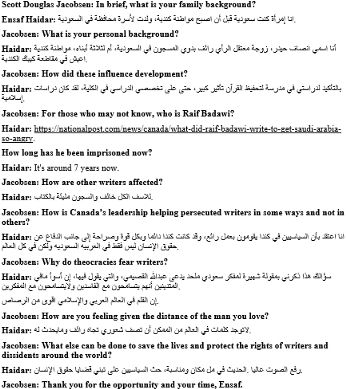
License
In-Sight Publishing by Scott Douglas Jacobsen is licensed under a Creative Commons Attribution-NonCommercial-NoDerivatives 4.0 International License. Based on a work at www.in-sightpublishing.com.
Copyright
© Scott Douglas Jacobsen and In-Sight Publishing 2012-Present. Unauthorized use and/or duplication of this material without express and written permission from this site’s author and/or owner is strictly prohibited. Excerpts and links may be used, provided that full and clear credit is given to Scott Douglas Jacobsen and In-Sight Publishing with appropriate and specific direction to the original content. All interviewees and authors co-copyright their material and may disseminate for their independent purposes.
Share this:

Author(s): Viola Namyalo (AfWG Chair, YHI) and Scott Jacobsen (VP, YHI)
Publication (Outlet/Website): Medium (Humanist Voices)
Publication Date (yyyy/mm/dd): 2019/04/26
What are humanist ceremonies?
For one to understand these ceremonies, it is important to understand what humanism is and who humanists are, as they exist in many societies in the world. Although, humanists may not be a major player in the world of life stances. Their core values can be seen in many dominant religions and life stances
What is Humanism? Who are humanists?
Humanism is a tradition based on reasoning. It is founded on the ethic of the wellbeing of every human being in the world. Humanism focuses on humanity and human interests. It implies thinking for yourself, doing your own thing, and accepting the results. In short, a respect for personal autonomy and an expectation of personal, and social, responsibility.
Its bases are anti-dogma if not non-dogmatic. It doesn’t believe statements without evidence. It does not impose beliefs or laws on people. Its emphasis is on reason and evidence. In part, this can explain the basis for humanists rejecting the supernatural, e.g. gods, angels, devils, and so on. In other words, humanism as a philosophy rejects the supernatural in all forms.
Since humanists don’t subscribe to the religious ideology, they celebrate their occasions including weddings ceremonies, funeral ceremonies, baby naming and all other celebrations in a secular manner.
The reason for this is humanists believe in the importance of celebrations without the supernatural. These ceremonies are known as Humanist Ceremonies. They are officiated or celebrated by humanist celebrants.
Humanist celebrants serve to provide humanists with a joyous and memorable ceremony. Humanist Ceremonies are unique because they are constructed with the wants of people in mind. These ceremonies can be celebrated in various venues including beaches, hotels, forest parks, and many more depending on the desires of the individuals planning the ceremony or event.
Do we have humanist ceremonies in Africa?
The good news, African humanists have had several humanist ceremonies. African had several wedding ceremonies in Ghana, Kenya, and South Africa. We have had one humanist funeral in Uganda. The reactions have been consistently positive; hence, we are hoping for more.
We have humanist celebrants in more than ten countries in Africa including Uganda, Kenya, Tanzania, Rwanda, Burundi, Nigeria, Ghana, South Africa, Zimbabwe, Malawi, and Sierra Leone. Thanks to the Humanist Association for Leadership, Equity and Accountability (HALEA) and their partners, including Humanist Society Scotland, for letting this happen for us.
Humanist marriages are not legal in Africa at present. However, different organizations in different African Countries are struggling to do this. The Humanist Association for leadership Equity and Accountability (HALEA) is in the struggle to legalize humanist marriages in Uganda. You can follow them on Facebook at humanist ceremonies Uganda to be update on events and activities.
The future of humanist ceremonies remains promising, especially with the number of humanists in Africa growing following the disappointments of adherents to formal religions. No doubt, humanist ceremonies promote humanism further through enabling humanists to put humanism more into practice.
We remain optimistic and hopeful of the further introduction of humanist ceremonies in Africa and its diaspora, where many skeptical people will embrace humanism. This is a trust in the power of the values of humanism to change the relationships of human beings to one another without the magical while keeping the wonder alive.
License
In-Sight Publishing by Scott Douglas Jacobsen is licensed under a Creative Commons Attribution-NonCommercial-NoDerivatives 4.0 International License. Based on a work at www.in-sightpublishing.com.
Copyright
© Scott Douglas Jacobsen and In-Sight Publishing 2012-Present. Unauthorized use and/or duplication of this material without express and written permission from this site’s author and/or owner is strictly prohibited. Excerpts and links may be used, provided that full and clear credit is given to Scott Douglas Jacobsen and In-Sight Publishing with appropriate and specific direction to the original content. All interviewees and authors co-copyright their material and may disseminate for their independent purposes.
Share this:
Author(s): Scott Douglas Jacobsen
Publication (Outlet/Website): Medium (Humanist Voices)
Publication Date (yyyy/mm/dd): 2019/04/26
Scott Douglas Jacobsen: What is some brief background of you?
Mike Golash: I have been active in the fight against US imperialism in Latin America for over 50 years. Opposed the boycott of Cuba, fought against US invasion of Grenada, opposed US support for the contras in Nicaragua and the rightist in El Salvador and the US efforts to undermine the Aristide government in Haiti.
Jacobsen: What is the Latin America & Caribbean Action Network — LACAN?
Golash: It is an advocacy group opposing US intervention in Latin America both militarily and economically.
Jacobsen: How did you find the Latin America & Caribbean Action Network — LACAN?
Golash: Through my relations with the immigration reform movement.
Jacobsen: What is your role as the Facebook Administrator of the Latin America & Caribbean Action Network — LACAN?
Golash: Making sure the posts follow the policies of LACAN.
Jacobsen: As a feminist organization and fighting against racism, how does this work within the context of the support for migrants and the general public?
Golash: Current US policy on immigration disproportionally affects women and people of colour. this is particularly true when it causes the breakup of families.
Jacobsen: What are the main sources of solidarity for feminism, anti-imperialism, and anti-racism in the Caribbean and Latin America?
Golash: At the moment we are mainly centred on the US attempt to replace the Maduro government in Venezuela and its support for the neo-fascist government in Brazil.
Jacobsen: Thank you for the opportunity and your time, Mike.
License
In-Sight Publishing by Scott Douglas Jacobsen is licensed under a Creative Commons Attribution-NonCommercial-NoDerivatives 4.0 International License. Based on a work at www.in-sightpublishing.com.
Copyright
© Scott Douglas Jacobsen and In-Sight Publishing 2012-Present. Unauthorized use and/or duplication of this material without express and written permission from this site’s author and/or owner is strictly prohibited. Excerpts and links may be used, provided that full and clear credit is given to Scott Douglas Jacobsen and In-Sight Publishing with appropriate and specific direction to the original content. All interviewees and authors co-copyright their material and may disseminate for their independent purposes.
Share this:
Author(s): Scott Douglas Jacobsen
Publication (Outlet/Website): Medium (Humanist Voices)
Publication Date (yyyy/mm/dd): 2019/04/16
Ding Jie “DJ” Tan is the Vice-President of the Humanist Society (Singapore). Here we talk about his life, work, and views.
Scott Douglas Jacobsen: Let’s talk about some background. What was personal and family background? How did this influence personal development? How did this eventually influence of personal life stance and worldview, especially in humanism?
Ding Jie “DJ” Tan: I grew up in a conventional Singaporean household. My parents subscribed to the traditional Chinese folk religion and were nominally Buddhists, though they may have considered themselves ‘free thinkers’ too. I attended a Catholic primary school (elementary school) and, like most Singaporeans, was exposed to the existence of different religions. This awareness of religion, coupled with my interest in the sciences would later help solidify my rejection of mainstream religious beliefs when I was 10-years old.
This rejection of religion was often viewed as the mere angst of a rebellious youth. Singaporeans, family and friends included, tend to perceive outright claims of atheism as ‘rocking the boat’, and may lean towards communal harmony, tradition, and superstition over broad overarching statements of facts which may not have a tangible impact on their day-to-day routine. While I identified as an atheist, I only found out about humanism when I joined the Atheist, Secularist, and Humanist Society in UCL, where I was the Secretary for two years.
Jacobsen: How did you find the Humanist Society (Singapore)? As the Vice President, what tasks and responsibilities come with the position? Since the organization’s founding, what have been positive developments for it?
Tan: Having served as an Executive Committee Member in the Humanist Society (Singapore) for the past two years, I felt that I could contribute more to the administration and leadership of the larger Society. Every individual brings a slightly different flavour to their roles in the Executive Committee; my interests are in science communication as well as in fostering inter-faith and inter-belief relations.
The Society has been around since 2010. Throughout our founding years, we have strived to provide a community of like-minded friends for the non-religious in Singapore. As we matured, we have also developed a voice in mainstream and online media, so as to better present the views of the non-religious and to preserve the secular common space in Singapore.
Jacobsen: What is the religious landscape, and non-religious landscape, of Singapore?
Tan: Singapore has long identified herself as a multi-ethnic, multi-religious, and multi-cultural nation-state. According to the last population census in 2010, 44 % of Singaporeans identified as Buddhists, 18 % as Christians, 17 % as non-religious, and 15 % as Muslim.
Jacobsen: For the main celebratory events per year: Humanist of the Year Award, Darwin Day and the Winter Solstice, what happens with each celebratory event? What are some upcoming plans for HSS for 2019/2020? How can people become involved in HSS?
Tan: The commemoration of festive occasions is steeped in human civilisation and rituals. Various Chinese cultures, as well as Christian societies, celebrate Winter Solstice in one form or another. The HSS does this by organising an annual get-together, for our members to mingle, eat, drink, and be merry.
Darwin Day is usually a more academic affair. Past iterations of the Day have included a visit to the local natural history museum, a guided walk of the local park, as well as lectures on the history of biodiversity in Singapore.
This year, HSS will be hosting AHC 2019. We are happy to have volunteers on board to help us with the programme, logistics, and sponsorship! We also hold monthly socials for members to socialise in a more casual setting, over drinks.
Jacobsen: Any recommended authors or speakers?
Tan: Richard Dawkins, AC Grayling, Bill Nye, Stephen Hawking, Christopher Hitchens
Jacobsen: Thank you for the opportunity and your time, DJ.
License
In-Sight Publishing by Scott Douglas Jacobsen is licensed under a Creative Commons Attribution-NonCommercial-NoDerivatives 4.0 International License. Based on a work at www.in-sightpublishing.com.
Copyright
© Scott Douglas Jacobsen and In-Sight Publishing 2012-Present. Unauthorized use and/or duplication of this material without express and written permission from this site’s author and/or owner is strictly prohibited. Excerpts and links may be used, provided that full and clear credit is given to Scott Douglas Jacobsen and In-Sight Publishing with appropriate and specific direction to the original content. All interviewees and authors co-copyright their material and may disseminate for their independent purposes.
Share this:
Author(s): Roslyn Mould & Scott Douglas “Nana Kwesi” Jacobsen (Ashanti)
Publication (Outlet/Website): Medium (Humanist Voices)
Publication Date (yyyy/mm/dd): 2019/04/11
Extreme poverty is a problem around the world defined by the UN as “severe deprivation of basic human needs, including food, safe drinking water, sanitation facilities, health, shelter, education and information” by the United Nations in 1995. Ghana is a West African country that was the first African country to have gained Independence from the British Colonials on the 6th of March, 1957. Having been through Democratic ways of government and transitioning power, Ghana has also experienced, a number of coup d’etats, the last one being that of Jerry John Rawlings when he was sprung out of custody after his first coup attempt 4th June, 1979. Despite being a country of massive wealth and resources ranging from Minerals like Gold, Bauxite, Manganese, one of the top Tourist destinations in Africa, Agricultural wealth such as 2nd largest exporter of Cocoa and having huge petroleum deposits, Ghana is a 3rd world developing country with issues of extreme poverty.
Under Military rule, Ghanaians were subjected to injustices, where even freedom of expression was curtailed or stifled until he handed over democratically in the year 2000.
Ghana has achieved appreciable steady growth levels since the late 1990s to the present day, such growth has translated much into lifting many people out of poverty. There has been a general rise in income levels for both the wealthiest and the poorest, however, this increase in income levels has been highly unequal and for many people, they have in fact gotten poorer and more vulnerable.
Growth has benefited the rich extremely more than it has done for the poor. Despite attaining a middle-income status, the rate of population growth has outpaced the number of people getting out of extreme poverty. We now have a situation where more people are born into poverty than people are escaping poverty. A child has a higher chance of living in poverty than an adult. The growth of the Ghanaian economy has not been even either. Urban residences are less likely to be living in extreme poverty than rural dwellers. This translates into a worrying state of affairs where the North of the country is predominantly poor and the South is relatively better. The economic disparity between the North and the South of Ghana has actually worsened since the early 1990s.
Not uncommon to other economies, the problem of extreme poverty has a gender dynamic to it. The majority of people suffering from extreme poverty are women and children. They bear the brunt of this increasing problem. The biggest problem facing people living in extreme poverty are numerous, the most important among them is the inability to afford decent and well-balanced diet, especially for rural dwellers. Urban dwellers are in also affected by poor nutrition, usually manifesting in the rising obesity problem and malnutrition in children. Rural poverty has consistently lead to the youth of those areas migrating to urban centers to seek menial jobs. With their low employable skills, they work harder and get paid less and since they cannot afford decent housing, they end up as squatters in slums such as those in Agbogbloshie, Ashaiman, Suame, etc. Most also engage in dangerous jobs like scavenging for e-waste products which they burn to retrieve minute rare metals. The burning process is hazardous work, exposing them and the environs to heavy metals, which reduces their life expectancy and quality of life. As folks move away from rural centers where the majority of farming output comes from, these areas are stripped of the manpower to grow food, transport foodstuffs and sustain agriculture that sustains the country.
Urban centers have a slightly different dynamic to rural areas. Urban centers have the characteristic of having its poor unable to afford decent housing, unemployment etc.
It is common rhetoric in Ghana to hear people say that justice is for the rich and those who can afford to pay for litigation. Access to opportunities depends on who you know. This allows for a situation where the poor can’t afford to access the judicial system for wrongs done them to seek justice. They let it go and injustice goes unchallenged. As such, people deliberately trample on the rights of fellow citizens knowing that they cannot afford to follow up with the court process. Police officers regularly abuse people and get away with it, they detain persons without due process. There’s a general lack of confidence in the security services of Ghana among citizens. Many prefer to not deal with the police at all.
Gaining employment and general opportunities is also constrained by how one is connected to people in higher places. This situation locks the poor in a vicious cycle of never-ending poverty that is extremely hard to escape. To gain employment often requires that one person pay a bribe to someone to connect you to someone to make it happen. The inability of parents to secure a reasonable income leads to them having to let their young children below the legal working age engage in labour to help sustain their families. These children are almost always exploited, sexually notwithstanding. These children spend school hours on the street hawking which translates in poor performance in school and some ultimately drop out of school and engage in full-time labour to feed themselves and their families. Girls are likely to engage in prostitution or other forms of the sex trade to sustain themselves. They often end up being teenage mothers themselves or as ‘carriers’ locally known as ‘kayayei’ in the marketplaces for carrying heavy loads on their heads for a small fee and the whole cycle starts for the next generation.
Access to quality healthcare depends on one’s ability to pay for it. Though the National health insurance scheme has been in operation, some health facilities have openly declined offering services on it and only hard cash is accepted. A situation that effectively bars a large section of the population from accessing health services. To compound the problem, there are not enough Doctors, hospitals and facilities giving the rise to superstition and witchcraft accusations that lead to people seeking alternative means of cures from Faith healers and fetish priests. Since extremely poor people live in slums and equally unsanitary environments, their general health status is by default below standard and their inability to afford healthcare further worsens the scenario and keeps them in a loop of constant health concerns, the overall effect being higher mortality rate for the poor and the need to bear more children.
Discrimination between women and girls is still rampant. Girls still have a hard time getting enrolled in school and staying in school due to a lack of interest in parents investing in girl-child education. Women, though accounting for the larger portion of people involved in economic activities, do not have easy access to land and ownership or inheritance of property and other assets and therefore do not enjoy the full benefit of ownership of the means of production of food and as such are economically disadvantaged. This disadvantage leaves women economically dependent on men who in turn use this vulnerability to manipulate and control women financially and otherwise. This trap doesn’t allow them autonomy of their bodies and minds. Cultural and religious practices also disproportionately affect women and even though women are legally able to access these services, cultural schemes prevent them from realizing their full rights and freedoms. The manifestation of weaker legal systems to break harmful cultural norms show up for example as witchcraft accusation victims are overwhelmingly women. These often target poor aged women, their frail bodies coupled with their poor economic status makes them easy targets.
The IMF and the World Bank have generally been welcome partners of Ghana in helping the country become fiscally more disciplined. In the area of macroeconomic outlooks, they have been nearly indispensable. However, when it comes to microeconomic matters, the World Bank and IMF policies have in some cases worsened the economic outlook of the already
economically vulnerable and threatened. Sometimes, the policies meant to keep the balance of the economy have disregarded their impacts downstream. Regulations have come at great social and cultural costs. The servicing of these huge debts have forced the government to underspend in areas such as education, health, agriculture and sanitation. Less spending in these areas like agriculture for an economy still heavily reliant on agriculture puts society in a long term shock with dangerous consequences. These financial players have been aware that monies meant for development projects largely end up in the pockets of corrupt officials, knowing this, they have often not bothered to enforce strict adherence which is the right thing to do because it is the entire country that would be trapped in debt that the very poor whom the developmental projects were meant to help in the first place but weren’t helped that will have to pay back these loans.
In the Greater Accra region, some suggested places to visit to see the effects of urban poverty are Townships like Jamestown, Agbogbloshie, Nima, Ashaiman. To the north of the country, places like the Tamale metropolitan area is a worthy study place, Yendi Gushiegu and East Gonja district and Bole areas all in the Northern region are perfect study areas as well. The Bolgatanga and Bongo municipalities, Bulisa south, Bawku East and Nabdam in the Upper East region are recommended. Adaklu, North Tongu districts in the Volta region. Wa west, was east and Sisala west in the Upper West region.
The Commission on Human Rights and Administrative Justice (CHRAJ), Ghana Center for Democratic Development(CDD), UNICEF Ghana are but a few civil society organization that will be of immense importance help. Even with these problems for Ghanaians for their history and into the present, Ghana has been improving in its human rights and quality of life, in part, for the improved life and wellness of Ghanaians. It is not simply all bad, but it is a record of improvement in the midst of extreme poverty. The positive takeaway is the improved living conditions for Ghanaians from time to time in spite of the problems.
License
In-Sight Publishing by Scott Douglas Jacobsen is licensed under a Creative Commons Attribution-NonCommercial-NoDerivatives 4.0 International License. Based on a work at www.in-sightpublishing.com.
Copyright
© Scott Douglas Jacobsen and In-Sight Publishing 2012-Present. Unauthorized use and/or duplication of this material without express and written permission from this site’s author and/or owner is strictly prohibited. Excerpts and links may be used, provided that full and clear credit is given to Scott Douglas Jacobsen and In-Sight Publishing with appropriate and specific direction to the original content. All interviewees and authors co-copyright their material and may disseminate for their independent purposes.
Share this:
Author(s): Scott Douglas Jacobsen
Publication (Outlet/Website): Medium (Humanist Voices)
Publication Date (yyyy/mm/dd): 2019/03/29
The Association humaniste du Québec and Humanist Canada have founded an essay contest for students — at the high school and CEGEP level — to write critically about humanist values and Canadian society.
There are no predetermined topics for the essay submissions by students. The Humanist Canada Essay Contest is intended for the advancement of humanist values in the Anglophone and the Francophone spheres of Canada.
This critical thinking and humanistic ethics writing will provide a window into the fresh thoughts of the young on the ways in which humanism has a place in modern society more than ever before.
There is a total of $8,000 in prizes. The first place prize in each language will come to $1,000. The deadline for submissions is May 15, 2019.
“We are proud to give Canadian students a forum to express humanist themes given the on-going attack on science and reason we have observed in society,” Dr. Lloyd Robertson, Vice-President of Humanist Canada, stated, “Humanist Canada and Association humaniste du Québec are proud to be the hosts of the HCEC. We look forward to receiving many submissions from inspired and interested high school students.”
The full information for the essay contest can be found here: https://hc-contest.ca/en/.
More information here: https://www.newswire.ca/news-releases/dr-henry-morgentaler-memorial-scholarship-announced-821243261.html.
License
In-Sight Publishing by Scott Douglas Jacobsen is licensed under a Creative Commons Attribution-NonCommercial-NoDerivatives 4.0 International License. Based on a work at www.in-sightpublishing.com.
Copyright
© Scott Douglas Jacobsen and In-Sight Publishing 2012-Present. Unauthorized use and/or duplication of this material without express and written permission from this site’s author and/or owner is strictly prohibited. Excerpts and links may be used, provided that full and clear credit is given to Scott Douglas Jacobsen and In-Sight Publishing with appropriate and specific direction to the original content. All interviewees and authors co-copyright their material and may disseminate for their independent purposes.
Share this:
Author(s): Scott Douglas Jacobsen
Publication (Outlet/Website): Medium (Humanist Voices)
Publication Date (yyyy/mm/dd): 2019/03/12
Most young people, men and women, want to marry one another. The questions arise, in younger generations growing in the wave of divorces in the West or seeing divorces in the West, about the nature of divorce, the proceedings and relations afterward, and the supports in place.
The Independent took account of the increasing interest in the worldview or life stance humanist in this most important of life domains for the vast majority of the population who, in fact, want to marry and have children.
It has been researched in some prior academic work by humanists, including Dr. Lloyd Hawkeye Robertson, that in spite of the increase in, for example, Canadian society of the secular by belief or the non-religious, and so on, the consistent trend has been a stabilization of the cultural tradition of marriage.
Something about this institution holds a special place in the ways in the English, the Welsh, the Scottish, the Canadian, and others. The due diligence on the part of the humanist leadership and community would be to take this into account as an empirical fact and then plan, and act, in accordance with the reality presented to us: human beings like weddings.
In addition, and with the hyper-cautious current generations in regards to weddings and partnerships, in the West, at least, we can see the important empirics provided by The Independent. The humanist weddings, compared to other forms of ceremonies, appear to divorce less — based on new data.
The data comes from a biased source in Humanists UK, but the information could be valid regardless of the potential bias or conflict of interest in the source used for the citation.
Interestingly enough, the statistics cited by Humanists UK, to dig a tad deeper into the rabbit hole, comes from the official statistics.
If you take some time to sift through the data on record for Civil, Humanist, Church of Scotland, Roman Catholic, and Other Religion categories for the weddings and the divorces, literally, every other type of marriage indicated an increase in the divorce rate whilst the humanists recorded a decrease in the divorce rate as the marriages lasted longer.
In fact, only Civil marriages seemed to do some of the same, but there was a stabilization of the divorce rate as the marriages counted were from 5–10 years and then 10–15 years. This doesn’t mean, by necessity, the superiority of the humanist marriages, but, certainly, this indicates an improved status of the divorce rate. Which, I guess, in one analysis, can imply better in the long term survival of the marriages.
One weakness of the data here is the fact of the limitations in the range of the data. It is on a limited number of types of beliefs. It, also, is limited to Scotland as a data set. Something of interest would be an international research study on humanist and other belief wedding ceremonies around the world controlling for reasonable confounding variables including family size, prior marital status — e.g., first or second, or third, marriage, and so on, socioeconomic status, educational status, region of the world, and so on.
The assumption would be a similar trend, or, perhaps, a null result in which the belief systems behind the ritual of a union, behind the marriage ceremony, in essence, amounts to a completely negative result overall. However, an in-camp bias would want, of course, the humanist ceremonies to be a protection against the ravages, typically, of the breakdown of a union in the case of divorce.
As stated by Humanists UK, “Overall, looking at marriages within the last fifteen years, 0.25% of couples who had a humanist marriage got divorced in 2017–18, compared to 0.84% of all other couples. This stark difference remains regardless of duration of marriage.”
An important note, no doubt, but does this amount to a statistically significant result or simply too tiny to become noteworthy; it may be salient to those who want a reduced odds of 0.59%. However, we simply do not know, as far as I can tell — as the data is only one country. It seems promising, though.
In the reportage by The Independent, humanist weddings are not formally recognized by England or Wales. However, Scotland, happily, has seen their legalization since as far back to the 2005 — you know, the Dark Ages of modernity.
The Civil Marriage Act of July 20, 2005, was, by comparison, the time when Canada legalized same-sex marriage, which is the country of origin and residence for me.
Now, humanist weddings, as of 2018, are recognized in North Ireland. This is all to the good, not simply the humanist good but those with goodwill and understanding of human right stipulations about equality. Of course, there may be personal legacy reasons or political motivations upon which the movements for equality in societies. However, the presence of greater equality is, at root, praiseworthy.
“…couples in England and Wales may choose to legalise their nuptials at a local registry office either before or after their humanist ceremony. The figures,” The Independent stated, “which were obtained by the Scottish Courts and Tribunals Service and released to the BBC via a freedom of information request, reveal there were 5,072 humanist marriages in Scotland between 2017 and 2018. Meanwhile, there were 3,166 Church of Scotland ceremonies and 1,182 Roman Catholic ceremonies; the most popular type of wedding was a civil ceremony, with 14,702 taking place in that same time.”
In essence, a humanist wedding as a non-religious ceremony, as an alternative to some of the more traditional or, rather, the traditional religious services and ceremonies provided by other belief systems.
A humanist celebrant will be the one to officiate the wedding or conduct the funeral within the framework of official training and then working within the constraints of the ideology of the movement. Humanist simply rejects the supernatural while harboring something more akin to a life stance or an ethical philosophy. In this sense, it is pragmatic.
Humanists UK stated, “[A humanist will] make ethical decisions based on reason, empathy, and a concern for human beings and other sentient animals… [where] human beings can act to give their own lives meaning by seeking happiness in this life and helping others to do the same.”
Meaning not as a constituent element of the universe but as a derivative of human beings in relation to it. Human beings make meaning. Some of those meanings exist in the long-term partnerships most choose to embark upon, in which further meaning can be gained through a ceremony to mark and honor it.
Andrew Copson, the Chief Executive of Humanists UK, stated, “These figures show what a good start for couples a humanist wedding can be… Humanist weddings are deeply personal, with a unique ceremony crafted for each couple by a celebrant that gets to know them well.”
One of the good sets of data comes from YouGov research into public attitudes about acceptance of humanist weddings. In England and Wales, 7 out of 10adults would like to see the humanist weddings legally recognized.
License
In-Sight Publishing by Scott Douglas Jacobsen is licensed under a Creative Commons Attribution-NonCommercial-NoDerivatives 4.0 International License. Based on a work at www.in-sightpublishing.com.
Copyright
© Scott Douglas Jacobsen and In-Sight Publishing 2012-Present. Unauthorized use and/or duplication of this material without express and written permission from this site’s author and/or owner is strictly prohibited. Excerpts and links may be used, provided that full and clear credit is given to Scott Douglas Jacobsen and In-Sight Publishing with appropriate and specific direction to the original content. All interviewees and authors co-copyright their material and may disseminate for their independent purposes.
Share this:
Author(s): Scott Douglas Jacobsen
Publication (Outlet/Website): Medium (Humanist Voices)
Publication Date (yyyy/mm/dd): 2019/02/21
Female roles in Hollywood and women in the movie and television industry continue to make further strides due, mostly, to their own efforts and activism for recognition, respect, and equal treatment with the men in the industries and on the screen.
Sarah Jessica Parker spoke on feminism and humanism. In the call for better roles for women, she remarked how this is not simply a feminist issue but, in actual fact, a humanist issue, broadly speaking.
Part of this may be due to the stigmatizing of the term “feminist.” Another part may be due to the universalist nature of the implications, in terms of direct representations, of the term “humanist.”
Of course, the terminology of feminism, in its traditionalist meaning, is universalist, as in women and men recognized as social and legal equals. Humanist simply moves this out into the level of the species.
“The actor reiterated this sentiment in a recent interview, explaining that she believes the LGBT+ community must be included when discussing better representation in film,” the Independent reported, “When questioned over whether or not female actors are being offered higher calibre roles than they have done in the past, the actor stated that she doesn’t feel as though she’s ‘equipped to speak to the quality across the board.’”
Parker’s hope is for the quality parts in movies and television will be part of the industry, not simply as a “call-to-arms” for feminists but, in fact, a general movement for the furtherance of humanism.
A humanist is someone who does not identify with the supernatural — not necessarily the rejection of the metaphysical but the supernatural — and emphasizes human reason, compassion, and science, in addition to their inherent limitations as evolved organisms.
Both respect the human rights of men and women. In that, there is a wide overlap in their outlooks.
“People of colour, gays, lesbians, and transgenders who are carving out this space. I’m not spitting in the face or being lazy about what still needs to be done — but I don’t think it’s just women anymore,” Parker said in 2015, in Cosmopolitan.
She further explained how the movement within the television and movie industry could be even more powerful if this was identified with the humanist movement. Others have proclaimed this as, in essence, an evasion tactic with the aforementioned demonization of the term feminist.
While, at the same time, these can both be true positions; the shift into humanist language may be more powerful than the limitations, currently, of the plurality of feminisms on offer.
But this could also lead to a similar problem with a wide range of humanisms on offer as well. As there is a wide range of humanisms, indeed, these can range from the deistic humanists to the atheistic humanists, and never the two meeting.
The world is complicated; people similarly so. Meryl Streep was also on record as identifying as humanist because of being for “nice easy balance,” which does reflect the casual style and flavor of thinking of the actress.
In addition, Susan Sarandon described her view of humanism too. It is not simply about the distinction but more about the overlap and then the appropriateness of the term to social context.
But certainly, these identifications as humanist by prominent women is an important aspect of the work to modernize the views of the humanist world and, as importantly, getting the title out into the mainstream sphere through prominent and respectable actresses.
License
In-Sight Publishing by Scott Douglas Jacobsen is licensed under a Creative Commons Attribution-NonCommercial-NoDerivatives 4.0 International License. Based on a work at www.in-sightpublishing.com.
Copyright
© Scott Douglas Jacobsen and In-Sight Publishing 2012-Present. Unauthorized use and/or duplication of this material without express and written permission from this site’s author and/or owner is strictly prohibited. Excerpts and links may be used, provided that full and clear credit is given to Scott Douglas Jacobsen and In-Sight Publishing with appropriate and specific direction to the original content. All interviewees and authors co-copyright their material and may disseminate for their independent purposes.
Share this:
Author(s): Scott Douglas Jacobsen
Publication (Outlet/Website): Medium (Humanist Voices)
Publication Date (yyyy/mm/dd): 2019/02/09
According to the Friendly Atheist, a Republican State Representative, John Ragan, filed a bill called HB 1490 in which taxpayer money would not be permitted to subsidize abortions.
The basic belief, here, is that the funding of abortion will endorse secular humanism in addition to violating the separation of church and state. I will not need to delineate the obvious to the audience here, on those first points of inquiry implied by the strange but expected bill.
The language of HB 1490 states some of the common tropes within the rhetoric amongst pro-life advocates; those who wish to deny safe and equitable access to abortion, which, as described by Human Rights Watch, is a fundamental human right and, in fact, saves women’s lives — literally — and livelihoods.
Important to note, this is not simply about the legislation. The documentation, in terms of rights, is explicit about three criteria. One is accessibility. Another is safety. A third is equity. It should be within the national consciousness.
Women have the human right, in fact, fundamental human right not simply “human right,” to reproductive health services with abortion as an aspect of this. The notion of abortion is to have the ability to get one in a legal fashion, as a fundamental human right.
Think about the opposition case, if women have their access to abortion denied, what will happen to these women who become pregnant with an unwanted child, for an example?
As a friend and colleague and former child violin prodigy, Paul Krassner, noted decades ago, there will need to be underground referral services, where, in fact, Krassner provided some referral services; in other words, women will get those abortions anyway.
When women get them in a legal or illegal context, in which the access is there or not & the state approves it or not, the main consideration becomes the respect for fundamental human rights or not.
By refusing to provide these services, which are far and away one of the least frequent provided services by reproductive health centres anyway, the legal structures, the society, and the opposition actively oppose the right to this fundamental human right and, in fact, the eventual — and statistical — health and wellness of women. It may not be in every single case, but, on average and based on the empirical evidence available to us at an international level, the general principle of heuristic is women will have improved wellbeing, as a group within societies, with the provision of abortion services.
That’s layer one. The basic respect for the right for it, as women will get them anyway. Thus, the best work would be to give this to them anyway. Following from this, we come to the second consideration, which is safety. Once women have it, is it safely available to women? This is a highly relevant question given the context of the United States of America after the appointment of Brett Kavanaugh.
If not, then this violates the fundamental human right. Women will be in only marginally better circumstances getting unsafe abortions in a licit context as they would in an illicit environment. Therefore, the purpose of a legal protection and provision of abortion services under the banner of reproductive health services would be two-fold: 1) the protection of the fundamental human right of women and 2) the increased probability for the improved outcomes for women in the context of a needed medical service, abortion.
The final criterion is equity, or “equitable.” Different sectors of the population of women have different levels of access to these provisions. This requires an explicit statement as to the import of the protection of women of color, rural women, poor women, and so on, in the case of provision of abortion.
With these criteria for the respect and implementation of a fundamental human right, it is simply about safe and equitable access to abortion services. Without these, with these made illegal or women turned into outlaws for needing or even wanting them, women will die or become injured by the thousands, in the former case, and by the millions, in the latter case, according to Human Rights Watch, at an international level.
The language of HB 1490 simply speaks to the talking points of the pro-life stance on this debate. That is to say, there will be references to direct opposition about abortion not being murder, about abortion not being immoral, and abortion not beginning at conception, and so on:
The naked assertions that “abortion is not murder”, “that abortion is not immoral”, and that “life does not begin at conception” are unproven faith-based assumptions that are implicitly religious and are unproven truth claims that are inseparably linked to the religion of secular humanism;
The stance of secular humanism is against religious dogma, where the stance is not dogma, e.g., no holy text, nothing to pray to, no suggested practices, no gods as traditionally defined at least, and so on; thus, the assertion of secular humanism as a religion simply speaks to the indication that religion, in the United States, continues to garner a bad reputation as an idea and as a term, which is cynically being exploited by Ragan in the language here.
This comes from a fundamentalist branch of Evangelicalism within the United States that has been working to demonize secular humanism, and other groups, for some time, including feminists, activists, progressives, and the like.
The statements continue:
That the establishment clause prohibits the state of Tennessee from enforcing, respecting, recognizing, favoring, or endorsing policies that fund abortion facilities with tax dollars because the practices are nonsecular and such appropriations have the effect of excessively entangling the government with the religion of secular humanism, putting religion over nonreligion;
To deconstruct this, the obvious implication of the title “secular” in secular humanism is the endorsement, explicitly if not implicitly, of the separation of church and state, or, more properly, place of worship and state. How does this qualify as a faith, exactly?
As we have seen in the history of the United States, the conservative religious fundamentalist base — not simply old fashioned conservatives — are working with what has worked for progressives in the past and then, non-creatively, attempting to reverse the arguments with their own talking points on the notion of religion interfering in the politics and health provisions of the country, which has been a progressive argument and pro-choice — as in, pro-human right, pro-maternal health, pro-infant health, and pro-women’s reproductive health — argument for years in order to prevent the encroachment of the fundamentalist religion into the reproductive lives of women.
Now, the conservatives realize the loss in the courts, e.g., Roe v Wade from 1973, but then see the utility in the form of the argument of the prevention of religion entering into political life. In this case, the attempt is to fight the ‘evils’ of secular humanism by trying to label secular humanism as a religion and then working to encroach religion into the public sphere, into the domain of reproductive health services and reproductive health rights for women, through the denial of abortion services, but from the opposite angle.
By the implication of this reversal, the pro-life sector represented by Ragan, perhaps not all but many, therefore, become people of politic rather than people of principle and may reflect the general assault on the population by “people of means,” as recently declared as a preference by billionaire Howard Schultz. The principles would be the same, as in the arguments would be consistent. But now, the arguments have reversed for Ragan and, thus, the principle is not principles but the restriction on the rights of women — full stop, by whatever arguments or means in order to do it.
The statements in the reportage continue:
The direct or indirect subsidization or facilitation of abortion with funds distributed by the state of Tennessee constitutes paying for an abortion and, therefore, conflicts with the First Amendment establishment clause of the United States Constitution;
The state of Tennessee may not favor or endorse one (1) religion over another, nor may the state of Tennessee favor or endorse the religion of secular humanism generally over nonreligion.
By the respect for human rights and the provision of a fundamental human right, the notion is the utilization of the First Amendment establishment clause to the United States Constitution in HB 1490 as, in some way, a religious issue from the other side, where, in fact, the basic principle of secular humanism is human rights and the separation of place of worship and state.
The argument for the prevention of abortion services through the labeling of secular humanism as a religion simply restricts the provision of abortion services to women — for the vast majority of cases — in need of one. By default or reflection, this would lean towards and instantiation of the pro-life position, or standard fundamentalist religious position, of the prevention of abortions for women. In either case, the outcome is the same: women simply denied equal status in American society through the denial of respect for their fundamental human rights.
“Not that we should have to waste time debunking any of that, but the assertion that abortion is ‘murder’ or ‘immoral’ and that life begins at conception are all faith-based statements that also have no basis in reality. It’s rhetoric, not science,” Hemant Mehta explained, “To suggest that a pro-choice chance promotes secular humanism but that an anti-choice stance has nothing whatsoever to do with religion is the sort of lie we’ve come to expect from conservative Christians. Keep in mind that the laws have nothing to do with whether abortion is ‘moral.’ That’s your call, not the government’s.”
In addition to HB 1490, Ragan, according to Mehta, is also endorsing, as a co-prime sponsor, a bill with the clear intent to ban abortions based on the detection of a fetal heartbeat, where, not conception, but the heartbeat detection becomes the first point of no abortion possible. As the readers here can tell, and certainly know, the work is to try anything that work, simply to restrict women’s freedom; the sensibility seems to come in the indirect pervasive truth, in some manner: a fear of sexually and economically free women — not a proof of this but a sense of it.
Mehta, properly, notes, “I guess it’s not government overreach when it involves his religious beliefs. In case that point about hypocrisy isn’t clear, Ragan also co-sponsored a resolution just this year that would literally change the state’s Constitution to say our ‘liberties do not come from government, but from Almighty God.’”
As Mehta reasonably and accurately observes, the issue is not about principle; it is about the innervation of a singular interpretation of religion into government rather than the permission of all voices via the denial of religion into public life. No religion in the politics is simply a recognition of the obvious: a respect for the non-religious and the religious across the board through equal treatment. The religious have been in power forever; thus, any movement towards equality feels like oppression.
The issue may seem ambiguous, to some, in the single HB 1490 case, but, if compared across examples, then the conclusions seem clear: the purpose is forced intervention into public life of one denomination of Christian religion in American legal structures and political life in order to have the consequence of the denial of the fundamental human rights of women.
And as this comes down to an individual choice of abortion, if you do not want an abortion, then don’t get one; if you disagree with it, on religious grounds, or for others, then still don’t get one, but, at the same time, don’t deny the safe and equitable access for women, or, if the case may be, other women.
License
In-Sight Publishing by Scott Douglas Jacobsen is licensed under a Creative Commons Attribution-NonCommercial-NoDerivatives 4.0 International License. Based on a work at www.in-sightpublishing.com.
Copyright
© Scott Douglas Jacobsen and In-Sight Publishing 2012-Present. Unauthorized use and/or duplication of this material without express and written permission from this site’s author and/or owner is strictly prohibited. Excerpts and links may be used, provided that full and clear credit is given to Scott Douglas Jacobsen and In-Sight Publishing with appropriate and specific direction to the original content. All interviewees and authors co-copyright their material and may disseminate for their independent purposes.
Share this:
Author(s): Scott Douglas Jacobsen
Publication (Outlet/Website): Medium (Humanist Voices)
Publication Date (yyyy/mm/dd): 2019/02/08
Scott Douglas Jacobsen: What is personal background on for you?
Jess Corpus: I would sum up my personal background as follows: I was baptized catholic. I am the oldest among six children, grew up in a devout catholic household. Went to a catholic elementary school (San Carlos elementary school) runned by nuns, actually runned by the same congregation where Marissa went to college at University Of San Carlos. I went to an exclusive catholic boy’s school, Don Bosco Technical High School, runned by the Salesian congregation based in Italy, school principal and the rector were Italians, technical heads were Italians. Don Bosco is a top notch school when it comes to technical courses prior going to college, it is also revered way back then for the “tough discipline” they instill on their students. The school slogan is…”In education, what is best is good enough”. I went to a catholic college after graduating high school in 1975, and graduated with a bachelor’s degree in electrical engineering. I am happily married to my second wife, have a 9 year old son who is currently an “A” honor roll student, I have a first son from my first marriage who is serving his last term with the U S. military. Have five siblings, 3 sisters and two brothers, in which the other brother retired from the U.S. navy not too long ago. All of us are degree holders with one sister have a master’s degree. Both of my catholic parents are deceased.
Jacobsen: How did you become involved in the humanist community? In early life or later life, when did you first come to value humanist ethics?
Corpus: Actually, I only have a slight idea from what point in my existence did I somehow turned to be a humanist. I haven’t had a clue on what humanism is but here’s a short story: My father back in 1971 threw a small Christmas party for the families of the three carpenters that mt father hired to renovated the house my father just bought which will become our permanent family home. At first there were only a few people…the spouses of the three carpenters and a few of their children. As the years went by, my father kept the occasion going each Christmas. As the succeeding years came the crowd grew bigger, it swelled from the three original families to numerous families. A small Christmas party for the three carpenters had turned into a family tradition as a party for indigents each Christmas day. Families of indigent with their children in tow would come to our house and partake in the festivities with delicious sumptuous meal prepared by my mother and our household help. We would stuffed candies in sock shaped plastics for the numerous kids that would come, and we would also stuff a kilo or two of rice and can goods in plastic bags for families to take back home after the festivities. I for one would saved money from my allowance to buy more candies for the kids. Although our parents are gone, we kept this tradition to this day since 1971. It was also at this juncture that I started “questioning the goodness and kindness of god”. If god is so good, why are these people so poor? Many would come to the party barefooted, many with tattered and dirty torn clothes! Some smelled as if they haven’t bathed for days. When I watched them eat it appears that was their first meal of the day. Those were the saddest sights I’d seen in my teenage years, and to this day my heart bleeds every time I am confronted with an image of a poor starving child. I started questioning what kind of an all loving, giving, and caring god when we have indigent people like these? What kind of church if it can not feed and care for the people it professes to serve in the name of a god?…I started looking for answers!
Jacobsen: What do you view was the core of humanism?
Corpus: I can not conceived of any particular humanist ethics other than being good to fellow humans. That whatever we do big or small, good or bad can somehow impact directly or indirectly the lives of other human beings. Needless to say, good or bad deeds have each own consequence. Those consequence may or may not have a ripple effect, but nevertheless it have consequence, big or small.
What I view as the core of humanism is “human empathy”. Empathy is what differs us from the lower species. But just for the sake of argument, other mammals in the lower rung also demonstrate a sense of empathy in their natural instinct to care for their young. But we humans can reason why we do what we do, lower animals couldn’t.
Jacobsen: Who are some prominent humanists that you respect? What are some books that had an influence on you?
Corpus: Einstein is more humanist than a pacifist, read Walter Isaacson’s best selling book Einstein. Bill and Melinda Gates greatly qualify as prominent humanist through their charitable contributions from their multi billion dollar foundation, so is Oprah Winfrey comes to mind in her quest of opening schools for girls in parts of Africa to empower them…Angelina Jolie, a celebrity, and in spite of the tumultuous relationships in her per personal life adopt african children to give them a better life, and her work with the U.N. is commendable. Some say her deeds are are just publicity stunts, publicity stunt or not, her empathy is obvious! These are just among the few prominent people that comes to mind…but let’s not put aside our very own Marissa Langseth for doing what she does in her own ways for the betterment of humanity.
I am a voracious reader, I wouldn’t say the bible is a book that influenced me, it never did really! I would say “The God Delusion” by Dawkins, “End Of Faith” by Harris, and of course “God Is not Great” by Hitchens, very influential books for people like me who are not blinded by faith. There are so many arguments to be made that go against the grain in the belief of the existence of any gods and these books surely lived up to that expectations in their arguments. These books wouldn’t do as much good to hardcore theists though. I’ve read so many books in my lifetime. I kept the ones that are worth keeping and the rest I donate to Goodwill. Not only that I buy and read books, I also read other publications as well like Nat’l Geo. which I had been reading since I was in the 6th grade, Time Magazine which I had been reading since my freshman years in high school to keep abreast of what’s going on in the world around me.

Disregard the spread on the table, photo was taken before a New Year’s dinner two years ago. Just to show my arsenal of books in my mini library at home. Still have too many in boxes in my garage, I am running out of room to where I put them. I would had donated many books to the Philippines if it’s not too costly to ship them!

My Nat. Geo. magazines, about 5 years worth waiting to be donated at a waterfront ministry in Charleston. I love reading Nat. Geo…it features just about anything…people, places, things, etc., love their photography!
Jacobsen: Can you recommend any lectures or speakers for those organizations that want to invite them?
Corpus: I would surely touch on the subject of religion and how it regressed countries like the Philippines, and how religion regressed theocratic countries like the UAE. But the Philippines is one country whose catholic majority population doesn’t take lightly any criticisms attacking, contradicting or anything critical of their faith. How can other concept of thought break through the juggernaut of religion’s suffocating grasp in an ignorant and superstitious population like the Philippines? Organizations in the Philippines like HAPI or other non belief organizations in the country can tap on many well known non theist speakers who are well known and respected in their respective fields, but they come with a premium price! Dawkins, Harris, Kauss, Dillahunty, Seth, Aron Ra, Dr. Crier, NDT, Dr. PZ Myers, etc. There are many well known vloggers in “YouTube” who are anti theist and have a huge following, these personalities can be tapped for lectures or speakers to bolster not only their slight fame but also to draw audience and boost visibility of humanist organizations like HAPI. In fact I am currently trying to finish reading a book…”An Atheist Stranger in A Religious Land”…Selected Writings from the Bible Belt. Authored by Herb Silverman, a native of Charleston, SC…not to say that I live in Goose Creek, SC, a small city and a few minutes drive from Charleston. Herb is a professor of mathematics in the College Of Charleston, he’s an atheist Jew. He’s also the founder of the low country humanist assoc. in Charleston. I reckon he can be an excellent speaker for an organization like HAPI.
Jacobsen: What do you think are some of the more valuable activities of humanist communities in the Philippines, in addition to its diaspora?
Corpus: I haven’t gone to any humanist meet ups or had attended any humanist conventions, symposiums or anything like that. I also never thought that such organizations in the Philippines exist until a few years ago out of curiosity I looked up in FB atheist organizations in the Philippines, lo and behold I came across PATAS which Marissa also founded. Unknowingly, my name was added on the HAPI list by somebody, but that was ok. Since my work schedule and family life take the most of my time, my only active participation in HAPI as with the LGBTQbus, and PATAS are my humble monetary donations every now and then to enable the organizations to keep on doing good work for humanity. I also every now and then would chime in and give my two cents in a forum thread…I don’t do it as much anymore as I used to do back then knowing some people are just argumentative assholes and wanted to flex their intellectual muscles. Some are just “fast googlers” to rebut arguments making it appear the reply came from their own little heads…intellectual cheats!
Jacobsen: What is your current role in the humanist community?
Corpus: I had been trying to open up a business in the Philippines for quite sometime now but the process is a bit difficult. I think opening a business and employing people is one of the best way of giving back by making a difference in people’s lives through employment. One big drawback for humanitarian organizations in the Philippines is the lack of “operating funds”. The Philippines is not much of a charitable country like the U.S. In fact the Philippines is a recipient of various charitable organizations. Despite of some economic progress made, many filipinos when it comes to donating to charity for a good cause are stingy! Except of course when handing out small amounts to their church! You may find some volunteers for organizations like HAPI, LGBTQbus, and PATAS, but they are just a handful. Operating funds can make or break an organization. Donors can be relied upon every now and then but not all the time. A business that have its own charitable foundation whose philanthropic philosophy is in line with organizations like HAPI can be a very good source for operational funding. There is nothing like a well oiled and well greased machine, otherwise it will seized and stop! It’s not only a question of driving up membership, it’s a question of drumming up membership who are willing to contribute!
Jacobsen: What are important ways people can give back to the humanist community to help it grow and for future generations?
Corpus: Many philanthropist are also humanist, but they would rather be called philanthropists rather than humanists as the later is associated with non belief or atheism. It’s quite of a stigma that negates the good work that humanists does.
Jacobsen: Thank you for the opportunity and your time, Jess.
License
In-Sight Publishing by Scott Douglas Jacobsen is licensed under a Creative Commons Attribution-NonCommercial-NoDerivatives 4.0 International License. Based on a work at www.in-sightpublishing.com.
Copyright
© Scott Douglas Jacobsen and In-Sight Publishing 2012-Present. Unauthorized use and/or duplication of this material without express and written permission from this site’s author and/or owner is strictly prohibited. Excerpts and links may be used, provided that full and clear credit is given to Scott Douglas Jacobsen and In-Sight Publishing with appropriate and specific direction to the original content. All interviewees and authors co-copyright their material and may disseminate for their independent purposes.
Share this:

Author(s): Scott Douglas Jacobsen
Publication (Outlet/Website): Medium (Humanist Voices)
Publication Date (yyyy/mm/dd): 2019/02/08
Anand Giridharadas, Aspen Fellow/Mckinsey consultant who became, subsequently, anticapitalist, was awarded the Rushdie Award for Outstanding Lifetime Achievement for Humanism in Culture.
According to Boing Boing, the award was given out by the Humanist Hub and by the Humanist Community at Harvard along with partners. Some of those partners included the Harvard College Community of Humanists, Atheists, and Agnostics (HCHAA) and the American Humanist Association.
The award was presented at the annual “social enterprise” conference via the Harvard School of Government and the business school.. Giridharadas will present the “1000 top leaders, practitioners and students” as a speech for the award.
His book entitled Winners Take All has been an important contribution, apparently, to the critique of the ultra-rich around the world and then those self-same ultra-rich using ‘philanthropy’ as simply a means by which to reputation launder.
Enter Harvard University, whose graduates constitute some of the world’s richest, most sociopathic, most generous donors to any university — the Harvard endowment was selected for study by Thomas Piketty in his Capital in the Twenty-First Century because it is the only privately held,” The article concluded, “…oligarch-scale fortune whose books are open for study. Congrats to Giridharadas, of course, but more important, bravo to the Harvard Humanists!”
License
In-Sight Publishing by Scott Douglas Jacobsen is licensed under a Creative Commons Attribution-NonCommercial-NoDerivatives 4.0 International License. Based on a work at www.in-sightpublishing.com.
Copyright
© Scott Douglas Jacobsen and In-Sight Publishing 2012-Present. Unauthorized use and/or duplication of this material without express and written permission from this site’s author and/or owner is strictly prohibited. Excerpts and links may be used, provided that full and clear credit is given to Scott Douglas Jacobsen and In-Sight Publishing with appropriate and specific direction to the original content. All interviewees and authors co-copyright their material and may disseminate for their independent purposes.
Share this:
Author(s): Scott Douglas Jacobsen
Publication (Outlet/Website): Medium (Humanist Voices)
Publication Date (yyyy/mm/dd): 2019/02/07
In an articulate letter in Cleveland.com, a considerate man, Mark Weber, provided some commentary on a letter about the President of the United States, Donald Trump.
Weber responds to the letter saying, “Walter Nicholes has written a thoughtful letter on President Trump. However, he writes that, as a secular humanist, he is neither moral nor immoral. I beg to differ.”
To Weber, the life of a secularist and a humanist is one bound to a morality, to a lifestance of the inherently ethical. I would agree. It is a lack of belief, in general, of some supernatural entity.
But also, and most salient to some of those more aware of the history of the community here, the Humanist Manifesto from 1933 was referenced, which shows a historical knowledge linked to a considerate person.
Weber concluded — though this is a short article, “Our worldview takes its substance from many different sources and thinkers. The core of our morality is a belief in democracy, pluralism, reason, and science.”
License
In-Sight Publishing by Scott Douglas Jacobsen is licensed under a Creative Commons Attribution-NonCommercial-NoDerivatives 4.0 International License. Based on a work at www.in-sightpublishing.com.
Copyright
© Scott Douglas Jacobsen and In-Sight Publishing 2012-Present. Unauthorized use and/or duplication of this material without express and written permission from this site’s author and/or owner is strictly prohibited. Excerpts and links may be used, provided that full and clear credit is given to Scott Douglas Jacobsen and In-Sight Publishing with appropriate and specific direction to the original content. All interviewees and authors co-copyright their material and may disseminate for their independent purposes.
Share this:
Author(s): Scott Douglas Jacobsen
Publication (Outlet/Website): Medium (Humanist Voices)
Publication Date (yyyy/mm/dd): 2019/02/01
In some of the standard portrayals of the religious mythologies on offer about the history of the world, one of the more prominent in the Abrahamic tradition will be the tall tale of Moses and the parting of the Red Sea.
The Guardian in a half-decade-old, approximately, article reported on the Ridley Scott film Exodus: Gods and Kings. In it, he examines the fable in a theatrical context. The protagonist, Moses, of course, was played by Christian Bale, who, as an independent-minded actor, spoke on the character portrayal of the Old Testament Patriarch.
Looking at the overall characterization of Moses, Bale considers Moses, as per acting out the non-historical figure, both barbaric and, indeed, schizophrenic; now, this may feel offensive to some sensibilities, but, if we examine this from a more direct and modern analysis rather than some arcane and esoteric theological hermeneutics, we can see the ways in which this may fit the image.
Bale stated, “I think the man was likely schizophrenic and was one of the most barbaric individuals that I ever read about in my life… He was a very troubled, tumultuous man and mercurial. But the biggest surprise was the nature of God. He was equally very mercurial.”
God reflective and Moses, or Moses mirroring Yahweh, the, obvious, conclusion comes from the characterizations as not caricatures but as honest assessments of the content of character — vices and all.
Naturally, these comments, how ever brief, provided a contextual skepticism of the film as not accurately portraying things; barbarism and schizophrenia untreated becomes less plausible than literal alterations in the natural operations of the ancient world, not ancient in scientific deep time but old in terms of recorded human history within pseudohistorical religious purported holy texts.
Ridley Scott had some words, too — the director. He concluded, “You can’t just do a giant parting, with walls of water trembling while people ride between them… I remember that feeling, and thought that I’d better come up with a more scientific or natural explanation.” This seems as if a remark from a modernist perspective and, in fact, not so much as a perspective inasmuch as a factual analysis.
What’s more probable? An individual with the power and grace of the creator of the universe, or a barbaric schizophrenic in the ancient world.
License
In-Sight Publishing by Scott Douglas Jacobsen is licensed under a Creative Commons Attribution-NonCommercial-NoDerivatives 4.0 International License. Based on a work at www.in-sightpublishing.com.
Copyright
© Scott Douglas Jacobsen and In-Sight Publishing 2012-Present. Unauthorized use and/or duplication of this material without express and written permission from this site’s author and/or owner is strictly prohibited. Excerpts and links may be used, provided that full and clear credit is given to Scott Douglas Jacobsen and In-Sight Publishing with appropriate and specific direction to the original content. All interviewees and authors co-copyright their material and may disseminate for their independent purposes.
Share this:
Author(s): Scott Douglas Jacobsen
Publication (Outlet/Website): Medium (Humanist Voices)
Publication Date (yyyy/mm/dd): 2019/01/27
According to Freethinker, there is work to promote humanism and atheism, or at least secular values, within some difficult areas of the world.
There is important work being done by the Brighter Brains Institute, based on the United States, on the advancement of and empowerment of others via humanism and freethought. This is a growing movement and there are a number of organizations devoted to these efforts.
Now, the organization — BBI — is working to advance humanism and freethinking in Pakistan, which, as many of you known, is a serious rights infringer of the non-religious — or even of the moderate religious. It is continual story of the secular and ordinary religious being imposed upon by fundamentalists.
BBI made an announcement about finding closeted ex-Muslims in Pakistan who received a free ebook of former believer narratives. It is entitled Why We Left Religion — testimonies by Ex-Believers. BBI is looking to work with and for nonbelievers and ex-believers through the publication of an e-book entitled Cyber Security and Survival Guide for Ex Muslims in Pakistan.
It is to be a non-English book, so in Urdu. The pseudonymic author will be Hurr Aqvi. The purpose is to protect and support nonbelievers and arm them with some knowledge, especially the knowledge of them not being alone — presumably.
The second initiative will be the launching of a website entitled www.pakistan-humanists.org. This will extend some of the survival book with some further information in addition to having essays from Why We Left Religion, which will be transcribed from Urdu.
Interestingly, and helpful, enough, there will be audiovisual material focusing on ex-Muslim atheists in addition to news about varieties of humanist activities around the world. This will provide a basis for the empowerment of the ex-Muslim populations there, as well as provide resources for those, potentially, in need and advance humanist principles in Pakistan.
The final effort will be the promotion of Facebook pages, so social media-based outreach, through “Dialogue Among Civilizations” and “Freethinkers — Pakistan.” Given the minimal cost to produce the ebook, $400, and the ease with which this can give some modicum of assistance to those in need, add to the online general internet repository of resources, and advance humanism seems like a worthwhile initiative.
The BBI has now extended the fundraiser to purchase books for the library.
License
In-Sight Publishing by Scott Douglas Jacobsen is licensed under a Creative Commons Attribution-NonCommercial-NoDerivatives 4.0 International License. Based on a work at www.in-sightpublishing.com.
Copyright
© Scott Douglas Jacobsen and In-Sight Publishing 2012-Present. Unauthorized use and/or duplication of this material without express and written permission from this site’s author and/or owner is strictly prohibited. Excerpts and links may be used, provided that full and clear credit is given to Scott Douglas Jacobsen and In-Sight Publishing with appropriate and specific direction to the original content. All interviewees and authors co-copyright their material and may disseminate for their independent purposes.
Share this:
Author(s): Scott Douglas Jacobsen
Publication (Outlet/Website): Medium (Humanist Voices)
Publication Date (yyyy/mm/dd): 2019/01/24
Within Canadian society, we continue to see the remnants of a biased educational system with a predominant preference in funding of one religious institution in the Roman Catholic Christian Church compared to others, whether Protestantism, Humanism, Sunni Islam or Sunni Islam, Sikhism, or Paganism.
The Roman Catholic Christian Church does not by necessity amount to an inherently bad system by itself, but, in practice, the implications of a long-time biased system within Canadian society regarding education has set the dials against the general principles of fairness and equality within the society.
Where, for a time, there may have been some marginally understandable reasons for this; in that, the majority of the Canadian populace within its recent history — a truism given the relatively young age of the nation, comparable to modern Japan — held fast to the belief structure and participated in the suggested practices more, and with greater seriousness, of the Roman Catholic Christian Church at the outset of the settler colonial society.
However, in the current moment, and certainly over time, we continue to observe the continual decline in the level of adherence to the Roman Catholic Christian Church, in the raw numbers and in the degree of adherence to the signifiers of the faith, e.g., attendance at church, implicit belief in the secondary or non-core beliefs, and partaking of a variety of other practices of the Roman Catholic Christian Church, and so on.
One Catholic school employee in the Calgary Catholic School District contacted IDEA, or Inclusive Diverse Education for All, and wrote a letter, where this was distributed via email to those on the mailing list or associated with the organization, including myself. The employee chose to remain anonymous and identified as a homosexual as well.
They stated, “Sit with that word “homosexual” for a minute before moving forward. I am also Catholic. I was raised Catholic and attended Catholic school. Though I was not hired as a religious education teacher, the subject of Catholicity is a topic that I address with my students daily. As a teacher with CCSD, and as a homosexual, my motives for continuing to stay with CCSD are often questioned. How can I be gay and work for a board that identifies “homosexuality” and “sin” as synonymous?”
They found the CCSD easy to defend. The employee remarked on working with and teaching LGBTQ students on numerous occasions and worked to ease any tensions that may have arisen as a member of the LGBTQ community as well as a Catholic. The employee remarked on the simple difficulty of existing as a homosexual in the province of Alberta in Canada.
That remains one problem. But this also lead into conversation around covenant. As has been seen at wider scale in a postsecondary institution in Canadian society with the Trinity Western University case, an Evangelical Christian university, in an attempt to acquire a law school, where this failed in a 7–2 decision and then the university (TWU) then removed the mandatory covenant for its community.
“The word “covenant” is being thrown around the hallways and offices in our schools and in our buildings. There is a belief that a new document is coming down the chain, one that CCSD employees must sign and agree to,” the anonymous employee said, “Though my eyes have never actually read this document, I have come to understand — from conversations with those who have read this covenant — that it reminds employees of the expectations in which Calgary Catholic employees must be mindful of, should they wish to continue their careers with our board.”
Now, the CCSD covenant is different with its lack of emphasis or even addressing of homosexuality. In that, in more indirect language, it is, apparently, stipulated that if an employee is found to be a homosexual, then their — the board’s — efforts to remove the remove the employee may be justified. Now, the employee, to their due credit, argues that if these stipulations are true, then the CCSD should immediately remove the document, the CCSD covenant.
Noting, of course, the terminology of “covenant” contains a special meaning within the Christian tradition. The seriousness with which Catholic teachers, administrators, and staff members, and thus schools, can be taken will, in some sense, emerge from the inclusion of homosexuals within their public culture, not the private-kept-secret and publicly-shamed culture.
“As a Catholic teacher, I am called to celebrate and to strengthen my faith, and to teach children to do the same. Love. Kindness. Mercy. Forgiveness. Humility. Righteousness. Faithfulness. These are the attributes I attempt to instil in my students,” the employee stated.
This employee, going out on a limb — though anonymous, represents non-zero membership within the educational system of the Roman Catholic Christians, where their support or lack thereof within their own community becomes a marker of how much they truly fix themselves to the image and example of their Christ.
There are, according to the anonymous homosexual employee, many former employees who were forced out of the school system and the community at the same time, simply for being outed as a member of the LGBTQ community as well. It becomes about justice, fairness, and equality.
“On a personal note, I know of four former employees who all felt pushed out of our board because they identify as LGBTQ. Recently, CCSD was given an opportunity to address one of these latest stories,” the employee opined, “and instead of speaking about how you support employees who identify as LGBTQ (which you do not), your statement only addressed supports made for students. Shame on all of us.”
This letter and the work for a single secular public school system throughout Canadian society could move the dial further towards the vaunted justice, fairness, and equality spoke about by the ethical visionaries of the past in North America. If the changes can happen within the Canadian educational system, we will have done, at a minimum, what would be ethically required of us, cleaning our own backyards.
License
In-Sight Publishing by Scott Douglas Jacobsen is licensed under a Creative Commons Attribution-NonCommercial-NoDerivatives 4.0 International License. Based on a work at www.in-sightpublishing.com.
Copyright
© Scott Douglas Jacobsen and In-Sight Publishing 2012-Present. Unauthorized use and/or duplication of this material without express and written permission from this site’s author and/or owner is strictly prohibited. Excerpts and links may be used, provided that full and clear credit is given to Scott Douglas Jacobsen and In-Sight Publishing with appropriate and specific direction to the original content. All interviewees and authors co-copyright their material and may disseminate for their independent purposes.
Share this:
Author(s): Scott Douglas Jacobsen
Publication (Outlet/Website): Medium (Humanist Voices)
Publication Date (yyyy/mm/dd): 2019/01/05
For any community, the needs of gathering together as one are essential, and at regular intervals. We also find the need to recognize excellence within the more giving and exceptional members of the community.
As a case in point, Will Ross, M.D., Associate Dean for Diversity Programs and a Professor of Medicine as well as the Principal Officer for Community Partnerships, was nominated by the Washington University School of Medicine students. It was a nomination for an award for Humanism in Medicine, which is a national award.
It is presented once per years via the Association of the American Medical Colleges. It, in essences, focuses on the core values of humanism with caring and compassionate conduct in the advising and teaching of students.
Where this is the core aspects of the reason for the nomination of the award for Will Ross, he helped with the promotion of health equity and the immersion of the newer students into the subjects of medicine within their first half-month within the medical school programs.
“Ross has been instrumental in redesigning local access to health care for the underserved as the founder of the Saturday Neighborhood Health Clinic and co-founder of Casa de Salud Latino Health Center,” as reported, ‘Ross was honored as part of the Distinguished Service Teaching Awards for the 2017–18 academic year. The awards, which were first given in 1991, reflect the students’ appreciation for dedication, patience and skill in training aspiring physicians.”
References
The St. Louis American. (2018, December 19). Dr. Ross recognized by students for Humanism in Medicine. Retrieved from www.stlamerican.com/your_health_matters/health_news/dr-ross-recognized-by-students-for-humanism-in-medicine/article_f447a21a-03e6-11e9-aec9-53d430352452.html.
License
In-Sight Publishing by Scott Douglas Jacobsen is licensed under a Creative Commons Attribution-NonCommercial-NoDerivatives 4.0 International License. Based on a work at www.in-sightpublishing.com.
Copyright
© Scott Douglas Jacobsen and In-Sight Publishing 2012-Present. Unauthorized use and/or duplication of this material without express and written permission from this site’s author and/or owner is strictly prohibited. Excerpts and links may be used, provided that full and clear credit is given to Scott Douglas Jacobsen and In-Sight Publishing with appropriate and specific direction to the original content. All interviewees and authors co-copyright their material and may disseminate for their independent purposes.
Share this:
Author(s): Scott Douglas Jacobsen
Publication (Outlet/Website): Medium (Humanist Voices)
Publication Date (yyyy/mm/dd): 2018/12/18
Waleed Al-Husseini founded the Council of Ex-Muslims of France. He escaped the Palestinian Authority after torture and imprisonment in Palestine to Jordan and then France. Here we talk about 2019.
Scott Douglas Jacobsen: If you could change the laws in France to better reflect the interests of the ex-Muslim community, what would the change in the laws be for you?
Waleed Al-Husseini: You know, in general, I would increase the freedom of speech and make it include everything, because we are in France.
We have more than 300 issues against freedom of speech. It’s just 7 in the USA. If I could do this in France, it will be great.
Jacobsen: How are fundamentalist groups attempting to hijack the conversation about ex-Muslims?
Al-Husseini: They just talk about us like cheat of the nation. That we should be killed. Also, this has been said by many French imams. On the internet, there are many Muslims attacking, insulting, accusing, or threatening us.
That is why some of us even close their social media after so many bad threats.
Jacobsen: How is the assertion that criticism of Islam is racism simply illogical? Why is this used as a tactic? In short, how is a set of ideas plus suggested practices not to be conflated with a race?
Al-Husseini: That one of big debate leftists don’t want to understand it for their own goals. Islam is not a race. Here the issue, Islam is not African or Arab, so that has never been a race.
It is one of the ideas the Left idolizes. We should criticize all ideologies. That’s why we really need redefinition of terms and to use things for their actual names, not mixing like what happening now everywhere in this world.
Jacobsen: Where do Muslims make legitimate criticisms of ex-Muslims?
Al-Husseini: Nowhere yet.
Jacobsen: Where do Muslims make incorrect assertions about ex-Muslims?
Al-Husseini: This exists everywhere; any Muslim you can meet.
Jacobsen: How is the public conversation changing around religion in France, and about those who leave religion?
Al-Husseini: In France, things become more limited, like what I said before, in the name of peace for society. Nothing to offend Muslims, or increasing the hate for Muslims, these things have always limited our speeches.
Jacobsen: Thank you for the opportunity and your time, Waleed.
License
In-Sight Publishing by Scott Douglas Jacobsen is licensed under a Creative Commons Attribution-NonCommercial-NoDerivatives 4.0 International License. Based on a work at www.in-sightpublishing.com.
Copyright
© Scott Douglas Jacobsen and In-Sight Publishing 2012-Present. Unauthorized use and/or duplication of this material without express and written permission from this site’s author and/or owner is strictly prohibited. Excerpts and links may be used, provided that full and clear credit is given to Scott Douglas Jacobsen and In-Sight Publishing with appropriate and specific direction to the original content. All interviewees and authors co-copyright their material and may disseminate for their independent purposes.
Share this:
Author(s): Scott Douglas Jacobsen
Publication (Outlet/Website): Medium (Humanist Voices)
Publication Date (yyyy/mm/dd): 2018/12/17
Ian Bushfield, M.Sc., is the Executive Director of the British Columbia Humanist Association (BCHA). The BCHA has been working hard through 2018. Here we talk about some of the updates.
Scott Douglas Jacobsen: The British Columbia Humanist Association has a number of great campaigns including Fair Property Tax Exemptions, End Blasphemy Laws, Public Funds for Public Schools, and Secular Addictions Recovery, among others. How are these playing out now? What is their level progress?
Ian Bushfield: The big news, as your readers will hopefully be aware, is that Canada’s blasphemy law is no more! Following years of lobbying by Humanists and secularists across Canada, the Government of Canada finally passed a bill that included the repeal of section 296 of the Criminal Code, which was the prohibition on blasphemous libel.
On our other campaigns, things are moving along steadily and we’re looking to push a lot of them forward with what should be a sympathetic BC government in 2019. This is why we’ve combined a number of these campaigns under a Secular BC banner, which we’ll present to Premier John Horgan in the new year.
Jacobsen: As well, there are frequent meetups with some upcoming ones in Kelowna and Vancouver. How are these helping to build some community and maintain important discussions within the existing community?
Bushfield: Building nonreligious communities has always been the core function of the BC Humanist Association and we’re so excited by the work being done by organizers in Vancouver, Kelowna, Comox, Victoria and elsewhere in this province. These groups are almost always built and run by volunteers so the dangers of burnout remain constant. I’m hopeful that we can start to develop more structures in 2019 to make it easier for volunteers to step up and support the important backbone of this movement.
Jacobsen: If people have some interest in some of the more recent and ongoing discussions, they can look into the BCHA podcast. How old is the podcast now? What are some upcoming discussion topics?
Bushfield: We actually started regularly posting recordings of our Vancouver Sunday meetings three years ago this month. There are now 120 different lectures up there, covering everything from science to philosophy to the latest in our own campaigns. One of my favourite lectures is a 20-year old recording we had of Svend Robinson from when he was an NDP MP. We digitized that off an old cassette tape from our archives. In it, Robinson talks about his efforts to support secularist causes in Ottawa, and how presenting a petition to get God out of the Charter got him relegated to the NDP’s backbenches at the time. Robinson’s actually now looking at a return to federal politics so it might be interesting to go back and listen to.
Jacobsen: What is the current state of science education within the province? How are creationists and others working to deny the young proper science education?
Bushfield: British Columbia really has a two-tiered education system. On the one hand, the public system is really strong. On every international comparison (which all have their limits), BC students perform exceptionally well. The previous government also brought in a new teacher and pedagogical expert-led curriculum that is providing a lot of space for students to really develop as critical thinkers. It also gives teacher’s the autonomy to ensure the content students learn is current and relevant. Of course there are still class size issues and an urgent need for greater support for students with special needs but I’m pretty optimistic about BC’s public schools.
However, our government also gives most private schools about 50% of the funding of the a public school. A majority of these schools are faith-based and we’ve shown that a number of those are open about the fact they teach Biblical creationism on top of the BC curriculum in science classes.
The government came down on public school boards in the 1990s that were doing this and we’re calling for a similar approach today. At the very least, the government needs to get out of the business of funding religious indoctrination.
Jacobsen: How can humanists become more involved with the BCHA in the province, e.g., membership, volunteering, donating, and so on?
Bushfield: You named it. We’re an entirely membership funded and driven organization. People can become a member through our website, make a donation or even just sign up for our updates. We’re also on Facebook, Twitter and Instagram and love interacting with people who share progressive and secular values there. We’re going to have more volunteer opportunities coming up so people can make sure to be on our newsletter and they’ll be the first to hear about those.
Jacobsen: How can they become officiants or chaplains within the humanist tradition?
Bushfield: Unfortunately our officiant program is in a bit of a state of stasis at the moment. Without the ability to perform legal marriages, we’re limited in what we can do and the officiants we have trained haven’t had a ton of work so far. We’re hopeful that we can get the Government of BC to make the necessary changes soon and then we can kickstart the program later next year.
Jacobsen: What two topics seem most concerning for 2018/19 relevant to the humanist community, e.g., human rights violations or anti-science education, to you?
Bushfield: The thing that’s really weighing on my mind these days is the resurgence of nationalist movements around the world and how disappointed I’ve been by the responses of many self-identifying Humanists, which range from downplaying its dangers to outright embracing its talking points. You don’t need to dig deep into the history of Humanist thought to see that Humanism has always been a movement that supports a more universal, global and democratic agenda. While institutions like the UN and European Parliament have their flaws, they are a step toward the global parliaments envisioned in many Humanist manifestos. When Christian nationalists and prominent atheists are mouthing the same talking points about immigration or trans rights, I feel we’ve really lost our way.
Otherwise, I think Humanists, and humanity broadly, still hasn’t come to terms with the scale of response we need to tackle the growing crisis posed by climate change. Our province’s own CleanBC plan is a promising start but even it feels like it falls short of the work that needs to be done, and it’s one of the only plans with momentum in Canada.
Jacobsen: Thank you for the opportunity and your time, Ian.
License
In-Sight Publishing by Scott Douglas Jacobsen is licensed under a Creative Commons Attribution-NonCommercial-NoDerivatives 4.0 International License. Based on a work at www.in-sightpublishing.com.
Copyright
© Scott Douglas Jacobsen and In-Sight Publishing 2012-Present. Unauthorized use and/or duplication of this material without express and written permission from this site’s author and/or owner is strictly prohibited. Excerpts and links may be used, provided that full and clear credit is given to Scott Douglas Jacobsen and In-Sight Publishing with appropriate and specific direction to the original content. All interviewees and authors co-copyright their material and may disseminate for their independent purposes.
Share this:
Author(s): Scott Douglas Jacobsen
Publication (Outlet/Website): Medium (Humanist Voices)
Publication Date (yyyy/mm/dd): 2018/12/16
“WHEN THE Cold War ended a quarter century ago, many realists expected the United States to retrench and demobilize. Instead, while drawing down some of its military forces, the country did the opposite. The United States waged war to expel Iraq from Kuwait, intervened in the Yugoslav civil war and promoted the expansion of NATO to include Eastern Europe and — many hoped, until Russia violently intervened — Georgia and Ukraine. Following the Al Qaeda attacks of September 11, 2001, the United States not only went to war against the Taliban regime in Afghanistan, but also engaged in “wars of choice” to topple Saddam Hussein in Iraq, Muammar el-Qaddafi in Libya and Bashar al-Assad in Syria, while adding U.S. participation in Saudi Arabia’s war in Yemen. The United States is now engaged in more simultaneous small wars on more fronts than at any point in its history.”
“Last week’s electoral losses in five states for India’s ruling party has led to speculation that its agenda of promoting hardline Hindu politics has backfired. The BBC’s Priyanka Pathak reports.
Prime Minister Narendra Modi’s Bharatiya Janata Party (BJP) lost to the main opposition Congress party in the Hindi-speaking heartland states of Madhya Pradesh, Rajasthan and Chhattisgarh, all of which they previously governed. Local parties swept up the other two states — Telangana and Mizoram — putting the BJP in a tough place ahead of general elections next year.
It appears that after winning no less than 13 state elections since coming to power in 2014, the BJP’s seemingly invincible electoral juggernaut is losing steam.”
Source: https://www.bbc.com/news/world-asia-india-46563165.
“Former alderman, MPP and Ontario cabinet minister John Smith had a chance to reflect on his overflowing life in a talk with his one-time council colleague Terry Cooke last month.
The pair got talking at a Remembrance Day service at St. George’s Reformed Episcopal Church in west Hamilton.
Cooke had no way of knowing it would be the last time they would speak together.”
“Our politics and our parliament is in deadlock over Brexit. But if we choose to learn from other countries in how we resolve our differences, this could be a moment when Britain comes together rather than falling apart in constitutional chaos.
Looking on, we cannot see how a majority can be found for any proposition in parliament: some want to remain, some want no deal, some want Norway, some want to vote again. The same rifts exist across the UK. Anger and resentment are growing, splitting families, communities and our country. Without a new intervention, the toxic culture which has infected public life will irrevocably damage democracy and the future for us all.
Each of us individually has different views on what should happen next when it comes to Brexit, but we all agree that finding a way forward is vital to restoring faith in our democracy. We are not MPs and we respect the important work they do. Yet we also recognise that there are important ways to help heal this rift and involve the public in deeper and more meaningful ways.”
“Just weeks after MLAs in the N.W.T. voted down a motion to introduce party politics there, Yukon politicians celebrated 40 years of party politics in their territory.
A gathering of current and former politicians was held at the Legislative Assembly in Whitehorse this week, to mark the occasion.
The Yukon general election on Nov. 20, 1978, was the first in Yukon history where elected candidates were openly affiliated with a party. The Progressive Conservatives won a majority that year, with 11 seats in the 16-seat Legislature. Also elected were two Liberals, one New Democrat, and two Independents.”
Source: https://www.cbc.ca/news/canada/north/yukon-party-politics-40-years-1.4945668.
License
In-Sight Publishing by Scott Douglas Jacobsen is licensed under a Creative Commons Attribution-NonCommercial-NoDerivatives 4.0 International License. Based on a work at www.in-sightpublishing.com.
Copyright
© Scott Douglas Jacobsen and In-Sight Publishing 2012-Present. Unauthorized use and/or duplication of this material without express and written permission from this site’s author and/or owner is strictly prohibited. Excerpts and links may be used, provided that full and clear credit is given to Scott Douglas Jacobsen and In-Sight Publishing with appropriate and specific direction to the original content. All interviewees and authors co-copyright their material and may disseminate for their independent purposes.
Share this:
Author(s): Scott Douglas Jacobsen
Publication (Outlet/Website): Medium (Humanist Voices)
Publication Date (yyyy/mm/dd): 2018/12/16
“United Nations human rights experts on Thursday expressed concern over recent rollbacks of women’s rights in Poland, especially those regarding reproductive health and societal roles.
The delegation from the UN Working Group on Discrimination Against Women in Law and in Practice presented their observations at the end of a 10-day visit to the EU member country.
“Rollbacks are our biggest concern. The difficulty in accessing emergency contraception is one very concrete example. And then the attempt to ban abortion altogether,” UN expert Melissa Upreti told reporters.”
“Over nine decades, efforts to amend the U.S. Constitution to recognize women’s rights have faced major challenges.
Congress finally passed such legislation, known as the Equal Rights Amendment, in 1972. The amendment would recognize women’s equal rights to men under the law.
Despite concerted campaigns by women’s rights groups, it fell short of the 38 states that needed to ratify it in order for it to become part of the Constitution. The original deadline for states to ratify was 1979. Congress extended the deadline to 1982, but even then it still fell three states short of passage.”
“The emancipation of women is one of the most significant aspects of social and cultural transformation around the world. Women are gradually moving to occupy more space in the public arena. However, in Africa, the history and current dynamics of women’s emancipation movements are off the radar and often poorly documented beyond women associated with political parties, liberation movements, or NGOs which receive funding from the global North.
For years, African women have broken through multiple layers of alienation and repression, enduring slavery, colonialism, post-colonial state patriarchy and victimisation, further compounded by cycles of armed and civil conflict that have forced women into roles as combatants, survivors and victims. The engagement of women in reconciliation and inter-communal peace is sidelined and superficially addressed in political processes.”
“NEW YORK — CBS on Friday pledged to give $20 million to 18 organizations dedicated to eliminating sexual harassment in the workplace as the network tries to recover from a scandal that led to the ouster of its top executive, Les Moonves.
The announcement comes as the network’s crisis deepens, with details emerging from an ongoing investigation into Moonves’ conduct and news surfacing of other instances of sexual misconduct at CBS.
In the latest revelation, CBS acknowledged that it reached a $9.5 million confidential settlement last year with actress Eliza Dushku, who said she was written off the show “Bull” in March 2017 after complaining about on-set sexual comments from its star, Michael Weatherly. Some women’s rights activists called on CBS to fire Weatherly.”
Source: https://www.cp24.com/scandal-plagued-cbs-grants-20m-to-18-women-s-rights-groups-1.4219964.
License
In-Sight Publishing by Scott Douglas Jacobsen is licensed under a Creative Commons Attribution-NonCommercial-NoDerivatives 4.0 International License. Based on a work at www.in-sightpublishing.com.
Copyright
© Scott Douglas Jacobsen and In-Sight Publishing 2012-Present. Unauthorized use and/or duplication of this material without express and written permission from this site’s author and/or owner is strictly prohibited. Excerpts and links may be used, provided that full and clear credit is given to Scott Douglas Jacobsen and In-Sight Publishing with appropriate and specific direction to the original content. All interviewees and authors co-copyright their material and may disseminate for their independent purposes.
Share this:
Author(s): Scott Douglas Jacobsen
Publication (Outlet/Website): Medium (Humanist Voices)
Publication Date (yyyy/mm/dd): 2018/12/16
“Today, feminism, anti-racism and LGBT advocacy have sadly become synonymous with demands for Safe Spaces and the censorship of so-called hate speech. Yet Nadine Strossen, who served as president of the American Civil Liberties Union (ACLU) for 18 years, is a staunch defender of both minority rights and unfettered free speech. This is the starting point for her latest book, Hate: Why We Should Resist It With Free Speech, Not Censorship.
Nadine will join Brendan O’Neill and Paul Coleman for the Spiked US panel discussion, ‘Should we be free to hate?’, at the New York Law School on 29 January 2019. Ahead of the event, spiked caught up with her to discuss the issues at stake.
Source: https://www.spiked-online.com/2018/12/14/minorities-suffer-the-most-from-hate-speech-laws/.
“LAHORE — A Pakistani official announced this week a new “Minorities Empowerment Package” and the creation of a task force to ensure the rights of religious minorities in the province of Punjab.
According to the newspaper Dawn, Punjab Minister for Human Rights and Minority Affairs Ijaz Augustine said the package will include new legislation and implement existing laws to assist religious minority communities.
A newly formed task force will be composed of professionals in human rights, law, and academics from a variety of religious communities, with the purpose of monitoring the implementation of human rights policies.”
“Islamabad: Federal Minister for Human Rights Dr Shireen Mazari on Wednesday expressed surprise at the US Administration’s decision to add Pakistan to the ‘blacklist for religious freedom violations’.
In a statement issued by the minister’s office, she said it was apparent the US was using this as a brazen political tactic to pressurise Pakistan to mitigate US failures in Afghanistan. “The timing of this move reflects this most clearly,” says the statement.
Dr Mazari suggested United States to assess the situation of minority rights in other countries as well. “There is no doubt Pakistan’s record on religious freedom is not ideal but then is the EU’s record much better given the restrictions on churches, the banning of certain dress codes of Muslims, refusal of entry of certain preachers — the list continues. In our own neighbourhood we have India where Muslims are being targeted and where the BJP is supporting violence against Muslims ostensibly over beef,” the statement says.”
Source: https://www.thenews.com.pk/print/405649-mazari-surprised-at-us-blacklisting-on-minority-rights.
“HALIFAX — A former Nova Scotia school teacher who spent decades advocating for the rights of people with HIV accepted a provincial human rights award Monday, while cautioning against the rise of white nationalism.
Eric Smith was among six individuals and groups recognized by the Nova Scotia Human Rights Commission at the Halifax ceremony.
Smith, who recently turned 61, came to national attention in 1987 when he was forced out of his elementary school teaching job on Cape Sable Island, N.S., after local parents found out he had tested positive for HIV.”
License
In-Sight Publishing by Scott Douglas Jacobsen is licensed under a Creative Commons Attribution-NonCommercial-NoDerivatives 4.0 International License. Based on a work at www.in-sightpublishing.com.
Copyright
© Scott Douglas Jacobsen and In-Sight Publishing 2012-Present. Unauthorized use and/or duplication of this material without express and written permission from this site’s author and/or owner is strictly prohibited. Excerpts and links may be used, provided that full and clear credit is given to Scott Douglas Jacobsen and In-Sight Publishing with appropriate and specific direction to the original content. All interviewees and authors co-copyright their material and may disseminate for their independent purposes.
Share this:
Author(s): Scott Douglas Jacobsen
Publication (Outlet/Website): Medium (Humanist Voices)
Publication Date (yyyy/mm/dd): 2018/12/16
“Thousands of participants from all walks of life, united by a passion for nature and culture, came together at the Nature and Culture Summit at the Conference of Parties 14 organised by the United Nations’ Convention on Biological Diversity, to form an alliance devoted to saving life on earth, in all of its beauty and diversity.
COP 14 was held in November 2018, in Sharm El-Sheikh, Egypt, a land of great cultural and natural heritage, a cradle of ancient civilizations, and the birthplace of irrigated agriculture;
With deep gratitude to the Government of Egypt and the indigenous and local communities of this ancient land, Slow Food’s participation at this Global event was led by its Indigenous Network’s Advisory Board Members Raja Rymbai (ITM Councillor for South East Asia) and Dali Nolasco Cruz(ITM Councillor for Latin America).”
Source: https://www.slowfood.com/indigenous-peoples-paving-the-way-un-cop-14-in-egypt/.
“A movement to make sharing of traditional foods easier for Indigenous peoples in urban environments is underway in Canada.
A group calling itself Indigenous Food in the City has been hosting workshops across the country to encourage conversation on the issue.
The organization said many Indigenous communities have identified legal and other barriers to traditional food harvesting and sharing activities, particularly in urban settings.”
“The Ontario government has slashed the Ontario Arts Council (OAC)’s Indigenous Culture Fund (ICF) nearly in half — from $5 million to $2.75 million.
The move, which the province has characterized as “a review,” comes five months after Premier Doug Ford’s Progressive Conservative government cancelled sessions to update the Ontario school curriculum with Indigenous content. Both the curriculum update and the ICF were responses to the Truth and Reconciliation Commission of Canada (TRC).
Four Indigenous women who administer the ICF have also been laid off, effectively suspending activity within the program.”
Source: https://nowtoronto.com/culture/art-and-design/doug-ford-cuts-indigenous-culture-fund/.
“TORONTO — Indigenous people will no longer have to swear allegiance to the Queen when they’re elected to civic office after the Ontario government created a new municipal oath.
The change comes after an Indigenous councillor-elect in a northern Ontario town was nearly forced to vacate his recently won seat because he wouldn’t pledge allegiance to the Crown.
Municipal Affairs Minister Steve Clark said in a statement Tuesday he was made aware of Gaetan Baillargeon’s case and asked ministry staff to create an alternate oath that would better reflect the views of Indigenous people.”
License
In-Sight Publishing by Scott Douglas Jacobsen is licensed under a Creative Commons Attribution-NonCommercial-NoDerivatives 4.0 International License. Based on a work at www.in-sightpublishing.com.
Copyright
© Scott Douglas Jacobsen and In-Sight Publishing 2012-Present. Unauthorized use and/or duplication of this material without express and written permission from this site’s author and/or owner is strictly prohibited. Excerpts and links may be used, provided that full and clear credit is given to Scott Douglas Jacobsen and In-Sight Publishing with appropriate and specific direction to the original content. All interviewees and authors co-copyright their material and may disseminate for their independent purposes.
Share this:
Author(s): Scott Douglas Jacobsen
Publication (Outlet/Website): Medium (Humanist Voices)
Publication Date (yyyy/mm/dd): 2018/12/16
“A tourist in Florentine museums is like a skipping stone above unfathomable depths. Here a Botticelli. There a Donatello. A single room at the Uffizi that would reward a lifetime of study gets five hurried minutes before lunch.
I have no intention of performing art criticism without a license (a capital offense here in Italy). But a few things stand out even to the amateur eye.
The medieval rooms display art for the sake of God. The artists reveal all the glories that two dimensions have to offer. But they are often anonymous. And their subjects — even Jesus on the cross — usually have the kind of flat, calm faces associated with Byzantine art. In a universe structured and ordered by the divine, piety is expressed by serenity.”
“A Louisiana library backed down from its educational “Drag Queen Story Time” event after a lawsuit brought by Christian groups, but some advocates aren’t ready to give up the fight.
We reported on this issue in September, when two military-themed Christian organizations — Warriors for Christ and Special Forces of Liberty — filed the lawsuit against the Lafayette Parish Library.”
“Historically Christian services are adapting for the increasingly diverse populations served by the NHS. Many people in the UK today lack religion, but we all may need help with existential concerns about what it means to be ill and to die. Richard Hurley reports
“Lots of people perceive chaplaincy as a purely religious service. It isn’t,” says Simon O’Donoghue, head of pastoral support at Humanists UK, a charity that promotes non-religious people’s interests.
Since 2015, guidance from NHS England has been that non-religious people should have the same opportunities as religious people to speak to someone like minded in care settings.1 It’s down to individual trusts to provide chaplaincy, defined broadly as pastoral, spiritual, and religious care.”
Source: https://www.bmj.com/content/363/bmj.k5223.
“The voice of secular America is often portrayed as the one saying “no” to nativity scenes and other religious displays on public grounds during the winter holidays.
This holiday season, there is a twelve-foot-high lighthouse-shaped sculpture glowing on the city square in downtown New Haven, Connecticut. To Chris Stedman, director of the Humanist Center of Minnesota, it represents a secular “yes” — the affirmative and inclusive voice of humanism.
Back in 2015, when he was executive director of the Yale Humanist Community (YHC), Stedman initiated the public art project as an attempt to counter the tired “war on Christmas” narrative. While YHC does acknowledge the importance of protecting public spaces from unconstitutional promotions of religion, the community is dedicated to highlighting what nonreligious Americans are for in addition to what they are against.”
Source: https://thehumanist.com/news/secularism/the-yes-of-humanism-glows-on-the-new-haven-green.
“La Paz, Dec 15 (Prensa Latina) Many Bolivians are currently grateful for the presence of Cuban doctors in this country, who with their professionalism and humanistic sense reach intricate communities to attend to the most disadvantaged people.
Rogelio Velazquez and his wife Angelica Rosse are among the more than 700,000 patients in this country who have benefited from ophthalmic surgeries, as part of the Operation Miracle plan, which seeks to solve the population’s different ocular pathologies.
‘Thanks to President Evo Morales and Cuban doctors, we can see without problem and we can carry out all our daily activities’, the 63-year-old couple told Prensa Latina.”
License
In-Sight Publishing by Scott Douglas Jacobsen is licensed under a Creative Commons Attribution-NonCommercial-NoDerivatives 4.0 International License. Based on a work at www.in-sightpublishing.com.
Copyright
© Scott Douglas Jacobsen and In-Sight Publishing 2012-Present. Unauthorized use and/or duplication of this material without express and written permission from this site’s author and/or owner is strictly prohibited. Excerpts and links may be used, provided that full and clear credit is given to Scott Douglas Jacobsen and In-Sight Publishing with appropriate and specific direction to the original content. All interviewees and authors co-copyright their material and may disseminate for their independent purposes.
Share this:
Author(s): Scott Douglas Jacobsen
Publication (Outlet/Website): Medium (Humanist Voices)
Publication Date (yyyy/mm/dd): 2018/12/16
“Ye Ni: Welcome to Dateline Irrawaddy! This week, we’ll discuss the responsibility and position of the youth in the democratic transition, and the communication between them and older generations. Ma Thinzar Shunlei Yi, a youth advocate from Action Committee for Democracy Development, and poet Maung Saung Kha from Freedom of Expression Activist Organization join me to discuss this. I am Ye Ni, editor of The Irrawaddy Burmese.
We will base our discussion on a Reuters article published by The Irrawaddy. I have read in the article you said that as a youth, you admired and had high hopes for Daw Aung San Suu Kyi, but now you have lost your idol. Can you explain this? Why did you admire her and why do you now feel like you have lost her?”
Source: https://www.irrawaddy.com/dateline/youth-activists-speak-lost-idols-freedom-expression.html.
“”’Everyone has the right to freedom of opinion’ — everyone, worldwide!
Yet still — perhaps even more now than ever — freedom of expression is one of the most frequently violated human rights. All the more reason for us to stand up for it. The right to freedom of expression and information is essential for a free and democratic state.
Freedom of expression is also the basis for other human rights. For example, free elections can only take place if all citizens can inform themselves freely and comprehensively.””
Source: https://www.dw.com/en/heiko-maas-freedom-of-expression-is-essential-to-democracy/a-46676259.
“Racing 92 are famed for their running rugby and always have been but all that could change this afternoon when the Parisian aristocrats will get their hands dirty at Leicester’s old-school Welford Road ground. The forecast calls for rain and snow.
“Oh, good!” stand-off Finn Russell says in response to the news. “They will be wanting to win at home and keep the European tournament alive for them.
“It’s a big game for them as well as for us. I think, depending upon the weather, it could be a very different game to what it was [last weekend]. We’ll have to see what the weather is like and then decide how to play the game.””
“If you are reading this column, you probably know that the Government of Ontario has mandated that all postsecondary institutions in the province must have a free speech policy in place by January 1, 2019 — just a couple of weeks from now. So, let’s talk about free speech on campus. But first let me tell you about my office door.
I have one of those iconic office doors. You know the kind. Every university department has a couple of professors whose doors are plastered with flyers and clippings and stickers. In my department, that’s me. Visiting speakers sometimes photograph my office door. Colleagues send me stuff to post on it. Students go ahead and post stuff there themselves.”
“Journalists in some countries risk their lives, and recent data confirms this: Reporters Without Borders claims that by mid-October, 52 journalists had been murdered in 2018. The highly publicized case of Washington Post journalist Jamal Khashoggi has shown that journalists can be silenced mercilessly.
Khashoggi’s case is of course an extreme example of the extent to which an alleged government-sponsored targeting of journalists can go. The dismemberment of his body for the mere convenience of disposal tells dissident journalists that a brutal death may not be enough; the indignity completes the horror.”
License
In-Sight Publishing by Scott Douglas Jacobsen is licensed under a Creative Commons Attribution-NonCommercial-NoDerivatives 4.0 International License. Based on a work at www.in-sightpublishing.com.
Copyright
© Scott Douglas Jacobsen and In-Sight Publishing 2012-Present. Unauthorized use and/or duplication of this material without express and written permission from this site’s author and/or owner is strictly prohibited. Excerpts and links may be used, provided that full and clear credit is given to Scott Douglas Jacobsen and In-Sight Publishing with appropriate and specific direction to the original content. All interviewees and authors co-copyright their material and may disseminate for their independent purposes.
Share this:
Author(s): Scott Douglas Jacobsen
Publication (Outlet/Website): Medium (Humanist Voices)
Publication Date (yyyy/mm/dd): 2018/12/16
“Today, we have just one story for you, because it’s a longer read than most other stories I share. It is absolutely worth the read, however, the author, James, is eloquent and clear. I really loved this story and I hope you will, too:
For most of my life, I was Jewish. I was raised Jewish by my Jewish parents and didn’t, in fact, never, saw any reason not to follow in their footsteps. We weren’t a very religious family. The topic of God, tradition, or faith didn’t come up very often. In fact, even the very concept of religion didn’t come up except for our occasional trips to the local Synagogue for the Jewish high-holidays or on random Friday nights where me and my family would practice a simple Shabbat consisting of the lighting of candles, the eating of challah, the drinking of grape juice, and the saying of a few short prayers in Hebrew. I did believe in God and some of the stories of the Torah (Old Testament), but not in a very meaningful way; it almost never seemed to have any impact on my daily life, thoughts, or other beliefs. I did hold a literalist interpretation of several biblical stories, but I didn’t think about them very often, if at all. My parents, nor no Rabbi, ever told me that that was the way I should read passages in that way, but I’ve always been a very literal person. I understood what metaphor was, of course, but I often had a hard time discerning when, if at all, a non-literal meaning was appropriate.
“(CNN)An atheist couple in Canada who complained about classroom celebrations of religious holidays was awarded $12,000 (almost $9,000 in US money) by a human rights tribunal after their daughter was barred from re-enrolling in her preschool.
The outspoken parents sued Bowen Island Montessori School (BIMS) in Bowen Island,”
Source: https://www.cnn.com/2018/12/14/world/atheist-family-wins-anti-holiday-lawsuit-trnd/index.html.
“LAS VEGAS (KSNV) — He spent decades in the financial world, even co-founding a bank in the weeks leading up to 9/11.
Now, Scott Shay has a new book out called “In Good Faith: Questioning Religion and Atheism.”
He joined us live via satellite to talk about the book and how he approached the issues.”
Source: https://news3lv.com/news/videos/author-explores-relationship-between-athiesm-religion.
“The US Constitution prohibits religious tests for public office, however, being an atheist in politics has been a powerful political taboo in our nation. New research finds that this bias against candidates who don’t believe in God has notably weakened. A poll conducted by Lake Research Partners for the American Humanist Association and the Center for Freethought Equality and funded by the Stiefel Freethought Foundation shows that being nonreligious, agnostic, or atheist need not be considered an impediment to a candidate’s electoral success.
Talking with candidates running in the 2018 midterm election about the political cost of identifying as an atheist was the impetus for the poll. A candidate in a very red district, where the last Democratic opponent received less than 20 percent of the vote against the Republican incumbent, said he couldn’t possibly identify as an atheist because he couldn’t afford to lose any more voters. He said he automatically lost voters by identifying as a Democrat, more since he is pro-choice, and even more with his support of LGBTQ equality. This begged the question: Would the supporters of a pro-choice, LGBTQ equality Democrat care if their candidate was also an atheist? Reliable data was needed to answer this question.”
Source: https://thehumanist.com/commentary/believe-it-atheism-less-and-less-a-political-taboo.
“Atheism and faith can coexist in schools but it takes more tolerance from both sides, according to diversity and inclusion expert Alden Habacon.
Habacon’s warning comes after the B.C. Human Rights Tribunal recently ruled in favour of an atheist family who didn’t want their young child exposed to religious celebrations like Christmas and Hanukkah at the Bowen Island Montessori School.
The parents were asked by the school to sign a letter saying they accept the school’s cultural programs before their child could re-enrol, which was found to violate their human rights. The school was ordered to pay them $12,000.”
License
In-Sight Publishing by Scott Douglas Jacobsen is licensed under a Creative Commons Attribution-NonCommercial-NoDerivatives 4.0 International License. Based on a work at www.in-sightpublishing.com.
Copyright
© Scott Douglas Jacobsen and In-Sight Publishing 2012-Present. Unauthorized use and/or duplication of this material without express and written permission from this site’s author and/or owner is strictly prohibited. Excerpts and links may be used, provided that full and clear credit is given to Scott Douglas Jacobsen and In-Sight Publishing with appropriate and specific direction to the original content. All interviewees and authors co-copyright their material and may disseminate for their independent purposes.
Share this:
Author(s): Scott Douglas Jacobsen
Publication (Outlet/Website): Medium (Humanist Voices)
Publication Date (yyyy/mm/dd): 2018/12/15
According to The Freethinker, one infamous international evangelist known as Ray Comfort is back on the controversy scene with claims describing the basis for evangelism: fear and guilt.
He, in a previous controversy, argued for the design in nature as evidenced through a banana and, thus, the hand of (the Christian) God must be present in the designs of living organisms. This stems back to Natural Theology (1802) by William Paley.
Of course, this was demolished as a hypothesis among scientists and professionals since 1859 with On the Origin of Species (1859) by Charles Darwin. Now, beyond this, the current controversy, rather minor in some ways, is with the term “evangelism.”
The Christian form of dawah or reaching out into the world to make converts for Christ. He was lamenting the ways in which this is an embarrassment for modern Christians as a term. In that, it becomes associated with, as noted, guilt and fear.
Comfort stated, “How then do you get a complacent body of believers excited about evangelism? The answer isn’t a pleasant one. It’s one that at first doesn’t even sound right. It’s the use of guilt and fear. If we ignore the obligation of evangelism, we are guilty of gross neglect.”
The response: of course, the use of guilt and fear tied to superstition, bigotry, and racism have been the staples of religious evangelism for a long time.
“We should be fearful as to whether or not we are playing the hypocrite, by having a form of godliness but refusing to obey the command of Jesus to reach the lost. In such a case, guilt and fear are not my enemies; they are my friends,” Comfort continued.
His central lament is the way in which evangelism, as a dirty word, has forced the dressing of an uncomfortable action and idea with more attractive language. But, as he and others in authority within some or much of the Christian church know, the use of guilt and fear can be necessary staples in the hard work of conquering minds, especially of the naïve and the young.
License
In-Sight Publishing by Scott Douglas Jacobsen is licensed under a Creative Commons Attribution-NonCommercial-NoDerivatives 4.0 International License. Based on a work at www.in-sightpublishing.com.
Copyright
© Scott Douglas Jacobsen and In-Sight Publishing 2012-Present. Unauthorized use and/or duplication of this material without express and written permission from this site’s author and/or owner is strictly prohibited. Excerpts and links may be used, provided that full and clear credit is given to Scott Douglas Jacobsen and In-Sight Publishing with appropriate and specific direction to the original content. All interviewees and authors co-copyright their material and may disseminate for their independent purposes.
Share this:
Author(s): Scott Douglas Jacobsen
Publication (Outlet/Website): Medium (Humanist Voices)
Publication Date (yyyy/mm/dd): 2018/12/09
“Half of all voters think British politics is “broken” and only one in seven thinks the Tories and Labour represent the views of the public, clearing the way for the creation of new political parties.
A YouGov poll for The Sunday Times has found that the Brexit crisis has fractured public trust in the political class, with 44% of voters saying the response of MPs has damaged their view of politicians.”
“The Angus Reid polling company has released a survey that appears puzzling, at least on the face of it.
Among respondents who voted Conservative in the last federal election, 35 per cent believe climate change has nothing to do with human activity and a further 21 per cent think it’s a theory that has yet to be proven. In short, more than half these respondents are skeptics.
When you turn to Liberal and NDP voters, however, the numbers reverse. Among Liberals, 81 per cent believe climate change is real and human-caused. Among New Democrats, 85 per cent agree with that view, and almost no one in either group thinks climate change is an unproven theory.”
“Los Remedios doesn’t have the feel of a political frontline. Rowers glide along the green waters of the Guadalquivir, a huge Christmas tree sits beneath a warm December sky and the nearby churrería is already bedecked with artificial poinsettias.
Beneath the Spanish flags that stripe many balconies, residents and the odd labrador stroll down citrus-tree-lined boulevards, past designer shops and a tobacconist’s with bottles of Moët in its window.
Oranges, however, aren’t the only things ripening in this comfortable Seville neighbourhood, or beyond. In last Sunday’s Andalucían regional elections, the tiny Vox party became the first far-right grouping to win seats since Spain’s return to democracy following the death of General Franco in 1975.”
“As transportation secretary Elaine Chao addressed newly elected members of Congress at an orientation event in Cambridge, Massachusetts, a handful of Democratic freshmen slipped out into the winter cold to join a healthcare rally.
With their brief absence from the biennial conference, a staid affair hosted by the Harvard Kennedy School, the progressive warriors of the House’s new majority sent a clear message.
“I was not sent to Washington to play nice,” Massachusetts congresswoman-elect Ayanna Pressley told the crowd outside. “I was sent to Washington to fight, alongside all of my colleagues, to save and to improve lives.””
“Senior Democrats on Sunday began talking openly about the imprisonment or impeachment of Donald Trump amid fresh allegations linking the President to hush money paid to two women ahead of the 2016 election.
The result is a growing sense of crisis as Republicans begin to weigh their chances of political survival.
Steve Bannon, the former Trump strategist, said 2019 was shaping up to be a year of “siege warfare”.”
License
In-Sight Publishing by Scott Douglas Jacobsen is licensed under a Creative Commons Attribution-NonCommercial-NoDerivatives 4.0 International License. Based on a work at www.in-sightpublishing.com.
Copyright
© Scott Douglas Jacobsen and In-Sight Publishing 2012-Present. Unauthorized use and/or duplication of this material without express and written permission from this site’s author and/or owner is strictly prohibited. Excerpts and links may be used, provided that full and clear credit is given to Scott Douglas Jacobsen and In-Sight Publishing with appropriate and specific direction to the original content. All interviewees and authors co-copyright their material and may disseminate for their independent purposes.
Share this:
Author(s): Scott Douglas Jacobsen
Publication (Outlet/Website): Medium (Humanist Voices)
Publication Date (yyyy/mm/dd): 2018/12/09
“It may be appropriate to decry Ontario Premier Ford’s plan to reduce services to Ontario’s French speaking citizens, and his decision to abandon plans to fund a French university. Nonetheless, it is important to note that Ontario’s francophones constitutional rights remain unaffected by the government’s action. When comparing the situation of the minorities in Quebec to those in Ontario, specifically regarding school access, Quebec’s English speakers do not enjoy the same rights given to francophones in Ontario, or, in any other part of Canada. There is a hint of hypocrisy when politicians, such as Melanie Joly, criticize the Ontario government, when there is no evidence of her ever trying to persuade the Quebec government to provide the same school rights to anglophones as those given to francophones elsewhere.
Although it is true that Quebec has three English universities, consequently, its community is better served in this regard than Ontario’s francophones. However, none of these three universities were provided by the grace and favour emanating from the Quebec government. Two of them were privately founded prior to Confederation and nurtured by the English speaking community. The third was an outgrowth of the educational courses offered by the YMCA aimed at providing education and training for working men and women. These universities do not rely entirely on the provincial government for their funding, but the community continues to support those institutions through its benevolent foundations and individual donations. Of course, for reasons rooted in history, without massive government support, we cannot expect the Ontario’s present francophone minority to reproduce the same outcome as their counterparts in this province. However, a closer scrutiny of the community’s significant support given to its English universities and hospitals should help dispel the myth that Quebec‘s anglophones ‘are the world’s best treated minority’. Given that Quebec is the recipient of $12 billion yearly equalization payments, maybe it is ‘the country‘s best treated province ‘ Moreover, if the situation was so good, how does one explain the massive exodus from Quebec by English speakers? On the other hand there seems little evidence of any disenchanted French speakers leaving Ontario to come here.”
“Islamic values preserve the legal rights and freedoms of everyone and these values do not accept any form of division or discrimination, the secretary-general of the Muslim World League said in Abu Dhabi, Trend reports referring to Reuters.
Mohammed bin Abdul Karim Al-Issa was speaking at the opening ceremony of the Forum for Promoting Peace, which drew hundreds of delegates from diverse religions and international humanitarian organizations.
Al-Issa told the audience that the responsibility of absurd words and deeds along with acts of hatred, violence and terrorism fell solely on individuals and not their religion.”
Source: https://en.trend.az/world/arab/2990981.html.
“ISLAMABAD: The sixteen-day international film festival highlighting human rights through cinematography arranged by United Nations Information Center in Islamabad (UNIC) in collaboration with European Union, will conclude on Monday (tomorrow) after screening 27 thematic documentaries and films in various parts of the country.
The event was arranged in celebration of 70 years of Universal Declaration of Human Rights.
The 4th edition of the international film festival screened thematic documentaries in Gujrat, Islamabad, Karachi, Lahore, Multan, Mardan, Peshawar, Quetta, Rawalpindi and Swat.”
Source: https://www.thenews.com.pk/latest/403838-intl-film-festival-on-human-rights-concludes-on-monday.
“Suburban reporter Kevin Woodhouse encapsulated the aspirations of first-time MNA Gregory Kelly very well (Kelly talks affordable housing, food insecurity and English rights, November 28) and it was gratifying to see Kelly’s concerns surrounding so-called English rights.
It is ironic that many Quebec politicians are highly angst that neighbouring Ontario has decided, for supposed financial reasons, to internally shift French language administrative offices and, unfortunately, postpone once again the establishment of a French language university. However, Quebec’s criticism must be seen as a deeply cynical attempt to piggy-pack on an internal provincial issue that is none of Quebec’s business.
Can you imagine the indignation emanating from Quebec City if Premier Ford asked Premier Legault to respect English rights in Quebec by enacting Article 59? This Constitutional article can only be enforced by Quebec, it would legally entrench English minority rights, and every Quebec government since the 1980s has deliberately refused to fulfill its constitutional obligations to its minority language citizens.”
License
In-Sight Publishing by Scott Douglas Jacobsen is licensed under a Creative Commons Attribution-NonCommercial-NoDerivatives 4.0 International License. Based on a work at www.in-sightpublishing.com.
Copyright
© Scott Douglas Jacobsen and In-Sight Publishing 2012-Present. Unauthorized use and/or duplication of this material without express and written permission from this site’s author and/or owner is strictly prohibited. Excerpts and links may be used, provided that full and clear credit is given to Scott Douglas Jacobsen and In-Sight Publishing with appropriate and specific direction to the original content. All interviewees and authors co-copyright their material and may disseminate for their independent purposes.
Share this:
Author(s): Scott Douglas Jacobsen
Publication (Outlet/Website): Medium (Humanist Voices)
Publication Date (yyyy/mm/dd): 2018/12/09
“When Theresa May became prime minister and set out her vision, women were among the groups she promised to champion. She cited unequal pay on a list of “burning injustices” alongside race and class inequalities. This year companies with more than 250 employees were for the first time compelled to report on their gender pay gap. This can be calculated in different ways, but the Office for National Statistics has it at 17.9%, down 0.5% from last year. At this rate it will be decades before women and men are paid the same, but the data is moving in the right direction.
Unfortunately, even such modest progress is the exception rather than the rule in 21st-century Britain. Unpalatable though it may be both to ministers and feminists, the evidence suggests that women’s advancement has stalled and is in danger of going backwards — if it is not doing so already. The government did not accept last year’s finding by the House of Commons Library that 86% of the burden of austerity since 2010 has fallen on women — £79bn, against £13bn for men — and refuses to conduct its own analysis. But work by the Institute for Fiscal Studies, Women’s Budget Group and Runnymede Trust has shown that women, and particularly BAME women, are disproportionately affected by cuts to public services and other spending.”
“Ohio’s state legislature recently passed a bill that criminalised the abortion of a fetus at six weeks, with no exception for rape or incest. So, how can this be legal given the fact that the landmark ruling in the court case of Roe v Wade from 1973, which gave American women the legal right to an abortion, has not been overturned?
The world ends not with a bang but with a whimper — to paraphrase American poet TS Eliot. As the nation’s highest court shifts right and, arguably, become more politicised than ever, legal activists and concerned citizens should be particularly attentive to what impending test cases are likely to reach the United States Supreme Court.”
Source: https://www.aljazeera.com/indepth/opinion/american-women-choose-danger-181205083314165.html.
“VANCOUVER — The province has received near-failing grades on several aspects of women’s rights, according to a new report card from women’s legal non-profit West Coast LEAF.
The 10th annual report card evaluated how the province fared in the past year on meeting safety and security standards set out in the UN’s Convention on the Elimination of All Forms of Discrimination against Women. While the province made improvements on child care and health, it received D minuses in the areas of gendered violence and the rights of women in prison and C-level grades on access to justice, housing and child protections.”
Source: https://www.thestar.com/vancouver/2018/12/06/bc-receives-near-failing-grades-on-womens-rights.html.
“From campaigns to liberalise abortion laws in Ireland, Argentina and Poland, to the #MeToomovement and the controversy over the confirmation of Court Justice Brett Kavanaugh in the United States, women’s rights issues made headlines around the world in 2018.
But, despite the increasing visibility, gender equality remains illusive for the majority of the world’s women.
As Amnesty International releases on Monday its annual review to coincide with the 70th anniversary of the Universal Declaration of Human Rights on Monday, Al Jazeera speaks to the rights group’s recently appointed Secretary-General Kumi Naidoo about a year defined by women’s rights activism and what still needs to be done.|”
License
In-Sight Publishing by Scott Douglas Jacobsen is licensed under a Creative Commons Attribution-NonCommercial-NoDerivatives 4.0 International License. Based on a work at www.in-sightpublishing.com.
Copyright
© Scott Douglas Jacobsen and In-Sight Publishing 2012-Present. Unauthorized use and/or duplication of this material without express and written permission from this site’s author and/or owner is strictly prohibited. Excerpts and links may be used, provided that full and clear credit is given to Scott Douglas Jacobsen and In-Sight Publishing with appropriate and specific direction to the original content. All interviewees and authors co-copyright their material and may disseminate for their independent purposes.
Share this:
Author(s): Scott Douglas Jacobsen
Publication (Outlet/Website): Medium (Humanist Voices)
Publication Date (yyyy/mm/dd): 2018/12/09
“Fifteen tribal nations in southeast Alaska have petitioned an international commission for human rights for help in influencing the Canadian government to take action against six mines in B.C.
The Southeast Alaska Indigenous Transboundary Commission filed the petition Wednesday, seeking support in obtaining relief from mine violations, the Juneau Empire reported.
The petition sent to the Washington, D.C-based Inter-American Commission on Human Rights claims the mines are likely to pollute rivers, threatening fish populations essential to maintaining life in the tribes.”
“The deputy grand chief of the Association of Iroquois and Allied Indians says he has a clear message for Canada as he and other leaders from across the country head into the Assembly of First Nations’ Special Chiefs Assembly, which begins in Ottawa today.
“There’s stuff you gotta stop doing right now, because this is not any part of reconciliation,” said Gord Peters.
Prime Minister Justin Trudeau is scheduled to address the assembly Tuesday afternoon, hours after a First Nations youth-led rally on Parliament Hill that’s part of a growing movement to stop the Liberals’ planned Recognition and Implementation of Indigenous Rights Framework.
The government originally hoped to table a framework bill before Christmas in an effort to have new legislation in place by the fall federal election. Now, some are questioning if anything will be tabled by October.”
“OTTAWA — Rebuilding Canada’s relationship with Indigenous people is part of the legacy Prime Minister Justin Trudeau wants to leave, he told chiefs gathered at a major Assembly of First Nations meeting in Ottawa Tuesday afternoon.
“We have to help demonstrate with you that everything we do starts from recognizing the rights you already have that you shouldn’t have to take us to court to prove that you have,” said Trudeau, answering a question from Chief Wayne Christian of Splatsin First Nation in the B.C. Interior.
Trudeau said if his government is able to accomplish that, all future Canadian governments will have to follow suit.”
License
In-Sight Publishing by Scott Douglas Jacobsen is licensed under a Creative Commons Attribution-NonCommercial-NoDerivatives 4.0 International License. Based on a work at www.in-sightpublishing.com.
Copyright
© Scott Douglas Jacobsen and In-Sight Publishing 2012-Present. Unauthorized use and/or duplication of this material without express and written permission from this site’s author and/or owner is strictly prohibited. Excerpts and links may be used, provided that full and clear credit is given to Scott Douglas Jacobsen and In-Sight Publishing with appropriate and specific direction to the original content. All interviewees and authors co-copyright their material and may disseminate for their independent purposes.
Share this:
Author(s): Scott Douglas Jacobsen
Publication (Outlet/Website): Medium (Humanist Voices)
Publication Date (yyyy/mm/dd): 2018/12/09
“Geoff Naylor (Letters, 29 November) speaks of the “sense of belonging” within faith communities, and of their “selfless collaboration for the inclusive good of one another”. But is this to do with faith, or with an intuitive tribalism?
Since different religions began to co-exist within communities, they have always defined their identity largely by what they are not — Christians aren’t pagans, Muslims aren’t Jews or Christians, Protestants aren’t Catholics, and so on, and the “sense of belonging” operates within the faith community. So is the “inclusive good” actually the “exclusive good”?
The only worldview that seeks to transcend this tribalism is secular humanism — we are all people, and no belief system is privileged over any other. This worldview is gaining (largely unacknowledged) acceptance — look at the way humanist models of wedding and funeral ceremonies have been increasingly aped by “secular” and religious celebrants. It is well on the way to becoming the “new normal”.”
Source: https://www.theguardian.com/world/2018/dec/03/humanism-should-trump-tribalism.
“Certainly, God was liberally invoked as was Christian scripture during the elegant, moving funeral. But, as a nontheist, I experienced the odes to spirituality as peripheral to the glowing humanism that deeply informed every beautiful, heartfelt eulogy and shone forth from faces in the pews.
It was fitting, I thought, that the first and arguably most eloquent tribute Wednesday to the former president — “Poppy” to his kids and grandkids — was delivered by an acclaimed American historian, Jon Meacham, not a clergyman. Among other books, Meacham wrote Destiny and Power: The American Odyssey of George Herbert Walker Bush, the definitive biography on the man.
“The story was almost over even before it had fully begun,” Meacham said in the opening words of his eulogy.”
Source: https://www.patheos.com/blogs/godzooks/2018/12/george-bush-funeral-humanism/.
“Let’s begin with a story. Last week, a friend posted his relief at having received a perfect grade for a grad-school paper. My problem, upon hearing this? His paper depicted the U.S.-Mexico border crisis–something I knew deeply affected him and his communities, and as such had consequences far beyond the page. Here he’d been, worrying about his ability to perform for a theory class, because of its impact on his ability to improve the world later… when the paper in question involved the need for greater action now. So when I saw his tweet, a floodgate of memories opened from my last term as a post-secondary instructor in Canada. I remembered, in general, the struggle to improve the relevancy of course material to student needs. I remembered, in particular, a moment when standardization pressures came in direct conflict with my humanist practice.
For fairness’s sake, though, I should first mention that I was already pretty burned out when this incident happened. After realizing in Fall 2016 that I’d have to leave my PhD program two dissertation drafts into the process, I had intended to slip out of academia after teaching one last course at another university. However, an opportunity arose to teach at a technical college in May, and even though I was reluctant to continue in post-secondary, I had yet to envision how I would pay for whatever came next. So how could I say “no” to one more month of income?”
“Morality is a system of conduct and beliefs designed to guide people in the customs, taboos, and mores of society. While the moral codes of one society may differ from those of another, there is considerable overlap in the moral ideals of most societies. For example, compassion, caring, trustworthiness and honesty are common moral values, while murder, deceit, greediness, and violence are moral taboos in most societies.
Many philosophers and moral thinkers use the terms morality and ethics almost interchangeably. For those who use the terms differently, moral principles arise from the everyday working out of situations which result in harmony within a society. For example, honesty is good because it works out best in most situations. In that sense, honesty is practical and socially useful.
On the other hand, ethics takes a slightly more cerebral approach in determining which principles are the best ones to follow. Ethics attempts to seek out broad principles such as truth, justice, equity and fairness, while morals are more concerned with codes and rules that result in an harmonious society. Thus the ethical principles of Aristotle and Plato differ in their emphasis from the moral imperatives of Immanuel Kant. However, in the end, these differences may be more matters of approach than of substance.”
Source: https://lfpress.com/opinion/columnists/emerson-religions-can-be-improved-by-humanism.
License
In-Sight Publishing by Scott Douglas Jacobsen is licensed under a Creative Commons Attribution-NonCommercial-NoDerivatives 4.0 International License. Based on a work at www.in-sightpublishing.com.
Copyright
© Scott Douglas Jacobsen and In-Sight Publishing 2012-Present. Unauthorized use and/or duplication of this material without express and written permission from this site’s author and/or owner is strictly prohibited. Excerpts and links may be used, provided that full and clear credit is given to Scott Douglas Jacobsen and In-Sight Publishing with appropriate and specific direction to the original content. All interviewees and authors co-copyright their material and may disseminate for their independent purposes.
Share this:
Author(s): Scott Douglas Jacobsen
Publication (Outlet/Website): Medium (Humanist Voices)
Publication Date (yyyy/mm/dd): 2018/12/09
“Responding to news that the High Court in Kigali has ruled to discharge and acquit Diane Rwigara and her mother Adeline Rwigara on all charges that had been brought against them, Joan Nyanyuki, Amnesty International’s East Africa Director, said:
“Diane and Adeline Rwigara should never have faced charges for expressing their views.
“While we welcome their discharge and acquittal, we are concerned that the right to freedom of expression remains under attack in Rwanda.”
“Freedom of expression and information is at its most restricted in a decade, according to human rights organisation Article 19.
In a report published on Wednesday, the organisation warned that the murders of journalists and activists around the world, compounded by surveillance and restriction of online spaces, was having a chilling effect on freedom of opinion and expression.
It noted that “technology has given us more opportunities to speak and to know than any known period of human endeavour, yet globally free speech is declining”.”
Source: https://news.sky.com/story/freedom-of-expression-in-decline-amid-media-attacks-report-warns-11572195.
“In May 2016, the German city of Oldenburg prevented a public lecture titled “BDS: A Palestinian Human Rights Campaign” from taking place by withdrawing its permission for event organizers to use the scheduled event space. On September 27, 2018, the Adminisrative Court-Oldenburg ruled that the city’s cancellation of the contract with the group BDS Initiative-Oldenburg had been unlawful.
Now, almost two months later, the full 20-page decision lays out the court’s reasoning.
BDS Initiative Oldenburg considers this decision of the Administrative Court of Oldenburg to be an important step toward a more informed and democratic public discussion in Germany when Israel and the Palestinian people are concerned.”
“Mauritius doesn’t get a whole lot of international attention. The island nation off the southeast coast of Africa, officially the Republic of Mauritius, is a diverse country that is highly ranked for democracy, and economic and political freedom. The Economist’s Intelligence Unit has named the country the only “full democracy” in Africa, and Freedom House’s latest Freedom in the World report calls it a free country. The country’s Constitution (Art. 12) protects freedom of expression, with exceptions in line with Article 19 of the Universal Declaration of Human Rights.
But readers of this blog know that democracies, from France to India and many places in between, often get Internet regulation terribly wrong. Recent amendments to Mauritius’ ICT Act are exemplary of that fact.
The Information and Communications Technologies Act was created in 2001 and covers a broad array of topics, from fraud to identity theft to tampering with telecommunications infrastructure. The Act also defines as an offense the use of telecommunication equipment to “send, deliver or show a message which is obscene, indecent, abusive, threatening, false or misleading, or is likely to cause distress or anxiety.””
Source: https://www.eff.org/deeplinks/2018/12/amendments-mauritius-ict-act-pose-risks-freedom-expression.
License
In-Sight Publishing by Scott Douglas Jacobsen is licensed under a Creative Commons Attribution-NonCommercial-NoDerivatives 4.0 International License. Based on a work at www.in-sightpublishing.com.
Copyright
© Scott Douglas Jacobsen and In-Sight Publishing 2012-Present. Unauthorized use and/or duplication of this material without express and written permission from this site’s author and/or owner is strictly prohibited. Excerpts and links may be used, provided that full and clear credit is given to Scott Douglas Jacobsen and In-Sight Publishing with appropriate and specific direction to the original content. All interviewees and authors co-copyright their material and may disseminate for their independent purposes.
Share this:
Author(s): Scott Douglas Jacobsen
Publication (Outlet/Website): Medium (Humanist Voices)
Publication Date (yyyy/mm/dd): 2018/12/09
“Am I letting the Bible off the hook?
Sam Harris thinks I am.
If you’ve ever felt completely and utterly outmatched, that should give you an idea of what it was like speaking with Sam — a philosopher, neuroscientist and one of the pre-eminent atheists of our time. Yes, an atheist.
Sam has gone toe-to-toe debating with some of today’s brightest minds: Jordan Peterson, Ezra Klein, Ben Shapiro and Reza Aslan, who will be our guest on next week’s “Journeys of Faith.””
“For as long as anyone can remember, a Nativity scene has been displayed during the Christmas season in front of the public library in Emmaus, Pennsylvania, but not this year.
After Americans United for Separation of Church and State dangled the threat of a lawsuit, the borough agreed reluctantly to end the tradition this year. The scene has since found a new home on Main Street outside the Emmaus Moravian Church.
Not everyone was happy about it. Some argued that the display honored the borough’s distinctly Christian roots: Emmaus was founded by the Moravians and named after the biblical town where Jesus was seen by two of his disciplines after his crucifixion and resurrection.”
Source: http://www.gopusa.com/atheists-target-christmas-hanukkah-displays/.
“While studying philosophy and world religions in an evangelical college, I read a number of books by the Jewish mystic philosopher Martin Buber (1878–1965). I sensed even then, while emerging from a narrow worldview, that if I was going to be a follower of the rabbi of Nazareth, I’d better understand something of Jewish thought.
Reading the work of holocaust survivors Elie Wiesel (“Night” and “Dawn”) and Viktor Frankl (“Man’s Search for Meaning” and “The Unheard Cry for Meaning”), I also encountered Rabbi Abraham Joshua Heschel (“The Prophets” and “Sabbath”), Jewish biblical scholars and the ancient commentary called the Talmud.
I learned there was no “old” testament any more than there are “old” gospels. There are Hebrew scriptures and Christian scriptures, both revered by their communities.”
“Christmas is approaching, and religious people across the world are preparing with the appropriate prayers, observations, and services. However, a growing proportion of the population is non-religious, and for them, Christmas can be a meaningless, empty, and lonely period.
Indeed, a small but growing body of research continues to explore the relationship between religiosity, non-religiosity, and mental health. Much of this includes broad comparisons between the religious and non-religious.
Who are the non-religious?
The ‘non-religious’ is an umbrella term referring to a heterogeneous group of people, often known as the ‘nones.’ These can include people who are lapsed, non-affiliated, agnostics, the ‘spiritual but not religious’ and atheists.”
“Dear John: About a year ago I decided that I could no longer claim to be a Christian. The sheer hypocrisy of so much of what the Christian church says and does finally became too much for me. So, after a lot of soul-searching, I renounced my belief in God and embraced atheism.
Although I was raised in the church, atheism is right for me. I love being free of the whole idea that God is a great big daddy-judge in the sky. I love that I don’t need God to make sense of the world and my place in it. I love being able to appreciate all the wonders of nature without having to credit it all to a divine creator.
All that said, this is my first Christmas as an atheist. And I have to admit that as Christmas Day approaches, I’m feeling a little more lost than I expected to.”
License
In-Sight Publishing by Scott Douglas Jacobsen is licensed under a Creative Commons Attribution-NonCommercial-NoDerivatives 4.0 International License. Based on a work at www.in-sightpublishing.com.
Copyright
© Scott Douglas Jacobsen and In-Sight Publishing 2012-Present. Unauthorized use and/or duplication of this material without express and written permission from this site’s author and/or owner is strictly prohibited. Excerpts and links may be used, provided that full and clear credit is given to Scott Douglas Jacobsen and In-Sight Publishing with appropriate and specific direction to the original content. All interviewees and authors co-copyright their material and may disseminate for their independent purposes.
Share this:
Author(s): Scott Douglas Jacobsen
Publication (Outlet/Website): Medium (Humanist Voices)
Publication Date (yyyy/mm/dd): 2018/12/02
“I’ve spent much of the past year hawking my latest book, “Suicide of the West: How the Rebirth of Tribalism, Populism, Nationalism and Identity Politics is Destroying American Democracy.”
An interesting pattern has developed. Of the terms in the subtitle, everyone from my friends in right-wing talk radio to invariably polite liberal NPR hosts — and the audiences that listen to each of them — agrees that “tribalism” is bad. I think it’s because no party or faction has adopted the term, so each side thinks only its opponents are guilty of it.
Similarly, liberals tend to be sympathetic to the idea that populism is bad, largely because they so closely associate it with Donald Trump, though a few remember that Bernie Sanders is a populist, too, and so want to offer caveats about “good” populism and “bad” populism. The same holds for conservatives, only in reverse.”
“(CNN)Former President George H.W. Bush, who died late Friday at age 94, believed that politics doesn’t ever need to be “nasty,” according to former Secretary of State Colin Powell.
Powell told CNN’s Wolf Blitzer that Bush, whom he served as chairman of the Joint Chiefs of Staff during his presidency, “lived” by his belief that “because you run against each other, that doesn’t mean you’re enemies. Politics doesn’t have to be uncivil and nasty.”
“I wish we could get some of that back in our system now,” Powell said, adding, “he was a great president, and he was a perfect American.””
Source: https://www.cnn.com/2018/12/01/politics/powell-bush-politics-nasty-cnntv/index.html.
“ ‘They used to be things that people would whisper to me in the chamber, designed to shut down my confidence … they’re now just shouted across the chamber.’ Greens senator Sarah Hanson-Young speaks to political editor Katharine Murphy about being a woman in politics. She says sexist attacks in parliament are getting worse and only a code of conduct with consequences will change the situation”
“Toward the end of every year, I ask C-level leaders to weigh in on what will be hot for marketers in the upcoming year. From politics to cybersecurity to emotion analysis, this year’s predictions do not disappoint.
Augmented Intelligence Will Replace Artificial Intelligence. Chris Colborn, Chief Experience Officer of Lippincott
“We’re not witnessing a human vs. machine conflict; rather we’re starting to explore “We’re not witnessing a human vs. machine conflict; rather we’re starting to explore (and negotiate) new opportunities for what human and machine can achieve together. There’s nothing artificial about intelligence — AI should more appropriately be thought of as Augmented Intelligence. As with the agricultural, industrial, and digital revolutions of the past, we’re not going to see a net loss of human jobs, though there will be a reallocation of human capital, and human potential. While this will be disruptive in the short term, we’ll undoubtedly see an uplift in effective affluence — this time due to the expansion of mental rather than physical labor. As literally every business is rethought, old jobs will be replaced by new ones, and old habits replaced with new behaviors. This will have both uncomfortable and awe-inspiring consequences. As such, it’s an amazing time to be in business, and to consider the interplay of design and technology in creating emerging customer experiences. Brands that lean in to AI and embrace these opportunities will shine. Two things we know for sure: we’ll be more sensitive about how we integrate AI in everyday lives and human experience, and we’ll need to get even more comfortable in expecting the unexpected.””
“OTTAWA — Canada’s chief science adviser admits her first year on the job was not exactly what she’d expected.
“I survived,” Mona Nemer says, laughing. “It was an exciting year. Lots of things to learn. In many ways it was a great job offer because it didn’t have any to-do list. It was just very broad and you could define the position.”
Her role, she says, is not to be a lobbyist. She isn’t there to tell politicians or public servants what to think or what decisions to make. Since September 2017, her job has been to help them find the scientific evidence they need to make decisions.”
License
In-Sight Publishing by Scott Douglas Jacobsen is licensed under a Creative Commons Attribution-NonCommercial-NoDerivatives 4.0 International License. Based on a work at www.in-sightpublishing.com.
Copyright
© Scott Douglas Jacobsen and In-Sight Publishing 2012-Present. Unauthorized use and/or duplication of this material without express and written permission from this site’s author and/or owner is strictly prohibited. Excerpts and links may be used, provided that full and clear credit is given to Scott Douglas Jacobsen and In-Sight Publishing with appropriate and specific direction to the original content. All interviewees and authors co-copyright their material and may disseminate for their independent purposes.
Share this:
Author(s): Scott Douglas Jacobsen
Publication (Outlet/Website): Medium (Humanist Voices)
Publication Date (yyyy/mm/dd): 2018/12/02
“The B.C. government is being urged in a new report to revitalize its relations with Indigenous Peoples, by adopting sweeping changes to its laws and policies to ensure that they protect human rights.
The report, True, Lasting Reconciliation: Implementing the United Declaration on the Rights of Indigenous Peoples in British Columbia Law, Policy and Practices, was released on Tuesday by the Union of BC Indian Chiefs (UBCIC) and the B.C. office of the Canadian Centre for Policy Alternatives (CCPA-BC).
The United Nations Declaration on the Rights of Indigenous Peoples is an international resolution adopted by the UN General Assembly in September 2007. It reaffirms the rights of Indigenous Peoples around the world, including their right to be consulted on issues that may affect them before decisions are made, and requiring their consent on those decisions. This principle is commonly described as the right to free, prior and informed consent.”
“Kuala Lumpur — Malaysia’s new government has a “window of opportunity” to address indigenous land rights and stop the intimidation, harassment and arrest of those attempting to defend their land, Amnesty International said at the launch of its latest report into indigenous rights.
Across the country, indigenous people, who make up about 14 percent of the population, are locked in a battle for their land and way of life with companies that want to exploit the forest for its timber and plant agricultural crops like durian, rubber and palm oil.”
“Canada will begin work with First Nations, Inuit and Métis to develop new child welfare legislation that Indigenous Services Minister Jane Philpott hopes will end the “scooping” of Indigenous children from their families.
At an announcement on Parliament Hill Friday morning Philpott said the federal government will begin co-developing new legislation to address what it and others have called a “humanitarian crisis” in Canada.
Upward of 40,000 Indigenous children are in state care in Canada — more than half of all children in care across the country. At the same time, Indigenous children make up just 7.7 per cent of the child population in Canada.”
“North sentinel has few visitors, which is just as its 150 or so residents want. The 30,000-year-old tribe on the tiny island in the Andaman archipelago in the Bay of Bengal has had almost no contact with the outside world since 1991. So when John Chau, a young American missionary, paid some boatmen to drop him off on the island last month he was greeted with bows and arrows. The same happened in 2006 to two Indian fishermen who drifted ashore when they were asleep on their boat. All three were killed.”
License
In-Sight Publishing by Scott Douglas Jacobsen is licensed under a Creative Commons Attribution-NonCommercial-NoDerivatives 4.0 International License. Based on a work at www.in-sightpublishing.com.
Copyright
© Scott Douglas Jacobsen and In-Sight Publishing 2012-Present. Unauthorized use and/or duplication of this material without express and written permission from this site’s author and/or owner is strictly prohibited. Excerpts and links may be used, provided that full and clear credit is given to Scott Douglas Jacobsen and In-Sight Publishing with appropriate and specific direction to the original content. All interviewees and authors co-copyright their material and may disseminate for their independent purposes.
Share this:
Publisher: In-Sight Publishing
Publisher Founding: January 1, 2014
Web Domain: http://www.in-sightpublishing.com
Location: Fort Langley, Township of Langley, British Columbia, Canada
Journal: In-Sight: Independent Interview-Based Journal
Journal Founding: August 2, 2012
Frequency: Three (3) Times Per Year
Review Status: Non-Peer-Reviewed
Access: Electronic/Digital & Open Access
Fees: None (Free)
Volume Numbering: 11
Issue Numbering: 2
Section: B
Theme Type: Idea
Theme Premise: “Outliers and Outsiders”
Theme Part: 27
Formal Sub-Theme: None.
Individual Publication Date: January 1, 2023
Issue Publication Date: May 1, 2023
Author(s): Richard May/May-Tzu
Author(s) Bio: Richard May (“May-Tzu”/“MayTzu”/“Mayzi”) is a Member of the Mega Society based on a qualifying score on the Mega Test (before 1995) prior to the compromise of the Mega Test and Co-Editor of Noesis: The Journal of the Mega Society. In self-description, May states: “Not even forgotten in the cosmic microwave background (CMB), I’m an Amish yuppie, born near the rarified regions of Laputa, then and often, above suburban Boston. I’ve done occasional consulting and frequent Sisyphean shlepping. Kafka and Munch have been my therapists and allies. Occasionally I’ve strived to descend from the mists to attain the mythic orientation known as having one’s feet upon the Earth. An ailurophile and a cerebrotonic ectomorph, I write for beings which do not, and never will, exist — writings for no one. I’ve been awarded an M.A. degree, mirabile dictu, in the humanities/philosophy, and U.S. patent for a board game of possible interest to extraterrestrials. I’m a member of the Mega Society, the Omega Society and formerly of Mensa. I’m the founder of the Exa Society, the transfinite Aleph-3 Society and of the renowned Laputans Manqué. I’m a biographee in Who’s Who in the Brane World. My interests include the realization of the idea of humans as incomplete beings with the capacity to complete their own evolution by effecting a change in their being and consciousness. In a moment of presence to myself in inner silence, when I see Richard May’s non-being, ‘I’ am. You can meet me if you go to an empty room.” Some other resources include Stains Upon the Silence: something for no one, McGinnis Genealogy of Crown Point, New York: Hiram Porter McGinnis, Swines List, Solipsist Soliloquies, Board Game, Lulu blog, Memoir of a Non-Irish Non-Jew, and May-Tzu’s posterous.
Word Count: 223
Image Credit: Richard May.
International Standard Serial Number (ISSN): 2369-6885
*Please see the footnotes, bibliography, and citations, after the publication.*
Abstract
The short piece provides an admixture of hypothetical nuclear forecasting from the frame of doom, in a quantum consideration, and reflects, passingly, on the prospects of human survival within historical human trends of war, greed, and corporate totalitarianism. All within Dada Daoist humour.
Keywords: Coca Cola, corporate identities, genocide, May-Tzu, medical-industrial complex, Microsoft Nation, missiles, quantum-computer, Richard May, unending warfare, WMDs.
Unknowing
Time-travelling missiles will be developed that reach their targets before the missiles are launched, preemptively destroying enemies that only exist in quantum-computer-projected probable futures. Nations will then defensively surrender to other nations not yet in existence, based solely upon their own defensive quantum-computer projections centuries into the future.
In the future nuclear holocausts, WMDs and genocide will be environmentally friendly and considered an essential part of any system of renewable resources and/or sustainable ecosystem design for homo sapiens. In particular it will become possible through advances in quantum computers to reassemble the precise molecular structure of each soldier killed in combat down to the quantum-information level.
The use of emulations, as these ‘resurrected’ combat-dead warriors will be called, will allow humanity to finally achieve its dream of continual unending warfare, as God intended. It will become the patriotic duty of each citizen who is capable of dying, to die for her corporate state unendingly, not only once, either in combat or of degenerative diseases from environmental toxins and agribusiness foods that are so essential to the profits of the medical-industrial complex.
Alzheimer’s and cancer, e.g., will be considered to be demonstrations of great economic patriotism. Archaic geographically based national identities will be transmogrified into corporate identities. One will be a citizen of Microsoft Nation or Coca Cola, e.g., not an American or Canadian.
May-Tzu
Bibliography
None
Footnotes
None
Citations
American Medical Association (AMA 11th Edition): May R. Unknowing. January 2023; 11(2). http://www.in-sightpublishing.com/unknowing-2
American Psychological Association (APA 7th Edition): May, R. (2023, January 1). Unknowing. In-Sight Publishing. 11(2). http://www.in-sightpublishing.com/unknowing-2.
Brazilian National Standards (ABNT): MAY, R. Unknowing. In-Sight: Independent Interview-Based Journal, Fort Langley, v. 11, n. 2, 2023.
Chicago/Turabian, Author-Date (17th Edition): May, Richard. 2023. “Unknowing.” In-Sight: Independent Interview-Based Journal 11, no. 2 (Winter). http://www.in-sightpublishing.com/unknowing-2.
Chicago/Turabian, Notes & Bibliography (17th Edition): May, R “Unknowing.” In-Sight: Independent Interview-Based Journal 11, no. 2 (January 2023). http://www.in-sightpublishing.com/unknowing-2.
Harvard: May, R. (2023) ‘Unknowing’, In-Sight: Independent Interview-Based Journal, 11(1). <http://www.in-sightpublishing.com/unknowing-2>.
Harvard (Australian): May, R 2023, ‘Unknowing’, In-Sight: Independent Interview-Based Journal, vol. 11, no. 2, <http://www.in-sightpublishing.com/unknowing-2>.
Modern Language Association (MLA, 9th Edition): May, Richard. “Unknowing.” In-Sight: Independent Interview-Based Journal, vo.11, no. 2, 2023, http://www.in-sightpublishing.com/unknowing-2.
Vancouver/ICMJE: Richard M. Unknowing [Internet]. 2023 Jan; 11(2). Available from: http://www.in-sightpublishing.com/unknowing-2
License
In-Sight Publishing by Scott Douglas Jacobsen is licensed under a Creative Commons Attribution-NonCommercial-NoDerivatives 4.0 International License.
Based on work at www.in-sightpublishing.com.
Copyright
© Scott Douglas Jacobsen and In-Sight Publishing 2012-Present. Unauthorized use and/or duplication of this material without express and written permission from this site’s author and/or owner is strictly prohibited. Excerpts and links may be used, provided that full and clear credit is given to Scott Douglas Jacobsen, or the author(s), and In-Sight Publishing with appropriate and specific direction to the original content. All interviewees and authors copyright their material, as well, and may disseminate for their independent purposes.
Share this:

Publisher: In-Sight Publishing
Publisher Founding: January 1, 2014
Web Domain: http://www.in-sightpublishing.com
Location: Fort Langley, Township of Langley, British Columbia, Canada
Journal: In-Sight: Independent Interview-Based Journal
Journal Founding: August 2, 2012
Frequency: Three (3) Times Per Year
Review Status: Non-Peer-Reviewed
Access: Electronic/Digital & Open Access
Fees: None (Free)
Volume Numbering: 11
Issue Numbering: 2
Section: E
Theme Type: Idea
Theme Premise: “Outliers and Outsiders”
Theme Part: 27
Formal Sub-Theme: “The Greenhorn Chronicles”
Individual Publication Date: January 1, 2023
Issue Publication Date: May 1, 2023
Author(s): Scott Douglas Jacobsen
Interviewer(s): Scott Douglas Jacobsen
Interviewee(s): Cindy Waslewsky
Word Count: 3,578
Image Credits: None
International Standard Serial Number (ISSN): 2369-6885
*Please see the footnotes, bibliography, and citations, after the interview.*
*Interview conducted January 2, 2022.*
Abstract
Cindy Waslewsky went to Stanford University and competed on the Varsity Gymnastics and Ski Teams. She earned a B.A. in Human Biology in 1982. She earned a Diploma in Christian Studies at Regent College in Vancouver, and a BC teachers’ certification from the University of British Columbia in 1984. She was the President of the Squamish Valley Equestrian Association. She is a certified English and Western coach. Waslewsky is co-owner of Twin Creeks Ranch. Waslewsky discusses: common human made problems; approximate mental age of an adult horse; different breeds of horse; the Canadian landscape of horses; operational business; standard procedure in the industry; the council in the township of Langley; particular bylaws; and industry as a whole in the Lower Mainland.
Keywords: adrenaline, Bold Ruler, breed, Canadian, Cindy Waslewsky, dressage, eventing, furlong, horse, hunting, iPhone, jumping, maturity, mental age, reiners, riders, Samsung, Secretariat, Western pleasure.
The Greenhorn Chronicles 35: Cindy Waslewsky on the Equestrian Industry and Breeds (2)
Scott Douglas Jacobsen: What are some of those common human made problems?
Cindy Waslewsky: Okay. A simple one; people throw their saddles on their horse and then they tighten up their girth for English, or a cinch for Western, and they’re worried about the saddle sliding. So they do it nice and tight and the horse starts to get what they say ‘girthy’ or ‘cinchy’; you’ll see people bring their saddles on the horse and the horse’s ears go back. They even make aggressive gestures toward the rider as they’re tightening up the girth and that is created by people when they tighten the girth too much. Otherwise, you put a saddle on. You snipe it up just a little bit to hold the saddle on. You finish picking hooks or whatever. You lock them into the arena, then you tighten it again, then mild, then tighten it again. So, in other words, you don’t just suddenly sort of squeeze them tight because they learn to tighten the muscles in their sternum enough to split across their right behind the front legs. They can tighten those muscles to expand, so that you go and now the girth is really loose. So, they learn to do that. However, they are called girthy or cinchy; meaning, they get crabby, cranky, and can get aggressive when people are tightening up the girth or cinch. And that’s created by people doing it too hard or too fast instead of gently tightening it as they get ready to ride like put the saddle on, snug it, then go and tighten it up just a hole and then maybe one more hole later, so it’s not just all being put on at the same time. That’s just one example.
Other examples are, I was teaching a student today that when you’re turning the horse. Horses are followers, so you’re the leader. You are in charge. I use the example with students that it’s like their substitute teacher walking into a grade 7 classroom. You have about 30 seconds to take charge and be fair, firm, and be the leader. Tell that horse just like you would a student what is acceptable behavior; like, you can’t swear to teacher. You can’t make comments to other people. Soon, you have spit wads on the ceiling in a classroom and the same with the horse. If you don’t right away say it’s time to report now: Ask, tell, demand, get going forward, do it firmly, have tools and techniques to make sure the horse is doing what you need it to do without being cruel and understanding horse cognition, which is, again, a new thing along with these trials and studies being a little delayed from horses when you compare it to other livestock that we often eat, right? Then you look at horse cognition. Studies are now coming out where they get in a PhD on learning, which manure pile does the horse sniff first. Believe it or not, they sniff their own first. Then they sniff the dominant horse next. How many seconds does it take for a horse to change from fear to inquisitive behavior because horses have the largest amygdala of any domesticated animal, in other words, amygdala processes fear. The most fear-based domesticated animal that we deal with is a horse, and we ride it.
So, what we have to constantly think about is when something scares or concerns that horse, they typically need 12 to 15 seconds to switch from fear to inquisitive. Let’s say they go by a tarp, and you start whacking on them to get closer to that tarp; I would question that. I would say I’ve changed how I ride, so if my horse is like bulging off the wall, I might go back to that spot and stop them and wait those 12 to 15 seconds. You will see horses drop their head, lick and chew, relax and stretch the nose out to whatever’s concerning them specific just to kind of investigate. They poke it with their nose. When they’re relaxed, I carry on, and then when I come back to that spot in their trail. I’ve already given my horse a chance to relax instead of beating them past it and making it a higher anxiety location. The other thing or techniques such as you’re coming to some spook zone in the arena where they tend to suddenly bolt away. For example, I was on a trail ride. There was a dog that looked like a bear, so the horse I was on had got just past the dog and scored ahead trying to get away from the dog. So, I asked the owner and if I could just go by there a couple of times. So, as I started to pass the dog; just when I started to pass, I stopped my horse and I waited. How long? 12 to 15 seconds, my horse relaxed with that dog and then walked on. So, the flight zone is right as they’re leaving the object they’re fearful of.
You might be leading horses out to paddocks. You’re going to be handling some of these horses and when they’re excited or hot, if you have fast feet for a long time equals fear for a horse. So, if you can slow their feet down, relax yourself, and slow your heart rate because horses’ heart rates match ours. When they put heartbeat monitors on horses and riders, they match each other. It’s interesting. So, we kind of have to relax ourselves to be the herd leader, but, if we get nervous, they don’t think we’re nervous with them. They think we’re nervous about something in our environment. And we need to let them know there’s nothing in the environment needs to concern you. But if we express fear of our horse, that’s going to translate to the horse that my rider who is my herd leader is concerned about something around us right now, so I better be worried too.
And they’ll do things like you can scratch the wither of your horse and their heart rate lowers and they did that with heart rate monitors. So if I’m going to reward my horse, I don’t slap the neck like how they pat horses on the neck and sort of slap them on the neck. That’s not much of a reward in the horse’s mind. But if you scratch or itch or massage the wither just like horses mutually groom each other, their heart rate actually slows. So, you would go lead a horse. You go to catch them. You scratch their wither. It’ll also lower their head a little bit, which is another long-necked animal. When a giraffe lowers its head, then the heart rate lowers; otherwise, you get head rush. Head goes up and it has to increase its heart rate. And so, a horse is the same, so when we lower their poll. That’s the area between their ears, to the same height or lower than their wither, then their heart rate autonomically slows. They don’t control that. It’s autonomic. So, as you lower a horse’s head, you’re actually relaxing them and lowering their heart rate and keep getting them to be a little calmer for leading out on a windy day or something. These are things people are just getting into now. The horse has been viewed a little bit like a motorcycle to get on a ride, but, now, we know for our own safety and for a humane treatment of the horse; we need to learn more about horse cognition. We need to do a little better.
Jacobsen: What is the approximate mental age of an adult horse?
Cindy: In terms of comparing to people, if you multiply a horse’s age by three, that’s going to give you an idea of maturity. In other words, a one-year-old horse is like a three-year-old. A two-year-old horse is typically like a six-year-old child. So, in terms of reasoning and training and teaching, they can start to link things up on conditions to what we use with horse training. I have a horse here that is 30 years old, that’s like a 90-year-old. She still did lessons. If she wasn’t doing that, she probably would really seize up. So, arthritis and everything would just really bother her. So in terms of mental maturity, I sort of try to link it to a human age, so that we can think what this horse can do physiologically and what is a fair workload for a 20 year old horse. And I think I’m 61, I can do just about anything back home, I can ride a horse. I can hike tough mountains with stuff if I stay in shape, but there are other 61 year olds that aren’t in as good a shape or if they’ve had some injury that really impedes them. So, if I look at a 20-year-old horse, and if it’s a healthy 20-year-old horse, they can still do they can still do some like jumping, they can do dressage, they can do lots of trail rides, they can work well, and they have maturity. They’ve got some experience. They’re a reliable horse, probably a safer horse for most people. They may have had a variety of exposure to different situations. But if you have a three-year-old horse, that’s like a nine-year-old. They’re kind of still learning a lot of things are still new to them… “Oh! What’s that? Oh, that’s a dog! Oh, that’s a plastic bag!” or “Oh, that’s a different horse trailer than the last one I got in” or “I’m going on a trail!” “What’s that big block?” So, you really expect to have to explore different things in a very calm and relaxed way.
Jacobsen: It gives a comparative answer to human beings to give an idea about the maturity and the ability to think of horses themselves.
Cindy: And what kind of physical demands you can make on them too.
Jacobsen: Absolutely.
Cindy: So, even as they age, you don’t want to just throw them out to pasture. That’s actually not a good retirement for a lot of these horses.
Jacobsen: How do different breeds of horse deal with different types of professional performance, whether dressage, hunting, jumping, or eventing?
Cindy: They’re all different even within a breed you will see different horses that are well suited conformationally to certain things. As a former gymnast, I would say I look at a body type, fast twitch muscles and flexibility. And then there’s a mental ability to do things. Some of my gymnasts were very timid and others were very bold. Some have a need for a little bit of adrenaline. Some are very driven. Some were not. You see that in horses as well. So, we didn’t breed just to generalize. You’ve got the quarter horse, which was named the quarter horse because it excelled in the quarter mile. It’s a sprinter. If you imagine human sprinters with big glutes and very strong muscle, quarter horses have very strong hind ends. They can sprint well. They can run fast, but for short periods of time and they keep their muscle tone. Let’s say they don’t get worked really well or they didn’t get ridden for a little while, they’ll keep their muscle tone better than a thoroughbred would. They tend to keep their weight on a little better.
So, you have the quarter horse. The mind was bred for cattle work and trails. So, you see them in the Western world. Everything from reining, working cow, cutting, western pleasure, trail classes where you go over all kinds of obstacles that could really freak out some horses. They learn to go over rivers, over bridges. They do teeter-totter bridges and all kinds of things that these horses have been known to do very well. They make a great all-around horse. Now, their neck ties in conformationally within the quarter horses. You would see different quarter horses and some are more capable of certain jobs. Some of the reiners are very able to collect themselves, meaning to lift their backs up kind of like doing a pelvic tilt and squat on their back legs a little bit. That’s what I would say I collected. If the horse is actually squatting on the back legs a little bit and lifting their back, lifting their wither, and stretching and telescoping the neck out, they’re not just bringing a chin into their chest. That’s a misunderstanding of what collection is.
So, when you compress these horses as compressing them like a spring and creating them with more energy and more athleticism, you’re also increasing the longevity of a horse being able to be worked because their musculature and the skeletal system is better designed for pulling a sled, pulling a plow. That kind of thing more than carrying a rider on its back. So, that’s why you’ll see all the disciplines of looking at collecting horses or compressing their body and lifting up their backs because then they will last longer and their gaits are better and are more athletic and more able to do everything. So, a quarter horse can turn on cows, a quarter horse can jump, a quarter horse can do some dressage. Do you really want to do the higher end dressage? You start looking for a horse that has a longer stride length and shoulder and then you look at thoroughbred, which was designed or bred to do the furlong or the mile. So, think of your distance runners, the long legs, the leaner build, they can really reach out. They have a long stride. Thoroughbreds have bigger lung capacity, so you see them in cross-country jumping a lot because they have to have the stamina for that. So, they have what they call their lung capacity and their nostrils are actually able to flare open wider than the quarter horse. They’re elongated and can open up. Equine dentists will say it’s easier to do the teeth of a thoroughbred because when you open their mouth there will be a bigger throat to work on their teeth because they have to suck the oxygen in to really do that at high speeds. And so, you have your thoroughbred.
Now, they’re called as a more hot-blooded horse. It’s a little more thin skin, the flies bother them a little more, could be a little spookier, and a little more temperamental. They are not quite as hardy a horse, not an easy keeper; meaning, they need more feed to keep their weight on. If you don’t use them consistently, they start to lose their muscle tone, especially along their back. Their topline we call it. And then what you can do is, you can breed a draft horse, which is great. Calmer horses that we use for usually pulling wagons and people do ride drops, but they’re a little bit wide for most people, especially women’s hips. They’re pretty big. But you can put a draft horse and say, “Oh, they’re so calm and good natured.” Ad then we have the thoroughbred, that’s so athletic, but a little bit slidy. So, let’s put them together. We have a cold-blooded draft and a hot-blooded thoroughbred. Most of the times, it’s one-quarter draft, three quarters thoroughbred. You get this lovely horse that’s usually a little calmer, still athletic, good muscle tone, and has that reach, the long stride of the thoroughbred to do some very nice dressage movement. It can also do some good jumping as well. So, you’ll see a lot of people pivoting to these warmbloods, who go into all kinds of various warmbloods.
It’s just a blend of the horses, and then you have the Arabs, which are small originally from, of course, Arabia. They have a little point to their ear, very pretty head, somewhat smaller. They have one vertebra less. So I think they’re very difficult to ride in a very collected frame. They would not be my favorite. For endurance riding, you can’t get a better horse for an endurance ride – small, hearty horses. And people who love Arabs love Arabs. They jump Arabs. They do pleasure. They do Wester. They do English. There are specialized Arab shows just as there are specialized paint shows. Paint is a color, but it’s actually a breed. So, you can say pinto for a color and paint is breed. So pinto is a color that you could have on a warm blood or something. But either you have paint; it’s a specific breed that has thoroughbred in it, quarter horse crossed with the thoroughbred. So, you can have a quarter horse thoroughbred cross. Great combination because you have the calmer mind of the quarter horse with more muscle tone of the muscly quarter horse, and then you put it with the thoroughbred. So, what other breed have you come across that you’re curious about?
Jacobsen: Well, I’d be curious about the Canadian landscape of horses as well in that regard. I mean, what breed of horse do Canadians work with the most, the riders, generally?
Cindy: It depends on what discipline you want to be in. We’re unusual in the barn that we have Western and English together in one barn. Usually, as you’ve seen, there are a hundred jumpers, then there’ll be Western. And they’re all divided up. Now, these ones in an Arab barn just do Arab shows and there’s paint here. This one’s just a Western pleasure and some trainers specialize in just one area. That’s, typically, because it’s a big spectrum. There’s a lot of time to think of another analogy. It’s hard to think of something that splits up as much as this does. Because when you think of horseback riding, you think of it as being, “Oh, you’re right. One rider can talk to another rider”, but there are so many different disciplines for riding, and so the horse excels at different disciplines. Some horses can cross over to be a nice all-around horse, which a family might purchase. So, I see a lot of people buying quarter horses because of their temperament, which is great for younger people to get into; fairly safe and yet they can still do all these different things.
Now, conformationally, their neck ties in a little lower, so they’re not perfect for jumping. The thoroughbreds will be able to out jump a quarter horse, typically. Yet, it depends on the build. I have two thoroughbreds. They’re built differently. One thoroughbred is “very upright”. I’ll call it. The other one’s built a little bit downhill if that makes sense. So, one’s kind of more laid back. That one’s a Secretariat lineage – Bold Ruler, really good lineage for racing, but he never won a race. He just laid back. He’s great; perfect for me for lessons. The other one won his races, but had a bowed tendon, so even as thoroughbreds go, these two are built differently because their confirmation was a little bit different, you ride them just a little differently. So even as riders switch from one horse to another, like people like to own their own horses, but you actually gain a lot of experience riding different horses. Do you have an iPhone or a Samsung?
Jacobsen: I have an iPhone.
Cindy: So, what if I say, “You know your iPhone well.” You’re good with the iPhone. I’m going to give you a Samsung. You know that Samsung is able to do all the same things your iPhone can do, but the buttons are in slightly different places. It’s a little frustrating. It doesn’t build your confidence. But if you’re ready to take on the challenge, and if you learn that Samsung, you now know cell phone’s better. You can do an iPhone; you can do Samsung. Now, you’re pretty conversant with your phone because you know both of them. My daughter who was a business major did that. She turned on both phones. She had a Mac and a PC because she needed to be conversant. She knew some programs are better one than the other. She wanted to be conversant with both because you never know what office system they’re going to be using. So, just saying, that horses vary even within the breeds. I have a quarter horse at 16.1. That’s on the bigger end of a quarter horse. She’s very nice for lessons. And then I have another one that’s 15.1, quite a bit smaller. They’re very different too. They teach my students different things because they’re good at different things. The one has a really good stop. He does this, does that. He can do some small jumps, but he’s never going to be a great jumper. But he can do some really good Western turn backs and maneuvers, but he’s a good all-around horse. Then when I get to my thoroughbred, they’re more specialized. They can do jumping. They can do some dressage, and then I do take them out on trails. They’re a little bit more lookie-loo at things on the trails, but the quarter horses are more relaxed on the trails. We put them in the front of the trail and thoroughbreds follow them. So, those are breed things, but within a breed; you’ll see variation.
Bibliography
None
Footnotes
None
Citations
American Medical Association (AMA 11th Edition): Jacobsen S. The Greenhorn Chronicles 35: Cindy Waslewsky on the Equestrian Industry and Breeds (2). January 2023; 11(2). http://www.in-sightpublishing.com/waslewsky-2
American Psychological Association (APA 7th Edition): Jacobsen, S. (2023, January 1). The Greenhorn Chronicles 35: Cindy Waslewsky on the Equestrian Industry and Breeds (2). In-Sight Publishing. 11(2). http://www.in-sightpublishing.com/waslewsky-2.
Brazilian National Standards (ABNT): JACOBSEN, S. D. The Greenhorn Chronicles 35: Cindy Waslewsky on the Equestrian Industry and Breeds (2). In-Sight: Independent Interview-Based Journal, Fort Langley, v. 11, n. 2, 2023.
Chicago/Turabian, Author-Date (17th Edition): Jacobsen, Scott. 2023. “The Greenhorn Chronicles 35: Cindy Waslewsky on the Equestrian Industry and Breeds (2).” In-Sight: Independent Interview-Based Journal 11, no. 2 (Spring). http://www.in-sightpublishing.com/waslewsky-2.
Chicago/Turabian, Notes & Bibliography (17th Edition): Jacobsen, Scott “The Greenhorn Chronicles 35: Cindy Waslewsky on the Equestrian Industry and Breeds (2).” In-Sight: Independent Interview-Based Journal 11, no. 2 (January 2023). http://www.in-sightpublishing.com/waslewsky-2.
Harvard: Jacobsen, S. (2023) ‘The Greenhorn Chronicles 35: Cindy Waslewsky on the Equestrian Industry and Breeds (2)’, In-Sight: Independent Interview-Based Journal, 11(2). <http://www.in-sightpublishing.com/waslewsky-2>.
Harvard (Australian): Jacobsen, S 2023, ‘The Greenhorn Chronicles 35: Cindy Waslewsky on the Equestrian Industry and Breeds (2)’, In-Sight: Independent Interview-Based Journal, vol. 11, no. 2, <http://www.in-sightpublishing.com/waslewsky-2>.
Modern Language Association (MLA, 9th Edition): Jacobsen, Scott. “The Greenhorn Chronicles 35: Cindy Waslewsky on the Equestrian Industry and Breeds (2).” In-Sight: Independent Interview-Based Journal, vo.11, no. 2, 2023, http://www.in-sightpublishing.com/waslewsky-2.
Vancouver/ICMJE: Jacobsen S. The Greenhorn Chronicles 35: Cindy Waslewsky on the Equestrian Industry and Breeds (2) [Internet]. 2023 Jan; 11(2). Available from: http://www.in-sightpublishing.com/waslewsky-2
License
In-Sight Publishing by Scott Douglas Jacobsen is licensed under a Creative Commons Attribution-NonCommercial-NoDerivatives 4.0 International License.
Based on work at www.in-sightpublishing.com.
Copyright
© Scott Douglas Jacobsen and In-Sight Publishing 2012-Present. Unauthorized use and/or duplication of this material without express and written permission from this site’s author and/or owner is strictly prohibited. Excerpts and links may be used, provided that full and clear credit is given to Scott Douglas Jacobsen, or the author(s), and In-Sight Publishing with appropriate and specific direction to the original content. All interviewees and authors copyright their material, as well, and may disseminate for their independent purposes.
Share this:

Publisher: In-Sight Publishing
Publisher Founding: January 1, 2014
Web Domain: http://www.in-sightpublishing.com
Location: Fort Langley, Township of Langley, British Columbia, Canada
Journal: In-Sight: Independent Interview-Based Journal
Journal Founding: August 2, 2012
Frequency: Three (3) Times Per Year
Review Status: Non-Peer-Reviewed
Access: Electronic/Digital & Open Access
Fees: None (Free)
Volume Numbering: 11
Issue Numbering: 2
Section: E
Theme Type: Idea
Theme Premise: “Outliers and Outsiders”
Theme Part: 27
Formal Sub-Theme: “The Greenhorn Chronicles”
Individual Publication Date: January 1, 2023
Issue Publication Date: May 1, 2023
Author(s): Scott Douglas Jacobsen
Interviewer(s): Scott Douglas Jacobsen
Interviewee(s): L.J. Tidball
Word Count: 4,498
Image Credits: Anwar Esquivel.
International Standard Serial Number (ISSN): 2369-6885
*Please see the footnotes, bibliography, and citations, after the interview.*
*Interview conducted December 26, 2022.*
Abstract
Laura Jane “L.J.” Tidball has been the Manager of Thunderbird Show Stables, an elite hunter and jumper facility, for 20 years. She is a shareholder and contributing partner to Thunderbird Show Park, which has been voted in the top 3 equestrian show facilities in North America. For Show Park, she has been important in advising on top level equine footing, site development plans for capital improvement, and competitor scheduling for National and FEI competitions. She has been competing at the Grand Prix level since 16-years-old. Since winning the Equine Canada medal (1994) and competing on the British Columbia Young Riders’ team (1996), L.J. pursued equestrianism as a career with a fervent passion. Tidball shows multiple mounts of Thunderbird Show Stables and its clients in the hunter and the jumper rings. Through work from the pony hunters onwards with the assistance of Olympian Laura Balisky and Laura’s husband, Brent, L.J. has achieved many years of success in equitation, and the hunters and the jumpers. In 2005, she returned from a successful European tour to operate Thunderbird on a professional basis. She has been awarded the 2014 Leading BCHJA 2014 rider in the FEI World Cup West Coast League Rankings and the 2014 BCHJA Leading Trainer of the Year. In her spare time, her hobbies include baking, skiing, and snowboarding. Tidball discusses: becoming interested in horses and developing a skill set as a show jumper; aunt Laura; intrinsic motivation for the sport; partnership with the horse; independent thought of horses; work ethic; differentiating factors; the safety of the sport; difficult accommodations; a skilled rider or a more naturally gifted horse; Laura the coach; the use of video technology; great women riders; the gender neutrality of the sport and the longevity of the sport; the best in show jumping; the Horse Capital of British Columbia; the industry; greatest improvement in riding skill and style; Florida immersion; and dreams.
Keywords: Beth Underhill, Brent Balisky, Canada, Concetto Son, Denmark, Diane Tidball, Erynn Ballard, George Tidball, Grand Prix, Horse Capital of British Columbia, Ian Millar, Jane Tidball, L.J. Tidball, Langley, Laura Balisky, Milton Friedman, Olympics, Pan-American Games, Queen’s Cup, Sean Jobin, Thunderbird Show Park, Thunderbird Show Stables, World Cup Finals.
The Greenhorn Chronicles 34: L.J. Tidball on Growth as a Show Jumper, George and Diane Tidball, and Show Jumping (1)
Scott Douglas Jacobsen: So, this is an interview with L.J. Tidball from Thunderbird Show Stables. Let’s start from the beginning. What were some of the earlier moments in becoming interested in horses and developing a skill set as a show jumper?
L.J. Tidball: I would say my earliest moments of spending time with horses would have been going all the way back to the lead lines that my grandfather used to take me in. I had a pony named snowball. I used to wear my first set of tall boots and riding hat and show jacket, it was a big deal to have my grandfather lead me out in the lead line class. It is, probably, one of my earlier memories. I was 3 or 4 years old. From there, I grew up watching my aunt Laura Balisky show and compete for everything from the Olympics to the Pan-American Games to the World Cup Finals. I grew up with stars in my eyes with that being my ultimate goal. I went to bed as a 5-year-old dreaming of having a red show jacket. I, definitely, have pursued this as a career from a very young age. I was lucky enough to be able to take my childhood dream and bring it to fruition, which, I think, is rare. I appreciate the opportunities I have had to get to where I am.
Jacobsen: Was there any advice that your aunt Laura gave while you were developing your earlier skill sets?
Tidball: I think, they were very open to the idea that I would do whatever I was going to do with riding. My mom was a downhill ski racer. She always encouraged me to follow my path. She wrote me a letter in Grade 12 saying, “You have to follow and do what you believe is the most important, follow your dreams, and don’t give up.” Laura and Brent supported and encouraged me, but they let it be my own drive. They didn’t say, “You need to do this, this, and this, to get there.” They gave me the tools and expected me to find my own drive and my own will to get to where I wanted to be, which allows you to find your own path. If people are dictating it for you, I don’t think you find the path as easily.
Jacobsen: What do you mark as the intrinsic motivation for the sport for you?
Tidball: Honestly, when I get into it, I love being around animals. I love being close to the horses. The partnership that you have with your horse, when you come to an enormous jump is an incredible feeling. It is an adrenaline high, but it is a partnership at the same time. You are combining finesse, feel, and kindness, with adrenaline and a fierce competitive nature. It is such a unique set of rules that go along with it. I don’t think you can replicate it. It has become a driving force. To walk in the ring and to jump a grand prix, it is why I wake up in the morning, and to train to get there. To make these horses better and to work with your partner to see how far you can go, with that end result always being to get into the big ring and jump that big class.
Jacobsen: How do you build that partnership with the horse? How long does that, typically, take?
Tidball: It can be different. My best horse to date, Concetto Son, was already jumping the 1.60m level when I got him. The previous owner created that partnership with that horse. I took it on and spent as much time as I could with Concetto, whether on the ground, at the stables, or on his back, to try to make him mine. I think the best partnerships are the ones where the riders are bringing the horses along themselves. For sure, that way you know them so well. You know when going into the ring how tight they can turn, how fast they can go and what their limits are, what limits are there. I feel if you take on a partnership a little later. You have to find those things out as you go. Also, you haven’t created the partnership together. I don’t think it is ever quite the same. I think you can win some rounds and some classes, but I don’t think it’s the same as when one comes up through the ranks with you.
Jacobsen: Erynn Ballard, this is 12 months ago, when I knew a lot less, had discussed things with a lot fewer people, and had done fewer interviews. She noted independent thought of horses as a problem, as a factor, in consideration of the sport. In some sense, it is a bi-athlete sport. When I talk to riders, it is entirely true. How do you deal with that level of uncertainty, psychologically speaking?
Tidball: I don’t think this is necessarily uncertainty. As we grow with horses, we tend to know what their indicators are very quickly. I rarely get on a horse and don’t know, whether it is wild that day or a little too quiet, or spooky of a Liverpool or scared of the water jump. You feel those things before they happen. You feel when your horse is not quite with you that day. Even something as simple as a soundness issue, you feel it, immediately. They are our partners. They are our teammates. If I walked in and said, “Hi”, to one of my friends, and if their response was, “Fine, I guess”, I know that they’re not okay that day. The moment you put your foot in the strip, or pat them on the neck. You can feel that. I don’t know if it as much of an uncertainty. To me, it’s knowing your partner, knowing their ins and outs. You know when you can push them and, also, when you can’t. Some horses will never jump a water jump well in their lives. That’s something you have to come to terms with; and the other side, some horses, you think to yourself, “I taught them a, b, and c. So, we can get through that next thing.” They all come out on some days a little different, just like us. Whether something spooks them at the ring or they get upset before even leaving their stall. All of the sudden, they’re spun on that day. So many factors come into play, whether you had a phone call or a bad conversation that day. You have to push through it. You have to know yourself well enough to know what you can set aside, what you’re okay with, and what you’re not okay with.
Jacobsen: If you look at the work ethic 25 years ago compared to now, having that transition from young adulthood to now, do you think there’s been a shift in some of that in this industry?
Tidball: I think the sheer numbers of what we do are higher now. Back in the day, you would be a 2-man show with 5 horses on the road. It wasn’t as much about clients and coaching and buying-and-selling horses. I don’t think the work ethic is different, though. For myself, I know. I work out. I stay fit. I work long hours at my job. I coach. I teach. I go teach clinics. I still compete at this sport at a high level. I don’t know many other athletes in this sport who are not like that, who are not travelling constantly, not working constantly to be better. That don’t have 100% drive to succeed at what they want to do. In my mind, the work ethic has not changed.
Jacobsen: Mac Cone noted George Morris produced the training methodology that has gone around the world. So, there has been an internationalization of that methodology. The breeding programs have been specialized and made very good. What are the differentiating factors, then, at the top level?
Tidball: I think looking at a top level. It is like looking at a top-level NBA player. How many people can make it to the NBA and be that #1 player? You look at Olympians. How many people make it into the 100m sprint or into the soccer team that goes to the World Cup? I think it’s the same for horses. There are a few more who could have made it there, but who had bad luck along the way or were on the wrong training program. I think the elite athletes, whether horses or riders, that it’s the same. You are looking for a top athlete for your partner, the horse. I would say back in the day, when Laura was riding; you could name the top 5 horses in the world at that time. As I said, the numbers have grown. In general, the amount of horses, clients, and people riding has increased. Nowadays, you may not be able to name the top 5, because it is the top 20 or top 30. I think there are many horses that are at that #1 level. That, I would say, is a big change. We are breeding horses to be faster, lighter, and more careful. The technicality of the courses in the sport has changed. So, I think that’s a big part of it.
Jacobsen: Has the safety of the sport changed?
Tidball: [Laughing] Absolutely. There used to not be breakaway cups. We did not even have hard hats with chin straps. You get into the amount of concussions that would have gone on 25 years ago would have been astronomically higher than today. The cups fall down. The jumps are way lighter. Of course, it is still a dangerous sport because you are riding a 1,000-pound animal over a 1.60m jump. That’s never an easy thing to conquer. There have definitely been huge improvements. Also, the courses used to be simpler. It used to be 1 jump, 10 strides to the next jump, and one triple combination. Now, you walk on course. It is bending 5 to the 2-stride to the 4-stride, and it carries on. The technicalities increase so much. I do think the safety has gone up, but the technicality has gone up with it.
Jacobsen: Has the speed gone up?
Tidball: Absolutely.
Jacobsen: Of those factors, what factors do you think are the most difficult to accommodate or adapt to?
Tidball: I am not the fastest rider. I have had fewer horses growing up than some. So, I need to preserve these horses. I need them to last for years, not for a season. The faster that you go. The greater the chances of scaring the horse or getting to a wrong spot because you are pushing the envelope a little more. You’re trying to be the winner every day. Things can go wrong because you’re working at top speeds. The most difficult thing for me to overcome is to be faster. I can jump a clean round and jump a technical track, but to beat Kent Farrington or Tiffany Foster. That’s harder for me to accomplish.
Jacobsen: Do you think it is more important to have a skilled rider or a more naturally gifted horse at this point?
Tidball: I think it’s both. It is a partnership – no matter what. You can have a completely untalented rider on an amazing horse. It will jump a few classes, but, eventually, it will stop succeeding. Because they are sensitive creatures. You can have an incredibly talented rider on an average horse. They might be able to get a bit more than the last person. But they will never make a 1.20m horse into a Grand Prix horse, and a 1.20m rider is never going to jump a 1.60m horse. The two things just don’t work. I always think it is that partnership. You need a great rider and a great horse if you want to be at the top of the sport.
Jacobsen: Did Laura coach you at all?
Tidball: Absolutely.
Jacobsen: How so?
Tidball: Laura always coached with subtleties. It was something small that would make a big difference. One time, I remember riding up to this big oxer. I think it was the Queen’s Cup. She said, “Make sure hind end meets front end before he leaves the ground, so he is pushing evenly off all four legs.” It is not necessarily about “think about where your shoulder is, hand is, or eye level is”. It was always small intricacies that always made a difference. She rode so much off of feel. She had so much natural talent. When she tells me things, it is, usually, something to do with feel, or something to do with a small part of a course. It is never a big lifechanging moment. If I haven’t figured out those big moments by now, having gotten to this level, then I should have paid closer attention [Laughing].
Jacobsen: Sean Jobin noted the use of video technology. Certain biomechanical feedback systems to get a better read on horses with modern technology. Do you think these are more helpful or less helpful for most riders at that level?
Tidball: I, definitely, think going back and watching your videos and being able to see how you performed is good. What you feel and what you see are, sometimes, two different things, you can think that you were leaving at the right spot, but you were a little close. You can go back and watch a video and analyze, and see a horse leaving the ground, if the left front or the right front is lower. It gives you a little bit more information. You are looking for small things, not huge changes.
Jacobsen: One thing, I have noted. Canada is really, really good at producing great women riders. Internationally, and nationally, Canada produces some of the best women riders in the world for show jumping. Why, how?
Tidball: I, actually, don’t really know. I know the way I was raised was to go off and get your dreams. I would say that is biggest thing that has led me to where I am, to be a great woman rider. I grew up in a family where nobody ever told me, “That person is a guy. He is going to be better than you.” All I ever heard. It was, “That person runs fast. You should learn to run faster too.”
Jacobsen: [Laughing].
Tidball: It was never, “But you’re a girl, so you can’t.” My grandparents were amazing that way. So was my mom, it was always about being the best version of yourself. I competed against myself, not really against others. I was always brought up to be the best version of myself, not to be better than so-and-so. For myself, that’s helped me become a top athlete. But I’m not really sure why Canada has so many top women equestrians.
Jacobsen: Show jumping is really a gender-neutral sport. If you are talented and have a good horse, you can go far. Many Canadian women have shown this, clearly, as we noted. Any commentary both on the gender neutrality of the sport and the longevity of the sport? People like Ian Millar were competing into their 70s and going into the Olympics into their 70s.
Tidball: I think show jumping is amazing that way. I love that we compete on an equal level, male and female. I think it’s great. I think it raises, like you said, “Why more female riders than males in Canada coming up?” I think the fact that it is gender neutral. It means you get to compete on an equal playing ground. Athletes in show jumping, we’ve been raised to be equals. It is a pretty incredible thing to be in this sport. I think society today is about equality. We are in a sport where it doesn’t matter. If you have the right horse and are a good rider, you can get to where you want to be.
Jacobsen: The team that went to Denmark was an all-women team.
Tidball: I think that was incredible. I give them such props. I think it’s awesome that we can produce strong athletes, a strong group of female athletes. I think it’s really good.
Jacobsen: Which countries do you think are doing the best in show jumping now?
Tidball: Holland and Belgium, and, probably, France, they have a high number of horses that they are breeding every year. In horse power alone, they have numbers. The U.S. has the population exceeding most of the other countries producing riders. They have that on their side. As Canadians, I think we’ve always been a little bit of an underdog. We’ve always had a smaller group of riders, not as many who jump the 1.60m level. But the ones who do, are good at it. We’ve always been able to produce good results. There’s been medals at Pan-Ams, medals at Olympics. With the size of our show jumping population in Canada, and the number of people who show at that level, it’s surprising that we produce the teams that we do. Canada has always been able to do it. I would give us credit for the programs that we’ve created here, for the level of riding that we’ve produced. If you look at Thunderbird Show Park, the fact that there are FEI in my backyard. It used to be: If you were a Western Canadian, there was nowhere to compete at other than Spruce Meadows. Now, we have a circuit on the West Coast. That is a huge reason we are producing riders.
Jacobsen: How did Langley become the Horse Capital of British Columbia? How did it get that appellation?
Tidball: There was Campbell Valley Park. That’s where it started. There were a lot of hobby farms. It came from the hobby farms. It is not, actually, from the show jumping community, necessarily.
Jacobsen: [Laughing] I didn’t know that.
Tidball: Definitely, when Show Park moved to its new venue, it increased the drive for show jumping in our area. It has gotten bigger and bigger.
Jacobsen: Before, Thunderbird Show Park was, for anyone reading locally, where the Colossus grounds is, before. People would eat at the Keg, eat their steaks, and watch show jumping. It was a nice tie-in.
Tidball: My grandfather went to the Cow Palace in San Francisco and loved it! The Keg in Langley was a representation of that. He thought it was the coolest thing. You could be watching roping in the arena, cutting in the arena, and show jumping in the arena. It was used for many things. That was the start of it. He thought it was the neatest thing to be sitting, eating your dinner, and watching show jumping at the same time. That’s where that idea came from. I hosted at The Keg. It was the hardest thing. People would come in and want a window seat. The wait would be hours and hours. It really created in our community an understanding of show jumping. Thunderbird became a known name. The Keg restaurant became a known name. It added to people wanting to come down to the shows and be a part of the culture.
Jacobsen: George brought McDonald’s to Canada, in Richmond in particular.
Tidball: He went to school in Harvard. My grandmother was with him, obviously. They had three small children. She would take them to McDonald’s, the kids. Because it was inexpensive and clean. Service was good. If something was spilled, somebody would clean it up. She loved it. After he finished at Harvard, he was working at MacMillan Bloedel. They wanted him to relocate to the United States somewhere. She didn’t want him to relocate again. They’d been all over the U.S. at that point. She’d had enough. She said, “George, why don’t you bring that McDonald’s place to Canada?” So, he found Ray Kroc and got the rights to Western Canada for McDonald’s.
Jacobsen: He was going to work directly with Milton Friedman.
Tidball: Yes, he was going to do his Ph.D. in economics at the University of Chicago with Friedman. They’d gotten into so much debt being in the States, being Canadian. My grandmother was typing papers for people at night to make things work. He went and was going to go to the University of Chicago. He opted out because they couldn’t keep going.
Jacobsen: I recall one article with him saying that they were tired of being broke.
Tidball: They were broke. They had a Volkswagen bug with three kids and the two of them.
Jacobsen: It was time for a change.
Tidball: Yes.
Jacobsen: What I am seeing in this family history is entrepreneurial business-mindset of George, motivation and also co-entrepreneurial business mind in Diane, two of their children on national teams. National ski team for Jane. National equestrian team for Laura. For yourself, as far as I know, you have jumped in the Nations Cup. It’s a strong trend in the family.
Tidball: Yes, my cousin went to the Paralympics for triathlon. It is a trend. The general trend of our family is to do the very best at what you choose to do, whether in school, in sport, or in life in general. It is to strive for the best. I would say that that has been the motto in our family all through my life. My cousin just got a job at Tesla. It’s been ingrained in us. My grandparents did an incredible in that. They didn’t put a demand on what it was that you chose to do; they just wanted you to do something that you loved. Once you chose what it was, they supported you. Also, they remind you how hard it is to work for what you love. They instilled a work ethic that goes beyond. Because, no matter what, you can do what you love every day. Let’s be honest, working in a barn every day is hard work. I wake up every day. I love my job. I love what I get to do. I don’t go, “Oh, today will be easy. I will have coffee with three people, quit early, go to the spa.” That’s not my daily routine. My daily routine is 7 in the morning to 7 at night. That’s the norm. I think if you’re lucky enough to do something that you love; it means that you’ll work harder to be able to keep doing it.
Jacobsen: Do you think the industry is weaker or stronger for show jumping in Canada?
Tidball: I think it’s getting stronger. I think there are more people getting involved in show jumping. The number of people involved in riding with horses is going up. I think show jumping is a great individual sport. For kids these days, it really gives them something that is a perfectionist sport that you get to keep striving for. It teaches a sense of responsibility with an animal. When we walk into a ring, we are not just taking care of ourselves. We have a partner with us. I think that’s a really important lesson. You will walk back into the ring. Maybe, you won the class. Maybe, you fell off. There is always something you could have done better, whether big or small. It teaches the sense of drive and work ethic that goes along with it. That’s what I’ve been taught in my time on horses.
Jacobsen: What do you consider the area of greatest improvement in riding skill and style?
Tidball: When I got to travel to Florida and got to perform on the world stage, immersing yourself with the top riders in the world, you pick it up. You get to watch what they do, how they are training. No matter what, I think that has been the biggest thing. I got to get out of my bubble and experience more. Any time to experience the great sport, it really gives you an appreciation of what you’re doing.
Jacobsen: You are considering Langley the bubble.
Tidball: Yes, Langley and California, I think when you get to go to Europe and Florida and can train with other people. There’s nothing wrong with being in Langley. It’s been great. We get two big shows a year. We have May and August, where the world stage comes to us. For sure, immersing yourself in those moments is huge, if you can have May and August throughout the year, your level will increase. With California and the Major League shows down there, it gives the opportunity to immerse yourself with the top riders. Any time that you can do that, and any time pay attention, you can learn.
Jacobsen: What did you learn in Florida immersing yourself with the top riders? What were the first things you noticed about how they conduct themselves?
Tidball: The biggest thing I learned was how fast they were. They go faster all the time. Their speed is at a different level than what I was used to when I got there. Also, their technique, it is little things. It is how they present something to their horses. It is how they are meeting a jump. It is the distances where they leave out a stride. Everything tightens up a little. That’s the only way I can describe it. Your track, your distances, your time between the jumps. Everything gets that much tighter. Because you are doing it day-in and day-out. You get used to it. All of the sudden, you come home. “That’s the line I should take.” Because that’s the line you’ve done for the last month. It was such a great experience that way.
Jacobsen: What are your dreams in this sport moving sport? Because taking the Ian Millar and Beth Underhill examples, you have a long career ahead of you.
Tidball: I would love to be able to compete on national teams and at the 1.60 level. I think it depends on if the right horse comes into my life. I do believe some of it is fate oriented. I think things happen at the right time at the right places. If a horse can come into my life to take me into those levels again, I would love to be on Nations Cup teams and do the Pan-Am Games. It would be a dream come true for me. The other side of it, I love training and bringing up young horses, and seeing what they can do. If one of them turns into one of those horses that can do that for me, that would be an ultimate goal. A horse you take through the levels into the top level. That is something that I would look forward to. I hope one of these youngsters that I have now can compete on the world stage.
Bibliography
None
Footnotes
None
Citations
American Medical Association (AMA 11th Edition): Jacobsen S. The Greenhorn Chronicles 34: L.J. Tidball on Growth as a Show Jumper, George and Diane Tidball, and Show Jumping (1). January 2023; 11(2). http://www.in-sightpublishing.com/tidball-1
American Psychological Association (APA 7th Edition): Jacobsen, S. (2023, January 1). The Greenhorn Chronicles 34: L.J. Tidball on Growth as a Show Jumper, George and Diane Tidball, and Show Jumping (1). In-Sight Publishing. 11(2). http://www.in-sightpublishing.com/tidball-1.
Brazilian National Standards (ABNT): JACOBSEN, S. D. The Greenhorn Chronicles 34: L.J. Tidball on Growth as a Show Jumper, George and Diane Tidball, and Show Jumping (1). In-Sight: Independent Interview-Based Journal, Fort Langley, v. 11, n. 2, 2023.
Chicago/Turabian, Author-Date (17th Edition): Jacobsen, Scott. 2023. “The Greenhorn Chronicles 34: L.J. Tidball on Growth as a Show Jumper, George and Diane Tidball, and Show Jumping (1).” In-Sight: Independent Interview-Based Journal 11, no. 2 (Spring). http://www.in-sightpublishing.com/tidball-1.
Chicago/Turabian, Notes & Bibliography (17th Edition): Jacobsen, Scott “The Greenhorn Chronicles 34: L.J. Tidball on Growth as a Show Jumper, George and Diane Tidball, and Show Jumping (1).” In-Sight: Independent Interview-Based Journal 11, no. 2 (January 2023). http://www.in-sightpublishing.com/tidball-1.
Harvard: Jacobsen, S. (2023) ‘The Greenhorn Chronicles 34: L.J. Tidball on Growth as a Show Jumper, George and Diane Tidball, and Show Jumping (1)’, In-Sight: Independent Interview-Based Journal, 11(2). <http://www.in-sightpublishing.com/tidball-1>.
Harvard (Australian): Jacobsen, S 2023, ‘The Greenhorn Chronicles 34: L.J. Tidball on Growth as a Show Jumper, George and Diane Tidball, and Show Jumping (1)’, In-Sight: Independent Interview-Based Journal, vol. 11, no. 2, <http://www.in-sightpublishing.com/tidball-1>.
Modern Language Association (MLA, 9th Edition): Jacobsen, Scott. “The Greenhorn Chronicles 34: L.J. Tidball on Growth as a Show Jumper, George and Diane Tidball, and Show Jumping (1).” In-Sight: Independent Interview-Based Journal, vo.11, no. 2, 2023, http://www.in-sightpublishing.com/tidball-1.
Vancouver/ICMJE: Jacobsen S. The Greenhorn Chronicles 34: L.J. Tidball on Growth as a Show Jumper, George and Diane Tidball, and Show Jumping (1) [Internet]. 2023 Jan; 11(2). Available from: http://www.in-sightpublishing.com/tidball-1
License
In-Sight Publishing by Scott Douglas Jacobsen is licensed under a Creative Commons Attribution-NonCommercial-NoDerivatives 4.0 International License.
Based on work at www.in-sightpublishing.com.
Copyright
© Scott Douglas Jacobsen and In-Sight Publishing 2012-Present. Unauthorized use and/or duplication of this material without express and written permission from this site’s author and/or owner is strictly prohibited. Excerpts and links may be used, provided that full and clear credit is given to Scott Douglas Jacobsen, or the author(s), and In-Sight Publishing with appropriate and specific direction to the original content. All interviewees and authors copyright their material, as well, and may disseminate for their independent purposes.
Share this:

Publisher: In-Sight Publishing
Publisher Founding: January 1, 2014
Web Domain: http://www.in-sightpublishing.com
Location: Fort Langley, Township of Langley, British Columbia, Canada
Journal: In-Sight: Independent Interview-Based Journal
Journal Founding: August 2, 2012
Frequency: Three (3) Times Per Year
Review Status: Non-Peer-Reviewed
Access: Electronic/Digital & Open Access
Fees: None (Free)
Volume Numbering: 11
Issue Numbering: 2
Section: E
Theme Type: Idea
Theme Premise: “Outliers and Outsiders”
Theme Part: 27
Formal Sub-Theme: “The Greenhorn Chronicles”
Individual Publication Date: January 1, 2023
Issue Publication Date: May 1, 2023
Author(s): Scott Douglas Jacobsen
Interviewer(s): Scott Douglas Jacobsen
Interviewee(s): Mac Cone
Word Count: 3,646
Image Credits: Cealy Tetley
International Standard Serial Number (ISSN): 2369-6885
*Please see the footnotes, bibliography, and citations, after the interview.*
*Interview conducted December 5, 2022.*
Abstract
Mac Cone, according to Starting Gate Communications, can be described as follows: “Mac Cone is one of Canada’s most experienced riders having been a steady performer at the international level for over 30 years. In 1974, he married Canadian Brenley Carpenter and the couple has two daughters. Originally from Tennessee, Mac moved to Canada in 1979 and is one of only two riders to have competed on both the United States and Canadian Equestrian Teams (the other being 1984 World Cup Champion Mario Deslauriers). With the stallion Elute, Mac enjoyed victory in the $100,000 Autumn Classic in New York in 1994. Although the pair was selected for the 1995 Pan American Games in Argentina, they were unable to compete due to a last minute injury. Elute made a strong comeback, however, winning the 1996 Olympic Selection Trials at Spruce Meadows. In his Olympic debut in Atlanta, Mac was the highest-placed Canadian rider, a feat he would repeat at the 2002 World Equestrian Games in Jerez, Spain, riding Cocu. At the 2007 Pan American Games in Rio de Janeiro, Mac and Melinda were members of the Silver Medal Team. In his second Olympic appearance in 2008, Mac and the impressive Ole were members of Canada’s historic Silver Medal Team. In addition to his own riding, Mac is active as an instructor and clinician. His personal style, which is very low key and easy going, makes him very popular with his students, who have included 1986 World Champion Gail Greenough and 2003 Pan American Games competitor, Mark Samuel. Mac operates Southern Ways Stable in King, Ontario.” Cone discusses: the factors outside of grit and training methodology that really set the great riders apart; more boys; the blue-collar level of work; the greatest streak of success; the biggest surprise in the 21st century; the greatest in the history of the sport; and the industry and the sport.
Keywords: African-American, equitation, European heritage, Frank Chapot, George Morris, Hispanic, hunter, Jessica Springsteen, Latino, Mac Cone, Olympics, riding, risks, Robert Ridland.
The Greenhorn Chronicles 33: Mac Cone on the Direction of Show Jumping and Its History (3)
Scott Douglas Jacobsen: Over time, countries that tend to be well to do tend to become soft. They become comfortable. So, artificially, they value their lives more than other countries. The inverse for countries in war torn circumstances. Life is functionally cheap there. So, that aspect of grit in the newer crop may not necessarily be there as much per rider. Yet, the methodologies are pretty much fixed globally, as you were noting earlier. On the one hand, you have barriers to entry with cost of horses at the highest level, maybe, even at some of the lower level too, as well as with the training methodologies being figured out so far. Also, you have the aspect of things like resilience or grit. If people can’t handle the long work days and the constant criticism, and getting bumped around, or falling off a horse and having to get back up, they may not necessarily last very long. Old videos of Eric Lamaze, he really knew how to ‘put on the gas’. He took those risks in riding. What do you think are the factors outside of grit and training methodology that really set the great riders apart?
Mac Cone: That goes back to when you were born, what circumstance are you born into, and what you do with that circumstance. It is not your fault what family you were born into or circumstance born into; it is what you do with your beginning and where you build from that. Once again, everybody’s road to Rome is different. Now, yes, there are some very entitled people who are getting into the sport now. You wonder if the grit is there enough to really count on them. Even though, the more fortunate kids that have no financial wall to deal with make it. Hopefully, because of the coaching and their attitude, and that they have grit, they are just as good as a hard knockin’ person that came from a different path. I will talk about one person. I mean this in nothing but positive, positive ways before I get going here. But it is such a public person. Everybody knows the story anyway. That is Jessica Springsteen. Everybody knows about Jessica Springsteen’s parent. It is Bruce Springsteen and Patti Scialfi. We know that. We know that they’re a well-to-do family. But she came up through the ponies, the hunters, and the equitation. I’m telling you. That is one knowledgeable, very good riding individual who has come up through the whole system. That’s all put into place. But the last Olympic games, she was on that team.
She was the anchor of that group because that is one tough, great riding young lady. So, there’s an example of someone that did have a pretty nice path to Rome. But she took advantage of it, did not abuse her situation at all. She just worked, and worked, and worked. She is tough and talented. She has a silver medal in her bedroom or den. So, Bruce can look at it with her. That’s one example of when you have a certain start that is beneficial. But it doesn’t mean that that start will make you soft, necessarily. I understand that that is what you were getting at. Can it be that way? Yes. Does it happen a lot? Yes, but not always, not always, the ones that are tough and do make it. They should not be frowned upon because of the family they were born into. I guess, that’s where I want to make sure that is where I stand quoted there. Now, there is the other side of the coin with the people because of their start; they may be just as talented, but they won’t get the opportunities to go to Rome as quickly or, maybe, not ever. It is not because of a lack of talent or grit, but because of the circumstance and the industry having thrown the financial side of the sport way out of whack if that explains it well. I think that explains it pretty well.
Jacobsen: You mentioned something in one of the earlier sessions coming to mind, which are a couple of things Canada does uniquely in spite of the training regimens. One is the focus on hunter. The other is the focus on equitation. This effecting the paths of how many boys are interested and how many girls are interested, 12 to 17 years old. Something like that. So, to get a better balance, maybe, for that age group in terms of interest, what might be a change that could bring more boys, instead of going into a different sport?
Cone: Yes, since we talked earlier, this is a little bit of a stickler point for me. The equitation and the hunters were brought in to North America. Back in the days before George had spread the gospel about how we should ride, the system of riding was not universal. Everybody had a different style. It was just a mess. So, the U.S. and the Canada following, as we do often [Laughing] – being Canadian, a little tongue in cheek there – came up with the hunters and the equitation, which provided a way of riding that got to be more of everyone riding the same. It was one or two countries here, out two countries. I don’t call that universal. But it did serve a great purpose in smoothing out everyone out, learning to do 5 strides in a 5 stride line, 6 in a 6, and not 7 or 8 in a 6. It made everybody start riding similarly and smoother, and nicer. The smoother and nicer that you’re able to ride a jumper. The idea is the odds will go up in your favour to leaving the jumps in the cups. If you ride rough and tough, it tends to make jumps fall down.
That was the purpose behind it all It was to smooth everybody all and will give the horse the chance to perform better. But, I think, because of the industry, we now have a lot of people in the industry that make a living off just hunters and just equitation. So, we’re not going to take that industry and throw it out. It’s just not going to happen. But if you look at the whole world now, we have just, I think, the equitation as far as preparing the jumper riders for the high level to a certain degree as outlived its purpose. There are other ways and, I think, better ways of preparing the jumper riders to get to the top. That gets to my other point. We have, let’s say, 80 countries over here by my right hand who do not choose to do equitation and hunters, but they could if they thought it was good for the development of their riders. Then we have Canada and the U.S. who still lean on that system for the development of their younger riders and think it’s important. Where we stand right now in the world, I would say that we’re behind a lot. We’re barely in the top 10 in Canada. We’re behind them. The U.S. is behind the top 10 now. Not always, they’ve had a bang-up record with Robert Ridland. He has done a hell of a job. But, I think, it is getting back now. We have knowledge. We have divisions that we can train these young people to ride properly in.
But on jumping horses, not equitation horses that jump flat and give you no feel, we need these kids to feel what a jumper feels like right from the start and how to ride an animal like that and how to do 5s in 5s and 6s in 6s and 4s in 4s, but smoothly on jumping horses and learning time for that from a young, young age. Those kids who know they don’t have to go; I’m talking of the culture. The culture needs to be there. The boys can say, “I love soccer. But that running around in the jumper ring. Even though, the coach is hard on me. That looks like fun.” If we are leaving almost 50% of our talented young riders on the soccer field because of our system that is totally different than the rest of the world who is not using that system, I begin to wonder if our system doesn’t need to be addressed a little bit. We might get more boys involved if that answers your question.
Jacobsen: It does. Another facet discussed in the second (lost) session was staff and types of labour if you want to call it that or backgrounds of people in the labour force. In general, you see riders-trainers tend to be European heritage. If you look at those who are cleaning the stalls, raking the aisles, sweeping the aisles, and some of the care of the horses, typically, they are Latino or Hispanic background or blue-collar white background, more often men than women. Has this always been the case? Has it changed over time? Why is this the case at the blue-collar level of work?
Cone: Now, this is totally an industry question, which is totally different than a sport question. So, industry question, the history behind this. I would say: Picture the state of Virginia in the 40s, 50s, and 60s. The horses in Virginia would be fox hunting horses and slowly, maybe, some show horses. It was racehorses. It was a different atmosphere altogether. The sport of kings was still definitely a lot there. Most of the people who owned those horses and went fox hunting were traditionally white people. They had a little bit of money. You can’t blame them for loving horses and wanting to do something with their horses. Now, some of those people, white people, would take care of their own horse. They would have their own barn, muck their own stall. That’s the case now. It’s not entitlement out there. But there would be stables, kind of like Rodney Jenkins’ dad stable before Rodney got famous. He would have staff members doing mucking and grooming getting horses ready for the clients who would come to go fox hunting.
Those employees back then were mainly African-Americans. I want to be politically correct here in my statement. That’s just the way it was. You weren’t required to have a college degree. You weren’t required to come from one side of the tracks and not the other. You were required to be a nice person, show up, and get a paycheque. A lot of them were African-Americans for sure. As time has gone on, you see fewer – and no need to discuss why, doesn’t really matter why – or as many African-Americans now. You see more Latino workers. Both female and male, though, maybe more male, it is definitely more Latino workers now. In Canada, there’s not as many Latino workers accessible to us, as they are in the States, especially the Southern parts of the U.S. We tend to get more young people who love the horses, possibly, want to bring their horse in and get lessons, be working students, or, maybe, just young people who need a job before they figure out if they are going to go to college or not. It is a different sort of work pool, which you see in Canada as opposed to the U.S. I would say it is younger horse crazy people who end up working in the stables for a while for whatever reason.
Jacobsen: Which country do you think has had the greatest streak of success over the longest streak of time in show jumping, competitive-wise?
Cone: If you go back to when the Olympics first had show jumping in it, horse jumping, don’t hold me to this, it was back in the 50s at some point, for sure. The horses back then for the U.S. came from the calvary. Talking about getting drafted.
Jacobsen: [Laughing].
Cone: You were drafted into the Army. If you wanted to ride horses, you could go and try riding. The next thing you know, you are riding into the Olympic games. The horses went ot eh calvary. They needed them back then still or thought they did. They slowly phased horses out, as we know. Way back then, closer to your answer, it would be Germany. For sure, it was the strongest for quite a while. They rode. They had big powerful horses and had mainly big powerful men who were very talented: Alwin Schockemöhle, Paul Schockemöhle, Hans Günter Winkler, these are famous German riders who dominated the sport for a long time. I’ll put it to you this way. There are many Olympics that the Germans were gold and the U.S. were silver. It seemed to be that was the way it went for a lot of Olympics. It wasn’t until the Los Angeles Olympics that the U.S. won their gold medal. I was Canadian by then. They, the U.S., had Conrad, Joseph “Joe” Halpin Fargis IV, Melanie Smith, and Leslie Burr Howard. Now, there are gritty, hard nosed, spit in your face individuals who knew no fear and were talented beyond belief. For them to walk away with that gold medal, it is no surprise. How am I doing answering the question? [Laughing]
Jacobsen: Who do you think has been the biggest surprise in the 21st century in terms of its success, a newcomer?
Cone: George Morris and Frank Chapot shared the chef-ing of the U.S. team for quite a while after De Nemethy retired. They carried on a great, great tradition and did well. When they both got out of it, Robert Ridland had taken over and his success has been amazing. His results, I can’t even tell you all that he has won. Now, him and I were together at Gladstone. We were both drafted at the same time. He is a year older than me. We were hard and fast friends. We still are; there’s been many a sport competition that has been on television that we’ve watched together. Maybe, not even the nicest places in the world where we were watching them [Laughing] that doesn’t matter, where we were watching them. We are good friends. He has done a bang up job there. Others countries that have popped in and out depending on the top. France has done amazing. Recently, Sweden has just taken over the entire world. Not only with their riders, but with these animals they have right now. My God, they’re quite a big space between their animals and the rest of the world right now. It is pretty amazing with their group. So, I would say that right now. Depending on how their horse flesh holds up, like we talked about Canada holding up after Beijing, if their horses hold up, or if they come up with new ones, they’re the new kid on the block. They’ve always been there knocking away. They have had good ones. Rolf-Göran Bengtsson, he sat behind Eric on the individual in Beijing. It’s the whole thing.
They’ve had four hard-knockin’ people all at the same time that last couple of competitions, the Olympics and, now, the World Championships. We’ll see how they hold together. If you want to call them then new kid powerhouse on the block, them for sure. It shifts around. Oh! The Dutch were dominating for a long time. They had Jeroen Dubbeldam, Maikel van der Vleuten, Gerco Schröder, and Marc Houtzager, and a bunch of top Dutch riders, going back to Jos Lansink and Jan Tops. The Dutch are always there and always a real pain in the ass.
Jacobsen: [Laughing].
Cone: I always said, when we came to these Nations Cup, “First thing we have to do is take care of the Germans, make sure we beat them, but then we have to worry about the U.S.” That explains it a little bit. [Laughing] Not that we could do anything, all we could do is jump our horses, but it made me feel better saying that.
Jacobsen: Is there a single horse that people regard as the greatest in the history of the sport?
Cone: That goes back to a history lesson. Like, who is the greatest basketball player? Is it LeBron or Jordan, or Chamberlain? Is it Tom Brady or Joe Montana in football? It gets down to opinion. But I can give you a history of some of the great ones I have known. Even if I didn’t know them, I have seen tapes. The one that really comes to mind is a horse that came from a bit of a standard bred background, as I understood it. Halla that Hans Günter Winkler had. The longevity of that horse at the top level was amazing. Longevity, like when you’re talking about GOATs, it does play into the discussion. So, I would say that is the case. One of the greatest horses I ever saw growing up was one of Rodney Jenkins’ named Idle Dice. He dominated the U.S. scene. When Europe would come over here for the indoor circuit for the Nations Cup tour, he would take them all head on and almost win almost every class, including the top Europeans coming over. He was just simply amazing. Then Melanie Smith’s horse, Calypso, he had a longevity of incredible length over and over again in wins, in the U.S. A horse named Gem Twist, longevity with several riders. It was great with his original rider, Greg Best, who took him from the junior jumper levels to the top. I am not a big Disney World story guy.
But that was a Disney World story horse. Frank Chapot bred the horse. Greg had the horse as a rider. He went through everything asked him. He did Olympic medals, World Championship medals, and same with Leslie Howard’s story riding him. Those are some. Big Ben, I can’t forget about Big Ben, of course. Longevity, two World Cup finals winner. Joh Whitaker’s horse Milton. You can think of a horse like Jus de Pomme who won the individual gold and the team gold in Atlanta. Top of the world and by far the best horse there. But he died right after that. That was too bad. ET ridden by Hugo Simon. I can go on, and on, and on, if people could keep jogging my memory with candidates. There is not one answer if that helps you [Laughing]. Hickstead, of course, I can’t leave Hickstead out.
Jacobsen: Where do you think the industry and the sport are headed?
Cone: It is getting more and more popular worldwide. The problem I have with it goes back to the elephant in the room, which are the finances involved with it. I don’t mind the horses really costing that much if that is what is going to happen. I don’t care that the prize money has gone up if that is what is going to happen. I like it that even if the television covers it more and more. I think the internet hurt us. You see the jumping on the internet, not necessarily on the television set. I don’t know if that is a good thing. I really don’t think that is a good thing, even if the audience is more. I think we need to gear the audience back to the family sitting in front of the T.V. set and being sports fans all together. When you go to Aachen, Germany, arguably the greatest show in the world, that and Spruce Meadows; you have 80,000 people sitting in those stands and 5 strides away from the jump; you’ll hear the whole crowd go [Gasp].
Jacobsen: [Laughing].
Cone: They know the rider 5 strides away is already in trouble. So, how do they become that knowledgeable? By being together as a family and watching the sport together, the internet, your kid sitting there over the corner of the room and not even talking to anybody with his face buried in the computer or the iPad. I know that. I have grandchildren. I watch them. I don’t know if that is a good thing for our sport. But the elephant in the room does keep, not all, some of the best athletes out on the soccer field, or it leaves them in a capacity into a stable where they never get a leg up to where they should go, and the horses that should be under them; and the people who should be back them. It leaves them out. There are a lot of people that do different paths who get to go there, but the money has to eventually come there and support whoever it is. It doesn’t come around in equal basis to everyone. That doesn’t make it a true sport, sometimes. People won’t like me saying that. I’ll say it again. If you’re good at basketball, there’s a ladder for you to go up the NBA and make a lot of money. The same in football and the same in soccer, the same in baseball, those are true sports. Money isn’t a part of it. It is only talent and behaving yourself. You’ll get drafted and make a lot of money and will go to the top of the sport if you’re good enough. Unfortunately, I can’t say that about show jumping.
Jacobsen: Mac, thank you very much for the opportunity and your time, once more [Laughing].
Cone: [Laughing] How many people are going to want to shoot me now? [Laughing] At 70 years of age, I don’t care.
Jacobsen: [Laughing] That’s part of the charm.
Cone: They could shoot me now. But I’ve had a hell of a go [Laughing].
Jacobsen: Thank you very much.
Cone: Alright, take care.
Bibliography
None
Footnotes
None
Citations
American Medical Association (AMA 11th Edition): Jacobsen S. The Greenhorn Chronicles 33: Mac Cone on the Direction of Show Jumping and Its History (3). January 2023; 11(2). http://www.in-sightpublishing.com/cone-3
American Psychological Association (APA 7th Edition): Jacobsen, S. (2023, January 1). The Greenhorn Chronicles 33: Mac Cone on the Direction of Show Jumping and Its History (3). In-Sight Publishing. 11(2). http://www.in-sightpublishing.com/cone-3.
Brazilian National Standards (ABNT): JACOBSEN, S. D. The Greenhorn Chronicles 33: Mac Cone on the Direction of Show Jumping and Its History (3). In-Sight: Independent Interview-Based Journal, Fort Langley, v. 11, n. 2, 2023.
Chicago/Turabian, Author-Date (17th Edition): Jacobsen, Scott. 2023. “The Greenhorn Chronicles 33: Mac Cone on the Direction of Show Jumping and Its History (3).” In-Sight: Independent Interview-Based Journal 11, no. 2 (Spring). http://www.in-sightpublishing.com/cone-3.
Chicago/Turabian, Notes & Bibliography (17th Edition): Jacobsen, Scott “The Greenhorn Chronicles 33: Mac Cone on the Direction of Show Jumping and Its History (3).” In-Sight: Independent Interview-Based Journal 11, no. 2 (January 2023). http://www.in-sightpublishing.com/cone-3.
Harvard: Jacobsen, S. (2023) ‘The Greenhorn Chronicles 33: Mac Cone on the Direction of Show Jumping and Its History (3)’, In-Sight: Independent Interview-Based Journal, 11(2). <http://www.in-sightpublishing.com/cone-3>.
Harvard (Australian): Jacobsen, S 2023, ‘The Greenhorn Chronicles 33: Mac Cone on the Direction of Show Jumping and Its History (3)’, In-Sight: Independent Interview-Based Journal, vol. 11, no. 2, <http://www.in-sightpublishing.com/cone-3>.
Modern Language Association (MLA, 9th Edition): Jacobsen, Scott. “The Greenhorn Chronicles 33: Mac Cone on the Direction of Show Jumping and Its History (3).” In-Sight: Independent Interview-Based Journal, vo.11, no. 2, 2023, http://www.in-sightpublishing.com/cone-3.
Vancouver/ICMJE: Jacobsen S. The Greenhorn Chronicles 33: Mac Cone on the Direction of Show Jumping and Its History (3) [Internet]. 2023 Jan; 11(2). Available from: http://www.in-sightpublishing.com/cone-3
License
In-Sight Publishing by Scott Douglas Jacobsen is licensed under a Creative Commons Attribution-NonCommercial-NoDerivatives 4.0 International License.
Based on work at www.in-sightpublishing.com.
Copyright
© Scott Douglas Jacobsen and In-Sight Publishing 2012-Present. Unauthorized use and/or duplication of this material without express and written permission from this site’s author and/or owner is strictly prohibited. Excerpts and links may be used, provided that full and clear credit is given to Scott Douglas Jacobsen, or the author(s), and In-Sight Publishing with appropriate and specific direction to the original content. All interviewees and authors copyright their material, as well, and may disseminate for their independent purposes.
Share this:

Publisher: In-Sight Publishing
Publisher Founding: January 1, 2014
Web Domain: http://www.in-sightpublishing.com
Location: Fort Langley, Township of Langley, British Columbia, Canada
Journal: In-Sight: Independent Interview-Based Journal
Journal Founding: August 2, 2012
Frequency: Three (3) Times Per Year
Review Status: Non-Peer-Reviewed
Access: Electronic/Digital & Open Access
Fees: None (Free)
Volume Numbering: 11
Issue Numbering: 2
Section: E
Theme Type: Idea
Theme Premise: “Outliers and Outsiders”
Theme Part: 27
Formal Sub-Theme: “The Greenhorn Chronicles”
Individual Publication Date: January 1, 2023
Issue Publication Date: May 1, 2023
Author(s): Scott Douglas Jacobsen
Interviewer(s): Scott Douglas Jacobsen
Interviewee(s): Hyde Moffatt
Word Count: 2,193
Image Credits: Cealy Tetley
International Standard Serial Number (ISSN): 2369-6885
*Please see the footnotes, bibliography, and citations, after the interview.*
*Interview conducted December 13, 2022.*
Abstract
Hyde Moffatt, according to Starting Gate Communications, can be described as follows: “Andrew Hyde Moffatt had an unusual introduction to horses. When he was five years old, a girl at school brought in her horse for show-and-tell and Hyde was hooked! His top horse is Ting Tin, a son of the well-known sire Chin Chin, purchased in Belgium as a six-year-old. Hyde describes Ting Tin as a brave, intelligent and energetic horse who loves to play with people, but gets bored easily. Starting their Grand Prix career together in 2004, Hyde and Ting Tin have steadily improved with each outing, enjoying top ten finishes at several of the biggest horse shows in Canada including the Capital Classic Show Jumping Tournament, the Collingwood Horse Show, Tournament of Champions, and the Royal Agricultural Winter Fair. When he is not showing in the Grand Prix ring, Hyde competes with several horses in the Young Horse Development Series including Baron, who was crowned the 2006 Ontario Six-Year-Old Champion. In addition to his equestrian pursuits, Hyde also enjoys running. Although he is currently a middle distance runner at 10 to 15 km, he would like to work towards doing his first marathon.” Moffatt discusses: some of the dynamics involved in developing that interest; different disciplines within equestrianism; bumps along the road; Canadian show jumping; George Morris; rankings; and criticisms of those rankings.
Keywords: equestrianism, equitation, George Morris, horses, hunter, Hyde Moffatt, Jeroen Dubbeldam, Jill Henselwood, Mac Cone, Olympics, pony club, show jumping, sport, World Championships.
The Greenhorn Chronicles 32: Hyde Moffatt on Getting Started and Rankings (1)
Scott Douglas Jacobsen: This is session 2 with Hyde Moffatt. As a preliminary note to this particular session, as with the Mac Cone first sessions, this first session with Hyde Moffatt, basically, went through the old system, the older computer. The audio file as corrupted, unfortunately. I have a new 2021 iMac. It is much better and things will be much more functional. So, Hyde, I apologize more formally. Let’s begin again, starting more from the perspective of a boy and an adolescent getting interested in horses, what were some of the dynamics involved in developing that interest?
Hyde Moffatt: I was lucky in the situation in which I grew up. It was a little bit of a small town. My introduction to horses was when a girl brought a horse to show and tell in kindergarten at 5-years-old. That peaked my interest. As far as getting into it, it was a little bit random. I do not have a family behind me. I do not have a family that has a lengthy tenure in the horse industry or anything like that. I was the first one of my family to be involved. Really, that was more of a fluke. As I grew up, I guess, some of the dynamics and stuff. Your friends all play hockey and baseball. I was very much more of a person geared towards individual sports, the way I operated. I didn’t feel a lot of pressure.
Certainly, my friends saw this as a girls sport. Lots of stuff people would say back then. It didn’t bother me. In this whole sport world, all you had to do was go out in the barn a few times to know that. It didn’t bother me at all. I enjoyed it. I enjoyed the responsibilities that came with horses and all of the accompanying stuff. For me, it was easy to figure out this was a sport that I really enjoyed.
Jacobsen: What about different disciplines within equestrianism at large? Things like horse racing or dressage. Were these in play in consideration or just show jumping?
Moffatt: I’ve done a bit of everything over the years. My basics included a bit of pony club. My area was not super dense in high-level horse activity, equestrian activity. Pony club provided me with the opportunity to learn things and access information. There is a lot of 3-day eventing. A lot of the horsemanship and all those things. There is a little bit of exposure to dressage, cross country, fitness and conditioning. Some of those people went on to become more involved in endurance riding and things. Certainly, the exposure to different disciplines was there for me. When I was 14 years old, I started to break horses. We would break and start 105 race horses a year, quite a large number, for the operation I was riding for in Lancaster. Eventually, I have done more things. My pony club was also associated with the Hamilton Hunt Club. I have field hunting too. I think the wide-ranging exposure is, probably, something that we, maybe, lack a little bit of, in the development of many riders now. We seem to be one sport focused very early. I think those same discussions are happening in hockey and football as well. Where, people are specializing in a sport at too early of an age. I think it is beneficial to play between the disciplines at a younger age.
I think there is something to be learned from all of them. It is also important to have an interest outside of horses. Those that can educate themselves in another sport also tend to excel later on. Some of that stuff that you learn in how to use your body, even how to think quickly while multitasking. Some of those can be learn in other sports as well and be applied to horses.
Jacobsen: What were some of the bumps along the road for you? I don’t want to make the mistake in doing these interviews that those who do the sport nationally and internationally had an easy time all the time. Most of the time, people have to work a lot of hours and work hard, and overcome certain obstacles, even just injuries or things of this nature.
Moffatt: There’s been a number of bumps. I wouldn’t say any of it has been easy. My path, I was willing to do the jobs others were unwilling to do: Muck stalls, did all those things when I was very young. My interest in doing those things, probably, provided me an opportunity to ride some horses. When I took those opportunities, they weren’t always the most broke or the nicest horse, but my job was just to ride them and see if I could make them a little bit better, regardless of whether it would be a phenomenal athlete or if it didn’t have much of a future as a sport horse. By doing that, it gave me more opportunities. The thing was, everything built organically in my career. It was all through work. I was willing to work the horse that stopped or wasn’t always behaving itself or the horse that was green.
In doing so, maybe, in the process, you had an opportunity to ride a better one that rose up. It was always one foot in front of the other in terms of show up and do the work. As far as injuries go, I’ve had my fair share. You don’t survive this sport forever without getting hurt. Sometimes, they fall over. Sometimes, you fall off. I’ve broken legs, had surgeries, had ribs broken, and wrist issues, over the years. Fortunately, I’ve been lucky. Everything has healed up and nothing was a catastrophic injury. I, certainly, broke a leg badly, at one point, and had an 8” plate and 12 screws, and, probably, 18 months of recovery, of which 11 weeks were off a horse. It, probably, should have been more than that. There are, certainly, challenges. Then there are the challenges of finding your niche within the industry. As I said, I made my niche a little bit because I was willing to ride things other people weren’t willing to ride. When I was riding, I was able to make a difference, or, at least, people thought I did.
Because they would offer me more horses to ride. That’s how I got there. There was a prevailing fear, as well, speaking of speed bumps. That if you said, “No”, to a horse, then they’d go ask someone else. I rarely said, “No”.
Jacobsen: [Laughing] Hospitality mentality.
Moffatt: Absolutely.
Jacobsen: What areas do you think Canadian show jumping is focusing on very, very early? I’m told things like equitation and hunter are a big thing. Is this the trend that we’re seeing over time?
Moffatt: Yes. If we are building riders for show jumping anyway, which is the one I can speak to the most, I think in the stages of development. I think there’s a focus on the hunters and the equitation. In that, you’re skill-building. There are good places to skill build, where things happen in reasonably controlled manners. Where, there is incentive to focus on how things are done, not just getting them done. So, it is definitely the focus of the youth, for sure. Hunters is such a good introduction, where people learn rhythm, balance, and straightness. All the important factors of getting horses to jump well, and the equitation focuses so much on that. Also, on rider technique, function follows form in this sport. If you can make the right things happen, then you stand a much better chance of having a good conversation with your horse.
Jacobsen: I’m told pretty much 3, 4, 5, decades ago. If you were to look at a rider from Germany, France, America, from Canada, you could tell the style of riding without necessarily understanding the nationality of the individual. However, after George Morris, there has been an internationalization of the methodology in the training and the ride. So, this homogenizing fact reduces the differentiating factors of high-performance on that factor. What does Canada do a little bit different if at all in terms of that methodology that’s been taken over through copying of George Morris, if any?
Moffatt: I don’t know if we do anything necessarily different. The sport contains more international travel, and with horses, became easier. We have more riders and different styles, and horses, became frequent. The search to become better at sport; we ended up adopting from each of those styles that which seemed more effective or competitive. We didn’t morph more towards or the Germans, and the Germans didn’t morph more towards us. It was a melding of all those things in the middle. I don’t know if we necessarily did anything different. The one thing that we, maybe, have a little bit of a different – not necessarily advantage – is that with Canada being such a large country with a small population; no different from building infrastructure, everything is difficult in this country. It is always far, always hard, whether putting in telephone lines or trying to show across the country. It presents challenges that are present in some other countries. It eliminates some of those struggles. I think that, maybe, that helps to build the Canadian character a little bit. We have to really want it to get there. When you look at the 2008 games where Eric won, moreso, the team jumped off for gold.
You’d say, “We had a great group of riders and a great group of horses. We did.” It’s way more than that. Mac Cone’s horse was unable to finish. We were down to three riders and no drop score. Jill Henselwood’s first round in the team competition didn’t go according to plan. She was able to pull magic out and make clean in the second round. Stuff like that. That deep desire to do good, to be able to overcome those difficulties. It comes from somewhere. I’m not sure what it is. Let’s put it to geography and the Canadian nature.
Jacobsen: There’s another facet of some discussion in different aspects of the equestrian world, which I’ve been researching in the discipline of show jumping. I have noticed January to July. Our rankings were very, very good. Then there is a slight decline July/August to the present. I’m told this is more of a seasonal thing because, in North America, you have to travel farther. There are fewer per capita competitions to take part in compared to Western Europe.
Moffatt: Most definitely.
Jacobsen: If anyone is looking at the rankings throughout the year, there’s going to be a wobble in terms of how good a country is going to be performing depending on where the country is from, because it costs a lot of money to get a horse around and it is better if the place you’re competing at frequently is 2 hours down the road.
Moffatt: Yes. I will say this. The ranking system is somewhat flawed. There’s no perfect way to rank them. Any given horse and rider can be the best on any particular day. I try to avoid reading too much into the rankings because they can be quite skewed based on numbers of horses shown and the events available in a particular area. They are better, probably, as metadata rather than individually representative of any one particular rider’s performance.
Jacobsen: What have been some other criticisms of those rankings?
Moffatt: It is impossible to make it perfect. So, I am hesitant to give major criticisms. Not all events are created equal. We have no way of really separating that. We say, “Okay, there is a 3*, 4*, 5*. That’s great. It is, usually, based on money and jump size.” There’s a certain amount of money and jump size corresponds to that. A 5* is always difficult. Let me start there, a 5* where all of the top 10 in the world show up is, probably, a lot different in terms of how difficult it is to actually win that day, than a 5* when no one in the top 100 shows up. It’s all relative. There’s no way to quantify that. I’m not trying to quantify that. I’m just saying that it is not necessarily representative. If you win Geneva, like last week, you could be pretty sure this person really did something there because everyone shows up to it. It is one of the grand slam events. I’m not going to pick on shows. If you win a smaller 5*, as in it is less well attended, that’s still fantastic and still extremely good for you. It may not carry the same weight as another one would. The rankings can be deceiving. The best rider in the world who only has one horse. You take a guy like Jeroen Dubbeldam. He consistently sits in the 400s and 500s in the world. It is not his priority. Yet, when he comes out, he can win the Olympics and the World Championships. He’s got something figured out.
Bibliography
None
Footnotes
None
Citations
American Medical Association (AMA 11th Edition): Jacobsen S. The Greenhorn Chronicles 32: Hyde Moffatt on Getting Started and Rankings (1). January 2023; 11(2). http://www.in-sightpublishing.com/moffatt-1
American Psychological Association (APA 7th Edition): Jacobsen, S. (2023, January 1). The Greenhorn Chronicles 32: Hyde Moffatt on Getting Started and Rankings (1). In-Sight Publishing. 11(2). http://www.in-sightpublishing.com/moffatt-1.
Brazilian National Standards (ABNT): JACOBSEN, S. D. The Greenhorn Chronicles 32: Hyde Moffatt on Getting Started and Rankings (1). In-Sight: Independent Interview-Based Journal, Fort Langley, v. 11, n. 2, 2023.
Chicago/Turabian, Author-Date (17th Edition): Jacobsen, Scott. 2023. “The Greenhorn Chronicles 32: Hyde Moffatt on Getting Started and Rankings (1).” In-Sight: Independent Interview-Based Journal 11, no. 2 (Spring). http://www.in-sightpublishing.com/moffatt-1.
Chicago/Turabian, Notes & Bibliography (17th Edition): Jacobsen, Scott “The Greenhorn Chronicles 32: Hyde Moffatt on Getting Started and Rankings (1).” In-Sight: Independent Interview-Based Journal 11, no. 2 (January 2023). http://www.in-sightpublishing.com/moffatt-1.
Harvard: Jacobsen, S. (2023) ‘The Greenhorn Chronicles 32: Hyde Moffatt on Getting Started and Rankings (1)’, In-Sight: Independent Interview-Based Journal, 11(2). <http://www.in-sightpublishing.com/moffatt-1>.
Harvard (Australian): Jacobsen, S 2023, ‘The Greenhorn Chronicles 32: Hyde Moffatt on Getting Started and Rankings (1)’, In-Sight: Independent Interview-Based Journal, vol. 11, no. 2, <http://www.in-sightpublishing.com/moffatt-1>.
Modern Language Association (MLA, 9th Edition): Jacobsen, Scott. “The Greenhorn Chronicles 32: Hyde Moffatt on Getting Started and Rankings (1).” In-Sight: Independent Interview-Based Journal, vo.11, no. 2, 2023, http://www.in-sightpublishing.com/moffatt-1.
Vancouver/ICMJE: Jacobsen S. The Greenhorn Chronicles 32: Hyde Moffatt on Getting Started and Rankings (1) [Internet]. 2023 Jan; 11(2). Available from: http://www.in-sightpublishing.com/moffatt-1
License
In-Sight Publishing by Scott Douglas Jacobsen is licensed under a Creative Commons Attribution-NonCommercial-NoDerivatives 4.0 International License.
Based on work at www.in-sightpublishing.com.
Copyright
© Scott Douglas Jacobsen and In-Sight Publishing 2012-Present. Unauthorized use and/or duplication of this material without express and written permission from this site’s author and/or owner is strictly prohibited. Excerpts and links may be used, provided that full and clear credit is given to Scott Douglas Jacobsen, or the author(s), and In-Sight Publishing with appropriate and specific direction to the original content. All interviewees and authors copyright their material, as well, and may disseminate for their independent purposes.
Share this:


Publisher: In-Sight Publishing
Publisher Founding: January 1, 2014
Web Domain: http://www.in-sightpublishing.com
Location: Fort Langley, Township of Langley, British Columbia, Canada
Journal: In-Sight: Independent Interview-Based Journal
Journal Founding: August 2, 2012
Frequency: Three (3) Times Per Year
Review Status: Non-Peer-Reviewed
Access: Electronic/Digital & Open Access
Fees: None (Free)
Volume Numbering: 11
Issue Numbering: 2
Section: E
Theme Type: Idea
Theme Premise: “Outliers and Outsiders”
Theme Part: 27
Formal Sub-Theme: “The Greenhorn Chronicles”
Individual Publication Date: January 1, 2023
Issue Publication Date: May 1, 2023
Author(s): Scott Douglas Jacobsen
Interviewer(s): Scott Douglas Jacobsen
Interviewee(s): Leann (Pitman) Manuel
Word Count: 6,405
Image Credits: None
International Standard Serial Number (ISSN): 2369-6885
*Please see the footnotes, bibliography, and citations, after the interview.*
*Interview conducted January 13, 2022.*
Abstract
Leann (Pitman) Manuel’s bio states: “Leann was as good as born on a horse, and has been fortunate to work with them daily since her very early twenties. From Pony Club and 4H as a child, through national level competition and several World’s Show qualifications with her Quarter Horse as a teen, to some Dressage tests, a few Cowboy Challenge clinics, and the daily operations at Riding 4 Life today, Leann’s horsemanship practice continues to seek out anything and everything she may be able to learn or experience with horses. Leann is passionate about helping others realize the value of having horses in their lives – no matter the breed or creed – and she hopes to continue to grow and nurture the horsemanship community in her region well into the future.” Manuel discusses: hours; part-time employee; closest facility; women or men in the staff; infinite funds; facilities; suitability; feral horses; equestrian industry in Canada; an expensive industry in general; politicization connected to a social elitism; the equine industry; the white collar versus the blue collar; challenged in the industry; therapeutic assisted development; an evidence-based foundation; evidence; horses teach us; and horsemanship versus equestrianism.
Keywords: blue collar, equestrianism, equine industry, evidence-based, facility, horsemanship, infinite funds, Leann (Pitman) Manuel, Okanagan, Riding 4 Life, show jumping, therapeutic riding, white collar.
The Greenhorn Chronicles 31: Leann (Pitman) Manuel on Equestrianism and Horsemanship (4)
Scott Douglas Jacobsen: How many hours are you putting in a week?
Leann (Pitman) Manuel: Right now, my husband and I, combined, to keep this afloat. We, probably, put in 60 hours per week combined.
Jacobsen: How many are each part-time employee putting into it?
Manuel: None right now. Come March, 10 hours per week because they are all in school. I am picking up a half-time staffer, adult staffer, who is going to have a job created entitled Program Coordinator or something. An adult with experience teaching beginner lessons. Part of her work will include helping with the lesson planning, we do some group stuff, too, called “Barn Kids”. They are taught about colic and de-worming and all of the other stuff needed to own a horse some day. Because that is where some of my clients are headed. Some come to ride and that’s all they’ll ever come for. Some come for a season; some are lifers. I have a program called Lifers. They have access to us. They have a horse that they ride and do a report on. They have gelled as a group.
Jacobsen: What is the next closest facility to you? How far is it, approximately?
Manuel: The next closest that boards, teaches, and stuff like that.
Jacobsen: Yes.
Manuel: 15 or 20 minutes away.
Jacobsen: That’s a decent amount away.
Manuel: There are several like that in Summerland. There is one active in OK (Okanagan) Falls.
Jacobsen: Are there more women or men in the staff?
Manuel: I have a higher average of male participants because autism diagnosis tends to be skewed towards the male population rather than the female population. Although, that’s shifted. We have more young women and girls diagnosed. Access to proper diagnosis is getting better. They are realizing. Rhere are far more females who have it. Because of the way women are socialized, it gets missed.
Jacobsen: If you have infinite funds, what would you do with Riding 4 Life?
Manuel: Ha!
Jacobsen: It is always the barrier.
Manuel: There have been a few pieces of property that have opened up for sale. A 10-minute drive out of city centre Penticton. Super close, as close as we are in terms of driving time, I would like one of those properties. We’d probably double out program capacity. I would probably set up some boarding. The other problem is people who want to buy a horse. I have a dozen in my program who want to own a horse, someday. I don’t even know if I helped them find a horse; if I helped them buy one, I don’t know one that would be a half-hour away. I would want to get an entry level boarding for the public. Maybe, for vetted members of the public who fit the flavour of what we’re doing at our facility, we are mainly a non-competitive facility too. It is to protect the client base who I have, and their needs and wants. I am, personally, not going to coach somebody at a horse show right now. I will refer them to a colleague, instead. I would love to include some farm animals. Maybe, include another service provider that is similar, there are, certainly, a few more colleagues who are propertyless. They are trying to do their thing. But when you don’t have the ability to give input or shape the facility that you’re working on, it is really hard to do your thing and really offer what it is that you have to offer. I can think of a couple.
I would love to invite them onto the property and say, “You set up your program how you do it on the program.” I’d have covered arenas and some farm to table stuff. Some farmed beef. Quarter horses are incredibly prolific. They are common. They are more affordable. Their mental health is supported by having a job or chasing some cattle around, sort of like a border collie.
Jacobsen: [Laughing] Some facilities will focus on warmblood. Others will focus on thoroughbred. What are the logistical reasons for the split?
Manuel: So, at the higher end of that economy, if you are a business owner, you are specializing. Maybe, most of your contacts are in that industry with those breeders. Or if it is certain disciplines, they have preferences for certain looks, breeds, or styles, of horses. If your skill set is in the dressage arena, you are going to be more keen to have the breeds of horses that are best suited or the trendiest. Personally, a horse is a horse. I can do horsemanship with any horse. I have a teen. We got her on a horse. My lesson horse is a bit spicier. So, she can learn how to work with her. I have an older bony Arabian who packs around some kids. We call him “The Grumpy Old Man”.
Jacobsen: I saw that one.
Manuel: It is attached to certain kids. He would do well with just one person. It is something Arabians are known for; they are very loyal to their people. I have some thoroughbred and thoroughbred crosses. They tend to be more sensitive. They work well with our equine assisted learning program because the immediate response of the horse helps people learn the subtleties and get a handle on themselves. Thoroughbreds are a little bit more quick to respond. It is a good model for PTSD work because they’re wired. When that adrenaline hits, they just run. As soon as a horse’s fight or flight hits in the thoroughbreds, it requires more precise and quick acumen. Whatever breed of horse, you pick. It needs to do the thing you want to do. I never got to pick the breeds of horses. Most of the breeds in my possession were rescues or were given, or were next to nothing. Nobody wanted them. So, I did what I could with those horses. It does seem to me: People either fall in love with the discipline and end up with the breeds best suited to the discipline, or if they are a stud owner, they end up with the breeds of horses that breed well with that stallion because there’s some mixed breed stuff going on.
If you have a Lusitano stallion, some quarter horses will want to be bred with them. Then you have an Azteca. Some of it is market driven breeding-wise. Some of it is, unfortunately, ignorance. It is like racism. The idea is that this is the superior breed. Actually, if you take that horse and put it in this environment, then it will die fast. Because that is not where it was selectively bred for years. I mean thousands of years. For me, the true horseman of this horse world. I think there are very few who are consummate master horse men and women. They can tell you the values, the strengths, and the weaknesses, of each breed. They will say something similar. “What do you want to do? What’s your dream? You want to chase cows. You want a quarter horse. You grew up in Portugal. Then you want a Lusitano or something.” Culture and tradition go into it too. It is another piece of it.
Jacobsen: So, it is less about better or worse horse. It is more about suitability.
Manuel: For me, at least.
Jacobsen: What is the purpose? What is the suitability to this purpose?
Manuel: Totally.
Jacobsen: Some of the websites for the facilities list the horses as staff.
Manuel: Yes.
Jacobsen: What is the fun fact behind that?
Manuel: They are working.
Jacobsen: [Laughing] Fair enough.
Manuel: I feed them. They work. So, I am ‘paying’ them. I calculate my costs. The operating costs of the business. I am trying to calculate my time. It tends to be the first thing to fall off when I want to pay my instructors. There is a piece for the horse. So, it is a way of tracking whether a horse is earning its keep or not. The other thing some of us are guilty of: Accumulating horses and to what end. Do they have a purpose? Do they have a job? Why do you have so many horses? A very near to us, a gal who trains and teaches and flips horses. She has a habit of accumulating more horses than she can’t get ridden and trained, and then sold back out into good lives. So, she accumulates a lot of freeloaders. It is a real threat to her business because she has to feed them. They are taking up space. She cannot put up a boarder to occupy that space. There’s the, maybe not, making decisions that are business-based enough. The other fascinating fact of this industry is the rescues. So, really big hearts doing good work, if I am really pressed and someone says, “Would you slaughter a horse?” I would say, “I guess, yes.” I cannot definitively agree with horse slaughter. It is a distinct problem. Something in the Okanagan that doesn’t exist on the coast. We have feral horses. It is grassland. It is cattle country all the way up North into Kamloops. There are grazing lands and cattle guards.
Jacobsen: If a horse gets loose, it becomes feral, potentially. Because these things run 50 km/h, easily.
Manuel: They do. Apex Mountain, which is one side of the valley here, to the West as I sit here now, a few years ago, there was an aerial view of the area. There were about 500 head count of feral horses. They are not ‘wild’ horses. Good luck genetically proving that any of these horses were indigenous here. You go further into the Chilcotin. There is some genetic evidence of there having been some actual wild herds. But not so much in the Okanagan, it is a couple of hundred years of cattle industry and horses used for transportation. They end up turned out, get loose, and become feral. In the last 50 or so years, horse owners on Indian land or Penticton Indian Band or a few other places have turned their horses loose because they live like that. Suddenly, there is a feral horse population.
Jacobsen: Are these feral horses ever accepted into indigenous herds? Is this ever a thing?
Manuel: This is the thing. What constitutes an indigenous herd? There are some things on the Okanagan news lately. The Penticton Herald, etc., because a lot more snow has brought some of them down looking for feed and water. They have been right along the highway. It is a hazard for them and for traffic. Penticton Indian Band has mentioned this is a nuisance issue for them. They are equally as frustrated. Inevitably, there will be folks who want to rescue horses. “Oh my gosh, they are starving.” Yes, living in the wild is harsh, our horses live better and longer because we meet their needs. Like anybody who was weak or not fat enough going into Winter, they’ll look bad. We file their teeth. In the wild, the weak do not survive. If we want to help the larger community of horses, we have to make some decisions. There are some groups who work with the bands, OKIB (Okanagan Indian Band), the Vernon Jurisdiction, the Oliver-Osoyoos Jurisdiction, they are pulling some of the horses out of the herd. They are making decisions of who should go where.
A lot of the young horses, yearling, etc., just old enough to come off mom, are being run through rescues being born free. They will go, get started, and will get auctioned. The funds from auctions will go to feed the herd that they are currently training and trying to bring the horses into our human economy that can survive; that will find homes, be cared for, and be safe if handled by experienced people. Sometimes, they are pulling horses off these herds that have either been feral too long, are not trainable, have health issues, and whatnot. They are going for slaughter. Those funds buy hay, etc. This whole rescue world in the horse industry has become more and more of a thing. In fact, once in a while, Horse Council BC sends out a survey to its membership asking, “What part of the industry are you in: competitive rider, recreational rider, or rescue?” Rescue is a category. I’m like, “Oh my.” [Laughing] There are enough folks involved in this now that it is a whole category of the horse industry. Yikes, yikes, I have a lot of thoughts about that.
Jacobsen: What are the parts of the equestrian industry in Canada that are highly politicized?
Manuel: Highly politicized, racing, it is where you find the most money, probably going to find the most politics.
Jacobsen: What kind of money are we taking here, as we are talking about an expensive industry in general?
Manuel: I would say the money that is, actually, measured from a business sense. If CRA, you pull numbers down from CRA in the horse industry. Horse racing is viewed as the most economically active sector and high-end competition, so Olympians. Those levels are highly politicized. When I showed up, a rusty trailer showed up with nowhere knowing how we got there.
Jacobsen: [Laughing].
Manuel: It is true. We’d pull up from Vancouver Island. If you took the ferry after 11 p.m., it was half the cost. We wouldn’t arrive until 2 p.m. because we couldn’t afford it. We pulled up in this rig worth more than my parents’ house and property at the time. I’m sure. $120,000 of rig in 1991. You’re like, “Oh my God.” [Laughing] I pulled up in this rinky dink rusted trailer looking like it is from a bad spaghetti Western in 1967. My horse comes out of that. I go compete the next day and beat some of these people. It is highly politicized, for sure. Because there’d be days when the judges alone; sometimes, things are double and triple judged. I go in a ring. I do the same obstacle course. One judge placed me first. Another judge places me second. A third judge doesn’t place me at all. Meanwhile, every other placing, all of the other professionals are there in about the same way with a few switching places here and there. You cannot tell me that is not political. I was the only non-pro rider in the class. One judge just feels one non-pro doesn’t belong there and will ignore me, very political.
Jacobsen: Is this politicization connected to a social elitism?
Manuel: Social elitism, I would say so. The judge might argue, “Why are you in a class with people who make their living? This is part of how they make their living. You need to go back into your division.” They would say it is, probably, not elitism.
Jacobsen: How do they define it?
Manuel: They define it as respect for industry. I call it misogyny. I call it colonialism. The fact I was female and the rest were male professionals is a thing. It’s pretty fascinating.
Jacobsen: How long has the equine industry, in its modern context or form, been present in Canada? So, the professionalization of equestrianism, broadly speaking, in Canadian society. Because, in years prior, a horse was a sign of being poor.
Manuel: It depended. It depended on what you did with them. If you did thoroughbred horse racing, that was a thing. If you did polo, it, absolutely, depended on what you did with them. Having mostly grown up with quarter horses, once in a while, I could borrow the fancy dressage saddle and could fake it at the dressage test, the local dressage test. I would beat all of them too. They’d be like, “You can’t do that on your quarter horse.” “You might want to check with your judge about that.” There are cultural artifacts still floating through these disciplines as well. Dressage, jumping definitely carries some elitism in it. Horse racing, as far as breeders involved in it and the trainers that they hire, a lot of money goes into buying, training, selling, these horses. There is a lot of old money there. A lot of them look down their nose at those of us who ride in our Western equipment.
Jacobsen: There is a similar thing with shanty Irish and lace curtain Irish. Shanty Irish as the poor; lace curtain Irish as the poor.
Manuel: I came from the more blue-collar side of the horse industry. I competed a bit with the white collars. “Who are you?”
Jacobsen: What is a tell, to an individual in the white collar versus the blue collar? Is it not having the right brand?
Manuel: I have trouble – literally – understanding from the outside looking up [Laughing] or in. My guess is that it challenges a lot of things that they think are true. Then there I am, I am not following the rules. How can that happen? It creates a cognitive dissonance that they’re uncomfortable with and don’t know what to do with. It comes to the idea of what you need to do and to accomplish to get where they are. “How can she at the ripe old age of 17 and 18 be able to ride like me?” Good question, I haven’t been able to figure that one out, except that it is what I did with every spare moment of my time from 11-years-old onwards. I rode anything I could get my hands on. I, probably, shouldn’t have. I fell off hundreds of times in my earlier years. That teaches you a lot about what not to do again. [Laughing] Then you try something else. “Don’t try that either, it didn’t work.” For a lot of them, it really challenged what they thought was real and true about their lives, and who they were.
Jacobsen: What needs to be challenged in the industry? What needs to be discussed in the industry explicitly?
Manuel: There are a few categories. One of the categories is that we almost need to be recognized: Horses’ impact on society needs to honoured. The last 100 years, the internal combustion engine, horses went from everyday life for so many people, especially in North America because it is so big. If horses were not part of your life somehow, I don’t know how you survived outside of urban areas. 100 years ago, they were rare and extremely small as a portion of the population. It is almost like a mass extinction of some basic equine involvement or horsemanship practice. Then it has died off in a couple of generations. That’s pretty quick. Again, the writing curriculum, the good horsemen are in their 60s, 70s, and 80s, and they are talking about their mentors who were 20, 30 years their senior. We’ve lost that. So, that recognition by our governments and culture as a whole. We are really missing something.
I think that that longing, missing, or recognition, might be missing, or people may be unable to put their finger on it. But so many people when they ask me, “What do you do?” I tell them about Riding 4 Life and what I do. “Horses are so healing. There is something about them.” I’m like, “Yes, it is cellular. A generation or two ago, they were a part of everyday life. If you have read anything about epigenetics, it wouldn’t seem that weird anymore as to why you have that longing.” It is – literally – in the psyche of our human species and development for 1,000s of years. Our historians are still and researchers are still pinning down the debate as to when were horse domesticated. The more resources put into figuring it out. The further back that number goes. I think last I was listening and looking at it. Those estimates were at 8,000 and 10,000 years ago. It keeps reaching further and further back the more we look into it. To go back to Malcolm Gladwell needs to reach a tipping point, before we reach a value of horsemanship, not just agriculture, it is one piece. I think it is part of this equine therapeutic movement in mental health now.
Jacobsen: When did the therapeutic assisted development begin?
Manuel: There are a lot of different answers to that. In the 70s, there were some definitive evidence with a human on a horse stimulates the brain. It was some first evidence base in our Western world medical view of it. I think a lot of notable people have been commenting on that for decades before that. One of the famous quotes from Winston Churchill. ‘There is nothing so good for the inside of a man as the outside of a horse.’ It has been misquoted. I think we’ve known that. A lot of Indigenous populations have acknowledged the horse as healing in their mythology forever. Certainly, I am aware of some nations in the U.S., for example, who view the Dun horse as a healing horse. It happens that the colour, genetically speaking, is a “primitive colour” because those colours can be brought back to horses in Kazakhstan and Mongolia. The hippo-therapy one, the research about the human motor cortex stimulated when being on the horse and the human pelvis aligning with the horse pelvis is the one most familiar to me. Because it is the one that gets access to me for funding for autism services. I am most familiar with that one.
But I am sure there are several. Therapeutic riding associations became more of a thing in the 70s and 80s. Some of them date back further to the 50s. It is not, exactly, new. But I don’t think it started to happened on this scale until the last 10 or 20 years, at the most.
Jacobsen: Is this most a move towards an evidence-based foundation in some small parts of equestrianism?
Manuel: I’m sure. There are blips that are evidence-based. I’m so happy they happened. Then you will get these other practitioners starting their own thing. I think, “It sounds fluffy.” Then I am frustrated again. It is a slow march forward and, hopefully, improves as we go. That’s one. That recognition of the history of horsemanship and our human history. Honestly, I don’t think that we would be the humans we are today without the horse. I don’t think we would have made it. Land bridges and mass migrations of populations; I don’t think it would have happened without the horse and other livestock like cattle and sheep, as part of people’s survival. But the horse is what allowed us to move that far.
Jacobsen: What part of the industry seems to lack evidence? Those that can be considered, not a standard practice but, a practice and don’t have the wherewithal to substantiate themselves. They’re based on error.
Manuel: Based on error, again, there are quite a few of them. The first one is this Natural Horsemanship movement. To me, it is expert marketing. [Laughing]
Jacobsen: [Laughing]
Manuel: It is fantastic marketing. In fact, it is most commonly attributed to Pat Parelli. He is not the first person to put it in a book. Several other notable master horsemen have used that term. Some of them were making the point that to say horsemanship is natural. It is false. We have to, as horseman, become familiar with and experts at horse’s state to become experts at something unnatural. Evolution didn’t necessarily lead us here, again, 10,000 years. Human history is a speck on the beach. It is really, really quite small. Then there’s the argument of this natural and better way as opposed to the old way. Some of our proponents of this type of horsemanship are guilty of that. The old way just a pocket of it in a certain region of the world, which seemed like the whole world to them – speaking of North American culture, because this is on U.S. soil. The gentler ways, the softer ways… I would argue truly successful horsemanship has been non-violent the whole way. There are varying degrees of success that have shown up. You can get some success using methods that are, even by my standards, quite violent. I am not opposed to standing my ground as a horse, but I define violence a bit differently too. Natural Horsemanship, where did that come from? It is like Santa being in a red suit. It is like, “Do you realize who started that?”
Jacobsen: You mentioned that there were a few. Any others that come to the top?
Manuel: It depends on who you ask. The difference between the disciplines, dressage, often, like to see themselves as distinctly different. “We do it this way because this is the pure way or the way that matches with the horse.” So, one of the comments that I hear from the average horse owner: Western riders were always gunning to ride on one rein with a loose hand to have a hand free. I do demonstrations where the bridle comes off the horse. I do not need a bridle on its head. It’s all my energy and body movement and everything else a horse can pick up from me to direct the horse. I have two hands free. But the one hand free comes from ranch work. I need to get a calf, need to open a gate. It’s a horse that works. If I cross train a bit, and if I go to a clinic with a dressage trainer, good horsemanship is good horsemanship. Core skills are core skills. These are my people.
Then there are the other people who are like, “You sit crooked and your posture is wrong, because you ride with one hand all the time.” I ride with two hands most of the time. But if I am on a finished horse at a competition, then I will ride with one hand. Those things. Then they try to tell me the dressage way is the better way; and I will get much better results if I do it that way. The Sun will shine, and the clouds will part. I have been at this a long time. I listen, listen, and listen, to the bits that I can take away that do improve the horsemanship. There are days when I need to vent about it. It is annoying and unfortunate. We cannot come together on the common ground pieces. Part of me wants to remind them where dressage came from, originally. It is a hangover from the calvary. I hate to break it to them all. Calvary riders in war rode with one hand because they had a weapon in one hand. You might want to do the research into the history of your own discipline before you go speaking about it that way. Not many people know that. For me, it outs them.
Jacobsen: You see them as fluffy.
Manuel: Yes, fluffy.
Jacobsen: It is someone in a business meeting coming inappropriate attire. They look lightweight. They are not necessarily bad, but lightweight and seemingly ignorant in this domain.
Manuel: Sometimes, that term “fluffy”. I run into it in those businesses that are therapeutic. If you want to have a therapeutic practice with horses, even more so, your horseman chops have to be there. Whenever you put inexperienced humans there with any horse, you are responsible for that relationship. If you don’t have the chops to understand all the dynamics there, you are putting people in harms way. “But doesn’t it just healing?” This is anthropomorphizing of horses.
Jacobsen: Sure, they’re putting human qualities on a horse.
Manuel: It can read emotions well, but it can’t think about what happened yesterday or what might happen and worry about it. It doesn’t have that ability. It is only dealing with you right now in front of you, and all of the emotions that you’re experiencing. It is only going to respond and react. If fight-flight, it is react. If calm, it is response. All to right now. Looking for professional development is tough for me because I pay some money and take some time off, and I will listen to these folks, “Oh my God, there were 15 things wrong with those beginners.” Cringing, things I would not allow in my yard.
Jacobsen: These weaved issues. The issue of non-standardization is connected to the issue of poor understanding of the management of a trainer with an inexperienced person – let alone with an inexperienced human being with a particular condition that limits their scope of functionality in life.
Manuel: One of my assessment tools for folks. How far have they come in horsemanship? It is how readily they project onto the horse things that have nothing to do with the horse. Do they see the horse or something else? That’s how you know they’re skills are coming up.
Jacobsen: What can horses teach us?
Manuel: You don’t grow and learn with horses without first getting a handle on yourself. Every time my horsemanship progresses, a key piece to that is I’ve healed, grown, or gained wisdom into me. Because if I don’t run me well, I don’t engage the world well. It is true for horses. True for so many things. All my relationships, it is true for horses, too. I can talk my out of a lot of things. You can’t talk your way out of a horse. They will see you, how you are in the moment because they can’t lie.
Jacobsen: If a horse is happy, what are the immediate tells? If a horse is unhappy, what are the immediate tells?
Manuel: I think happiness is more of a human concept.
Jacobsen: Positive affect as opposed to negative affect.
Manuel: The tells on a horse are either stressed or at ease is a better way to describe the spectrum of arousal on a horse because they are a prey animal. At ease, it doesn’t matter what breed of horse. They tend to have a slack, level top-line. An alert or on alert horse will raise its head. How they carry their ears, it is part of the top-line through the ears. Relaxed floppy donkey ears are a sign of ease. Any sign of tension is a way along up the arousal continuum. Flat back is quite a ways down or quite a ways along the opposite of ease. “I have to fight or flee.” With that comes all kinds of facial expression, as humans have recognizable facial expressions with our emotions, when you spend time with horses, hopefully, you will learn what those mean. I have some horses with some idiosyncrasies.
I know some horses who hold one nostril higher. It tends to coordinate with what back foot they’re resting because it goes along the spine. Pain in a horse is difficult for a human to read because of how they hold their face. They are not alert. They are not fully relaxed either. They are a bit distant. They try to dissociate from their pain as well. Rhythm, anything a person doing a rhythm with flies in the shade. When they break the rhythm, something is going wrong. That’s why, when we ride, if we have no rhythm, we will irritate the crap out of that horse. Rhythm is a soothing, harmonizing, connecting thing for them. The rhythm of their foot falls, a horse that is long and low. Its stride length gets lower or a slower beat, whatever gait they’re at; there’s a lot of relaxation there. When their feet strides get shorter and quicker, you see that a lot. This is when they’re being ridden in particular. A rider is, in a big way, interfering way causing stress and discomfort. A horse that won’t stand and rest at any point. If they need to continually move, pain, worry, loneliness, or if they don’t feel safe in their surroundings, or if a horse never lies down and has some health issues or isn’t in a herd where they feel safe, I run my horses in groups or pods because we work with beginners.
The herd has to be comfortable with each other. If they accidentally do bumper ponies, I can trust the herd’s familiarity and respect, and dynamic of them, that no one gets hurt. If I go on my show horse, and go on a riding ring, and collide with somebody, it can get ugly pretty quick. Beginners who play bumper ponies can get hurt. I get my horses familiar with the whole herd together. Quite often, on a warm sunny day, there are a few standing and one or two sitting two. One or two standing watch while the rest are taking a rest. The boss mare is watching out for the herd. If we see out in the herd that there is a lot of movement, nobody is really standing around. Nobody is at ease. We know something happened on the property. Maybe, the bear in close behind. One morning, you couldn’t see what happened. I looked at the property and the rest of the horses. We realized a horse a few packs over was colicky.
Jacobsen: Are there any aspects of equestrianism that we haven’t covered, but could cover?
Manuel: The only thing I want to mention, for me, is a distinction between being an equestrian and being a horseman. The reason I think there is a differentiation. I can see people ride and can identify people who are great equestrians, not great horsemen. I can identify folks who are great horsemen, but, in the ranks of the equestrian world – which I view as the competitive world with the judges, are unorthodox. It is possible to be a great equestrian and a great horseman.
Jacobsen: Is it a similar difference between a horseman is more of a cowboy and an equestrian is more of a show jumper?
Manuel: No, I think I know some great horseman. Ian Millar is a fantastic horseman. Mario Deslauriers is also a great horseman, in my opinion. They are consummate professionals and masters at not only the riding and training of a horse – the horse’s whole. When they take it home, its living environment and the psychology of the situation. Thinking of my own immediate horse community, there is a rider who can ride fire-breathing off the track thoroughbreds, but who can for a moment make them look wonderful. When she stops, it becomes every bit as dangerous. She is a great equestrian. She can ride anything. Kudos to you, and looking great doing it. She will compete and could go far and would be a rider who could compete at the Olympics and do really, really, really well. But she doesn’t have the ability to change that horse in how it experiences life, how it views people. She is not affecting that horse’s experience of people well enough to hand that lead rope off.
Sometimes, you meet horses that don’t do that for people in a noticeable way. I think master horseman do and can tell you all about it. I think I put myself in the horseman category more than the equestrian category. I excelled at the events where you had to get things done. You have to do an obstacle course. The horse’s maneuvers were fantastic. I looked at doing it as 5’2” pudgy teenager in an unorthodox way. But in the course where they score you, I beat them. How do you explain that, gentlemen? I made a career out of taking the fire-breathing dragon horses and change them, so I could hand the lead rope to others and make them more safe. Then advise people. “This is the horse’s needs and temperament, and here’s what you need to watch for and be a steward for this horse,” and who might be appropriate, and who isn’t. Sometimes, you meet horses who are so traumatized or neurochemical makeup is too sensitive. I have one here.
They will always be here. I don’t know many people who could be successful riding him. He is too sensitive. He is a sweetheart. I can give a lead rope to him for kids. He is a great therapeutic tool, expressive, and responsive. But he is a big boy. If he is nervous when you are on, you are coming off because is just so big. So, equestrian versus horseman, a horseman describes a broader skill set.
Jacobsen: It sounds like equestrian, in your terminology, means the original meaning of a horse rider.
Manuel: Yes.
Jacobsen: As opposed to a horseman as someone who deals with the general arc of a life of a horse plus riding.
Manuel: It is one thing you do with a horse, riding.
Jacobsen: It is, probably, the smallest thing you do with a horse.
Manuel: I know, right? [Laughing]
Jacobsen: I mean, put it this way: How hard is it to find a good stall cleaner? Someone who can muck well.
Manuel: Surprisingly hard. I get so many emails, “I want to help and volunteer.” It is good nobody can see me when I read them, because I am awful, “Oh, hell no.” Because so much energy goes into teaching someone to go into a paddock and being with the horses and mucking.
Jacobsen: Not being afraid of horses is probably a big step in their favour in being decent at cleaning. Cleaning is an extremely hard job. To maintain a standard, to do it fast.
Manuel: One of my assessment tools for clients who want to be more involved is the Lifers program. “How much is it? I want to sign my kid up.”
Jacobsen: [Laughing].
Manuel: That kid can’t even put their saddle pad away. The kid who wants to stay, wants to ignore the parent to get them into the car, and who picked up the poo in the yard, as many excuses as they can come up with to stay here. I am all for it. If the parent says, “How much does it cost for them to stay in? They’re in every time.”
Jacobsen: Leann, it has been a very lovely and educational conversation. I appreciate both the opportunity and your time today.
Manuel: Thank you, the questions were great. I don’t often get to talk about this stuff in detail.
Bibliography
None
Footnotes
None
Citations
American Medical Association (AMA 11th Edition): Jacobsen S. The Greenhorn Chronicles 31: Leann (Pitman) Manuel on Equestrianism and Horsemanship (4). January 2023; 11(2). http://www.in-sightpublishing.com/manuel-4
American Psychological Association (APA 7th Edition): Jacobsen, S. (2023, January 1). The Greenhorn Chronicles 31: Leann (Pitman) Manuel on Equestrianism and Horsemanship (4). In-Sight Publishing. 11(2). http://www.in-sightpublishing.com/manuel-4.
Brazilian National Standards (ABNT): JACOBSEN, S. D. The Greenhorn Chronicles 31: Leann (Pitman) Manuel on Equestrianism and Horsemanship (4). In-Sight: Independent Interview-Based Journal, Fort Langley, v. 11, n. 2, 2023.
Chicago/Turabian, Author-Date (17th Edition): Jacobsen, Scott. 2023. “The Greenhorn Chronicles 31: Leann (Pitman) Manuel on Equestrianism and Horsemanship (4).” In-Sight: Independent Interview-Based Journal 11, no. 2 (Spring). http://www.in-sightpublishing.com/manuel-4.
Chicago/Turabian, Notes & Bibliography (17th Edition): Jacobsen, Scott “The Greenhorn Chronicles 31: Leann (Pitman) Manuel on Equestrianism and Horsemanship (4).” In-Sight: Independent Interview-Based Journal 11, no. 2 (January 2023). http://www.in-sightpublishing.com/manuel-4.
Harvard: Jacobsen, S. (2023) ‘The Greenhorn Chronicles 31: Leann (Pitman) Manuel on Equestrianism and Horsemanship (4)’, In-Sight: Independent Interview-Based Journal, 11(2). <http://www.in-sightpublishing.com/manuel-4>.
Harvard (Australian): Jacobsen, S 2023, ‘The Greenhorn Chronicles 31: Leann (Pitman) Manuel on Equestrianism and Horsemanship (4)’, In-Sight: Independent Interview-Based Journal, vol. 11, no. 2, <http://www.in-sightpublishing.com/manuel-4>.
Modern Language Association (MLA, 9th Edition): Jacobsen, Scott. “The Greenhorn Chronicles 31: Leann (Pitman) Manuel on Equestrianism and Horsemanship (4).” In-Sight: Independent Interview-Based Journal, vo.11, no. 2, 2023, http://www.in-sightpublishing.com/manuel-4.
Vancouver/ICMJE: Jacobsen S. The Greenhorn Chronicles 31: Leann (Pitman) Manuel on Equestrianism and Horsemanship (4) [Internet]. 2023 Jan; 11(2). Available from: http://www.in-sightpublishing.com/manuel-4
License
In-Sight Publishing by Scott Douglas Jacobsen is licensed under a Creative Commons Attribution-NonCommercial-NoDerivatives 4.0 International License.
Based on work at www.in-sightpublishing.com.
Copyright
© Scott Douglas Jacobsen and In-Sight Publishing 2012-Present. Unauthorized use and/or duplication of this material without express and written permission from this site’s author and/or owner is strictly prohibited. Excerpts and links may be used, provided that full and clear credit is given to Scott Douglas Jacobsen, or the author(s), and In-Sight Publishing with appropriate and specific direction to the original content. All interviewees and authors copyright their material, as well, and may disseminate for their independent purposes.
Share this:


Publisher: In-Sight Publishing
Publisher Founding: December 1, 2014
Web Domain: http://www.in-sightpublishing.com
Location: Fort Langley, Township of Langley, British Columbia, Canada
Journal: In-Sight: Independent Interview-Based Journal
Journal Founding: August 2, 2012
Frequency: Three (3) Times Per Year
Review Status: Non-Peer-Reviewed
Access: Electronic/Digital & Open Access
Fees: None (Free)
Volume Numbering: 11
Issue Numbering: 1
Section: E
Theme Type: Idea
Theme Premise: “Outliers and Outsiders”
Theme Part: 26
Formal Sub-Theme: “The Greenhorn Chronicles”
Individual Publication Date: December 22, 2022
Issue Publication Date: January 1, 2023
Author(s): Scott Douglas Jacobsen
Interviewer(s): Scott Douglas Jacobsen
Interviewee(s): Sean Jobin
Word Count: 1,224
Image Credits: Erin Gilmore, SportFot, Cealy Tetly.
International Standard Serial Number (ISSN): 2369-6885
*Please see the footnotes, bibliography, and citations, after the interview.*
Abstract
Sean Jobin is a 29-year-old Grand Prix show jumping rider representing Canada on the FEI International circuit. After working his way up through the regional and national tours, he’s quickly made a name for himself at the international level with six podium finishes and two wins in the last year. He credits much of his recent success to the use of innovative training techniques and advanced analytics, developed in partnership with Dr. Worden. For the 2022 season, he was signed to the Major League Show Jumping Tour as a member of the Northern Lights team, where he will compete at the FEI5* level, and hopes to win a World Championship title for Canada. He has placed 5th in the 2019 Canadian Championships and received the Baker Award, 2nd in the 2021 $137,000 FEI3* Tryon International Grand Prix (First FEI 3* Grand Prix Podium), and 1st in the 2022 FEI4* Open Welcome at the Live Oak International. Jobin discusses: the choice to make this a career; the pivotal influences and inspirations; key opportunities and breaks; the postsecondary education; winnings and performance; technologies; training regimens; key lessons; high-level international performance; Double Clear LLC; newer riders; and the most controversial topic.
Keywords: Double Clear LLC, Emily Rickert, Eric Lamaze, FEI, Grand Prix rider, Hickstead, Hugh Graham, Major League, Mike Grinyer, Sean Jobin, The Greenhorn Chronicles, University of Guelph.
The Greenhorn Chronicles 30: Sean Jobin on Personal Story, Work, and Views in Show Jumping
Scott Douglas Jacobsen: As with most professional equestrians, there was a moment or a series of experiences leading into the choice to make this a career. What was that moment or series of experiences for you?
Sean Jobin: Ever since I can remember, I’ve always wanted to be a Grand Prix rider. I loved old horse movies and stories, and my mom used to be a groom and eventer, so she introduced show jumping to me. Horses have this natural quality unlike any animal, where despite their strength and difference, they can connect with humans on a very real level. Basically, all through human history, horses have been helping humans.
Jacobsen: Who were the pivotal influences and inspirations for you, growing up?
Jobin: I grew up during a pretty special time in North American showjumping, being able to watch Eric Lamaze win the individual gold medal and the Canadian team win silver at Beijing was a really big deal. Watching Eric and Hickstead compete on the international stage and consistently be the best was a huge inspiration to me to keep going.
Jacobsen: What were some of the key opportunities and breaks for your career in show jumping?
Jobin: I was lucky in my junior years to work for stables like Mike Grinyer and Hugh Graham where I could get experience riding a lot of young horses. I never really did any major youth championships, but the opportunities afforded by stables like these willing to give me a chance to ride several high-quality horses was huge.

Jacobsen: Some professional equestrians will take a break to pursue postsecondary education. How did the postsecondary education help you?
Jobin: I completed my Bachelors at University of Guelph online, so I had a bit of a unique experience. I think it really helped me expand how I approached the sport, and it was where I first became interested in pursuing different professionals’ point of view. On the other hand, I don’t think I could have done it any way other than online. I needed to pursue opportunities outside of Canada to further my career, and there were no similar opportunities available in Ontario.
Jacobsen: In terms of winnings and performance, what have been the most meaningful successes in the career for you?
Jobin: We’ve had a couple great wins at the national and international level this year, but for sure my highlight so far is getting my first podium finish in the 5* Major League Grand Prix this past month in California. It was only my fifth appearance in a 5* Grand Prix, and given it’s the highest level of showjumping sport in the world it’s the one that sticks out most.
Jacobsen: What technologies have you incorporated into traditional training regimens?
Jobin: We’ve used a lot of fancy stuff going from wearable technology that track biomechanics and biometrics along with more advanced video analysis. Combined with less complex methods like data tracking and training notes, it’s really helped give us a chance to view our horses in a more nuanced way. Sport is inherently emotional, but you can’t let your emotions drive your training or decisions when it comes to horses, you have to accept them for who they are, and this approach helps us do that.
Jacobsen: How have these complicated the training regimens while making them more modern and robust?
Jobin: Not much to be honest. There’s the usual growing pains of adjusting competition warm up and cool down procedures along with the odd technical issues, but I enjoy it.
Jacobsen: What are the key lessons from warm-up to riding to cooldown for jockeys/riders to take into account for show jumping?
Jobin: I’d say mental preparedness effects a horse to a really high degree, a lot of warm up can turn into over training for a horse if the rider is too hyped up before a big class and essentially trying too hard in the warmup. It’s best to save the jump for the ring and try to maintain the horses focus rather than winning in the warmup ring.
Jacobsen: What seem like the sources – the combination of attributes – of the high-level international performance for you?
Jobin: To me, cleverness and enjoyment are absolutely key in top showjumpers. There’s no way around it, if a horse doesn’t love jumping, they won’t jump. The best horses also figure out ways to win even when in tough positions.
Jacobsen: How do you run Double Clear LLC, front to back?
Jobin: I’m in a great position right now where I can focus on my career competing at the higher levels, but I still train a select few clients and deal horses. I’m lucky to have a great team behind me that helps carry a lot of the load. My girlfriend Emily Rickert has taken over hunter and equitation training for me as well as riding my top horses when I’m away. My assistant trainer Heather Jarvis has really stepped up as a great high-level trainer, and we’ve had our grooms step up and perform at the 5* FEI level to be amazing support this year.
Jacobsen: For newer riders, what are the most important work ethic, and moral, lessons to get across to them about show jumping and maintaining high standards?
Jobin: I think working hard is a given in any high-level sport or industry, but it’s probably not enough by itself. At the top level, pretty much everyone works hard, and you can’t coast on the talent that hard work cultivates. An athlete needs to constantly re-invent themselves, because the sport is always changing as everybody looks to gain competitive advantages. When I look at the very best athletes in and outside our sport, they are always pushing every year to see their sport from different perspectives, trying different approaches and dropping standards that aren’t working.

Jacobsen: What is the most controversial topic in the show jumping community at the moment – taboo topic? What could broach this topic amongst/between members of this community?
Jobin: There’s probably a few too many to count, but I’ll weigh in. There’s the obvious issues at the top level about whether the new Olympic format is good or bad for the future of our sport. On one hand, it is incredibly difficult as a rider losing a drop score on the team and it can put you in very difficult positions, but I also understand that the previous format was confusing to new viewership. I also think the future of the sport needs to be taken into consideration. As experience with horses becomes less and less common, people start to lose understanding of horses and why they like showjumping. In turn showjumping becomes viewed as an elitist hobby that’s prohibitively expensive, especially at the top level. I think this sentiment is true, but not cause for giving up, it’s cause to look for different ways of succeeding than old paths.
In my opinion, you have to go really far to find someone who doesn’t like horses, they are that special. And as much as I love history and tradition, there is a way to synthesize these customs while expanding the appeal of the sport and making sure the happiness and welfare of our horses takes precedence.
Jacobsen: Thank you for the opportunity and your time, Sean.
Jobin: Absolutely, thank you.
Bibliography
None
Footnotes
None
Citations
American Medical Association (AMA 11th Edition): Jacobsen S. The Greenhorn Chronicles 30: Sean Jobin on Personal Story, Work, and Views in Show Jumping. December 2022; 11(1). http://www.in-sightpublishing.com/jobin
American Psychological Association (APA 7th Edition): Jacobsen, S. (2022, December 22). The Greenhorn Chronicles 30: Sean Jobin on Personal Story, Work, and Views in Show Jumping. In-Sight Publishing. 11(1). http://www.in-sightpublishing.com/jobin.
Brazilian National Standards (ABNT): JACOBSEN, S. D. The Greenhorn Chronicles 30: Sean Jobin on Personal Story, Work, and Views in Show Jumping. In-Sight: Independent Interview-Based Journal, Fort Langley, v. 11, n. 1, 2022.
Chicago/Turabian, Author-Date (17th Edition): Jacobsen, Scott. 2022. “The Greenhorn Chronicles 30: Sean Jobin on Personal Story, Work, and Views in Show Jumping.” In-Sight: Independent Interview-Based Journal 11, no. 1 (Winter). http://www.in-sightpublishing.com/jobin.
Chicago/Turabian, Notes & Bibliography (17th Edition): Jacobsen, Scott “The Greenhorn Chronicles 30: Sean Jobin on Personal Story, Work, and Views in Show Jumping.” In-Sight: Independent Interview-Based Journal 11, no. 1 (December 2022). http://www.in-sightpublishing.com/jobin.
Harvard: Jacobsen, S. (2022) ‘The Greenhorn Chronicles 30: Sean Jobin on Personal Story, Work, and Views in Show Jumping’, In-Sight: Independent Interview-Based Journal, 11(1). <http://www.in-sightpublishing.com/jobin>.
Harvard (Australian): Jacobsen, S 2022, ‘The Greenhorn Chronicles 30: Sean Jobin on Personal Story, Work, and Views in Show Jumping’, In-Sight: Independent Interview-Based Journal, vol. 11, no. 1, <http://www.in-sightpublishing.com/jobin>.
Modern Language Association (MLA, 9th Edition): Jacobsen, Scott. “The Greenhorn Chronicles 30: Sean Jobin on Personal Story, Work, and Views in Show Jumping.” In-Sight: Independent Interview-Based Journal, vo.11, no. 1, 2022, http://www.in-sightpublishing.com/jobin.
Vancouver/ICMJE: Jacobsen S. The Greenhorn Chronicles 30: Sean Jobin on Personal Story, Work, and Views in Show Jumping [Internet]. 2022 Dec; 11(1). Available from: http://www.in-sightpublishing.com/jobin
License
In-Sight Publishing by Scott Douglas Jacobsen is licensed under a Creative Commons Attribution-NonCommercial-NoDerivatives 4.0 International License.
Based on work at www.in-sightpublishing.com.
Copyright
© Scott Douglas Jacobsen and In-Sight Publishing 2012-Present. Unauthorized use and/or duplication of this material without express and written permission from this site’s author and/or owner is strictly prohibited. Excerpts and links may be used, provided that full and clear credit is given to Scott Douglas Jacobsen, or the author(s), and In-Sight Publishing with appropriate and specific direction to the original content. All interviewees and authors copyright their material, as well, and may disseminate for their independent purposes.
Share this:


Publisher: In-Sight Publishing
Publisher Founding: December 1, 2014
Web Domain: http://www.in-sightpublishing.com
Location: Fort Langley, Township of Langley, British Columbia, Canada
Journal: In-Sight: Independent Interview-Based Journal
Journal Founding: August 2, 2012
Frequency: Three (3) Times Per Year
Review Status: Non-Peer-Reviewed
Access: Electronic/Digital & Open Access
Fees: None (Free)
Volume Numbering: 11
Issue Numbering: 1
Section: E
Theme Type: Idea
Theme Premise: “Outliers and Outsiders”
Theme Part: 26
Formal Sub-Theme: “The Greenhorn Chronicles”
Individual Publication Date: December 22, 2022
Issue Publication Date: January 1, 2023
Author(s): Scott Douglas Jacobsen
Interviewer(s): Scott Douglas Jacobsen
Interviewee(s): Kimberley Martens
Word Count: 3,167
Image Credits: Kimberley Martens
International Standard Serial Number (ISSN): 2369-6885
*Please see the footnotes, bibliography, and citations, after the interview.*
*Interview conducted December 9, 2022.*
Abstract
Kimberley Martens was born in St. Albert on February 28, 1989. Her Dutch parents moved back to Holland when she was 8/9 months old. They lived in Canada for 5 years. They were going to stay, but her grandfather became very ill. She began riding at the age of five on a cousin’s pony. At 7, she got approval to enter a riding school. At age 9, she acquired her first pony. She started full-time at the age of 16. She went to David Hopper in America at the age of 18 for 1 year. She went back to Holland and trained un Peter Geerink. At 27, she started her own stable. Now, she is based on the South of Holland with her husband, who is her trainer. Martens discusses: getting involved in horses’ influential people; accessibility of the sport; gender neutrality in the sport; financial backers as an issue; barriers for some; the skill of the rider and of the horse; girls and young women, and boys and young men in the sport; Kinmar Quality Hero; the Longines Global Champion Tour; the term ‘scope”; the * system; the best horses; the differentiating factors in competitions; great riders; social media; and the direction of the sport.
Keywords: Belgium, Canadian, Christian Ahlmann, Dutch, Eric Lamaze, Europe, George Morris, Hickstead, Holland, Ian Millar, Kimberley Martens, Kinmar Quality, Longines Global Champions Tour, Mac Cone, Marcus Ehning, Nations Cup, Netherlands, Peter Geerink, Spruce Meadows, The Greenhorn Chronicles.
The Greenhorn Chronicles 29: Kimberley Martens on Show Jumping, the Netherlands, Show Jumping Culture
Scott Douglas Jacobsen: So, this is Kimberley Martens. My first question for most equestrians who are on the international scene or who have made a bit of an impact on the international scene. What are some of the earlier moments for discovering an interest in horses or showing an inclination in getting involved in riding horses as you were younger?
Kimberley Martens: My cousin had a small barn. I went to go and visit her, often. That’s the only place I wanted to be at, since I was little girl. It was horses, just horses. I always wanted to make a living out of it. My parents thought it was a good idea. They are not horse people. They had no idea what it was, but, now, they are very supportive. They enjoy coming to the shows, watching me ride.
Jacobsen: How did you develop your skill set over time? Were there influential mentors or trainers, or was it a natural development over time?
Martens: I think I am naturally an easygoing rider. It is quite easy for me. I trained with a very famous Dutch rider, Peter Geerink. I worked for him. I’d say I really developed well there. Now, my husband is training me. He is making me a more consistent rider. He is really teaching me how I should ride and why I should ride my best. He’s fine-tuning me [Laughing].
Jacobsen: One thing I have noticed, at least, within the discipline of show jumping. Show jumping, itself, is truly a gender neutral sport. In the sense that, men or women, if they have the skill set, and if they have a good horse, they can perform very well internationally.
Martens: Absolutely.
Jacobsen: It is one of those things that has a wider range of accessibility for age groups as well. People like Ian Millar is riding into his 70s before retirement and going to the Olympics in that time as well. If we are taking a perspective of a career focus around show jumping itself, what tends to be the longevity of show jumpers themselves?
Martens: For the sport itself, it’s nice that the riders can stay in the sport for a very long time. It makes it difficult for the younger riders to step up and to do the higher level if that is what you mean. It is nice that the talented riders can do this job for a very long time.
Jacobsen: Even with the equal accessibility for men and women, and the longevity of riders to gain access in their teens and 20s, even up to retirement age and beyond, a cost of a really good horse (a 1.60m horse) can be prohibitive for most. They have to syndicate a horse. They have to get a backer for a horse who has a lot of capital. How do you see that barrier being overcome in many cases? How do you see it, in other cases, being insurmountable for others?
Martens: It is a difficult sport, I feel. You need someone who really supports you to keep the horse for you, in order to do the higher level. If you don’t have that, and if you are really, really talented, then you don’t have a chance to break through. I find that hard. We have a dealing stable. Now, I have one horse that I think can jump any class in the world. We are trying not to sell him for now [Laughing].
Jacobsen: [Laughing].
Martens: It is difficult. We have younger ones. We sell. We buy some. If someone comes by and offers a lot of money, we can’t always say, “No”. I have one very, very good horse, which could do Spruce or whatever. When we sell that one, I will be mostly back to riding young horses. I might never ride a big class again if I never find another horse. I think some talented riders aren’t out there anymore because they don’t have someone who can support them and can keep the horse. For younger riders, it is difficult to find people who will support you. Because most of the time, if they have been in the horse world already, they have another rider or an older rider. I think there are only a few chances for the younger riders to get out there.
Jacobsen: In other words, in a sense, the financial backers are the people who come from people with money or those are the people who have developed a lot of capital over time in their own profession. They have an interest in show jumping and show jumpers, but they are already with people who they trust, respect, know they have a talent, and have worked with their horses. So, it sort of bars some people from getting entrance.
Martens: Yes.
Jacobsen: At the higher end of the show jumping world, is it more of a difference between the skill of the rider or the innate talent of the horse?
Martens: I think you need both. If you really want to do the highest level, you need both. The best rider in the world if he doesn’t have a horse that’s very talented. He can also not win classes. Maybe, once or twice. To stay at that level, you need a talented horse for sure and a talented rider. Even if the rider is not that talented and if they have an extremely good horse, for sure, they can go a long way. At the end of the day, the classes are so difficult, technical, and the time is so short. You need feeling and a bit of talent [Laughing], I think.
Jacobsen: Now, you’re in your early 30s. Yet, you’ve been riding for a while. How has the sport changed over time, in your time?
Martens: At the beginning, there were not so many international shows. Now, especially in this area, there are 3 or 4 2* shows every weekend.
Jacobsen: Wow.
Martens: It is easier to get in, but the level got so high even on the 2* level. They don’t want to have 25 clear rounds. They want to have 15. So, they are making the time shorter, the course more technical. Sometimes, the 2* are comparable with 3* here, because there are a lot of talented people here.
Jacobsen: Mac Cone in an earlier interview was noting this as well. He was saying that when he was beginning riding in the 60s, 70s, 80s. It wasn’t too, too many countries. Now, you have upwards of 80 or more countries involved in it. He was making a similar notion. That the internationalization of the sport makes it more difficult. Also, he was noting George Morris’ training style has become a common factor in most training styles, internationally, now. So, the training regimens are much the same. There are more people in the sport. So, the differentiating factors become more minute. It becomes more difficult to move up the ranks compared to before.
Martens: Absolutely. Because I can do most of the 2* shows, but to get to it is difficult here. You either need to buy yourself in or you need points. It’s hard to get those points if you can’t get to shows.
Jacobsen: There are aspects of equestrian culture, after approximately 14 months in the industry. I noticed a constant breaking of assumptions. Even doing this interview with Canadian show jumpers, I thought one had to be based on Canada. Yet, they can be based in France, the Netherlands, etc. I made some wrong assumptions. You are listed as Canadian riders. However, you’ll be based wherever you need to be based to get the sort of training, access to competitions and horses, etc. I hadn’t grasped that until reaching out to some of the Canadian riders. I noticed Canada produces really, really good women riders. At the lower level, there tends to be a very large number of girls and young women, not many adolescent boys and young men. At the top, though, you see mostly men. That’s on the international scene. What explains this difference we see, over time, in the development of riders, where you see more men at the top in the later stages, internationally, but seeing more girls and young women at the lower end?
Martens: Also, here, at the lower level, it is mostly girls. At the higher level, certainly, in Holland, there are more men than women at that level. In the smaller sport, there are a lot of girls and women riding.
Jacobsen: How do you think that plays out over time in terms of the girls dropping out over time and the boys continuing on into the international scene?
Martens: I think it is a tough world. For the guys, I think it is easier. I think they are taken a bit more serious than the women to be honest: dealing wise, riding wise. I think it also helps that a lot of guys have a lot of confidence. I think confidence is the key in the end. You need so much confidence when you go into the ring.
Jacobsen: This sort of confidence. Do you think this is something acculturated with show jumping culture as the boys go along, or is it self-selected for that small category of men who are overly confident in themselves and their abilities?
Martens: Oh! [Laughing] That’s a tough question.
Jacobsen: I don’t know [Laughing]. That’s why I’m asking.
Martens: I think they just have more confidence and are, maybe, a bit more outspoken. When they can find an owner who can keep a horse for them, they might step up to keep it. I think us women are more quiet. We wait until someone offers us a chance.
Jacobsen: Who is your current favourite horse?
Martens: In the long term or now?
Jacobsen: Oh! Good question, over the long term, your horses over the long term so far.
Martens: Kinmar Quality (Hero), the one I have now.
Jacobsen: That horse, which you mentioned earlier, that could jump any competition. How old is the horse, currently?
Martens: 9.
Jacobsen: If you are looking at a horse that is 9, which is that good, what is the longevity of a good horse in this industry, typically?
Martens: Some jump until they’re 16. Some until they’re 15. You need to get a bit lucky, of course. This one has a very, very good mindset. I think he’ll try when he’s 20. But you need to be lucky that they don’t get injured. It depends on what they do. If he is going to jump 2* for the rest of his life, or if he is going to do Nations Cup or bigger shows, when you do the bigger shows, it is harder on the horse.
Jacobsen: How do you compare the dietary regimens in the Netherlands compared to Canada? I understand, in general, not just in the Netherlands or Canada that the care of horses has extended their performance life.
Martens: Over here, the horse, of course, needs scope. They need to be fast. Apparently, if you want to do the Longines Global Champions Tour, you need, in my opinion, a different kind of horse. You need a horse that has all the scope and is careful. It doesn’t need to be the fastest horse. But if you look over here at Longines Global Champions Tour, for sure, you need a fast horse.
Jacobsen: If you look at the top times of this sport, they’re within the same second with zero faults. If you have one second back or a fault, you are not even in the top 10, basically. Does this go back to the internationalization of the sport making it more competitive?
Martens: Yes. Also, the horses get better. There are not a lot of courses that cannot be jumped anymore by a lot of horses.
Jacobsen: Where do, typically speaking, the best horses coming from? I’m told, “Europe.” But where in Europe?
Martens: I think Belgium.
Jacobsen: Why Belgium?
Martens: I think Holland was leading for many, many years. But I think they bred a bit too much towards quality. They lose scope. In Belgium, they just breed scope.
Jacobsen: What does that word “scope” mean in this sport?
Martens: That he can jump very big fences.
Jacobsen: What differentiates these 4* competitions from these 5* competitions?
Martens: The prize money.
Jacobsen: [Laughing].
Martens: [Laughing] The more stars it is, the more money you can make.
Jacobsen: When was this star (*) system put in place, approximately?
Martens: I have no idea, to be honest.
Jacobsen: Because if this was put into place to give a rough metric on the quality of a competition, the prize money, the difficulty, and so on, then this could be changed again to something like a 6* competition in some theoretical future, especially if the competition level is getting higher and higher and the number of people entering is getting higher and higher.
Martens: Because there are not a lot of shows that have as much as the Longines Global Champions Tour. It stops with the 5* and then the organizations can decide, but they do have to give a minimum of money to be a 5*.
Jacobsen: So, if you are looking at your career trajectory so far, and training with your husband to improve consistency of performance, how do you see you career progressing as the years go on? What are your goals?
Martens: Now, my goal is to, hopefully, represent Canada once in a Nations Cup. I hope this Summer because it would be good to do these shows, and to Spruce Meadows. I would love to do it. But for us to come over, it is very expensive. With all the horses at home, it all needs to be arranged. They need someone who actually supports us. Because, otherwise, it is, financially, not okay for us.
Jacobsen: I was also told many times. The cost for travel is simply a tremendous amount more compared to the past. I don’t know what the cost is. How much does it cost to get rider and horse and equipment over to a competition, including the price of boarding at the competitions, etc.?
Martens: I think that is around 10,000 Euros a horse, just the way there.
Jacobsen: Wow.
Martens: Also, you need to go home [Laughing]…
Jacobsen: …[Laughing]…
Martens: …or leave it there.
Jacobsen: Most people will bring more than one horse, correct?
Martens: Yes.
Jacobsen: That is incredibly expensive.
Martens: Yes, it is. But it would be my dream to ride there. It looks amazing.
Jacobsen: What differentiates Spruce Meadows and some of these other competition grounds? Is it the kind of grounding, the presentation area, the development of the course, course design? What really makes them that much better?
Martens: For sure, the ring, the grass ring, the audience there, and Calgary is, for every rider, a treat to go there. It is a show everybody wants to go to. If you have a horse, you need a lot of scope because it is massive there.
Jacobsen: What riders did you look up to growing up?
Martens: Marcus Ehning, he’s a fabulous rider. He has a lot of feeling. Christian Ahlmann, there are so many good riders. They all have a different style. I like the riders who all have a bit of feeling.
Jacobsen: What do you mean by that? For someone who has less experience in the industry, it is a strange phrasing.
Martens: Someone who can ride the horse and be one with them. Someone who is not fighting all the way through, who makes it look easy, loves to ride, and you can see the horse loves to ride, like Eric Lamaze and Hickstead. That was such a pleasure to look at.
Jacobsen: Why was the Netherlands, other than the horses, so on top for so long?
Martens: Here, we have all the facilities, all of the bigger shows quite close. I think Holland is a country with a lot of knowledge from a horse. I think for a very long time that they bred the good horses. Now, you can see the results. Belgium is getting very, very close if they are not already stronger than Holland at the moment. I think Germany is very close. I think there are so many horses here and so many shows. Here, the bigger riders can go to 2*, 3*, 4* shows every weekend.
Jacobsen: What does your typical work week look like?
Martens: We start with doing the boxes [Ed. “stalls” to North Americans], and the hay. Then we put the horses in the walker. We do everything ourselves. So, that gives us a better overview over the horses. We know when something is going on with one of the horses. So, we put them in the walker, put them in the field, then we ride. That’s, basically, what we do for the whole week or one show until Wednesday. My father works in the stables. When we are in the international shows, he takes care of the horses at home. From Wednesday on, we leave to the bigger shows. Otherwise, we do the shows with the younger horses.
Jacobsen: I’m told that within Canadian show jumping that pretty much everyone knows everyone or knows of everyone because it is such a small sport community. Is this more or less true?
Martens: Yes. Because we travel so much to different shows. We see each other so often.
Jacobsen: That’s also something I noticed. I was talking to a friend of mine who is a show jumper and then someone else who I sent a question set to; they were both in Thermal, in fact. [Laughing] I am getting this indication over and over again that this is true.
Martens: Social media, also, helps.
Jacobsen: Yes, most of you are on Facebook or Instagram. The travel and those couple of access points of social media that you’re all, more or less, on. Do you think it is the visual aspect of it, e.g., the mechanics of watching a horse and rider go over a jump?
Martens: Yes.
Jacobsen: One last question for today, how do you think the sport is going to be evolving over the next several years into the future?
Martens: I think it is only going to get more difficult for the normal people because it looks – as with the Longines Global Champions Tour – like you cannot rely on one horse. You cannot do all the shows because you cannot rely on the one horse. And to do the competitions, you need to pay a lot of money to get in. I am bit scared that it will go in the direction of becoming a sport for the wealthy people, even more than it is already.
Jacobsen: Kimberley, thank you very much for your time today.
Martens: You’re welcome.
Bibliography
None
Footnotes
None
Citations
American Medical Association (AMA 11th Edition): Jacobsen S. The Greenhorn Chronicles 29: Kimberley Martens on Show Jumping, the Netherlands, Show Jumping Culture. December 2022; 11(1). http://www.in-sightpublishing.com/martens
American Psychological Association (APA 7th Edition): Jacobsen, S. (2022, December 22). The Greenhorn Chronicles 29: Kimberley Martens on Show Jumping, the Netherlands, Show Jumping Culture. In-Sight Publishing. 11(1). http://www.in-sightpublishing.com/martens.
Brazilian National Standards (ABNT): JACOBSEN, S. D. The Greenhorn Chronicles 29: Kimberley Martens on Show Jumping, the Netherlands, Show Jumping Culture. In-Sight: Independent Interview-Based Journal, Fort Langley, v. 11, n. 1, 2022.
Chicago/Turabian, Author-Date (17th Edition): Jacobsen, Scott. 2022. “The Greenhorn Chronicles 29: Kimberley Martens on Show Jumping, the Netherlands, Show Jumping Culture.” In-Sight: Independent Interview-Based Journal 11, no. 1 (Winter). http://www.in-sightpublishing.com/martens.
Chicago/Turabian, Notes & Bibliography (17th Edition): Jacobsen, Scott “The Greenhorn Chronicles 29: Kimberley Martens on Show Jumping, the Netherlands, Show Jumping Culture.” In-Sight: Independent Interview-Based Journal 11, no. 1 (December 2022). http://www.in-sightpublishing.com/martens.
Harvard: Jacobsen, S. (2022) ‘The Greenhorn Chronicles 29: Kimberley Martens on Show Jumping, the Netherlands, Show Jumping Culture’, In-Sight: Independent Interview-Based Journal, 11(1). <http://www.in-sightpublishing.com/martens>.
Harvard (Australian): Jacobsen, S 2022, ‘The Greenhorn Chronicles 29: Kimberley Martens on Show Jumping, the Netherlands, Show Jumping Culture’, In-Sight: Independent Interview-Based Journal, vol. 11, no. 1, <http://www.in-sightpublishing.com/martens>.
Modern Language Association (MLA, 9th Edition): Jacobsen, Scott. “The Greenhorn Chronicles 29: Kimberley Martens on Show Jumping, the Netherlands, Show Jumping Culture.” In-Sight: Independent Interview-Based Journal, vo.11, no. 1, 2022, http://www.in-sightpublishing.com/martens.
Vancouver/ICMJE: Jacobsen S. The Greenhorn Chronicles 29: Kimberley Martens on Show Jumping, the Netherlands, Show Jumping Culture [Internet]. 2022 Dec; 11(1). Available from: http://www.in-sightpublishing.com/martens
License
In-Sight Publishing by Scott Douglas Jacobsen is licensed under a Creative Commons Attribution-NonCommercial-NoDerivatives 4.0 International License.
Based on work at www.in-sightpublishing.com.
Copyright
© Scott Douglas Jacobsen and In-Sight Publishing 2012-Present. Unauthorized use and/or duplication of this material without express and written permission from this site’s author and/or owner is strictly prohibited. Excerpts and links may be used, provided that full and clear credit is given to Scott Douglas Jacobsen, or the author(s), and In-Sight Publishing with appropriate and specific direction to the original content. All interviewees and authors copyright their material, as well, and may disseminate for their independent purposes.
Share this:


Image Credit: Quinn Saunders.
Publisher: In-Sight Publishing
Publisher Founding: December 1, 2014
Web Domain: http://www.in-sightpublishing.com
Location: Fort Langley, Township of Langley, British Columbia, Canada
Journal: In-Sight: Independent Interview-Based Journal
Journal Founding: August 2, 2012
Frequency: Three (3) Times Per Year
Review Status: Non-Peer-Reviewed
Access: Electronic/Digital & Open Access
Fees: None (Free)
Volume Numbering: 11
Issue Numbering: 1
Section: E
Theme Type: Idea
Theme Premise: “Outliers and Outsiders”
Theme Part: 26
Formal Sub-Theme: “The Greenhorn Chronicles”
Individual Publication Date: December 22, 2022
Issue Publication Date: January 1, 2023
Author(s): Scott Douglas Jacobsen
Interviewer(s): Scott Douglas Jacobsen
Interviewee(s): Hayley Mercer
Word Count: 3,300
Image Credits: Quinn Saunders, Kim Gaudry.
International Standard Serial Number (ISSN): 2369-6885
*Please see the footnotes, bibliography, and citations, after the interview.*
*Interview conducted December 16, 2022.*
Abstract
Hayley Mercer is a U25 show jumper from Langley, British Columbia, Canada. She has trained with Samantha Aird and Natasha Brash, among a number of other trainers. Her more formal equestrian training and competing on the U25 circuit began at Thunderbird Show Stables under the tutelage of Laura Balisky and Brent Balisky, and LJ Tidball, on the mount Crown Royal. Currently, she is travelling the North American circuit in California and Florida. Mercer discusses: an inkling of horses as an interest; Samantha Aird; make it fun; humbled once or twice; a growth mindset; humility and teachability; industry; Laura and Brent Balisky, and LJ Tidball; 3-part team; Tiffany Foster; the United States; that extra leap; equitation; a bi-athlete sport; horses having independent thought; injuries; worst fear; long-term goals in this sport; great riders; problems in the sport; social media; the Irish and the Swiss; non-essential routines, superstitions, lucky charms; and pearl earrings.
Keywords: Andrea Strain, Ashlee Bond, Brent Balisky, CET Nationals, Eric Lamaze, Erynn Ballard, Hayley Mercer, Hyde Moffatt, Kelly Kennedy, Laura Balisky, LJ Tidball, Major League, Malcolm Gladwell, Natasha Brash, Nations Cup, Samantha Aird, Team Canada, The Greenhorn Chronicles, Thunderbird, Tiffany Foster.
The Greenhorn Chronicles 28: Hayley Mercer on Personal Story and Aspirations in Show Jumping
Scott Douglas Jacobsen: Okay, so, this is round 2 with Hayley Mercer. As with the Mac Cone and the Hyde Moffatt [Ed. Upcoming] interviews, an apology because of my mistake. I used the older system rather than the newer system for interviews. We will go over her narrative, work, and views, in show jumping, in the career of her choice. I am going to start as before. What were the moments when you were first getting an inkling of horses as an interest and a path for you to continue forward, in your life?
Hayley Mercer: Horses, as an interest for me, were since I was little. My grandmother moved to Vancouver Island when I was little. We used to go there and visit her. She would give us pony lessons as an incentive to keep visiting her. I was 5 or 6 when that started. When I decided I wanted to pursue it as a career option, I was in grade 9. I was 14 or 15 years old. I was training with Samantha Aird. That was when I started opening my eyes to the grand prix as an option. Mostly, at Thunderbird, I grew up there. I was watching the big players growing up: Ashlee Bond and Tiffany Foster. Eric Lamaze was big at the time. He still is big, but he’s not necessarily jumping internationally, anymore. Team Canada, I was watching those riders growing up. I remember being 14, 15, 16, and 17, and thinking, “I want to do this.” As I grew up, I fashioned how I wanted to go about it.
Jacobsen: How did you, originally, get connected with Samantha?
Mercer: Samantha, we met briefly. I was with Kelly Kennedy, as a little kid. Little pony club lessons, we ended up moving from her. We were going to go to Samantha Aird because she had a connection to Kelly. Kelly recommended Samantha to us. Samantha wasn’t ready, at the time, for any new clients. So, we went to Andrea Strain. We were there for about a year or two. That was all great. After that, we went back to Sam, who was ready at the time. She really made the sport fun for me. I learned a lot at Andrea’s. Although, Sam made the sport fun [Laughing], as a 15, 16, and 17 year old. It was all I wanted to do now. She gave me passion for the sport. It was all I wanted to do after school, which was go and spend time with her and the horses.
Jacobsen: What did she incorporate to make it fun?
Mercer: She took the stress out of competing. It helped me a little bit to this day. Where, you can put a lot of pressure on yourself. In this sport, when you get to 3*, 4*, and Nations Cup levels, you can get a lot of pressure put on yourself. She was really good. I wasn’t at that level with her. However, she was good at reminding you: Have fun when you go out to the ring. You’re doing this for the love of the horse, and to remember this when you go into the ring.
Jacobsen: Are there moments when you have forgotten that?
Mercer: Definitely [Laughing].
Jacobsen: [Laughing].
Mercer: You get caught up in the sport, like any sport. What is happening next? What horse show is happening next? What thing do I need points for next? What do I need to qualify for next? It is such a difficult world to navigate that way. It takes one or two humbling experiences to remember, “I am doing this because I love these horses.”
Jacobsen: How were you humbled once or twice?
Mercer: Everyone gets humbled. Every day in the sport is like that. It can be from winning a class on the Saturday to falling off on the GPO on the Sunday. It can be… I came back from Toronto. I did the CET Nationals there. I qualified for them. I came back in the Spring back to B.C. when the season started again. The first five or six classes of the CET; I didn’t place [Laughing].
Jacobsen: [Laughing].
Mercer: And I just qualified for nationals. I came back from Toronto at the Royal Winter Fair. I didn’t qualify in the first 7 classes. It was humbling for sure. That was a small one.

Image Credit: Kim Gaudry.
Jacobsen: I am reminded of the first session, the lost session. You had mentioned – or we had discussed – that the rate of failure is much higher, regardless of the level of the sport, than the successes. How do you psychologically become a bit calloused to that or adapt to that to keep moving forward?
Mercer: I stopped viewing it as failure and more as development. I think that if you’re always viewing your career, your sport, your job, your parenting skills, your life, as a success or failure, then it’s very black-and-white, for lack of a better analogy [Laughing]. I don’t think you’re necessarily failing. You’re learning.
Jacobsen: Would you frame your own mindset as a growth mindset?
Mercer: I try to keep an open mind to everything and in anything that I learn in life. I think the human mind should always be learning, and is capable of so many things, every day. You should be open to growth and stay humble and stay teachable.
Jacobsen: Do you think humility and teachability go hand-in-hand?
Mercer: Yes, I would say they do.
Jacobsen: Who did you move onto from Samantha?
Mercer: From Samantha, I went to Natasha Brash.
Jacobsen: What did you learn from her?
Mercer: Natasha changed my thoughts on the sport in the sense that I could have a career and make money in the sport. In this sense, she owned a sales barn. She made money through sales of horses. I learned a lot about that with her, how to prepare horses for that and flipping sales of horses. If I had a horse that wasn’t amazing, but was cheaper, you ride it for a few months, bring it up, and sell it for a bit more. You keep going. She opened my eyes to that.
Jacobsen: Are horses in show jumping a highly profitable industry or a modestly profitable industry in general?
Mercer: There are so many aspects of the sport and so many disciplines. It depends on how you work it. I think horse sales, at a certain level of the sport, might make you more. Maybe, at a lower level, you might make less. In comparison, at the higher level, if your business is based on prize winnings, then that might better for you.
Jacobsen: Who did you move onto from Natasha?
Mercer: After Natasha, I went to Laura Balisky, Brent Balisky, and LJ Tidball.
Jacobsen: Why them?
Mercer: They were the next step for me in terms of wanting to further my goals of pursuing equitation at the time, CET, and the medals, at the time, which was a massive goal of mine. Also, I viewed them as a team who I could stay with a long time. They could keep teaching me and propelling me in my goals. Now, I’m in my 20s. I learn from them every day. I will always keep learning from them. They are the ones I have stuck with the longest.
Jacobsen: What does each person in that 3-part team bring to the table?
Mercer: It’s so interesting to have three different minds work together in a training business. Because you get so many different perspectives. Laura was an Olympian. So, there’s that. Brent’s mind is insane, how he breaks things down and explains them to you. It is so knowledgeable. I am never walking out of a lesson with Brent and never not learning something new. LJ is so relatable because she is jumping what I am jumping. She is in the same classes as me. It is nice to have someone in the class who is riding the same course as you, if that makes sense.
Jacobsen: Who inspired you the most, as you were a teenager?
Mercer: Probably, Tiffany Foster.
Jacobsen: Why?
Mercer: I viewed her as someone who always had such a kind personality and such drive in the sport. You can read multiple articles on her. She didn’t come from a super wealthy family. I look up to her in what she has created for herself, in the sport, and her professional standards. I have always looked up to her. She rides amazing. She is so fast. She is part of Team Canada. She is a really big role model of mine.
Jacobsen: What does she represent for the country?
Mercer: That’s a hard one. Because I think all the people who ride for Team Canada represent good pieces of our nation, not just one who rides for Team Canada. I don’t know. I don’t really know how to answer that.
Jacobsen: If we can now go and take a step back, Canada produces some of the best women riders in show jumping in the world, consistently. Why?
Mercer: I guess, we have grit [Laughing].
Jacobsen: [Laughing].
Mercer: Maybe, it is in the cold air.
Jacobsen: Hyde Moffatt had a similar response. He said something to the effect of “because we’re tough”. We’re resilient. So, it could be the cold air from the Canadian Shield. Now, you decided to take a road trip south along the southern parts of the United States in California and Florida for half of a year. Why decide to make this move?
Mercer: This was my Winter of experiencing everything I could in the span of a few months, not in my own country, because I am reaching the point in my life where I want to figure out where I want to be in this career and in this sport. I am lucky to have a horse reaching a 3* and 4* level. We’re competitive in the U25. That is a handy class to travel around in. So, this was wanting to hold myself to the level of sport at WEF and in California, to see if I like it and if I want to do it.
Jacobsen: When you’re getting a horse reaching a height of 1.50m, how does that feel getting that extra leap compared a lot of other people who get to about 1.30m, 1.35m? Then they cut their career short and stay at that level and don’t proceed further.
Mercer: The first time I jumped a 1.50m grand prix. I was in awe that I had a horse that could do that. I was so in awe. I’m shocked. Like, why? Why do they jump for us? They are so willing. The fact that I have one; I am immensely grateful. The feeling was… I don’t even have a word for it. I feel like I could accomplish anything.
Jacobsen: Does awestruck exhilaration come to mind?
Mercer: Yes.
Jacobsen: Do you think this horse could reach 1.55m, 1.60m?
Mercer: I think he could get to 1.55m. If he wanted to jump 1.60m, then he will. I will leave it up to him if he wants to do that because I can’t ask anything more of him. He has done so much for me. I would love to see that of him. I think he would try his heart out. If he wants to, great; if not, he doesn’t have to do it.

Image Credit: Quinn Saunders.
Jacobsen: Why did you focus earlier in your career on equitation?
Mercer: Equitation was something all of my trainers valued. As you start out, before you start moving up, it teaches you really good basics and discipline, in my opinion. It is a major factor when you jump big jumps. The tracks of the equitation courses are as hard as all the grand prix courses. Although, the grand prix courses are bigger. In terms of technicality, they are the same. In terms of pressure of nerves, I have never felt the same nerves – to this day – as I have in the Royal Winter Fair.
Jacobsen: One of the myths of this sport, as you have alluded in some of the responses, is the idea of this as a solo sport. In some real sense, it is a bi-athlete sport. There is a horse and a rider. Many riders will reference the horse as another athlete, which is real. Do you have that same sensibility about show jumping, where there are two athletes working together to make these jumps?
Mercer: Yes, I do. I agree with that. Because this is a sport where you depend on another animal to largely factor into your success or your development; it makes it hard to create a path for yourself. So, I believe that that is a very big factor to someone’s career choice, or how they want to play in the sport.
Jacobsen: About 12 months ago, when I first interviewed Erynn Ballard, she noted horses having independent thought as a problem, as a factor. In this sense, if you are in another high-octane sport, such as NASCAR or F1, you are dealing with a very powerful construct. It doesn’t think for itself. It does what you want it to do, for the most part. Unless one of the parts is failing or falling apart, or there is a malfunction. With horses, everything could be perfectly fine. They may just not want to follow your directions at that time. How do you deal with that level of uncertainty, at the level of psychology, of the sport?
Mercer: I think, for myself, you approach every day the same and don’t make things a problem. You deal with things when they happen. For the most part, give them the benefit of the doubt, these are good horses. I agree that that makes it difficult. In our sport, that is the most difficult part. Our partner is a living, breathing animal. A lot of the time, they pull through for us. If not, try another day, again, it’s not a failure; it’s development.
Jacobsen: Another myth, as I learned in 14 months in this industry without background – before, the public will see horse sport as something soft, similar to the mythology around cheerleading. When in fact, in both cheerleading and show jumping, the injury rates are very high, and the injuries can be extraordinarily lifechanging in their danger. Have you had any injuries, major or minor, so far?
Mercer: No, I’ve been lucky enough to have minor, minor injuries. I think the worst thing I did was dislocate my shoulder once and a few concussions, knock on wood. I have never injured anything in a major way. I have been quite lucky.
Jacobsen: There have been deaths for some riders in the ring.
Mercer: Yes, it is scary.
Jacobsen: What is your worst fear in show jumping?
Mercer: That is a very deep question. In terms of safety, or in terms of… what?
Jacobsen: Both safety and interest in the sport. It could be a psychological thing. Some people could fear that they lose their motivation. Erynn Ballard noted this, when she had her injury. She had this one thought. Where, basically, she felt as though she could retire. She could just drop it, make a good living, and get on with it. That dropped pretty quick. But it can happen. Those thoughts can pass through the thoughts of someone, even performing at a high level of the sport. Those could be fears as well. The intrinsic motivation is gone.
Mercer: That’s very accurate. My two biggest thoughts that came to mind when you asked that. Psychologically, if I lose motivation and don’t want to do this anymore, what do I do with my life? I didn’t go to university. In high school, I didn’t really try in terms of academics. If I lose interest in this, where do I go, that’s a normal thing to have; I’m sure lots of people feel this when thinking of their career. Another thing would be injuring a horse in the ring. Those videos of injuring a horse in the ring. That would be really terrible.
Jacobsen: What are your long-term goals in this sport? What are your hopes for it?
Mercer: Long-term, I want to have my own business in teaching and riding. Maybe, mid- to long-term, I want to be on the team, whether a Nations Cup team or a Major League team. Those are two big goals for me.
Jacobsen: What tends to set apart nationally great riders from internationally great riders? Those who rise above the circumstance of their country and perform as well as any other world-class rider.
Mercer: I think it depends on the rider. The determination and the grit to get there. It is a full-on sport. You talk about 10,000 hours devoted to any sport. I think about the amount of hours in the saddle. I have spent way more than 10,000. So, I think when you’re talking about who goes that extra step to the international level. It is who puts the time and the effort in.
Jacobsen: What do you see as problems in the sport, issues?
Mercer: I think funding can be an issue, especially for young ones coming up. Exposure: Wanting to get onto people in the sport’s radar, for lack of a better word, to put yourself on the scene. It is something I have found to be difficult. Something that I have had to work at, for sure.
Jacobsen: I have noticed something in reaching to a lot of the Canadian prominent show jumpers. It is social media. They are on Facebook. They are on Instagram. Is there a reason for these media as a means by which they show off performances or communicate with one another over others?
Mercer: Instagram, you can share photos and videos. It is an easy way to attract a following, which is through posting memories of a show or a barn party. Same with Facebook. Facebook is massive. You can reach so many people. Everybody has Facebook, whether 80 or 18. I think it’s different demographics for both. I think they both have the most outreach, in my opinion.
Jacobsen: Which country do you think is doing well overall?
Mercer: Ireland is on a hot streak. Switzerland, all the European ones are always on there. Switzerland is doing really well. U.S.A. is always at the top.
Jacobsen: Why the Irish and the Swiss now?
Mercer: Ireland seems to have really good riders and horses right now. All the good riders have found good horses with them. They ride really well. I think it is showing in their placings and their team competition.
Jacobsen: Do show jumpers have non-essential routines, superstitions, lucky charms that they bring to each event, to psychologically prep them?
Mercer: I’m sure they do. Lots of people do. I have a specific pair of pearl earrings that I have to wear. I know lots of people who do a certain prep the night before or the morning after. It all depends on who you are.
Jacobsen: What kind of prep?
Mercer: I used to know this one girl who had to have a bath every night. She would have an Epsom salt bath every night. She would get candles and everything.
Jacobsen: Why those pearl earrings?
Mercer: [Laughing] They were gifted to me on my 16th birthday. They were the same ones I wore to the Royal. The same ones I wore competing all over, same horse or different horses. I have a lot of good memories – good and bad. It is important to remember.
Jacobsen: Hayley, thank you very much.
Mercer: Yes, of course, thank you for reaching out and thinking of me.
Bibliography
None
Footnotes
None
Citations
American Medical Association (AMA 11th Edition): Jacobsen S. The Greenhorn Chronicles 28: The Greenhorn Chronicles 28: Hayley Mercer on Personal Story and Aspirations in Show Jumping. December 2022; 11(1). http://www.in-sightpublishing.com/mercer
American Psychological Association (APA 7th Edition): Jacobsen, S. (2022, December 22). The Greenhorn Chronicles 28: The Greenhorn Chronicles 28: Hayley Mercer on Personal Story and Aspirations in Show Jumping. In-Sight Publishing. 11(1). http://www.in-sightpublishing.com/mercer.
Brazilian National Standards (ABNT): JACOBSEN, S. D. The Greenhorn Chronicles 28: The Greenhorn Chronicles 28: Hayley Mercer on Personal Story and Aspirations in Show Jumping. In-Sight: Independent Interview-Based Journal, Fort Langley, v. 11, n. 1, 2022.
Chicago/Turabian, Author-Date (17th Edition): Jacobsen, Scott. 2022. “The Greenhorn Chronicles 28: The Greenhorn Chronicles 28: Hayley Mercer on Personal Story and Aspirations in Show Jumping.” In-Sight: Independent Interview-Based Journal 11, no. 1 (Winter). http://www.in-sightpublishing.com/mercer.
Chicago/Turabian, Notes & Bibliography (17th Edition): Jacobsen, Scott “The Greenhorn Chronicles 28: The Greenhorn Chronicles 28: Hayley Mercer on Personal Story and Aspirations in Show Jumping.” In-Sight: Independent Interview-Based Journal 11, no. 1 (December 2022). http://www.in-sightpublishing.com/mercer.
Harvard: Jacobsen, S. (2022) ‘The Greenhorn Chronicles 28: The Greenhorn Chronicles 28: Hayley Mercer on Personal Story and Aspirations in Show Jumping’, In-Sight: Independent Interview-Based Journal, 11(1). <http://www.in-sightpublishing.com/mercer>.
Harvard (Australian): Jacobsen, S 2022, ‘The Greenhorn Chronicles 28: The Greenhorn Chronicles 28: Hayley Mercer on Personal Story and Aspirations in Show Jumping’, In-Sight: Independent Interview-Based Journal, vol. 11, no. 1, <http://www.in-sightpublishing.com/mercer>.
Modern Language Association (MLA, 9th Edition): Jacobsen, Scott. “The Greenhorn Chronicles 28: The Greenhorn Chronicles 28: Hayley Mercer on Personal Story and Aspirations in Show Jumping.” In-Sight: Independent Interview-Based Journal, vo.11, no. 1, 2022, http://www.in-sightpublishing.com/mercer.
Vancouver/ICMJE: Jacobsen S. The Greenhorn Chronicles 28: The Greenhorn Chronicles 28: Hayley Mercer on Personal Story and Aspirations in Show Jumping [Internet]. 2022 Dec; 11(1). Available from: http://www.in-sightpublishing.com/mercer
License
In-Sight Publishing by Scott Douglas Jacobsen is licensed under a Creative Commons Attribution-NonCommercial-NoDerivatives 4.0 International License.
Based on work at www.in-sightpublishing.com.
Copyright
© Scott Douglas Jacobsen and In-Sight Publishing 2012-Present. Unauthorized use and/or duplication of this material without express and written permission from this site’s author and/or owner is strictly prohibited. Excerpts and links may be used, provided that full and clear credit is given to Scott Douglas Jacobsen, or the author(s), and In-Sight Publishing with appropriate and specific direction to the original content. All interviewees and authors copyright their material, as well, and may disseminate for their independent purposes.
Share this:

Publisher: In-Sight Publishing
Publisher Founding: December 1, 2014
Web Domain: http://www.in-sightpublishing.com
Location: Fort Langley, Township of Langley, British Columbia, Canada
Journal: In-Sight: Independent Interview-Based Journal
Journal Founding: August 2, 2012
Frequency: Three (3) Times Per Year
Review Status: Non-Peer-Reviewed
Access: Electronic/Digital & Open Access
Fees: None (Free)
Volume Numbering: 11
Issue Numbering: 1
Section: E
Theme Type: Idea
Theme Premise: “Outliers and Outsiders”
Theme Part: 26
Formal Sub-Theme: “The Greenhorn Chronicles”
Individual Publication Date: December 22, 2022
Issue Publication Date: January 1, 2023
Author(s): Scott Douglas Jacobsen
Interviewer(s): Scott Douglas Jacobsen
Interviewee(s): Mac Cone
Word Count: 2,299
Image Credit: Cealy Tetley.
International Standard Serial Number (ISSN): 2369-6885
*Please see the footnotes, bibliography, and citations, after the interview.*
*Interview conducted December 5, 2022.*
Abstract
Mac Cone, according to Starting Gate Communications, can be described as follows: “Mac Cone is one of Canada’s most experienced riders having been a steady performer at the international level for over 30 years. In 1974, he married Canadian Brenley Carpenter and the couple has two daughters. Originally from Tennessee, Mac moved to Canada in 1979 and is one of only two riders to have competed on both the United States and Canadian Equestrian Teams (the other being 1984 World Cup Champion Mario Deslauriers). With the stallion Elute, Mac enjoyed victory in the $100,000 Autumn Classic in New York in 1994. Although the pair was selected for the 1995 Pan American Games in Argentina, they were unable to compete due to a last minute injury. Elute made a strong comeback, however, winning the 1996 Olympic Selection Trials at Spruce Meadows. In his Olympic debut in Atlanta, Mac was the highest-placed Canadian rider, a feat he would repeat at the 2002 World Equestrian Games in Jerez, Spain, riding Cocu. At the 2007 Pan American Games in Rio de Janeiro, Mac and Melinda were members of the Silver Medal Team. In his second Olympic appearance in 2008, Mac and the impressive Ole were members of Canada’s historic Silver Medal Team. In addition to his own riding, Mac is active as an instructor and clinician. His personal style, which is very low key and easy going, makes him very popular with his students, who have included 1986 World Champion Gail Greenough and 2003 Pan American Games competitor, Mark Samuel. Mac operates Southern Ways Stable in King, Ontario.” Cone discusses: factors; the “elephant in the room”; the Canadian Olympic team and the American Olympic team; and guiding lights.
Keywords: America, Canada, equestrianism, Frank Chapot, George Morris, horsemanship, Ian Millar, Jim Elder, Kathy Kusner, Katie Monahan, Leslie Burr-Howard, Mac Cone, Melanie Smith, Michael Matz, Michelle Vaillencourt, Olympics, Rodney Jenkins, Sue McNamara, Tennessee, The Greenhorn Chronicles, Tom Gayford, William Steinkraus, Bertalan de Nemethy.
The Greenhorn Chronicles 27: Mac Cone on North American Show Jumping History (2)
Scott Douglas Jacobsen: So, now, back to some of the personal history, you are setting up these 4-foot jumps out of boards in your backyard, basically. You get picked up and trained by George Morris. As you were saying, there’s been either a homogenization or a universalization of the training methodology for all 80+ countries who are a part of show jumping. How does that affect the level of competitiveness of the sport when the training methodology is, more or less, the same, regardless of the country? So, there’s internationalization there. The quality of the horse might vary, but the proper age upon which to get a horse to start riding at different levels, and when young people are getting into the sport know when they can compete in certain things, and not – when they’re ready, in other words. How do these factors affect the sport as a whole?
Mac Cone: The biggest thing that has changed. The first person to bring over a fancy, fancy warmblood from Europe that was so different than any of the horses than any of the rest of us had at that point was Melanie Smith who rode Calypso, because we were still on horses off the track. She was on the gold medal team in the Los Angeles Olympics with Calypso. She had this winning record and had unbelievable success. As George Morris was her coach, he said, “It didn’t take long for everyone to say, “I want a Calypso. Something like that.” That was the beginning of trying to import the warmbloods. There weren’t any warmbloods in North America or Canada; they were all in Europe. So, that’s how the relationships began between all the riders here and their dealers, and their contacts – and it’s how they went about it.
Everyone has a different story. But everyone worked out how they could get some of their hands on some of these warmbloods. Then a horse came over named The Natural. I think Katie Monahan was responsible for that one coming over. I think Rodney Jenkins jumped in there somehow and got a hold of The Natural. It was the first horse sold for $1,000,000, in the 80s or late 80s. I’m not sure. Those are the progressions of how things go. Then it went to that being the one person who would pay $1,000,000 for a jumping horse. Then it went to just stand in line.
Jacobsen: [Laughing].
Cone: It’s a long line of people that’ll pay $1,000,000. Now, it’s gotten to the point that the $1,000,000 will barely buy you an 8-year-old or a 7-year-old because there are so many people around the world who want top horses who can do the top sport. There are only so many out there. It is then the old supply-and-demand. The supply is low, the demand is high, and the prices go up. Do they go up? They are crazy up!
Jacobsen: This is the “elephant in the room” mentioned in one of the earlier sessions, by you. [Ed. Others in the industry mention this in conversation, in the field, outside of formal interviews.] Expenses of the horses have really gotten astronomical for rational economic reasons. But it sets a barrier for entry at that level.
Cone: That’s all very correct. The elephant in the room: Horse sport forever has been associated with the sport of kings. I think they were talking – when that phrase was hanging starting – about racehorses. It followed us to the jumping horses. Once again, everyone has a different path. Where you start from is not your fault, your bonus, your negativity, it doesn’t really matter. Where you start from is where you start, where you go with where you start is what’s important, so, we’re all trying to get to Rome, which is the high-level of the sport. Meaning: Making an Olympic team, making a World Championship team, we’re all trying to get to Rome. Everyone’s path to Rome might be different. Some might have a more direct, straighter, path. Others might have to wind around mountains to get there. Whatever path you take, that doesn’t really matter. That’s what you were given when you were born. You shouldn’t dwell on that. That’s nothing to dwell on. What could be talked about, and it probably isn’t going to change, because it seems to be getting worse, with the strength of our industry, meaning, everything from the very beginner levels to the medium levels to the amateur levels to the hunters, the equitation, the jumpers, and so on; the industry is so strong. With the industry being stronger and broader, there are many people making a very good living in this industry. But industry and sport are two different things – two totally different things.
So, if we were totally doing nothing but addressing a path to the top, and it was all that were concerned with, the things people were doing and how they were operating would be totally different than what we see now.
Jacobsen: As you came from Tennessee, this was something noted to me, after the interview, by a good woman farrier friend. She noted: In fact, you were the only person, for a long time, to compete on the Canadian Olympic team and the American Olympic team. What is the story there?
Cone: Actually, I got drafted twice. When I went to New Jersey to train with Mr. Morris, I took a quarter horse with me. There was another quarter horse in Tennessee. Each one cost $5,000. But they could jump. They were just quarter horses, but they could really jump. I brought these quarter horses and did very well with them, very quickly. Thanks to George’s coaching. One thing I will brag about myself on: I was always a really good student. Number one, I wanted to learn. I knew how to keep my mouth shut and my ears open. I was good at osmosis, soaking it up from the outside. I love being a student, especially when I was learning from very good people. So, he got me onto the team. He recommended me to Bertalan de Nemethy. He was one of the greatest coaches, too. He was the chef and coach of the American team. I was allowed to go there with my horses and to live and work with George and de Nemethy. That was an unbelievable experience. I started riding on donated horses and competed on the Fall circuit the following year: Harrisburg, Washington, and Toronto. That was fantastic.
I had great teammates. I had Michael Matz, who is a legend, and Rodney Jenkins, a legend, and Frank Chapot. Those are my teammates. We won all the Nations’ Cups – surprise, surprise. That was an unbelievable experience for a 20-/21-year-old boy. So, anyway, that all came to end. I had to leave Gladstone and enter into business for myself. My journey took my wife, Brenley, and myself up to Toronto. I was a landed immigrant there. I got a job offer from Sue Grange, who was Sue McNamara up to that point. She wanted me to coach her. So, I came up to coach. I said, “I wanted to run a business.” She built me a 15-stall barn. She said, “Run your business.”
Jacobsen: [Laughing].
Cone: This went on for like 4 years. During that time, Tom Gayford approached me. He was now the chef. He wasn’t riding anymore, but Elder was still riding. He said, “We want you to ride for the Canadian team.” I said, “Well, I’m American.”
Jacobsen: [Laughing].
Cone: No, I didn’t say that. I said, “I’ll look into it.” So, I looked into the rules. It said you could only ride for the country for which you hold a passport. Gayford said, “What are you going to do?” I said, “I love Canada. I love the U.S., but I am going to live in Canada. I’ll look into changing my citizenship.” I had a half-Clydesdale, half-thoroughbred Canadian horse owned by the Isbister family. Don’t you know, we ended up jumping the big American invitational Grand Prix down in Florida in March. He said, “At the World Championships in Dublin, we want you on the team.” So, it was Jim Elder, Ian Millar, Mark Laskin, and me. That was my first performance with the Canadian team, which was that year in Dublin. So, drafted twice [Laughing].
Jacobsen: He didn’t have a choice, your honour. Who would you consider pivotal people within American show jumping and Canadian show jumping history? Those who stand apart for setting a consistent tone over decades for the industry, guiding lights.
Cone: Do you want to talk about industry or about sport?
Jacobsen: Sport.
Cone: Well, the first dominating rider of the U.S., and the most successful, was a guy named William Steinkraus. He was a cornerstone of the United States equestrian team for decades. He rode great. He won the gold medal at Mexico, individual gold medal. Because he rode so good, he got the pick of the donated horses. He was always really well-mounted. He was the guy that I, at 12 or 14 years of age, would read the stories of and would want to emulate. He was the guy. About the same time, there was a guy named Frank Chapot who was on many silver-medal teams with him. The other member of the team, at that time, was George Morris, then a girl named Kathy Kusner. She was a great talent and rider. Those were the four at that time. Neal Shapiro won bronze on Sloopy. Other ones came in, that’s when things started. It was the beginning of the end of the donation of the horses, like I talked about before.
Then the industry and the sport had to clash, if you want to call it something. Hopefully, they’ll learn to work together, which they’re still trying to do – not always great, but, sometimes, they’re doing okay. Then there was this guy named Rodney Jenkins. He had more talent in his pinky finger than all those riders that I’ve just mentioned put together. He was just amazing, natural. Talking about a guy who came from the rough, tough, and tumble, his father was a fox hunter. He kept his fox hunting horses. He, basically, had a string of horses that people would use to fox hunt and ride. Rodney was his son. He started there and started showing horses a little bit. Rodney’s talent came to the forefront. He would ride 30 or 40 horses at the shows, because everyone wanted Rodney riding the horses. They didn’t want the rest of us. They wanted Rodney. I remember a meeting that we had. A bunch of us were trying to ride in the grands prix in the U.S. The owners all wanted Rodney riding their horses. We were saying, “That’s not fair. We have to spread these horses around. We have to spread these horses around, or we won’t have a class. We can’t have a class in a competition with just Rodney riding.”
Jacobsen: [Laughing].
Cone: It was to that degree. He was that good. As the industry made things spread out a bit, that’s one thing it did. It gave Leslie Burr-Howard a place to go, and to teach her clients, which was the Ox Ridge Hunt Club. She started showing up. Katie Monahan started her business in Virginia. It all started spreading out a bit. Then Michael Matz, of course, probably, if there was anyone who had the natural talent who is a different sort of talent than Rodney was, he was gifted with quite a natural talent. He dominated show jumping in the U.S. for a long time, and well-deserved. Canada, on the other hand, as things went on from the ’68 Olympics, I would say the biggest force that came in would have been Ian Millar. He would have started coming into play. He didn’t intend this in a mean way. But he meant it. There’s no bullshit there.
He said, “I came in. I saw who was on top. There was Elder. I said, ‘I’m going to rider better than Elder and faster than Elder. And I’m going to be that all then time.’ And I did that.” Then he goes, “I looked at Rodney. I want to learn to ride just as good as him, and faster than him. And he did!” That’s Ian. Talking about what it takes to be on a medal winning team at the top level, it is that attitude; that attitude, that grit that you need there. You need four people with that, to accomplish it. Then Mark Laskin came along, a great natural talent and beautiful rider. We were all sitting at the Hall of Fame dinner in 1980, I think, alternate Olympic team; we all boycotted it because of Russia invading Afghanistan. Can you imagine that? Getting upset over a country invading Afghanistan, isn’t that weird?
Jacobsen: [Laughing].
Cone: Anyway, we had an alternate Olympics in Rotterdam. That consisted of Mark, Ian, Michelle Vaillencourt – a new grit, and Jim Elder. We were watching the films from that. Laskin came on the big video screen at the awards screen. Watching him ride, he looked as modern and as smooth, and as beautiful, and as up to date, as any rider now. He was like that back in 1980. So, it is quite a history of the top, top jockeys that we have produced in Canada. I must say the majority of those jockeys came from the rough and tumble way. They found their way by reading, watching, and desiring, and wanting, and realizing that a more classical way was the way to go if that helps you at all in answering that question.
Jacobsen: It does.
Bibliography
None
Footnotes
None
Citations
American Medical Association (AMA 11th Edition): Jacobsen S. The Greenhorn Chronicles 27: Mac Cone on North American Show Jumping History (2). December 2022; 11(1). http://www.in-sightpublishing.com/cone-2
American Psychological Association (APA 7th Edition): Jacobsen, S. (2022, December 22). The Greenhorn Chronicles 27: Mac Cone on North American Show Jumping History (2). In-Sight Publishing. 11(1). http://www.in-sightpublishing.com/cone-2.
Brazilian National Standards (ABNT): JACOBSEN, S. D. The Greenhorn Chronicles 27: Mac Cone on North American Show Jumping History (2). In-Sight: Independent Interview-Based Journal, Fort Langley, v. 11, n. 1, 2022.
Chicago/Turabian, Author-Date (17th Edition): Jacobsen, Scott. 2022. “The Greenhorn Chronicles 27: Mac Cone on North American Show Jumping History (2).” In-Sight: Independent Interview-Based Journal 11, no. 1 (Winter). http://www.in-sightpublishing.com/cone-2.
Chicago/Turabian, Notes & Bibliography (17th Edition): Jacobsen, Scott “The Greenhorn Chronicles 27: Mac Cone on North American Show Jumping History (2).” In-Sight: Independent Interview-Based Journal 11, no. 1 (December 2022). http://www.in-sightpublishing.com/cone-2.
Harvard: Jacobsen, S. (2022) ‘The Greenhorn Chronicles 27: Mac Cone on North American Show Jumping History (2)’, In-Sight: Independent Interview-Based Journal, 11(1). <http://www.in-sightpublishing.com/cone-2>.
Harvard (Australian): Jacobsen, S 2022, ‘The Greenhorn Chronicles 27: Mac Cone on North American Show Jumping History (2)’, In-Sight: Independent Interview-Based Journal, vol. 11, no. 1, <http://www.in-sightpublishing.com/cone-2>.
Modern Language Association (MLA, 9th Edition): Jacobsen, Scott. “The Greenhorn Chronicles 27: Mac Cone on North American Show Jumping History (2).” In-Sight: Independent Interview-Based Journal, vo.11, no. 1, 2022, http://www.in-sightpublishing.com/cone-2.
Vancouver/ICMJE: Jacobsen S. The Greenhorn Chronicles 27: Mac Cone on North American Show Jumping History (2) [Internet]. 2022 Dec; 11(1). Available from: http://www.in-sightpublishing.com/cone-2
License
In-Sight Publishing by Scott Douglas Jacobsen is licensed under a Creative Commons Attribution-NonCommercial-NoDerivatives 4.0 International License.
Based on work at www.in-sightpublishing.com.
Copyright
© Scott Douglas Jacobsen and In-Sight Publishing 2012-Present. Unauthorized use and/or duplication of this material without express and written permission from this site’s author and/or owner is strictly prohibited. Excerpts and links may be used, provided that full and clear credit is given to Scott Douglas Jacobsen, or the author(s), and In-Sight Publishing with appropriate and specific direction to the original content. All interviewees and authors copyright their material, as well, and may disseminate for their independent purposes.
Share this:

Author(s): Scott Douglas Jacobsen
Publication (Outlet/Website): Medium (Humanist Voices)
Publication Date (yyyy/mm/dd): 2018/12/01
Kavin Senapathy is a writer covering science, health, medicine, parenting, and the intersection of these topics. Her work appears in Slate, SELF Magazine, Forbes, Skeptical Inquirer, SciMoms, and other outlets. She’s a proud “Science Mom” to a 7-year-old and 5-year-old.
Scott Douglas Jacobsen: What is the difference between science and pseudoscience as applied to food?
Kavin Senapathy: Pseudoscience can be a powerful weapon in the hands of those who know how to exploit it, primarily because it can sound so credible (and because the demarcation between pseudoscience and science isn’t as black and white as some would like to believe). That’s especially true for food, and unfortunately, it’s not always as clear-cut as separating “science” from “pseudoscience.”
Take, for example, the concept of “clean” eating. It doesn’t really mean a whole lot — the FDA only talks about “clean” with regard to sanitation and food safety, and neither the Academy of Nutrition and Dietetics nor the Dietary Guidelines for Americans define “clean” eating. Clean food proponents define it broadly as avoiding any synthetic or artificial food additives, and yes, their claims about such additives are rife with pseudoscience and misrepresentations of science. But that doesn’t necessarily mean that people who avoid common clean eating “nonos” (I’m not kidding, major food companies like Panera have “no no lists”) are fundamentally misguided. It turns out that these concepts are often more about values than science. Several nebulous food concepts, like “clean” and “GMO”, have become proxies for perceived and real ills of the food system. Depending on an individual’s values and circumstances, these can raise a wide range of issues, including corporate control of the food system, perceived or real rises in the incidence of disease, environmental concerns, fear of harmful chemicals, the well-being of our children, health disparities, and a lot more — all of which are concerns that I share. So, instead of demarcating “science” vs. “pseudoscience,” I’ve come to realize that the most important step we can take is to really define our concerns so that we can truly address them rather than blame dietary scapegoats. For one example, I wrote about the social consequences of the GMO debate with the other SciMoms here.
Jacobsen: What are the common fads and myths about diet and health?
Senapathy: This could and has filled entire books! Common myths include that “non-GMO” means better for the environment, health, or farm and factory workers, or that it really tells you anything about your food other than breeding method. One diet and health fad that I think will become an actionable reality in the coming years is the microbiome — we know that the trillions of microorganisms that inhabit our bodies and digestive tracts can make or break good health, and the growing science on how very integral this microscopic universe is to our everyday lives shows no signs of slowing. But for the time being, claims about products that can harness the power of the microbiome for better health are premature.
Jacobsen: How can the public better inform themselves, and the policymakers create public education campaigns, in order to better combat the ongoing and predictable waves of pseudoscience in health and diet?
Senapathy: The proposed solutions to pseudoscience susceptibility are complex, but one of the biggest missing pieces is that far too many people don’t know the basics of evaluating the credibility of information on the internet, which is where these waves proliferate fastest. I’m also a firm believer that the media’s breakneck pace in the internet age is a problem. An example that comes to mind is the recent, widely-covered study concluding that layers of the body that exist between connective tissue and organs are actually a newly discovered “organ,” called the interstitium, described as “a highway of moving fluid.” Several news outlets breathlessly reported that the discovery of this “organ” could explain how acupuncture works because one of the study authors said so. Turns out that this study doesn’t explain acupuncture at all, and that this specific author has long promoted pseudoscientific ideas about health. I covered the whole thing for Slate back in April.
Jacobsen: Thank you for the opportunity and your time, Kavin.
License
In-Sight Publishing by Scott Douglas Jacobsen is licensed under a Creative Commons Attribution-NonCommercial-NoDerivatives 4.0 International License. Based on a work at www.in-sightpublishing.com.
Copyright
© Scott Douglas Jacobsen and In-Sight Publishing 2012-Present. Unauthorized use and/or duplication of this material without express and written permission from this site’s author and/or owner is strictly prohibited. Excerpts and links may be used, provided that full and clear credit is given to Scott Douglas Jacobsen and In-Sight Publishing with appropriate and specific direction to the original content. All interviewees and authors co-copyright their material and may disseminate for their independent purposes.
Share this:
Author(s): Scott Douglas Jacobsen
Publication (Outlet/Website): Medium (Humanist Voices)
Publication Date (yyyy/mm/dd): 2018/11/30
The mothership or the International Humanist and Ethical Union, now Humanists International (as we are Young Humanists International as well, formerly International Humanist and Ethical Youth Organisation), has made a call for fundraising:
Our wonderful Chief Executive, Gary McLelland, spoke on how close to the goal of the GoFundMe the community is now. Some of the promotional facts derived from research and publications by the mothership.
There are 12 nations in the world with apostasy laws or the punishment of speaking in an offensive way to sets of ideas; obviously, this becomes linked to the self-appointed commanders of the ideas.
These laws, though, can, unfortunately, be non-physical political bludgeons to prevent humanists fighting for their values and, in fact, international community ethics found in human rights for the privilege of a particular religion.
There continue to be attacks on the freethinkers and humanists of the world. Countries mentioned are Afghanistan, Egypt, Iran, and Malaysia, and some others. Of course, this happens elsewhere, and, likely, quietly in even more socially developed societies.
The promotion of non-theisms becomes a crime rather than a point of debate. The use of political, legal, and physical force to — ahem — enforce a worldview remains one major crime against the non-religious of the world.
As stated in the GoFundMe, “And in yet other countries including Poland, Moldova, Turkey, Hungary, Bulgaria, Russia and the United States, populist movements and demagogic leaders have coupled with authoritarian religious movements, creating a toxic atmosphere for democracy, threatening secularism and non-religious rights.’
The International Humanist and Ethical Union (or Humanists International) can be a bulwark against the superstition, bigotry, rejection of human rights, xenophobia, and hatred cooked up, inculcated, and encouraged by fundamentalist religions around the world.
“We advise and directly support individual humanists at verified risk, from countries where prosecution or violence threaten their fundamental human rights,” Humanists International explained, “We advocate human rights, and highlight cases where humanists have been persecuted or prosecuted, at the United Nations Human Rights Council and other international forums.’
The fight for the cataloging of violations of the human rights of atheists pushes the dial of the international community more towards the proper recognition, affirmation of personhood and rights, and equality of the non-religious in the world.
Now, we have the annual IHEU Freedom of Thought Report and other works to establish the levels at which the violation of the rights of the non-religious community exist in the world.
It is within these works, accomplishments, and fights for rights that we encourage pushing the fundraising above the current goal for the furtherance of the charitable human rights, humanitarian, and humanistic work of Humanists International.
License
In-Sight Publishing by Scott Douglas Jacobsen is licensed under a Creative Commons Attribution-NonCommercial-NoDerivatives 4.0 International License. Based on a work at www.in-sightpublishing.com.
Copyright
© Scott Douglas Jacobsen and In-Sight Publishing 2012-Present. Unauthorized use and/or duplication of this material without express and written permission from this site’s author and/or owner is strictly prohibited. Excerpts and links may be used, provided that full and clear credit is given to Scott Douglas Jacobsen and In-Sight Publishing with appropriate and specific direction to the original content. All interviewees and authors co-copyright their material and may disseminate for their independent purposes.
Share this:
Author(s): Scott Douglas Jacobsen
Publication (Outlet/Website): Medium (Humanist Voices)
Publication Date (yyyy/mm/dd): 2018/11/26
Scott Douglas Jacobsen: So what was the family background, culture, geography, religion, irreligion?
Kevin Bolling: Well, that’s a long question. My family was a military family, so my father was in the navy. I didn’t have like most people the home town. I don’t. It was wherever we lived. So we moved around a lot when I was young. Probably not as much as other military families. Most military families move every three years, we did it about every four and five years, but I’ve lived up and down the east coast.
We lived in Puerto Rico where my brother was born and lived in Spain for four years, mainly during my high school. And then at that point, we came back to the United States and I did college and my master’s in the southeast, including around Everson. Growing up, I’ve come from a very Catholic based family. I remember my grandparents going to church every single day, so my family was very involved in the Catholic church,
My mother was extremely involved in all the stuff she did. I was an altar boy for years. So I always think my mother was very outspoken with the church as far as with regard to their treatment and inequality for women within the church. I think that very much, my brother and I definitely learned that from her to speak out and that equality should be the part for everybody. So we can see how that lesson is played out through our lives. We’ve gotten involved with different things, and so I think a lot of it comes from my mother.
Jacobsen: I think that’s a fabulous foundation. And the personal background, so by that I mean, I meant more specifically, the pivotal moments or even the seminal moments in your trajectory to a more secular outlook. You hinted at some of those before.
Bolling: For me, of course, I think growing up in a strong religious background, my mother’s approach to religion was very different, probably very different from the rest of my family. So she really applied us more to evaluate what the church was telling us.
So sermons with stories on how to do better. What was in the bible was, these would not be her words, but were dated and old. They were written at the time they were written and they were for that time. So, you had to look at them and just remember how things were these days. You didn’t take the stories in the bible at face value, or the sermon at face value; you had to translate them to today’s world and what you would do with them now, but they were stories on what was supposed to be good or how you were supposed to be a good person.
So I don’t think she intended it. But she very much allowed us to question that, and we examined in different ways. She didn’t take it as truth, an absolute truth. My aunt believes the Bible is absolute truth, even today she believes that men physically have one less rib than women because, of course, God took the rib from Adam to make Eve. I was like you can just count and that is really easy to disprove. But she doesn’t.
She is very hard in having that belief system and that is how she runs her life. I’m fortunate that my family does not. So, I think out of another pivotal moment for me was I think my very slow and gradual process to coming out as gay. I finally came out in graduate school. And so you know, I hadn’t thought about this before from my father where the family is more important than religion. So, of course, I’m going to accept you. You are more important to me than what the Bible says.
For my family, that was a very easy transition. I think it’s where their priorities were and family things are first. So I think we always had that; we had that nurturing environment from our family, but also, it was okay to question the things that were sometimes presented as absolute. So there was a strong belief, I think one from my father’s background as far as the military, that service to the country was always important.
So we were always doing things when we were young about being involved in volunteering and those sorts of things. Because a large part of what we did was growing up on naval bases, I think we were introduced to a lot of different cultures and then living outside of the United States is a very different perspective of a very Americentric world. All you hear about is the United States and that’s the only thing that’s important.
Being outside the United States, you see things differently in the world and recognize that’s not true, where it’s not always the same experience in the United States. So I think all of those things were pivotal. I’ve always remembered volunteering with something. I continued that on through my personal life, so you were always giving back in a way and that was just important for us to do.
Personally, it gives me a lot of personal satisfaction, so I’ve always done things that I have continued. I do remember history class in college and talking about world religion, and coming up with the Catholic church, which is, of course, the paradigm I associated with at the time. The professor really going in and talking about the church more as a corporation and why we’re doing all these things historically to make itself survive. So it gave me a very different perspective on the church and allowed me to question communion, and just the different practices of the church.
I do remember my first stances against religion: “I’m not going to confession anymore.” And then coming out gay, the church does not have a great relationship, especially the Catholic church for a long time, and not much is better, of not being very accepting of LGBT people. So there were times when unfortunately I never went through this, but you weren’t allowed to take communion, and being very negative. So I separated from the church a little bit more, and then I don’t believe in God anymore. I do remember having conversations with people; I don’t think there was anything specific that was a definite moment for me.
It was generalization, “That’s how I feel and I’m okay with that.”
License
In-Sight Publishing by Scott Douglas Jacobsen is licensed under a Creative Commons Attribution-NonCommercial-NoDerivatives 4.0 International License. Based on a work at www.in-sightpublishing.com.
Copyright
© Scott Douglas Jacobsen and In-Sight Publishing 2012-Present. Unauthorized use and/or duplication of this material without express and written permission from this site’s author and/or owner is strictly prohibited. Excerpts and links may be used, provided that full and clear credit is given to Scott Douglas Jacobsen and In-Sight Publishing with appropriate and specific direction to the original content. All interviewees and authors co-copyright their material and may disseminate for their independent purposes.
Share this:
Author(s): Scott Douglas Jacobsen
Publication (Outlet/Website): Medium (Humanist Voices)
Publication Date (yyyy/mm/dd): 2018/11/23
Leo Igwe is the founder of the Nigerian Humanist Movement and former Western and Southern African representative of the International Humanist and Ethical Union. He is among the most prominent African non-religious people from the African continent. When he speaks, many people listen in a serious way.
He holds a Ph.D. from the Bayreuth International School of African Studies at the University of Bayreuth in Germany, having earned a graduate degree in Philosophy from the University of Calabar in Nigeria. Here we talk risks in leaving religion in Nigeria.
Scott Douglas Jacobsen: You have a new upcoming event. What is it?
Dr. Leo Igwe: The event is a humanist convention. And it is taking place in Abuja on January 12. It will be the second major humanist event that we are holding in the city.
The last meeting was held in 2011 and since then many humanist groups have emerged. We are looking forward to using the meeting to consolidate on the gains and progress that we have made since our last convention.
Jacobsen: What is it about?
Igwe: The event is about leaving religion and at this event, the attendees will be exploring the risks and challenges that apostates or those who deconvert from various religious faiths face in the country.
The impression is often that Nigerians are deeply religious and that atheism or skepticism has no place in the Nigerian culture and society. Incidentally, this is not exactly the case.
Indeed, religion is visible and ubiquitous in the Nigerian society. Millions of people profess belief in various spirits and deities especially in the Christian and Islamic divinities.
But a key component of religion in Nigeria is the willingness to sanction sometimes violently those who reject, renounce or criticize religious beliefs. Unfortunately, the religions of Christianity and Islam owe their dominance and spread in Nigeria to this very attribute.
Simply put, there is no real freedom of religion in Nigeria because freedom of religion is understood as professing a religion or belief in gods especially the Christian and Islamic gods, not disbelieving in God, or questioning Christian or Islamic god ideas.
Open expressions of atheistic, agnostic or nonreligious thoughts are frowned at or disallowed. The Christian and Islamic religious public find them offensive. Those who openly and publicly express thoughts that are critical of God are accused of blasphemy or of offending religious sensibilities or of insulting God or Allah.
Consequently, social sanctions are applied to such persons including mob attacks and killings. Hate, resentment, and violence have largely characterized the treatment of people who leave religion or those whose thoughts are at variance with religion.
Due to entrenched religious persecution, persons who have left religion find it difficult to identify openly and publicly as nonreligious or irreligious individuals. So the main goal of this event is to provide a space for apostates to share their stories and experiences, and to connect with people of like mind.
Jacobsen: How can local Nigerian humanists become involved?
Igwe: Local Nigerian humanists can get involved at different levels. First, by publicizing the event. Humanists should circulate the announcement on social media, and get the notice across to the wider society.
Then, they should plan to attend, and use the opportunity to connect with others. Some of the attendees will be looking forward to meeting and forging new ties and friendships with other apostates. In addition, local humanists should also encourage other humanists to attend.
They should help mobilize and support others who have left religion or who are contemplating leaving to come and be a part of an event where apostasy is celebrated, not despised; an occasion where leaving religion is considered an expression of human rights, not an offense or a taboo.
Jacobsen: How can this event help enlighten the Nigerian public?
Igwe: This event will hopefully educate and get the people in Nigeria to understand that there are religious (and non-religious) others in Nigeria. Many Nigerians languish in ignorance that is induced by religious indoctrination.
They are not aware that there are other Nigerian who are atheists, agnostics and freethinkers, that there are individuals who do not subscribe to any religion or who do not believe in any god. Nigerians are brought up to think that one can embrace religion or convert to a religion but cannot deconvert; that religious claims cannot be critically examined, and religious absurdities should not be highlighted.
The dominant disposition is that apostates be compelled to recant or be penalized. So the conference will help stimulate a reorientation, a change in attitude towards apostates and a realization that the rights of persons who renounce their religious faiths are human rights.
Nigerians need to know that in a religiously pluralistic society, it is imperative that the rights of apostates be respected. They should be informed that Christianity and Islam started as heresies and blasphemies and that if pre Christian and pre Islamic Africans reacted with hatred, resentment, intolerance and violence towards Christian and Islamic faiths, there might not be such religions in the region today.
Jacobsen: What are the ways in which people can donate finances are other resources to the event in the humanist movement in Nigeria?
Igwe: Persons who want to donate money or to support our programs should contact the organization for necessary instructions. We are working to make it easier for people to send donations and to financially support humanist activities in Nigeria.
Jacobsen: Thank you for the opportunity and the time, Dr. Igwe.
Igwe: It’s been my great pleasure.
License
In-Sight Publishing by Scott Douglas Jacobsen is licensed under a Creative Commons Attribution-NonCommercial-NoDerivatives 4.0 International License. Based on a work at www.in-sightpublishing.com.
Copyright
© Scott Douglas Jacobsen and In-Sight Publishing 2012-Present. Unauthorized use and/or duplication of this material without express and written permission from this site’s author and/or owner is strictly prohibited. Excerpts and links may be used, provided that full and clear credit is given to Scott Douglas Jacobsen and In-Sight Publishing with appropriate and specific direction to the original content. All interviewees and authors co-copyright their material and may disseminate for their independent purposes.
Share this:
Author(s): Scott Douglas Jacobsen
Publication (Outlet/Website): Medium (Humanist Voices)
Publication Date (yyyy/mm/dd): 2018/11/20
Scott is the Founder of Skeptic Meditations. Here we talk about opposing viewpoints, understanding, and compassion.
Scott Douglas Jacobsen: The non-religious world is a large collection of different beliefs and orientations to the world. How can the non-religious reach out to those caught inside of a cult?
Scott from SkepticMeditations.com: I suggest we reframe the question to “What can people with opposing viewpoints do to better understand each other?”.
While I’m sympathetic and often think about “cult-like” behaviors and abhor them, I believe that labeling the other as a “cult” or cult member automatically tends to create an us versus them mentality.
The question, at its core, is a really powerful question: how do we allow unavoidable conflicts of ideas or clashes of worldviews and not allow them to escalate to violence, physical or psychological?
Frankly, I don’t know if there’s any way to address the issues that confront us as a society without slowly, fearlessly addressing our differences head-on. But, as Krishnamurti, an Indian philosopher said: We are the world.
I suggest that we first confront the “cults” or cult-like behaviors in ourselves. I offer that we all harbor dogmatic and unchallengeable assumptions. We may not be aware of them. But they are there.
Not all of them are bad or need to go away. But awareness and humility may help us each, individually and collectively, not get stuck in the “cult” of our own conscious or unconscious conditioning and dogmatism.
Jacobsen: What should a person reaching out to an individual in a cult not do in conversation or interaction?
Scott: Not do? Approach the other person with a “holier than thou” attitude. How can I say this another way? Listen, understand the other person. Not agree.
But realize the other person probably has no choice at this time but to think, feel, and believe what they do. Perhaps, eventually the other person, including ourselves, will be able to let go of current mental models. Then in the freedom of another mental model or worldview change can happen.
I see no escape from all mental models. It’s just are we willing to let go of our pet theories about the world or others so we can experience or see something totally new?
When I was in college I was prescribed eyeglasses and I remember the experience of clarity of seeing the detailed outlines of green leaves on trees. It was a profound experience of seeing with clarity.
Communicating with others this clarity so others see what we see or experience is perhaps the challenge. And then allowing others to challenge our perceptions or assumptions.
Jacobsen: How does the use of reason remain, at times, an ineffective tool in deprogramming someone from a cult mentality, like many who enter a cult were not reasoned into it?
Scott: I’m glad you see the limitations of reasoning other people out their “religion”. “A person convinced against their will is of the same opinion still.” Yet, we see that sometimes people are “deprogrammed” by reason or counter-arguments. I think we have to try to reason with others.
To talk with others using an “emotional logic” can be very compelling. It’s kind of how many believers or religious “reason” emotionally to keep their irrational beliefs. Just reversing it to use emotional logic for an alternative approach or view.
Jacobsen: When can even non-religious groups go wrong, and begin to reflect the Us vs. Them mentality as seen in cults?
Scott: Excellent question. I think we, especially those of us who consider ourselves “non-religious” can reflect that we probably have “religious-like” behaviors and attitudes.
For example, though someone may not pray to a God or go to a Church, we still might be dogmatic in following an unchallengeable authority or ideology. Beliefs in the purity of Nature or the power of science as ultimate truth is probably dogmatic.
Karl Popper, a philosopher of science, has written much about the necessity of falsifying theories or challenging beliefs rather than trying to prove them. We all harbor unchallengeable beliefs that we consider part of our identity or core self.
The trick may be to look for flaws or counter facts that can falsify our assumptions. The fact that we label and put ourselves and other people into buckets or categories, those very underlying criteria or assumptions of categorizing people, might be “religious-like”.
I’m not saying categorization is bad. But when our underlying assumptions are dogmatic or unchallengeable then that behavior is what we label as “religious”. In fact, “religious” = bad assumes or places value on the terms.
We need to be aware of the language and see that we process data through these underlying filters. I like your questions. Thanks for asking.
Jacobsen: Thank you for the opportunity and your time, Scott.
License
In-Sight Publishing by Scott Douglas Jacobsen is licensed under a Creative Commons Attribution-NonCommercial-NoDerivatives 4.0 International License. Based on a work at www.in-sightpublishing.com.
Copyright
© Scott Douglas Jacobsen and In-Sight Publishing 2012-Present. Unauthorized use and/or duplication of this material without express and written permission from this site’s author and/or owner is strictly prohibited. Excerpts and links may be used, provided that full and clear credit is given to Scott Douglas Jacobsen and In-Sight Publishing with appropriate and specific direction to the original content. All interviewees and authors co-copyright their material and may disseminate for their independent purposes.
Share this:
Author(s): Scott Douglas Jacobsen
Publication (Outlet/Website): Medium (Humanist Voices)
Publication Date (yyyy/mm/dd): 2018/11/08
GoFundMe
George is a Dutch coastal city located in the Western Cape of South Africa. It is prone to veld fires during summer but intense heat waves have made it into a natural disaster. The fire is growing wilder by the minute and certain neighbourhoods are being evacuated now.
George is mainly made up of numerous pine forests, which have made it easy for the fires to spread. Firefighters have been working for the past couple of days to try and keep it out of control and a lot more are flocking into the city from other cities.
The local mountain, Outeniqua, has been on fire for about two weeks. At the moment, the fire department issued a statement saying that the public should not panic. That they not in danger at all.
There have been about 200 plus firefighters working relentlessly to bring the fires under control. They need donations of energy drinks, juices, and lip balm. Christians have been at the forefront of these donations.
They have turned this into a religious show. Our plan is to get donations, so we can also sponsor the firefighters as the non-religious community. This is a great way to show that you do not need God to be good.

Supplies are running very low at the moment. They have been urged to keep donations coming. Some asks:
$400 for supplies for firefighters (energy drinks, water, and lip balm).
$400 for sanitary products for the victims.
$400 baby products (milk formulas, diapers, and so on.).
$400 for pet food (donation to SPCA for all the sheltered animals)
$400 for blankets and some essential clothing.
No major damage to property and no fatalities. Many injuries reported. Clinics all remain open 24/7 with the hospital being over flooded. Hundreds of people are still in the community centres and will remain there until further notice.
However, the fires in the Knysna area escalated rapidly and already 8 lives lost, most of which are toddlers and babies, also one pregnant lady.
There are no fire damages to any of the houses at the moment. Gayleen Cornelius and Takudzwa Mazwienduna of Cornelius Press were advised to come and pack their stuff, which they have done.
Reports are very iffy at the moment. There are safe paths out of here for the two of them, at least; however, people that do not live in the area are causing major roadblocks. Potentially, everyone wants to see what is happening.
If Humanists and Atheists join their efforts to contribute to the firefighters’ plight, the cooperation will inspire our society and the act will be a living testament that we can be good without God.

License
In-Sight Publishing by Scott Douglas Jacobsen is licensed under a Creative Commons Attribution-NonCommercial-NoDerivatives 4.0 International License. Based on a work at www.in-sightpublishing.com.
Copyright
© Scott Douglas Jacobsen and In-Sight Publishing 2012-Present. Unauthorized use and/or duplication of this material without express and written permission from this site’s author and/or owner is strictly prohibited. Excerpts and links may be used, provided that full and clear credit is given to Scott Douglas Jacobsen and In-Sight Publishing with appropriate and specific direction to the original content. All interviewees and authors co-copyright their material and may disseminate for their independent purposes.
Share this:

Author(s): Scott Douglas Jacobsen
Publication (Outlet/Website): Medium (Humanist Voices)
Publication Date (yyyy/mm/dd): 2018/11/08
According to IOL, the South Africa Human Rights Commission (SAHRC) spoke in support of a large number of women and non-gender conforming people who will be marching. It is a march in South Africa against gender-based violence.
The SAHRC stated:
Gender-based violence violates the fundamental rights enshrined in our Constitution, especially the right to equality, dignity and freedom.The commission urges all South Africans to recognise the constitutionally-entrenched right to protest peacefully, acknowledging how this right is inextricably linked to other rights in our Constitution…
The commission calls on the government to implement its obligation under section 7(2) of the Constitution to particularly vindicate women’s rights to life, dignity, equality, bodily integrity, freedom of movement and freedom from violence.
It further emphasized the need for the Government of South Africa to work with immediate and decisive steps to tackle violence against women within the nation. Because women deserve and reserve the same right to enjoy a happy and fulfilling life as the men without harm to harm to health or well-being.
The #TotalShutdown march will occur in nine provinces on August 1. The organizers of the march are planning to shut down the major cities in order to make explicit statements with numbers about the need to reduce and eliminate the violence against children and women, and gender-based violence in general.
The article concluded, “Trade union organisations such as Federation of Unions of SA (Fedusa), SA Federation of Trade Unions (Saftu) have also pledged their support. The ANC Women’s League (ANCWL) said earlier this month that it would march alone and will not be joining the #totalshutdown marches after organisers banned it from taking part.”
License
In-Sight Publishing by Scott Douglas Jacobsen is licensed under a Creative Commons Attribution-NonCommercial-NoDerivatives 4.0 International License. Based on a work at www.in-sightpublishing.com.
Copyright
© Scott Douglas Jacobsen and In-Sight Publishing 2012-Present. Unauthorized use and/or duplication of this material without express and written permission from this site’s author and/or owner is strictly prohibited. Excerpts and links may be used, provided that full and clear credit is given to Scott Douglas Jacobsen and In-Sight Publishing with appropriate and specific direction to the original content. All interviewees and authors co-copyright their material and may disseminate for their independent purposes.
Share this:
Author(s): Scott Douglas Jacobsen
Publication (Outlet/Website): Medium (Humanist Voices)
Publication Date (yyyy/mm/dd): 2018/11/08
A UNICEF Goodwill Ambassador, Lilly Singh, went to South Africa in order to meet with children who are working to speak out call out, and reduce bullying and violence in the classroom.
Singh is a Canadian. She led a discussion with students aged 13 to 19. This was in Johannesburg, so she could hear the stories and narratives of the children. Their personal experiences of violence and bullying inside and outside of the classroom.
Singh stated, “I met with children and young people who have experienced a range of violence, from bullying and physical attacks to corporal punishment, sexual assault and harassment… No child should have to face violence at school, a place where they should feel safe and protected.”
This event with Singh was the first to start for UNICEF of the #ENDviolence Youth Talks. These are a collection of student-led dialogues on their experiences of violence and bullying in the classroom.
There is a collective effort — not only in South Africa but also around the world even the advanced industrial economies — to tackle the problem of bullying and violence related to the classroom: on and off the campuses. Who better to know about it than from the young people experiencing it?
There are a variety of organizations devoted to this cause including “UNICEF, the Global Partnership to End Violence Against Children, DFID and UNESCO, and others in different ways.
They will help inform the work of global leaders with a set of recommendations. More than half of students in South Africa have reported being bullied or subject to some form or peer-to-peer violence — mean age of 15. There are even many who report sexual abuse by their peers.
“In my work with UNICEF, I continue to see first-hand how this generation is coming up with creative and innovative ideas to help end violence in their own schools and communities, through forming peer-led groups, as well as speaking out and creating safe spaces for students to tell their stories,” said Singh. “As I listened to the children and young people, it underscored how vital it is that we involve them in problem-solving and continue empowering them to use their voices.”
The Government of South Africa including the Department of Education along with several partners are working to reduce the level of bullying and violence the young experience at their schools.
The Department of Education founded the Girls Education and Boys Education Movement (GEM/BEM) clubs to help curb the level of bullying and violence experienced by students. There have student-led clubs through these programs devoted to more than 2,000 schools with 975 trained club members.
Their emphases are the promotion of both dignity and mutual respect between the girls and the boys on each school campus. The students are then encouraged to not only to identify but to call out the various forms of discrimination against their peers and themselves that may arise for them.
This seems important as this may precede some action to the violence and bullying of the young.
The article concluded, “UNICEF and Lilly Singh are encouraging young people around the world to use the hashtag #ENDviolence to share what they need to feel safe in and around school. Comments will inform a set of recommendations to global leaders.”
License
In-Sight Publishing by Scott Douglas Jacobsen is licensed under a Creative Commons Attribution-NonCommercial-NoDerivatives 4.0 International License. Based on a work at www.in-sightpublishing.com.
Copyright
© Scott Douglas Jacobsen and In-Sight Publishing 2012-Present. Unauthorized use and/or duplication of this material without express and written permission from this site’s author and/or owner is strictly prohibited. Excerpts and links may be used, provided that full and clear credit is given to Scott Douglas Jacobsen and In-Sight Publishing with appropriate and specific direction to the original content. All interviewees and authors co-copyright their material and may disseminate for their independent purposes.
Share this:
Author(s): Scott Douglas Jacobsen
Publication (Outlet/Website): Medium (Humanist Voices)
Publication Date (yyyy/mm/dd): 2018/11/07
Human Rights Watch (HRW) reported on the secure position at the security council for South Africa.
The seat at the council offers South Africa to restore a human rights-based foreign policy. The next term will last from 2019 to 2020.
This is the third time South Africa secured a seat as a non-permanent member on the United Nations Security Council. At the January Summit, the African Union endorsed the South African seat at the United Nations Security Council.
South Africa remains the only country supported and endorsed by the African Union for the UN Security Council. The nation of South Africa declared its intent of peace and security on the African continent.
However, there is an uncertainty of the backing of a variety of tough measures for countries that violate human rights. The former South African prime minister Jacob Zuma had military cooperation with the South Sudan government including the use of child soldiers.
For its first two terms on the UN Security Council, South Africa went away from the Mandela hope of “human rights will be the light that guide our foreign policy.”
Africa in its first term on the UN Security Council in 2007 voted against a resolution for the cessation of military attacks against various ethnic minorities in Burma.
China and Russia also vetoed the decision in its second term during 2011, South Africa abstained from every vote in relation to the global south. It was criticized “championing a Western agenda” when it voted to authorize a no-fly zone in Libya.
100 years after the birth of Mandela, South Africa may have the possibility for the creation of a new legacy respecting human rights on the UN Security Council.
License
In-Sight Publishing by Scott Douglas Jacobsen is licensed under a Creative Commons Attribution-NonCommercial-NoDerivatives 4.0 International License. Based on a work at www.in-sightpublishing.com.
Copyright
© Scott Douglas Jacobsen and In-Sight Publishing 2012-Present. Unauthorized use and/or duplication of this material without express and written permission from this site’s author and/or owner is strictly prohibited. Excerpts and links may be used, provided that full and clear credit is given to Scott Douglas Jacobsen and In-Sight Publishing with appropriate and specific direction to the original content. All interviewees and authors co-copyright their material and may disseminate for their independent purposes.
Share this:
Author(s): Md. Sazzadul Hoque and Scott Douglas Jacobsen
Publication (Outlet/Website): Medium (Humanist Voices)
Publication Date (yyyy/mm/dd): 2018/11/07
In some American freethinking communities, there is a phrase, “Lying for Jesus.” What does this mean to you? To many, it means pious fraud. It is a purposeful deceit to advance a religion or a religious end.
To some of the Western non-believing communities, with humour, the phrase, “Lying for Jesus,” labels the phenomenon of some self-identified Christians lying for the advancement of a religious cause.
In some Islamic nations or Muslim subcultures, some Muslims will conduct themselves in a similar manner. Where sometimes, in the more extreme examples, the threats of physical violence and murder become realities. The intent is to shut down critical examination or ridicule of religious ideas or iconography.
Some ex-Muslims experience bullying, ostracization, job loss, income loss, educational delays, blasphemy charges, imprisonment, torture, death threats, and executions by law or murder via the public.
This is a big problem for open, critically-minded, and vocal bloggers, writers, and public figures who are ex-Muslims. For some of these Islamic nations and some of the Muslim subcultures, the benefit is shutting down political enemies.
Those enemies seen as believers in other religions or the non-religious. With the advent of electronic media, the anonymity provides some protection or cover for vocal ex-Muslims. However, some Individual Muslims will portray themselves falsely.
The purpose is clear. It is to find out the identity and location of the ex-believers. To find them in order to commit acts of retribution for leaving the faith, this is a serious problem, e.g., Md. Sazzadul Hoque at the moment.
It has been the main issue with the murder of the Bangladeshi bloggers for several years as well.
License
In-Sight Publishing by Scott Douglas Jacobsen is licensed under a Creative Commons Attribution-NonCommercial-NoDerivatives 4.0 International License. Based on a work at www.in-sightpublishing.com.
Copyright
© Scott Douglas Jacobsen and In-Sight Publishing 2012-Present. Unauthorized use and/or duplication of this material without express and written permission from this site’s author and/or owner is strictly prohibited. Excerpts and links may be used, provided that full and clear credit is given to Scott Douglas Jacobsen and In-Sight Publishing with appropriate and specific direction to the original content. All interviewees and authors co-copyright their material and may disseminate for their independent purposes.
Share this:
Author(s): Scott Douglas Jacobsen
Publication (Outlet/Website): Medium (Humanist Voices)
Publication Date (yyyy/mm/dd): 2018/11/06
Abdurrahman Aliyu is a Critical Thinking Teacher for the Brighter Brains Institute and a Freethinker. Here we learn about his life, work, and views.
Scott Douglas Jacobsen: Was religion a big part of your early life?
Abdurrahman Aliyu: Yes, religion was a very big and vital part of my early life, I don’t see how it couldn’t have been, having been born into an Islamic scholar’s home.
Jacobsen: How were family and community influenced by religion?
Aliyu: The community I grew up is strongly influenced by religion, mostly because of the religious preaching center’s campaign that is increasingly and rapidly growing by the day.
Nigerians are very religious, you either see a Muslim or a Christian. You hardly ever come across a nonreligious person here.
Jacobsen: When you work with the nonbelieving community, the freethinking groups, what is consistent with the religious ones, insofar as you have observed?
Aliyu: Wow, that’s a difficult question, I must say. If I understand you correctly, you want to know what is common between religion and freethinking groups?
As far as I can tell, curiosity. Let me explain what I mean by curiosity; I think part of the reason why primitive humans came up with the concept of God is that they had many questions.
By trying to analyze and answer the mysteries of the cosmos and origins, these early civilizations came up with a very primitive and naive explanation of a supernatural power, a supernatural being, designing it all.
Since the questions at hand are very complicated and difficult to solve, most especially considering that science as we know it would not exist for thousands of years.
On the other hand, free thinking and nonreligious groups are very curious entities; they are trying to understand the world, humans place in it, their well being, and then striving to make it a better place using the most advanced scientific methods, proven by research.
So you see, in a nutshell, religion is born out of the curiosity of a very primitive, ignorant and ancient society. While freethinking groups are born out of the curiosity of an advanced society, a society that has knowledgeable elements and access to science.
Jacobsen: What are the differences between the religious and the nonreligious groups?
Aliyu: That’s very simple. There are many differences but I will mention some of the more important ones.
1. Logic, reason and rationality; nonreligious people don’t require you to have faith without evidence or to unquestioningly follow some supreme power. They only care about scientific facts about the universe, logical arguments on issues and above all, they back up claims with evidence and insist that others do so too.
In contrast, religious groups tell you about imaginary, mythical, or immaterial things and expect you to believe them without question because a book says so.
2. Unity; Religious groups only campaign for unity inasmuch as you are in line with their belief system and accept all of their dogma unquestioningly. But nonreligious groups, see all of us as human and as one single entity.
For instance, gays are being persecuted, even killed by some religious groups. But we freethinkers understand that gays do not determine their sexuality themselves, hence we see them as our equals, deserving of the same respect as anyone else.
Jacobsen: Does science tend to erode magical and supernatural thinking?
Aliyu: It most assuredly does. Very well too. Science is arguably the most elegant and useful concept ever devised by humanity.
It is simply a system, a method of thinking, rather than a body of knowledge, gained by systematic research and organized into general disciplines, or branches such as physics, chemistry, biology, geology, astronomy, etc.
It gives you facts, evidence, proofs, and theories. A significant difference with religious thinking is that it is inherently antiauthoritarian. It is based upon skepticism and welcomes challenges and questions.
Unlike religious/supernaturalist thinking, which is authoritarian and if you dare question God, dogma, and authority you are seen as a sinner, you are seen to be doomed.
Jacobsen: How did you become involved with the Brighter Brains stitute?
Aliyu: If I remember correctly, I made a post on a Facebook page, and the founder of Brighter Brains Institute Hank Pellissier saw it and reached out to me.
At first, I just wrote a few articles about the danger of Islam and they have been published in either Brighter Brains Institute site or the Nigerian Human Policy Center site, which regrettably hasn’t worked out. From then on I started representing the Brighter Brains Institute here in Nigeria.
Jacobsen: What tasks and responsibilities were given to you from the Brighter Brains Institute?
Aliyu: I handle quite a few tasks:
1. Reached out to Almajiri (kids abandoned by parents in the name of a quest to search for Islamic knowledge). Gave clothes, soap, and food items to them.
2. Gave blankets to Almajiris during cold weather.
3. I taught critical thinking to multiple of schools in the Kaduna state Nigeria.
4. Oversaw lots of projects in Maiduguri, coordinating with our representative there. Projects like building toilets to the refugees displaced by Boko Haram, empowering their women with capital, and providing them with access to drinking water and much more.
5. Also, I plan to raise funds for Brighter Brains.
Jacobsen: Now, what are you working on for 2018/19?
Aliyu: Now I am working on founding my own local charitable foundation, that may rely solely on donations. The foundation will be working with any interested organization, either local or foreign. Also, I am working on trying to help some 20 women that have fistula disease, to cover their medical expenses. Brighter Brain Institute may help in that regard as well, but because of the security situation in Kaduna, everything is now at a standstill.
Jacobsen: How can individuals become involved with the critical thinking movement?
Aliyu: The most effective way to get involved in the critical thinking movement is by helping to fund the project. We have the manpower; we lack financing. I used to teach, we have someone teaching in Maiduguri, and my brother teaches it too in Zaria, and other areas outside kaduna.
Jacobsen: Thank you for the opportunity and your time, Abdurrahman.
License
In-Sight Publishing by Scott Douglas Jacobsen is licensed under a Creative Commons Attribution-NonCommercial-NoDerivatives 4.0 International License. Based on a work at www.in-sightpublishing.com.
Copyright
© Scott Douglas Jacobsen and In-Sight Publishing 2012-Present. Unauthorized use and/or duplication of this material without express and written permission from this site’s author and/or owner is strictly prohibited. Excerpts and links may be used, provided that full and clear credit is given to Scott Douglas Jacobsen and In-Sight Publishing with appropriate and specific direction to the original content. All interviewees and authors co-copyright their material and may disseminate for their independent purposes.
Share this:
Author(s): Scott Douglas Jacobsen
Publication (Outlet/Website): Medium (Humanist Voices)
Publication Date (yyyy/mm/dd): 2018/11/04
Life can suck. Life can also be pretty darn awesome. In fact, the clouds are more often spread out with lots of sunshine and sometimes life gives you nothing but sunshine.
The people who tend to get nothing done are those who sit around and complain, moan, blame others, engage in self-pity, and feel at odds with the world.
Those who tend to get things done are those who have an optimistic outlook on the world because you have to think that the world can be better.
So, the fundamental difference between the power of positive thinking and the weakness of negative thinking comes from the practical reality.
Those who can get things done think that the world can be better than it was the day before. If someone keeps that up day after day after day, they are more likely to produce a world worth living in, because the world they produce is more positive than the prior one.
It is a fact that the negative thinkers can sometimes think of themselves as hard-nosed realists. However, they are more often cynics, which is not to be confused with a realism.
A realist will look at the situation and analyze it relatively objectively within the information that they have on hand at the moment. A cynic will give up any sign of problems.
A realist will give up half the time because half of the time the situations do seem bleak. However, they maybe have limited information.
Whereas, the optimist will continue forward in any case. So, in any of those cases of bleak and not bleak, the optimist will persevere and continue on to make that better world. The world needs optimists. That’s the power of positive thinking.
License
In-Sight Publishing by Scott Douglas Jacobsen is licensed under a Creative Commons Attribution-NonCommercial-NoDerivatives 4.0 International License. Based on a work at www.in-sightpublishing.com.
Copyright
© Scott Douglas Jacobsen and In-Sight Publishing 2012-Present. Unauthorized use and/or duplication of this material without express and written permission from this site’s author and/or owner is strictly prohibited. Excerpts and links may be used, provided that full and clear credit is given to Scott Douglas Jacobsen and In-Sight Publishing with appropriate and specific direction to the original content. All interviewees and authors co-copyright their material and may disseminate for their independent purposes.
Share this:
Author(s): Scott Douglas Jacobsen
Publication (Outlet/Website): Medium (Humanist Voices)
Publication Date (yyyy/mm/dd): 2018/11/04
The Guardian reported on the need to considermore than the pro-choice laws in South Africa in order to prevent unsafe abortions for women, which can lead to the death of women. Abortions have been legal in South Africa since 1997.
There are advertisements for abortion in Johannesburg. However, the experts on the subject matter think about half of the terminations in South Africa occur external to the safe abortion areas. That is, the safer places known as the designated health facilities.
One doctor, Dr. Tlaleng Mofokeng, talked abut being an abortion provider for as long as being a qualified medical doctor. However, in the previous five years as a doctor and abortion provider, Mofokeng’s email, social media, and calls have been from many women, from every area of life, desperately requesting help from Mofokeng.
“I will never forget one young woman who came to the public clinic in the West Rand township near Johannesburg, panicking about massive blood loss from her vagina. It was only after some prompting that she and a family member admitted to using abortion pills purchased outside a shopping centre. She bought the pills after being denied an abortion by the local clinic, where health workers told her ‘We don’t do those things here,’ and shamed her for being young and sexually active,” Mofokeng stated.
The paramedics had come by and then the woman needed resuscitation. She was then transported to a close by private hospital. A couple hours later, the 17-year-old woman went into the operating theatre. She underwent a hysterectomy because of sepsis and haemorrhage. This was in South Africa. Abortion was liberalized 21 years prior, as noted in 1997.
Mofokeng used this as a warning of the referendum victory in Ireland. By which Mofokeng means, the laws can be passed. However, the implementation of those laws can be another hurdle off the books rather than on them — so to speak.
“The Choice on Termination of Pregnancy Act (Ctop) came into effect in South Africa in February 1997, with hopes it would promote female reproductive autonomy by providing free access to abortion. It has been described by the Guttmacher Institute as ‘one of the most liberal abortion laws in the world’ and secured all South African women — and minors — the right to decide to have an abortion,” Mofokeng explained.
The Act was seen as a historic moment for women. Nonetheless, the reality remains different on the ground, especially with the example provided before. One main factor comes from the lack of access to information. It creates a layered problem. Women have the right in the law. However, the information exists without access to the information.
It amounts to a socio-cultural restriction on the reproductive rights of women regarding safe and equitable access to abortion. Women and young women deserve the right to equitable and safe access to abortion as a human right. Then if someone has a religious objection, they can have access while not having to use it.
Mofokeng described, “The formal health system does as little as it can to comply with the law. A recent survey by Bhekisisa, the Mail & Guardian newspaper’s health journalism centre, found that less than 5% of public clinics and hospitals offer the procedure. The National Department of Health’s website fails to list any information on abortion and neither do its four mobile apps.”
Women will acquire an abortion with or without the abortion access. One 2017 study noted that approximately 1/3 of South African women do not know that abortion is legal in South Africa.
“Illegal abortion flyers have become recognisable on many lamp-posts across the country, including at the entrance of the Department of Health. They promise same-day abortions, which can include an indiscriminate concoction of pills and procedures that risk incomplete abortions, sepsis and even death,” Mofokeng stated.
Little political will exists for the upholding of the law, especially with the lack of information among women in the community. By implication, the authorities will not take measures in order to control or prosecute the provision or advertisement of illegal, or mostly unsafe and illicit, abortion services.
The Minister of Health, Aaron Motsoaledi, was named a champion within the She Decides movement, which is, obviously, a progressive movement. However, there has been concern about an unresponsiveness to the concerns of women in the last decade.
Mofokeng stated, “As a doctor, I have seen what lack of access to abortions means: too many South African women suffer needless complications and preventable deaths. But I cannot get much more specific than that, as the Health Systems Trust said in its 2011 report that the government’s abortion statistics are ‘increasingly unreliable.’”
With the United States’ Global Gag Rule, this has impacted the ability of South Africa to develop its abortion services as well. “Trump’s expansion of the rule further restricts NGOs to using their own funds to save lives. This will lead to preventable deaths and life-long ill health from complications due to unsafe procedures,” Mofokeng explained.
Mofokeng concluded with a question about the things that will be needed for the country to step up to the plate.
License
In-Sight Publishing by Scott Douglas Jacobsen is licensed under a Creative Commons Attribution-NonCommercial-NoDerivatives 4.0 International License. Based on a work at www.in-sightpublishing.com.
Copyright
© Scott Douglas Jacobsen and In-Sight Publishing 2012-Present. Unauthorized use and/or duplication of this material without express and written permission from this site’s author and/or owner is strictly prohibited. Excerpts and links may be used, provided that full and clear credit is given to Scott Douglas Jacobsen and In-Sight Publishing with appropriate and specific direction to the original content. All interviewees and authors co-copyright their material and may disseminate for their independent purposes.
Share this:
Author(s): Scott Douglas Jacobsen
Publication (Outlet/Website): Medium (Humanist Voices)
Publication Date (yyyy/mm/dd): 2018/11/04
Sara Al Iraqiya is a USA-based 2nd generation Iraqi-American social scientist, writer, producer, and activist. Raised under Sunni Islam and a survivor of attempted radicalization in American mosques and centers — she has both lived experience as well as academic experience with Islam. Sara aims to educate her fellow lovers of Western civilization on the horrors, inequalities, and injustices that occur in geographically Western mosques and Islamic centers. Sara has been published in two languages (and counting). A world traveler, she briefly lived in France, Jordan, and even Cuba in order to complete her Masters of Arts in Global Affairs specializing in Global Culture and Society. Sara Al Iraqiya’s has been published in Conatus News and Spain’s ALDE Group. She has also been featured on CRTV and Compound Media.
Scott Douglas Jacobsen: You work at some prominent media outlets. When working in a more prominent publication, and building an early career portfolio, how can a person, whether older or younger but still early career, systematically construct a publication portfolio?
Sara Al Iraqiya: Write up a “pitch,” watermark it accordingly, and send out your pitches to whoever will read them. Be a loud mouth — talk to people. In the past, perhaps the advice was “slow and steady wins the race.”
Today, that is outdated advice. The faster you can move up, the faster you should move up. Accept any and all internships in relation to writing or whatever your media or journalistic endeavour may be.
I think a lot of young people overlook internships, especially when they are unpaid, but it helps to look at them as educational. An unpaid internship plus a paying job is not unlike working and going to school. Yes, it is difficult, but you will eventually be rewarded for your efforts.
Jacobsen: Many of the outlets you produce with work in a larger team. How is working with a larger team at a moderately prominent publication giving a better experience in not only a cooperative asynchronous electronic environment but also seeing different backgrounds, skill sets, and ability and talent levels in action?
Al Iraqiya: The role of the internet in the way we communicate, in my experience, is a wonderful thing. One can work remotely for example with a large, global cooperative but can easily connect via social media platforms. I did this with Conatus News.
And, of course, because it is a global team you will hear from many, as you say asynchronous voices as bias is always present and it is largely shaped by our environment.
From a logistical perspective, people are publishing different things all of the time, you need to be comfortable working with different time zones, patience is a virtue, lots of trial and error.
This is why I cannot recommend internships enough. It is also imperative to keep up with your fellow writers! Why?
Because it is fun and everyone wins. You may disagree with your peers, agree with them, though you disagreed with them but they opened your eyes to new possibilities, and perhaps you return that favour. It is all highly rewarding.
Jacobsen: Thank you for the opportunity and your time, Sara.
License
In-Sight Publishing by Scott Douglas Jacobsen is licensed under a Creative Commons Attribution-NonCommercial-NoDerivatives 4.0 International License. Based on a work at www.in-sightpublishing.com.
Copyright
© Scott Douglas Jacobsen and In-Sight Publishing 2012-Present. Unauthorized use and/or duplication of this material without express and written permission from this site’s author and/or owner is strictly prohibited. Excerpts and links may be used, provided that full and clear credit is given to Scott Douglas Jacobsen and In-Sight Publishing with appropriate and specific direction to the original content. All interviewees and authors co-copyright their material and may disseminate for their independent purposes.
Share this:
Author(s): Scott Douglas Jacobsen
Publication (Outlet/Website): Medium (Humanist Voices)
Publication Date (yyyy/mm/dd): 2018/11/03
Scott Douglas Jacobsen: South Africa in particular and Southern African, in general, seems more known than other parts of the world to the entire world, especially with the history of individuals such as Nelson Mandela in South Africa and apartheid.
Of course, religion continues to play a role in the existence of the country after the death of Mandela. However, the legacy continues onward for the country and religion continues to influence the nation insofar as I understand it. Others know the situation better than me.
What seems like the progression of the liberalization of religion in Southern Africa and increase in space for those who do not have a religion in live safely and healthily in South Africa?
Dr. Leo Igwe: Post-apartheid South Africa has a mixed religious and cultural heritage and that leaves an ample space for a healthy mélange of cultures, religions, and philosophies. It is against this background that the progress in terms of liberal religion in South Africa could be understood. In spite of the region’s progress, supernaturalism continues to play an overbearing role in the lives of South Africans, especially among black South Africans. This is evident in the reports of witchcraft accusations, witch persecution, and killings in the provinces. Abuses by South African pastors who spray insecticide on their church members or order them to eat grass have made international headlines. Questionable medicinal claims by traditional healers, called Sangoma abound. However it must be noted that the government of South Africa has taken measures to combat religious abuses. It constituted a committee that inquired into the commercialization of religion. Some of the erring pastors have been sanctioned. However, time will tell if contemporary South Africans will build on the secular legacy of Nelson Mandela or allow those hard-won gains to be eroded by magico-religious beliefs. So while progress has been made to further the liberalization of religion, a lot of work needs to be done to stamp out religious exploitation and abuses in Southern Africa.
Jacobsen: How are other regions of Africa in terms of the freedom for the people to be able to find their own way within the continent and to be able to live free from religion if they so choose?
Igwe: The situation varies across the region but is quite dire in the north of Africa where Islam is the dominant religion or in other parts of the region where de facto or de jure sharia law holds sway. Interestingly, African countries have constitutions that guarantee freedom of religion or belief. But in actual fact, there is no freedom of religion in much of these places. In muslim dominated areas, what applies is ‘freedom’ to profess and practice Islam or some other nationally recognized religions. Those who are born into Muslim families are not allowed to change their religion; they cannot leave the faith of Islam because apostasy is a crime that is punishable by death. So in regions across Africa freedom from religion is not an option and without freedom from religion, the right to freedom of religion or belief makes no sense. It is utterly meaningless.
Jacobsen: Does science education tend to moderate or religious belief in African education?
Igwe: Actually religion is hampering science education in schools because religious owners and managers of the educational system treat science with suspicion and mistrust. The impression is that much scientific knowledge is corrupting. It will make students to become atheists. So to prevent this from happening, religious controllers of schools disallow or water down aspects of scientific knowledge that they consider to be in conflict with their religious teachings and traditions. So schools produce scientific illiterates. They graduate scientifically half-baked students, who believe that the dogmas of their various religions are superior to scientific explanations. Simply put, religious belief trumps science in Nigerian schools. And I think this applies to many schools across Africa. The irony is that while Christian and Islamic religious zealots who manage these schools limit science education, they send their children to study in western countries where there is a better delivery of science education. African masses need to wake up to the hypocrisy of their ruling elite and demand an optimal delivery of science education in schools.
Jacobsen: How often is critical thinking encouraged in Nigerian formal education? For example, we have some trouble in Canada as far as I know, but the general tone is one of critical thinking as good about certain topics. Religion tends to be off-limits for deep criticism.
Igwe: Critical thinking is not expressly encouraged in the Nigerian educational system because of the potential of applying the skills to forbidden topics such as religion. So Nigerian students become critical thinkers by default. With the advent of the Internet, the trend will continue as the religious grip on the educational system loosens.
Jacobsen: As you are in your fifth decade of life, you have seen many changes in Nigerian culture and education. What have been the most prominent changes in the educational system there?
Igwe: The most prominent change is the Internet, the attendant massive flow of information and the liberation of students, seekers and learners from the tyranny of teachers, clerics and other custodians of knowledge, truth, and wisdom. It is most liberating to know that today people who seek knowledge or answers to some basic questions don’t have to wait till they go school; they don’t need to consult a priest, a diviner or an Imam. Learners and seekers don’t have to rely solely on what they were told or taught, they only need some Internet access. For me, this is one prominent change that will drive other educational and cultural changes in the years to come.
Jacobsen: Thank you for the opportunity and your time, Dr. Igwe.
License
In-Sight Publishing by Scott Douglas Jacobsen is licensed under a Creative Commons Attribution-NonCommercial-NoDerivatives 4.0 International License. Based on a work at www.in-sightpublishing.com.
Copyright
© Scott Douglas Jacobsen and In-Sight Publishing 2012-Present. Unauthorized use and/or duplication of this material without express and written permission from this site’s author and/or owner is strictly prohibited. Excerpts and links may be used, provided that full and clear credit is given to Scott Douglas Jacobsen and In-Sight Publishing with appropriate and specific direction to the original content. All interviewees and authors co-copyright their material and may disseminate for their independent purposes.
Share this:
Author(s): Scott Douglas Jacobsen
Publication (Outlet/Website): Medium (Humanist Voices)
Publication Date (yyyy/mm/dd): 2018/11/03
Ms. Gissou Nia is the Board Chair of the Iran Human Rights Documentation Center and the Strategy Director of Purpose. Here we talk about how to become involved in human rights work and pursue the passion for human rights.
Scott Douglas Jacobsen: Many young humanists may have an interest in human rights, not only speaking to the inherent dignity, worth, and respect of each individual human being but also as a profession.
For those with an interest, what can high school and undergraduate students do to pursue it?
Gissou Nia: The easiest way to find out is doing internships or volunteering. A lot of human rights organizations have youth chapters, where they are, specifically, looking to engage people at the high school level and on university campuses.
There are a lot of different entry points for people interested in learning more. There are the human rights giants, e.g., Amnesty International and Human Rights Watch, and civil rights organizations, e.g., ACLU.
A lot of these groups have a youth-focused effort. They are trying to mobilize young people, specifically Generation Z if you will. A lot of opportunities for young people to get involved. That way, they can dip their toe in and see what piques their interest in human rights.
I know some groups are big such as IGOs and INGOs that are more development focused. That could be interesting for young people too. A lot of those have youth chapters, like UNICEF and so on.
I think volunteering is one of the best ways to get a feel what the work is like and to see if the subject matter interests you.
Jacobsen: What about undergraduate minors or majors more appealing to people taking on interns?
Nia: The interesting thing is that some of my colleagues at human rights organizations that I have worked at in the past had backgrounds in engineering or psychology-biology.
The interesting thing about human rights work: as long as you are a good communicator and a solid researcher, it is almost not relevant what background that you had before coming to the work.
But there are some mainstays. I was a political science major and an anthropology minor. Political science, in particular, will acquaint you with systems and processes of government, how democracy works, how different types of governing systems work, which then impact the rights of the people living in those nation-states.
There is a lot that can be helpful with it. However, I have seen people with journalism backgrounds, e.g., communications as an undergraduate degree, because a lot is articulating messages.
I have seen an English literature major transition into it because they were dealing with the written word, as the written word is very important. Also, philosophy is great for law school or debate/interrogation principles as to why systems function in current ways.
It opens your mind as to why certain things are done a certain way, and how we should not simply accept the premises that are given to us. You are not barred from being any major. But there are some that, maybe, focus a bit more on specific disciplines that will serve you later.
Jacobsen: With those having a serious interest in human rights and world politics, looking at some of the contexts in, for instance, some of North America, we can see some reactionary elements of hate groups.
Some young people may encounter them. They can have a variety of reasons for why they arise and their purported principles. That may be a concern to some young humanist or secular people.
What do you recommend for getting into the field to combat some of these social ills s?
Nia: Since I graduated university, there has been a proliferation of new majors and subject areas. One thing, I have seen some universities offer Human Rights and Counter-Terrorism.
Because a lot of hate speech and the actions of different hate groups could be seen as a form of terrorism and a relevant area of study. There is a growing body of work devoted to combatting extremism.
There might be majors specific to that. But there would be many classes at the university that are focused on that. I believe it could be on the social science or sociology curriculum. Those should be available.
Definitely, I saw a growth in the US, at least, after September 11th and events of that day. You see a growing focus on combatting extremism and counter-terrorism. It wasn’t the case before that. I wouldn’t say that it was a really weighty area, where a lot of investment was placed.
But I have seen a growth of that. That may be of interest to young people who are interested in combatting hateful rhetoric and divisive tactics. Also, the study of dictatorships can serve you well, in that regard, because a lot of a dictators playbook is focused on hate speech, divisiveness, currying favour among specific groups, and divide and conquering.
Jacobsen: Thank you for the opportunity and your time, Gissou.
License
In-Sight Publishing by Scott Douglas Jacobsen is licensed under a Creative Commons Attribution-NonCommercial-NoDerivatives 4.0 International License. Based on a work at www.in-sightpublishing.com.
Copyright
© Scott Douglas Jacobsen and In-Sight Publishing 2012-Present. Unauthorized use and/or duplication of this material without express and written permission from this site’s author and/or owner is strictly prohibited. Excerpts and links may be used, provided that full and clear credit is given to Scott Douglas Jacobsen and In-Sight Publishing with appropriate and specific direction to the original content. All interviewees and authors co-copyright their material and may disseminate for their independent purposes.
Share this:
Author(s): Scott Douglas Jacobsen
Publication (Outlet/Website): Medium (Humanist Voices)
Publication Date (yyyy/mm/dd): 2018/11/03
Tara Abhasakun is a colleague. We have written together before. I reached out because of the good journalism by her. I wanted to get some expert opinion on women’s rights, journalism, and so on. I proposed a series. She accepted. Abahasakun studied history at The College of Wooster. Much of her coursework was in Middle East history.
After graduating Tara started blogging about the rights of women, LGBT, and minorities in MENA. She is currently a freelance writer. She is of Thai, Iranian, and European descent. She has lived in Bangkok and San Francisco. Here we talk about updating gender dynamics in the workplace.
Scott Douglas Jacobsen: With the new open channels of communications about sexual misconduct in all situations, not ideally set or widely accepted but, certainly, increasing, this should alter workplace dynamics between the genders.
What will the changing international landscape of work life mean for the genders?
Tara Abhasakun: I think that in the beginning, things may be a bit rocky because many people are afraid about false accusations and the idea that anything they do will be read as misconduct.
I think that in light of the #MeToo movement, we are seeing some of the frustrations over this issue fizzle out.
Much of this frustration is from men who are genuinely misogynists, however, I believe that a good amount of this frustration is from men who now genuinely feel as though every interaction that they have with a woman could be branded as harassment.
I don’t have all the answers. But I think the beauty of the #MeToo movement is that we are HAVING these conversations.
This is only the beginning, and I think the reason we see this type of tension, awkwardness, and frustration is BECAUSE we are finally addressing issues that, for a long time, have been swept under the rug.
We are seeing the birth pangs of the movement, now that men and women are thinking about these issues. We are starting to answer questions such as, “How much touching is appropriate in X situation?”
What type of greeting is appropriate when addressing strangers on the street? It’s frustrating and hard because we are at this beginning stage, and it’s going to take another generation to have a clearer sense of the answers.
But I think that as we continue trying to answer these questions, things will settle down, and hopefully one day we can have a world free of all sexual violence and misconduct, though that day is probably far off in the future.
Jacobsen: What workplace policies, protections, mores, and norms would improve the trajectory of the changing gender dynamics in the workplace?
Abhasakun: Once again, I don’t have all the answers. I believe that we need to be careful in prescribing one exact “remedy” for sexual misconduct.
This question is rather broad, and I believe that if it was about a more specific company or industry, I might be better able to answer it.
Jacobsen: Thank you for the opportunity and your time, Tara.
License
In-Sight Publishing by Scott Douglas Jacobsen is licensed under a Creative Commons Attribution-NonCommercial-NoDerivatives 4.0 International License. Based on a work at www.in-sightpublishing.com.
Copyright
© Scott Douglas Jacobsen and In-Sight Publishing 2012-Present. Unauthorized use and/or duplication of this material without express and written permission from this site’s author and/or owner is strictly prohibited. Excerpts and links may be used, provided that full and clear credit is given to Scott Douglas Jacobsen and In-Sight Publishing with appropriate and specific direction to the original content. All interviewees and authors co-copyright their material and may disseminate for their independent purposes.
Share this:
Author(s): Scott Douglas Jacobsen
Publication (Outlet/Website): Medium (Humanist Voices)
Publication Date (yyyy/mm/dd): 2018/11/03
According to Religion News Service, John Onaiyekan, a Nigerian cardinal, made a proposal. It caused some controversy.
The proposition is to negotiate with the terrorists. Onaiyekan is the archbishop of Abuja. He has been working to have some talks with the violent Islamist — political Islam — group called Boko Haram. This would happen in the northern parts of Nigeria.
Numerous governments in Africa are against any negotiations with terrorist groups, including Boko Haram. The fear is the backlash from any discussions and so further violence and militancy on the part of the terrorist groups.
Onaiyekan said, “My position is no matter how extremist a person is, there must be somebody who can talk to them and others… Then eventually talking will start taking place. That will be an easier way of handling grievances than guns.”
He has argued that Muslim groups can help with this effort as they share the same faith tradition. Even though, Boko Haram takes a rather extreme interpretation of the faith.
A Kenyan homeland security consultant and counterterrorism expert, Richard Tutah, explained, “We cannot negotiate with terrorists as long as they continue to use violence to achieve their motives… They are terrorists because they use violence to terrorize civilians, whether they base it on their religion or otherwise.”
Tutah stated one of the only times for negotiation is in kidnapping situations or when the terrorist groups are open to putting down their weapons. Boko Haram, for nearly one full decade, has been bombing churches, mosques, and government installations in West Africa.
Women, boys, and girls have been kidnapped. The Quran is cited as a source for these attacks and kidnappings. Now, the group is spreading to the north of Nigeria, and Cameroon, Chad, and Niger. Boko Haram has killed thousands in its work to establish fundamentalist Islamic law as the law of the land regardless of the borders.
President Muhammadu Buhari, in 2015, stated that 10,000 have been killed by Boko Haram, which is a tragic number. It has been widely using girls as suicide attackers or bombers. “Roman Catholic Church figures estimate more than 5,000 Catholics have been killed in Nigeria’s predominantly Muslim northern region. More than 900 churches have also been destroyed, according to the Christian Association of Nigeria,” Religion News Service stated.
The government of Nigeria has been reluctant to have any negotiations with the Islamic terrorist group while also have some discussions at some points. There was a negotiation of the release of 276 kidnapped schoolgirls in April of 2014.
“Onaiyekan painted the Nigerian government’s response as primarily a military bombardment that has cost millions of dollars, some of which came from foreign assistance funds,” the reportage stated. The cardinal argued for better use of the funds for better relationships and the improvement of dialogue between the terrorist group and everyone else.
Onaiyekan stated, “The aim is not to kill all Boko Haram, but to arrive at reconciliation so that people can go home to their families.” Based on the analysis of the African Union’s Continental Conflict Early Warning System, 31 conflicts are rooted in the unresolved colonial past of Africa, e.g. “interethnic wars to Islamist campaigns, border disputes and civil wars.”
The leaders of religious movements are often the targets with as many as 30 ordained clergypersons killed in South Sudan in since only December of 2013. The Central African Republic had four church leaders murdered since January of this year.
The general secretary of the African Council of Religious Leaders affirmed, “Unless we confront that past, we shall not resolve these conflicts… Religion is part and parcel of that.”
The deputy chief Kadhi and Sheikh Rashid Omar, as well as the higher ranking religious judges in the Islamic courts of the country, argued for the need to comprehend the religious texts of the other faiths. This may help with interfaith understanding, provide a basis for talks, and so peace.
The cooperation between African Christians and African Muslims is not strong. Bishop Alfred Rotich said, “We must have the voice and prophesy, but first we must work on our inner selves… Once we are comfortable, we must strongly speak against violence.”
Much of the conversation is by and from religious leaders and religious lenses. In some ways this is not helpful, and in other ways this can be helpful, it can assist with the cross-belief understanding for those who speak the language and metaphor of the holy books when they talk with extremists because they have a firmer foundation upon which to do so.
License
In-Sight Publishing by Scott Douglas Jacobsen is licensed under a Creative Commons Attribution-NonCommercial-NoDerivatives 4.0 International License. Based on a work at www.in-sightpublishing.com.
Copyright
© Scott Douglas Jacobsen and In-Sight Publishing 2012-Present. Unauthorized use and/or duplication of this material without express and written permission from this site’s author and/or owner is strictly prohibited. Excerpts and links may be used, provided that full and clear credit is given to Scott Douglas Jacobsen and In-Sight Publishing with appropriate and specific direction to the original content. All interviewees and authors co-copyright their material and may disseminate for their independent purposes.
Share this:
Author(s): Scott Douglas Jacobsen
Publication (Outlet/Website): Medium (Humanist Voices)
Publication Date (yyyy/mm/dd): 2018/11/03
According to eNews Channel Africa, there will be further restrictions on tobacco consumption in South Africa. Aaron Motsoaledi, the South African Health Minister, published a new tobacco control bill. If this bill becomes a law, then this will restrict the means by which cigarettes and tobacco products are sold and regulated in South Africa.
Catherine Egbe was asked about the implications for tobacco control. The article reports, based on a question-and-answer with The Conversation Africa’s Health and Medicine Editor Candice Bailey, that the implications are for five areas.
One is the targets of a smoke-free policy, plain cigarette packages, regulation of e-cigarettes, “points of sale marketing,” and then the removal of the vending machines for cigarettes. Some, reportedly, as already covered within the current tobacco control law of South Africa.
The nation does not comply with the World Health Organisation’s (WHO) Framework Convention on Tobacco Control, which was signed by South Africa signed in 2005. One example of implementation is the smoke free public areas.
With the current laws around tobacco control, there are designated areas to permit smoking. The WHO convention states the need for 100% smoke-free public spaces in order to protect the non-smokers of the world.
There is a ban upcoming on the advertising of cigarettes at tills and for their being sold at vending machines. There are health warnings on the packages too.
“So the new law mandates standardised packaging with graphic health warnings to make tobacco packages less attractive to new smokers and to discourage old smokers from continuing to smoke,” Egbe stated, “The bill is also significant because it attempts to regulate e-cigarettes for the first time in South Africa. To date e-cigarettes have been freely marketed and sold anywhere to anyone, including children.”
With the question about the evidence for the efficacy of the planned interventions by Bailey, Egeb stated that there is a “great deal of evidence from the rest of the world,” which means a tremendous amount of evidence to support the increased set of restrictions of the sale, marketing, and distribution of tobacco in South Africa with examples internationally.
Egbe explained, “Let’s start with smoke-free policies. In countries like South Korea and the US where they are in place, research shows that they led to an overall improvement in health, particularly children’s health. Incidents of smoking-related cancers went down and there was a reduction in childhood smoking.”
More smokers wanted to quit too. If you discourage smokers to quit, then this can discourage young people from wanting or desiring to smoke in the first place. Then there are the cases of the standardized and simple packaging such as those introduced in Australia in 2012.
E-cigarettes may encourage young people to start smoking cigarettes, unfortunately. 18 studies point to no quitting rate increases of smoking. They may reduce the numbers of those who do quit smoking if they have a desire and intent to quit smoking in the first place.
“There are 83 countries that regulate e-cigarettes and about 27 that have completely banned their sale. These include Brazil, Singapore, Uruguay, Seychelles and Uganda,” Egbe explained, “The advertising, promotion and sponsorship of e-cigarettes are regulated or prohibited in 62 countries.”
The importance of the legislation comes from tobacco smoking being the single most preventable cause of death in the entire world, which makes this especially incredible and important. Much of the world is working to implement the WHO recommendations.
It seems well within the ability of South Africa to do the same. In fact, Egbe notes that smoking makes the TB and HIV outcomes far worse. However, 37% of men and 6.8% of women in South Africa use tobacco.
“Before the WHO Framework Convention on Tobacco Control, South Africa was a leader in tobacco control in Africa and across the world because of strong tobacco control legislation it had put in place. But the laws weren’t updated according to current WHO’s standards and the country now lags behind some other African countries,” Egbe opined.
The big pluses from interventions like this include the helping of people to live healthier lives, to discourage young citizens from starting smoking, protecting millions of South Africans from second.
hand smoke, and the prevention of young people being manipulated by the tobacco industry.
Egbe concluded, “Once the bill becomes law, the health minister will have to draw up several regulations to guide its implementation. These will ensure that the law is interpreted correctly and not manipulated by the tobacco industry and that the potential gains of the legislation are not watered down.”
License
In-Sight Publishing by Scott Douglas Jacobsen is licensed under a Creative Commons Attribution-NonCommercial-NoDerivatives 4.0 International License. Based on a work at www.in-sightpublishing.com.
Copyright
© Scott Douglas Jacobsen and In-Sight Publishing 2012-Present. Unauthorized use and/or duplication of this material without express and written permission from this site’s author and/or owner is strictly prohibited. Excerpts and links may be used, provided that full and clear credit is given to Scott Douglas Jacobsen and In-Sight Publishing with appropriate and specific direction to the original content. All interviewees and authors co-copyright their material and may disseminate for their independent purposes.
Share this:
Author(s): Scott Douglas Jacobsen
Publication (Outlet/Website): Medium (Humanist Voices)
Publication Date (yyyy/mm/dd): 2018/11/02
Scott Douglas Jacobsen: How can other African countries develop humanist education programs for youth?
Robert Bwambale: They can do so by creating humanist organizations in their areas and networking with secular communities globally. It could be a gradual process for them to achieve this, though.
Jacobsen: What other people are developing programs at the moment with impressive outcomes for humanist education in the African diaspora?
Bwambale: One of my role models is Leo Igwe who remodified the Critical Thinking program to suit the African context. It is steadily being taught to people all over Africa.
The British Humanist Association has played a key part in providing an educational free resource website named Understand Humanism. This has helped us to access easily information, which we easily pass on to the students.
Jacobsen: What are the educational performance differences of those in the humanist schools compared to those in the normal public school, in general?
Bwambale: Those in humanist schools perform better than those in normal public schools.
The pupils in our schools have informed minds since they are given the opportunity to question everything; this favors them to have a widened mind.
Jacobsen: Is there an organization or association that unites the humanist educational establishments in Africa or in particular African countries?
Bwambale: Actually, I only know of one in Uganda. Its Uganda Humanist Schools Association of which my schools are members. Other schools associated with this association include Isaac Newton High school, Mustard Seed Secondary School, and Pearl vocational college.
Jacobsen: How can people or organizations get involved or collaborate with you?
Bwambale: People can volunteer to teach or work at my schools or associated projects.
People can fundraise for my initiatives wherever they might be and link up.
Mutual collaborations with like-minded organizations are also welcome.
My contacts are:
I am available on Facebook: https://www.facebook.com/bwambale.robert.
My cell phone: +256700468020
Email: kasesehumanistschool@hotmail.com.
Mailing address: Kasese Humanist School, P.O. Box 58 Kasese — Uganda.
Jacobsen: Thank you for the opportunity and your time, Robert.
License
In-Sight Publishing by Scott Douglas Jacobsen is licensed under a Creative Commons Attribution-NonCommercial-NoDerivatives 4.0 International License. Based on a work at www.in-sightpublishing.com.
Copyright
© Scott Douglas Jacobsen and In-Sight Publishing 2012-Present. Unauthorized use and/or duplication of this material without express and written permission from this site’s author and/or owner is strictly prohibited. Excerpts and links may be used, provided that full and clear credit is given to Scott Douglas Jacobsen and In-Sight Publishing with appropriate and specific direction to the original content. All interviewees and authors co-copyright their material and may disseminate for their independent purposes.
Share this:
Author(s): Scott Douglas Jacobsen
Publication (Outlet/Website): Medium (Humanist Voices)
Publication Date (yyyy/mm/dd): 2018/11/01
According to The Guardian, a former Perth student was found guilty of murdering both of his parents and his brother in South Africa.
The murderer, Henri van Breda, is 23. He denied the allegations of murder. However, he was found guilty of axe murder. At the family’s luxury home, van Breda murdered his family with an ax. His sister was left with near fatal injuries.
It was a “frenzied axe attack at their home on an exclusive golf estate in South Africa.”
The news reportage stated, “Henri van Breda, 23, had denied murdering his 21-year-old brother Rudi and parents Martin, 54, and Teresa, 55, and leaving his sister, Marli, struggling with near-fatal injuries to her head, neck and throat.”
In the trial, the van Breda, the murderer, stated that a late-night intruder came into the home. However, the De Zalze golf estate in Stellenbosch, right outside Cape Town, is heavily guarded. That made the defense questionable.
Siraj Desai, the judge, took the defence apart in a five-hour summary of the trial. In the verdict, Desai said, “As a family man, it’s difficult… After considering all the evidence, the result is inescapable.”
Van Breda was charged with murder and obstruction of justice. There was no typical house robbery evidenced at the scene of the crime, or murders. “Four of five members of family found brutally attacked in similar fashion and left for dead… The accused was left standing, having lived through the events,” Desai explained.
During the verdict, it was reported that van Breda showed little emotion. “He himself suffered superficial stab wounds which he said were caused while wrestling with the attacker who was trying to slit his throat. He said he then fell unconscious,” the news agency said.
License
In-Sight Publishing by Scott Douglas Jacobsen is licensed under a Creative Commons Attribution-NonCommercial-NoDerivatives 4.0 International License. Based on a work at www.in-sightpublishing.com.
Copyright
© Scott Douglas Jacobsen and In-Sight Publishing 2012-Present. Unauthorized use and/or duplication of this material without express and written permission from this site’s author and/or owner is strictly prohibited. Excerpts and links may be used, provided that full and clear credit is given to Scott Douglas Jacobsen and In-Sight Publishing with appropriate and specific direction to the original content. All interviewees and authors co-copyright their material and may disseminate for their independent purposes.
Share this:
Author(s): Scott Douglas Jacobsen
Publication (Outlet/Website): Medium (Humanist Voices)
Publication Date (yyyy/mm/dd): 2018/10/31
Scott Douglas Jacobsen: Cornelius Press is located in South Africa. It is the first progressive publication, as far I as I am told, in South Africa and Southern Africa for that matter.
Noura Hussein Hammad has been given the death penalty for murdering a husband who she was forced to marry and who raped her within the marriage. How common is this story the MENA region? Does this tend to extend within the fundamentalist religious group in general, e.g. those found in Southern Africa too?
Marieme Helie Lucas: First of all, it is not just a marital rape, it is also a gang rape insofar as she was held down by several of the husband’s male relatives on the 5th day of their legal marriage, after steadily refusing first of all to get married to him and then to have sex with him.
She did not sign her marriage contract and was given in marriage by her matrimonial tutor or wali,- in this case, her father. It is only the day after this first rape, when he attempted again to rape her that she stabbed him in self-defense. I think we need to spell out these horrendous circumstances.
Now, marital rape is common the world over and women and rights defenders — always — had to struggle for a long time before having it criminalized. It is neither specific to a region, nor to Islam or to a school of thought in Islam.
However, it is true that bad practices and ultraconservative interpretations of Islam that legitimize patriarchy in all its forms are on the rise everywhere and facilitate the extension of the worst cultural practices: for instance, the concept of wali, which was unheard of in many predominantly Muslim countries, is now being propagated in the name of Islam; so is FGM, an Egyptian practice of sexual mutilation of women that predates Islam (as it originates in Ancient Egypt), which fundamentalist preachers, right now, are trying to expand to South East Asia and the Maghreb in North Africa where is was unknown till recently.
Jacobsen: Hammad has less 15 days to appeal the case. What external pressure can come from other countries in order to change the highly punitive and gender discriminatory legal system found in many Islamic theocracies or Muslim majority countries for that matter?
Helie Lucas: First of all, there is internal pressure, both from within Sudan where women’s rights and human rights defenders are on high alert and from within predominantly Muslim countries where progressives started defending Noura and her lawyers.
It is essential that external pressure come in support to those progressive forces from within, and in alliance with them. Ignoring the high level local protest would be totally counter productive, and will amount to putting such a blatant denial of fundamental human rights — self defense in a case of rape — into a political context of ‘good West’ against ‘bad Islam’.
The so-called Muslim world is very far from being homogeneous, hence marriage laws range from granting no rights at all to women within the marriage to granting equal rights — and responsibilities — to both spouses in more democratic countries.
In all countries, whether predominantly Muslim, Christian, other or secular, democratic forces struggle long and hard in order to defend fundamental human rights — especially but not exclusively for women.
Jacobsen: If Hammad dies, what will this symbolize as with other potential tragedies in loss of life simply fighting for their well-being and dignity?
Helie Lucas: I do not want to believe for one second that we, the progressive forces the world over and especially those within Muslim contexts, will allow for death penalty to be a applied to such a young woman, a victim of child marriage, forced marriage, rape, and many other violations of universal rights.
We should just keep actively fighting for her rights till her life is saved. Appeals for pardon have already been sent to the Sudanese president, petitions have popped out on Aawaz and on Change; they are massively signed. There is a very active and courageous Sudanese website in defense of Noura.
Vocal progressive theologians of Islam started speaking up. Sudan’s Constitution and international human rights treaties that Sudan signed should be called upon to protect Noura’s life.
Jacobsen: Thank you for the opportunity and your time, Marieme.
License
In-Sight Publishing by Scott Douglas Jacobsen is licensed under a Creative Commons Attribution-NonCommercial-NoDerivatives 4.0 International License. Based on a work at www.in-sightpublishing.com.
Copyright
© Scott Douglas Jacobsen and In-Sight Publishing 2012-Present. Unauthorized use and/or duplication of this material without express and written permission from this site’s author and/or owner is strictly prohibited. Excerpts and links may be used, provided that full and clear credit is given to Scott Douglas Jacobsen and In-Sight Publishing with appropriate and specific direction to the original content. All interviewees and authors co-copyright their material and may disseminate for their independent purposes.
Share this:
Author(s): Scott Douglas Jacobsen
Publication (Outlet/Website): Medium (Humanist Voices)
Publication Date (yyyy/mm/dd): 2018/10/30
Sodfa Daaji is the Chairwoman of the Gender Equality Committee and the North Africa Coordinator for the Afrika Youth Movement. Here we talk about Noura Hussein Hammad’s urgent case. The hashtag: #JusticeForNoura. Daaji’s email if you would like to sign: daajisodfa.pr@gmail.com.
Hammad has 15 days to appeal the decision for her execution.
Scott Douglas Jacobsen: What is Noura Hussein Hammad’s current crisis?
Sadfa Daaji: Ms. Noura is a 19-year-old Sudanese woman who, on 10th of May 2018, has been sentenced to death penalty according to Sharia Law. Today was her last trial, and the family’s husband decided for Qasas (death) instead of Deia (payment, and consequently forgiveness). Noura is condemned under the article 130, for intentional homicide, and from now we have 15 days to appeal and to try to save Noura’s life.
Noura is a victim of forced child marriage, as her father got her to get married with her relative, and no one of her relatives heard her refusal. Noura managed to escape to her aunt’s house, but her father tricked her, and she has found herself married against her will. Ms. Noura is a victim of rape, as on the fifth day of her honeymoon, after refusing to have any intercourse with her husband, she has been raped by him with the help of his brother and his cousins, who held her.
Noura is also a victim of gender-based violence and domestic violence, as her husband threatened her with a knife, and she has on her body scars made from his bites and his violence.
We are urging Sudanese authorities to take in consideration the multiple factors, and to treat Noura as a victim of violence, who is psychologically affected by her earlier experience, and she is now facing the misery of being condemned to death.
Jacobsen: What is the purported crime? What may be the punishment for this?
Daaji: Noura is formerly accused of intentional homicide, under the article 130 of the Sudanese Law. According to Sharia Law, the punishment is Qasas (death) or Deia (payment of the loss to the family and some time to spend in prison).
The decision is made, at the ending, by the family of the husband. And today the family has decided for death, even if the judge recommended them to take in consideration the opportunity to forgive her and to make her pay a fine.
The family has not accepted the advice from the judge, and according to our volunteers, at the end of the trial the husband’s family was clapping and celebrating outside the courtroom for their decision.
Jacobsen: How can she be helped?
Daaji: We are now running against the time, and we are trying to catch the attention of the High Commissioner of Human Rights, but also the head of States of African Union. Who wants to support us can join our official hashtag #JusticeForNoura and find on twitter further information.
Thank you for the opportunity.
Jacobsen: Thank you for the opportunity and your time, Sadfa.
License
In-Sight Publishing by Scott Douglas Jacobsen is licensed under a Creative Commons Attribution-NonCommercial-NoDerivatives 4.0 International License. Based on a work at www.in-sightpublishing.com.
Copyright
© Scott Douglas Jacobsen and In-Sight Publishing 2012-Present. Unauthorized use and/or duplication of this material without express and written permission from this site’s author and/or owner is strictly prohibited. Excerpts and links may be used, provided that full and clear credit is given to Scott Douglas Jacobsen and In-Sight Publishing with appropriate and specific direction to the original content. All interviewees and authors co-copyright their material and may disseminate for their independent purposes.
Share this:
Author(s): Scott Douglas Jacobsen
Publication (Outlet/Website): Medium (Humanist Voices)
Publication Date (yyyy/mm/dd): 2018/10/28
Scott Douglas Jacobsen: If you take a critical look at early life, what was a moment of leaning more towards the freethinking view of the world?
David Osei: When my mother died, I began to ask myself so many questions. Questions like, “If God loves us so much, why must we die? Why should we die? Why should we lose people that we love? Are we created to come and suffer in the world? Also according to the biblical context, it is said the wages of sin is death. So does God punish us to die?”
So with this, I began to think in the free-thinking view; that I don’t think there is a God who is protecting us. So in this world, we live on our own. If we die, we die, because the memory or any essential part of us which makes us living beings does not function anymore.
Jacobsen: How did you become involved in the freethinking movement? Was this a difficult or an easy process?
Osei: When I was in school in 2015, I began to share my freethinking thoughts with my colleagues. They thought I was crazy and did not take me seriously. They sometimes tell me that I want to lead them astray.
They believed I thought and felt that way because I wanted to join a cult and seduce them into the act as well. I was very frustrated and felt very misunderstood. I lost friends because of my beliefs.
Even my family was confused and worried, it was years before I finally met another Ghanaian who also thinks as I do.
Jacobsen: What is your current set of roles and responsibilities in the freethinking community and movement?
Osei: I met a women’s group in Gyakan, a suburb of Cape Coast. They are fishmongers who smoke fish to sell and also do some farming work. The grouped was established to involve women who will come together to work hand in hand to live a successful life in the village.
They believed that hard work leads to success and there is no need to rely on any gods. They already had freethinking ideas and views. I had a discussion with the women on superstitious beliefs in Ghana and the role that scientific knowledge plays in correcting some of these superstitious beliefs.
I also went to schools to talk to students about critical thinking on the subject of African traditional beliefs. The talks went well and some students wanted to have a broader conversation on critical thinking in other aspects of our tradition and culture.
I am currently working with Foundation Beyond Belief’s Humanist Service Corps program in Cape Coast. The program seeks to do humanitarian work with local grassroots organizations in the area using ethical humanistic approaches.
Jacobsen: Within those roles, what tasks and responsibilities come along with them?
Osei: I am helping the Humanist Service Corps program identify local NGOs in the area to partner with. The process involves meeting with the heads of these NGOs to try and figure out how they operate and if their core values and goals align with that of a humanist program.
Jacobsen: How would a robust primary and secondary school national science education policy improve the conditions for Ghanaians? How would this fit within a humanist worldview?
Osei: It will help students explore science in a more intimate manner and hopefully shift the focus from the currently robust religious and moral studies.
When equal emphasis is placed on religion as well as science, it gives students the chance to put more thought into the everyday decisions they make regarding the environment and society. Students will no longer be trapped within superstitious beliefs that they have no way of explaining.
Jacobsen: If you examine the basic premise of many naturalist versus supernaturalist claims, what makes the naturalist view far more robust and consistent given the modern knowledge of the world?
Osei: Africa has some of the most religious countries in the world. Ghana is one of them. It is hard for a country to move forward when its citizens do not use facts and evidence to govern the society, the environment, etc.
The rampant belief in superstition has made people vulnerable to government and religious leaders who use miracles and fear in their indoctrination. Worse of all, the society is discouraged from using facts and science to disprove these superstitions as anyone who dares asks questions is then deemed evil and lost to salvation.
For example, the eclipses were said to be evidence that the world is ending some years ago in Ghana until scientists explained that it occurs when the moon shadows the Sun rays from reaching the earth.
Jacobsen: How can the humanist movement in Ghana be supported from the outside and the inside? Any practical examples that have been tried?
Osei: The Government needs to invest in more scientific programs and projects in and out of school. There should be as many science centers as there are churches, if not more.
There should be laws put in place to protect people who question or do not believe in religion and superstition. Inside and outside sources can use the media to discuss these issues openly.
Outsiders should invest in and donate to non-governmental organizations that use critical thinking and ethics in doing their work.
Jacobsen: Thank you for the opportunity and your time, David.
Osei: Thank you.
License
In-Sight Publishing by Scott Douglas Jacobsen is licensed under a Creative Commons Attribution-NonCommercial-NoDerivatives 4.0 International License. Based on a work at www.in-sightpublishing.com.
Copyright
© Scott Douglas Jacobsen and In-Sight Publishing 2012-Present. Unauthorized use and/or duplication of this material without express and written permission from this site’s author and/or owner is strictly prohibited. Excerpts and links may be used, provided that full and clear credit is given to Scott Douglas Jacobsen and In-Sight Publishing with appropriate and specific direction to the original content. All interviewees and authors co-copyright their material and may disseminate for their independent purposes.
Share this:
Author(s): Scott Douglas Jacobsen
Publication (Outlet/Website): Medium (Humanist Voices)
Publication Date (yyyy/mm/dd): 2018/10/29
Mandisa Thomas is the Founder of Black Nonbelievers, Inc. One of, if not the, largest organization for African-American or black nonbelievers or atheists in America. The organization is intended to give secular fellowship, provide nurturance and support for nonbelievers, encourage a sense of pride in irreligion, and promote charity in the non-religious community. Here we talk about the recent transition from full-time work to full-time activism for Thomas and building community.
Scott Douglas Jacobsen: If you look at the American context of religion and the level of religiosity, how seriously people take their faith, and if you look at the South African case on similar factors, what do you see as similarities in terms of the state of religion and the level of religiosity?
Mandisa Thomas: Unfortunately, through colonialism and the indoctrination and imposing of religion among the people of color, particularly black folks and Africans on the continent, it is similar.
Colonialism and Christianity was a force among the Indigenous peoples. Unfortunately, it has taken on a life of its own in both areas, where many African-Americans are highly religious due to the historical nature of the church and the role it played during and after slavery and before and after the Civil Rights movement.
I also think Evangelical Christianity has taken over the continent of Africa as well. Certainly, in the eastern part of Africa Islam dominates there. But there is certainly a similarity in the way it was imposed on blacks in Americ and Africa.
Jacobsen: Regarding the effects of the ways in which religion is represented on the continent of Africa and in southern Africa in particular, how does this lead to human rights violations, whether wittingly or unwittingly used to enact violations of human rights?
Thomas: It has been a tool to get the oppressed to accept their oppression. That God or Jesus will deliver you from oppression, will come and save you. We will go to heaven once we die.
Unfortunately, it has allowed many people to accept this idea of suffering or oppression as [Laughing] something like God’s Will.
Jacobsen: [Laughing] Do you think that culture of “accept your suffering, take it, and you will have a better life in the hereafter” is taken seriously by most people who identify as Christian or Muslim in the continent of Africa?
Or do you think they take it more as a marginal belief that doesn’t necessarily influence their day-to-day lives?
Thomas: I think it is a mixture. I think people have been conditioned to believe that because there are many believers who live their lives like everyone else, except when it comes to going to church on Sunday.
Or if they go to church, they just don’t believe, but a huge factor of that is fear. Many are scared to not believe. It is an insurance policy. They may not know for sure that it is real, but, just in case, they will err on the side of belief because they do not want to be wrong and end up on that wrong side once they die.
So, fear is often a huge factor when it comes to espousing the belief or truly believing it.
Jacobsen: When it comes to the case of South Africa or southern Africa generally, it is not only fear about a hereafter as an insurance policy motivation. It is a fear of being socially unaccepted. You are cast out of the group simply by not taking on the label of “Christian” or “Muslim” or attending mosque or church on a particular holy day.
Thomas: Absolutely, people do have this fear, ostracism. I think in the Muslim faith or the secular Muslim faith. You are considered an apostate, and the punishment is death. So, many people fear for their lives.
If they break away from the religion or the temple and such, in Christianity, there might be the sense of exorcism. In the continent of Africa, I think people fear more for their lives. People definitely face social outcasting from their churches or their communities if they stop believing.
Unfortunately, it does lead to a sense of alienation because you feel that you cannot relate to the people that you once socialized with. It is very uncomfortable for many who break away.
Jacobsen: Not only on the personal and social aspects, what about professional life? Does this make potential professional life difficult? Could these impact promotion opportunities, the ability to get certain types of employment, if you do not hold a particular faith, whether in the United States or in other places?
Thomas: I do absolutely believe that to be true. There are many nonbelievers here in the United States who are business owners or entrepreneurs. They absolutely cannot say they are atheists or nonbelievers because they would alienate their Christian clients.
I have seen a shift in our members, where they are speaking about it more. But they still do fear that loss of livelihood. They also feel the loss of families, but also in the professional world; it could possibly hinder progression if you come out and speak openly about your non-belief.
In the US, there are employment discrimination laws that should prevent that, but I am not sure about the continent of Africa. Certainly, in the US on paper, there are laws to prevent that. That doesn’t mean it doesn’t happen.
Jacobsen: Thank you for the opportunity and your time, Mandisa.
Thomas: No problem! Thank you.
License
In-Sight Publishing by Scott Douglas Jacobsen is licensed under a Creative Commons Attribution-NonCommercial-NoDerivatives 4.0 International License. Based on a work at www.in-sightpublishing.com.
Copyright
© Scott Douglas Jacobsen and In-Sight Publishing 2012-Present. Unauthorized use and/or duplication of this material without express and written permission from this site’s author and/or owner is strictly prohibited. Excerpts and links may be used, provided that full and clear credit is given to Scott Douglas Jacobsen and In-Sight Publishing with appropriate and specific direction to the original content. All interviewees and authors co-copyright their material and may disseminate for their independent purposes.
Share this:
Author(s): Scott Douglas Jacobsen
Publication (Outlet/Website): Medium (Humanist Voices)
Publication Date (yyyy/mm/dd): 2018/10/29
South Africa, ethnically, divides into the coloureds, the whites (Afrikaners), and black South Africans. Several sectors of the nation split along these lines.
Some based on Dutch colonialism in the past. One Dutch coastal city in the Western Cape of South Africa is called George. There has been a major recent and emergent issue.
That is, the ongoing fires there. Living in British Columbia, Canada, we have had climate change/global warming exacerbated fires within our area of the world.

It creates a panic in the public, destroys assets of the state and the public, and can even kill many people. This coastal city is prone to veld fires during the summer months. Why?
Because of the intense heat waves, which global warming makes worse. This has become a natural disaster in George. Now, the fire continues to grow with several neighbourhoods evacuated.
The forests around George, mainly, are pine, which simply becomes kindling for the fire to spread as fast and far as possible. The relevant authorities, the firefighters, have been working to prevent the excess spreading of the fire.

The firefighters have been working for the past couple of days. They main goal is to prevent the fire from getting too out of control. But looking at the images, it seems quite severe.
Many people are migrating from some cities to safer cities, which is creating a need for resources for the individuals struck by the fire, e.g., the need for food, water, and so on.

Christians have been capitalizing on this. That is to say, the Christian charity has, in part, been driven to be a form of marketing and advertising for the local Christian authorities rather than out of pure charity and goodness of will and heart.
They have been making donations. Now, it may be time for humanists and atheists to match these efforts. Because, regardless, we have populations in need to help the firefighters in their battle against the rising tide of flames.
A cooperative effort between the faithful and faithless would be a positive effort in the world and go against the notion that the faithless cannot be good without God.

License
In-Sight Publishing by Scott Douglas Jacobsen is licensed under a Creative Commons Attribution-NonCommercial-NoDerivatives 4.0 International License. Based on a work at www.in-sightpublishing.com.
Copyright
© Scott Douglas Jacobsen and In-Sight Publishing 2012-Present. Unauthorized use and/or duplication of this material without express and written permission from this site’s author and/or owner is strictly prohibited. Excerpts and links may be used, provided that full and clear credit is given to Scott Douglas Jacobsen and In-Sight Publishing with appropriate and specific direction to the original content. All interviewees and authors co-copyright their material and may disseminate for their independent purposes.
Share this:

Author(s): Scott Douglas Jacobsen
Publication (Outlet/Website): Medium (Humanist Voices)
Publication Date (yyyy/mm/dd): 2018/10/29
“Time and history have revealed almost countless Gods. However, in some countries, more and more people are choosing to believe in none.
In Switzerland, where religious freedom is set out in the constitution, the portion of the population with no religious affiliation is approaching 25%, according to figures for 2016 published this year.
In Switzerland, religion is a cantonal matter, and in some cantons nearly half of the population belong to no religion.”
Source: https://lenews.ch/2018/10/28/switzerlands-religious-decline-continues-by-canton/.
“EDITOR — The greatest threat to the future of our once humble, tolerant a caring and loving society is now religion.
All the problems we encounter in our society — the shifting of government, Aids, terrorism, diseases and weapons of mass destruction — are simply the tools used by religion.
More wars have been fought in the name of religion than any other influence.
Why is religion so powerful and controlling? Why it is more powerful than politics? Religion is not just a social, cultural, political or ideological factor. Instead it finds power in the personal chamber of the soul of the individual.”
Source: https://southlandssun.co.za/100711/why-religion-is-greatest-threat-to-our-society/.
“All men traverse through different stages of their lives and those who embark on the journey in quest of knowledge often find themselves in a perplexing situation. When one delves deep into different subjects, more queries take birth in one’s mind. Resultantly, all the notions that were instilled in his mind start to get weak, he starts to challenge the validity of ideas he once held near to his heart, the beliefs he stood with unequivocally once, now all of a sudden they stop making sense.
While going through all this an average person starts to think about everything from an analytical perspective and his new romance with science compels him to see everything through the lens of science which means if it cannot be measured, felt and proven it may be dismissed altogether. Furthermore, as one reads books like “A brief history of time.” By Stephen Hawkings he thinks that science has answer to everything and slowly starts to adapt science as his new religion and believes every commandment of science as final verdict.
However, when he spends some more time in this state and reads more about the fickle nature of science only then it dawns upon him that even science is not able to answer all the questions. Likewise, Mr Stephen Hawking once gave an idea of some sort of super power behind all the laws of physics and creation of this universe but in his final book “Brief Answers to the Big Questions “which has been published posthumously on October 16,he states that “There is no God. No one directs the universe,”.”
Source: https://dailytimes.com.pk/315730/science-and-religion-2/.
“There is undeniable historical truth that institutionalized religion has functioned to back a ruling power and the social classes it has privileged (as with the Church of England under the Restoration following England’s Civil War, or France’s Catholic Church following the Franco-Prussian War to “expiate the crimes of the Commune”). Nonetheless, there is also a strong historical current, both in the Anglo-American Puritan tradition and among French free thinkers, whether Catholic or Protestant, that religion provides a moral conscience that is as natural to reason as it is compatible with it. Moreover, this moral conscience that religion encourages provides a means to check the ruling power, and even a duty to rebel when that power imposes unethical, dishonorable, dishonest, or unfair burdens on citizens. Such, for example, is the sentiment expressed by the motto “Rebellion to Tyrants is Obedience to God,” which Benjamin Franklin and Thomas Jefferson proposed for America’s Great Seal.”
Source: https://www.psychologytoday.com/intl/blog/in-gods-we-trust/201810/the-role-religion.
“When he campaigned for president in 1976, Jimmy Carter often invoked the late theologian Reinhold Niebuhr and his admonition that “the sad duty of politics is to establish justice in a sinful world.” That sort of faith-inflected speech from a major national politician was new to most voters. So was the candidate himself, a former Georgia governor who taught Sunday school and described himself as born again, an obscure term for many millions of Americans.
Mr. Carter managed, narrowly, to win that first post-Watergate national election. As president, he put liberal aspects of his Baptist tradition front and center, whether appealing for racial equality, lamenting economic disparity or making human rights concerns integral to American foreign policy. What he did not win were the hearts and minds of his white co-religionists.”
Source: https://www.nytimes.com/2018/10/28/us/religion-politics-evangelicals.html.
License
In-Sight Publishing by Scott Douglas Jacobsen is licensed under a Creative Commons Attribution-NonCommercial-NoDerivatives 4.0 International License. Based on a work at www.in-sightpublishing.com.
Copyright
© Scott Douglas Jacobsen and In-Sight Publishing 2012-Present. Unauthorized use and/or duplication of this material without express and written permission from this site’s author and/or owner is strictly prohibited. Excerpts and links may be used, provided that full and clear credit is given to Scott Douglas Jacobsen and In-Sight Publishing with appropriate and specific direction to the original content. All interviewees and authors co-copyright their material and may disseminate for their independent purposes.
Share this:
Author(s): Scott Douglas Jacobsen
Publication (Outlet/Website): Medium (Humanist Voices)
Publication Date (yyyy/mm/dd): 2018/10/29
“The United Nations Human Rights Council has said France’s face veil ban is a violation of women’s rights, as it called for a review of the “sweeping” legislation.
In a landmark ruling on Tuesday, the body found that the French law, passed in 2010, violated the rights of two French women, who were fined in 2012 for concealing their faces in public. They had filed a complaint in 2016.
“The Committee found that the general criminal ban on the wearing of the niqab in public introduced by the French law disproportionately harmed the petitioners’ right to manifest their religious beliefs, and that France had not adequately explained why it was necessary to prohibit this clothing,” the UN experts said in a statement.”
“Women’s rights activist Maria Caicedo Muñoz was found dead in Rio Macay, Cauca department Friday. She was a Women’s Committee of the Association of Campesino Women of Argelia, as informed by the Peoples’ Prosecutor on Saturday.
“We reject the murder of Maria Caicedo Muñoz, social leader, in Argelia [Cauca]. We stand in solidarity with her family and the communities she represented,” the organization wrote in its Twitter account.
Caicedo was part of a group which championed women’s rights, in the region, which is linked to the Campesino Association of Workers of Argelia (Ascamta).”
“The 12th National Women’s Congress will open on October 30 in Beijing. The congress, held every five years, is expected to review a work report delivered by the 11th Executive Committee of the All-China Women’s Federation, deliberate draft amendments to the federation’s constitution and elect a new executive committee.
Then the delegates from all walks of life, including civil servants, academics, entrepreneurs, teachers, doctors, will voice their opinions on issues relating to women’s rights.
In particular, this year’s session will have 49 representatives from state-owned enterprises under central administration.”
Source: https://news.cgtn.com/news/3d3d774d3567544d30457a6333566d54/share_p.html.
“OTTAWA, Canada, Oct 29 2018 (IPS) — Canada, which has been described as one of the world’s most progressive countries, has legitimized gay rights, vociferously advocated gender empowerment, offered strong support for abortion rights — and recently became the world’s first major economy to legalize recreational marijuana.
Canada’s Minister of International Development Marie-Claude Bibeau
Currently the fifth largest donor to the UN’s development agencies — and holding the Presidency of the G7 comprising the world’s leading industrialized nations– it is planning to run for a non-permanent seat in the UN Security Council for 2021–22.
Host to the 7th International Parliamentarians’ Conference (ICPI) on population and development in Ottawa last week — and having hosted the first such meeting in 2002 — Canada has also launched a Feminist International Assistance Policy (FIAP).”
“(CNN)The Duchess of Sussex — formerly known as Meghan Markle — said “Bravo New Zealand” during a heartfelt speech on Sunday marking the 125th anniversary of women’s right to vote.
The Duchess, who is in New Zealand on the final leg of a Pacific tour with husband Prince Harry, said that the country’s women’s suffrage movement had “paved the way” for women and minorities around the globe.
In 1893 New Zealand became the first country in the world to give women the right to vote in parliamentary elections.”
Source: https://www.cnn.com/2018/10/28/world/harry-meghan-new-zealand-intl/index.html.
License
In-Sight Publishing by Scott Douglas Jacobsen is licensed under a Creative Commons Attribution-NonCommercial-NoDerivatives 4.0 International License. Based on a work at www.in-sightpublishing.com.
Copyright
© Scott Douglas Jacobsen and In-Sight Publishing 2012-Present. Unauthorized use and/or duplication of this material without express and written permission from this site’s author and/or owner is strictly prohibited. Excerpts and links may be used, provided that full and clear credit is given to Scott Douglas Jacobsen and In-Sight Publishing with appropriate and specific direction to the original content. All interviewees and authors co-copyright their material and may disseminate for their independent purposes.
Share this:
Author(s): Scott Douglas Jacobsen
Publication (Outlet/Website): Medium (Humanist Voices)
Publication Date (yyyy/mm/dd): 2018/10/29
“Days ahead of Sunday’s deciding vote, however, right-wing front-runner Jair Bolsonaro has pushed them off the fence, splitting Brazilian women along deep fault lines.
On one side, he has won the backing of women fed up with crime, corruption scandals and economic recession under the leftist Workers Party, represented by his rival Fernando Haddad.
On the other, women say they cannot bring themselves to vote for a man with a track record of offending minorities and women, including telling a fellow lawmaker she was too ugly to rape and defending the gender pay gap.”
“Alberta NDP Government House Leader Brian Mason, in his farewell address to the party he once led, urged members to prepare for a spring vote fight that will be both daunting and bruising.
“We have a wonderful legacy and we want to add to that legacy, but it is under threat,” Mr. Mason told delegates Saturday at the party’s annual convention, held at a downtown hotel convention centre.
“And there’s no question about it — this is going to be a tough election.””
“On 22 October the Non-Governmental Organizations Committee on Freedom of Religion or Belief at the United Nations hosted an event on the importance of the freedom of religion acting as an overall indicator of human rights protections. United Nations Special Rapporteurs Ahmed Shaheed for freedom of religion or belief, Karima Bennoune for cultural rights, and Fernand de Varennes for minority issues came together to discuss the topic and set goals for the future. They focused on the global situation of religious freedom and how this impacts and acts as a barometer for the legal recognition of human rights more broadly.
“From religious belief comes the idea that every human being is equal to one another,” said Ahmed Shaheed.
“Infringements on freedom of religion or belief serve as the early warning signs of violent conflict. It is not only a barometer of other human rights, it is central to providing human rights more broadly. Freedom of religion or belief is at the heart of rights of minorities,” said Dr. de Varennes.”
“ISLAMABAD: The Sindh Public Service Commission (SPSC) has announced the result of the Re-Scheduled Combined Competitive Examination (CCE), held in December 2017 on the orders given in the Supreme Court of Pakistan’s Suo Motu case No 18/2016. According to the result, 182 candidates have been recommended against the allocated posts in the Government of Sindh (GoS). Only four candidates out of 182 are from minority groups belonging to Sindh. It is pertinent to mention that more than 20 candidates from different such backgrounds passed the written exam of the rescheduled CCE-2013 and subsequently appeared in the interview, but only four of them have been recommended for allocation of posts in the GoS. However, in this entire process the five per cent reserved job quota for the minorities has been ignored and eligible candidates from minority groups have been denied their constitutional right. The allocated posts are of executive level.”
Source: https://tribune.com.pk/story/1835387/6-minorities-due-rights/.
“The white of our flag has been stained red too many times; representatives of that tainted portion have faced discrimination and violence.
1947 witnessed the victory of a group in minority. Muslims- who had been on the receiving end of enough religious discrimination- knew better than anyone else the meanings of discrimination. The Quaid reassured our minorities: “You are free; you are free to go to your temples, you are free to go to your mosques or to any other place or worship in this State of Pakistan…you may belong to any religion or caste or creed — that has nothing to do with the business of the State.” If such was the vision that gave birth to Pakistan, why out of 428 Hindu temples in Pakistan only 20 remain today? Why do cases against minorities continue to mark our history? Why do reports of forced conversions scream our intolerance? Why does the number of minorities continue to decline?”
Source: https://nation.com.pk/28-Oct-2018/call-to-protect-minority-rights.
License
In-Sight Publishing by Scott Douglas Jacobsen is licensed under a Creative Commons Attribution-NonCommercial-NoDerivatives 4.0 International License. Based on a work at www.in-sightpublishing.com.
Copyright
© Scott Douglas Jacobsen and In-Sight Publishing 2012-Present. Unauthorized use and/or duplication of this material without express and written permission from this site’s author and/or owner is strictly prohibited. Excerpts and links may be used, provided that full and clear credit is given to Scott Douglas Jacobsen and In-Sight Publishing with appropriate and specific direction to the original content. All interviewees and authors co-copyright their material and may disseminate for their independent purposes.
Share this:
Author(s): Scott Douglas Jacobsen
Publication (Outlet/Website): Medium (Humanist Voices)
Publication Date (yyyy/mm/dd): 2018/10/29
“Dr. Robin Gray, Assistant Professor of Sociology at UTM, argued at an Indigenous Education Week event that the full rights to ownership of song recordings of the Ts’msyen Indigenous people — many of which are legally owned by Columbia University as part of its Laura Boulton Collection of Traditional and Liturgical Music — should be transferred to the Ts’msyen Indigenous people.
The talk was titled “Access & Control of Indigenous Cultural Heritage: When the ‘Object’ of Repatriation is Song,” held in the First Nations House (FNH) on October 23. The event was part of Indigenous Education Week, an endeavour by FNH to celebrate Indigenous contributions and Indigenous presence on campus.
During her talk, Gray explained how ethnomusicologist Laura Boulton recorded songs of the Ts’msyen people — an Indigenous people of the Pacific Northwest — in 1942, and then sold the recordings to Columbia University in 1962.”
“The Association of Iroquois and Allied Indians says the proposed Indigenous recognition rights framework meant to affirm their rights will do the exact opposite. And the Ontario group wants to ensure the framework gains wide opposition prior to the next federal election slated for the fall of 2019.
The framework, a promise made by Prime Minister Justin Trudeau, would prioritize section 35 of the Constitution Act, which supports rights and reconciliation.
It would also introduce 10 principles to build a renewed relationship with Indigenous communities including the recognition of Indigenous self-government and a distinctions-based approach to ensure unique rights are maintained.”
Source: https://www.cbc.ca/news/canada/london/ontario-group-indigenous-rights-framework-1.4878966.
“There was nowhere left to smudge.
This was a few years back, after Dalhousie University tore down its Indigenous Students’ Centre during campus renovations; a temporary location had no place for the ceremonial burning of sweet grass, sage, tobacco or cedar, and left some Indigenous students feeling adrift, their needs invisible.
Aaron Prosper, a Mi’kmaw student who had lived most of his life on Nova Scotia’s Eskasoni reserve, was just in his second year then. But in his new role as the Indigenous students’ representative on campus, the responsibility to fix the problem fell to him.”
“Noel Castillo Aguilar, member of the Indigenous Rights Defense Committee (Codedi), was murdered Thursday afternoon in Santiago Astata, Oaxaca, southern Mexico.
The 44-year-old activist was involved in the local chapter of Codedi, an organization with presence across the state of Oaxaca, and the defense of the community’s beaches, rivers and overall territory.
“This is clearly a political crime,” said the Codedi in a public statement.”
“A Clear General Exception for Obligations to Indigenous Peoples
At Canada’s request, USMCA includes a general exception to protect the rights of Indigenous peoples. This exception — Article 32.5 — clearly states that legal obligations to Indigenous peoples cannot be trumped, or interfered with, by commitments under trade rules: “nothing in this Agreement shall preclude a Party from adopting or maintaining a measure it deems necessary to fulfill its legal obligations to Indigenous peoples”. For Canada, this provides protection for the implementation of legal obligations affirmed by section 35 of the Constitution Act 1982, such as lands becoming subject to Aboriginal title or rights, or obligations set out in modern treaties like the Tsawwassen First Nation Final Agreement. The general exception covers the entire USMCA.
A New Chapter on the Environment
USMCA also includes a new chapter on the environment — Chapter 24. Provisions in this chapter recognize the specific importance of the environment for Indigenous peoples, and the role they play in its long-term conservation. Additionally, USMCA preserves the pre-existing carve-out related to Aboriginal harvesting of natural resources.”
License
In-Sight Publishing by Scott Douglas Jacobsen is licensed under a Creative Commons Attribution-NonCommercial-NoDerivatives 4.0 International License. Based on a work at www.in-sightpublishing.com.
Copyright
© Scott Douglas Jacobsen and In-Sight Publishing 2012-Present. Unauthorized use and/or duplication of this material without express and written permission from this site’s author and/or owner is strictly prohibited. Excerpts and links may be used, provided that full and clear credit is given to Scott Douglas Jacobsen and In-Sight Publishing with appropriate and specific direction to the original content. All interviewees and authors co-copyright their material and may disseminate for their independent purposes.
Share this:
Author(s): Scott Douglas Jacobsen
Publication (Outlet/Website): Medium (Humanist Voices)
Publication Date (yyyy/mm/dd): 2018/10/29
“Since the founding of the United Nations, the role of the United States has been to bolster its sovereignty by diplomatically rejecting the nativist impulses of dictators or their nationalist governments. Never perfect, but demonstrating how secular democracy can lead to peace, prosperity, and justice, the US has served at times as an aspirational moral good in terms of social attainment.
However, the United States is turning its back on international agreements and losing its moral and diplomatic voice concerning human rights, climate change, and denuclearization. What’s more, our rejection of bilateral commitments does not make the world safer, richer, or kinder.
In meetings at the United Nations this week, there seemed to be a certain filling of the vacuum left by America’s lack of leadership, especially for the rights of those who choose to be secular or who are outright nonbelievers.”
“Today’s mainstream media has captured America as entrenched in a belligerent political civil war between “Trump Country”, a neo-conservative bastion of nationalism and theologism, and “Blue America”, a liberal base which supports a socially progressive platform rejecting rigid border law and social authoritarianism. From this categorical lens, Monrovia, Indiana, falls squarely on the Trump pole: the tiny mid-western rural town (population: 1,443) is in Morgan county, where Trump won 80 percent of the presidential vote in 2016. Against this familiar hyper-polarized backdrop, Fredrick Wiseman’s somewhat apolitical, and remarkably humanistic Monrovia, Indiana, is refreshingly essential viewing.
Rather than expressly opine about the 2016 US presidential election, Wiseman’s remarkably disciplined camera instead spends several minutes at a time covering various everyday Monrovia functions with an unhurried rhythm not too different from a day of local errands. Of course, true to Wiseman’s style, some of those chores consist of attending political functions. But unlike the hot button national topics covered in Wiseman’s most recent documentaries, Jackson Heights and Ex Libris, the issues covered in his most recent opus have a uniquely local twinge.”
Source: https://www.popmatters.com/monrovia-indiana-frederick-wiseman-2615426556.html.
“By James A. Haught
Physicist Lawrence Krauss, a brilliant hero of the freethought movement, fell into disgrace because several young women accused him of unwanted sexual advances, crude gropings and molestations.
His downfall came after years of dispute over whether Dr. Michael Shermer — founder of Skeptic magazine and a Scientific American columnist — took advantage of a tipsy young woman at an atheist convention.
Next, David Silverman was fired as president of American Atheists after he was accused of forcing himself onto unwilling women in hotel rooms during the group’s meetings.”
Source: https://goodmenproject.com/featured-content/secular-sex-sjbn/.
“Canadian-American global thinker Steven Pinker uses statistics in his latest book to show how health, prosperity, peace, and happiness have vastly improved for most people in the world and living conditions continue to rise, despite media headlines that make it seem as though life is getting worse.
RFE/RL Belarusian correspondent Alex Znatkevich interviewed the Harvard professor and psychologist about his book, Enlightenment Now: The Case For Reason, Science, Humanism, And Progress, and discusses how too much bad news can lead to apathy and “radicalism.””
License
In-Sight Publishing by Scott Douglas Jacobsen is licensed under a Creative Commons Attribution-NonCommercial-NoDerivatives 4.0 International License. Based on a work at www.in-sightpublishing.com.
Copyright
© Scott Douglas Jacobsen and In-Sight Publishing 2012-Present. Unauthorized use and/or duplication of this material without express and written permission from this site’s author and/or owner is strictly prohibited. Excerpts and links may be used, provided that full and clear credit is given to Scott Douglas Jacobsen and In-Sight Publishing with appropriate and specific direction to the original content. All interviewees and authors co-copyright their material and may disseminate for their independent purposes.
Share this:
Author(s): Scott Douglas Jacobsen
Publication (Outlet/Website): Medium (Humanist Voices)
Publication Date (yyyy/mm/dd): 2018/10/28
“When most of the citizens are misinformed and controlled through the government narrative, it is easy for the dictator to control, and keep controlling, the population.
I was amongst those who were in denial about the possible murder of Saudi journalist Jamal Khashoggi in the kingdom’s consulate in Istanbul earlier this month. It was not because I think the Saudi regime is not capable of murder, but because it would be a bad decision to invite a critic into the country’s diplomatic mission in order to murder him. Also, if I am being honest, I did not want to believe it.
Nevertheless, our worst fears have been confirmed, and we have to accept what happened. On October 17, The Washington Post published Khashoggi’s last column which it had received from his translator a few days after his disappearance. In what were to be his last words, Jamal, as if prescient that this could be his final public statement, was reflecting on the dire state of freedom of expression in the Arab world and its impact on our lives. The fight for freedom, including freedom of expression, is one of the common causes we, Saudi dissidents and critics, stand united in.”
“For over a century now, various Christian apologists have advanced the “liar, lunatic, or Lord” argument in support of their belief in the divinity of Jesus Christ. If Jesus was not the Lord, you see, then he must otherwise have been dishonest or deranged. Putting aside the question of what certainty we have concerning the words that Jesus spoke two thousand years ago, it should go without saying that answering “liar” or “lunatic” to the question should not constitute a crime.
Mind you, calling Jesus Christ a deranged lunatic is likely to offend Christians. They might be insulted, too, since the assertion implies that Christians, therefore, worship a crazy person. However, the mere fact that certain people may feel offended or insulted about aspersions cast on a long-dead religious figure is no basis for infringing on the free speech rights of anyone who wishes to cast such aspersions.”
Source: https://globalnews.ca/news/4599292/free-speech-blasphemy-rob-breakenridge/.
“A St. John’s lawyer is weighing in on new legislation about cannabis promotion, saying it could infringe on rights to freedom of expression.
Sections of the federal Cannabis Act that deal with the promotion of cannabis and cannabis accessories are so broad they could, in theory, regulate items like T-shirts, books and wallets emblazoned with images of marijuana leaves, Mark Gruchy told CBC Radio’s St. John’s Morning Show.
“Frankly, it would be far more restrictive than anything we’ve seen before. And it would be treating, in my view anyway, cannabis in a fashion which is completely different from how we would treat alcohol,” he said.”
License
In-Sight Publishing by Scott Douglas Jacobsen is licensed under a Creative Commons Attribution-NonCommercial-NoDerivatives 4.0 International License. Based on a work at www.in-sightpublishing.com.
Copyright
© Scott Douglas Jacobsen and In-Sight Publishing 2012-Present. Unauthorized use and/or duplication of this material without express and written permission from this site’s author and/or owner is strictly prohibited. Excerpts and links may be used, provided that full and clear credit is given to Scott Douglas Jacobsen and In-Sight Publishing with appropriate and specific direction to the original content. All interviewees and authors co-copyright their material and may disseminate for their independent purposes.
Share this:
Author(s): Scott Douglas Jacobsen
Publication (Outlet/Website): Medium (Humanist Voices)
Publication Date (yyyy/mm/dd): 2018/10/28
“Daniel Seeger was twenty-one when he wrote to his local draft board to say, “I have concluded that war, from the practical standpoint, is futile and self-defeating, and from the more important moral standpoint, it is unethical.” Some time later, he received the United States Selective Service System’s Form 150, asking him to detail his objections to military service. It took him a few days to reply, because he had no answer for the form’s first question: “Do you believe in a Supreme Being?”
Unsatisfied with the two available options — “Yes” and “No” — Seeger finally decided to draw and check a third box: “See attached pages.” There were eight of those pages, and in them he described reading Plato, Aristotle, and Spinoza, all of whom “evolved comprehensive ethical systems of intellectual and moral integrity without belief in God,” and concluded that “the existence of God cannot be proven or disproven, and the essence of His nature cannot be determined.” For good measure, Seeger also used scare quotes and strike-throughs to doctor the printed statement he was required to sign, so that it read, “I am, by reason of my ‘religious’ training and belief, conscientiously opposed to participation in war in any form.””
Source: https://www.newyorker.com/magazine/2018/10/29/why-are-americans-still-uncomfortable-with-atheism.
“Comedian, writer, actor and activist Stephen Fry was honored last weekend at CSICON 2018 skeptics conference with the Richard Dawkins award for honorable and outstanding atheism. Dawkins himself presented the award to Fry on behalf of the Atheist Alliance of America; Incubator For Secular Activities. This is the first time I’ve attended an event where a public figure was lionized for what they don’t believe in. “We’re honoring him today because of his role in the world of skepticism, atheism, rationalism,” said Dawkins. “He’s just about the only real celebrity we’ve got.” Inscribed on the award is the Aristotelian quote, “Wit is educated insolence.”
The ceremony began with a famous clip where Fry addresses the classic theological problem of evil.”
“Saudi Arabia, the birthplace of Islam, remains one of the most conservative and rigid countries, particularly for women, and for anyone who goes against Islam. Rana Ahmad knows all too well those constraints as she fled her home country after declaring herself an atheist and after having endured the hardships of a woman under the strict control of her family and government.
Although the country appears to be going through reforms at the behest of the Crown Prince Mohamed Bin Salman, such as allowing women to drive, these reforms have seen female activists imprisoned, often threatened with the death penalty, and none have tackled the root problem of the country: the Guardianship system. This is the system that forces every woman to seek permission from a husband, brother, father or other close male family member to do simple tasks such as travel, go to school or go to work.”
Source: http://en.rfi.fr/20181027-mid-east-junction-27-10-18.
“Your Stories of Atheism are heartbreaking, triumphant, angering and inspiring. They are written by you, for you in this ongoing series about how you came to identify as an atheist. If you want to send me your story, you can email me here. Please note that by doing so, you give me permission to publish it here as part of the series. If you wish to remain anonymous, please say so in your email otherwise, I will use just your first name. To read other stories, click here.
Our first and very brief story this week comes from Edward,
The combination of education and working in law enforcement seeing the horrible things humans beings do to each other, especially children. Many of those children prayed for the abuse to stop, but their imaginary friend did not protect them.”
Source: http://www.patheos.com/blogs/godlessmom/2018/10/your-stories-of-atheism-god-will-not-protect-you/.
“It is still harder for young women to enter an ancient shrine on Sabarimala than to enter any liquor shop in Kerala. Mobs of devotees and political thugs have been driving away women who tried to enter the temple. Atheists are, once again, disgusted by believers. But this disgust is, once again, a useless way of perceiving believers, who form most of the world. What if there is a better way for atheists to view believers?
Actually, believers in god understand atheism more deeply than they imagine. As the biologist Richard Dawkins paraphrased an old piece of wisdom, “We are all atheists about most of the gods that humanity has ever believed in. Some of us just go one god further.” Atheists, too, understand belief more deeply than they imagine. We are all believers in unprovable ideas; just that in some of us the idea is god.
Even so isn’t it true that in a civilized world, belief in the fable of god should be subordinate to belief in the fable of law? There can only be one alpha on the street. Otherwise our protection money, also known as taxes, is a total waste. But then atheists should accept that the colonization of religion by democracy can never be a smooth transition.”
License
In-Sight Publishing by Scott Douglas Jacobsen is licensed under a Creative Commons Attribution-NonCommercial-NoDerivatives 4.0 International License. Based on a work at www.in-sightpublishing.com.
Copyright
© Scott Douglas Jacobsen and In-Sight Publishing 2012-Present. Unauthorized use and/or duplication of this material without express and written permission from this site’s author and/or owner is strictly prohibited. Excerpts and links may be used, provided that full and clear credit is given to Scott Douglas Jacobsen and In-Sight Publishing with appropriate and specific direction to the original content. All interviewees and authors co-copyright their material and may disseminate for their independent purposes.
Share this:
Author(s): Scott Douglas Jacobsen
Publication (Outlet/Website): Medium (Humanist Voices)
Publication Date (yyyy/mm/dd): 2018/10/28
Scott Douglas Jacobsen: How was religion part of family and community in early life?
Masereka Sebastian: – It was a way of identity so that you can belong to a Catholic, Protestant and/or Muslim family.
– It was a ways in which family heads and community members influenced their own approach to parenting and shape required behaviors
– Helped families/communities to meet at worshiping centers and be able to plan for certain issues.
– Religions were tools to help poor or sick people. People in worshiping centers used to collect food or money to help the needy.
– Religion was a way of helping to speak to God to give what a family or community wanted. People in a family or religion prayed together to their God to be answered in turn.
Jacobsen: What is the common view of religion, in general, throughout much of Africa?
Sebastian: – Religious people are the only ones who will go to heaven.
– If you are religious and keep praying to God every time and now, you will become rich.
– Religion is viewed as a way to good life; people who don’t belong to religion belong to Satan.
– Religion is viewed as a way to believe in God.
Jacobsen: When did freethinking become a life-affirming and intellectually fulfilling view for you?
Sebastian: In 2016, freethinking became a life-affirming and intellectually fulfilling view for me because of the following reasons:
– Superstitions associated with religion, e.g., the Muslim communities which believe that other people who are not Muslims are Haram/unwanted.
– That prayer can bring rain and where religious people cannot put much emphasis on protecting the environment, e.g., planting trees.
– That people die because the first man sinned.
The above among others prompted me to become a free thinker who believes in science.
Jacobsen: What are the common arguments given for religion in Africa? What seem like some decent to strong counter-arguments to those reasons?
Sebastian: – That free thinkers are Illuminati, yet for them they don’t know and don’t believe in that.
-That freethinkers are satanic.
-They think that associating with freethinkers will lead to loss of their cultures and religions.
What is decent is that some religious teachings are good, e.g., that do not kill and love your neighbor as you love yourself. These are also stipulated in the freethinkers’ principles.
Jacobsen: What are some of the more prominent organizations for the non-religious and freethinking in Africa known to you? Those you would recommend supporting and bolstering financially, with volunteering, with skills and assets, and through the provision of news and notoriety.
Sebastian: – I know Save the Children Uganda and HIVOS.
Jacobsen: What are the importance of scientific training, implementation of women’s rights, and the separation of religion and state for the flourishing of Africans?
Sebastian: – Scientific training will help people learn how to protect the environment so that they may leave healthier.
– Scientific training helps communities to protect themselves from diseases and not believe that God will protect.
– Implementation of women’s rights protects women from being poor; women’s rights enable them to work where also men can work and get paid equally.
– Implementation of women’s rights make women empowered ready and able to speak and express their needs and solutions made or got by women.
– Separation of religion will safeguard people from losing in worshiping centers that would be spent on working in farms and other works.
– Separation of religion will help people get saved from exploitation by religious clerics who demand money at what they call baptism, confirmation, and other business sacraments.
Jacobsen: What is your current work in the freethinking community? What are your hopes and fears for the rest of 2018/19?
Sebastian: My current work in the freethinking community is riding my motorcycle, which has even aged to work with women and other people to create peace and harmony.
There is circular education at Mother Givers Humanist School: focusing on women’s economic empowerment, diseases control and treatment at Pellissier healthy centre at our humanist school, tree planting to sustain life and the environment, dressing the poor children and orphans, feeding children and bringing water, etc.
My hopes
Having more children enrolled into our school to acquire circular education and women empowered with rights.
My Fears
Some religious people may criticize our works negatively.
Our free thinking promotion works may have inadequate funds for facilitation after BBI has pulled out’ we have no strong sustainable projects.
Jacobsen: Thank you for the opportunity and your time, Sebastian.
License
In-Sight Publishing by Scott Douglas Jacobsen is licensed under a Creative Commons Attribution-NonCommercial-NoDerivatives 4.0 International License. Based on a work at www.in-sightpublishing.com.
Copyright
© Scott Douglas Jacobsen and In-Sight Publishing 2012-Present. Unauthorized use and/or duplication of this material without express and written permission from this site’s author and/or owner is strictly prohibited. Excerpts and links may be used, provided that full and clear credit is given to Scott Douglas Jacobsen and In-Sight Publishing with appropriate and specific direction to the original content. All interviewees and authors co-copyright their material and may disseminate for their independent purposes.
Share this:
Author(s): Scott Douglas Jacobsen
Publication (Outlet/Website): Medium (Humanist Voices)
Publication Date (yyyy/mm/dd): 2018/10/27
Ghada Ibrahim is a Former Muslim and Saudi Activist. In particular, the rights of women in Islam. Her emphasis in activist work comes to women’s rights in Islam and talking about her former faith. Here we talk about the Islamic educational system in Saudi Arabia, the use of fear, and the religious mental health system in education.
Scott Douglas Jacobsen: If you look at the Saudi Arabian educational system, how does this system look to you? How does this rank in international metrics?
Ghada Ibrahim: I can only speak to what I have been exposed to. I was in the education system until 2006. I watched as the girl’s education merged with the boy’s education in the Ministry of Education (before, there was General Administration for Girl’s Education. It was run by a group of religious fanatics who wanted to control what girls were exposed to in the school system.) Even after the merger, there were distinct differences. For example, girls were not allowed a physical education class and were not permitted to study geology, whereas the boys did.
The education system was government owned and distributed. All schools, public and private, had to teach the same core courses. The only difference was “Extracurricular” classes such as additional English language classes, physical education, and computer classes. These were not counted as part of our GPA.
The classes we took were heavy on religion. We began with 3 main religion classes from 1st to 3rd grade (Quran, Theology, and Jurisprudence). Afterwards, more classes were added. These were: Hadeeth (The sayings of the prophet), Tafseer (The interpretation of the Quran), and Tajweed (The preferred method of reading the Quran). We also took science and math (Physics, Chemistry, biology), English, Arabic (This included literature, writing, grammar, etc..), History (Mostly Islamic history and the history of Saudi Arabia), and Geography. The only thing I can honestly say was good in the education system was math and Arabic. Everything else was extremely poor or religion classes. After graduating from high school and going to college in the US, I felt how useless those religion classes were. We could have had more time in literature (Arabic or English), more emphasis on research and writing, more science, but that would take away from the religious studies, wouldn’t it?
Jacobsen: If you look at the educational system in South Africa, as an example, most South African Muslims are Sunni Muslims. How would this then compare the educational system in Saudi Arabia and in South Africa?
Ibrahim: I am not aware of what they teach in South Africa, but most Muslims in Saudi Arabia are Sunni Muslims. Saudi Arabia is also the birthplace of Wahhabi Islam. This is what we were taught in our religion classes. We were taught the most extreme version of an already extreme religion, including that the punishment for apostasy is death, the punishment for stealing is cutting off limbs, and the punishment for fornication is lashing.
Jacobsen: How early does the indoctrination start in Islamic schools in Saudi Arabia?
Ibrahim: Grade School. I remember some of the “rhymes” we were taught back then. “Man rabbuk” (Who is your god?) “Man nabiyyuk” (Who is your prophet?) “Ma deenuk” (What is your religion?) This was taught to us at 6 or 7 years old. Then we are taught what is halal (permitted) and haram (Not permitted) and also that there is a group of people called Kuffar or infidels that are not Muslim and they are not our friends. During this time, we also begin to memorize the short chapters in the Quran and also learn how to pray. Some of the “group activities” that we did when we were children was go to the bathroom together to perform “Wudu” or ablution before prayer then going to the prayer room and praying together.
Once girls reach 4th grade, they are required to wear the black cloak or “Abaya”. After they reach middle school, not only are they required to cover their hair with a hijab, they are required to cover their faces. As the years progress more religious studies are imposed on us. “You can’t love a non Muslim” is a big thing they taught us pre-9/11. It mysteriously disappeared afterwards. I saw it disappear from my younger siblings books. We were also taught to hate capitalism, communism, socialism, nationalism, and ism that isn’t Islam.
Jacobsen: How is fear used to intimidate the children into the belief system?
Ibrahim: Oh boy, how does it not? Imagine this with me. You’re maybe 11 or 12, just starting to mature, and every week in the morning you have a morning assembly lecture from a religious teacher or a visiting religious scholar. What is today’s lecture about? Positive thinking? Don’t bully? Be good to your neighbor? No. It is about punishment in the grave for those that miss prayers. Cautionary tales of how an otherwise good person died, but every time they dug a grave, they found a huge snake. Finally, they decided to bury him despite the big snake. Afterwards, the people in cemetery heard bones crushing and a blood curdling scream. That is the punishment for missing prayer. A snake will crush your bones after death. Also as punishment: Your face will be as black as coal (don’t get me started at how extremely racist this notion is) and that your body will reek after death. In contrast, if you were a pious Muslim that prayed on time, you will smell like Musk after death, your face will be glowing and white (again, the racist undertones), and no snake in your grave. This is just one of many scare-tactics.
Other tactics used: Scaring girls into hijab by telling them that they will be held by their hair in hell. Scaring people who listen to music by telling them that molten lead will be poured into their ears in hell.
Jacobsen: How does the religious mental health system deal with modern knowledge about depression and the real cases in the young?
Ibrahim: I don’t think it does at all. The religious, whether it be Muslim or otherwise, look at depression as a sign of a weakened faith. Depression is dealt with by more prayers, reading more Quran, and return to the faith. I’ve struggled with depression for a long time and every time I mentioned feeling down, the answer was always the same: Read the Quran. At first, that was exactly what I did and it never worked. I prayed. I recited. But nothing. Seeing a mental health professional was frowned upon and a HUGE taboo in my culture. Only “insane” and “crazy” people go to a mental health professional.
What was even worse is the state of mental health institutions. I have known people that were put in institutions and medical professionals that worked in them and it is atrocious. There is no real definition of mental illness in there. A friend was put in there for being gay and her “treatments” were memorizing the Quran. The same can be said for patients with schizophrenia, bipolar disorder, and other serious diseases. Orderlies regularly abuse patients. It is horrific.
Jacobsen: What impact does this likely have on the mental health of children?
Ibrahim: Children that have actual mental health needs do not get the help they need. This isn’t just about depression, but also learning disabilities. Everything is taboo. Children with learning disabilities are called stupid for not being able to catch up to their peers, which in turn, cause other harms such as low self-esteem and fear of expressing themselves. This has profound effects on building one’s self. In addition, children with depression or anxiety disorders are completely dismissed instead of addressing the very real disease they are suffering from. Untreated depression and anxiety only intensifies with time.
Jacobsen: Any feelings or thoughts in conclusion?
Ibrahim: As I said, I can only speak of the education system as I had gone through it and from the girls side only. Everything is segregated in Saudi Arabia. The girls schools are surrounded by tall cement walls and there is always a guard the prevents girls from leaving between classes and who makes sure everyone is covered up appropriately. The curriculum has changed and I believe is still changing to try and meet international standards. I have seen the sciences improve from my time to my siblings. Religion classes are not as emphasized, or at least I hope they aren’t. The new generation doesn’t care as much about religion, thanks to social media, the internet, and their parents who traveled and took them outside of the country with them.
Jacobsen: Thank you for the opportunity and your time, Ghada.
License
In-Sight Publishing by Scott Douglas Jacobsen is licensed under a Creative Commons Attribution-NonCommercial-NoDerivatives 4.0 International License. Based on a work at www.in-sightpublishing.com.
Copyright
© Scott Douglas Jacobsen and In-Sight Publishing 2012-Present. Unauthorized use and/or duplication of this material without express and written permission from this site’s author and/or owner is strictly prohibited. Excerpts and links may be used, provided that full and clear credit is given to Scott Douglas Jacobsen and In-Sight Publishing with appropriate and specific direction to the original content. All interviewees and authors co-copyright their material and may disseminate for their independent purposes.
Share this:
Author(s): Scott Douglas Jacobse
Publication (Outlet/Website): Medium (Humanist Voices)
Publication Date (yyyy/mm/dd): 2018/10/26
Religion News Service reported on the new church in Orange Farm, South Africa. A clergyperson poured whiskey into a cup to anointed a man.
The congregation of the Gabola Church swig beer and dance. A rite of passage initiated for the newcomer. Less than one year old, Tsietsi Makiti, said, “We are a church for those who have been rejected by other churches because they drink alcohol.
Those drinkers get seen as sinners, who Makiti helps save. The line of argumentation amounting to the Holy Spirit through drinks. Other South Africans claim Gabola Church does not qualify.
It does not amount to a church. Archbishop Modiri Patrick Shole said, “They are using the Bible to promote taverns and drinking liquor. It is blasphemous. It is heresy and totally against the doctrines.”
Gabola Church is a non-member of the South African Council of Churches. No affiliations exist with the church. It stands alone as the whiskey-chalice and beer-congregation church.
56 million people live in South Africa. Approximately 80% of the population identify as Christian: Catholic and Protestant. Some other sects sprinkled in the mix.
30 worshippers, recently, held a service in an Orange Farm township bar. It is south of Johannesburg. That service had a pool table as an altar with, of course, whiskey and beer.
Six ministers blessed cold beer bottles. Other alcoholic beverages included brandy, whiskey, and others. Hymns got sung. All in praise of drinking and its good side.
Makiti said, “Our aim is to convert bars, taverns and shebeens into churches… And we convert the tavern-owners into pastors.” The churchgoers get encouraged to drink in a responsible, mature manner.
License
In-Sight Publishing by Scott Douglas Jacobsen is licensed under a Creative Commons Attribution-NonCommercial-NoDerivatives 4.0 International License. Based on a work at www.in-sightpublishing.com.
Copyright
© Scott Douglas Jacobsen and In-Sight Publishing 2012-Present. Unauthorized use and/or duplication of this material without express and written permission from this site’s author and/or owner is strictly prohibited. Excerpts and links may be used, provided that full and clear credit is given to Scott Douglas Jacobsen and In-Sight Publishing with appropriate and specific direction to the original content. All interviewees and authors co-copyright their material and may disseminate for their independent purposes.
Share this:
Author(s): Scott Douglas Jacobsen
Publication (Outlet/Website): Medium (Humanist Voices)
Publication Date (yyyy/mm/dd): 2018/10/25
Gayleen Cornelius is a South African human rights activist from Willowmore; a tiny town in the Eastern Cape province. She grew up a coloured (the most ethnically diverse group in the world with Dutch, Khoisan, Griqua, Zulu, Xhosa Indian and East Asian ancestry). Despite being a large Demographic from Cape Town to Durban along the coast, the group is usually left out of the racial politics that plague the nation. She has spoken out against identity politics, racism, workplace harassment, religious bigotry and different forms of abuse. She is also passionate about emotional health and identifies as an empath/ humanist. Here we talk about South African progressivism.
Scott Douglas Jacobsen: How did you go about forming the first South African progressive publication, as far as I know?
Gayleen Cornelius: We live in a very Afrikaner (Dutch) area known as the Garden Route. Local newspapers and media outlets aim to preserve the culture and never brings up progressive concerns unlike bigger cities like Cape Town, Port Elizabeth, Johannesburg or Durban that have progressed out of apartheid norms. News publications in these major cities are not dedicated to progressive issues either because they do not find the need to; their diverse communities are already liberal. Cornelius Press started as an initiative to counter racism (which has not progressed much in the Garden Route since apartheid because it’s a white dominated area hidden in wine/ hop farms and forests overlooking the most Southern part of the Indian Ocean. Takudzwa Mazwienduna and I ended up making it a publication dedicated to all the African progressive concerns, aiming to bring a balance to Southern African media. Social trivia (with a lot of reports on speculations about witchcraft allegations), political propaganda and tourism journals summarizes everything there is to know about Southern African media. We tried our best to juggle our livelihoods with this new initiative, but our barriers by far outweighed anything we could handle at that time.
Jacobsen: What is the state of South African progressivism?
Cornelius: South Africa is undoubtedly the most progressive country in Africa. It was the first to recognise LGBTQ rights on the continent, did away with most repressive laws (especially from Apartheid), pushed for secularism in public schools and recently legalized cannabis for recreational purposes. A lot of people will attest to the fact that South Africa is a lot more liberal than most first world countries. The people however, are not liberal. Gruesome atrocities like “correctional” rape for lesbians are very common. A lot of the demographics that make up the population still uphold inhumane cultural norms like how domestic violence is considered normal in African communities, arranged marriages in Indian groups and racism in white communities. These unhealthy social vices that people overlook slackens our progressive legislation. The South African workplace is not a pretty sight either, especially for African immigrants most of whom are undocumented, making them vulnerable to various abuses they cannot report. Income inequality is very sharp in South Africa, it could cut through thin air. This is the reason for the county’s very high crime rate and constant violent strikes. So in short, we have progressive legislation that just needs a lot of following up.
Jacobsen: What are some impediments to some of the more impactful elements of progressivist philosophy, such as the enfranchisement of women, in South Africa?
Cornelius: Inhumane cultural norms, racism and a low regard for worker’s rights are the three main impediments holding the country back in terms of progressivism. There is need for cultural reform. Cultural practices that infringe on human rights should be ruled out. There is need for race relations to improve too. There has been cases of white farmers who kill their black and coloured workers for sport, black workers who retaliate; repaying violence with violence. When the news comes out from the white owned publications, it is just the black workers who are pointed out as murderers. The media and politicians should give a non racialist view when dealing with problems affecting South Africa to encourage all the citizens to work together with a common goal. Worker’s rights should also be addressed discouraging the culture of exploiting workers.
Jacobsen: Thank you for the opportunity and your time, Gayleen.
License
In-Sight Publishing by Scott Douglas Jacobsen is licensed under a Creative Commons Attribution-NonCommercial-NoDerivatives 4.0 International License. Based on a work at www.in-sightpublishing.com.
Copyright
© Scott Douglas Jacobsen and In-Sight Publishing 2012-Present. Unauthorized use and/or duplication of this material without express and written permission from this site’s author and/or owner is strictly prohibited. Excerpts and links may be used, provided that full and clear credit is given to Scott Douglas Jacobsen and In-Sight Publishing with appropriate and specific direction to the original content. All interviewees and authors co-copyright their material and may disseminate for their independent purposes.
Share this:
Author(s): Scott Douglas Jacobsen
Publication (Outlet/Website): Medium (Humanist Voices)
Publication Date (yyyy/mm/dd): 2018/10/25
Dr. Sven van de Wetering was the head of psychology at the University of the Fraser Valley and is a now an associate professor in the same department. He is on the Advisory Board of In-Sight: Independent Interview-Based Journal.
Dr. van de Wetering earned his BSc in Biology at The University of British Columbia, and Bachelors of Arts in Psychology at Concordia University, Master of Arts, and Ph.D. in Psychology from Simon Fraser University.
His research interest lies in “conservation psychology, lay conceptions of evil, relationships between personality variables and political attitudes.” We have been conducting an ongoing series on the epistemological and philosophical foundations of psychology with the current sessions here, here, here, and here.
Here we explore blind spots of everyone, epistemologies of psychology, public policy, and social science.
Scott Douglas Jacobsen: What tends to be the blind spot of the academic world? Why is this the case?
Professor Sven van de Wetering: We all have blind spots. Many of which get us into fairly big trouble, but I would have to say the biggest one is that we are so enamoured of logic and evidence.
Where we tend to ignore the criteria by which people outside academia judge the truth of propositions, criteria like emotional resonance, I believe logic and evidence are usually much more useful criteria for truth than emotional resonance (though there are exceptions, and we are not vigilant about those).
However, the fact of the matter: we try to use those criteria and much of the rest of the world does not leads to some fairly spectacular breakdowns in communication. A lot of us seem to think that coming across as condescending assholes is an acceptable price to pay for improving our odds of being right.
The political consequences of that misunderstanding are now playing out in the United States. I do not think they are at all trivial. Another blind spot adversely affecting not only our communication but also our odds of getting things right is our assumption that universal or nearly universal generalizations are useful epistemological devices in almost all domains.
This is probably more of an issue for the sciences and social sciences than it is for the humanities. In psychology, this often manifests itself in researchers doing studies on first-year undergraduate students in some Western country (often the United States), then writing about the results as if they were universally applicable to all human beings.
In those rare cases in which such generalizations have been tested cross-culturally, it has usually been found that these populations are less typical of humanity as a whole than any other population that has ever been studied.
People from this population have been described as WEIRD (Western, Educated, Industrialized, Rich, Democratic) to highlight the inappropriateness of generalizing from studies done on this population.
Jacobsen: What does learning the implicit epistemologies of psychology, e.g., statistics and methodology, teach a university-educated person compared to someone without this education?
van de Wetering: It teaches them how to join that inner circle of WEIRD people, for good or for ill. On the positive side, it does give them some valuable tools for assessing the validity of evidence, especially evidence for generalizations; on the negative side, it also puts them on the wrong side of the communications barrier I was talking about earlier.
If they absorb these lessons well, I hope it also gives them a certain amount of intellectual humility, but I am not sure how often that part of the lesson takes.
Jacobsen: How can the public policy be better informed by the science?
van de Wetering: Bismarck once famously commented that laws are like sausages; it is better not to watch them being made. In the case of public policy where some scientific knowledge is an input (which is a step in the right direction), the best public policy from a purely scientific point of view gets gradually distorted by political horse trading.
So, by the time it becomes law, it may be almost useless. Radically changing the political process is not easy to do and, therefore, the best that is achievable is to hope for science to exert some influence over policies at every stage of their development, not at the beginning.
Given that politicians do listen to their constituents, probably the best thing we could do is improve the quality of public science education, so that the politicians’ constituents do not quietly accept policy modifications that go against what is thought to be best on a purely scientific basis.
This is probably a pipe dream. Science is hard. Our culture does not seem to be good at motivating people to do hard things that do not have immediate payoffs.
Jacobsen: As a social scientist, what are some areas in which public policy, provincially or federally, does not reflect the best psychological science?
van de Wetering: Speaking not as a social scientist but a father of a child on the autism spectrum with an intellectual disability, I am horrified to discover that the level of support for such children drops very dramatically after they turn 19.
This is not totally contrary to science, which does say that getting it right in childhood does greatly reduce problems in adulthood. But the degree of decline in support needs is much less than the policy seems to imply.
I do not think this massive drop off in funding is due to a misunderstanding of the science. I suspect it has more to do with the fact that little kids with intellectual disabilities are often cute, and, therefore, funding for them is a relatively easy sell, politically; whereas adults with intellectual disabilities are often substantially less cute, and, therefore, easier to ignore, politically.
The other provincial policy that drives me crazy is the relative degree of funding for education and for health. Education has been underfunded in this province for so long that we do not even know what normal funding looks like.
And yet, failure to invest in education is going to have far more adverse effects on our future than failure to invest in health, which is, as far as I can tell, not happening to nearly the same degree.
Jacobsen: Thank you for the opportunity and your time, Sven.
License
In-Sight Publishing by Scott Douglas Jacobsen is licensed under a Creative Commons Attribution-NonCommercial-NoDerivatives 4.0 International License. Based on a work at www.in-sightpublishing.com.
Copyright
© Scott Douglas Jacobsen and In-Sight Publishing 2012-Present. Unauthorized use and/or duplication of this material without express and written permission from this site’s author and/or owner is strictly prohibited. Excerpts and links may be used, provided that full and clear credit is given to Scott Douglas Jacobsen and In-Sight Publishing with appropriate and specific direction to the original content. All interviewees and authors co-copyright their material and may disseminate for their independent purposes.
Share this:
Author(s): Scott Douglas Jacobsen
Publication (Outlet/Website): Medium (Humanist Voices)
Publication Date (yyyy/mm/dd): 2018/10/24
Muriel was born and raised in Logan, Utah. She studied History and French at Utah State University. During that time, she had an enlightenment and left the religion she was raised in — Mormonism. She taught French at a middle school for a few years before going back to get her Masters in Political Science. She founded the Secular Student Alliance Club at Utah State University and has worked to build a secular community in the area. She is an atheist, a lover of knowledge and deep discussions, and an avid runner.
Scott Douglas Jacobsen: Was religion part of early family life?
Muriel McGregor: I was raised as a member of the Church of Jesus Christ of Latter-day Saints (Mormon) in Utah. Not only was religion an integral part of my home life, but it permeated the culture at large. My good-standing and success with my family and community were directly related to me doing everything the LDS Church told me to do.
This caused me to have severe cognitive dissonance. Internally, I loved to ask questions, seek information, and dream big. Outwardly, however, I had to go along with the set expectations that 1) I shouldn’t ask questions, but be naturally faithful, 2) I should engage in “womanly pursuits” like home-making and tending children, and 3) my life goal should be to get married as soon as possible and have as many children as I could.
After being exposed to different viewpoints while at Utah State University as well as to historical information available on the internet, I was eventually able to leave the mental stranglehold Mormonism hand on me and formally leave the LDS Church (You become a member at 8 when you’re baptized. This prompts a record of you at Church Headquarters; in order to no longer be considered a member, you have to request that your name is removed and get your Bishop and Stake President to approve it).
Jacobsen: When did you find the larger secular community?
McGregor: After leaving mormonism, I struggled to find a community. I tried hanging out with other post-Mormons but found that the conversation was usually negative. I tried hanging out with more liberal people but found that I was more conservative than most of them in many ways. Meanwhile, I had come to identify as an atheist — in the sense that I grounded my life on empirical evidence gleaned from science and logical arguments.
So, when I went back to do my masters at Utah State University, I founded the Secular Student Alliance Club. It started out small but has gradually grown and become a desperately needed secular community for non-religious students. I have made some of my best and closest friends via the SSA.
Jacobsen: What seems like the importance of secular work on campuses?
McGregor: Research shows that a growing number of students identify as non-religious. Traditionally, organized religion has played a large role in providing immediate social networks, emotional support, life guidance, opportunities for service, etc. When a non-religious student comes to a college campus, if a secular club isn’t there, then they can struggle to find other places to fill that support-network gap. This can lead to many students feeling isolated, lonely, and even deprresed. Consequently, a community-centred secular club can meet these needs that organized religion often does.
Jacobsen: How did you find the SSA? How did you become involved in it?
McGregor: I remember wanting to start a secular club when I went back to do my masters. I did some research — USU used to have a club called USU Reason, but it hadn’t been inactive for several years. I don’t exactly remember how, but I learned about the national organization called the Secular Student Alliance. It seemed like a great opportunity to affiliate our campus group with them — not only would we get free stuff, but it would also connect us with a support team as well as other campus secular clubs. So I registered our club and the rest is history.
Jacobsen: What is your current role at the SSA through Utah State University? Is the experience in Mormon state unique for the SSA work?
McGregor: This year I am advising the club. After starting the club, I was the president of it for 2 years, then the next year I was over service/activism while I gave another person the opportunity to be president. This year, there’s a new president with the old president guiding them. I have stepped back significantly in order to allow new leadership the opportunity to step up; but they know they can always ask me questions.
Definitely. A lot of our club members are leaving or have left Mormonism. They need a community that is going to befriend them, give them advice, and support them through tough times. These club members frequently deal with familial issues and a sense of isolation as a result of coming out secular. Moreover, they now have to process through religious baggage and figure out who they want to be as an independent person. This can all be extremely tough when your family doesn’t support you, Mormonism is all you’ve ever known, and you’re trying to keep up in school. For students who were never Mormon, they are so happy to find a secular community in an area where religion frequently feels omnipresent.
Jacobsen: What tasks and responsibilities come with the position?
McGregor: As an advisor, I monitor the plans of the club. When need is, I make suggestions, provide information, and/or remind them to work on something. In the past, as club president, I planned, advertised for, and implemented all our activities/events. As the service/activism chair, I oversaw several fundraiser parties and collaborative activities with other campus clubs.
Jacobsen: How can students become involved with the Utah State University SSA or the national SSA?
McGregor: Great question! For the national SSA, they can to https://secularstudents.org/ to see if their campus has a chapter. If it does, then they can connect with the contact info provided. If their campus does not have a club and they want to start one, then they can start one on the SSA website. Next, they need to create a club at their university (different campuses have different rules, procedures, etc.). The SSA provides help information for what to do after — planning activities, advertising, etc. For the USU SSA chapter, the best way to join is to find our group on facebook (USU Secular Student Alliance) or email us at ususecularstudents@gmail.com.
Jacobsen: Thank you for the opportunity and your time, Muriel.
License
In-Sight Publishing by Scott Douglas Jacobsen is licensed under a Creative Commons Attribution-NonCommercial-NoDerivatives 4.0 International License. Based on a work at www.in-sightpublishing.com.
Copyright
© Scott Douglas Jacobsen and In-Sight Publishing 2012-Present. Unauthorized use and/or duplication of this material without express and written permission from this site’s author and/or owner is strictly prohibited. Excerpts and links may be used, provided that full and clear credit is given to Scott Douglas Jacobsen and In-Sight Publishing with appropriate and specific direction to the original content. All interviewees and authors co-copyright their material and may disseminate for their independent purposes.
 In-Sight Publishing